Mardis Gras Indians Land in NC Beach Town

"Chief Albert Lambreaux: No Hum Bow, Don’t Know How" costume. In the pilot, the character returns to his devastated home six months after Katrina, enters, and emerges in this costume.

“Chief Albert Lambreaux: No Hum Bow, Don’t Know How” costume. In the pilot, the character returns to his devastated home six months after Katrina, enters, and emerges in this costume.

Towering feathered headdresses, intricate beaded panels, plumes, and miles and miles of ruffled edging adorn more than a dozen Mardis Gras Indians that are camping out until November 3 at the Cameron Art Museum in Wilmington, North Carolina.

The dazzling incarnations are all part of the exhibition, Well Suited: The Costumes of Alonzo V. Wilson for HBO’s ® Treme. Alonzo was on hand for the opening, where he explained the challenges he faced designing elaborate, 60-lb. Mardis Gras Indian costumes for the actors playing characters living in New Orleans’ Tremé neighborhood (the Third Ward) in the months after Hurricane Katrina.

The African-American men who bead the panels and feather the elaborate costumes for their Mardis Gras Indian tribes typically take all year to execute their visions, which reflect their position in the tribe (e.g. the Big Chief, Second Chief, Spy Boy, Wild Man). To meet HBO’s production schedule, Alonzo and his team often had a much shorter time to create the patches, headdresses, staffs, panels, and shoes for the script’s characters.
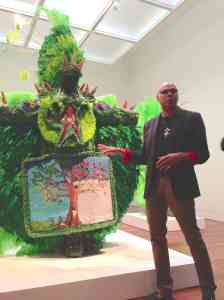
Alonzo Wilson explains how the cycle of life and the seasons are reflected on the beaded apron of the "Big Chief: Tree of Life" costume.

Alonzo Wilson explains how the cycle of life and the seasons are reflected on the beaded apron of the “Big Chief: Tree of Life” costume.

For the series, Alonzo felt it was important to embed part of each character’s story into the stories being told on the panels, even if the costume was only seen for a few minutes on TV. Thankfully, the exhibition (and our Flickr feed) lets you closely examine some of this character development-in-beadwork – a chief shedding a crystal tear for his hurricane-damaged home, a white buffalo evoking the return of bounty post-Katrina, and stunning use of hurricane weather symbols amidst a bold S.O.S.

Originally mounted by the Ogden Museum of Southern Art, curator Bradley Sumrall was impressed by Alonzo’s use of narrative that broke through the typical Hollywood stereotypes of African Americans and Indians. “We could have just done a show with traditional Mardi Gras Indian costumes, but Alonzo’s work had so much narrative built in.” With the mix of African-American, Native American, government, city, and current-event references, Bradley felt the layers of meaning in such intricate craftwork was an achievement worthy of a fine-art exhibition.
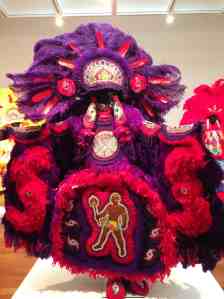
"Spy Boy: Katrina Memorial" costume. Feathers on lower half spell out "S.O.S.", the international distress signal, using the universal symbol for hurricanes from weather maps.

“Spy Boy: Katrina Memorial” costume. Feathers on lower half spell out the “S.O.S.” distress signal, using the universal weather-map symbol for hurricanes.

The NC stop for the show is a way for others to understand a bit more about New Orleans people, neighborhoods, and culture. Plus, Wilmington is Alonzo’s hometown. The movie and slide show inside the gallery provide an even deeper window into to this achievement – showing how Alonzo and his crew learned from the traditional craftsmen, shared new beading techniques, and received some “rescue help” from the locals when the production deadlines were too much to handle.

The exhibition all adds up to win-win storytelling about Alonzo, his team, New Orleans, and the Indians. Read an interview with Alonzo on the HBO blog and see behind-the-scenes production photos on page 40 of the Wilmington magazine Salt.

Philadelphia Museums Reach 2.4M YouTube Views

Since Philadelphia museums, zoos, and gardens began posting videos online in 2008, collective YouTube views have climbed to 2.4 million, as chronicled in our latest report, Philadelphia Museums: 2013 Video and Social Media Rankings. The biggest surprise about the Philadelphia museum videos is that stylistically they are a bit different than New York museum videos. The institutions in Philly take a more whimsical approach to science, use a lot more promotional videos to drive exhibition attendance, and occasionally throw in a bit of the macabre.

Longwood Garden’s Top Philadelphia Exhibition Video of 2012

The Top Philadelphia Exhibition Video of 2012, courtesy of the Longwood Gardens grounds crew and Bruce Munro

Highlights of our report on 32 Philadelphia museums:

As of year-end 2012, the Philadelphia institutions with the highest number of total YouTube channel views are the Penn Museum, the Mutter Museum, and Longwood Gardens. Penn’s channel features a mix of behind-the-scenes videos about exhibits, anthropology lectures, and a gigantic docu-archive; the Mutter produces highly creative shorts highlighting selections from its tantalizingly weird collection; and Longwood simply has tons and tons of fans that want to see what’s up with the seasons.

Last year, Longwood Gardens produced Philadelphia’s highest rated museum video — Light: Installations by Bruce Munro. Over 36,000 nature and art lovers viewed this short about Longwood transforming itself into Munro’s luminous vision. The garden also pumped out other video promos and features all year that kept their fans coming back to hit the YouTube channel.

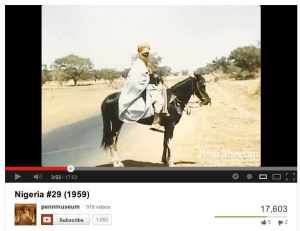
The Penn Museum’s Top Anthropology Video of 2012 features a sheik among many other people and places in 1959 Nigeria

The Penn Museum’s Top 2012 Anthropology Video Nigeria #29 (1959) features a sheik, a mosque, a fuel depot with camels, and country life the way it used to be

The Penn Museum’s YouTube channel surpassed 1 million views in May. Penn’s been adding an enormous anthropology film collection to its channel (over 400 films) and the time-machine quality is irresistible. It’s no surprise that Penn’s Maya 2012: Lords of Time videos captivated the public all year, but it is interesting that the silent travelogue Nigeria #29 (1959) is up to 17,000 views. You could poke around that channel for days.

The Chemical Heritage Foundation produced Philadelphia’s most popular science video. Over 26,000 people watched A Distillations Explainer: Sweat, part of the Foundation’s Blood, Sweat, and Tears series (see below). It’s an entertaining, well-produced podcast series.

The Mutter Museum presents its unusual medical collections quite effectively through its YouTube series. Their 2012 series feature the curator taking “mystery” items out of the cabinets and challenging the viewers to identify them. Not for the squeamish, but really clever and nicely scripted.

The most active museum Twitter users in Philadelphia are the National Constitution Center, the Eastern State Penitentiary, and the Penn Museum. The most active Flickr users during 2012 were the Franklin Institute Science Museum and the Pennsylvania Academy of the Fine Arts. The largest Flickr photo pools are populated by Longwood Gardens and Eastern State Penitentiary enthusiasts.

All the video and social media details on 32 museums are in the report. Click here to see what’s included and make a purchase from our Its News To You Reports shop.

Enjoy watching Philadelphia’s top science video, courtesy of the Chemical Heritage Foundation. Meet Louis Pasteur and find out why sweat often smells:

Dive Into MAD’s New Jewelry Web

MAD's digital gallery navigation tool, featuring a photo of a model wearing Peter Hoogeboom’s Spanish Collar (1995)

MAD’s digital gallery navigation tool, featuring a photo of a model wearing Peter Hoogeboom’s Spanish Collar (1995)

The Museum of Art and Design has spent a lot of time collecting brooches, collars, rings, and pins for its collection — around 200 mid-century pieces over the last few years. About half of MAD’s new stuff is on display in the show, Wear It or Not: Recent Jewelry Acquisitions, which closes this Sunday.

If you can’t get up to Columbus Circle to see the works in person, be sure to check out the new digital archive for the show. MAD has spent considerable time and effort to get its collections pushed out through the web, and the effort really pays off.

This photo of Peter Hoogeboom’s Spanish Collar shows the navigation tools that MAD has designed for its on-line archive that let you zoom in close right in to take in all of the construction details of his ceramic, silver, and brass construction.

Model wearing The Big Spiderweb, No. 2 made of sterling silver in 2005 by Lucie Heskett-Brem, The Gold Weaver. Photo: Louis Brem

Model wearing The Big Spiderweb, No. 2 made of sterling silver in 2005 by Lucie Heskett-Brem, The Gold Weaver. Photo: Louis Brem

Use the + to zoom in, and then click on the arrows to navigate up, down, left, and right across the image. The detail is incredible.

Dive into the archive to zoom in on Robert Ebendorf’s Berlin Wall brooch (made from guess what?), Luis Acosta’s multilayered paper constructions, and The Big Spiderweb. Also be sure to inspect Boris Bally’s brooches that were crafted from recycled traffic signals and the 19th century Sprocket Cuff from Northern Pakistan. It looks on trend right now.

You’ll be inside the archive for hours, since every time you click on an artist’s work, other related innovations pop up in the sidebar.

And what’s up with that red adhesive piece by Rebecca Strzelec? Take a look at how you wear it!

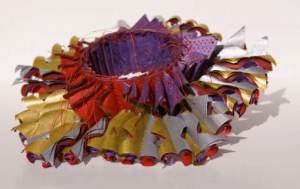
Luis Acosta’s 2009 bracelet is made of six layers of stitched paper. Photo: Luis Acosta

Luis Acosta’s 2009 bracelet is made of six layers of stitched paper. Photo: Luis Acosta

Interior Design Goes Medieval Avant-Garde at National Gallery

An avant-garde 1890s tapestry by Morris & Co., Edward Burne-Jones, William Morris, and John Henry Dearle (designers), The Arming and Departure of the Knights of the Round Table on the Quest for the Holy Grail. Collection of Jimmy Page, courtesy of Paul Reeves, London

An avant-garde 1890s tapestry by Morris & Co., Edward Burne-Jones, William Morris, and John Henry Dearle (designers), The Arming and Departure of the Knights of the Round Table on the Quest for the Holy Grail. Collection of Jimmy Page, courtesy of Paul Reeves, London

How did a secret society of artists in the 19th century turn into one of the most beloved interior design trends of the modern era? That story is the most surprising part of the exhibition (closing May 19) at Washington’s National Gallery of Art, Pre-Raphaelites: Victorian Art and Design, 1848–1900.

Organized by the Tate (and originally titled Pre-Raphaelites: Victorian Avant-Garde), the show introduces us to the PR Brotherhood (founded 1848), whose oil paintings and writings looked to the Middle Ages, myths, and legends of ancient literature for the spirituality that they felt was missing from modern, rapidly industrializing life.

Early collaboration by Rossetti and Morris, The Arming of a Knight chair, 1856 – 1857, painted pine, leather, and nails. Source: Delaware Art Museum, Wilmington.

Early collaboration by Rossetti and Morris, The Arming of a Knight chair, 1856 – 1857, painted pine, leather, and nails from the Delaware Art Museum,.

Dante Rosetti, William Holman Hunt, Edward Burne-Jones, William Morris, and others took inspiration from meticulous observation of nature, sensual textiles replicated in their paintings, and ethereal muses in medieval robes, which they often painted on location in leafy, natural settings.

In 1859, Rosetti painted a cupboard as a wedding gift for Morris. It wasn’t long before these pals ran with the inspiration — constructing medieval-inspired furniture and decorating it with similar mystical medieval images and experimenting with mixed media (images + poetry) on tiles, tables, and other creations made by hand.

For all the beautiful painting in the National Gallery’s show, the most startling room is the one that showcases the fact that the painters took it one step further by creating chairs, tapestries, tables, and textiles for forward-looking couples who wanted to live the 360-degree experience. In the 1860s, Morris & Co. was the go-to interior design shop for medieval-style avant-garde furnishings. They singlehandedly drove the stained-glass revival in Victorian architecture.

In 1873, Morris & Co. went international, selling wallpaper in Boston. Soon, American retailers in most major cities were carrying the hand-blocked or woven wall coverings and textiles.

Block-printed cotton designed by Morris (printed 1884-1917) from The Baltimore Museum of Art

Block-printed cotton designed by Morris (printed 1884-1917) from The Baltimore Museum of Art

Ever the advocate of the handmade, Morris was passionate about the relationship of decorative arts to the modernist movement. During Oscar Wilde’s US speaking tour in 1882, his lectures about Morris, the Pre-Raphaelites, and the nobility of hand-crafted work spread the trend in hand-crafted interior design in America.

Today, just about every museum shop carries William Morris-inspired something-or-others. Here’s the Tate’s video about the 17th century carved oak bed that Morris himself used in the 1890s. It’s all about the hand-made approach to the bedding textiles – a modern-medieval collaboration between his designer daughter, Mary, and wife, Jane.

Hats off to the Tate and National Gallery for presenting avant-garde design in a new light. Check out the rest of the Tate’s PR videos, including the one with Karen Elson on the topic of model as muse, then and now.

NYC Museum Videos Receive 49 Million Views on Social Media

The Japan Society’s popular Japanese language series

The Japan Society’s popular Japanese language series

After reposting so many museum videos here, we wondered how much video museums were producing, what social media they were using, and who had the most viewership and followers. We counted, and found that the museums, zoos, and botanic gardens around New York have racked up 48.8 million views on their public YouTube channels since 2007.

The volume of activity on was so significant that we couldn’t help documenting it and packaging the rankings into a report, NYC Museums: 2013 Video and Social Media Rankings.

Museum folks may want to purchase the full 48-page report to see how their organization stacks up, but here are some of our key findings:

As of year-end 2012, NYC museums with the highest number of all-time YouTube channel views were the Paley Center, American Museum of Natural History, and  Japan Society. Paley merges its NYC and LA feeds, and it’s 33M all-time video views are mostly from TV celebrity show panels in LA. So if we’re really looking at the museum programming champs in NYC, it would be AMNH (15M), Japan Society (7M), and MoMA (6M).

The Top NYC Museum Video of 2012 -- an AMNH Science Bulletin Whales Give Dolphins a Lift

The Top NYC Museum Video of 2012 — an AMNH Science Bulletin Whales Give Dolphins a Lift

The top NYC museum viral video of all time is The Known Universe video produced by AMNH for the Rubin Museum’s 2009 show, Visions of the Cosmos – 11M views and still growing. The video was generated from the Hayden Planetarium’s data set.

In  2012, another AMNH video, Whales Give Dolphins a Lift, went viral with 2M views. The AMNH has an active video-production team supplying content to its Science Bulletin walls inside the museum. Hats off to them for making a winning wordless video out of a few still photographs from field scientists in Hawaii, simple titles, and tranquil music.

The popularity of Japan Society’s language lessons are driving the numbers on their channel. Who can resist clicking through all the 2-minute lessons in their Waku Waku Japanese series with Konomi?

Asia Society’s Top NYC Museum Music Video of 2012

Asia Society’s Top NYC Museum Music Video of 2012

The top 2012 NYC museum music video was produced by the Asia Society, Arif Lohar and Friends: Jugni Ji!. Who knew that the finale to a Sufi pop legend’s concert on Park Avenue one year ago would rack up over half a million views?

The top star featured in a 2012 NYC museum exhibition video was a piece of 18th century mechanical furniture displayed at the Metropolitan. Viewership of The Roentgens’ Berlin Secretary Cabinet grew from 182,000 views at year-end 2012 to 1.6 million today. Can anyone explain how mechanical furniture received 25 times the viewership of the Met’s video walk-through of its blockbuster McQueen show, Savage Beauty?

The NYC museums using the greatest range of social media and video channels are The Jewish Museum and the Rubin.  One of the best under-the-radar NYC museum Flickr sites was the historical archive of Wall Street documents and treasures posted by the Museum of American Finance.

All the video and social media rankings 63 museums are in the report. Click here to see what’s included and make a purchase from our Its News To You Reports shop.

OK, here it is: the all-time top NYC museum video from 2009:

FIT’s Fashion Tech Timeline

Black velvet evening dress by Charles James (c. 1955) with a zipper inserted along that diagonal seam

Black velvet evening dress by Charles James (c. 1955) with a 3-ft. zipper inserted along that diagonal seam

Once you see the clothes in FIT’s Fashion and Technology exhibition inside a technology context, you’ll start making the connections at other shows all over town.

Exhibit A right inside the entrance – a seamless nylon-powder dress and bag made from CAD software and a 3D printer by Freedom of Choice in 2005 is a mesh wonder that is made by the same process as Amanda Levete’s woven Fruit Bowl in MoMA’s current Applied Design show.

Take the brilliant purple British day dress that FIT displays as an example of the revolution in color that occurred in the 1860s as analine dyes began to be used for the first time in commercial cloth manufacture. The Metropolitan Museum showcases the same point (except surrounded by Manet and Monet masterpieces) in its blockbuster time-series Impressionism, Fashion and Modernity. (Reference Camille.)

The 1860s color revolution due to analine dyes in commercial fabrics

The 1860s color revolution due to analine dyes in commercial fabrics

Outstanding achievement award invention + application at the FIT show: invention of the zipper in 1913 and the stunning accomplishment of Charles James, who inserted a three-foot-long zipper into a spectacular gown in a hidden seam on the bias (see left).

In Fashion and Technology, FIT makes brilliant use of its own stellar collection to chronicle the changes in technology that revolutionized fashion, from the advent of the Spinning Jenny in 1764 to the world’s first programmable T-shirt (see below).

For fans of the 18th and 19th centuries, here’s what technology mattered:

1764 – cotton replaces wool and linen as the go-to fabric (thanks, Spinning Jenny)

1780s – machine-knit textiles (200 years before double-knits)

1801 – Jacquard looms create complex patterns by using punch cards (up to 10,000, so take that Univac!)

1846 – sewing machines eliminate tedious hand stitching for the interiors of gowns

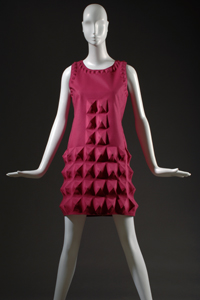
Pierre Cardin, dress, fuchsia “Cardine” textile with molded 3D shapes, 1968, Gift of Lauren Bacall.

Pierre Cardin, dress, fuchsia “Cardine” textile with molded 3D shapes, 1968, Gift of Lauren Bacall.

1856 – analine dyes bring about a color revolution to ladies’ fashions (go, hot pink!)

1857 – chain-stitch sewing machine

1860s – more color complexity with roller-printed fabrics

1880s – collapsible bustles let ladies sit down

1882 – celluloid used to imitate ivory and tortoiseshell for accessories

Check out the excellent exhibition timeline interactive to see these breakthroughs and what happened in the 20th and 21st centuries.

As promised, here’s the video of the world’s first programmable T-shirt:

Dance into Spring to Mr. Burrows’s Color-Block Beat at MCNY

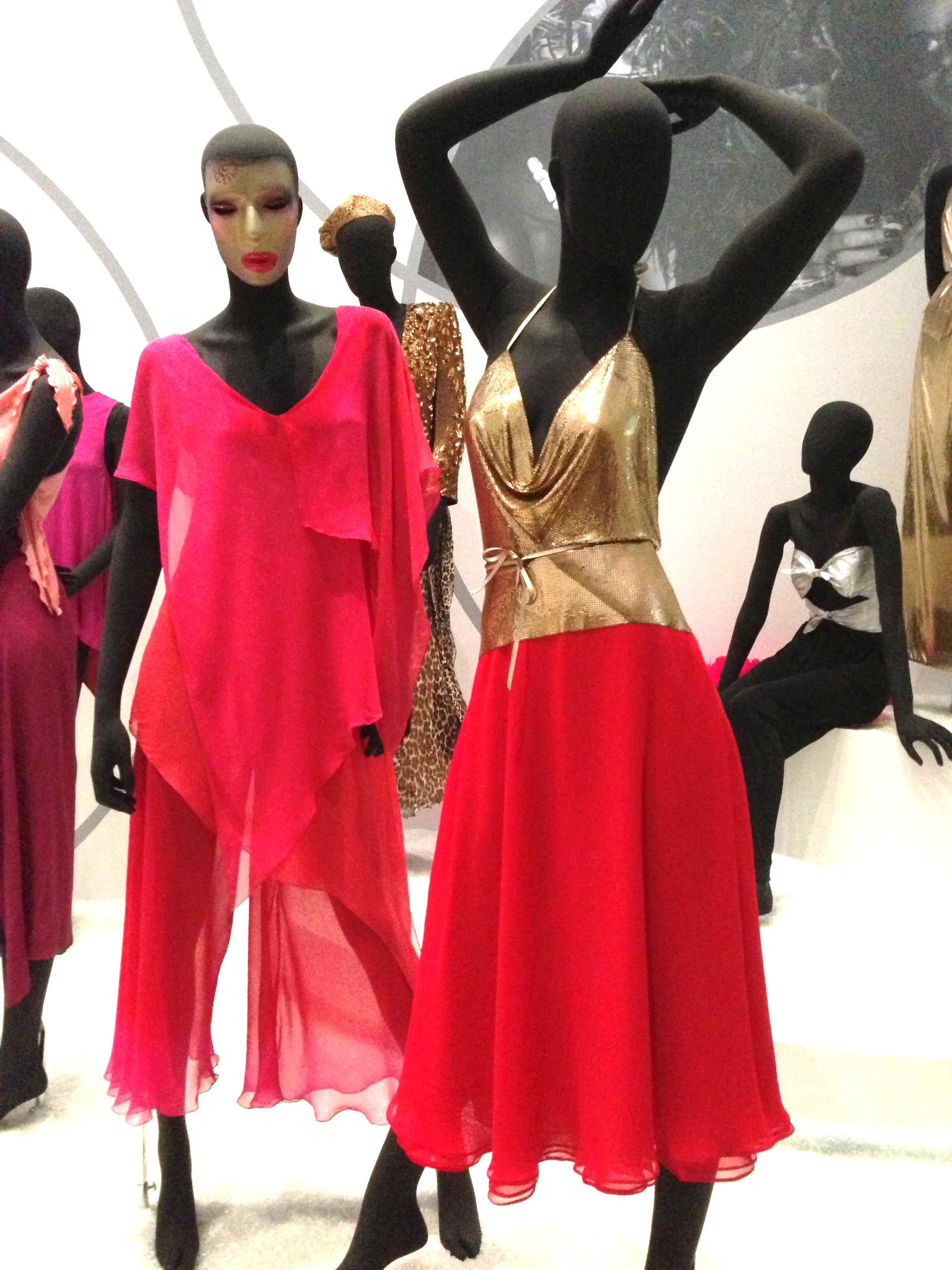
Studio 54 dance wear by Stephen Burrows.

Studio 54 dance wear by Stephen Burrows.

To experience an all-out burst of color, walk through the doors of the Museum of the City of New York and visit the paparazzi-worthy tribute to a 1970s design legend, Stephen Burrows: When Fashion Danced. You’ll get to know the man who styled Liza, Cher, Diana, Farrah, and so many icons of the 1970s with bright, beautiful, glamorous draped designs were made to whirl around the dance floor.

Vogue issues throughout the 1970s were filled with cavorting models sporting color-blocked coats, dresses, sweaters, and evening wear and lettuce-edged jersey wrap tops, cocktail dresses, and pant suits by King of Qiana, Stephen Burrows. When he burst upon the scene in the late Sixties, Geraldine Stutz installed him in her ground-breaking “street of shops” that she created at Henri Beldel, when it was still on 57th Street. If you don’t know Stephen’s work, a stroll through the first floor of MCNY will set you straight about who actually created the draped metallic disco top emblematic of Studio 54.

It’s the first retrospective dedicated to this stylish creative powerhouse, with ensembles drawn from the Burrows archive, FIT, the Metropolitan, and MCNY’s own treasure trove, and you’ll have until July 8 to see it.

Stephen gave us the draped metallic disco top and so much more.

Stephen gave us the draped metallic disco top and so much more.

The opening night party drew fashion royalty, and when we visited, Michael Kors was levitating with excitement, seeing the work that inspired so many to drape, piece, and glamorize with eye-popping colors. Check out the looks on the Flickr feed.

Don’t miss the major piece of fashion history hiding in one corner of the show: At a time when American fashion was viewed by Europeans as second rate, Burrows and Blass, Calvin, Oscar, and Halston were invited to follow the French at the still-talked-about 1973 benefit fashion show at Versailles. You’ll witness how Stephen and the NYC crew battled it out on the stage against YSL, Cardin, Ungaro, Givenchy, and Dior.

Spoiler alert: Stephen and his American crew won.  Historic is an understatement.

Shoe Obsession or War at FIT

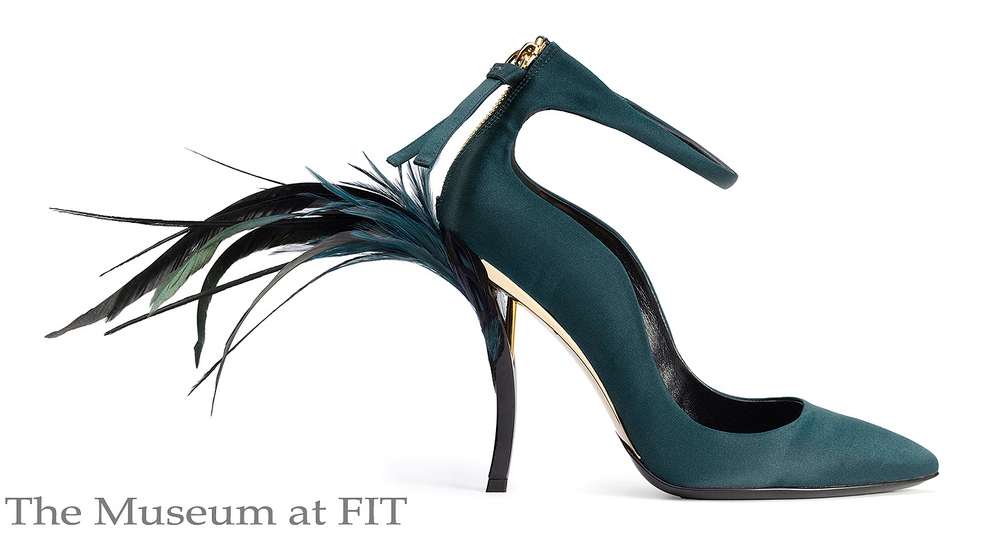
Eyelash Heel pump by Roger Vivier (Bruno Frisoni) (2012-2013). Courtesy of Roger Vivier/Photo by Stephane Garrigues

Eyelash Heel pump by Roger Vivier (Bruno Frisoni) (2012). Courtesy of Roger Vivier/Photo by Stephane Garrigues

The design gauntlet has been thrown down. The Museum at FIT’s lower-level exhibit, Shoe Obsession, pits establishment high-heel designers against upstart shoe artists in a no-holes-barred visual extravaganza that footwear lovers will savor.

There’s really no winner or loser. It’s all an impossible-to-take-in treasure trove. Take a look at FIT’s Flickr site, which gives you a taste, but doesn’t even tell half the story. There are 150 pairs of shoes on display, all fighting for your attention as to which is the best, highest, most outlandish, to-be-seen-in, and impossible-to-wear shoe creation.

Noritaka Tatehana’s Lady Pointe shoes designed for Lady Gaga (2012)

Noritaka Tatehana’s Lady Pointe shoes designed for Lady Gaga (2012)

The show, sponsored by Saks Fifth Avenue, focuses on 21st century shoe design, seeming to claim that bags are over and that shoes are “it”. If stats tell the story, FIT says that the average American woman today has over 20 pairs of shoes – double the average of the late 1990s.

The glass vitrines present all the artistry beautifully. When we visited, admirers were circling each slowly to view the exquisite, fanciful creations from all angles. The center  aisle features selections from several private shoe collections, including a few from McQueen muse Daphne Guiness.

You’ll see over-the-top works by incumbants Vivier, Prada, Blahnik, and Gucci right next to glass houses showcasing the upstarts, as in our photo here: Center front is Mariela’s actual glass slipper, which no one can actually wear. Above it and to the right, are Tea Petrovic’s prototypes inspired by futuristic sculptor Naum Gabo and the soaring architecture of Calatrava. On the left, Janina Alleyne’s menacing Exoskeleton shoe actually has been created by a 3D printer.

Go and make your own choice about what you would take home if you could.

There’s no video to accompany this incredible show (just a book), so enjoy the trailer for the documentary God Save My Shoes, which FIT had running in its 27th Street entrance:

FIT Grad Students Give Everyone the Boot

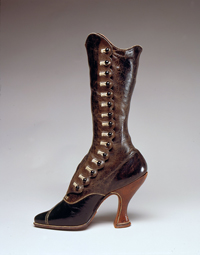
Curvy, red-lined leather “it” boot of 1900 by Jack Jacobus Ltd. Austrian fashion, gift of the V&A.

Curvy, red-lined leather “it” boot of 1900 by Jack Jacobus Ltd. Austrian fashion, gift of the V&A.

As part of FIT’s program in Fashion and Textiles Studies, the grad students have mounted a gem of a show about fashionable footwear  — Boots: The Height of Fashion, running just a few days more.

The museum’s side gallery tells an interesting story about how boots went from practical to glam, and from guy wear to girl fashion, beginning with some thought-provoking high-buttoned “look at me” boots from 1900, following on to the boot-clad flappers, and taking us straight through boot history to the heyday of the Warhol factory.

The students have rummaged through the FIT collection to show us their picks to demonstrate “boots as a second skin” (David Evins, Charles Jourdan, and silk Louboutins), the rebel look, fashion-tribe style, and over-the-top luxury.

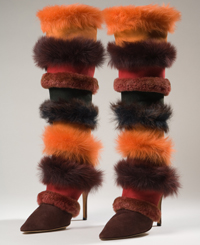
Fantasy-meets-luxury suede and shearling creation by Manolo Blanik (1997, UK). Gift of Ruffo.

Fantasy-meets-luxury suede and shearling creation by Manolo Blanik (1997, UK). Gift of Ruffo.

Among our favorites are the 1922 Ball Brand flapper galoshes and everything from the collection of Warhol superstar Baby Jane Holzer – 1963 Davide Beatle boots, 1969 Guccis, and 1971 embroidered boots from The Chelsea Cobbler.

The students also gave us a behind-the-scenes look with two cases about boot conservation. One case features pairs of boots (baby boots and high-buttoned shoes) with one shoe “conserved” and the other in its deteriorating state. The second case shows how the museum is preserving those famous “second skin” David Evins polyurethane leggings from 1960s, which sadly have broken down due to the atmosphere and light.

Although the following video is not associated with the show, it certainly shows that form-fitting high-style boots did not originate with Mr. Evins. Enjoy:

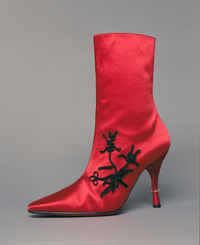
Second-skin Louboutin satin boots (1994-95 Fall collection)

Second-skin Louboutin satin boots (1994-95 Fall collection)

Celebrity Robot Says Good-Bye to Upper East Side

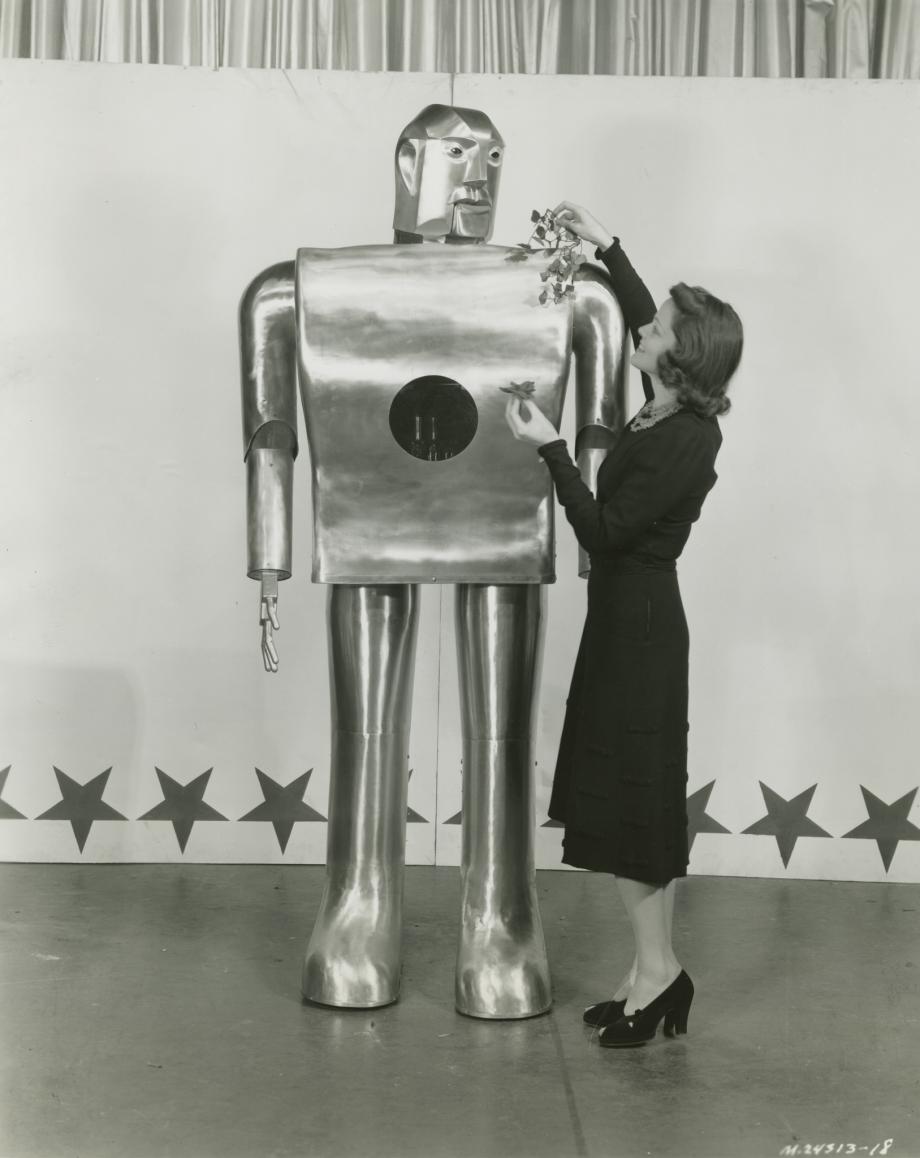
As musician Lois Kendall shows him red roses and green leaves, Elektro tells her the color of each. Source: NYPL

As musician Lois Kendall shows him red roses and green leaves, Elektro tells her the color of each. Source: NYPL

If you love the future, you have to see Elektro, the celebrity robot, who once held court in the Westinghouse pavilion at the 1939 New York’s World’s Fair, before he leaves the city once again. He’s the star attraction in the Museum of the City of New York’s Designing Tomorrow: America’s World’s Fairs of the 1930s exhibition, closing soon.

We couldn’t take photos inside the show, so here’s a publicity picture of Elektro back in 1939. He walked, talked, smoked cigarettes, as you’ll witness in this 1939 YouTube clip. This sensational moto-man used vacuum tubes, a 78 RPM record player, photoelectric cells, and telephone relays to wow the crowds.

But Elektro is only the tip of the Trylon of how fair design and engineering shaped modern American style. The show introduces the industrial design engineers that shaped products that grace MoMA’s design collection and insinuated themselves into everyday life – streamlined appliances, nylon stockings, Herman Miller clocks, Greyhound buses, and superhighways. Check out the MCNY’s excellent Tumblr feed for their visions of the future.

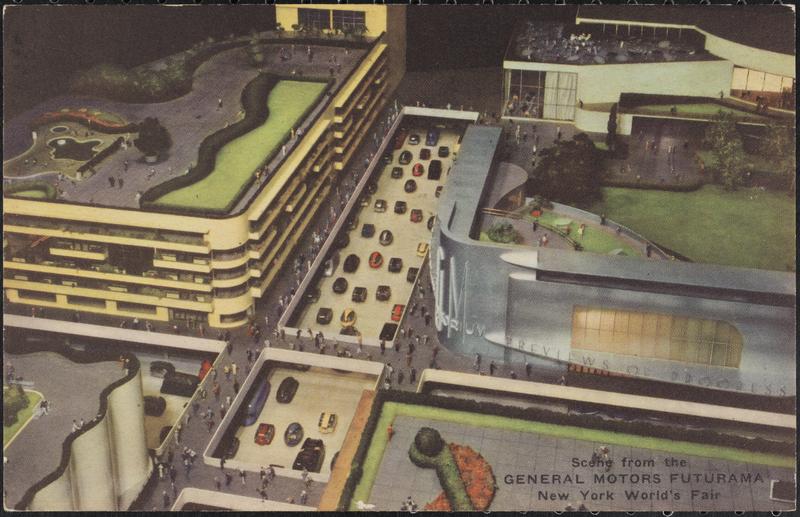
Postcard of the General Motors Futurama, NY 1939 World's Fair. Source: MCNY

Postcard of the General Motors Futurama, NY 1939 World’s Fair, that resembles BPC today. Source: MCNY

Among the show’s highlights are clips showing the GM Futurama, where New Yorkers waited in line for hours to see what the city of 1960 would look like. “Sound chairs” moved them along a conveyor belt where they could witness a vast scale model of modernized America, with superhighways soaring over canyons and cutting through mountains, and urban/suburban cloverleaf interchanges to keep traffic moving.

Afterward, people would exit into a full-scale World of Tomorrow where they would see what the urban intersection of the future would be – filled with pedestrian overpasses, department stores, and unimpeded whizzing traffic. It sure looked a lot like the view of Battery Park City along West Street.

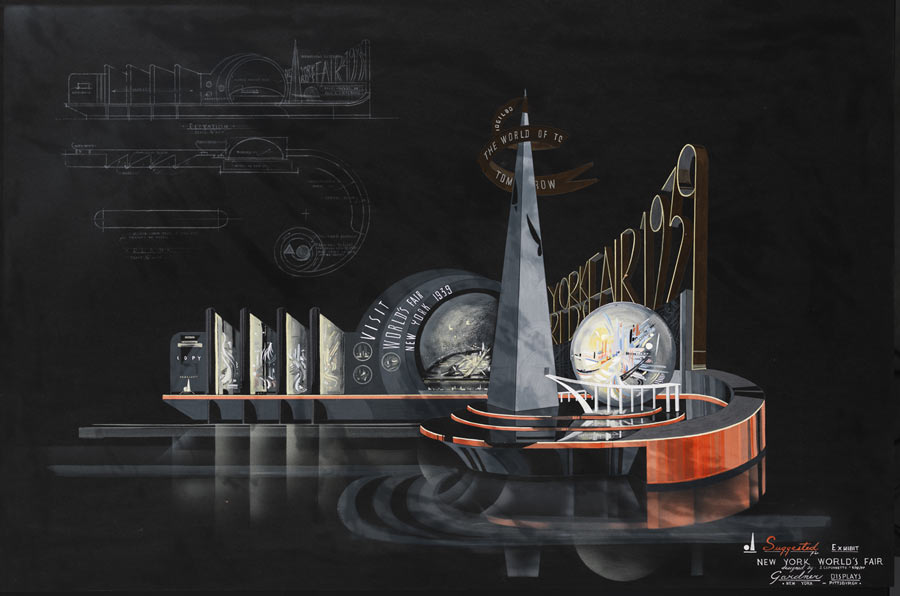
Suggested Exhibit for NY 1939 World's Fair. Watercolor & gouache on board. Source: MCNY

Beautiful watercolor/gouache from MCNY collection: “Suggested Exhibit for NY 1939 World’s Fair.”

Oh! Wallace Harrison, one of the architects of the Trylon and Perisphere actually did the master plan for Battery Park City…and Lincoln Center and the UN Headquarters building and Time-Life on Sixth Avenue!

So, no wonder Elektro feels right right at home in 2013 Manhattan. In 1939, he already could see what it would look like, right from his pavilion!

Take a spin around Elektro’s world, courtesy of the New York Public Library: