Met Refuses to Draw Line Between Art, Technology, and Fashion

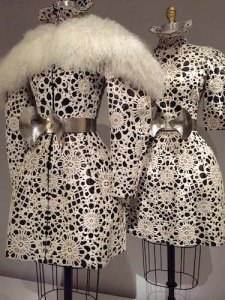
Sara Burton’s 2013 ensemble for McQueen: laser-cut pony skin bonded to leather, machine-sewn and finished with Mongolian lamb

Lasers: Sara Burton’s 2013 ensemble for McQueen: laser-cut pony skin bonded to leather, machine-sewn and finished with Mongolian lamb

As cool as an iPhone and as meticulously engineered, the Met’s new blockbuster Costume Institute show — Manus + Machina: Fashion in the Age of Technology — asks you to think about the frocks you’re seeing: does a designer’s reliance on technology diminish the artistic value of haute couture, which has for centuries relied upon handcrafted structure and embellishment?

See for yourself before August 14 and click here to look at the details in our Flickr album.

The show is a meditation on the beauty that can come when great design minds have centuries-old craft collide with technology. It helps to have gazzilions of resources (hands in Paris) at your disposal. The result: really good art and wondrous feats of engineering that just happens to be fashion.

There’s plenty to ponder and repeat visits are a must. Curator Andrew Bolton said that the idea came to him as he examined YSL’s iconic Mondrian dress and realized that this Sixties haute couture dress-that-went-viral was mostly stitched by sewing machine, a no-no in the rule-book of the Paris high-fashion syndicate.
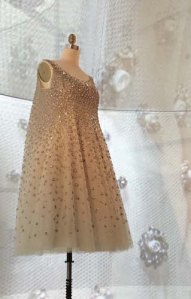
Yves Saint Laurent’s hand-worked 1958 trapeze in his first collection at Dior.

Yves Saint Laurent’s hand-worked 1958 trapeze in his first collection at Dior. Five layers of tulle with hand embroidery

It made him ponder the extent to which handwork and machine intersect in the world of high fashion.

Underwritten by Apple, there are no digital iPads or robots on the scene (like the Met’s revolutionary Charles James show) – just classical domes and arches highlighting masterworks of craftsmanship that cry out for the closest of scrutiny. Although it’s fun to waft through the crowds, getting glimpses of dazzling beadwork and dreamy Grecian-pleated chiffon gowns, to join Bolton in his investigation, reading the label copy, wall copy, and close inspection is a must.

Your first glimpse sets the historic context: The stunning Chanel wedding ensemble under the main dome (a created space made from a false floor across the upper level of the usually empty atrium of the Lehman wing) is surrounded by books. Leather-bound volumes of Diderot’s 1762-71 encyclopedia on liberal and mechanical arts are open to engravings of lacemaking and embroidery.
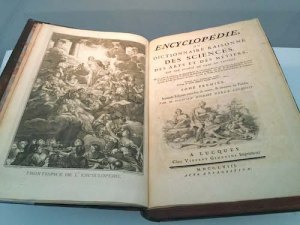
Diderot’s 1762-71 encyclopedia on liberal and mechanical arts

Diderot’s 1762-71 encyclopedia on liberal and mechanical arts

By including these “métiers”, Diderot elevated fine dressmaking skills to the level of respect given to other types of 18th-century engineering.

Bolton chose Diderot’s encyclopedia categories as the sub-sections of the show and gave each métier can-you-believe-what-you’re-seeing treatment. Click here to read more about each métier on the Met’s website.

The pleating section of the show is a great example, beginning by displaying the masterful hand-formed pleats on Grecian gowns designed by Madame Grés and the still-mysterious processes used by Fortuny to clothe boho types in liquid charmeuse pleats at the dawn of the 20th century.
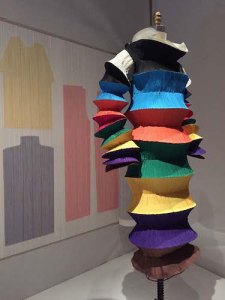
Issey Miyake ready-to-wear 1994 Flying Saucer dress fully extended; synthetic polyester that is machine pleated and stitched

Issey Miyake ready-to-wear 1994 Flying Saucer dress fully extended; synthetic polyester that is machine pleated and stitched

Across the way, you can compare Fortuny’s craftsmanship with machine-stitched and pleated versions, which are no less compelling. Mary McFadden’s pleated dresses were must-haves of the must-be-seen society set in the Seventies and Eighties. Mary’s synthetic pleated fabric was a pull-it-out-of-the-suitcase miracle in a world of jet-set travel and society parties.

And don’t ignore the works in the show by Issey Miyake, who wowed the design world with innovative pleated shapes that twisted and turned into avant-garde dresses and tops. Machine made from synthetic material, Miyake’s creations could fold flat and be popped into action in a nanosecond. His techno-trick was to make an entire, gigantic garment, position the fabric into pleats and run the entire garment through a heat press. Go, Flying Saucer dress!

In every section of the show, Bolton provides something historic (such as the 1870s hand-crocheted wedding gown) bookended by blazingly new creations, such as Iris Van Herpen’s 3-D-printed creations.
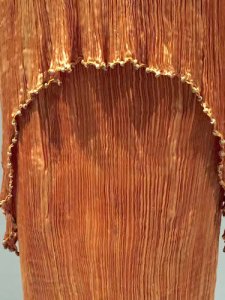
Close-up: Fortuny’s hand-pleated, hand-sewn 1920s charmeuse dress; Venetian-beads embroidery and hand-knotted silk trim

Close-up: Fortuny’s hand-pleated, hand-sewn 1920s charmeuse dress; Venetian-beads embroidery and hand-knotted silk trim

Muslins from Charles James reveal classic tailoring techniques by the master engineer, worked and re-worked by hand until perfection was achieved. Miyake pushed the boundaries of modern dressmaking one step further by using lasers to cut polyester monofilament, draping it, and shaping it with metal snaps –creating a dress without using any needles, thread, or scissors.

Laser cutting makes multiple appearances in the show with the work of Comme des Garcons, Iris van Herpen, Thom Brown, and Sarah Burton for Alexander McQueen. However, traditional techniques by historic Parisian ateliers are on view, too – a Chanel embellished by Maison Lemarie with 2,500 fabric camellias that took 90 minutes each to create, Dior’s post-war embroidered floral dresses bursting with foilage, and YSL’s game-changing trapeze dress in his first collection for Dior. This last creation had five layers of tulle embellished with crystals, beads, and sequin clusters by Maison Rébé.

At the press opening, Apple’s designer extraordinaire, Jony Ive, cautioned viewers to remember that technology and craft are not at odds. The notion of care – whether by hand or machine – is intrinsic to everything in the show.

Enjoy Mr. Bolton’s walk-through.
MoMA Connects Music and Modernism

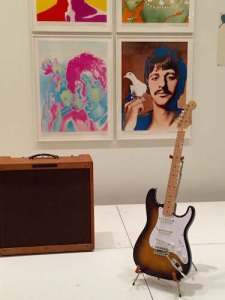
A decade apart – 1957 Stratocaster and Avendon’s 1967 posters of the Beatles

A decade apart – 1957 Stratocaster and Avendon’s 1967 posters of the Beatles

The MoMA Design Department had a brilliant idea – to tell the history of 20th century music culture by pulling out objects and two-dimensional art from the museum’s rich collection. How did modernism and music influence one another? See Making Music Modern: Design for Eye and Ear, on view through January 18.

There’s still time to catch some demos of the Scopitone, the Stratocaster, and the Mechanical Flux Orchestra inside the gallery this weekend.

Although a lot of the buzz in the gallery is over visitors’ recollections of the turntables, radios, and album covers on display, the curators do everyone a favor by putting the mod, mod world into historical context at the start of the show.

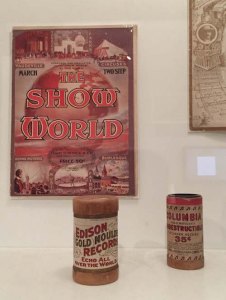
Early Edison sound experiments, films of Loie Fuller and Josephine Baker, and a poster of Yvette Guilbert from the can-can era remind everyone that shocking live performances, revolutionary music trends (go, ragtime!), and print designs that pushed the limits don’t belong exclusively to the mod, punk, or techno eras.

Early pop music innovations: sheet music and Edison wax cylinders

Early pop music innovations: sheet music and Edison wax cylinders

Tucked into side panels and corners are photos of costumed interplanetary performers of the Triadic Ballet at the Bauhaus in 1922 and early Russian avant-garde takes on the advent of radio, the broadcast and communications technology that changed entertainment forever.

These were worlds where artists and designers did it all – fine art, typography, industrial design, textiles, and performance. There are even some snippets of early acoustic-enhancing textiles on display, courtesy of Anni Albers. Design and music mixed, right from the start of the last century.

The sleek, streamlined radios, microphones, and Rural Electrification poster from the 1930s are presented as icons of the earliest era of broadcasting, with reminders from the curators that the designs were made to rescue the radio from its early haywire, spaghetti-city look that first appeared on 1920s garage workbenches across the country. Make it look nice, and you can bring it inside, where we can all enjoy it.

Stylish: 1932 Bakelite radio by Wells Coates and a 1939 Unidyne mic by Benjamin Baker.

Stylish: 1932 Bakelite radio by Wells Coates and a 1939 Unidyne mic by Benjamin Baker.

Throughout the Fifties and Sixties, music and design seemed to go hand in hand. Consider the Sixties revolution in turntable and speaker design – everything fit for a super-modern lifestyle of easy listening with jazz and high-concept percussion album covers nearby.

The invention of the Fender Stratocaster guitar revolutionized the sound and look of early rock and roll with its iconic whammy bar and performances that represented out and out rebellion. Although the Stratocaster was invented in the 1950s, it’s appropriately displayed in front of posters of Bob Dylan, The Yardbirds, and Avedon’s Beatles – an innovation adopted by Buddy Holly that inspired the next generation.

Where pop music and art come together – Sixties album covers, including those by Richard Hamilton and Warhol

Where pop music and art come together – Sixties album covers, including those by Richard Hamilton and Warhol

If you really want to dig into the details, there are dozens of famous album covers and posters on display with tribute paid to their designers. Among the luminaries are pop-god Richard Hamilton’s “White Album” for the Beatles, Warhol’s “Sticky Fingers” cover for the Stones, and Rauchenberg’s design for the vinyl disk inside the Talking Heads’ “Speaking in Tongues” album. The chronicle of the Fillmore East posters is a book unto itself.

And Mr. Jobs’ imprint is never forgotten at MoMA. An early version of his iPod is displayed right next to the Seventies invention from Japan that rocked the music world – the Sony Walkman.

If you can’t make it, take a look at the show through our Flickr views. We’ve grouped the items in chronological order.

And check out the excellent MoMA blog posts about the show on MoMA’s “Inside/Out” platform, where curators go to share enthusiasm about the hunt for the Stratocaster, famous rock posters, and other gems from the Fifties and Sixties. Leave your own comments, reflection on music and design, and memories right there on the MoMA website.

Before Walkmans and iPods

Before Walkmans and iPods

Texas Retirement for World Famous NYC Dinos

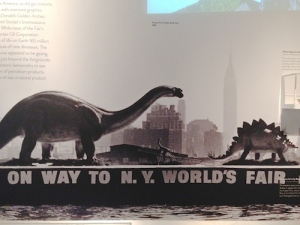
A 1964 New York Times photo of the Sinclair Dinosaur and Stegosaurus passing by the Empire State Building on their way to the Queens fairgrounds

A 1964 New York Times photo of the Sinclair Dinosaur and Stegosaurus viewing the Empire State Building on their way to the Worlds Fair fairgrounds

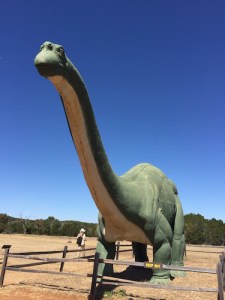
The Sinclair dinosaur was a sensation when he arrived in New York City to star in the 1964 World’s Fair. Millions of visitors queued to have their pictures taken with him and get a glimpse of life-size replicas of the scale and scope of the Mesozoic megafauna.

T. Rex, Stegosaurus, Triceratops, Trachodon…never mind that they lived millions of years apart – just to see them inspired science geeks, wonder seekers, and future paleontologists – an unforgettable childhood impression.

It may surprise you to learn that Sinclair and T. Rex are living a blissful retirement in Texas where there are no Unispheres, freeways, lines of tourists, or ticket booths…about 75 miles southwest of Fort Worth in a state park with another unique connection to New York.

Sinclair relaxes in a Texas corral

Sinclair relaxes in a Texas corral

The gargantuan dinosaur trackway up on the fourth floor of the American Museum of Natural History is from the Paluxy River in Dinosaur Valley State Park, where these two former New Yorkers have retired.

Back in the Thirties, AMNH field explorer Roland T. Bird told his boss, Barnum Brown, about the Texas trackways. In 1940, aided by WPA crews, the submerged tracks were excavated, cut into 1,200 pieces and shipped off to the AMNH, the Smithsonian, the University of Texas, and a few other places.The excavation was a media sensation, with chronicles appearing everywhere.

In New York, the jigsaw-puzzle track pieces were eventually reassembled and placed under the Apatosaurus/Brontosaurus, where they remain today.

Apatosaurus atop Paluxy trackway in New York at AMNH

Apatosaurus atop Paluxy trackway in New York at AMNH

The big, round blobby tracks that appear to match those of Apatosaurus are reckoned to be those of Sauroposeidon and the three-toed tracks running right alongside are those of Acrocanthosaurus, a predator.

Even though this spectacular trackway got moved to New York, there are still plenty in in the park. There are at least five big sites, which have all been documented in the Dinosaur Valley State Park footprint-mapping project. See the results here. When you click on each photo mosaics or track overlays, they will open in Google Earth. Find the R.T. Bird site under Track Site Area 2.

But how did the New York dinosaurs get to Glen Rose? The entire dinosaur group toured the United States for a few years after the Fair, right around the time that Texans lobbied to have the Paluxy Trackway declared a state park. No dinosaur fossils at the time, but there were lots of footprints, mostly underwater but a few on the shoreline. Neighboring ranchers donated the land, hoping to keep the site intact and spur tourism dollars.

Sauropod footprints underwater at the Paluxy River, Glen Rose, Texas

Sauropod footprints underwater at the Paluxy River, Glen Rose, Texas

When the Sinclair tour concluded, Atlantic Richfield’s idea was to donate all the dinosaurs to the Smithsonian, but when the Smithsonian said they didn’t want the group, the band broke up. One went to Vernal, one to Cleveland, but Glen Rose was the only location that managed to get the two biggest stars. Did the New York connection make the difference?

It’s hard to know, but the recently opened Perot Museum of Nature and Science features a pop culture corner in its dinosaur hall with replicas of all of the NYC’s World’s Fair dinosaurs!

For the complete story, check out this video of the tracksite and an introduction to the Google Earth mapping project, old videos of Mr. Bird’s historic 1940s excavation, and cameos by the Sinclair dinosaur and friends.

World’s Fair T Rex enjoying a quiet life in Texas

World’s Fair T Rex enjoying a quiet life in Texas

Sneaker Culture Wows Brooklyn

Nike’s original Air Jordan I (1985) and the 25th anniversary Run-DMC Adidas brings joy to Brooklyn fans

Nike’s original Air Jordan I (1985) and the 25th anniversary Run-DMC Adidas bring joy to Brooklyn fans

Crowds in Brooklyn are levitating with excitement as they explore their own sartorial history in The Rise of Sneaker Culture, an exhibition running at the Brooklyn Museum through this weekend. Finally, a fashion history and technology show that really resonates with the men in the room!

The hundreds of historic sneakers, mostly from the Bata Shoe Museum collection in Toronto, tell the story of how casual sports footwear came to be so dominant in today’s high-fashion landscape.

Although there are a few examples of women’s footwear – early Keds from 1916 and iconic Reeboks from the Jane Fonda-fitness era – the focus is squarely on the men, their sports, and their athletic-inspired designer footwear.

The history section of the show shows some of the earliest rubberized sports shoes from UK collections, but quickly moves into familiar New York City territory when colorful creations began appearing at pick-up games on basketball courts around the city in the 1970s, and when the tide really turned through sports and music licensing.

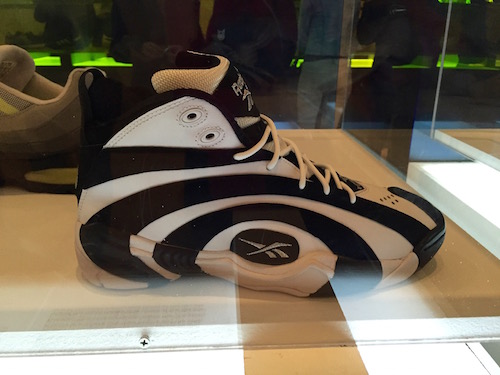
No one forgets the first time they saw Reebok’s Shaqnosis in 1995 (reissue)

No one forgets the first time they saw Reebok’s Shaqnosis in 1995 (reissue)

Crowds and docents jockey for space to worship at the altar of Nike’s 1985 Air Jordan I alongside the autographed reissue of Run-DMC’s 1986 Adidas. After Michael Jordan inked that deal and hip-hop video was distributed worldwide on MTV, sneaker fashion went viral. Electrifying images of loosely laced footwear were seen and copied by fans from the Bronx to Kathmandu. The right shoes and lacing style could wordlessly convey to others in the know, “I know what’s going down.”

Beautifully installed, Brooklyn crowds could work their way through men’s footwear history down one side and up the other – the original P.F. Flyers, original Chuck Taylors, streamlined European designs from the 1970s, Adidas’s early fitness shoes with built-in microprocessors, Nike’s Air Force 1, and Magic Johnson’s Weapons for Converse.

Nike’s 2009 limited edition for LeBron

Nike’s 2009 limited edition for LeBron

After the awesome case with the entire evolution of Air Jordans, the curators lined up a riot of color, technology, status, and design with evidence of so many subsequent licensing deals. Kanye’s new Yeezy Boot for Adidas was interesting, but the Reebock’s Shaqnosis and Nike’s limited edition for LeBron really stopped people in their tracks.

High-fashion sneakers by design and art luminaries Damien Hirst, Jeremy Scott, Chanel, Pierre Hardy, Raf Simons, Giuseppi Zanotti, and Rick Owens brought visitors right into the present day – when guys wear sneakers and tuxes to the Emmys, just as Michael Jordan predicted they would three decades ago.

A great touch at the show’s exit was the opportunity for visitors to leave a note about their own personal “sneaker story” and draw their favorite one.

Take a look at our favorite footwear from the show on our Flickr feed, all presented in chronological order. And enjoy this brief presentation on men’s contemporary footwear in this behind-the-scenes peek into the collections of the Bata Shoe Museum with senior curator Elizabeth Semmelhack:

Daring Docent Dishes with Digital Adam at The Met

Digital Adam and the Docent reenact what Paradise was like before The Fall

Digital Adam and the Docent reenact what Paradise was like before The Fall

There’s no need to check into the Met after hours to see a classical statue come to life. In Renaissance gallery 504 on the main floor, a digital version of Tullio Lombardo’s 15th-century Adam is interacting with visitors and a knowledgeable Docent in Reid Farrington’s The Return performance through August 2.

The Return is quite a production and its illusions created in the Italian Renaissance gallery would make any animation fan jump for joy.

Classical Adam (the marble one) is installed prominently in the gallery where half the performance takes place. Its presence is a miracle, since the beautiful Renaissance sculpture totally shattered in a freak fall in 2002.

To repair it – a complex undertaking — Met team made a digital replica of all the pieces to decide how to fit everything back together again and spent years making it whole.

Tullio Lombardo’s Adam (1490-1495), which fell and shattered in 2002, but has been exquisitely repaired

Tullio Lombardo’s Adam (1490-1495), which fell and shattered in 2002, and is now repaired

Now, it’s Digital Adam who’s the fascinating co-star of the show, brought back to life by performance artist Reid Farrington who envisioned a tribute to the virtuosity of the Met’s conservation team who so flawlessly reassembled Tullio’s Adam.

The other half of the performance involves an improv actor, a motion sensor suit, and a crew of digital engineers and prop masters, all camped out on the stage of the Met’s auditorium in the Egyptian wing. As the stage actor moves in the auditorium, Digital Adam moves, speaks, answers questions, and holds up a Warhol and a Van Gogh inside his lifesize digital frame in the Renaissance gallery to the delight of the audience and his sidekick, The Docent. See photos on our Flickr feed.

The audience decides what part of Classical Adam’s renovation will get discussed next, but the witty duo soon veer off into other fascinating topics:

Actor in motion-capture portrays Digital Adam, whose image is simulcast at the right and in gallery 504

Actor in motion-capture portrays Digital Adam, whose image is simulcast at the right and in gallery 504

What does it feel like to always look good and never age? Does Classical Adam remember back to the marble quarry? Does Biblical Adam remember what Garden of Eden was like before the Fall? Adam’s clever responses reveal that his Eden experience was a lot about infinity pools and the good life.

At one point, Digital Adam invites the Docent to portray Eve in his telling of what happened after the Serpent appeared with that apple. Then the attention turns back to Classical Adam, as the Docent shows Lombardo’s thinking about that particular moment portrayed in marble.

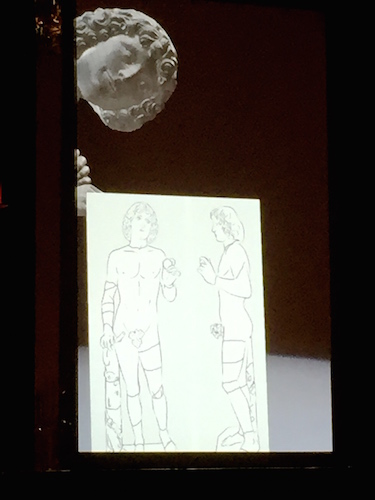
Digital Adam shows drawing of where the breaks in Lombardo’s Adam occurred

Digital Adam shows drawing of the breaks in Lombardo’s Adam

These two need their own ongoing talk show about history, time and space in some corner of the Met. Until August 2, ask the information desk for The Return’s program and go marvel at both the gallery and the behind-the-scenes performances. Or go to the live stream on the Met Museum’s website.

After meeting Digital Adam, you’ll never again wonder about what’s going on inside Classical Adam’s cool, calm, beautiful marble head.

10 Things to Know About Pluto’s Star Turn This Week

In real time, AMNH astrovisualization guru Carter Emmart notes the moment that humans reached the furthest point of exploration on Pluto on the big screen

In real time, AMNH astrovisualization guru Carter Emmart notes the moment that humans reached the furthest point of exploration, passing beyond Pluto

The American Museum of Natural History hosted a sold-out event at the crack of dawn this week to give Pluto fans (and Dr. Neil) a real time, play-by-play of what was happening on the edge of our solar system.

Check out our Flickr feed to see the visualizations created by Dr. Carter Emmart’s team at the Hayden Planetarium and glimpse some of the (human) stars at Mission Control and others who weighed in via Google Hangout from planetariums from around the world.

Here are 10 essential things you should know:

Pluto’s photo from earlier in the week appears on the Google Hangout, showing the “heart” area

Pluto’s photo from earlier in the week appears on the Google Hangout, showing the “heart” area

1) It was a fly-by. The New Horizons spacecraft flew by Pluto. It didn’t land or orbit around it.

2) Pluto has a reddish tint. The new color photos show that Mars isn’t alone.

3) Pluto has five moons. New Horizons is looking for more.

4) This marks the furthest point of human exploration to date. It happened just before 9 a.m. on Tuesday, July 14.

Just in -- the latest from New Horizons: July 17 photo of smooth frozen plains in Pluto’s “heart”

Just in — the latest from New Horizons: July 17 photo of smooth frozen plains in Pluto’s “heart”

5) The spacecraft, New Horizons, is the size of a grand piano. It traveled over 3 billion miles.

6) It took New Horizons 9-1/2 years to get to Pluto. It was launched January 17, 2006 and is expected to keep going out into space for another ten years. For the full story, click here.

7) The new photos confirm that Pluto is young and doesn’t have any craters (like our Moon or Neptune). Its 11,000-foot ice mountains are only 100 million years old (compared to the Rockies at 80 million years old). They formed during our Cretaceous period. More discoveries to come photos and data slowly stream in.

Fran Bagenal, New Horizons's co-PI, and Alice Bowman, the Mission Operation Manager — the first female Mission Operation Manager at APL Johns Hopkins

Fran Bagenal, New Horizons’s co-PI, and Alice Bowman, the first female Mission Operation Manager at APL

8) The transmission speed from the spacecraft is half the speed of an old dial-up modem. That’s why mission control will be receiving photos and other data from this fly-by for the next sixteen months or more.

9) Twenty-five percent of the people on the New Horizons project are women. Alice Bowman is the first female Mission Operations Manager at APL Johns Hopkins.

10) Dr. Neil keeps correcting people to call Pluto a “dwarf planet” but all of the scientists interviewed on the mission love it anyway. Some fans think it should be “grandfathered” into the solar system as an honorary planet.

Neil de Grasse Tyson reminds astrobiologist David Grinspoon at Mission Control to call Pluto a “dwarf” planet

Neil de Grasse Tyson reminds astrobiologist David Grinspoon at Mission Control to call Pluto a “dwarf” planet

Does Pluto have a molten core? What’s the topography of Charon? Are there geysers? Are there other moons? What’s going on with the Kuiper Belt? Stay tuned as New Horizons keeps going.

NASA has a TV channel featuring (now) daily media briefings on the photos and data and has a channel with all the updates on New Horizons, including links to new photos.

Also, tune into the New Horizons site hosted by mission control at APL Johns Hopkins. Next month, releases will be on a monthly basis.

Real-time visualization of how the New Horizons maps Pluto

Real-time visualization of how the New Horizons maps Pluto

Credit goes to Carter Emmart, AMNH’s director of astrovisualization, and the other creators of the Digital Universe for inventing this 4D open-source software and sharing it with planetariums around the world and applause for the scientists that made this expedition happen!

Nearly 11,000 people watched this live telecast from AMNH. If you have time, enjoy it for yourself by watching this YouTube recording of the event, currently at 46K views and counting:


When Apple Met Alto and Game Boy Began

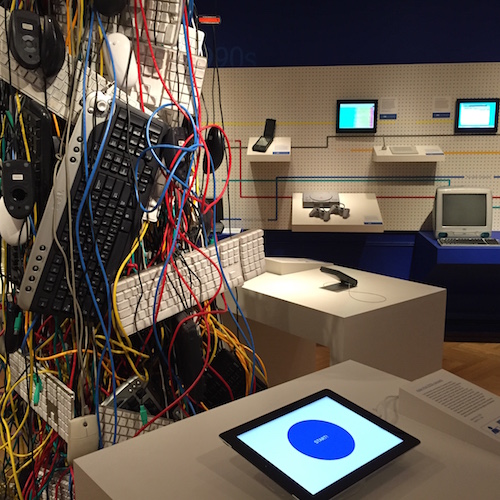
Tower of keyboards and wires in the center of the fourth-floor gallery; Newton visible against the history wall

Tower of keyboards and wires in the center of the fourth-floor gallery; Newton, PlayStation, and iMac visible on the history wall as iPad watches over everything

What’s the longest you ever sat in front of a computer screen or stared at stuff on your phone? Can you even remember a time before there were texts, browsers, and interactive screens? Bard Graduate Center Gallery has assembled a retrospective that asks you to remember your first keyboard, joystick, trackball, and mouse in their exhibition, The Interface Experience: Forty Years of Personal Computing, on view through July 19.

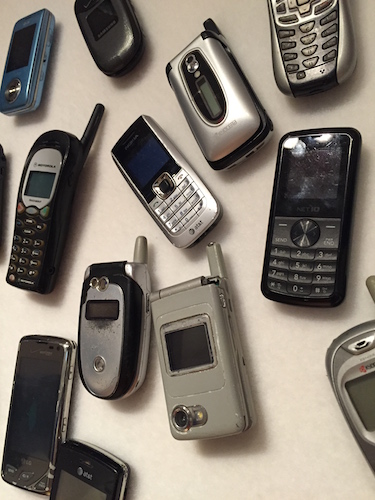
Plus, you can touch everything in the show and even sort through maybe every clamshell and Internet-enabled cellphone ever designed. What a stroll down memory lane!

Your first view of the fourth-floor show is a tangled tower of keyboards and cables, surrounded by a pegboard gallery with little platforms displaying the timeline of devices – desktop PCs, tablets, and game consoles.

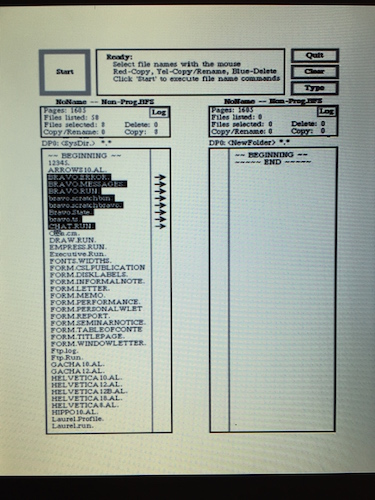
The 1973 Xerox Alto operating system featured the first mouse and graphic user interface.

The 1973 Xerox Alto operating system featured the first mouse and graphic user interface.

The oldest item in the show is the famous (but rarely glimpsed) 1973 Xerox Alto operating system, which the curators display on an ever-playing loop. Experience what Steve Jobs saw when he came face to face with the first graphical user interface, replete with the screen arrow. Brain flash on using a mouse to point to stuff on a screen – Steve said that someday everyone would be using something like this interface.

Walk on to see the Apple IIe (Woz built in an unbelievable 64K of RAM), VisiCalc (first “killer app” all quants had to have – a spreadsheet), and the predecessor to Steve’s Macintosh – the 1981 Xerox Star, which was the first commercially produced computer system to use a mouse and GUI. At a price of $16,000 in 1981, Steve’s up-and-coming Apple Macintosh was positioned to become a winner.

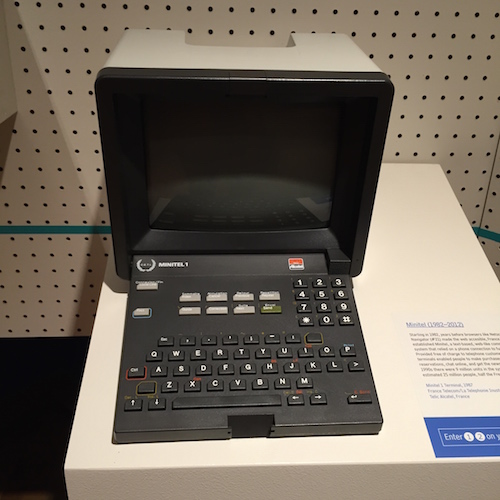
Before web browsers: Rarely seen, the exotic Minitel (1987 model) text information interface, which the French government distributed for free to half its population.

Before web browsers: Rarely seen, the exotic Minitel (1987 model) text information interface, which the French government distributed for free to half its population.

The Commodore 64 and IBM’s PC aren’t neglected, and neither is MS-DOS. Consider other game-changers such as Palm Pilot, Newton, and Kinect. You can touch them all and remember the way it was before things got smaller, faster, and got more oomph. Get a glimpse of the installation (pegboards and all) on our Flickr feed.

Don’t worry if you can’t get up to 86th Street to handle the technology in person. As usual, Bard’s students and faculty, who collaborated on this show, have produced a highly fulfilling web application that highlights everything in their show, adds historic tidbits, and shows each piece’s original print and TV ads.

Click on “Grid” to see all the exhibition items. Click on “Connections” to read interesting comments by the curators comparing different items or telling little histories about the relationships between the tech innovations. Click on “Device Statistics” to see how many units of each sold, how long it was in the market, and how much each would cost in today’s dollars. You’ll be able to sort the items by any of these parameters.

Steve’s hip and happening1998 iMac injected color into a drab, drab desktop computing world

Steve’s hip and happening1998 iMac injected color into a drab, drab desktop computing world

Example: sorted by today’s cost, the most expensive computing investment in the show would be the Xerox Alto operating system at (today) $225,981.

Be sure to click on “more” and enjoy the gallery of magazine ads for these innovations. And check out the 1979 TV commercial for Xerox Alto, on loan from the Xerox Archives, and please, do not miss the unforgettable all singing and dancing MS-DOS product introduction video.

You’ll read memories shared by gallery visitors about various items in the exhibition. For that matter, click on any item on the Grid and add your own story about your first personal encounter with these icons!

Bravo, Bard Graduate Center!

Mobile phones for days – the future of computing. The curators put these up with Velcro so visitors could feel them.

Mobile phones for days – the future of computing. The curators put these up with Velcro so visitors could feel them.

Dramatic Live Steam Show Envelops Virginia Museums

The restored 611 arrives in downtown Roanoke behind the art museum

The restored 611 arrives in downtown Roanoke behind the art museum

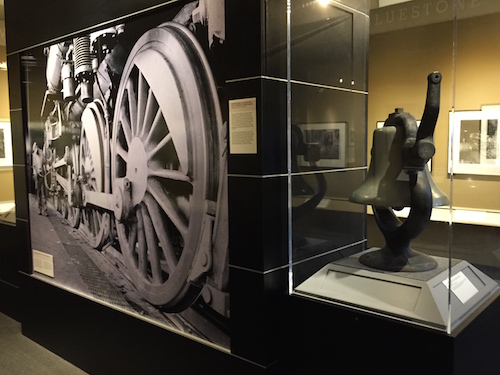
For the last month, crowds in western Virginia have been turning out in droves to see the dramatic result of engineering, technology, and determination by several museums and volunteers to resurrect the biggest, fastest passenger steam locomotive to live out its former glory on the Norfolk & Western Railroad.

If the CEO of Norfolk Southern hadn’t sold his Rothko in New York in 2013 and donated $1.5 million of its record-breaking proceeds, this amazing steam revival might not have happened.

Waiting for the 611 at Evington, Virginia on its debut run

Waiting for the 611 at Evington, Virginia on its debut run

The Virginia Museum of Transportation is celebrating the culmination of efforts to “Fire Up the 611” and let this 100-mile-per-hour wonder rip through the foothills of the Blue Ridge and points east all month and hopefully into the future.

As the 611 made its way from its rehab yard at the North Carolina Transportation Museum in Spencer, North Carolina, people lined the tracks to see the newly refurbished 1950s streamlined locomotive pull 17 passenger cars loaded with fans 140 miles north to its new home in Roanoke. The celebration of 611’s return has been going on all month, as the locomotive keeps making runs to Petersburg, Lynchburg, Radford, and other Virginia towns.

611 parked next to the O. Winston Link Museum

611 parked next to the O. Winston Link Museum

The 611’s Twitter feed lets everyone know when to expect it, although the piercing steam whistle and roaring sound are also sufficient alerts to anyone in a five-mile radius. Listen to its sounds on our Flickr video of its 45-mph pass through one lucky town and see photos its Roanoke arrival.

The 611 and its 13 sister locomotives (Norfolk & Western J Class) were produced after 1941 and pulled passenger trains through Ohio, North Carolina, Virginia, and Tennessee until the late 1950s – around the same time that Rothko painted the canvas that would later benefit the 611’s resurrection. Since it’s retirement, this coal-fired steam engine mostly sat in the yard at the Roanoke museum, but had a brief comeback in the 1980s making a few tourist rail runs.

Inside the O. Winston Link Museum, showcasing Link’s spectacular photographs of the last days of steam on the Norfolk & Western Railroad

Inside the O. Winston Link Museum, showcasing Link’s spectacular photographs of the last days of steam on the Norfolk & Western Railroad

Norfolk Southern initiated a “21st Century Steam” initiative, and volunteers at the Roanoke museum began the “Fire Up the 611!” campaign. The NS CEO decided to jump-start the initiative with the $1.5 million from the Rothko sale, and volunteers put in over 8,000 hours to bring the magnificent machine back to life.

When the 611 steamed into downtown Roanoke on May 30, it stopped for photos and an official welcome right behind Roanoke’s contemporary at museum and in front of the O. Winston Link Museum, housing the work of one of the most acclaimed railway photographers of the 20th century in the former Norfolk & Western Railway Building.

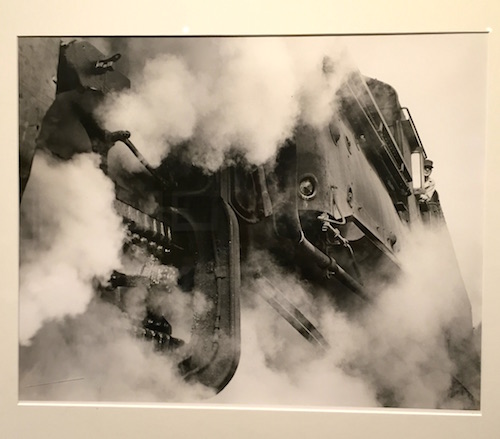
Link’s 1960s portrait of steam locomotive fireman, Joe Estes

Link’s 1960s portrait of steam locomotive fireman, Joe Estes

Link, a Brooklyn-born commercial photographer, fell in love with steam locomotives that he knew were rapidly being replaced by diesel. He innovated nighttime lighting gear to capture dramatic shots of the steam giants coursing through the hills and crossroads of West Virginia and Virginia. Link recorded their sounds as well – recordings that continued to sell well for decades. Catch a glimpse of Link’s gorgeous images, equipment and recordings on our Flickr site.

After finishing its July runs, the 611 will be on display in the museum yard in Roanoke, parked alongside other giants of steam.

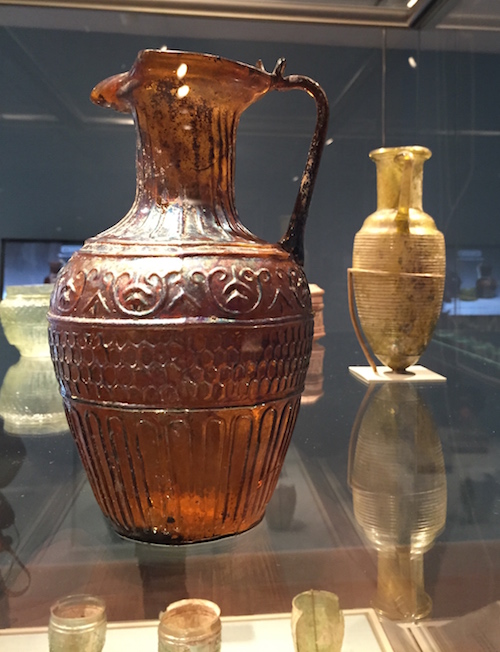
Ennion: Luxury Tableware at The Met

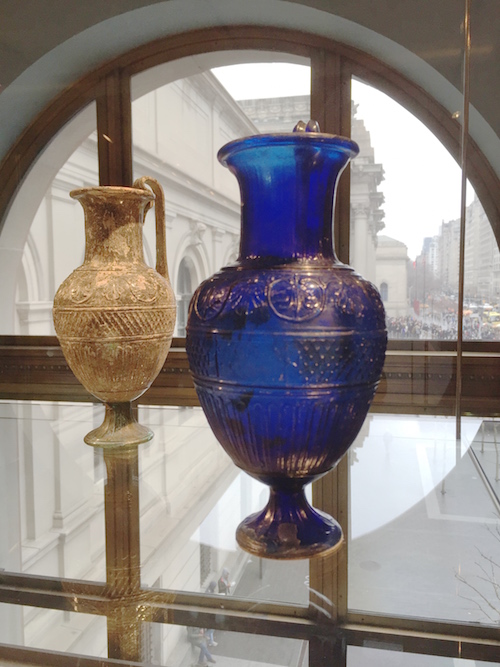
Two identical one-handled Ennion jugs from different sites. On right, the only Ennion piece with an intact foot, 1st c. A.D.

Two identical one-handled Ennion jugs from different sites. On right, the only Ennion piece with an intact foot, 1st c. A.D.

It’s unlikely that you have any of this sought-after designer’s pieces accompanying your best table setting or that the MAD Museum has any of his hand-blown, molded glassworks in their collection.

Two thousand years before ABC Carpet began retailing high-end home goods on Broadway and Martha Stewart branded her at-home lifestyle line, a Mediterranean craftsman in Sidon, Lebanon (then Phoenecia) created a line that every aspiring tastemaker in the Roman Empire just had to have. The Metropolitan Museum of Art pays tribute to his output in Ennion: Master of Roman Glass, on view just off the Greek-Roman study galleries through April 12.

Who needs old-fashioned metal cups or pottery jugs on the well-laid Roman table when Ennion was creating stunning cobalt-blue and transparent glass equivalents?

Two-handled cup, with Ennion’s Greek brand (“Ennion made this/it”). Blown glass into mold, 1st c. A.D. Courtesy: Turin museum; other by private collector

Two-handled cup, with Ennion’s Greek brand (“Ennion made this/it”). Blown glass into mold, 1st c. A.D. Courtesy: Turin museum; other by private collector

Ennion’s workshop was on the cutting edge of a manufacturing-and-craft revolution – blowing glass into decorative molds (which took the guesswork out of creating place settings for four, six, or ten) and exporting sets for sale throughout The Empire.

Ennion’s competitors were doing the same, but Ennion of Sidon had the big brand emblazoned on his work, working it into the design in the same way that MK, DKNY, DVF or YSL do today. His logo was written in Greek, the universal language of the first century: ““Ennion made me/it.” Scholars reckon that it was all made and exported from Sidon, a first-century glassmaking powerhouse, since none of Ennion’s molds featured a bilingual brand.

After two millennia, only about 50 of Ennion’s gorgeous works remain, and the Met’s show has assembled about half that amount from its own collection (courtesy of master-collector J. Pierpont Morgan), the Corning Museum, private collections, and other museums of antiquities in Israeli and Europe.

Non-Ennion glass jug made in a four-part mold; right, a two-handled amphora blown into a three-part mold, ist c. A.D. Source: The Met

Non-Ennion glass jug made in a four-part mold, 1st c. A.D. Source: The Met

In addition to Sidon, Ennion’s output has been found in excavations of ancient homes in places as far flung as Jerusalem, Croatia, Italy, and Spain. The Met’s team has had fun displaying glassware from identical molds next to one another, despite the fact that pairs were discovered thousands of miles from each other at different archeological sites.

Check out the Met’s beautiful tribute to a master artist on our Flickr feed.

Pterosaurs Leave New York

AMNH illustration of Mary Anning’s Dimorphodon. Courtesy: AMNH.

AMNH illustration of Mary Anning’s Dimorphodon. Courtesy: AMNH.

They came from all over the world to hang out for the ball drop, but will be gone by the time of the Super Bowl. Yes, the crazy cast of characters in the American Museum of Natural History’s show, Pterosaurs: Flight in the Age of the Dinosaurs, will decamp for their hometowns tomorrow, January 4 just like everyone else who came to New York and had a blast.

Quetzalcoatlus, Tropeognathus, and “Dark Wing” have been putting on quite a show for AMNH visitors since April, and only time will tell if New Yorkers have learned to stop calling them “dinosaurs.” They are flying reptiles.

AMNH illustration of super-tiny Nemicolopterus from China (10 inches) proves that not all pterosaurs were giants. He lived in the forest.

AMNH illustration of super-tiny Nemicolopterus from China (10 inches) proves that not all pterosaurs were giants. He lived in the forest.

The show features life-sized replicas of these flying machines and the big celebrity “Dark Wing” from Germany – the only pterosaur fossil yet found with impressions of the amazing wing membrane that contains layers and layers of thin muscle, all suspended from a single finger.

Get to know more about these amazing animals in the intro to the show, complete with a peppy soundtrack created by the Museum’s digital divas:


When Mary (“She Sells Sea Shells…”) Anning went scouting along Dorset’s Jurassic Coast in 1828, she found little Dimorphodon and sold it to Mr. Buckland, starting a scientific quest to determine the exact nature of these enigmatic creatures.

Happy Ptreranodon in the Vertebrate Origins hall before the crew made him a star of the show inside the Lefrak Gallery.

Happy Ptreranodon in the Vertebrate Origins hall before the crew made him a star of the show inside the Lefrak Gallery.

Most of the press at the time went gaga for the pterodactyl found in Bavaria during the 1830s and 1840s, named Pterodactylus by Mr. Cuvier. Pterosaur fossils have been around so long that it’s hard to believe that this New York show is the first time that these non-dinos have gotten the full star treatment.

Co-curators Mark Norell and Alexander Kellner and the AMNH exhibitions squad took on the jumbo challenge of mounting this first-ever museum show devoted solely to the vertebrates who “invented” flight. Yes, before birds (or bats) took to the skies, fuzzy-bodied pterosaurs were dive-bombing Mesozoic fish, launching from beaches, and leaving their unmistakable footprints on mudflats all over the ancient world.

Click here to see paleontologists searching for pterosaur footprints on an ancient Upper Jurassic beach in central Wyoming.

Pterosaur tracks in the Wyoming sandstone. Crooked forelimb print (L), hindfoot print (R). Taken on a 2006 trackway field trip with the Tate Museum.

Pterosaur tracks in the Wyoming sandstone. Crooked forelimb print (L), hindfoot print (R). Taken on a 2006 trackway field trip with the Tate Museum.

We couldn’t take photos inside the AMNH show of the beautiful pterosaur trackway from the Utah Field House of Natural History in Vernal, Utah, so this Flickr slide show gives you the idea. The shots were taken ten years ago, when paleontologists were still debating whether pterosaurs were bipedal or quadrupedal. As you can see, these Jurassic pterosaurs left quadrupedal tracks.

It’s doubtful that these flying marvels stayed on the beach for long. Watch here to see how gigantic Quetzalcoatlus and friends took off via the animations by the AMNH digital team, based on Michael Habib’s analytics and simulations. You’ll be surprised by what airplanes and pterosaurs have in common: