When Folk Music Ruled New York

Washington Square Sunday folk singing, early 1960s. Courtesy: MCNY/Nat Norman

Washington Square Sunday folk singing, early 1960s. Courtesy: MCNY/Nat Norman

The large map inside the exhibition tells the entire story of how a folk music revival germinated on a few blocks in Greenwich Village in the 1950s and exploded into a national mania for twelve-string guitars, songs of protest, and music that paid tribute to deep, deep roots of the American experience.

The Museum of the City of New York tells a fascinating tale with its multimedia exhibition, Folk City: New York and the Folk Music Revival, through this weekend. Take a look at some of the show’s highlights in our Flickr album.
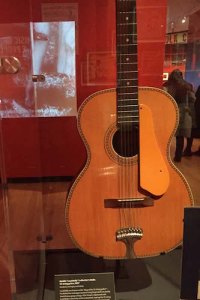
Ledbelly's historic twelve-string guitar

Ledbelly’s historic twelve-string guitar

The show ties together the tale of how Woody Guthrie and Alan Lomax got the ball rolling by shining a spotlight on Appalachian and Southern purveyors of down-home folk singing and inspiring a generation to look back, pay tribute, and carry it forward. MCNY has plenty of listening stations scattered throughout the gallery, offering up rare recordings that speak to the roots of popular music of the Sixties.

It’s a revelation to listen to Lomax’s 1934 recording of Ledbelly singing Good Night Irene and Midnight Special long before Pete Seeger, The Weavers, and Johnny Cash catapulted them to the charts in the Fifties and Sixties.

Flyers, broadsides, and other paraphernalia from Greenwich Village clubs paper the walls and vitrines, as the show steps through the story of how that sleepy NYC neighborhood transformed itself into a destination for the likes of Bob Dylan and other activist-artists who inspired a generation.
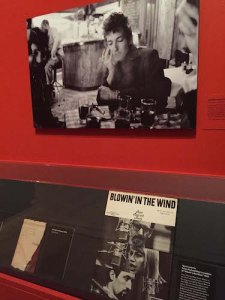
Photo of Dylan at Kettle of Fish Bar at 114 MacDougal Street in 1964 above his sheet music

1964 photo Dylan at Kettle of Fish Bar at 114 MacDougal Street above his sheet music

Music studios, clubs, publishing houses, coffee houses, and cold-water flats were all jammed into a few city blocks that functioned like a 24/7 open-mic night. Back in the late Fifties and early Sixties, music was pouring out of nearly every door on Bleecker Street and MacDougal.

The convergence spawned a network of producers and publishers who felt it was their mission to bring folk music to a wider audience – uptown at Town Hall, on alternative radio stations across the country, and executives at the big labels. Some of the highlights at the back of the gallery are Dylan’s handwritten lyrics for Blowin’ In the Wind and Mr. Tambourine Man.

Political battles are found at every turn in the installation, from Seeger’s encounter with McCarthy’s House Un-American Activities Committee to inspirational performances by Pete, Odetta or Peter, Paul & Mary at historic marches and protests. The music was always there, intertwined with the events of the day.

First edition of “Sing Out!” magazine, 1950

First edition of “Sing Out!” magazine, 1950

Although folk and roots music inspired artists like The Beatles and The Rolling Stones, the MCNY show notes that after Dylan went electric and the British invaded New York, the folk music juggernaut lost some of its steam. No matter. You can still see it all recreating itself on Bleecker Street at The Bitter End any night of the week, listen to an up-and-coming singer-songwriter, and view lots of those historic posters on the back wall after MCNY’s show closes.

Navajo Jewelry Masters Offer Glittering World at Customs House

Bracelet of coral, opal, suglite, lapis, turquoise, gold, and silver by Raymond Yazzie. Courtesy: NMAI/Knight collection. Photo: S. Franks

Bracelet of coral, opal, suglite, lapis, turquoise, gold, and silver by Raymond Yazzie. Courtesy: NMAI/Knight collection. Photo: S. Franks

If you’d like an immersion into a chamber of glistening silver and gems, enter the National Museum of the American Indian’s exhibition of stunning beauty and tranquility — Glittering World: Navajo Jewelry of the Yazzie Family.

The Smithsonian is providing New York with a unique chance to view 300 remarkable necklaces, bracelets, rings, and buckles from a New Mexico family of artists known for catapulting Navajo symbols, colors, and gems into a modern-art context.

Lapis and gold bracelet by Lee Yazzie, 1984. Photo: E. Aboroso, NMAI.

Lapis and gold bracelet by Lee Yazzie, 1984. Photo: E. Aboroso, NMAI.

The focus is on Lee and Raymond Yazzi, brothers whose award-winning, intricate creations are sought by collectors worldwide. You’ll see five magnificent pieces as soon as you enter, including work by their sister, Mary Marie – representing lifetimes of master craftsmanship inspired by the mountains, sun, sky, spirits, and family in Gallup, New Mexico.

Photomurals inside the door will transport you to the red rock monuments of Navajo Nation, 1950s trading posts along the old Route 66, and maps to turquoise mines that have supplied native peoples with high-end bedazzlers since 300 A.D. The Smithsonian will be returning it all to private collectors after January 10, so be sure to enter this beautiful realm before then.

Watch this testament to artistic inspiration and dedication to beauty:

And take a trip to the Navajo world to hear more on a lifetime of creation:

AMNH Highlights Species Living at the Limits

Tartigrades rule the show -- the micro-animal can survive at high heat, high altitude, high pressure, inhospitable climates, without water, and even outer space.

Tartigrades rule the show — the micro-animal survives high heat, high altitude, high pressure, without water, and even outer space.

If you’ve ever wanted to take a magic carpet ride to visit all the animals, plants, and environments you’ve ever seen on National Geographic or Nova, spend some time inside the special exhibition Life at The Limits: Stories of Amazing Species, running through January 3 at the American Museum of Natural History.

The curators and exhibition staff take you to the absolute limits of life on Earth in a “wow factor” show, organized into topics sure to astound.

How high into the atmosphere do animals live? How deep in the ocean? Who is the world-record holder for bite force? Who makes the longest migratory journey? Who is the award-winner for survival in the extreme?

The show will take you into deep caves, to life among the black smokers in ocean depths, to high altitudes, and even into outer space.

A deep-sea diving champion -- the Southern elephant seal can hold its breath for 2 hours and dive to 5,000 feet

A deep-sea diving champion — the Southern elephant seal can hold its breath for 2 hours and dive to 5,000 feet

And they’ve even thrown in some live creatures, too – the popular Axolotls, who retain their juvenile amphibious form into adulthood, and swimmers using the jet-propulsion method – chambered nautilis. Check out a few views on our Flickr feed.

Not to give anything away, but you’ll find out that vultures have been known to fly at 37,000 feet and beaked whales have been known to dive at least 10,000 feet below the ocean’s surface.

Live Chambered nautilis demonstrates jet propulsion

Live Chambered nautilis demonstrates jet propulsion

Crocodiles have a bit force of 3,700 pounds, electric eels and hammerheads can deliver 600 volts, and eagles can subdue animals of up 20 pounds in weight using only their claws. Arctic Terns may migrate 25,000 miles.

There’s no doubt that the stars of the survivalist show are miniscule tartigrades (better known as “water bears” or “moss piglets”). These miniature eight-legged water creatures inhabit climates that no human could. They are able to survive at temperatures colder than Pluto and hotter than boiling water and have been known to survive in the void of space for up to 12 days.

Moreover, tartigrades are prolific: nearly 1,200 species inhabit Earth in lichen, moss, beaches, and dunes and hold the distinction of residing at the International Space Station and being part of Space Shuttle Endeavor’s final flight.

Artist recreation of tube worms absorbing chemicals from ocean vents three miles under the sea – an environment unknown until 1977

Artist recreation of tube worms absorbing chemicals from ocean vents three miles under the sea – an environment unknown until 1977

How did life evolve to adapt to such extremes? Darwin explains it in his theory of natural selection, which leads to gradual adaptations within animal populations.

But you are left to wander and wonder at the engaging displays, animals, specimens, and movies.

Glimpse some of this fascinating exhibition in this video with co-curators John Sparks and Mark Siddall. By the way, the cover photo below is the Axolotl featured in the show:

MoMA Salute to Sixties Art World Transmissions

Announcement for Allan Kaprow’s 1968 Three Country Happening with collaborators in Germany and Argentina, one of the earliest artworks to incorporate an international telecast.

Announcement for Allan Kaprow’s 1968 Three Country Happening in NYC, Germany and Argentina, one of the earliest telecast international performance pieces.

Before restaurants and shops populated Tribeca and Soho in the 60s and 70s, edgy New York City artists were experimenting with happenings, video art, performance pieces, mail art, and assorted ephemeral pieces – Cage, Moorman, Kaprow, Ono, Paik, Grooms, Oldenberg and Maciunas to name a few.

In the pre-Internet days they might have been unaware that half a world away, Eastern European and Latin American artists were catching wind of this new art wave and stamping their own brand on their local art scene.

MoMA’s show, Transmissions: Art in Eastern Europe and Latin America, 1960-1980, captures the zeitgeist and shines a light on the artists, movements, and pieces from important avant-garde artists whose names are not as well known in the States. See it through January 3.

Organized into several rooms and themes, it’s a great collaboration among MoMA’s Departments of Media and Performance Art, Photography, and Drawings and Prints. The result puts a lot of MoMA’s huge Fluxus collection into a proper world context.

Socially relevant art posters from Poland, Cuba, Czech Republic, Yugoslavia

Socially relevant art posters from Poland, Cuba, Czech Republic, Yugoslavia

The first half of the show deals with geometry and its spiritual significance, offbeat artist publications, and mash-us between mail art and street performance.

Favorites include post-minimalist pieces from Brazil, Suprematist-style wall works by Yugoslavia’s Mangelos and an entire wall of photos documenting push-the-envelope street art many Eastern European countries. See our Flickr feed for a walk-through and click the links below for glimpses into MoMA’s show blog.

The next section turns more socio-political with works from the Argentine collective, Instituto Torcuasto di Tella – a center of the avant garde in Buenos Aires from 1959 to 1970. The centerpiece is a large installation for the Venice Biennal by David Lameles – Office of Information about the Vietnam War at Three Levels: The Visual Image, Text and Audio. The glass-walled newsroom is a stage from which performers read “breaking news” from the Vietnam War, just as they did when the collective debuted this in 1968. When the performers aren’t present, visitors can listen to archival recordings in three languages to feel transported back in time and reflect on how and if things have changed.

Installation for the 1968 Venice Biennal by Argentina’s David Lameles – Office of Information about the Vietnam War at Three Levels

Installation for the 1968 Venice Biennal by Argentina’s David Lameles – Office of Information about the Vietnam War at Three Levels

Nearby, visitors see clips from Marta Minujin’s Simultaneity in Simultaneity part of Allen Kaprow’s 1968 Three Country Happening, which was one of the first international telecasts of performance art.

Other galleries feature the blossoming of feminist art and performance art, social-commentary painting and sculpture, and poster art on these two continents. Artists that are familiar in US collections — like Botero (Colombia), Marisol (Venezuela), Marina Abramonovic (Serbia), and Ana Mendieta (Cuba) – are displayed in galleries that introduce other stellar artists to entirely new US audiences.

Oscar Bony’s photo documentation of his 1968 performance piece, The Working Class Family, which displayed an actual Argentine family at an exhibition

Oscar Bony’s photo his 1968 performance piece, The Working Class Family, which put an actual Argentine family on display

Consider Oscar Bony’s photo documentation of his controversial 1968 performance piece, The Working Class Family, where an actual Argentine family displayed themselves for the run of an exhibition at Instituto Torcuasto di Tella. Or Romanian graphic designer Geta Bratescu’s Medea IV, a 1980 sewing-machine drawing made and displayed privately in her studio at the height of a repressive political regime when most artists retreated underground.

The show ends with a spectacular installation: Juan Downey’s 1975-76 masterwork, Video Trans Americas. The gallery floor is painted with an outline map of the Western Hemisphere with banks of video monitors placed atop countries to which he traveled from the tip of South America to New York City, showing the life and times of indigenous people.

Chilean artist Juan Downey’s 1975-76 Video Trans Americas, documenting native peoples from his travels from the tip of South America to New York City

Chilean artist Juan Downey’s 1975-76 Video Trans Americas, documenting his travels from the tip of South America to New York City

Inspired by the idea of a transnational identity, Downey’s piece beautifully sums up the feeling of the entire show – artists and people engaged in a cultural dialogue across time and space.

Thankfully MoMA has given these artists a timeless showcase and home.

FIT Honors Transatlantic Nightlife Queen

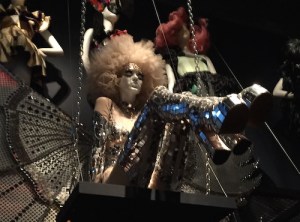
1990 Mathu & Zaldy body suit and attached boots that Susanne wore to an Armani party

1990 Mathu & Zaldy body suit and attached boots that Susanne wore to an Armani party

If you think the music and fashion stopped after Studio 54 shut its doors to Liza, Liz, Andy, Calvin, Halston, and Yves, FIT’s club-scene exhibition, Fashion Underground: The World of Susanne Bartsch, presents evidence to the contrary through December 5.

The show features nightlife splendor (with all the trimmings) from Susanne’s clothes-to-be-seen-in archive. Plus, you’ll get the thrill of pretending that you’ve stepped into one of her over-the-top parties, filled with celebrities, outrageous clothes, spectacle, and glitter.

Wielding "the list" in a 2008 Jean-Paul Gaultier jacket and Patricia Fields hat

Wielding “the list” in a 2008 Jean-Paul Gaultier jacket and Patricia Fields hat

Right downstairs at the gallery entrance, you’ll be taken back to a graffiti-splashed Nineties club entrance with a dolled-up doorkeeper sizing you up and holding “the list”. But there’s no anxiety about whether you’ll be let inside…Just walk in and be transported back to 1981.

 As the glittery disco 54 era was coming to an end in New York in 1981, Bartsch arrived from London and opened up a shop in Soho filled with up-and-coming London designers that were creating the “new look” catching on in clubs across the pond.

In the early 1980s, Japanese and British designers experimented with crinkly natural fibers and oversized smocks – which looked fresh and hip after a decade of form-fitting, glitzy disco looks.

The Eighties -- Vivienne Westwood looks with Galliano linen ensembles

The Eighties — Vivienne Westwood looks with Galliano linen ensembles

Susanne sold the oversized, anti-disco baggy look of nightlife trendsetters Boy George and Leigh Bowery, imported dandy mix-and-match men’s and women’s looks from Vivienne Westwood, and featured flowing frocks by London’s Rachel Auburn.

The first part of the FIT show walks down this part of memory lane, including linen frocks by Mr. Galliano. Smocks are punctuated with dramatic hats (decades before fascinators) or beads from Portobello Road.

By the late Eighties, all that had given way to raggedy and accessorized mash-ups sported by the Material Girl and by the Nineties, bejeweled and bedazzled clubwear reigned again. Susanne was regularly hosting parties clad in an ever-evolving array of embellished corsets, fashioned by the master of form and shape, Mr. Pearl.

Two Mr. Pearl corset ensembles (1989, 1991) with 1992 Mugler Cowgirl ensemble, worn by Naomi Campbell Installation view of “Fashion Underground: The World of Susanne Bartsch” September 18 – December 5, 2015 The Museum at FIT New York, New York

Mr. Pearl corset ensembles (1989, 1991) with 1992 Mugler Cowgirl ensemble for Naomi Campbell

In a well-deserved tribute to his creations, FIT has installed a carousel of Mr. Pearl’s work on a turntable in the show’s back room of the show, next to a corner where mannequins form a towering tribute to the magic of Mr. Mugler, another of Ms. Bartsch’s favorites. After she introduced Mr. Pearl to Mr. Mugler, the rest was fashion history.

Fashion designers flocked to her parties and she did justice to them all – working in their hats, jackets, shoes, bags, and separates into her never-ending array of special occasion get-ups. When you peruse the specific looks on display in the show, it’s an all-star line-up of New York, Paris, and London fashion heavyweights.

Gareth Pugh 2015 ensemble of paper, Lycra and leather

Gareth Pugh 2015 ensemble of paper, Lycra and leather

The show screams of creativity and it’s wonderful that curator Valerie Steele put a spotlight on this Queen of Nightlife and her impact on the underground/high fashion scene for the last three decades. A lot of Susanne’s featured clubwear is credited to Mathu & Zaldy, who turned out plenty of over-the-top looks when designer ready-to-wear just didn’t pack enough punch for a special occasion.

Another charming touch in the show is the ensemble of paper, Lycra and leather contributed by Gareth Pugh. Susanne asked him to send something she could (and would) wear.

As always, FIT provides lots of history and photographs of Susanne and friends in action at multitudes of balls and parties on its exhibition website. Spend time looking at Susanne in action and at snapshots of her historic Love Ball. For close-ups of the clothes and costumes, visit our Flickr feed.

Take 360 spin around each room of the show courtesy of FIT’s virtual tour produced by Synthescape. The arrows appearing on the floor will take you to all three rooms.

Do you wish you could have been at the opening of this exhibit? Not to worry – her friends and fans let you in on the party and remember unforgettable nights in this celebratory video. Even Calvin’s there:

Fashion Never Sleeps at FIT

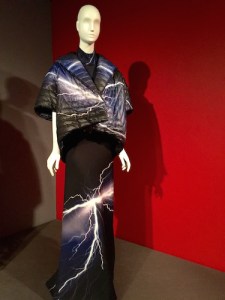
Show opens with 2014 synthetic knit and nylon jacket and dress by Istanbul designer Arzu Kaprol “Global Fashion Capitals” Museum at FIT June 2 – November 14, 2015 New York, New York

Ensemble by Istanbul designer Arzu Kaprol

Stepping inside Global Fashion Capitals at the Museum at FIT is an around-the-world trip that gives a nod to fashion’s past while presenting style innovators who are thriving in nearly every corner of the world. Right inside the front door of the exhibit is a powerful mannequin duo straight outta Istanbul. Wow!

Turn around and you’ll see a packed International Fashion Week Calendar and an illuminated world map. It’s pretty clear that every hour or so, the sun rises on another hotbed of sartorial creativity. Except for Antarctica, every continent has multiple fashion weeks, fashion bloggers, innovative designers, and fashion followers all their own. Explore through the show’s website, and visit in person before November 14.

Representing London, Alexander McQueen's 2009 dress and corset

Representing London, Alexander McQueen’s 2009 dress and corset

The curators tell the story of the rise of traditional couture centers — Paris, New York, Milan, and London – through selected looks and accessories, dating all the way back to the mid-19th century and the House of Worth, when the fashion system and seasonal cycles were institutionalized. It’s interesting to learn that by 1949, the House of Dior was generating 5% of French export profits.

Of course, after WWII, New York was hot on the heels of Paris. Eleanor Lambert kickstarted New York’s Fashion Week in 1943 and Halston and his designer pals won their place in the pantheon of style by vanquishing the Parisians in the 1973 Battle of Versailles.

Milan took over the mantle from Rome after World War II, and London came into its own in the Sixties and Seventies with the debut of mad Mod, rocker chic, and Westwood’s over-the-top subversions.

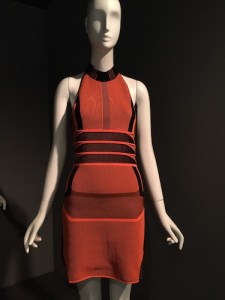
Alexander Wang's 2015 dress from Nike's “flyknit” sneaker fabric

Alexander Wang’s 2015 dress from Nike’s “flyknit” sneaker fabric

In each section, the curators are careful to add a look from recent runways – Christopher Kane’s layered silk organza masterpiece and Alexander Wang’s shift made from the same fabric as Nike’s “flyknit” sneakers.

But the remainder of the floor space tells the story of other influential capitals of fashion – the 1981 emergence of the Antwerp 6 in Belgium; Tokyo’s wild ride with Miyake, Yamamoto, and Kawakubo; and what H&M did for Scandinavia as a fashion capital.

Next, the show highlights cities and fashion culture in Kiev, Mexico City, Sao Paulo, Lagos, J-burg, Sydney, Seoul and Mumbai. Click through these fashion histories on the FIT exhibition site, and marvel at Lisa Folawiyo’s bead-encrusted dress (Lagos) and Lie Sangbong’s graphic silk ensemble (Seoul).

Take a trip through the gallery on our Flickr site, and watch an interview with curator Ariele Elia below:

And for more on the Battle of Versailles, courtesy of FIT, click here.

Frida Khalo Extravaganza Ending with Colorful Surprises

NYBG’s Haupt Conservatory is transformed into Frida’s Casa Azul

NYBG’s Haupt Conservatory is transformed into Frida’s Casa Azul

Ever since the New York Botanical Garden installed its Frida Khalo: Art, Garden, Life show, it’s been a nonstop party and feast for the eyes, ears, and tastebuds.

Not sufficient to import fourteen of Frida’s rarely seen paintings for the formal gallery upstairs in its library building, the creative NYBG team has made environments, commissioned artists, designed apps, booked acts, hosted special events, transformed the conservatory, made a wall of cactus, redesigned menus, and even brought in a taco truck to give everyone an immersion into her sophisticated Mexican lifestyle.

This blockbuster sensory experience is in its last week, going out with a bang with a Dia de los Muertos theme as this traditional Mexican holiday collides with our own Halloween. Sugar skulls and whimsical skeletons are taking over Frida and Diego’s pyramid that serves as the centerpiece of the garden portion of the show.

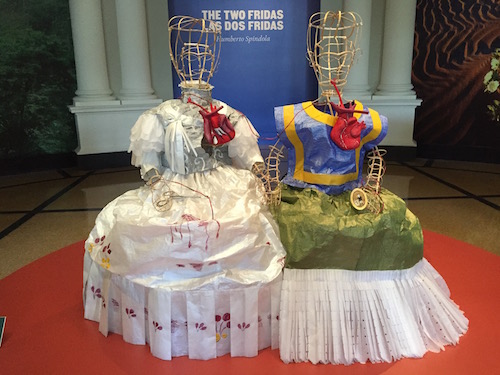
Tissue-paper dresses for The Two Fridas by artist Humberto Spindola

Tissue-paper dresses for The Two Fridas by artist Humberto Spindola

It’s an appropriate mix, given Frida’s own proclivity to merge the everyday with the surreal in her own works. The Library has an exquisite collection of her self-portrait and still life paintings, featuring flowers, animals, and deep-rooted Mexican myth and culture.

Downstairs in the Britton Rotunda, there’s a stunning installation of The Two Fridas by artist Humberto Spindola – side-by-side mannequins wearing tissue-paper dresses in colors that Frida sported, but with the surreal outer heart that she painted more than once. Visitors approach as if it were a shrine with special powers.

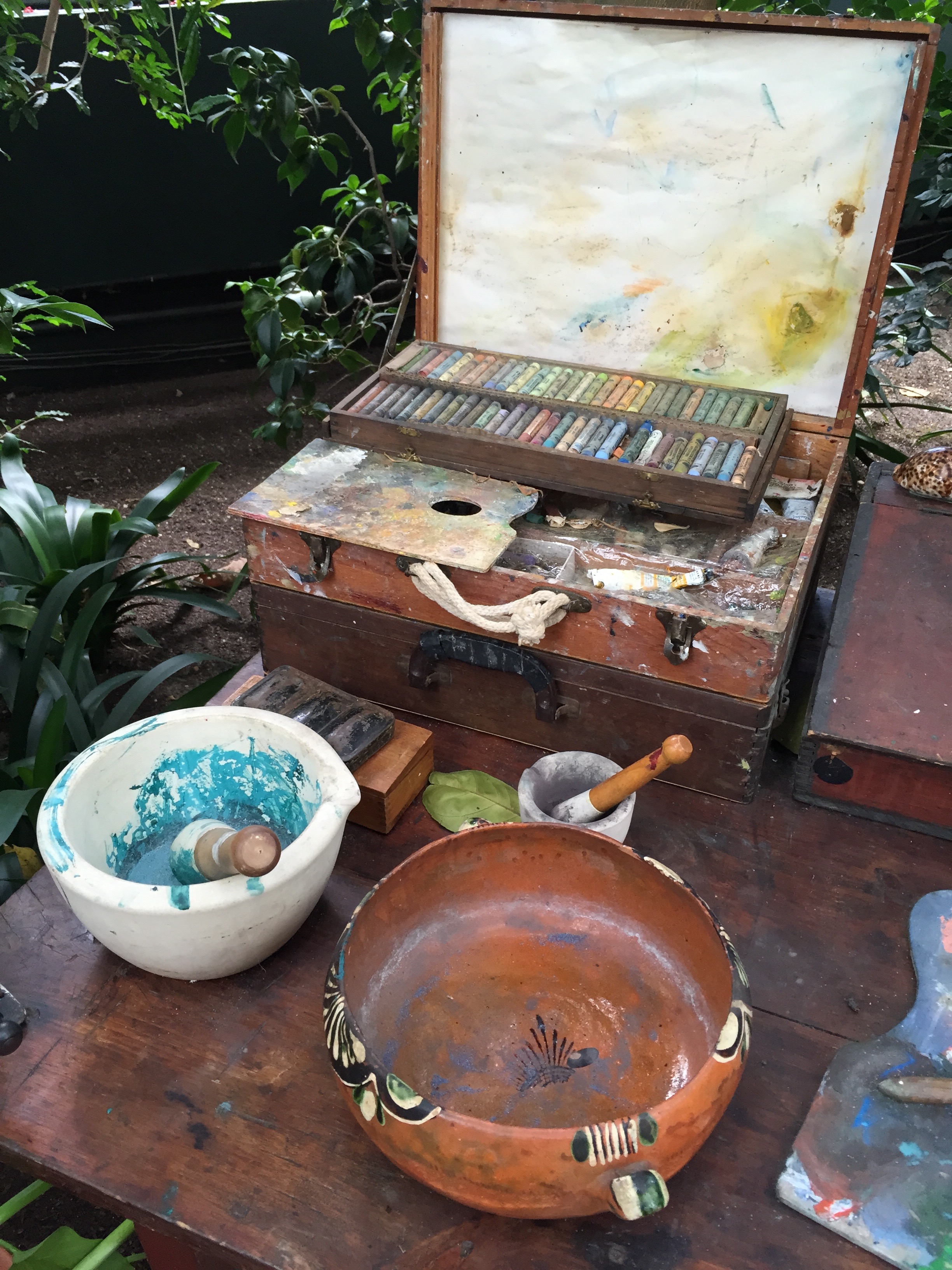
Frida’s workspace

Frida’s workspace

The Haupt Conservatory serves up a riot of color with floating blue containers of vivid flowers, the dynamic blue of the recreated Casa Azul, where she lived, pops of the types of flowers with which she adorned her table and sills, and the intensely painted Mexican-style pyramid in the center of it all.

The sensations are so bright that it’s easy to miss the recreation of Frida’s studio, tucked away in the trees to the left of the main event – brushes, paints, paint sticks, and other tools.

Outdoors, the curators have succulents jammed into every piece of oversize Mexican pottery near a “wall” of cactus, replicating a natural fence that Diego had outside his studio for decades.

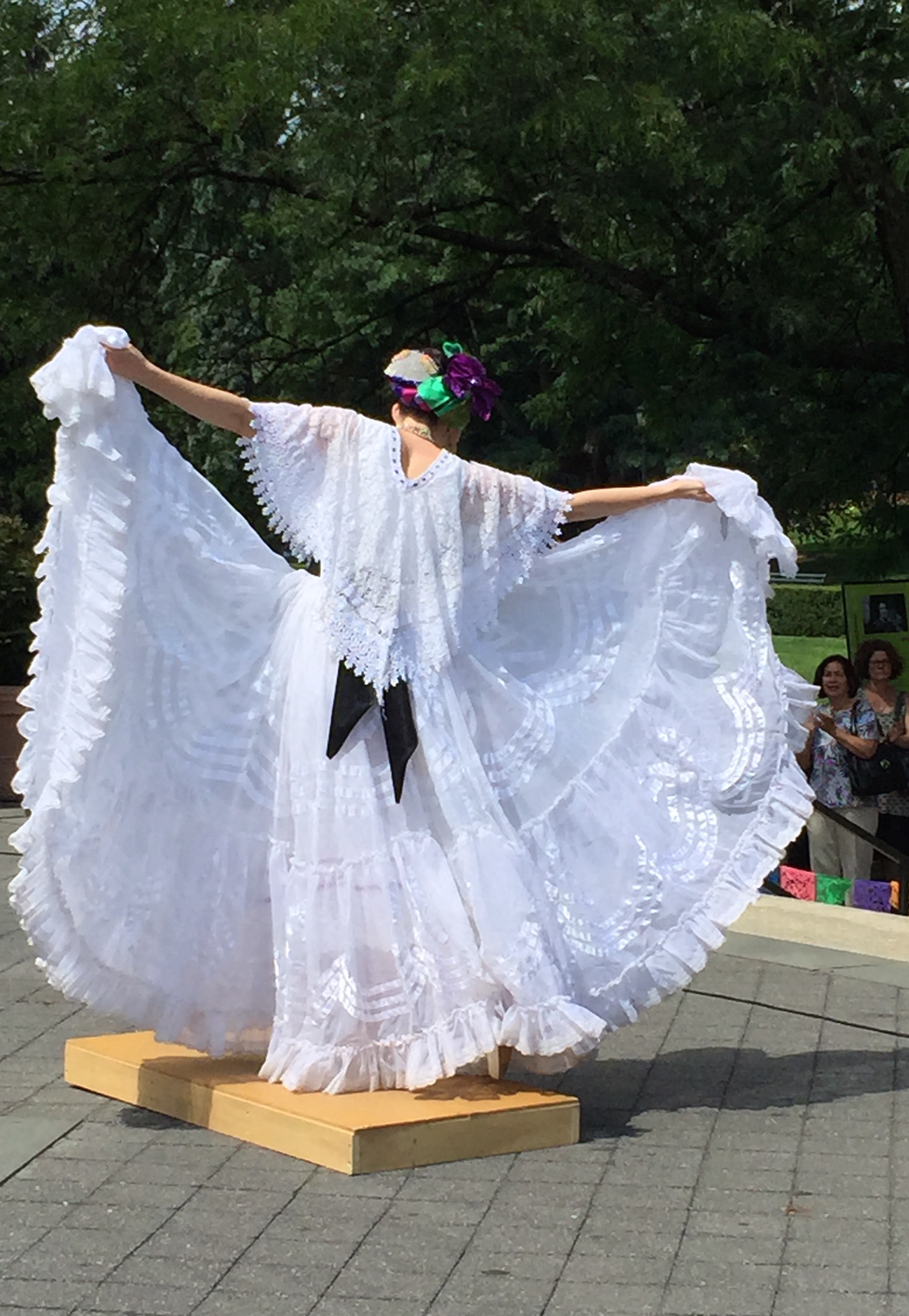
Soloist from Capulli Danza Mexicana channels her inner Frida for the crowd

Soloist from Capulli Danza Mexicana channels her inner Frida for the crowd

The “Life” portion of the show’s title is represented by the generous schedule of music, performances, films, and events that the NYBG has featured throughout the show’s six-month run. Dance companies, all-female mariachi bands, chefs, and authors provide sensuous infusions of movement, wit, gaiety, and sophistication that Frida embodied her entire life. Flashing red skirts, exciting beats, fast footwork, dramatic flourishes, and meaty conversation all contribute to the experience of who Frida was, how she lived, and what she loved.

Download the exhibition panel to see all the parts of Mexico City that meant so much to Frida and Diego – images of parks, gardens, markets, and historic sites, including photos of Casa Azul.

Download the app for your visit, and go to our Flickr site to see the photos and a few videos of the dancers in action.

Take a look at what the NYBG team achieved:

If you have time, check out the YouTube of the all-star kick-off symposium dedicated to Frida last May.


Sneaker Culture Wows Brooklyn

Nike’s original Air Jordan I (1985) and the 25th anniversary Run-DMC Adidas brings joy to Brooklyn fans

Nike’s original Air Jordan I (1985) and the 25th anniversary Run-DMC Adidas bring joy to Brooklyn fans

Crowds in Brooklyn are levitating with excitement as they explore their own sartorial history in The Rise of Sneaker Culture, an exhibition running at the Brooklyn Museum through this weekend. Finally, a fashion history and technology show that really resonates with the men in the room!

The hundreds of historic sneakers, mostly from the Bata Shoe Museum collection in Toronto, tell the story of how casual sports footwear came to be so dominant in today’s high-fashion landscape.

Although there are a few examples of women’s footwear – early Keds from 1916 and iconic Reeboks from the Jane Fonda-fitness era – the focus is squarely on the men, their sports, and their athletic-inspired designer footwear.

The history section of the show shows some of the earliest rubberized sports shoes from UK collections, but quickly moves into familiar New York City territory when colorful creations began appearing at pick-up games on basketball courts around the city in the 1970s, and when the tide really turned through sports and music licensing.

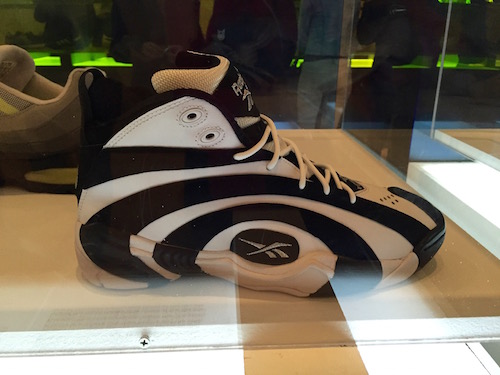
No one forgets the first time they saw Reebok’s Shaqnosis in 1995 (reissue)

No one forgets the first time they saw Reebok’s Shaqnosis in 1995 (reissue)

Crowds and docents jockey for space to worship at the altar of Nike’s 1985 Air Jordan I alongside the autographed reissue of Run-DMC’s 1986 Adidas. After Michael Jordan inked that deal and hip-hop video was distributed worldwide on MTV, sneaker fashion went viral. Electrifying images of loosely laced footwear were seen and copied by fans from the Bronx to Kathmandu. The right shoes and lacing style could wordlessly convey to others in the know, “I know what’s going down.”

Beautifully installed, Brooklyn crowds could work their way through men’s footwear history down one side and up the other – the original P.F. Flyers, original Chuck Taylors, streamlined European designs from the 1970s, Adidas’s early fitness shoes with built-in microprocessors, Nike’s Air Force 1, and Magic Johnson’s Weapons for Converse.

Nike’s 2009 limited edition for LeBron

Nike’s 2009 limited edition for LeBron

After the awesome case with the entire evolution of Air Jordans, the curators lined up a riot of color, technology, status, and design with evidence of so many subsequent licensing deals. Kanye’s new Yeezy Boot for Adidas was interesting, but the Reebock’s Shaqnosis and Nike’s limited edition for LeBron really stopped people in their tracks.

High-fashion sneakers by design and art luminaries Damien Hirst, Jeremy Scott, Chanel, Pierre Hardy, Raf Simons, Giuseppi Zanotti, and Rick Owens brought visitors right into the present day – when guys wear sneakers and tuxes to the Emmys, just as Michael Jordan predicted they would three decades ago.

A great touch at the show’s exit was the opportunity for visitors to leave a note about their own personal “sneaker story” and draw their favorite one.

Take a look at our favorite footwear from the show on our Flickr feed, all presented in chronological order. And enjoy this brief presentation on men’s contemporary footwear in this behind-the-scenes peek into the collections of the Bata Shoe Museum with senior curator Elizabeth Semmelhack:

New Views from/at The Whitney Museum

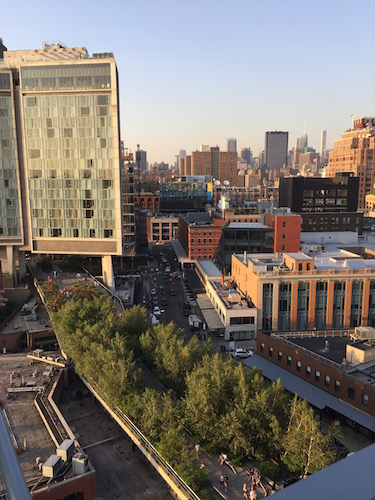
High Line and City views from the Whitney

Towering over the green esplanade of the High Line, the new Whitney Museum of American Art is a spectacular success, inside and out. The inaugural show, America is Hard to See, closing this weekend, features 600 works on all eight floors of the new Renzo Piano-designed landmark. Finally, Gertrude’s collection has room to breathe.

The inaugural installation distributed the massive collection into smartly themed galleries, but moving up and down between the floors is an equal delight – picture windows and balconies offering views of spectacular sunsets over the Hudson and Empire State Building views from entirely new vantage points. Peeking through the doors into the kitchen on the 8th floor reveals some of the best views (think Standard Hotel) offered to any sous chef in the City.

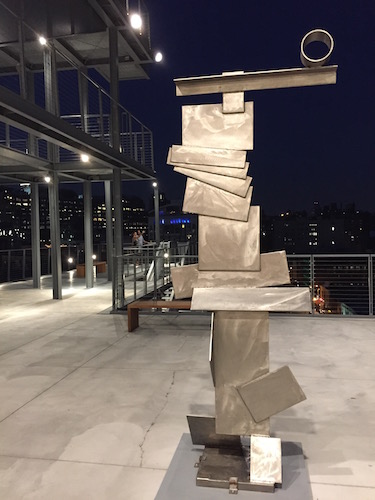
David Smith’s Cubi XXI (1961) enjoys its view of Meatpacking District nightlife from the balcony

David Smith’s Cubi XXI enjoys its balcony view of Meatpacking nightlife

Part of the fun is walking around on the balconies (on every floor) and experiencing the Whitney’s vertical outdoor sculpture park – Joel Shapiro’s playful bronze guy and David Smith’s towering Cubi totems, all against stunning City vistas. It’s Storm King for the urban soul.

Inside, it’s a walk through American art history with themes from the early 20th century (“Forms Abstracted”, “Music, Pink and Blue”, and “Machine Ornament”) with featuring the Whitney’s iconic works by Stella and Dove, O’Keefe and Macdonald-Wright, and Sheeler and Demuth. The clever mix of paintings and sculptures evoke times when American artists did their own takes on the modernist mix of African art and Cubism, colorful abstractions evoking symphonies for the eye, and the beauty of industrial techniques and landscapes in the heartland.

Gallery devoted to 1950s New York Abstract Expressionism with Chamberlain and diSuvero sculptures set against and Lee Krasner's 1957 Seasons

Gallery devoted to 1950s New York Abstract Expressionism with Chamberlain and diSuvero sculptures set against and Lee Krasner’s 1957 Seasons

The curators even pay tribute to early American filmmaking with a continuing mix of reels by 20th century innovators capturing the bustle and abstraction of modern life.

Calder’s “Circus” gets an expansive showcase, surrounded by jazz age depictions of vaudeville, clubs, movie palaces, and downtown edge by Benton, Hopper, Marsh, Weegee, and Cadmus. Around every corner, a new dimension to the American Experience is revealed – social-justice prints of the 1930s, heartland life in the 1940s, wartime calls to action, abstraction and color-field revolutions, and Pop.

Marisol’s Women and Dog group take in Lichtenstein’s Little Big Painting

Marisol’s Women and Dog group take in Lichtenstein’s Little Big Painting

One of the most stunning triumphs is the large gallery dominated by Mr. Chamberlain’s white car-crush tower, Mr. di Suvero’s primal hankchampion sculpture, and Ms. Krasner’s voluptuous 1957 pink and green mural. The clever curators gave Ms. Krasner her place in the spotlight, surrounded by works by Newman, Rothko, Kline, and Mr. Pollack, who is — at least for the run of this show – relegated to a few vertical drip canvases on the faraway opposite wall.

On a lower floor, the curators have hauled out the massive de Feo piece, “The Rose”, and installed it next to works by other female innovators, Lee Bontecou and Louise Nevelson.

If you missed the initial installation, take a look at the Whitney’s website (which features selected works from each of the 23 themed sections), listen to the audio guide introduction, and enjoy views of our favorites on our Flickr page.

Max Weber's Chinese Restaurant, painted in 1915 when Chinese restaurants and Cubism were first popping up in Manhattan

Max Weber’s Chinese Restaurant, made in 1915 when Chinese restaurants and Cubism were both new to Manhattan

The Whitney welcomes late-night guests (until 10 p.m.) every Thursday, Friday, and Saturday. Ride over to NYC’s newest subway station at 11th Avenue and 34th Street and walk down the High Line to the City’s latest hot spot in the Meatpacking District.


Daring Docent Dishes with Digital Adam at The Met

Digital Adam and the Docent reenact what Paradise was like before The Fall

Digital Adam and the Docent reenact what Paradise was like before The Fall

There’s no need to check into the Met after hours to see a classical statue come to life. In Renaissance gallery 504 on the main floor, a digital version of Tullio Lombardo’s 15th-century Adam is interacting with visitors and a knowledgeable Docent in Reid Farrington’s The Return performance through August 2.

The Return is quite a production and its illusions created in the Italian Renaissance gallery would make any animation fan jump for joy.

Classical Adam (the marble one) is installed prominently in the gallery where half the performance takes place. Its presence is a miracle, since the beautiful Renaissance sculpture totally shattered in a freak fall in 2002.

To repair it – a complex undertaking — Met team made a digital replica of all the pieces to decide how to fit everything back together again and spent years making it whole.

Tullio Lombardo’s Adam (1490-1495), which fell and shattered in 2002, but has been exquisitely repaired

Tullio Lombardo’s Adam (1490-1495), which fell and shattered in 2002, and is now repaired

Now, it’s Digital Adam who’s the fascinating co-star of the show, brought back to life by performance artist Reid Farrington who envisioned a tribute to the virtuosity of the Met’s conservation team who so flawlessly reassembled Tullio’s Adam.

The other half of the performance involves an improv actor, a motion sensor suit, and a crew of digital engineers and prop masters, all camped out on the stage of the Met’s auditorium in the Egyptian wing. As the stage actor moves in the auditorium, Digital Adam moves, speaks, answers questions, and holds up a Warhol and a Van Gogh inside his lifesize digital frame in the Renaissance gallery to the delight of the audience and his sidekick, The Docent. See photos on our Flickr feed.

The audience decides what part of Classical Adam’s renovation will get discussed next, but the witty duo soon veer off into other fascinating topics:

Actor in motion-capture portrays Digital Adam, whose image is simulcast at the right and in gallery 504

Actor in motion-capture portrays Digital Adam, whose image is simulcast at the right and in gallery 504

What does it feel like to always look good and never age? Does Classical Adam remember back to the marble quarry? Does Biblical Adam remember what Garden of Eden was like before the Fall? Adam’s clever responses reveal that his Eden experience was a lot about infinity pools and the good life.

At one point, Digital Adam invites the Docent to portray Eve in his telling of what happened after the Serpent appeared with that apple. Then the attention turns back to Classical Adam, as the Docent shows Lombardo’s thinking about that particular moment portrayed in marble.

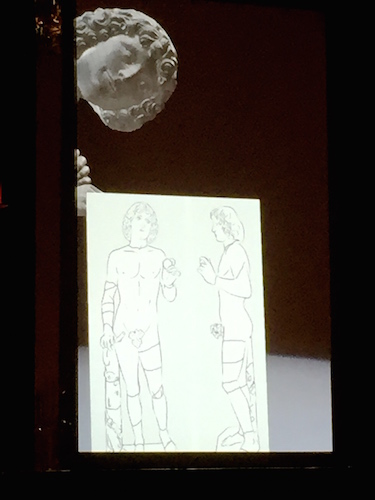
Digital Adam shows drawing of where the breaks in Lombardo’s Adam occurred

Digital Adam shows drawing of the breaks in Lombardo’s Adam

These two need their own ongoing talk show about history, time and space in some corner of the Met. Until August 2, ask the information desk for The Return’s program and go marvel at both the gallery and the behind-the-scenes performances. Or go to the live stream on the Met Museum’s website.

After meeting Digital Adam, you’ll never again wonder about what’s going on inside Classical Adam’s cool, calm, beautiful marble head.