Times Square Time Machine at the Skyscraper Museum

Poster from the Schubert archives of “The City at 42nd Street”, the never-built 1979 mall-superblock plan

Poster from the Schubert archives of “The City at 42nd Street”, the never-built 1979 mall-superblock plan

Two weeks ago, the eyes of the world were on Times Square, but how did it get that way? Take a walk through history at The Skyscraper Museum’s exhibition — Times Square, 1984: The Post Modernist Moment through February 15.

You’ll find out that the crazy, frenetic, chaotic landscape of this town square and its surrounding theaters was nearly lost when the City Fathers and the real-estate community thought Times Square should be “sanitized”. It took wrecking balls destroying several historic theaters to bring activists, celebrities, actors, historians, and preservationists into the streets and paddy wagons to reverse course.

The skyscrapers that were finally built at Times Square, including the Times Towers of 1997 and 2004

The skyscrapers that were finally built at Times Square, including the Times Towers of 1997 and 2004

The Skyscraper Museum has assembled the architectural models, videos, personal memorabilia collections, and planning sketches to resurrect this nearly forgotten war story. See the installation views on our Flickr site.

The show opens with a 1905 Mutoscope film showing the panorama from the top of the new Times Tower – the first skyscraper in that part of town. See it here on the exhibition web site. The Times started the ball drop in 1907, and it’s continued as one of the City’s most famous traditions.

The “Great White Way” name became popular in the 1920s and 1930s to indicate the glow from theater marquees lining Broadway, Seventh Avenue, and the side streets. The second skyscraper wasn’t built until 1927 (the Paramount Building/ Hard Rock Café), and remarkably, no other skyscrapers popped up until 1972.
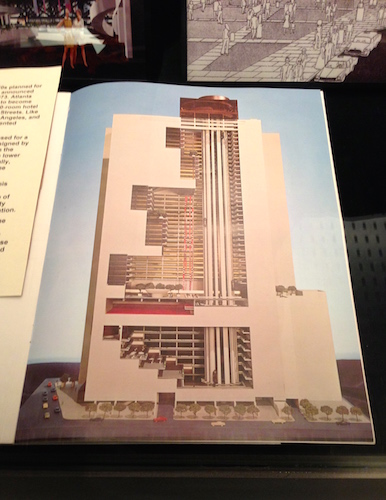
Cutaway drawing of the Portman/Marriott Marquis Hotel (1973-1985), which kept focus inward away from tawdry Times Square

Cutaway drawing of the Portman/Marriott Marquis Hotel (1973-1985), which kept focus inward away from tawdry Times Square

The Portman Hotel (now Marriott Marquis) project was sketched out in 1973, but it took until 1985 to open. The fortress-like complex was designed to look inward on purpose – away from the tawdry street life that characterized Times Square in the “bad old” days when drug pushers, crime, pickpockets, loudmouths, and fistfights were the norm. The atrium and rotating rooftop restaurant were marvels to tourists, who were happy to have an inside-escape route.

By 1979, it was so bad outside that the City proposed some drastic plans to make it all better: Why not tear down a few blocks and make an indoor entertainment mall, complete with a 15-story indoor Ferris wheel and the world’s biggest movie screen? Why not make Times Square look more like Sixth Avenue by building monolithic skyscrapers on each corner of Broadway at 42nd?

Real estate deals ruled the city at the time, and the bonanza created by tourism was still decades away.

Save the Theaters study with 1982 photos of Joe Papp and others protesting the destruction of the Helen Hays and Morosco to build the  Portman. Courtesy: Lee Harris Pomeroy

Save the Theaters study and 1982 photos of Joe Papp protesting the destruction of the Helen Hays and Morosco to build the Portman. Courtesy: Lee Harris Pomeroy

The actors, preservationists, and architects were aghast at plans to tear down so many historic theaters for the Portman/Marriott Marquis and began staging street protests and galvanizing public opinion to save Broadway. Through a lot of community organizing, a Save the Theaters study, and a night where all the theaters turned the lights out, the battle was won. Yes, new towers would be built, but the demolition of theaters would stop.

In 1993, Disney pledged to take over and restore the New Amsterdam, the study identified theater features of historic value (including backstage areas), and a 42nd Street redevelopment effort commenced. Julian Eltinge’s theater (now AMC Empire 25) was moved 130 feet down the street, rehearsal studios were built, and the New Victory brought children’s theater to a house that used to be Minsky’s (and the Belasco).

Today, the crossroads is dominated by tall, sparkling skyscrapers and bustling with high-spending visitors. The TKTS island serves as a concrete village green for the entire area.
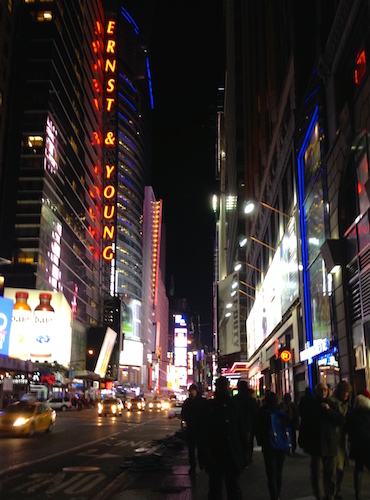
Looking north today toward Times Square and 42nd Street

Looking north today toward Times Square and 42nd Street

Insiders at the Skyscraper Museum’s winter program at Columbia University let us in on the fact that the there are actually design requirements for flashing signs and billboards in Times Square to be at off-angles and tilts to maintain the slapped-together look of the area – design elements flouted by Vornado’s new block-long HD video billboard.

This short synopsis is only the tip of the iceberg on Times Square. For the full story and history, get to the show and take time to watch Carol Willis’ historic, all-star panel from last November, where you’ll meet the people who saved the Theater District, remade 42nd Street, and created the landscape of Times Square that the world knows today. You’ll never look at it the same way again:


For more, click here to read the exhibition story online and see more photos, videos, and artifacts.
Philly Hosts Patrick Kelly’s Runway of Love

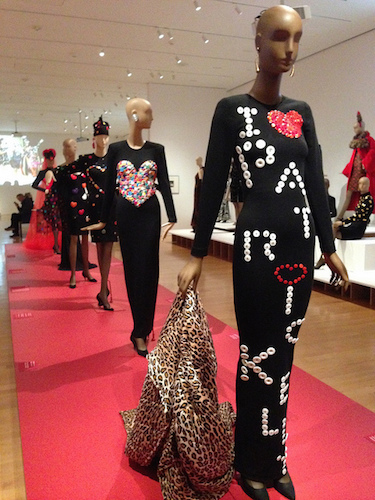
Mismatched button-inspired looks line the center runway in the show (1986)

Mismatched button-inspired looks line the center runway in the show (1986)

Supermodels having fun, crazy colorful buttons, zingy color, and tongue-in-cheek tributes to fashion’s greats – it’s all on display at the Philadelphia Museum of Art’s tribute to one of our all-time favorite fashion designers in the exhibition Patrick Kelly: Runway of Love, on through December 7.

Click here to see our favorite Flickr photos from the exhibition, which has been packed with fashion admirers throughout the show’s run. The gallery is ablaze with life, references to African-American heritage, supermodel sizzle, and the sheer joy that Patrick took in upending fashion’s icons.

The center runway features lots of Patrick’s iconic button dresses, evoking his grandmother’s way of using mismatched buttons to refresh his well-worn clothes as a kid in Mississippi. As a youngster, Patrick consumed acres of fashion magazines – Vogue and Harpers were his favorites – and high-tailed it to Paris as soon as he could.

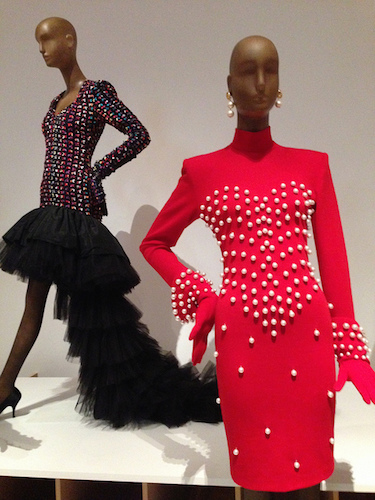
Always fun to spoof Chanel’s use of pearls (1988) and create a Ricci-inspired flamenco dress once modeled by Iman

Always fun to spoof Chanel’s use of pearls (1988) and create a Ricci-inspired flamenco dress once modeled by Iman

He made and sold voluminous coats (inspired by Issey Miyake and Balenciaga) on the streets of Paris to earn cash. But soon his cut-up jersey tube dresses caught the eye of editors of Elle. Maybe it was because he created them for his model-friends to wear on casting calls. When the “tubes” were published, Bergdorf’s placed an order, put his work in their windows, and his career was off and running.

He appropriated sly references to Black culture in the American South and put his own unique high-fashion spin – flouncy dance dresses made from bandana fabric, denim jumpers inspired by sharecropper wear, runway shows with models sporting Blackamoor turbans, and watermelon accessories. Paris went wild over his exuberant runway shows.

A lot of the excitement was over the models who walked his shows — Pat Cleveland, Iman, L’Wren Scott, and other beauties – who cavorted and flounced all his flirty and fun creations. Watch the trailer and see Patrick and his supermodels in action:


Patrick created a bit of fashion history in 1986 when Pat Cleveland interpreted Josephine Baker in Patrick’s famous Banana Dance costume, a collaboration with jeweler David Spada. The photos went viral.

Two looks inspired by Josephine Baker. Left, the “Banana Dance Costume” (1986), a collaboration with jewelry designer David Spada

Two looks inspired by Josephine Baker. Left, the “Banana Dance Costume” (1986), a collaboration with jewelry designer David Spada

The show features videos of Patrick sporting his familiar denim overalls, a joyful designer with a lot of love in his heart for his models, friends, and colleagues. It’s fitting that the museum has posted on its web the things that he loved best. Click here to see Patrick’s Love List and a photo of Bette Davis wearing one of his looks.

If you can’t get to Philly to see the show, click here to see the museum’s site and work your way through each mini-slideshow. The curator’s copy is attached to each look.

Thanks to Bill T. Jones for lending so many of Patrick’s inspired creations and to the museum’s web team that has created such a terrific documentation of this bright light.

And how does a fashion exhibition like Patrick’s all come together? Here’s a backstage look with the exhibitions team:


Tiny Show Tells Big Story at NY Historical Society

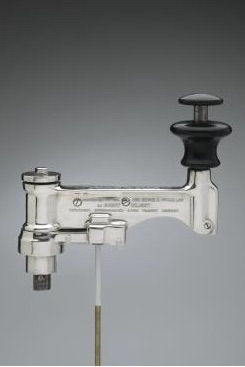
Tiffany & Co., Sterling silver controller handle used to operate NYC’s first subway train, 1904. Source: NYHS

Tiffany & Co., Sterling silver controller handle used to operate NYC’s first subway train, 1904. Source: NYHS

Has anything changed in New York in the last 400 years?

To celebrate the debut of a history book by Sam Roberts, the New-York Historical Society has filled its tiny second-floor gallery with A Brief History of New York: Selections from A History of New York in 101 Objects. Perhaps it’s always been about infrastructure, finance, and tourism. See for yourself through Sunday, November 30.

Many of the stories intertwine, and it’s fun to get insights from reading the backstories of the items on display, like the 1500s arrowhead and the 1700s oyster. We all know that New York City was the oyster capital of North America until the 1920s, but did you know that they were so abundant that crushed shells were used to line Pearl Street and provide the major component of the foundation mortar for Trinity Church on Wall Street?

Consider that the earliest guidebook to New York City (formerly New Amsterdam) was written in 1670, long before double-decker buses were trolling the mean streets.

New York's first guide book from 1640

New York’s first guide book from 1640

Mass-market media manipulations were born here as long ago as 1809, when young Washington Irving (who first used “Gotham” as a synonym the city in 1807) began posting missing-persons advertisements in a variety of city papers (the New York Evening Post is on display) to drive sales of his satirical political “history” of New York by a fictional Diedrich Knickerbocker. Move over, Buzzfeed.

City infrastructure highlights include Mr. Randal’s field books for laying out the Manhattan street grid in the early 1800s (see the digitized results here) and a snippet from the first transatlantic cable, deployed in 1854-1858. Queen Victoria sent an 88-word telegram to New York, which was officially received in an astounding 17 hours — an innovation at the time but significantly slower than dial-up AOL.

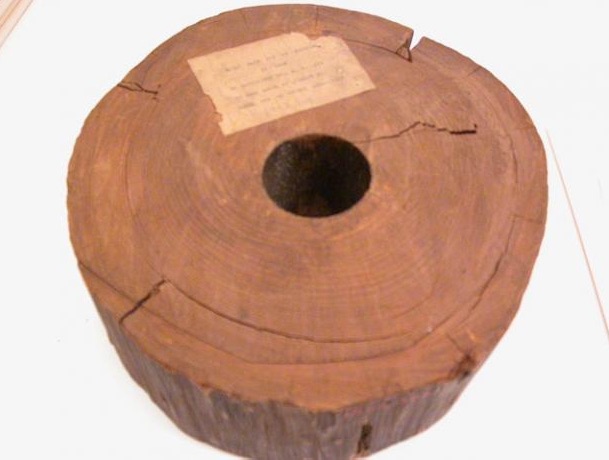
Visitors absolutely love the wooden water pipes on display at NYHS, but the show shares the fact that these were deployed by Aaron Burr, who got the state license to build New York’s first water system as part of his mission with The Manhattan Company. We’re used to hearing about the crumbling infrastructure under the streets today and contractors under-funding city technology projects, but this item underscores that it’s not a new story.

Section of water pipe, 1770-1804. The note says it was put into service in 1804 on Washington Street near Liberty Street and pulled out of the ground around 1911.

Section of water pipe, 1770-1804. The note says it was installed on Washington Street (near Liberty) in 1804 and pulled out of the ground around 1911.

Burr made money but let this innovative delivery system deteriorate. Instead of keeping the infrastructure up-to-date, he use the cash to build The Manhattan Bank (today JPMorgan Chase) to break the monopoly held by Mr. Hamilton’s Bank of New York – a rivalry that later escalated toward an historically tragic outcome. (See their dueling pistols in the lobby.)

On a happier note, one of the brightest objects in the show is the sterling silver Tiffany handle used to operate the first subway train in New York in 1904. Dignitaries used it to make the first run from City Hall up to 103rd Street on a day when 150,000 tickets were sold and New Yorkers took their first ride.

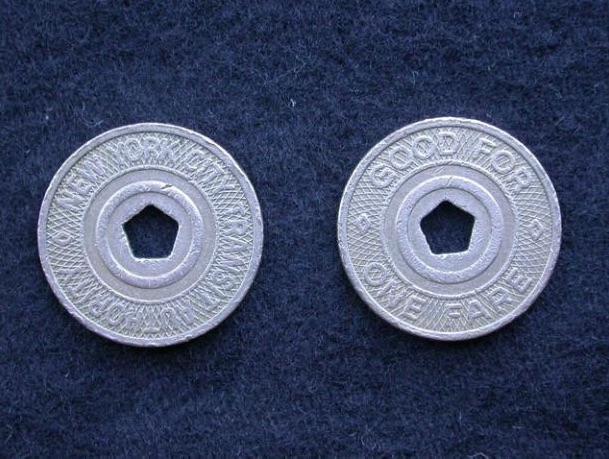
Subway tokens (1995-2003). Source: NYHS

Subway tokens (1995-2003). Source: NYHS

Although they only went extinct in 2003, the subway tokens mounted behind glass seem like ancient history – little round artifacts that look as though they should have been dangling from beaded wampum belts and not carried around as currency in the 20th century.

Thanks to NYHS for providing us with this illuminating capsule collection.

FIT’s Fun, Flirty Historic Lingerie Show

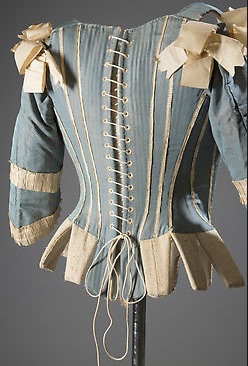
Unusual combination: Sleeves on a silk corset with whalebone stays, circa 1770

Unusual combination: Sleeves on a silk corset with whalebone stays, circa 1770

After sifting through hundreds of corsets, petticoats, slips, nightgowns, knickers, baby dolls, and stockings, the FIT curators have selected 70 key pieces from the archives that lay out trajectory of ladies’ underthings in Exposed: A History of Lingerie, on display through November 15.

The upstairs gallery – usually reserved for gems from FIT’s spectacular collection – takes you on a journey through four centuries of shape-shifting garments that really contributed to the silhouettes of yesteryear. Remarkably, many look totally “today”. The first room pairs underwear and outerwear to make the point.

Hard corsetry items follow next – bustles and corsets from the 17th and 18th centuries, including two that are reckoned to be some of the first examples (at least, in FIT’s collection) of “underwear as outerwear” – a delicate, lavish petticoat and a spectacular 17th century whalebone corset. The telltale signs: If you weren’t showing them off, why would you own a corset with sleeves or a petticoat with such fine hand-embroidered detail?

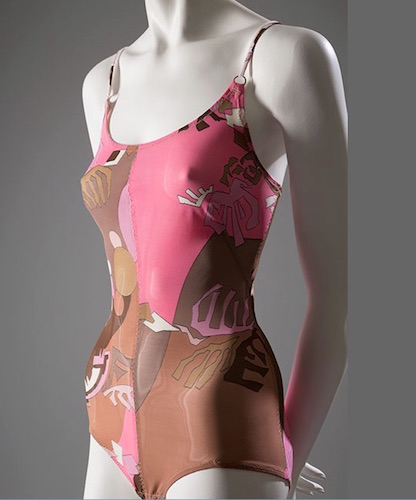
1969 Pucci Lycra-Spandex body stocking for Formfit Rogers

1969 Lycra-Spandex body stocking by Pucci for Formfit Rogers

Predating flappers by more than a century, you can gaze upon the unstructured “natural corset” that 1815 fashionistas wore under their white Grecian-style muslins. One hundred years later, underwear history repeats itself with the 1920s silk underwear designed to be worn under the “corsetless” styles of the Roaring Twenties.

Then it’s on to many more 1920s intimate-fashion innovations – hostess gowns, boudoir mules, French cami-knickers sold at Saks, and the ultimate in period bohemian luxury, the Fortuny tea gown.

Retail history is noted in the 1930s section. Alongside the languid lounging pajamas, negligees, and lingerie-inspired evening gowns, you’ll learn that in 1935, Bergdorf Goodman became the first Manhattan retailer to open up a specialty store within the store specifically devoted to lingerie.

1949 overwire and a 1951 nylon net and silk taffeta petticoat from Dior.

1949 overwire and a 1951 nylon net and silk taffeta petticoat from Dior.

In the 1940s section of the show, special honor is given to Dior’s structured nylon petticoats that gave the New Look’s iconic silhouette its shape, the role of the overwire bra, and the sensation caused by the 1940 debut of nylon stockings – a fashion must-have that quickly became impossible to acquire during WWII.

Historic intimate gems keep appearing through the exhibition, culminating in more recent innovations, such as the Gaultier’s girdle dress, Rudi Gernriech’s no-bra bra, and the revolutionary Wonderbra, as well as up-to-the-minute styles by La Perla, Agent Provocateur, and Victoria’s Secret.

Want to know more? FIT again gives us a stellar on-line exhibition site organized by decade. On each decade, click on “more images” to see nearly the entire exhibition. FIT’s exhibition blog contains the backstory on a dozen or more pieces from the collection.

Even if you’re able to get to Seventh Avenue this week, why not take a walk-through with Coleen Hill, the curator who created this beautiful, thoughtful, and delight-packed show?

Sinclair Dinosaur Sneaks In and Out of Grand Central

Entrance to the show, featuring the 1964 monorail, transport of the future

Entrance to the show, featuring the 1964 monorail, transport of the future

Although he’s featured at the back, the famous Sinclair dinosaur from the 1964 New York World’s Fair has generated a lot of attention inside the New York Transit Museum’s show Traveling in the World of Tomorrow: The Future of Transportation at New York’s World’s Fairs, closing today.

Drawn in by the spectacular photo of the monorail, commuters and tourists visiting Grand Central have been roaming through the gallery and gift shop, checking out the photos, murals, and Dinoland movie that whisk them back to the transportation pavilions of the history-making 1939 and 1964 New York world’s fairs. What’s a dinosaur doing in the World of Tomorrow? It’s all about the car.

The 1939 World’s Fair was built on top of the Corona garbage dump during the height of the Great Depression, putting visionary architects and day laborers to work.

A 1964 New York Times photo of the Sinclair Dinosaur and Stegosaurus passing by the Empire State Building on their way to the Queens fairgrounds

A 1964 New York Times photo of the Sinclair Dinosaur and Stegosaurus passing by the Empire State Building on their way to the Queens fairgrounds

A futuristic subway station was built to deliver visitors to the fairgrounds from the A Line. You could enter a spaceship-shaped Flash Gordon amusement ride and watch the first 3D Technicolor movie ever produced inside the Chrysler pavilion.

The best was the legendary Futurama, where people could imagine a time where everyone owned their own car. The ride took them to the faraway year of 1960. Superhighways and curly exit ramps bisect acres of tall skyscrapers, with cars traveling on autopilot at the amazing speed of 55 miles per hour. Incredible!

Dinoland brochure from the Queens Historical Society

Dinoland brochure from the Queens Historical Society

Fast forward: The Sinclair dinosaur is part of the 1964 experience. By then, every family owned its own car. Sinclair’s long-necked, supersized Brontosaurus was a familiar icon to any family stopping to gas up along the newly completed interstate highway system, so why not mix a little magic, promotion, and science?

Sinclair built Dinoland and populated it with life-size replicas of nine dinosaurs. The exhibition has plenty of Dinoland souvenirs along with a movie clip of families seeing the Jurassic giant for the first time.

Robert Moses and Walt Disney look at the model of the 1964 World’s Fair. From MTA Bridges & Tunnels archives

Robert Moses and Walt Disney look at the model of the 1964 World’s Fair. From MTA Bridges & Tunnels archives

The show also pays tribute to the man who also brought another group of Mesozoic superstars to life inside the fairgrounds. Walt Disney designed four of the fair’s animatronics displays, including the robot cavemen and dinosaurs glimpsed in the Ford Motor Company’s “Magic Skyway” ride. There’s a terrific photo of New York’s Robert Moses alongside Walt, looking out over the model of the 1964 fairgrounds, and you can see the actual model itself, right inside.

Missed the show? You won’t see all the movies and hear the soundtracks that made the exhibition so exciting, but you can take a look at the galleries on our Flickr feed.

The 1964 car that everyone wanted — the Ford Mustang, which debuted at the fair

The 1964 car that everyone wanted — the Ford Mustang, which debuted at the fair

The Paper Bag Was Her Design

MoMA honors Margaret Knight, 1870s inventor of the flat-bottomed paper bag

MoMA honors Margaret Knight, 1870s inventor of the flat-bottomed paper bag

What will the MoMA curators pull out of the design collection next? Designing Modern Women 1890–1990, running through October 19, puts the spotlight on furniture, textiles, graphics, performance, kitchens, and even inflatables designed by some innovative women over the last century. How can you not love a show that begins with 1890s modern-dance provocateur Loïe Fuller and ends with 1980s pop icon Grace Jones?

The crowd last weekend was loving every bit of it, pausing to watch videos sprinkled throughout the show and marvel at designs – some 80 to 100 years old that are as modern today as they were at their creation.

The next time you carry away your morning muffin from the coffee counter in that little white paper bag, ponder that the flat-bottomed paper bag was invented in the 1870s by Margaret E. Knight and Charles B. Stilwell. Ms. Knight not only invented this classic, but also invented the machine that made it and was one of the first American women ever to receive a patent.

1901 dinner service by Jutta Sika and Koloman Moser

1901 dinner service by Jutta Sika and Koloman Moser

No, the dinner service is not from Pottery Barn. It was created in 1901 by the Austrian design team of Jutta Sika and Koloman Moser. Didn’t I just see a copy of Eileen Gray’s 1927 adjustable table at the D & D Building? Open shelving in your new, modern kitchen? Yes, that was Charlotte Perriand’s idea, and MoMA has (for the first time) installed this full-size, fully efficient, ground-breaking kitchen from her 1952 project with Le Corbusier.

And what about the Slinky? Invented by Betty and Richard James in 1945. You’ll have fun peering into the design cases and learning more about the women behind some remarkable things.

Slinky was designed by Betty and Richard James in 1945

Slinky was designed by Betty and Richard James in 1945

In the 1960s portion of the show, you’ll see those famous Fillmore posters designed by Bonnie Maclean. And there’s an entire wall filled with iconic pop and punk graphics – all created by female designers – that should be familiar to anyone that traversed the downtown CBGBs scene.

There’s no digital media to accompany this fantastic show, so take a walk through our Flickr site. All of the items are from MoMA’s own collection, and we’ve taken slight liberties by arranging the photos in the show album in chronological order of the year that each design debuted.

And to bring it all back to the beginning of this design innovation tribute: Here’s a glimpse of 1897 Art Nouveau performance art by Loïe Fuller, courtesy of the Lumiere Brothers. The color you see here is a result of hand-tinting the film, but her actual perfomances used new theatrical stage lighting for which she held numerous patents. Listen to the MoMA curators explain her influence, but get over to MoMA (or the Flickr site) to take in this super-fun tribute to 100-plus years of smart women who thought differently and made it happen.

Groundbreakers App Ties History and Beauty Together

AppTitle

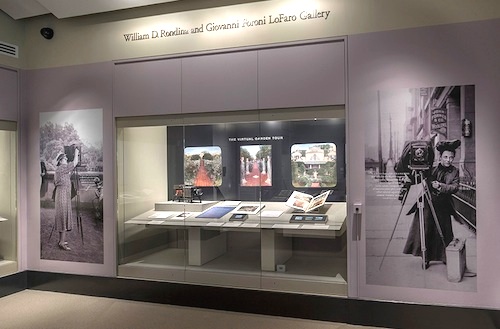
The New York Botanical Garden carved out an ambitious agenda in its Groundbreakers show – to tie the stories of six women of landscaping history, present a two-gallery recreation of an historic garden, pay tribute to the contributions of several landscapes within NYBG itself, create a poetry walk, and wrap it up with the history of early 20th-century photography and high-gloss publishing. They did it with GPS and an iPhone app, courtesy of Bloomberg.

Closing this weekend, Groundbreakers: Great American Gardens and the Women Who Designed Them is still worth downloading from iTunes, just to get a glimpse into the lives of six landscape-gardening pioneers, see their work, and understand the popularization of American gardening long before the dawn of HGTV or Lifestyles of the Rich and Famous. Here’s the link.

Photos of Ms. Johnston (left), lantern slides and projector, and Beals (right) on NYC street in 1902. Courtesy: NYBG

Photos of Ms. Johnston (left), lantern slides and projector, and Beals (right) on NYC street in 1902. Courtesy: NYBG

Here’s the story: back in the day (early 1900s), garden design and photography were two of the few career avenues available to women.

Way before Instagram, Photoshop, and two-way phone cameras, documenting the lush gardens involved lugging a gigantic, large-format camera up and down garden paths and around water features, processing black-and-white negatives into prints, turning some into newly-invented lantern slides, and having each slide painstakingly colored by hand. It helped if you had a car and an able-bodied assistant to help navigate the flagstone-lined paths with all the heavy gear.

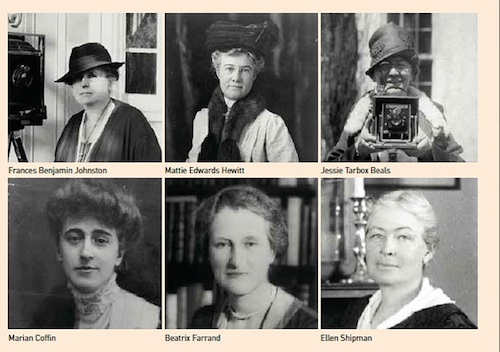
Six American landscape pioneers who changed the course of American gardening. Courtesy: NYBG

Six American landscape pioneers who changed the course of American gardening. Courtesy: NYBG

Also, after the Industrial Revolution, aesthetically minded women (predating Lady Bird Johnson) felt it was time for American homescapes to get a little more spruced up.

The rich and famous were beginning to hire landscape designers to fix up the areas behind their East Side townhomes and acreages around their country estates. Why not document this and inspire upper middle class homeowners to follow suit?

The exhibition gives us a look at how artist visionaries, authors, and the publishing industry worked in tandem to record how landscape architects were creating romantic backyard landscapes and popularize beautification. Although seeing actual lantern slides, projectors, and gigantic tripods is amazing, one of the highlights is a recreation of the slide show by Frances Benjamin Johnston that basically blazed the trail of a new vision of what was possible – one image after another of gorgeous, visionary landscapes on the grounds of homes on the East Coast, California, England, and France.

NYBG recreated the evocative Moon Gate from the Rockefeller garden, inspired by their experience of the Forbidden City and designed by Beatrix Farrand

NYBG recreated the evocative Moon Gate from the Rockefeller garden, inspired by their experience of the Forbidden City and designed by Beatrix Farrand

In the Conservatory, the team at NYBG recreated Mrs. Rockefeller’s garden, originally designed by Beatrix Farrand, to highlight how the garden was conceived, used, and enhanced by the Asian art Mr. and Mrs. John D. collected. Since Farrand took on this project in 1926, NYBG has the sounds of America’s Jazz Age wafting through the galleries. Take a look on our Flickr page.

Another great feature of this show and the app – NYBG’s GPS feature shows you where you are in the expansive garden and encourages you to visit features where these groundbreakers had a hand – such as Marian Coffin’s ornamental conifer collection and Ferrand’s Rose Garden.

Get a closer view of the spectacular Groundbreakers in NYBG’s news-style video:

If you have a bit more time, listen to this curator lecture on the Beautiful Garden movement in America in 1900 and see the photos used by Johnston home to show suburbanites exactly how it should be done. You’ll witness garden images that hadn’t been seen since 1930. Take a look and get inspired:

Click here for other videos: a lecture about Beatrix Farrand created Mrs. Rockefeller’s garden and how the NYBG team recreated it in the stunning Victorian conservatory.

Stunning Jewelry at Met Reflects Contemporary Art

These stunning creations of Eugene and Hiroko Pijanowski are made from paper cord and canvas

These stunning creations of Eugene and Hiroko Pijanowski are made from paper cord and canvas

The Metropolitan Museum of Art has not only reinstalled its American Modernist wing on the first floor, but it’s given over the design gallery right inside the door to Unique by Design: Contemporary Jewelry in the Donna Schneier Collection, on view through August 31.

Gertrude Stein is holding court in the far back gallery with some of Mr. Stieglitz’s treasures, but on your way to see them, check out the high-class, high-gloss presentation of masterworks of wearable art from the 1960s through today.

The thesis of the show is contemporary jewelry doesn’t exist in a vacuum and often reflects the prevailing art of the day — Pop, Minimalism, Abstraction, and so forth.

In 2007, Ms. Schneier donated 130 of her favorite pieces to the Met – just a small fraction of the collection she has been building for over 30 years. Here, these gleaming, surprising, artful, fun pieces are grouped to highlight their context within various themes of recent contemporary art.

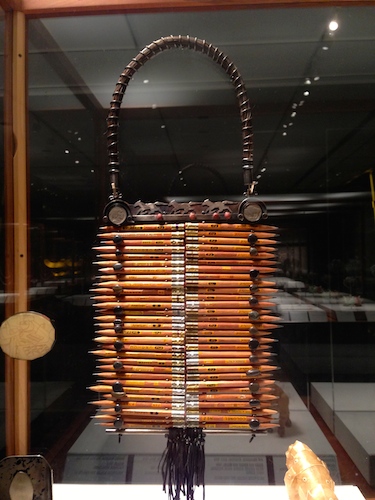
Kiff Slemmonds Sticks and Stones and Words

Kiff Slemmonds Sticks and Stones and Words

As you marvel at each one, you’ll be thinking back across decades of gallery shows and installations of minimalist art, performance art, funky found art, and 3D printing.

Check out the gold neckpiece right inside the door. You might think it’s a riff on the Met’s room full of Columbian gold across the hall, but this treasure is actually made of paper and canvas by the Pijanowskis (Eugene and Hiroko).

Marvel at what seems to be Native American-inspired breastworks by Kiff Slemmonds. Her art piece is fabricated with a lot of stuff but mainly No. 2 pencils in the “narrative” portion of the show.

If you like self-referential playfulness, consider Gijs Bakker’s piece – a real diamond mounted on a PVC-laminated photo of a diamond. Recyclable art? Check out Robert Ebendorf’s brooch made from crushed auto window glass, beach glass, and a vinyl record.

Ted Noten’s clever Fashionista necklace made of tiny resin high-heeled shoes

Ted Noten’s clever Fashionista necklace made of tiny resin high-heeled shoes

And if you think it’s fun to poke around the history of contemporary art through jewelry that’s neatly tucked inside a single room, don’t ignore the fact that right beyond this gallery door is another art-history tour-de-force-in-a-box: The Met is displaying Mr. Duchamp’s famous green case, which is full of many of the same visual and conceptual challenges – “what is art?”, “what is play?” “what is hidden?”, and “everything you see is not as it appears.”

What would Rose Sélavy herself choose to don from the next room if the Met and Ms. Schneier gave her chance?

Peek at a few of the choices on our Flickr site, but enjoy wandering through the gallery and deciding for Rose and yourself.


Folk Art Geniuses Take a Trip

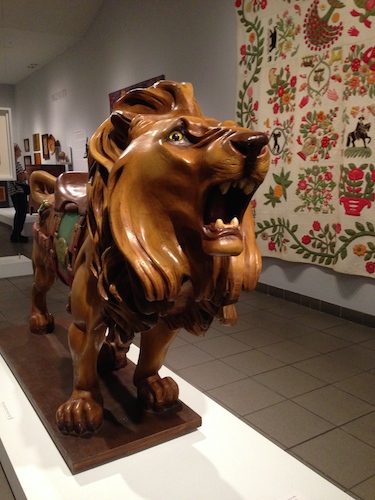
Brooklyn’s Lion, carved in 1910 by Marcus Charles Illions, who worked at the carousel shop and later set up his own studio

Brooklyn’s Lion, carved in 1910 by Marcus Charles Illions, who worked at the carousel shop and later set up his own studio

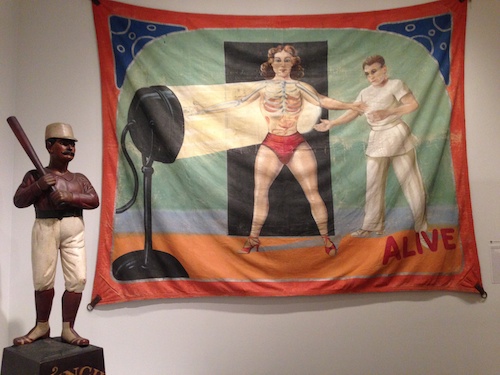
The American Folk Art Museum knows how to put on a show and take it on the road. After today, the staff will be packing up Self-Taught Genius: Treasures from the American Folk Art Museum and letting the Brooklyn Lion, Connecticut’s Weathervane Elephant, Chicago’s Sideshow “Radium Girl”, and a baseball old-timer from Centre Street see what’s up in Davenport, San Diego, Fort Worth, New Orleans, Saint Louis, and Tampa. We’re betting that there will be crowds waiting to greet them.

The museum’s staff has brought out its best to show off four centuries of made-in-America maker art – furniture, sculptures, textiles, painting, and what-not. It’s genius that they’ve put the spotlight on “genius” because their collection is jam-packed with some truly remarkable artists, visionaries, and craftsmen. Get the full view on the Museum web site and some close-ups on our Flickr page.

The curators say that the United States was a make-it-up-as-you-go-along democracy, so they felt “self taught” was right in line with this unique Americana theme – having a vision and making a masterwork.

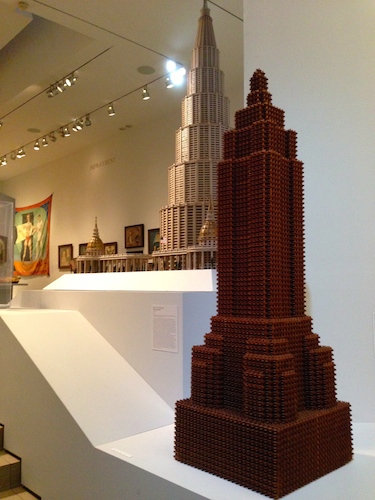
Empire State Building, carved in New Jersey in 1931 from precious cherry wood. Auriti's Palace is just behind.

Empire State Building, carved in New Jersey in 1931 from precious cherry wood. Auriti’s Palace is just behind.

Yes, there are some true eccentrics in the mix, but let’s momentarily focus on the People with a Plan from the section of the show on “Achievers”. Their works are immensely pleasurable and intense, and they’re right inside the entry.

You could spend hours contemplating the detail and work that went into the monumental Empire State Building made from cut cherry wood pieces in New Jersey in 1931. No one knows who created it, but legend has it that it was an ironworker that actually worked on that 13-month wonder and couldn’t let go of the achievement.

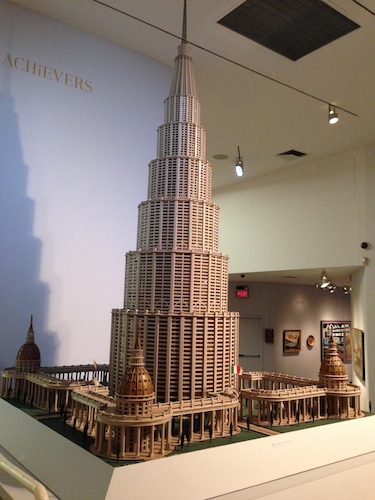
Consider The Encyclopedic Palace of the World, created by Maurino Auriti, an auto body worker who just loved designing and building architecture. Mind blowing. If his visionary campus was actually constructed, the skyscraper would be taller than that spire in Dubai.

The Encyclopedic Palace, created by Maurino Auriti, an auto body mechanic, in the 1950s from from wood, plastic, glass, metal, hair combs, and hobby kit parts

The Encyclopedic Palace, created by Maurino Auriti, an auto body mechanic, in the 1950s from wood, plastic, glass, metal, hair combs, and hobby kit parts

If you get to Lincoln Square today, you’ll enjoy one amazing treasure after another, but if not, check it out the beautiful web site archive created by the museum team for the tour. Browse by time period, theme, or artist.

And check out the Museum’s other brilliant online solution to letting you in on the world’s interpretation of these works. They’ve assembled all the media written and produced about the pieces in the show, which have often served as a springboard for scholarly research. This is a fun, serious treasure chest of work, so probe to your heart’s content — baseball folk art, mourning pictures, 18th century folk-art Washington portraits, and even more recent works.

What will it take to take this show of masterworks on the road? Last year, Auriti’s The Encyclopedic Palace was chosen as the theme of the  55th International Venice Biennial, so it got to go on its first trip to Italy.

Get a glimpse of where the folk art lives when it’s not on display and see how art gets packed to take a trip.

Baseball statue from 114 Centre Street and the sideshow’s Radium Girl banner from Chicago in the 1930s

Baseball statue from 114 Centre Street and the sideshow’s Radium Girl banner from Chicago in the 1930s

Dissident Artist Leaves Brooklyn for Second Time

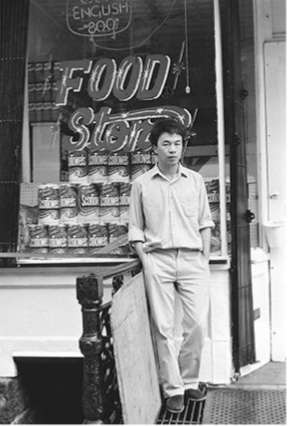
The artist in Williamsburg, 1983. From his New York Photograph Series (1983-1993). Courtesy: the artist

Then: Ai Weiwei in Williamsburg, 1983. From his New York Photograph Series (1983-1993). Courtesy: the artist

If you haven’t yet trekked to Brooklyn to see one of the world’s most famous international provocateurs, go this weekend to see Ai Weiwei: According to What? and get to know the work of the artist who was incarcerated a few years ago by the Chinese government for pulling the veil off its bureaucratic repression and dishonesty. Closing August 10, it’s the last stop on the show’s North American tour – a fitting finale since Ai Weiwei first lived in Williamsburg when he moved to New York back in 1983.

You know him either from his collaboration on the famous “bird nest” stadium at the 2008 Beijing Olympics, smashing Han Dynasty vases as an art project, or from having bulldozers sent by the Chinese government to eradicate his studio in 2011 and being put into house arrest for 81 days – an event that made front-page news and sparked an international outcry – museums and political leaders took out protest ads, made videos, placed flowers on his public works, and called for his release all over the world.

Close-up of R itual, one of the six dioramas of S.A.C.R.E.D. (2011-2013), inspired by his 2008 incarceration. Courtesy of Ai Weiwei Studio. © Ai Weiwei

Now: Close-up of R itual, one of six dioramas of S.A.C.R.E.D. (2011-2013), showing his 2008 incarceration. Courtesy of Ai Weiwei Studio. © Ai Weiwei

Even before you hit the admissions booth, you’ll see his response to all of this – a series of six large, mysterious boxes that make up his work, S.A.C.R.E.D. You climb up to peer into them, right inside Brooklyn’s entrance. Inside, you’ll see everyday depictions of what it was like for him in detainment – eating, sleeping under the watch of the uniformed guards, and interrogations.

Upstairs, you’ll see an expansive show filled with thought-provoking works along with some black-and-white photos of his East-Village life in the 1980s, where he hug with Tan Dun, Xu Bing, and other artists-on-the-move and artists-on-the-run from a conformist Mainland.

At a distance, his sculptures seem like simple, cool contemporary installations. Read the label copy and you realize the subversive is at work. It looks like some found-art piece, but the room is actually filled with the full contents of a young woman’s home. Ai Weiwei found her and all her stuff on the side of a road after the authorities evicted her.

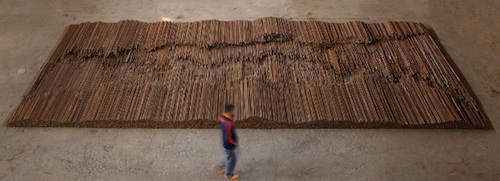
Straight (2008-2012) is made from 70 tons of rebar reclaimed from the Sichuan earthquake and hammered straight back into rods. © Ai Weiwei

Straight (2008-2012) is made from 70 tons of rebar rods, reclaimed from the Sichuan earthquake and hammered straight. © Ai Weiwei

A single room is devoted to Straight, a monumental installation made up of rebar, metal rods used to strengthen concrete calls. Except that this is the actual rebar from the 2008 earthquake that claimed 5,400 young lives in Sichuan Province when the schools collapsed due to shoddy construction practices. He bought the scrap rebar from those buildings, spent four years hammering to straighten them out, and assembled the rods into a 70-ton sculpture. Nearby, he’s listed the names of every school child – something that the Chinese government never did.

Performance art: dropping a Han dynasty vase (206 BC-220 AD), along with other historic ceramic pieces altered by a dip into modern industrial paint (2007-2010). Photo: C. Carver. Courtesy: the artist

Performance art: dropping a Han dynasty vase (206 BC-220 AD), along with other historic ceramic pieces altered by a dip into modern industrial paint (2007-2010). Photo: C. Carver. Courtesy: the artist

How and why does he do it? Find out by listening to Ai Weiwei’s answers to visitors’ questions. You’ll have quite an insight to his thought process, since there are 45 pages of video Q&A. Well worth the time to meet this brave, inspirational artist-activist.

He’s simply one of the top contemporary artists working today and you owe it to yourself to experience work that literally takes on the world. Kudos to the Brooklyn Museum for also publishing the amazing teacher’s guide, which asks students to ponder and think about news, authority, and speaking out.

Watch as the Brooklyn crew assembles Stacked, Ai Weiwei’s 2014 sculpture made from 700 bicycles, a comment on the transportation traditionally used by Chinese commuters until the dawn of the smog-inducing automobile. It’s all happening under the watchful Egyptian eye on Brooklyn’s main floor: