Warhol’s New Year’s Eve Finale at the Met

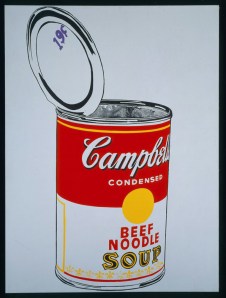
Andy Warhol. Big Campbell's Soup Can, 19¢ (Beef Noodle), 1962. Acrylic and graphite on canvas, The Menil Collection, Houston. © 2012 The Andy Warhol Foundation for the Visual Arts, Inc. / Artists Rights Society (ARS), New York

Andy Warhol. Big Campbell’s Soup Can, 19¢ (Beef Noodle), 1962. Acrylic & graphite on canvas, The Menil Collection, Houston. © 2012 The Andy Warhol Foundation for the Visual Arts, Inc. / ARS, New York

New Year’s Eve is the last day of a major tribute to the man who encouraged us to view brands, news, celebrities, identity-shifting, multiples, and commerce as art – Regarding Warhol: Sixty Artists, Fifty Years.

 The curators have organized the big, second-floor galleries along these themes, and paired Andy’s work with the work of fifty contemporary artists whose own work is indebted to Andy’s redefinition of modern life.

As the show begins, it’s almost as if Andy’s contemplating the implications of the upcoming fiscal cliff talks with the wall quote, “Buying is much more American than thinking.”

To prove his point, you’ll find Andy’s little-seen Dr. Scholl’s Corns (1961) (a gift from Halston to the Met), alongside better-known Brillo boxes and other brand icons from the Whitney, Menil, and Warhol Foundation collections. The curators have included Tom Sach’s Chanel Chainsaw (1996) and Hans Haake’s political pop masterwork, a giant cigarette box created in 1990 in response to Jesse Helms’s attack on Mapplethorpe and the NEA with the cigarettes wrapped in the Bill of Rights and branded “Phiip Morris Funds Jesse Helms”.
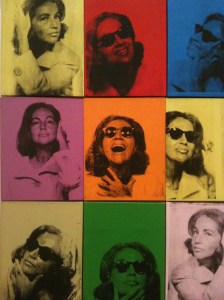
Fragment of Andy Warhol’s silkscreen on canvas, Ethel Scull 36 Times. Jointly owned by the Whitney Museum of American Art and The Metropolitan Museum of Art; Gift of Ethel Redner Scull, 2001

Fragment of Andy Warhol’s silkscreen on canvas, Ethel Scull 36 Times. Jointly owned by the Whitney Museum of American Art and The Metropolitan Museum of Art; Gift of Ethel Redner Scull, 2001

Alongside Andy’s Screen Test films are portraits by Tillman, Close, and Avedon, as well as a needlepoint of Liza in her heyday and a brilliant Sugimoto portrait of Fidel Castro (except that it’s a wax museum likeness).  Andy’s dollar-sign print multiples are hung near another quote: “Being good in business is the most fascinating kind of art.” An entire wall covered in Takashi Murakami and Koons multiples stand in evidence.

If you can’t celebrate in person at the Met, download Rebecca Lowery’s timeline of Warhol’s impact from the exhibition catalog. Or watch the 90-minute video featuring the curator Mark Rosenthal debating if Warhol actually is the most influential artist of the last fifty years. Or, view the films and listen to the music that the Met streamed live last October:  The Metropolitan Museum of Art – Dean and Britta—13 Most Beautiful: Songs for Andy Warhol’s Screen Tests.
Brooklyn Holiday Art Mash Up

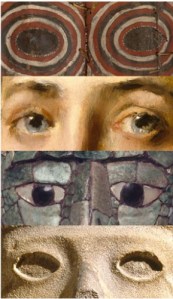
Details of four works in Connecting Cultures, from top: Korumbo Gable Painting, 20th century, unidentified Abelam artist; Girl in a Japanese Costume, circa 1890, William Merritt Chase; Mosaic Head Pendant, 700–800, unidentified Maya artist; and Life-Death Figure, circa 900–1250, unidentified Huastec artist.

Details of four featured works, from top: Korumbo Gable Painting, 20th c. by unidentified Abelam artist; Girl in a Japanese Costume, c. 1890, William Merritt Chase; Mosaic Head Pendant, 700–800, unidentified Maya artist; and Life-Death Figure, c. 900–1250, unidentified Huastec artist.

A big mix-up has happened on the First Floor of The Brooklyn Museum, but it’s OK. In fact, if you like rambling around the Brooklyn Flea, the Connecting Cultures: A World in Brooklyn exhibit is less congested but just as much fun.

The museum curators clearly enjoyed picking and choosing objects from their wide-ranging collections, and packing a gallery full of juxtapositions from different centuries, cultures, and countries. The designers made great use of the soaring space of the Great Hall, creating floor-to-ceiling murals, maps, and display shelves that provoke, delight, and mystify. Check out the museum’s Flickr photostream. As a visitor, you feel as though you’ve wandered in on a modern version of a Victorian-era World Exposition.

Gaston Lachaise’s modern Standing Woman bronze is installed near Nick Cave’s Soundsuit, Picasso’s cubist Woman in Gray portrait is hung next to Huntington’s classical portrait The Sketcher, and Ikea-clean wall grids house ornate pitchers from many cultures and time periods. Catch a glimpse of the variety in the installation views on Flickr, or peruse the objects in Brooklyn’s on-line database.

As an added bonus, the Museum has established both human and social-media feedback options for visitors. It’s nice to use the terminal to input comments on the show (posted on the exhibition site), but maybe it’s even nicer to have staff members positioned inside the exhibit to chat, answer questions, and elicit your comments.

The installation is reflected in Pistoletto’s Standing Man, Standing Woman with Hat, a 1980 silkscreen on stainless steel.

Installation as reflected in Pistoletto’s Standing Man, Standing Woman with Hat, 1980 silkscreen on stainless steel.

The Museum has been collecting since 1823, and there’s both an on-line chronology and a pictorial history slightly hidden away inside the show.

Upcoming and news flash: Brooklyn Museum is going to continue it’s Target First Saturday tradition into the New Year (next on January 5), but for the time being, it’s cancelling the dance party portion of the festivities. Get there for the rest of the night.

Mayans Dispute 2012 Ending

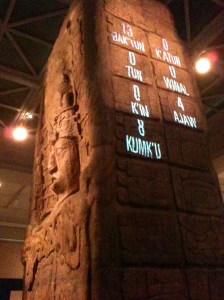
Illumination translates glyphs into numbers on stele, marking the end of the Long Count cycle on December 29, 775 CE

Illumination translates glyphs into numbers on stele, marking the end of the Long Count cycle on December 29, 775 CE

One of the best things about the Penn Museum’s “Maya 2012: Lord of Time” exhibition is the manner in which the curators meld the ancient, the mathematical, the historic, and the modern to answer the question “Will the world end at the end of the Mayan Long Count calendar in December 2012?”

The exhibition is built around the spectacular work that Penn’s archeological teams have done for decades in Copan, an ancient Mayan city located in today’s Honduras not far from the Guatemalan border – excavating tombs, uncovering clues to the succession of rulers, and figuring out exactly what all the once-cryptic hieroglyphics tell us. Check out the Flickr photos.

It turns out that the rulers kept a tight rein on the calendar, astronomic phenomenon, and various time-counting cycles to assert their right to rule. As some of the most spectacular stele show, the stone monuments actually enabled kings to embody dates, such as October 21, 731 (Copan Stele A).

Censor lid depicting founder of the Copan dynasty (695 CE)

Censor lid depicting founder of the Copan dynasty (695 CE)

The towering Quirigua Stele C from Guatemala associates the ruler with December 29, 775, the last time that the calendar flipped to the number 13.0.0.0 to signal the end of the Long Count.

There are many beautiful altars, sculptures, and pieces from the Penn’s collection, but the curators also went further, including the famous Dresden Codex, the Popol Vuh, and a phenomenal digital blow-up of a map showing how and where the Aztecs and Spaniards brought down the Maya. But one of the best contributions to the show are the video interviews with contemporary Maya commenting on their still-thriving culture and debunking the worries of their global neighbors about events later this month.

It’s obvious the view that Penn is taking, since the show is scheduled to run through January 13, 2013. Here’s Penn’s YouTube preview:

Holiday Rush for Christopher Columbus

Greeting visitors in his apartment 75 feet in the air

Greeting visitors in his apartment 75 feet in the air

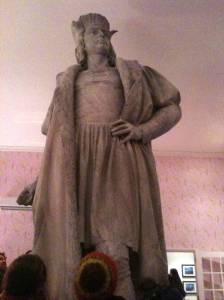
It’s the holiday season in New York, with art lovers rushing to see the spectacular apartment that Tatzu Nishi has created (courtesy of The Public Art Fund) for Christopher Columbus, the man at the center of things near the Time-Warner Building.

He’s been standing atop that column since 1892, so it’s about time that he had us over to see his taste in décor, books, and light TV viewing.  Here’s the Flickr feed, which takes you on a 360-degree view of his digs.

Who knew Captain Columbus was into pop culture? He even has a copy of one of Andy’s early cat lithos in his bookcase. Enjoy the holiday views that Columbus is enjoying, and get your free tickets now, because you won’t be seeing the City from this view again!

What Columbus is reading inside his apartment

What Columbus is reading inside his apartment

NYC Spider Theater Due to Close

Bronze Spider 1, 1995 by Ms. Bourgeois lurks at the show’s entrance

About the best spider theater in town is about to close in a few weeks – the live-animal floor show inside the American Museum of National History’s Spiders Alive! exhibition, where an actual spider-handler enthralls the crowds with myth-busting tales while introducing the arachnid star of the show, a Chilean Rose Hair Tarantula. Nearly 20 live species are crawling around the terrariums, but crowds are flocking to the live demo/theater area of the show and sitting spellbound until intermission. Go see it!

Since the AMNH never does anything second-rate, it’s fitting to note that welcoming visitors to the show is an art-world superstar. Lurking inconspicuously in the “canoe” lobby area outside the show is one of the smaller bronze spiders crafted by Louise Bourgeois. It’s smaller than the babies that graced the 1999 opening of Tate Modern’s Turbine Hall in London (and later the Guggenheim in Bilbao and Rockefeller Center), but who cares? Stop by for a glimpse.

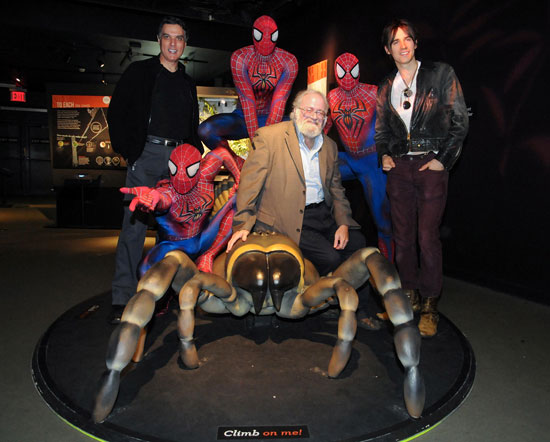
Robert Cuccioli, AMNH curator Norman Platnik, Reeve Carney and multiple Spider-Men take in AMNH’s “Spiders Alive!” © AMNH\R. Mickens

And lest you think that AMNH ignored the other obvious art-world connection, it didn’t, as shown by this amusing photo in September, when the cast of that other spider-themed show came to visit AMNH curator Normal Platnik for a walk-through.

Check out the opening-day YouTube promo below, but go meet the spiders up close and personal before they leave after January 6. If you’re a sci café geek that wants more, go poke around the AMNH World Spider Catalog.

Do-It-Yourself Fashion Alphabet

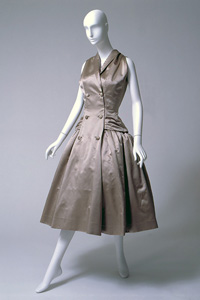
Christian Dior, dress in satin, 1954, France, gift of Sally Cary Iselin.

You’ve probably been too busy looking for electrical outlets below 34th Street to have noticed that today is the last day of the exhibition Fashion, A-Z: Highlights from the Collection of the Museum at FIT, Part Two.

Don’t worry, because as your power (and Internet) comes back on, you can get your fashion fix via FIT’s new digital archive that lets you surf by alphabet to see all the famous designers and dresses that are in the collection. Search by designer or brand, they’re all there.

The gallery show has the outfits arranged A (for Adrian with a MoMA-inspired creation) to Z (Zoran) in its upstairs gallery. The curators often placed two designer ensembles side-by-side, emphasizing the original designer (for example, Dior) and the younger designer who took over creative duties for the house over time (for example, YSL for Dior).

It’s a treat to see side-by-side examples of new and old Hermes (featuring Gaultier vs. the Kelly bag), Valentino, Balmain, Kenzo, YSL, Dior, and Comme des Garcon creatives.

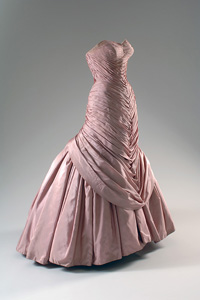
Charles James, evening dress in silk taffeta and net, 1955, USA, gift of Robert Wells In Memory of Lisa Kirk.

Is Charles James still the reigning world champion? Take a trip to Seventh Avenue today or start surfing fashion history to make your own determination.

MoMA Displays Post-Sandy Boardwalk Episode

Maybe it’s a bridge and not a coastal boardwalk, but the character in Munch’s pastel on view at MoMA through April 2013 pretty much sums up the experience of so many Tri-State residents in the last week.  Ironically, the privately owned drawing went up only a few days before the hurricane stormed through the region, devastating homes, beaches, and the Chelsea galleries.

Many downtown museums remain closed, including the South Street Seaport Museum, the New York City Police Museum, the National Museum of the American Indian, and the Skyscraper Museum, although the Museum of Jewish Heritage at the Battery has just announced its reopening. On the West Side, the Intrepid is closed until it can fix its inundated welcome center and repair the outdoor protective bubble around the space shuttle Enterprise, which got a little beat up. The High Line is repairing all of its electrical infrastructure.

To help the arts and museum community during this difficult week, MoMA has posted a PDF with instructions on conserving art works that have sustained flood damage and held a workshop with conservators from the American Institute for Conservation Collections Emergency Response Team for afflicted dealers and collectors this past weekend.

While the repairs and restoration will take time and with another windy storm on the way toward New York, Mr. Munch’s 117-year-old evocation remains pretty much on point.

Hirschhorn Goes Overboard at Gladstone

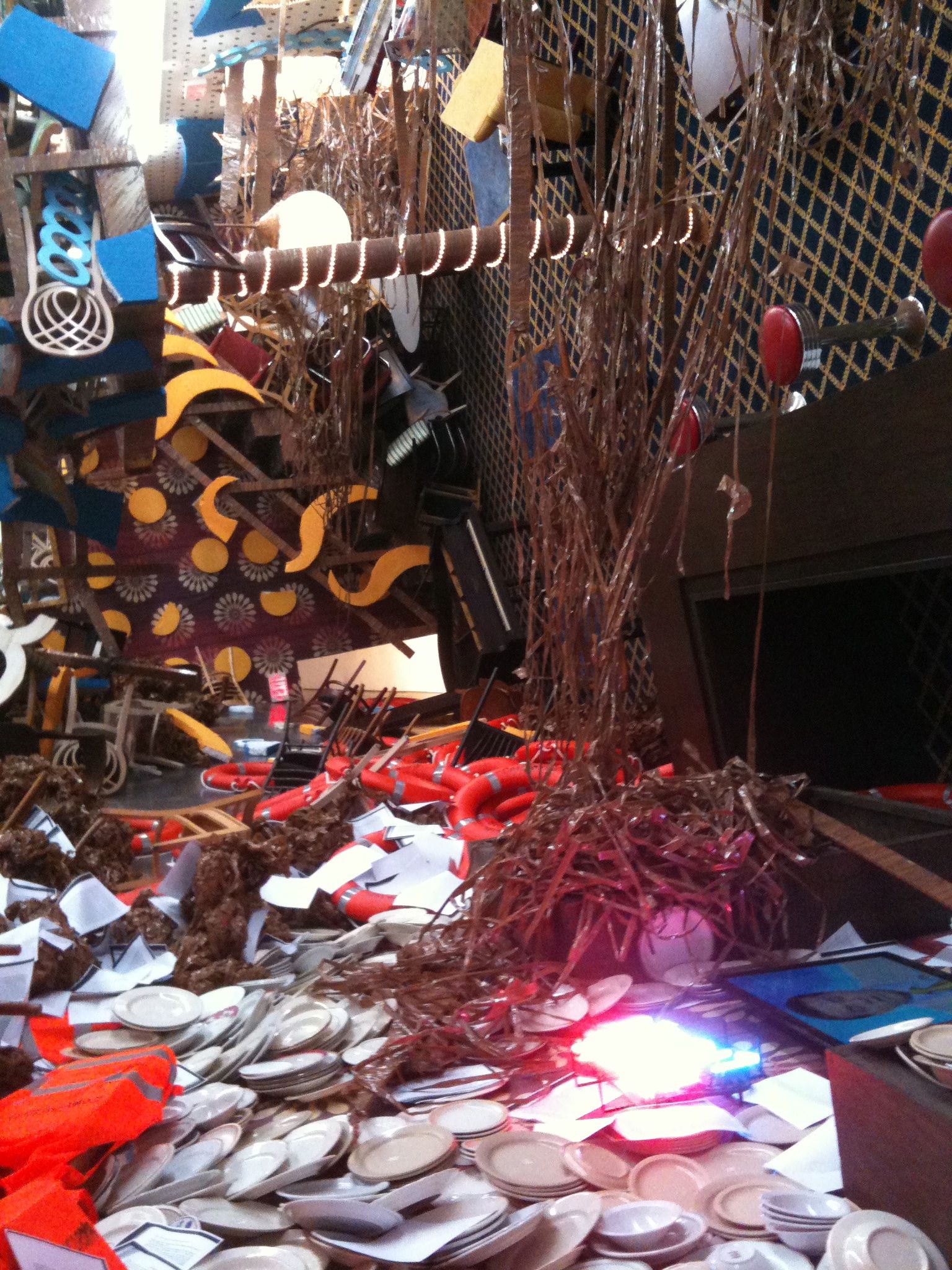
This may look like a Judy Pfaff installation, but it’s a close-up of the engaging, room-size environmental work by social commentator Thomas Hirschhorn on view until October 20 at Gladstone Gallery in Chelsea.

Concordia, Concordia is a riff on the tumultuous, larger-than-life grounding tumble of the Italian cruise ship, Costa Concordia in January 2012. Gladstone has other close-ups on its website, but its worth a walk over to 530 West 21st to get the full experience for yourself.

Hirschhorn was inspired by the furniture-akimbo nature of the interior photos of the luxury liner and the refusal of the ship’s captain to tend to the self-inflicted disaster.  There’s a lot to look at – including Hirschhorn’s cheeky inclusion of The Raft of the Medusa.  Look hard. You’ll find it. There’s no safe place.

Coe Multimedia Accessory Collection at The Met

Detail of Possible bag (1900) from the Coe Collection at The Met

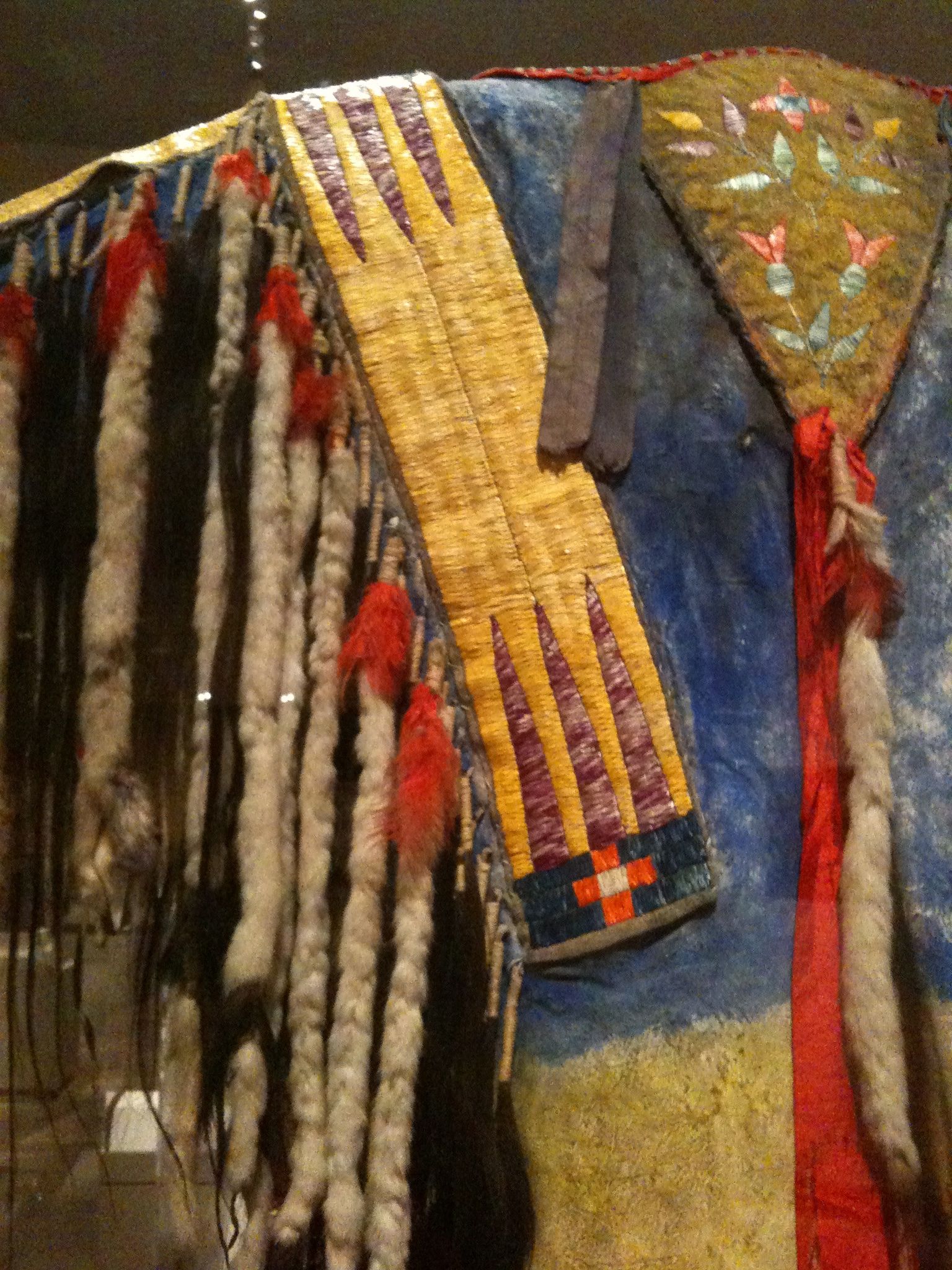
McQueen and the Paris runways have nothing over the 18th and 19th-century Native Americans who knew how to mix unusual materials and meanings into symbolic, functional, innovative, and salable accessories. A collector with an eye for the interesting is honored in the Met’s Michael C. Rockefeller wing in the micro-show, The Coe Collection of American Indian Art.

Ted Coe of Santa Fe was inspired to collect both ancient and contemporary works by Native Americans that caught his attention, amassing thousands of pieces that he bequeathed to the Met. He mounted a truly innovative show at AMNH in 1986, which linked old and new traditions in Native American art making, Lost and Found Traditions: Native American Art 1965-1985. The Met’s curators decided to honor his work by selecting forty objects.

Detail of Arikara Leadership shirt (1860) from Coe collection at The Met

The show isn’t all about wearable art, but we decided to focus on a few details that you might find of interest. We’ve organized the Flickr feed to document some of the oldest to the newest creations on display, ranging from mid-Mississippian carved stone tools from 4,000 B.C. to the cheeky dough bowl (1994) made by Chochiti potter Diego Ramirez.

In between, you’ll see an array of sophisticated and rough creations made by artists from the 1700s to early 1900s for Native American leaders, nomads, and tourists – all designed, embellished, and crafted in a variety of materials. Who knew that nuns taught Canadian tribal artists to embroider with moose hair? Enjoy the details.

Afghanistan in MoMA’s Atrium

Afghanistan is in the house as part of MoMA’s tribute to Italy’s art povera superstar in their soon-to-close exhibition Alighiero Boetti: Game Plan. Although Boetti’s retrospective takes up room on MoMA’s other floors, it’s the Afghanistan-made kilims and other art works that really serve as the focal point of the visitor experience. Check out the photos.

Get there to see the series of embroideries on tissue and the grid-within-grid rugs with patterns designed by art students and woven by Afghan artisans. Up until the Soviet invasion in 1979, Boetti worked with artists there to carry out intricate woven collaborations – including over 150 maps of the world. Boetti traced the maps on canvas and let the weavers add whatever text they wanted and pick all the colors. A few are on display here, and you can hear a pretty amazing description about the logistics of Boetti’s collaborations from MoMA curators in a short audio.

Installation view of Alighiero Boetti map (1979), embroidered by Afghani craftswomen

You’ll enjoy the densely packed embroidery Everything, and the amazing tapestry of the thousand longest rivers in of the world (1976-1982). It took Botetti and his wife years to classify all of the rivers, and if you’ve ever seen this on display before at MoMA (it’s in their collection), it’s an amazing textile that never fails to draw a crowd.  You’ve got to see it in person.

Check out MoMA’s interactive site for the exhibition, but run over to examine all the Afghani creations up close. Enjoy the trip.