Unknown's avatar

About MsSusanB

Arts and technology writer who is in the know about the latest and greatest that New York City – and other places in the country – have to offer and the fossils that are being dug up around the world

Stella Leaps Off Walls at The Whitney

Long view of gallery with The Grand Armada (IRS-6, 1X) (1989)

Long view of gallery with The Grand Armada (IRS-6, 1X) (1989)

Leaping loops of bendable pipes! If you’ve never seen paintings that jump off the wall, get over to the Whitney’s Frank Stella: A Retrospective before it closes on February 7.

As Frank himself says, “Painting does not want to be confined by the boundaries of edge and surface.” Ok, no argument here. Nothing up here looks “confined”.

You emerge from the elevator face-to-face with his monumental masterpiece that’s nearly as long as the AMNH Titanosaur. It’s full of more visual nooks and crannies than a walk through Central Park and as vast as Wyoming. It’s a dazzling performance of color, line, and expanse. Before jumping into the rest of the show, the sheer size demands that you slow down to see the detail.

Detail of baroque, monumental 1999 painting, The Earthquake in Chile

Detail of baroque, monumental 1999 painting, The Earthquake in Chile

Let’s admit, however, that the busy, unconfined artworks on the right form a gravitational force field that will lure even the most focused visitor away to explore the whirly color and 3-D protrusions. The label copy says Frank was inspired by Baroque music, letting his paintings function like soundless symphonies.

Through the bays, you catch glimpses of big Protractors and other Day-Glo creations that embody the over-the-top Eighties in New York.

You’ll also encounter of Frank’s most famous geometric meditations and early works from the pre-Soho days. From every angle and position, you see, feel, and meet some mighty heavy output. And it’s only the tip of the iceberg in terms of the full output of this 79-year-old powerhouse.

The Whitney’s solution to showing such a big, diverse, lively group of work was to take advantage of their new, moveable walls. The show’s designers moved all the walls away from the edges of the gallery so that visitors can see from one end to the other and glimpse the full spectrum of Frank’s artistic output.

Wall with works from the 1980s Moby Dick series

Wall with works from the 1980s Moby Dick series

Look through the show on our Flickr feed of the show, with the works sorted into chronological order, and enjoy the curator audio guide on the Whitney website.

On the far east section of the gallery, the 3-D might comes into full view with selections from the Moby Dick series, roaring, raging works that push out from the white wall. The selections are impressive, but are only a small portion of Frank’s total output from that era.

For every one of the 95 works on the wall, there are dozens and dozens of works in each series – just as big and monumental – that didn’t get into the show. The curators told us that it was the biggest problem in mounting Frank’s retrospective: Their size demands that they be bolted into place, so to borrow them for the show, the parts of each huge work must be carefully disassembled and then reassembled. Installing each piece was a challenge akin to moving the Amenemhat II colossus into the Great Hall at The Met. Thank goodness that Frank’s team provided elaborate instruction manuals and how-to drawings.

Circus of Pure Feeling for Malevich, 4 Square Circus, 16 parts, 2009 has a view of the Hudson

Circus of Pure Feeling for Malevich, 4 Square Circus, 16 parts, 2009 has a view of the Hudson

Stella’s most recent work is situated in two special places of honor: His diminutive 2009 creations are parked right next to the Hudson River view – sixteen little curvy sculptural tributes to the collision between the precision of absolute geometry (courtesy of Mr. Malevich) and whimsy playfulness, represented by Mr. Calder, the Whitney’s circus master.

At the other end of the floor, his Black Star dominates on the outdoor balcony overlooking the Meatpacking District and the Standard Hotel. See the video below.

Great tribute, great art, great show at the New Whitney. And thanks for publishing the full catalog and essays online.

Buried in New York – Divas and Rare Jewelry

Henut does Queen Neferu’s hair, 11th dynasty (2051-2000 B.C.) Courtesy: Brooklyn Museum

Henut does Queen Neferu’s hair, 11th dynasty (2051-2000 B.C.) Courtesy: Brooklyn Museum

While New York City is digging out from record snowfalls, there’s some great news about a few items that have been buried for centuries and are none the worse for wear – cosmetic boxes, bracelets, belts, and styling tips of the great divas (male and female) of ancient Egypt. The Metropolitan Museum of Art moved some gems out of the cavernous Egyptian wing – and borrowed a few things from Brooklyn and elsewhere – for its monumental tribute to the 12th dynasty, Ancient Egypt Transformed: The Middle Kingdom, closing today.

Usually buried among the collections on the first floor, the curators pulled out some of our favorites from the galleries (along the way to the Costume Institute) and presented them as the spectacular showpieces they are. It warrants a shout-out to the effort it took to conceive, mount, and present this terrific show. What a way to leverage the collections that are right inside the city limits!

Queen or Princess as a Sphinx, 12th dynasty (1981-1802 B.C.) Once owned by Emperor Hadrian , later by a Cardinal. From Brooklyn Museum

Queen or Princess as a Sphinx, 12th dynasty (1981-1802 B.C.) Once owned by Emperor Hadrian , later by a Cardinal. From Brooklyn Museum

The story of the transformations happening in Egypt’s 11tth to 13th Dynasties (ca. 2030–1650 B.C.) is big (enough to fill twelve galleries), so we’re just highlighting a few of the things we noticed that modern People of Style might enjoy. Check out our Flickr site.

First, Brooklyn is in the house in the gallery dedicated to royal women: off to the side, there’s a limestone relief fragment (normally at the Brooklyn Museum of Art) showing Queen Nefuru having her tresses done by 11th Dynasty celebrity stylist, Henut. The curators point out that a telltale sign of royals (men and women) is the distinctive winged-eye look that her makeup artist achieved in kohl. The styling is incised in limestone, showing the Queen getting ready to emulate Hathor, the goddess of love and romance. In those days (2051-2000 B.C.), only royals could sport the jeweled necklace or eye makeup style.

Nearby, Brooklyn also contributes a beautifully sculpted head, said to be broken off from a larger sphinx statue from the 12th Dynasty – a protective guardian featuring a fantastic coif that only a queen or a princess would sport. It was all wigs, all the time.

372-piece cloisonné pectoral of Princess Sithathoryunet. Gold, carnelian, lapis lazuli, turquoise, and garnet. 12th dynasty (1887-1878 B.C.).

372-piece cloisonné pectoral of Princess Sithathoryunet. Gold, carnelian, lapis lazuli, turquoise, and garnet. 12th dynasty (1887-1878 B.C.).

One of the most spectacular pieces is the 372-piece cloisonné pectoral worn by Princess Sithathoryunet. It’s a 12th Dynasty masterwork (1887-1878 B.C.). of gold, carnelian, lapis lazuli, turquoise, and garnet. The piece is magical and protective, but instead of being inlaid with the name of the princess, it features the name of the king. The idea is that the king himself is being protected when the royal daughter wears it – not the diva herself. You get what you pay for.

She also had another set of formal jewelry — a cowerie shell girdle and matching bracelet of gold, carnelian, feldspar, and crystal. The imitation shells had small pellets inside, which would have made a tinkling sound when she walked. The same is true for the feline-headed set of jewelry of gold and amethyst.

Feline-Headed Girdle of gold and amethyst from 12th Dynasty (1887-1813 B.C.).

Feline-Headed Girdle of gold and amethyst from 12th Dynasty (1887-1813 B.C.).

Sithathoryunet kept these and other treasures in a beautiful jewelry box, which is displayed nearby alongside a cosmetic box. The Met reconstructed the wood boxes by putting the ebony, ivory, gold, carnelian, blue faience, and silver back into place. Magnificent. Look for it all when these spectacular items go back on display at the back of the Egyptian Wing later this year.

By this time in Middle Kingdom culture, the elites started copying the royals, so some of the buried treasures that the Met found on its early 20th century expeditions belonged more to aspirational upper classes than the royals themselves. Check out the cosmetic case and mirror belonging to Amenemhat IV’s royal butler, Kemeni. Or the faience necklace worn by Wah, the overseer who served Meketre, the royal chief steward serving kings in both the 11th and 12th Dynasties.

The Met found a bonanza of fantastic reality art in Meketre’s tomb – so much that only a few pieces were brought up to the second floor for the special show. The show features a real-life depiction of a grainery and sport fishing boat, but if you look on the first floor as you walk through to the Costume Institute, you’ll see many more boats and several more rooms of day-to-day life – all meant to serve Meketre in the next world.

Cosmetic box of the royal butler, Kemeni, with four ointment jars and a mirror. 12th dynasty (1814-1805 BC.)

Cosmetic box of the royal butler, Kemeni, with four ointment jars and a mirror. 12th dynasty (1814-1805 BC.)

The Met has meticulously documented this show online. Spend a snow day (or not) by taking a tour through all twelve galleries on the Met’s web site and listening to the curators’ take on the on-line audio guide, which also features photos of each of the objects. Here’s where you can search the exhibition objects and find more detail.

Hear the behind-the-scenes chit-chat from the curators on the museum’s blog, including how the Egyptians feasted and how the digital team created the replica of the pyramid complex at the center of the show.

MoMA Connects Music and Modernism

A decade apart – 1957 Stratocaster and Avendon’s 1967 posters of the Beatles

A decade apart – 1957 Stratocaster and Avendon’s 1967 posters of the Beatles

The MoMA Design Department had a brilliant idea – to tell the history of 20th century music culture by pulling out objects and two-dimensional art from the museum’s rich collection. How did modernism and music influence one another? See Making Music Modern: Design for Eye and Ear, on view through January 18.

There’s still time to catch some demos of the Scopitone, the Stratocaster, and the Mechanical Flux Orchestra inside the gallery this weekend.

Although a lot of the buzz in the gallery is over visitors’ recollections of the turntables, radios, and album covers on display, the curators do everyone a favor by putting the mod, mod world into historical context at the start of the show.

Early Edison sound experiments, films of Loie Fuller and Josephine Baker, and a poster of Yvette Guilbert from the can-can era remind everyone that shocking live performances, revolutionary music trends (go, ragtime!), and print designs that pushed the limits don’t belong exclusively to the mod, punk, or techno eras.

Early pop music innovations: sheet music and Edison wax cylinders

Early pop music innovations: sheet music and Edison wax cylinders

Tucked into side panels and corners are photos of costumed interplanetary performers of the Triadic Ballet at the Bauhaus in 1922 and early Russian avant-garde takes on the advent of radio, the broadcast and communications technology that changed entertainment forever.

These were worlds where artists and designers did it all – fine art, typography, industrial design, textiles, and performance. There are even some snippets of early acoustic-enhancing textiles on display, courtesy of Anni Albers. Design and music mixed, right from the start of the last century.

The sleek, streamlined radios, microphones, and Rural Electrification poster from the 1930s are presented as icons of the earliest era of broadcasting, with reminders from the curators that the designs were made to rescue the radio from its early haywire, spaghetti-city look that first appeared on 1920s garage workbenches across the country. Make it look nice, and you can bring it inside, where we can all enjoy it.

Stylish: 1932 Bakelite radio by Wells Coates and a 1939 Unidyne mic by Benjamin Baker.

Stylish: 1932 Bakelite radio by Wells Coates and a 1939 Unidyne mic by Benjamin Baker.

Throughout the Fifties and Sixties, music and design seemed to go hand in hand. Consider the Sixties revolution in turntable and speaker design – everything fit for a super-modern lifestyle of easy listening with jazz and high-concept percussion album covers nearby.

The invention of the Fender Stratocaster guitar revolutionized the sound and look of early rock and roll with its iconic whammy bar and performances that represented out and out rebellion. Although the Stratocaster was invented in the 1950s, it’s appropriately displayed in front of posters of Bob Dylan, The Yardbirds, and Avedon’s Beatles – an innovation adopted by Buddy Holly that inspired the next generation.

Where pop music and art come together – Sixties album covers, including those by Richard Hamilton and Warhol

Where pop music and art come together – Sixties album covers, including those by Richard Hamilton and Warhol

If you really want to dig into the details, there are dozens of famous album covers and posters on display with tribute paid to their designers. Among the luminaries are pop-god Richard Hamilton’s “White Album” for the Beatles, Warhol’s “Sticky Fingers” cover for the Stones, and Rauchenberg’s design for the vinyl disk inside the Talking Heads’ “Speaking in Tongues” album. The chronicle of the Fillmore East posters is a book unto itself.

And Mr. Jobs’ imprint is never forgotten at MoMA. An early version of his iPod is displayed right next to the Seventies invention from Japan that rocked the music world – the Sony Walkman.

If you can’t make it, take a look at the show through our Flickr views. We’ve grouped the items in chronological order.

And check out the excellent MoMA blog posts about the show on MoMA’s “Inside/Out” platform, where curators go to share enthusiasm about the hunt for the Stratocaster, famous rock posters, and other gems from the Fifties and Sixties. Leave your own comments, reflection on music and design, and memories right there on the MoMA website.

Before Walkmans and iPods

Before Walkmans and iPods

When Folk Music Ruled New York

Washington Square Sunday folk singing, early 1960s. Courtesy: MCNY/Nat Norman

Washington Square Sunday folk singing, early 1960s. Courtesy: MCNY/Nat Norman

The large map inside the exhibition tells the entire story of how a folk music revival germinated on a few blocks in Greenwich Village in the 1950s and exploded into a national mania for twelve-string guitars, songs of protest, and music that paid tribute to deep, deep roots of the American experience.

The Museum of the City of New York tells a fascinating tale with its multimedia exhibition, Folk City: New York and the Folk Music Revival, through this weekend. Take a look at some of the show’s highlights in our Flickr album.

Ledbelly's historic twelve-string guitar

Ledbelly’s historic twelve-string guitar

The show ties together the tale of how Woody Guthrie and Alan Lomax got the ball rolling by shining a spotlight on Appalachian and Southern purveyors of down-home folk singing and inspiring a generation to look back, pay tribute, and carry it forward. MCNY has plenty of listening stations scattered throughout the gallery, offering up rare recordings that speak to the roots of popular music of the Sixties.

It’s a revelation to listen to Lomax’s 1934 recording of Ledbelly singing Good Night Irene and Midnight Special long before Pete Seeger, The Weavers, and Johnny Cash catapulted them to the charts in the Fifties and Sixties.

Flyers, broadsides, and other paraphernalia from Greenwich Village clubs paper the walls and vitrines, as the show steps through the story of how that sleepy NYC neighborhood transformed itself into a destination for the likes of Bob Dylan and other activist-artists who inspired a generation.

Photo of Dylan at Kettle of Fish Bar at 114 MacDougal Street in 1964 above his sheet music

1964 photo Dylan at Kettle of Fish Bar at 114 MacDougal Street above his sheet music

Music studios, clubs, publishing houses, coffee houses, and cold-water flats were all jammed into a few city blocks that functioned like a 24/7 open-mic night. Back in the late Fifties and early Sixties, music was pouring out of nearly every door on Bleecker Street and MacDougal.

The convergence spawned a network of producers and publishers who felt it was their mission to bring folk music to a wider audience – uptown at Town Hall, on alternative radio stations across the country, and executives at the big labels. Some of the highlights at the back of the gallery are Dylan’s handwritten lyrics for Blowin’ In the Wind and Mr. Tambourine Man.

Political battles are found at every turn in the installation, from Seeger’s encounter with McCarthy’s House Un-American Activities Committee to inspirational performances by Pete, Odetta or Peter, Paul & Mary at historic marches and protests. The music was always there, intertwined with the events of the day.

First edition of “Sing Out!” magazine, 1950

First edition of “Sing Out!” magazine, 1950

Although folk and roots music inspired artists like The Beatles and The Rolling Stones, the MCNY show notes that after Dylan went electric and the British invaded New York, the folk music juggernaut lost some of its steam. No matter. You can still see it all recreating itself on Bleecker Street at The Bitter End any night of the week, listen to an up-and-coming singer-songwriter, and view lots of those historic posters on the back wall after MCNY’s show closes.

Navajo Jewelry Masters Offer Glittering World at Customs House

Bracelet of coral, opal, suglite, lapis, turquoise, gold, and silver by Raymond Yazzie. Courtesy: NMAI/Knight collection. Photo: S. Franks

Bracelet of coral, opal, suglite, lapis, turquoise, gold, and silver by Raymond Yazzie. Courtesy: NMAI/Knight collection. Photo: S. Franks

If you’d like an immersion into a chamber of glistening silver and gems, enter the National Museum of the American Indian’s exhibition of stunning beauty and tranquility — Glittering World: Navajo Jewelry of the Yazzie Family.

The Smithsonian is providing New York with a unique chance to view 300 remarkable necklaces, bracelets, rings, and buckles from a New Mexico family of artists known for catapulting Navajo symbols, colors, and gems into a modern-art context.

Lapis and gold bracelet by Lee Yazzie, 1984. Photo: E. Aboroso, NMAI.

Lapis and gold bracelet by Lee Yazzie, 1984. Photo: E. Aboroso, NMAI.

The focus is on Lee and Raymond Yazzi, brothers whose award-winning, intricate creations are sought by collectors worldwide. You’ll see five magnificent pieces as soon as you enter, including work by their sister, Mary Marie – representing lifetimes of master craftsmanship inspired by the mountains, sun, sky, spirits, and family in Gallup, New Mexico.

Photomurals inside the door will transport you to the red rock monuments of Navajo Nation, 1950s trading posts along the old Route 66, and maps to turquoise mines that have supplied native peoples with high-end bedazzlers since 300 A.D. The Smithsonian will be returning it all to private collectors after January 10, so be sure to enter this beautiful realm before then.

Watch this testament to artistic inspiration and dedication to beauty:

And take a trip to the Navajo world to hear more on a lifetime of creation:

AMNH Highlights Species Living at the Limits

Tartigrades rule the show -- the micro-animal can survive at high heat, high altitude, high pressure, inhospitable climates, without water, and even outer space.

Tartigrades rule the show — the micro-animal survives high heat, high altitude, high pressure, without water, and even outer space.

If you’ve ever wanted to take a magic carpet ride to visit all the animals, plants, and environments you’ve ever seen on National Geographic or Nova, spend some time inside the special exhibition Life at The Limits: Stories of Amazing Species, running through January 3 at the American Museum of Natural History.

The curators and exhibition staff take you to the absolute limits of life on Earth in a “wow factor” show, organized into topics sure to astound.

How high into the atmosphere do animals live? How deep in the ocean? Who is the world-record holder for bite force? Who makes the longest migratory journey? Who is the award-winner for survival in the extreme?

The show will take you into deep caves, to life among the black smokers in ocean depths, to high altitudes, and even into outer space.

A deep-sea diving champion -- the Southern elephant seal can hold its breath for 2 hours and dive to 5,000 feet

A deep-sea diving champion — the Southern elephant seal can hold its breath for 2 hours and dive to 5,000 feet

And they’ve even thrown in some live creatures, too – the popular Axolotls, who retain their juvenile amphibious form into adulthood, and swimmers using the jet-propulsion method – chambered nautilis. Check out a few views on our Flickr feed.

Not to give anything away, but you’ll find out that vultures have been known to fly at 37,000 feet and beaked whales have been known to dive at least 10,000 feet below the ocean’s surface.

Live Chambered nautilis demonstrates jet propulsion

Live Chambered nautilis demonstrates jet propulsion

Crocodiles have a bit force of 3,700 pounds, electric eels and hammerheads can deliver 600 volts, and eagles can subdue animals of up 20 pounds in weight using only their claws. Arctic Terns may migrate 25,000 miles.

There’s no doubt that the stars of the survivalist show are miniscule tartigrades (better known as “water bears” or “moss piglets”). These miniature eight-legged water creatures inhabit climates that no human could. They are able to survive at temperatures colder than Pluto and hotter than boiling water and have been known to survive in the void of space for up to 12 days.

Moreover, tartigrades are prolific: nearly 1,200 species inhabit Earth in lichen, moss, beaches, and dunes and hold the distinction of residing at the International Space Station and being part of Space Shuttle Endeavor’s final flight.

Artist recreation of tube worms absorbing chemicals from ocean vents three miles under the sea – an environment unknown until 1977

Artist recreation of tube worms absorbing chemicals from ocean vents three miles under the sea – an environment unknown until 1977

How did life evolve to adapt to such extremes? Darwin explains it in his theory of natural selection, which leads to gradual adaptations within animal populations.

But you are left to wander and wonder at the engaging displays, animals, specimens, and movies.

Glimpse some of this fascinating exhibition in this video with co-curators John Sparks and Mark Siddall. By the way, the cover photo below is the Axolotl featured in the show:

MoMA Salute to Sixties Art World Transmissions

Announcement for Allan Kaprow’s 1968 Three Country Happening with collaborators in Germany and Argentina, one of the earliest artworks to incorporate an international telecast.

Announcement for Allan Kaprow’s 1968 Three Country Happening in NYC, Germany and Argentina, one of the earliest telecast international performance pieces.

Before restaurants and shops populated Tribeca and Soho in the 60s and 70s, edgy New York City artists were experimenting with happenings, video art, performance pieces, mail art, and assorted ephemeral pieces – Cage, Moorman, Kaprow, Ono, Paik, Grooms, Oldenberg and Maciunas to name a few.

In the pre-Internet days they might have been unaware that half a world away, Eastern European and Latin American artists were catching wind of this new art wave and stamping their own brand on their local art scene.

MoMA’s show, Transmissions: Art in Eastern Europe and Latin America, 1960-1980, captures the zeitgeist and shines a light on the artists, movements, and pieces from important avant-garde artists whose names are not as well known in the States. See it through January 3.

Organized into several rooms and themes, it’s a great collaboration among MoMA’s Departments of Media and Performance Art, Photography, and Drawings and Prints. The result puts a lot of MoMA’s huge Fluxus collection into a proper world context.

Socially relevant art posters from Poland, Cuba, Czech Republic, Yugoslavia

Socially relevant art posters from Poland, Cuba, Czech Republic, Yugoslavia

The first half of the show deals with geometry and its spiritual significance, offbeat artist publications, and mash-us between mail art and street performance.

Favorites include post-minimalist pieces from Brazil, Suprematist-style wall works by Yugoslavia’s Mangelos and an entire wall of photos documenting push-the-envelope street art many Eastern European countries. See our Flickr feed for a walk-through and click the links below for glimpses into MoMA’s show blog.

The next section turns more socio-political with works from the Argentine collective, Instituto Torcuasto di Tella – a center of the avant garde in Buenos Aires from 1959 to 1970. The centerpiece is a large installation for the Venice Biennal by David Lameles – Office of Information about the Vietnam War at Three Levels: The Visual Image, Text and Audio. The glass-walled newsroom is a stage from which performers read “breaking news” from the Vietnam War, just as they did when the collective debuted this in 1968. When the performers aren’t present, visitors can listen to archival recordings in three languages to feel transported back in time and reflect on how and if things have changed.

Installation for the 1968 Venice Biennal by Argentina’s David Lameles – Office of Information about the Vietnam War at Three Levels

Installation for the 1968 Venice Biennal by Argentina’s David Lameles – Office of Information about the Vietnam War at Three Levels

Nearby, visitors see clips from Marta Minujin’s Simultaneity in Simultaneity part of Allen Kaprow’s 1968 Three Country Happening, which was one of the first international telecasts of performance art.

Other galleries feature the blossoming of feminist art and performance art, social-commentary painting and sculpture, and poster art on these two continents. Artists that are familiar in US collections — like Botero (Colombia), Marisol (Venezuela), Marina Abramonovic (Serbia), and Ana Mendieta (Cuba) – are displayed in galleries that introduce other stellar artists to entirely new US audiences.

Oscar Bony’s photo documentation of his 1968 performance piece, The Working Class Family, which displayed an actual Argentine family at an exhibition

Oscar Bony’s photo his 1968 performance piece, The Working Class Family, which put an actual Argentine family on display

Consider Oscar Bony’s photo documentation of his controversial 1968 performance piece, The Working Class Family, where an actual Argentine family displayed themselves for the run of an exhibition at Instituto Torcuasto di Tella. Or Romanian graphic designer Geta Bratescu’s Medea IV, a 1980 sewing-machine drawing made and displayed privately in her studio at the height of a repressive political regime when most artists retreated underground.

The show ends with a spectacular installation: Juan Downey’s 1975-76 masterwork, Video Trans Americas. The gallery floor is painted with an outline map of the Western Hemisphere with banks of video monitors placed atop countries to which he traveled from the tip of South America to New York City, showing the life and times of indigenous people.

Chilean artist Juan Downey’s 1975-76 Video Trans Americas, documenting native peoples from his travels from the tip of South America to New York City

Chilean artist Juan Downey’s 1975-76 Video Trans Americas, documenting his travels from the tip of South America to New York City

Inspired by the idea of a transnational identity, Downey’s piece beautifully sums up the feeling of the entire show – artists and people engaged in a cultural dialogue across time and space.

Thankfully MoMA has given these artists a timeless showcase and home.

FIT Honors Transatlantic Nightlife Queen

1990 Mathu & Zaldy body suit and attached boots that Susanne wore to an Armani party

1990 Mathu & Zaldy body suit and attached boots that Susanne wore to an Armani party

If you think the music and fashion stopped after Studio 54 shut its doors to Liza, Liz, Andy, Calvin, Halston, and Yves, FIT’s club-scene exhibition, Fashion Underground: The World of Susanne Bartsch, presents evidence to the contrary through December 5.

The show features nightlife splendor (with all the trimmings) from Susanne’s clothes-to-be-seen-in archive. Plus, you’ll get the thrill of pretending that you’ve stepped into one of her over-the-top parties, filled with celebrities, outrageous clothes, spectacle, and glitter.

Wielding "the list" in a 2008 Jean-Paul Gaultier jacket and Patricia Fields hat

Wielding “the list” in a 2008 Jean-Paul Gaultier jacket and Patricia Fields hat

Right downstairs at the gallery entrance, you’ll be taken back to a graffiti-splashed Nineties club entrance with a dolled-up doorkeeper sizing you up and holding “the list”. But there’s no anxiety about whether you’ll be let inside…Just walk in and be transported back to 1981.

 As the glittery disco 54 era was coming to an end in New York in 1981, Bartsch arrived from London and opened up a shop in Soho filled with up-and-coming London designers that were creating the “new look” catching on in clubs across the pond.

In the early 1980s, Japanese and British designers experimented with crinkly natural fibers and oversized smocks – which looked fresh and hip after a decade of form-fitting, glitzy disco looks.

The Eighties -- Vivienne Westwood looks with Galliano linen ensembles

The Eighties — Vivienne Westwood looks with Galliano linen ensembles

Susanne sold the oversized, anti-disco baggy look of nightlife trendsetters Boy George and Leigh Bowery, imported dandy mix-and-match men’s and women’s looks from Vivienne Westwood, and featured flowing frocks by London’s Rachel Auburn.

The first part of the FIT show walks down this part of memory lane, including linen frocks by Mr. Galliano. Smocks are punctuated with dramatic hats (decades before fascinators) or beads from Portobello Road.

By the late Eighties, all that had given way to raggedy and accessorized mash-ups sported by the Material Girl and by the Nineties, bejeweled and bedazzled clubwear reigned again. Susanne was regularly hosting parties clad in an ever-evolving array of embellished corsets, fashioned by the master of form and shape, Mr. Pearl.

Two Mr. Pearl corset ensembles (1989, 1991) with 1992 Mugler Cowgirl ensemble, worn by Naomi Campbell Installation view of “Fashion Underground: The World of Susanne Bartsch” September 18 – December 5, 2015 The Museum at FIT New York, New York

Mr. Pearl corset ensembles (1989, 1991) with 1992 Mugler Cowgirl ensemble for Naomi Campbell

In a well-deserved tribute to his creations, FIT has installed a carousel of Mr. Pearl’s work on a turntable in the show’s back room of the show, next to a corner where mannequins form a towering tribute to the magic of Mr. Mugler, another of Ms. Bartsch’s favorites. After she introduced Mr. Pearl to Mr. Mugler, the rest was fashion history.

Fashion designers flocked to her parties and she did justice to them all – working in their hats, jackets, shoes, bags, and separates into her never-ending array of special occasion get-ups. When you peruse the specific looks on display in the show, it’s an all-star line-up of New York, Paris, and London fashion heavyweights.

Gareth Pugh 2015 ensemble of paper, Lycra and leather

Gareth Pugh 2015 ensemble of paper, Lycra and leather

The show screams of creativity and it’s wonderful that curator Valerie Steele put a spotlight on this Queen of Nightlife and her impact on the underground/high fashion scene for the last three decades. A lot of Susanne’s featured clubwear is credited to Mathu & Zaldy, who turned out plenty of over-the-top looks when designer ready-to-wear just didn’t pack enough punch for a special occasion.

Another charming touch in the show is the ensemble of paper, Lycra and leather contributed by Gareth Pugh. Susanne asked him to send something she could (and would) wear.

As always, FIT provides lots of history and photographs of Susanne and friends in action at multitudes of balls and parties on its exhibition website. Spend time looking at Susanne in action and at snapshots of her historic Love Ball. For close-ups of the clothes and costumes, visit our Flickr feed.

Take 360 spin around each room of the show courtesy of FIT’s virtual tour produced by Synthescape. The arrows appearing on the floor will take you to all three rooms.

Do you wish you could have been at the opening of this exhibit? Not to worry – her friends and fans let you in on the party and remember unforgettable nights in this celebratory video. Even Calvin’s there:

Texas Retirement for World Famous NYC Dinos

A 1964 New York Times photo of the Sinclair Dinosaur and Stegosaurus passing by the Empire State Building on their way to the Queens fairgrounds

A 1964 New York Times photo of the Sinclair Dinosaur and Stegosaurus viewing the Empire State Building on their way to the Worlds Fair fairgrounds

The Sinclair dinosaur was a sensation when he arrived in New York City to star in the 1964 World’s Fair. Millions of visitors queued to have their pictures taken with him and get a glimpse of life-size replicas of the scale and scope of the Mesozoic megafauna.

T. Rex, Stegosaurus, Triceratops, Trachodon…never mind that they lived millions of years apart – just to see them inspired science geeks, wonder seekers, and future paleontologists – an unforgettable childhood impression.

It may surprise you to learn that Sinclair and T. Rex are living a blissful retirement in Texas where there are no Unispheres, freeways, lines of tourists, or ticket booths…about 75 miles southwest of Fort Worth in a state park with another unique connection to New York.

Sinclair relaxes in a Texas corral

Sinclair relaxes in a Texas corral

The gargantuan dinosaur trackway up on the fourth floor of the American Museum of Natural History is from the Paluxy River in Dinosaur Valley State Park, where these two former New Yorkers have retired.

Back in the Thirties, AMNH field explorer Roland T. Bird told his boss, Barnum Brown, about the Texas trackways. In 1940, aided by WPA crews, the submerged tracks were excavated, cut into 1,200 pieces and shipped off to the AMNH, the Smithsonian, the University of Texas, and a few other places.The excavation was a media sensation, with chronicles appearing everywhere.

In New York, the jigsaw-puzzle track pieces were eventually reassembled and placed under the Apatosaurus/Brontosaurus, where they remain today.

Apatosaurus atop Paluxy trackway in New York at AMNH

Apatosaurus atop Paluxy trackway in New York at AMNH

The big, round blobby tracks that appear to match those of Apatosaurus are reckoned to be those of Sauroposeidon and the three-toed tracks running right alongside are those of Acrocanthosaurus, a predator.

Even though this spectacular trackway got moved to New York, there are still plenty in in the park. There are at least five big sites, which have all been documented in the Dinosaur Valley State Park footprint-mapping project. See the results here. When you click on each photo mosaics or track overlays, they will open in Google Earth. Find the R.T. Bird site under Track Site Area 2.

But how did the New York dinosaurs get to Glen Rose? The entire dinosaur group toured the United States for a few years after the Fair, right around the time that Texans lobbied to have the Paluxy Trackway declared a state park. No dinosaur fossils at the time, but there were lots of footprints, mostly underwater but a few on the shoreline. Neighboring ranchers donated the land, hoping to keep the site intact and spur tourism dollars.

Sauropod footprints underwater at the Paluxy River, Glen Rose, Texas

Sauropod footprints underwater at the Paluxy River, Glen Rose, Texas

When the Sinclair tour concluded, Atlantic Richfield’s idea was to donate all the dinosaurs to the Smithsonian, but when the Smithsonian said they didn’t want the group, the band broke up. One went to Vernal, one to Cleveland, but Glen Rose was the only location that managed to get the two biggest stars. Did the New York connection make the difference?

It’s hard to know, but the recently opened Perot Museum of Nature and Science features a pop culture corner in its dinosaur hall with replicas of all of the NYC’s World’s Fair dinosaurs!

For the complete story, check out this video of the tracksite and an introduction to the Google Earth mapping project, old videos of Mr. Bird’s historic 1940s excavation, and cameos by the Sinclair dinosaur and friends.

World’s Fair T Rex enjoying a quiet life in Texas

World’s Fair T Rex enjoying a quiet life in Texas

Fashion Never Sleeps at FIT

Show opens with 2014 synthetic knit and nylon jacket and dress by Istanbul designer Arzu Kaprol “Global Fashion Capitals” Museum at FIT June 2 – November 14, 2015 New York, New York

Ensemble by Istanbul designer Arzu Kaprol

Stepping inside Global Fashion Capitals at the Museum at FIT is an around-the-world trip that gives a nod to fashion’s past while presenting style innovators who are thriving in nearly every corner of the world. Right inside the front door of the exhibit is a powerful mannequin duo straight outta Istanbul. Wow!

Turn around and you’ll see a packed International Fashion Week Calendar and an illuminated world map. It’s pretty clear that every hour or so, the sun rises on another hotbed of sartorial creativity. Except for Antarctica, every continent has multiple fashion weeks, fashion bloggers, innovative designers, and fashion followers all their own. Explore through the show’s website, and visit in person before November 14.

Representing London, Alexander McQueen's 2009 dress and corset

Representing London, Alexander McQueen’s 2009 dress and corset

The curators tell the story of the rise of traditional couture centers — Paris, New York, Milan, and London – through selected looks and accessories, dating all the way back to the mid-19th century and the House of Worth, when the fashion system and seasonal cycles were institutionalized. It’s interesting to learn that by 1949, the House of Dior was generating 5% of French export profits.

Of course, after WWII, New York was hot on the heels of Paris. Eleanor Lambert kickstarted New York’s Fashion Week in 1943 and Halston and his designer pals won their place in the pantheon of style by vanquishing the Parisians in the 1973 Battle of Versailles.

Milan took over the mantle from Rome after World War II, and London came into its own in the Sixties and Seventies with the debut of mad Mod, rocker chic, and Westwood’s over-the-top subversions.

Alexander Wang's 2015 dress from Nike's “flyknit” sneaker fabric

Alexander Wang’s 2015 dress from Nike’s “flyknit” sneaker fabric

In each section, the curators are careful to add a look from recent runways – Christopher Kane’s layered silk organza masterpiece and Alexander Wang’s shift made from the same fabric as Nike’s “flyknit” sneakers.

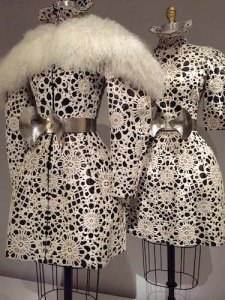
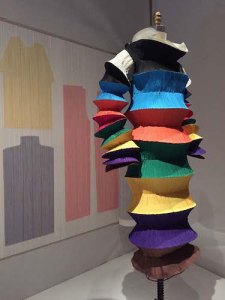
But the remainder of the floor space tells the story of other influential capitals of fashion – the 1981 emergence of the Antwerp 6 in Belgium; Tokyo’s wild ride with Miyake, Yamamoto, and Kawakubo; and what H&M did for Scandinavia as a fashion capital.

Next, the show highlights cities and fashion culture in Kiev, Mexico City, Sao Paulo, Lagos, J-burg, Sydney, Seoul and Mumbai. Click through these fashion histories on the FIT exhibition site, and marvel at Lisa Folawiyo’s bead-encrusted dress (Lagos) and Lie Sangbong’s graphic silk ensemble (Seoul).

Take a trip through the gallery on our Flickr site, and watch an interview with curator Ariele Elia below:

And for more on the Battle of Versailles, courtesy of FIT, click here.