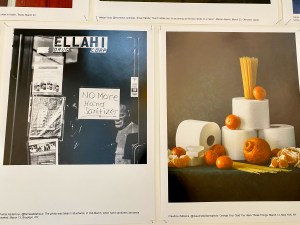
For months, people have noticed that days get blurred, months speed by, and time feels warped. Why is this happening? The answer is on the walls of the International Center of Photography in a must-see exhibition, #ICPConcerned: Global Images for Global Crisis, on view through December 31.
You’ll see images contributed from 70 countries between March and October 2020. ICP simply reached out to its network in March and April (when the museum had to close) to request images via the hashtag that showed was happening in their part of the world.
March images by Brooklyn’s Farras Abdelnour and NYC’s Claudine Williams
By April, 10,000 images had been submitted to ICP, mostly dealing with pandemic response, adjustments to routines, the need to quarantine, and at-home isolation pods. By May, the number of submissions had doubled.
But in the coming months, social-justice protests filled the streets, hurricanes swept shores, wildfires turned night skies orange, Beirut exploded, the pandemic kept grinding on, and the photos just kept flowing to the inbox at 79 Essex and onto the Instagram page.
Artists contributed thousands of photographs illustrating the ways COVID has changed life around the world, and images of hospital workers, families cocooning at home, and life in the public space. The exhibition is an affirmation how artists sustain creativity in troubled times and during protest.
Listen to David Campany, managing director of ICP’s programs, explain:
If you visit the museum in person at 79 Essex, you’ll experience why you’ve been feeling a little time-disoriented. As you walk through the months, you’ll be amazed to see how many disruptive or charming events everyone has been experiencing on an extremely compressed time scale.
April images from Karen Epstein (Kingston, NY), Morfi Jiménez Mercado (Lima, Peru), René Treece Roberts (Ashville, NC), and Lisa Sorgini (Australia)
It’s enormously satisfying to look through the #ICPConcerned images on ICP’s website and Instagram feed, but visiting the exhibit in person is the only way to experience fully the time-compression effect – walking, seeing, reading, reflecting, letting your eyes scan floor to ceiling, noting the places and dates. By the time you hit August and September, you’ll wonder, “Did all of that really happen since May?”
See the ICP installation of 1,000 contributed photos in our Flickr album.
#ICPConcerned has such a simple installation, but walking through it has a powerful effect. The only other museum installation that offers this much temporal disassociation is the Met’s About Time, but that’s done with a giant pendulum, hall of mirrors, a Phil Glass score, and intonations by renowned actresses.
It’s quite a credit to the ICP and the thousands of sharing photographers that they’re able show the weight (and whimsey) of the world as we’re living it in such spectacular form with just a hashtag, a free-spirited community deep-dive, and a push-pin budget.
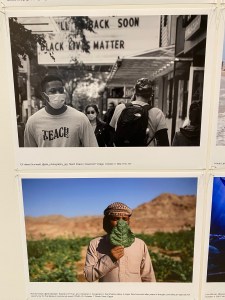
In October – Teach Peace | Greenwich Village by Eli Haies-Grunwald and Keepers of the Land by Rehab Eldalil of South Sinai, Egypt
See all the captions and images on the exhibition website. Have fun looking at the submissions by country here.
Many photographers contributed stories about their images and experiences. See and hear them here.
Want to be part of it all? Share your own images on Instagram with the tag #ICPConcerned
Entrance with Noguchi’s 1945 Kouros and Rodin’s controversial 1876 sculpture
The Met has pulled out all the stops on its 150th birthday show, Making the Met, 1870-2020, on view at Fifth Avenue through January 3 – incredible installation, intriguing stories, and a phenomenal digital showcase. So even if you can’t come to New York to see it in person, the Met website has it all!
The exhibition tells the story of the Met over the last 150 years – from its first incarnation in a house on 14th Street to its ever-expanding footprint in Central Park – shows the incredible art that benefactors donated, and relays the stories of the men and women who made it happen.
Head of a Hindu god, Bhairava, made by 16th c. Nepalese artists
Walking into the dramatic exhibition entrance, you’re surrounded by figures from different eras and cultures – a little girl from 5th century Greece holding two doves, a gilded mask of a Hindu god beautifully crafted by Nepalese masters of the 16th century, and Avedon’s 1957 portrait of a pensive Marilyn Monroe.
At the press opening, senior researcher associate Laura Corey explained that these were chosen to encourage visitors to think about the people behind the Met – collectors, curators, artists, restoration experts, and other staff. According to Laura, the African power figure from the Republic of Congo was one of the first artworks chosen for the welcome gallery. He’s looking right across to Marilyn, and they are sharing a similar expression and mood.
1906 photo of The Great Hall
At Noguchi’s Kouros sculpture, you can look left or right down a “street” lined with arches – portals that beckon you to step into different chapters of the Museum’s history. Each arch proclaims the decade and the theme. In between, there are huge slideshows from the museum’s past – how the Great Hall used to look, ladies in turn-of-the-century hats taking their art appreciation classes, Fifties moms and kids looking at art.
We’ve included our favorite artworks in our Flickr album, but the Met has produced a spectacular multimedia walk-through (posted on Google Arts & Culture), where you can experience all ten stories through photos, films, and links to blogs. Definitely watch the silent 1928 “Behind the Scenes” film showing museum shops, painters, gilders, and photographers at work. No surprise that the museum was into multimedia way back then!
Houdon’s 1778 bust of Franklin and reflection of Manet’s Young Lady in 1866
Through the first arch titled “The Founding” (the 1870s), you pass a huge Cypriot head (the first director was into archaeology) and the first paintings donated by the founding trustees. Houdon’s spectacular Ben Franklin gazes quietly (and slyly) at Manet’s Young Lady in 1866 – the first contemporary painting in the Met’s collection. It depicts a life-size, modern gal in her dressing gown – an image that shocked early visitors to the Met’s classical galleries! Of course, Ben looks on approvingly.
Next, you’ll see a 15th-century Turkish turban helmet and 17th-century Japanese armor. The story here is that the Met green-lighted Bashford Dean, a zoologist and world traveler working at the AMNH, to begin the arms and armor collection. Other curators began collecting works on paper, textiles, lace, wallpaper, musical instruments, and contemporary designs. In the Twenties, curators headed straight to the UK to scoop up samples from Morris & Company.
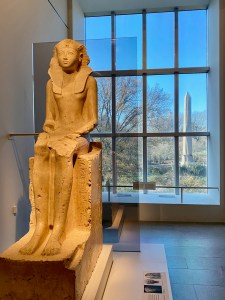
1479-1458 B.C. statue of Hatshepsut, and Cleopatra’s Needle (1450 B.C.) in Central Park
Around the corner is a tribute to the deep-pocketed donors like Morgan and B. Altman, who gave the Met lots of upscale, princely treasures – paintings by Vermeer and Ingres, fancy furniture, and tapestries. A treasure trove gifted by generous benefactors fills a wall – pistols for kings, cosmetic cases for Egyptians, bedazzled tablewear, and Middle Eastern glass.
Back into the main “street,” you’re right next to an imposing, reconstructed sculpture of Egypt’s female pharaoh Hatshepsut with a stunning view of Central Park’s Egyptian obelisk through the window.
These lead to the stories of how the Met collected art via excavations of archaeological sites – the Kharga Oasis (1908), Egypt (1880-1931) with Wah’s tomb stuff, Nimrud (Iraq), and along an ancient trade route (1934). The intrepid Bashford Dean enters the story again – excavating a Crusader castle, but only bringing back “dismal finds,” such as Crusader lamps, melted chain mail, and shards of stained glass, and (our favorite!) a projectile from a Crusades-era catapult (1250).
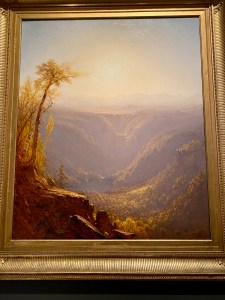
1864 A Gorge in the Mountains by Sanford Robinson Gifford
Apparently, it took a lot for a fancy museum to turn its attention from Europe to collecting art from the Western Hemisphere, but wealthy patrons had the goods. The American room features Sargent’s best-dressed “Madame X” and an enormous 1830 honeycomb quilt by Elizabeth Clarkson, the first quilt to enter the Met’s collection in 1923. There’s also a gorgeous Catskill Mountain landscape by Sanford Robinson Gifford, once owned by AMNH’s long-serving president, Mr. Jessup.
A gallery packed with work by Degas, Monet, Cassatt, Cezanne, and their Japanese masters tells the story of the Havemeyers, the Met patrons who lavished the museum with Tiffany glass (likely picked out by Mr. Tiffany himself), impressionist masters (picked out by Ms. Cassatt herself), and much more.
I Saw the Figure 5 in Gold (1928) by Demuth
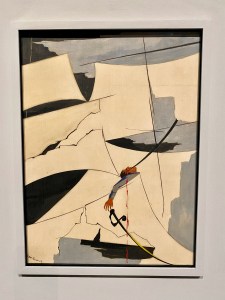
At the midpoint of the exhibition, you learn that Stieglitz had a rough time trying to convince the Met to honor contemporary photography. The Met also refused Ms. Whitney’s collection in 1929. Gertrude’s response was to start her own museum, which joined MoMA (which debuted in 1929) in celebrating modernism. The Met finally did accept modern works through Georgia O’Keeffe’s 1949 gift, and proudly displays a Demuth and Kandinsky in the show.
The Monuments Men story looms large, with Met curators playing a major role in discovering and returning art looted during World War II. There’s a 1945 model of an Army helmet prototype designed by the Met’s armor expert, hand-crafted in solid aluminum.
1965 Yves Saint Laurent Mondrian dress and 1966 Balenciaga coat
The largest gallery in the show tells the story of how the Met beefed up its collections and expanded gallery space during what it calls “The Centennial Era” – Islamic art, fashion, Asian and African art, and modern art from the 20th century.
The final story about the Museum’s current focus – adding works by artists and from regions that are underrepresented in its collections – is represented by a large El Anatsui piece, an embellished Tibetan saddle, a wall of art guitars, a large Faith Ringgold story quilt, and other intriguing works.
The museum’s done a tremendous job online telling all the stories via its digital primer. Click here to hear in-depth stories on the Met’s audio guide with Steve Martin, check out this video with his narration, get the backstory on every artwork in the show, and definitely visit the multimedia walk-through .
And check out this exhibition video showing how the museum’s architecture evolved to house these growing collections. In the 1880s, Olmstead and Vaux assigned a spot in Central Park for the Met. It’s interesting that one of the initial designs (which no one liked) was not scheduled for completion until 1990!! It’s a microcosm of 150 years of architecture and history.
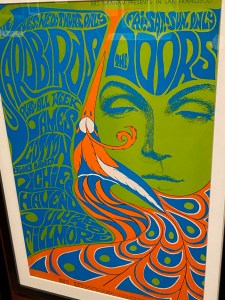
Bonnie McLean poster for Fillmore Auditorium July 1967. Courtesy: Bahr Gallery
It’s a trip back to the birth of Sixties youth culture, guitar virtuosos, the Fillmore, and multimedia extravaganzas in the New-York Historical Society exhibition, Bill Graham and the Rock & Roll Revolution, on display through January 3.
The show, originally organized by LA’s Skirball Cultural Center, tells the story of the man who created the Fillmore, catapulted legendary bands to fame, grew concert audiences to stadium size, and gave back to society by organizing once-in-a-lifetime benefit concerts televised throughout the world.
Photos, show posters, videos, rock and soul music, and even a wall from the legendary Joshua Light Show bring the story of Bill Graham to life.
Bill Graham in 1968 Fillmore Auditorium office. Gene Anthony photo in Graham collection
Graham’s life was saved by Kindertransport during World War II – a dramatic story told inside the entry to the exhibition. He was adopted and grew up in the Bronx, moved to San Francisco, and had the right skills in the right place at the right time to bring bands like Jefferson Airplane, The Grateful Dead, Hendrix, and Big Brother and the Holding Company to a larger audience.
In preparing the exhibition, the curators did original research into Graham’s early life and pulled artifacts, paraphernalia, and stories related to each decade of his concert-promotion career – leasing the Fillmore Auditorium in a largely African-American neighborhood, creating events that interspersed rock-and-roll acts with poets and new-age philosophers, securing larger venues in the Bay Area, opening the Fillmore East in 1968 in New York inside a former Yiddish vaudeville house on Second Avenue.
Joshua Light Show backs 1968 Mothers of Invention at Fillmore East. Courtesy: Joshua White
The show has plenty of the Fillmore’s promotional posters, and pays tribute to the artists who created them, such as Wes Wilson and Graham’s wife, Bonnie McLean. The curators also provide a few side-by-side displays of the original ink drawings for the psychedelic broadsides with the full-color printed versions. See some of our favorites in our Flickr album.
Despite the legendary status of the Graham’s two Fillmore stages, they only lasted until 1971. Although they were highly profitable, the writing was on the wall – the demand (particularly after Woodstock) to see the Stones, The Who, Santana, and other frenzy-inducing performers was too big to be satisfied inside the constraints of traditional theaters.
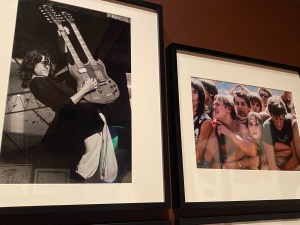
Led Zeppelin’s Jimmy Paige in 1977 and 1985 Metallica fans. Photos: Michael Zagaris and Ken Friedman
Through it all, Graham managed some stars, like Santana; created festivals featuring bands like Fleetwood Mac, Led Zeppelin, Metallica, the Eagles in the Seventies; organized Dylan’s historic 1974 tour; and produced The Last Waltz for The Band’s farewell.
The exhibition lets visitors savor these memories and moments through behind-the-scenes stories about Bill’s relationships with the artists, who often said yes to Bill’s ideas because they knew he was a perfectionist who would deliver his promises, understood what made fans happy, and always saw the epic, historic perspective behind that moment in culture.
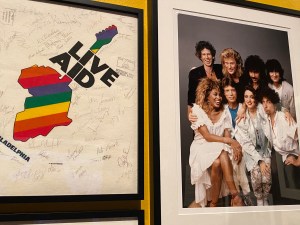
1986 Live Aid T-shirt with Ken Regan’s photo of US benefit stars. Graham and Regan collections
The exhibition puts special focus on Bill’s willingness to tackle the monumental challenges of producing nationally televised benefit concerts, such as Live Aid, and taking tours and bands to places in the world that had never seen super-sized rock events before – Moscow’s 1987 concert for peace and the 1988 five-continent tour for Amnesty International with Bruce Springsteen, Peter Gabriel, and Sting to commemorate the 40th anniversary of the Universal Declaration of Human Rights.
Watch the trailer for the show:
If you’re in NYC, go over to hear the music and see the show before it closes January 3. If not, take this “Curator Confidential” walk through the exhibition with the people behind the Bill Graham Memorial Foundation, who talk about the life of Bill Graham and the history they lived with him – a Zoom session produced by NYHS last August while the museum was still closed.
Zamora’s wall with southern skyline view from the Met terrace
The rooftop mojito bar is missing, but it doesn’t matter to the art lovers trekking up to the Met’s rooftop. The Roof Garden Commission: Héctor Zamora, Lattice Detour, on view through December 7, invites you to stroll around Héctor’s undulating wall and experience what it feels like to have your ideal, verdant view of Central Park and the soaring skyline partially interrupted.
On a bright, sunny day (and New York as had many recently), Metropolitan Museum visitors are taking the time contemplate this simple, provocative, statement by a Mexican installation artist. Héctor’s wall is only 11 feet high and made of see-through bricks – the kind created to let air and sun pass through courtyard walls in steamy Mediterranean, Middle Eastern, and Latin American climates.
Partial view through blocks made from Mexican earth
For this Met installation, Héctor had the blocks for the wall made from Mexico’s earth and asked a crew of Mexican and Latin American builders to hand-craft it the traditional way. As you circumnavigate Héctor’s wall, you have to position yourself just right to get a good view, and then it’s only a tiny, tiny fraction of what lies beyond.
And you have to be close, which lets you appreciate the artistry of the patterns and tunnels of the lattice, which also casts geometric patterns on the roof.
Héctor’s hope is that his installation enables quiet contemplation on thinking about the world that lies just beyond the walls of the Met. If you free-associate about walls, national borders, or larger societal issues, OK, but Héctor presents his architectural statement in a straightforward manner – basic building blocks that originated in ancient times. You can create the experience what you want.
Take a tour of the installation in our Flickr album, enjoy the spectacular rooftop views in this Met’s video, and hear Héctor Zamora talk about this work with Met curator Iria Candela:
1890 pointillist portrait of Fénéon by Paul Signac
He wasn’t an artist, but MoMA has given him a show that has everything – joyous post-Impressionist canvases, Moulin Rouge posters, color wheels, African masterworks, Italian futurists, street riots, manifestos, explosions, and mug shots.
Félix Fénéon: The Anarchist and the Avant-Garde – From Signac to Matisse and Beyond, an exhibition on view through January 2, will introduce you to a writer, critic, anarchist, and dealer living in turn-of-the-century Paris who championed Seurat, gave Matisse his start, coined the term neo-Impressionism, and went to jail for a few months after he was accused of setting off a bomb in a restaurant frequented by government big shots.
1891 painting by Paul Signac, Setting Sun, Sardine Fishing, Adagio, Opus 221
This gorgeous show was inspired by Signac’s pointillist portrait of Fénéon, which features swirling color wheels referencing their shared passion for Japanese design, pattern, and the science behind art. Books and ephemera by influential color theorists are displayed nearby, but it’s hard to keep your attention there when paintings by so many modernist masters are vying for your attention around every turn.
1894 Bonnard poster for the avant-garde journal Fénéon edited
Fénéon used his critical bullhorn to turn many artists into household names. Think Seurat and Signac, two of Fénéon’s early favorites. The first gallery is full of their beautiful seascapes and figurative work. Read the curator’s essay about the artists he promoted, and see our favorites in our Flickr album.
The curators let us know that these peaceful images and exuberant dance-hall posters were made at a time of serious social unrest and profound economic hardship for working-class Parisians by interspersing Fénéon politics-charged writings and socially conscious works by Vallottin and Pissarro. Disruptive protests, nightlife, zines, and art all went hand-in-hand during the 1890s.
1905-1906 painting by Matisse Interior with a Young Girl (Girl Reading)
Fénéon spent several years as the editor-in-chief of a leading avant-garde journal, orchestrating contributors such as Bonnard, Toulouse-Lautrec, and Vallotton, and collecting their work along the way. So, it came as quite a shock to everyone when the independent critic announced that he was taking a full-time job with a prestigious but conservative gallery in Paris.
Entering the second gallery of the exhibition, you see immediately how Fénéon used his notoriety and avant-garde chops to build up a contemporary art business and lure old-line clients into taking a chance on something new and modern. He signed contracts with artists he had long championed, and gave an up-and-comer named Henri Matisse his first show in 1910.
Late 19th-c mask by a Guro artist from Cote d’Ivoire with 1920 Bonnard. Private collection; Musee d’Orsay.
It’s exciting to see a room full Matisse’s early work (including three that were in that initial show) and work by other artists that Fénéon both collected and sold, including a wall full of ethereal Seurat drawings.
Like many others in the avant-garde, Fénéon was a passionate collector of art from Africa and Oceana, and it’s thrilling to see so much of his original collection – now scattered throughout the world – reassembled inside MoMA.
Fénéon hated colonialism and railed against calling this portion of his collection “primitive art.” He lamented that the names of the artists who created such dynamic, inventive work were unknown and disliked having such evocative pieces relegated to ethnographic museums.
19th-c cap by Tin Dama artist from Papua New Guinea (Musée du quai Branly-Jacques Chirac) and Balla’s 1910-1911 futurist work.
He hoped that one day “art from faraway places” could take its place in the art pantheon right up there with works in the Louvre.
The worlds of ancient mythic power, modernism, and emotive color seem to be spending their time at MoMA having an active conversation – just the way Fénéon would have wanted.
Enjoy MoMA’s fast-pace introduction to this revolutionary modernist:
And now meet MoMA director Glenn Lowry and Starr Figura, curator of the exhibition, who show works from the exhibition and discuss why they mounted this show:
If you can’t get to MoMA, listen to the audio guide here, and enjoy the “colors” playlist that MoMA designed.
1927-1929 reverse-print experimentation by Bauhaus master Lazlo Moholy-Nagy
Although the Metropolitan Museum’s 150th anniversary year did not go as planned during the months-long shutdown of 2020, there’s a silver lining that you can experience for yourself – sixty important promised gifts to honor the occasion in Photography’s Last Century: The Ann Tenenbaum and Thomas H. Lee Collection, on view at Fifth Avenue through November 30 and available for viewing in the Met’s online gallery.
If you go in person, there’s lots of space to wander, relax, and look through three large galleries. It’s a who’s who of 20th century photography – everyone from Stieglitz, Weston, Atget, and Arbus to more contemporary photographers like Cindy Sherman, Nan Goldin, and collaborators Fischli & Weiss.
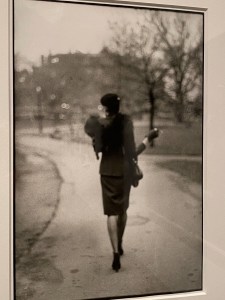
One of Nan Goldin’s earliest photographs, a 1973 study of her performer friend Ivy strolling home from a drag bar
The show isn’t hung chronologically, but that works to the exhibition’s advantage. You’ll required to approach each piece more or less like the collectors did – meeting each image on its own terms and enjoying what you see.
Each work is accompanied by a short text that puts the photographer into the context of art history and explains how this particular work relates to the artist’s best-known work. Read each one on the Met’s website.
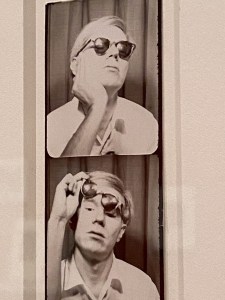
Often, Ann Tenenbaum and Thomas H. Lee collected work from the start of an artist’s career, or an image that’s goes against the grain of what we’ve come to expect – Avedon’s early work, Mapplethorpe’s ocean image of the aircraft carrier Midway, and Andy’s first foray into a photo booth for magazine piece on emerging New York artists for Harper’s Bazaar.
Two of Andy Warhol’s 1963-64 photo booth self-portraits
It’s almost as if you are walking through the last 100 years of photography with the collectors themselves, understanding why they collected certain works and the reason that this is such a phenomenal addition to the Met’s holdings.
Tenenbaum and Lee also paid attention to filling out the ranks of less-well-known female photographers, such as Florence Henri who studied at the Bauhaus, Ilse Bing, Bunny Yeager, and New York’s own Mickalene Thomas.
The collectors are also providing the Met with attention-grabbing, large-scale works that show that artists are still experimenting with this art form.
2015 inkjet print by Daisuke Yokota
Met visitors were taking selfies in front of the gigantic digitally manipulated print by Andreas Gursky that uses a Prada in-store display as its jumping-off point. Visitors were also stopped in their tracks by Daisuke Yokota’s colorful abstraction so big and spectacular that it had to be mounted in the hallway! Avoiding even a camera or lens, Daisuke just manipulated the layers of pigment.
The exhibition is a loving tribute to these collectors’ passion for artists and image making.
Enjoy some of the highlights with the Met’s curator of photography, Jeff Rosenheim:
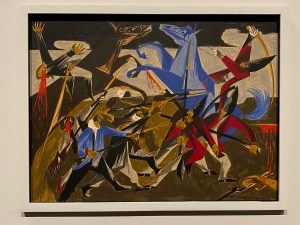
The Battle of Bennington, painted in 1954 – …again the rebels rushed furiously on our men. – a Hessian soldier
Nearly 65 years ago, a young WWII veteran immersed himself in history books up in Harlem and envisioned a modern way to bring key episodes of early American history to life on canvas. Today, visitors to the Metropolitan Museum of Art are pouring over his 60-panel series – reassembled for the first time in decades – in the remarkable exhibition, Jacob Lawrence: The American Struggle, on view through November 1.
Known for his enormous body of work chronicling the African-American experience, Lawrence’s American history series is largely unknown. That’s why attending the show and working your way around the room to learn about each episode is such a revelation. Which episodes did he pick? How did he use modern, angular style to depict the struggle for independence and economic progress?
Sacagawea and her brother reunite
His series “Struggle: From the History of the American People” brings forgotten pieces of history to life and depicts many from a new angle – Patrick Henry’s rousing revolutionary rhetoric, regional skirmishes against mercenaries, the enlisted man’s view of the perilous Delaware River crossing, and treasonous whispers that risked undermining the Continentals.
Inspired by the Mexican muralists, WPA storytellers, and the city around him, Lawrence chose dynamic composition, symbolic colors, and an everyday person’s experience of historic events to create an intriguing, historic, and emotional narrative. Take a look at some of our favorites in the exhibition on Flickr.
1940s American history book opened to map of Lewis & Clark’s 1804-1806 expedition
Inside the gallery, the Met presents two of the books that Lawrence consulted as he planned the series as well as his funding proposal to produce a much more expansive work from the American Revolution through World War I. The notes on display show that Lawrence had the parts of history that could tell the full American story all thought out. Unfortunately, the series wasn’t funded.
The panels on view are hung in the order they were presented at Charles Allan’s gallery in 1956-1957, beginning with the lead-up to the American Revolution. Lawrence tells the story his way through conflicts, close-ups, and long shots, working in stories of Black combatants and women, like Margaret Corbin who manned the guns at Fort Washington.
1956 painting of the Battle of Lake Erie – if we fall, let us fall like men, and expire together in one common struggle – Henry Clay, 1813
Many of the events he depicts from the early 1800s have largely been forgotten –impressment of sailors by the British, the Battle of Lake Erie, and the destruction of Washington D.C., and the Battle of New Orleans. The series ends with epic undertakings by everyday Americans – the building of the Erie Canal and the westward migration to the Ohio and beyond. It makes you want to learn more.
If you are in New York, be sure to see this important show in person; otherwise, take a look through this series in the Met’s website. Click on each image to read the backstory of Lawrence’s take on that slice of American history and the quotes he selected for each work. Go on a visual journey with an American modernist master here.
Listen in to this recent program produced by the Met in association with the Schomburg Center for Research in Black Culture – the same library where Lawrence did his research in the 1950s.
Listen as the Schomburg’s director Kevin Young, arts curator Tami Lawson, and the Getty’s associate curator LeRonn P. Brooks discuss Jacob Lawrence, his scholarship, the WPA, Harlem, and the milieu from which his art emerged. Hear how a genius was made:
Other major works by Jacob Lawrence are on view at the Whitney Museum – he is a featured New York artist in Vida Americana: Mexican Muralists Remake American Art and his War Series, created after he returned from serving in the Coast Guard in World War II, has its own special gallery inside the collections show on the seventh floor.
12th – 14th c. terracotta equestrian statue from the Middle Niger civilization (Mali).
As you confront the stone monolith in the entry, get prepared to see art you’ve never before encountered, learn about empires you didn’t know existed, and fill in the blank spot on what you know about African history.
Beauty and cultural discoveries are everywhere in a first-of-its-kind exhibition on Saharan artistic legacies in Sahel: Art and Empires on the Shores of the Sahara, on view through October 26 at the Metropolitan Museum of Art.
Large 12th – 13th c. gold pectoral, found at a burial in northwest Senegal, with elaborate filigree. Courtesy: IFAN, Senegal
The shifting sands of the Sahara are echoed in the centuries of shifting artistic traditions, migrations, civilizations, religions, and cultural affinities of the Saharan people. Take a look at our Flickr album.
This gorgeous show is one of the first to tie and unite the threads of the sub-Sahara’s nearly invisible history for Western audiences. Western approaches to art history have traditionally made it appear as if the people on a large content were a monoculture with no beginning, end, or history. The show brings a deeper artistic and historical context to work that has always suffered from just being lumped together as “African art,” or worse, “primitive art.”
Scholars on two continents are starting to piece the story together, reflected in the exhibition’s design. The alcoves are a primer to walk back through time to understand the region’s complex history, which covers deserts, oases, and farming areas that are the size of Europe. For centuries, the region was criss-crossed by trading routes (the “Saharan superhighway”) through which caravans delivered luxury goods, exotic raw materials, news, and new cultural influences.
Pre-1659 royal tunic, a European import from the Ardra kingdom (south Benin) via Mandé trade routes. Courtesy: Museum Ulm
Wooden or fired clay depictions of warrior kings on horseback from the 3rd through 19th centuries line the exhibition’s central path. Settlements, archeological sites, and kings are named, with the vast region’s artifacts, architecture, and traditions of storytelling joyously placed into a proper context.
There are plenty of national treasures, such as the gold pectoral from Senegal and lively terra cotta sculptures (likely made by women) from Mali, made with the highest levels of craftsmen between the 12th and 14th centuries. Another highlight is the still-vibrant 8th-century woven tunic from Niger, one of Africa’s most ancient textiles.
The exhibition explains how Islam gradually, peacefully became the dominant religion in sub-Saharan Africa, displacing the previous belief systems. As is the case with other world cultures, artists continued to merge and adapt older, more traditional symbols and forms with the new.
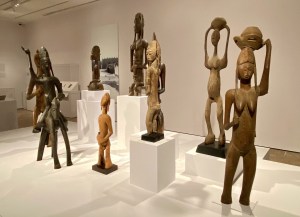
Wood sculptures of Mali’s Bamana people, from the 15th to 20th century
An intriguing 15th-century Italian map-painting documents Mansa Musa, a 14th-century emperor from Mali, who achieved global celebrity status for his over-the-top pilgrimage to Mecca via Cairo and was inspired to develop Timbuktu into a center of Islamic scholarship.
The display of Bamana sculptures, dating from the 15th to 20th centuries, in the rear gallery is the show’s dramatic conclusion, although the walls depict incredible resist-dye textiles made by early 20th century women in Mali and couture-level embroidery on pure white status garments of the Timbuktu elite from the Sixties.
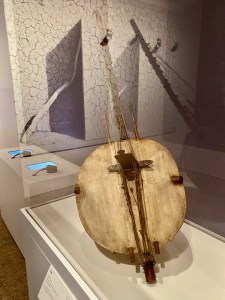
Senegalese kora made before 1878, used by griots to perform social narratives.
The show was an epic undertaking by the Met – organizing a narrative and objects to tell two thousand years of relatively unknown history; first-time loans of national treasures from the museums in Niger, Mali, Senegal, and Mauritania; arranging for an 8,000-lb. monolith to be shipped across the Atlantic to New York.
The epic histories recounted by griots playing traditional instruments over the centuries play a large role in the exhibition. Koras and percussion instruments are on display, and music permeates the galleries.
Here’s a peaceful walk through the exhibition with music by Toumani Diabaté with Ballake Sissoko:
For an in-depth understanding of this ground-breaking show, join in on this conversation with Met curator Alisa LaGamma and scholar and writer Manthia Diawara:
Learn more about the epic history of the Sahara in the Met’s exhibition guide.
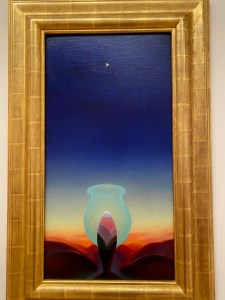
Agnes Pelton’s 1929 Star Gazer, suggesting rebirth in a desert landscape. Private collection.
Have you wanted to enter a light-filled, spiritual place and be transported to another realm? Get a ticket to the Whitney Museum of American Art enter the Agnes Pelton: Desert Transcendentalist, on view through November 1.
You’ll experience six decades of abstract paintings whose shapes fly, hover, and float above desert mountains and in deep space – another dimension that feels light, otherworldly, and pure. Take a look at our Flickr album.
She began developing her style in the early years of the 20th century when abstraction, the symbolic meaning of color, and spiritualism were being explored in the New York art world, and she took to heart what she read in Kandinsky’s influential 1910 treatise, On the Spiritual in Art.
1926 Meadowlark’s Song, Winter. Courtesy: Maurine St. Gaudens.
The exhibition opens with a figurative work in the style for which Agnes was first known to the New York art scene – an ethereal artistic woman inhabiting a dreamy, semi-abstract, soft-colored landscape. Her work earned her inclusion in New York’s landmark 1913 Armory Show – the exhibition that introduced “modernism” to America – in Gallery D alongside other young American artists experimenting with bold color and abstraction.
But the Whitney exhibition (originally mounted by the Phoenix Art Museum) is actually focused on the next phase of Alice’s abstract work, which reflects her embrace of spiritualism, experience with New Mexico’s desert landscapes, and interaction with creative, like-minded thinkers in and around Taos in the Twenties. Although she often accepted commissions for portraits or landscapes throughout her life, she considered the abstract works the core of her artistic journey.
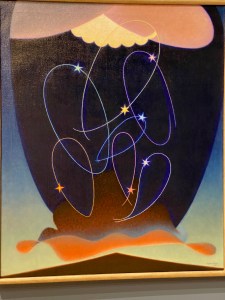
1934 Orbits. Courtesy: Oakland Museum.
Like her contemporary, Georgia O’Keeffe, Agnes found inspiration in the Southwest desert. However, Agnes had a different artistic approach, using color, natural form, and abstract shapes to lead viewers into another realm of consciousness that exists beyond the natural world.
Agnes’s journals and notebooks are filled with lessons from spiritual teachers and with sketches for paintings with notes on what the different forms and colors mean.
Visitors to the Whitney show move slowly, taking time to digest each canvas and to appreciate the artist’s care and thought. Swooping shapes, illuminated portals, and clusters of abstracted forms take center stage, posing questions, and leading you into another dimension.
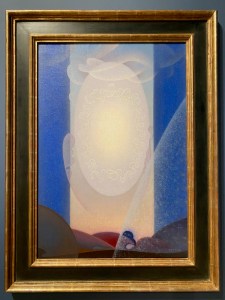
1947 Light Center, evoking one’s ability to transform. Private collection.
The center gallery features work done after Agnes moved to her desert home near Palm Springs in the Thirties, where she was transfixed by the quality of desert light. She loved incorporating water and light into her works – two natural phenomenon that symbolize transformation and change.
The dark walls of the center gallery enhance the glowing nature of her spiritual canvases. Her technique is masterful, with layers of translucent washes applied to give the white ovals nearly a three-dimensional feel, like looking into the void of an Anish Kapoor sculpture, except that Agnes achieves the effect with simply a canvas.
Here’s a talk recorded last year at the Phoenix Art Museum in which Notre Dame professor Erika Doss explains Agnes Pelton’s spirituality and puts her work in the context of the modernist movement:
Reopening News
The Whitney has just announced that the large outdoor public project on the Hudson waterfront by David Hammons will open this fall. The other big announcement is that a one-year Biennial postponement will give artists and curators more time to view and prepare work that was put on hold by the shutdown. Read more about upcoming shows here.
At 7:00pm on October 20, Whitney curator Barbara Haskell will take your questions about Agnes in an online “Ask a Curator” event. Check our Virtual Museum Event page for all of the museum’s nearly daily virtual tours, talks, and walks on this and other exhibitions.
If you’re in New York, you can visit the Whitney five days each week, Thursday through Monday, with extended hours every Friday until 9:00pm. All exhibition spaces are open, including the magnificent collection show, which features mini-shows by Jacob Lawrence, Hopper, and Calder. Here’s our previous post about this fantastic exhibition.
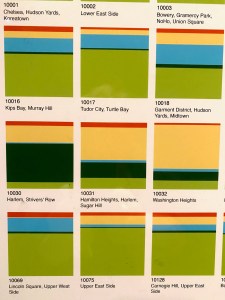
Herwig Sherabon’s 2019 Landscapes of Inequality NYC No. 2, showing median income per block
As the 2020 Census winds down across New York City, it’s nice to be reminded of the history and impact of what’s been revealed since 1790, when census-data gathering began. Who We Are: Visualizing NYC by the Numbers, on view at the Museum of the City of New York through October 18, presents not only rich archival material but an intriguing display of new data-visualizations that were commissioned specifically for this show.
Although the museum shutdown curtailed in-person viewing until a few weeks ago, the curators wisely transported the story and some of the works to an on-line exhibition that explained the history of the decennial census, why it matters to New York, and how new stories are told when artists get their hands on the data.
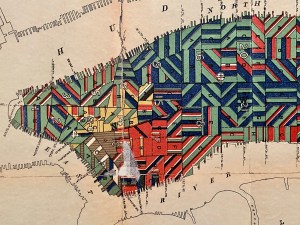
Tenement House Committee of 1894 map of nationalities inhabiting Lower Manhattan
When we visited in person, it was nice to see historic documents (or facsimiles of them) up close, like the page listing people and occupations (attorneys, stone cutters, boat makers) along Nassau Street in 1812 and the detailed illustrations of the “counting machines” used by men and women tallying the census on the cover of 1890 Scientific American. Take a look at our Flickr album.
But it’s also nice to see data visualizations from past decades, when no one had digital tools at their disposal and everything was drawn pen-and-ink and embellished with watercolor. And to see evidence of Congressional trailblazers, like Shirley Chisholm, getting out into the street to show their constituents the importance of being counted.
Detail of Jill Hubley’s 2019 Race in NYC from neighborhood data
Today’s news is full of stories about whether an undercount is happening in New York, but the MCNY collection shows newspaper after newspaper from the past, where politicians, social-justice advocates, and everyday citizens have voiced the same concerns. It’s useful to see the pie chart of the types of Federal programs whose dollars are apportioned based upon the census.
But the star attractions are the enormously compelling contemporary visualizations displayed in the “Art of Data” gallery. It’s a clean, modern, immersive experience walking among the giant projections of work.
Take a look at three of the works featured in MCNY’s on-line exhibition:
Here is the tree-ring-inspired Simulated Dendrochronology of Immigration to New York City, 1840 – 2017, created in 2019 by Northeast University designers Pedro Cruz, John Wihbey, and Felipe Shibuya. Left and right growth reflects immigration flow to the US from either Asia-Pacific or Europe.
Here, see how artist Neil Freeman uses 2017 American Community Survey data to reconstitute population blocks in New York City according to inequality and injustice in his 2019 video The Grid Series.
The shape of New York’s population blocks make another appearance in artist/developer Jill Hubley’s 2019 visualization Languages of New York.
Read more about each of these works on the MCNY’s site.



















 itsnewstoyou