Pelton & Jonson’s Transcendental Desert Art

Decending into the ground-floor gallery of the University of New Mexico Art Museum, visitors find themselves in a transcendental chamber, filled with abstraction, color, and spiritual emanations.

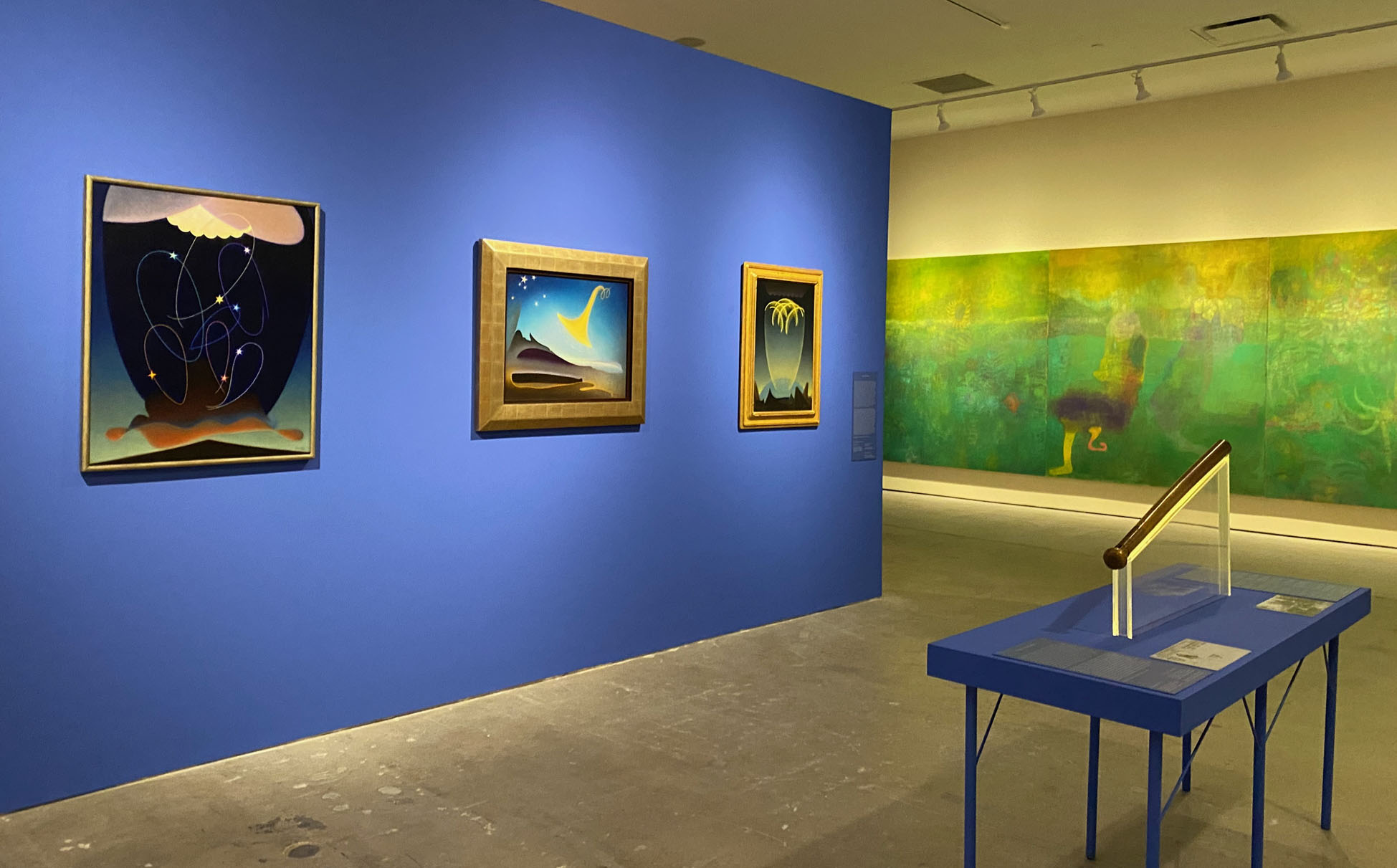
Pelton & Jonson: The Transcendent 1930s, on view in Albuquerque through March 15, features the work, letters, and personal photographs documenting the professional and personal friendship between two artists that wanted people to see realities beyond the visible world. Artists Raymond Jonson, former UNM professor, and Agnes Pelton, the visionary New York artist who relocated to the Western desert, felt they were kindred spirits, and the exhibition shows us why.

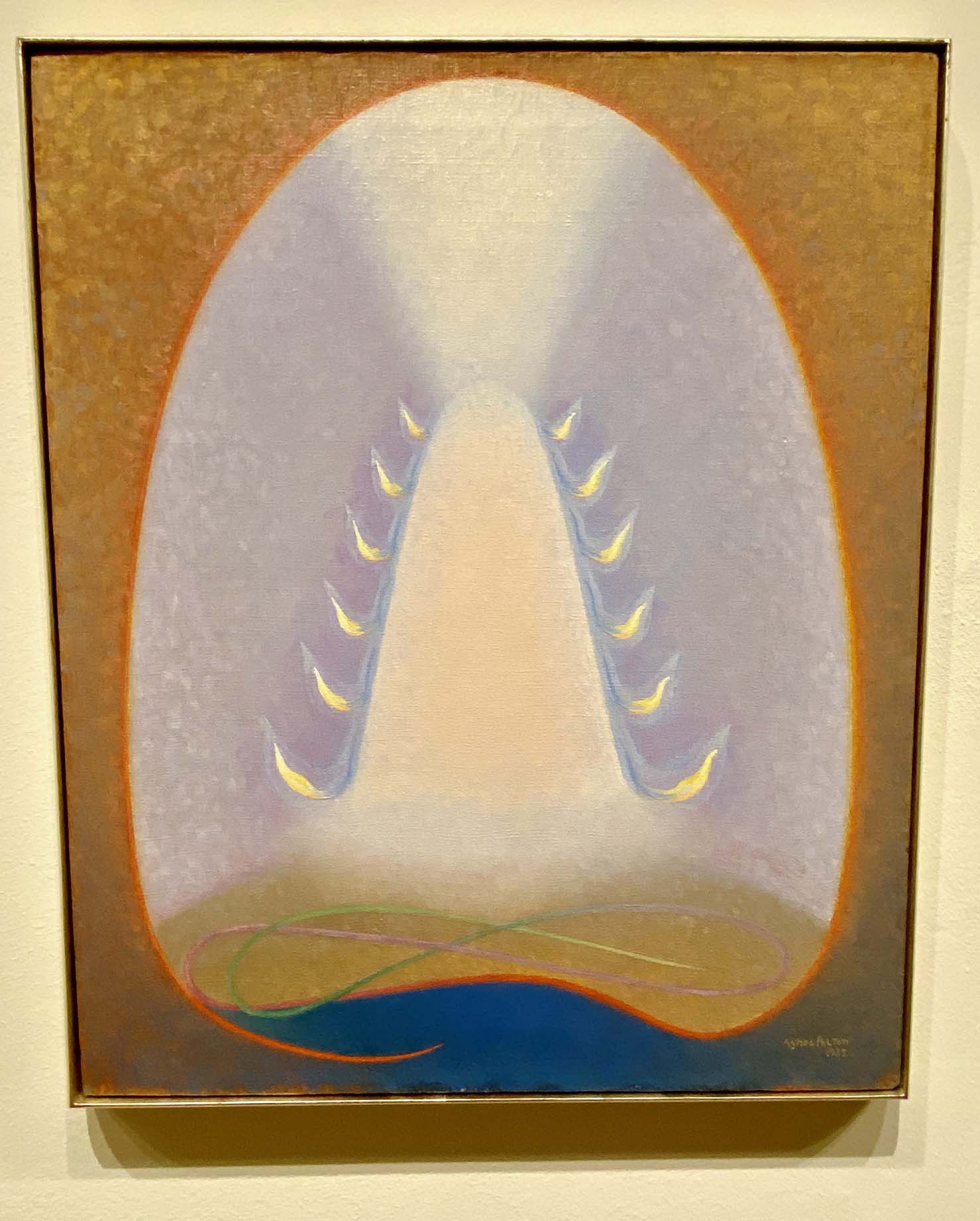
Agnes Pelton’s 1930 painting The Voice – suggesting enlightened dialogue within human consciousness.

As a young artist, Jonson was thunderstruck by the modern art he witnessed in the 1913 Armory Show when it came to Chicago (which included a painting by his future friend, Agnes Pelton from her “imaginative” period of work). Jonson read Kandinsky’s influential The Art of Spiritual Harmony when it was published in English in 1914, and increasingly pushed his work toward pure shape and design that could evoke a deeper response from the viewer.

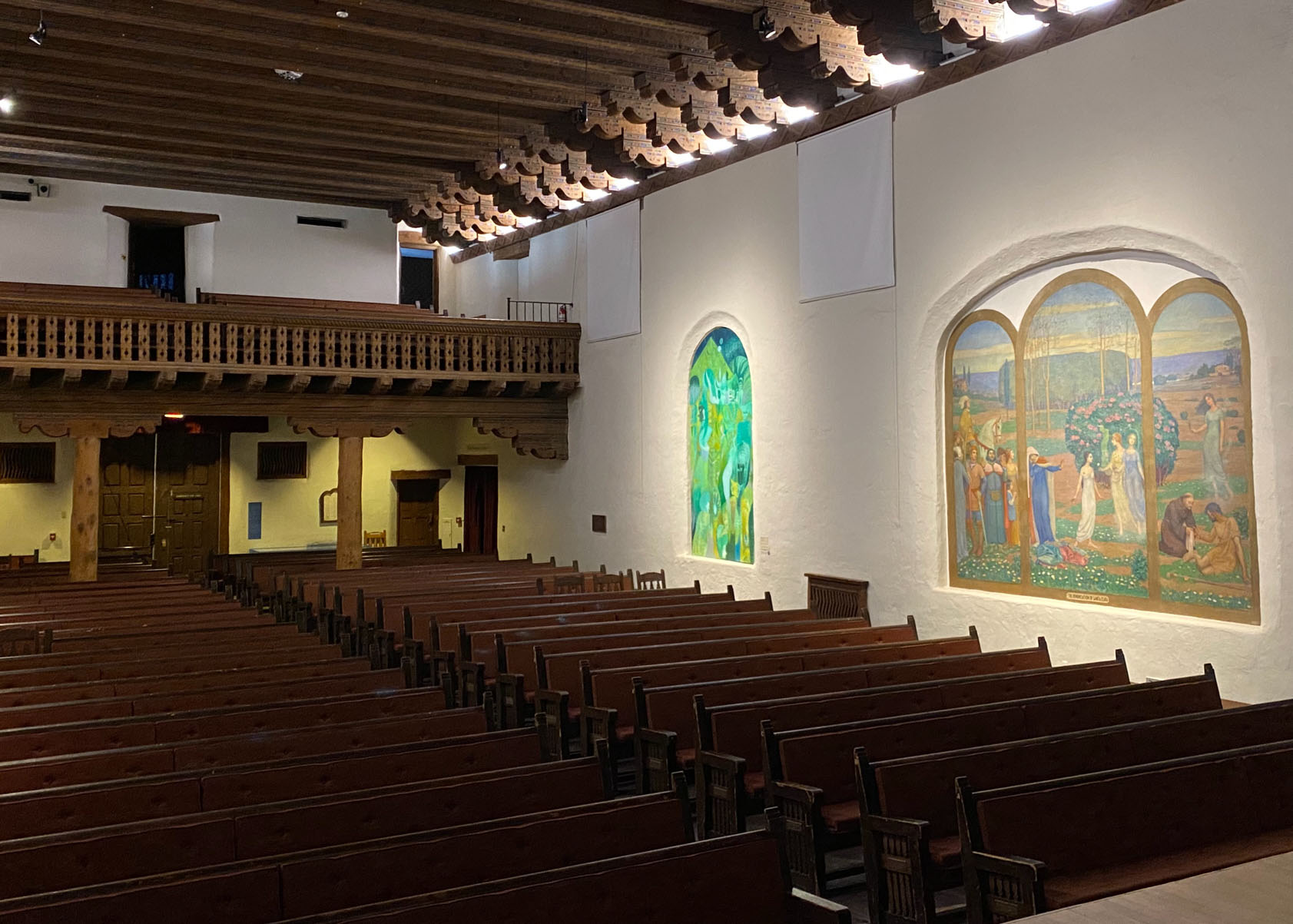
By 1930, he and his wife moved to Santa Fe. He began teaching, curating shows, and continuing to pursue abstraction. When concepts were simply too much for a single canvas, he conceived a triptych.

Raymond Jonson’s 1930 tryptich – Time Cycle: Morning, Noon, and Night

Around 1931, new-age/Jungian composer, author, and painter Dane Rudhyar told Jonson about Pelton’s abstractions, and put them in touch.  For the next 30 years, Jonson and Pelton corresponded about art making, materials, abstraction, and spiritual connections.

By this time, Pelton had had 14 solo exhibitions and been in 20 group shows. Her interest in spiritual practices kept growing, and the lure of the new-age communities in southern California beckoned her. During a 1932 yoga-retreat trip to Cathedral City, she decided to stay put and paint in the peaceful desert for the rest of her life

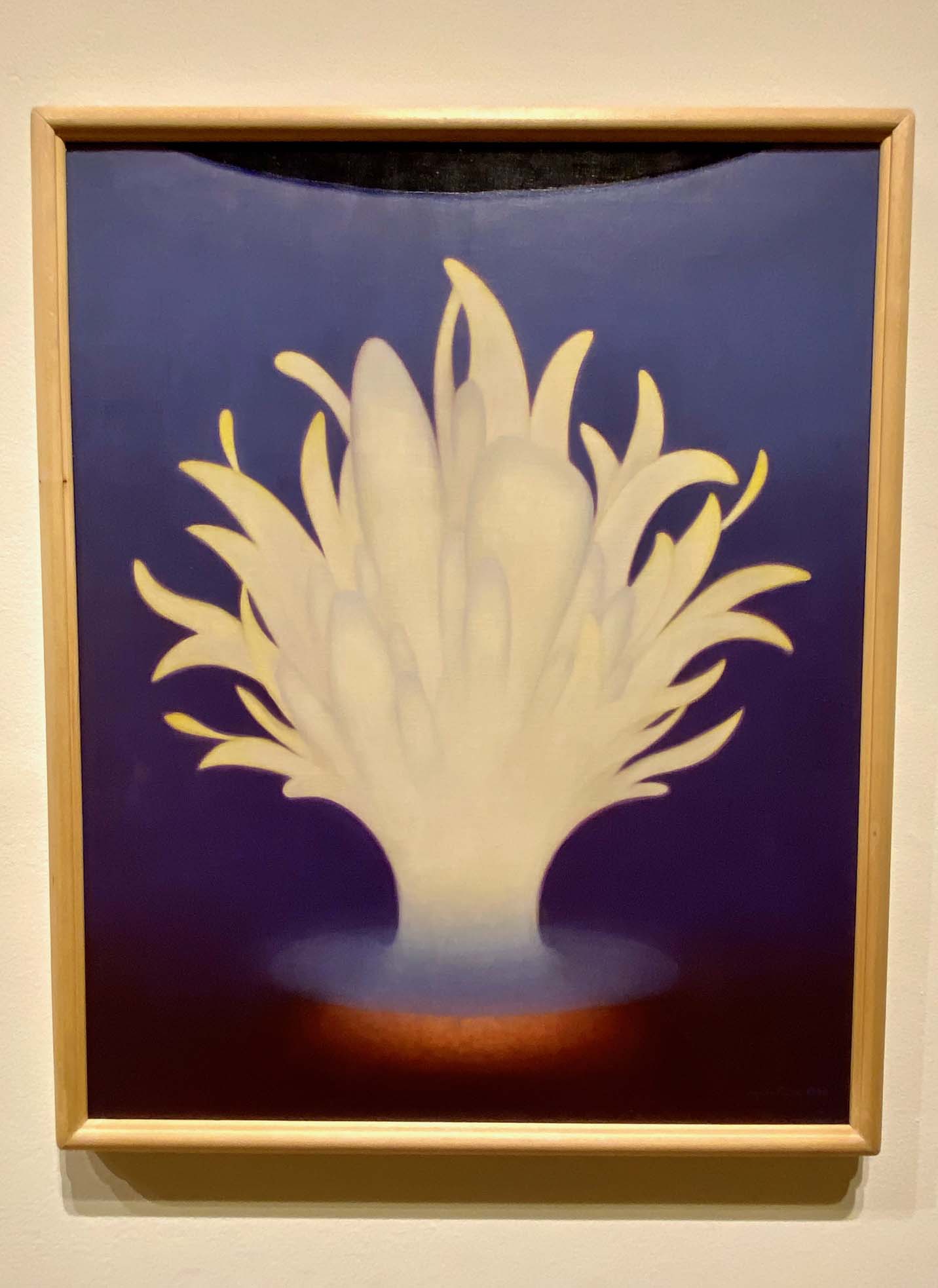
Pelton’s 1930 White Fire – showing light radiating from the inner self – from Jonson’s 1933 exhibition
Pelton’s 1932 Mount of Flame – symbolizing the beauty in the abstract – from Jonson’s 1933 exhibition.

In 1933, Jonson invited Pelton to participate in a Santa Fe exhibition alongside himself and Cady Wells. This current exhibition at UNM commemorates this convergence by reuniting some of the original works by Pelton, Wells, and Jonson.  See some of the pieces in our Flickr album.

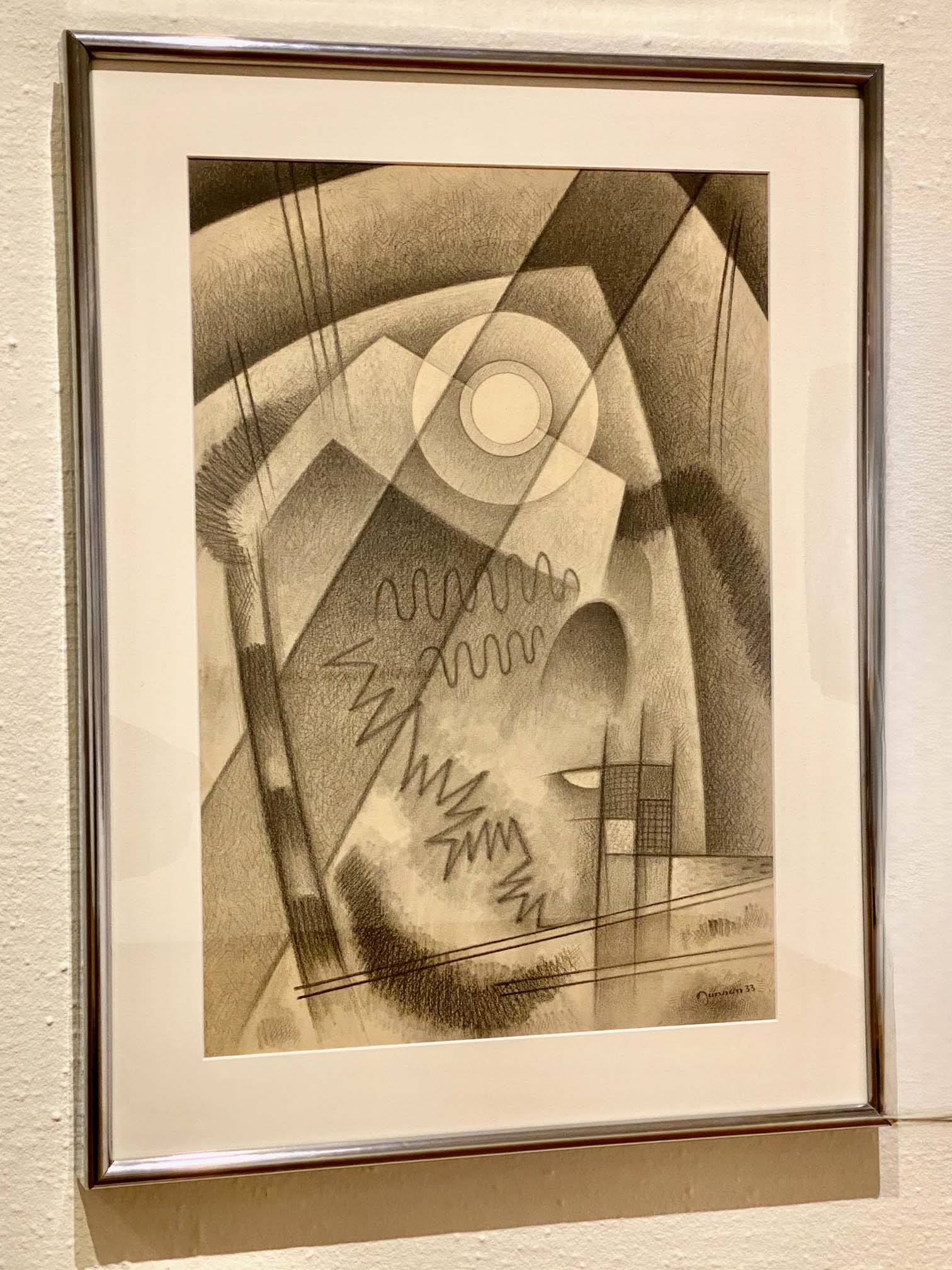
From the 1933 exhibition: Jonson’s 1933 charcoal drawing Ascending Circle

Jonson and his wife took a road trip to visit Pelton in 1935 – their one and only meeting. Although they were at a distance, the letters kept coming, and when Jonson and others in New Mexico organized the Transcendental Painting Group in 1938, she was invited to participate and serve as the grand dame/president.

In recent years, Agnes Pelton’s work has been resurgent due to the traveling exhibition organized in 2019 by the Phoenix Art Museum, which traveled to the Whitney in 2020. Read our review here.

To hear how this Albuquerque exhibition came together, listen in on Christian Waguespack’s interview with curator Mary Statzer:

UNM is lucky to have over 600 works by Raymond Jonson in its collection, and all the letters, sketches, publications, and journals he kept. For more on Raymond Jonson’s life and work, visit his portal on the UNM website.

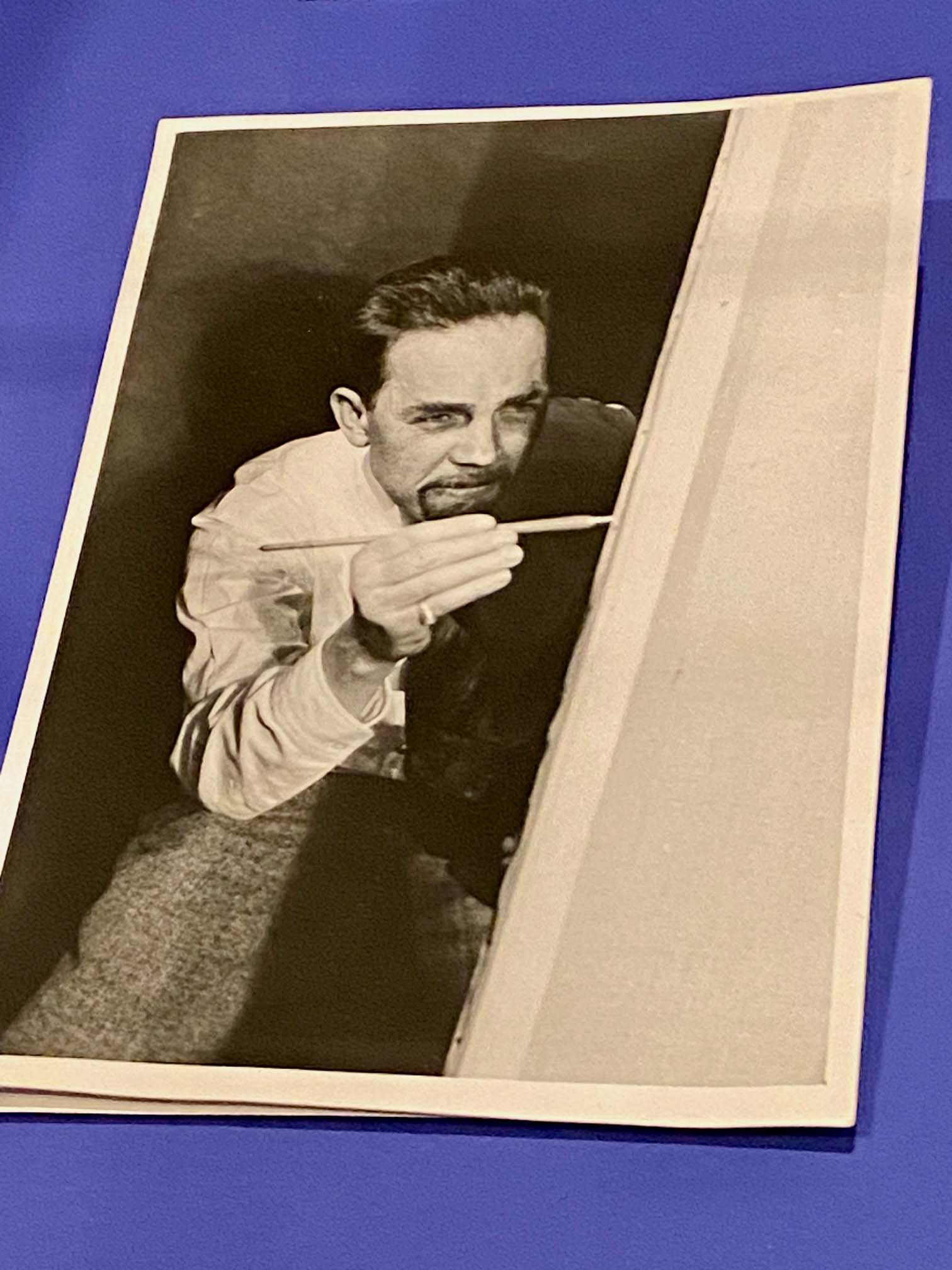
Jonson touching up work at his solo exhibition in Tulsa in a 1937 photo by F. Von James.
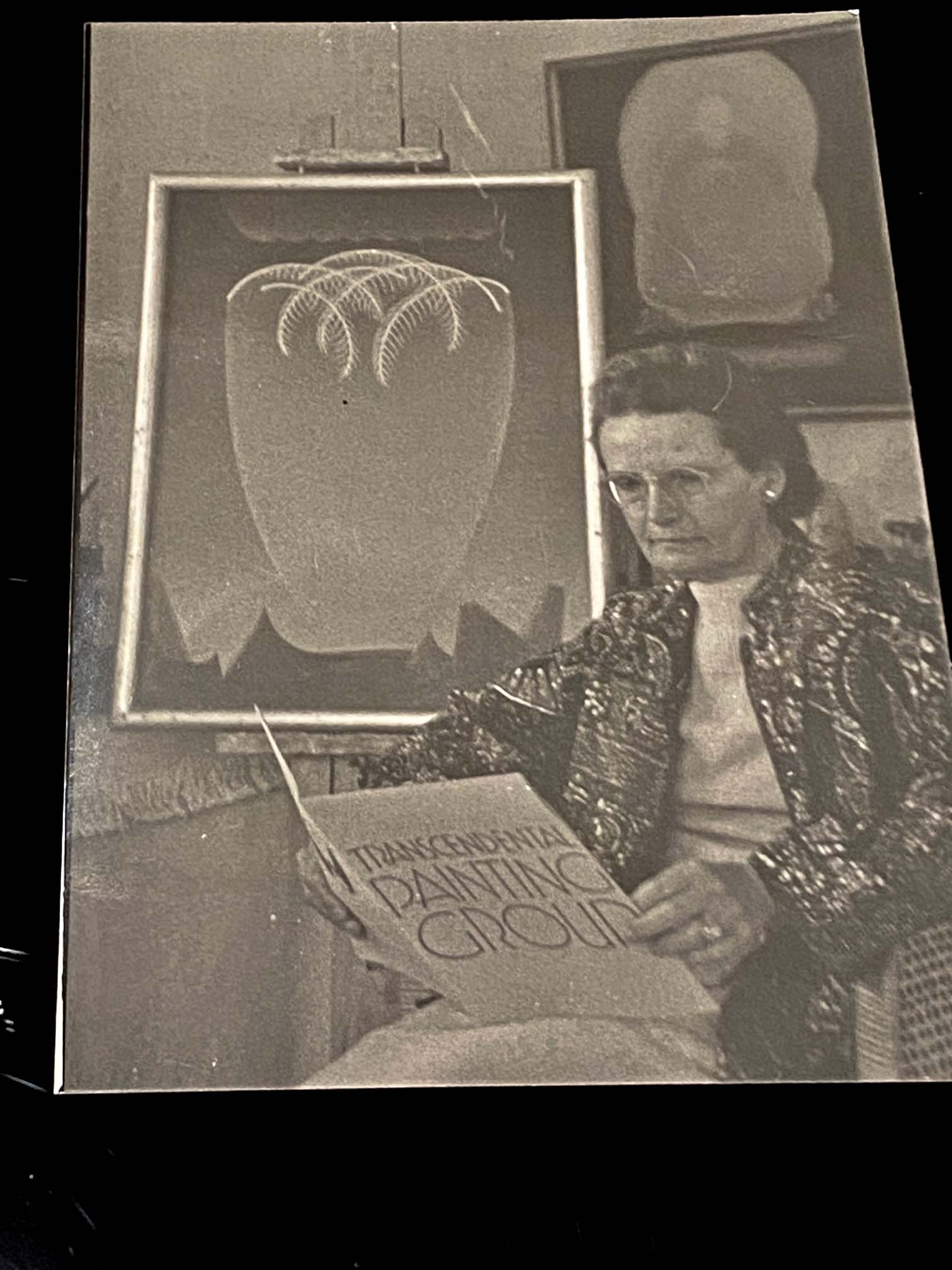
1935-1940 photo of Pelton reading the TPG brochure in her Cathedral City studio with Mount of Flame behind her.

Parisian Orphists Cover Guggenheim with Color

Ascending the ramp inside the Guggenheim Museum to enjoy Harmony and Dissonance: Orphism in Paris, 1910-1930, European optimism and color abound. The exhibition, on view through March 9, 2025, showcases the exuberance and innovation of artists living in early 20th century Paris, who felt exhilarated by the profusion of modern forms of music, dance, and architecture and used abstraction and prismatic color to translated their enthusiasm.

Avant-garde power couple Robert and Sonia Delaunay broke from analytic cubism’s monochromatic approach and injected pulsing color into the art-scene conversation in Paris.

Robert Delaunay’s 1911-1912 Red Eiffel Tower – modern architecture and cubism with a twist of color.

Inspired by 19th century color theory (wheels demonstrating complimentary and dissonant colors), they painted swirling orbs pulsing with harmonies and contrasts to show optimism about the future.

Modern buildings like the Eiffel Tower, electrification of city streets, and the syncopation in dance-hall music created a pre-war energy in Paris that motivated these “orphists.” Everything seemed to be happening simultaneously. Harmonious and dissonant colors and whirling shapes on large canvases seemed a good way to represent it, as shown in the Guggenheim’s fun musical promo:

The style was named “orphism” by none other than Apollinaire himself.  Robert Delaunay’s works in the exhibition include some of his early experimentation with abstract oval “windows,” his abstract riffs on the cosmos, and canvases still showing a hint of the real world.  All convey the simultaneous push-pull of Paris, modern life, and larger scientific forces.  

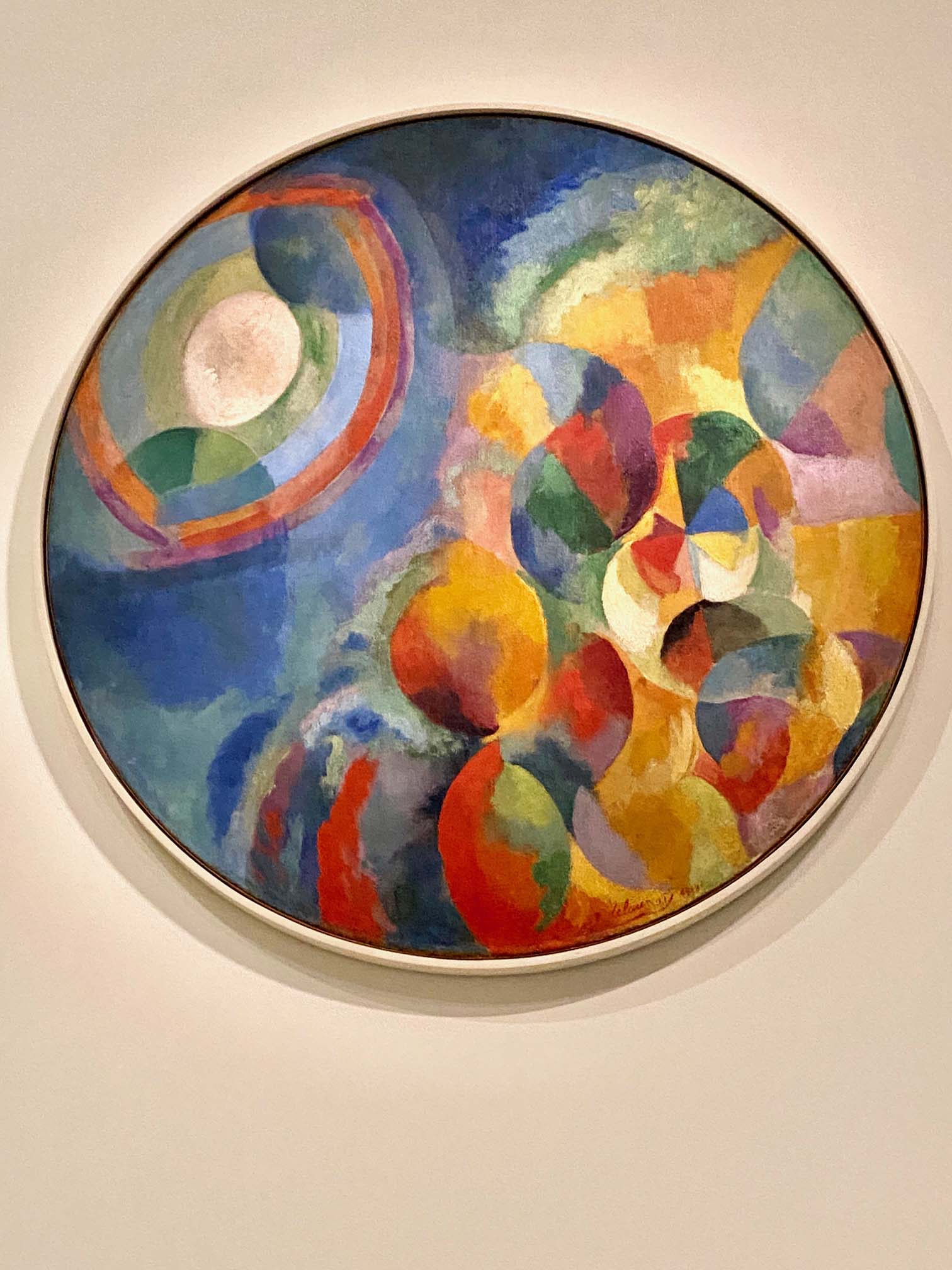
Robert Delaunay’s 1913 Simultaneous Contrasts: Sun and Moon. Courtesy: MoMA
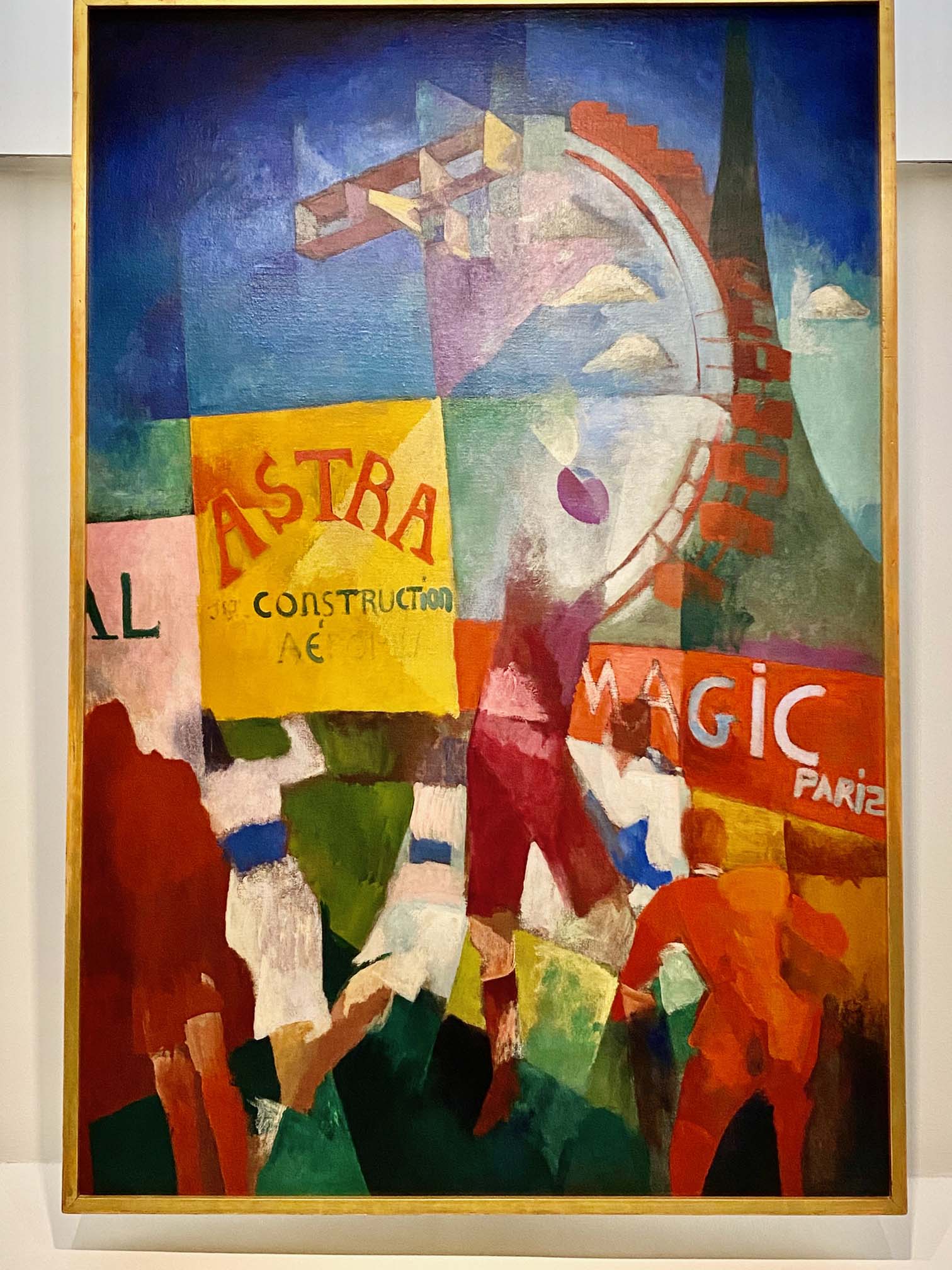
Robert Delaunay’s 1913 The Cardiff Team, with Eiffel’s tower, aerial achievements, and sports dynamics. Courtesy: Van Abbemuseum, The Netherlands.

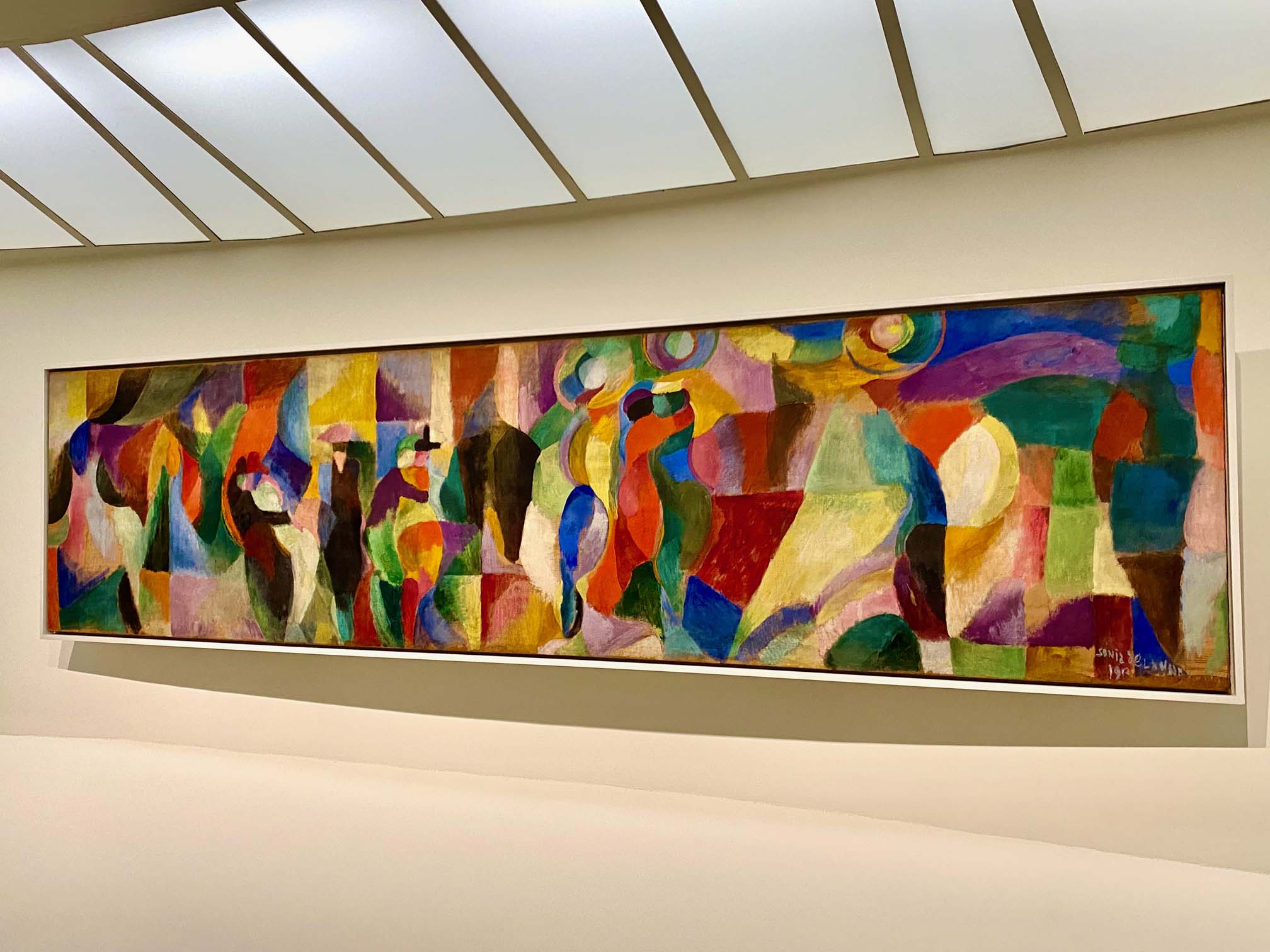
Many of Sonia’s orphist paintings are featured, including a gigantic horizontal color work inspired by the dynamic movement of tango dancers at a popular Parisian club. No doubt the massive 2024 Bard Graduate Center Gallery show about her forays into fashion and other creative fields (Sonia Delaunay: Living Art) influenced the Guggenheim curators to include her painted toy box and her celebrated super-tall accordion-book painting representing her collaboration with poet Blaise Cendrars.

Sonia Delaunay’s 1913 oil Bal Bullier inspired by dynamism of tango dancers at the popular Parisian club. Courtesy: Centre Pompidou

Innovations by the Delaunays are placed alongside other artists’ works that reflect the artistic breakthroughs of the early Twentieth Century – Kandinsky’s abstraction, the Blue Rider group’s symbolic use of color, and the synergies that artists felt between abstraction and music. In 1912, Leopold Survage intended to create the first fully abstract film, but the project was halted by World War I. Fortunately, we can envision his plan from his series of dynamic color drawings.

Colored Rhythms series of twelve 1912 ink drawings created by Léopold Survage for the first abstract film. Courtesy: La Cinémathèque Française

The music that inspired the Orphism is referenced throughout the exhibition – the improvisation and free structure of jazz, the dissonance of cutting-edge experimental music, and the staccato of the latest Parisian dance-hall craze – Argentine tango. The curators have even provided musical tracks to underscore this influence.

The Italian futurists Balla and Severini are also featured. Speed, modernity, and simultaneous city sensations were their bread and butter, too, even though they argued in the press and art journals that Futurism and Orphism were totally different.

Italian futurist Giacomo Balla’s 1914 Mercury Passing before the Sun, an allusion to recent cosmic events. Milan’s Museo del Novocento.
Gino Severini’s 1915 Dancer–Propeller–Sea. Courtesy: The Metropolitan Museum

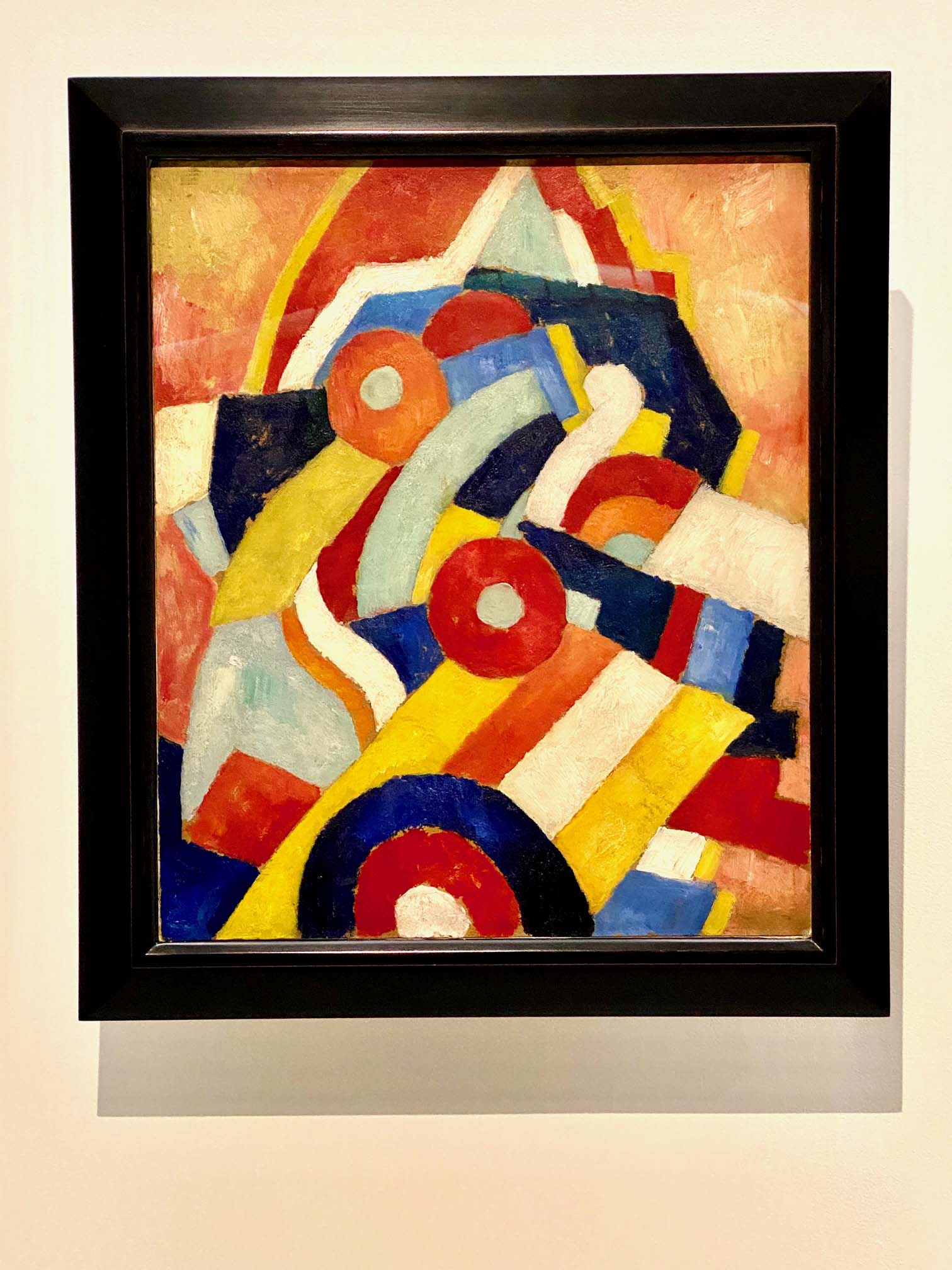
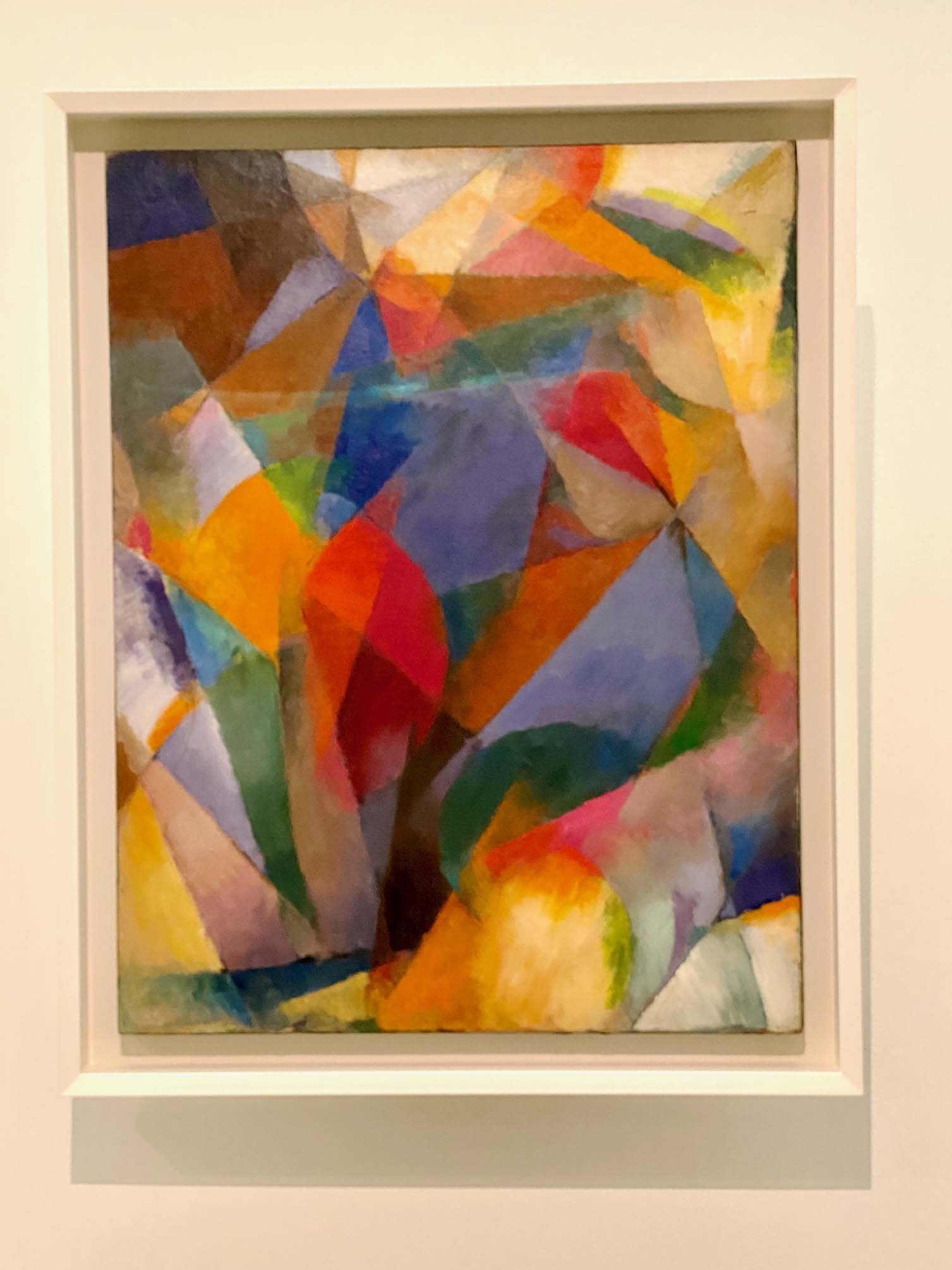
In pre-war Paris, American modernist painters Marsden Hartley, Stanton Macdonald-Wright, and Morgan Russell picked up on Orphism, although the latter two rebranded their work Synchronism when they wrote their manifesto.

Marsden Hartley’s 1914 Abstraction Courtesy: The Museum of Fine Arts, Houston.
Stanton Macdonald-Wright’s 1917 oil Synchromy. Courtesy: MoMA

Even after the War, the Delaunays continued to represent orphism even if they occasionally incorporated real-world elements. Early orphism adopter Albert Gleizes also continued in this style throughout his career, and inspired students like Mairnie Jelett to explore color theory and its potential.

Albert Gleizes’s 1942 Painting for Contemplation, Dominant Rose and Green.
Irish artist Mairnie Jellett’s 1938 Painting. Courtesy: National Museum, NI, Ulster.

Take a look at our favorite works in our Flickr album here, and enjoy a syncpated strut through the colorful side of Modernism in this catalog preview:

Walking Into the Broken Boxes Podcast

Did you ever want to walk into a podcast? The grand installation of Broken Boxes: A Decade of Art, Action, and Dialogue lets you experience large-scale work by some of the socially conscious artists that have been featured on Ginger Dunnill’s interview series. Enter, listen, and get inside the heads of 23 artists at the Albuquerque Museum through March 2, 2025.

The exhibition honors ten years of Broken Boxes conversations, which you can hear at various “listening spots” inside the exhibition. Ginger began her project as a way to encourage community among artists who were creating disruptive work that prompts viewers to imagine a different world.

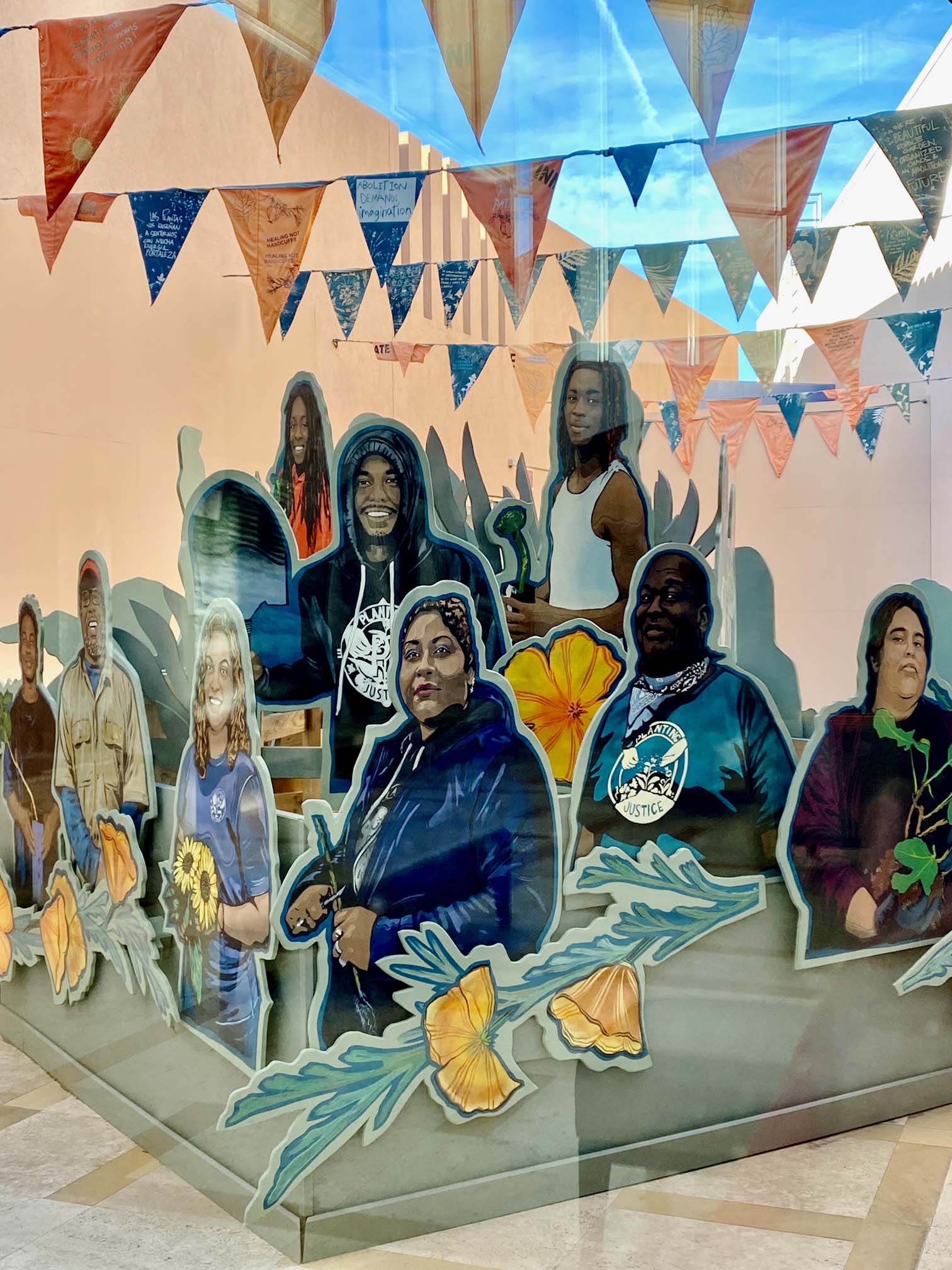
Kate DeCiccio’s Blooming Abolition depicts formerly incarcerated community members who develop gardens. Created by local artists, Planting Justice, Hiroyo Kaneko, and Malaya Tuyay.

The show spills way beyond this main gallery into a theater showing artist videos, another space featuring a soundscape by Raven Chacon, and a courtyard reflecting artist-educator Kate DeCiccio’s vision for sustainable community gardens that give purpose and fulfillment to formerly incarcerated neighbors. 

Inside the main space, visitors wind through and around different installations, such as Marie Watt’s hanging jingle sculptures and her spectacular collaboration with Cannupa Hanska Luger. The jingle “clouds” take a traditional element of powwow and turn it into fine art that invites participation in the soundscape.

2023 dangling jingle sculptures Sky Dances Light: Revolution VII, VIII, and IX created by Marie Watt (Seneca Nation of Indians). Courtesy: private collection

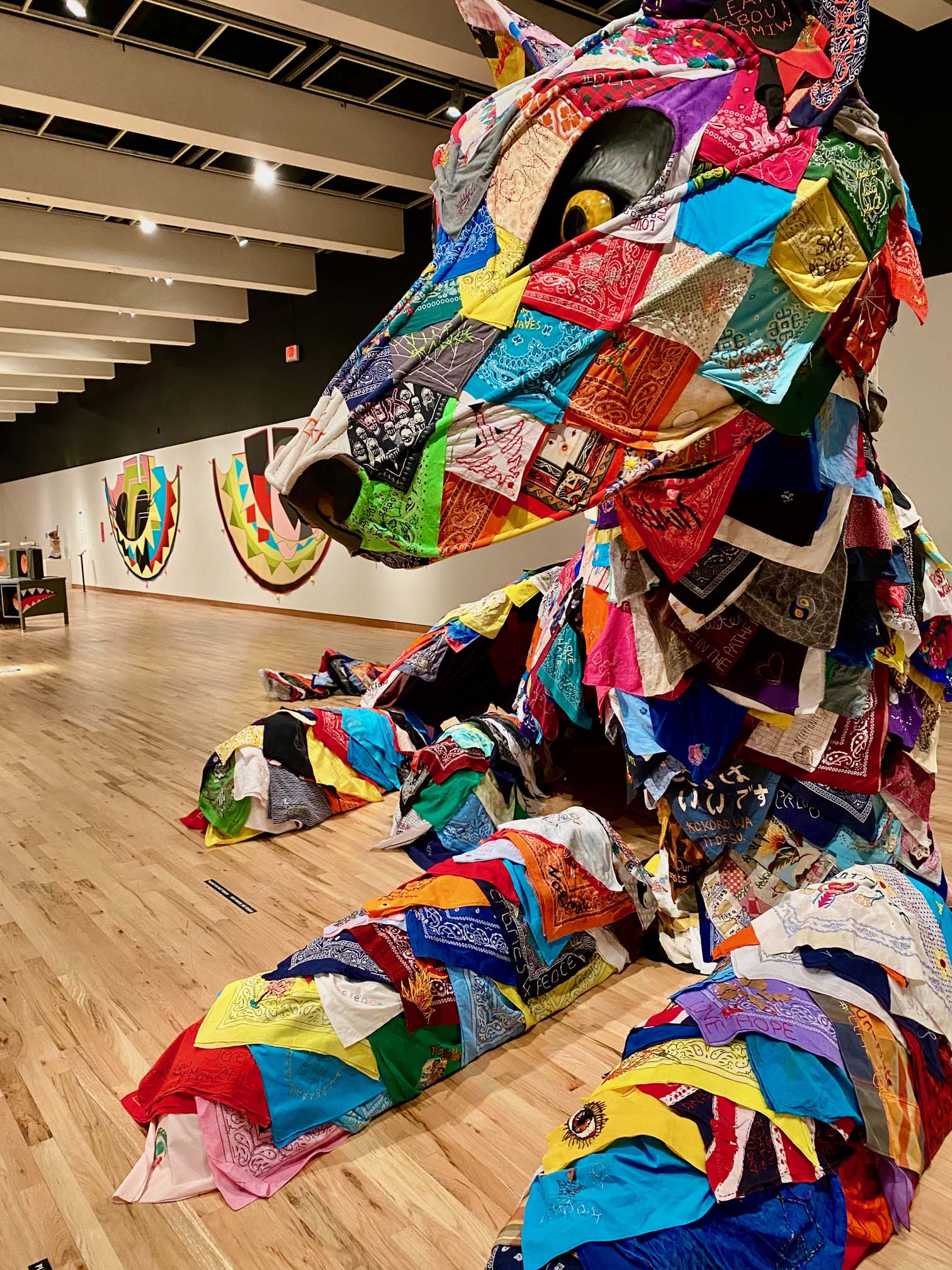
Across the way is an enormous canine created by Luger and Watt. As he’s done with other large-scale participatory projects, Luger sent out a call worldwide requesting people to embroider messages on bandanas and send them in. Visitors are fascinated by the Each Other collaboration, circling around the wolf to discover messages about rescue, shelter, and sustainability.

Guadalupe Maravilla’s installation draws inspiration from his own story and struggle. He assembled the piece from items picked up when he retraced his migration route from El Salvador to the United States when he was a child. But he made it to emit therapeutic vibrational sounds, similar to the sound therapy that brought him relief as an adult when he underwent therapies to cure his own cancer.

2020-2021 Each Other community bandana-sculpture created by Cannupa Hanska Luger (Mandan, Hidatsa, Ankara, Lakota) and Marie Watt (Seneca Nation of Indians). Courtesy: the artists
Guadalupe Maravilla’s 2021 Disease Thrower #17 – a therapeutic sound installation using materials found when he retraced his El Salvador-US migration route. Courtesy: the artist

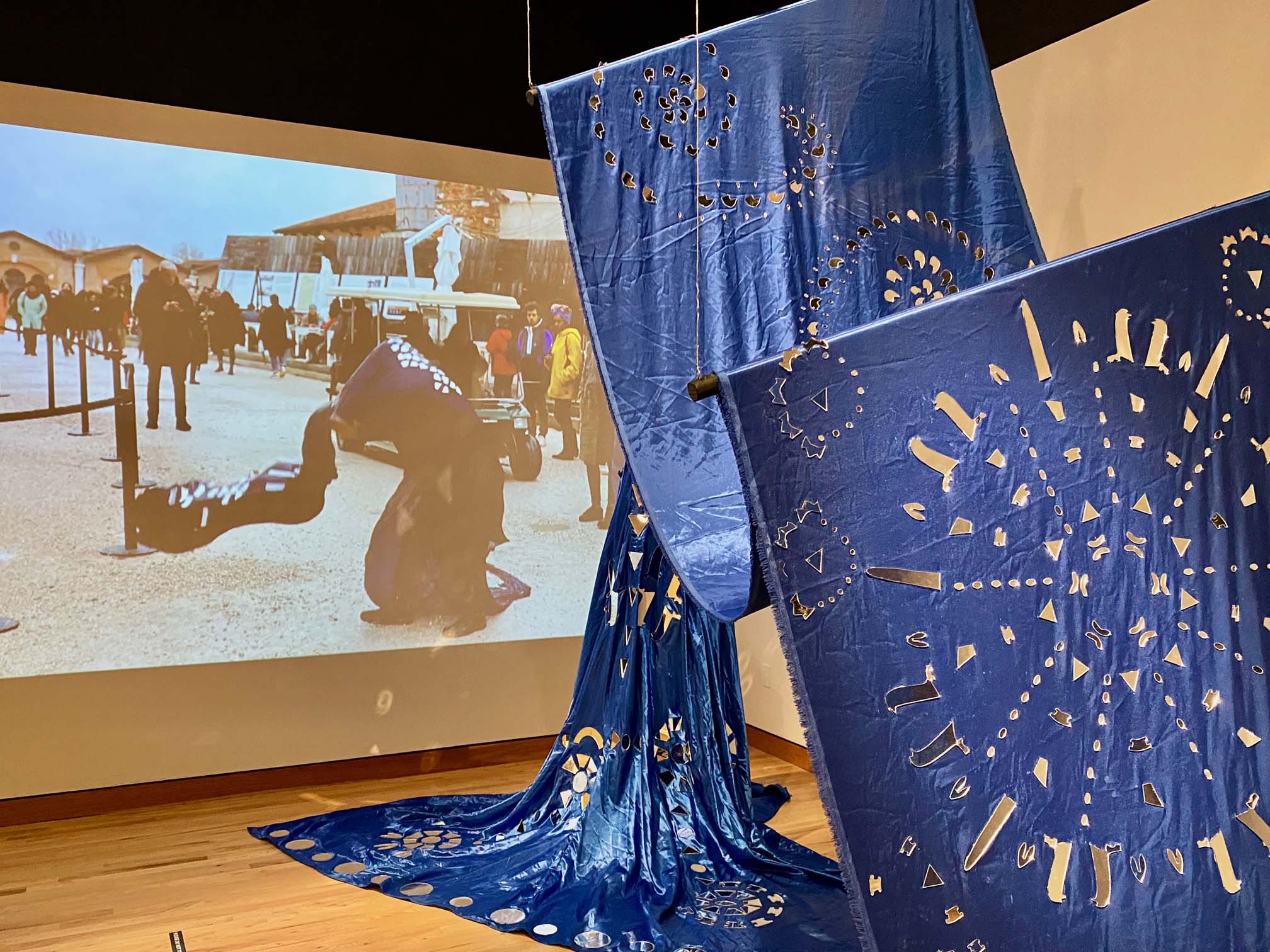
Work by Ethiopian refugee Tsedaye Makonnen includes a performance video and installation that focuses attention on African refugees who risk dangerous ocean crossings to escape violence in their home countries. The blue fabric represents the ocean, and each mirror a life lost.

Tsedaye Makonnen’s Astral Sea Views video with Astral Sea Series mirrored fabrics – commemorating women migrants who perished attempting dangerous European ocean crossings. Courtesy: the artist. 
See some of our other favorite installations here in our Flickr album – a shrine by Mario Yvarra, Jr. dedicated to his Chicana-activist mother –Music My Mom Played While Cleaning House – and works by Natalie Ball (Klamath/Modoc) that are straight from her recent show at the Whitney.

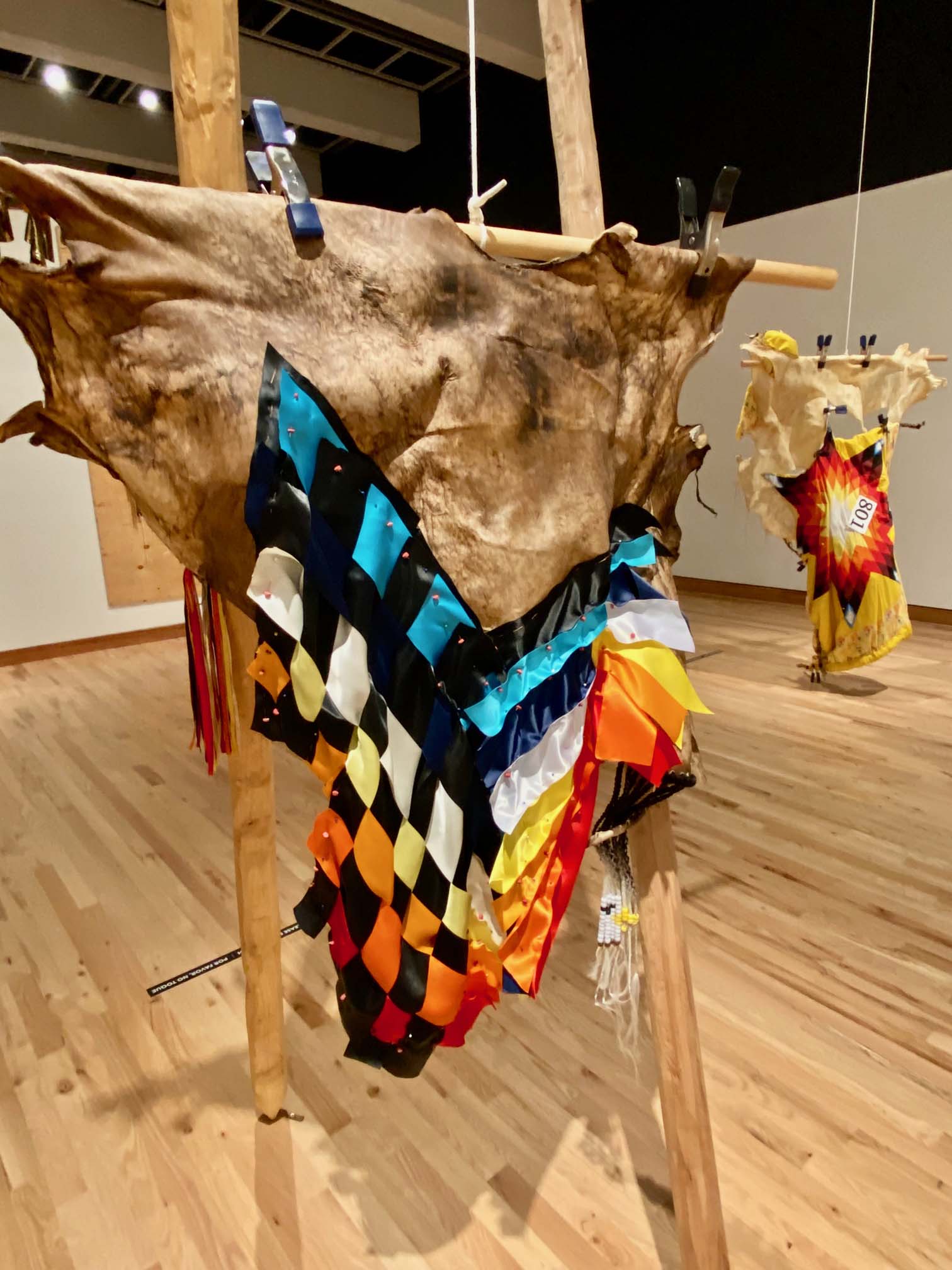
2023 mixed-media sculptures by Natalie Ball – ribbon skirt: There’s Indian and than there’s Indian; (rear) Baby Board. Courtesy: the artist.
Music My Mom Played While Cleaning the House…, a parade float by California artist Mario Ybarra, Jr. that honors his mother, a Chicana civil rights activist.

Listen to the Broken Boxes podcast to hear Ginger and international artists talk about making art, building community, and meeting the challenge of the moment.

Flight Into Egypt at The Met

Take an epic tour through ancient Egyption iconography through the eyes of African-American artists and thinkers in Flight into Egypt: Black Artists and Ancient Egypt, 1876 – Now, on view at the Metropolitan Museum through February 17. It’s quite a ride with African-American artists and writers through decades of deep history.

The wonders never cease, from Cleopatra’s “throne” welcoming you into the galleries to Simone Leigh’s giant queen Sharifa, Henry Taylor’s vision of Michelle Obama as (maybe?) Queen Hapshetsut, epistles of the Harlem Renaissance, Afro-futurist super-heroines, and a neon Nefertiti taking her bow.

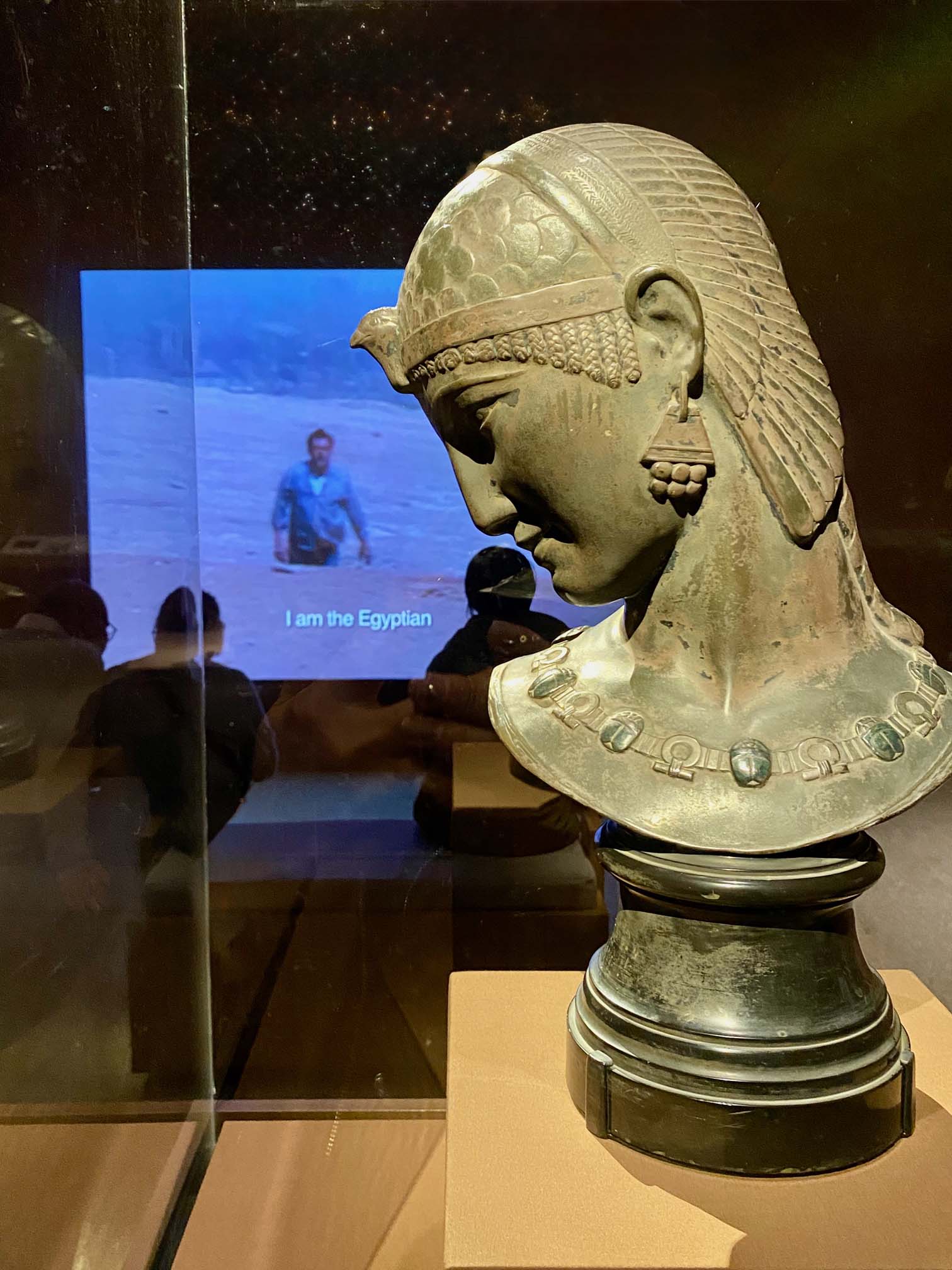
1930 bronze and silver Bride of the Nile (Arous El Nil), Bust by Egyptian sculptor Mahmoud Moktar. In the Heritage Studies gallery. Courtesy: HAR Collection.

The Met, home to the largest Egyptian art collection in the Western Hemisphere (followed by Brooklyn!), decided to create a contemporary counterpoint to its heralded wing and showcase all the ways African-American artists have looked to ancient histories of the Nile, contemplated their relationships to Egypt, and integrated Egyptian spirituality into the current narrative.

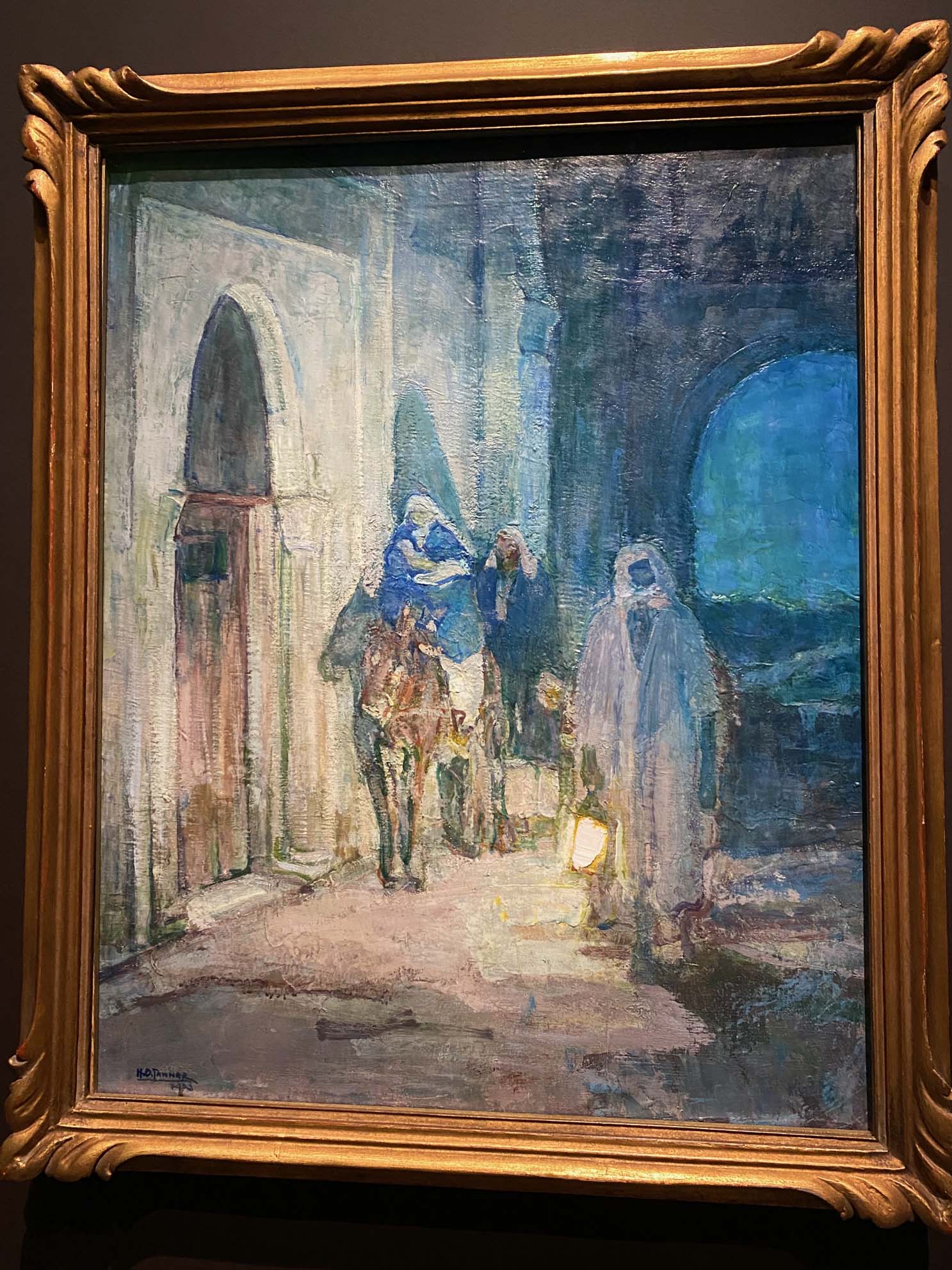
Henry O. Tanner’s 1923 painting Flight into Egypt, based on sketches made during his travels in Egypt.
Jean-Michel Basquiat’s 1982 painting Kings of Egypt II. In the Kings and Queens gallery. Courtesy: Rotterdam’s Museum Boijmans Van Beuningen.

Over 200 paintings, sculptures, videos, and installations are presented in this massive show, which also includes performances produced by Met Live Arts.  See some of our favorite works in our Flickr album.

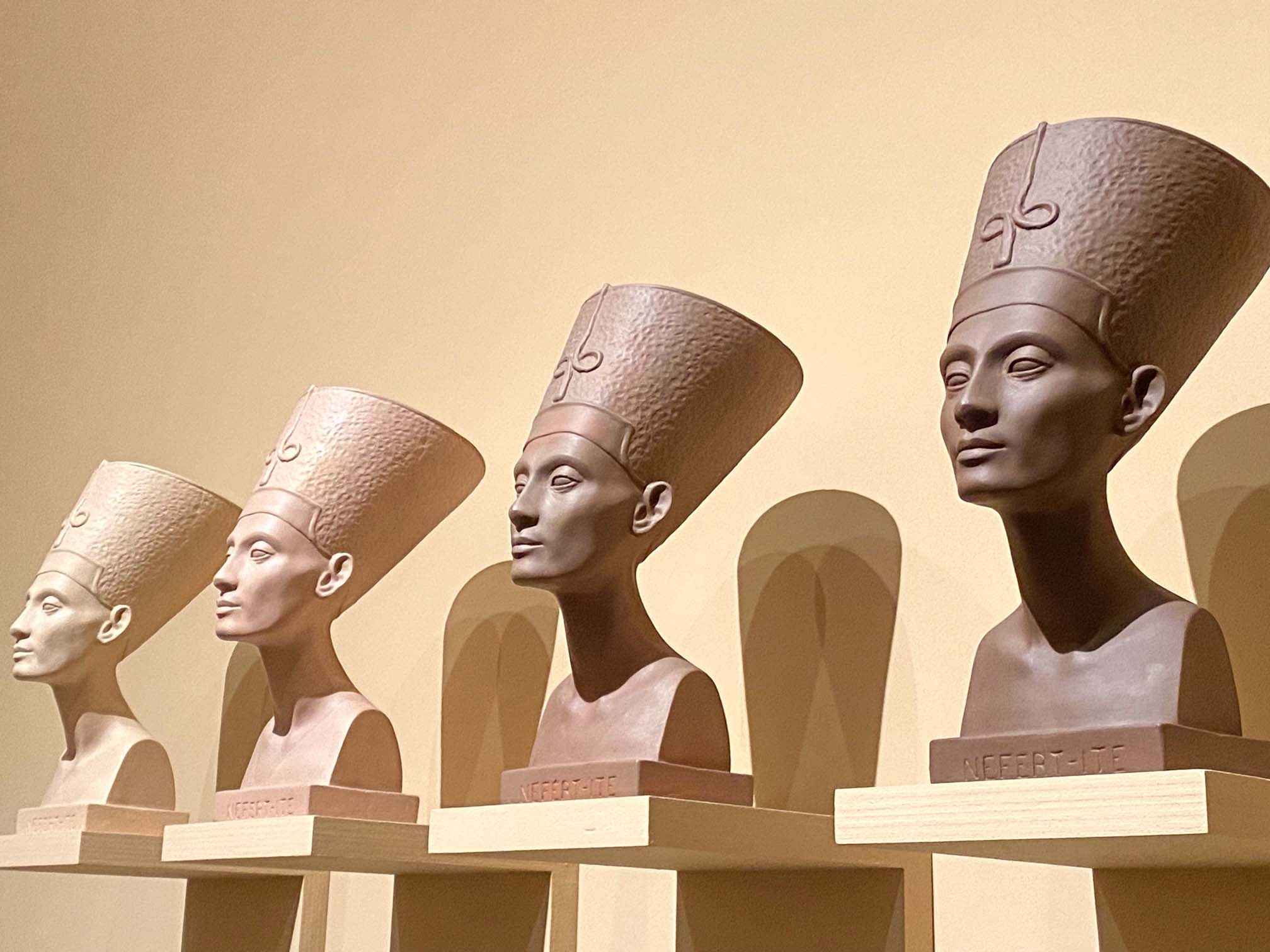
1993 Grey Area (Brown Version) by Fred Wilson – busts of Nefertiti painted in varied skin shades, reflecting the unresolved opinions on the racial makeup of the ancient Egyptians. From the Kings and Queens gallery. Courtesy: Brooklyn Museum

Watch this video walk-through with the curator, who’s accompanied by two artist in the show – Fred Wilson, whose “Grey Area (Brown Version)” sculpture inspired the curator’s theme, and acclaimed abstractionist Julie Mehretu, who herself was born in Ethiopia and experienced the monuments of Egypt at a very young age:

There’s also a gallery devoted to contemporary work by Egyptian artists –a body of work that’s often overlooked in Western art museums. Here’s a closer look at how an Egyptian artist – who’s also a security guard at the Met – was invited by the curator to participate in this exhibition:

For learn more, here’s a link to the Met’s exhibition guide, and a curated playlist for the show. Take an exciting journey through these visual and musical revelations!

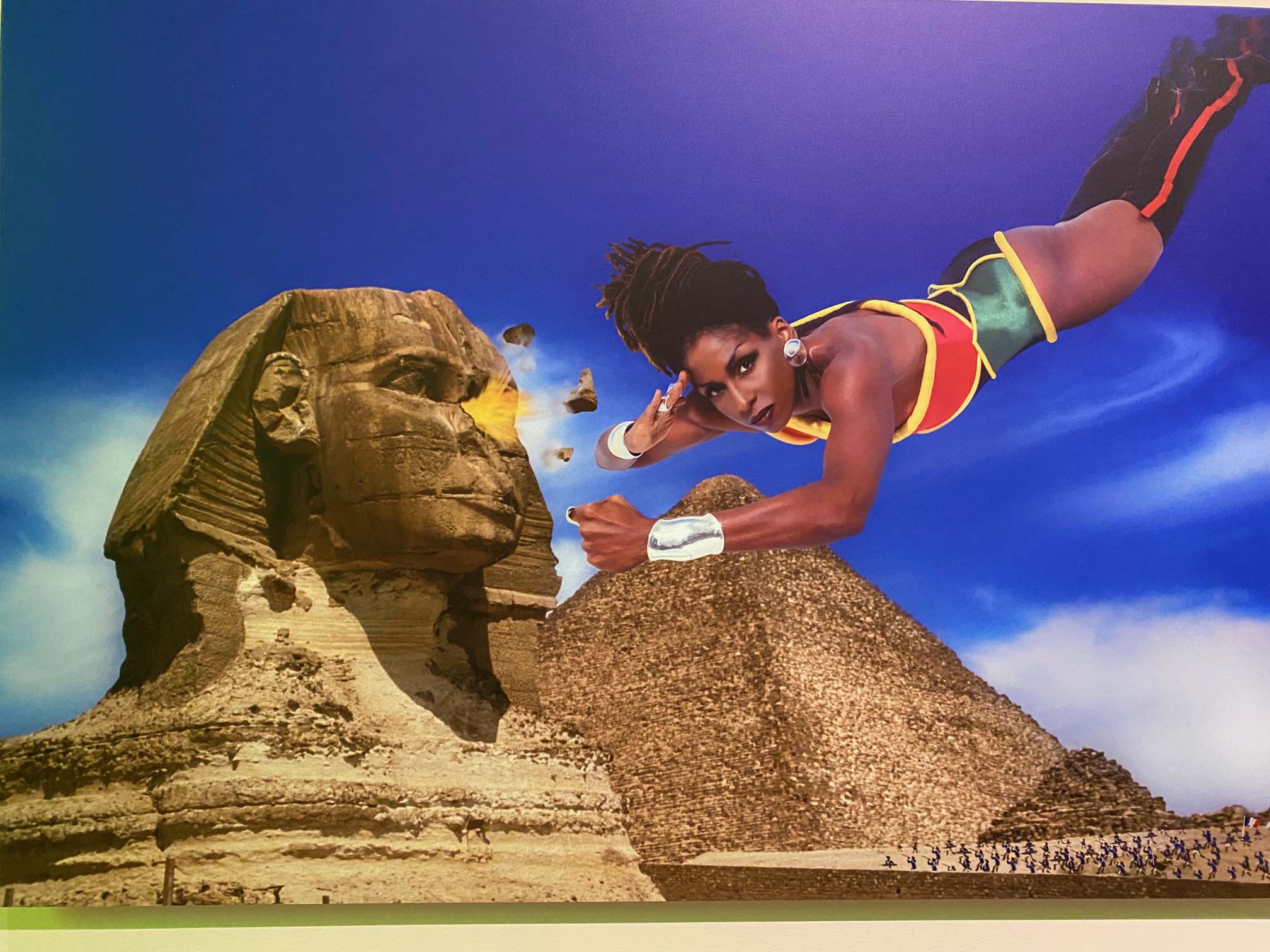
Renee Cox’s 1998 digital print (printed 2024) Rajé to the Rescue, featuring an Afrofuturist super-heroine. In the Space is the Place gallery. Courtesy: the artist.

Artists Call to Action for Central America

In the early 1980s, socially minded artists living downtown in New York couldn’t handle the news coming out of Central America and did something about it. The United States government was intervening in the affairs of Nicaragua, El Salvador, and Guatemala, and everyone was worried that the situation was going to devolve into another Vietnam.

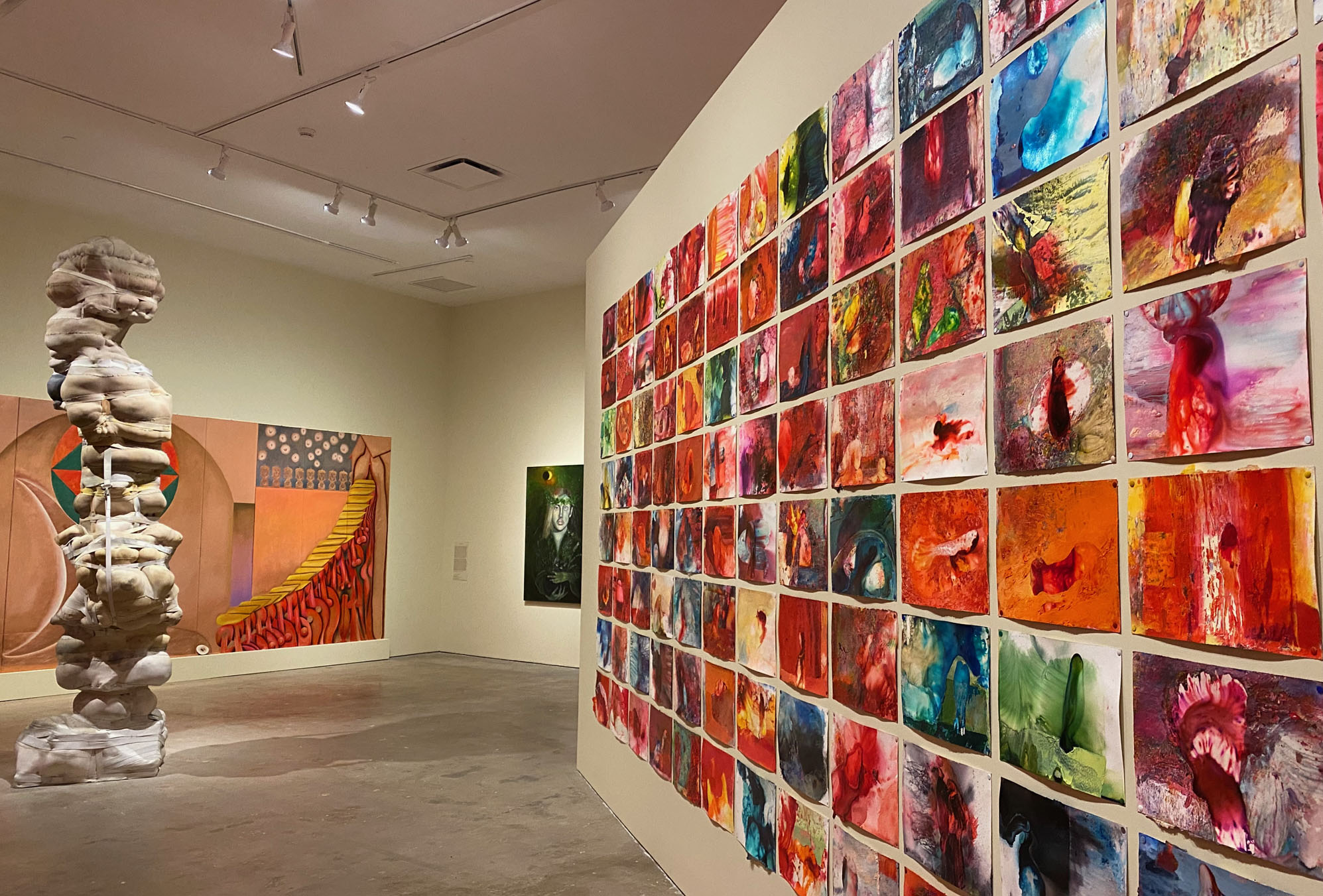
This is just one part of the story told by the dynamic, timely, informative exhibition, Art for the Future: Artists Call and Central American Solidarities, on view at the University of New Mexico Museum of Art in Albuquerque through December 3.

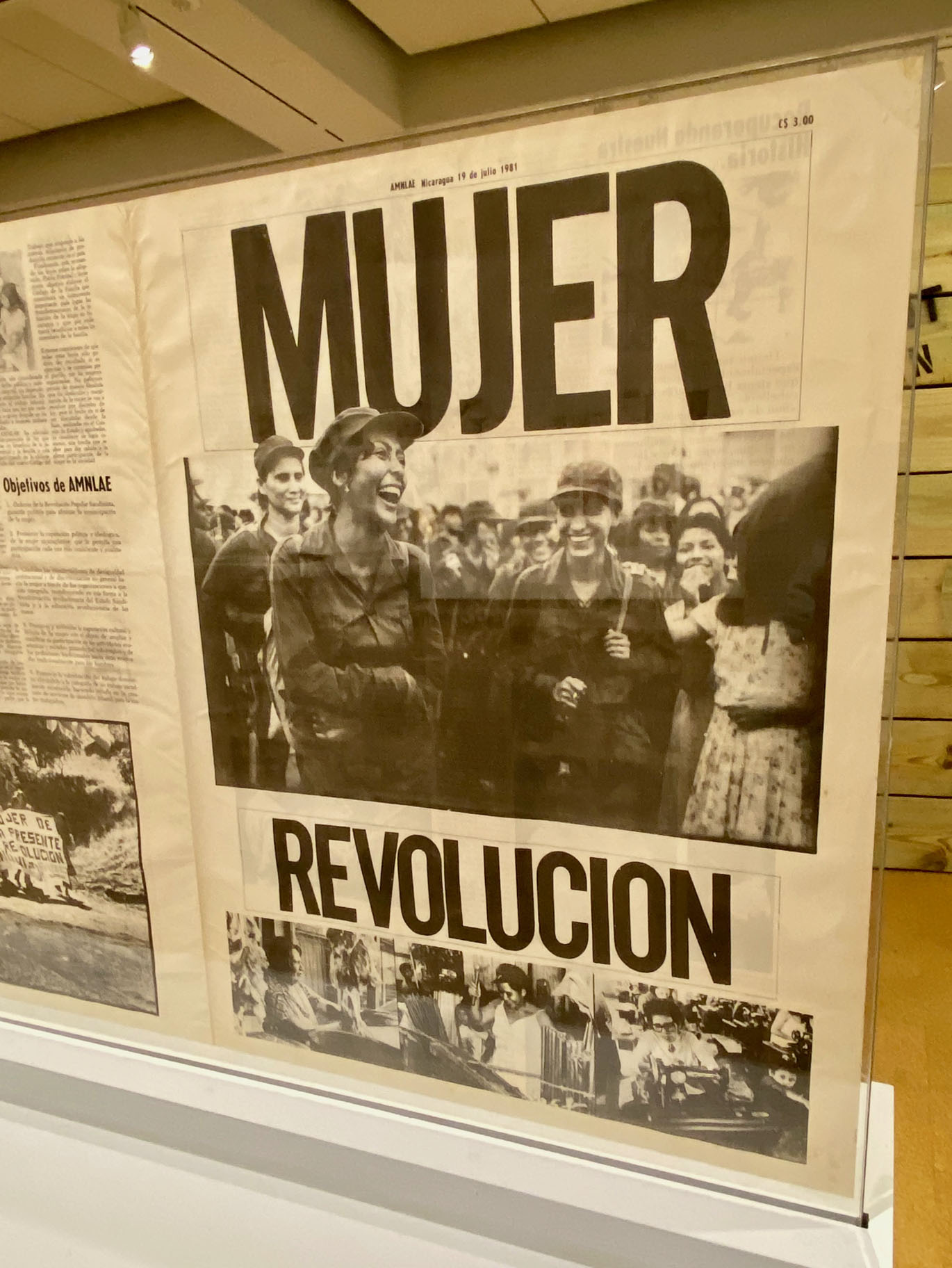
1981 pamphlet Mujer Revolución by Association of Nicaraguan Women. Private collection
1983 Print of Contra (after a drawing in Rock Comics, 1979) by Jerry Kearns, depicting communist fears stoked by the US government

In 1982, a group of New York artists collaborated with Latin American artists to create a show with contemporary art and cultural artifacts to draw attention to the escalating crises in Latin America. By 1984, organizers launched a national call to artists to raise money and awareness of what was happening.

Artists responded with performances, music concerts, films, poetry readings, and exhibition. In New York alone, over 1,100 artists participated in over 30 exhibitions.

Nationally, artists in 27 cities organized chapters and events and tried to build alliances in Latin America.

Videos, photographs, sculptures, paintings, and ephermera pulled from archives (like posters, buttons, mail art, and pamphlets) bring the story of artist-activists to life – their concerns about US government intervention, their efforts to organize artists across the United States, and their attempts to help artists living in oppressed Central American countries.

The Tufts University-organized show resurrects a largely forgotten story of artist activism, illuminates the tribulations of indigenous communities in Central America at the time, introduces us to contemporary works from artists inspired by their indigenous heritage, and gives us an idea of what’s happening in those countries now.

Two contributions to Solidarity Art by Mail project, a fast, cheap solution to boost Latin American and Caribbean participation in a 1984 New York exhibit at Judson Memorial Church. Private collection.

The three-floor show is packed with arresting images, works, and histories. The art work and documentation push and pull visitors between the international political crises of the 1980s and social-justice issues being addressed by artists today.

Take a look at the show on our Flickr site.

The installation features work by heavy hitters of the 1980s New York art scene – wall-size Vietnam-era work by Leon Golub, images documenting Ana Mendieta’s performance pieces, and Claes Oldenburg and Coosje van Bruggen’s sketches, maquettes, and exploding-banana image that branded the Artists Call Against US Intervention initiative.

The first-floor exhibition area includes Nancy Spero’s dramatic scroll-like drawing that calls attention to the oppression of Salvadorean women.

1984 Arts Magazine cover with Oldenburg’s image promoting Artists Call. Private collection

Downstairs, there’s another 1984 work that similarly unfurls the length of the gallery – an accordian-book project led by Sabra Moore that is a collaborative reconstruction of a rare 16th-century Mayan codex by 22 women. It’s the first time the codex has been displayed since 1984.

1984 “Reconstructed Codex,” a project organized by Sabra Moore with contributions from 22 diverse female Latin American and US artists. Courtesy: Barnard

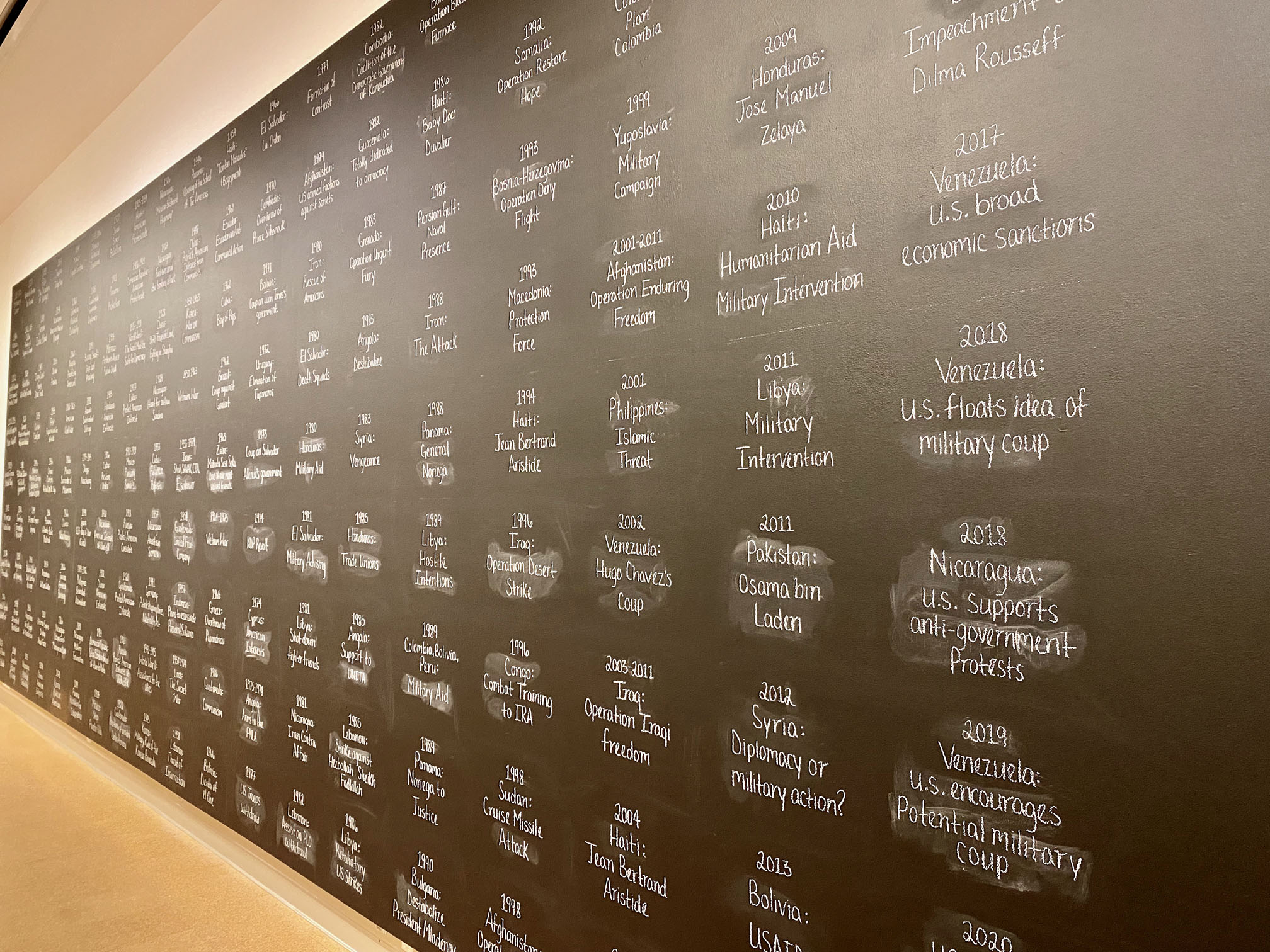
The third floor packs a punch, installing revolutionary images and publications around the infamous (and censored) Hans Haacke piece that questions the aftermath of the 1983 US invasion of Grenada.  Across the room, visitors pour over Carlos Motta’s 2005 wall-sized chalkboard installation Brief History of US Interventions in Latin America since 1946. 

Although the 1980 artist-activists did not achieve all of their utopian goals, the contemporary selections show that social consciousness, pride in indigenous heritage, and artistic futures are still alive – including a beautiful feathered immigrant history dome by Batriz Cortez, stitched by a team of immigrant collaborators.

2021 sculpture 1984: Space-Time Capsule by Salvadorian artist Batriz Cortez and immigrant collaborators – a shelter for immigrant histories.

Learn more about how the curator Erina Duganne and her collaborator Abigail Satinsky created this remarkable show:

Art for the Future will be on display at Chicago’s DePaul Art Museum from March to August 2023.

Carlos Motta’s 2005 detailed chalkboard installation Brief History of US Interventions in Latin America since 1946. Courtesy: the artist

O’Keeffe Museum Shows Georgia at Home

One of the most photographed artists of the 20th century, everyone is used to seeing Georgia O’Keeffe in her “formal” pose and gear – angular black hat, stark wrap dress, punctuated by her modernist Calder pin, standing against the New Mexico sky peering solemnly into the future.

In its latest offering, the Georgia O’Keeffe Museum is giving fans a special treat (and a different view) through its exhibition, Georgia O’Keeffe, a Life Well Lived: Photographs by Malcolm Varon, on display in Santa Fe through October 31.

2021 print of Varon’s 1977 photo of Georgia relaxing at Ghost Ranch. Courtesy: the artist
Georgia’s 1946 Part of the Cliff, a painting inspired by the view through her studio window.

The show features a smiling, at-ease 89-year-old surrounded by family, friends, companions, and pets – images quite apart from the GOK that we all admire and revere. How did this happen?

In the 1960s in New York, photographer Malcolm Varon established quite a reputation for documenting painters’ works in a way that captured a lot of their spirit. No wonder that in the mid-1970s, he was summoned out to Ghost Ranch and Abiquiu to document some of Georgia’s huge body of work.

While he was working with the artist during the summer of 1977, a journalist arrived to interview the icon for a feature in ARTnews.

No photographer had been attached to the story, so Georgia came up with hew own solution – ask her colleague Malcolm to shoot her in the setting of her Ghost Ranch home.

Since Malcolm was already familiar with the operations around Ghost Ranch and Abiquiu, he ended up taking about 300 photos of her homes, the landscapes that inspired her, and the people who kept things humming.

2021 prints of Varon’s 1977 portraits of Ida Archuleta, Candelaria Lopez, and Estiben Suazo, the people who managed Georgia’s homes and properties. Courtesy: the artist.

Despite Georgia’s reputation as a loner living out in the middle of nowhere, Malcolm appreciated that the day-to-day operations in the outback were quite fun, busy, natural, and happy at her two studio compounds.

ARTnews made a few selections from Varon’s photographs and ran them in the feature, but the majority of the 300 shots were never printed or seen…until now.

Visitors at the GOK museum pour over every detail of the portraits and landscapes, enjoying a new, different glimpse of the artist and her world – Varon’s portrait of Georgia’s sister, beautiful portraits of her property caretakers (whose families still take care of the GOK home for the museum), and her assistant Juan Hamilton.

The curators present several paintings from the 1940s showing the same cliffs, landscapes, and skies that Varon captured in the summer of 1977. Visitors have fun shifting back and forth between the oil paintngs and photos.

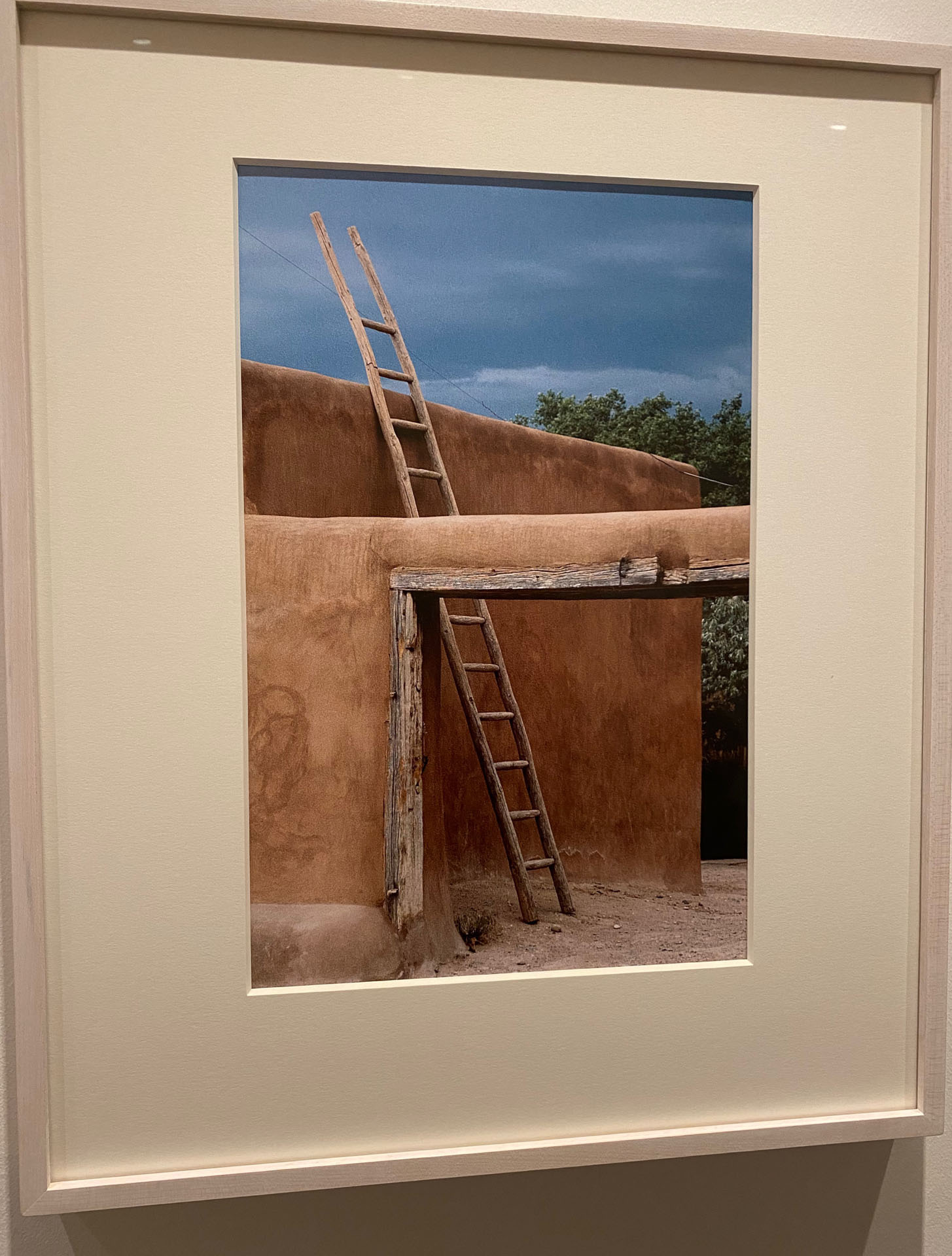
2021 print of Varon’s 1977 photograph of the tall ladder at Georgia’s Abiquiu home – a platform from which she surveyed the world. Courtesy: the artist

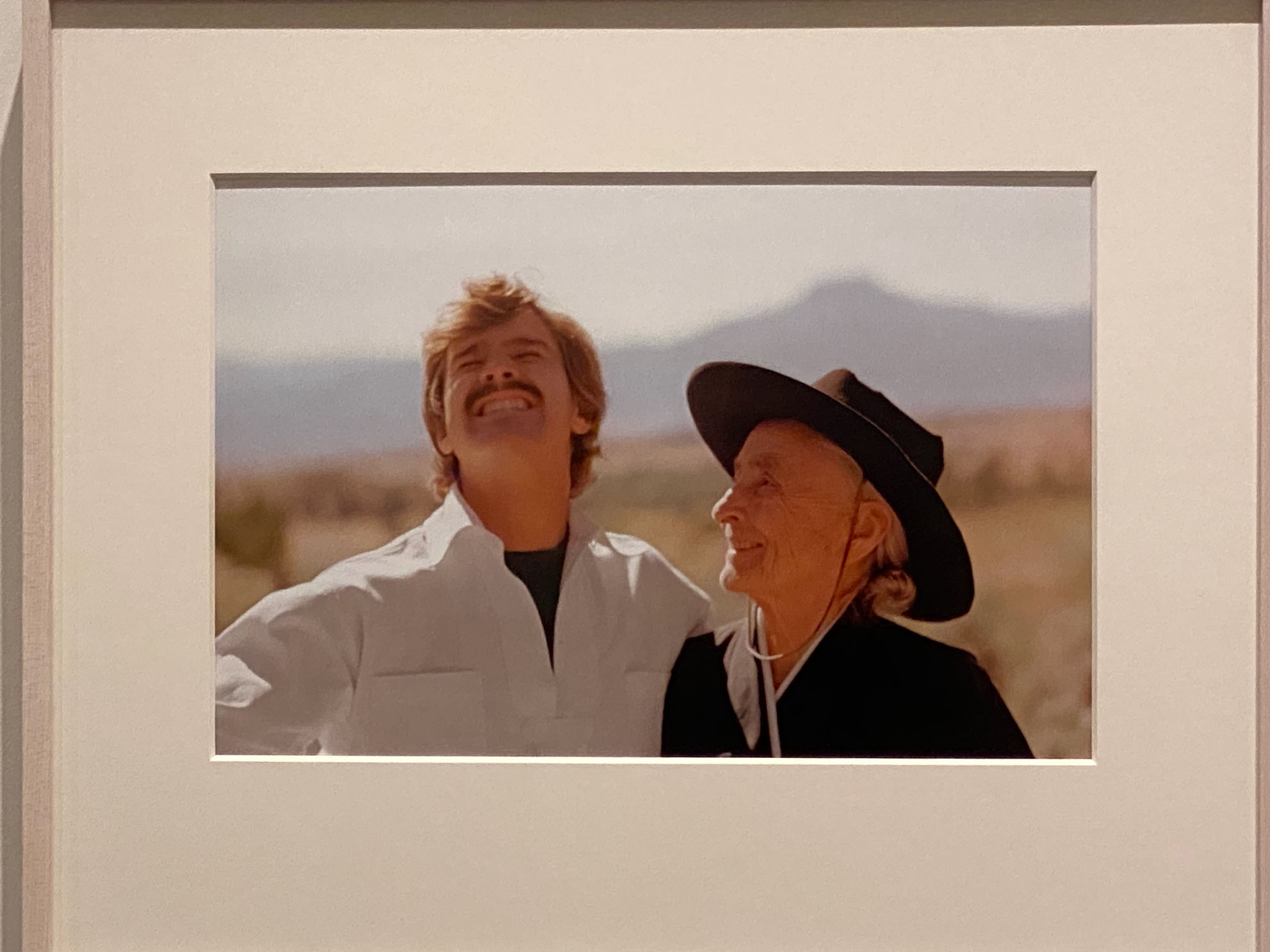
2021 print of Varon’s 1977 fun photograph of Georgia at Ghost Ranch with her friend and assistant, artist Juan Hamilton with the Pedernal as backdrop. Courtesy: the artist

Take a look at some of our favorites in our Flickr album.

Listen in as the curators of this delightful show draw back the curtain on the legendary O’Keeffe, her relationship with photography, and what happened when a trusted friend got her to smile for the camera:

Fashion Manifestos by Carla Fernández

What does “slow” fashion look like? A revolutionary Mexican haute couture designer shows how it’s done in Carla Fernandez Casa de Moda: A Mexican Fashion Manifesto, on display at the Denver Art Museum through October 16.

As a young woman, Carla met and got to appreciate Mexico’s indigenous communities as she traveled with her father, a renowned anthropologist. She loved collecting hand-made indigenous garments reflecting the distinct local styles she saw. 

As a student of art history and fashion design, the complex indigenous textile techniques in these out-of-the way communities seemed to stand in contrast to the ever-changing, always-disposable cycle of Western fashion.

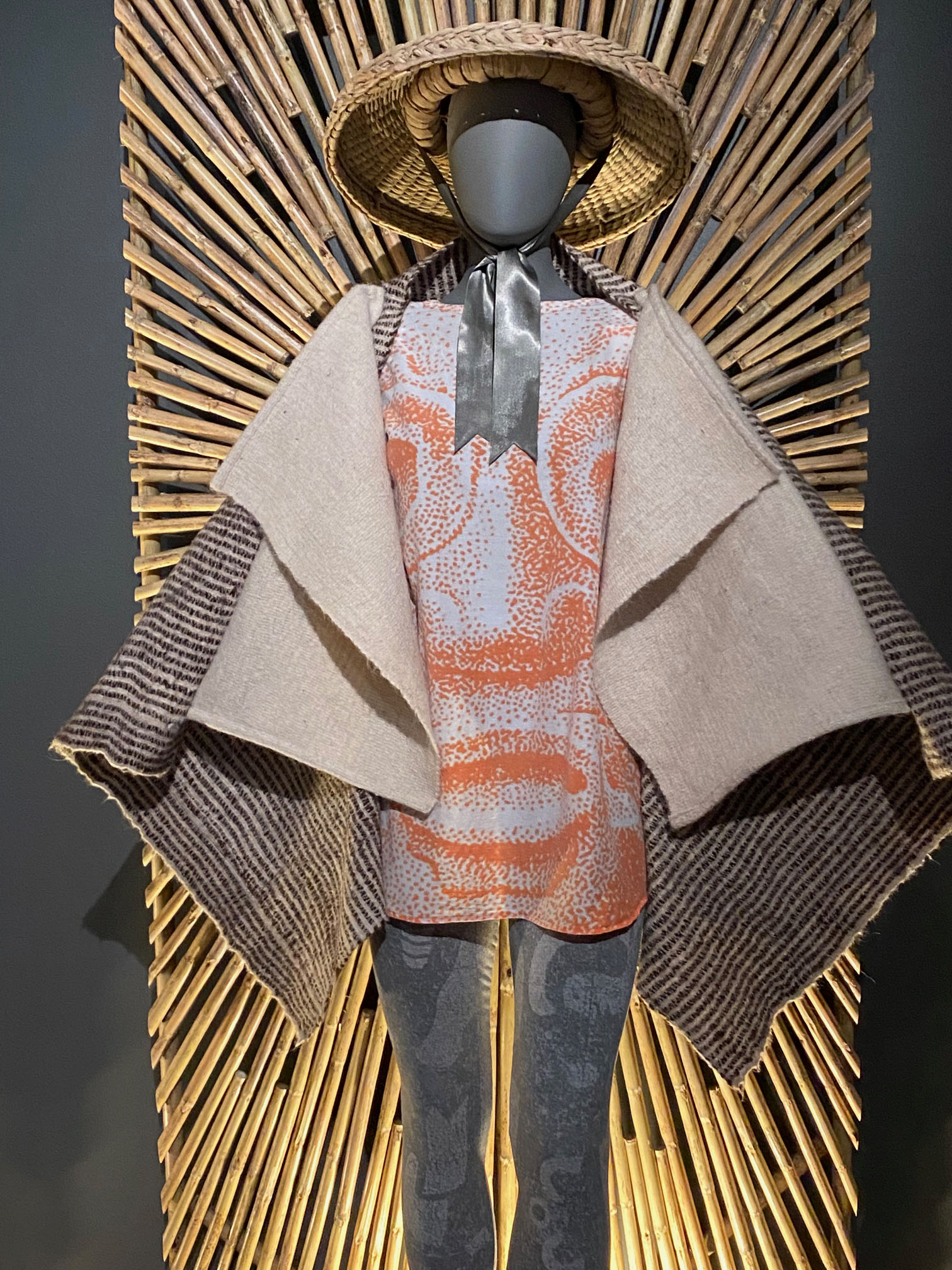
Carla Fernández 2014 jacket collaboration with Juanez Lopez Santis (San Juan Chamula, Chiapas) over digital-printed silk top and leggings.
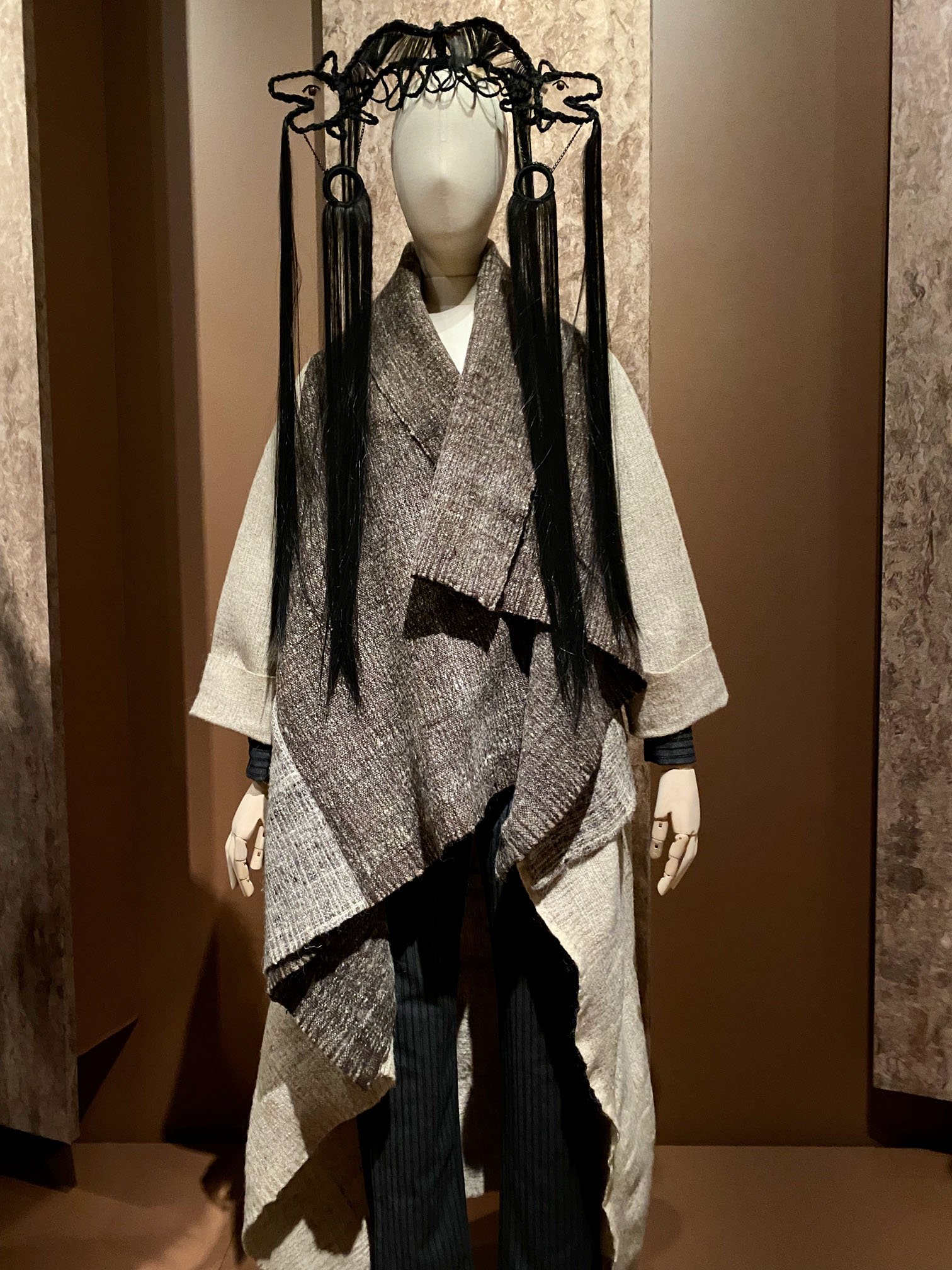
2003 wool poncho – a Carla Fernández collaboration San Juan Chamula (Chiapas) artisans ­– over a 2009 pantsuit. From the collection of photographer/model Luisa Sáenz

Why not use these indigenous “haute couture” techniques for a high-fashion collection? Why not create a mix-and-match aesthetic using traditional, geometric shapes? Why not credit the artists?

As presented in her first-ever museum retrospective, the results are dramatic, detailed, intriguing, and one-of-a-kind – a completely different kind of fashion system that incorporates indigenous work, pays and credits community makers, and gives artisans the time to create pieces that collectors cherish.

Carla travels to mountain and desert communities to collaborate with textile artists.

With her fame growing, communities now invite her to drive over, see what they’re doing and brainstorm about potential collaborations. It’s an approach that involves time, dialogue, and mutual respect between the artisans and Carla-as-fashion-facilitator.

In her mobile studio (Taller Flora), they create hand-woven, dyed, and painted works of wearable art that Carla brings to the runway, but always with an eye toward collectors who value innovative, indigenous craft traditions.

The exhibition features runway looks, accessories, and videos of performance art that showcase different facets of her fashion manifesto – that artisan-made is the true “luxury” in a “fast fashion,” throw-away world.

2021 hand-painted coverall and digital-printed jumper and coat with Leonardo Linares (Mexico City); embroidered jumper with Antonia Vasquez (San Pedro Chenalhó, Chiapas).

Fiesta masks, leather caballero fretwork, whimsical basket-purses, and fuzzy handmade pom-poms provide home-grown Mexican flair to the cinched, draped, easy ensembles.

Take a look through our Flickr album, and enjoy this video of the installation at Denver Art Museum:

Every section of the exhibition demonstrates her commitment to stimulating innovation and creativity among indigenous makers.

Inspired by decorative fretwork on rodeo apparel, a 2022 wool poncho and pants done in collaboration with calado master Fidel Martínez (Chimalhuacán, State of Mexico).

As of 2022, Carla’s collaborated with more than 164 artisans in 39 communities in 15 Mexican states, with more to come. The show presents a map and identifies all of her collaborators.

To see and hear more about Carla’s collaborative process, watch the Denver Art Museum’s 2019 seminar on culture, cultural appropriation, and fashion in this YouTube video.

And join in on Carla’s beautiful, expressive fashion revolution by checking out her current and past collections on her website.

Jeffrey Gibson at SITE Santa FE

What happens when a Native American MacArthur genius is asked by SITE Santa Fe to create an art exhibition during a time of a global pandemic and social justice marches? And invite him to a location where Native Americans make up a significant percentage of the population?

The result is Jeffrey Gibson: The Body Electric – a constantly surprising gallery journey where shape-shifting, cultural disassociation, beadwork, kitsch-image appropriation, gender-identity questions, and science-fiction inspiration reigns.

The show is filled with life-size beaded dolls and garments, films, pulsing papered walls, mysterious film experiences, and social statements either woven or stamped onto clothes (or are they banners?).

Gibson’s 2021 White Swan mixed-media painting in wall-papered gallery with a beaded, life-size, genderless “doll”
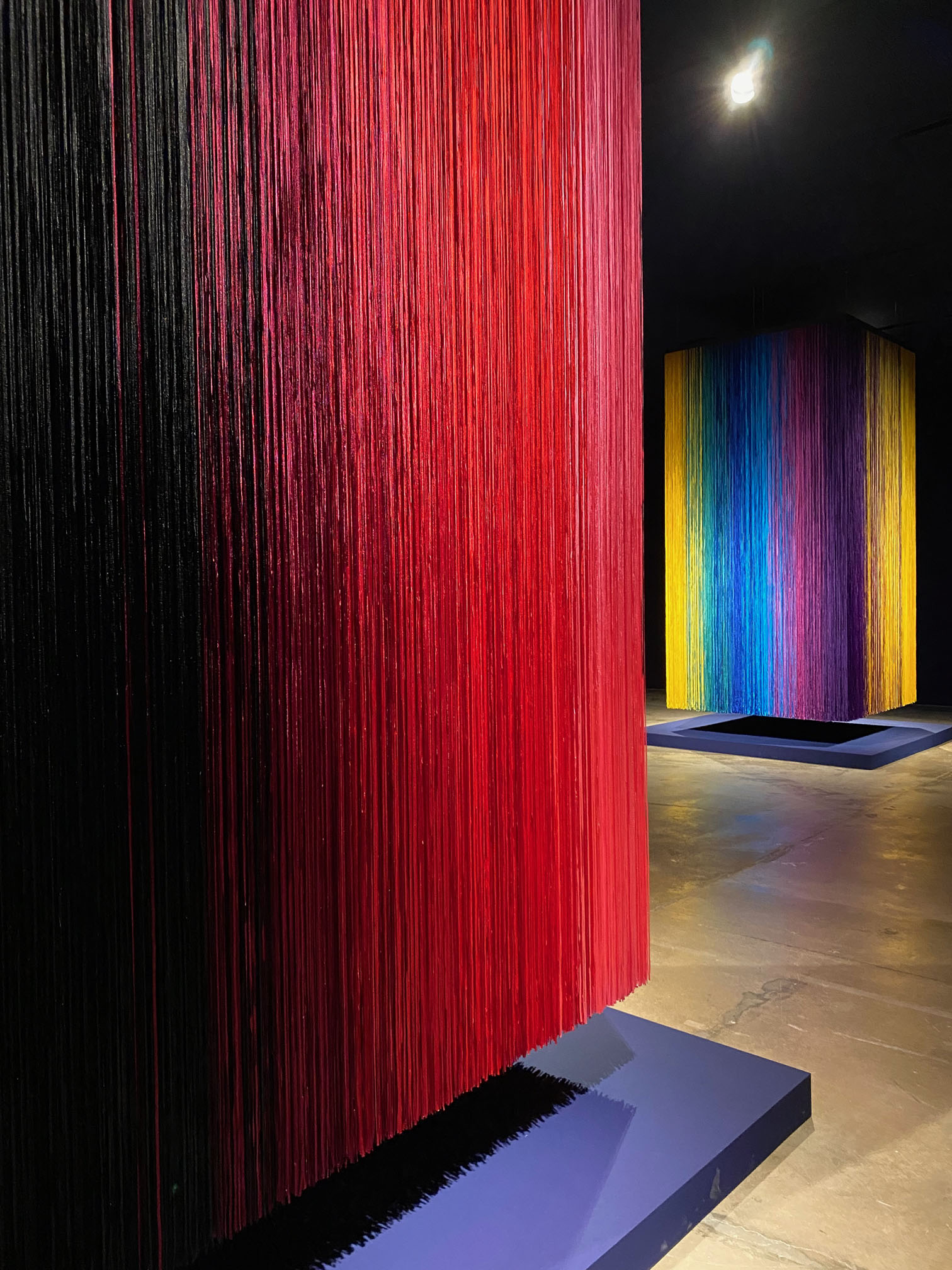
2020 Red Moon and Desert Sky minimalist sculptures created from strands of dance fringe.

Gibson, who is based in New York, is an intertribal artist who is a member of Mississippi Band of Choctaw and half Cherokee. However, his influences were forged from prestigious art schools, international travel, and living in non-Native societies.

The opportunity to come to Santa Fe, host a cinema series and several performances, and stay out West for a while was an open door to explore inter-cultural influences, host discussions with appreciative audiences, and show off his wide intellectual and artistic breadth.

In many of his works, Jeffrey mixes traditional “Indian” materials like beads or fringe with slogans, sayings, dime-store “Indian” images, and big-time art-world references.

See some our favorites from this exhibit in our Flickr album and hear Jeffrey explain his influences in SITE Santa Fe’s audio guide.

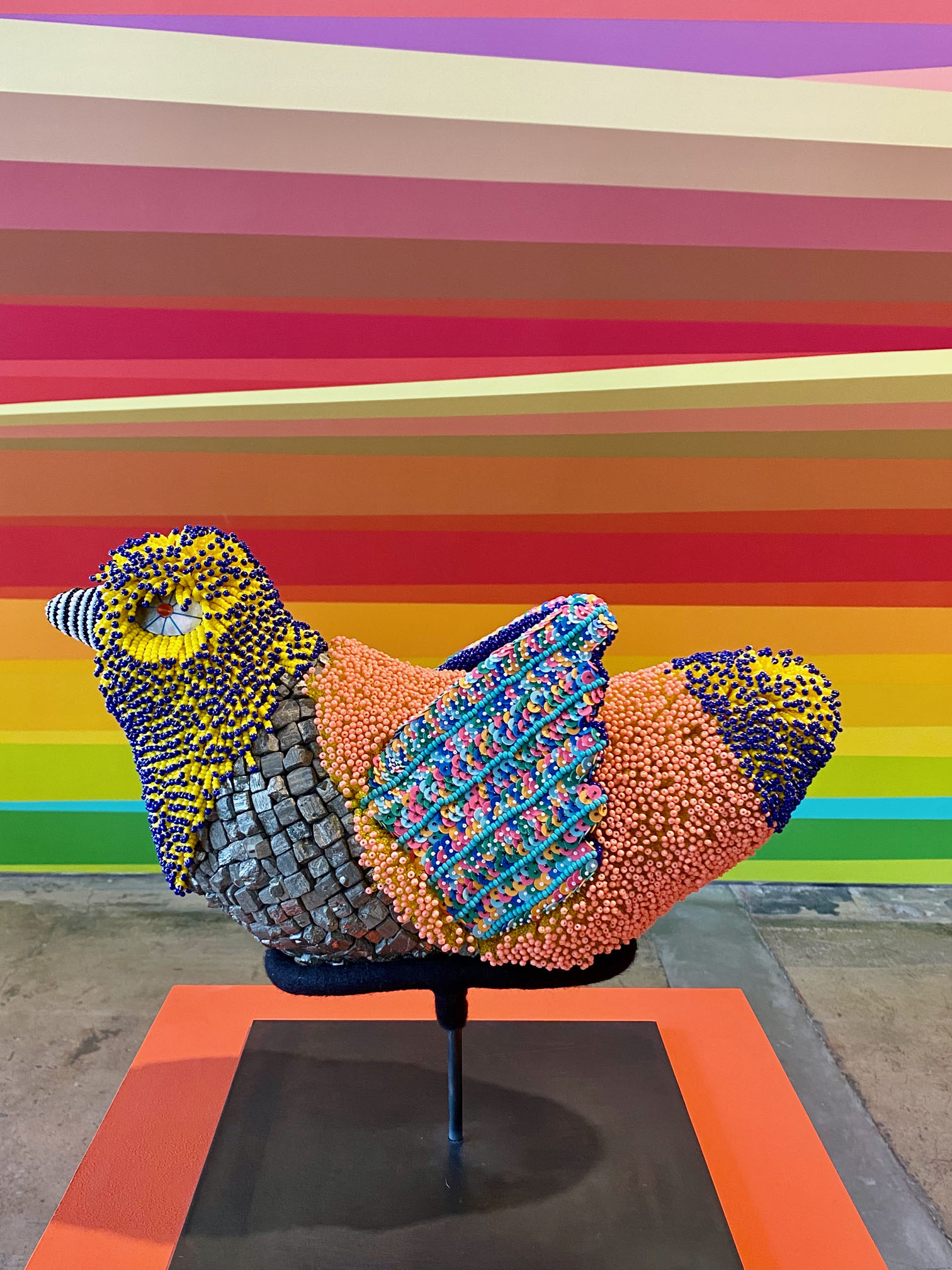
The little beaded birds that greet visitors in the first gallery and the big beaded life-sized “dolls” in the second were inspired by Jeffrey’s early work in the ethnographic collections of the Field Museum, where he encountered Haudenosaunee-made beaded tourist-trade whimsies and traditional “third gender” dolls for the first time. Why not make his own, but over-size them?

2021 My Joy My Joy My Joy, a mixed-media beaded bird inspired by Victorian-era Native American tourist whimsies

The nearby video gallery features a kaleidoscopic multichannel video of Sarah Ortegon, an award-winning Eastern Shoshone/Northern Arapaho jingle dress dancer, performing to the energetic Sisters track by A Tribe Called Red. This piece – She Never Dances Alone – refers to the dancers who came to the Standing Rock Reservation and lent their support to the 2016 pipeline protests though dance.

Here’s Sarah Ortegon in Gibson’s 2019 Times Square installation of She Never Dances Alone here…wait for it:

2021 They Play Endlessly mixed-media crazy quilt of paint, beads, words, and found objects.

And here’s another look at Gibson’s 2020 exhibition at the Brooklyn Museum, where he mixed works from his studio with artifacts and art from Brooklyn’s own collection.

And check out Gibson’s work our album documenting the Smithsonian’s National Museum of the American Indian exhibition of Native painting, Stretching the Canvas.

If you’re near Nashville, you’ll be able to see Gibson’s The Body Electric at the Frist Art Museum February 3 – April 23, 2023.

Jasper Johns Takes Victory Lap at The Whitney

Iconic imagery, big statements, technical mastery, and long-distance endurance are all on display from the second you enter Jasper Johns: Mind/Mirror at The Whitney – the mind-bending retrospective of one of the century’s most celebrated artists.

Then you realize that this 12-part extravaganza is only half the story ­– a mirror image of the Whitney retrospective that is also on display 90 minutes south at the Philadelphia Museum of Art.

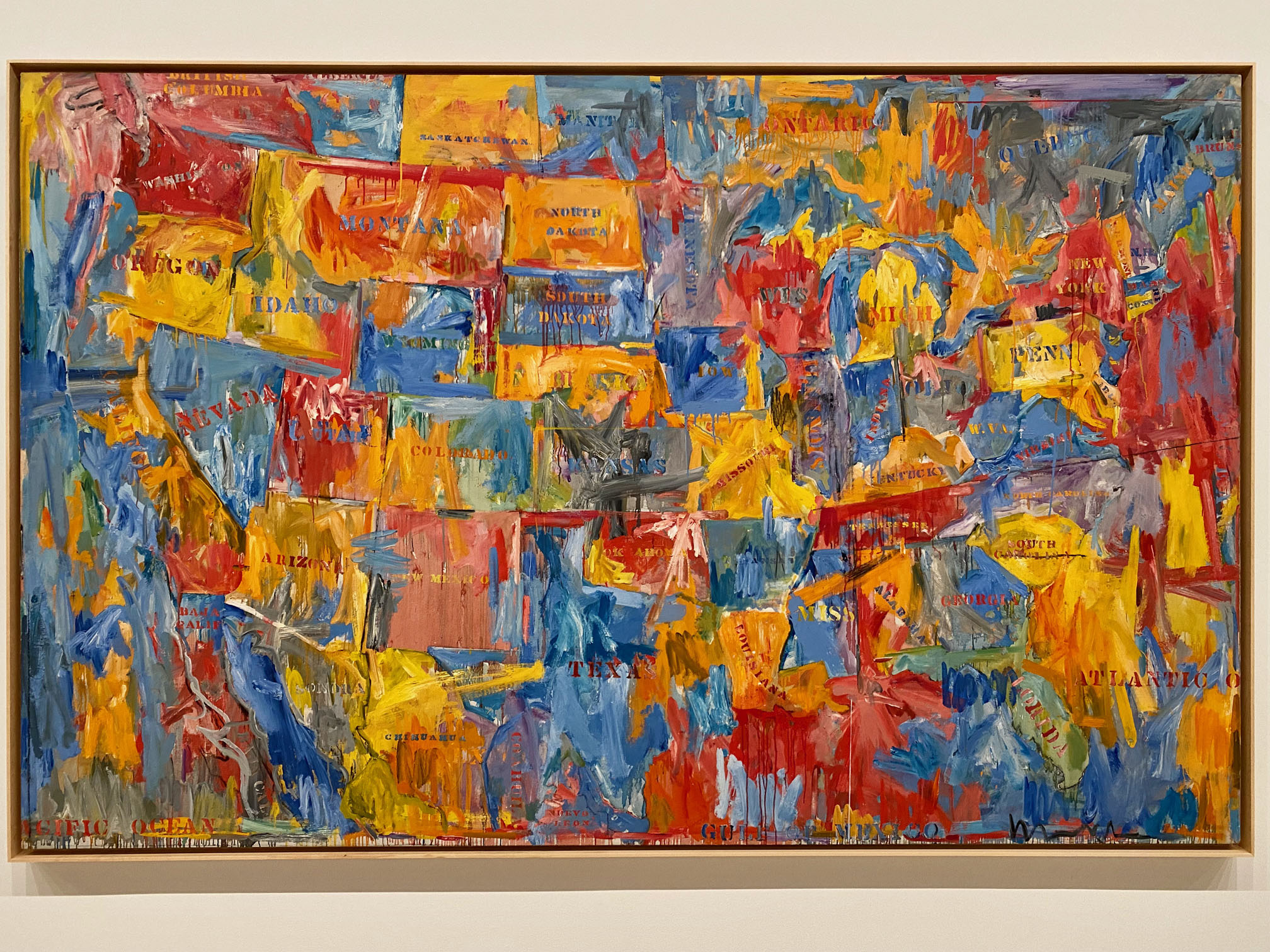
1961 Map by Jasper Johns. Courtesy: MoMA
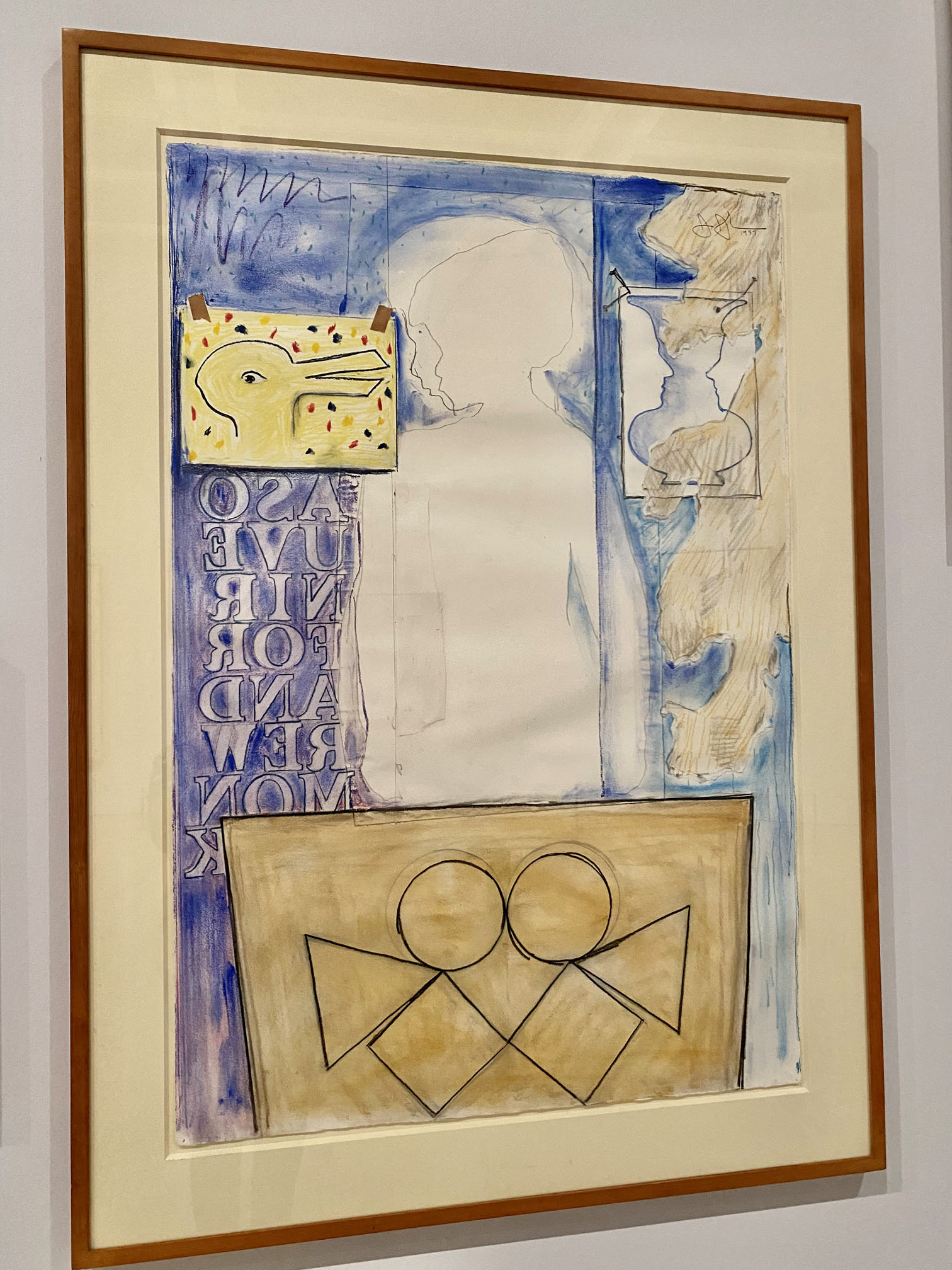
1982 Savarin monotype of Johns’ 1960 bronze.

Each has different works and minutely different themes (the number paintings vs. the flag), but reflect the same scale and scope of the artist’s astonishing 70-year career.

Most art lovers know that the early work of Johns and Rauschenberg in the late 1950s and early 1960s helped to redirect the New York art scene from Abstract Expressionism toward Pop. But show puts a much-needed spotlight on the rest of Johns’ career – how he kept experimenting with media, pushing his own boundaries, manipulating paint to evoke an emotional response, and not letting any art-world “ism” impede his creative journey over the next 50 years.

Hear what the show’s two curators, Scott Rothkopf (NYC) and Carlos Basualdo (Philly), have to say about Johns, the “rules” he “broke,” and the mark his work left upon 20th century American art:

The sheer magnitude and quality of the artist’s output is on full display as you take the journey through the Whitney – masterful paintings, prints, drawings, watercolors, and sculptures

See some of our favorite works in our Flickr album.

Exhibition entrance with full scope of Johns prints.

As soon as the elevator doors open at The Whitney, viewers are confronted with a curved wall that contains dozens of surprises – a chronology of prints stretching from Johns’ early days in New York through works completed as recently as 2019.  Walking left to right, the wall serves as a mini-retrospective as well as the intro to the larger show.  Bravo to the team for this brilliant, engaging welcome.

It’s joyful to poke through the first few galleries and experience Johns’ early experimentations with stenciled lettering, disappearing letters, collaged newsprint, and maps enlivened by painterly gestures and swipes.

But then you see works done in South Carolina, where Johns took in the beach and sky and recollected back to his childhood in the South. Big, bold, mystical, evocative puzzles taking the form of large-scale canvases, small intimate sculptures, and all forms of drawing and mark making.

1964 Studio with paint cans, created at the South Carolina beach.
1967 Harlem Light from Johns’ 1968 Leo Castelli gallery show. Courtesy: Seattle Art Museum.

You experience a room where the team has brought together work originally shown by Leo Castelli in his New York townhouse gallery in 1968. The exhibition designers mimic the size of the original gallery to let you experience the same thrill of interacting with these big, colorful, slightly conceptual, architectural paintings.

The centerpiece of the Whitney exhibition is a spectacular gallery created by the exhibition team to showcase the retrospective’s theme – how Johns used doubles and “mirroring” to explore perception and entice viewers to ponder the works more carefully.  The exhibition designer explains and shows how the famed bronze Ballantine ale cans are the fulcrum around which Johns’ subsequent work revolves:

There are hundreds of loans from other museums and private collectors, and the two museums even swapped some of their own holdings.

And Johns himself has loaned never-before-exhibited works, including watercolors and drawings that he did in the 1980s. Although the colors draw you in, they represent the artist’s process of working through the ravages of HIV and loss inside the art community.

The curatorial precision of the show allows you to experience an evolving appreciation of Johns’ later work – experimental monotypes in the print studio, contemplation of the arc of life in monumental elegiac grey paintings, and sculptures completed in the 2000s. See more on the Whitney website about the works in the show.

1990 watercolor from Johns’ collection with mysterious, surreal, personal imagery.

The latter are displayed in natural light, which allows you to enjoy the cast bronze and aluminum number blocks as the sun shines over the Hudson from different angles. The changes illuminate the hand work, gestures, and conceptual rigor over time – a fitting encapsulation of this two-city tribute to Mr. Johns.

Reverse side of 2008 bronze 0-9 sculpture. Private collection.

Kamoinge Workshop Photographers Show NYC in a Different Light

Anthony Barboza’s 1972 Kamoinge Workshop Portraits and multifold Kamoinge Artist’s Book.

When fourteen photographers decided to get together in 1963 to for regular critiques, history was happening in Harlem, Mississippi, and on the Capitol Mall and life was bursting at the seams in down-and-out neighborhoods all around them.

The collaboration, influence, mutual support, and artistic output of their first 20 years is the story told in Working Together: Photographers of the Kamoinge Workshop, an exhibition on view at the Whitney Museum of American through March 28.

Two by Beuford Smith, a 1978 self-portrait and 1972 Wall, Lower East Side.

The show, originally produced by the Virginia Museum of Fine Art in Richmond, shines a light on the work of the workshop’s founders. It’s a master class in black-and-white photography, experimentation, and community spirit. Everyone has their own style and path, all the works you’ll see here provide a window into community and life in New York during the Sixties and Seventies with a different slant than you’ve seen before.

The Kamoinge Workshop artists were keenly aware that they had access to people and events either ignored by mainstream media or at least invisible to it. Plus, they all had keen awareness and appreciation for artistic heroes, like Cartier-Bresson, Dorothea Lange, and other legendary photographers, and used the workshop to push one another forward – to make art that went beyond basic photojournalism, and use formal composition and other imaginative techniques.

Abstractions in the city –1973 Untitled (Harlem) by Ming Smith and 1966 Shadows by Adger Cowans.

When they began meeting in the Sixties, Herb Randall showed photos of Southern life taken the summer he accompanied the Freedom Riders to Mississippi; Adger Cowans showed his abstracted, from-a-rooftop image of the crowd listening to Malcom X; Herb Randall showed images of Harlem kids cutting up for his camera; James Mannes Jr. showed formally composed portraits evoking African royalty.

Share the excitement that they felt at the time:

The quality of the work and the unlikely prospects of being selected for shows in elite museums or high-end commercial galleries inspired them to get it out there a different way – by issuing portfolios that they donated to museums, libraries, and universities.

C. Daniel Dawson’s 1978 Olaifa and Egypt, taken at The Met

Anthony Barboza’s group portrait of the founding members is the welcome image for the Whitney show. Inside the space, the work is loosely grouped into areas featuring emerging political movements in Harlem, abstraction, experimentation, journeys to Africa and the Caribbean, and cityscapes during a time when New York was going downhill.

Every time we visited, viewers were studying each work closely, somewhat transfixed by each window into the past. Each image has a special twist to it – shadows creating abstractions across bodies or buildings, the unexpected jolt of the pattern of a man’s jacket, or the panorama of life in a fleeting moment on a street in Senegal.

Look at some of our favorites in our Flickr album, and meet each of the artists on the museum’s exhibition page. Click on each artist’s portrait to see some of their work in the exhibition, and listen to them speak about their work on the audio guide.

Meet the artists and listen to what this group meant to them in the Seventies and today:

Next stops on the exhibition tour – the Getty in Los Angeles (June 29 – September 26, 2021) and the Cincinnati Art Museum (February 25 – May 15, 2022).

On Wednesday, March 24, meet Ming Smith in a live online event, discussing the publication of her recent Aperture monograph and the influence of music upon her work.