Charlotte performs a John Cage piece at a 1965 Paris art festival.
In Grey Art Gallery’s gleaming white space on Washington Square East, you can take a walk-through of the gritty lofts and performance spaces of the 1960s, when the avant-garde was being born in Lower Manhattan
A Feast of Astonishments: Charlotte Moorman and the Avant-Garde, 1960s – 1980s is a tribute to the avant-garde’s poster girl, who transformed classical cello into a spectator sport. Trained at Julliard, Moorman came under the sway of the genre-busting, performance-loving artistic collaborators Nam June Paik, Yoko Ono, Alan Kaprow, and others. See the show through this weekend.
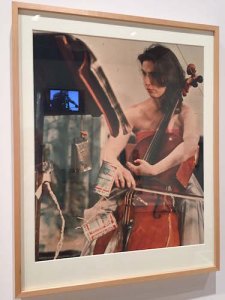
The show chronicles her early collaborations with Nam June, the artist who turned early portable video on its head. The centerpiece of the first-floor gallery is Paik’s “portrait” of Moorman, studded with an electrified cello and the tiniest video monitors. It’s quite a presence. Good work, Nam June.
Charlotte Moorman II, a 1995 sculpture-portrait by Nam June Paik. Collection: Brandies
On the audio system, you hear her voice, recounting her night in jail as a result of a police raid on a Village art cinema where she happened to be performing her own art piece topless. Ooops!
Cage might not have been crazy about Moorman’s interpretation of his at-the-edge contemplative works (too theatrical, he thought), but that didn’t stop her.
The show also highlights her friendship and support for Yoko Ono, another up-and-comer at the time. Moorman paid Ono the highest compliment by performing her legendary piece hundreds of times.
A fearless performer, she continued throughout the Sixties and Seventies as quite a producer too. From early performances of composers’ works, staged with all-star casts (Ginsberg et al.), she ended up getting a decade’s worth of permits to host an annual Avant-Garde Festival in New York City.
1989 Neon Cello by Charlotte Moorman
Some years, it was on the Staten Island Ferry. Others, it was Wards Island. Others, it was a parade, way before the Village Halloween Parade became a family favorite.
Charlotte and Paik toured well throughout the Seventies, everywhere art-loving Germans would have them.
Take a walk through the downtown underground with a classically trained musician who made performance-art history. Here are the exhibition photos and our Flickr album.
Taking their Shot in the lobby of the Public Theater in 2015
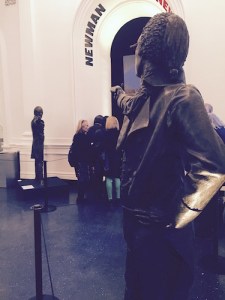
If you really want to experience Hamilton before the Tony Awards, it’s not that hard. Get up to New-York Historical Society at 77th Street and Central Park West and check out the life-size bronze statues of Hamilton and Burr one second before The Shot.
If you went to see Hamilton last year at the Public, you had to pass right between Kim Crowley’s bronze recreations when you entered the theater — a bespectacled Hamilton (wearing tinted glasses because he was facing the sunrise) and an intense Burr who was branded for all time in the history books one second later.
These action figures were initially installed at NYHS in 2004 as part of its ground-breaking Hamilton show…a magnificent installation that drew both raves (for the classy reimagining of NYHS and its exhibitions program after a near-collapse of that institution) and criticism (was it pandering to New York’s besmirched banking community?).
Their 1797 dueling pistols in the NYHS lobby
Interesting that 2004 was the 300th anniversary of both the duel and the year that NYHS was founded. In fact, Hamilton’s attending doctor that day was one of the founders.
Hamilton takes aim inside NYHS
After three hundred years and countless tries at the Hamilton’s pre-show lottery at the Richard Rodgers Theater, it will be a little disconnect to realize that the two facing off in the white marbled lobby are not Lin Manuel and Leslie Odom, Jr. The intensity and the historical dress are there, but the faces are different. Just stand there and run through all the lyrics you’ve memorized from the show.
Walk a few steps further and gaze down at the actual pistols – not stage props – and Angelica Schuyler’s letter to her brother, conveying the terrible news. All real, in her own hand, dated July 11, 1804.
OK, that’s just the lobby. By now, you’ve probably heard that NYHS has just announced its Summer of Hamilton, replete with a large gallery show of all the Hamilton-related documents, artifacts, and portraits plus special clips from Hamilton, movie musicals that inspired Lin, Ron Chernow’s book, and costumed performers on July 4 weekend.
But why not visit right now and have Ham and Burr all to yourself? To fill in the blanks about Ham’s life or prep to see the Broadway show, treat yourself to an exploration of the 2004 Ham show website. It’s full of all types of fun things – a quiz to test your Ham knowledge, a map of where Hamilton hung out in New York City, and real-life historical portraits of all the Schuyler sisters and everyone else in the Broadway show.
Lin’s Ham 4 Ham reading outside the theater during the preview lottery
There’s even a handy timeline of Hamilton’s “strange and amazing life,” which is a nice reference for things you’ve seen (or hope to see) in the show. For true fans (or curiosity-seekers), there’s even a small selection of short academic papers on Hamilton, including an interview with Ron Chernow, whose book inspired the current Broadway smash hit, and other brief treatises on his schooling, the duel, and the hours before his death.
Although it’s not inside the museum (or the Richard Rodgers), you can check out other Hamilton excitement at the Ham4Ham shows performed at lottery time on 47th Street, many of which have been taped by fans and put up on YouTube. Check out the recreation of the cabinet meeting by the Tony-nominated crew:
Steeplechase Funny Face, the symbol of a famous amusement park.
How did a strip of pristine, white-sand beach turn into one of the most fantastical, lurid, menacing, and whimsical destinations in the United States? You won’t find a sociological essay, but you’ll experience a lot of evidence in the Brooklyn Museum’s Coney Island extravaganza.
The crowds filling the galleries last Saturday night savored the experience of the sky-high towers of contemporary hand-painted, Coney-inspired signs by the collaborative, ICY SIGNS. You could stand for an hour, just taking in all the messages, philosophy, and witty send-ups of contemporary life, curated by TED-talking artist Stephen Powers.
Through the door, however, another world waits. Seeing Coney Island’s gaudy jumble today from the air or Q train, it’s hard to imagine how it looked in the mid-1800s in the post-Civil War era.
Chase’s 1886 oil, Landscape, Near Coney Island
The show, organized by Hartford’s Wadsworth Atheneum Museum of Art, opens with tranquil landscapes of the aspiring middle-classes enjoying the salt air and low-key entertainments and diversions on the beach – maybe having a photo taken by an itinerant photographer, or sampling some sweet treats. Back in these more genteel times, the sandy shores were open to a mix of races and nations, or so the oils by William Merritt Chase and John Henry Twachtman attest.
How times changed! A giant vintage black-and-white film clip of romance on a roller coaster draws you into a world of more visceral wonder – carousel horses and gambling wheels interspersed with a hundreds of works by famous American artists that explore the magic, mayhem, and malevolence that made Coney such a phenomenon.
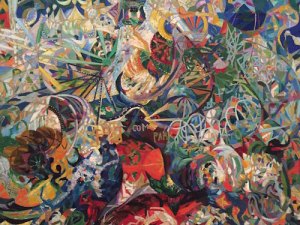
Detail of Joseph Stella’s 1913-1914 Battle of Lights, Coney Island, Mardi Gras from Yale University.
Figurative work from Reginald Marsh and others catapult you back to bawdy bathers and burlesque scenes brought to life last year in Broadway’s On the Town. Photographs by Arbus, Weegee, and Walker Evans provide close-up views of what it was like above and under the boardwalk.
Much of the shows’s fun is driven by the jarring injection of super-cool modern abstraction next to the flotsam and jetsam of the actual historic artifacts.
Edwin Porter’s 1905 silent movie Coney Island at Night gave nickelodeon viewers a novel way to see Edison’s incandescent lights in all their glory.
It’s startling to see Joseph Stella’s Futurist-inspired tribute to Coney Island’s Mardis Gras and realize that it’s from the same 1910-1914 era in which Jimmy Durante played honkey tonk piano for newcomer Mae West. It was all happening at the same time as the Armory Show.
1991 acrylic painting featuring iconic Spook-A-Rama Cyclops by Arnold Mesches.
Frank Stella’s 1950’s abstraction holds its own amidst the sideshow banners and relics that inspired his jarring color bars and mystery portal. Maybe it’s not a coincidence that right around the corner you come face-to-face with the real-life Coney landmark – the Cyclops who lured riders into America’s largest dark ride, Spook-A-Rama. The curators have placed him right next to his menacingly large portrait by Arnold Mesches.
Take a walk on the wild side of history, art, and sideshow performance while you can in person or via our Flickr album.
The Stephen Powers installation runs through the summer. Here he is explaining the allure of Coney Island as a contemporary inspiration:
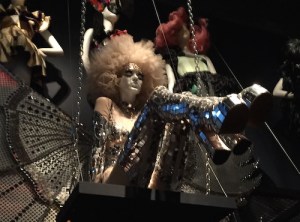
1990 Mathu & Zaldy body suit and attached boots that Susanne wore to an Armani party
If you think the music and fashion stopped after Studio 54 shut its doors to Liza, Liz, Andy, Calvin, Halston, and Yves, FIT’s club-scene exhibition, Fashion Underground: The World of Susanne Bartsch, presents evidence to the contrary through December 5.
The show features nightlife splendor (with all the trimmings) from Susanne’s clothes-to-be-seen-in archive. Plus, you’ll get the thrill of pretending that you’ve stepped into one of her over-the-top parties, filled with celebrities, outrageous clothes, spectacle, and glitter.
Wielding “the list” in a 2008 Jean-Paul Gaultier jacket and Patricia Fields hat
Right downstairs at the gallery entrance, you’ll be taken back to a graffiti-splashed Nineties club entrance with a dolled-up doorkeeper sizing you up and holding “the list”. But there’s no anxiety about whether you’ll be let inside…Just walk in and be transported back to 1981.
As the glittery disco 54 era was coming to an end in New York in 1981, Bartsch arrived from London and opened up a shop in Soho filled with up-and-coming London designers that were creating the “new look” catching on in clubs across the pond.
In the early 1980s, Japanese and British designers experimented with crinkly natural fibers and oversized smocks – which looked fresh and hip after a decade of form-fitting, glitzy disco looks.
The Eighties — Vivienne Westwood looks with Galliano linen ensembles
Susanne sold the oversized, anti-disco baggy look of nightlife trendsetters Boy George and Leigh Bowery, imported dandy mix-and-match men’s and women’s looks from Vivienne Westwood, and featured flowing frocks by London’s Rachel Auburn.
The first part of the FIT show walks down this part of memory lane, including linen frocks by Mr. Galliano. Smocks are punctuated with dramatic hats (decades before fascinators) or beads from Portobello Road.
By the late Eighties, all that had given way to raggedy and accessorized mash-ups sported by the Material Girl and by the Nineties, bejeweled and bedazzled clubwear reigned again. Susanne was regularly hosting parties clad in an ever-evolving array of embellished corsets, fashioned by the master of form and shape, Mr. Pearl.
Mr. Pearl corset ensembles (1989, 1991) with 1992 Mugler Cowgirl ensemble for Naomi Campbell
In a well-deserved tribute to his creations, FIT has installed a carousel of Mr. Pearl’s work on a turntable in the show’s back room of the show, next to a corner where mannequins form a towering tribute to the magic of Mr. Mugler, another of Ms. Bartsch’s favorites. After she introduced Mr. Pearl to Mr. Mugler, the rest was fashion history.
Fashion designers flocked to her parties and she did justice to them all – working in their hats, jackets, shoes, bags, and separates into her never-ending array of special occasion get-ups. When you peruse the specific looks on display in the show, it’s an all-star line-up of New York, Paris, and London fashion heavyweights.
Gareth Pugh 2015 ensemble of paper, Lycra and leather
The show screams of creativity and it’s wonderful that curator Valerie Steele put a spotlight on this Queen of Nightlife and her impact on the underground/high fashion scene for the last three decades. A lot of Susanne’s featured clubwear is credited to Mathu & Zaldy, who turned out plenty of over-the-top looks when designer ready-to-wear just didn’t pack enough punch for a special occasion.
Another charming touch in the show is the ensemble of paper, Lycra and leather contributed by Gareth Pugh. Susanne asked him to send something she could (and would) wear.
As always, FIT provides lots of history and photographs of Susanne and friends in action at multitudes of balls and parties on its exhibition website. Spend time looking at Susanne in action and at snapshots of her historic Love Ball. For close-ups of the clothes and costumes, visit our Flickr feed.
Take 360 spin around each room of the show courtesy of FIT’s virtual tour produced by Synthescape. The arrows appearing on the floor will take you to all three rooms.
Do you wish you could have been at the opening of this exhibit? Not to worry – her friends and fans let you in on the party and remember unforgettable nights in this celebratory video. Even Calvin’s there:
Digital Adam and the Docent reenact what Paradise was like before The Fall
There’s no need to check into the Met after hours to see a classical statue come to life. In Renaissance gallery 504 on the main floor, a digital version of Tullio Lombardo’s 15th-century Adam is interacting with visitors and a knowledgeable Docent in Reid Farrington’s The Return performance through August 2.
The Return is quite a production and its illusions created in the Italian Renaissance gallery would make any animation fan jump for joy.
Classical Adam (the marble one) is installed prominently in the gallery where half the performance takes place. Its presence is a miracle, since the beautiful Renaissance sculpture totally shattered in a freak fall in 2002.
To repair it – a complex undertaking — Met team made a digital replica of all the pieces to decide how to fit everything back together again and spent years making it whole.
Tullio Lombardo’s Adam (1490-1495), which fell and shattered in 2002, and is now repaired
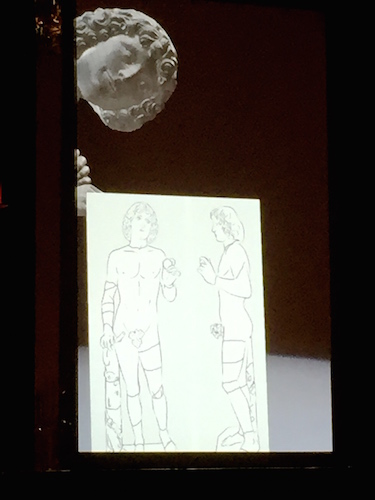
Now, it’s Digital Adam who’s the fascinating co-star of the show, brought back to life by performance artist Reid Farrington who envisioned a tribute to the virtuosity of the Met’s conservation team who so flawlessly reassembled Tullio’s Adam.
The other half of the performance involves an improv actor, a motion sensor suit, and a crew of digital engineers and prop masters, all camped out on the stage of the Met’s auditorium in the Egyptian wing. As the stage actor moves in the auditorium, Digital Adam moves, speaks, answers questions, and holds up a Warhol and a Van Gogh inside his lifesize digital frame in the Renaissance gallery to the delight of the audience and his sidekick, The Docent. See photos on our Flickr feed.
The audience decides what part of Classical Adam’s renovation will get discussed next, but the witty duo soon veer off into other fascinating topics:
Actor in motion-capture portrays Digital Adam, whose image is simulcast at the right and in gallery 504
What does it feel like to always look good and never age? Does Classical Adam remember back to the marble quarry? Does Biblical Adam remember what Garden of Eden was like before the Fall? Adam’s clever responses reveal that his Eden experience was a lot about infinity pools and the good life.
At one point, Digital Adam invites the Docent to portray Eve in his telling of what happened after the Serpent appeared with that apple. Then the attention turns back to Classical Adam, as the Docent shows Lombardo’s thinking about that particular moment portrayed in marble.
Digital Adam shows drawing of the breaks in Lombardo’s Adam
These two need their own ongoing talk show about history, time and space in some corner of the Met. Until August 2, ask the information desk for The Return’s program and go marvel at both the gallery and the behind-the-scenes performances. Or go to the live stream on the Met Museum’s website.
After meeting Digital Adam, you’ll never again wonder about what’s going on inside Classical Adam’s cool, calm, beautiful marble head.
In real time, AMNH astrovisualization guru Carter Emmart notes the moment that humans reached the furthest point of exploration, passing beyond Pluto
The American Museum of Natural History hosted a sold-out event at the crack of dawn this week to give Pluto fans (and Dr. Neil) a real time, play-by-play of what was happening on the edge of our solar system.
Check out our Flickr feed to see the visualizations created by Dr. Carter Emmart’s team at the Hayden Planetarium and glimpse some of the (human) stars at Mission Control and others who weighed in via Google Hangout from planetariums from around the world.
Here are 10 essential things you should know:
Pluto’s photo from earlier in the week appears on the Google Hangout, showing the “heart” area
1) It was a fly-by. The New Horizons spacecraft flew by Pluto. It didn’t land or orbit around it.
2) Pluto has a reddish tint. The new color photos show that Mars isn’t alone.
3) Pluto has five moons. New Horizons is looking for more.
4) This marks the furthest point of human exploration to date. It happened just before 9 a.m. on Tuesday, July 14.
Just in — the latest from New Horizons: July 17 photo of smooth frozen plains in Pluto’s “heart”
5) The spacecraft, New Horizons, is the size of a grand piano. It traveled over 3 billion miles.
6) It took New Horizons 9-1/2 years to get to Pluto. It was launched January 17, 2006 and is expected to keep going out into space for another ten years. For the full story, click here.
7) The new photos confirm that Pluto is young and doesn’t have any craters (like our Moon or Neptune). Its 11,000-foot ice mountains are only 100 million years old (compared to the Rockies at 80 million years old). They formed during our Cretaceous period. More discoveries to come photos and data slowly stream in.
Fran Bagenal, New Horizons’s co-PI, and Alice Bowman, the first female Mission Operation Manager at APL
8) The transmission speed from the spacecraft is half the speed of an old dial-up modem. That’s why mission control will be receiving photos and other data from this fly-by for the next sixteen months or more.
9) Twenty-five percent of the people on the New Horizons project are women. Alice Bowman is the first female Mission Operations Manager at APL Johns Hopkins.
10) Dr. Neil keeps correcting people to call Pluto a “dwarf planet” but all of the scientists interviewed on the mission love it anyway. Some fans think it should be “grandfathered” into the solar system as an honorary planet.
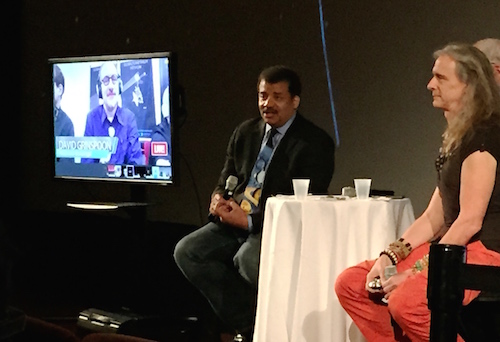
Neil de Grasse Tyson reminds astrobiologist David Grinspoon at Mission Control to call Pluto a “dwarf” planet
Does Pluto have a molten core? What’s the topography of Charon? Are there geysers? Are there other moons? What’s going on with the Kuiper Belt? Stay tuned as New Horizons keeps going.
NASA has a TV channel featuring (now) daily media briefings on the photos and data and has a channel with all the updates on New Horizons, including links to new photos.
Also, tune into the New Horizons site hosted by mission control at APL Johns Hopkins. Next month, releases will be on a monthly basis.
Real-time visualization of how the New Horizons maps Pluto
Credit goes to Carter Emmart, AMNH’s director of astrovisualization, and the other creators of the Digital Universe for inventing this 4D open-source software and sharing it with planetariums around the world and applause for the scientists that made this expedition happen!
Nearly 11,000 people watched this live telecast from AMNH. If you have time, enjoy it for yourself by watching this YouTube recording of the event, currently at 46K views and counting:
Poster from the Schubert archives of “The City at 42nd Street”, the never-built 1979 mall-superblock plan
Two weeks ago, the eyes of the world were on Times Square, but how did it get that way? Take a walk through history at The Skyscraper Museum’s exhibition — Times Square, 1984: The Post Modernist Moment through February 15.
You’ll find out that the crazy, frenetic, chaotic landscape of this town square and its surrounding theaters was nearly lost when the City Fathers and the real-estate community thought Times Square should be “sanitized”. It took wrecking balls destroying several historic theaters to bring activists, celebrities, actors, historians, and preservationists into the streets and paddy wagons to reverse course.
The skyscrapers that were finally built at Times Square, including the Times Towers of 1997 and 2004
The Skyscraper Museum has assembled the architectural models, videos, personal memorabilia collections, and planning sketches to resurrect this nearly forgotten war story. See the installation views on our Flickr site.
The show opens with a 1905 Mutoscope film showing the panorama from the top of the new Times Tower – the first skyscraper in that part of town. See it here on the exhibition web site. The Times started the ball drop in 1907, and it’s continued as one of the City’s most famous traditions.
The “Great White Way” name became popular in the 1920s and 1930s to indicate the glow from theater marquees lining Broadway, Seventh Avenue, and the side streets. The second skyscraper wasn’t built until 1927 (the Paramount Building/ Hard Rock Café), and remarkably, no other skyscrapers popped up until 1972.
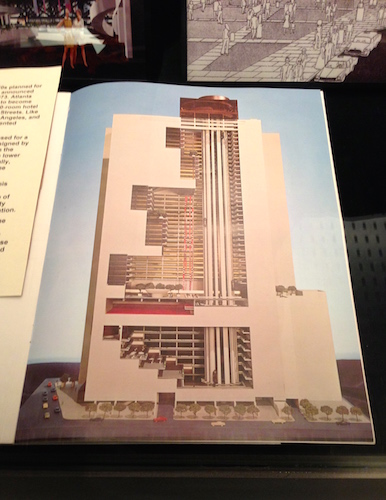
Cutaway drawing of the Portman/Marriott Marquis Hotel (1973-1985), which kept focus inward away from tawdry Times Square
The Portman Hotel (now Marriott Marquis) project was sketched out in 1973, but it took until 1985 to open. The fortress-like complex was designed to look inward on purpose – away from the tawdry street life that characterized Times Square in the “bad old” days when drug pushers, crime, pickpockets, loudmouths, and fistfights were the norm. The atrium and rotating rooftop restaurant were marvels to tourists, who were happy to have an inside-escape route.
By 1979, it was so bad outside that the City proposed some drastic plans to make it all better: Why not tear down a few blocks and make an indoor entertainment mall, complete with a 15-story indoor Ferris wheel and the world’s biggest movie screen? Why not make Times Square look more like Sixth Avenue by building monolithic skyscrapers on each corner of Broadway at 42nd?
Real estate deals ruled the city at the time, and the bonanza created by tourism was still decades away.
Save the Theaters study and 1982 photos of Joe Papp protesting the destruction of the Helen Hays and Morosco to build the Portman. Courtesy: Lee Harris Pomeroy
The actors, preservationists, and architects were aghast at plans to tear down so many historic theaters for the Portman/Marriott Marquis and began staging street protests and galvanizing public opinion to save Broadway. Through a lot of community organizing, a Save the Theaters study, and a night where all the theaters turned the lights out, the battle was won. Yes, new towers would be built, but the demolition of theaters would stop.
In 1993, Disney pledged to take over and restore the New Amsterdam, the study identified theater features of historic value (including backstage areas), and a 42nd Street redevelopment effort commenced. Julian Eltinge’s theater (now AMC Empire 25) was moved 130 feet down the street, rehearsal studios were built, and the New Victory brought children’s theater to a house that used to be Minsky’s (and the Belasco).
Today, the crossroads is dominated by tall, sparkling skyscrapers and bustling with high-spending visitors. The TKTS island serves as a concrete village green for the entire area.
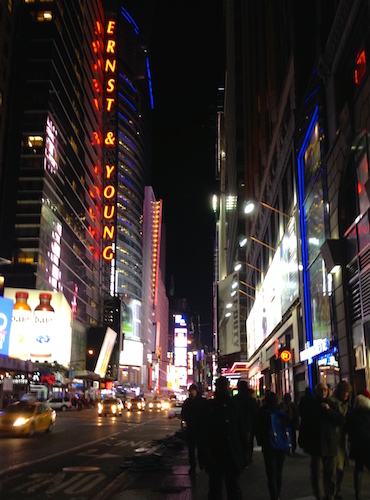
Looking north today toward Times Square and 42nd Street
Insiders at the Skyscraper Museum’s winter program at Columbia University let us in on the fact that the there are actually design requirements for flashing signs and billboards in Times Square to be at off-angles and tilts to maintain the slapped-together look of the area – design elements flouted by Vornado’s new block-long HD video billboard.
This short synopsis is only the tip of the iceberg on Times Square. For the full story and history, get to the show and take time to watch Carol Willis’ historic, all-star panel from last November, where you’ll meet the people who saved the Theater District, remade 42nd Street, and created the landscape of Times Square that the world knows today. You’ll never look at it the same way again:
For more, click here to read the exhibition story online and see more photos, videos, and artifacts.
MoMA honors Margaret Knight, 1870s inventor of the flat-bottomed paper bag
What will the MoMA curators pull out of the design collection next? Designing Modern Women 1890–1990, running through October 19, puts the spotlight on furniture, textiles, graphics, performance, kitchens, and even inflatables designed by some innovative women over the last century. How can you not love a show that begins with 1890s modern-dance provocateur Loïe Fuller and ends with 1980s pop icon Grace Jones?
The crowd last weekend was loving every bit of it, pausing to watch videos sprinkled throughout the show and marvel at designs – some 80 to 100 years old that are as modern today as they were at their creation.
The next time you carry away your morning muffin from the coffee counter in that little white paper bag, ponder that the flat-bottomed paper bag was invented in the 1870s by Margaret E. Knight and Charles B. Stilwell. Ms. Knight not only invented this classic, but also invented the machine that made it and was one of the first American women ever to receive a patent.
1901 dinner service by Jutta Sika and Koloman Moser
No, the dinner service is not from Pottery Barn. It was created in 1901 by the Austrian design team of Jutta Sika and Koloman Moser. Didn’t I just see a copy of Eileen Gray’s 1927 adjustable table at the D & D Building? Open shelving in your new, modern kitchen? Yes, that was Charlotte Perriand’s idea, and MoMA has (for the first time) installed this full-size, fully efficient, ground-breaking kitchen from her 1952 project with Le Corbusier.
And what about the Slinky? Invented by Betty and Richard James in 1945. You’ll have fun peering into the design cases and learning more about the women behind some remarkable things.
Slinky was designed by Betty and Richard James in 1945
In the 1960s portion of the show, you’ll see those famous Fillmore posters designed by Bonnie Maclean. And there’s an entire wall filled with iconic pop and punk graphics – all created by female designers – that should be familiar to anyone that traversed the downtown CBGBs scene.
There’s no digital media to accompany this fantastic show, so take a walk through our Flickr site. All of the items are from MoMA’s own collection, and we’ve taken slight liberties by arranging the photos in the show album in chronological order of the year that each design debuted.
And to bring it all back to the beginning of this design innovation tribute: Here’s a glimpse of 1897 Art Nouveau performance art by Loïe Fuller, courtesy of the Lumiere Brothers. The color you see here is a result of hand-tinting the film, but her actual perfomances used new theatrical stage lighting for which she held numerous patents. Listen to the MoMA curators explain her influence, but get over to MoMA (or the Flickr site) to take in this super-fun tribute to 100-plus years of smart women who thought differently and made it happen.
The first-ever adult Night at the Museum sleepover at the American Museum of Natural History last night was a hit, thanks to the enthusiasm and star power of Dr. Mark Siddall, the curator of the fantastic exhibition, The Power of Poison, closing August 10.
Early in the evening, Siddall mingled with sleepover guests at dinner in the Powerhouse and later in a series late-night talks from the Victorian theater inside the Poison show where costumed performers normally show visitors how to gather clues to solve a period murder mystery involving poison. (Think “I’ve got poison in my pocket” from A Gentleman’s Guide to Love and Murder.)
After dinner, the adventurers, some in costumes themselves, made quick trips with their stuffed animals to the cots under the Blue Whale and bounded up the stairs through the low-light galleries to reach the shark IMAX, live animal demos, fossil tours, and Siddall’s Poison briefings.
The Victorian theater inside Poison. Photo: AMNH/D. Finnan
You had to pass through the always eerie Hall of Reptiles and Amphibians (hello, Komodo dragons!) to enter the magical kingdom of the Poison galleries.
Once inside, you were transported to a tropical rainforest, with golden poison-dart frogs under a dome, huge models of dangerous insects, and a toxin-eating Howler Monkey lurking on a branch.
Beyond the tropics, the show morphed into a land of make-believe…or was it? Tableaux with a sleeping Snow White, the witches of Macbeth, and the Mad Hatter were captivating, with the label copy bringing you back down to earth by explaining the role played by poisons and toxins in these scenes and what exactly witches’ brew contained.
Supplies for the toxic witches’ brew. Source: AMNH
A Chinese emperor (the one with the terra cotta army, no less!) ingests mercury in one diorama, thinking it’s going to give him immortality. Wrong move. Glancing down, you find out that as recently as 1948, mercury-laced teething powder was still being used on babies in the United States.
A spectacular illusion along the way is a magical set of Greek vases whose painted figures came to life to tell stories of how poison helped Hercules and doomed Ms. Medea.
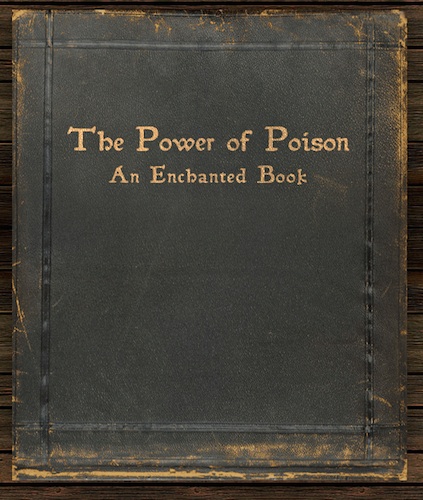
The lively vases are a prelude to the exhibition team’s greatest wonder – the Enchanted Book – a gigantic tome where ancient illustrations leap to life as you turn big, think parchment pages. Visitors could not get enough of that magic book. Somehow the AMNH digital team replicated it on the website, so click here to take a look at The Power of Poison: An Enchanted Bookand turn the pages on line.
Here’s a glimpse of one story from the belladonna page, providing the backstory on how witches fly:
A lot of Siddall’s spectacular, magical, immersive, theatrical exhibition explains the science behind venoms, the “arms races” in the natural world, poison’s role in children’s stories, and how to analyze clues in solving murder mysteries.
Check out the Victorian-style introduction to Poison with Dr. Mark Siddall, its creator, and get a little taste of what the sleepover guests saw and heard.
To ward off any bad dreams about toxins or creepy crawlers, a lot of the late-nighters nestled in to watch vintage Abbott and Costello and Superman films and post Instagrams from the cozy, pillow-lined pit in center of the Hall of Planet Earth.
PS: If you can’t get to this show before August 10, download the iPad app, Power of Poison: Be a Detective that allows you to experience the last portion of the show. It’s been nominated for a 2014 Webby Award in the Education and Reference category.
The original 1858 William Russell Smith drop curtain, displayed in Thalian Hall’s Parquet Hall
Lincoln was prepping for his sixth debate with Douglas in Illinois when the curtain went up on October 12, 1858 at Thalian Hall in Wilmington, North Carolina – the same curtain, still on display, that is considered to be the oldest existing theater drop in America, painted by Philadelphia-trained landscape artist William Russell Smith.
Back in the 1850s, major theaters up and down the East Coast were in pursuit of the classically trained Smith to create romantic, ethereal landscape images on the gigantic canvas curtains that audiences saw when they entered opera houses. Typically framed by an ornate proscenium, the drop transported theatergoers to the work of make-believe, Moliere, and Macbeth – staples of the touring companies and troupes of the time.
Detail of 1858 curtain, distemper on a 30-foot canvas
Today, except for Wilmington’s Thalian Hall treasure, those grand masterpieces are gone, victims of time, decay, and impermanence like the superstars of yesteryear. It’s quite a miracle that Thalian’s original curtain has still survived, considering that it’s not painted in oil, but distemper – a less permanent, water-soluable medium, essentially colors ground into glue. When an artist applies the wet pigment, he sees the opposite color, which gradually turns into the “true” color when the paint dries. It’s a process that could only be executed by a skilled master, particularly on a 30-foot wide canvas. The surface of the curtain holds the granules (like a piece of paper holds pastel fragments).
Wilmington, NC’s Thalian Hall, built 1855-1858, one of the oldest continuously operating theaters in the South
No wonder Smith purpose-built a huge studio in his home with poles that could be raised and lowered as he worked on a gigantic scale first with a charcoal sketch, then with distemper (move over, Chuck Close!). When Smith finished painting his commission, he carefully folded the canvas, rolled it on a long pole, and had it delivered to the opera house.
Thalian Hall received its long-distance delivery this way, because Smith never set foot in North Carolina. The new opera house was designed by New York architect John Trimble, who built Barnum’s Museum and many New York theaters of the mid-1800s, including the New Bowery. Smith’s curtain was the finishing touch, depicting an Aegean sailing ship arriving at classical islands filled with temples dedicated to Apollo, evoking commencement of the ancient Olympiad.
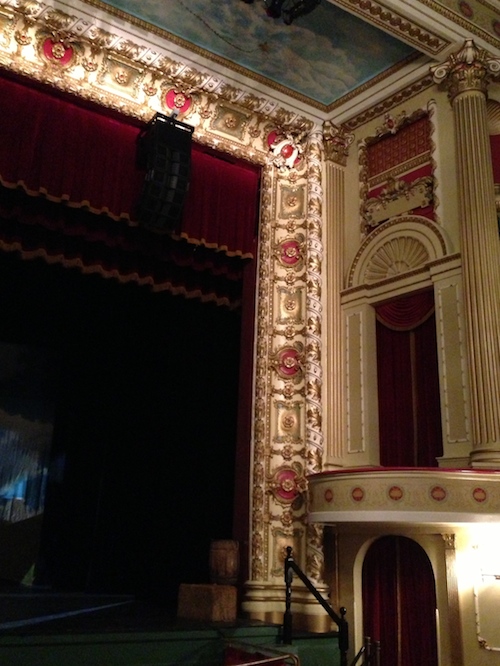
Detail of Thalian Hall’s beautifully restored proscenium and box
The curtain was in service from 1858 until 1909, when a restoration was planned. Historians know it was hung again by 1938 (see the photo in our Flickr feed). It got hurt a little in the 1940 WPA renovations, and was known to be back in place in 1947, but disappeared after 1963. It was rediscovered in 1979, when Mrs. Juanita Menick, the president of the board, told the new Thalian director that she might still have an old curtain that she took years ago to her home for safekeeping. Thank goodness for those large, Southern homes.
Although only 15 feet of the original 30-foot drop remained, tribute was paid to the historic artwork. The fragile canvas was used as part of the set for Thanlian Hall’s 125th anniversary celebration, and now hangs, ready for its closeup, in the luxurious entry to the theater’s orchestra section.
Hear how executive director Tony Rivenbark rediscovered it, and watch historian David Rowland’s talk about the life of William Russell Smith (at 4:20), whose romantic landscapes of New England somewhat predated the Hudson River School; the imagery used in the magnificent theater curtains (at 30:22); and the astonishing discovery recently made in Smith’s grand studio (at 35:30) in this YouTube video.
Thalian Hall’s balconies and orchestra
You can read more about the historic theater on its website (and check out the video on Thalian’s “thunder roll” device, another “only remaining in America” theatrical wonder). Glimpse more of this theater’s grandeur and photos of the illustrious performers who have trod its boards on our Flickr feed.
In Wilmington, you can view this remarkable piece of theater history any time during box office hours.


















 itsnewstoyou
