Subversive Chinese Brush-Up at the Met

Yang Jiechang’s Crying Landscape (2003) shares the Gallery for Art of Ancient China with a sandstone stele from the Northern Wei dynasty (489-495) and the 1319 Buddha of Medicine.

Yang Jiechang’s Crying Landscape (2003) shares the Gallery for Art of Ancient China with a sandstone stele from the Northern Wei dynasty (489-495) and the 1319 Buddha of Medicine.

Normally, the galleries for Asian Art at the Metropolitan Museum of Art are pretty tranquil. But through April 6, you’ll find them buzzing with contemporary art lovers reveling in the hunt to find the most famous, subversive, subtle works by Chinese painters, sculptors, and digital artists residing amidst centuries-old treasures in the widely popular exhibition, Ink Art: Past as Present in Contemporary China.

The Met gave the Chinese art curators free reign to pluck sly works from the in-house contemporary collections created by Chinese artists over the last 20 years, grab monumental works from private collectors, and mount a tribute to how post-Cultural Revolution innovators parse the traditions associated with centuries-old art making in their ancestral country.

How do the hottest artists on the planet turn calligraphy and inked woodblocks into biting social commentary? Take a stroll through the second floor Asian art wing.

Inspired by Cultural Revolution posters, the letters in Wu Shanzhuan’s Character Image of Black Character Font (1989) have no meaning.

Inspired by Cultural Revolution posters, the letters in Wu Shanzhuan’s Character Image of Black Character Font (1989) have no meaning. Courtesy: Private collector, the artist.

Just past the balcony-bar area, the monumental 1319 Buddha of Medicine mural from Shanxi Province, China, casts a benign presence over the Gallery for Art of Ancient China. But just stage right, two larger-than-life works on paper preview how Chinese artists twist the “then” into the “now”.

Yang Jiechang’s Crying Landscape panels are painted in the beautiful, colorful “old school” flat Asian style but depict decidedly unbeautiful industrial and political subjects. Similarly, Qiu Zhirie’s Nanjing Yangzi River Bridge ink triptych features masterful, large-scale ink-brush technique but uses art-world icons to relay a disturbing story. It’s an installation triumph that will haunt you every time you pass through that room again.

Large-scale calligraphy by many of the artists makes ink-pot-and-brush tradition echo with gestures as large as Rothko’s. In the galleries with meticulously crafted “landscape” drawings and images, you’ll ask how this modern crew managed to produce scrolls with such heft and detail. Take a walk-through of the show through our Flickr site.

In 1995, Ai Weiwei corporatized a Han Dynasty (206 B.C. – 9 A.D.) earthenware jar.

In 1995, Ai Weiwei corporatized a Han Dynasty (206 B.C. – 9 A.D.) earthenware jar. Courtesy: M + Sigg, the artist

Along the way to back of the wing, the curators play hide-and-seek, putting Ai Weiwei’s “enhanced” Han Dynasty jar right in the aisle with the “unmodernized” earthenware vessels, and mounting Hong Hoo’s subtly colored, hilarious historical “atlas” silkscreens in a case that practically dares unfocused visitors to pass them by as they drift toward the Astor Court.

Hopefully by the time they get to the rock garden they will notice Zhang Jianjun’s crazy pink silicone rubber “scholar rock” right next to the real ones. Zhan Wang’s stainless steel scholar rock and Shou Fan’s side chairs are beautifully arranged in the Ming Dynasty room just off the Court, along with more of Ai Weiwei’s furniture hijinx.

After you’re done getting a feel for how the galleries have been transformed, go back into the Met’s exhibition web site to study the brushwork and details and get to know some of the artists.
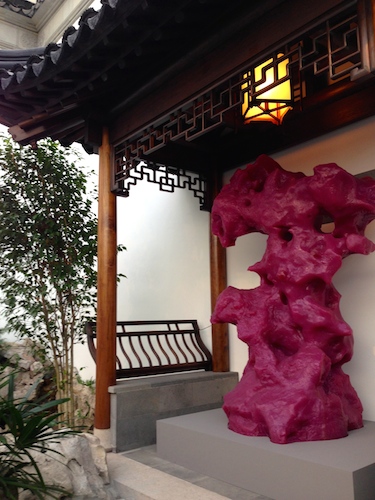
Zhang Jianjun’s 2008 silicone rubber Scholar Rock (The Mirage Garden) sits in a 17th-century pagoda in the Met’s Astor Court

Zhang Jianjun’s 2008 silicone rubber Scholar Rock (The Mirage Garden) sits under a 17th-century pagoda in the Met’s Astor Court. Courtesy: Sigg Collection, the atist

Although the web site appears to be more plain-vanilla than jazzy, you’ll be surprised to see that the digital back-end of the Met archives lets you zoom into each of the paintings to see the handsome handwork of each of these wunderkinds from each thematic section of the show. You can even peruse the gigantic scrolls up close, section by section.

The video room, where art lovers can relax and watch a rotating collection of work, is a nice touch. The modern digital sign to the side tells you exactly where you are in the rotation.

Here’s a link to one of the featured videos: Get to know the constantly transforming cityscape of Beijing through Chen Shaoxiong’s 2005  Ink City, and see what happens when a contemporary artist paints daily life in Beijing with traditional tools and ports his day-to-night experience to video.

Armory Show Stars on the West Coast of Manhattan

The Artforum Lounge on the Contemporary Pier

The Artforum Lounge on the Contemporary Pier

For four action-packed days, the art crowd made its way to the West Coast of Manhattan Island past gritty lots, warehouses, the ball fields of Clinton, and high-rises-under-construction to enter a white, light-filled glittery expanse of painting, sculpture, and champagne bars at the 2014 edition of The Armory Show.

This year, 205 exhibitors showed off the best in modern masters and contemporary upstarts. Walk through it with us on our Flickr feed.

If you’ve never been there, just know that the art fills two full piers (yes, where the cruise ships come in). You may think the Whitney Biennial is big, but The Armory promenade is vast.

On the Modern Pier: Chicago’s Alan Koppel Gallery gave tribute to original Armory Show in 1913 with several Duchamps, but most of the work is post-1940 by Modern superstars. Right at the start of the pier, Galleria d’Arte Maggiori positioned a nice rough-and-ready Mattia Moreni in kind-of a face-off with a pretty primitive Basquiat nearby.

Dramatic paper collage and charcoal work by Elaine de Kooning with two Picasso ceramics at Vivian Horan

Dramatic paper collage and charcoal work by Elaine de Kooning with two little Picasso ceramics at Vivian Horan

Frankfurt’s Die Galerie gave NYC glamour-icon Louise Nevelson a mini-tribute, and several galleries featured Marca-Relli’s painting/collages.

Best on the Modern Pier: Vivian Horan’s booth, dominated by a large Elaine de Kooning charcoal drawing with collage, but populated by two small Picasso ceramics that most fair goers didn’t even see, although they were practically out in the aisle. You don’t see Picasso ceramics too much, and they really added a nice touch.

Second runner-up was the Armand Bartos booth with a sharp Kenneth Noland, Andy’s chicken soup can under glass, and a no-holds-barred Stella. In fact, there were multiple 1980s 3D Frank Stellas leaping out from walls, demanding attention. Besides posing with the soup can, lots of visitors were snapping photos of themselves in front of Mr. Stella’s work.

1949 Hans Hoffman oil at London’s Crane Kalman

1949 Hans Hoffman oil at London’s Crane Kalman

Welcomed surprises: Even though he taught most of the post-war painters in New York, you don’t often see Hans Hoffman paintings, so it was nice to encounter one of his color explosions at Crane Kalman. And we’ve never seen the two super-early skinny Lichtenstein sculptures at Barcelona’s Galeria Marc Domenech booth. Guess they were made in those lean before-the-dots years on his path to Pop.

Susan Harris curated a great micro-show of 20th century female artists, mostly works on paper (e.g. Georgia O’Keefe, Kiki Smith, Lee Bonticou), all contributed by gallery exhibitors.

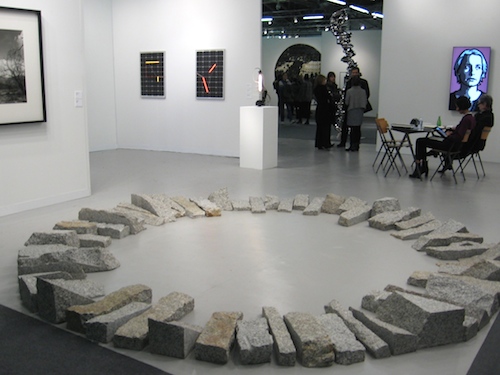
Richard Long’s 1994 Merrivale Circle at the Lisson Gallery

Richard Long’s 1994 Merrivale Circle at the Lisson Gallery

Although you could hike outdoors to get to the second pier along the West Side Highway, most were guided through a wormhole and down a flight of stairs to descend directly into the booths from 17 contemporary galleries across China – a great landing into a warren of booths featuring installations (watch out for the Roomba!), and user-friendly exercise equipment that the PRC makes available in public parks for citizen fitness.

From there, you enter the Contemporary Pier area.  Highlights: the whirling handbag piece (with real handbags) by Egill Saebjornsson at Reykjavik’s i8 Gallery, Richard Long’s stone circle at London’s Lisson Gallery booth, the completely constructed entry to Boesky Gallery, and Claudia Weiser’s cool wooden sculptures at Sies + Hoke (Dusseldorf).

Nick Cave Soundsuits at Jack Shainman

Nick Cave Soundsuits at Jack Shainman

A great place to end the journey was at the Jack Shainman booth, with its dramatic contemporary art exploring expressions from Africa, African-Americans, and global artists — the Nick Cave soundsuits and Richard Mosse’s spectacularly dissonant hot-pink infrared photograph of a waterfall in the continually disintegrating, war-torn Democratic Republic of Congo.
Take a look at the highlights here.

Fair goer relaxes on modernist egg chair under the watchful eye of Dali

Fair goer relaxes on modernist egg chair under the watchful eye of Dali

Berlin Artist Loves NYC and MoMA Loves Her Back

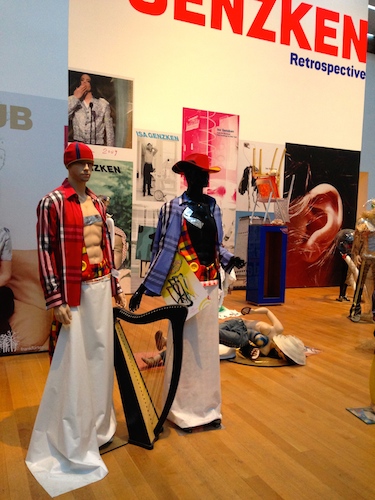
Schauspieler (Actors) (2012-2013) welcome visitors to Isa’s show.

Isa’s Schauspieler (Actors) (2012-2013) welcome visitors.

Early in her art career, she zigged and zagged and eventually found inspiration in New York, but  then who hasn’t? Take a ride at MoMA through the career of an “artist’s artist”, Isa Genzken Retrospective, through March 10.

On a weekend with the bit-of-everything Biennial debut, why not also see work a sculptor who’s done it all herself — tried a little bit of everything on a career-long journey through computerized wood, concrete and electronics, resin, subversive architectural models with ready-mades, and mannequin-and-outfit art. Hey, she’s a one-woman Armory Show!

We have highlights on our Flickr feed, but MoMA’s digital interactive team has done an outstanding chronology of this Berlin artist’s invention over the past 40 years. Click through the show on the web, read the label copy, and enjoy the audio tour.

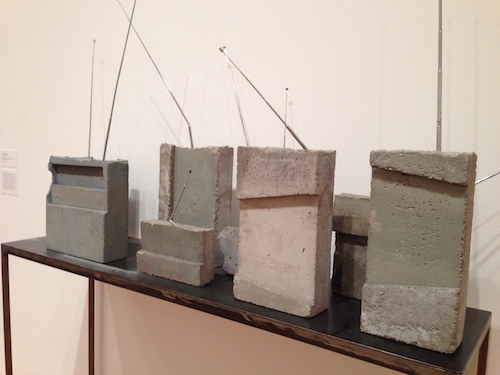
Weltempfänger (World Receiver) (1987–89) mimic the real thing in concrete

Weltempfänger (World Receiver) (1987–89) mimic the real thing in concrete

What we found interesting: Back in the late 1970s, she wondered what it would be like to design sculptures on computers and ended up making huge wooden sculptures that took collaboration with physicists and carpenters. To put her achievement in perspective, her 1980 sculptures were displayed at a time when the Mac was still essentially a garage project. Good going, girl!

Around the same time, she became captivated by electronics and began experimenting with collages, sculptures, and ready-mades with hi-fi equipment and wideband radio receivers.

Fenster (Window) (1992) installed under a MoMA skylight from which you can see the buildings outside.

Fenster (Window) (1992) installed under a MoMA skylight from which you can see the buildings outside.

MoMA’s installed a spectacular gallery populated with large, high, dramatic, airy structures that she made in the 1990s. Are they windows? Empty stretchers for paintings? Look closely and you’ll see that they are made of see-through resin. It’s all the more mysterious because their tops are reaching up to Midtown’s rectangle skyscrapers visible through MoMA’s own window. (You’ll feel like you’re in Stacy and Clinton’s 360, except it’s reflecting Modern architecture.)

It’s a nice gateway to what lies beyond – a room filled with work inspired by her first trips to New York in 1995-1996. She loved what she saw.  She collected mementos of her Downtown travels – invites to clubs, flyers, posters, gallery notices, calling cards – and made them into bright, colorful scrapbooks.

In 2000, she went on another collecting trip from her flat near Wall Street to pay tribute to the City’s world-class skyscraper architecture that so inspired her.

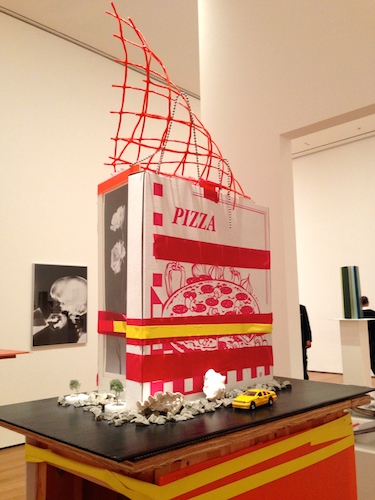
Genzken’s 2000 series that paid tribute to NYC's modernist architecture. A sly Tatlin touch.

Genzken’s 2000 series that paid tribute to NYC’s modernist architecture. A sly Tatlin touch.

But rather than rely on “substantial” materials to interpret hard-edge Modernist design, she cobbled together vignettes of toy cars, pizza boxes, and other ready-mades holding it all together with brightly colored adhesive tape. (As you walk through her tall plywood stands perusing her cityscapes, watch out for the tiny Hula-Hair-Barbie-wannabe toy standing along the narrow pathway facing the gallery wall.)

And be sure to look up. On the ceiling above, she’s showing a film shot on the noisy city streets, interspersed with tranquil river views of the Hudson.

There’s much more to the exhibit – commentaries on corporate America (featuring Scrooge McDuck) and her phenomenal we-are-all-actors-in-this-crazy-life installation at the entrance. You can’t really describe it.

And don’t worry if you’ve never heard of Isa before, as this MoMA YouTube attests. If you have 20 minutes, take a tour of Berlin, New York, and the Venice Biennale through the eyes of Isa’s fans — Lawrence Weiner, Wolfgang Tilmans, Dan Graham, and a host of German gallery owners, collectors, and curators:

Take a stroll through Isa’s work in person at the Museum of Contemporary Art Chicago (April 12-August 3) and the Dallas Museum of Art (September 14 – January 4).

The Most Lavish Natural History Show in the World

Remember 17th c. Dutch tulipmania? JAR
Tulip Brooch 2008 made of
rubies, diamonds, pink sapphires, garnets, silver, gold, and enamel. Private collection.
Photo: Jozsef Tari. Courtesy: JAR, Paris.

Remember 17th c. Dutch tulipmania? JAR
 Tulip Brooch 2008. Rubies, diamonds, pink sapphires, garnets, silver, gold, and enamel. Private collection.
Photo: Jozsef Tari. Courtesy: JAR, Paris.

If you took the detailed observational field skills and plant-and-animal artistry of JJ Audubon and crossed them with the gold-and-jewels precision of a Fabergé master, you can understand the enjoyment, beauty, and wonder that await the luxury-lovers crowding into Jewels by JAR, the Metropolitan Museum of Art’s tribute to the world’s most exclusive and reclusive jewelry artist. Meditate on his exquisite take on the natural world before it all goes back to the vaults on March 9.

Plenty of worshippers were wielding tiny flashlights last Saturday night, working their way meticulously through the darkened gallery perusing every detail of 400 tiny, sparkling, jewel-encrusted pieces by JAR (or, Joel A. Rosenthal as he was known growing up in the Bronx). He’s one of the world’s experts in the pavé technique and achieves subtle effects by painstakingly arranging miniscule diamonds, rubies, opals, and amethysts across gold, platinum, and silver surfaces.

JAR’s 2010 bracelet evokes snow on branches. Diamonds, silver, and platinum.
Private collection.
 Photo: Jozsef Tari. Courtesy: JAR, Paris.

JAR’s 2010 bracelet evokes snow on branches. Diamonds, silver, and platinum.
Private collection.
 Photo: Jozsef Tari. Courtesy: JAR, Paris.

Despite being one of the most sought-after jewelers in the world, JAR will not do commissions. Each piece is one of a kind, so the subjects that he chooses tell you a lot about him. Look closely.

The first case features bracelets, earrings, brooches, and necklaces fashioned into exact, delicate replicas of just about anything you can find at the New York Botanical Garden on a spring day — gardenias, roses, camellias, tulips, lilacs,  carnations, wisteria, pansies, and even wild oats. Across the room, you’ll see perfect oak leaves and acorns (made from diamonds, platinum, silver, and gold) formed into dramatic rings, cufflinks, necklaces, and earrings.

Growing up, JAR loved roaming the halls of the American Museum of Natural History and the Met, which shows. He’s made one pair of pendant earrings (No. 83) from iridescent beetle wings, married with tiny emeralds, garnets, and diamonds set into silver and platinum.

JAR
Butterfly Brooch
1994.
Sapphires, fire opals, rubies, amethyst, garnets, diamonds, silver, and gold.
Private collection.
Photo: Katharina Faerber. Courtesy: JAR, Paris

JAR 
Butterfly Brooch
1994.
 Sapphires, fire opals, rubies, amethyst, garnets, diamonds, silver, and gold.
Private collection.
Photo: Katharina Faerber. Courtesy: JAR, Paris

Right next to that (No. 84) you’ll see his 1981 Egyptian-style faience earrings with emeralds, coral, and gold — a 20th century take on the Middle Kingdom. He’s crafted stalactite earrings (No. 93) from diamonds and silver and found a heart-shaped pebble into which he’s set a perfect ruby surrounded by silver and gold (No. 283).

In the center of the room there are moon and stars pendant earrings (a tribute to Cole Porter) made of sapphires and diamonds (No. 274), and a box (No. 260) inspired by lightning (rock crystal and diamonds). JAR’s 1991 Phases of the Moon Bracelet, made of basalt, diamonds, silver, and platinum, makes you think he probably also hung out at the Hayden in his youth.

The finale to the gallery is the Met’s jeweled twin to the AMNH Butterfly Conservatory – a wall in which 22 of JAR’s beautiful butterflies take flight. OK, there are 2 dragonflies in there, too, but the overall message is butterflies.

A few animals are in the show, too. JAR
Zebra Brooch
1987
made of agate, diamonds, a sapphire, silver, and gold.
Private collection.
 Photo: Katharina Faerber. Courtesy: JAR, Paris

A few animals are in the show, too. JAR Zebra Brooch 1987
made of agate, diamonds, a sapphire, silver, and gold.
Private collection.
 Photo: Katharina Faerber. Courtesy: JAR, Paris

Every person in the crowd seemed to pause here in the dark to choose which creature was the most beautiful before entering the bright, unforgiving lights of the gift shop. A personal favorite was the 1987 Dragonfly Brooch (No. 378) with double-layered rock crystal wings.

If you love nature, wit, color, and fool-the-eye magic, you’ll like getting lost in the dark among the billions of points of light that JAR has created in his glittering universe.

Exquisite Journey Through Time via Modern Venetian Glass

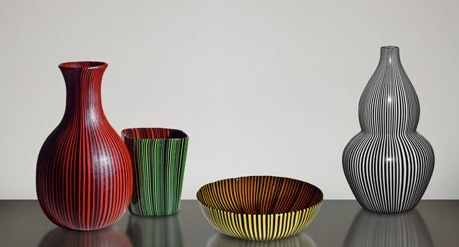
Scarpa’s striped Rigati e tessuti glass pieces (1938–1940). Sources: private collection; Carraro Collection (Venice); European Collection

Scarpa’s striped Rigati e tessuti glass pieces (1938–1940). Sources: private collection; Carraro Collection (Venice); European Collection

The gorgeous art and design show at the Metropolitan Museum of Art, Venetian Glass by Carlo Scarpa: The Venini Company, 1932–1947, is deceptive.

It’s a tribute to one of the top innovators in Murano glass, stepping visitors through more than two dozen styles and innovations that he brought to glass-making, but it also provides a brilliant introduction to the virtuosity that characterized decorative luxury items as far back as the first century B.C. See it before March 2.

Scarpa was inspired by 18th c. Chinese porcelain. Source: The Met

Scarpa was inspired by 18th c. Chinese porcelain. Source: The Met

Scarpa, a trained architect, began working as an artistic consultant at Paolo Venini’s glass factory in Venice right after he graduated, but soon his creativity and vision catapulted him into the job of artistic director and into the spotlight with every new collection he debuted at the Venice Biennale.

At the start of the show, you’ll see his Bollicine group (1932-1933) with tiny air bubbles incorporated into each white, blue, black, and green piece. In awe of the artistry of Eastern Asia, he fused this modern technique with a reliance on traditional shapes from one of his favorite periods of Chinese porcelain – the Qing dynasty (1644-1911), where ceramic artists crafted bold, dramatic single-color works. Check. Let’s take a page out of that book and put it to use in creating sleek, modern icons of Italian design.

At the far side of the circular Lehman Wing gallery, the Met curators have put together a shelf that fools you from a distance. You’ll think that the gorgeously modern works are all opaque glass masterpieces by Scarpa, but only half are. The rest are beautifully arranged works from 18th and 19th century China from the Met’s own collection.

Scarpa’s bubble-glass liqueur set (1935). Source: The Met.

Scarpa’s bubble-glass liqueur set (1935). Source: The Met.

Venini and Scarpa felt it was important to document the specific silhouettes that they created, and the Met has matched the archive shape with many of the modern glass works in the collection.

Just look at each label and wonder what the 18th century Chinese ceramicists would think of their shapes being transformed into glass marvels.

Working your way around the gallery, you’ll experience astonishing artistry resulting from dozens of technical approaches – for example, glass with rough, irregular surfaces (Corrosi 1936-1938), glass blown from thin slabs made of alternating clear and colored glass rods (Mecca filigrana 1934-1936), boldly striped pieces, and iridescent glass (Iridati, 1940). The variety and effects are astonishing and it’s easy to float dreamily through this art for art’s sake show.

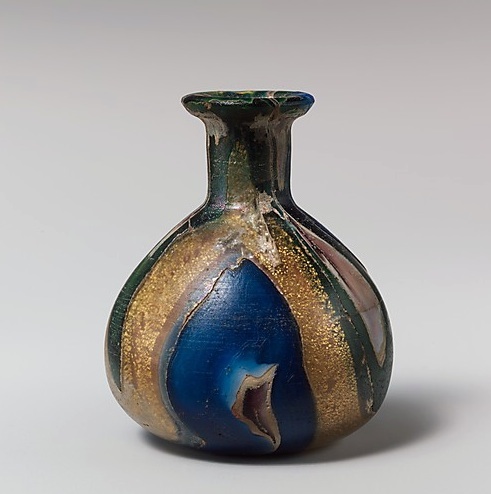
Luxury Italian modern glass from the early 1st century A.D. Source: The Met, gift of Henry G. Marquand, 1881

Luxury Italian modern glass from the early 1st century A.D. Source: The Met

The curators also make use of the Met’s vast collection of ancient glass to remind modernists that the glassmaking tradition extends back nearly two millennia along the Mediterranean and Adriatic shores.

Be sure to look for the Met’s cast glass created in Greece between the 2nd century and 1st century B.C. and in Rome from the late 1st century B.C. to the early 1st century A.D. Glass was a super-high-end luxury item back in those days.

You’ll be blown away by how modern it all looks.

This mosaic glass dish may look like Italian 1980s, but it’s Greek from the 2nd-1st century B.C. Source: The Met

This mosaic glass dish may look like Italian 1980s, but it’s Greek from the 2nd-1st century B.C. Source: The Met

The Art of ElBulli’s Culinary Genius

Notebooks and menu drawings from ElBulli’s kitchen displayed in front of a mural of Ferran Adrià and staff in Roses, Spain in the most famous kitchen in the world. Courtesy: elBullifoundation, The Drawing Center

Notebooks and menu drawings from ElBulli’s kitchen displayed in front of a mural of Ferran Adrià and staff in Roses, Spain in the most famous kitchen in the world. Courtesy: elBullifoundation, The Drawing Center

If you weren’t able to visit the famed ElBulli restaurant on the coast of Spain before it closed two years ago, don’t worry. Pop down to Soho to meet the man, his team, and his legacy through The Drawing Center’s provocative show, Ferran Adrià: Notes on Creativity, running through February 28.

Even if you can’t taste the world-renowned creations, you’ll feel as though you’ve entered his kitchen during the six months per year that his team worked on R&D through up-close looks at experiments, plating, techniques, codes, inventions, and graphic treatises. Take a look at the installation on our Flickr feed.

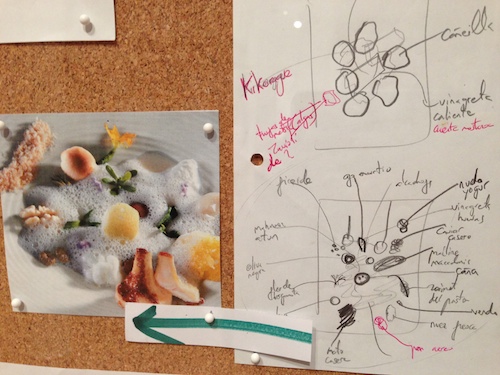
Close-up of large working board of photo and diagrams document the plating and components of each dish. Courtesy: elBullifoundation

Close-up of large working board of photo and diagrams document the plating and components of each dish. Courtesy: elBullifoundation

Last weekend, the Wooster Street space was jammed with visitors eager to see glimpse the genius behind the magic of the famed elBulli – notebooks filled with diagrams of exacting platings of food, a room inside the gallery evoking elBulli’s Barcelona archive, huge storyboards pinned with drawings and photographs of artist-inspired dishes, and glass-topped tables containing inventions that created some of the most amazing food–art in the world.

Examples: the apparatus that turns cheese into “spaghetti”, the glass bowls used to serve diners “edible air”, or the cocktail device that literally sprays a dry martini right into a diner’s mouth.

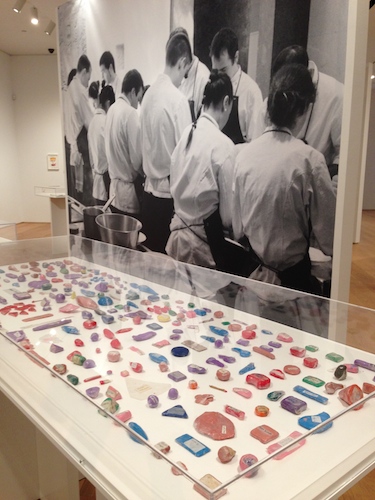
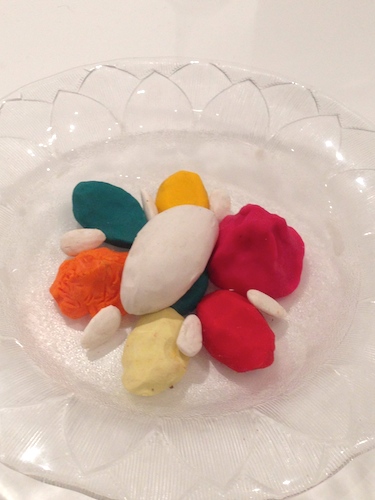
240 plasticine models used to standardize recreation of the sizes and shapes of various portions of food used as components in his highly inventive, artistic dishes. Courtesy: elBullifoundation, The Drawing Center

240 plasticine models used by staff to recreate precise shapes and portions of artistic dish components.

And how do you keep the beautiful dishes consistent? By making little plastic sculptures so that the kitchen crew knows how to duplicate forms for delicate platings precisely on everyone’s plate. When you’re delivering identical 40-course dinners to guests who have flown halfway around the world to join you for dinner, precision counts.

Improvisation may have happened during the six months of the year that elBulli shut down to devote itself to R&D, but not so much during dining-season crunch time. Just look at the large wall drawing that Adrià sketched for this show — Map of the Creative Process: Decoding the Genome of Creativity. Organization is key.

Last weekend, there were no empty seats in the downstairs video viewing gallery, as visitors sat mesmerized by 1846, the 90-minute film co-produced by The Drawing Center, showing every dish Adriá ever served at elBulli (1987 – 2011).

Plasticine model of the 1994 Le Menestra dish composed only of textures, including cauliflower mousse, basil jelly, almond sorbet, avocado, and numerous other components. Courtesy: elBullifoundation

Plasticine model of the 1994 Le Menestra dish composed only of textures, including cauliflower mousse, basil jelly, almond sorbet, avocado, and numerous other components.

Photos of gorgeous, glistening food on plates, rocks, and wood lilted by to an opera soundtrack punctuated by the sounds of water lapping on the shore near the restaurant.  Plates of vegetables, seafood slices, sprigs, and flowers wafted by. What are those spoons filled with? What appeared to be “hatching” out of that egg? What was the egg? What was perching on a stalk like an insect? The effect made you feel as if you were seeing life on Earth evolve…biomorphic shapes surrounded by foam.

You could tell that these art-and-food lovers had absorbed the exhibit upstairs when there was a collective gasp of recognition when the real-life version of La Menestra (accurately and lovingly represented in plascticene upstairs) floated onto the screen.

Since he shut the most desired and famous restaurant in the world, Adrià has been hard at work making sure that his thoughts, processes, philosophy, and research were well documented and translated to digital form. Although it’s still in beta, he’s incorporating it all into an online encyclopedia of gastronomic knowledge.

Kudos to Brett Littman and his team at The Drawing Center for mounting a show that pays tribute to food-as-art and shows us how creativity, inspiration, and documentation (in the hands of an genius, or team of geniuses) can turn experiments in a kitchen on a small Spanish seaside cove into a global digital export of wisdom and innovation for the next generation of chefs.

Take a look at Bullifoundation’s promo video to see what’s in store:

Happily, this show is going on the road in the United States before it leaves for The Netherlands in 2016:  See it at the ACE Museum in LA (May 4-July 31), Museum of Contemporary Art in Cleveland (September 26-January 18, 2015), or Minneapolis Institute of Art (September 17, 2015-January 3, 2016).

Here’s a link to Documenting Documenta, a 2011 film about Adrià’s life, inspiration, work, and participation in Documenta 12, an international cultural festival in Kassel, Germany that happens every five years.

The Armory Show: One Ends, One Begins

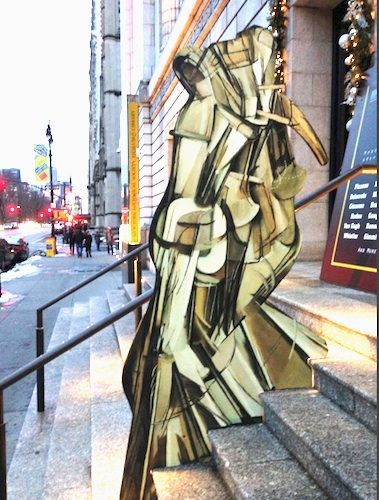
Mr. Duchamp’s 100 year-old icon exits NYHS on Central Park West after seeing the show.

Mr. Duchamp’s 100 year-old icon exits NYHS on Central Park West after seeing the show.

Challenging, ground-breaking art from all over the world under one roof, fashionable crowds, and buyers looking for the next big thing. On March 6, the 2014 edition of The Armory Show opens at the Hudson Piers 92 and 94; but for art-history lovers, there’s just a few days more to travel back in time to experience the 1913 edition that inspired it all at the New-York Historical Society’s show, The Armory Show at 100: Modern Art and Revolution, closing February 23. Check out the spectacular online exhibition site.

NYHS has gathered together 100 of the great art works that rocked Manhattan 100 years ago downtown at the 69th Regiment Armory on Lexington and 26th Street, where the Fighting Irish rented out their parade hall for a month to the newly formed Association of American Painters and Sculptors to show 1,400 works representing the latest trends in modernism.

One of the many postcards sold at the 1913 show’s merchandise table. Source: Smithsonian Archives of American Art

One of the many postcards sold at the 1913 show’s merchandise table. Source: Smithsonian Archives of American Art

Picasso, Cezanne, Matisse, Gauguin, and Munch were there in all their shocking glory – the first time many of these Europeans had been shown stateside. Take a look on the NYHS site and see what chaos ensued in the popular press. Even T. Roosevelt himself wrote an editorial about it.

NYHS not only shows us the work, but puts it all in the context of the times – the bohemian life in Greenwich Village, upstart galleries with an interest in the primitive and new, dissatisfaction with the confines of taste at the National Academy, and New York tastemakers yearning to make their mark on a world stage.

In the little low-light gallery next to the library, you’ll find all sorts of interesting ephemera – letters by the organizers of the show, registration cards with the insurance value of now-famous works, postcards for sale at the show, and a scrapbook of satirical telegrams read by the organizers at their celebratory dinner. This is where you can marvel at Gauguins selling for $8,100, Redon for $810, an oil by Braque for $200, a plaster Brancusi for $200, and Cezanne lithographs for $20 to $40. No wonder Stieglitz amassed such a great collection at these prices!

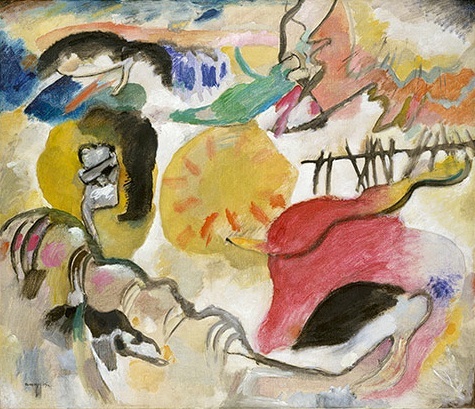
He had to have it. Stieglitz bought Kandinsky’s 1912 The Garden of Love (Improvisation Number 27) as soon as he saw it. Source: Metropolitan Museum/ © 2011 Artists Rights Society (ARS), NY / ADAGP, Paris

Stieglitz bought Kandinsky’s 1912 The Garden of Love (Improvisation Number 27) as soon as he saw it. Source: Metropolitan Museum/ © 2011 Artists Rights Society (ARS), NY / ADAGP, Paris

It’s interesting that the show would not have been such an affordable-art extravaganza without mega-dealer Vollard riding to the rescue, shipping crates of color lithographs and drawings to New York from Paris a scant three weeks before the show. Kuhn and his co-organizers devoted three galleries to works on paper. Works by Gaugin, Cezanne, Lautrec, and Munch flew off the walls, and when the show closed in New York, half of all the works sold had been supplied by Vollard.

Check out the price list and who-bought-what online. You can also probe the Smithsonian’s archive of Armory Show-related materials here.

The International Exhibition of Modern Art (a.k.a. Armory Show) installed in the 69th Regiment Armory at 25th & Lexington. Source: Smithsonian Archives of American Art, Kuhn family papers.

The International Exhibition of Modern Art (a.k.a. Armory Show) installed in the 69th Regiment Armory at 25th & Lexington. Source: Smithsonian Archives of American Art, Kuhn family papers.

The NYHS show is organized according to the original layout, including the grouping of Cubists with Mr. Duchamp’s iconic Nude Descending a Staircase, and the Fauve-Brancusi area – otherwise known in New York critic circles as the “Chamber of Horrors.” Looking at Matisse’s Blue Nude today, it’s hard to imagine that Art Institute of Chicago students found Matisse so shocking that they held a mock trial for him and burned it in effigy when the show arrived in the Windy City in April 1913.

And speaking of Chicago, the Armory Show was a huge success there – attracting over 180,000 art lovers, nearly double the attendance in New York. See the Art Institute’s gorgeous web site of exactly how everything looked in its grand galleries on Michigan Avenue. Everything really got the royal treatment. In turn, AIC can say it was the first museum in North America to show Picasso, Matisse, Duchamp, and Brancusi. No second-city status there.

Kuhn kept Picasso’s 1912 list of which artists should be shown. Source: Smithsonian Archives of American Art, Kuhn family papers.

Kuhn kept Picasso’s 1912 list of which artists should be shown. Source: Smithsonian Archives of American Art, Kuhn family papers.

Buy your ticket to this Armory Show before you buy one for the next one and feel what it’s like to walk through a turning point in American art history.

Tiny Natural History Show Has Eyes Bugging Out

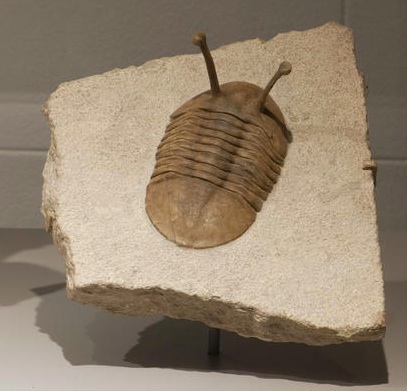
Asaphus, from St. Petersburg, has eyes bugging out (Ordovidian, 490-440 mya). Photo: ©AMNH/R.Mickens)

Asaphus, from St. Petersburg, has eyes bugging out (Ordovidian, 490-440 mya). Photo: ©AMNH/R.Mickens)

Confined to a tiny case in the “canoe” rotunda at the American Museum of Natural History, some extinct species from more than 400 million years ago are putting on quite a show, thanks to two trilobite lovers from the heavy-metal music and vert paleo worlds.

Andy Secher and Martin Shugar went through their massive trilobite collections (Andy has 4,000 in his Manhattan apartment and Martin turned over 200,000 fossils and shells to AMNH) and picked out fifteen “best of the best” from each of the six geologic periods that hosted these little waterway critters – from the Cambrian to the Permian (521 to 240 million years ago). It’s quite something, considering there are over 20,000 recognized species lingering in 281 million years of rocks around the world!

When the exoskeleton of Dicranurus disintegrated in the Lower Devonian, it left a fossilized cast that is so perfectly prepared you think you’re watching him in action

When the exoskeleton of Dicranurus disintegrated in the Lower Devonian, it left a fossilized cast so perfectly prepared you think you’re watching him in action

The tiny show, which is in an open-ended run,  is a “wow” due to the spectacular preservation and preparation of each of these little snubs of rock containing fossilized “casts” of animals whose exoskeletons disintegrated soon after they expired millions of years ago. The state of preservation of even the most delicate features is pretty remarkable.

Consider Asaphus kowalewskii from Ordivician rocks near St. Petersburg (490-440 mya), whose long eye stalks are truly a wonder of nature, evolution, and behind-the-scenes prep that make this character’s eyes pop. Trilobites invented complex, multi-lens eyes, and this Asaphus provocatively suggests the ability to check things out above the sediments where they burrowed, sort of like a horseshoe crab equipped with a modern submarine periscope.

The little Olenoides on display hails from British Columbia’s famous Burgess Shale and has long antenna curving back along its sides. He’s also found in New York, Pennsylvania, Virginia, Utah, and other places in Cambrian rocks 450-490 million years old.  For all those AMNH visitors asking where they can see the Burgess Shale, here’s your chance to commune with a critter and some rock from the same formation that so inspired uber-naturalist Stephen Jay Gould.

Olenoides of British Columbia’s Burgess Shale (Cambrian 450-490 mya) has curve-back spines

Olenoides of British Columbia’s Burgess Shale (Cambrian 450-490 mya)

Walliserops has a full trident sprouting out of his head –a unique apparatus that adapted him for who-knows-what in Devonian life in what-is-now Morocco. Is this where Neptune got the idea of what works best down under the sea?

The hometown favorite is Arctinurus boltoni, first found in upstate New York in the early 1800s during the construction of the Erie Canal. The AMNH has an entire website showcasing these upstate wonders from the Rochester Shale. See them all and take a peek behind the scenes into the AMNH collection drawers on the image gallery.

Andy and Martin’s enthusiasm for trilobites puts them in good company. Tom Jefferson and Ben Franklin are said to have collected them. Trilobite fossils were hawked on 15th century European streets and several trilobite websites say that 25,000-year-old European burials were found with these fossils, too.

Trilobites with tridents and horns. Walliserops is found in Morocco’s Lower to Middle Devonian strata.

Trilobites with tridents and horns. Walliserops is found in Morocco’s Lower to Middle Devonian strata.

Although AMNH has terrific trilobite blog and a page with “Twenty Trilobite Fast Facts,” why not go for the slick YouTube video tour? Watch as AMNH’s Neil Landman, Andy, and Martin talk about their passion and show the cabinet-sized exhibit in close-up.  You really need to come, meet the trilobites, and journey back to a time on Earth before animals had even colonized land.


Brooklyn Museum Shows What Rich Americans Buy to Impress

Cabrera

Miguel Cabrera oil (1760) of Dona Maria de la Luz Padilla y Gomez de Cervantes sporting velvet beauty marks and bling

Conspicuous consumptions is nothing new, according to the Brooklyn Museum’s spectacular show, Behind Closed Doors: Art in the Spanish American Home 1492-1898, and they’ve gathered (mostly from their collection) four centuries of blindingly beautiful stuff to show how earlier generations of status-seekers showed off how special and rich they were. Catch it before January 12.

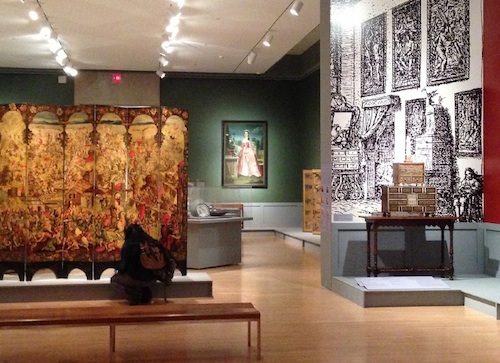
The Fourth-Floor show fills two huge galleries that have been partitioned by the curators into areas corresponding to rooms in a traditional Spanish-American home, where they’ve displayed the stuff that the colonial high and mighty would have put there.  Although two-thirds of the United States was once under Spanish rule, the paintings, furniture, textiles, and other treasures you’ll see are from homes south of the border, including the Caribbean and south of the Isthmus. Check out our Flickr feed.

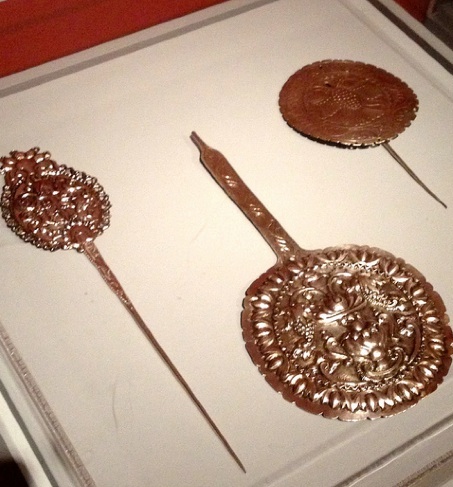
Silver Pins

Giant 18th century silver status pins for women, slightly Incan-style

First, you’d dress to impress and make sure that everyone knew that you were somehow aligned with the upper classes back in Spain. The show puts English and Spanish-American portraits side-by-side in the first gallery to illustrate that the latter weren’t shy about applying ostentatious tiaras and pearls to themselves, slapping on the velvet faux-beauty marks, and shoving royal proclamations into the frame to convey your wealth, status, and privilege. Wealthy English colonials and their portrait painters took a more austere, understated approach.

Second, if you were of mixed race but possibly had some Incan royalty in your blood, you’d hang gold-flecked portrait series of Incan chieftains where everybody could see them in your home. The lady of the house might wrap herself in a locally woven textile sporting mixes of South American deities with that oh-so-familiar-to-Europeans Hapsburg double eagle. Then she’d bling it up with a giant oversize pin made out of solid silver.

Visitor inspects painted screen in exhibit area with the objects from the grand reception room of an upscale home.

Visitor inspects painted screen in exhibit area with the objects from the grand reception room of an upscale home.

Third, you’d emphasize your casual elegance by actually draping the rugs and tapestries all over the floor, stairs, and risers in the ladies’ sitting room.  After gold, silver, and jewels, textiles were about the biggest luxury anyone could find, and Spanish Americans made and bought a lot. In British America, carpets were only used to cover tables, so the casual distribution of so much wealth below your feet was something only Spanish Americans could afford.

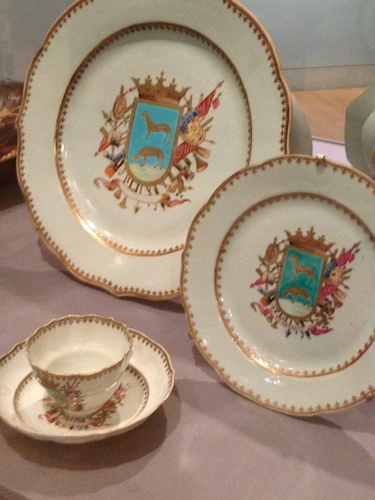
Because the Caribbean and coastal cities of South and Central America were right in the center of shipping and trade routes for centuries, wealthy people could buy pretty much anything they wanted and the curators show it to us – gorgeous Japanese screens, custom-printed Chinese porcelain, English-style sitting chairs, and Turkish rugs. No pennies were pinched in upwardly mobile, Spanish-speaking homes.

Peruvian bed of gilt wood (1700-1760) that would be shown off in a state bedroom.

Peruvian bed of gilt wood (1700-1760) that would be shown off in a state bedroom.

And let’s not forget what treasures were produced right inside the Spanish protectorates – silver shaving basins, polychromed statues of the saints, gigantic gold-framed “statue paintings”, gilded beds, embellished leather traveling trunks (to go to your country home), solid mahogany furniture, and custom-made books of your family’s geneaology. We won’t even get started on the private chapel décor.

This show throws open a window on the first wave of high-status interior design and decoration – a story that is normally confined to the castles in Europe or the palace at Versailles, and one that is perfectly suited to be told by Brooklyn’s extensive Latin American holdings with a couple of key pieces from the sumptuous collections uptown at the Hispanic Society of America.

Chinese import: 1770 porcelain featuring South American animals, purchased by Ignazio Lemez de Cervantes

Chinese import: 1770 porcelain featuring South American animals, purchased by Ignazio Lemez de Cervantes

If you want to do a deep dive into upscale living of past centuries, visit the exhibition archive on the Museum’s website and click on the Objects tab. Or, see it all in person when it goes on the road: it opens at the Albuquerque Museum on February 16, the New Orleans Museum of Art on June 20, and the Ringling Museum in Sarasota on October 17.

And congratulations to Brooklyn for making it onto the cover of the winter edition of Humanties, the NEH magazine.

Medieval Enthusiasts Throng to See Departing Treasure

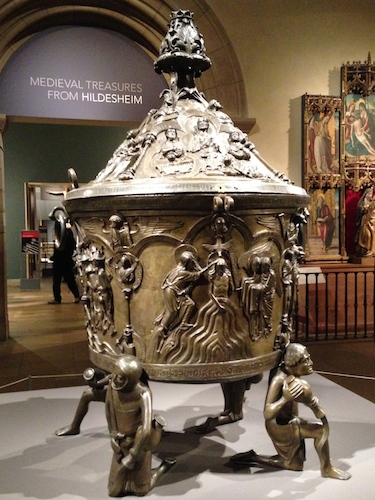
Hildesheim’s large cast 1226 baptismal font installed in the great Medieval Hall

Hildesheim’s large cast 1226 baptismal font installed in the great Medieval Hall

Before the Metropolitan Museum of Art takes down the Baroque Christmas tree, take a look at what’s sitting right behind it – a large, beautiful cast baptismal font that’s one of the treasures of a cathedral in Saxony that’s been transported to New York for the exhibition, Medieval Treasures from Hildesheim, closing January 5.

Like the medieval hall surrounding you, it will take you back to the Middle Ages, along with the manuscripts, castings, croziers, and spectacular rock crystal ornaments in Gallery 521, a few steps away in the special exhibition space that you pass going toward the Lehman wing.

During the holidays, the small space was packed with medieval-art lovers relishing the fact they were seeing treasures from a unique UNESCO World Heritage site right in the heart of Manhattan – the first time they have left Germany.

In the late 12th c., Bernward of Hildesheim, commissioned a dazzling new cover for the Gospel Book, which dates from the late 900s

In the late 12th c., Bernward of Hildesheim, commissioned a dazzling new cover for the Gospel Book, which dates from the late 900s

While renovations were being done at Hildesheim Cathedral, 50 amazing treasures were sent here to give their spiritual heft to the Met’s already hefty medieval holdings. Check out our Flickr site for some of our favorites.

The 1226 baptismal font is a true masterpiece of casting, along with the magnificent eagle that has sat upon a cathedral lectern since 1220. The Jesus figure of the Ringelheim Crucifix at the center of the exhibition is one of the most important (and awe inspiring) large-scale wood sculptures surviving from the post-1000 era in Europe.

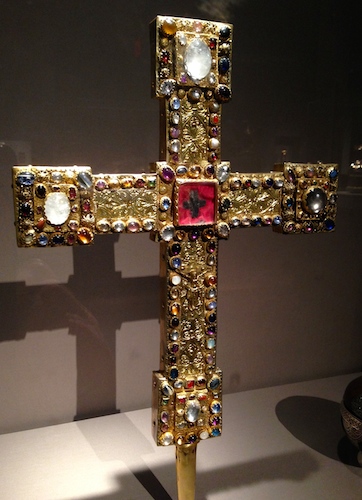
The chalices, reliquaries, croziers once held by medieval bishops, and bound books of the gospels and sacraments will stop you in your tracks.  Seek out the bejeweled cross with what was once believed to be a relic of the True Cross.

As quiet crowds milled around last weekend, savoring the beauty, one youngster came upon the Gospel Book that had been rebound in the second half of the 12th century and asked in a whisper, “Are those real jewels?”

A processional cross, made between 1170 and 1190, which is said to hold relics of the True Cross

A processional cross, made between 1170 and 1190, which is said to hold relics of the True Cross

Many of these treasures, including the bogglingly beautiful Gospel Book, were commissioned by Bishop Bernward of Hildesheim (960-1022), whose aesthetic vision transformed the cathedral into the must-see pilgrimage spot that it remains today.

One out-of-towner told us that they traveled to New York simply to see this show. See the baptismal font and the other works for yourself, and you’ll know why.

If you want to know more or if you’re a fan of the Middle Ages, take the time to sit in on this hour-long presentation about medieval alchemy, metalwork of the 1100s, and how these treasures came to New York: