36 Hours of Jeff Koons at The Whitney

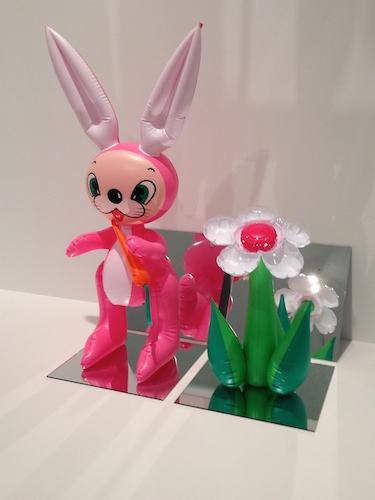
Inflatable Flower and Bunny, a cheeky take on minimalist work NYC galleries showcased in the 1970s

Inflatable Flower and Bunny, a cheeky take on minimalist work NYC galleries showcased in the 1970s

It’s the last 36 hours, and the Whitney is taking it’s Jeff Koons retrospective out with a bang – all day, all night fun-filled wonder on all four floors, letting the crowds take in his irreverent porcelains, 70s inflatables, whimsical fool-the-eye aluminum sculptures, and giant billboards. It’s the first proper retrospective that Koons has had in New York and the last show to be mounted on Madison Avenue before the Whitney moves to the High Line.

Any day of the week, lines of art-seekers have snaked out the door of the Whitney, past the pretzel carts on Madison and around the corner along 75th Street, waiting for admission into this no-holes-barred finale.

The curators and crew have done a spectacular job with the installation – no mean feat, since those big bulbous “inflatables” on the top floor are really highly polished, super-heavy hunks of stainless steel. Oh, and don’t get any fingerprints or scratches on the highly polished surfaces…it will break the illusion that these are just Mylar balloons!
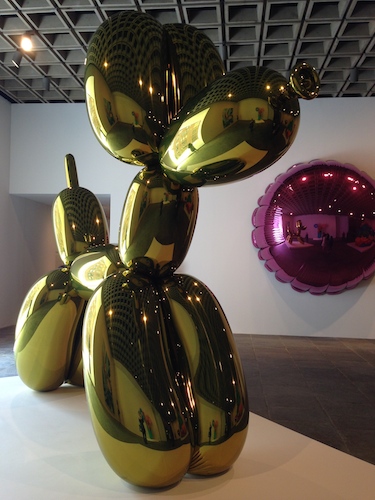
Ten-ton stainless steel Balloon Dog with Moon (Light Pink) (1994-2000)

Ten-ton stainless steel Balloon Dog with Moon (Light Pink) (1994-2000)

The show starts strong on the second floor with a light-filled room of recreated works from the late Seventies – actually inflatable flowers, bunnies, and what-not. Everything uses angled mirrors.

You can’t get the joke unless you trod the floors of those West Broadway galleries in Soho way back then and saw the Minimalists and Earth Works guys in full force.Think Barry Le Va, Heizer, and Smithson who arranged rocks or dirt in a few square feet of gallery space and added a mirror or two to make a statement about nature, art, reflection (i.e. art viewing), and formal criticism inside the art world.

Koons turns all this on its head with silly found inflatables and similarly formalist presentation. It’s kitchen sponges instead of Richard Long’s rocks! Thanks, Whitney and Mr. Koons, for giving us this walk down memory lane.

The main space on Floor 2 is devoted to a spectacular low-light installation of favorite Koons pieces from the early Eighties. Several double-decker and triple-decker vitrines house illuminated and never-used Hoover vacuum cleaners, which Koons assembled to illustrate the feeling of “newness” in American society.

Billboard and illuminated Hoover vacuum cleaners, the essence of “newness” from 1983

Billboard and illuminated Hoover vacuum cleaners, the essence of “newness” from 1983

It’s a beautiful, magical room dominated by a gigantic billboard on The New, all of it from his first window-display installation on 14th Street and Fifth, when Marcia Tucker had her New Museum there back in 1983, just before the move to Soho.

Speaking of moves, it seems fitting to come full circle – spectacular early works by Mr. Koons that debuted on 14th Street as the finale to the Whitney’s long run on Madison Avenue, just prior to its move back to its new 14th Street neighborhood.

Missed the show? Take a look on our Flickr feed.

Stunning Jewelry at Met Reflects Contemporary Art

These stunning creations of Eugene and Hiroko Pijanowski are made from paper cord and canvas

These stunning creations of Eugene and Hiroko Pijanowski are made from paper cord and canvas

The Metropolitan Museum of Art has not only reinstalled its American Modernist wing on the first floor, but it’s given over the design gallery right inside the door to Unique by Design: Contemporary Jewelry in the Donna Schneier Collection, on view through August 31.

Gertrude Stein is holding court in the far back gallery with some of Mr. Stieglitz’s treasures, but on your way to see them, check out the high-class, high-gloss presentation of masterworks of wearable art from the 1960s through today.

The thesis of the show is contemporary jewelry doesn’t exist in a vacuum and often reflects the prevailing art of the day — Pop, Minimalism, Abstraction, and so forth.

In 2007, Ms. Schneier donated 130 of her favorite pieces to the Met – just a small fraction of the collection she has been building for over 30 years. Here, these gleaming, surprising, artful, fun pieces are grouped to highlight their context within various themes of recent contemporary art.

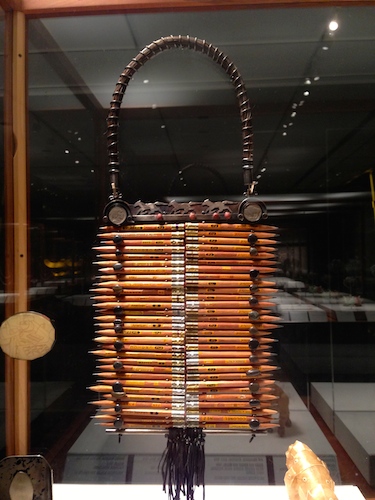
Kiff Slemmonds Sticks and Stones and Words

Kiff Slemmonds Sticks and Stones and Words

As you marvel at each one, you’ll be thinking back across decades of gallery shows and installations of minimalist art, performance art, funky found art, and 3D printing.

Check out the gold neckpiece right inside the door. You might think it’s a riff on the Met’s room full of Columbian gold across the hall, but this treasure is actually made of paper and canvas by the Pijanowskis (Eugene and Hiroko).

Marvel at what seems to be Native American-inspired breastworks by Kiff Slemmonds. Her art piece is fabricated with a lot of stuff but mainly No. 2 pencils in the “narrative” portion of the show.

If you like self-referential playfulness, consider Gijs Bakker’s piece – a real diamond mounted on a PVC-laminated photo of a diamond. Recyclable art? Check out Robert Ebendorf’s brooch made from crushed auto window glass, beach glass, and a vinyl record.

Ted Noten’s clever Fashionista necklace made of tiny resin high-heeled shoes

Ted Noten’s clever Fashionista necklace made of tiny resin high-heeled shoes

And if you think it’s fun to poke around the history of contemporary art through jewelry that’s neatly tucked inside a single room, don’t ignore the fact that right beyond this gallery door is another art-history tour-de-force-in-a-box: The Met is displaying Mr. Duchamp’s famous green case, which is full of many of the same visual and conceptual challenges – “what is art?”, “what is play?” “what is hidden?”, and “everything you see is not as it appears.”

What would Rose Sélavy herself choose to don from the next room if the Met and Ms. Schneier gave her chance?

Peek at a few of the choices on our Flickr site, but enjoy wandering through the gallery and deciding for Rose and yourself.


Sailing Life Rafts into Brooklyn’s Submerged Motherlands

The tree touches the top of the Cantor Gallery. Photo: Brooklyn Museum

The tree touches the top of the Cantor Gallery. Photos: Brooklyn Museum

The view is dramatic, but the story is it evokes is even bigger than what’s in the room. There’s still time to travel out to the Brooklyn Museum to have the immersive experience of Swoon’s Submerged Motherlands, closing August 24.

The pictures here just don’t do justice to the super-high wrap-around effect of this walk-through take on the emotional side of rising tides throughout the world. A photo can’t take it all in — a sheltering, 60-foot tree with cut-out paper leaves with some day-after-the-Flood rafts parked down below, all decorated with sketches of the peoples and mothers of the world.

And did we mention that Brooklyn visionary Callie Curry (a.k.a. Swoon) actually built and lived on those rafts for a while? Several years ago, she sailed them up and down the Hudson, on the Mississippi, and across the Adriatic.

Close-up of one of Callie’s rafts. Photo: Brooklyn Museum

Close-up of one of Callie’s rafts.

You’ll get to see these jerry-rigged but seaworthy concoctions up close, and examine the drawings, cut paper, and torn, coffee-stained textiles draping walls, floor, and shelters in this dramatic space.

The feeling it evokes makes you wonder if we’re ready for rising seas and climate change. It’s beautiful, monumental, and reminiscent of our recent lights-out experience of Hurricane Sandy, which tore at the edges of Brooklyn, Long Island, and Staten Island just two years ago – exactly what inspired Callie to take this work in this direction.

Hear what it took for Callie to create this fantastic walk-through installation on Brooklyn’s top floor:


You may also want to hear what Callie has to say about being a working artist in the real world – outside the four walls of a gallery – in her talk from TEDxBrooklyn in 2010. She will show you her rafts in action at Minute 5 and tell you what it felt like to arrive on a hand-built raft in Venice, her projects in post-earthquake Haiti, and interacting with people from the neighborhood as she creates art on the sides of Brooklyn buildings. Truly inspirational.

Folk Art Geniuses Take a Trip

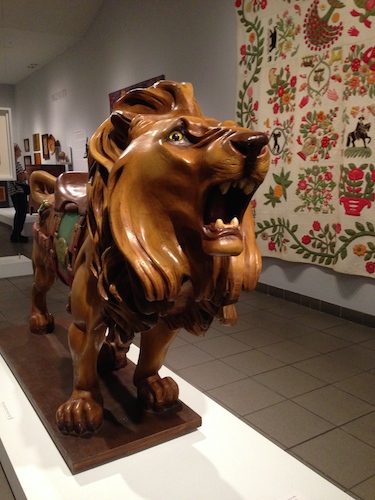
Brooklyn’s Lion, carved in 1910 by Marcus Charles Illions, who worked at the carousel shop and later set up his own studio

Brooklyn’s Lion, carved in 1910 by Marcus Charles Illions, who worked at the carousel shop and later set up his own studio

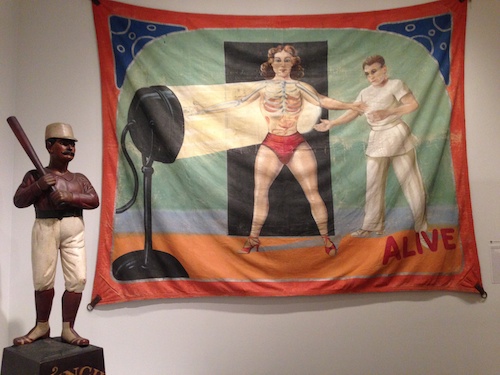
The American Folk Art Museum knows how to put on a show and take it on the road. After today, the staff will be packing up Self-Taught Genius: Treasures from the American Folk Art Museum and letting the Brooklyn Lion, Connecticut’s Weathervane Elephant, Chicago’s Sideshow “Radium Girl”, and a baseball old-timer from Centre Street see what’s up in Davenport, San Diego, Fort Worth, New Orleans, Saint Louis, and Tampa. We’re betting that there will be crowds waiting to greet them.

The museum’s staff has brought out its best to show off four centuries of made-in-America maker art – furniture, sculptures, textiles, painting, and what-not. It’s genius that they’ve put the spotlight on “genius” because their collection is jam-packed with some truly remarkable artists, visionaries, and craftsmen. Get the full view on the Museum web site and some close-ups on our Flickr page.

The curators say that the United States was a make-it-up-as-you-go-along democracy, so they felt “self taught” was right in line with this unique Americana theme – having a vision and making a masterwork.

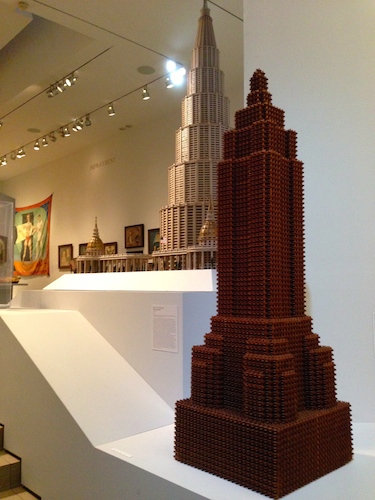
Empire State Building, carved in New Jersey in 1931 from precious cherry wood. Auriti's Palace is just behind.

Empire State Building, carved in New Jersey in 1931 from precious cherry wood. Auriti’s Palace is just behind.

Yes, there are some true eccentrics in the mix, but let’s momentarily focus on the People with a Plan from the section of the show on “Achievers”. Their works are immensely pleasurable and intense, and they’re right inside the entry.

You could spend hours contemplating the detail and work that went into the monumental Empire State Building made from cut cherry wood pieces in New Jersey in 1931. No one knows who created it, but legend has it that it was an ironworker that actually worked on that 13-month wonder and couldn’t let go of the achievement.

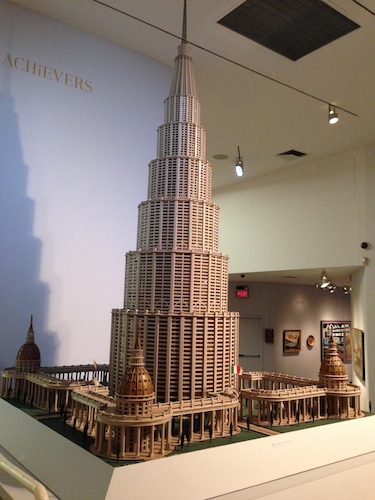
Consider The Encyclopedic Palace of the World, created by Maurino Auriti, an auto body worker who just loved designing and building architecture. Mind blowing. If his visionary campus was actually constructed, the skyscraper would be taller than that spire in Dubai.

The Encyclopedic Palace, created by Maurino Auriti, an auto body mechanic, in the 1950s from from wood, plastic, glass, metal, hair combs, and hobby kit parts

The Encyclopedic Palace, created by Maurino Auriti, an auto body mechanic, in the 1950s from wood, plastic, glass, metal, hair combs, and hobby kit parts

If you get to Lincoln Square today, you’ll enjoy one amazing treasure after another, but if not, check it out the beautiful web site archive created by the museum team for the tour. Browse by time period, theme, or artist.

And check out the Museum’s other brilliant online solution to letting you in on the world’s interpretation of these works. They’ve assembled all the media written and produced about the pieces in the show, which have often served as a springboard for scholarly research. This is a fun, serious treasure chest of work, so probe to your heart’s content — baseball folk art, mourning pictures, 18th century folk-art Washington portraits, and even more recent works.

What will it take to take this show of masterworks on the road? Last year, Auriti’s The Encyclopedic Palace was chosen as the theme of the  55th International Venice Biennial, so it got to go on its first trip to Italy.

Get a glimpse of where the folk art lives when it’s not on display and see how art gets packed to take a trip.

Baseball statue from 114 Centre Street and the sideshow’s Radium Girl banner from Chicago in the 1930s

Baseball statue from 114 Centre Street and the sideshow’s Radium Girl banner from Chicago in the 1930s

Dissident Artist Leaves Brooklyn for Second Time

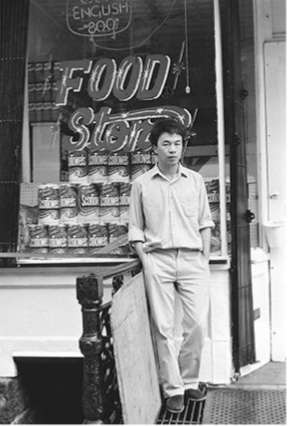
The artist in Williamsburg, 1983. From his New York Photograph Series (1983-1993). Courtesy: the artist

Then: Ai Weiwei in Williamsburg, 1983. From his New York Photograph Series (1983-1993). Courtesy: the artist

If you haven’t yet trekked to Brooklyn to see one of the world’s most famous international provocateurs, go this weekend to see Ai Weiwei: According to What? and get to know the work of the artist who was incarcerated a few years ago by the Chinese government for pulling the veil off its bureaucratic repression and dishonesty. Closing August 10, it’s the last stop on the show’s North American tour – a fitting finale since Ai Weiwei first lived in Williamsburg when he moved to New York back in 1983.

You know him either from his collaboration on the famous “bird nest” stadium at the 2008 Beijing Olympics, smashing Han Dynasty vases as an art project, or from having bulldozers sent by the Chinese government to eradicate his studio in 2011 and being put into house arrest for 81 days – an event that made front-page news and sparked an international outcry – museums and political leaders took out protest ads, made videos, placed flowers on his public works, and called for his release all over the world.

Close-up of R itual, one of the six dioramas of S.A.C.R.E.D. (2011-2013), inspired by his 2008 incarceration. Courtesy of Ai Weiwei Studio. © Ai Weiwei

Now: Close-up of R itual, one of six dioramas of S.A.C.R.E.D. (2011-2013), showing his 2008 incarceration. Courtesy of Ai Weiwei Studio. © Ai Weiwei

Even before you hit the admissions booth, you’ll see his response to all of this – a series of six large, mysterious boxes that make up his work, S.A.C.R.E.D. You climb up to peer into them, right inside Brooklyn’s entrance. Inside, you’ll see everyday depictions of what it was like for him in detainment – eating, sleeping under the watch of the uniformed guards, and interrogations.

Upstairs, you’ll see an expansive show filled with thought-provoking works along with some black-and-white photos of his East-Village life in the 1980s, where he hug with Tan Dun, Xu Bing, and other artists-on-the-move and artists-on-the-run from a conformist Mainland.

At a distance, his sculptures seem like simple, cool contemporary installations. Read the label copy and you realize the subversive is at work. It looks like some found-art piece, but the room is actually filled with the full contents of a young woman’s home. Ai Weiwei found her and all her stuff on the side of a road after the authorities evicted her.

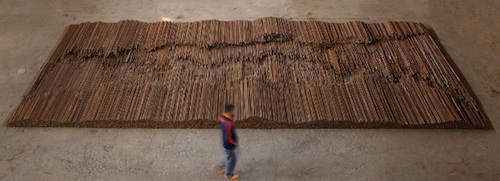
Straight (2008-2012) is made from 70 tons of rebar reclaimed from the Sichuan earthquake and hammered straight back into rods. © Ai Weiwei

Straight (2008-2012) is made from 70 tons of rebar rods, reclaimed from the Sichuan earthquake and hammered straight. © Ai Weiwei

A single room is devoted to Straight, a monumental installation made up of rebar, metal rods used to strengthen concrete calls. Except that this is the actual rebar from the 2008 earthquake that claimed 5,400 young lives in Sichuan Province when the schools collapsed due to shoddy construction practices. He bought the scrap rebar from those buildings, spent four years hammering to straighten them out, and assembled the rods into a 70-ton sculpture. Nearby, he’s listed the names of every school child – something that the Chinese government never did.

Performance art: dropping a Han dynasty vase (206 BC-220 AD), along with other historic ceramic pieces altered by a dip into modern industrial paint (2007-2010). Photo: C. Carver. Courtesy: the artist

Performance art: dropping a Han dynasty vase (206 BC-220 AD), along with other historic ceramic pieces altered by a dip into modern industrial paint (2007-2010). Photo: C. Carver. Courtesy: the artist

How and why does he do it? Find out by listening to Ai Weiwei’s answers to visitors’ questions. You’ll have quite an insight to his thought process, since there are 45 pages of video Q&A. Well worth the time to meet this brave, inspirational artist-activist.

He’s simply one of the top contemporary artists working today and you owe it to yourself to experience work that literally takes on the world. Kudos to the Brooklyn Museum for also publishing the amazing teacher’s guide, which asks students to ponder and think about news, authority, and speaking out.

Watch as the Brooklyn crew assembles Stacked, Ai Weiwei’s 2014 sculpture made from 700 bicycles, a comment on the transportation traditionally used by Chinese commuters until the dawn of the smog-inducing automobile. It’s all happening under the watchful Egyptian eye on Brooklyn’s main floor:

The Sistine Chapel of Fashion Virtuosity

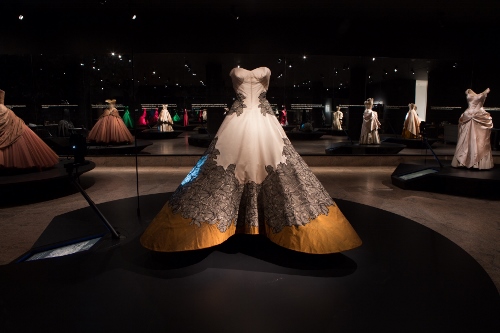
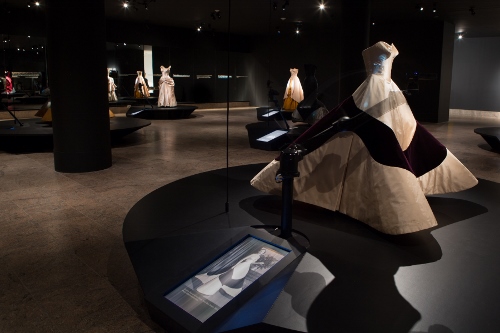
Clover Leaf Ball Gown – a 1953 silk faille, shantung, and black lace sculpture by Mr. James. Part of the Brooklyn Collection at The Met

Clover Leaf Ball Gown – a 1953 silk faille, shantung, and black lace sculpture by Mr. James. Part of the Brooklyn Collection at The Met

When the Brooklyn Museum handed its fashion archive over to the Met in January 2009, the first thought that crossed everyone’s mind was the mind-bending masterworks that would now be sheltered under the protective wing of the Costume Institute’s crack conservation team — “Oooh, maybe the Met will do a Charles James show!”

We’re glad to report that the Met has done this master proud and given his humble admirers a fitting place to worship in its triumphant two-gallery show, Charles James: Beyond Fashion, which ends this weekend, August 10.

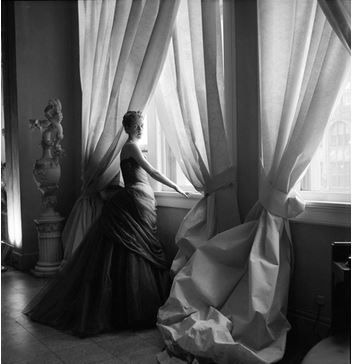
1952 portrait by Michael A. Vaccaro / LOOK Magazine. Courtesy: The Met;  Library of Congress

1952 portrait by Michael A. Vaccaro / LOOK Magazine. Courtesy: The Met; Library of Congress

Mr. James is credited with being among the first to perfect the strapless gown in the 1930s, an inspiration for Mr. Dior’s “New Look” in the 1940s, and the epitome of Vogue glamour dressing in the 1950s. He could do things with fabric that others simply couldn’t do or wouldn’t dare…well, maybe except for Madame Gres. He pushed silhouettes and fabrics further than most anyone could conceive and had the temperamental nature, drive for perfection, and uncompromising attention to detail that characterize any of history’s greatest, most passionate artists.

You always look at his creations and ask yourself, “How did he do it?” How did he get a spiral of fabric to stand out as it wraps sinuously around a sleek, strapless electric green silk mermaid dress? Is that sexy Thirties frock actually cut from one scarf?  How did he create virtual moving sculptures from the world’s most expensive fabric?

Innovative digital display tells the back story of Mrs. Hearst’s Clover Leaf Gown – too big for Ike’s inaugural, but just right for Queen Elizabeth II’s coronation

Innovative digital display tells the back story of Mrs. Hearst’s Clover Leaf Gown – too big for Ike’s inaugural, but just right for Queen Elizabeth II’s coronation

Long known for his innovative engineering, the Met came to a brilliant solution to explain the magic that Mr. James wrought over his decades of no-two-alike work – hire an architectural firm to show us.

Enter Diller Scofidio + Renfro, who have mounted these sculptures in silk inside an infinity-room gallery and paired each masterpiece with its own personal robot and humongous iPad-type display. Look at the dress and refer to the screen as the dress digitally deconstructs and is assembled again.

Cecil Beaton’s 1955  photo of Nancy James in the Swan Gown. Courtesy: The Met; Cecil Beaton Studio Archive at Sotheby's

Cecil Beaton’s 1955 photo of Nancy James in the Swan Gown. Courtesy: The Met; Cecil Beaton Studio Archive at Sotheby’s

The crowds waft from dress to dress in no particular order, clustering silently to watch digital magic, see where the robot is pointing, and view photos of Mrs. Randolph Heart, Jr., Gypsy Rose Lee, or Josephine Abercrombie in said gown. The robot with the 1954 Swan Ball Gown captivates viewers by moving underneath to televise close-up views of some of the 1,080 square feet of tulle that Mr. James used to create the oomph.

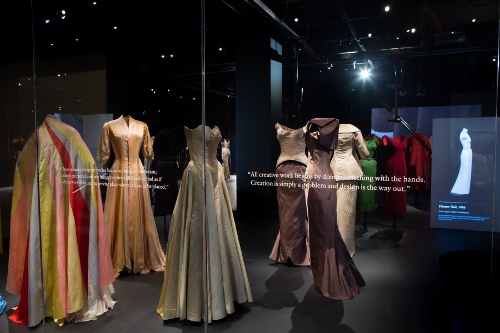
The mirrored walls of the upstairs gallery and the see-through dividers downstairs are emblazoned with the wisdom of the man himself. He seems to be talking right to you as you wonder how he made the fabric do what it’s doing (“It’s the air that’s sculpted, not the silk”) or how he thought about the world of fashion (“We who have been ahead in style have usually been ahead in our thinking”).

Downstairs gallery, newly named for Ms. Wintour, filled with James creations

Downstairs gallery, newly named for Ms. Wintour, filled with James creations

The second gallery (welcome back, ground floor Costume Institute!) displays his wool creations and sharply shaped cocktail wear. It’s interesting that James considered some of these genuinely more innovative than his often-photographed gowns. The curators have placed another of his “first” in a room at the back – the predecessor of today’s puffer coat. On loan from the V&A, it remarkably dates from the 1930s – his soft, sensual, silky answer to the boxy fur jackets that Ms. Schiaparelli was showing in Europe at the time.

We have to thank Mr. James for his vision and for making sure the Brooklyn design lab had so many examples of his masterpieces to teach and inspire future generations of Seventh Avenue designers. As he says, “In fashion, even what seems most fragile must be built on cement.”  Lesson learned.

The Met’s a great steward. Just listen to the love in the tour of the show by its curators:

If you have more time, hear what Zac Posen has to say to the co-curator about The Master:

Last Day for Art & Industrial History: Kara Walker’s “Sugar Baby”

Crowds surround Kara Walker’s monumental sugar sculpture

Crowds surround Kara Walker’s monumental sugar sculpture

The crowds lined up yesterday on Kent Avenue all the way beyond the Williamsburg Bridge, almost to Schaeffer’s Landing, waiting to enter the rusted, aromatic, tumble-down confines of the old Domino Sugar Factory on one of the last days to see Kara Walker’s “A Subtlety, or The Marvelous Sugar Baby”, commissioned by Creative Time.

Today is the last day, so take a look at history in person, on our Flickr page, or in the video below.

Security was in full force to keep the Williamsburg bike path clear and drivers were slowing down to ask, “What’s going on and what are people waiting for?” only to be told by patient fans, “They’re lined up to see art!”

Once inside, the marvelous, gigantic Sugar Baby sculpture was on hand to preside over the far end of the abandoned several-block-long 1851 industrial space that once refined over half the sugar consumed in the entire United States.

One of her many attendants throughout the factory

One of her many attendants throughout the factory

As readers of Friday’s front-page article in The New York Times knew, Walker was again pushing the buttons with her homage to the brutal history of the sugar trade from the 1700s until today by giving us an experience that isn’t really all that sweet. Witnessing Kara’s witnessing is what had people – including some elderly visitors on canes — flocking to the sticky-floored, slightly ominous space. You could smell the sugar and molasses before you even entered the door.

Leading up to the gigantic white sculpture, people encountered all sorts of molasses-children, toting baskets full of…well…looks/smells like molasses. The experience evokes everything that Kara wished for…history, economics, society, race, abuse, industrial profit, and industrial scale.

Take a look at how it was made, and read about the history behind her thinking. Click on this link to Vimeo, look on the Creative Time website to see her sketches and graphic inspirations, and be sure to check out the various stages of Kara’s 3D digital sphinx up close.

If you go to Brooklyn today, expect to wait about an hour in line; once inside, there’s plenty to think about.

Astonishing Colorful Carved Stone Collections in The Met

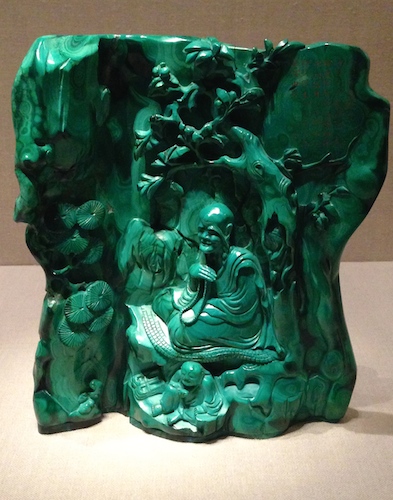
Converse had to have this tiny green malachite sculpture of a teacher seated in a grotto.

Converse had to have this tiny green malachite sculpture of a teacher seated in a grotto.

The tiny show in the upper gallery at the far, far end of the Metropolitan Museum’s Asian Wing shows just how far two industrialists would go to collect eye-popping dazzlers from 18th and 19th century China. Colors of the Universe: Chinese Hardstone Carvings runs through October 9, 2017.

The curators want you to now that intricately carved and polished stones from China’s Qing Dynasty go way beyond green and white jade to the blacks, tans, reds, oranges, roses, and blues of a wide variety of stones available to the Chinese 18th and 19th century artisans — malachite, chalcedony, amethyst, coral, lapis, and carnelian. See them all lovingly displayed in Gallery 222.

Look at our Flickr page, and check out other images in the Met’s photo gallery. If you can get to the Met, walk all the way to the end of the Asian wing on the Second Floor and take the stairs or elevator up. When we visited, there were no shortage of Asian tour groups filing through and snapping photos.

Who wouldn’t want to have a miniature Peanuts and Jujube Dates carved from chalcedony in 18th century China? Heber Bishop bought it

Who wouldn’t want to have a miniature Peanuts and Jujube Dates carved from chalcedony? Heber Bishop bought this. It’s just over one inch high. 18th c. China

The ancient art of Chinese stone carving reached its zenith during the Qing (1644-1911), known in movies and pop culture as the Manchu Dynasty. It was a time when emperors painted and wrote poems, the Peking opera was born, and culinary culture (tea ceremonies and gourmet dishes) rivaled today’s elevation of foodie culture. Scholars and the highly educated upper classes went to town outdoing one another with ink, paper, and acquisitions.

Qing craftsmen enjoyed lots of royal patronage, and any materials required to produce something fantastic – including colorful stones — were available. Although this show includes personal jewelry and a few carved pots and brushes used by high-end scholars, the focus is really on the “look at this” display pieces.

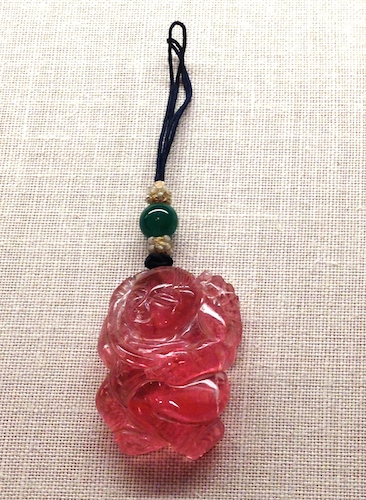
Tiny pendant in the Shape of a Boy, carved and polished tourmaline

Tiny pendant in the Shape of a Boy, carved and polished tourmaline

These fantastic pieces were mostly acquired by two powerful industrialists of 19th century and early 20th century New York. Colorful miniature landscapes, lions, kids, fruits, vegetables, and seafood were irresistible.

Several stunning pieces were bequeathed by Edmund Converse, an industrialist-collector who otherwise focused on big jade and European oil paintings. But even when his stuff went to the Met in 1921, the curators noted that the quality and delight of his assemblage of little colorful non-jade Chinese hardstones.

But most of what you’ll see in Gallery 222 was collected and given to the Met by Heber Bishop, an industrialist who began in the Cuban sugar business in the 1860s, but later went on to many other industries (gas, iron, and railways) and was one of the backer-builders of New York’s Third Avenue El.

Bishop could not resist a tiny polished lapis lion with a little cub peeking out. Its about 2 inches high

Bishop could not resist a tiny polished lapis lion with a little cub peeking out. It’s just over 2 inches high.

Like many cultured gentlemen of his time, his passion for anthropology and collecting found its end-point in many NYC institutions. He went everywhere and bought everything, including vast amounts of Asian textiles, lacquers, bronzes, swords, and ironwork, but he was crazy for jade. Eventually his collection surpassed any of the jade collections of European museums, and he decided to make a big donation to the Met.

Although there doesn’t seem to be any sign of it now, he made the donation on one condition – that the magnificent pieces be housed in a room that was an exact reproduction of his ballroom at home where it had been so lovingly housed.

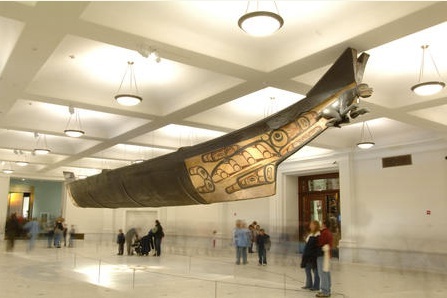
Bishop’s room-size Great Canoe donation across town. Photo: © AMNH/R. Mickens

Bishop’s room-size Great Canoe donation across town. Photo: © AMNH/R. Mickens

Who knows what became of that idea 100 years later, but we know that one of Bishop’s biggest buys did get it’s own room across town: Any day of the week at the American Museum of Natural History you can admire the spectacular 64-foot Haida canoe transported from Bella Bella, suspended in the recently spiffed-up Grand Gallery on AMNH’s First Floor. Although it’s wood, it’s carved from a single piece, just like his little Chinese stones.

Gauguin’s Primitive Universe at MoMA

Be Mysterious (1890) Carved and painted lime wood from Musée d’Orsay, Paris. © RMN-Grand Palais /Art Resource NY.

Be Mysterious (1890) Carved and painted lime wood from Musée d’Orsay, Paris. © RMN-Grand Palais /Art Resource NY.

You can almost hear the rustling pandan leaves, waterfalls rushing into exotic coves, and the drums and chants of fiery Tahitian rituals around powerful idols long since banned by the Christian missionaries…but only if you take the time to get close to the smaller works in MoMA’s revealing sixth-floor show, Gauguin: Metamorphoses through June 8.

Yes, Gauguin’s bright, colorful paintings of island life are displayed, but the show is really about the darker, more primitive experience expressed in Mr. Gauguin’s ceramics, woodcuts, carvings, and monoprints – the works that we rarely get to see en masse.

Hina and Fatu (c. 1892) Carved tamanu wood. Courtesy: Art Gallery of Ontario, Toronto © 2013 AGO

Hina and Fatu (c. 1892) Carved tamanu wood. Courtesy: Art Gallery of Ontario, Toronto © 2013 AGO

After nearly two decades plugging away at his day job, weathering a stock-market crash, struggling to stay in the middle class, cranking out artworks in his spare time, and showing with the Impressionists, he just chucked it all, packed a bag, and went to Tahiti in 1891. From his young-adult years working in the merchant marine, he figured Tahiti was as far away as he could get from his family, responsibilities, and the frustrating Paris art scene where others were making it besides him.

Nothing’s perfect, and the Tahiti he arrived in was already changing from contact with the global trade networks of industrialized countries. No matter. Gauguin was captivated by the thought of connecting with the “true” primitive and savage that lived in the myths, lore, and natural beauty of Polynesia and shoving it all into the face of the avant-garde and art-buying public back home.

The curators have assembled all the images Gauguin created for three dramatic series of woodcuts. The rough edges really come out in Noa Noa (1893) and The Vollard Suite, with a few of the gouged-out woodblocks exhibited right next to several states of the same image.

Mahna no varua ino (The Devil Speaks), state IV / IV, from the suite Noa Noa (Fragrant Scent). (1893–94). Woodcut from private collection. Courtesy: Galleri K, Oslo. © Reto Rodolfo Pedrini, Zurich

Mahna no varua ino (The Devil Speaks), state IV / IV, from the suite Noa Noa (Fragrant Scent).
(1893–94). Woodcut from private collection. Courtesy: Galleri K, Oslo. © Reto Rodolfo Pedrini, Zurich

Black, dark, primitive, edgy – too edgy, in fact, for his dealer, Mr. Vollard, who felt that the prettier oil paintings were a lot more palatable to his clients. (Vollard kept the more expressive primitive prints in the drawer.)

Take a look on MoMA’s special website for the show, which has a detailed timeline for Gauguin’s travels. Clicking on images on the site allows you to zoom in closely on each work. A particularly nice touch is the full digitized version of Gauguin’s unpublished Noa Noa manuscript, which he assembled (but never published) to interpret all the exotic images and symbols of the series for the public and his hoped-for fans. Scroll down to the bottom of this page to see the manuscript, page by page.

Oviri (Savage). (1894) Partly enameled stoneware, from Musée d’Orsay, Paris. © RMN-Grasnd Palais /Art Resource NY

Oviri (Savage). (1894) Partly enameled stoneware, from Musée d’Orsay, Paris. © RMN-Grasnd Palais /Art Resource NY

So here’s your chance to examine what was boxed up for so long along alongside magnificently  disturbing sculptures, panels, and reliefs of goddesses, devils, spirits, waves, women, and mountains created out of tamanu and pua wood with the occasional daubs of colored paint. It’s clear that the design and detail of Gauguin’s beautiful symbolist color paintings got a further workout through all of these other works portraying the dark, mysterious side of life forces emanating from the mind of a struggling artist obsessed with the uber-primitive.

Some say that Picasso was inspired to transform his Demoiselles after seeing some of this raw work (exhibited after Gauguin’s death). Say hello to them seven days a week on MoMA’s 5th Floor.

Last Call for the Whitney Biennial Uptown

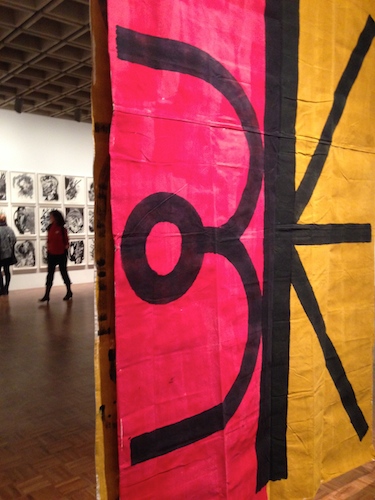
Detail of Elijah Burgher’s “The Pattern of All Patience 1” (2014), featuring magical symbols, installed on the second floor

Detail of Elijah Burgher’s The Pattern of All Patience 1 (2014), featuring magical symbols, installed on the second floor

It’s the last time the Whitney Biennial is holding its big, expansive, colorful, and provocative shindig on the Upper East Side, since it will decamp to its new riverside home at the foot of the High Line next year. Go before it ends on May 25.

It’s amazing to think that this is the 77th time that the Whitney has hosted either an annual or biennial show to showcase the best of American art, as controversial and impossible a task as that may be. This year, the Whitney threw in the towel in trying to showcase “the best” of what’s going on in contemporary art coast to coast. It just wasn’t possible given the expanse, diversity, and barrier-breaking works that American artists are cranking out right now.

Instead, the Whitney invited three innovative curators to choose what should be shown on each of three floors and around town. (Yes, there are offsite works, too.)

“Pillar of Inquiry/Supple Column” (2013-2014) by fiber artist superstar Sheila Hicks

Pillar of Inquiry/Supple Column (2013-2014) by fiber artist superstar Sheila Hicks

The divide-and-conquer approach works, resulting in a fun variety of media, installations, paintings, sculptures, textile art, performance, and collections-as-art. The team pulled it all together in only 18 months while still doing their day jobs at Chicago’s Art Institute, London’s Tate Modern, and Philadelphia’s ICA.

Visit our Flickr album and walk through the press preview with us, where several artists were on hand in the galleries with their work.

It’s a happier, lighter show compared to past Biennials, but that doesn’t mean that the artists ignore social commentary or darker sides of human nature. It just means that you won’t feel as though you need a graduate degree in Conceptual Art to enjoy and ponder the work you’ll encounter.

Highlights: Charlemagne Palestine has created a surprisingly spooky installation in the stairwell that features sonorous sounds emanating from speakers adorned with stuffed animals. LA painter Rebecca Morris has two bright, gigantic delightful paintings on the second floor, curated by Philadelphia’s Anthony Elms, which features several satisfying collections-as-art installations by Julie Ault, Richard Hawkins, and Catherine Opie.

Pterosaur and giant theropod are featured in Shio Kusaka’s third-floor ceramics display

Pterosaur and giant theropod are featured in Shio Kusaka’s fourth-floor ceramics display

Fans of NYC’s 1970s art scene (when Soho was still industrial) will be captivated by The Gregory Battcock Archive, peering at the ephemera collected by one of the decade’s most prominent art critics who died under mysterious circumstances in 1980. Amazingly, it was all found by artist Joseph Grigley wafting around garbage bins in an abandoned storage facility. Grigley’s created a disciplined, loving, and intimate installation of reclaimed Battcock mementos, memories, and letters with Cage, Warhol, Moorman, Paik, Ono, and other 70s superstars.

The top floor takes a down-home approach to some very enjoyable paintings, sculptures, installations, and ceramics. Midwest curator Michelle Grabner said that she wishes she could just camp out there for the run of the show. You’ll enjoy it, too — a dreamy installation by Joel Otterson, a monumental yarn pillar by uber-fiber-artist Sheila Hicks, a witty desk and bookcase by master woodsman-sculptor David Robbins, and shelf of delicate and whimsical ceramics by Shio Kusaka.

Knits with commentary by Lisa Anne Auerbach, including We Are All Pussy Riot

Knits with commentary by Lisa Anne Auerbach, including We Are All Pussy Riot

The third floor, curated by Stuart Comer (who’s recently moved to MoMA), features a lot of screens and digital media, essentially making you think about art in the age of the iPhone. As you step out of the elevator, you’ll encounter Ken Okiishi’s series of painted panels. Oh, wait! They’re actually abstract paintings on upended flat-screen TV displays – sort of like what would happen if Kandinsky’s Seasons were done at the Samsung plant.

The mixing of media keeps morphing in room after room of clever installations by Triple Canopy (antiques meet 3D printing) and Lisa Anne Auerbach (knitting meets social commentary, and zines meet the Giant in Jack and the Beanstalk). See Lisa’s work and listen to her explain her knitting:

There are dozens of other videos and audio guide stops posted on the Biennial web site (click on “watch and listen”), as well as bios of all the artists.

Alert: MAD’s own design biennial opens July 1.