Gus Baumann’s Legacy of Art and Fun in Santa Fe

Gus Baumann, America’s greatest master of color woodblock prints, never considered himself a fine artist. Nevertheless, his prints, sculptures, paintings, commercial art, furniture, and marionette stages fill four galleries in his grand retrospective at the New Mexico Museum of Art – Gustave Baumann: The Artist’s Environment, on view through February 22, 2026.

Demand for Gus’s intricate block-printed sun-dappled Western landscapes from the 1920s through the 1950s still runs high. So, it’s a treat to learn how Gus achieved such a high degree of technical proficiency early in his career, lived Arts and Crafts philosophy, relished immersion in art colonies, and found his family in Santa Fe.
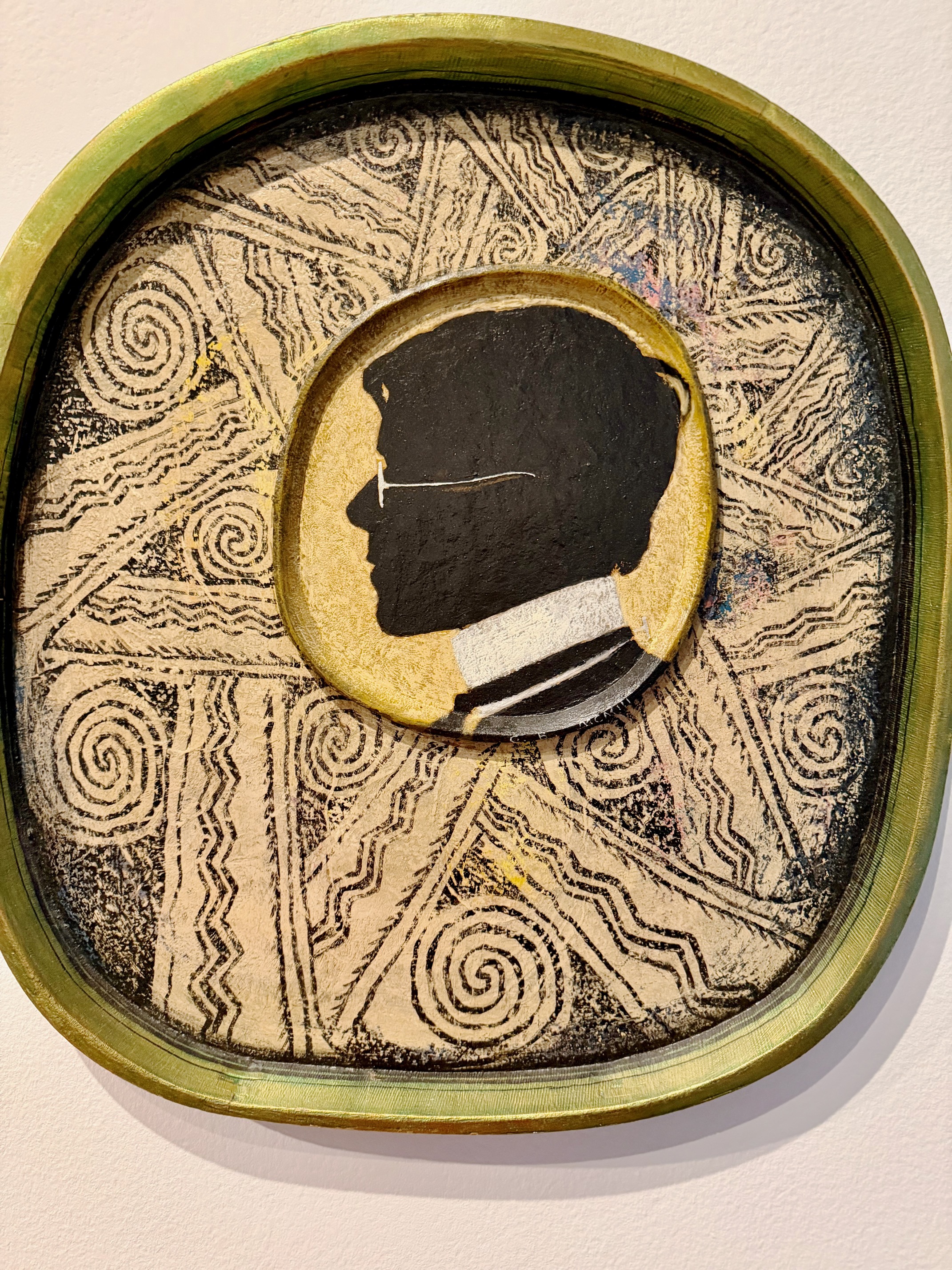
Gus Baumann’s 1903 oil Self-portrait (Silhouette) painted in his Chicago studio; reworked in Santa Fe after 1920 with a border inspired by Mimbres pottery.

See some of our favorites in our Flickr album.

Although Gus was born in Germany in 1881, his family emigrated to Chicago when he was around ten. His father was a craftsman and woodcarver, and it left an impression.  The first themed section of the exhibit – “Finding His Way”– gives a glimpse into his family background, early commercial art work, wood carving expertise, and furniture he designed later in the 1930s.
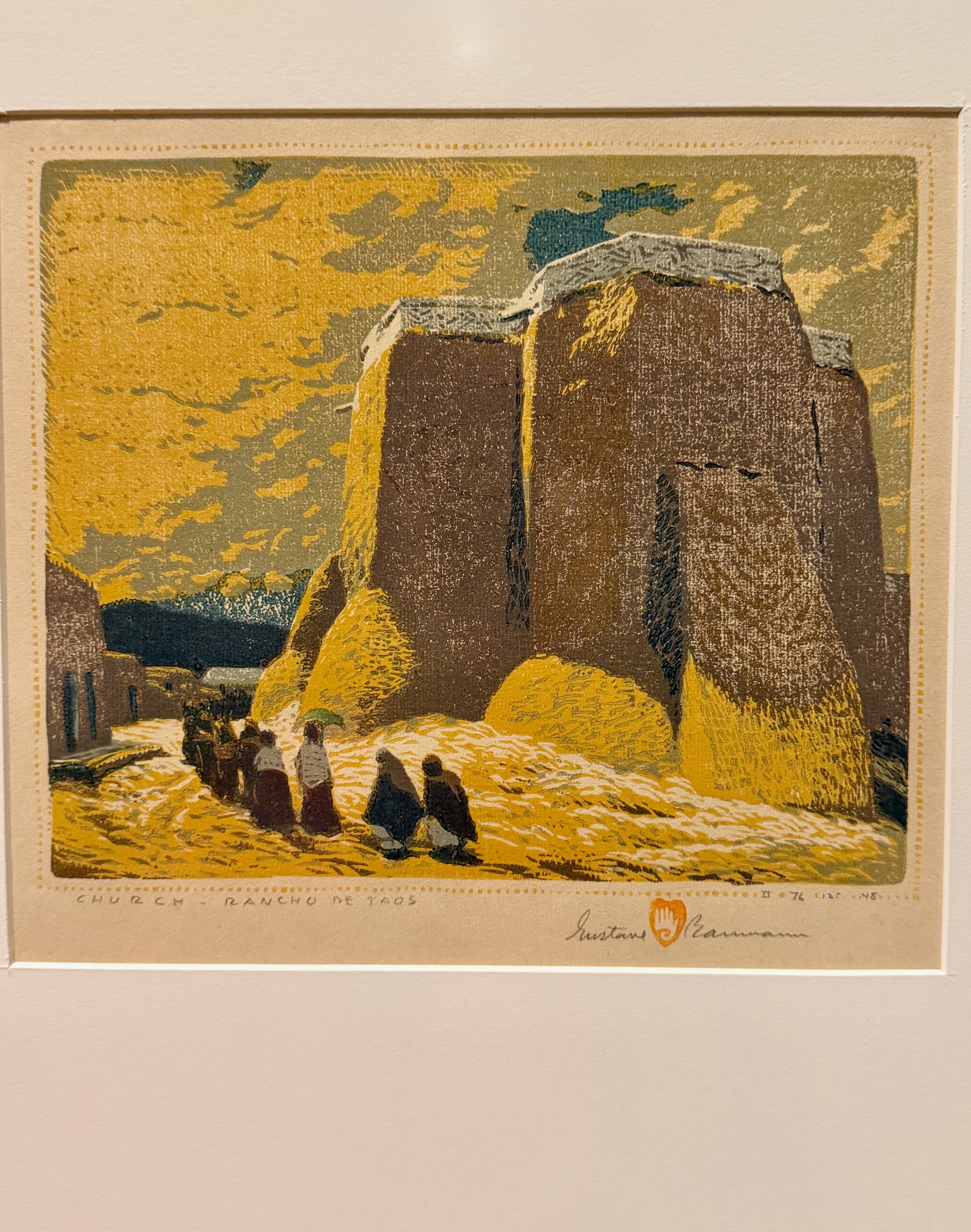
Gus Baumann’s 1919 color woodblock print Church Ranchos de Taos – one of the first modern artists to depict this iconic church; printed in 1948.
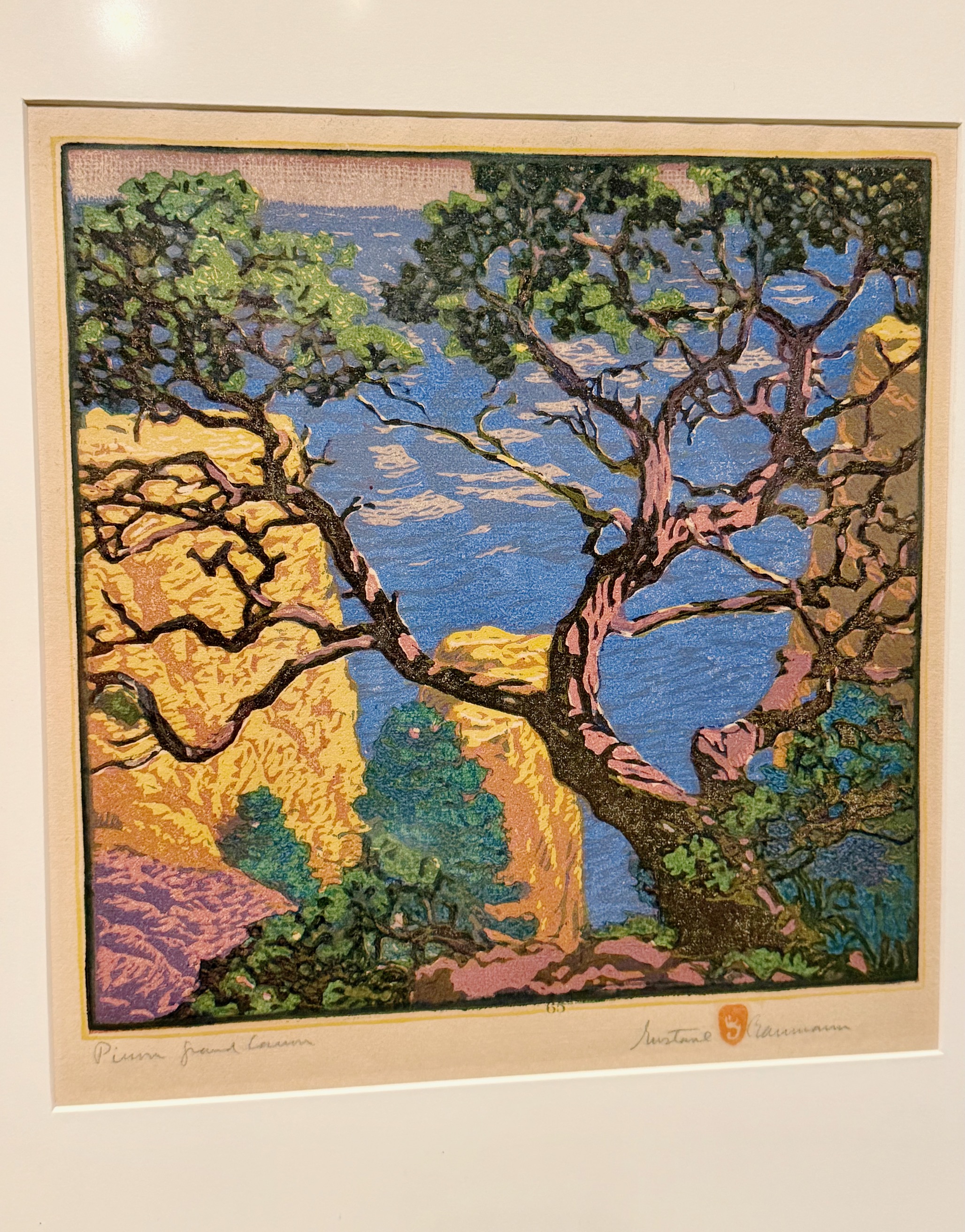
Gus Baumann’s 1921 color woodblock print Piñon Grand Canyon – one of four landscapes created after his first visit.

When he was 17 and his dad left the family, Gus had to find work to help his mom make ends meet.  He worked full time at a Chicago wood-engraving shop that cut illustrations for books, magazines, and newspapers. When he was 20, Gus opened his own wood-engraving studio.

To fine tune his skill, he attended Munich’s Royal Arts and Crafts School for a year to learn from the best German color wood-block print masters – a move that chose traditional skills over academy fine-arts training. When he returned to Chicago, he opened Baumann Graphic Art Service.
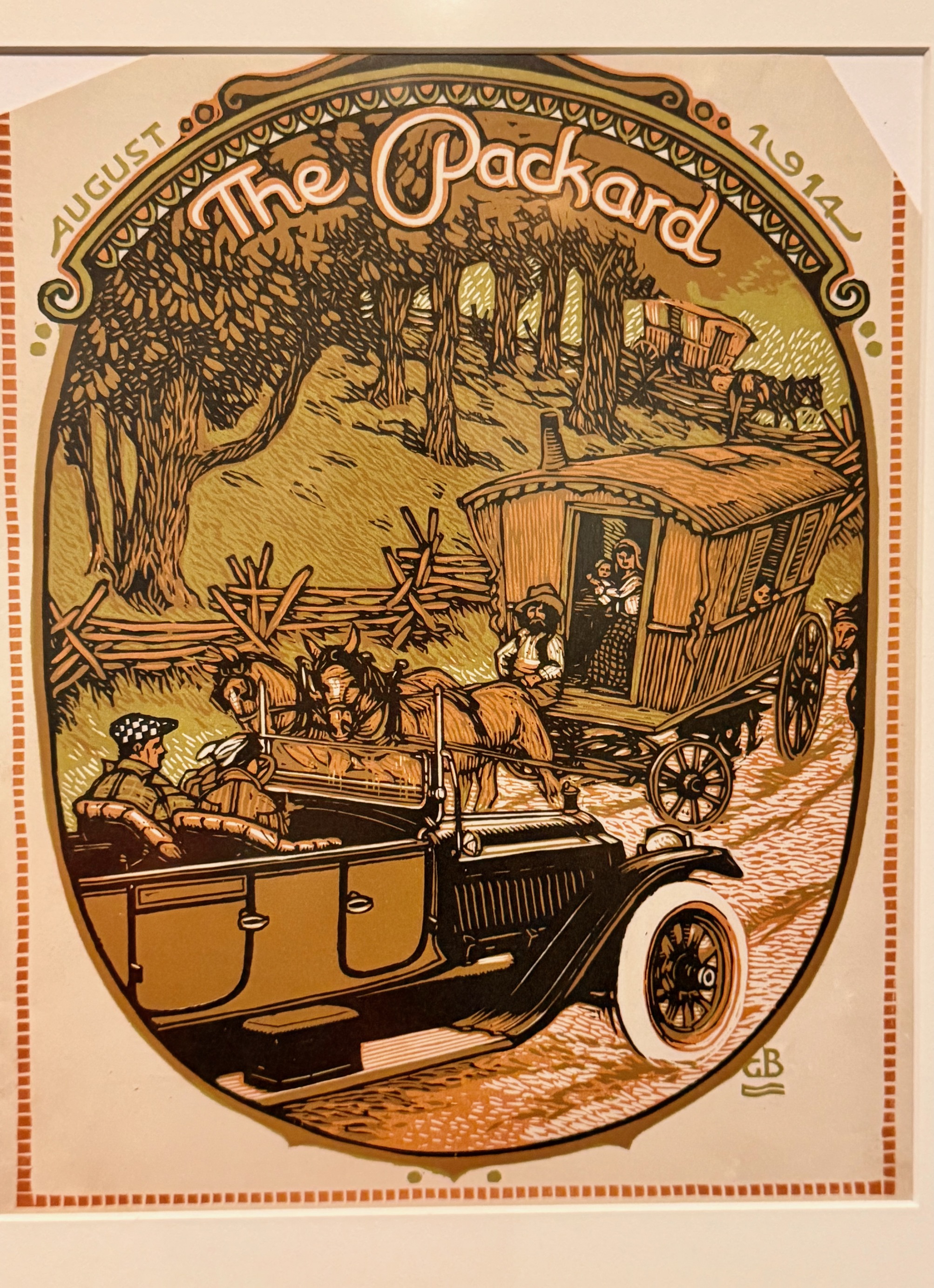
Gus Baumann’s 1913 Illustration for a Calendar: The Packard Car Motor Company, August 1914 – one of four he created for Packard.
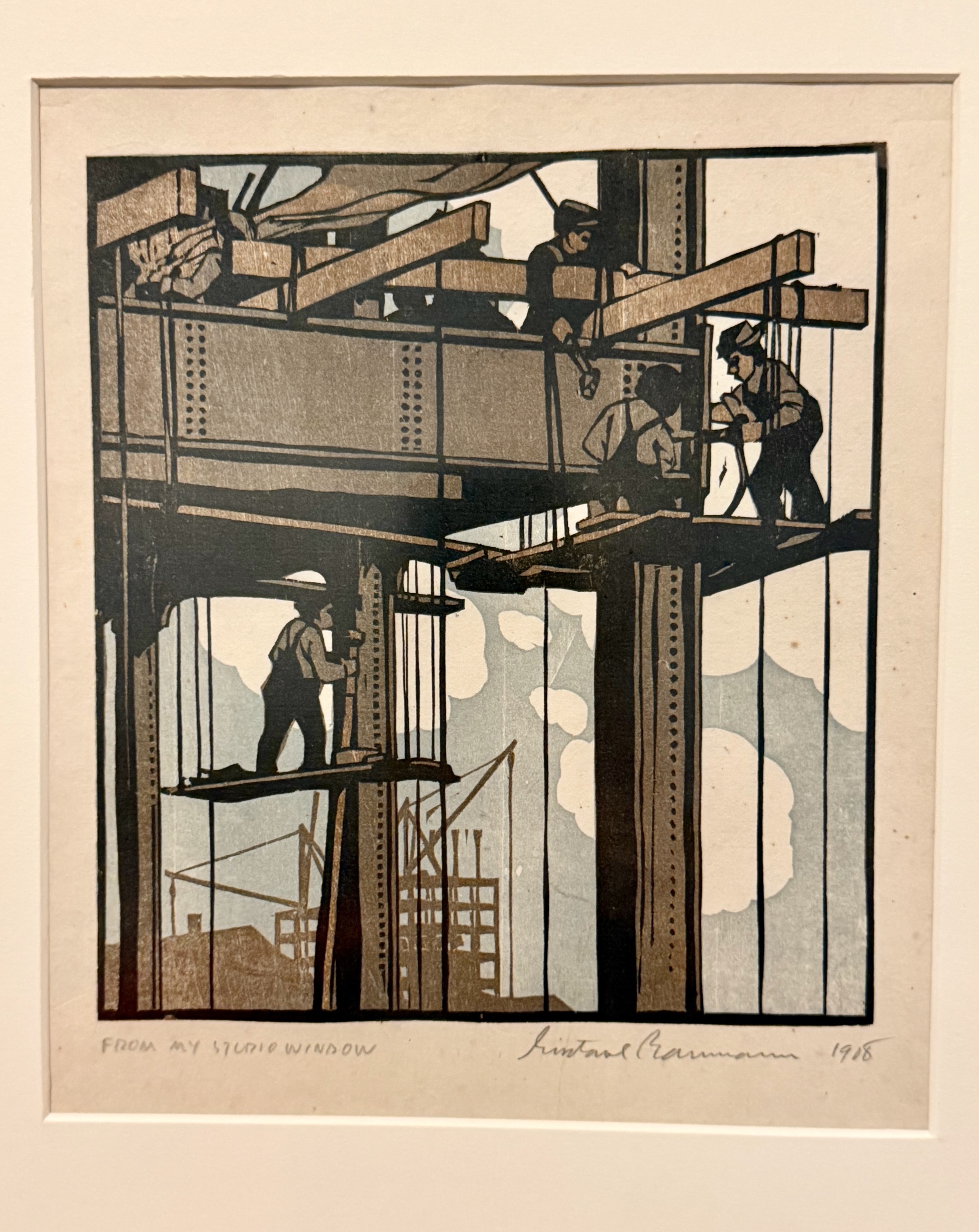
Gus Baumann’s 1908 color woodcut From My Studio Window in downtown Chicago –the high-rise McCormack Building going up on South Michigan Avenue.

Although Gus found success, his love of craft and traditional printmaking methods drew him to an art colony in Nashville, Indiana that revered traditional crafts and a slower pace of life.  The second section of the exhibition – “A Rolling Stone” – highlights work he did in Munich, his acclaimed print series featuring Indiana craftsmen, coastal life in Provincetown, and the electricity he felt in New York.
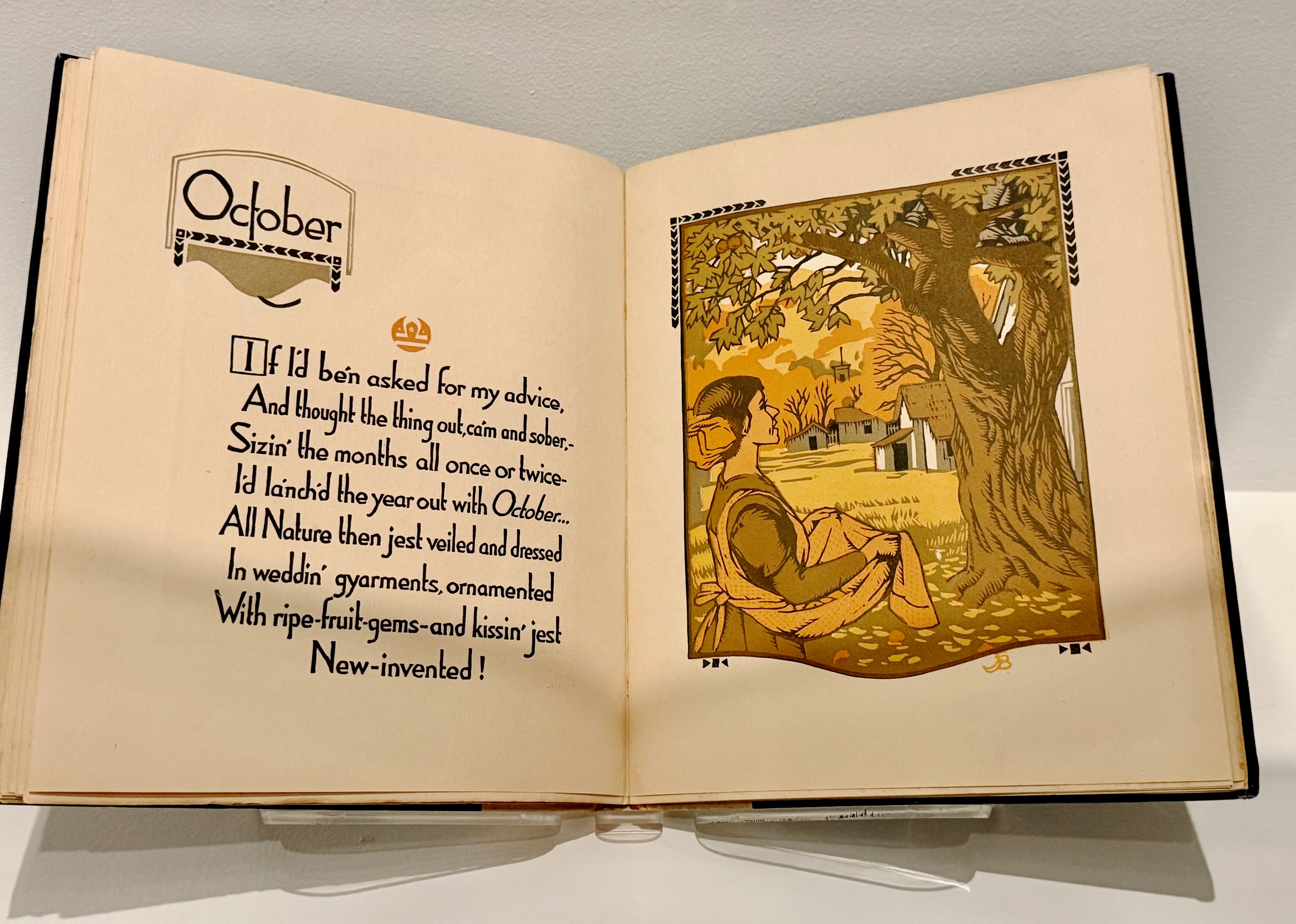
Gus Baumann’s 1912 book All the Year Round – woodcut illustrations and poetry James Whitcomb Riley, featuring scenes of daily rural life for each month of the year.

But his life would change forever when he traveled West and landed in New Mexico in 1918. Due to his reputation as an award-winning printmaker, Santa Fe welcomed him with open arms. Gus was struck by the unique Hispanic and Pueblo ways of life, the beauty of the Southwest, and the growing art colony in Santa Fe. 
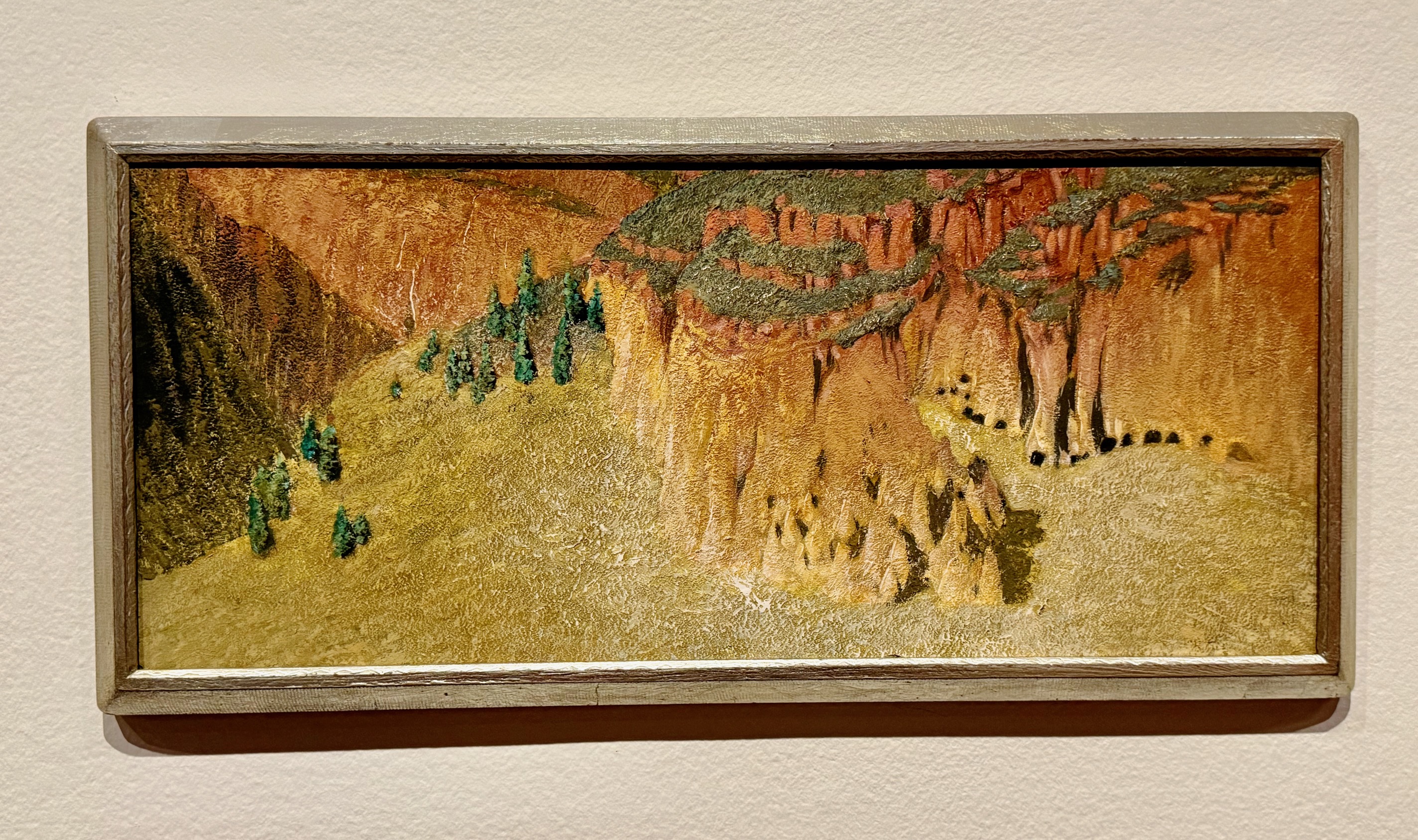
Gus Baumann’s 1925 oil painting Frijoles Canyon – a panorama of ancient tuff dwellings of Tuyoni Pueblo at Bandelier.

Before long, Gus was making and selling gorgeous prints, traveling to archeological sites, attending dances at the pueblos, soaking up the ambience of ancient Spanish churches, and putting brush to canvas, and partying with his new artist friends. And he met Jane, the love of his life, and started a family – creating a life full of fun, art, play, and community service.
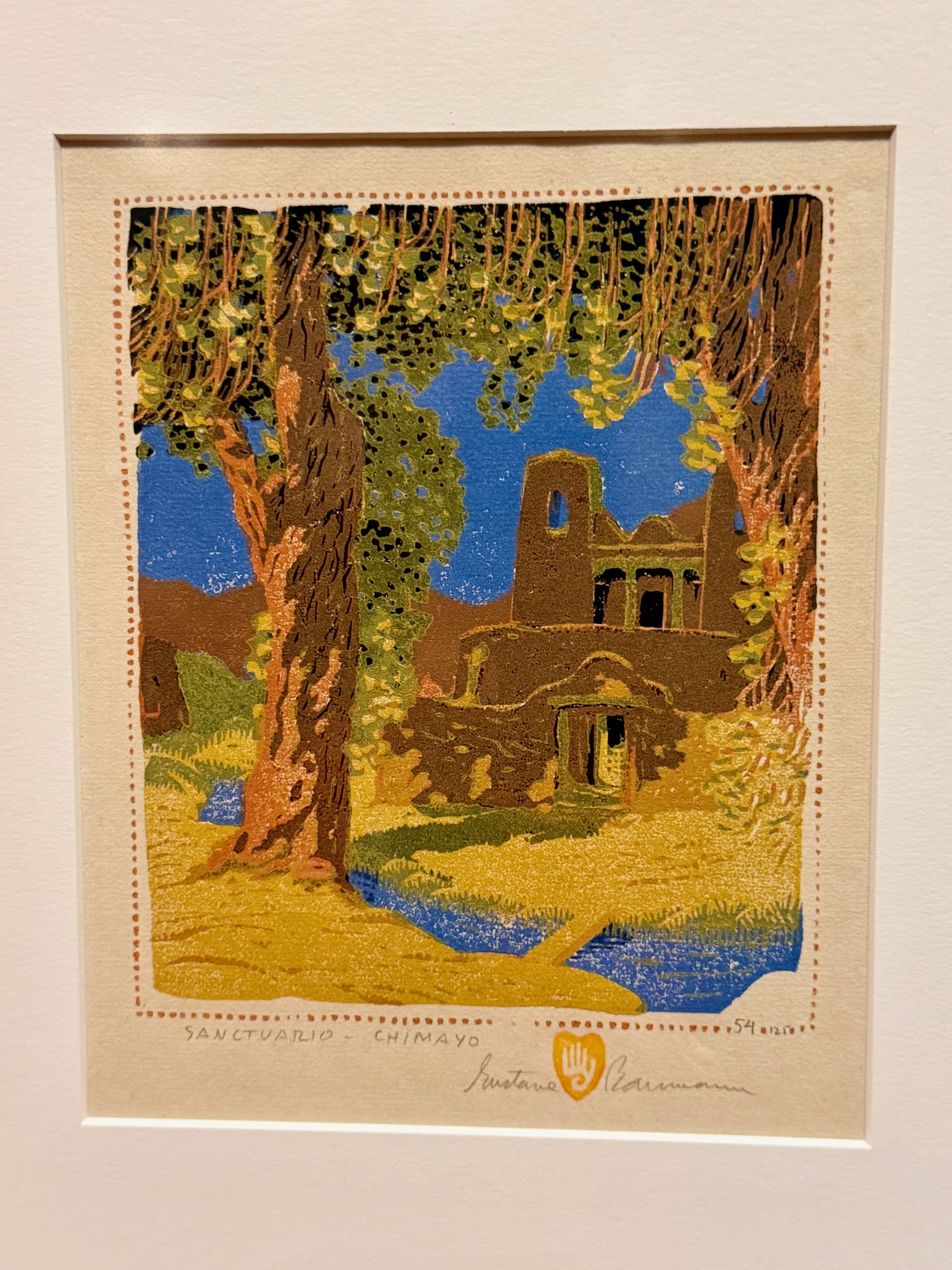
Gus Baumann’s 1924 color woodblock print Sanctuario Chimayo – learning of the historic church’s imminent sale on a sketching trip, he lobbied successfully for its preservation.
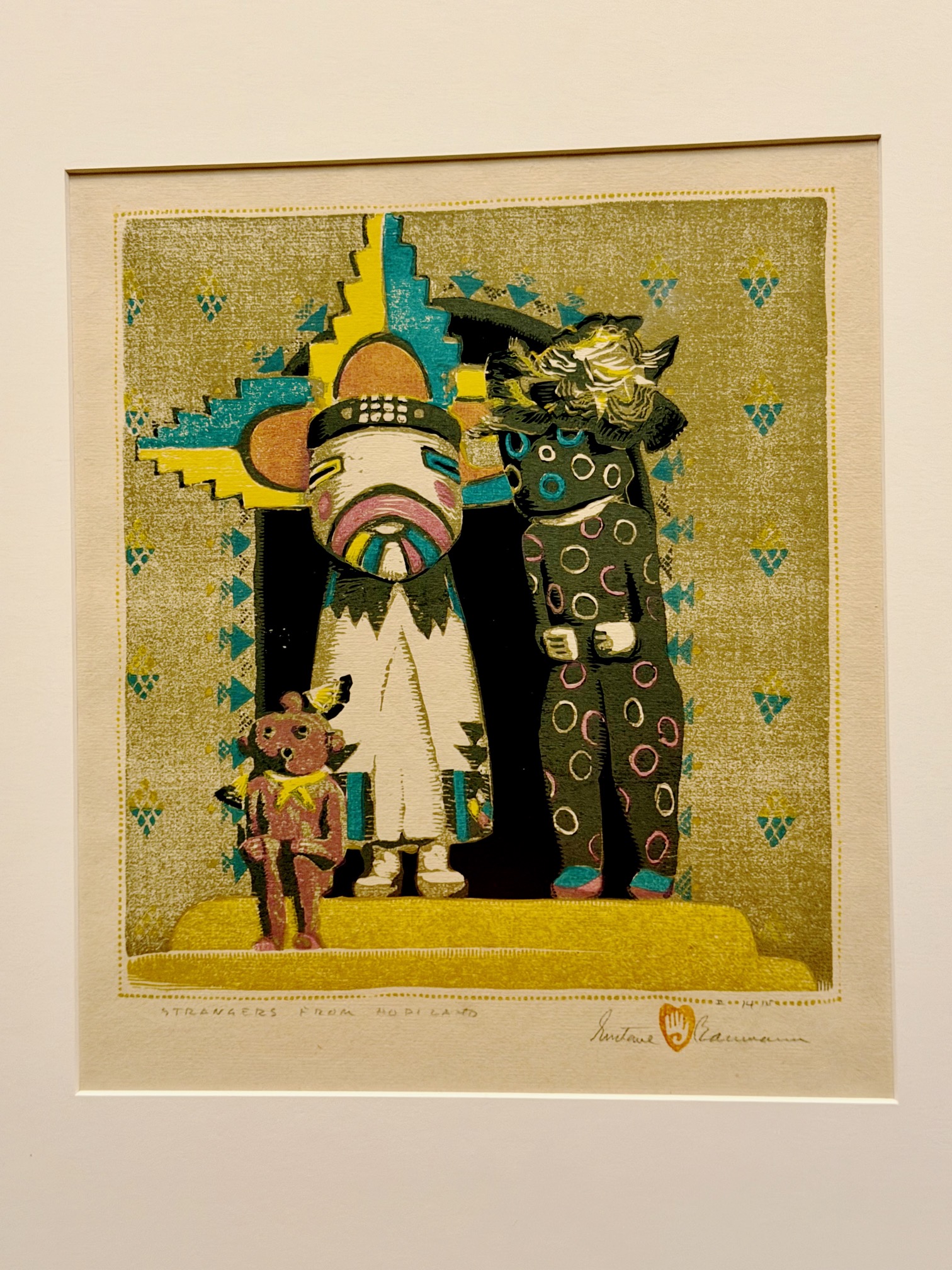
Gus Baumann’s 1921 color woodblock print Strangers from Hopiland, featuring kachinas from his collection; printed in the 1930s.

Since Jane and Ann Baumann donated so much of Gus’s work to the New Mexico Museum of Art, the curators were able to display finished prints alongside drawings and wood blocks that give visitors insight to his process.  One long wall dissects his multi-color printing process for his famed Old Santa Fe – the initial drawing, the separately carved color blocks, single-color proofs, multi-color runs, and the finished six-color print.
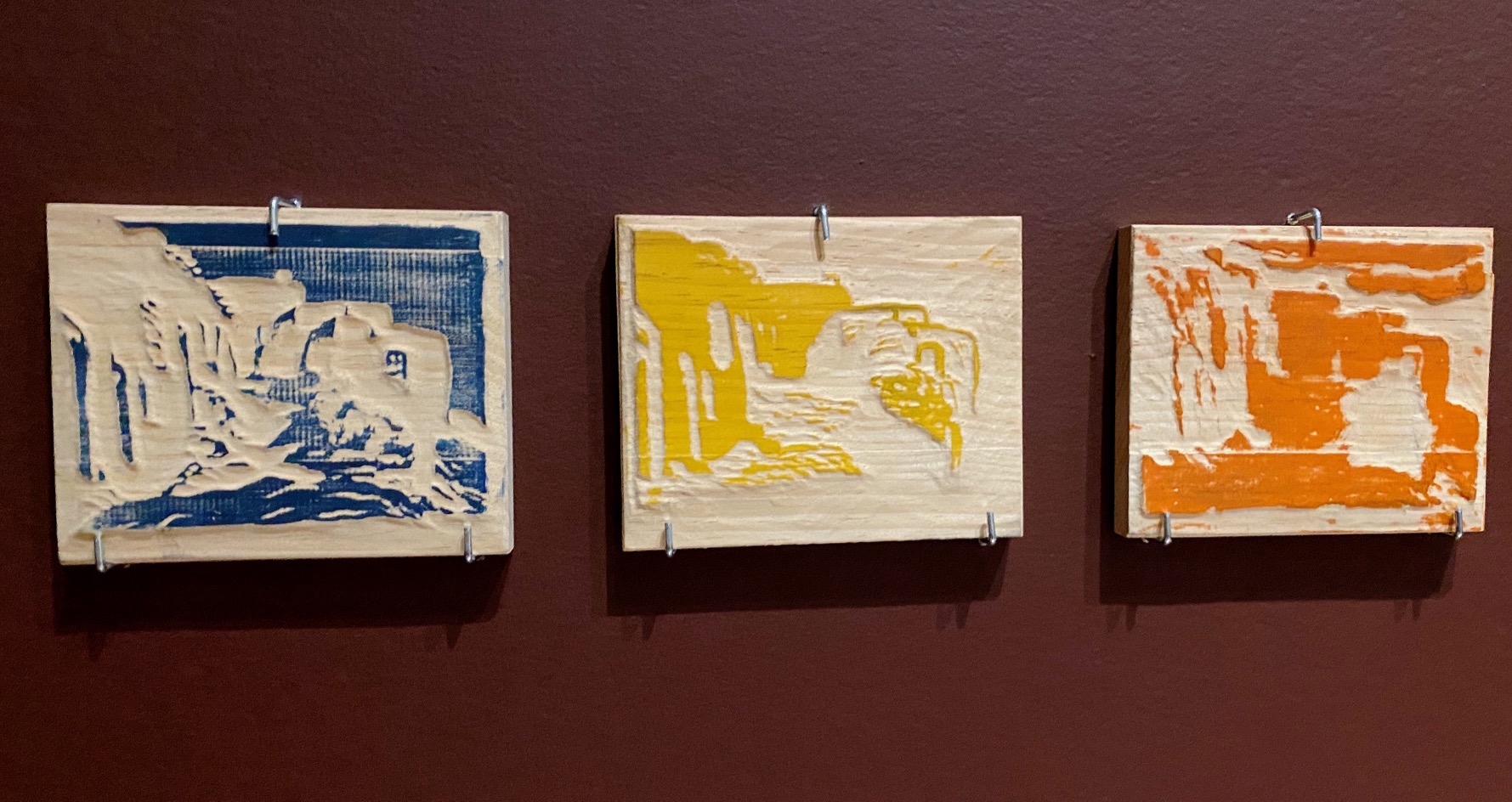
Reproductions of Baumann’s blue, yellow, and orange woodblocks for his 1925 print Old Santa Fe.

Nearly a half-dozen example of Gus’s watercolor paintings and finished prints are displayed side by side. Visitors are delighted to stand, look, compare, and wonder how he conceptualized steps to carve blocks for each color and achieve images of such depth and vibrancy.
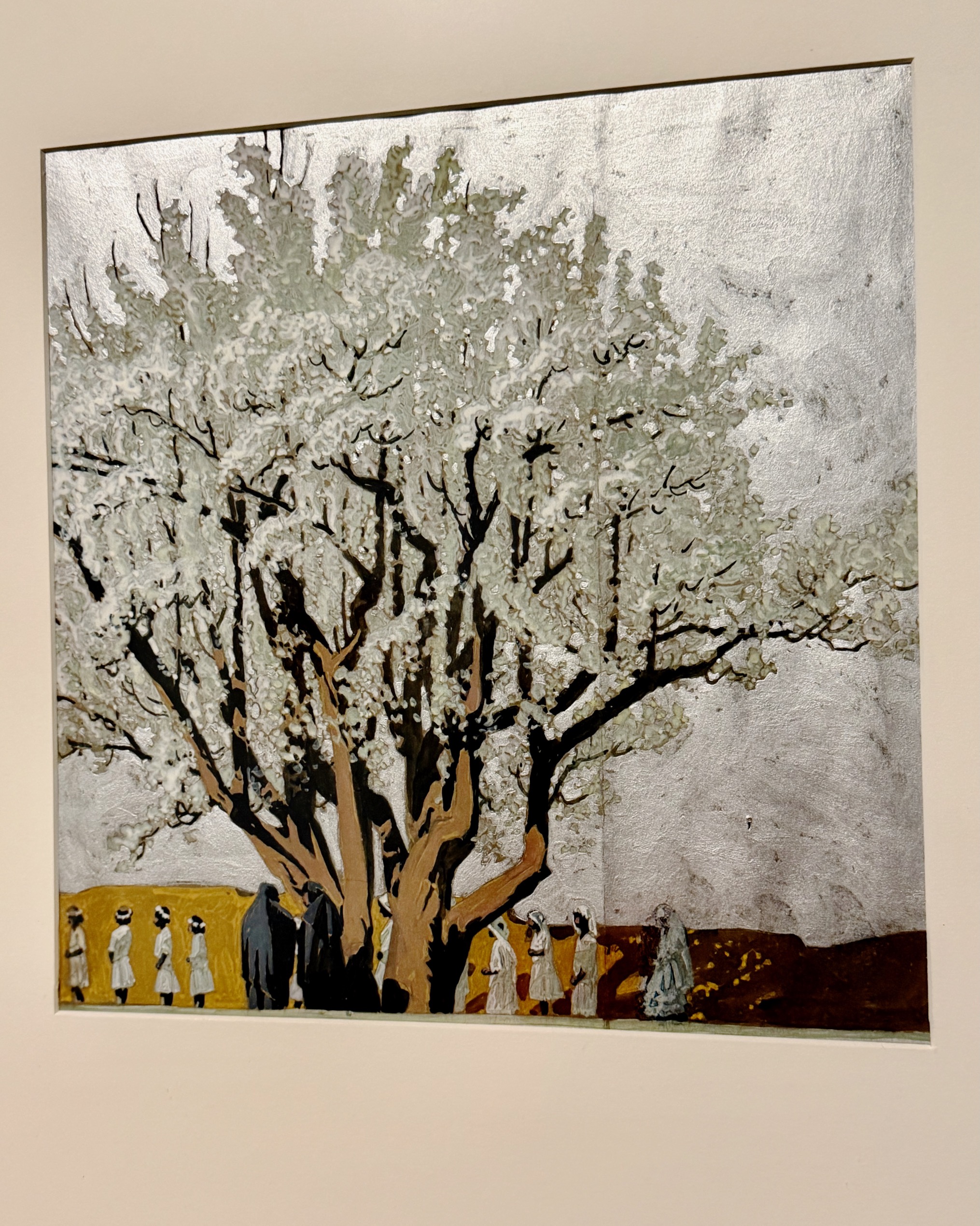
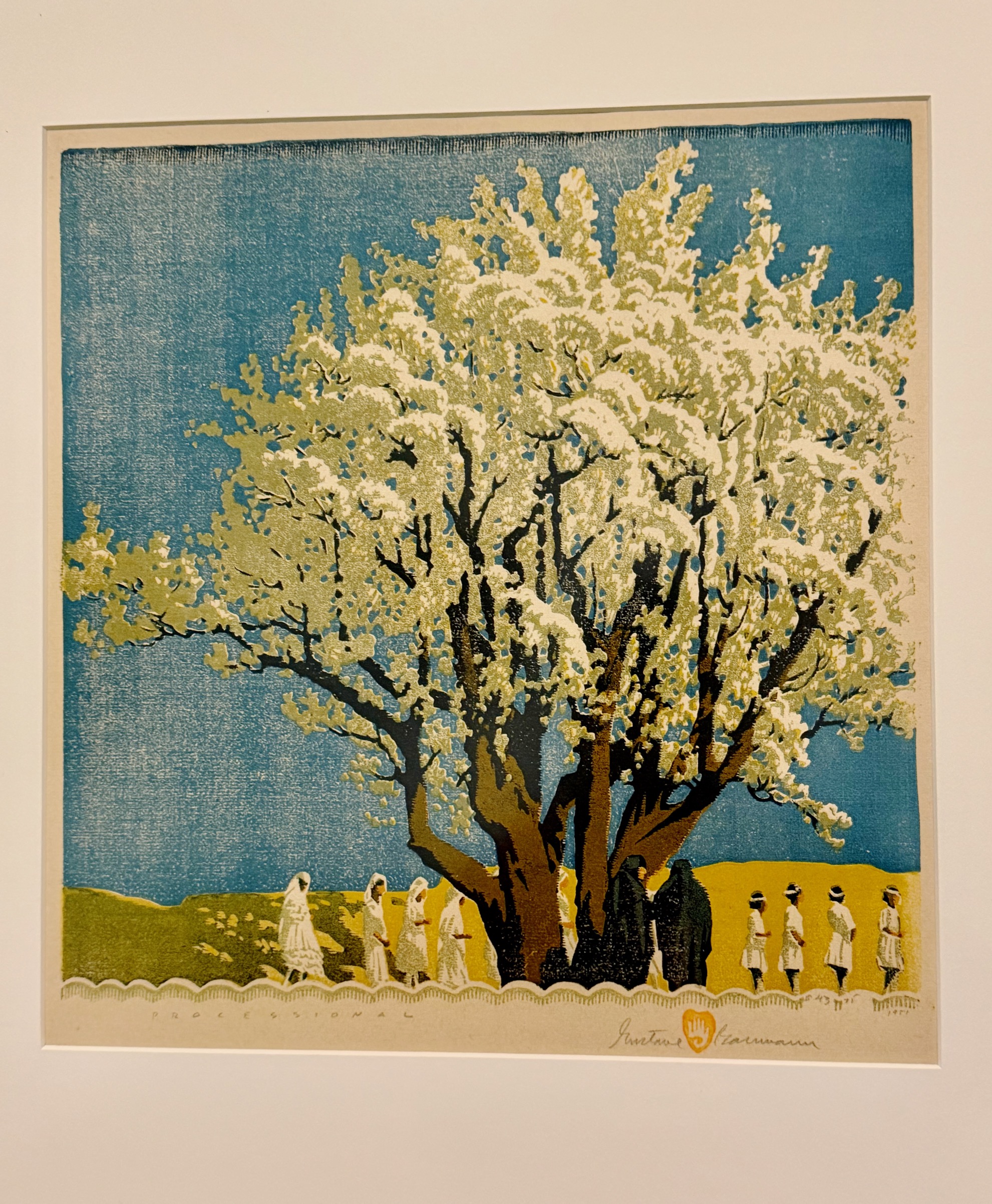
Gus Baumann’s 1930 watercolor Processional (Study), featuring girls walking to their First Holy Communion under a blooming tree and silver sky.
Gus Baumann’s 1930 color woodcut print Processional (printed 1951), based upon his watercolor.

The final gallery “An Artist by Accident” displays an array of intricate color woodcuts, experimental paintings, satirical works, paintings Spanish religious icons, whimisical wood carvings, and everyone’s favorites – Baumann’s marionettes.

It’s the first time Gus and Jane’s marionette casts have been displayed in decades, complete with hand-painted backdrops – scenes representing just a few of the couple’s scripted shows that they performed at home, in venues around Santa Fe, at world fairs, and on tour. 
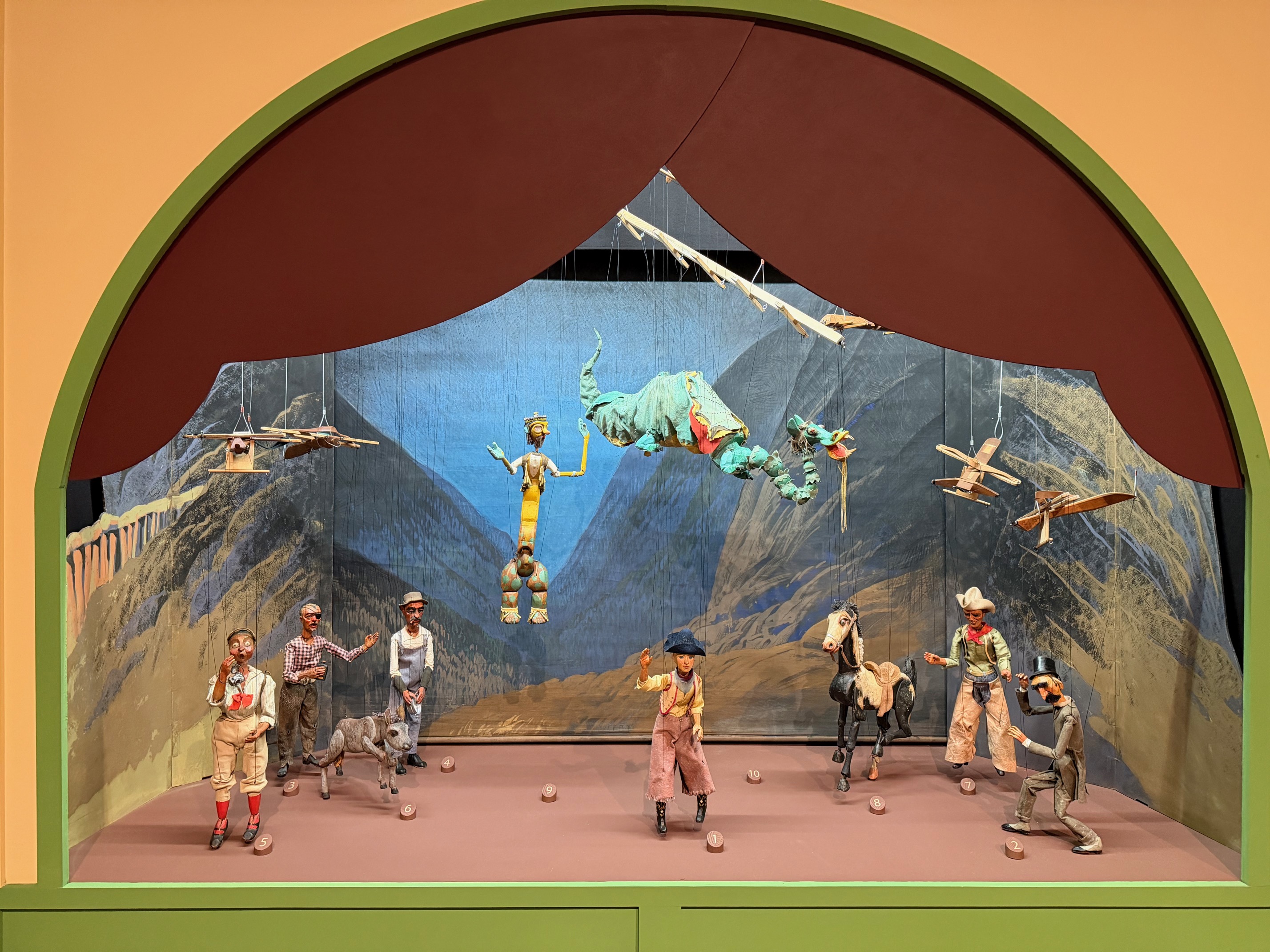
Gus and Jane Baumann’s stage set for the Santa Fe Puppett Wranglers’ 1932 marionette production of the comic melodrama The Golden Dragon Mine –starring The Tourist Lady, Temperence the Miner, Hardpan, Burro, Old Man of the Mountain, the Green Dragon, Nambé Nell, Coco the Horse, Pecos Bill, and Lord Leffinghoop.

Whimsey, delight, innovation, social commentary, and fun are all there, with surprises unfolding around every corner.  And this is all just a fraction of Gus’s creative output from his coming-of-age in the horse-and-buggy era to the Atomic Age.
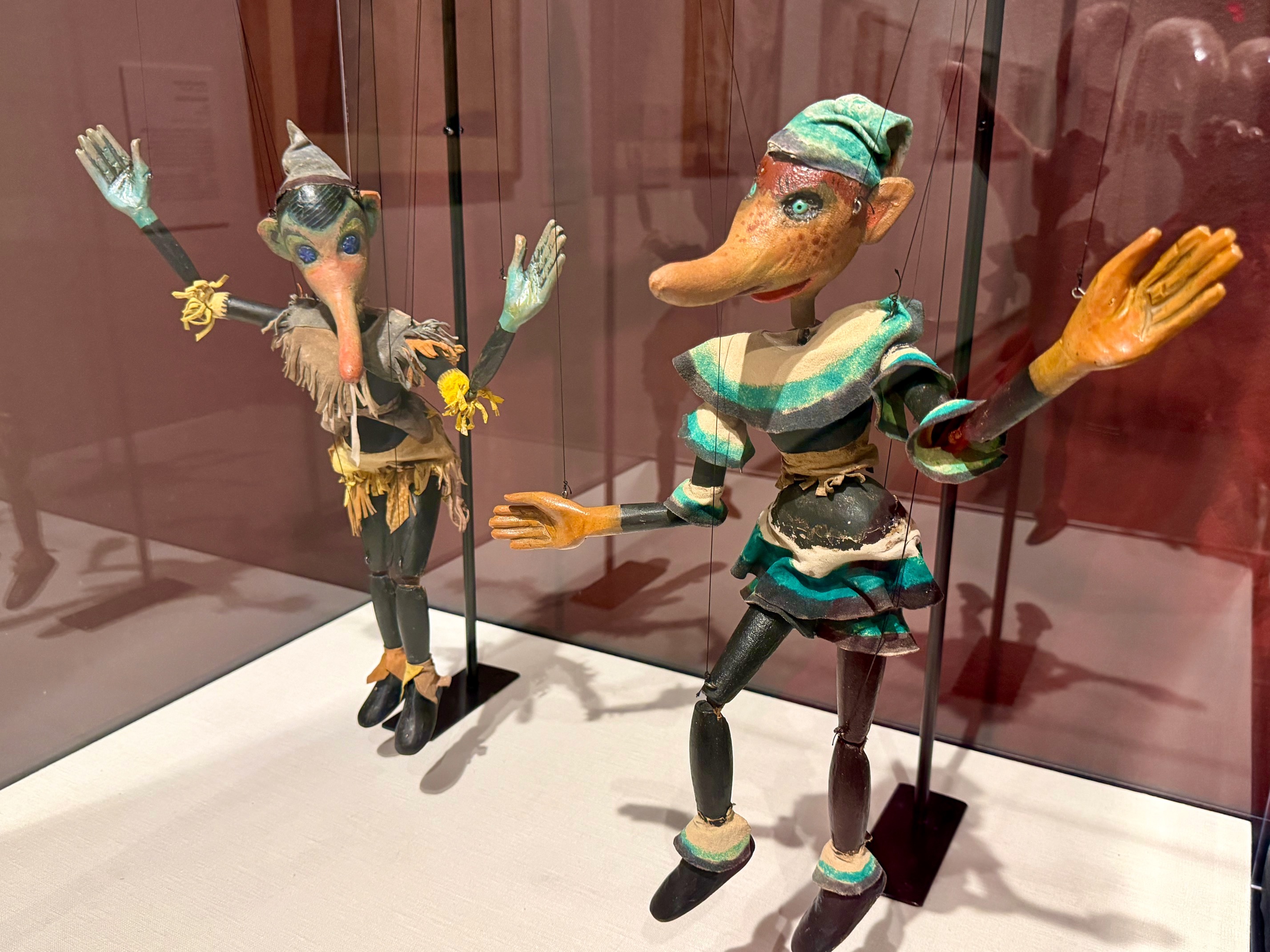
Gus Baumann’s 1940 marionette comedy stars of Teatro Duende – Long Nose (“Nosey”), the Duendi and Freckles the Duende – mischief-making Iberian elves.

No, he didn’t follow the traditional academic path, but he did leave his creative touch on America’s printmaking traditions, the foundation of many Santa Fe cultural and historical institutions, and the care and feeding of a state full of artists as head of New Mexico’s New Deal artist programs.
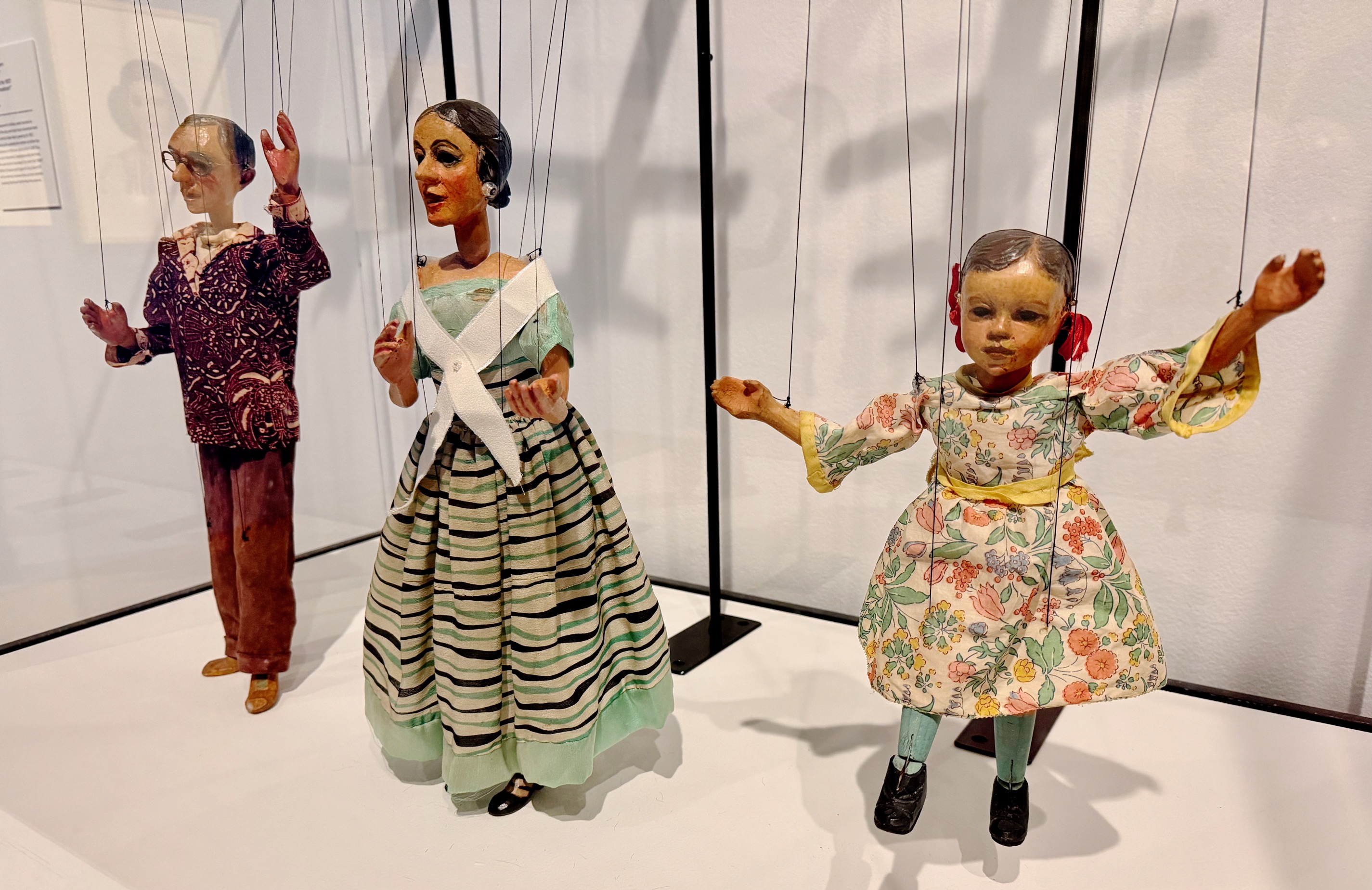
Gus Baumann’s 1932 carved family portrait – marionettes Gus, Jane, and Ann – with costumes by Jane.

Man Ray at The Met

After Man Ray saw European Cubism at the 1913 Armory Show, he knew what he had to do in his own art – abandon all of the constraints of contemporary American art and dive headfirst into Dada and push the boundaries – go rogue.  

Some say that Man Ray became America’s most important 20th century artist. Marcel Duchamp – who became one of Man Ray’s best friends and collaborators – would certainly agree. All the evidence for Man Ray’s status is right here in the Met’s survey of Man Ray’s formative years (1914-1929), Man Ray: When Objects Dream on view through February 1, 2026.

Man Ray’s 1930 Self-Portrait with Camera – a solarized portrait. Courtesy: The Jewish Museum.

Walking in, you look through the exhibition’s architectural aperture to an endless array of Man Ray’s famed rayographs – dreamy abstract black-and-white cameraless images – lining parallel black gallery walls. Nearly sixty have been gathered for this occasion from international public and private collections.

See our favorite works in the exhibition in our Flickr album.

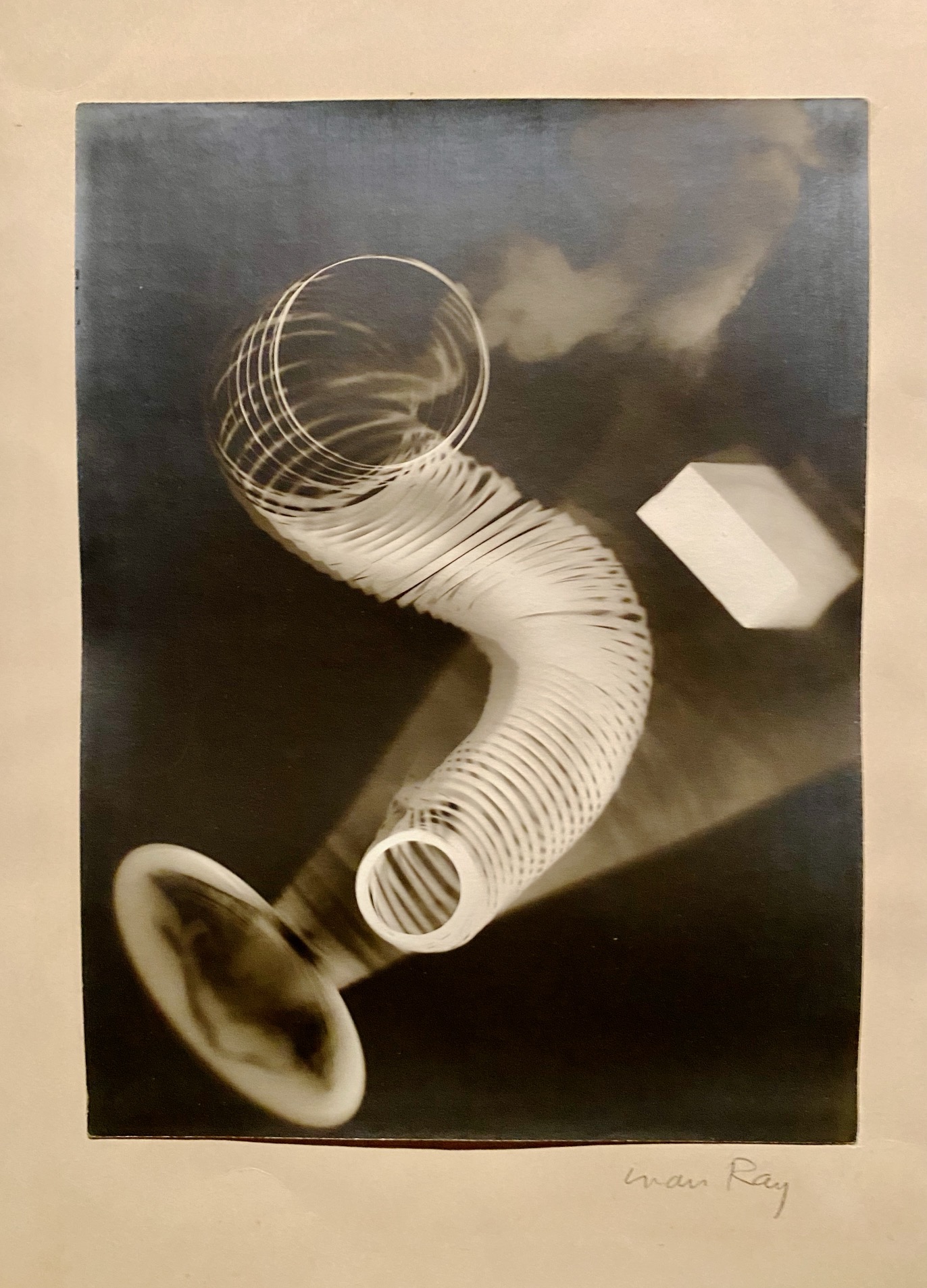
Man Ray’s 1922 Rayograph published in Les Fuilles Libres (Loose Pages) magazine – a coiled wire puffing smoke emerges from a glass.  Courtesy: private collection.
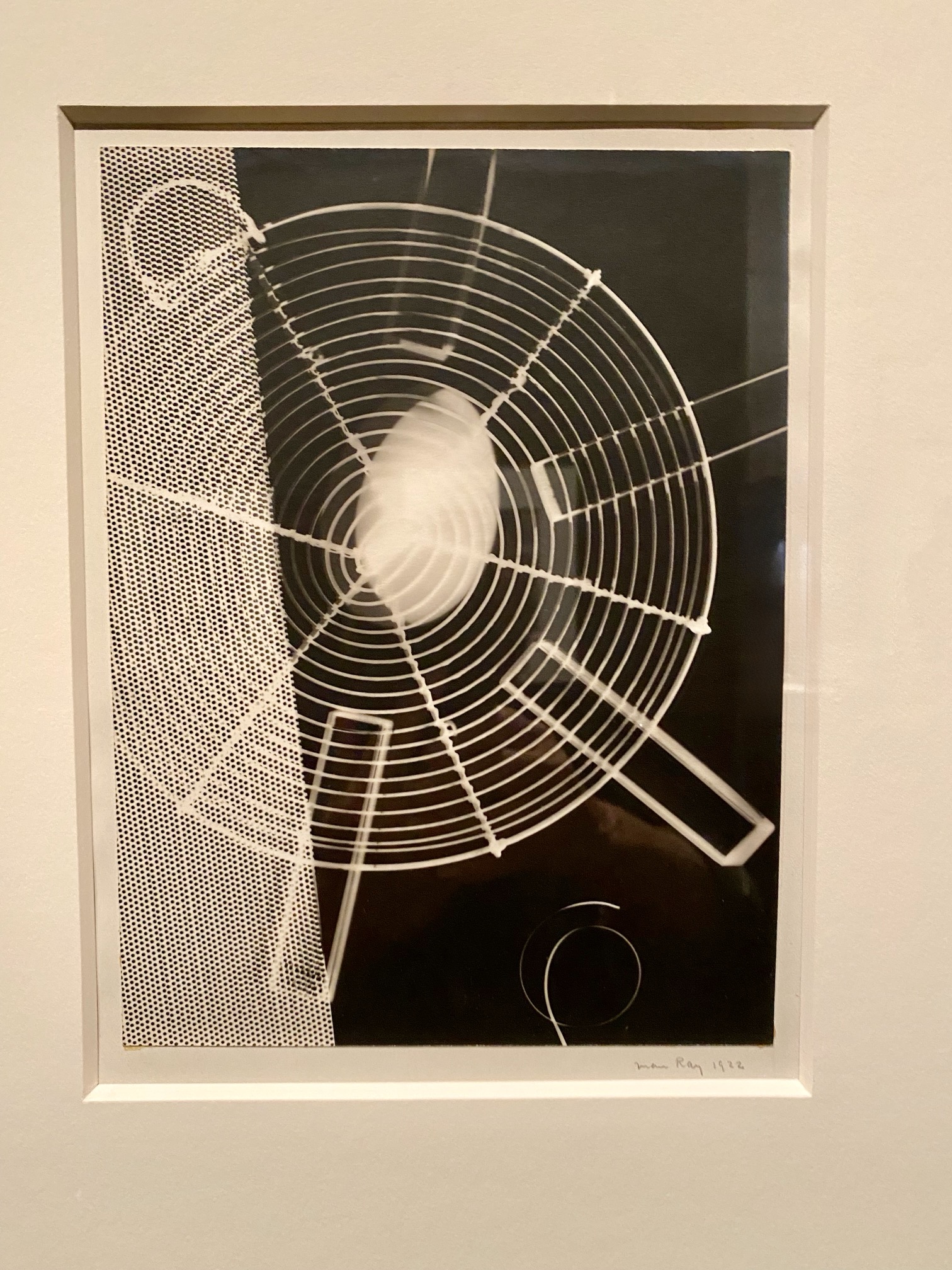
Man Ray’s 1922 gelatin silver print Rayograph incorporating an everyday wire rack for dramatic effect.  Courtesy: Yale University Art Gallery.

Although the rayographs form the core of this show, you also see the oil paintings, airbrush drawings, sculptures, movies, and game boards – works that are rarely seen, but illustrate why Man Ray rapidly took center-stage in the modern avant-garde community.

While working as a commercial artist and photographer, he used his free time to make unconventional, revolutionary works that banished representation. In 1916, he wrote a “new art” treatise on how to condense motion and dynamic shapes into two dimensions.

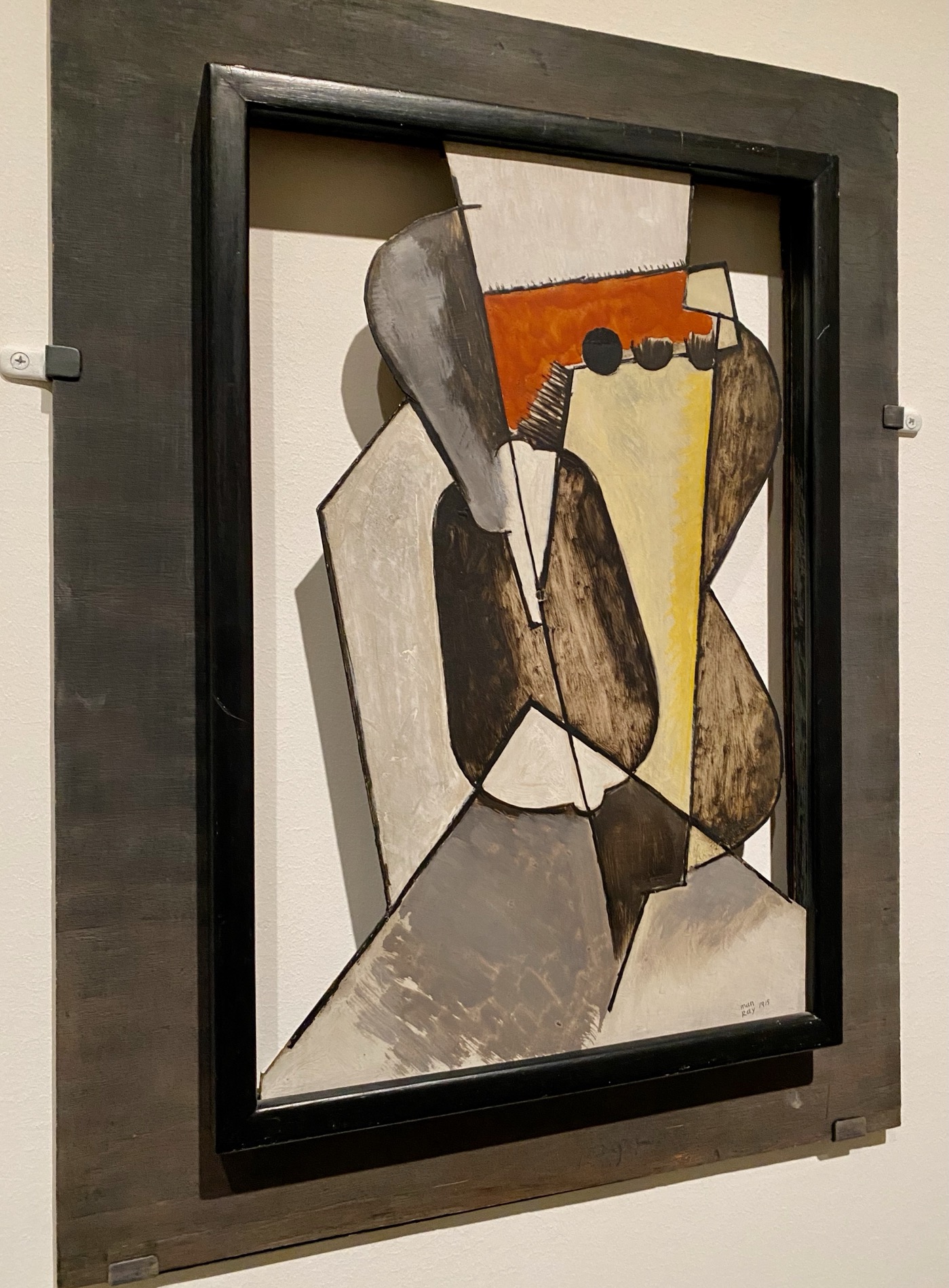
Man Ray’s 1915 oil on board Cut-Out from his first solo show in New York in 1919 – representing three dimensions within two.
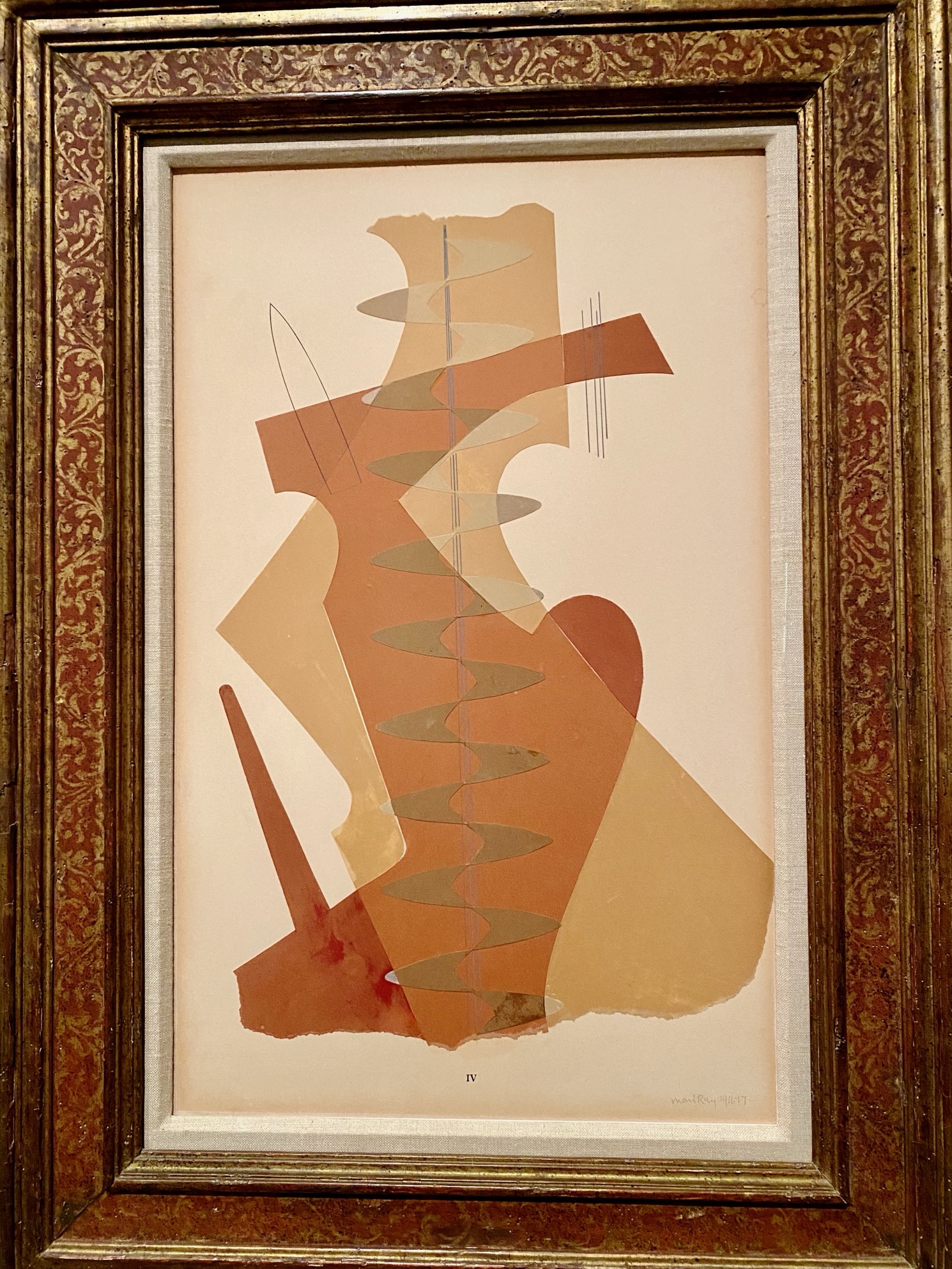
Man Ray’s 1916-1917 collage and pen-ink drawing The Meeting. Courtesy: The Whitney Museum of American Art.

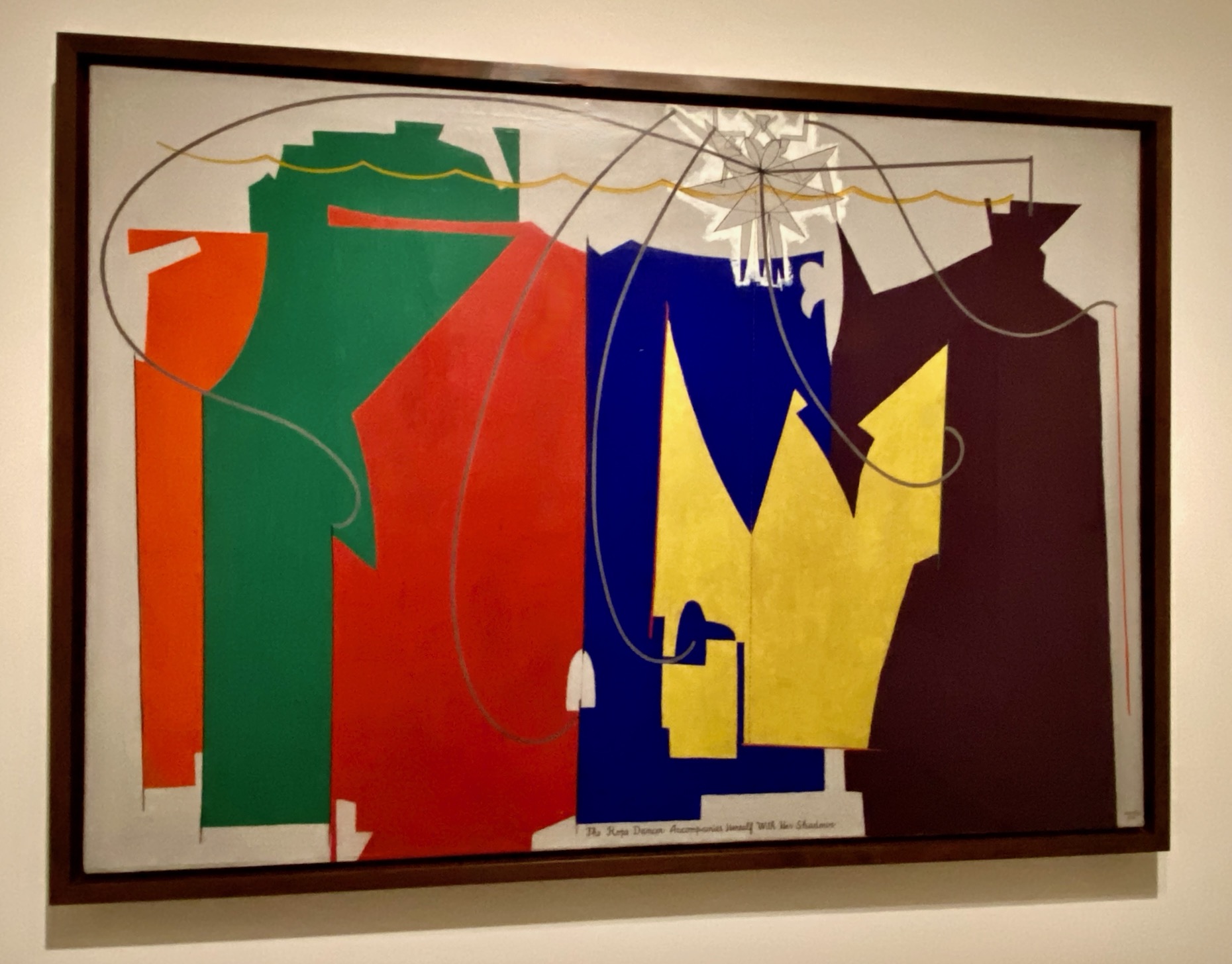
By 1917, he was making large-scale works, portraying a Rope Dancer mid-performance with stencils, cut-up pieces of colored paper, and big colored spaces representing her shadows.

Man Ray’s 1916 oil painting The Rope Dancer Accompanies Herself with Her Shadows planned with cut paper. Courtesy: MoMA

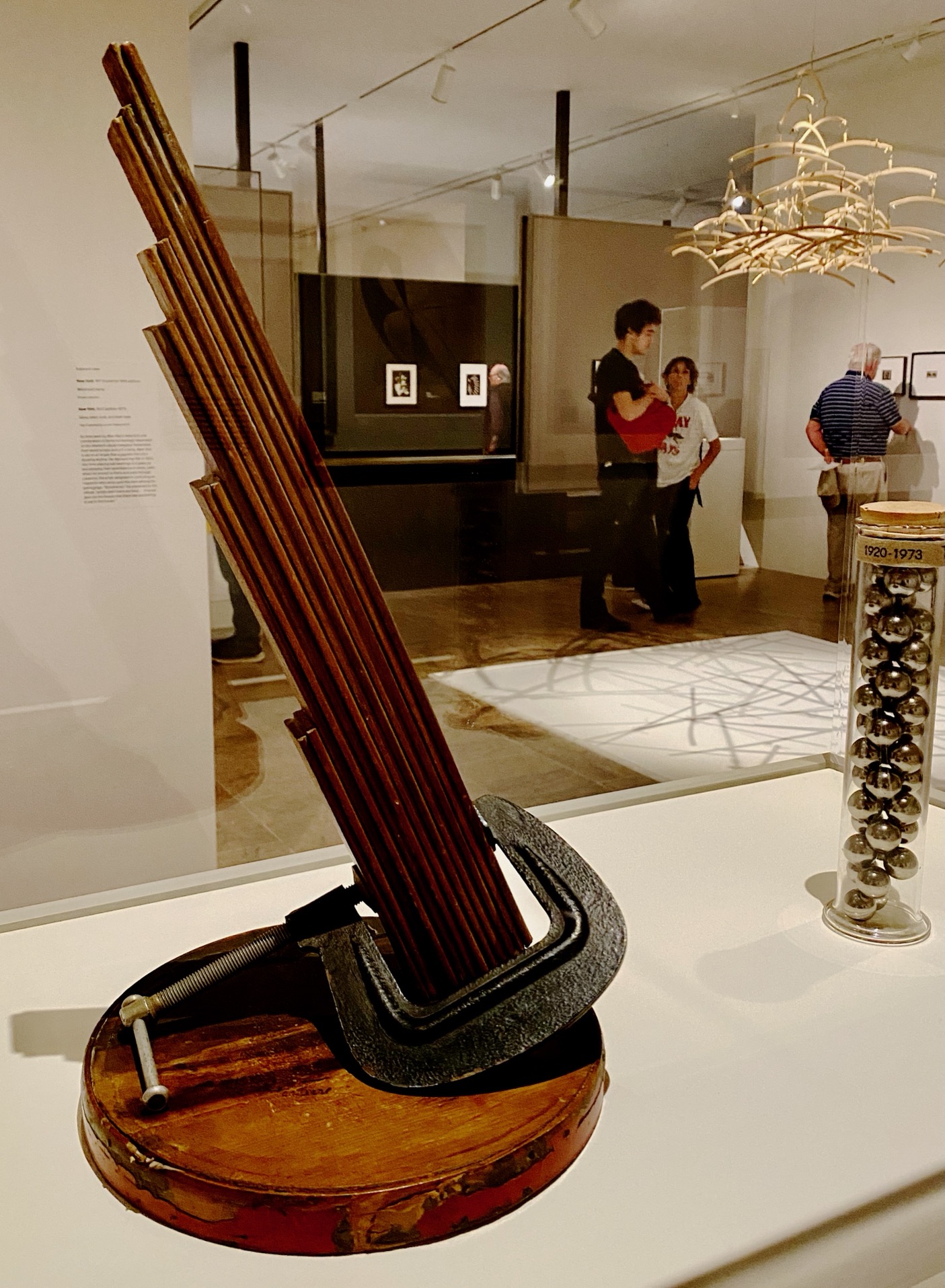
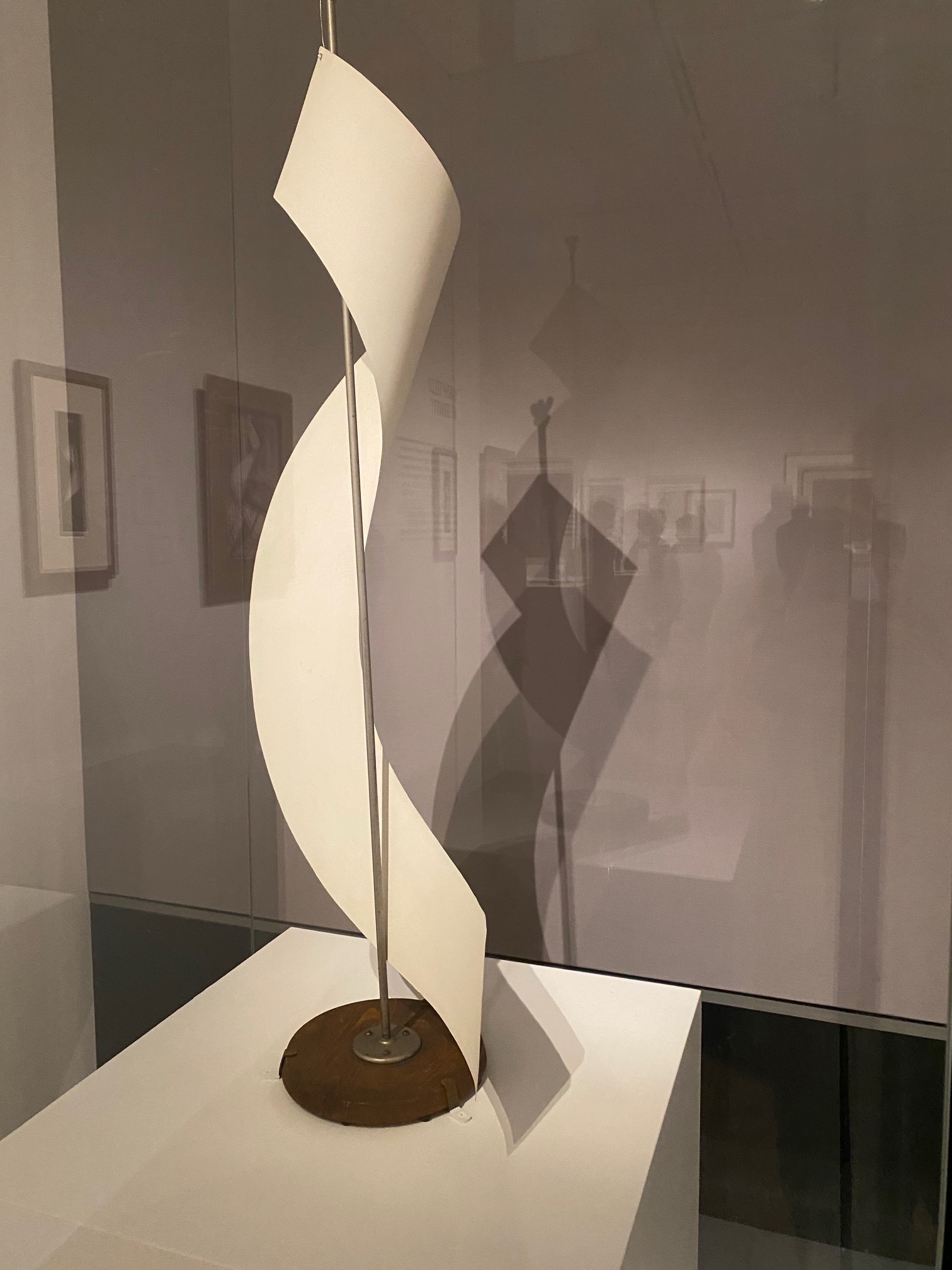
His sculptures were made in true anarchist-Dada fashion – from junk found on the street or in his apartment-building trash can. In one gallery, a precarious grouping of dramatically lit wooden hangars is installed overhead like a chandelier. The cast shadows look pretty good, too.  His spiraling Lampshade, a sensuously curved metal sculpture is nearby, alongside paintings and avant-garde portraits where he repurposed the great shape.

Man Ray’s 1917 wood and clamp sculpture New York like a tilted skyscraper; at right, 1920 sculpture New York – a mysterious stack of ball bearings in a glass container. Courtesy: private collection; Tate.
Man Ray’s 1921 Lampshade – a dynamic painted tin and metal sculpture; inspired by a paper lampshade found in the trash a year earlier. Courtesy: Yale University Art Gallery.

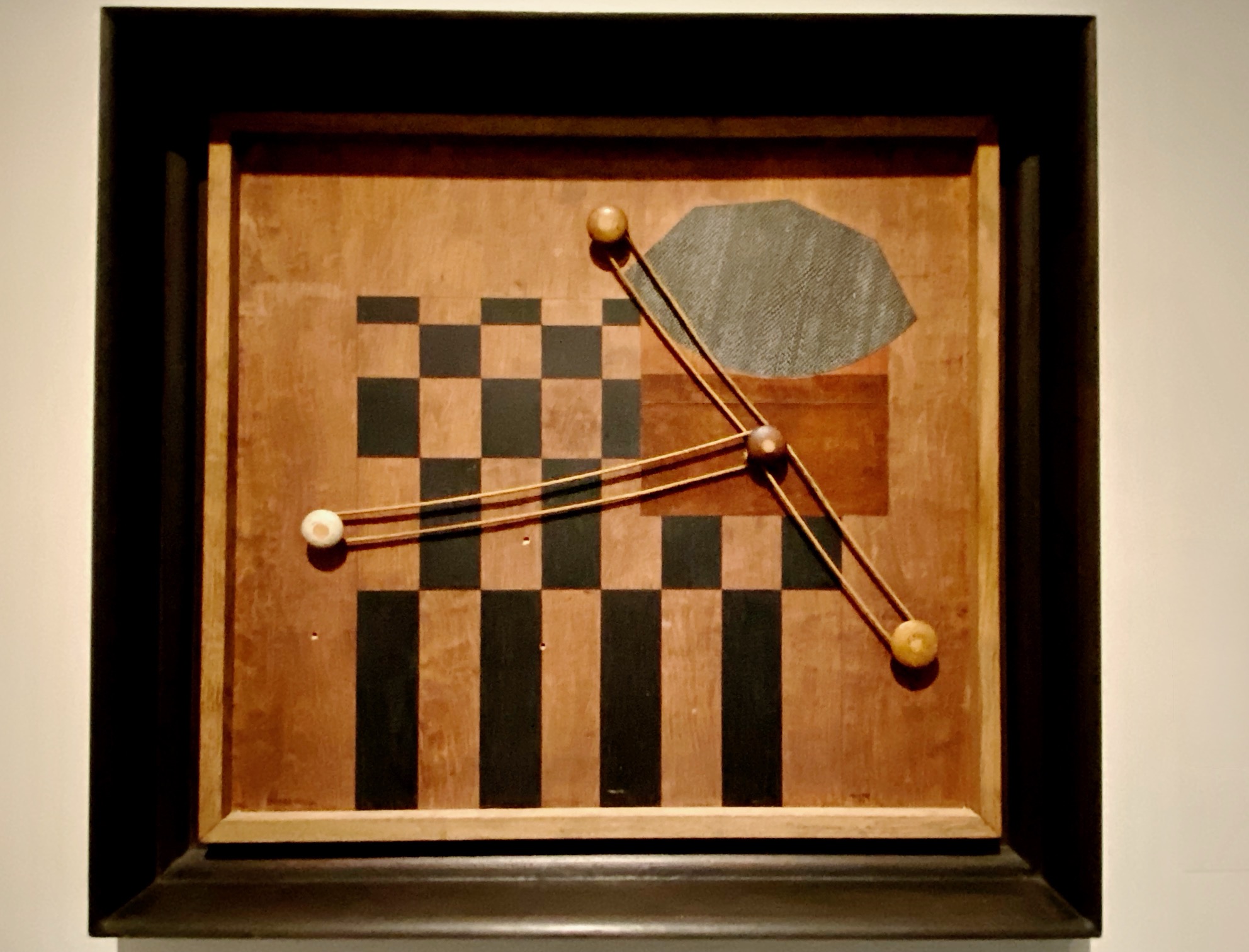
He even made game boards and chess sets to symbolize his philosophy about the best way to make art – spur-of-the-moment imagination, abstract planning, clear intention, and an element of surprise.

The philosophy of the chessboard: Man Ray’s 1917 Boardwalk – an assemblage of oil, furniture knobs, and yarn on wood. Courtesy: Staatsgalerie Stuttgart.

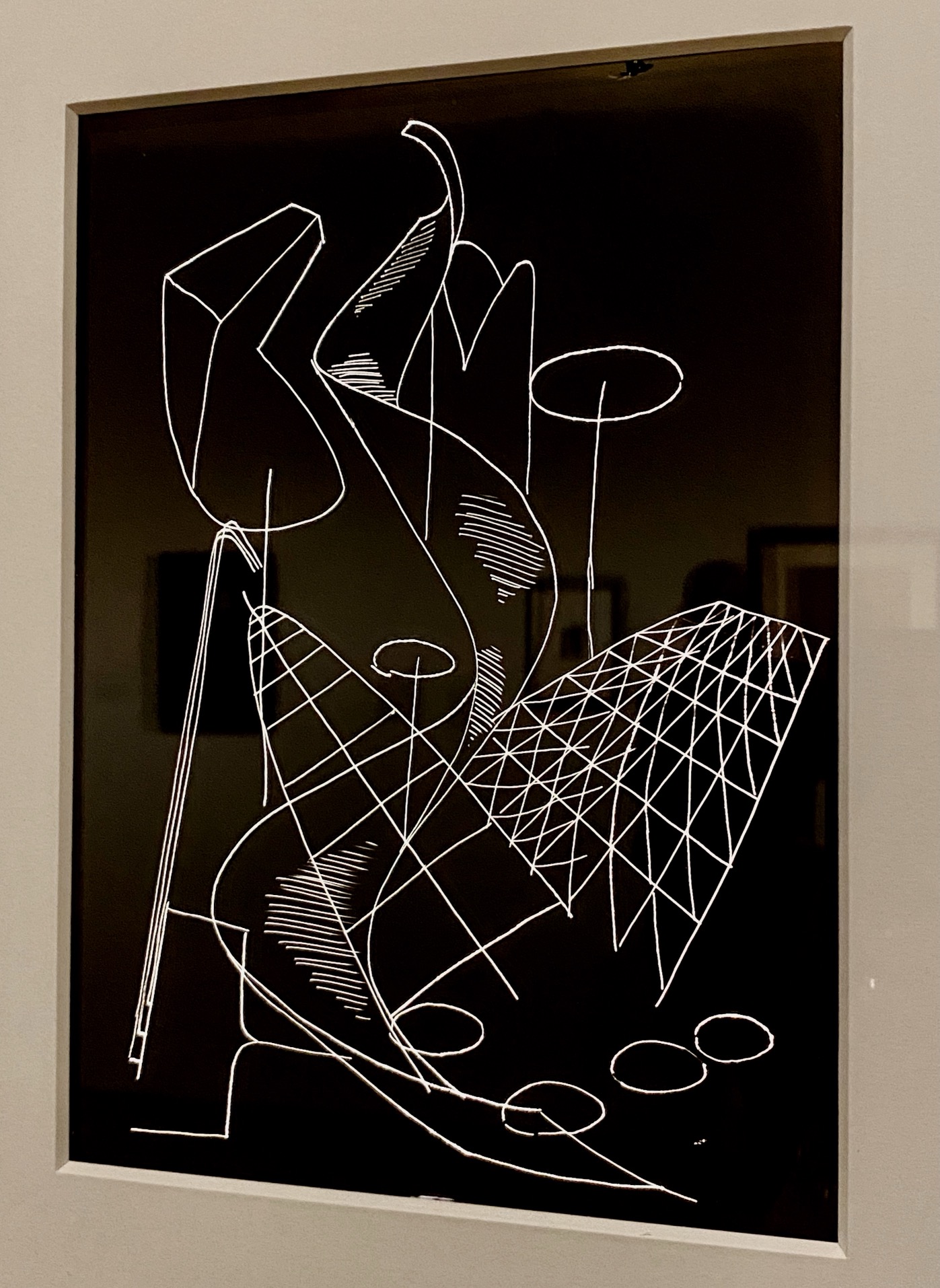
For Man Ray’s fine-art photographs, he preferred using inanimate, everyday objects to humans. And as he progressed as an artist, he didn’t use a camera.  In 1917, he started making glass-plate prints (cliché-verre) with sinuous, patterned line drawings. Soon, he was innovating with Aerographs – abstract pencil-and-airbrush drawings inspired by new technology (“drawing in air”).

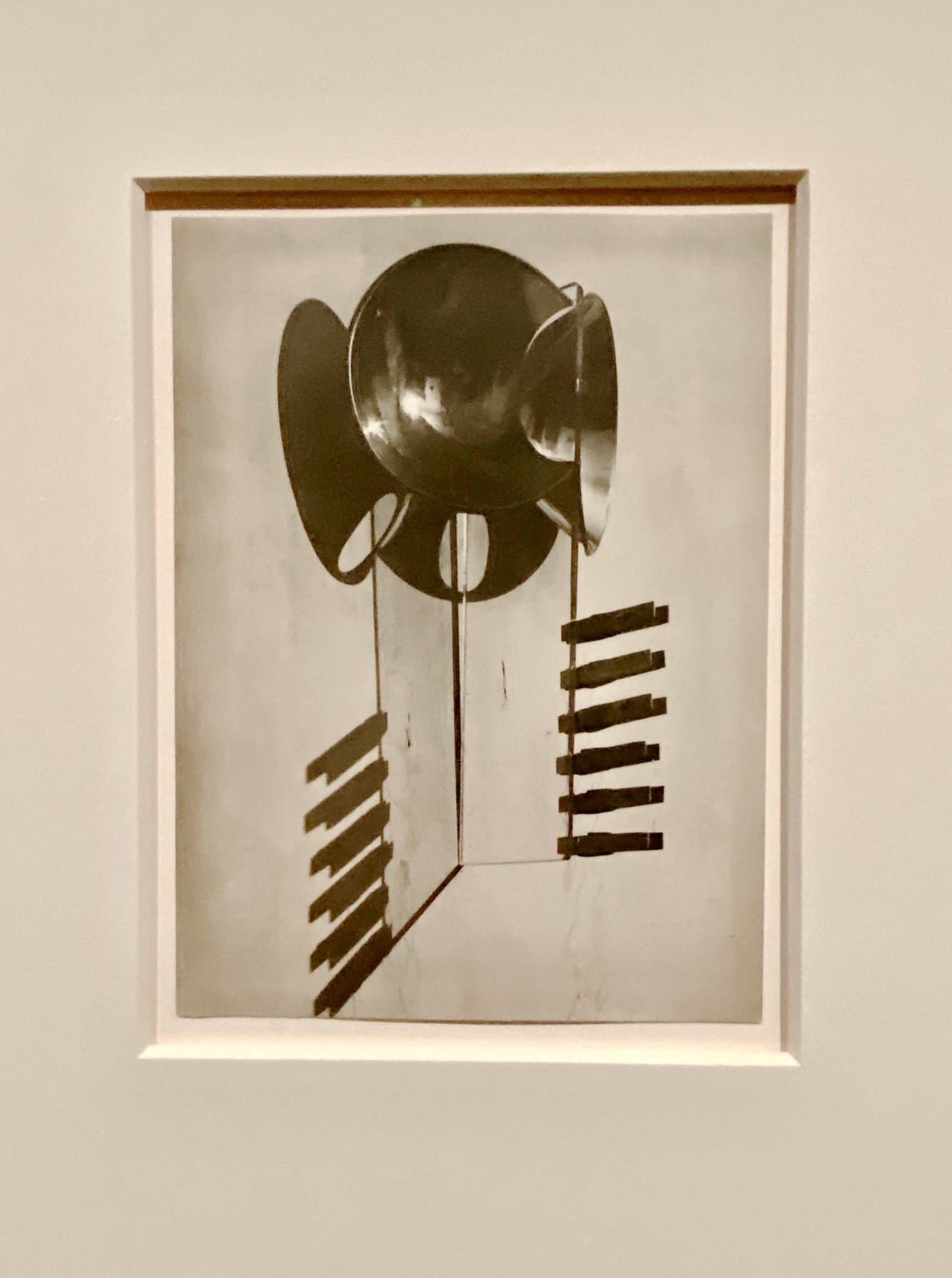
Man Ray’s 1918-1920 gelatin silver print “Integration of Shadows” – an assemblage of clothespins, glass, and reflectors; printed after 1935. Courtesy: private collection.
Before the rayograph: Man Ray’s 1917 untitled glass-plate negative (cliché-verre). Courtesy: Centre Pompidou, Paris

Man Ray primarily spent his time in Paris during the 1920s. Once he began making rayographs in his studio, he was content playing with unusual juxtapositions of everyday objects, studio lights, and various types of photographic exposures. It’s reported that in 1922, he created over 100 rayographs and abandoned painting altogether. (But he took it up again the next year!)

The curators make a point of juxtaposing several rarely-seen paintings with specific rayograms from the same period to make a point – the artist might have returned to experimental paintings as a compliment to some of the shapes and feelings he was exploring through photography.

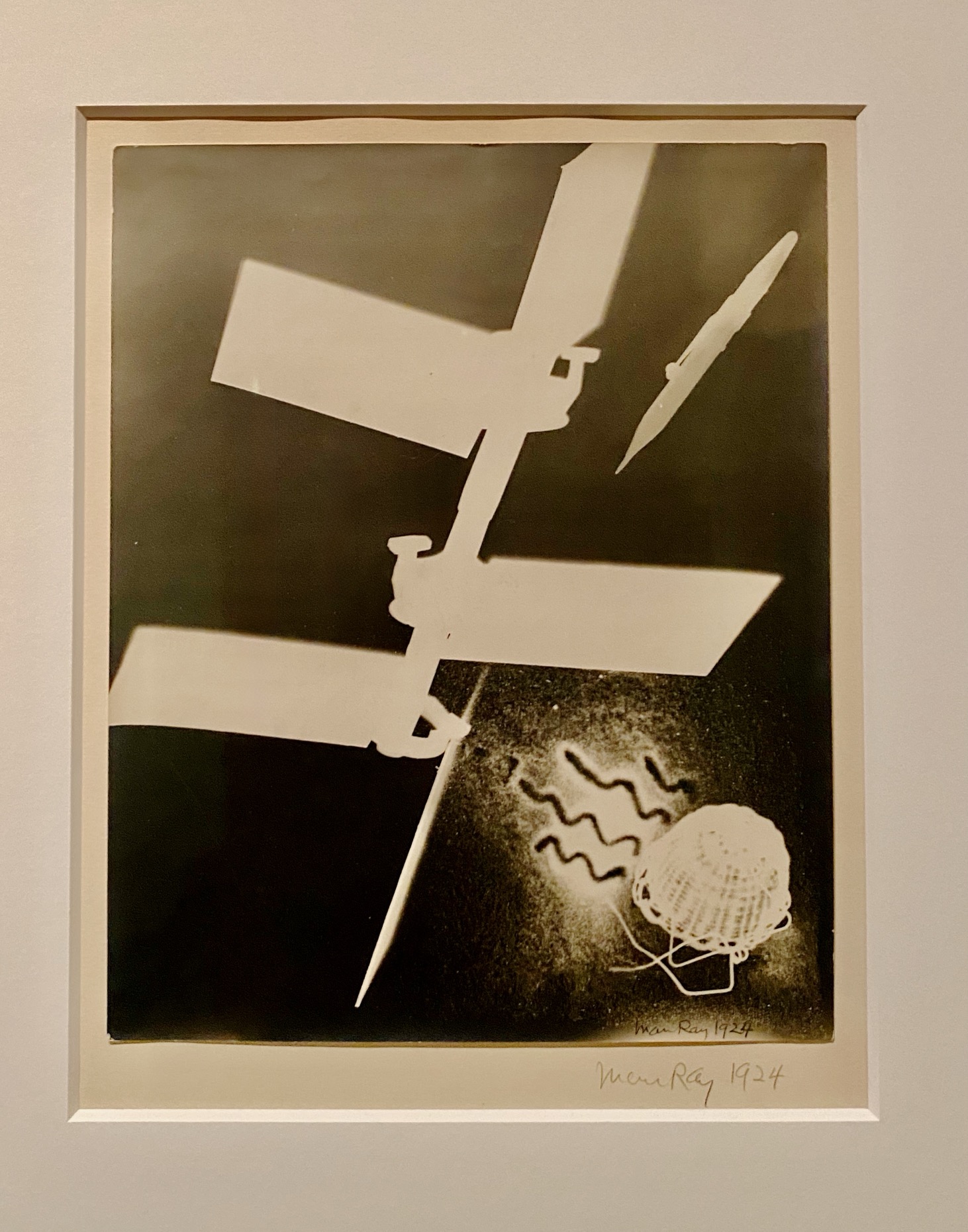
Man Ray’s 1924 gelatin silver print “Rayograph.”  Courtesy: Whitney Museum of American Art.
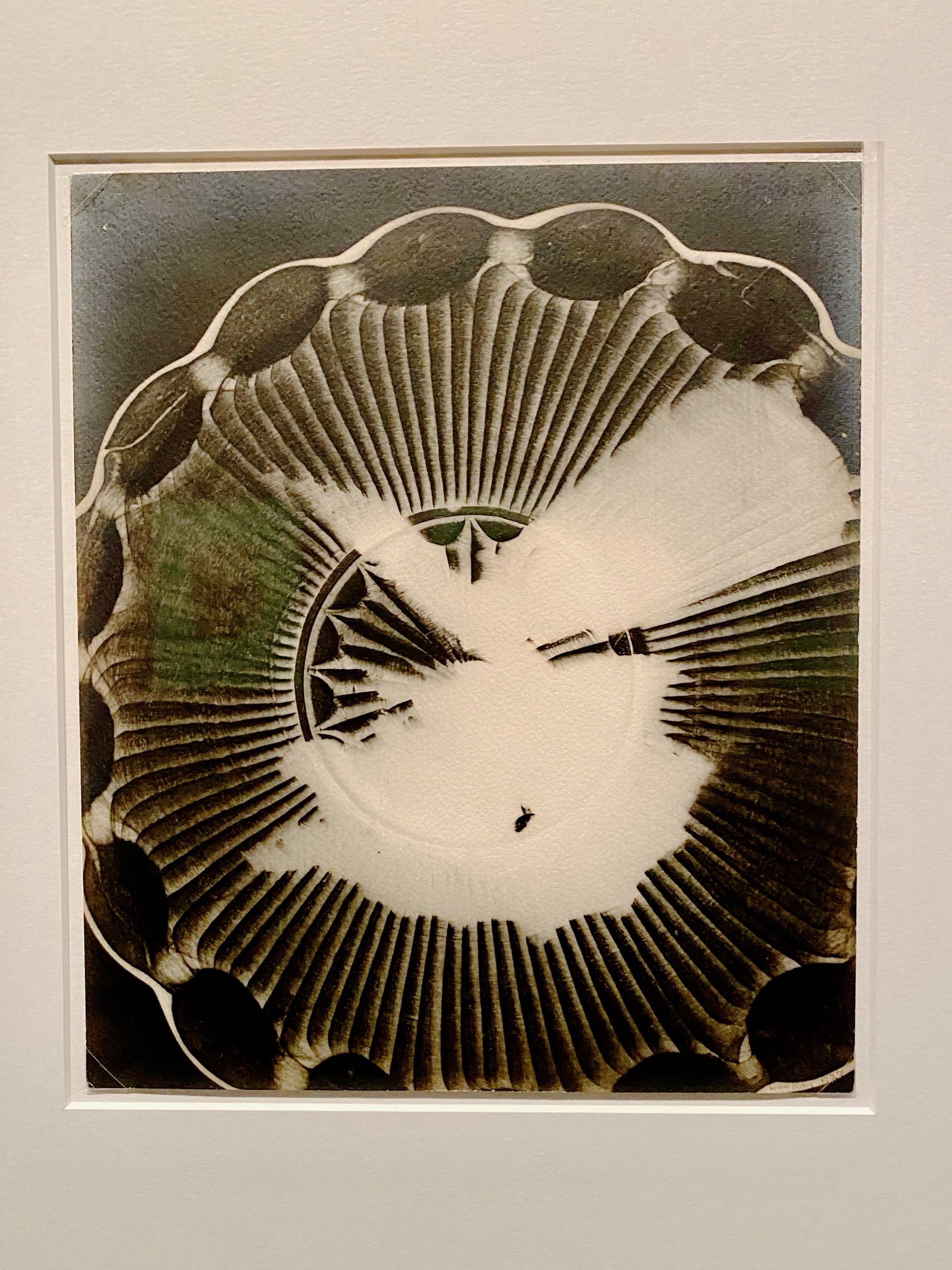
Man Ray’s 1927 gelatin silver print Rayograph – an experimental exploration of printing his images on textured paper.  Courtesy: private collection.

His unusual, dream-like images were eagerly applauded by the inner circle of European poets and artists who would soon be the official founders of Surrealism. They were intrigued by dreams, psychoanalysis, inner worlds, and startling juxtapositions. In fact, the title of the Met’s show comes a phrase written by Man Ray’s fan, poet Tristan Tzara – “when objects dream” refers to Man Ray’s mesmerizing work.

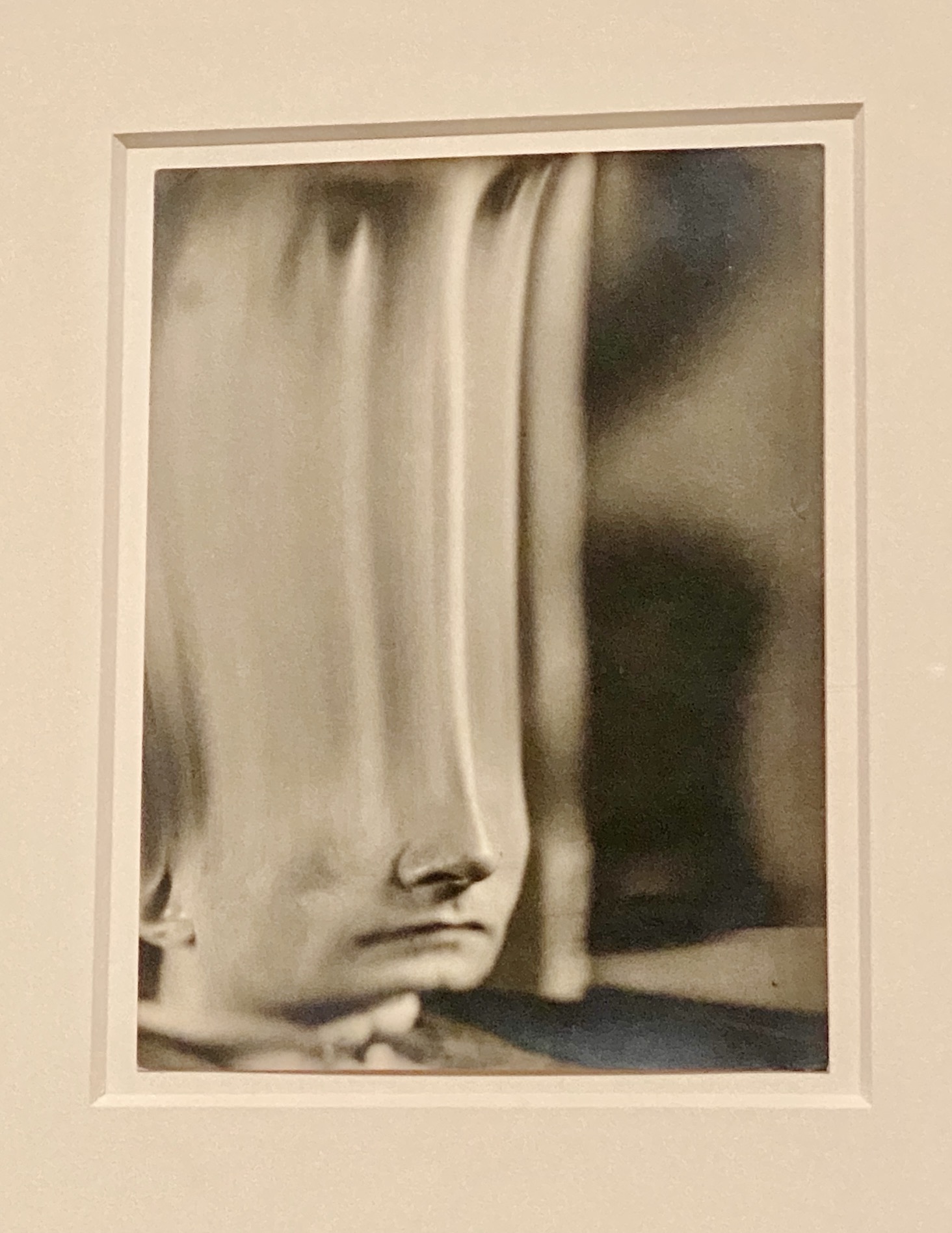
Man Ray’s ability to make magic with the camera – distorted images, adding surprising symbols, and creating tableaux of otherworldly floating objects – only added to the  enthusiasm for his work.

Man Ray’s 1925-1928 gelatin silver print Marcel Duchamp. Courtesy: private collection.
Man Ray’s 1924 gelatin silver print Le Violon d’Ingres featuring performer Kiki de Montparnasse – published in the proto-Surrealist journal Littérature.

The exhibition concludes with Man Ray’s beautiful solarized prints (a technique co-invented with model/photographer Lee Miller), symbolic paintings, and photographs that have become icons of Surrealism.

Hear the curators talk about the exhibition as they walk through this beautiful, inspiring show:

Take a look through all of the artwork in the exhibition here on the Met’s website. For more on Man Ray’s life and collaborations, listen to a longer Met telecast about his 1920s work with Lee Miller, Kiki de Montparnasse, and Berenice Abbott here.

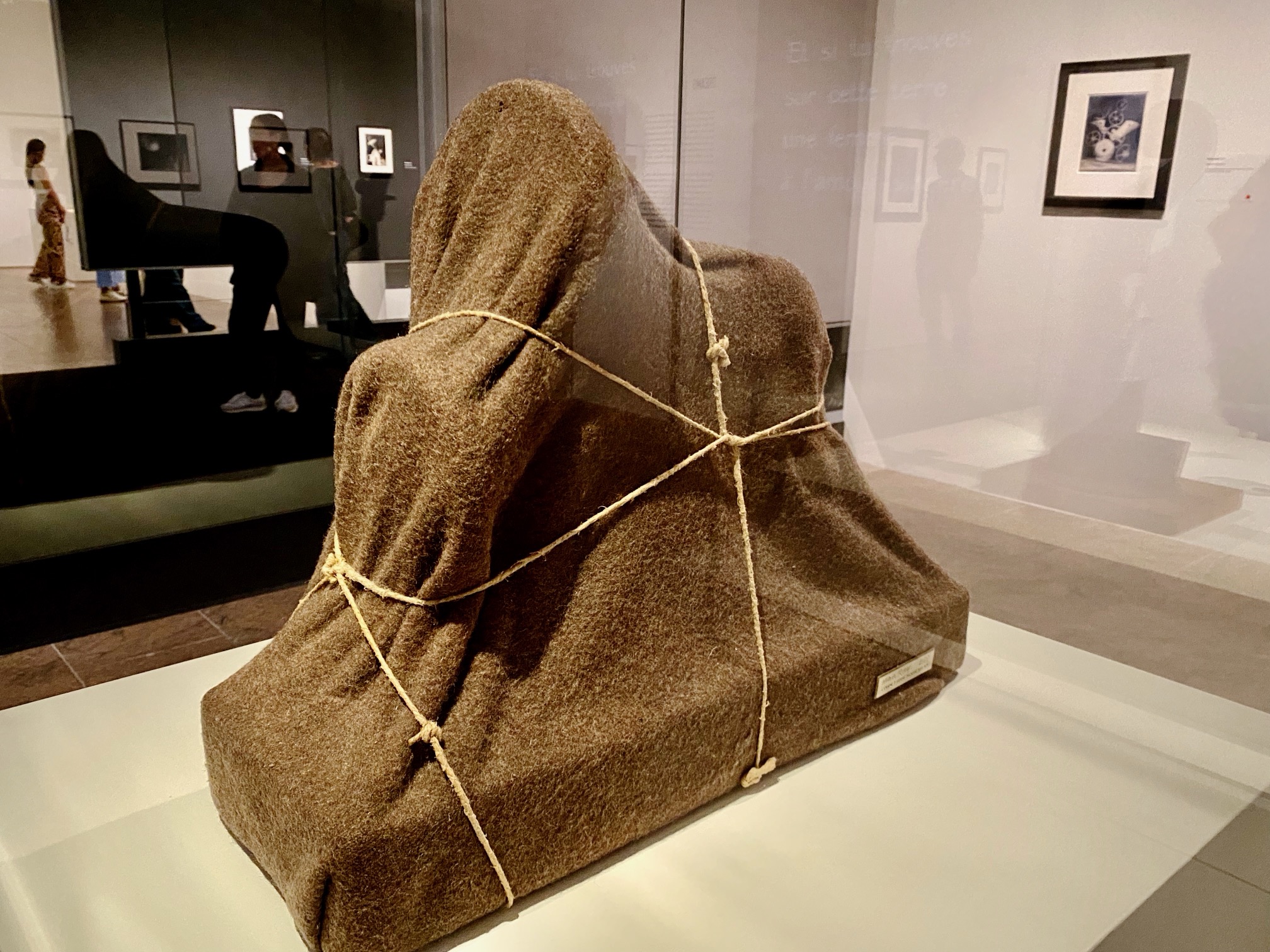
Man Ray’s 1920 sculpture L’enigme d’Isidore Ducasse (The Enigma of Isidore Ducasse) a mysterious wood, iron, wool, and rope assemblage to stir the subconscious (1971 edition). Courtesy: private collection.

Sixties Surreal at The Whitney

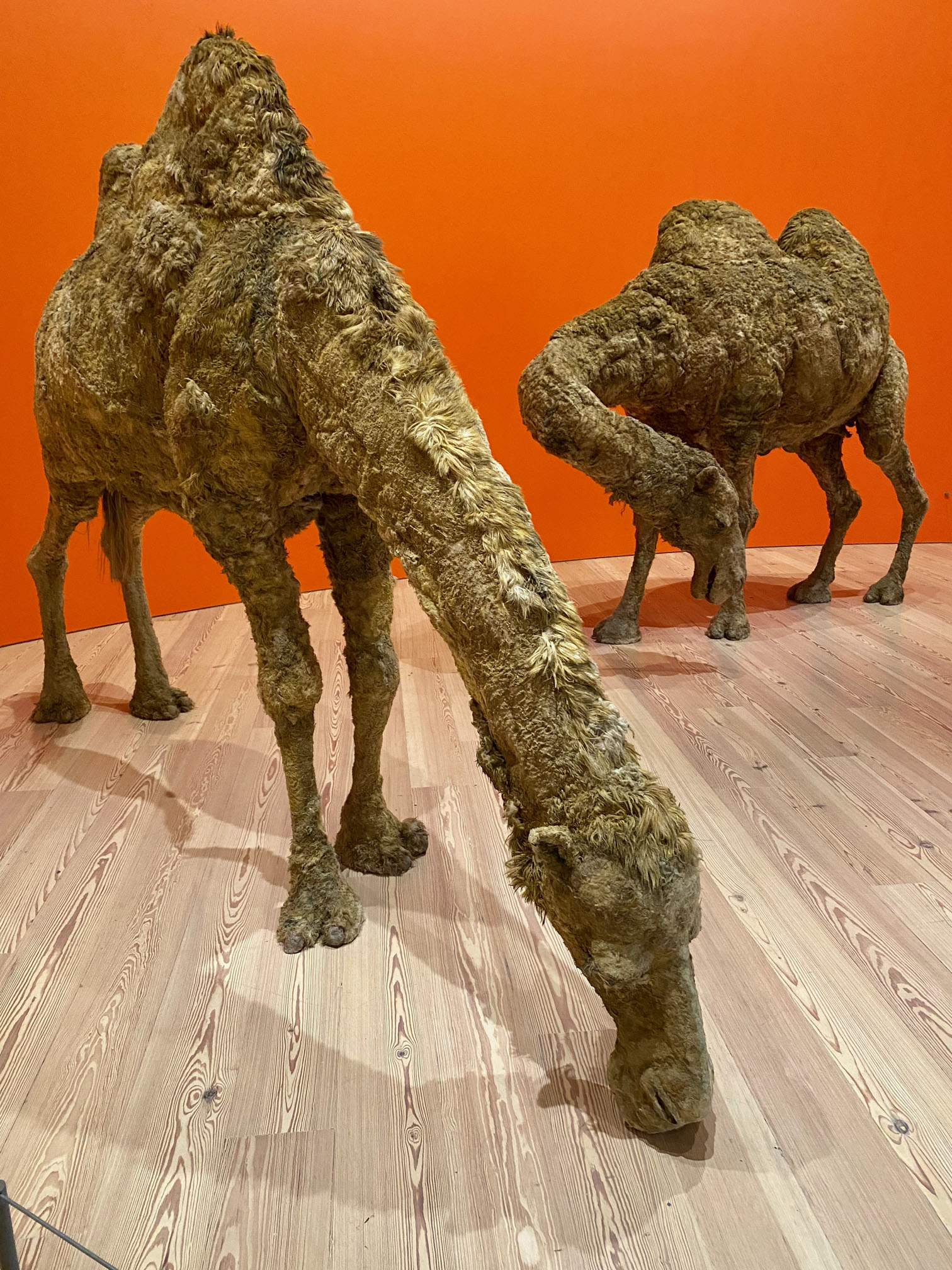
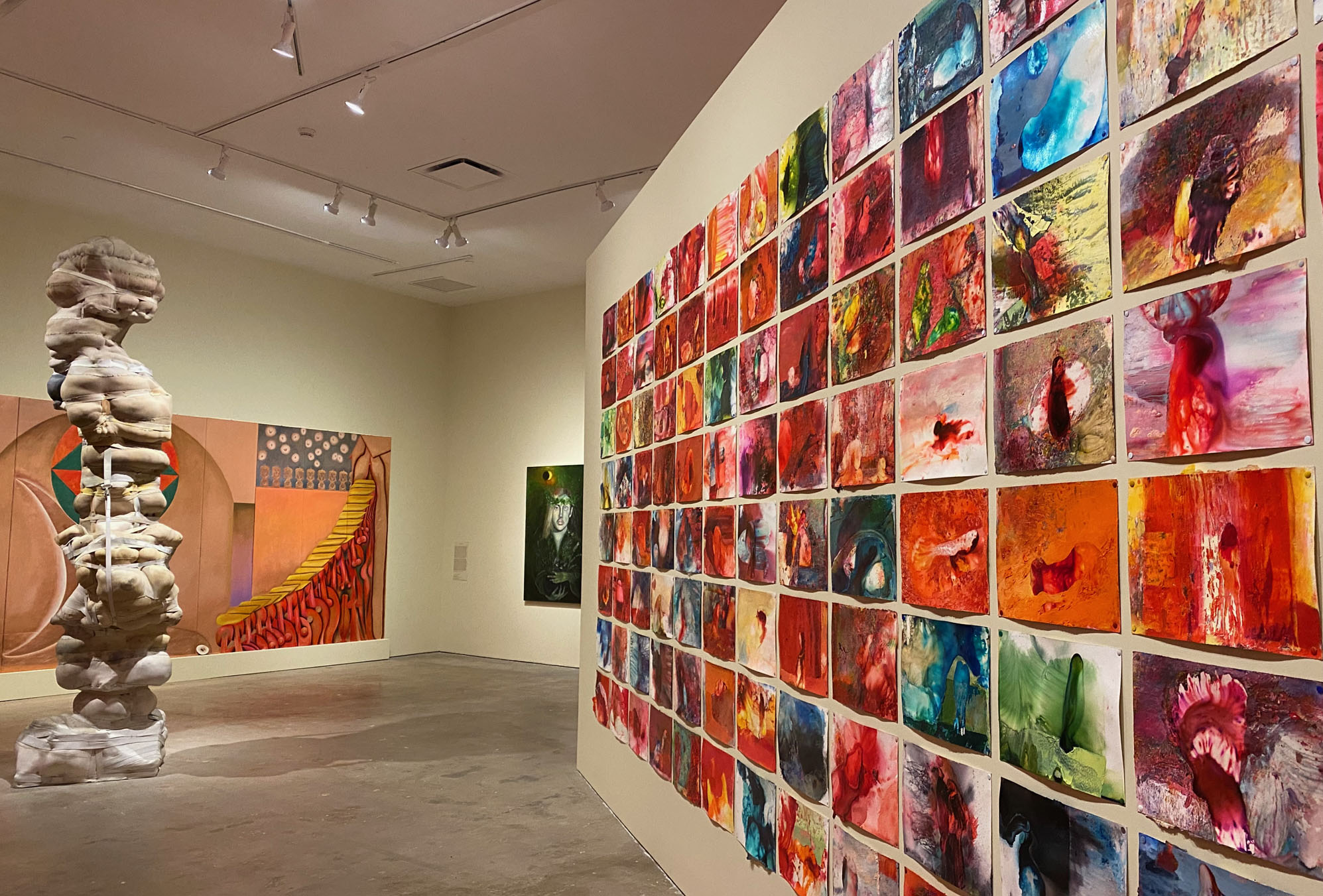
After more than 55 years, the camel herd is back at the Whitney. When they first appeared in 1969, the dromedaries were a media sensation. Who could resist the delight of seeing the life-sized camel sculptures by 28-year-old science nerd Nancy Graves nonchalantly going about their business in the pristine, white Breuer building?

At the new Whitney, the camels are welcoming everyone to Sixties Surreal – a superb exhibition (on view through January 19, 2026) that pulls out an array of engaging, cheeky work from that tumultuous decade. The show presents work by over 100 artists who chose to remain on the fringes of the big-time art world, creating pieces that poke at the Establishment, consumer culture, and social norms.

Strange, surrealistic 1968-1969 mixed-media, life-sized Camel sculptures by Nancy Graves; initially shown in her solo 1969 Whitney show. Courtesy: National Gallery of Canada, Ottawa.

The Whitney makes the case that American artists of the Sixties were not echoing the themes of European Surrealism (dreams, subconscious desires); but they did adapt a few of that group’s visual techniques to reflect and critique what was happening in America in off-center, slightly surreal ways.

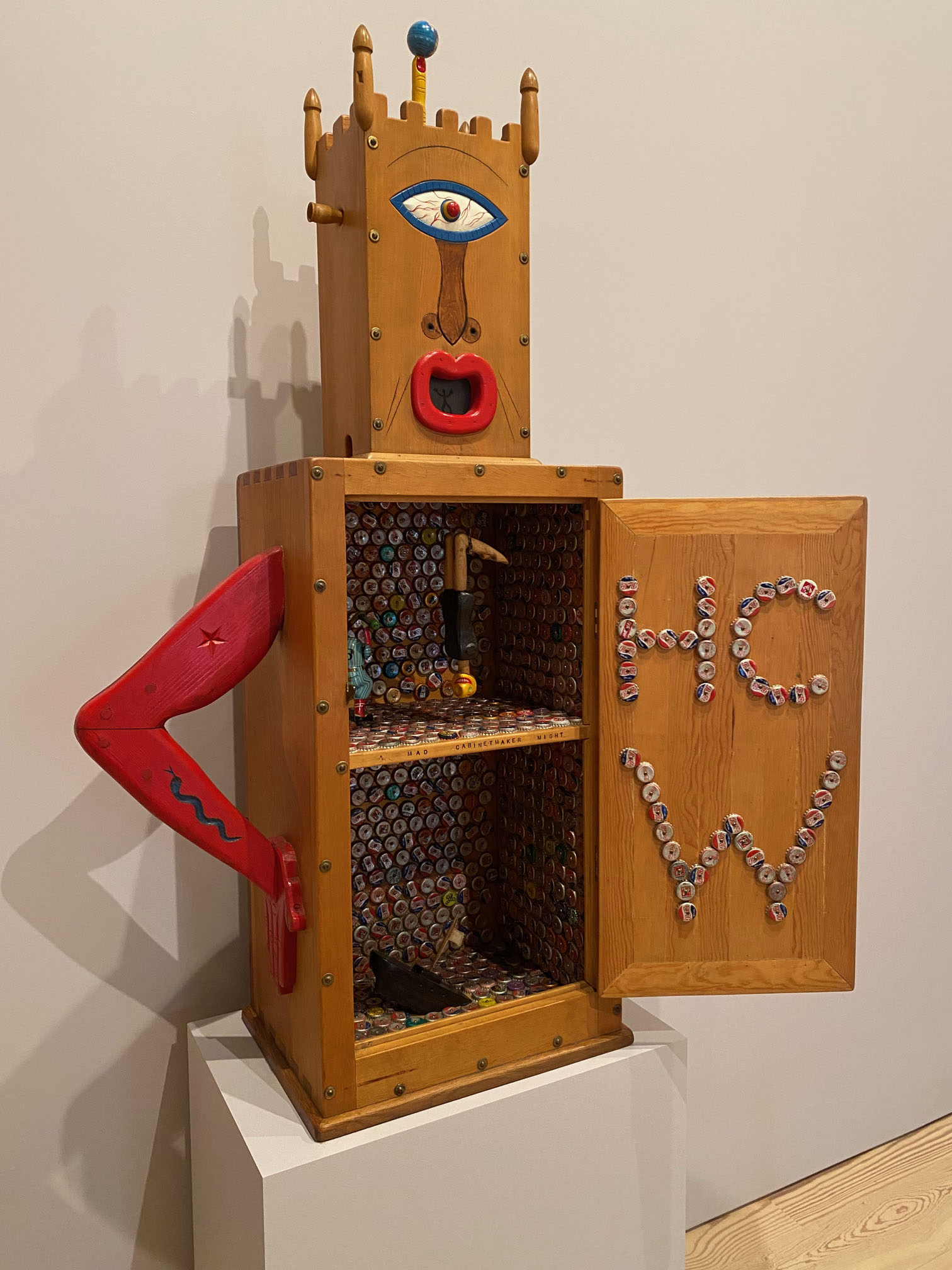
H.C. Westerman’s 1958 Memorial to the Idea of Man If He Was an Idea – a finely crafted “person” with an extremely complicated interior of bottle caps, toys, glass, metal, etc. Courtesy: Museum of Contemporary Art Chicago.
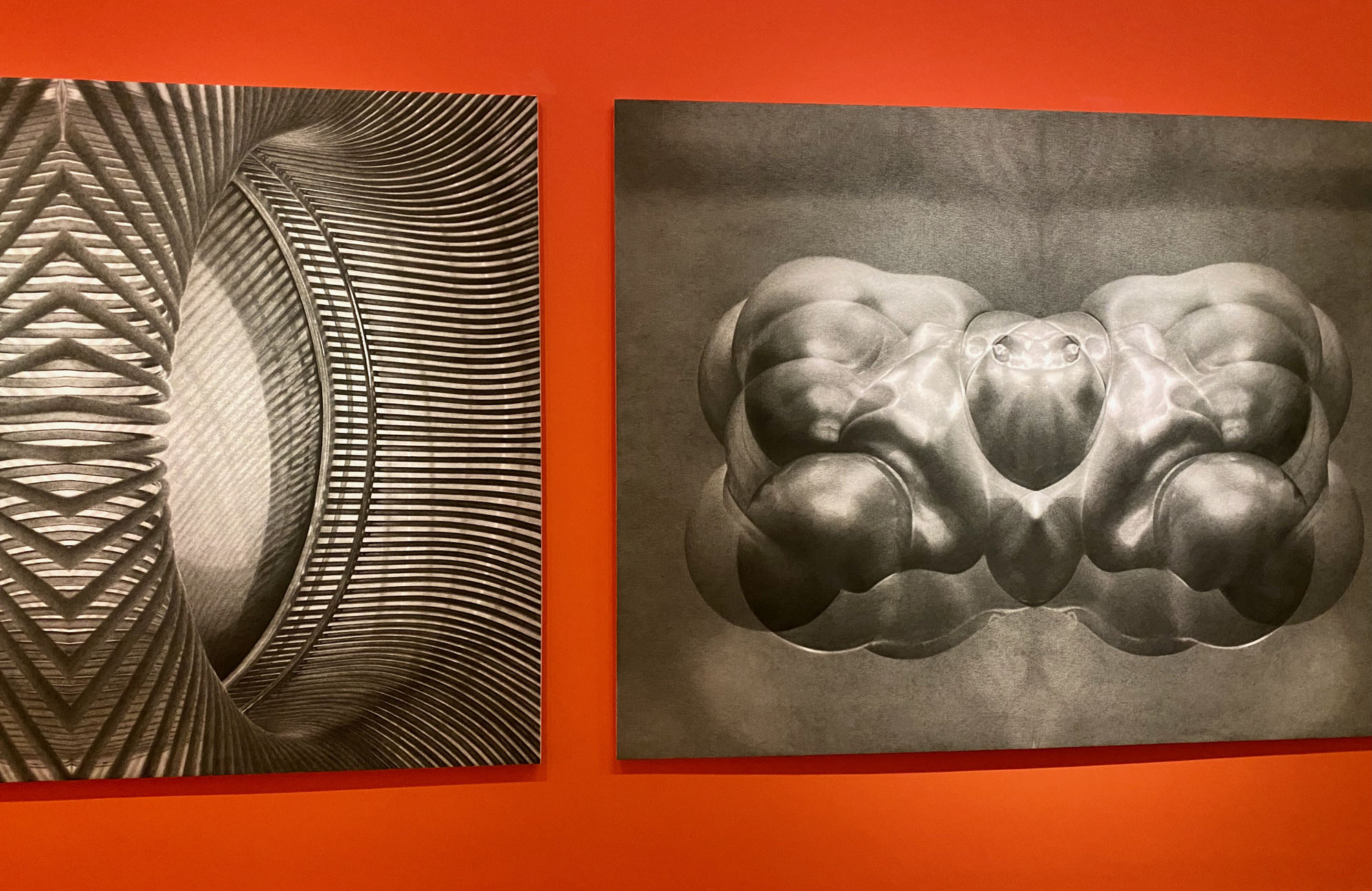
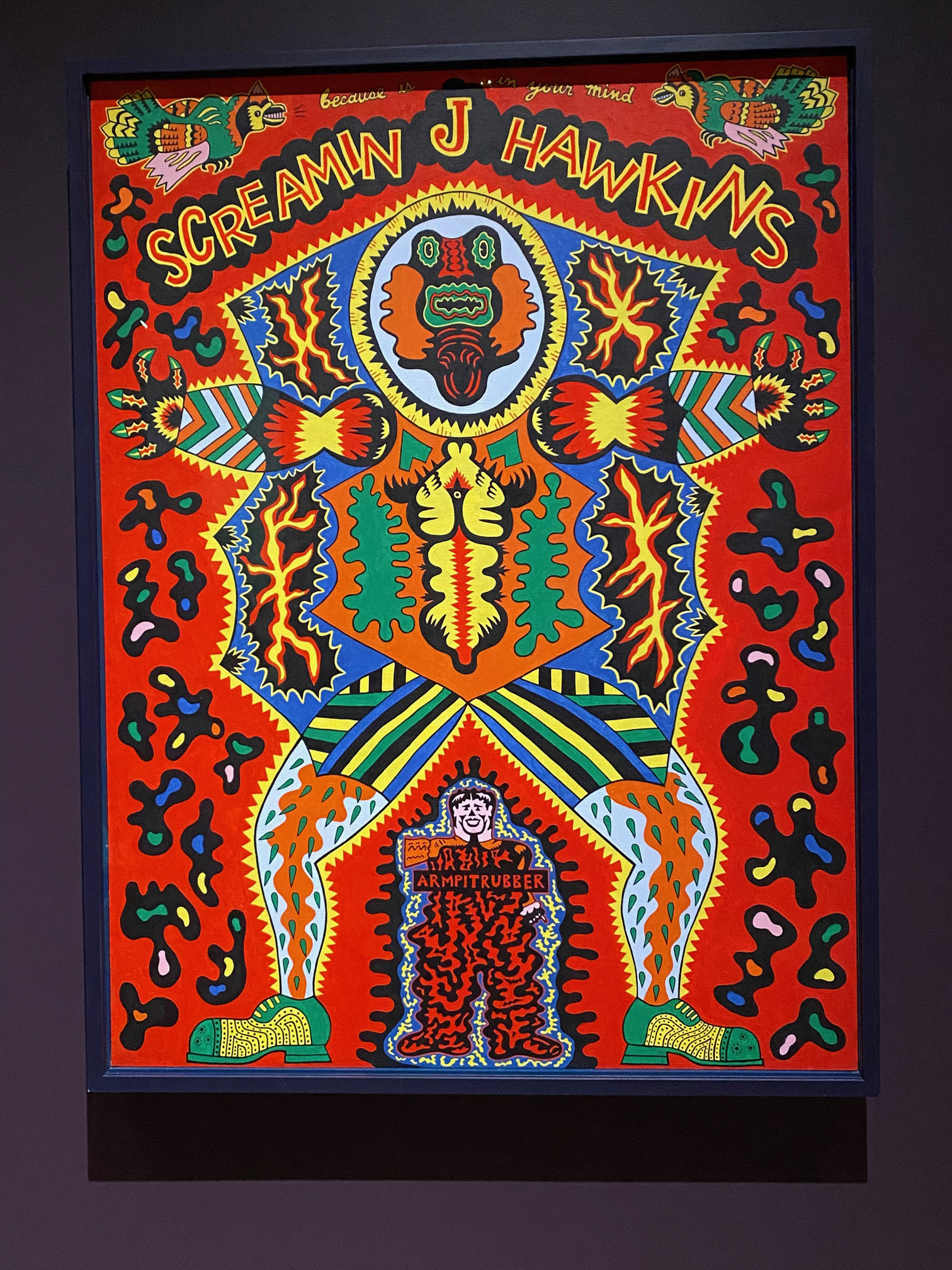
Karl Wirsum’s 1968 acrylic Screamin’ Jay Hawkins – a surreal, high-octane album cover painting for an early-rock icon. Courtesy: Art Institute of Chicago.

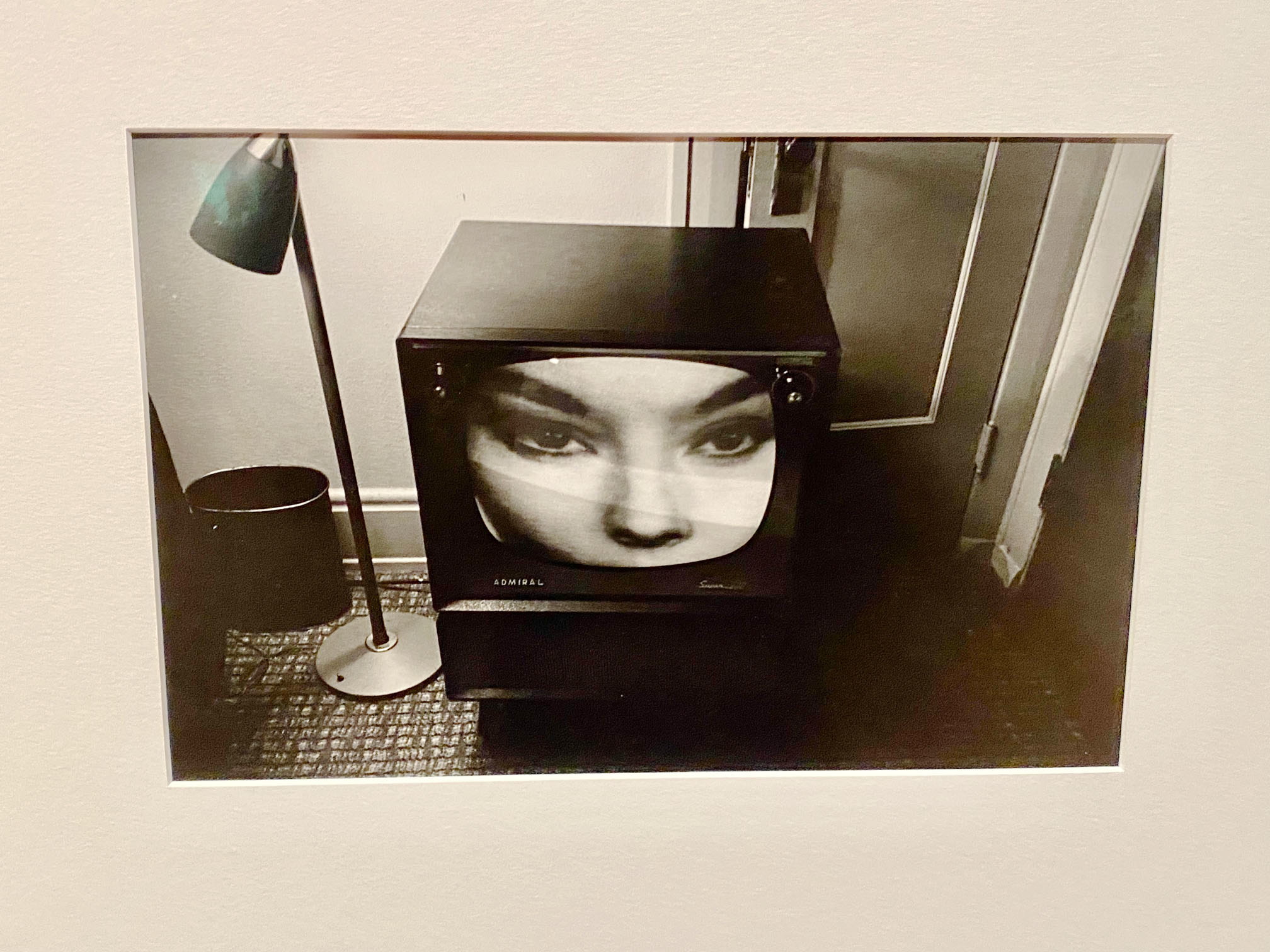
The Sixties was a decade when cultures were clashing, TVs were showering a kaleidoscope of images into people’s living rooms, nuclear catastrophes loomed, and people were landing on the Moon.

Lee Friedlander’s 1963 photograph Florida showing the surrealistic, disorienting impact of TVs in every home. Courtesy: Museum of Modern Art.

The exhibition shows how artists who didn’t belong to trendy “isms” still managed to create work that has stood the test of time – the Hairy Who of Chicago, the funk-and-pun artists of California, the downtown post-minimalists of New York, emerging Native American modernists, and social-justice artist-advocates.

Take a look at some of our favorites in our Flickr album.

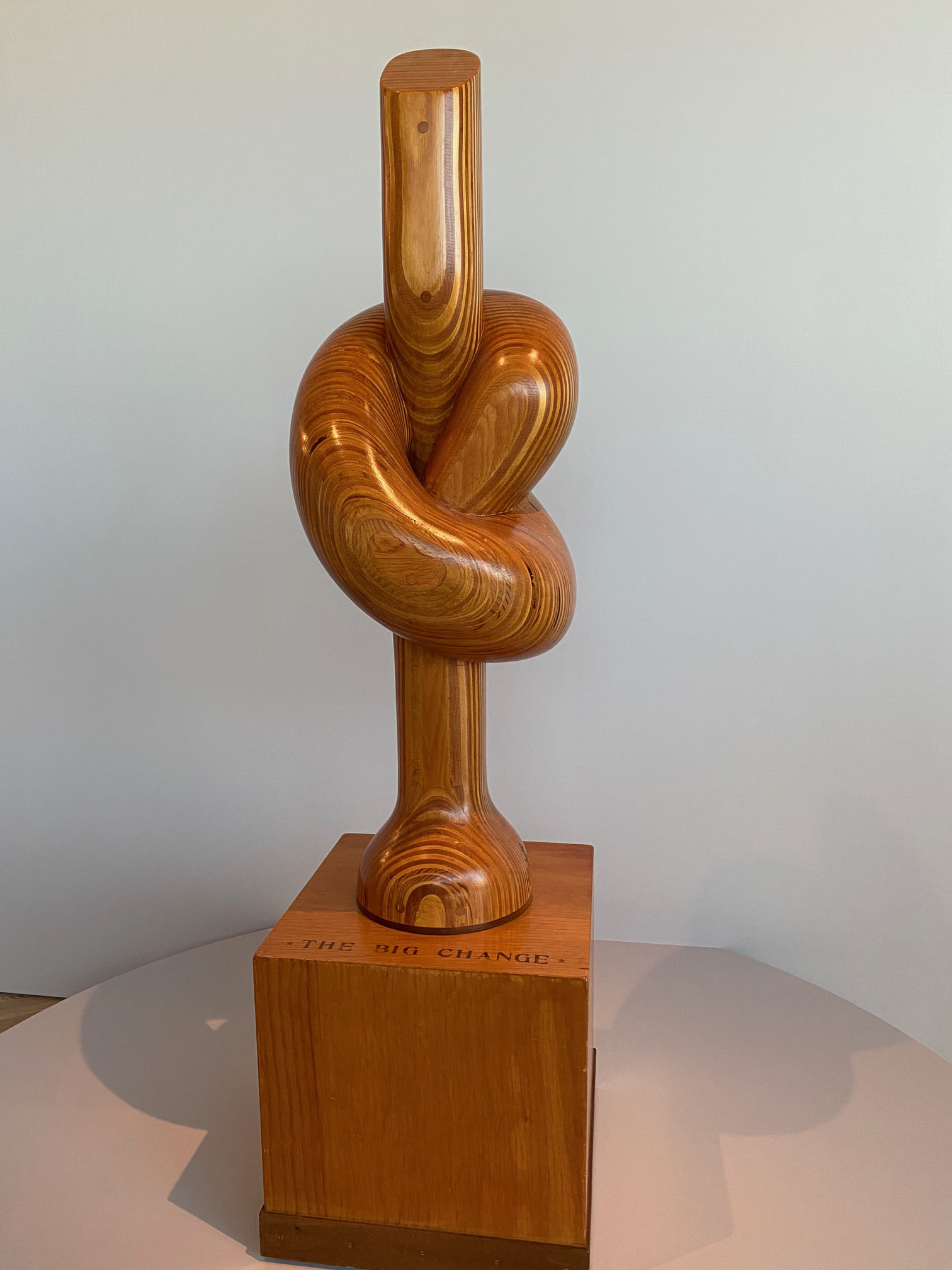
H.C. Westerman’s 1963 impossible wooden “knot” sculpture The Big Change – an allusion to all the social-political changes happening in America. Courtesy: The Art Institute of Chicago.

At a time when hard-edged minimalism and Pop Art ruled, the curators want us to see and experience (again) artists whose work was featured key exhibition showcases like Lucy Lippard’s 1966 Eccentric Abstration show at Fischbach Gallery in New York and Peter Selz’s 1967 Funk show at the Berkeley Art Museum. Each were full of work that defied contemporary art-world conventions.

The Whitney’s chosen to showcase several pieces of one of the artistic godfathers of the funk movement – H.C. Westerman. His satiric “minimalistic” shag carpet sculpture sits next to a William T. Wiley painting, but it’s wonderful to contemplate two virtuoso carved pieces  – The Big Change and Memorial to the Idea of Man If He Was an Idea.

The first gallery presents disquieting creations that present strange, out-of-context juxtapositions, weird images, and out-of-proportion everyday objects that seem to reflect the feeling that we’re living in an off-kilter world.  A large Rosenquist hovers over the gallery, but its muted tones and dissonant images evoke a far different mood than his famous, epic, over-the-top F-111.

Alex Hay’s 1968 strange, oversized painted fiberglass and epoxy Paper Bag sculpture. At rear, James Rosenquist’s 1961 oil The Light That Won’t Fail I, full of unsettling juxtapositions.
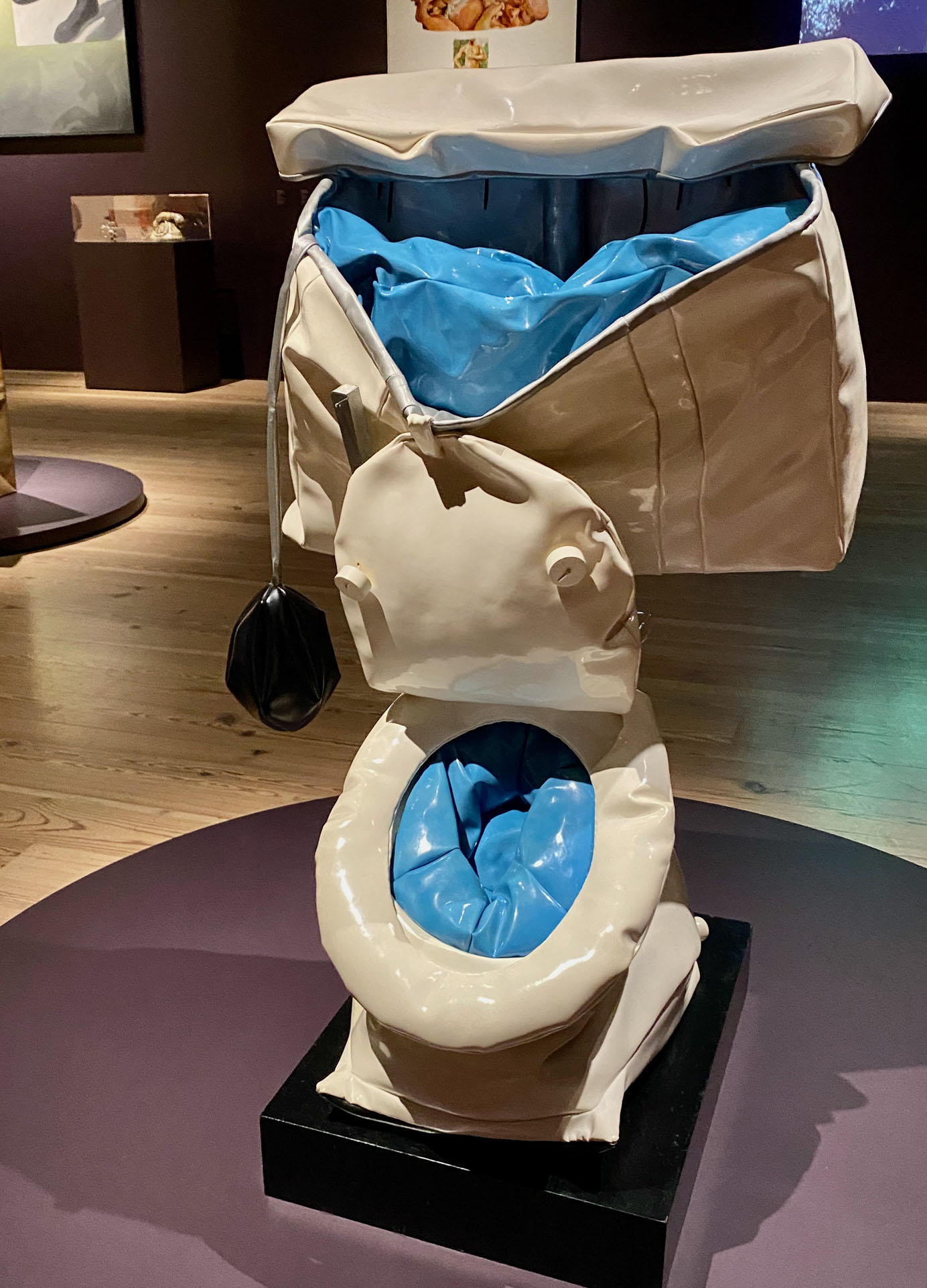
Claes Oldenburg’s 1966 mixed-media Soft Toilet – an unsettling, oversized fixture from the American bathroom.

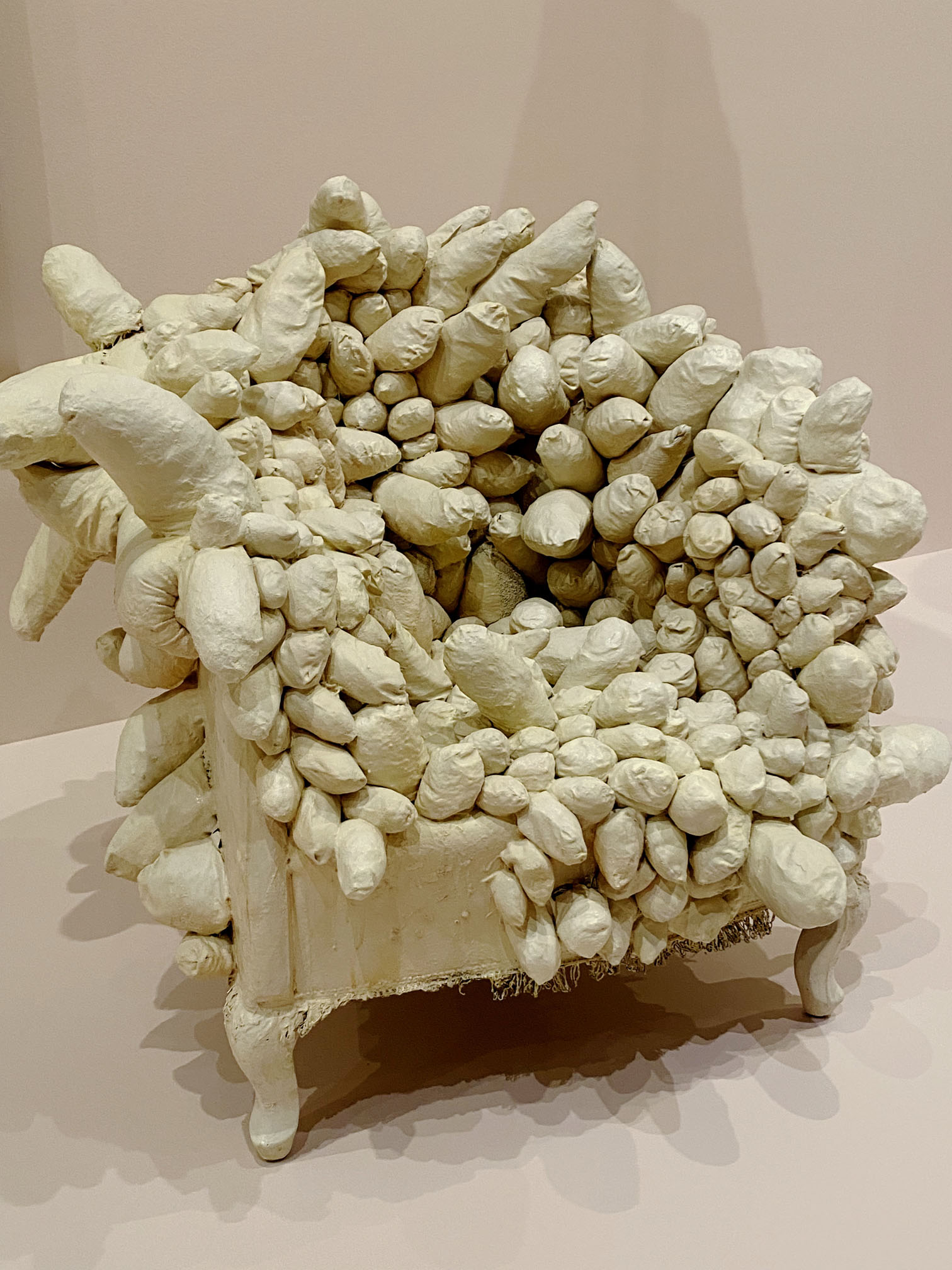
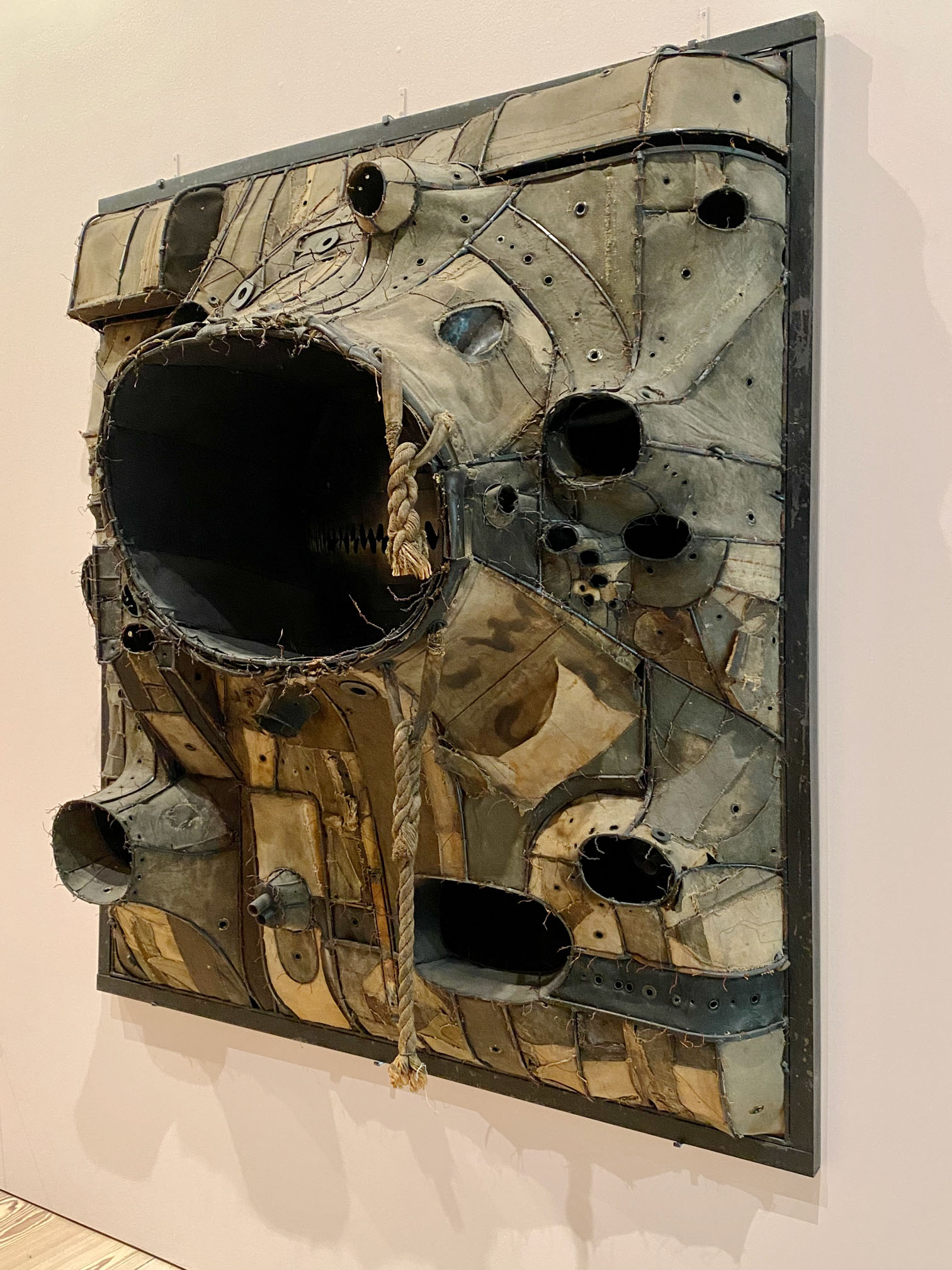
Another section presents work – many from repurposed or recycled material – with sensuous forms that suggest – but not directly depict – the human body. It’s nice to see such an array of soft, draped, and biomorphic work by artists like Kusama, Eva Hesse, Kay Segimachi, and nearly forgotten Miyoko Ito.

Kusama’s 1963 provocative hand-sewn, soft fabric-chair sculpture, Accumulation, which caused a sensation among New York critics.
 Lee Bonticou’s 1961 welded, stitched canvas abstraction, created from scavenged steel, weathered canvas, clamps, wire, and rope from conveyor belts.

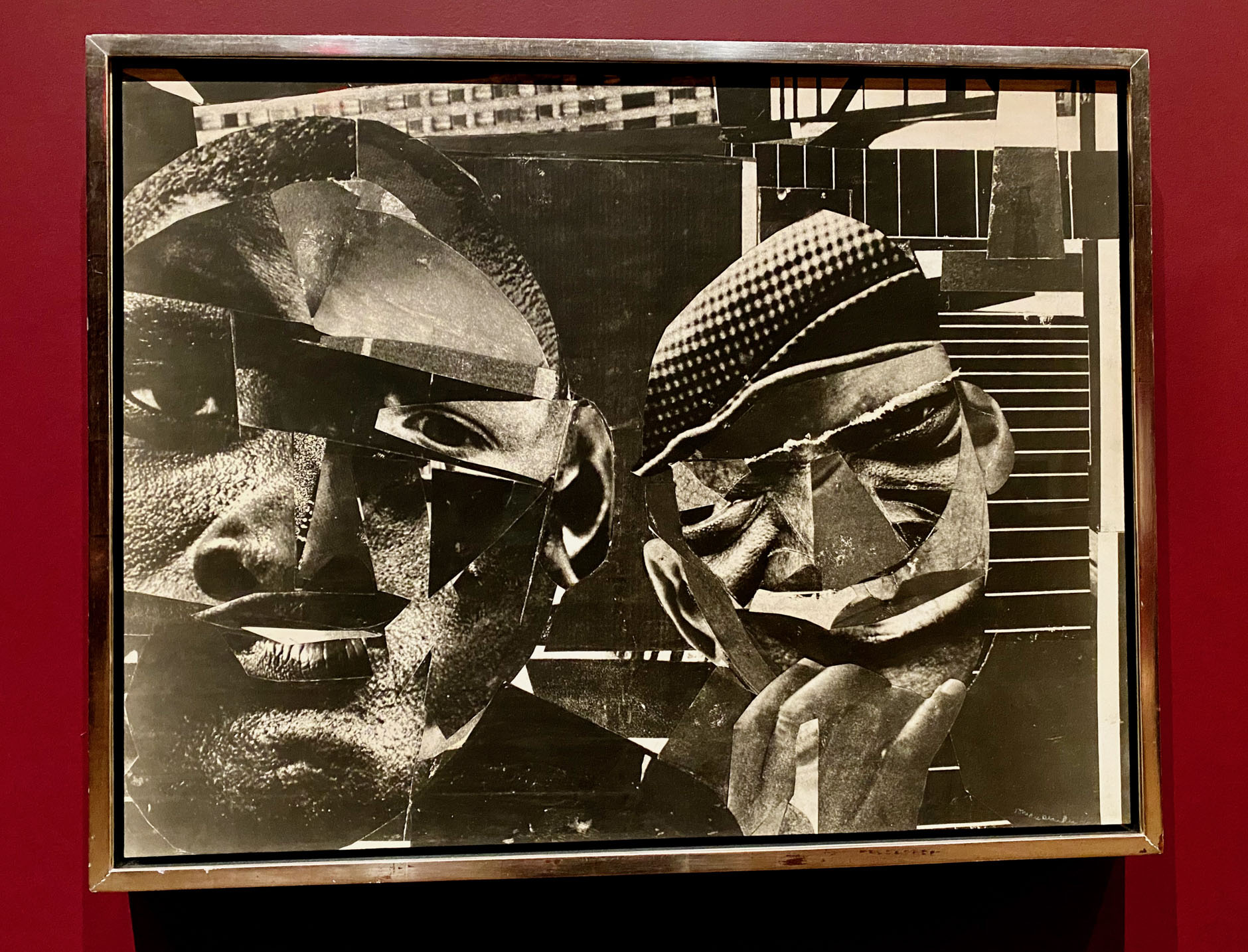
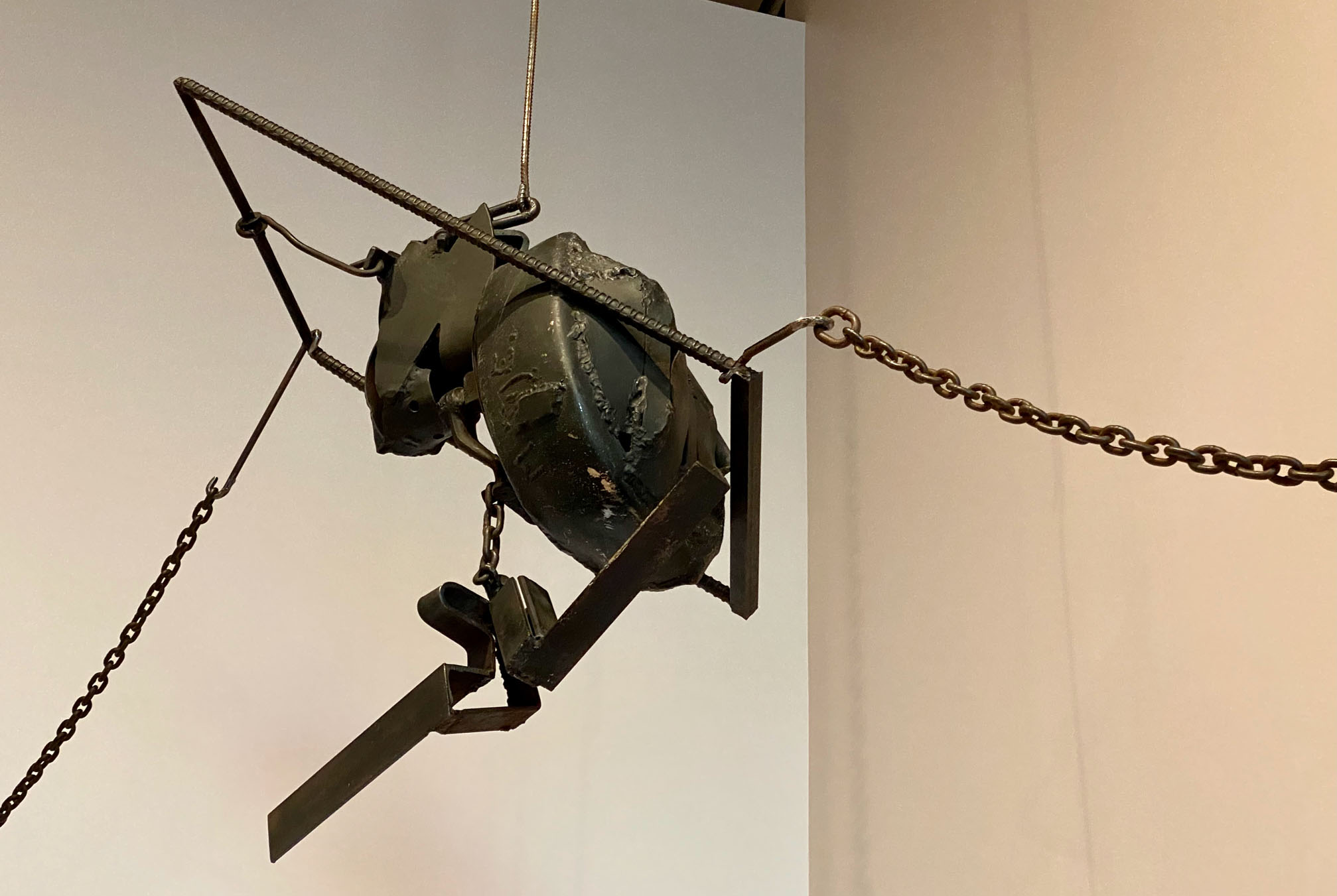
The far end of the exhibition presents works that take a stand to push for change in the world. Jasper Johns and Fritz Scholder let their paint do the talking. But others use a dada tactic to get the point across – hard-edge collages and assemblages.

Social surreal: Romare Beardon’s 1964 Pittsburgh Memory 2/6 – mounted collage of photograph fragments creating the surreal experience of being Black in a big America city. Courtesy: private collection.

Works by Romare Beardon, John Outterbridge, Ralph Arnold, and Melvin Edwards create surreal dissonance that still packs a punch decades later.

1966 Cotton Hangup by Melvin Edwards – suspended abstraction from recycled industrial equipment; evokes historic violence and oppression against African Americans. Courtesy: Studio Museum in Harlem

The show concludes with a selection of works by artists reflecting alternative spiritual practices and beliefs. At a time when organized institutions and religions were being questioned, why not turn inward?

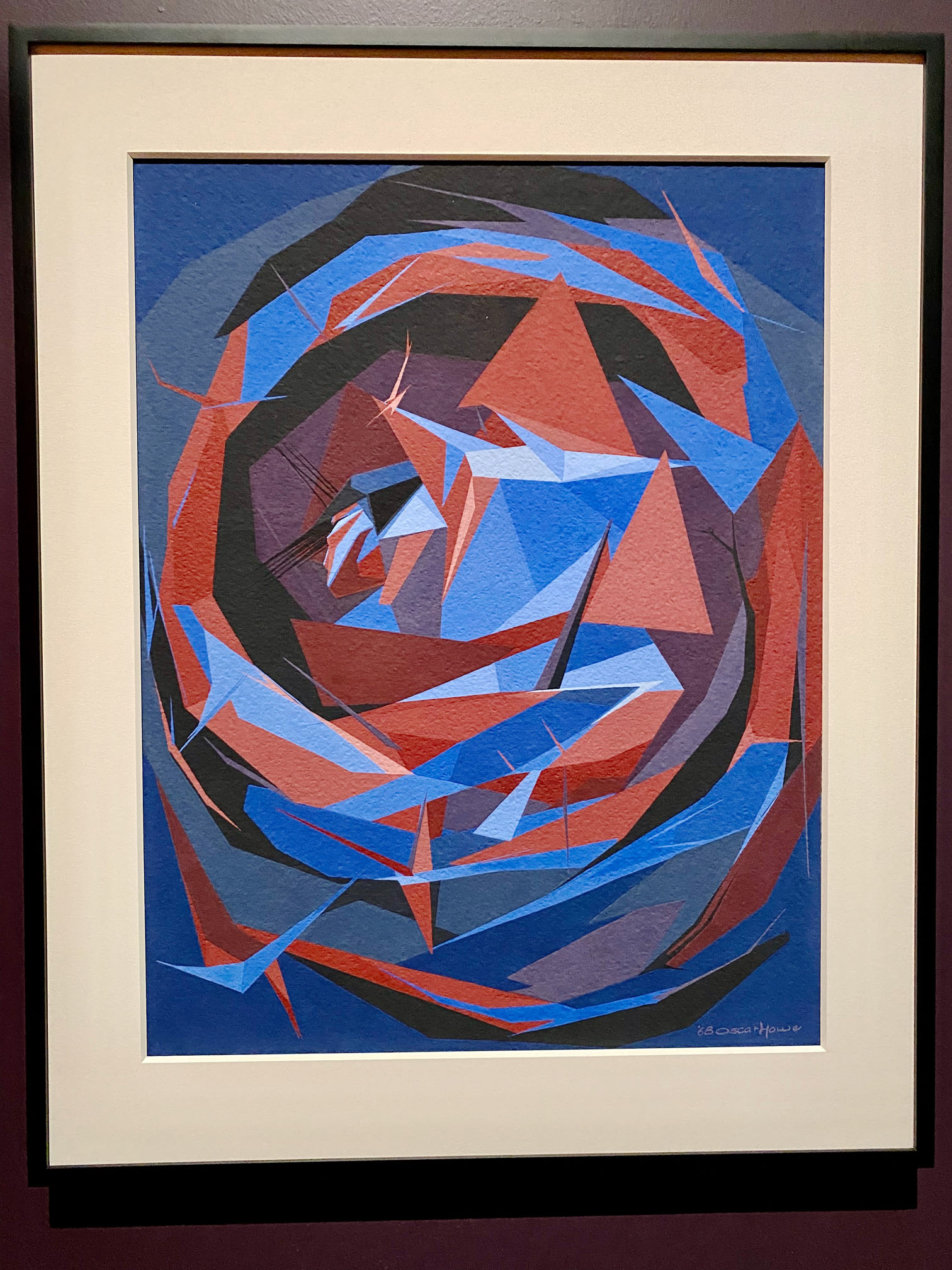
Oscar Howe’s 1968 painting Retreat – an Indigenous-modernist impression of a traditional Dakota ceremony.
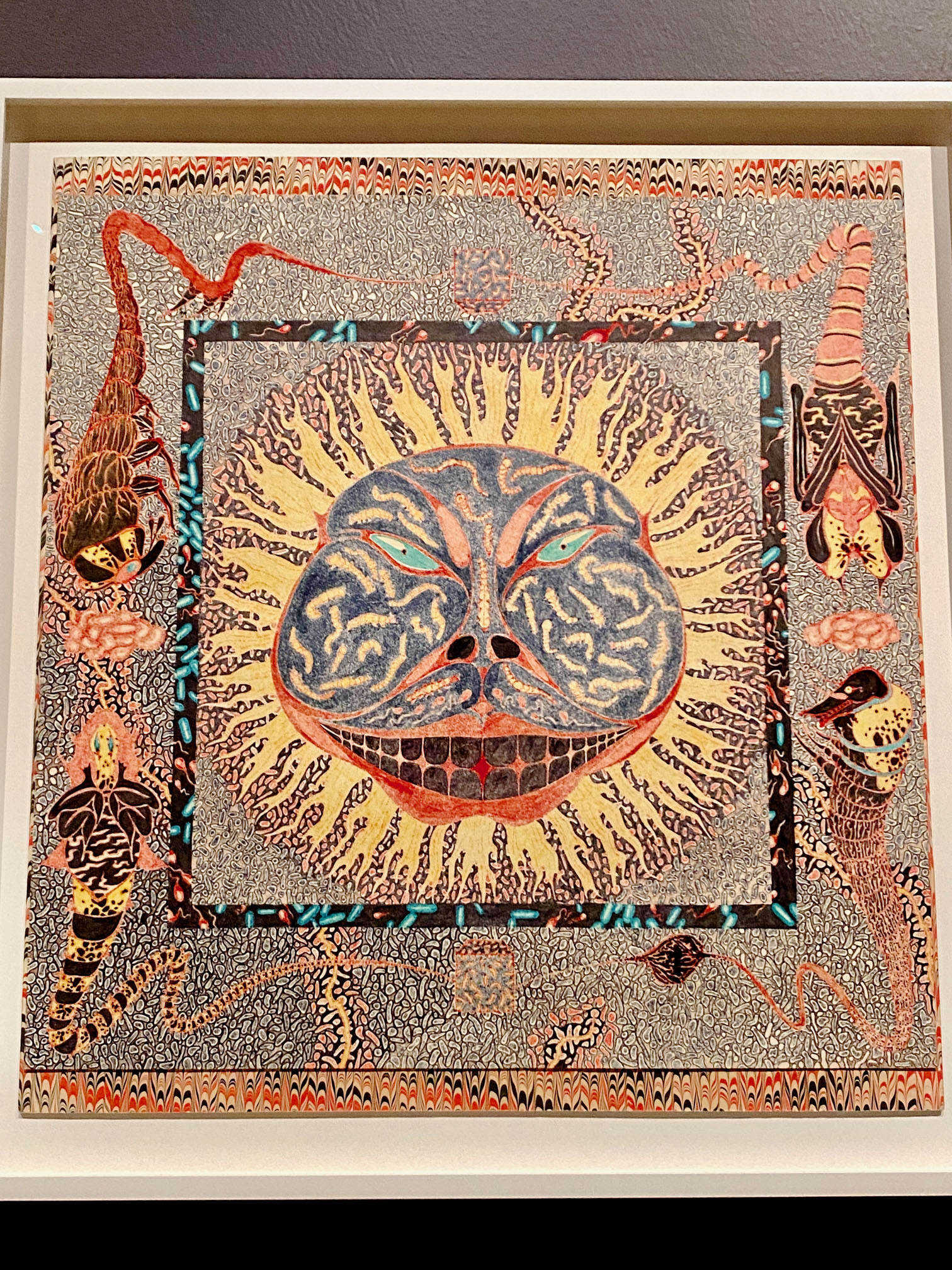
Ching Ho Cheng’s 1967 Sun Drawing, a meditative approach using a felt-tipped pen on found paper.

Have fun strolling through the Whitney’s Sixties Surreal galleries to a totally throwback Sixties soundtrack:

To hear more about specific works, listen to the curators talk about individual works in the audio guide here.

Contemporary Art Extravaganza Provides Time-Travel Portals

The scale and scope of the contemporary art on display is tremendous, but how often do art-seekers also get an opportunity to travel across ancient streets and landscapes, to meet real and fictional historic characters, contemplate fables and real-life stories, and see art of the past and present side by side?

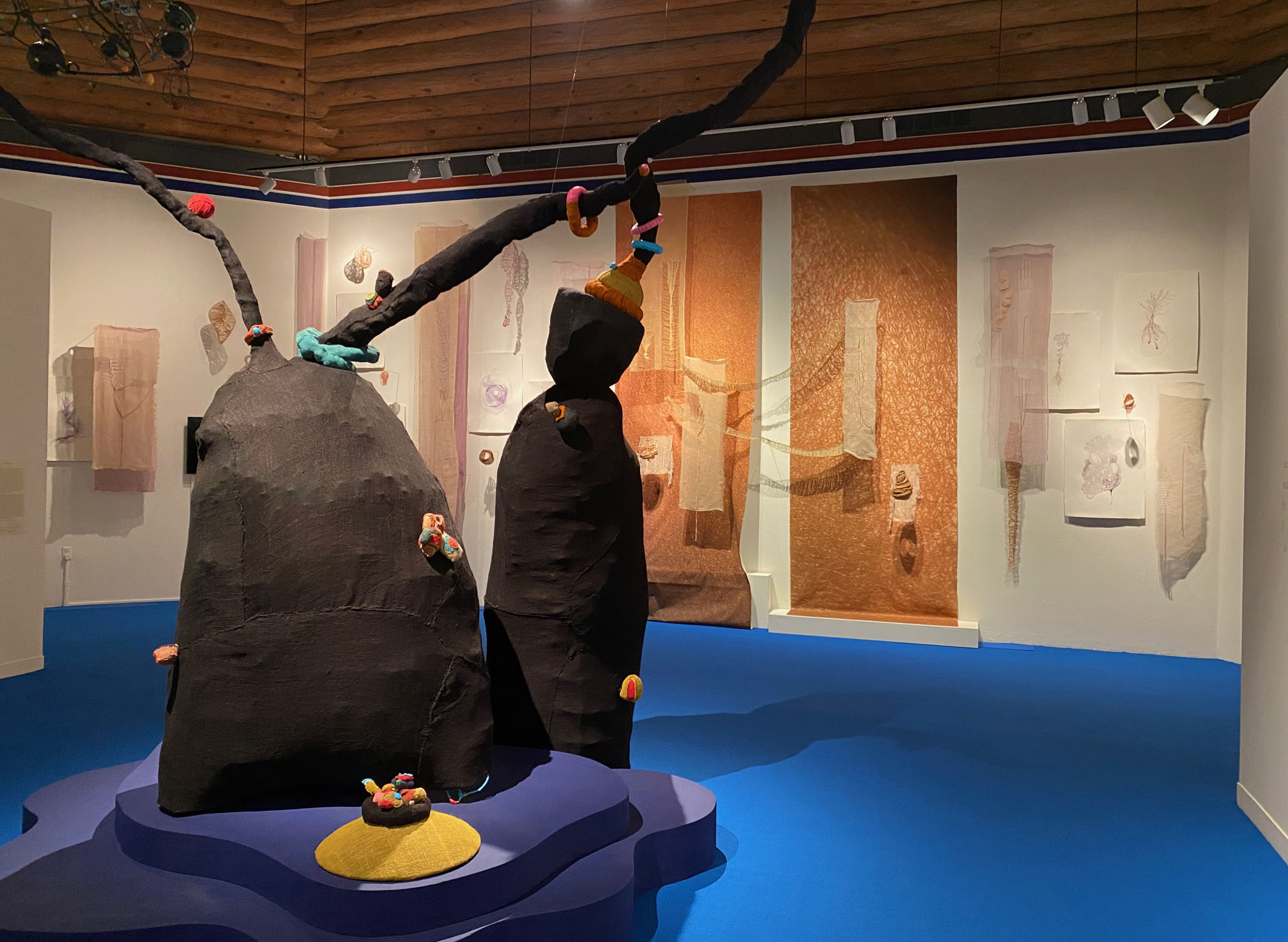
It can take days to experience and fully absorb all of the history and potential futues presented in the films, paintings, sculptures, and installations in Once Within a Time: 12th SITE Santa Fe International, on view across 15 art spaces across Santa Fe through January 12, 2026.

Exhibition banner in the courtyard of Palace of the Governors (1610) (New Mexico History Museum) – gateway to SITE installations by Daisy Quezada Ureña (Santa Fe) and Charisse Perlina Weston. (Harlem, New York)

Besides the expansive white galleries and screening rooms of SITE’s museum in Santa Fe’s always-popping Railyard District, visitors can choose to contemplate giant abstract murals in a church-like auditorium, an innovative historical-object installation in a 400-year-old seat of power, or enter an old foundry to see an evocative installation by a Silk Road artist across farm fields adjacent to the Old Spanish Trail.

SITE Santa Fe gallery theme: appears like real life and sensual free-thinkers. 2025 mixed-media sculpture “18-1-4-5-7-21-14-4” by Patricia Ayres; copper work by Santiago de Paoli; Katja Sieb’s 2025 “perpetual novice” painting; and 2020 grid painting “Atlas” by Penny Siopis (South Africa).
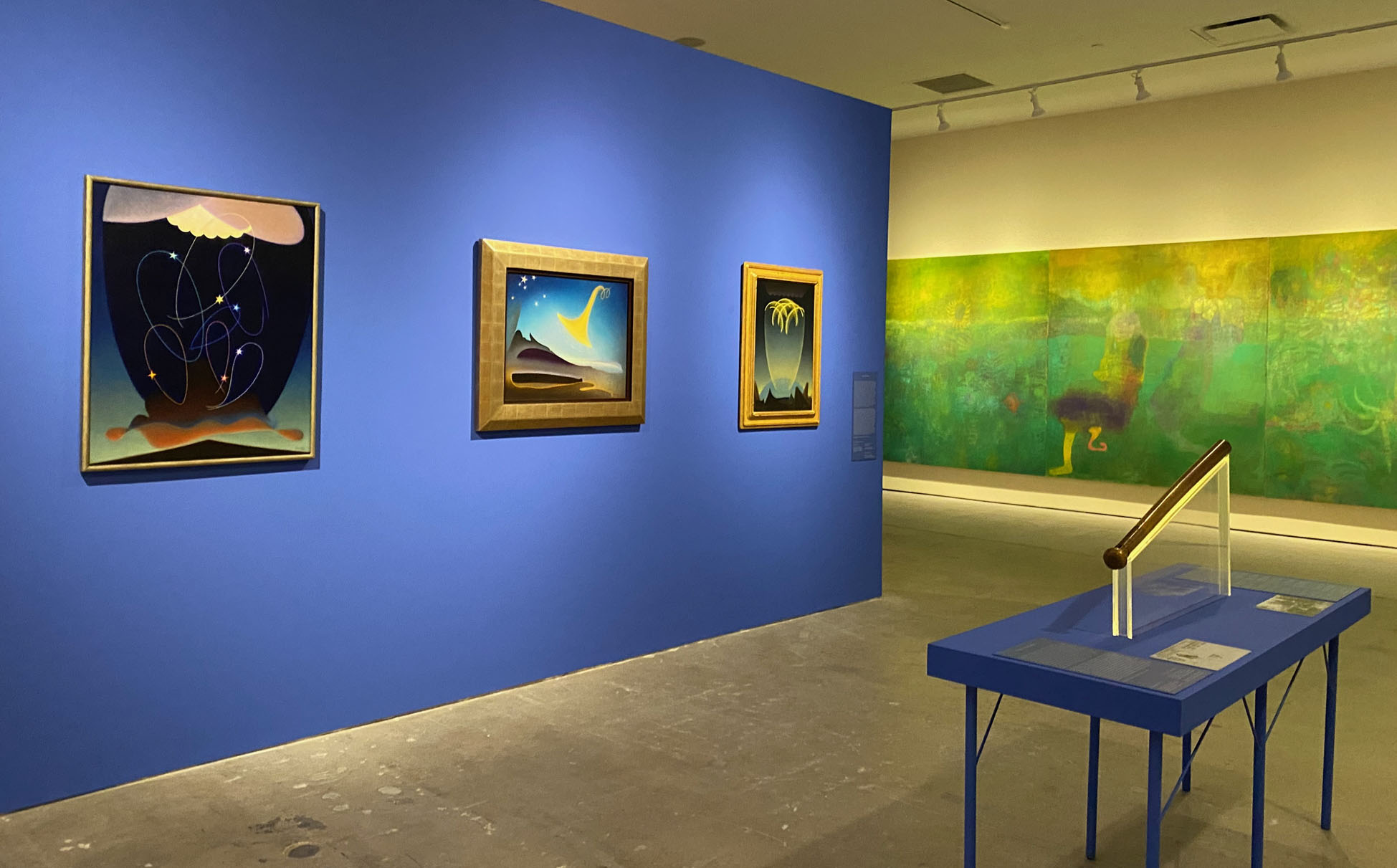
SITE Santa Fe gallery theme: in touch with light (spiritual) – Agnes Pelton’s paintings (1930s), Maja Ruznic’s mural (2025), and the 1895 healing rod of itinerant Southwestern mystic Francis Schlatter. Courtesy: Phoeix Art Museum; New Mexico Museum of Art; Oakland Museum of California; Maja Ruznic and Karma Gallery; and New Mexico History Museum.

In every space and art encounter, visitors may reflect upon whether history is repeating itself and whether inspiration can be drawn from futures that artists imagined nearly a century ago. Each space is designed for visitors to look, read, encounter, and reflect.

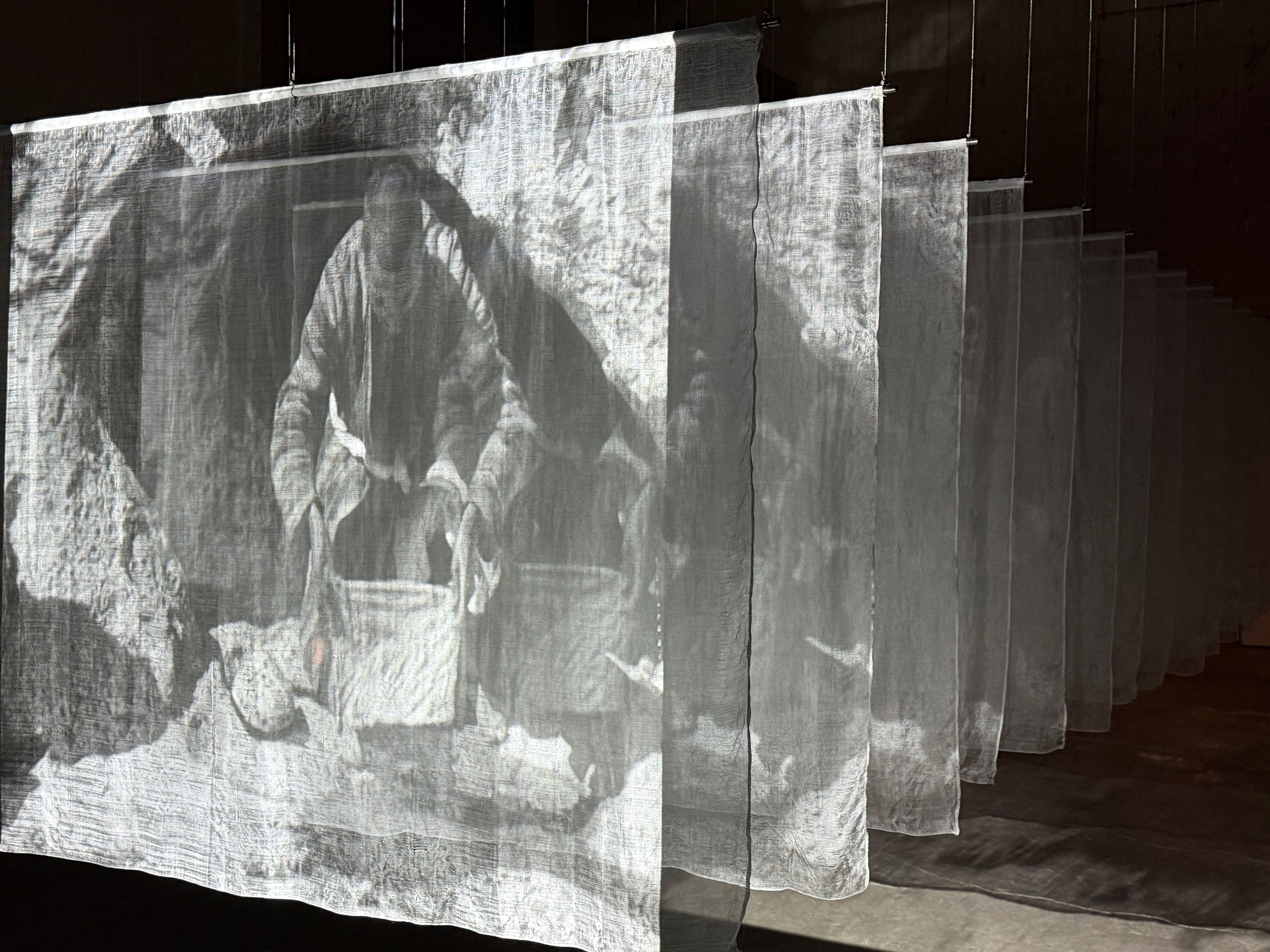
In the old foundry at Tesuque: 2024 video As We Fade by Saodat Ismailova (Uzbeckistan), showing visitors to one of Central Asia’s most sacred sites (Throne of Solomon) along the ancient Silk Road; projected across 24 suspended silk screens. Courtesy: the artist and Milan’s Pirelli HangarBicocca.

The theme for the show – Once Within a Time – is inspired by Godfrey Reggio’s most recent film – a suggestive and wordless mix of innocence, nostalgic images, visual poetry, and the future facing the next generation. The film screens continuously inside SITE, with visitors caught up in Godfrey’s dream-like images, which highlighted in this mesmerizing movie trailer:

Like Godfrey’s film, each space and gallery presents a theme, story, historic character, and provocative contemporary art that pulls back in time, creates an unforgettable experience, and asks the viewer to go inward to contemplate the future. 

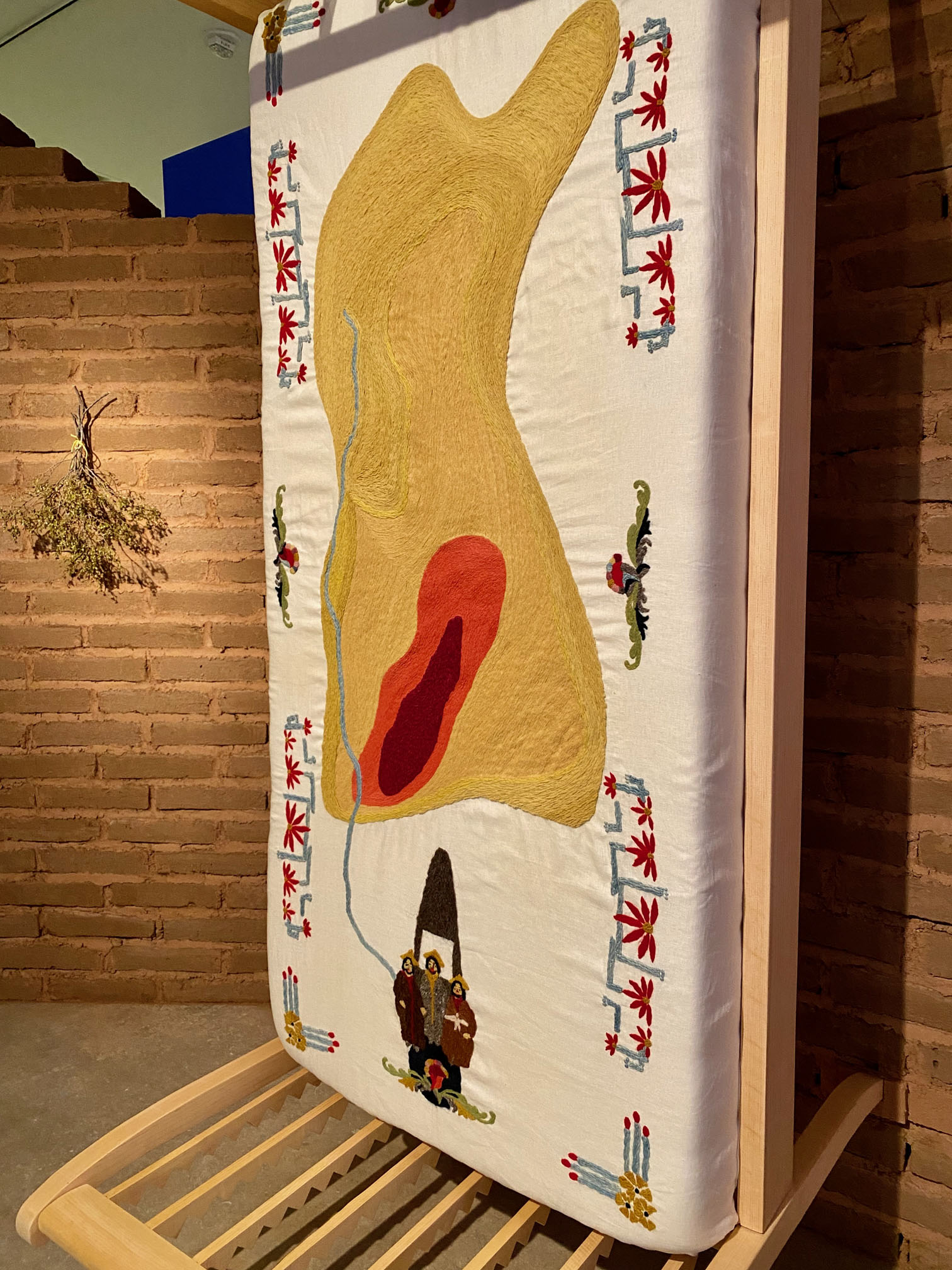
Joanna Keane Lopez’s 2024 Batter my heart, three person’d God – adobe, a handmade bed, colcha embroidery showing a radiation cloud, and creosote bush, referencing her family’s experience of living downwind of the Trinity detonation.

SITE’s galleries, for example, present themes such as storytelling, technology and language, the power of spiritual energy, and New Mexico’s undeniable status as a natural Land of Enchantment.  

The exhibition presents traditional New Mexico superstars and inspirations –  Awa Tsireh and Helen Cordero (San Ildefonso Pueblo), Agnes Pelton, Rebecca Salsbury James, Florence Miller Pierce, Pop Chalee (Taos), Pablita Velarde (Santa Clara Pueblo), and Eliot Porter – alongside artists who are breaking through on the international stage.

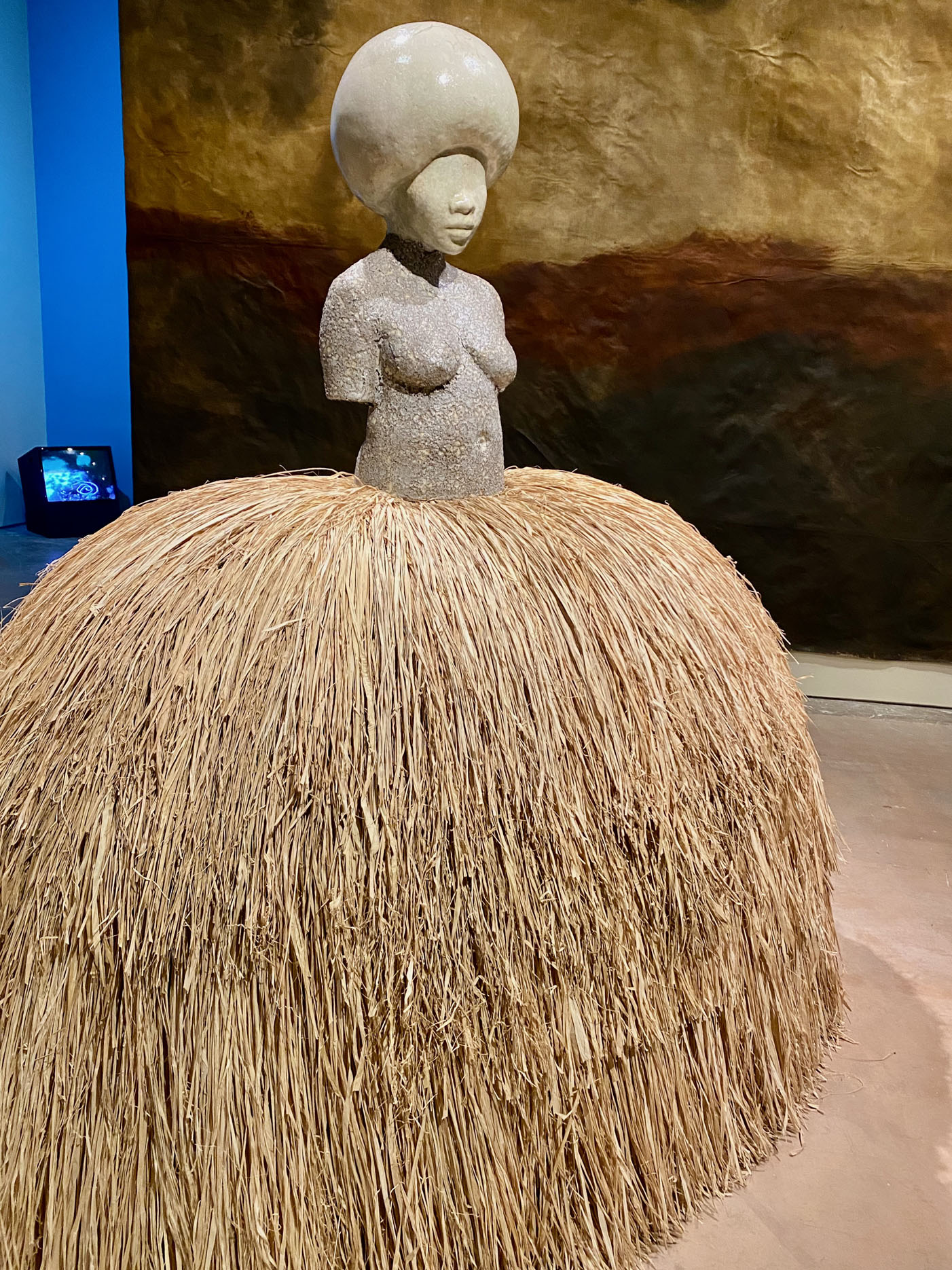
Cochiti pueblo ceramicist Helen Cordero’s storyteller figures are paired with Pablita Velardi’s storyteller illustrations (both are inspired by grandfathers and fathers) and Simone Leigh’s epic stone and raffia goddesses.

SITE Santa Fe gallery theme: storytelling. Simone Leigh’s 2025 untiled stoneware and raffia sculpture. At rear, 2025 oil The Solemn and Dignified Burial Befitting My Beloved for All Seasons by Dominique Knowles. Courtesy: Matthew Marks Gallery; the artist and Hannah Hoffman Gallery, Los Angeles.
Gallery theme: storytelling. Helen Cordero’s 1970 painted clay Storyteller – the creator of the Cochiti Pueblo sculptural tradition, inspired by her grandfather’s stories; championed by patron Alexander Girard. Courtesy: School for Advanced Research.
SITE Santa Fe gallery theme: language Marilou Schultz’s 2024 weaving Integrated Circuit Chip & AI Diné Weaving – a reference to the controvercial 1970s Fairchild Semiconductor chip plant on Navajo Nation staffed primarily with Diné women. Courtesy: private foundation.

The story of the legendary WWII heroes, the Navajo Code Talkers, is featured in a gallery alongside Marilou Schultz’s weavings of chip technology using traditional Diné methods with Fred Hammersly’s ground-breaking IBM computer drawings at the University of New Mexico in 1968-1970. 

Fred was given an opportunity to create the first mainframe-generated art in the form of drawings programmed by traditional IBM punch-card technology and the Art1 program.  SIITE not only displays a selection of the 400 computer drawings that he generated over the course of 18 months, but some of the punch cards he used, which are now archived at the Smithsonian’s Archives of American Art.

Sensual free-thinkers are represented by the story of Santa Fe gambling mogul Doña Tules (Maria Gertrudis Barceló) and her actual 1840s money chest, witty contemporary porcelain playing cards and magical paintings by Katja Seib (UK), and jaw-dropping drawings by Shanghai’s Zhang Yunyao.

SITE Santa Fe gallery theme: sensual free-thinkers. Two of three 2025 Connector drawings by Zhang Yunyao (Shanghai); pencil on stretched felt. Courtesy: the artist, Don Gallery.

Around the corner from Agnes Pelton’s transcendental paintings are Diego Medina’s landscapes reflecting the Piro-Mansa-Tiwa spiritual power inhabiting ancestral lands of Southern New Mexico and also installations about a different type of New Mexico light – the impact of the nuclear energy tests on people living downwind and the legacy of uranium mining across native lands.

SITE Santa Fe gallery theme:In touch with light (nuclear energy): Will Wilson’s 2025 series Hubris on the Land – aerial photography of abandoned 1940s uranium mines on Navajo Nation paired with his documentation of Land Art sites created by Holt, Smithson, Heiser, and Turrell in the 1960s-1970s. Courtesy: the artist

New Mexico’s natural world is paid tribute in stories and artwork by travelers and residents – watercolors of Pueblo spirits and wildlife by Awa Tsireh (Alfonso Roybal) in the 1930s, Vladimir Nabokov’s sketches of butterfly wing cells (1940s-1950s), and Eliot Porter’s spectacular photos of Tesuque jays in the 1960s.

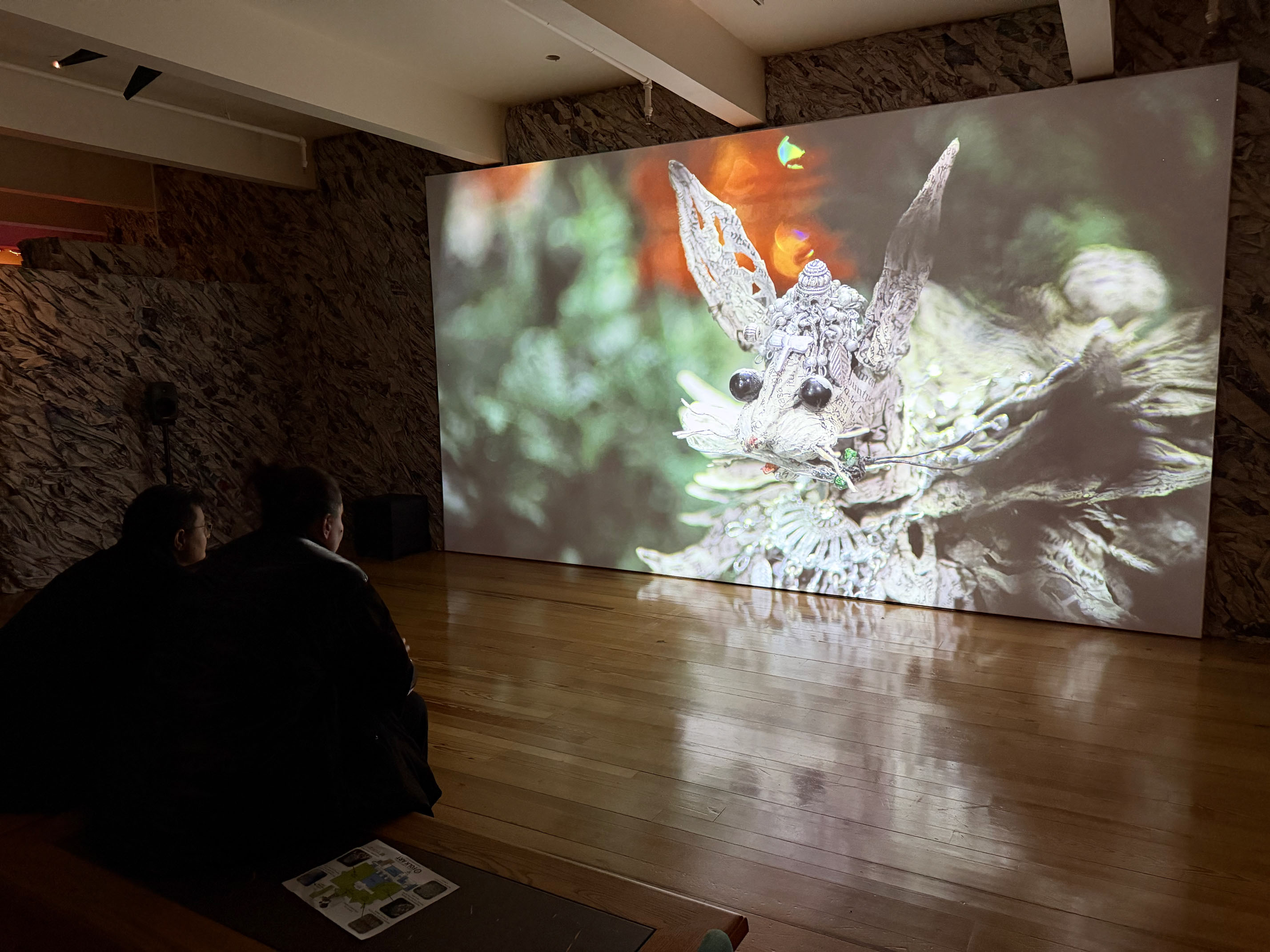
But these examples are just snippets of Once Within a Time – the entire show deserves multiple visits, and time to visit the other locations in the city, such as the hidden basement natural wonderland epic at the Museum of Internatonal Folk Art created by Taiwan ‘s Zhang Xu Zhan. It’s not only an immersive environment, but a film, animal-spirit sculptures, and selections from the MoIFA’s paper funerary object collection.  Don’t miss the Day of the Dead altar, the 18th-century Pere Lachaise Cemetary tribute initially collected by Mr. Girard himself, and paper funerary fantasies made by the artist’s own family. Truly unforgettable.

Museum of International Folk Art: Zhang Xu Zhan’s 2020-2022 paper-animation video Compound Eyes of Tropical (Animal story series), with a Southeastern Asian deer-mouse outwitting a group of predatory crocodiles. Courtesy: the artist and Project Fulfill Art Space, Taiwan.

The Wheelwright Museum of the American Indian fills the Klah Gallery (in the shape of a traditional hogan) with a meditation on healing by Cristina Flores Pescorán, a wild organic sculpture by Nora Naranjo Morse, and a mini-retrospective of paintings by the incomparable Emmi Whitehorse.

Wheelwright Klah Gallery theme: journeys. Nora Naranjo Morse’s sculpture Into the Forever; on walls, Cristina Flores Pescorán’s 2025 installation Treinta y ocho. Ofrendas para reescribir historia medica y renacer Huaca. Courtesy: the artists

The Tesuque location also features rooms with installations by Mexico’s Guillermo Galindo incorporating burned wood from the recent New Mexico fires (crossed with Picasso’s Guernica),  David Horvitz’s tribute to the men incarcerated in Santa Fe’s Japanese internment camp (and a hat from one them), and Thailand’s Korakrit Arunanondchai’s room-sized contemplation that incorporates the ashes from the burning of Zozobra.

Video of Korakrit Arunanondchai’s 2025 installation Unity for Nostalgia, with floor incorporating ashes from Santa Fe’s Zozobra’s burning and a prayer to the phoenix; layered soundtrack. Courtesy: the artist, Bangkok City Gallery, London’s Carlos/Ishikawa, CLEARNING NY-LA, Kukje Gallery, Seoul
Video of Max Hooper Schneider’s 2025 Written in Sand (Finquita Garden) installation; spheres mysteriously travel sand channels. Courtesy: the artist; Maureen Paley, London, Hove; Francois Ghebaley, Los Angeles, New York.

For more, take a walk through the main exhibit and five other sites in and around Santa in our Flickr album to see work by legendary New Mexican artists, and travel back and forth to see how contemporary art reflects epic histories and mystic systems of the Southwest.

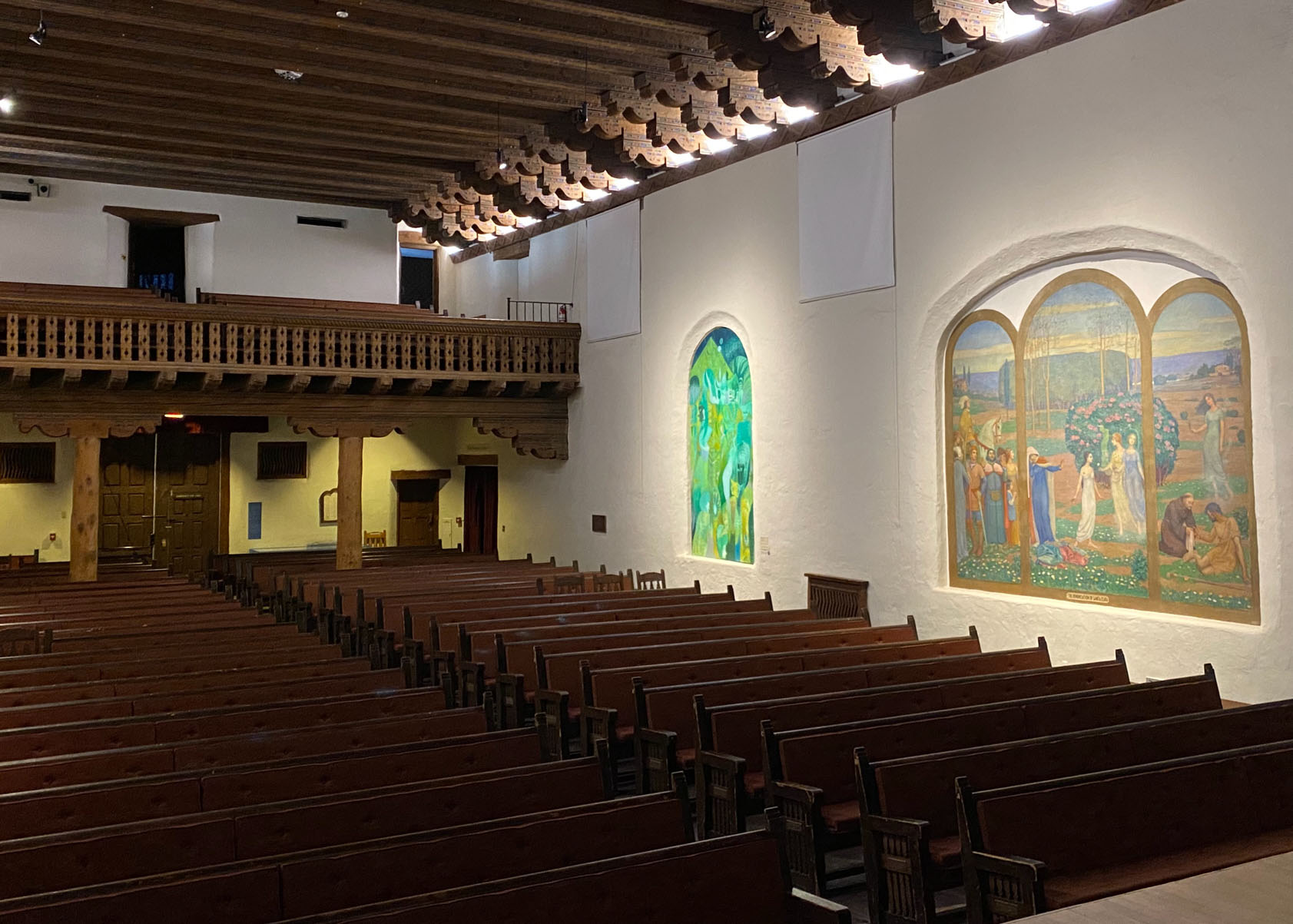
View of historic St. Francis Auditorium (1917) with Maja Ruznic’s 2025 Kisa Pada, Trava Raste, Gora Zeleni installed atop Donald Beauregad’s painting The Conversion of St. Francis; to right, Beauregard’s The Renunciation of Santa Clara.

Modern Art and Political Survival in 20th Century Germany

How do artists – and their art – survive two world wars, an authoritatian dictatorship, and the bifurcation of nation’s premiere art institution? It’s the story told by the must-see exhibition, Modern Art and Politics in Germany 1910-1945: Masterworks from the Neue Nationalgalerie, on view at the Albuquerque Museum through January 4, 2026.

Berlin’s Neue Nationalgalerie mounted the show to bring never-before-seen works to the United States and tell the story of how modern art became an ideological battleground in Germany during the early 20th-century and how the history of politics, artistic innovation, and social commentary are reflected in the institution’s collections today.

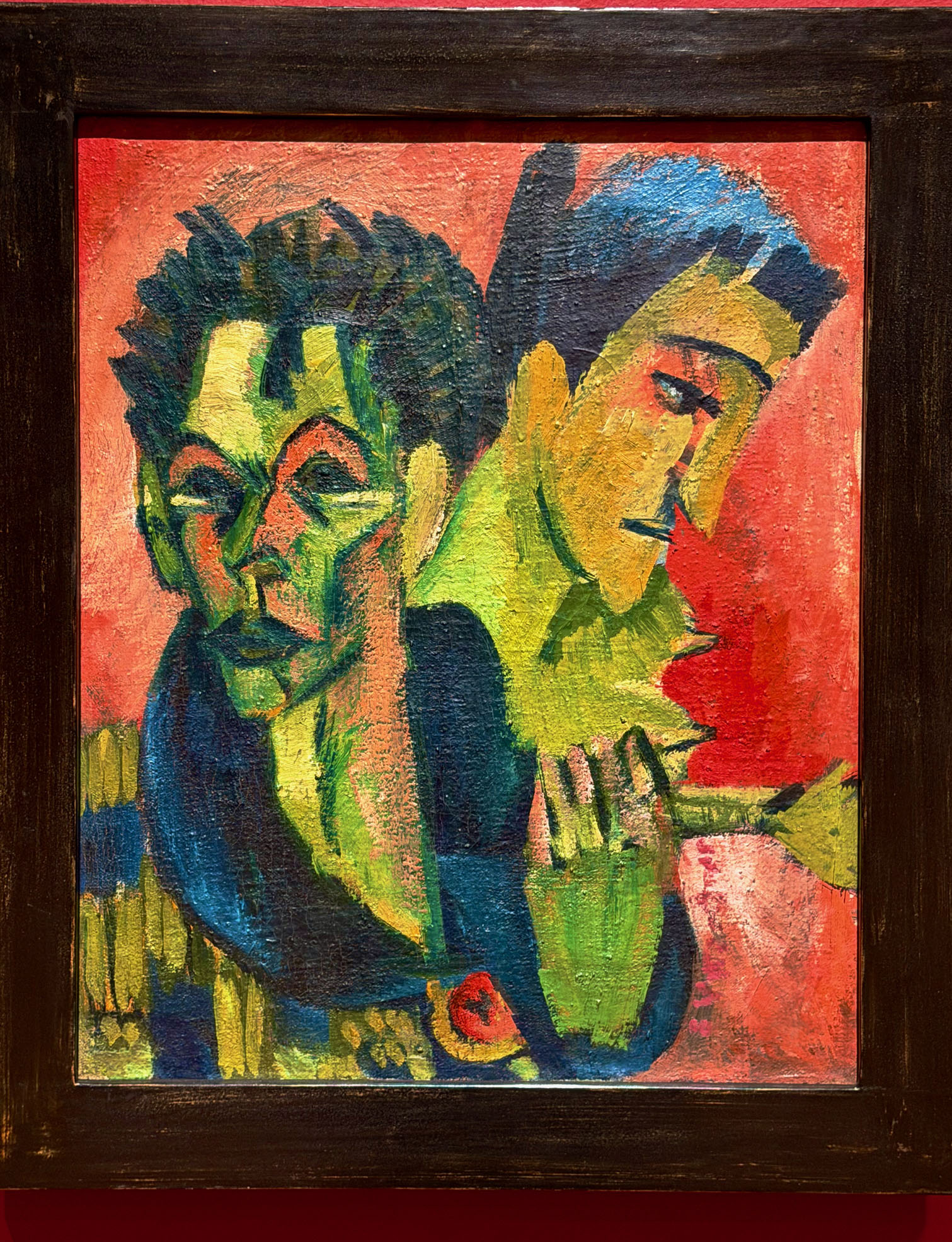
Ernst Kirchner’s 1914-1915 vividly expressionist Self-Portrait with a Girl.

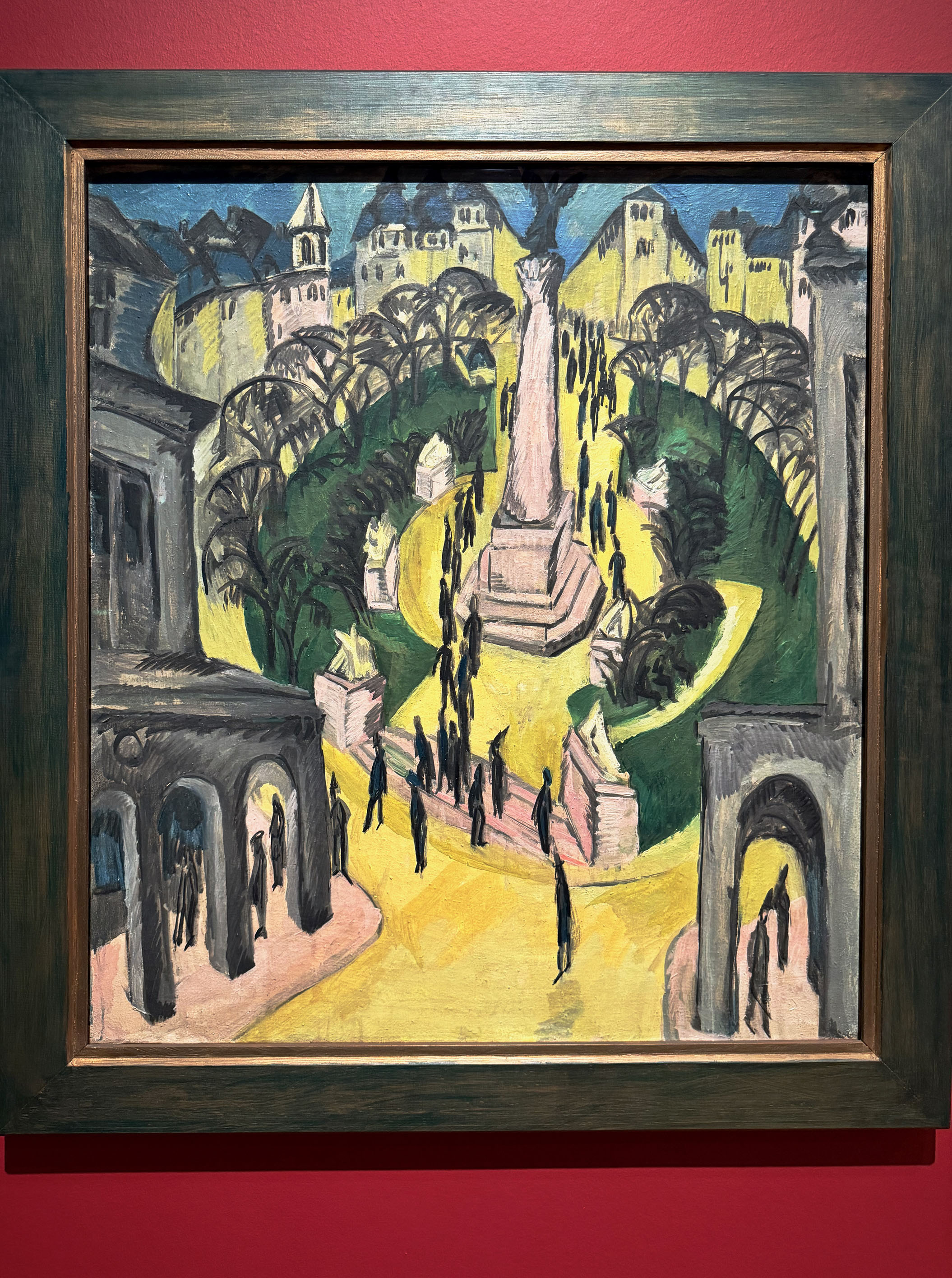
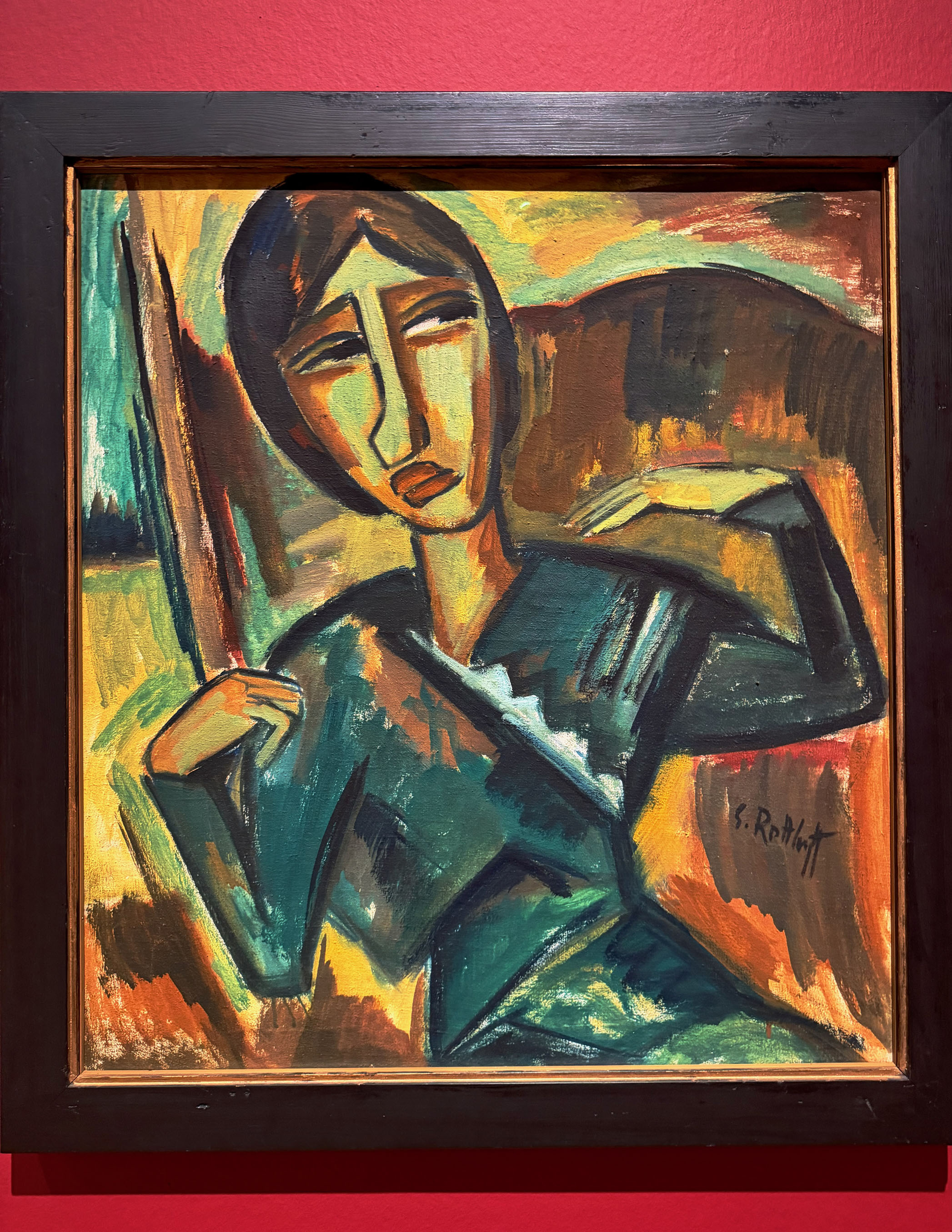
The exhibition opens with works from some of the best-known German expressionists – Kirschner, Pechstein, Schmitt-Rotluff, and Nolde. Slalshes of wild color, sharp angles, and modernist portraits nearly leap out of the frames of paintings, showing the influences of the French avant-garde fauves and Picasso’s angular Cubist planes.

Ernst Kirchner’s 1914 expressionistic city view Belle-Alliance-Platz in Berlin.
Karl Schmitt-Rotluff’s 1915 expressionist painting The Green Girl.

Another section of the exhibition presents portraits of influential German art dealers who brought the best of the avant-garde to Berlin, Munich, Dusseldorf, and other German culture capitals in the early 20th century. Works by influential modernists Picasso, Leger, and Kokolschka hang alongside works by the Russian ex-pats who formed the forerunner group to Die Brücke in 1909 – Kandinsky, Alex Jawlensky, and Marianne von Werefki.

See some of our favorite works in our Flickr album.

Austrian avant-garde: Oskar Kokoschka’s 1909 oil portrait of Viennese architect, Adolph Loos; both artists represented by Berlin gallery owner Herworth Walden.

In 1911, the German modernists formed Die Brücke – a group that celebrated getting an artist’s inner feeling out on the canvas – not just a formalist declaration against classical painting and historical norms. When World War I broke out, many went to the front. If they survived, they continued painting to process the psychological agony of the War and the economic toll it took on the homeland.

The exhibition also features a gallery full of works that are a logical outcome of experimentation – abstract works by German artists that merge the symbology and energy of Italian Futurism with the riotous colors of Orphism.

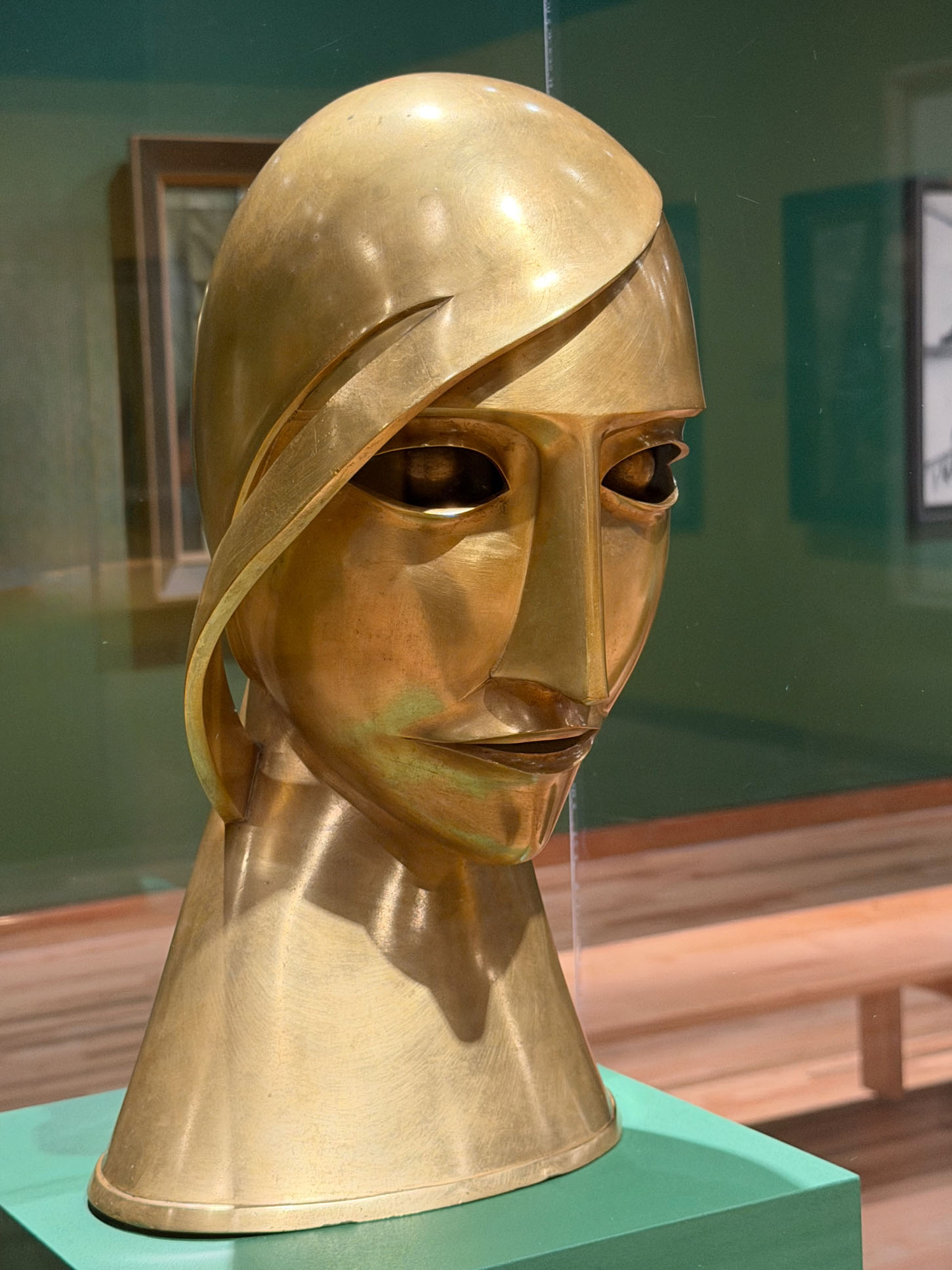
Abstract innovator: Rudolf Belling’s 1925 sculpture Head in Brass – confiscated and labeled “degenerate” by the Nazis in 1937.
Abstract innovator: Otto Möller’s 1921 oil painting City – influenced by Futurism.

Surviving hardship together, the end of World War I only motivated the survivors to come together, form societies and political action committees and keep creating.

Leading up to World War I, it seemed as though modernism would sweep the Continent and become the dominant art style collected by the progressive National Gallery. However, during the 1919-1933 democratic Weimar Republic, art preferences shifted to a highly literal, figurative style dubbed “the New Objectivity.”

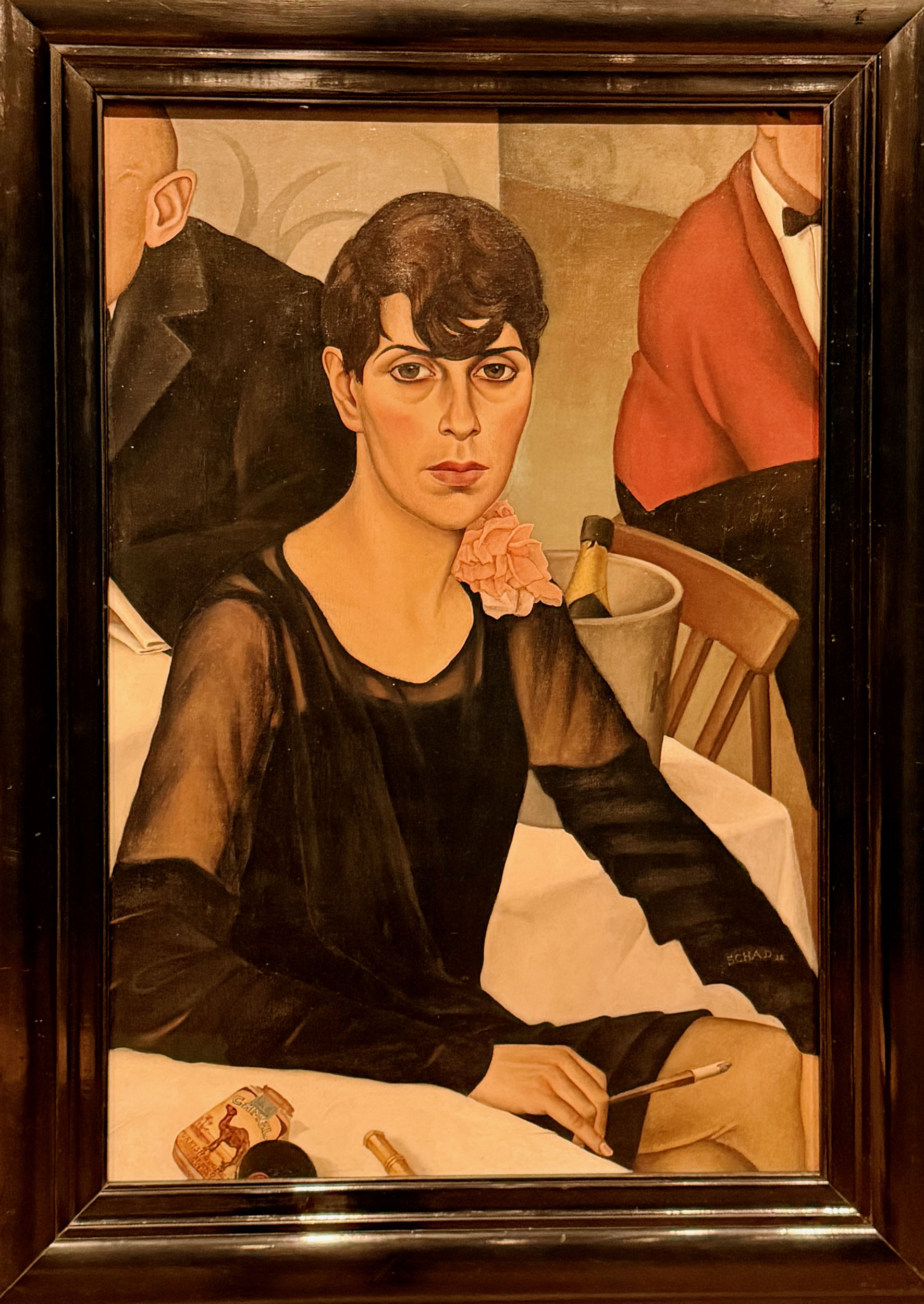
This gallery shows the artistic and political shift to realistic portraits with hints of social commentary, depictions of new technology, and a new culture of enfranchised, emamcipated women (exemplified by the museum’s iconic Sonja by Christian Schad).

But over time, the political mood shifted, and the National Socialist Party rose.

New Objectivity: Christian Schad’s 1928 Sonja– a portrait of the new emancipated women
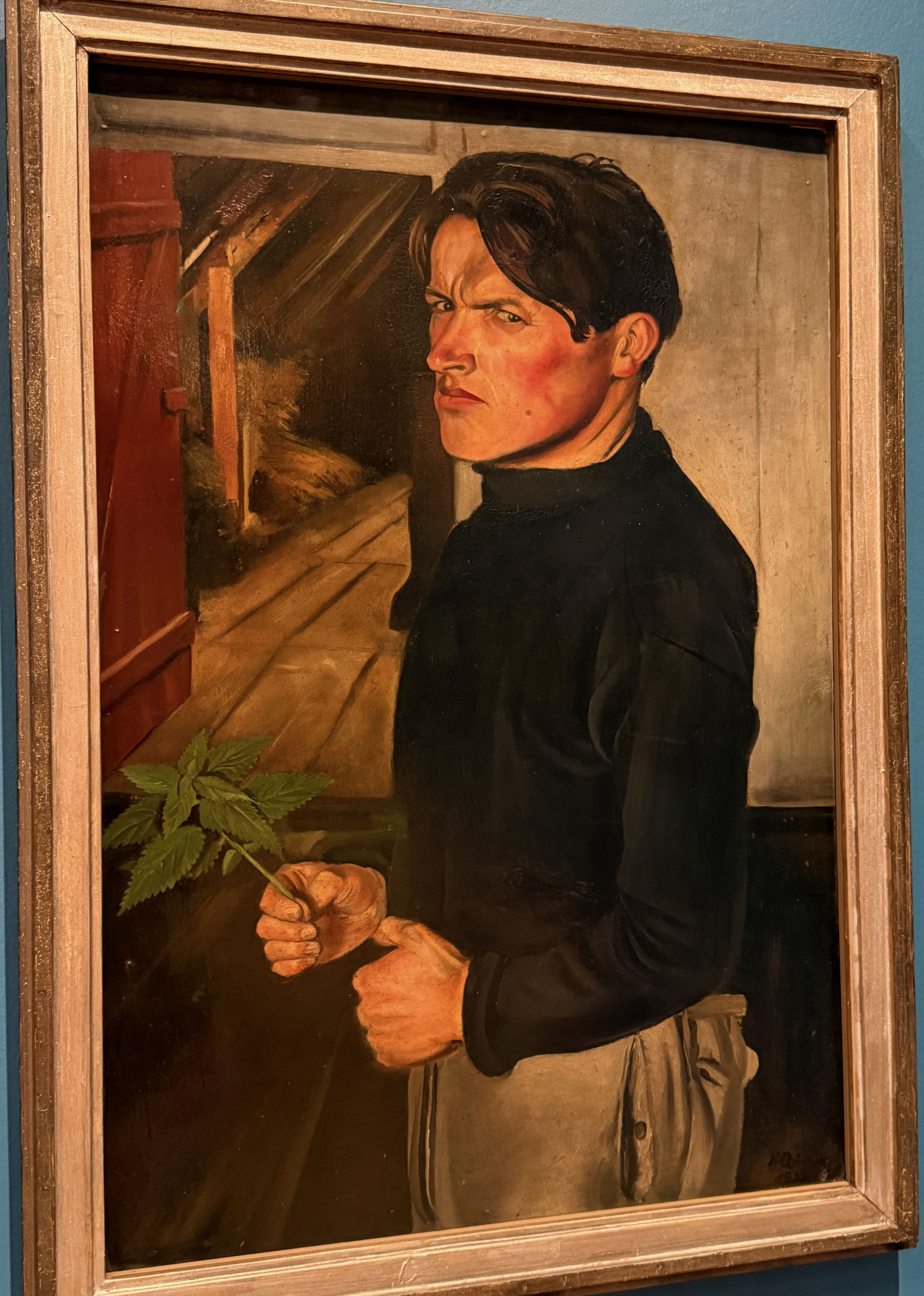
New Objectivity: Curt Querner’s 1933 oil on cardboard painting Self-Portrait with Stinging Nettle – painted in secret (and hidden) as a reaction to a violent police raid on a Communist Party meeting.

Throughout the 1930s, increasingly militaristic and anti-semetic groups formed in Germany, and as the National Socialists came to power, they fired heads of the leading art schools, shuttered the innovative Bauhaus, and banned abstract art and modernism because it did nothing to support their agenda. Artists either went underground (painting in basements) or fled the country entirely. 

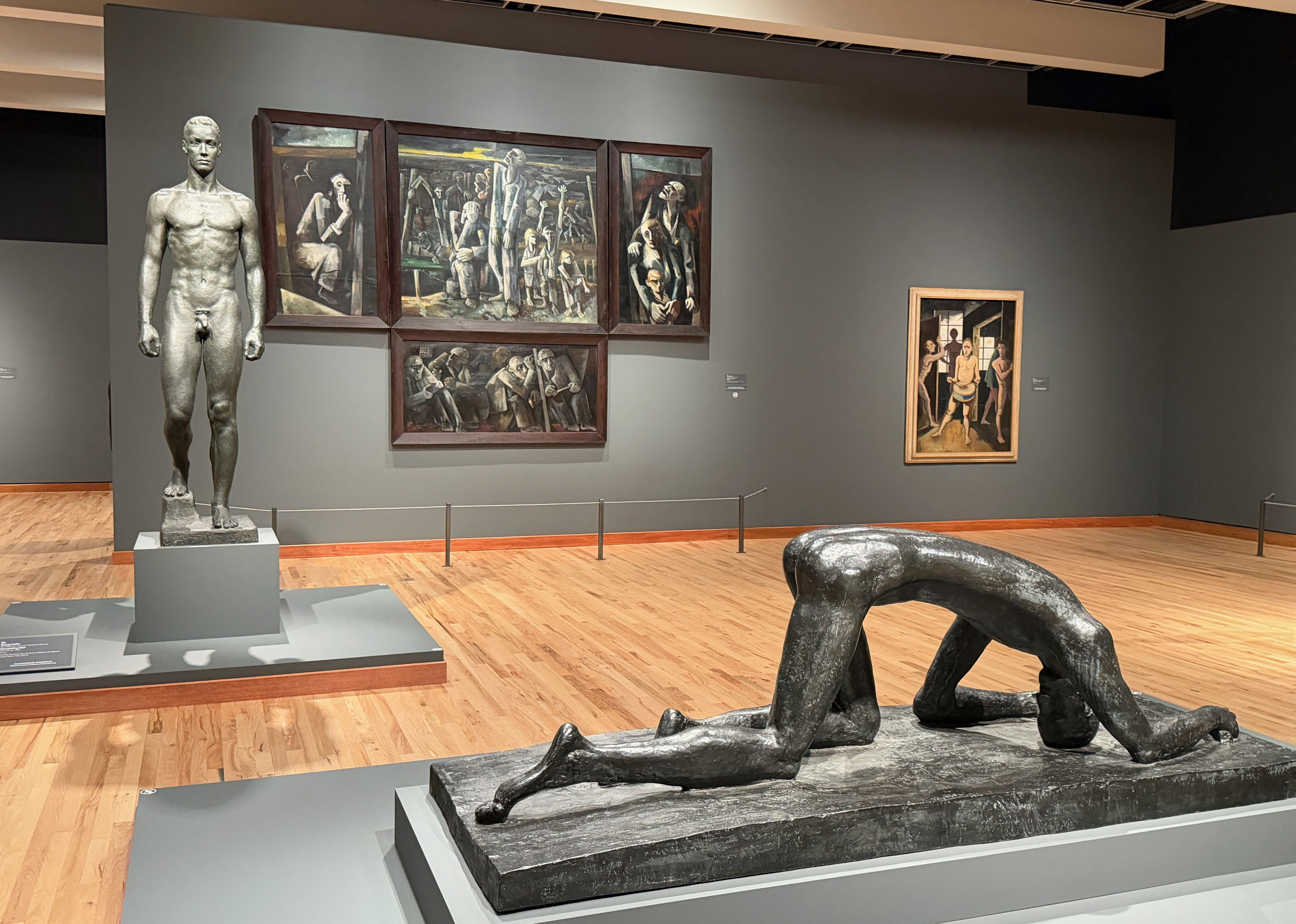
Art responding to WWI and WWII: Georg Kolbe’s 1939-1940 bronze Descending Man, Horst Strempel’s 1945-1946 oil on burlap Night Over Germany, and (foreground) Wilhelm Lehmbruck’s 1915-1916 bronze (cast 1972) Fallen Man.

The exhibition concludes by showcasing works made at the end of the war by German artists reacting to the societal disruption and atrocities.  In some cases, banned artists like Karl Kunz were able to paint in secret, wait until the War ended, and emerge to help a divided Germany revive the arts in the post-war years.

Watch the exhibition’s opening lecture by Berlin curator Irina Hiebert Grun, who provides an overview of the Neue Nationalgalerie’s collecting history, responses to the changing politics that affected early 20th century art, how the museum reassembled its collections and personnel after the Nazi-era persecutions.

The war destroyed the buildings and the Allies divided the country, but the story of this museum’s incredible 21st-century renaissance is one for the ages.

After the exhibition closes in Albuquerque, it be on view at the Minneapolis Museum of Art March 7 – July 19, 2026. Don’t miss it!

Banned modernist Karl Kunz was inspired by Picasso’s Guernica to paint Germany, Awake! in secret in 1942 – Kunz survived the war in Germany and participated in its post-War artistic resurgence.

Eternal Signs from the Australian Outback

It’s not often you find yourself surrounded by vibrant contemporary art that directly connects you to dreams and stories that have been told and retold for tens of thousands of years. Meet some exceptional visual storytellers from nearly twenty Australian regions in Eternal Signs: Indigenous Australian Art from the Kaplan and Levi Collection, on view at the Nevada Museum of Art in Reno through November 2, 2025.

This exhibition showcases well-known and emerging artists in different geographic areas of Australia’s north coast and interior desert. See our favorites in our Flickr album and consult the map to locate the communities where the featured artists work.

2011 acrylic painting Wanampi Jukurrpa by Tiger Palpatja (Pitjantjatjara) from Kaltjiti, APY Lands about the water serpent and how sacred rock forms were created.

For thousands of millenia, the indigenous groups in Australia have created rock art, painted spiritual images on eucalyptus bark, and documented their “dreams” – a mix of creation stories, confirmation of people’s integration with the land and animals, and everyday life.  These visual affirmations present a simultaneous representation of past, present, and future, hence the term “eternal signs.”

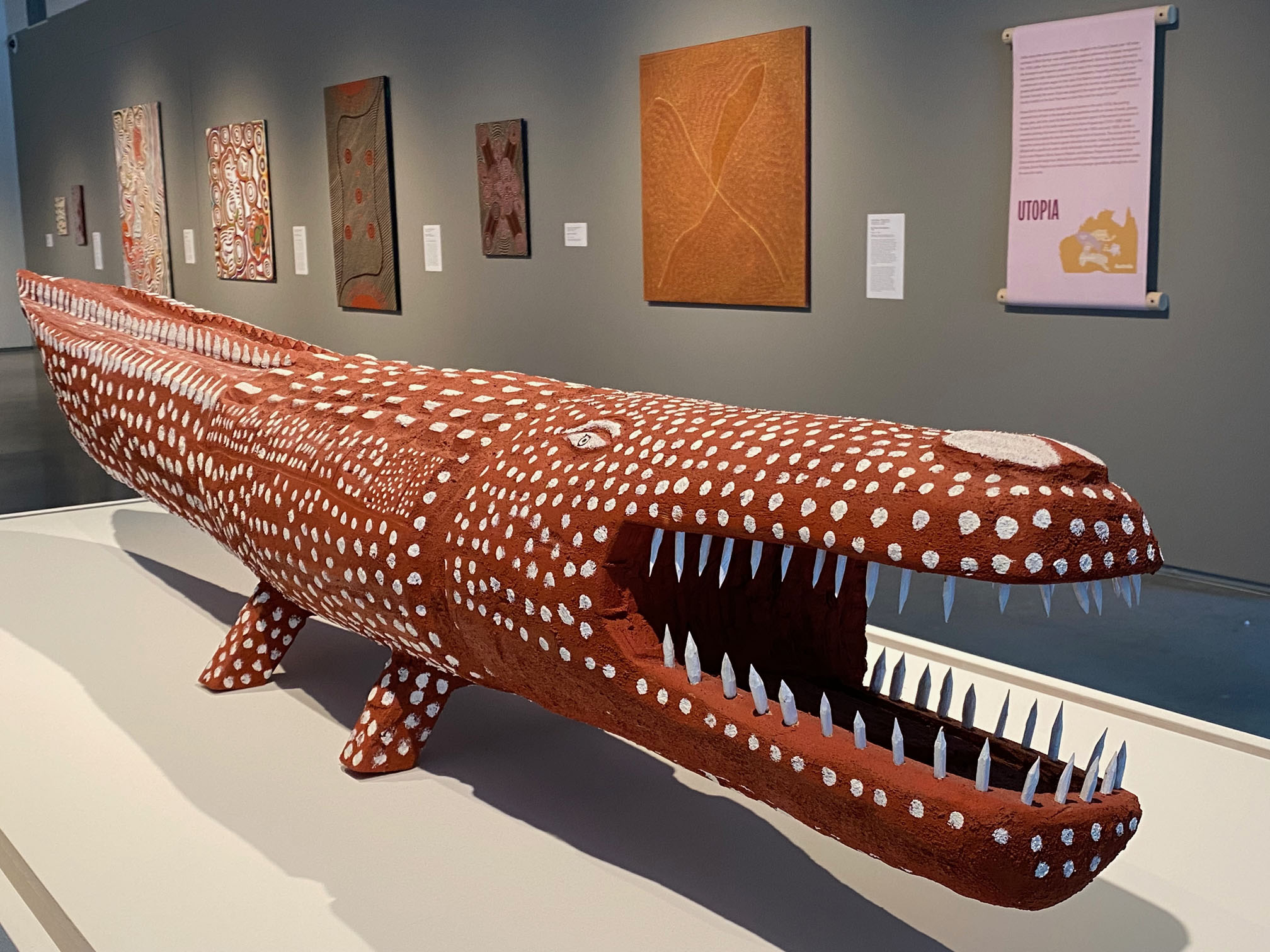
2001 Saltwater Crocodile by Craig Koometa (Wik-Alkan) from Aurukun, in far north of Queensland; at rear, paintings by artists from Utopia at the edge of the Tanami Desert.

Stories, images, culture, dreams, and language differ greatly among Australia’s 120 indigenous groups. (We’ve indicated each artist’s geographic region and particular language after their name.)

From Arnhem Land in the north, Paddy Fordham Wainburranga (Rembarrnga) from Wugularr, Northern Territory is one of the best-known artists shown. Growing up in the bush, Paddy was eleven when he first encountered anyone outside his traditional community. In the 1970s, he moved to Maningrida, a government-sponsored settlement, and began painting at the Arts & Culture Center. Paddy’s work often depicts ancestral spirits that he first encountered in rock art.

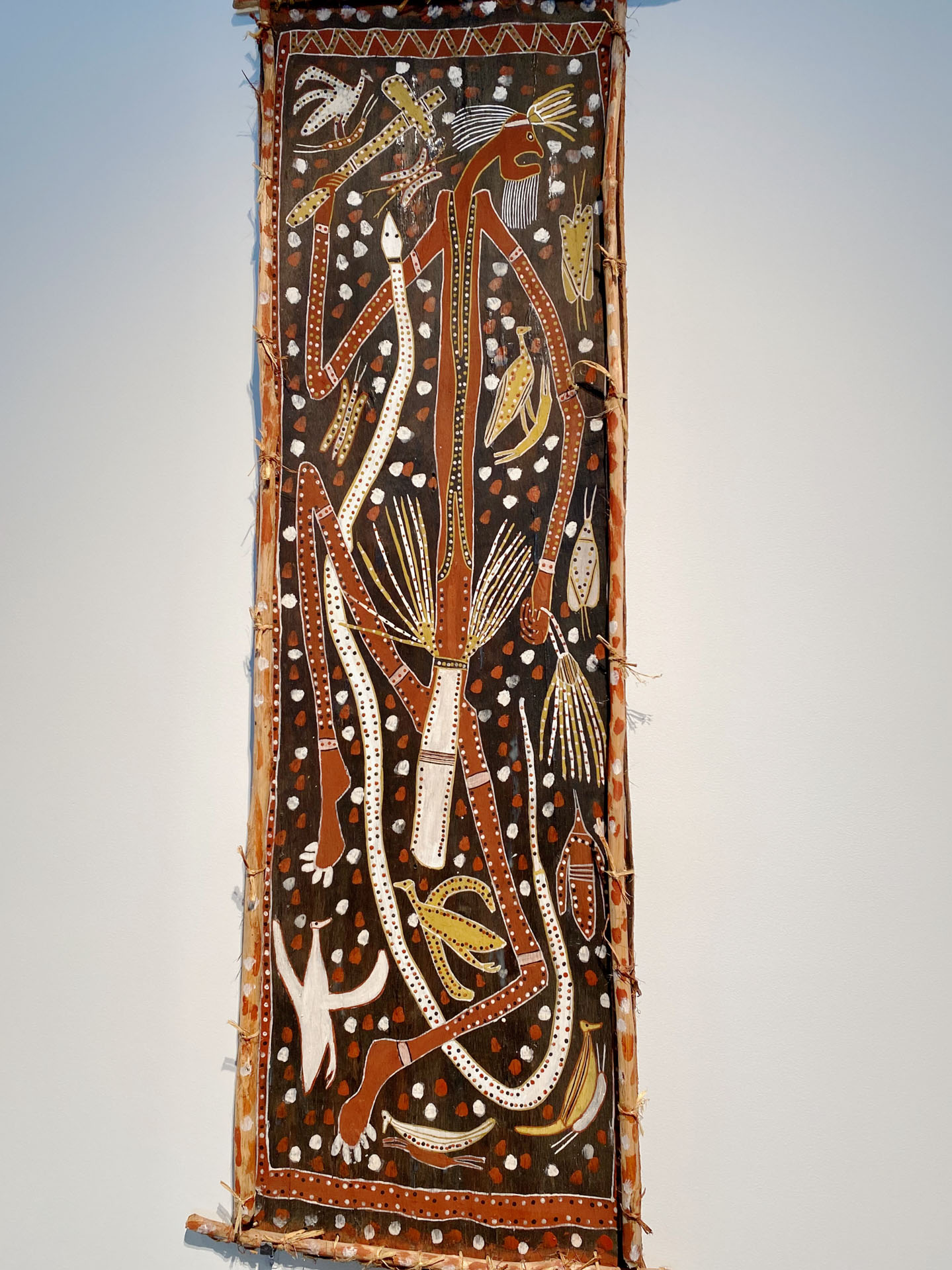
1991 Balangalngalan by Paddy Fordham Wainburranga (Rembarrnga) – a shape-shiting ancestor who guides and heals.
1994 painted wood Manjhkikilyo (Malevolent Mimih Spirit) by Paddy Fordham Wainburranga (Rembarrnga) from Wugularr, Northern Territory – a bad ancestral spirit from ancient cave art.

John Bulunbulun (Ganalbingu), another Maningrida Arts & Culture Center artist, also starts with traditional dreams and forms – for example, he uses a traditional hollow-log coffin as a basis from which to sculpt a three-dimensional dream about the long-necked turtle creator. Take a look.

More recent work by Yirrkala artists in East Arnham reflect ecological concerns and the clans’ interest in protecting ancestral lands. A dramatic sculpture by Guynbi Ganambarr (Naymil) reflects the rich, majestic, and spiritual coastal life of the Grove Peninsula. A masterful wall piece by Djambawa Marawili (Madarrpa) is one in a series that he’s used to affirm his people’s land and sea rights – even used as legal evidence in court cases challenging indigenous rights to land and sea, demonstrating the deep, spiritual meaning behind their claims.

Cormorant catches a freshwater fish: 2011 carved eucalyptus bark Wurran Ga Baypinga by Guynbi Ganambarr (Naymil) from Yirrkala, East Arnhem
2014 Source of Fire by Djambawa Marawili (Madarrpa) from Yirrkala in East Arnhem; ochres and sawdust on bark showing strong ancestral truth-tellers.

Here are two works by the award-winning Petyarre sisters from the area of Utopia on the border of the Tanami Desert in central Australia – an area that began to achieve acclaim as an art center in the late 1990s with dot paintings referencing the landscape and women’s expertise in bush medicine.

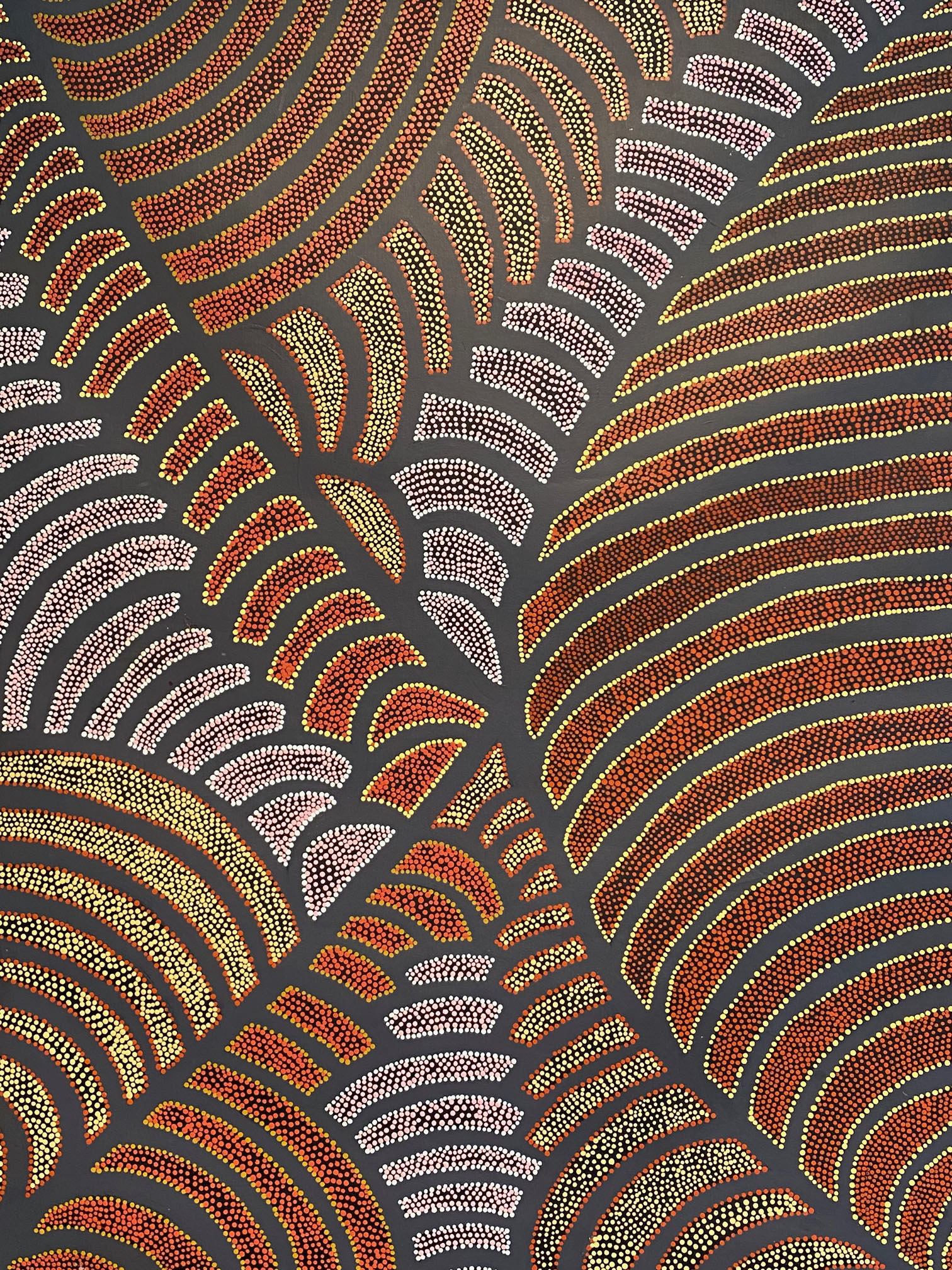
Detail of 1992 acrylic Mountain Devil Awelye by Gloria Tamerre Petyarre (Anmatyerre) from Utopia in the central Tanami Desert.
1996 acrylic My Place Atnangkere by Kathleen Petyarre (Anmatyerre) from Utopia in the central Tanami Desert; aerial view of creation story journey across the desert homeland.

We have to give a big shout-out to Robert Kaplan and Margaret Levi for donating over 70 of these amazing artworks to the Nevada Museum of Art. Their passion shows!

In case you aren’t able to enjoy this insightful, beautiful show at the Nevada Art Museum, art lovers will be able enjoy The Stars We Do Not See: Australian Indigenous Art from the National Gallery of Victoria in Melbourne as it tours across the North America. Right now, The Stars We Do Not See is scheduled for the National Gallery in Washington, D.C. through March 1, 2026.

2008 ochres on linen Sing Out Spring – Yiyili Country by David Cox (Goonlyandi/Walmajarri) from Warmun, Western Australia.

The Stars We Do Not See will travel to the Denver Art Museum (April 19 – July 26, 2026), Portland Art Museum (September 2026 – January 2027), Peabody Essex Museum in Salem (February – June 2027), and the Royal Ontario Museum in Toronto (July 2027 – January 2028).

Two 2004 acrylic paintings Ngura (Country) by Tali Tali Pompey (Pitjantjatjara) from Kaltjiti, APY Lands.

Abstracting Nature in Albuquerque

How do abstract artists visually channel their response to awesome landscapes? You’ll get a glimpse of how ten artists approach natue and atmospheric phenomenon in Abstracing Nature, an engaging contemporary exhibition at the Albuquerque Museum, on view thorugh October 12.

Works by grand-master abstractionists Richard Diebenkorn and Agnes Martin greet you right at the entrance. 

Diebenkorn isn’t normally associated with New Mexico, but decades before embarking upon his epic Ocean Park series, he spent two years (1950-1952) at the University of New Mexico (1950-1952) working toward his MFA before returning to the West Coast.

Richard Diebenkorn’s 1952 Untitled (Albuquerque), featuring deep earth tones and undulating forms.

The Diebenkorn on display is a recent museum acquisition from those years. Complete abstract expressionist approach to the colors and undulating geologic forms he saw surrounding the post-war boom town.

Martin – the abstractionist grand-dame of New Mexico – made no attempt to hide the fact that her grids and minimal approach were expressions of the tranquililty and serenity she saw and felt from her retreats in Cuba and Galisteo, New Mexico.  She was channeling her emotional, meditative response in her surroundings – not following the reductivist, minimalist trend fo the East and West Coast gallery scene.

By getting up close to the two Martin paintings, you can appreciate her hand-drawn approach. Several stainless-steel sculptures by Agnes Martin’s great friend and student Karen Yank are nearby. The gleaming, hard-edged pieces do not resemble her mentor’s approach, except for the light, gestural touches across the surface.

Agnes Martin’s 1980 acrylic Untitled #6. Courtesy: New Mexico Museum of Art.
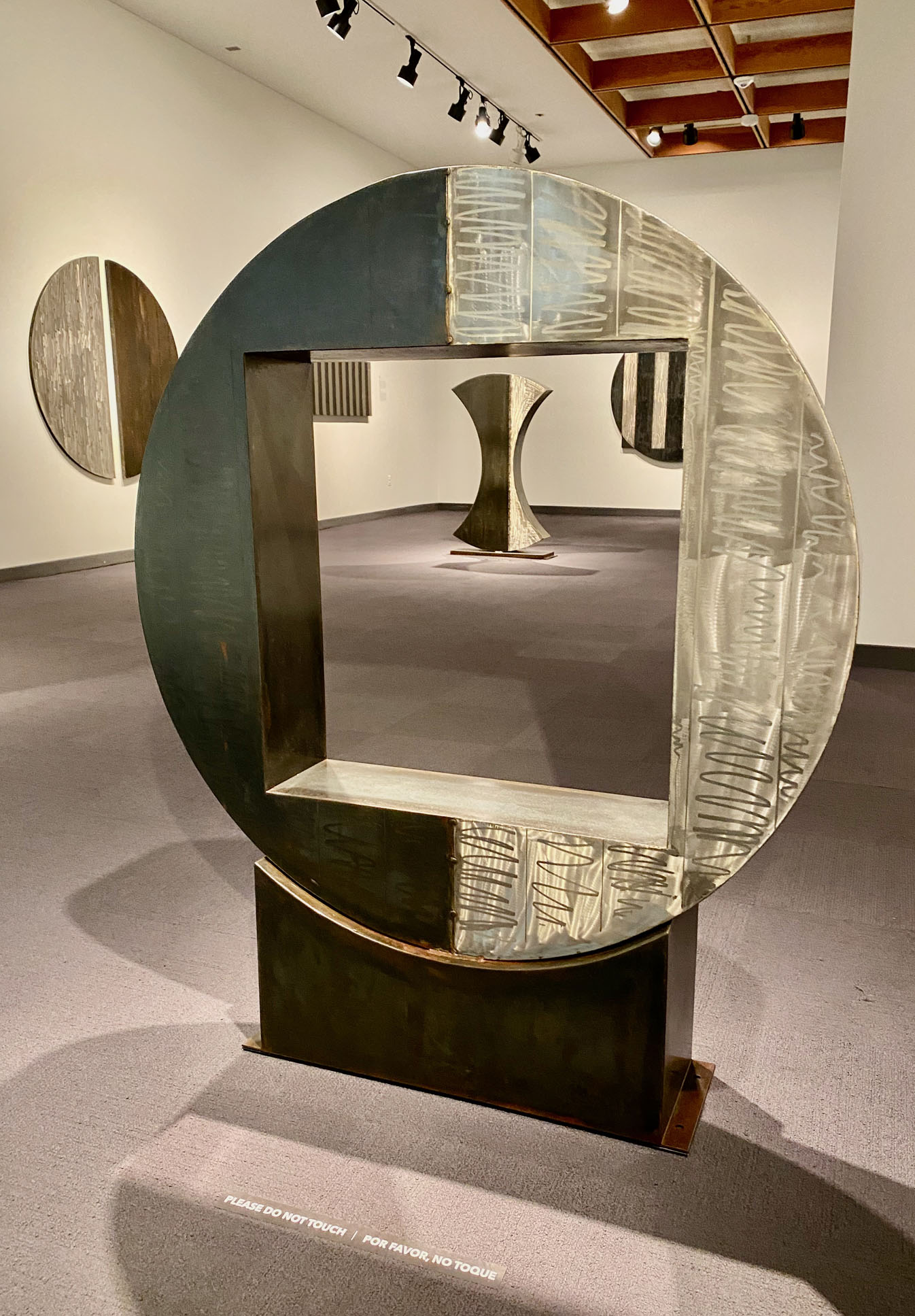
Karen Yank’s 2023 steel View with Silhouette VII and other sculptures visible through the portal. Courtesy: the artist.

The large pastels by Emmi Whitehorse look to the landscape and sacred colors of the Navajo Nation inspiration – a poetic approach most evident in Yei Retires to Mt. Taylor. Dramatic blue gestures suggest the spiritual turquoise color associated with the Navajo’s soutnern sacred mountain Tsoodzil.

Emmi Whitehorse 1985 pastel abstraction on canvas Yei Retires to Mt. Taylor.

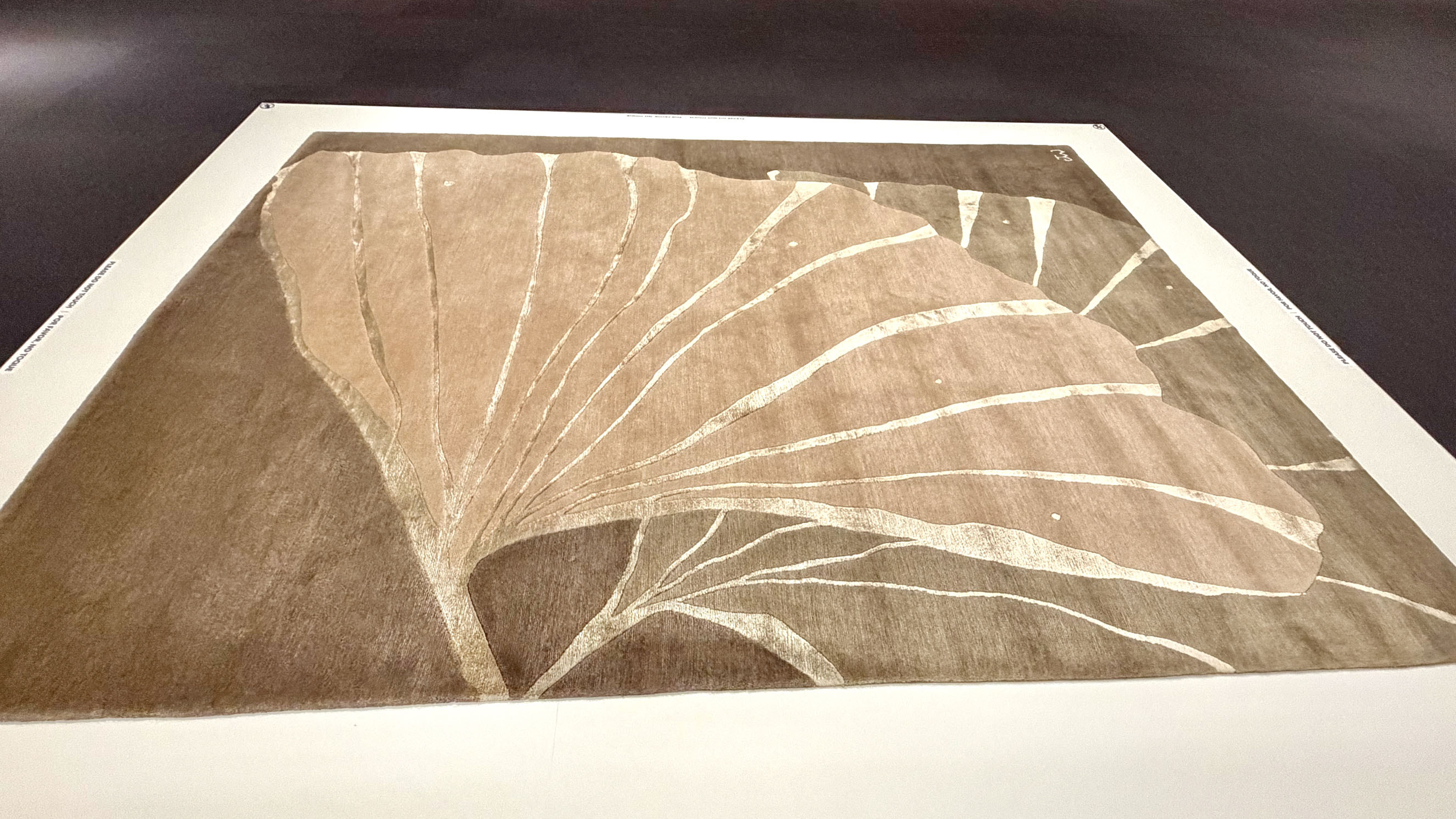
Abstractions used by textile artist Joan Weissman come from a place of process in which she starts with recognizable nature studies but allows her iterations to become more abstract.  Approaching her seemingly abstract Ginko, only gradually do visitors see that the hand-knotted rug (created at large scale by Pakistani artisans) is an extreme close-up of a leaf. 

Joan Weissman’s 2006 Ginko, a wool and silk hand-knotted rug, highlighting the intricacies of the leaf. Courtesy: the artist

2023 Hearing the Sun by Marietta Patricia Leis. Courtesy: the artist

Mariette Patricia Leis translates her experience of nature more formally. In one case, six seemingly minimalist wall-mounted panels are painted to reflect how we perceive the color of sunlight in different atmospheres and at different times of the day.

Another is a series of abstract panels suggesting horizons across volcanic surfaces during Iceland’s 24 hours of darkness.

Enjoy walking through the full exhibition in our Flickr album.

Detail of 2018 Vacuities by Marietta Patricia Leis inspired by Iceland’s winter night sky. Courtesy: the artist.

Here’s a close look at Judy Tuwaletstiwa’s 2001 Divination. She transformed sand by creating an arrangement of glass objects – cubes, spheres, and organic shapes – all displayed across a soft sand base.

Like the rest of the work in this exhibition, it allows us to think about the natural world, our perception of it, and the many ways that the experience can be transformed into art.

Sculptor Shonnard Invents a Two-Continent Creative Life

The joyful retrospective Eugenie Shonnard: Breaking the Mold, on view at Santa Fe’s New Mexico Museum of Art through September 1, 2025, tells the story of a determined young artist in turn-of-the-century Brooklyn who seized opportunities to follow her dream, learn from the best, forge lifelong friendships, and transform inspirations of the nature and culture around her into fine art.

In 1927, Shonnard took up full-time residence as Santa Fe’s first academically trained sculptor. For years, the community considered her the “dean of sculpture”, but after she passed away in 1978 at the age of 91, gradually her legacy and accomplishments faded into obscurity.

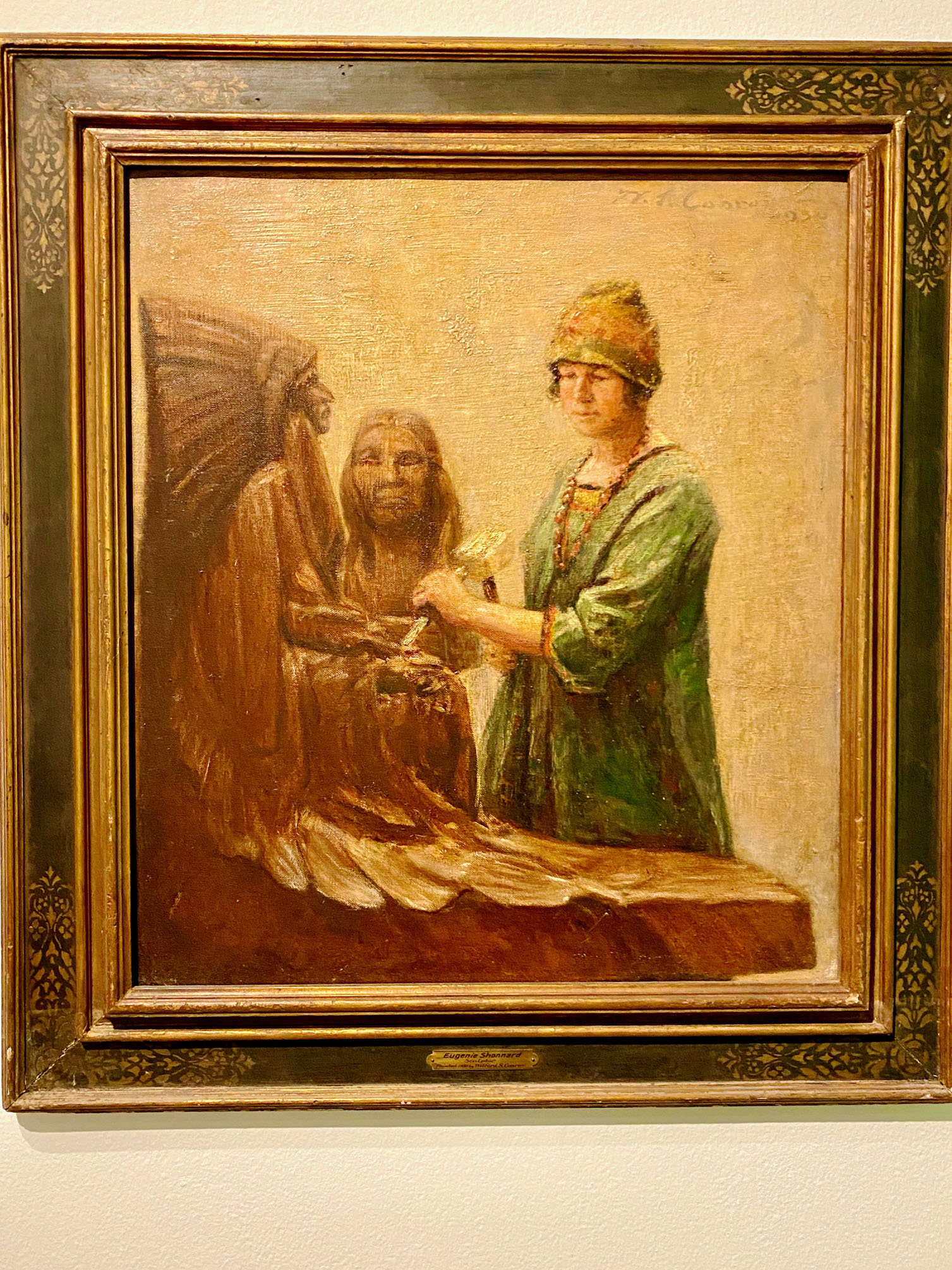
1930 portrait of Eugenie Shonnard in her sculpture studio by Wilford S. Conrow.

This year, the Museum chose to showcase Shonnard’s range of accomplishments – sculpture, painting, furniture, and architectural design. The strategy has worked, since most visitors remark, “What a beautiful body of work! Why haven’t we heard about her before?

Looking at the strong, robust sculptures of Breton peasants and Native American celebrity Dr. Charles Eastman featured in the introductory gallery, you would never guess that Shonnard started life as a sickly child whose wealthy parents kept her close to home. She spent lots of time outdoors with pets, nature, and the serenity of the Hudson Valley.

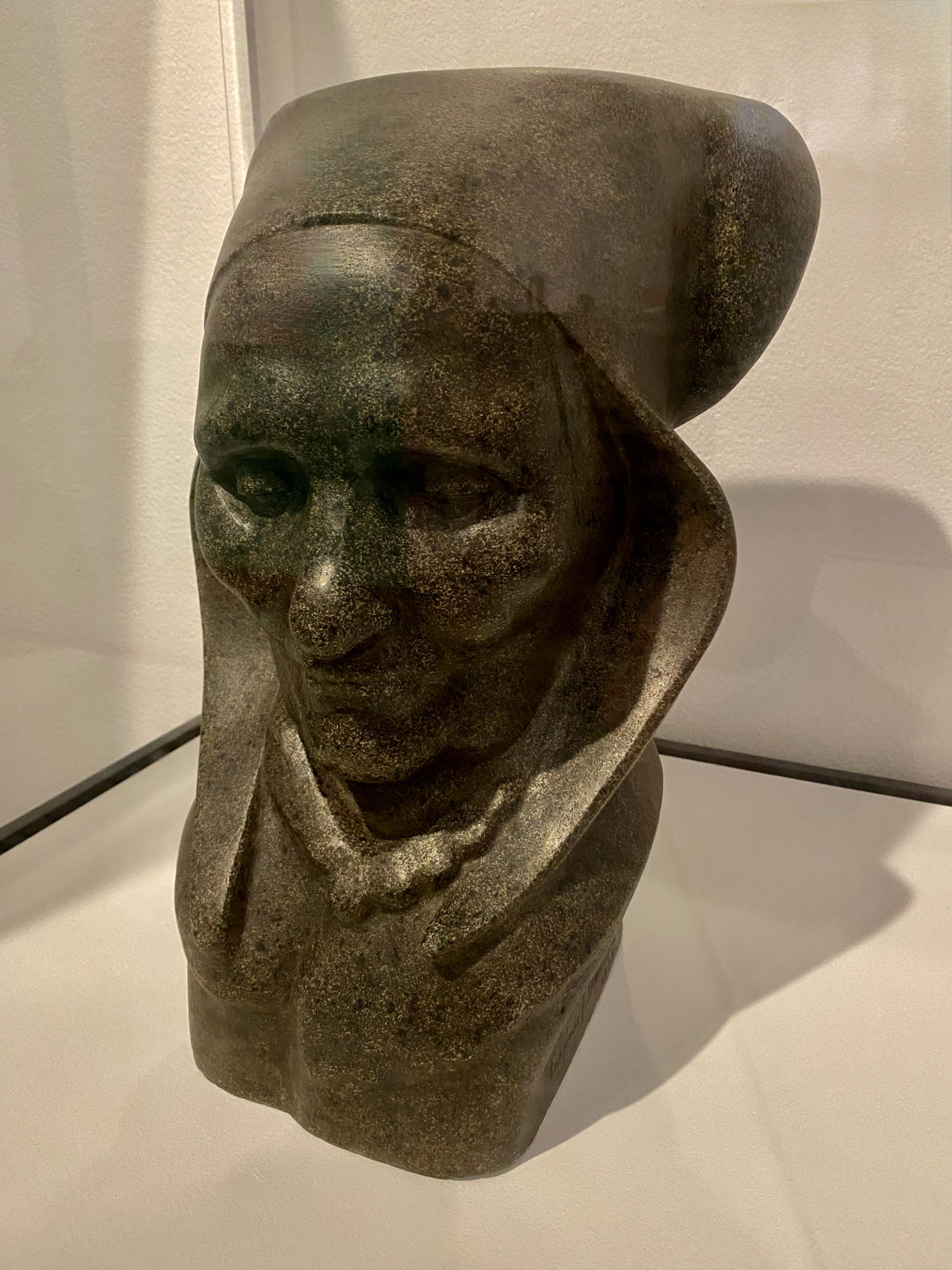
Shonnard’s 1923 granite portrait of a Basque woman, La Grandmére.
Shonnard’s 1926 direct-carved mahogany portrait of Dr. Charles Eastman, Chief Ohiyesa Communing with the Great Spirit.

Always considered a talented watercolorist, her teenage life took quite a turn when her mother allowed her to enroll in the New York School of Applied Design for Women – a school that taught proficiency in the “lesser arts” like lacemaking, wallpaper design, and book illustration, and cover design so that young women could have “appropriate” careers.

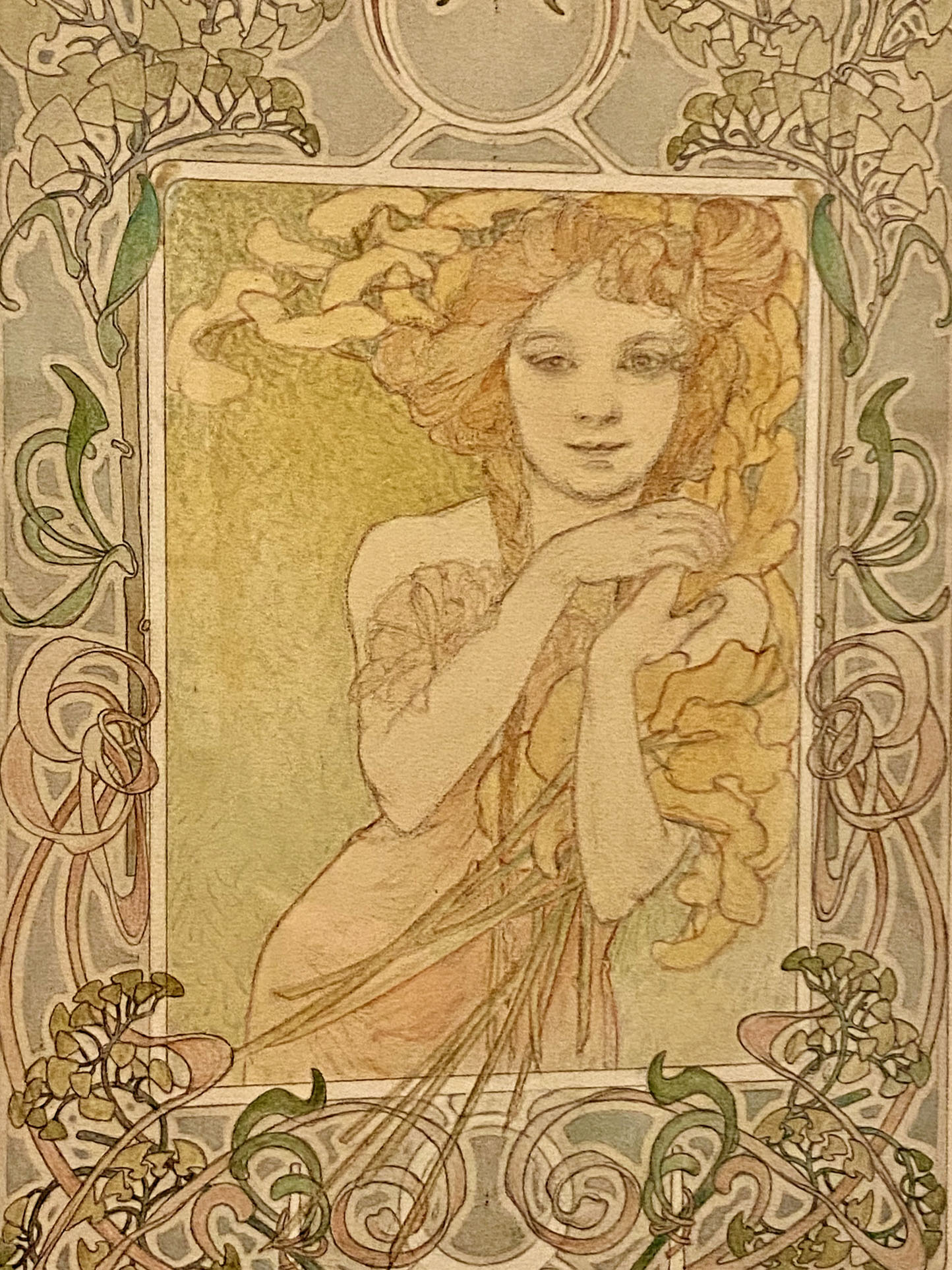
Shonnard’s 1907 pencil and watercolor design in the pastel “Mucha style” – organic designs framing ethereal woman with flowing tresses.

The most sought-after course was a figure drawing class taught by a visiting European professor – the famous Art Nouveau superstar Alphonse Mucha. A master draughtsman and designer, he taught students how to convey human expression in quick, sure, animated line and to use expressive, organic designs from nature to give their work a modern something extra.

Mucha immediately recognized Shonnard’s skill in blending human empathy and line, and advised her to think beyond what was offered at her school. He suggested that she go to Paris, train with top European sculptors (he’d provide letters of introduction), and seriously purse a “fine arts” path.  

Although her doctors advised her against making the long transatlantic passage, she and her mother set off for Paris in 1911. She loved it! She followed up with Mucha’s suggestions (and contacts), began her fine-arts sculptural training, and met other young American female sculpture students (like Gertrude Vanderbilt Whitney and Malvina Hoffman) who were soaking up all of the influences that the Parisian modern art scene offered.

Although he had retired from teaching students, Rodin made an exception for Shonnard and told her he’d be happy to review her work periodically. She worked across a variety of sculptural media (stone, clay, wood) in the atelier of Antoine Bourdelle (an early adoptor of Art Deco who also taught Matisse), showed with the American Woman’s Art Association, and exhibited at the Paris Salon.

When World War I forced Shonnard’s return to New York, she enrolled at the Art Students League for classes with superstar American sculptor James Earle Fraser.

Two of Shonnard’s popular garden commissions – a crane and pelican.

Combining everything she learned from Rodin, Mucha, Bourdelle, and Fraser, she began to excel in stripping her depictions of her subjects down to the essentials that captured each person (or animal’s) inner spirit.

Inspired by Brittany: Shonnard’s 1926 oak Figure of a Woman. Courtesy: Panhandle-Plains Historical Museum, Canyon, Texas

Her career began to take off – commissions for sculptures, shows in New York, and acclaim for her portraits of people and gentle animals. Shonnard made the most of it, showing at New York galleries and the Booklyn Museum, working with her mentor Mucha, and criss-crossing America and Europe in the 1920s.

Like decades of artists before her, she was often drawn to Brittany to capture the spirituality, nature, and culture of the people in her art.

In 1925, she made a fortuitous stop in New Mexico at the invitation of museum director Edger Lee Hewitt, who introduced her to the thriving art community and innovative Native American artists. 

As with Brittany, much about the Southwest resonated with her – dramatic landscapes, spirituality of ancient New Mexican cultures, and the unique architecture and religious art of old churches.  She also drove out into the country to create plein air watercolors of the same Abiquiu landscapes that later inspired O’Keeffe.

Shonnard’s 1925 watercolor of Abiquiu’s unique landscape, Red and White Cliffs with Mesa.

Her sculptures inspired by her New Mexico experience created a sensation in Paris in 1926 – beautiful, direct-carved portraits from the faraway Southwest on display next to her work from Brittany.

Shonnard’s untitled 1925 mahogany Indian bust, shown in her solo show in Paris.

By 1927, Shonnard moved permanently to Santa Fe and began her own full-time studio from which she produced commissions, designed Southwest-inspired furniture, and explored Spanish and Pueblo cultures more deeply.

The exhibition includes designs for private chapel commissions with John Gaw Meem, examples of her furniture, and keenstone panels – her lightweight material invention that liberated her from manipulating heavy granite and wood in her studio, so she could keep carving and sculpting with a lighter material well into her seventies.

People who knew Shonnard said that she exuded a positive spirit throughout her life, seeking harmony with nature, animals, and people. It’s fitting that this retrospective includes a large room populated with her beloved birds, woodland, and backyard animals, and concludes with works by local artists she admired and whose works she collected – Maria and Juan Martinez and Awa Tsireh.

Detail of Shonnard’s Madonna sculpture.
Shonnard’s 1950 portrait Maria, a tribute to the acclaimed San Ildefonso artist.

Get to know this Santa Fe legend by looking through all her beautiful work (and work by her mentors) in our Flickr album.

Light, Space and Time in Albuquerque

Drift into another dimension in Light, Space, and the Shape of Time at the Albuquerque Museum through July 20, 2025. The show, with significant works from the museum’s own collection, harkens back to the founders of California’s 1960s Light and Space movement, but also presents work by contemporary artists – many from New Mexico – who continue to explore the same phenomenon.

The curators have arranged the exhibition to show how artists use light, space, and time as subjects through which visitors can slow down, contemplate, and experience.

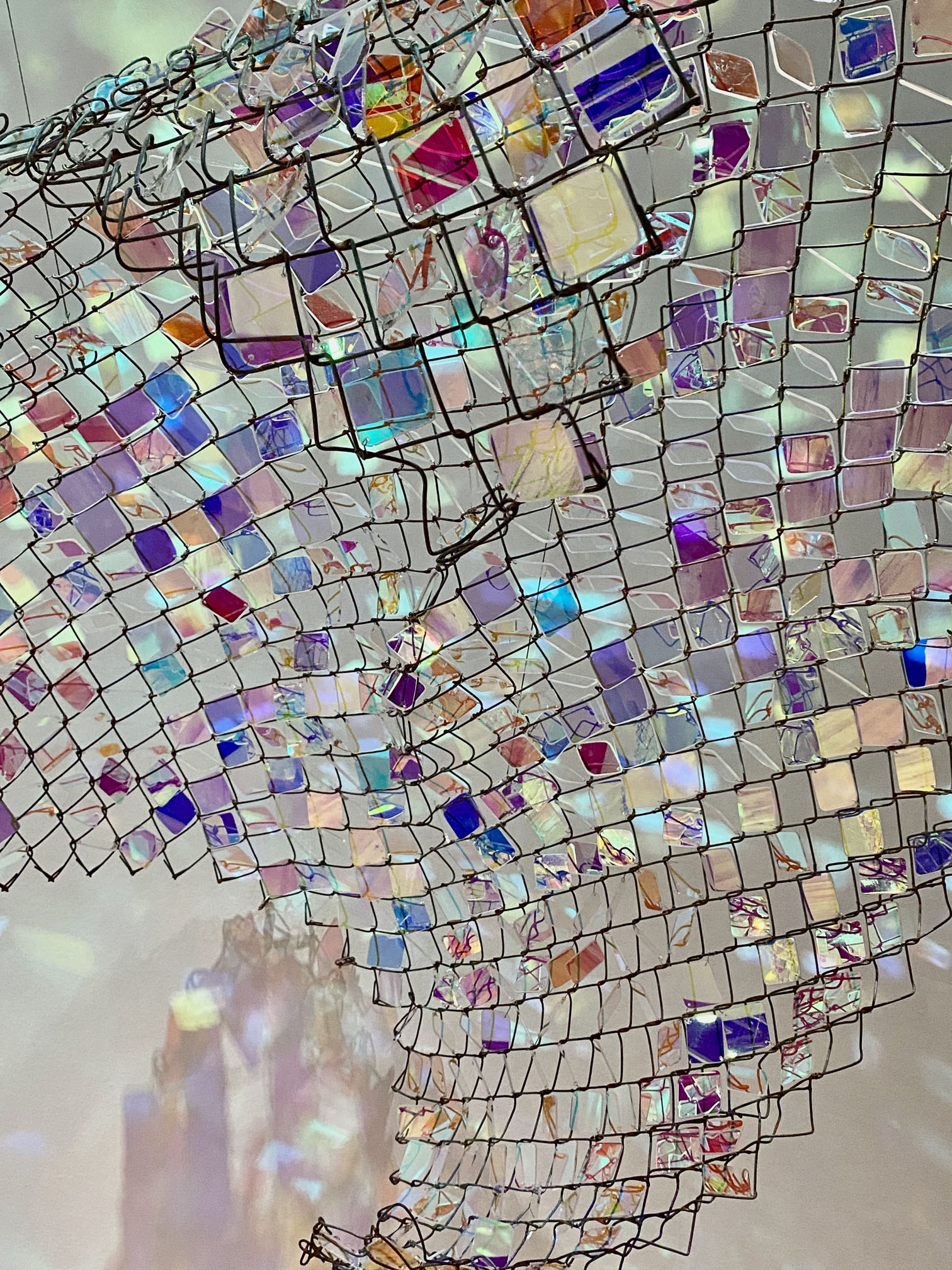
Detail of Soo Sunny Park’s 2013 Unwoven Light, an installation that seems to move as visitors walk through it. Courtesy: the artist

For more, see some of our favorites works in our Flickr album.

The first section showcases works where artists use light as the primary medium. Visitors can enjoy works by some of the most famous innovators from the Sixties and Seventies – Robert Irwin, who inspired a generation of West Coast art students to think differently; Dan Flavin, who merged minimalism with industrial light; and Helen Pashgian, who makes magic from luminous resins.

Irwin’s 2011 piece appears minimal, but his six fluorescent-light colors can be activated in four different variations, and he associated each with agricultural colors of Southern California. You can enjoy looking at Lucky You for its purity of form, or contemplate Irwin’s recollections of home.

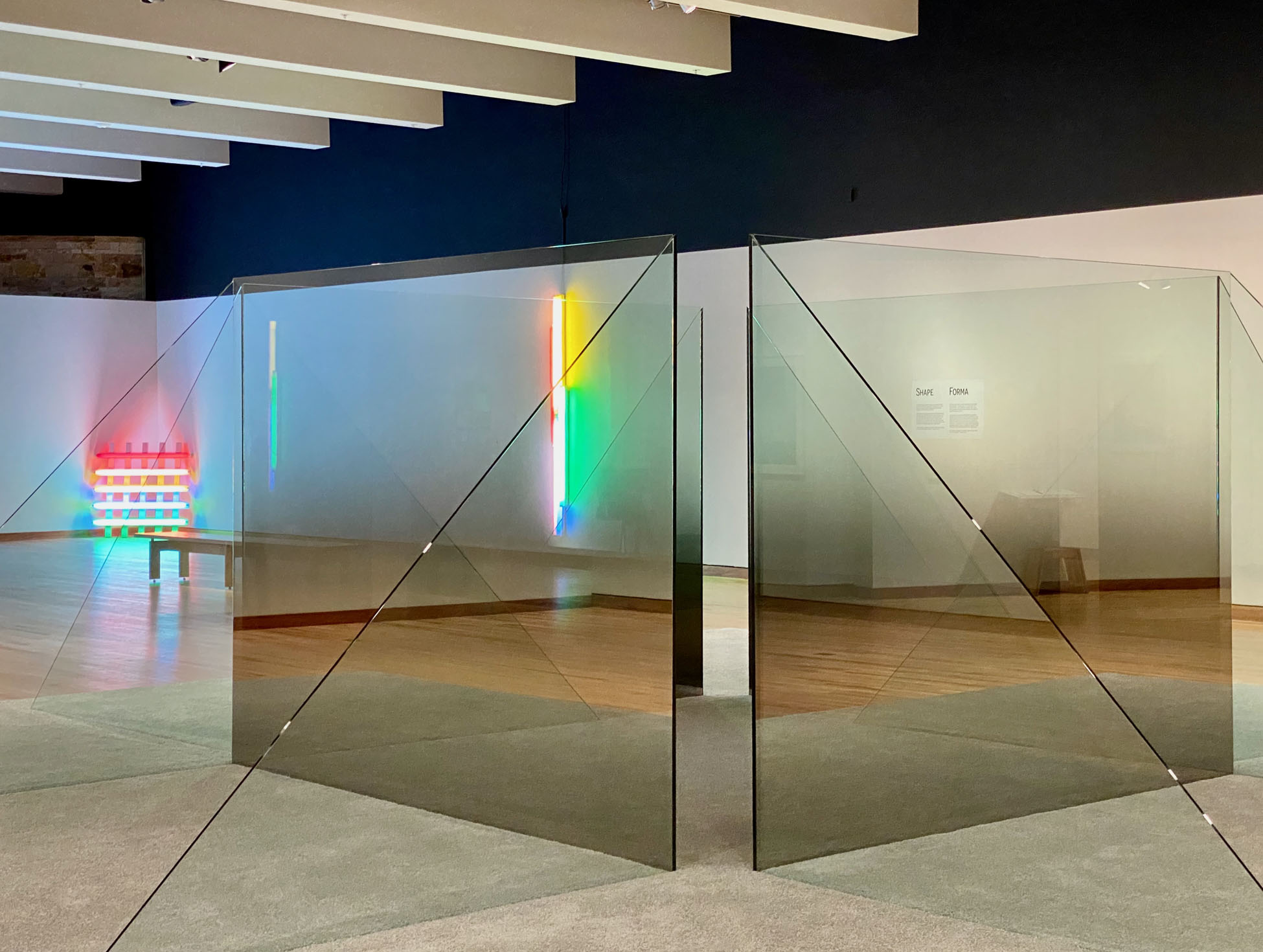
Two fluorescent works by Space and Light superstars – Robert Irwin’s 2011 Lucky You and Dan Flavin’s 1987 untitled (in honor of Leo at the 30th anniversary of his gallery. Courtesy: Thoma Foundation

Behind the black curtain, you can enter a tranquility chamber. Helen Pashgian’s 2021 installation provides an unforgettable experience to visitors to slow down and wait. What are you seeing? The frosted, peach-colored epoxy sculpture at center stage appears dissolve in the light-filled space as lights slowly change. It’s like watching show changes to the sky during a dramatic sunset, but it’s light, white, ethereal, and pure.

Helen Pashgian’s 2021 untitled (peach lens) – the lens dissolve into space as the light changes to sunrise and sunset modes. Courtesy: Tia Collection

All-star word artist Jenny Holtzer’s Red Tilt takes an absolutely maximalist approach with multiple LED displays – a too-much, all-at-once, never-stopping tsunami of emotional words from her own story about survival and trauma.

Leo Villareal’s piece Scramble is the opposite. Albuquerque-bassed Villareal creates a mesmerizing, tranquil, never-repeating abstraction by programming LED lights. He’s done this on a larger scale in his epic commissions to light the San Francisco-Oakland Bay Bridge and all of London’s bridges over the Thames. Here, visitors get a more intimate experience – slowing down to watch Scramble’s gently changing colors and know what they’re seeing is unique to the moment.

Jenny Holtzer’s 2002 LED display, Red Tilt. Courtesy: Thoma Foundation
Leo Villareal’s 2011 Scramble, a programmed LED artwork that changes constantly. Courtesy: Thoma Foundation

Larry Bell’s 1984 installation is the centerpiece of exhibition’s exploration of how artists use light, illusion, and technology to explore (and play with) our perceptions of space. Direct from his retrospective in Phoenix, Bell’s barely-there The Cat is a delicate but monumental presence in the show.  Huge, planes of coated and non-coated glass require a circumnavigation. Moving around, you can see how works are reflected and how some opaque surfaces block views of others.

Larry Bell’s 1984 The Cat – rectangles of coated and uncoated float glass.

Two nearby works by Santa Fe-based August Muth offer visitors a more intimate experience. Muth uses a holographic etching technique in which he creates the illusion of a “floating” image.

August Muth’s 2024 holographic etching Shadow Within Light. Courtesy: Pie Projects Contemporary Art.
August Muth’s 2022 holographic etching Terra Solaris. Courtesy: Pie Projects Contemporary Art.

The exhibition concludes with a magnificent installation by Soo Sunny Park – an installation of lights and plexiglass pieces that appear to move as you move through. Take a peek in this video.

Detail of Soo Sunny Park’s 2013 Unwoven Light installation with tiles that appear to move as the visitor moves through it. Courtesy: the artist

Santero Nicholas Herrera at the Harwood

The local artist honored in Taos with a lifetime retrospective lives and works only 18 miles from Georgia O’Keeffe’s famous home in El Rito. But their work, lives, purpose, and legacy couldn’t be further apart.

Nicholas Herrera: El Rito Santero, on view at the Harwood Museum of Art through June 1, fills three galleries with work by a New Mexican wood carver who not only pays tribute to saints and ceremonies important to the nearby rural Hispanic communities, but also channels politics, social commentary, lowrider culture, and pressures of modern life in a mixed-up world into his craft.

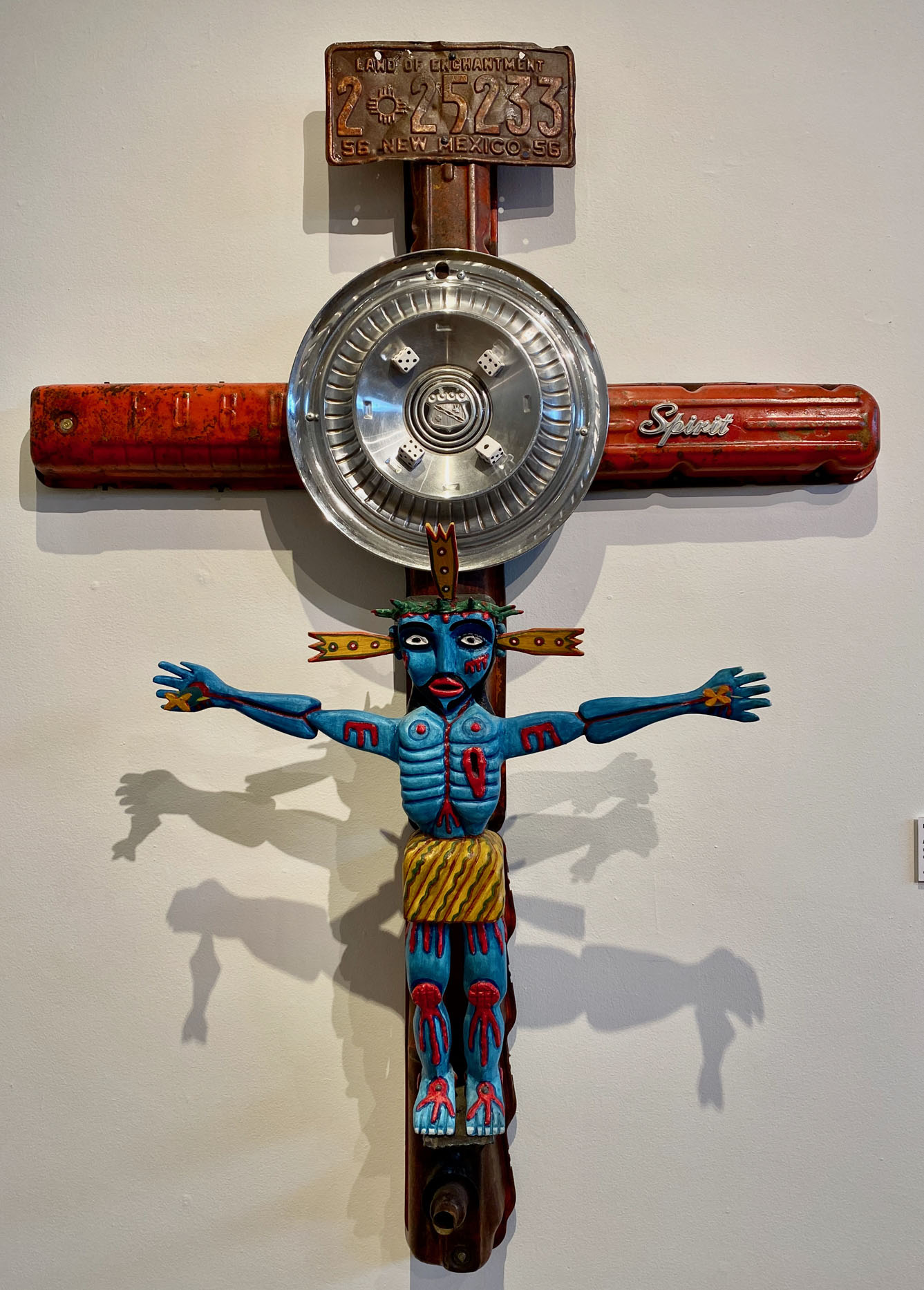
Herrera’s Espiritu mixes religion with found car parts. Courtesy: private collector

It’s a colorful, irreverent, heart-felt tribute to the people, places, religion, and culture of the rural high hills that he calls home. And here’s Herrera’s self-portrait – the namesake of this engaging retrospective.

Herrera’s 2022 hand-carved self-portrait – El Rito Santero. Courtesy: private collection
Herrera’s1998 hand-carved image of his favored protector La Virgen de Guadalupe. Courtesy: Evoke Contemporary

At first glance around the gallery at the top of the back stairs, Herrera’s work seems firmly situated in the tradition of the last 400 years of northern New Mexico saint-carving. Since the 1600s, when Spanish farmers first colonized these remote hills, the faithful relied primarily on local artists and carvers to decorate home chapels, churches, and shrines.

Herrera’s work is the 20th century version. There’s a grand, colorful painted altar honoring his brother in which a pantheon of Catholic icons gazing benevolently upon you. You’ll also meet his special icon – a bright, enigmatic Lady of Guadalupe.

In a small, dark room you’ll experience a powerful home altar, filled with hand-carved spiritual tributes, surrounded by candles and and all manner of other-worldly retablos.  

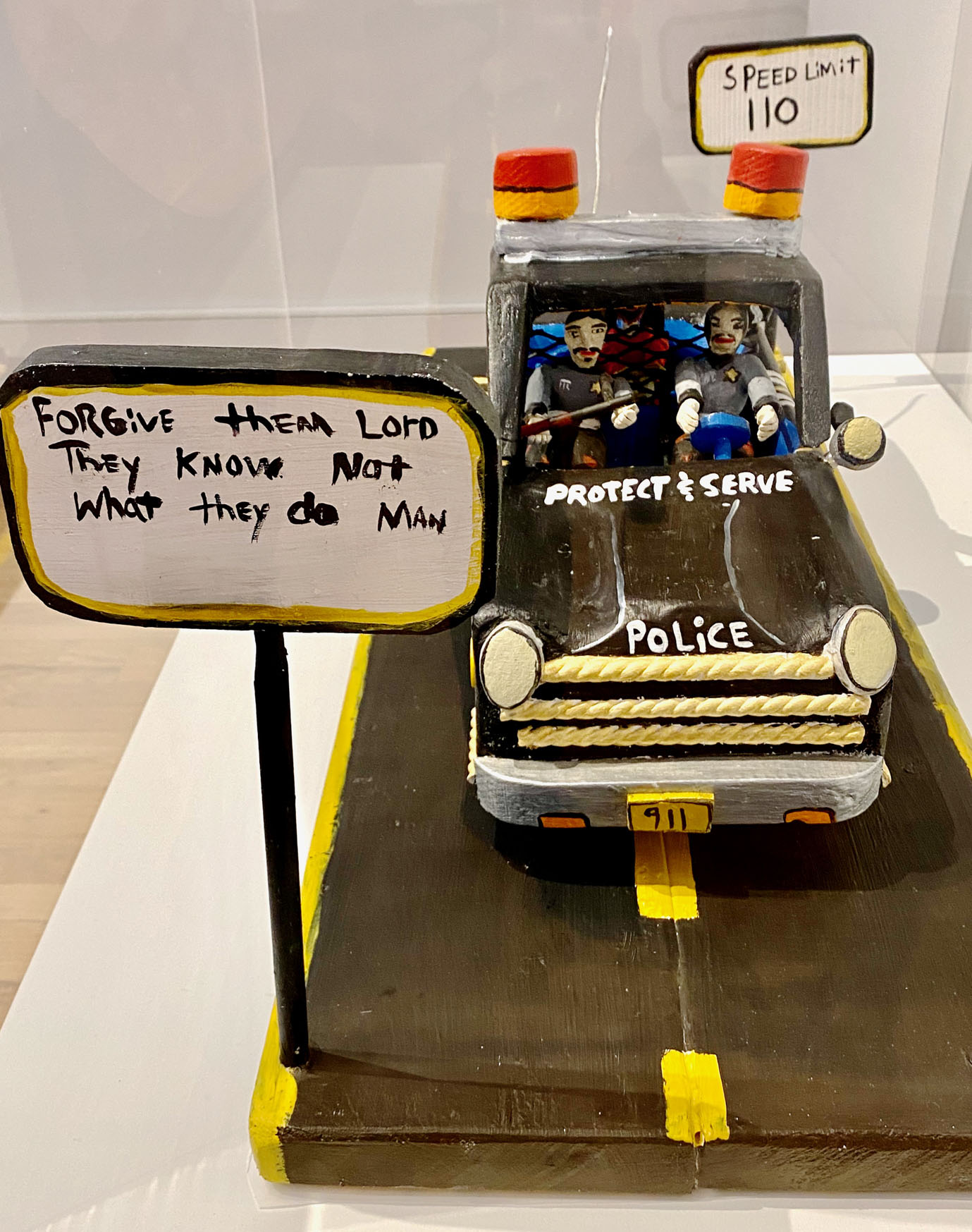
But the next two galleries, you’ll encounter work using these same materials and techniques, but reflects life-changing events in the artist’s life that are mashed up with ancient spiritual traditions – Jesus in the back of a speeding cop car, Herrera’s own near-death experience in a car crash when he was in this twenties, and a crazy lights-flashing slot machine promising allures that only the Devil can love., or aerial views of old Spanish valleys.

Herrera’s 1994 painted wood and mixed-media sculpture Protect and Serve with Jesus in the back seat of the patrol car. Courtesy: Smithsonian American Art Museum
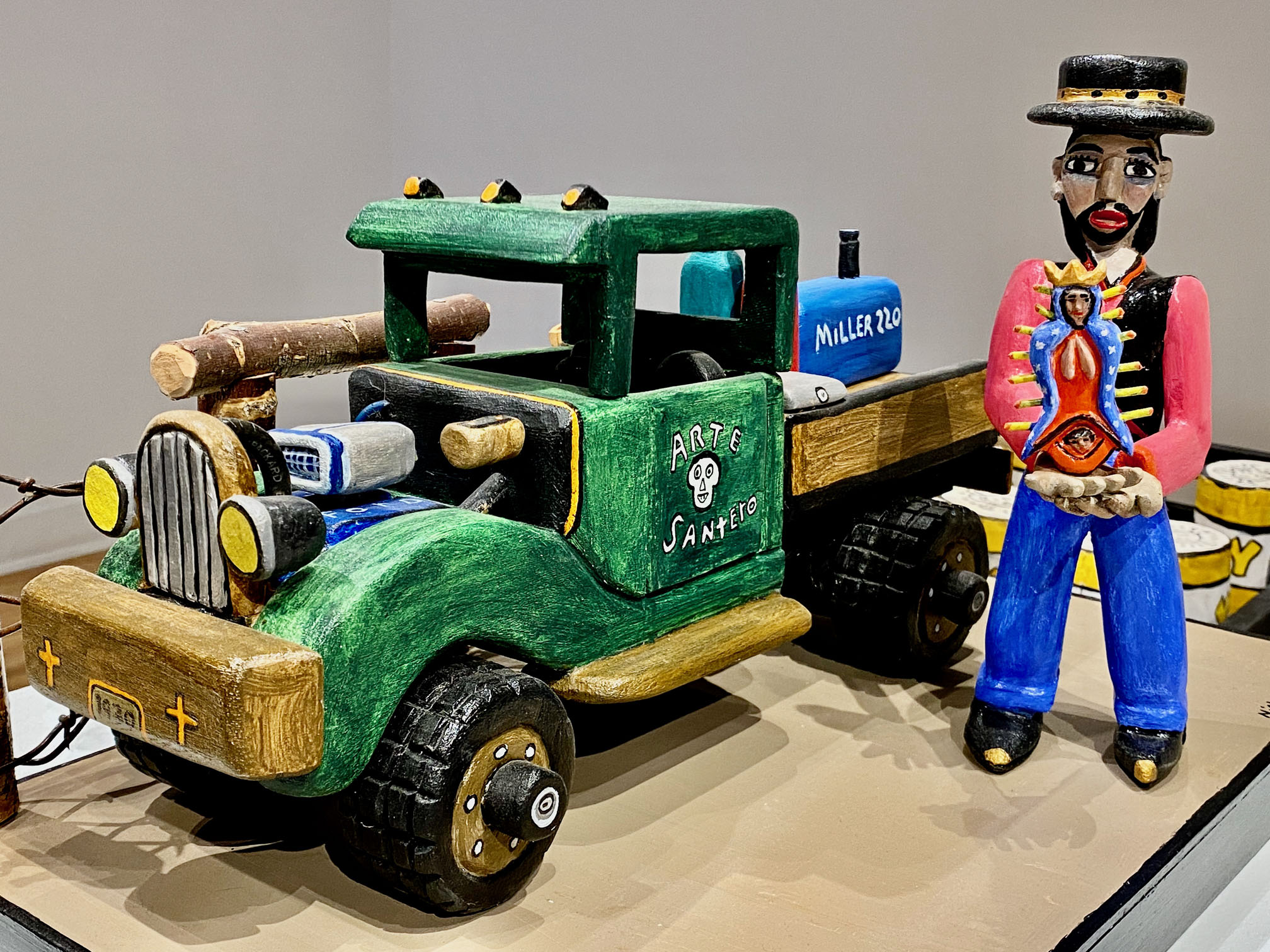
Herrera’s 1995 painted wood and metal Los Alamos Death Truck. Courtesy: private collection

Like all great artists, Herrera is inspired from life events and the world around him – reflections about his growing up and home life, land-use and traditions in his community, and issues ripped from the headlines, like the terror of transporting Los Alamos nuclear waste or issues with the border patrol.

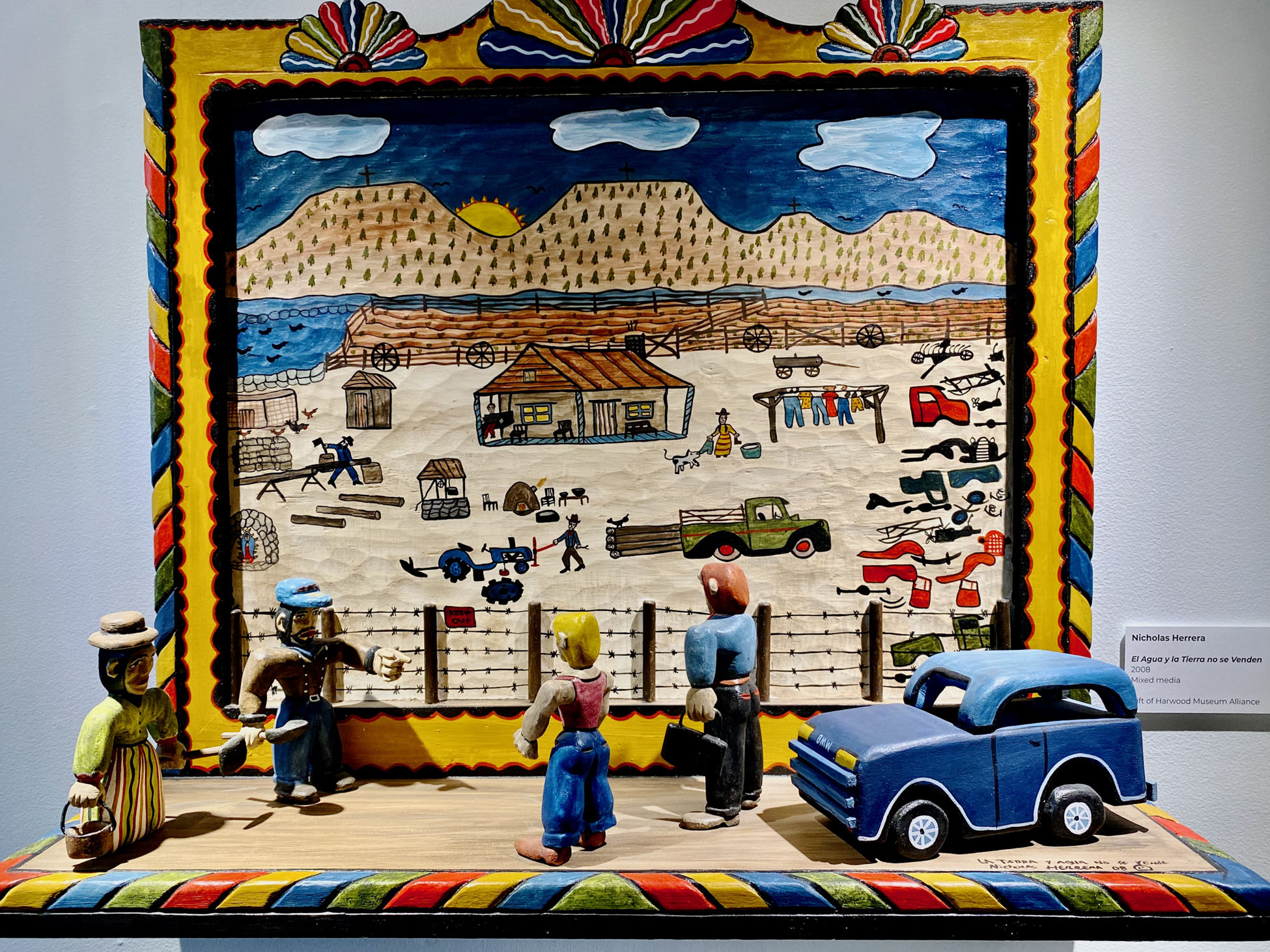
Herrera’s 2008 mixed-media El Agua y la Tierra no se Venden, highlighting the importance of 400 years of protective land stewardship in Northern New Mexico.

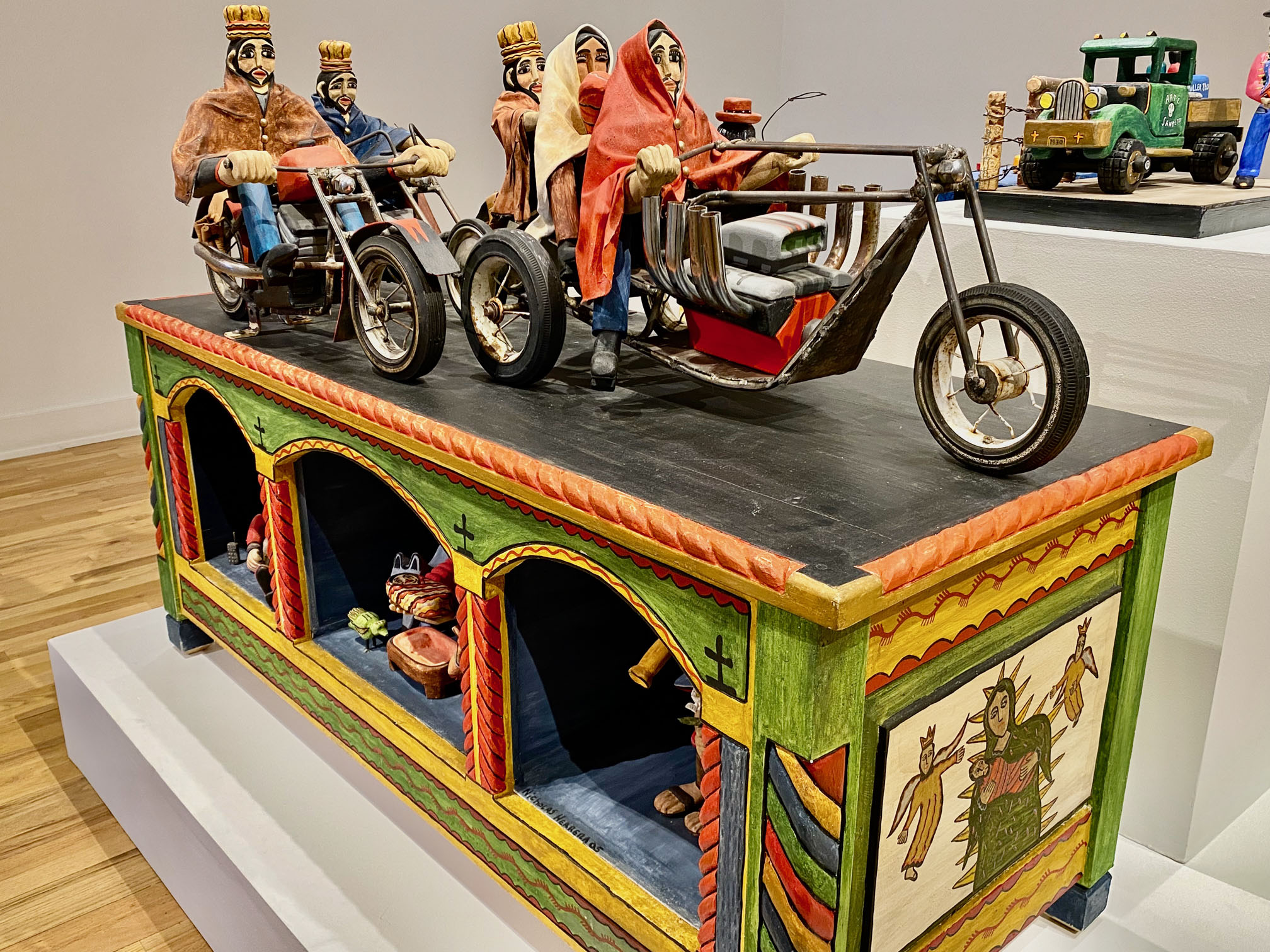
Used car parts, toy parts, and other stuff from the junkyard “tell” Herrera how and where he might use them. Lowrider culture is an important source of price in Northern New Mexico, so it’s not surprising that he’s channeled that part of the local experience into his work, too.

The Holy Family hits the road in Herrera’s 2005 carved and painted Low Rider Nativity, embellished with cloth, toy wheels, and found metal. Courtesy: private collection

See some of our favorite works in our Flickr album, and meet the artist himself in this short video profile created by the Smithsonian American Art Museum: