Man Ray at The Met

After Man Ray saw European Cubism at the 1913 Armory Show, he knew what he had to do in his own art – abandon all of the constraints of contemporary American art and dive headfirst into Dada and push the boundaries – go rogue.  

Some say that Man Ray became America’s most important 20th century artist. Marcel Duchamp – who became one of Man Ray’s best friends and collaborators – would certainly agree. All the evidence for Man Ray’s status is right here in the Met’s survey of Man Ray’s formative years (1914-1929), Man Ray: When Objects Dream on view through February 1, 2026.

Man Ray’s 1930 Self-Portrait with Camera – a solarized portrait. Courtesy: The Jewish Museum.

Walking in, you look through the exhibition’s architectural aperture to an endless array of Man Ray’s famed rayographs – dreamy abstract black-and-white cameraless images – lining parallel black gallery walls. Nearly sixty have been gathered for this occasion from international public and private collections.

See our favorite works in the exhibition in our Flickr album.
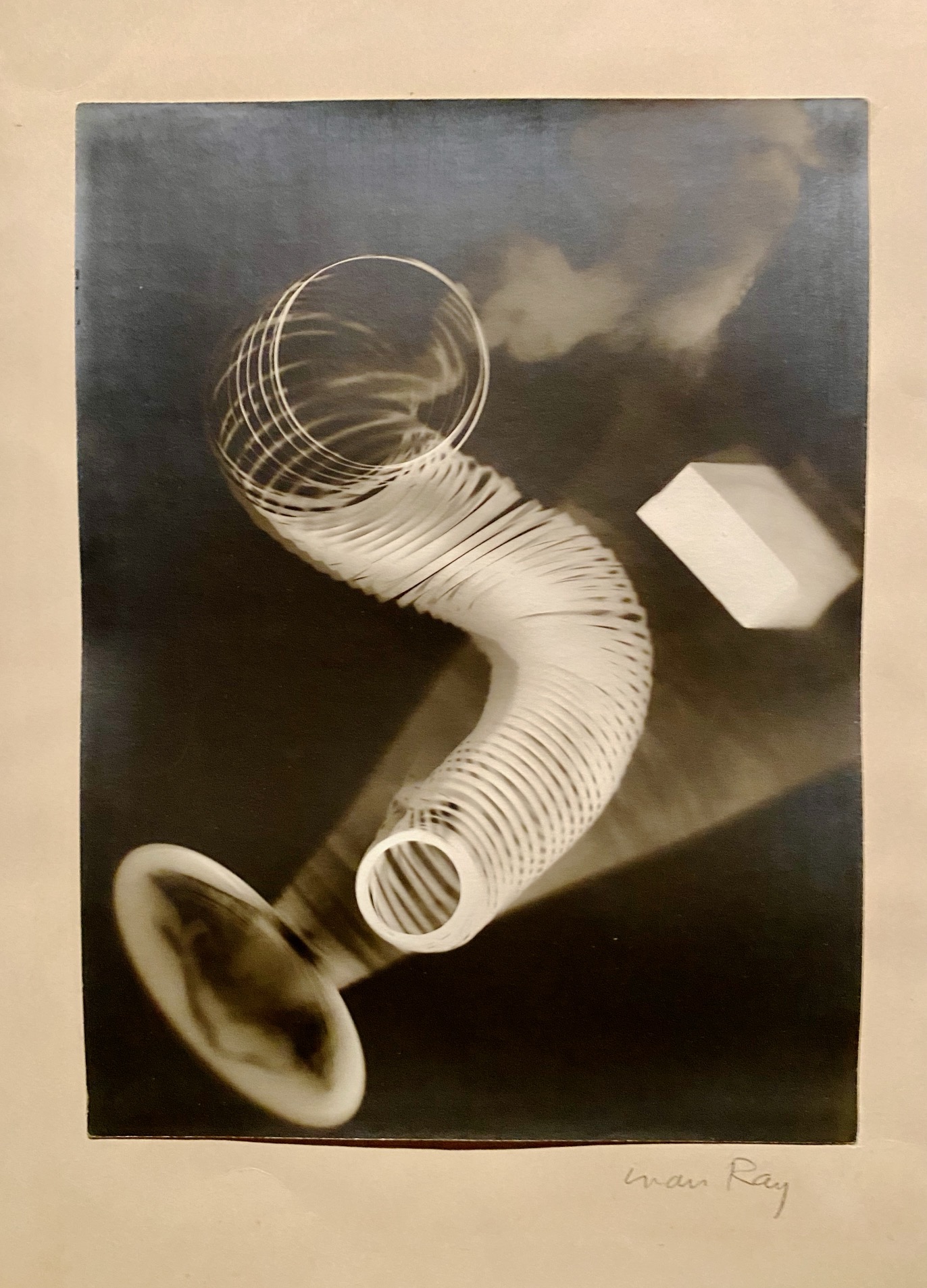
Man Ray’s 1922 Rayograph published in Les Fuilles Libres (Loose Pages) magazine – a coiled wire puffing smoke emerges from a glass.  Courtesy: private collection.
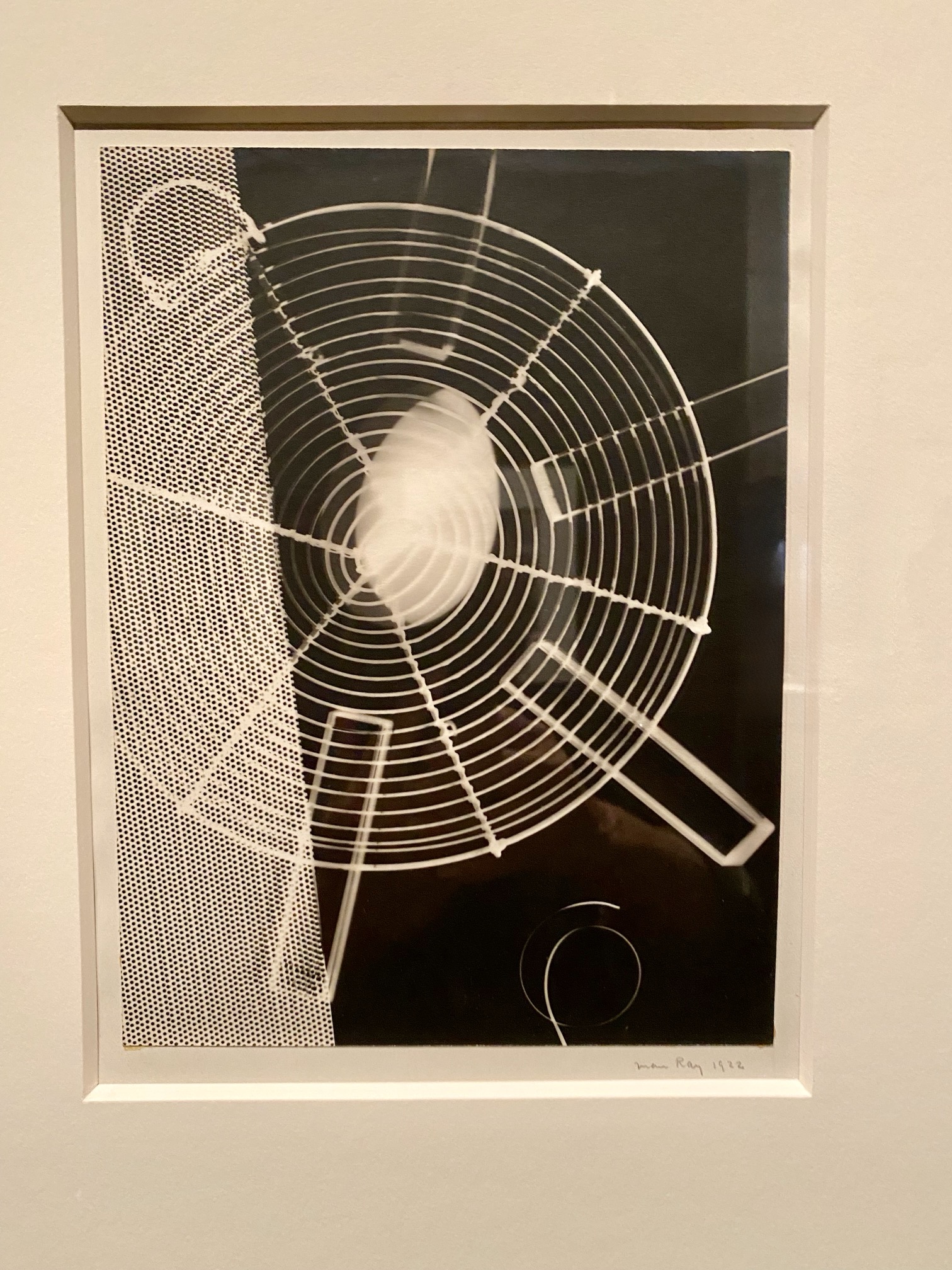
Man Ray’s 1922 gelatin silver print Rayograph incorporating an everyday wire rack for dramatic effect.  Courtesy: Yale University Art Gallery.

Although the rayographs form the core of this show, you also see the oil paintings, airbrush drawings, sculptures, movies, and game boards – works that are rarely seen, but illustrate why Man Ray rapidly took center-stage in the modern avant-garde community.

While working as a commercial artist and photographer, he used his free time to make unconventional, revolutionary works that banished representation. In 1916, he wrote a “new art” treatise on how to condense motion and dynamic shapes into two dimensions.
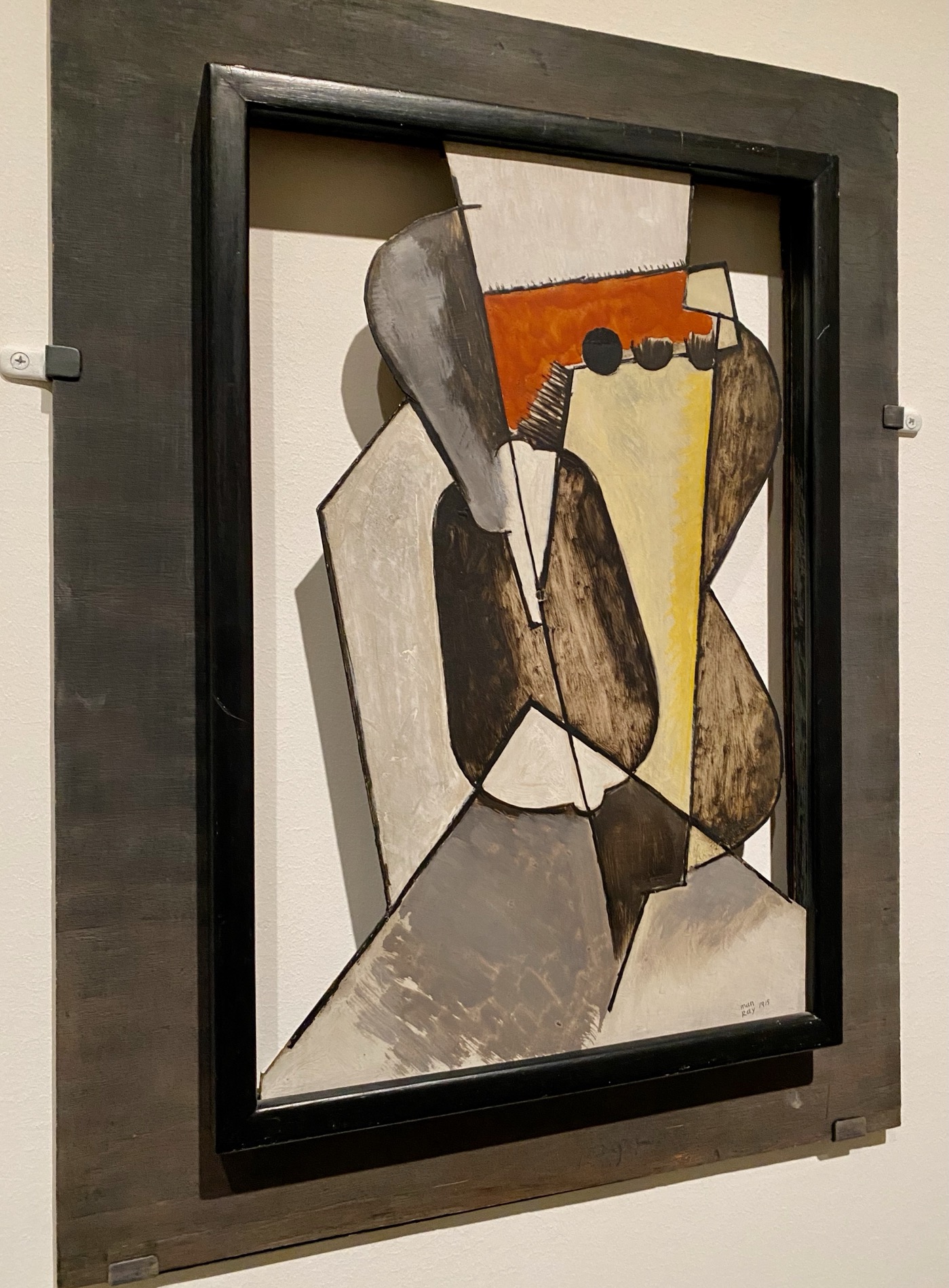
Man Ray’s 1915 oil on board Cut-Out from his first solo show in New York in 1919 – representing three dimensions within two.
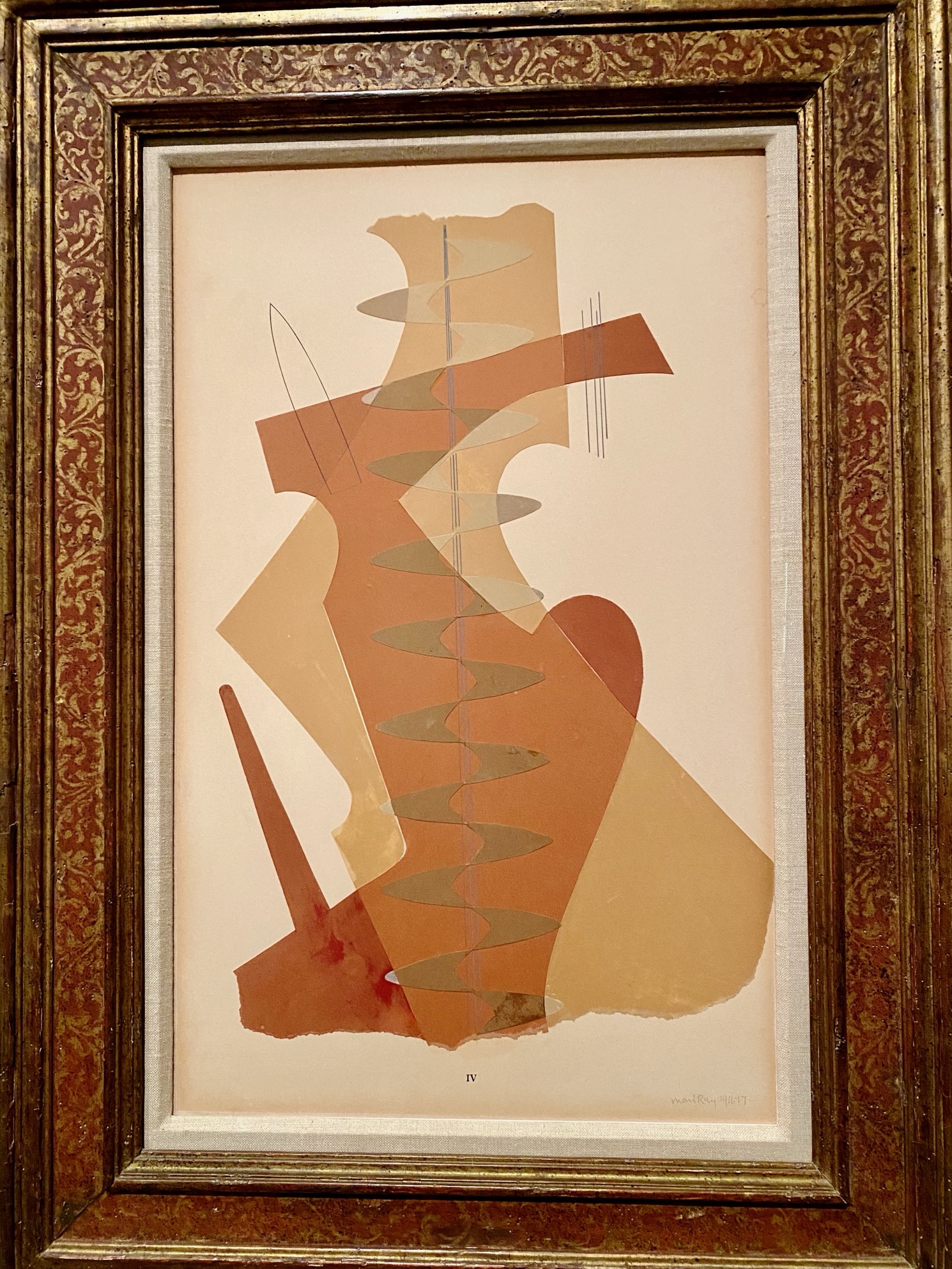
Man Ray’s 1916-1917 collage and pen-ink drawing The Meeting. Courtesy: The Whitney Museum of American Art.

By 1917, he was making large-scale works, portraying a Rope Dancer mid-performance with stencils, cut-up pieces of colored paper, and big colored spaces representing her shadows.
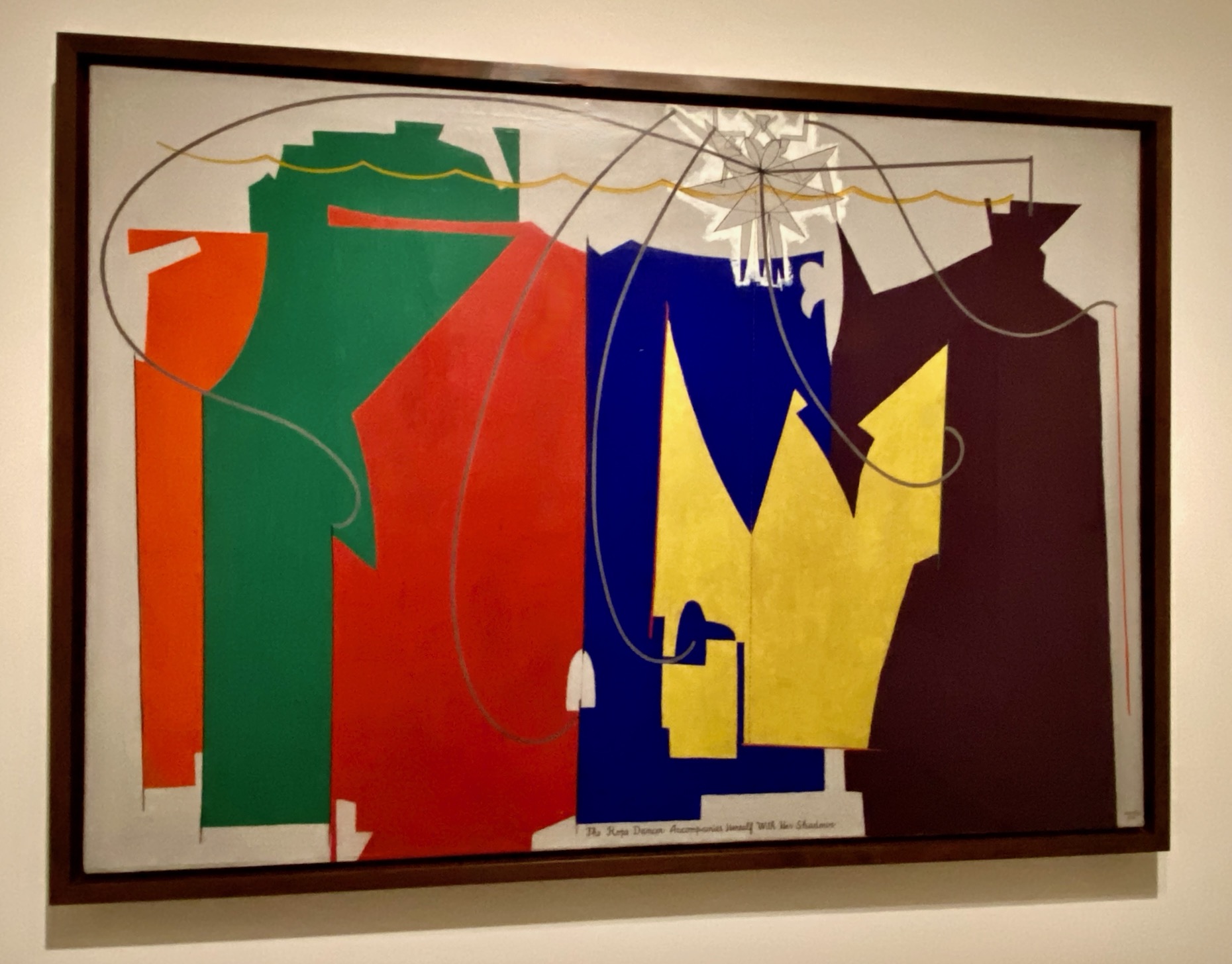
Man Ray’s 1916 oil painting The Rope Dancer Accompanies Herself with Her Shadows planned with cut paper. Courtesy: MoMA

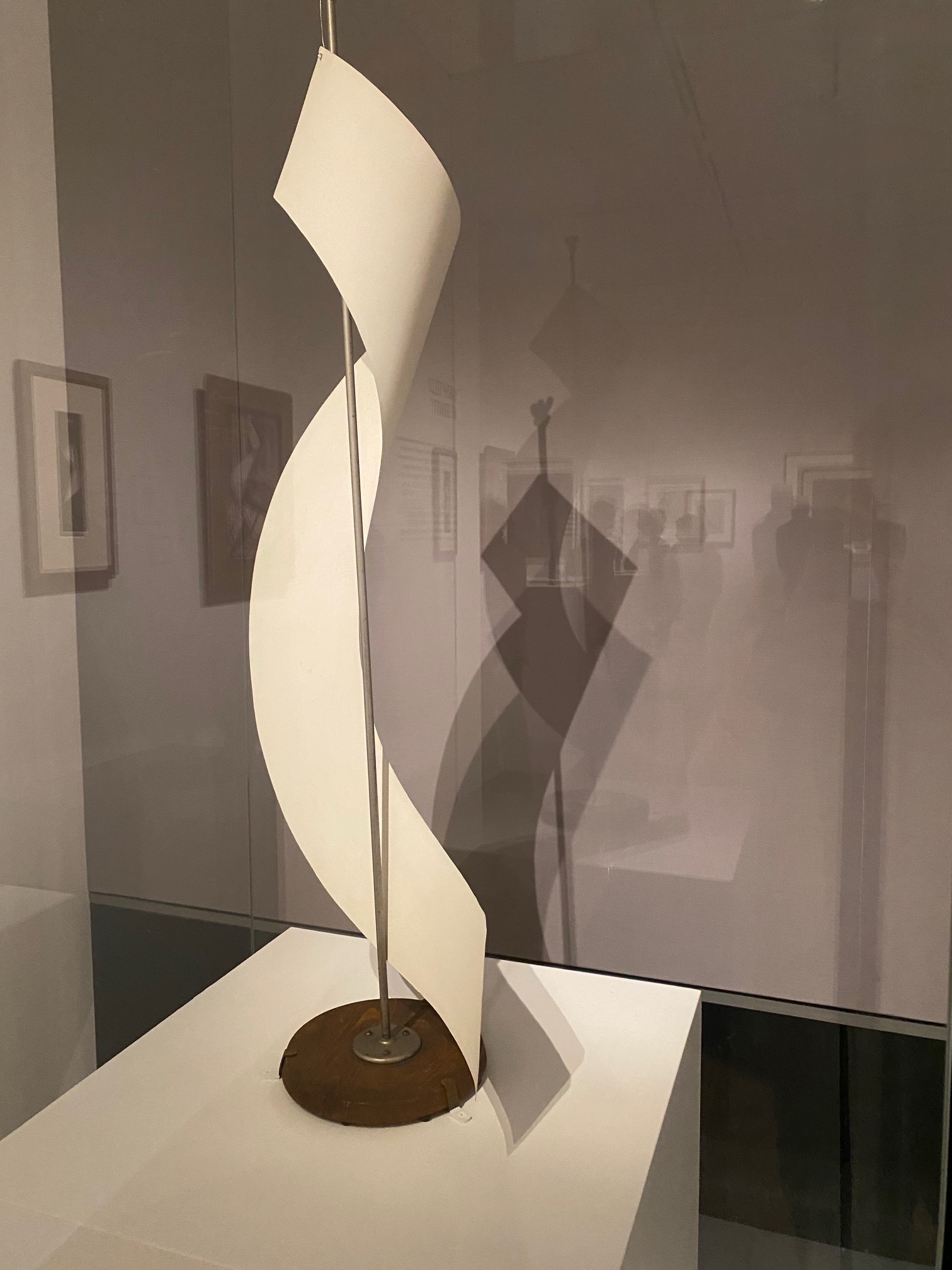
His sculptures were made in true anarchist-Dada fashion – from junk found on the street or in his apartment-building trash can. In one gallery, a precarious grouping of dramatically lit wooden hangars is installed overhead like a chandelier. The cast shadows look pretty good, too.  His spiraling Lampshade, a sensuously curved metal sculpture is nearby, alongside paintings and avant-garde portraits where he repurposed the great shape.
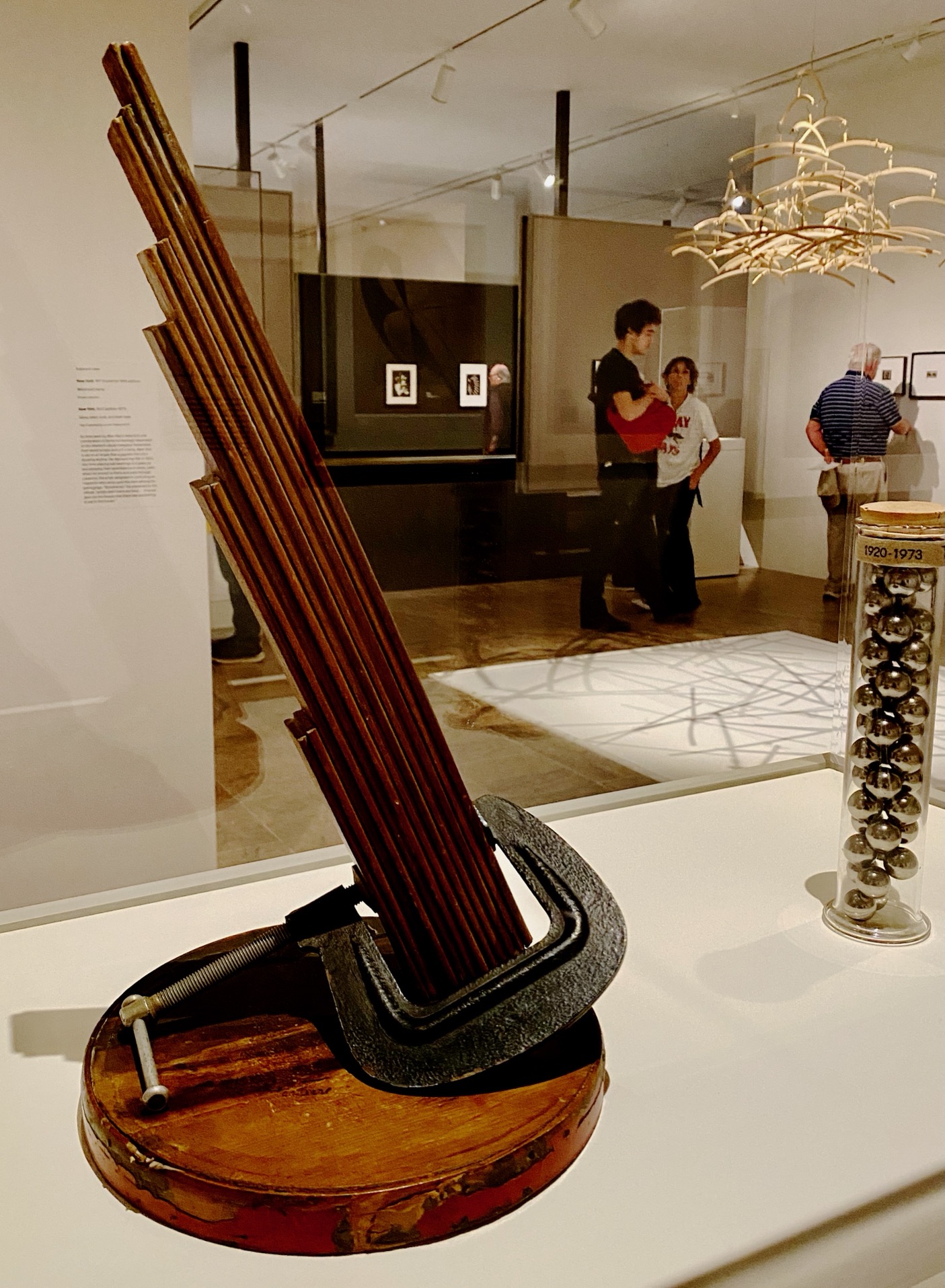
Man Ray’s 1917 wood and clamp sculpture New York like a tilted skyscraper; at right, 1920 sculpture New York – a mysterious stack of ball bearings in a glass container. Courtesy: private collection; Tate.
Man Ray’s 1921 Lampshade – a dynamic painted tin and metal sculpture; inspired by a paper lampshade found in the trash a year earlier. Courtesy: Yale University Art Gallery.

He even made game boards and chess sets to symbolize his philosophy about the best way to make art – spur-of-the-moment imagination, abstract planning, clear intention, and an element of surprise.
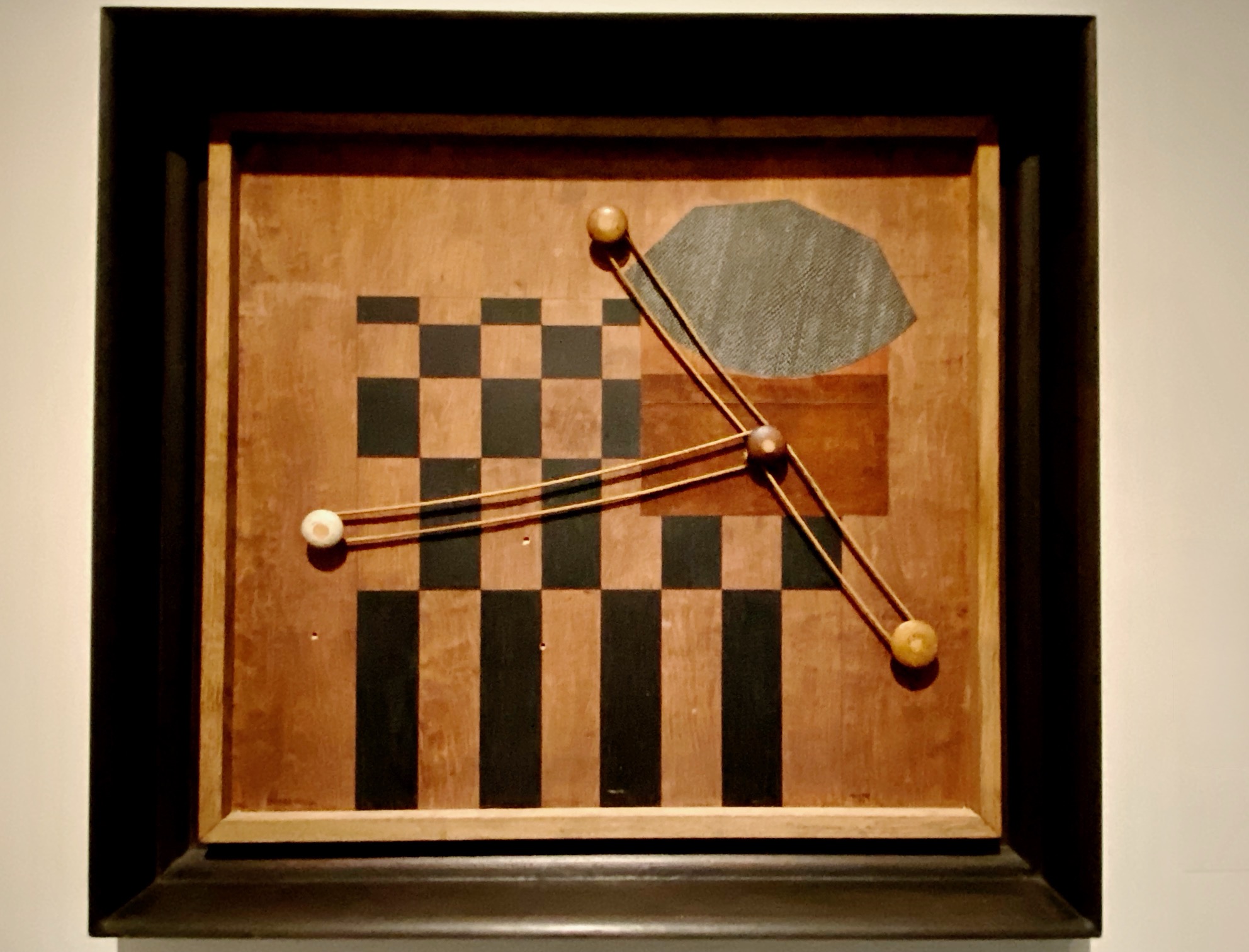
The philosophy of the chessboard: Man Ray’s 1917 Boardwalk – an assemblage of oil, furniture knobs, and yarn on wood. Courtesy: Staatsgalerie Stuttgart.

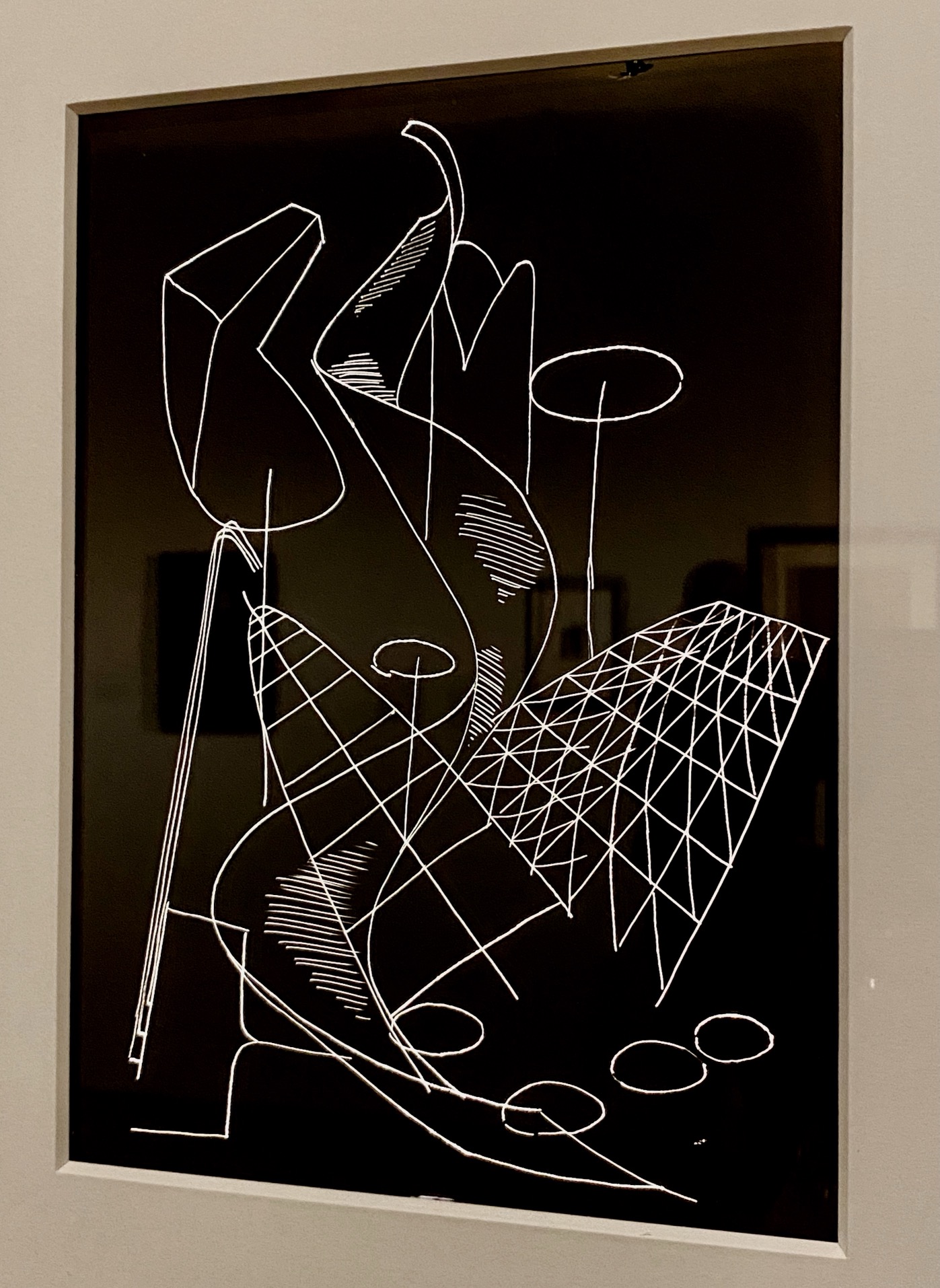
For Man Ray’s fine-art photographs, he preferred using inanimate, everyday objects to humans. And as he progressed as an artist, he didn’t use a camera.  In 1917, he started making glass-plate prints (cliché-verre) with sinuous, patterned line drawings. Soon, he was innovating with Aerographs – abstract pencil-and-airbrush drawings inspired by new technology (“drawing in air”).
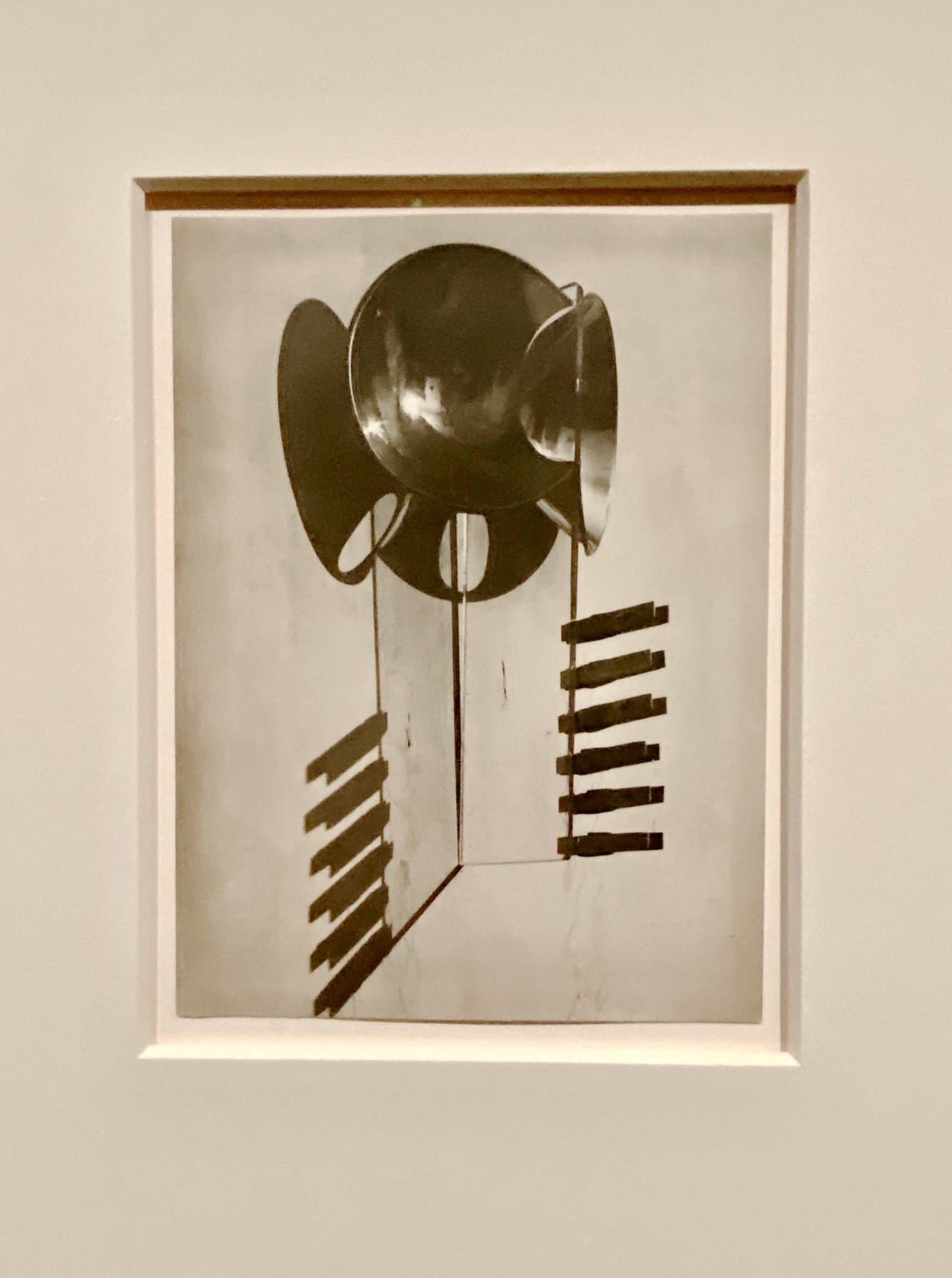
Man Ray’s 1918-1920 gelatin silver print “Integration of Shadows” – an assemblage of clothespins, glass, and reflectors; printed after 1935. Courtesy: private collection.
Before the rayograph: Man Ray’s 1917 untitled glass-plate negative (cliché-verre). Courtesy: Centre Pompidou, Paris

Man Ray primarily spent his time in Paris during the 1920s. Once he began making rayographs in his studio, he was content playing with unusual juxtapositions of everyday objects, studio lights, and various types of photographic exposures. It’s reported that in 1922, he created over 100 rayographs and abandoned painting altogether. (But he took it up again the next year!)

The curators make a point of juxtaposing several rarely-seen paintings with specific rayograms from the same period to make a point – the artist might have returned to experimental paintings as a compliment to some of the shapes and feelings he was exploring through photography.
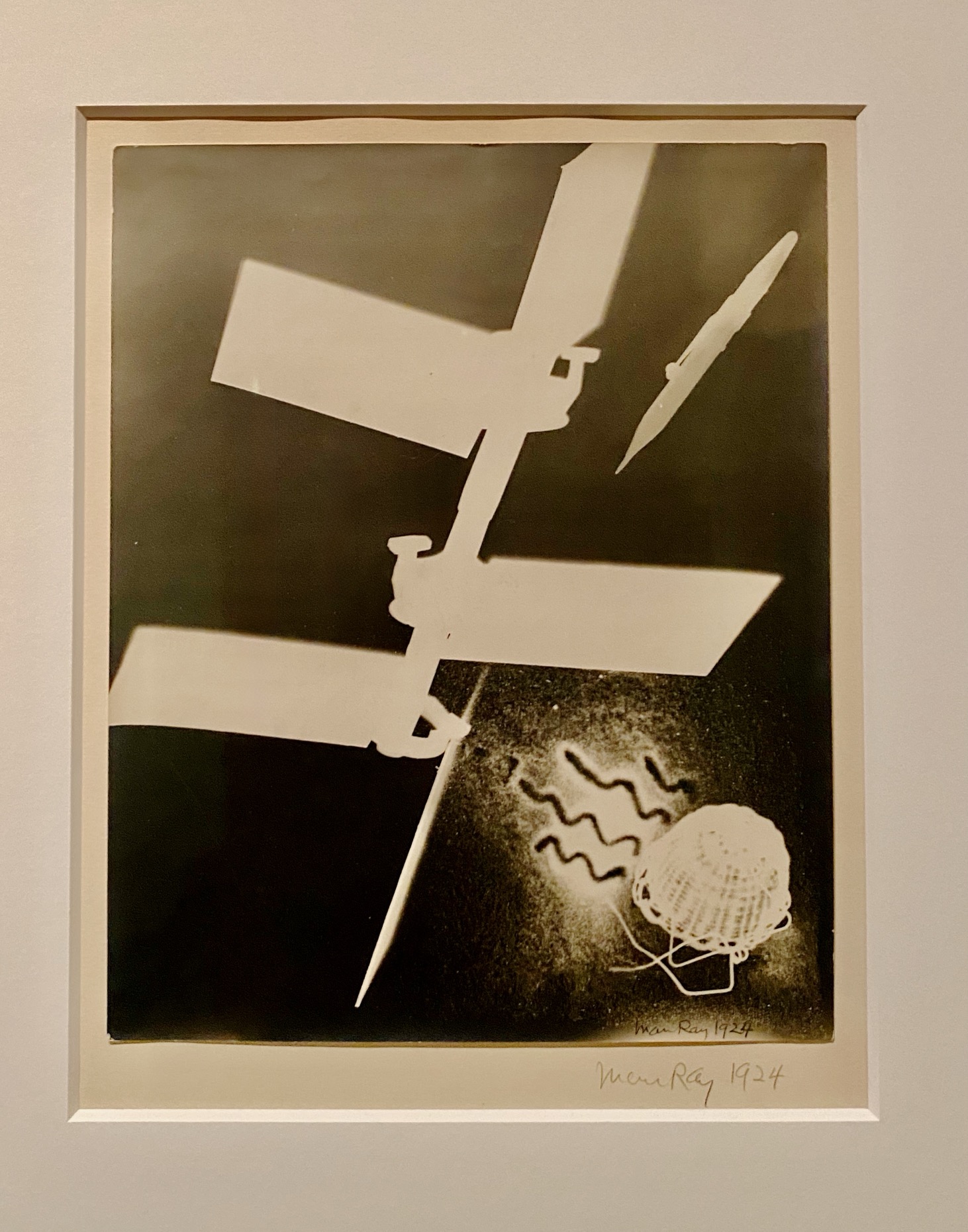
Man Ray’s 1924 gelatin silver print “Rayograph.”  Courtesy: Whitney Museum of American Art.
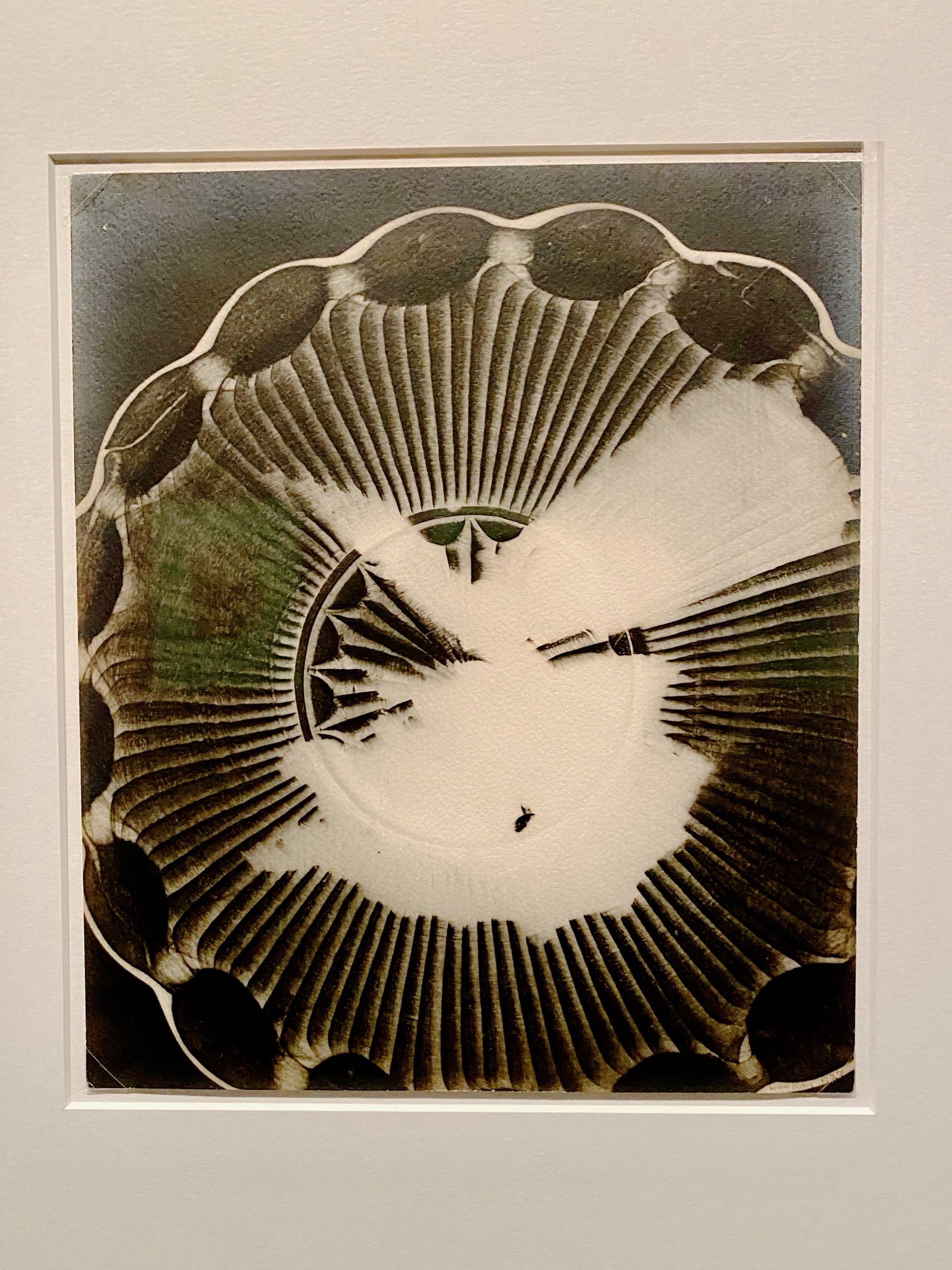
Man Ray’s 1927 gelatin silver print Rayograph – an experimental exploration of printing his images on textured paper.  Courtesy: private collection.

His unusual, dream-like images were eagerly applauded by the inner circle of European poets and artists who would soon be the official founders of Surrealism. They were intrigued by dreams, psychoanalysis, inner worlds, and startling juxtapositions. In fact, the title of the Met’s show comes a phrase written by Man Ray’s fan, poet Tristan Tzara – “when objects dream” refers to Man Ray’s mesmerizing work.

Man Ray’s ability to make magic with the camera – distorted images, adding surprising symbols, and creating tableaux of otherworldly floating objects – only added to the  enthusiasm for his work.
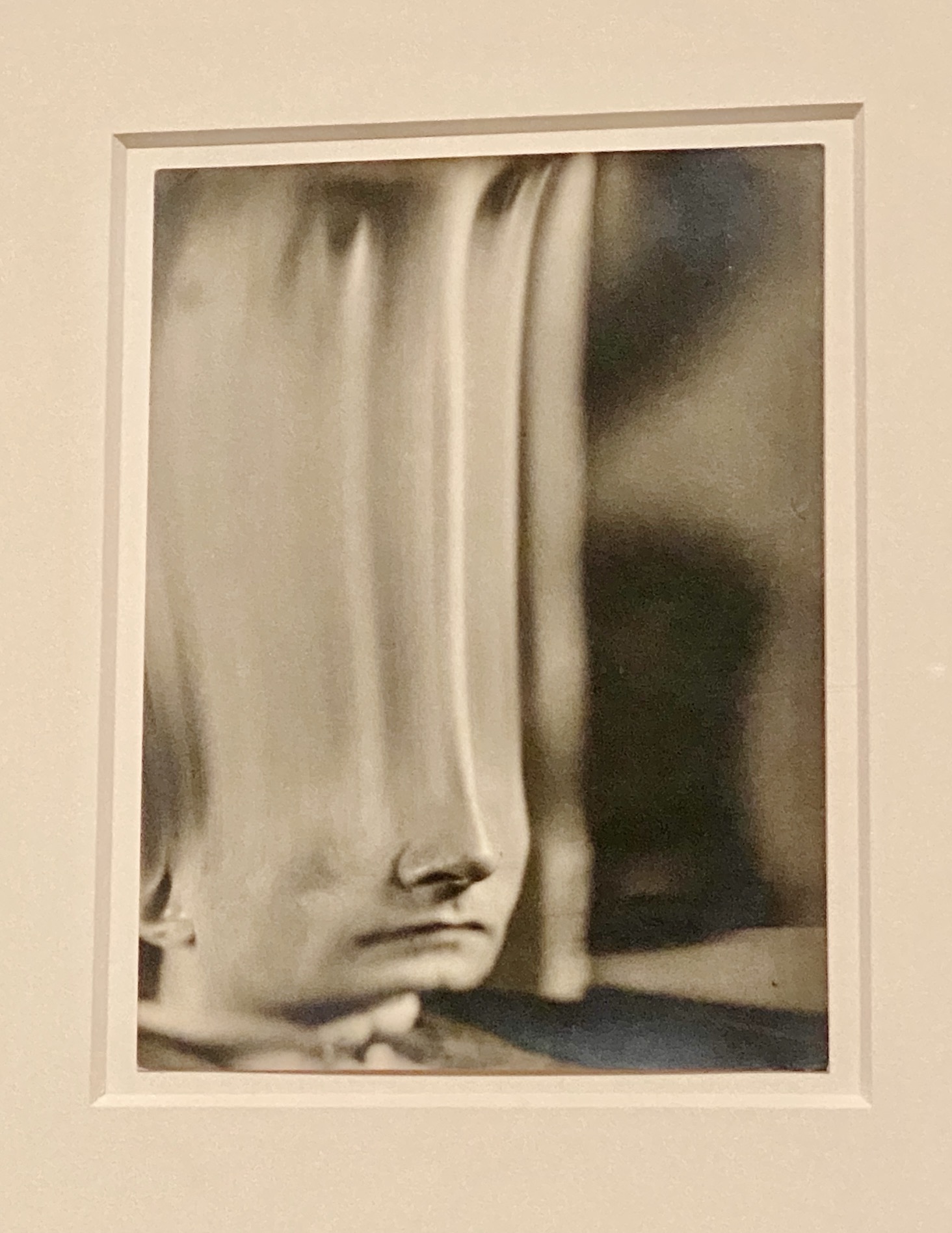
Man Ray’s 1925-1928 gelatin silver print Marcel Duchamp. Courtesy: private collection.
Man Ray’s 1924 gelatin silver print Le Violon d’Ingres featuring performer Kiki de Montparnasse – published in the proto-Surrealist journal Littérature.

The exhibition concludes with Man Ray’s beautiful solarized prints (a technique co-invented with model/photographer Lee Miller), symbolic paintings, and photographs that have become icons of Surrealism.

Hear the curators talk about the exhibition as they walk through this beautiful, inspiring show:

Take a look through all of the artwork in the exhibition here on the Met’s website. For more on Man Ray’s life and collaborations, listen to a longer Met telecast about his 1920s work with Lee Miller, Kiki de Montparnasse, and Berenice Abbott here.
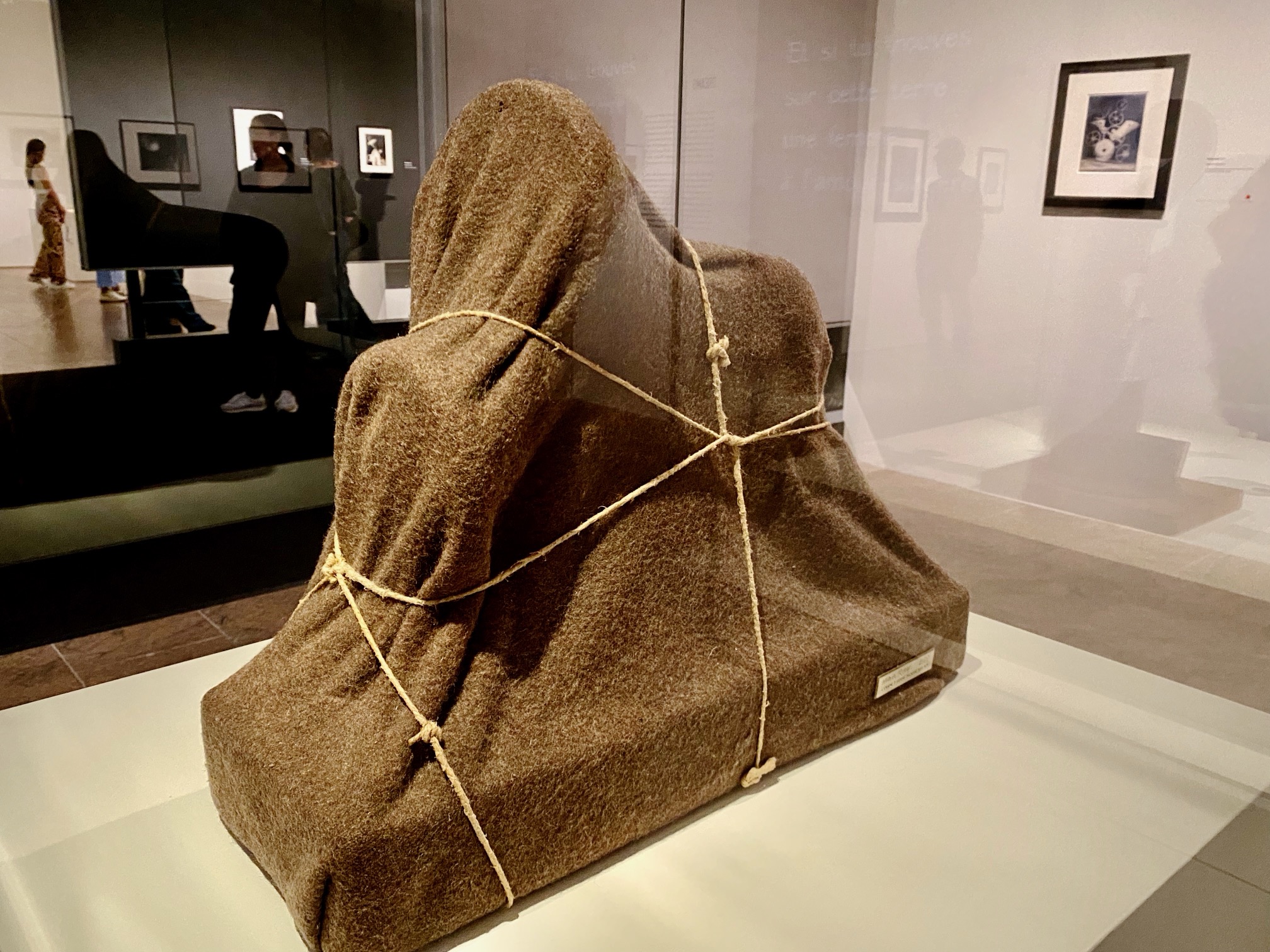
Man Ray’s 1920 sculpture L’enigme d’Isidore Ducasse (The Enigma of Isidore Ducasse) a mysterious wood, iron, wool, and rope assemblage to stir the subconscious (1971 edition). Courtesy: private collection.

MIAC Connects Diné Textiles to Land and Community

Building on the groundwork laid in the artist-curated exhibition Grounded in Clay: The Spirit of Pueblo Pottery (opening in St. Louis on March 7), Santa Fe’s Museum of Indian Arts and Culture asked five Navajo textile artists, photographers, and scholars to delve into MIAC’s historic collections to tell the story of Diné weavng.

Horizons: Weaving Between the Lines with Diné Textiles, on view through February 2, 2025, presents historic and contemporary weavings alongside epic photographs of Navajo Nation landscapes to show the connections textile artist have to ancestors, their mentors, the community, the land, and their materials.

Historic Diné weaving with photomural by co-curator Rapheal Begay. Courtesy: the artist.

Appropriately, the story told by over 30 historic textiles is presented in MIAC’s Masterpieces gallery.

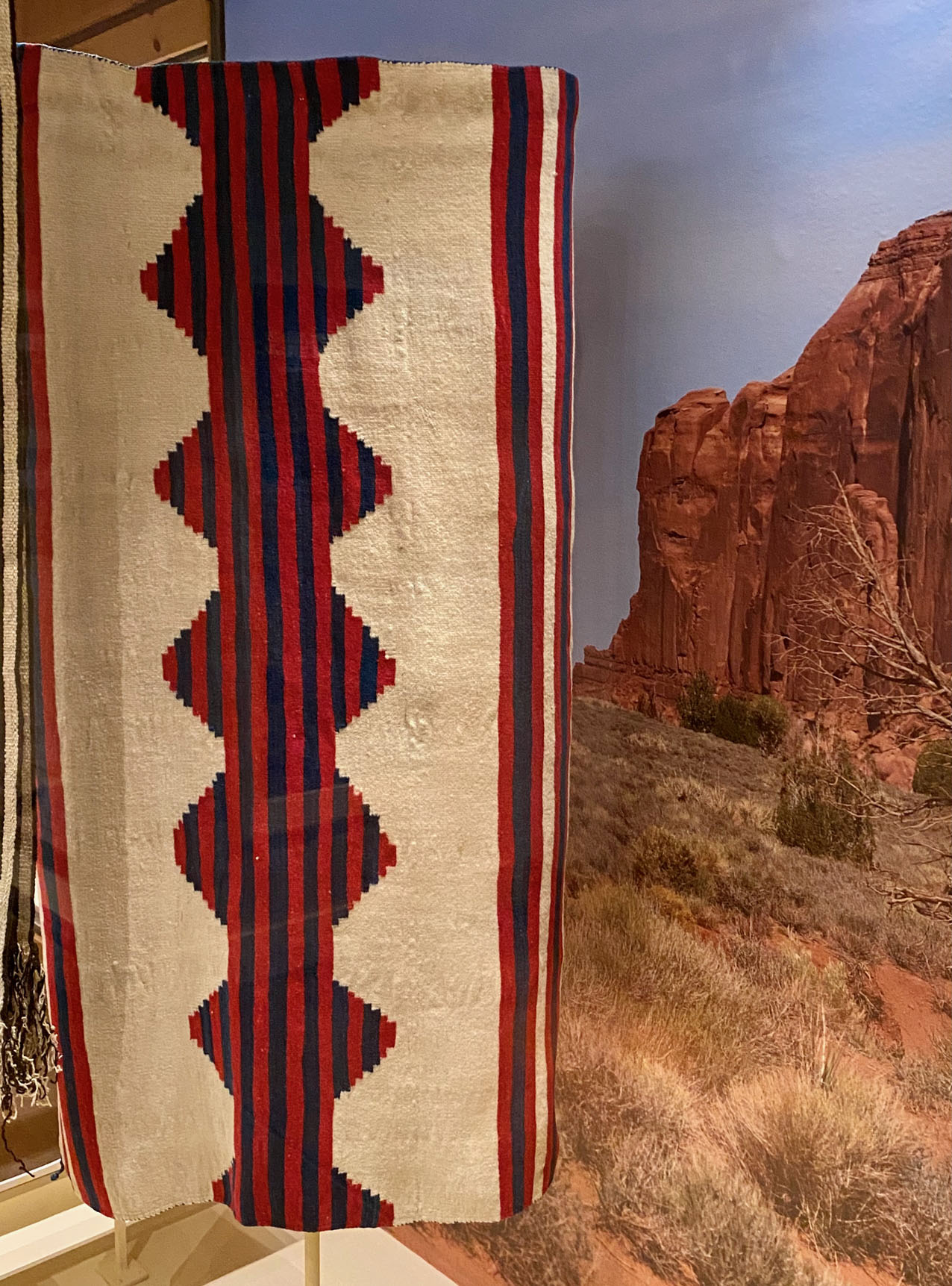
The entrance presents a dazzling display – a pictorial blanket woven in the 1890s set against a photomural of co-curator Rapheal Begay’s family sheep corral. It’s a visual testament to the importance of wool, life, and the 27,000 square miles of Navajo Nation. 

The blanket’s creator (unknown today) was an astute observer of the life on the land and translated it all into warp and weft – cow punchers, cattle, boots, birds, and new-fangled railroad cars, that only arrived in Navajo Country around the 1880s. Click here to see the detail.

1885 pictorial blanket created with Germantown wool yarn introduced in the Southwest by the railroads; photomural Navel (Hunter’s Point, AZ) by co-curator Rapheal Begay. Photo courtesy of artist.

Nothing was newer than the railroad, at the time this artist depicted it – a steam-fed invention from the East that would change western life forever, but that also brought a wide array of colorful yarn that could be mixed and matched with vegetal dyes to create new Native designs.

The intertwined history of Diné (“The People” in the Navajo language), textile art, and the land is told through quotes and recollections by the exhibition’s Native collaborators. While examining masterful geometric weaving techniques in 19th-century works, visitors are provided with an historic context – the types of art materials introduced to captives imprisoned at Bosque Redondo after the Long Walk, the images that could be interpreted as a longing for the homeland by the incarcerated, and coded spiritual affirmations.

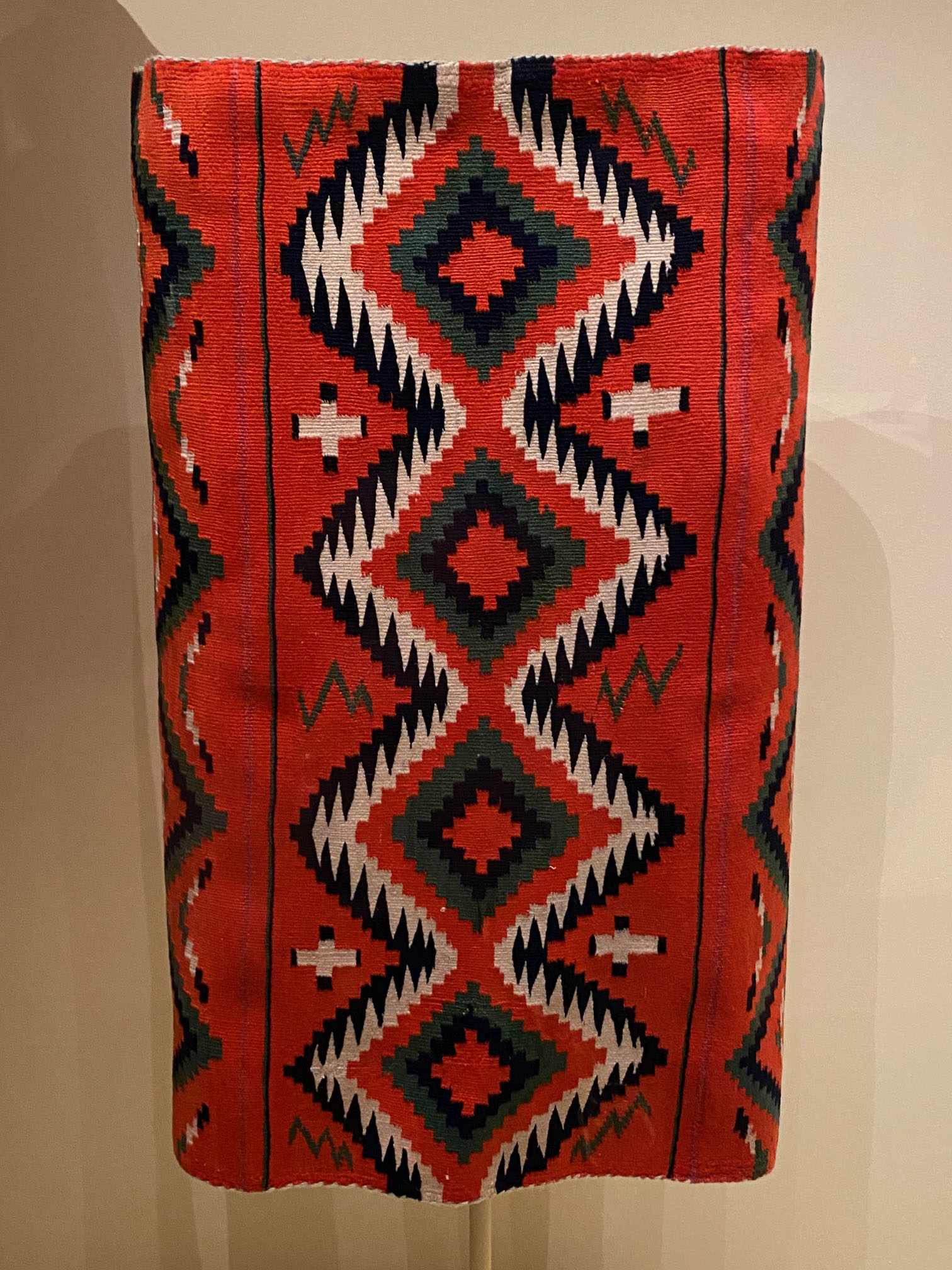
1850-1860 hand-spun wool child’s (or saddle) blanket with Spider Woman crosses; created with natural cocineal, indigo, and chamisa dye
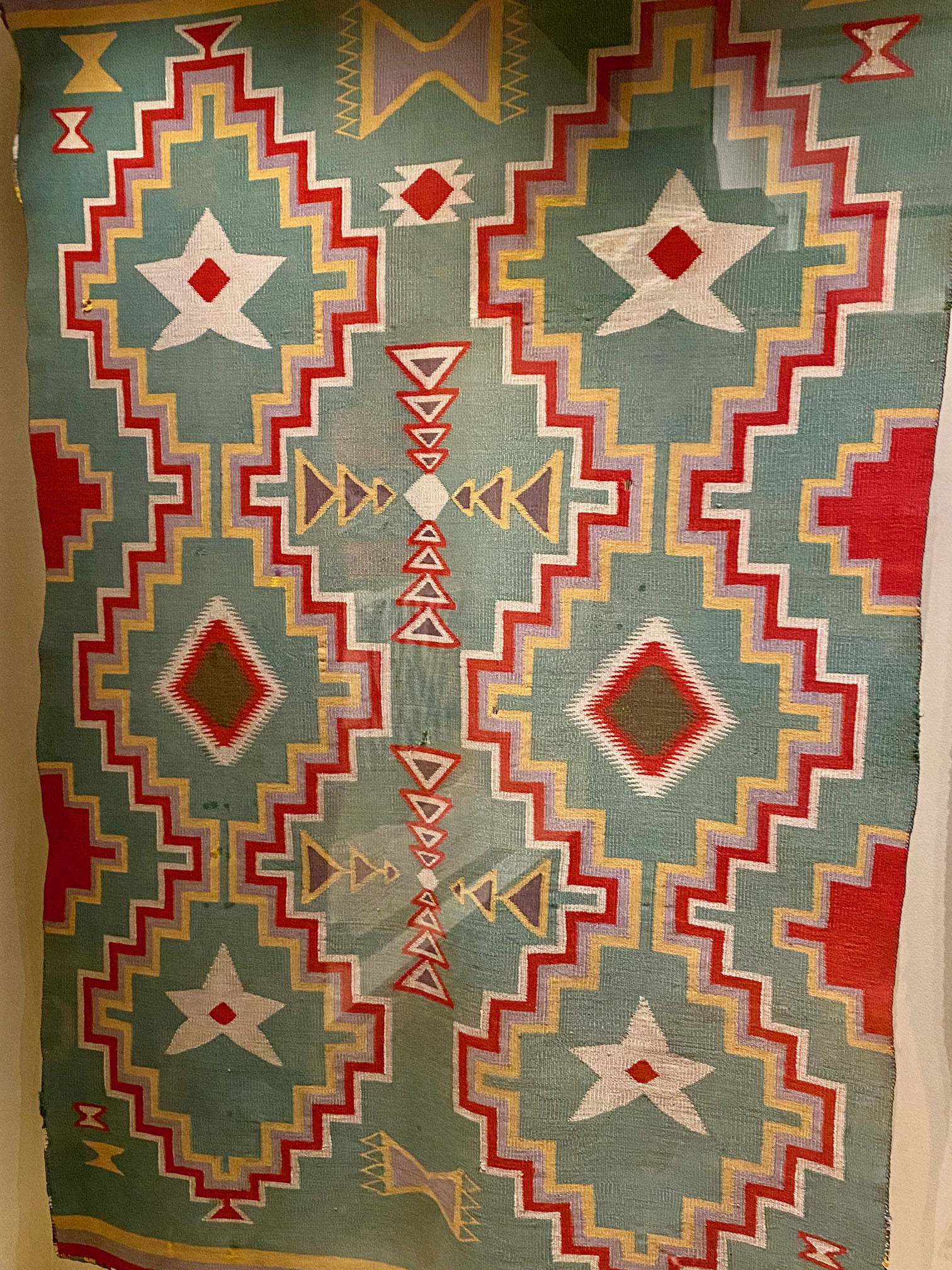
1880-1897 rug made with Germantown wool yarn, cotton string, and raveled yarn; materials used in weaving at Bosque Redondo era, post-Long Walk.

The participants in the exhibition make sure that viewers also experience how the landscape inspires the work of the past and contemporary Native textile artists. Diné fiber artist Tyrrell Tapaha includes her two-panel dress in which incorporates images of the Utah clouds and mountains that bring her spiritual peace. The masterful wall hanging by Lillie Joe uses the palette of the desert to create a mesmerizing geometric dazzler.

2020 two-panel dress by fiber artist Tyrrell Tapaha with images from Utah landscapes that inspired her; woven from churro, silk, mohair, and marino wool..
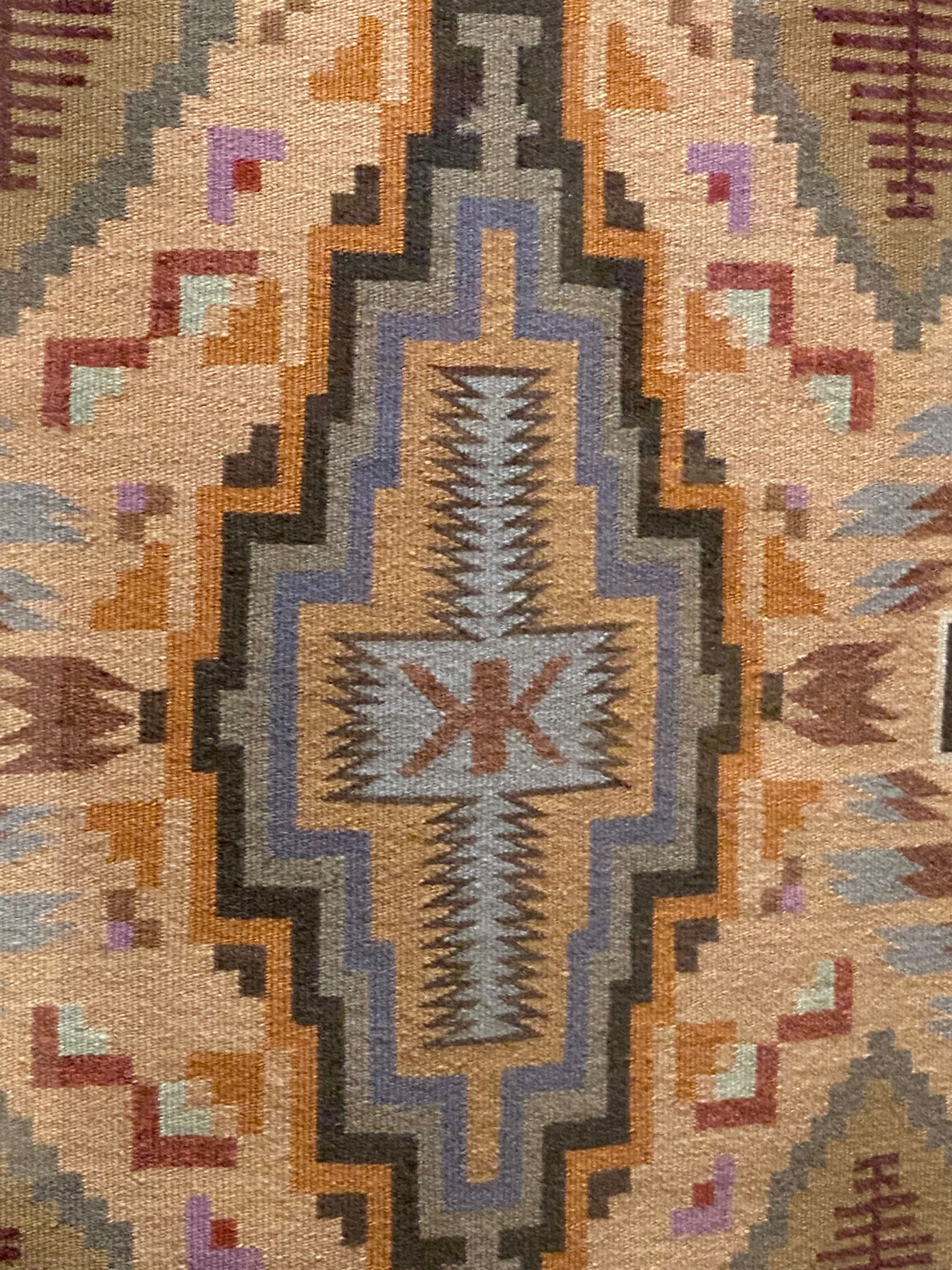
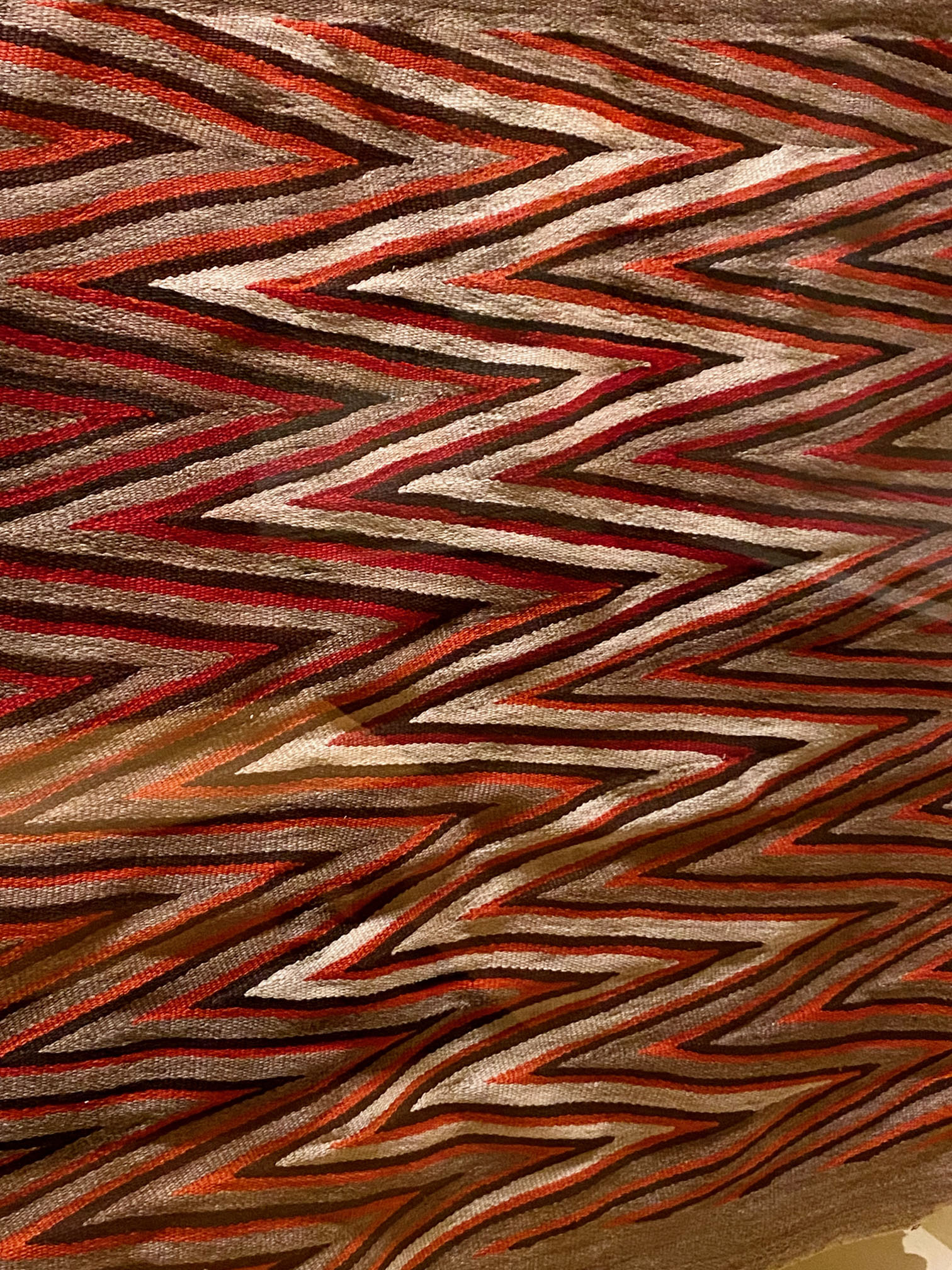
Close up of highly detailed 1980s Burntwater wall hanging by Lillie Joe, reflecting colors and patterns of the Navajo Nation landscape.

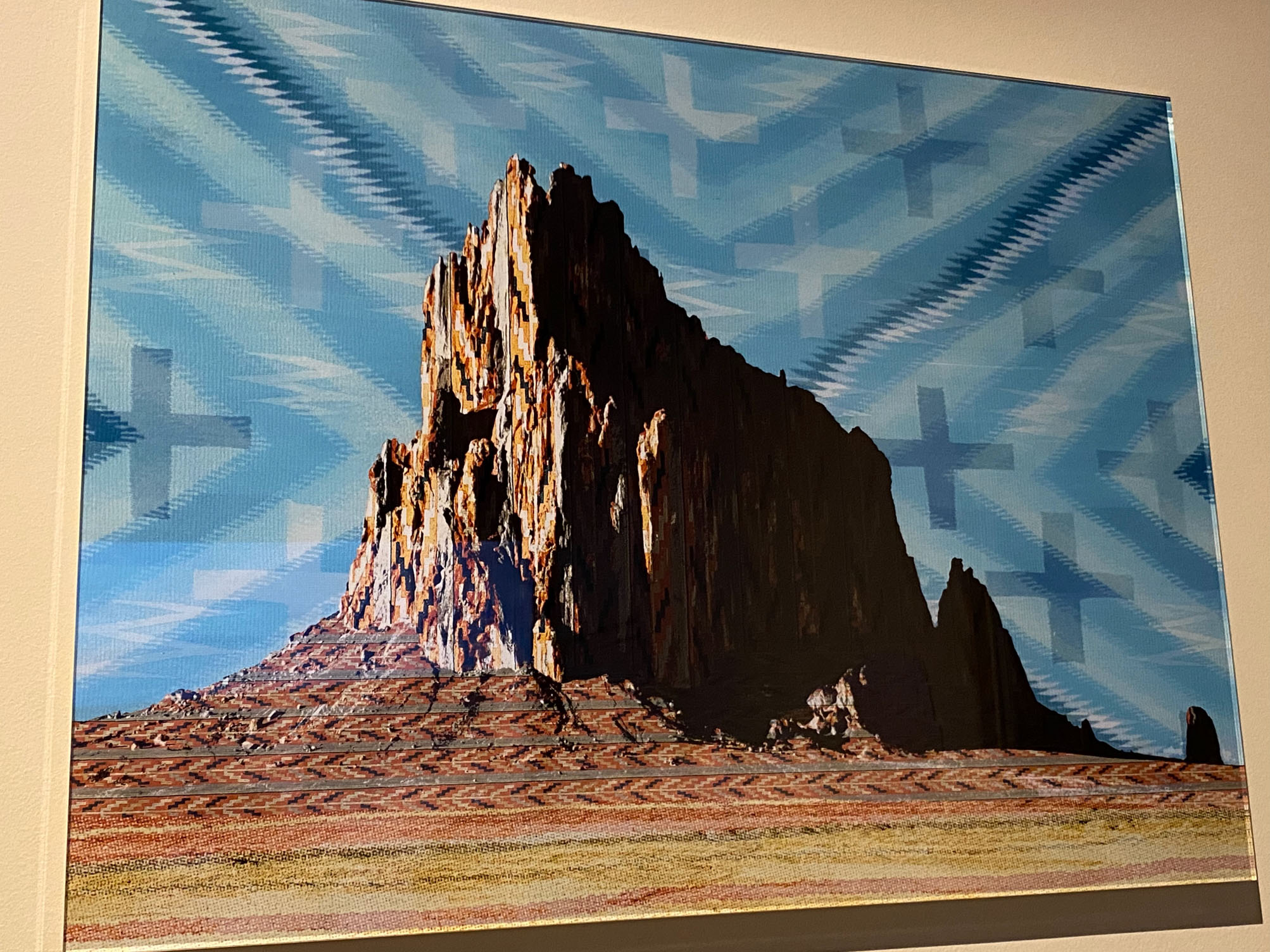
The curators feature both the photography of co-curator Rapheal Begay and Darby Raymond-Overstreet to allow gallery visitors to experience the awesome beauty of the homeland that inspires artists. Digital artist Raymond-Overstreet overlays geometric textile patterns across his luscious, beautiful landscapes.

2018 digital print Woven Landscape, Shiprock by Darby Raymond-Overstreet (Diné), overlaying digital landscapes with traditional weavings. Courtesy: the artist

Take a look at some of our favorite works in our Flickr album. And enjoy these historic and contemporary dazzlers.

Detail of 1895 wedge weave blanket made with commercial cotton string and Germantown wool – a dramatic 19th c. weaving innovation. Courtesy: International Museum of Folk Art.
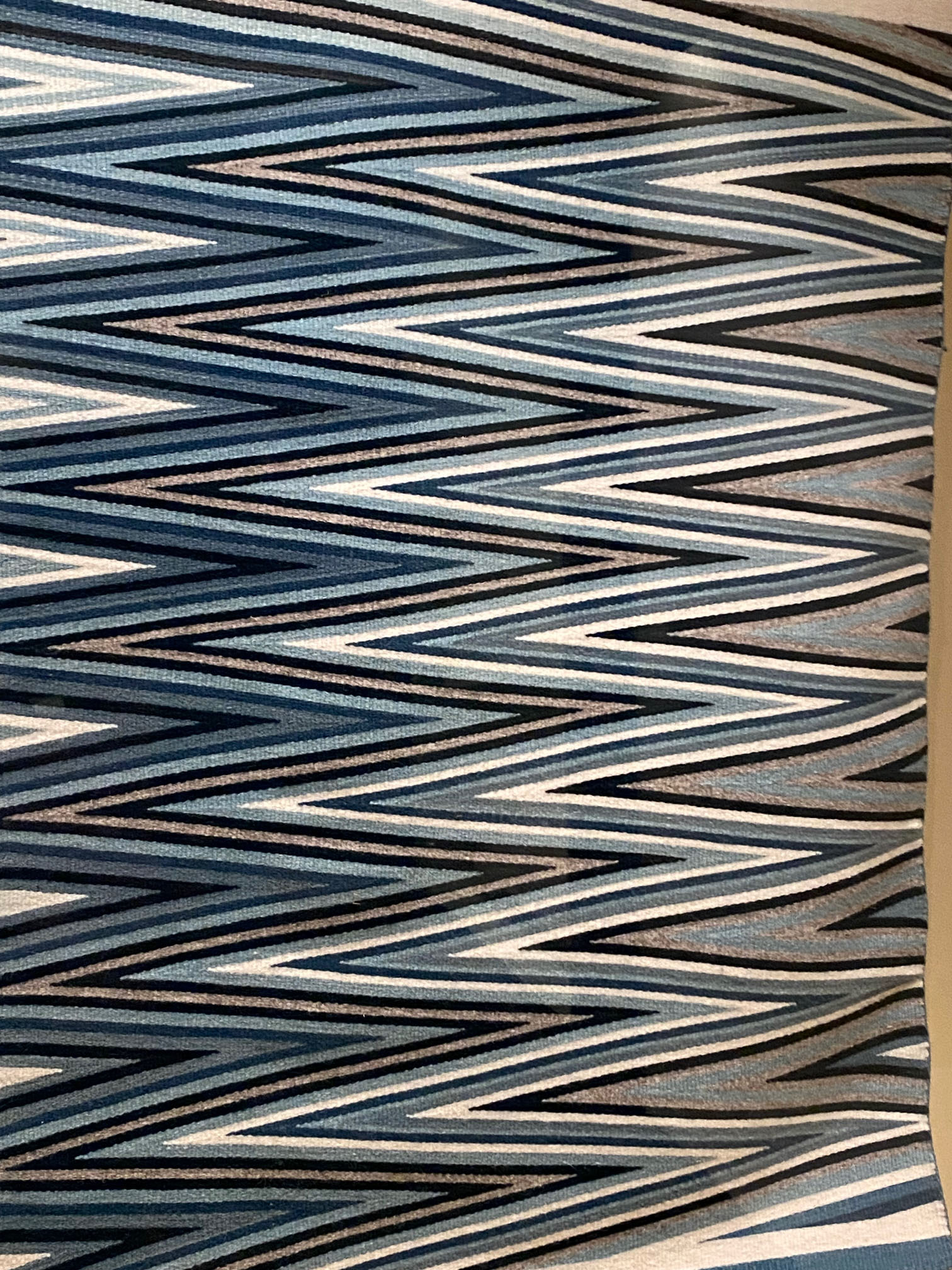
2022 wedge weave by Kevin Aspaas; white and grey wool yarn with indigo dye. Courtesy: private collection.
Detail of dynamic Diné 1960 wool tapestry weave. Courtesy: International Museum of Folk Art

Contemporary Artists Talk with Thomas Cole

There’s a big conversation going on about epic landscapes, people’s impact upon the wilderness, and personal connections to nature. It involves four contemporary artists and American master Thomas Cole, mid-19th century landscape painter and visionary, through February 12 at the Albuquerque Museum.

Plus, visitors are able to step back in time to visit Cole’s studio, arranged much as it was at the moment of his untimely death at the age of 47 – an unfinished canvas, paint palettes, his paint box, plaster casts, and mementos of his wilderness walks and trips abroad.

1835-1845 paint box, palette, and tools in Cole’s studio. Courtesy: Greene County Historical Society’s Bronck Museum.

This section of the four-in-one exhibition is Thomas Cole’s Studio: Memory and Inspiration. The curators have also surrounded the studio recreation with a wide range of Cole’s studies and finished works, including his last completed commissioned work. Take a closer look in our Flickr album.

Unfinished Landscape with Clouds, paints, plaster casts, and furniture in Cole’s studio when he died in 1848. Courtesy: Thomas Cole National Historic Site.

Cole redefined American landscape painting in the 1830s and 1840s by merging the style of romantic European landscapes with the dramatic skies, vistas, and mountains of New York’s Adirondack wilderness. His work kick-started the Hudson River School of landscape painting, and by the time of his untimely death at age 47, he was America’s best known and best loved artist.

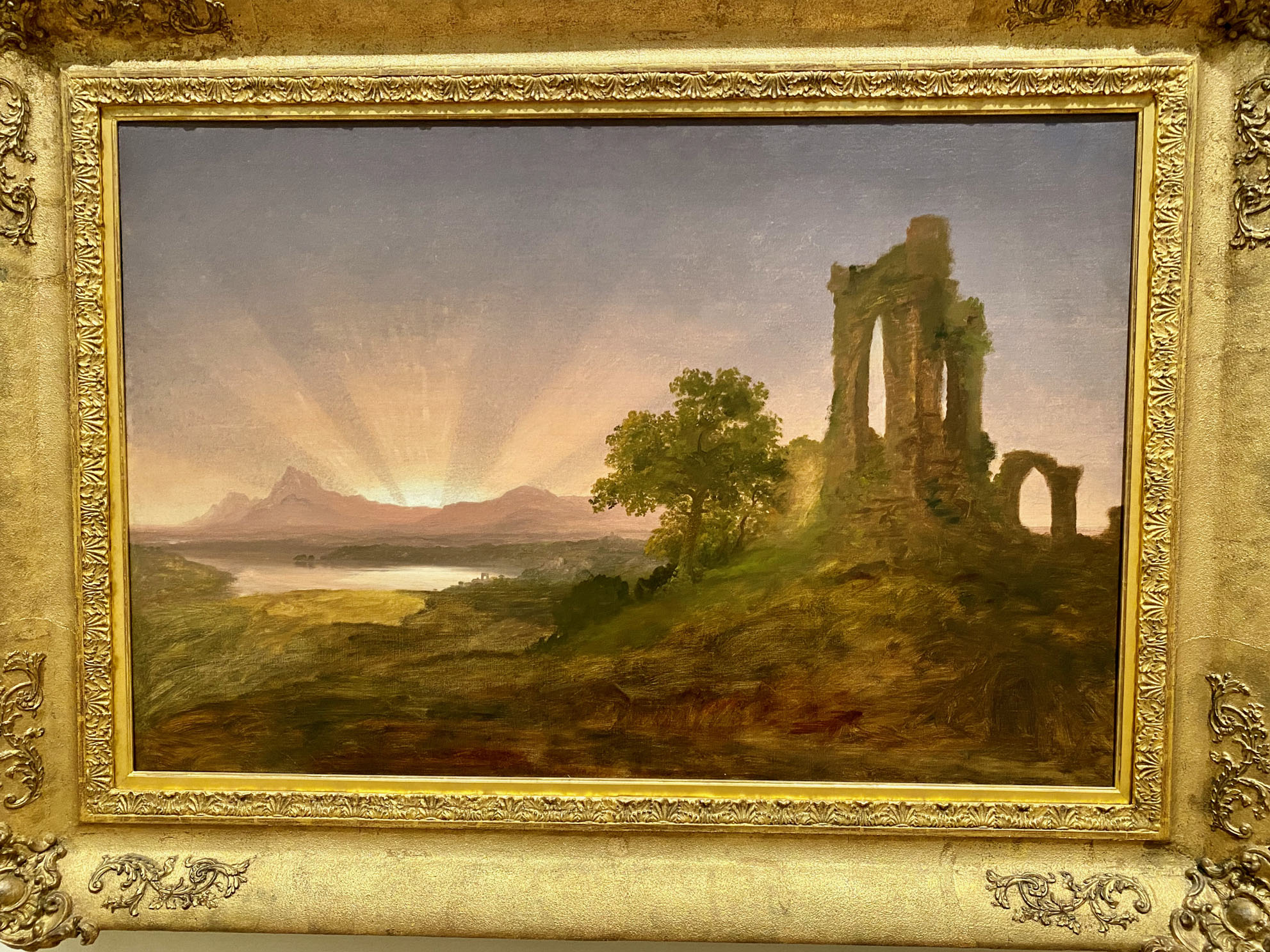
Cole’s 1848 Gothic Ruins at Sunset, an unfinished work from his studio. Private collection.
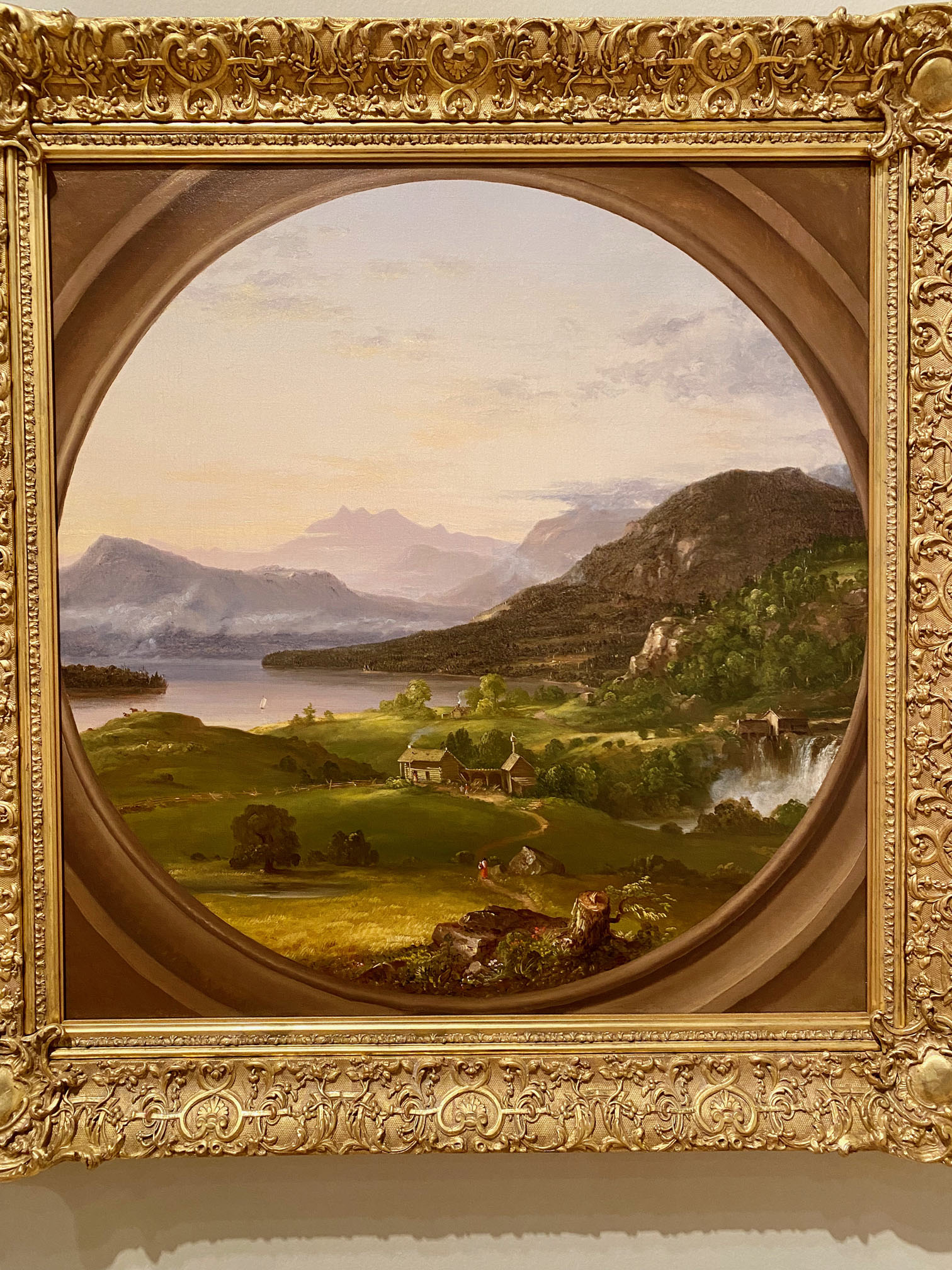
Cole’s 1846 Schroon Lake, showing a civilized landscape at the edge of mountain wilderness. Courtesy: Adirondack Experience

During his life (1801-1848), Cole witnessed how pristine American wilderness was changed by proliferating settlements, roads, bridges, mills, and commerce along the rivers. Sometimes he chose to paint sights, like Niagara Falls, minus human intrusion; other times he gently inserted “civilization” into magnificent landscapes, as in Schroon Lake.

Cole had been a mentor to innovative landscape painters like Durand, Church, Kensett, and Cropsey. When Cole passed away suddenly, they were devastated. His wife left his studio just as it was, and for the next ten years she welcomed painters to make the pilgrimage to visit it, spend time, and gain inspiration.

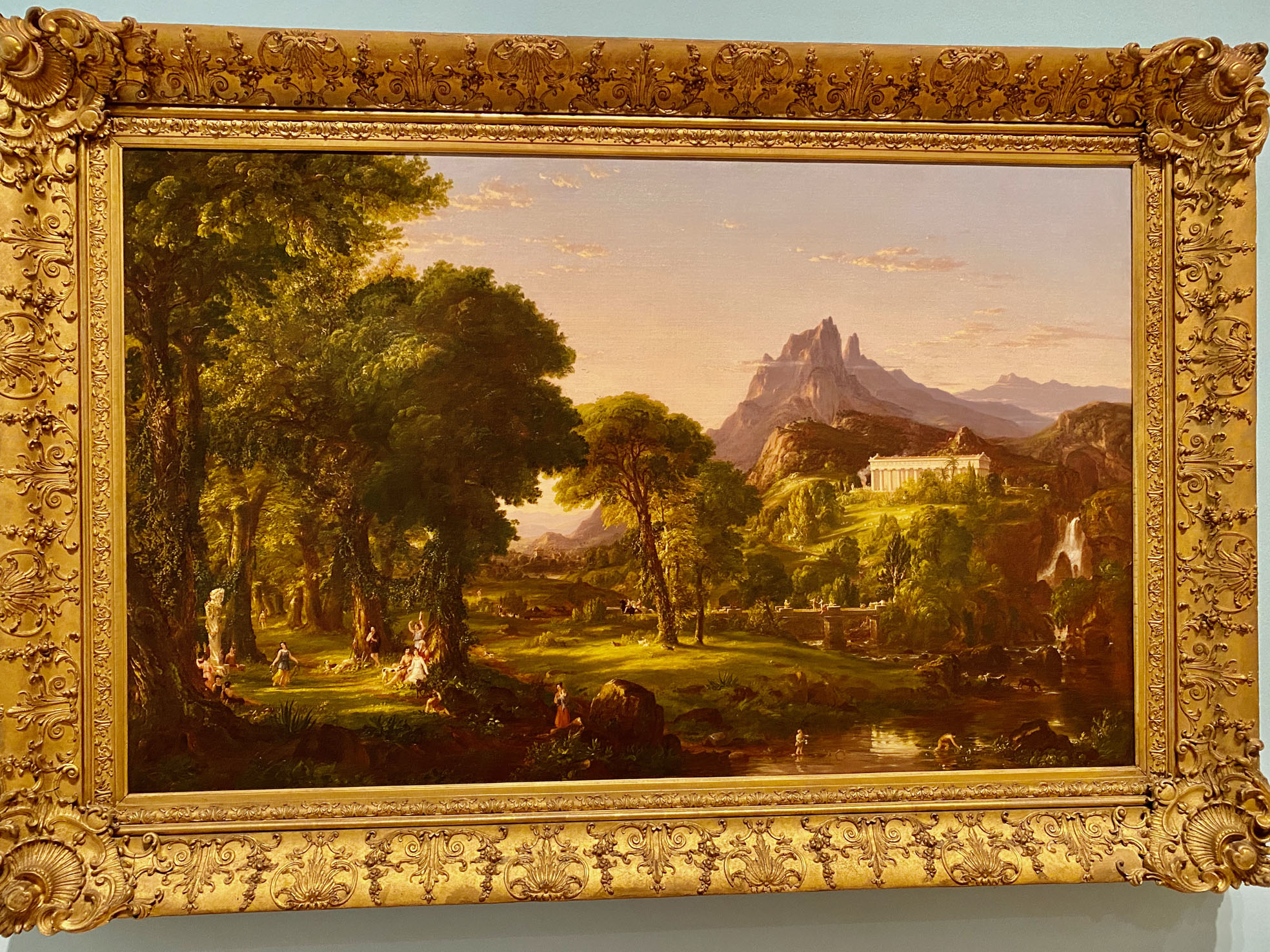
Visitors enter this exhibition and confront Cole’s large 1838 work, Dream of Arcadia, showing a mythical time when civilization existed in harmony with nature.  Can this ideal state truly exist?

Thomas Cole’s 1938 Dream of Arcadia. Courtesy: Denver Art Museum.

The Thomas Cole National Historic site, which organized three of the four shows, answers this question through the eyes of two well-known contemporary artists – Kiki Smith, who owned a house along a creek a short distance from where Cole lived, and Shi Guori, who created camera obscura images at Hudson Valley sites where Cole stood and painted.

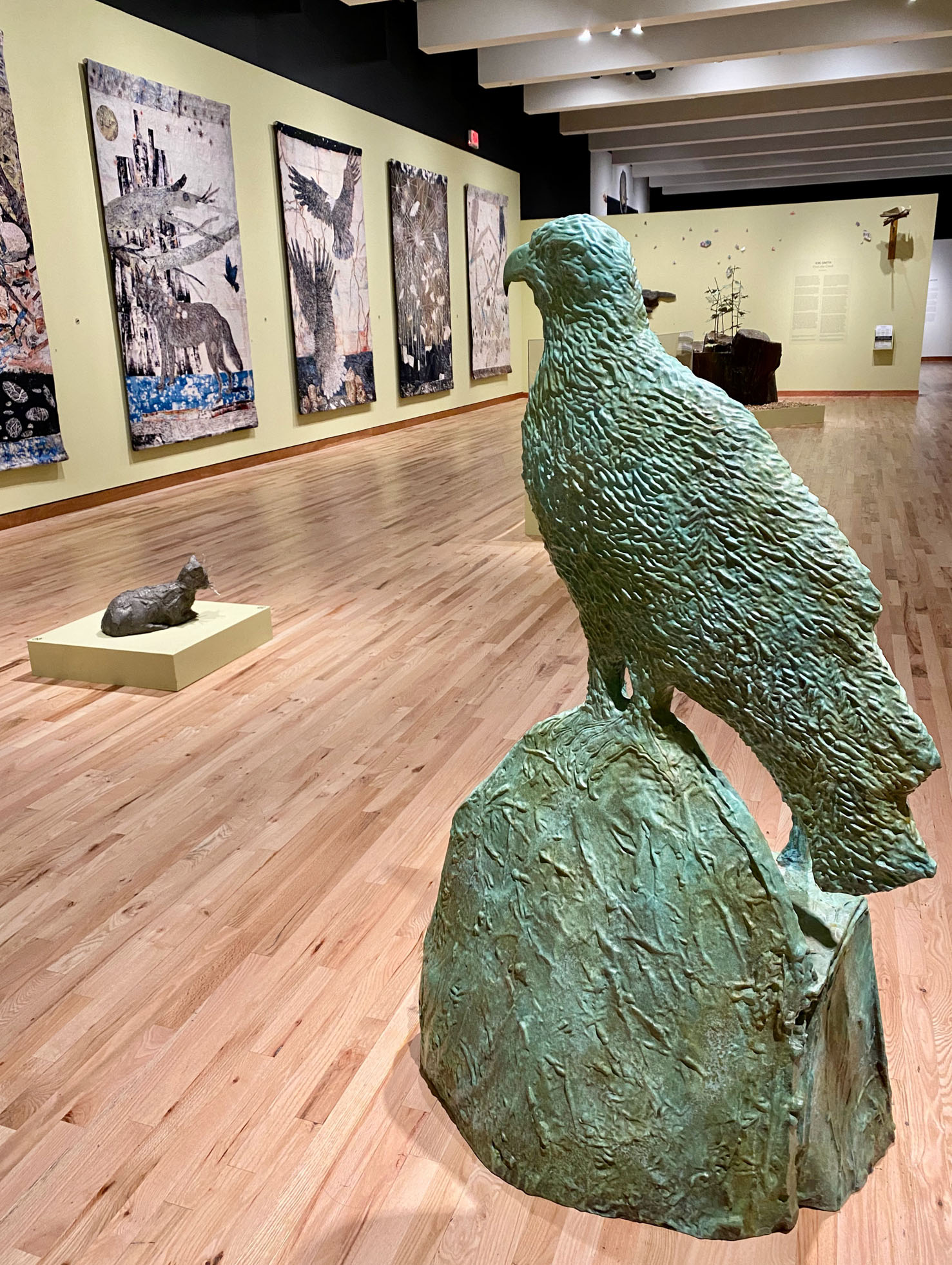
Kiki Smith: From the Creek is an immersive exhibition populated by the birds, beasts, insects, and plants along Catskill Creek – an area that Cole walked and knew well.

Kiki Smith’s 2016 bronze Eagle in the Pines in gallery with 2012-2014 jacquard tapestries

Visitors look up, down, and around to see owls, eagles, wolves, and pheasant peering back at them from perches, tapestries, frames, and vitrines…observing and being observed. Take a look at here.
2019 bronze Coxsackie sculpture of owl at the exhibition entrance.
Detail of Kiki Smith’s 2012 Cathedral jacquard tapestry (published by Magnolia Editions).

Kiki’s work always brings an air of other-worldly mystery. Here, it’s easy to enjoy all of her varied creations, which display her deep connection to nature and ask us to contemplate the cycles of life that busy people sometimes forget to notice. Cole’s paintings had the same impact.

Shi Guori’s Katerskill Falls, New York, July 26-28, 2019 – a 72-hour exposure made where Thomas Cole sketched in 1824. Courtesy: private collection.

Shi Guori: Ab/Sense – Pre/Sense presents monumental camera obscura images of landscapes Cole painted in the Hudson Valley 180 years ago. When he was growing up in China, Guori experienced the shock of rapid environmental disruption as Mao’s Cultural Revolution transformed the countryside.

Guori studied Cole’s documentation of similar 19th-century transformation in the Northeast, and traveled back to sites that Cole documented to bear witness to natural settings – somewhat still undisturbed – that resonated with Cole.

Guori built large camera-obscura tents, sat inside for up to 72 hours, and exposed light-sensitive paper to create his images. Images of Cole’s oil paintings at the same site are mounted nearby with Guori’s meditations on the experience.

Shi Guori’s camera obscura image The Clove, Catskill Mountains, New York, April 25, 2019. Courtesy: the artist
Basis for camera obscura work by Shi Guori: Thomas Cole’s 1827 oil The Clove. Image: Connecticut’s New Britain Museum of American Art.

In one case, Guori turned Cole’s own sitting room into a camera, capturing not only furniture that he would have used, but showing the image of nature that Cole surely would have spent hours gazing upon. View more of Guori’s work here.

Shi Guori’s camera obscura image View of the Catskill Mountains from Thomas Cole’s House, August 12, 2019 – which turned Cole’s sitting room into a camera. Courtesy: the artist

The fourth exhibition, Nicola López and Paula Wilson: Becoming Land, present large-scale environmental meditations on Southwestern desert landscapes. The Albuquerque curators selected these two popular New Mexico artists to get a bit of cross-cultural discussion going with Mr. Cole.

Glimpse some of the work in their gallery here.

Wilson, who works in Carrizozo, creates gigantic, mixed-media installations that prompt viewers to consider the interconnection among different people, desert landscapes, agricultural technologies, and even the debris left by civilization.

Paula Wilson’s 2021 monumental printed and painted installation, Yucca Rising. From the artist.

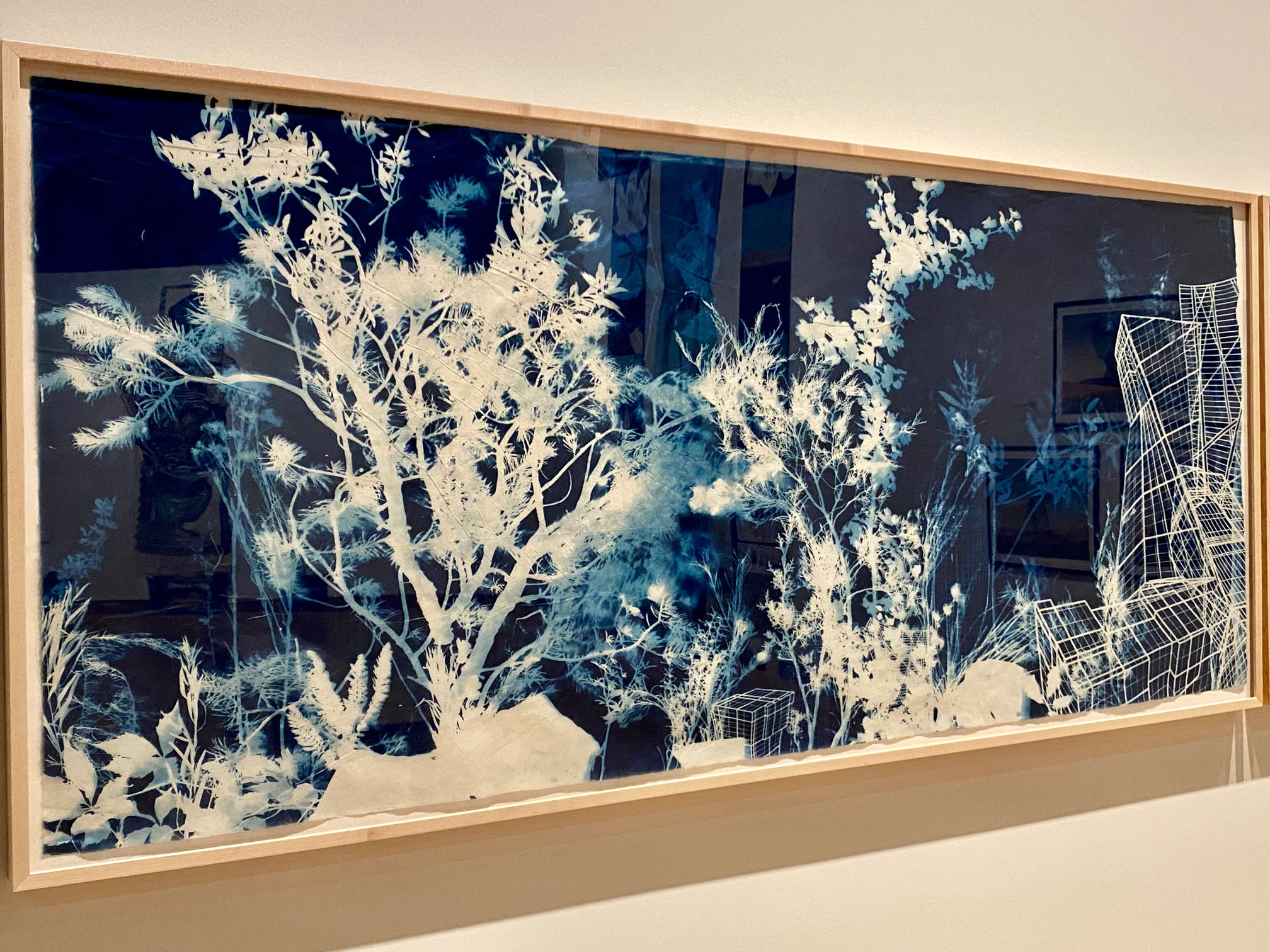
López, who works and teaches in New York, presents a large-scale cyanotype. Unlike Guori, who traveled to the Catskills to create his ghostly images with light, López was unable to travel during the pandemic and made this monumental work at home with the materials around her – a driveway, nearby desert plants, and the blazing New Mexico sun.

Detail of 2021 NeverWild cyanotype by Nicola López – ghostly images of New Mexico plants dwarfing mysterious architectural structures in the desert.

Congratulations to the Albuquerque Museum for inviting Thomas Cole’s team to collaborate in mounting such a beautiful, thought-provoking show.

Transgressive Photography Shown in Santa Fe

Want to meet some people who enjoy breaking the rules?  You’ll meet plenty of mavericks who challenged the norm in Transgressions and Amplifications: Mixed-Media Photography of the 1960s and 1970s, an exhibition on view at the New Mexico Museum of Art in Santa Fe through January 8, 2023.

Edward Weston and Ansel Adams set a high bar for classic, modernist photography, but the generation of image-makers who followed were driven to experiment, shake things up, and see where it all led. 

Detail of 1983 Joyce Niemanas Grandfather Polaroid collage
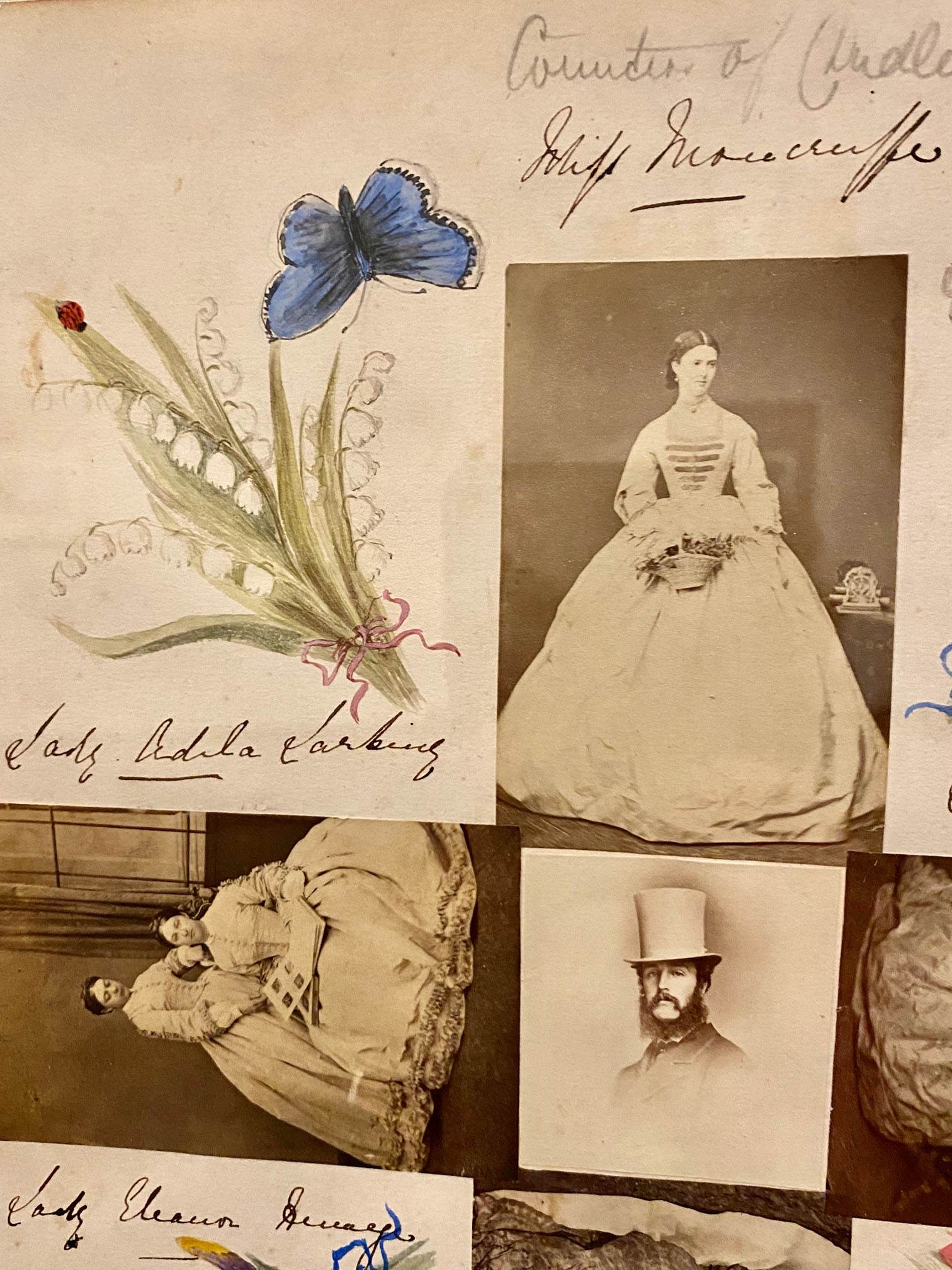
Detail of 1864 Lady Filmer’s album mixing watercolor and albumen print collage. Courtesy: UNM Art Collection.

Why not go back a hundred years and make new images with historic photo techniques (sun prints, anyone)? Has anyone tried embroidering photos? What about mashing up photo-silkscreen prints with readymade collages decorated with rubber stamps?

Can Polaroids be turned into fine art? Or making a sculpture or kitch card deck out of photos?  What about dreamscapes? What about creatively repurposing magazine photos or TV images?

A stroll through the gallery shows a broad range of creative 20th-century minds at work, with at least one case showcasing some 19th century pioneers.

Meet Lady Mary Georgina Filmer, a London society gal who mastered the art of photocollage as early as the 1860s. A page from one of her albums shows how she merged topsy-turvey photo images, botanical watercolors, and text to tell stories her own way – a true stay-at-home pioneer!

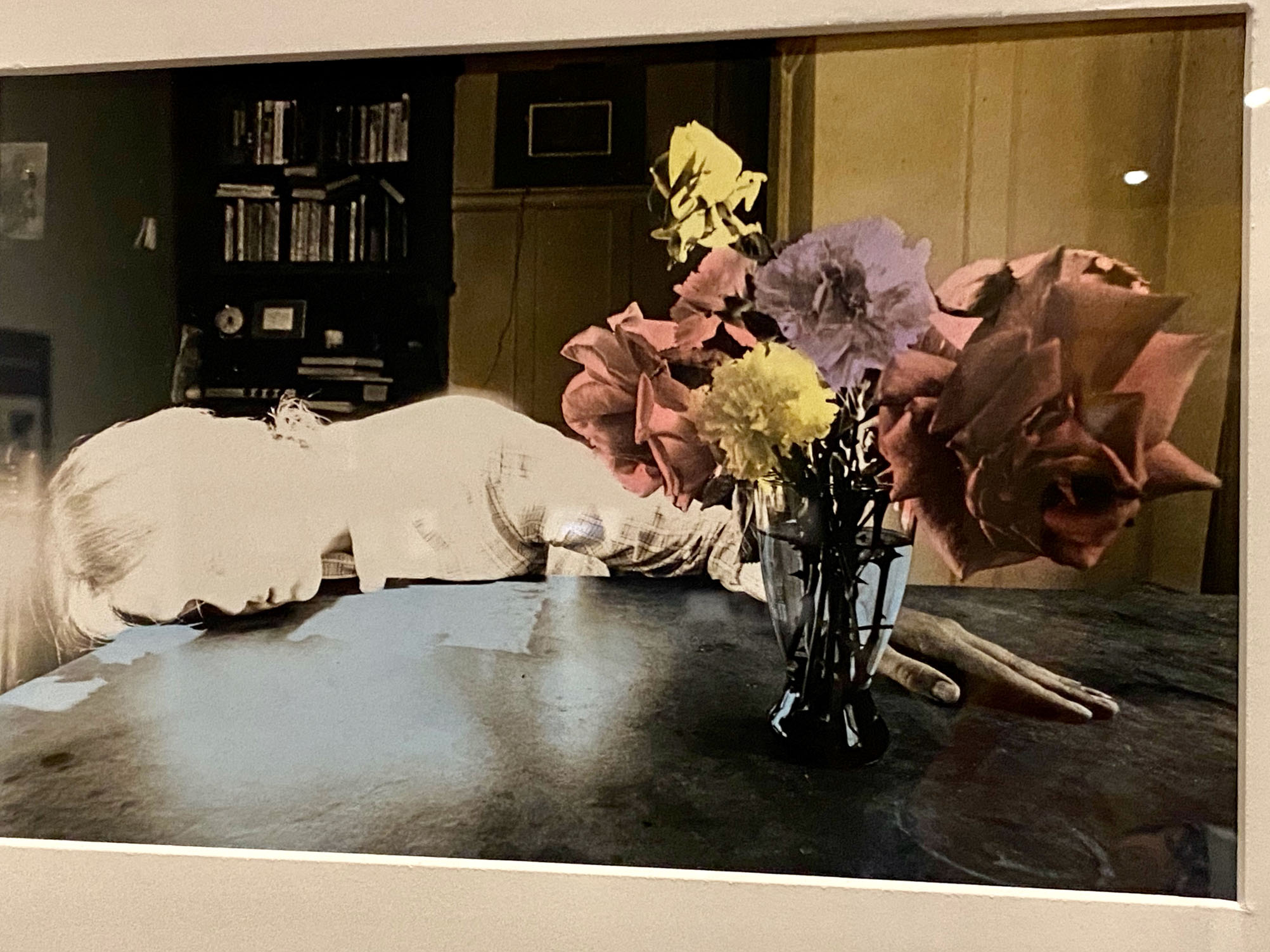
Lady Filmer’s album looks out on dozens of other Americans who went back into the time machine to toy with making albumen prints, stereographs, hand-colored photos, drawing, and cyanotypes. Example: the arresting 1970s hand-colored gelatin silver print by Karen Truax where she ghosts-out her central figure.

1970-1974 gelatin silver print Supernal by Karen Truax, featuring a bleached-out central figure and hand-colored domestic interior

For anyone curious about these old-timey methods, the curators have provided visitors with a place to relax, leaf through books about it, and watch YouTube videos on the gallery iPad.

Another gallery features artists who took photography mixed-media to the next level, like Rauchenburg’s litho that appropriates Bonnie and Clyde movie stills and an over-the-top abstraction by Thomas Barrow that combines gelatin silver print technique with a crazy-quilt of stencils, spray paint, and objects. So totally Eighties!

Detail of Thomas Barrow’s 1980 gelatin silver print Discrete Multivariate Analysis, mixing lights, objects, stencils, and spray paint

The third gallery displays lots of fool-the-eye and 3-D delights. What’s the most fun? Jerry McMillan’s photo-offset inside a “paper bag?” Betty Han’s Soft Daguerreotype of Xeroxed weeds on fabric? Probably Robert Heinecken’s T.V. Dinner/Shrimp. Hard to choose.

Robert Heinecken’s 1971 Van Dyke print T.V. Dinner/Shrimp, #1C. Courtesy: University of Arizona’s Center for Creative Photography.

Other sections of the exhibition show how 1970s photographers made images in which photography itself was the subject and told highly personal stories.

Take a look at some of our favorites in our Flickr album.

Artist book: Keith Smith’s 1972 gelatin silver print Book 32 – a 3D take on photography.

And don’t forget the coda that features a dramatic images by more recent photographers that make provocative social statements and represent voices that were not fully represented within the university system during the 1960s and 1970s.

Lorna Simpson’s 1991 Black, a dye diffusion transfer print with engraved plastic plaques

Artists Call to Action for Central America

In the early 1980s, socially minded artists living downtown in New York couldn’t handle the news coming out of Central America and did something about it. The United States government was intervening in the affairs of Nicaragua, El Salvador, and Guatemala, and everyone was worried that the situation was going to devolve into another Vietnam.

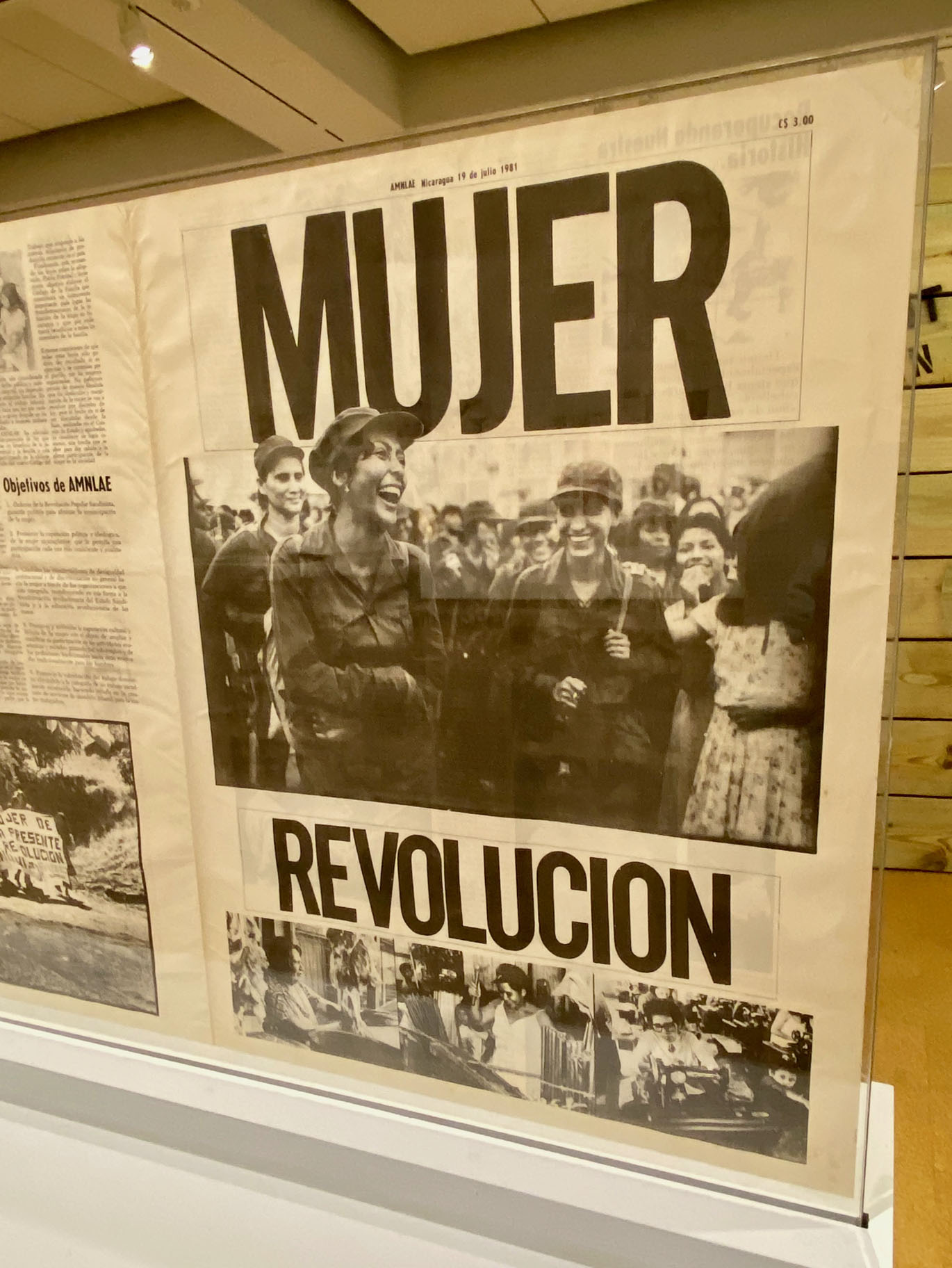
This is just one part of the story told by the dynamic, timely, informative exhibition, Art for the Future: Artists Call and Central American Solidarities, on view at the University of New Mexico Museum of Art in Albuquerque through December 3.

1981 pamphlet Mujer Revolución by Association of Nicaraguan Women. Private collection
1983 Print of Contra (after a drawing in Rock Comics, 1979) by Jerry Kearns, depicting communist fears stoked by the US government

In 1982, a group of New York artists collaborated with Latin American artists to create a show with contemporary art and cultural artifacts to draw attention to the escalating crises in Latin America. By 1984, organizers launched a national call to artists to raise money and awareness of what was happening.

Artists responded with performances, music concerts, films, poetry readings, and exhibition. In New York alone, over 1,100 artists participated in over 30 exhibitions.

Nationally, artists in 27 cities organized chapters and events and tried to build alliances in Latin America.

Videos, photographs, sculptures, paintings, and ephermera pulled from archives (like posters, buttons, mail art, and pamphlets) bring the story of artist-activists to life – their concerns about US government intervention, their efforts to organize artists across the United States, and their attempts to help artists living in oppressed Central American countries.

The Tufts University-organized show resurrects a largely forgotten story of artist activism, illuminates the tribulations of indigenous communities in Central America at the time, introduces us to contemporary works from artists inspired by their indigenous heritage, and gives us an idea of what’s happening in those countries now.

Two contributions to Solidarity Art by Mail project, a fast, cheap solution to boost Latin American and Caribbean participation in a 1984 New York exhibit at Judson Memorial Church. Private collection.

The three-floor show is packed with arresting images, works, and histories. The art work and documentation push and pull visitors between the international political crises of the 1980s and social-justice issues being addressed by artists today.

Take a look at the show on our Flickr site.

The installation features work by heavy hitters of the 1980s New York art scene – wall-size Vietnam-era work by Leon Golub, images documenting Ana Mendieta’s performance pieces, and Claes Oldenburg and Coosje van Bruggen’s sketches, maquettes, and exploding-banana image that branded the Artists Call Against US Intervention initiative.

The first-floor exhibition area includes Nancy Spero’s dramatic scroll-like drawing that calls attention to the oppression of Salvadorean women.

1984 Arts Magazine cover with Oldenburg’s image promoting Artists Call. Private collection

Downstairs, there’s another 1984 work that similarly unfurls the length of the gallery – an accordian-book project led by Sabra Moore that is a collaborative reconstruction of a rare 16th-century Mayan codex by 22 women. It’s the first time the codex has been displayed since 1984.

1984 “Reconstructed Codex,” a project organized by Sabra Moore with contributions from 22 diverse female Latin American and US artists. Courtesy: Barnard

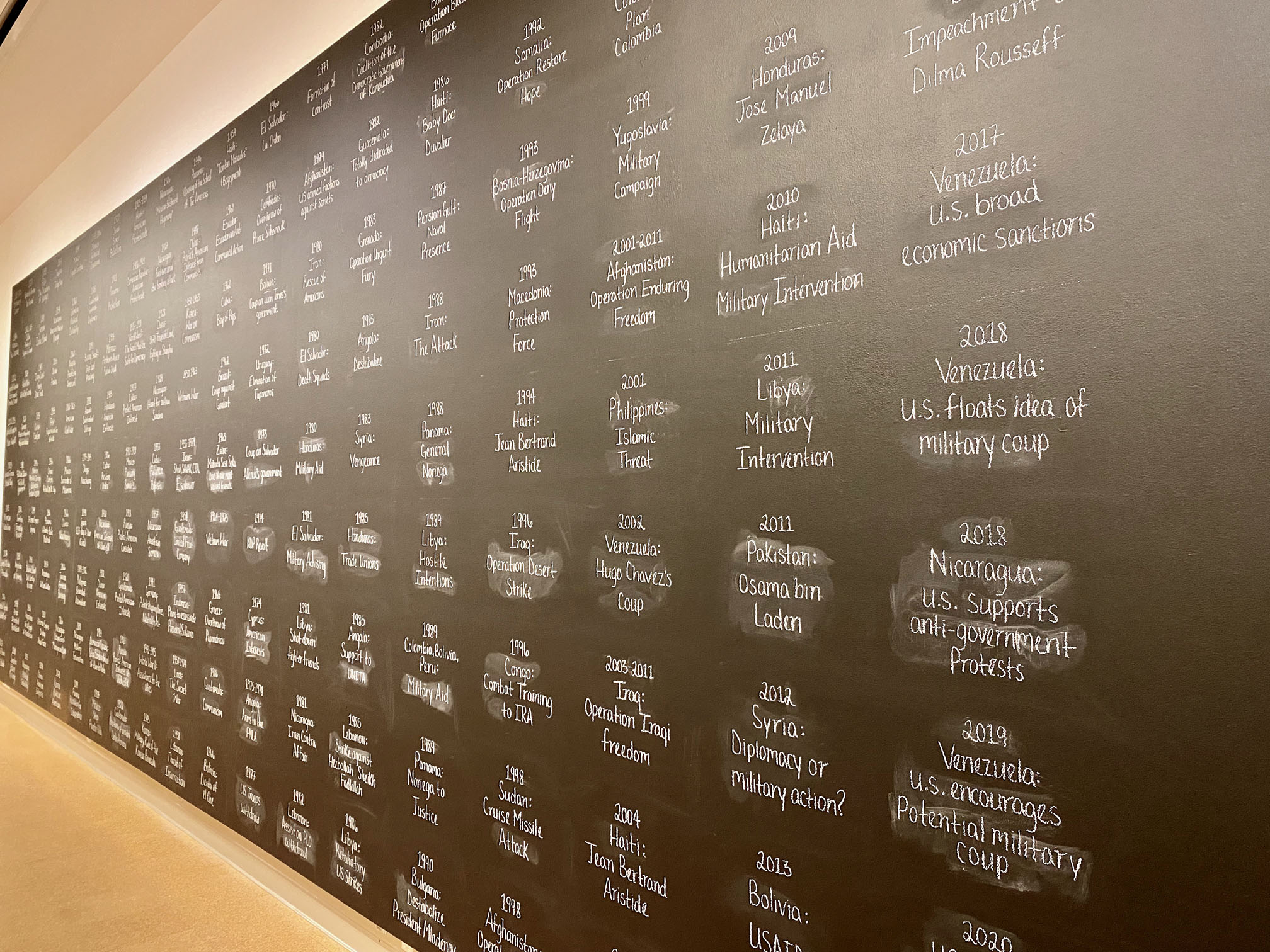
The third floor packs a punch, installing revolutionary images and publications around the infamous (and censored) Hans Haacke piece that questions the aftermath of the 1983 US invasion of Grenada.  Across the room, visitors pour over Carlos Motta’s 2005 wall-sized chalkboard installation Brief History of US Interventions in Latin America since 1946. 

Although the 1980 artist-activists did not achieve all of their utopian goals, the contemporary selections show that social consciousness, pride in indigenous heritage, and artistic futures are still alive – including a beautiful feathered immigrant history dome by Batriz Cortez, stitched by a team of immigrant collaborators.

2021 sculpture 1984: Space-Time Capsule by Salvadorian artist Batriz Cortez and immigrant collaborators – a shelter for immigrant histories.

Learn more about how the curator Erina Duganne and her collaborator Abigail Satinsky created this remarkable show:

Art for the Future will be on display at Chicago’s DePaul Art Museum from March to August 2023.

Carlos Motta’s 2005 detailed chalkboard installation Brief History of US Interventions in Latin America since 1946. Courtesy: the artist

O’Keeffe Museum Shows Georgia at Home

One of the most photographed artists of the 20th century, everyone is used to seeing Georgia O’Keeffe in her “formal” pose and gear – angular black hat, stark wrap dress, punctuated by her modernist Calder pin, standing against the New Mexico sky peering solemnly into the future.

In its latest offering, the Georgia O’Keeffe Museum is giving fans a special treat (and a different view) through its exhibition, Georgia O’Keeffe, a Life Well Lived: Photographs by Malcolm Varon, on display in Santa Fe through October 31.

2021 print of Varon’s 1977 photo of Georgia relaxing at Ghost Ranch. Courtesy: the artist
Georgia’s 1946 Part of the Cliff, a painting inspired by the view through her studio window.

The show features a smiling, at-ease 89-year-old surrounded by family, friends, companions, and pets – images quite apart from the GOK that we all admire and revere. How did this happen?

In the 1960s in New York, photographer Malcolm Varon established quite a reputation for documenting painters’ works in a way that captured a lot of their spirit. No wonder that in the mid-1970s, he was summoned out to Ghost Ranch and Abiquiu to document some of Georgia’s huge body of work.

While he was working with the artist during the summer of 1977, a journalist arrived to interview the icon for a feature in ARTnews.

No photographer had been attached to the story, so Georgia came up with hew own solution – ask her colleague Malcolm to shoot her in the setting of her Ghost Ranch home.

Since Malcolm was already familiar with the operations around Ghost Ranch and Abiquiu, he ended up taking about 300 photos of her homes, the landscapes that inspired her, and the people who kept things humming.

2021 prints of Varon’s 1977 portraits of Ida Archuleta, Candelaria Lopez, and Estiben Suazo, the people who managed Georgia’s homes and properties. Courtesy: the artist.

Despite Georgia’s reputation as a loner living out in the middle of nowhere, Malcolm appreciated that the day-to-day operations in the outback were quite fun, busy, natural, and happy at her two studio compounds.

ARTnews made a few selections from Varon’s photographs and ran them in the feature, but the majority of the 300 shots were never printed or seen…until now.

Visitors at the GOK museum pour over every detail of the portraits and landscapes, enjoying a new, different glimpse of the artist and her world – Varon’s portrait of Georgia’s sister, beautiful portraits of her property caretakers (whose families still take care of the GOK home for the museum), and her assistant Juan Hamilton.

The curators present several paintings from the 1940s showing the same cliffs, landscapes, and skies that Varon captured in the summer of 1977. Visitors have fun shifting back and forth between the oil paintngs and photos.

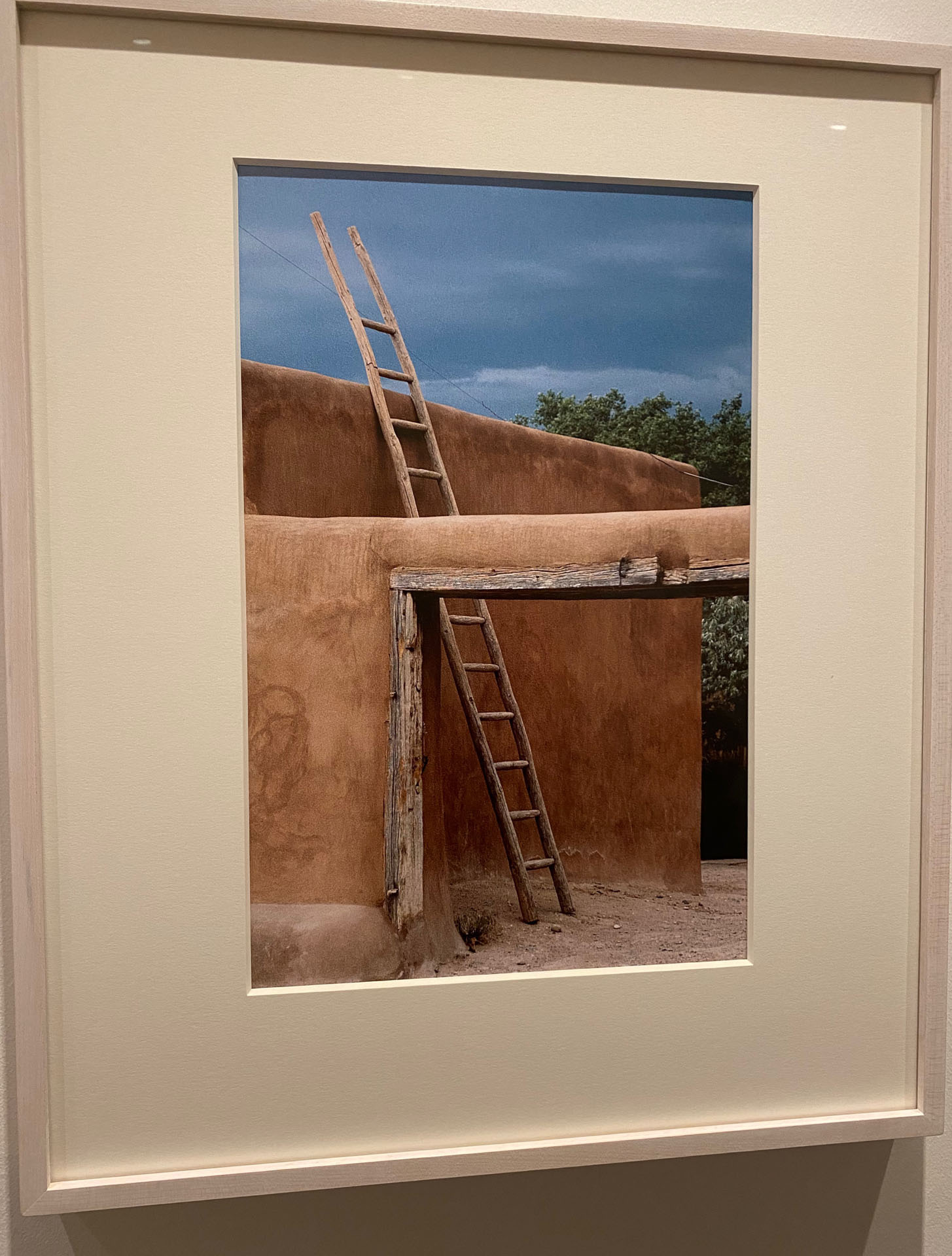
2021 print of Varon’s 1977 photograph of the tall ladder at Georgia’s Abiquiu home – a platform from which she surveyed the world. Courtesy: the artist

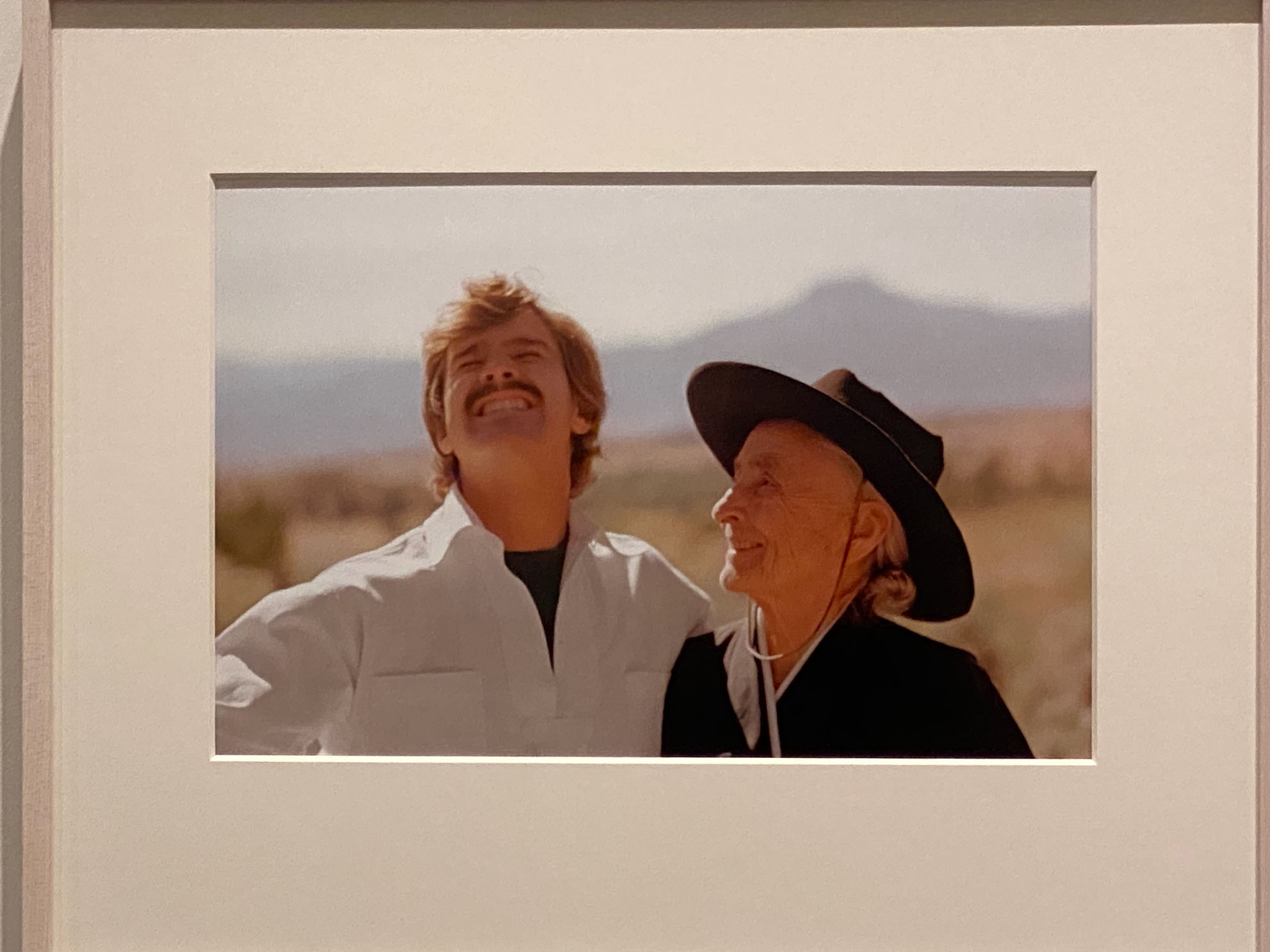
2021 print of Varon’s 1977 fun photograph of Georgia at Ghost Ranch with her friend and assistant, artist Juan Hamilton with the Pedernal as backdrop. Courtesy: the artist

Take a look at some of our favorites in our Flickr album.

Listen in as the curators of this delightful show draw back the curtain on the legendary O’Keeffe, her relationship with photography, and what happened when a trusted friend got her to smile for the camera:

Virtual NYC Museum Events – Broadway, Brooklyn, Karma, Kusama, and McQueen

New York museums are offering a full calendar of virtual events this week, including trips to Broadway history, hipster restaurants of the world, Buddhist virtual reality, and tributes to artistic genius. Take a look at the list here! Here are just a few highlights:

2002 Broadway revival of Rogers & Hammerstein’s Flower Drum Song

Do you miss Broadway? Learn about some little-known secrets behind hit shows today, Monday (April 12) at 5:30pm. It’s a rare chance to meet the president of the Rogers & Hammerstein Organization, Ted Chapin, who will be giving a behind-the-scenes look at the Great White Way in his program, From Follies to Flower Drum Song and Beyond. It’s the premiere of a conversation recorded last Fall with Broadway World’s Richard Ridge, courtesy of the New York Public Library for the Performing Arts at Lincoln Center.

Did this global restaurant trend actually start in Brooklyn? Find out with MOFAD and the creators of Global Brooklyn: Designing Food Experiences in World Cities.

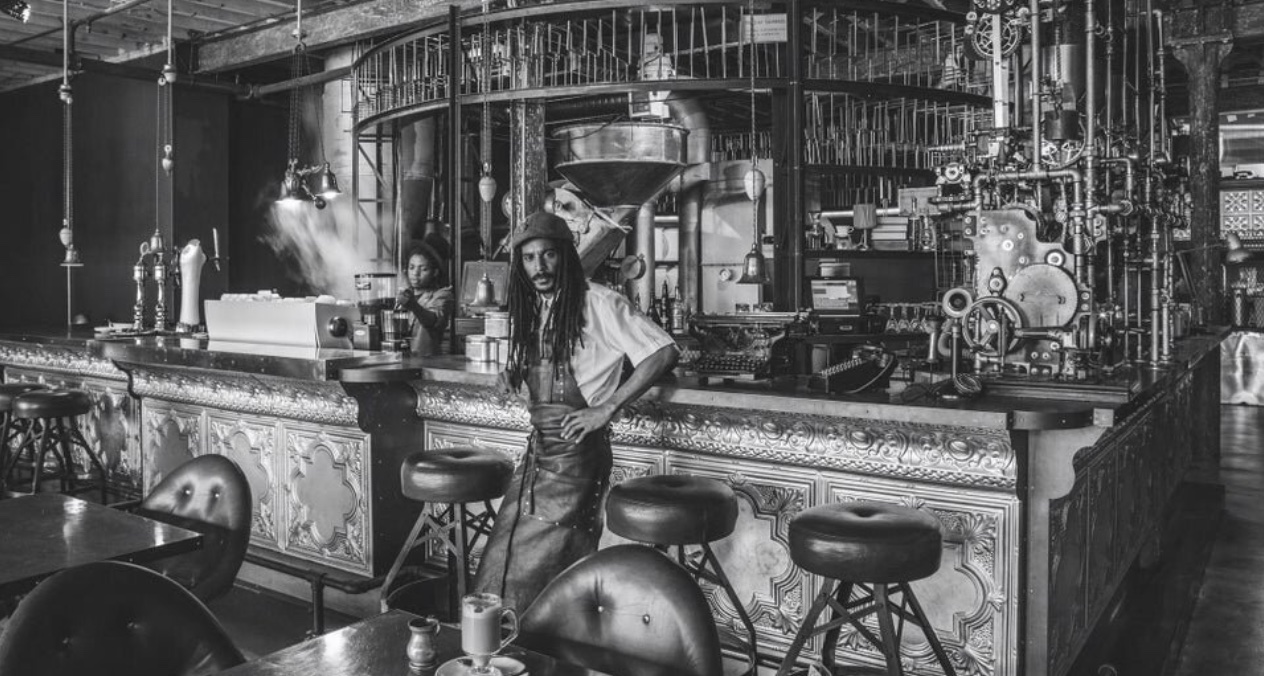
Love restaurants? Especially ones with slightly nostalgic post-industrial interiors decorated with that hand-crafted look? At 7pm, join the Museum of Food and Drink to meet the authors who explored how the Brooklyn aesthetic for How a Restaurant Aesthetic Became a Global Phenomenon. Learn how restaurants around the world adopted the style, and find out if this brand of hip actually started in Brooklyn.

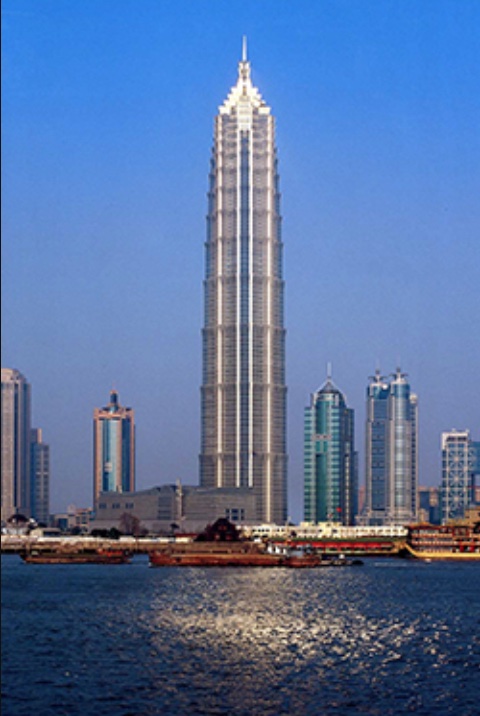
On Tuesday (April 14) at 6pm, join the architecture crowd at the Skyscraper Museum to hear Mark Sarkisian, the structural and seismic engineer who is a partner at SOM in San Francisco. Mark designed one of Shanghai’s first supertalls back in 1999. His talk Pivot to China: How Jin Mao Portended Future Supertalls will explain how this tower’s innovations influenced the generation of supertall skyscrapers that followed.

Shanghai’s Jin Mao tower, 1999
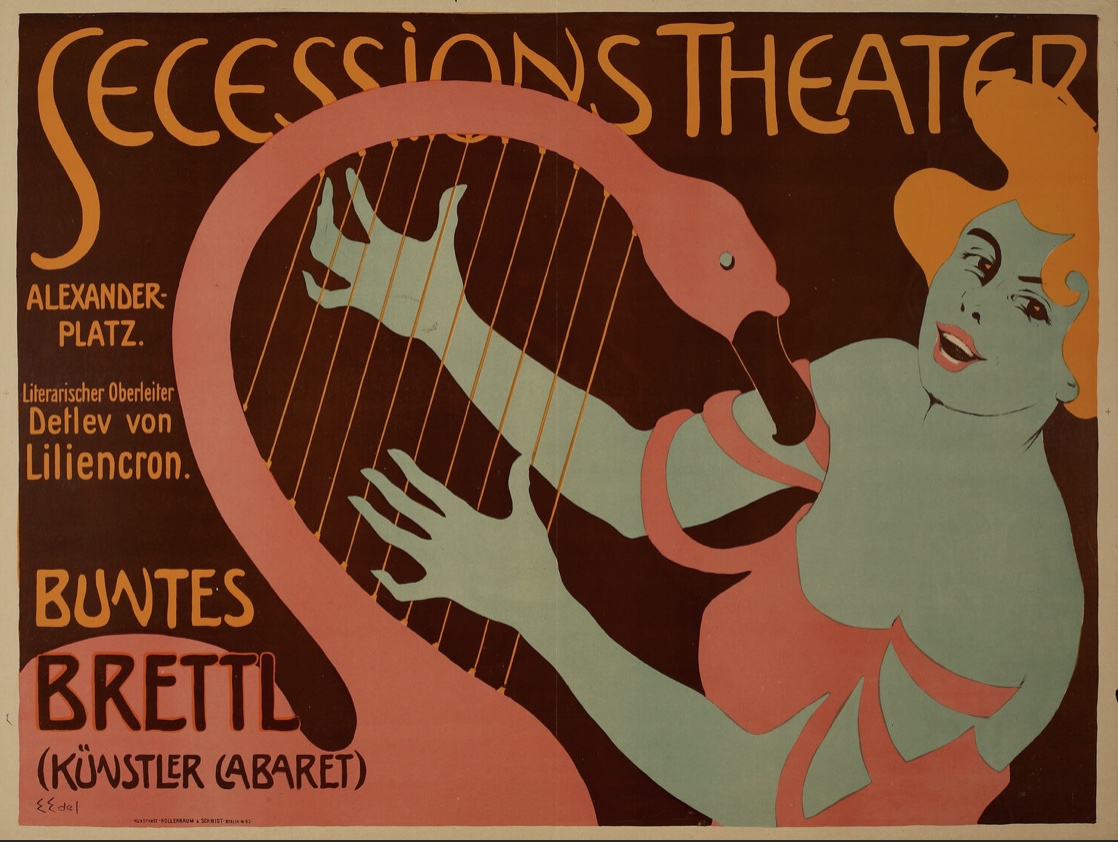
Berman Collection poster part of the Youth Style talk at Poster House.

On Wednesday (April 14) at 6:30pm, take a journey back to early modernist Europe at Poster House, who will be hosting A Tale of Three Cities: Youth Style in Berlin, Munich, & Vienna with the Kaller Research Institute. The evening will focus on how young designers made their mark on design from 1895 to 1910. You’ll see works from the Merrill C. Berman Collection (the collection featured at MoMA in Engineer Agitator Constructor), and works from the Poster House’s current Julius Klinger exhibition.

Also at 6:30pm – an opportunity to understand your karma. Join the Rubin Museum of Art for The Game of Life: An Interactive Virtual Experience. A contemplative psychotherapist will guide participants through a virtual Buddhist Wheel of Life to finding liberation from negative habits and patterns. The virtual game takes you throughout the different floors of the museum, and provides twists and turns. There are “Hell” and “God” Zoom rooms, but the payoff is higher awareness of one’s state of mind.

The Rubin’s reimagined Wheel of Life by eight graphic artists.
Kusama at New York Botanical Garden

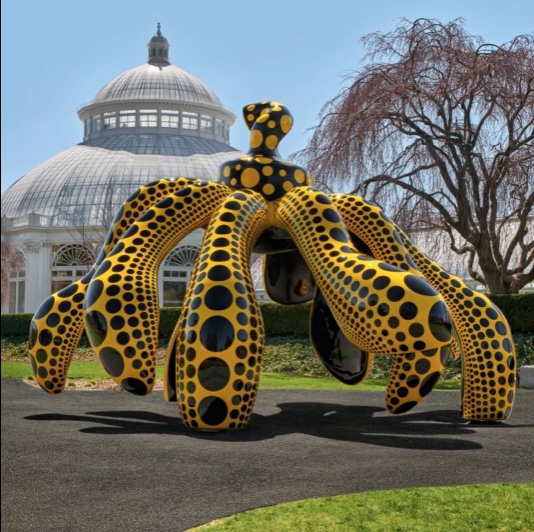
On Thursday (April 15) at 11am, it’s what all of New York has been waiting for! Mika Yoshitake, the curator of New York Botanical Garden’s KUSAMA: Cosmic Nature will provide a look at how Kusama’s blockbuster installation reflects nature, the earth, the microscopic, and the cosmos. Cosmic Nature: Embracing the Unknown will present Mike’s insights about Kusama’s artistic language and her unrelenting, lifelong journey into new territory.

McQueen models backstage, as photographed by Richard Fairer

Want to go backstage at a McQueen show? At 6pm you can. Join Vogue photographer Robert Fairer at Museum at FIT for a live Q&A about his new book, Alexander McQueen: Unseen. Experience memorable moments of fashion’s greatest, most outrageous showman and see what a genius at work backstage before the show.

There’s a lot more happening this week, so check the complete schedule. Most of the events are free, but it’s always nice to add a thank-you donation.

Virtual Museum Events – New Show Tours at MoMA, The Whitney, Poster House, and American Folk Art

For Easter Week, you’ll have an opportunity to join online tours of the new architecture show at MoMA, Julie Mehretu’s retrospective at The Whitney, the Lincoln Center poster show at Poster House, and a look at visionary photography at the Museum of American Folk Art.  See the full list of activities this week on our virtual events page.

Today (March 29) at 6:30pm, join MoMA to hear a panel of high-powered Black architects and designers to discuss Cities and Spatial Justice – one of the themes presented in MoMA’s new exhibition Reconstructions: Architecture and Blackness in America. How are Black urban spaces created and protected? How do communities reckon with the past to create a future? Join in to participate in this timely discussion.

At 9pm, join the New Museum for a talk with Rachel Rossin, an artist whose work is part of World on a Wire, an online visual exhibition that is the first exhibition in a new partnership between Hyundai Motor Company and Rhizome, the museum’s digital art affiliate. The later (US) time was set to allow art lovers in Seoul and Beijing to join in at a reasonable time, too.

2_New Museum_Rhizome_Rossin

Rachel Rossin work at Hyundai Motorstudio Beijing and World on a Wire digital project.

On Tuesday (March 30) at 7pm, join a tour for the new Julie Mehretu mid-career retrospective at the Whitney Museum. See the giant, genius, multilayered canvases with the curator and find out how maps, revolutions, social justice, and architecture have inspired her to create such monumental works. (And for the tour of Julie’s show in Spanish, join the tour online at noon on Friday, April 2.)

3_Whitney_Mehretu_Invisible Line

Pondering Julie Mehretu’s Invisible Line at the Whitney

At 8pm, take a trip to Tokyo’s An’yo-in Temple to hear one of the earliest forms of meditative, chanting vocal music reimagined in a new work by the young composer. Japan Society, the University of Chicago, and Carnegie Hall present Shomyo: Buddhist Ritual Chant – Moonlight Mantra, followed by a live Q&A with the composer.

4_Japan Society_Chant_Shomyo

Traditional Buddhist chanting in Tokly’s An’yo-in Temple on Tuesday, courtesy of Japan Society and Carnegie Hall

The temple is created in a traditional method of joining wood without nails or glue, and ties into the society’s current exhibition, When Practice Becomes Form: Carpentry Tools from Japan.

On Wednesday (March 31), join Poster House for its program, For the Many: the Public Art of Lincoln Center, which is being held in association with the museum’s current exhibition, Vera List & The Posters of Lincoln Center. The program includes an introduction to Lincoln Center’s poster project – the landmark series pioneered by Vera List –and goes on to showcase the full range of public art commissioned for this New York cultural landmark.

Dorothy Gillespie’s 1989 Lincoln Center information center poster.

On Thursday (April 1) at 11am, take another trip to Japan to visit the Tokachi Millennium Forest ecological project on Hokkaido with experts from the New York Botanical Garden. Hear them talk about the master plan for this project, how they merged the “new Japanese horticulture” with wild nature, and how they created not only a beautiful garden but a gorgeous new book.

7_NYBG_Tokachi

Travel to the Tokachi Millennium Forest in Japan with NYBG and Dan Pearson and Midori Shintani

At 6pm, join the Museum of American Folk Art for a panel discussion (Re)Turning the Gaze, on the relationship of “the gaze” to gender, race, and sexuality. The panelists will feature photographs from the provocative current exhibition, PHOTO | BRUT: Collection Bruno Decharme & Compagnie.

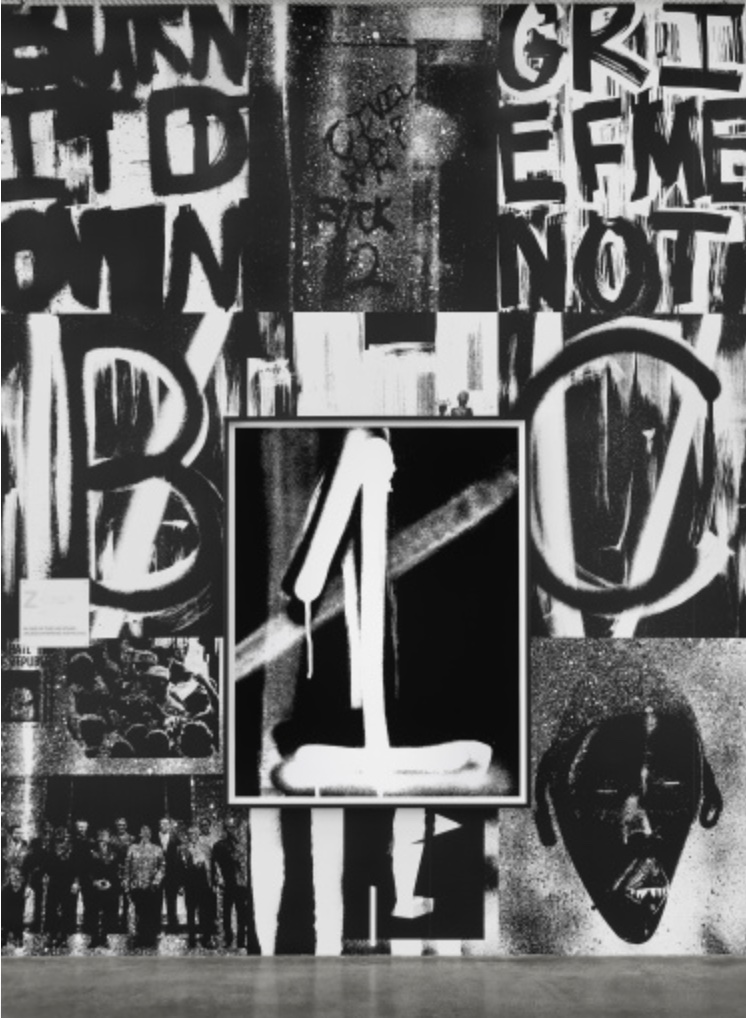
Adam Pendleton at New Museum. Photo: Dario Lasagni

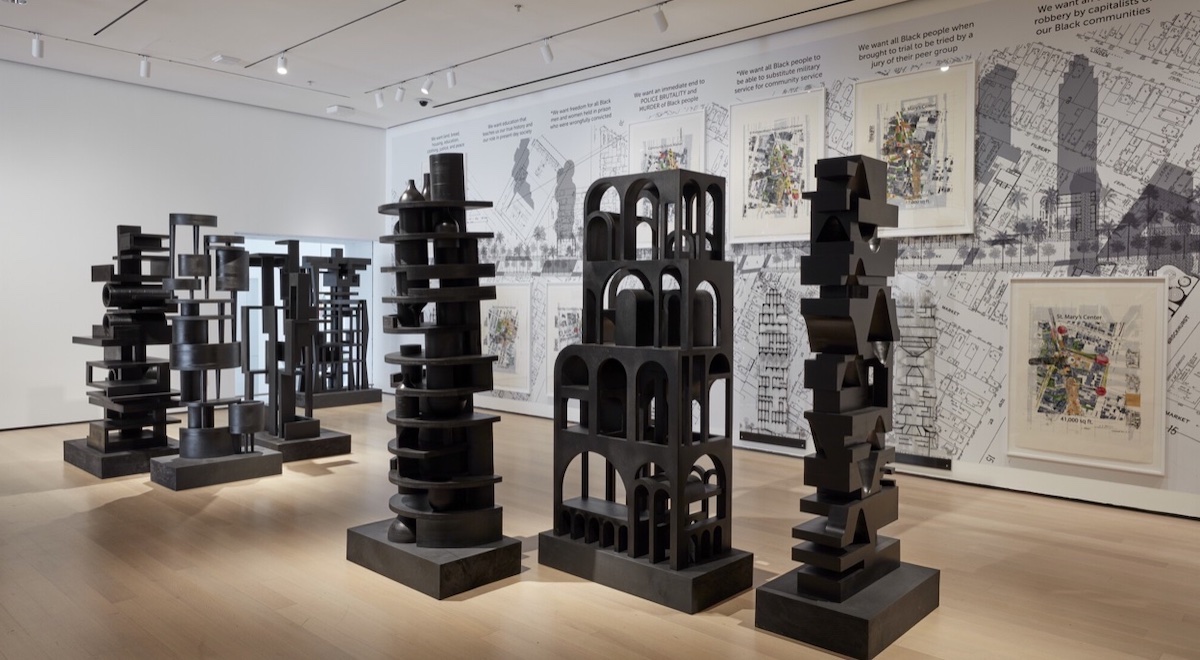
At 7pm, join the conversation at the New Museum with Adam Pendleton, who’s transformed the museum lobby into an exciting environment for the acclaimed Grief and Grievance: Art and Mourning in America exhibition. He often talks about “Black dada” – art that incorporates blackness, abstraction, and the avant-garde. If you can’t get to New York, take an online tour of the exhibition at 11am on Saturday, April 3.

There’s a lot more happening this week, so check the complete schedule. Most of the events are free, but it’s always nice to add a thank-you donation.

Museum Update

The crowds were at the Whitney to get their first look at the Julie Mehretu retrospective and to take a last look at the Kamoinge Workshop photographs from the Sixties and Seventies in the last weekend of Working Together. We saw lots of conversations and contemplations happening inside the Kamoinge gallery.  Although the show closed yesterday, the Whitney is offering one final virtual tour at noon on Thursday (April 1).

This past week, we went to the Met’s virtual opening of the Alice Neel retrospective, which is now posted online. Take a look.

We also joined MoMA’s online event with the Calder Foundation to take a closer look at the new exhibition, Alexander Calder – Modern from the Start.

The program is now posted on MoMA’s YouTube channel. Nearly 4,700 people have listened to Calder’s grandson Sandy Rower (and head of the Calder Foundation) shatter some Calder myths and show decades-old color 16mm film of Tanguy, Duchamp, and his grandmother hanging out with Calder in MoMA’s garden on 54th Street. (Don’t break that sculpture with the cat, Marcel!)

And while you’re on that YouTube channel, check out MoMA Virtual Cinema’s discussions with the directors, crews, and actors associated with some of their top picks for the film-awards season – Nomadland, Borat, Mank, Sound of Metal, and Minari.

Calder’s 1934 sculpture A Universe at MoMA

Kamoinge Workshop Photographers Show NYC in a Different Light

Anthony Barboza’s 1972 Kamoinge Workshop Portraits and multifold Kamoinge Artist’s Book.

When fourteen photographers decided to get together in 1963 to for regular critiques, history was happening in Harlem, Mississippi, and on the Capitol Mall and life was bursting at the seams in down-and-out neighborhoods all around them.

The collaboration, influence, mutual support, and artistic output of their first 20 years is the story told in Working Together: Photographers of the Kamoinge Workshop, an exhibition on view at the Whitney Museum of American through March 28.

Two by Beuford Smith, a 1978 self-portrait and 1972 Wall, Lower East Side.

The show, originally produced by the Virginia Museum of Fine Art in Richmond, shines a light on the work of the workshop’s founders. It’s a master class in black-and-white photography, experimentation, and community spirit. Everyone has their own style and path, all the works you’ll see here provide a window into community and life in New York during the Sixties and Seventies with a different slant than you’ve seen before.

The Kamoinge Workshop artists were keenly aware that they had access to people and events either ignored by mainstream media or at least invisible to it. Plus, they all had keen awareness and appreciation for artistic heroes, like Cartier-Bresson, Dorothea Lange, and other legendary photographers, and used the workshop to push one another forward – to make art that went beyond basic photojournalism, and use formal composition and other imaginative techniques.

Abstractions in the city –1973 Untitled (Harlem) by Ming Smith and 1966 Shadows by Adger Cowans.

When they began meeting in the Sixties, Herb Randall showed photos of Southern life taken the summer he accompanied the Freedom Riders to Mississippi; Adger Cowans showed his abstracted, from-a-rooftop image of the crowd listening to Malcom X; Herb Randall showed images of Harlem kids cutting up for his camera; James Mannes Jr. showed formally composed portraits evoking African royalty.

Share the excitement that they felt at the time:

The quality of the work and the unlikely prospects of being selected for shows in elite museums or high-end commercial galleries inspired them to get it out there a different way – by issuing portfolios that they donated to museums, libraries, and universities.

C. Daniel Dawson’s 1978 Olaifa and Egypt, taken at The Met

Anthony Barboza’s group portrait of the founding members is the welcome image for the Whitney show. Inside the space, the work is loosely grouped into areas featuring emerging political movements in Harlem, abstraction, experimentation, journeys to Africa and the Caribbean, and cityscapes during a time when New York was going downhill.

Every time we visited, viewers were studying each work closely, somewhat transfixed by each window into the past. Each image has a special twist to it – shadows creating abstractions across bodies or buildings, the unexpected jolt of the pattern of a man’s jacket, or the panorama of life in a fleeting moment on a street in Senegal.

Look at some of our favorites in our Flickr album, and meet each of the artists on the museum’s exhibition page. Click on each artist’s portrait to see some of their work in the exhibition, and listen to them speak about their work on the audio guide.
Meet the artists and listen to what this group meant to them in the Seventies and today:

Next stops on the exhibition tour – the Getty in Los Angeles (June 29 – September 26, 2021) and the Cincinnati Art Museum (February 25 – May 15, 2022).

On Wednesday, March 24, meet Ming Smith in a live online event, discussing the publication of her recent Aperture monograph and the influence of music upon her work.

Weekly Virtual Museum Events – Berlin Neon, Japanese Rap, Master Photographers, and Alice Neel

Commercial neon in Berlin under discussion at Poster House Monday

This week, NYC museums are offering more than 40 on-line events (mostly free) that will take you to Berlin in the Twenties, the music scene in Tokyo, studios of acclaimed photographers, and an opening at the Met.  See the full list on our virtual events page.

Tonight (Monday, March 22) at 6:30pm, join Poster House and photographer Thomas Rinaldi for Interwar Neon: Commercial Illumination in Weimar-Era Germany to look back on the electric art that flourished alongside the freewheeling nightlife scene for a brief time between the wars.

Dawoud Bey’s Birmingham series at the New Museum.

On Tuesday (March 23) at 4pm, join the New Museum to meet Dawoud Bey, a photography legend (and MacArthur genius) whose moving 2012 tribute, The Birmingham Project, is featured in the acclaimed exhibition, Grief and Grievance: Art and Mourning in America

At 7pm, join Japan Society for 333 Contemporaries – Looking for the Next Global Rap Star in Japan, the kickoff to its new on-line series which talks about how US rap music adopted and adapted by the next generation of Japanese artists.

Parlor of the Merchant’s House Museum, New York’s only intact 19th c. home

On Wednesday (March 24) at 6pm, if Monday’s session got you curious, Join the Merchant’s House for 19th Century Domestic Lighting: 100 Years of Change. It will be an in-depth look at the technology behind the historic home’s lighting fixtures from 1835 forward, a time when candles and oil lamps gave way to electric lighting.

Anthony Barboza’s 1972 Kamoinge Workshop portrait of Ming Smith

At 7pm, meet Kamoinge Workshop photographer Ming Smith in a live online event, discussing the publication of her recent Aperture monograph and the influence of music upon her work. Ming’s work features prominently in the current exhibition at The Whitney, Working Together: The Photographers of the Kamoinge Workshop. She is the first African-American female photographer to have her work enter MoMA’s collection.

On Thursday (March 25) at 6pm, get your fashion fix at the Museum at FIT with a special program, From Louis Armstrong to Dizzy Gillespie: Jazz and Black Glamour. The pre-recorded program will feature vintage performer Dandy Wellington, a deep-dive into the influence of jazz on 1920s menswear, and a live Q&A with FIT during the YouTube stream.

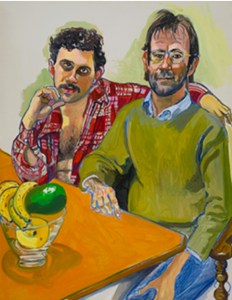
Alice Neel’s 1978 portrait Geoffrey Hendricks and Brian

At 7pm, join the Met for the online opening of its new exhibition, Alice Neel: People Come First, which features over 100 works by this beloved New York artist, considered one of America’s greatest 20th century portrait painters. You’ll find out all about how an artist who labored for decades in relative obscurity was drawn to document political movements, people, styles, and community in paint.

At 8pm, join MoMA for Virtual Views: Alexander Calder, a Live Q&A in honor if its new exhibition about Calder, MoMA’s founding, and modernism. The event will feature conversation with the artist’s grandson, who leads the Calder Foundation.

There’s a lot more happening, so check the complete schedule. Most of the events are free, but it’s always nice to add a thank-you donation.

Museum Update

1539 box for crossbow bolts made for the Bavarian duke. Value = 6 cows

We’re glad to report that the Met has extended its exhibition on the value of Renaissance art through the end of the 2021!  See it on the way to the Lehman Wing and the Dutch masters exhibition, and read about it (and the cows) in our February post The Met Asks What the Renaissance Thought It Was Worth.