Egyptian Animal Planet at The Met

Animal lovers, rush to see the final days of a truly spectacular journey back in time to experience the African wildlife that bounded across the still-lush lands surrounding the Nile. Tucked back into the lower level of the Met’s Lehman Wing, it may be easy to miss The Dawn of Egyptian Art, but don’t!

The items in this show are embellished with some of the liveliest, whimsical, and dramatic creatures, big and small, that entranced the citizens of Dynasties I and II, over five millennia ago.

Back in 3300 B.C., it was all about the animals – carvings of sleek and savvy jackals, mehen game boards in the shapes of snakes and turtles, fat bird jars, and frog containers that would make 14th century Mesoamerican artists jealous.  Who knew that you’d carry your stuff around in ostrich-egg containers? Or use palettes adorned with antelopes and turtles? Or have hair combs decorated with giraffes, hippos, and wildebeest? (Pre-dating Hello Kitty by about 5,000 years.)

It’s as if the curators were mounting a show for the AMNH, because they clearly have an eco-anthro explanation about the hottest trends. Examples: elephants were commonly seen in the lands around the Nile around 3700 B.C., but they vanished from the desert (and thus, from the art) by 2649 B.C.

Also, around 3300 B.C., there was art trend to portray some animals as sacred. But it wasn’t until the Upper and Lower Egyptian kingdoms were united in 2150 B.C. that animals were used as royal symbols and the well-known style of animal-head-on-human-body became the thing.

Jackal (ca. 3300-3100 B.C.)

Other highlights of this show include the Two-Dog Palette (which gives the famous Narmar Palette a run for its money) and a seemingly unremarkable ceramic bowl that documents a time of unprecedented high-tech innovation in 3700-3450 B.C. textile making: a new technique with ground looms that enabled the ancient Egyptians to weave the strongest, widest linen in the world (ever).

Join this safari and go spot some big game through the eyes of the ancient Egyptians.
Curtain Comes Down on Follies

Unfortunately, the show has closed: The Great American Revue exhibition at NYPL’s Library of Performing Arts at Lincoln Center ended its run last weekend.

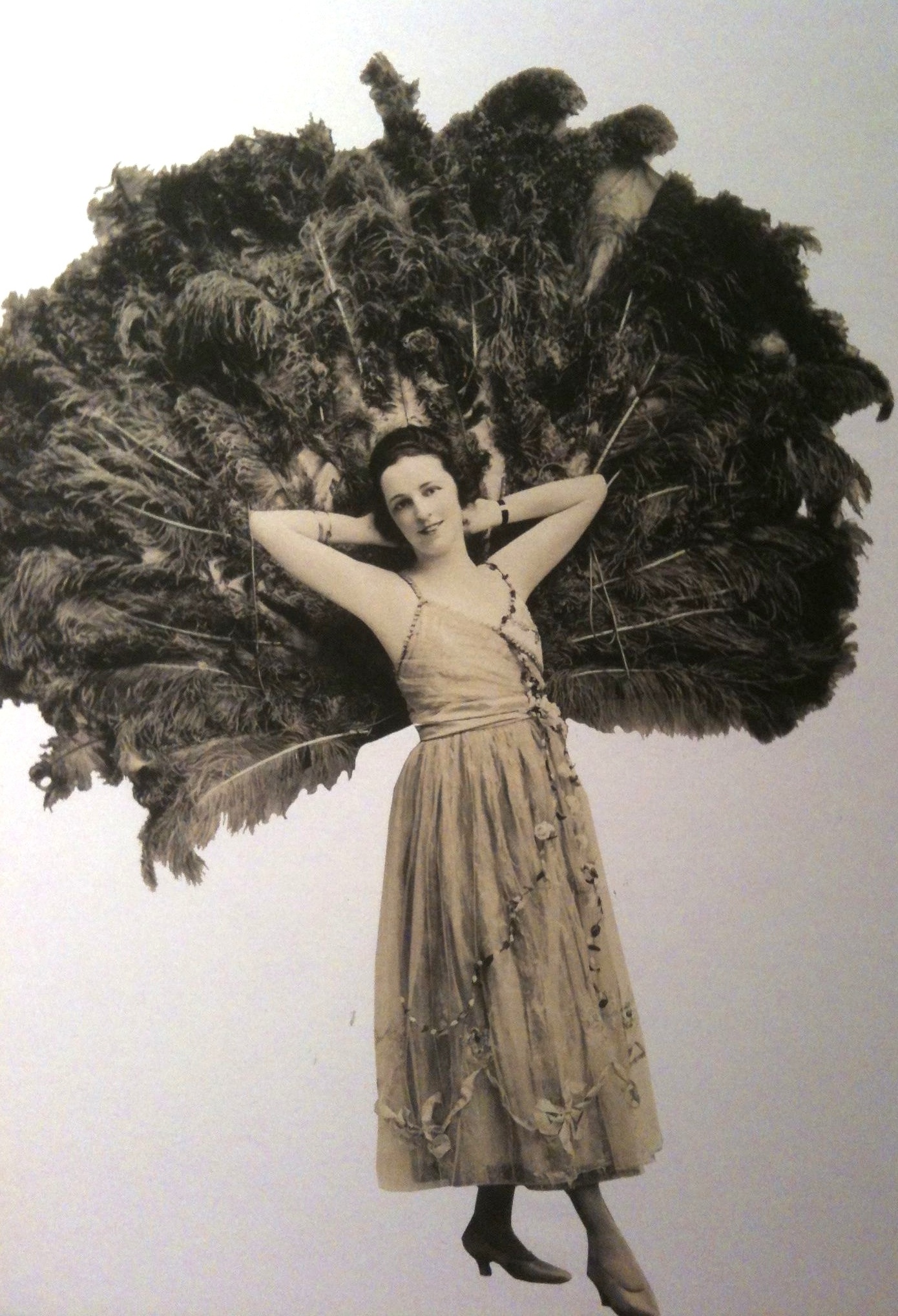
Performer in one of The Passing Show revues (1912-1919), which spoofed politicians and Broadway shows (kind of like “Forbidden Broadway”)

Today, Broadway pretty much consists of musicals and dramas, but back in the day, the “tired businessman” was entertained by chorus lines, comics, impersonators, satirists, and the best songwriters. (Think Cohan, Berlin, Rogers & Hart.)

Perhaps the note found in the archives inside a Follies costume swatch book sums it up: “Costume designs are attached. Lyrics will be written if you are interested.”

This terrific NYPL show explored how follies and revues evolved between the years 1902 (the dawn of the Hammerstein Roof Garden shows) to 1938 (when topical revues of the Great Depression, such as Pins and Needles made their mark).

The curators’ chronology and commentary is brilliant, chronicling the four stages of development: beginnings, experimenting with formats, celebrating the “body as performance”, and the emergence of political satires (1930s). (Download the show’s mini-program to get the Cliff Notes version.)

Chorus line from Earl Carroll’s Vanities (1923-1940), which featured the Most Beautiful Girl in the World

Who knew that the original Hippodrome was also built by the team that built Coney Island’s Luna Park? Who knew that George White invented “souvenir programs”? Who knew that Martha Graham got her start in settlement-house venues way back when the Neighborhood Playhouse was at the Henry Street Settlement? Who knew that audience participation shows and mini-revues on rooftop eating-drinking gardens predated the Brooklyn Bowl mash-up by 100 years?

Olympic-Sized Dreams for the Suburbs

You’ve seen Danny Boyle transform the Olympic stadium from a 19th Century industrial landscape into the digital home of today. What happens when you give a 21st century design team the chance to do the same with Chicago’s suburban industrial wasteland?

See for yourself at MoMA’s show “Foreclosed: Rehousing the American Dream.” Although it closes tomorrow, the MoMA website has replicated everything on line–videos, maps, manifestos, and plans.

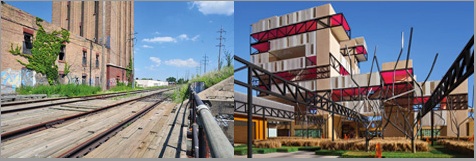
The proposed transformation of Cicero’s abandoned railside factories into a 21st century village where people work and live is particularly interesting. Abandoned factories currently take up 30% of Cicero. What if you redesigned it and let people buy only the parts of the home they need (vs. everyone living in a brick bungalow with a yard)? See the video and solution by Studio Gang Architects.

Cicero, Illinois and the proposal for the Vertical Neighborhood in the Garden in the Machine project by Studio Gang Architects. © 2011 James Ewing, photograph courtesy James Ewing.

Also, check out WORKac’s creation of “Nature-City” in a down-and-out Oregon suburb, Keizer. What happens when you integrate organic farming businesses and wildlife crossings into a village? Or MOS’s proposed transformation of The Oranges, New Jersey from a grid to a walking city.

Enjoy meeting our own artistic visionaries with Olympic-sized dreams on line.

What You’ll Be Wearing in Space

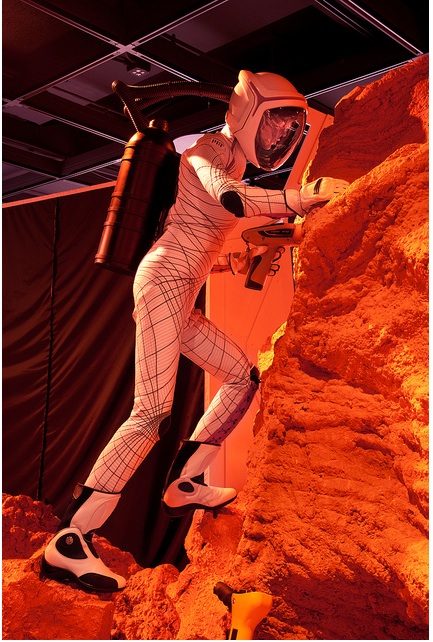
BioSuit™, a form-fitting next-generation spacesuit prototype by MIT aeronautics and astronautics professor Dava Newman displayed in the AMNH exhibition. © AMNH\D. Finnin

If the wizards at MIT have their way, the future look on Mars (for us) will be spandex, nylon, and polymer. It’s the look that’s featured in the soon-to-close show at AMNH, Life Beyond Planet Earth: The Future of Space Exploration.

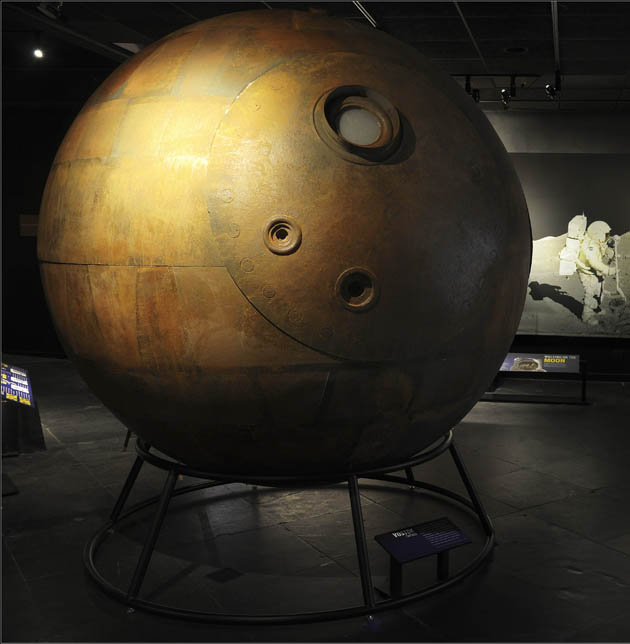
Some of the highlights include a model of Yuri Gagarin’s 1961 space capsule (don’t walk by it in the entry to the show!), Soviet and US space helmets, the “smell” of the Moon, a model of Sir Richard Branson’s space-tourist vehicle, and a space elevator.  (Didn’t you ever wonder how you’d get back from another planet?)

There are two great interactive opportunities – sitting down at a small console to skim over the surface of Mars and a big, well-lit interactive table (near the spacesuit) that lets you and others trigger modifications to Mars that eventually transform it into a habitable Earth colony.

Again, you can’t beat those 1950s letters to the Hayden Planetariumto get the juices flowing about the promise of space travel. Now, were do we order the suits?

Exhibition model of the Vostok capsule, in which Yuri Gagarin became the first person in space on April 12, 1961. © AMNH\R. Mickens

Cool MoMA Summer Pop

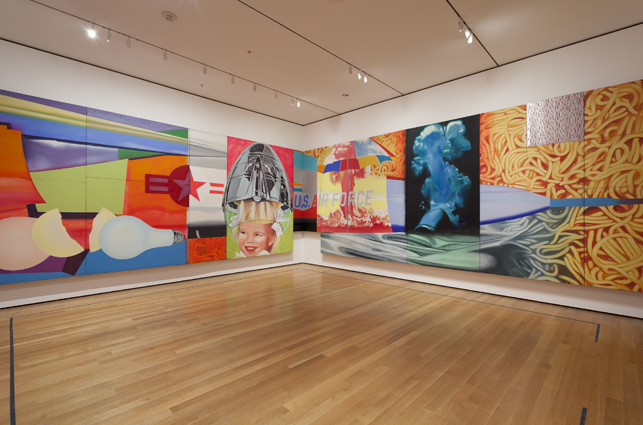
There’s no better way to cool down during the heat wave than by visiting MoMA’s Fourth Floor to see the last days that one of Pop’s masterpieces is on view: Rosenquist’s epic F-111.

The great thing about this display is that the spectacular 84-foot-long, 23-section work is installed just as it was first put on public display in Castellli’s gallery on East 77th Street back in 1965…in a small 22 x 23-foot room in which the spectacular panels and images wrap around you (instead of spread out on a long, long wall).

The thrill of this installation is being so bombarded with color, image, shine, and texture but not being able to take it all in at once. You can take time to meditate on the forces ripping through American culture in 1964, when Rosenquist created this opus.

And listen to him tell about it on the MoMA web site.  Get to MoMA and see for yourself. It’s a visual Sixties yin to Avedon’sb/w yang.

Installation view of James Rosenquist: F-111 (1964-65) at MoMA. Gift of Mr. and Mrs. Alex L. Hillman and Lillie P.Bliss Bequest, both by exchange. © 2012 James Rosenquist/Licensed by VAGA, New York, NY. Photo by Jonathan Muzikar

Classical Israeli Hip Hop

What do you see when a classically trained African American fine artist from LA decides to mash up Jewish Eastern European folk art with portraits of passionate Israeli hip-hop men of color?

Kehinde Wiley portrait of Jewish Ethiopian Israeli hip-hop artist Kalkian Mashasha

Find out at the most recent installment of Kehinde Wiley’s series, The World Stage, which will soon end its run at The Jewish Museum. It’s the Israel portion of Wiley’s effort to “chart the presence of black and brown people around the world.” It’s a stunner partly because of the paintings, the models, the provocative country choice, the Museum, and the physical Fifth Avenue setting.

Traveling to Tel Aviv during 2011, Wiley wanted to see, meet, and document men of color in a country that he really only associated with an anxious source of conflict. When he scoured the discos, malls, and promenades, he found that hip-hop practitioners and fans associated regardless of their identity as Ethiopian Jews, Arab Israelis, and other native-born Jews. That’s who you’ll meet on the walls and in the video.

If you’ve seen Wiley’s other work, you know that he smothers his canvases and subjects in pattern. In this case, inspired by the collection at the Jewish Museum, you’ll have the treat of actually viewing patterned 19th-cetury textiles and Eastern European paper cuts from the collection that inspired him. Plus, you can enjoy the echo between the curlicues on canvas and on the wood paneling of the (former) Felix Warburg mansion.

Wiley wanted to “broaden the discussion” about Israel, race, culture, and art, and his skill, vision, creativity, and deep-dive into the Tel Aviv youth scene delivers big time. Enjoy walking the Tel Aviv streets with the artist at work. (And for more, look at the other discussions and videos here.)

Best gift items associated with a current exhibition: Wiley’s skateboard deck and dog tags featuring his proud subjects.

Virtual Indie Declarations

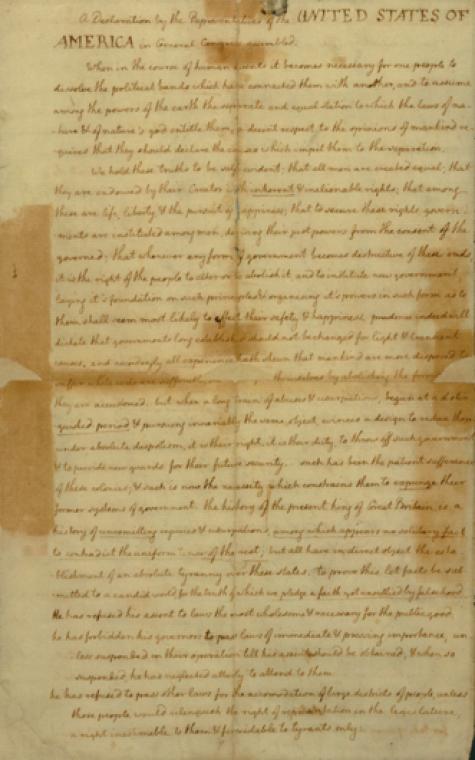
It’s never really the Fourth of July in New York without seeing Tom J’s annotated copy of his Declaration of Independence that’s usually shown this time of year at the New York Public Library.

Because Tom’s two-page handwritten draft was diplayed all year in NYPL’s 100th anniversary exhibition, the Library has decided that “It will be given a rest of a few years…” Even though you’re not able to visit Tom’s Declaration in person, the library’s digital team has made it available on line, along with a number of its other revolutionary treasures. Check out:

Ben Franklin’s June 21, 1776 note to General Washington (written while Tom was toiling away in the Philadelphia’s sweltering summer heat) that “a Declaration of Independence is preparing”.

Tom’s original draft of the Declaration with his paragraph objecting to the slave trade, which Congress forced him to edit out. (Check out this blog posting at NYPL and click on the images for a larger view.)

Tom’s clean draft that became official.

Also check out the first news report on the Declaration in The Pennsylvania Evening Post (dated July 6, 1776), telling everyone that something was up, followed by the classifieds on page 2.

Daring Sea Rescue Yields Treasure

Treasure is what you’ll find in the upstairs galleries of The South Street Seaport Museum in Lower Manhattan, following its daring rescue by The Museum of the City of New York.

Armed with a two-year plan, a dedicated team, and construction crews, MCNY figured out how to transform former storage areas into sixteen beautiful galleries, re-open, and give new life to the museum and iconic tall ships anchored downtown.

In a brilliant use of space, MCNY enables us now to enter three separate time machines that should warm the heart of any NYC booster, particularly the side-by-side installation of two versions of Manhatta (the original name of our island community). The first is the (slightly reduced) reinstallation of the acclaimed Manhatta exhibition (and scientific project), which shows you visions of the island, inhabitants, geology, river systems, and fauna that Henry Hudson would have seen in 1609. (Crowds flocked to this uptown in 2009, so you here’s your second chance.)

The second is the adjacent gallery, where you can sit down and contemplate three stunning simultaneous views of our waterfront — Paul Strand’s famous 1921 documentary of our waterfront (Manhatta), Edison’s early 1900s views of our water’s edge, and a contemporary visual meditation. Time travel doesn’t get any better than this!

The third view, MCNY’s Timescapes film, sweeps more grandly over time and history. Images pop onto three screens as Stanley Tucci narrates the whole, complete story, from forested island to home of the High Line. It’s hard to take it all in, but you’ll be swept away and seriously, it will make you proud.

Although these shows are in open-ended runs, check them out sooner rather than later. Although the Seaport Museum has been thrown a lifeline, it’s only temporary. MCNY only has 18 months to demonstrate that these stories, ships, artifacts, buildings, Bowne & Co. Stationers, and galleries are worth saving.

Be part of the rescue. Shop at Bowne, bring your friends, and step back in time.

Virtual Trip around London

Even if you’re not going to the Olympics, it’s still possible to get around London and environs on the train virtually by stopping into Grand Central to see the last week of the Transit Museum’s Art of the Poster show.

You’ll see original artwork commissioned by the London Underground made into posters seen by the riding public over the last 100 years. You’ll see how the transit network enticed folks to take the train to the country in 1913, encouraged fashionable people to get to the theater in the 1920s, brought people together during the War, and wryly encouraged courtesy in the 1950s.

There’s even a section about the designs that were never used and why.  The best known fine artists in the show are Howard Hodgkin and R.B. Kitaj, but you’ll also get to know original work by many innovators in British graphic design and see the differences between the original and the final printed product.

Walter E. Spradbery, Ascot Sunday (1924), ©TfL from the London Transport Museum

If you can’t get to Grand Central, check out the online exhibition on the London Transport Museum’s site.


Seventh-Century Fashionable

If you’re running over to the Met to catch the Prada/Schiaparelli show in the next two weeks (don’t worry, it’s up until August 19), be sure to see the other rarely seen, worth-the-trip clothes – the robes, tunics, and kids’ stuff that’s straight from the Seventh Century.

It’s the textile/clothing room of the show Byzantium and Islam: Age of Transition. It’s not often you get to see clothes from 430-870 A.D., much less see a one-room summary of all the cross-cultural fashion trends.

It’s Byzantine fashion at it’s best, from a time when Greek Orthodox, Coptic, Christian, and Jewish lifestyles were all mixing and mingling across the Empire between the Seventh and Ninth Centuries.  Radio carbon dating of the fibers gave the curators a range of dates on the outfits, but let’s just call it even by saying “Seventh Century”.

In the fashion gallery of the show, you’ll see several tapestry-weave tunics (woven to shape), along with a small Egyptian kid’s fringed-trimmed hoodie (430-620 A.D.), a tunic with polychrome-pattered trim, and a huge, oversized Persian riding coat made of cashmere and wool. In a tapestry panel, you’ll see a veritable Vogue layout of various styles, including someone dressed in skins and boots below this more conservative tunic/mantle combo.  Did they really wear that?  You be the judge.

Amazingly enough, a lot of the coats and tunics come from the Met’s and the Brooklyn Museum’s own collections. Take a look and marvel at what curatorial care has wrought. (And check out the popular Samson silk fabric swatch in the adjacent gallery.)