Gold is Everywhere in Brooklyn

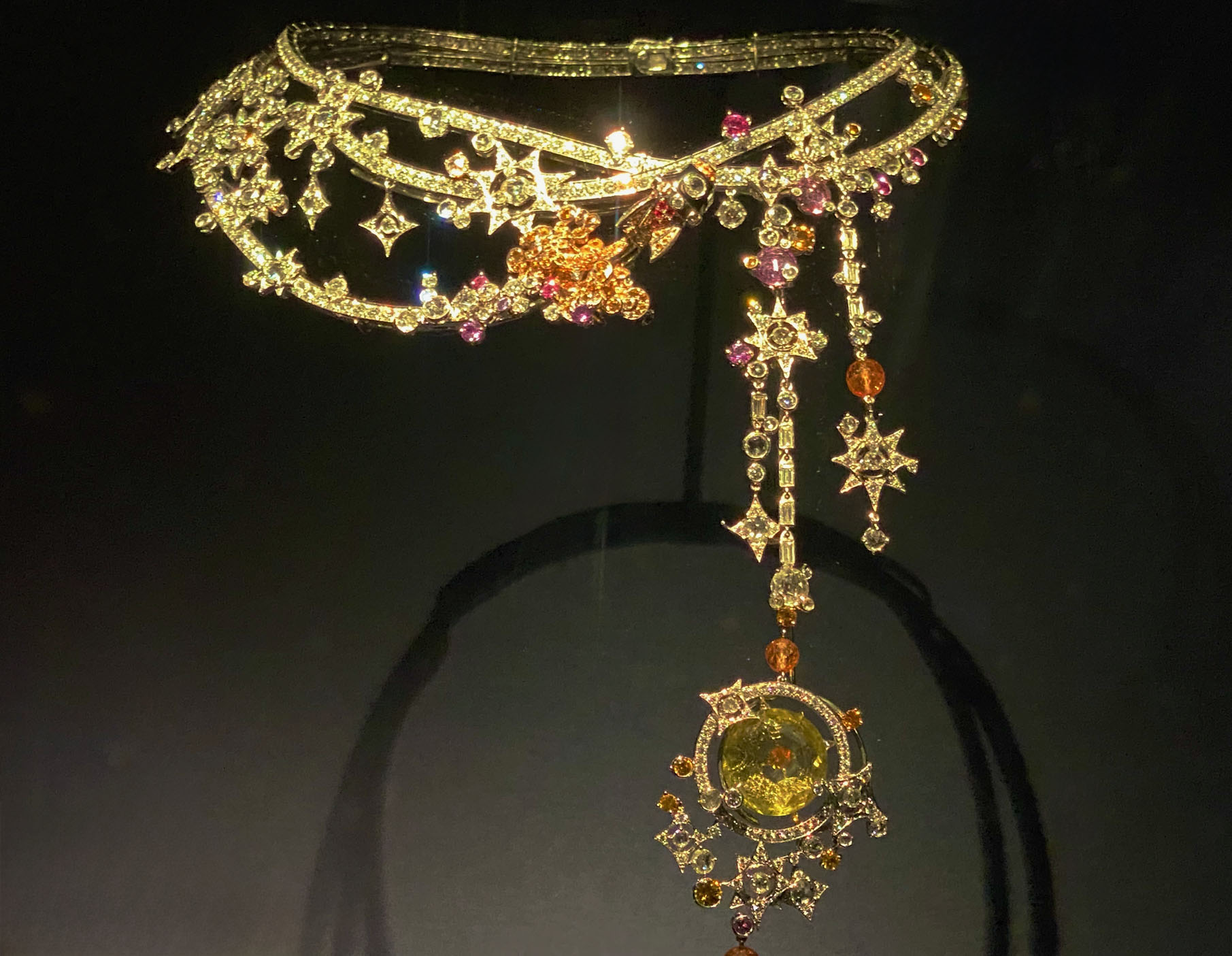
To celebrate its 200th anniversary, the Brooklyn Museum decided to dazzle us with 500 gold pieces – Tiffany, Cartier, Egyptian, Renaissance altarpieces, golden sculptures, Greek wreaths, and eye-popping bedazzled fashion – in Solid Gold, on view through July 6. Half of the pieces are from the museum collection, and half loaned by private collectors and design houses. See our favorites in our Flickr album.

The ten-part show, spread across the museum’s two top-floor galleries deliberately pairs shimmering art from its vast collection with haute couture, gold records, and dramatic jewelry. The exhibition begins by acknowledging the ancient gold in Brooklyn’s Mediterranean and American collections.

Nam June Paik’s 2005 Golden Buddha checks himself out on TV. Courtesy: estate of the artist.

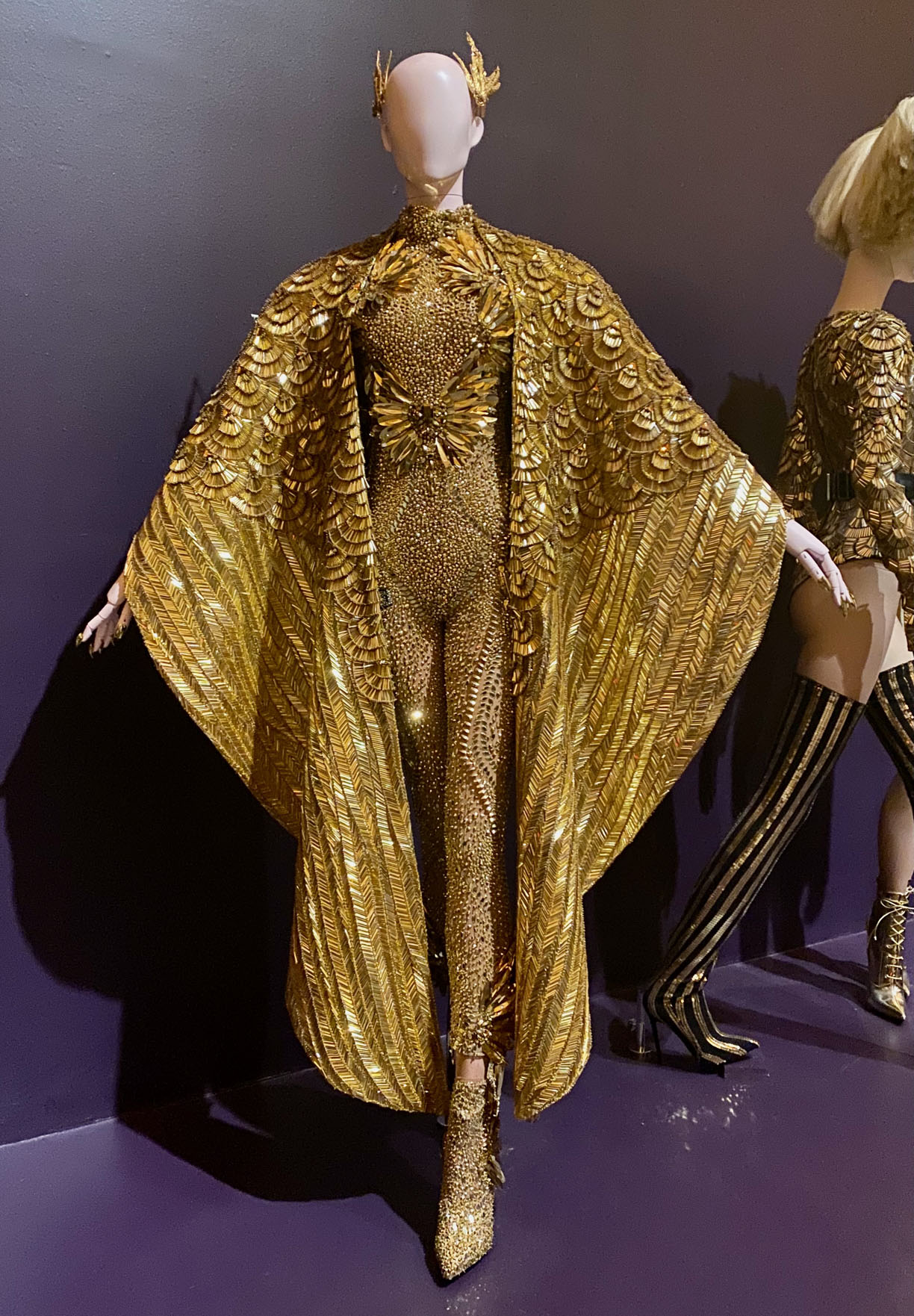
Known for its massive Egyptian holdings, the exhibition’s introductory gallery allows us to plunge directly into a mix of actual and retro Egyptian objects and fashion – golden Egyptian tomb fragments, Victorian-era faux Egyptian decor, clips of Elizabeth Taylor from her Sixties Cleopatra extravaganza, and many dazzling pieces from the Egyptian Disco collection by The Blonds, including the Cleopatra catsuit-cape that Billy Porter wore as he was carried on a litter onto the 2019 Met Gala red carpet.

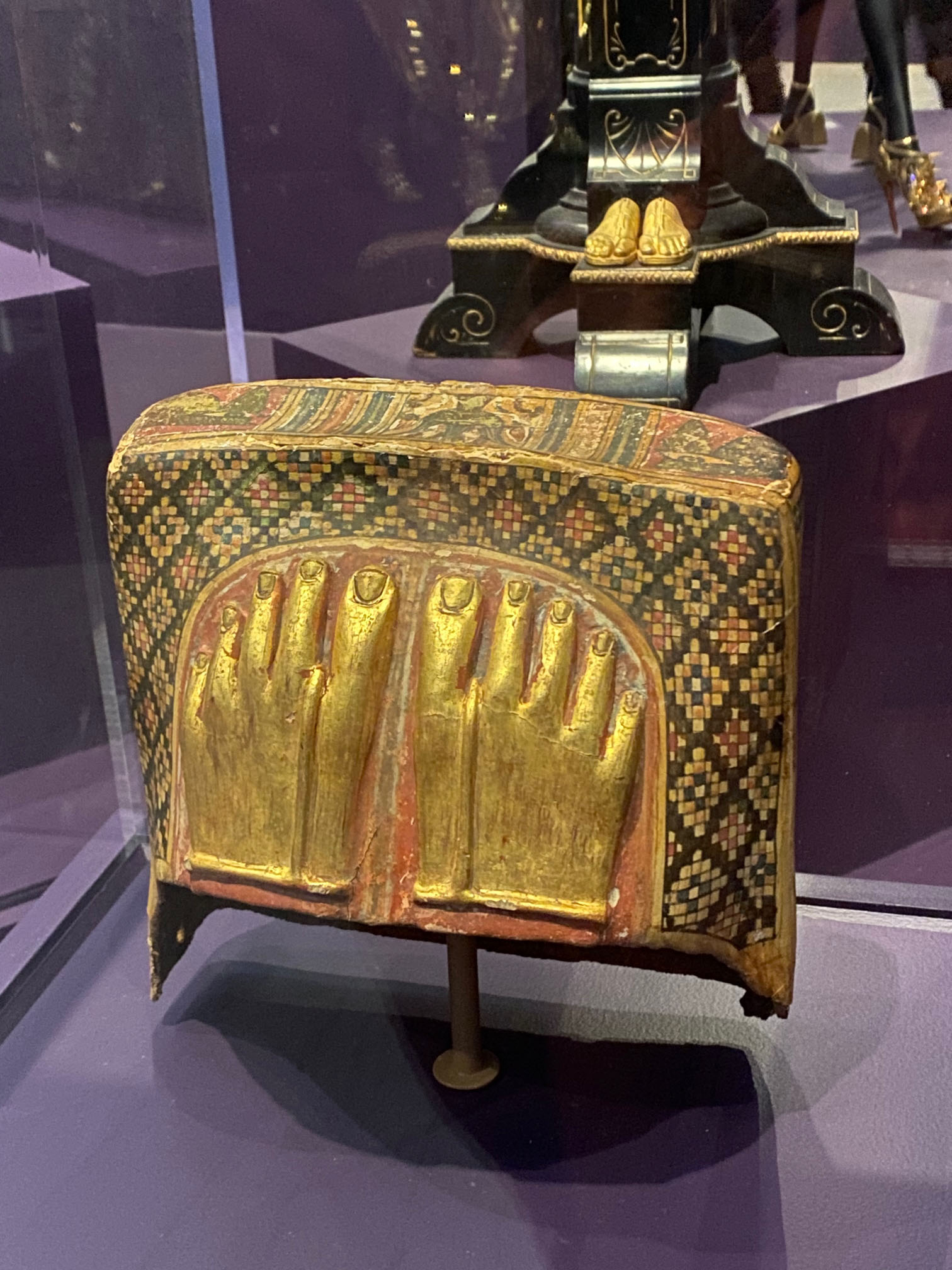
Gold in the First Century: painted gold-leafed footcase from Coptic era Egypt; (rear) 1870 gilded and lacquered pedestal by Kimbel and Cabus.
From The Blonds’ Egyptian Disco collection: Cleopatra catsuit, cape, and headdress worn by Billy Porter to the 2019 Met Gala.. Courtesy: The Blonds

You could spend hours in the first room just taking in the gold, platinum, and diamond details of Jacob Arabo’s wristwatches; wondering how Galliano crafted a gown of Lurex pyramids; admiring Mary McFadden’s golden macrame gowns; or contemplating the 4th-century golden hoard from the Middle East.

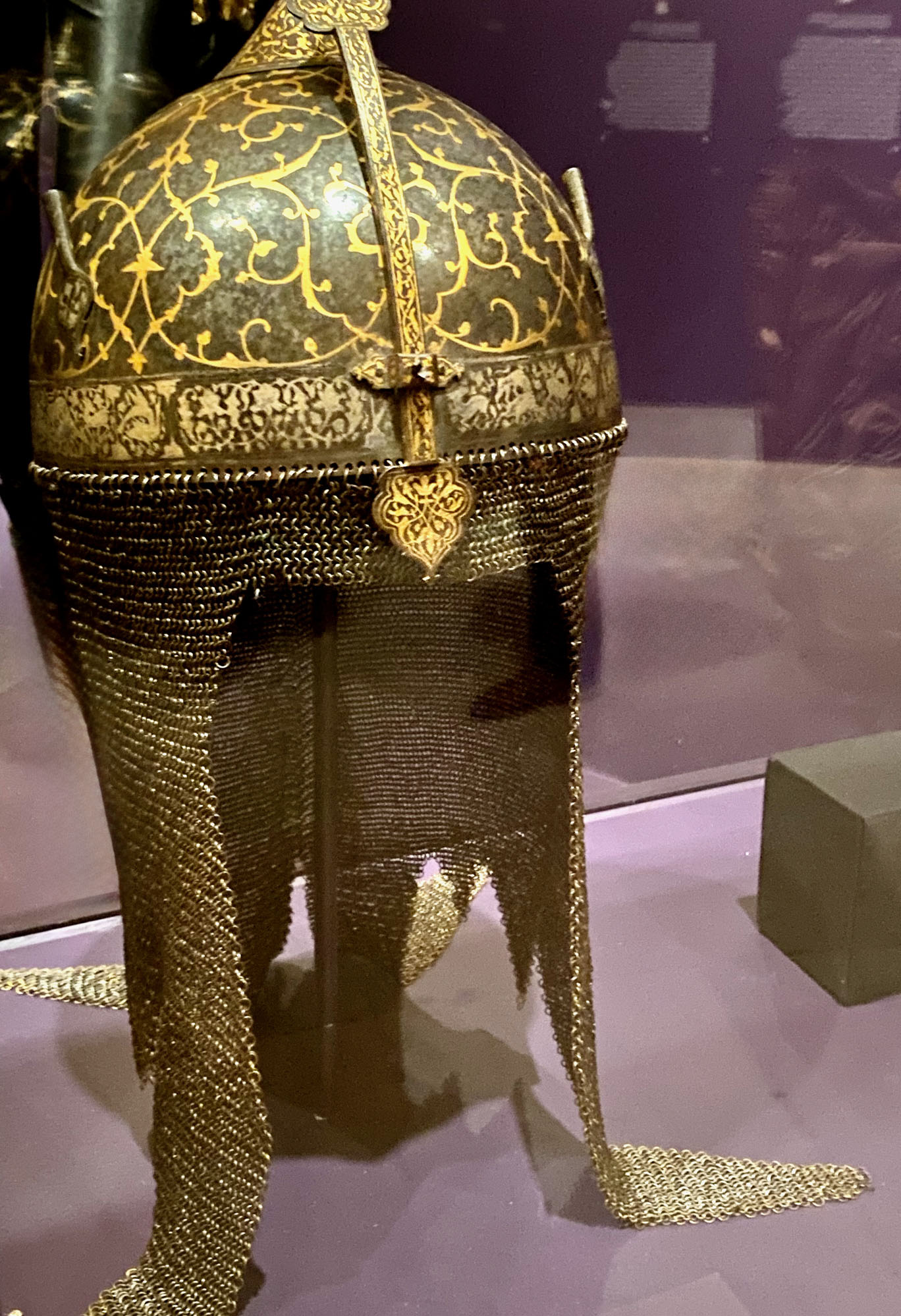
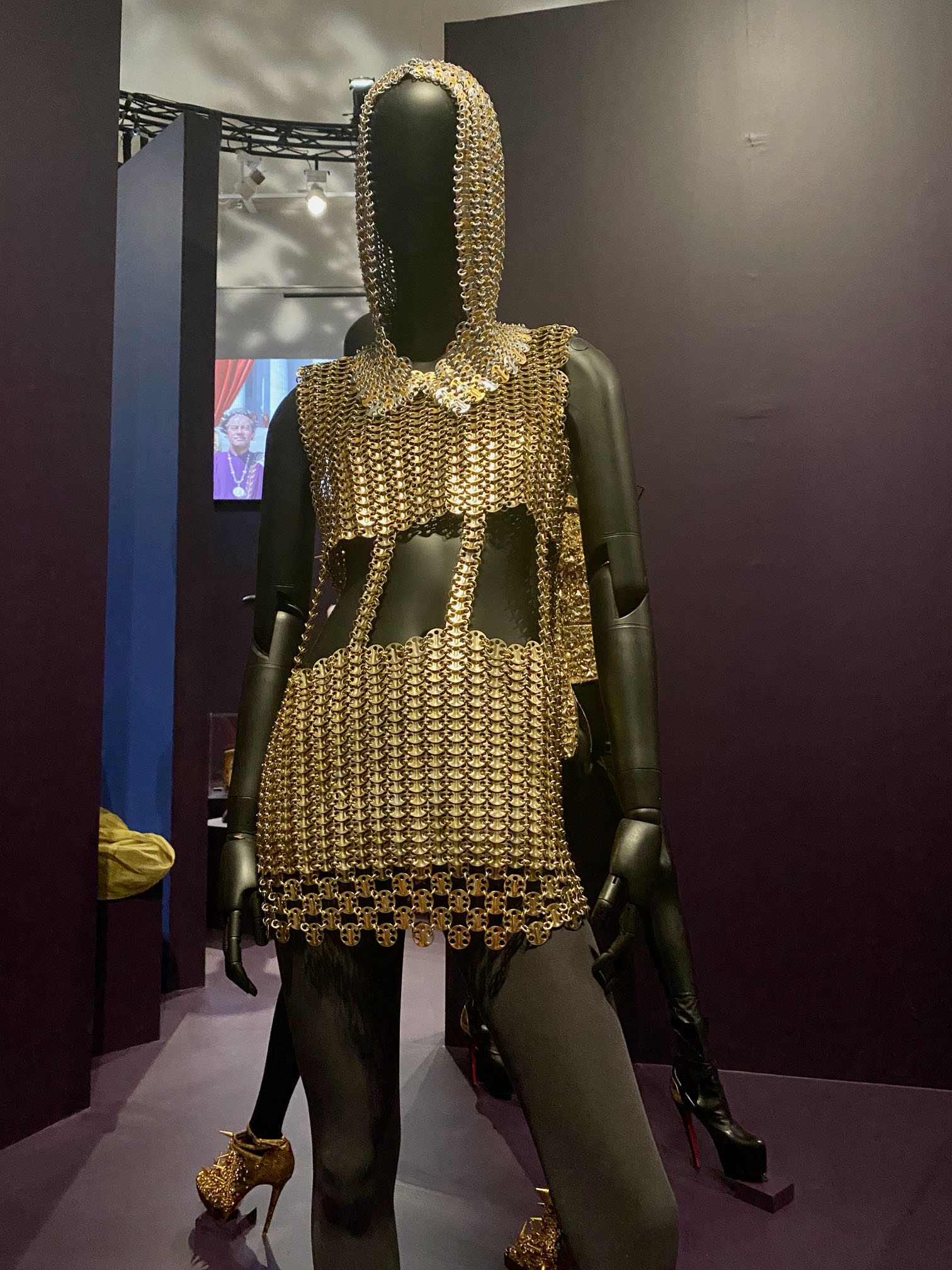
But even more dazzlers await in the linked-chain section – 18th century Islamic helmets, Janelle Monet’s gold-braid wig by The Blonds, and a Seventies chain mini by Paco Rabanne.

From the Safavid Islamic Empire in Central Asia: a 1700 steel, gold, and silver helmet.
1971-72 gold, silver, and patinated aluminum cowl and dress by Paco Rabanne. Courtesy: private collection

A large, dramatic gold sculpture punctuates the first quarter of the exhibition – the dramatic piece by Zadik Zadikian is only plaster covered in gold leaf, but if it were solid gold, it would represent $1 billion in value.  Visitors take a break here to circumnavigate the piece, watch a video and read about the history of gold mining – and its human cost – throughout the world.

2024 24-karat gold Path to Nine by Zadik Zadikian – a wall of 1,000 gold bars (gold leaf on plaster). Courtesy: private collectors

Golden mosaics, golden halos, golden chasubles, embellished holy portaits, golden uniforms, and golden coin containers from Italy, Mexico, Peru, China, and Japan line the next galleries, demonstrating how different cultures have integrated gold into private and public devotions, court, and the economy. In Italy, for example, one era’s minted golden coins are transformed into another era’s golden halos for saints in home altars.

Somehow, it’s a fitting punctuation to this section of the exhibit to encounter the epic, shimming wall sculpture by El Antsui. The “golden” glow emanates from recycled whiskey bottle cap

2010 Black Block by El Antsui, a wall hanging of recycled whiskey bottle caps.

The second half of the exhibition features objects from Brooklyn’s own collection and fashions that combine gold with other colors.

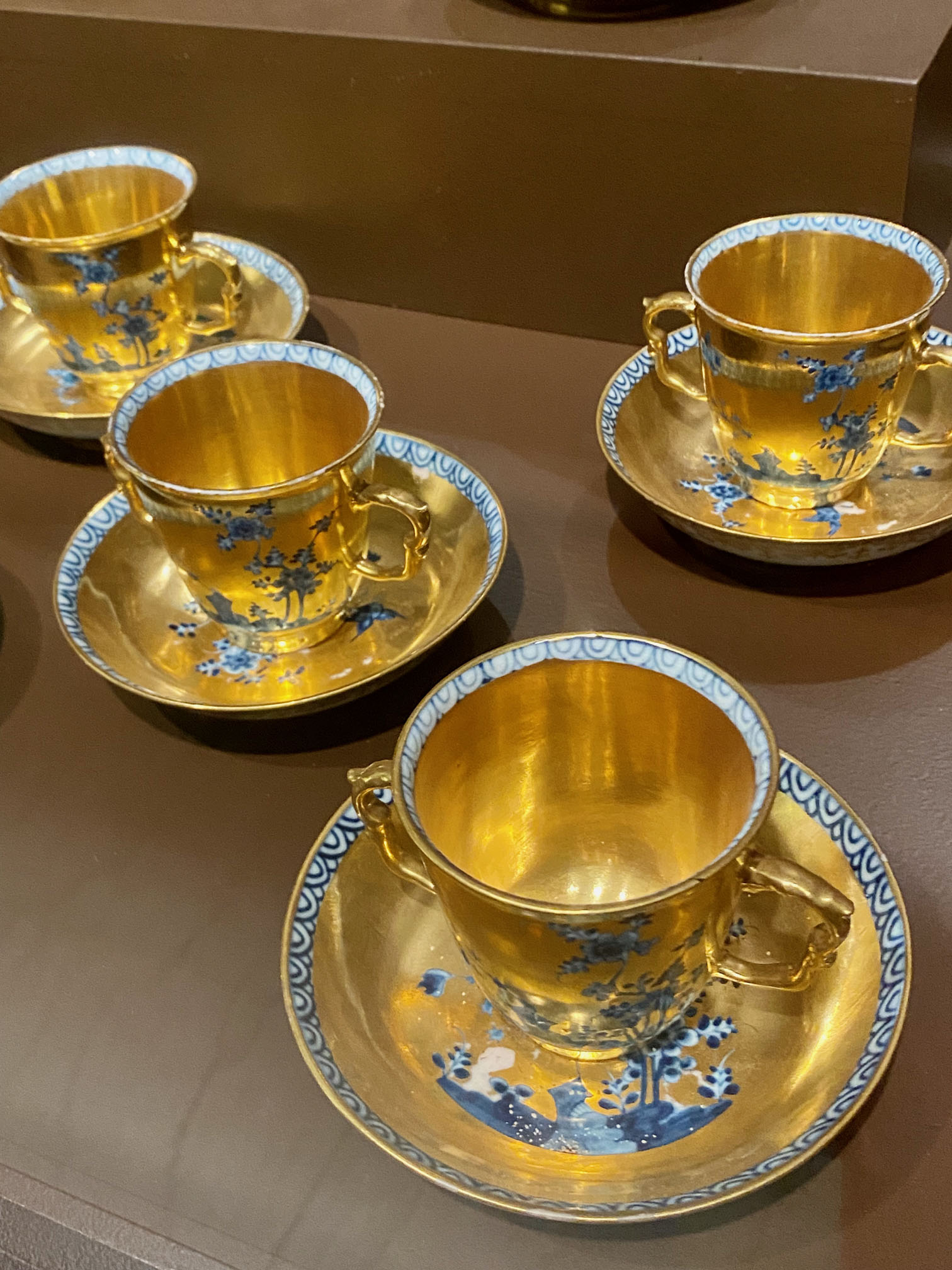
1720-25 gilded Meissen porcelain coffee and chocolate set.
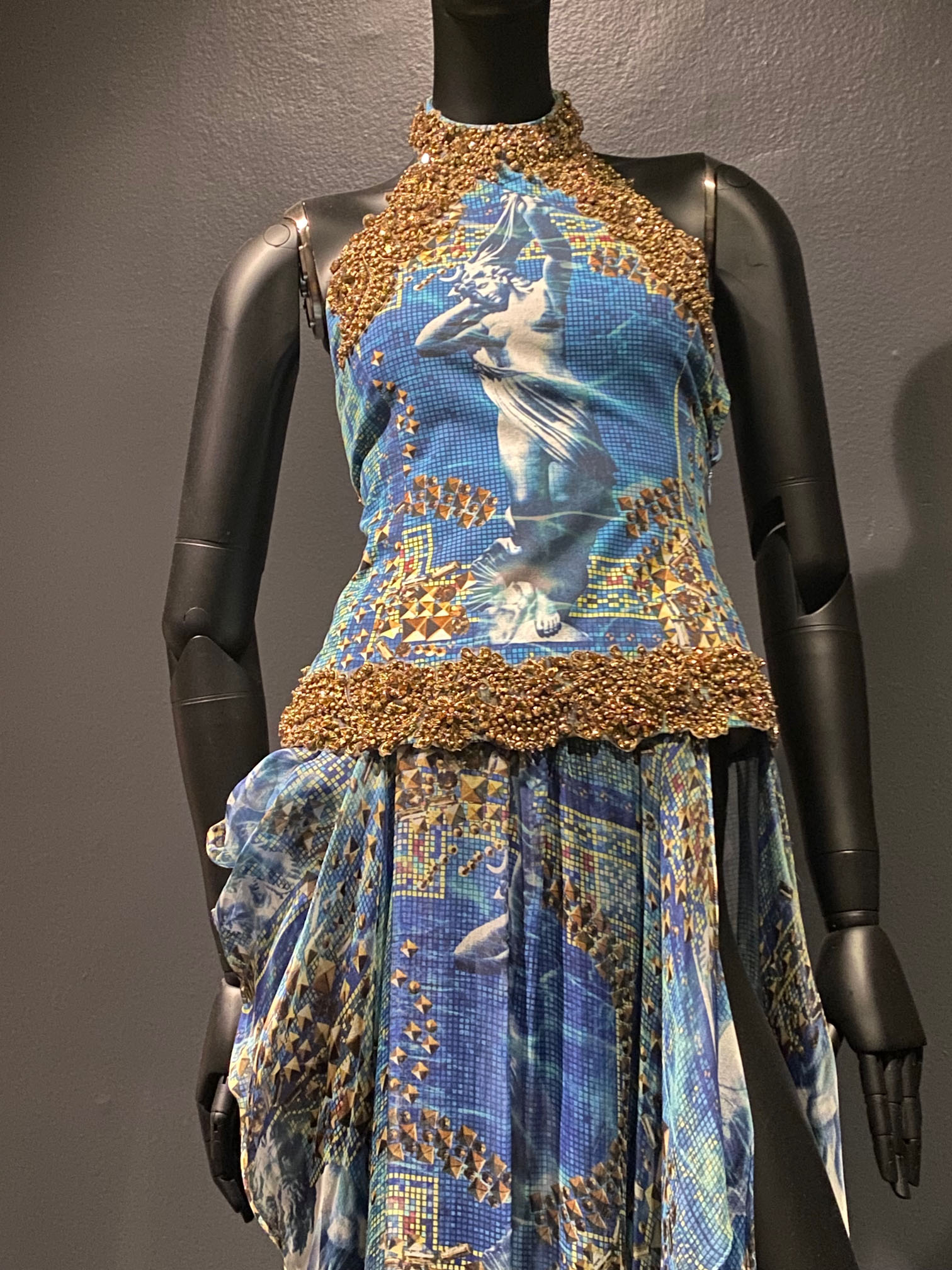
Claudio Cina’s 2017 photo-printed skirt and top depicting Venus, embroidered in gold with gold studs and crystals. Courtesy: the designer

And then it’s just one golden haute couture gown after another – Dior, Yves Saint Laurent, Cardin – accented by cases containing masterpieces of jewelry design by Cartier and Schiaparelli.

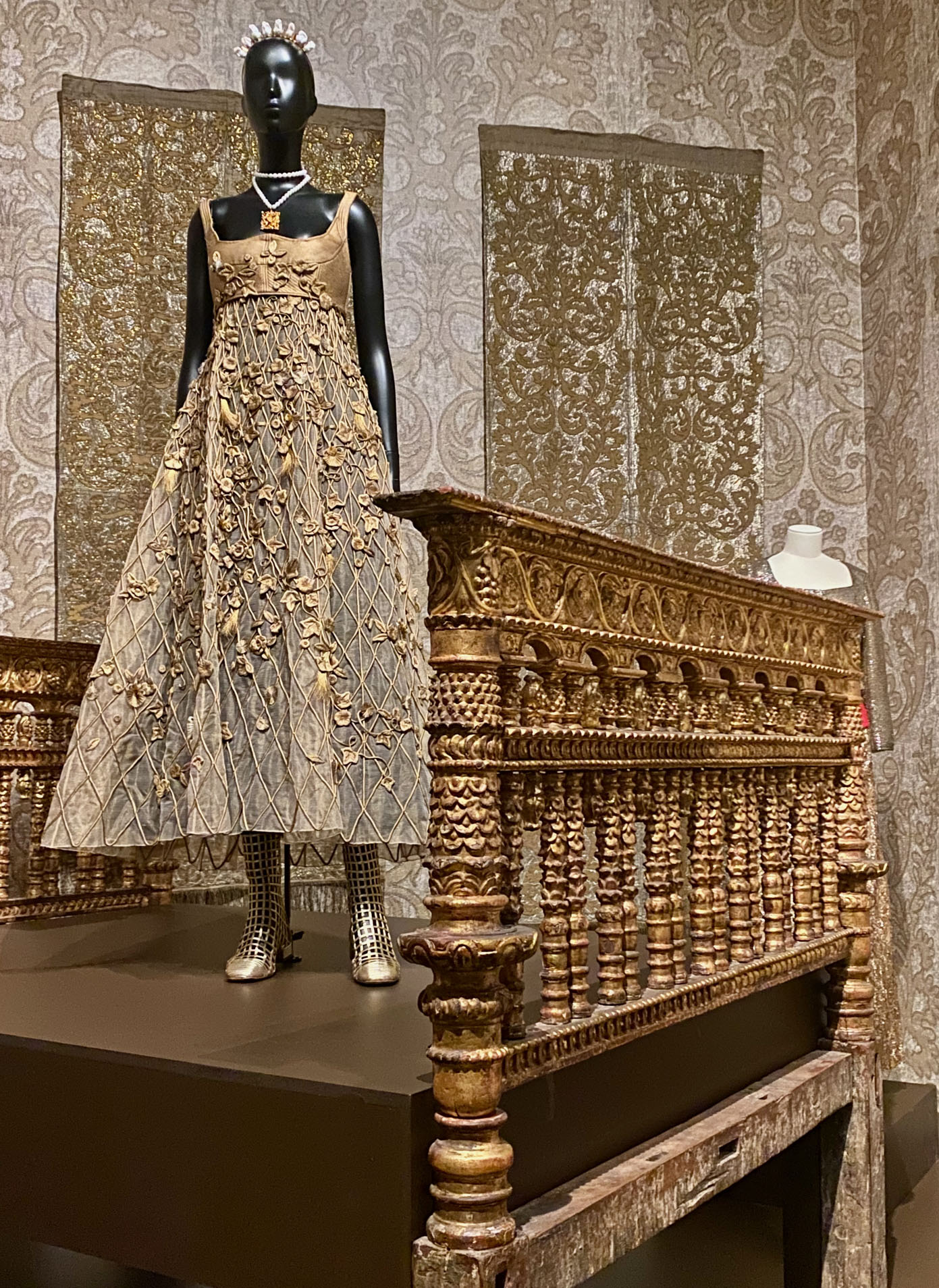
2021 embroidered gold silk haute couture dress by Maria Grazia Chiuri for Dior atop 1700-1760 gilt wood bed from Peru. Courtesy: Dior.
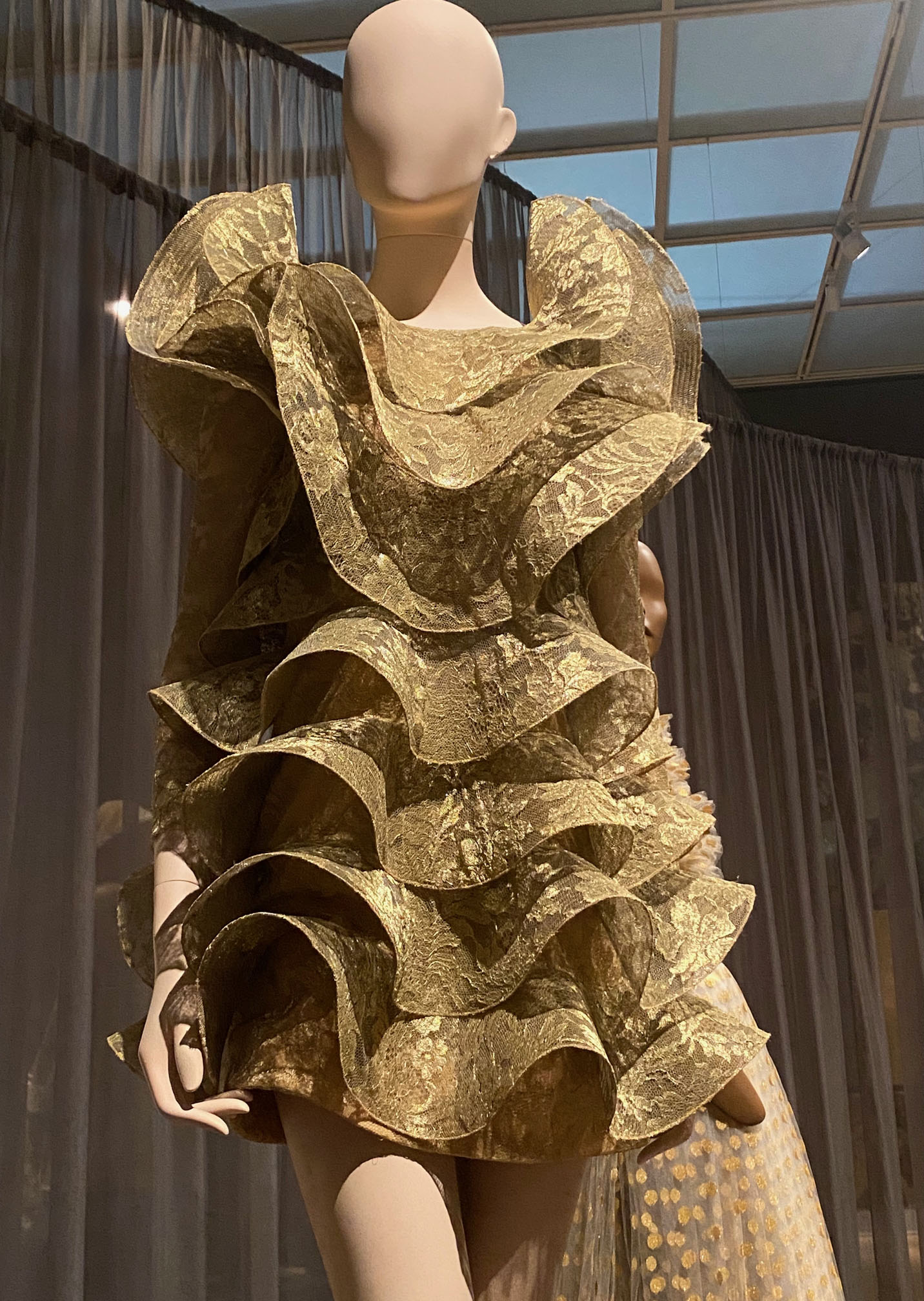
1991 gold nylon lacework ruffled cocktail dress by Pierre Cardin. Courtesy: Musée Pierre Cardin.

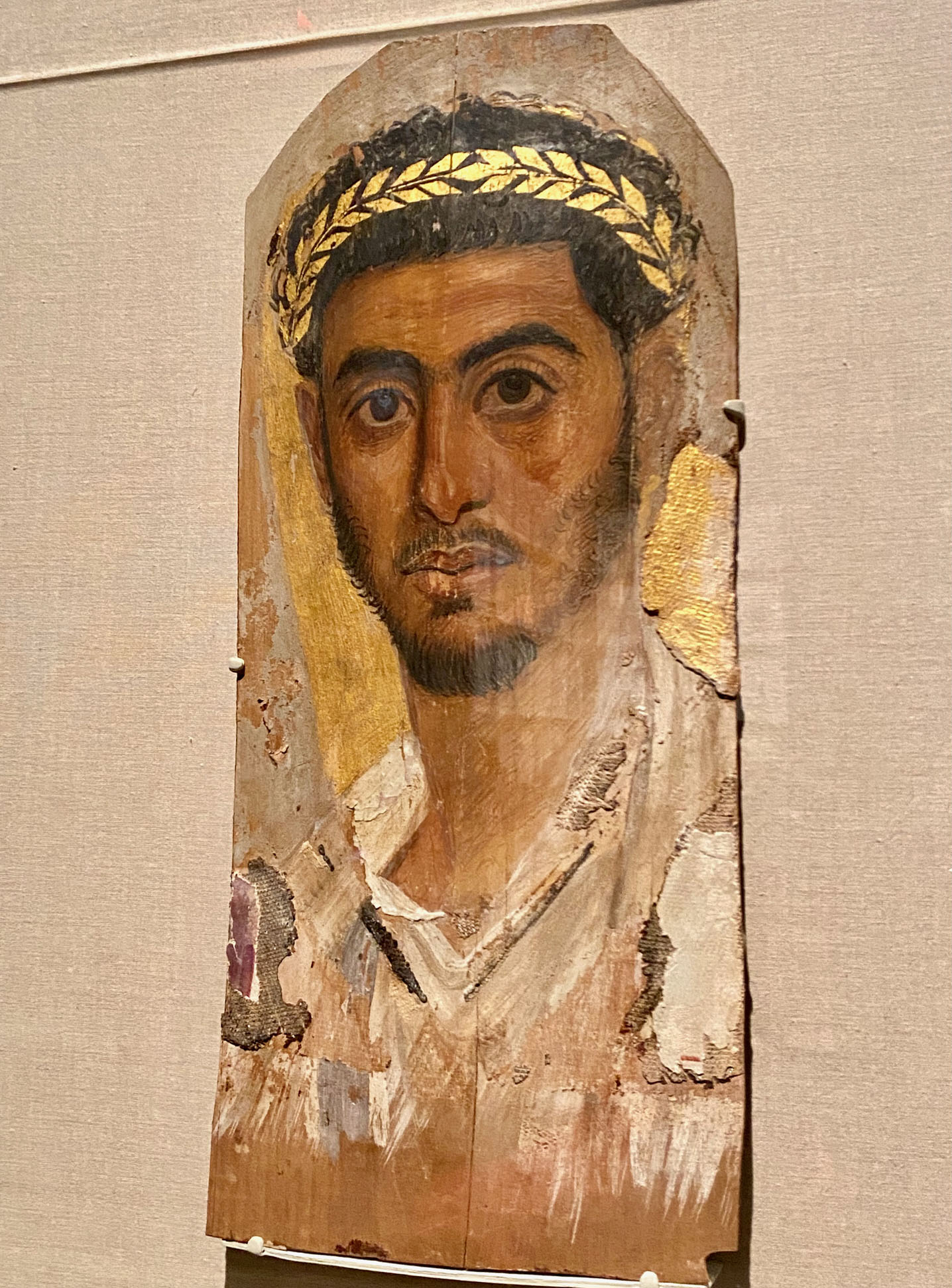
The final gallery – and it’s a stunner – shows how ancient and contemporary artists and designers use gold to signify special status and power. A gold wreath encircles an Egyptian man’s portrait, and Basquiat honors his friend in a painting by inserting his iconic gold crown. We get a chance to examine Brooklyn’s rare hammered leafy gold wreath from ancient Greece alongside a golden dress made by Dior for the opening of the 2024 Paris Olympics.

120-130 A.D. Egyptian Mummy Portrait of a Man.
Aya Nakamura’s 2024 metallic gold feather dress for the 2024 Paris Olympics opening ceremony by Maria Grazia Chiuri for Dior. Courtesy: Dior.

To see inside the gallieries and hear more, watch this video with Brooklyn Museum curator Matthew Yokobosky:

Contemporary “Echoes” at The Wheelwright

Since its founding in 1937 as an institution documenting Navajo ceremonial art, Santa Fe’s Wheelwright Museum of the American Indian has shifted toward collecting contemporary Native American art and serving as a platform to boost careers of emerging artists.

The latest exhibition pays tribute to its last 50 years in Echoes: Selections from the Wheelwright Museum’s Permanent Collection, on view through June 8, 2025

The exhibit showcases well-known artists – like Tony Abeyta, T.C. Cannon, Virgil Ortiz, Rose B. Simpson, Bob Hazous, and Emmi Whitehorse – but the curators deliberately chose early-career works that haven’t been seen for a while. 

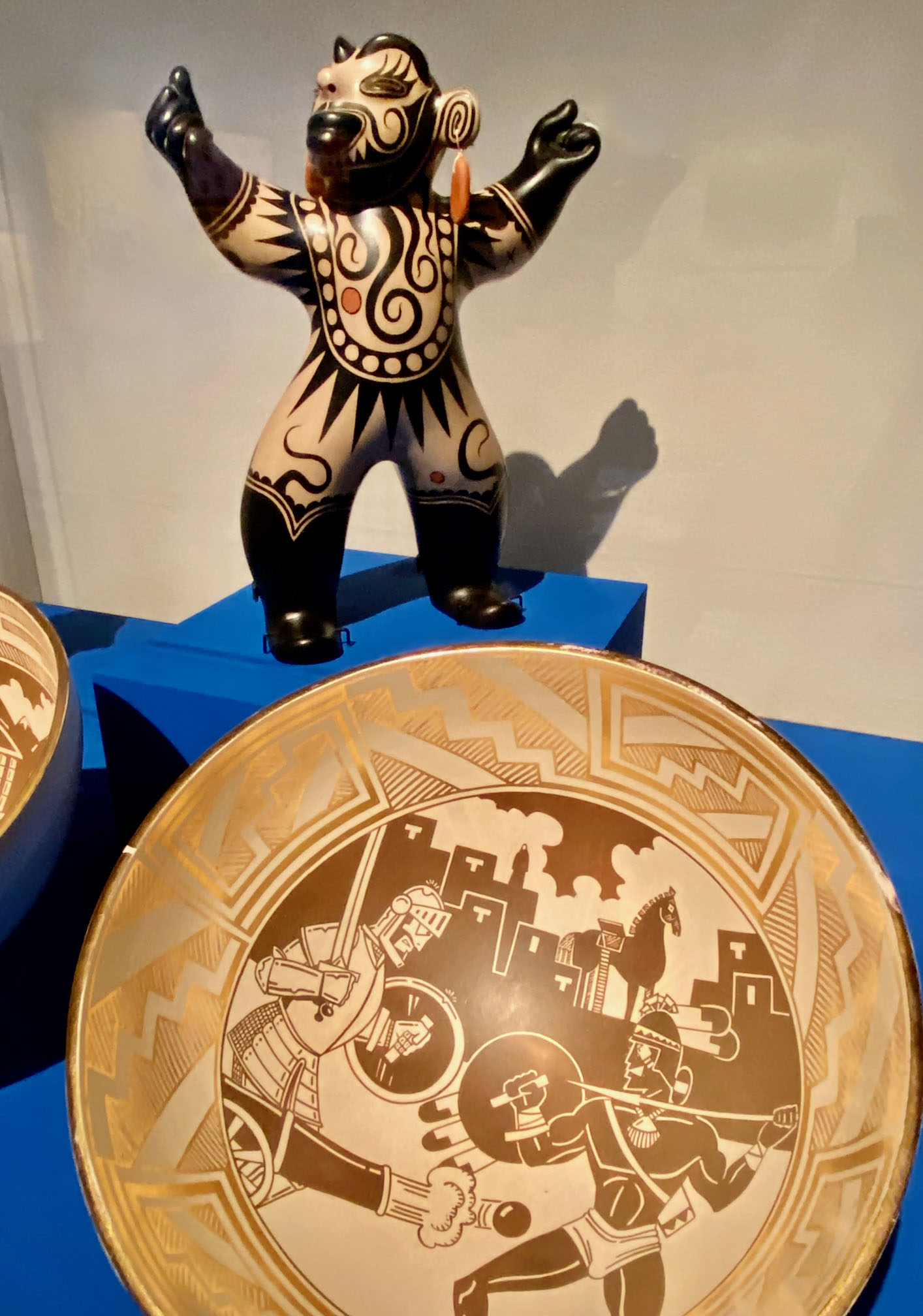
Virgil Ortiz’s (Cochiti) 2005 ceramic sculpture Monos Figure with Diego Romero’s (Chochiti) 2005 bowl Tenga Cuidado Con Griegos Salvo Obseqios.

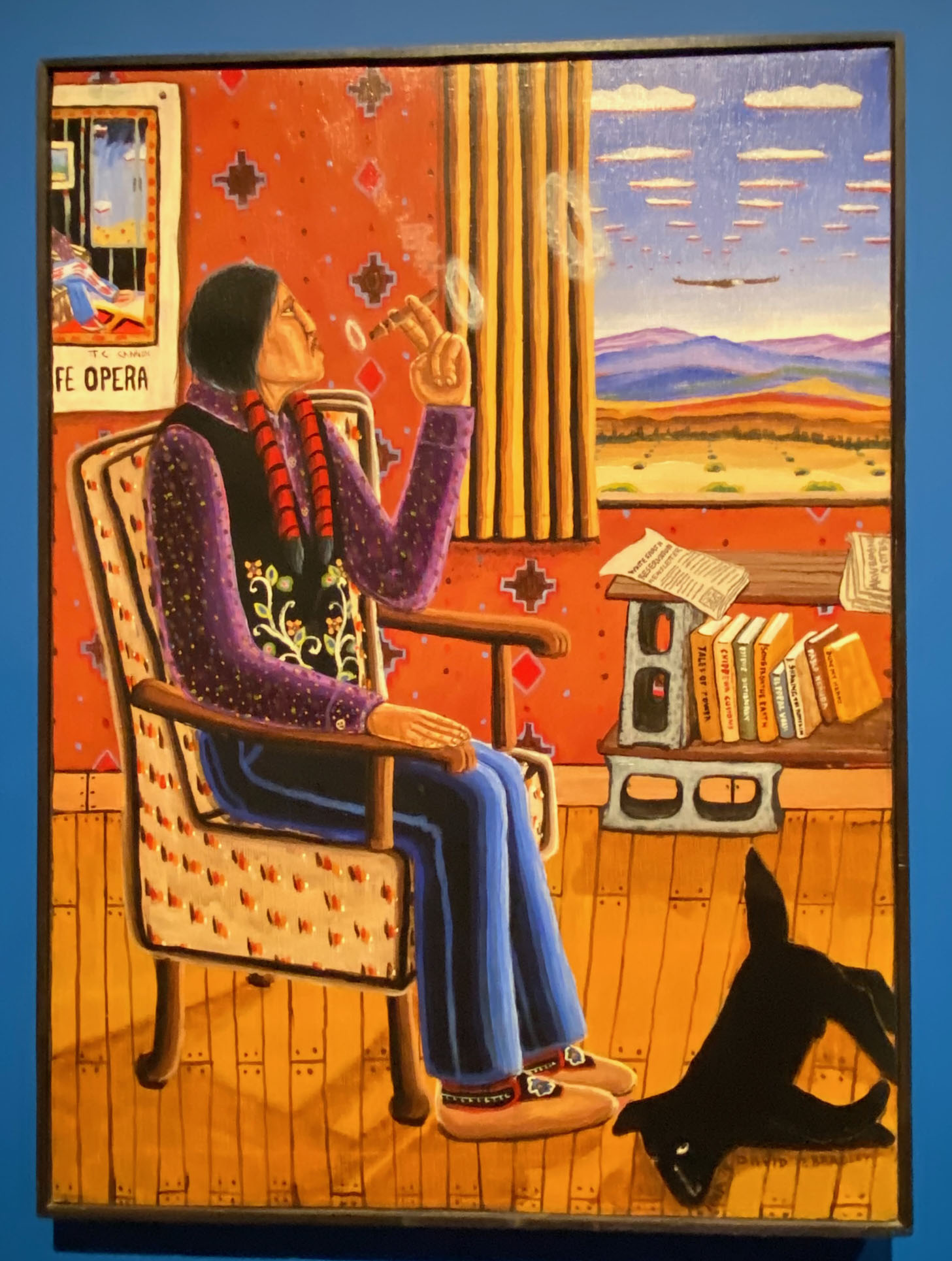
For example, on a wall honoring T.C. Cannon, the curators showcase a crazy, irreverent David Bradley work painted in T.C.’s bold, satirical style, but display a rather conservative (and rarely seen) woodcut by T.C. himself.

David Bradley’s (Minnesota Chippewa) 1979 acrylic Remembering T.C. Cannon in the style of his hero.
T.C. Cannon’s (Kiowa/Caddo) 1977 woodblock print Hopi with Manta.

Contemporary textile artist Ramona Sakiestewa’s comment that her work represents “visual echoes of what came before” inspired the title of the exhibition. Sakiestewa’s tapestry incorporates colors and motifs of traditional Hopi wicker plaques.  This theme is carried throughout the show.

Ramona Sakiestewa’s 1992 Basket Dance/9-B echoes a traditional woven Hopi ceremonial plaque.

A grouping of intricately painted Acoma ceramics pays tribute to the Wheelwright’s 1981 exhibition Sky City Salute that honored two matiarchs of that art form – Lucy Lewis, who lived at Acoma before and after tourists began beating a path to the ancient mesa-top city, and Marie Z. Chino. The curators match it with work by Marie’s grandson, Robert Patricio, who channels traditional themes into a modern ceramic context.

Acoma legacies: a 1965-85 seed pot and 1958 bowl by Lucy Lewis, and large 1980 storage jar by Marie Z. Chino.

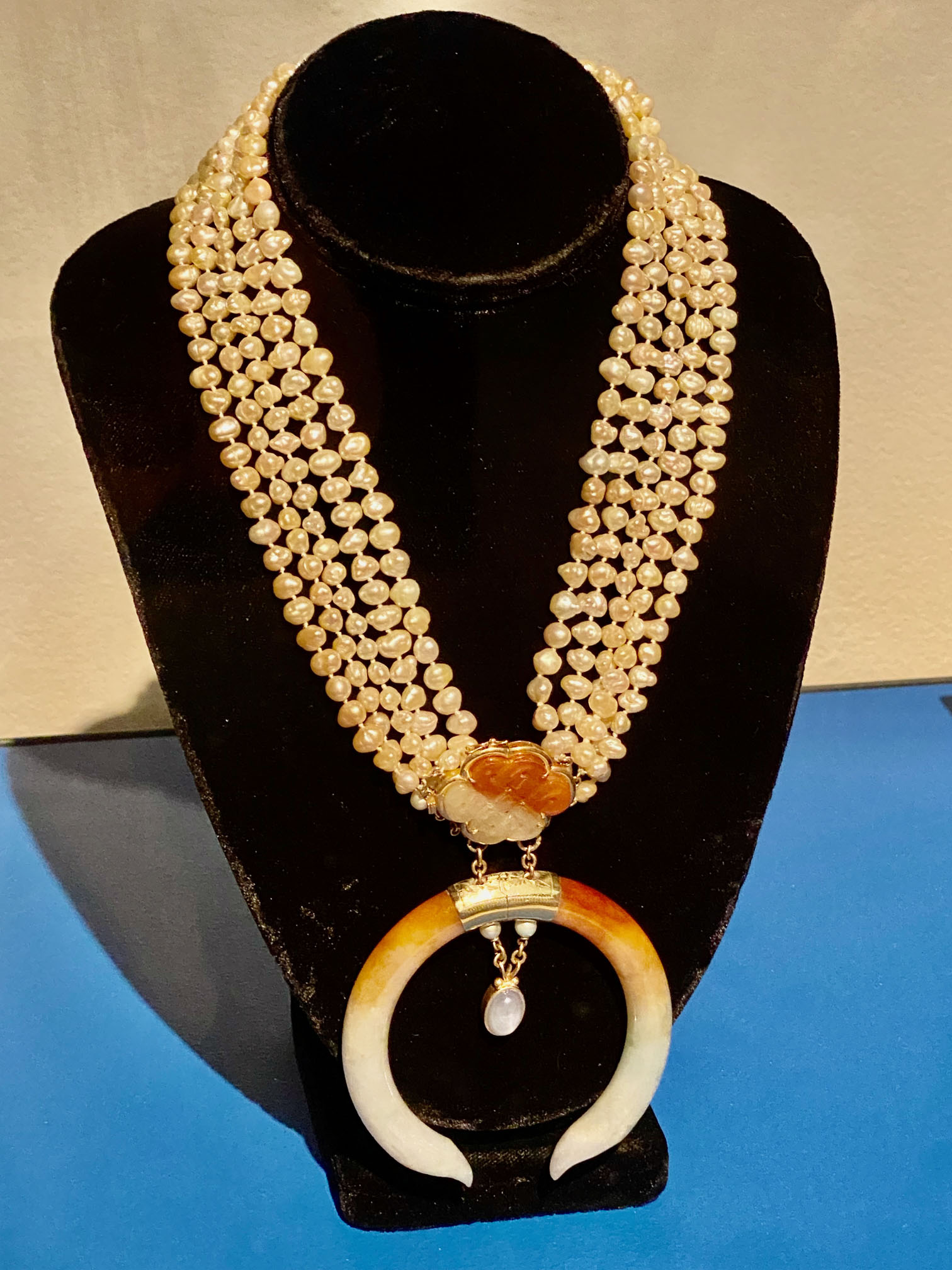
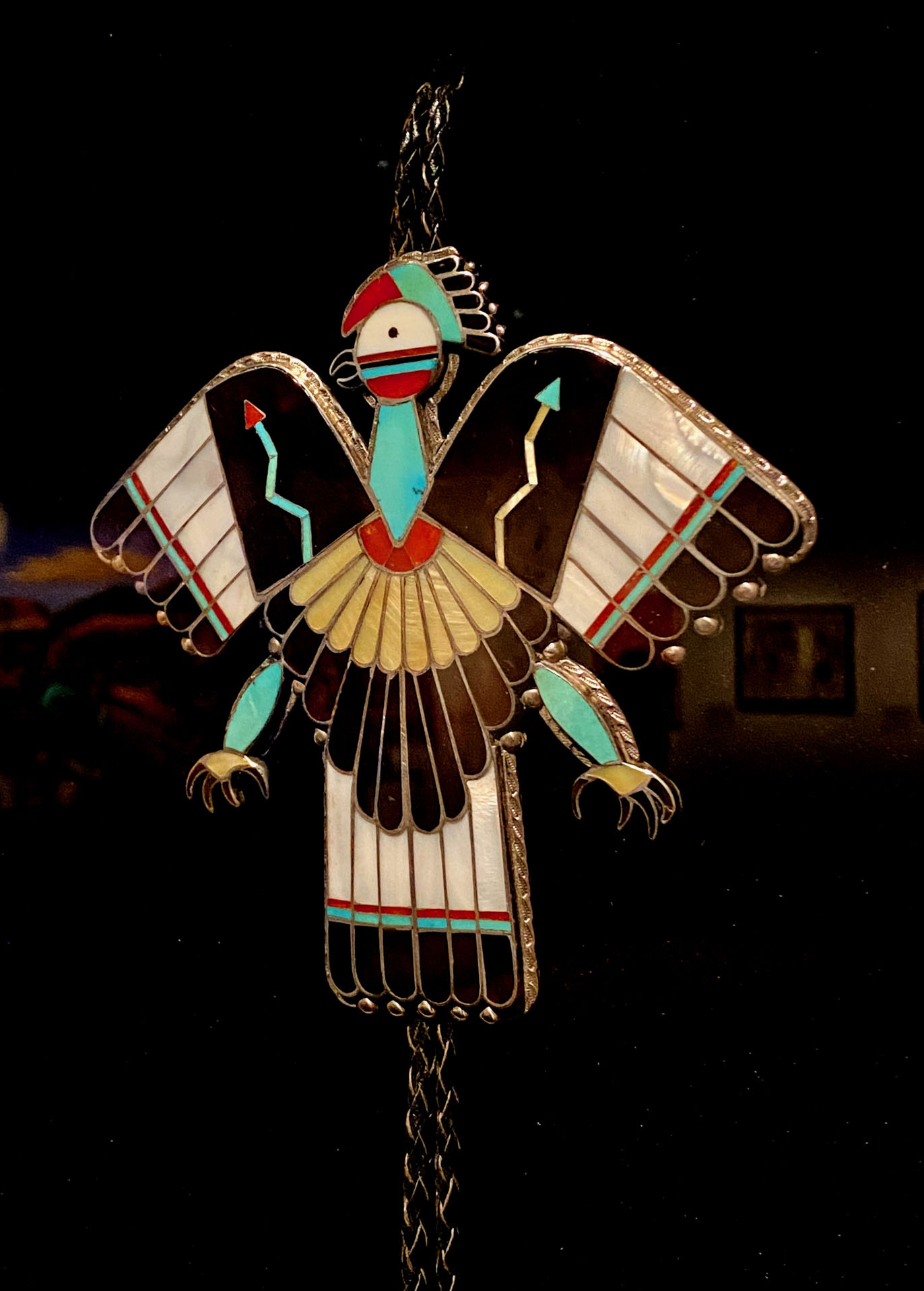
Another grouping references the Wheelwright’s 2011 show Radical Recycled Jewelry Makeover with a bold piece by Kenneth Johnson and the Wheelwright’s stellar collection of Zuni bolo-tie inlays.

Kenneth Johnson’s (Muscogee/Seminole) 2011 necklace from recycled pearls, jade, gold, and silver..
1970s-1980s thunderbird bolo by Owen Bobelu (Zuni); inlaid silver, jet, turquoise, and mother-of-pearl.

The “salon wall” is peppered with paintings that tell the interconnected histories and styles of nine Native artists – the trajectory from flat-style styles of the 1920s and 1930s to more open innovation of Ben Harjo and Linda Lomahaftewa, some of earliest graduates at the Institute of American Insitute Arts (IAIA).

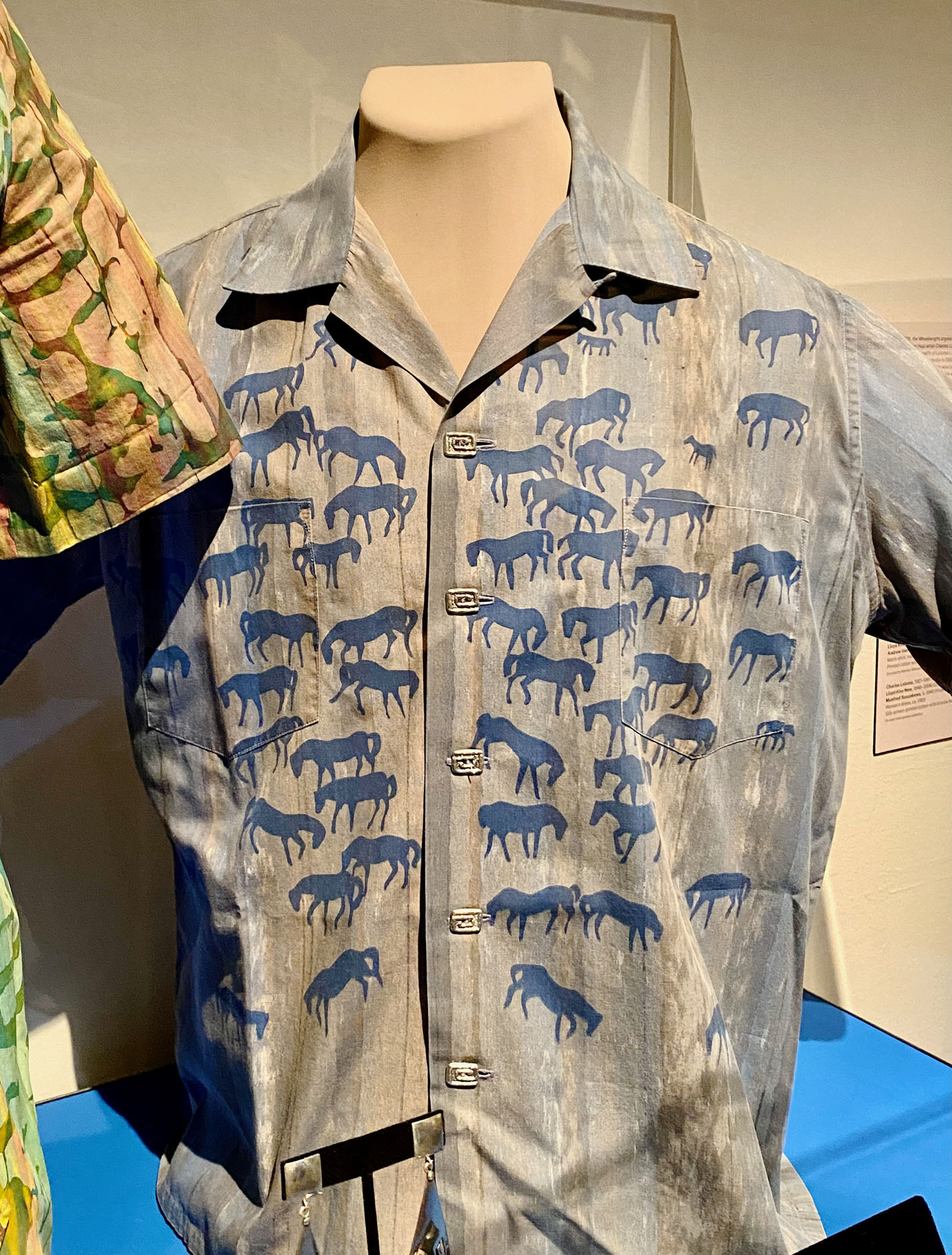
The exhibition also presents another group of work to acknowledge the artists who began working together in Scottsdale in the 1950s and who began IAIA in 1962 – clothing designed by co-founder/president Lloyd Kiva New and jewelry by instructor Charles Loloma..

Lloyd Kiva New’s (Cherokee) 1950s man’s shirt with Andrew van Tsinajinnie (Diné) printed fabric and Charles Laloma (Hopi) silver buttons.
Charles Laloma’s 1970 silver, coral, turquoise pin.

Beaded Converse sneakers by Marie Flying Horse, clever collage by Arthur Amiotte, a dinosaur pot by William Andrew Pacheco, art-world satire by Bob Hazous, and colorful Seurat references by Shonto Begay all add up to a vibrant walk through the last half-century of contemporary art innovations inside the hogan on Museum Hill.   

Take a look at our favorites on Flickr.

David Bradley’s (Minnesota Chippewa) 2004 acrylic To Sleep Perchance to Dream – a take on Rousseau

Scandinavian Folk Dressing Takes a Stand

Forget about the picturesque fjords and pastoral views reindeer herders that we imagine when we envision Scandinavia. Completely different stories of history, revolution, oppression, and cultural revival are told by the array of colorful, decorative, embellished and loved clothing in Dressing with Purpose: Belonging and Resistance in Scandinavia, on view at the International Folk Art Museum in Santa Fe through February 19.

You’re introduced to the iconic folk clothing of three cultures when you enter the exhibition – Sweden, Norway, and Sápmi, the homeland of the indigenous Sami people that stretches across the northern boundaries of Russia and the three other Scandinavian countries.

Detail of mid-19th to early 20th century woman’s dräkt from Sweden’s Delsbo parish in Häsingland historical province.
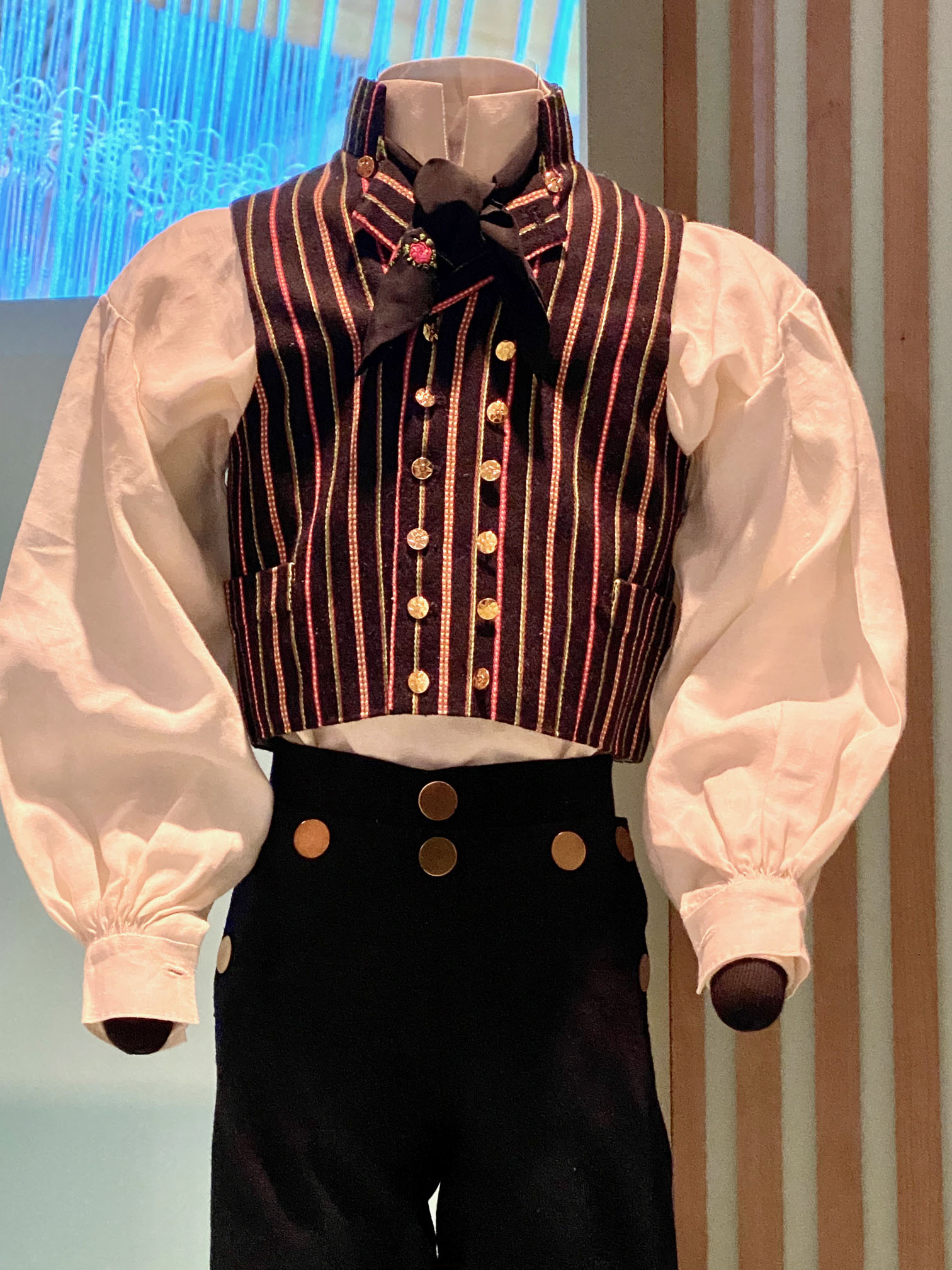
Young Swedish man’s dräkt, made in 1992 by Birgitta Lördal and Maj-Lis Halvarsson of Häsingland historical province.

But then it’s a deep dive into what each of these colorful creations represent.

The story behind Sweden’s folk costumes (folksdräkt) extends back into the 19th century, when rural peasants lived in a fairly hierarchical society and relied on their church clothes to signify where they ranked on the status ladder. Each community developed its own details and styling. In some communities, women used almanacs to help them keep track of various clothing combinations.

The exhibition displays an array of men’s and women’s country ensembles.

There are also examples of striking, elaborately silk-embroidered shawls that were essential to women’s status dressing.

In the 1800s, a series of economic and agricultural misfortunes caused rural Swedes to leave their communities and either migrate to the United States or to middle-class jobs in the city.

Swedish intellectuals worried that the rural population drain meant that country traditions and craftsmanship would vanish. Around 1900, cultural leaders prompted a craft awareness and revival movement ­– retail shops, showcases for hand-crafted clothing, and national museums.

Detail of woman’s 1834 silk-embroidered linen shawl, a status symbol worn on specified occasions; Leksand parish in Sweden’s Dalarna province.

Today, many Swedes gladly purchase and buy kits to make folksdräkt for festivals, parades, and other events.

The curators have even included items from a new cottage industry – protective garment bags specifically designed to store your folk costume!

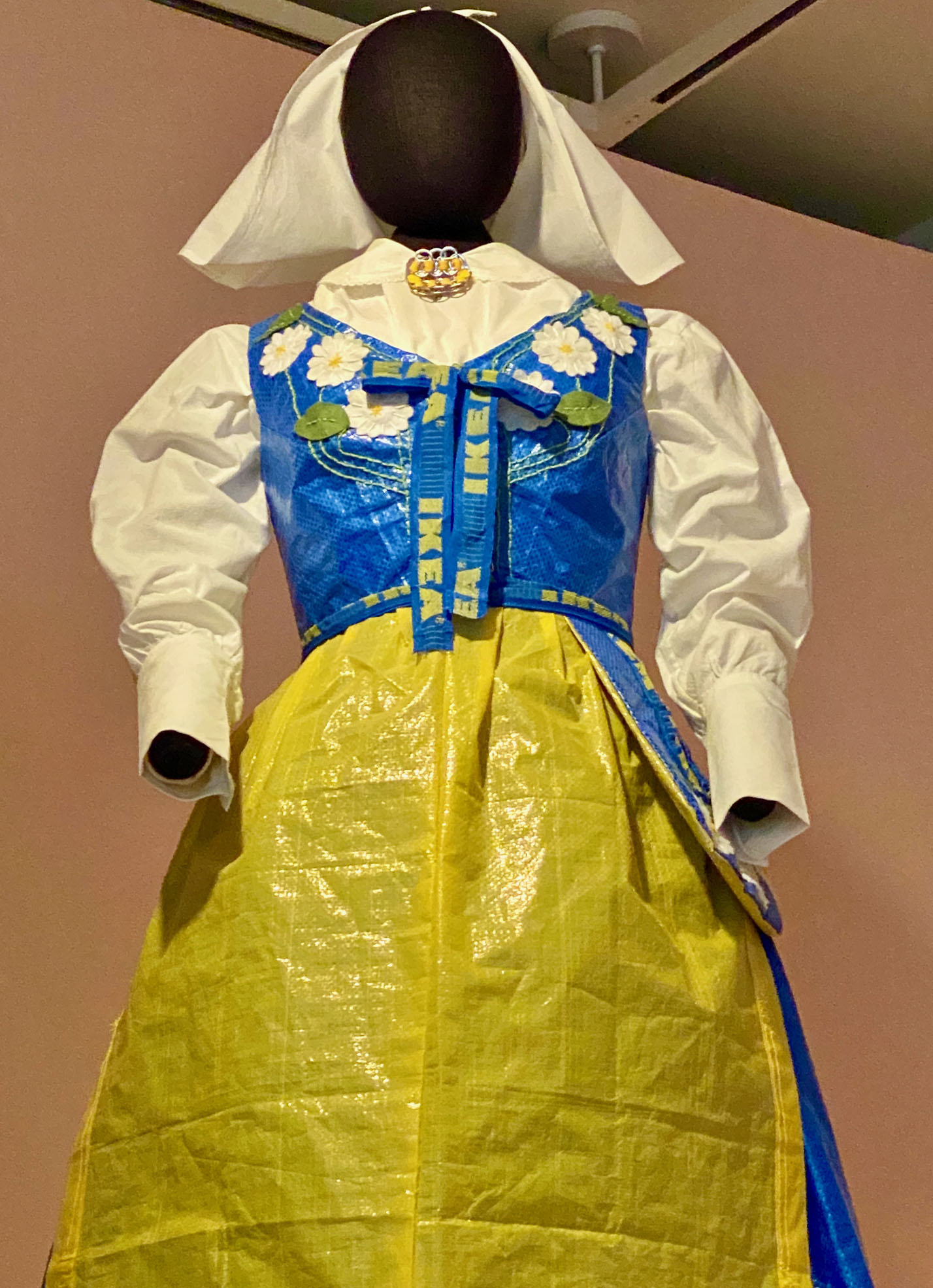
In a whimsical touch, the curators have included a contemporary take from artist Heidi Mattsson – the Swedish national costume made from Ikea shopping bags, a cotton nightshirt and napkin, and sodacan pop tops!

And the curators have included several other inventive modern takes on national wear.

Heidi Mattsson’s 2018 Swedish national costume fashioned from napkin, soda can pop tops, cotton nightshirt, and Ikea shopping bags. I
Täpp Lars Arnesson’s 2016 winter dräkt for his young daughter in Malung parish in Sweden’s Dalarna province; blended decorative elements from other parishes.
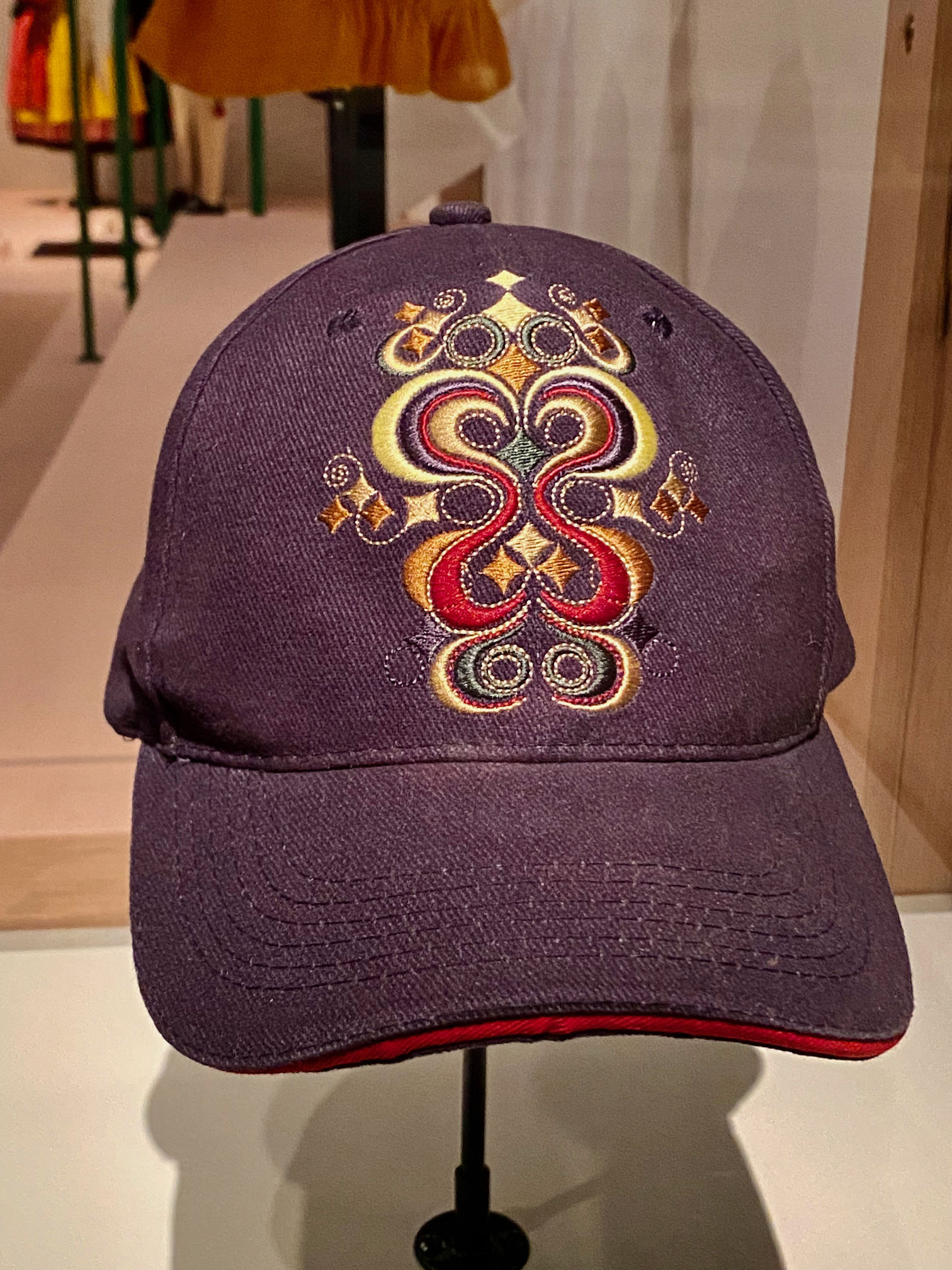
2017 embroidered baseball cap created in Leksand parish in Sweden’s Dalarna province, using traditional symbols. Private collection.

The story told by Norweigan folk dress is more tightly linked to the long revolutionary fight for independence throughout the 19th century. Rural Norwegian peasants were land owners. To city dwellers laboring under Danish and Swedish domination in the 1800s, rural people epitomized the “independent everyman” who had more control over their personal destinies.

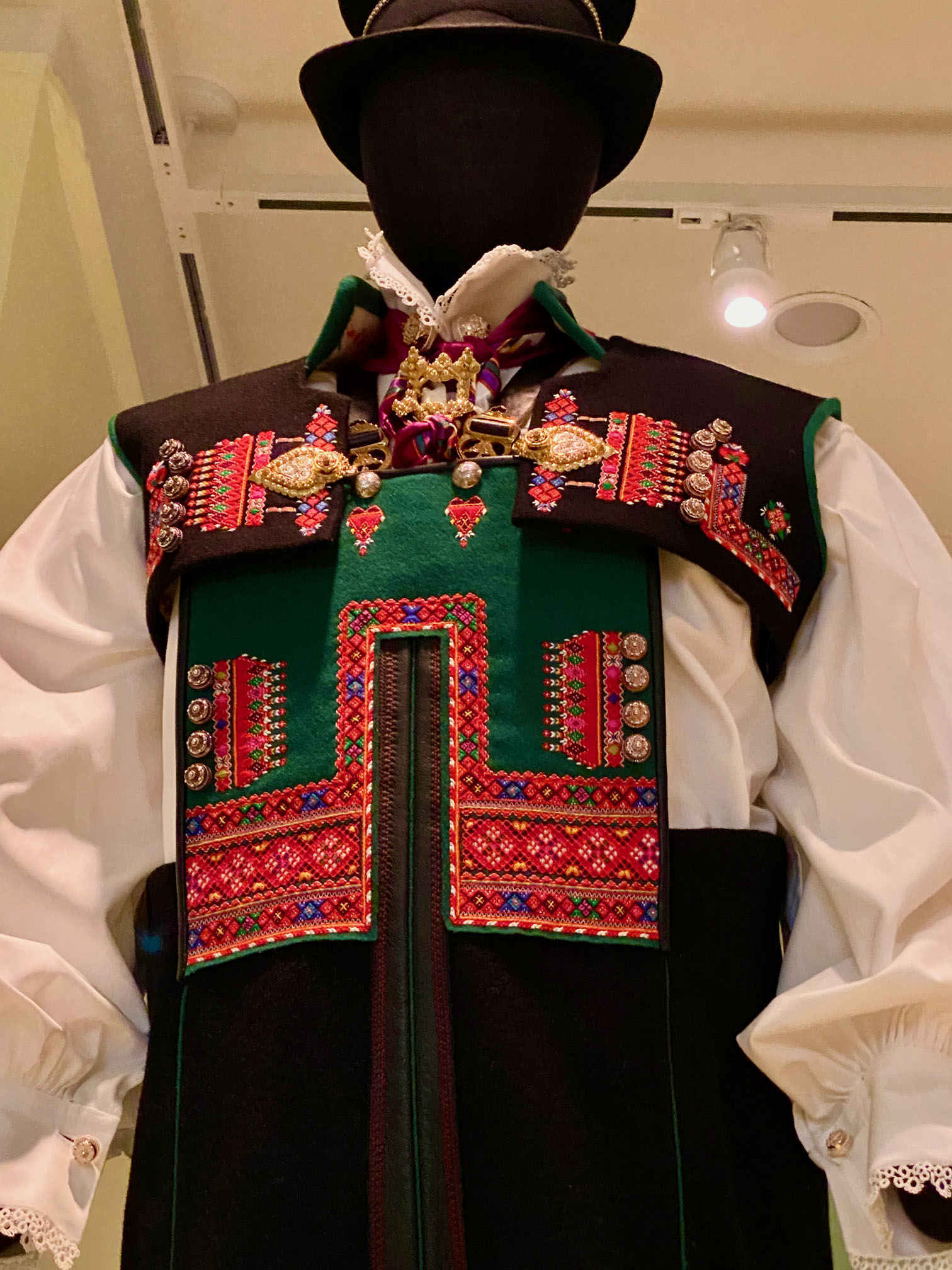
During Norweigans’ century-long fight for independence, political activists began adopting bunader, contemporary clothing inspired by preindustrial rural clothing as a sartorial statement about their desire for freedom. It popped up at youth rallies and dances.

1900 national costume – red bodice with beaded insert and dark skirt – typical of Norway’s Hardanger district, depicted in photo.
Hans Kristiansen Lybeck’s fantasy drakt, worn in Oslo’s National Constitution Day parade in 1906. Courtesy: Vesterheim Norweigan-American Museum, Decorah, Iowa.

In 1903, activist and regional dance expert, Hulda Garborg, outlined a philosophy for nationalized clothing and popularized it.  Everyone’s enthusiasm for and pride in the national costume kept going, even after independence in 1905. Even in the 21st century, it’s a sure-fire tourism draw up in Norway’s fjord country.

Close-up of Reidun Dahle Nuquist’s embroidered red-jacket bunad, made in East Telemark, Norway by a relative in 1960-1963. She wore it for her wedding and throughout her life.
Man’s 2018 bunad by Inger Homme and other artists in Valle in Norway’s Setesdal district; silver, gold, brass jewelry by Hasla AS.

In the Sápmi portion of the exhibition, the clothing and art is mostly contemporary, with a focus on making declarative statement about indigenous rights.

Long an oppressed minority, the Sámi people have been subject to racial injustice, forced relocation of children to boarding schools, and industrialization of their traditional lands north of the Arctic Circle. In many jurisdictions, they were forbidden to wear their traditional garb.

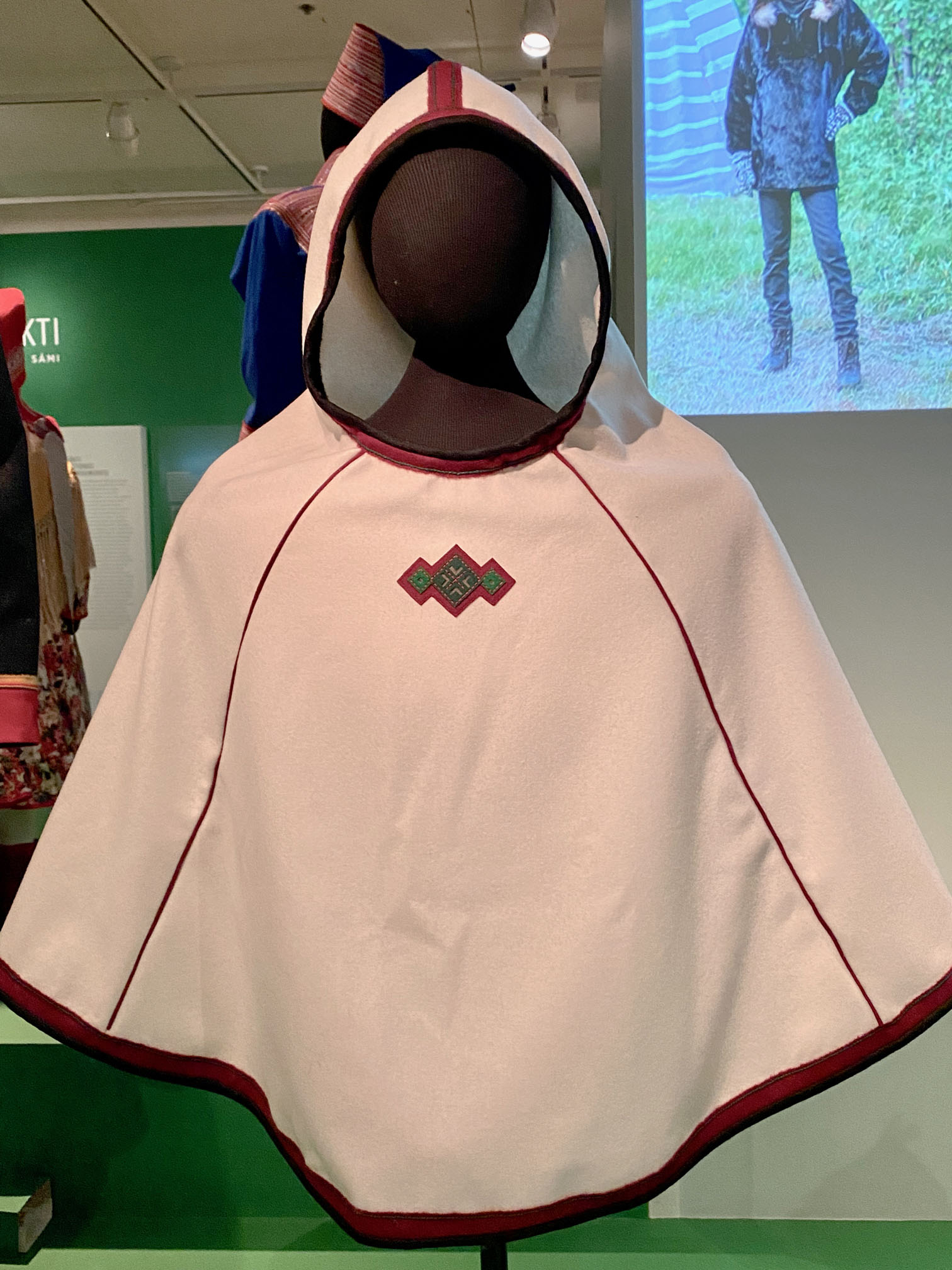
Symbol of Sámi pride: Jenni Laiti’s 2017 gákti creation from Karasjok – in Finnmark, the Norwegian side of Sápmi. Courtesy: the artist.

Around 1970, the Sámi were able to organize and raise public awareness about their status and why they opposed government dam building in Sápmi. Across their land, people began proudly wearing the traditional gákti and other symbols of their culture and engaging in direct political action on issues affecting them.

1966 summer gákti for a Sámi couple – wool tunics embellished with rose-colored ribbons and rickrack; made in Guovdageaidnu in Finnmark (Norwegian side of Sápmi)
Contemporary Sámi design: 2017 ready-to-wear cotton and poly “party outfit” by Stoorstålka (clothing line by Lotta W. Stoor and Per Niila Stålka) of Norrbotten (Swedish side of Sápmi).

The exhibition has posters and artwork proudly proclaiming native rights and identity, including an appropriated Sámi-style Rosie the Riverter image. For the contemporary eye, some of the most exciting clothing in the exhibition are by young Sámi designers and activists – ranging from Sámi-inspired home goods, modern woven designs, and even ready-to-wear party dresses from Sámi clothing lines.

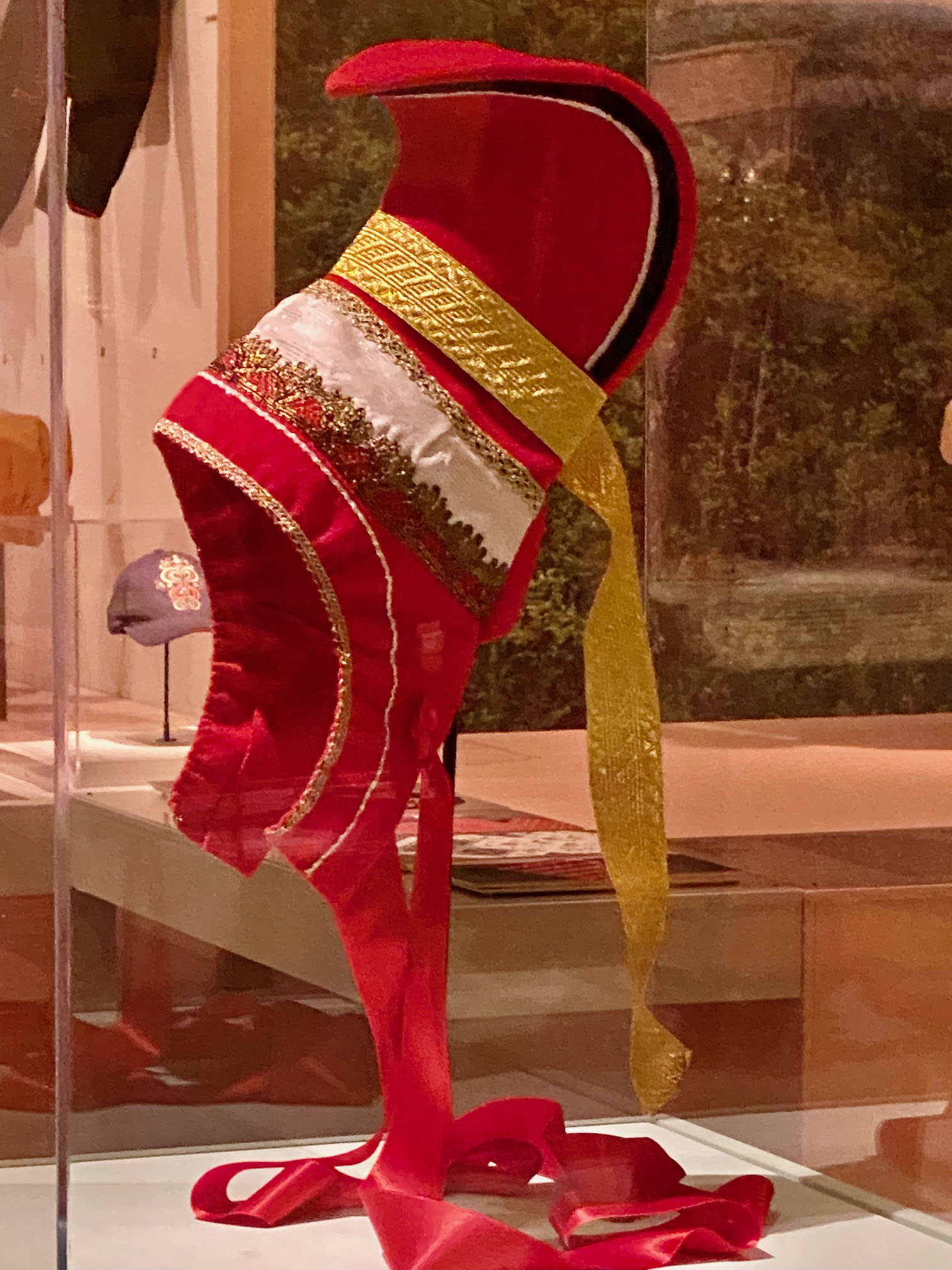
The examples from Sámi makers demonstrate how design and fashion can help to reconnect young people with their ancestors’ heritage that society blotted out.

Jorunn Lokvold’s 2020 Igvu gákti with geometric applique, a style reconstructed in 1995.
Outi Pieski’s 2020 Ladjogahpir, a revival of a headdress symbolic of Sámi women’s resistance; from Utsjoki (Finnish side of Sápmi).

This wonderful exhibition demonstrates exactly how old traditions can be reinvented to gain traction, even in the 21st century. Take a look through our Flickr album.

Resistance and revival continue in the far North. Meet Jenni Laiti, one of the Sámi artists, activists, and change-makers, who introduces you to art-making in the Arctic:

Gilded Age Treasure Hunt at The Met

Once you navigate the twists and turns of one of the furthest reaches of the Metropolitan Museum of Art’s American Wing (past the Versailles panorama and past the Rockefeller room), you’ll come to a treasure trove of Gilded Age interior design – Aesthetic Splendors: Highlights from the Gift of Barrie and Deedee Wigmore, on view through April 18.

What did rich people in the 1880s and 1890s want? The exhibition will show you.

1880s Herter Brothers cabinet, Britcher landscape, and reproduction wallpaper evoke the Wigmore’s home

You’ll find lush landscapes by second-generation Hudson River painters and first-generation romantic painters of the American West, elaborate furniture and decorative pieces embellished with tributes to Asian style, and bedazzled masterpieces from the Tiffany workshops.

Sanford Gifford’s 1879 An Indian Summer Day in Claverack Creek

The curators pay tribute to these avid Aesthetic Movement collectors by framing these promised gifts with reproduction period wallpaper and fixtures, and it’s hard to decide where to look first.

The approach to this marvelous exhibition gives modern gallery-goers an experience of what Gilded Age interior designers had in mind – cramming foyers and drawing rooms with lush paintings, flashy techno brass furniture, Japanese-style ceramics, art pottery, and fringed upholstered seats decorated with Arts & Crafts tiles that throwback to mythical times.

The mix of styles and techniques – some old and some new – reflect a time when consumption of luxury goods ran wild with the ascension of New York City as the trading and shipping capital of the world.  Many of the pieces reflect new machine-made technology mixed in with a bit of medieval nostalgia via the British Arts and Crafts movement.

Look closely at all these showstoppers in our Flickr album.

Detail of 1880 Modern Gothic cabinet by Kimbel and Cabus with tile by Minton & Co.

Although the exhibition is slightly hidden away, the landscapes appearing throughout the show provide windows to lush valleys of the Rockies (thank you, Mr. Bierstadt!), autumn colors of the Catskills, and spectacular, tranquil shorelines on Maine’s rocky coast.  All are either in their original fancy frames or reproductions from the era.

Alfred Thompson Bricher’s 1899 Low Tide, Hetherington’s Cove, Grand Manan in Maine

Most of the works are oil paintings, but (in case you didn’t know) New York was also the epicenter of the movement to make watercolor paintings the equal of any fine salon work.  The curators have included work by the masterful William Trost Williams, so you can enjoy a side-by-side comparison of the techniques he used to give those oil painters a run for their money. Every time we’ve visited this show, visitors simply stand transfixed, drinking in the saturated, tranquil views of the faraway.

The ceramics, cloisonné tabletops, andirons, and many large-scale pieces reflect the period’s mania for anything with a hint of Japanese or Chinese style – delicate birds flitting through bamboo and fierce dragons swirling in magical space. Designers for the upper classes were captivated by images from kimonos, scrolls, screens, and ceramics from the East and made sure that custom commissioned pieces were on trend.

Bradley & Hubbard’s 1895 phoenix andirons
Sapphire encircled by grapevines on 1910 gold and platinum Tiffany necklace

The mesmerizing beacon within the show is the spectacular array of Tiffany necklaces in the center – dramatic opals and sapphires, often encircled by intricate grapevines in gold or another nod to nature-by-design. The effect of these beauties side by side is magical, and you can imagine a Gilded Age beauty making an entrance with one of these dazzlers.

The Met just announced that its September 2022 Costume Institute exhibition would be displayed in the period rooms of the American Wing, so we’ll see if Mr. Bolton and his team deploy any period finery in the more-is-more 19th-century area.

Read more about pieces in this fantastic donation on the MetCollects blog and flip through close-ups of some the featured works.

The Met Asks What the Renaissance Thought It Was Worth

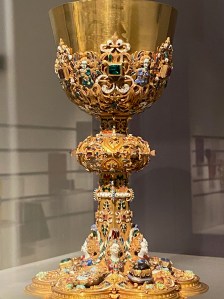
1608 chalice by Otto Meier, Germany. Value = 255 cows.

What kind of art and collectables were Northern Europeans buying in the 16th century? How much were they paying?

The Metropolitan Museum of Art answers that question in a highly creative way in its exhibition, Relative Values: The Cost of Art in the Northern Renaissance, on view through January 2022.

The gallery is filled with a wide range of beautiful objects made in the Renaissance – ceramic containers, cups made from natural shells, bejeweled chalices, gorgeous drinking glasses, fancy sporting boxes, and portable desktop personal shrines. At a distance of 400 years, museums and modern viewers regard them as priceless treasures.
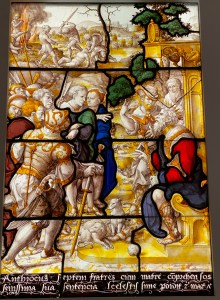
1530-1535 glass painted by Dirck Vellert, Flanders. Value = 12 cows

But the Met curators wondered how much these items cost in their day. How rare were these items in the collection? How much did collectors value them? And how did Renaissance makers market them?

The curators dug into assessments of royal holdings, craft guild price lists, and estate inventories. But understanding pricing was complicated because each price list used different regional European currencies (gilders, shillings, florins, and so forth). Then a light bulb went off.

Across Europe, the price of a cow was stabilized at 175 grams of silver. So, the cost of every item in the show is shown in cows!
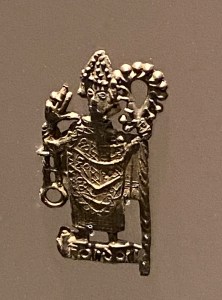
15th c. British or French pilgrims’ badge with Saint Leonard. Value = ½ cow

It’s fun to view the museum’s treasures from this perspective – how many cows was each piece of art worth? Take a look at our Flickr album, which shows some of our favorite treasures from low to high value.

Two of the least expensive items in the show are the ceramic jug used for a silly drinking game (value = 1/8 cow) and the sought-after pilgrim pins that you could pin to your hat to show that you had actually made and completed your pilgrimage across Europe (value = ½ cow). The mass-produced traveler pins seem a little pricey, but probably not compared to the cost of the trip itself. In any case, the pin was probably the only piece of art owned by the lower classes.
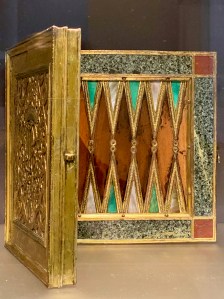
Nobleman’s multi-game board made in 16th c. Spain. Value = 14 cows

Wealthy patrons were attracted to over-the-top virtuoso pieces made from high-priced materials – elaborate traveling game board sets with exotic inlays (14 cows) and silver utilitarian art pieces (10 cows). Commissioning a work from a well-known goldsmith, glass painter, or locksmith drove up the price, especially if you wanted upscale materials.

If you ordered something in solid silver, you could melt it down in a pinch if you needed the cash.

Just like the latest smart device, collectors went wild over buying the latest technological marvel, like automaton clocks (21 cows) or rare natural wonders.  Unusual natural materials and virtuosity really drove up the price. Coconut-shell cups with silver (11 cows) or ruby-eyed rock-crystal carved birds (275 cows), anyone?
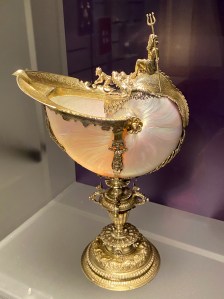
1602 nautilus shell cup, Netherlands. Value = 18 cows.

High-end collectors created cabinets to store their “curiosities” and reveled in showing guests how their advanced mechanical wonders worked or talking about where in the world the unusual materials were sourced.

With economies booming, the merchant and the middle classes desperately wanted to emulate the upper classes, so over the course of the 16th century, demand for fabulous objects only grew. Some makers began using molds to decorate or replicate sculptures to create attractive, but less expensive works for middle-market buyers, such as decorative molded German stoneware (1/2 to ¾ cow).

Some cities began hosting annual art markets, drawing buyers from across Europe. Guilds enhanced distribution by setting up trading posts for their wares in key market towns.

1580 rock crystal bird ruby eyes, Nuremburg. Value = 275 cows

Different from today’s art market that sees paintings at auction in the millions, classical paintings during the Renaissance were relatively inexpensive (5 cows).  Works that emanated and reflected “divine light” were highly prized – painted glass (12 cows), alabaster sculptures (40 cows), and bejeweled chalices (255 cows). And tapestries, which took forever to make, were considered the ultimate luxury.

To capitalized on the demand, the design/art stars of the day worked across media, elevating value of less expensive works by putting their highly prized monograms on prints and ceramics as well as high-end masterpieces, channeling their inner Andy Warhol.

Take a look at all of the wonders in the show on our Flickr album and on the Met website, were you can click on each work and then click to see where it falls on the museum’s incredible, feature-rich Timeline of Art History.

MAD History of Modern Art Jewelry

45 stories about modern art jewelry, such as Greenwich Village designer Arthur Smith

Sleek, modern, space-age, intricate, architectural, political, satirical, and comic – all descriptions of the array of modern-art jewelry selected by the Museum of Arts and Design exhibition, 45 Stories in Jewelry: 1947 to Now, on display on the second floor.

The second-floor space features a tour through modern-art jewelry’s evolution from a craft pioneered by studio artists like Art Scott and Alexander Calder to its current status as a respected and valued sector of today’s international art market.

MAD has shown art jewelry since it was founded in 1956, and its full collection now numbers 930 pieces. After redesigning its art jewelry exhibition area, MAD decided to mount a show to honor the extraordinary scope of its collection and place selected artworks into the broader context of art history.
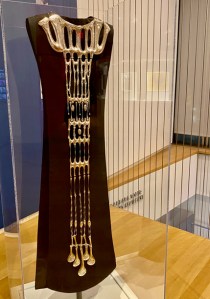
1966 sterling silver body ornament by Arlene Fisch

Two rings of white cases offer visitors opportunities to peer into each story, see a spectacular or provocative piece, and read about its designer and context.

In every visit to this show, we saw jewelry lovers fully engaged, pouring over every detail of the craftsmanship.

The first case that drew our attention was a Constructivist pin by Margaret De Patta, a passionate California artist became immersed in modernism through her New York art studies in the Twenties, but really hit her stride in the Forties after training with Moholy-Nagy in Chicago. (This spectacular pin is prominently depicted on the museum’s timeline of modern art jewelry.)

John Paul Miller’s 1969 molten gold Armored Polyp

The museum highlights the stories of Forties artists working in studios, like Art Scott, who created body-conscious pieces for the jazz artists and modern dance innovators who visited his Greenwich Village studio.

Another early innovator honored in the exhibition is John Paul Miller, who created stunning gold pieces using ancient, forgotten techniques discovered in his archeological research.

Stories from the Fifties show how an entire generation of American designers was influenced by Danish design, particularly the sleek work of master silversmith Henning Koppel, whose work was featured internationally through the Georg Jensen brand.

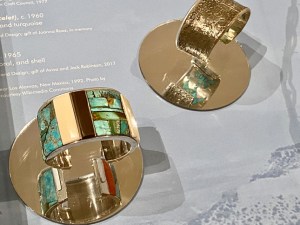
Charles Laloma’s 1968 inlaid silver bracelet and 1960 bracelet with inner turquoise inlay

Art works from the Sixties include the way-out sterling body ornament by Arlene Fisch, space-age jewelry by Danish designers Gijs Bakker and Emmy van Leersum, and modernist Hopi jewelry design Charles Laloma, a ground-breaking Native American artist.

Stories in the exhibition from subsequent decades show how designers used their work to tell stories, make clever social comments, turn recycled materials into wearable art, display technical virtuosity, make magic, and create conceptual wonders.

Gésine Hackenberg’s earthenware 2008 Kitchen Necklace

The timeline in the exhibition details how art jewelry grew in popularity, entered museum collections, and began being shown at international art fairs.

Take a look at some of our favorites in the exhibition in our Flickr album and be sure to visit MAD in person.

Meet the 45 Stories committee members, who selected which works in MAD’s collection that embody key developments in the evolution of the art form:

Studio 54 Designers Turn Swimsuits into Evening Wear

Studio 54 fashion: Fiorucci blouse by Antonio, Stephen Burrows dress, and Zandra Rhodes gown. Courtesy: Pat Cleveland

The Seventies fashions in Studio 54: Night Magic, on display through November 8 at the Brooklyn Museum, slip, slide, drape, glitter, and sometimes seem like they’re not even there.

The entire point of going to the Studio 54 nightclub – assuming you could get in – was to shimmer, startle, reveal, exude fabulousness, and shine, shine, shine in the crowd and on the dance floor.

The Brooklyn Museum exhibition, a masterful curatorial achievement, pumps the music, flashes the lights, and runs the videotape while showing off the wunderkinds that made the Seventies 54 scene drip with glamour – Halston, Calvin, Kamali, and Burrows.

See our photos in our Flickr album.

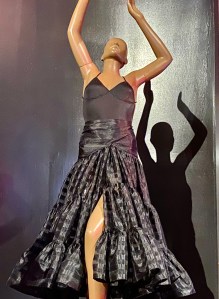
Norma Kamali’s swimsuit top and skirt made for dancing

Although Halston and others made custom gowns for clients (and there are plenty for Liza and Liz in the exhibition), the show highlights one of their other fashion innovations that the 99 percent adopted in the Seventies ­– the swimsuit. If you had a great body, fantastic hair, and dramatic make-up, you could just throw on a bathing suit, tie on a net skirt with little sparkle, and you were ready for the club!

Designers like Kamali and Sant’Angelo partnered with fabric companies to innovate body-hugging solutions, and turned out sexy bathing suits that doubled as disco-ready separates.

One of the galleries features the fun, transparent dance skirts Antonio designed for Fiorucci that he featured in the 1977 “Fiorucci Fantasy” event he staged at Rubell and Schrager’s Queens club, The Enchanted Garden, which predated Studio 54. A video shows how Antonio’s supermodels set the New York fashion and nightlife scene ablaze.

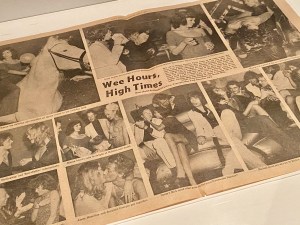
Studio 54 coverage in the Daily News, May 4, 1977. Courtesy: Ian Schrager

For all of its influence in pop culture, it’s hard to think that Studio 54 had a lifespan of only 33 months between 1977 and 1979. The exhibition explores all of facets of the phenomenon – paparazzi, the daily tabloid fodder, Grace Jones, Andy Warhol’s goings-on, disco jeans, Interview magazine, fashion shows, and product launches.

It’s surprising to think that Doris Duke, Alan Greenspan, Lillian Carter, and Bella Abzug were just as likely to be in the club as street performance artists, Bianca Jagger, and Yves Saint Laurent.

Halston’s 1979 beaded chiffon ensemble for Liza Minelli.

To transform the old Twenties theater and TV studio into Studio 54, Schrager and Rubell tapped into the technical and artistic community to figure out how flying disco poles, set changes, and special effects could be orchestrated into a continual surprise for the partygoers. When the musical Chicago closed, designer Tony Walton repurposed his dramatic neon “Roxy” sign as a centerpiece for 54’s stage.

Some of our favorite items are the opening night guest list, Ron Galella’s celebrity photos, Antonio’s costume sketches for opening-night show by the Alvin Ailey dancers, the slideshow of their rehearsal by Juan Ramos, and the giant sapphire that Elizabeth Taylor famously wore to the club in 1979 (it’s in a safe).

Original celebrity photo portraits and Richard Bernstein illustrations for Warhol’s Interview magazine covers

Congratulations to the Brooklyn Museum staff who found and presented this amazing exhibition that lets everyone into Studio 54 to celebrity-watch nearly 40 years after the door closed on the party, and to show us how its influence still reverberates today.

Travel the Sahara Superhighway at The Met

12th – 14th c. terracotta equestrian statue from the Middle Niger civilization (Mali).

As you confront the stone monolith in the entry, get prepared to see art you’ve never before encountered, learn about empires you didn’t know existed, and fill in the blank spot on what you know about African history.

Beauty and cultural discoveries are everywhere in a first-of-its-kind exhibition on Saharan artistic legacies in Sahel: Art and Empires on the Shores of the Sahara, on view through October 26 at the Metropolitan Museum of Art.

Large 12th – 13th c. gold pectoral, found at a burial in northwest Senegal, with elaborate filigree. Courtesy: IFAN, Senegal

The shifting sands of the Sahara are echoed in the centuries of shifting artistic traditions, migrations, civilizations, religions, and cultural affinities of the Saharan people. Take a look at our Flickr album.

This gorgeous show is one of the first to tie and unite the threads of the sub-Sahara’s nearly invisible history for Western audiences. Western approaches to art history have traditionally made it appear as if the people on a large content were a monoculture with no beginning, end, or history. The show brings a deeper artistic and historical context to work that has always suffered from just being lumped together as “African art,” or worse, “primitive art.”
Scholars on two continents are starting to piece the story together, reflected in the exhibition’s design. The alcoves are a primer to walk back through time to understand the region’s complex history, which covers deserts, oases, and farming areas that are the size of Europe. For centuries, the region was criss-crossed by trading routes (the “Saharan superhighway”) through which caravans delivered luxury goods, exotic raw materials, news, and new cultural influences.

Pre-1659 royal tunic, a European import from the Ardra kingdom (south Benin) via Mandé trade routes. Courtesy: Museum Ulm

Wooden or fired clay depictions of warrior kings on horseback from the 3rd through 19th centuries line the exhibition’s central path. Settlements, archeological sites, and kings are named, with the vast region’s artifacts, architecture, and traditions of storytelling joyously placed into a proper context.

There are plenty of national treasures, such as the gold pectoral from Senegal and lively terra cotta sculptures (likely made by women) from Mali, made with the highest levels of craftsmen between the 12th  and 14th centuries. Another highlight is the still-vibrant 8th-century woven tunic from Niger, one of Africa’s most ancient textiles.

The exhibition explains how Islam gradually, peacefully became the dominant religion in sub-Saharan Africa, displacing the previous belief systems. As is the case with other world cultures, artists continued to merge and adapt older, more traditional symbols and forms with the new.

Wood sculptures of Mali’s Bamana people, from the 15th to 20th century

An intriguing 15th-century Italian map-painting documents Mansa Musa, a 14th-century emperor from Mali, who achieved global celebrity status for his over-the-top pilgrimage to Mecca via Cairo and was inspired to develop Timbuktu into a center of Islamic scholarship.

The display of Bamana sculptures, dating from the 15th to 20th centuries, in the rear gallery is the show’s dramatic conclusion, although the walls depict incredible resist-dye textiles made by early 20th century women in Mali and couture-level embroidery on pure white status garments of the Timbuktu elite from the Sixties.

Senegalese kora made before 1878, used by griots to perform social narratives.

The show was an epic undertaking by the Met  – organizing a narrative and objects to tell two thousand years of relatively unknown history; first-time loans of national treasures from the museums in Niger, Mali, Senegal, and Mauritania; arranging for an 8,000-lb. monolith to be shipped across the Atlantic to New York.

The epic histories recounted by griots playing traditional instruments over the centuries play a large role in the exhibition. Koras and percussion instruments are on display, and music permeates the galleries.

Here’s a peaceful walk through the exhibition with music by Toumani Diabaté with Ballake Sissoko:

For an in-depth understanding of this ground-breaking show, join in on this conversation with Met curator Alisa LaGamma and scholar and writer Manthia Diawara:

Learn more about the epic history of the Sahara in the Met’s exhibition guide.

Cardin Sees the Future Through Fashion

The Brooklyn Museum’s latest blockbuster fashion exhibition Pierre Cardin: Future Fashion, open through January 5, presents the work of a French designer who continues to be inspired by the belief that simplicity, design, and science are essential ingredients for a world that lives in peace, treats men and women equally, and looks to the horizon.

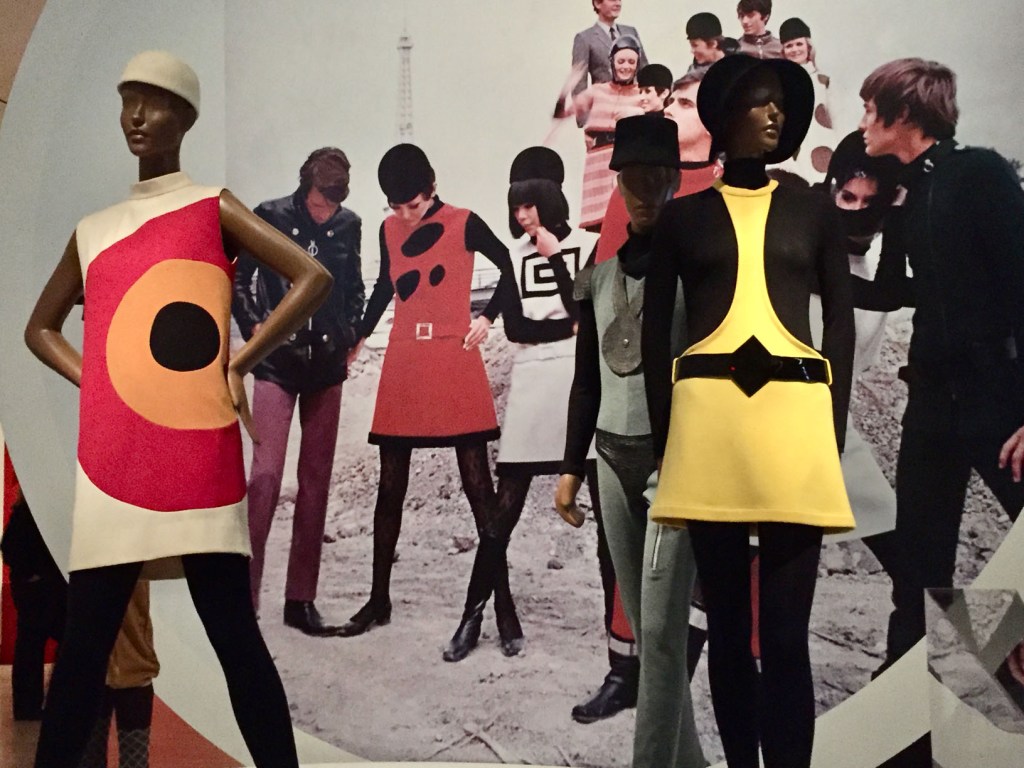
Geometric minidresses and men’s ensembles worn with tights and over bodysuits from the revolutionary 1964 Cosmocorps collection

Cardin came of age as a designer in the 1950s creating luscious swing coats, lasso-backed draped suits, and prim (but red-hot) looks for Jackie Kennedy. But he shot to “influencer” status in the early 1960s with unisex looks, bodysuits, collarless jackets for the Beatles, reliance on a fashion-forward Japanese model, turtlenecks (for men and women), hoods, felt helmets, and body jewelry – in other words, all the basic building blocks that would be used to clothe the crew of the Starship Enterprise.

1957 “lasso back” suit, 1968 bodysuit ensemble, and Cosmocorps photo with video showing the unisex Star Trek costumes it inspired in 1966

The Brooklyn show begins with a chronology of Cardin’s young life – soldier, costumer, and Christian’s first employee at the House of Dior in 1946 – but rapidly gives way to a sensational array of tubular, unisex clothing from his mind-blowing Cosmocorps collection, which had so much impact on Sixties culture. Take a look at our favorites in Flickr album.

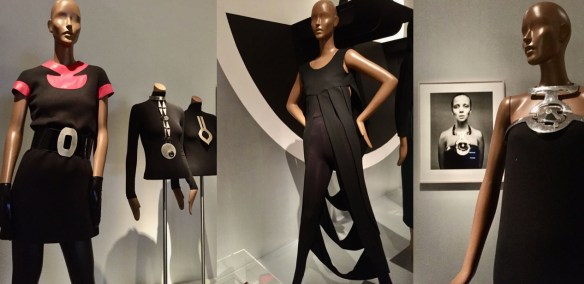
1968 wool and vinyl minidress, 1966 aluminum statement jewelry, a 1970 wool crepe “Kinetic” dress, and Avedon photo of Penelope Tree wearing a 1968 evening dress and collar

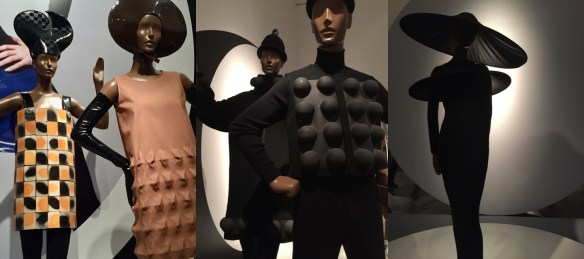
Although several other European designers could be credited with the evolution of the miniskirt, no one channeled the Space Age like Pierre Cardin when it came to shape, form, and use of new fabrics and materials – lenticular plexiglass, vinyl, Dynel pressed into 3D forms and shaped for the body, and parabolic structures that underpinned evening gowns, men’s jackets, and skirts. Pierre even went so far as to visit Houston and slip on an Apollo 11 astronaut’s suit.

1969 lenticular plexiglass and vinyl “armor” dress, 1968 heat-molded Dynel dress, 2007 jersey coat and suit with rubber, and 1991 jersey evening ensemble with parabolic shoulders and hat

It’s clear that the Sixties and Seventies fashions in the show reflect what was going on in the art world at the time – bright, bold colors of Pop Art, pared-down minimalism, an embrace of non-traditional materials, and kinetic art. (Carwash dresses, anyone?)

Even Cardin’s forays into furniture design reflect his belief that his hand-made contemporary works genuinely functioned as art first and utilitarian additions to the home second.

1968 circle coat and hat, next to 1979 Junior Unit, and 1977 Serge Manzon lamp

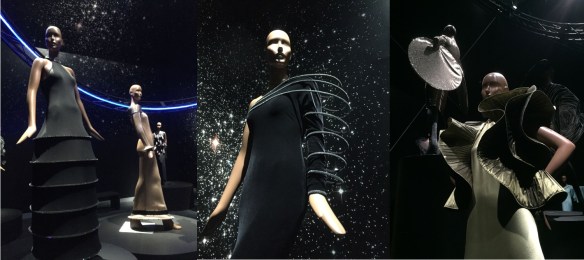
The final gallery in the Brooklyn show is a darkened room populated with mannequins in shimmering gowns and suits, electrified dresses and sportswear, and pieces embellished with parabolic hoops and flourishes – sheer Space Age magic. Slight swoops across the space, framing the last 20 years of Cardin’s output with an other-worldly, visionary feel.

2008 evening dress with parabolic hem, 2003 evening gown with plastic tubes, 1994/2000 velvet evening dress with Swarovski crystals on the orbital sleeves, and 2013 silk/lame evening dress with Swarovski crystals

A surprise inspiration is the revelation that Cardin at 97 is still designing and looking toward the future.  His predictions? That people will be on the Moon in 2069 wearing his Cosmocorps look, women will be sporting tube clothing and Plexiglass cloche hats, and that men will be wearing kinetic tunics and elliptical trousers.  Why not?

Watch as the curator explains how Cardin envisioned the future…

…and why this retrospective of his work is just right right now:

Catholic Inspiration for Fashion at the Met

Balenciaga’s 1967 silk wedding dress in the Romanesque Chapel at the Met Cloisters

The brilliant installation of haute couture in the historic halls of the Met Cloisters, Heavenly Bodies: Fashion and the Catholic Imagination, closing October 8, also serves as a surprising showcase for the spectacular medieval art residing in the same space.

Curator Andrew Bolton’s thoughtful placement and narrative creates a genuine conversation between European couture and religious-themed works made over 500 years ago at both the Cloisters and the Met’s Fifth Avenue location.

The Cloisters show starts spectacularly with Balenciaga’s 1967 wedding dress dramatically casting shadows across the floor of the largest room at the Cloisters, the Romanesque chapel with its outsized arch and crucifix.

Closeup of Jean Paul Gaultier’s 2007 evening ensemble printed with 15th c. image of the Virgin by Jean Fouquet.

The jeweled pieces of German stained glass are echoed by Gaultier gowns, and Craig Green’s avant-garde ensembles created from Islamic prayer rugs are at home amidst the 13th century tapestries in the Hall of Heroes. Looking at each contemporary expression fully reflects the magnificent artwork resting just a few feet away.

Hidden spaces, leafy cloisters, underground tombs, light-filled corridors, and dark, secret corners of the Treasury all provide surprises and context for exploring visitors – Valentino’s Garden of Eden dress, Galliano’s Machiavelli gown for Dior, Dolce & Gabbana’s gold silk-and-metal macramé wedding ensemble, and McQueen’s crown-of-thorns headpiece.  Seek and you will find.

Sleeve detail of monastic paper taffeta 1969 evening dress by Madame Grés.

Take a look at our Flickr album to see many close-up the details of all the clothes and surrounding artwork.

The Met has gone all out to make the connections between clothes and the Catholic themes explicit, providing innovative high-res photos, several brief videos and blog posts. Read more about the themes here.

Andrew Bolton, the show’s curator, gives an overview of all the inspiration and documentation of the exquisite clothing, jewelry, and inspirational art work in the show in this video here.

Closeup of Olivier Theyskens’ 1999 evening dress with a hook-and-eye closure in the shape of the cross. From the Crusades section of the show in the Gothic Chapel.

Click here to walk through every room of the Cloisters with Andrew Bolton and hear him explain how he made the selections according to the surrounding artworks.

The Fifth Avenue portion of the show is, like so much of Catholic pageantry, more of a public event, filling the Medieval hall with fashions inspired by angels, secular clergy, nuns, Mary, and saints, all dominated by an Ecclesiastical Fashion Show.

The Fifth Avenue portion of the show is, like so much of Catholic pageantry, more of a public event, filling the Medieval hall with fashions inspired by angels, secular clergy, nuns, Mary, and saints, all dominated by an Ecclesiastical Fashion Show.

Highlights include a procession of works from Gianni Versace’s last collection, Gaultier’s hologram votive dress, Mugler’s floating angel, and the loft high above it all, populated by ethereal figures wearing choir robes by Balenciaga.

1984 dress by Thierry Mugler from his Winter of Angels collection, part of the Celestial Hierarchy at Fifth Avenue

Here’s a link to the Met’s walkthrough video.

An important part of the Met’s undertaking is a spectacular mini-exhibition of incredible works of clothing art from the Vatican, which took significant negotiation. Here, Andrew shows highlights of the items on loan from the Vatican, some of which have never been displayed abroad before.

Walk through the Met’s Vatican section of the show here.