The Paper Bag Was Her Design

MoMA honors Margaret Knight, 1870s inventor of the flat-bottomed paper bag

MoMA honors Margaret Knight, 1870s inventor of the flat-bottomed paper bag

What will the MoMA curators pull out of the design collection next? Designing Modern Women 1890–1990, running through October 19, puts the spotlight on furniture, textiles, graphics, performance, kitchens, and even inflatables designed by some innovative women over the last century. How can you not love a show that begins with 1890s modern-dance provocateur Loïe Fuller and ends with 1980s pop icon Grace Jones?

The crowd last weekend was loving every bit of it, pausing to watch videos sprinkled throughout the show and marvel at designs – some 80 to 100 years old that are as modern today as they were at their creation.

The next time you carry away your morning muffin from the coffee counter in that little white paper bag, ponder that the flat-bottomed paper bag was invented in the 1870s by Margaret E. Knight and Charles B. Stilwell. Ms. Knight not only invented this classic, but also invented the machine that made it and was one of the first American women ever to receive a patent.

1901 dinner service by Jutta Sika and Koloman Moser

1901 dinner service by Jutta Sika and Koloman Moser

No, the dinner service is not from Pottery Barn. It was created in 1901 by the Austrian design team of Jutta Sika and Koloman Moser. Didn’t I just see a copy of Eileen Gray’s 1927 adjustable table at the D & D Building? Open shelving in your new, modern kitchen? Yes, that was Charlotte Perriand’s idea, and MoMA has (for the first time) installed this full-size, fully efficient, ground-breaking kitchen from her 1952 project with Le Corbusier.

And what about the Slinky? Invented by Betty and Richard James in 1945. You’ll have fun peering into the design cases and learning more about the women behind some remarkable things.

Slinky was designed by Betty and Richard James in 1945

Slinky was designed by Betty and Richard James in 1945

In the 1960s portion of the show, you’ll see those famous Fillmore posters designed by Bonnie Maclean. And there’s an entire wall filled with iconic pop and punk graphics – all created by female designers – that should be familiar to anyone that traversed the downtown CBGBs scene.

There’s no digital media to accompany this fantastic show, so take a walk through our Flickr site. All of the items are from MoMA’s own collection, and we’ve taken slight liberties by arranging the photos in the show album in chronological order of the year that each design debuted.

And to bring it all back to the beginning of this design innovation tribute: Here’s a glimpse of 1897 Art Nouveau performance art by Loïe Fuller, courtesy of the Lumiere Brothers. The color you see here is a result of hand-tinting the film, but her actual perfomances used new theatrical stage lighting for which she held numerous patents. Listen to the MoMA curators explain her influence, but get over to MoMA (or the Flickr site) to take in this super-fun tribute to 100-plus years of smart women who thought differently and made it happen.

Stunning Jewelry at Met Reflects Contemporary Art

These stunning creations of Eugene and Hiroko Pijanowski are made from paper cord and canvas

These stunning creations of Eugene and Hiroko Pijanowski are made from paper cord and canvas

The Metropolitan Museum of Art has not only reinstalled its American Modernist wing on the first floor, but it’s given over the design gallery right inside the door to Unique by Design: Contemporary Jewelry in the Donna Schneier Collection, on view through August 31.

Gertrude Stein is holding court in the far back gallery with some of Mr. Stieglitz’s treasures, but on your way to see them, check out the high-class, high-gloss presentation of masterworks of wearable art from the 1960s through today.

The thesis of the show is contemporary jewelry doesn’t exist in a vacuum and often reflects the prevailing art of the day — Pop, Minimalism, Abstraction, and so forth.

In 2007, Ms. Schneier donated 130 of her favorite pieces to the Met – just a small fraction of the collection she has been building for over 30 years. Here, these gleaming, surprising, artful, fun pieces are grouped to highlight their context within various themes of recent contemporary art.

Kiff Slemmonds Sticks and Stones and Words

Kiff Slemmonds Sticks and Stones and Words

As you marvel at each one, you’ll be thinking back across decades of gallery shows and installations of minimalist art, performance art, funky found art, and 3D printing.

Check out the gold neckpiece right inside the door. You might think it’s a riff on the Met’s room full of Columbian gold across the hall, but this treasure is actually made of paper and canvas by the Pijanowskis (Eugene and Hiroko).

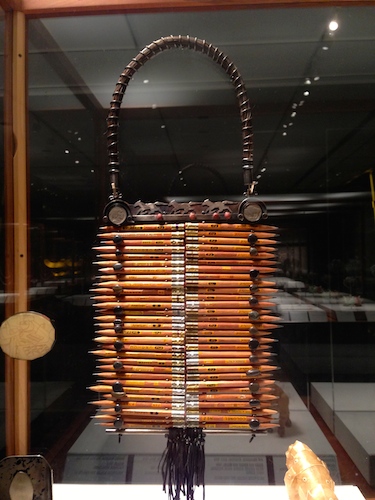
Marvel at what seems to be Native American-inspired breastworks by Kiff Slemmonds. Her art piece is fabricated with a lot of stuff but mainly No. 2 pencils in the “narrative” portion of the show.

If you like self-referential playfulness, consider Gijs Bakker’s piece – a real diamond mounted on a PVC-laminated photo of a diamond. Recyclable art? Check out Robert Ebendorf’s brooch made from crushed auto window glass, beach glass, and a vinyl record.

Ted Noten’s clever Fashionista necklace made of tiny resin high-heeled shoes

Ted Noten’s clever Fashionista necklace made of tiny resin high-heeled shoes

And if you think it’s fun to poke around the history of contemporary art through jewelry that’s neatly tucked inside a single room, don’t ignore the fact that right beyond this gallery door is another art-history tour-de-force-in-a-box: The Met is displaying Mr. Duchamp’s famous green case, which is full of many of the same visual and conceptual challenges – “what is art?”, “what is play?” “what is hidden?”, and “everything you see is not as it appears.”

What would Rose Sélavy herself choose to don from the next room if the Met and Ms. Schneier gave her chance?

Peek at a few of the choices on our Flickr site, but enjoy wandering through the gallery and deciding for Rose and yourself.


The Sistine Chapel of Fashion Virtuosity

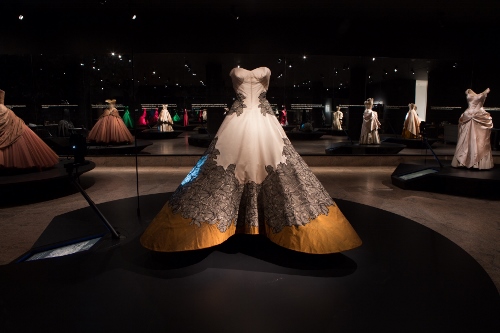
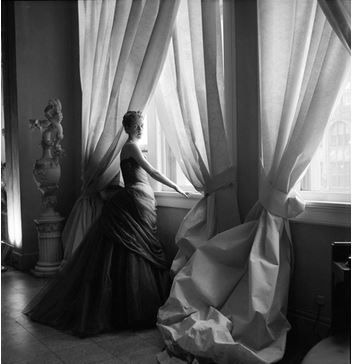
Clover Leaf Ball Gown – a 1953 silk faille, shantung, and black lace sculpture by Mr. James. Part of the Brooklyn Collection at The Met

Clover Leaf Ball Gown – a 1953 silk faille, shantung, and black lace sculpture by Mr. James. Part of the Brooklyn Collection at The Met

When the Brooklyn Museum handed its fashion archive over to the Met in January 2009, the first thought that crossed everyone’s mind was the mind-bending masterworks that would now be sheltered under the protective wing of the Costume Institute’s crack conservation team — “Oooh, maybe the Met will do a Charles James show!”

We’re glad to report that the Met has done this master proud and given his humble admirers a fitting place to worship in its triumphant two-gallery show, Charles James: Beyond Fashion, which ends this weekend, August 10.

1952 portrait by Michael A. Vaccaro / LOOK Magazine. Courtesy: The Met;  Library of Congress

1952 portrait by Michael A. Vaccaro / LOOK Magazine. Courtesy: The Met; Library of Congress

Mr. James is credited with being among the first to perfect the strapless gown in the 1930s, an inspiration for Mr. Dior’s “New Look” in the 1940s, and the epitome of Vogue glamour dressing in the 1950s. He could do things with fabric that others simply couldn’t do or wouldn’t dare…well, maybe except for Madame Gres. He pushed silhouettes and fabrics further than most anyone could conceive and had the temperamental nature, drive for perfection, and uncompromising attention to detail that characterize any of history’s greatest, most passionate artists.

You always look at his creations and ask yourself, “How did he do it?” How did he get a spiral of fabric to stand out as it wraps sinuously around a sleek, strapless electric green silk mermaid dress? Is that sexy Thirties frock actually cut from one scarf?  How did he create virtual moving sculptures from the world’s most expensive fabric?

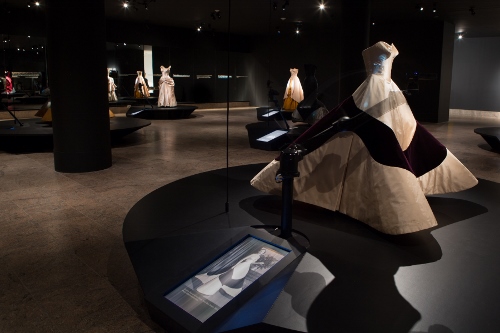
Innovative digital display tells the back story of Mrs. Hearst’s Clover Leaf Gown – too big for Ike’s inaugural, but just right for Queen Elizabeth II’s coronation

Innovative digital display tells the back story of Mrs. Hearst’s Clover Leaf Gown – too big for Ike’s inaugural, but just right for Queen Elizabeth II’s coronation

Long known for his innovative engineering, the Met came to a brilliant solution to explain the magic that Mr. James wrought over his decades of no-two-alike work – hire an architectural firm to show us.

Enter Diller Scofidio + Renfro, who have mounted these sculptures in silk inside an infinity-room gallery and paired each masterpiece with its own personal robot and humongous iPad-type display. Look at the dress and refer to the screen as the dress digitally deconstructs and is assembled again.

Cecil Beaton’s 1955  photo of Nancy James in the Swan Gown. Courtesy: The Met; Cecil Beaton Studio Archive at Sotheby's

Cecil Beaton’s 1955 photo of Nancy James in the Swan Gown. Courtesy: The Met; Cecil Beaton Studio Archive at Sotheby’s

The crowds waft from dress to dress in no particular order, clustering silently to watch digital magic, see where the robot is pointing, and view photos of Mrs. Randolph Heart, Jr., Gypsy Rose Lee, or Josephine Abercrombie in said gown. The robot with the 1954 Swan Ball Gown captivates viewers by moving underneath to televise close-up views of some of the 1,080 square feet of tulle that Mr. James used to create the oomph.

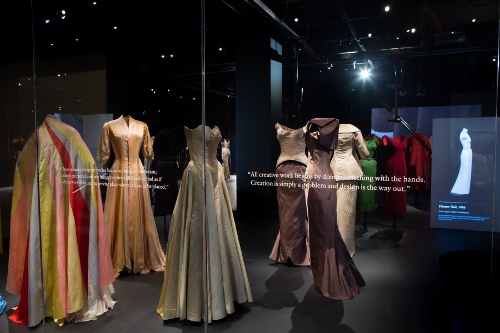
The mirrored walls of the upstairs gallery and the see-through dividers downstairs are emblazoned with the wisdom of the man himself. He seems to be talking right to you as you wonder how he made the fabric do what it’s doing (“It’s the air that’s sculpted, not the silk”) or how he thought about the world of fashion (“We who have been ahead in style have usually been ahead in our thinking”).

Downstairs gallery, newly named for Ms. Wintour, filled with James creations

Downstairs gallery, newly named for Ms. Wintour, filled with James creations

The second gallery (welcome back, ground floor Costume Institute!) displays his wool creations and sharply shaped cocktail wear. It’s interesting that James considered some of these genuinely more innovative than his often-photographed gowns. The curators have placed another of his “first” in a room at the back – the predecessor of today’s puffer coat. On loan from the V&A, it remarkably dates from the 1930s – his soft, sensual, silky answer to the boxy fur jackets that Ms. Schiaparelli was showing in Europe at the time.

We have to thank Mr. James for his vision and for making sure the Brooklyn design lab had so many examples of his masterpieces to teach and inspire future generations of Seventh Avenue designers. As he says, “In fashion, even what seems most fragile must be built on cement.”  Lesson learned.

The Met’s a great steward. Just listen to the love in the tour of the show by its curators:

If you have more time, hear what Zac Posen has to say to the co-curator about The Master:

William Morris: Meeting the Needs of Artistic Shoppers

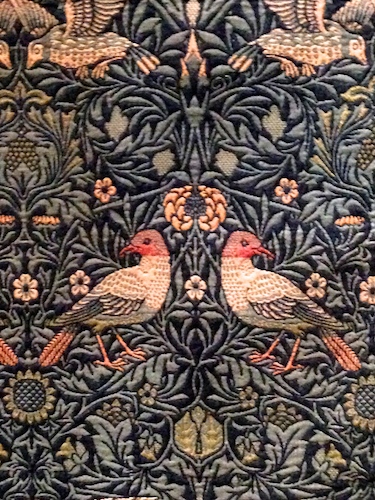
Detail of the large woolen Bird textile that Morris designed in 1878 for his home that was still being sold decades later.

Detail of the large woolen Bird textile that Morris designed in 1878 for his home that was still being sold decades later.

William Morris not only did his historic homework, but was able to channel his convictions about the magic of the Medieval to tap into what artistic Victorian shoppers wanted – stylized visions of nature and old-school craftsmanship, the way it was done in the “old days.” See the evidence in two Metropolitan Museum of Art shows on right now — The Pre-Raphaelite Legacy: British Art and Design (running through October 26) and William Morris Textiles and Wallpaper (closing July 20).

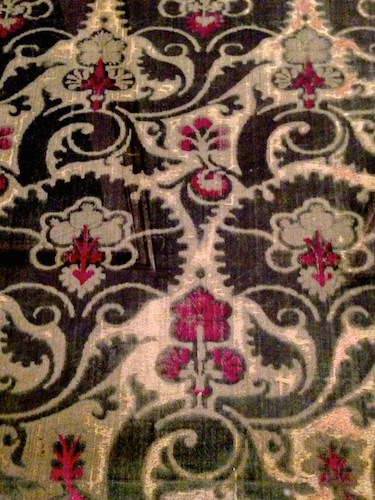
You’ll see how Morris used the historic textile collections at the Victoria & Albert Museum as inspiration for his modern wall coverings and textiles. In the little low-light gallery outside the museum’s textile center –many designed by his designer, John Henry Dearle — right next to the older textiles that inspired them both. You’ll be able to compare Morris’s own winding, intricate patterns with those woven by the 15th-18th c. Venetians, Germans, and Spaniards.

Voided velvet and silk from Venice, 1420

Voided velvet and silk from Venice, 1420

As our Flickr site shows, the Met has its own examples for you to enjoy.

Morris began designing in 1861, went through a couple of iterations of his company and collaborators, and finally landed at Hanover Square in 1917, where his workshop was located just a few steps from Liberty of London on Regent, another retail hotbed of the Arts and Crafts movement where many of the Pre-Raphaelites shopped. As Oscar Wilde once remarked, ““Liberty is the chosen resort of the artistic shopper.”

In 1923, the Met decided to scoop up all of the still-being-sold Morris textiles from London. What you’ll see in the show aren’t the originals, but likely subsequent runs of the super-popular block-printed decorating papers and yardage.


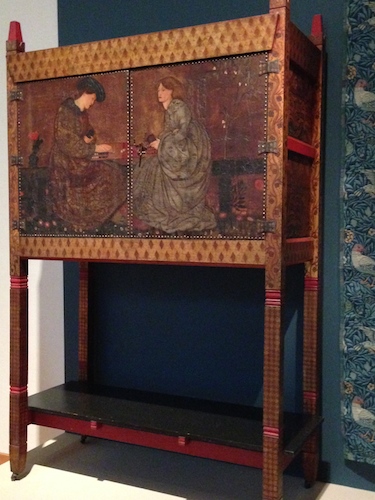
The Backgammon Players, the faux-Medieval, mixed-arts furniture collaboration that started it all1861, with the 1878 Bird wall hanging far right.

The Backgammon Players, the faux-Medieval, mixed-arts furniture collaboration that started it all 1861, with the 1878 Bird wall hanging far right.

The Pre-Raphaelite Legacy has paintings, photos, sculptures, and other works by a wide range of artists. Check out the early painted furniture that Morris did with Edmund Burne-Jones (1861) and the book, written by Morris in archaic English and illustrated by Mr. Burne-Jones at the height of Morris mania (1898).

Next to the furniture collaboration, the curators have hung Morris’s own Bird textile, an intricate woven wonder of woodland creatures and forest marvels. The detail will blow you away, but so will the fact that the original was created in 1878, but what you are looking at was likely manufactured decades later for artistic shoppers and décor enthusiasts who just had to have it.

Vintage Attire on NYC Mean Streets

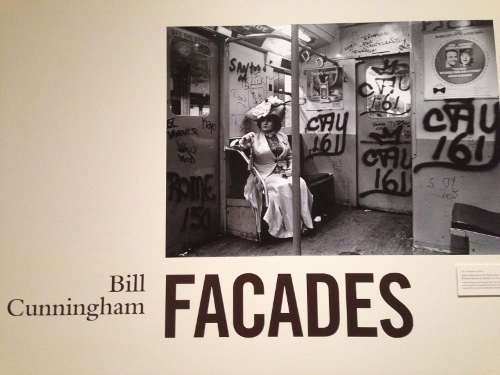
Editta Sherman in period dress on a graffiti-covered subway car to the Brooklyn Botanic Gardens

Cunningham’s photo of Editta Sherman in period dress on a 70s graffiti-covered subway car going to a shoot at the Brooklyn Botanic Gardens

Uber-fashion documentarian Bill Cunningham had a great idea in 1968, just as NYC was sliding toward financial crisis, crime, and (goes without saying) neglect of architectural sites, like Grand Central. Why not celebrate two centuries of NYC fashion and splendor on the street?

What were people wearing when some of the City’s most iconic homes, churches, and public buildings were built? Was it possible for a black-and-white photograph to reveal some new insight about the City from combining fashion, architecture, and a little fashion flair and attitude?

Editta poses for Bill  in embroidered frock coat and breeches  in front of St. Paul’s Chapel, the oldest church building (1766) in Manhattan

Editta poses for Bill in embroidered frock coat and breeches in front of St. Paul’s Chapel, the oldest church building (1766) in Manhattan

Results of Bill’s eight-year project are on display through July 15 in the Bill Cunningham: Facades photo exhibition on the second floor of the New-York Historical Society.

Without the aid of Wikipedia, he researched the years that some of his favorite historic places were built, and began scouring thrift stores for get-ups from the matching decade. He enlisted his muse, Editta Sherman, a fellow photographer and neighbor at the Carnegie Hall studios. For the next eight years, Editta and Bill went on weekend odysseys throughout the City, modeling and documenting over 500 historic outfits in front of interesting but sometimes forgotten facades.

In 1976, Bill gave 88 of his silver-gelatin prints to NYHS – the core of the current show, which is hung to emphasize the chronology of fashion and architectural style. The show was jammed with fashion lovers last weekend, soaking in the details from Bill and Eddita’s journey back in time.

Editta dresses for Bill in Gertrude Vanderbilt Whitney’s own Callot Soeurs at the 1904 Harry Payne Whitney House

Editta dresses for Bill in Gertrude Vanderbilt Whitney’s own Callot Soeurs at the 1904 Harry Payne Whitney House

It starts with Editta dressed in an 18th c. embroidered coat and breeches in front of the 1766 tower of St. Paul’s Chapel at Broadway and Fulton – the oldest church building in Manhattan that was considered “suburban” when President Washington lived here. Remarkably, they discovered this satorial gem in a Ninth Avenue second-hand store.

The visual treats just keep coming – a diaphanous Empire muslin on a model in front of City Hall (1803), Civil War-era frocks at Sniffen Court in Murray Hill, bustles and parasols at the 1884 Villard Houses (Helmsley Palace), and many spectacular gowns from the Gilded Age. Consider Eddita channeling “Diamond Lil” in front of 1891 Delmonico’s, the first modern American restaurant that innovated a la carte dining, private dining rooms, Lobster Newberg, and Baked Alaska.

In two photos, the team managed to borrow some historically relevant gowns – Gertrude Whitney’s Callot Soeurs frock for the shoot at the 1906 Payne Whitney home by Stanford White (Fifth & 79th) and Mrs. J.P. Morgan’s Worth gown at the gazelle gates of the Apthorp.

Bill Cunningham's take on modern fashions at the 1968 GM Building

Bill Cunningham’s take on modern fashions at the 1968 GM Building

The curators note that although women’s fashion in the early 20th century was fairly liberating, the public architecture of New York remained tightly classical. The show’s final shots soar with the optimism of the modern – the “New Look” in front of the Paris Theater (1948), full-skirted flair on Park Avenue by the Lever House (1952), Givenchy at the Guggenheim (1959), and mod looks at the GM Building (1968).

You will savor every minute of your journey with these creative geniuses. Check out a few photos on the NYHS web site, find a copy of the 1978 book Facades, or get to the show.

If you didn’t see the film about Bill, rent it from iTunes or Netflix or buy the DVD. You can glimpse  Eddita (a.k.a. The Dutchess) in the movie trailer below:

Trending in Fashion at FIT

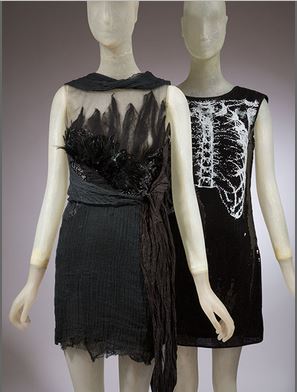
Rodarte’s California condor-inspired evening dress (2010) (left) next to their chest X-ray dress for Target (2011) (right)

Rodarte’s California condor-inspired evening dress (2010) (left) next to their chest X-ray dress for Target (2011) (right)

In contemporary times, you can’t really have a fashion trend unless you can get the items for your total “look” at H&M, Topshop, Macy’s, Nordstrom Rack, or another mass-market ready-to-wear site. Not everyone is fortunate enough to have designers send stuff over for a red-carpet look.

FIT’s wonderful Trend-ology exhibition acknowledges that although trends today may start from celebrity looks in magazines or on TV, they often arrive fairly quickly at Target, Zara, Express, and other shops. The pace of knock-offs has increased due to the mania for trend, faster speeds in shipping containers across oceans, and “instant” digital media.

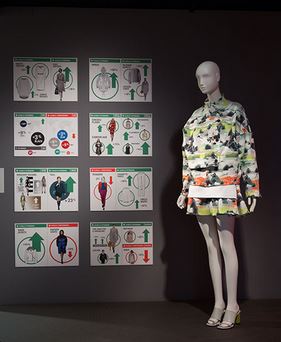
As soon as you enter the upstairs gallery, FIT features a wall of 2014 trend data from consultant WGSN right next to an “on trend” ensemble from Opening Ceremony.

WSGN trend analysis and “on trend” Opening Ceremony ensemble (2014)

WSGN trend analysis and “on trend” Opening Ceremony ensemble (2014)

You see at a glance how WGSN parses global runway shows each season into key looks, colors, tones, flower shapes, and skirt lengths for ready-to-wear company clients. Without detailed Paris-NY-Milan-London catwalk analysis, how would anyone know what was “trending”?

Spoiler alert: from the analysis depicted here, autumn/winter 2014 is all going to be all about pastel blue, the slip dress, hand-drawn patterns, and midi-length skirts.

There’s also an iPad streaming coverage of the latest award-show red carpet right in front of side-by-side ensembles by the Rodarte sisters – one from their 2010 high-end couture line and one from their sold-out line for Target in 2011.

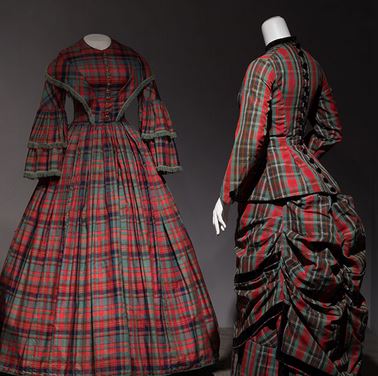
19th century passion for plaid in silk dress (1852) and wool bustle dress (1880).

19th century passion for plaid in silk dress (1852) and wool bustle dress.

The curators have stuck two former “it” bags in front of you, too – one from Fendi and the other from Murakami’s colorful collection for Vuitton.

A photograph from a look at Celine’s Fall 2013 collection is mirrored on the mannequin behind, who sports an identical look that’s being marketed to the masses at Zara.

From the vintage looks in the rest of the galleries, the curators prove that trends mattered in the last few centuries, too. Neon yellow hues became the rage in the late 1700s due to the proliferation of imported Chinese silks.

Plaid mania was inspired by Queen Victoria’s Highlands flings at Balmoral Castle in the 1850s, and the craze for mass-produced paisley proliferated throughout the 19th century, following the invention of the Jacquard loom.

Dior “New Look” (1950) (left) inspired Anne Fogarty to create a full-skirt dress for budget-conscious homemakers in 1954 (right)

Dior “New Look” (1950) (left) inspired Anne Fogarty to create a full-skirt dress for budget-conscious homemakers in 1954 (right)

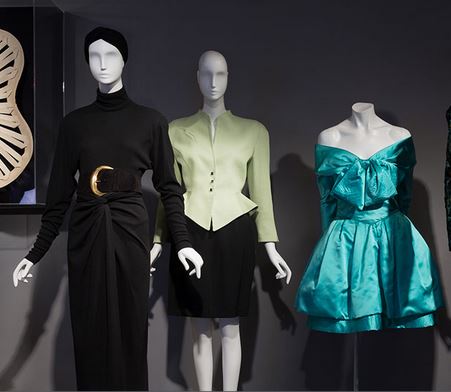
Of course, most of the galleries showcase trends from FIT’s vast archive of more recent fashions – Hollywood bias-cut silks, jet-set fashions following the British Invasion, disco-era menswear (the wide pant legs and patterned shirts seemed to baffle younger male gallery goers), Donna Karen’s iconic 1980s wrap-skirt-bodysuit, and fashions covered in designer logos from the 90s.

The biggest surprise: That Anne Fogarty’s “housewife” dress owes its genesis to Dior’s New Look. Hey, Lucy! Hey, Ethel!

Strangest item: Halston’s uncharacteristic tie dye ensemble that looks more like a Giorgio di Sant’Angelo than the nearby Giorgio di Sant’Angelo.

Greatest pleasure: Seeing the mini-documentary about the first days of Vogue magazine location shoots in the 1960s, surrounded by mod, space-age Carnaby Street looks.

Eighties trends: Donna’s wrap, Thierry’s cut, and an absolutely fabulous Lacroix

Eighties trends: Donna’s wrap, Thierry’s cut, and an absolutely fabulous Lacroix

Take a tour of 250 years of trends on FIT’s engaging, dazzling web site.

Folk Art Couture

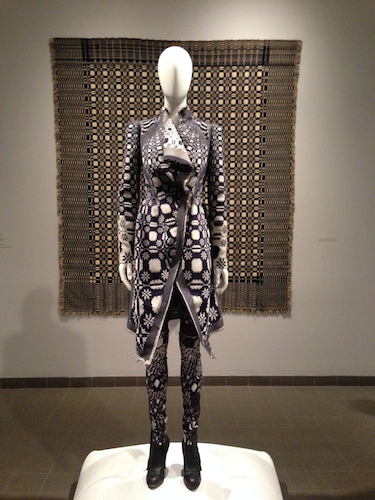
Gary Graham’s coat of wool/cotton jacquard in front of his inspiration — an 1810 Ann Carll Coverlet: “Blazing Star and Snowball.”

Gary Graham’s coat of wool/cotton jacquard in front of his inspiration — an 1810 Ann Carll Coverlet: “Blazing Star and Snowball.”

Delightful, whimsical carved animals from New Mexico don’t often appear on the runway with couture, but they certainly take center stage in the American Folk Art Museum’s fantastic show, Folk Couture: Fashion and Folk Art, which closes today.

No worries, though, the museum has created a detailed, media-rich exhibition site on Tumblr that gives you a close-up look at the fabrics, fashions, and folk art that inspired these fun, creative looks.

The museum pulled 100 of works from its collection and asked thirteen
designers to create clothes – wearable or not – that would reflect the scope, spontaneity, and sheer funkiness of folk art.

A steady stream of fashion-lovers worked their way through three galleries of beautiful clothes and creations inspired by collection pieces from across America — New Mexico folk-art porcupines inspired Jean Yu to make a straw-chiffon cocktail ensemble; an 1810 coverlet from Westbury, Long Island inspired Gary Graham to create a gorgeous jacquard-pattern coat and leggings; a religious sculpture made by German immigrants in North Dakota inspired Brazilian designer Fabio Costa to create an other-worldly white ensemble that would look at home in any avant-garde collection.

Closep-up of Michael Bastian’s sweater icon based upon an 1840s weathervane of the Archangel Gabriel. The look also features a hood with built-in earmuffs.

Closep-up of Michael Bastian’s sweater icon based upon an 1840s weathervane of the Archangel Gabriel. The look also features a hood with built-in earmuffs.

Apparently menswear designer Michael Bastian is a fan of this museum and loves its collection, so he fairly faithfully replicated an angel-weathervane icon on the front of his guy sweater and thought it would be fun (which it is!) to take the top hat and eyewear from a Michigan folk-art sculpture and put them right onto his mannequin’s head. The look is great — modern artist and old-fashioned at the same time.

Visit our Flickr album and the exhibition site to see all of the inspirations from the museum collection and learn more about each designer’s working process. We particularly liked the inspiration board in the gallery, which showed some of the process from art to reimagination to finished gown, coat, and dress.

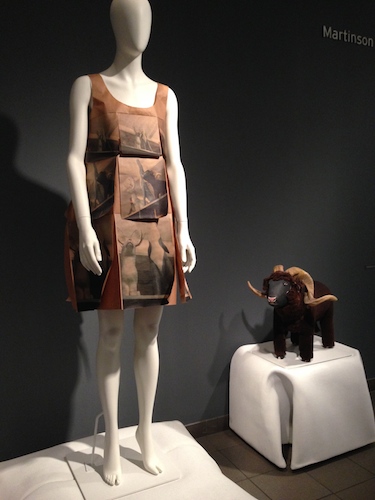
You can’t really beat Yeohlee’s paper dress, featuring images of New Mexico folk-art animals printed on Kraft paper and made into a modern and mod shaman ensemble. Chic and magical at the same time, just like her all of her collections and fans.

Yeohlee’s dress — Shamanistic Printed Prayer Flag Dress from Brown Kraft Paper. Among her whimsical inspirations — a ram carved in 1988 by New Mexico artist Johnson Antonio

Yeohlee’s dress — Shamanistic Printed Prayer Flag Dress from Brown Kraft Paper. Among her whimsical inspirations — a ram carved in 1988 by New Mexico artist Johnson Antonio

We’ve heard that this inspirational show will tour and we’ll keep you posted.

FIT Students Digitize and Unzip Biker Jacket History

The 1980 version of The Perfecto, which debuted in 1928 and is still sold by Schott Bros. Source: FIT

The 1980 version of The Perfecto, which debuted in 1928 and is still sold by Schott Bros. Source: FIT

The FIT fashion and textile grad students always pull out the stops on their shows in the Museum at FIT’s side gallery, turning mini-shows into main events, as in their current exhibition, Beyond Rebellion: Fashioning the Biker Jacket. The gallery installation highlights the jacket’s role in history, culture, couture, and street fashion, but the team makes its history come alive even further on their superb companion digital site featuring photos, videos, and the historical context. See the jackets in person and touch the leather swatches before April 5, and go play with the web site at any time.

The digital timeline begins with the birth of the motorcycle in the UK in 1902, but the fashion story starts in 1928 with the debut of the leather riding jacket, The Perfecto by the Schott Bros. It’s the template upon which all other cool looks – street, couture, punk, ready-to-wear – are based. It combines the swag of a WWI aviator jackets with the utility and protection needed by one of the original road warriors. Retail: $5.50.

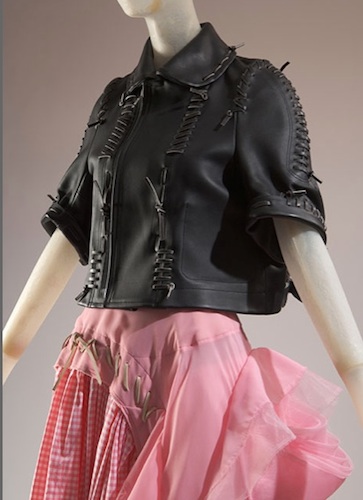
From Rei Kawakubo’s 2005 Biker + Ballerina collection (leather, gingham, and tulle) for Comme des Garcons. Source: FIT.

From Rei Kawakubo’s 2005 Biker + Ballerina collection (leather, gingham, and tulle) for Comme des Garcons. Source: FIT.

In the first gallery next to The Perfecto, fashionable visitors were hovering to take in all the information in Paula Sim’s excellent illustrated deconstruction of the jacket’s iconic design features as if it were the Rosetta Stone. How and why did the details we know so well all originate? The asymmetrical zip thwarts wind, epaulets secure riding gloves during breaks, the belt keeps wind from whistling up your back, and zips at the wrist do the same for the glove-sleeve juncture. The extensive use of hardware was a desirable touch inspired by chrome and metal features on the just-taking-off auto industry. Want or need?

It didn’t take long for motorcycle-loving vets to start applying patches and insignias to the aviator-inspired jackets, just as they had done with patches, insignias, and pins during the war. By the 1930s, as shown on the timeline, club patches gradually became associated with “outlaw” clubs. Nevertheless, the popularity of motorcycle riding grew, documented by the curators with a 1951 Sears catalog showing a premium $33.95 leather moto jacket featuring a snap-off lamb collar and “built-in kidney support”.

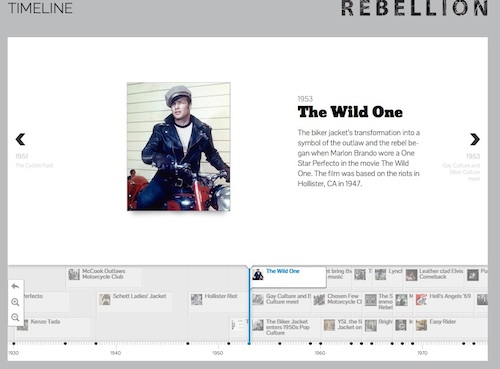
Screenshot from the FIT show timeline

Screenshot from the FIT show timeline

As the curators note, the watershed year for this utility bomber was 1953, when Brando sported cuffed-jeans-and-jacket attire in The Wild One. Banned initially in the UK, the film (and Brando) became a sensation, giving mass audiences a pop-culture version of what happened in the 1947 Hollister, California motorcycle club riots.

The style went viral, pushed further into street-style consciousness by emerging rock-and-rollers and The King himself, Elvis. Take a look at some iconic 50s performances that the digital curators included on the show’s website. Scroll up to 1956 in the timeline to see Gene Vincent tear it up onstage and to 1968 to see Elvis rocking his leather look doing Jailhouse Rock in his NBC comeback special.

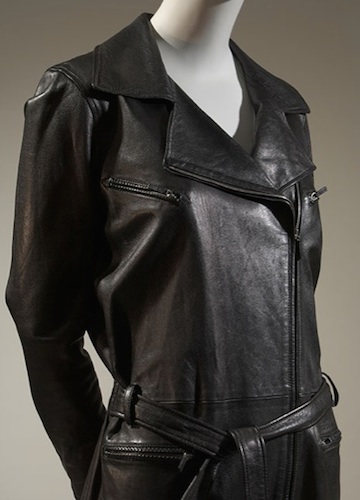
It's so Schott: Stefano Pilati’s Fall 2009 jumpsuit for YSL. Source: FIT, gift of YSL.

It’s so Schott: Stefano Pilati’s Fall 2009 jumpsuit for YSL. Source: FIT, gift of YSL.

In 1960, YSL became the first high-fashion designer to bring the biker look to the runway – a move that contributed to his exit from the House of Dior. Never mind, though. When he opened his own house two years later, he continued riffing on the bad-girl theme.  The rest was history, with plenty of rock musicians, high-end designers, and Vogue stylists following suit.

The curators feature New York’s own Ramones as the epitome of the 1970s motorcycle-jacket-wearing punk-music rebels, and present lots of album covers as evidence of the jacket’s enduring presence.

As for fashion from the FIT collections, the team has pulled together a dozen high-end interpretations, beginning with Mr. Versace’s 1993 gold-stitched biker jacket with pull-tab logo hardware and a more subdued version by Emporio Armani. Fashion lovers have plenty of other versions to savor from Ms. Herrera, Rick Owens, JPG, Rei Kawakubo, and others.

All the techniques rolled into one in Jean Paul Gaultier’s 1987 creation of leather, fake fur, suede, and wool. Note the trapunto, elbow studs, fringe, and pin stripes. Source: FIT, gift of Anne Zartaian.

All the techniques rolled into one: Jean Paul Gaultier’s 1987 leather, fake fur, suede, and wool jacket with trapunto, elbow studs, fringe, and pin stripes. Source: FIT, gift of Anne Zartaian.

In the far corner, the team offers a wall where you can touch and compare different types of hides and treatments used for jackets, marvel at the trapunto-on-leather techniques Mr. Versace and JPG used so extensively, and learn that patent leather was invented in 1811.

If you can’t get to FIT in person, browse through the fantastic exhibition site, listen to the nine-minute audio tour, and download the exhibition brochure. Better yet, do both.

As for the current popularity of the biker jacket on the Streets of New York, enjoy the slide show by the FIT student team, shot on the only warm weekend day so far this year in Williamsburg:

The Most Lavish Natural History Show in the World

Remember 17th c. Dutch tulipmania? JAR
Tulip Brooch 2008 made of
rubies, diamonds, pink sapphires, garnets, silver, gold, and enamel. Private collection.
Photo: Jozsef Tari. Courtesy: JAR, Paris.

Remember 17th c. Dutch tulipmania? JAR
 Tulip Brooch 2008. Rubies, diamonds, pink sapphires, garnets, silver, gold, and enamel. Private collection.
Photo: Jozsef Tari. Courtesy: JAR, Paris.

If you took the detailed observational field skills and plant-and-animal artistry of JJ Audubon and crossed them with the gold-and-jewels precision of a Fabergé master, you can understand the enjoyment, beauty, and wonder that await the luxury-lovers crowding into Jewels by JAR, the Metropolitan Museum of Art’s tribute to the world’s most exclusive and reclusive jewelry artist. Meditate on his exquisite take on the natural world before it all goes back to the vaults on March 9.

Plenty of worshippers were wielding tiny flashlights last Saturday night, working their way meticulously through the darkened gallery perusing every detail of 400 tiny, sparkling, jewel-encrusted pieces by JAR (or, Joel A. Rosenthal as he was known growing up in the Bronx). He’s one of the world’s experts in the pavé technique and achieves subtle effects by painstakingly arranging miniscule diamonds, rubies, opals, and amethysts across gold, platinum, and silver surfaces.

JAR’s 2010 bracelet evokes snow on branches. Diamonds, silver, and platinum.
Private collection.
 Photo: Jozsef Tari. Courtesy: JAR, Paris.

JAR’s 2010 bracelet evokes snow on branches. Diamonds, silver, and platinum.
Private collection.
 Photo: Jozsef Tari. Courtesy: JAR, Paris.

Despite being one of the most sought-after jewelers in the world, JAR will not do commissions. Each piece is one of a kind, so the subjects that he chooses tell you a lot about him. Look closely.

The first case features bracelets, earrings, brooches, and necklaces fashioned into exact, delicate replicas of just about anything you can find at the New York Botanical Garden on a spring day — gardenias, roses, camellias, tulips, lilacs,  carnations, wisteria, pansies, and even wild oats. Across the room, you’ll see perfect oak leaves and acorns (made from diamonds, platinum, silver, and gold) formed into dramatic rings, cufflinks, necklaces, and earrings.

Growing up, JAR loved roaming the halls of the American Museum of Natural History and the Met, which shows. He’s made one pair of pendant earrings (No. 83) from iridescent beetle wings, married with tiny emeralds, garnets, and diamonds set into silver and platinum.

JAR
Butterfly Brooch
1994.
Sapphires, fire opals, rubies, amethyst, garnets, diamonds, silver, and gold.
Private collection.
Photo: Katharina Faerber. Courtesy: JAR, Paris

JAR 
Butterfly Brooch
1994.
 Sapphires, fire opals, rubies, amethyst, garnets, diamonds, silver, and gold.
Private collection.
Photo: Katharina Faerber. Courtesy: JAR, Paris

Right next to that (No. 84) you’ll see his 1981 Egyptian-style faience earrings with emeralds, coral, and gold — a 20th century take on the Middle Kingdom. He’s crafted stalactite earrings (No. 93) from diamonds and silver and found a heart-shaped pebble into which he’s set a perfect ruby surrounded by silver and gold (No. 283).

In the center of the room there are moon and stars pendant earrings (a tribute to Cole Porter) made of sapphires and diamonds (No. 274), and a box (No. 260) inspired by lightning (rock crystal and diamonds). JAR’s 1991 Phases of the Moon Bracelet, made of basalt, diamonds, silver, and platinum, makes you think he probably also hung out at the Hayden in his youth.

The finale to the gallery is the Met’s jeweled twin to the AMNH Butterfly Conservatory – a wall in which 22 of JAR’s beautiful butterflies take flight. OK, there are 2 dragonflies in there, too, but the overall message is butterflies.

A few animals are in the show, too. JAR
Zebra Brooch
1987
made of agate, diamonds, a sapphire, silver, and gold.
Private collection.
 Photo: Katharina Faerber. Courtesy: JAR, Paris

A few animals are in the show, too. JAR Zebra Brooch 1987
made of agate, diamonds, a sapphire, silver, and gold.
Private collection.
 Photo: Katharina Faerber. Courtesy: JAR, Paris

Every person in the crowd seemed to pause here in the dark to choose which creature was the most beautiful before entering the bright, unforgiving lights of the gift shop. A personal favorite was the 1987 Dragonfly Brooch (No. 378) with double-layered rock crystal wings.

If you love nature, wit, color, and fool-the-eye magic, you’ll like getting lost in the dark among the billions of points of light that JAR has created in his glittering universe.

Mutu Takes Art-Lovers on a Fantastic Brooklyn Journey

Le Noble Savage, 2006. Ink and collage on Mylar (over 7 feet tall). Collection: Martin and Rebecca Eisenberg. Image: courtesy of the artist. © Wangechi Mutu

Le Noble Savage, 2006. Ink and collage on Mylar (over 7 feet tall). Collection: Martin and Rebecca Eisenberg. Image: courtesy of the artist. © Wangechi Mutu

The Saturday night crowd at the Brooklyn Museum was intent on exploring every inch, sketchbook, plastic-wrapped ball, and cut-out supplied by the born-in-Kenya Brooklyn vision-artist in her one-woman show, Wangechi Mutu: A Fantastic Journey. Explore her world (installed right next to The Dinner Party) before March 9.

Wangechi has been turning out thought-provoking work for the last 15 years, and the show, originally created by the Nasher Museum on the Duke University campus, presents the gigantic collage images that made her famous with collectors as well as a brand-new video and on-site installation.

Ladies’ fashion lips, stiletto-heeled shoes, African totems, African animals, high-fashion eyes, and magical shapes and patterns are interworked onto large-scale pieces portraying Amazons that are pushed, puzzled, and probed in fantasy landscapes, surrounded by plants and creatures from different worlds.

She’s a visual virtuoso who knows that how things look from a distance are nothing like what you’ll see when you get up to her images very, very close. For example, when you come into the gallery, you see a wall-sized work that Wangechi created that looks like a she-centaur being chased by who-knows-what-in-3D flying into the frame. Up close, you’ll see that her “hooves” are collages of African sculptures and engine parts. The furtive creature flees atop a huge root system of “earth” created out of masses of folded felt. Take a look at how she assembled it:

Walking up to each piece, shapes shift right in front of you, conjuring mixed messages and forms associated with female beauty, African “otherness”, the fallout from colonialism, and the disassociation with the natural world. Wangechi wants everyone and everything to exist harmoniously, but her techniques constantly remind you of the dissonance and difficulty in achieving this.

Funkalicious fruit field, 2007. Ink, paint, mixed media, plastic pearls, and collage on Mylar. Collection of Glenn Scott Wright. Courtesy: Victoria Miro Gallery, London. © Wangechi Mutu

Funkalicious fruit field, 2007. Ink, paint, mixed media, plastic pearls, and collage on Mylar. Collection of Glenn Scott Wright. Courtesy: Victoria Miro Gallery, London. © Wangechi Mutu

In a 2007 piece titled Funkalicious fruit field, the far-away feeling is organic, dense, watery, and surreal. But when you get right up close, you’ll discover three jackals, a sacred cow, and a white rhino floating around, and you’ll start scouring the weeds for more surprises. Her female portraits can sometimes feel scary as you recognize the genesis of some of the cut-up images creating the illusion – medical textbooks whose components aren’t pretty.

The crowd was captivated by her first animated film, The End of eating Everything. A female-headed magical creature belches volcano steam from her misshapen body, eating everything in sight. Thankfully, it has a bit of a surreal, happy ending as hopeful, intelligent heads eventually prevail, framed by a cloud-filled blue sky.

Listen to a discussion of her work at the Brooklyn Museum via YouTube, and enjoy this beautiful 9-minute documentary produced by Arise Entertainment 360. You’ll meet this fascinating artist, see close-ups of her collages, and experience what’s so great about this show: