FIT Honors Transatlantic Nightlife Queen

1990 Mathu & Zaldy body suit and attached boots that Susanne wore to an Armani party

1990 Mathu & Zaldy body suit and attached boots that Susanne wore to an Armani party

If you think the music and fashion stopped after Studio 54 shut its doors to Liza, Liz, Andy, Calvin, Halston, and Yves, FIT’s club-scene exhibition, Fashion Underground: The World of Susanne Bartsch, presents evidence to the contrary through December 5.

The show features nightlife splendor (with all the trimmings) from Susanne’s clothes-to-be-seen-in archive. Plus, you’ll get the thrill of pretending that you’ve stepped into one of her over-the-top parties, filled with celebrities, outrageous clothes, spectacle, and glitter.

Wielding "the list" in a 2008 Jean-Paul Gaultier jacket and Patricia Fields hat

Wielding “the list” in a 2008 Jean-Paul Gaultier jacket and Patricia Fields hat

Right downstairs at the gallery entrance, you’ll be taken back to a graffiti-splashed Nineties club entrance with a dolled-up doorkeeper sizing you up and holding “the list”. But there’s no anxiety about whether you’ll be let inside…Just walk in and be transported back to 1981.

 As the glittery disco 54 era was coming to an end in New York in 1981, Bartsch arrived from London and opened up a shop in Soho filled with up-and-coming London designers that were creating the “new look” catching on in clubs across the pond.

In the early 1980s, Japanese and British designers experimented with crinkly natural fibers and oversized smocks – which looked fresh and hip after a decade of form-fitting, glitzy disco looks.

The Eighties -- Vivienne Westwood looks with Galliano linen ensembles

The Eighties — Vivienne Westwood looks with Galliano linen ensembles

Susanne sold the oversized, anti-disco baggy look of nightlife trendsetters Boy George and Leigh Bowery, imported dandy mix-and-match men’s and women’s looks from Vivienne Westwood, and featured flowing frocks by London’s Rachel Auburn.

The first part of the FIT show walks down this part of memory lane, including linen frocks by Mr. Galliano. Smocks are punctuated with dramatic hats (decades before fascinators) or beads from Portobello Road.

By the late Eighties, all that had given way to raggedy and accessorized mash-ups sported by the Material Girl and by the Nineties, bejeweled and bedazzled clubwear reigned again. Susanne was regularly hosting parties clad in an ever-evolving array of embellished corsets, fashioned by the master of form and shape, Mr. Pearl.

Two Mr. Pearl corset ensembles (1989, 1991) with 1992 Mugler Cowgirl ensemble, worn by Naomi Campbell Installation view of “Fashion Underground: The World of Susanne Bartsch” September 18 – December 5, 2015 The Museum at FIT New York, New York

Mr. Pearl corset ensembles (1989, 1991) with 1992 Mugler Cowgirl ensemble for Naomi Campbell

In a well-deserved tribute to his creations, FIT has installed a carousel of Mr. Pearl’s work on a turntable in the show’s back room of the show, next to a corner where mannequins form a towering tribute to the magic of Mr. Mugler, another of Ms. Bartsch’s favorites. After she introduced Mr. Pearl to Mr. Mugler, the rest was fashion history.

Fashion designers flocked to her parties and she did justice to them all – working in their hats, jackets, shoes, bags, and separates into her never-ending array of special occasion get-ups. When you peruse the specific looks on display in the show, it’s an all-star line-up of New York, Paris, and London fashion heavyweights.

Gareth Pugh 2015 ensemble of paper, Lycra and leather

Gareth Pugh 2015 ensemble of paper, Lycra and leather

The show screams of creativity and it’s wonderful that curator Valerie Steele put a spotlight on this Queen of Nightlife and her impact on the underground/high fashion scene for the last three decades. A lot of Susanne’s featured clubwear is credited to Mathu & Zaldy, who turned out plenty of over-the-top looks when designer ready-to-wear just didn’t pack enough punch for a special occasion.

Another charming touch in the show is the ensemble of paper, Lycra and leather contributed by Gareth Pugh. Susanne asked him to send something she could (and would) wear.

As always, FIT provides lots of history and photographs of Susanne and friends in action at multitudes of balls and parties on its exhibition website. Spend time looking at Susanne in action and at snapshots of her historic Love Ball. For close-ups of the clothes and costumes, visit our Flickr feed.

Take 360 spin around each room of the show courtesy of FIT’s virtual tour produced by Synthescape. The arrows appearing on the floor will take you to all three rooms.

Do you wish you could have been at the opening of this exhibit? Not to worry – her friends and fans let you in on the party and remember unforgettable nights in this celebratory video. Even Calvin’s there:
Fashion Never Sleeps at FIT

Show opens with 2014 synthetic knit and nylon jacket and dress by Istanbul designer Arzu Kaprol “Global Fashion Capitals” Museum at FIT June 2 – November 14, 2015 New York, New York

Ensemble by Istanbul designer Arzu Kaprol

Stepping inside Global Fashion Capitals at the Museum at FIT is an around-the-world trip that gives a nod to fashion’s past while presenting style innovators who are thriving in nearly every corner of the world. Right inside the front door of the exhibit is a powerful mannequin duo straight outta Istanbul. Wow!

Turn around and you’ll see a packed International Fashion Week Calendar and an illuminated world map. It’s pretty clear that every hour or so, the sun rises on another hotbed of sartorial creativity. Except for Antarctica, every continent has multiple fashion weeks, fashion bloggers, innovative designers, and fashion followers all their own. Explore through the show’s website, and visit in person before November 14.

Representing London, Alexander McQueen's 2009 dress and corset

Representing London, Alexander McQueen’s 2009 dress and corset

The curators tell the story of the rise of traditional couture centers — Paris, New York, Milan, and London – through selected looks and accessories, dating all the way back to the mid-19th century and the House of Worth, when the fashion system and seasonal cycles were institutionalized. It’s interesting to learn that by 1949, the House of Dior was generating 5% of French export profits.

Of course, after WWII, New York was hot on the heels of Paris. Eleanor Lambert kickstarted New York’s Fashion Week in 1943 and Halston and his designer pals won their place in the pantheon of style by vanquishing the Parisians in the 1973 Battle of Versailles.

Milan took over the mantle from Rome after World War II, and London came into its own in the Sixties and Seventies with the debut of mad Mod, rocker chic, and Westwood’s over-the-top subversions.

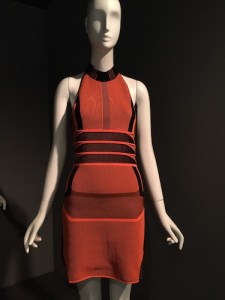
Alexander Wang's 2015 dress from Nike's “flyknit” sneaker fabric

Alexander Wang’s 2015 dress from Nike’s “flyknit” sneaker fabric

In each section, the curators are careful to add a look from recent runways – Christopher Kane’s layered silk organza masterpiece and Alexander Wang’s shift made from the same fabric as Nike’s “flyknit” sneakers.

But the remainder of the floor space tells the story of other influential capitals of fashion – the 1981 emergence of the Antwerp 6 in Belgium; Tokyo’s wild ride with Miyake, Yamamoto, and Kawakubo; and what H&M did for Scandinavia as a fashion capital.

Next, the show highlights cities and fashion culture in Kiev, Mexico City, Sao Paulo, Lagos, J-burg, Sydney, Seoul and Mumbai. Click through these fashion histories on the FIT exhibition site, and marvel at Lisa Folawiyo’s bead-encrusted dress (Lagos) and Lie Sangbong’s graphic silk ensemble (Seoul).

Take a trip through the gallery on our Flickr site, and watch an interview with curator Ariele Elia below:

And for more on the Battle of Versailles, courtesy of FIT, click here.

Sneaker Culture Wows Brooklyn

Nike’s original Air Jordan I (1985) and the 25th anniversary Run-DMC Adidas brings joy to Brooklyn fans

Nike’s original Air Jordan I (1985) and the 25th anniversary Run-DMC Adidas bring joy to Brooklyn fans

Crowds in Brooklyn are levitating with excitement as they explore their own sartorial history in The Rise of Sneaker Culture, an exhibition running at the Brooklyn Museum through this weekend. Finally, a fashion history and technology show that really resonates with the men in the room!

The hundreds of historic sneakers, mostly from the Bata Shoe Museum collection in Toronto, tell the story of how casual sports footwear came to be so dominant in today’s high-fashion landscape.

Although there are a few examples of women’s footwear – early Keds from 1916 and iconic Reeboks from the Jane Fonda-fitness era – the focus is squarely on the men, their sports, and their athletic-inspired designer footwear.

The history section of the show shows some of the earliest rubberized sports shoes from UK collections, but quickly moves into familiar New York City territory when colorful creations began appearing at pick-up games on basketball courts around the city in the 1970s, and when the tide really turned through sports and music licensing.

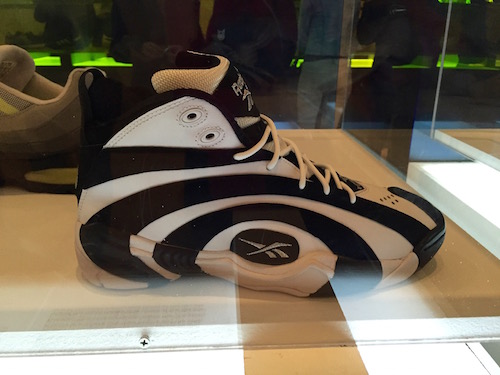
No one forgets the first time they saw Reebok’s Shaqnosis in 1995 (reissue)

No one forgets the first time they saw Reebok’s Shaqnosis in 1995 (reissue)

Crowds and docents jockey for space to worship at the altar of Nike’s 1985 Air Jordan I alongside the autographed reissue of Run-DMC’s 1986 Adidas. After Michael Jordan inked that deal and hip-hop video was distributed worldwide on MTV, sneaker fashion went viral. Electrifying images of loosely laced footwear were seen and copied by fans from the Bronx to Kathmandu. The right shoes and lacing style could wordlessly convey to others in the know, “I know what’s going down.”

Beautifully installed, Brooklyn crowds could work their way through men’s footwear history down one side and up the other – the original P.F. Flyers, original Chuck Taylors, streamlined European designs from the 1970s, Adidas’s early fitness shoes with built-in microprocessors, Nike’s Air Force 1, and Magic Johnson’s Weapons for Converse.

Nike’s 2009 limited edition for LeBron

Nike’s 2009 limited edition for LeBron

After the awesome case with the entire evolution of Air Jordans, the curators lined up a riot of color, technology, status, and design with evidence of so many subsequent licensing deals. Kanye’s new Yeezy Boot for Adidas was interesting, but the Reebock’s Shaqnosis and Nike’s limited edition for LeBron really stopped people in their tracks.

High-fashion sneakers by design and art luminaries Damien Hirst, Jeremy Scott, Chanel, Pierre Hardy, Raf Simons, Giuseppi Zanotti, and Rick Owens brought visitors right into the present day – when guys wear sneakers and tuxes to the Emmys, just as Michael Jordan predicted they would three decades ago.

A great touch at the show’s exit was the opportunity for visitors to leave a note about their own personal “sneaker story” and draw their favorite one.

Take a look at our favorite footwear from the show on our Flickr feed, all presented in chronological order. And enjoy this brief presentation on men’s contemporary footwear in this behind-the-scenes peek into the collections of the Bata Shoe Museum with senior curator Elizabeth Semmelhack:

Before Shapewear: Six Centuries of How to Look Good

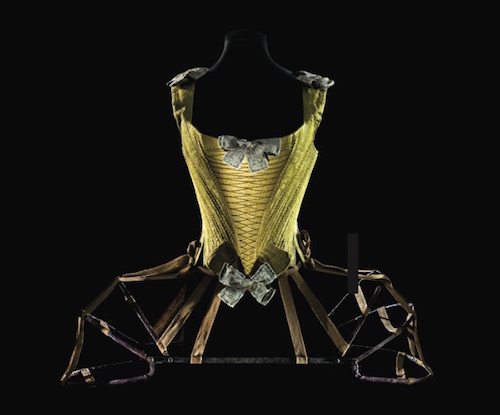
Articulated French pannier made of iron, leather, and fabric tape, 1770. Source: Les Arts Décoratifs. Photo: Patricia Canino.

Whalebone corset (1740-1760) above 1770 articulated French pannier that collapsed. Source: Les Arts Décoratifs. Photo: Patricia Canino

If you’ve ever successfully poured yourself into a pair of tight jeans, pay a visit to the Bard Graduate Center Gallery’s townhouse through July 26 to see Fashioning the Body: An Intimate History of the Silhouette, a three-story exhibition of how women – and men — pushed, pulled, and shaped their bodies into the “hot” silhouette of the day.

The show originated in the Musée des Arts Décoratifs in Paris in 2013 tells the story of how fashion divas and dandies utilized undergarments to stiffen, enhance, pad, and pouf themselves to create the iconic shapes we admire in paintings, photos, magazines, and other pre-digital media.

Painted yellow silk taffeta American robe a la Polonaise, 1780-1785 Installation views of “China: Through the Looking Glass” May 7 - August 16, 2015 Metropolitan Museum of Art New York, New York

American robe a la Polonaise held up by wire, 1780-1785. Source: Metropolitan Museum of Art, “China” exhibition.

Corsets (some iron!), farthingales, whalebone stays, panniers, crinolines, bustles, and girdles from the 15th century until today are all on display. You’ll see exactly how those whalebone stays stiffened corsets worn by nearly every woman from the 1500s to 1800s, and be amazed to learn that little children were also strapped into kids’ corsets to help shape “unformed” bodies right up through the 1950s in Western Europe.

Mr. James would approve of all the engineering that the curators reveal for us. Who knew that those wide panniers under 18th century French court skirts had elaborate mechanisms that could collapse to let their wearers squeeze through narrow carriage doors or tight household doorways? Automated models demonstrate just how neatly these ingenious apparatus operated to create the illusion of width just below super-tiny corseted waists.

How were those elaborate poufs created at the back of 1770s court gowns in the “Polonaise style”? Ladies could manipulate wires through eyelets in the voluminous triple-part skirts to create just the right amount of volume, drape, and flash.

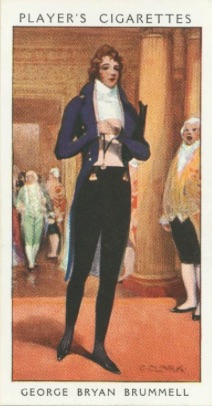
Uber-dandy Beau Brummel. Source: NYPL’s digitized George Arents Collection.

Uber-dandy Beau Brummel. Source: NYPL’s digitized George Arents Collection.

And the men! Under the sparkle jackets of 1770s court dress (subject of our previous post), the guys consciously padded chests, calves, and other body parts to give the appearance of a more muscular physique even if they hadn’t been working out. Shapely men’s calves were all the more important since high-end men’s footwear at the time consisted of elevated Louis heels.

For dandies of the 1800s, it was all clothes, all the time, so an even wider array of sartorial artifice came into being—tight men’s corsets, stomach belts, padding, and (more) fake calves. Striking a pose meant everything,

The in-gallery app provides lots of insightful commentary on the items and apparatus. On the second floor, Bard has a line of mannequins that illustrate the changes in female silhouettes. Here’s a walk –through of that part of the installation:

Watch this companion video to see some the collapsible pannier, corsets, and girdles in the show – direct predecessors to the shapewear of today:

Embroidered Menswear 100% Flash

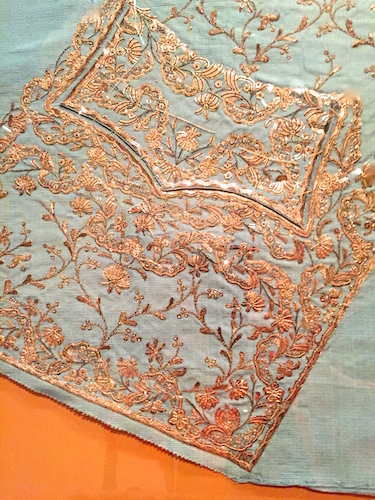
Embroidered front jacket pocket typical of 1780s court wear

Embroidered front jacket pocket typical of 1780s court wear

The womenswear in the Metropolitan Museum of Art’s China show couldn’t be more spectacular, but flashy menswear is not forgotten in the Ratti Center’s show, Elaborate Embroidery: Fabrics for Menswear before 1815, running through July 19.

It’s tiny, but lets you see what rich, fashionable men of the late 1700s and early 1800s were getting from their tailors in the biggest cities of Europe just before the fashions changed. Around 1815, Western men all adopted the monochrome suits that they’re still wearing for formal occasions and business today.

Until that fashion wave hit, the most spectacularly dressed men on the Continent would sport elaborate embroidery on silk or velvet jackets. The Met’s conservation center and textile library has selected some of its most spectacular samples. Check out the elaborate needlework in our Flickr feed.

Waistcoat front panel from 1760s Europe; metal thread embroidery with sequins on silk.

Waistcoat front panel from 1760s; metal thread embroidery with sequins on silk.

The show centers around a few samples that would be on display in retail shops where fashionable men would place custom orders. For more details on the 1770s showroom experience, read the Met’s blog post.

You’ll see swaths of silk or velvet all embroidered to the fit of the customer, just waiting for the tailor to perform the 3D transformation. The handwork is truly incredible. An early sample from the 1760s uses silver (that’s metal) embroidery interlaced with different-sized sequins to catch the light. Just imagine the dazzle when that guy made his entrance at court.

Some of the samples in the cases appear toned down by comparison to the silk-silver-sequin combo, but close inspection reveals how piling on a profusion of different stitches create botanical illusions running up and down the edges of coats and waistcoats. They’re comparable to botanical illustrations in the NYBG’s collections.

Close-up of embroidered velvet sample from 1800-1815, after which men preferred plain suits

Close-up of embroidered velvet sample from 1800-1815, after which men preferred plain suits

The most elaborate work was done in France, but with the switch to more democratic, monochrome suits in the early 1800s meant that people who had developed some of the best embroidery skills in Europe had to look for other jobs.

Whose stitches are on top? East or West? There’s just one more week to compare these snippets of handwork history with the elaborately embroidered 1700s and 1800s Manchu robes on loan from Beijing’s Palace Museum in the downstairs gallery of the Costume Institute. Decide for yourself.

Enlightenment through Gems

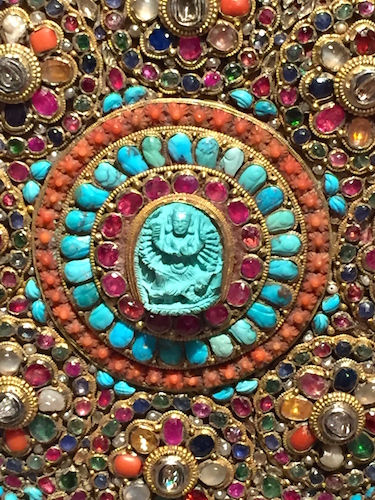
Center of 8-in. ritual offering dish made in 17th-18th c. Nepal

Turquoise Dhurga defeats a dragon in the center of 8-in. ritual offering dish (17th-18th c. Nepal)

It’s clear that wearing and giving precious (and semi-precious) gems can elevate the mind to higher levels of consciousness – at least in the minds of the Tibetan Buddhists – according to what you’ll see in Sacred Traditions of the Himalayas, running through this weekend at the Metropolitan Museum of Art.

The curators feature some remarkable statues, ritual dancewear, mandalas, and arms in the show, but let’s focus on the jewel-encrusted mosaics, containers, and jewelry displayed in the corner of the second-floor gallery, estimated to date from the 17th to 20th centuries.

Tibetan Buddhism emerged over the centuries in a dry, dusty, seemingly barren but beautiful region where people’s own adornment or bright flags atop mountain passes seem to be the only bursts of color. Inside homes, personal shrines, and monastery temples hang intricate, colorful mandalas pictorially suggesting the path to enlightenment, often symbolized by brightly adorned temples.

Mrs. Tsarong and two ladies from Tsang wearing special-occasion jewelry and hats as photographed by C. Suydam Cutting in 1937. Courtesy: Newark Museum collection

Mrs. Tsarong and two ladies from Tsang sport special-occasion jewelry and hats near Lhasa in 1937. Photo: C. Suydam Cutting. Courtesy: Newark Museum

These conceptual centers of enlightenment are often thought of as colorful crystal palaces emblazoned with jewels – an attractive image to hold in one’s mind on the lifelong journey to this higher plane of existence. What better way to remember your goal than to contemplate bedazzling diamonds, rubies, emeralds, sapphires, garnets, quartz, pearls, amber, coral, lapis lazuli, and turquoise?

To honor one’s journey to enlightenment, wealthy Tibetans often donated jewels to temples to adorn statues of the deities or commissioned personal devotional objects. That’s why you see so many jewel-encrusted objects in the Met’s collection. Personal shrines had jewel mosaics jam-packed with a dazzling array of stones. Gigantic statues were adorned with jewel-encrusted ornaments and surrounded by similarly elaborate containers for offerings.

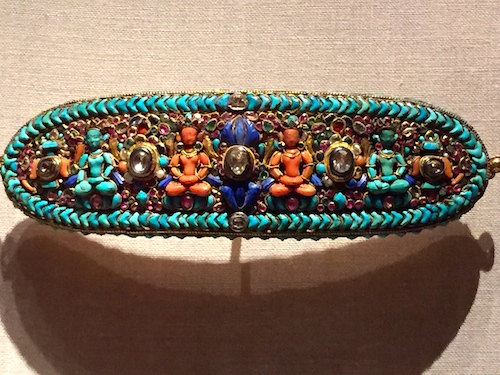
This Forehead Ornament for a Deity is only 8 inches long. Four celestial Buddhas are interspersed with diamonds

This Forehead Ornament for a Deity is only 8 inches long. Four celestial Buddhas are interspersed with diamonds

For special occasions, women sported accessories with amazing numbers of stones, reminding everyone of their social status, wealth, and devotion to an enlightened path.

Although some of the metal work was done in and around Lhasa, Tibet’s capital, the majority of the eye-popping jeweled settings were created across the border in Kathmandu, Nepal by Newari masters who created some of the most intricate visions in metal, wood, and paint ever known to the world. We’ve provided you with some close-up looks here and on our Flickr site. As shown, the result is a mix of Tibetan and Hindu imagery – typical of this region where so many cultural influences mix.

Densely packed diamonds, rubies, emeralds, sapphires, garnets, quartz, pearls, amber, coral, lapis, and turquoise in corner of Birth of the Buddha mosaic (18th-19th c. Nepal)

Densely packed diamonds, rubies, emeralds, sapphires, garnets, quartz, pearls, amber, coral, lapis, and turquoise in corner of Birth of the Buddha mosaic (18th-19th c. Nepal)

The Met’s own site for the objects in the show also allows you to zoom in on the details. Learn more about how the Met conserves such intricate jewel work in this blog post by an intern in the conservation department. See close-ups of how the Newaris set their gems.

Finally, explore Tibet as it was 100 years ago through this slideshow prepared for this show at the Met by the Newark Museum, which itself has a world-class collection of Tibetan objects and perhaps the largest collection of photographs of Tibetan people and temples from that time.

Plains Indians Wearable Art at The Met

1780 Plains Indian horned headdress assembled from a powerful mix of materials including bison horns, deer and horsehair, porcupine quills, glass beads, wood, metal cones, cotton cloth, silk ribbon, and paint. From the Musée du quai Branly in Paris

1780 Horned headdress assembled from a powerful mix from mighty bison , deer, and horse. From Musée du quai Branly in Paris.

With all the attention this week on the couture gowns at the Metropolitan Museum of Art ball and Costume Institute show, don’t forget that some of the most elaborately embellished mixed-media wearable art is installed on the second floor in the expansive tribute, The Plains Indians: Artists of Earth and Sky, through this weekend.

The masterworks have been gathered from select European and North American collections and feature beadwork (mostly on leather), symbolic headdresses, and magical objects that directly telegraph the wearer’s connection to nature, the universe, and supernatural power.

The show was organized by the Musée du quai Branly, Paris, in collaboration with The Met, and in partnership with The Nelson-Atkins Museum of Art, Kansas City, and features works from the 18th century through today (like the China exhibition in the other wing).

All-over beading on contemporary platform shoes by artist Jamie Okuma, 2014.

All-over beading on 2014 platform shoes by artist Jamie Okuma.

The curators track changes in materials, styles, and concerns of the Osage, Quapaw, Omaha, Crow, Cheyenne, Arapaho, Lakota, Blackfeet, Pawnee, Kiowa, Comanche, and Meskwaki nations from the time they dominated the Midwest through the demise of the buffalo, the great wars, the transition to reservation life, and participation in 21st century art and culture.

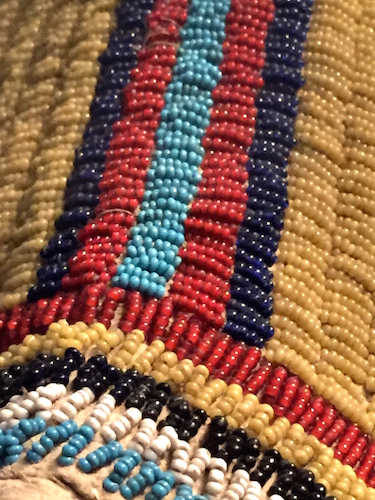
Take a read through the curators’ story on this exhibition site and see some of our favorite looks on our Flickr feed, where we’ve organized the pieces in chronological order. We’re giving you a close-up view of some of the bead, quill, and embroidery work. You can see the transition from more shamanistic embellishment to use of imported Venetian glass beads, to the all-over bead style, and finally to current creations, such as Jaime Okuma’s beaded platform shoes.

Central painting on large-scale Mythic Bird robe from the Illinois Confederacy, 1700-1740. Courtesy: Musée du quai Branly in Paris

Central painting on Mythic Bird robe, Illinois Confederacy, 1700-1740. Courtesy: Musée du quai Branly in Paris

Much of the painting and handwork was divided according to gender – men painted figures and women did the beadwork and painted the geometric forms. This beautiful robe with a geometric mythological bird is one of the earliest surviving large-scale paintings from Plains tribes, and the beaded geometry of the 1895 Crow wedding robe is another marvel.

Compare the mixed-media horned headdresses from 1780s Missouri with Chief Red Cloud’s dramatic all-business trophy-feathered war bonnet of 1865. The fluffy-feathered 1925 creation from Cody’s Buffalo Bill Center almost makes you wonder if that version were strictly for wild west shows.

It’s also interesting to learn that the powerful symbolic paintings on shirts and shields were essentially “owned” by their creators.

Close up of the tiny Venetian seed beads used to decorate a Lakota woman’s dress (Teton Sioux), 1865. From the Smithsonian’s NMAI

Tiny Venetian seed beads decorate a Lakota woman’s 1865 dress. From the Smithsonian’s NMAI

Similar to what we learned about 1920s French couture designers’ concerns about unlicensed copies in FIT’s recent Faking It show, anyone wanting to replicate a particular war shirt or shield, had to be granted formal permission. The Met exhibition explains that replication permission of Plains Indian designs were closely held and protected for generations.

A full database of the amazing objects in the show is on the Met’s website, as well as the complete audio guide to the exhibit on the museum’s Soundcloud site. As you click on the audio tracks, you’ll see a small thumbnail of the object.

Listen to curator Gaylord Torrence, explain how French culture and embroidery techniques collided with Plains Indians culture three hundred years ago to such magnificent result:


FIT Tribute to Lauren’s Look

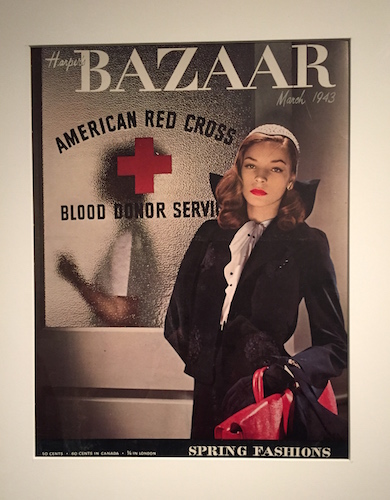
18-year-old Bacall poses as a Red Cross WWII nurse on Harpers Bazaar cover, March 1943. Cover photo: Louise Dahl Wolfe

18-year-old Bacall poses as a Red Cross WWII nurse on Harpers Bazaar cover, March 1943. Cover photo: Louise Dahl Wolfe

What’s a New York City style icon to do when you run out of room at the Dakota but can’t bear to part with 700 of your favorite designer dresses, gown, daytime wear, and accessories? Give them to FIT, of course.

The FIT graduate students are paying tribute to the classic simplicity, clean lines, and casual elegance of a particularly generous donor in the capsule show, Lauren Bacall: The Look, on view at The Museum at FIT through April 4.

The show chronicles Bacall’s start (under the watchful eye of Ms. Vreeland) as a Forties’ cover girl and her quick ascent into the Hollywood pantheon as a 19-year-old leading lady in To Have and Have Not with her soon-to-be-husband Mr. Bogart.

The students have unearthed an early studio photo-test of various hairstyles for the Hollywood newcomer – revealing the casual, wavy down-to-the-shoulder look that would be her signature look for the rest of her life.

1968 Cardin dress of Dynel, which can be crushed and washed without losing its shape. Worn in the 1968 CBS fashion special, Bacall and The Boys

1968 Cardin dress of Dynel, which can be crushed and washed without losing its shape. Worn in the 1968 CBS fashion special, Bacall and The Boys

Take a look at clips of Lauren at her best in snippets from famous films, including How to Marry a Millionaire alongside Ms. Monroe and Designing Women.

On to the clothes: The narrow gallery displays a hot pink Norell coat from Sex and The Single Girl, but the focal point of the show is in the back room — an array of frocks custom-fit for Bacall from the leading Sixties designers as part of a 1968 CBS special, Bacall and The Boys.

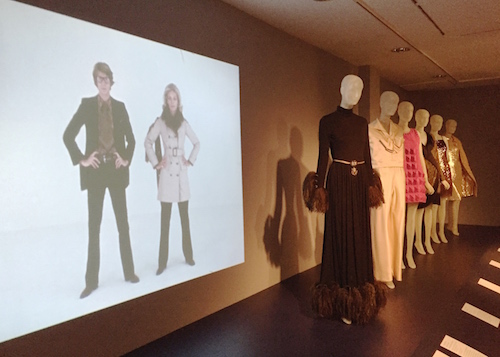
The wall-size projection shows Bacall modeling the outfits you’ll see right in the gallery – looks from Yves Saint Laurent, Pierre Cardin, Mr. Ungaro, and Marc Bohan of Dior. All of the designers make appearances and clearly Ms. Bacall has an artist-muse connection with each of them.

The back wall features a silk Ungaro pantsuit with sleek dresses that became Ms. Bacall’s day-to-day “uniform” around town – most by Norell and Miss Dior. There’s also an iPad featuring close-ups of outfits that don’t appear in this capsule show (but do appear in the FIT show downstairs on Halston and YSL).

1968 CBS special Bacall and The Boys showing Yves Saint-Laurent with Lauren Bacall. Nearby are ensembles and dresses by Marc Bohan of Dior, Cardin, Norell, YSL, and Ungaro.

1968 CBS special Bacall and The Boys showing Yves Saint-Laurent with Lauren Bacall. Nearby are ensembles and dresses by Marc Bohan of Dior, Cardin, Norell, YSL, and Ungaro.

As always, the students have provided some digital punch to the show on line: Click through the FIT timeline, loaded with great 1960s-style fashion illustrations.

See what’s on the iPad by clicking here and enjoy looks from Ms. Bacall’s closet by Ossie Clark, Halston, YSL, Norell, Chanel, and Pucci.

For more of Lauren’s looks, visit the exhibition website, FIT’s Flickr website and our own Flickr site.

Norell’s 1956 “Subway” cashmere silk ensemble.

Norell’s 1956 “Subway” cashmere silk ensemble.

Killer Heels as Art in Brooklyn

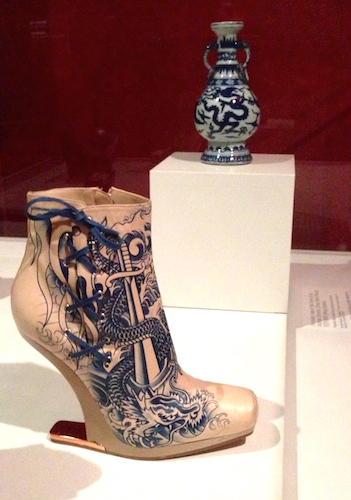
Gaultier’s 2012 Nude Tattoo Boot displayed next to its inspiration, a Chinese porcelain Ming vase (1573-1619)

Gaultier’s 2012 Nude Tattoo Boot displayed next to its inspiration, a Chinese porcelain Ming vase (1573-1619)

The hottest show in New York right now is Killer Heels: The Art of the High-Heeled Shoe, a curatorial masterwork that the Brooklyn Museum has decided to extend through March 1.

As soon as you enter the first-floor gallery, you’ll encounter Zach Gold’s mesmerizing Spike video, a wall-sized video extravaganza of high fashion, high glamour, and high heels. Why rush into the first room of the exhibition when your eye is trying process all the lush details? This digital kaleidoscope genuinely sets the tone for what lies ahead – an historical mash-up of style, fashion, and design all seen through the lens of ladies’ shoes.

What an eyeful – carefully composed vitrines where you can behold golden Baroque curliques on Prada platforms, 1920s evening shoes, and a 19th century gilded table. What about silver-and-pearl Chanel boots whose heels mimic the 1890s Gorham candlestick right next to them? Or the red-hot strappy Miu Miu shoes whose ornament is identical to the handles on a 18th-century Wedgewood ice cream cup? Check out our Flickr feed to see some of our favorites.

2008 Heels by Miu Miu next to a Wedgewood ice cream cup and saucer (1790-1800)

2008 Heels by Miu Miu next to a Wedgewood ice cream cup and saucer (1790-1800)

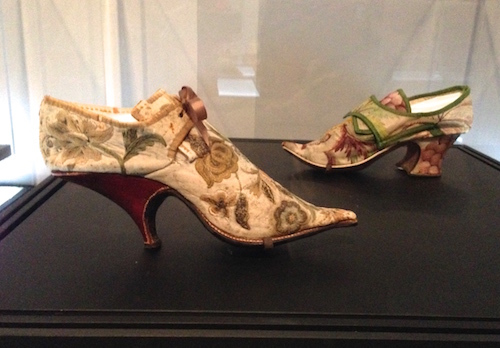
Everywhere you look, there are delightful juxtapositions across time, culture, and material – embellished pointy-toed heels from the 1690s, iron-and-leather pallets that boosted the feet of ladies above the muck of 18th-century city streets, and sky-high mother-of-pearl-inlay stilt shoes that Syrian beauties sported in the Twenties. It’s interesting that the latter are displayed in proximity to those dangerous purple Vivienne Westwood gillies that gave Naomi Campbell such problems on the runway.

Nothing’s chronological. It’s all designed to unfold in your mind by pinging unexpected references and associations – designer shoes next to concoctions from another place and time, fantastical embellishments, and streamlined perfection.

Fashionable, embellished pointy-toed 1690 French and 1720 British heels

Fashionable, embellished pointy-toed 1690 French and 1720 British heels

Provocative, room-sized videos commissioned for this show and small historical films only heighten the pizzazz. Check out Edison’s 1903 short, The Gay Shoe Clerk, or snippets from Sophia Coppola’s Marie Antoinette or other Hollywood classics. Don’t miss Eve A.D. 2000, shot in 1939 to predict what fashions and footwear of the future would look like. You’ll have fun evaluating whether those Thirties visionaries got it right.

There’s simply too much to describe – glass slippers by Georgina Goodman, political-statement heels, shoes that seem to take Metamorphoses at its word, and architectural-engineering wonders. Go see for yourself. You’ll find shoes by Ford, Ferragamo, Prada, Gaultier, and unknown Italian, French, and British craftsmen of long ago.

Watch curator Lisa Small’s video but make the trip out to Brooklyn to immerse yourself in one of the best adventures of the season:

Sending a Message by Dressing in Black

Dramatic 1861 British mourning attire in black silk moiré.

Dramatic 1861 British mourning attire in black silk moiré.

When the curators at the Metropolitan Museum of Art were researching collections for last year’s Impressionism-fashion show, they noticed something curious – a disproportionate number of luxurious 19th century American dresses in black. The black silhouettes found in the Costume Institute’s collection formed the basis for their first fall exhibition in seven years, Death Becomes Her: A Century of Mourning Attire, closing this weekend.

The show is a sumptuous walk-through of the years spanning the 1840s to the early 20th century, when fashionable women telegraphed their status as widows, paid tribute to fallen heroes, and acknowledged the passing of a member of the British royal family through dress, hats, parasols, rings, brooches, and other purchases. Click here to see our Flickr feed, and here for the Met’s own gallery views.

1868 wedding ensemble designed by West Virginia bride to honor casualties of the Civil War

1868 wedding ensemble designed by West Virginia bride to honor casualties of the Civil War

Fashion became such a rich language that the women in the 19th century felt “forced” to conform, according to associate curator Jessica Regan. It was an expensive proposition, and during the hard times of the American Civil War, many women stopped worrying about what others might think if they didn’t conform. If you didn’t have the cash to commission a new frock, it seemed to be OK just to dye an old one black.

As fashion magazines and periodicals became ubiquitous, middle-class and elite-status women eagerly sought styles that telegraphed sorrow while maintaining an up-to-the-minute silhouette.

Men of the 19th century were essentially wearing all-black suits, so the show’s focus is squarely on the ladies and the complex codes of mourning-attire etiquette. For example, after a sufficient period of time, a woman could introduce a bit of grey into her wardrobe, then mauve.

1894-1896 half-mourning dress purchased at James McCreery at 180 Broadway,when machine sewing was more common

1894-1896 half-mourning dress purchased at James McCreery at 180 Broadway,when machine sewing was more common

The team has assembled stunning examples of each from local collections (the now in-house Brooklyn collection, New-York Historical Society, and the Museum of the City of New York) as well as from the V&A’s collection in London. The most dramatic all-black look is the sweeping silk moiré gown from 1861 Britain. Perhaps the most startling is the 1868 a all-black bridal gown designed for a West Virginia bride who chose to pay tribute to fallen Civil War soldiers on her happy day.

Boutiques within department stores catered to mourning clothes buyers. Entire warehouses were filled to the brim with essential accouterments for the correct “look”. By the 1860s, mass-production of fabric increased the accessibility of the raw materials. A few decades later, heavy fabrics fell out of fashion in favor of lighter weight, more flowing options.

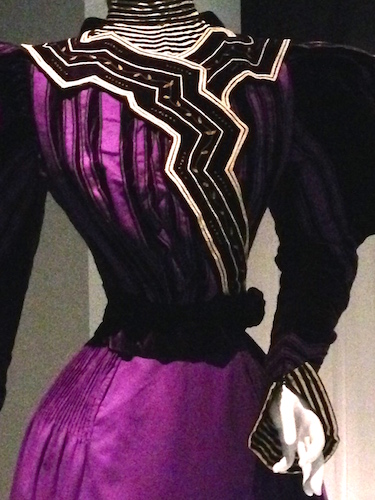
The 1890s fashions feature the best from New York department stores, including a mourning dress emblazoned with a bold geometric design.

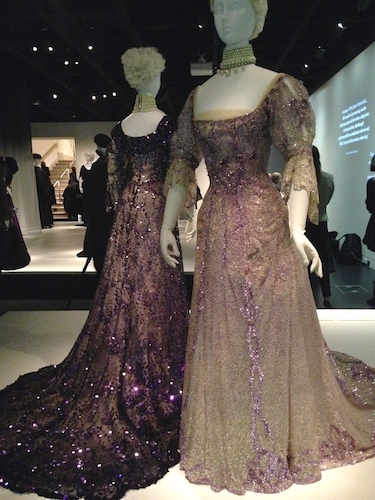
1902 dresses worn by Queen Alexandra to mourn Queen Victoria’s death. French tulle, chiffon, and sequins.

1902 dresses worn by Queen Alexandra to mourn Queen Victoria’s death. French tulle, chiffon, and sequins.

A conservative black dress worn by Queen Victoria stands in stark contrast to the sparkly mauve gowns worn in tribute to her by Queen Alexandra – exquisite and subtle, but not really subdued. The spotlights emphasize the delicate pizzazz of these French confections.

By 1910, wearing all black became fashionable, decoupling the color from its sorrowful past. The show concludes by noting that World War I essentially brought an end to mourning-attire traditions and fashions in Europe.

Enjoy this lecture by associate curator Jessica Regan here, posted on the exhibition home page.

Next up at the Costume Institute, Spring 2015: Chinese Whispers: Tales of the East in Art, Film and Fashion. Get out your cheongsams.

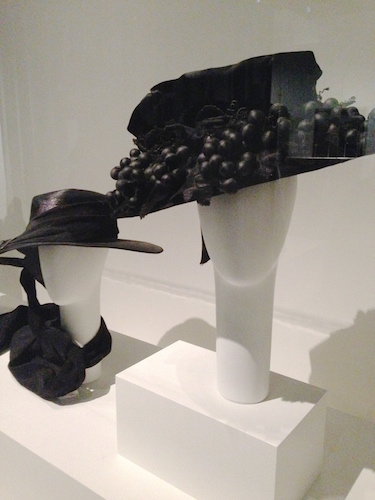
1915 Mme. Boué-Debat mourning hat with silk grapes from Brooklyn Museum collection at the Met

1915 Mme. Boué-Debat mourning hat with silk grapes from Brooklyn Museum collection at the Met