More Time Tripping at Grand Central

Annex window view of Lothar Osterburg’s model of his dream of Grand Central as a zeppelin docking station back in the 1930s

Annex window view of Lothar Osterburg’s model of his dream of Grand Central as a zeppelin docking station back in the 1930s

Even if you didn’t manage to board the historic train cars at Grand Central in May, you can still go back in time, courtesy of 18 artists featured in the GCT exhibition in the New York Transit Museum Annex, On Time: Grand Central at 100.

Inspired by The Clock and the continual flow of people and trains through Grand Central, MTA Arts for Transit cooked up a delightful mix of contemporary 2D works, models, videos, and digital art that puts a smile on the face of every commuter, tourist, and art-seeker that we’ve seen inside the tiny Annex.

Look closely to find this minute secret portal: Ledge with Lunette, 2013 by Patrick Jacobs

Look closely to find this minute secret portal: Ledge with Lunette by Patrick Jacobs

Have you seen the mysterious Zeppelin posters by Lothar Osterburg on the subway? Right in the Annex window you’ll see the gigantic, fun-house model that he created to photograph as one step in the process of making the photogravure you see on the A train. Kids and parents can’t resist Lothar’s newspaper-covered multi-story GCT impression and the funny, fat yellow old-time taxis and zeppelin ends that poke out. Right next to it, you can examine his resulting print, Zeppelins Docking on Grand Central.

People are usually transfixed by the 2008 video documenting Frozen Grand Central, where Improv Everywhere staged a 250-person flash mob, where people “froze” for 5 minutes as commuters, tourists, and workers wondered what was going on.

Another hit is Grand Central Diary. London Squared Productions interviewed tourists and commuters about GCT, animated the furniture and items around the terminal, and…well, just watch The Clock and the Maintenance Cart speak for themselves:

Nearby, several small digital screens show Alexander Chen’s Conductor, a 15-minute video loop that animates the subway lines, suggesting trains moving through the system. He turns the subway lines into an animated stringed instrument. No wonder he’s working for Google Creative Labs. Spend a few moments, take a look, and experience it here.
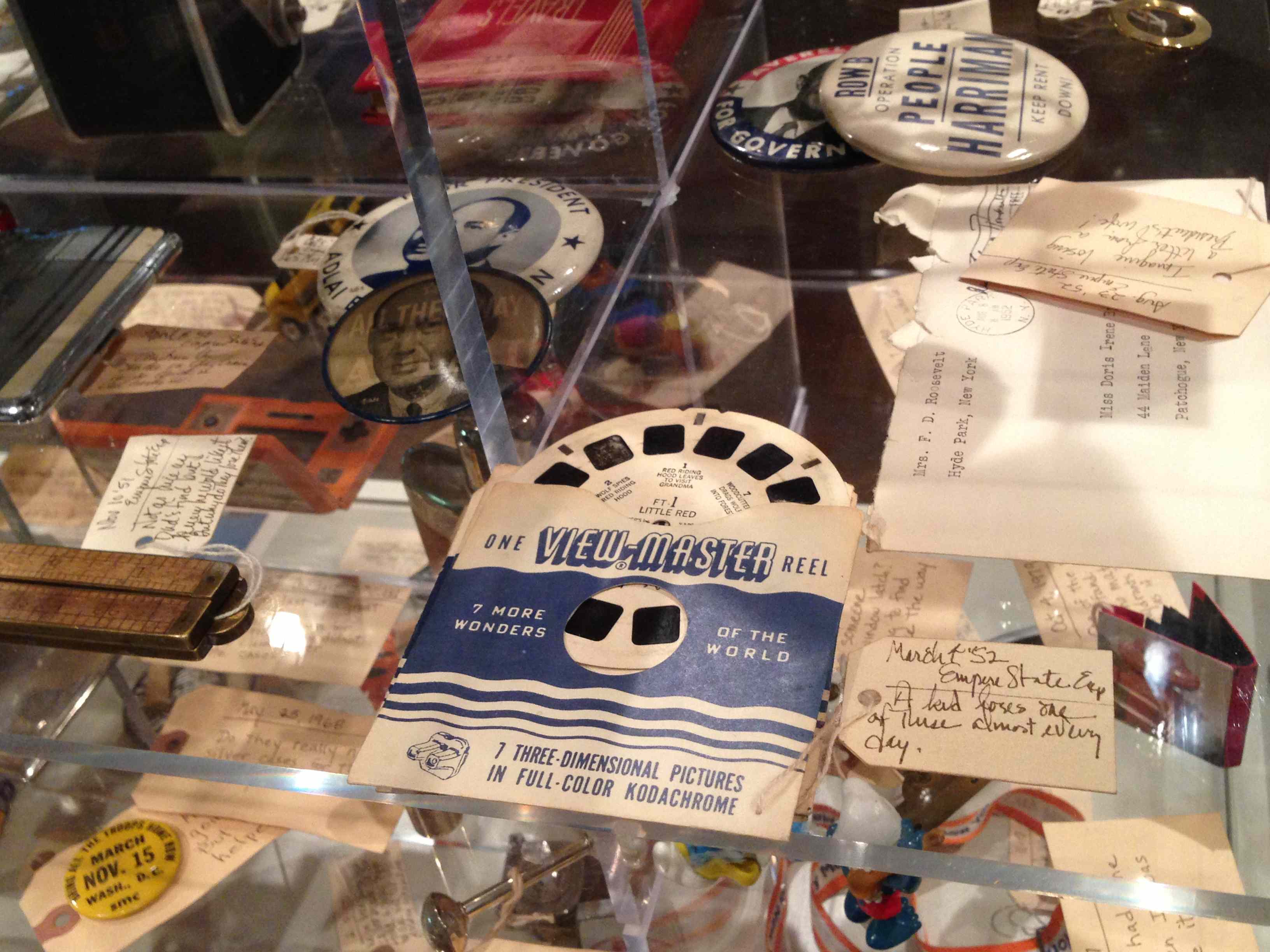
Close-up of Viewmasters and other leave-behinds inside Jane Greengold’s Lost and Found.

Close-up of Viewmasters and other leave-behinds inside Jane Greengold’s Lost and Found.

Another must-see piece (among many) is Jane Greengold’s Lost and Found. She’s created a sort-of fiction about the dozens of tagged items in the vitrine, evoking the memories and observations of generations of conductors who found items that train passengers left behind. Actually, the items you’re looking at are actual leave-behinds collected by real-life conductors, so Jane’s work isn’t entirely made up. The archeological discoveries include things from the old Lake Shore Limited on the NY Central, a 1948 boxed baby tooth, 1943 ration cards, 1952 Viewmasters, a Kennedy campaign button, and a Kindle.

Get to the Annex before July 7. In the meantime, check out curator Amy Hausmann and her artists telling about the fun they had contemplating time, architecture, fashion, and Jackie O.

War Ends at NY Historical

Welcome to New YorkJoin the crowds for two more days to pay tribute to NYC’s Greatest Generation at the revealing, reflective exhibition, WWII & NYC created by the New-York Historical Society. If you can’t get there in person, take a look at the synopsis here, but in the galleries there are surprises at every turn. The slideshow gives you a glimpse.

Right inside, you’ll find a line-up of people checking out a portion of the actual 1938 Cyclotron, a kind-of atom smasher that physicists at Columbia University were using confirm nuclear fission. It’s also surprising to see an interactive map of where “The Manhattan Project” was actually located in Manhattan. At Fifth Avenue and 29th Street, the Army had 300 people on the 22nd Floor of 261 Fifth sourcing materials for the first atom bomb. Other teams were working in the Woolworth Building and at 270 Broadway.

People also cluster around the interactive map of New York’s harbor, which explains how all those interesting-looking, now quiet big buildings, forts, and warehouses along the shore were once alive with 3.3 million active duty service men and women headed for Europe and North Africa. Take this video tour and see it then and now:

And the show would not be complete without a in-depth look at the activities of the Brooklyn Navy Yard and the rise of Rosie the Riveter. Watch this video to experience what it was like from a woman who lived it:

The show includes stories about how Tito Puente, Jacob Lawrence, filmmaker Francis Lee, MoMA, the Metropolitan Museum of Art, Maiden Form, Nabisco, and countless other New York people and companies joined in to the war effort. Check out additional videos expertly produced by NYHS on line. You’ll never look at these City streets or harbor the same way again.

Liberace Sparkles at Time Warner

Purple Cuff

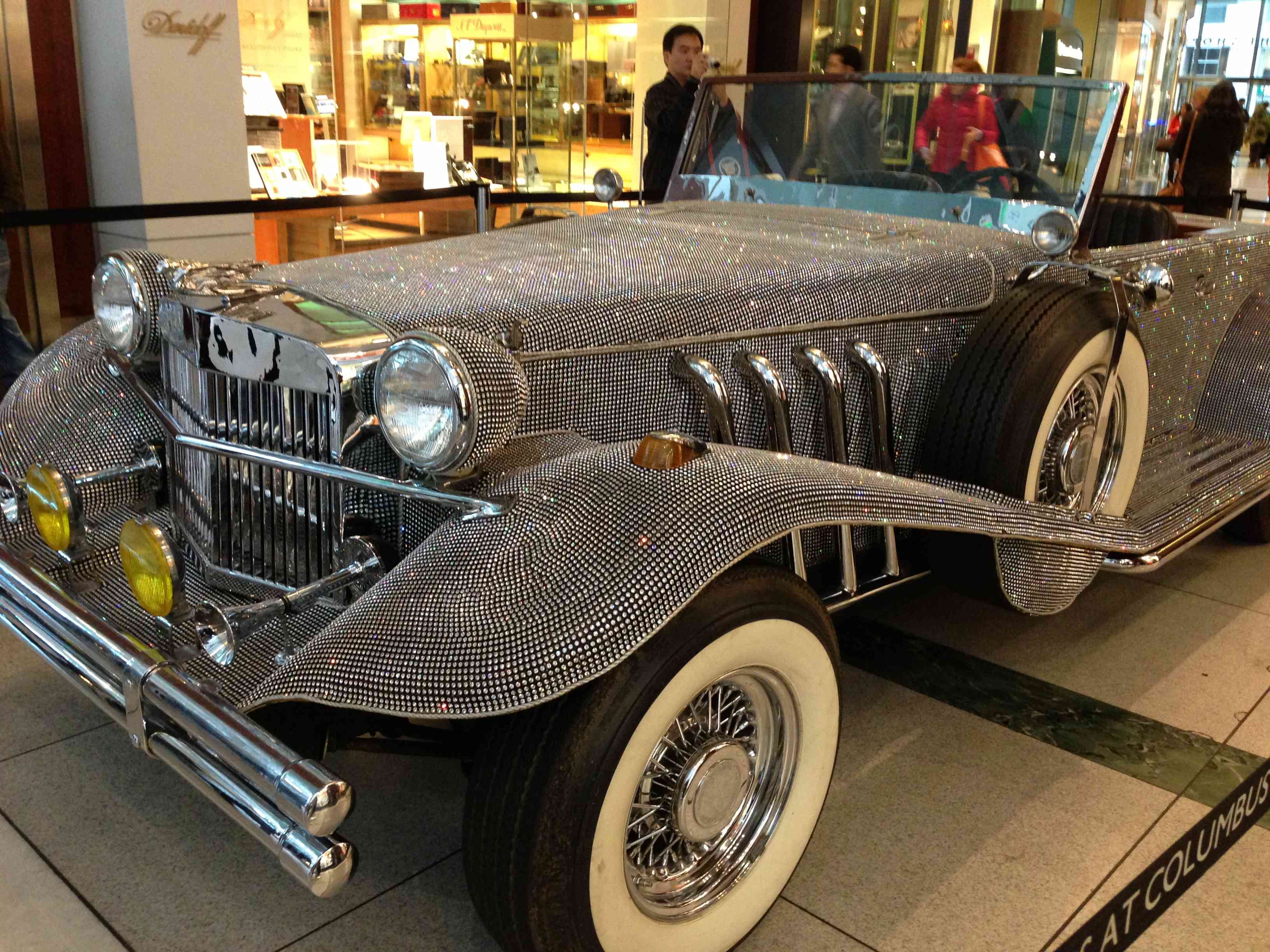
Dazzling rhinestones and teardrop crystals are providing the antidote to a rainy summer weekend inside the Time Warner Center, where HBO has installed Liberace’s piano, signature suits, and a tower of champagne to celebrate of the debut of the Michael-Douglas-as-Liberace pic Behind the Candelabra.

Up the escalators on the Third Floor, crowds were swimming through glitter Nirvana – Lee’s head-to-toe glamour looks: white cravats, bejeweled lapels, matching boots with rhinestone-studded heels, and the all-important cuff, which framed those flying ring-encrusted hands.

Purple BootsEnjoy it all in the Flickr gallery, because it’s all about the details. Besides, there’s no more Liberace Museum to visit in Vegas, so this is your chance to check out a bit of his million-dollar legacy.

Branding for the HBO film was everywhere, featuring giant pictures of Matt Damon and Michael D, but people mostly hovered about the glass cases to see look after look loaned by the barely-surviving Liberace Foundation.

RoadsterThere were no capes in sight, but plenty of fur-trimmed boots, beaded fringe, and a giant Swarovski crystal. Downstairs throngs were circling Lee’s rhinestone Duesenberg and admiring the bling on the Baldwin.

Check out the HBO movie, but run over to Time Warner to see (for real) what made this man a show business legend. Open 9am to 9pm through May 27.

Crowds See Luxury on Vintage Rail Cars at Grand Central

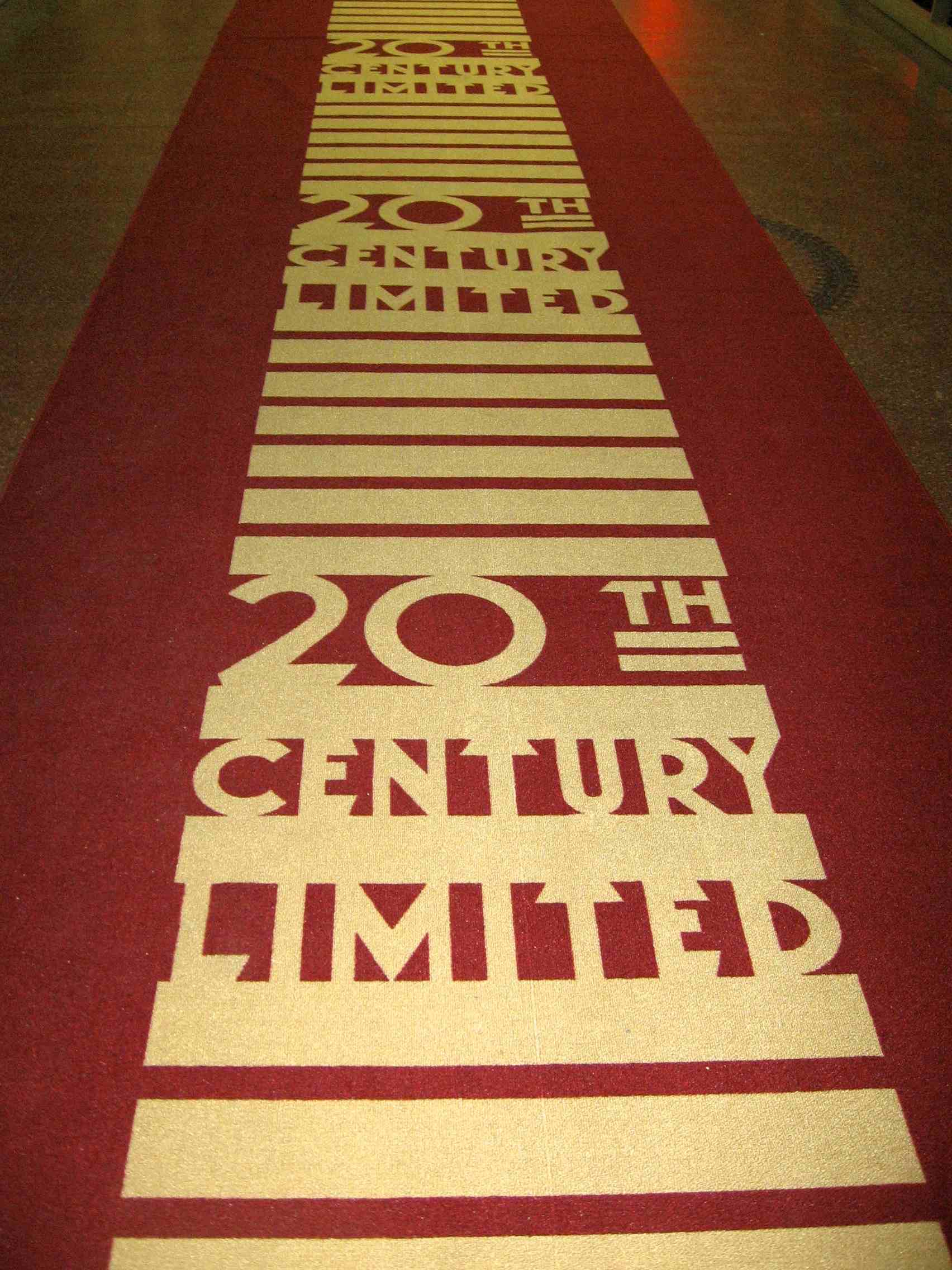
Red CarpetThe red carpet is back at Grand Central, right where it belongs: leading visitors down Tracks 34 and 35 to the door of the 1947 observation car of the 20th Century Limited and to fifteen other vintage sleeper, dining, and lounge cars that once traveled the New York Central rails and other lines all over the United States between the 1920s and 1950s.

An unexpected treat was being greeted by former “Century Girl” Joan Jennings Scalfani, who politely posed for photos with admirers and talked about the 1960s when she represented the brand to celebrities such as Frank Sinatra, Bess and Harry Truman, Ernest Hemingway, and Lena Horne.

Joan Jennings Scalfani, a former “Century Girl”, at the Parade of Trains

Joan Jennings Scalfani, a former “Century Girl”, at the Parade of Trains

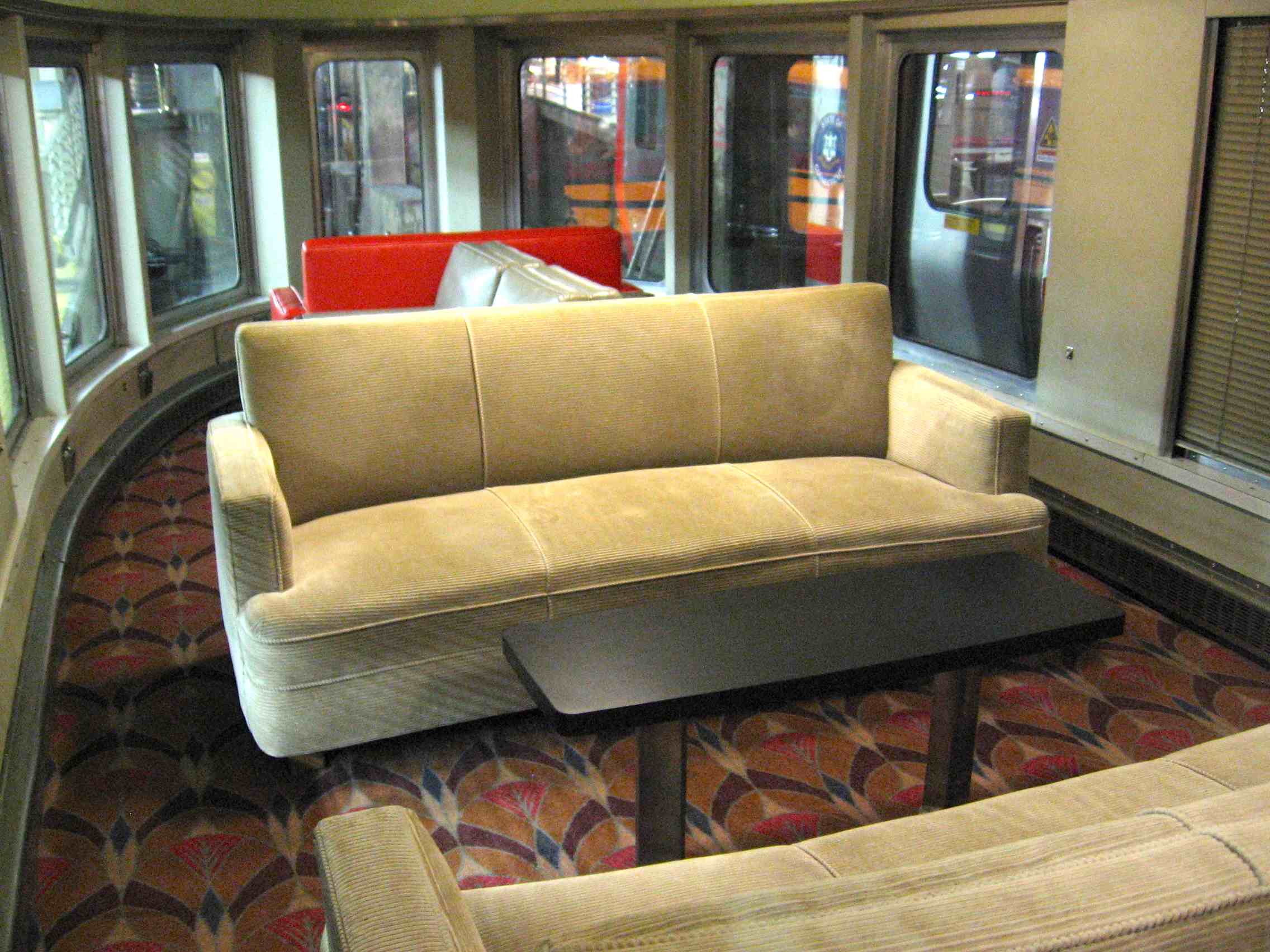
Besides the streamlined 20th Century observation car, we visited the leather lounge of the 1923 Kitchi Gammi Club (Pennsylvania Railroad), the 1949 Babbling Brook observation car (New York Central), and the refurbished Broadway Limited baggage car that has transformed into a luxurious private-dining experience, Dover Harbor.

All sixteen cars were brought to New York for the Parade of Trains in honor of GCT’s 100 anniversary – the largest convergence of private rail cars ever assembled at one time in the City.

Small crews of people serve up meals and make guests comfortable whenever the rail cars are booked for parties, getaways, and dinners. Rail clubs, crews, and owners welcomed us in every car we visited, including the fully stocked barbershop aboard the Overland Trail, which once ran on the Southern Pacific.

Due to the crowds, not everyone who came to Grand Central was able to walk through the halls of long-distance travel history, so we’re providing a closer look at the luxury, design, and history on our Flickr feed.

Front of the streamlined Hickory Creek sleeper-observation lounge car (1947) for the 20th Century Limited.

Front of the streamlined Hickory Creek sleeper-observation lounge car (1947) for the 20th Century Limited.

To accommodate the overflow crowds who weren’t able to make it onto Metro-North Tracks 34 and 35 before the afternoon cut-off time, MTA provided a train made up of three vintage subway cars, which shuttled between Times Square and Grand Central  – the 1948 R-12 car that was still equipped with wicker seats and whirring fans, the red 1950 IRT R-15 (the first subway to be air conditioned) with its iconic “portholes” in the doors, and the R33-S “World’s Fair” car which took visitors to the 1963 fair in style.

Dining aboard the Babbling Brook (1949)

Dining aboard the Babbling Brook (1949)

Easter Parade with Horses at Grand Central

GCT security keeping an eye on the red horse

GCT security keeping an eye on the red horse

The colors, crowds, finery, and promenade in Grand Central is every bit as celebratory as the famed Easter Parade on Fifth Avenue, except there’s live music and horses. It’s all part of Nick Cave’s monumental performance Heard NY going on each day at 11am and 2pm in Vanderbilt Hall.

Get there early and take your cameras to see The Ailey School students don the two-person horse costumes, created out of raffia, to whoosh and swirl away to the drums and harp. Take a look at the Flickr photos of yesterday’s 11am performance.

Creative Time and MTA Arts for Transit have decided to use both sections of Vanderbilt Hall for simultaneous performances, so you have lots of options to see the 30 magnificent horses close up. Afterward, you’ll see the volunteers grooming the horses, so there’s lots of opportunity to check out the loving detail that Cave has given each of them.

Half of the 30-horse herd

Half of the 30-horse herd

The raffia flies, the dancers whirl, and it’s breathtaking to see the horses come alive before your eyes and cavort about with their distinct personalities. Even if you go to the Easter Parade at St. Patrick’s on Sunday, you’ll still have time to catch their final 2pm performance.  If you want to see another example of Nick’s work, check out our post on The Armory Show a few weeks ago. For now, enjoy this wonderful promo:

The Armory Show 2013: It’s a Wrap

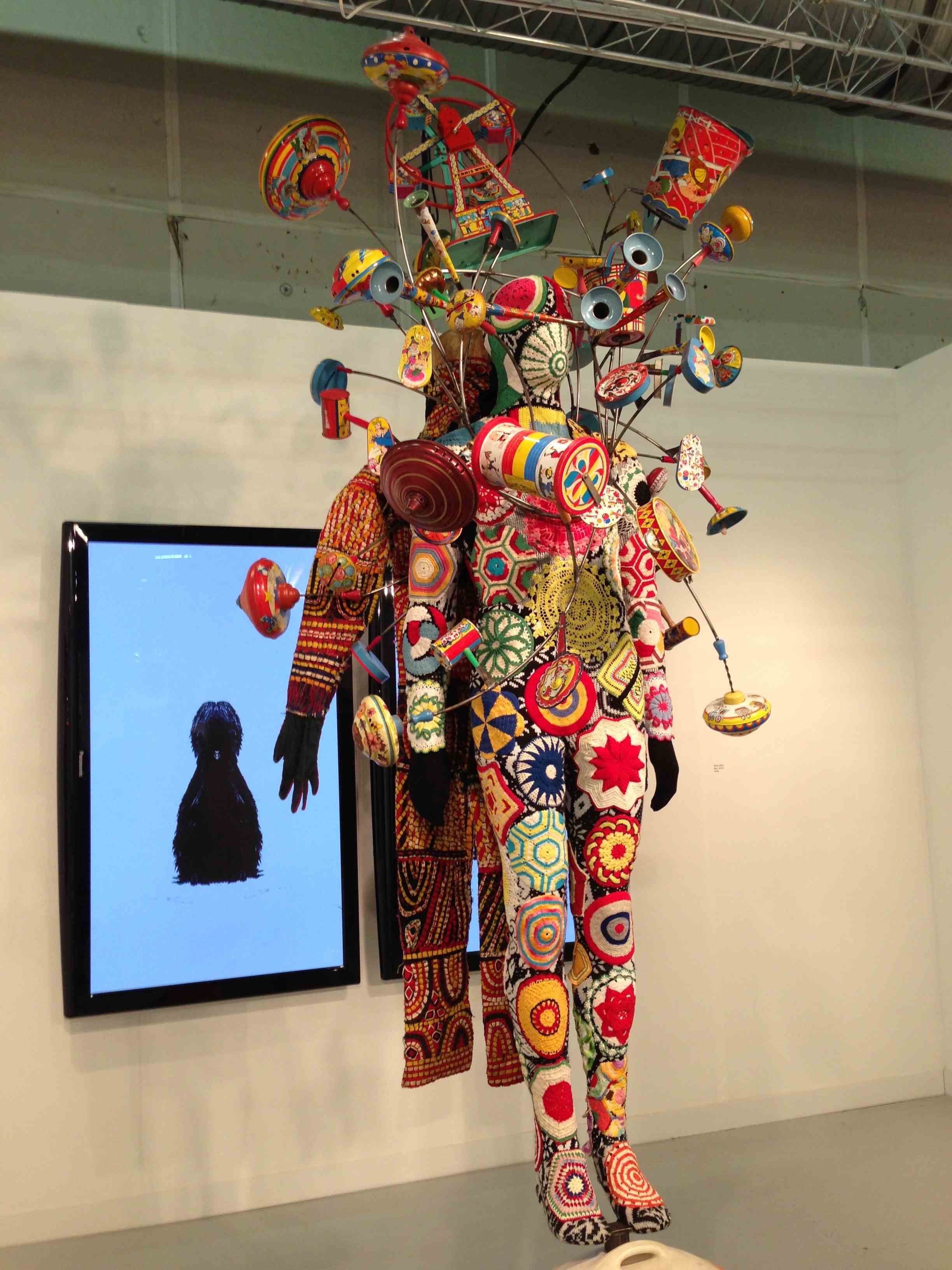
Nick Cave soundsuit (2012) and video featured at Jack Shaniman Gallery booth at the Armory Show’s Contemporary pier

Nick Cave soundsuit (2012) and performance video featured at Jack Shaniman Gallery at the Armory Show’s Contemporary pier

One hundred years ago, The Armory Show blew the roof off New York City as Matisse, Monet, Picasso, Seurat, Lautrec, Kandinsky and The Eight made history at Lexington and 26th Street. It was the beginning of Modern in America, and even Whistler’s Mother showed up.

This week, the 2013 edition of The Armory Show glamorized the West Side with its wall-to-wall extravaganza of modernist and contemporary sculpture, painting, and installation art at Piers 92/94. Take a walk-through of both shows via our Flickr photo feed.

Tributes to the original were in view in the Modern portion of the show, such as Munch’s intense woodcut Vampire II (1895-1902), as were edible Parisian imports from the Laudrée macaroon cart just inside the entrance. The show began right at coat check, where a few people were walking around carrying flattened-out versions of Andy’s Brillo boxes. Around the bend, there was the source: a silver chamber where the Pittsburgh’s Warhol Museum was inviting art-lovers to sit in front of a video camera to record a Warhol screen test. Obviously, the box carriers had claimed their 2.5 minutes of fame.

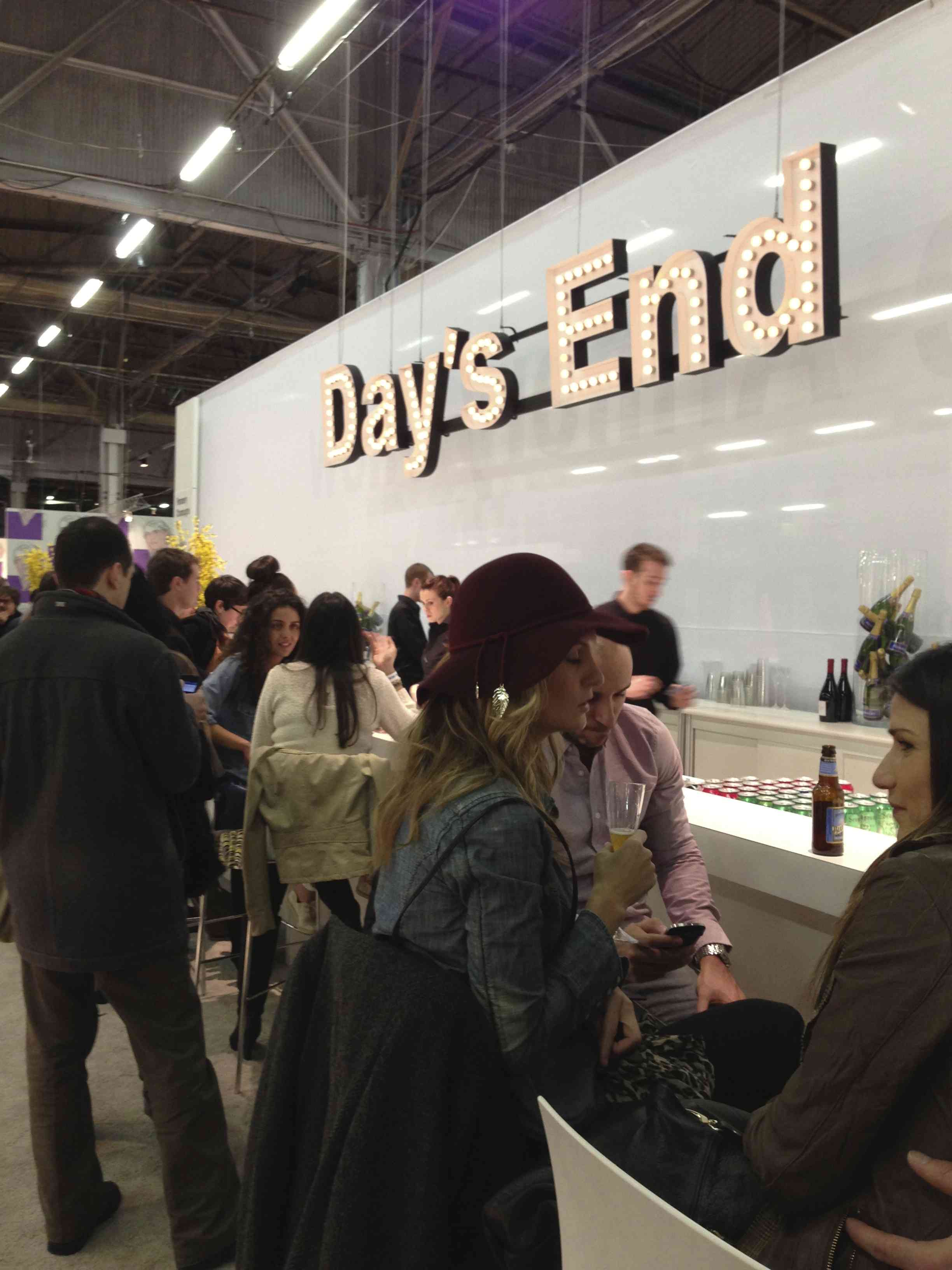
All-important champagne bar at the Armory Show’s Contemporary pier

All-important champagne bar at the Armory Show’s Contemporary pier

The Modern show featured a mix of new and old, but everything certainly looked fresh. People were even taking turns having their pictures taken with a large Basquiat painting at the Tokyo’s Galerie Sho Contemporary Art booth.

The Contemporary pier was filled with twice as much art. Although there were no actual performance installations on Saturday (as there were in last year’s show), two booths attracted lots of bystanders with performance videos – Marlborough’s Shade Composition video by Rashaad Newsome (evoking 80s Harlem ballroom voguing) and one of superstar Nick Cave’s soundsuit performances on a sharp, clean screen mounted right behind an actual, riotous soundsuit. (Be sure to catch his “horses” performing at Grand Central March 25-31 for Creative Time/MTA Arts for Transit.)

Other hits from the Contemporary pier (besides the champagne bar) included Tony Tasset’s snowman made entirely from inert material, right down to the bronze twigs and leaves (Kavi Gupta Gallery) and Kysa Johnson’s monumental recreation and embellishment of a Bank of America waiting room at Morgan Lehman, layered with the calculated, rational precision of Piranesi’s perspective.

Take a look, because it’s all being packed up and shipped back to Dusseldorf, Istanbul, Oslo, London, Paris, and Chelsea today.

Artists Occupy Bank in Queens

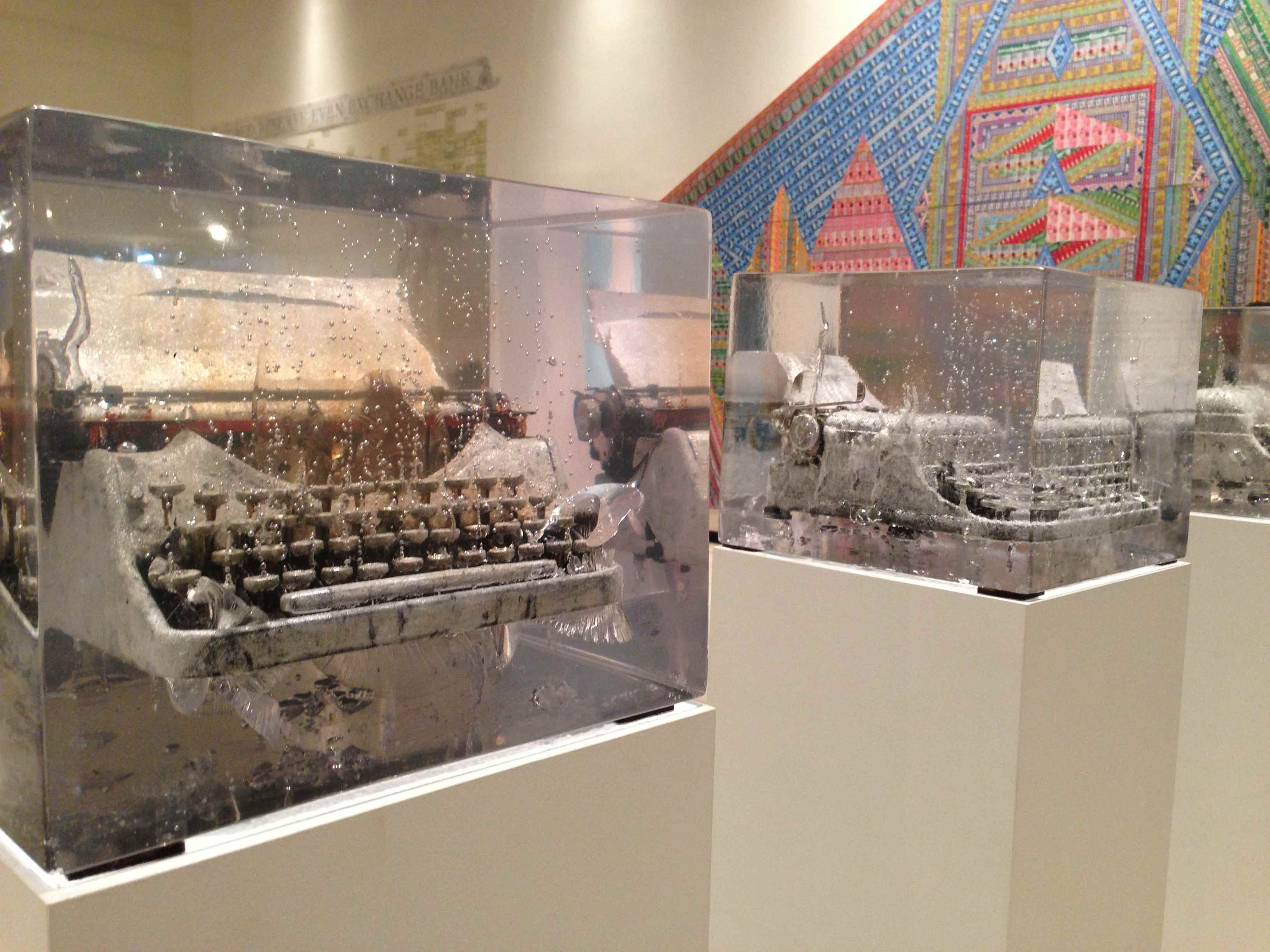
Installation view of Keiko Miyamori's typewriters-in-resin (2012) with Ghost of a Dream's The Price of Happiness mural (2011) made from US and Chinese lottery tickets.

Installation view of Keiko Miyamori’s typewriters-in-resin (2012) with Ghost of a Dream’s The Price of Happiness mural (2011) made from losing US and Chinese lottery tickets.

Just as they did in the Bronx last summer at the Andrew Freedman Home, No Longer Empty has invited artists take over the former Bank of Manhattan in Long Island City and let us contemplate the meaning of currency and exchange in today’s troubled times.

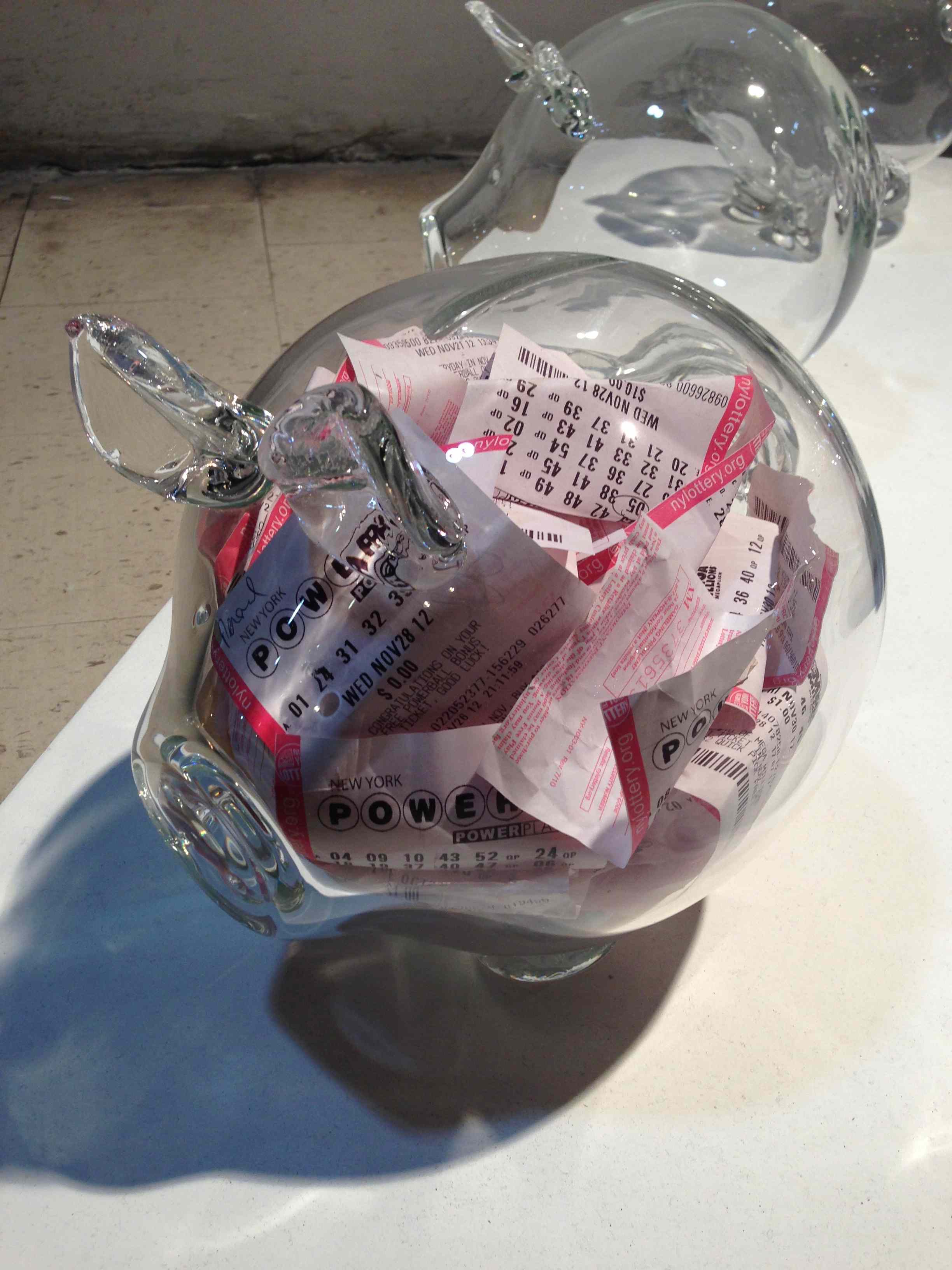
Get over to see how 26 artists from 15 countries think about the American economy in How Much Do I Owe You, which is right next to the Queens Plaza subway station in the Clock Tower Building (29-27 41st Avenue). There’s lots of thought-provoking stuff from the moment you enter the door, like Ghost of a Dream’s The Price of Happiness mural. It depicts a typical American house made up of losing US and Chinese lottery tickets, and was made by the group during their stay in China. Check out more pictures of our favorites on Flickr.

Installation view of Coleen Ford's Saving for our Future (2010), glass piggy banks stuffed with lottery tickets.

Installation view of Coleen Ford’s Saving for our Future (2012), glass piggy banks stuffed with lottery tickets.

Erika Harrsch’s Mao Dragon Kite and several US Dollar Kites fly overhead.  Keiko Miyamori’s typewriters-sunk-in-resin evoke historic systems and intractable problems. Susan Hamburger adorns a faux “bank” space (formerly where the bank tellers worked) with an old-style, symbol-filled mural that lays out relationships among Wall Street and Euro financial actors in the Greek debt crisis.

Downstairs by the bank’s vault, installations have a more private feel. Enter a small room to see and hear the results of Nicky Enright’s survey of the financial status of 80 artists in his Money Talks video (it’s not pretty). Enter a small alcove to watch Ana Prvacki’s amusing video of literal money laundering – in the guise of a “smelling good” household product commercial (think Wet Ones), she cleans and smells dollars in the hopes that she can bring about “a clean money culture”

When you round the corner to enter the open vault, you’ll be completely absorbed in watching Orit Ben-Shitrit’s mysterious performance video, Vive le Capitale, which was shot in HD among the vaults of the old Bankers Trust building at 14 Wall Street.

Last weekend, the gallery was packed for a round-table discussion – one of several live events that No Longer Empty has scheduled here until closing on March 17. Alert: Lots of cool things are planned for the space on March 8, Long Island City Night of Armory Arts Week, so catch a tour or a provocative conversation.

If You Love Brooklyn, Get to GO!

Installation view of Yeon Ji Yoo’s The Fight (2012), made of paper, paper pulp, acetate, glue, packing tape, cheesecloth, plastic flowers, recycled plastic bottles and bags

Installation view of Yeon Ji Yoo’s The Fight (2012), made of paper, paper pulp, acetate, glue, packing tape, cheesecloth, plastic flowers, recycled plastic bottles and bags

Tucked away in the Mezzanine Gallery on the second floor at the Brooklyn Museum is a valentine to the borough, its artists, and the support and love they received last September in Go: A Community-Curated Open Studio Project. It mixed trudging around Brooklyn, democracy in action, and high-tech to peer into other worlds right in our own backyard.

The museum commissioned an app, asked artists to open their studios, and invited the world to visit and vote for their favorites. (Apparently, it was inspired by an art competition organized out of Grand Rapids!)

GO tracked the art makers and art seekers – take a look at the “weekend activity heatmap” and the other GPS-gathered stats. The results showed a lot of love – 18,000 visitors making 147,000 studio visits to about 1,700 artists over a two-day period, or about eight studio visits per participant. See the raw data for yourself, broken out by neighborhood. Learn a bit more about the voters here.

Art lovers nominated 9,457 artists for a museum showing, and eventually voting and curators whittled it down to five spectacular representatives. Interestingly, four on display were born outside the United States.

Yeon Ji Yoo of South Korea, currently lives in Greenpoint and works in Red Hook. The large installation piece in the show is inspired by her grandmother’s fading memory. Listen as she talks about growing up in South Korea’s rural countryside:

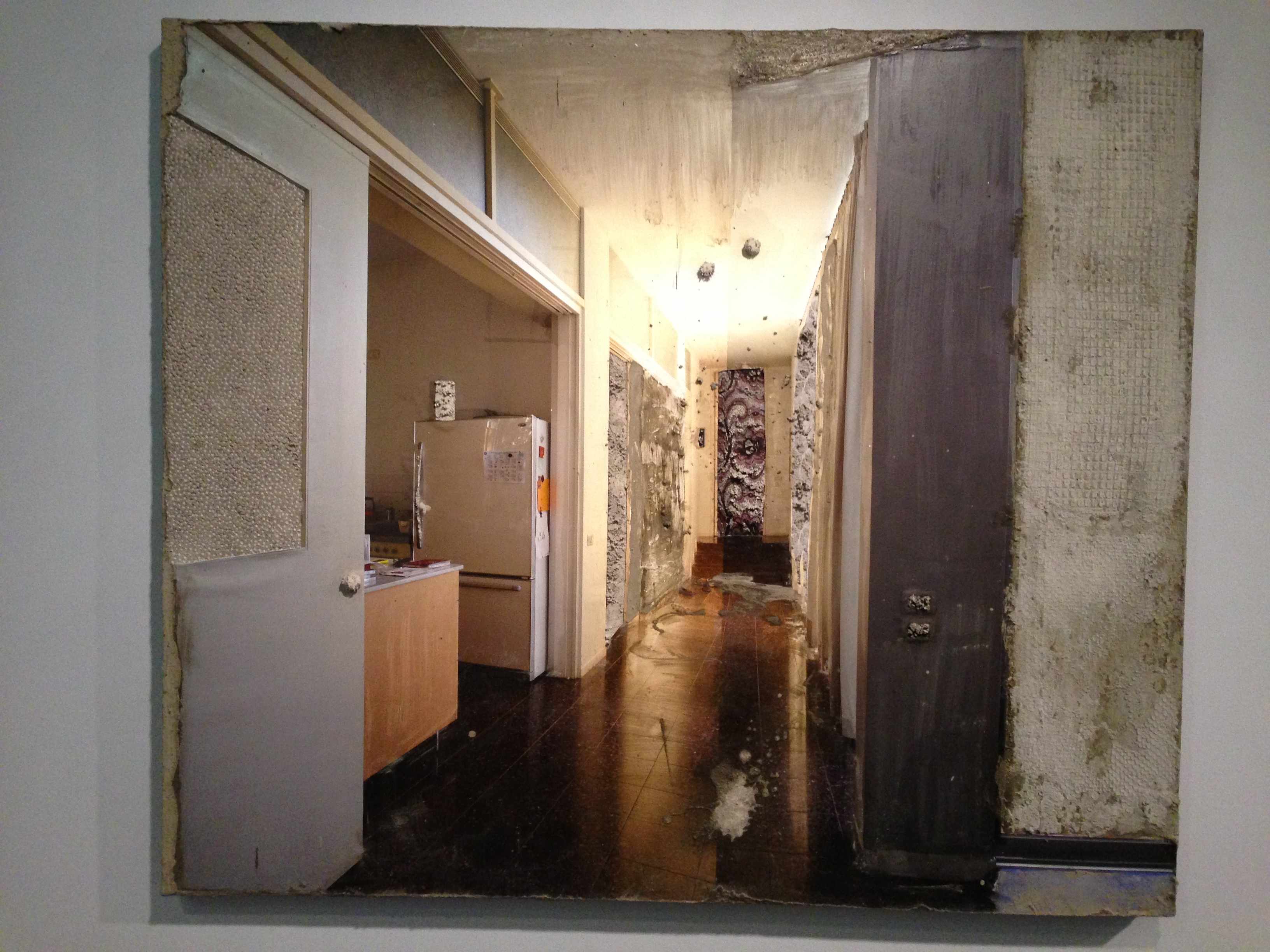
Installation view of Naomi Safran-Hon’s Home Invasion (2011). Archival inkjet print, lace, and cement on canvas

Installation view of Naomi Safran-Hon’s Home Invasion (2011). Archival inkjet print, lace, and cement on canvas

Naomi Safran Hon (of Prospect Heights) prints photographs of her hometown of Haifa, Israel on canvas; makes some cuts in the image; and pushes cement through lace to make a 3-D effect. She feels she’s working out the push/pull of the political and domestic realities of where she grew up. But let her tell you:

Meet the other artists, too: urban watercolorist Adrian Coleman, and painters Oliver Jeffers, and Gabrielle Watson. But if you really love Brooklyn, get over to experience the work in person, and add your comments. The museum’s open late on Thursday.

Party Like It’s 1913 at Grand Central

Just after the clock strikes midnight on GCT's 100th birthday

After the clock struck midnight on GCT’s 100th birthday

At midnight tonight, the crews, security, police, and station manager were on hand to see the famous clock above the information desk signal the beginning of Grand Central Terminal’s 100th birthday. Just like a film set, everyone was concentrating on pulling magic out of a hat for the public birthday celebration that begins today.

If you’re within commuting distance, get over to Grand Central today to rub shoulders with celebrities, artists, and officials commemorating 100 years of our beautiful terminal.   At 10am, see Cynthia Nixon, our poet laureate Billy Collins, Keith Hernandez, Caroline Kennedy, Melissa Manchester, and (yes) the Vanderbilt family pay tribute in a rededication birthday celebration.

Check the web site for the afternoon schedule of honors, music, giveaways, and  1913 prices (one day only!)  for shoe shines (10¢), fries (10¢), loaves of rye bread (6¢), pasta (5¢), and cocktails at Michael Jordan’s (75¢).

IMG_1706Also, be sure you seek out the replica of the Terminal made out of Lego bricks in the Station Master’s Office. Then, dance the afternoon and night away (until 9:30) with Grammy Award-winning big band Vince Giordano and the Nighthawks. The celebration continues all year, but more on that later.

If you can’t get there, enjoy the new history timeline from your desktop (especially the part in 1976 with Jackie).

Or watch the Metro-North guys polishing up the chandeliers in Patrick Cashin’s photos on the MTA Flickr feed.

Clock Ticks All Night at MoMA

Christian Marclay. Video still from The Clock. 2010. Single-channel video with sound, 24 hours. © Christian Marclay. Courtesy Paula Cooper Gallery, New York

Christian Marclay. Video still from The Clock. 2010. Single-channel video with sound, 24 hours. © Christian Marclay. Courtesy Paula Cooper Gallery, New York

If you didn’t get to see it last summer in the Atrium at Lincoln Center, Christian Marclay’s The Clock is back, just in time for the countdown to the New Year.

MoMA is offering the first 24-hour screening of the 24-hour art film tonight on New Year’s Eve, so art lovers can experience the 24-hour countdown of clocks in real time. To keep its guests satisfied, MoMA is extending café hours until 1am and keeping its espresso bar open all night.

If you have other plans for this New Year’s Eve, don’t worry. The Clock screens at MoMA until January 21 and you’ll have ample opportunity to catch the non-stop action. On subsequent Fridays (January 4, 11, and 18), MoMA will start The Clock at 10:30am and keep it ticking in the Contemporary Galleries until 5:30pm the following Sunday.

First come, first served, with no time limits.