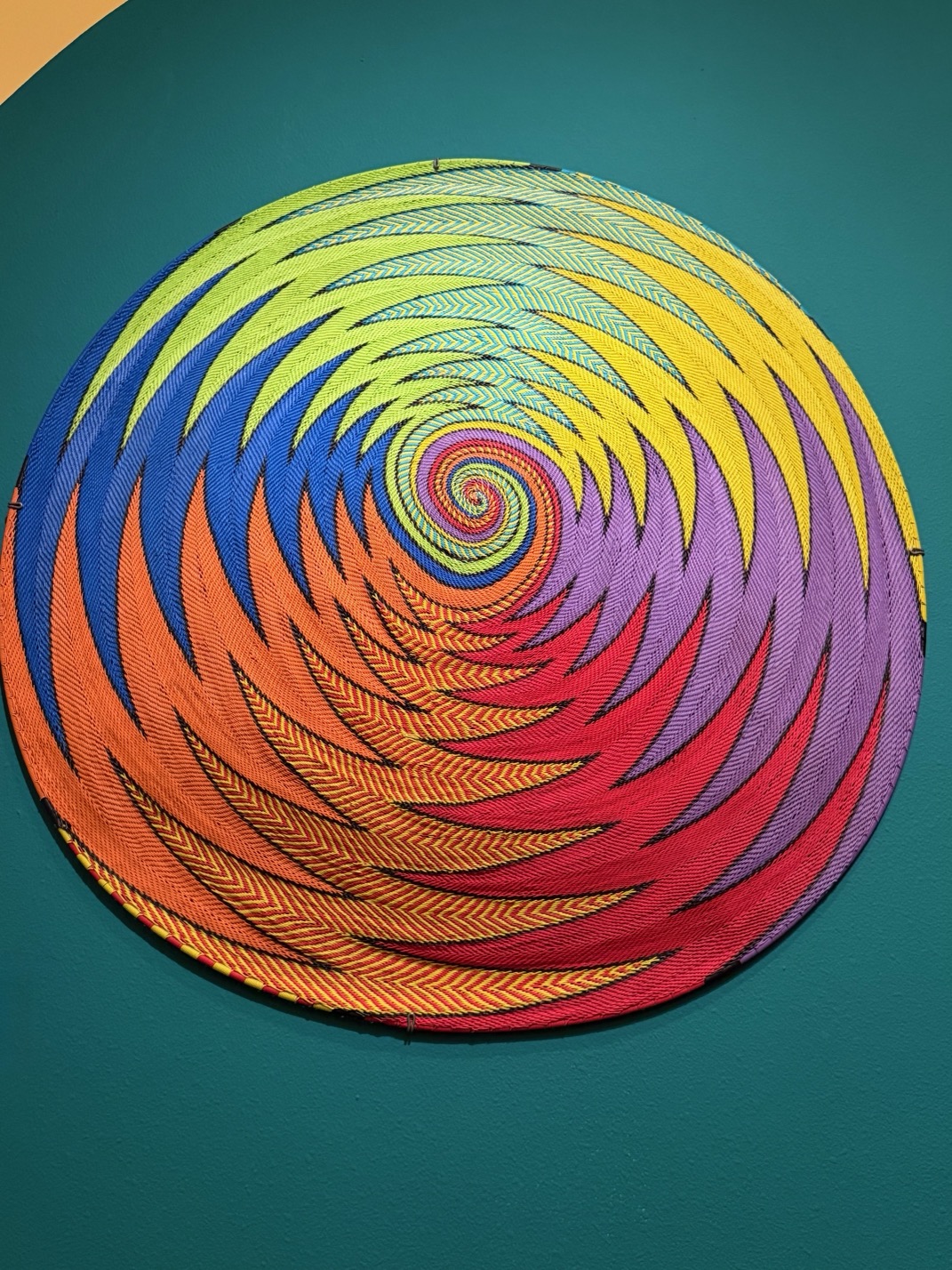
How do you take a domestic beer pot and lid and turn it into art? Take a look at the dazzling designs on display in the first museum exhibition dedicated to one of the most unique art forms to blossom in post-Apartheid South Africa – iNgqikithi yokuPhica/Weaving Meanings: Telephone Wire Art from South Africa, on view at Santa Fe’s International Museum of Folk Art through March 29, 2026.
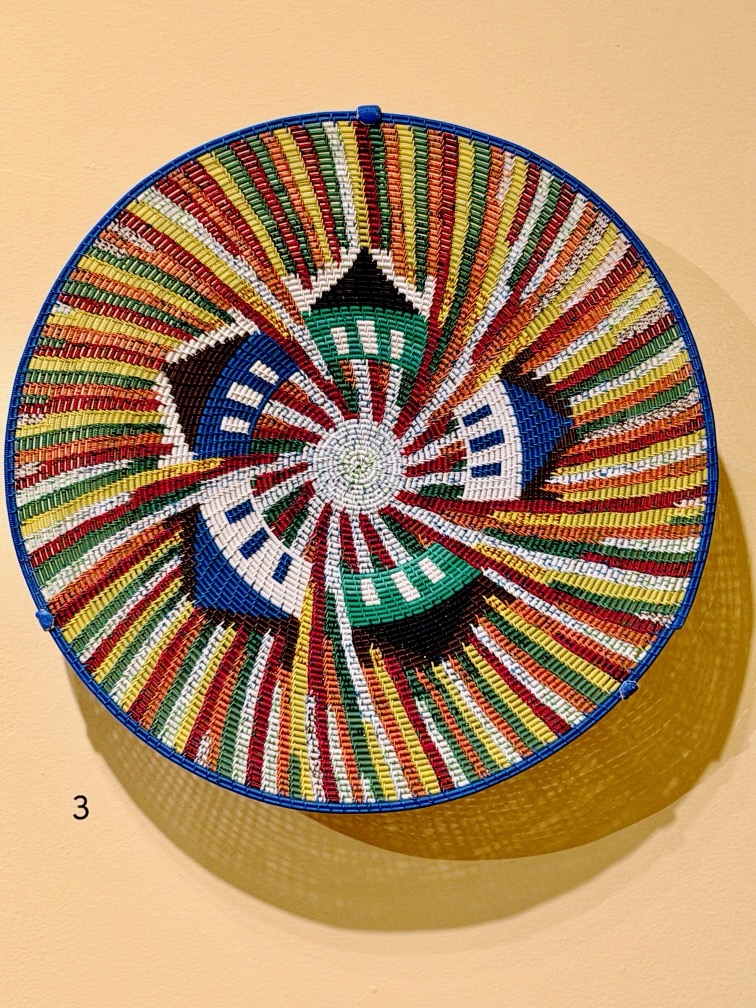
It’s easy to be overwhelmed at the the intricacy of the colorful, whirling designs that first meet your eye. But when you slow down to look more closely, all sorts of meanings appear – ancient tribal writing, village scenes, Zululand wildlife, patriotic emblems, and even celebrated achievements in the sports world
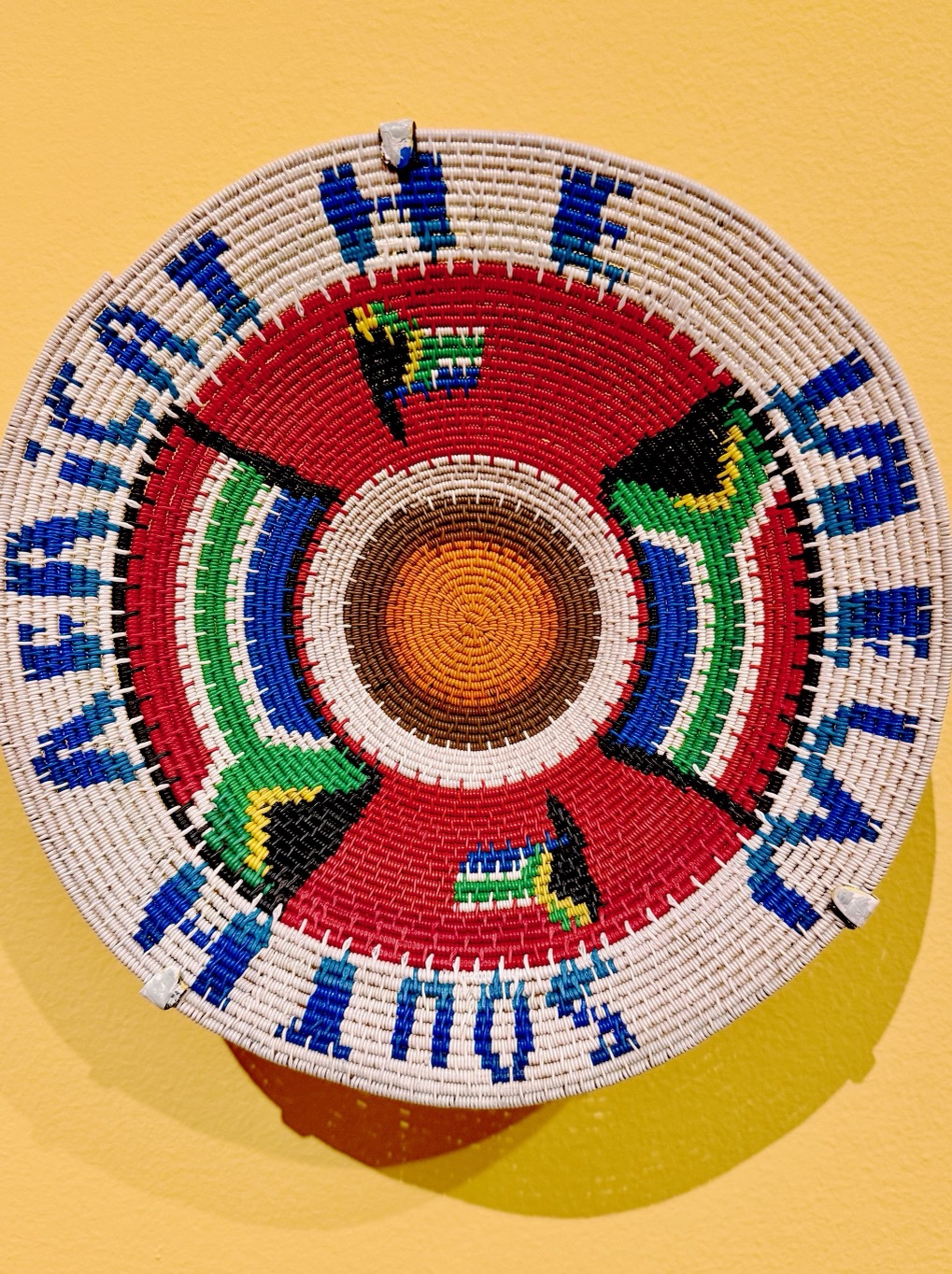
Dudu Cele’s 1990s The New South Africa telephone-wire weaving celebrating the end of apartheid featuring the colors of the nation’s new flag.
Take a look at some of our favorite works in our Flickr album.
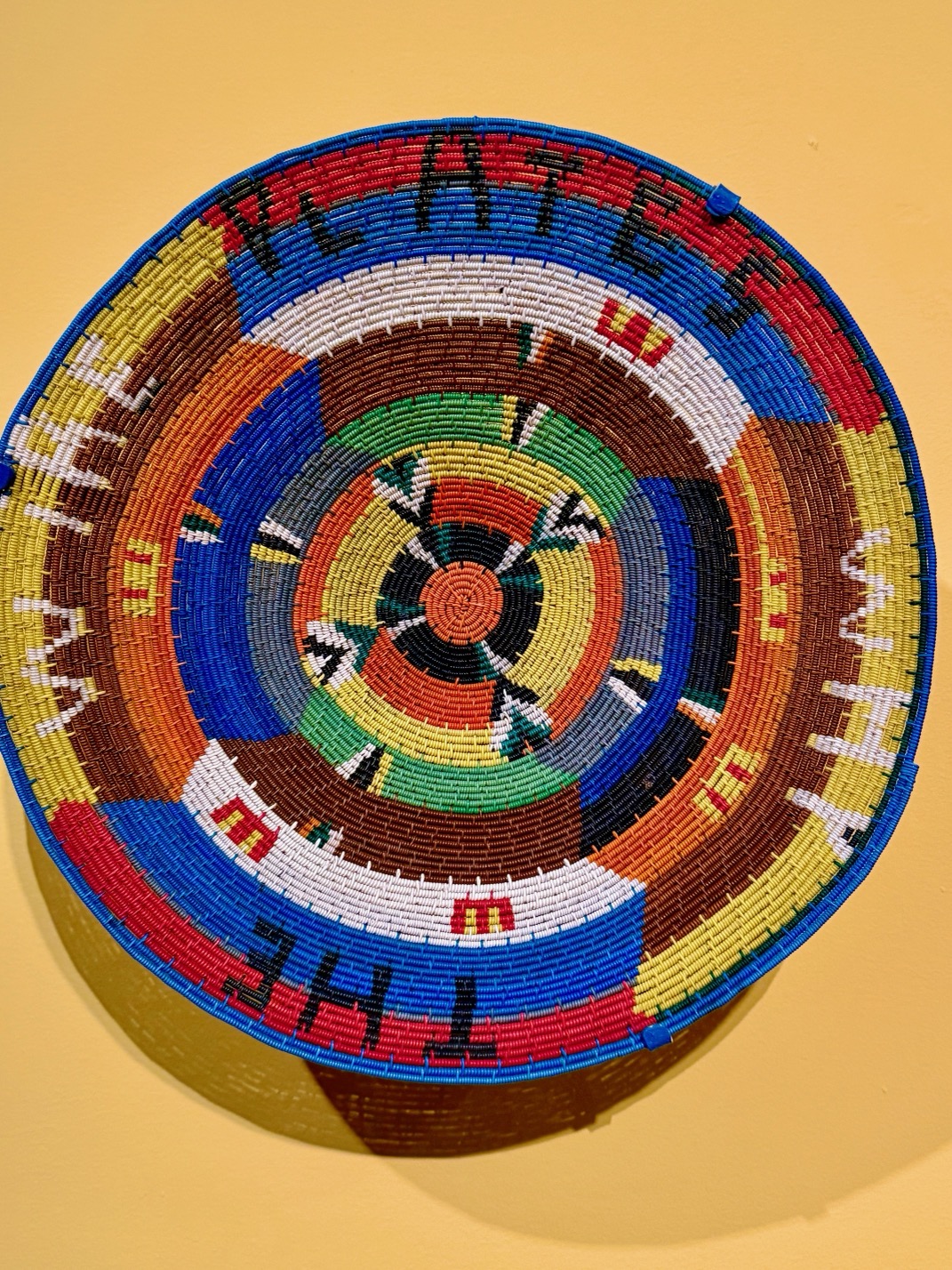
The journey begins with Bheki Diamini’s 1990s telephone-wire basket, whose text asks the question “Why the Wire Plates?” T
The exhibition answers by explaining the long history of African wire weaving, the stories of innovators who started using colorful telephone wire in the 1990s, and how it became an economic game-changer for practitioners.
As far back as the 16th century, wire and metal rods were popular trade items in South Africa, and by the 19th century, everyday people were embellishing snuff containers and traditional sparring and walking sticks with intricate wire weaves. Although traditional beer and grain pots were made of woven fiber, and sometimes people wove in beads to personalize (and identify) their own.
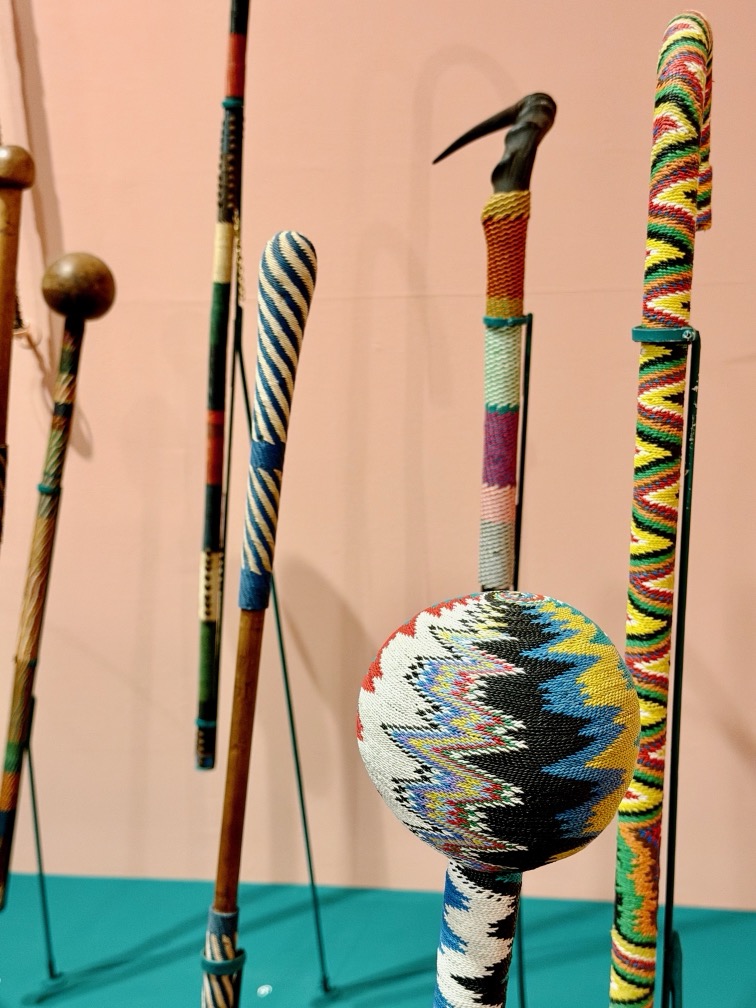
An array of sparring sticks embellished with telephone wire and other materials –dancing sticks, 2005 walking stick, and Peter Lekotjo’s 2005 knobbed fighting stick.
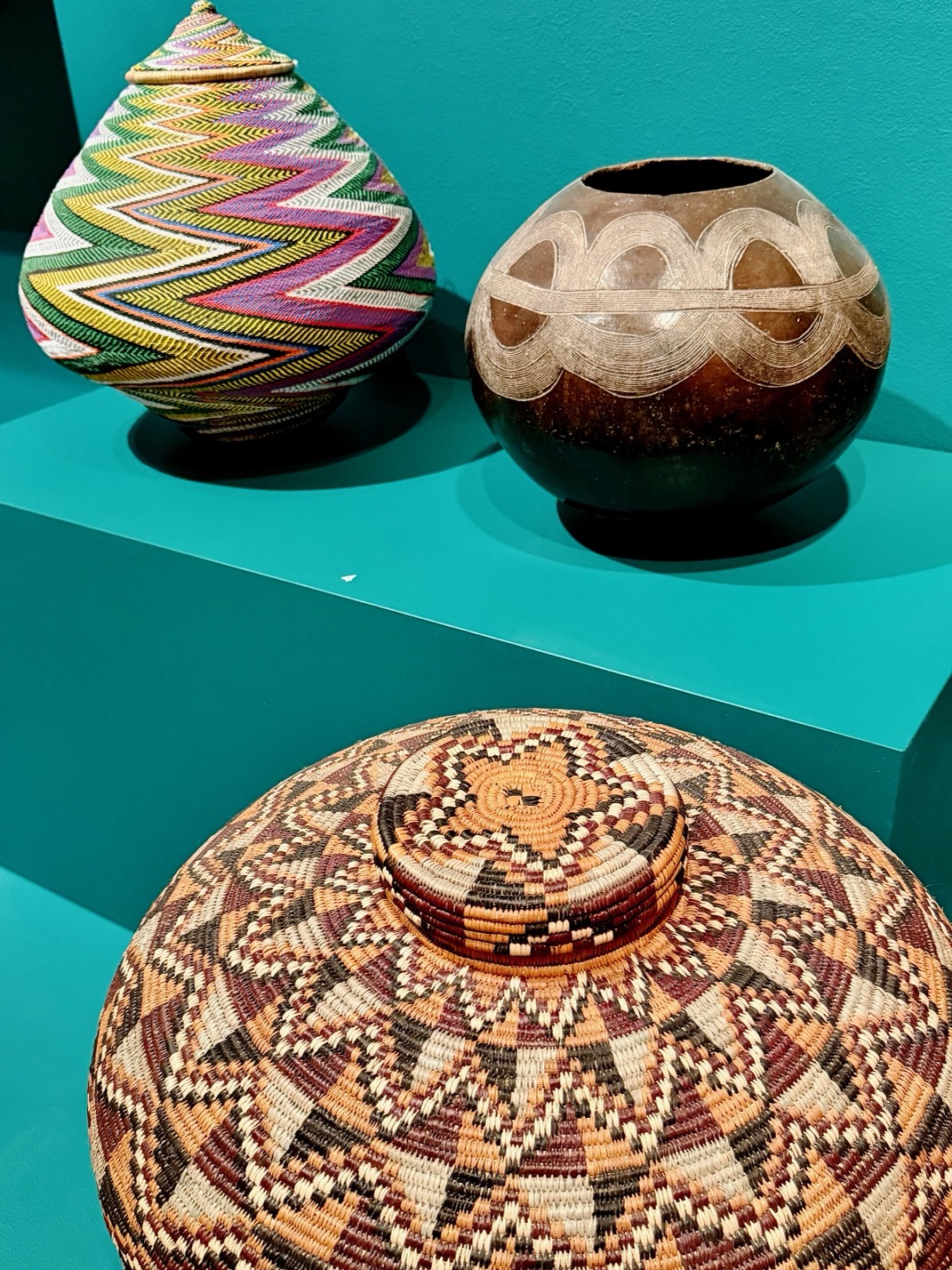
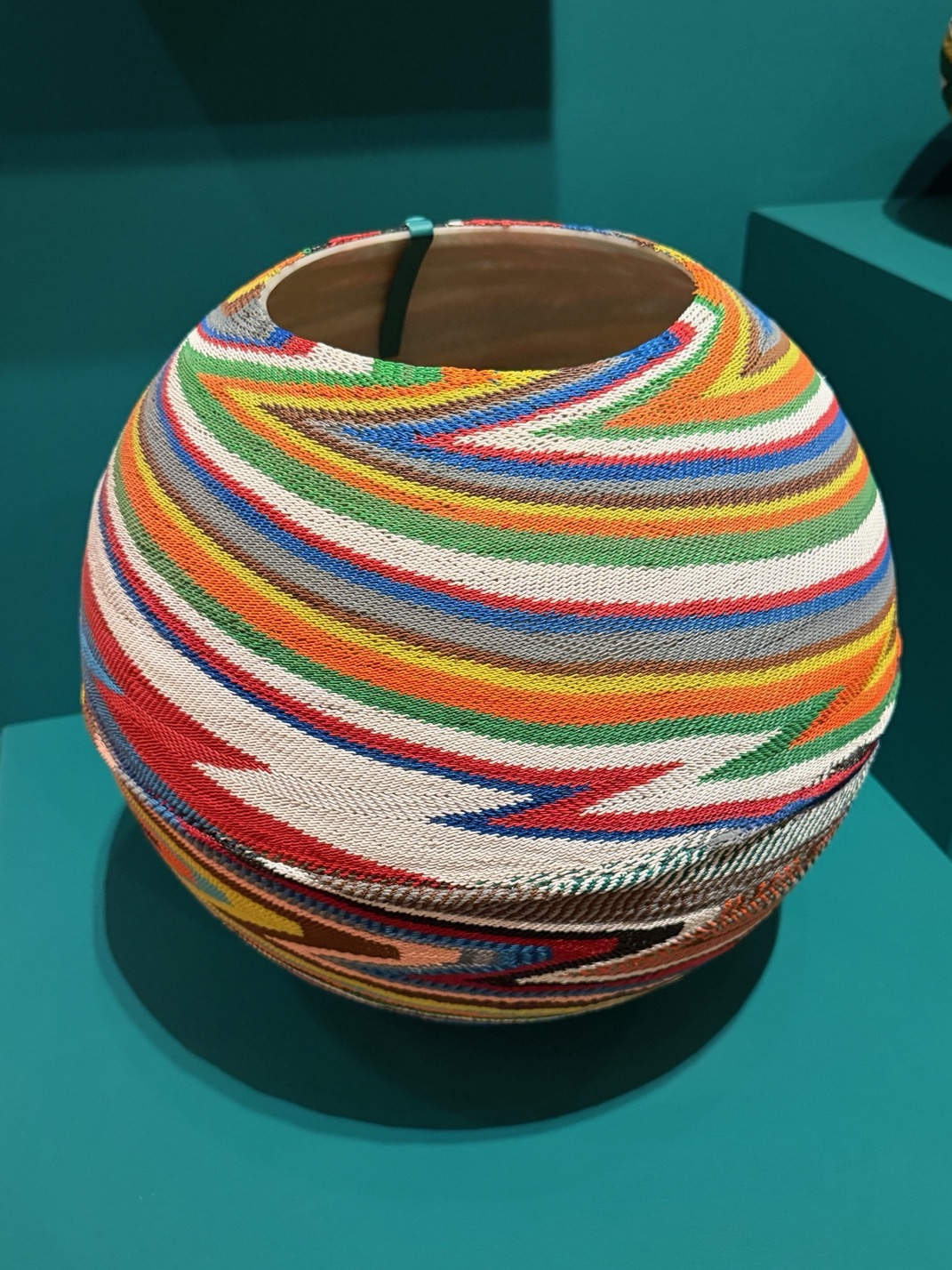
Rare late 20th-century works made of telephone wire and natural materials – a palm and grass basket embellished with telephone wire, an earthenware grain-storage pot, and Laurentia Diamini’s grain storage basket woven with palm and grass.
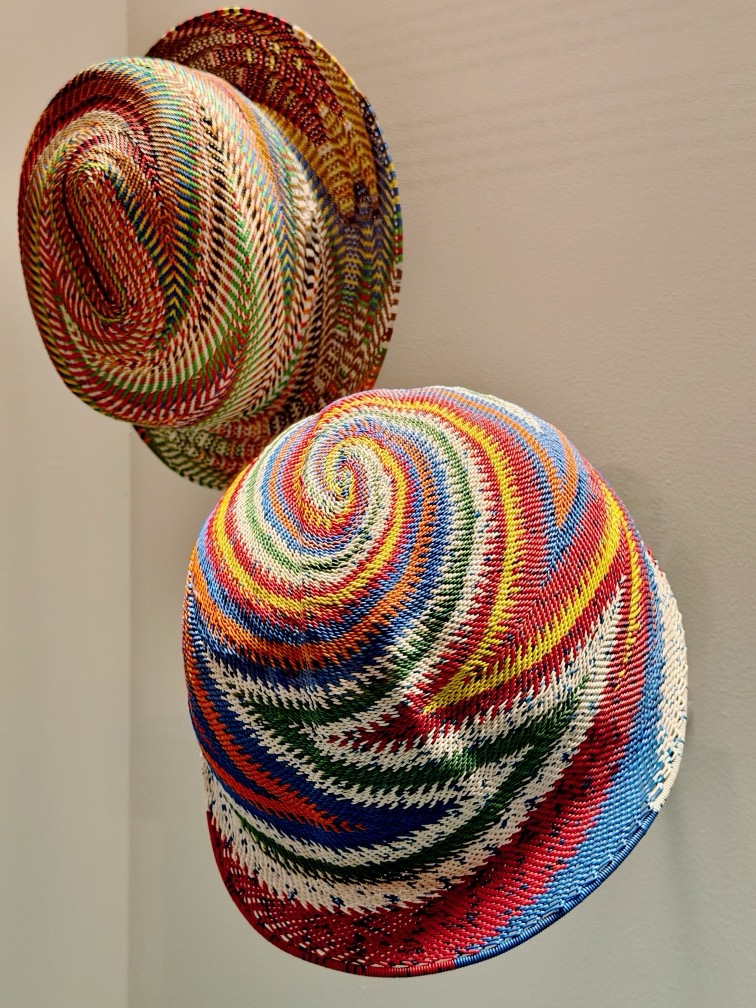
In the 20th century, when a few weavers began incorporating colorful telephone wire into their work, it didn’t take long until highly decorated sticks, colorful hats, amped-up drinking cups, and beer pot lids were transformed. Under the repressive apartheid system, Black South Africans lived under highly restrictive work-life conditions, just scraping by and hardly able to afford most art making materials.
As telephone technology was deployed across Black communities in South Africa, the spools of colorful, coated wire surged in popularity as a tool more creative expression because workers often cast it off when industrial projects were done. Cheap (or free!), plentiful, and in a dozen colors! Perfect!.
Two hats embellished with telephone wire – a top hat (pre-2007) and Shadercke Ntuli’s 2000 hard hat – similar to those used for mine-worker dance performances.
Michael Mfeke’s late 20th-century telephone-wire basket in the shape of a beer pot (ukhamba).
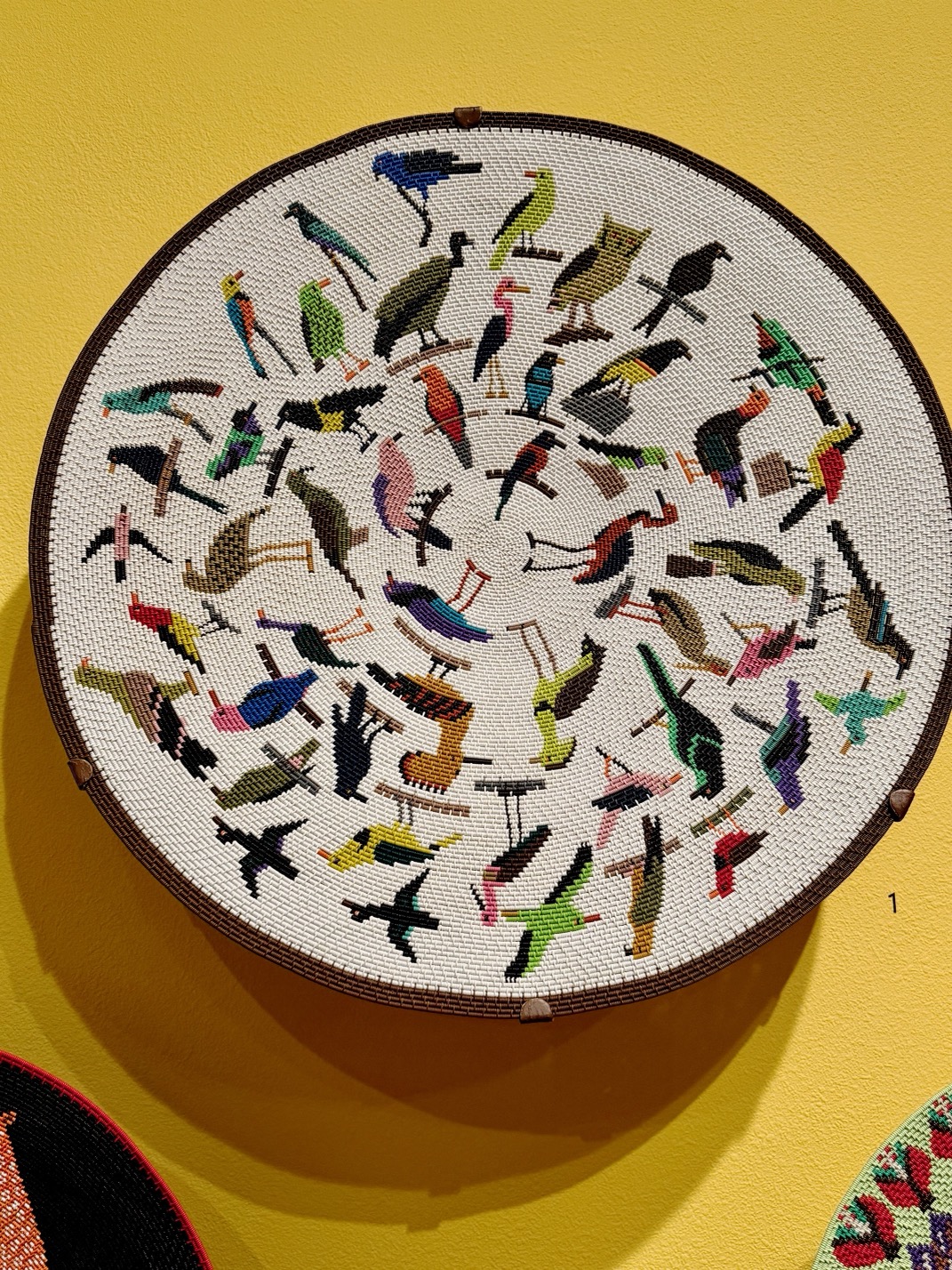
Rather than making an historical exhibition, the curators have chosen to focus on grouping work by and presenting biographies of the innovators – like master weavers Bheki Diamini, Jerita Mmola, Elliot Mkhize, Vincent Sithole, and othes – who popularized this art form with makers in their own country and collectors internationally. It’s captivating to see all the ways Sithole, for example, incorporated wildlife into his designs to satisfy demand from tourists who began flocking to South Africa as a safari destination.
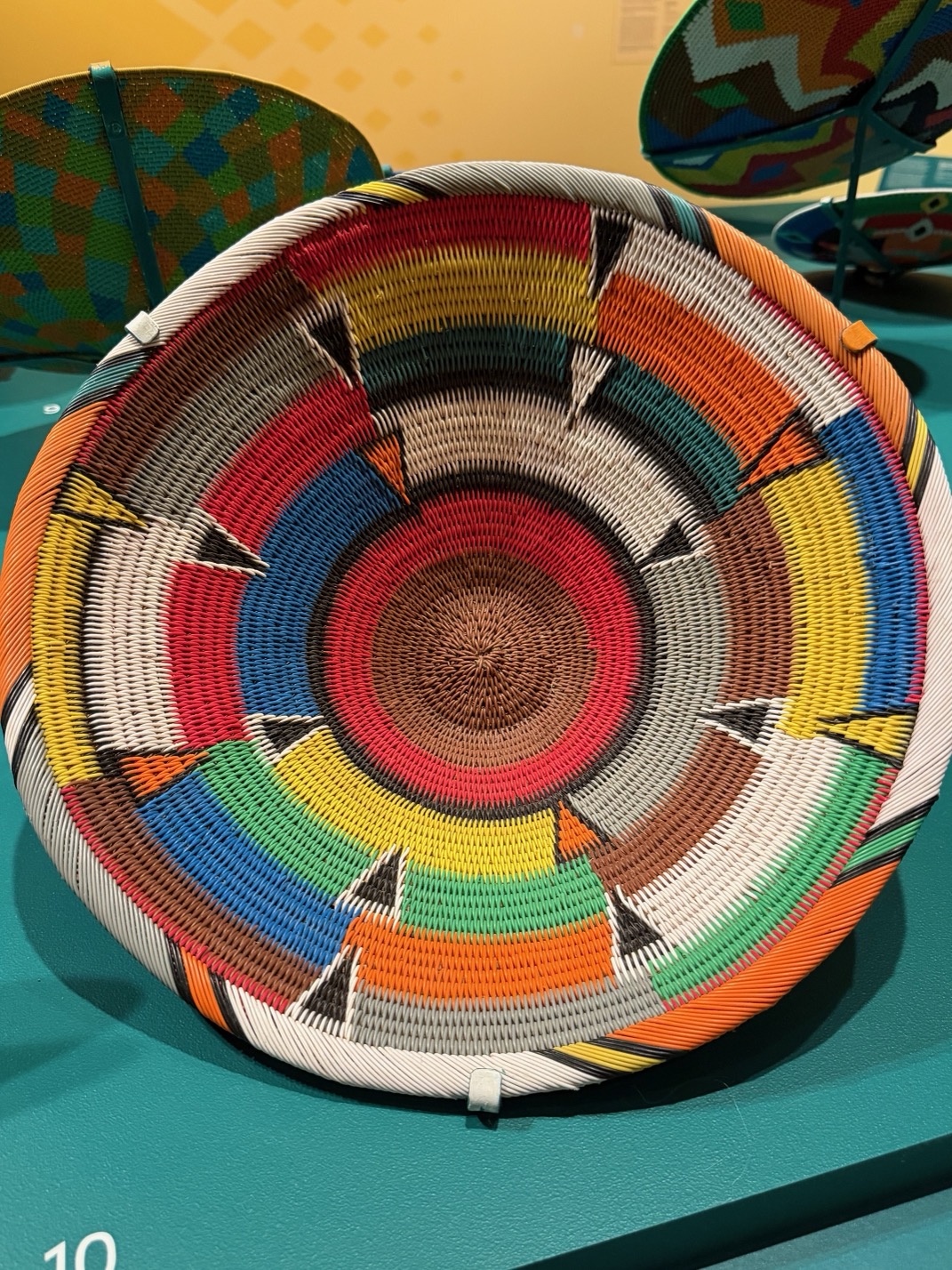
Colorful 1990 telephone-wire food basket (xirutu) by Jerita Mmola of Limpopo, South Africa.
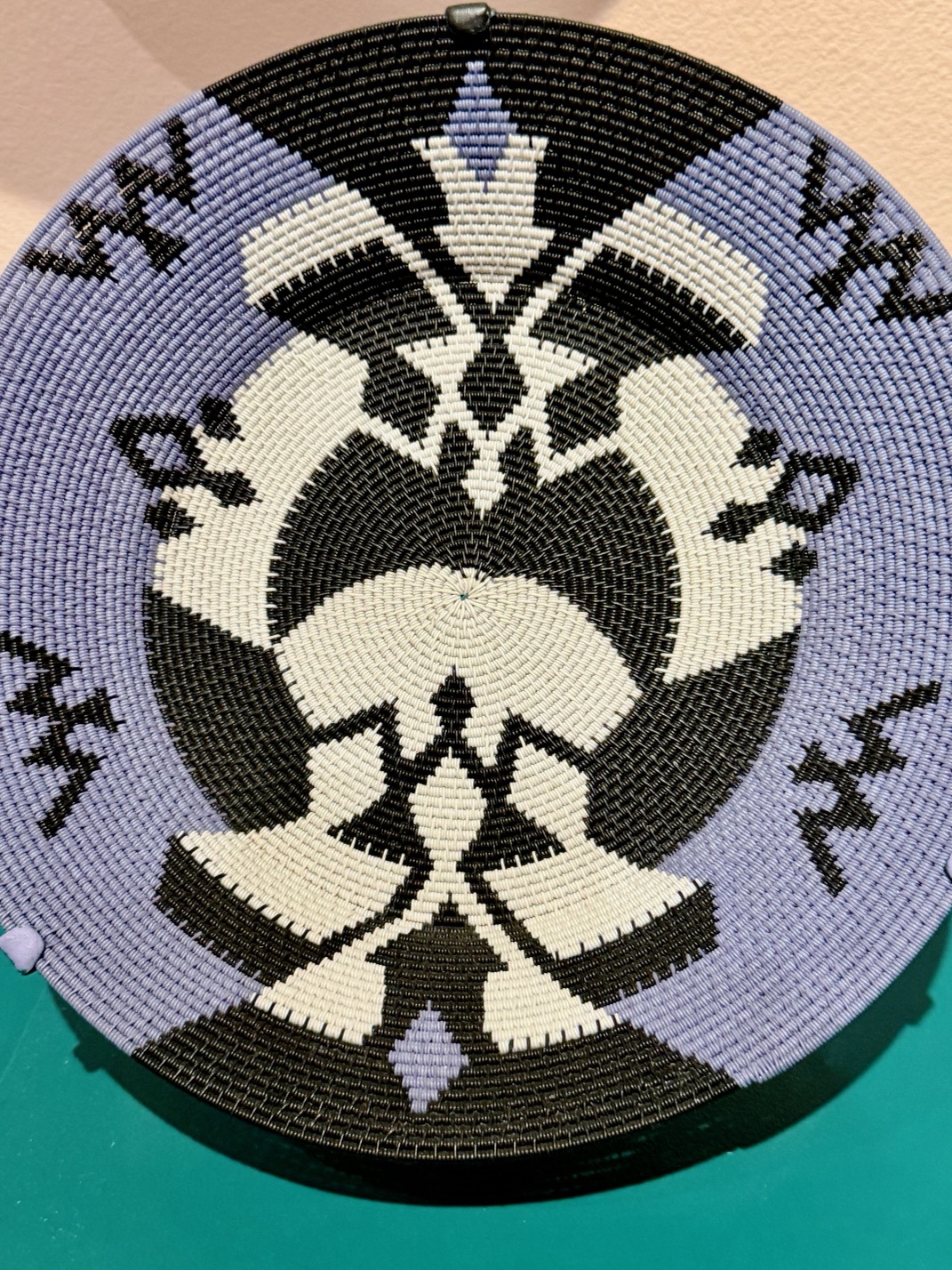
Elliot Mkhize’s 1997 telephone-wire basket with abstract symbols inspired by ancient Zulu hierographic writing.
A compelling video in the center of the exhibition takes visitors into the Maphumolo family home to show how increased revenue from art sales – in South Africa and abroad at art festivals – have boosted living standards and opportunities for artists on an intergenerational basis.
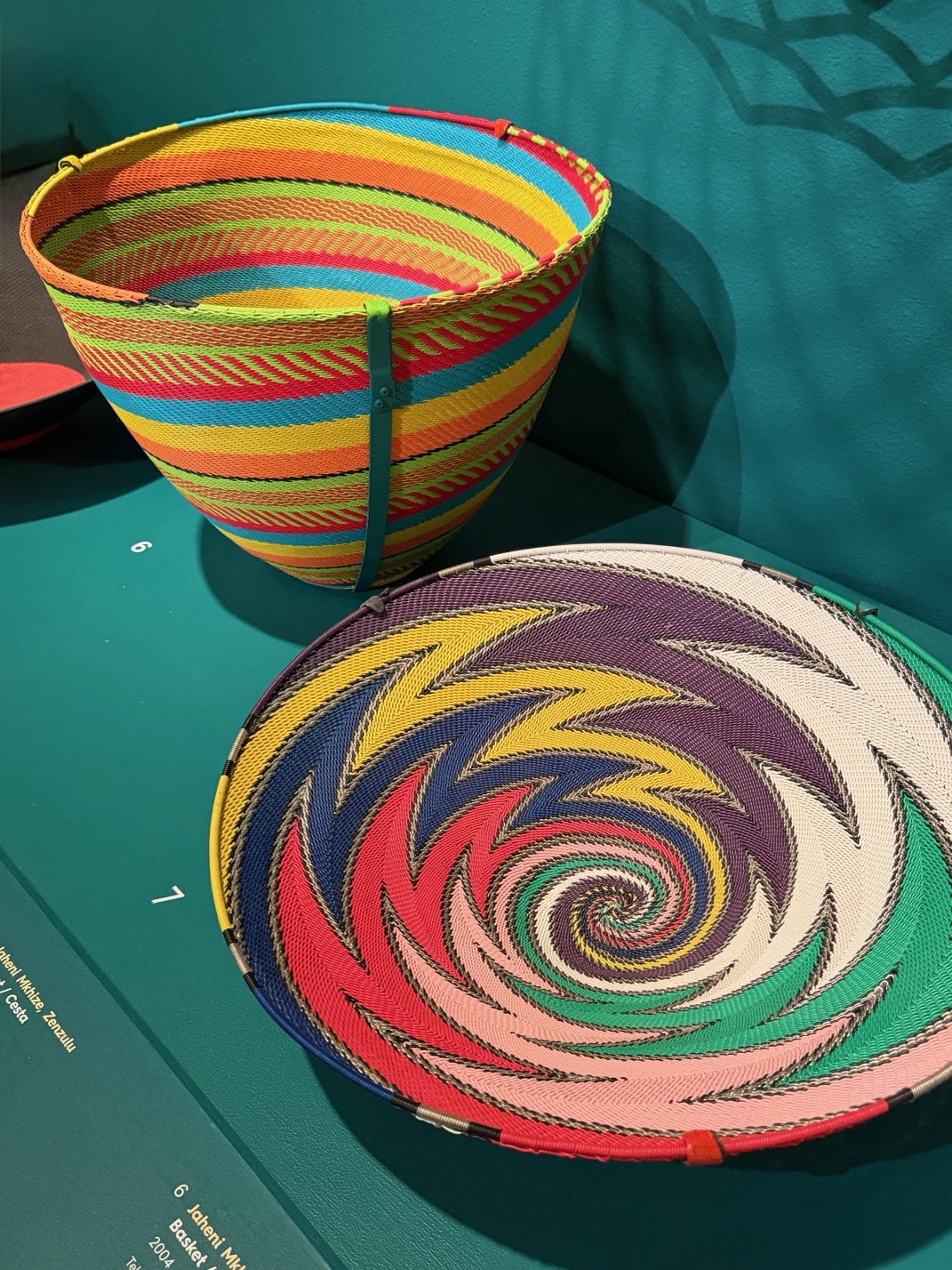
Two by master soft-wire innovator Jaheni Mkhize – 2004 cone-shaped basket and colorful 2000 telephone-sire basket.
In the mid-1990s and early 2000s, as tourism to South Africa increased, weavers began to incorporate South African wildlife, create whimsical wire animals, and depict rural villages to boost a new pride in the homeland. Sports triumphs are celebrated by weavers, too.
Figurative master Vincent Sithole’s 2008 telephone wire basket depicting numerous species of South African birds. Courtesy: Arment-Rimelspach collection.
Octavia Gwala’s 2005 telephone-wire and wire weaving showing a rondavel – a circle of thatched-roof Zulu homes that form a homestead.
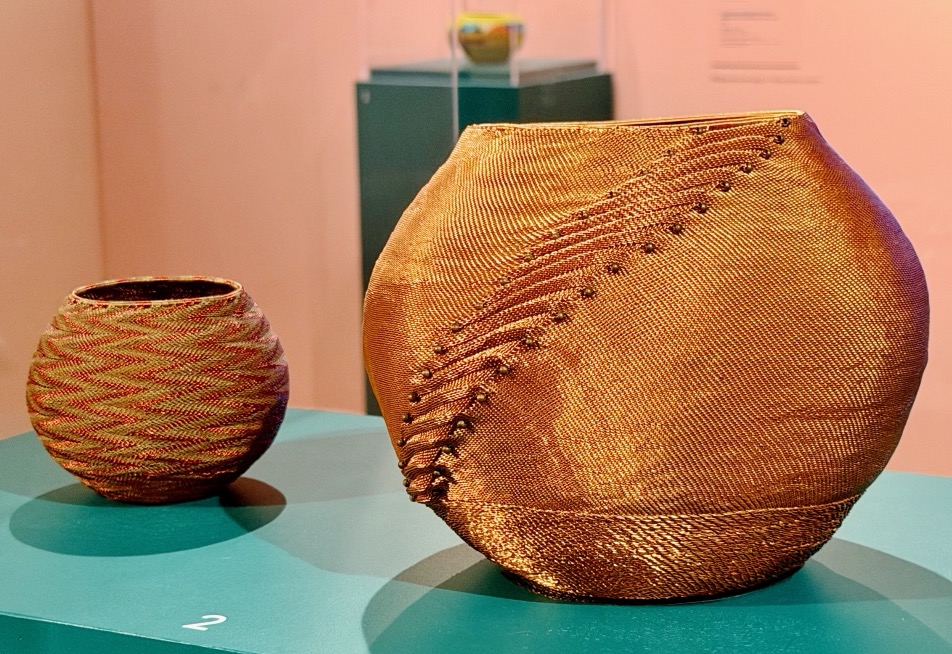
The exhibition walk-through concludes with work exemplifying new trends – baskets that incorporate pop culture references. three-dimensional wall pieces, and shimmering works in gleaming woven copper wire.
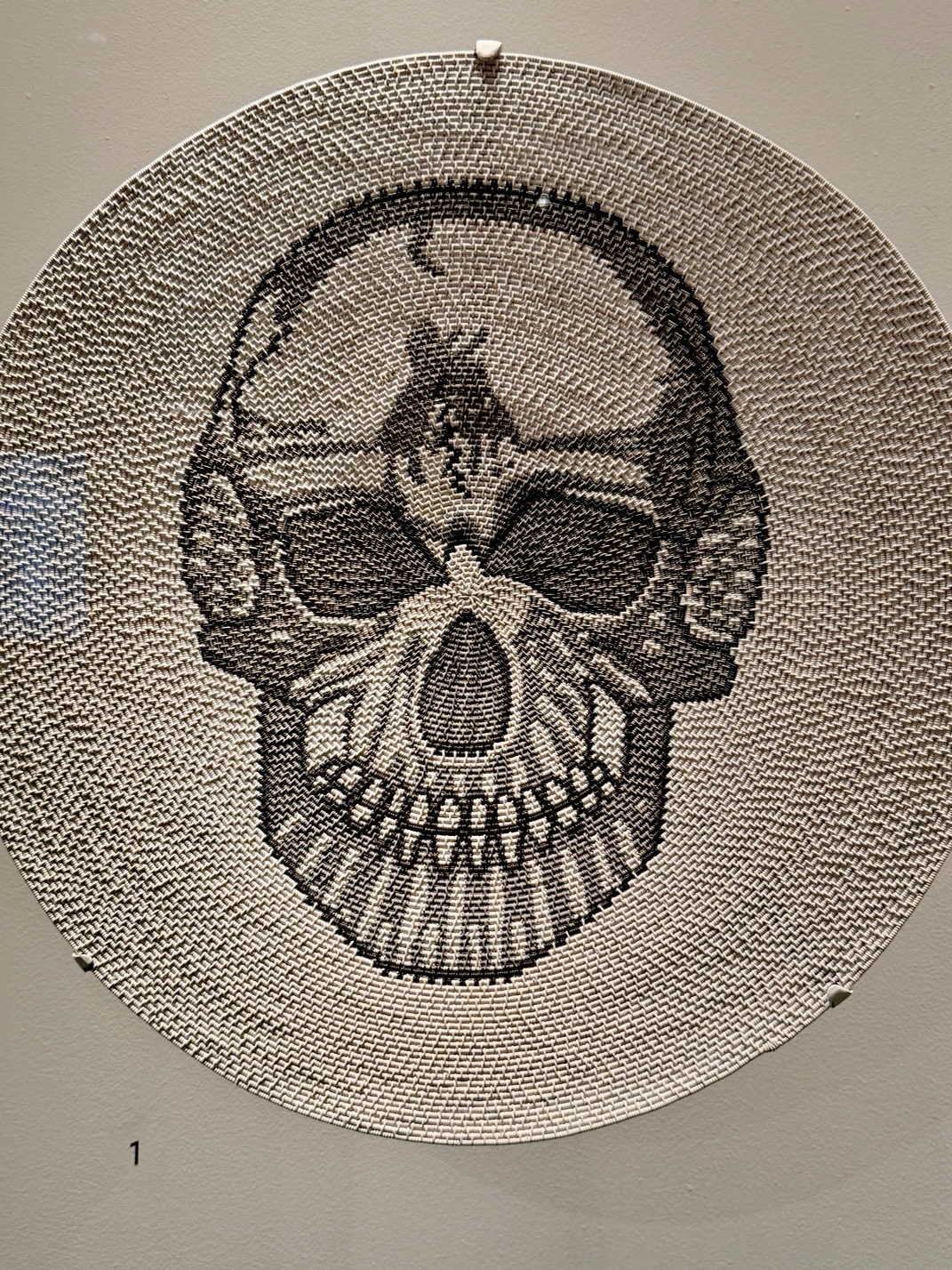
Simon Mavundla’s 2013 telephone-wire and wire basket Grey’s Anatomy Series: Norma Frontalis from a design by Marisa Fick-Jordaan. Courtesy: Arment-Rimelspach collection.
Details of 2009 Nature Series, Wall Platter, Rousseau, a three-dimensional telephone-wire sculpture designed by Marisa Fick-Jordaan
In the exhibition promo, indigenous knowledge-keepers explain more about what these artworks mean and see some of the masters at work.
Enjoy this look at the riches on display in this beautiful show.
Thanks to collectors David Arment and Jim Rimelspach, whose passion, patronage, and vision have introduced us to beautiful work by the most innovative artists and families creating in South Africa today, and donated so many exquisite works to IFAM’s permanent collection.
Two metal baskets from Threads of Africa project: Bandile Mtshali’s 2010 brass and copper-wire basket and Jobe Sithole’s 2016 copper wire and brass bead basket.
In her day, she was considered a style icon, spendthrift, deviant, monster, and hapless victim. And why are we still talking about her and dissecting her lifestyle, look, and acquisitions over 200 years later?
You’ll find the answer in the South Kensington V&A galleries with portraits, clothes, artifacts, and haute couture fashion in Marie Antoinette Style, on view in London through March 22, 2026.
The Victoria & Albert Museum has pulled incredibly well-preserved fashions from its own 18th-century collection, and has also borrowed from Versailles and European collections that scooped up Marie’s stuff when it was ransacked and put on the open market after her death during the French Revolution – jewels, furniture, Sèvres table settings, and remnants of her dress fabric.
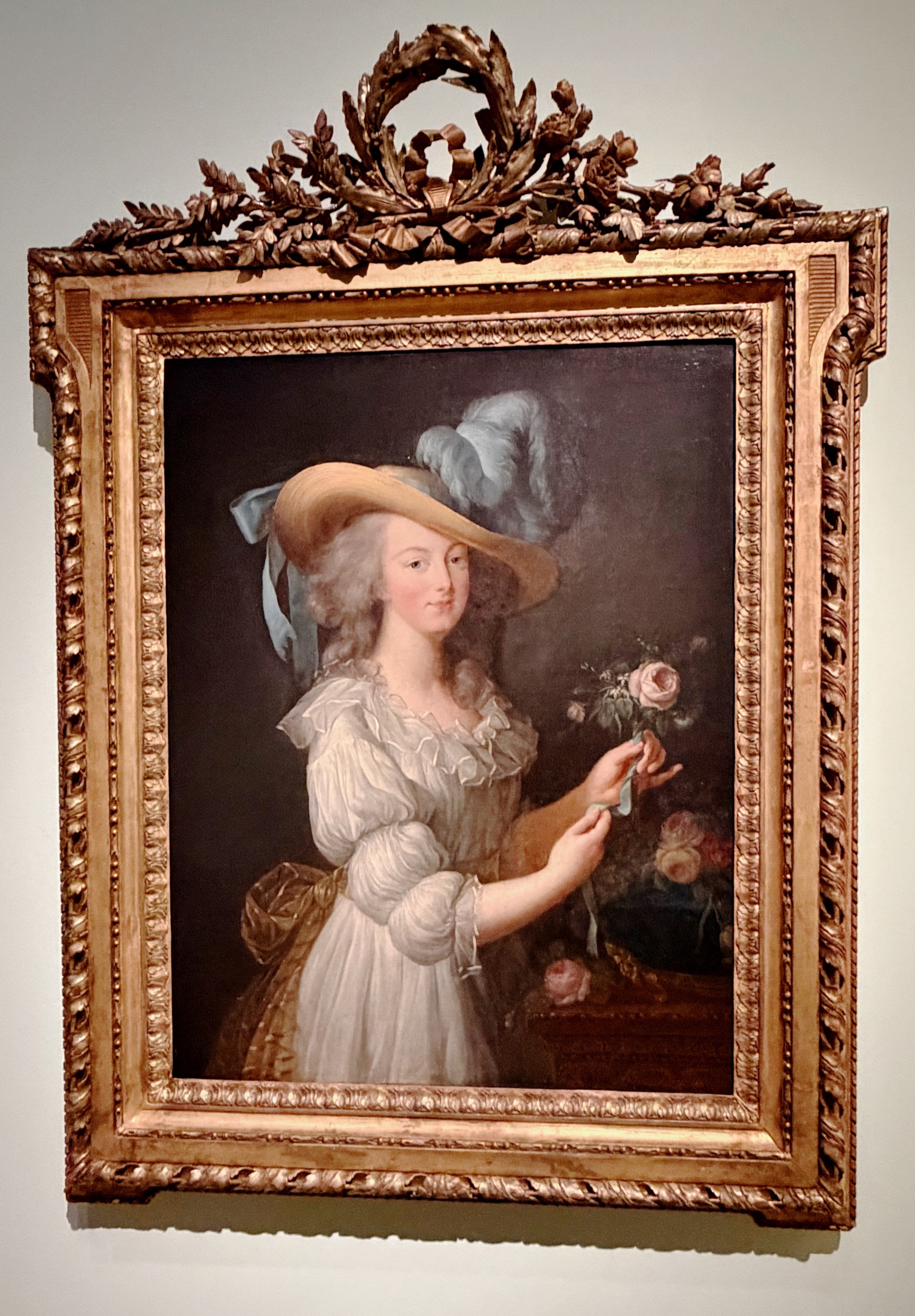
1783 Marie Antoinette in a muslin dress by Elisabeth Louise Vigée Le Brun; seeing the queen in a dress resembling underwear shocked everyone who saw it at the Paris Salon, but it soon became the style. Courtesy: National Gallery of Art, Washington, D.C.
As befitting a Versailles icon, the introductory gallery is a dazzling room of mirrors. With the dramatic illumination of opulent court dresses, wedding attire, royal portraits nof Marie, fans, and swaths of over-the-top embroidered silk, the effect is magnified by the points of light dancing across multiple reflections of sumptuously draped fabric.
Take a look through some of our favorites on display in our Flickr album.
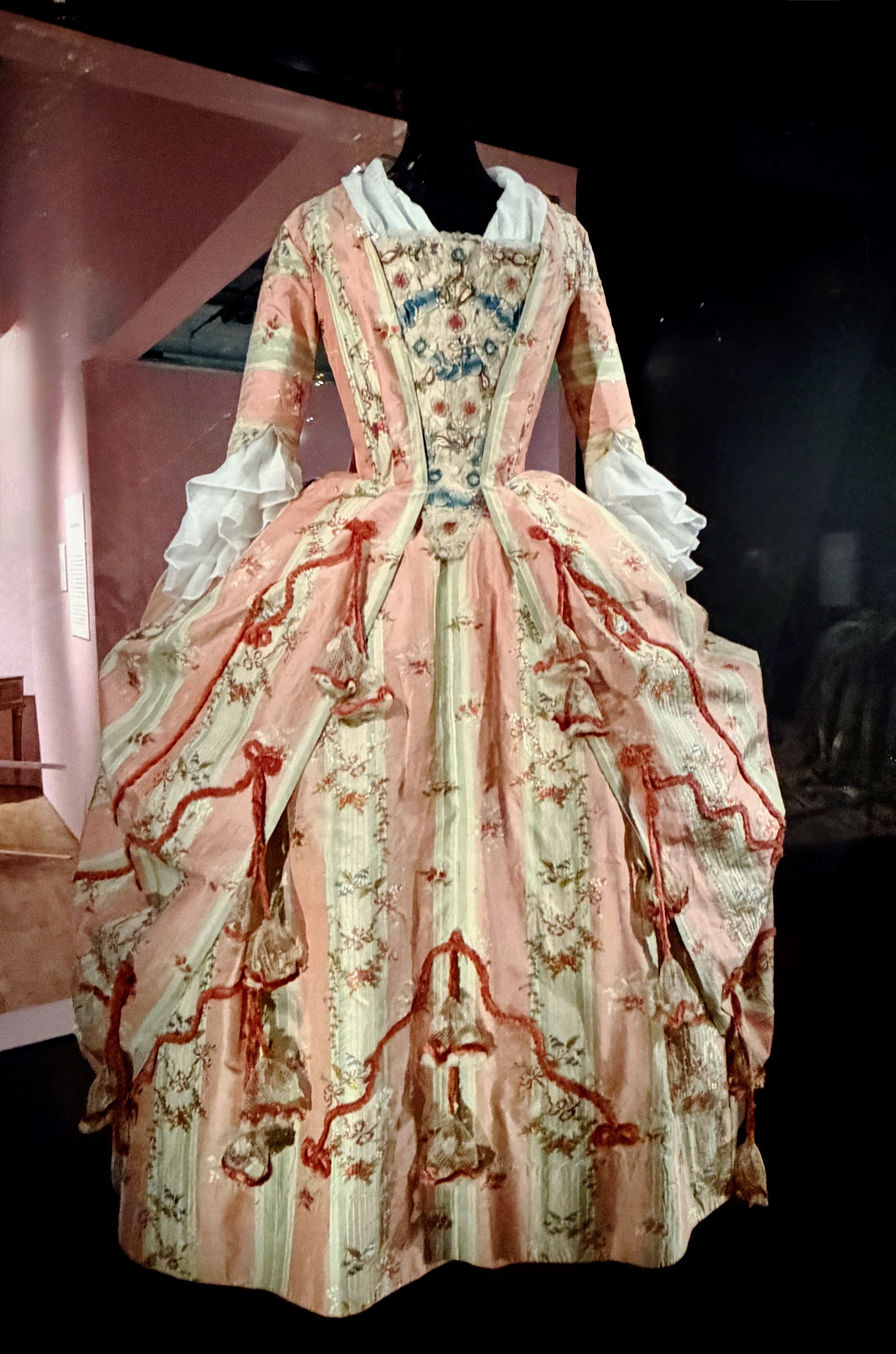
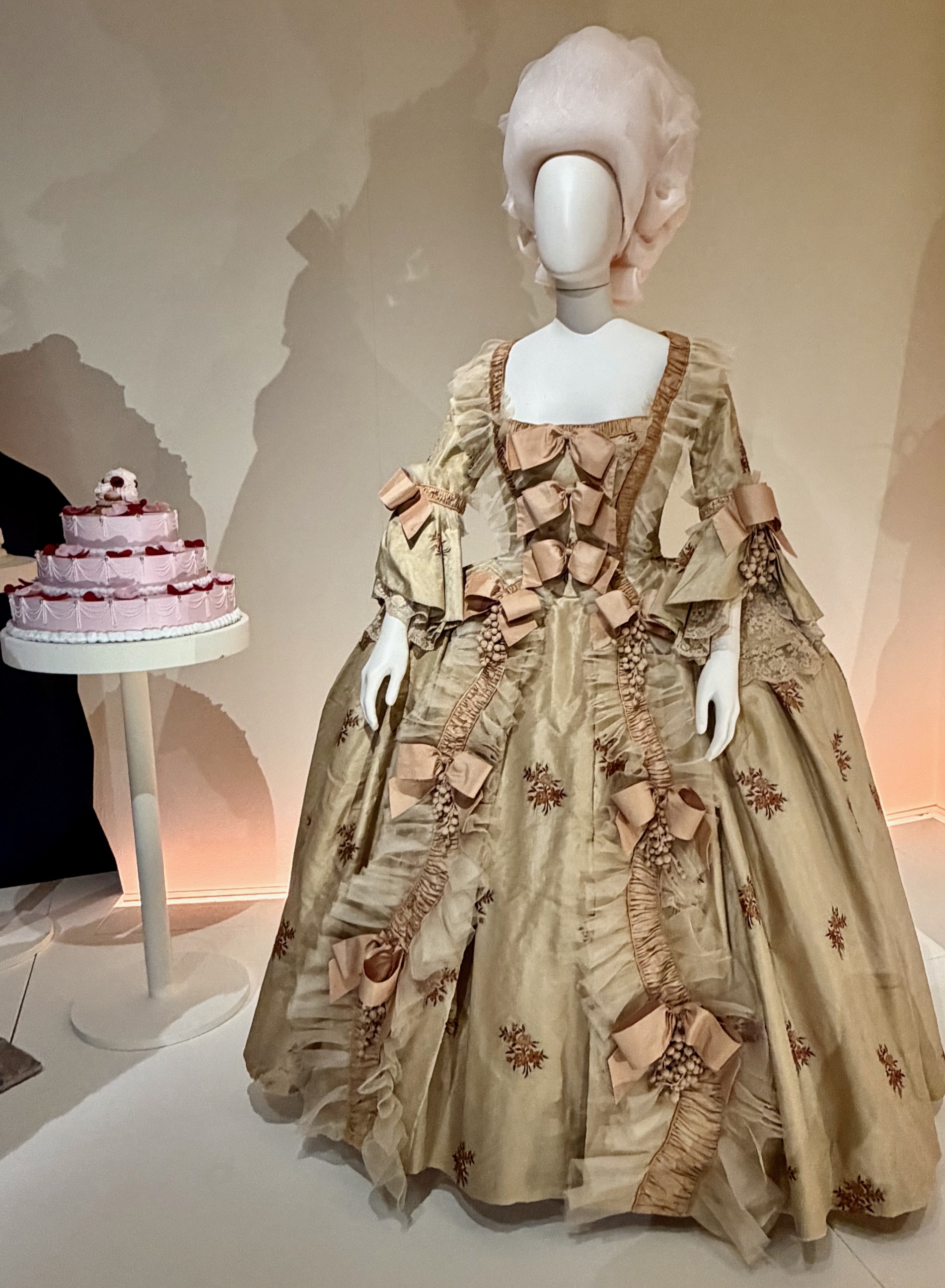
1775 French robe à la française à la Polonaise silk taffeta, silk chenille, and linen lace; less formal style with skirts looped up to create volume. Courtesy: Los Angeles County Museum of Art.
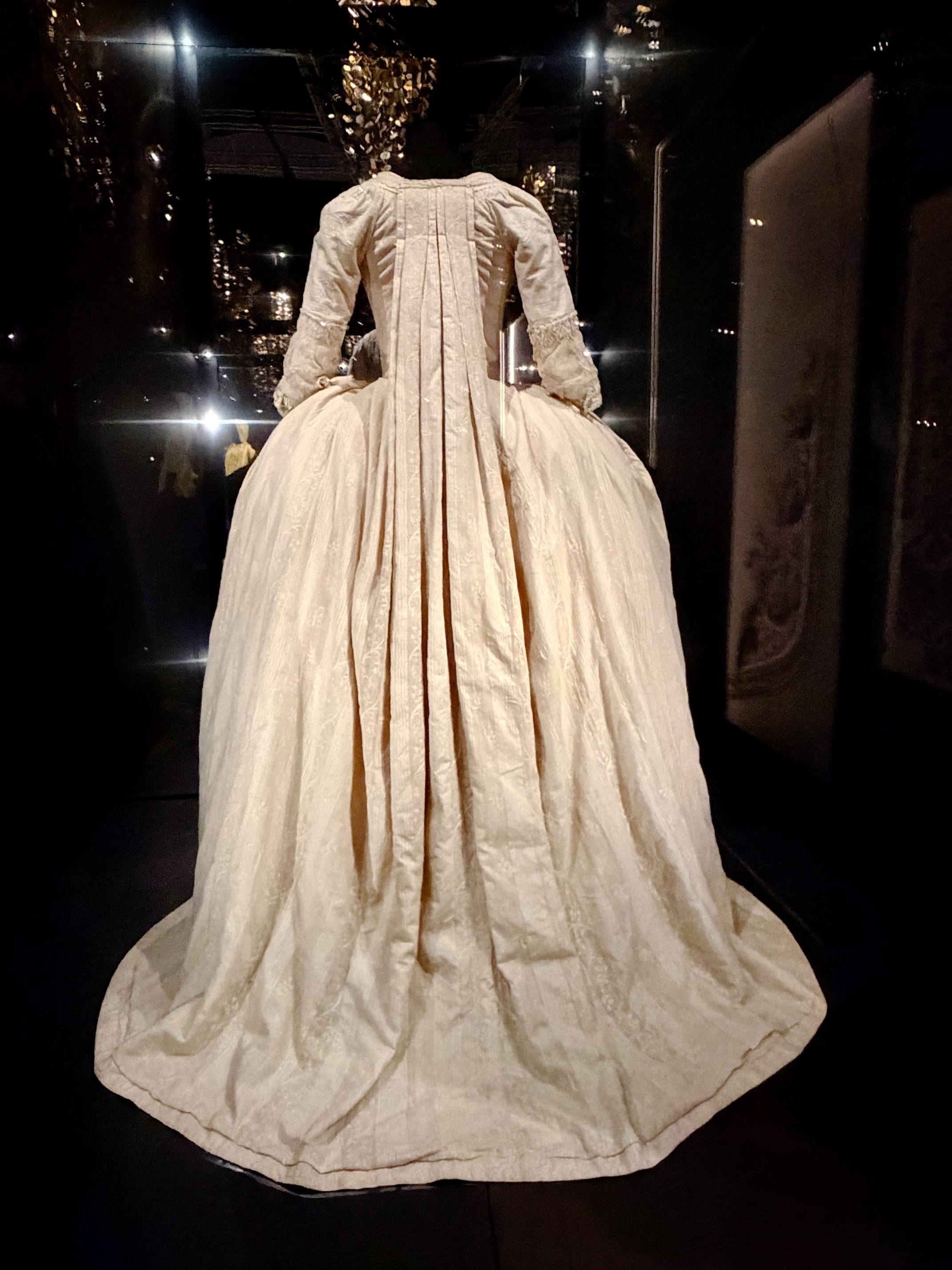
1775-1780 French embroidered cotton and linen muslin robe à la française – a fresh, light style innovated by the French court; silk lining creates a blush effect. Courtesy: V&A
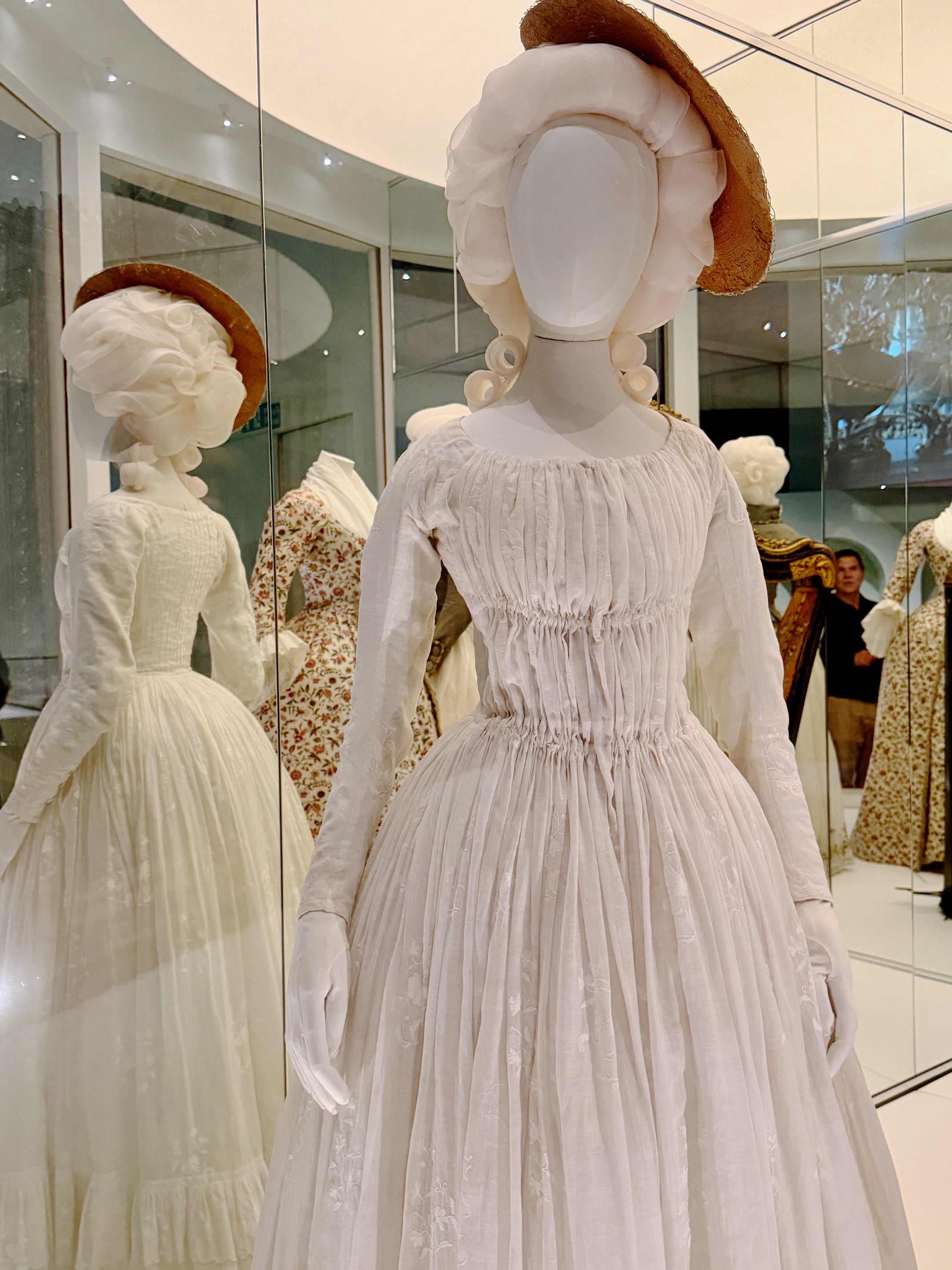
You experience how Marie’s fashion sense changed from the big-time Rococo style she sported as a teen to the more minimal muslin style she popularized as she and her friends gallivanted around the Tríanon grounds in jaunty Italian straw bonnets.
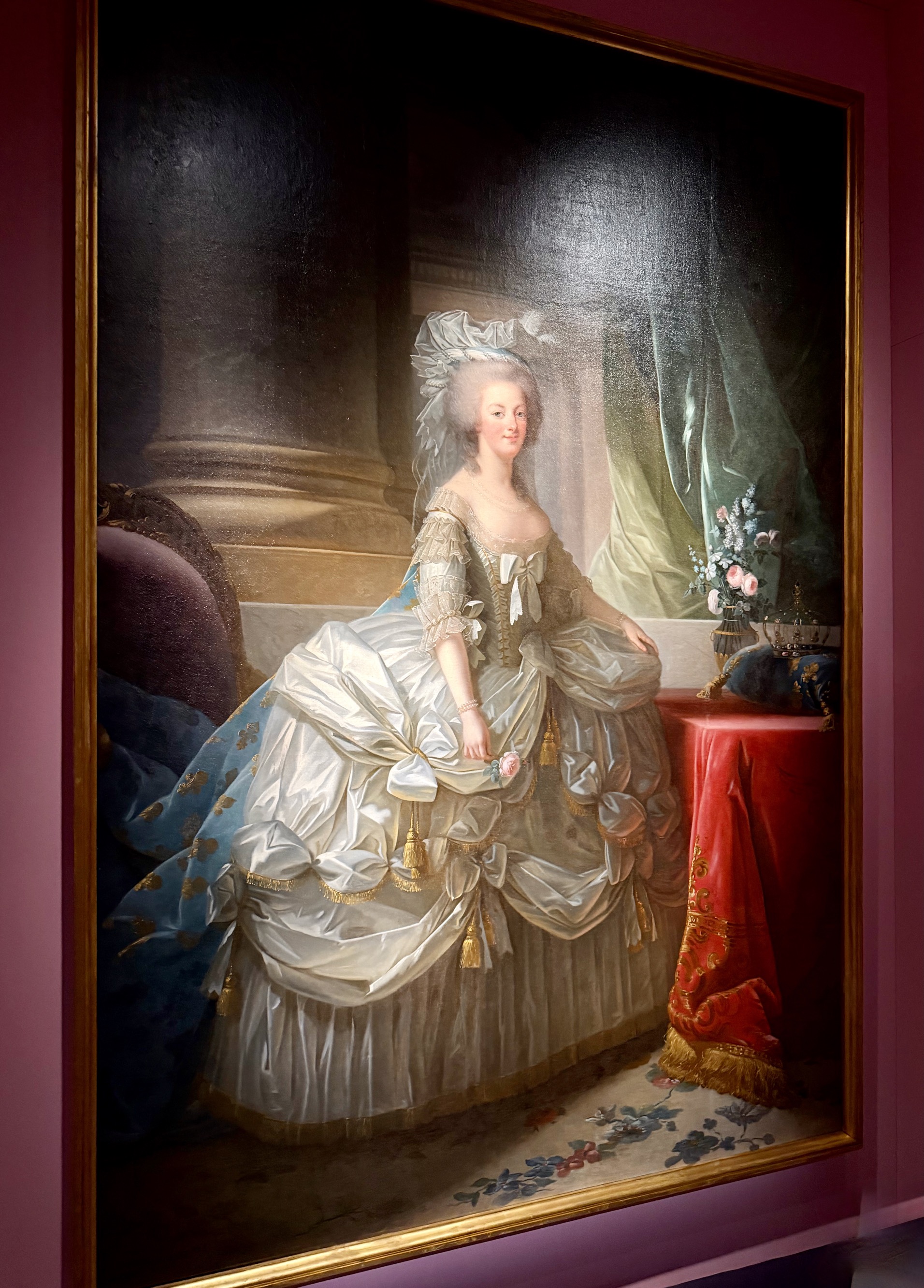
Style icon: later painting based on 1778 oil Queen Marie-Antoinette in Court Dress by Elisabeth Louise Vigée Le Brun; the queen at 22. Courtesy: Versailles, musée national des chateaux de Versailles.
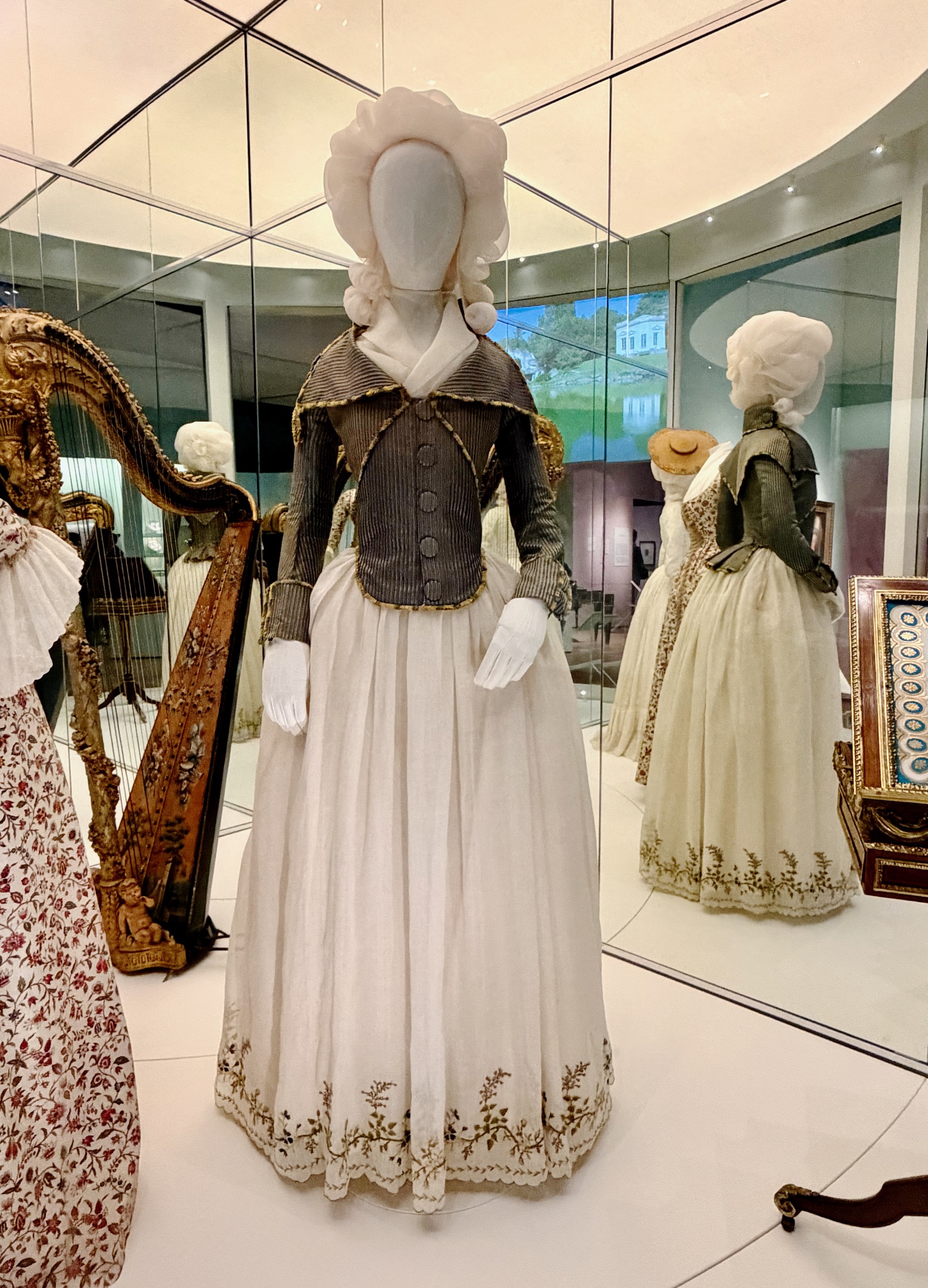
Informal dress that Marie popularized: 1760-1780 “shepherdess” hat (bergères) of Italian straw and a rare 1785-1790 embroidered muslin dress (robe en chemise) owned by Madame Oberkampf of Jouy-en-Josas. Courtesy: V&A; Musée de la Toile de Jouy
Plates from 18th-century fashion publications show off the latest extravagant details of hair poufs that Marie popularized. Incredibly, there’s also an actual shoe owned by the style icon herself. As queen, she received four new pairs of shoes per week! Watch this short video to get a close-up view of her 230-year-old silk and kid shoe that survived!
During her reign, Marie had an outsized influence on interior design, landscape architecture, the decorative arts, and music. Her fashion selections and hairstyles were noted, discussed, and copied.
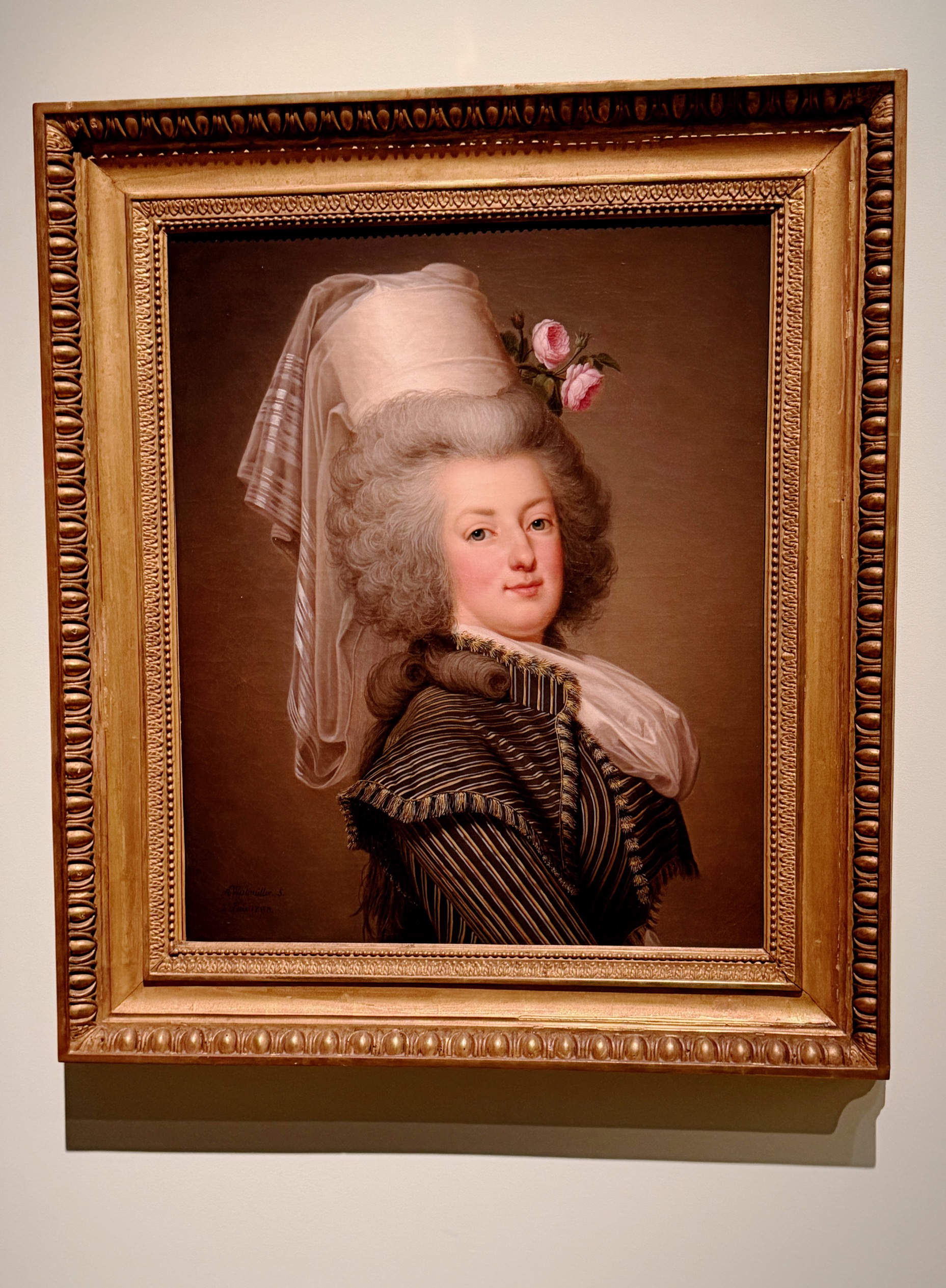
When the winds of democratic change came to France, Marie’s attire changed again to a more pared-down republican look that every patriotic woman in Paris also sported, right down to the patriotic silk cockades pinned to hats and lapels.
Years of the Republic: 1789 oil Marie Antoinette wearing a fashionable jacket (pierrot) and gauze-draped white silk fez; portrait by Adolf-Ulrich Wertmüller. Courtesy: Versailles, musée national des chateaux de Versailles et de Tríanon.
Years of the Republic: Height of French 1780s-1790s fashion – a 1790 striped silk pierrot (jacket) work atop a muslin petticoat, decorated with tambour embroidery. Courtesy: V&A
But by then public opinion had turned against Marie, largely due to the unfortunate incident that completely tarnished the public’s view of her – The Diamond Necklace Affair. In an exhibition section titled “The Queen of Sparkle,” the curators display a modern copy of the necklace that created the ruckus alongside lavish jewelry created from the diamonds removed (and resold) by an 18th-century con artist.
Here, the V&A’s Senior Curator Sarah Grant provides a close-up look at those infamous diamonds and tells the story:
Decried, denounced, and executed, it’s remarkable that 75 years later, Marie-Antoinette style and influence had a come-back, thanks to an obsessive 19th century fan, Empress Eugénie of France. Eugénie loved Marie’s fashion sense began sporting her look at various fancy-dress balls. She even commissioned haute courtier designer Charles Frederick Worth to design some looks, and he was happy to oblige.
Over the years, the Marie Antoinette’s Tríanon retreat had fallen into extreme disrepair and its contents scattered. Eugénie set about to find much of the furniture Marie had commissioned, did a major rehab job on the property, and had a big, public exhibition about Marie at the Tríanon’s reopening in 1867.
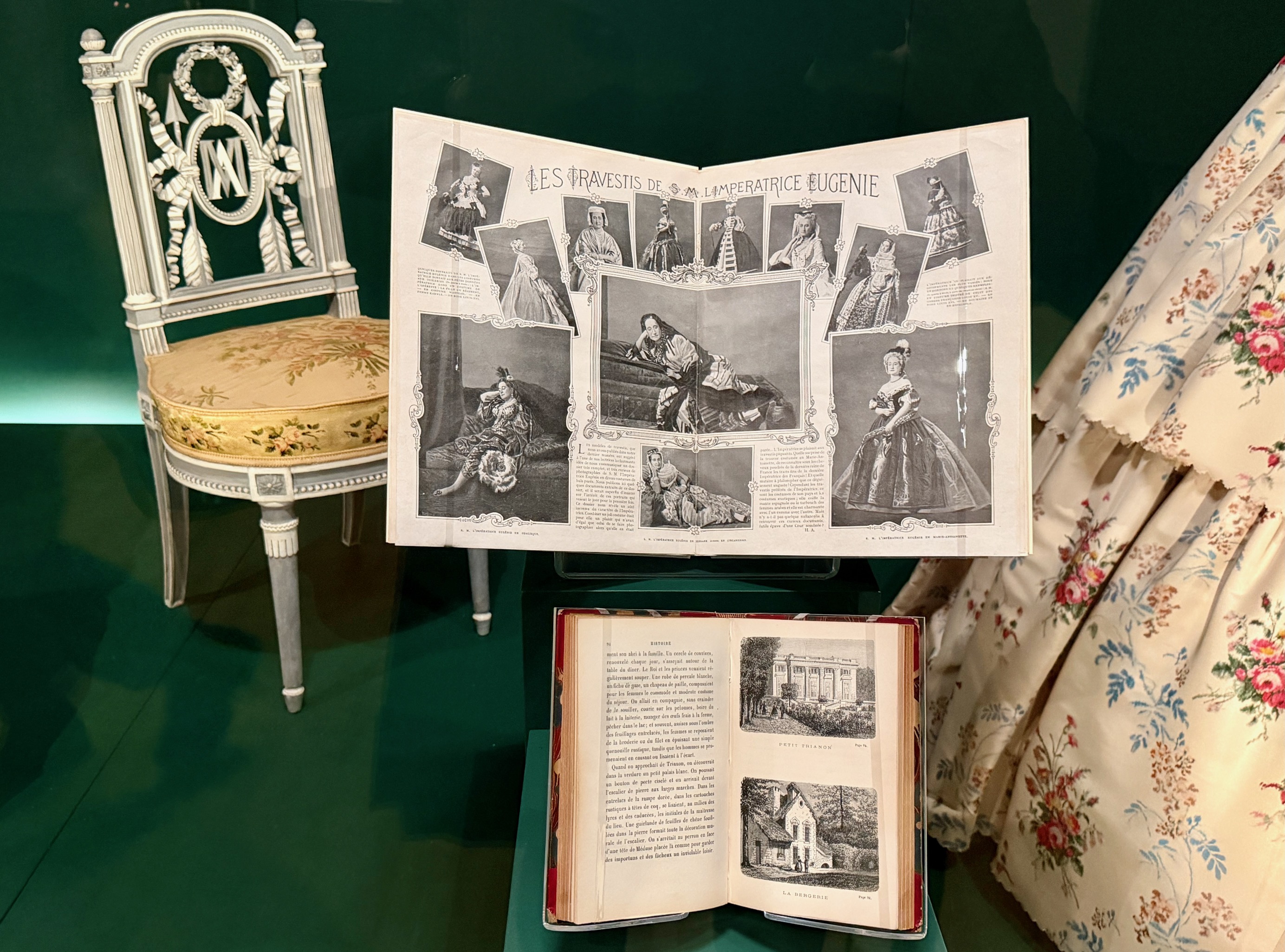
Style revival: Marie Antoinette’s 1784 carved monogrammed chair, part of a four-piece set; 1911 Fémina magazine article about Empress Eugénie’s love of big court costumes; and Eugénie’s 1867 exhibition catalogue about Marie Antoinette at the Petit Trianon. Courtesy: Versailles, musée national des chateaux de Versailles et de Tríanon; private collection; V&A
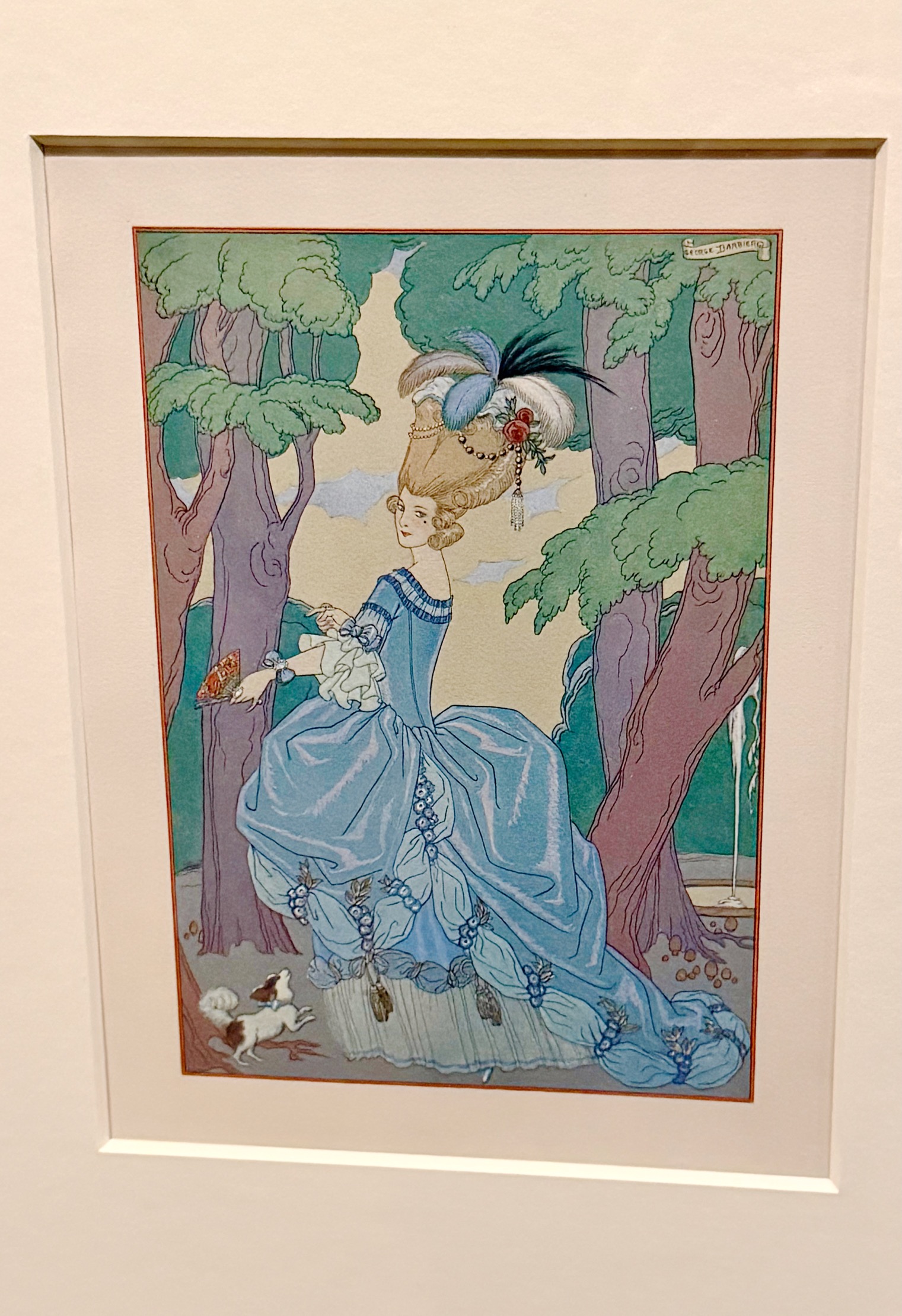
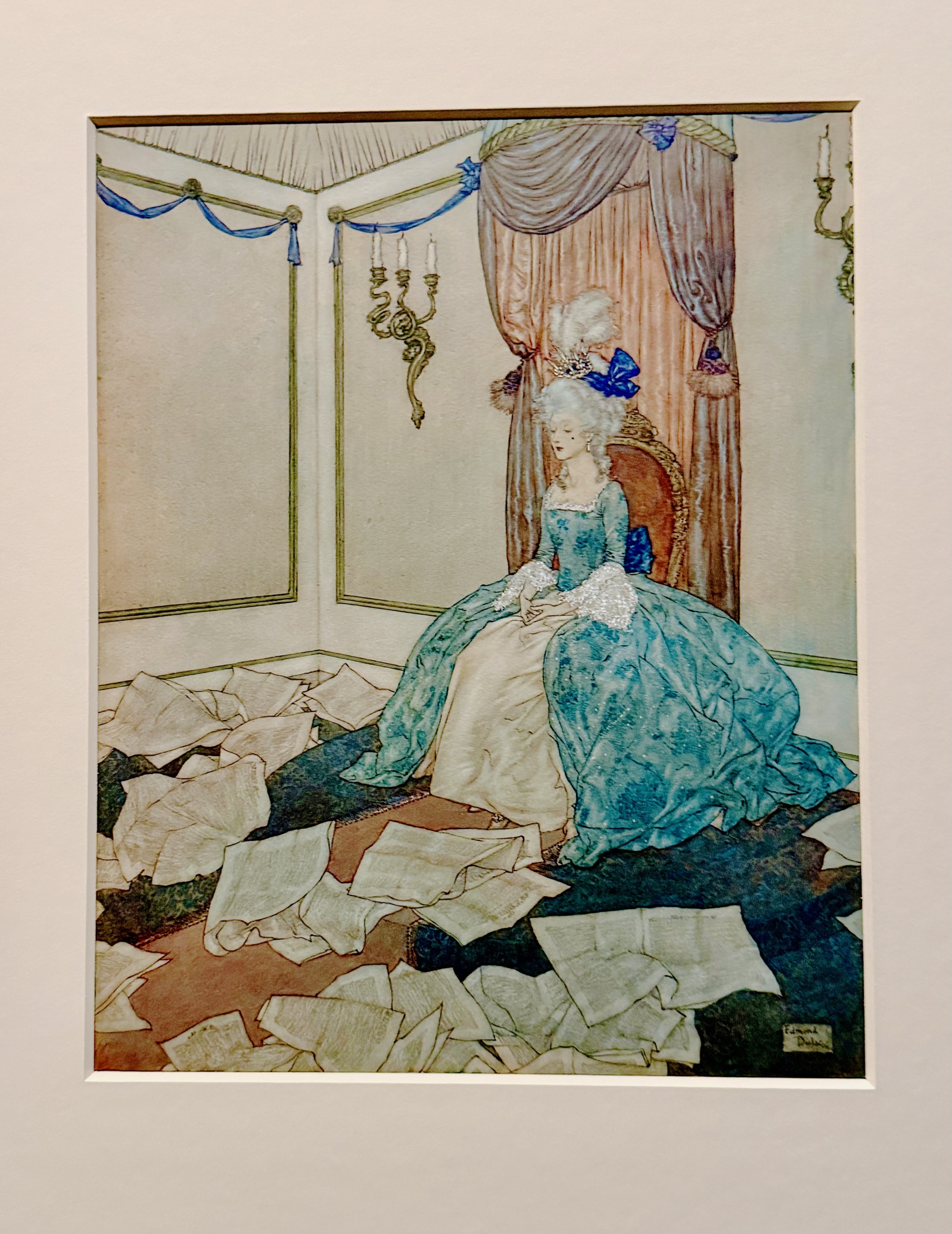
Spurred by Eugénie’s very public fandom into the 20th century, pop culture did not lose sight of Marie Antoinette as a style on display at upscale costume parties or as the evergreen image of fairy-tale princesses. The V&A shows illustrations using the queen’s pouf-do, tiny waist, princess-heel shoes, and voluminous 18th-century gowns to convey royal ingenues right into the 1910s and 1920s.
20th c. fairy tale princess: George Barbier’s 1928 illustration “L’Allée (The Pathway)” for Fete Galantes (Gallant Festivities) featuring an Art Deco image of Marie Antoinette based on Elisabeth Louise Vigée Le Brun’s portrait. Courtesy: private collection
20th c. fairy tale queen: Edmund Dulac’s 1911 watercolor illustration of Marie Antoinette as Hans Christian Anderson’s Snow Queen; aloof, seated on an icicle throne. Courtesy: private collection.
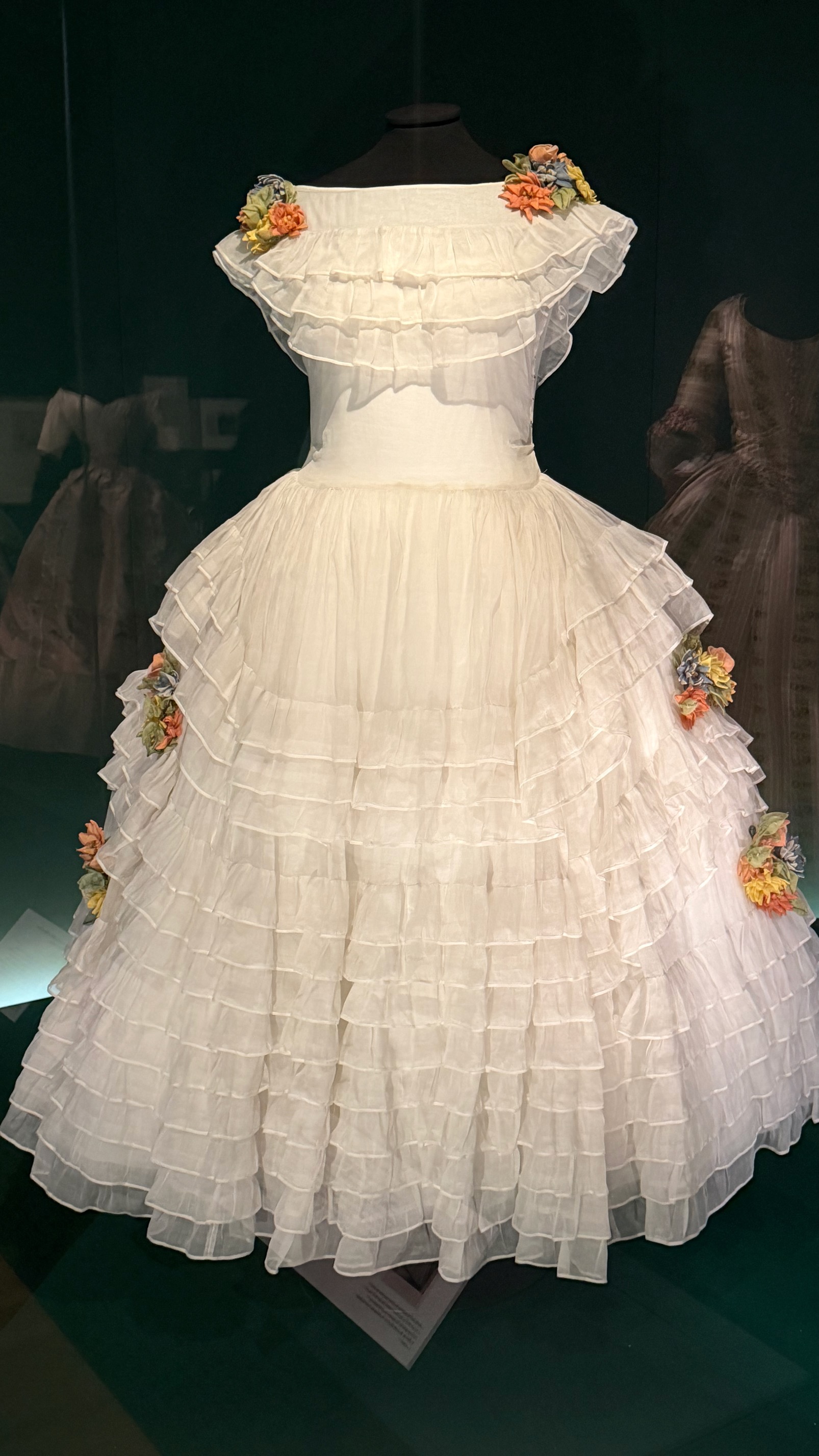
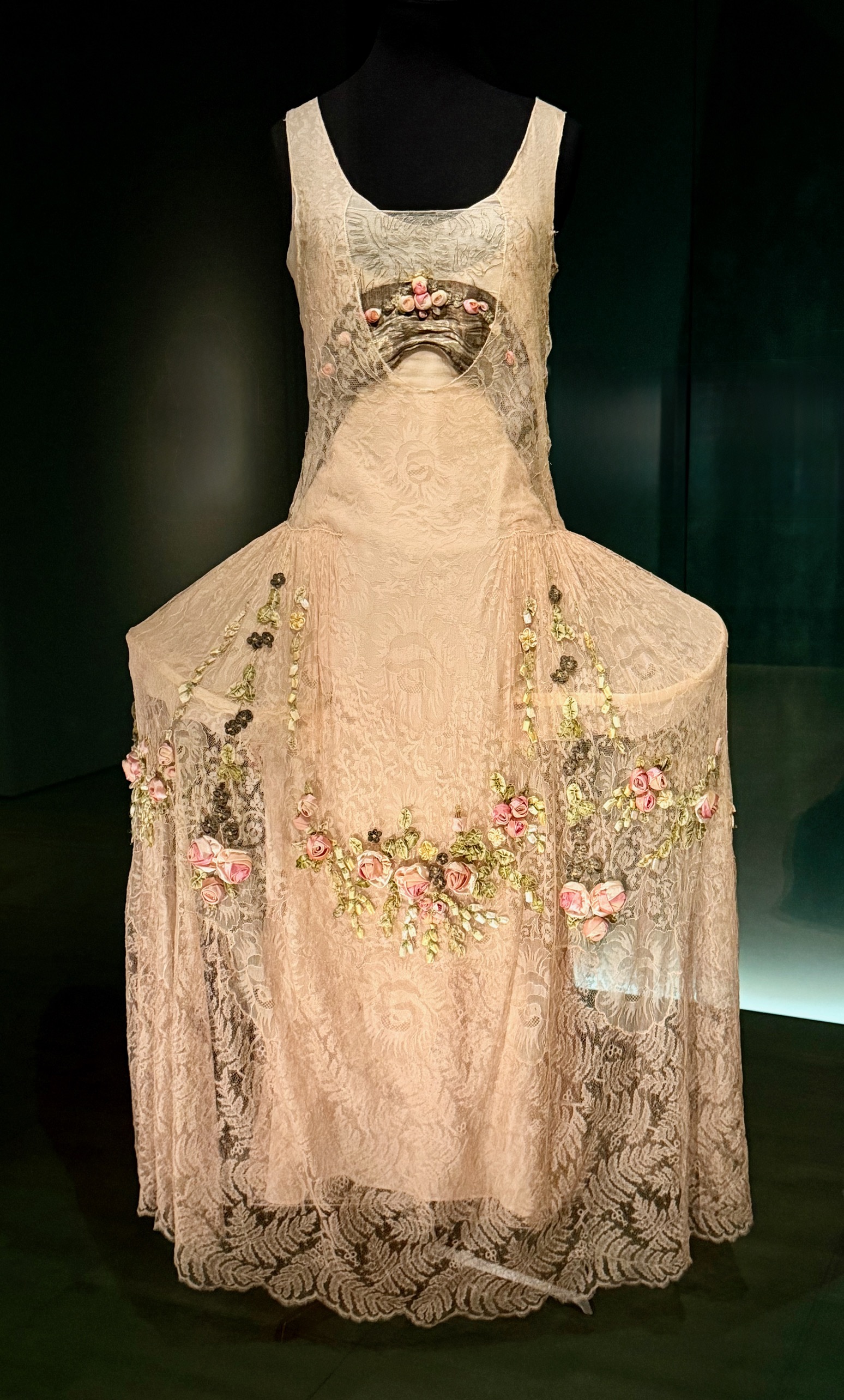
And 1920s fashion designers took note, mixing gauzy references to Marie’s muslin dresses with full skirts and panniers.
Referencing Marie Antoinette’s lingerie style: Jeanne Lanvin’s 1922-1923 silk organiza robe d’style (evening dress); a chemise with panniers. Courtesy: V&A
Boué Soers’ “lingerie frock” – a 1923 appliqued silk chiffon robed’style (evening dress) with panniers and ribbon roses; advertised showing models as Trianon shepardesses. Courtesy: Designmuseum Danmark
The spectacular finale to the exhibition pays tribute to the costume designers and haute couturiers who have translated Marie’s style into modern times. Even Manolo Blahnik jumped at the invitation to make shoes for Coppola’s Marie Antoinette film actresses, making each pair himself and basking in the glamor of using truly opulent silks and embellishments. It’s fun to see an entire wall of them.
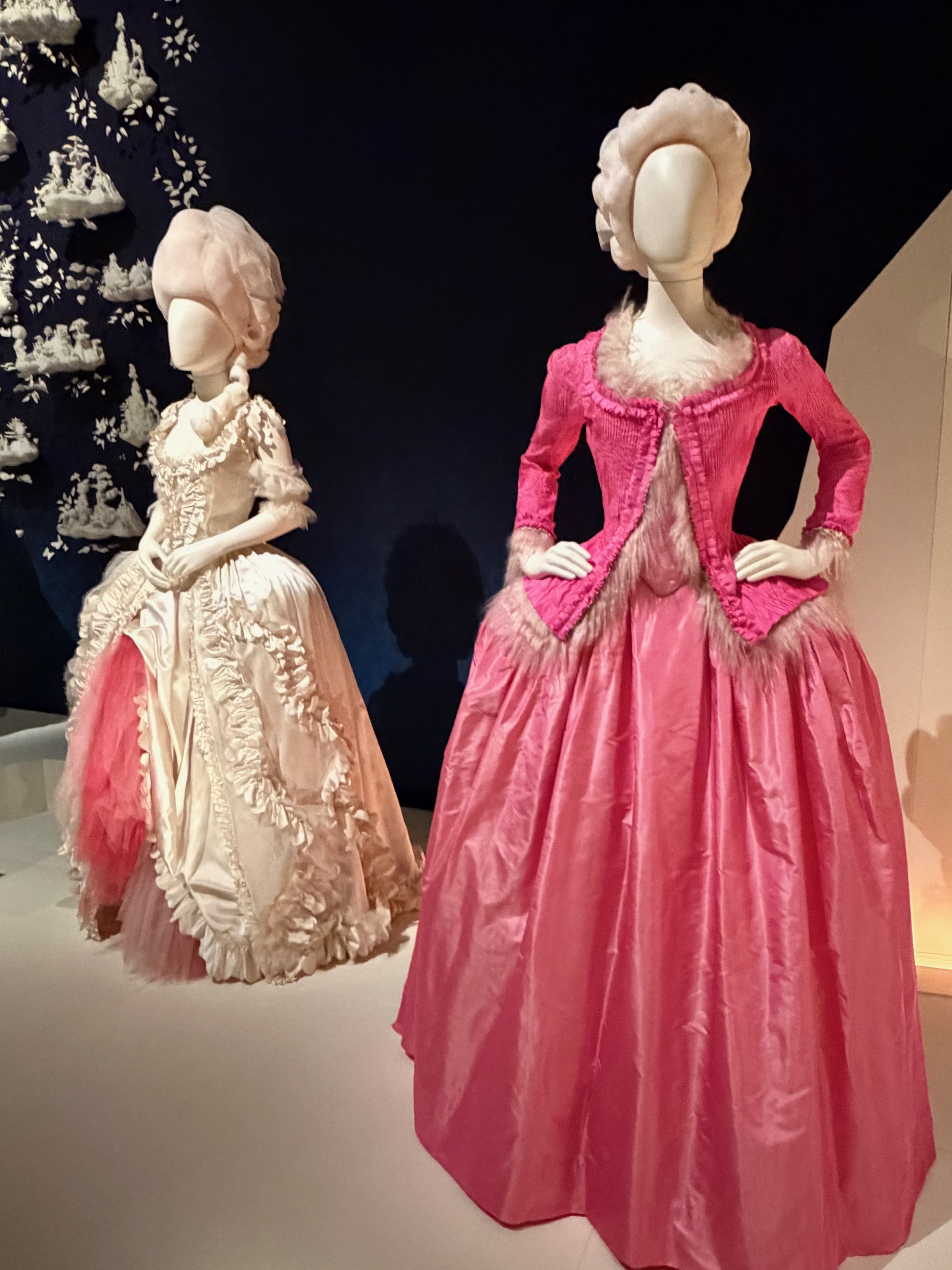
Neon pink costumes by Milena Canonero worn by Kirsten Dunst in Sofia Coppola’s 2006 film, Marie Antoinette. Courtesy: private collection.
Adrian’s silk gown worn by Norma Shearer in Willard Van Dyke’s 1938 Marie Antoinette film. Courtesy: private collection
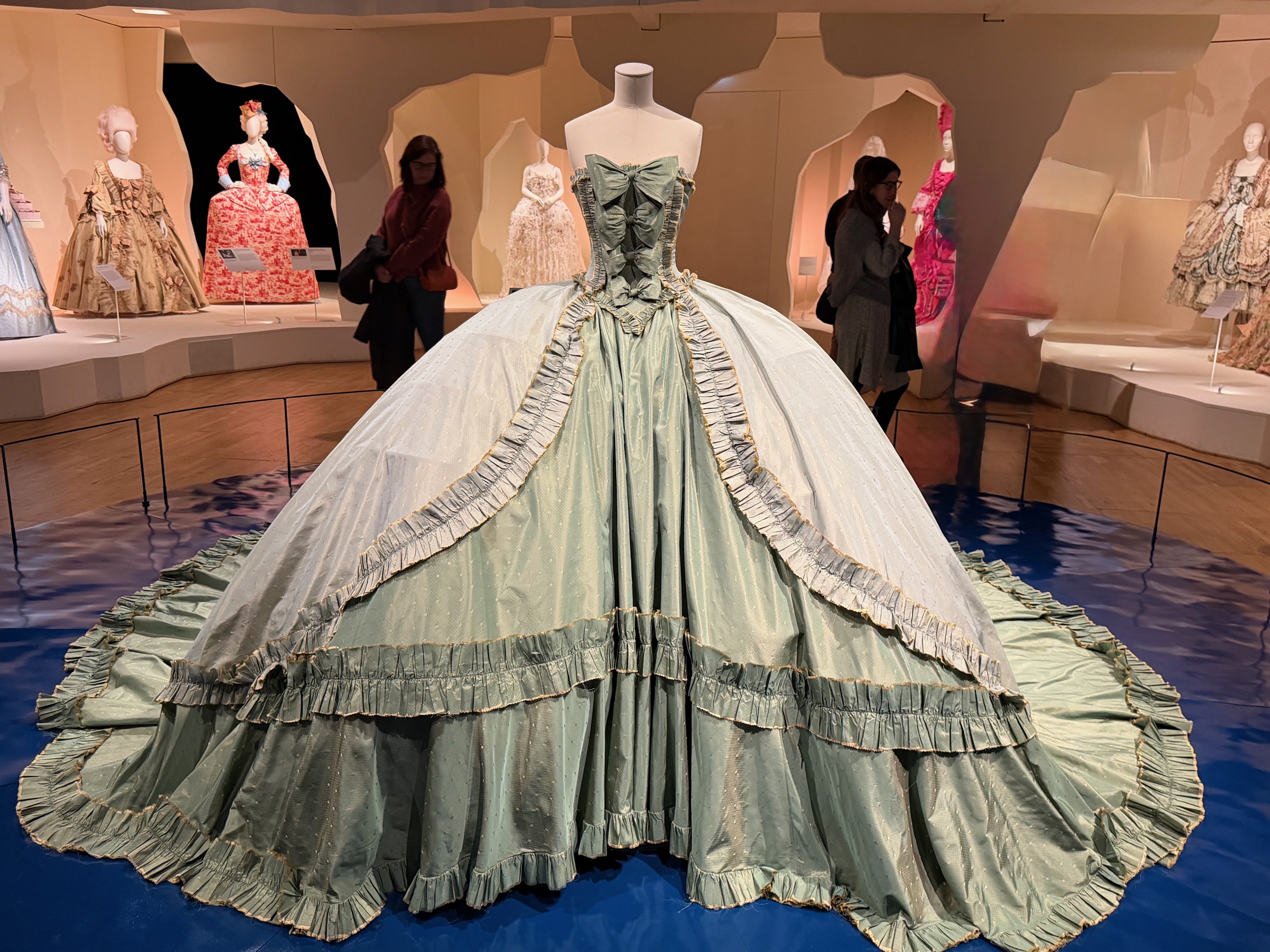
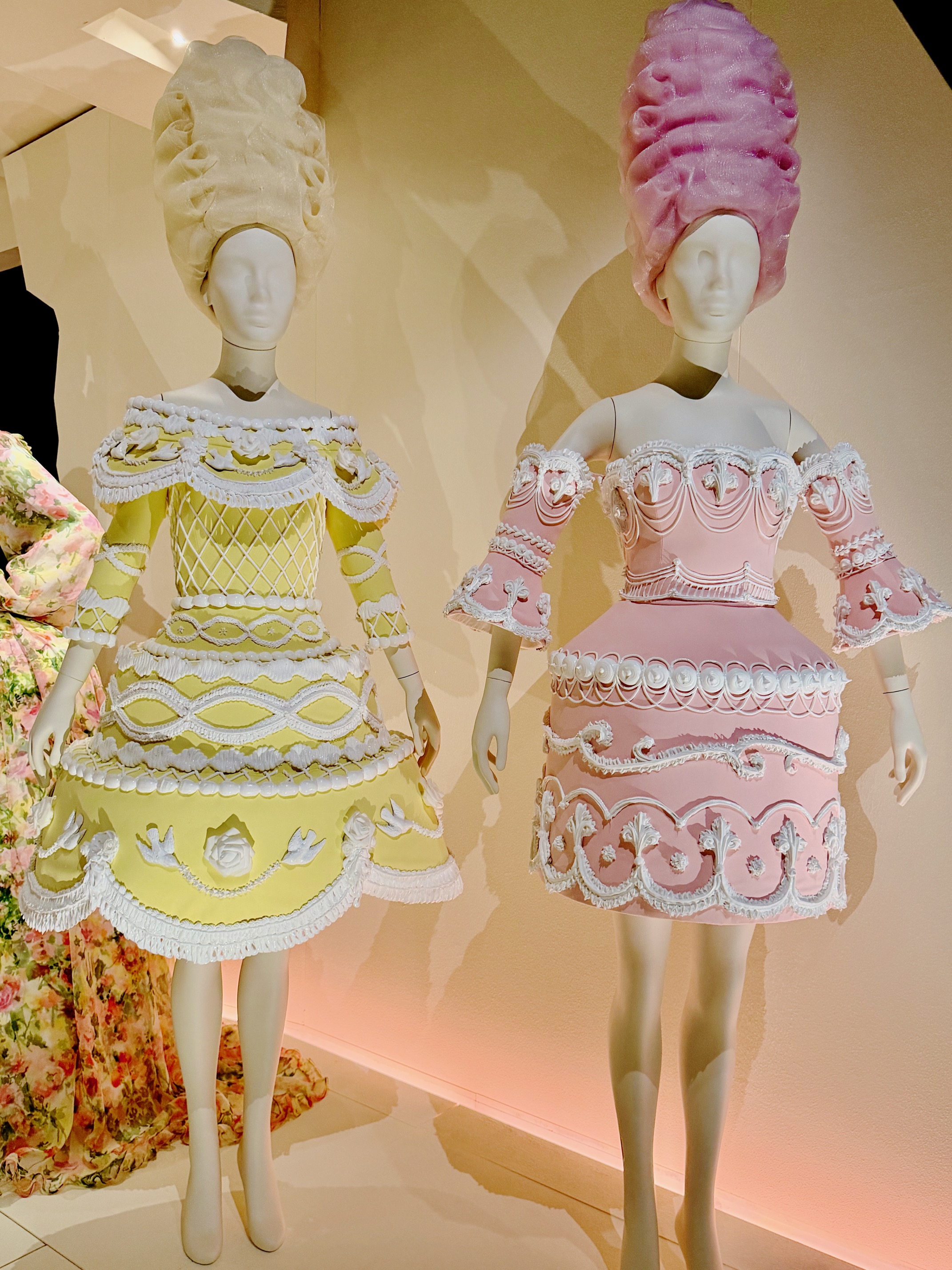
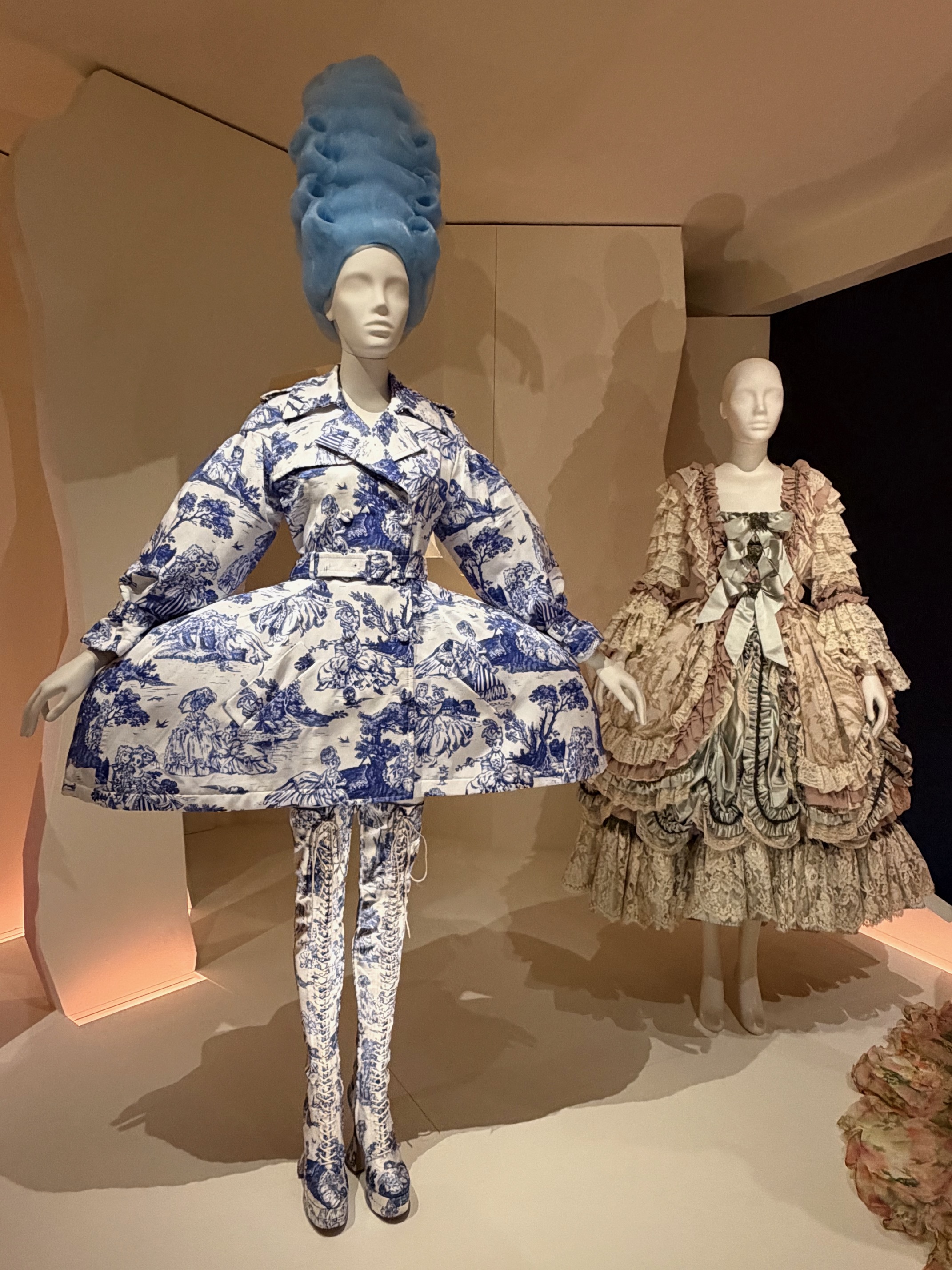
The show closes with a bigger-than-big wide gown by Galliano for Dior, surrounded by two tiers of Moschino silicone cake dresses, Moschino toile de jouy pannier spoofs, Marmalade’s drag ensemble, Vivienne Westwood’s bridal take, and even Lagerfeld’s take on those scandalous diamonds for Chanel.
Gallery of restyled Marie Antoinette fashions by contemporary designers; at center, John Galliano’s 1998 iridescent silk taffeta Marquise Masquée gown for Dior. Courtesy: Dior
It’s an unmistakable style that’s recognizable hundreds of years later, and one everyone who’s seen this unforgettable show is still talking about!
Be forewarned: Schiaparelli opens at the V&A South Kensington on March 28, 2026.
Jeremy Scott’s 2020-2021 silicone cake dresses from a runway show mixing contemporary and 18th century style and fun. Courtesy: Moschino archives.
Jeremy Scott’s 2020-2021 cotton anime Toile de Jouy mini-pannier dress with matching boots and Franco Moschino’s 1990 silk and lace robe á la polonaise. Courtesy: Moschino archives.
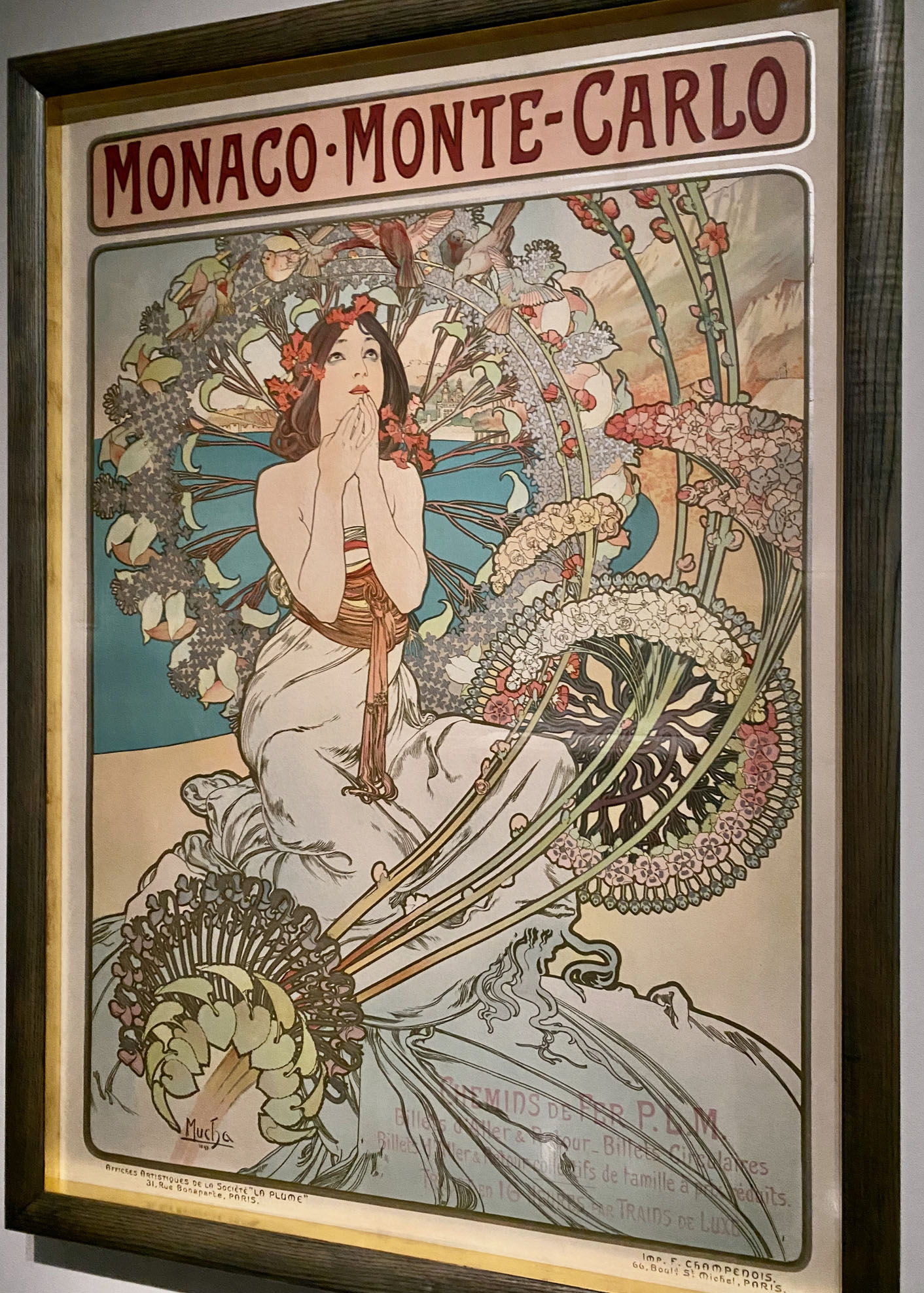
Fans of Mr. Mucha, the grand master of sinuous line, have been lining up across North America to admire some of his greatest works – epic posters of Sarah Bernhardt, beautiful women hawking products surrounded by swirling halos or smoke, and exotic details on small-scale, affordable decorative panels representing the seasons, flowers, or arts.
Created by the Mucha Foundation in Prague, Timeless Mucha: The Magic of Line presents Mucha’s own collection of art and books that inspired his creativity, his early works as an in-demand illustrator, and his most famous posters and viral images. It’s all on display at the Boca Raton Museum of Art through March 1, 2026 after successful stops at the Phillips Collection in Washington, D.C. and Santa Fe’s Vladem Museum of Contemporary Art.
Mucha’s 1897 lithograph Monaco – Monte Carlo, an ad for the Paris- Côte d’Azur railway featuring a young woman dreaming about her beach trip. Courtesy: Mucha Foundation.
See some of our favorite works from the Vladem installation in our Flickr album.
So how did a designer who was all the rage for Art Nouveau at the 1900 Paris Expo inspire Sixties psychedelic rock illustrators, Marvel Comics creators, and Japanese manga artists? You’ll see that in the exhibition, too. Check out this promo from Boca:
A portion of the exhibit features drawings, sketches, and acquisitions that suggest the building blocks that formed his mature style – Moravian folk style, the mix and match of multicultural design elements seeping into European designers’ consciousness, and the super-flat design in Japanese prints, and fantastical embellishments on Japanese collectibles in late 19th century Paris.
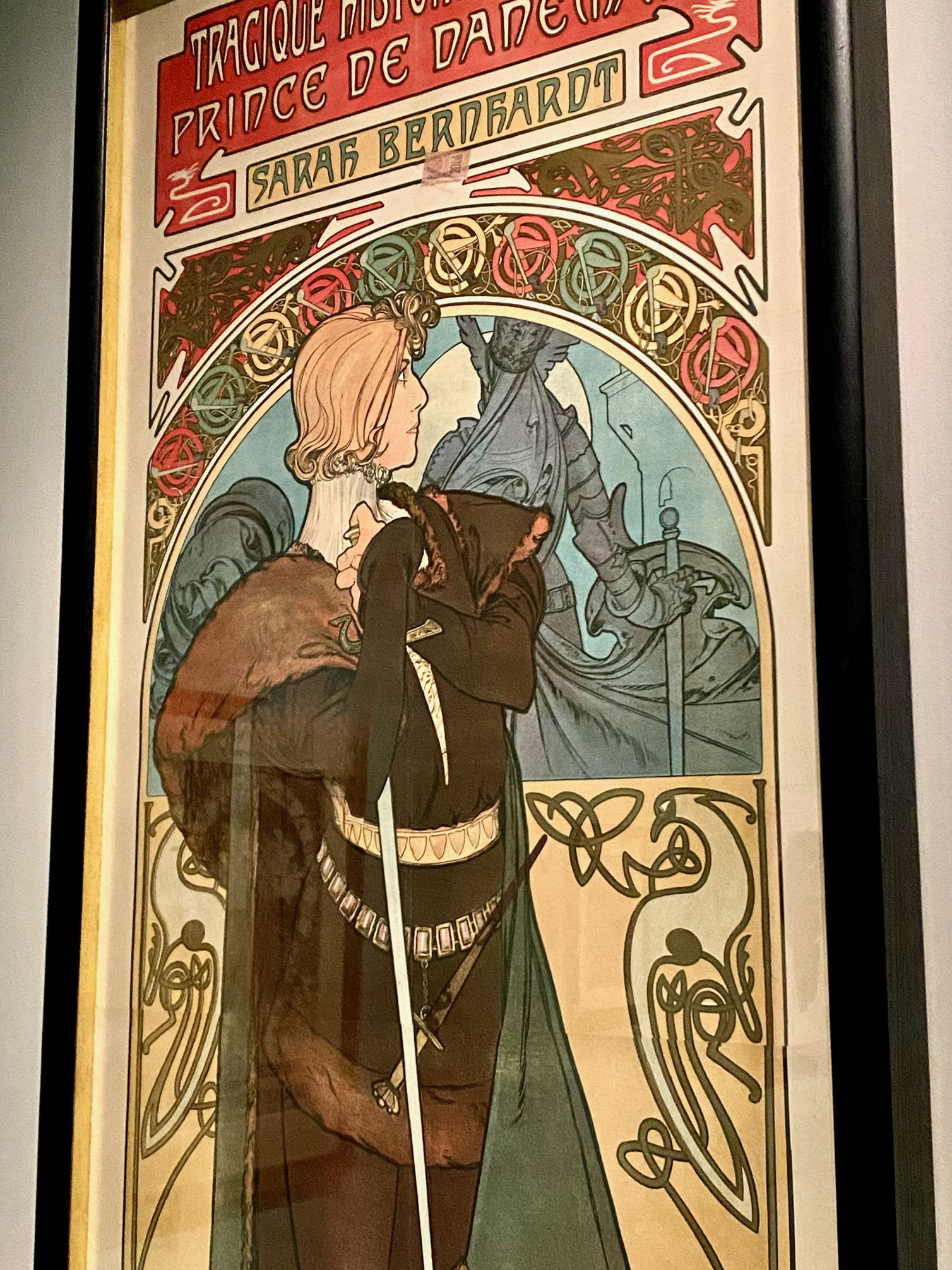
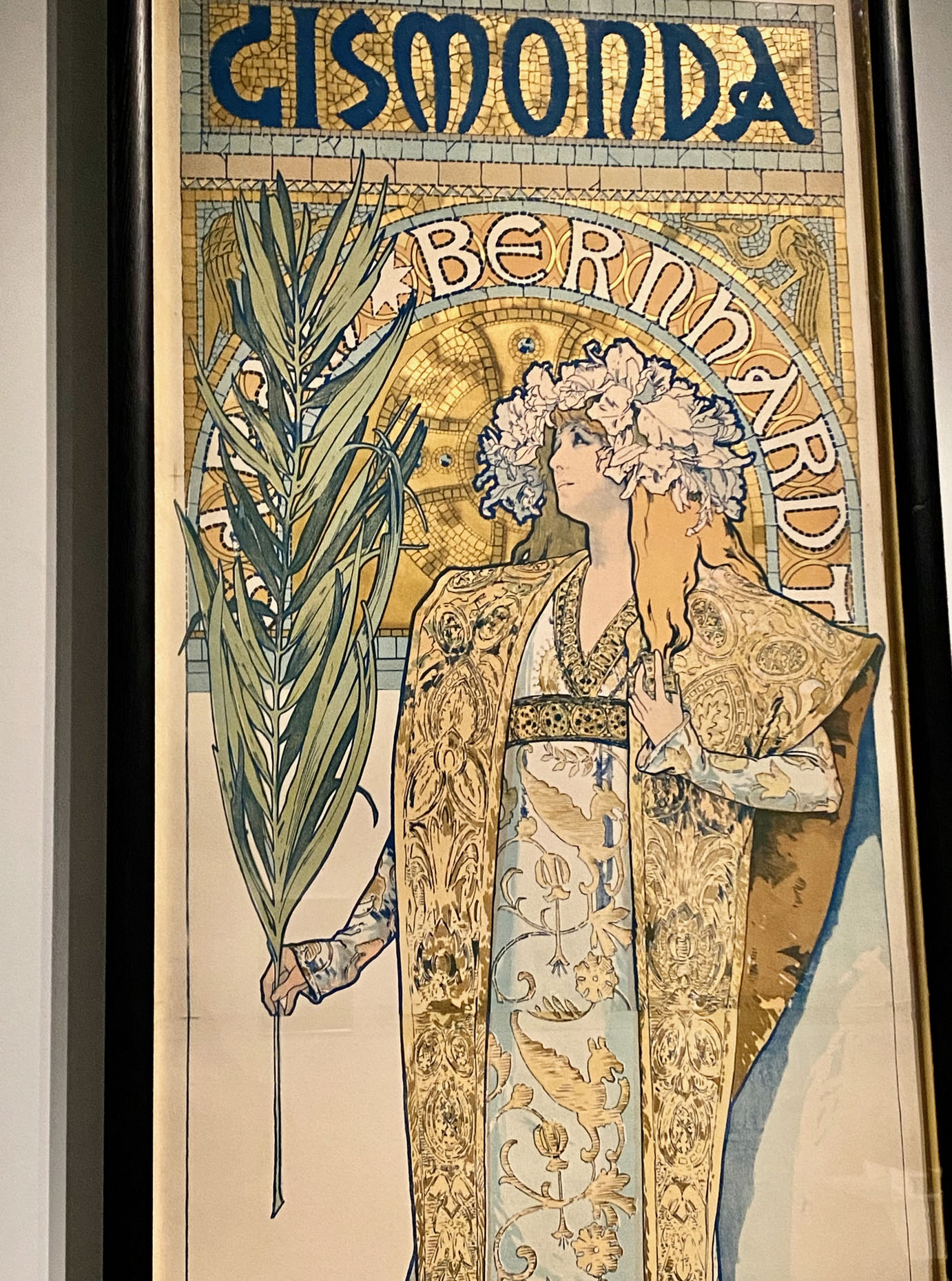
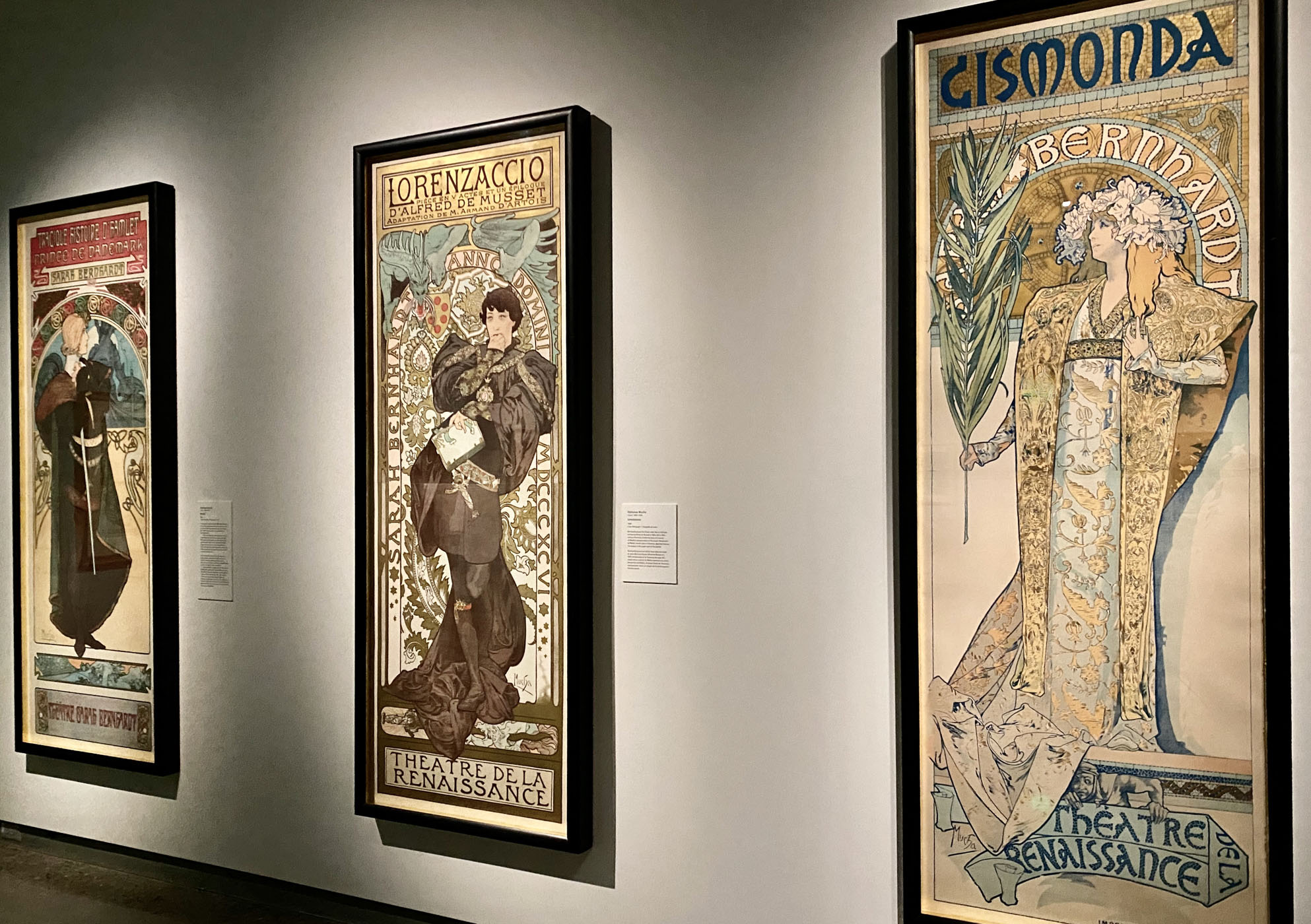
Just take a look at how many of these design influences Mucha packed into his viral street posters advertising actress Sarah Bernhardt’s new plays – mosaics like those in Eastern European churches, exotic decorative elements, and arcs functioning as halos.
Close-up of Mucha’s life-size 1899 poster of Sarah Bernhardt starring in Hamlet, with Celtic motifs. Courtesy: Mucha Foundation.
Close-up of Mucha’s life-size 1894 poster of Sarah Bernhardt starring in Gismonda featuring a Byzantine mosaic, Orothodox cross, and Slavic designs. Courtesy: Mucha Foundation.
Listen to the Foundation’s curator Tomoko Sato (shown in Phillips Collection galleries) explain how Mucha’s 1894 poster commission – his first – immortalized superstar actress Sarah Bernhardt:
When Mucha’s Gismonda poster appeared on the streets of Paris in 1894, it was a sensation and cemented Mucha’s status as the hottest designer of the day. Bernhardt signed him to a six-year contract (including designing her jewelry), and other offers started rolling in.
Everyone considered Mucha the leading practitioner of Art Nouveau, although Mucha never cared for this label. As the exhibition shows, Mucha’s style was a flat application with bold outlines around ethereal depictions of independent women, swirling vines and/or hair, and a sinuous spiral curving through his layout.
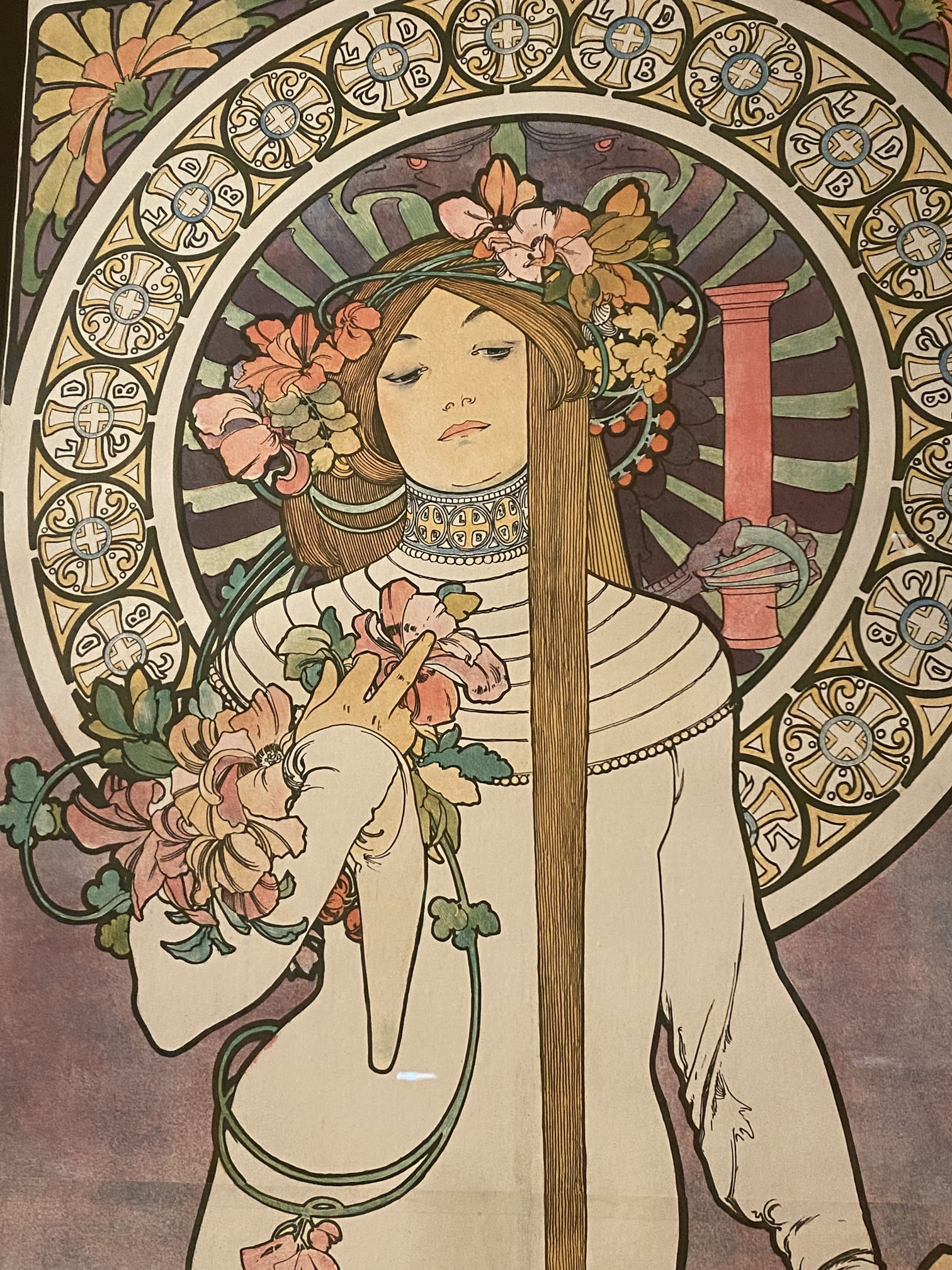
Detail of Mucha’s 1897 lithograph La Trappestine, a liqueur ad featuring a halo, Celtic designs, and a floral wreath. Courtesy: Mucha Foundation.
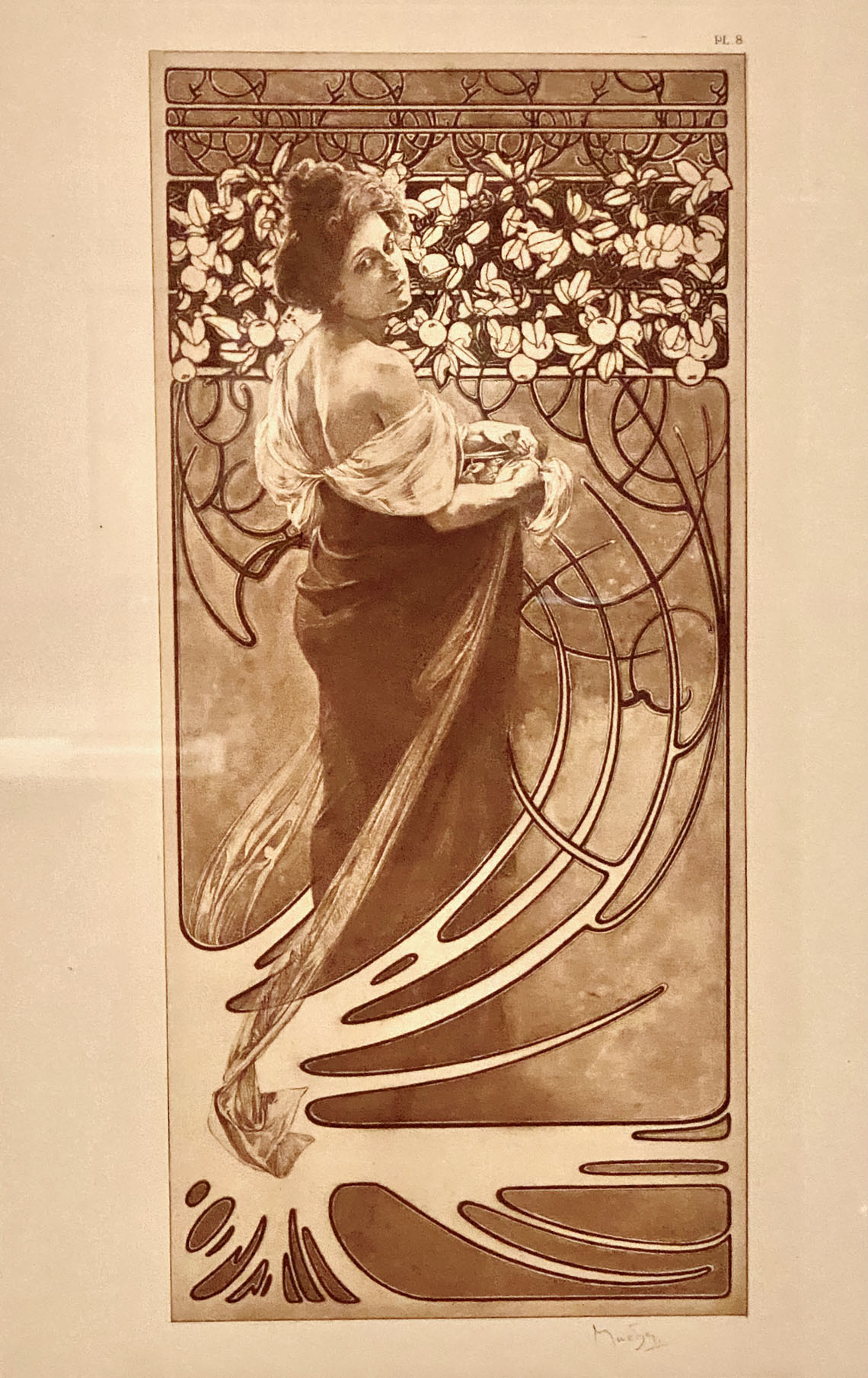
Plate from Mucha’s 1902 Documents dècoratifs, his designer handbook on how to combine human figures with decorative elements. Courtesy: Mucha Foundation.
As his fame grew, publishers licensed his images and published them at affordable prices worldwide. Mucha himself traveled abroad, teaching sold-out classes in drawing, line, and figures. He was in such demand that he eventually created books showing up-and-coming designers how to create universally appealing designs in his style.
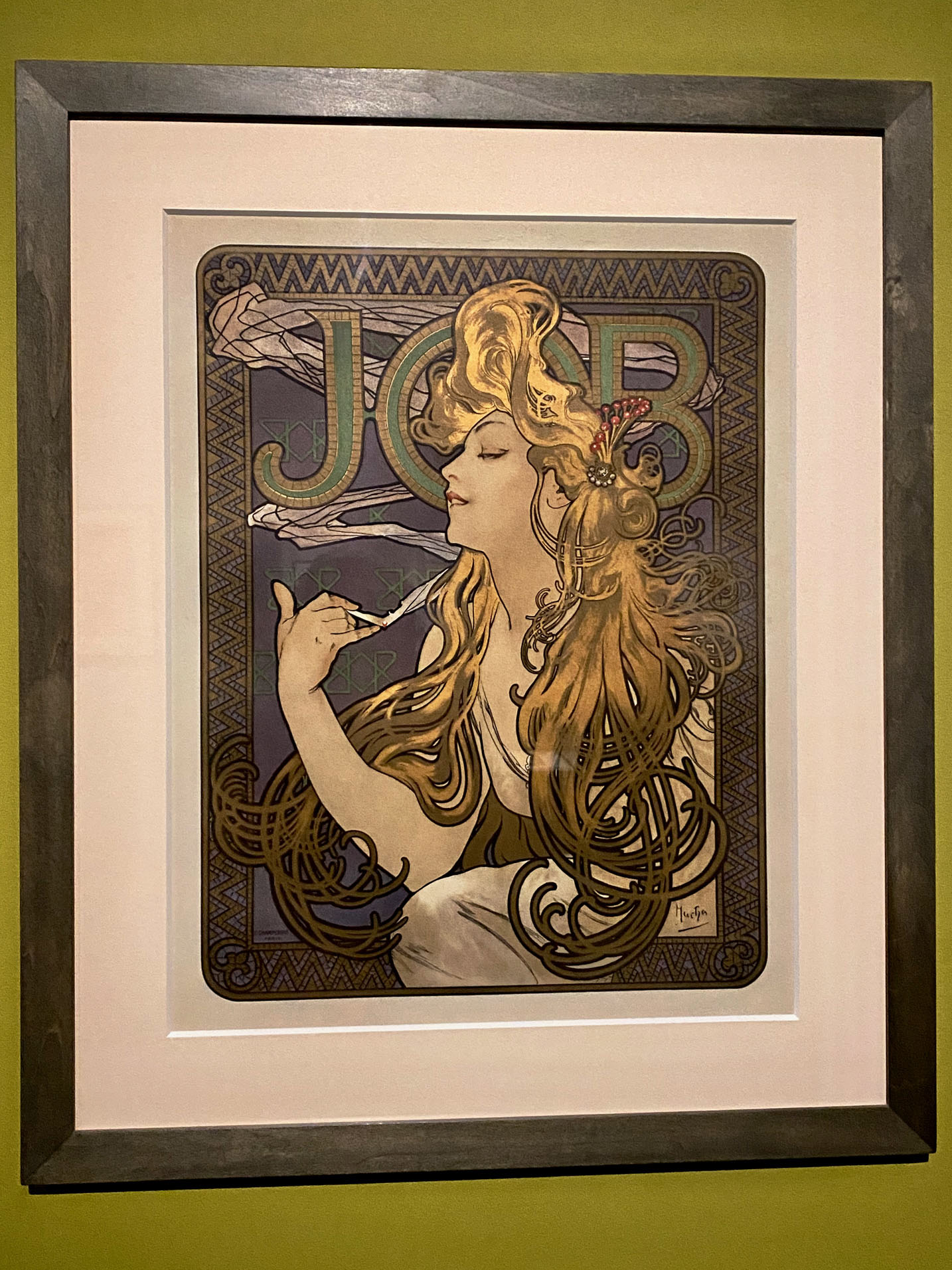
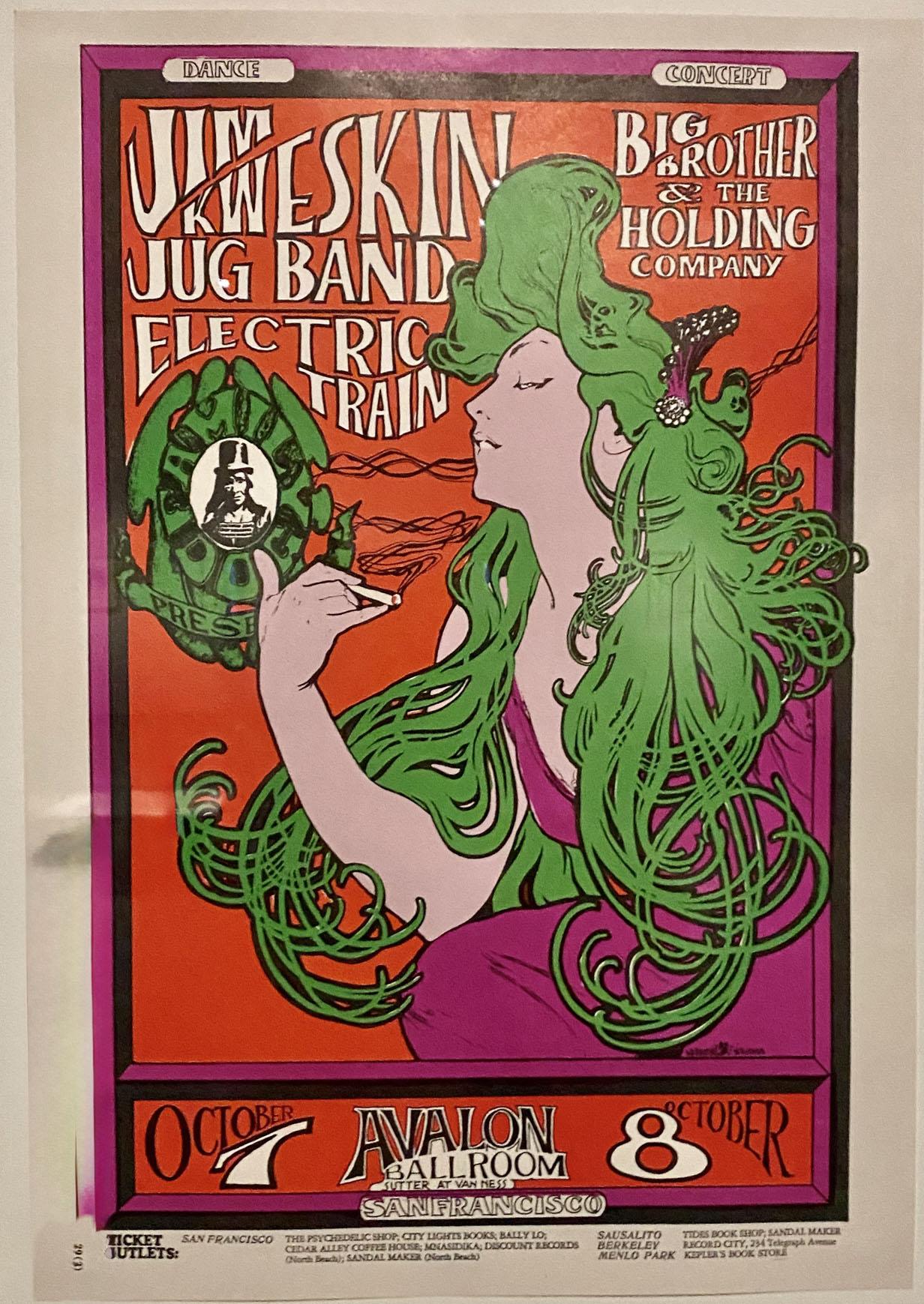
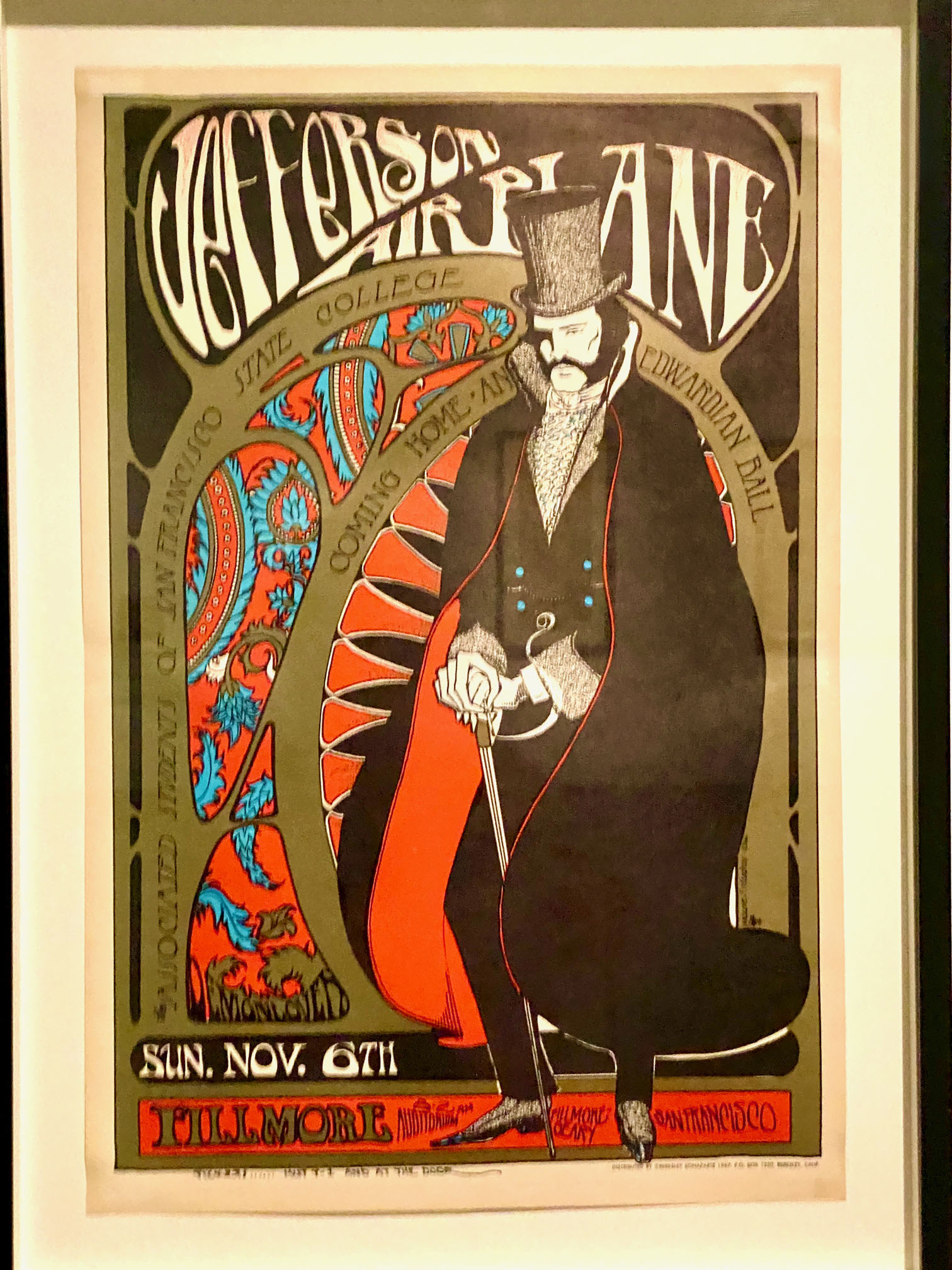
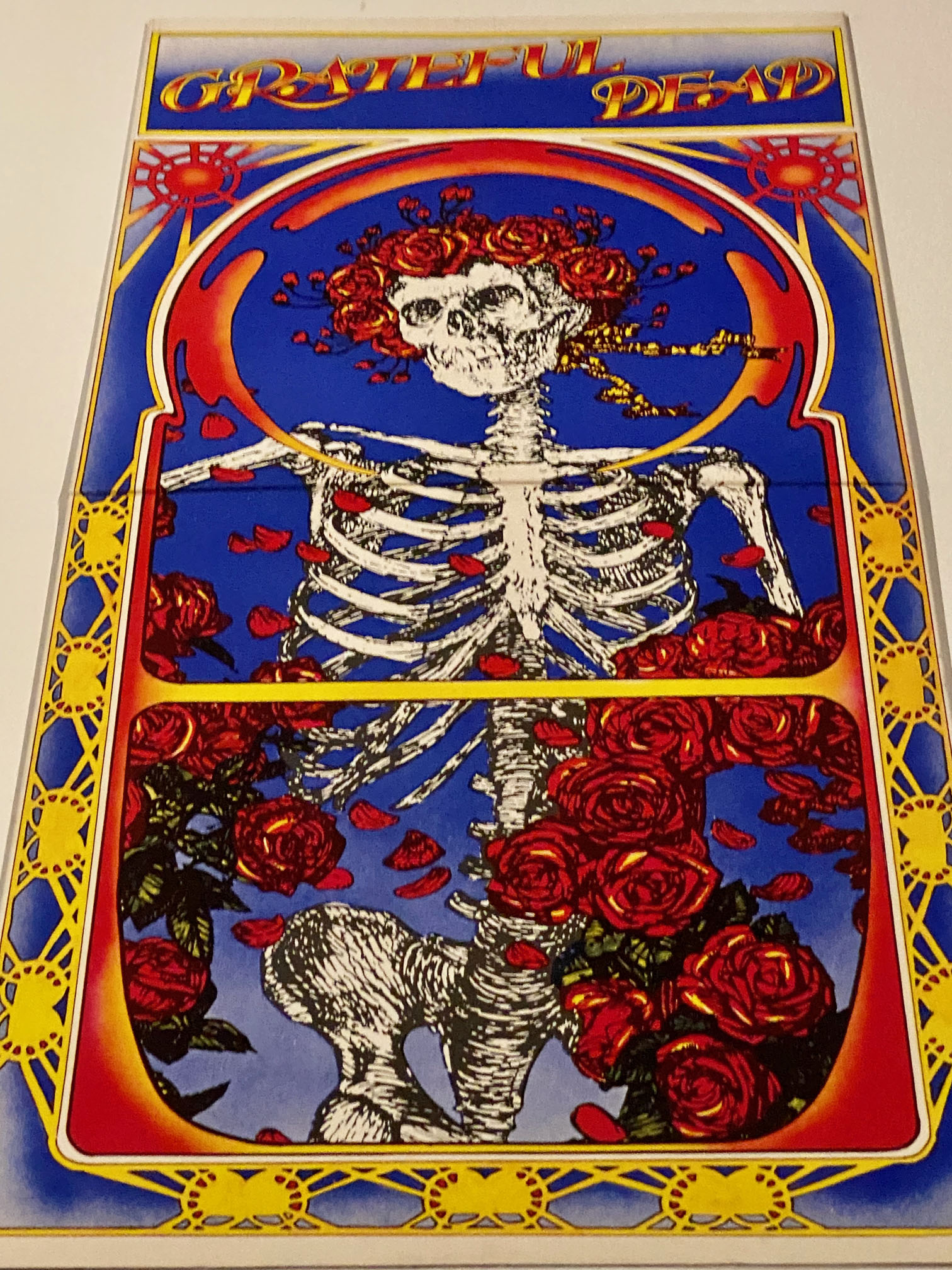
When Mucha produced these design look-books in the early 1900s, could he have envisioned that illustrators and designers of the late 20th and early 21st century would take note? The exhibition showcases Fillmore West posters and Sixties’ rock album covers that repurposed Mucha’s style, such as this transformation of Mucha’s cigarette paper ad into a nearly identical promo for the Jim Kweskin Jug Band.
Mucha’s first product advertising poster – 1896 promo for JOB rolling papers featuring a sensuous smoker and a Byzantine border. Courtesy: Mucha Foundation.
1966 poster by Stanley Mouse and Alton Kelley for a San Francisco concert headlining the Jim Kweskin Jug Band and Big Brother and the Holding Company.
Flowers in your hair? Swirling hair, flowers, and stars were part of Mucha’s “universal language” that took design in a new direction in the 1900s. Museum visitors love pouring over the Sixties album covers and posters detail in the exhibition, remembering which albums they owned and acts they saw, delightedly pointing out the Mucha design influences to their friends.
1966 tour poster for Jefferson Airplane at the Fillmore Auditorium by Stanley Mouse and Alton Kelley.
1971 Skull and Roses tour poster for Grateful Dead by Alton Kelley.
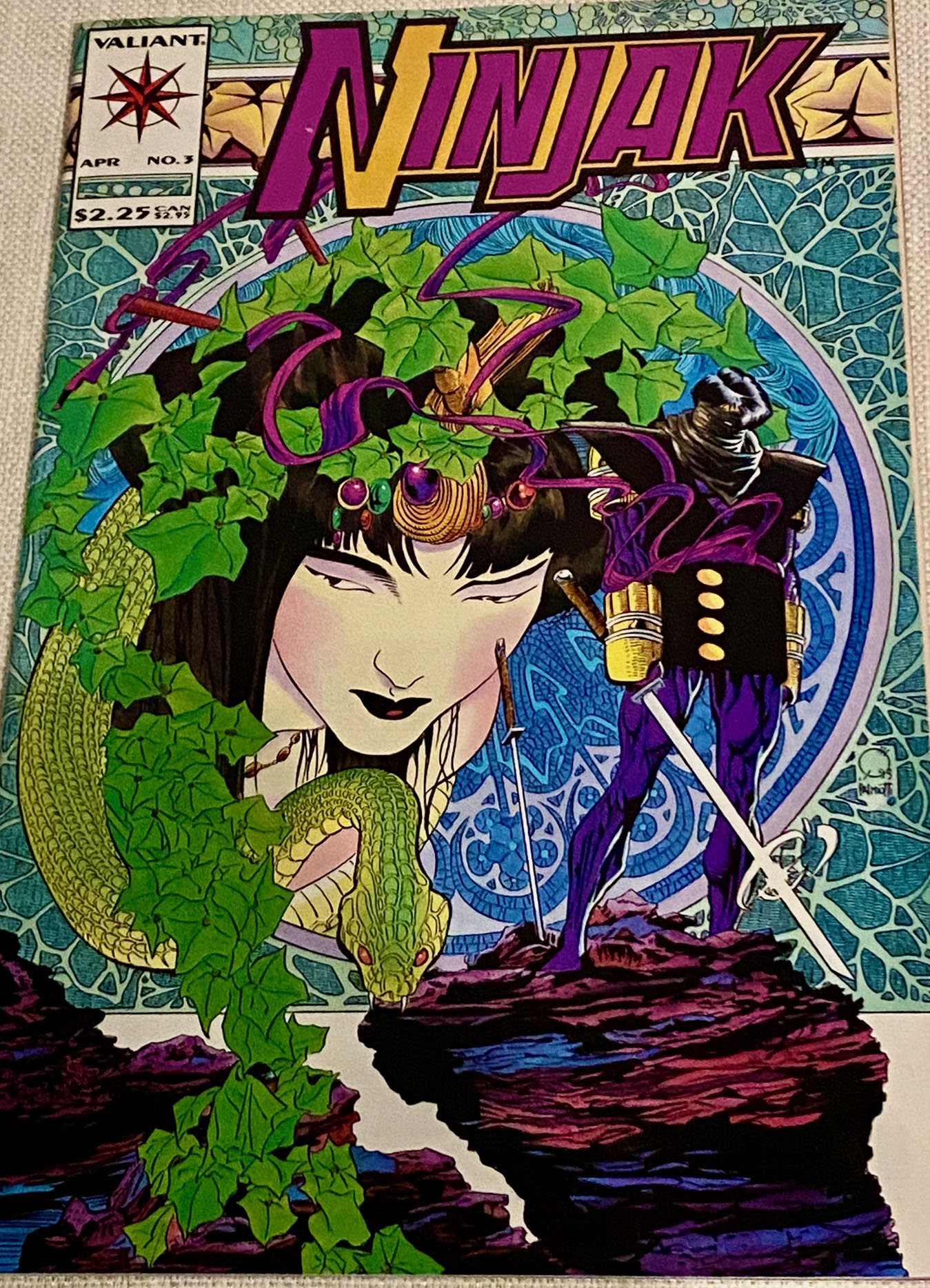
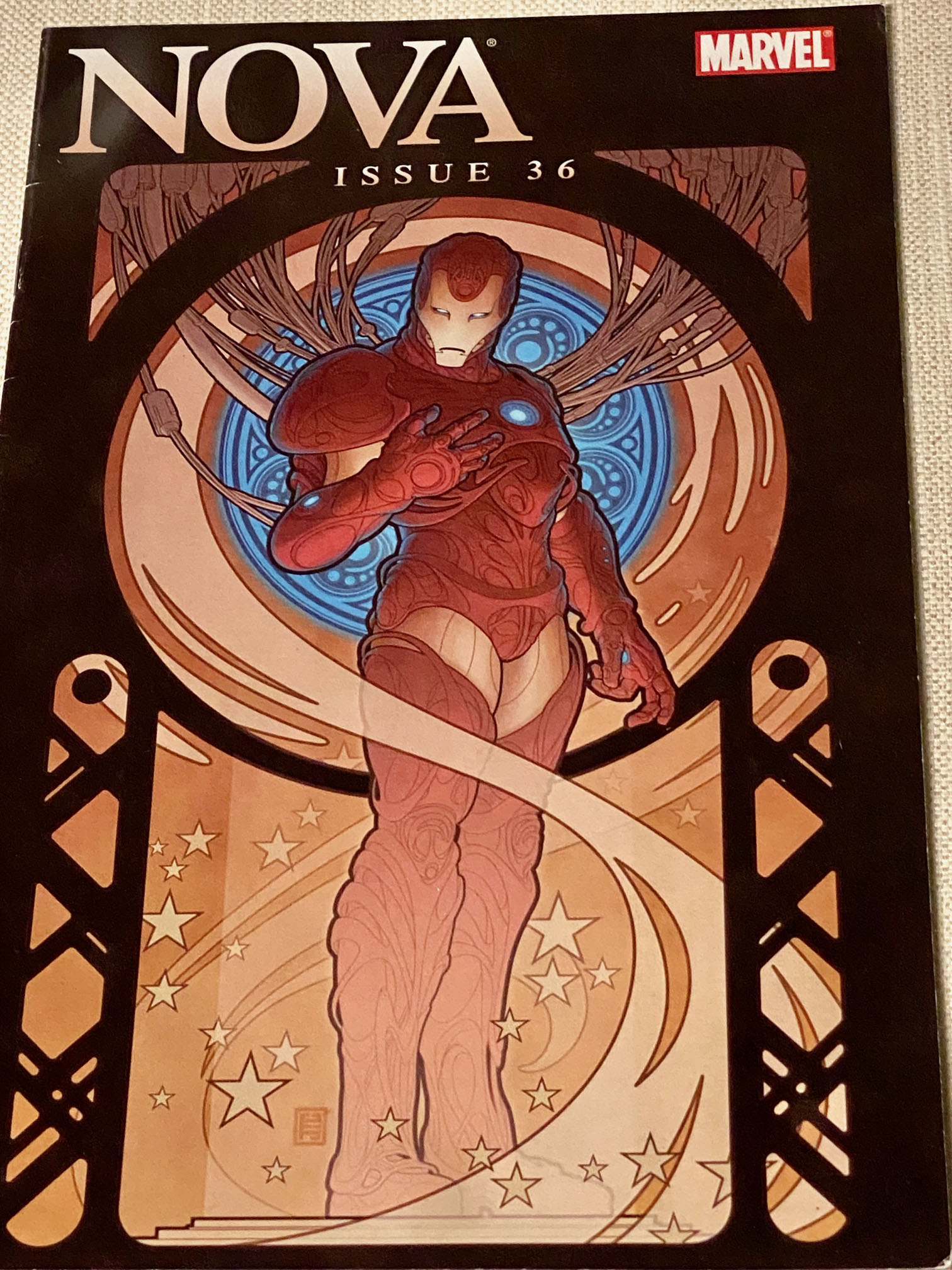
But subsequent generations of media makers also adapted Mucha style – comic book and manga artists.
Joe Quesada’s 1994 Spread, Ninjak cover for Valient Comics.
John Tyler Christopher’s 2007 cover for Marvel’s Nova, no. 36B.
Listen to curator Sato about how Japanes artists adapted Muca’s design breakthroughs for 21st manga fans:
Next on the tour for this beautiful exhibition – the Nelson-Atkins Museum of Art in Kansas City, Missouri (April 11-August 30, 2026) and Museo Kaluz in Mexico City (October 8, 2026 – February 7, 2027).
The riches on display in this exhibition are also a reminder that much more is on view at the Mucha Museum – a spectacular new venue in Prague opened by the Mucha Foundation at the Savarin Palace in 2025, right on the western edge of Old Town.
A star framed by a halo: years of Mucha’s poster ads for Sarah Bernhardt’s 1894-1899 plays – Hamlet, Lorenzaccio, and Gismonda. Courtesy: Mucha Foundation.
It’s always fun when the MoMA design curators dig into the collection and present innovations that make you look – and think – twice. They’ve outdone themselves with the endlessly fascinating, super-popular, and throught-provoking exhibition, Pirouette: Turning Points in Design, on view through November 15, 2025.
Where (and why) did Crocs evolve? Who improved the paper bag? Who designed the first emojis? What’s the link between M&Ms and the US military? The exhibition celebrates designers and tells stories about eureka moments – a flash of genius in adapting industrial materials to solve everyday problems in unexpected ways.
Early 1930s invention for the military by Forrest Mars – M&M’s candy-coated chocolates.
Each design innovation has its own little curtained cubby, giving the exhibit a luxe red World’s-Greatest-Showman vibe with surprises revealed around each bend. The show has it all – beloved technology innovations, fashion twists, furniture innovations, and ubiquitous everyday items that we take for granted.
1950 Bic Cristal Ballpoint pen designed by Marcel Bisch and the Décolletage Plastique Design Team for Société Bic, which eliminated clogs and leaks.
1962 View-Master Model G, a lightweight stereoscope viewer remodeled by Charles Harrison for Sawyer Manufacturing.
Right at the start, there’s an entire wall where you learn about Shegetaka Kurita, the Japanese innovator who designed emojis in 1998.
Emojis, designed in 1998-1999 by Shigetaka Kurita for NTT DOCOMO in Japan; 176 designed for mobile phoes and pagers
The earliest innovation honored in the exhibition is the folding, flat-bottomed paper bag designed by Margaret E. Knight and Charles B. Stillwell in the 1870s. MoMA honors Margaret as one of the first women in the United States to obtain a patent for her invention of the paper-bag manufacturing machine. By unfolding a paper container that “stood up” on its own, clerks were able to pack everything with two hands! Revolutionary shopping efficiency!!
1870s-1880s flat-bottomed paper bag designed by Margaret E. Knight and Charles B. Stillwell
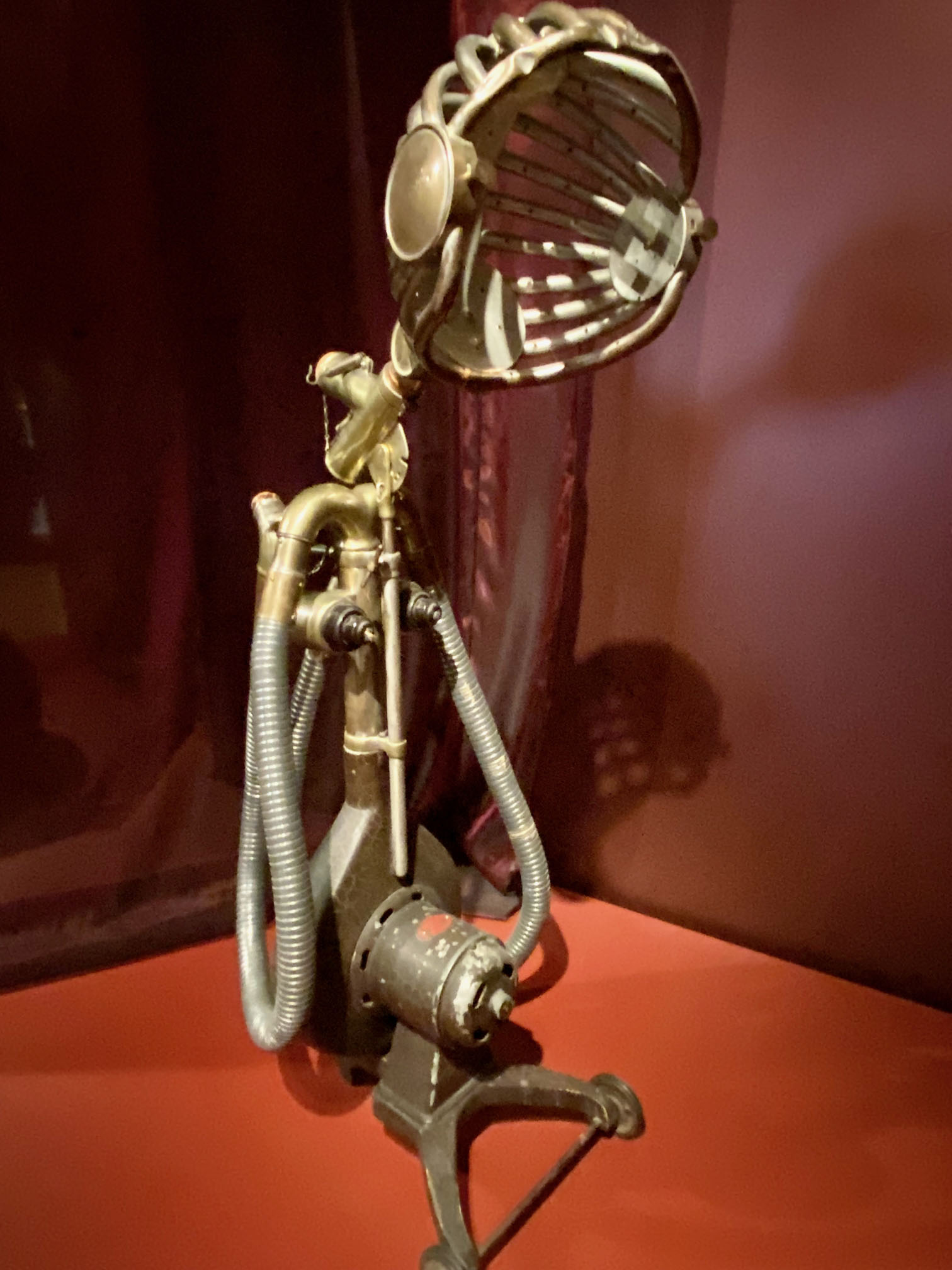
From the early 20th century, we have two European turning points in design – the electric hooded hairdryer and the at-home expresso maker. The Thirties’ version of the Müholos hairdryer is the first invention you see, but its heavy-duty industrial design is a shocker.
The innovative Moka Express expresso pot – invented in Italy during the Great Depresssion – is in every Italian home today. But it was revolutionary in the 1930s because it finally allowed people to economize by brewing at home instead of spending more at the café.
Highly intimidating 1930s hairdryer from the Müholos company of Leipzig, Germany, founded in 1909; innovators in electric hair clippers, too
2008 version of Moka Express designed in 1933 during the Great Depression by Alfonso Bialetti to enable Italians to brew espresso at home.
Going back to 1979, the team honors Sony Walkman, the portable music wearable that replaced ginormous boom boxes. Steve Jobs and his team gets a nod for their 1983 Mac desktop all-in-one and everything that came with it – the Oakland font designed by Zuzana Licko for the earliest Mac word processing and Susan Kare’s graphic OS icons. Kare invented the trashcan and didn’t even own a computer!
Although the tech world seems to be bringing it back this season, it’s nice to see the design innovation that began it all – 1996 Motorola flip phone!
Sony’s 1979 “Walkman” audio cassette player (Model TPS L-2) – the first portable listening “bubble”; designed with two headphone jacks for sharing.
1996 Motorola cellular telephone (Model V3682) – the lightest, smallest mobile device (“flip phone”) – designed by Albert Nagele.
And speaking of technology at your fingertips, it’s always nice to see MoMA display full-size 1926 Frankfurt kitchen that influenced every modern kitchen that came after it. After WWI, Germany undertook a big modernization project to alleviate the housing crisis. Grete Lihetzk, who designed this kitchen was the only woman on the design team, but she made quite a mark! She studied efficiencies in factory designs and incorporated them into the kitchen – revolving stools, built-in storage, stain-resistant cutting surfaces, and drop-down ironing boards.
1926-1927 Frankfurt Kitchen designed by Grete Lihetzky – a revolutionary, efficient approach with features still used in kitchen design today.
Listen to MoMA’s audio guide to hear the backstories of the Rainbow Flag, early Mac OS design, graphic design improvements to familiar signs, and how artificial acrylic nails became a trend.
Here’s a short history of shapewear:
And learn about the Monobloc Chair (designer unknown). It’s everywhere!
Fancy neck ruffles, gilt-framed portraits, sleek suits, flowing trousers, and bold plaids and stripes pop from every corner of the Costume Institute exhibition Superfine: Tailoring Black Style, on display at the Metropolitan Museum of Art through October 27.
It’s a 12-chapter journey through Black men’s style that emphasizes how superb tailoring, style, and fashionable precision has been used successfully by newly emancipated slaves, Revolutionary political leaders, activists, sports and pop stars, and high-style travelers from the 17th-century through today.
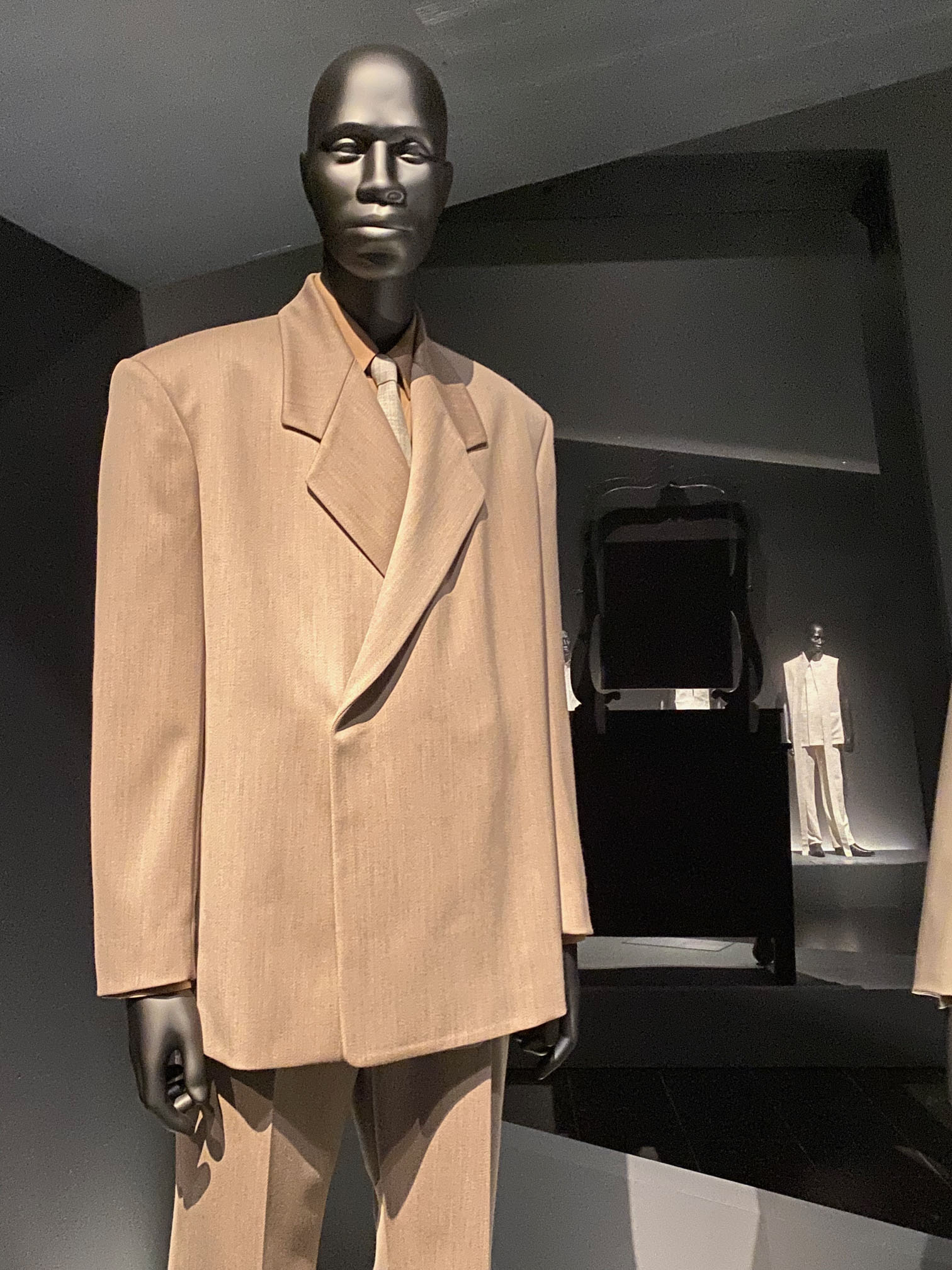
So cool: 2025 wool gabardine ensemble by Jerry Lorenzo for Fear of God – a modern throwback to Fifties’ tailoring. Courtesy: Fear of God
Each section provides a deep dive into history to explain how Black men (and a few daring women) adapted high-fashion menswear in the 17th and 18th centuries to reinvent themselves as authoritative, free, cosmopolitan high-achievers. Themes include Presence, Distinction, and Cool – based on co-curator Monica L. Miller’s acclaimed 2009 book, Slaves Slaves to Fashion: Black Dandyism and the Styling of Black Diasporic Identity.
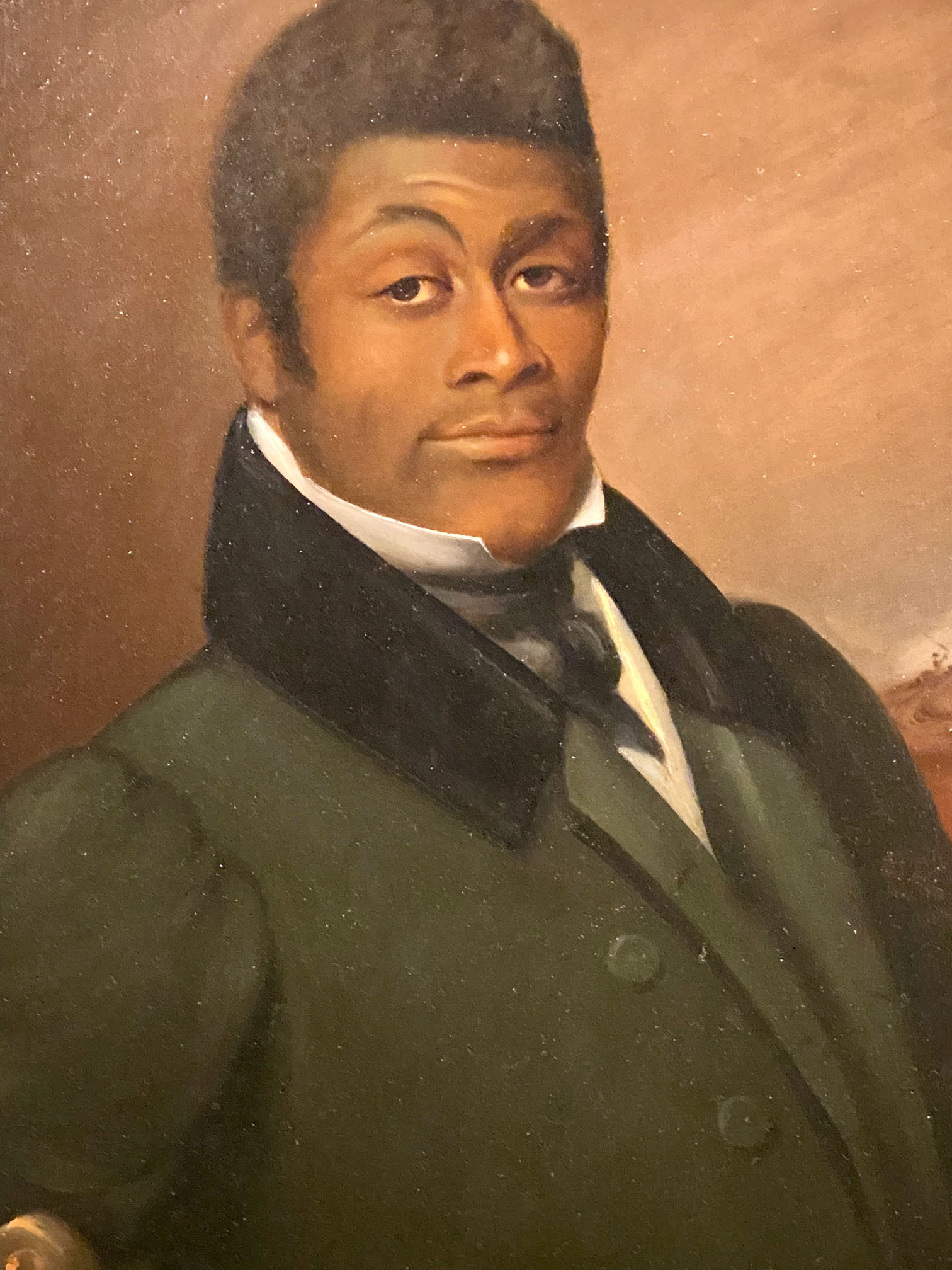
Dressing for distinction: 1804 Portrait of Toussaint L’Ouverture, leader of the Haitian revolution, painted by Giradin. Courtesy: La Maison de l’histoire européen, Brussels.
The curators leverage the Met’s extensive collection of photos, books, magazines, fashion, and accessories to provide visitors with the full visual story of each of the angles of Miller’s treatise. Plus, they’ve assembled loans from recent collections of cutting-edge contemporary Black designers who themselves are pulling inspiration from these same pages of history.
The Distinction section, for example, has a wall of impressive portraits and bedazzled swords of the first leaders of the Hatian revolution dressed in military finery – emphasizing their commitment to Englightenment ideals in the first successful slave rebellion in the Western Hemisphere.
The brilliant multi-level exhibition design features contemporary menswear inspired by 18th-century revolutionary and military style, including a swaggering great coat designed for the ever-magnificent Vogue editor-at-large, Andre Leon Talley.
Jawara Alleyne’s 2004 tailored ensemble inspired by Jamaican style; at right, ensemble from his 2021-2022 “Renegade” collection inspired by 19th-century shipwrecked sailors. Courtesy: the designer.
Worn by Andre Leon Talley; 2000-2001 haute couture coat with gold braid by John Galliano for House of Dior. Courtesy: Talley estate.
The Freedom section tells the story of the rise of the Black dandy in the 19th century and how the entrepreneurial class of African Americans dressed to impress. Historic portraits, photos, a fancy tailcoat, and a book on how to tie fancy neckwear – evidence of social upward mobility – are shown alongside cutting-edge contemporary menswear.
2023 figure-enhancing white cotton ensemble by Bianca Saunders for her “Nothing Personal” collection. Courtesy: the artist.
Freedom: Fashionable attire in 1850-1856 portrait of Thomas Howland, the first elected Black official in Providence. Courtesy: Rhode Island Historical Society.
The Champions section focuses upon how successful Black athletes – such as Jack Johnson, Walt Frazier, and Mohammed Ali – used fine clothing and style to make a statement, and how althetic wear transitioned into upscale runway fashion.
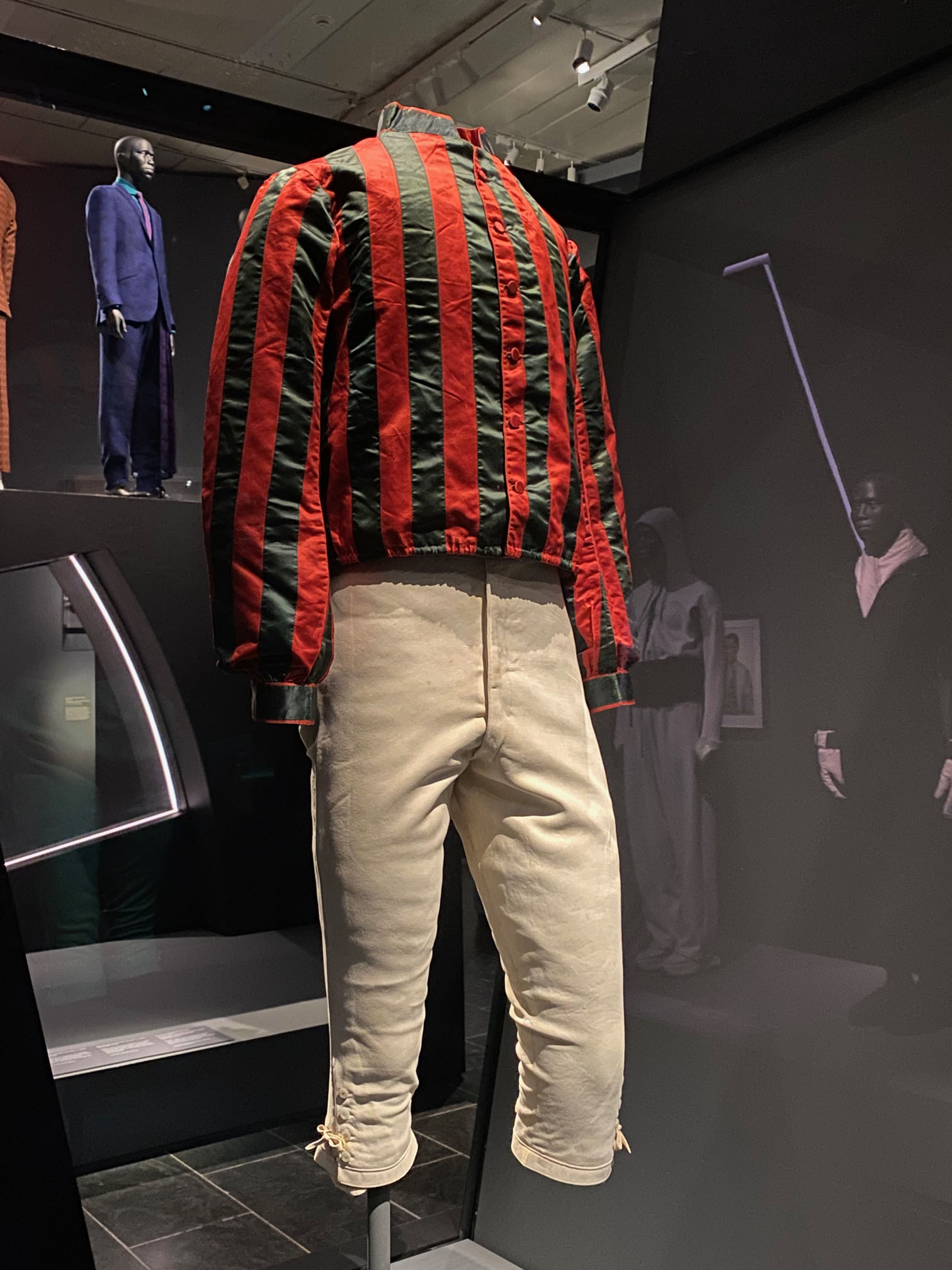
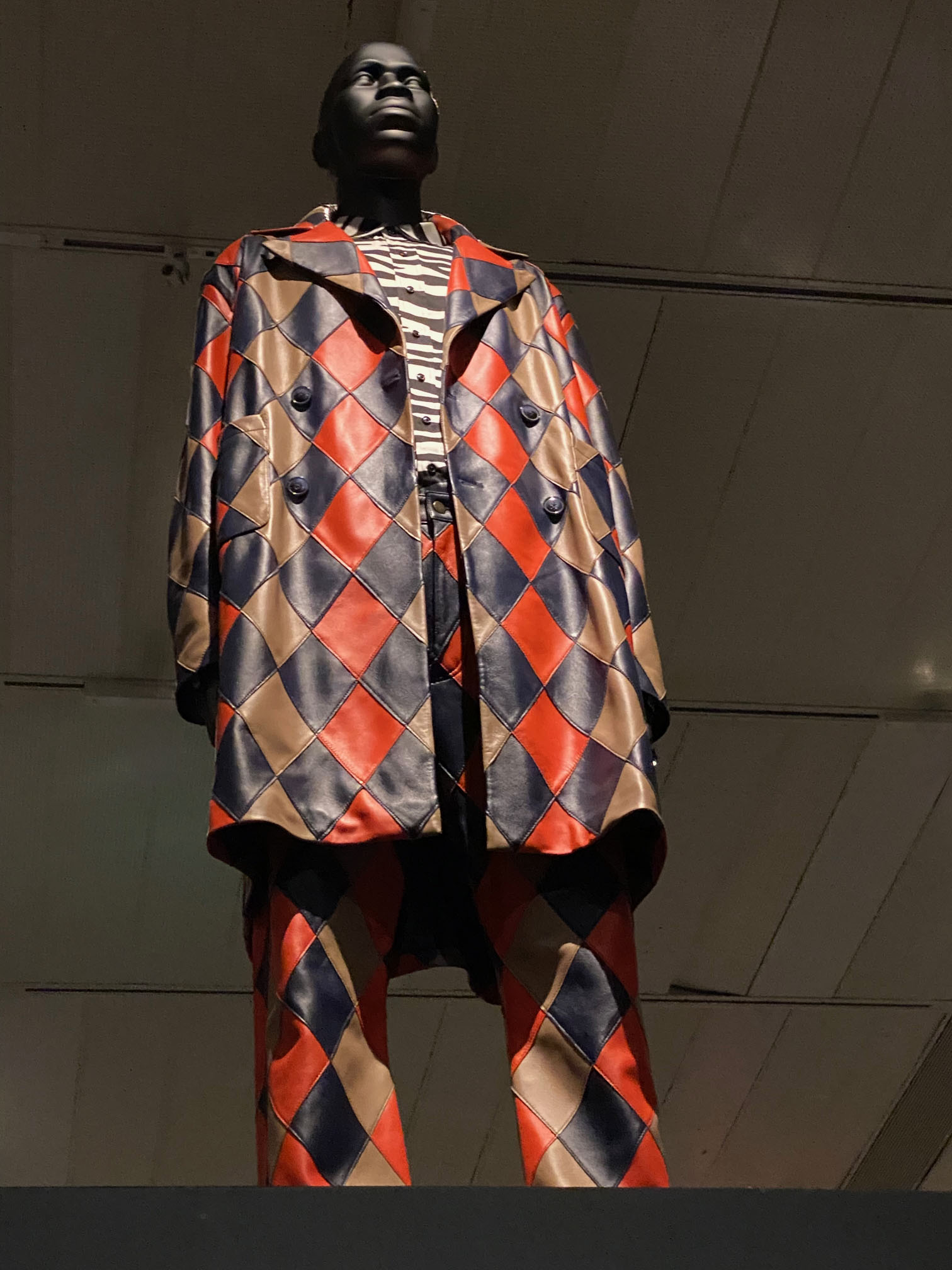
The story of Black jockeys is told – how 19th-century sports superstars got pushed out of early 20th-century racing when racial discrimination was at its peak, and how contemporary designers are incorporating this story into their designs.
EaEarliest surviving jockey suit (1830-1850): stripes appliquéd on silk jacket with and buckskin breeches made by plantation tailors. Courtesy: Charleston Museum, South Carolina.
2024 ensemble from “The Great Black Jockeys” collection by Tremaine Emory for Denim Tears; pieced lamb leather coat and trousers over silk shirt. Courtesy: Denim Tears.
The Respectability section explains how social-justice icons D.E.B. Du Bois and Frederick Douglass used their perfectionist style to draw a crown and make a statement, but it also discusses (and shows) the tools of the trade used by legions of Black tailors. There’s also a beautifully cut in-process example from Saville Row tailor Andrew Ramroop.
2024 in-process tailored jacket by Andrew Ramroop for Maurice Sedwell of Saville Row. Courtesy: Maurice Sedwell
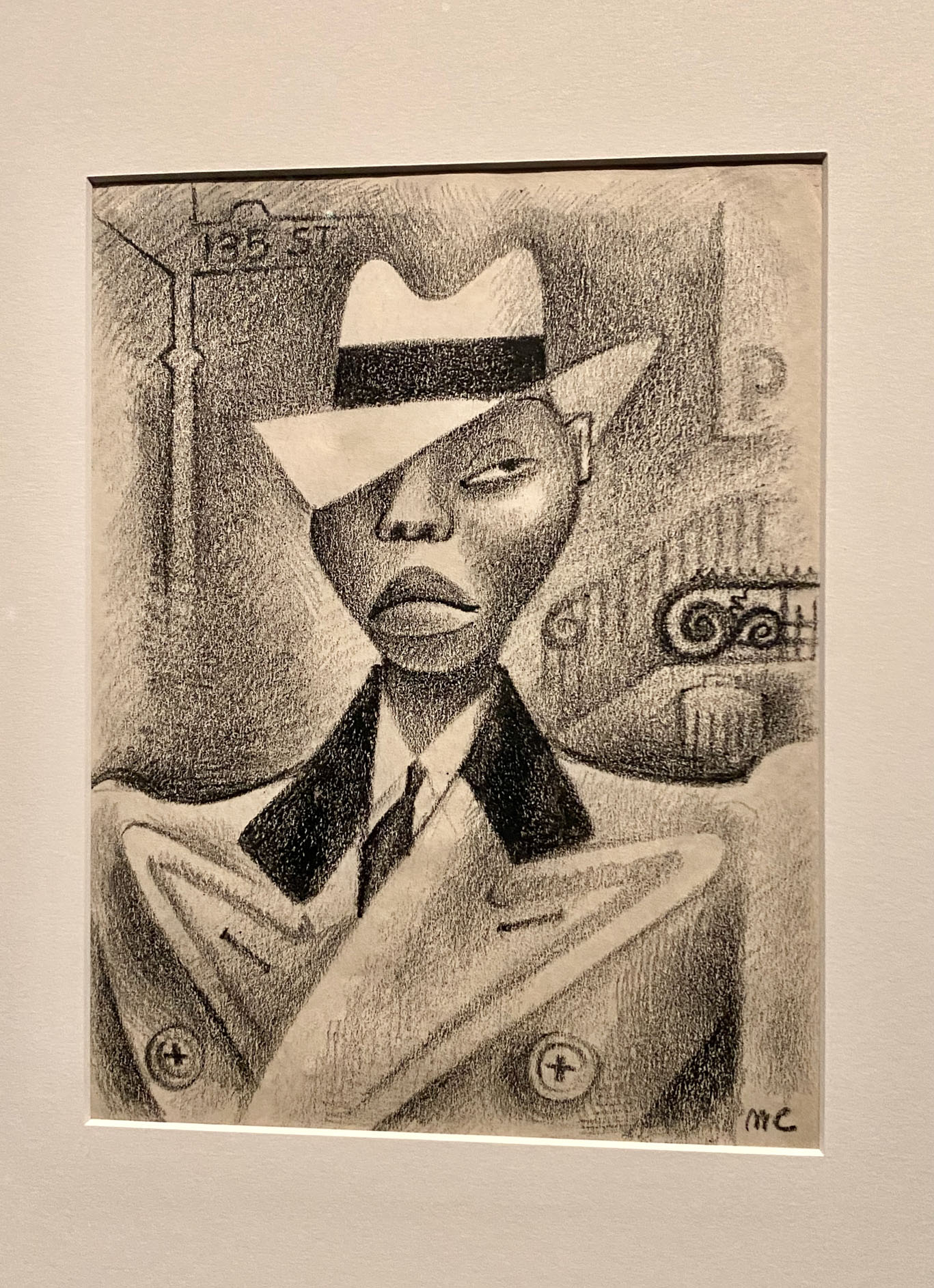
Hip community: 1930 lithograph of stylish Harlem Dandy on Striver’s Row by Miguel Covarrubias, a popular Vanity Fair contributor. Courtesy: University of Texas at Austin.
Of course, hip-hop takes its bow, too, with a tribute to Dapper Dan and other designers honoring the cool, ever-evolving style of Black musicians and performers.
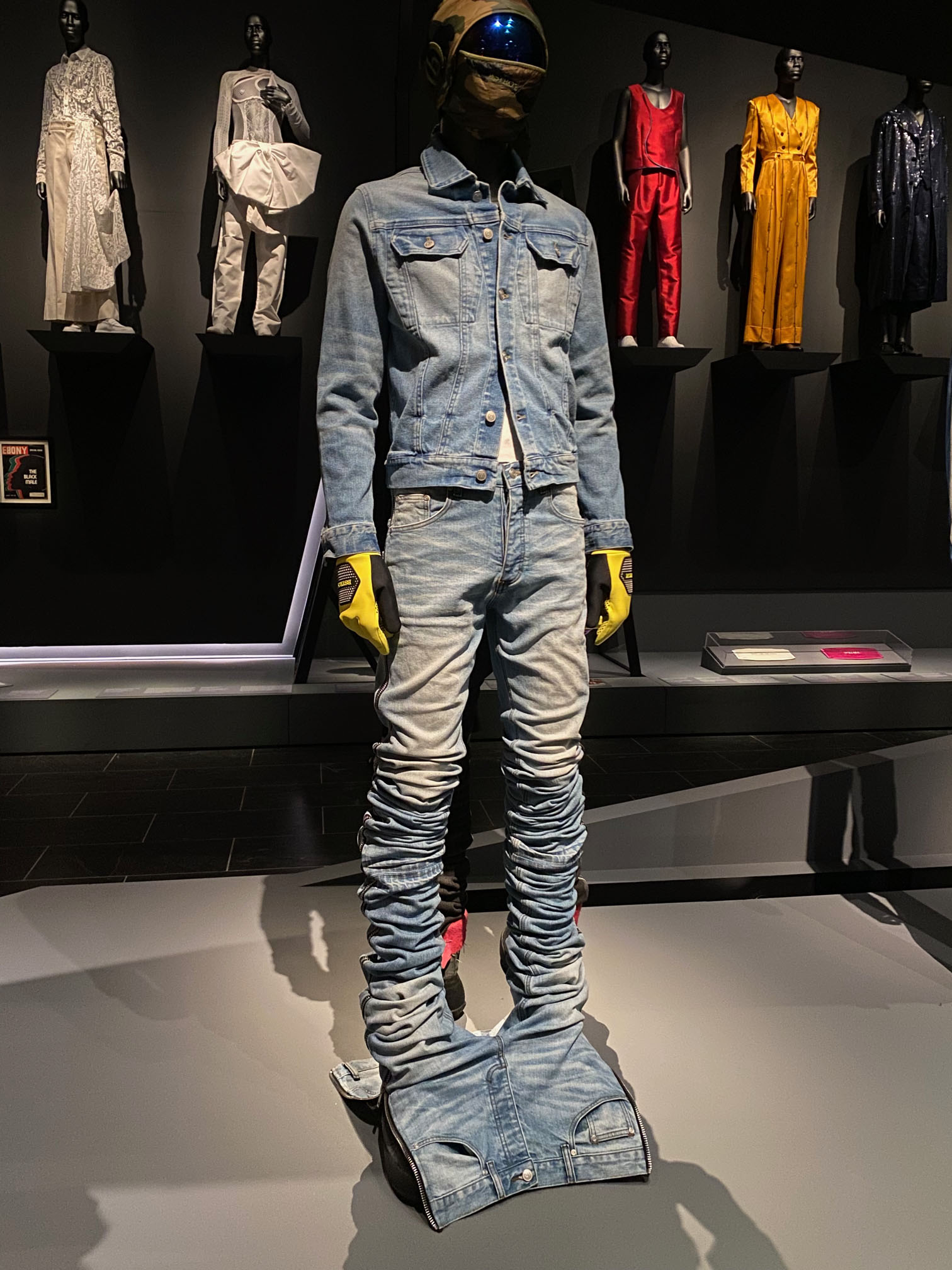
So cool: 2017 denim ensemble by Brick Owens and Dieter Grams for Bstroy, a reference to early all-denim hip-hop fashion. Courtesy: the designers.
1987 all-over LV-monogrammed leather jacket for Jam Master Jay of Run-DMC and pants for DJ Hurricane by Dapper Dan of Harlem. Courtesy: private collections.
To celebrate its 200th anniversary, the Brooklyn Museum decided to dazzle us with 500 gold pieces – Tiffany, Cartier, Egyptian, Renaissance altarpieces, golden sculptures, Greek wreaths, and eye-popping bedazzled fashion – in Solid Gold, on view through July 6. Half of the pieces are from the museum collection, and half loaned by private collectors and design houses. See our favorites in our Flickr album.
The ten-part show, spread across the museum’s two top-floor galleries deliberately pairs shimmering art from its vast collection with haute couture, gold records, and dramatic jewelry. The exhibition begins by acknowledging the ancient gold in Brooklyn’s Mediterranean and American collections.
Nam June Paik’s 2005 Golden Buddha checks himself out on TV. Courtesy: estate of the artist.
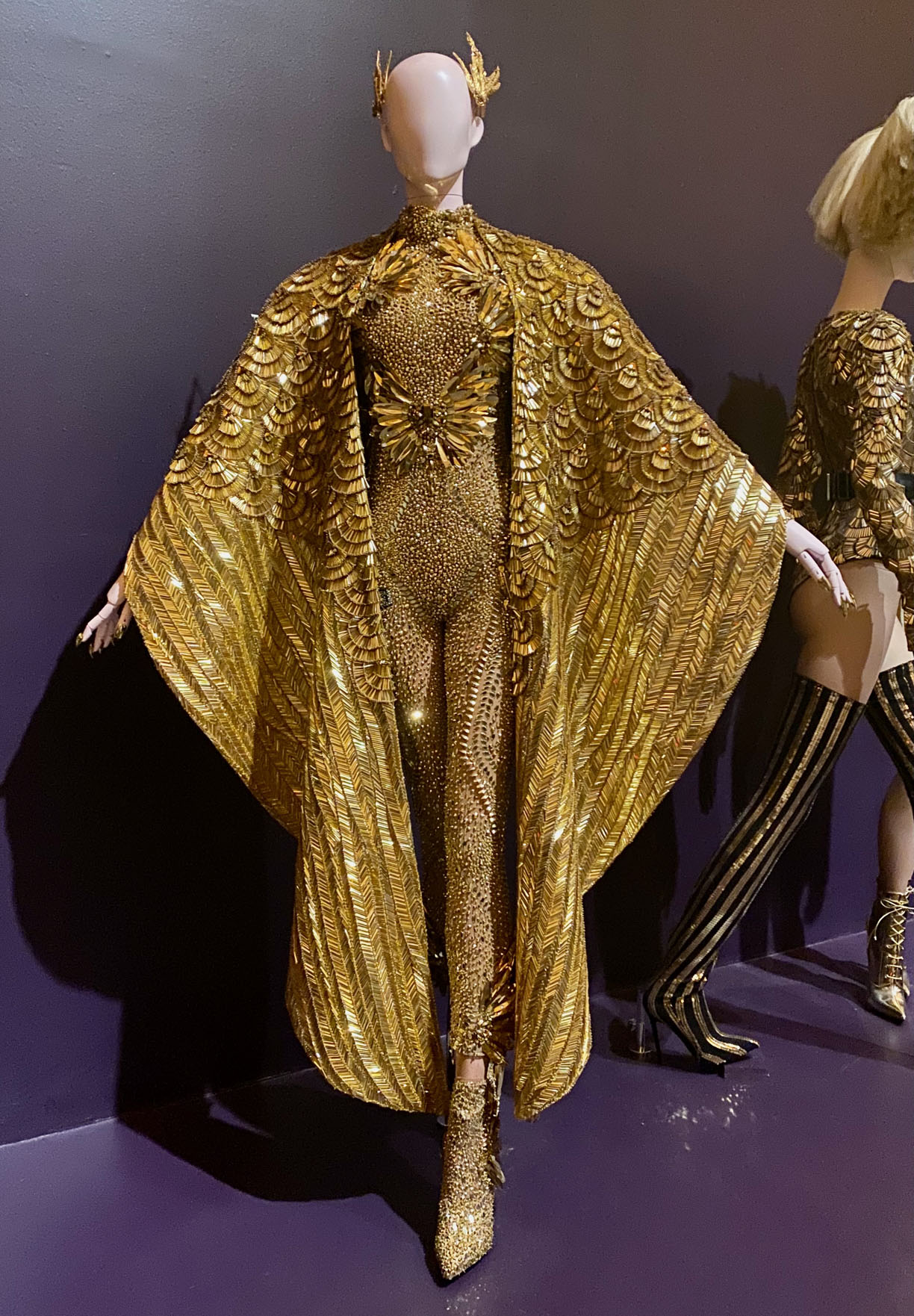
Known for its massive Egyptian holdings, the exhibition’s introductory gallery allows us to plunge directly into a mix of actual and retro Egyptian objects and fashion – golden Egyptian tomb fragments, Victorian-era faux Egyptian decor, clips of Elizabeth Taylor from her Sixties Cleopatra extravaganza, and many dazzling pieces from the Egyptian Disco collection by The Blonds, including the Cleopatra catsuit-cape that Billy Porter wore as he was carried on a litter onto the 2019 Met Gala red carpet.
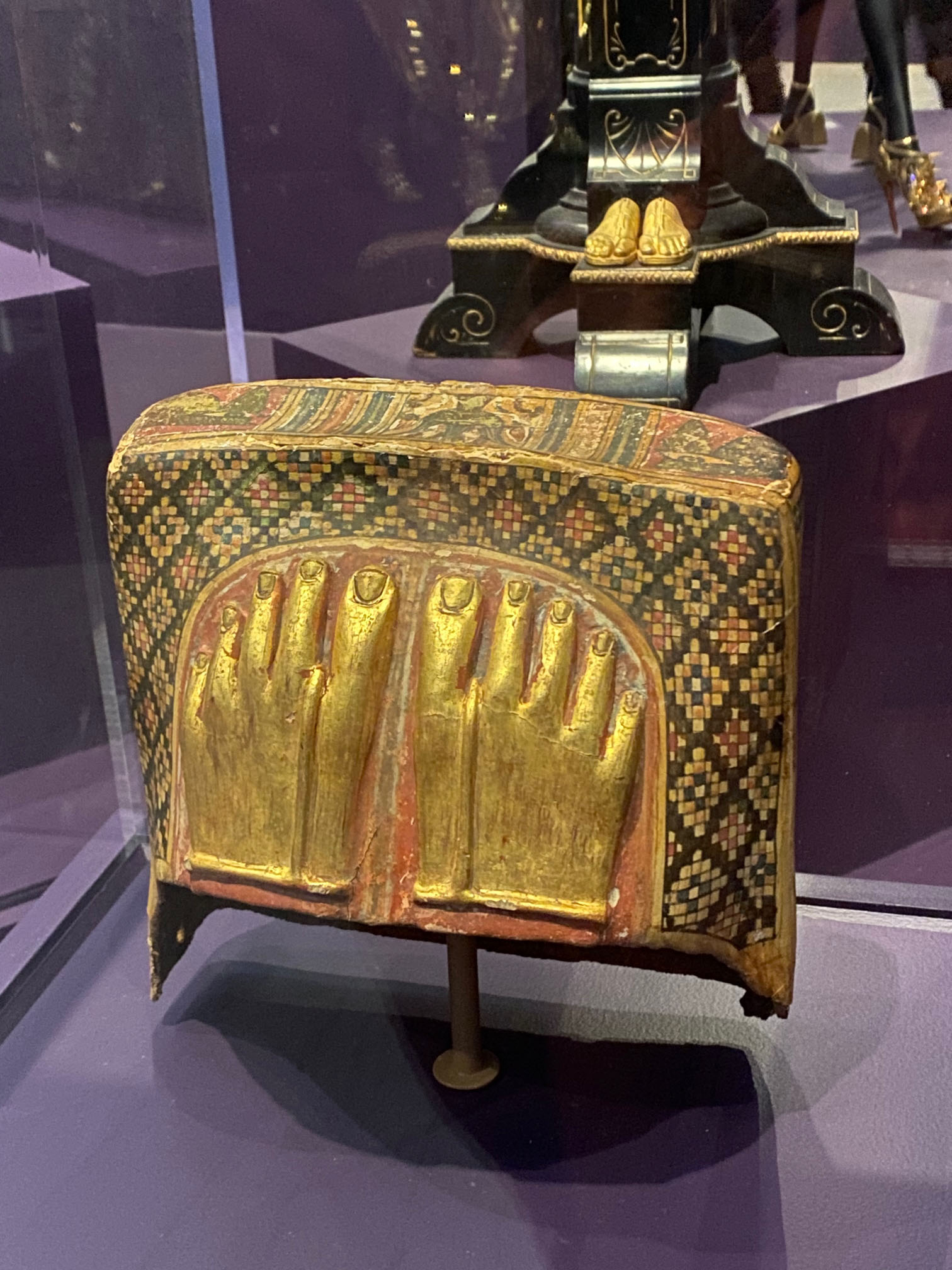
Gold in the First Century: painted gold-leafed footcase from Coptic era Egypt; (rear) 1870 gilded and lacquered pedestal by Kimbel and Cabus.
From The Blonds’ Egyptian Disco collection: Cleopatra catsuit, cape, and headdress worn by Billy Porter to the 2019 Met Gala.. Courtesy: The Blonds
You could spend hours in the first room just taking in the gold, platinum, and diamond details of Jacob Arabo’s wristwatches; wondering how Galliano crafted a gown of Lurex pyramids; admiring Mary McFadden’s golden macrame gowns; or contemplating the 4th-century golden hoard from the Middle East.
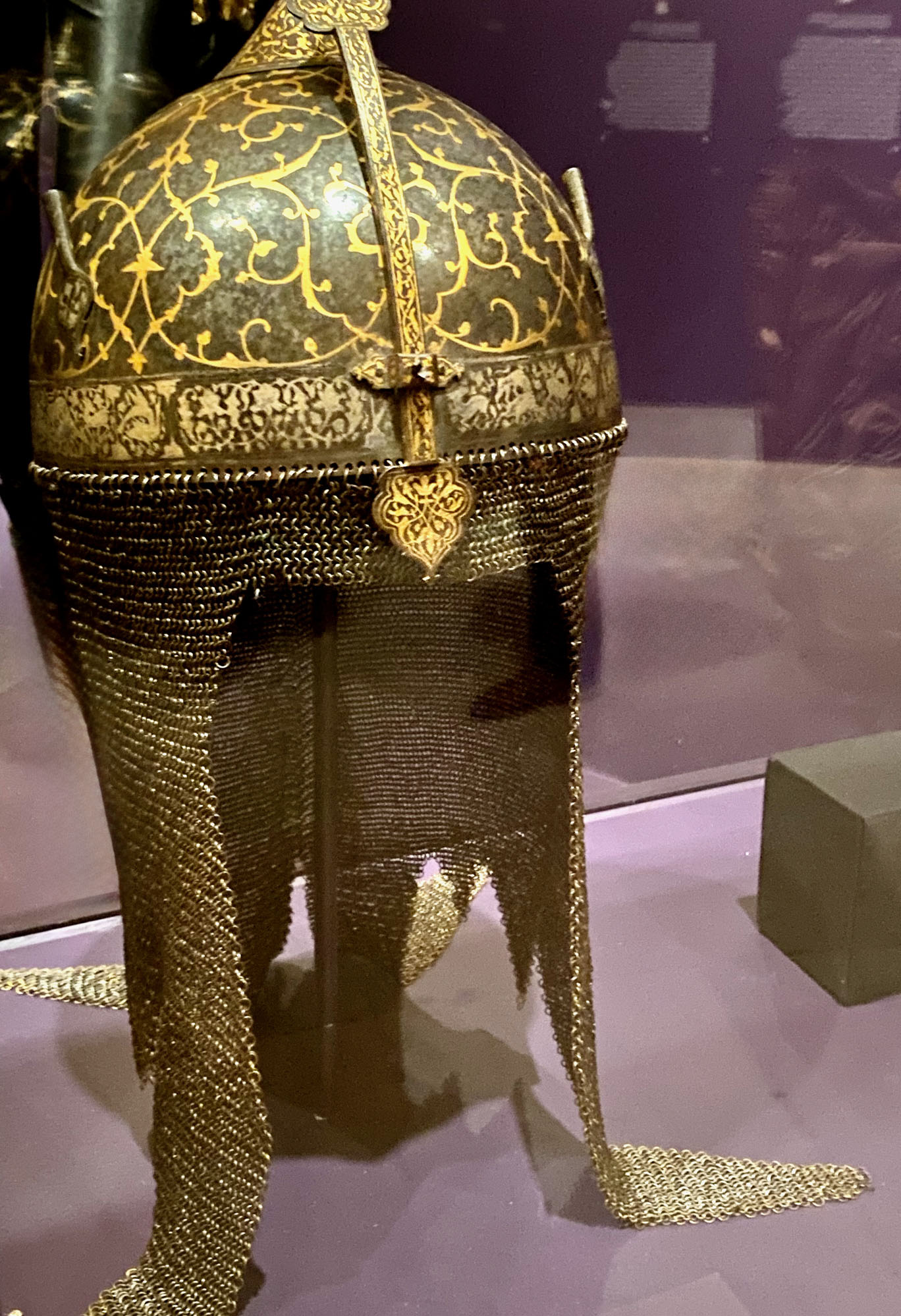
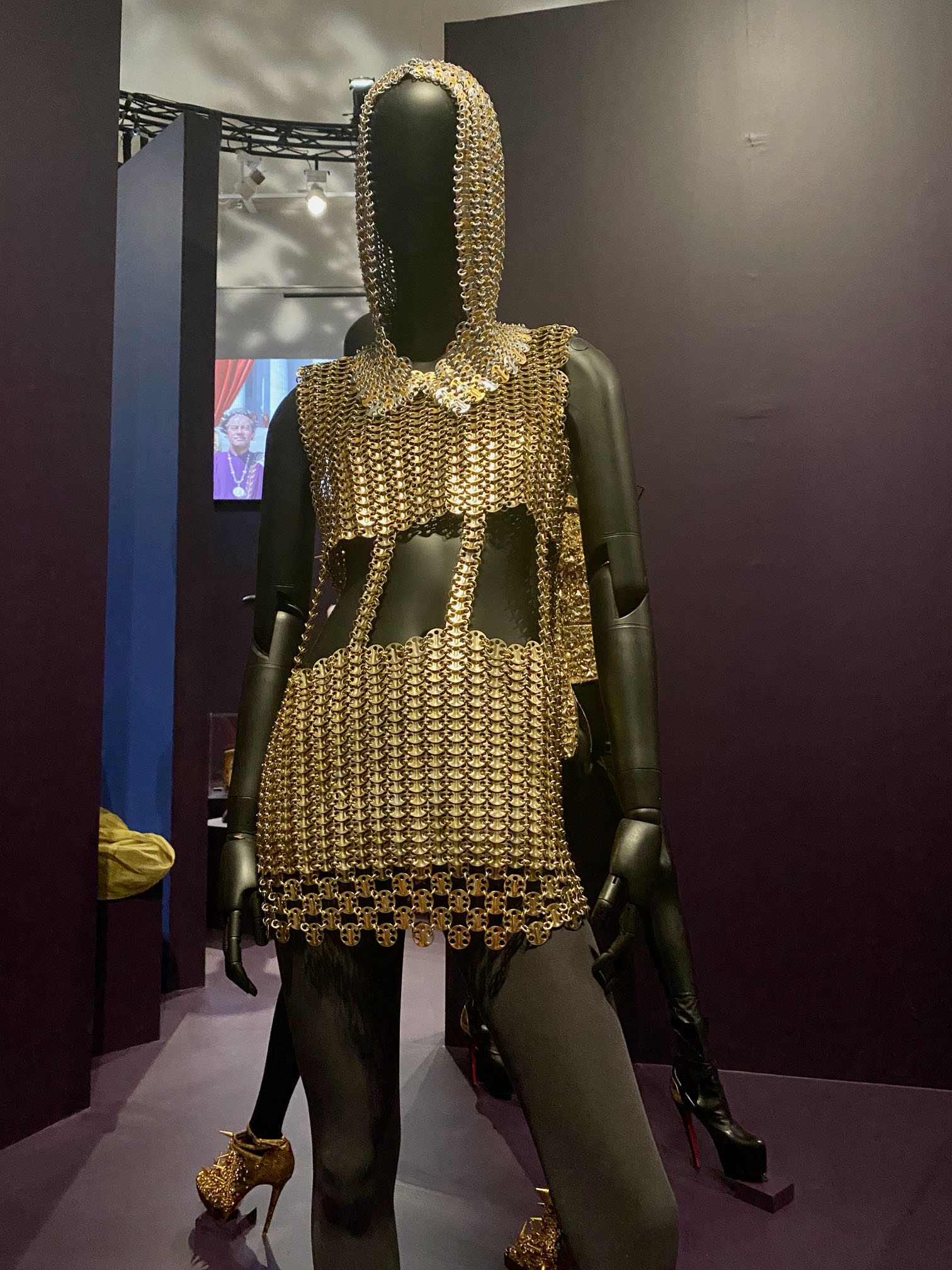
But even more dazzlers await in the linked-chain section – 18th century Islamic helmets, Janelle Monet’s gold-braid wig by The Blonds, and a Seventies chain mini by Paco Rabanne.
From the Safavid Islamic Empire in Central Asia: a 1700 steel, gold, and silver helmet.
1971-72 gold, silver, and patinated aluminum cowl and dress by Paco Rabanne. Courtesy: private collection
A large, dramatic gold sculpture punctuates the first quarter of the exhibition – the dramatic piece by Zadik Zadikian is only plaster covered in gold leaf, but if it were solid gold, it would represent $1 billion in value. Visitors take a break here to circumnavigate the piece, watch a video and read about the history of gold mining – and its human cost – throughout the world.
2024 24-karat gold Path to Nine by Zadik Zadikian – a wall of 1,000 gold bars (gold leaf on plaster). Courtesy: private collectors
Golden mosaics, golden halos, golden chasubles, embellished holy portaits, golden uniforms, and golden coin containers from Italy, Mexico, Peru, China, and Japan line the next galleries, demonstrating how different cultures have integrated gold into private and public devotions, court, and the economy. In Italy, for example, one era’s minted golden coins are transformed into another era’s golden halos for saints in home altars.
Somehow, it’s a fitting punctuation to this section of the exhibit to encounter the epic, shimming wall sculpture by El Antsui. The “golden” glow emanates from recycled whiskey bottle cap
2010 Black Block by El Antsui, a wall hanging of recycled whiskey bottle caps.
The second half of the exhibition features objects from Brooklyn’s own collection and fashions that combine gold with other colors.
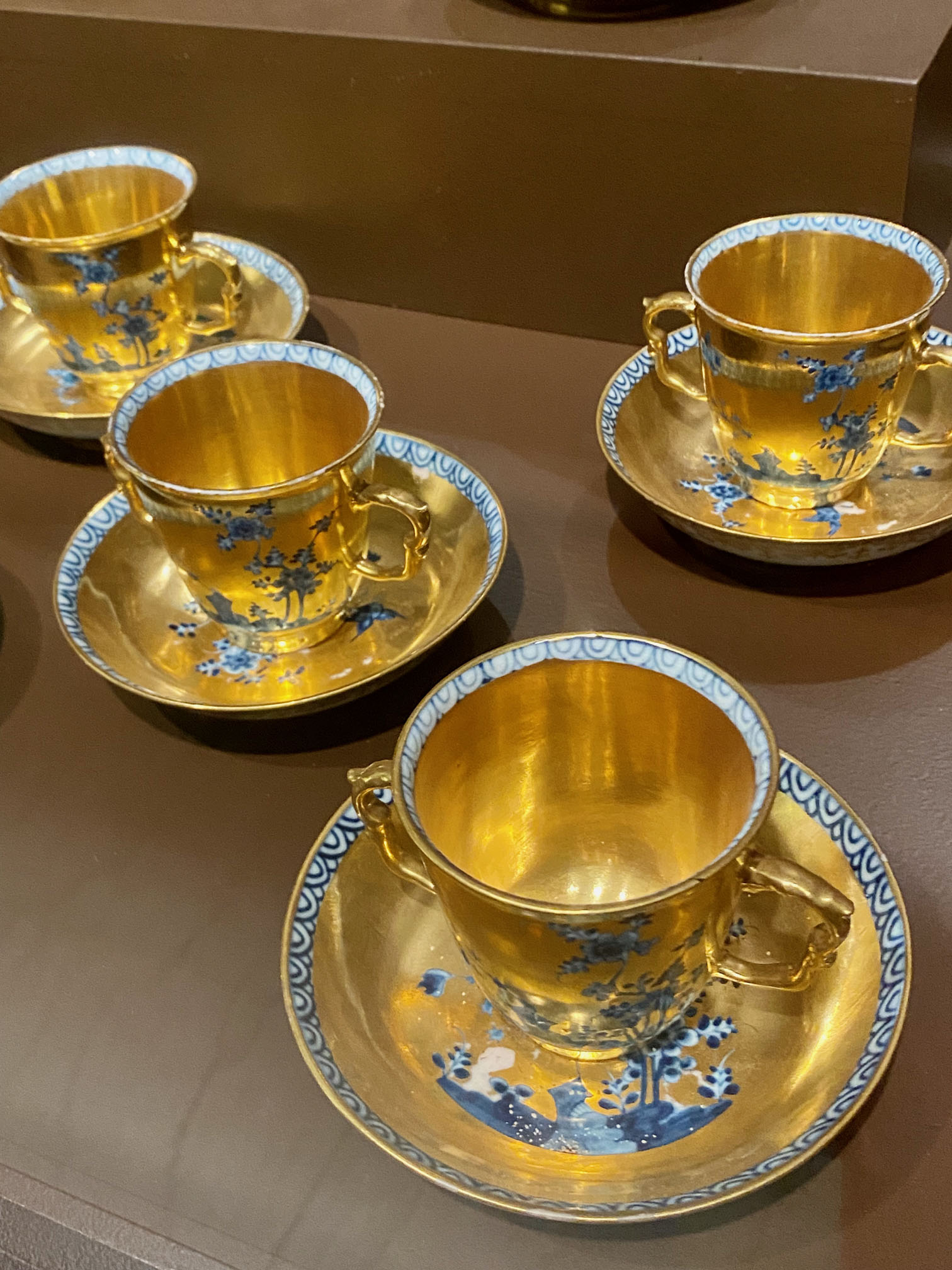
1720-25 gilded Meissen porcelain coffee and chocolate set.
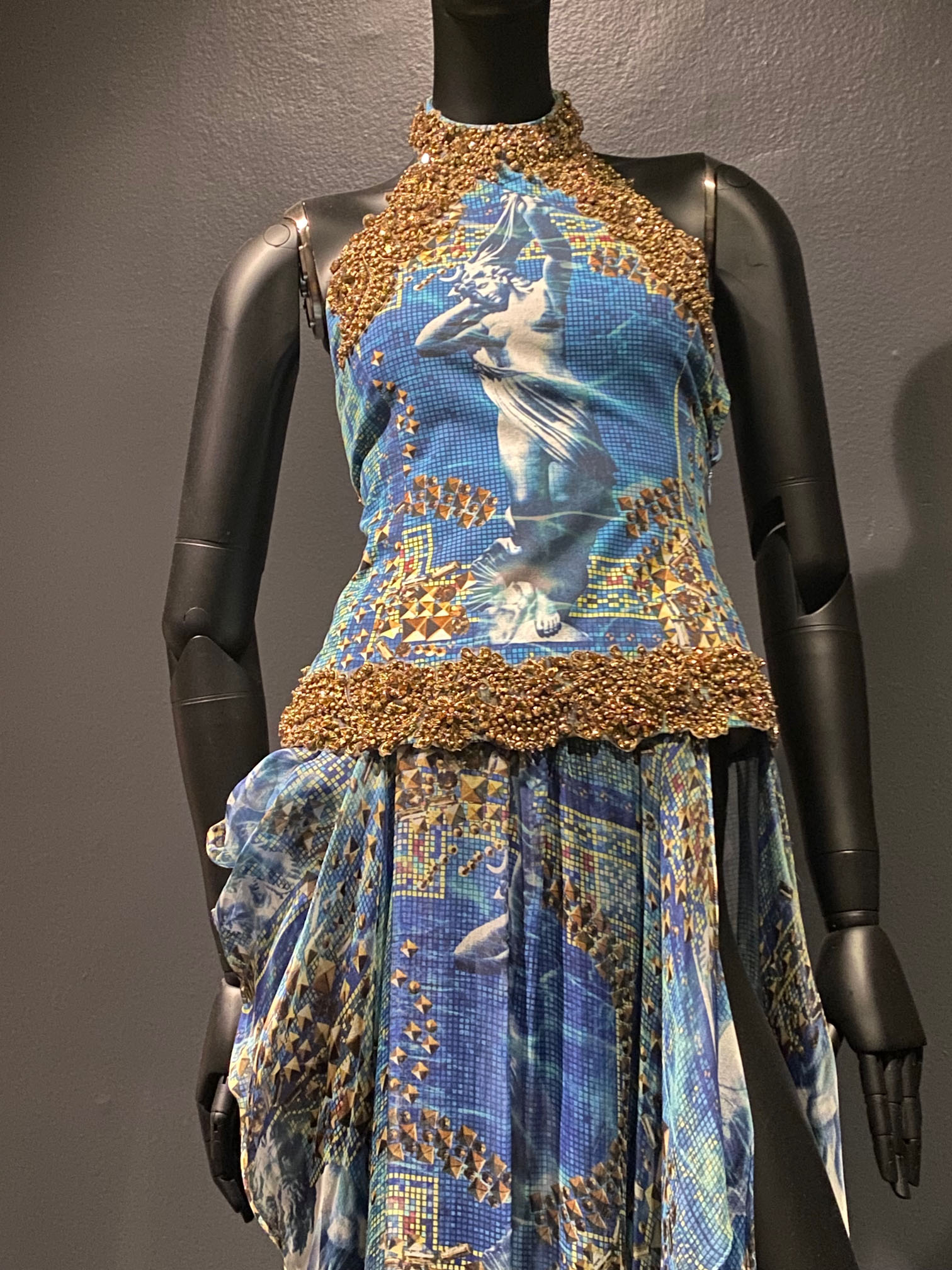
Claudio Cina’s 2017 photo-printed skirt and top depicting Venus, embroidered in gold with gold studs and crystals. Courtesy: the designer
And then it’s just one golden haute couture gown after another – Dior, Yves Saint Laurent, Cardin – accented by cases containing masterpieces of jewelry design by Cartier and Schiaparelli.
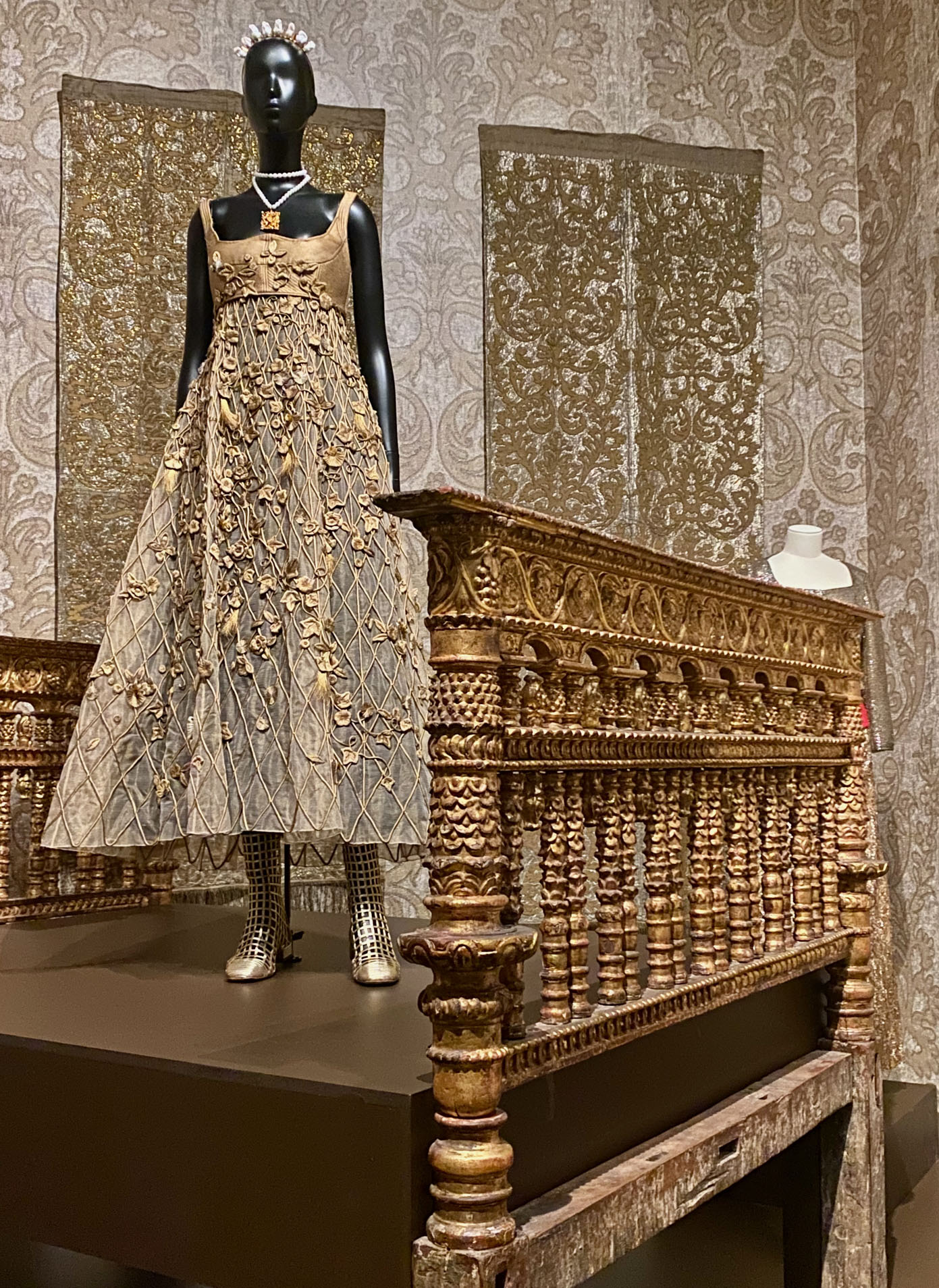
2021 embroidered gold silk haute couture dress by Maria Grazia Chiuri for Dior atop 1700-1760 gilt wood bed from Peru. Courtesy: Dior.
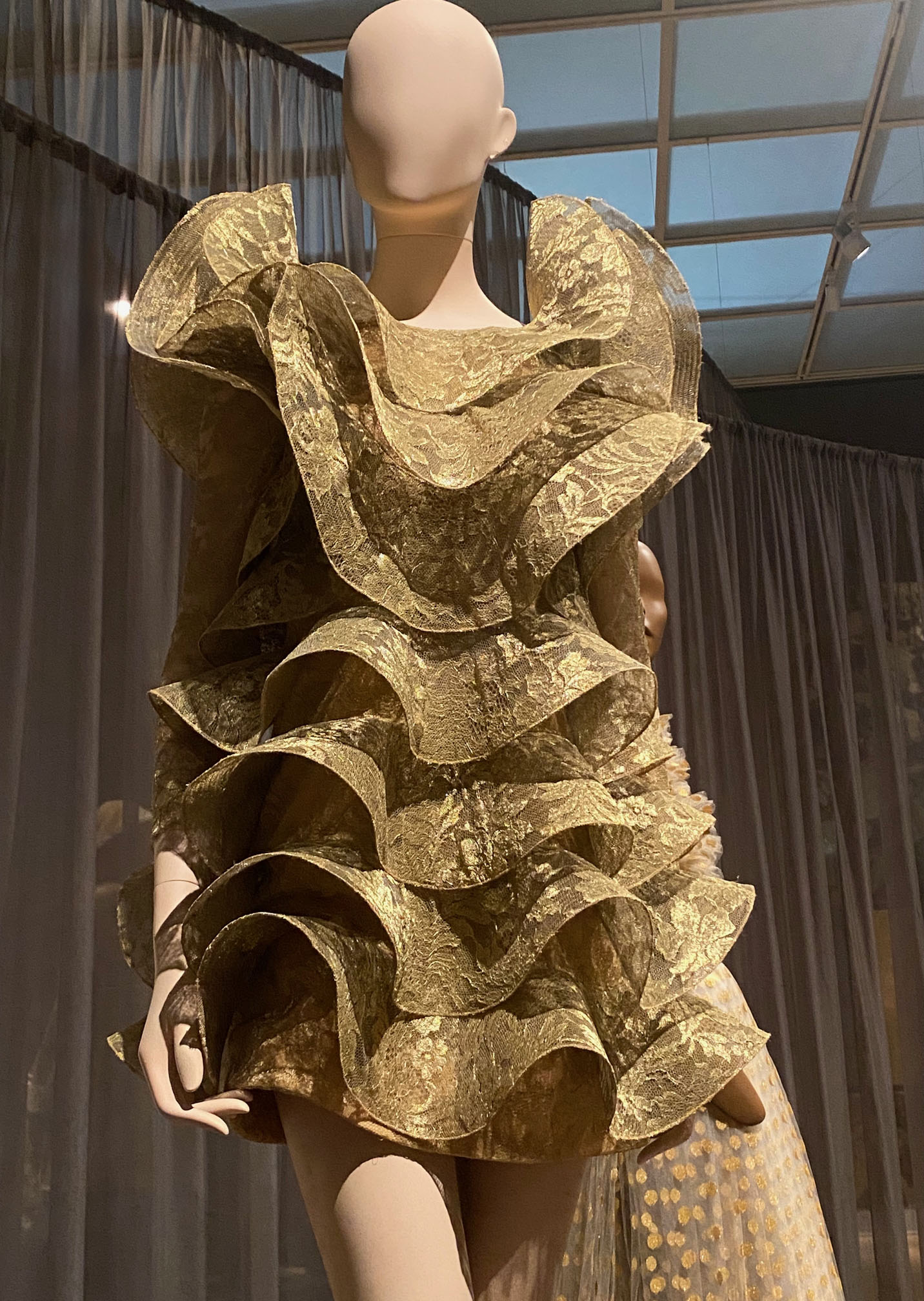
1991 gold nylon lacework ruffled cocktail dress by Pierre Cardin. Courtesy: Musée Pierre Cardin.
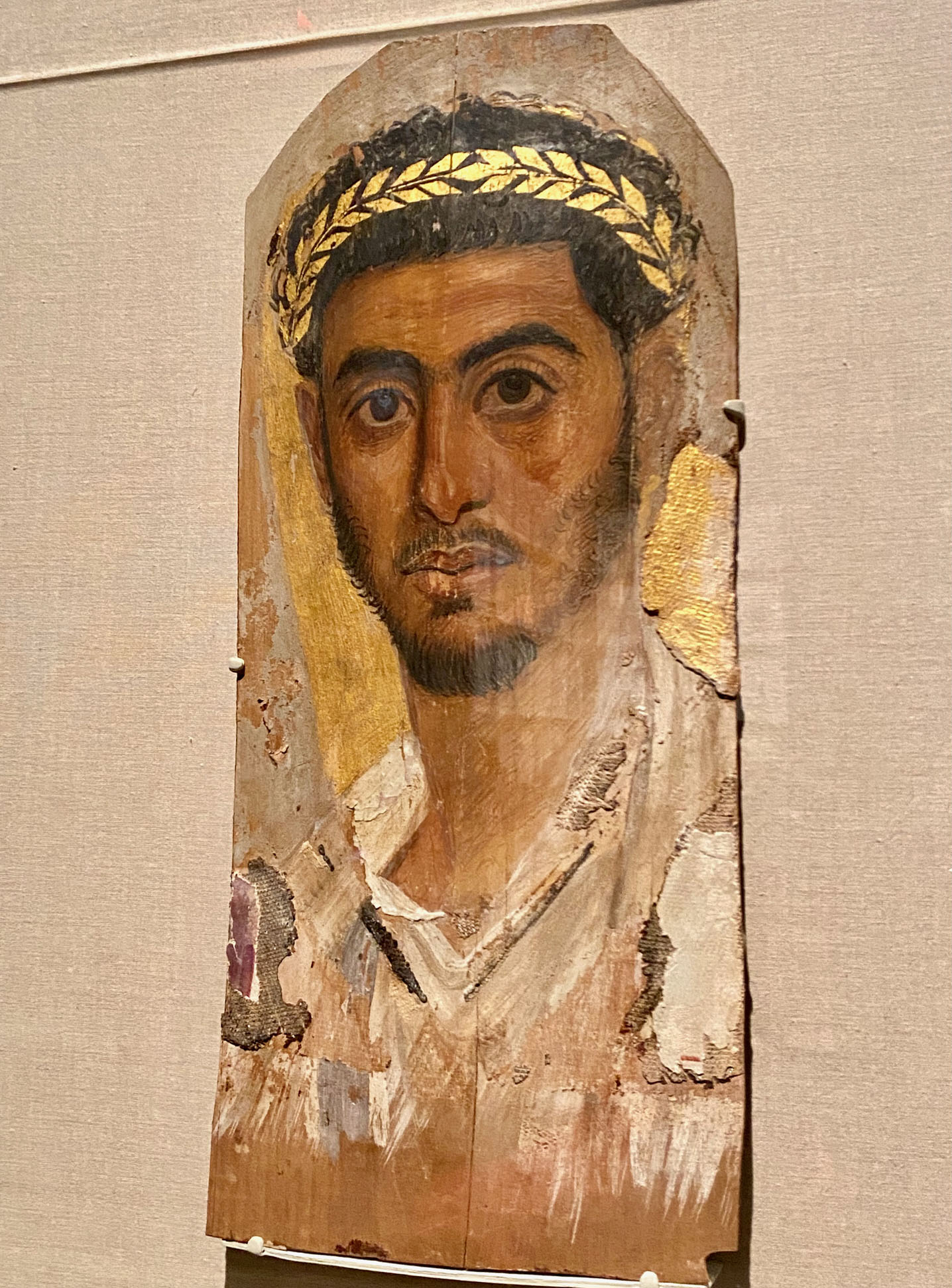
The final gallery – and it’s a stunner – shows how ancient and contemporary artists and designers use gold to signify special status and power. A gold wreath encircles an Egyptian man’s portrait, and Basquiat honors his friend in a painting by inserting his iconic gold crown. We get a chance to examine Brooklyn’s rare hammered leafy gold wreath from ancient Greece alongside a golden dress made by Dior for the opening of the 2024 Paris Olympics.
120-130 A.D. Egyptian Mummy Portrait of a Man.
Aya Nakamura’s 2024 metallic gold feather dress for the 2024 Paris Olympics opening ceremony by Maria Grazia Chiuri for Dior. Courtesy: Dior.
To see inside the gallieries and hear more, watch this video with Brooklyn Museum curator Matthew Yokobosky:
Take a look at generations of 20th century craft mentorship in Craft Front & Center: ConversationPieces, on view at MAD Museum through April 20, 2025. The exhibition shines a light on how innovators shaped subsequent generations of craft artists at schools and art colonies across the United States. The curators have pulled from the MAD collection to show us the work of student and teacher side by side in several disciplines – fiber arts, ceramics, and glass.
Many of the mentors either taught at or were influenced by the Bauhaus, the legendary early 20th century design incubator.
Who are the generational inspirations for Eve Biddle’s 2019-2023 tiny ceramic sculptures, New Relics?
Bauhaus students could take classes in weaving, ceramics, typography, and metalwork alongside traditional fine arts classes. They were expected to excel in their applied-arts training and mix in aesthetics learned in their fine arts classes.
Bauhaus innovator Margeurite Friedlander Wildenhain’s 1966 Square and Textured Vase
When the Nazis closed the progressive school in 1933, many German-Jewish refugee teachers and students fled, transplanting Bauhaus design and educational philosophies across the world.
MAD highlights several artists – including Anni Albers, Trude Guermonprez, Margeurite Friedlander Wildenhain, and Maija Grotell – who came to the United States and integrated Bauhaus practice into curriculums at Black Mountain College, the California College of Arts and Crafts, Cranbrook, and new craft workshops they began.
One of the best-known 20th century textile artists, Anni Albers is featured in the show by a fine-art “pictoral textile” made on a small handloom. At the Bauhaus, Albers she trained under master weaver Gunta Stölzl, and eventally took over as head of the textile workshop. Albers moved to Black Mountain College in North Carolina with her husband, painter Josef Albers, and was the first textile artist invited by MoMA to have a one-person exhibition.
Anni Albers’s 1959 textile Sheep May Safely Graze made on a small handloom using gauze weave technique
Anni also designed commercial textiles for Knoll for years. Her influence on the next generation of painters and textile artists was profound.
MAD features work by two fiber-arts innovators (and Albers admirers) who pushed boundaries by crafting commanding, large-scale sculptures. Sheila Hicks (who studied with Josef at Yale) and Claire Zeisel (who studied with the former Bauhaus faculty at Chicago’s IIT) are credited as the leaders of America’s textile arts movement. Tufts burst from the wall in Hicks’ piece, and Zeisel’s hovers in the center of the gallery like a shaman.
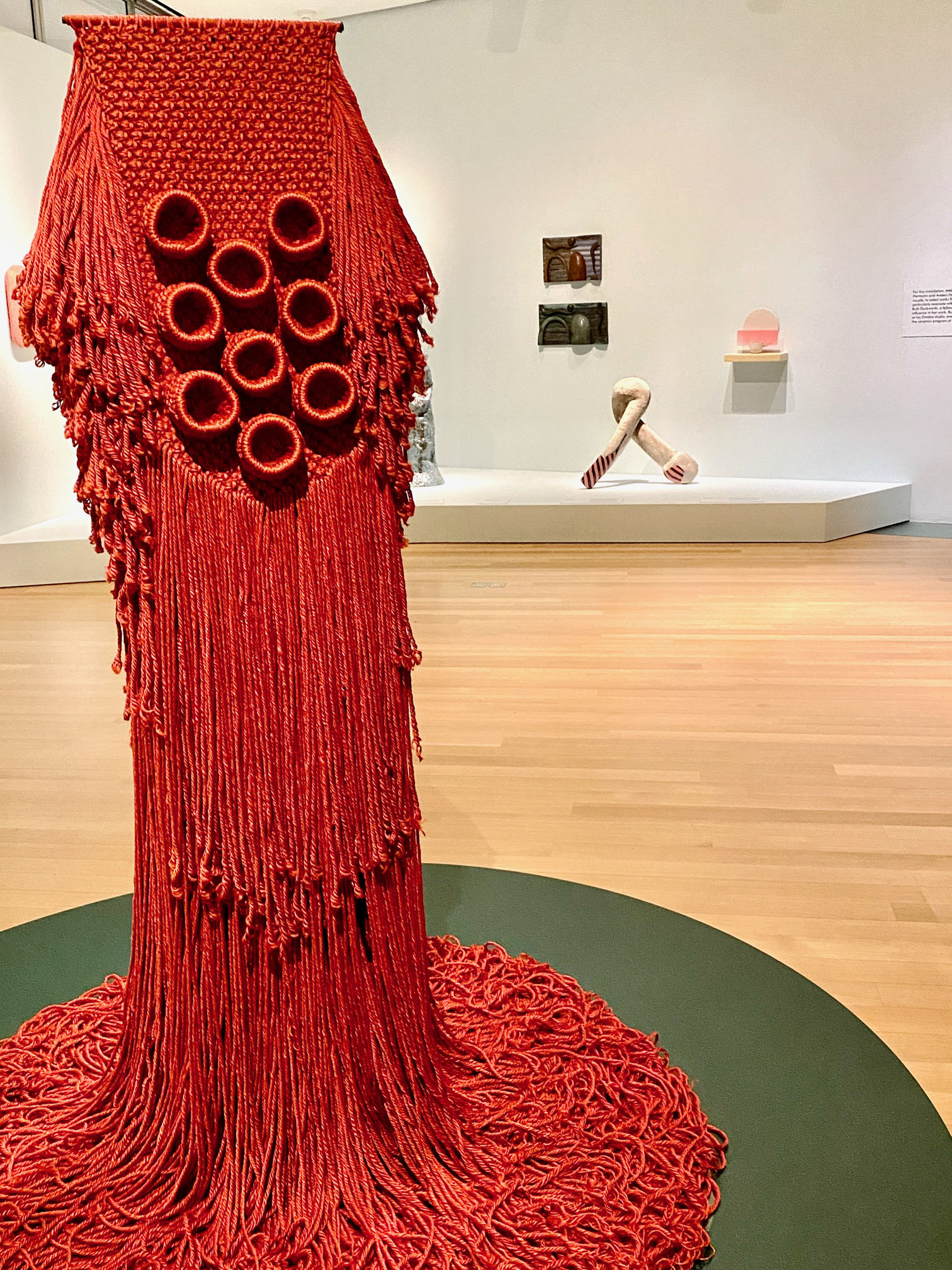
Sheila Hicks’s 1968 Dark Prayer Rug, inspired by Anni Albers and Mexican and Moroccan textile artists.
Claire Zeisler’s 1967 Red Wednesday with braid and cords twisting the sculpture’s armature
Trude Guermonprez, an unconventional materials artist known for innovations in three-dimensional weaving once worked at Berlin’s textile engineering academy; later, she consulted with industrial textile firms, as did Anni Albers.
Next to Guermonprez’s dynamic 3D hanging woven sculpture, MAD shows us a piece by Kay Sakimachi, a student who met Guermonprez in 1951 at the California College of Arts and Crafts summer craft workshop.
Guermonprez encouraged students to use latest technology, and here we see how Kay used a 1959 invention by DuPont – monofilament that’s better known today as fishing line. Kay’s woven it into an ethereal hanging sculpture.
Innovative fishing-line weaving 1968 Kunoyuki by Kay Sakimachi alongside 1962 Banner by her mentor, Trude Guermonprez.
In ceramics, MAD displays a series of vessels that transform into sculptures, starting with a modest, contained piece by Margeurite Friedlander Wildenhain, one of the first Bauhaus students and the first woman in Germany to be honored as a master potter. After emigrating to the United States in 1940, Wildenhain founded Pond Farm Workshops in Sonoma County, California ad instituted a rigorous Bauhaus instructional approach.
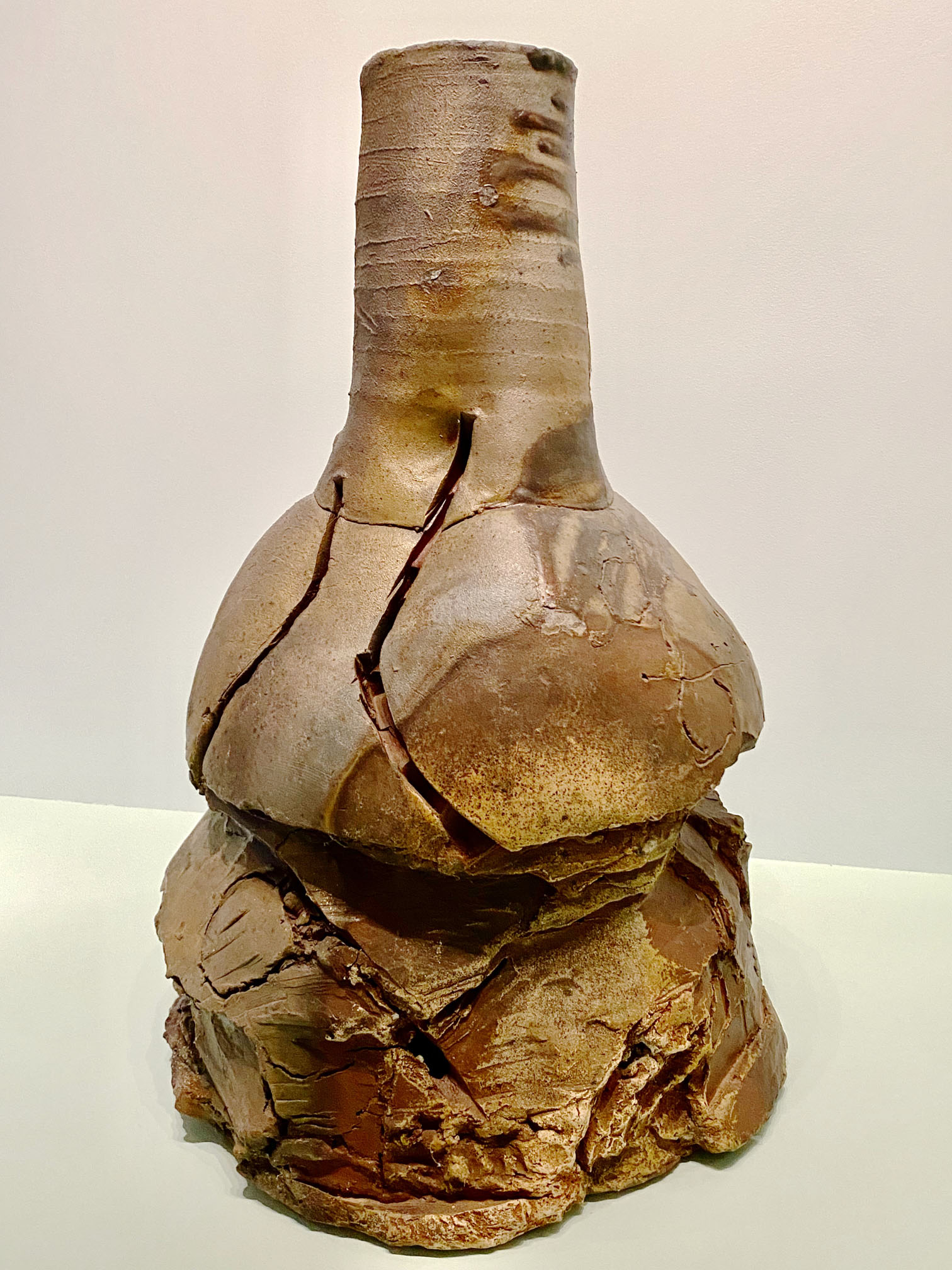
Frances Senska, her ceramics student, applied Wildenhain’s instructional principles to her own classes at Montana State, where student Peter Voulkos learned how to breathe new life into clay. Voulkos shashed, prodded, and poked clay, vigorously transforming the humble medium into wild, dramatic expressions.
Peter Voulkos’s 1992 stoneware Sibley, an example of his revolutionary approach to ceramic form.
Mary Ann Unger 1994 terra cotta Hoist – an approach to ceramic sculpture inspired by teacher Peter Voulkos
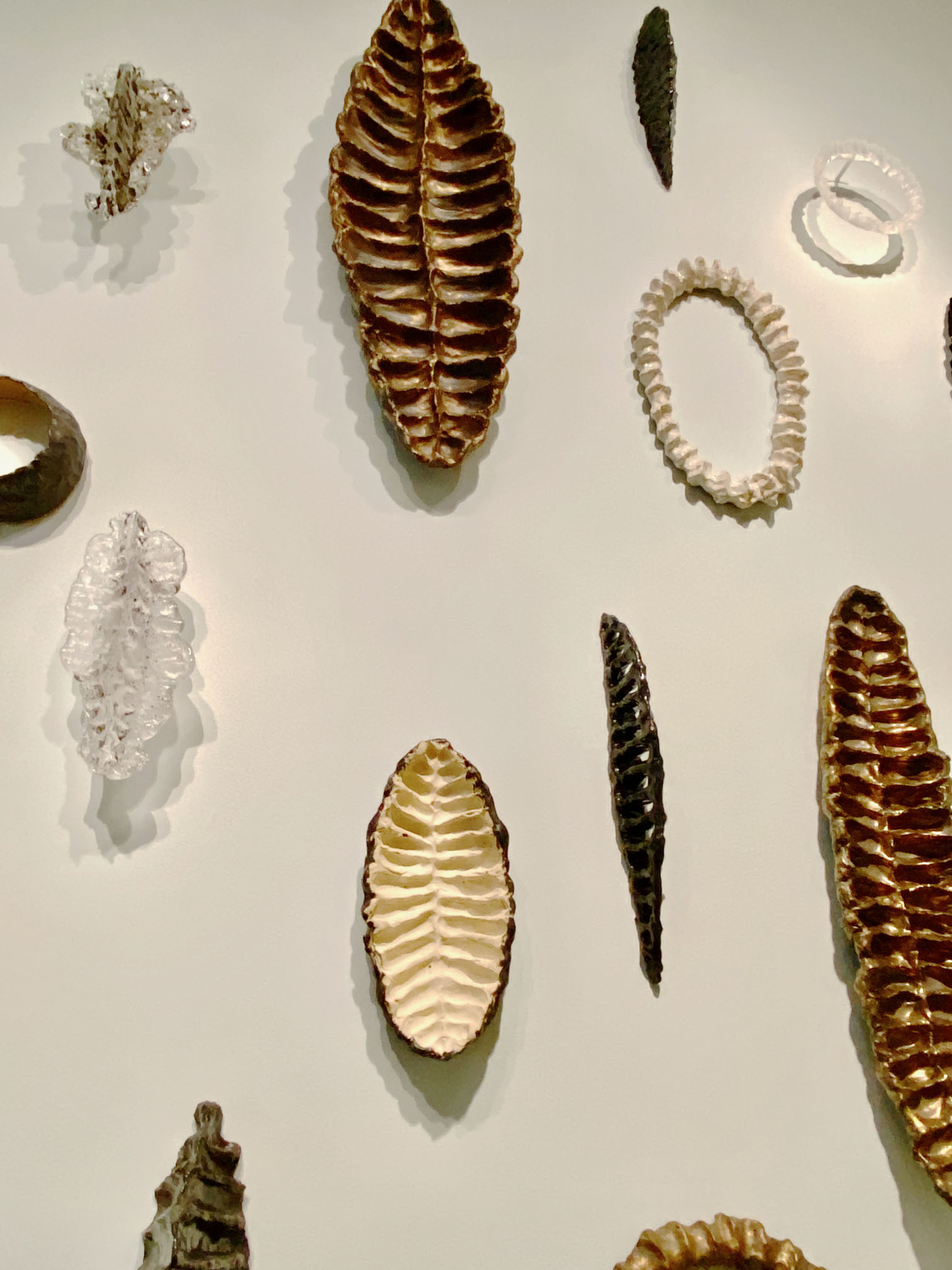
In turn, his UC-Berkeley student, Mary Ann Unger injected whimsey and improvisation into her sculptures, which allowed her daughter, Eve Biddle, to push it even further. MAD shows Biddle’s ingenious installation of creative ceramic geodes, trilobites, and spines crawling around the gallery wall.
Ceramics mentors even play a role in the development of America’s Studio Glass movement, which begins with Harvey Littleton, whose dad was a physicist on the first reasarch team at Corning Glass Works (he later developed Pyrex). MAD displays Harvey’s gorgeous glass arcs.
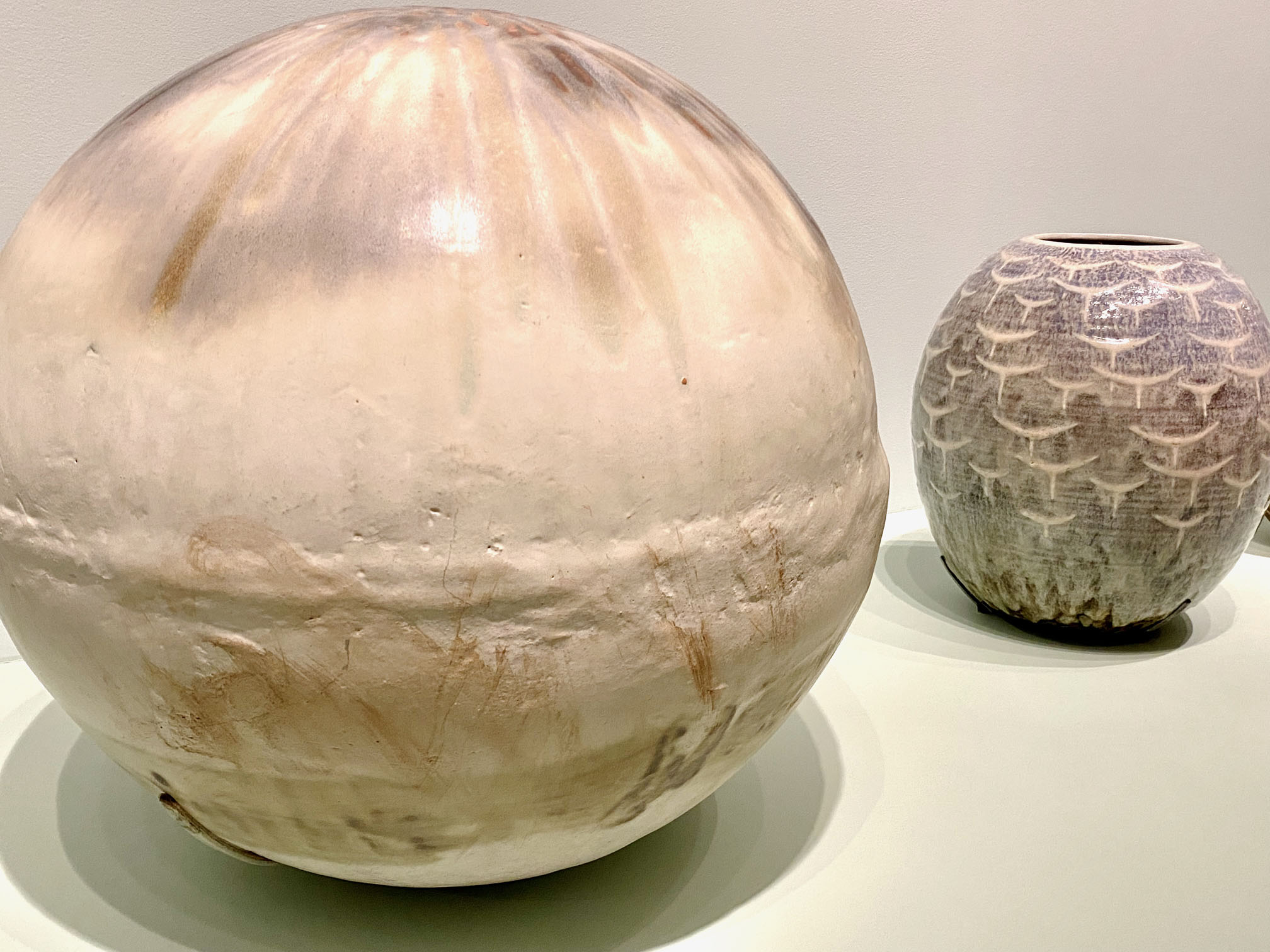
Work by student and teacher: Toshiko Takaezu’s 1995 stoneware Mist #2, part of her Moon series, with Maija Grotell’s 1953 glazed earthenware vase
On weekends, Harvey spent lots of time with his dad in the Corning lab, assuming he would follow in dad’s footsteps as a physicist at the University of Michigan. But after Harvey experienced UM art classes, he switched major. Eventually, he was specializing in ceramics under Maija Grotell at Cranbrook Academy of Art (who also taught ceramic superstar Toshiko Takaezu).
Littleton’s travels to observe the Italian glassmaking masters at Verano inspired him to apply his kiln and physics skills to experimental glassmaking. Back home, e pioneered low-temperature glass-blowing techniques that enabled glass artists to create work in studio setting and not a factory.
Littleton achievement was established the first university-based glass-blowing program at University of Wisconsin-Madison. A lucky undergraduate, Dale Chihuly, learned from the master, and the rest was history for American glass making.
Glass sculptures by teacher and student – 1983 Double Blue Arches by innovator Harvey Littleton and 1968 Wine Bottle by created by Dale Chihuly in Venice under a Fulbright Fellowship.
After receiving his MFA in ceramics at RISD, Chihuly traveled to Venice (like his mentor), and observed how the team worked together to create a finished work of glass art. In 1971, he founded Pilchuk Glass Works in Washington State, where he emphasized the collaborative, collective process. Chihuly’s own sculptural wonders emerged, plus the next generation of indigenous glass artist gained experience in collaborative expression – Tony Jojolla and Preston Singletary.
There are many more stories told in this illuminating exhibition from the MAD collection. Take a look in our Flickr album.
Tony Jojolla’s 1996-1997 Large Glass Olla, a traditional Pueblo pot made of glass at Dale Chihuly’s Pilchuk School; at right, Chihuly’s 1978 Untitled Basket
Building on the groundwork laid in the artist-curated exhibition Grounded in Clay: The Spirit of Pueblo Pottery (opening in St. Louis on March 7), Santa Fe’s Museum of Indian Arts and Culture asked five Navajo textile artists, photographers, and scholars to delve into MIAC’s historic collections to tell the story of Diné weavng.
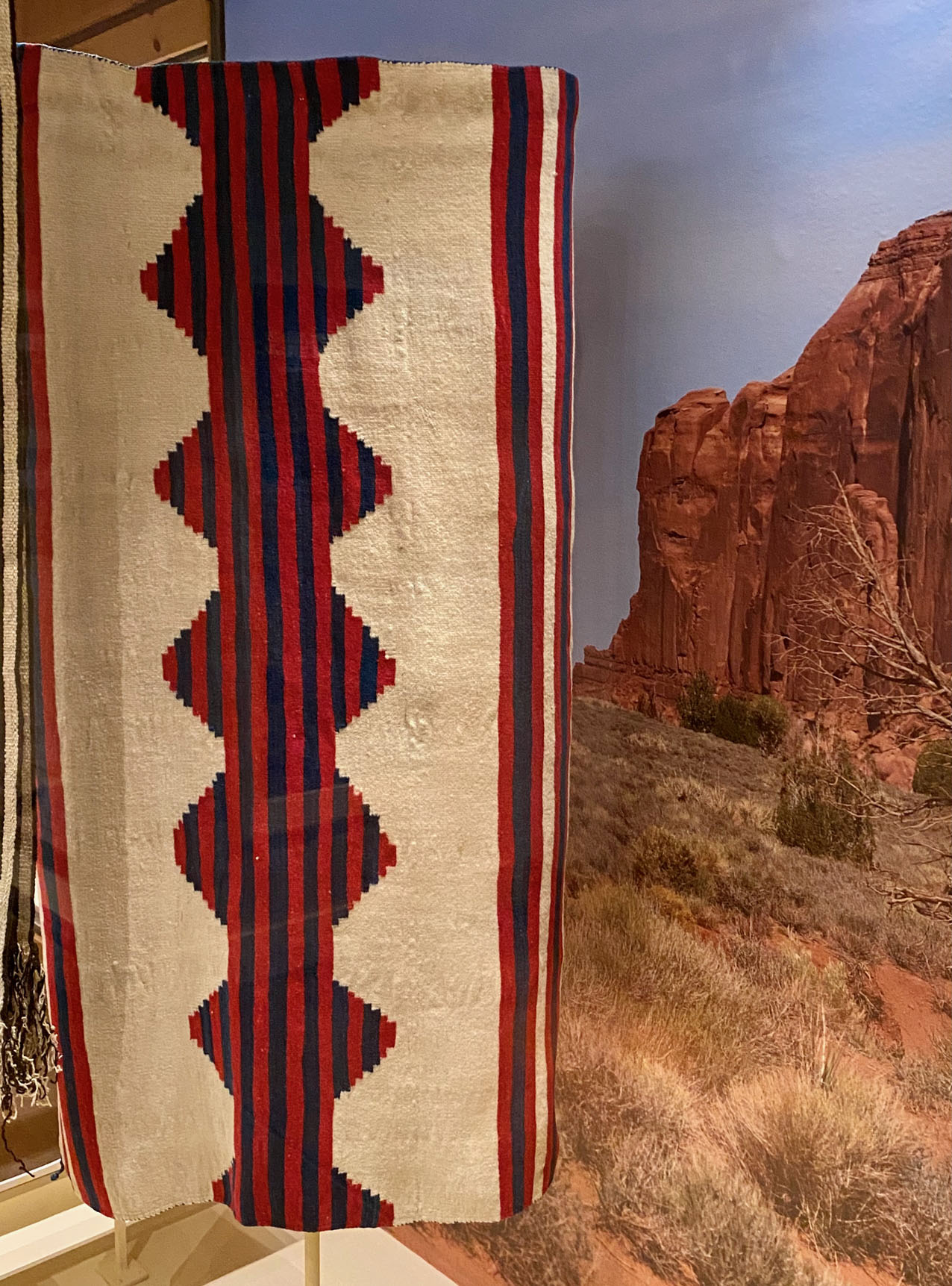
Horizons: Weaving Between the Lines with Diné Textiles, on view through February 2, 2025, presents historic and contemporary weavings alongside epic photographs of Navajo Nation landscapes to show the connections textile artist have to ancestors, their mentors, the community, the land, and their materials.
Historic Diné weaving with photomural by co-curator Rapheal Begay. Courtesy: the artist.
Appropriately, the story told by over 30 historic textiles is presented in MIAC’s Masterpieces gallery.
The entrance presents a dazzling display – a pictorial blanket woven in the 1890s set against a photomural of co-curator Rapheal Begay’s family sheep corral. It’s a visual testament to the importance of wool, life, and the 27,000 square miles of Navajo Nation.
The blanket’s creator (unknown today) was an astute observer of the life on the land and translated it all into warp and weft – cow punchers, cattle, boots, birds, and new-fangled railroad cars, that only arrived in Navajo Country around the 1880s. Click here to see the detail.
1885 pictorial blanket created with Germantown wool yarn introduced in the Southwest by the railroads; photomural Navel (Hunter’s Point, AZ) by co-curator Rapheal Begay. Photo courtesy of artist.
Nothing was newer than the railroad, at the time this artist depicted it – a steam-fed invention from the East that would change western life forever, but that also brought a wide array of colorful yarn that could be mixed and matched with vegetal dyes to create new Native designs.
The intertwined history of Diné (“The People” in the Navajo language), textile art, and the land is told through quotes and recollections by the exhibition’s Native collaborators. While examining masterful geometric weaving techniques in 19th-century works, visitors are provided with an historic context – the types of art materials introduced to captives imprisoned at Bosque Redondo after the Long Walk, the images that could be interpreted as a longing for the homeland by the incarcerated, and coded spiritual affirmations.
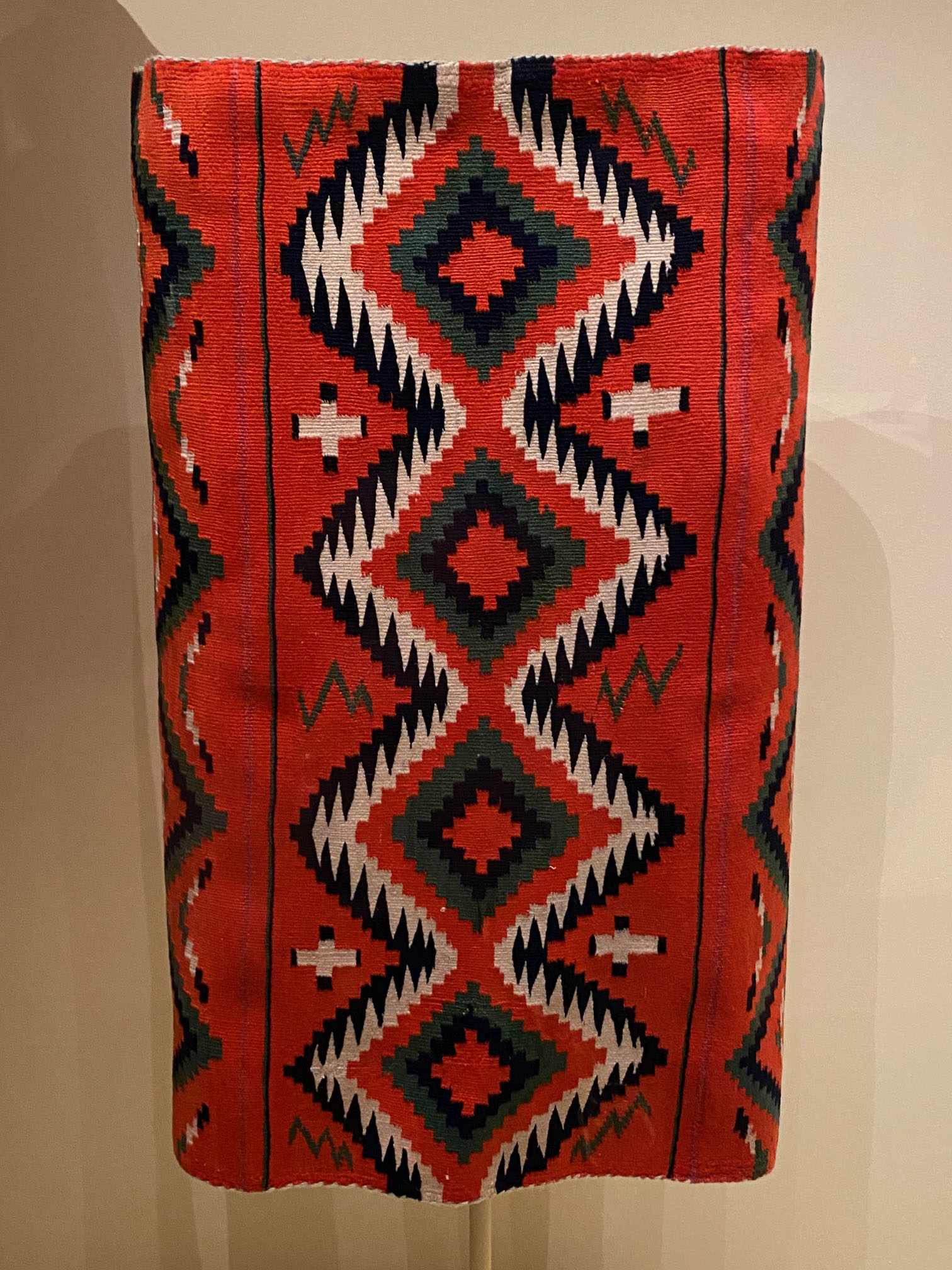
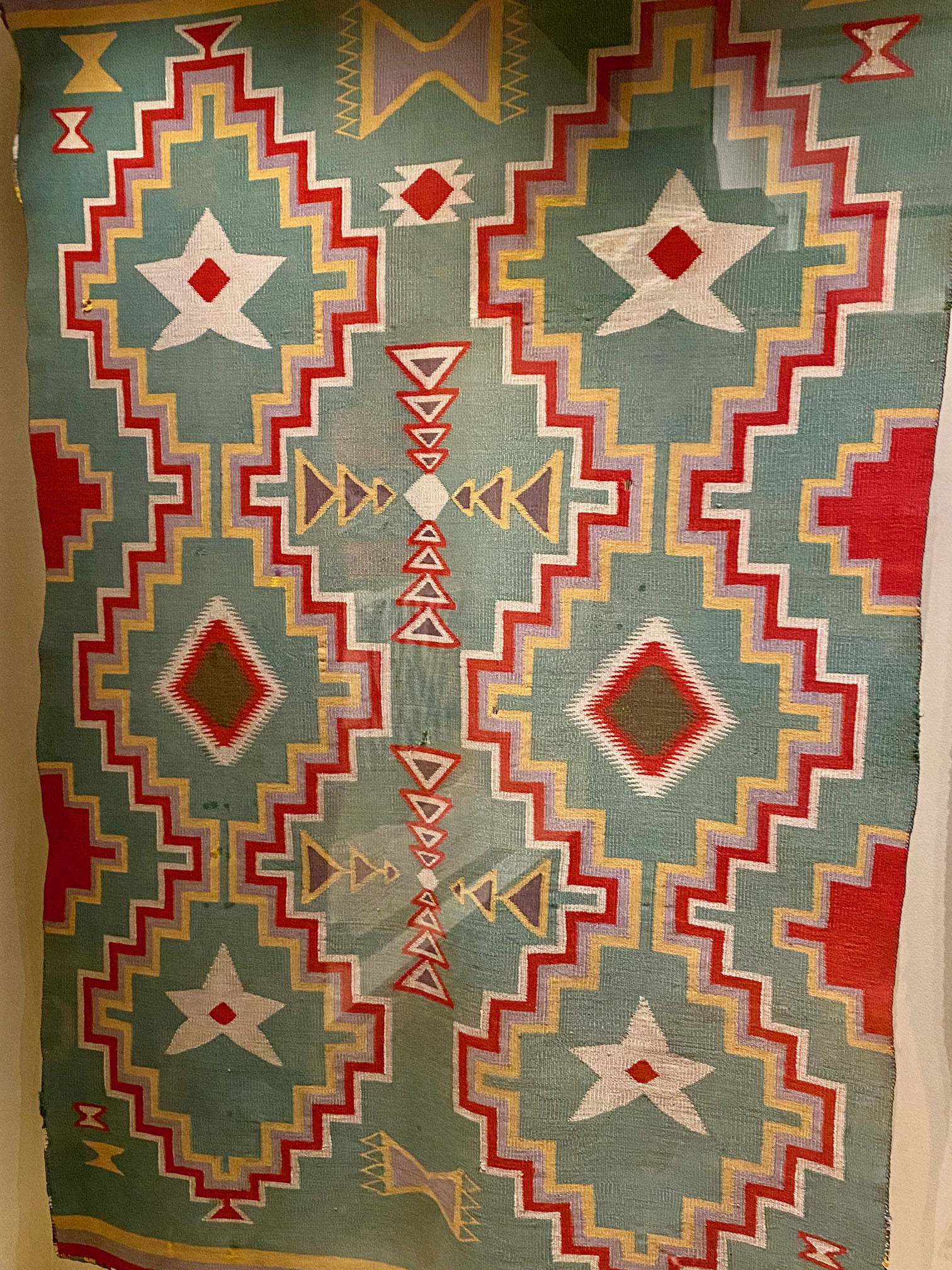
1850-1860 hand-spun wool child’s (or saddle) blanket with Spider Woman crosses; created with natural cocineal, indigo, and chamisa dye
1880-1897 rug made with Germantown wool yarn, cotton string, and raveled yarn; materials used in weaving at Bosque Redondo era, post-Long Walk.
The participants in the exhibition make sure that viewers also experience how the landscape inspires the work of the past and contemporary Native textile artists. Diné fiber artist Tyrrell Tapaha includes her two-panel dress in which incorporates images of the Utah clouds and mountains that bring her spiritual peace. The masterful wall hanging by Lillie Joe uses the palette of the desert to create a mesmerizing geometric dazzler.
2020 two-panel dress by fiber artist Tyrrell Tapaha with images from Utah landscapes that inspired her; woven from churro, silk, mohair, and marino wool..
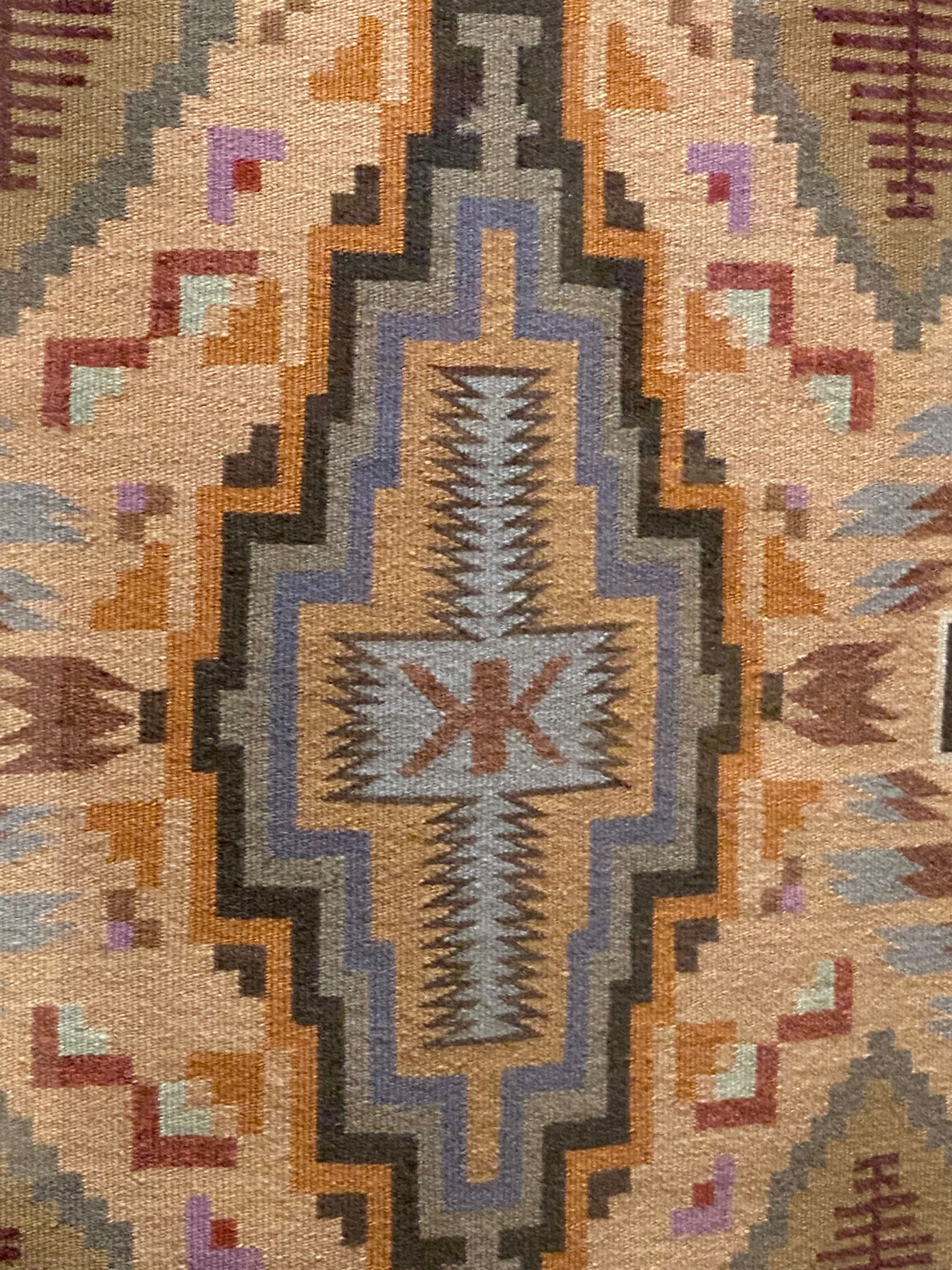
Close up of highly detailed 1980s Burntwater wall hanging by Lillie Joe, reflecting colors and patterns of the Navajo Nation landscape.
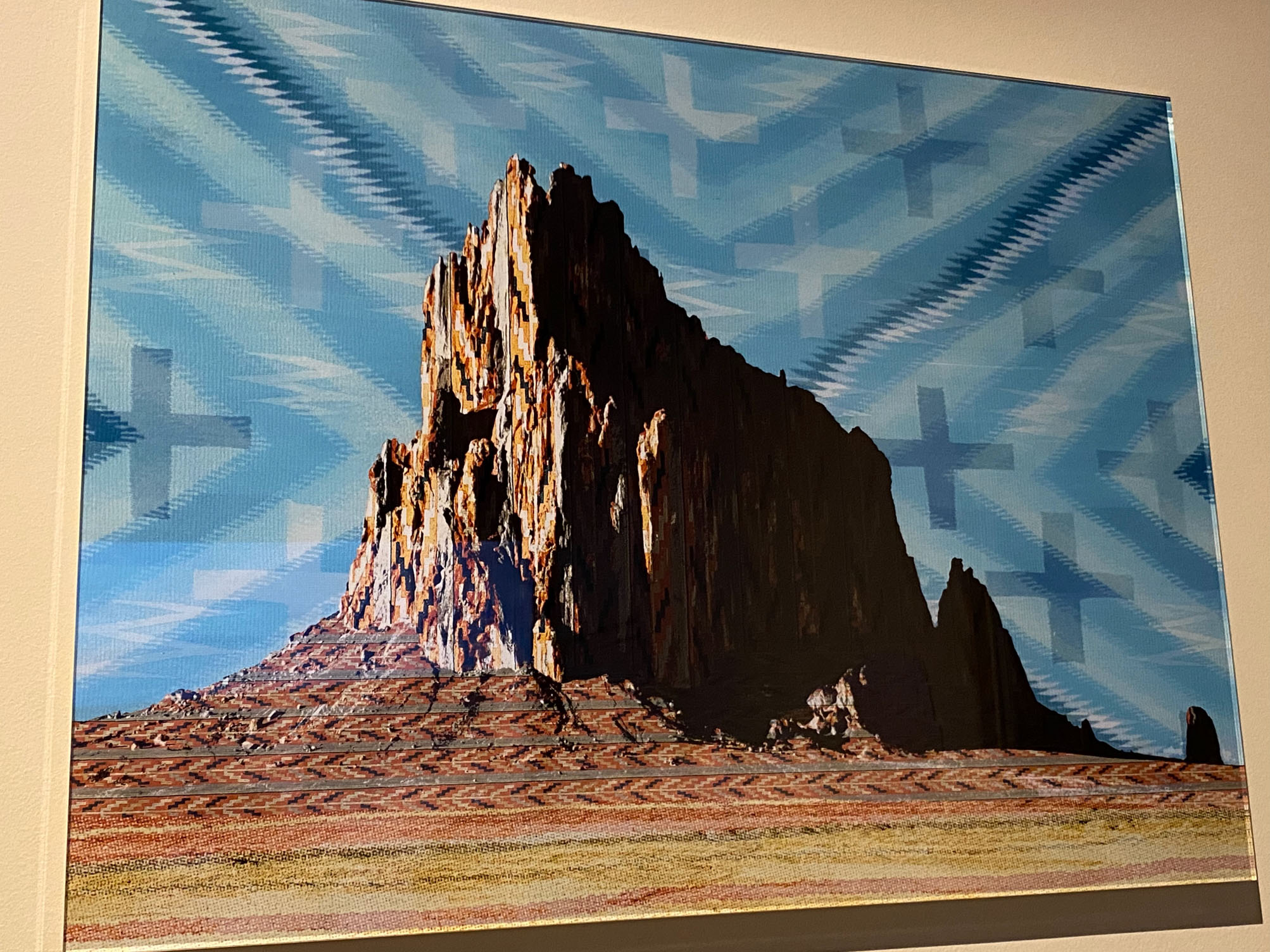
The curators feature both the photography of co-curator Rapheal Begay and Darby Raymond-Overstreet to allow gallery visitors to experience the awesome beauty of the homeland that inspires artists. Digital artist Raymond-Overstreet overlays geometric textile patterns across his luscious, beautiful landscapes.
2018 digital print Woven Landscape, Shiprock by Darby Raymond-Overstreet (Diné), overlaying digital landscapes with traditional weavings. Courtesy: the artist
Take a look at some of our favorite works in our Flickr album. And enjoy these historic and contemporary dazzlers.
Detail of 1895 wedge weave blanket made with commercial cotton string and Germantown wool – a dramatic 19th c. weaving innovation. Courtesy: International Museum of Folk Art.
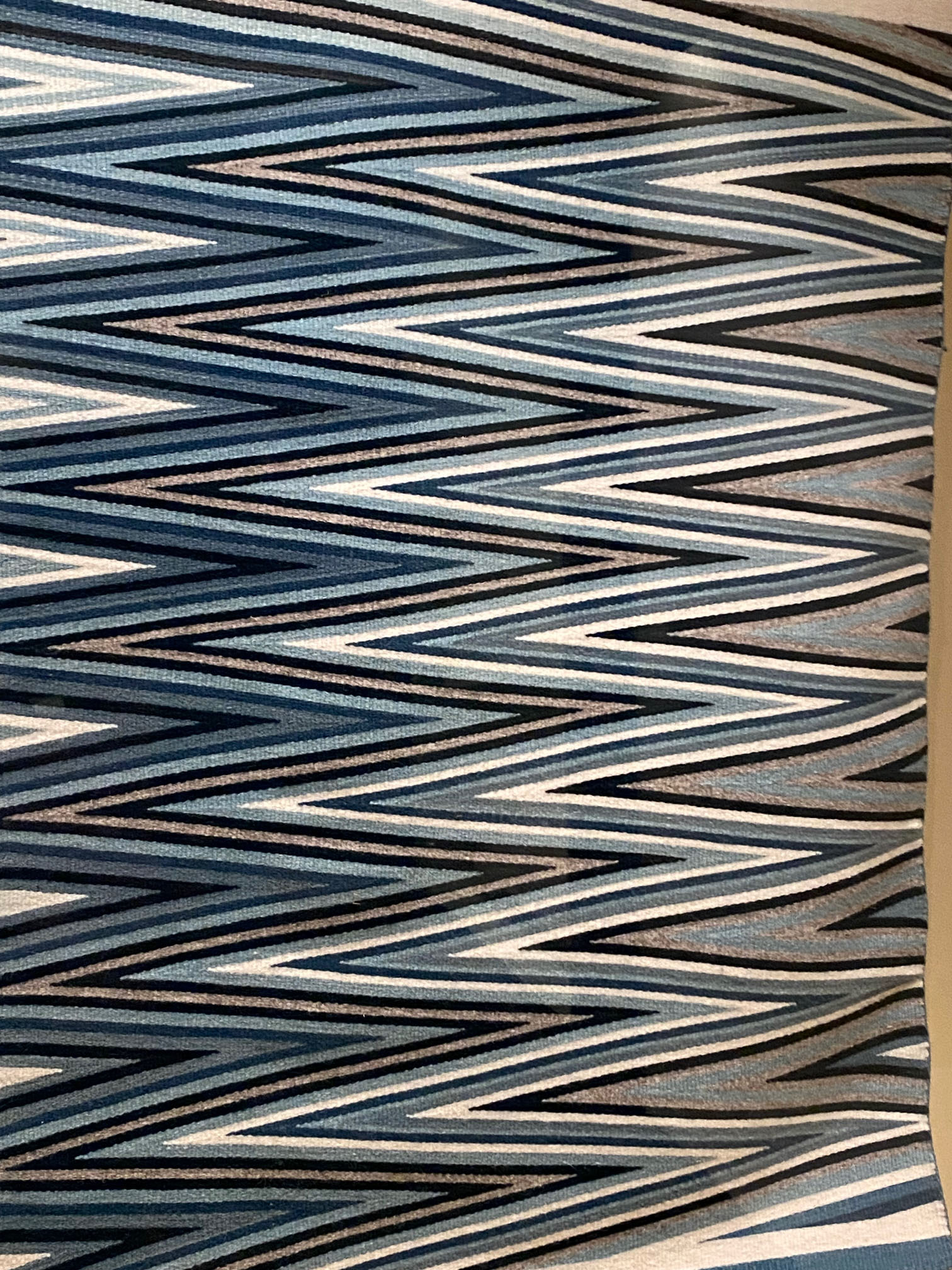
2022 wedge weave by Kevin Aspaas; white and grey wool yarn with indigo dye. Courtesy: private collection.
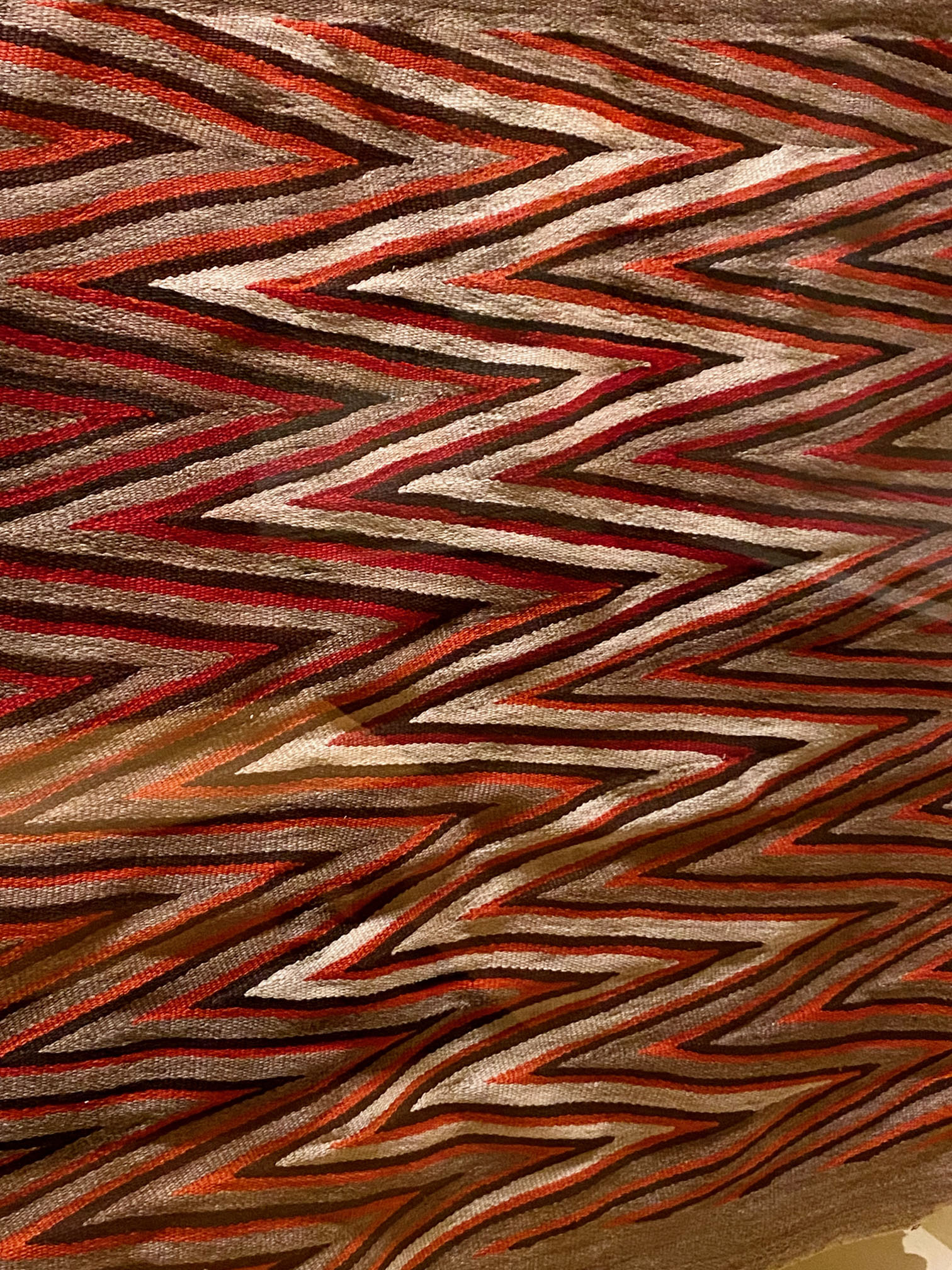
Detail of dynamic Diné 1960 wool tapestry weave. Courtesy: International Museum of Folk Art
2023 A Family of 4 red oak side chairs by LANZA Atelier (Isabel Abascal and Alessandro Arienzo).
Everything you could want from a design exhibition is packed into Have a Seat: Mexican Chair Design Today at the Denver Museum of Art through January 12, 2025 – history, context, videos, inspiration behind the designs, and…
Did we mention that you get to sit on the chairs?
The creative lighting and gallery layout invites visitors to take a journey that reflects Mexico’s ancient and colonial history – just like the work of the 22 designers featured here.
Everything on display is part of the Denver Museum’s permanent design collection,
The museum has created an environment that’s engaging and fun, so visitors seem to take time to read about the designers and the history of Mexican furniture while they sample the diverse range of furniture (“it’s more comfortable than it looks!”) as they wind their way through the clean, modern installation. View it all in our Flickr album.
Laura Noriega’s 2012 Your Skin chair made of walnut, handwoven cotton, and synthetic fabric, combining Japanese woodworking and Mexican textiles.
As you enter, you’re greeted by a tiny carved Guatemalan figurine from 300-100 CE, showing the type of simple thrones from which Olmec rulers or religious leaders might sit – a backless seat. Ancient civilizations are the inspiration for the innovative seats made by the first set of designers.
Some of these humble-looking stools by Camilia Apaez and HABITACIÓN 116 are made from stoneware, basalt and volcanic ash – harkening back to landscapes, environments, and simplicity that resonates with these forward-looking 21st century designers.
Camila Apaez’s 2002 stoneware Room in the Cave seats – inspired by deep associations with Paleolithic and Neolithic architecture and ceramics.
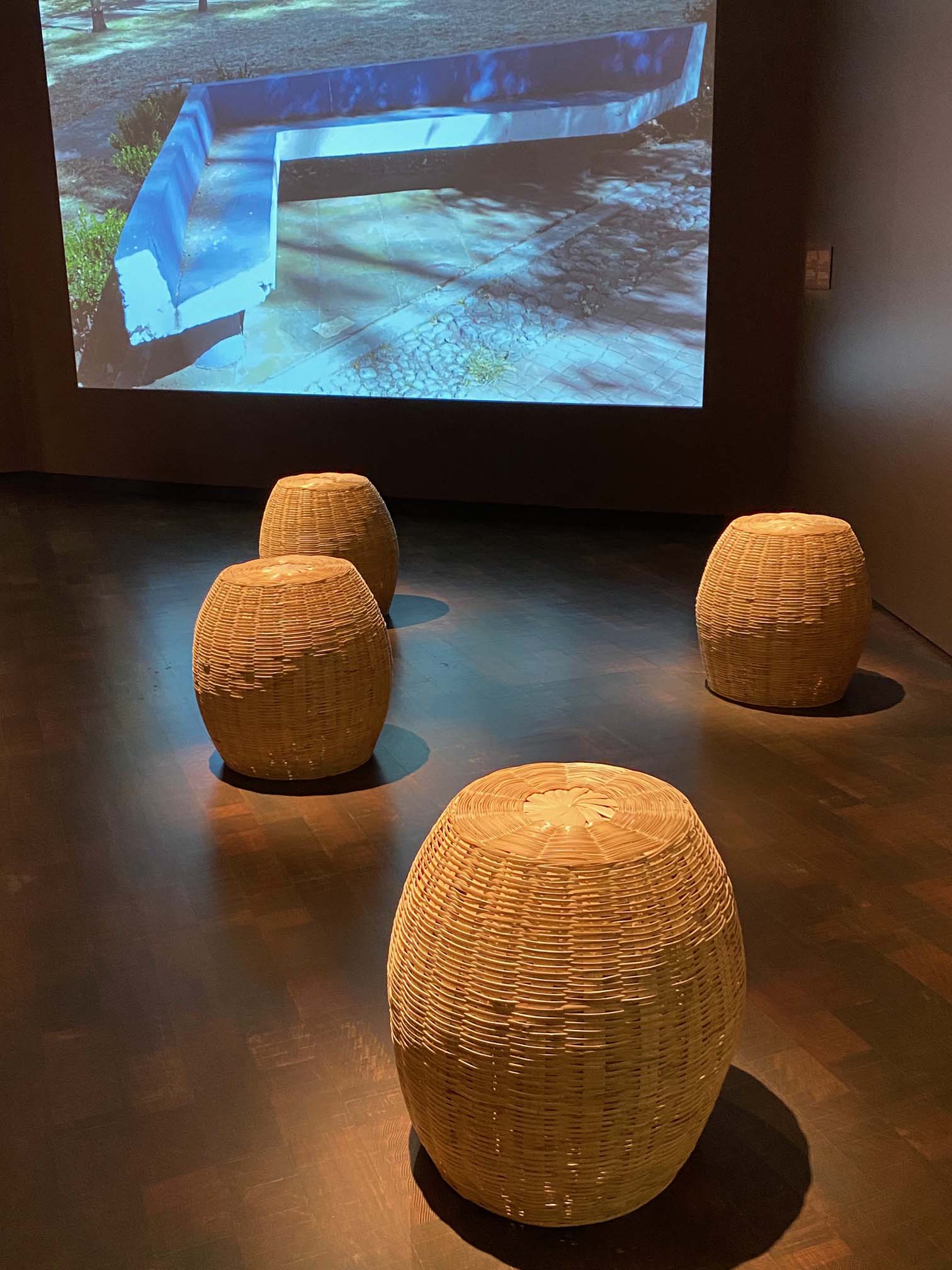
Raúl Cabra’s 2009 Bamboo seats made from carizzo reeds; video shows public seating.
Visitors are invited to sit and experience the enjoyment of relaxing in each of the exhibition areas – and many couples and families do! It’s nice to sit and watch the large-screen videos that take you on a trip around Mexico, showing you modern and traditional public seating areas along city streets and town squares.
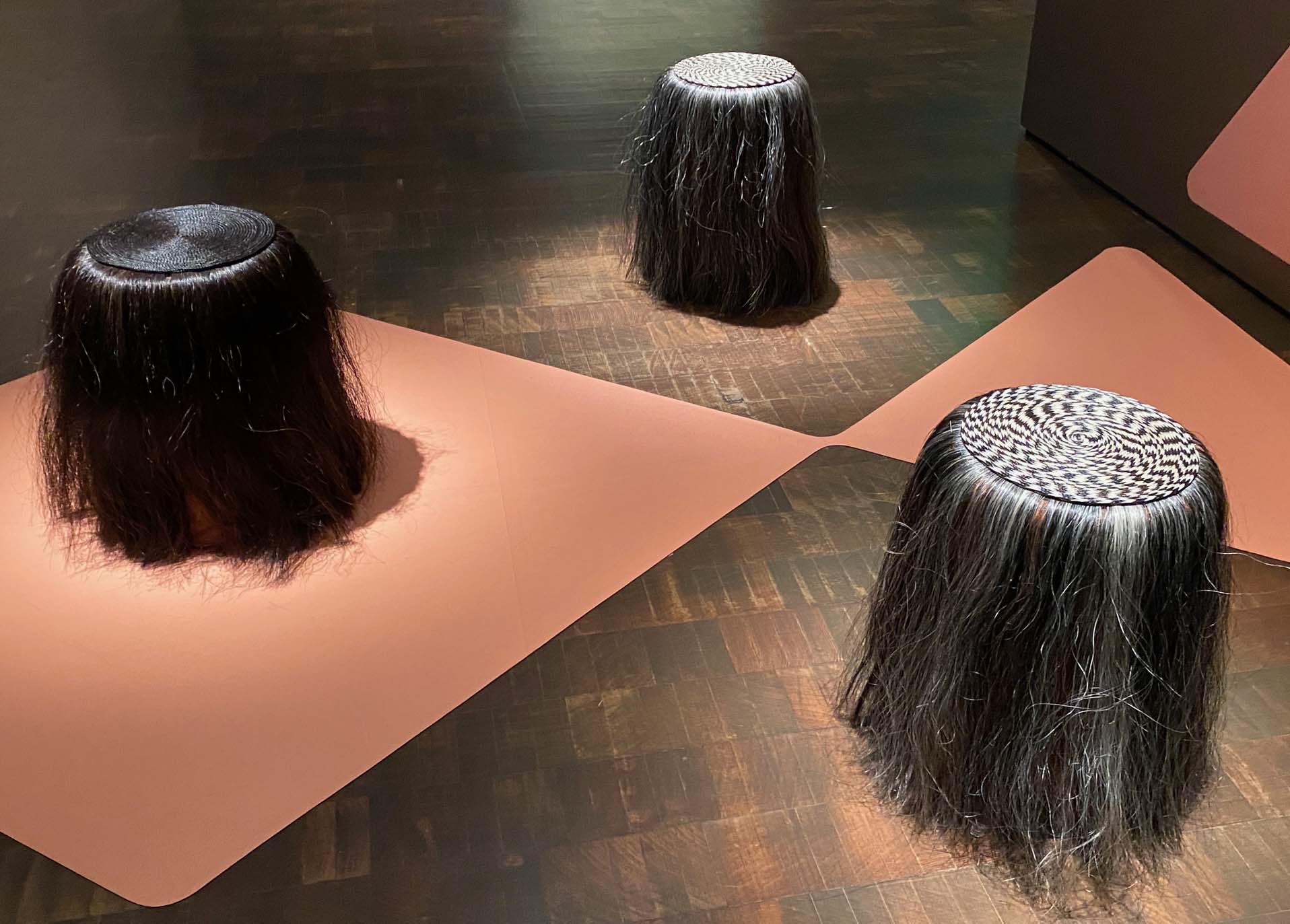
Not all of the stools are minimalistic, proven by the creations of Aldo Alvarez Tostado, who turned from architecture to making smaller pieces that enabled him to work with traditional Mexican weavers and woodworkers to invent seats that are run and new.
Aldo Alvarez Tostado’s 2022 Little Horse stools, made of wool and synthetic horsehair.
The second section of the show features the history and modern interpretation of easy chairs – comfortable seating that invites visitors to stay and enjoy. There’s an upscale Spanish Colonial chair to demonstrate traditional European design roots, surrounded by Ricardo Casas’s classy designs and Mauricio Lara Eguiluz’s funny foam take on the Yucatan’s Chac-Mool Mayan deity (always reclining comfortably!)
But if truth be told, all the visitors are having the most fun flopping onto the super-comfortable recycled “stuffables” by Andrés Lhima!
An array of comfortable easy chairs – the 2013 Clara design by Ricardo Casas and the 2005 polyurethane foam Chac Seat by Mauricio Lara Eguiluz
Andrés Lhima’s fun, portable easy chairs – comfy 2011 plastic mesh Fidencio chairs filled with shredded foam and recyclables.
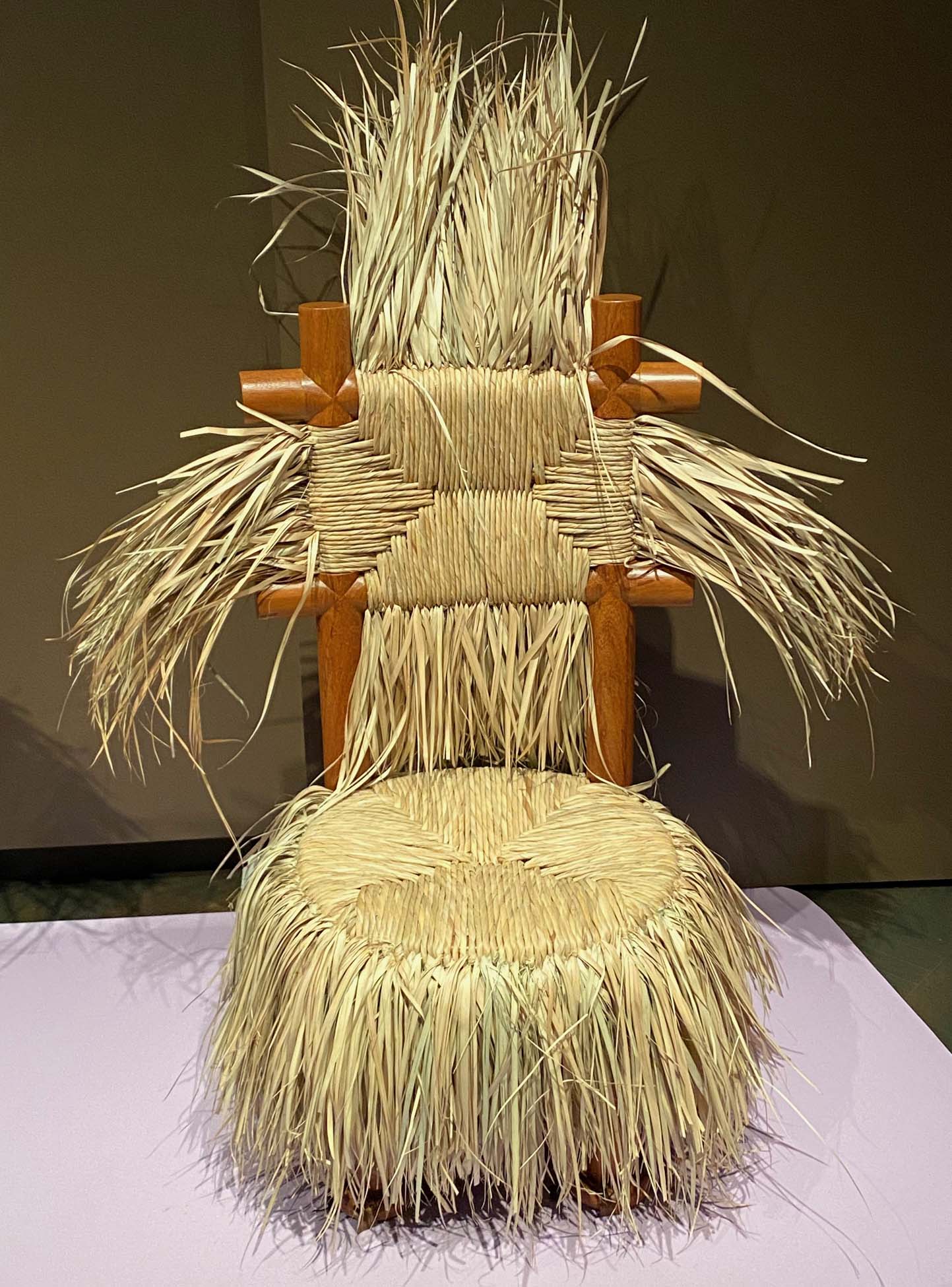
The final section pays tribute new takes on the Spanish side chair, comparing a 19th-century classic with high-style sets by Oscar Hagerman and La Metropolitana and outrageous reinventions by Estaban Calcendo Cortés. You can feel the Afro-Colombian rhythms in his woven palm chairs.
A highly decorative painted 1800s Mexican side chair.
2022 Palapa side chairs by Estaban Calcendo Cortés – inspired by Afro-Mexican and Colombian cultures
To learn more about the designers and their inspiration, scroll through the exhibition guide.
And this beautifully designed show would not be complete with an out-of-the-box participatory woven-wicker design section for kids of all ages!
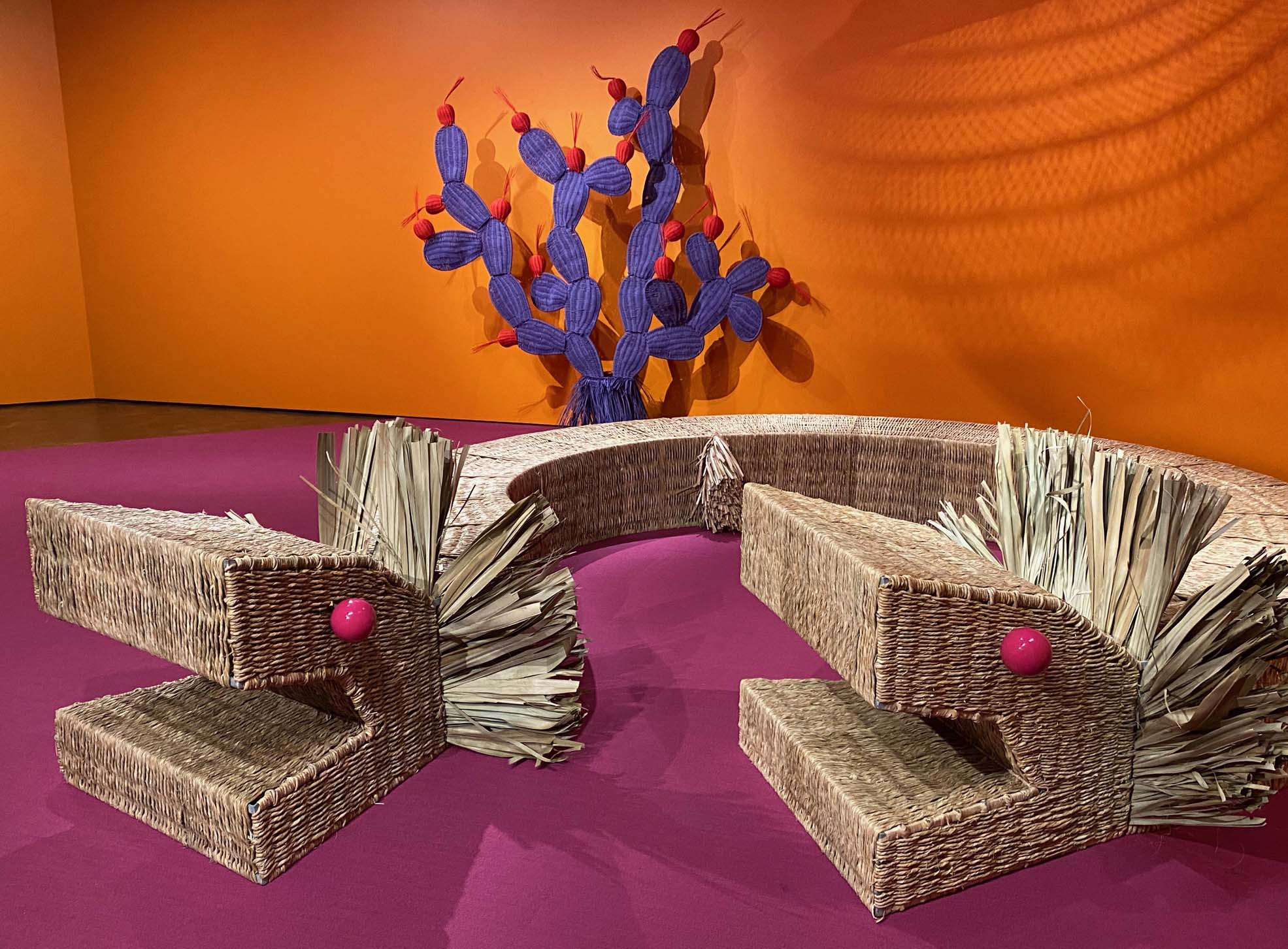
2023 El Charco environment by Mestiz for visitors to contemplate design and the environment, including the wicker Cactus of a Thousand Eyes and Great Two-Headed Viper.
Forget about the picturesque fjords and pastoral views reindeer herders that we imagine when we envision Scandinavia. Completely different stories of history, revolution, oppression, and cultural revival are told by the array of colorful, decorative, embellished and loved clothing in Dressing with Purpose: Belonging and Resistance in Scandinavia, on view at the International Folk Art Museum in Santa Fe through February 19.
You’re introduced to the iconic folk clothing of three cultures when you enter the exhibition – Sweden, Norway, and Sápmi, the homeland of the indigenous Sami people that stretches across the northern boundaries of Russia and the three other Scandinavian countries.
Detail of mid-19th to early 20th century woman’s dräkt from Sweden’s Delsbo parish in Häsingland historical province.
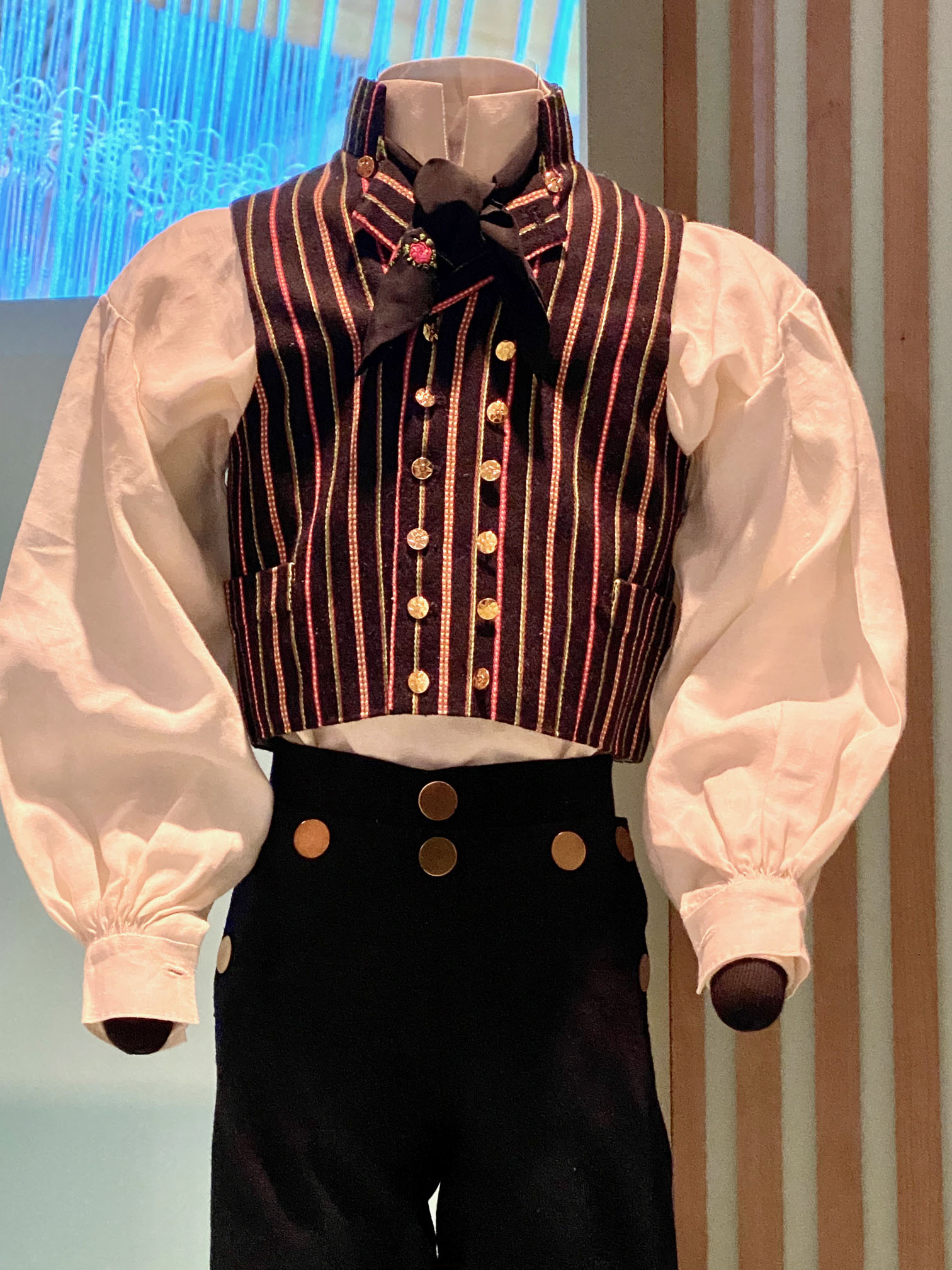
Young Swedish man’s dräkt, made in 1992 by Birgitta Lördal and Maj-Lis Halvarsson of Häsingland historical province.
But then it’s a deep dive into what each of these colorful creations represent.
The story behind Sweden’s folk costumes (folksdräkt) extends back into the 19th century, when rural peasants lived in a fairly hierarchical society and relied on their church clothes to signify where they ranked on the status ladder. Each community developed its own details and styling. In some communities, women used almanacs to help them keep track of various clothing combinations.
The exhibition displays an array of men’s and women’s country ensembles.
There are also examples of striking, elaborately silk-embroidered shawls that were essential to women’s status dressing.
In the 1800s, a series of economic and agricultural misfortunes caused rural Swedes to leave their communities and either migrate to the United States or to middle-class jobs in the city.
Swedish intellectuals worried that the rural population drain meant that country traditions and craftsmanship would vanish. Around 1900, cultural leaders prompted a craft awareness and revival movement – retail shops, showcases for hand-crafted clothing, and national museums.
Detail of woman’s 1834 silk-embroidered linen shawl, a status symbol worn on specified occasions; Leksand parish in Sweden’s Dalarna province.
Today, many Swedes gladly purchase and buy kits to make folksdräkt for festivals, parades, and other events.
The curators have even included items from a new cottage industry – protective garment bags specifically designed to store your folk costume!
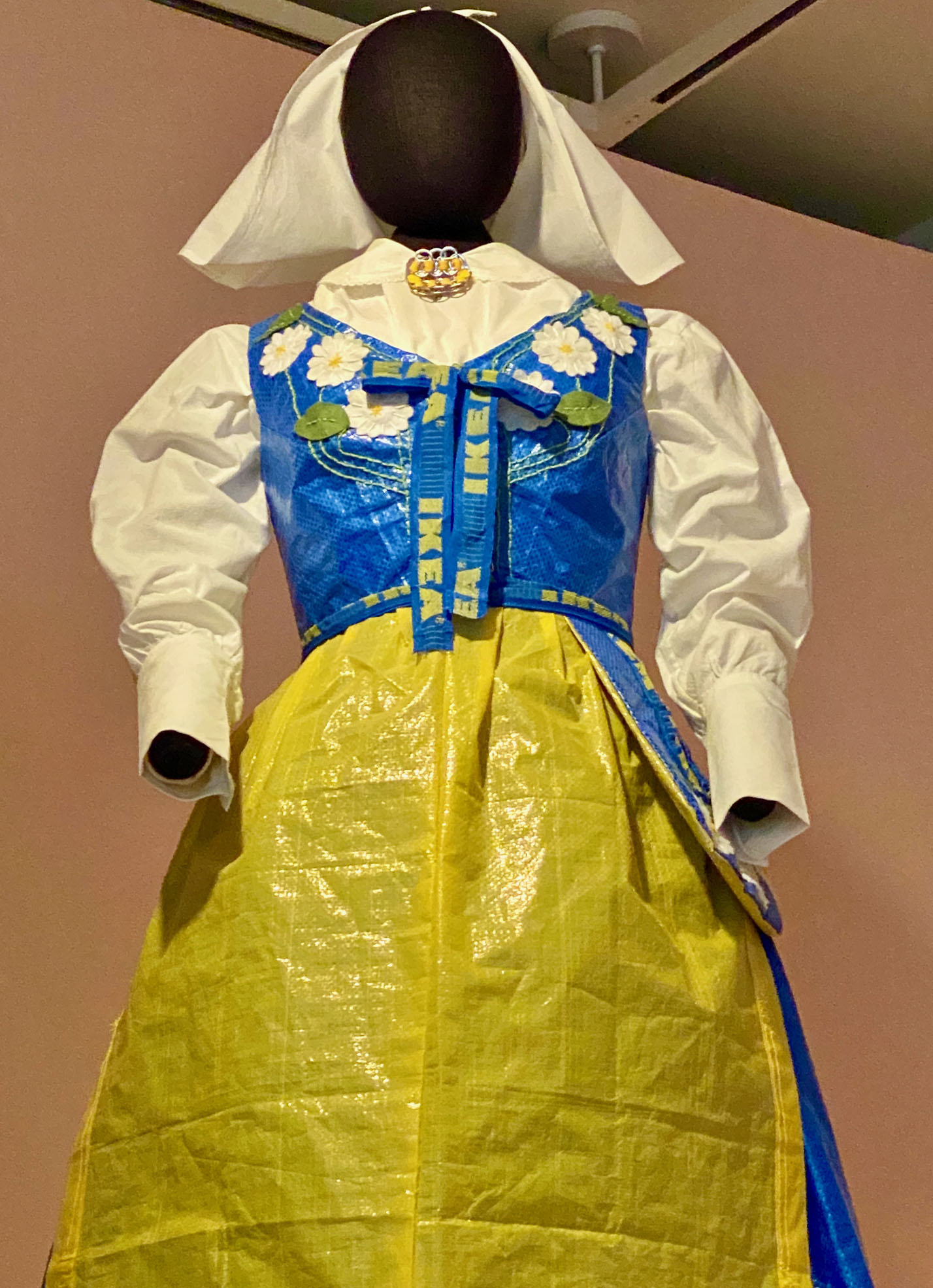
In a whimsical touch, the curators have included a contemporary take from artist Heidi Mattsson – the Swedish national costume made from Ikea shopping bags, a cotton nightshirt and napkin, and sodacan pop tops!
And the curators have included several other inventive modern takes on national wear.
Heidi Mattsson’s 2018 Swedish national costume fashioned from napkin, soda can pop tops, cotton nightshirt, and Ikea shopping bags. I
Täpp Lars Arnesson’s 2016 winter dräkt for his young daughter in Malung parish in Sweden’s Dalarna province; blended decorative elements from other parishes.
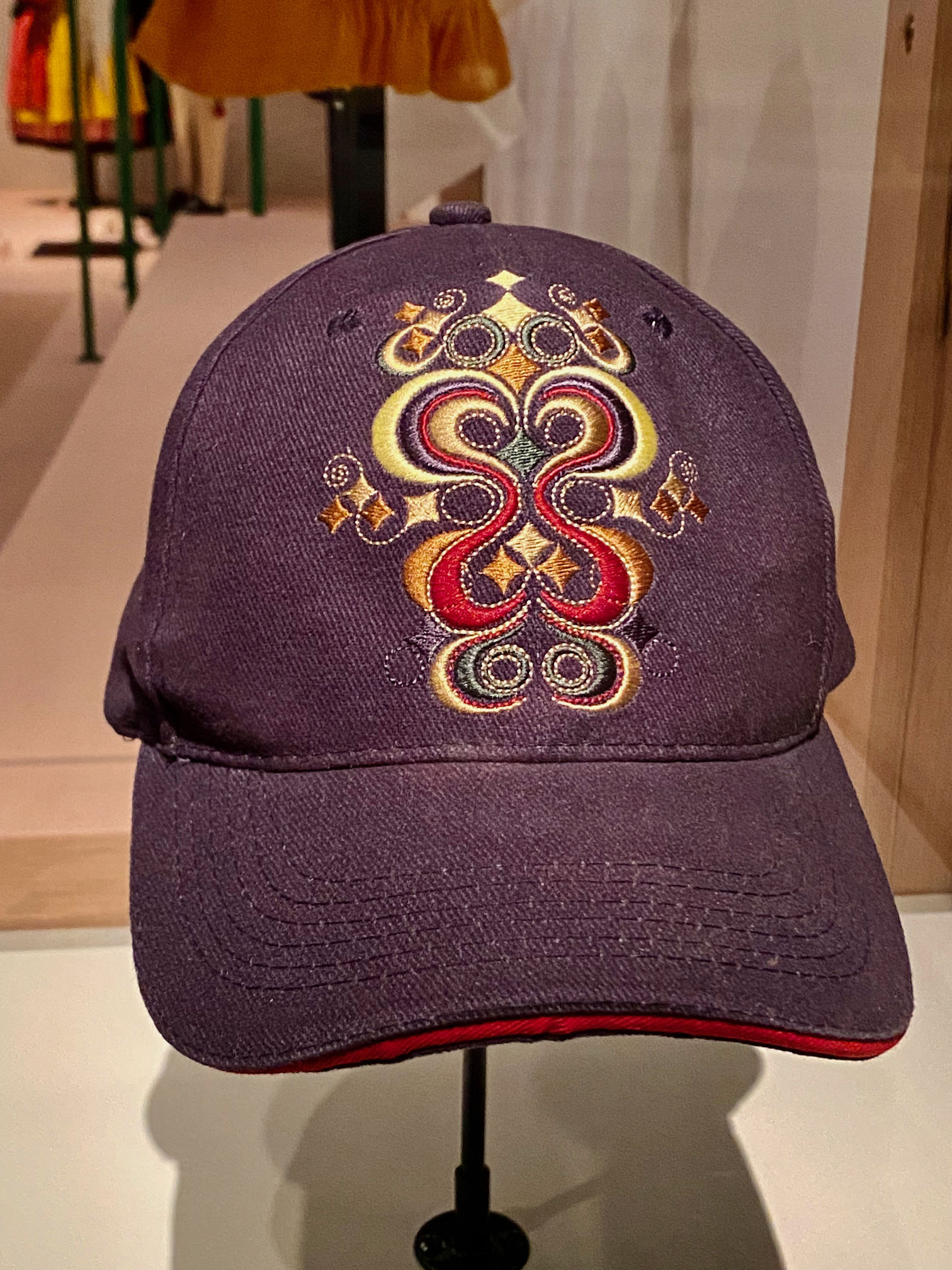
2017 embroidered baseball cap created in Leksand parish in Sweden’s Dalarna province, using traditional symbols. Private collection.
The story told by Norweigan folk dress is more tightly linked to the long revolutionary fight for independence throughout the 19th century. Rural Norwegian peasants were land owners. To city dwellers laboring under Danish and Swedish domination in the 1800s, rural people epitomized the “independent everyman” who had more control over their personal destinies.
During Norweigans’ century-long fight for independence, political activists began adopting bunader, contemporary clothing inspired by preindustrial rural clothing as a sartorial statement about their desire for freedom. It popped up at youth rallies and dances.
1900 national costume – red bodice with beaded insert and dark skirt – typical of Norway’s Hardanger district, depicted in photo.
Hans Kristiansen Lybeck’s fantasy drakt, worn in Oslo’s National Constitution Day parade in 1906. Courtesy: Vesterheim Norweigan-American Museum, Decorah, Iowa.
In 1903, activist and regional dance expert, Hulda Garborg, outlined a philosophy for nationalized clothing and popularized it. Everyone’s enthusiasm for and pride in the national costume kept going, even after independence in 1905. Even in the 21st century, it’s a sure-fire tourism draw up in Norway’s fjord country.
Close-up of Reidun Dahle Nuquist’s embroidered red-jacket bunad, made in East Telemark, Norway by a relative in 1960-1963. She wore it for her wedding and throughout her life.
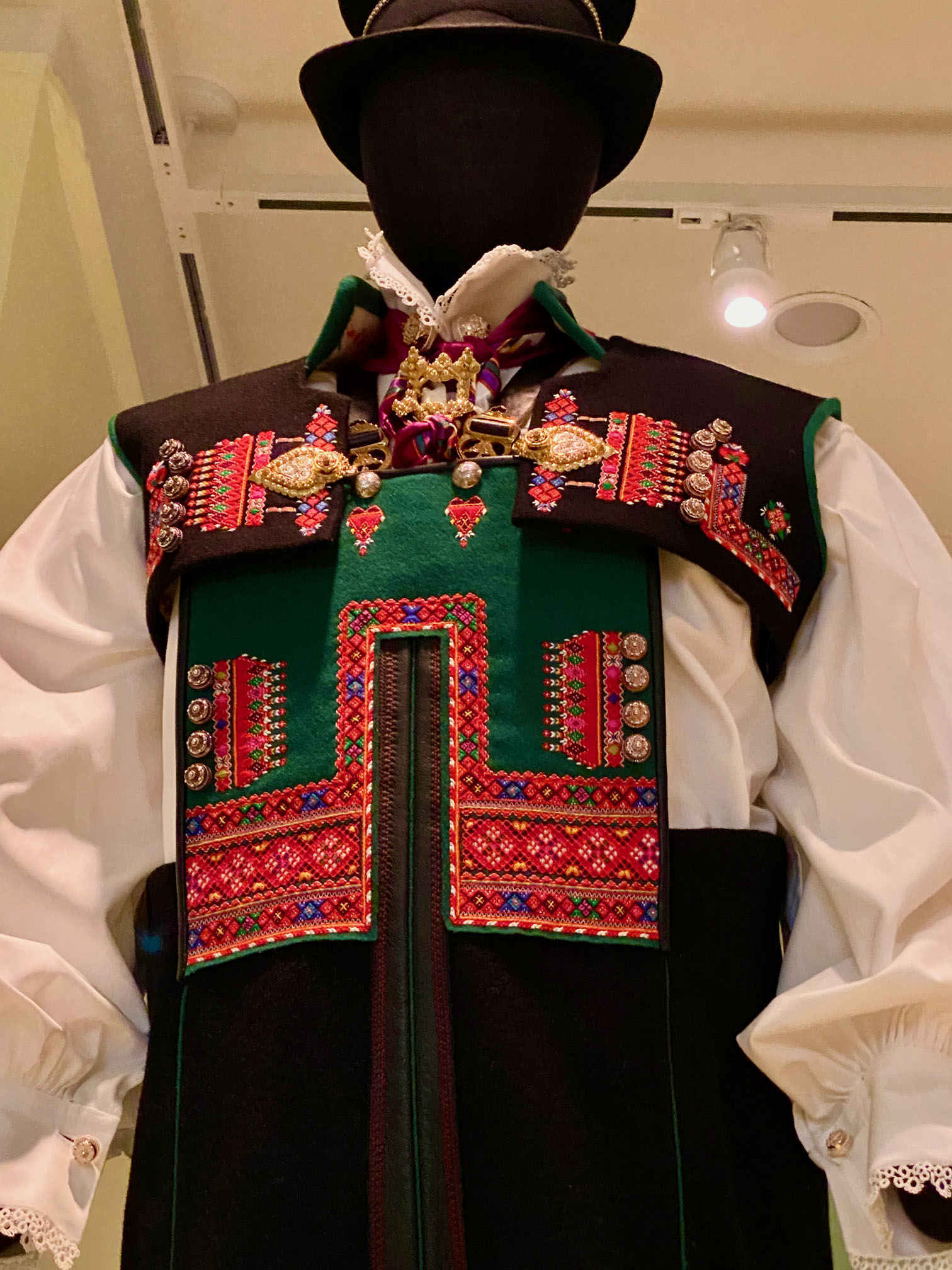
Man’s 2018 bunad by Inger Homme and other artists in Valle in Norway’s Setesdal district; silver, gold, brass jewelry by Hasla AS.
In the Sápmi portion of the exhibition, the clothing and art is mostly contemporary, with a focus on making declarative statement about indigenous rights.
Long an oppressed minority, the Sámi people have been subject to racial injustice, forced relocation of children to boarding schools, and industrialization of their traditional lands north of the Arctic Circle. In many jurisdictions, they were forbidden to wear their traditional garb.
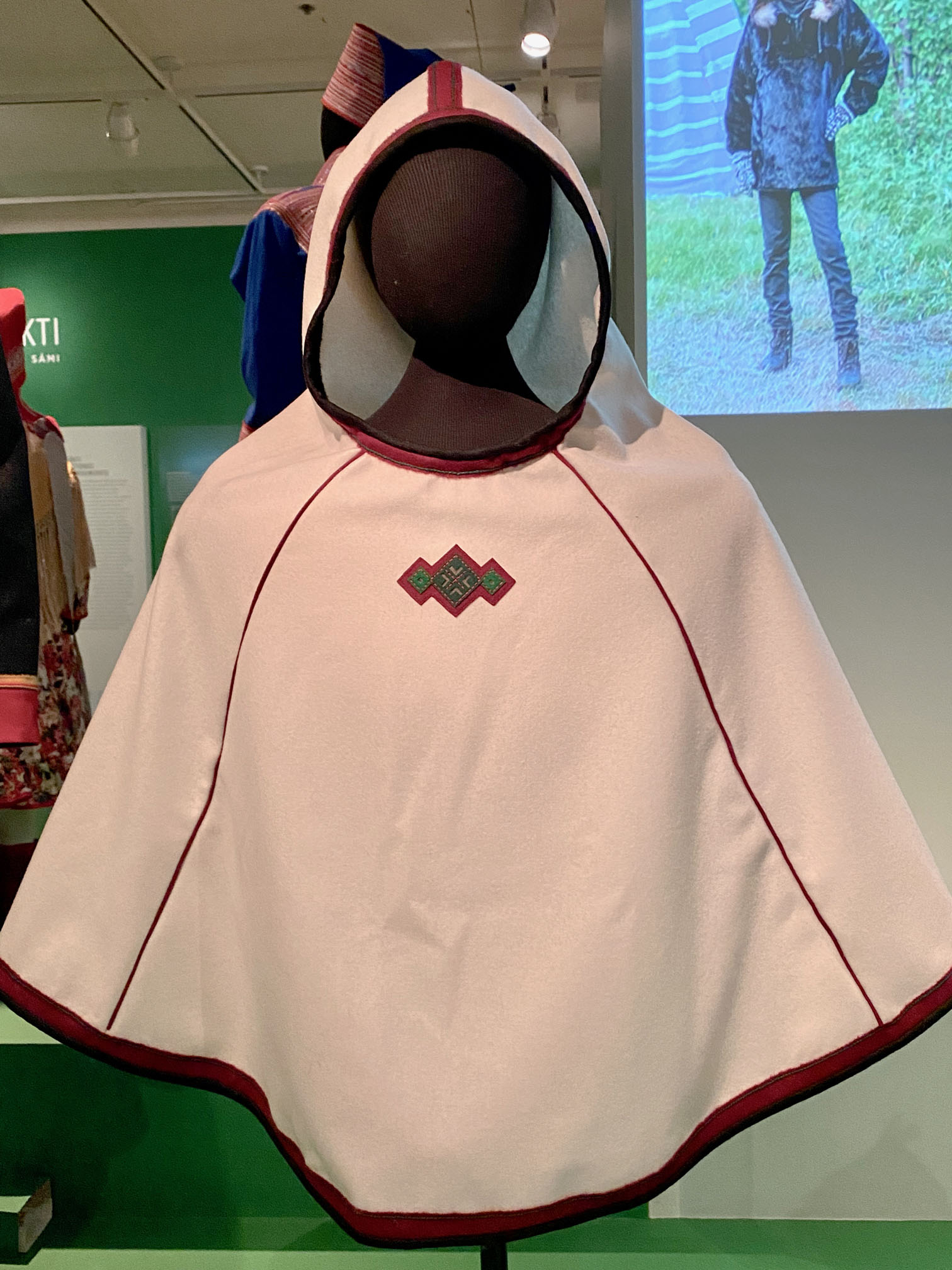
Symbol of Sámi pride: Jenni Laiti’s 2017 gákti creation from Karasjok – in Finnmark, the Norwegian side of Sápmi. Courtesy: the artist.
Around 1970, the Sámi were able to organize and raise public awareness about their status and why they opposed government dam building in Sápmi. Across their land, people began proudly wearing the traditional gákti and other symbols of their culture and engaging in direct political action on issues affecting them.
1966 summer gákti for a Sámi couple – wool tunics embellished with rose-colored ribbons and rickrack; made in Guovdageaidnu in Finnmark (Norwegian side of Sápmi)
Contemporary Sámi design: 2017 ready-to-wear cotton and poly “party outfit” by Stoorstålka (clothing line by Lotta W. Stoor and Per Niila Stålka) of Norrbotten (Swedish side of Sápmi).
The exhibition has posters and artwork proudly proclaiming native rights and identity, including an appropriated Sámi-style Rosie the Riverter image. For the contemporary eye, some of the most exciting clothing in the exhibition are by young Sámi designers and activists – ranging from Sámi-inspired home goods, modern woven designs, and even ready-to-wear party dresses from Sámi clothing lines.
The examples from Sámi makers demonstrate how design and fashion can help to reconnect young people with their ancestors’ heritage that society blotted out.
Jorunn Lokvold’s 2020 Igvu gákti with geometric applique, a style reconstructed in 1995.
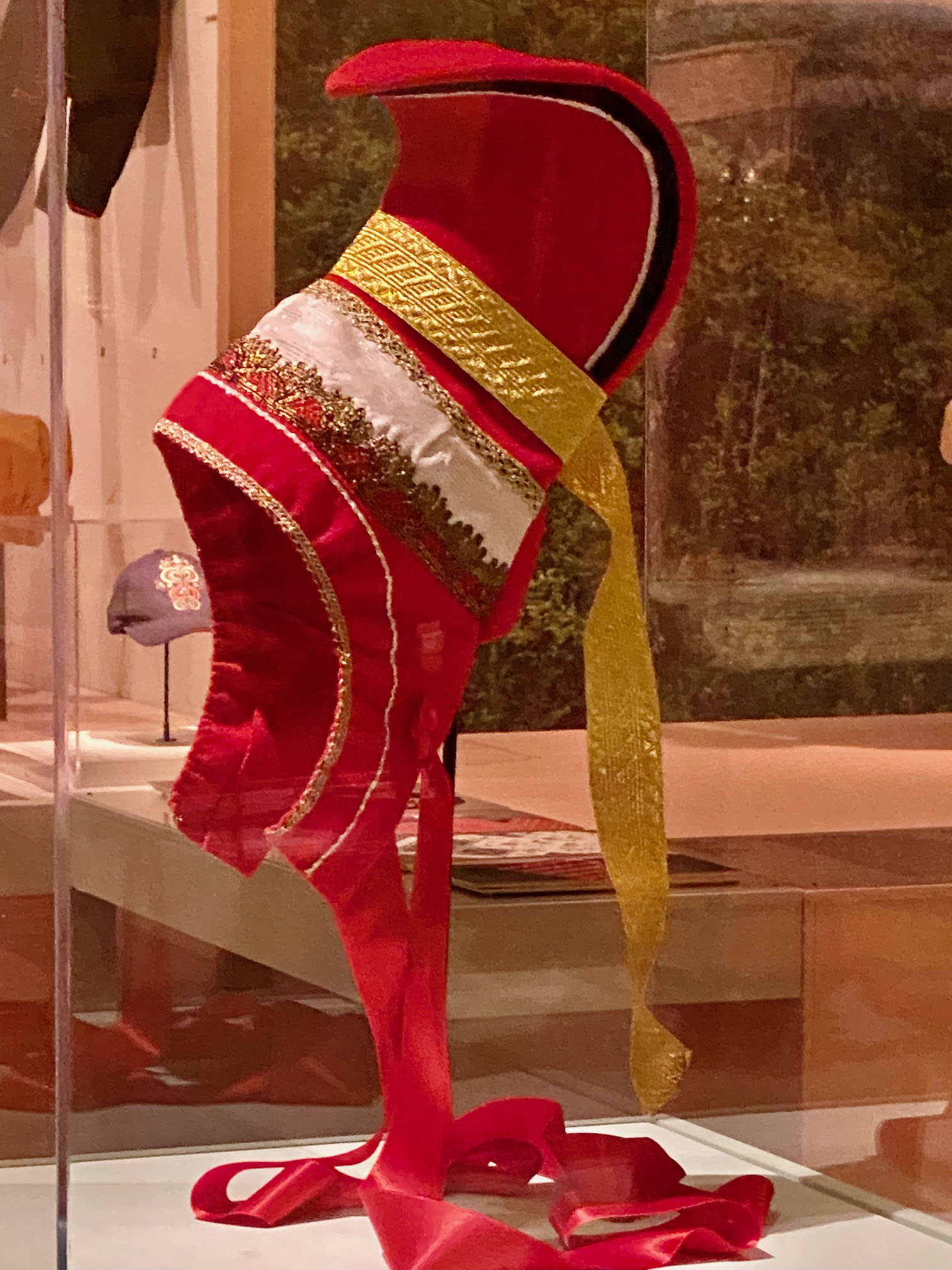
Outi Pieski’s 2020 Ladjogahpir, a revival of a headdress symbolic of Sámi women’s resistance; from Utsjoki (Finnish side of Sápmi).
This wonderful exhibition demonstrates exactly how old traditions can be reinvented to gain traction, even in the 21st century. Take a look through our Flickr album.
Resistance and revival continue in the far North. Meet Jenni Laiti, one of the Sámi artists, activists, and change-makers, who introduces you to art-making in the Arctic:


































 itsnewstoyou