Amy Sillman Gets Shapes to Talk at MoMA

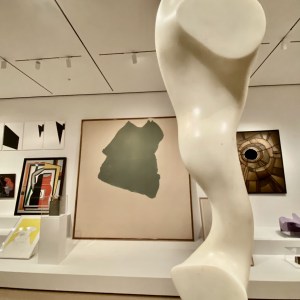
1957 Arp sculpture and view of works by Leger, Frankenthaler and Bonticou

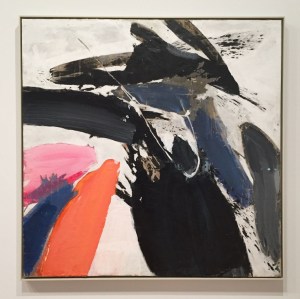
A big, red blob on the fifth floor at MoMA is the welcome sign to one of the most engaging exhibitions in New York ­– the come-hither array of modern artworks in the latest Artist’s Choice show, Amy Sillman: The Shape of Shape, on display through October 4.

But here’s the catch for MoMA visitors – the show has more than 75 works but no labels, no identification, no dates. Just the clue that Amy chose works to explore the role of “shape” in modern art. Small artworks are arranged knee-level on risers (kind of like stadium seating), with larger paintings tilted against the wall.  A few are hung in the traditional way, but it feels as if MoMa’s collection is looking at you and hankering for a conversation. Check it out in our Flickr album.

Rectilinear frame conversation between 1989 Albert Oehlen painting and 1935 “Construction” by Gertrude Green

In our first visit back to the re-opened MoMA, visitors circulated through the room, looking intensively, talking about what they saw, and discussing how pieces might be connected. Although the gallery guide was available via QR code, no one during our visit appeared to seek it out. Everyone seemed quite content to parachute into 110 years of modern visuals and just go for the ride.

What did Amy choose? Abstracted forms, organic shapes, human bodies, and not-bodies – all arranged in a way that makes you feel that one is somehow related to its neighbor. You can’t quite describe why the entire room felt like a tight ensemble, even though one piece might feel like fun and the next a little scary.

It was interesting how unsettled visitors felt by 1970s works by Christina Ramburg and Julian Schnabel. This is exactly what Amy was going for, according to what we overheard her tell students in the gallery yesterday. She wanted to evoke the anxious feelings that most artists experience as they paint, draw, and sculpt and to reflect the times today without being didactic.
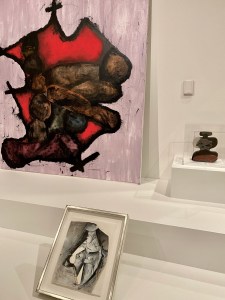
Along the east wall – 2008 acrylic by Charline von Heyl, 1920 Arp sculpture, and 1976 drawing by Jay DeFeo

Amy came of age during the Seventies when museums and intellectuals had given abstract expressionism its “heroic” status and crowned minimalists and conceptual artists as successors in the march of modernism. For this Artist’s Choice exhibition, Amy examined MoMA’s vast archive from a different perspective, looking at famous and not-so-famous creators whose work evoked myths, an interest in shadows, tension, anxiety, bodies, and whimsey.

Shadowy Black figures in a dark painting by Zimbabwean artist Thomas Mukarobgwa are echoed by a shadowy figure in a work by Leger. The tiny 1920 stacked Arp sculpture seems to be playing a “Mini-Me” role next to the large, layered 2008 Charline von Heyl acrylic.

Shadows also play key roles in a Lois Lane painting paired with a Kirschner wooduct. See for yourself and make a connection. Download Amy’s zine here to learn more about the works she chose and how she installed them. (She designed it during the quarantine months when the show was shut down.)

Here’s a short overview of the show hosted by MoMA painting/sculpture curator Michelle Kuo:

But you should really dig into the in-depth conversation (with over 10,000 views!) between Amy and Michelle, if you’ve ever been to art school or painted. They talk about art making, art history, Amy’s inspiration from Munch’s little-known litho of a woman hugging a bear, and the way she chose lesser-known works that could have a conversation with you in 2020:

More on MoMA’s reopening
MoMA on 53rd Street is open every day with timed ticketing, and now that the free-ticket offer has concluded, it seems easy to find a time to visit. The Queens outpost at P.S.1 is open until 8:00pm Thursday through Sunday, and is currently showing the acclaimed (and long-anticipated exhibition) Marking Time: Art in the Age of Mass Incarceration through April 4.

Join Live Virtual Events at NYC Museums

Tour “Sahel: Art and Empires on the Shores of the Sahara” at The Met this week

Are you missing your favorite New York museums? We’re happy to report that many of the cultural powerhouses, like the Whitney, The Met, and MoMA have reopened, although timed tickets in the opening weeks have been a little hard to get.
There’s a quick and easy way to get inside, however, by attending one of the live virtual programs being offered.  Check out our new page on events! As you can see, there’s a lot of opportunities to connect.

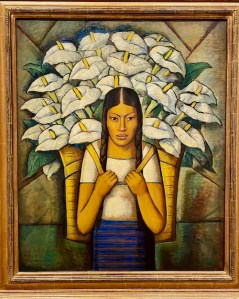
1929 “Calla Lily Vendor” by Alfredo Ramos Martinez in The Whitney’s must-see exhibition “Vida Americana”

New York museums have been keeping their events going online, and joining in is a great way to meet curators, docents, tour some blockbuster shows, and join in on the discussions happening around town about art and the social-justice movement (past and present), women’s issues and history, and even listen to ETHEL play classical music from the virtual Met balcony on Friday night.

For smaller museums, the virtual events have been a great way to broaden programming to a national or international audience.  In recent on-line programs produced by Fraunces Tavern, it’s been nice to see colonial history buffs from Virginia and New England join in on the discussion. At last week’s New York Transit Museum’s talk on the 20th Century Limited, a few UK railroad enthusiasts joined in the chat room!

Hear about the preservation of Washington and Hamilton’s hangout, Fraunces Tavern, one of NYC’s oldest buildings this week

So, it’s a great way to be in the virtual room where it’s happening with others who love history and conversation as much as you do!  Take a look at the array of topics and events and register.

Most of the events are free, although after the months-long shut down here, it’s always nice to give a thank-you donation.

Reopening Update

This week, we’ll welcome the opening of the Guggenheim and Jewish Museum along Fifth Avenue and the International Center of Photography at its new home on Essex on the Lower East Side, where the Tenement Museum has begun neighborhood walking tours again.

Welcome back!!

Enjoy this beautiful four-hour meditative Met Live Arts performance by Lee Mingwei and Bill T. Jones at The Met this week

Resistance and Power via Fashion at FIT

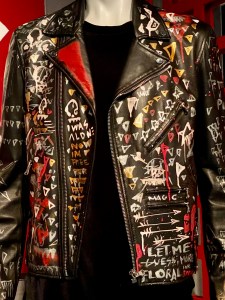
2016 jacket by Kerby Jean-Raymond for Pyer Moss powerfully protesting racism in the fashion industry

Although the doors to the museum exhibition are shut tight, the Museum at FIT still allows full access to its spring show Power Mode: The Force of Fashion through its online exhibition.

The power of resistance and how clothes convey the message are among the themes explored. Hand-crafted items such as jackets slashed with anti-racist graffiti, T-shirts silkscreened with bold words, and pink pussy hats are shown (and discussed) alongside high-end designer appropriations of messages, causes, or culture.

The exhibition presents actual 19th– and 20th-century uniforms – templates of precision, force, and authority – next to creations in which high-fashion designers channel this concept of “power” through military colors or styling.

Power to resist 2017 – a T-shirt from the Women’s March T-shirt and a feminist statement by Maria Grazie Chiuri in her first collection for Dior

The show explores examples of economic power via “status dressing” over three centuries and shows how the authority of a man’s traditionally tailored suit was adapted to white-suit statements by women showing power – not only by the marching and protesting suffragettes of the last century, but also by the current crop of female politicians in the United States.

Take a close-up look at the details in our Flickr album and read more about individual items on the show’s website.

Curator Emma McClendon gave a lot of thought to the visual cues, economic issues, and shifting societal backdrops for as she selected the items for this show.  Join her on a walkthrough to find out what lies beneath the surface of everyday, extravagant, and elemental clothing choices :

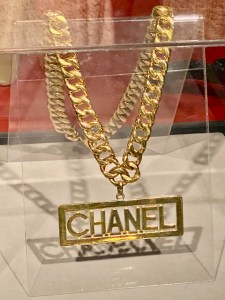
Status dressing – 1991 gold-plated necklace by Karl Lagerfeld criticized for its cultural appropriation of hip-hop street culture

Building a Retail Empire on Wearable Art

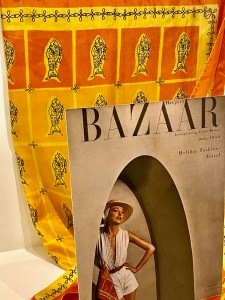
Vera’s 1950 silk “Fish Scroll” scarf, featured on the cover Harper’s

So many of the great female entrepreneurial success stories begin at the kitchen table, and the story currently being told by the Museum of Arts and Design (MAD) in Vera Paints a Scarf: The Art and Design of Vera Neumann, on view through January 26, is no exception.

Fashionistas today may be too young to remember when the American height of chic was to sport a scarf by Vera. Back in the Sixties and Seventies, Vera pretty much had a lock on the retail market for bold, colorful silk scarves through major department-store behemoths.

The exhibition is a tribute to a woman who took her love of painting, travel, nature, and culture to the wardrobe and accessory drawers of all fashionable American households, and ended up partnering with many top manufacturers to push her aesthetic and flare into mid-century modern homes.

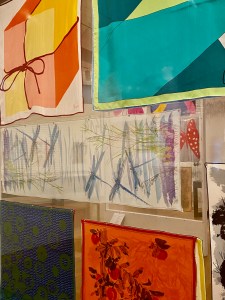
Vera’s silk scarves, based upon watercolors, hung as art at MAD

Although her name is not well known by young people today, MAD’s exhibition is a fitting tribute to a woman who virtually invented the concept of “lifestyle” brand. It’s hard to believe that an aspiring artist born in Connecticut in 1907 would grow up and develop her company to pack such a punch in retail.

A graduate of Cooper Union and Traphagen in the 1920s, during the Depression, Vera and her husband set up a silkscreen on their little Manhattan kitchen table and began printing her paintings on surplus parachute silk. Within a few years, her beautiful silks were being retailed at B. Altman, Lord & Taylor, and other nice shops in the city. Her joyous prints were a success!

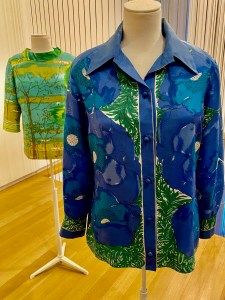
Vera’s 1960-1965 silk blouses with paintings of blue poppies and woodland images

Building her business through the war years, Vera took her first foray into fashion in the 1950s, creating tops and blouses that she came to market as “wearable art.” Rather than simply printing yards of repeating patterns, she went a step further – engineering prints in panels, so when pattern cutters and sewers assembled her shirts, her beautiful patters would strategically appear in the final product, enhancing cuffs, collars, edges, and hems.

Of course, everything was priced for the widest possible market, so a woman seeking a bit of fashion flair could buy a Vera without blowing her budget. She followed the art-plus-commerce philosophy – a Bauhaus innovation – and maximized accessibility of mid-century modern design by expanding into home textiles, tabletop accessories, and dishes.

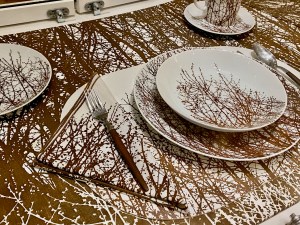
1979 “The Birches” china dining set for Mikasa with matching tablecloth

As her business grew, Vera came to rely upon the next generation (Perry Ellis got his start with her) to keep the design development chugging along while she traveled to Asia and other parts of the world to feed the constant demand for new inspiration for her collections.

MAD has assembled a beautiful, loving exhibition of Vera’s output, showing how her original watercolor work made its way into her commercial ventures – scarves, clothes, and home décor. Perhaps most remarkable is that this powerhouse kept traveling, painting, and channeling joy into her textiles well into her eighties – an inspirational lesson in love of life, art, craft, and culture.

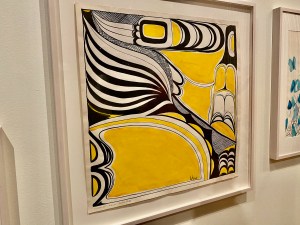
1971 “Northwest Coast” silk scarf

Thank you, Vera! Long may your prints wave!

And thank you to MAD for sharing Vera’s lifetime of creations and inspiring story!

See more photos of this wonderful exhibition in our Flickr album.

World-Class Design Inspired by Nature

Mischer’Traxler’s Curiosity Cloud installation

Visitors are immediately drawn into front room of the Carnegie Mansion to enter a magical environment in which insects appear to be fluttering inside hand-blown glass bulbs in the entry to Nature: Cooper-Hewitt Design Triennial, on display through January 20.

But it’s actually artificial insects that are creating the commotion, programmed to activate as a visitor approaches – all replicas of extant and extinct species of New York State created by Austrian design team Mischer’Traxler.

This Curiosity Cloud installation serves as the introduction to an expansive show that presents how innovative designers are applying new technical solutions inspired by nature to architecture, agriculture, textiles, construction materials, and robotics.

In cooperation with the Cube Design Museum in Kerkrade, Netherlands, the show highlights the work of over 60 international design teams who explore biomimicry, new materials, and artificial intelligence as they create solutions to climate challenges and sustainability in the real world.

2019 Fantasma garment by design studio Another Farm from transgenetic glowing silk

Among the highlights, shown in our Flickr album – textiles printed by rain and pigment-producing microbes, a fruit tree grafted with dozens of fruit varieties, a biodegradable Michelin tire, a personal food computer, and a robotic bionic ant programmed to interact autonomously with other similar ants, just like they do in real life.

The showpiece on the second floor of the exhibition is the concept garment by design studio Another Farm from transgenetic glowing silk, manufactured by Kyoto’s Hosoo textile company. The silk was engineered by injecting DNA from bioluminescent coral into silkworm eggs and using it to create the fabric. Visitors used special glasses to see the other-worldly glow.

Another favorite is the Cosmic Web project by Kim Albrecht, based upon the scientific research on 24,000 galaxies. Take a look:

To spread the good work, the Cooper Hewitt and Cube are installing a portion of the show at the World Economic Forum in Davos, Switzerland in January, hoping to inspire global thinkers to look into the future of possibilities for a changing world.

Listen as one of the Cooper-Hewitt curators introduces the exhibition and hear contributing artists talk about their work in a video produced by ALL ARTS as part of the documentary series Climate Artists.

Back in Time with Wolf Nation at the Whitney

1-4 Wolf Nation at The Whitney

2018 Wolf Nation video, featuring endangered red wolves in New York and evoking the vanished Lenape (Wolf Clan) of Manhattan and New Jersey

The darkened room with the plaintive cries of the wolves is the heart of Alan Michelson: Wolf Nation, at the Whitney Museum of American Art through January 12, but the other three installations created by the internationally renowned Mohawk artist take you back to experience what the Lenapes saw over 400 years ago on the very ground upon which you stand.

It’s subtle and it’s outside the pace of today’s bustling Meatpacking District, so take your time and slow down.

1-1 Wolf Nation at The Whitney

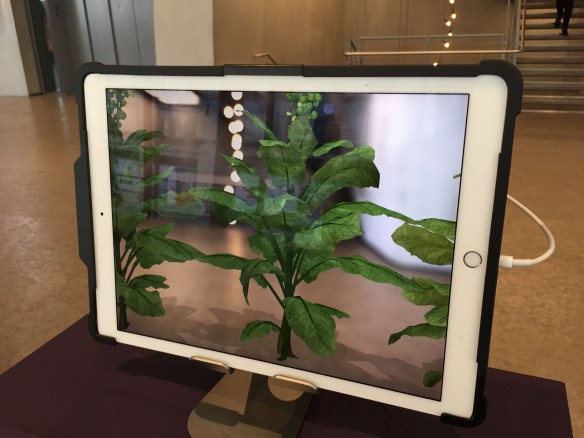
Sapponckanikan (Tobacco Field) that allows visitors to walk among ritual tobacco plantings in the museum lobby, near the Lenape’s original field

The first experience is right inside the entrance – an augmented reality (AR) piece that transforms the busy lobby into a tobacco field that historians say was planted over 400 hundred years ago by the Lenape people where Ganesvoort Street ends today.

Through an iPad (or by downloading AR co-creator Steven Fragale’s app), visitors can watch and walk through a field of lush tobacco plants that the original inhabitants of Manhattan used for rituals and ceremonies.  Different from the commercial tobacco that was grown for export, the virtual plants are based upon the type grown by Michelson’s sister in her upstate garden.

It’s an effective experience that causes visitors to stop and think about nature, history, indigenous cultures, and cycles of life in an ultra-modern, hyperactive environment that is typically untethered to the ancient or natural.

On the fifth floor, the experiences continue in a hallway and theater just off the Rachel Harrison retrospective.

1-5 Wolf Nation at The Whitney

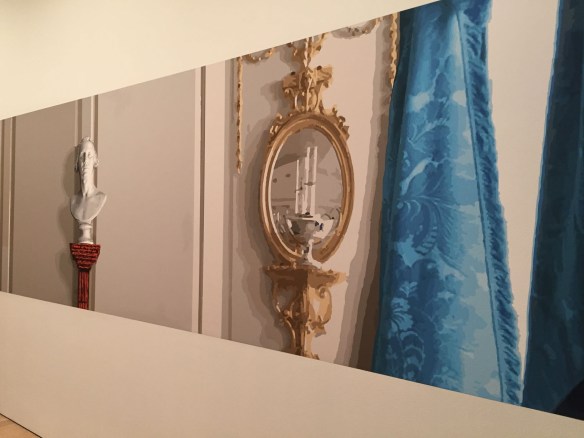
Mt. Vernon-inspired wallpaper backdrop for 2019 Town Destroyer AR installation that evokes memory of 1779 destruction of the Haudenosaunee people in New York State

A second AR installation, Town Destroyer, uses a genteel, upscale, Mount Vernon-inspired colonial interior to educate visitors about a particularly gruesome removal of 60 settlements of Native people during the early years of the American Revolution in upstate New York.

The wallpaper image of General Washington becomes a 3D marble bust when seen through the AR app, upon which is projected a map of the lands taken from the Haudnosaunee, upon his orders, by the Sullivan Expedition in 1779. Projections of State historical markers tell the sad tale, reminding viewers of the forgotten history of displacement, violence, and greed endured by New York’s First Nations…even at the hands of our Revolutionary heroes.

Visitors who see the installation rush over to read the label copy to get better informed about this forgotten history and to wonder what else was left out of American history books about the vanquished people.

Wolf Nation_AR Images

Historical markers and maps about 1779 Continental Army aggression against Native Americans in Town Destroyer AR installation

The large, comfortable dark theater has an enormous wide-screen video of several of New York’s most endangered species – red wolves. You’re seeing them at night in their native habitat upstate, or so it seems. In actuality, you are seeing residents of a captive breeding colony maintained in the hopes of increasing the remaining population of 17.

It looks like a mysterious nighttime scene, shot with a surveillance camera. The pace is slow, with different members of the group arriving, listening, and leaving, fully alert. Sounds of their calls in the distance fill the room.

The effect is hypnotic, allowing viewers to slow down, see the wolves at their eye level, and reflect upon status of our indigenous wildlife and people.  The Lenape, who first colonized Manhattan and New Jersey, identified as Wolf Clan. The color and shape of the cinema projection evokes wampum, the purple and white clamshell beads strung by the Lenape as gifts or to seal treaties.

All of Michelson’s work here requires visitors to slow down their pace and see their surroundings through the eyes of people who stood right there 400 years ago.

1-3 Wolf Nation at The Whitney

Shattemuc video in which a boat’s searchlight illuminates the Hudson River shoreline at night

Shattemuc, a quiet video does just that.  Sit for a while, and see what the Hudson River looks like, illuminated only by a circle of light from a boat that is making its way slowly through the waters in the dead of night. No skyscrapers, no water taxis, no giant clocks.  Just shoreline, trees, cliffs, an occasional small settlement, small boats, and a small, up-close personal feeling.

Then later, as you take in the magnificent view Hudson from the west windows of the fifth-floor Whitney, Michelson’s work allows you to envision what the Lenape saw.

So, despite the distance in time, did Native Americans truly vanish from the shores of New York? Actually, the city today hosts one of the largest populations among big cities in the United States, including many working artists and cultural scholars.

Michelson is one of the leading voices advocating that museums and galleries reflect the work of the first Americans, and congratulations to The Whitney for making this a priority. See Michelson’s seminar on this here.

Urban Indian: Native New York Now at the Museum of the City of New York, running through March 8, testifies to the continuing vibrancy of the First Americans in the cultural capital.

Cardin Sees the Future Through Fashion

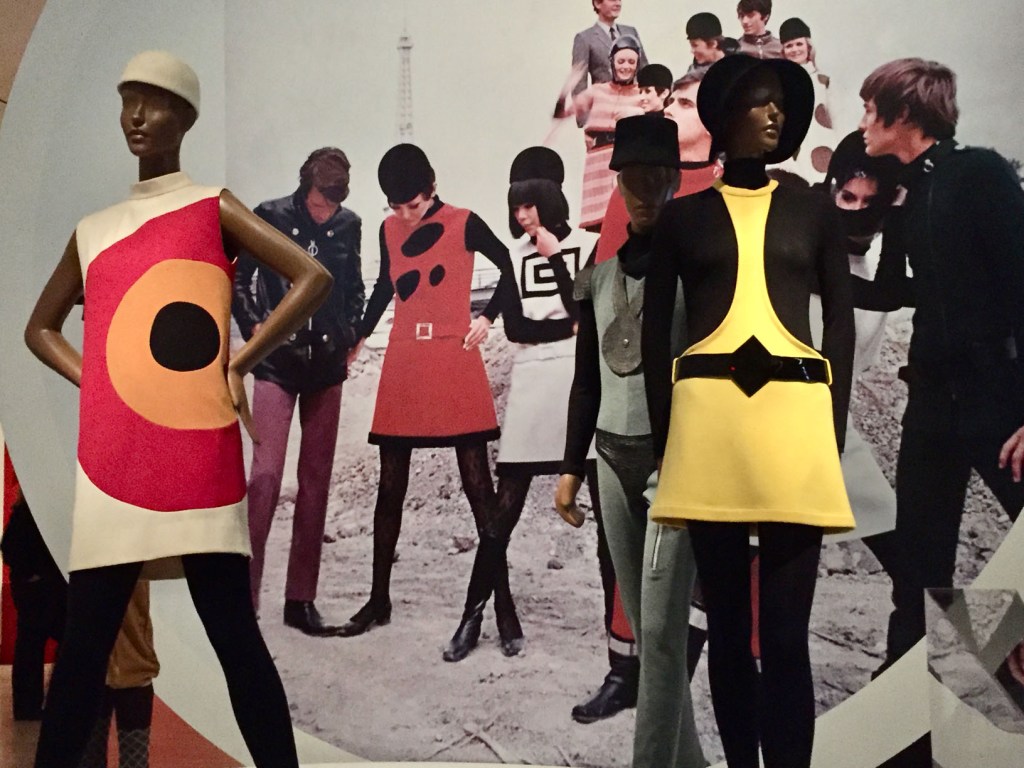
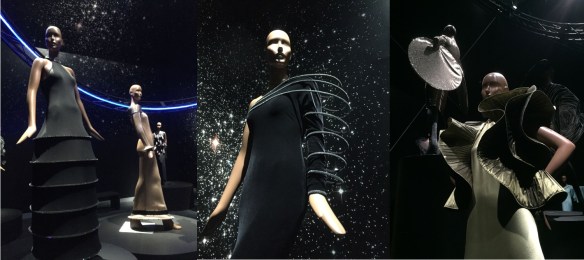
The Brooklyn Museum’s latest blockbuster fashion exhibition Pierre Cardin: Future Fashion, open through January 5, presents the work of a French designer who continues to be inspired by the belief that simplicity, design, and science are essential ingredients for a world that lives in peace, treats men and women equally, and looks to the horizon.

Geometric minidresses and men’s ensembles worn with tights and over bodysuits from the revolutionary 1964 Cosmocorps collection

Cardin came of age as a designer in the 1950s creating luscious swing coats, lasso-backed draped suits, and prim (but red-hot) looks for Jackie Kennedy. But he shot to “influencer” status in the early 1960s with unisex looks, bodysuits, collarless jackets for the Beatles, reliance on a fashion-forward Japanese model, turtlenecks (for men and women), hoods, felt helmets, and body jewelry – in other words, all the basic building blocks that would be used to clothe the crew of the Starship Enterprise.

1957 “lasso back” suit, 1968 bodysuit ensemble, and Cosmocorps photo with video showing the unisex Star Trek costumes it inspired in 1966

The Brooklyn show begins with a chronology of Cardin’s young life – soldier, costumer, and Christian’s first employee at the House of Dior in 1946 – but rapidly gives way to a sensational array of tubular, unisex clothing from his mind-blowing Cosmocorps collection, which had so much impact on Sixties culture. Take a look at our favorites in Flickr album.

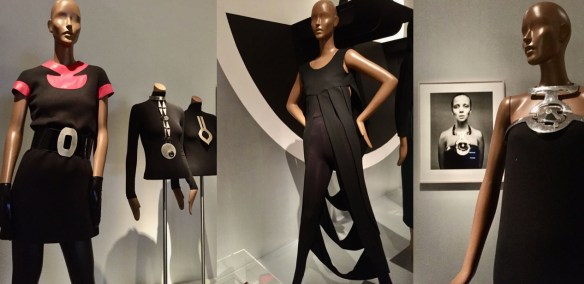
1968 wool and vinyl minidress, 1966 aluminum statement jewelry, a 1970 wool crepe “Kinetic” dress, and Avedon photo of Penelope Tree wearing a 1968 evening dress and collar

Although several other European designers could be credited with the evolution of the miniskirt, no one channeled the Space Age like Pierre Cardin when it came to shape, form, and use of new fabrics and materials – lenticular plexiglass, vinyl, Dynel pressed into 3D forms and shaped for the body, and parabolic structures that underpinned evening gowns, men’s jackets, and skirts. Pierre even went so far as to visit Houston and slip on an Apollo 11 astronaut’s suit.

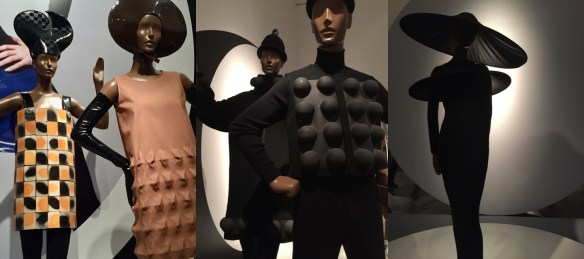
1969 lenticular plexiglass and vinyl “armor” dress, 1968 heat-molded Dynel dress, 2007 jersey coat and suit with rubber, and 1991 jersey evening ensemble with parabolic shoulders and hat

It’s clear that the Sixties and Seventies fashions in the show reflect what was going on in the art world at the time – bright, bold colors of Pop Art, pared-down minimalism, an embrace of non-traditional materials, and kinetic art. (Carwash dresses, anyone?)

Even Cardin’s forays into furniture design reflect his belief that his hand-made contemporary works genuinely functioned as art first and utilitarian additions to the home second.

1968 circle coat and hat, next to 1979 Junior Unit, and 1977 Serge Manzon lamp

The final gallery in the Brooklyn show is a darkened room populated with mannequins in shimmering gowns and suits, electrified dresses and sportswear, and pieces embellished with parabolic hoops and flourishes – sheer Space Age magic. Slight swoops across the space, framing the last 20 years of Cardin’s output with an other-worldly, visionary feel.

2008 evening dress with parabolic hem, 2003 evening gown with plastic tubes, 1994/2000 velvet evening dress with Swarovski crystals on the orbital sleeves, and 2013 silk/lame evening dress with Swarovski crystals

A surprise inspiration is the revelation that Cardin at 97 is still designing and looking toward the future.  His predictions? That people will be on the Moon in 2069 wearing his Cosmocorps look, women will be sporting tube clothing and Plexiglass cloche hats, and that men will be wearing kinetic tunics and elliptical trousers.  Why not?

Watch as the curator explains how Cardin envisioned the future…

…and why this retrospective of his work is just right right now:

Fresh Look at Gertrude Whitney’s Collection

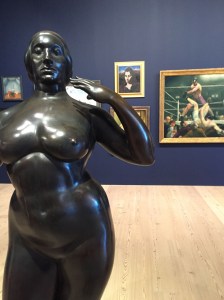
Lachaise 1912-1927 bronze Standing Woman with works acquired by Gertrude Vanderbilt Whitney herself

The Whitney’s Collection: Selections from 1900 to 1965 is a full-floor installation that focuses on the institution’s origin in 1930 as an eclectic, lively space where of-the-moment art could make a statement to the world – the same as today.

But rather than concentrate exclusively on all of the masterworks of American art that the museum owns, this show integrates some practically forgotten works and artists that the curators feel deserve a fresh look. So, walking through this chronological show, everyone gets a taste of something completely unexpected.

See some of our favorites here on Flickr.

When the elevator doors open, the first gallery is a tribute to the passion of Gertrude Whitney, the only American artist to establish a major museum. Lachaise’s bronze beauty beckons visitors to take a closer look at paintings that Gertrude herself acquired. Photographs of the Whitney’s earliest incarnation downtown are nearby to set the context.

Anne Goldthwaite’s 1926 Rebecca, purchased by Gertrude Vanderbilt Whitney 

It wasn’t a museum collection in the traditional sense, because Gertrude acquired paintings and sculptures by artists that she wanted to support. Better-known works by Bellows, Benton, and Bluemner are on display here, but so is a beautiful, rarely shown 1926 portrait by Anne Goldthwaite, a women’s rights activist from Alabama whose work was included in the 1913 Armory Show, but is not that well known today.

Subsequent galleries group artists inspired by uniquely American landscapes ­– urban engineering achievements of New York (Man Ray, Stella, Stettenheimer), O’Keeffe’s evocations of nature’s spirituality, and clean, idealized visions of modern industrial campuses (Demuth, Sheeler).

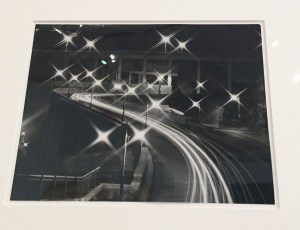
Andreas Feininger’s 1940 photo of the West Side Highway

Photographs dot the walls, including Herbert W. Gleason’s other-worldly 1908 images of Walden Pond and a modern 1940 image of the West Side Highway by Feininger, which anyone can see through windows in the Whitney’s Hudson-facing interior staircase.

A dark side gallery features one of the Whitney’s greatest treasures – Calder’s Circus, which has been newly conserved and restored. The ringmaster, bareback rider, and trapeze artists – all based upon actual performers from the Twenties ­– occupy the spotlight, surrounded by Calder’s performance props, Victrola, and whistles.

Here’s a recent video containing excerpts of how Circus was brought to life by the master himself and how it’s been conserved for posterity by a team at the Whitney:

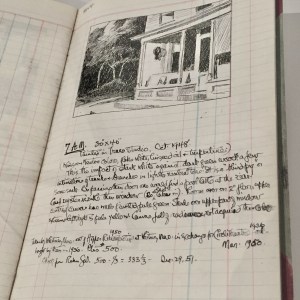
An additional highlight in another gallery is the “show within a show” of Edward Hopper works and drawings – his early work from Paris, the solitary American townscapes, and a sketchbook in which he documented every painting he made. Everyone spends time here.

Edward Hopper’s ledger book documenting all his work 

A melancholy dark gallery is hung with paintings by American émigré artists whose work evokes surrealist experimentation, the war, urban isolation, and growing societal dissonance. A counterpoint (and surprise) is a 1939 animated film by experimental film pioneer Mary Ellen Bute, a symphonic short shown to the crowds at Radio City Music Hall before movie features.

The gallery devoted to Fifties abstraction showcases the usual suspects (Pollack, de Kooning, Kline), but intersperses new acquisitions and lesser-known players, such as a 1959 abstract canvas by Ed Clark, an African-American artist who trained in Paris courtesy of the GI Bill, which holds its own against the other AE powerhouses in the room.

Ed Clark’s 1959 abstract poured-acrylic painting 

Big David Smith and Barnett Newman sculptures reign on the outdoor terrace, right next to the joyful Pop Art gallery, dominated by a massive, four-panel 1964 Wesselmann and an engaging multi-person self-portrait (with dog) by Marisol in the corner.

The walk-through is a reminder of the riches that anchored the first 30 years of the Whitney and the efforts that the museum is taking to find powerful artwork from the archive that enhances the traditional narrative of 20th century American art history.

Go soon before the team changes it out for the next collection installation, and take the audio tour on the Whitney website.

Getting a breath of fresh air: Barnett Newman’s 1966 Here III and David Smith’s 1961 Lectern Sentinel

MoMA Activates Sensory Landscape Daily

Large moveable sculpture covered in tiny bells

MoMA’s open again, and as the sun comes down daily, a sparkling, tinkling, gleaming landscape created by Korean multimedia artist Haegue Yang comes alive in the Museum of Modern Art’s multistory atrium.

Giant, stylized animalistic sculptures glide across the space, carefully guided by a black-clad dozen performers who appear every day at 4 p.m. for the one-hour activation.

Handles is a dreamscape world, where six large sculptural pieces inhabit an atrium enlivened by reflective biomorphic shapes climbing playfully up the walls.

When the performers move them, the giant sculptures, sheathed in a neat layer of bells, subtly chime to a soundtrack of tweeting birds and a tranquil symphony. Magic that soothes museum goers into a contemplative state.

A team of performers activate the installation daily

The piece reflects Haegue’s growing interest in using choreography and sound to build a sensory experience for art viewers. Gradually, she’s incorporated performers moving in geometric patterns, pulling oversized sculptures across and around the space, in a modern take on utopian Triadic Ballet-style movement.

Environmental phenomenon, geopolitical stresses, and modern art pioneers all factor into her work. Read MoMA’s interview with her here.

There’s plenty of time to see Handles, which will be activated for MoMA visitors through April 12, 2020.

See more photos of the installation on Flickr and watch a few moments of the performance here.

Minimal and Maximal Fashion at FIT

Minimal 2011 silk evening dress by Narciso Rodriguez next to wild 2018 Multidimensional Graffiti ensemble by Rei Kawakubo.

The Museum of FIT is having it both ways in Minimalism/Maximalism, on view through November 16. The first thing you see is a super-minimalist slip dress by Narciso Rodriguez alongside Rei Kawakubo’s semi-abstract ensemble filled with flourishes.

The show is an opportunity for the curators to present an historical case for the wild swings in fashion for the last 250 years, all drawn from FIT’s massive fashion archive.

Over-the-top, way-too-much fashion is shown alongside clean, spare, elevated statements, demonstrating how the fashion pendulum has swung between these two extremes, reflecting women’s liberation and high fashion’s societal mirror. Periods of excess, followed by understated silhouettes and statements.

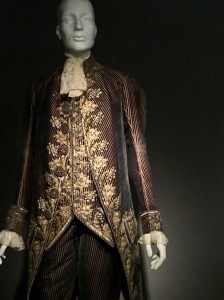
18th century extravagance — an elaborate 1785 embroidered velvet French court suit

The chronological tour begins back in the mid-1700s, when continental courtiers had to keep up with the minutia and meanings behind the tiniest sartorial flourishes of court stylings. The right buckle, the proper embroidery, luxurious fabrics, and new silhouettes. FIT presents the excesses of luxurious brocades, incredible embroideries, and flounces required for both men and women.

By the 1800s, the taste for British simplicity overtook French excesses. Besides, revolutions elevating the common man and woman had jolted the world. The curators present a simple man’s suit created of luxury velvet and dresses made of largely under-stated muslin.

They make the point that the silhouette might be stripped down, but luxurious fabrics and complex layers were the subtle signals that elevated fashions worn by the upper classes were (literally) a cut above those worn by everyday people.

Close up of rich ornamentation, drapery, and embellishment on 1883 Worth gown from France

The next pendulum swing shows ever-wider ladies’ crinolines of the mid-19th century giving way to elaborately draped confections by Worth by century’s end. The curators underscore the fact that ladies’ high-end wear was expected to convey a sense of frivolity, while men’s suits remained serious, restrained, and constricted to more formal black-and-white.

The exhibition spotlights the revolution in simplicity that followed by the 1920s, when Chanel and her contemporaries introduced super-slim silhouettes, pulled jersey into sportswear, and liberated women from now-ancient-looking corseted frocks.

Giittery dancing shoes, feathers and beads, fringed accessories signaled the Jazz Age – kinetic, modern, and Deco. The embellishments could be excessive, but they all had sharp lines and clean looks.

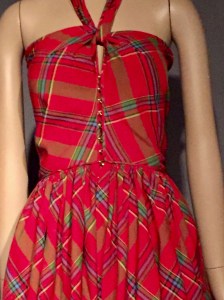
Simplified sportswear from America – detail of a 1952 cotton dress by Clare McCardell

There’s a nod to the post-War structured silhouettes of the tour-de-force European eveningwear designers, but these elaborate sculptural forms are sit next to the blazingly modern, simple sporty shapes of Clare McCardell. American women adopted these clean-lined creations in droves, not only because they were perfect to popping in and out of suburban cars, but they were widely available as ready-to-wear in stores across the country.

The Sixties section of the show begins with ultra-modern space and art-inspired dresses and jumpsuits and works its way into the flip side – over-the-top psychedelic fabric creations.

Remember the Sevenites and Eighties? The minimal side is represented by Jordache jeans, Halston, Armani soft suits, and Donna Karan’s easy pieces.  The excessive counterpoint by Thierry Mugler’s theatrical, disco-inspired, big-shouldered to-be-seen dress and a studded-to-the-max ensemble by Versace.

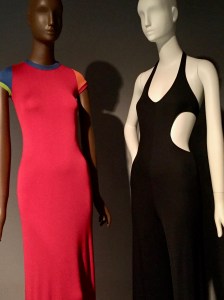
Body-conscious simplicity – a 1973 jersey color-contrast T-shirt dress by Stephen Burrows and 1976 silk jersey jumpsuit by Halston

Filling in the chronology to today, the curators use accessories – -Murakami’s Vuitton bag, McQueen’s pheasant-claw necklace, and Iris van Herpen shoes – to demonstrate the maximalist mixed bag to which we’re now accustomed at the ultra-high end.

Styles are eclipsed at a record pace, as evidenced by the video in the gallery — John Galiano’s 2019 collection for Margiela, which starts with crazy, nearly unwearable experiments and transforms to stripped-down, utilitarian wear.

It drives home the point that maximalist and minimalist sometimes co-exist today in the same show and within the same garment.

See some of our favorites from show in our Flickr album, and take a deeper dive into FIT’s fantastic web exhibition.

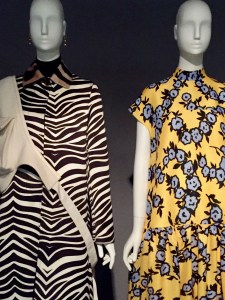
Minimal shape + maximal print: a 2015 ensemble by Phoebe Philo for Céline and a 2019 dress in digitally printed silk chiffon by Wes Gordon for Carolina Herrera