Antonio Lopez: When Fashion Danced Off the Page

Antonio's 1986 Vanity illustration of Tina and Mick Jagger

Antonio’s 1986 illustration of Tina and Mick Jagger for Vanity

Music, fashion, and art were never mixed up so deliciously as when Antonio was working in the studio, surrounded by breakdancers, supermodels, street accessories, and couture. Glimpse the pulsing lines and beat at El Museo del Barrio’s celebratory exhibition Antonio Lopez: Future Funk Fashion through this weekend.

With his partner, Juan Ramos, the dynamic duo changed the way the fashion industry thought about drawing, line, color and style, infusing the typically staid haute couture with ethnic twists, flair, and celebrity in a way no one before had dared. Pencil or conte crayon in hand, Antonio broke down barriers and walls, infusing the New York and Parisian fashion worlds with lively banter, music, and beauty that only a savvy, streetwise Puerto Rican New Yorker could.

The show is a tribute to the 360-degree life that produced the America’s greatest fashion illustrator during the Mod- and disco-infused Sixties and Seventies.

Dynamic 1973-74 pencil drawing for Gentleman’s Quarterly magazine

Dynamic 1973-74 pencil drawing for Gentleman’s Quarterly magazine

The early work from the Seventies is tight, controlled, and more-or-less a jigsaw puzzle of drafting mastery. Witness the Gentleman’s Quarterly illustrations mixing menswear, muscle, and motorcycles, which were considered too racy for the day. Futurist angles, pointed pencils, and lavish details will blow you away.

Around the same time, American master Charles James took note of this FIT wunderkind, asking Antonio to document his entire archive of sumptuous gowns and daywear. Although this ten-year collaboration is not featured in the Fifth Avenue show, look here to see the digital library of Antonio’s work for James, now in the collection of the Chicago History Museum.

As the style cauldrons of Fiorucci, Max’s Kansas City, and Studio 54 amped up, Antonio and Juan began curating their entourage of uptown and downtown style divas, which included legends Jessica Lange, Jerry Hall, and Grace Jones.
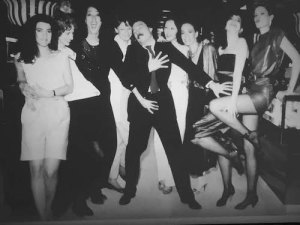
Photo of Antonio surrounded by "Antonio's girls" in the 1980s Installation views of “Antonio Lopez: Future Funk Fashion” El Museo del Barrio New York, New York June 14 – November 27, 2016

Antonio’s Girls surround him in the 1980s

The message: live and draw large. Subjects for illustrated fashion spreads were styled, posed, and recorded in Antonio’s hand, all to a pulsing beat. To get everyone in the mood, innovative street dance crews were given free rein to spin, pop, and twirl during the sessions.

No wonder that Antonio’s mature work leaps off the page, lines swirling, accessories flying. Publications like Vogue, The New York Times, and Warhol’s Interview just had to have it, and published his drawings over and over.

In the age of Snapchat and Instagram, it’s hard to over-emphasize how revolutionary Antonio’s vision was at the time. His two-dimensional visualizations left fashion photography in the dust. As Ms. Missoni once said, “He transformed the clothes.” Take a look at the Flickr feed.

A 1983 pencil and gouache drawing of totally glorified Maria Snyder

A 1983 pencil and gouache drawing of totally glorified Maria Snyder. Collection: Narciso Rodriquez

El Museo is distributing copies of the Interview magazine issue that Antonio and Juan edited. Pick it up as you peruse the serious sampling of celebrity-infused work in the show – Tina Chow, Karl Lagerfeld, Billy Idol, and Tina, to name a few. To give exhibition goers a feel for the pizzazz in Antonio’s work and life, there are videos of break dancers in his studio and a great video of him working from a live model as part of a drawing demo for students at his alma mater, FIT.

Too bad that Valentin de Boulogne (Caravaggio’s follower, currently on view at the Met, who also styled and staged models) lived 350 years too early to enjoy this joyful, breakneck, vibrant 20th-century beautiful-people scene with subjects jumping out of the picture frame.

It’s hard to underestimate the influence Antonio had on the cultural beat of New York in the Seventies and Eighties. It was all about the mix – high art, pop art, high fashion, street style, and ethnic culture.

Take a look at Antonio’s 1983 workshop at Pasedena’s ArtCenter College of Design, and see the master at work creating, staging, and transforming what he sees and feels with gestures as large as Pollack’s:

When Modernism Met Folk Art at NYHS

Elie Nadelman’s painted cherrywood Circus Girl sculpture (1920-1924)

Elie Nadelman’s painted cherrywood Circus Girl sculpture (1920-1924)

What do 19th-century tobacco-store Scotsmen and Spanish-clad dancers mounted on the fronts of tall-masted trading ships have to do with the rise of Modernism in the United States and the 1913 Armory Show?

Find out through August 21 at the New-York Historical Society’s exhibition, which traces the path of one of America’s modern-art pioneers in The Folk Art Collection of Elie and Viola Nadelman. Take a look on our Flickr feed.

The engaging show is largely drawn from the NYHS collection and tells the story of how a Polish immigrant fused his love of European and American woodworking tradition with Picasso’s love of “the primitive” and developed his own pop-culture-infused modernist sculpture style.

Feisty figurehead from the shipwrecked clipper ship Rosa Isabella, carved in Hamburg in 1865

Feisty figurehead from the shipwrecked clipper ship Rosa Isabella, carved in Hamburg in 1865

The show, which travels next to the Addison Gallery of American Art in Andover, Massachusetts, is a delightful window into how modernism crept onto America’s 20th century radar as 19th-century traditions were becoming a thing of the past.

Nadelman’s sculptures were included in the ground-breaking Armory Show in 1913 and showcased in one-man shows at Stieglitz’s 291 Gallery and other NYC Modernist hotspots.

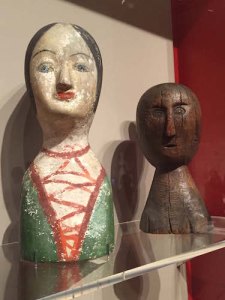
As the NYHS show makes clear, the whitened faces and painted-to-look-weathered bodies of his circus girls, tango dancers, and vaudevillians echoed back to shapes, colors, and styles he favored from carved tobacco-store Indian sculptures, figureheads salvaged from sailing ships, chalkware busts, and untrained American portraitists of years gone by.

Milliner heads 1820 – 1870

Milliner heads 1820 – 1870

First made in plaster (like popular chalkware tchotchkes) and later in painted cherry wood, Nadelman’s whimsical figures dance, prance, high kick, and entertain in a vaudevillian and Jazz-Age way that their folk-art counterparts never do. Encountering the show’s monumental woodworks at the entrance to the show showcase Edelman’s brilliance in packaging New American rhythms into tabletop sculpture works a sly, backward-looking wink at the past.

Elie shared his love of rapidly disappearing woodcarving, hand-painted boxes and chests, and wooden kitchen objects with his wife, Viola, who led the charge in amassing one of the greatest collections of American folk art ever. The couple scooped up over 15,000 European and Americana work at a rapid pace – so rapid that Elie dropped his art career and concentrated full time on collecting.

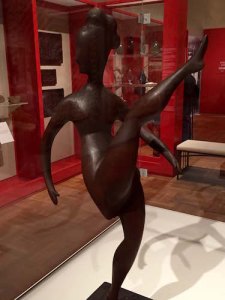
Nadelman’s high-kicking cherry wood “Dancer” sculpture (1922) on loan from the Jewish Museum

Nadelman’s high-kicking cherry wood “Dancer” sculpture (1922) on loan from the Jewish Museum

The show is a tribute to their vision and energy (move over, Abby Aldrich Rockefeller!). They were among the first to coin the term “folk art” and opened their own folk art museum in Riverdale in 1924.

When the Depression hit, the couple was forced to sell and the bulk of the collection became the core of the NYHS “everyday history” collection – kitchen implements, toys, miniatures, hat-shop heads, paintings, weathervanes, and you-name-it. Indeed, the back half of the show is a glimpse into everyday life, culinary arts, and domestic entertainments.

It’s an important look into American history, the history of collecting, and the birth of Modernist sensibilities in New York – a show that pays fitting tribute to a core component of one of New York’s storied institutions.

Mizrahi Shows His Colors at Jewish Museum

An early 1988 look in orange-orange wool – scarf, coat, and jumpsuit

An early 1988 look in orange-orange wool – scarf, coat, and jumpsuit

For a shot of color and inspiration to let creative impulses run free, trot up to the second floor of the Jewish Museum to see the closing day of the tribute to one of New York’s favorite sons — “Isaac Mizrahi: An Unruly History”. It’s open late tonight until 8 pm.

Isaac has filled four galleries with the results of his imagining in the worlds of fashion, theater, and film, showing how it’s done when you have so many talents, so many ideas, interest in everything, and so little time. You just do it all.

The entry to the show is a wall of organized color, all pulled from his meticulously organized archive of fabrics and color swatches – a great introduction to a brilliant mind harnessed to bring a little more beauty and whimsy into the world.

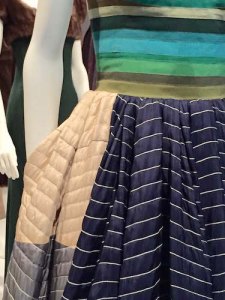
Inspired by elevator padding – silk quilting and grosgrain go to the ball in 2005

Inspired by elevator padding – silk quilting and grosgrain go to the ball in 2005

Beyond that, the first room – mostly from his early 1990 collections – is a riot of color   featuring his high-low approach to style: pair something everyday (like a T-shirt or bomber jacket) with silk-taffeta glamor (like a ball-gown skirt). This is where Isaac made his splash into the world of fashion, and it’s a fun, exciting introduction to the rest of the exhibit.

The curators have mounted his fashion sketches floor to ceiling in a small gallery, showing how Isaac maps out his fashion shows like storyboarding a movie. The room also reveals his passion for drawing, his favorite part of creating a collection.

Another gallery gives a nod to his theatrical costuming work and the next features two ensembles that demonstrate his interest in everyday style and good causes: Isaac was one of the first big-name designers work with Target, and here we see one of those 2004 sweaters.

Sketches with swatches organize the run of show

Sketches with swatches organize the run of show

His Coca-Cola sequined dress grew out of his collaboration with a charity that employed the homeless to collect and flatten discarded cans. Isaac had a Parisian couture house cut the smashed metal into sequins and had them hand-embroidered – another think-about-the-world creation.

Witty, wonderful, and full of life – Isaac’s accessories, film, fashions, and colors should inspire you to get a little more creative with your own day to day. Visit via our Flickr album, watch the Isaac video snippets, and listen to the audio tour the show.

For more Isaac right here, watch his conversation with editor Wendy Goodman on style and the pressures of starting out in the fashion industry.

Met Refuses to Draw Line Between Art, Technology, and Fashion

Sara Burton’s 2013 ensemble for McQueen: laser-cut pony skin bonded to leather, machine-sewn and finished with Mongolian lamb

Lasers: Sara Burton’s 2013 ensemble for McQueen: laser-cut pony skin bonded to leather, machine-sewn and finished with Mongolian lamb

As cool as an iPhone and as meticulously engineered, the Met’s new blockbuster Costume Institute show — Manus + Machina: Fashion in the Age of Technology — asks you to think about the frocks you’re seeing: does a designer’s reliance on technology diminish the artistic value of haute couture, which has for centuries relied upon handcrafted structure and embellishment?

See for yourself before August 14 and click here to look at the details in our Flickr album.

The show is a meditation on the beauty that can come when great design minds have centuries-old craft collide with technology. It helps to have gazzilions of resources (hands in Paris) at your disposal. The result: really good art and wondrous feats of engineering that just happens to be fashion.

There’s plenty to ponder and repeat visits are a must. Curator Andrew Bolton said that the idea came to him as he examined YSL’s iconic Mondrian dress and realized that this Sixties haute couture dress-that-went-viral was mostly stitched by sewing machine, a no-no in the rule-book of the Paris high-fashion syndicate.

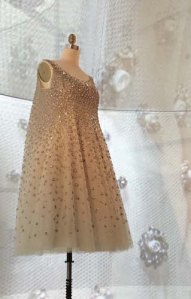
Yves Saint Laurent’s hand-worked 1958 trapeze in his first collection at Dior.

Yves Saint Laurent’s hand-worked 1958 trapeze in his first collection at Dior. Five layers of tulle with hand embroidery

It made him ponder the extent to which handwork and machine intersect in the world of high fashion.

Underwritten by Apple, there are no digital iPads or robots on the scene (like the Met’s revolutionary Charles James show) – just classical domes and arches highlighting masterworks of craftsmanship that cry out for the closest of scrutiny. Although it’s fun to waft through the crowds, getting glimpses of dazzling beadwork and dreamy Grecian-pleated chiffon gowns, to join Bolton in his investigation, reading the label copy, wall copy, and close inspection is a must.

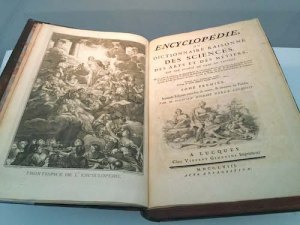
Your first glimpse sets the historic context: The stunning Chanel wedding ensemble under the main dome (a created space made from a false floor across the upper level of the usually empty atrium of the Lehman wing) is surrounded by books. Leather-bound volumes of Diderot’s 1762-71 encyclopedia on liberal and mechanical arts are open to engravings of lacemaking and embroidery.

Diderot’s 1762-71 encyclopedia on liberal and mechanical arts

Diderot’s 1762-71 encyclopedia on liberal and mechanical arts

By including these “métiers”, Diderot elevated fine dressmaking skills to the level of respect given to other types of 18th-century engineering.

Bolton chose Diderot’s encyclopedia categories as the sub-sections of the show and gave each métier can-you-believe-what-you’re-seeing treatment. Click here to read more about each métier on the Met’s website.

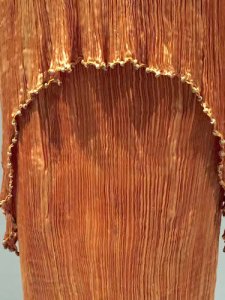
The pleating section of the show is a great example, beginning by displaying the masterful hand-formed pleats on Grecian gowns designed by Madame Grés and the still-mysterious processes used by Fortuny to clothe boho types in liquid charmeuse pleats at the dawn of the 20th century.

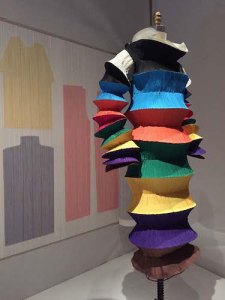
Issey Miyake ready-to-wear 1994 Flying Saucer dress fully extended; synthetic polyester that is machine pleated and stitched

Issey Miyake ready-to-wear 1994 Flying Saucer dress fully extended; synthetic polyester that is machine pleated and stitched

Across the way, you can compare Fortuny’s craftsmanship with machine-stitched and pleated versions, which are no less compelling. Mary McFadden’s pleated dresses were must-haves of the must-be-seen society set in the Seventies and Eighties. Mary’s synthetic pleated fabric was a pull-it-out-of-the-suitcase miracle in a world of jet-set travel and society parties.

And don’t ignore the works in the show by Issey Miyake, who wowed the design world with innovative pleated shapes that twisted and turned into avant-garde dresses and tops. Machine made from synthetic material, Miyake’s creations could fold flat and be popped into action in a nanosecond. His techno-trick was to make an entire, gigantic garment, position the fabric into pleats and run the entire garment through a heat press. Go, Flying Saucer dress!

In every section of the show, Bolton provides something historic (such as the 1870s hand-crocheted wedding gown) bookended by blazingly new creations, such as Iris Van Herpen’s 3-D-printed creations.

Close-up: Fortuny’s hand-pleated, hand-sewn 1920s charmeuse dress; Venetian-beads embroidery and hand-knotted silk trim

Close-up: Fortuny’s hand-pleated, hand-sewn 1920s charmeuse dress; Venetian-beads embroidery and hand-knotted silk trim

Muslins from Charles James reveal classic tailoring techniques by the master engineer, worked and re-worked by hand until perfection was achieved. Miyake pushed the boundaries of modern dressmaking one step further by using lasers to cut polyester monofilament, draping it, and shaping it with metal snaps –creating a dress without using any needles, thread, or scissors.

Laser cutting makes multiple appearances in the show with the work of Comme des Garcons, Iris van Herpen, Thom Brown, and Sarah Burton for Alexander McQueen. However, traditional techniques by historic Parisian ateliers are on view, too – a Chanel embellished by Maison Lemarie with 2,500 fabric camellias that took 90 minutes each to create, Dior’s post-war embroidered floral dresses bursting with foilage, and YSL’s game-changing trapeze dress in his first collection for Dior. This last creation had five layers of tulle embellished with crystals, beads, and sequin clusters by Maison Rébé.

At the press opening, Apple’s designer extraordinaire, Jony Ive, cautioned viewers to remember that technology and craft are not at odds. The notion of care – whether by hand or machine – is intrinsic to everything in the show.

Enjoy Mr. Bolton’s walk-through.

See Hamilton No Waiting

Taking their Shot in the lobby of the Public Theater in 2015

Taking their Shot in the lobby of the Public Theater in 2015

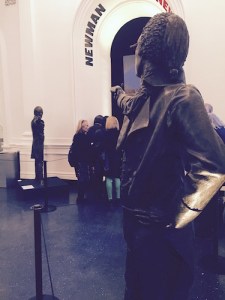
If you really want to experience Hamilton before the Tony Awards, it’s not that hard. Get up to New-York Historical Society at 77th Street and Central Park West and check out the life-size bronze statues of Hamilton and Burr one second before The Shot.

If you went to see Hamilton last year at the Public, you had to pass right between Kim Crowley’s bronze recreations when you entered the theater — a bespectacled Hamilton (wearing tinted glasses because he was facing the sunrise) and an intense Burr who was branded for all time in the history books one second later.

These action figures were initially installed at NYHS in 2004 as part of its ground-breaking Hamilton show…a magnificent installation that drew both raves (for the classy reimagining of NYHS and its exhibitions program after a near-collapse of that institution) and criticism (was it pandering to New York’s besmirched banking community?).

Their 1797 dueling pistols in the NYHS lobby

Their 1797 dueling pistols in the NYHS lobby

Interesting that 2004 was the 300th anniversary of both the duel and the year that NYHS was founded. In fact, Hamilton’s attending doctor that day was one of the founders.

NYHS Ham

Hamilton takes aim inside NYHS

After three hundred years and countless tries at the Hamilton’s pre-show lottery at the Richard Rodgers Theater, it will be a little disconnect to realize that the two facing off in the white marbled lobby are not Lin Manuel and Leslie Odom, Jr. The intensity and the historical dress are there, but the faces are different. Just stand there and run through all the lyrics you’ve memorized from the show.

Walk a few steps further and gaze down at the actual pistols – not stage props – and Angelica Schuyler’s letter to her brother, conveying the terrible news. All real, in her own hand, dated July 11, 1804.

OK, that’s just the lobby. By now, you’ve probably heard that NYHS has just announced its Summer of Hamilton, replete with a large gallery show of all the Hamilton-related documents, artifacts, and portraits plus special clips from Hamilton, movie musicals that inspired Lin, Ron Chernow’s book, and costumed performers on July 4 weekend.

But why not visit right now and have Ham and Burr all to yourself? To fill in the blanks about Ham’s life or prep to see the Broadway show, treat yourself to an exploration of the 2004 Ham show website. It’s full of all types of fun things – a quiz to test your Ham knowledge, a map of where Hamilton hung out in New York City, and real-life historical portraits of all the Schuyler sisters and everyone else in the Broadway show.

Lin's Ham 4 Ham reading outside the theater during the preview lottery

Lin’s Ham 4 Ham reading outside the theater during the preview lottery

There’s even a handy timeline of Hamilton’s “strange and amazing life,” which is a nice reference for things you’ve seen (or hope to see) in the show. For true fans (or curiosity-seekers), there’s even a small selection of short academic papers on Hamilton, including an interview with Ron Chernow, whose book inspired the current Broadway smash hit, and other brief treatises on his schooling, the duel, and the hours before his death.

Although it’s not inside the museum (or the Richard Rodgers), you can check out other Hamilton excitement at the Ham4Ham shows performed at lottery time on 47th Street, many of which have been taped by fans and put up on YouTube. Check out the recreation of the cabinet meeting by the Tony-nominated crew:

The Goose Gets Loose at Grolier

The Pleasant Game of the Goose, a 1640 hand-colored Italian woodblock print. In the center, a fancy family dines on one! Courtesy: Morgan Library

The Pleasant Game of the Goose, a 1640 hand-colored Italian woodblock print. In the center, a fancy family dines on one! Courtesy: Morgan Library

The geese are running wild inside the historic Grolier Club on Madison and 60th Street – part of the tribute exhibition organized by curator-collector Adrian Seville, The Royal Game of the Goose: Four Hundred Years of Printed Board Games, running through this weekend.

The show is an historical overview of one of the most replicated and popular board-game entertainments of the Western world — The Goose, a board-game design that has existed since the Middle Ages.

It’s remarkable to see over 70 examples including hand-colored woodblock prints, games from copperplate engravings, chromolithographs, and commercially printed folding boards spanning the 1600s through today.

Most feature some form of The Goose. The Goose board is designed as a single track in which players move their markers toward the finish based on a dice roll. Sound familiar? The rules have been around since 1600.

Detail of The New Game of Aerostatic Balloons, a 1784 French hand-colored engraving depicting the early history of ballooning

Detail of The New Game of Aerostatic Balloons, a 1784 French hand-colored engraving depicting the early history of ballooning

Wildly popular across the European continent, the Goose game has survived and depicted the French Revolution, the fall of Napoleon, the various configurations of royal marriages, WWII, and the evolution of social mores.

After the French Revolution, Goose games appealing to the middle-class appear, providing graphic lessons about reading music notation, the Parisian theater, ethnicity in America states, and countries you’d visit on an round-the-world voyages. A late 18th century French game depicts the history of ballooning, featuring Ben Franklin’s witness to a spectacular liftoff in Paris.

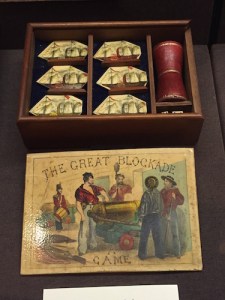
At the end of the 19th century, the games featured subjects like British ships running the Union blockades in America’s Civil War, monuments of the world, and significant inventors like Edison and Roebling (complete with a picture of the brand new Brooklyn Bridge).

Game pieces for The Game of the Great Blockade, produced in 1863 London about the British ships that were helping the Confederacy by running through the Union blockade during the Civil War

Game pieces for The Game of the Great Blockade, produced in 1863 London about the British ships that were helping the Confederacy by running through the Union blockade during the Civil War

Commercials creep into the mix, too, but what else is new? The Grolier has again hit a home run with chronicle of Western culture’s time spent around a table, hanging with friends, and rolling the dice.

Click here to view some of our favorites in our Flickr album.

MoMA Connects Music and Modernism

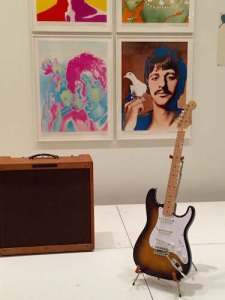
A decade apart – 1957 Stratocaster and Avendon’s 1967 posters of the Beatles

A decade apart – 1957 Stratocaster and Avendon’s 1967 posters of the Beatles

The MoMA Design Department had a brilliant idea – to tell the history of 20th century music culture by pulling out objects and two-dimensional art from the museum’s rich collection. How did modernism and music influence one another? See Making Music Modern: Design for Eye and Ear, on view through January 18.

There’s still time to catch some demos of the Scopitone, the Stratocaster, and the Mechanical Flux Orchestra inside the gallery this weekend.

Although a lot of the buzz in the gallery is over visitors’ recollections of the turntables, radios, and album covers on display, the curators do everyone a favor by putting the mod, mod world into historical context at the start of the show.

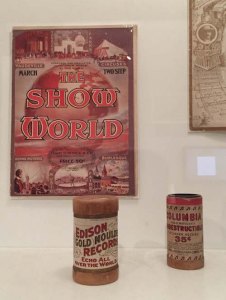
Early Edison sound experiments, films of Loie Fuller and Josephine Baker, and a poster of Yvette Guilbert from the can-can era remind everyone that shocking live performances, revolutionary music trends (go, ragtime!), and print designs that pushed the limits don’t belong exclusively to the mod, punk, or techno eras.

Early pop music innovations: sheet music and Edison wax cylinders

Early pop music innovations: sheet music and Edison wax cylinders

Tucked into side panels and corners are photos of costumed interplanetary performers of the Triadic Ballet at the Bauhaus in 1922 and early Russian avant-garde takes on the advent of radio, the broadcast and communications technology that changed entertainment forever.

These were worlds where artists and designers did it all – fine art, typography, industrial design, textiles, and performance. There are even some snippets of early acoustic-enhancing textiles on display, courtesy of Anni Albers. Design and music mixed, right from the start of the last century.

The sleek, streamlined radios, microphones, and Rural Electrification poster from the 1930s are presented as icons of the earliest era of broadcasting, with reminders from the curators that the designs were made to rescue the radio from its early haywire, spaghetti-city look that first appeared on 1920s garage workbenches across the country. Make it look nice, and you can bring it inside, where we can all enjoy it.

Stylish: 1932 Bakelite radio by Wells Coates and a 1939 Unidyne mic by Benjamin Baker.

Stylish: 1932 Bakelite radio by Wells Coates and a 1939 Unidyne mic by Benjamin Baker.

Throughout the Fifties and Sixties, music and design seemed to go hand in hand. Consider the Sixties revolution in turntable and speaker design – everything fit for a super-modern lifestyle of easy listening with jazz and high-concept percussion album covers nearby.

The invention of the Fender Stratocaster guitar revolutionized the sound and look of early rock and roll with its iconic whammy bar and performances that represented out and out rebellion. Although the Stratocaster was invented in the 1950s, it’s appropriately displayed in front of posters of Bob Dylan, The Yardbirds, and Avedon’s Beatles – an innovation adopted by Buddy Holly that inspired the next generation.

Where pop music and art come together – Sixties album covers, including those by Richard Hamilton and Warhol

Where pop music and art come together – Sixties album covers, including those by Richard Hamilton and Warhol

If you really want to dig into the details, there are dozens of famous album covers and posters on display with tribute paid to their designers. Among the luminaries are pop-god Richard Hamilton’s “White Album” for the Beatles, Warhol’s “Sticky Fingers” cover for the Stones, and Rauchenberg’s design for the vinyl disk inside the Talking Heads’ “Speaking in Tongues” album. The chronicle of the Fillmore East posters is a book unto itself.

And Mr. Jobs’ imprint is never forgotten at MoMA. An early version of his iPod is displayed right next to the Seventies invention from Japan that rocked the music world – the Sony Walkman.

If you can’t make it, take a look at the show through our Flickr views. We’ve grouped the items in chronological order.

And check out the excellent MoMA blog posts about the show on MoMA’s “Inside/Out” platform, where curators go to share enthusiasm about the hunt for the Stratocaster, famous rock posters, and other gems from the Fifties and Sixties. Leave your own comments, reflection on music and design, and memories right there on the MoMA website.

Before Walkmans and iPods

Before Walkmans and iPods

When Folk Music Ruled New York

Washington Square Sunday folk singing, early 1960s. Courtesy: MCNY/Nat Norman

Washington Square Sunday folk singing, early 1960s. Courtesy: MCNY/Nat Norman

The large map inside the exhibition tells the entire story of how a folk music revival germinated on a few blocks in Greenwich Village in the 1950s and exploded into a national mania for twelve-string guitars, songs of protest, and music that paid tribute to deep, deep roots of the American experience.

The Museum of the City of New York tells a fascinating tale with its multimedia exhibition, Folk City: New York and the Folk Music Revival, through this weekend. Take a look at some of the show’s highlights in our Flickr album.

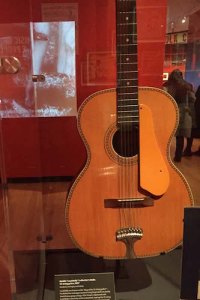
Ledbelly's historic twelve-string guitar

Ledbelly’s historic twelve-string guitar

The show ties together the tale of how Woody Guthrie and Alan Lomax got the ball rolling by shining a spotlight on Appalachian and Southern purveyors of down-home folk singing and inspiring a generation to look back, pay tribute, and carry it forward. MCNY has plenty of listening stations scattered throughout the gallery, offering up rare recordings that speak to the roots of popular music of the Sixties.

It’s a revelation to listen to Lomax’s 1934 recording of Ledbelly singing Good Night Irene and Midnight Special long before Pete Seeger, The Weavers, and Johnny Cash catapulted them to the charts in the Fifties and Sixties.

Flyers, broadsides, and other paraphernalia from Greenwich Village clubs paper the walls and vitrines, as the show steps through the story of how that sleepy NYC neighborhood transformed itself into a destination for the likes of Bob Dylan and other activist-artists who inspired a generation.

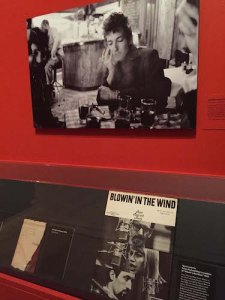
Photo of Dylan at Kettle of Fish Bar at 114 MacDougal Street in 1964 above his sheet music

1964 photo Dylan at Kettle of Fish Bar at 114 MacDougal Street above his sheet music

Music studios, clubs, publishing houses, coffee houses, and cold-water flats were all jammed into a few city blocks that functioned like a 24/7 open-mic night. Back in the late Fifties and early Sixties, music was pouring out of nearly every door on Bleecker Street and MacDougal.

The convergence spawned a network of producers and publishers who felt it was their mission to bring folk music to a wider audience – uptown at Town Hall, on alternative radio stations across the country, and executives at the big labels. Some of the highlights at the back of the gallery are Dylan’s handwritten lyrics for Blowin’ In the Wind and Mr. Tambourine Man.

Political battles are found at every turn in the installation, from Seeger’s encounter with McCarthy’s House Un-American Activities Committee to inspirational performances by Pete, Odetta or Peter, Paul & Mary at historic marches and protests. The music was always there, intertwined with the events of the day.

First edition of “Sing Out!” magazine, 1950

First edition of “Sing Out!” magazine, 1950

Although folk and roots music inspired artists like The Beatles and The Rolling Stones, the MCNY show notes that after Dylan went electric and the British invaded New York, the folk music juggernaut lost some of its steam. No matter. You can still see it all recreating itself on Bleecker Street at The Bitter End any night of the week, listen to an up-and-coming singer-songwriter, and view lots of those historic posters on the back wall after MCNY’s show closes.

Navajo Jewelry Masters Offer Glittering World at Customs House

Bracelet of coral, opal, suglite, lapis, turquoise, gold, and silver by Raymond Yazzie. Courtesy: NMAI/Knight collection. Photo: S. Franks

Bracelet of coral, opal, suglite, lapis, turquoise, gold, and silver by Raymond Yazzie. Courtesy: NMAI/Knight collection. Photo: S. Franks

If you’d like an immersion into a chamber of glistening silver and gems, enter the National Museum of the American Indian’s exhibition of stunning beauty and tranquility — Glittering World: Navajo Jewelry of the Yazzie Family.

The Smithsonian is providing New York with a unique chance to view 300 remarkable necklaces, bracelets, rings, and buckles from a New Mexico family of artists known for catapulting Navajo symbols, colors, and gems into a modern-art context.

Lapis and gold bracelet by Lee Yazzie, 1984. Photo: E. Aboroso, NMAI.

Lapis and gold bracelet by Lee Yazzie, 1984. Photo: E. Aboroso, NMAI.

The focus is on Lee and Raymond Yazzi, brothers whose award-winning, intricate creations are sought by collectors worldwide. You’ll see five magnificent pieces as soon as you enter, including work by their sister, Mary Marie – representing lifetimes of master craftsmanship inspired by the mountains, sun, sky, spirits, and family in Gallup, New Mexico.

Photomurals inside the door will transport you to the red rock monuments of Navajo Nation, 1950s trading posts along the old Route 66, and maps to turquoise mines that have supplied native peoples with high-end bedazzlers since 300 A.D. The Smithsonian will be returning it all to private collectors after January 10, so be sure to enter this beautiful realm before then.

Watch this testament to artistic inspiration and dedication to beauty:

And take a trip to the Navajo world to hear more on a lifetime of creation:

FIT Honors Transatlantic Nightlife Queen

1990 Mathu & Zaldy body suit and attached boots that Susanne wore to an Armani party

1990 Mathu & Zaldy body suit and attached boots that Susanne wore to an Armani party

If you think the music and fashion stopped after Studio 54 shut its doors to Liza, Liz, Andy, Calvin, Halston, and Yves, FIT’s club-scene exhibition, Fashion Underground: The World of Susanne Bartsch, presents evidence to the contrary through December 5.

The show features nightlife splendor (with all the trimmings) from Susanne’s clothes-to-be-seen-in archive. Plus, you’ll get the thrill of pretending that you’ve stepped into one of her over-the-top parties, filled with celebrities, outrageous clothes, spectacle, and glitter.

Wielding "the list" in a 2008 Jean-Paul Gaultier jacket and Patricia Fields hat

Wielding “the list” in a 2008 Jean-Paul Gaultier jacket and Patricia Fields hat

Right downstairs at the gallery entrance, you’ll be taken back to a graffiti-splashed Nineties club entrance with a dolled-up doorkeeper sizing you up and holding “the list”. But there’s no anxiety about whether you’ll be let inside…Just walk in and be transported back to 1981.

 As the glittery disco 54 era was coming to an end in New York in 1981, Bartsch arrived from London and opened up a shop in Soho filled with up-and-coming London designers that were creating the “new look” catching on in clubs across the pond.

In the early 1980s, Japanese and British designers experimented with crinkly natural fibers and oversized smocks – which looked fresh and hip after a decade of form-fitting, glitzy disco looks.

The Eighties -- Vivienne Westwood looks with Galliano linen ensembles

The Eighties — Vivienne Westwood looks with Galliano linen ensembles

Susanne sold the oversized, anti-disco baggy look of nightlife trendsetters Boy George and Leigh Bowery, imported dandy mix-and-match men’s and women’s looks from Vivienne Westwood, and featured flowing frocks by London’s Rachel Auburn.

The first part of the FIT show walks down this part of memory lane, including linen frocks by Mr. Galliano. Smocks are punctuated with dramatic hats (decades before fascinators) or beads from Portobello Road.

By the late Eighties, all that had given way to raggedy and accessorized mash-ups sported by the Material Girl and by the Nineties, bejeweled and bedazzled clubwear reigned again. Susanne was regularly hosting parties clad in an ever-evolving array of embellished corsets, fashioned by the master of form and shape, Mr. Pearl.

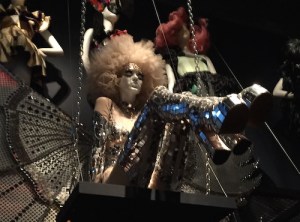
Two Mr. Pearl corset ensembles (1989, 1991) with 1992 Mugler Cowgirl ensemble, worn by Naomi Campbell Installation view of “Fashion Underground: The World of Susanne Bartsch” September 18 – December 5, 2015 The Museum at FIT New York, New York

Mr. Pearl corset ensembles (1989, 1991) with 1992 Mugler Cowgirl ensemble for Naomi Campbell

In a well-deserved tribute to his creations, FIT has installed a carousel of Mr. Pearl’s work on a turntable in the show’s back room of the show, next to a corner where mannequins form a towering tribute to the magic of Mr. Mugler, another of Ms. Bartsch’s favorites. After she introduced Mr. Pearl to Mr. Mugler, the rest was fashion history.

Fashion designers flocked to her parties and she did justice to them all – working in their hats, jackets, shoes, bags, and separates into her never-ending array of special occasion get-ups. When you peruse the specific looks on display in the show, it’s an all-star line-up of New York, Paris, and London fashion heavyweights.

Gareth Pugh 2015 ensemble of paper, Lycra and leather

Gareth Pugh 2015 ensemble of paper, Lycra and leather

The show screams of creativity and it’s wonderful that curator Valerie Steele put a spotlight on this Queen of Nightlife and her impact on the underground/high fashion scene for the last three decades. A lot of Susanne’s featured clubwear is credited to Mathu & Zaldy, who turned out plenty of over-the-top looks when designer ready-to-wear just didn’t pack enough punch for a special occasion.

Another charming touch in the show is the ensemble of paper, Lycra and leather contributed by Gareth Pugh. Susanne asked him to send something she could (and would) wear.

As always, FIT provides lots of history and photographs of Susanne and friends in action at multitudes of balls and parties on its exhibition website. Spend time looking at Susanne in action and at snapshots of her historic Love Ball. For close-ups of the clothes and costumes, visit our Flickr feed.

Take 360 spin around each room of the show courtesy of FIT’s virtual tour produced by Synthescape. The arrows appearing on the floor will take you to all three rooms.

Do you wish you could have been at the opening of this exhibit? Not to worry – her friends and fans let you in on the party and remember unforgettable nights in this celebratory video. Even Calvin’s there: