Light, Space and Time in Albuquerque

Drift into another dimension in Light, Space, and the Shape of Time at the Albuquerque Museum through July 20, 2025. The show, with significant works from the museum’s own collection, harkens back to the founders of California’s 1960s Light and Space movement, but also presents work by contemporary artists – many from New Mexico – who continue to explore the same phenomenon.

The curators have arranged the exhibition to show how artists use light, space, and time as subjects through which visitors can slow down, contemplate, and experience.
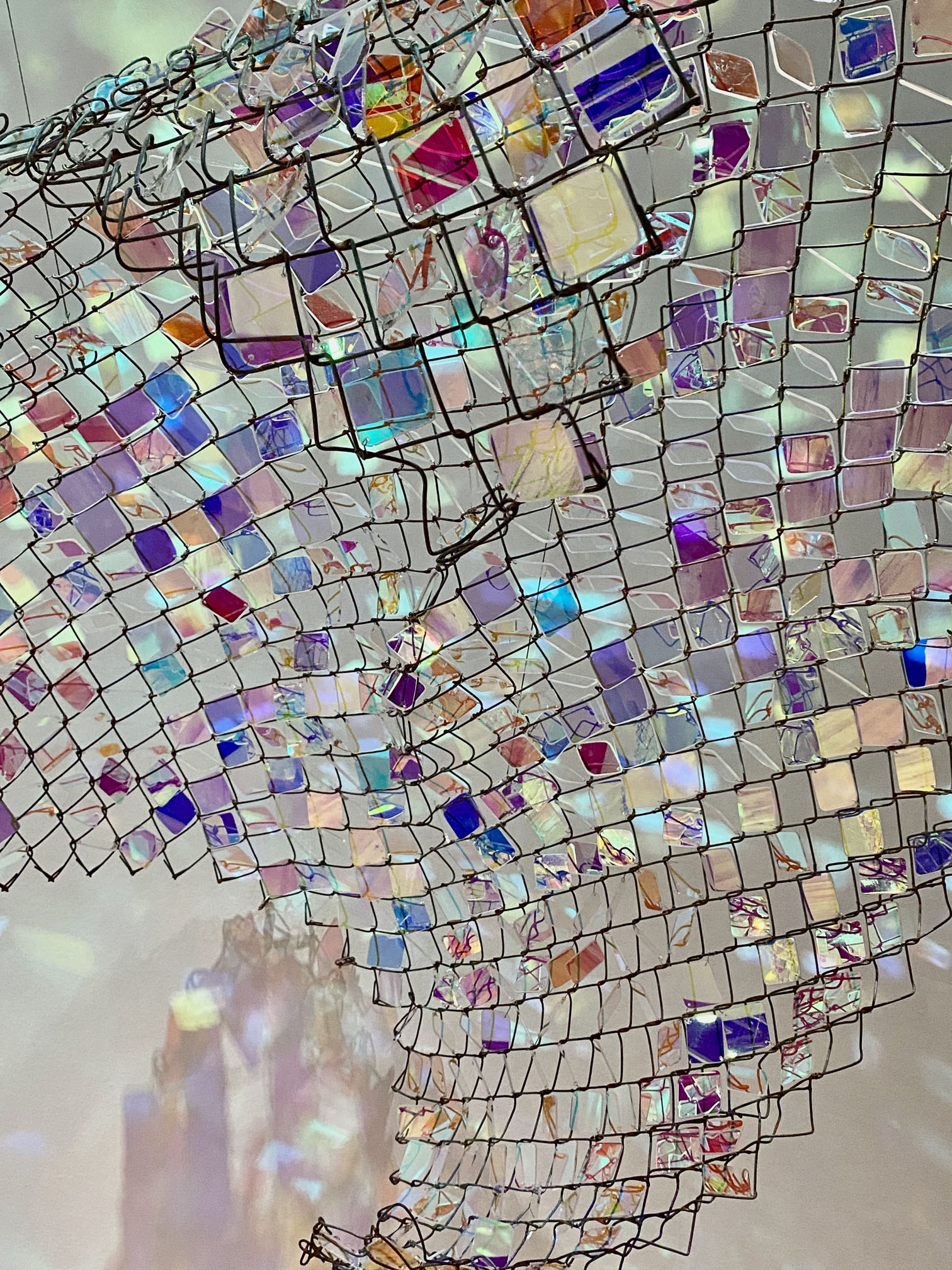
Detail of Soo Sunny Park’s 2013 Unwoven Light, an installation that seems to move as visitors walk through it. Courtesy: the artist

For more, see some of our favorites works in our Flickr album.

The first section showcases works where artists use light as the primary medium. Visitors can enjoy works by some of the most famous innovators from the Sixties and Seventies – Robert Irwin, who inspired a generation of West Coast art students to think differently; Dan Flavin, who merged minimalism with industrial light; and Helen Pashgian, who makes magic from luminous resins.

Irwin’s 2011 piece appears minimal, but his six fluorescent-light colors can be activated in four different variations, and he associated each with agricultural colors of Southern California. You can enjoy looking at Lucky You for its purity of form, or contemplate Irwin’s recollections of home.

Two fluorescent works by Space and Light superstars – Robert Irwin’s 2011 Lucky You and Dan Flavin’s 1987 untitled (in honor of Leo at the 30th anniversary of his gallery. Courtesy: Thoma Foundation

Behind the black curtain, you can enter a tranquility chamber. Helen Pashgian’s 2021 installation provides an unforgettable experience to visitors to slow down and wait. What are you seeing? The frosted, peach-colored epoxy sculpture at center stage appears dissolve in the light-filled space as lights slowly change. It’s like watching show changes to the sky during a dramatic sunset, but it’s light, white, ethereal, and pure.

Helen Pashgian’s 2021 untitled (peach lens) – the lens dissolve into space as the light changes to sunrise and sunset modes. Courtesy: Tia Collection

All-star word artist Jenny Holtzer’s Red Tilt takes an absolutely maximalist approach with multiple LED displays – a too-much, all-at-once, never-stopping tsunami of emotional words from her own story about survival and trauma.

Leo Villareal’s piece Scramble is the opposite. Albuquerque-bassed Villareal creates a mesmerizing, tranquil, never-repeating abstraction by programming LED lights. He’s done this on a larger scale in his epic commissions to light the San Francisco-Oakland Bay Bridge and all of London’s bridges over the Thames. Here, visitors get a more intimate experience – slowing down to watch Scramble’s gently changing colors and know what they’re seeing is unique to the moment.

Jenny Holtzer’s 2002 LED display, Red Tilt. Courtesy: Thoma Foundation
Leo Villareal’s 2011 Scramble, a programmed LED artwork that changes constantly. Courtesy: Thoma Foundation

Larry Bell’s 1984 installation is the centerpiece of exhibition’s exploration of how artists use light, illusion, and technology to explore (and play with) our perceptions of space. Direct from his retrospective in Phoenix, Bell’s barely-there The Cat is a delicate but monumental presence in the show.  Huge, planes of coated and non-coated glass require a circumnavigation. Moving around, you can see how works are reflected and how some opaque surfaces block views of others.
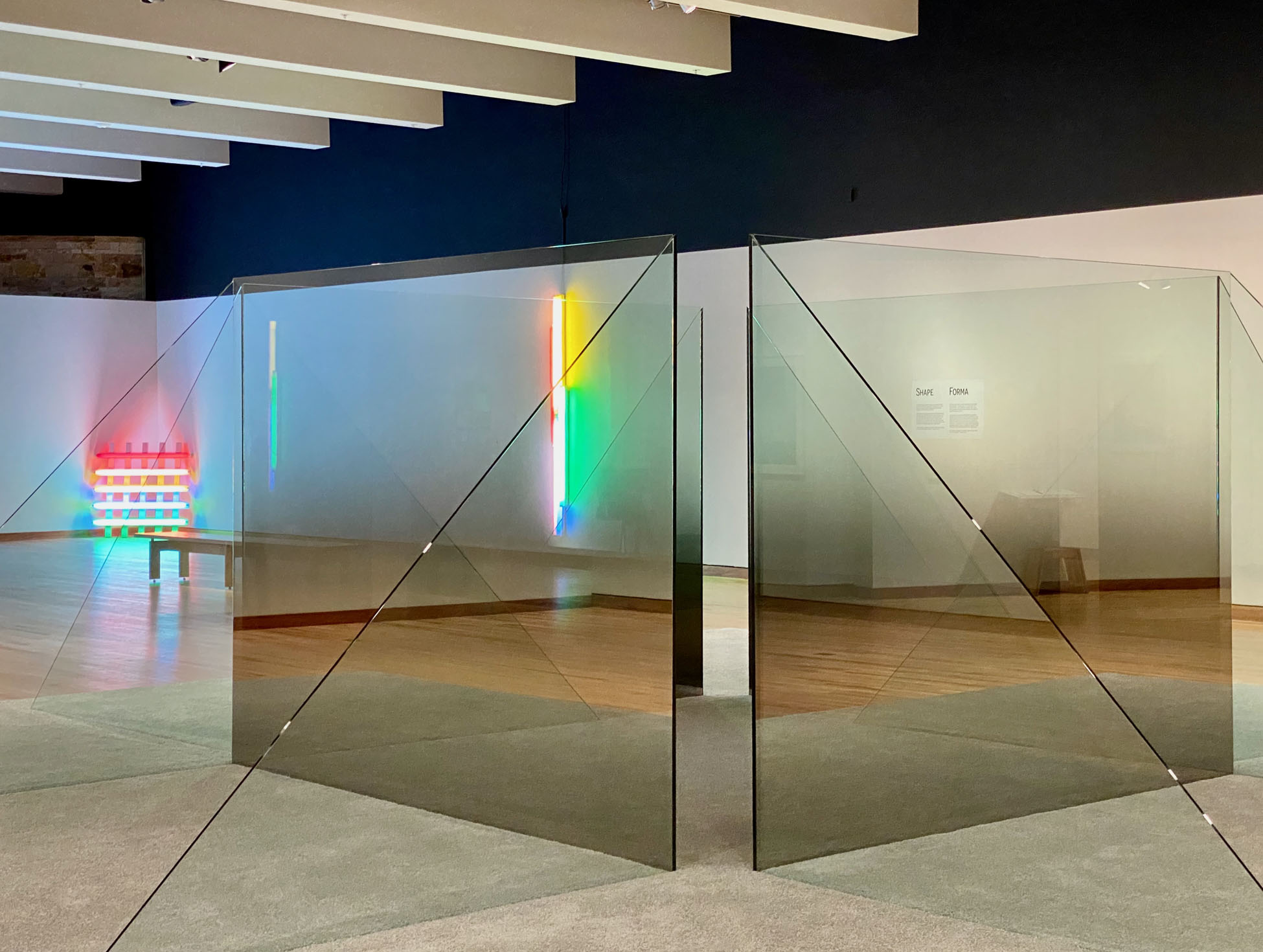
Larry Bell’s 1984 The Cat – rectangles of coated and uncoated float glass.

Two nearby works by Santa Fe-based August Muth offer visitors a more intimate experience. Muth uses a holographic etching technique in which he creates the illusion of a “floating” image.

August Muth’s 2024 holographic etching Shadow Within Light. Courtesy: Pie Projects Contemporary Art.
August Muth’s 2022 holographic etching Terra Solaris. Courtesy: Pie Projects Contemporary Art.

The exhibition concludes with a magnificent installation by Soo Sunny Park – an installation of lights and plexiglass pieces that appear to move as you move through. Take a peek in this video.

Detail of Soo Sunny Park’s 2013 Unwoven Light installation with tiles that appear to move as the visitor moves through it. Courtesy: the artist

Kite Dreams with AI at IAIA

How does a Lakȟóta artist link dreams and artificial intelligence to imagine futures for her people? Experience five years of innovative installations in Kite and Wíhaŋble S’a Center: Dreaming with AI, on view at the IAIA Museum of Contemporary Native Arts in Santa Fe through July 13, 2025.

The IAIA exhibition – Suzanne Kite’s third solo exhibition this year across the United States – presents several installations that highlight her collaborative work that merges cutting-edge technology with Indigenous knowledge systems. 

Download the exhibition catalogue here, and look at photos of the installation in our Flickr album.

2023 Wičhíŋčala Šakówiŋ (Seven Little Girls) and Wicháhpi Wóihanbleya (Dreamlike Star) use stones to translate Kite’s dreams into Lakhóta symbols.

In Iron Road and Dreamlike Star, stones and minerals (the building blocks of computers!) are arranged in Lakȟóta geometric language that suggest Lakȟóta quilt patterns. They’re placed atop a mirror to show resonance between the Earth and the cosmos (stars).

2023 Wicháhpi Wóihanbleya (Dreamlike Star) suggest that ancestor stars can point the way to Indigenous futures.

In this first section, inputs are taken from Kite’s dreams. Using AI, her dreams are translated into geometric Lakȟóta shapes created by designer Sadie Red Wing. Kite has figured out a way to bypass large-scale, commercial AI networks in favor of an AI model (run on her PC) that aligns more closely with Indigenous knowledge systems.    

A digital embroidery machine has yards of embroidered black velvet flowing out of it.  Oihanke Wanica (Infinity) is a collaboration with New York City’s Center for Art, Research and Alliances. As you examine the velvet, you’ll find geometric Lakȟóta shapes translated (using AI) from Kite’s dreams.

Nearby, there’s a comfortable lounge where you can watch Cosmologyscape, an interactive digital quilt – a public art project in which AI translates the public’s dreams into artist-created geometric symbols. It’s a collaboration with Alisha B. Wormsley, so the virtual community quilt manifests both African-American and Lakȟóta shapes.

2023 Oihanke Wanica (Infinity) – a digital embroidery machine stitches symbols representing dreams onto black velvet. Collaborator; Center for Art, Research and Alliances.
Lounge to watch Kite and Alisha B. Wormsley’s 2024 Cosmologyscape – Ai translates the public’s dreams into symbols for an ever-expanding digital quilt.

Installations in the other half of the exhibition shows collaborative projects that combine Indigenous knowledge systems and AI. Along one wall in the spectacular, tranquil gallery, you can explore a print and digital resource library on international research programs that integrate Indigenous knowledge systems into AI design.

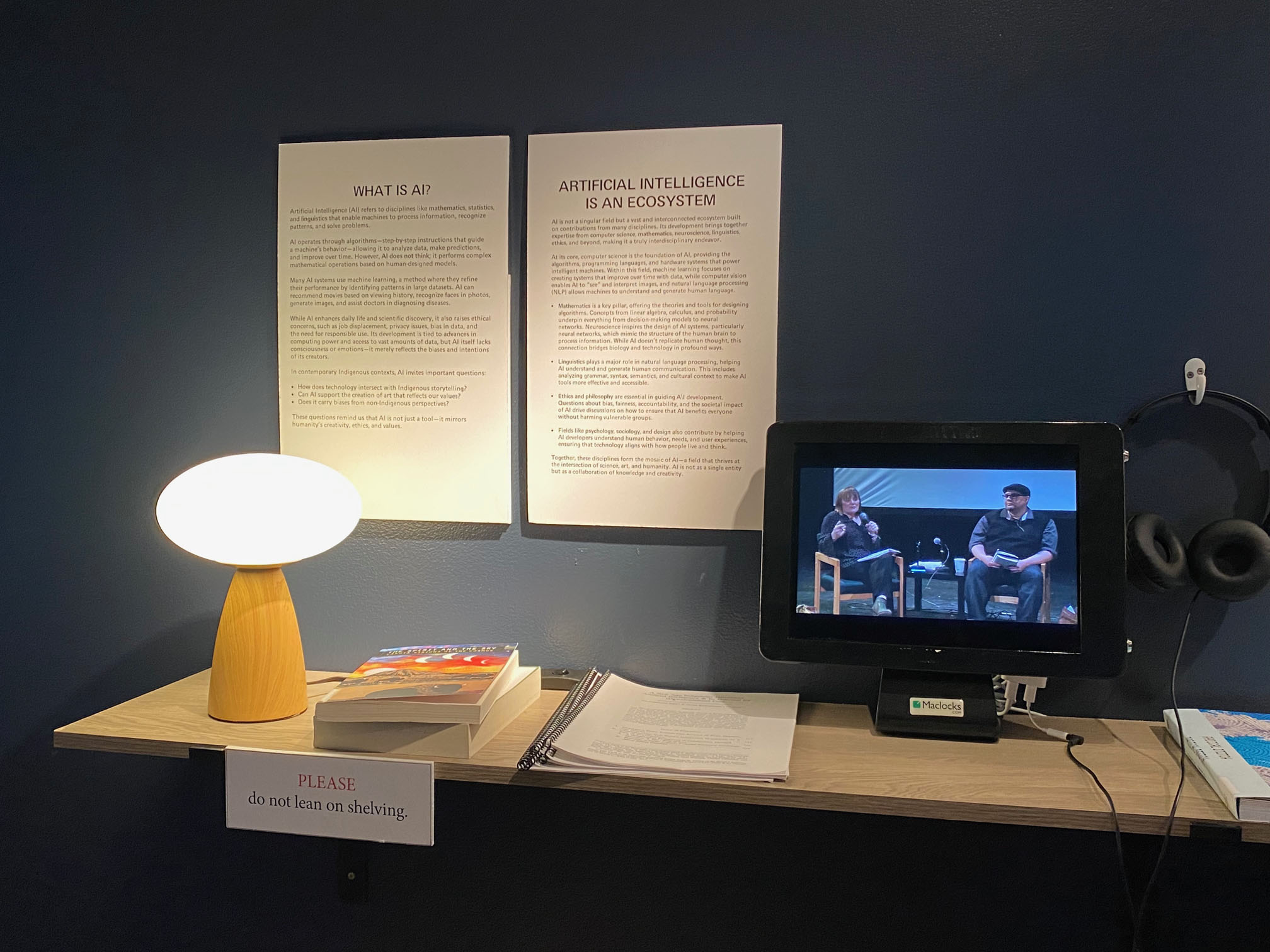
Abundant Intelligences – a library and digital resource station for information on AI and futurism in contemporary Indigenous art.

Oneiris is a large interactive station through which visitors are invited to generate dream symbols that AI adds into a wall-sized display that looks like a portal to the cosmos. Inspired by the Lakȟóta concept of a Dream Language, she and her many technical collaborators genuinely bring dreams to life.

Oneiris – a collaborative project using advanced AI models to allow visitors to bring dreams to life.

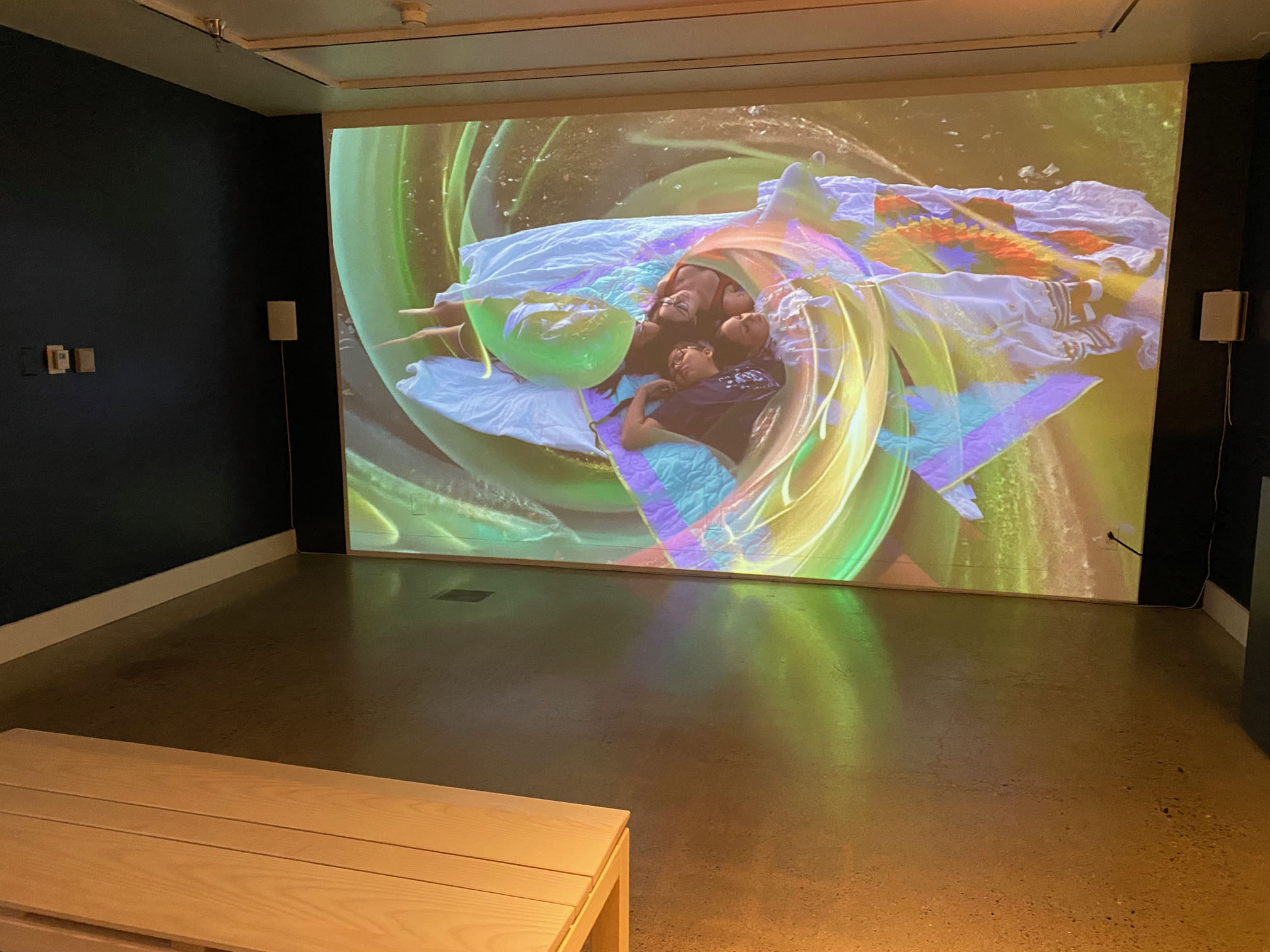
Spashed across the final wall of the space, The Land Paints Itself is a video collaboration with her Wíhaŋble S’a Center for Indigenous AI at Bard – a lab that explores Indigenous advances in this science and art. Watch as AI generates dazzling colors and patterns as four Lakȟóta dream about Indigenous futures. Kite suggests that the evolving technology of dreams is a legitimate way for her nation to envision ways forward.

2025 The Land Paints Itself video that uses AI to illustrate Lakhóta people’s dreams about Indigenous futures.

Provocative, visionary, and affirmative – meet Kite herself in an interview with Artforum editor Tina Rivers Ryan in March 2025, when Kite’s work was featured on the cover.

Transgressive Photography Shown in Santa Fe

Want to meet some people who enjoy breaking the rules?  You’ll meet plenty of mavericks who challenged the norm in Transgressions and Amplifications: Mixed-Media Photography of the 1960s and 1970s, an exhibition on view at the New Mexico Museum of Art in Santa Fe through January 8, 2023.

Edward Weston and Ansel Adams set a high bar for classic, modernist photography, but the generation of image-makers who followed were driven to experiment, shake things up, and see where it all led. 

Detail of 1983 Joyce Niemanas Grandfather Polaroid collage
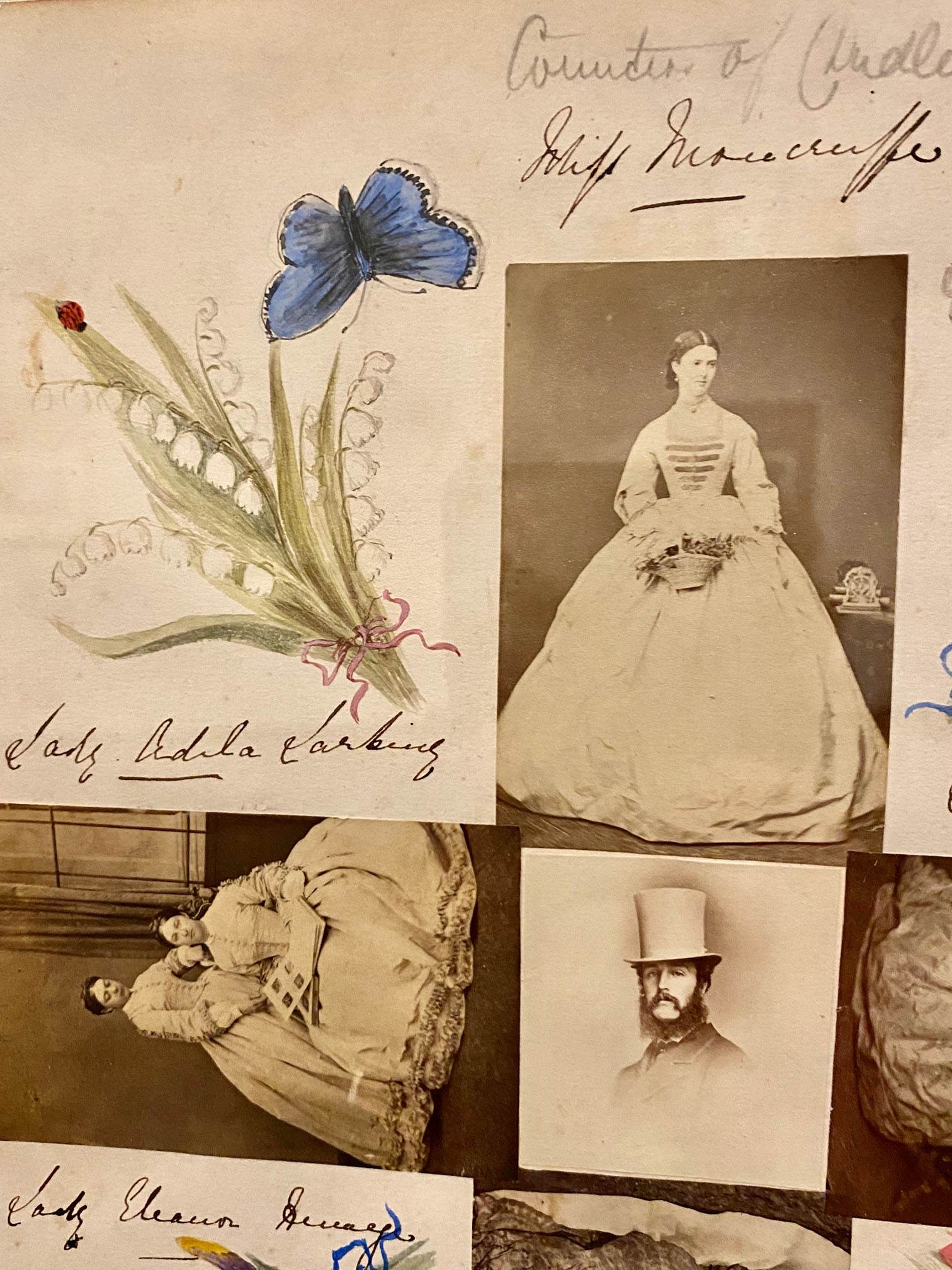
Detail of 1864 Lady Filmer’s album mixing watercolor and albumen print collage. Courtesy: UNM Art Collection.

Why not go back a hundred years and make new images with historic photo techniques (sun prints, anyone)? Has anyone tried embroidering photos? What about mashing up photo-silkscreen prints with readymade collages decorated with rubber stamps?

Can Polaroids be turned into fine art? Or making a sculpture or kitch card deck out of photos?  What about dreamscapes? What about creatively repurposing magazine photos or TV images?

A stroll through the gallery shows a broad range of creative 20th-century minds at work, with at least one case showcasing some 19th century pioneers.

Meet Lady Mary Georgina Filmer, a London society gal who mastered the art of photocollage as early as the 1860s. A page from one of her albums shows how she merged topsy-turvey photo images, botanical watercolors, and text to tell stories her own way – a true stay-at-home pioneer!

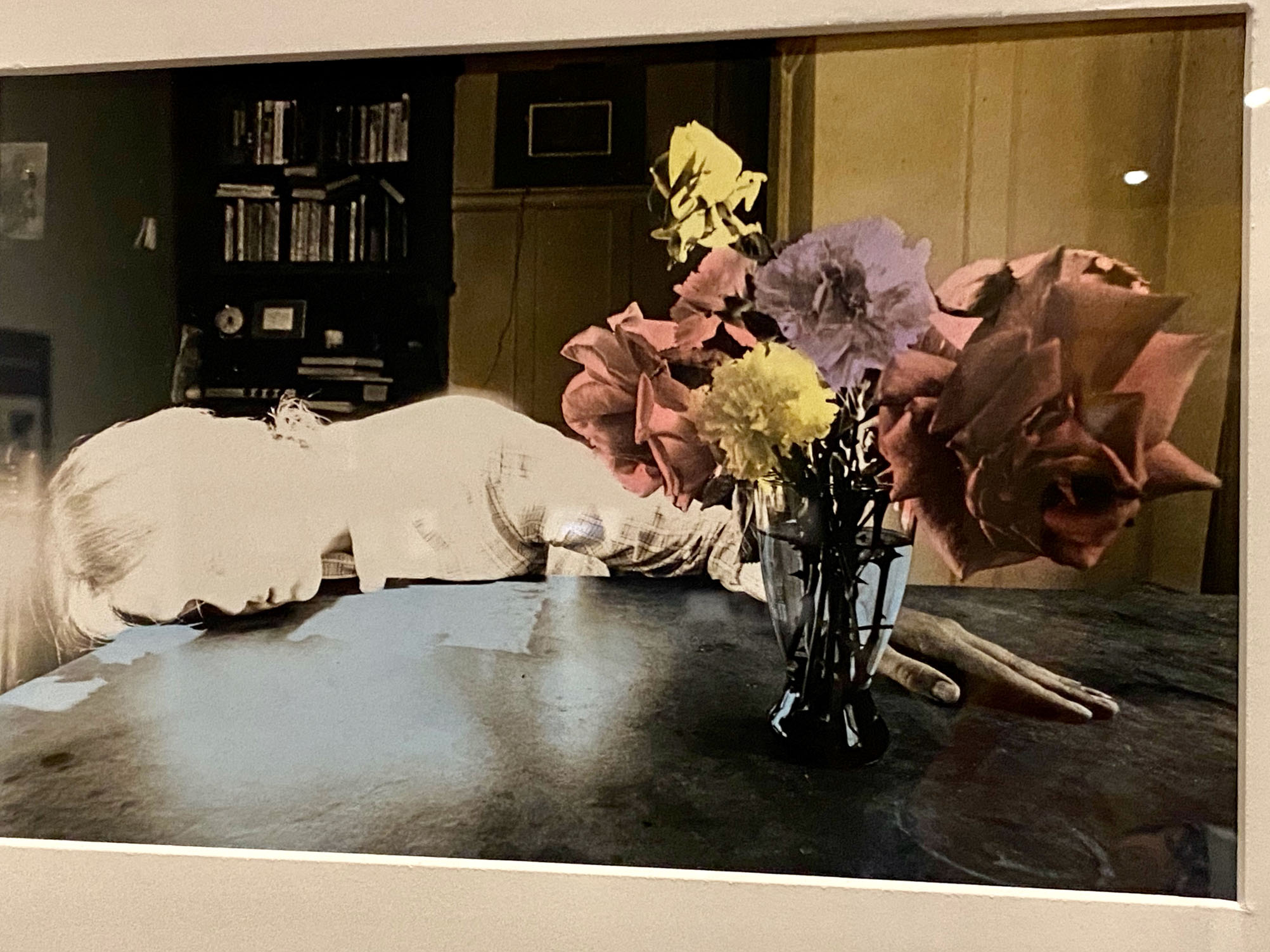
Lady Filmer’s album looks out on dozens of other Americans who went back into the time machine to toy with making albumen prints, stereographs, hand-colored photos, drawing, and cyanotypes. Example: the arresting 1970s hand-colored gelatin silver print by Karen Truax where she ghosts-out her central figure.

1970-1974 gelatin silver print Supernal by Karen Truax, featuring a bleached-out central figure and hand-colored domestic interior

For anyone curious about these old-timey methods, the curators have provided visitors with a place to relax, leaf through books about it, and watch YouTube videos on the gallery iPad.

Another gallery features artists who took photography mixed-media to the next level, like Rauchenburg’s litho that appropriates Bonnie and Clyde movie stills and an over-the-top abstraction by Thomas Barrow that combines gelatin silver print technique with a crazy-quilt of stencils, spray paint, and objects. So totally Eighties!

Detail of Thomas Barrow’s 1980 gelatin silver print Discrete Multivariate Analysis, mixing lights, objects, stencils, and spray paint

The third gallery displays lots of fool-the-eye and 3-D delights. What’s the most fun? Jerry McMillan’s photo-offset inside a “paper bag?” Betty Han’s Soft Daguerreotype of Xeroxed weeds on fabric? Probably Robert Heinecken’s T.V. Dinner/Shrimp. Hard to choose.

Robert Heinecken’s 1971 Van Dyke print T.V. Dinner/Shrimp, #1C. Courtesy: University of Arizona’s Center for Creative Photography.

Other sections of the exhibition show how 1970s photographers made images in which photography itself was the subject and told highly personal stories.

Take a look at some of our favorites in our Flickr album.

Artist book: Keith Smith’s 1972 gelatin silver print Book 32 – a 3D take on photography.

And don’t forget the coda that features a dramatic images by more recent photographers that make provocative social statements and represent voices that were not fully represented within the university system during the 1960s and 1970s.

Lorna Simpson’s 1991 Black, a dye diffusion transfer print with engraved plastic plaques

Artists Call to Action for Central America

In the early 1980s, socially minded artists living downtown in New York couldn’t handle the news coming out of Central America and did something about it. The United States government was intervening in the affairs of Nicaragua, El Salvador, and Guatemala, and everyone was worried that the situation was going to devolve into another Vietnam.

This is just one part of the story told by the dynamic, timely, informative exhibition, Art for the Future: Artists Call and Central American Solidarities, on view at the University of New Mexico Museum of Art in Albuquerque through December 3.

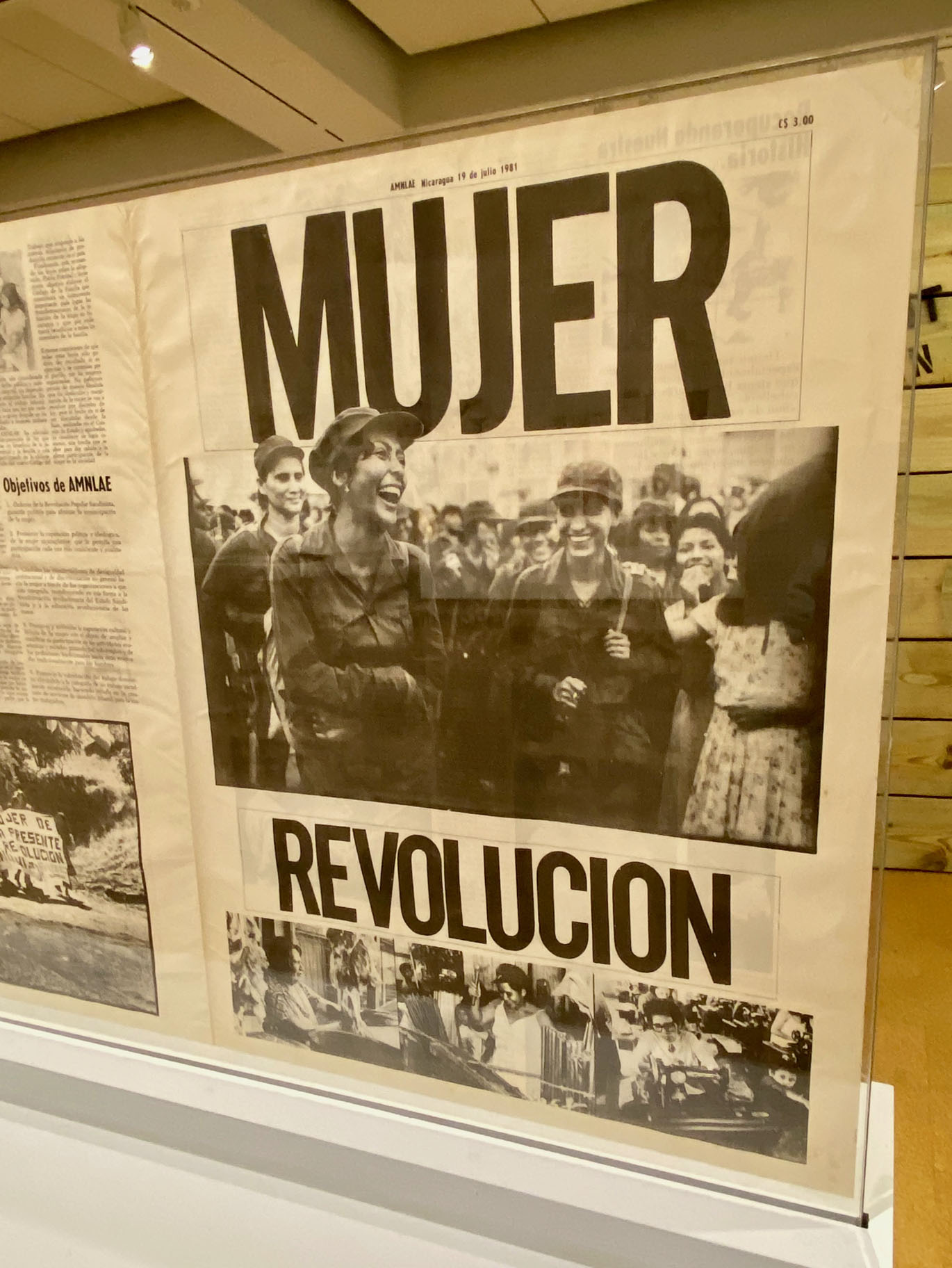
1981 pamphlet Mujer Revolución by Association of Nicaraguan Women. Private collection
1983 Print of Contra (after a drawing in Rock Comics, 1979) by Jerry Kearns, depicting communist fears stoked by the US government

In 1982, a group of New York artists collaborated with Latin American artists to create a show with contemporary art and cultural artifacts to draw attention to the escalating crises in Latin America. By 1984, organizers launched a national call to artists to raise money and awareness of what was happening.

Artists responded with performances, music concerts, films, poetry readings, and exhibition. In New York alone, over 1,100 artists participated in over 30 exhibitions.

Nationally, artists in 27 cities organized chapters and events and tried to build alliances in Latin America.

Videos, photographs, sculptures, paintings, and ephermera pulled from archives (like posters, buttons, mail art, and pamphlets) bring the story of artist-activists to life – their concerns about US government intervention, their efforts to organize artists across the United States, and their attempts to help artists living in oppressed Central American countries.

The Tufts University-organized show resurrects a largely forgotten story of artist activism, illuminates the tribulations of indigenous communities in Central America at the time, introduces us to contemporary works from artists inspired by their indigenous heritage, and gives us an idea of what’s happening in those countries now.

Two contributions to Solidarity Art by Mail project, a fast, cheap solution to boost Latin American and Caribbean participation in a 1984 New York exhibit at Judson Memorial Church. Private collection.

The three-floor show is packed with arresting images, works, and histories. The art work and documentation push and pull visitors between the international political crises of the 1980s and social-justice issues being addressed by artists today.

Take a look at the show on our Flickr site.

The installation features work by heavy hitters of the 1980s New York art scene – wall-size Vietnam-era work by Leon Golub, images documenting Ana Mendieta’s performance pieces, and Claes Oldenburg and Coosje van Bruggen’s sketches, maquettes, and exploding-banana image that branded the Artists Call Against US Intervention initiative.

The first-floor exhibition area includes Nancy Spero’s dramatic scroll-like drawing that calls attention to the oppression of Salvadorean women.

1984 Arts Magazine cover with Oldenburg’s image promoting Artists Call. Private collection

Downstairs, there’s another 1984 work that similarly unfurls the length of the gallery – an accordian-book project led by Sabra Moore that is a collaborative reconstruction of a rare 16th-century Mayan codex by 22 women. It’s the first time the codex has been displayed since 1984.

1984 “Reconstructed Codex,” a project organized by Sabra Moore with contributions from 22 diverse female Latin American and US artists. Courtesy: Barnard

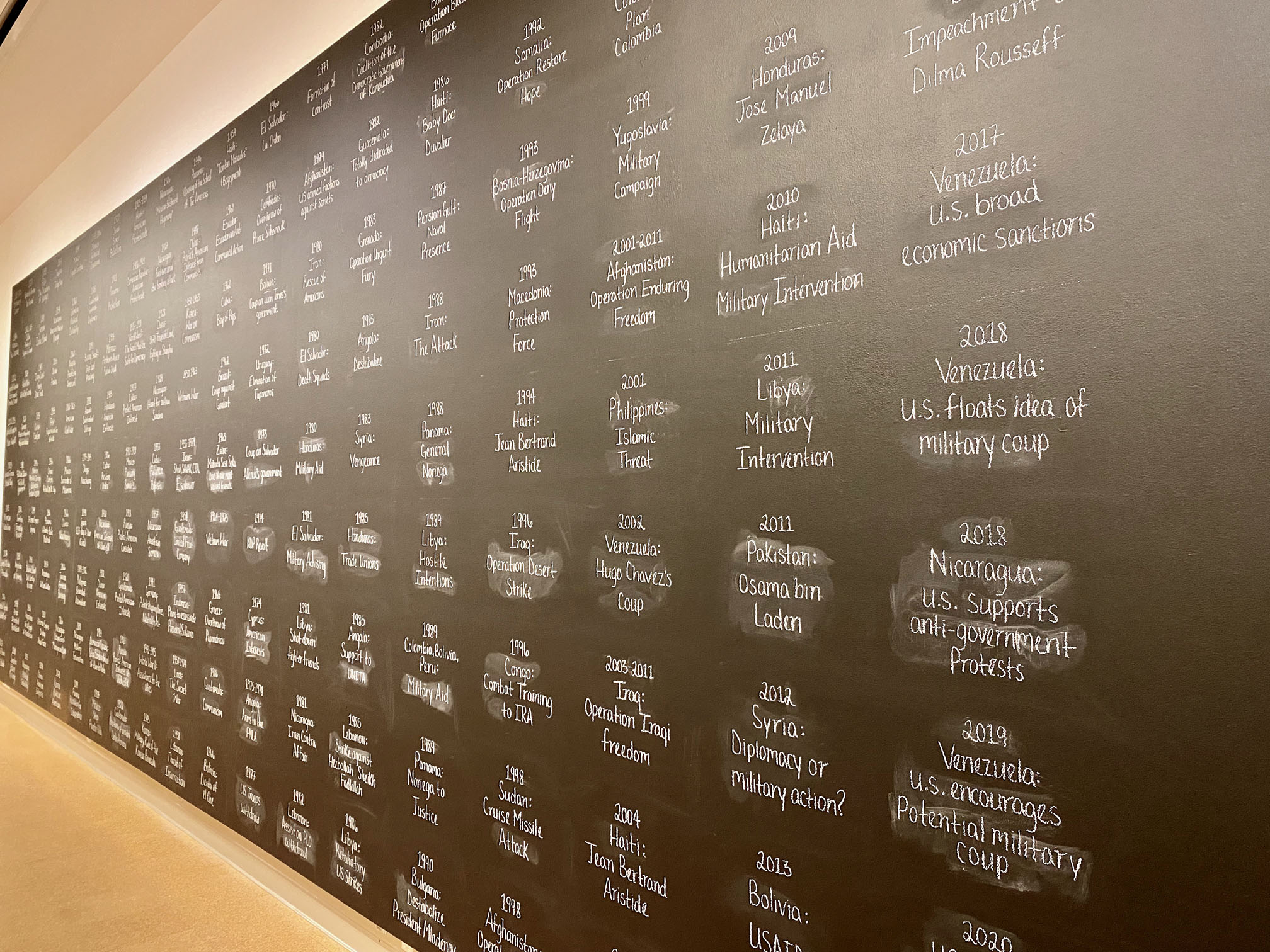
The third floor packs a punch, installing revolutionary images and publications around the infamous (and censored) Hans Haacke piece that questions the aftermath of the 1983 US invasion of Grenada.  Across the room, visitors pour over Carlos Motta’s 2005 wall-sized chalkboard installation Brief History of US Interventions in Latin America since 1946. 

Although the 1980 artist-activists did not achieve all of their utopian goals, the contemporary selections show that social consciousness, pride in indigenous heritage, and artistic futures are still alive – including a beautiful feathered immigrant history dome by Batriz Cortez, stitched by a team of immigrant collaborators.

2021 sculpture 1984: Space-Time Capsule by Salvadorian artist Batriz Cortez and immigrant collaborators – a shelter for immigrant histories.

Learn more about how the curator Erina Duganne and her collaborator Abigail Satinsky created this remarkable show:

Art for the Future will be on display at Chicago’s DePaul Art Museum from March to August 2023.

Carlos Motta’s 2005 detailed chalkboard installation Brief History of US Interventions in Latin America since 1946. Courtesy: the artist