Buried in New York – Divas and Rare Jewelry

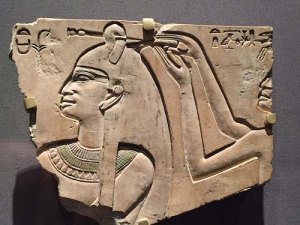
Henut does Queen Neferu’s hair, 11th dynasty (2051-2000 B.C.) Courtesy: Brooklyn Museum

Henut does Queen Neferu’s hair, 11th dynasty (2051-2000 B.C.) Courtesy: Brooklyn Museum

While New York City is digging out from record snowfalls, there’s some great news about a few items that have been buried for centuries and are none the worse for wear – cosmetic boxes, bracelets, belts, and styling tips of the great divas (male and female) of ancient Egypt. The Metropolitan Museum of Art moved some gems out of the cavernous Egyptian wing – and borrowed a few things from Brooklyn and elsewhere – for its monumental tribute to the 12th dynasty, Ancient Egypt Transformed: The Middle Kingdom, closing today.

Usually buried among the collections on the first floor, the curators pulled out some of our favorites from the galleries (along the way to the Costume Institute) and presented them as the spectacular showpieces they are. It warrants a shout-out to the effort it took to conceive, mount, and present this terrific show. What a way to leverage the collections that are right inside the city limits!

Queen or Princess as a Sphinx, 12th dynasty (1981-1802 B.C.) Once owned by Emperor Hadrian , later by a Cardinal. From Brooklyn Museum

Queen or Princess as a Sphinx, 12th dynasty (1981-1802 B.C.) Once owned by Emperor Hadrian , later by a Cardinal. From Brooklyn Museum

The story of the transformations happening in Egypt’s 11tth to 13th Dynasties (ca. 2030–1650 B.C.) is big (enough to fill twelve galleries), so we’re just highlighting a few of the things we noticed that modern People of Style might enjoy. Check out our Flickr site.

First, Brooklyn is in the house in the gallery dedicated to royal women: off to the side, there’s a limestone relief fragment (normally at the Brooklyn Museum of Art) showing Queen Nefuru having her tresses done by 11th Dynasty celebrity stylist, Henut. The curators point out that a telltale sign of royals (men and women) is the distinctive winged-eye look that her makeup artist achieved in kohl. The styling is incised in limestone, showing the Queen getting ready to emulate Hathor, the goddess of love and romance. In those days (2051-2000 B.C.), only royals could sport the jeweled necklace or eye makeup style.

Nearby, Brooklyn also contributes a beautifully sculpted head, said to be broken off from a larger sphinx statue from the 12th Dynasty – a protective guardian featuring a fantastic coif that only a queen or a princess would sport. It was all wigs, all the time.

372-piece cloisonné pectoral of Princess Sithathoryunet. Gold, carnelian, lapis lazuli, turquoise, and garnet. 12th dynasty (1887-1878 B.C.).

372-piece cloisonné pectoral of Princess Sithathoryunet. Gold, carnelian, lapis lazuli, turquoise, and garnet. 12th dynasty (1887-1878 B.C.).

One of the most spectacular pieces is the 372-piece cloisonné pectoral worn by Princess Sithathoryunet. It’s a 12th Dynasty masterwork (1887-1878 B.C.). of gold, carnelian, lapis lazuli, turquoise, and garnet. The piece is magical and protective, but instead of being inlaid with the name of the princess, it features the name of the king. The idea is that the king himself is being protected when the royal daughter wears it – not the diva herself. You get what you pay for.

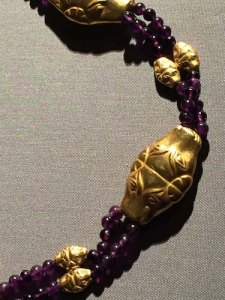
She also had another set of formal jewelry — a cowerie shell girdle and matching bracelet of gold, carnelian, feldspar, and crystal. The imitation shells had small pellets inside, which would have made a tinkling sound when she walked. The same is true for the feline-headed set of jewelry of gold and amethyst.

Feline-Headed Girdle of gold and amethyst from 12th Dynasty (1887-1813 B.C.).

Feline-Headed Girdle of gold and amethyst from 12th Dynasty (1887-1813 B.C.).

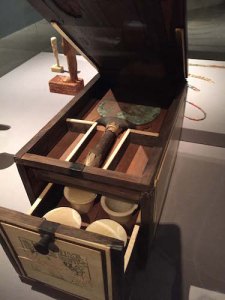
Sithathoryunet kept these and other treasures in a beautiful jewelry box, which is displayed nearby alongside a cosmetic box. The Met reconstructed the wood boxes by putting the ebony, ivory, gold, carnelian, blue faience, and silver back into place. Magnificent. Look for it all when these spectacular items go back on display at the back of the Egyptian Wing later this year.

By this time in Middle Kingdom culture, the elites started copying the royals, so some of the buried treasures that the Met found on its early 20th century expeditions belonged more to aspirational upper classes than the royals themselves. Check out the cosmetic case and mirror belonging to Amenemhat IV’s royal butler, Kemeni. Or the faience necklace worn by Wah, the overseer who served Meketre, the royal chief steward serving kings in both the 11th and 12th Dynasties.

The Met found a bonanza of fantastic reality art in Meketre’s tomb – so much that only a few pieces were brought up to the second floor for the special show. The show features a real-life depiction of a grainery and sport fishing boat, but if you look on the first floor as you walk through to the Costume Institute, you’ll see many more boats and several more rooms of day-to-day life – all meant to serve Meketre in the next world.

Cosmetic box of the royal butler, Kemeni, with four ointment jars and a mirror. 12th dynasty (1814-1805 BC.)

Cosmetic box of the royal butler, Kemeni, with four ointment jars and a mirror. 12th dynasty (1814-1805 BC.)

The Met has meticulously documented this show online. Spend a snow day (or not) by taking a tour through all twelve galleries on the Met’s web site and listening to the curators’ take on the on-line audio guide, which also features photos of each of the objects. Here’s where you can search the exhibition objects and find more detail.

Hear the behind-the-scenes chit-chat from the curators on the museum’s blog, including how the Egyptians feasted and how the digital team created the replica of the pyramid complex at the center of the show.

MoMA Salute to Sixties Art World Transmissions

Announcement for Allan Kaprow’s 1968 Three Country Happening with collaborators in Germany and Argentina, one of the earliest artworks to incorporate an international telecast.

Announcement for Allan Kaprow’s 1968 Three Country Happening in NYC, Germany and Argentina, one of the earliest telecast international performance pieces.

Before restaurants and shops populated Tribeca and Soho in the 60s and 70s, edgy New York City artists were experimenting with happenings, video art, performance pieces, mail art, and assorted ephemeral pieces – Cage, Moorman, Kaprow, Ono, Paik, Grooms, Oldenberg and Maciunas to name a few.

In the pre-Internet days they might have been unaware that half a world away, Eastern European and Latin American artists were catching wind of this new art wave and stamping their own brand on their local art scene.

MoMA’s show, Transmissions: Art in Eastern Europe and Latin America, 1960-1980, captures the zeitgeist and shines a light on the artists, movements, and pieces from important avant-garde artists whose names are not as well known in the States. See it through January 3.

Organized into several rooms and themes, it’s a great collaboration among MoMA’s Departments of Media and Performance Art, Photography, and Drawings and Prints. The result puts a lot of MoMA’s huge Fluxus collection into a proper world context.

Socially relevant art posters from Poland, Cuba, Czech Republic, Yugoslavia

Socially relevant art posters from Poland, Cuba, Czech Republic, Yugoslavia

The first half of the show deals with geometry and its spiritual significance, offbeat artist publications, and mash-us between mail art and street performance.

Favorites include post-minimalist pieces from Brazil, Suprematist-style wall works by Yugoslavia’s Mangelos and an entire wall of photos documenting push-the-envelope street art many Eastern European countries. See our Flickr feed for a walk-through and click the links below for glimpses into MoMA’s show blog.

The next section turns more socio-political with works from the Argentine collective, Instituto Torcuasto di Tella – a center of the avant garde in Buenos Aires from 1959 to 1970. The centerpiece is a large installation for the Venice Biennal by David Lameles – Office of Information about the Vietnam War at Three Levels: The Visual Image, Text and Audio. The glass-walled newsroom is a stage from which performers read “breaking news” from the Vietnam War, just as they did when the collective debuted this in 1968. When the performers aren’t present, visitors can listen to archival recordings in three languages to feel transported back in time and reflect on how and if things have changed.

Installation for the 1968 Venice Biennal by Argentina’s David Lameles – Office of Information about the Vietnam War at Three Levels

Installation for the 1968 Venice Biennal by Argentina’s David Lameles – Office of Information about the Vietnam War at Three Levels

Nearby, visitors see clips from Marta Minujin’s Simultaneity in Simultaneity part of Allen Kaprow’s 1968 Three Country Happening, which was one of the first international telecasts of performance art.

Other galleries feature the blossoming of feminist art and performance art, social-commentary painting and sculpture, and poster art on these two continents. Artists that are familiar in US collections — like Botero (Colombia), Marisol (Venezuela), Marina Abramonovic (Serbia), and Ana Mendieta (Cuba) – are displayed in galleries that introduce other stellar artists to entirely new US audiences.

Oscar Bony’s photo documentation of his 1968 performance piece, The Working Class Family, which displayed an actual Argentine family at an exhibition

Oscar Bony’s photo his 1968 performance piece, The Working Class Family, which put an actual Argentine family on display

Consider Oscar Bony’s photo documentation of his controversial 1968 performance piece, The Working Class Family, where an actual Argentine family displayed themselves for the run of an exhibition at Instituto Torcuasto di Tella. Or Romanian graphic designer Geta Bratescu’s Medea IV, a 1980 sewing-machine drawing made and displayed privately in her studio at the height of a repressive political regime when most artists retreated underground.

The show ends with a spectacular installation: Juan Downey’s 1975-76 masterwork, Video Trans Americas. The gallery floor is painted with an outline map of the Western Hemisphere with banks of video monitors placed atop countries to which he traveled from the tip of South America to New York City, showing the life and times of indigenous people.

Chilean artist Juan Downey’s 1975-76 Video Trans Americas, documenting native peoples from his travels from the tip of South America to New York City

Chilean artist Juan Downey’s 1975-76 Video Trans Americas, documenting his travels from the tip of South America to New York City

Inspired by the idea of a transnational identity, Downey’s piece beautifully sums up the feeling of the entire show – artists and people engaged in a cultural dialogue across time and space.

Thankfully MoMA has given these artists a timeless showcase and home.

Frida Khalo Extravaganza Ending with Colorful Surprises

NYBG’s Haupt Conservatory is transformed into Frida’s Casa Azul

NYBG’s Haupt Conservatory is transformed into Frida’s Casa Azul

Ever since the New York Botanical Garden installed its Frida Khalo: Art, Garden, Life show, it’s been a nonstop party and feast for the eyes, ears, and tastebuds.

Not sufficient to import fourteen of Frida’s rarely seen paintings for the formal gallery upstairs in its library building, the creative NYBG team has made environments, commissioned artists, designed apps, booked acts, hosted special events, transformed the conservatory, made a wall of cactus, redesigned menus, and even brought in a taco truck to give everyone an immersion into her sophisticated Mexican lifestyle.

This blockbuster sensory experience is in its last week, going out with a bang with a Dia de los Muertos theme as this traditional Mexican holiday collides with our own Halloween. Sugar skulls and whimsical skeletons are taking over Frida and Diego’s pyramid that serves as the centerpiece of the garden portion of the show.

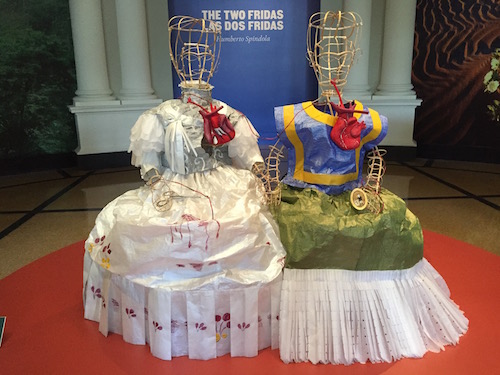
Tissue-paper dresses for The Two Fridas by artist Humberto Spindola

Tissue-paper dresses for The Two Fridas by artist Humberto Spindola

It’s an appropriate mix, given Frida’s own proclivity to merge the everyday with the surreal in her own works. The Library has an exquisite collection of her self-portrait and still life paintings, featuring flowers, animals, and deep-rooted Mexican myth and culture.

Downstairs in the Britton Rotunda, there’s a stunning installation of The Two Fridas by artist Humberto Spindola – side-by-side mannequins wearing tissue-paper dresses in colors that Frida sported, but with the surreal outer heart that she painted more than once. Visitors approach as if it were a shrine with special powers.

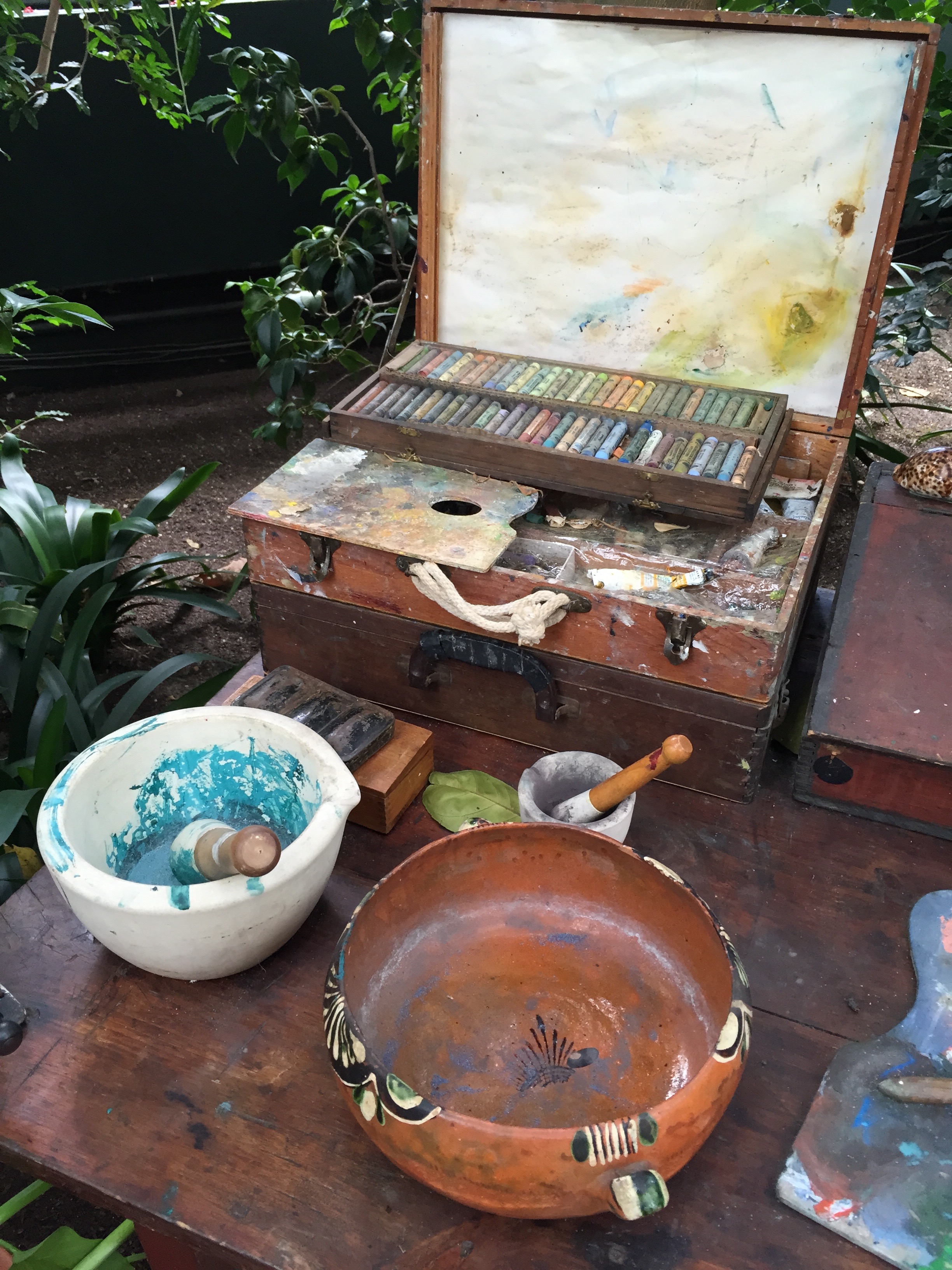
Frida’s workspace

Frida’s workspace

The Haupt Conservatory serves up a riot of color with floating blue containers of vivid flowers, the dynamic blue of the recreated Casa Azul, where she lived, pops of the types of flowers with which she adorned her table and sills, and the intensely painted Mexican-style pyramid in the center of it all.

The sensations are so bright that it’s easy to miss the recreation of Frida’s studio, tucked away in the trees to the left of the main event – brushes, paints, paint sticks, and other tools.

Outdoors, the curators have succulents jammed into every piece of oversize Mexican pottery near a “wall” of cactus, replicating a natural fence that Diego had outside his studio for decades.

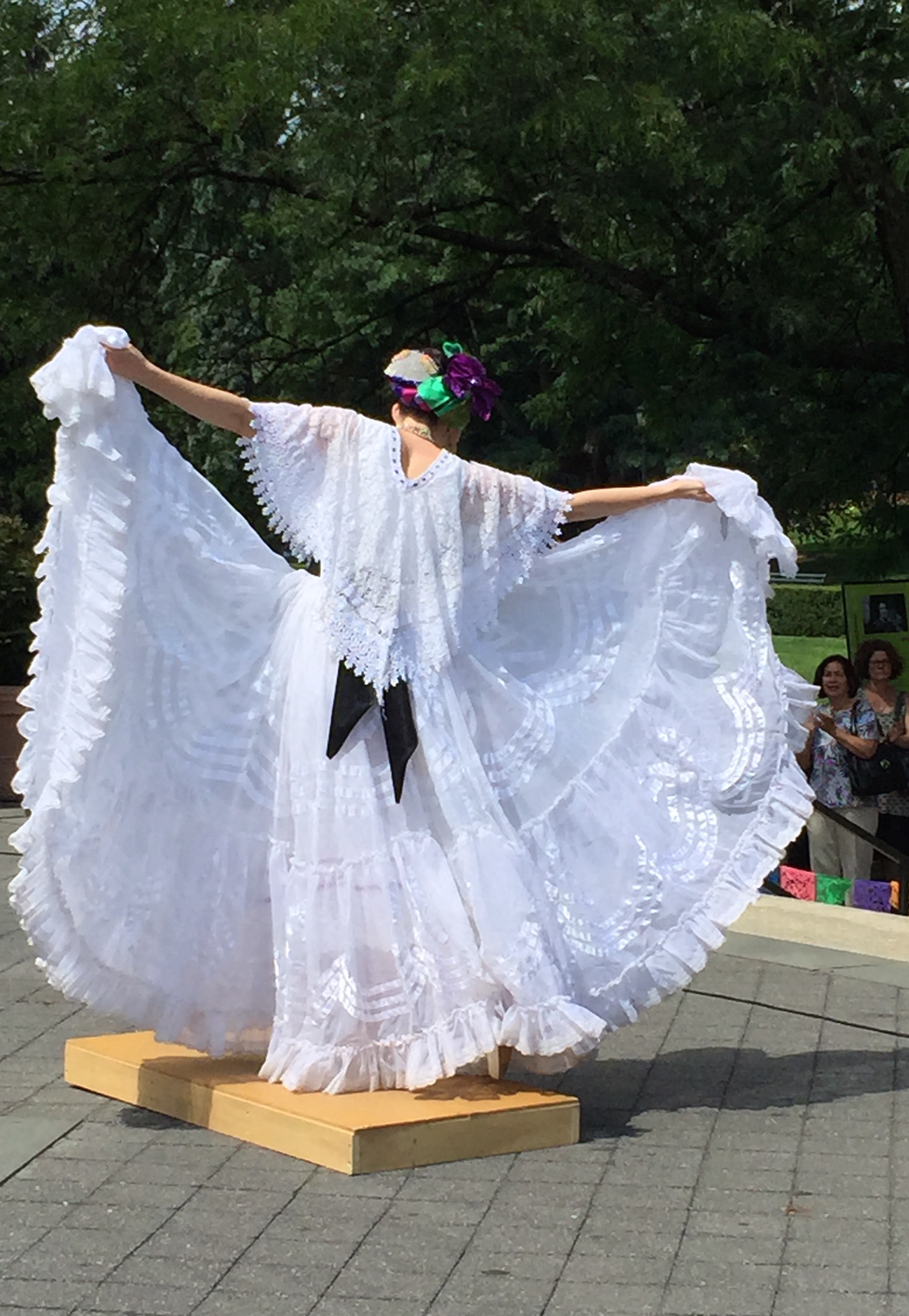
Soloist from Capulli Danza Mexicana channels her inner Frida for the crowd

Soloist from Capulli Danza Mexicana channels her inner Frida for the crowd

The “Life” portion of the show’s title is represented by the generous schedule of music, performances, films, and events that the NYBG has featured throughout the show’s six-month run. Dance companies, all-female mariachi bands, chefs, and authors provide sensuous infusions of movement, wit, gaiety, and sophistication that Frida embodied her entire life. Flashing red skirts, exciting beats, fast footwork, dramatic flourishes, and meaty conversation all contribute to the experience of who Frida was, how she lived, and what she loved.

Download the exhibition panel to see all the parts of Mexico City that meant so much to Frida and Diego – images of parks, gardens, markets, and historic sites, including photos of Casa Azul.

Download the app for your visit, and go to our Flickr site to see the photos and a few videos of the dancers in action.

Take a look at what the NYBG team achieved:

If you have time, check out the YouTube of the all-star kick-off symposium dedicated to Frida last May.


New Views from/at The Whitney Museum

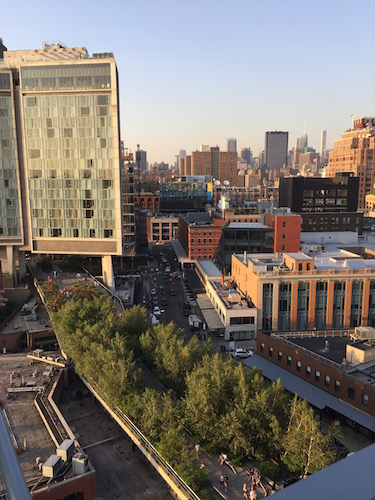
High Line and City views from the Whitney

Towering over the green esplanade of the High Line, the new Whitney Museum of American Art is a spectacular success, inside and out. The inaugural show, America is Hard to See, closing this weekend, features 600 works on all eight floors of the new Renzo Piano-designed landmark. Finally, Gertrude’s collection has room to breathe.

The inaugural installation distributed the massive collection into smartly themed galleries, but moving up and down between the floors is an equal delight – picture windows and balconies offering views of spectacular sunsets over the Hudson and Empire State Building views from entirely new vantage points. Peeking through the doors into the kitchen on the 8th floor reveals some of the best views (think Standard Hotel) offered to any sous chef in the City.

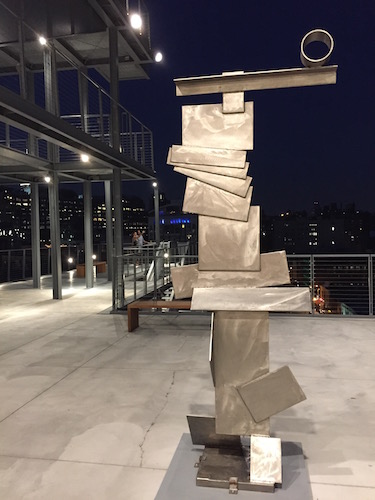
David Smith’s Cubi XXI (1961) enjoys its view of Meatpacking District nightlife from the balcony

David Smith’s Cubi XXI enjoys its balcony view of Meatpacking nightlife

Part of the fun is walking around on the balconies (on every floor) and experiencing the Whitney’s vertical outdoor sculpture park – Joel Shapiro’s playful bronze guy and David Smith’s towering Cubi totems, all against stunning City vistas. It’s Storm King for the urban soul.

Inside, it’s a walk through American art history with themes from the early 20th century (“Forms Abstracted”, “Music, Pink and Blue”, and “Machine Ornament”) with featuring the Whitney’s iconic works by Stella and Dove, O’Keefe and Macdonald-Wright, and Sheeler and Demuth. The clever mix of paintings and sculptures evoke times when American artists did their own takes on the modernist mix of African art and Cubism, colorful abstractions evoking symphonies for the eye, and the beauty of industrial techniques and landscapes in the heartland.

Gallery devoted to 1950s New York Abstract Expressionism with Chamberlain and diSuvero sculptures set against and Lee Krasner's 1957 Seasons

Gallery devoted to 1950s New York Abstract Expressionism with Chamberlain and diSuvero sculptures set against and Lee Krasner’s 1957 Seasons

The curators even pay tribute to early American filmmaking with a continuing mix of reels by 20th century innovators capturing the bustle and abstraction of modern life.

Calder’s “Circus” gets an expansive showcase, surrounded by jazz age depictions of vaudeville, clubs, movie palaces, and downtown edge by Benton, Hopper, Marsh, Weegee, and Cadmus. Around every corner, a new dimension to the American Experience is revealed – social-justice prints of the 1930s, heartland life in the 1940s, wartime calls to action, abstraction and color-field revolutions, and Pop.

Marisol’s Women and Dog group take in Lichtenstein’s Little Big Painting

Marisol’s Women and Dog group take in Lichtenstein’s Little Big Painting

One of the most stunning triumphs is the large gallery dominated by Mr. Chamberlain’s white car-crush tower, Mr. di Suvero’s primal hankchampion sculpture, and Ms. Krasner’s voluptuous 1957 pink and green mural. The clever curators gave Ms. Krasner her place in the spotlight, surrounded by works by Newman, Rothko, Kline, and Mr. Pollack, who is — at least for the run of this show – relegated to a few vertical drip canvases on the faraway opposite wall.

On a lower floor, the curators have hauled out the massive de Feo piece, “The Rose”, and installed it next to works by other female innovators, Lee Bontecou and Louise Nevelson.

If you missed the initial installation, take a look at the Whitney’s website (which features selected works from each of the 23 themed sections), listen to the audio guide introduction, and enjoy views of our favorites on our Flickr page.

Max Weber's Chinese Restaurant, painted in 1915 when Chinese restaurants and Cubism were first popping up in Manhattan

Max Weber’s Chinese Restaurant, made in 1915 when Chinese restaurants and Cubism were both new to Manhattan

The Whitney welcomes late-night guests (until 10 p.m.) every Thursday, Friday, and Saturday. Ride over to NYC’s newest subway station at 11th Avenue and 34th Street and walk down the High Line to the City’s latest hot spot in the Meatpacking District.


Daring Docent Dishes with Digital Adam at The Met

Digital Adam and the Docent reenact what Paradise was like before The Fall

Digital Adam and the Docent reenact what Paradise was like before The Fall

There’s no need to check into the Met after hours to see a classical statue come to life. In Renaissance gallery 504 on the main floor, a digital version of Tullio Lombardo’s 15th-century Adam is interacting with visitors and a knowledgeable Docent in Reid Farrington’s The Return performance through August 2.

The Return is quite a production and its illusions created in the Italian Renaissance gallery would make any animation fan jump for joy.

Classical Adam (the marble one) is installed prominently in the gallery where half the performance takes place. Its presence is a miracle, since the beautiful Renaissance sculpture totally shattered in a freak fall in 2002.

To repair it – a complex undertaking — Met team made a digital replica of all the pieces to decide how to fit everything back together again and spent years making it whole.

Tullio Lombardo’s Adam (1490-1495), which fell and shattered in 2002, but has been exquisitely repaired

Tullio Lombardo’s Adam (1490-1495), which fell and shattered in 2002, and is now repaired

Now, it’s Digital Adam who’s the fascinating co-star of the show, brought back to life by performance artist Reid Farrington who envisioned a tribute to the virtuosity of the Met’s conservation team who so flawlessly reassembled Tullio’s Adam.

The other half of the performance involves an improv actor, a motion sensor suit, and a crew of digital engineers and prop masters, all camped out on the stage of the Met’s auditorium in the Egyptian wing. As the stage actor moves in the auditorium, Digital Adam moves, speaks, answers questions, and holds up a Warhol and a Van Gogh inside his lifesize digital frame in the Renaissance gallery to the delight of the audience and his sidekick, The Docent. See photos on our Flickr feed.

The audience decides what part of Classical Adam’s renovation will get discussed next, but the witty duo soon veer off into other fascinating topics:

Actor in motion-capture portrays Digital Adam, whose image is simulcast at the right and in gallery 504

Actor in motion-capture portrays Digital Adam, whose image is simulcast at the right and in gallery 504

What does it feel like to always look good and never age? Does Classical Adam remember back to the marble quarry? Does Biblical Adam remember what Garden of Eden was like before the Fall? Adam’s clever responses reveal that his Eden experience was a lot about infinity pools and the good life.

At one point, Digital Adam invites the Docent to portray Eve in his telling of what happened after the Serpent appeared with that apple. Then the attention turns back to Classical Adam, as the Docent shows Lombardo’s thinking about that particular moment portrayed in marble.

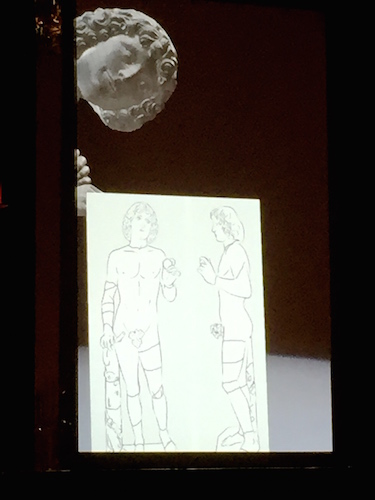
Digital Adam shows drawing of where the breaks in Lombardo’s Adam occurred

Digital Adam shows drawing of the breaks in Lombardo’s Adam

These two need their own ongoing talk show about history, time and space in some corner of the Met. Until August 2, ask the information desk for The Return’s program and go marvel at both the gallery and the behind-the-scenes performances. Or go to the live stream on the Met Museum’s website.

After meeting Digital Adam, you’ll never again wonder about what’s going on inside Classical Adam’s cool, calm, beautiful marble head.

Dramatic Live Steam Show Envelops Virginia Museums

The restored 611 arrives in downtown Roanoke behind the art museum

The restored 611 arrives in downtown Roanoke behind the art museum

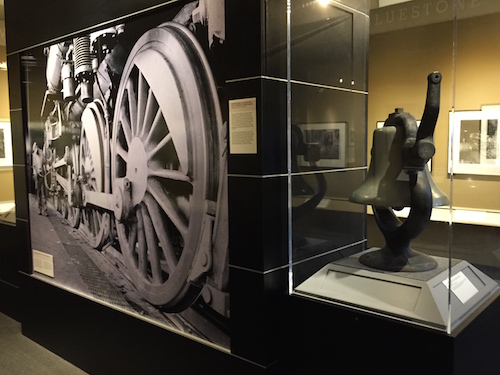
For the last month, crowds in western Virginia have been turning out in droves to see the dramatic result of engineering, technology, and determination by several museums and volunteers to resurrect the biggest, fastest passenger steam locomotive to live out its former glory on the Norfolk & Western Railroad.

If the CEO of Norfolk Southern hadn’t sold his Rothko in New York in 2013 and donated $1.5 million of its record-breaking proceeds, this amazing steam revival might not have happened.

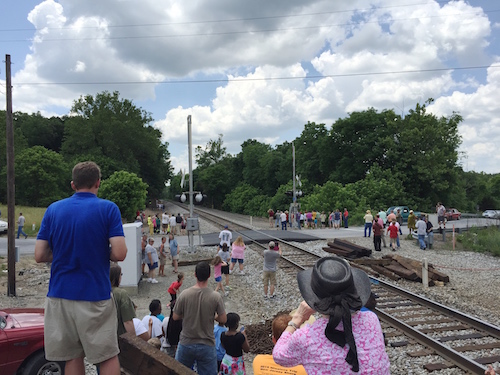
Waiting for the 611 at Evington, Virginia on its debut run

Waiting for the 611 at Evington, Virginia on its debut run

The Virginia Museum of Transportation is celebrating the culmination of efforts to “Fire Up the 611” and let this 100-mile-per-hour wonder rip through the foothills of the Blue Ridge and points east all month and hopefully into the future.

As the 611 made its way from its rehab yard at the North Carolina Transportation Museum in Spencer, North Carolina, people lined the tracks to see the newly refurbished 1950s streamlined locomotive pull 17 passenger cars loaded with fans 140 miles north to its new home in Roanoke. The celebration of 611’s return has been going on all month, as the locomotive keeps making runs to Petersburg, Lynchburg, Radford, and other Virginia towns.

611 parked next to the O. Winston Link Museum

611 parked next to the O. Winston Link Museum

The 611’s Twitter feed lets everyone know when to expect it, although the piercing steam whistle and roaring sound are also sufficient alerts to anyone in a five-mile radius. Listen to its sounds on our Flickr video of its 45-mph pass through one lucky town and see photos its Roanoke arrival.

The 611 and its 13 sister locomotives (Norfolk & Western J Class) were produced after 1941 and pulled passenger trains through Ohio, North Carolina, Virginia, and Tennessee until the late 1950s – around the same time that Rothko painted the canvas that would later benefit the 611’s resurrection. Since it’s retirement, this coal-fired steam engine mostly sat in the yard at the Roanoke museum, but had a brief comeback in the 1980s making a few tourist rail runs.

Inside the O. Winston Link Museum, showcasing Link’s spectacular photographs of the last days of steam on the Norfolk & Western Railroad

Inside the O. Winston Link Museum, showcasing Link’s spectacular photographs of the last days of steam on the Norfolk & Western Railroad

Norfolk Southern initiated a “21st Century Steam” initiative, and volunteers at the Roanoke museum began the “Fire Up the 611!” campaign. The NS CEO decided to jump-start the initiative with the $1.5 million from the Rothko sale, and volunteers put in over 8,000 hours to bring the magnificent machine back to life.

When the 611 steamed into downtown Roanoke on May 30, it stopped for photos and an official welcome right behind Roanoke’s contemporary at museum and in front of the O. Winston Link Museum, housing the work of one of the most acclaimed railway photographers of the 20th century in the former Norfolk & Western Railway Building.

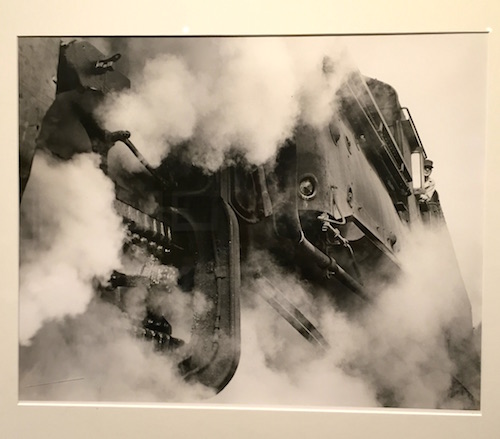
Link’s 1960s portrait of steam locomotive fireman, Joe Estes

Link’s 1960s portrait of steam locomotive fireman, Joe Estes

Link, a Brooklyn-born commercial photographer, fell in love with steam locomotives that he knew were rapidly being replaced by diesel. He innovated nighttime lighting gear to capture dramatic shots of the steam giants coursing through the hills and crossroads of West Virginia and Virginia. Link recorded their sounds as well – recordings that continued to sell well for decades. Catch a glimpse of Link’s gorgeous images, equipment and recordings on our Flickr site.

After finishing its July runs, the 611 will be on display in the museum yard in Roanoke, parked alongside other giants of steam.

Saints in the ‘Hood in Brooklyn

Kehinde Wiley’s Saint Amelie in stained glass, 2014

Kehinde Wiley’s Saint Amelie in stained glass, 2014

Take a look at the saints as you’ve never seen them in Kehinde Wiley: A New Republic through this weekend at the Brooklyn Museum of Art.

They’re not saints, exactly, but Mr. Wiley is asking you to look at the young African American men you pass in your everyday life in a slightly different way – through the lens of Byzantine icons and Medieval stained glass. The icons and would-be saints are magnificent, proud, and mysterious, just like his slightly earlier portraits that are grace the walls of Lucious Lyon’s mansion in the hit series Empire.

The Cantor Gallery is filled with these men of higher purpose, and the crowds love it. Bronze busts echo the 18th century marble work of Houdon, and visitors check them out from all angles.

The Archangel Gabriel, Wiley’s 22-karat gold leaf and oil on wood painting from his Iconic series

The Archangel Gabriel, Wiley’s 22-karat gold leaf and oil on wood painting from his Iconic series

Beyond this gallery, the curators have assembled a survey of Mr. Wiley’s 14-year career – dominated by his giant canvases in which guys from the neighborhood take on the heroic poses of European aristocrats and conquerors. In fact, when he began, Wiley would scan neighborhood streets for handsome, statuesque subjects and ask them if they would feel comfortable posing as other-era men of means in his painting studio. Those who said yes were asked to select the person they felt comfortable emulating from Wiley’s library of art books on European portraiture.

Elsewhere in the show are Wiley’s first-ever bronze sculpture of female subjects and selections from his world tour, where he found portrait subjects in Israel, Palestine, Africa, and the Indian subcontinent. Check out some of the works in our Flickr feed and on the museum website.

Although it’s common to see a gigantic Wiley portrait in another museum these days, Brooklyn is proud that it was among the first to collect his work. If you journey to another floor, you’ll see a five-panel painting installed on a ceiling like some Renaissance master’s and several portraits from his Passing/Posing series in 2003.

If you can’t get to Brooklyn to see this show, let Mr. Wiley take you through the exhibition via video:

Bird Watching with Audubon: Forget the Binoculars

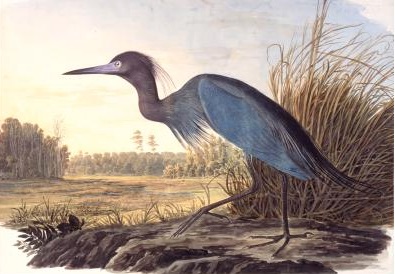
Little Blue Heron (Egretta caerulea), Havell plate no. 307, 1832

Little Blue Heron (Egretta caerulea), Havell plate no. 307, 1832

If you climb up to the second story of the New-York Historical Society to see Audubon’s birds, grab the magnifying glass right inside the gallery door. See the magnificent details painted by the watercolor master of all time in  Audubon’s Aviary: The Final Flight (Part III of The Complete Flock), running through this weekend.

NYHS is the lucky owner of every watecolor JJA produced to make his historic Birds of America subscription project in the early 1800s, which documented over 700 species.

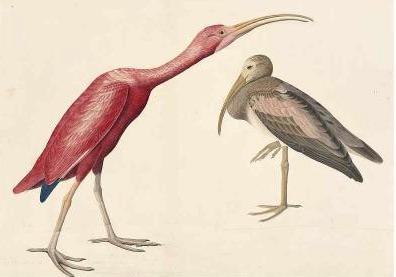
Scarlet Ibis (Eudocimus ruber), Havell plate no. 397, 1837

Scarlet Ibis (Eudocimus ruber), Havell plate no. 397, 1837

The watercolor collection – from which engravings were made – is so large that NYHS had to split the exhibition into three parts. It’s a joy to look at the life-size paintings that Audubon produced through the magnifying lens, seeing the tiny brushstrokes on lush feathers and miniscule detail on the small hummingbirds.

Paintings featured in all three shows are hung in the sequence that JJA painted them. Although JJA traveled extensively throughout the East and South, he never actually saw birds west of the Missouri in the wild.

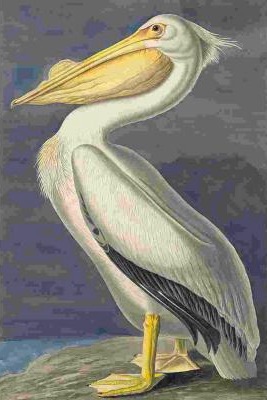
American White Pelican (Pelecanus erythrorhynchos), Havell plate no. 311

American White Pelican (Pelecanus erythrorhynchos), Havell plate no. 311

By the time Audubon began cranking out the watercolors needed for his final installment of his masterwork, lots of new birds were being discovered out West. Scrambling to keep up – after all, he committed to documenting every American bird – he accessed specimens collected by recent Western expeditions, Lewis & Clark’s trove, and other American specimens archived in Europe.

He holed up in Charleston, South Carolina in the winter of 1836 and worked, worked, worked to finish all the watercolors, which would be shipped to Mr. Havell in the UK for engraving.

How did Mr. Auduon’s studio work compare to the real thing? See for yourself in this bird-watching documentary shown inside the gallery. The birds featured are from the previous installation of the exhibit, including the rare, rambunctious Prairie Chicken at 1:25.

For more, go to the show’s excellent website, explore some of JJA’s works in more depth, and listen to the bird calls for the exhibition, courtesy of the Cornell Lab of Ornithology.

On Kawara: Time and Life as Art

On Karawa always wanted to see his work on the timeless, spiritual spiral ramps of the Guggenheim and got his wish. Photo by David Heald

On Karawa always wanted to see his work on the Guggenheim’s timeless, spiritual spiral ramps. Photo by David Heald

Back in the 1970s, you couldn’t find a language-art or Conceptual art exhibition without the enigmatic world traveler On Kawara. Sometimes you would see canvases with a single day’s date, but other times you might encounter a single telegram sent from a major world city with simply the message: “I am still alive.”

The Guggenheim is paying tribute to this favorite through the weekend in its show On Kawara – Silence, and has done a magnificent job of displaying and interpreting the life work of an artist who always appeared barely there. Although he was fully immersed in the New York art scene, he seemed always to be on the go, traveling to some other major world capital. He managed to make art out of this peripatetic life.

Visitors peruse On Karawa’s Today series paintings and peer into their newspaper-lined storage boxes below. Photo by David Heald

Visitors peruse On Karawa’s Today series paintings and peer into their newspaper-lined storage boxes below. Photo by David Heald

Indeed, at one point in his early life he thought he might like to be a travel agent, but an immersion in the ancient cave paintings of Altamira changed that. He decided to dedicate himself to art and set upon a unique course.

At the start of the walk up the spiral ramp, you encounter his Today series – a continuous set of rectangle canvases, painted each day with the day’s date, beginning with January 1, 1970. Over the next four decades, he would create more than 3,000 of these. In a twist, the Guggenheim displays many with its associated storage box that the artist assembled each day when he was done, lined with the newspaper from the same day.

From the I Got Up postcard series. Photo by David Heald

From the I Got Up postcard series. Photo by David Heald

Although the artist never intended the paintings to be shown with the storage boxes, the throngs of visitors have quite a time looking at the date and then peering down to see what else was happening in the world that day – for example, Golda Meir’s proclamations about Israeli-Egyptian standoffs, desegregation in the South, the Chicago Seven trial, and Vincent Canby reviews.

It’s stunning to see the assemblage of tourist postcards that he sent at the rate of two per day to friends and colleagues with the stamped inscription I Got Up Today with a time stamp of his rising. Travel and personal routine systematized and packaged into a series of projects he carried out from 1968 through 1979.

He didn’t want the moments or people to pass as he journeyed throughout the world, so he began the series I Met. He noted every single person he met every day for twelve years – friends, artists, waiters, store clerks – and typed their names on pieces of paper that were time-stamped and bound into books.

Viewers peruse a fraction of the 1,800 postcards that On Kawara sent to document the time he got up at various cities in his travels. Photo by David Heald

Viewers peruse a fraction of the 8,000 postcards that On Kawara sent to document the time he got up at various cities in his travels. Photo by David Heald

It’s amazing to encounter the bound volumes on the ramp, visitors circling the extensive set wondering what it must have been like to carry out this level of life documentation.

The curators explain more in the video below about how On Kawara took on monumental projects to translate his day-to-day life, travels, and schedule into the art that fills this meditative, peaceful, and mind-expanding show:

See more views of this thought-provoking installation here. For more curator videos, click here.

Benton’s Freebie Masterpiece at The Met

Viewer contemplates “The Changing West” panel of Thomas Hart Benton’s America Today mural (1930-1931)

Met visitor contemplates “The Changing West” panel of Thomas Hart Benton’s America Today mural (1930-1931)

When times get tough, did you ever take on a job or make something for free just to build up your resume and showcase what you could do? That’s exactly what one New York up-and-comer did, and it really paid off. The Metropolitan Museum of Art’s show, Thomas Hart Benton’s ‘America Today’ Mural Rediscovered, tells the story.

Back in 1930, the New School was just completing its modern building in the Village on West 12th Street and was seeking something to jazz up the boardroom.

“City Activities with Subway” portion of America Today based on his portrait sketches

“City Activities with Subway” portion of America Today based on his portrait sketches. (It’s Pollack’s sister-in-law, Elizabeth)

Mr. Orozco, the famed Mexican muralist, had already been commissioned for the more visible dining room/lounge, and Mr. Benton, who was teaching at the Art Students League, saw an opportunity to showcase his painting chops.

Social realist chronicler Reginald Marsh had introduced Benton to the mysteries of mastering egg tempera, and Benton felt ready to go to town on a large-scale portrait of American life in all of its regional glory. Here’s the deal: no pay, just loft studio space about a block away.

Twenty years earlier, Benton had hung around Paris, soaking up the birth of the French Cubist and Italian Futurist movements in Europe. Ten years earlier, he roamed around the back roads of the United States, filling up sketchbooks with steel town landscapes, lumber camps, oil derricks popping up in Los Angeles, dives, diners, and small town stuff.

“Steel” portion of the mural, featuring model Jackson Pollack, Benton’s student

“Steel” portion of the mural, featuring model Jackson Pollack, Benton’s student

The mural began taking shape, crammed to the gills with swirling activities, people, industry, and pop culture that he saw. Need models? Why not ask Jackson Pollack, his art student, and his sister to pose?

It’s hard to imagine serious board meetings taking place in a room so alive with oversized ambition and action. Over the decades, the New School repurposed the room for classroom lectures, and over time, the scuffed mural was removed completely.

Lucky for us, Benton’s 1930s historic masterpiece found its way to the Met, which has lovingly restored and installed it in a rectangular room just beyond the Frank Lloyd Wright room.

The curators have filled the adjacent galleries with extra treats: the inspirational sketches from Benton’s earlier road trips and works by Mr. Pollack and Benton’s Village contemporaries.

See our Flickr album to glimpse the installation (and works by early Pollack, Abbott, Marsh from the Met’s collection), and watch the Met curators tell the story of how Mr. Benton’s freebie paid off and their joy in giving this ten-panel chronicle a new home.