Sinclair Dinosaur Sneaks In and Out of Grand Central

Entrance to the show, featuring the 1964 monorail, transport of the future

Entrance to the show, featuring the 1964 monorail, transport of the future

Although he’s featured at the back, the famous Sinclair dinosaur from the 1964 New York World’s Fair has generated a lot of attention inside the New York Transit Museum’s show Traveling in the World of Tomorrow: The Future of Transportation at New York’s World’s Fairs, closing today.

Drawn in by the spectacular photo of the monorail, commuters and tourists visiting Grand Central have been roaming through the gallery and gift shop, checking out the photos, murals, and Dinoland movie that whisk them back to the transportation pavilions of the history-making 1939 and 1964 New York world’s fairs. What’s a dinosaur doing in the World of Tomorrow? It’s all about the car.

The 1939 World’s Fair was built on top of the Corona garbage dump during the height of the Great Depression, putting visionary architects and day laborers to work.

A 1964 New York Times photo of the Sinclair Dinosaur and Stegosaurus passing by the Empire State Building on their way to the Queens fairgrounds

A 1964 New York Times photo of the Sinclair Dinosaur and Stegosaurus passing by the Empire State Building on their way to the Queens fairgrounds

A futuristic subway station was built to deliver visitors to the fairgrounds from the A Line. You could enter a spaceship-shaped Flash Gordon amusement ride and watch the first 3D Technicolor movie ever produced inside the Chrysler pavilion.

The best was the legendary Futurama, where people could imagine a time where everyone owned their own car. The ride took them to the faraway year of 1960. Superhighways and curly exit ramps bisect acres of tall skyscrapers, with cars traveling on autopilot at the amazing speed of 55 miles per hour. Incredible!

Dinoland brochure from the Queens Historical Society

Dinoland brochure from the Queens Historical Society

Fast forward: The Sinclair dinosaur is part of the 1964 experience. By then, every family owned its own car. Sinclair’s long-necked, supersized Brontosaurus was a familiar icon to any family stopping to gas up along the newly completed interstate highway system, so why not mix a little magic, promotion, and science?

Sinclair built Dinoland and populated it with life-size replicas of nine dinosaurs. The exhibition has plenty of Dinoland souvenirs along with a movie clip of families seeing the Jurassic giant for the first time.

Robert Moses and Walt Disney look at the model of the 1964 World’s Fair. From MTA Bridges & Tunnels archives

Robert Moses and Walt Disney look at the model of the 1964 World’s Fair. From MTA Bridges & Tunnels archives

The show also pays tribute to the man who also brought another group of Mesozoic superstars to life inside the fairgrounds. Walt Disney designed four of the fair’s animatronics displays, including the robot cavemen and dinosaurs glimpsed in the Ford Motor Company’s “Magic Skyway” ride. There’s a terrific photo of New York’s Robert Moses alongside Walt, looking out over the model of the 1964 fairgrounds, and you can see the actual model itself, right inside.

Missed the show? You won’t see all the movies and hear the soundtracks that made the exhibition so exciting, but you can take a look at the galleries on our Flickr feed.

The 1964 car that everyone wanted — the Ford Mustang, which debuted at the fair

The 1964 car that everyone wanted — the Ford Mustang, which debuted at the fair

The Paper Bag Was Her Design

MoMA honors Margaret Knight, 1870s inventor of the flat-bottomed paper bag

MoMA honors Margaret Knight, 1870s inventor of the flat-bottomed paper bag

What will the MoMA curators pull out of the design collection next? Designing Modern Women 1890–1990, running through October 19, puts the spotlight on furniture, textiles, graphics, performance, kitchens, and even inflatables designed by some innovative women over the last century. How can you not love a show that begins with 1890s modern-dance provocateur Loïe Fuller and ends with 1980s pop icon Grace Jones?

The crowd last weekend was loving every bit of it, pausing to watch videos sprinkled throughout the show and marvel at designs – some 80 to 100 years old that are as modern today as they were at their creation.

The next time you carry away your morning muffin from the coffee counter in that little white paper bag, ponder that the flat-bottomed paper bag was invented in the 1870s by Margaret E. Knight and Charles B. Stilwell. Ms. Knight not only invented this classic, but also invented the machine that made it and was one of the first American women ever to receive a patent.

1901 dinner service by Jutta Sika and Koloman Moser

1901 dinner service by Jutta Sika and Koloman Moser

No, the dinner service is not from Pottery Barn. It was created in 1901 by the Austrian design team of Jutta Sika and Koloman Moser. Didn’t I just see a copy of Eileen Gray’s 1927 adjustable table at the D & D Building? Open shelving in your new, modern kitchen? Yes, that was Charlotte Perriand’s idea, and MoMA has (for the first time) installed this full-size, fully efficient, ground-breaking kitchen from her 1952 project with Le Corbusier.

And what about the Slinky? Invented by Betty and Richard James in 1945. You’ll have fun peering into the design cases and learning more about the women behind some remarkable things.

Slinky was designed by Betty and Richard James in 1945

Slinky was designed by Betty and Richard James in 1945

In the 1960s portion of the show, you’ll see those famous Fillmore posters designed by Bonnie Maclean. And there’s an entire wall filled with iconic pop and punk graphics – all created by female designers – that should be familiar to anyone that traversed the downtown CBGBs scene.

There’s no digital media to accompany this fantastic show, so take a walk through our Flickr site. All of the items are from MoMA’s own collection, and we’ve taken slight liberties by arranging the photos in the show album in chronological order of the year that each design debuted.

And to bring it all back to the beginning of this design innovation tribute: Here’s a glimpse of 1897 Art Nouveau performance art by Loïe Fuller, courtesy of the Lumiere Brothers. The color you see here is a result of hand-tinting the film, but her actual perfomances used new theatrical stage lighting for which she held numerous patents. Listen to the MoMA curators explain her influence, but get over to MoMA (or the Flickr site) to take in this super-fun tribute to 100-plus years of smart women who thought differently and made it happen.

Groundbreakers App Ties History and Beauty Together

AppTitle

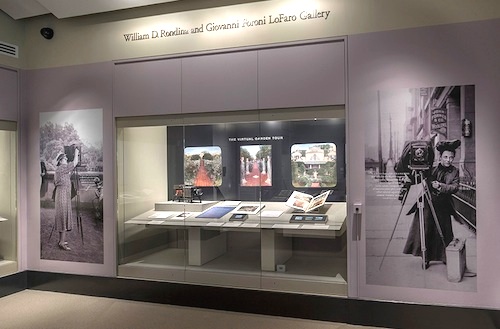
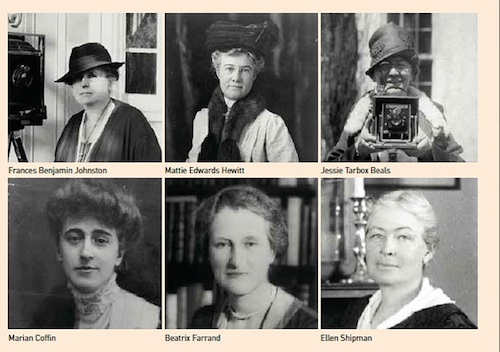
The New York Botanical Garden carved out an ambitious agenda in its Groundbreakers show – to tie the stories of six women of landscaping history, present a two-gallery recreation of an historic garden, pay tribute to the contributions of several landscapes within NYBG itself, create a poetry walk, and wrap it up with the history of early 20th-century photography and high-gloss publishing. They did it with GPS and an iPhone app, courtesy of Bloomberg.

Closing this weekend, Groundbreakers: Great American Gardens and the Women Who Designed Them is still worth downloading from iTunes, just to get a glimpse into the lives of six landscape-gardening pioneers, see their work, and understand the popularization of American gardening long before the dawn of HGTV or Lifestyles of the Rich and Famous. Here’s the link.

Photos of Ms. Johnston (left), lantern slides and projector, and Beals (right) on NYC street in 1902. Courtesy: NYBG

Photos of Ms. Johnston (left), lantern slides and projector, and Beals (right) on NYC street in 1902. Courtesy: NYBG

Here’s the story: back in the day (early 1900s), garden design and photography were two of the few career avenues available to women.

Way before Instagram, Photoshop, and two-way phone cameras, documenting the lush gardens involved lugging a gigantic, large-format camera up and down garden paths and around water features, processing black-and-white negatives into prints, turning some into newly-invented lantern slides, and having each slide painstakingly colored by hand. It helped if you had a car and an able-bodied assistant to help navigate the flagstone-lined paths with all the heavy gear.

Six American landscape pioneers who changed the course of American gardening. Courtesy: NYBG

Six American landscape pioneers who changed the course of American gardening. Courtesy: NYBG

Also, after the Industrial Revolution, aesthetically minded women (predating Lady Bird Johnson) felt it was time for American homescapes to get a little more spruced up.

The rich and famous were beginning to hire landscape designers to fix up the areas behind their East Side townhomes and acreages around their country estates. Why not document this and inspire upper middle class homeowners to follow suit?

The exhibition gives us a look at how artist visionaries, authors, and the publishing industry worked in tandem to record how landscape architects were creating romantic backyard landscapes and popularize beautification. Although seeing actual lantern slides, projectors, and gigantic tripods is amazing, one of the highlights is a recreation of the slide show by Frances Benjamin Johnston that basically blazed the trail of a new vision of what was possible – one image after another of gorgeous, visionary landscapes on the grounds of homes on the East Coast, California, England, and France.

NYBG recreated the evocative Moon Gate from the Rockefeller garden, inspired by their experience of the Forbidden City and designed by Beatrix Farrand

NYBG recreated the evocative Moon Gate from the Rockefeller garden, inspired by their experience of the Forbidden City and designed by Beatrix Farrand

In the Conservatory, the team at NYBG recreated Mrs. Rockefeller’s garden, originally designed by Beatrix Farrand, to highlight how the garden was conceived, used, and enhanced by the Asian art Mr. and Mrs. John D. collected. Since Farrand took on this project in 1926, NYBG has the sounds of America’s Jazz Age wafting through the galleries. Take a look on our Flickr page.

Another great feature of this show and the app – NYBG’s GPS feature shows you where you are in the expansive garden and encourages you to visit features where these groundbreakers had a hand – such as Marian Coffin’s ornamental conifer collection and Ferrand’s Rose Garden.

Get a closer view of the spectacular Groundbreakers in NYBG’s news-style video:

If you have a bit more time, listen to this curator lecture on the Beautiful Garden movement in America in 1900 and see the photos used by Johnston home to show suburbanites exactly how it should be done. You’ll witness garden images that hadn’t been seen since 1930. Take a look and get inspired:

Click here for other videos: a lecture about Beatrix Farrand created Mrs. Rockefeller’s garden and how the NYBG team recreated it in the stunning Victorian conservatory.

Folk Art Geniuses Take a Trip

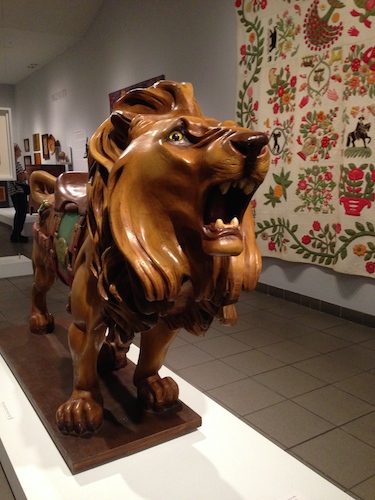
Brooklyn’s Lion, carved in 1910 by Marcus Charles Illions, who worked at the carousel shop and later set up his own studio

Brooklyn’s Lion, carved in 1910 by Marcus Charles Illions, who worked at the carousel shop and later set up his own studio

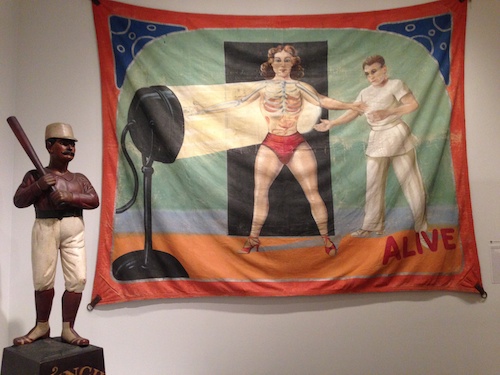
The American Folk Art Museum knows how to put on a show and take it on the road. After today, the staff will be packing up Self-Taught Genius: Treasures from the American Folk Art Museum and letting the Brooklyn Lion, Connecticut’s Weathervane Elephant, Chicago’s Sideshow “Radium Girl”, and a baseball old-timer from Centre Street see what’s up in Davenport, San Diego, Fort Worth, New Orleans, Saint Louis, and Tampa. We’re betting that there will be crowds waiting to greet them.

The museum’s staff has brought out its best to show off four centuries of made-in-America maker art – furniture, sculptures, textiles, painting, and what-not. It’s genius that they’ve put the spotlight on “genius” because their collection is jam-packed with some truly remarkable artists, visionaries, and craftsmen. Get the full view on the Museum web site and some close-ups on our Flickr page.

The curators say that the United States was a make-it-up-as-you-go-along democracy, so they felt “self taught” was right in line with this unique Americana theme – having a vision and making a masterwork.

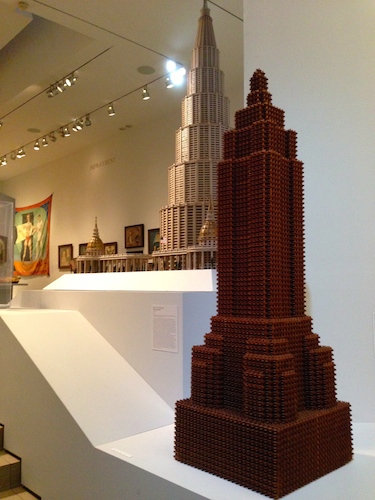
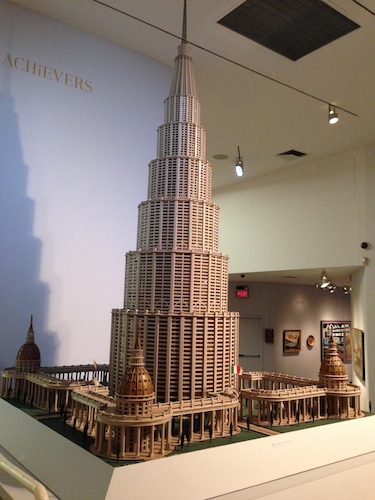
Empire State Building, carved in New Jersey in 1931 from precious cherry wood. Auriti's Palace is just behind.

Empire State Building, carved in New Jersey in 1931 from precious cherry wood. Auriti’s Palace is just behind.

Yes, there are some true eccentrics in the mix, but let’s momentarily focus on the People with a Plan from the section of the show on “Achievers”. Their works are immensely pleasurable and intense, and they’re right inside the entry.

You could spend hours contemplating the detail and work that went into the monumental Empire State Building made from cut cherry wood pieces in New Jersey in 1931. No one knows who created it, but legend has it that it was an ironworker that actually worked on that 13-month wonder and couldn’t let go of the achievement.

Consider The Encyclopedic Palace of the World, created by Maurino Auriti, an auto body worker who just loved designing and building architecture. Mind blowing. If his visionary campus was actually constructed, the skyscraper would be taller than that spire in Dubai.

The Encyclopedic Palace, created by Maurino Auriti, an auto body mechanic, in the 1950s from from wood, plastic, glass, metal, hair combs, and hobby kit parts

The Encyclopedic Palace, created by Maurino Auriti, an auto body mechanic, in the 1950s from wood, plastic, glass, metal, hair combs, and hobby kit parts

If you get to Lincoln Square today, you’ll enjoy one amazing treasure after another, but if not, check it out the beautiful web site archive created by the museum team for the tour. Browse by time period, theme, or artist.

And check out the Museum’s other brilliant online solution to letting you in on the world’s interpretation of these works. They’ve assembled all the media written and produced about the pieces in the show, which have often served as a springboard for scholarly research. This is a fun, serious treasure chest of work, so probe to your heart’s content — baseball folk art, mourning pictures, 18th century folk-art Washington portraits, and even more recent works.

What will it take to take this show of masterworks on the road? Last year, Auriti’s The Encyclopedic Palace was chosen as the theme of the  55th International Venice Biennial, so it got to go on its first trip to Italy.

Get a glimpse of where the folk art lives when it’s not on display and see how art gets packed to take a trip.

Baseball statue from 114 Centre Street and the sideshow’s Radium Girl banner from Chicago in the 1930s

Baseball statue from 114 Centre Street and the sideshow’s Radium Girl banner from Chicago in the 1930s

The Sistine Chapel of Fashion Virtuosity

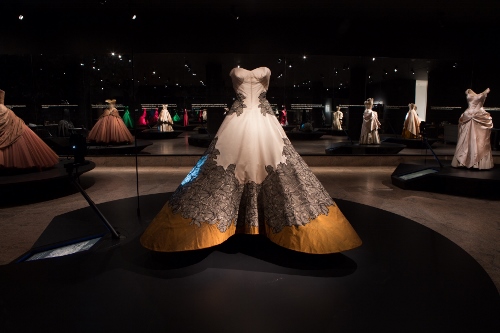
Clover Leaf Ball Gown – a 1953 silk faille, shantung, and black lace sculpture by Mr. James. Part of the Brooklyn Collection at The Met

Clover Leaf Ball Gown – a 1953 silk faille, shantung, and black lace sculpture by Mr. James. Part of the Brooklyn Collection at The Met

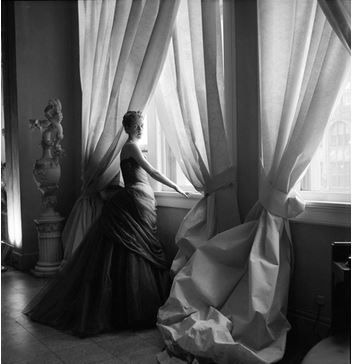
When the Brooklyn Museum handed its fashion archive over to the Met in January 2009, the first thought that crossed everyone’s mind was the mind-bending masterworks that would now be sheltered under the protective wing of the Costume Institute’s crack conservation team — “Oooh, maybe the Met will do a Charles James show!”

We’re glad to report that the Met has done this master proud and given his humble admirers a fitting place to worship in its triumphant two-gallery show, Charles James: Beyond Fashion, which ends this weekend, August 10.

1952 portrait by Michael A. Vaccaro / LOOK Magazine. Courtesy: The Met;  Library of Congress

1952 portrait by Michael A. Vaccaro / LOOK Magazine. Courtesy: The Met; Library of Congress

Mr. James is credited with being among the first to perfect the strapless gown in the 1930s, an inspiration for Mr. Dior’s “New Look” in the 1940s, and the epitome of Vogue glamour dressing in the 1950s. He could do things with fabric that others simply couldn’t do or wouldn’t dare…well, maybe except for Madame Gres. He pushed silhouettes and fabrics further than most anyone could conceive and had the temperamental nature, drive for perfection, and uncompromising attention to detail that characterize any of history’s greatest, most passionate artists.

You always look at his creations and ask yourself, “How did he do it?” How did he get a spiral of fabric to stand out as it wraps sinuously around a sleek, strapless electric green silk mermaid dress? Is that sexy Thirties frock actually cut from one scarf?  How did he create virtual moving sculptures from the world’s most expensive fabric?

Innovative digital display tells the back story of Mrs. Hearst’s Clover Leaf Gown – too big for Ike’s inaugural, but just right for Queen Elizabeth II’s coronation

Innovative digital display tells the back story of Mrs. Hearst’s Clover Leaf Gown – too big for Ike’s inaugural, but just right for Queen Elizabeth II’s coronation

Long known for his innovative engineering, the Met came to a brilliant solution to explain the magic that Mr. James wrought over his decades of no-two-alike work – hire an architectural firm to show us.

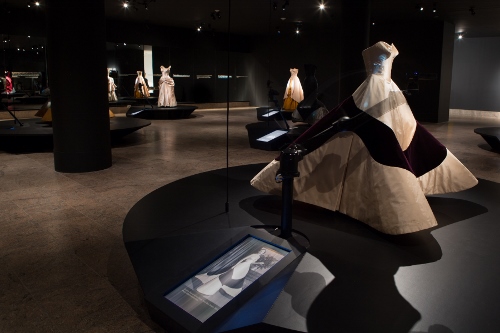
Enter Diller Scofidio + Renfro, who have mounted these sculptures in silk inside an infinity-room gallery and paired each masterpiece with its own personal robot and humongous iPad-type display. Look at the dress and refer to the screen as the dress digitally deconstructs and is assembled again.

Cecil Beaton’s 1955  photo of Nancy James in the Swan Gown. Courtesy: The Met; Cecil Beaton Studio Archive at Sotheby's

Cecil Beaton’s 1955 photo of Nancy James in the Swan Gown. Courtesy: The Met; Cecil Beaton Studio Archive at Sotheby’s

The crowds waft from dress to dress in no particular order, clustering silently to watch digital magic, see where the robot is pointing, and view photos of Mrs. Randolph Heart, Jr., Gypsy Rose Lee, or Josephine Abercrombie in said gown. The robot with the 1954 Swan Ball Gown captivates viewers by moving underneath to televise close-up views of some of the 1,080 square feet of tulle that Mr. James used to create the oomph.

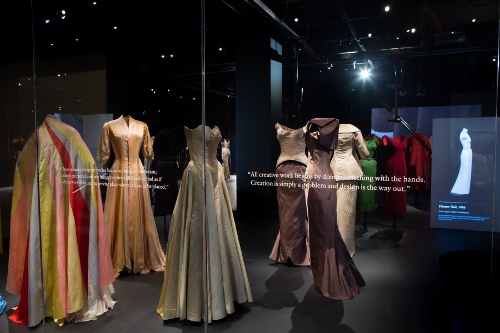
The mirrored walls of the upstairs gallery and the see-through dividers downstairs are emblazoned with the wisdom of the man himself. He seems to be talking right to you as you wonder how he made the fabric do what it’s doing (“It’s the air that’s sculpted, not the silk”) or how he thought about the world of fashion (“We who have been ahead in style have usually been ahead in our thinking”).

Downstairs gallery, newly named for Ms. Wintour, filled with James creations

Downstairs gallery, newly named for Ms. Wintour, filled with James creations

The second gallery (welcome back, ground floor Costume Institute!) displays his wool creations and sharply shaped cocktail wear. It’s interesting that James considered some of these genuinely more innovative than his often-photographed gowns. The curators have placed another of his “first” in a room at the back – the predecessor of today’s puffer coat. On loan from the V&A, it remarkably dates from the 1930s – his soft, sensual, silky answer to the boxy fur jackets that Ms. Schiaparelli was showing in Europe at the time.

We have to thank Mr. James for his vision and for making sure the Brooklyn design lab had so many examples of his masterpieces to teach and inspire future generations of Seventh Avenue designers. As he says, “In fashion, even what seems most fragile must be built on cement.”  Lesson learned.

The Met’s a great steward. Just listen to the love in the tour of the show by its curators:

If you have more time, hear what Zac Posen has to say to the co-curator about The Master:

Last Day for Art & Industrial History: Kara Walker’s “Sugar Baby”

Crowds surround Kara Walker’s monumental sugar sculpture

Crowds surround Kara Walker’s monumental sugar sculpture

The crowds lined up yesterday on Kent Avenue all the way beyond the Williamsburg Bridge, almost to Schaeffer’s Landing, waiting to enter the rusted, aromatic, tumble-down confines of the old Domino Sugar Factory on one of the last days to see Kara Walker’s “A Subtlety, or The Marvelous Sugar Baby”, commissioned by Creative Time.

Today is the last day, so take a look at history in person, on our Flickr page, or in the video below.

Security was in full force to keep the Williamsburg bike path clear and drivers were slowing down to ask, “What’s going on and what are people waiting for?” only to be told by patient fans, “They’re lined up to see art!”

Once inside, the marvelous, gigantic Sugar Baby sculpture was on hand to preside over the far end of the abandoned several-block-long 1851 industrial space that once refined over half the sugar consumed in the entire United States.

One of her many attendants throughout the factory

One of her many attendants throughout the factory

As readers of Friday’s front-page article in The New York Times knew, Walker was again pushing the buttons with her homage to the brutal history of the sugar trade from the 1700s until today by giving us an experience that isn’t really all that sweet. Witnessing Kara’s witnessing is what had people – including some elderly visitors on canes — flocking to the sticky-floored, slightly ominous space. You could smell the sugar and molasses before you even entered the door.

Leading up to the gigantic white sculpture, people encountered all sorts of molasses-children, toting baskets full of…well…looks/smells like molasses. The experience evokes everything that Kara wished for…history, economics, society, race, abuse, industrial profit, and industrial scale.

Take a look at how it was made, and read about the history behind her thinking. Click on this link to Vimeo, look on the Creative Time website to see her sketches and graphic inspirations, and be sure to check out the various stages of Kara’s 3D digital sphinx up close.

If you go to Brooklyn today, expect to wait about an hour in line; once inside, there’s plenty to think about.

Little Quilts Honor Grand Central’s Big Sky

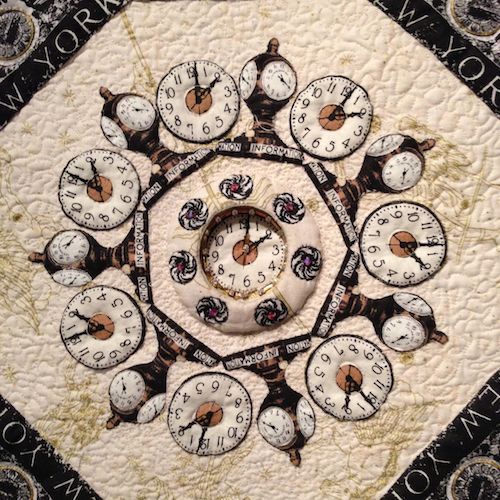
Center detail of Grand Prize quilt by Baltimore’s Amy Krasnarsky, Time Flies, But We Take the Train

Center detail of Grand Prize quilt by Baltimore’s Amy Krasnarsky, Time Flies, But We Take the Train

When you’re used to seeing large, magnificent quilts at the American Folk Art Museum, it’s a bit of a surprise to confront so many small ones as you walk through the doors of the New York Transit Museum’s annex to view the Grand Central Centennial Quilts exhibition (through July 6). But they’ve arrived from 15 states as part of a nationwide challenge to quilters to use some custom-designed fabric featuring Grand Central’s zodiac sky to say “Happy 100th Birthday” to our favorite transit hub.

A competition run by The City Quilter, a gallery and quilting emporium on West 25th Street, and American Patchwork & Quilting Magazine, inspired more than 80 quilters from 25 states to design, piece, stitch, and embellish creations that evoke the historic space. Everyone had to make a quilt to the same dimensions and incorporate the custom-patterned fabric designed by The City Quilter, “GCT Constellations” (the zodiac ceiling) and “Grand Central” with many of the terminal’s most iconic architectural elements.

Center detail of First Prize quilt, Grand Central Terminal Mandala, by Ligaya Siachongco

Center detail of First Prize quilt, Grand Central Terminal Mandala, by Ligaya Siachongco

You’ll see 30 of the best – three winners, nine honorable mentions, and other top finalists. Pop into the Annex and take a look.

The Grand Prize went to Baltimore’s Amy Krasnarsky, who used Beauty Blocks, sequins and trapunto to evoke the people who have trod those marble floors over the last 100 years. Amy worked in the acorns and oak leaves, which the Vanderbilt family chose to be their symbols and which are embedded in every nook and cranny of the lavish terminal. Once you begin looking, you’ll see them everywhere.

Ligaya Siachongco of Woodside, Queens, won First Prize by creating a mandala from the terminal’s architectural elements. Look carefully and you’ll see the exacting bead and applique work. The central clock appears “hidden” within a mysterious, secret space.

Abstract Second Prize quilt by Beth Carney of Yonkers, Chasms 16: Under the Stars

Abstract Second Prize quilt by Beth Carney of Yonkers, Chasms 16: Under the Stars

Abstraction was rewarded in Beth Carney’s lyrical interpretation, Chasms 16: Under the Stars.

She used sinuous, meandering stitched lines to evoke the passersby, train lines, veins of marble, tracks and tunnels – everything she sees when she travels down to the City and through the GCT from her home in Yonkers.

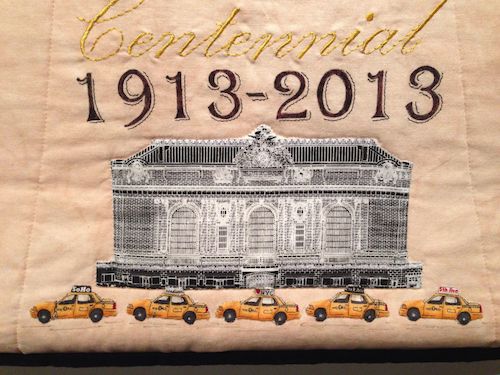
Hudon, Ohio’s Nancy Gary received an Honorable Mention, but achieved something quite unique – simultaneous views of the interior and exterior of GCT. Her quilt accurately conveys the dramatic interior of the terminal and those magnificent windows while also showing us the line-up of taxis along the 42nd Street stand. Everything is where it should be, including the black square on the ceiling – the tiles left by the restoration crew to show just how sooty the interior marble and zodiac ceiling used to be.

Kim Gimblette's quilt was one of the few to focus on the track diagrams and East Side Access

Detail of Kim Gimblette’s quilt, focusing on GCT’s track diagrams and the future East Side Access

Kim Gimblette of Ossining, New York, was one of the few that paid tribute to the track diagrams. She even added one in a different shade to represent the future of the station – the mighty East Side Access project that will eventually bring the Long Island Rail Road trains into Grand Central.

We couldn’t resist posting photos some of these amazing details here on the blog page, so go to our Flickr album to see the full-scale designs. The City Quilter’s Flickr page shows each of the artists next to their work. Click here to read each artist’s comments about their quilts.

Does this make you nostalgic for New York and wonder about what you’d create? If you have some time to sew, go to City Quilter’s on-line shop and order some NYC-themed fabrics. Get inspired by cotton yardage featuring the Big Sky of Grand Central (two color ways), architectural landmarks, the skyline at night, subway train cars, and – in case you wanted to channel a little Damien Hirst crossed with NYCT – subway dots of all the lettered and numbered lines.

Detail from Nancy Gary's quilt, featuring the taxi stand and so much more

Detail from Nancy Gary’s quilt, featuring the taxi stand and so much more

Sky High NYC Real Estate at Skyscraper Museum

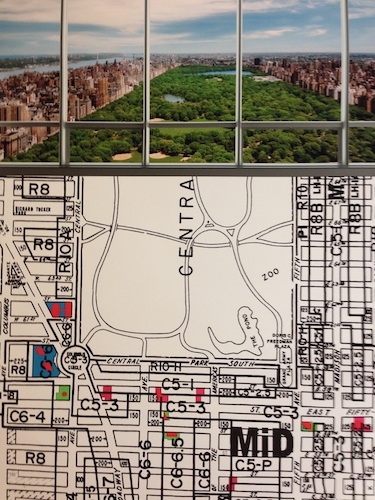
A photo of the future view from an apartment in One57, with the Midtown zoning map. Source: Skyscraper Museum

A photo of the future view from an apartment in One57, with the Midtown zoning map. Source: Skyscraper Museum

People get pretty emotional about their New York skyline. Recent news has swirled around Comcast wanting to put its name atop Rockefeller Center (goodbye, G.E.), the soon-to-be obstructed view of Manhattan from New Jersey’s Lincoln Tunnel entrance, and the super-slim ultra-tall residential skyscrapers sprouting up along the south edge of Central Park.

What’s going up at Hudson Yards? Will more sky-high slivers be overtaking the Empire State Building? The downtown skyline? Thankfully, the Skyscraper Museum is walking us all through the plans in its show, closing this weekend, Sky High & the Logic of Luxury. In a fantastic on-line and in-gallery show, the museum lays out the thinking behind six super-tall residential real estate developments, gives us the historic context of tall buildings here, and introduces us to the architects and developers behind the trend.

Take an installation walk-through.

Stars of the show, left to right: 432 Park Avenue, One57, 111 West 57th, Four Seasons at 30 Park Place, 56 Leonard, Hudson Yards Tower D.

Stars of the show, left to right: 432 Park Avenue, One57, 111 West 57th, Four Seasons at 30 Park Place, 56 Leonard, Hudson Yards Tower D.

The show – both in the museum and on the web – begins with a definition of  “slim” skyscraper and the long history of super-skinny in Manhattan. The history goes as far back to 1889 with the super-tall (at eleven stories) Tower Building at 50 Broadway – the beginning of the first phase of super-slim buildings. The MetLife Tower, finished in 1909, still towers to the east of Shake Shack at Madison Square. (Note, however, that the clock face is the only original part of the exterior left after a 1960s renovation.)

Illustrations of the world’s tallest skyscrapers in 1899 to 1918, all in Manhattan.

Illustrations of the world’s tallest skyscrapers in 1899 to 1918, all in Manhattan.

After New York’s zoning laws went into effect in 1916 (the first in the United States), hotels started growing taller and skinnier (e.g. the Sherry Netherland in 1927, the Pierre in 1930). Residences didn’t get that way until much more recently with the post-1961 legal change that allowed developers to buy air rights and build really high.

Enter Trump in the 1980s with multiple residential towers covered in dark glass, and the super-tall building (One Madison Park) that went bankrupt during the recession. But now, the entire movement is gaining steam again, with prices, views, and amenities reaching higher and higher.

The buildings featured in this show (in case you haven’t looked up) shoot up between 50 and 90 stories. Some are clustered at the foot of Central Park (check out 432 Park Avenue, One57, and 111 West 57th). Some are rising downtown – Four Seasons at 30 Park Place and 56 Leonard.

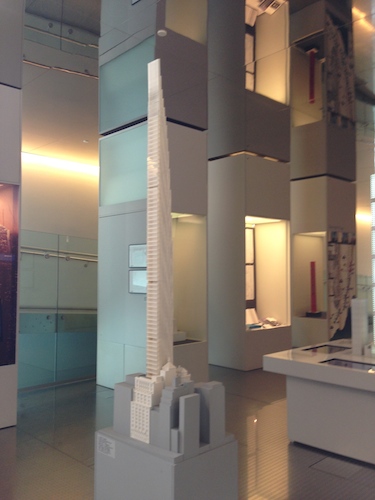
Architect model of 111 West 57th Street soars over surrounding buildings

Architect model of 111 West 57th Street soars over surrounding buildings

And, of course, some will be encircled by the High Line Phase III, such as Hudson Yards Tower D.

Take a look at the fantastic, detailed museum exhibition site and get to know your new neighbors.

Be sure to zoom in on the chart on the museum’s web site, showing the history of Manhattan sky-high apartment prices. Also, check out our Flickr photstream of the museum show.

Want to see the future? Take a look:

Vintage Attire on NYC Mean Streets

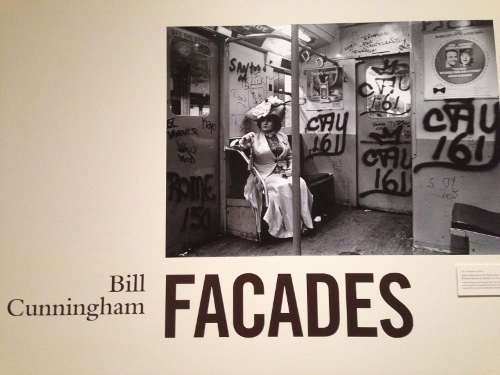
Editta Sherman in period dress on a graffiti-covered subway car to the Brooklyn Botanic Gardens

Cunningham’s photo of Editta Sherman in period dress on a 70s graffiti-covered subway car going to a shoot at the Brooklyn Botanic Gardens

Uber-fashion documentarian Bill Cunningham had a great idea in 1968, just as NYC was sliding toward financial crisis, crime, and (goes without saying) neglect of architectural sites, like Grand Central. Why not celebrate two centuries of NYC fashion and splendor on the street?

What were people wearing when some of the City’s most iconic homes, churches, and public buildings were built? Was it possible for a black-and-white photograph to reveal some new insight about the City from combining fashion, architecture, and a little fashion flair and attitude?

Editta poses for Bill  in embroidered frock coat and breeches  in front of St. Paul’s Chapel, the oldest church building (1766) in Manhattan

Editta poses for Bill in embroidered frock coat and breeches in front of St. Paul’s Chapel, the oldest church building (1766) in Manhattan

Results of Bill’s eight-year project are on display through July 15 in the Bill Cunningham: Facades photo exhibition on the second floor of the New-York Historical Society.

Without the aid of Wikipedia, he researched the years that some of his favorite historic places were built, and began scouring thrift stores for get-ups from the matching decade. He enlisted his muse, Editta Sherman, a fellow photographer and neighbor at the Carnegie Hall studios. For the next eight years, Editta and Bill went on weekend odysseys throughout the City, modeling and documenting over 500 historic outfits in front of interesting but sometimes forgotten facades.

In 1976, Bill gave 88 of his silver-gelatin prints to NYHS – the core of the current show, which is hung to emphasize the chronology of fashion and architectural style. The show was jammed with fashion lovers last weekend, soaking in the details from Bill and Eddita’s journey back in time.

Editta dresses for Bill in Gertrude Vanderbilt Whitney’s own Callot Soeurs at the 1904 Harry Payne Whitney House

Editta dresses for Bill in Gertrude Vanderbilt Whitney’s own Callot Soeurs at the 1904 Harry Payne Whitney House

It starts with Editta dressed in an 18th c. embroidered coat and breeches in front of the 1766 tower of St. Paul’s Chapel at Broadway and Fulton – the oldest church building in Manhattan that was considered “suburban” when President Washington lived here. Remarkably, they discovered this satorial gem in a Ninth Avenue second-hand store.

The visual treats just keep coming – a diaphanous Empire muslin on a model in front of City Hall (1803), Civil War-era frocks at Sniffen Court in Murray Hill, bustles and parasols at the 1884 Villard Houses (Helmsley Palace), and many spectacular gowns from the Gilded Age. Consider Eddita channeling “Diamond Lil” in front of 1891 Delmonico’s, the first modern American restaurant that innovated a la carte dining, private dining rooms, Lobster Newberg, and Baked Alaska.

In two photos, the team managed to borrow some historically relevant gowns – Gertrude Whitney’s Callot Soeurs frock for the shoot at the 1906 Payne Whitney home by Stanford White (Fifth & 79th) and Mrs. J.P. Morgan’s Worth gown at the gazelle gates of the Apthorp.

Bill Cunningham's take on modern fashions at the 1968 GM Building

Bill Cunningham’s take on modern fashions at the 1968 GM Building

The curators note that although women’s fashion in the early 20th century was fairly liberating, the public architecture of New York remained tightly classical. The show’s final shots soar with the optimism of the modern – the “New Look” in front of the Paris Theater (1948), full-skirted flair on Park Avenue by the Lever House (1952), Givenchy at the Guggenheim (1959), and mod looks at the GM Building (1968).

You will savor every minute of your journey with these creative geniuses. Check out a few photos on the NYHS web site, find a copy of the 1978 book Facades, or get to the show.

If you didn’t see the film about Bill, rent it from iTunes or Netflix or buy the DVD. You can glimpse  Eddita (a.k.a. The Dutchess) in the movie trailer below:

Windows into Famed 12th c. Cathedral at Cloisters

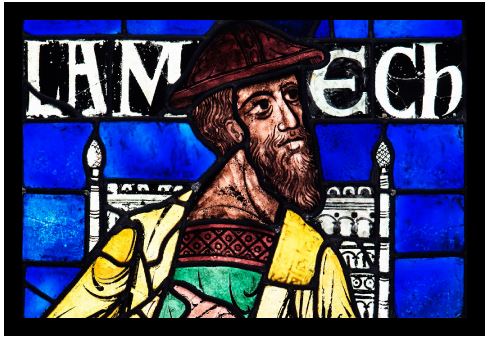
Lamech (detail), from the Ancestors of Christ Windows, Canterbury Cathedral, England, 1178–80. Images © Robert Greshoff Photography, courtesy Dean and Chapter of Canterbury

Lamech (detail), from the Ancestors of Christ Windows, Canterbury Cathedral, England, 1178–80. Images © Robert Greshoff Photography, courtesy Dean and Chapter of Canterbury

If you’ve never gotten to see Canterbury Cathedral, pop into Radiant Light before May 18 to see six magnificently restored Romanesque windows from this historic site, installed appropriately in the Romanesque Gallery near the entrance of The Cloisters.

It’s the first time any of stained glass windows from Canterbury have left home, so it’s a unique chance to gaze upon brilliant, beautiful works designed and made in 1178-1180 and think about the fact that these were seen by Chaucer and millions of pilgrims who trekked to this site over the centuries. Maybe during your trip to the wilds of Fort Tryon Park in northern Manhattan, you’ll act out your own CanterburyTales adventure.

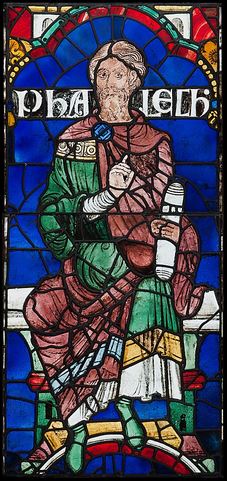
Phalech, one of Noah’s descendants, one of Canterbury’s original 86 stained-glass panels (1178-1780)

Phalech, one of Noah’s descendants, one of Canterbury’s original 86 stained-glass panels (1178-1780)

The Cloisters got the chance to display these medieval masterworks after a brief run at The Getty while the walls of the Canterbury Cathedral were being restored. Lucky us.

The backstory: After King Henry had Thomas Becket killed at Canterbury in 1170, word spread of miracles in 1171, the fastest canonization in history followed in 1173, and pilgrims began flocking to Becket’s former home. A fire in 1174 triggered Canterbury’s rebuilding and redesign, including the plan for an unprecedented series of 86 stained-glass windows to emphasize the connection of priests (versus kings) to Christ.

At the Cloisters, you will see six of the 46 surviving choir windows depicting the Biblical ancestors of Christ, as chronicled in the Book of Luke.

The patriarchs that you’ll meet uptown are Jared, a fifth-generation descendant of Adam; Lamech, the son of Methuselah and father of Noah, who lived during those sinful pre-Flood times; Noah, who appears to be talking to God; Phalec, who lived five or six generations after Noah; Thara, Abraham’s father who hailed from the ancient city of Ur; and Abraham himself.

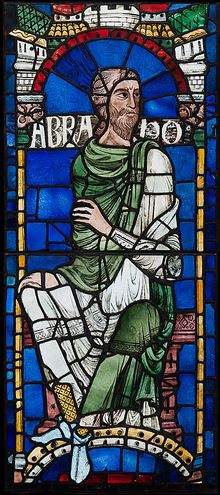
Abraham with his border back around him again after 200 years

Abraham with his border back around him again after 200 years

Several full-body portraits are reunited for the first time in 200 years with their original stained-glass borders, which mimic those of contemporaneous manuscript illuminations. Phalech’s portrait has a little less detail than the others, and the curators speculate that the artisans may have had to rush a bit to finish this monster-sized commission on time for the Archbishop back in 1180.

Spoiler alert: The faces of Thara and Abraham are 20th-century copies.

How were these painted? How were these  images made? The Cloisters points us the four-minute video below, created by London’s Victoria and Albert Museum to show how medieval artists created their magic.

Making a stained glass panel from Victoria and Albert Museum on Vimeo.

For other views of The Cloisters, see our Flickr album.