Contemporary Pueblo Architecture Honors Ancient Beliefs

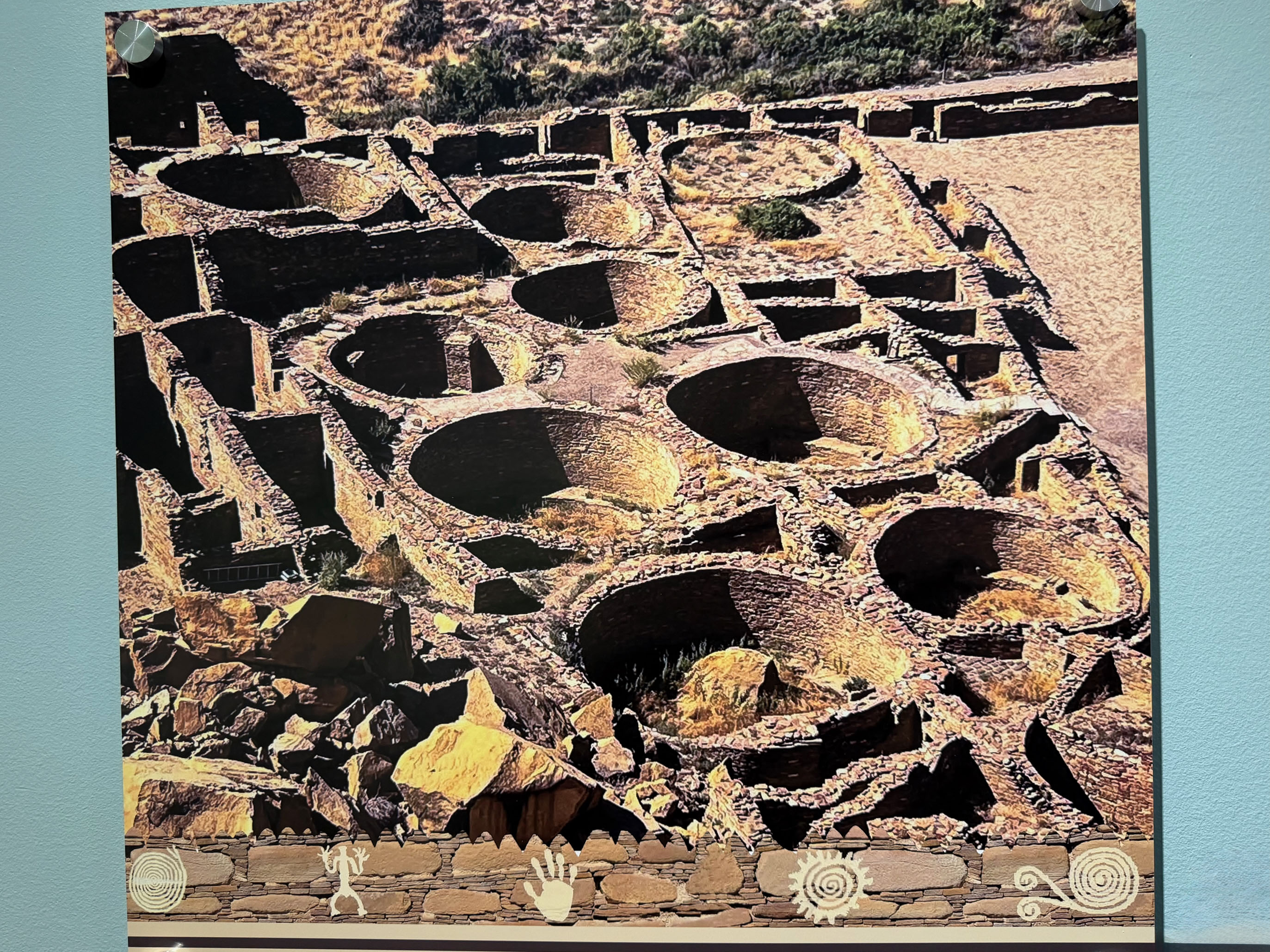
Any visitor to Chaco Canyon National Historial Park (850-1250 CE) makes the journey to appreciate innovative masonry of the Great Houses, the precision of the ancient road system, and the astronomically aligned walls, windows, and kivas. But how do contemporary Pueblo architects incorporate these traditional beliefs in their 21st century projects?

A fascinating, in-depth exhibition, Restorying our Heartplaces: Contemporary Pueblo Architecture – on view at Albuquerque’s Indian Pueblo Cultural Center through December 7, 2025 – explores how modern Indigenous architects incorporate traditional world views into their work.

2023 photo Kivas at Pueblo Bonito,Chaco Canyon by curator Ted Jojola (Islela Pueblo) showing advanced masonry and architectural concepts.

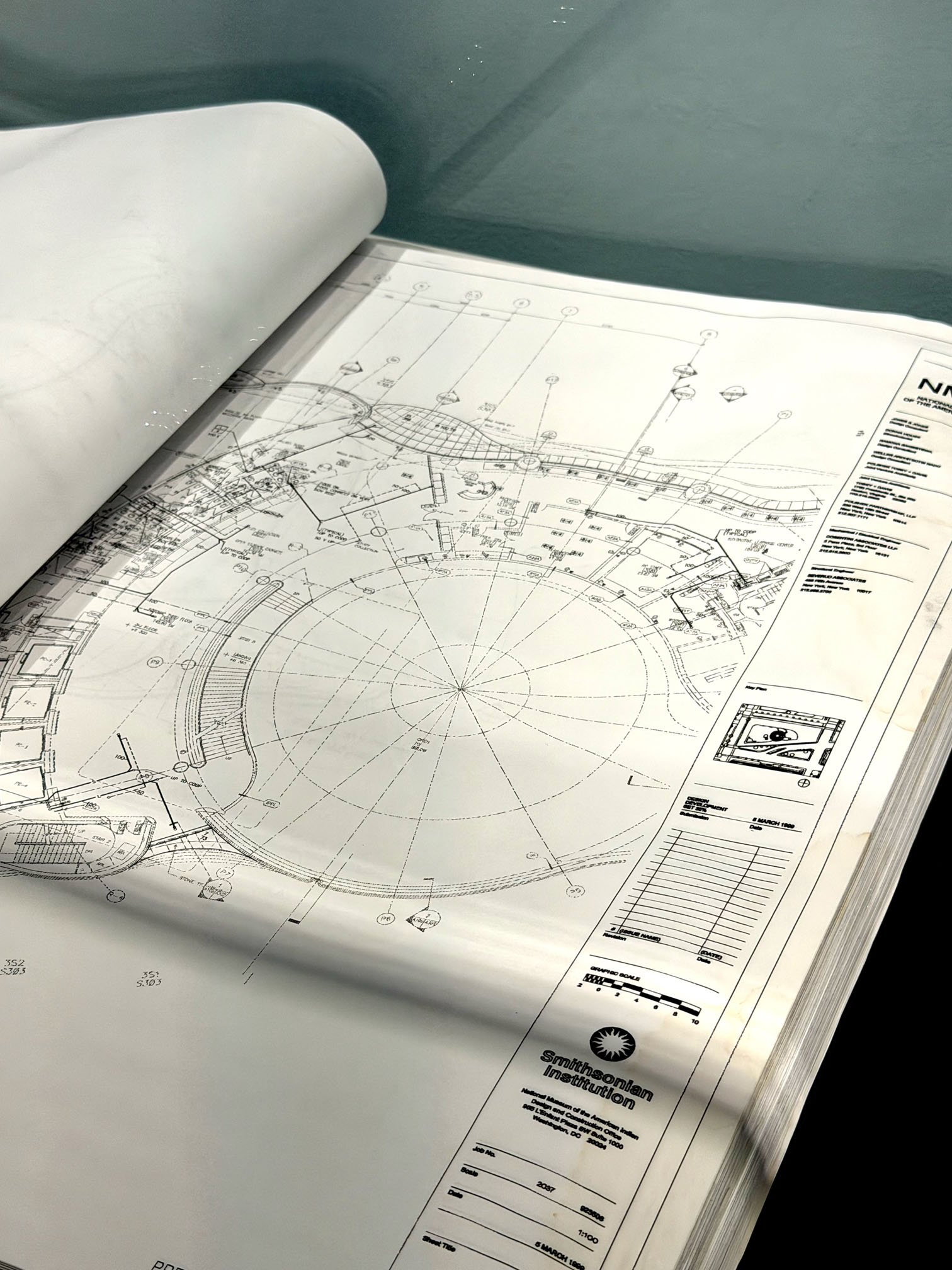
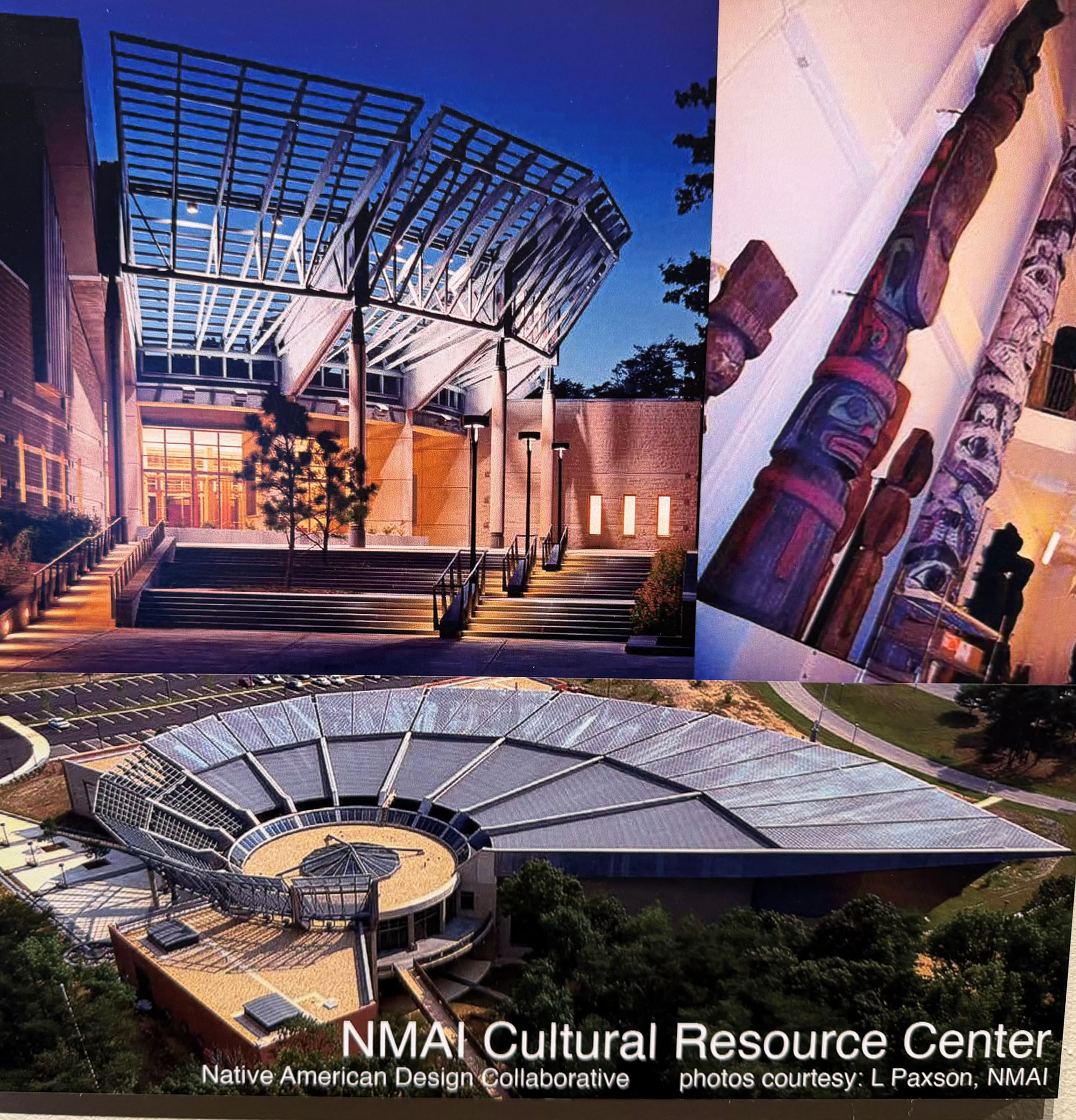
For example, just look at the design of the National Museum of the American Indian’s Resource Center – an organic design, aligned to the four cardinal directions, with extensive use of cedar wood.

1999 plans for the National Museum of the American Indian Resource Center. Courtesy: Ted Jojola (Isleta Pueblo)
Views of the 1999 National Museum of the American Indian Cultural Resource Center in Suitland, Maryland. Courtesy: Lynn Paxson.

This exhibition coincides with the 50th anniversary of the 1975 Indian Self-Determination and Education Assistance Act – legislation that shifted Native American policy in the United States from assimilation to self-determination. Tribes were now able to initiate and run justice, government, health and education departments of their own – a change that triggered a construction boom for new schools and administrative buildings.

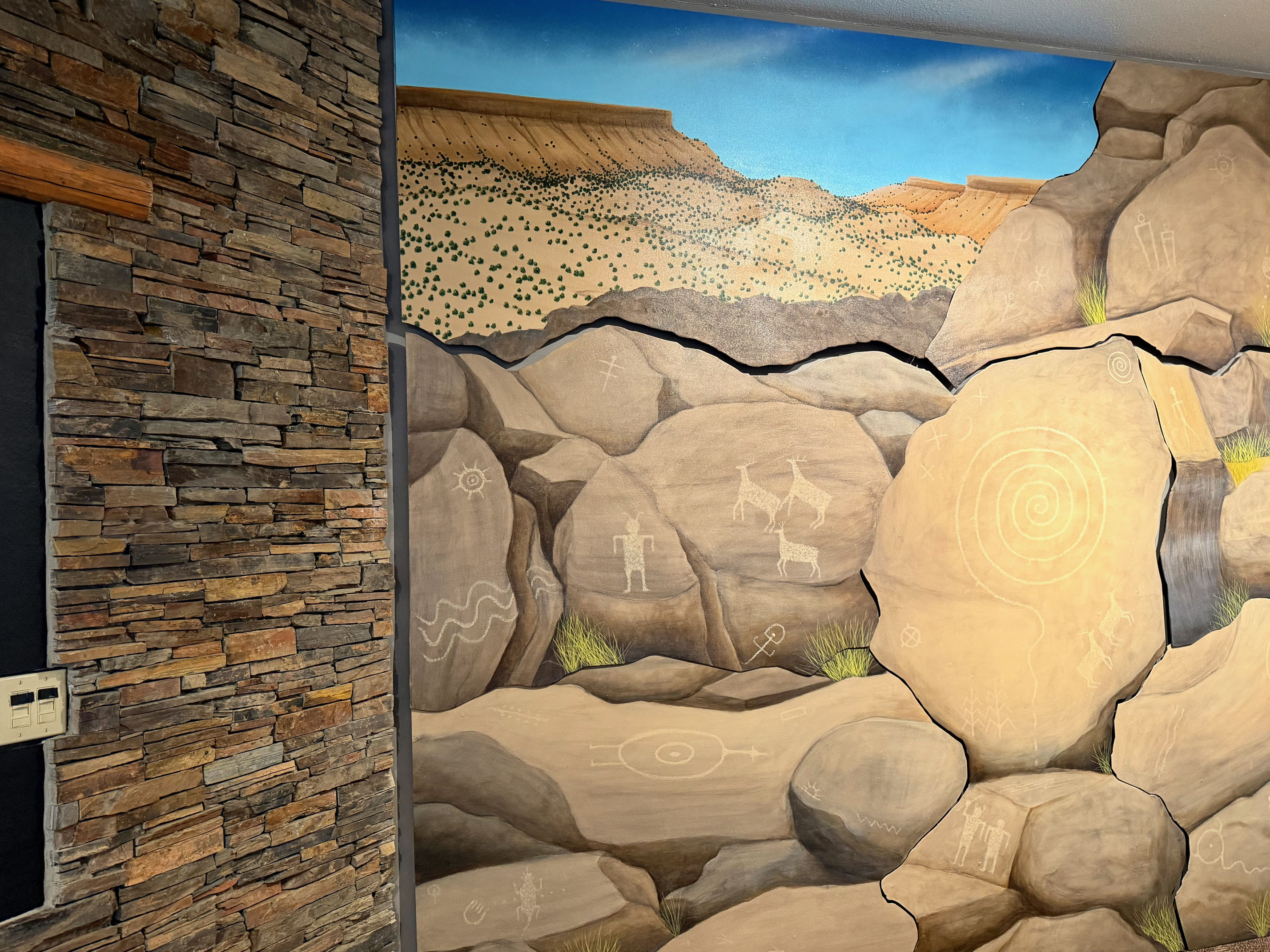
The show opens as an immersive experience in a large, circular gallery that introduces the core belief system and origin story of the Ancient Puebloans. Across a large screen in a vivid animation, the Pueblo people emerge into this world from a previous world. You watch them migrating outward in a spiral – symbols that are reflected across the art, murals, and photographs on the surrounding walls.

Mural by Dominic Aquero (Cochiti) with symbols of Pueblo creation; T-door represents the spiritual passage between two worlds (sky and Earth)

This experience sets the stage for the rest of the exhibition by showing how the stonework and beliefs reflected by the architecture of Ancient Puebloan centers points the way forward for Pueblo architects today.

2022 print by Gerald Dawavandewa (Hopi Cherokee) with T-shaped door for passage between worlds (sky and Earth]

The exhibition describes Ancient Puebloan architectural innovations – passive solar heating, precise window alignment, and masonry approaches. How did the Ancients achieve such precision in their dramatic Chaco and Mesa Verde buildings?

The curators present engineering and survey tools from archaeological excavations and modern survey backpacks side by side – plumb bobs, levels, and measuring devices.

Ancient stone and ceramic plumb bobs (from California and from Hewitt excavation at Rito de los Frijoles, Bandelier). Courtesy: Museum of Indian Arts & Culture/Lab of Anthropology.
Modern survey tools: level, tape measure, compass, brass plumb bob, wood, and string. Courtesy: curator Ted Jojola (Isleta Pueblo)

They also add comparisons of selenite used as window panels in Old Acoma’s Sky City (among the longest-inhabited communities in the US) and the contemporary architectural approach to windows in the recently built Acoma museum – a thoughtful reflection of the past

The exhibition directly addresses past HUD housing approaches on tribal lands – pushing suburban-style low-income housing, which moved families away from the traditional Pueblo plaza (the HeartPlace) and provided pitched-roof designs that blunted community cultural practices that utilized traditional Pueblo flat-roof construction.

The curators remind us of the continual upkeep required by adobe construction – a repeated communal task typically undertaken by a community’s women that happened on a regular, cyclical basis.  It’s also a reminder that Pueblo communities view buildings as living presences that evolve – not just concrete objects exist in a “finished” state.

Views of the 2000 campus for the Institute of American Indian Arts in Santa Fe. Courtesy: Paul Fragua (Jemez Pueblo)
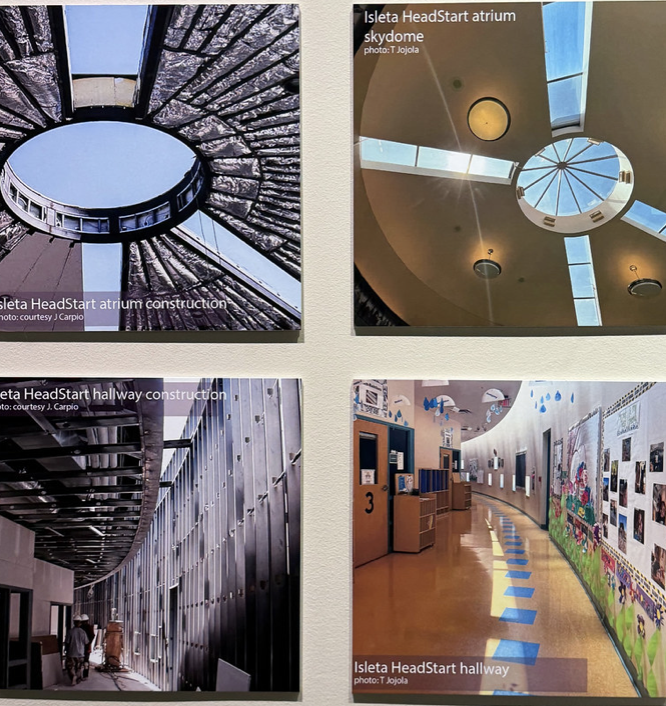
Views of 2004 building designed by Janet Carpio (Laguna/Isleta Pueblos) for Pueblo of Isleta’s Headstart/Child Care Center.

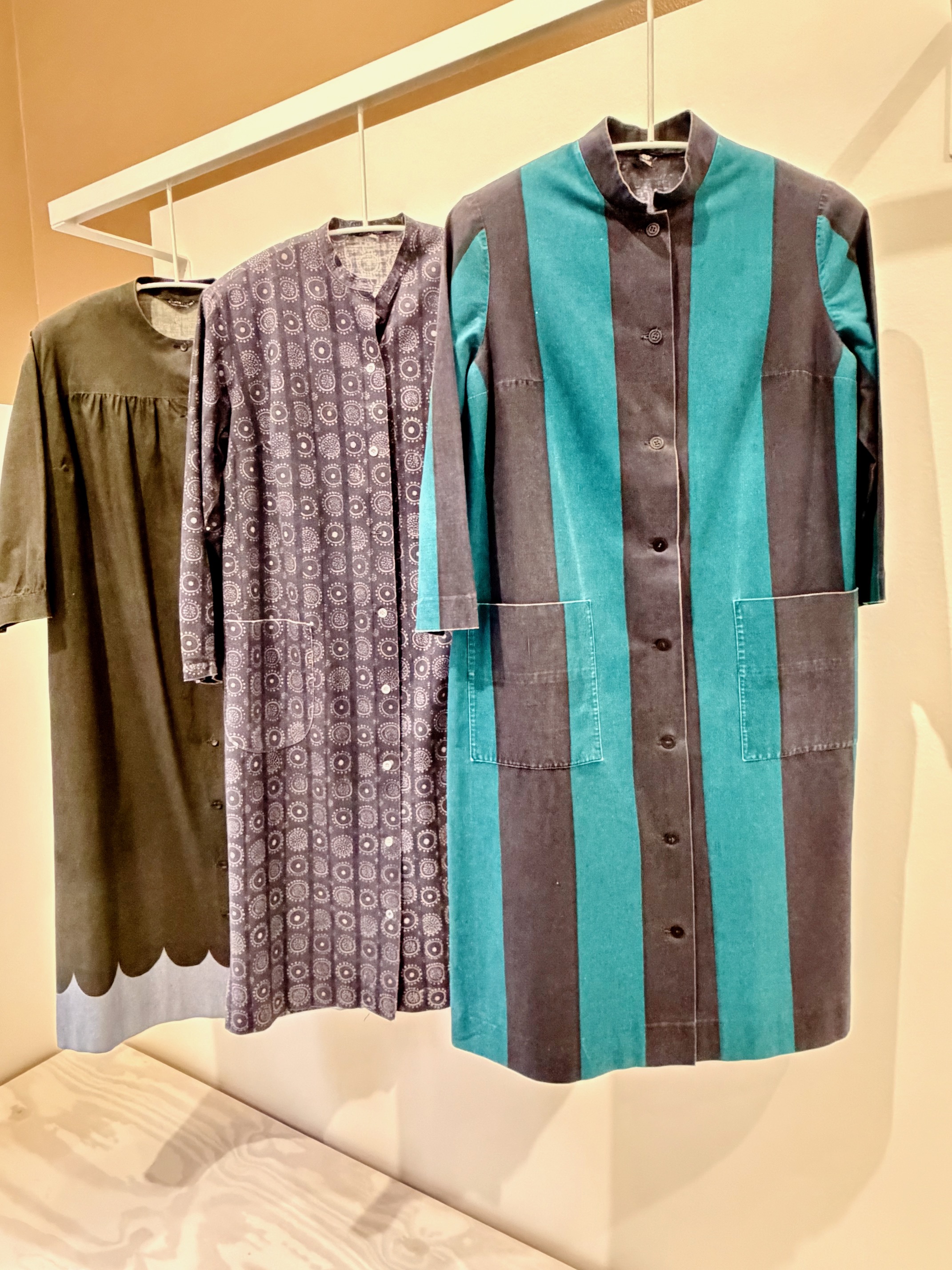
Wall panels, blueprint books, and architectural models are used to demonstrate the contemporary innovations of Pueblo architects – the Resource Center of the National Museum of the American Indian (1999), the campus of the Institute of Amercian Indian Arts in Santa Fe (2000), and the Headstart Child Care Center for Isleta Pueblo (2004). Both incorporate design elements echoing the spiral migration path, alignment to the cardinal directions, and colors and elements of the Earth.

A huge multimedia interactive theater punctuates the walk-through – an immersive visit to Acoma’s new Cultural Center and Haa’ku Museum with tribal members and designers explaining the architectural details and how the buildings reflect the landscape and traditional belief systems.

Immersive interactive experience of Acoma’s new Cultural Center and Haa’ku Museum. Courtesy: Anna Seed Productions, Electric Playouse, and UNM ASPIRE.

The exhibition features the work of the Indiginous Design and Planning Institute (iD+Pi) at UNM and presents dramatic architectural models of the past, present, and future of the community of Nambe Pueblo.

Look through the exhibition in our Flickr album here – a future-forward look at the continuing progression of innovative architectural designs and the next generation of designers and architects respecting and integrating the Pueblo world view with buildings considered to be living, breathing HeartPlaces for the community. 

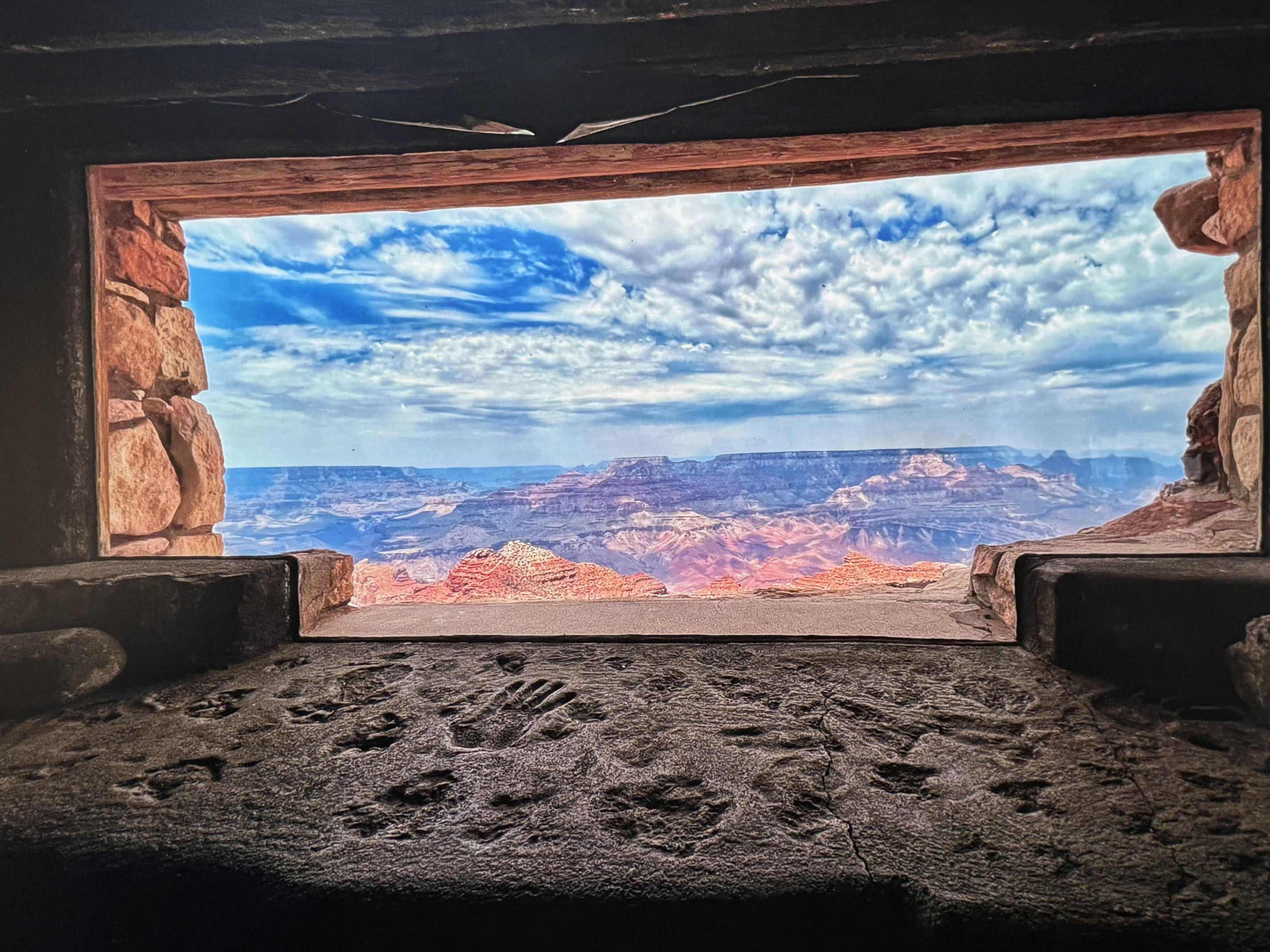
2023 photo by curatorTed Jojola (Islela Pueblo) North Window View from Desert View Watchtower, Grand Canyon showing the T-shaped doorway symbolizing passage between worlds

As the curators made clear in their opening-day remarks, a similarly extensive exhibition could explore architectural innovation and spiritualism across Navajo Nation. Let’s hope that happens!

Virtual NYC Museum Events – Broadway, Brooklyn, Karma, Kusama, and McQueen

New York museums are offering a full calendar of virtual events this week, including trips to Broadway history, hipster restaurants of the world, Buddhist virtual reality, and tributes to artistic genius. Take a look at the list here! Here are just a few highlights:

2002 Broadway revival of Rogers & Hammerstein’s Flower Drum Song

Do you miss Broadway? Learn about some little-known secrets behind hit shows today, Monday (April 12) at 5:30pm. It’s a rare chance to meet the president of the Rogers & Hammerstein Organization, Ted Chapin, who will be giving a behind-the-scenes look at the Great White Way in his program, From Follies to Flower Drum Song and Beyond. It’s the premiere of a conversation recorded last Fall with Broadway World’s Richard Ridge, courtesy of the New York Public Library for the Performing Arts at Lincoln Center.

Did this global restaurant trend actually start in Brooklyn? Find out with MOFAD and the creators of Global Brooklyn: Designing Food Experiences in World Cities.

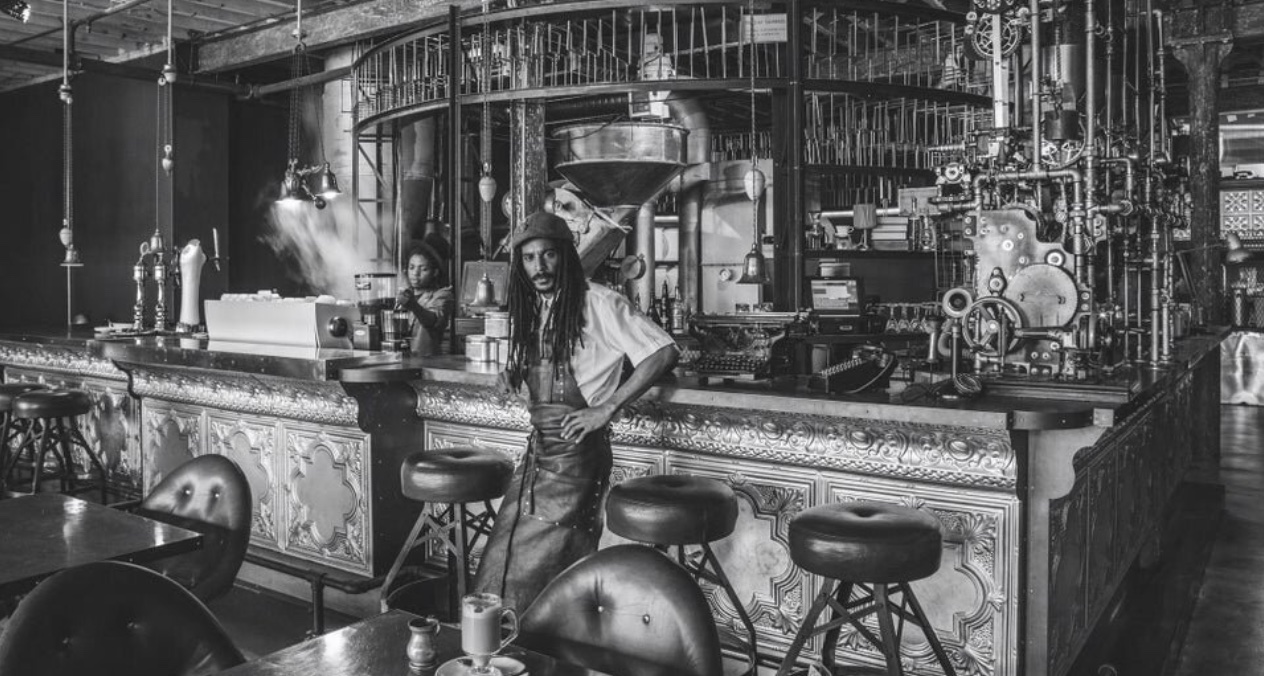
Love restaurants? Especially ones with slightly nostalgic post-industrial interiors decorated with that hand-crafted look? At 7pm, join the Museum of Food and Drink to meet the authors who explored how the Brooklyn aesthetic for How a Restaurant Aesthetic Became a Global Phenomenon. Learn how restaurants around the world adopted the style, and find out if this brand of hip actually started in Brooklyn.

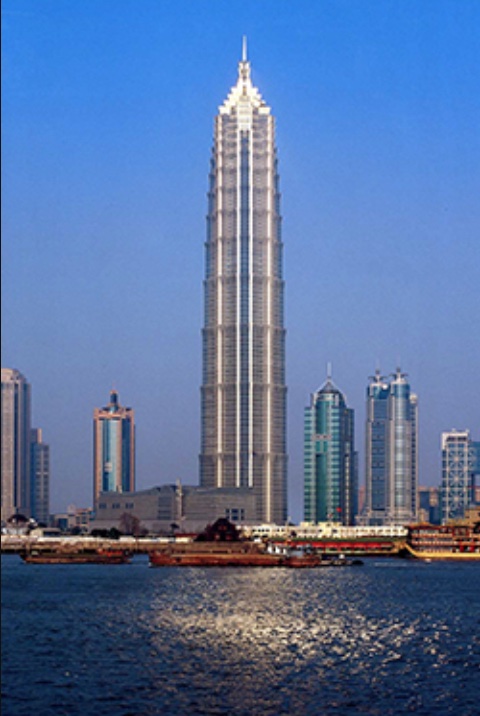
On Tuesday (April 14) at 6pm, join the architecture crowd at the Skyscraper Museum to hear Mark Sarkisian, the structural and seismic engineer who is a partner at SOM in San Francisco. Mark designed one of Shanghai’s first supertalls back in 1999. His talk Pivot to China: How Jin Mao Portended Future Supertalls will explain how this tower’s innovations influenced the generation of supertall skyscrapers that followed.

Shanghai’s Jin Mao tower, 1999
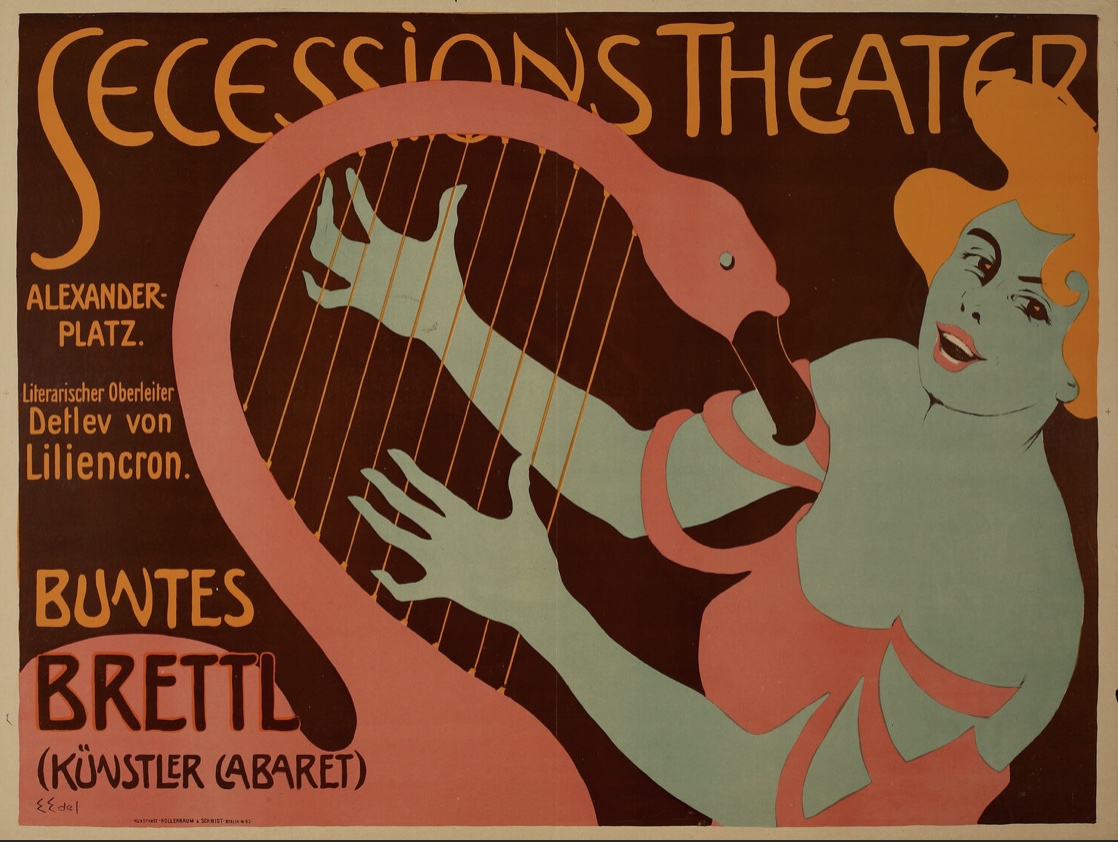
Berman Collection poster part of the Youth Style talk at Poster House.

On Wednesday (April 14) at 6:30pm, take a journey back to early modernist Europe at Poster House, who will be hosting A Tale of Three Cities: Youth Style in Berlin, Munich, & Vienna with the Kaller Research Institute. The evening will focus on how young designers made their mark on design from 1895 to 1910. You’ll see works from the Merrill C. Berman Collection (the collection featured at MoMA in Engineer Agitator Constructor), and works from the Poster House’s current Julius Klinger exhibition.

Also at 6:30pm – an opportunity to understand your karma. Join the Rubin Museum of Art for The Game of Life: An Interactive Virtual Experience. A contemplative psychotherapist will guide participants through a virtual Buddhist Wheel of Life to finding liberation from negative habits and patterns. The virtual game takes you throughout the different floors of the museum, and provides twists and turns. There are “Hell” and “God” Zoom rooms, but the payoff is higher awareness of one’s state of mind.

The Rubin’s reimagined Wheel of Life by eight graphic artists.
Kusama at New York Botanical Garden

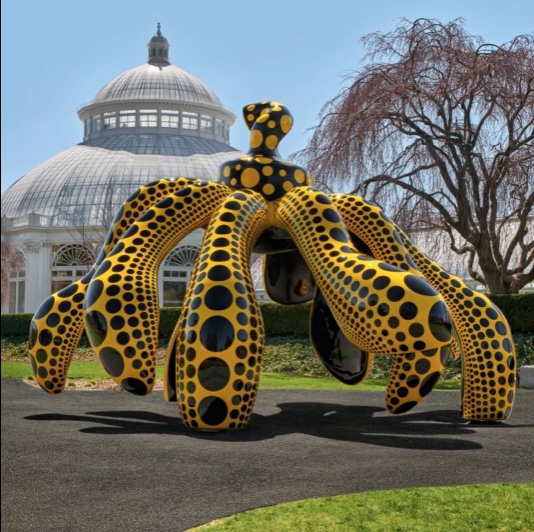
On Thursday (April 15) at 11am, it’s what all of New York has been waiting for! Mika Yoshitake, the curator of New York Botanical Garden’s KUSAMA: Cosmic Nature will provide a look at how Kusama’s blockbuster installation reflects nature, the earth, the microscopic, and the cosmos. Cosmic Nature: Embracing the Unknown will present Mike’s insights about Kusama’s artistic language and her unrelenting, lifelong journey into new territory.

McQueen models backstage, as photographed by Richard Fairer

Want to go backstage at a McQueen show? At 6pm you can. Join Vogue photographer Robert Fairer at Museum at FIT for a live Q&A about his new book, Alexander McQueen: Unseen. Experience memorable moments of fashion’s greatest, most outrageous showman and see what a genius at work backstage before the show.

There’s a lot more happening this week, so check the complete schedule. Most of the events are free, but it’s always nice to add a thank-you donation.

Virtual Museum Events – Julie Mehretu, Craft in Art, Viennese Lettering, and Niki de Saint Phalle

Kick off April by choosing from many virtual museum events about the latest art shows, women’s history events, and what’s happening here! Here are just a few highlights:
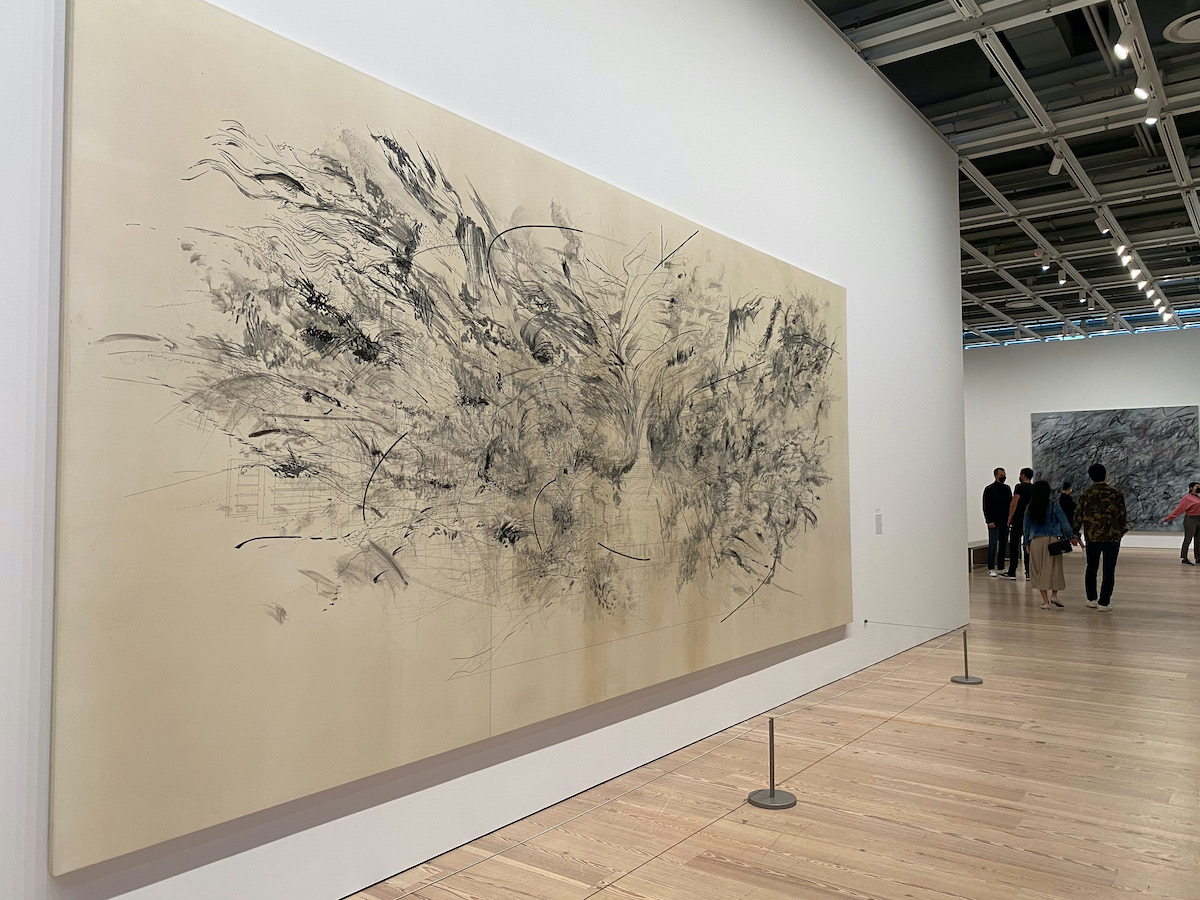
On Tuesday (April 6) at 6pm, meet Julie Mehretu at the Whitney Museum’s annual Annenberg Lecture. Julie will have a conversation with the Whitney’s director about how history, architecture, cities, protest, maps, and geography have influenced her work. Her magnificent mid-career retrospective is a must-see.

Julie Mehretu’s 2003 Transcending: The New International at The Whitney

Also at 6pm, the Skyscraper Museum presents Wright and New York: The Making of America’s Architect – an illustrated talk by Anthony Alofsin on how an early visionary design for a cathedral and skyscraper set the stage for the Wright’s later success.

At 6:30pm, bring your own pint to celebrate National Beer Day in this month’s Tavern Tastings series with Fraunces Tavern Museum and Connecticut’s Keeler Tavern Museum. The gals will tell you everything you ever wanted to learn about beer in 18th century taverns.

Simone Leigh’s 2008 Cupboard VIII in Making Knowing Craft in Art at The Whitney

On Thursday (April 8) at noon, join one of the Whitney’s teaching fellows in Art History from Home: Making Knowing to discuss how four artists use the materials and methods of craft to turn the idea of “fine art” on its head. Examples that you’ll discuss are selected from artworks featured in the Whitney’s expansive, fun exhibition, Making Knowing Craft in Art, 1950 – 2019. You’ll enjoy all of the twists and turns.

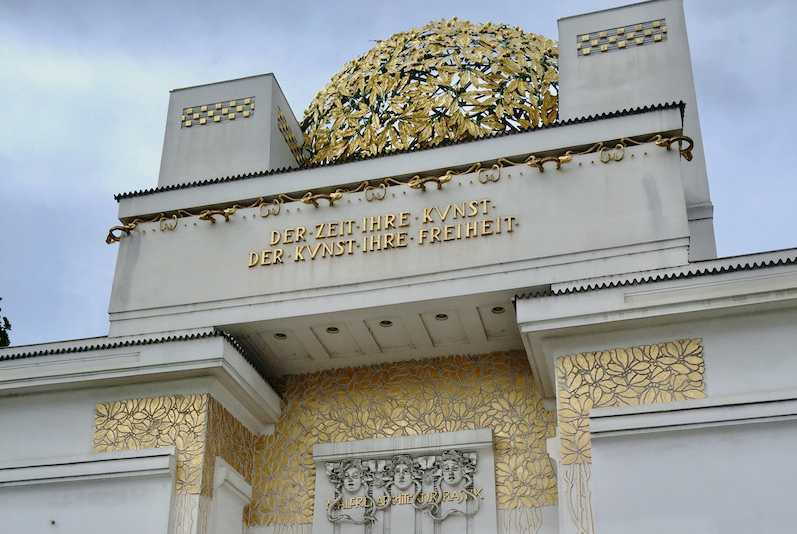
At 6:30pm, join Paul Shaw at Poster House for a tour of Viennese Lettering by some of the greats of the Vienna Secession movement. Paul will show examples of innovative lettering on posters, ads, and books and explain how all of this had an impact on artists of the Sixties and Seventies. The lecture is part of a series in honor of Julius Klinger: Posters for a Modern Age, currently on view at Poster House.

Letters on Vienna’s Secessionist Building – hear more at Poster House on Thursday

At 7pm, MoMA PS1 hosts Niki de Saint Phalle and the Art of Tarot to explore tarot’s influence on modern art and why the artist was inspired to create her monumental installation in Tuscany, Tarot Garden.

Niki de Saint Phalle’s life project in Tuscany, Tarot Garden.

There’s a lot more happening this week, so check the complete schedule. Most of the events are free, but it’s always nice to add a thank-you donation.

Museum Update

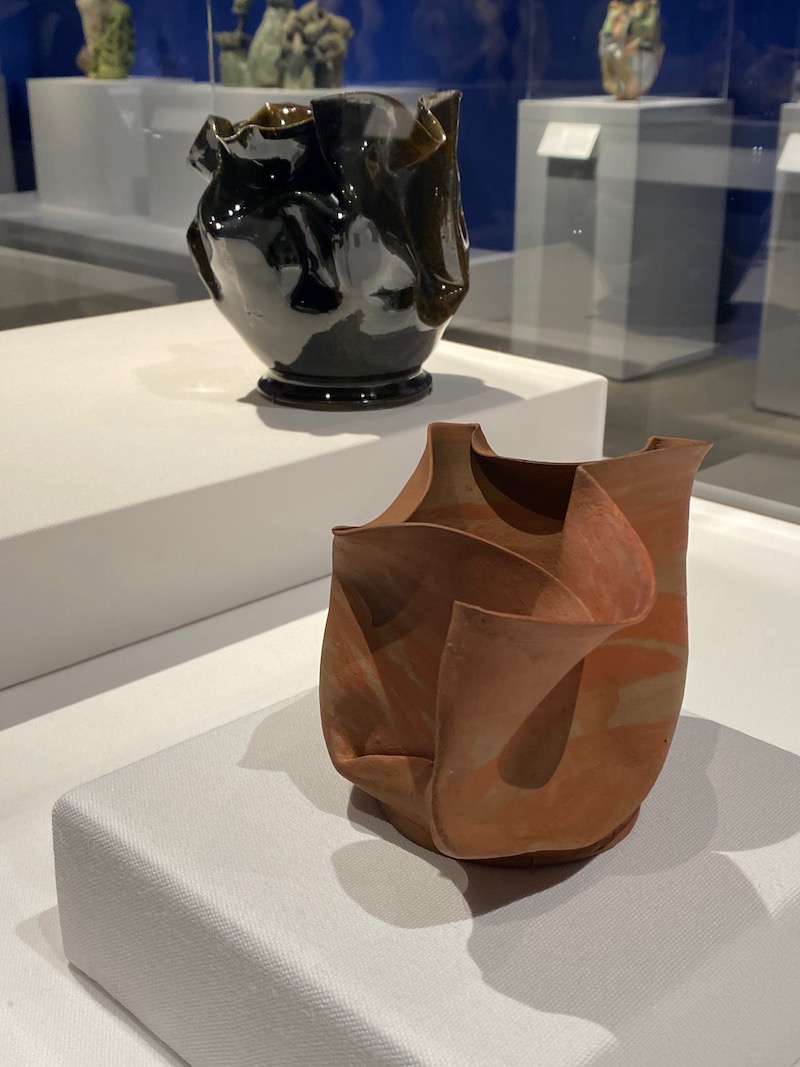
This week we checked out the new modern ceramics show at the Met, Shapes from Out of Nowhere: Ceramics from the Robert A. Ellison Jr. Collection, which showcases 75 works that are promised gifts to the Met. Among the highlights ­– several works by celebrated ceramicist George Ohr, whose late 19th century works predate midcentury shape, form, and abstraction. Lots of fans present when we visited. 

Rare George Ohr ceramics 1890–1900 in Out of Nowhere at The Met

Virtual Museum Events – New Show Tours at MoMA, The Whitney, Poster House, and American Folk Art

For Easter Week, you’ll have an opportunity to join online tours of the new architecture show at MoMA, Julie Mehretu’s retrospective at The Whitney, the Lincoln Center poster show at Poster House, and a look at visionary photography at the Museum of American Folk Art.  See the full list of activities this week on our virtual events page.

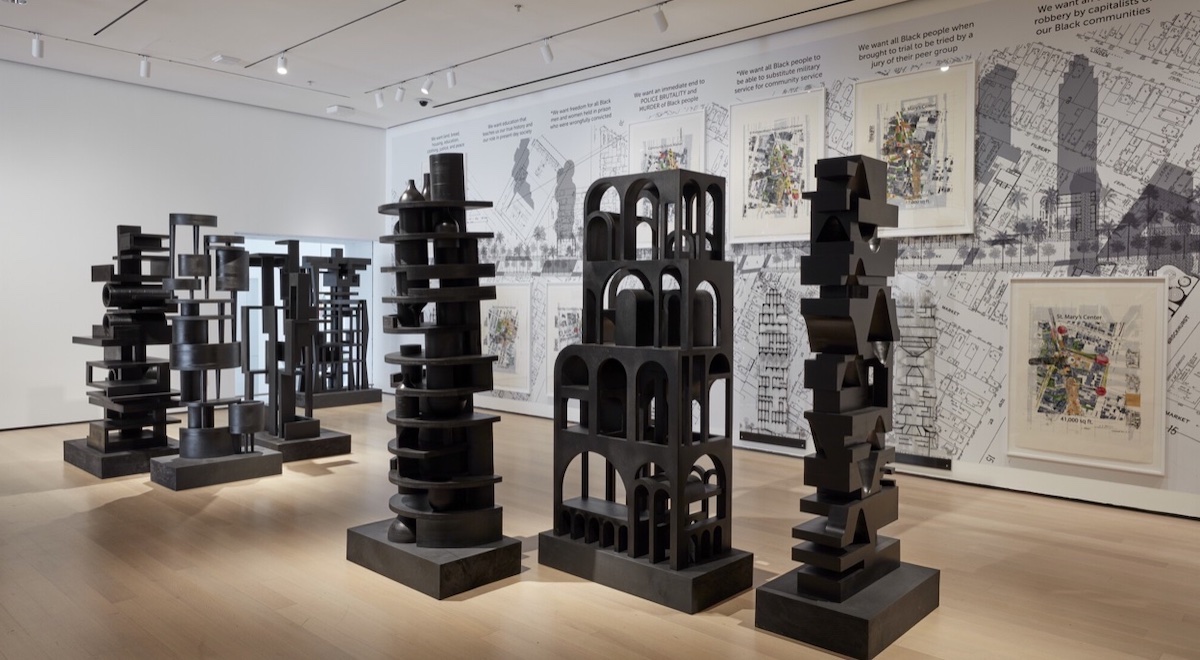
Today (March 29) at 6:30pm, join MoMA to hear a panel of high-powered Black architects and designers to discuss Cities and Spatial Justice – one of the themes presented in MoMA’s new exhibition Reconstructions: Architecture and Blackness in America. How are Black urban spaces created and protected? How do communities reckon with the past to create a future? Join in to participate in this timely discussion.

At 9pm, join the New Museum for a talk with Rachel Rossin, an artist whose work is part of World on a Wire, an online visual exhibition that is the first exhibition in a new partnership between Hyundai Motor Company and Rhizome, the museum’s digital art affiliate. The later (US) time was set to allow art lovers in Seoul and Beijing to join in at a reasonable time, too.

2_New Museum_Rhizome_Rossin

Rachel Rossin work at Hyundai Motorstudio Beijing and World on a Wire digital project.

On Tuesday (March 30) at 7pm, join a tour for the new Julie Mehretu mid-career retrospective at the Whitney Museum. See the giant, genius, multilayered canvases with the curator and find out how maps, revolutions, social justice, and architecture have inspired her to create such monumental works. (And for the tour of Julie’s show in Spanish, join the tour online at noon on Friday, April 2.)

3_Whitney_Mehretu_Invisible Line

Pondering Julie Mehretu’s Invisible Line at the Whitney

At 8pm, take a trip to Tokyo’s An’yo-in Temple to hear one of the earliest forms of meditative, chanting vocal music reimagined in a new work by the young composer. Japan Society, the University of Chicago, and Carnegie Hall present Shomyo: Buddhist Ritual Chant – Moonlight Mantra, followed by a live Q&A with the composer.

4_Japan Society_Chant_Shomyo

Traditional Buddhist chanting in Tokly’s An’yo-in Temple on Tuesday, courtesy of Japan Society and Carnegie Hall

The temple is created in a traditional method of joining wood without nails or glue, and ties into the society’s current exhibition, When Practice Becomes Form: Carpentry Tools from Japan.

On Wednesday (March 31), join Poster House for its program, For the Many: the Public Art of Lincoln Center, which is being held in association with the museum’s current exhibition, Vera List & The Posters of Lincoln Center. The program includes an introduction to Lincoln Center’s poster project – the landmark series pioneered by Vera List –and goes on to showcase the full range of public art commissioned for this New York cultural landmark.

Dorothy Gillespie’s 1989 Lincoln Center information center poster.

On Thursday (April 1) at 11am, take another trip to Japan to visit the Tokachi Millennium Forest ecological project on Hokkaido with experts from the New York Botanical Garden. Hear them talk about the master plan for this project, how they merged the “new Japanese horticulture” with wild nature, and how they created not only a beautiful garden but a gorgeous new book.

7_NYBG_Tokachi

Travel to the Tokachi Millennium Forest in Japan with NYBG and Dan Pearson and Midori Shintani

At 6pm, join the Museum of American Folk Art for a panel discussion (Re)Turning the Gaze, on the relationship of “the gaze” to gender, race, and sexuality. The panelists will feature photographs from the provocative current exhibition, PHOTO | BRUT: Collection Bruno Decharme & Compagnie.

Adam Pendleton at New Museum. Photo: Dario Lasagni

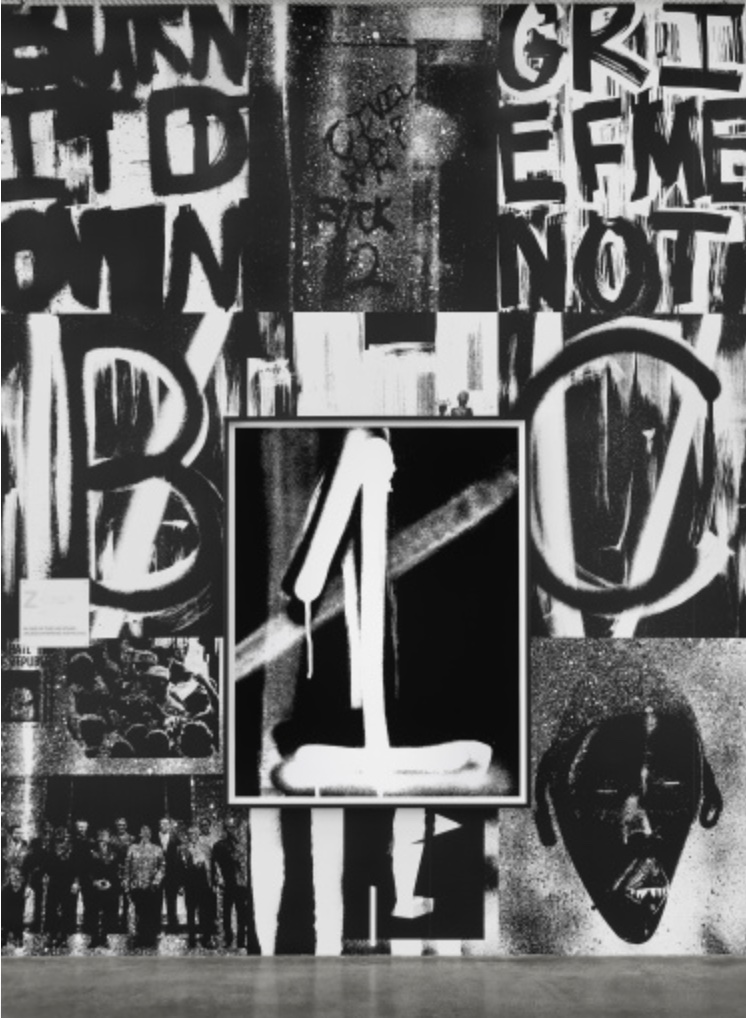
At 7pm, join the conversation at the New Museum with Adam Pendleton, who’s transformed the museum lobby into an exciting environment for the acclaimed Grief and Grievance: Art and Mourning in America exhibition. He often talks about “Black dada” – art that incorporates blackness, abstraction, and the avant-garde. If you can’t get to New York, take an online tour of the exhibition at 11am on Saturday, April 3.

There’s a lot more happening this week, so check the complete schedule. Most of the events are free, but it’s always nice to add a thank-you donation.

Museum Update

The crowds were at the Whitney to get their first look at the Julie Mehretu retrospective and to take a last look at the Kamoinge Workshop photographs from the Sixties and Seventies in the last weekend of Working Together. We saw lots of conversations and contemplations happening inside the Kamoinge gallery.  Although the show closed yesterday, the Whitney is offering one final virtual tour at noon on Thursday (April 1).

This past week, we went to the Met’s virtual opening of the Alice Neel retrospective, which is now posted online. Take a look.

We also joined MoMA’s online event with the Calder Foundation to take a closer look at the new exhibition, Alexander Calder – Modern from the Start.

The program is now posted on MoMA’s YouTube channel. Nearly 4,700 people have listened to Calder’s grandson Sandy Rower (and head of the Calder Foundation) shatter some Calder myths and show decades-old color 16mm film of Tanguy, Duchamp, and his grandmother hanging out with Calder in MoMA’s garden on 54th Street. (Don’t break that sculpture with the cat, Marcel!)

And while you’re on that YouTube channel, check out MoMA Virtual Cinema’s discussions with the directors, crews, and actors associated with some of their top picks for the film-awards season – Nomadland, Borat, Mank, Sound of Metal, and Minari.

Calder’s 1934 sculpture A Universe at MoMA

Weekly Virtual Museum Events – Green Book Trip, Willi Smith, Ice Cores, Revolutionary Design, and Museum Scavenger Hunt

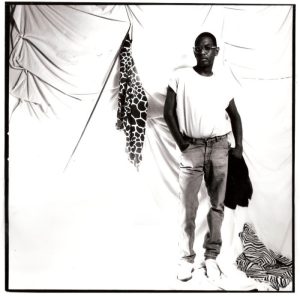
NYC fashion designer Willi Smith, ca. 1981. Courtesy: Kim Steele

Mark your calendars for any (or all) of fifty special on-line events sponsored by NYC museums, including a trip inspired by The Green Book, a tribute to a fashion designer who electrified runways in the Eighties, a look under Greenland’s ice, a Q&A on MoMA’s revolutionary design show, and a game-night trip to 18 American museums (with prizes!).

There are many other Black History Month events, discussions, art tours, and previews, so check the week’s listings on our virtual events page. For starters:

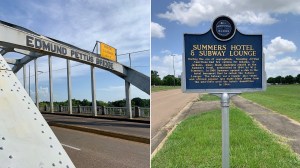
Sights along the road trip Driving the Green Book at MAD Museum Monday.

Today (February 22) at 6pm, hit the road with Alvin Hall, Janée Woods, and MAD Museum to learn about a 2,021-mile road trip that they took, inspired by the historic Green Book, which guided Black American motorists on family road trips for decades. The event will be an extension of their podcast, “Driving the Green Book” and feature lots of photos of what they found along the way.

CITIC Tower talk at the Skyscraper Museum

On Tuesday (February 23) at 12:30pm, join the Cooper-Hewitt in its tribute to Willi Smith, the beloved, exuberant fashion designer who dressed all the fun people in the Eighties. Since the museum has been shuttered nearly a year, few were able to see the Willi’s retrospective inside the Carnegie Mansion. So, our national design museum has declared “Willi Smith Day” so that it can shine a light on this historic Black designer for the world to see.

Get inside a supertall building. At 6pm, jet off to Beijing with the Skyscraper Museum and Robert Whitlock, the architect of the city’s tallest buildings. Hear about the design and construction of the CITIC Tower, whose shape is inspired by an ancient ritual vessel from China’s Bronze Age. This is just one of several upcoming talks at the museum on supertall buildings.

African Burial National Monument program at the Tenement Museum

Want to travel back a few centuries? On Wednesday (February 24) at 1pm, visit the Tenement Museum and the African Burial Ground National Monument for a talk on lifestyles of two African families living in old New Amsterdam. Using original source materials, you’ll get a fresh understanding of everyday life in mid-1600s Manhattan.

NYBG’s edible archway

At 6pm, take a trip around the country with a preview of the latest exhibition at the International Center for Photography. Join photographer-curator Paul Graham to walk through the exhibition But Still, It Turns: Recent Photography from the World. Celebrate unexpected journeys and enjoy the nondocumentary approach (no stories, just looking).

On Thursday (February 25) at 11am, start the morning with the New York Botanical Garden’s program with Leslie Bennett of Pine House Edible Gardens on creating gardens of sanctuary. Learn how she creates inspirational gardens that are organic and yield plenty of food, flowers, and medicinal herbs.

Icebergs now, but what happens if Greenland melts?

Thinking about climate patterns recently? Get a completely different perspective.  At 2pm, join a glacier scientist in Beneath the Ice at the American Museum of Natural History to learn what happens when Greenland’s ice melts. You’ll look at how ice core samples are taken, what they show, and how they are being used to predict what’s next with the climate.

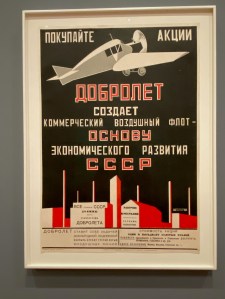
Rodchenko’s 1923 Russian airline poster at MoMA

At 8pm, visit revolutionary Russia and see what role designers played with Jodi Hauptman, MoMA’s senior drawings and prints curator, and Ellen Lupton, Cooper Hewitt’s senior curator. Angles, fonts, photos, montage, social issues, and politics will be flying fast and furious as Jodi and Ellen answer your questions about the lives and fates of the artists behind the hundreds of 1920s and 1930s ads, posters, brochures, and magazines showcased in Engineer, Agitator, Constructor: The Artist Reinvented­.

Haven’t you been dying to take a vacation? On Saturday (February 27) at 8pm, join the New York Historical Society and Watson Adventures for a live, virtual scavenger hunt that will take you to 18 different museums across America to search for clues among the history, art, and design collections. Get a team! Have fun! Win prizes!! Co-sponsored by the Museum of the American Revolution and Missouri Historical Society.

There’s a lot more art, history, and discussion, so check the complete schedule. Most of the events are free, but it’s always nice to add a thank-you donation.

Museum Updates

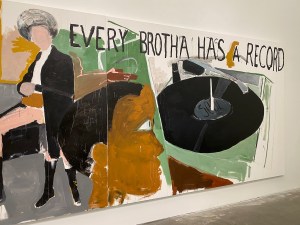
2020 painting by Henry Taylor at New Museum

We were able to get a ticket to the New Museum’s acclaimed exhibition this opening week, Grief and Grievance: Art and Mourning in America, and were happy to attend last week’s on-line curators’ panel (available here).

It’s a beautifully installed show, filled with top-notch painting, sculpture, music, performance art, and films that deliver on so many levels.

Still from Gone Are the Days of Shelter and Martyr, a 2017 video by ©Theaster Gates. Courtesy: White Cube and Regen Projects, Los Angeles

We’ll be reporting on this show soon, but in the meantime, we want to draw your attention to the weekly (and bi-weekly) panels that New Museum is offering on-line with many of the participating artists. This week, New Museum is speaking with South Side Chicago artist Theaster Gates, represented in the show by a performance video recorded in a church in the process of being demolished. Viewers inside the video gallery were mesmerized.

We’ll be featuring New Museum’s upcoming events on our weekly listing, but check out everything coming up over the next six weeks here under Conversations.

Virtual NYC Museum Events – Tarot, Japanese Pancakes, A Swiss Trip, and More Andre

Learn about tarot at El Museo del Barrio on Monday

Still snowing or freezing cold where you live? Escape with some great virtual NYC museum events this week – learning a little tarot, talking trends with celebrity chef Marcus Samuelsson, cooking soufflé pancakes, hanging out in a Swiss print studio, and joining MAD for a second night of conversation between Andre Leon Talley and Darren Walker.

Check the daily listings on our virtual events page. Here are a few highlights:

Marcus Samuelsson talks about art and cuisine at The Whitney on Tuesday

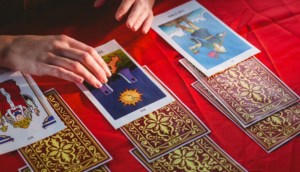
Want to see what the future holds? Today (February 8) at 4pm, see how to figure that out by popping in on Tarot 101 with Chiquita Brujita, courtesy of El Museo del Barrio.

On Tuesday (February 9) at 6pm, get in on a celebrity chef and art world mash-up when Whitney museum director Adam Weinberg speaks with culinary superstar Marcus Samuelsson about “Food, Culture, and What’s Next.” It’s free to listen in.

Visit Dafi Kuhn’s print studio in Switzerland with Poster House

At 7pm, if more practical kitchen projects are your thing, join Japan Society to learn how to make Japanese Soufflé Pancakes and be ready to whip out a special Valentine’s Day treat.

On Wednesday (February 10), why not run off to Switzerland and spend time with seeing the old-fashioned presses used by a cutting-edge designer to make astonishing work. At 6pm, join Poster House for a letterpress studio tour with Dafi Kühne.

At 8pm, join the Museum of Food and Drink for an evening of “Black Smoke,” a history of African-American barbeque. You know you want to meet these BBQ historians and find out why it’s all so good!

Tour PHOTO | BRUT at American Folk Art on Thursday

On Thursday (February 11) at 1pm, take a tour of the new photography show that is getting raves at the American Folk Art Museum – PHOTO | BRUT: Collection Bruno Decharme & Compagnie.

At 2pm, go behind the scenes with scientists at the American Museum of Natural History to learn what’s in the bone collection – one of the largest repositories of prehistoric life in the world.

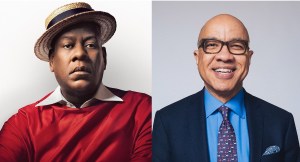
Talley and Walker meet again at MAD on Thursday

At 7pm at MAD Museum, it’s an encore performance!  Everyone thought the previous conversation between fashion icon Andre Leon Talley and Ford Foundation president Darren Walker was legendary.  So, the duo is back for a follow-on talk, with Leon asking the questions. See what everyone was talking about.

There’s a lot more history, art, and get-togethers, so check the complete schedule. Most of the events are free, but it’s always nice to add a thank-you donation.

Museum Updates

Kusama opens April 10 at NYBG

In case you haven’t heard, the New York Botanical Garden has just announced its opening date for its outdoor extravaganza withs the Queen of Dots – Kusama: Cosmic Nature opens April 10!  You’ll be able to see her new monumental works, her outside Infinity Room, and floral arrangements through October 31.

Walking into the Countryside and its Future at The Guggenheim

An innovative, continuous exploration about rural areas along the futuristic ramps

Want to go for a trip around the world? Visit out-of-the-way places? Meet interesting people?

There’s no better trip than hanging out with Rem Koolhaas and his think tank, AMO, in their all-encompassing exhibition, Countryside, The Future, on display at The Guggenheim through February 15.

It’s a colorful, engaging, data-driven, and provocative show that began as a response to the fact that population projections show indicate that in the not-too-distant future only 20 percent of people will live in the countryside.

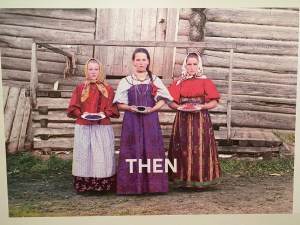
1909 photo of three peasant women in Kirilov, Russia

Rem, Samir Bantal of AMO, and their university collaborators believe that many of the most important, exciting, and radical innovations are happening outside cities, and this is their way of taking you there.

You’ll zip into the past, zoom into current village experiments, watch videos, and meet robots as you swirl your way up the Guggenheim’s ramps.

Listen to famed architect Rem Koolhaas explain the context for the project and research that make up this extraordinary experience:

As this promo notes, this exhibition opened just a few days before New York City and all the museum shut down to mitigate the pandemic. The team did not foresee the impact that the pandemic would have, but the exhibition could not be more of the moment.

1,000 Koolhaas questions about the countryside and society

In the audio guide, the curators say that you can view the exhibit like a buffet (just snacking on this and that) or dive in and read/see everything.  When we experienced Countryside, everyone was digging in, reading, watching, absorbing, and interacting with everything.

View part of the exhibition in our Flickr album.

The show begins with Rem’s 1,000 questions about the world and the future. He makes it clear that he and the team are not there to provide answers – that’s up to you.

How “countryside” has been equated with leisure since Roman times

There’s a walk through history on the next level by way of fun floor-to-ceiling collages filled with Romans from murals, Chinese people from scrolls, quotes, and fun facts – all to drive home the fact that for 2,000 years, major urban sophisticates have seized upon the idea that city people need to visit the country for peace, quiet, contemplation, leisure pursuits, and artistic inspiration.

The history walk continues by exploring Marie Antoinette’s decision to create a rural “hamlet” on the Versailles grounds, the desire of Sixties Hippies to create communes in the country, and the emergence of today’s rural “wellness” spas and retreats.

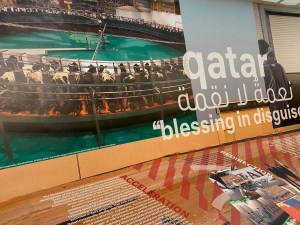
Qatar’s solution to achieving national food security after the June 2017 border closure

The story continues by presenting details about efforts by famous political leaders to “redesign” their countries rural regions on a large scale – Jefferson’s adaptation of the 640-acre grid for developing the West, how the Soviets scaled up collective farming, FDR’s “shelterbelt” policy to minimize soil erosion in the Thirties, and the agricultural emphasis in Mao’s Cultural Revolution.

The most startling story is how Qatar, which imported the majority of its food, did years of research into ways it could be self-sustaining. When the Saudis jammed Qatar’s border in 2017, the country already had a plan. Within 36 hours, it airlifted in 4,000 cows and milking machines, a move that immediately (and successfully) started its domestic dairy industry.

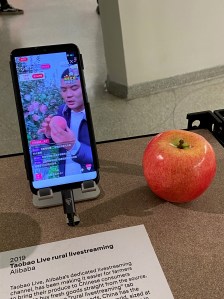
Chinese service that lets city dwellers select apples from trees

The exhibition takes you to villages in China where interesting things are happening – a dying farming town that transformed itself into a “wellness” tourist destination, and an apple-growing region that uses livestreaming on mobile phones to let city-dwellers pick out the specific apples that the villager will pick and ship to them overnight.

The exhibition includes mini-galleries on the move to “preserve” nature, presenting facts and posing land-use questions related to mountain gorilla habitats in Central Africa, permafrost melts that are exposing mammoth fossils, and American billionaires buying and preserving Patagonian land.

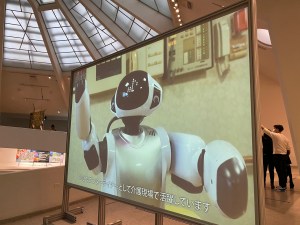
Humanoid PALRO robot from Fujisoft in action

The top floor is alive with roaming robots powered by Roombas, who invite you to enter mini-theaters to see worlds beneath the ocean, developments of industrial facilities run completely by robots, and vast expanses of industrial-level agriculture. You’ll even meet PALRO, Fujisoft’s humanoid robot who hangs out with seniors in Japan, and Prospero, a little robot farmer that’s designed to work in swarm teams.

Hear all about the research and collaborations behind the exhibition and how the exhibition design brings it all to life:

To take a leisurely stroll through the future, listen to the audio guide.

For the full report, purchase the book (a steal at $12).

Virtual NYC Museum Events – Harlem Heavyweights, Design Disrupters, Rap History, and Gulla Cooking

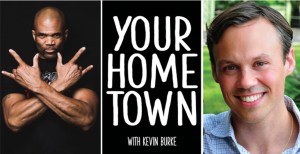
Darryl McDaniels of Run-DMC talks with Kevin Burke at MCNY

Despite the massive nor’easter moving through New York, we’re assuming that the virtual NYC museum events are happening as planned – an opportunity get behind the scenes of New York’s hottest photography show, visit a West Coast design archive, meet a Rock legend, and dive into historic Southern cuisine.

Check the daily listings on our virtual events page to for these events and details on many, many others.

The Kamoinge workshop show at The Whitney. Meet the artists this week.

We want to alert you all to the upcoming opportunities that the Whitney is offering to showcase the photographers and work featured in Working Together: The Photographers of the Kamoinge Workshop. On Wednesday (February 3) at 7pm, you can meet the Kamoinge artists live and hear them talk about how Harlem influenced their work. On Friday (February 5) at 3pm, see which artists used “the body” for inspiration and which contemporary photographers take on similar themes.

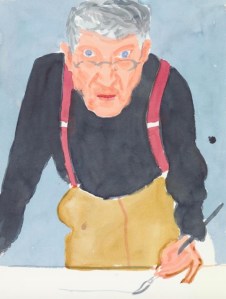
Two tours of the Morgan’s David Hockey show this week.

Also, just a reminder that there are two opportunities to walk through the Morgan Library’s David Hockney life-drawing show – on Wednesday, February 3 at 3pm and on Thursday, February 5 at 12:30pm.

Here’s how the rest of this week will shape up, with just a few suggestions (see the entire list here):

On Tuesday (February 2) at 4pm, take a trip to California with the Poster House to hear Letterform Archive’s Stephen Coles talk about (and show examples of) what happens when graphic designers break the rules of what typically constitutes good design.

Close-up of Swiss grid at Poster House. What happens when designers ignore it?

At 7pm at the Museum of the City of New York in the Your Hometown series, meet Rock and Roll Hall of Famer Darryl McDaniels of Run-DMC who will talk about growing up in Queens during the Sixties and Seventies and how the lessons learned contributed to becoming a rap icon atop the music industry.

On Wednesday (February 3), you can join two programs that take you inside museum collections and exhibitions to ask questions about how indigenous cultures and artists are represented, and what is changing.  At 6pm at Bard Graduate Center, hear about “Indigenous Arts in Transition” from two Native American curators in Minnesota and Oklahoma.

Boy’s hide shirt made by female Crow artist in 1870-1900 displayed at the Met in 2017

At 7pm, join the SciCafe crowd for a talk and Q&A on “Museums and Race” at the American Museum of Natural History that has a long (and current) history of grappling with these issues. Anthropologist Monique Scott will focus on African objects in the collection in New York and other museums around the world.

At 8pm, join the Museum of Food and Drink (collaborating with the Smithsonian Folklife Festival) for a fun dive into regional cooking in “Sustaining Gullah Geechee Cooking across Land and Sea.” You’ll hear a fascinating migration story told through food and learn how to make crab fried rice.

There’s a lot more music, science, and get-togethers, so check the complete schedule. Most of the events are free, but it’s always nice to add a thank-you donation.

Museum Updates

Toxic Titan program at the AMNH Hayden Planetarium last week was a hit

We dropped in on fun virtual events last week at the AMNH, Fraunces Tavern Museum, and the NYPL’s discussion with Amber Ruffin, and couldn’t have enjoyed them more!

The Toxic Titan show with the Hayden Planetarium crew had nearly 400 viewers from around the world!  Congratulations to the virtual team, who even un-muted everyone to give the crazy-good speaker a live round of virtual applause!

Get to the Guggenheim by February 14!!

Before the storm hit, we were able to visit the Guggenheim to see Countryside, the Future, the spectacular show by AMO/Rem Koolhaas. Although the curators say you can either breeze through or read through it slowly, the crowds were definitely making the most of their time and digesting everything – the history of our obsession with country and leisure, the ways 20th-century leadership tried to reshape vast swaths of their countries, and the efforts going on today to reimagine non-urban environments in Africa, the Middle East, the Arctic, and everywhere.  It’s a must-see. Two more weeks.

Online Museum Events – Cheese Tetrahedrons, Exoplanets, and a Virtual Pub Crawl

Coqui is fun to make and delicious! Try it Tuesday with El Museo del Barrio

New York City museums are pulling out the stops on their pre-Christmas on-line offerings with craft workshops, food tastings, and pub history. Find the daily listings for everything on our virtual events page.

El Museo del Barrio hosts several bilingual events this week as part of the new series, El Barrio en Tu Casa, including a cooking class (direct from Puerto Rico!) with Chopped Chef Santana Benitez (6pm today Dec. 14) and a coquito-making workshop  and social with Jonathan Rivera (Thursday, Dec. 17).

Join the Noguchi and Buckminster Fuller event on Monday

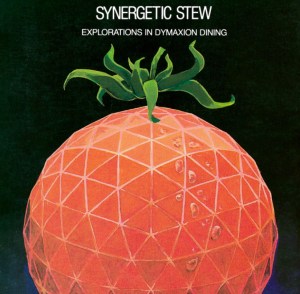
Why not mix food, architecture, and design? At 7:30pm today, the Noguchi Museum will host a session on the “Dymaxion Dining” cookbook that honors Buckminster Fuller, talk about baking Geodesicandy, and show how to make Cheese Tetrahedrons.  Bring your own knife, block of cheese, ruler, and cutting board!

MetLiveArts presents the beautiful Monteverdi Vespers of 1610 with the Handel and Haydn Society at 7pm on Tuesday (December 15), and follows up with its regularly scheduled Friday concert with ETHEL (virtual music on the balcony).

Kepler-1652 b, a super-Earth exoplanet [JPL-Caltech/T. Pyle/NASA]

On Wednesday (December 16) at noon, you can join the cool kids at the Hayden Planetarium in “Hot Takes on Cool Worlds” to find out the latest on exoplanets (4,000 and counting!).  The program will feature planetary atmosphere expert Laura Kreidberg of Heidelberg’s Max Planck Institute for Astronomy (MPIA), who will discuss whether planets (like Kepler-1652 b) are habitable and explain approaches to future research.

Later that day at 8pm, you can join the Museum of Food & Drink and WNYC’s The Green Space for a super-fun holiday-themed Filipinx cooking demonstration, conversation, and a little Karaoke (a revered Filipino holiday tradition) – all part of MOFAD’s Food for Thought speaker series.

Serving it up at Charlie’s Tavern, New York in 1946

You can close out the week with a Friday night virtual holiday pub crawl with pub buffs from the New-York Historical Society. They’ll send you a list of libation recipes spanning New York’s 400-year history, and spin you off into hang-outs to discuss, compare, and tell tales of favorite bars.

Many more programs are on the schedule, so register for as many of the topics and events that you can fit into your schedule. Most of the events are free, but it’s always nice to add a thank-you donation.

No Monolith but Judd’s Works at MoMA Deliver the Power

1968 stainless steel and Plexiglass tower (Froehlich Collection)

For anyone lamenting the disappearance of the Monolith and yearning to experience its minimalist magic, walk through MoMA’s Donald Judd retrospective before January 3 to understand how big, gleaming, super-sleek objects create such electrifying force fields.

Initially, journalists speculated that the Utah Monolith was the work of West Coast artist John McCracken. It wasn’t, but Judd was one of McCracken’s art-world heroes – a master who reveled in pure shape, pure color, and (when he wanted to) pure transparency. Judd also built repeating rectangles (seemingly not created by human hands) in remote western landscapes (Marpha, Texas).

On MoMA’s top floor, you’ll encounter wide, open spaces with spare, clean hard-edged objects inhabiting four galleries.

1964 construction of orange pebbled Plexiglass and hot-rolled steel. Private collection.

In the first room, you’ll see cadmium-red shapes from the early Sixties that Judd made in his Soho studio. The idea was to remove any gestures or evidence of craft in the work – just present the pure painted shape.

But to get the perfection he craved, Judd went one step further – engaging industrial fabricators to create large-scale works from his meticulous drawings. Industrial materials like aluminum, iron, and Plexiglass are transformed into magical rectangles, epic towers, and airy channels. See our favorites in our Flickr album.

In each gallery, visitors are invited to circumnavigate and explore the monumental works. One orange box seems to glow; another has a transparent surface that lets you peer inside. An enticing series of blue and silver boxes seem to let you peek through to an entirely different dimension.

1969 “channel” of aluminum and Plexiglass units (Saint Louis Art Museum)

Towers emerge from walls in each room – neat stacks of monumental rectangles, separated by exact amounts of space. It’s quite a sensation to approach one, look up, and feel its commanding presence. One silver tower seems to be emitting yellow light. A copper tower gleams a little from a subtle spotlight.

Judd wanted it this way – no interpretation. Just you and the large, beautiful, perfect form, as this short video demonstrates:

MoMA cautions visitors to remain at least six feet away from each of the works, but most admirers are cautious and reverent, taking it all in and giving everything its space.

Here, curator Ann Temkin talks about Judd’s work and the joy of bringing such a monumental exhibition to New York:

Take a trip through the installation on MoMA’s website here, and hear artists describe their experience of the show here.