Inhale…The MAD Exhibit They Won’t Let You See

JickeyThere’s nothing to see…only to experience…in The Art of Scent 1889-2012 currently at the Museum of Art and Design. Designed by Diller, Scofidio + Renfro, the exhibition space is completely bare, save for gentle depressions pressed into the wall where visitors can lean in and experience fragrances considered masterworks of innovation and complexity.

Thank you to curator Chandler Burr for paying tribute to the artists that created these scents. The earliest is Jicky, created by Guerlain in 1889 when the Eiffel Tower was on the rise, the first designer fragrance to use synthetic components.

Walking through these design innovations is an experience you won’t forget. Can you tell that a 1980s fragrance was inspired by the smell of laundry detergent (the essence of “clean”)? Do you agree with Prada’s 1990s take on the romanticism of the 19th century? Do you think Untitled by Daniela Andrier for Margiela in 2010 combines “excitement and unease”, as MAD purports?

MAD has many videos to let you in on the process behind the ephemeral. Listen as Jean-Marc Chaillon discusses what it’s like to create something that can’t be touched:

Ever wonder about the work that goes into designing a celebrity fragrance? Listen in on this enlightening and entertaining curator’s panel on the design and structure of olfactory art:

Look Up to See Where Your Grandmother’s Clothes Came From

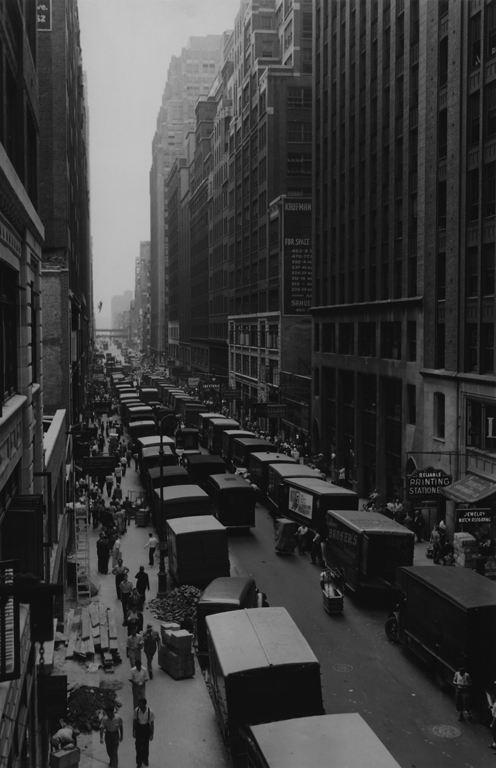
West 35th Street in 1938, looking east between Seventh and Eighth Avenues. Source: NYC Department of Records, Municipal Archives

West 35th Street in 1938, looking east between Seventh and Eighth Avenues. Source: NYC Department of Records, Municipal Archives

It can seem a little quiet walking over to Mood these days. Not too long ago, the streets above 34th Street between Sixth and Eighth Avenues were clogged with push boys, wheeling racks of  materials, trims, and fashions among jobbers, contractors, accessory importers, fabric stores, and showrooms. The way it used to be comes alive in the Skyscraper Museum’s show (closing today) Urban Fabric: Building New York’s Garment District.

In its heyday, those 18 blocks just north and west of Macy’s produced 75% of all US women’s and children’s clothes.  The exhibit tells the story of how this bustling hive happened.  In a nutshell, the old sweatshops in tenement buildings gave way to factory loft spaces in the 1890s around the area where NYU is today. When the big department stores emerged along Sixth Avenue and 23rd Streets, the lofts came with them. But the congestion proved to be a bit much for the female shoppers, who were disturbed by the throngs of guys loitering about on their lunch breaks, and the retailers took action.

The department stores (like Macy’s and Lord & Taylor) moved above 34th Street. To prevent the factory lofts from overwhelming them again, the City implemented the first zoning ordinance in America in 1916. The garment makers, closed out of the fancy retail neighborhood, started razing the Tenderloin District on the West Side and erecting architect-designed skyscrapers (like the Fashion Tower on West 36th) from that point on. About 125 buildings went up on those 18 blocks before the Depression hit.

Here’s a glimpse of what it was like in 1952:

As recently as the 1970s, carts were still being shuttled through the narrow streets, but we know how that story ended.  Today, no one even looks up at the entrances, set-backs, lobbies, or embellishments of these once grand hubs where models, marketers, Mad Men, laborers, seamstresses, teamsters, pattern makers, the designers co-mingled.

Interestingly enough, not a single building is landmarked. In fact, the Skyscraper Museum had trouble even finding photographs of the original buildings and had to turn to historic adverts and early brochures on factory electricity.

For the full, fascinating story by the curator who unearthed it all, listen to Andrew Dolkart of Columbia University, and watch his slide show:

Interns and staff built a nice model of the buildings lining 37th Street for the show, and a big thank you to The Skyscraper Museum for (again) putting the history and installation walkthrough on line. Tell your friends, and be sure to look up next time you walk over to Mood.

If You Love Brooklyn, Get to GO!

Installation view of Yeon Ji Yoo’s The Fight (2012), made of paper, paper pulp, acetate, glue, packing tape, cheesecloth, plastic flowers, recycled plastic bottles and bags

Installation view of Yeon Ji Yoo’s The Fight (2012), made of paper, paper pulp, acetate, glue, packing tape, cheesecloth, plastic flowers, recycled plastic bottles and bags

Tucked away in the Mezzanine Gallery on the second floor at the Brooklyn Museum is a valentine to the borough, its artists, and the support and love they received last September in Go: A Community-Curated Open Studio Project. It mixed trudging around Brooklyn, democracy in action, and high-tech to peer into other worlds right in our own backyard.

The museum commissioned an app, asked artists to open their studios, and invited the world to visit and vote for their favorites. (Apparently, it was inspired by an art competition organized out of Grand Rapids!)

GO tracked the art makers and art seekers – take a look at the “weekend activity heatmap” and the other GPS-gathered stats. The results showed a lot of love – 18,000 visitors making 147,000 studio visits to about 1,700 artists over a two-day period, or about eight studio visits per participant. See the raw data for yourself, broken out by neighborhood. Learn a bit more about the voters here.

Art lovers nominated 9,457 artists for a museum showing, and eventually voting and curators whittled it down to five spectacular representatives. Interestingly, four on display were born outside the United States.

Yeon Ji Yoo of South Korea, currently lives in Greenpoint and works in Red Hook. The large installation piece in the show is inspired by her grandmother’s fading memory. Listen as she talks about growing up in South Korea’s rural countryside:

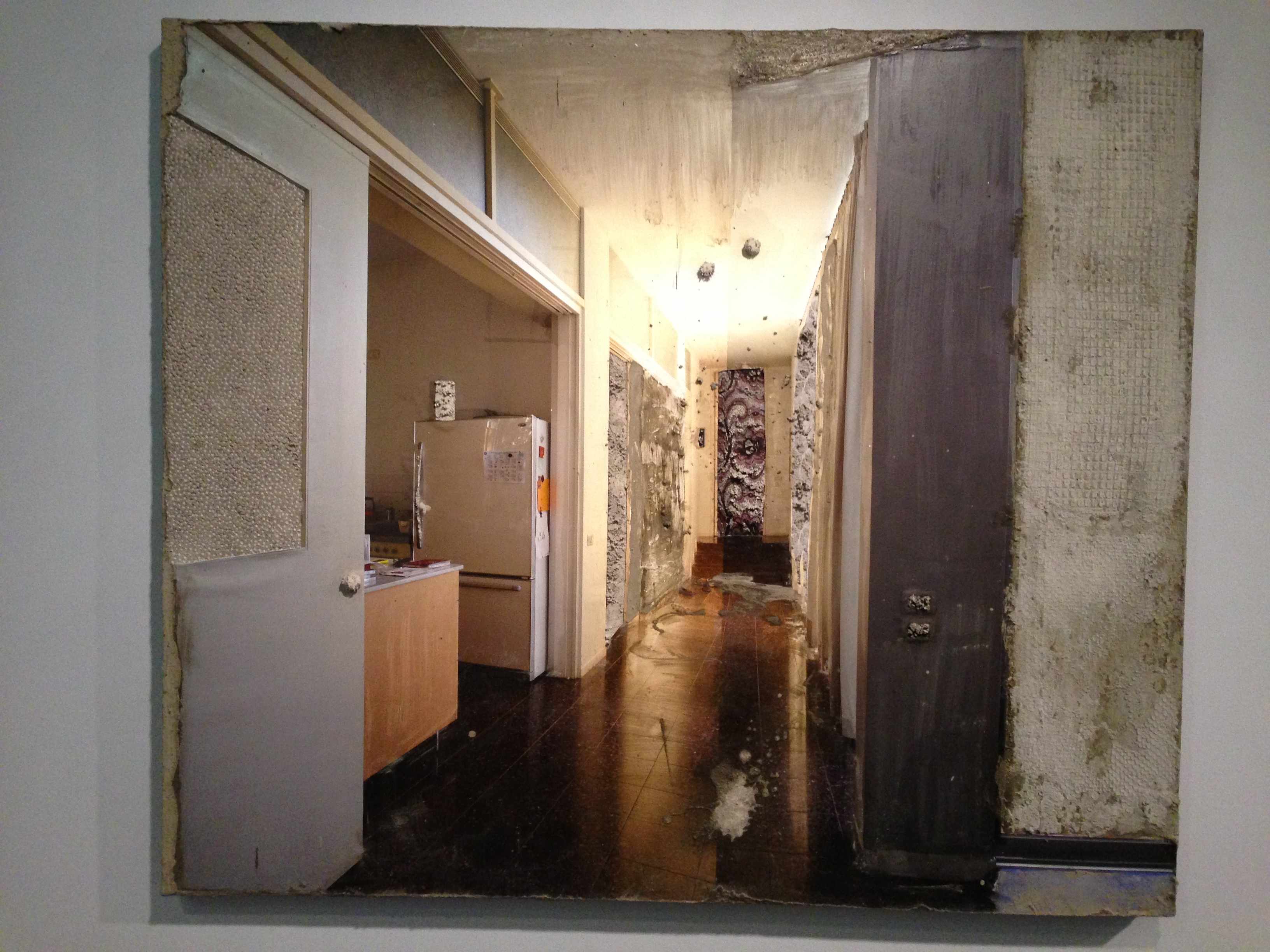
Installation view of Naomi Safran-Hon’s Home Invasion (2011). Archival inkjet print, lace, and cement on canvas

Installation view of Naomi Safran-Hon’s Home Invasion (2011). Archival inkjet print, lace, and cement on canvas

Naomi Safran Hon (of Prospect Heights) prints photographs of her hometown of Haifa, Israel on canvas; makes some cuts in the image; and pushes cement through lace to make a 3-D effect. She feels she’s working out the push/pull of the political and domestic realities of where she grew up. But let her tell you:

Meet the other artists, too: urban watercolorist Adrian Coleman, and painters Oliver Jeffers, and Gabrielle Watson. But if you really love Brooklyn, get over to experience the work in person, and add your comments. The museum’s open late on Thursday.

Thin, Rich, and MAD Embrace of the Middle East

Martin Munkácsi photo of Doris in an ensemble that is in the exhibition. Source: Doris Duke Charitable Foundation Historical Archives, Duke University.

Martin Munkácsi photo of Doris in an ensemble that is in the exhibition. Source: Doris Duke Charitable Foundation Historical Archives, Duke University.

Walking into MAD’s soon-to-close exhibit, Doris Duke’s Shangri La: Architecture, Landscape, and Islamic Art, what do you see? An architect’s model of a small palace by the sea, dazzling objects that adorned it, exotic loungewear inspired by faraway ports of call, Vogue-worthy jewelry, and photographs of a young socialite/philanthropist consulting with master craftsmen in busy Iranian and Moroccan workshops off the world’s most ancient streets.

As you examine these bits and pieces of Shangri La and its history, there’s a single vision that emerges – a portrait of a woman who knew about light, color, beauty, form, design, artistry, history, and had the vision, passion, and resources to put it all together in a way that any interior designer, fashionista, curator, and global traveler would envy.

Here’s the story line: In 1935, Doris Duke fell in love, went on a round-the-world honeymoon with James Cromwell, and fell in love again – with the exotic sights, sounds, patterns, textures, and artisanal wonders of the Middle East. Followed everywhere by reporters, she and James sojourned for months through Palestine, Jordan, Egypt, and the Indian subcontinent, marveling at the dazzling historic architecture, sinuous designs, luxurious carpets, lattice metalwork, colorful tile, and bejeweled ornament.

Tim Street-Porter’s photo of Doris’s dining room at Shangri La (2011) Source: DDFIA

Tim Street-Porter’s photo of Doris’s dining room at Shangri La (2011) Source: DDFIA

She just had to have it, and when she and James landed in Hawaii, she knew that no home in Palm Beach was going to cut it. They bought an ocean-view lot on the Big Island and began constructing a dream house. Her architects hewed to her vision — to create a seaside home into a tribute to the Islamic architecture and design that thrilled her imagination.

They brought artists and designers in from Iran, Syria, India, and Morocco to work on the home, and Doris herself traveled went back to check on progress in the home-country workshops and buy more. Eventually, she amassed one of the largest private collections of Islamic art in the world. Peruse her collecting timeline.

The actual home (now christened Doris Duke Foundation for Islamic Art) is now open to the public. Take time to explore Shangri La on the virtual tour. It hosts not only a 2,500-item collection, but thought-provoking installations by contemporary artists. (So does the show.) Here’s a video of artist Shahzia Sikander sharing what it felt like to project her light installations on this magical dream house.

For more history, watch the curators’ video. Doris’s vision, taste, and style will be on view at MAD for a few more days, then tour museums across the country.

You’ll never walk through the Islamic Wing at The Met again without thinking, “What would Doris do with this?”

What Seinfeld Ate for Lunch

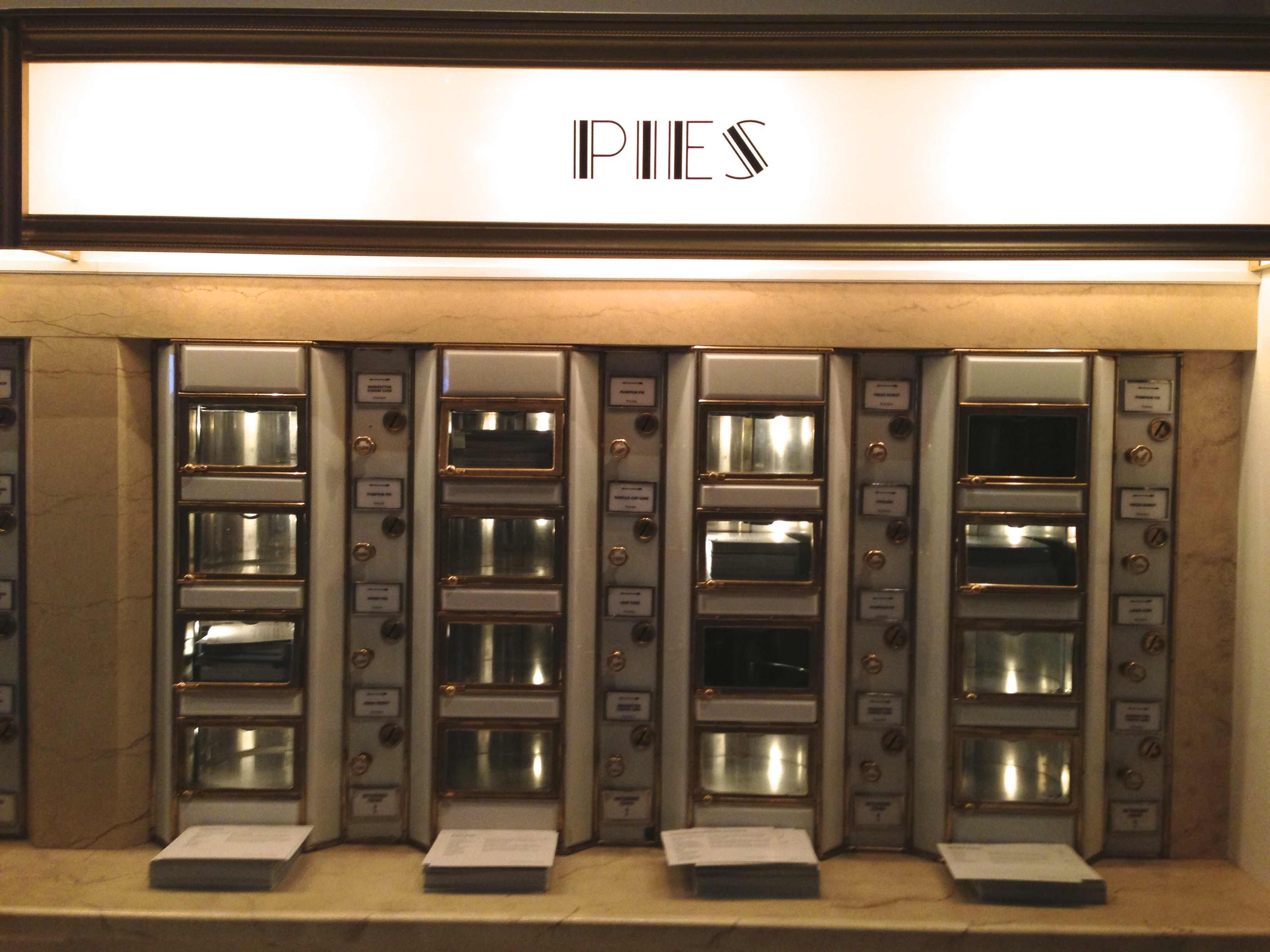
Installation view of the pie section of the historic Automat

Installation view of the pie section of the historic Automat

If you’re a New Yorker, you eat the same stuff – Chinese take out, sushi, hero sandwiches, and the occasional power lunch. So, where did it come from? How long have these New York traditions been going on? Did you know that take-out began in 1976?

Get to see the New York Public Library’s walk-through of culinary history at Lunch Hour NYC. As soon as you enter, you see a reproduction of the oyster carts that fed millions of working New Yorkers in the early 1800s, when these small bites were so plentiful in our waters that entrepreneurs made fortunes shipping them to Paris and London.

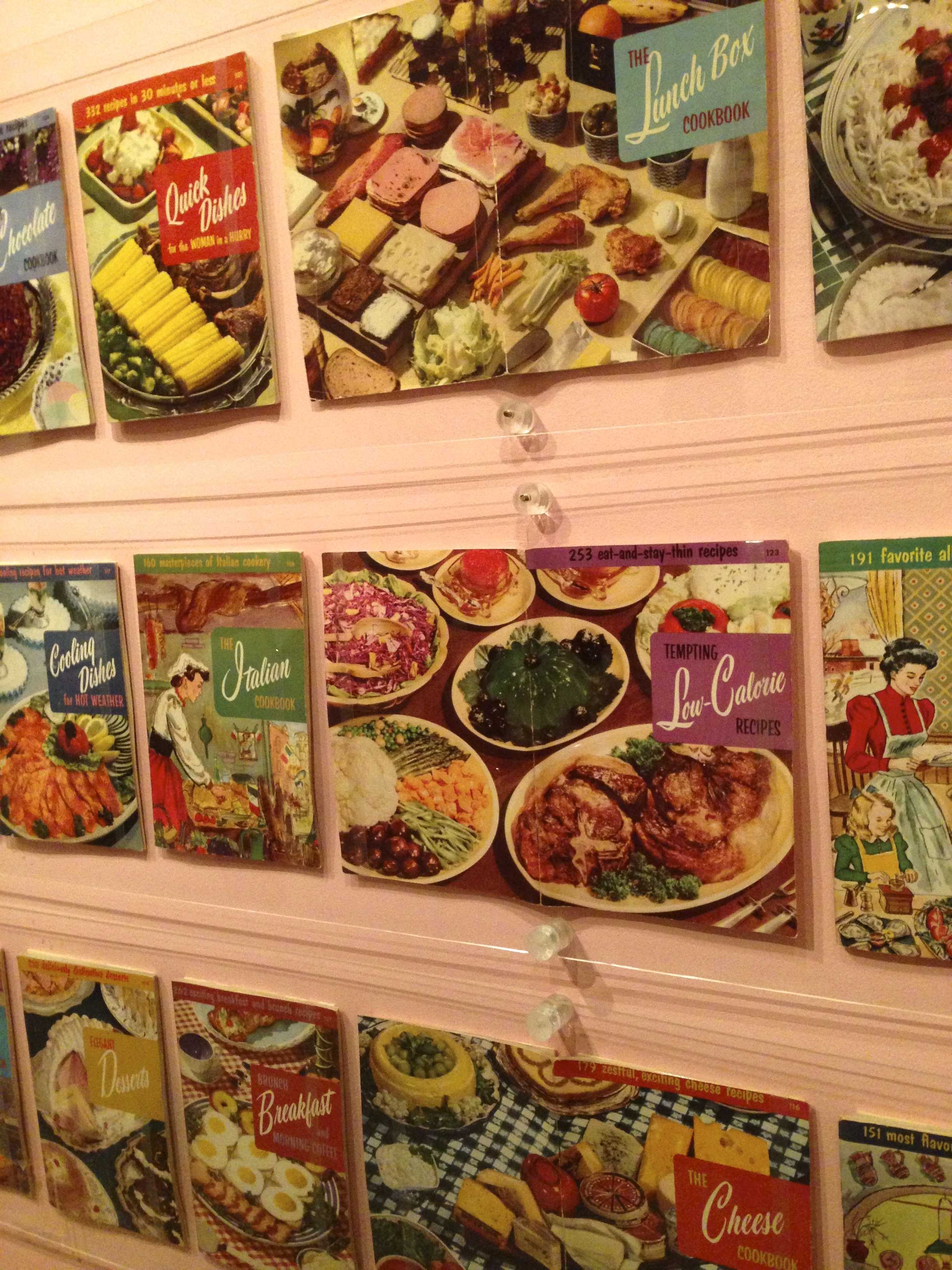
Recipes for 1960s homemakers

Installation view of homemaker recipes

You’ll also see tribute paid to the ubiquitous Chinese take-out bike, learn that pretzels have been sold on street corners for 150 years, and meet the creator of the stainless steel hot dog cart, Ed Beller. Listen to his story yourself.

Of course, the genuine star of the show is the Automat wall. You not only get a glimpse of the original doors, but you can go around behind the scenes and see where workers put in the fresh creamed spinach, baked beans, beef with burgundy sauce, and pie. People tend to linger in this section of the show, watching videos of Marlo Thomas in That Girl, a career girl without a lot of cash eyeing the yummier selections chosen by more successful types – a theme that’s also echoed in the clips from other movies, too.

Nostalgia lovers will be delighted to see a vintage Frigidere, a wall full of lunch boxes, and an array of 1950s and 1960s homemaker recipe booklets, and to learn that dieting crazes go back for decades. (Favorite: the article “Nice People Don’t Eat” from a 1941 Ladies Home Journal.) There’s also a 1940s Betty Crocker book with open to an article that any New Yorker would find comforting:  “Meals at Odd Hours.” Watch the NYPL’s lively video promo:

Get a close-up look with these photos on Flickr.

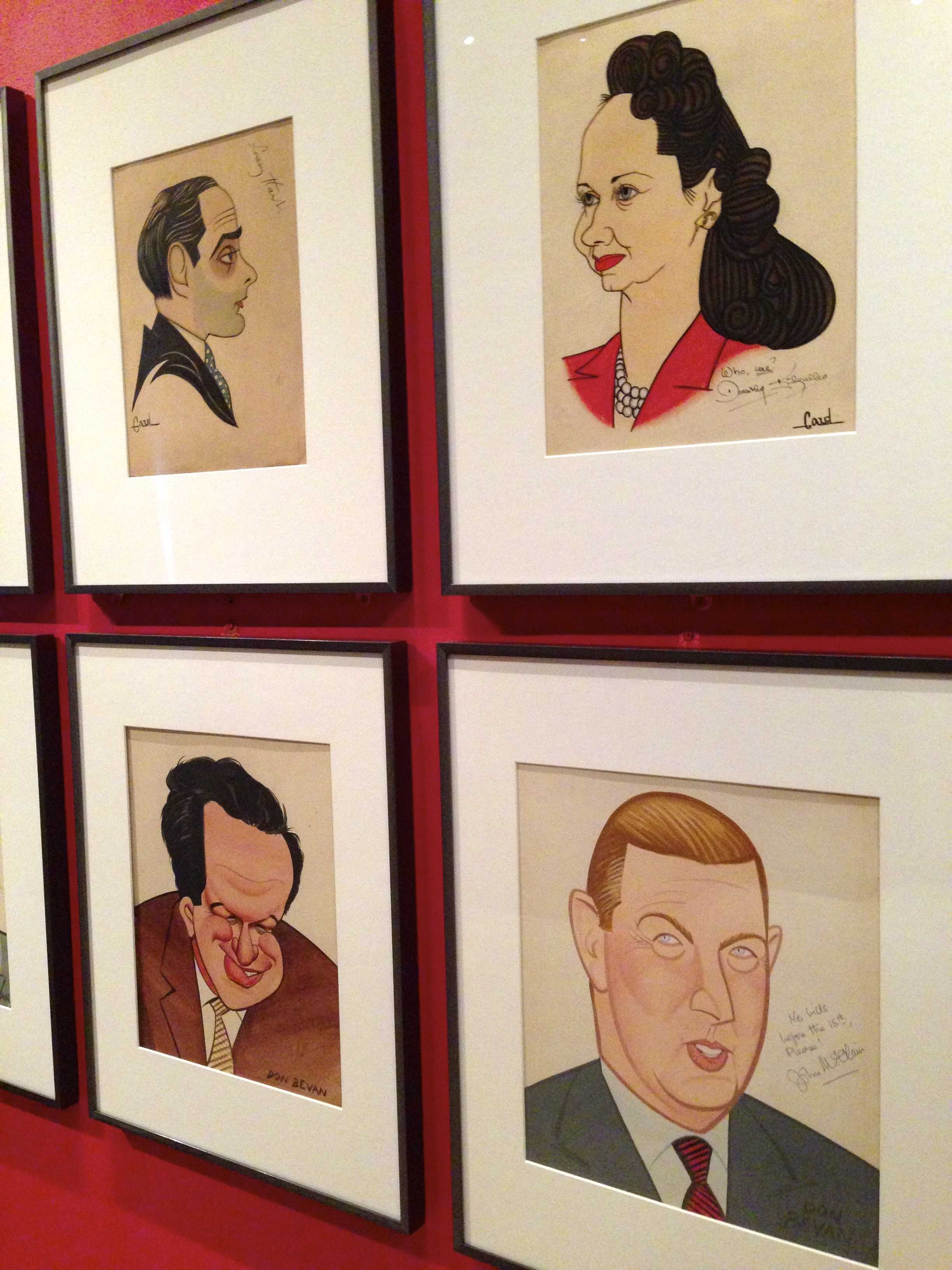
Installation view of Alex Gard’s portraits at Sardi’s – Lorenz Hart, Dorothy Kilgallen, Al Capp, and John McClain. Collection: NYPL

Installation view of Alex Gard’s portraits at Sardi’s – Lorenz Hart, Dorothy Kilgallen, Al Capp, and John McClain. Collection: NYPL

NYPL has a terrific Automat-themed website, filled with revelations. Go read about how cafeterias began in 1898 at 130 Broadway, how peanut butter began in 1900, how Alex Gard did all those portraits at Sardi’s in exchange for dinners on a regular basis, and how NYPL needs volunteers to transcribe its collection of historic menus.  (Go sign up.)

Meet The Building You Didn’t Know at NYHS

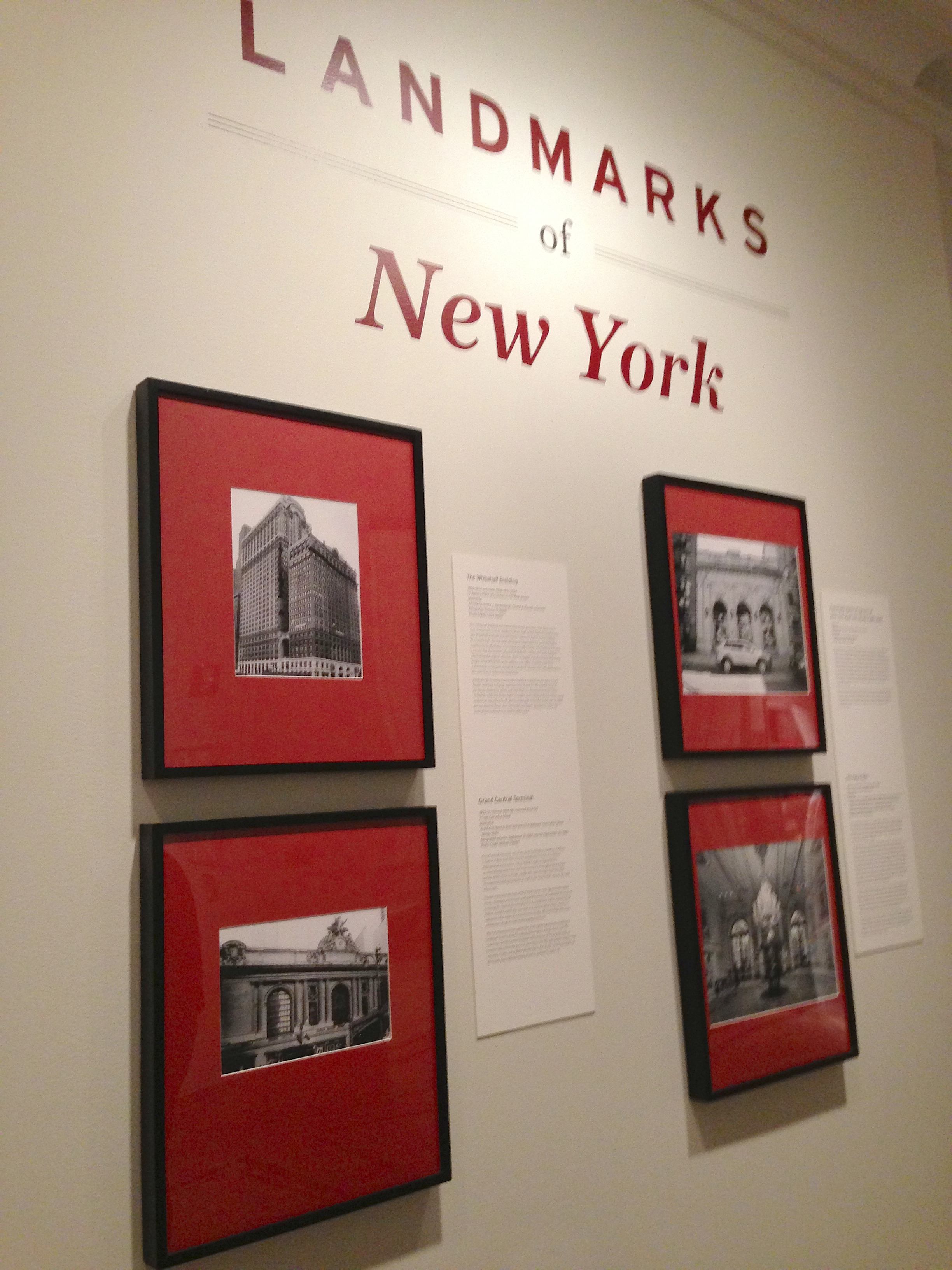
Installation view featuring photos of the Whitehall Building (17 Battery Place), Grand Central Terminal, the Free Public Baths (538 East 11th), and the interior of the Plaza Hotel

Installation view featuring photos of the Whitehall Building (17 Battery Place), Grand Central Terminal, the Free Public Baths (538 East 11th), and the interior of the Plaza Hotel

In one of the most deceptively simple installations at the New-York Historical Society, visitors can’t stop looking, reading, absorbing, talking, and pointing.  The Landmarks of New York show was humming all last weekend, with exhibition goers moving up and down the staid second-floor hallway, quietly moving from photo to photo learning stuff about buildings they’ve seen a million times.

Did you ever think the entire history of New York could be told in 90 identically framed photographs? Take a look at a few of the 1,287 landmarked buildings in NYC. Since the NYHS web site does not contain any of these buildings’ compelling stories, run up to their second floor before the show closes.

The show pays tribute the 1965 Landmarks Law and resulting Landmarks Commission, established in the wake of the greatest architectural disaster in the history of the modern City – the 1963 destruction of the historic Penn Station.  Today, 30,000 structures are protected, and the photos show you some of the exteriors, interiors, and scenic landmarks of our five boroughs.

Installation view of John Bowne House (1661) photo by Jeanne Hamilton

Installation view of John Bowne House (1661) photo by Jeanne Hamilton

Which are the oldest? The Wyckoff House, built sometime before 1641, at 5816 Clarendon Road, Brooklyn, and the oldest surviving home in Queens, the 1661 John Bowne House. The label copy says that Bowne had a huge flare-up with Peter Stuyvesant over his ban on the Quaker religion (actually, he was arrested), which led Bowne to lend his sliver of Flushing to regular meetings of the Quaker community.

Nothing in Manhattan even come close, although 1764 St. Paul’s Chapel is the oldest surviving church. Did you know it was modeled upon St. Martin-in-the-Fields on London’s Trafalgar Square?

This exhibit is packed with story after story of places you pass all the time. Charlie Parker’s Residence at 151 Avenue B is a landmark, partly because Charlie lived there between 1950-1954, but also because Franz Kline did, too.

Lucky for us, that the City has posted all of the Historic District Maps for each borough. Or go to the interactive city map and click on “Landmarks” to see what’s in your neighborhood. Who knew Greenpoint has the Eberhard Faber Pencil Company Historic District? Adventures await. Get to know a building.

1890s Pleasure Island (Staten) Honored at MCNY

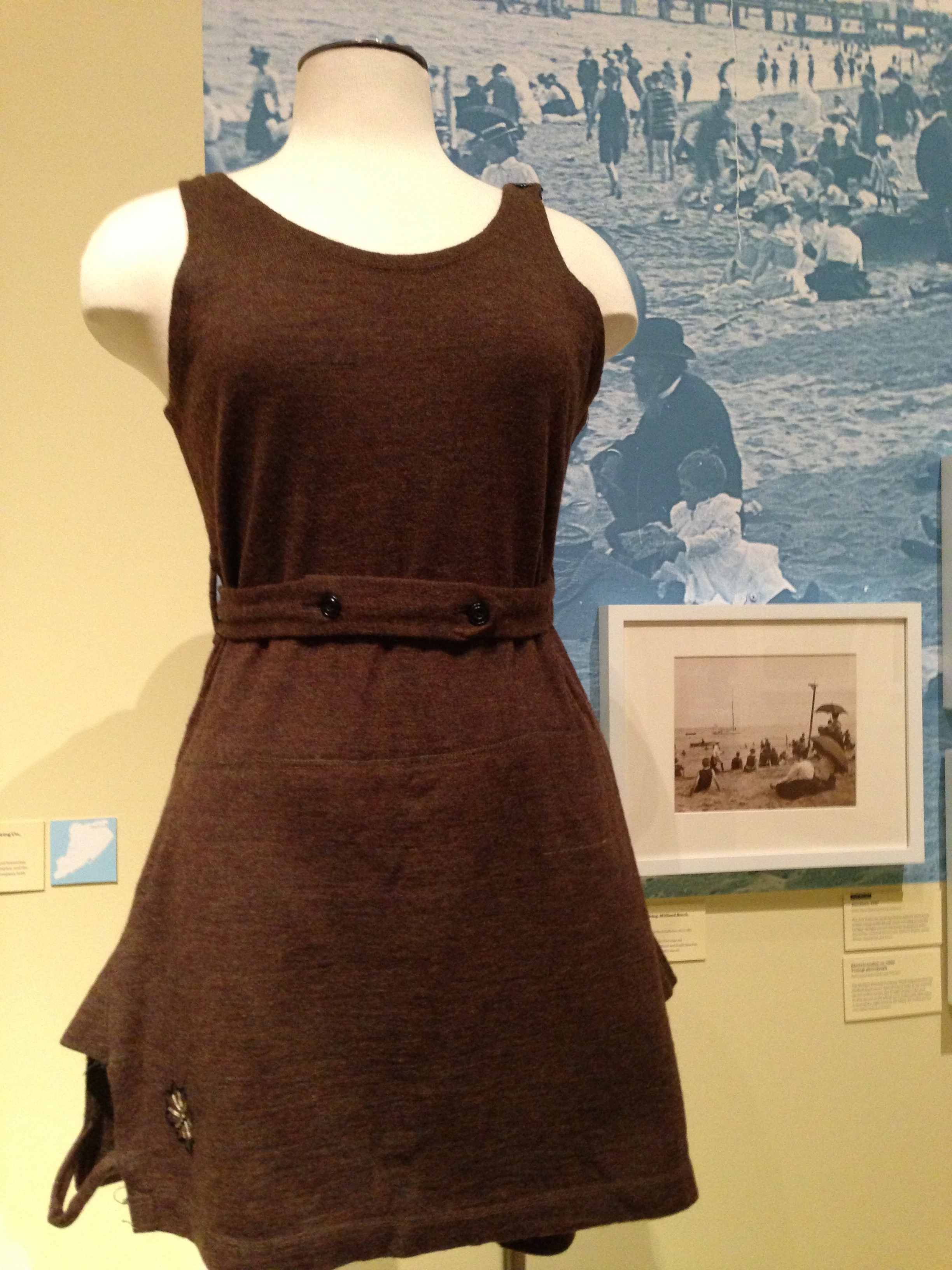
Installation view of woolen bathing suit (1905) and images of the 1890s Staten Island shore

Installation view of woolen bathing suit (1905) and images of the 1890s Staten Island shore

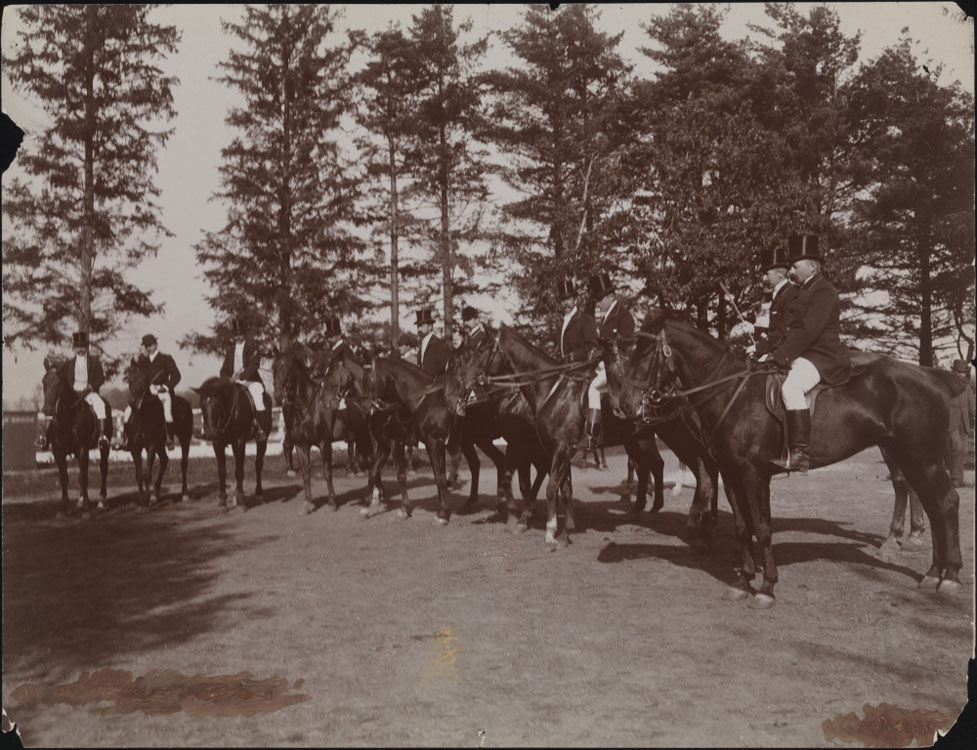
Over 100 years ago, the 59-mile square island rising up over New York harbor was the epitome of chic, cool sport – fantastic beaches, sunny farmland through which the well-heeled could enjoy an energetic fox hunt, and where one could witness the latest in tennis and cricket gear, to say nothing of the first tennis tournament in the United States.

It was all happening on Staten Island, playground to the upper, upper middle class, as chronicled in the Museum of the City of New York’s show, From Farm to City: Staten Island, 1661-2012. The shows covers the recent history of bridge-building and suburban development, but among the most fascinating parts of the show are those chronicling how our sometimes-forgotten borough gave the birth to modern sporting culture.

The Dutch bought it all from the Lenape in 1657, and SI thrived for centuries as the food supplier to Manhattan and the home of the overland stage service, operating between Philadelphia and Manhattan.

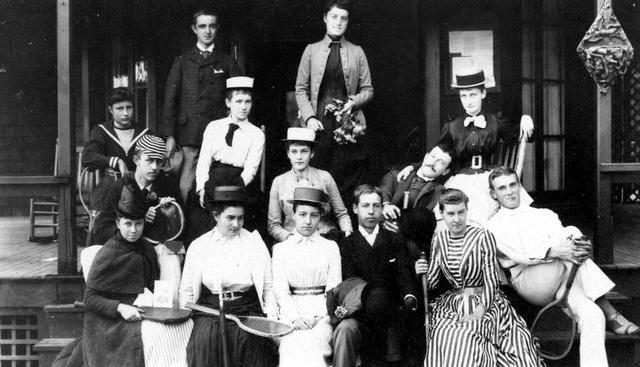
Alice Austen's photo of Tennis Clothing (1893). Source: Alice Austen House

Alice Austen’s photo of Tennis Clothing (1893). Source: Alice Austen House

But in the late 1870s, the Staten Island Cricket and Baseball Club became the epicenter of the lawn tennis craze (imported from England via Bermuda), and by the 1890s, the edge of the island had boardwalks and amusements to rival Coney Island.

Victorian sporting culture was well documented by Staten Island photography pioneer Alice Austen, whose photos have been enlarged to wall murals by the curators to convey the sense of fun, sun, and cachet in the exhibition. The historic home where she grew up has recently posted her work online, an incomparable look at everyday life here in the 1890s.

Richmond County Hunt Club in 1895. Source: MCNY

Richmond County Hunt Club in 1895. Source: MCNY

If you want to compare the past with today on Staten Island, MNCY has done a spectacular job of taking its historic maps and putting them into digital overlay of today’s world. Check out this great online resource to view the view in 1750 or 1829 compares to today. Click on the blue dots to see images of what used to be.

Extreme Renaissance Sportswear Back at The Met

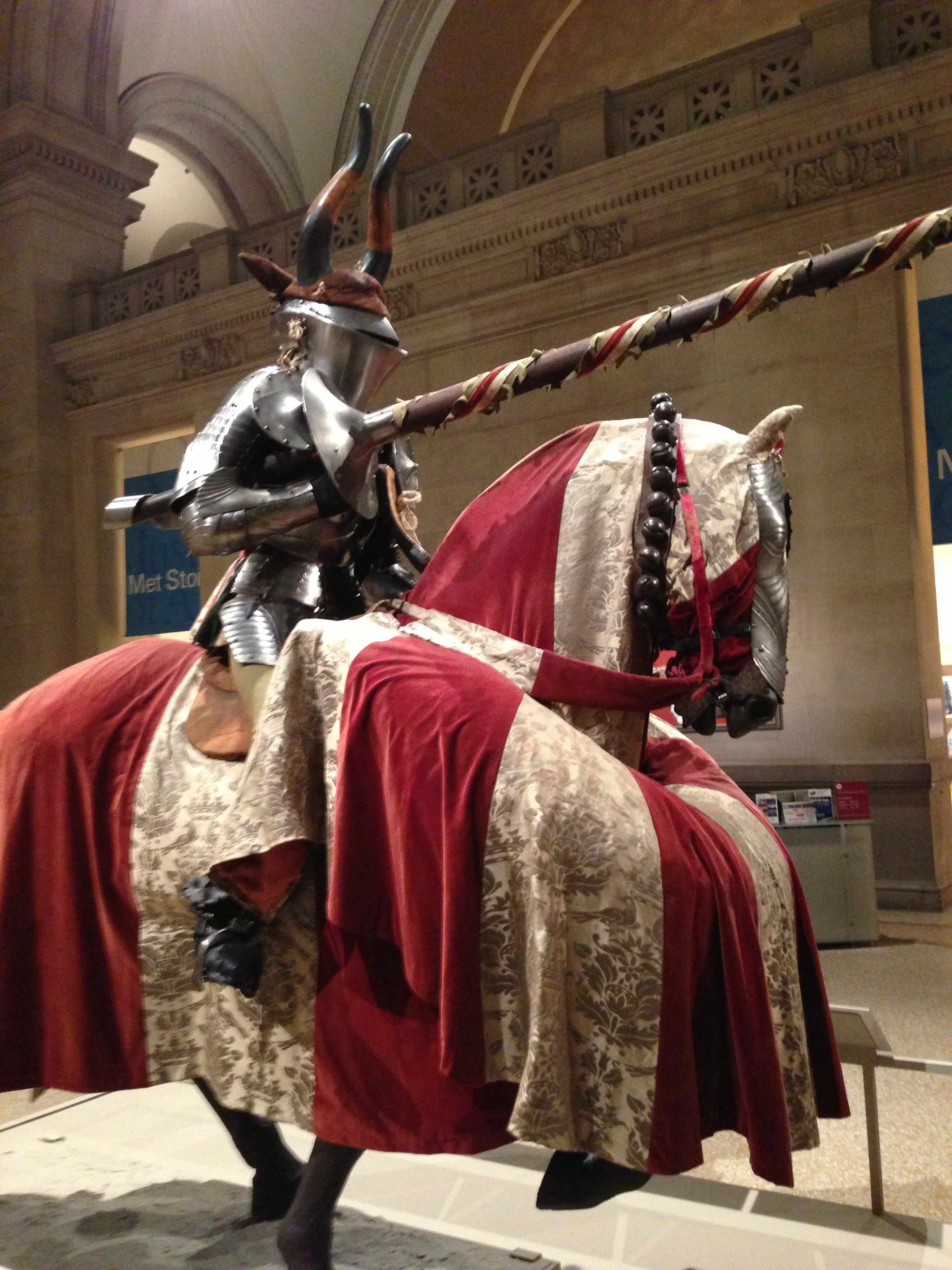
JoustAfter a brief Yuletide absence, the spectacular Armor for the Joust of Peace has been returned to the Great Hall of the Metropolitan Museum of Art, just inside the main entrance, to honor 100 years of the Arms and Armor Department.

Not seen in all its splendor since the 1980s, you’re looking at what extreme sports dressing looked like back in 1500. It all took place as the Renaissance was dawning across Europe, so this outfit was designed for safety and sport – not combat. The objective: unseat your opponent during a horseback charge across an open field with a blunt lance.

Jousts happened on open fields without barricades to separate the horses, so the horse’s head armor completely covered its eyes (yes, galloping blind). A straw-filled bumper hung around his chest for protection. This jouster’s wear was super-heavy (over 80 pounds for the body and 21 for the helmet), with the padded helmet physically bolted to the body armor to protect against whiplash when the inevitable impact occurred.

Solid covering over the horse's eye

Solid covering over the horse’s eye

The Met’s first curator of arms, Bashford Dean, found this German ensemble (even though some pieces were missing) and purchased it in 1904, setting the stage for many, many subsequent acquisitions (oh, about 14,000 more).  It lacked an original helmet, but when Dean saw the one on display (an 1891 recreation made by Parisian armorer superstar Daniel Tacheaux), Dean not only snapped it up, but hired Tacheaux to be the Met’s first armor conservator.

The shield and upper-thigh protectors are also restorations, and so is the horse’s brocade and velvet. But standing so close to this magnificent mount below the arches of the Great Hall, it’s easy to imagine you’re hearing the hoofbeats and roar of the sports crowd, and know that it’s not coming from the gift shop.Detail

Party Like It’s 1913 at Grand Central

Just after the clock strikes midnight on GCT's 100th birthday

After the clock struck midnight on GCT’s 100th birthday

At midnight tonight, the crews, security, police, and station manager were on hand to see the famous clock above the information desk signal the beginning of Grand Central Terminal’s 100th birthday. Just like a film set, everyone was concentrating on pulling magic out of a hat for the public birthday celebration that begins today.

If you’re within commuting distance, get over to Grand Central today to rub shoulders with celebrities, artists, and officials commemorating 100 years of our beautiful terminal.   At 10am, see Cynthia Nixon, our poet laureate Billy Collins, Keith Hernandez, Caroline Kennedy, Melissa Manchester, and (yes) the Vanderbilt family pay tribute in a rededication birthday celebration.

Check the web site for the afternoon schedule of honors, music, giveaways, and  1913 prices (one day only!)  for shoe shines (10¢), fries (10¢), loaves of rye bread (6¢), pasta (5¢), and cocktails at Michael Jordan’s (75¢).

IMG_1706Also, be sure you seek out the replica of the Terminal made out of Lego bricks in the Station Master’s Office. Then, dance the afternoon and night away (until 9:30) with Grammy Award-winning big band Vince Giordano and the Nighthawks. The celebration continues all year, but more on that later.

If you can’t get there, enjoy the new history timeline from your desktop (especially the part in 1976 with Jackie).

Or watch the Metro-North guys polishing up the chandeliers in Patrick Cashin’s photos on the MTA Flickr feed.

Revolutionary Counterculture Gives Birth to Soho

George Maciunas, Self-Portrait, 1961/2012. Installation view. Source: Jonas Mekas Visual Arts Center.

George Maciunas, Self-Portrait, 1961/2012. Installation view. Source: Jonas Mekas Visual Arts Center.

A revolutionary Lithuanian studies at Cooper Union, decides to thumb his nose at elitist art, leads a group genre-busting artists, asks why not use vacant industrial space in a down-and-out part of the city, petitions the City to create artist cooperative-lofts, and…voilà, Soho is born.

Remarkably enough, it’s a story that’s never been told, so kudos to Cooper Union School of Art for the collaboration with Lithuania’s Jonas Mekas Visual Arts Center to mount the exhibition at 41 Cooper Square, Anything Can Substitute Art: Maciunas in Soho. Who better to make the connection between art history, the avant-garde, and real estate?
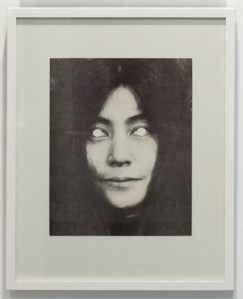
Yoko Ono Mask (1970) by George Maciunas. Source: Jonas Mekas Visual Arts Center

Yoko Ono Mask (1970) by George Maciunas. Source: Jonas Mekas Visual Arts Center

The show documents the early work of George Maciunas, who emigrated from Lithuania in 1948, studied at Cooper Union in the 1950s, became fascinated with the history of migrations and revolutions in the then-Soviet Union, wrote the famous Fluxus manifesto calling for a revolution against “elitist” art in New York, and gathered a group of downtown provocateurs around him.  He drew a map of the most influential art events of 1965-1967. The roster reads like a who’s who today, but at the time, they were newbies living on the edge — Kaprow, Schneeman, Moorman, Paik, Satie, Rauchenberg, Trish Brown, Gordon and Setterfield, and Yoko.

Thinking about Russian revolutions since the 1230s encouraged Maciunas to ask why a revolution couldn’t be mounted against the art “establishment” by declaring that “anything can be art”. He and his friends produced an avalanche of work that kept things simple and cheap, playing with the concepts of ephemeral events, experiences, packaging, context, and games. You know them today as happenings, performance art, conceptual art, multiples, boxed sets, word art, multimedia, and (possibly) Occupy Wall Street.

Installation view of Ay-O’s Tactile Box (No. 25) (1964). You put your hand into the hole to feel what’s inside. Source: Jonas Mekas Visual Arts Center.

Installation view of Ay-O’s Tactile Box (No. 25) (1964). You put your hand into the hole to feel what’s inside. Source: Jonas Mekas Visual Arts Center.

Mekas, another Lithuanian immigrant and founder of Anthology Film Archives, kept a lot of his friends’ early work, so the gallery is filled with never-before-seen Fluxus art, posters, letters, and maps that normally reside in Vilnius.

Maciunus thought Fluxus principles could also be applied to urban living, business, and real estate, so the show includes correspondence with government officials about permission to establish cooperative artist spaces. A highlight is a hand-drawn map showing where Fluxhouse co-ops would transform abandoned industrial lofts in the 25-square blocks of Soho. His first transformation was 80 Wooster, which gave Fluxus artists a chance to live and work together, unencumbered by walls and tradition — a socially conscious, revolutionary move that eventually influenced the course of art, lifestyles, and real estate here and around the world.