Spacewar Ending in Astoria

Replica of the round CRT and game controllers developed at MIT in 1962 to run Spacewar on DEC’s PDP-1, the first commercial interactive computer. Note input-output typewriter.

Replica of the round CRT and game controllers developed at MIT in 1962 to run Spacewar on DEC’s PDP-1, the first commercial interactive computer. Note input-output typewriter.

It’s all aliens, flying saucers, galaxies, and other worlds inside the Museum of the Moving Image’s tribute to gaming history, Spacewar! Video Games Blast Off, soon ending in Queens.

The big, expansive dark gallery is a gamer’s dream, with flashing lights, arcade consoles, virtual headgear, and wall-sized projections distributed around the room. Last weekend, enthusiastic museum-goers were happily roaming through the space, enjoying the please-touch experience of interacting with 20 historic video games from the last 50 years. Yes, they all work!

The show begins with a reverential replica of the game that started it all in 1962 at MIT, Spacewar, the first virtual intergalactic battle in deep space. Check out the story of SpaceWar, a slick, fun video created by the Computer History Museum in Silicon Valley. (Spoiler alert: it involves model railroading.) If you want to read more, here are links to the 1972 Rolling Stone article that predicted that computer gaming was going to take off in big ways.

Child waits turn as museum-goer enjoys Galaxy Force II, Sega’s 1988 arcade game built upon a flight-simulator cabinet.

Child waits turn as museum-goer enjoys Galaxy Force II, Sega’s 1988 arcade game built upon a flight-simulator cabinet.

The museum did not feel compelled to arrange its time-machine arcade in chronological fashion, and it’s fun switching back and forth among the different technologies. You’ll find Atari’s 1979 Asteroids arcade unit is next to Nintendo’s 2009 Super Mario Galaxy II and Atari’s 1982 home console for Yar’s Revenge. There’s even the 2009 iPad game Osmos.

No one has to wait very long to step up and play, although there was tiny queue for Space Invaders, the 1972 arcade sensation that was one of the earliest microprocessor-based units. Dads were having fun explaining to kids exactly why it didn’t fire as fast as games they have at home.

Leave that light saber app holstered, and get to Astoria to relive what it was like the first time you fought in space.  Note: Admission gets each person four complimentary arcade tokens, but you can always buy more.

Virtual Ancestor Cornered in High-Tech Tree by AMNH

Carl Buell’s rendering of the hypothetical placental ancestor, a small insect-eating animal. Source: AMNH

Carl Buell’s rendering of the hypothetical placental ancestor, a small insect-eating animal. Source: AMNH

Who says dinosaurs get all the attention?

One of the big front-page science stories of the last few weeks is that a global team of researchers has mapped our ancestor tree back in time to a hypothetical small, furry critter that emerged just after the dinosaurs went extinct. The big news is that through a giant high-tech, data-crunching technique, 15-20 molecular-data scientists collaborating in six countries around the world figured out that the hypothetical ancestor to nearly all the mammals alive today emerged 200,000 to 400,000 years after the comet crashed to Earth 65 million years ago.

Ok, it wasn’t the first mammal (the ancestor to platypuses, opossums, kangaroos, and a lot of other extinct things came much earlier), but let’s applaud the American Natural History Museum for telling this story so clearly to a writer at The New York Times that it made it to the front page.

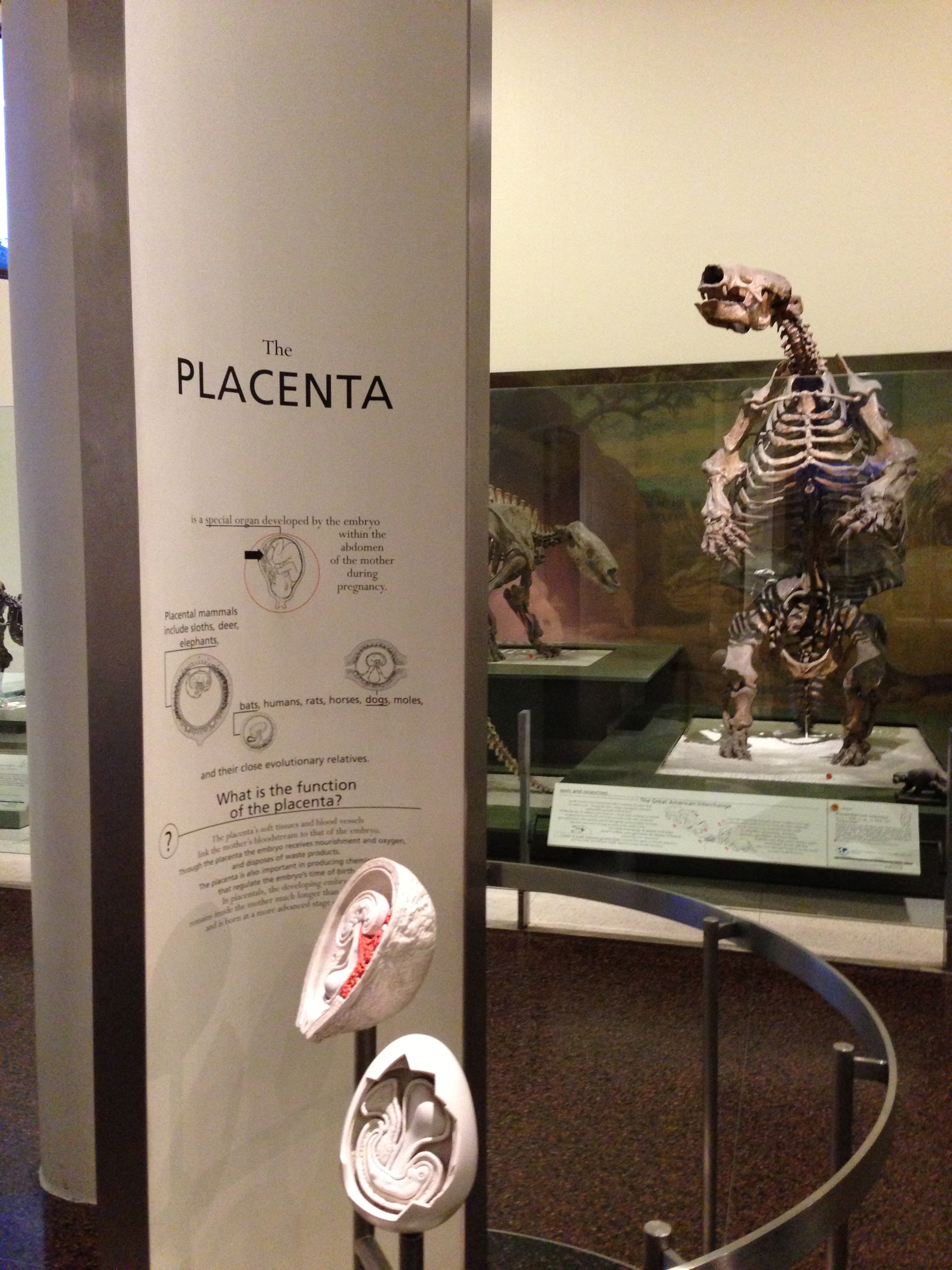
Column on AMNH Fourth Floor exhibit space that marks the spot where the virtual critter emerged along the evolutionary pathway in the Hall of Primitive Mammals.

Column on AMNH Fourth Floor exhibit space that marks the spot where the virtual critter emerged along the evolutionary pathway in the Hall of Primitive Mammals.

At Thursday’s Social Media Week event on how to tell stories in science, panelists repeatedly emphasized how hard it is to make clarity emerge from a morass of data.  In a way, this “story about the rat” reached a social-media science storytelling trifecta: over 240 comments “about the rat” on the NYT web site, a neat little video that’s racked up over 11,000 views in just two weeks, and an exhibition layout for the vertebrate paleo collection on the museum’s Fourth Floor that lets you stand in the exact spot on the evolutionary pathway where this tiny hypothetical ancestor emerged. (See the photo with the Giant Sloth, to the left.)

Great job, AMNH and Stony Brook storytellers for giving us this video view into deep time, showing how MorphoBank crunches data, and creating another social-media star out of a virtual ball of fur.

PS: The fossil background talent in this video appears to be a model of Gobiconodon, an actual Cretaceous mammal from 110 million years ago who’s not directly related to the star of this show, but looks good on camera.

Inhale…The MAD Exhibit They Won’t Let You See

JickeyThere’s nothing to see…only to experience…in The Art of Scent 1889-2012 currently at the Museum of Art and Design. Designed by Diller, Scofidio + Renfro, the exhibition space is completely bare, save for gentle depressions pressed into the wall where visitors can lean in and experience fragrances considered masterworks of innovation and complexity.

Thank you to curator Chandler Burr for paying tribute to the artists that created these scents. The earliest is Jicky, created by Guerlain in 1889 when the Eiffel Tower was on the rise, the first designer fragrance to use synthetic components.

Walking through these design innovations is an experience you won’t forget. Can you tell that a 1980s fragrance was inspired by the smell of laundry detergent (the essence of “clean”)? Do you agree with Prada’s 1990s take on the romanticism of the 19th century? Do you think Untitled by Daniela Andrier for Margiela in 2010 combines “excitement and unease”, as MAD purports?

MAD has many videos to let you in on the process behind the ephemeral. Listen as Jean-Marc Chaillon discusses what it’s like to create something that can’t be touched:

Ever wonder about the work that goes into designing a celebrity fragrance? Listen in on this enlightening and entertaining curator’s panel on the design and structure of olfactory art:

If You Love Brooklyn, Get to GO!

Installation view of Yeon Ji Yoo’s The Fight (2012), made of paper, paper pulp, acetate, glue, packing tape, cheesecloth, plastic flowers, recycled plastic bottles and bags

Installation view of Yeon Ji Yoo’s The Fight (2012), made of paper, paper pulp, acetate, glue, packing tape, cheesecloth, plastic flowers, recycled plastic bottles and bags

Tucked away in the Mezzanine Gallery on the second floor at the Brooklyn Museum is a valentine to the borough, its artists, and the support and love they received last September in Go: A Community-Curated Open Studio Project. It mixed trudging around Brooklyn, democracy in action, and high-tech to peer into other worlds right in our own backyard.

The museum commissioned an app, asked artists to open their studios, and invited the world to visit and vote for their favorites. (Apparently, it was inspired by an art competition organized out of Grand Rapids!)

GO tracked the art makers and art seekers – take a look at the “weekend activity heatmap” and the other GPS-gathered stats. The results showed a lot of love – 18,000 visitors making 147,000 studio visits to about 1,700 artists over a two-day period, or about eight studio visits per participant. See the raw data for yourself, broken out by neighborhood. Learn a bit more about the voters here.

Art lovers nominated 9,457 artists for a museum showing, and eventually voting and curators whittled it down to five spectacular representatives. Interestingly, four on display were born outside the United States.

Yeon Ji Yoo of South Korea, currently lives in Greenpoint and works in Red Hook. The large installation piece in the show is inspired by her grandmother’s fading memory. Listen as she talks about growing up in South Korea’s rural countryside:

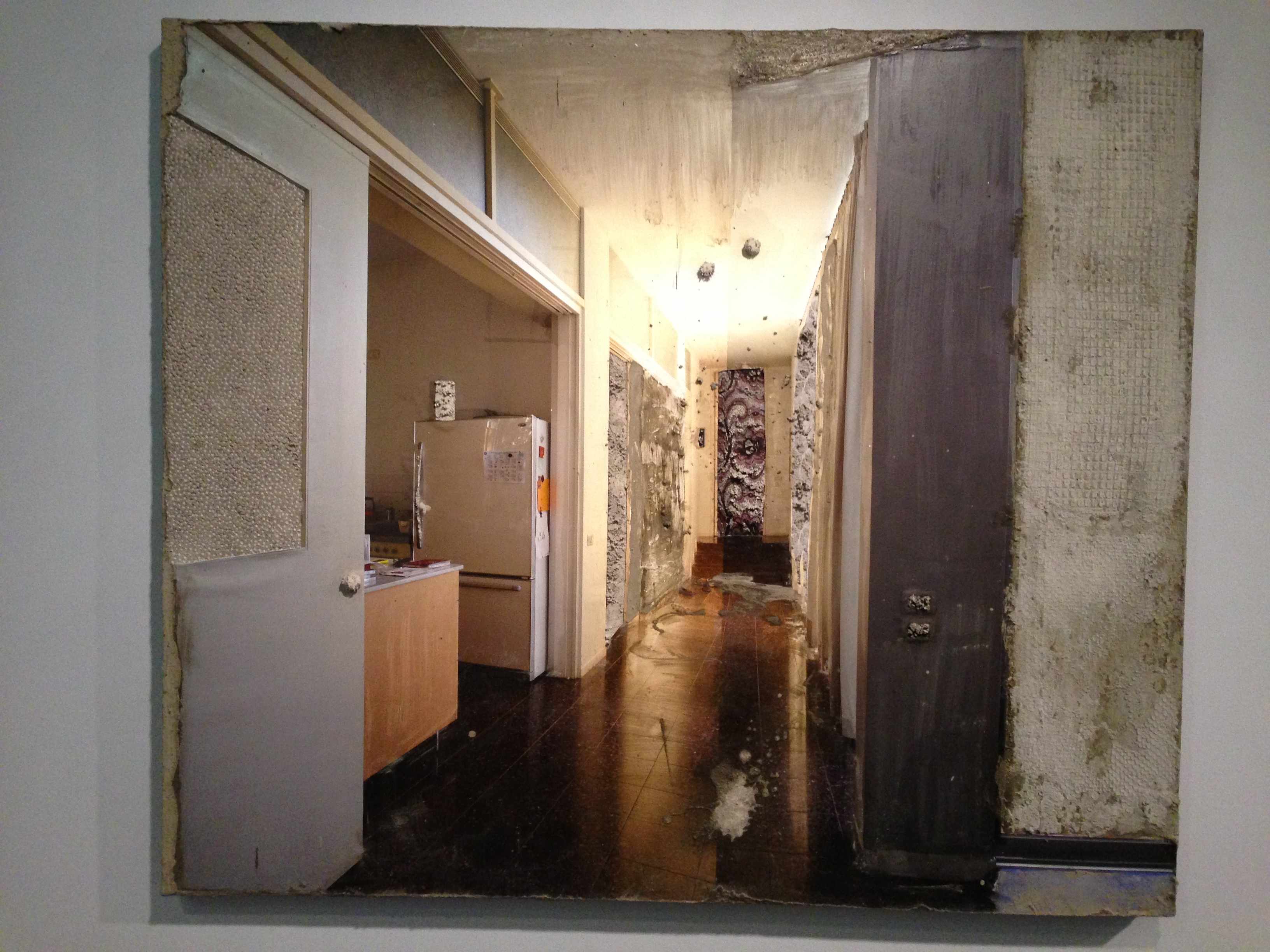
Installation view of Naomi Safran-Hon’s Home Invasion (2011). Archival inkjet print, lace, and cement on canvas

Installation view of Naomi Safran-Hon’s Home Invasion (2011). Archival inkjet print, lace, and cement on canvas

Naomi Safran Hon (of Prospect Heights) prints photographs of her hometown of Haifa, Israel on canvas; makes some cuts in the image; and pushes cement through lace to make a 3-D effect. She feels she’s working out the push/pull of the political and domestic realities of where she grew up. But let her tell you:

Meet the other artists, too: urban watercolorist Adrian Coleman, and painters Oliver Jeffers, and Gabrielle Watson. But if you really love Brooklyn, get over to experience the work in person, and add your comments. The museum’s open late on Thursday.

Design Driven by Necessity at MoMA

The latest design show at MoMA features something that we can’t live without.

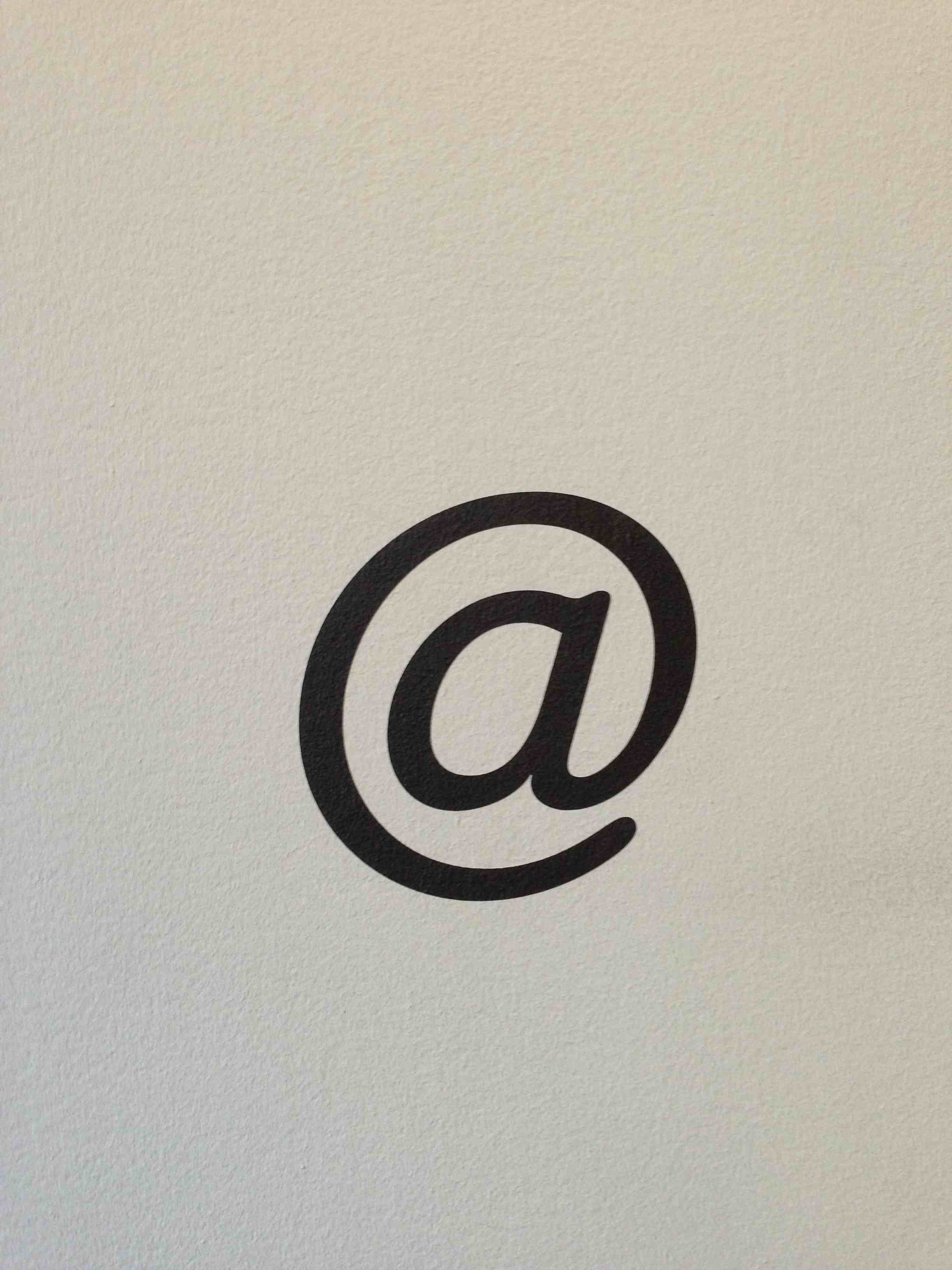
Installation view of @ (1971), ITC American typewriter medium, at MoMA

Installation view of @ (1971), ITC American typewriter medium, at MoMA

You’d never think that @ was a design invention, but it was created in 1971 by Ray Tomlinson, the inventor of the first email system in the United States. The @ made it into MoMA’s design collection and stars there in the show, Born Out of Necessity.

Tomlinson developed it for ARPAnet, because he thought it would be more efficient than using arcane programming language to tell data messages where to go. MoMA says that there’s not a lot agreement as @’s genesis – some say it goes back to the 6th century (from Latin scribes). Others say it’s from the 16th century (Venetian abbreviation for the “amphora” measurement unit), or Norman French  (for “each at” a particular price). Whatever.

The little symbol began appearing on typewriter keyboards in the 19th century, so it eventually migrated to our computer and iPad keyboards, and that’s where Tomlinson got ahold of it. History was made.

Another design star in the show came from the military budget, too — a Utility ¼-Ton 4 X 4 Jeep. Jeep

You may be surprised to know that Jeeps and MoMA go way back to 1951, when they included one in a design exhibit. Quick assembly, fast part-swapping, and portability (when disassembled) for transport made it a design winner. Although this Jeep is from 1952 (just light modifications over the previous model), MoMA says it’s the best military Jeep ever built anywhere.

The show includes an array of other interesting design innovations triggered by need – like Oxo’s Good Grip handles on kitchen items, new-fangled inflatable life rafts that don’t tip in high waves, collapsible wheelchairs, and hand-cranked radios (originally designed for the Third World, but just as useful here during blackouts and hurricanes).

The show closes today, but the @ and the other stuff will be with us for a long, long time.

Never Too Late to Fake it at The Met

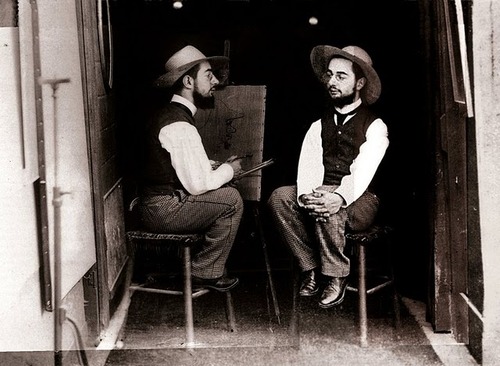
Maurice Guibert’s Henri de Toulouse-Lautrec as Artist and Model (ca. 1890). Gelatin silver print. Source: Philadelphia Museum of Art: Gift of Henry P. Mcllhenny.

Maurice Guibert’s Henri de Toulouse-Lautrec as Artist and Model (ca. 1890). Gelatin silver print. Source: Philadelphia Museum of Art: Gift of Henry P. Mcllhenny.

Even though it’s the last day, the Metropolitan Museum of Art has you covered: they’ve put the entire show, Faking It: Manipulated Photography Before Photoshop on the web and into a free iPad app.

So whether you’re living in New York or not, you can enjoy the wonderful history of how photos have been manipulated since the birth of photography (around the 1840s) until the birth of Photoshop (around the early 1990s). As if you couldn’t guess, this provocative show is sponsored by Adobe.

Who doesn’t get a kick out of double exposures, double portraits, and fake stuff inside the photo? Certainly Montmartre pals Maurice Guibert and Toulouse-Lautrec did. Even the great Steichen used some photo-manipulation to create his iconic portrait of Rodin with The Thinker.

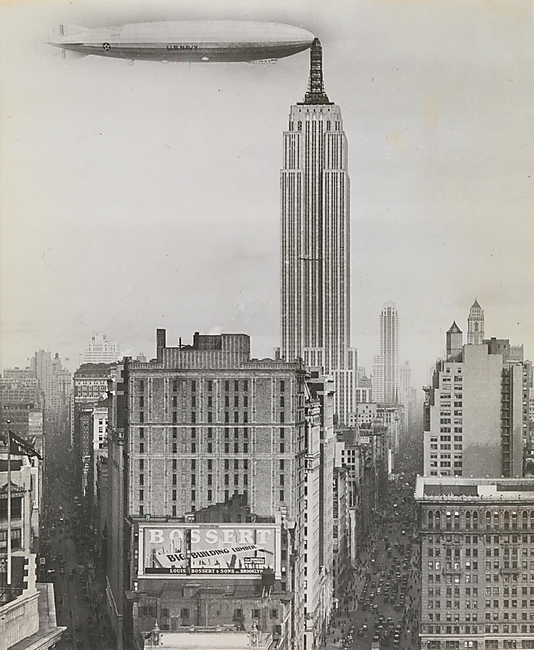
Dirigible Docked on Empire State Building, New York, 1930. This never happened. Source: The Metropolitan Museum of Art, Twentieth-Century Photography Fund Fund

Dirigible Docked on Empire State Building, New York, 1930. This never happened. Source: The Metropolitan Museum of Art, Twentieth-Century Photography Fund Fund

In a nutshell, professionals and amateurs have been fiddling with negatives, creating photomontages, rephotographing images, and retouching since the beginning. So, really, there’s nothing new about all the creativity that goes into today’s digital imagery, except that it’s easier to do on a computer.

One of the first innovations was faking color to make the black-and-white photos in the late 1800s more “real.” The V&A Museum even hired expert photographer-lithographer J.I. Williamson to hand-color the pictures he took of their decorative arts collection.

Another early innovation was taking two (or more) exposures for land and sky, masking out parts of the negative (just like in Photoshop), and printing it all on a single sheet of paper.

And what about the masters of the wacky postcards of the early 1900 Americana that predate the Jackalope?

The Met has posted a brief guide to the themes in the show as well as the full, rich archive of 202 photos that hung on the walls until today. Really a fun treasure trove to explore.

Is David Roentgen the 18th Century Steve Jobs?

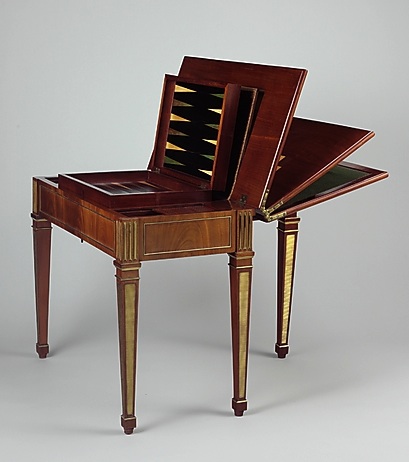
David Roentgen’s Game Table (ca. 1780–83). Oak, walnut, veneered with mahogany, maple, stained maple, holly, stained holly; felt; leather, partially tooled and gilded; iron and steel fittings; brass and gilt bronze mounts. Source: Metropolitan Museum, Pfeiffer Fund, 2007.

David Roentgen’s Game Table (ca. 1780–83). Oak, walnut, veneered with mahogany, maple, stained maple, holly, stained holly; felt; leather, partially tooled and gilded; iron and steel fittings; brass and gilt bronze mounts. Source: Metropolitan Museum, Pfeiffer Fund, 2007.

Even if David Roentgen didn’t produce for the mass-market, he certainly seemed to have written Steve’s playbook  — wow them with innovative design, refined surfaces, exacting craftsmanship, playful art, and sophisticated multimedia integration. Oh, and if that’s not enough, why not make it passkey protected and portable, too? Like Steve, David knew how to turn engineering into art and ka-ching.

Experience out-of-the-box design innovation in the closing week of the Metropolitan Museum’s unforgettable show, Extravagant Inventions, Princely Furniture of the Roentgens. The beauty of the marquetry and fittings on the displayed desks, sofas, clocks, commodes, and rolltop desks would be enough, even if they simply occupied a quiet corner of a drawing room or boudoir.

But if an 18th-century king, queen, or royal saw them in action – revealing hidden apps for writing, reading, drawing, music, games, curios, and hiding the desktop – there was no turning back. The mechanical furniture was so desirable that wealthy trend-setters just had to have it (like iPads).

What social-minded gamer could resist Roentgen’s 1780s Game Table if they saw David’s demo?

The desire to own and show off the most up-to-date artistic engineering marvel had royals running for their strongboxes to put down deposits on anything Roentgen could produce. In fact, the Met tells us that the Berlin Secretary Cabinet, the star of the show, is probably the most expensive piece of furniture ever produced. And we can’t even begin to discuss robot Marie Antoinette playing the dulcimer, or the clocks that turn into orchestras.

When the French Revolution put an end to sales at Versailles, Roentgen cut out the curliques, tailored the outer design to a sleeker look, and shifted his retail operations to Russia. Catherine and her court bought the newer stuff by the cartload.

The Met has an entire YouTube playlist devoted to these 18th century wonders, and you really should peruse them all. Get to the show in the final week and see what another style and multimedia-obsessed generation spent their money on.

And lest it slipped your mind, Steve and Woz’s first Apple 1 computer was assembled within a wooden case. Maybe it’s good that David and his engineering/sales team weren’t around to critique it.

3D Cave Art Revealed at NYU

Left Hand of Maitreya, Buddha of the Future, Holding the Looped End of His Robe
Xiangtangshan: Northern Group of Caves, North Cave, south face altar of central pillar, 550-559 ce., limestone. Source:
Asian Art Museum of San Francisco, Transfer from the Fine Arts Museum of San Francisco

Left Hand of Maitreya, Buddha of the Future, Holding the Looped End of His Robe
Xiangtangshan: Northern Group of Caves, North Cave, south face altar of central pillar, 550-559 ce., limestone. Source:
Asian Art Museum of San Francisco, Transfer from the Fine Arts Museum of San Francisco

The exhibition closing today on 84th Street isn’t about Herzog’s 12,000-year old French cave art, but about truly monumental art that has been largely unknown in the West until the University of Chicago unveiled a truly spectacular achievement – the digital recreation of a Sixth Century Buddhist cave temple destroyed in the 20th century by vandals selling to the international Asian art market.

Echoes of the Past: The Buddhist Cable Temples of Xiangtangshan was brought here by NYU’s Institute for the Study of the Ancient World after the show’s run at the Sackler in Washington.

The story of this cave temple’s recreation began when the University of Chicago started asking what happened to all the stuff from the vandalized cave temples that were originally built as hostels for wandering Buddhist monks in the Fourth Century in Northern China along the old East-West trade routes. UC ultimately identified about 100 statue fragments in museums and collections all over the world.

Take a look at the cave temples today and the techniques used by the University to bring an amazing collection back together in virtual reality:

At NYU, you first immerse yourself in the Digital Cave and then enter the elegant gallery to see the works themselves – holy men, heads and hands of Bodhisattvas, and little monsters all gathered from collections from Penn, the Met, the V&A, the Nelson-Atkins of Kansas City, and the Asia Art Museum of San Francisco. Check out the highlights on line.

1950s and 60s Vintage Rolling through Midtown This Week

GM Model 5106 (1958-mid-1970s)

GM Model 5106 (1958-mid-1970s)

Christmas shoppers in NYC’s Midtown are in for a special retro-treat this week. For $2.25, they can take a trip back in time, as New York City Transit shuttles 42nd Street travelers from Twelfth Avenue to the East River on its collection of vintage buses.

It’s a fun way to travel to two of the best holiday markets in the City – Bryant Park and Grand Central Terminal – by enjoying a “good old days” vibe, complete with vintage ads. mtabus1211

The antique buses are due to roll east along the M42 route at 8:30am, 11:30am, and 2:30pm. If you aren’t in the vicinity of 42nd Street, look for parked antique buses opposite Macy’s (at Sixth and 35th Street) and across from Union Square between 10am and 3:30pm all week.

Transit will be featuring six styles of vintage buses from its collection, including five models from General Motors and one from Mack Truck and Bus. The earliest model is GM’s Model 5101, which ran the streets from 1949 to 1966; the most recent vintage is GM Model 5305A, which debuted in 1968 and ran until 1984.

Even though MetroCards are “new” (they debuted in 1993), they’ll work on the retro-buses. Check out this 1949 Rapid Transit movie to feel the way it used to be, and be sure to catch one of the retro-subway trains every Sunday until December 30 on the M Line between 2 Ave and Queens Plaza.

235 Years of Veteran History in a High-Tech Park

Open again after the hurricane, best-kept-secret BLDG 92 has opened its doors to honor veteran, industrial, medical, and military history at the Brooklyn Navy Yard Center.

The stunning displays of over 235 years of history in New York Harbor inside are nothing compared to the experience of traipsing around by bus and foot to poke in and around the mix of crumbling 19th-century architecture, active dry docks, overgrown campuses, historic streets, and state-of-the-art sustainable design.

Take a look at the sights seen during the sunny days of summer on the Flickr feed, and book your trip now. It’s an adventure to get there (subways aren’t exactly close), but you will feel amazing to walk in the footsteps of so many heroes of American history and innovation, like Commodore Perry, Dr. Squibb, the North Atlantic Command for WWII, and Rosie the Riveter.

If it all feels and looks a little like a back lot, it is. (Boardwalk Empire shoots at the Steiner Studios and SNL builds sets there.)

Check out the photo of the tugboat under repair in the third oldest dry dock in the country – right where the Monitor was built for combat during the Civil War.  And if you’re a Navy history buff, immerse yourself in BLDG 92’s Flickr stream courtesy of the National Archives, stereoscopes and all.

What have you been missing?  Just check out this video, and then go see the real thing on foot, by bus,  by bicycle, or on an industrial tour: