Thousands Flock to the Light

Imagine you are laying on the floor of the Guggenheim rotunda and that you are looking up at James Turrell’s new work. This is what you’d see.
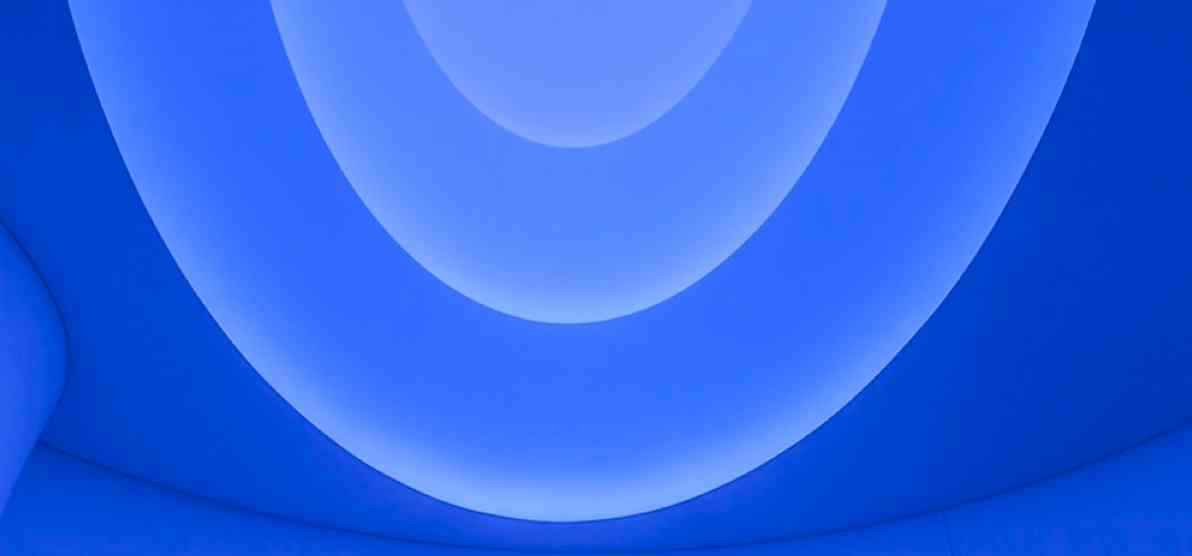
James Turrell’s Aten Reign. Source: Guggenheim

The colors slowly, slowly morph for the next hour, changing from pink to green to yellow until they work through the entire color cycle. As yellow fades, you see the white, glowing sun…or is it the moon?
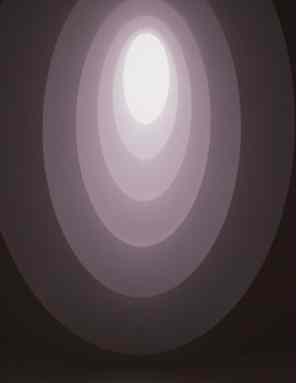
Aten Reign moment in the Guggenheim atrium, James Turrell’s site-specific spectacular. Source: Guggenheim

Aten Reign moment in the Guggenheim atrium, James Turrell’s site-specific spectacular. Source: Guggenheim

You need to get there to experience the spectacular light before September 25, when James Turrell takes his leave of New York, the end of his first major show here. The museum’s exhibition site is wonderful, but it’s no match for the out-of-this-world, cosmic experience of his masterful Aten Reign.

The Guggenheim has blocked off the famous skylight and any view of the atrium from its gallery spiral. Viewing the light show from the ground floor, all viewers see are these rings of slowly changing light with an oval center – a natural shape that Mr. Turrell loves.

Out-of-towners expecting to have the fun of walking up the ramp and looking down on ever-tinier ground-floor visitors will be disappointed. But other magical Turrell encounters await.

On Level 2, we found celebrated security guard, Jeffrey Martinez (see this week’s New York Times profile on him) holding throngs in rapt attention explaining the magic wrought by Mr. Turrell with his corner floor-to-ceiling strip of light. Martinez told us that although it appeared to be a vertical “light”, we were actually seeing an illumination emanating from behind the false wall. The New York Times was right to single him out for a story, because it felt like we were meeting a celebrity with art-world smarts, gently cautioning people against trying to touch and asking them to “stand back” to give the piece some space.

Afrum I (White), 1967, one of Mr. Turrell’s early cross-corner projections. Source: Guggenheim

Afrum I (White), 1967, one of Mr. Turrell’s early cross-corner projections. Source: Guggenheim

Upstairs, the show presents two more light installations that mimic two of the twenty 2D etchings precisely ringing a small gallery. Mr. Turrell creates the illusion, on paper, of light glowing from the white cubes surrounded by the ink. You just have to see them and then turn the corner to see “square” beams of light illuminating two walls. In the second room, Afrum I (White) astounds. You think you’re seeing a levitating white cube of light. Magical.

Hear him talk about his view of Mr. Wright’s philosophy and building and why they are so right for one another:

Enough said. Go see it.

Spoiler alert: The Guggenheim’s YouTube site has several videos about how Turrell and the team created the magic on the spiral.
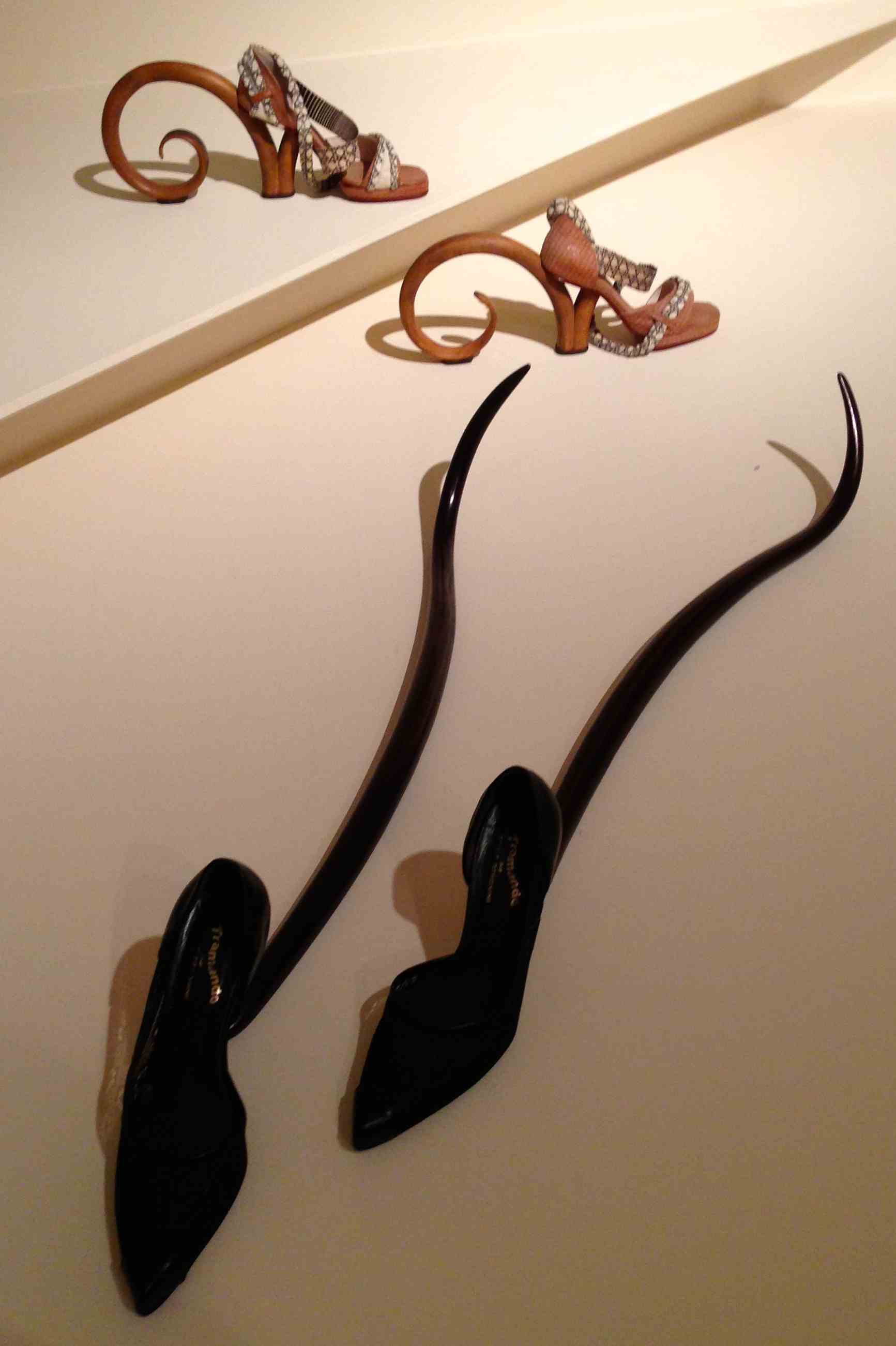
Wood Goes Against Grain at MAD

Pablo Reinoso's whimsical wooden shoes

Pablo Reinoso’s whimsical wooden shoes

All those years walking up and down the aisles at craft fairs may have you convinced that there’s nothing new in wood art. Get over to the final days of Against the Grain: Wood in Contemporary Art, Craft, and Design at the Museum of Art and Design.

It’s not what you’d expect, and curator Lowery Stokes Sims has done a magnificent job in telling us what’s trending now with forward-looking artists on the scene.

In short, she focuses her two-floor exhibition on seven trends that she sees: Artists, like Ai Weiwei, working on socio-political themes, whimsical designers who make us smile, digital artists pushing the envelope with wood, collages, virtuoso technique, takes on trees, and works that just capitalize on the beautiful texture in the wood itself.

Check out our Flickr feed for views of some of our favorite works, and MAD’s four-minute video as Sims herself walks you through the show, the artists, and her thinking about the pieces and themes.

Steam-bent ash chairs by Christopher Kurtz

Steam-bent ash chairs by Christopher Kurtz

But let’s focus on some of our favorites, which you can see on Flickr.

Wood as fashion: What about these shoes by Pablo Reinoso? If you’re thinking Dutch wooden shoes, think again, because these dainties are inspired by Thonet chairs, that he’s embellished with long, wooden “tails”. Or wooden hats by fashionable Moody & Farrell of London.

Music: How did Maria Elena Gonzalez go from looking at a fallen birch tree to creating paper-thin birch rolls that can create stunning music on a player piano? Watch and hear it all on this video of her player piano in action.

Laurel Roth's Hominid Chimpanze (2011) from vere wood with Swarovsky crystals in the teeth

Laurel Roth’s Hominid: Chimpanze (2011) from vere wood with Swarovsky crystals in the teeth

How-did-they-do-that category: Bud Latvin’s gravity-defying wooden spiral sculptures, Christopher Kurtz’s impossible steam-bent chairs, and Elisa Strozyk’s wooden textile.

Recycled surprises: Think about what it took to turn 8,000 recycled chopsticks into a collapsible sofa. Good going, Yuya Yoshida.

If you can get to this show today or tomorrow, go. If not, take time to meet Leonard Drew in his studio, see his wood works in progress, and hear what success in wood feels like:

Civil War Photos and High Line

The High Bridge and the former Civil War rail line, now turned into a pedestrian walking trail across the Appomattox River last year by the State of Virginia.

The High Bridge and the former Civil War rail line, now turned into a pedestrian walking trail across the Appomattox River last year by the State of Virginia.

What can you see from the perspective of 150 years after Gettysburg? If you go to Farmville, Virginia, you can experience a tranquil, soaring view of lush greenery 160 feet above the Appomattox River – a railroad trestle that was once burned, chopped, and torn apart in desperation just a few days before Lee’s surrender.

If you go to the Metropolitan Museum of Art today or tomorrow, you can see Photography and the American Civil War, a show on the First Floor that snaps you back to the birth of image-making, self-promotion, and day-to-day documentation in a way that makes today’s mania for image-sharing look a little lame in comparison.

Essentially, there were over 2,000 photographers roaming through the North and South during those four years of the Civil War. They produced over 1 million pictures of people, soldiers, current/former slaves, battlefield encampments, and more. Photographers trailed the troops everywhere they went, setting up tented studios on site.

Half of Timothy O’Sullivan’s stereo photo, Farmville, Va. April 1865, High Bridge of the South Side Railroad across the Appomattox. Source: Library of Congress

Half of Timothy O’Sullivan’s stereo photo, Farmville, Va. April 1865, High Bridge of the South Side Railroad across the Appomattox. Source: Library of Congress

As soon as you walk into the tented galleries, you’ll see a dizzying array of new technology and firsts – the first campaign button (Lincoln’s) using photos, the carte de visite mass marketed by Sojourner Truth to raise funds and promote her many social-change initiatives (check it out), stereo photos, albumen silver prints from glass negatives, Matthew Brady’s Union Square photo studio for the rich and famous, and before-and-after panoramas of what was going on at the front (not easy when the medium does not capture motion). But that’s just the first two rooms, so plan about an hour or more for the rest of the show.

Timothy O’Sullivan’s 1865 photograph, High Bridge, Appomattox, Va. from Gardner's Photographic Sketch Book of the War [c1866] Source: Library of Congress

Timothy O’Sullivan’s 1865 photograph, High Bridge, Appomattox, Va. from Gardner’s Photographic Sketch Book of the War [c1866] Source: Library of Congress

The photos from this week’s walk across the High Bridge in central Virginia is in stark contrast to the Library of Congress photos of the site in 1865, just after the war ended – a ground-up view of the famous rail bridge that was part of the historic photo-tome produced and marketed to the wealthy by Alexander Gardner and a stereo view of same, produced for the 3-D mass market. See and compare more views of Virginia’s Civil War “high line” with our Flickr photos.

There’s a lot more to the Met’s show than it’s possible to write about here (like the original $100K reward poster for Booth that was the first time photos were used in a perp search) and the fact that Brady never actually went to a battlefield (he sent others).

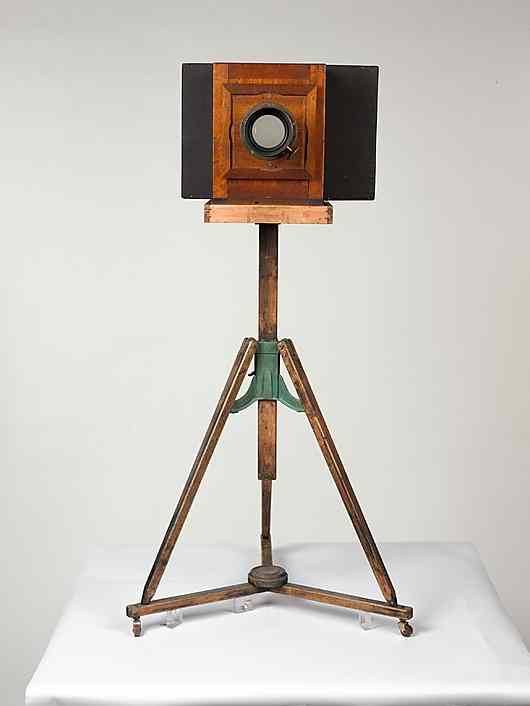
Matthew Brady’s 1860s studio camera is part of the Met’s show. Source: Lowenthell Family Photography Collection.

Matthew Brady’s 1860s studio camera is part of the Met’s show. Source: Lowenthell Family Photography Collection.

It’s simply one of the best shows that the Met has mounted, and congratulations to curator Jeff Rosenheim for this triumph. He’s written a great blog post and recorded a nice 30-minute video that sums up a lot of his thinking.

Check it out and if you’ve missed it, get your Amtrak ticket and head South: This mind-bending, must-see show is coming to the Gibbes Museum, Charleston, South Carolina (September 27, 2013–January 5, 2014), and the New Orleans Museum of Art (January 31–May 4, 2014).

Patching Up the Emperor’s Carpet

Carpet

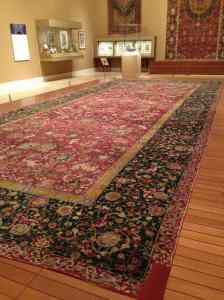
Installation view of the Emperor’s Carpet, second half 16th century. Iran, Safavid period (1501–1722). Source: The Met.

If royal guests had walked all over your Persian carpet for the last 600 years, how many repairs would you need? Before coming to the Met, the 16th-century Emperor’s Carpet, covered in animals and poetry, was once owned by the Shah of Iran and the Hapsburgs.

Since this large, beautiful carpet arrived in New York 60 years ago, the Metropolitan Museum was only able to display it twice because it was in such fragile shape.  When they turned it over, they saw it had been patched over 700 times. How could they stabilize it and install it in their expansive New Galleries of the Art of the Arab Lands on the second floor?

You’ll find out all about the behind-the-scenes work analyzing, stabilizing, patching, and repairing it in the micro- show, Making the Invisible Visible: Conservation and Islamic Art.

Carpet Detail

Restored corner of the Emperor’s Carpet.

The show features all manner of science, technology, and process that the magical conservators put to work for other pieces, too – ceramics, tapestries made of gold and silver threads, wood, and works on paper over the last 2,000 years. One of our favorites is the child’s coat made from antique pashmina. They also have examples of the natural materials that were crushed and pounded into pigments for all these beautiful dyes and paints.

Although the gallery is tiny, the Met decided to send visitors on a treasure hunt by providing a brochure through which seekers of conservation wizardry can locate the Emperor’s Carpet and other works throughout the dozens of Islamic Art galleries. See the details on these and more our Flickr site.

Child Coat

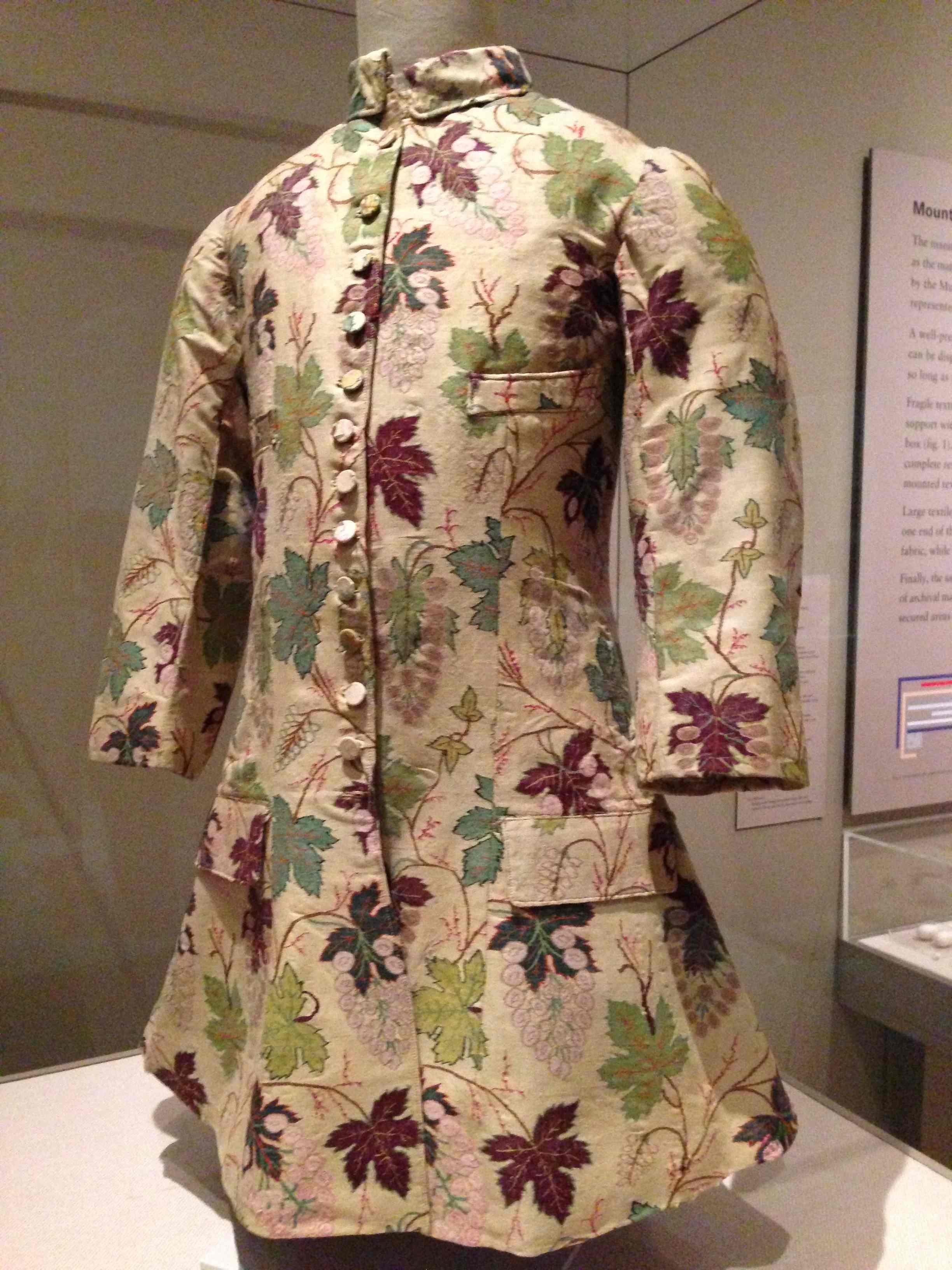
Child’s coat from India on display in the show. Tailored in the late 19th c., but but fabric woven late 18th c. The textile is from Kashmir and is likely pashmina.

One of the shockers is seeing what the conservators reckon are the true colors of the 1707 Damascus room, long a favorite of Met period-room fans. The science showed that the darkened panels that we’re so familiar with were once bright, bright blue and gold.

If you can’t see the conservator’s showcase before August 4, read about all the science and technology on line at the special web site. You’ll find links to the stories of rehab for the carpet, the child’s coat, the gold-weave chadar, and more.

If you have eight minutes, take a look at three years of work on the royal carpet by the Met’s magicians:

Brooklyn Museum Reveals Sargent’s Master Strokes

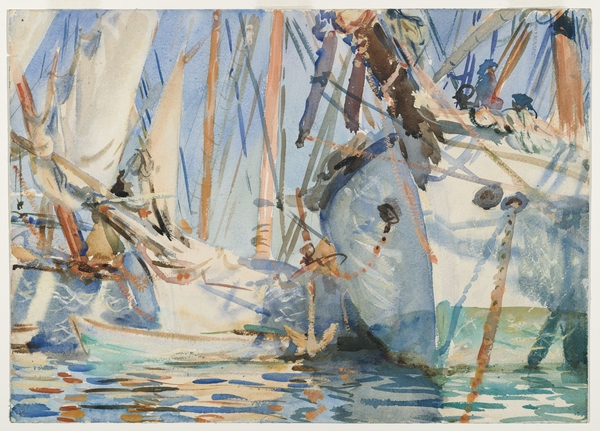
Sargent’s masterful 1908 White Ships. Translucent and opaque watercolor and wax resist with graphite underdrawing, Source: Brooklyn Museum.

Sargent’s masterful 1908 White Ships that he likely painted in a day. Translucent and opaque watercolor and wax resist with graphite underdrawing, Source: Brooklyn Museum.

Back in 1909, John Singer Sargent’s watercolor show at Knoedler was considered a knockout, drawing discerning crowds in awe of his sensational technique. The images of Bedouin life, Venice, and boats on the Mediterranean were so compelling that the Brooklyn Museum raced in to buy 83 (nearly all of them), forcing Boston’s Museum of Fine Arts to wait until 1912, when they could clean out his entire next watercolor show.

Bedouins

Bedouins (c.1905–6). Opaque and translucent watercolor, Source: Brooklyn Museum.

Walking into John Singer Sargent Watercolor on Brooklyn’s Fourth Floor, you can see why the two great institutions went crazy. With 93 of their finest Sargent purchases collectively displayed, it’s impossible for visitors to pick the most spectacular. They’re all exceptional – the Bedouin horses at rest inside the tent, Sargent’s niece wrapped in her cashmere shawl, the cliffs of the Carrara quarries, and the lush Medici gardens.

How did he make such magnificent work with such an unforgiving medium? How did he whip them out? The two museums asked a team of conservators and curators to put the works under the microscope and ultraviolet light to discern more about the master’s process – the sequence of paint application, the types of paint used, and whether he did a pencil sketch before applying paint to paper.

The team gives visitors insights to the scientific process used — an unusual twist at the back of the gallery that visitors poured through enthusiastically. Brooklyn’s digital team installed a 30-second video in which paper conservator Toni Owen asks visitors what more they’d like to know. Here’s the site where she answers with comments on Sargent’s use of gouache, soft-wax resist, yellow paints, and the difficulties of explaining false-color infrared imaging (FCIR) in limited-space wall text in the gallery.

Carrara: A Quarry (1911). Translucent and opaque watercolor and wax resist with graphite underdrawing, Photo: © 2013 Museum of Fine Arts, Boston

Carrara: A Quarry (1911). Translucent and opaque watercolor and wax resist with graphite underdrawing, Photo: © 2013 Museum of Fine Arts, Boston

You’ll learn that Mr. Sargent painted very fast, did not rely on photographs, and did at least one watercolor sitting in a gondola.

Brooklyn’s integrating much more media into its visual art shows, and they’ve hit upon a winning combination here. Some videos show the gardens that were the subjects of Sargent’s work in Italy. Others explain the techniques that Sargent used in the painting next to it.

Listen as artist Monika deVries Gohlke reflects on the type of day Mr. Sargent might have experienced working on his 1908 Melon Boat painting. Watch as she prepares the watercolors, selects his colors, chooses his brushes, and attempts to recreate his “jungle” of shapes and impressions. Does her painting look like his? You be the judge and go get your own paintbox.

Think…Download…Make at New Museum

Open-source vacuum assembled from downloadable instructions, a red thermos, hardware store items, and 3D printed parts

Open-source vacuum assembled from downloadable instructions, a red thermos, hardware store items, and 3D printed parts

If you haven’t been exposed to the DIY (Do It Yourself) movement, drop into the New Museum’s Adhocracy show at its Studio 231 storefront this weekend.

It’s a 25-project showcase of cutting-edge design solutions, including DIY as well as some film, video, low-tech high tech, and crazy, new approaches to making stuff in the 21st century.

The DIY sections that we particularly liked were the household appliances made by downloading Open Source instructions, manufacturing components with 3D printers, and buying the remaining bits and pieces at the hardware store. Why spend money on a Dyson when you can build your own vacuum cleaner from a thermos container and other scrounged parts? Each solution is more fascinating than the next, with displays of OS-compatible coffee grinders, water boilers, and bicycle parts and their instructions.

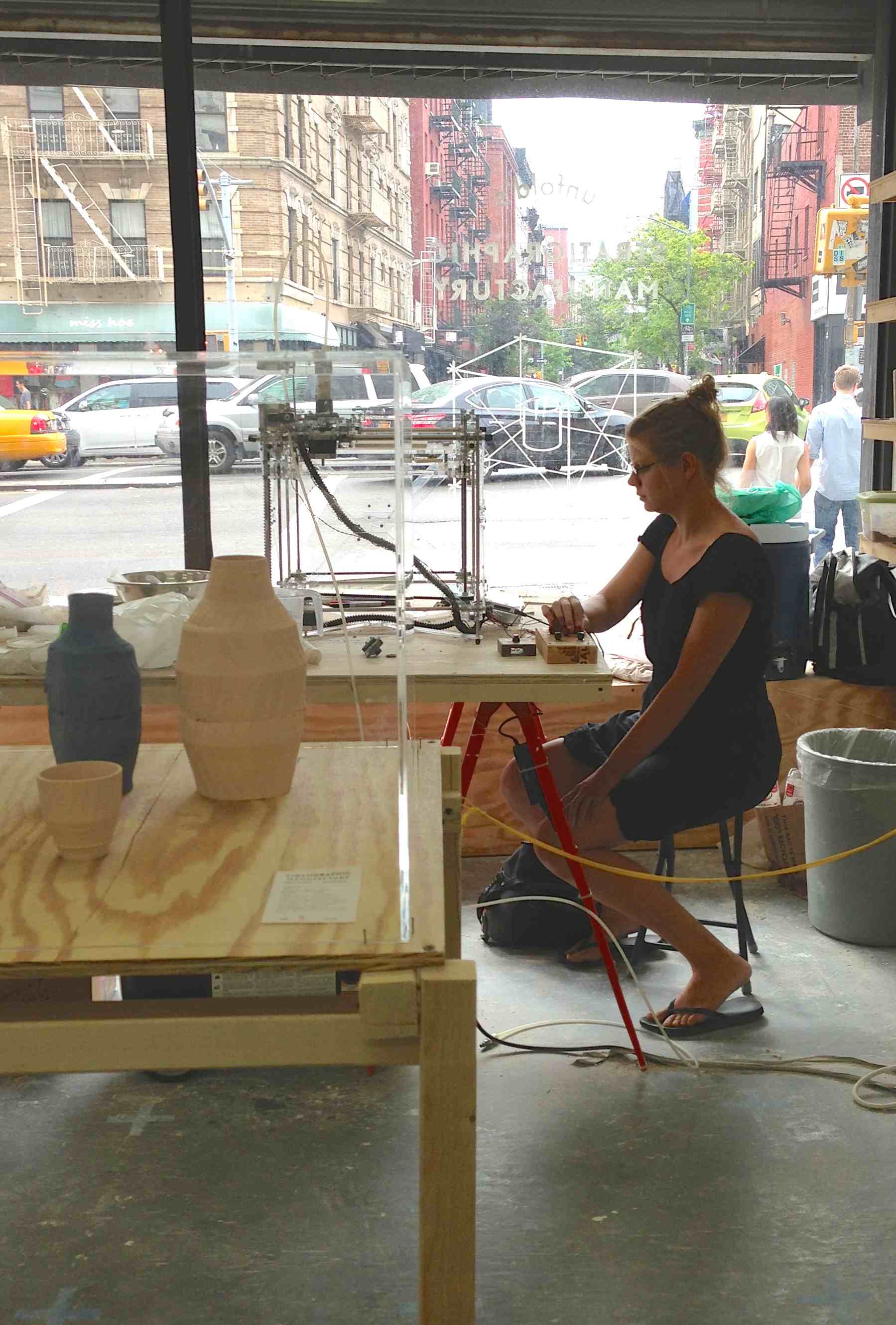
Larisa Daiga uses Unfold's Stratigraphic Manufactury (3D ceramic device) to make coil pots from Gowanus sludge

Larisa Daiga uses Unfold’s Stratigraphic Manufactury (3D ceramic device) to make coil pots from Gowanus sludge

Other displays highlighted the best inventions from Kickstarter (e.g. Central Standard Time wristbands and iPod Nano multimedia wristwatches) and solutions for using the Arduino microcontroller – lion tracking collars in Kenya and an earthquake-sensing device created and marketed by a 14-year old in Chile. It tweets you when there’s a tremor. Click here to see some photos, and if you feel like making something, explore your options on Adafruit..

Right in the storefront window, NYC ceramicist Larisa Daiga uses a ceramic 3D printer to make a tiny coiled pot. Larisa told us that she couldn’t touch the porcelain, because it was actually sludge from Brooklyn’s beloved Superfund site, the Gowanus, and loaded with biotixins.

Daiga felt it was interesting to be part of Unfold’s Stratigraphic Manufactury project, making coil pots (one of the oldest technologies of humankind) with toxic waste. Days spent in the window of Adhocracy let her contemplate how sludge might be reused and recycled instead of being trucked and dumped into unsuspecting landfills in the rest of the country. View her Adhocracy output and see the machine at work on her Flickr feed.

Another DIY favorite from Helsinki is featured in the show — Restaurant Day, when everyone in the city has permission to open their own restaurant on the curb. It’s one step beyond Smorgasburg.


Founders in Beta

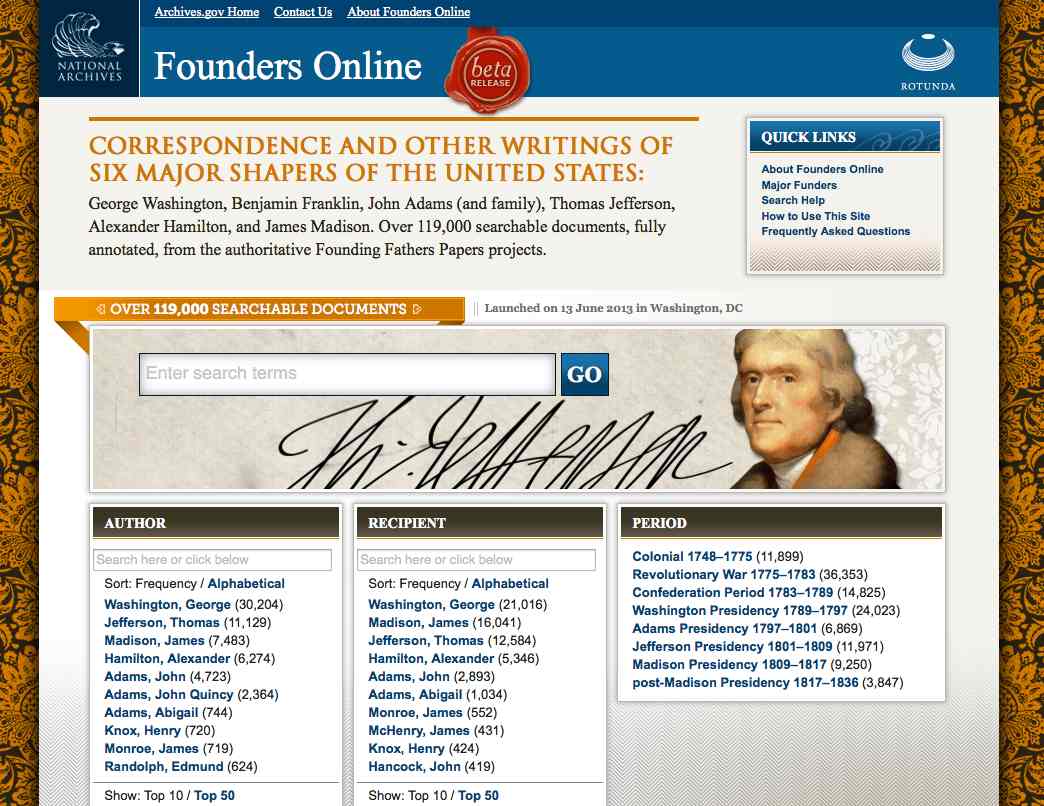
Founders OnlineThere’s no better way to celebrate the Fourth of July weekend than spending a little time with Founders Online, a collaboration between the National Archives and the University of Virginia Press, featuring posts from six of our most popular founding fathers – Washington, Franklin, Hamilton, Adams, Jefferson, and Madison.

The National Historical Publication and Records Commission (within the Archives) decided to liberate everyone from trekking to libraries by putting all of the diary posts, letters, and day-to-day chronicles of the Founders online.

You can go right to the earliest drafts of Tom J’s Declaration, and read young Washington’s journal entries on his first trip over the mountains of western Virgina in 1747.

The site, still in beta, currently has over 119,000 searchable documents – who wrote to whom and what the daily buzz was about in the colonial times. You can search by person, sender, recipient, concept, or era.

Jump in and see what Franklin’s or Hamilton’s revolutionary days were like, or ramble through the early White House years. It will be like scanning 18th century Twitter feeds or FB timelines of your favorite founders.

(And speaking of beta, check out Tom J’s copy of his unedited Declaration in the new NYPL Digital Collection.)

Washington, D.C. Museum Videos Reach 14 Million YouTube Views

Since Smithsonian branches and other Washington, D.C. museums, zoos, and gardens began posting videos on line in 2007, collective YouTube views have climbed to 14 million, as chronicled in our latest report, Washington D.C. Museums: 2013 Video and Social Media Rankings.

Although the 14 million total is less than the 49 million views racked up by New York museums, don’t forget that two high-profile DC institutions – National Geographic and the Smithsonian – produce significant amounts of programming distributed on their popular cable TV channels, dedicated apps, and snazzy web sites. Even though it has a DC museum space, NatGeo (a joint venture with Fox Cable) has largely abandoned YouTube; however, the 18 individual Smithsonian branches are all still posting their own stuff regardless of the more comprehensive joint venture with Showtime.

In the Top 2012 Cultural Museum Video, archival footage is cleverly coupled with behind-the-scenes looks at the National Archives’ 1940s Census release

In the Top Cultural Museum Video, archival footage is cleverly coupled with behind-the-scenes looks at the National Archives’ 1940s Census release

Here are some findings from our report on video and social media produced by DC institutions:

As of year-end 2012, the Washington museums having the highest number of total YouTube channel views were the Library of Congress (4.5M), the National Archives (2.1M), and the United States Holocaust Memorial Museum (1.6M). The top two are information powerhouses with massive collections to push out for public consumption, and the third is right on their heels with an innovative series with curators interpreting interesting items from their collections.

All-time top DC museum video, one of Edison’s earliest films, with over 329K hits on YouTube

All-time top DC museum video, one of Edison’s earliest films, with over 329K hits on YouTube

Edison still delivers. It’s interesting that the top ranked DC museum video of all time is Edison Kinetoscopic Record of a Sneeze, Jan. 7, 1894, the earliest surviving copyrighted moviesuggesting that our greatest media innovator is having the last laugh, contributing over 329,000 hits to the number-one ranking by Library of Congress on YouTube. It’s short enough for Fred Ott to be on Vine.

Four museum video channels have surpassed 1 million views. To put the DC numbers in context, if they were merged with the New York museum video rankings, the Library of Congress (4.5M) would rank seventh, just ahead of the Metropolitan Museum of Art. The Library of Congress would rank eight (2.1M), just ahead of the New York Public Library.

The National Zoo produced Washington’s top-viewed 2012 museum video – Shanthi, the National Zoo’s Musical Elephant, Plays the Harmonica!. Over 290,000 viewers watched this middle-aged mom experiment with a musical instrument in her enclosure and listen to her keeper talk about her performance. Shanthi’s viewership greatly surpassed the numbers generated by the most popular 2011 Washington museum video, the National Portrait Gallery’s Conan O’ Brien as Seen by Artist John Kascht. Surely, Conan would be amused.

The Smithsonian American Art Museum’s Top Exhibition Video of 2012 features curator Chris Melisinos describing why video games belong in an art museum

The Smithsonian American Art Museum’s Top Exhibition Video of 2012 features curator Chris Melisinos describing why video games belong in an art museum

The top cultural video was a behind-the-scenes work at the National Archives for the release of the 1940s census. Over 115,000 family historians watched Learn About the 1940s Census, which showed the Archives census team, provided information on how to find your family’s records, and worked in interesting archival footage from the original census.

The Smithsonian American Art Museum produced Washington’s top video about a museum exhibition. Over 28,600 people watched The Art of Video Games: Chris Melissinos, Curator, a brief look into the evolution of the stories, technology, and visualization advances of this mass entertainment medium.

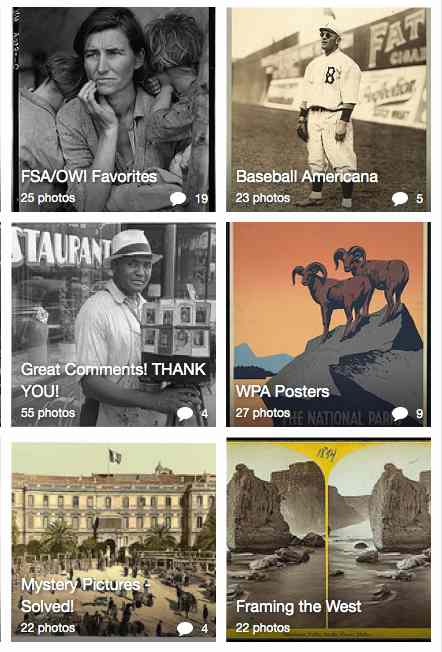
A few of the Flickr sets from Library of Congress

A few of the Flickr sets from Library of Congress

The most active Twitter users are the National Museum of American History, the National Air and Space Museum, and the National Postal Museum. But except for Air and Space, it’s a different set for Facebook followers.

The most active Flickr users are the National Archives, the Library of Congress, and the Smithsonian American Art Museum. The Archives has organized its photos into creatively themed sets, such as “White House Wednesdays,” “Millinery Monday,” pictures of the 1940s census being taken, and pets of the First Families. The Library of Congress also posts a folder containing “mystery” photos and asks the public to help to identify them.

All the detailed video and social media statistics on 42 museums are in the report. Click here to see what’s included and make a purchase from our Its News To You Reports shop.

Enjoy the most popular DC museum video, a musical visit with the National Zoo’s sensation, Shanthi:

More Time Tripping at Grand Central

Annex window view of Lothar Osterburg’s model of his dream of Grand Central as a zeppelin docking station back in the 1930s

Annex window view of Lothar Osterburg’s model of his dream of Grand Central as a zeppelin docking station back in the 1930s

Even if you didn’t manage to board the historic train cars at Grand Central in May, you can still go back in time, courtesy of 18 artists featured in the GCT exhibition in the New York Transit Museum Annex, On Time: Grand Central at 100.

Inspired by The Clock and the continual flow of people and trains through Grand Central, MTA Arts for Transit cooked up a delightful mix of contemporary 2D works, models, videos, and digital art that puts a smile on the face of every commuter, tourist, and art-seeker that we’ve seen inside the tiny Annex.

Look closely to find this minute secret portal: Ledge with Lunette, 2013 by Patrick Jacobs

Look closely to find this minute secret portal: Ledge with Lunette by Patrick Jacobs

Have you seen the mysterious Zeppelin posters by Lothar Osterburg on the subway? Right in the Annex window you’ll see the gigantic, fun-house model that he created to photograph as one step in the process of making the photogravure you see on the A train. Kids and parents can’t resist Lothar’s newspaper-covered multi-story GCT impression and the funny, fat yellow old-time taxis and zeppelin ends that poke out. Right next to it, you can examine his resulting print, Zeppelins Docking on Grand Central.

People are usually transfixed by the 2008 video documenting Frozen Grand Central, where Improv Everywhere staged a 250-person flash mob, where people “froze” for 5 minutes as commuters, tourists, and workers wondered what was going on.

Another hit is Grand Central Diary. London Squared Productions interviewed tourists and commuters about GCT, animated the furniture and items around the terminal, and…well, just watch The Clock and the Maintenance Cart speak for themselves:

Nearby, several small digital screens show Alexander Chen’s Conductor, a 15-minute video loop that animates the subway lines, suggesting trains moving through the system. He turns the subway lines into an animated stringed instrument. No wonder he’s working for Google Creative Labs. Spend a few moments, take a look, and experience it here.

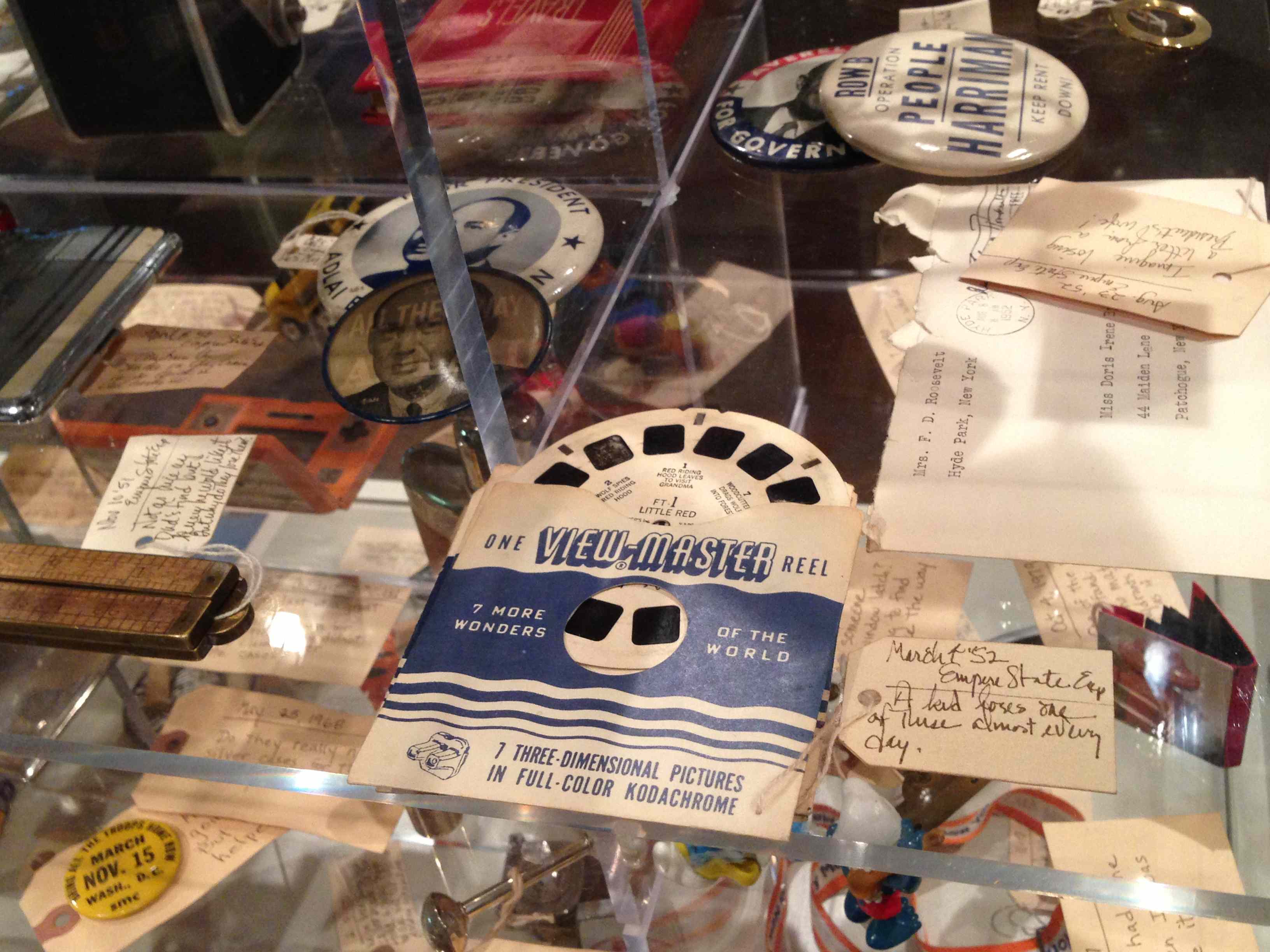
Close-up of Viewmasters and other leave-behinds inside Jane Greengold’s Lost and Found.

Close-up of Viewmasters and other leave-behinds inside Jane Greengold’s Lost and Found.

Another must-see piece (among many) is Jane Greengold’s Lost and Found. She’s created a sort-of fiction about the dozens of tagged items in the vitrine, evoking the memories and observations of generations of conductors who found items that train passengers left behind. Actually, the items you’re looking at are actual leave-behinds collected by real-life conductors, so Jane’s work isn’t entirely made up. The archeological discoveries include things from the old Lake Shore Limited on the NY Central, a 1948 boxed baby tooth, 1943 ration cards, 1952 Viewmasters, a Kennedy campaign button, and a Kindle.

Get to the Annex before July 7. In the meantime, check out curator Amy Hausmann and her artists telling about the fun they had contemplating time, architecture, fashion, and Jackie O.

Mary Cassatt’s Tech Start-Up Chronicled by NYPL

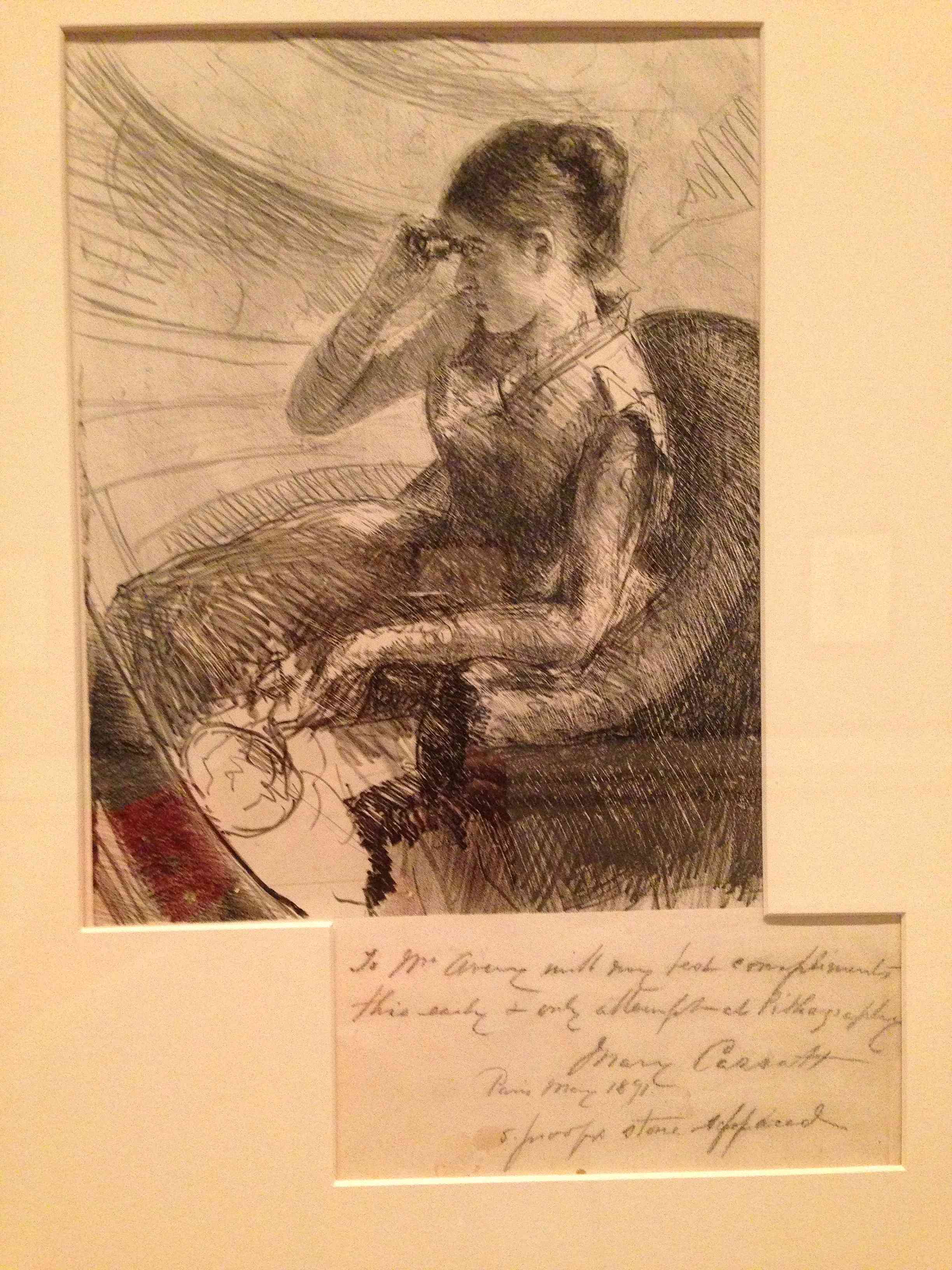
Woman Seated in a Loge (1881). The only lithograph Cassatt ever did, personally inscribed to Mr. Avery.

Woman Seated in a Loge (1881). The only lithograph Cassatt ever did, personally inscribed to Mr. Avery.

Still using a flip phone? Don’t know how to code? There’s nothing wrong with sticking with what you know, but expanding horizons with new technology is always good. In 1876, it’s exactly why Mr. Degas invited 32-year-old Mary Cassatt into his studio, showed her some of his printmaking techniques, and encouraged her to jump in and try something new. She did, and her technological triumph is the story of NYPL’s illuminating third-floor show, Daring Methods: The Prints of Mary Cassatt, which ends Saturday.

The show gives you a new slant, documenting this American artist’s struggle to make new work, push her technical boundaries, and mash up styles to total critical acclaim at the turn of the last century. NYPL found itself in a unique position to mount this show, since art dealer/print collector Samuel Putnam Avery made an unprecedented donation back in 1900 — more than 17,000 19th-century prints, including dozens and dozens he purchased directly from Cassatt as evolved her printmaking between 1878 and 1898.

The Letter (1891) – color print with drypoint and aquatint. This is an earlier state (iii/iv) of Cassatt’s famous print minus the wallpaper pattern and letter on the desk

The Letter – 1891 color print with drypoint and aquatint. This is an earlier state (iii/iv) of Cassatt’s famous print minus the wallpaper pattern and letter on the desk

This show provides art-lovers with a unique, chronological walk-through of Cassatt’s technical trial-and-error, beginning with her early drypoints (1878 costume studies suggested by Degas), simple drypoints and etchings, and her only litho (see right). Cassatt continued to experiment throughout the 1880s, perfecting her softground, drypoint, aquatint, and etching techniques, often mashing them together – brave moves by a stylish, curious female artist of the modern era.

Gallery visitors walk slowly from print to print, taking in the subtle changes, redirects, and reworks of this modern, mid-career artist determined to find status and success in the male-dominated Parisian art scene of the late 19th century.

The NYPL curators decided to hang multiple versions of similar subjects side by side, so you can really examine the mind of the artist at work. It’s interesting that Cassatt let Avery have prints off cancelled plates that she pulled after the “good” print run was finished. You’ll see the scratched-up images in the show next to the best ones.

The Fitting – 1891 color print with drypoint and aquating, printed with three plates

The Fitting – 1891 color print with drypoint and aquatint, printed with three plates

In 1890, everything changed for Cassatt, when she saw an exhibition of Japanese woodblock prints took the Parisian cultural community by storm. It was the moment that her technical experiments paid off and her printmaking vision, style, and legacy became sharply focused. In the last portion of the show, you witness her brilliant response — making intaglio look like woodblock, applying multiple areas of bright color, injecting pattern into domestic surfaces, and zooming in for low-angle close-ups of private moments in women’s lives.

Enjoy NYPL’s selections from Mr. Avery’s collection and spend some time examining the multiple states of the most beloved prints in the Impressionist canon, mash-ups of aquatint and drypoint. It’s a master class in color, ink, and composition.

If you can’t get to the show this week, download the PDF and take a look at Ms. Cassatt’s technical journey. Then go out and try something new.