Man Ray at The Met

After Man Ray saw European Cubism at the 1913 Armory Show, he knew what he had to do in his own art – abandon all of the constraints of contemporary American art and dive headfirst into Dada and push the boundaries – go rogue.  

Some say that Man Ray became America’s most important 20th century artist. Marcel Duchamp – who became one of Man Ray’s best friends and collaborators – would certainly agree. All the evidence for Man Ray’s status is right here in the Met’s survey of Man Ray’s formative years (1914-1929), Man Ray: When Objects Dream on view through February 1, 2026.

Man Ray’s 1930 Self-Portrait with Camera – a solarized portrait. Courtesy: The Jewish Museum.

Walking in, you look through the exhibition’s architectural aperture to an endless array of Man Ray’s famed rayographs – dreamy abstract black-and-white cameraless images – lining parallel black gallery walls. Nearly sixty have been gathered for this occasion from international public and private collections.

See our favorite works in the exhibition in our Flickr album.
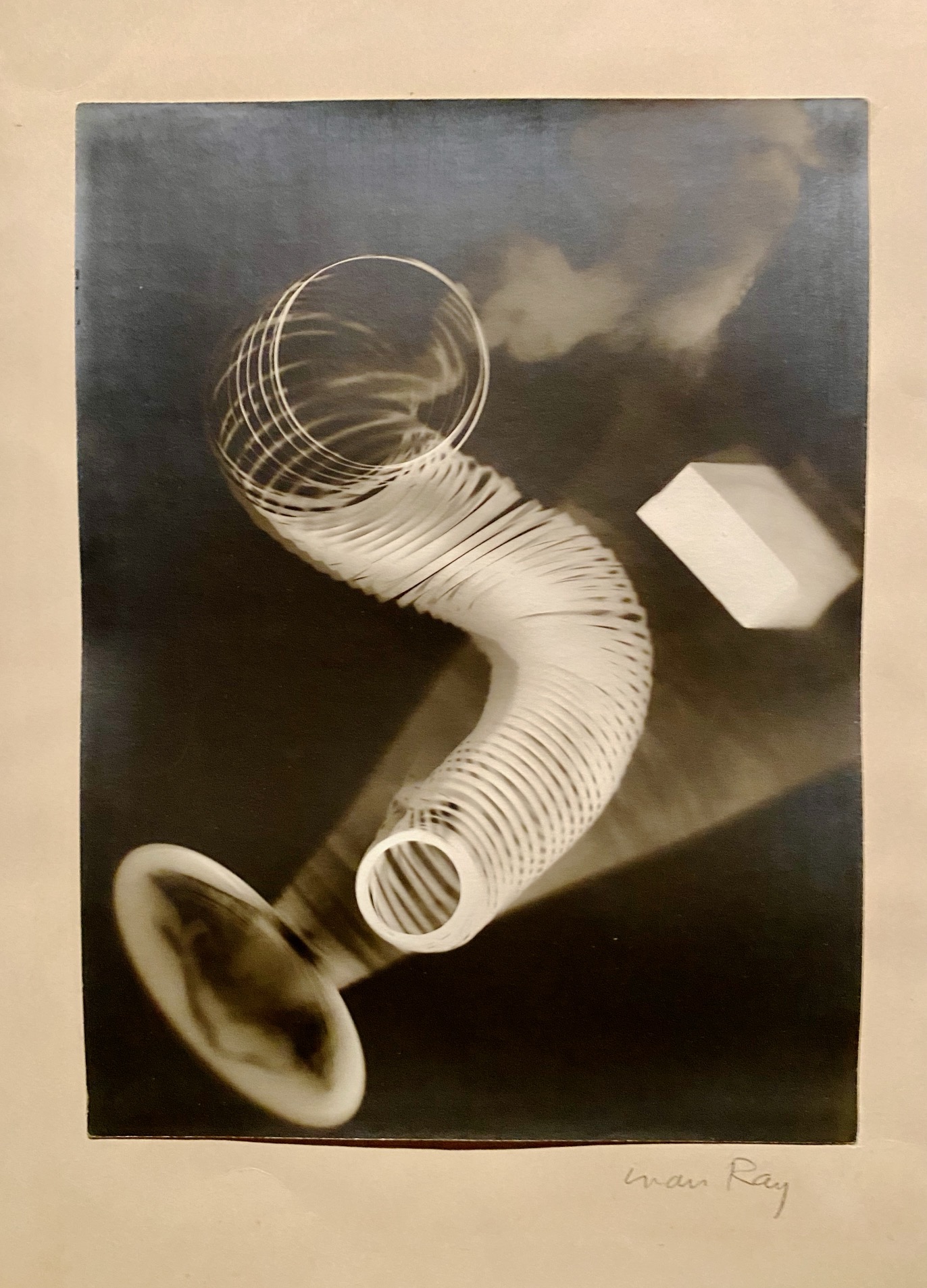
Man Ray’s 1922 Rayograph published in Les Fuilles Libres (Loose Pages) magazine – a coiled wire puffing smoke emerges from a glass.  Courtesy: private collection.
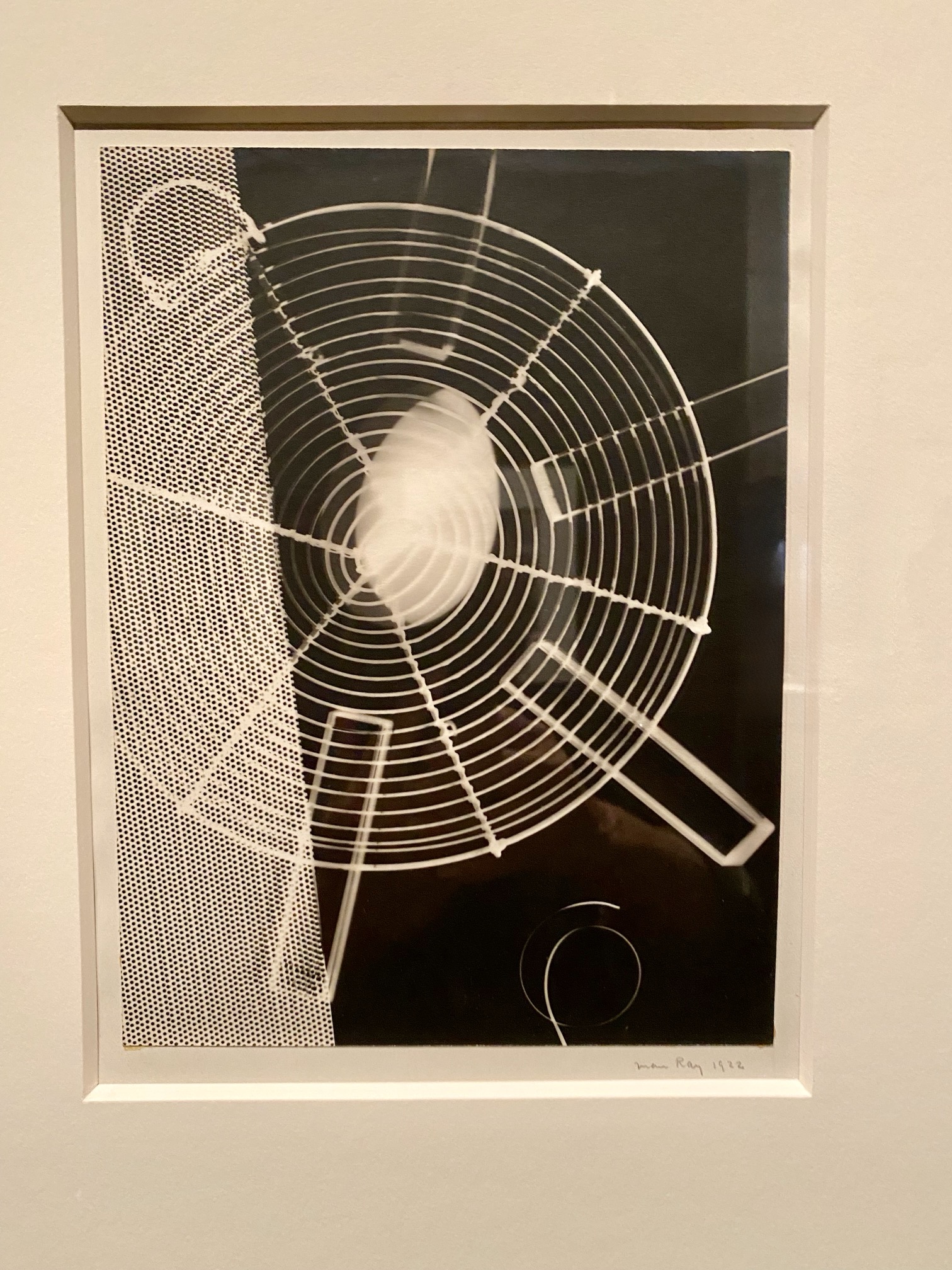
Man Ray’s 1922 gelatin silver print Rayograph incorporating an everyday wire rack for dramatic effect.  Courtesy: Yale University Art Gallery.

Although the rayographs form the core of this show, you also see the oil paintings, airbrush drawings, sculptures, movies, and game boards – works that are rarely seen, but illustrate why Man Ray rapidly took center-stage in the modern avant-garde community.

While working as a commercial artist and photographer, he used his free time to make unconventional, revolutionary works that banished representation. In 1916, he wrote a “new art” treatise on how to condense motion and dynamic shapes into two dimensions.
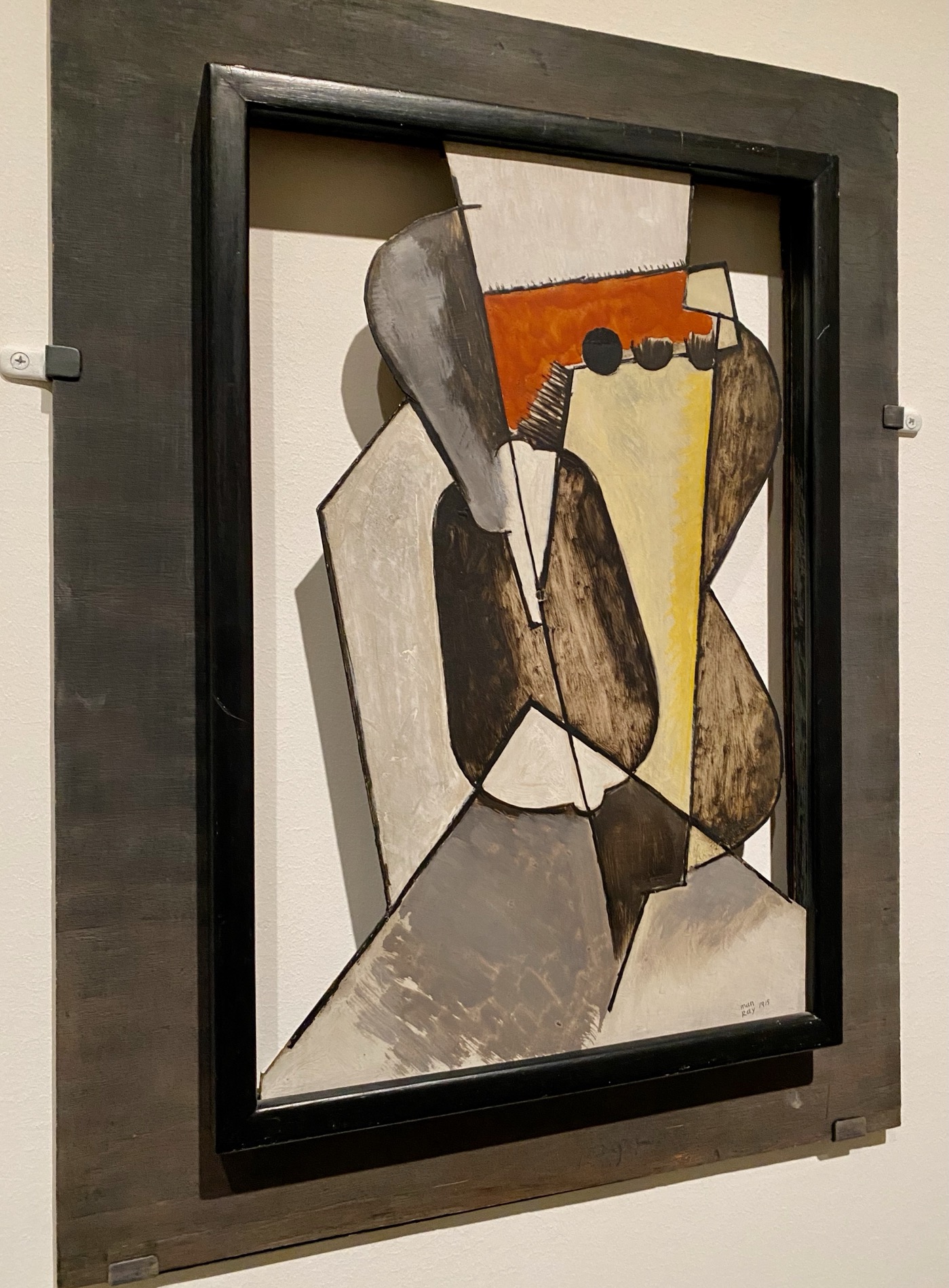
Man Ray’s 1915 oil on board Cut-Out from his first solo show in New York in 1919 – representing three dimensions within two.
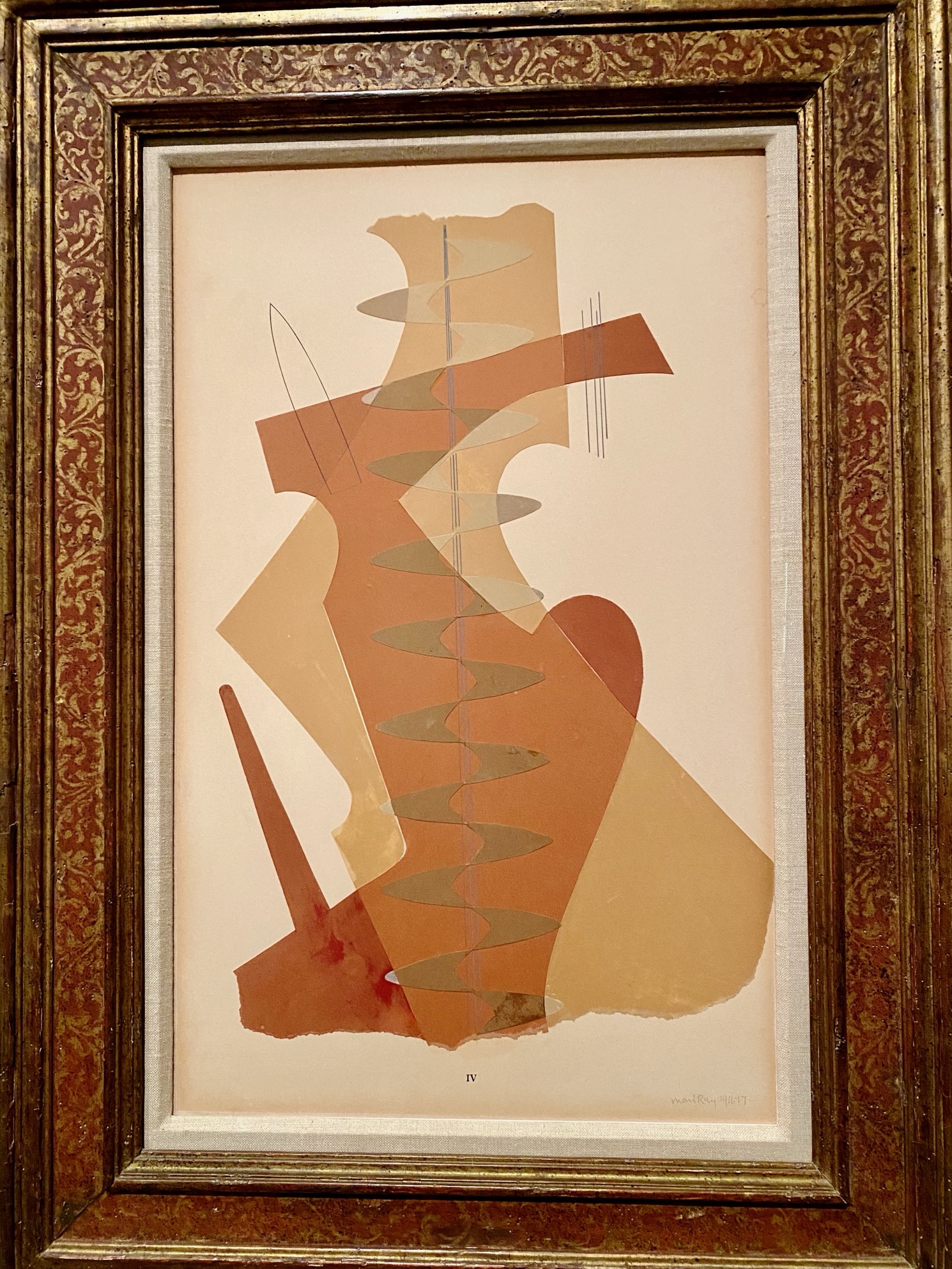
Man Ray’s 1916-1917 collage and pen-ink drawing The Meeting. Courtesy: The Whitney Museum of American Art.

By 1917, he was making large-scale works, portraying a Rope Dancer mid-performance with stencils, cut-up pieces of colored paper, and big colored spaces representing her shadows.
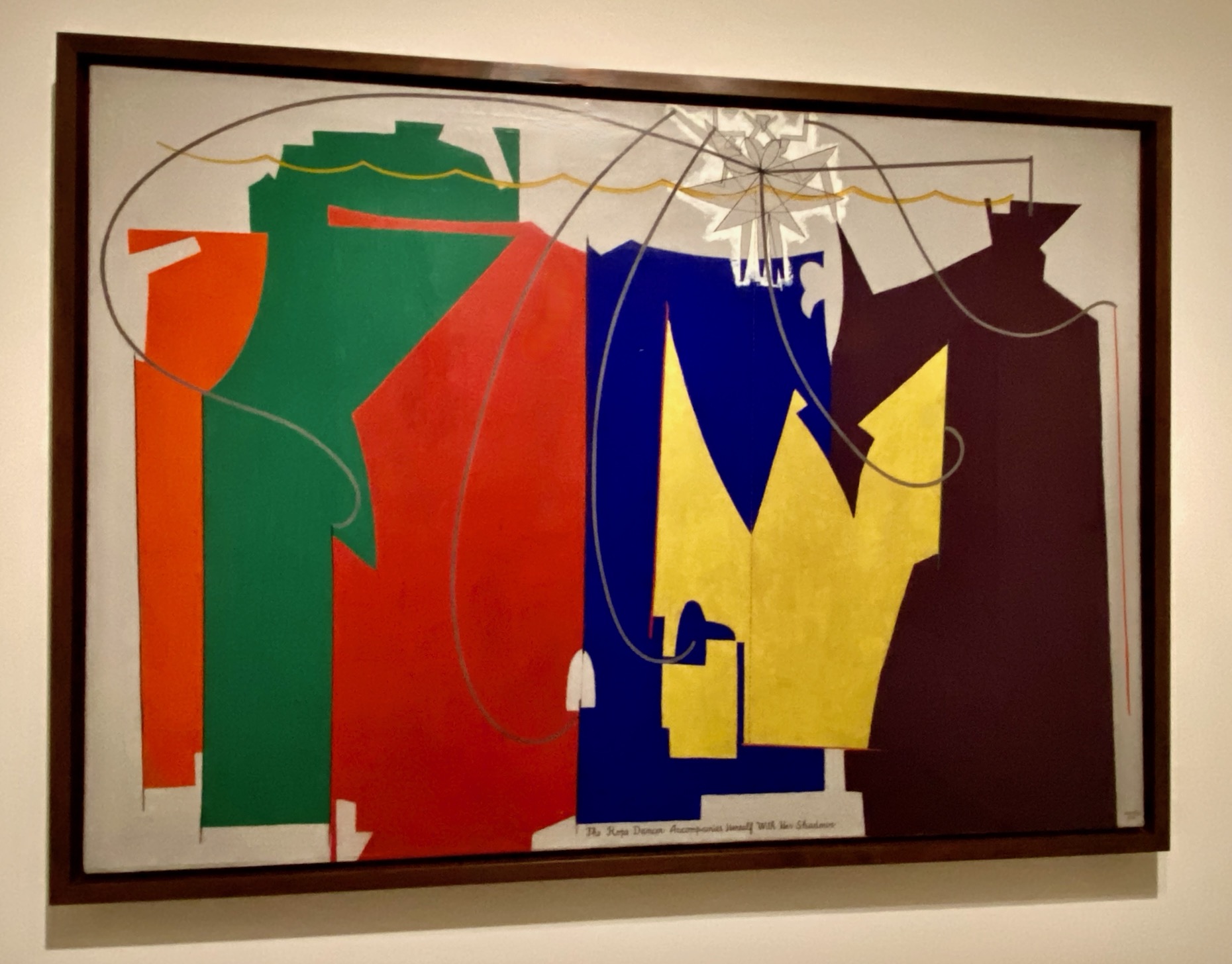
Man Ray’s 1916 oil painting The Rope Dancer Accompanies Herself with Her Shadows planned with cut paper. Courtesy: MoMA

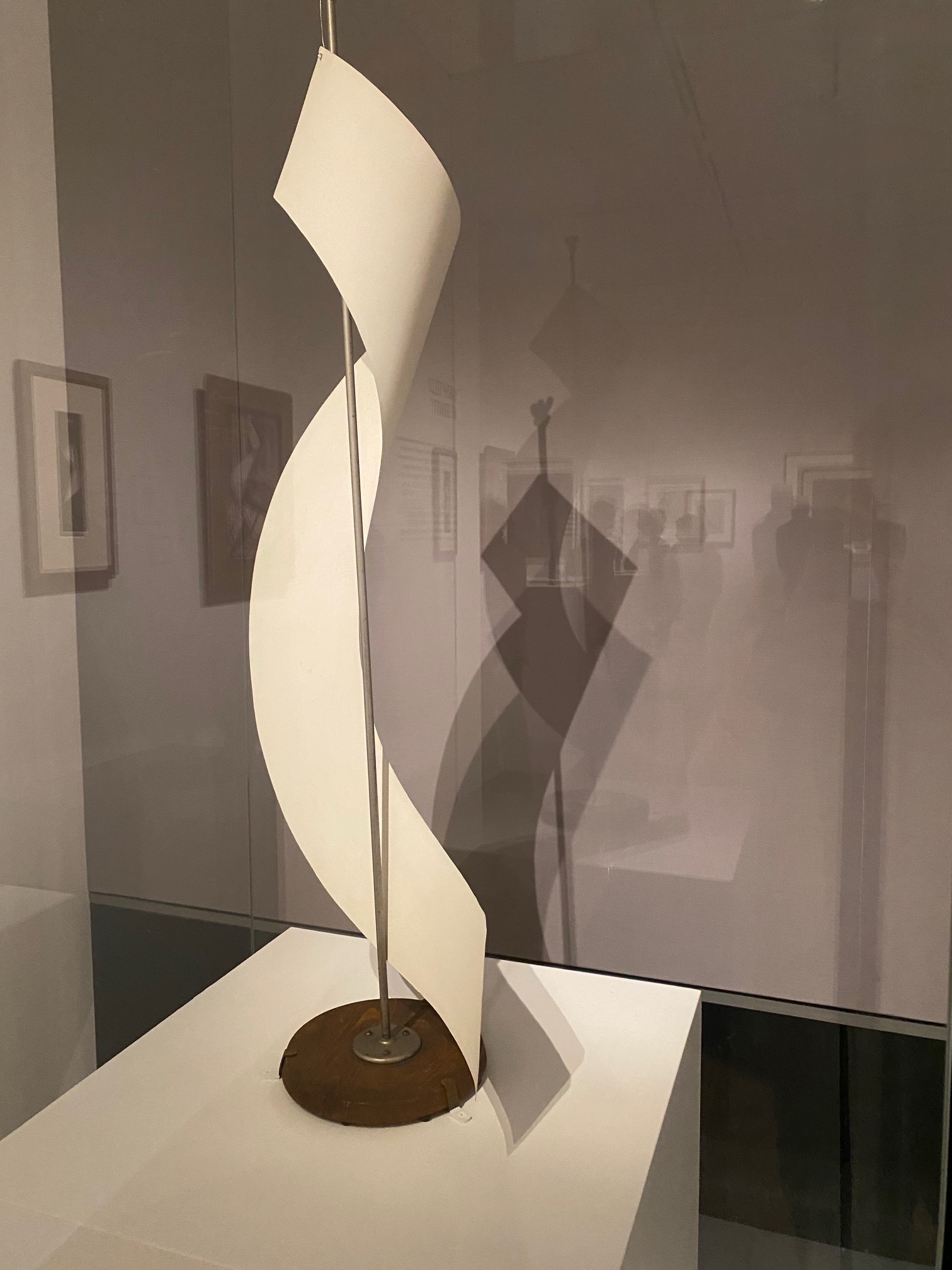
His sculptures were made in true anarchist-Dada fashion – from junk found on the street or in his apartment-building trash can. In one gallery, a precarious grouping of dramatically lit wooden hangars is installed overhead like a chandelier. The cast shadows look pretty good, too.  His spiraling Lampshade, a sensuously curved metal sculpture is nearby, alongside paintings and avant-garde portraits where he repurposed the great shape.
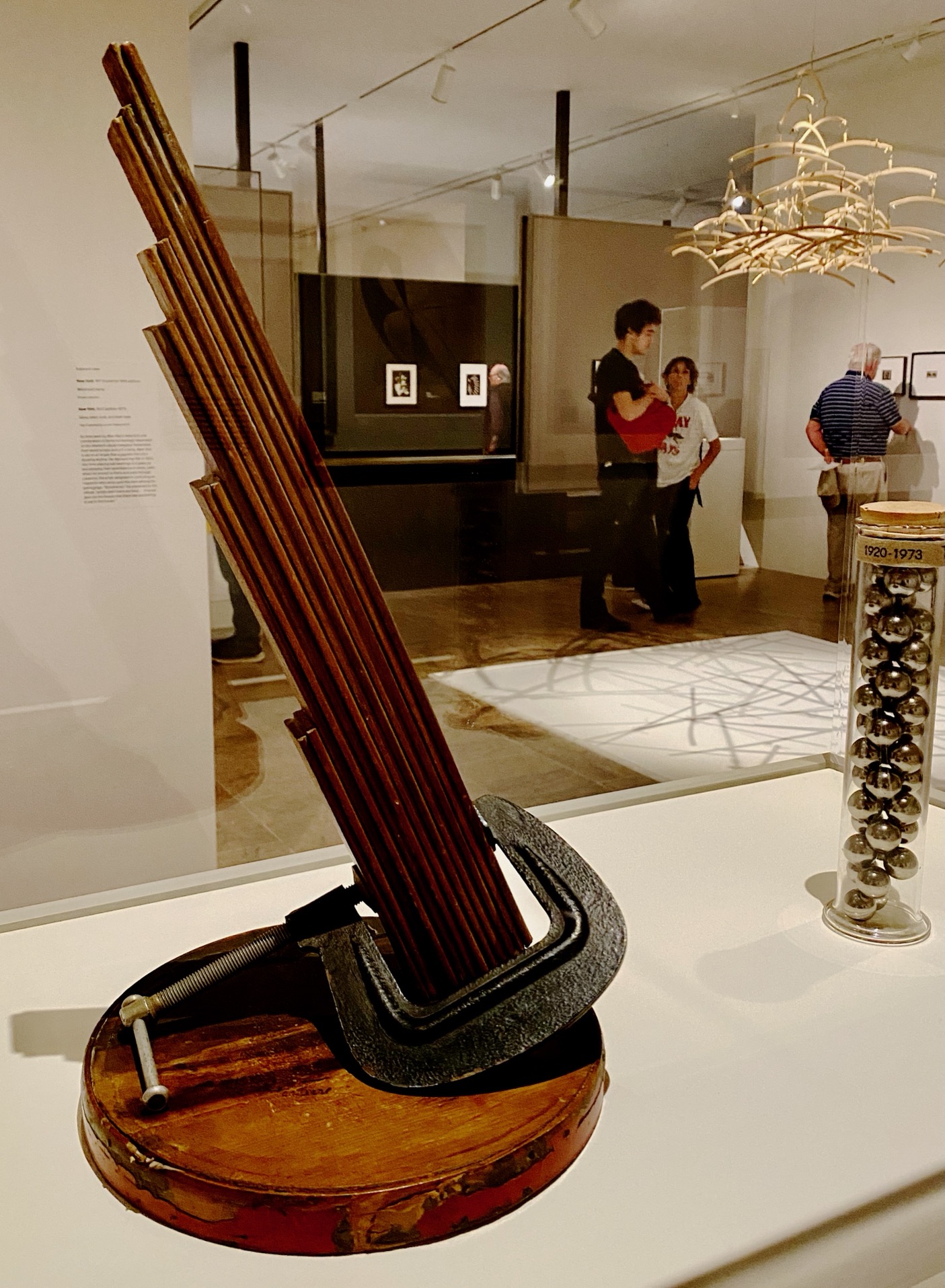
Man Ray’s 1917 wood and clamp sculpture New York like a tilted skyscraper; at right, 1920 sculpture New York – a mysterious stack of ball bearings in a glass container. Courtesy: private collection; Tate.
Man Ray’s 1921 Lampshade – a dynamic painted tin and metal sculpture; inspired by a paper lampshade found in the trash a year earlier. Courtesy: Yale University Art Gallery.

He even made game boards and chess sets to symbolize his philosophy about the best way to make art – spur-of-the-moment imagination, abstract planning, clear intention, and an element of surprise.
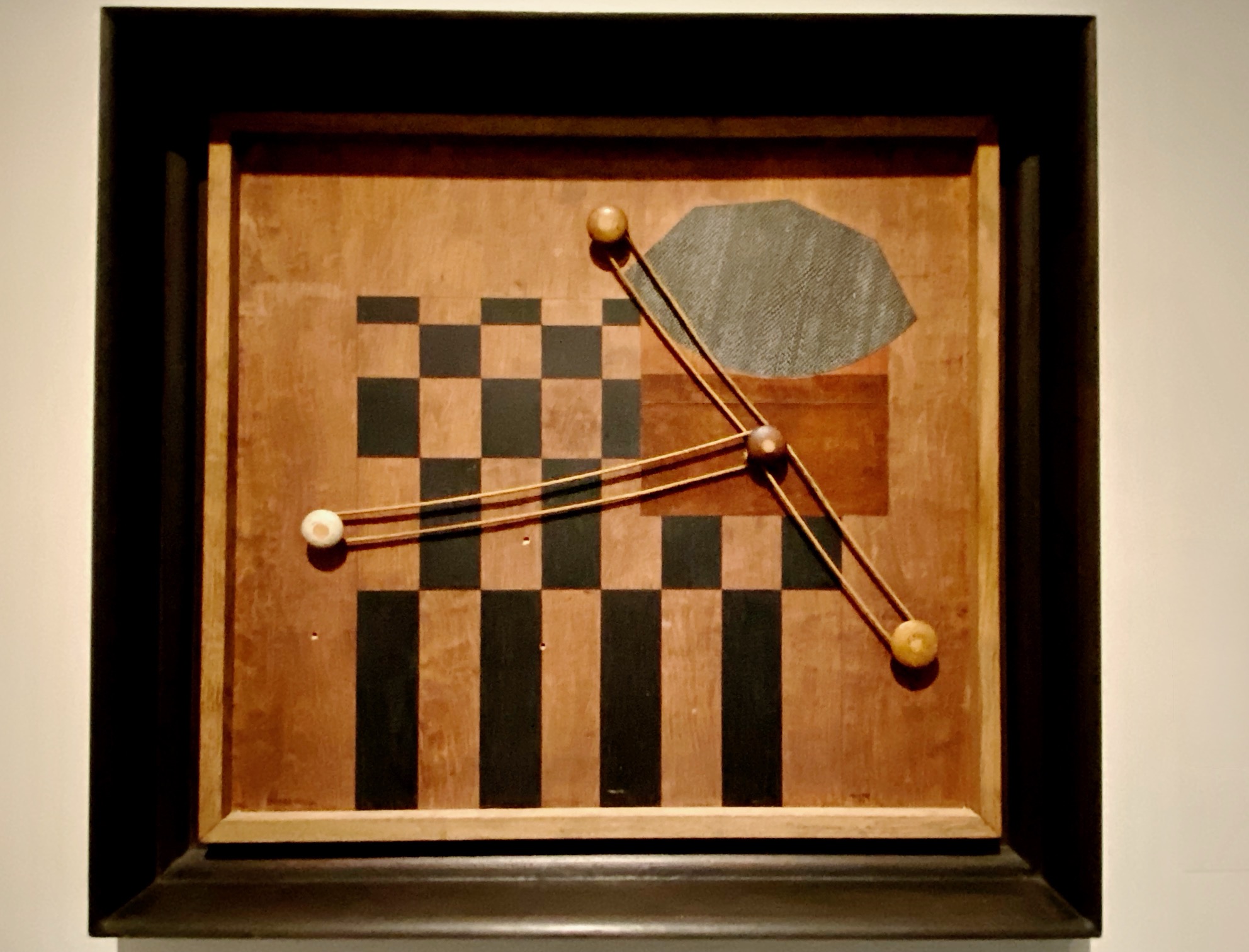
The philosophy of the chessboard: Man Ray’s 1917 Boardwalk – an assemblage of oil, furniture knobs, and yarn on wood. Courtesy: Staatsgalerie Stuttgart.

For Man Ray’s fine-art photographs, he preferred using inanimate, everyday objects to humans. And as he progressed as an artist, he didn’t use a camera.  In 1917, he started making glass-plate prints (cliché-verre) with sinuous, patterned line drawings. Soon, he was innovating with Aerographs – abstract pencil-and-airbrush drawings inspired by new technology (“drawing in air”).
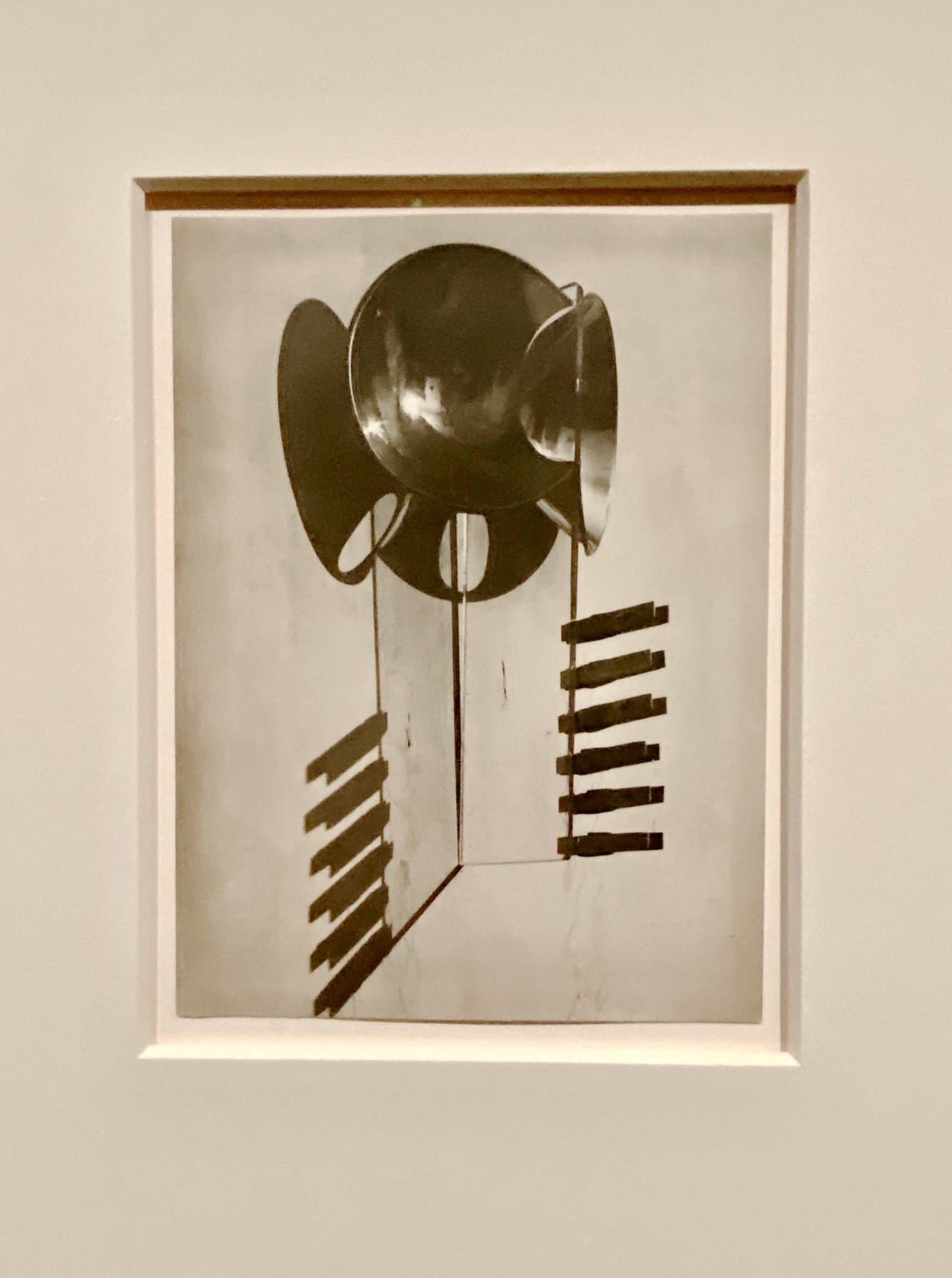
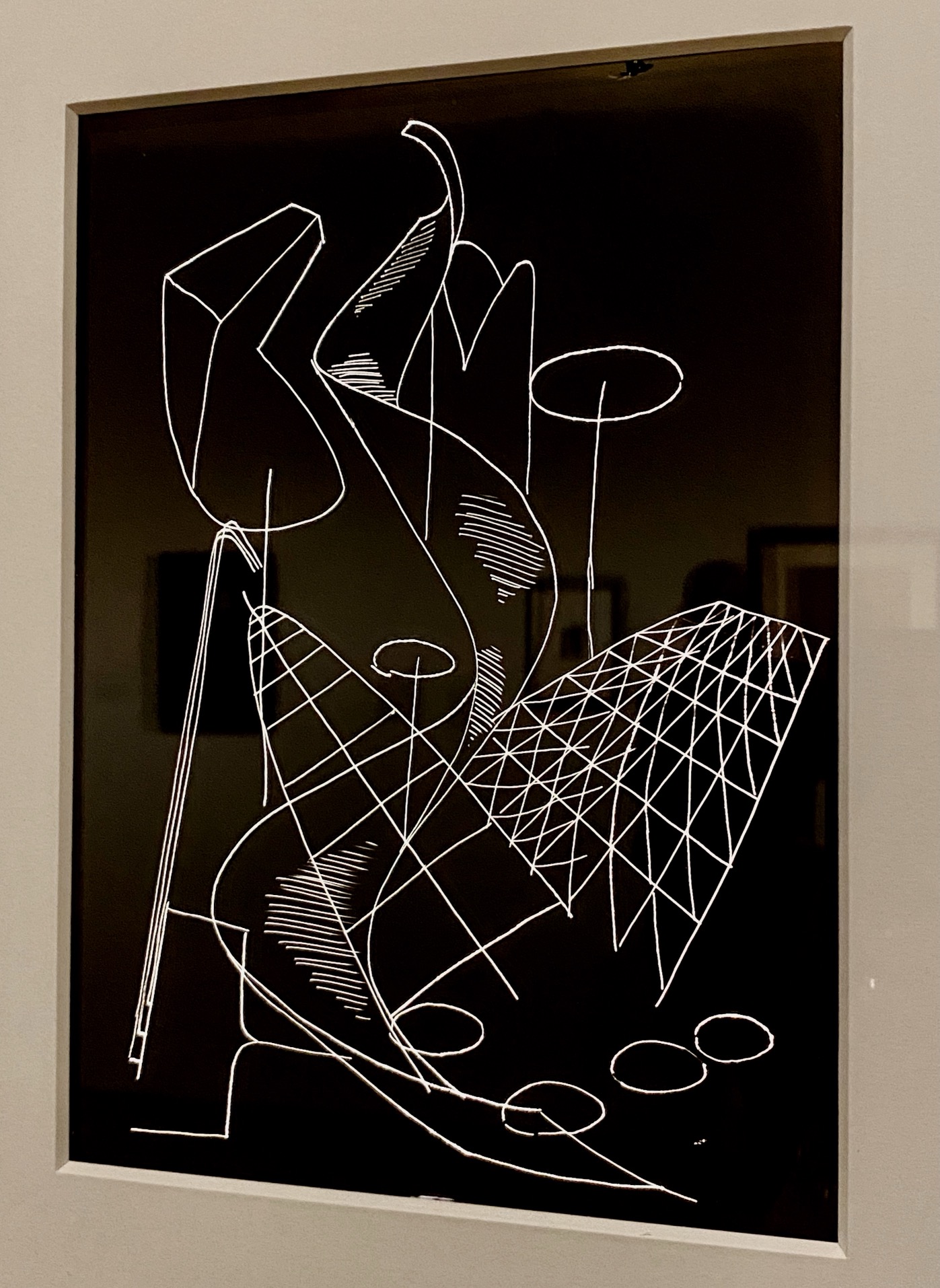
Man Ray’s 1918-1920 gelatin silver print “Integration of Shadows” – an assemblage of clothespins, glass, and reflectors; printed after 1935. Courtesy: private collection.
Before the rayograph: Man Ray’s 1917 untitled glass-plate negative (cliché-verre). Courtesy: Centre Pompidou, Paris

Man Ray primarily spent his time in Paris during the 1920s. Once he began making rayographs in his studio, he was content playing with unusual juxtapositions of everyday objects, studio lights, and various types of photographic exposures. It’s reported that in 1922, he created over 100 rayographs and abandoned painting altogether. (But he took it up again the next year!)

The curators make a point of juxtaposing several rarely-seen paintings with specific rayograms from the same period to make a point – the artist might have returned to experimental paintings as a compliment to some of the shapes and feelings he was exploring through photography.
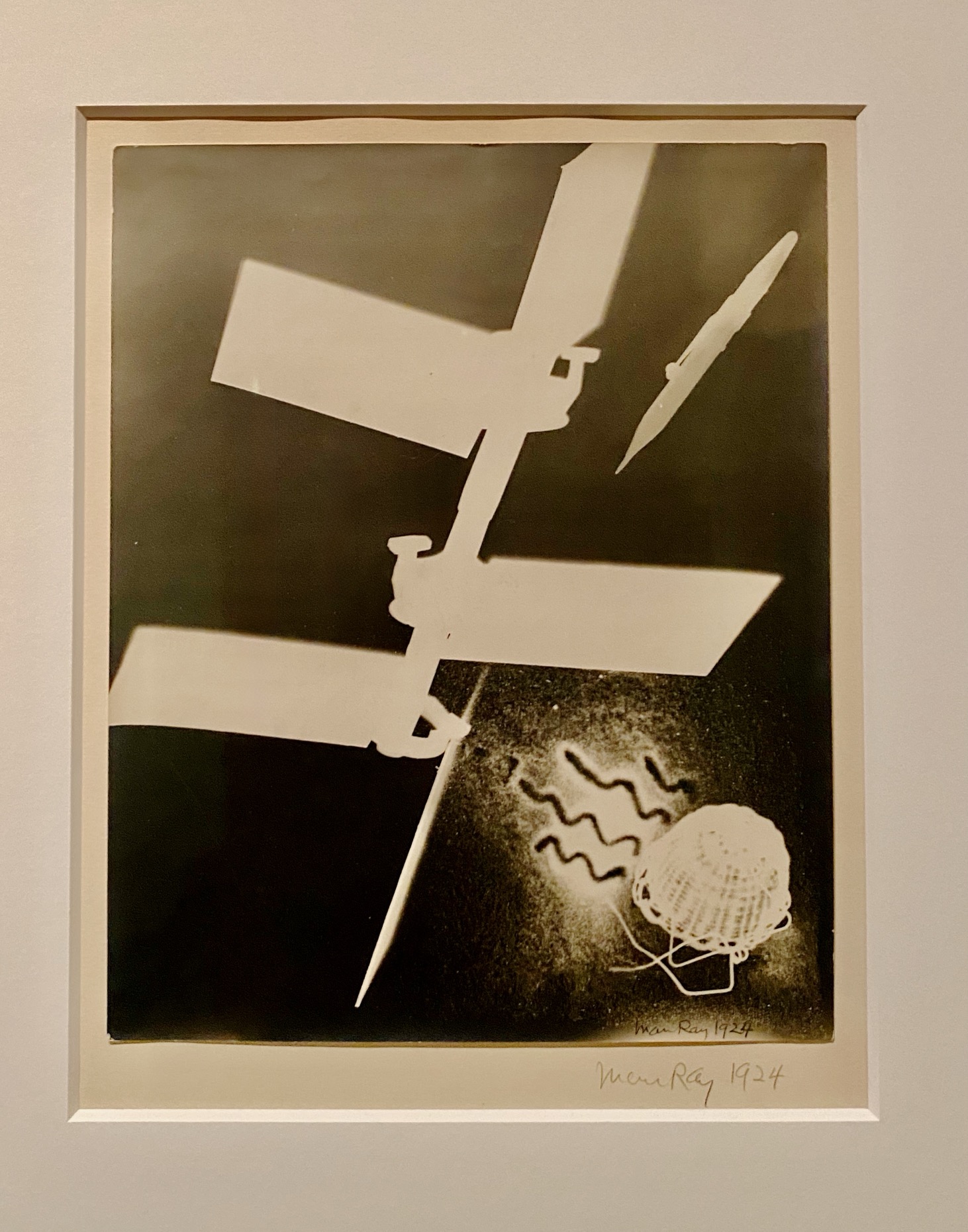
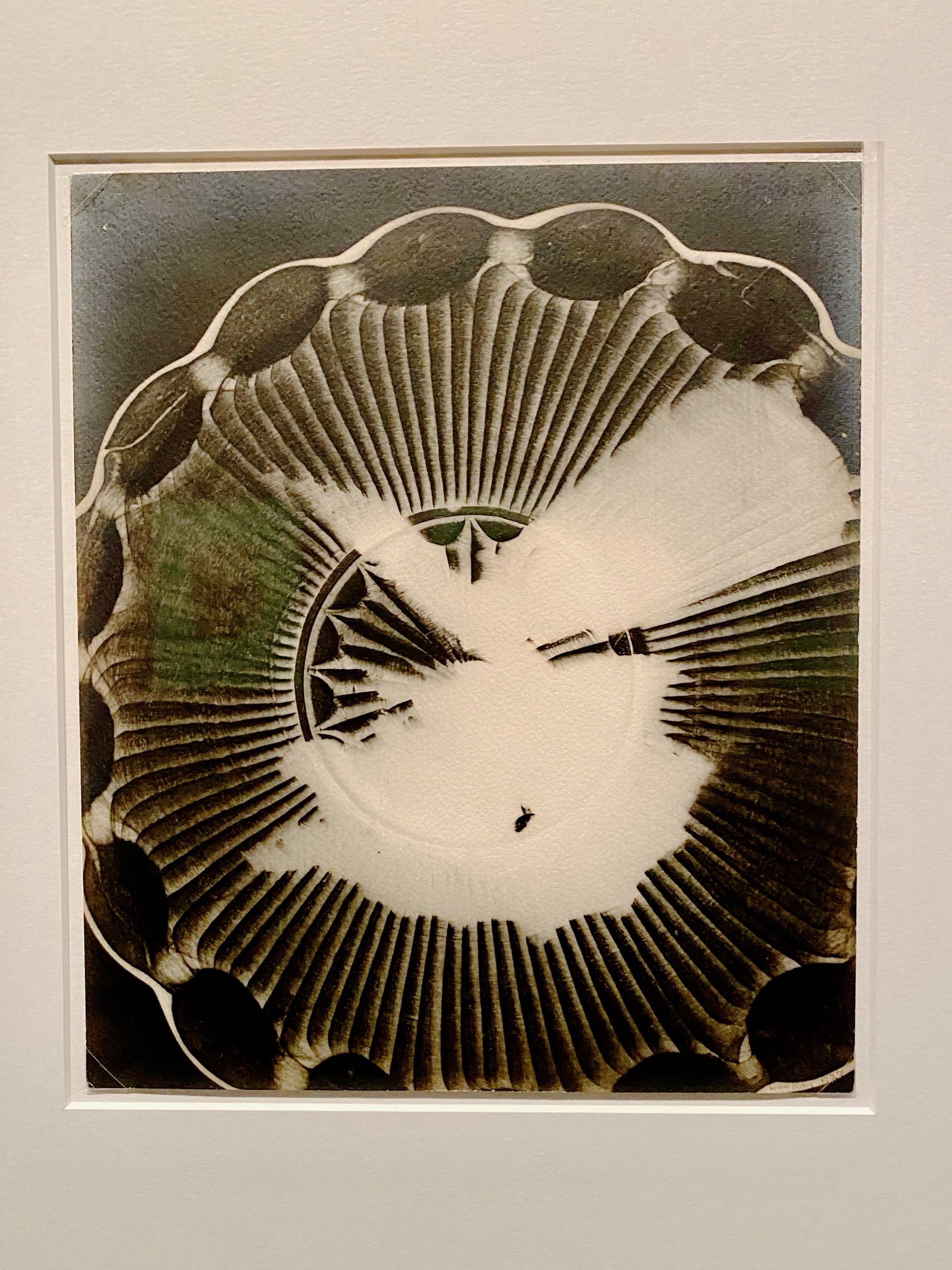
Man Ray’s 1924 gelatin silver print “Rayograph.”  Courtesy: Whitney Museum of American Art.
Man Ray’s 1927 gelatin silver print Rayograph – an experimental exploration of printing his images on textured paper.  Courtesy: private collection.

His unusual, dream-like images were eagerly applauded by the inner circle of European poets and artists who would soon be the official founders of Surrealism. They were intrigued by dreams, psychoanalysis, inner worlds, and startling juxtapositions. In fact, the title of the Met’s show comes a phrase written by Man Ray’s fan, poet Tristan Tzara – “when objects dream” refers to Man Ray’s mesmerizing work.

Man Ray’s ability to make magic with the camera – distorted images, adding surprising symbols, and creating tableaux of otherworldly floating objects – only added to the  enthusiasm for his work.
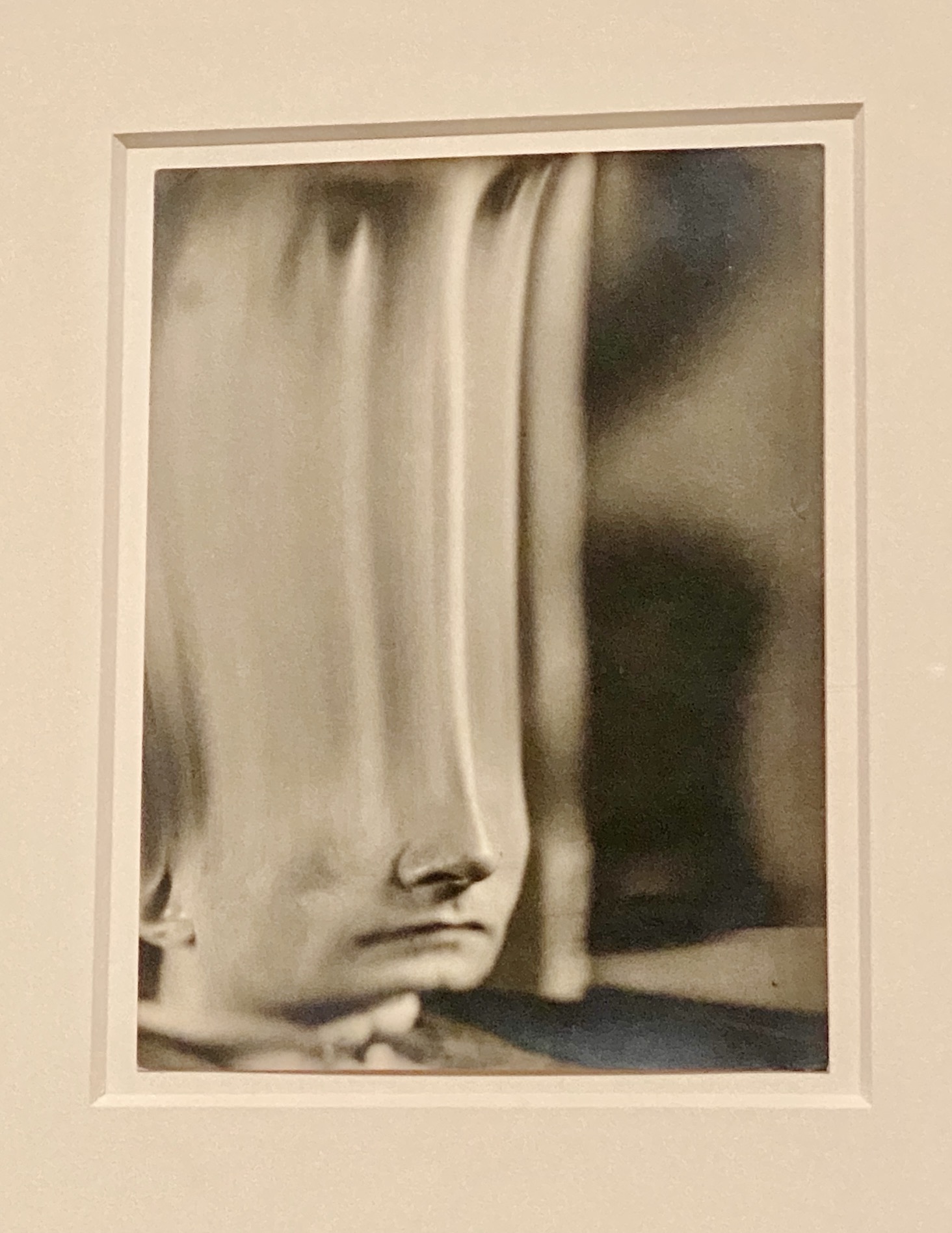
Man Ray’s 1925-1928 gelatin silver print Marcel Duchamp. Courtesy: private collection.
Man Ray’s 1924 gelatin silver print Le Violon d’Ingres featuring performer Kiki de Montparnasse – published in the proto-Surrealist journal Littérature.

The exhibition concludes with Man Ray’s beautiful solarized prints (a technique co-invented with model/photographer Lee Miller), symbolic paintings, and photographs that have become icons of Surrealism.

Hear the curators talk about the exhibition as they walk through this beautiful, inspiring show:

Take a look through all of the artwork in the exhibition here on the Met’s website. For more on Man Ray’s life and collaborations, listen to a longer Met telecast about his 1920s work with Lee Miller, Kiki de Montparnasse, and Berenice Abbott here.
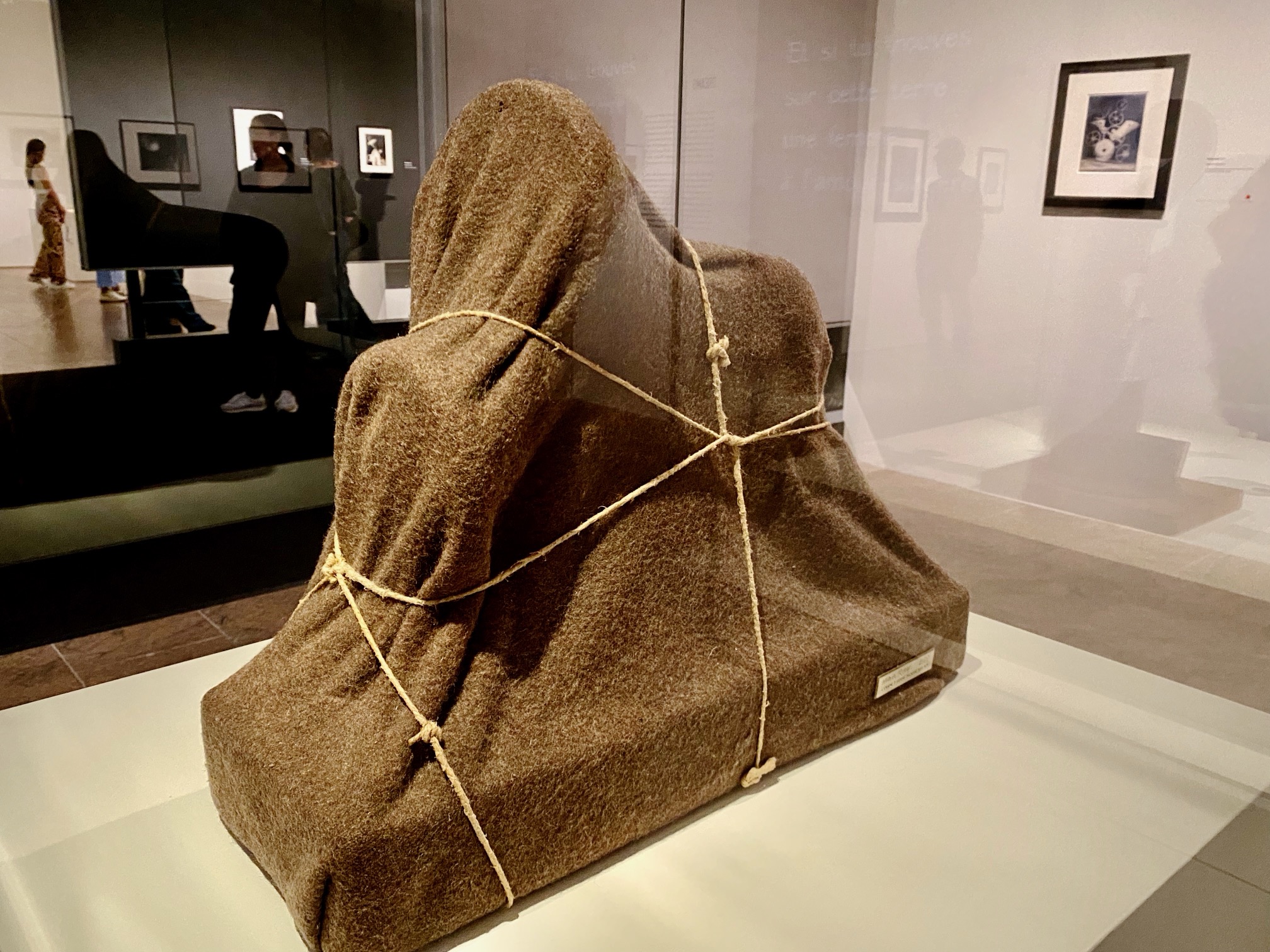
Man Ray’s 1920 sculpture L’enigme d’Isidore Ducasse (The Enigma of Isidore Ducasse) a mysterious wood, iron, wool, and rope assemblage to stir the subconscious (1971 edition). Courtesy: private collection.

Contemporary Art Extravaganza Provides Time-Travel Portals

The scale and scope of the contemporary art on display is tremendous, but how often do art-seekers also get an opportunity to travel across ancient streets and landscapes, to meet real and fictional historic characters, contemplate fables and real-life stories, and see art of the past and present side by side?

It can take days to experience and fully absorb all of the history and potential futues presented in the films, paintings, sculptures, and installations in Once Within a Time: 12th SITE Santa Fe International, on view across 15 art spaces across Santa Fe through January 12, 2026.

Exhibition banner in the courtyard of Palace of the Governors (1610) (New Mexico History Museum) – gateway to SITE installations by Daisy Quezada Ureña (Santa Fe) and Charisse Perlina Weston. (Harlem, New York)

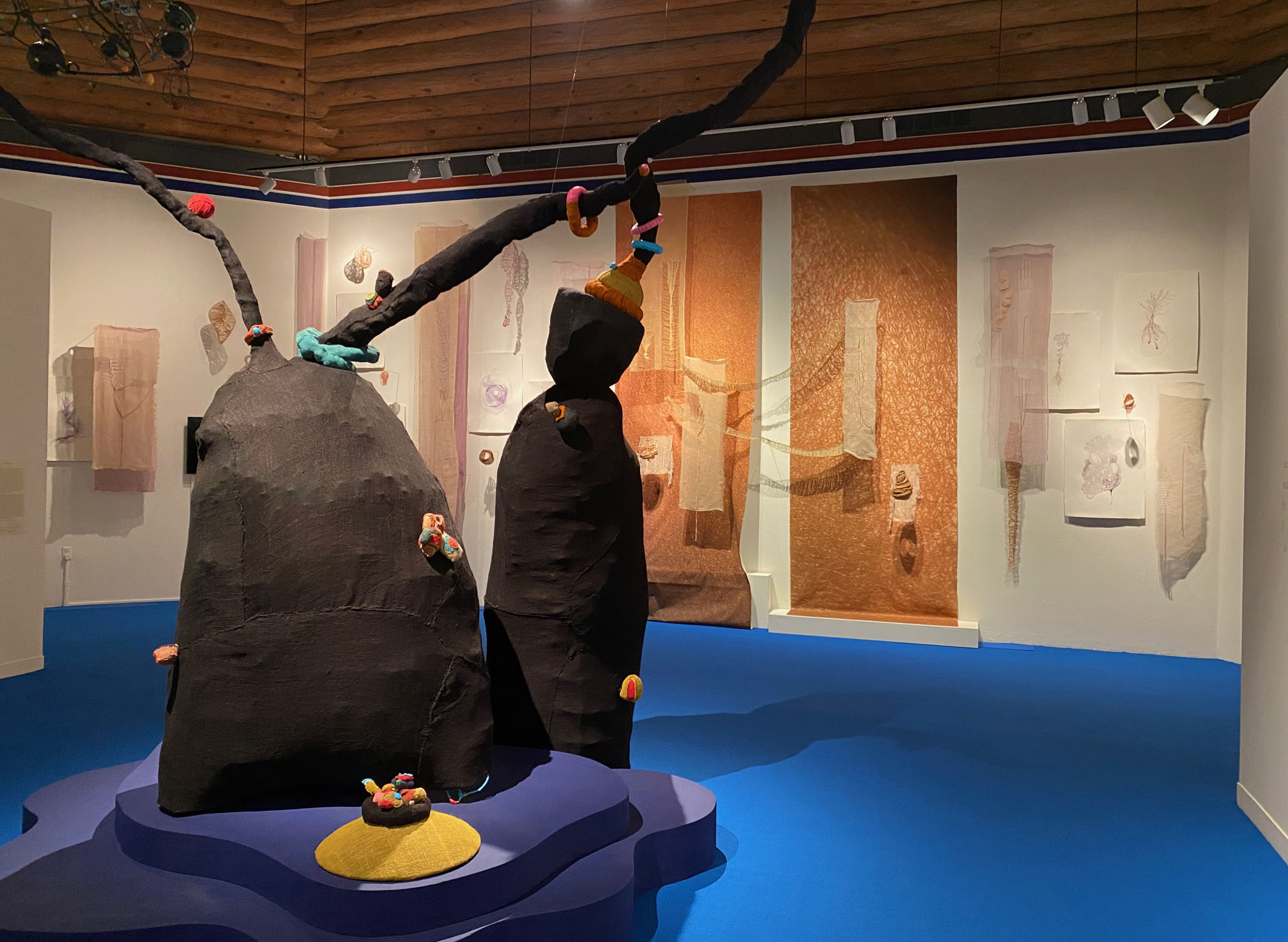
Besides the expansive white galleries and screening rooms of SITE’s museum in Santa Fe’s always-popping Railyard District, visitors can choose to contemplate giant abstract murals in a church-like auditorium, an innovative historical-object installation in a 400-year-old seat of power, or enter an old foundry to see an evocative installation by a Silk Road artist across farm fields adjacent to the Old Spanish Trail.

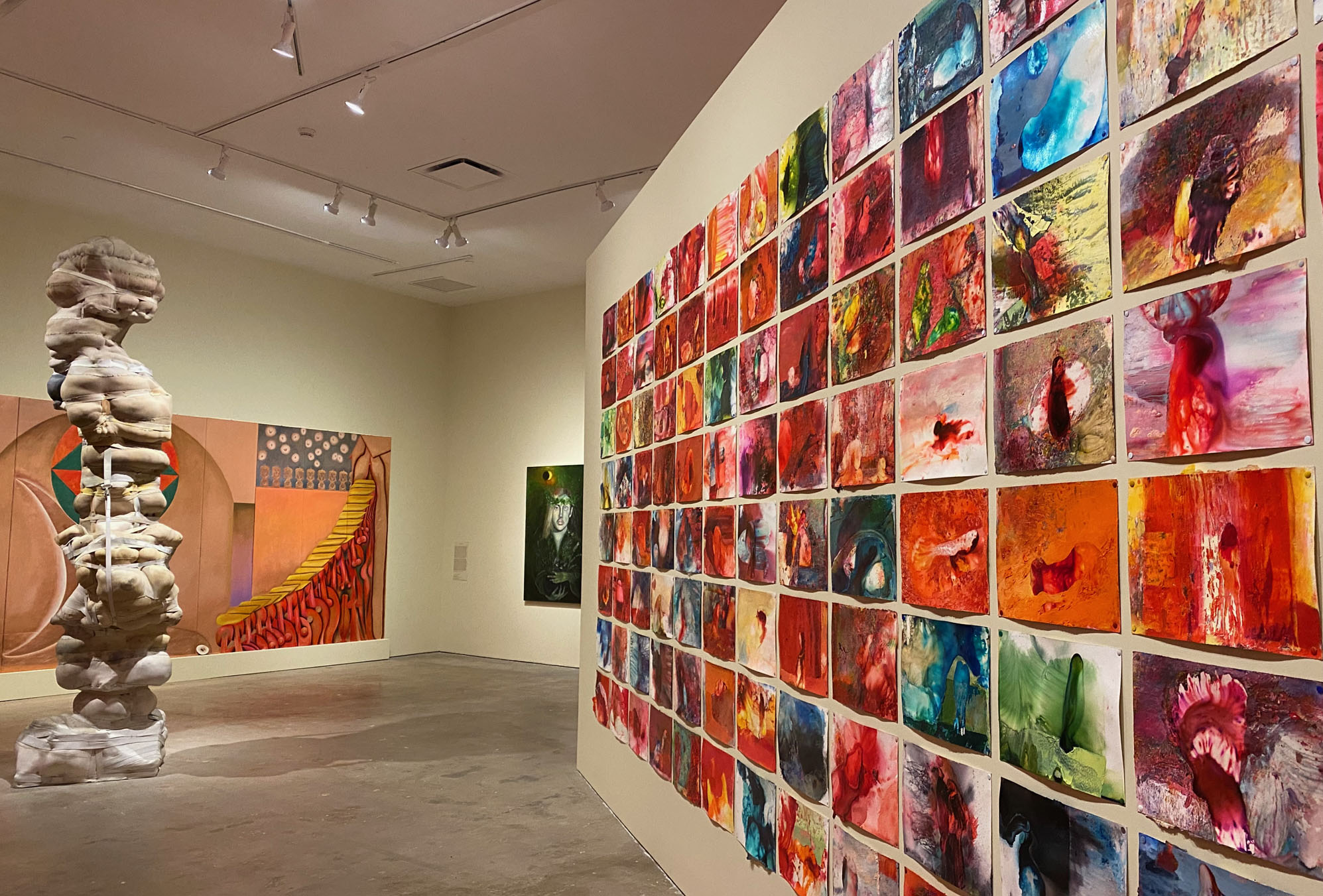
SITE Santa Fe gallery theme: appears like real life and sensual free-thinkers. 2025 mixed-media sculpture “18-1-4-5-7-21-14-4” by Patricia Ayres; copper work by Santiago de Paoli; Katja Sieb’s 2025 “perpetual novice” painting; and 2020 grid painting “Atlas” by Penny Siopis (South Africa).
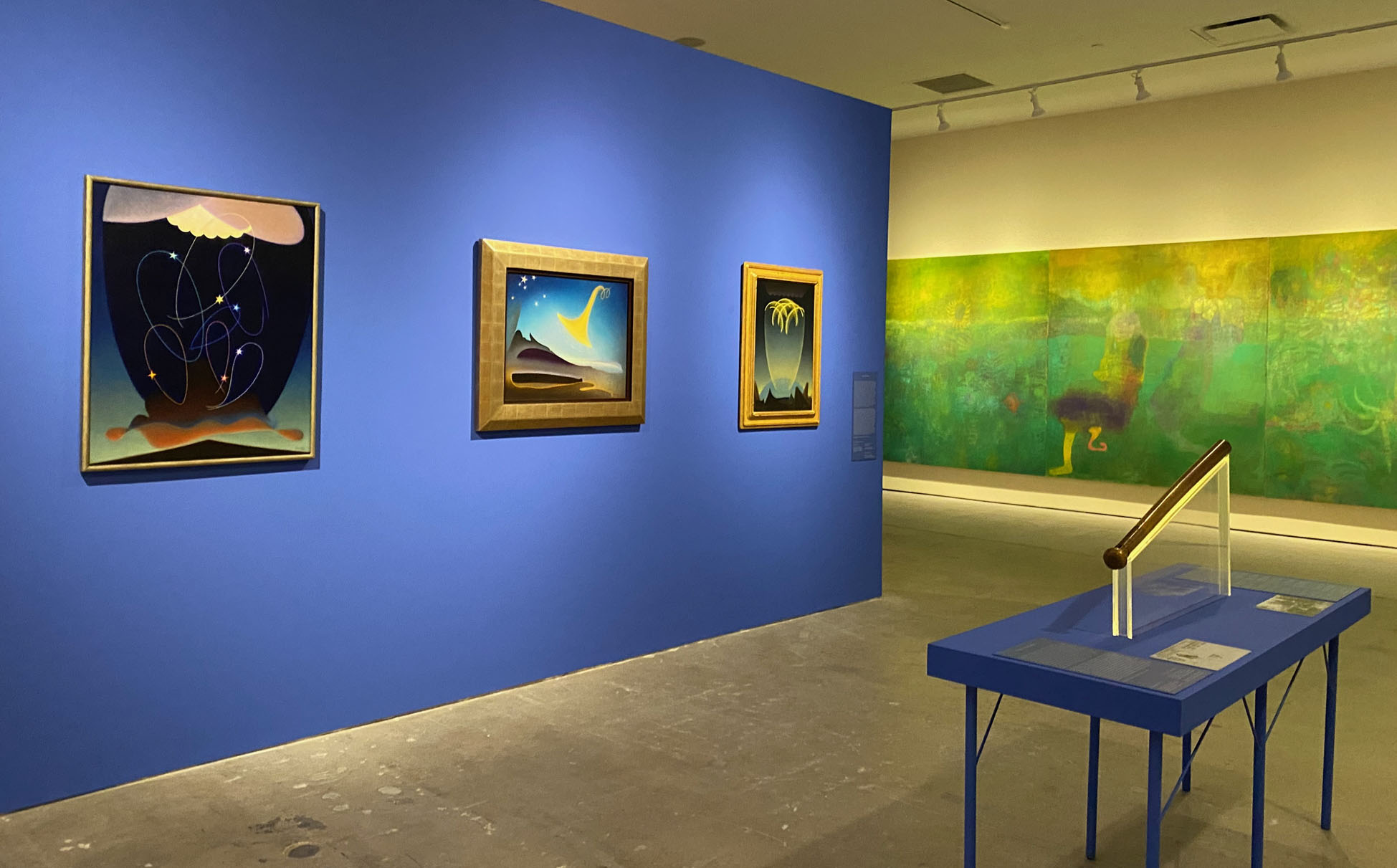
SITE Santa Fe gallery theme: in touch with light (spiritual) – Agnes Pelton’s paintings (1930s), Maja Ruznic’s mural (2025), and the 1895 healing rod of itinerant Southwestern mystic Francis Schlatter. Courtesy: Phoeix Art Museum; New Mexico Museum of Art; Oakland Museum of California; Maja Ruznic and Karma Gallery; and New Mexico History Museum.

In every space and art encounter, visitors may reflect upon whether history is repeating itself and whether inspiration can be drawn from futures that artists imagined nearly a century ago. Each space is designed for visitors to look, read, encounter, and reflect.

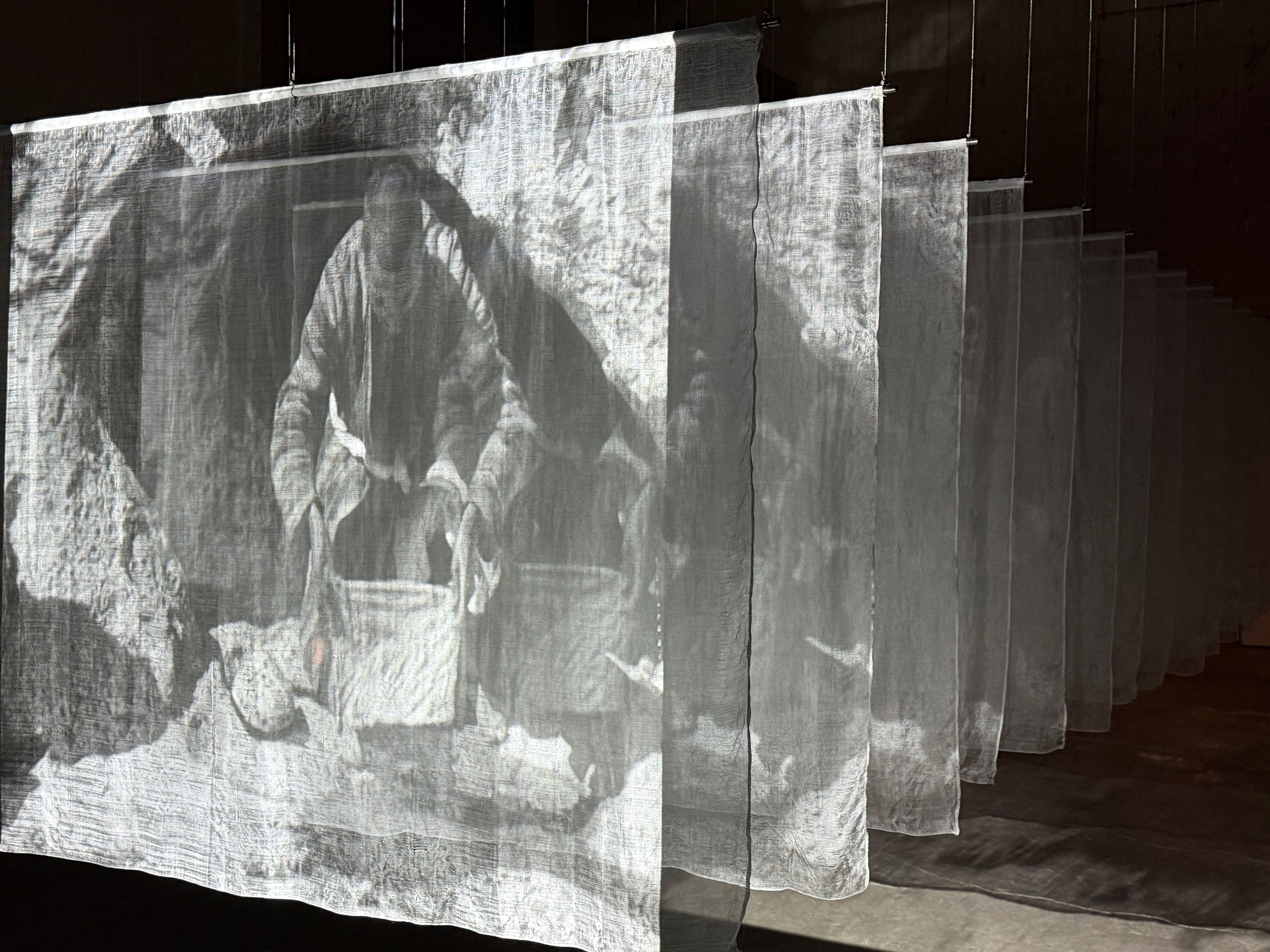
In the old foundry at Tesuque: 2024 video As We Fade by Saodat Ismailova (Uzbeckistan), showing visitors to one of Central Asia’s most sacred sites (Throne of Solomon) along the ancient Silk Road; projected across 24 suspended silk screens. Courtesy: the artist and Milan’s Pirelli HangarBicocca.

The theme for the show – Once Within a Time – is inspired by Godfrey Reggio’s most recent film – a suggestive and wordless mix of innocence, nostalgic images, visual poetry, and the future facing the next generation. The film screens continuously inside SITE, with visitors caught up in Godfrey’s dream-like images, which highlighted in this mesmerizing movie trailer:

Like Godfrey’s film, each space and gallery presents a theme, story, historic character, and provocative contemporary art that pulls back in time, creates an unforgettable experience, and asks the viewer to go inward to contemplate the future. 

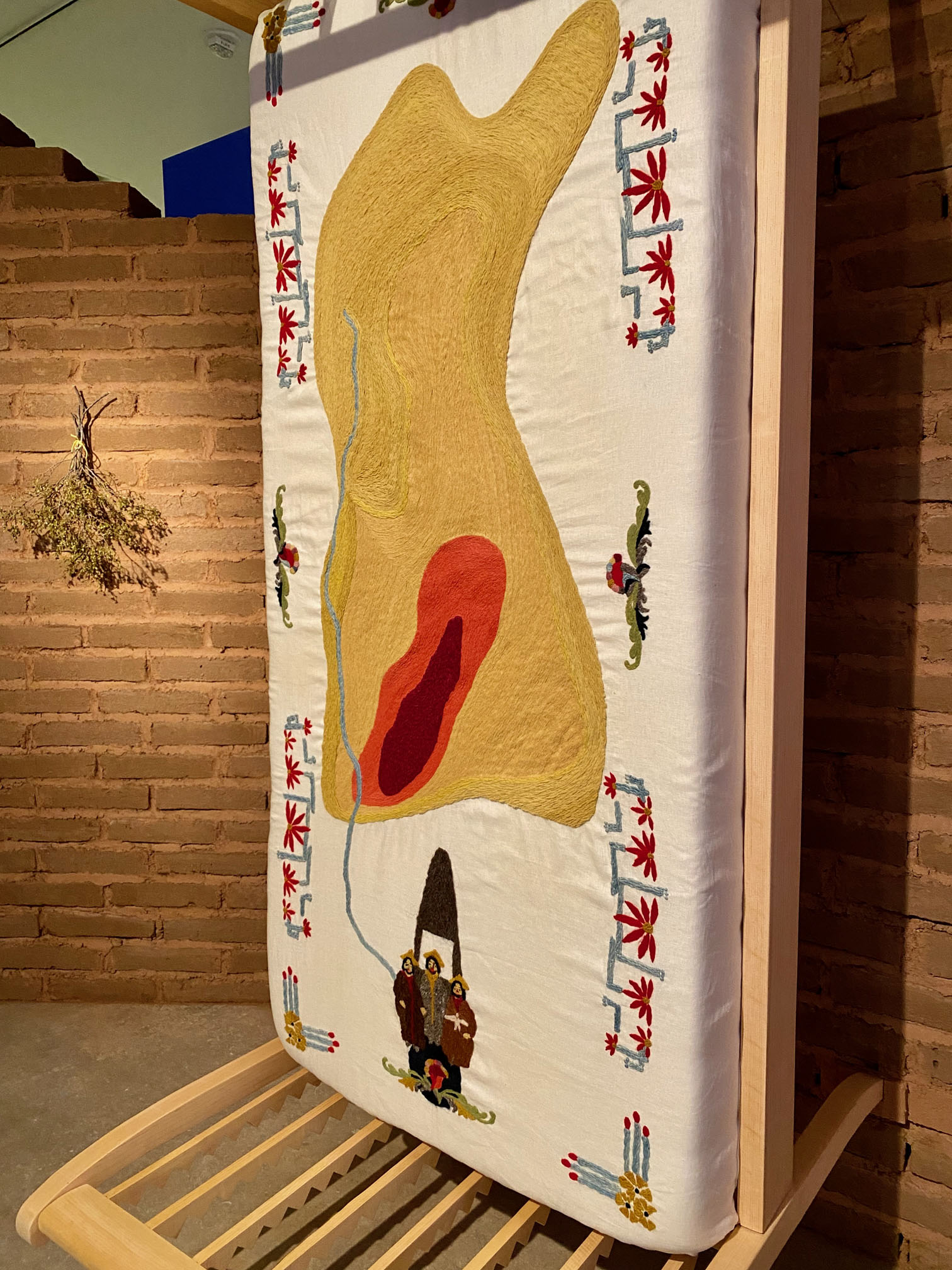
Joanna Keane Lopez’s 2024 Batter my heart, three person’d God – adobe, a handmade bed, colcha embroidery showing a radiation cloud, and creosote bush, referencing her family’s experience of living downwind of the Trinity detonation.

SITE’s galleries, for example, present themes such as storytelling, technology and language, the power of spiritual energy, and New Mexico’s undeniable status as a natural Land of Enchantment.  

The exhibition presents traditional New Mexico superstars and inspirations –  Awa Tsireh and Helen Cordero (San Ildefonso Pueblo), Agnes Pelton, Rebecca Salsbury James, Florence Miller Pierce, Pop Chalee (Taos), Pablita Velarde (Santa Clara Pueblo), and Eliot Porter – alongside artists who are breaking through on the international stage.

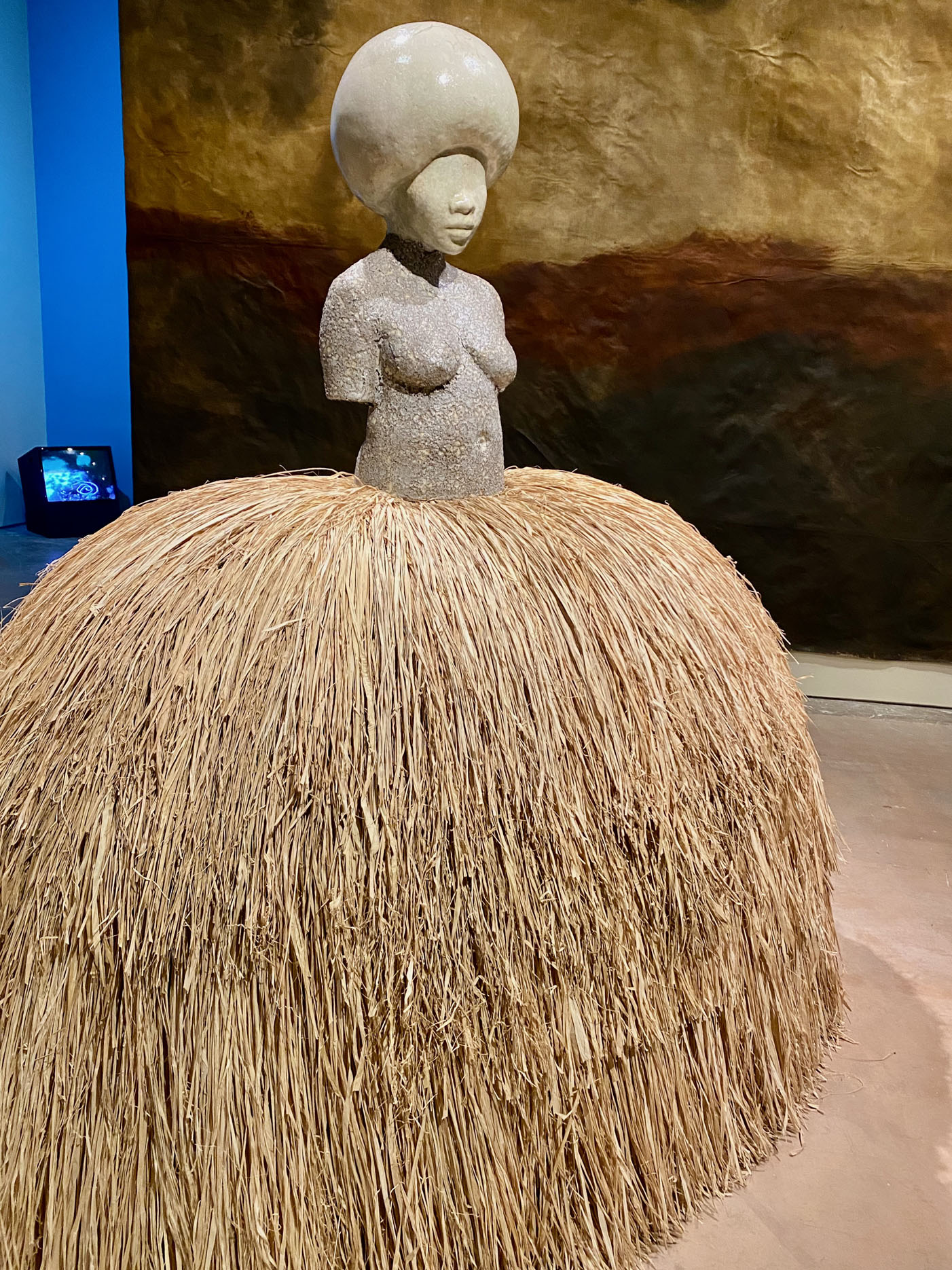
Cochiti pueblo ceramicist Helen Cordero’s storyteller figures are paired with Pablita Velardi’s storyteller illustrations (both are inspired by grandfathers and fathers) and Simone Leigh’s epic stone and raffia goddesses.

SITE Santa Fe gallery theme: storytelling. Simone Leigh’s 2025 untiled stoneware and raffia sculpture. At rear, 2025 oil The Solemn and Dignified Burial Befitting My Beloved for All Seasons by Dominique Knowles. Courtesy: Matthew Marks Gallery; the artist and Hannah Hoffman Gallery, Los Angeles.
Gallery theme: storytelling. Helen Cordero’s 1970 painted clay Storyteller – the creator of the Cochiti Pueblo sculptural tradition, inspired by her grandfather’s stories; championed by patron Alexander Girard. Courtesy: School for Advanced Research.
SITE Santa Fe gallery theme: language Marilou Schultz’s 2024 weaving Integrated Circuit Chip & AI Diné Weaving – a reference to the controvercial 1970s Fairchild Semiconductor chip plant on Navajo Nation staffed primarily with Diné women. Courtesy: private foundation.

The story of the legendary WWII heroes, the Navajo Code Talkers, is featured in a gallery alongside Marilou Schultz’s weavings of chip technology using traditional Diné methods with Fred Hammersly’s ground-breaking IBM computer drawings at the University of New Mexico in 1968-1970. 

Fred was given an opportunity to create the first mainframe-generated art in the form of drawings programmed by traditional IBM punch-card technology and the Art1 program.  SIITE not only displays a selection of the 400 computer drawings that he generated over the course of 18 months, but some of the punch cards he used, which are now archived at the Smithsonian’s Archives of American Art.

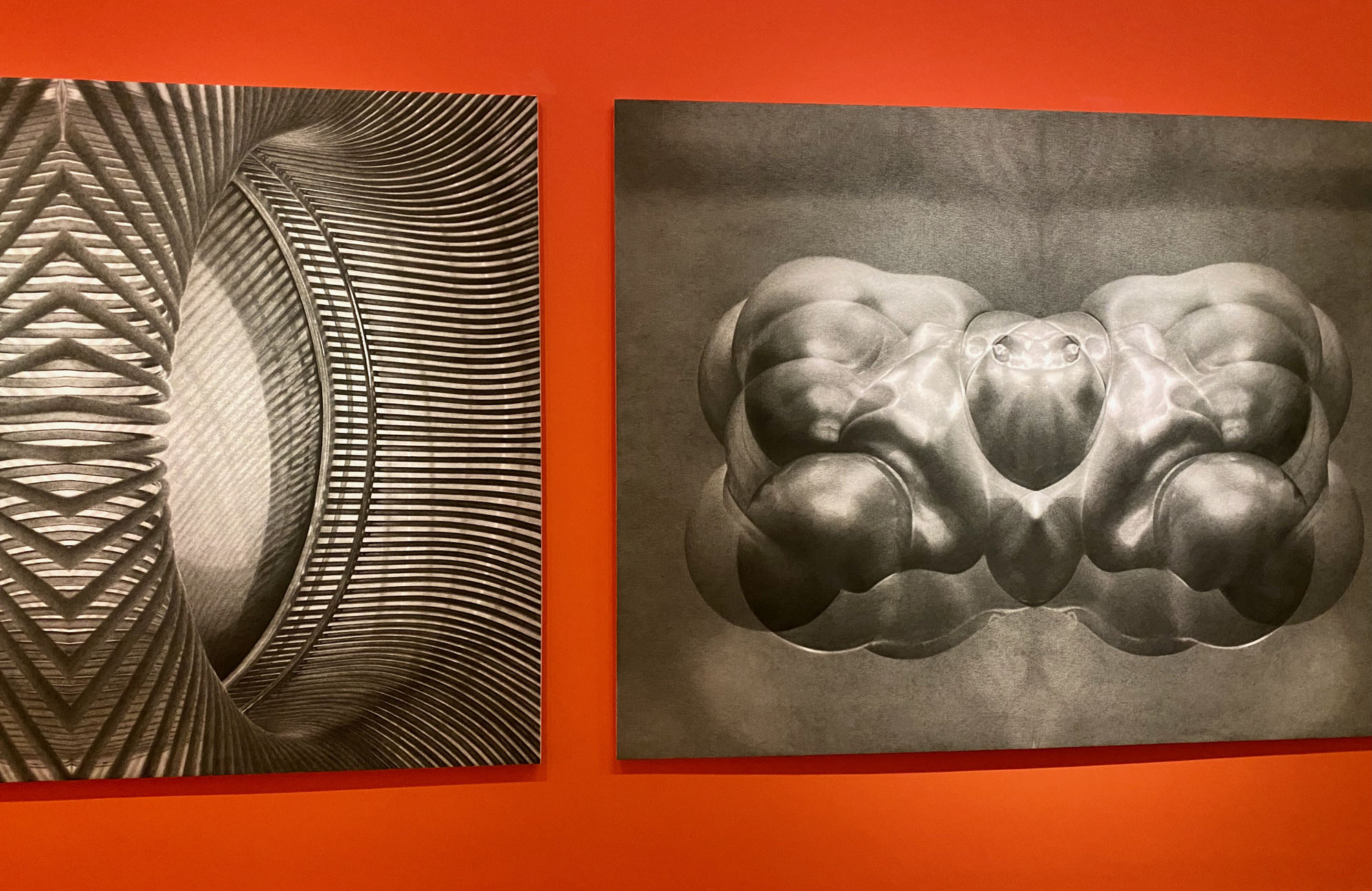
Sensual free-thinkers are represented by the story of Santa Fe gambling mogul Doña Tules (Maria Gertrudis Barceló) and her actual 1840s money chest, witty contemporary porcelain playing cards and magical paintings by Katja Seib (UK), and jaw-dropping drawings by Shanghai’s Zhang Yunyao.

SITE Santa Fe gallery theme: sensual free-thinkers. Two of three 2025 Connector drawings by Zhang Yunyao (Shanghai); pencil on stretched felt. Courtesy: the artist, Don Gallery.

Around the corner from Agnes Pelton’s transcendental paintings are Diego Medina’s landscapes reflecting the Piro-Mansa-Tiwa spiritual power inhabiting ancestral lands of Southern New Mexico and also installations about a different type of New Mexico light – the impact of the nuclear energy tests on people living downwind and the legacy of uranium mining across native lands.

SITE Santa Fe gallery theme:In touch with light (nuclear energy): Will Wilson’s 2025 series Hubris on the Land – aerial photography of abandoned 1940s uranium mines on Navajo Nation paired with his documentation of Land Art sites created by Holt, Smithson, Heiser, and Turrell in the 1960s-1970s. Courtesy: the artist

New Mexico’s natural world is paid tribute in stories and artwork by travelers and residents – watercolors of Pueblo spirits and wildlife by Awa Tsireh (Alfonso Roybal) in the 1930s, Vladimir Nabokov’s sketches of butterfly wing cells (1940s-1950s), and Eliot Porter’s spectacular photos of Tesuque jays in the 1960s.

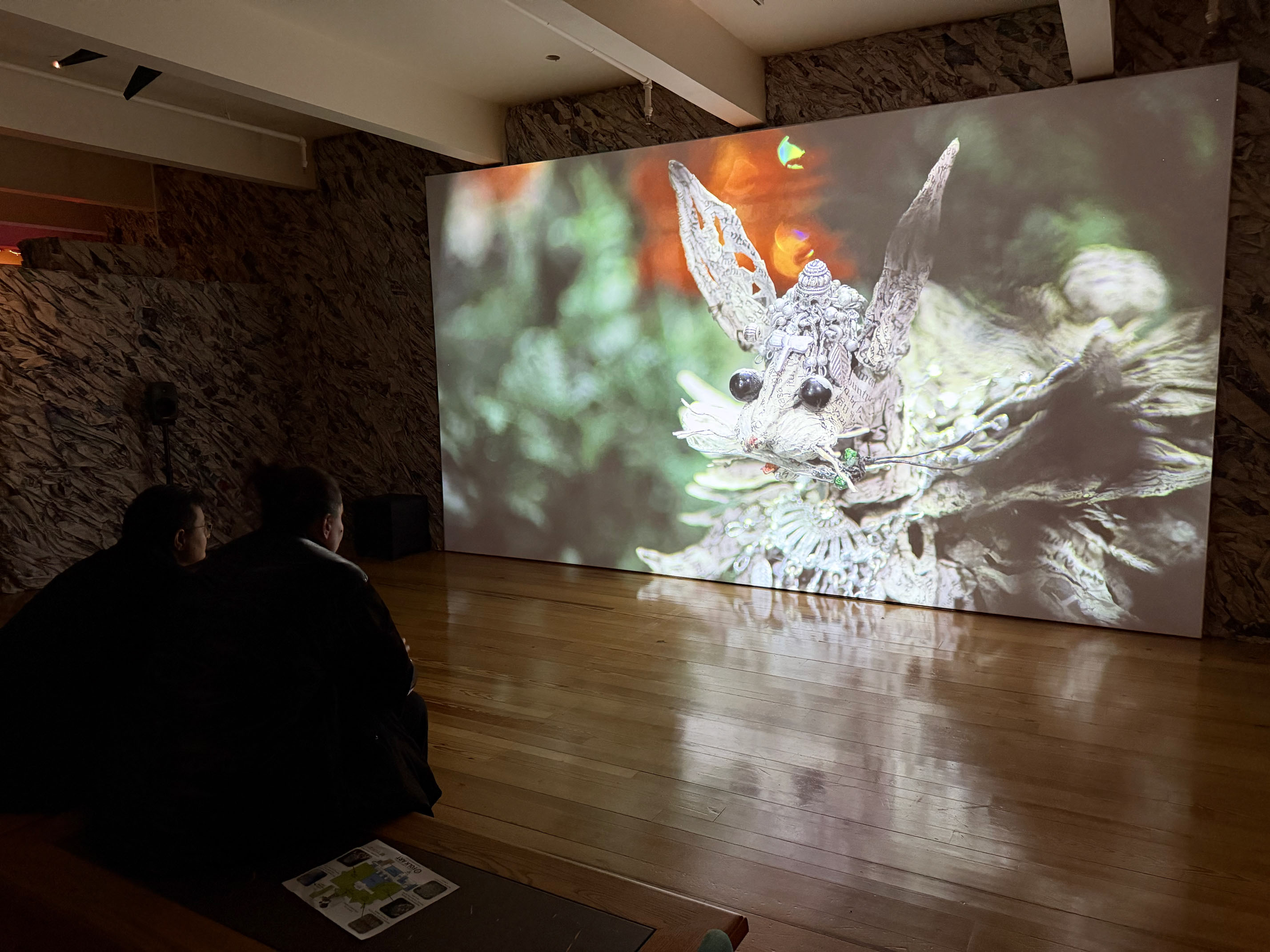
But these examples are just snippets of Once Within a Time – the entire show deserves multiple visits, and time to visit the other locations in the city, such as the hidden basement natural wonderland epic at the Museum of Internatonal Folk Art created by Taiwan ‘s Zhang Xu Zhan. It’s not only an immersive environment, but a film, animal-spirit sculptures, and selections from the MoIFA’s paper funerary object collection.  Don’t miss the Day of the Dead altar, the 18th-century Pere Lachaise Cemetary tribute initially collected by Mr. Girard himself, and paper funerary fantasies made by the artist’s own family. Truly unforgettable.

Museum of International Folk Art: Zhang Xu Zhan’s 2020-2022 paper-animation video Compound Eyes of Tropical (Animal story series), with a Southeastern Asian deer-mouse outwitting a group of predatory crocodiles. Courtesy: the artist and Project Fulfill Art Space, Taiwan.

The Wheelwright Museum of the American Indian fills the Klah Gallery (in the shape of a traditional hogan) with a meditation on healing by Cristina Flores Pescorán, a wild organic sculpture by Nora Naranjo Morse, and a mini-retrospective of paintings by the incomparable Emmi Whitehorse.

Wheelwright Klah Gallery theme: journeys. Nora Naranjo Morse’s sculpture Into the Forever; on walls, Cristina Flores Pescorán’s 2025 installation Treinta y ocho. Ofrendas para reescribir historia medica y renacer Huaca. Courtesy: the artists

The Tesuque location also features rooms with installations by Mexico’s Guillermo Galindo incorporating burned wood from the recent New Mexico fires (crossed with Picasso’s Guernica),  David Horvitz’s tribute to the men incarcerated in Santa Fe’s Japanese internment camp (and a hat from one them), and Thailand’s Korakrit Arunanondchai’s room-sized contemplation that incorporates the ashes from the burning of Zozobra.

Video of Korakrit Arunanondchai’s 2025 installation Unity for Nostalgia, with floor incorporating ashes from Santa Fe’s Zozobra’s burning and a prayer to the phoenix; layered soundtrack. Courtesy: the artist, Bangkok City Gallery, London’s Carlos/Ishikawa, CLEARNING NY-LA, Kukje Gallery, Seoul
Video of Max Hooper Schneider’s 2025 Written in Sand (Finquita Garden) installation; spheres mysteriously travel sand channels. Courtesy: the artist; Maureen Paley, London, Hove; Francois Ghebaley, Los Angeles, New York.

For more, take a walk through the main exhibit and five other sites in and around Santa in our Flickr album to see work by legendary New Mexican artists, and travel back and forth to see how contemporary art reflects epic histories and mystic systems of the Southwest.

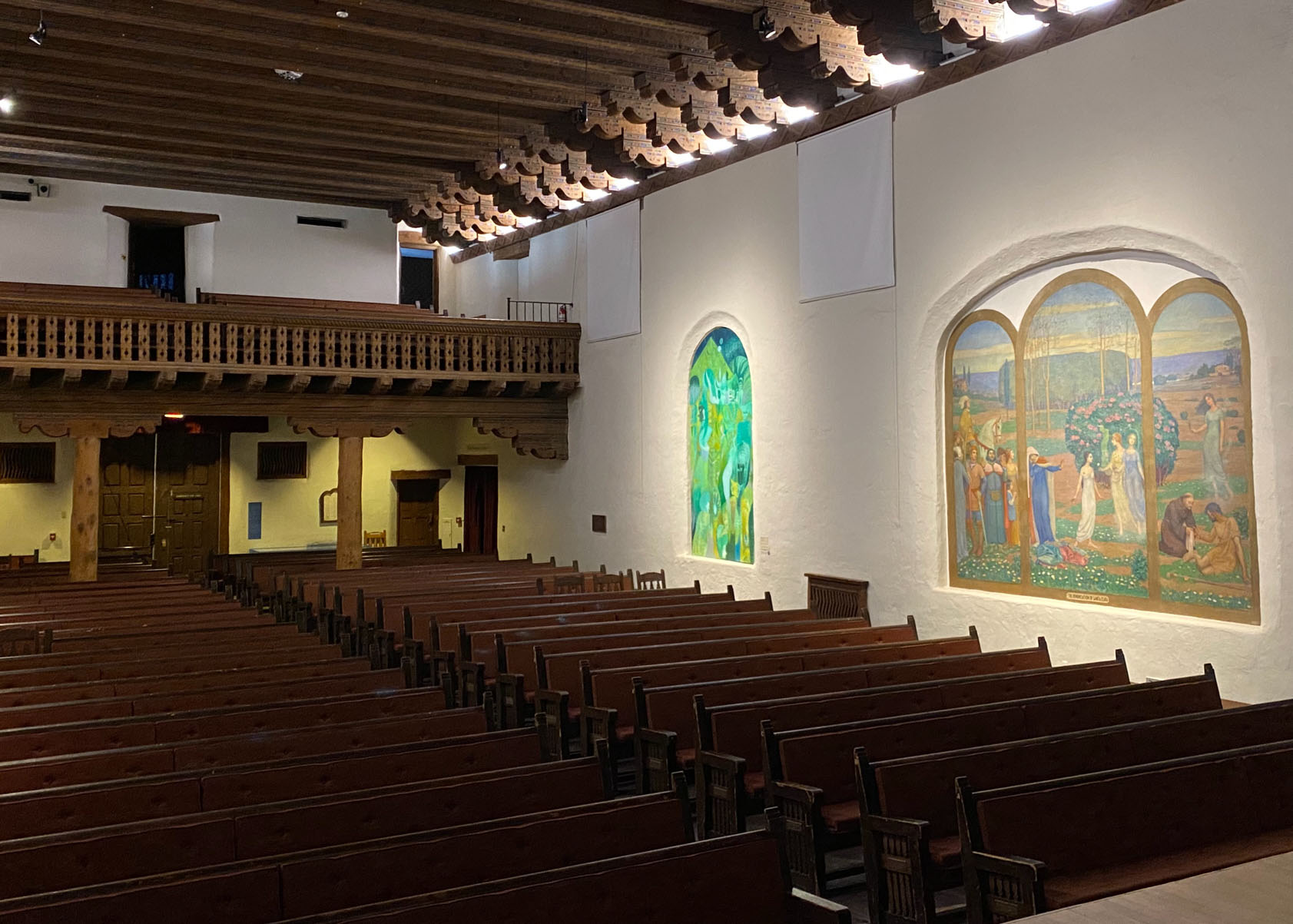
View of historic St. Francis Auditorium (1917) with Maja Ruznic’s 2025 Kisa Pada, Trava Raste, Gora Zeleni installed atop Donald Beauregad’s painting The Conversion of St. Francis; to right, Beauregard’s The Renunciation of Santa Clara.

Contemporary Pueblo Architecture Honors Ancient Beliefs

Any visitor to Chaco Canyon National Historial Park (850-1250 CE) makes the journey to appreciate innovative masonry of the Great Houses, the precision of the ancient road system, and the astronomically aligned walls, windows, and kivas. But how do contemporary Pueblo architects incorporate these traditional beliefs in their 21st century projects?

A fascinating, in-depth exhibition, Restorying our Heartplaces: Contemporary Pueblo Architecture – on view at Albuquerque’s Indian Pueblo Cultural Center through December 7, 2025 – explores how modern Indigenous architects incorporate traditional world views into their work.

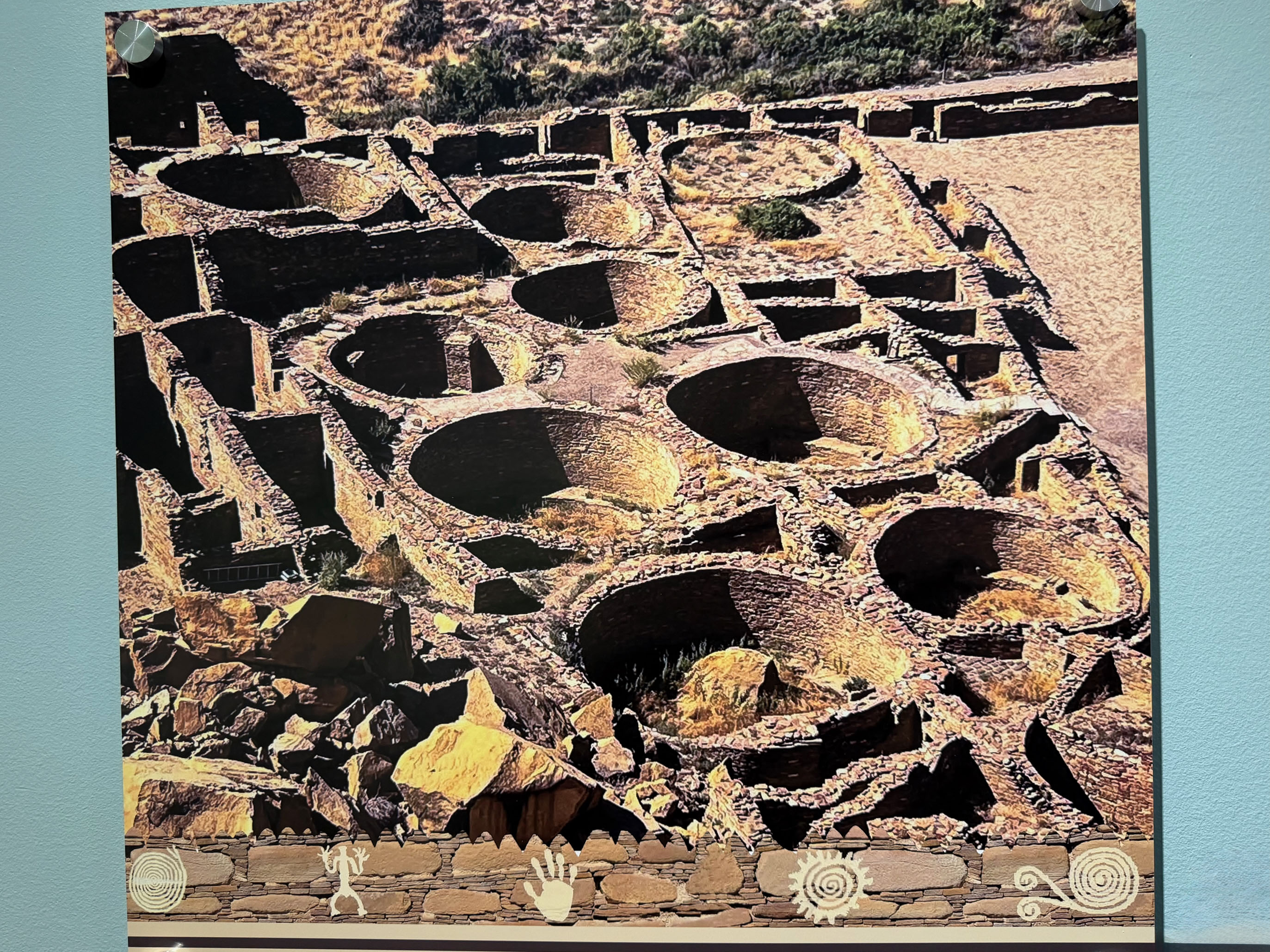
2023 photo Kivas at Pueblo Bonito,Chaco Canyon by curator Ted Jojola (Islela Pueblo) showing advanced masonry and architectural concepts.

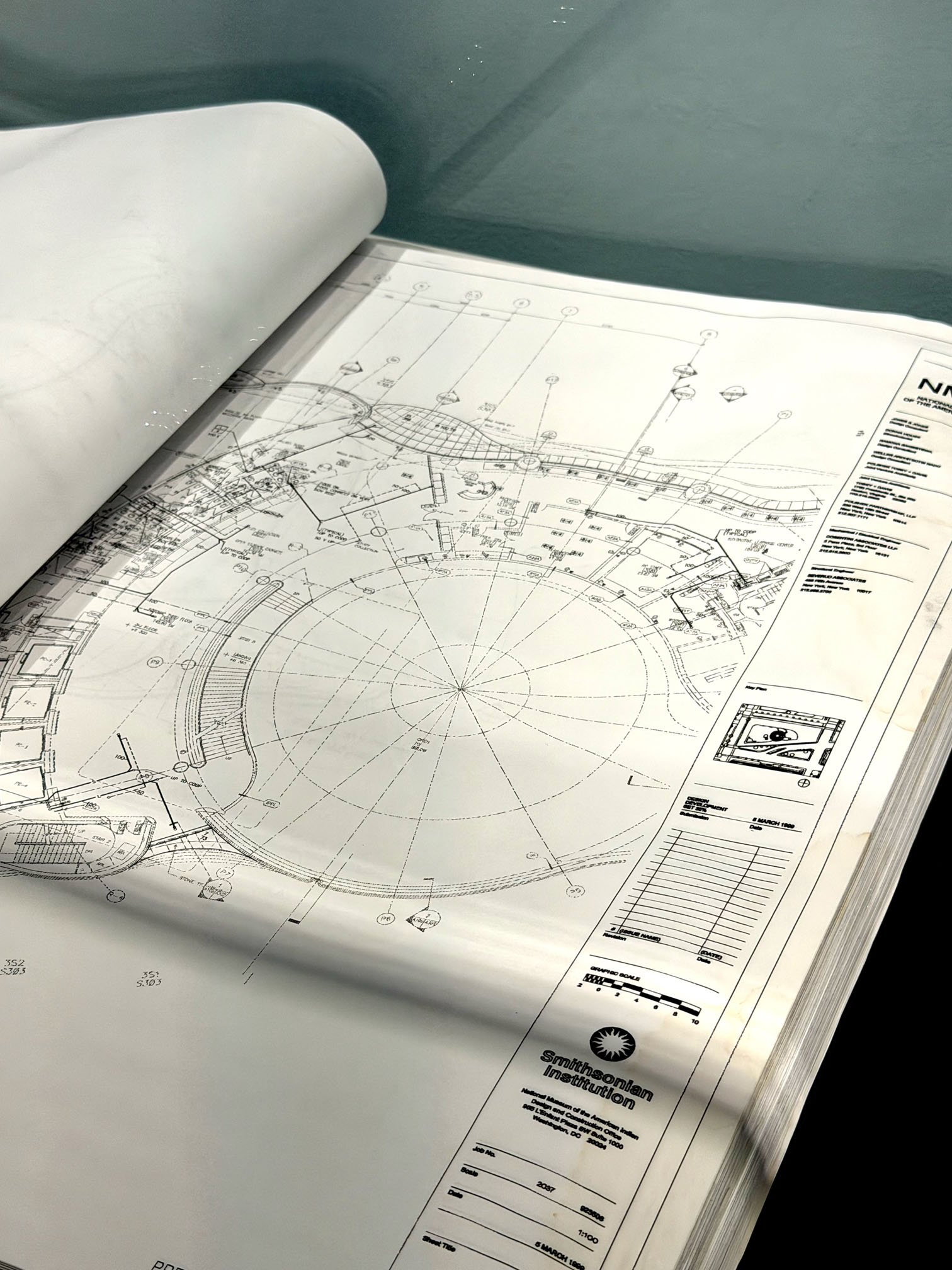
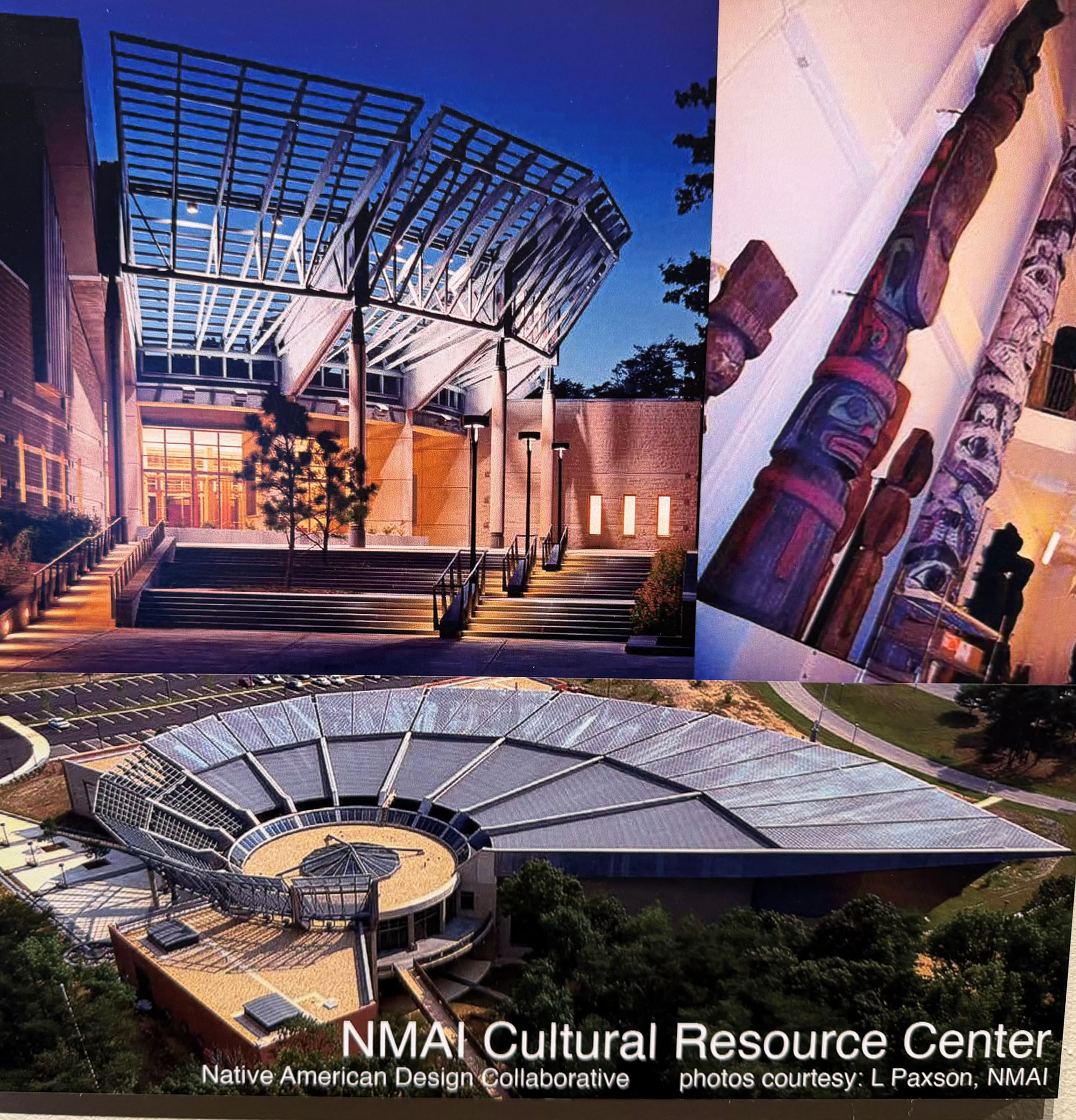
For example, just look at the design of the National Museum of the American Indian’s Resource Center – an organic design, aligned to the four cardinal directions, with extensive use of cedar wood.

1999 plans for the National Museum of the American Indian Resource Center. Courtesy: Ted Jojola (Isleta Pueblo)
Views of the 1999 National Museum of the American Indian Cultural Resource Center in Suitland, Maryland. Courtesy: Lynn Paxson.

This exhibition coincides with the 50th anniversary of the 1975 Indian Self-Determination and Education Assistance Act – legislation that shifted Native American policy in the United States from assimilation to self-determination. Tribes were now able to initiate and run justice, government, health and education departments of their own – a change that triggered a construction boom for new schools and administrative buildings.

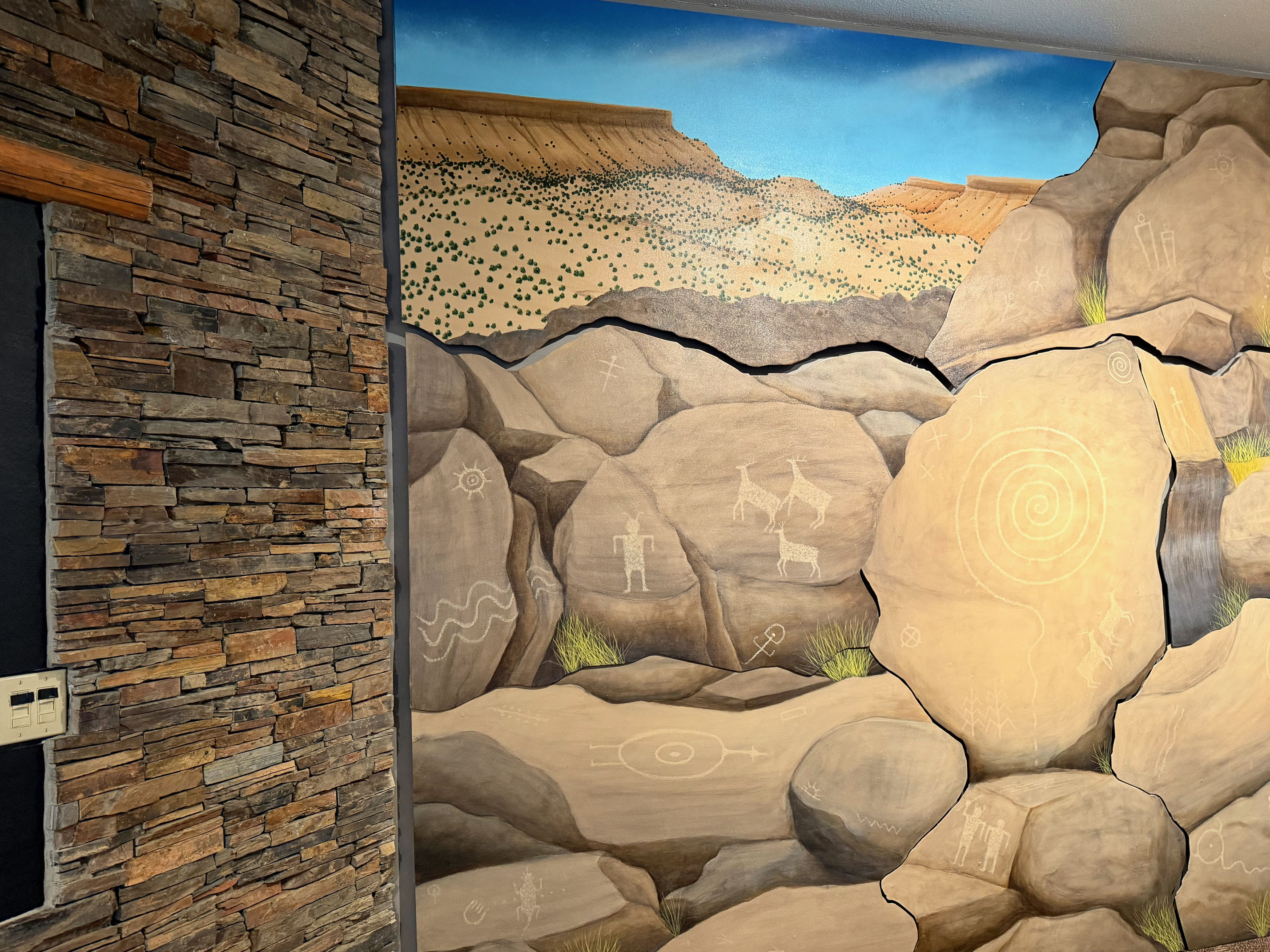
The show opens as an immersive experience in a large, circular gallery that introduces the core belief system and origin story of the Ancient Puebloans. Across a large screen in a vivid animation, the Pueblo people emerge into this world from a previous world. You watch them migrating outward in a spiral – symbols that are reflected across the art, murals, and photographs on the surrounding walls.

Mural by Dominic Aquero (Cochiti) with symbols of Pueblo creation; T-door represents the spiritual passage between two worlds (sky and Earth)

This experience sets the stage for the rest of the exhibition by showing how the stonework and beliefs reflected by the architecture of Ancient Puebloan centers points the way forward for Pueblo architects today.

2022 print by Gerald Dawavandewa (Hopi Cherokee) with T-shaped door for passage between worlds (sky and Earth]

The exhibition describes Ancient Puebloan architectural innovations – passive solar heating, precise window alignment, and masonry approaches. How did the Ancients achieve such precision in their dramatic Chaco and Mesa Verde buildings?

The curators present engineering and survey tools from archaeological excavations and modern survey backpacks side by side – plumb bobs, levels, and measuring devices.

Ancient stone and ceramic plumb bobs (from California and from Hewitt excavation at Rito de los Frijoles, Bandelier). Courtesy: Museum of Indian Arts & Culture/Lab of Anthropology.
Modern survey tools: level, tape measure, compass, brass plumb bob, wood, and string. Courtesy: curator Ted Jojola (Isleta Pueblo)

They also add comparisons of selenite used as window panels in Old Acoma’s Sky City (among the longest-inhabited communities in the US) and the contemporary architectural approach to windows in the recently built Acoma museum – a thoughtful reflection of the past

The exhibition directly addresses past HUD housing approaches on tribal lands – pushing suburban-style low-income housing, which moved families away from the traditional Pueblo plaza (the HeartPlace) and provided pitched-roof designs that blunted community cultural practices that utilized traditional Pueblo flat-roof construction.

The curators remind us of the continual upkeep required by adobe construction – a repeated communal task typically undertaken by a community’s women that happened on a regular, cyclical basis.  It’s also a reminder that Pueblo communities view buildings as living presences that evolve – not just concrete objects exist in a “finished” state.

Views of the 2000 campus for the Institute of American Indian Arts in Santa Fe. Courtesy: Paul Fragua (Jemez Pueblo)
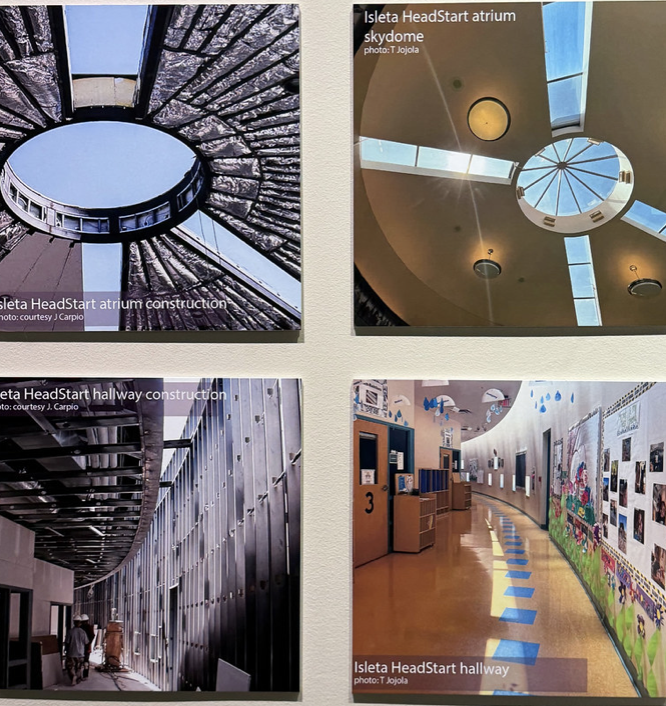
Views of 2004 building designed by Janet Carpio (Laguna/Isleta Pueblos) for Pueblo of Isleta’s Headstart/Child Care Center.

Wall panels, blueprint books, and architectural models are used to demonstrate the contemporary innovations of Pueblo architects – the Resource Center of the National Museum of the American Indian (1999), the campus of the Institute of Amercian Indian Arts in Santa Fe (2000), and the Headstart Child Care Center for Isleta Pueblo (2004). Both incorporate design elements echoing the spiral migration path, alignment to the cardinal directions, and colors and elements of the Earth.

A huge multimedia interactive theater punctuates the walk-through – an immersive visit to Acoma’s new Cultural Center and Haa’ku Museum with tribal members and designers explaining the architectural details and how the buildings reflect the landscape and traditional belief systems.

Immersive interactive experience of Acoma’s new Cultural Center and Haa’ku Museum. Courtesy: Anna Seed Productions, Electric Playouse, and UNM ASPIRE.

The exhibition features the work of the Indiginous Design and Planning Institute (iD+Pi) at UNM and presents dramatic architectural models of the past, present, and future of the community of Nambe Pueblo.

Look through the exhibition in our Flickr album here – a future-forward look at the continuing progression of innovative architectural designs and the next generation of designers and architects respecting and integrating the Pueblo world view with buildings considered to be living, breathing HeartPlaces for the community. 

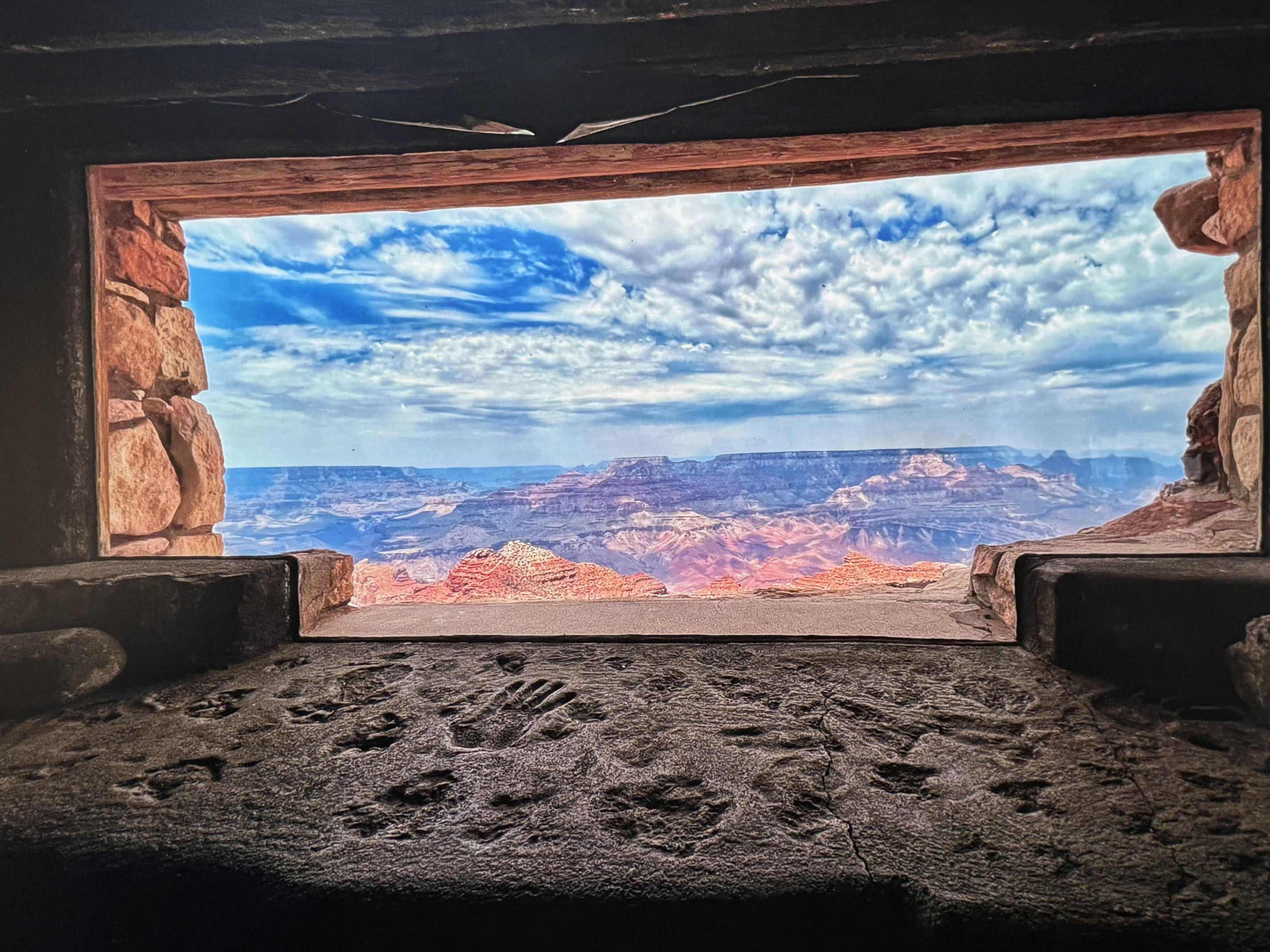
2023 photo by curatorTed Jojola (Islela Pueblo) North Window View from Desert View Watchtower, Grand Canyon showing the T-shaped doorway symbolizing passage between worlds

As the curators made clear in their opening-day remarks, a similarly extensive exhibition could explore architectural innovation and spiritualism across Navajo Nation. Let’s hope that happens!

Light, Space and Time in Albuquerque

Drift into another dimension in Light, Space, and the Shape of Time at the Albuquerque Museum through July 20, 2025. The show, with significant works from the museum’s own collection, harkens back to the founders of California’s 1960s Light and Space movement, but also presents work by contemporary artists – many from New Mexico – who continue to explore the same phenomenon.

The curators have arranged the exhibition to show how artists use light, space, and time as subjects through which visitors can slow down, contemplate, and experience.

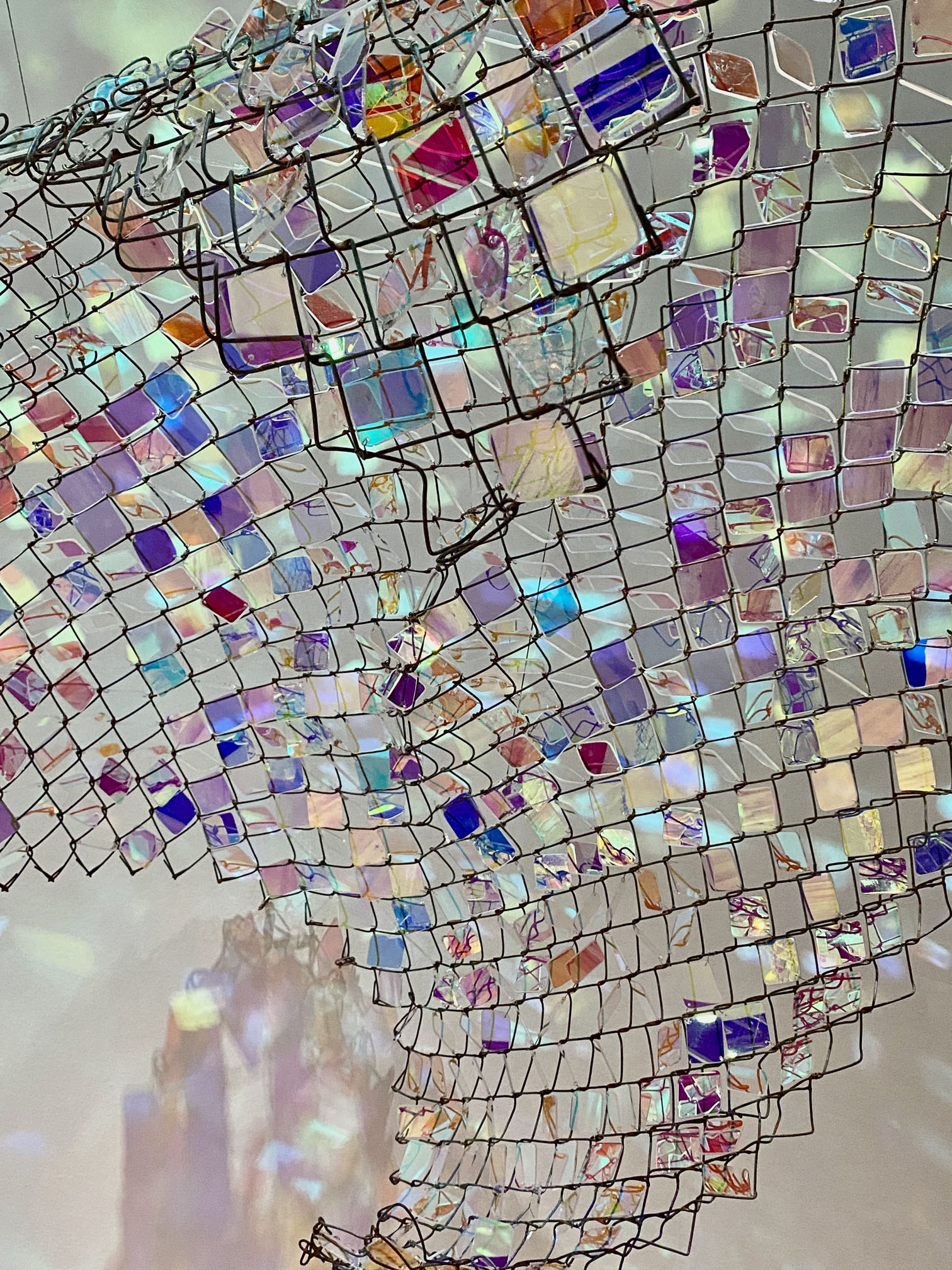
Detail of Soo Sunny Park’s 2013 Unwoven Light, an installation that seems to move as visitors walk through it. Courtesy: the artist

For more, see some of our favorites works in our Flickr album.

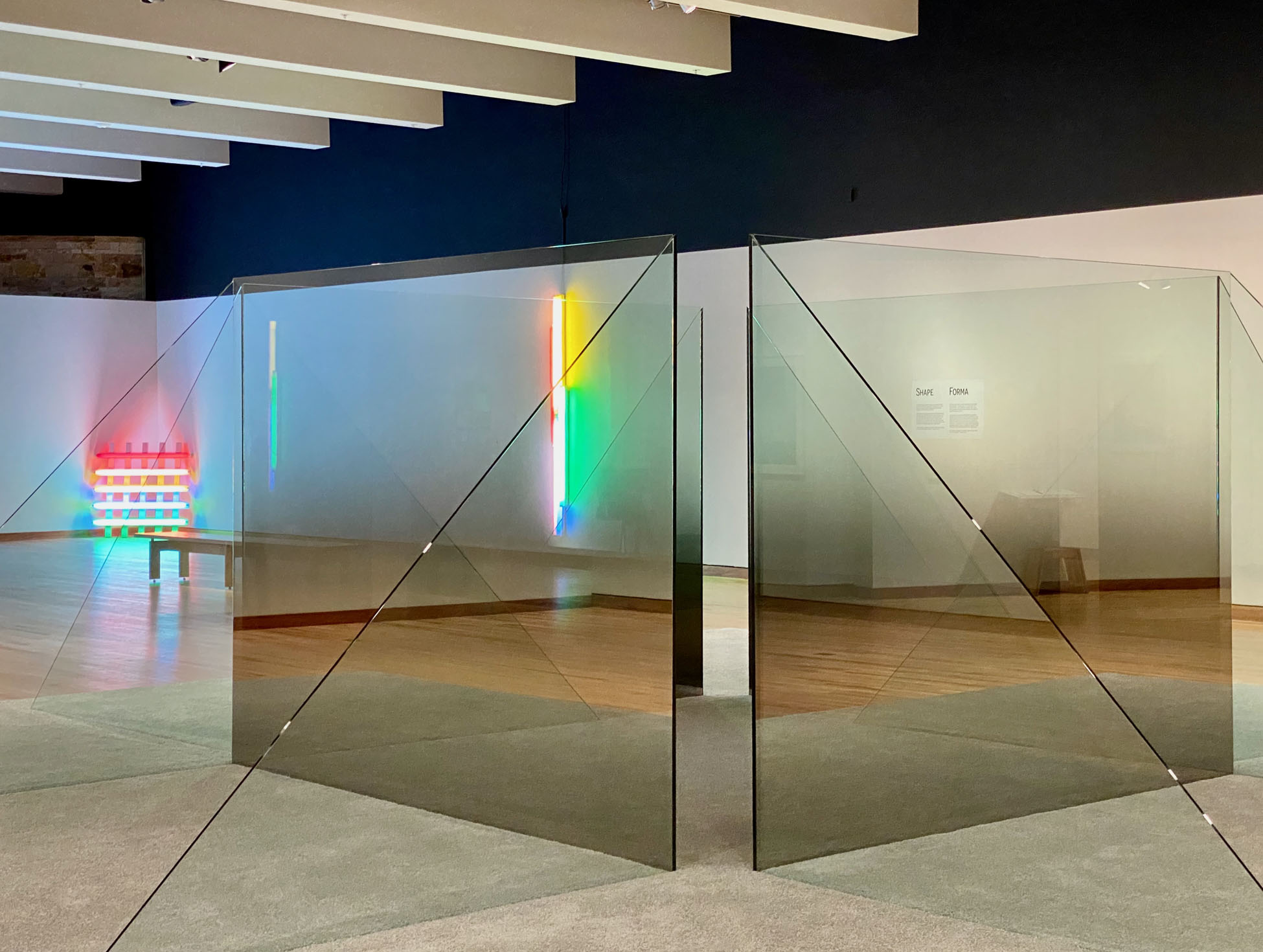
The first section showcases works where artists use light as the primary medium. Visitors can enjoy works by some of the most famous innovators from the Sixties and Seventies – Robert Irwin, who inspired a generation of West Coast art students to think differently; Dan Flavin, who merged minimalism with industrial light; and Helen Pashgian, who makes magic from luminous resins.

Irwin’s 2011 piece appears minimal, but his six fluorescent-light colors can be activated in four different variations, and he associated each with agricultural colors of Southern California. You can enjoy looking at Lucky You for its purity of form, or contemplate Irwin’s recollections of home.

Two fluorescent works by Space and Light superstars – Robert Irwin’s 2011 Lucky You and Dan Flavin’s 1987 untitled (in honor of Leo at the 30th anniversary of his gallery. Courtesy: Thoma Foundation

Behind the black curtain, you can enter a tranquility chamber. Helen Pashgian’s 2021 installation provides an unforgettable experience to visitors to slow down and wait. What are you seeing? The frosted, peach-colored epoxy sculpture at center stage appears dissolve in the light-filled space as lights slowly change. It’s like watching show changes to the sky during a dramatic sunset, but it’s light, white, ethereal, and pure.

Helen Pashgian’s 2021 untitled (peach lens) – the lens dissolve into space as the light changes to sunrise and sunset modes. Courtesy: Tia Collection

All-star word artist Jenny Holtzer’s Red Tilt takes an absolutely maximalist approach with multiple LED displays – a too-much, all-at-once, never-stopping tsunami of emotional words from her own story about survival and trauma.

Leo Villareal’s piece Scramble is the opposite. Albuquerque-bassed Villareal creates a mesmerizing, tranquil, never-repeating abstraction by programming LED lights. He’s done this on a larger scale in his epic commissions to light the San Francisco-Oakland Bay Bridge and all of London’s bridges over the Thames. Here, visitors get a more intimate experience – slowing down to watch Scramble’s gently changing colors and know what they’re seeing is unique to the moment.

Jenny Holtzer’s 2002 LED display, Red Tilt. Courtesy: Thoma Foundation
Leo Villareal’s 2011 Scramble, a programmed LED artwork that changes constantly. Courtesy: Thoma Foundation

Larry Bell’s 1984 installation is the centerpiece of exhibition’s exploration of how artists use light, illusion, and technology to explore (and play with) our perceptions of space. Direct from his retrospective in Phoenix, Bell’s barely-there The Cat is a delicate but monumental presence in the show.  Huge, planes of coated and non-coated glass require a circumnavigation. Moving around, you can see how works are reflected and how some opaque surfaces block views of others.

Larry Bell’s 1984 The Cat – rectangles of coated and uncoated float glass.

Two nearby works by Santa Fe-based August Muth offer visitors a more intimate experience. Muth uses a holographic etching technique in which he creates the illusion of a “floating” image.

August Muth’s 2024 holographic etching Shadow Within Light. Courtesy: Pie Projects Contemporary Art.
August Muth’s 2022 holographic etching Terra Solaris. Courtesy: Pie Projects Contemporary Art.

The exhibition concludes with a magnificent installation by Soo Sunny Park – an installation of lights and plexiglass pieces that appear to move as you move through. Take a peek in this video.

Detail of Soo Sunny Park’s 2013 Unwoven Light installation with tiles that appear to move as the visitor moves through it. Courtesy: the artist

Kite Dreams with AI at IAIA

How does a Lakȟóta artist link dreams and artificial intelligence to imagine futures for her people? Experience five years of innovative installations in Kite and Wíhaŋble S’a Center: Dreaming with AI, on view at the IAIA Museum of Contemporary Native Arts in Santa Fe through July 13, 2025.

The IAIA exhibition – Suzanne Kite’s third solo exhibition this year across the United States – presents several installations that highlight her collaborative work that merges cutting-edge technology with Indigenous knowledge systems. 

Download the exhibition catalogue here, and look at photos of the installation in our Flickr album.

2023 Wičhíŋčala Šakówiŋ (Seven Little Girls) and Wicháhpi Wóihanbleya (Dreamlike Star) use stones to translate Kite’s dreams into Lakhóta symbols.

In Iron Road and Dreamlike Star, stones and minerals (the building blocks of computers!) are arranged in Lakȟóta geometric language that suggest Lakȟóta quilt patterns. They’re placed atop a mirror to show resonance between the Earth and the cosmos (stars).

2023 Wicháhpi Wóihanbleya (Dreamlike Star) suggest that ancestor stars can point the way to Indigenous futures.

In this first section, inputs are taken from Kite’s dreams. Using AI, her dreams are translated into geometric Lakȟóta shapes created by designer Sadie Red Wing. Kite has figured out a way to bypass large-scale, commercial AI networks in favor of an AI model (run on her PC) that aligns more closely with Indigenous knowledge systems.    

A digital embroidery machine has yards of embroidered black velvet flowing out of it.  Oihanke Wanica (Infinity) is a collaboration with New York City’s Center for Art, Research and Alliances. As you examine the velvet, you’ll find geometric Lakȟóta shapes translated (using AI) from Kite’s dreams.

Nearby, there’s a comfortable lounge where you can watch Cosmologyscape, an interactive digital quilt – a public art project in which AI translates the public’s dreams into artist-created geometric symbols. It’s a collaboration with Alisha B. Wormsley, so the virtual community quilt manifests both African-American and Lakȟóta shapes.

2023 Oihanke Wanica (Infinity) – a digital embroidery machine stitches symbols representing dreams onto black velvet. Collaborator; Center for Art, Research and Alliances.
Lounge to watch Kite and Alisha B. Wormsley’s 2024 Cosmologyscape – Ai translates the public’s dreams into symbols for an ever-expanding digital quilt.

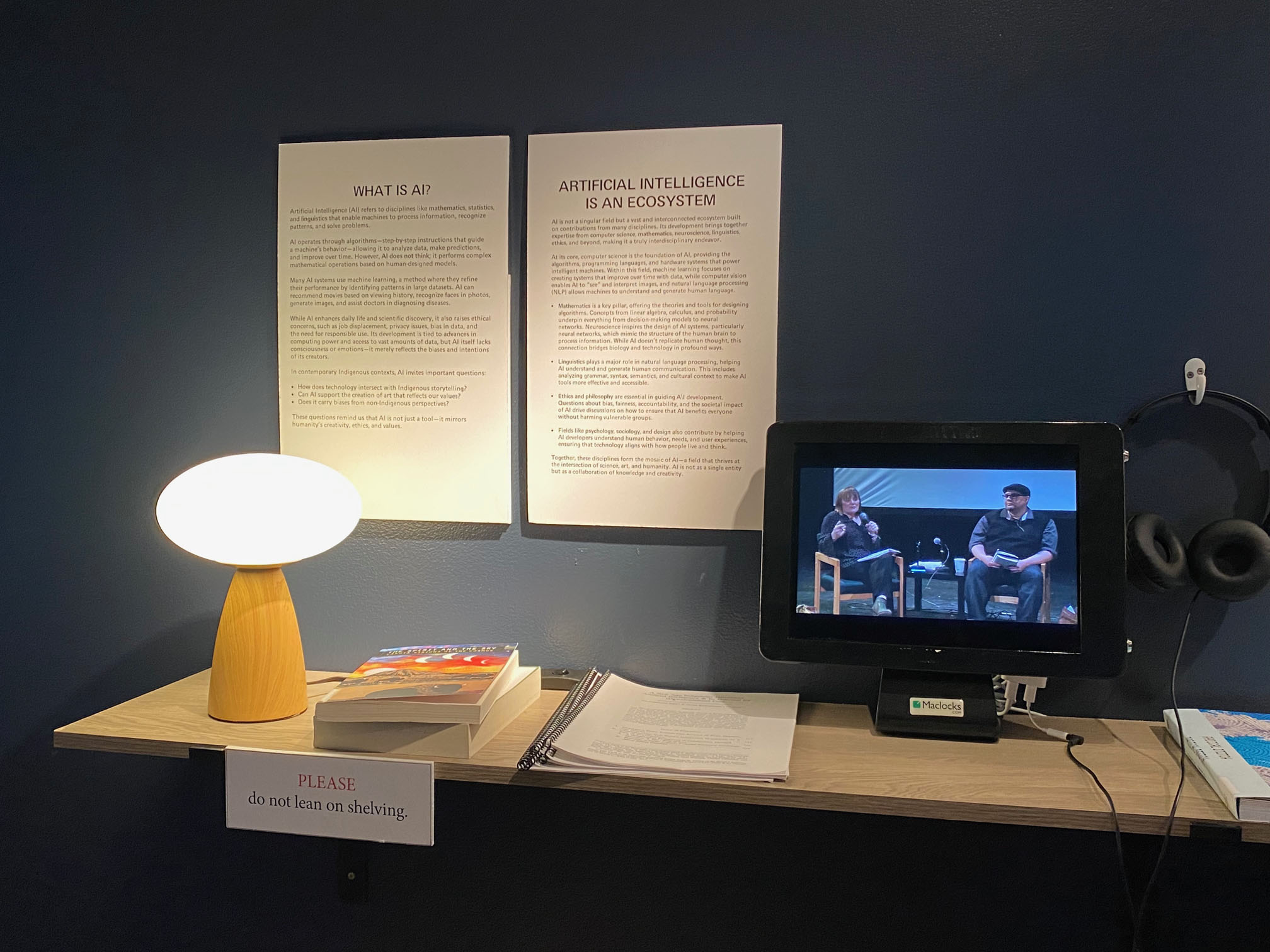
Installations in the other half of the exhibition shows collaborative projects that combine Indigenous knowledge systems and AI. Along one wall in the spectacular, tranquil gallery, you can explore a print and digital resource library on international research programs that integrate Indigenous knowledge systems into AI design.

Abundant Intelligences – a library and digital resource station for information on AI and futurism in contemporary Indigenous art.

Oneiris is a large interactive station through which visitors are invited to generate dream symbols that AI adds into a wall-sized display that looks like a portal to the cosmos. Inspired by the Lakȟóta concept of a Dream Language, she and her many technical collaborators genuinely bring dreams to life.

Oneiris – a collaborative project using advanced AI models to allow visitors to bring dreams to life.

Spashed across the final wall of the space, The Land Paints Itself is a video collaboration with her Wíhaŋble S’a Center for Indigenous AI at Bard – a lab that explores Indigenous advances in this science and art. Watch as AI generates dazzling colors and patterns as four Lakȟóta dream about Indigenous futures. Kite suggests that the evolving technology of dreams is a legitimate way for her nation to envision ways forward.

2025 The Land Paints Itself video that uses AI to illustrate Lakhóta people’s dreams about Indigenous futures.

Provocative, visionary, and affirmative – meet Kite herself in an interview with Artforum editor Tina Rivers Ryan in March 2025, when Kite’s work was featured on the cover.

Past and Future of Santa Fe’s Indian Market

There’s no better way to see the best of the best at the Santa Fe Indian Market than to visit the remarkable retrospective assembled at the New Mexico History Museum in their honorary centennial exhibition, Honoring Tradition and Innovation: 100 Years of Santa Fe’s Indian Market, 1922-2022, on view through August 31.

The curators have gathered loans from private collections, museums, individual artists, and big-name galleries to give visitors a decade-by-decade chronicle of the people, families, maker innovations, and contemporary-art trends that converged to showcase works from one the most exciting confluences of creativity in the United States.

Santa Clara artist Nancy Youngblood’s 2018 polished pottery jar (best of pottery category award), granddaughter of Margaret Tafoya. Courtesy: private collection.

The items in the show – traditional pots, dazzling Navajo weavings, whimsical figurines, elaborately embroidered accessories and clothing, social-commentary photos and paintings – are so compelling that it takes two or three visits to actually focus on the thoughtful, illuminating text that accompanies each portion of the show.

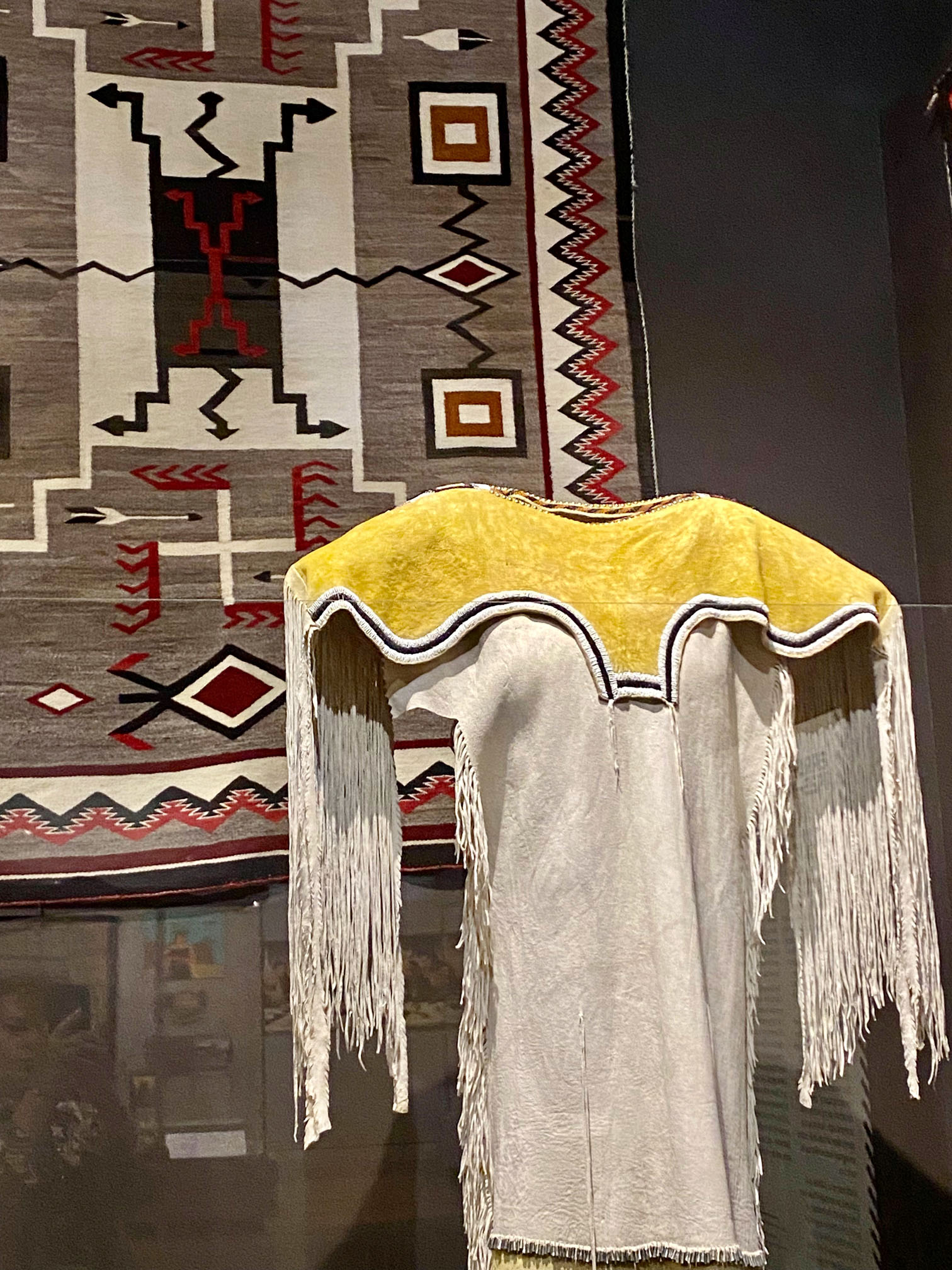
Embellished 1890 buckskin Apache/Ute dress; behind, a 1925-1930 Navajo rug. Courtesy: Cowboys and Indians Antiques, Historic Toadlena Trading Post Museum.

The organizers have provided a revealing chronology of the politics, economics, and social context of each decade of the arts festival, noting changes in the people, processes, power, and patronage over time.

The first gallery brings you back to the earliest days of the market – a time when there were no Indian curators or judges (unlike today!) and when Native makers were not even allowed to sell their own work or interface directly with non-Native buyers. 

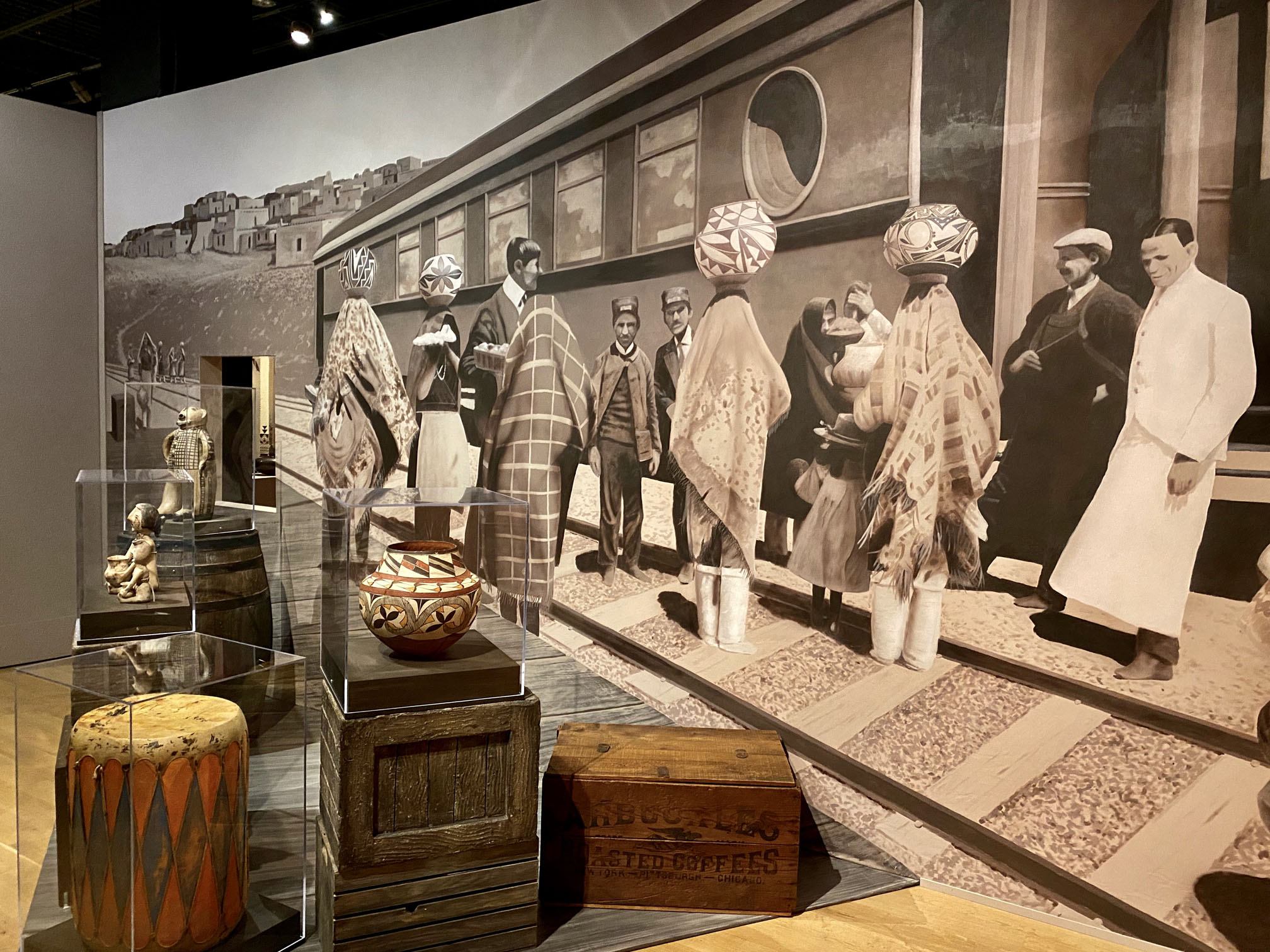
The wall mural harkens back to the days when Pueblo people sold their pots and creations to tourists along the railroad, which in the late 1890s and early 1900s brought curious travelers, East Coast dandies, and traveling showpeople out to the Western badlands.

David Rock’s mural with early Native-made collectibles – early 1900s pottery and 1920s drum.

Turn-of-the-century tom-toms, curios, and older pots are displayed near the rail-top mural; Navajo rugs and beaded moccasins from the period are arrayed across the way. It’s an arrangement that evokes what might be displayed in an old trading post, or at least in the early 1920s Santa Fe markets.

Many of these makers in New Mexico were still living on their ancestral lands, but across the United States, the majority of Indigenous populations had either been relocated to reservations or boarding schools.

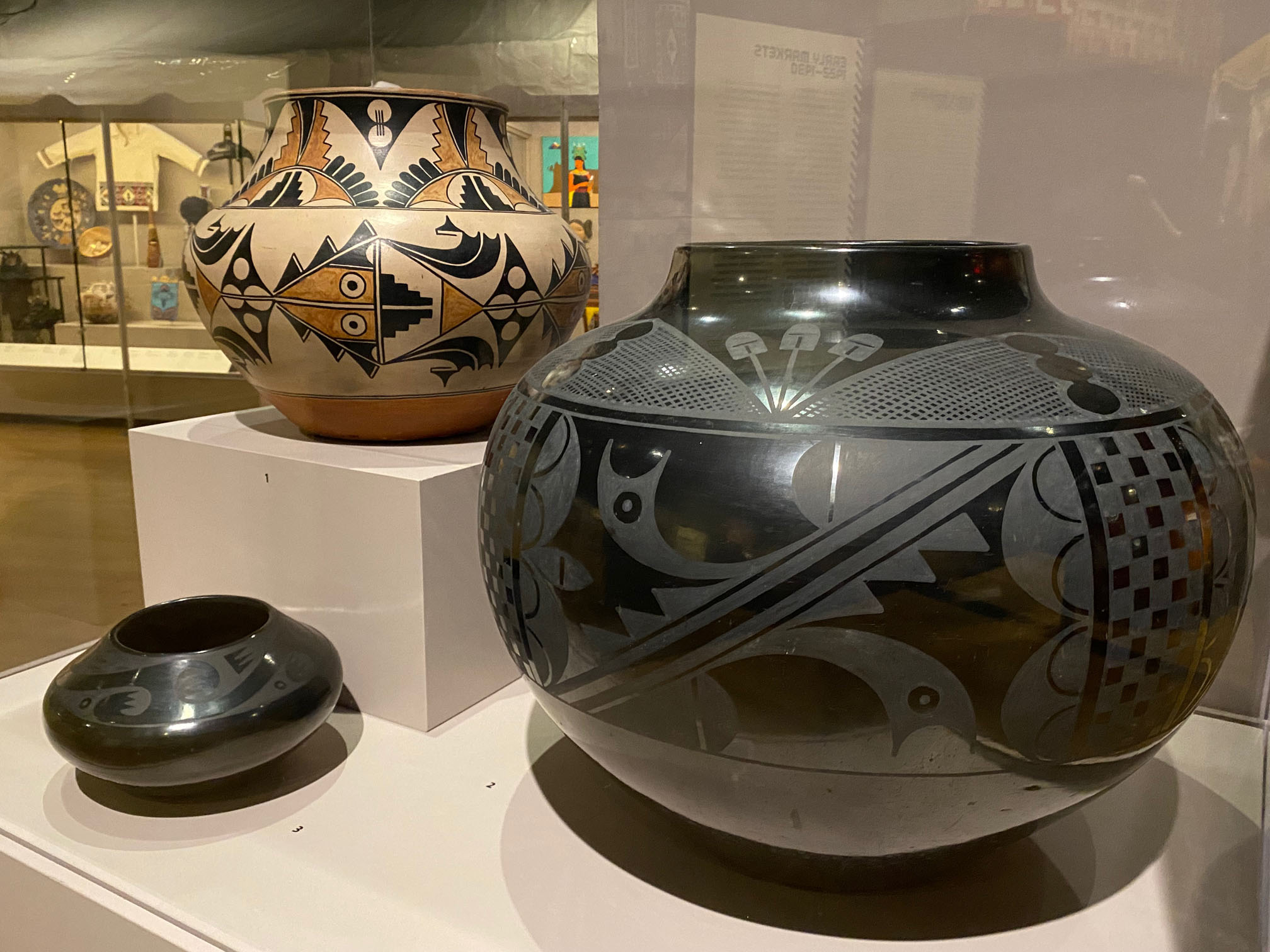
The inter-generational mastery of New Mexico’s Pueblo artists is featured in several vitrines holding examples of black-on-black (and other) masterworks by the Martinez family at San Ildefonso (go, Maria!) and the Tafoyas of Santa Clara, with Margaret’s famous bear-paw imprints.

Work by famed San Ildefonso artist Maria Martinez: 1922 polychrome, large 1942 black pot (award-winner painted by Julian Martinez); and 1928 jar. Courtesy: MICA, SAR

The surrounding gallery features dazzling painted pottery works by Zuni and Acoma from the 1920s – all drawn from the School for Advanced Research (SAR) collection, which began in 1922 to preserve classic works, SAR is the source of the acclaimed exhibition now at the Metropolitan Museum, Grounded in Clay: The Spirit of Pueblo Pottery. Sometimes the artists who made the pot is known; but often the maker is lost to history.

1928 Acoma jar. Courtesy: SAR

In the 1930s and 1940s across the United States, tribal mortality rates increased and their other economic lifelines decreased. But these conditions in the Southwest made the Market an even more important source of family revenue. Throughout the 1940s, the Santa Fe Market boomed.

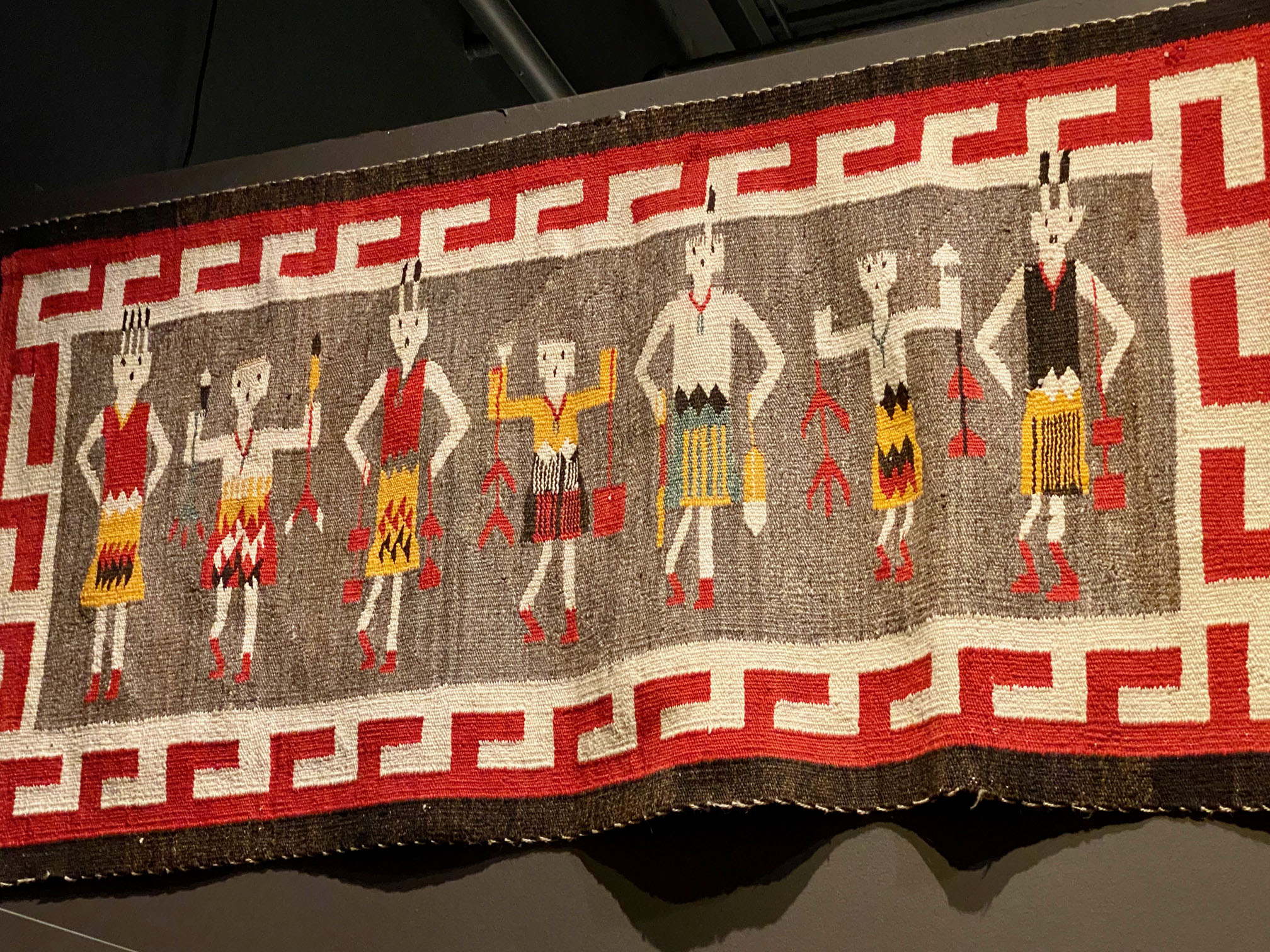
1920-1930 Navajo hand-spun wool rug with figures representing the fire dance. Courtesy: Historic Toadlena Trading Post Museum.

By the 1950s, Federal government instituted policies to encourage Indians to leave their land and move into cities. Unfortunately, Santa Fe Indian Market policies had the same depressing effect – the organizers reduced both the number of artists allowed to show and amount of prize money that could be won.

By 1959, the SF Indian Market was on life support, with a few private donors stepping in with funding just to let it survive.

But during the 1960s, changes were afoot. The Institute for American Indian Arts began in Santa Fe, where Lloyd Kiva New gave Native artists “permission” to throw off traditional conventions and make contemporary art. Across the United States, social-justice movements focused on indigenous people’s rights demanded policy changes to reverse the impact of oppression. By 1968, Congress had passed the Indian Civil Rights Act.

What did that mean for the Market? The majority of works on display in the museum gallery are from the post-1970s period, when the scope, range, voice, virtuosity, and experimentation reflected the times.

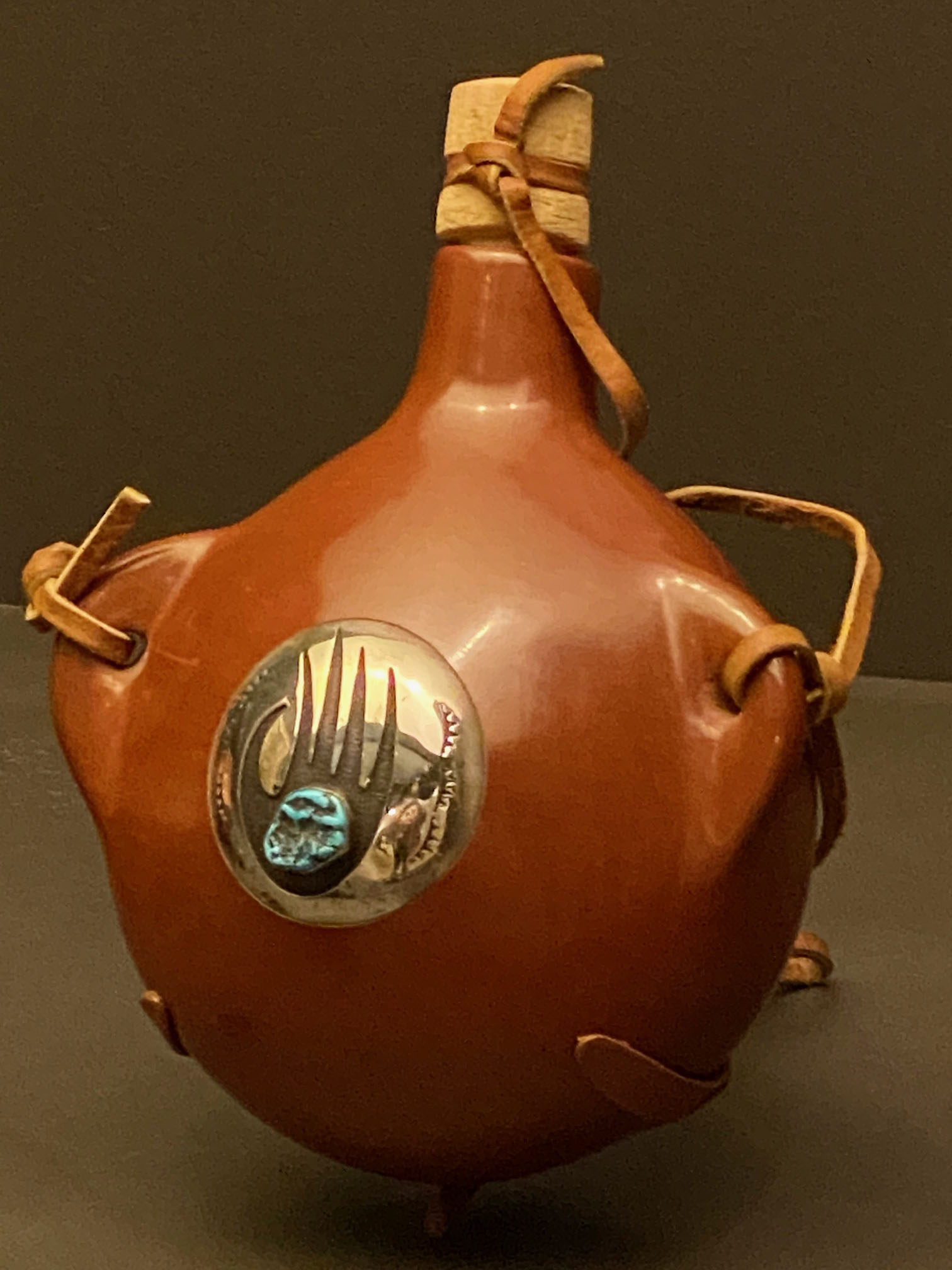
1974 pottery canteen with turquoise and silver by San Ildefonso artists Rose Gonzales and Tse Pe. Courtesy: private collection.

Here are some examples – the glorious, gleaming, turquoise-inlaied 1980s vessel by by Zia/Jemez/San Ildefonso artist Dora Tse Pe and the virtuoso painting on a jar by by Acoma artist Dorothy Toriio.

1980s pottery jar by Zia/Jemez/San Ildefonso artist Dora Tse Pe. Courtesy: private collection.
1990 pottery jar by Acoma artist Dorothy Toriio. Courtesy: King Galleries.

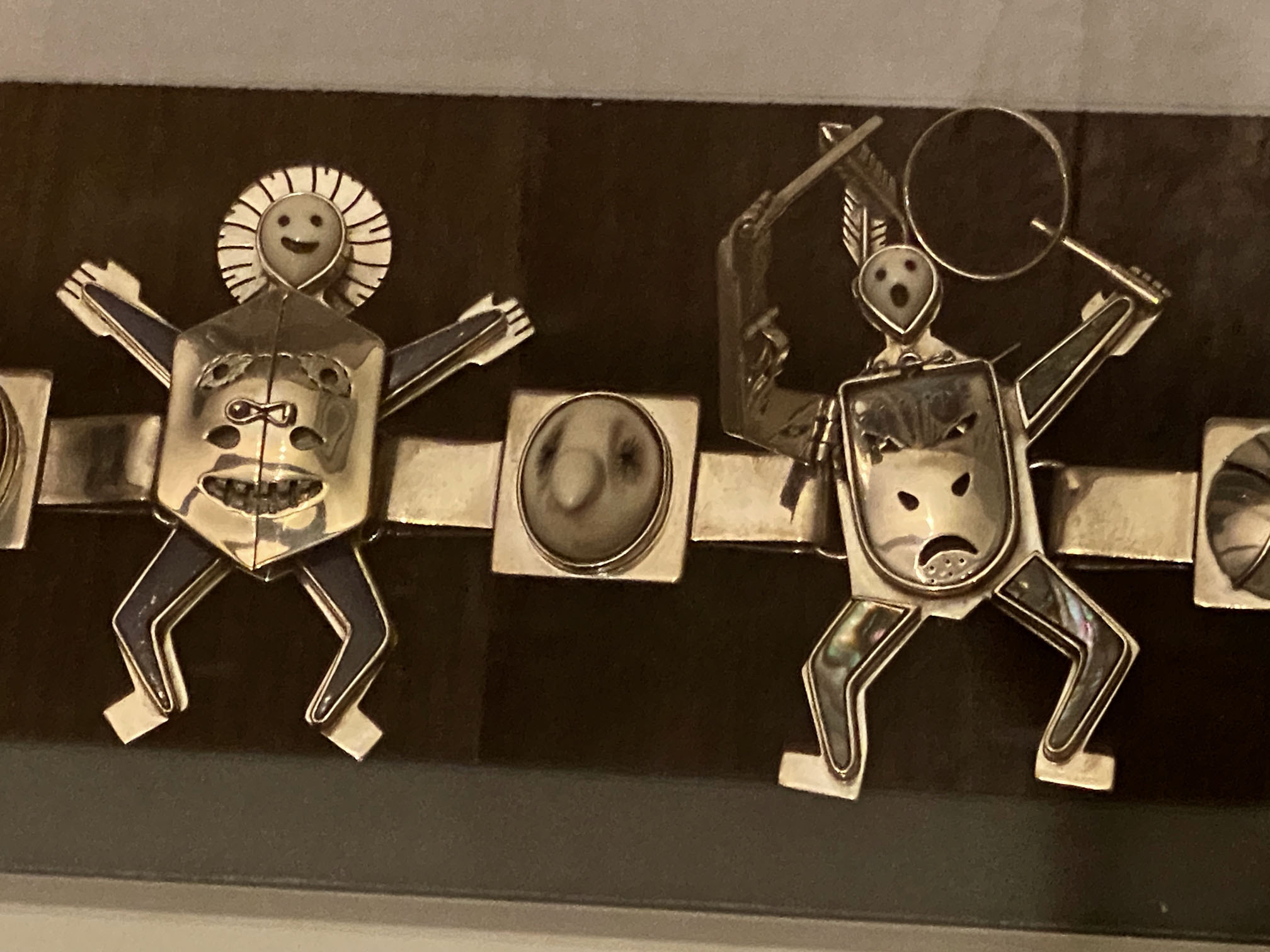
Or, consider the virtuoso silverwork and inlaid belt by Aleutian master Denise Wallace; edgy, theatrical 1990s Cochiti figurines by Virgil Ortiz; and a 1999 horsehair basket woven by Tohono O’odham artist Leona Antone. See more in our Flickr album.

Silver 1986 “Aleut Dancer Belt” by Aleut artist Denise Wallace with abalone, fossil ivory, and lapis; Best in Non-traditional Jewelry Award. Courtesy: private collection.

The show’s finale catapults the story of Indian Market into the future.  First, there’s a cluster of sculptural and video works by Virgil Ortiz, featuring his sci-fi, super-powered, time-traveling warriors from the future who travel back to 1680 to fortify the success of the Pueblo Revolt and save Pueblo culture.

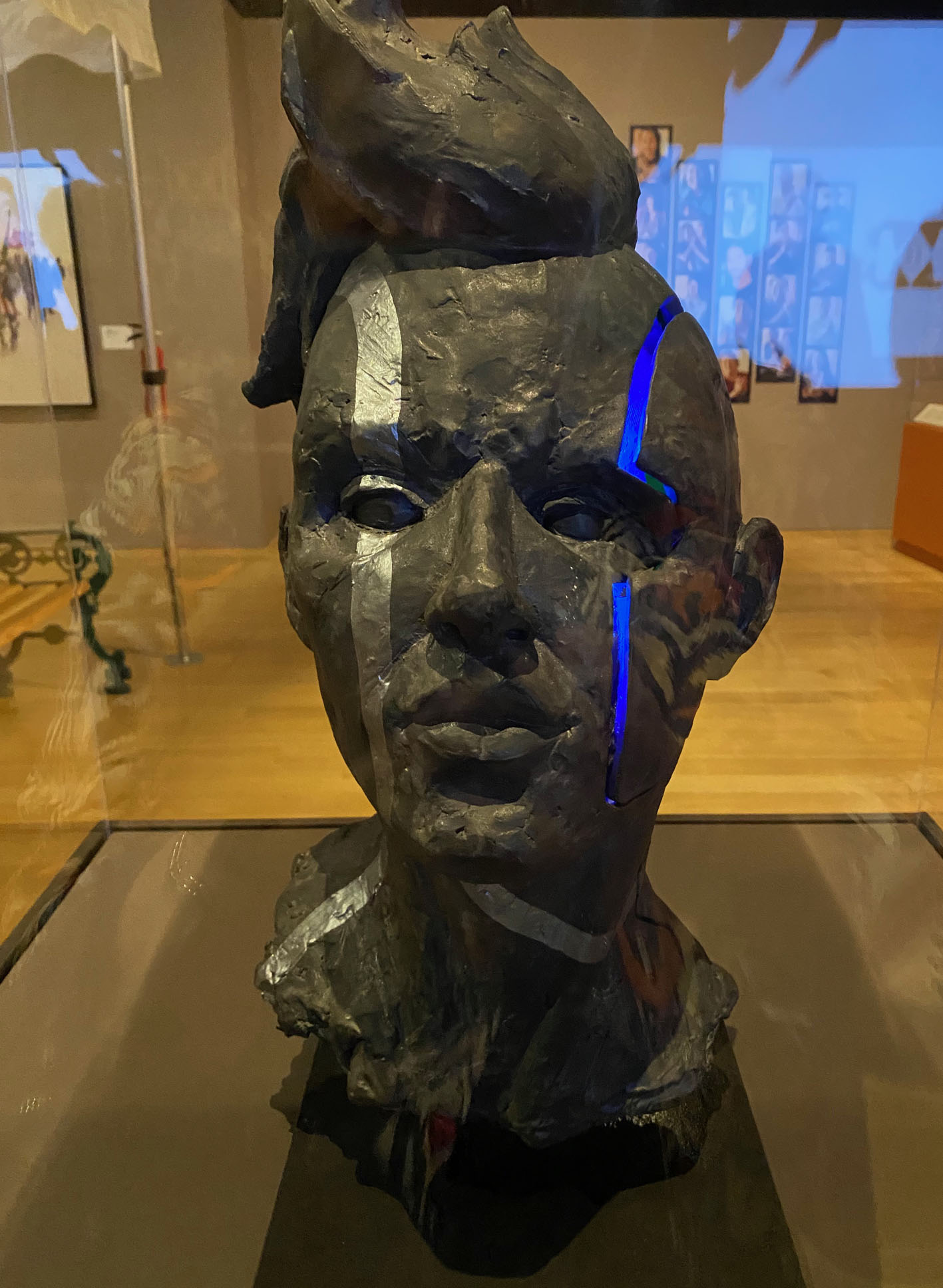
“Kootz (Runner-twin brother of Tahu)” 2018 high-fire clay sculpture with “warning” LED lights by Cochiti artist Virgil Ortiz. – a character from his sci-fi 2180 ReVOltage Series. Courtesy: the artist
“Tahu (Blind Archer)” 2018 sculpture with LED lights by Cochiti artist Virgil Ortiz.. Courtesy: the artist

Second, there’s a photo wall of families and their young children, who create work to enter in to the children’s division. It leaves visitors with the strong feeling that not only will forward-looking artists keep innovating and creating, but that the kids will be all right.

Still of 2022 “Made in Native America” video by Cochiti artist Virgil Ortiz, featuring sci-fi costumes. Courtesy: the artist

Pedro Reyes Takes Direct Action in Santa Fe

You first see a group of anonymous protestors – statues that appear to be taking it to the streets with placards and bullhorns. Elevated at different levels, they present a monument to non-violent protest – a fitting opening to Pedro Reyes: DIRECT ACTION, on view at SITE Santa Fe through May 1.

Reyes believes in participatory art projects that transform art-making into social action.

The Protesters, Reyes’ 2016-2017 monument to unified voices that bring about change from non-violent protest. Courtesy: the artist, private collectors.
Memento, 2022 – vases made from gun parts by Albuquerque and Santa Fe students. All for sale.

The products of his 2022 Memento are right behind you – an array of fun flowers popping out of tall vases. Look closer.

The airy containers are transformed guns from a New Mexico buyback program that incentivized people to exchange their guns for grocery or home-store gift cards. The vases, made by welding-class students from Albuquerque and Santa Fe, are all for sale, with proceeds going to fund activities by New Mexicans to Prevent Gun Violence.

Turning the corner into the next installation, you encounter a wall of videos and shovels in a similar transformation – Palas por Pistoles – that Reyes organized in a particularly violence-prone community in western Mexico.

Reyes’ Palas por Pistoles (2006-present) – shovels made from melted-down gun parts, which were used by schools and museums to plant trees.

Reyes asked people to donate guns to be melted down for an art project promoting environmental peace. He received 1,527 weapons, crushed them in a public-art event, and commissioned a foundry to make shovels. Schools and museums used the shovels to plant 1,527 trees.

Every turn in the gallery reveals a different type of installation and project – libraries for “the people,” sculptures referencing language systems, posters protesting nuclear arms, and musical instruments and contraptions created from weapons.

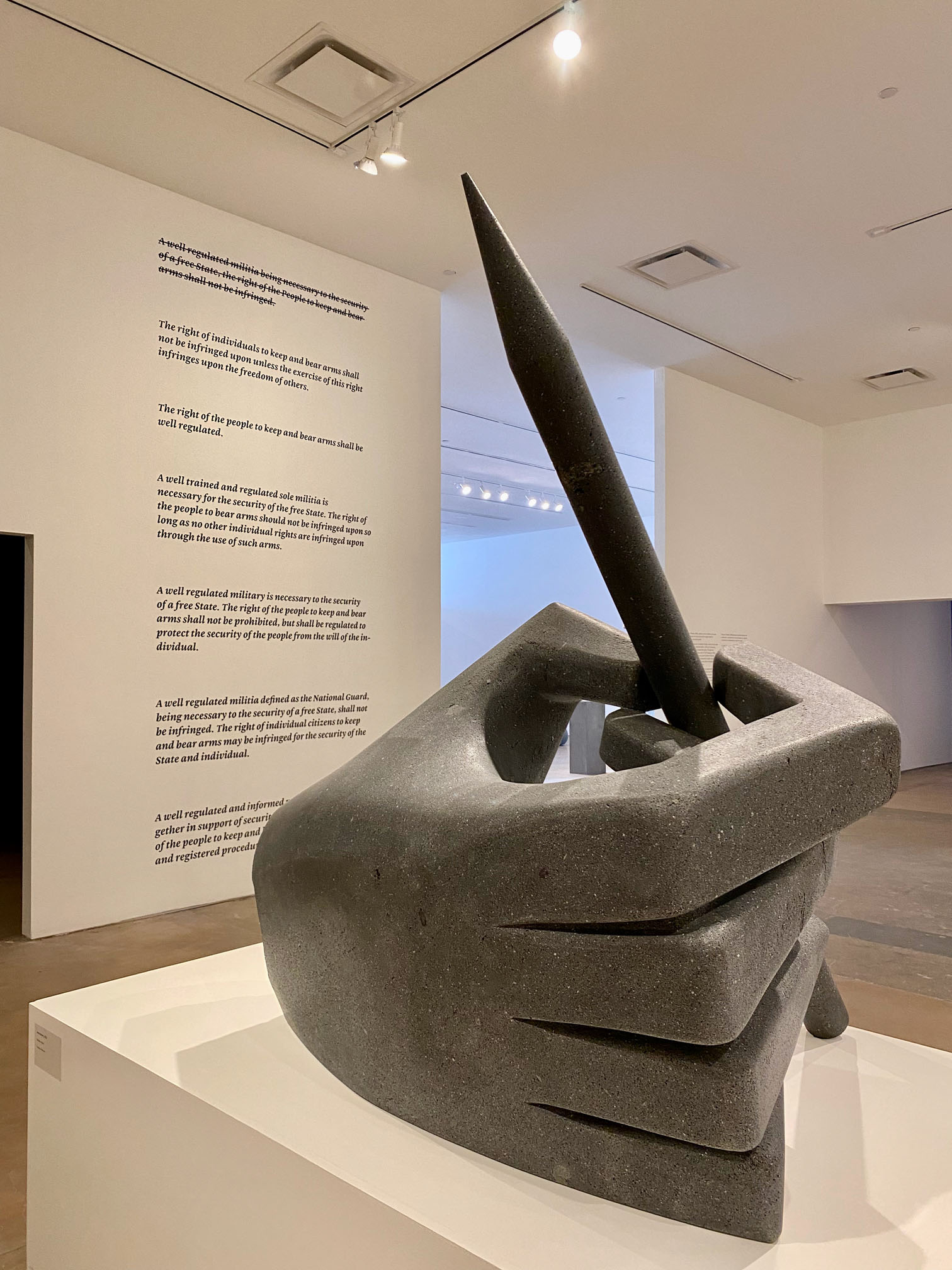
You can’t miss the artist’s large volcanic-rock hand with pencil – an emblem of Reyes’ Amendment project that held community meetings where rewrites to the Second Amendment were proposed and discussed. The idea is that with so much discussion on policies these days, it’s better to write down the “amendments to the Amendment” in pencil! A list of suggestions is prominently posted nearby.

2002 Amendment volcanic stone hand writes the Second Amendment in pencil to facilitate changes in wording as necessary. On wall, multiple drafts of the Second Amendment generated in a Tampa, Florida community project.
Reyes’ 2022 marble sculpture, Colloquium (Parafrasis) depicting the architecture of speech; in background, icons of solutions to social problems from The People’s United Nations (pUN) project – food insecurity, population, gun control, mass incarceration.

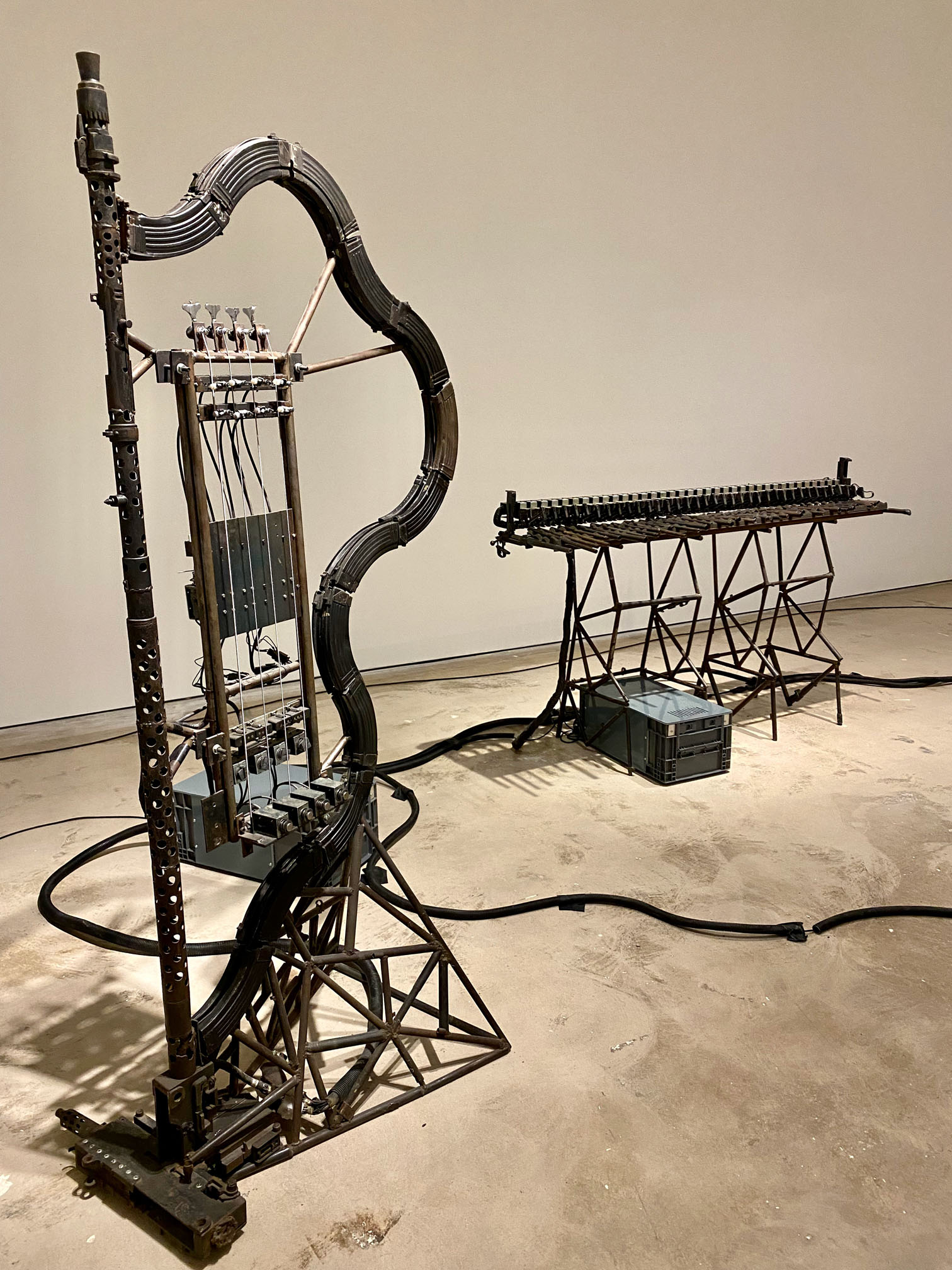
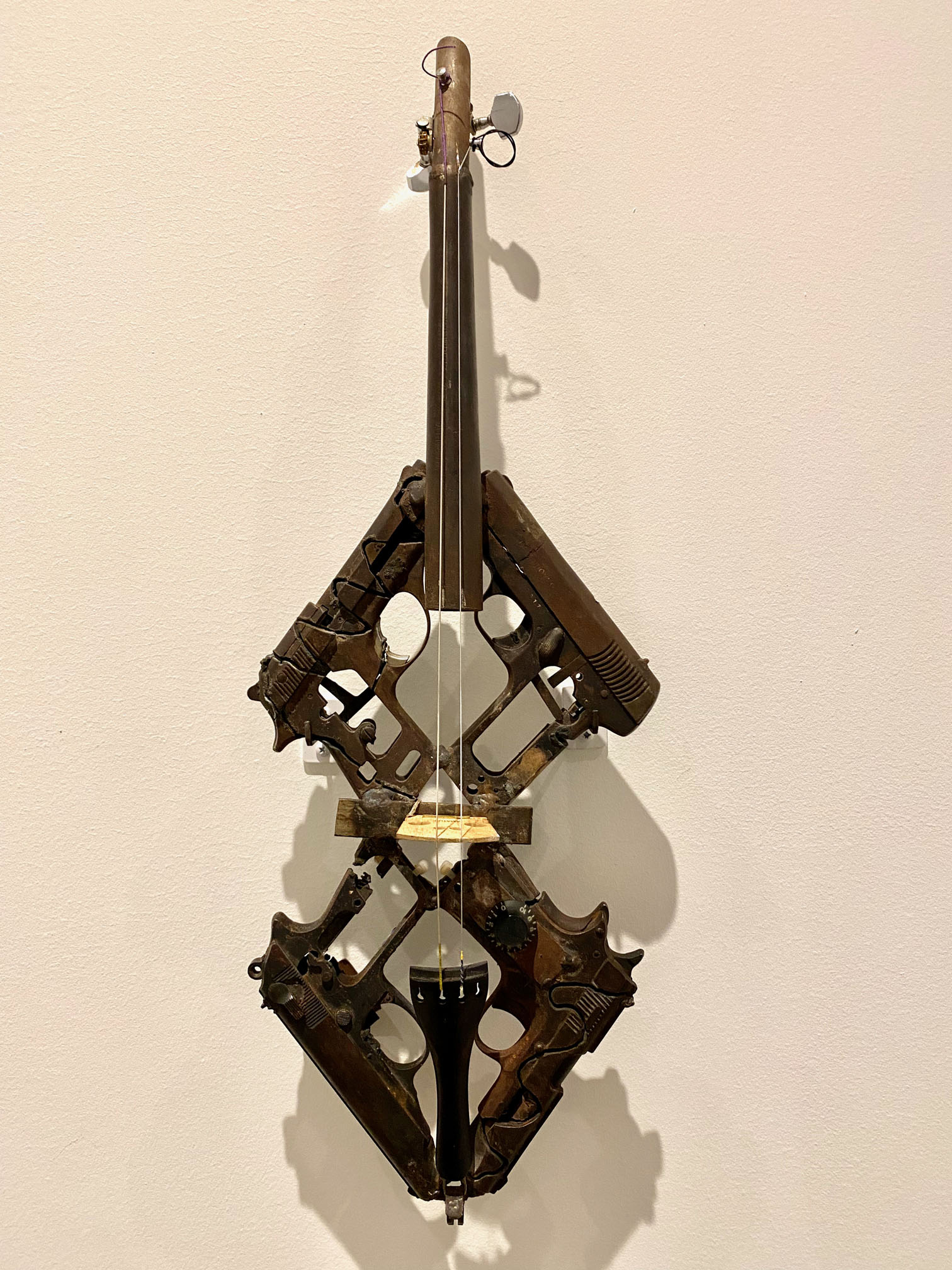
Visitors tend to linger in the Disarm gallery, closely examining the various automated musical instruments created from firearms. Every few minutes, one of the pieces awakens to pluck a string or tap out a slow sequence. It’s a bit startling, not knowing which of the seven is going to activate next.

Harpanet and Cañonófono in Disarm Mechanized, mechanized instruments made from recycled gun and rifle parts. Courtesy: Enrique Rojas.
Reyes’ 2012 Disarm (Violin) from destroyed weapons, played in SITE Santa Fe concerts in 2023. Courtesy: the artist.

Take a look at our Flickr album to see more of the exhibition and to hear the sounds made by the Disarm instruments.

SITE Santa Fe provides “activators” for Reyes’ Music Machine installation – an experience that demonstrates how one artist’s imagination can make you stop and think, even if it’s toward the end of a deep, contemplative show.  Reyes features iconic firearms from three European countries – Austrian Glocks, Swiss Carbines, and Italian Barettas – that have been transformed into classy music boxes. When activated, each plays a musical composition by a famous composer from that country.

Gallery educator Red Hart about to activate Reyes’ Machine Music – crank-operated music boxes made of Swiss Carbine rifles, Italian Barettas, and Austrian Glock pistols.

Hear the artist talk about each of these works in the SITE Santa Fe audio guide, and take time to ponder taking direct action as you visit this beautifully installed, socially relevant, and thought-provoking show.

No Nukes installation with series of 2022 hand-painted Zero Nukes posters in different languages, representing many countries. Courtesy: the artist.

Jeffrey Gibson at SITE Santa FE

What happens when a Native American MacArthur genius is asked by SITE Santa Fe to create an art exhibition during a time of a global pandemic and social justice marches? And invite him to a location where Native Americans make up a significant percentage of the population?

The result is Jeffrey Gibson: The Body Electric – a constantly surprising gallery journey where shape-shifting, cultural disassociation, beadwork, kitsch-image appropriation, gender-identity questions, and science-fiction inspiration reigns.

The show is filled with life-size beaded dolls and garments, films, pulsing papered walls, mysterious film experiences, and social statements either woven or stamped onto clothes (or are they banners?).

Gibson’s 2021 White Swan mixed-media painting in wall-papered gallery with a beaded, life-size, genderless “doll”
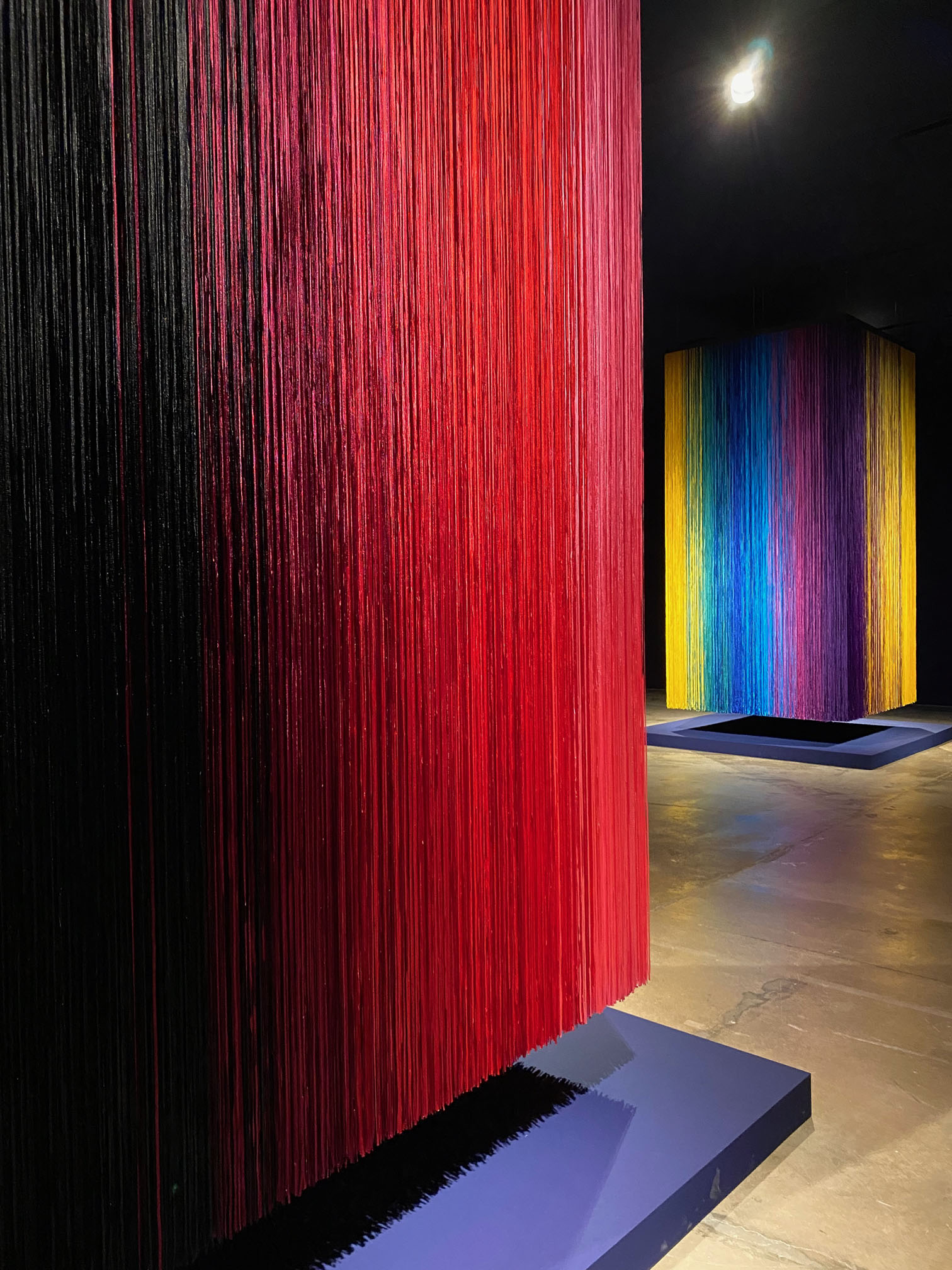
2020 Red Moon and Desert Sky minimalist sculptures created from strands of dance fringe.

Gibson, who is based in New York, is an intertribal artist who is a member of Mississippi Band of Choctaw and half Cherokee. However, his influences were forged from prestigious art schools, international travel, and living in non-Native societies.

The opportunity to come to Santa Fe, host a cinema series and several performances, and stay out West for a while was an open door to explore inter-cultural influences, host discussions with appreciative audiences, and show off his wide intellectual and artistic breadth.

In many of his works, Jeffrey mixes traditional “Indian” materials like beads or fringe with slogans, sayings, dime-store “Indian” images, and big-time art-world references.

See some our favorites from this exhibit in our Flickr album and hear Jeffrey explain his influences in SITE Santa Fe’s audio guide.

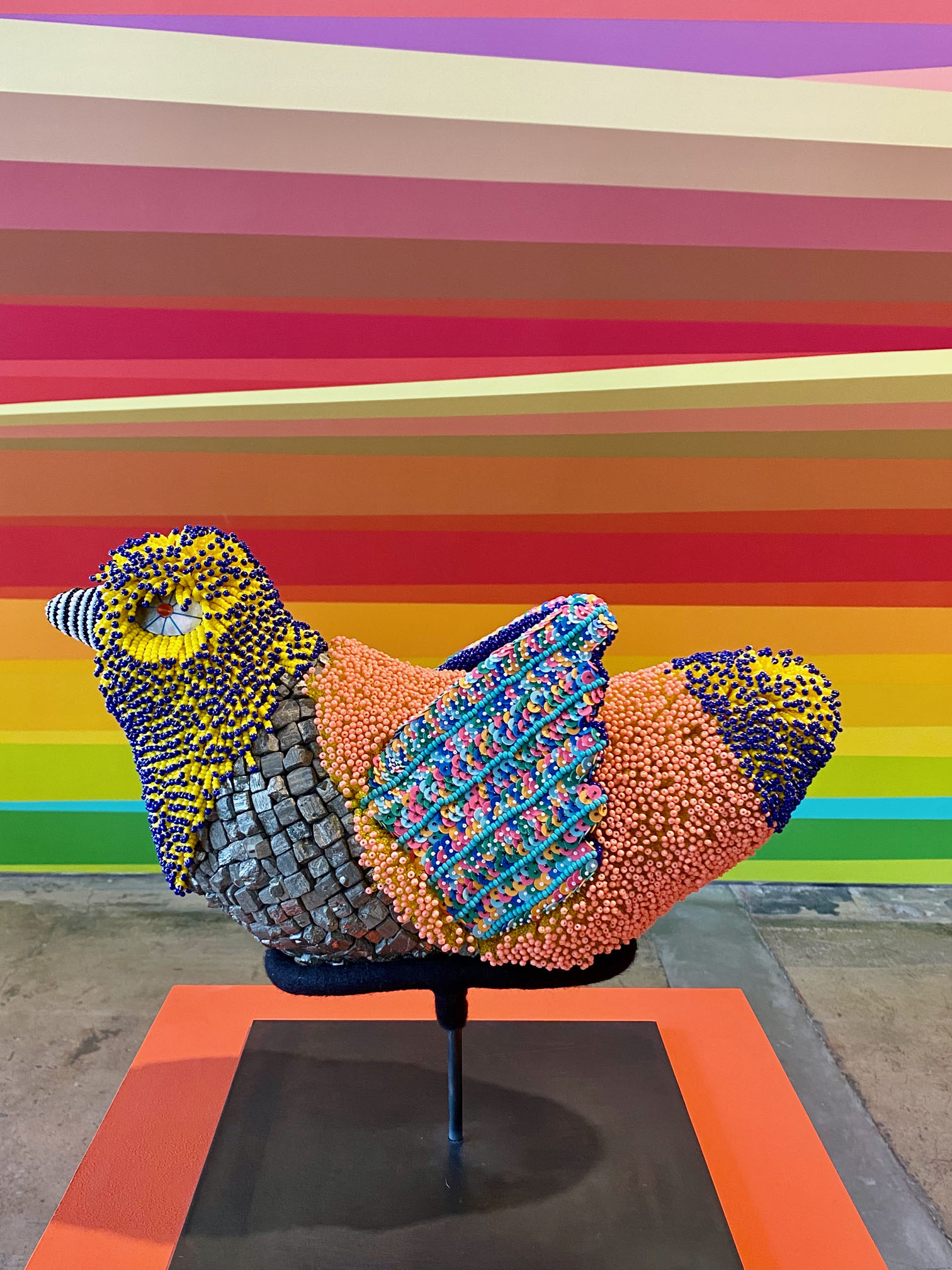
The little beaded birds that greet visitors in the first gallery and the big beaded life-sized “dolls” in the second were inspired by Jeffrey’s early work in the ethnographic collections of the Field Museum, where he encountered Haudenosaunee-made beaded tourist-trade whimsies and traditional “third gender” dolls for the first time. Why not make his own, but over-size them?

2021 My Joy My Joy My Joy, a mixed-media beaded bird inspired by Victorian-era Native American tourist whimsies

The nearby video gallery features a kaleidoscopic multichannel video of Sarah Ortegon, an award-winning Eastern Shoshone/Northern Arapaho jingle dress dancer, performing to the energetic Sisters track by A Tribe Called Red. This piece – She Never Dances Alone – refers to the dancers who came to the Standing Rock Reservation and lent their support to the 2016 pipeline protests though dance.

Here’s Sarah Ortegon in Gibson’s 2019 Times Square installation of She Never Dances Alone here…wait for it:

2021 They Play Endlessly mixed-media crazy quilt of paint, beads, words, and found objects.

And here’s another look at Gibson’s 2020 exhibition at the Brooklyn Museum, where he mixed works from his studio with artifacts and art from Brooklyn’s own collection.

And check out Gibson’s work our album documenting the Smithsonian’s National Museum of the American Indian exhibition of Native painting, Stretching the Canvas.

If you’re near Nashville, you’ll be able to see Gibson’s The Body Electric at the Frist Art Museum February 3 – April 23, 2023.

Walking into the Countryside and its Future at The Guggenheim

An innovative, continuous exploration about rural areas along the futuristic ramps

Want to go for a trip around the world? Visit out-of-the-way places? Meet interesting people?

There’s no better trip than hanging out with Rem Koolhaas and his think tank, AMO, in their all-encompassing exhibition, Countryside, The Future, on display at The Guggenheim through February 15.

It’s a colorful, engaging, data-driven, and provocative show that began as a response to the fact that population projections show indicate that in the not-too-distant future only 20 percent of people will live in the countryside.

1909 photo of three peasant women in Kirilov, Russia

Rem, Samir Bantal of AMO, and their university collaborators believe that many of the most important, exciting, and radical innovations are happening outside cities, and this is their way of taking you there.

You’ll zip into the past, zoom into current village experiments, watch videos, and meet robots as you swirl your way up the Guggenheim’s ramps.

Listen to famed architect Rem Koolhaas explain the context for the project and research that make up this extraordinary experience:

As this promo notes, this exhibition opened just a few days before New York City and all the museum shut down to mitigate the pandemic. The team did not foresee the impact that the pandemic would have, but the exhibition could not be more of the moment.

1,000 Koolhaas questions about the countryside and society

In the audio guide, the curators say that you can view the exhibit like a buffet (just snacking on this and that) or dive in and read/see everything.  When we experienced Countryside, everyone was digging in, reading, watching, absorbing, and interacting with everything.

View part of the exhibition in our Flickr album.

The show begins with Rem’s 1,000 questions about the world and the future. He makes it clear that he and the team are not there to provide answers – that’s up to you.

How “countryside” has been equated with leisure since Roman times

There’s a walk through history on the next level by way of fun floor-to-ceiling collages filled with Romans from murals, Chinese people from scrolls, quotes, and fun facts – all to drive home the fact that for 2,000 years, major urban sophisticates have seized upon the idea that city people need to visit the country for peace, quiet, contemplation, leisure pursuits, and artistic inspiration.

The history walk continues by exploring Marie Antoinette’s decision to create a rural “hamlet” on the Versailles grounds, the desire of Sixties Hippies to create communes in the country, and the emergence of today’s rural “wellness” spas and retreats.

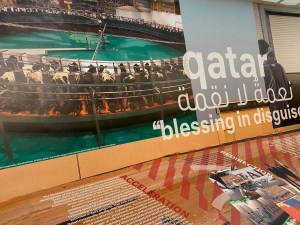
Qatar’s solution to achieving national food security after the June 2017 border closure

The story continues by presenting details about efforts by famous political leaders to “redesign” their countries rural regions on a large scale – Jefferson’s adaptation of the 640-acre grid for developing the West, how the Soviets scaled up collective farming, FDR’s “shelterbelt” policy to minimize soil erosion in the Thirties, and the agricultural emphasis in Mao’s Cultural Revolution.

The most startling story is how Qatar, which imported the majority of its food, did years of research into ways it could be self-sustaining. When the Saudis jammed Qatar’s border in 2017, the country already had a plan. Within 36 hours, it airlifted in 4,000 cows and milking machines, a move that immediately (and successfully) started its domestic dairy industry.

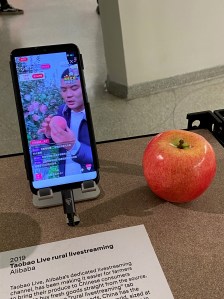
Chinese service that lets city dwellers select apples from trees

The exhibition takes you to villages in China where interesting things are happening – a dying farming town that transformed itself into a “wellness” tourist destination, and an apple-growing region that uses livestreaming on mobile phones to let city-dwellers pick out the specific apples that the villager will pick and ship to them overnight.

The exhibition includes mini-galleries on the move to “preserve” nature, presenting facts and posing land-use questions related to mountain gorilla habitats in Central Africa, permafrost melts that are exposing mammoth fossils, and American billionaires buying and preserving Patagonian land.

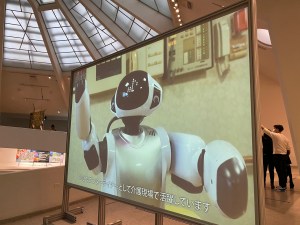
Humanoid PALRO robot from Fujisoft in action

The top floor is alive with roaming robots powered by Roombas, who invite you to enter mini-theaters to see worlds beneath the ocean, developments of industrial facilities run completely by robots, and vast expanses of industrial-level agriculture. You’ll even meet PALRO, Fujisoft’s humanoid robot who hangs out with seniors in Japan, and Prospero, a little robot farmer that’s designed to work in swarm teams.

Hear all about the research and collaborations behind the exhibition and how the exhibition design brings it all to life:

To take a leisurely stroll through the future, listen to the audio guide.

For the full report, purchase the book (a steal at $12).

About Fashion and Time at The Met

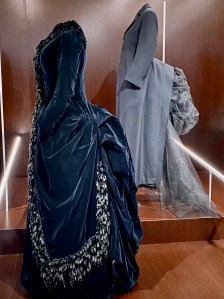
An 1885 American walking dress with 1986 Yamamoto overcoat

What day is it? What year is it? If we’re going forward in time, should we be moving counterclockwise?

As ten months of pandemic disruption sink in, there’s no better exhibition in New York to experience than the Metropolitan’s Costume Institute extravaganza, About Time: Fashion and Duration, on view through February 7.

Curator Andrew Bolton had the task of organizing a show in honor of the Met’s 150th anniversary, but wanted to take an exhibition approach that wasn’t simply a “greatest hits” showcase.  He wondered what would it be like to mount a show that lets visitors see, feel, and experience how fashion sometimes folds back on itself – like time in Virginia Woolf novels.

Queen Alexandra’s 1902 riding jacket with 2018 Vuitton ensemble by Ghesquière

Stepping into the first gallery, sixty black dresses are arranged like minutes on a clock. The exhibition begins with an example from 1870, the year that the Met was founded, and progresses in time from there.  At each point, you see an ensemble from that year, paired with a designer look from a different year that echoes it – bustles, princess lines, gigot sleeves, tailored jackets, flourishes of 18th-century aristocratic opulence.

It’s all in the Met’s gallery guide.
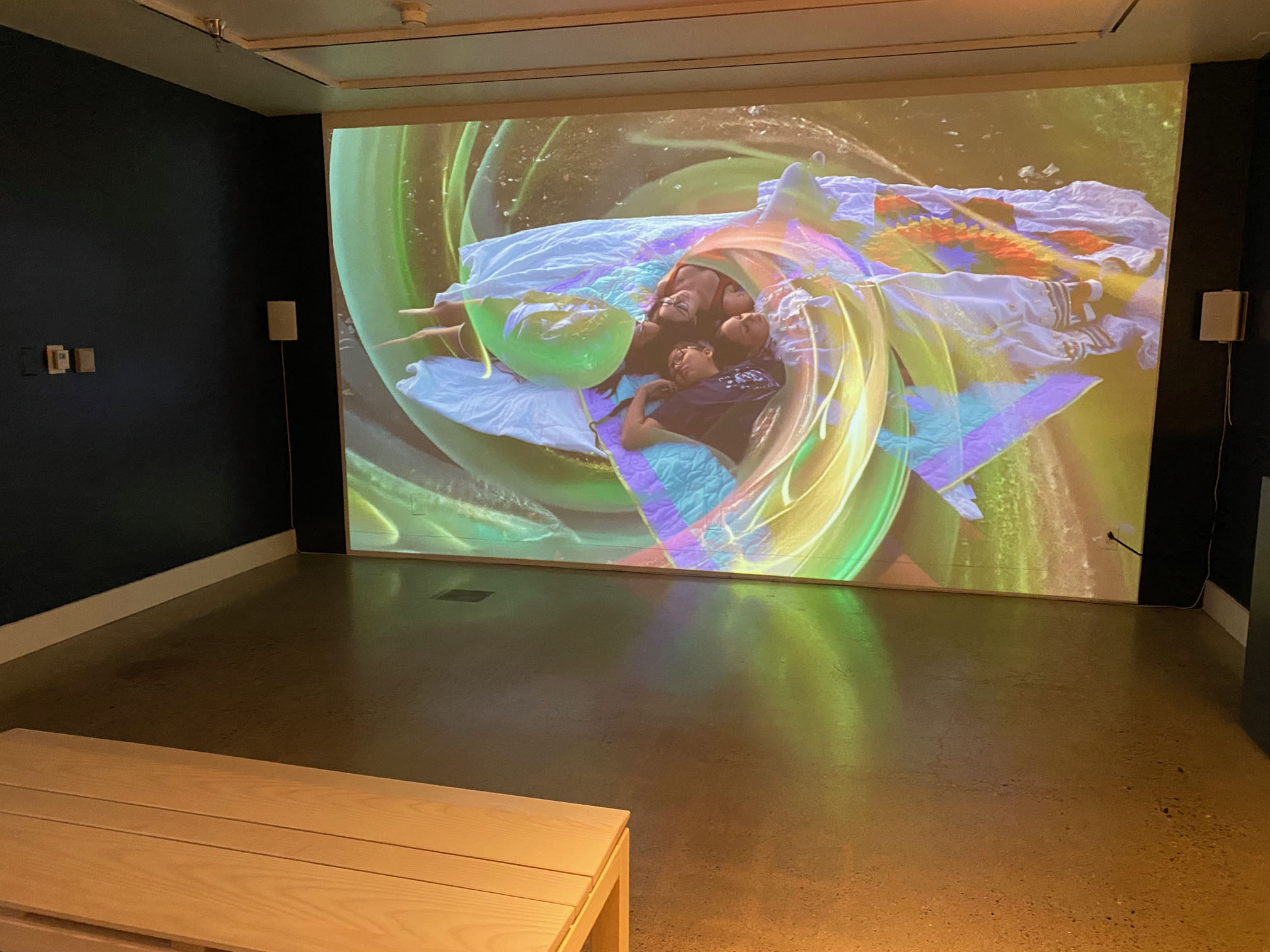
The inspiration for the first room is a grandfather clock – warm wood colors, a constantly swinging pendulum, and the monotonous, even tick. As you slowly work around the room, the time is even, rhythmic, and set – just like the pace of fashion from 1870 to 1950.

1895 dinner dress by Mrs. Arnold with Rei Kawakubo’s deconstructed 2004 ensemble

The 19th century garments are solid black, with masterful tailoring, swags, trims, and embellishments. In a tribute to the home town, two were created in Brooklyn: the 1885 silk satin dinner dress by Mrs. Arnold (paired with Rei Kawakubo’s equally elaborate but deconstructed 2004 ensemble) and an 1897 riding habit from Brooklyn’s acclaimed department store, Frederick Loeser & Co. (paired with a 1968 equestrian-style suit by Victor Joris).

Some of our other favorite pairings in this room are the 1912 artistic dinner dress with its leather pannier clone by Rick Owens, the 1928 alphabet flapper dress paired with Galliano’s 1997 spider-web frock, and the 1947 Christian Dior “New Look” jacket paired with Watanabe’s 2011 experimental motorcycle jacket.

Dior’s 1947 “New Look” with Watanabe’s 2011 motorcycle jacket

The second room is a shocker – mirrors everywhere, blinding white, undulating pathways, a fractured sense of time, and fashions morphing at breakneck speed – minis, maxis, minimalism, glitter, punk, pleats, unconventional materials, technology, and 3-D printing. (And it’s no surprise that so many pairings include visionary works by Charles James!)

The displays follow the same convention – sequential years paired with a “disrupter” dress or ensemble – but the impact is enormously disorienting, since the “twin” piece could be from the past or future and the mirrored walls and ceiling turn the experience into something like Kusama’s “infinity” room.

“Shattered” gallery – evoking fashion’s accelerated pace

When you enter, it takes a few minutes to figure out where to go, how to move through the sequence, and find the continuing storyline of the exhibition. Is there another room in the exhibition that you missed? Did you just jump to the Seventies and Eighties and miss the Sixties? Is the “next garment” to the right or the left? What year are you in?

[The gallery security guards confirmed that this occurs all day long with visitors!]

To sort it out, take a look at this video – a sequential walk through fashion time punctuated by some out-of-time disrupters (or peruse some pairings on the web):

Some of our favorite pairings in the second room are the zipper twins from Gernreich (1968) and Alaia (2003), the red-edged jersey pairing of Stephen Burrows (1975) and Xuly.bet (1993), and Patrick Kelly’s simple pearl heart dress (1988) with Olivier Rousteing’s Versailles-inspired dress for Balmain lavished with pearls, crystals, and beads (2012).

2012 Iris van Herpen PVC dress with 1951 ball gown by Charles James

Check out more of our favorites in our Flickr album.

And congratulations for including an unexpected (and deserving) multi-part display – Donna Karen’s “Five Easy Pieces” mix-and-match knit separates (1985) with the totally chic, revolutionary, coordinated wool knit separates invented by the ready-to-wear sportswear founder herself, Claire McCardell (1934). Wow!

When you finish walking through this gallery, you’re left wondering if fashion ever truly changes ­– the last pair features a 2018 coat with a 3-D printed understructure alongside a strangely similar coat from 1889.  What just happened?

Sustainability – 2020 Viktor & Rolf’s dress of leftover samples

The exhibition finale is fitting – a small chapel where visitors can meditate on “slow fashion,” sustainability, and a return to basics before they exit to the gift shop.  It features a suspended (or ascending) figure clad in one of Viktor & Rolf’s sweet dresses made of leftover off-white fabric swatches.

When the Met chose the theme for the show and designed it to debut with the celebrity-filled First Monday in May event, no one envisioned that the doors would be sealed shut until August. Or that the exhibition would so perfectly mirror the sensation of endless time, interruption of cycles, and fashion disruption/rethinking happening right now.

Join the Met’s fashion collection curator, Andrew Bolton, for a tour: