Cage’s Zen Den at the Academy

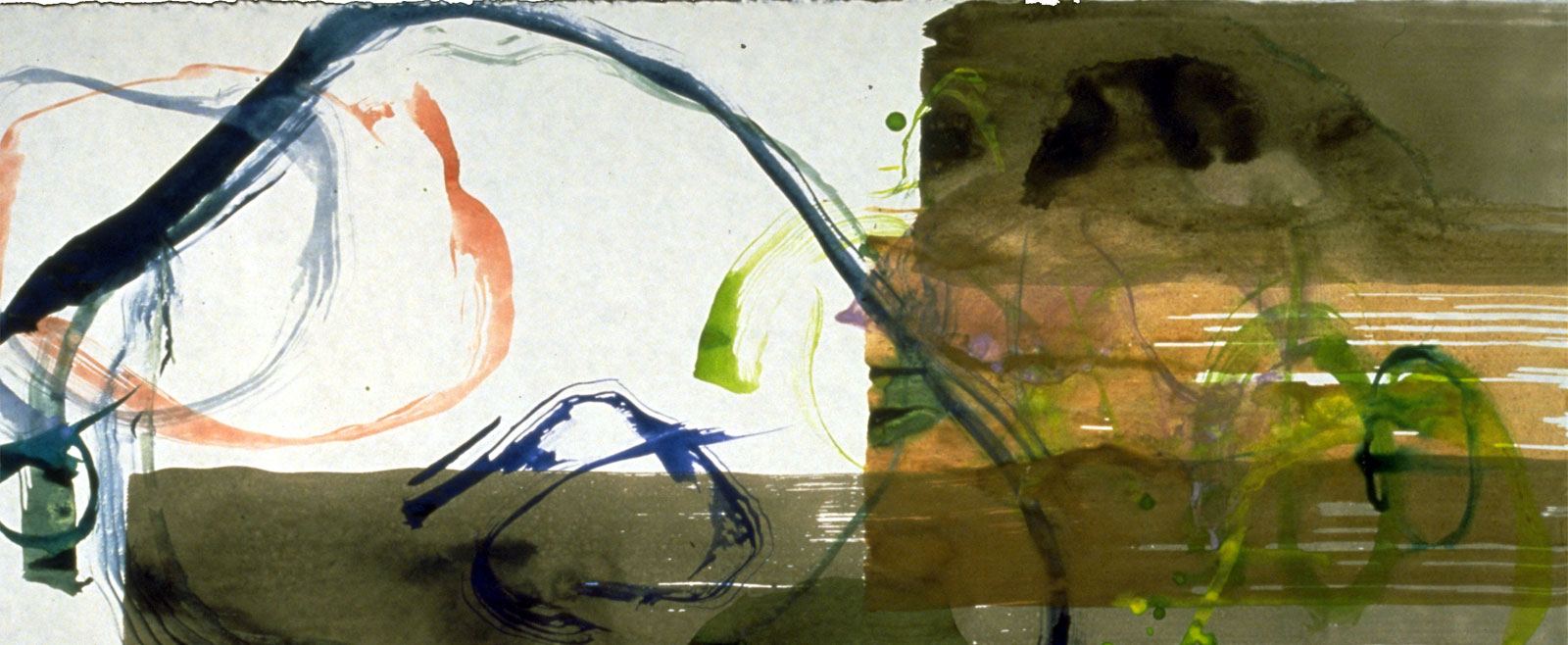
Cage's New River Watercolor Series I on parchment paper. Courtesy: Mountain Lake Workshop

Cage’s New River Watercolor Series I on parchment paper. Courtesy: Mountain Lake Workshop

Take one of the most controversial composers of the 20th century, give him some watercolors, drop him at the foot of the Blue Ridge Mountains, and leave everything to chance. See what happens.

You’ll see the results at the National Academy Museum’s John Cage: The Sight of Silence show this weekend. Back in 1988, Cage was the artist in residence at the Mountain Lake Workshop in Blacksburg, Virginia. He spent his time making a series of watercolors inspired by his trip to a Zen garden and temple in Kyoto, where he saw stones floating on a field of raked gravel.

Cage, whose lifelong interest in using chance (via the I Ching) to select and structure his musical compositions, decided to apply the same principles to watercolors, drawings, and prints. He customized some large-scale brushes that he could drag across wet paper like rakes, picked up feathers, and collected stones from the New River.

The brush, paper wetting, colors, stones, and actions are all determined by chance to stunning effect. Watch the artist at work and hear him talk about his process here:

Now see the results at the Academy and witness pure Zen.

Celebrity Lace at the Met

EuropeanLace_posterIt was all the rage 100 years ago – who could amass the best collection of antique lace owned by the rich and powerful, and what could you do with it to make a fashion statement?

The Met still has its Gems of European Lace micro-exhibit on display in a lower-level nook for a few more days, right outside of the Ratti Textile Center. (It’s down the stairs on the left side of the tiled medieval Gallery 304 on the first floor.)

The show blends astonishing craftsmanship with an object lesson in conspicuous consumption of the rich and famous of a century ago. It seems that in the late 1800s, wealthy American women tried to outdo one another with lace collections, vying for little masterpieces that might have been owned by European royalty.

Adolf de Meyer’s photo of Rita de Acosta Lydig in Harper’s Bazaar in 1917 (Source: The Met; gift of Mercedes de Acosta)

Adolf de Meyer’s photo of Rita de Acosta Lydig in Harper’s Bazaar in 1917 (Source: The Met; gift of Mercedes de Acosta)

One gem is the bobbin-made lace cravat end (featured above), allegedly commissioned by Austrian empress Maria Therese and later given to her daughter, Marie Antoinette. The Met cites this provenance, but will only say that it’s “maybe” true.

In the race by society ladies to amass the best lace collections, international lace-dealers made out like bandits. The frenzy only benefits us today, since so many patrons ultimately bequeathed their collections to the Metropolitan and the Brooklyn Museum.

By the early 20th century, the super-wealthy were also acquiring antique lace and asking for it to be refashioned into stylish haute couture. The example on display in Gems is a Callot Soers original made of 16th-century-style lace for the style icon Rita de Acosta Lydig, known for her celebrity-filled New York salons; lace-covered accessories and bedecked couture; and having her portraits done by Rodin, Sargent, and anyone who was anyone at the turn of the century.

Rita's 16th c. style lace remade by Callot Soers in the 1920s (Brooklyn Collection at the Met)

Rita’s 16th c. style lace remade by Callot Soers in the 1920s (Brooklyn Collection at the Met)

Check out the Met site for close-ups of masterworks of needle and bobbin.


3D Cave Art Revealed at NYU

Left Hand of Maitreya, Buddha of the Future, Holding the Looped End of His Robe
Xiangtangshan: Northern Group of Caves, North Cave, south face altar of central pillar, 550-559 ce., limestone. Source:
Asian Art Museum of San Francisco, Transfer from the Fine Arts Museum of San Francisco

Left Hand of Maitreya, Buddha of the Future, Holding the Looped End of His Robe
Xiangtangshan: Northern Group of Caves, North Cave, south face altar of central pillar, 550-559 ce., limestone. Source:
Asian Art Museum of San Francisco, Transfer from the Fine Arts Museum of San Francisco

The exhibition closing today on 84th Street isn’t about Herzog’s 12,000-year old French cave art, but about truly monumental art that has been largely unknown in the West until the University of Chicago unveiled a truly spectacular achievement – the digital recreation of a Sixth Century Buddhist cave temple destroyed in the 20th century by vandals selling to the international Asian art market.

Echoes of the Past: The Buddhist Cable Temples of Xiangtangshan was brought here by NYU’s Institute for the Study of the Ancient World after the show’s run at the Sackler in Washington.

The story of this cave temple’s recreation began when the University of Chicago started asking what happened to all the stuff from the vandalized cave temples that were originally built as hostels for wandering Buddhist monks in the Fourth Century in Northern China along the old East-West trade routes. UC ultimately identified about 100 statue fragments in museums and collections all over the world.

Take a look at the cave temples today and the techniques used by the University to bring an amazing collection back together in virtual reality:

At NYU, you first immerse yourself in the Digital Cave and then enter the elegant gallery to see the works themselves – holy men, heads and hands of Bodhisattvas, and little monsters all gathered from collections from Penn, the Met, the V&A, the Nelson-Atkins of Kansas City, and the Asia Art Museum of San Francisco. Check out the highlights on line.

Crisp Hepburn Clothing Tribute at Lincoln Center

There’s no surprise that the wardrobe on display in the Katherine Hepburn: Dressed for Stage and Screen exhibition is sharp, clean, and perfectly turned out. Finishing its run at NYPL at Lincoln Center this month, the Library has imported this stunning tribute developed by Kent State University. Check out this promo produced by WNET Channel 13:

The first clothes you encounter are a collection of her famous trousers and jodphurs, but tucked away in the corner to the right of the entrance is an item that underscores the purpose of this tribute – the Ernest Trova statuette that she received in 1985 from the Council of Fashion Designers of America for Lifetime Achievement (and inspiration).

Photo from NYPL’s Billy Rose Collection. This dress is in the show.

Photo from NYPL’s Billy Rose Collection, but the dress is in the show.

A fashion icon for the 20th Century, the show highlights her collaborations with the best designers throughout her life. The first gallery features her stage clothes – Valentina’s creations for the Broadway production of The Philadelphia Story, which look like they were made yesterday, and the Chanel outfits that she commissioned for her performances in Coco. Apparently she did not think that Cecil Beaton’s vision could compare to the real thing, so she wore genuine Chanel in the play. Beaton did get Hepburn to wear some of his creations, and you’ll see a gorgeous black gown there, too.

It was the same story for films. Edith Head said, ““One does not design for Miss Hepburn, one designs with her.” Hepburn bought hats directly from Hattie Carnegie for Alice Adams.  Margaret Furse, who loved working with the perfectionist Hepburn, said that she was glad to “share credit” for the contemporary designs in A Delicate Balance. You’ll see her solution – to simply let Bergdorf Goodman make the leopard-print caftan and other stuff.

Almost everything for Hepburn later in life had high necklines and longish sleeves. Still, the stunner is the revealing form-fitting black gown she wore in Adam’s Rib (1949) by Walter Plunkett, the designer who also did Gone With The Wind. (It’s the one in the video promo.)

Her theatrical make-up kit is also on display in the back room. Who else? Max Factor.

Ivy Style or Gangnam Style?

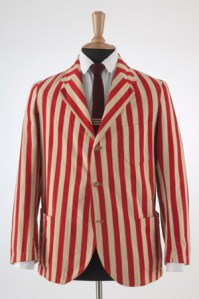
Red and white cotton flannel blazer, c.1928. Museum at FIT purchase.

Red and white cotton flannel blazer, c.1928. Museum at FIT purchase.

It’s hard to remember a time without Gangnam Style, but it’s even harder to remember before there was Ivy (as in Preppie) Style. There’s just a few more days to trek to The Museum at FIT for its revealing show on the roots of American menswear, Ivy Style.

Sure, the show is peppered with references and examples of the current Kings of Prep –Lauren, Hilfiger, and (prep with a twist) Thom Browne. But the real eye-opener here is the manner in which the curators journey back in time to show you how something so familiar today was once so radical – how “Ivy” got its name in 1876, how students set the sportswear trends before WWI, and the debut of the now-forgotten (but influential) “beer suits” at Princeton in 1912.

It’s also startling to learn that Brooks Brothers industrialized wardrobes as far back as 1818, and that J. Press “owned” the market for natural-shoulder jackets for pretty much the entire 20th Century.

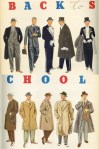
1937 illustration of college men’s fashions from FIT Library and Archives.

1937 illustration of college men’s fashions from FIT Library and Archives.

Thankfully, FIT has packed enormous amounts of menswear history on its special exhibition web site, so work your way through it and mine it for your own favorite tidbits (e.g. origins of saddle shoes, polo coats, and blazers).

Favorite factoid: In 1931, the average college student spent 51% more on clothes than the average man-on-the-street – a college trend that kept going right through the Great Depression. So, maybe it’s like Gangnam Style, after all? Psy sports it too, you know.

If you can’t get to the show in the next few days, take the virtual walkthrough with the Richard Press, the former President of J. Press, who interprets the who, what, why, and when of menswear history (including the roots of the most memorable scene in Animal House). Don’t ask, just watch:

Warhol’s New Year’s Eve Finale at the Met

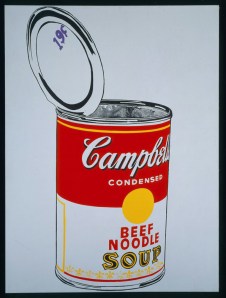
Andy Warhol. Big Campbell's Soup Can, 19¢ (Beef Noodle), 1962. Acrylic and graphite on canvas, The Menil Collection, Houston. © 2012 The Andy Warhol Foundation for the Visual Arts, Inc. / Artists Rights Society (ARS), New York

Andy Warhol. Big Campbell’s Soup Can, 19¢ (Beef Noodle), 1962. Acrylic & graphite on canvas, The Menil Collection, Houston. © 2012 The Andy Warhol Foundation for the Visual Arts, Inc. / ARS, New York

New Year’s Eve is the last day of a major tribute to the man who encouraged us to view brands, news, celebrities, identity-shifting, multiples, and commerce as art – Regarding Warhol: Sixty Artists, Fifty Years.

 The curators have organized the big, second-floor galleries along these themes, and paired Andy’s work with the work of fifty contemporary artists whose own work is indebted to Andy’s redefinition of modern life.

As the show begins, it’s almost as if Andy’s contemplating the implications of the upcoming fiscal cliff talks with the wall quote, “Buying is much more American than thinking.”

To prove his point, you’ll find Andy’s little-seen Dr. Scholl’s Corns (1961) (a gift from Halston to the Met), alongside better-known Brillo boxes and other brand icons from the Whitney, Menil, and Warhol Foundation collections. The curators have included Tom Sach’s Chanel Chainsaw (1996) and Hans Haake’s political pop masterwork, a giant cigarette box created in 1990 in response to Jesse Helms’s attack on Mapplethorpe and the NEA with the cigarettes wrapped in the Bill of Rights and branded “Phiip Morris Funds Jesse Helms”.

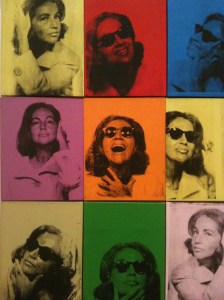
Fragment of Andy Warhol’s silkscreen on canvas, Ethel Scull 36 Times. Jointly owned by the Whitney Museum of American Art and The Metropolitan Museum of Art; Gift of Ethel Redner Scull, 2001

Fragment of Andy Warhol’s silkscreen on canvas, Ethel Scull 36 Times. Jointly owned by the Whitney Museum of American Art and The Metropolitan Museum of Art; Gift of Ethel Redner Scull, 2001

Alongside Andy’s Screen Test films are portraits by Tillman, Close, and Avedon, as well as a needlepoint of Liza in her heyday and a brilliant Sugimoto portrait of Fidel Castro (except that it’s a wax museum likeness).  Andy’s dollar-sign print multiples are hung near another quote: “Being good in business is the most fascinating kind of art.” An entire wall covered in Takashi Murakami and Koons multiples stand in evidence.

If you can’t celebrate in person at the Met, download Rebecca Lowery’s timeline of Warhol’s impact from the exhibition catalog. Or watch the 90-minute video featuring the curator Mark Rosenthal debating if Warhol actually is the most influential artist of the last fifty years. Or, view the films and listen to the music that the Met streamed live last October:  The Metropolitan Museum of Art – Dean and Britta—13 Most Beautiful: Songs for Andy Warhol’s Screen Tests.

Brooklyn Holiday Art Mash Up

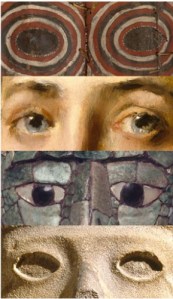
Details of four works in Connecting Cultures, from top: Korumbo Gable Painting, 20th century, unidentified Abelam artist; Girl in a Japanese Costume, circa 1890, William Merritt Chase; Mosaic Head Pendant, 700–800, unidentified Maya artist; and Life-Death Figure, circa 900–1250, unidentified Huastec artist.

Details of four featured works, from top: Korumbo Gable Painting, 20th c. by unidentified Abelam artist; Girl in a Japanese Costume, c. 1890, William Merritt Chase; Mosaic Head Pendant, 700–800, unidentified Maya artist; and Life-Death Figure, c. 900–1250, unidentified Huastec artist.

A big mix-up has happened on the First Floor of The Brooklyn Museum, but it’s OK. In fact, if you like rambling around the Brooklyn Flea, the Connecting Cultures: A World in Brooklyn exhibit is less congested but just as much fun.

The museum curators clearly enjoyed picking and choosing objects from their wide-ranging collections, and packing a gallery full of juxtapositions from different centuries, cultures, and countries. The designers made great use of the soaring space of the Great Hall, creating floor-to-ceiling murals, maps, and display shelves that provoke, delight, and mystify. Check out the museum’s Flickr photostream. As a visitor, you feel as though you’ve wandered in on a modern version of a Victorian-era World Exposition.

Gaston Lachaise’s modern Standing Woman bronze is installed near Nick Cave’s Soundsuit, Picasso’s cubist Woman in Gray portrait is hung next to Huntington’s classical portrait The Sketcher, and Ikea-clean wall grids house ornate pitchers from many cultures and time periods. Catch a glimpse of the variety in the installation views on Flickr, or peruse the objects in Brooklyn’s on-line database.

As an added bonus, the Museum has established both human and social-media feedback options for visitors. It’s nice to use the terminal to input comments on the show (posted on the exhibition site), but maybe it’s even nicer to have staff members positioned inside the exhibit to chat, answer questions, and elicit your comments.

The installation is reflected in Pistoletto’s Standing Man, Standing Woman with Hat, a 1980 silkscreen on stainless steel.

Installation as reflected in Pistoletto’s Standing Man, Standing Woman with Hat, 1980 silkscreen on stainless steel.

The Museum has been collecting since 1823, and there’s both an on-line chronology and a pictorial history slightly hidden away inside the show.

Upcoming and news flash: Brooklyn Museum is going to continue it’s Target First Saturday tradition into the New Year (next on January 5), but for the time being, it’s cancelling the dance party portion of the festivities. Get there for the rest of the night.

1950s and 60s Vintage Rolling through Midtown This Week

GM Model 5106 (1958-mid-1970s)

GM Model 5106 (1958-mid-1970s)

Christmas shoppers in NYC’s Midtown are in for a special retro-treat this week. For $2.25, they can take a trip back in time, as New York City Transit shuttles 42nd Street travelers from Twelfth Avenue to the East River on its collection of vintage buses.

It’s a fun way to travel to two of the best holiday markets in the City – Bryant Park and Grand Central Terminal – by enjoying a “good old days” vibe, complete with vintage ads. mtabus1211

The antique buses are due to roll east along the M42 route at 8:30am, 11:30am, and 2:30pm. If you aren’t in the vicinity of 42nd Street, look for parked antique buses opposite Macy’s (at Sixth and 35th Street) and across from Union Square between 10am and 3:30pm all week.

Transit will be featuring six styles of vintage buses from its collection, including five models from General Motors and one from Mack Truck and Bus. The earliest model is GM’s Model 5101, which ran the streets from 1949 to 1966; the most recent vintage is GM Model 5305A, which debuted in 1968 and ran until 1984.

Even though MetroCards are “new” (they debuted in 1993), they’ll work on the retro-buses. Check out this 1949 Rapid Transit movie to feel the way it used to be, and be sure to catch one of the retro-subway trains every Sunday until December 30 on the M Line between 2 Ave and Queens Plaza.

Mayans Dispute 2012 Ending

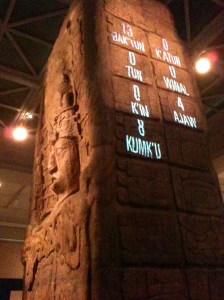
Illumination translates glyphs into numbers on stele, marking the end of the Long Count cycle on December 29, 775 CE

Illumination translates glyphs into numbers on stele, marking the end of the Long Count cycle on December 29, 775 CE

One of the best things about the Penn Museum’s “Maya 2012: Lord of Time” exhibition is the manner in which the curators meld the ancient, the mathematical, the historic, and the modern to answer the question “Will the world end at the end of the Mayan Long Count calendar in December 2012?”

The exhibition is built around the spectacular work that Penn’s archeological teams have done for decades in Copan, an ancient Mayan city located in today’s Honduras not far from the Guatemalan border – excavating tombs, uncovering clues to the succession of rulers, and figuring out exactly what all the once-cryptic hieroglyphics tell us. Check out the Flickr photos.

It turns out that the rulers kept a tight rein on the calendar, astronomic phenomenon, and various time-counting cycles to assert their right to rule. As some of the most spectacular stele show, the stone monuments actually enabled kings to embody dates, such as October 21, 731 (Copan Stele A).

Censor lid depicting founder of the Copan dynasty (695 CE)

Censor lid depicting founder of the Copan dynasty (695 CE)

The towering Quirigua Stele C from Guatemala associates the ruler with December 29, 775, the last time that the calendar flipped to the number 13.0.0.0 to signal the end of the Long Count.

There are many beautiful altars, sculptures, and pieces from the Penn’s collection, but the curators also went further, including the famous Dresden Codex, the Popol Vuh, and a phenomenal digital blow-up of a map showing how and where the Aztecs and Spaniards brought down the Maya. But one of the best contributions to the show are the video interviews with contemporary Maya commenting on their still-thriving culture and debunking the worries of their global neighbors about events later this month.

It’s obvious the view that Penn is taking, since the show is scheduled to run through January 13, 2013. Here’s Penn’s YouTube preview:

Holiday Rush for Christopher Columbus

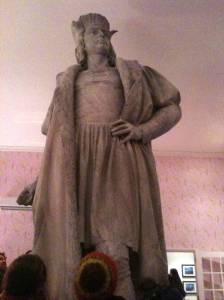
Greeting visitors in his apartment 75 feet in the air

Greeting visitors in his apartment 75 feet in the air

It’s the holiday season in New York, with art lovers rushing to see the spectacular apartment that Tatzu Nishi has created (courtesy of The Public Art Fund) for Christopher Columbus, the man at the center of things near the Time-Warner Building.

He’s been standing atop that column since 1892, so it’s about time that he had us over to see his taste in décor, books, and light TV viewing.  Here’s the Flickr feed, which takes you on a 360-degree view of his digs.

Who knew Captain Columbus was into pop culture? He even has a copy of one of Andy’s early cat lithos in his bookcase. Enjoy the holiday views that Columbus is enjoying, and get your free tickets now, because you won’t be seeing the City from this view again!

What Columbus is reading inside his apartment

What Columbus is reading inside his apartment