Travel the Sahara Superhighway at The Met

12th – 14th c. terracotta equestrian statue from the Middle Niger civilization (Mali).

As you confront the stone monolith in the entry, get prepared to see art you’ve never before encountered, learn about empires you didn’t know existed, and fill in the blank spot on what you know about African history.

Beauty and cultural discoveries are everywhere in a first-of-its-kind exhibition on Saharan artistic legacies in Sahel: Art and Empires on the Shores of the Sahara, on view through October 26 at the Metropolitan Museum of Art.

Large 12th – 13th c. gold pectoral, found at a burial in northwest Senegal, with elaborate filigree. Courtesy: IFAN, Senegal

The shifting sands of the Sahara are echoed in the centuries of shifting artistic traditions, migrations, civilizations, religions, and cultural affinities of the Saharan people. Take a look at our Flickr album.

This gorgeous show is one of the first to tie and unite the threads of the sub-Sahara’s nearly invisible history for Western audiences. Western approaches to art history have traditionally made it appear as if the people on a large content were a monoculture with no beginning, end, or history. The show brings a deeper artistic and historical context to work that has always suffered from just being lumped together as “African art,” or worse, “primitive art.”

Scholars on two continents are starting to piece the story together, reflected in the exhibition’s design. The alcoves are a primer to walk back through time to understand the region’s complex history, which covers deserts, oases, and farming areas that are the size of Europe. For centuries, the region was criss-crossed by trading routes (the “Saharan superhighway”) through which caravans delivered luxury goods, exotic raw materials, news, and new cultural influences.

Pre-1659 royal tunic, a European import from the Ardra kingdom (south Benin) via Mandé trade routes. Courtesy: Museum Ulm

Wooden or fired clay depictions of warrior kings on horseback from the 3rd through 19th centuries line the exhibition’s central path. Settlements, archeological sites, and kings are named, with the vast region’s artifacts, architecture, and traditions of storytelling joyously placed into a proper context.

There are plenty of national treasures, such as the gold pectoral from Senegal and lively terra cotta sculptures (likely made by women) from Mali, made with the highest levels of craftsmen between the 12th  and 14th centuries. Another highlight is the still-vibrant 8th-century woven tunic from Niger, one of Africa’s most ancient textiles.

The exhibition explains how Islam gradually, peacefully became the dominant religion in sub-Saharan Africa, displacing the previous belief systems. As is the case with other world cultures, artists continued to merge and adapt older, more traditional symbols and forms with the new.
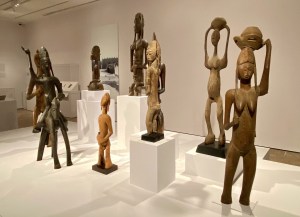
Wood sculptures of Mali’s Bamana people, from the 15th to 20th century

An intriguing 15th-century Italian map-painting documents Mansa Musa, a 14th-century emperor from Mali, who achieved global celebrity status for his over-the-top pilgrimage to Mecca via Cairo and was inspired to develop Timbuktu into a center of Islamic scholarship.

The display of Bamana sculptures, dating from the 15th to 20th centuries, in the rear gallery is the show’s dramatic conclusion, although the walls depict incredible resist-dye textiles made by early 20th century women in Mali and couture-level embroidery on pure white status garments of the Timbuktu elite from the Sixties.
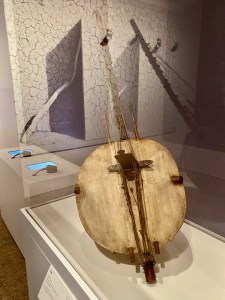
Senegalese kora made before 1878, used by griots to perform social narratives.

The show was an epic undertaking by the Met  – organizing a narrative and objects to tell two thousand years of relatively unknown history; first-time loans of national treasures from the museums in Niger, Mali, Senegal, and Mauritania; arranging for an 8,000-lb. monolith to be shipped across the Atlantic to New York.

The epic histories recounted by griots playing traditional instruments over the centuries play a large role in the exhibition. Koras and percussion instruments are on display, and music permeates the galleries.

Here’s a peaceful walk through the exhibition with music by Toumani Diabaté with Ballake Sissoko:

For an in-depth understanding of this ground-breaking show, join in on this conversation with Met curator Alisa LaGamma and scholar and writer Manthia Diawara:

Learn more about the epic history of the Sahara in the Met’s exhibition guide.

Tenement Museum Opens Window via Virtual Visits

Kitchen on the Tenement Museum’s virtual tour of the Moore family residence

We’re happy to see that the Tenement Museum, one of NYC’s most beloved cultural centers, is not only offering in-person neighborhood walks again, but hosting virtual tours of the cramped quarters where our European immigrant ancestors first gained a foothold in America. This week, there is an opportunity (October 15) for everyone to climb those narrow stairs on Orchard Street, see the neighborhood (October 17), and help sustain the museum.

Check out everything that’s happening in NYC museums online on our virtual events page here.

And speaking of small history museums, we also want to mention the virtual events being programmed at the Merchant’s House Museum, which continues to persevere despite the massive construction project happening on the other side of its 1830s walls. Check out their pre-Halloween programming this week and throughout the month, and see what it’s like inside the place deemed Manhattan’s “most haunted” house.

Disco reigns supreme at Brooklyn Museum’s Studio 54: Night Magic

On our list this week, we also want to draw your attention to:

  • The Fashion Institute of Technology and Museum at Eldridge Street’s presentation on Berlin’s fashion industry in the 1920s (October 13)
  • The Morgan Library’s discussion of European blockbooks in “Print-on-Demand in the 15th Century” (October 15)
  • The Brooklyn Museum’s program with three Studio 54-era disco divas, who talk about how their music shaped the era ($10 on October 15)
  • The Bard Graduate Center’s presentation on Eileen Grey and architectural drawings (October 17)

For Tiffany fans on October 13, the New-York Historical Society will show off its spectacular collection. If you’ve never seen the upstairs Tiffany gallery at NYHS and heard the stories behind the lamps, do not miss this.

Last week, the Whitney had to postpone its Agnes Pelton panel, but curator Barbara Haskell will be answering questions on October 20 in a virtual event.

Take a look and register for as many of the topics and events that you can fit into your schedule. Most of the events are free, but it’s always nice to add a thank-you donation.

Reopening Update

Poster featured at El Museo del Barrio graphic arts exhibition, Taller Boricua: A Political Print Shop in New York

The Bard Graduate Center Gallery had just opened its much-anticipated exhibition on Eileen Grey when the pandemic forced its closure. We’re happy to let New Yorkers know that BGC is opening up the doors to the in-person exhibition for two weeks, October 13-28. Reserve your timed tickets now.

We also checked out the newly reopened El Museo del Barrio to see the graphic arts exhibition on Taller Boricua, which presents over 200 works by artists at this historic print shop. There were plenty of visitors yesterday pouring over the works produced by activist Puerto Rican artists over the last 50 years. The museum at 104th and Fifth is open Saturday and Sunday.

Welcome back to the Museum Mile!

Agnes Pelton’s Meditation Chamber at The Whitney

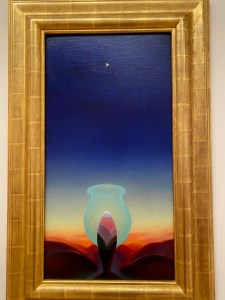
Agnes Pelton’s 1929 Star Gazer, suggesting rebirth in a desert landscape. Private collection.

Have you wanted to enter a light-filled, spiritual place and be transported to another realm? Get a ticket to the Whitney Museum of American Art enter the Agnes Pelton: Desert Transcendentalist, on view through November 1.

You’ll experience six decades of abstract paintings whose shapes fly, hover, and float above desert mountains and in deep space – another dimension that feels light, otherworldly, and pure. Take a look at our Flickr album.

She began developing her style in the early years of the 20th century when abstraction, the symbolic meaning of color, and spiritualism were being explored in the New York art world, and she took to heart what she read in Kandinsky’s influential 1910 treatise, On the Spiritual in Art.

1926 Meadowlark’s Song, Winter. Courtesy: Maurine St. Gaudens.

The exhibition opens with a figurative work in the style for which Agnes was first known to the New York art scene –  an ethereal artistic woman inhabiting a dreamy, semi-abstract, soft-colored landscape. Her work earned her inclusion in New York’s landmark 1913 Armory Show – the exhibition that introduced “modernism” to America – in Gallery D alongside other young American artists experimenting with bold color and abstraction.

But the Whitney exhibition (originally mounted by the Phoenix Art Museum) is actually focused on the next phase of Alice’s abstract work, which reflects her embrace of spiritualism, experience with New Mexico’s desert landscapes, and interaction with creative, like-minded thinkers in and around Taos in the Twenties. Although she often accepted commissions for portraits or landscapes throughout her life, she considered the abstract works the core of her artistic journey.

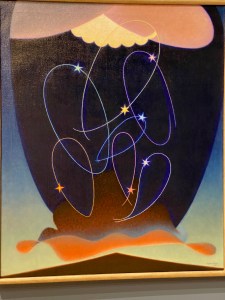
1934 Orbits. Courtesy: Oakland Museum.

Like her contemporary, Georgia O’Keeffe, Agnes found inspiration in the Southwest desert. However, Agnes had a different artistic approach, using color, natural form, and abstract shapes to lead viewers into another realm of consciousness that exists beyond the natural world.

Agnes’s journals and notebooks are filled with lessons from spiritual teachers and with sketches for paintings with notes on what the different forms and colors mean.

Visitors to the Whitney show move slowly, taking time to digest each canvas and to appreciate the artist’s care and thought. Swooping shapes, illuminated portals, and clusters of abstracted forms take center stage, posing questions, and leading you into another dimension.

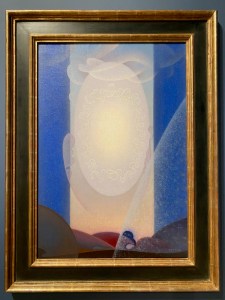
1947 Light Center, evoking one’s ability to transform. Private collection.

The center gallery features work done after Agnes moved to her desert home near Palm Springs in the Thirties, where she was transfixed by the quality of desert light.  She loved incorporating water and light into her works – two natural phenomenon that symbolize transformation and change.

The dark walls of the center gallery enhance the glowing nature of her spiritual canvases. Her technique is masterful, with layers of translucent washes applied to give the white ovals nearly a three-dimensional feel, like looking into the void of an Anish Kapoor sculpture, except that Agnes achieves the effect with simply a canvas.

Here’s a talk recorded last year at the Phoenix Art Museum in which Notre Dame professor Erika Doss explains Agnes Pelton’s spirituality and puts her work in the context of the modernist movement:

Reopening News

 The Whitney has just announced that the large outdoor public project on the Hudson waterfront by David Hammons will open this fall.  The other big announcement is that a one-year Biennial postponement will give artists and curators more time to view and prepare work that was put on hold by the shutdown. Read more about upcoming shows here.

At 7:00pm on October 20, Whitney curator Barbara Haskell will take your questions about Agnes in an online “Ask a Curator” event. Check our Virtual Museum Event page for all of the museum’s nearly daily virtual tours, talks, and walks on this and other exhibitions.

If you’re in New York, you can visit the Whitney five days each week, Thursday through Monday, with extended hours every Friday until 9:00pm. All exhibition spaces are open, including the magnificent collection show, which features mini-shows by Jacob Lawrence, Hopper, and Calder. Here’s our previous post about this fantastic exhibition.

Artists Crunch NYC Census Numbers

Herwig Sherabon’s 2019 Landscapes of Inequality NYC No. 2, showing median income per block

As the 2020 Census winds down across New York City, it’s nice to be reminded of the history and impact of what’s been revealed since 1790, when census-data gathering began. Who We Are: Visualizing NYC by the Numbers, on view at the Museum of the City of New York through October 18, presents not only rich archival material but an intriguing display of new data-visualizations that were commissioned specifically for this show.

Although the museum shutdown curtailed in-person viewing until a few weeks ago, the curators wisely transported the story and some of the works to an on-line exhibition that explained the history of the decennial census, why it matters to New York, and how new stories are told when artists get their hands on the data.

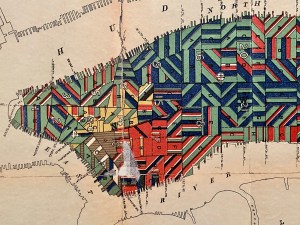
Tenement House Committee of 1894 map of nationalities inhabiting Lower Manhattan

When we visited in person, it was nice to see historic documents (or facsimiles of them) up close, like the page listing people and occupations (attorneys, stone cutters, boat makers) along Nassau Street in 1812 and the detailed illustrations of the “counting machines” used by men and women tallying the census on the cover of 1890 Scientific American. Take a look at our Flickr album.

But it’s also nice to see data visualizations from past decades, when no one had digital tools at their disposal and everything was drawn pen-and-ink and embellished with watercolor. And to see evidence of Congressional trailblazers, like Shirley Chisholm, getting out into the street to show their constituents the importance of being counted.

Detail of Jill Hubley’s 2019 Race in NYC from neighborhood data

Today’s news is full of stories about whether an undercount is happening in New York, but the MCNY collection shows newspaper after newspaper from the past, where politicians, social-justice advocates, and everyday citizens have voiced the same concerns. It’s useful to see the pie chart of the types of Federal programs whose dollars are apportioned based upon the census.

But the star attractions are the enormously compelling contemporary visualizations displayed in the “Art of Data” gallery. It’s a clean, modern, immersive experience walking among the giant projections of work.

Take a look at three of the works featured in MCNY’s on-line exhibition:

Here is the tree-ring-inspired Simulated Dendrochronology of Immigration to New York City, 1840 – 2017, created in 2019 by Northeast University designers Pedro Cruz, John Wihbey, and Felipe Shibuya. Left and right growth reflects immigration flow to the US from either Asia-Pacific or Europe.

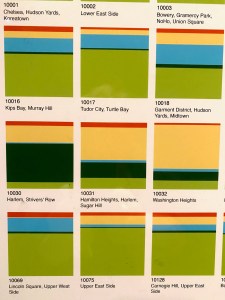
Here, see how artist Neil Freeman uses 2017 American Community Survey data to reconstitute population blocks in New York City according to inequality and injustice in his 2019 video The Grid Series.

The shape of New York’s population blocks make another appearance in artist/developer Jill Hubley’s 2019 visualization Languages of New York.

Read more about each of these works on the MCNY’s site.

NYC Museum Virtual Events on Hockney, Pelton, and Design

David Hockney, Self Portrait with Red Braces, 2003. © David Hockney. Photography by Richard Schmidt. Courtesy: The Morgan

This week has a full line-up of (mostly free) programs featuring new exhibitions and topical issues from the art world and beyond. See the list of everything you can participate in on our virtual events page.

We welcome the reopening of the Morgan Library with this week’s most-talked-about exhibition on David Hockney’s portrait drawings from the National Gallery in London. This week’s virtual schedule gives you two opportunities (October 6 and 9) to take a virtual tour, but get the free tickets now since they are going fast!

This week on October 8, you’ll also get an opportunity to learn more from the Whitney about Agnes Pelton and her transcendentalist work from the curator herself, Barbara Haskell. Although the show originated in Phoenix and went to Santa Fe before its New York stop, the Whitney’s given over an entire floor to for you to enjoy the tranquility, spiritualism, and meditative power of Ms. Pelton’s works. Although Ms. Pelton participated in the historic 1913 Amory Show, she’s had zero recognition until now.

Agnes Pelton, Day, 1935. Courtesy: Phoenix Art Museum

Although the Cooper-Hewitt still hasn’t opened its doors, you’ll have an opportunity to celebrate the National Design Awards and National Design Month on line. This week features a virtual salon on October 8, but their website has a full roster of design, education, and maker events, too.

We also want to draw your attention to:

  • New-York Historical Society’s evening with Carl Bernstein and Maggie Haberman ($20 on October 8)
  • A live encore presentation from the New York Transit Museum on the cultural history of the 20th Century Limited (free on October 9)
  • October’s Sci Café from AMNH on hive minds and politics (free on October 8)

For Hamilton fans on October 8, Fraunces Tavern Museum will host an author who will dig up all the dirt between General Washington and his nemesis, General Charles Lee.

Last week, we joined ETHEL on the Met’s balcony on Friday night (a weekly digital event), and really enjoyed the digital effects that were added to a beautiful performance. We also dropped into the Brooklyn Book Fair courtesy of the Brooklyn Historical Society.

Take a look and register for as many of the topics and events that you can fit into your schedule. Most of the events are free, but it’s always nice to add a thank-you donation.

Reopening Update

Dancing dress by Giorgio di Sant’Angelo, as shown in Studio 54: Night Magic

It was great to be back at the Brooklyn Museum this week, where the community was enjoying the sunshine on the front plaza while waiting for timed ticket entry to the fantastic exhibition, Studio 54: Night Magic.  If you plan to go, budget enough time, because the time-capsule exhibition is massive.

For budget and safety reasons, only two floors of the museum are open, but that did not stop any of the art-seekers from checking out many of the special shows, study center, and permanent American gallery works. The first floor features an installation filled with amazing, inspiring photographs by a ground-breaking Parisian artist. Wow! Do not miss JR: Chronicles or Studio 54!!

Welcome back, Brooklyn!!

Amy Sillman Gets Shapes to Talk at MoMA

1957 Arp sculpture and view of works by Leger, Frankenthaler and Bonticou

A big, red blob on the fifth floor at MoMA is the welcome sign to one of the most engaging exhibitions in New York ­– the come-hither array of modern artworks in the latest Artist’s Choice show, Amy Sillman: The Shape of Shape, on display through October 4.

But here’s the catch for MoMA visitors – the show has more than 75 works but no labels, no identification, no dates. Just the clue that Amy chose works to explore the role of “shape” in modern art. Small artworks are arranged knee-level on risers (kind of like stadium seating), with larger paintings tilted against the wall.  A few are hung in the traditional way, but it feels as if MoMa’s collection is looking at you and hankering for a conversation. Check it out in our Flickr album.

Rectilinear frame conversation between 1989 Albert Oehlen painting and 1935 “Construction” by Gertrude Green

In our first visit back to the re-opened MoMA, visitors circulated through the room, looking intensively, talking about what they saw, and discussing how pieces might be connected. Although the gallery guide was available via QR code, no one during our visit appeared to seek it out. Everyone seemed quite content to parachute into 110 years of modern visuals and just go for the ride.

What did Amy choose? Abstracted forms, organic shapes, human bodies, and not-bodies – all arranged in a way that makes you feel that one is somehow related to its neighbor. You can’t quite describe why the entire room felt like a tight ensemble, even though one piece might feel like fun and the next a little scary.

It was interesting how unsettled visitors felt by 1970s works by Christina Ramburg and Julian Schnabel. This is exactly what Amy was going for, according to what we overheard her tell students in the gallery yesterday. She wanted to evoke the anxious feelings that most artists experience as they paint, draw, and sculpt and to reflect the times today without being didactic.

Along the east wall – 2008 acrylic by Charline von Heyl, 1920 Arp sculpture, and 1976 drawing by Jay DeFeo

Amy came of age during the Seventies when museums and intellectuals had given abstract expressionism its “heroic” status and crowned minimalists and conceptual artists as successors in the march of modernism. For this Artist’s Choice exhibition, Amy examined MoMA’s vast archive from a different perspective, looking at famous and not-so-famous creators whose work evoked myths, an interest in shadows, tension, anxiety, bodies, and whimsey.

Shadowy Black figures in a dark painting by Zimbabwean artist Thomas Mukarobgwa are echoed by a shadowy figure in a work by Leger. The tiny 1920 stacked Arp sculpture seems to be playing a “Mini-Me” role next to the large, layered 2008 Charline von Heyl acrylic.

Shadows also play key roles in a Lois Lane painting paired with a Kirschner wooduct. See for yourself and make a connection. Download Amy’s zine here to learn more about the works she chose and how she installed them. (She designed it during the quarantine months when the show was shut down.)

Here’s a short overview of the show hosted by MoMA painting/sculpture curator Michelle Kuo:

But you should really dig into the in-depth conversation (with over 10,000 views!) between Amy and Michelle, if you’ve ever been to art school or painted. They talk about art making, art history, Amy’s inspiration from Munch’s little-known litho of a woman hugging a bear, and the way she chose lesser-known works that could have a conversation with you in 2020:

More on MoMA’s reopening
MoMA on 53rd Street is open every day with timed ticketing, and now that the free-ticket offer has concluded, it seems easy to find a time to visit. The Queens outpost at P.S.1 is open until 8:00pm Thursday through Sunday, and is currently showing the acclaimed (and long-anticipated exhibition) Marking Time: Art in the Age of Mass Incarceration through April 4.

Join Live Virtual Events at NYC Museums

Tour “Sahel: Art and Empires on the Shores of the Sahara” at The Met this week

Are you missing your favorite New York museums? We’re happy to report that many of the cultural powerhouses, like the Whitney, The Met, and MoMA have reopened, although timed tickets in the opening weeks have been a little hard to get.

There’s a quick and easy way to get inside, however, by attending one of the live virtual programs being offered.  Check out our new page on events! As you can see, there’s a lot of opportunities to connect.

1929 “Calla Lily Vendor” by Alfredo Ramos Martinez in The Whitney’s must-see exhibition “Vida Americana”

New York museums have been keeping their events going online, and joining in is a great way to meet curators, docents, tour some blockbuster shows, and join in on the discussions happening around town about art and the social-justice movement (past and present), women’s issues and history, and even listen to ETHEL play classical music from the virtual Met balcony on Friday night.

For smaller museums, the virtual events have been a great way to broaden programming to a national or international audience.  In recent on-line programs produced by Fraunces Tavern, it’s been nice to see colonial history buffs from Virginia and New England join in on the discussion. At last week’s New York Transit Museum’s talk on the 20th Century Limited, a few UK railroad enthusiasts joined in the chat room!

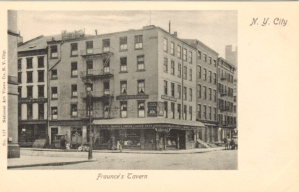
Hear about the preservation of Washington and Hamilton’s hangout, Fraunces Tavern, one of NYC’s oldest buildings this week

So, it’s a great way to be in the virtual room where it’s happening with others who love history and conversation as much as you do!  Take a look at the array of topics and events and register.

Most of the events are free, although after the months-long shut down here, it’s always nice to give a thank-you donation.

Reopening Update

This week, we’ll welcome the opening of the Guggenheim and Jewish Museum along Fifth Avenue and the International Center of Photography at its new home on Essex on the Lower East Side, where the Tenement Museum has begun neighborhood walking tours again.

Welcome back!!

Enjoy this beautiful four-hour meditative Met Live Arts performance by Lee Mingwei and Bill T. Jones at The Met this week

Couture Nirvana at The Met

1957-58 satin “Du Barry” evening dress by Christian Dior

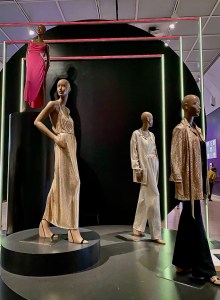
Walking through the Costume Institute’s show, In Pursuit of Fashion: The Sandy Schreier Collection, closing September 27, you can feel the care and attention that Sandy gave to choosing exquisite fabrics and impossibly precise handwork in the pieces she chose for her archive.

The dresses and accessories that Sandy’s chosen to donate to the Met are pristine – a tribute to her true love, appreciation, and care for couture masterworks. She didn’t collect to wear the clothes, but to preserve and admire them as genuine works of art – duchess satins, intricately painted velvets, and incredible beadwork from the best French embroidery houses. Take a look some of the details close-up in our Flickr album.

A transition to ease – a lavish 1913 evening dress by Jean Victorine Margaine-Lacroix for the House of Margaine-Lacroix

The beautiful show opens with an array of postwar couture by superstar designers Dior, Balenciaga, and Saint Laurent alongside creations by less shown couturiers, such as Jean Dessès and Jacques Griffe. It’s a joy to behold Sandy’s reverence for sumptuous fabrics and dramatic silhouettes.

It’s equally exciting to encounter lavish early 20th century gowns and discover new names, such as Madeline & Madeline or Jean Victorine Margaine-Lacroix, who were blazing the trail for a new kind of liberating dress for women at the same time that suffragettes were marching to gain the vote. Sandy’s gift brings these ground-breaking female designers into the Met’s collection for the first time, too.

The show also calls attention to at-home ease and glamour of the Thirties from innovative, sought-after American female designers – a tea gown of simplified perfection by Jessie Franklin Turner (who Poiret called “a genius”) and a virtually sheer dinner dress by Valentina created from layers and layers of netting.

1939 chiffon tea gown by Jessie Franklin Turner and 1940 net dinner dress by Valentina

Both pieces show masterful construction, nearly invisible handwork, and style that enabled an understated hostess to sweep through her own private event like a movie star.

The back of the gallery showcases some of Sandy’s earliest acquisitions – nearly a dozen coats, dresses, and capes from the Twenties by two legends of textile magic – Fortuny and Maria Monaci Gallenga. Each had their own secrets techniques for applying intricate, metallic Renaissance-inspired patterns on lush velvet and silk. The creations are a master class in artistic dressing.

Many couture feats demanding close examination are encountered in the third major portion of the show – delicate flowers on a tulle dress by Vionnet, diaphanous, layered embroidered chemises by Boué Soeurs, and sparkly flapper dresses by Poiret and others that are beaded beyond belief and look as if they were made yesterday.

1925 lame and lace dress by Paul Poiret and 1925-28 evening dress with paillettes, beads, and crystals

There’s a tongue-in-cheek gallery with Sandy’s collection of sartorial puns from the Eighties by Stephen Sprouse and Patrick Kelly, alongside and fool-the-eye hats and accessories by Stephen Jones and Philip Treacy. (Turkey feathers painted to look like butterflies, anyone?)

Alongside a watercolor portrait of Sandy, there’s another hint to what her collecting will add to the Met – a works-on-paper collection from the early 20th century, featuring pen-and-ink illustrations that were how fashion houses showed their clients what each season had to offer. It will be exciting to see more from the print portfolio that Poiret created with star illustrator Georges Lepape for his best clients.

Enjoy this brief glimpse into a space where Ms. Schreier’s gift provides beauty, delight, and reverence for masterful makers around every corner.

Resistance and Power via Fashion at FIT

2016 jacket by Kerby Jean-Raymond for Pyer Moss powerfully protesting racism in the fashion industry

Although the doors to the museum exhibition are shut tight, the Museum at FIT still allows full access to its spring show Power Mode: The Force of Fashion through its online exhibition.

The power of resistance and how clothes convey the message are among the themes explored. Hand-crafted items such as jackets slashed with anti-racist graffiti, T-shirts silkscreened with bold words, and pink pussy hats are shown (and discussed) alongside high-end designer appropriations of messages, causes, or culture.

The exhibition presents actual 19th– and 20th-century uniforms – templates of precision, force, and authority – next to creations in which high-fashion designers channel this concept of “power” through military colors or styling.

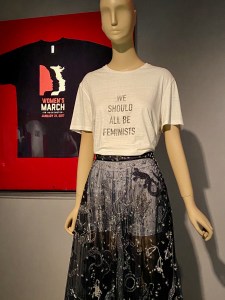
Power to resist 2017 – a T-shirt from the Women’s March T-shirt and a feminist statement by Maria Grazie Chiuri in her first collection for Dior

The show explores examples of economic power via “status dressing” over three centuries and shows how the authority of a man’s traditionally tailored suit was adapted to white-suit statements by women showing power – not only by the marching and protesting suffragettes of the last century, but also by the current crop of female politicians in the United States.

Take a close-up look at the details in our Flickr album and read more about individual items on the show’s website.

Curator Emma McClendon gave a lot of thought to the visual cues, economic issues, and shifting societal backdrops for as she selected the items for this show.  Join her on a walkthrough to find out what lies beneath the surface of everyday, extravagant, and elemental clothing choices :

Status dressing – 1991 gold-plated necklace by Karl Lagerfeld criticized for its cultural appropriation of hip-hop street culture

Building a Retail Empire on Wearable Art

Vera’s 1950 silk “Fish Scroll” scarf, featured on the cover Harper’s

So many of the great female entrepreneurial success stories begin at the kitchen table, and the story currently being told by the Museum of Arts and Design (MAD) in Vera Paints a Scarf: The Art and Design of Vera Neumann, on view through January 26, is no exception.

Fashionistas today may be too young to remember when the American height of chic was to sport a scarf by Vera. Back in the Sixties and Seventies, Vera pretty much had a lock on the retail market for bold, colorful silk scarves through major department-store behemoths.

The exhibition is a tribute to a woman who took her love of painting, travel, nature, and culture to the wardrobe and accessory drawers of all fashionable American households, and ended up partnering with many top manufacturers to push her aesthetic and flare into mid-century modern homes.

Vera’s silk scarves, based upon watercolors, hung as art at MAD

Although her name is not well known by young people today, MAD’s exhibition is a fitting tribute to a woman who virtually invented the concept of “lifestyle” brand. It’s hard to believe that an aspiring artist born in Connecticut in 1907 would grow up and develop her company to pack such a punch in retail.

A graduate of Cooper Union and Traphagen in the 1920s, during the Depression, Vera and her husband set up a silkscreen on their little Manhattan kitchen table and began printing her paintings on surplus parachute silk. Within a few years, her beautiful silks were being retailed at B. Altman, Lord & Taylor, and other nice shops in the city. Her joyous prints were a success!

Vera’s 1960-1965 silk blouses with paintings of blue poppies and woodland images

Building her business through the war years, Vera took her first foray into fashion in the 1950s, creating tops and blouses that she came to market as “wearable art.” Rather than simply printing yards of repeating patterns, she went a step further – engineering prints in panels, so when pattern cutters and sewers assembled her shirts, her beautiful patters would strategically appear in the final product, enhancing cuffs, collars, edges, and hems.

Of course, everything was priced for the widest possible market, so a woman seeking a bit of fashion flair could buy a Vera without blowing her budget. She followed the art-plus-commerce philosophy – a Bauhaus innovation – and maximized accessibility of mid-century modern design by expanding into home textiles, tabletop accessories, and dishes.

1979 “The Birches” china dining set for Mikasa with matching tablecloth

As her business grew, Vera came to rely upon the next generation (Perry Ellis got his start with her) to keep the design development chugging along while she traveled to Asia and other parts of the world to feed the constant demand for new inspiration for her collections.

MAD has assembled a beautiful, loving exhibition of Vera’s output, showing how her original watercolor work made its way into her commercial ventures – scarves, clothes, and home décor. Perhaps most remarkable is that this powerhouse kept traveling, painting, and channeling joy into her textiles well into her eighties – an inspirational lesson in love of life, art, craft, and culture.

1971 “Northwest Coast” silk scarf

Thank you, Vera! Long may your prints wave!

And thank you to MAD for sharing Vera’s lifetime of creations and inspiring story!

See more photos of this wonderful exhibition in our Flickr album.