Ye Olde Hip-Hop Brings Met Armor to Life

It’s Showtime NYC troupe. Photo: MetLiveArts

Nimble knights and knaves again take the stage tonight amidst the horses, banners, shields, lances, and heraldry of the Metropolitan Museum’s Hall of Arms and Armor in Battle! Hip-Hop in Armor, part of MetLiveArts.

The amazing dancers from It’s Showtime NYC are putting on their gauntlets and knee guards to show spectators what it’s like to bring medieval and Renaissance armor to life in a co-production with the Met’s Department of Arms and Armor.

The static state

Tonight’s program is the third in a series of performances, running through spring, where street-style choreography presents a modern interpretation of chivalry, battles, honor, mysterious tales, and ghosts.

The dancers took a crash course in the days of old from curators in the Met’s Arms and Armor department and got to learn how to apply accoutrements that are normally relegated to the mannequins and cases in the popular hall.

Bashford Dean, the Victorian world traveler and collector who began this department over 100 years ago, would have loved it, since he is a man that also liked to dress up in similar regalia.

Kester Esterphane makes chivalry and armor come alive

The troupe from It’s Showtime have created several dance pieces, including one that tells the story of a long-dead king who springs to life from his medieval tomb to terrorize craft thieves who try to steal his stuff.

Rising up dressed in an authentic chain-mail tunic, the king brings zombie-like commotion to the tale and answers the choreographic question: How does a dancer bring a feeling of terrifying mayhem to the stage when he’s wearing that many pounds of heavy, constricting steel?

A conversation with curators revealed that although visitors see the armor displayed in static form, all of the engineering involved makes it incredibly flexible. So, asking dancers to try it on and create new moves actually shows off something that isn’t apparent about the Met’s incredible collection.

Knaves face wrath of an angry king’s ghost.

Congratulations to the curators of Arms and Armor, MetLiveArts, and the It’s Showtime NYC dancers for such a fantastic concept and program! More! More!

It’s Showtime will perform it’s pieces several times tonight and reappear like knights of old on February 8, March 22, April 12, and June 7.

And in case you think this is the first time the Arms and Armor curators have ever tried to put a new twist on a medieval subject, take a look at one of Bashford Dean’s brainstorms when movies were just starting to be made in Queens.

Yes, he talked to Barrymore and other early actors and directors of American cinema on just how to get people interested in the past. Here’s a link to one of Bashford Dean’s media pieces that also brought the knights back to life:
50 Shades of Pink at FIT

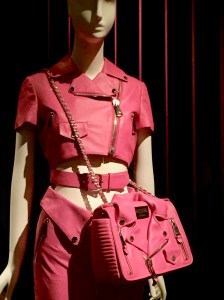
Jeremy Scott’s 2015 crazy-fun leather and zipper ensemble for Moschino, featured on posters for the show.

Everyone has an opinion about the color, and that’s brought to bear on the fun, irreverent, and insightful show at the Museum at FIT, Pink: The History of a Punk, Pretty, and Powerful Color, on view through January 5.

FIT’s downstairs gallery shows a retrospective of pink in fashion in the first room, anchored by Gwyneth Paltrow’s pale pink Ralph Lauren slip-gown that everyone remembers from the 1999 Oscars.

A stroll around the room is chronological, beginning with a fancy and frilly girly-girl two-piece ensemble from the 1850s, through ice-pink Chanel from the flapper period to pale pink plasticized space-age Courréges coats to the hot-pink satin features on Eighties society-ball statements by Adolfo and others.

Courréges logo and exquisite details on 1972 coat.

There’s even a full pink immersion installation of My Little Pony, Hello Kitty, and Barbie to make the point that for much of the 20th century in the West, pink has been associated with little-girl things.

Through the doors to the main gallery, curator Valerie Steele shows us the facets of how pink functions in a global society, as a transgressive color, as a wry joke, and even a power statement when applied to menswear.

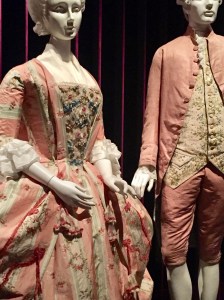
One of the most interesting facts about pink is hidden in tiny label copy inside the first historical tableaux – a gorgeous 1775 silk brocade robe á la française on loan from the Los Angeles County Museum of Art and man’s suit from the same Pompadour Pink period.

Men and women in pink, 1775 style.

The word “pink” only entered the English language in the eighteenth century – the same time that the word “rose” was coined in French.

So, yes, despite the color’s appearance in the natural world prior to the burst of fashionable plant cultivation in the 18th century, it really took off as a response to horticulture that was reflected in fashions for both ladies and men.

From there, the exhibit explores how pink came to be associated with gender-specific kids’ clothes in the early days of Western consumer culture and how it was adapted as a “like life” color in lingerie and lingerie-inspired outerwear.

There are iconic pinkish women-as-flower dresses by Charles James from the Thirties and Fifties, and examples of Schiaparelli’s “shocking pink” reimagined by the house that bears her name today.

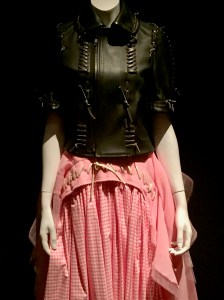
Rei Kawakubo’s 2005 biker-ballerina leather and pink gingham ensemble for Comme des Garçons.

It’s a great contemporary touch to see how punks and Rei Kawakubo subverted pink, and how Janelle Monae, Rihanna, and rappers have used it for their own pop-shock purposes.

See details of our favorites in our Flickr album. For fun, we’ve arranged the photos in chronological order and zoomed in on the embroideries, draping, embellishment, and masterful stitchery.

As usual, FIT has done an outstanding job on the digital side of the exhibition. Take a look at the exhibition website and FIT Flickr site, showing full-length photos of the ensembles. Listen to the audio tour of the show.

Enjoy curator Valerie Steele’s tour of the show here: