Modern Japanese Design from Humble Plants Blossoms at Met

2017 immersive bamboo sculpture by Tanabe Chikuunsai IV

Ancient grasses are the medium through which master craftsmen have made eye-popping, intricate statements, as evidenced in the Metropolitan’s exhibition, Japanese Bamboo Art: The Abbey Collection, running until February 4.

The show opens with a dynamic, undulating tiger-bamboo sculpture installation by Tanabe Chikuunsai IV, a modernist descended, trained, and influenced by three previous generations of acclaimed Japanese bamboo innovators.

In fact, families passing on the secrets and traditions in three different regions of Japan is a featured theme of the show. In many cases, work by fathers and sons is shown side-by-side, such as the intricate works by Tanabe’s own great-grandfather and grandfather, and the stunning sculptures by Honma Hideaki and his father, Honma Kazuaki.

Mid-19th c. hanging cicada-shaped basket collected by Moore

The show showcases contemporary and 20th-century bamboo art from the Abbey Collection (which will eventually be given to the Met) alongside 19th-century pieces collected and donated to the Met in different eras.

For example, the Met received a bonanza of Asian art from Tiffany’s artistic director of silver, Edward Moore – over 80 textiles, bamboo baskets, metal work, and ceramics – from his overseas journeys in the 1860s and 1870s.

Beautiful gold-and-lacquered bamboo pieces that he collected are displayed in this show, alongside kimonos, painted screens, and netsuke-toggled containers featuring images of bamboo growing wild.

Modern lines of 1940s Peony Basket by Maeda Chikubosai

There’s also a unique bamboo and rattan bowler hat from the 1880s, courtesy of the Abby Collection, which injects a bit of the “Pacific Overtures” feel to the show, demonstrating how Western influences began to creep into Japan and push artists, such as Shokosai, to use traditional materials in contemporary life. In this case, snappy items sported by fashionable celebrities.

Despite the centuries in which craftsmen shaped large and small specimens of some of the more than 600 species of these grasses, bamboo work remained classified as “craft” versus “art.”

By 1929, however, the up-and-coming generation of bamboo innovators finally accomplished what their artistic ancestors had not – full recognition by the Japanese art hierarchy that their creations were on a par with painting, other types of sculpture, and fashion.

2014 sculpture by Honma Hideaki next to 1983 panel by his father, Honma Kazuaki

An example is Sakaguchi Sounsai’s fruit tray, one of the first pieces of bamboo works accepted into a government-organized national art exhibition. Kudos to the Abbey Collection and the Met for showing how Japanese artists took a humble plant and made it blossom into a dramatic, rich, intricate statement reflecting modern times.

Take a look at everything on the Met’s website and our favorites on Flickr, which shows some of the Moore and Abbey-collected works in chronological order.

To get an idea of the skill involved in transforming these natural materials, watch this time-lapse video of The Gate, the dynamic, undulating installation dominating the show’s entrance, created by a team led by bamboo artist Tanabe Chikuunsai IV.

And listen to Hiroshi Sugimoto, the famed photographer, looks at Tosa Mitsunobu’s 15th-century Bamboo in the Four Seasons screen, also included in this show at the Met, describing how a two-dimensional work brilliantly uses nature to convey the passage of time.

MoMA Picks Fashion Items with Modern Impact

1970 looks envisioned by Rudi Gernreich people in the Year 2000

The MoMA design department came up with a list of 111 clothing items that have had an impact on the world and is presenting them for your reflection through January 28  in Items: Is Fashion Modern?

Capri pants, graphic T-shirts, jumpsuits, backpacks…they’re easy to identify, but do you really know where they came from or where they’re going?

The design team dug deep, interviewing experts, commissioning new designs, and taking you on quite a journey from what seems familiar but has deeper implications and meanings.

Each item on the list gets more-or-less the same treatment: familiar examples, a little historic context, audio by experts intimately familiar with the prototype and its societal significance, and maybe videos providing a little more background. (Go, Beatnik video, next to the felt berets and black turtlenecks!)

Close-up of MoMA-commissioned jumpsuit by Richard Malone, made from recycled acrylics

There are sections on shaping undergarments, luxury items, expedition wear, and power dressing. Check out our Flickr album of some of our favorites, and be sure to check out the video of the graphic T-shirt installation.

The MoMA team gets the digital gold star for using sound, video, social media, and social platforms to explore each item on the list. Hear the many voices who contributed to the show – designers, curators, fashionistas – on MoMA’s terrific audio tour.

For example, everyone knows “the little black dress” but MoMA calls it “a concept” and then displays everything from Gabby Chanel’s original 1920s bugle-beaded innovation to Gianni’s safety-pin number to subversive top-shorts combos for a hip-hop crowd by Rick Owens.

It’s nice to see all the versions while listening to FIT’s Valerie Steele on the audio tour and to watch the gallery video of how the laser-cut nylon pieced dress by Nervous System symbolizes the LBD’s future.

1997 A-POC Queen by Miyake Design Studio — one tubular piece of cloth knitted by an industrial machine from one thread.

And as for the future, there are plenty of visions: Gernreich’s 1960s take on what people would be wearing in the Year 2000. Donna’s Seven Easy Pieces from the Eighties are still being treasured as components for a totally modern dressing solution.

It’s remarkable to think that the Miyake Design Studio’s innovative, red-hot one-thread tubular computer-knit everything-in-one piece first debuted in 1997 and that paper shift-dresses weren’t born yesterday.

A soft, doe-colored Halston Ultrasuede shirtdress is featured in one of the final galleries, but there’s nothing about its demure look to suggest the societal fashion mania that ensued during the Seventies for this washable suede-like innovation.  It was one of the decade’s had-to-have items.

There’s plenty of flash, surprise, and history to go around. Sign up for MoMA’s free course on Fashion as Design on Coursera and poke through MoMA’s YouTube channel for insights on Saville Row suits, fashion lifecycles, digital dresses, and more.

Take a walk with MoMA’s design curator Paola Antonelli though this enjoyable, provocative show:

Also, MoMA produced a set of videos to provide a behind-the-scenes look at some of the garments commissioned especially for the show, such as futuristic biker jacket by Asher Levine and James DeVito. Step into their atelier as they enhance their design:

Divine Michelangelo at The Met

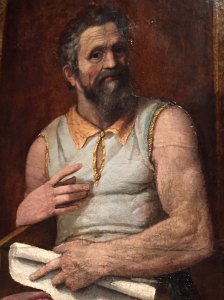
Detail of Zuccaro’s 1600 Portrait of Michelangelo as Moses

Crowds at the Metropolitan Museum of Art have been jamming into the galleries on the second floor to get a close-up look at rarely seen works by the Divine Mr. M – drawings, sketches, and sculptures pulled together from 48 institutions from across the world, including the Louvre and Queen Elizabeth’s own private collection.

Michelangelo: Divine Draftsman and Designer, in New York through February 12, is a blockbuster that tells the story of the master’s life, loves, teachers, students, and clients from his early-prodigy works through portraits of the legend late in life through 200 works, reunited here in a once-in-a-lifetime show.  See some of our favorites on our Flickr site.

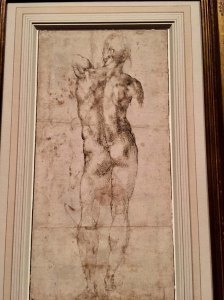
Although Michelangelo thought of himself primarily as a sculptor, the assembled works principally illustrate his mastery in two dimensions – red chalk and pen-and-ink sketches where sculptural illusions are built up on handmade rag paper in studies of nude models that would later make it into larger commissioned works.

Pen-and-ink study of a model for the 1504 Battle of Cascina

Although he burned most of this prep sketches, the 133 drawings that you see in the Met’s show evoke a studio-lab that might not be so dissimilar to Warhol’s Factory – assistants everywhere, celebrity-artists dropping in, muscled models ever-present, up-and-comers asking for guidance, and teams preparing large-scale cartoons for the next fresco that the master would finish.

Crowds make it necessary to visit the show multiple times to see all of the fine, delicate work and examine sheets where he would whip off a small drawing and ask his students to copy it. The small scale of so many works makes it easy to miss a masterpiece.

For many visitors, the high point is the spacious central gallery with a scaled-down replica of the Sistine Chapel hanging overhead and matching preparatory studies displayed below.

Red chalk study for the Sistine Chapel’s Libyan Sibyl

The crowd dissipates as people waft toward the drawings distributed across the floor. It’s quite a pleasurable path of discovery as you meet the earlier incarnations of the Libyan Sybil and even the Hand of God.

The Met curators have helpfully added diagrams to the label copy to help you find the section of the ceiling that matches the sketch you are perusing. Seeing the early and finished versions together is nothing you can otherwise experience, even if you travel to Rome.

The massive show includes several unfinished marble statues, luxury works by others that were inspired by Michelangelo’s better-known drawings, and an architectural model of his portion of Saint Peter’s Cathedral in the Vatican.

Best times to visit this show at the Met are Monday mornings and dinnertime on Friday or Saturday, when the crowds thin out.

Look through works in the exhibition on the Met website, and learn about each section of the show here.

Get a preview before your visit by stepping through the audio guide of the show here.

Hear the curator Carmen Bambach speak about the joy of curating this show and how the master used drawing in his wider work:

Disorienting Delirious Art at Met Breuer

Detail of Jim Nutt’s 1967 Miss E. Knows, representing twisted expressions of Sixties angst

Do you believe that delirious times call for delirious art? This was the impetus for the Met Breuer to create “Delirious: Art at the Limits of Reason, 1950-1980,” to take viewers on an experience of vertigo, excess, nonsense, and twisted sensibilities through January 14.

About a third of the show is drawn from the Met’s own collections, but there are plenty of surprises around each corner – art from lesser-known artists who were channeling their times as well as little-known pieces from well-known artists.

The first rooms of the show explore vertigo by catapulting you back in time to the 1960s, when psychedelia and altered, fractured states drove artists to experiment and translate the feelings of social change and upheaval.

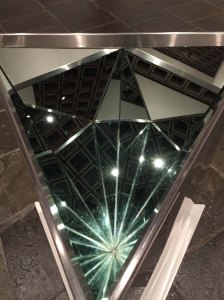
Peering into Robert Smithson’s 1965 Three Mirror Vortex

Works include the stunning, ultra-controlled, and visually disorienting op-art canvases of Edna Andrade as well as a fractured inside-out sculpture by Robert Smithson. You can even put your head inside of it and experience worlds within worlds.

In case you miss the point of all this early Sixties experimentation, the curators have the Met’s copy of Timothy Leary’s psychedelic tome on display, along with drawings done by his colleagues under trance-like conditions.

From there, the curators accelerate the feeling of delirium and disorientation by grouping works according to excess (read obsessive), nonsense (gibberish), and twisted.

Detail of Alfred Jensen’s obsessive 1978 work

You’ll see highly obsessive, ordered works, such as a monumental Alfred Jensen systems painting with rows of numbers caked in oil impasto and an all-white 3-D see-through grid installation by Sol Lewitt. All very precise but irrational, regardless whether the work is messy or clean.

Turn the corner and find that obsessive Kusama is at it again with her self-titled “compulsion furniture,” plastering an ordinary ladder with high-heeled shoes and who-knows-what. It feels as though her work is the opposite of the previous group, but it’s just as over-the-top.

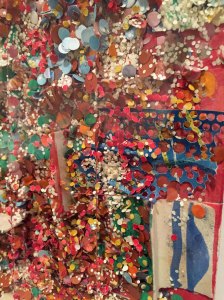
Punched-paper details in Howardina Pindell’s 1977 collage

In a nice surprise, the Met pairs Kusama with obsessive, joyous, and glittering works by former curator Howardena Pindell, who channeled her experience of a 1970s African odyssey into an abstract riot of punched-out paper holes, colors, and stuff. Bravo, Howardena! (Note: Her work is also featured on the walls of the Whitney right now in “An Incomplete History of Protest.”)

The nonsense portion of the galleries feature word-play and an unusual early Oldenburg totem inspired by his old neighborhood – “Letter Tenement” is a mish-mash sturdily assembled from oil and rags. An abstract Stan VanDerBeek video pulses nearby.

Impermanence and found-object inspirations are represented by letterset, photocopy art, and large-scale works made from torn Parisian posters by Jacque Mahé de la Villegié from the Tate collection. Layers upon layers of jumbled, dazzling fragments that you can get lost in.

For a walk on the wild side, visit this stimulating show. Take a look at some of our favorite works on our Flickr feed, and listen in as the curator presents highlights of the show:

Cooper Hewitt Serves Up Decade of Twenties Style

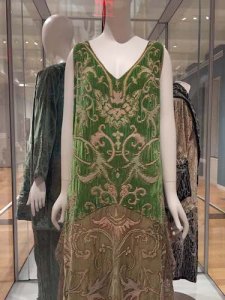
1923-1926 Callot Soeurs velvet evening dress, embroidered with pearls and metallic thread. Collection: MCNY

Booze-filled nights, cocktail artistry, designer scents, dancing the night away in half-hidden clubs, and high style provide the context for the Cooper-Hewitt’s gigantic show, The Jazz Age: American Style in the 1920s, closing on August 20. If you go, plan on spending some time contemplating two floors of beautiful things that made this decade a design stand-out.

From the time of New York’s first Armory Show in 1913, the appetite for primitive art, artistic dressing, and design innovations just kept growing. The end of World War I encouraged German, Austrian, and French designers to look west to find new markets and clients, and New York in the Twenties was ready for something completely different.

As the curators show, the trans-Atlantic influences, designers emigrating to New York from Europe, and newly liberated women enjoying the cigarettes, cocktails, music, and dance all added up to an explosion of change.

1927 silver coffee service, inspired by cubism and skyscrapers, designed by Eric Magnussen for Gorham

The Twenties became a watershed decade for innovations in fashion, jewelry, furniture, art, and design on both sides the Atlantic. View all the beautiful things in the show here.

The two-floor show is grouped by theme, chronicling the initial cross-pollination of new European designs into high-end American lifestyles and choices – modern geometric designs in diamond bracelets, hair bands replacing tiaras, cubism gone wild, the De Stijl and Wiener Werkstätte revolutions in design-think, and how everyone was interested in Frank Lloyd Wright.

1920s diamond geometric bracelet by Mauboussin with colorful clusters of rubies

New York high society could not get enough of the meticulous craftsmanship and new geometries in design emanating from Europe. If you had the cash, you traveled to Paris to scoop up designer duds and art glass, but the appetite for what each continent had to offer was a two-way street: Europe could not get enough of Josephine Baker, jazz, and New York’s new, ever-expanding skyline. The Jazz Age is loaded with vases, armchairs, and even a wastebasket drawing inspiration from super-tall buildings sprouting in Manhattan.

The show also highlights the craze for “primitive” elements of design, Egyptian motifs inspired by the discovery of King Tut’s tomb, and the stuff that started to be made when party goers discovered the joy of cocktails.

There are fabulous bracelets from Cartier worn by high-society style makers and celebrities (e.g. Mae West, Gloria Swanson) and perfume containers that doubled as collectible art.

1955 copy of 1918 Gerrit Rietveld chair, inspired by Frank Lloyd Wright

Couturier Jean Patou even commissioned a perfume presentation styled to look like a cocktail bar as a wink to the fact of Prohibition on the other side of the Atlantic. Of course, he offered ladies’ drinks when they came to his Paris salon, commiserating about alcohol deprivation in America.

The array of armchairs that have been assembled are a mini-exhibition on their own – from Gerrit Rietveld’s astonishing 1918 primary-color chair to Breuer’s iconic 1925 Barcelona chair to the 1929 steel-tube-and-rubber chair by René Herbst. It’s hard to look at them and see them as from an era different than our own today.

The curators make the point that a watershed moment in design was the 1925 Paris Exposition of International Arts. The excitement over the new designs was so intense that department stores in the United States offered to hold a traveling exhibition of 400 objects. After people across the US got a whiff of what new style was all about, the appetite for modern furniture, vanity table items, and textiles exploded.

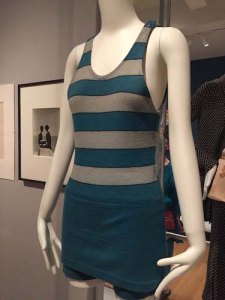
1920s form-fitting “California” style wool knit bathing suit. Collection: Kent State

Clothing plays a role in the show, but the displays include more accessories and jewels. Beautiful evening dresses by Chanel and Callot Soeurs are featured, along with a pair of exquisitely preserved sparkly dancing shoes and a modern knit bathing suit that really revealed all of a woman’s curves.

Touring the show, you’ll learn how jewelry changed with the times during the Twenties. Shorter, looser-fitting dresses on ladies moving to the latest dance styles demanded longer, looser necklaces, or sautoirs, that swung in time to the music, too. More open T-strapped and ankle-strapped shoes were embellished to make those dance moves even more dazzling.

There’s a lot to the fashion story during this decade. Join two fashion historians and Cooper Hewitt curators, as they talk about the fashions of the Jazz Age in New York and Paris.

MoMA Makes Space for Women 70 Years Later

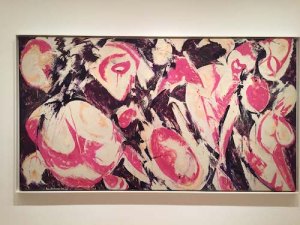
Epic 1966 Gaea painting by Lee Krasner

This show never happened…until now. Over the years, MoMA has been collecting the work of female artists, but in their prime, only a few had the chance to reach a wide audience, and certainly back in the Fifties this group would not have been assembled for an all-woman show.

MoMA corrects this oversight and gives these women the attention they deserve in Making Space: Women Artists and Postwar Abstraction, closing August 13.

MoMA has burrowed into its collection to present the work of female painters and sculptors who largely worked in the shadows of the dominant male artists of the Fifties and Sixties, both in the United States and abroad.

Grace Hartigan’s 1957 Shinnecock Canal

The curators have segmented the artists by style, and it’s fun to discover better-known favorites alongside some women that you simply have never heard of. The first part features large ethereally stained canvases by superstar Helen Frankenthaler and swooping gestures by Lee Krasner (pretty in pink).

The gallery also showcases lesser-known Lebanese-born abstractionist Etel Adnan and Grace Hartigan, who briefly attempted to get her work into galleries by letting dealers think that “George” Hartigan did them. Grace did OK, however, becoming the only female painter that MoMA included in its Fifties European touring show New American Painting.

You can almost imagine critiques like “too feminine” and “paints like a girl” being uttered over shots at the Cedar Tavern. Joan Snyder was not ashamed to say that she drew inspiration from nature – instead of internal angst. Super-minimalist Agnes Martin did the same, drawing inspiration for her thin pencil grids from the majesty and stillness of nature.

Close up of Agnes Martin’s 1964 oil and pencil Big Tree

The “geometric” gallery is where the show expands away from New York’s home base to feature more of the Latin American contingent, like Venezuelan sculptural innovator Gego, a German refugee born Gertud Goldschmidt, and Cuban-born Carmen Herrera. Carmen, who lived in Paris and other world capitals, didn’t sell her first painting until 2004 when she was 89. To put that into perspective, black-and-white paining in MoMA’s collection was done in 1952. Well, at least the Whitney gave her a one-woman show this past year.

The curators hit a home run by also including textile artists and designers like Bauhaus artist Anni Albers and sculptural innovator Sheila Hicks. Seeing these and the process-art artists together is a treat – Eva Hesse and Polish art megastar Magdelena Abakanowicz. Both use found objects but Eva used industrial materials to create ephemeral sculptures and installations; Magdelena took lowly sisal and created a monumental textile presence.

On our Flickr album, we’ve arranged photos of the works in the show chronologically, so it was surprising to find that some of the earliest pieces of abstract art in the show were the 1951 bowl chair by Brazilian designer Bo Bardi and 1950 Stone on Stone textiles from Vera.

Two versions of Vera’s 1950 Stone on Stone pattern — prints on linen and silk by commercial manufacturers for the home market

Anyone decorating a home or buying a headscarf in the Fifties and Sixties knew of Vera, one of the first one-name household design names. The curators make a point to note that by hiring contemporary designers, commercial fabric houses were able to disseminate abstraction throughout the United States in curtains, upholstery, and daily items.

Big-time abstract painting and sculpture – whether expressionist, geometric, or minimal — might have been dominated by the guys, but the democratization of abstraction in the way of dress fabric and curtains was a realm that made female designers into brands.

To learn more about many of these innovators, listen in on MoMA’s audio tour via their website or app.

Here’s a quick spin through the show with curator Starr Figura here:

Bard Resurrects NYC’s Crystal Palace

The domed Crystal Palace depicted on a commemorative window shade

With its exhibition New York Crystal Palace 1853, the Bard Graduate Center gallery is offering an exquisite experience of one of the 19th century marvels of New York – the enigmatic 1,500-paned glass structure that rose on what is now Bryant Park.

In 1853, New York was trying to claim its place as a culture capital. Two years prior, London had mounted its world-class exhibition in its beautiful Crystal Palace, and New York wanted to do Europe one better.

By this time, New York was dominating in global trade, so the City thought it could elevate American taste (and spur consumer appetite for luxury goods) by assembling technology innovations, art, and manufactured items all under one big domed glass roof.

Why not build the world’s largest cast iron and glass exhibition hall on the edge of the city at 42nd Street next to the Croton Reservoir? For 50 cents, visitors could spend the day inside and people watch to their heart’s content.

Showpiece parlor furniture, an 1853 armchair by Julius Dessoir

It would be the largest building that anyone had ever experienced – so big that it had its own police force and you had to buy a guidebook.

The exhibition selects some choice items from New York collections – many which were indeed exhibited under the dome in 1853 – to tell the story of the endeavor, give a feeling of what a wonder it was, and bring you back to a time in New York when parlor furniture was the rage, ladies were just venturing out for ice cream on their own, and oysters were still so plentiful in the harbor that they reigned as the best quick snack for lunch.

Take a look at the galleries exhibition on the Bard website, but see a close-up view on our Flickr album.

Although the physical exhibition ends July 30, the Bard team offers a through-the-looking glass digital site, where you can actually stroll through the interior and examine different items along the way. The journey takes you by evocative sculptures, beautifully crafted musical instruments, spectacular parlor furniture, and vitrines filled with over-the-top ladies’ hats.

High-tech Singer sewing machine for home and business

The technology section features the latest in fire engines, Eli Whitney’s original model of his 1794 cotton gin, Colt’s revolvers, a pyramid made of innovative cotton rope, and the revolutionary iron sewing machine. To show how it worked for industry and the home, Singer had women demonstrate this new labor-saving device.

In-gallery and online interactive walk-through tour of the Crystal Palace

The scope of the exhibition was so massive – the footprint of Bryant Park between 40th and 42nd Streets – that publishers offered guide books so that visitors wouldn’t miss a thing.

Helpfully, Bard provides you with digital access to the free July 23, 1853 Crystal Palace supplement from the Illustrated News, modeled upon a period newspaper.

For a thrilling view, you can go up to the 270-foot tall, 8-foot wide platform of the Latting Observatory (New York’s first authentic skyscraper) and get a bird’s eye view of the city all the way out to Jamaica Bay. Or duck into the saloon below for smash, the cocktail of the day, a shaken-not-stirred icy mix of brandy, lemon, mint, and sugar. (And consult the guidebook to find out which saloons allow ladies to sip alcohol.)

There’s also a digital guide to other 1853 attractions, including how to take an omnibus over to the Hippodrome and where to find Matthew Brady’s studio.

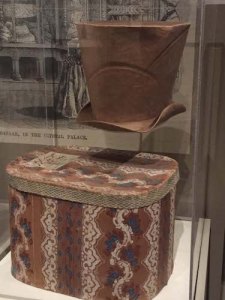
Must-have tophat displayed and available from John Genin’s downtown mega-store

It’s all so lively, that it’s sad to learn that the entire edifice came crashing down in a dramatic fire in 1858, which likely adds to the mystery. The curators have found a tiny, insignificant piece of its melted glass from the Museum of the City of New York’s collection. Treasure it.

If you have three hours, watch Bard’s symposium on how it all came together – the palace, the exhibition, and the digital experience that will provide everyone with hours of 19th century summer fun in the City:

Curtain Up on Theater’s Best at NYPL

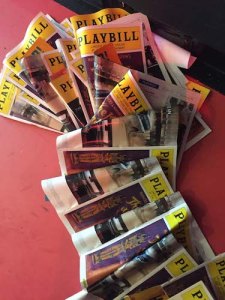
All the Playbills you ever collected

The excitement of Broadway and West End theater is fully on display at the New York Public Library’s show at Lincoln Center, Curtain Up: Celebrating the Last 40 Years of Theatre in New York and London, closing July 30.

It’s a theater-lover’s fantasy journey through four decades of smash hits that cross-pollinated two shores – costumes, stage sets, video clips, lights, sound, and awards. And as the curators point out, the two theatrical epicenters are mirror images of one another.

The Victoria & Albert (V&A) Museum in London, the Society of London Theaters, and our own NYPL assembled this extravaganza with the help of producers, costume designers, actors, theaters, and other owners theatrical history.

The foyer is awash in Playbills, hanging from the ceiling and piled up in corners. It feels like home. It’s hard to know where to look or what to process first. Is it Michael Crawford’s Phantom mask (direct from his own collection)? Is it the overscale streetplan of Times Square or Shaftsbury Avenue? Lola’s thigh-high hot pink Kinky Boots?

A Chorus Line finale top hats by Theoni V. Aldridge from TDF’s Costume Collection.

Take a short walk-through of the show on our Flickr album.

Look closely for windows into innovative set designs (An Inspector Calls, War Horse) amid towering costumed mannequins. But the overpowering sound throughout is One. Who can concentrate on anything else once you see a corridor sprinkled with glittery top hats overhead and Broadway-sized media screen showing the multi-mirrored finale of A Chorus Line.

Besides being everyone’s favorite musical (the first to win London’s coveted Olivier award), the show ushered in the digital age of theater. When it debuted at the Public Theater, the lighting was the first musical to depend on an electronic light board, which made the transitions just as precise at the choreography.

There are backstage notes for The History Boys, box office totals from Evita, period costumes from the theater’s grande dames, and a brief video showing one of the all-time great moments of inspiration and awe onstage — the seconds-long flash accompanying the finale appearance of the magnificent angel in Angels in America.

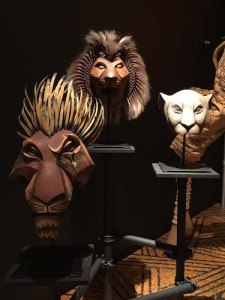
Julie Taymor’s 1997 masks for The Lion King’s Scar, Simba, and Nala

The most dramatic encounter is an area populated with costumes and masks from The Lion King and the swan costume from Matthew Bourne’s all-male Swan Lake.

The “fliers” are aloft, too – Marry Poppins and Elphaba – with a big-finish wall of televisions showing coverage of the Olivier Awards, currently celebrating their 40th anniversary.

The result is a theatrical show together that sings, dances, and reminds everyone of what a life in the theater – either as an actor, technician, or audience member – can be.

To prepare for your next visit to the West End, here’s a short primer on the stats, lingo, and facts about theater culture on both sides of the Atlantic:

Whitney Biennial Takes America’s Pulse in New Home

Larry Bell’s Pacific Red II

Moving into a new home often gives a new perspective on life, and it’s true of this year’s Whitney Biennial. The open, flexible spaces allowed significantly more creativity above the High Line than at the old confines of the Madison Avenue building — Larry Bell’s 2017 “Pacific Red II” installation lording it over The Standard, Asad Raza’s 26-tree installation with the skyline beyond, Cauleen Smith’s banners in the daylight downstairs, and light streaming through the faux “stained glass” window by Raul de Nieves.

Yes, interior spaces are filled with concept art, video installations, slide shows, and paintings, but the glimpses of light and sky serve like punctuation breaks from the sometimes-intense experiences about race, society, rising personal debt (even for artists!), and a throw-away cuture.

Caretaker explains growing trees for Asad Raza’s Root sequence, Mother tongue

The word on the street is that this is one of the most enjoyable Biennials in the show’s history, which is not to say that the curators have avoided challenging work. They haven’t.

Tension…disorientation…protest are all there in reflections on today’s social issues, censorship, social memory, marginalization of populations, and obsessions over the role that too-much-digitalization plays in our hectic lives.

But there are aspirational pieces, too – hopefulness, sincerity, and healing.

Classroom inside the Whitney by Chemi Rosado-Seijo

Think about the (concept art) school set up inside the Whitney. It’s the idea of Puerto Rican artist and educator Chemi Rosado-Seijo, who tried the same displacement between school and museum in his hometown – an experiment that the kids there are still talking about. For the Biennial, Chemi arranged for Lower Manhattan Arts Academy high school students come to the Whitney for classes one day a week; in exchange, work by Whitney artists is moved to the school.

Take a look at our Flickr album, which includes photos of Chemi and some of the other artists from the press preview.

The Whitney has done a spectacular job of documenting all the artists, their statements, and work on their website.

The museum has produced a beautiful testament to this year’s survey. Take a look and witness art history. Seventy-eight years and going strong:

Scraps = Fashion Design

Poly “fabric” and tote by Milan’s Luisa Cevese, featuring artfully arranged clumps of recycled silk thread.

On Earth Day weekend, there’s no better place to contemplate beauty, fashion, and style than walking through the Cooper-Hewitt’s show “Scraps: Fashion, Textiles, and Creative Reuse,” on display through April 23.

The curators decided to shine a spotlight on several designers who have been inspired to probe ways in which cast-offs from garment and fabric manufacturing can be turned into fashionable, beautiful items so that the ever-churning cycle of production can become more of a closed loop and rely less upon consumption of raw material.

Luisa Cevese, a Milan-based designer who worked in research for Italy’s high-end silk industry, wondered if there was a way to recycle the waste from the production process – large quantities of silk selvedge (ends) and assorted silk threads thrown off from the looms. The Smithsonian shows us a collection of her results – waterproof polyurethane bags featuring these colorful production scraps in stripes or whimsical arrangements. Take a look at the Flickr album.

Christina Kim’s choga and slip made from recycled hand spun, hand woven cotton saris.

Luisa was encouraged and inspired by the attitude toward recycling in India, where no one can afford to waste the precious fabric used in saris. When someone’s done with an old, worn-out sari, they are cleaned, repaired, and refashioned for buyers on the secondary market. Hems might be shortened, or other alterations made. Luisa gave the same treatment to these bits of exotic silk – embedding scraps into polyurethane for re-use in other items.

Christina Kim, based in Los Angeles, has long worked with local artisans in India and Mexico to repurpose scraps into full garments and scarves so that there is zero waste. Her approach represents a commitment to sustainable fashion that is not out of sync with other, more large-scale manufacturers. Check out some of the processes used on the exhibition site.

Watch this video of a recent conversation between Eileen Fischer and Patagonia’s Nellie Cohen at the Cooper Hewitt about how their clothing companies are reusing textiles and innovating a “closed production cycle”.