Met’s YouTube Star Seeks Holiday Friends

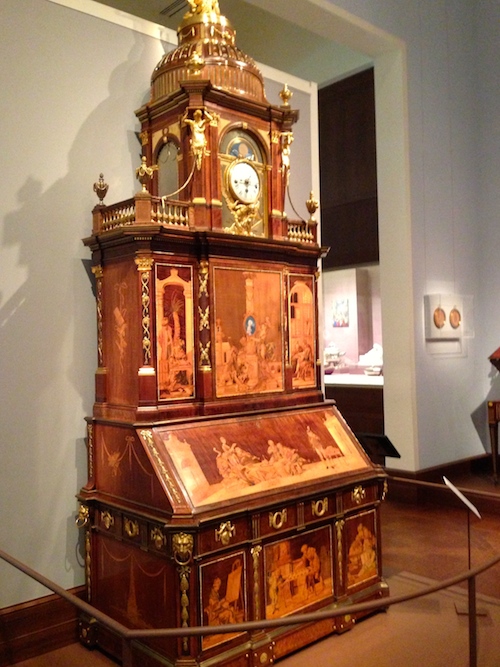
Mr. Roentgen's Berlin Secretary Cabinet, the viral NYC museum YouTube sensation, awaiting visitors in Met Gallery 553

Mr. Roentgen’s Berlin Secretary Cabinet, the viral NYC museum YouTube sensation, awaits visitors in Met’s Gallery 553

It’s lonely at the top. More specifically, it’s lonely in the Metropolitan Museum’s Gallery 553, where one of the biggest YouTube stars in NYC museum history is holding court until January 26 – David Roentgen’s Berlin Secretary Cabinet, which has racked up 4.4 million hits since his show, Extravagant Inventions, closed last January.

That’s right. A piece of mechanical furniture has 4.4 million YouTube fans (in addition to 13K on the Met’s own website) – quite an achievement since it had only around 200,000 when its show closed. It’s not the only piece of mechanical furniture to gain big YouTube numbers (another has over 91K), but to put the Cabinet’s achievement in perspective, consider that the Met’s McQueen video has only racked up 72,000 views in the two years since that blockbuster ended.

The crowds were crazy for the 18th-century marquetry extravaganza (see our earlier post), and the Met asked the Kunstgewerbemuseum, Staatliche Museen zu Berlin if it could keep the YouTube star a little longer.
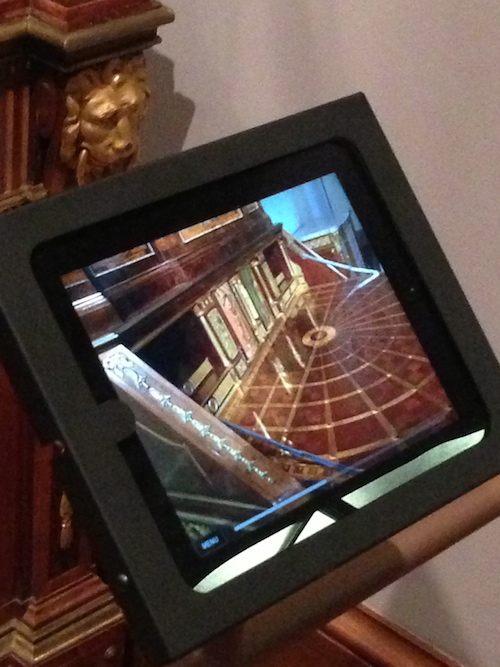
The Cabinet's video, displayed also in the gallery, has gone viral with 4.4M views

The Cabinet’s video, displayed also in the gallery, has gone viral with 4.4M views

The Met dedicated a cozy corner of its First Floor to the Cabinet and some of its other pieces from Mr. Roentgen’s studio — a rolltop desk and tall clock from the Met’s own collection, and a mechanical table lent by the Cooper-Hewitt. Take a closer look on our Flickr feed.

But every time we pass by, the Cabinet seems a little lonely. The Met says it’s likely the most expensive piece of furniture ever manufactured (there were only three), but it seems like the Fabergé eggs in the hallway are getting all the foot traffic. Yes, they’re beautiful, but a piece of marquetry that’s gone viral is something that deserves some in-person praise.

During the holidays, just hang a left at the Christmas tree. Look for a tall stately Cabinet in a gallery on the right after you pass through the European Sculpture Court and before the rooftop elevator. Spend a little time with the star before he decamps the Big Apple for Berlin.

Roentgen's Rolltop Desk also has its own video and has 59,000 YouTube fans of its own

Roentgen’s Rolltop Desk also has its own video and has 59,000 YouTube fans of its own

If you want to see the Roentgens in performance, the Met’s hosting a gallery talk and demo of the mechanical furniture at 2:30pm in Gallery 553 on December 17 and January 14

The Cabinet’s mega-hit video (produced by the Berlin museum, but posted by the Met) is also on display in the gallery — no people, no curators, no talking, no cats…just subtitles, a human hand wielding a key, and the magnificent magic of Mr. Roentgen. Hold on for the hidden easel.

Oldest Painted Theater Curtain in America on View in NC

The original 1858 William Russell Smith drop curtain, displayed in Thalian Hall’s Parquet Hall

The original 1858 William Russell Smith drop curtain, displayed in Thalian Hall’s Parquet Hall

Lincoln was prepping for his sixth debate with Douglas in Illinois when the curtain went up on October 12, 1858 at Thalian Hall in Wilmington, North Carolina – the same curtain, still on display, that is considered to be the oldest existing theater drop in America, painted by Philadelphia-trained landscape artist William Russell Smith.

Back in the 1850s, major theaters up and down the East Coast were in pursuit of the classically trained Smith to create romantic, ethereal landscape images on the gigantic canvas curtains that audiences saw when they entered opera houses. Typically framed by an ornate proscenium, the drop transported theatergoers to the work of make-believe, Moliere, and Macbeth – staples of the touring companies and troupes of the time.

Detail of original drop curtain, done in distemper on 30-foot canvas

Detail of 1858 curtain, distemper on a 30-foot canvas

Today, except for Wilmington’s Thalian Hall treasure, those grand masterpieces are gone, victims of time, decay, and impermanence like the superstars of yesteryear. It’s quite a miracle that Thalian’s original curtain has still survived, considering that it’s not painted in oil, but distemper – a less permanent, water-soluable medium, essentially colors ground into glue. When an artist applies the wet pigment, he sees the opposite color, which gradually turns into the “true” color when the paint dries. It’s a process that could only be executed by a skilled master, particularly on a 30-foot wide canvas. The surface of the curtain holds the granules (like a piece of paper holds pastel fragments).

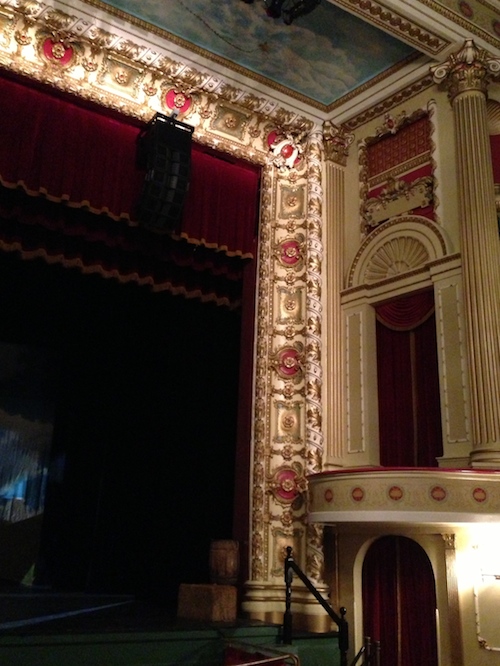
Wilmington, NC’s Thalian Hall, built 1855-1858, one of the oldest continuously operating theaters in the South

Wilmington, NC’s Thalian Hall, built 1855-1858, one of the oldest continuously operating theaters in the South

No wonder Smith purpose-built a huge studio in his home with poles that could be raised and lowered as he worked on a gigantic scale first with a charcoal sketch, then with distemper (move over, Chuck Close!). When Smith finished painting his commission, he carefully folded the canvas, rolled it on a long pole, and had it delivered to the opera house.

Thalian Hall received its long-distance delivery this way, because Smith never set foot in North Carolina. The new opera house was designed by New York architect John Trimble, who built Barnum’s Museum and many New York theaters of the mid-1800s, including the New Bowery. Smith’s curtain was the finishing touch, depicting an Aegean sailing ship arriving at classical islands filled with temples dedicated to Apollo, evoking commencement of the ancient Olympiad.

Detail of Thalian Hall's beautifully restored proscenium and box

Detail of Thalian Hall’s beautifully restored proscenium and box

The curtain was in service from 1858 until 1909, when a restoration was planned. Historians know it was hung again by 1938 (see the photo in our Flickr feed). It got hurt a little in the 1940 WPA renovations, and was known to be back in place in 1947, but disappeared after 1963. It was rediscovered in 1979, when Mrs. Juanita Menick, the president of the board, told the new Thalian director that she might still have an old curtain that she took years ago to her home for safekeeping. Thank goodness for those large, Southern homes.

Although only 15 feet of the original 30-foot drop remained, tribute was paid to the historic artwork. The fragile canvas was used as part of the set for Thanlian Hall’s 125th anniversary celebration, and now hangs, ready for its closeup, in the luxurious entry to the theater’s orchestra section.

Hear how executive director Tony Rivenbark rediscovered it, and watch historian David Rowland’s talk about the life of William Russell Smith (at 4:20), whose romantic landscapes of New England somewhat predated the Hudson River School; the imagery used in the magnificent theater curtains (at 30:22); and the astonishing discovery recently made in Smith’s grand studio (at 35:30) in this YouTube video.

Thalian Hall's balconies and orchestra

Thalian Hall’s balconies and orchestra

You can read more about the historic theater on its website (and check out the video on Thalian’s “thunder roll” device, another “only remaining in America” theatrical wonder). Glimpse more of this theater’s grandeur and photos of the illustrious performers who have trod its boards on our Flickr feed.

In Wilmington, you can view this remarkable piece of theater history any time during box office hours.

See New York Through Hopper’s Eyes

Hopper’s easel holds his painting, Early Sunday Morning (1930) at the Whitney.

Hopper’s easel holds his painting, Early Sunday Morning (1930) at the Whitney.

If you thought you knew about Edward Hopper, think again. The Whitney’s show, Hopper Drawing, provides surprises galore from curator Carter Foster, who has presented the museum’s trove of Hopper drawings in a fresh, new context. The Whitney has more Hopper drawings (made for his private use) than any other museum in America, and about half are up on the walls. Go before October 6.

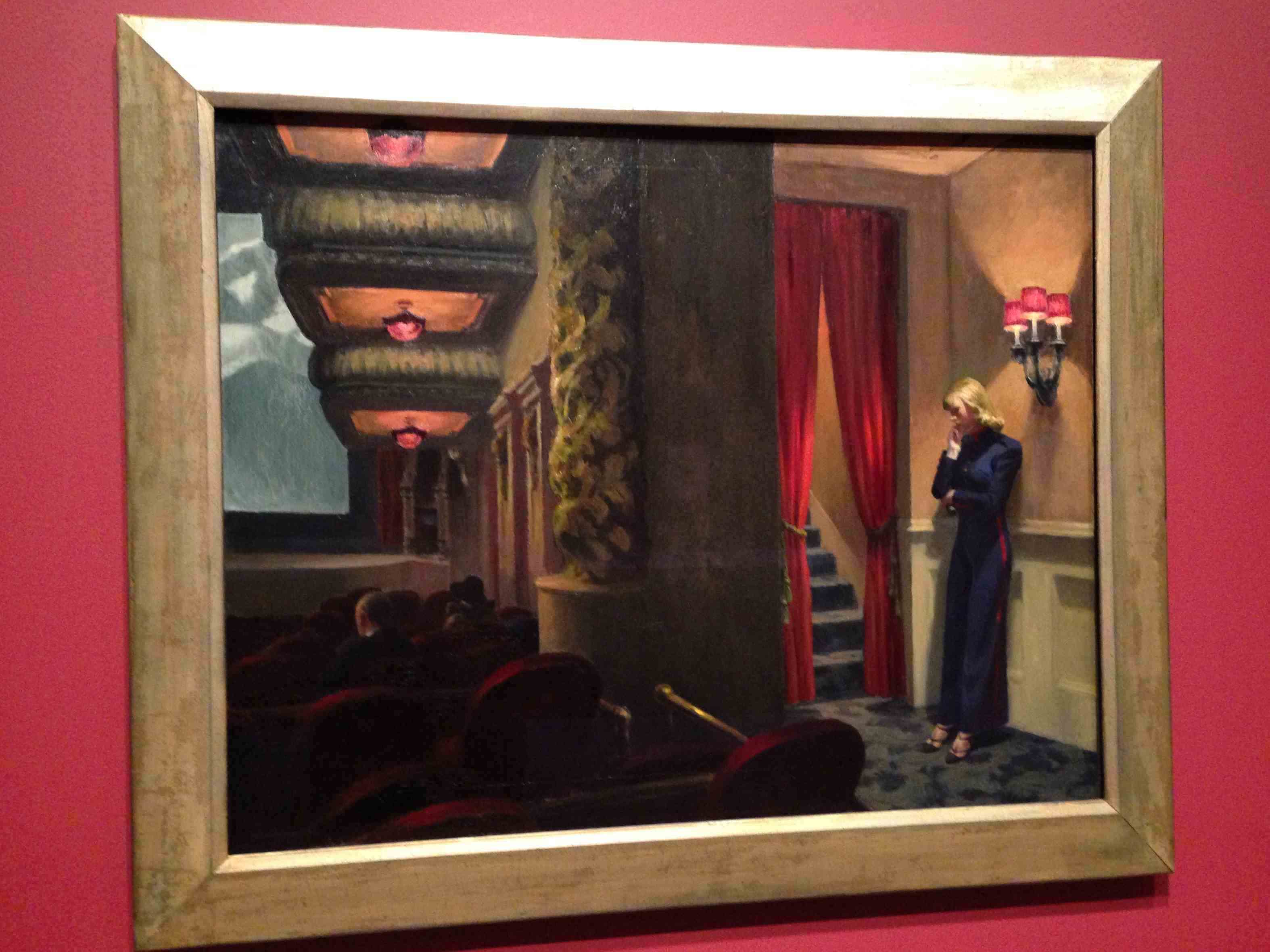
Although Hopper’s representational work is considered by his fans to signify “realism”, Foster has unearthed and organized zillions of preparatory drawings that demonstrate that this is hardly the case. Hopper, as he often said, worked “from fact” but added improvisational touches that pretty much made the canvases perfect. A case in point is New York Movie, where one side of the canvas is “real”, and the other side is completely imaginary. His sketchbook from the Palace Theater proves it.

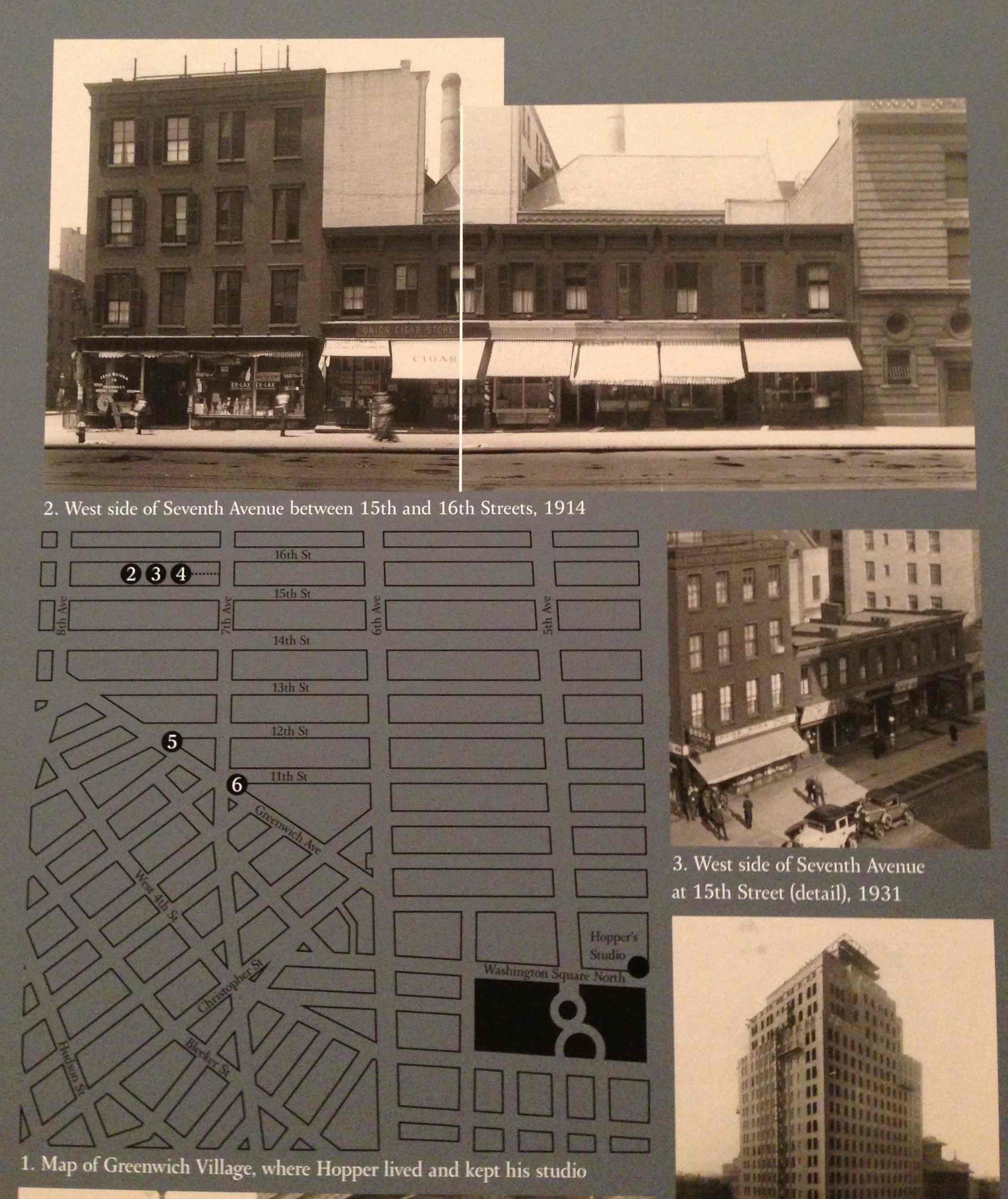
Whitney exhibition card showing map and 1914 photograph of the West Village storefronts depicted in the above oil painting

Whitney exhibition card showing map and 1914 photograph of the West Village storefronts depicted in the above oil painting

To prove this point, you’ll see the most famous Hopper paintings right alongside his preparatory sketches and sketchbooks to see his meticulous decision making process. Go to the exhibition web site (or our Flickr feed) and flip through images of Hopper’s iconic oils (such as New York Movie  and Chicago’s Nighthawks), followed by sketches and studies where Hopper worked out all the compositional kinks.

Hopper lived and worked right inside the row of gorgeous 1830s townhouses along Washington Square North. It’s a complete surprise to find that NYU still preserves Hopper’s studio intact, complete with his print press and easel.

Foster convinced NYU to loan it to the show, and it’s an electrifying reminder that artists once walked the streets of the Village and then came back to paint. You’ll stand face-to-face with the working easel that Hopper used to paint every one of his great works. Early Sunday Morning is perched, right where it sat in 1930, facing the Hopper’s other icon Nighthawks, on loan from Chicago’s Art Institute. The width of those canvases precisely matches the width of the easel.

Installation view of Hopper’s New York Movie (1939), on loan from MoMA

Installation view of Hopper’s New York Movie (1939), on loan from MoMA

So, that left a question: Where these real places, or fictions made up entirely in Hopper’s mind? Foster spent time trying to figuring it out, and thankfully the Whitney recorded the answers on its YouTube video. Take a walk with him and see the Village and the Flatiron through Hopper’s eyes back in the 1930s. You’ll never look at Nighthawks the same way again. Genius.

For theater fans: It’s not in the video, but Hopper’s sketchbooks are also filled with drawings of Times Square theaters — the Palace, the Globe (now the Lunt-Fontanne), the Republic (now the New Victory; formerly Minsky’s Burlesque),  and the Strand (where Morgan Stanley now sits).

Medieval Foodies

Cooking ScrollWhen you enter Mr. Morgan’s Library, you never know what you’re going to find, since the curators are always surprising us with treasures from the archives. Remember when the volcano spit ash all over Europe several years ago and all the flights were grounded?  The Magna Carta couldn’t get home, so it took up residence for a few months right in front of Mr. Morgan’s big fireplace in the East Room.

If you get over there before October 6, you’ll get to see something just as unique – a scroll from the mid-1400s containing 200 recipes (in Middle English, of course) that are fit for a king or royal lord. Move over, Smorgasburg!

The scroll would have been created by foodies some time around the reign of Henry VI (1422-1461) or Edward IV (1461-1483) during the War of the Roses. Henry’s objections to the aristocrats’ rights protected by the Magna Carta led to civil war, which was won by Edward, his successor from the House of York. At least someone was eating well and practicing penmanship during this tumultuous time in Merry Olde England.

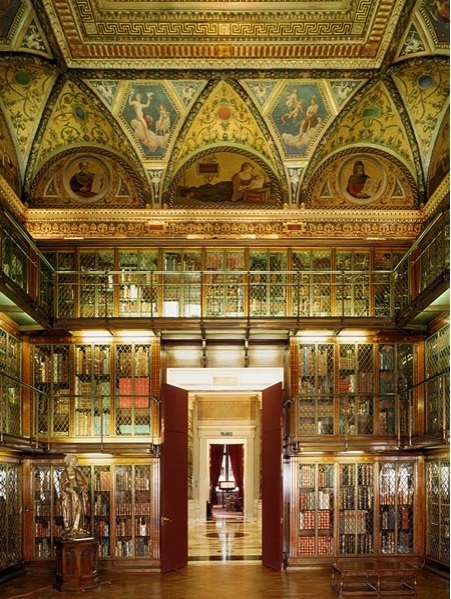
30-foot walls of Mr. Morgan’s Library have three stories of inlaid Circassian walnut bookcases with treasures of world literature. Photo © 2006 Todd Eberle

30-foot walls of Mr. Morgan’s Library have three stories of inlaid Circassian walnut bookcases with treasures of world literature. Photo © 2006 Todd Eberle

The cookery scroll is displayed right inside the library door, past the historic marbled rotunda, keeping company with one of Mr. Morgan’s three Gutenberg bibles just opposite. It’s fitting that these two treasures are holding court together: one showing the hand-crafted way that oral traditions of the one percent were being preserved; the other suggesting the revolution that was about to unfold as movable type and printing presses made the printed word universally accessible. Check out the amazing digital facsimile of Mr. Morgan’s printed treasure.

The scroll is part of an ongoing exhibition series, Treasures from the Vault, which also features music, letters, and manuscripts from the greats of Western culture. Check out the surroundings.

Here’s a video of everyone’s favorite still-working Tudor kitchen at Hampton Court Palace. The palace wasn’t built until 1529, but it will give you a visual on how some high-end cooks could have been using the scroll 550 years ago.

For more detailed 14th century cooking techniques, check out the YouTube by MedievalArtScience.


Thousands Flock to the Light

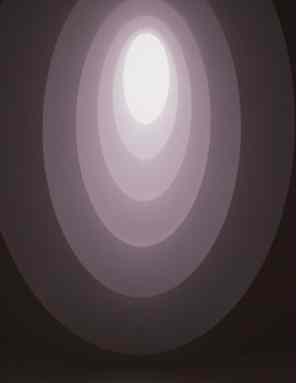
Imagine you are laying on the floor of the Guggenheim rotunda and that you are looking up at James Turrell’s new work. This is what you’d see.

James Turrell’s Aten Reign. Source: Guggenheim

The colors slowly, slowly morph for the next hour, changing from pink to green to yellow until they work through the entire color cycle. As yellow fades, you see the white, glowing sun…or is it the moon?

Aten Reign moment in the Guggenheim atrium, James Turrell’s site-specific spectacular. Source: Guggenheim

Aten Reign moment in the Guggenheim atrium, James Turrell’s site-specific spectacular. Source: Guggenheim

You need to get there to experience the spectacular light before September 25, when James Turrell takes his leave of New York, the end of his first major show here. The museum’s exhibition site is wonderful, but it’s no match for the out-of-this-world, cosmic experience of his masterful Aten Reign.

The Guggenheim has blocked off the famous skylight and any view of the atrium from its gallery spiral. Viewing the light show from the ground floor, all viewers see are these rings of slowly changing light with an oval center – a natural shape that Mr. Turrell loves.

Out-of-towners expecting to have the fun of walking up the ramp and looking down on ever-tinier ground-floor visitors will be disappointed. But other magical Turrell encounters await.

On Level 2, we found celebrated security guard, Jeffrey Martinez (see this week’s New York Times profile on him) holding throngs in rapt attention explaining the magic wrought by Mr. Turrell with his corner floor-to-ceiling strip of light. Martinez told us that although it appeared to be a vertical “light”, we were actually seeing an illumination emanating from behind the false wall. The New York Times was right to single him out for a story, because it felt like we were meeting a celebrity with art-world smarts, gently cautioning people against trying to touch and asking them to “stand back” to give the piece some space.

Afrum I (White), 1967, one of Mr. Turrell’s early cross-corner projections. Source: Guggenheim

Afrum I (White), 1967, one of Mr. Turrell’s early cross-corner projections. Source: Guggenheim

Upstairs, the show presents two more light installations that mimic two of the twenty 2D etchings precisely ringing a small gallery. Mr. Turrell creates the illusion, on paper, of light glowing from the white cubes surrounded by the ink. You just have to see them and then turn the corner to see “square” beams of light illuminating two walls. In the second room, Afrum I (White) astounds. You think you’re seeing a levitating white cube of light. Magical.

Hear him talk about his view of Mr. Wright’s philosophy and building and why they are so right for one another:

Enough said. Go see it.

Spoiler alert: The Guggenheim’s YouTube site has several videos about how Turrell and the team created the magic on the spiral.

LA Whimsy Runs Riot at The Met

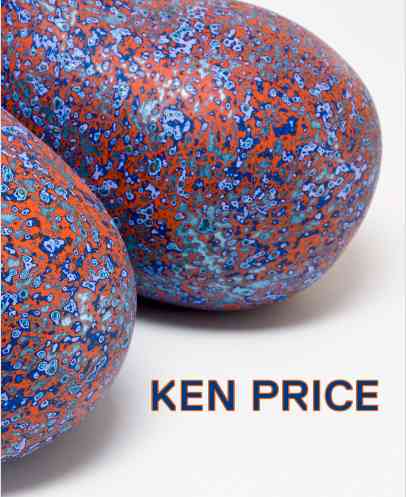
The catalog cover shows a close-up of Price’s finely sanded surface

Catalog cover close-up of Price’s finely sanded ceramic surfaces

If you want to feel happy, step into the Frank Gehry-designed space at the back of the first floor of the Metropolitan Museum of Art before September 22 to see Ken Price Sculpture: A Retrospective. You’ll find colorful abstract ceramic sculptures that absolutely defy you to smile.

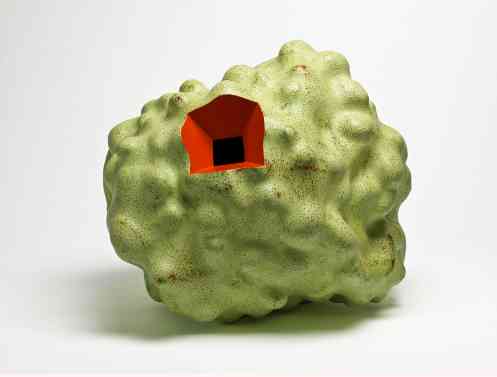
Blobs, twists, eggs with things popping out, and joyful fantasy shapes abound in the clean, white space. It’s impossible to make sense out of any of it, except the feeling that you are let loose inside the mind of a California artist, who claimed to have a “highway to the unconscious.”

Price, a superstar on the West Coast, is fairly unknown here in the East, so it’s nice to get to know him. As a student, he was tutored by legendary ceramic artist Peter Voulkos and then worked mostly around Venice, California (and occasionally Taos) for the next 50 years, producing delightful, collectable pieces, and hanging out with LA greats Rusha, Irwin, Keinholz, Bell, and Bengston.

Pastel, 1995, fired and painted clay. Courtesy: James Corcoran Gallery. © Ken Price. Photo: © Fredrik Nilsen.

Pastel, 1995, Ken Price’s fired and painted clay sculpture, courtesy of the James Corcoran Gallery. © Ken Price. Photo: © Fredrik Nilsen.

The show begins with Price’s most recent work and works back through time, so you’ll encounter some of the larger, crazier, colorful pieces right as you walk in. Some of the ceramic surfaces of look pebbly and coarse, but this is right where Price worked his magic. He painted coat after coat atop his fired pieces, and then meticulously sanded it all down to make a silky smooth surface. You really can’t tell unless you’re eyeball-to-eyeball with the blob sculptures, but the cover of the catalog (top left) gives you a hint.

This experience suggests the type of fun, contemporary shows that The Met will mount when it takes up residence at the Whitney’s building on Madison, once that institution decamps for the High Line in 2015.

Take 3 minutes to let curator Stephanie Barron walk you through LACMA’s installation earlier this year, which is pretty much what you’ll experience on Fifth Avenue. She tells you a little about Gehry’s gallery approach and talks about her relationship with the fun, fabulous Ken Price. Enjoy the spin, and get over to The Met for some real California fun.

Wood Goes Against Grain at MAD

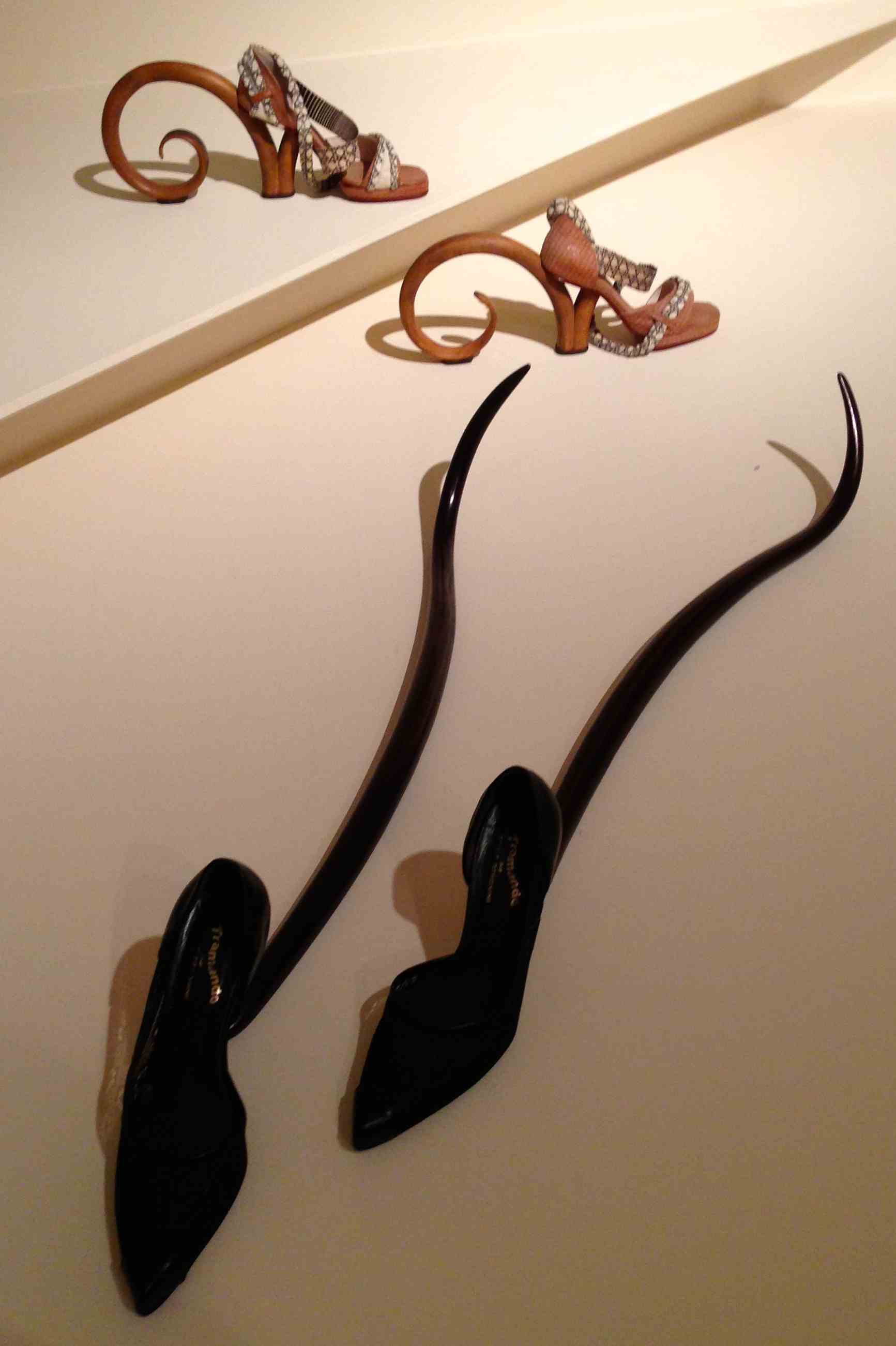
Pablo Reinoso's whimsical wooden shoes

Pablo Reinoso’s whimsical wooden shoes

All those years walking up and down the aisles at craft fairs may have you convinced that there’s nothing new in wood art. Get over to the final days of Against the Grain: Wood in Contemporary Art, Craft, and Design at the Museum of Art and Design.

It’s not what you’d expect, and curator Lowery Stokes Sims has done a magnificent job in telling us what’s trending now with forward-looking artists on the scene.

In short, she focuses her two-floor exhibition on seven trends that she sees: Artists, like Ai Weiwei, working on socio-political themes, whimsical designers who make us smile, digital artists pushing the envelope with wood, collages, virtuoso technique, takes on trees, and works that just capitalize on the beautiful texture in the wood itself.

Check out our Flickr feed for views of some of our favorite works, and MAD’s four-minute video as Sims herself walks you through the show, the artists, and her thinking about the pieces and themes.

Steam-bent ash chairs by Christopher Kurtz

Steam-bent ash chairs by Christopher Kurtz

But let’s focus on some of our favorites, which you can see on Flickr.

Wood as fashion: What about these shoes by Pablo Reinoso? If you’re thinking Dutch wooden shoes, think again, because these dainties are inspired by Thonet chairs, that he’s embellished with long, wooden “tails”. Or wooden hats by fashionable Moody & Farrell of London.

Music: How did Maria Elena Gonzalez go from looking at a fallen birch tree to creating paper-thin birch rolls that can create stunning music on a player piano? Watch and hear it all on this video of her player piano in action.

Laurel Roth's Hominid Chimpanze (2011) from vere wood with Swarovsky crystals in the teeth

Laurel Roth’s Hominid: Chimpanze (2011) from vere wood with Swarovsky crystals in the teeth

How-did-they-do-that category: Bud Latvin’s gravity-defying wooden spiral sculptures, Christopher Kurtz’s impossible steam-bent chairs, and Elisa Strozyk’s wooden textile.

Recycled surprises: Think about what it took to turn 8,000 recycled chopsticks into a collapsible sofa. Good going, Yuya Yoshida.

If you can get to this show today or tomorrow, go. If not, take time to meet Leonard Drew in his studio, see his wood works in progress, and hear what success in wood feels like:

Stylish NYC Micro-Housing Showcased at MCNY

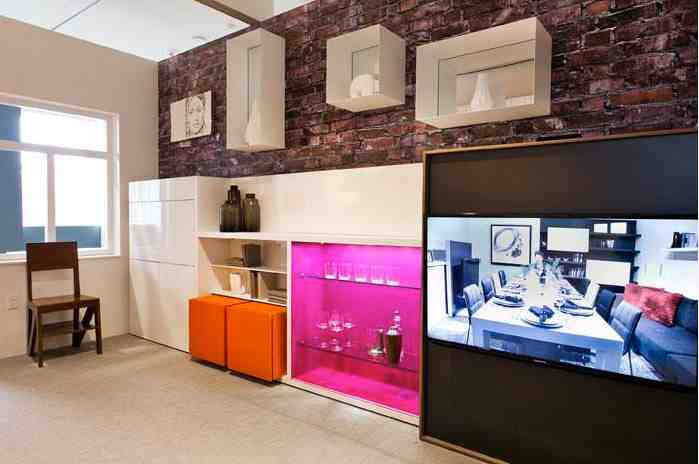
The TV wall slides away to reveal storage shelves

The 325 square-foot solution on display at MCNY: the TV wall slides away to reveal storage shelves. Source: MCNY

With all the single people living in Manhattan and the outer boroughs, it’s kind of shocking to find that building stylish, affordable micro-units is still illegal in most of the City. What’s a renter to do?

Get over to Museum of the City of New York pronto and take a look at the future in the hugely popular show, Making Room: New Models for Housing New Yorkers.

It’s no surprise that the housing stock here doesn’t match the demand. MCNY and the Citizens Housing & Planning Council got together to put on a show that raises the possibility of change, showcases several innovative solutions proposed by design teams, and presents a full-scale, walk-through model apartment: a 325 square-foot micro-space (built and furnished by Clei and Resource Furniture).

The sofa turns into a bed

The sofa turns into a bed. Source: MCNY

Apparently our City’s is due to grow by 600,000 people over the next 20 years, so the question becomes – where is everyone going to live? How can people live affordably? Is there a way to create living spaces that are flexible as families grow? Listen as CHPC’s Jerilyn Perine lays it all out in this fascinating 11-minute presentation at the 2011 kick-off to the project, focusing on housing demand, illegal rentals, and rental history in New York.

Currently, the City regulates things such as occupancy, density, minimum room size, parking areas, lot coverage, the number of dwelling units that can be on a single lot, and the proportion of living vs. working space in some parts of town. And, yes, most neighborhoods prohibit building spaces like the micro-studio at the center of the MCNY show. CHPC’s projects imagined what could be if some of those regulations (well intended) were relaxed.

Read about the background of CHPC’s Making Room project and design competition and find links to related TED talks, sites, and the proposed design solutions – stacks of prefabricated apartments, mini-bungalows for the Bronx, and repurposed industrial spaces in Brooklyn. The CHPC site shows details of each of the five featured plans.

But the star of the MCNY show is the model studio. Here’s a video of what you can experience for a few more days. (The show was held over by popular demand.) Note the transformation of the Cubista (the ottoman-looking piece of furniture that unfolds), and so many other smart small-space design choices.

African Art – 20th-c Modern Master Collectables

Sculptural Element from a Reliquary Ensemble: Head. The first African sculpture to be exhibited with modern masters in NY at Robert Coady’s Washington Square Gallery. This pre-1914 wood sculpture is from Gabon. Source: Curtis Galleries, Inc.

The first African sculpture to be exhibited with modern masters in NY at Coady’s Washington Square Gallery in 1914. From Gabon. Source: Curtis Galleries, Inc.

The show closing at the Metropolitan Museum of Art this weekend, African Art, New York, and the Avant-Garde, is a love letter to the advent of modernist art in New York 100 years ago. In the early 1900s, artists like Picasso and Matisse began looking more closely at the exotic shapes and forms pouring out of Gabon and Cote d’Ivoire – the primary sources of wooden African statuary at the time in Europe.

The Armory Show in 1913, rocked New York, where crowds viewed disruptive cubist works by Picasso, Duchamp, and Braque. Although the edgy work startled New Yorkers and the press, American modern artists and connoisseurs went crazy for African art because it looked so “modern”.

Sensing an opportunity, Stieglitz sent his friend, Marius de Zayas, to Europe to bring back more. Good thing, since Europe was soon at war and the global art scene shifted to New York. Stieglitz’s 291 Gallery and the Washington Square Gallery in the Village became leaders of the new trend, mounting a series of shows. De Zayas had to push Stieglitz to mix African art with Picasso, and it worked. One critic looked and said, “Here are the fathers of Gaugin, Matisse, and Picasso!”

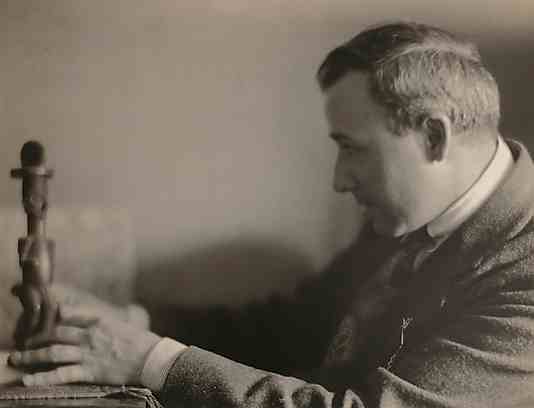
Clara Sipprell’s 1916 Portrait of Max Weber, where the artist holds a wooden figure from the Democratic Republic of the Congo. He bought it in 1906, the first African sculpture to be brought back to the City by a New York art-lover. Source: Museum of Fine Arts, Boston.

Clara Sipprell’s 1916 Portrait of Max Weber, where the artist holds a wooden figure from the Democratic Republic of the Congo. He bought it in 1906, the first African sculpture to be brought back to the City by a New York art-lover. Source: Museum of Fine Arts, Boston.

This show is special because the curators really went all out – huge photo-murals of the ground-breaking shows, the actual works you see in the photos, and photos of same from the magazines and newspapers of the day. It’s an art-history, primitive art, and modernist master trifecta.

Visitors feel like they’re stepping right into 291 itself, seeing mash-ups of African art, nature objects, and European cubist works. Poking through the vitrines, you’ll see works appearing in New York for the first time since 1914, gorgeous Sheeler photos of early exhibitions, and lots of work collected by Mr. Schamberg (for whom NYPL’s Harlem library/collection/study center is named).

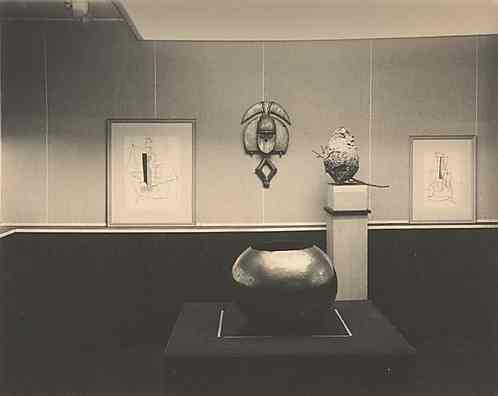
Stieglitz’s Picasso and Braque show at 291 Gallery (Dec 1914-Jan 1915). This features a Kota reliquary statue hung as art, like the fine Picasso nearby, a brass bowl, and a wasp nest. Source: Stieglitz photo from The Met.

Stieglitz’s Picasso and Braque show at 291 Gallery (Dec 1914-Jan 1915). This features a Kota reliquary statue hung as art, like the fine Picasso nearby, a brass bowl, and a wasp nest. Source: Stieglitz photo from The Met.

Since Georgia O’Keefe gave Mr. Stieglitz’s entire collection to the Met, the show packs in many surprises — his African works, his Matisse and Rivera paintings, and issues of Camera Work. There are key pieces from the Smithsonian’s National Museum of African Art and loans from Philadelphia’s Arnesberg collection.

In 1923, the Brooklyn Museum was the first museum in the West to show African art as “art” (versus “anthropology”), Penn was the first museum to actively collect it, and we all know what Mr. Barnes did when he displayed his magnificent modernist collection.

Check out all the objects in this amazing exhibition, but walk through the show in person if you can.

If you have some time, sit in on the curator’s talk via YouTube. Around 33:00 they start talking about the works in the show with a nice split screen that shows the speakers and the slides, so skip ahead and take a provocative, virtual tour.

Anxious, Turbulent Skies in Masterful Landscapes

Frederic Edwin Church’s depiction of the volcanic eruption in Ecuador -- Cotopaxi, painted in 1862 and exhibited the following year. Source: Detroit Institute of Arts.

Frederic Edwin Church’s depiction of the volcanic eruption in Ecuador — Cotopaxi, painted in 1862 and shown the following year. Source: Detroit Institute of Arts.

Who expects that gigantic, bold 18th-century people-free landscapes by Bierstadt and Church to bear the heft of telling the anxious backstory of America before, during, and after the Civil War?

It’s true. Big landscapes are the booknds to the dramatic story told by the Smithsonian Museum of American Art’s exhibition to honor the 150th anniversary of Gettysburg, American Painting and the Civil War, installed through September 2 on the upper and lower levels of the Met’s Lehman Wing.

Seeing the stunning upper-gallery works within the context of America’s troubled times is a must. You’ll never look again at a Bierstadt or Church again without checking its date to see if it was painted in the 1859-1865 range.

Sanford R. Giffins’s 1863 oil, A Coming Storm, says it all. Retouched by the artist in 1880. Source: Philadelphia Museum of Art.

Sanford R. Giffins’s 1863 oil, A Coming Storm, says it all. Retouched by the artist in 1880. Source: Philadelphia Museum of Art.

Hear Smithsonian curator Eleanor Jones Harvey’s three-minute introduction to how these magnificent landscapes became the “emotional barometer” of the country and what approach genre painters took in the midst of changing times. Then, check out the Smithsonian’s nice timeline and click on Church’s Meteor of 1860 and Our Banner in the Sky from 1861 to see what was in the news while these were being created in the studio.

You’ll find Sanford Gilfford’s A Coming Storm (1863) in the timeline in 1865. Ironically, this was owned by Shakespearean superstar Edwin Booth right after it was painted, but before his brother actor John Wilkes changed history and trashed the family name. When Melville saw the painting in a New York gallery a few weeks later in April 1865, he felt the tragic irony so profoundly that he had to write a poem to process it all.

Bierstadt’s Looking Down Yosemite Valley, California, exhibited in 1865, one year after Lincoln signed legislation declaring this a public reserve. Source: Birmingham Museum of Art.

Bierstadt’s Looking Down Yosemite Valley, California, exhibited in 1865, one year after Lincoln signed legislation declaring this a public reserve. Source: Birmingham Museum of Art.

Church, Homer, and Gifford also painted camp life during the War, and those up-close-and-personal works are also featured in the show, alongside very precise oils of Confederate encampments by Conrad Wise Chapman. Thanks to Richmond’s Museum of the Confederacy, which loaned the works by Chapman, you’ll get to see the famous experimental submarine, The Hunley as it was in 1863. The submersible was raised from the depths near Charleston in 2000 with the tar bucket you’ll see in Chapman’s oil painting

But back to the giant landscape that closes the show upstairs. Bierstadt paid someone to take his place in the Union Army, so maybe that’s why his mind was free concentrate on more placid, ethereal works, such as the show’s finale, Looking Down Yosemite Valley, California of 1865 – a immersive look into the California Eden that Lincoln’s signature in 1864 preserved as public land and away from scarred landscapes of the battlefield states.

What’s the connection between Arctic exploration and unusual nighttime phenomenon of 1864? Watch this video to see how Church used them to convey the mood of the country through his powerful, gigantic, beautiful Aurora Borealis.

See a slide show of 34 paintings in the show and access the full set of video podcasts on the Smithsonian’s web site.