Texas Retirement for World Famous NYC Dinos

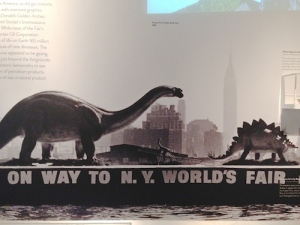
A 1964 New York Times photo of the Sinclair Dinosaur and Stegosaurus passing by the Empire State Building on their way to the Queens fairgrounds

A 1964 New York Times photo of the Sinclair Dinosaur and Stegosaurus viewing the Empire State Building on their way to the Worlds Fair fairgrounds

The Sinclair dinosaur was a sensation when he arrived in New York City to star in the 1964 World’s Fair. Millions of visitors queued to have their pictures taken with him and get a glimpse of life-size replicas of the scale and scope of the Mesozoic megafauna.

T. Rex, Stegosaurus, Triceratops, Trachodon…never mind that they lived millions of years apart – just to see them inspired science geeks, wonder seekers, and future paleontologists – an unforgettable childhood impression.

It may surprise you to learn that Sinclair and T. Rex are living a blissful retirement in Texas where there are no Unispheres, freeways, lines of tourists, or ticket booths…about 75 miles southwest of Fort Worth in a state park with another unique connection to New York.
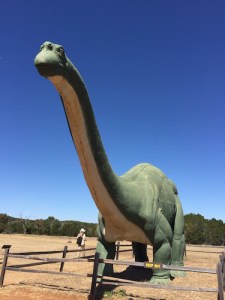
Sinclair relaxes in a Texas corral

Sinclair relaxes in a Texas corral

The gargantuan dinosaur trackway up on the fourth floor of the American Museum of Natural History is from the Paluxy River in Dinosaur Valley State Park, where these two former New Yorkers have retired.

Back in the Thirties, AMNH field explorer Roland T. Bird told his boss, Barnum Brown, about the Texas trackways. In 1940, aided by WPA crews, the submerged tracks were excavated, cut into 1,200 pieces and shipped off to the AMNH, the Smithsonian, the University of Texas, and a few other places.The excavation was a media sensation, with chronicles appearing everywhere.

In New York, the jigsaw-puzzle track pieces were eventually reassembled and placed under the Apatosaurus/Brontosaurus, where they remain today.

Apatosaurus atop Paluxy trackway in New York at AMNH

Apatosaurus atop Paluxy trackway in New York at AMNH

The big, round blobby tracks that appear to match those of Apatosaurus are reckoned to be those of Sauroposeidon and the three-toed tracks running right alongside are those of Acrocanthosaurus, a predator.

Even though this spectacular trackway got moved to New York, there are still plenty in in the park. There are at least five big sites, which have all been documented in the Dinosaur Valley State Park footprint-mapping project. See the results here. When you click on each photo mosaics or track overlays, they will open in Google Earth. Find the R.T. Bird site under Track Site Area 2.

But how did the New York dinosaurs get to Glen Rose? The entire dinosaur group toured the United States for a few years after the Fair, right around the time that Texans lobbied to have the Paluxy Trackway declared a state park. No dinosaur fossils at the time, but there were lots of footprints, mostly underwater but a few on the shoreline. Neighboring ranchers donated the land, hoping to keep the site intact and spur tourism dollars.

Sauropod footprints underwater at the Paluxy River, Glen Rose, Texas

Sauropod footprints underwater at the Paluxy River, Glen Rose, Texas

When the Sinclair tour concluded, Atlantic Richfield’s idea was to donate all the dinosaurs to the Smithsonian, but when the Smithsonian said they didn’t want the group, the band broke up. One went to Vernal, one to Cleveland, but Glen Rose was the only location that managed to get the two biggest stars. Did the New York connection make the difference?

It’s hard to know, but the recently opened Perot Museum of Nature and Science features a pop culture corner in its dinosaur hall with replicas of all of the NYC’s World’s Fair dinosaurs!

For the complete story, check out this video of the tracksite and an introduction to the Google Earth mapping project, old videos of Mr. Bird’s historic 1940s excavation, and cameos by the Sinclair dinosaur and friends.

World’s Fair T Rex enjoying a quiet life in Texas

World’s Fair T Rex enjoying a quiet life in Texas

Sneaker Culture Wows Brooklyn

Nike’s original Air Jordan I (1985) and the 25th anniversary Run-DMC Adidas brings joy to Brooklyn fans

Nike’s original Air Jordan I (1985) and the 25th anniversary Run-DMC Adidas bring joy to Brooklyn fans

Crowds in Brooklyn are levitating with excitement as they explore their own sartorial history in The Rise of Sneaker Culture, an exhibition running at the Brooklyn Museum through this weekend. Finally, a fashion history and technology show that really resonates with the men in the room!

The hundreds of historic sneakers, mostly from the Bata Shoe Museum collection in Toronto, tell the story of how casual sports footwear came to be so dominant in today’s high-fashion landscape.

Although there are a few examples of women’s footwear – early Keds from 1916 and iconic Reeboks from the Jane Fonda-fitness era – the focus is squarely on the men, their sports, and their athletic-inspired designer footwear.

The history section of the show shows some of the earliest rubberized sports shoes from UK collections, but quickly moves into familiar New York City territory when colorful creations began appearing at pick-up games on basketball courts around the city in the 1970s, and when the tide really turned through sports and music licensing.

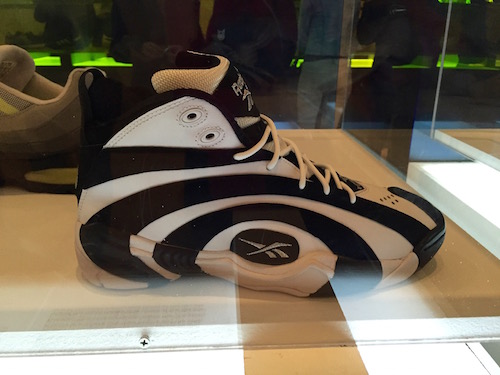
No one forgets the first time they saw Reebok’s Shaqnosis in 1995 (reissue)

No one forgets the first time they saw Reebok’s Shaqnosis in 1995 (reissue)

Crowds and docents jockey for space to worship at the altar of Nike’s 1985 Air Jordan I alongside the autographed reissue of Run-DMC’s 1986 Adidas. After Michael Jordan inked that deal and hip-hop video was distributed worldwide on MTV, sneaker fashion went viral. Electrifying images of loosely laced footwear were seen and copied by fans from the Bronx to Kathmandu. The right shoes and lacing style could wordlessly convey to others in the know, “I know what’s going down.”

Beautifully installed, Brooklyn crowds could work their way through men’s footwear history down one side and up the other – the original P.F. Flyers, original Chuck Taylors, streamlined European designs from the 1970s, Adidas’s early fitness shoes with built-in microprocessors, Nike’s Air Force 1, and Magic Johnson’s Weapons for Converse.

Nike’s 2009 limited edition for LeBron

Nike’s 2009 limited edition for LeBron

After the awesome case with the entire evolution of Air Jordans, the curators lined up a riot of color, technology, status, and design with evidence of so many subsequent licensing deals. Kanye’s new Yeezy Boot for Adidas was interesting, but the Reebock’s Shaqnosis and Nike’s limited edition for LeBron really stopped people in their tracks.

High-fashion sneakers by design and art luminaries Damien Hirst, Jeremy Scott, Chanel, Pierre Hardy, Raf Simons, Giuseppi Zanotti, and Rick Owens brought visitors right into the present day – when guys wear sneakers and tuxes to the Emmys, just as Michael Jordan predicted they would three decades ago.

A great touch at the show’s exit was the opportunity for visitors to leave a note about their own personal “sneaker story” and draw their favorite one.

Take a look at our favorite footwear from the show on our Flickr feed, all presented in chronological order. And enjoy this brief presentation on men’s contemporary footwear in this behind-the-scenes peek into the collections of the Bata Shoe Museum with senior curator Elizabeth Semmelhack:

Daring Docent Dishes with Digital Adam at The Met

Digital Adam and the Docent reenact what Paradise was like before The Fall

Digital Adam and the Docent reenact what Paradise was like before The Fall

There’s no need to check into the Met after hours to see a classical statue come to life. In Renaissance gallery 504 on the main floor, a digital version of Tullio Lombardo’s 15th-century Adam is interacting with visitors and a knowledgeable Docent in Reid Farrington’s The Return performance through August 2.

The Return is quite a production and its illusions created in the Italian Renaissance gallery would make any animation fan jump for joy.

Classical Adam (the marble one) is installed prominently in the gallery where half the performance takes place. Its presence is a miracle, since the beautiful Renaissance sculpture totally shattered in a freak fall in 2002.

To repair it – a complex undertaking — Met team made a digital replica of all the pieces to decide how to fit everything back together again and spent years making it whole.

Tullio Lombardo’s Adam (1490-1495), which fell and shattered in 2002, but has been exquisitely repaired

Tullio Lombardo’s Adam (1490-1495), which fell and shattered in 2002, and is now repaired

Now, it’s Digital Adam who’s the fascinating co-star of the show, brought back to life by performance artist Reid Farrington who envisioned a tribute to the virtuosity of the Met’s conservation team who so flawlessly reassembled Tullio’s Adam.

The other half of the performance involves an improv actor, a motion sensor suit, and a crew of digital engineers and prop masters, all camped out on the stage of the Met’s auditorium in the Egyptian wing. As the stage actor moves in the auditorium, Digital Adam moves, speaks, answers questions, and holds up a Warhol and a Van Gogh inside his lifesize digital frame in the Renaissance gallery to the delight of the audience and his sidekick, The Docent. See photos on our Flickr feed.

The audience decides what part of Classical Adam’s renovation will get discussed next, but the witty duo soon veer off into other fascinating topics:

Actor in motion-capture portrays Digital Adam, whose image is simulcast at the right and in gallery 504

Actor in motion-capture portrays Digital Adam, whose image is simulcast at the right and in gallery 504

What does it feel like to always look good and never age? Does Classical Adam remember back to the marble quarry? Does Biblical Adam remember what Garden of Eden was like before the Fall? Adam’s clever responses reveal that his Eden experience was a lot about infinity pools and the good life.

At one point, Digital Adam invites the Docent to portray Eve in his telling of what happened after the Serpent appeared with that apple. Then the attention turns back to Classical Adam, as the Docent shows Lombardo’s thinking about that particular moment portrayed in marble.

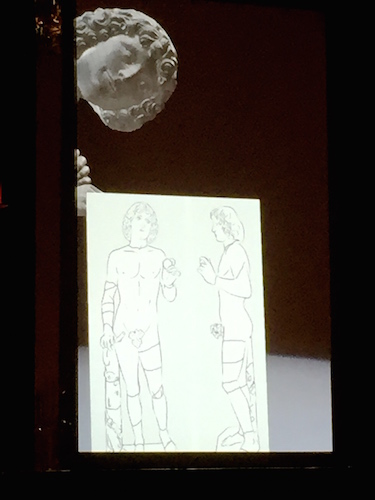
Digital Adam shows drawing of where the breaks in Lombardo’s Adam occurred

Digital Adam shows drawing of the breaks in Lombardo’s Adam

These two need their own ongoing talk show about history, time and space in some corner of the Met. Until August 2, ask the information desk for The Return’s program and go marvel at both the gallery and the behind-the-scenes performances. Or go to the live stream on the Met Museum’s website.

After meeting Digital Adam, you’ll never again wonder about what’s going on inside Classical Adam’s cool, calm, beautiful marble head.

Before Shapewear: Six Centuries of How to Look Good

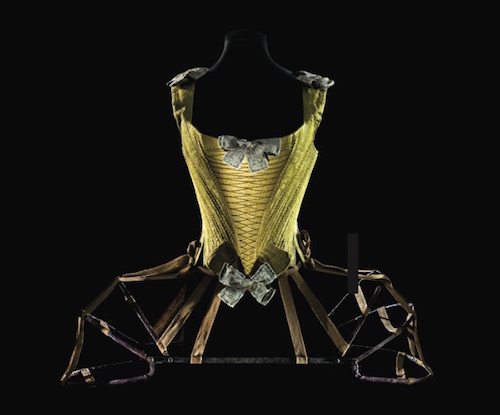
Articulated French pannier made of iron, leather, and fabric tape, 1770. Source: Les Arts Décoratifs. Photo: Patricia Canino.

Whalebone corset (1740-1760) above 1770 articulated French pannier that collapsed. Source: Les Arts Décoratifs. Photo: Patricia Canino

If you’ve ever successfully poured yourself into a pair of tight jeans, pay a visit to the Bard Graduate Center Gallery’s townhouse through July 26 to see Fashioning the Body: An Intimate History of the Silhouette, a three-story exhibition of how women – and men — pushed, pulled, and shaped their bodies into the “hot” silhouette of the day.

The show originated in the Musée des Arts Décoratifs in Paris in 2013 tells the story of how fashion divas and dandies utilized undergarments to stiffen, enhance, pad, and pouf themselves to create the iconic shapes we admire in paintings, photos, magazines, and other pre-digital media.

Painted yellow silk taffeta American robe a la Polonaise, 1780-1785 Installation views of “China: Through the Looking Glass” May 7 - August 16, 2015 Metropolitan Museum of Art New York, New York

American robe a la Polonaise held up by wire, 1780-1785. Source: Metropolitan Museum of Art, “China” exhibition.

Corsets (some iron!), farthingales, whalebone stays, panniers, crinolines, bustles, and girdles from the 15th century until today are all on display. You’ll see exactly how those whalebone stays stiffened corsets worn by nearly every woman from the 1500s to 1800s, and be amazed to learn that little children were also strapped into kids’ corsets to help shape “unformed” bodies right up through the 1950s in Western Europe.

Mr. James would approve of all the engineering that the curators reveal for us. Who knew that those wide panniers under 18th century French court skirts had elaborate mechanisms that could collapse to let their wearers squeeze through narrow carriage doors or tight household doorways? Automated models demonstrate just how neatly these ingenious apparatus operated to create the illusion of width just below super-tiny corseted waists.

How were those elaborate poufs created at the back of 1770s court gowns in the “Polonaise style”? Ladies could manipulate wires through eyelets in the voluminous triple-part skirts to create just the right amount of volume, drape, and flash.

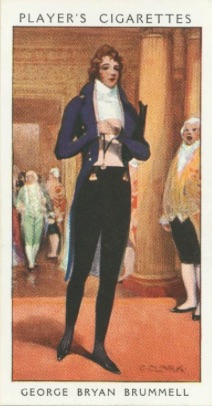
Uber-dandy Beau Brummel. Source: NYPL’s digitized George Arents Collection.

Uber-dandy Beau Brummel. Source: NYPL’s digitized George Arents Collection.

And the men! Under the sparkle jackets of 1770s court dress (subject of our previous post), the guys consciously padded chests, calves, and other body parts to give the appearance of a more muscular physique even if they hadn’t been working out. Shapely men’s calves were all the more important since high-end men’s footwear at the time consisted of elevated Louis heels.

For dandies of the 1800s, it was all clothes, all the time, so an even wider array of sartorial artifice came into being—tight men’s corsets, stomach belts, padding, and (more) fake calves. Striking a pose meant everything,

The in-gallery app provides lots of insightful commentary on the items and apparatus. On the second floor, Bard has a line of mannequins that illustrate the changes in female silhouettes. Here’s a walk –through of that part of the installation:

Watch this companion video to see some the collapsible pannier, corsets, and girdles in the show – direct predecessors to the shapewear of today:

When Apple Met Alto and Game Boy Began

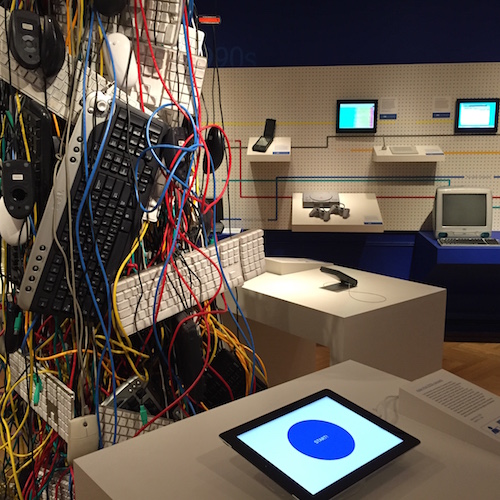
Tower of keyboards and wires in the center of the fourth-floor gallery; Newton visible against the history wall

Tower of keyboards and wires in the center of the fourth-floor gallery; Newton, PlayStation, and iMac visible on the history wall as iPad watches over everything

What’s the longest you ever sat in front of a computer screen or stared at stuff on your phone? Can you even remember a time before there were texts, browsers, and interactive screens? Bard Graduate Center Gallery has assembled a retrospective that asks you to remember your first keyboard, joystick, trackball, and mouse in their exhibition, The Interface Experience: Forty Years of Personal Computing, on view through July 19.

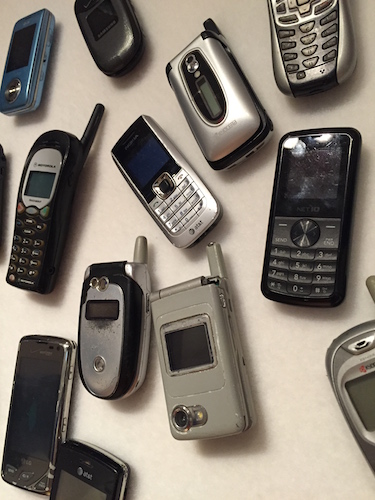
Plus, you can touch everything in the show and even sort through maybe every clamshell and Internet-enabled cellphone ever designed. What a stroll down memory lane!

Your first view of the fourth-floor show is a tangled tower of keyboards and cables, surrounded by a pegboard gallery with little platforms displaying the timeline of devices – desktop PCs, tablets, and game consoles.

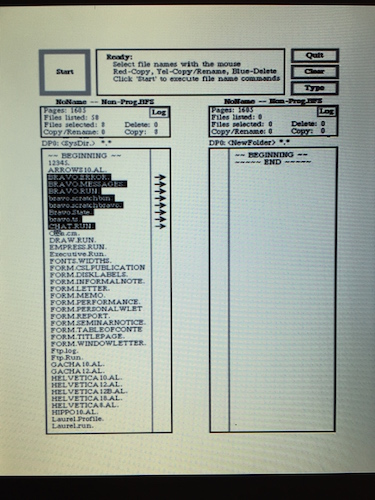
The 1973 Xerox Alto operating system featured the first mouse and graphic user interface.

The 1973 Xerox Alto operating system featured the first mouse and graphic user interface.

The oldest item in the show is the famous (but rarely glimpsed) 1973 Xerox Alto operating system, which the curators display on an ever-playing loop. Experience what Steve Jobs saw when he came face to face with the first graphical user interface, replete with the screen arrow. Brain flash on using a mouse to point to stuff on a screen – Steve said that someday everyone would be using something like this interface.

Walk on to see the Apple IIe (Woz built in an unbelievable 64K of RAM), VisiCalc (first “killer app” all quants had to have – a spreadsheet), and the predecessor to Steve’s Macintosh – the 1981 Xerox Star, which was the first commercially produced computer system to use a mouse and GUI. At a price of $16,000 in 1981, Steve’s up-and-coming Apple Macintosh was positioned to become a winner.

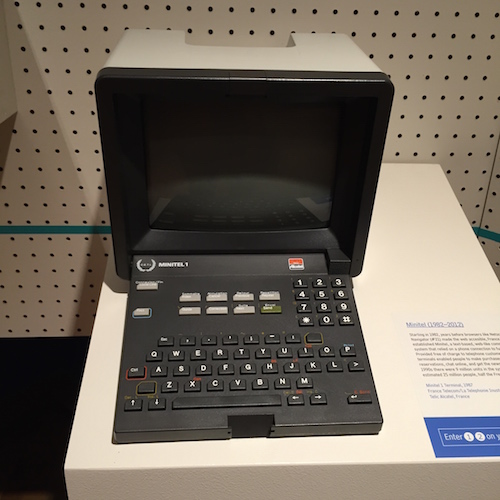
Before web browsers: Rarely seen, the exotic Minitel (1987 model) text information interface, which the French government distributed for free to half its population.

Before web browsers: Rarely seen, the exotic Minitel (1987 model) text information interface, which the French government distributed for free to half its population.

The Commodore 64 and IBM’s PC aren’t neglected, and neither is MS-DOS. Consider other game-changers such as Palm Pilot, Newton, and Kinect. You can touch them all and remember the way it was before things got smaller, faster, and got more oomph. Get a glimpse of the installation (pegboards and all) on our Flickr feed.

Don’t worry if you can’t get up to 86th Street to handle the technology in person. As usual, Bard’s students and faculty, who collaborated on this show, have produced a highly fulfilling web application that highlights everything in their show, adds historic tidbits, and shows each piece’s original print and TV ads.

Click on “Grid” to see all the exhibition items. Click on “Connections” to read interesting comments by the curators comparing different items or telling little histories about the relationships between the tech innovations. Click on “Device Statistics” to see how many units of each sold, how long it was in the market, and how much each would cost in today’s dollars. You’ll be able to sort the items by any of these parameters.

Steve’s hip and happening1998 iMac injected color into a drab, drab desktop computing world

Steve’s hip and happening1998 iMac injected color into a drab, drab desktop computing world

Example: sorted by today’s cost, the most expensive computing investment in the show would be the Xerox Alto operating system at (today) $225,981.

Be sure to click on “more” and enjoy the gallery of magazine ads for these innovations. And check out the 1979 TV commercial for Xerox Alto, on loan from the Xerox Archives, and please, do not miss the unforgettable all singing and dancing MS-DOS product introduction video.

You’ll read memories shared by gallery visitors about various items in the exhibition. For that matter, click on any item on the Grid and add your own story about your first personal encounter with these icons!

Bravo, Bard Graduate Center!

Mobile phones for days – the future of computing. The curators put these up with Velcro so visitors could feel them.

Mobile phones for days – the future of computing. The curators put these up with Velcro so visitors could feel them.

Dramatic Live Steam Show Envelops Virginia Museums

The restored 611 arrives in downtown Roanoke behind the art museum

The restored 611 arrives in downtown Roanoke behind the art museum

For the last month, crowds in western Virginia have been turning out in droves to see the dramatic result of engineering, technology, and determination by several museums and volunteers to resurrect the biggest, fastest passenger steam locomotive to live out its former glory on the Norfolk & Western Railroad.

If the CEO of Norfolk Southern hadn’t sold his Rothko in New York in 2013 and donated $1.5 million of its record-breaking proceeds, this amazing steam revival might not have happened.

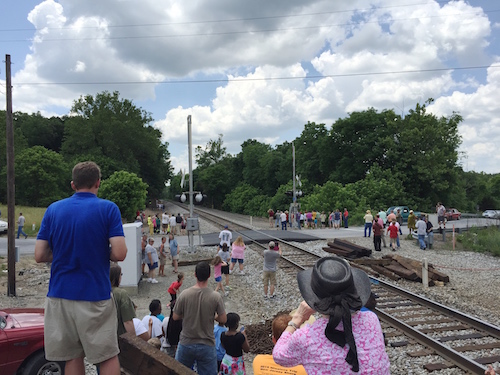
Waiting for the 611 at Evington, Virginia on its debut run

Waiting for the 611 at Evington, Virginia on its debut run

The Virginia Museum of Transportation is celebrating the culmination of efforts to “Fire Up the 611” and let this 100-mile-per-hour wonder rip through the foothills of the Blue Ridge and points east all month and hopefully into the future.

As the 611 made its way from its rehab yard at the North Carolina Transportation Museum in Spencer, North Carolina, people lined the tracks to see the newly refurbished 1950s streamlined locomotive pull 17 passenger cars loaded with fans 140 miles north to its new home in Roanoke. The celebration of 611’s return has been going on all month, as the locomotive keeps making runs to Petersburg, Lynchburg, Radford, and other Virginia towns.

611 parked next to the O. Winston Link Museum

611 parked next to the O. Winston Link Museum

The 611’s Twitter feed lets everyone know when to expect it, although the piercing steam whistle and roaring sound are also sufficient alerts to anyone in a five-mile radius. Listen to its sounds on our Flickr video of its 45-mph pass through one lucky town and see photos its Roanoke arrival.

The 611 and its 13 sister locomotives (Norfolk & Western J Class) were produced after 1941 and pulled passenger trains through Ohio, North Carolina, Virginia, and Tennessee until the late 1950s – around the same time that Rothko painted the canvas that would later benefit the 611’s resurrection. Since it’s retirement, this coal-fired steam engine mostly sat in the yard at the Roanoke museum, but had a brief comeback in the 1980s making a few tourist rail runs.

Inside the O. Winston Link Museum, showcasing Link’s spectacular photographs of the last days of steam on the Norfolk & Western Railroad

Inside the O. Winston Link Museum, showcasing Link’s spectacular photographs of the last days of steam on the Norfolk & Western Railroad

Norfolk Southern initiated a “21st Century Steam” initiative, and volunteers at the Roanoke museum began the “Fire Up the 611!” campaign. The NS CEO decided to jump-start the initiative with the $1.5 million from the Rothko sale, and volunteers put in over 8,000 hours to bring the magnificent machine back to life.

When the 611 steamed into downtown Roanoke on May 30, it stopped for photos and an official welcome right behind Roanoke’s contemporary at museum and in front of the O. Winston Link Museum, housing the work of one of the most acclaimed railway photographers of the 20th century in the former Norfolk & Western Railway Building.

Link’s 1960s portrait of steam locomotive fireman, Joe Estes

Link’s 1960s portrait of steam locomotive fireman, Joe Estes

Link, a Brooklyn-born commercial photographer, fell in love with steam locomotives that he knew were rapidly being replaced by diesel. He innovated nighttime lighting gear to capture dramatic shots of the steam giants coursing through the hills and crossroads of West Virginia and Virginia. Link recorded their sounds as well – recordings that continued to sell well for decades. Catch a glimpse of Link’s gorgeous images, equipment and recordings on our Flickr site.

After finishing its July runs, the 611 will be on display in the museum yard in Roanoke, parked alongside other giants of steam.