NYC Spider Theater Due to Close

Bronze Spider 1, 1995 by Ms. Bourgeois lurks at the show’s entrance

About the best spider theater in town is about to close in a few weeks – the live-animal floor show inside the American Museum of National History’s Spiders Alive! exhibition, where an actual spider-handler enthralls the crowds with myth-busting tales while introducing the arachnid star of the show, a Chilean Rose Hair Tarantula. Nearly 20 live species are crawling around the terrariums, but crowds are flocking to the live demo/theater area of the show and sitting spellbound until intermission. Go see it!

Since the AMNH never does anything second-rate, it’s fitting to note that welcoming visitors to the show is an art-world superstar. Lurking inconspicuously in the “canoe” lobby area outside the show is one of the smaller bronze spiders crafted by Louise Bourgeois. It’s smaller than the babies that graced the 1999 opening of Tate Modern’s Turbine Hall in London (and later the Guggenheim in Bilbao and Rockefeller Center), but who cares? Stop by for a glimpse.
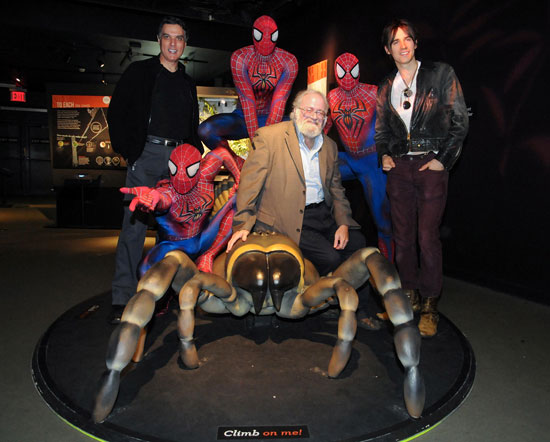
Robert Cuccioli, AMNH curator Norman Platnik, Reeve Carney and multiple Spider-Men take in AMNH’s “Spiders Alive!” © AMNH\R. Mickens

And lest you think that AMNH ignored the other obvious art-world connection, it didn’t, as shown by this amusing photo in September, when the cast of that other spider-themed show came to visit AMNH curator Normal Platnik for a walk-through.

Check out the opening-day YouTube promo below, but go meet the spiders up close and personal before they leave after January 6. If you’re a sci café geek that wants more, go poke around the AMNH World Spider Catalog.

235 Years of Veteran History in a High-Tech Park

Open again after the hurricane, best-kept-secret BLDG 92 has opened its doors to honor veteran, industrial, medical, and military history at the Brooklyn Navy Yard Center.

The stunning displays of over 235 years of history in New York Harbor inside are nothing compared to the experience of traipsing around by bus and foot to poke in and around the mix of crumbling 19th-century architecture, active dry docks, overgrown campuses, historic streets, and state-of-the-art sustainable design.

Take a look at the sights seen during the sunny days of summer on the Flickr feed, and book your trip now. It’s an adventure to get there (subways aren’t exactly close), but you will feel amazing to walk in the footsteps of so many heroes of American history and innovation, like Commodore Perry, Dr. Squibb, the North Atlantic Command for WWII, and Rosie the Riveter.

If it all feels and looks a little like a back lot, it is. (Boardwalk Empire shoots at the Steiner Studios and SNL builds sets there.)

Check out the photo of the tugboat under repair in the third oldest dry dock in the country – right where the Monitor was built for combat during the Civil War.  And if you’re a Navy history buff, immerse yourself in BLDG 92’s Flickr stream courtesy of the National Archives, stereoscopes and all.

What have you been missing?  Just check out this video, and then go see the real thing on foot, by bus,  by bicycle, or on an industrial tour:

Cool Off in Dublin Water Works

During the summer heat wave, there’s a way to cool down in Chelsea and let the team from the Science Gallery at Trinity College challenge you to think differently about the splashing water you take for granted.

Take advantage of the final weeks of Surface Tension: The Future of Water at Eyebeam Art & Technology Center on West 21st Street, an incubator for digital art/design experimentation. For the past two-plus months, they’ve hosted an exhibition (first curated in Dublin) on the social-economic-political tensions created by water scarcity.

As soon as you walk into Eyebeam, you’ll be struck by the plethora of infographics that show you just how much water bounty that we have in the United States versus the availability and consumption per capita in the rest of the world. What’s your water footprint?

One of the ways you’ll find out is by looking at The Virtual Water Project, a celebrated infographic by German designer Tim Kekeritz, that depicts everyday objects and the amount of water required to produce them. Download the iPhone app. For $1.99, it will blow your mind (but not your budget) and continue to deliver a truly a conscious-raising experience of epic proportion.

Another unforgettable experience is Bit.Fall by artist Julius Popp, an installation that translates words from Internet newsfeeds into bits that are reconverted into a stunning waterfall of words:

There’s so much great stuff: multiple takes on water consumption, conservation, next-gen thinking, third-world innovations, and art-meets-technology solutions. Like Tele-Present Water by David Bowen, which recreates actual water movements from NOAA data being collected from a random buoy out in the ocean.

If you can’t get over to Chelsea for an hour, just click through the thought-provoking objects, artworks, design solutions, documentaries, and thought pieces by the scientists, artists, engineers, and designers whose works are on display on the Dublin microsite.

What You’ll Be Wearing in Space

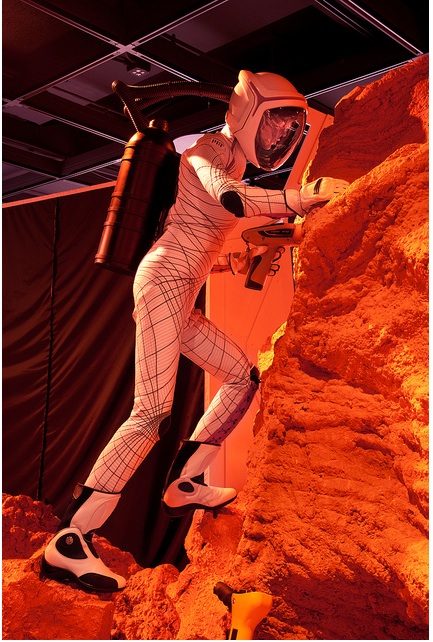
BioSuit™, a form-fitting next-generation spacesuit prototype by MIT aeronautics and astronautics professor Dava Newman displayed in the AMNH exhibition. © AMNH\D. Finnin

If the wizards at MIT have their way, the future look on Mars (for us) will be spandex, nylon, and polymer. It’s the look that’s featured in the soon-to-close show at AMNH, Life Beyond Planet Earth: The Future of Space Exploration.

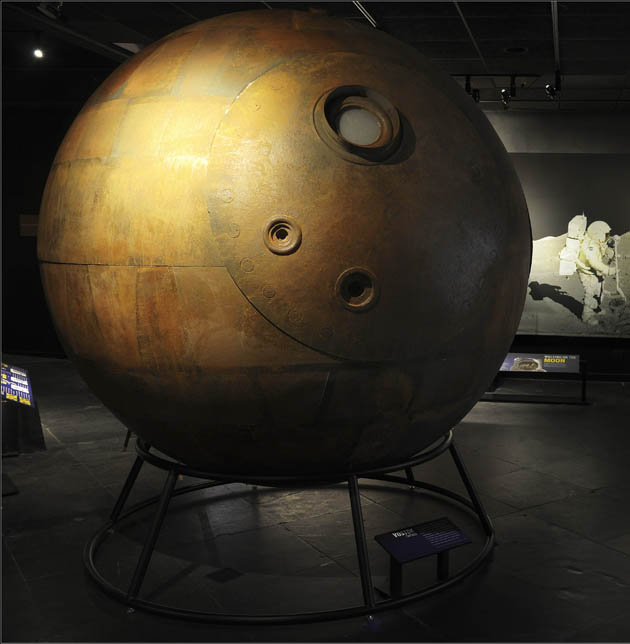
Some of the highlights include a model of Yuri Gagarin’s 1961 space capsule (don’t walk by it in the entry to the show!), Soviet and US space helmets, the “smell” of the Moon, a model of Sir Richard Branson’s space-tourist vehicle, and a space elevator.  (Didn’t you ever wonder how you’d get back from another planet?)

There are two great interactive opportunities – sitting down at a small console to skim over the surface of Mars and a big, well-lit interactive table (near the spacesuit) that lets you and others trigger modifications to Mars that eventually transform it into a habitable Earth colony.

Again, you can’t beat those 1950s letters to the Hayden Planetariumto get the juices flowing about the promise of space travel. Now, were do we order the suits?

Exhibition model of the Vostok capsule, in which Yuri Gagarin became the first person in space on April 12, 1961. © AMNH\R. Mickens

Daring Sea Rescue Yields Treasure

Treasure is what you’ll find in the upstairs galleries of The South Street Seaport Museum in Lower Manhattan, following its daring rescue by The Museum of the City of New York.

Armed with a two-year plan, a dedicated team, and construction crews, MCNY figured out how to transform former storage areas into sixteen beautiful galleries, re-open, and give new life to the museum and iconic tall ships anchored downtown.

In a brilliant use of space, MCNY enables us now to enter three separate time machines that should warm the heart of any NYC booster, particularly the side-by-side installation of two versions of Manhatta (the original name of our island community). The first is the (slightly reduced) reinstallation of the acclaimed Manhatta exhibition (and scientific project), which shows you visions of the island, inhabitants, geology, river systems, and fauna that Henry Hudson would have seen in 1609. (Crowds flocked to this uptown in 2009, so you here’s your second chance.)

The second is the adjacent gallery, where you can sit down and contemplate three stunning simultaneous views of our waterfront — Paul Strand’s famous 1921 documentary of our waterfront (Manhatta), Edison’s early 1900s views of our water’s edge, and a contemporary visual meditation. Time travel doesn’t get any better than this!

The third view, MCNY’s Timescapes film, sweeps more grandly over time and history. Images pop onto three screens as Stanley Tucci narrates the whole, complete story, from forested island to home of the High Line. It’s hard to take it all in, but you’ll be swept away and seriously, it will make you proud.

Although these shows are in open-ended runs, check them out sooner rather than later. Although the Seaport Museum has been thrown a lifeline, it’s only temporary. MCNY only has 18 months to demonstrate that these stories, ships, artifacts, buildings, Bowne & Co. Stationers, and galleries are worth saving.

Be part of the rescue. Shop at Bowne, bring your friends, and step back in time.

Venus in Transit or Fur

In an out-of-this-world coincidence, Venus (the planet) gave Venus in Fur (the play) a run for its money yesterday, pulling in gigantic audiences in New York City just a few days before the Tony Awards.

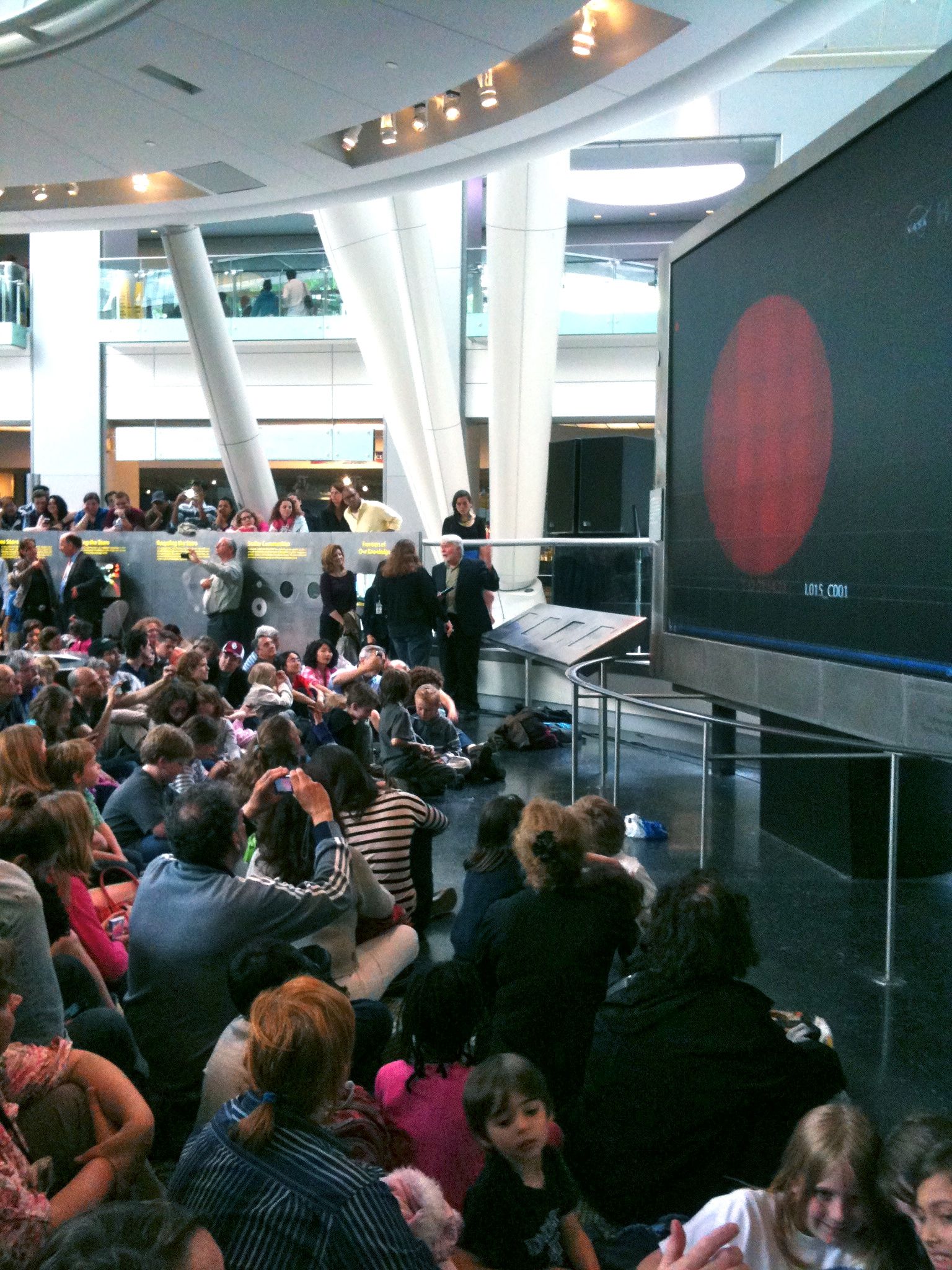
On an intermittently cloudy day, crowds flocked to the Hayden Planetarium (AMNH) to watch Venus (the planet) begin its stroll across the face of the Sun via the NASA feed projected on the giant screen in the Cullman Hall of the Universe. Venus put on similar shows in 1882 and 2004. Hundreds of science geeks heard astronomer Steve Bayer interpret what they were seeing on the live simulcast generated from Hawaii’s Mauna Kea Observatory.

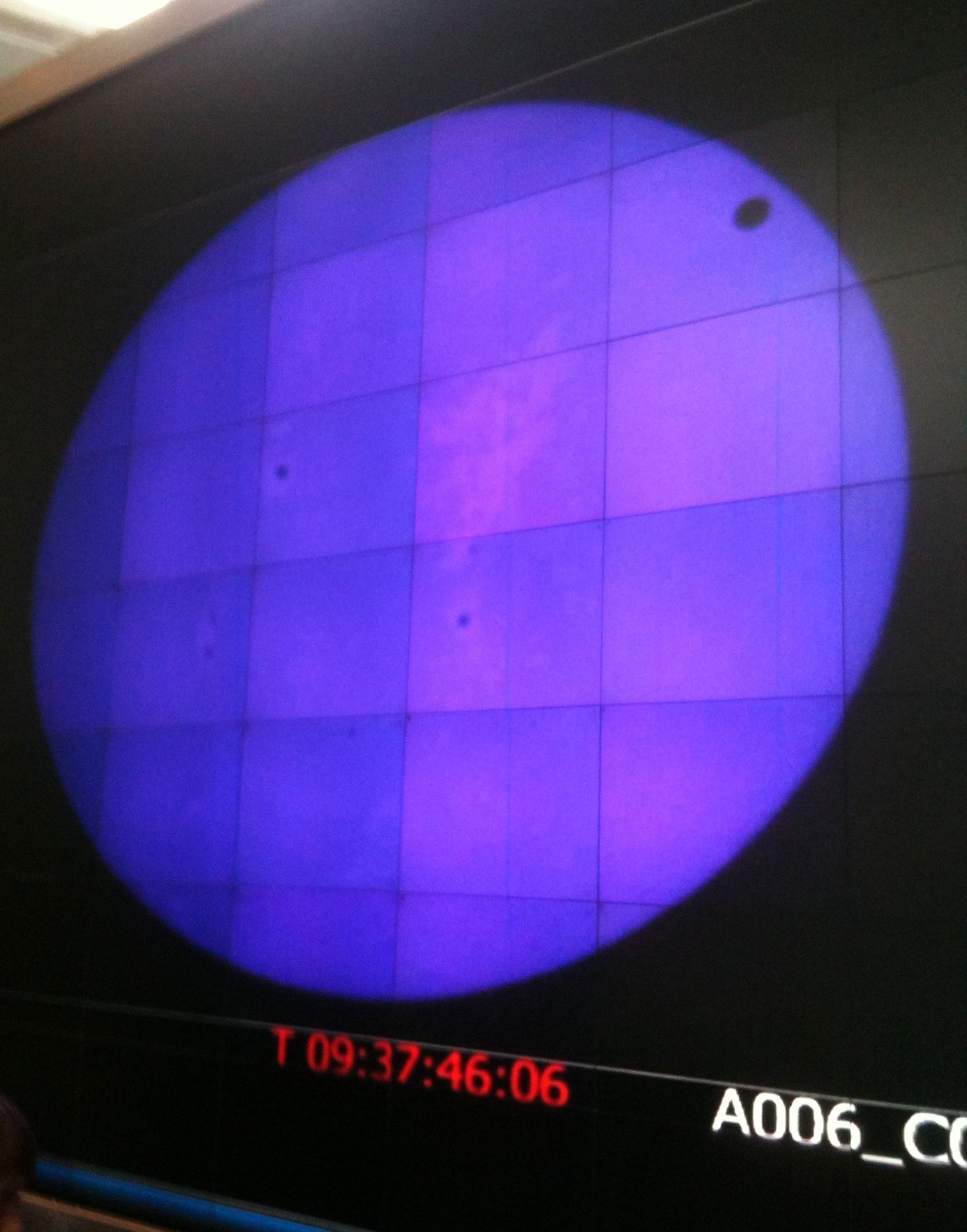
Venus (the planet) appeared as a tiny dot at the “8 o’clock” position on the Sun’s disk and kept on moving across until well after midnight (like the movements of Tony Award and theater attendees). The AMNH cut the live feed around 7pm, but not before the planetarium paparazzi snapped photos of the disk, and the diminutive moving Venus dot with and without friends, families, and kids in front of the giant screen to commemorate this once-in-a-lifetime event. Check out the photos.

Our only questions are 1) will Venus in Fur favorite Nina Arianda get similar attention at the Tony Awards next Sunday a few blocks south at the Beacon, and 2) will you see Venus in Fur before it completes its Broadway transit in two weeks?

Venus begins its journey across the Sun

Mars on Park Avenue

It’s time to live the dream. No doubt you’ve seen the American Museum of Natural History’s show about what it’s like to explore Beyond Planet Earth. (AMNH has even dug out 1950s letters to the Hayden on its web site.)

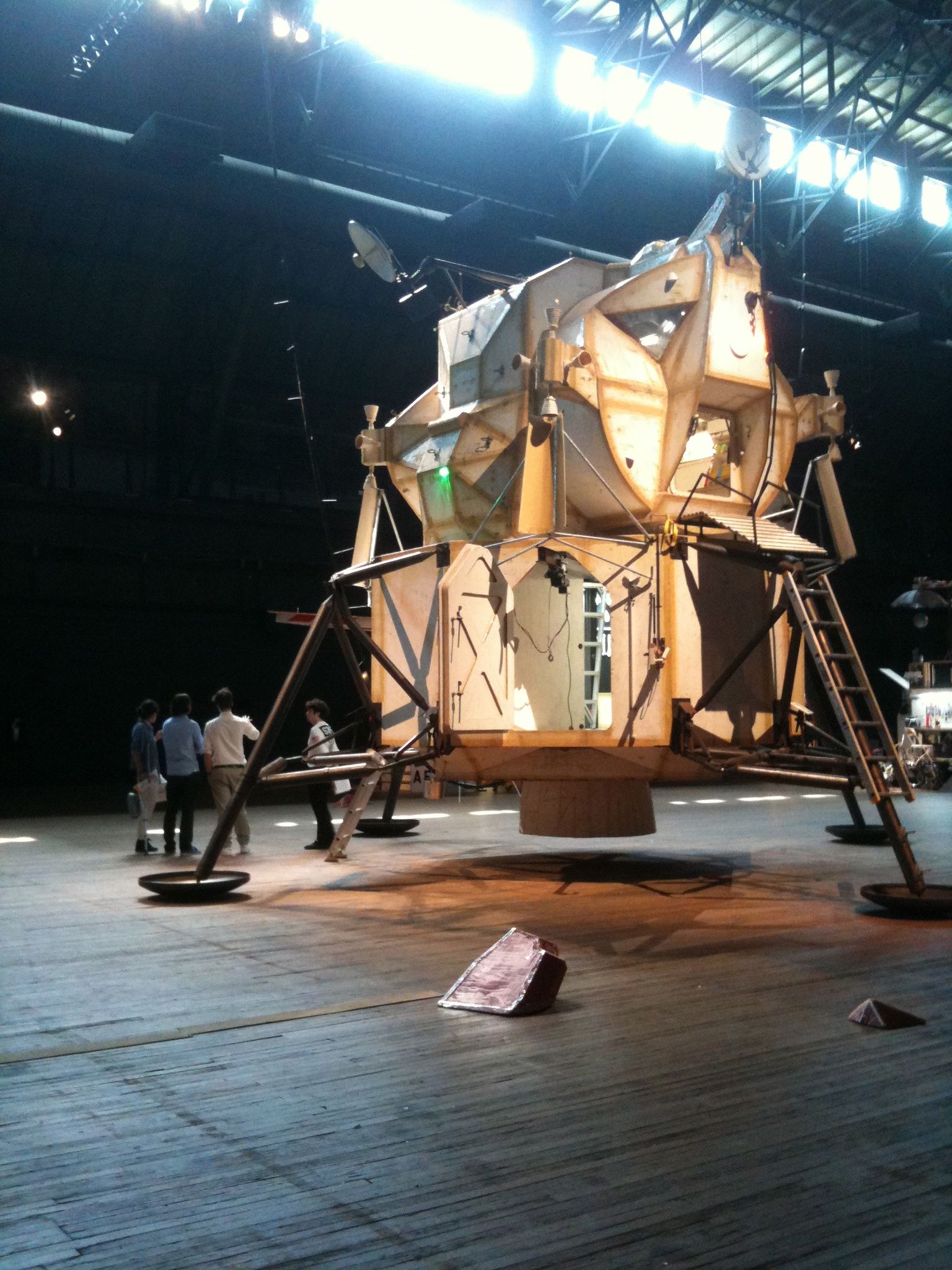
But drop into the Park Avenue Armory to experience it for yourself. Tom Sachs has created the surface of Mars and an exploratory base out of materials that he scrounged near his art studio. The results are spectacular, fun, and a trip worth taking.

You’ll go through orientation to enter Space Program: Mars, but once you’re on the base, you can stroll around, take the test to enter the LEM, chat with the dozens of lab-coated workers, tour the museum, or just sit and view it all from the bleachers in front of Mission Control. Seriously, you can be entertained all day. Check out the inspiring trailer and a few on-site photos.

If you’ve wanted to travel to Mars, now’s your chance, before the show blasts off June 17.

Bioluminescent Superstars

You don’t need to be James Cameron or build your own submersible to peek in at the amazing stuff in the deep, deep ocean. The American Museum of Natural History has pulled together a gallery of some of the strangest creatures of all time for its Creatures of Light: Nature’s Bioluminescenceshow.

Credit: AMNH/E. Grosch

In the deep, black depths of the ocean, several varieties of Anglerfish have strange bodies, heads, and hunting apparatus – bioluminescent fishing lures. They can light up these lures and also affect a strange glow due to the presence of their own colonies of bioluminescent bacteria.  You can’t make this up.

Want to catch a glimpse fast? Look at the Anglerfish video.

If you want to linger over these unbelievable deep-water superstars, go right to the Flickr Luminous Lures page.

Hey, Socrates, What Do You See?

If you’re hankering for last summer’s BMW Idea Lab, zoom in on the conversation on the future of Long Island City and the shoreline near Socrates Sculpture Park at the Noguchi Museum’s visionary show Civic Action.

Noguchi and Socrates have commissioned four artists to work with architects, designers, and urban planners to reimagine the surrounding neighborhood, a mélange of homes, high rises, light industry, and Costco. The proposals by Mary Miss, George Trakas, Natalie Jeremijenko, and Rirkrit Tiraanija are on display at the Noguchi for a few more days. Other related installations will appear at Socrates in May.

If you can’t get to Queens, go virtual by checking out three videos and watch the brainstorming among artists and planners:

Enjoy the discussion and contemplate some exciting futures.

Struthiomimus Gets No Respect —

— From The New York Times. Although it was a fantastic article in yesterday’s Science Times about the real reasons for “the death pose”, no one saw fit to give our friend, S. altus credit for his amazing contortion.  Yes, the photo is of a cast, but still…c’mon people…AMNH 5339 is one of the most-seen, most admired dinosaur fossils on the Fourth Floor of the American Museum of Natural History.  Why not slap a name on him in the NYT “Twisted” caption

To add insult to injury, check out the hyperlink title:  “archeopteryx fossils appear twisted but not because of agony”. Maybe I’m being sensitive, but some long-limbed Saurischian residents of Manhattan (Ornithomimids) deserve their “15 minutes of fame” truth-in-reporting as others. Do 12,000 visitors each weekend pay as much attention to S. altus (genuine and nearly complete skeleton) as to our Archeopteryx casts? Absolutely, so give this guy some credit, please.NYC Upper West Side resident Struthiomimus

Check out the nice story and obscured (and wrong in the metadata) pictoral identity of Struthiomimus online:

http://www.nytimes.com/2012/03/06/science/archaeopteryx-fossils-appear-twisted-but-not-because-of-agony.html?_r=1&ref=science