Transgressive Photography Shown in Santa Fe

Want to meet some people who enjoy breaking the rules?  You’ll meet plenty of mavericks who challenged the norm in Transgressions and Amplifications: Mixed-Media Photography of the 1960s and 1970s, an exhibition on view at the New Mexico Museum of Art in Santa Fe through January 8, 2023.

Edward Weston and Ansel Adams set a high bar for classic, modernist photography, but the generation of image-makers who followed were driven to experiment, shake things up, and see where it all led. 

Detail of 1983 Joyce Niemanas Grandfather Polaroid collage
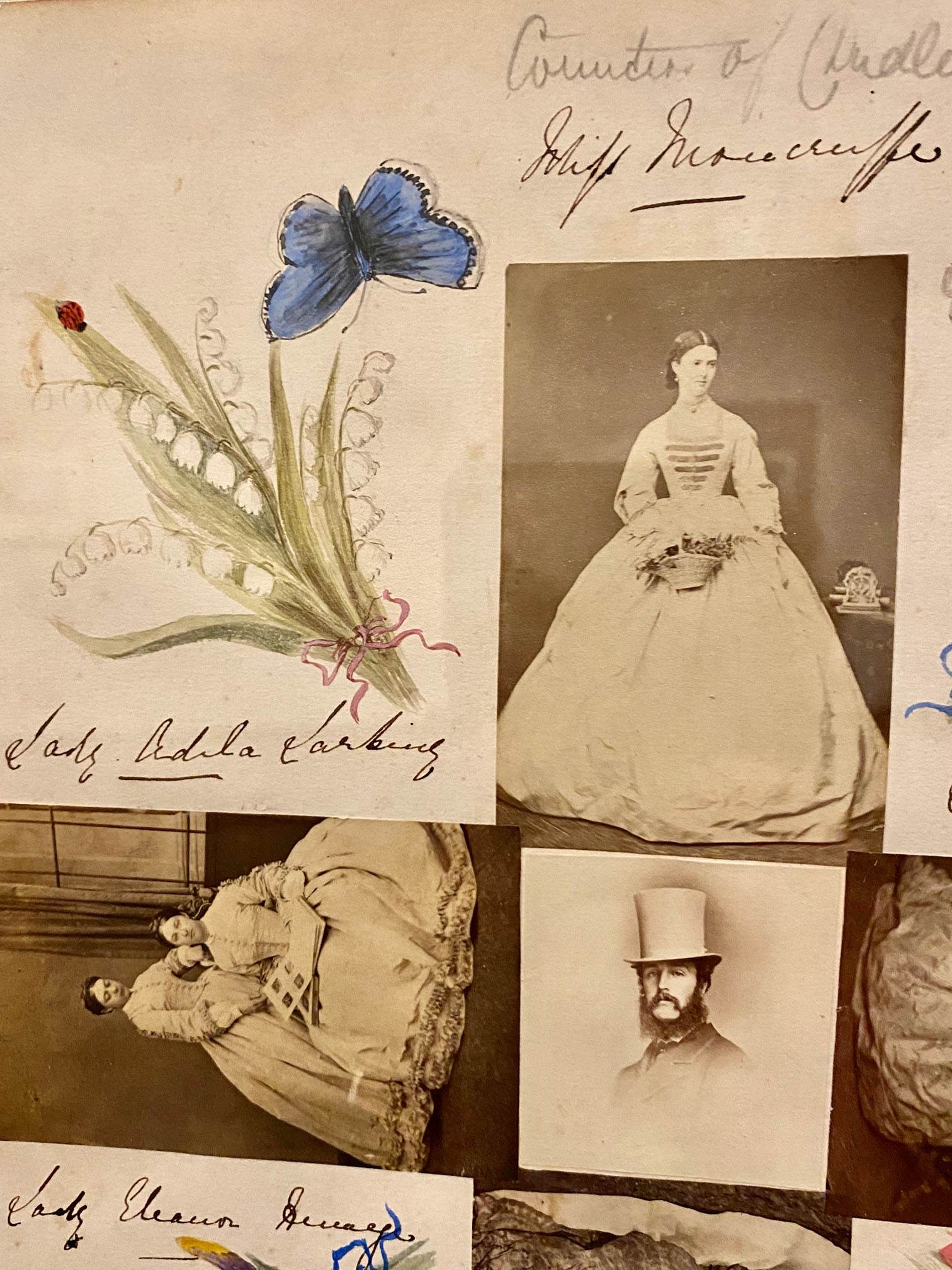
Detail of 1864 Lady Filmer’s album mixing watercolor and albumen print collage. Courtesy: UNM Art Collection.

Why not go back a hundred years and make new images with historic photo techniques (sun prints, anyone)? Has anyone tried embroidering photos? What about mashing up photo-silkscreen prints with readymade collages decorated with rubber stamps?

Can Polaroids be turned into fine art? Or making a sculpture or kitch card deck out of photos?  What about dreamscapes? What about creatively repurposing magazine photos or TV images?

A stroll through the gallery shows a broad range of creative 20th-century minds at work, with at least one case showcasing some 19th century pioneers.

Meet Lady Mary Georgina Filmer, a London society gal who mastered the art of photocollage as early as the 1860s. A page from one of her albums shows how she merged topsy-turvey photo images, botanical watercolors, and text to tell stories her own way – a true stay-at-home pioneer!

Lady Filmer’s album looks out on dozens of other Americans who went back into the time machine to toy with making albumen prints, stereographs, hand-colored photos, drawing, and cyanotypes. Example: the arresting 1970s hand-colored gelatin silver print by Karen Truax where she ghosts-out her central figure.
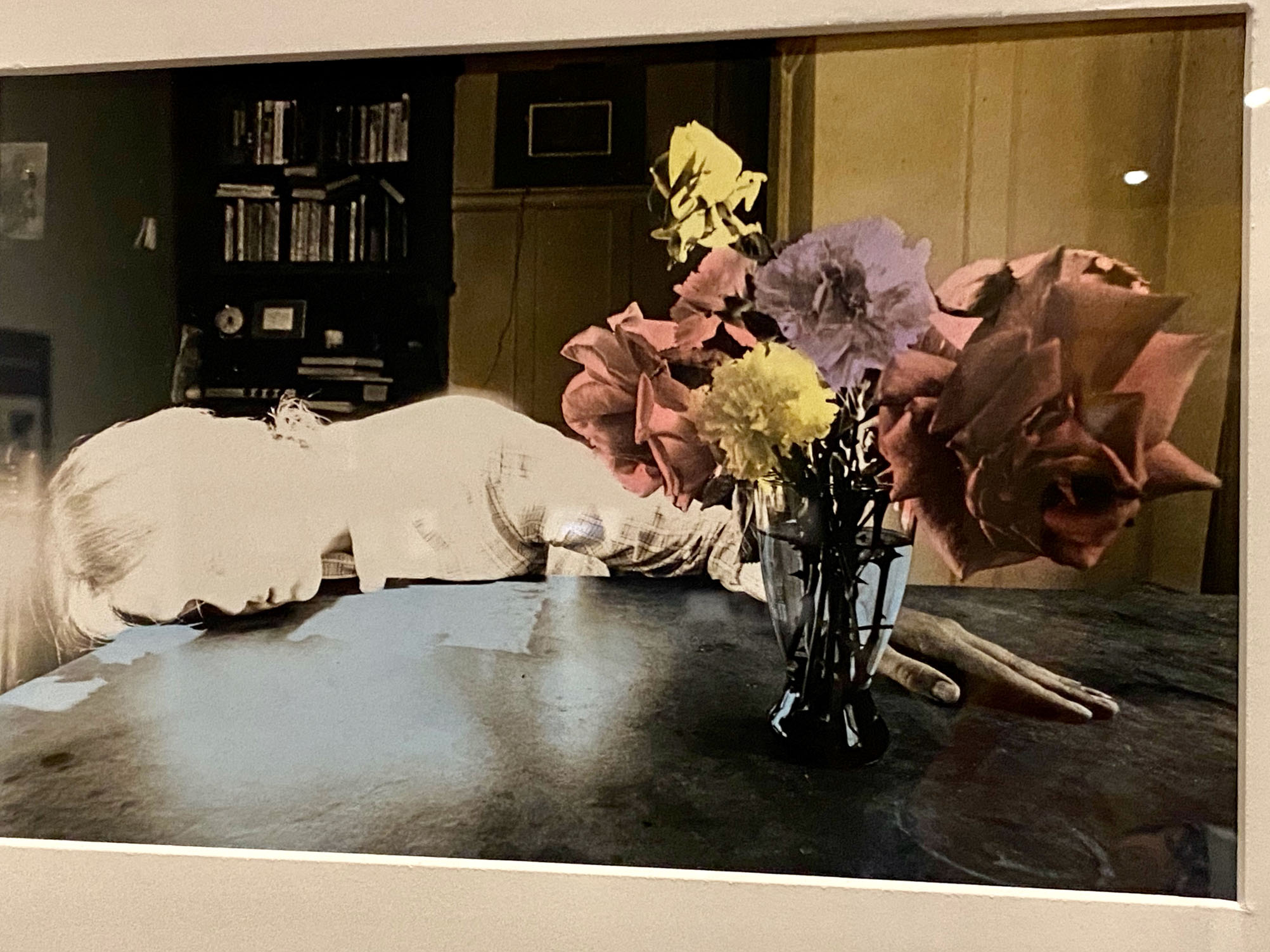
1970-1974 gelatin silver print Supernal by Karen Truax, featuring a bleached-out central figure and hand-colored domestic interior

For anyone curious about these old-timey methods, the curators have provided visitors with a place to relax, leaf through books about it, and watch YouTube videos on the gallery iPad.

Another gallery features artists who took photography mixed-media to the next level, like Rauchenburg’s litho that appropriates Bonnie and Clyde movie stills and an over-the-top abstraction by Thomas Barrow that combines gelatin silver print technique with a crazy-quilt of stencils, spray paint, and objects. So totally Eighties!

Detail of Thomas Barrow’s 1980 gelatin silver print Discrete Multivariate Analysis, mixing lights, objects, stencils, and spray paint

The third gallery displays lots of fool-the-eye and 3-D delights. What’s the most fun? Jerry McMillan’s photo-offset inside a “paper bag?” Betty Han’s Soft Daguerreotype of Xeroxed weeds on fabric? Probably Robert Heinecken’s T.V. Dinner/Shrimp. Hard to choose.

Robert Heinecken’s 1971 Van Dyke print T.V. Dinner/Shrimp, #1C. Courtesy: University of Arizona’s Center for Creative Photography.

Other sections of the exhibition show how 1970s photographers made images in which photography itself was the subject and told highly personal stories.

Take a look at some of our favorites in our Flickr album.

Artist book: Keith Smith’s 1972 gelatin silver print Book 32 – a 3D take on photography.

And don’t forget the coda that features a dramatic images by more recent photographers that make provocative social statements and represent voices that were not fully represented within the university system during the 1960s and 1970s.

Lorna Simpson’s 1991 Black, a dye diffusion transfer print with engraved plastic plaques

O’Keeffe Museum Shows Georgia at Home

One of the most photographed artists of the 20th century, everyone is used to seeing Georgia O’Keeffe in her “formal” pose and gear – angular black hat, stark wrap dress, punctuated by her modernist Calder pin, standing against the New Mexico sky peering solemnly into the future.

In its latest offering, the Georgia O’Keeffe Museum is giving fans a special treat (and a different view) through its exhibition, Georgia O’Keeffe, a Life Well Lived: Photographs by Malcolm Varon, on display in Santa Fe through October 31.

2021 print of Varon’s 1977 photo of Georgia relaxing at Ghost Ranch. Courtesy: the artist
Georgia’s 1946 Part of the Cliff, a painting inspired by the view through her studio window.

The show features a smiling, at-ease 89-year-old surrounded by family, friends, companions, and pets – images quite apart from the GOK that we all admire and revere. How did this happen?

In the 1960s in New York, photographer Malcolm Varon established quite a reputation for documenting painters’ works in a way that captured a lot of their spirit. No wonder that in the mid-1970s, he was summoned out to Ghost Ranch and Abiquiu to document some of Georgia’s huge body of work.

While he was working with the artist during the summer of 1977, a journalist arrived to interview the icon for a feature in ARTnews.

No photographer had been attached to the story, so Georgia came up with hew own solution – ask her colleague Malcolm to shoot her in the setting of her Ghost Ranch home.

Since Malcolm was already familiar with the operations around Ghost Ranch and Abiquiu, he ended up taking about 300 photos of her homes, the landscapes that inspired her, and the people who kept things humming.

2021 prints of Varon’s 1977 portraits of Ida Archuleta, Candelaria Lopez, and Estiben Suazo, the people who managed Georgia’s homes and properties. Courtesy: the artist.

Despite Georgia’s reputation as a loner living out in the middle of nowhere, Malcolm appreciated that the day-to-day operations in the outback were quite fun, busy, natural, and happy at her two studio compounds.

ARTnews made a few selections from Varon’s photographs and ran them in the feature, but the majority of the 300 shots were never printed or seen…until now.

Visitors at the GOK museum pour over every detail of the portraits and landscapes, enjoying a new, different glimpse of the artist and her world – Varon’s portrait of Georgia’s sister, beautiful portraits of her property caretakers (whose families still take care of the GOK home for the museum), and her assistant Juan Hamilton.

The curators present several paintings from the 1940s showing the same cliffs, landscapes, and skies that Varon captured in the summer of 1977. Visitors have fun shifting back and forth between the oil paintngs and photos.

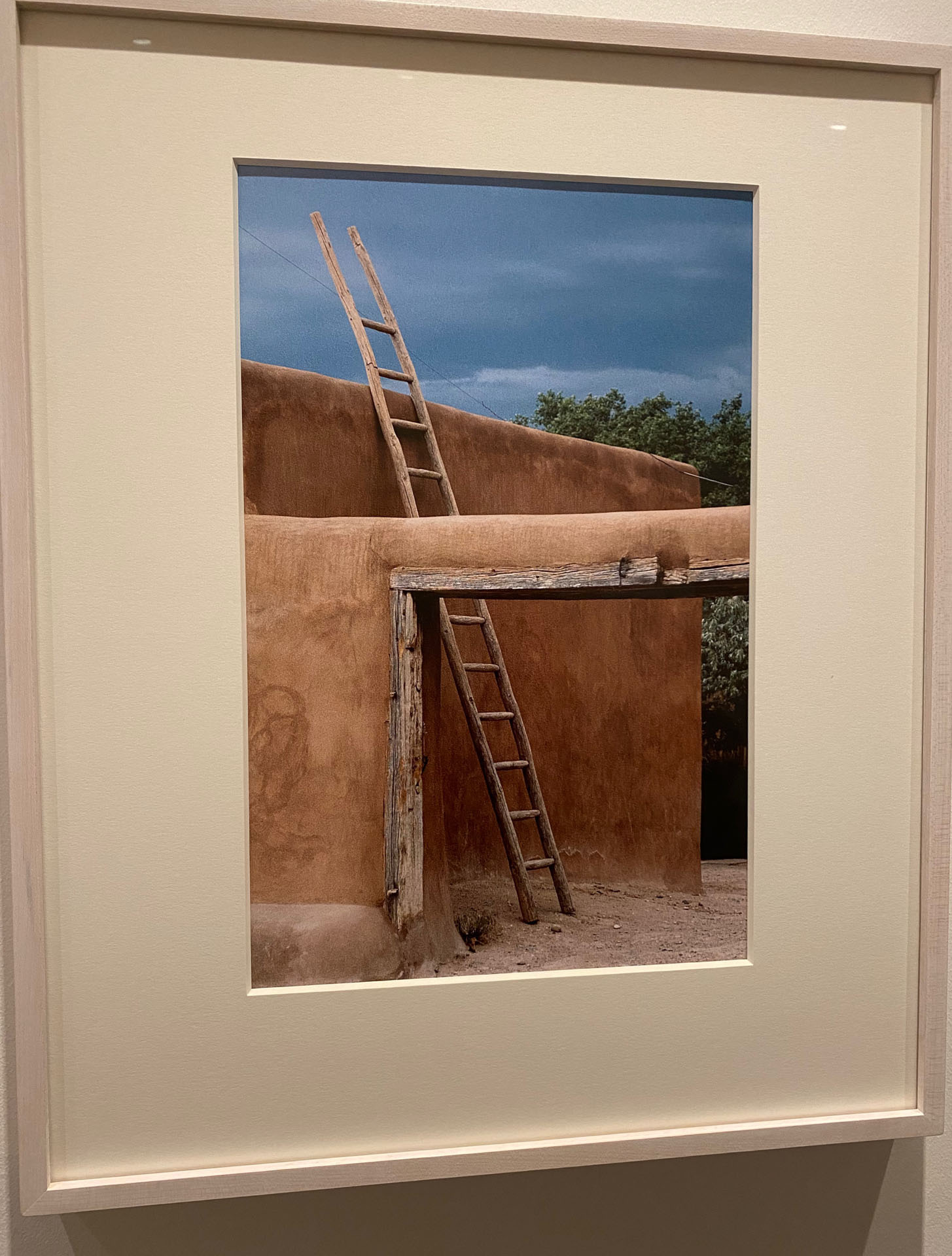
2021 print of Varon’s 1977 photograph of the tall ladder at Georgia’s Abiquiu home – a platform from which she surveyed the world. Courtesy: the artist

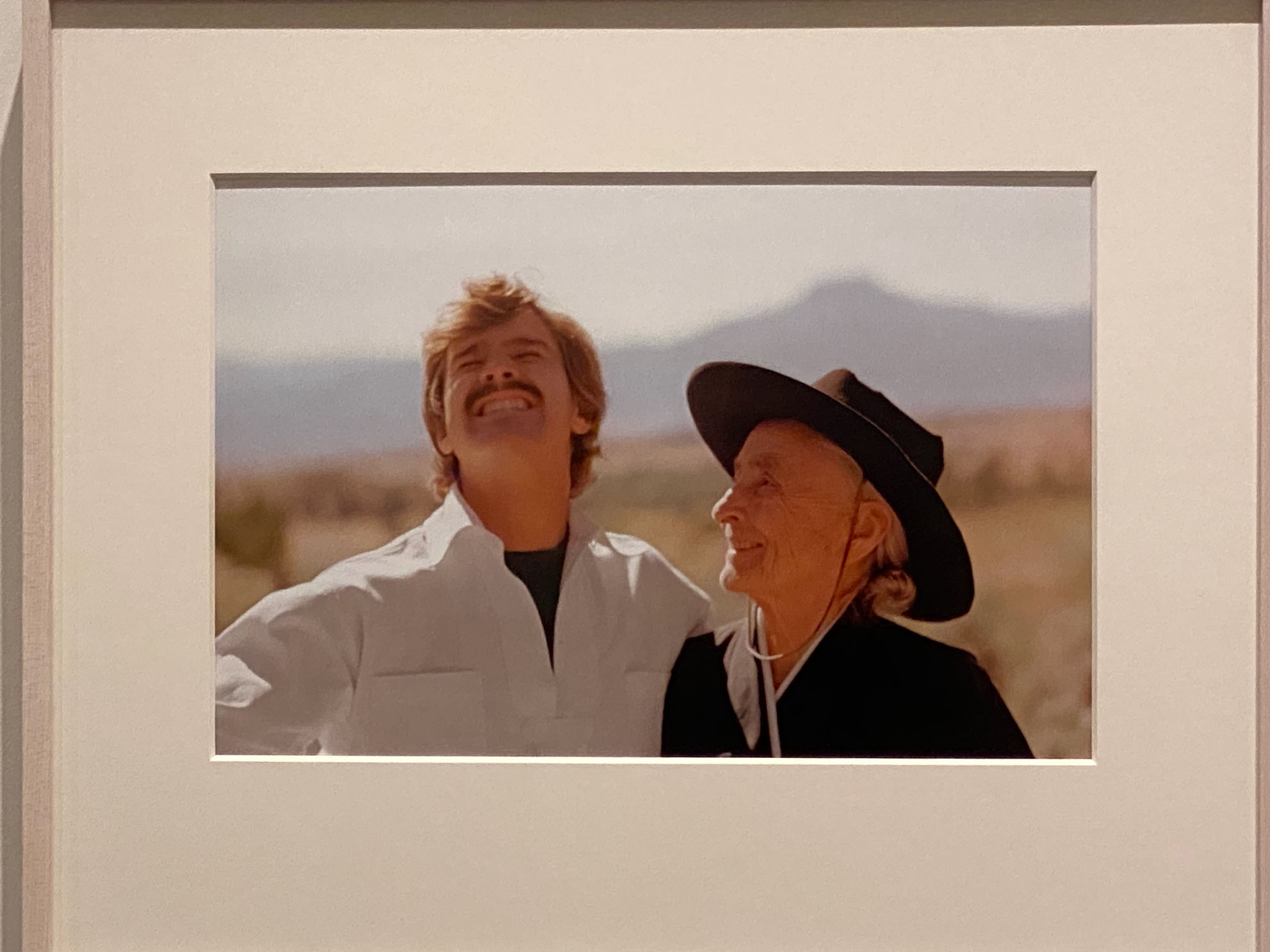
2021 print of Varon’s 1977 fun photograph of Georgia at Ghost Ranch with her friend and assistant, artist Juan Hamilton with the Pedernal as backdrop. Courtesy: the artist

Take a look at some of our favorites in our Flickr album.

Listen in as the curators of this delightful show draw back the curtain on the legendary O’Keeffe, her relationship with photography, and what happened when a trusted friend got her to smile for the camera:

Jeffrey Gibson at SITE Santa FE

What happens when a Native American MacArthur genius is asked by SITE Santa Fe to create an art exhibition during a time of a global pandemic and social justice marches? And invite him to a location where Native Americans make up a significant percentage of the population?

The result is Jeffrey Gibson: The Body Electric – a constantly surprising gallery journey where shape-shifting, cultural disassociation, beadwork, kitsch-image appropriation, gender-identity questions, and science-fiction inspiration reigns.

The show is filled with life-size beaded dolls and garments, films, pulsing papered walls, mysterious film experiences, and social statements either woven or stamped onto clothes (or are they banners?).

Gibson’s 2021 White Swan mixed-media painting in wall-papered gallery with a beaded, life-size, genderless “doll”
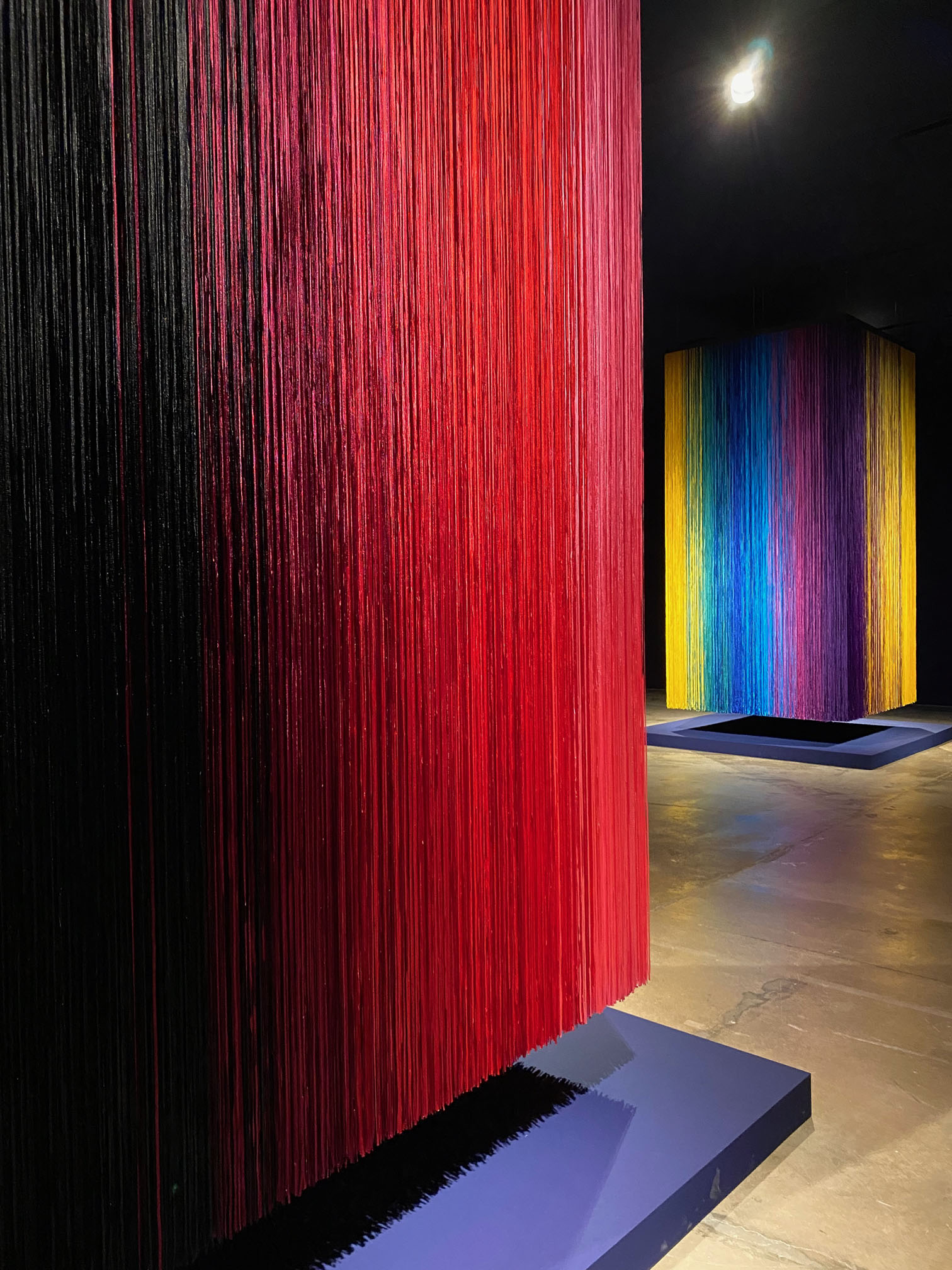
2020 Red Moon and Desert Sky minimalist sculptures created from strands of dance fringe.

Gibson, who is based in New York, is an intertribal artist who is a member of Mississippi Band of Choctaw and half Cherokee. However, his influences were forged from prestigious art schools, international travel, and living in non-Native societies.

The opportunity to come to Santa Fe, host a cinema series and several performances, and stay out West for a while was an open door to explore inter-cultural influences, host discussions with appreciative audiences, and show off his wide intellectual and artistic breadth.

In many of his works, Jeffrey mixes traditional “Indian” materials like beads or fringe with slogans, sayings, dime-store “Indian” images, and big-time art-world references.

See some our favorites from this exhibit in our Flickr album and hear Jeffrey explain his influences in SITE Santa Fe’s audio guide.

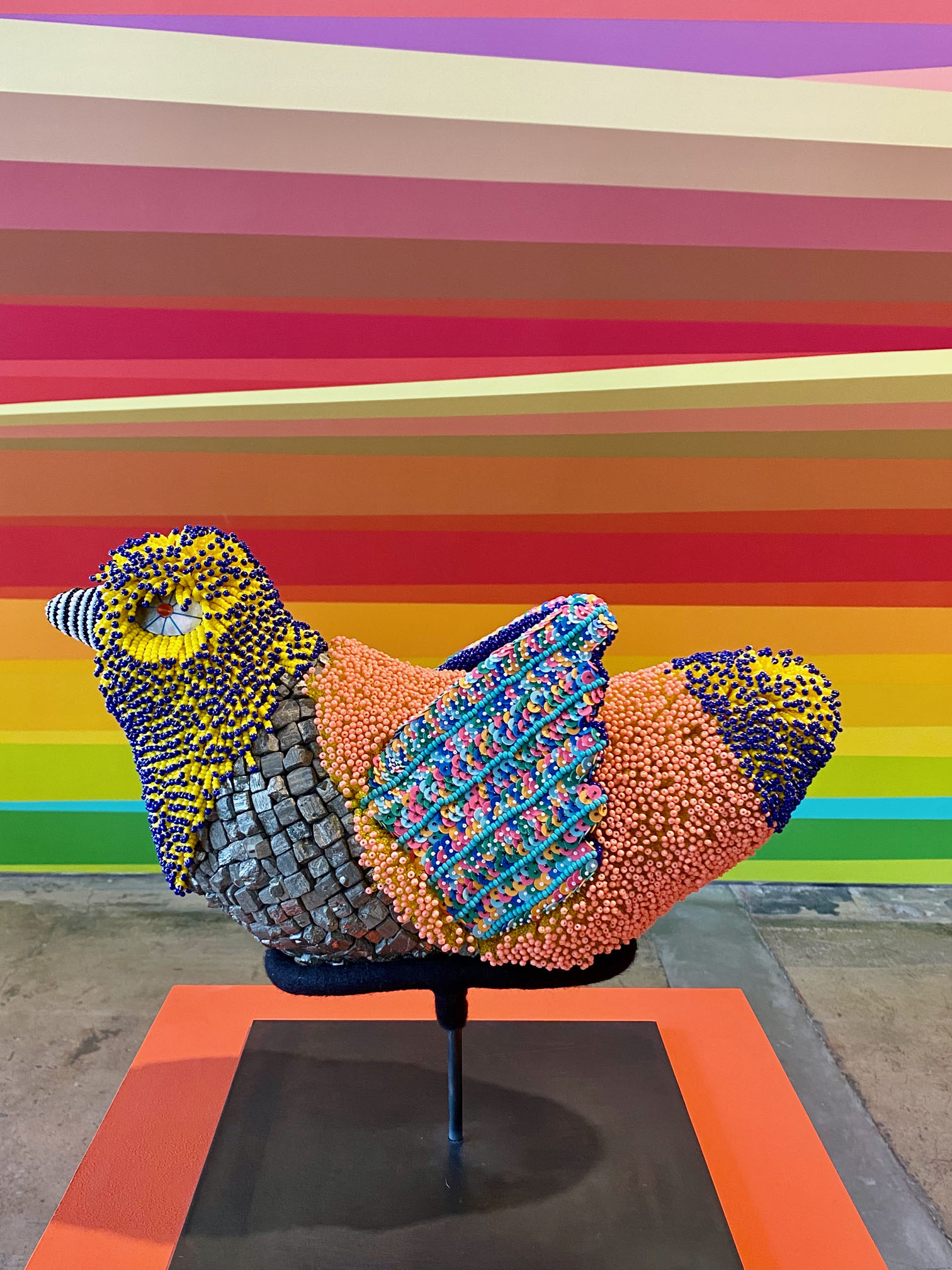
The little beaded birds that greet visitors in the first gallery and the big beaded life-sized “dolls” in the second were inspired by Jeffrey’s early work in the ethnographic collections of the Field Museum, where he encountered Haudenosaunee-made beaded tourist-trade whimsies and traditional “third gender” dolls for the first time. Why not make his own, but over-size them?

2021 My Joy My Joy My Joy, a mixed-media beaded bird inspired by Victorian-era Native American tourist whimsies

The nearby video gallery features a kaleidoscopic multichannel video of Sarah Ortegon, an award-winning Eastern Shoshone/Northern Arapaho jingle dress dancer, performing to the energetic Sisters track by A Tribe Called Red. This piece – She Never Dances Alone – refers to the dancers who came to the Standing Rock Reservation and lent their support to the 2016 pipeline protests though dance.

Here’s Sarah Ortegon in Gibson’s 2019 Times Square installation of She Never Dances Alone here…wait for it:

2021 They Play Endlessly mixed-media crazy quilt of paint, beads, words, and found objects.

And here’s another look at Gibson’s 2020 exhibition at the Brooklyn Museum, where he mixed works from his studio with artifacts and art from Brooklyn’s own collection.

And check out Gibson’s work our album documenting the Smithsonian’s National Museum of the American Indian exhibition of Native painting, Stretching the Canvas.

If you’re near Nashville, you’ll be able to see Gibson’s The Body Electric at the Frist Art Museum February 3 – April 23, 2023.