Gus Baumann’s Legacy of Art and Fun in Santa Fe

Gus Baumann, America’s greatest master of color woodblock prints, never considered himself a fine artist. Nevertheless, his prints, sculptures, paintings, commercial art, furniture, and marionette stages fill four galleries in his grand retrospective at the New Mexico Museum of Art – Gustave Baumann: The Artist’s Environment, on view through February 22, 2026.

Demand for Gus’s intricate block-printed sun-dappled Western landscapes from the 1920s through the 1950s still runs high. So, it’s a treat to learn how Gus achieved such a high degree of technical proficiency early in his career, lived Arts and Crafts philosophy, relished immersion in art colonies, and found his family in Santa Fe.
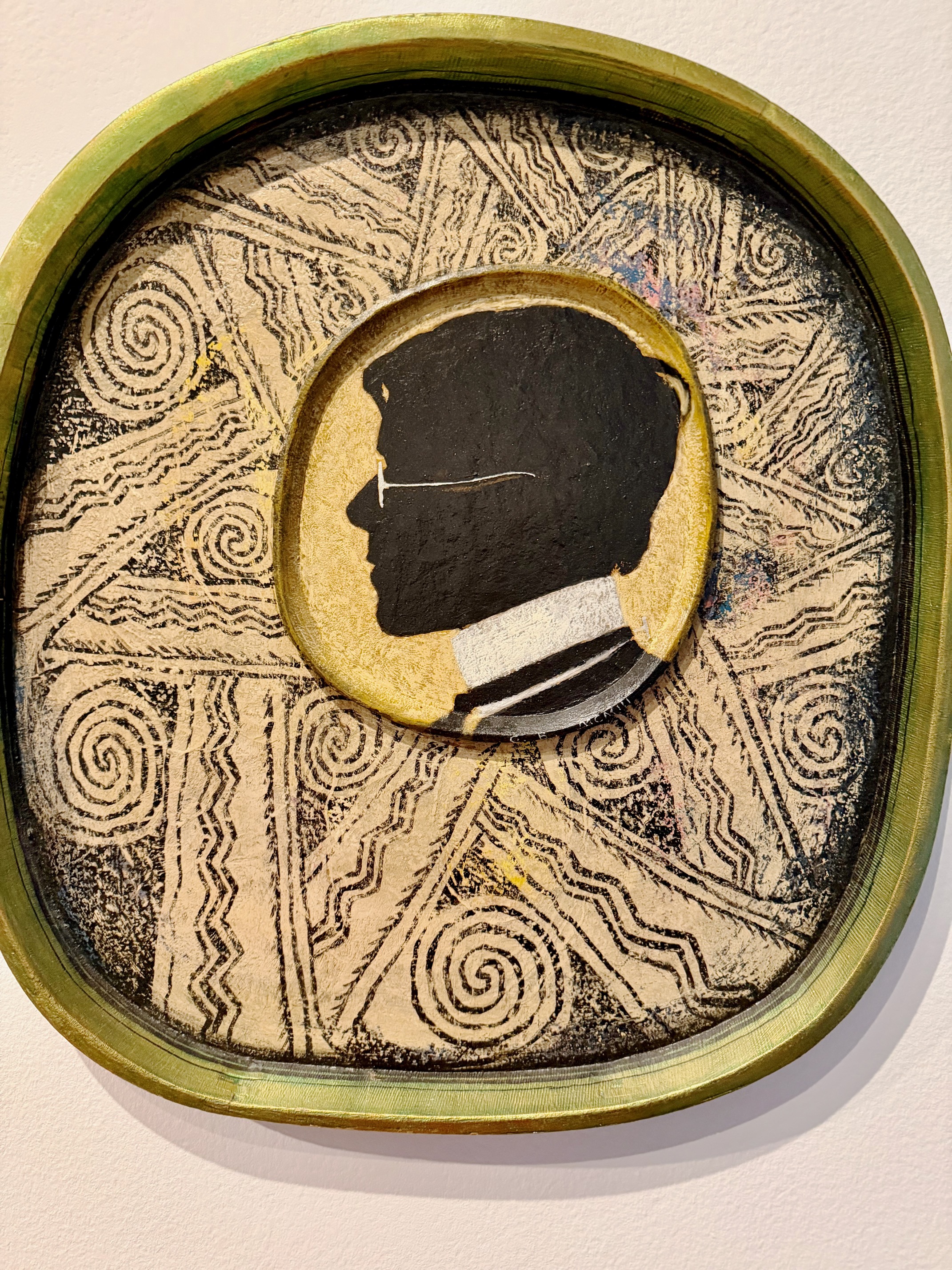
Gus Baumann’s 1903 oil Self-portrait (Silhouette) painted in his Chicago studio; reworked in Santa Fe after 1920 with a border inspired by Mimbres pottery.

See some of our favorites in our Flickr album.

Although Gus was born in Germany in 1881, his family emigrated to Chicago when he was around ten. His father was a craftsman and woodcarver, and it left an impression.  The first themed section of the exhibit – “Finding His Way”– gives a glimpse into his family background, early commercial art work, wood carving expertise, and furniture he designed later in the 1930s.
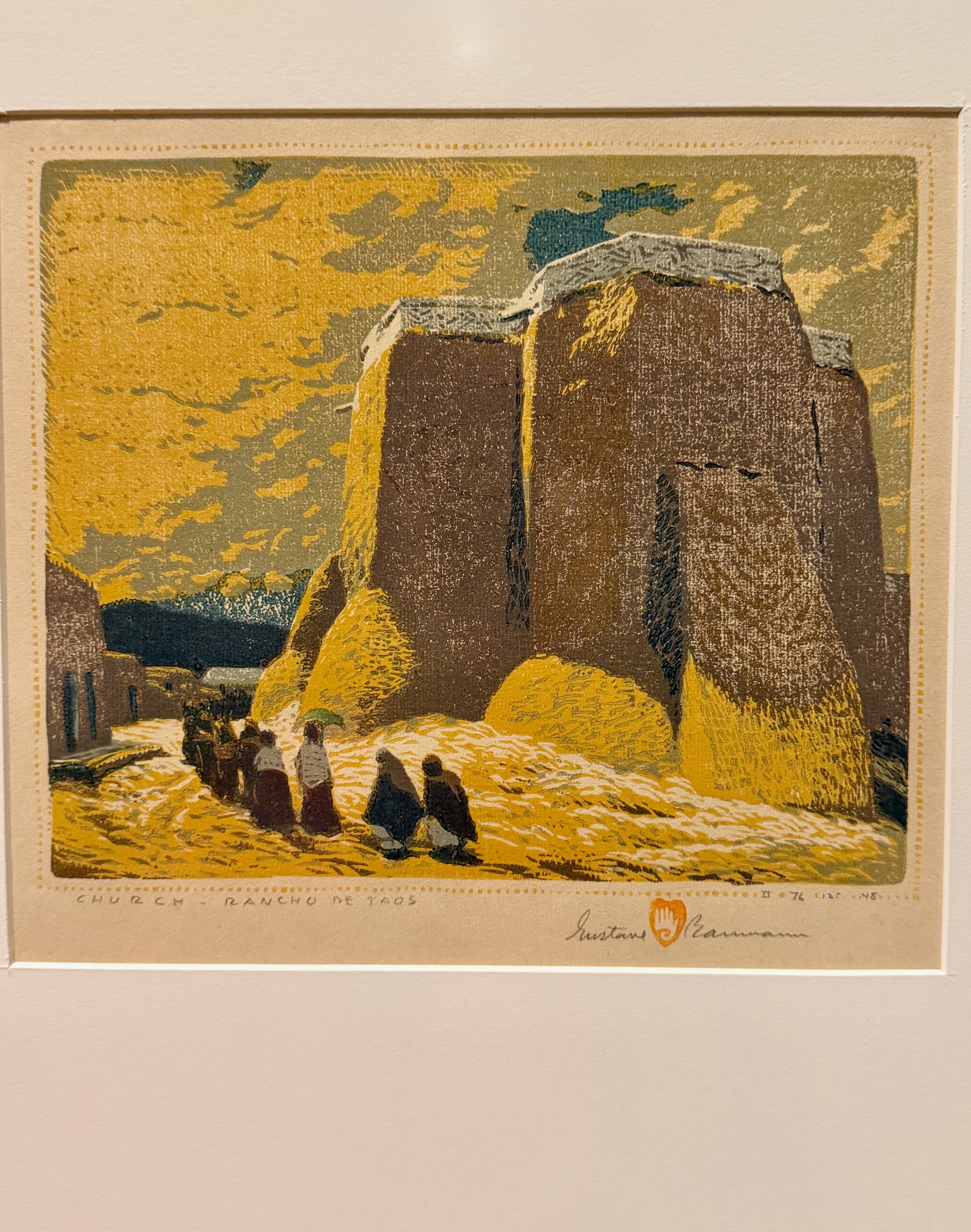
Gus Baumann’s 1919 color woodblock print Church Ranchos de Taos – one of the first modern artists to depict this iconic church; printed in 1948.
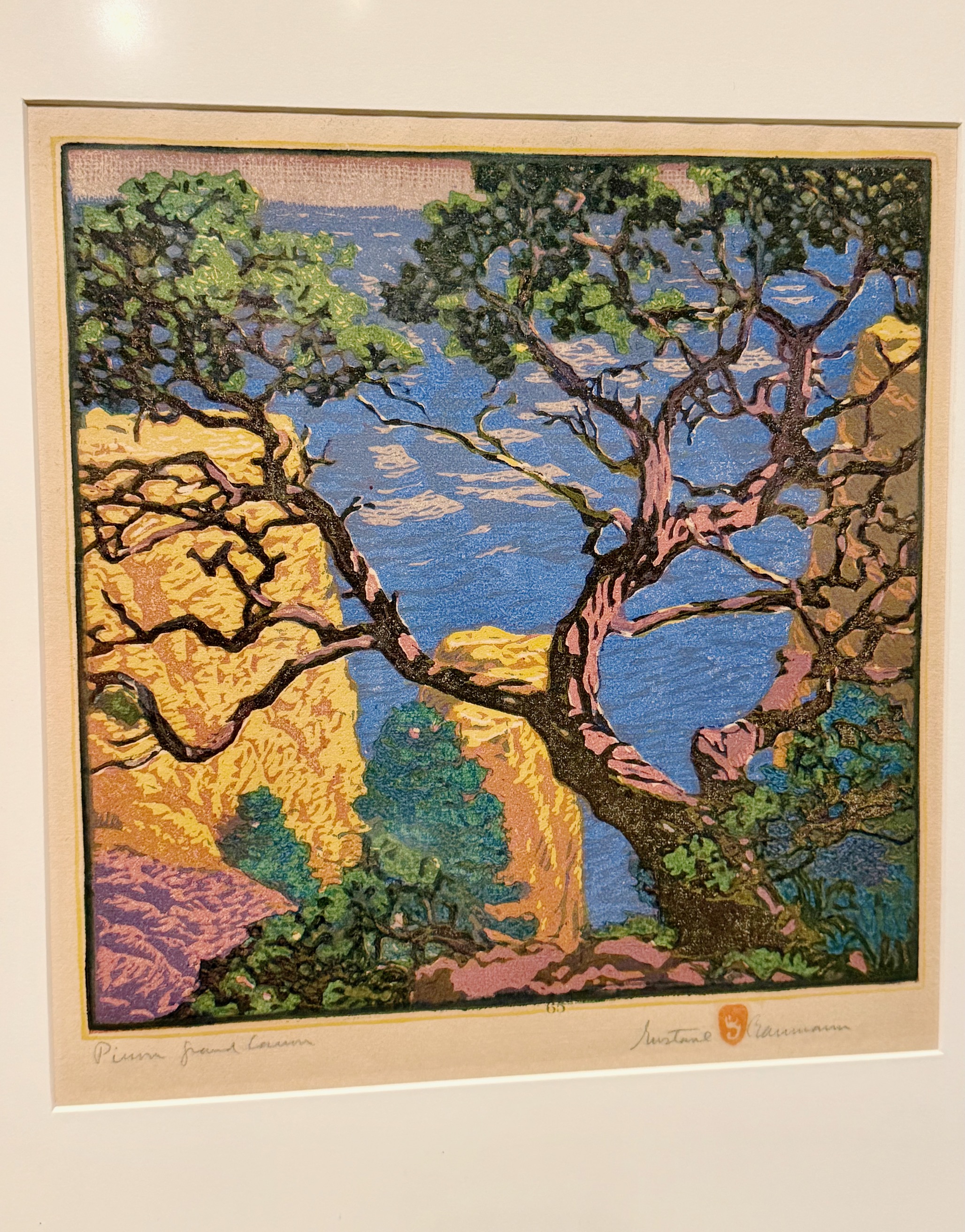
Gus Baumann’s 1921 color woodblock print Piñon Grand Canyon – one of four landscapes created after his first visit.

When he was 17 and his dad left the family, Gus had to find work to help his mom make ends meet.  He worked full time at a Chicago wood-engraving shop that cut illustrations for books, magazines, and newspapers. When he was 20, Gus opened his own wood-engraving studio.

To fine tune his skill, he attended Munich’s Royal Arts and Crafts School for a year to learn from the best German color wood-block print masters – a move that chose traditional skills over academy fine-arts training. When he returned to Chicago, he opened Baumann Graphic Art Service.
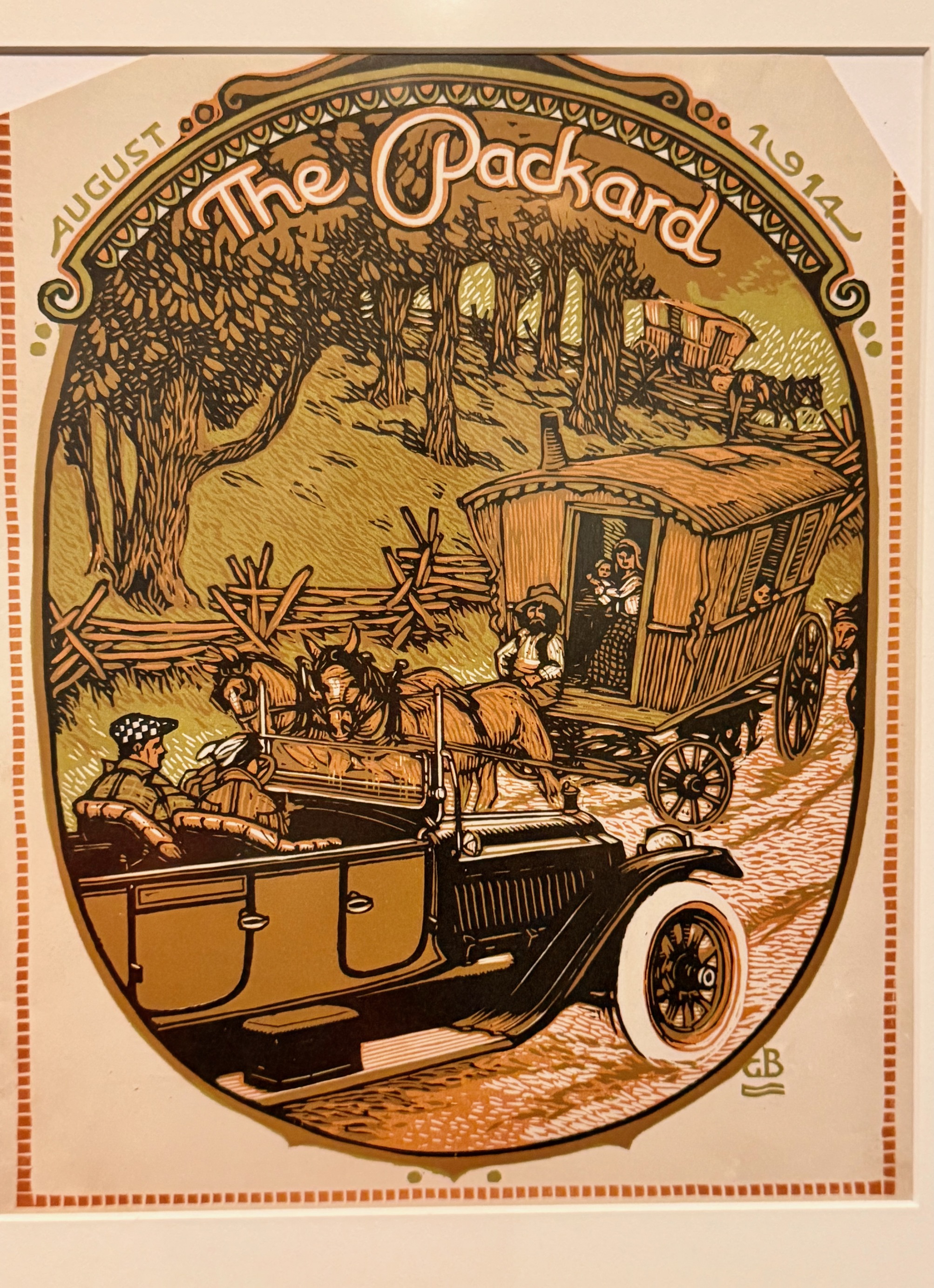
Gus Baumann’s 1913 Illustration for a Calendar: The Packard Car Motor Company, August 1914 – one of four he created for Packard.
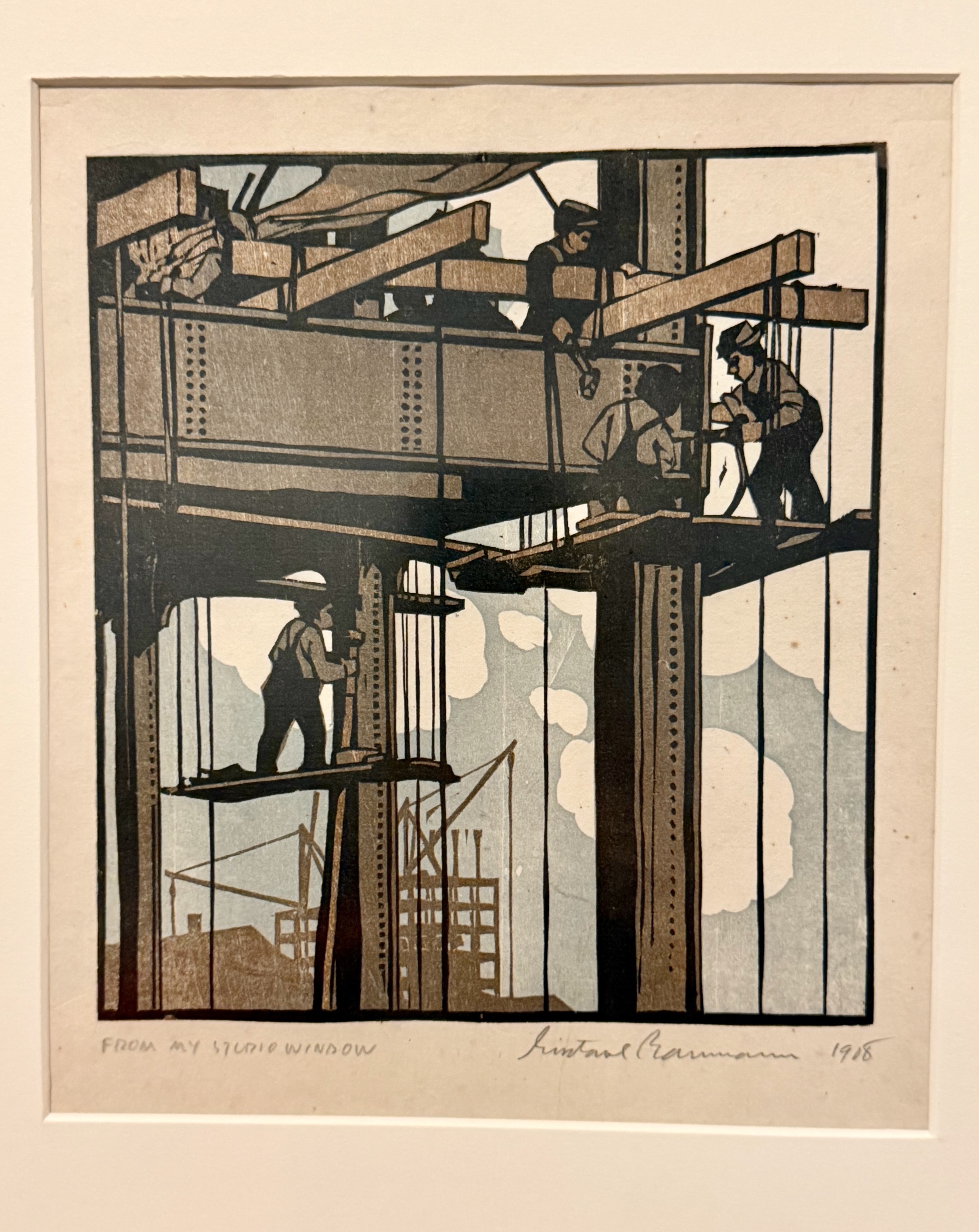
Gus Baumann’s 1908 color woodcut From My Studio Window in downtown Chicago –the high-rise McCormack Building going up on South Michigan Avenue.

Although Gus found success, his love of craft and traditional printmaking methods drew him to an art colony in Nashville, Indiana that revered traditional crafts and a slower pace of life.  The second section of the exhibition – “A Rolling Stone” – highlights work he did in Munich, his acclaimed print series featuring Indiana craftsmen, coastal life in Provincetown, and the electricity he felt in New York.
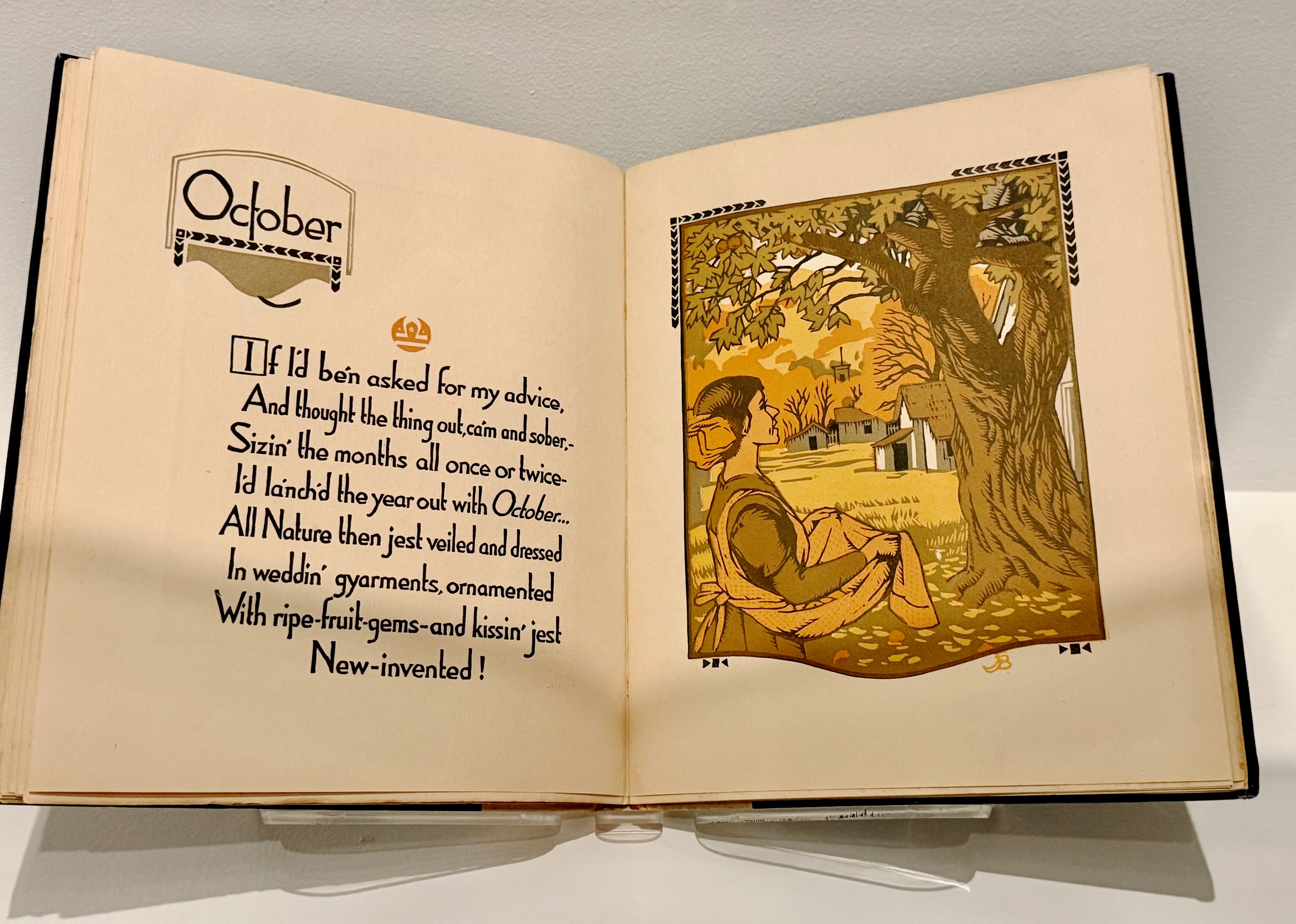
Gus Baumann’s 1912 book All the Year Round – woodcut illustrations and poetry James Whitcomb Riley, featuring scenes of daily rural life for each month of the year.

But his life would change forever when he traveled West and landed in New Mexico in 1918. Due to his reputation as an award-winning printmaker, Santa Fe welcomed him with open arms. Gus was struck by the unique Hispanic and Pueblo ways of life, the beauty of the Southwest, and the growing art colony in Santa Fe. 
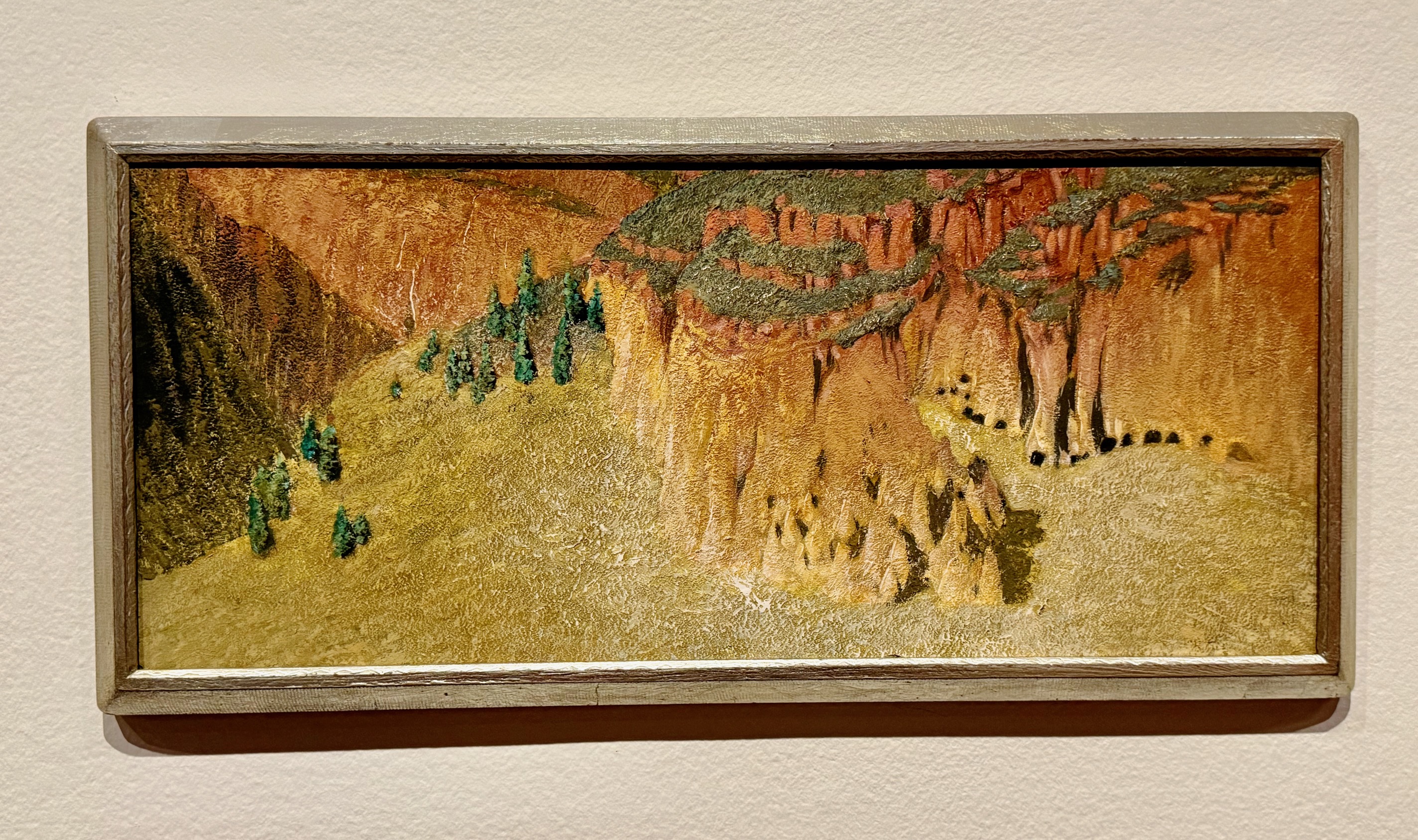
Gus Baumann’s 1925 oil painting Frijoles Canyon – a panorama of ancient tuff dwellings of Tuyoni Pueblo at Bandelier.

Before long, Gus was making and selling gorgeous prints, traveling to archeological sites, attending dances at the pueblos, soaking up the ambience of ancient Spanish churches, and putting brush to canvas, and partying with his new artist friends. And he met Jane, the love of his life, and started a family – creating a life full of fun, art, play, and community service.
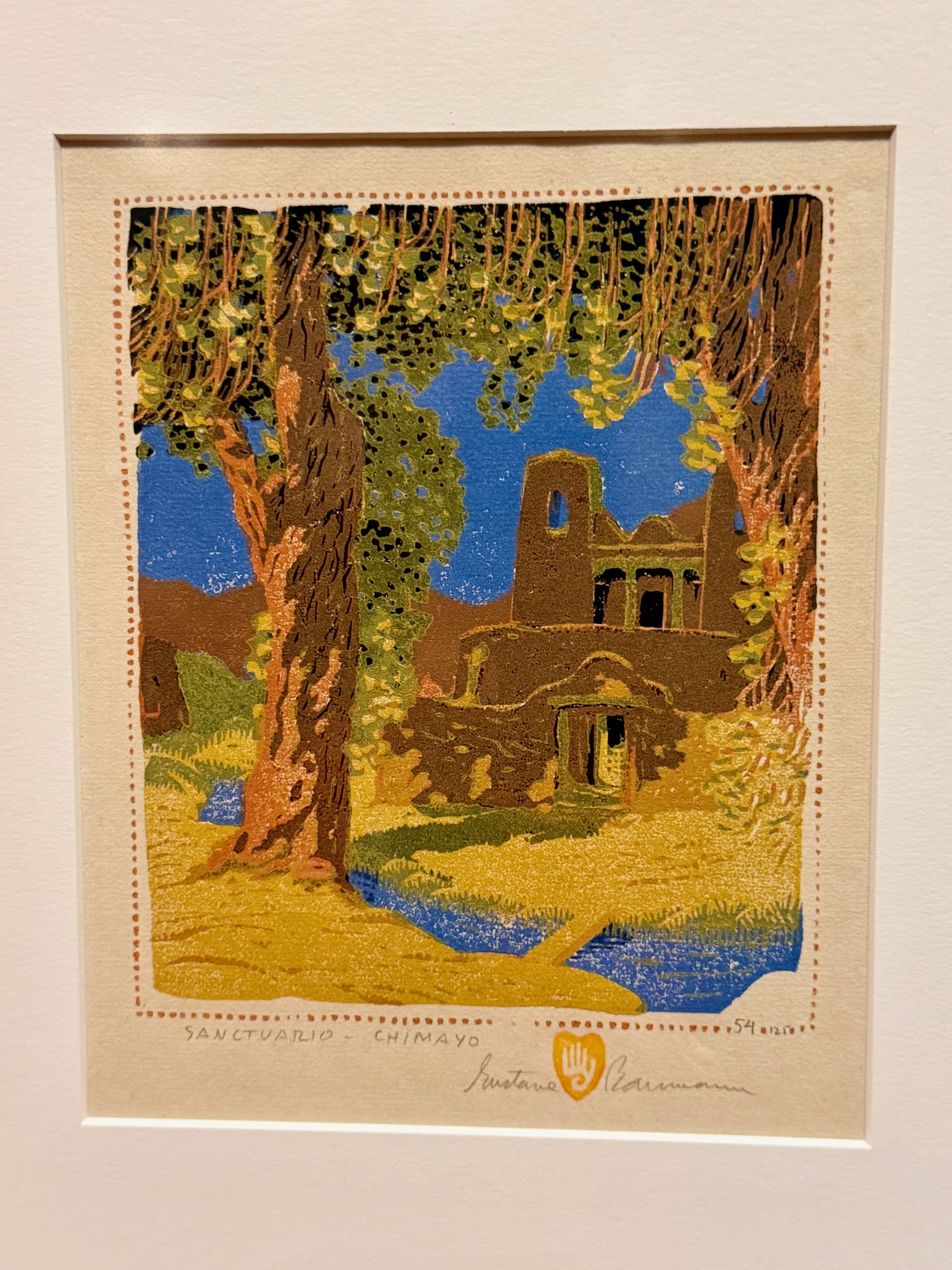
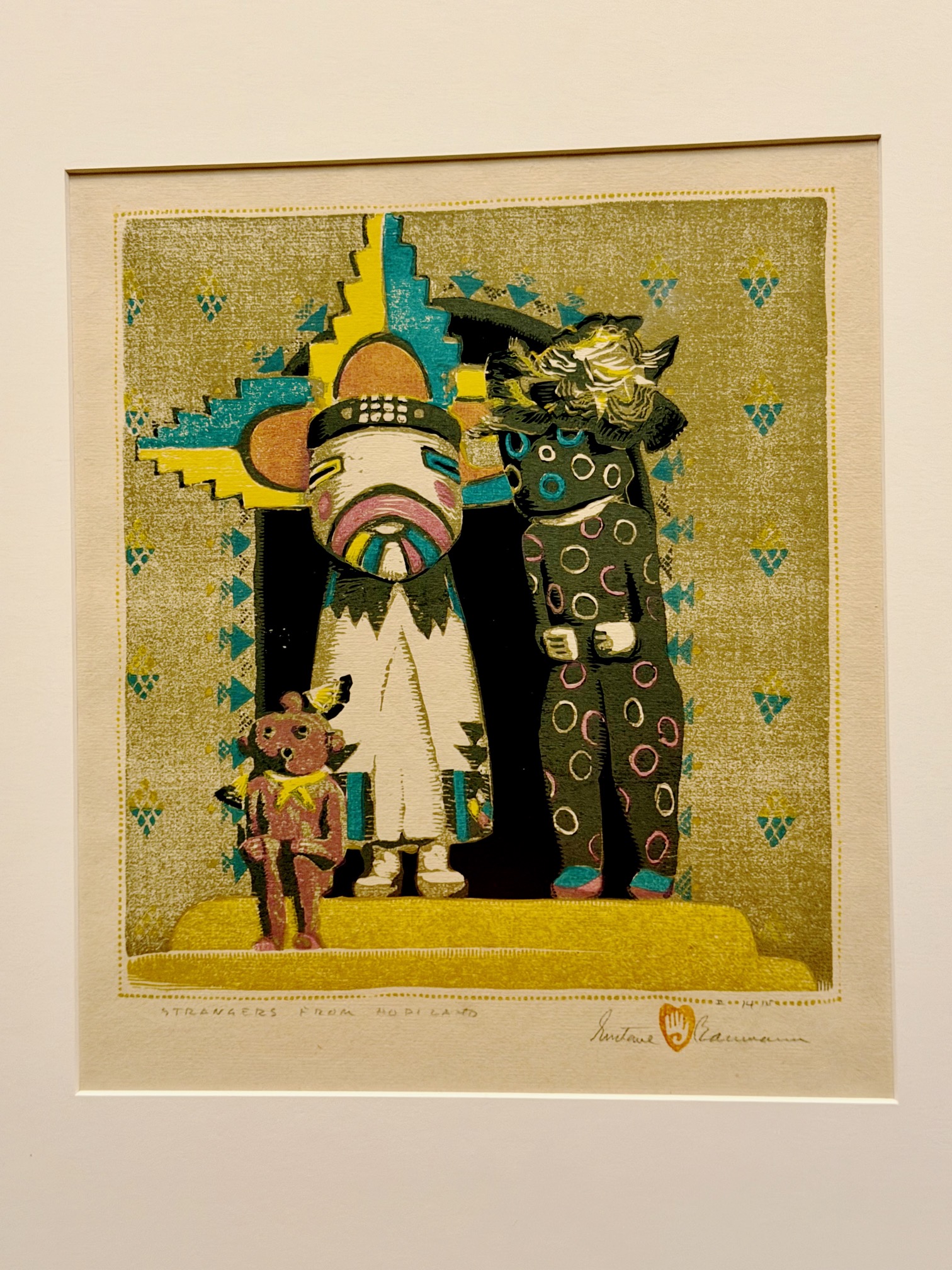
Gus Baumann’s 1924 color woodblock print Sanctuario Chimayo – learning of the historic church’s imminent sale on a sketching trip, he lobbied successfully for its preservation.
Gus Baumann’s 1921 color woodblock print Strangers from Hopiland, featuring kachinas from his collection; printed in the 1930s.

Since Jane and Ann Baumann donated so much of Gus’s work to the New Mexico Museum of Art, the curators were able to display finished prints alongside drawings and wood blocks that give visitors insight to his process.  One long wall dissects his multi-color printing process for his famed Old Santa Fe – the initial drawing, the separately carved color blocks, single-color proofs, multi-color runs, and the finished six-color print.
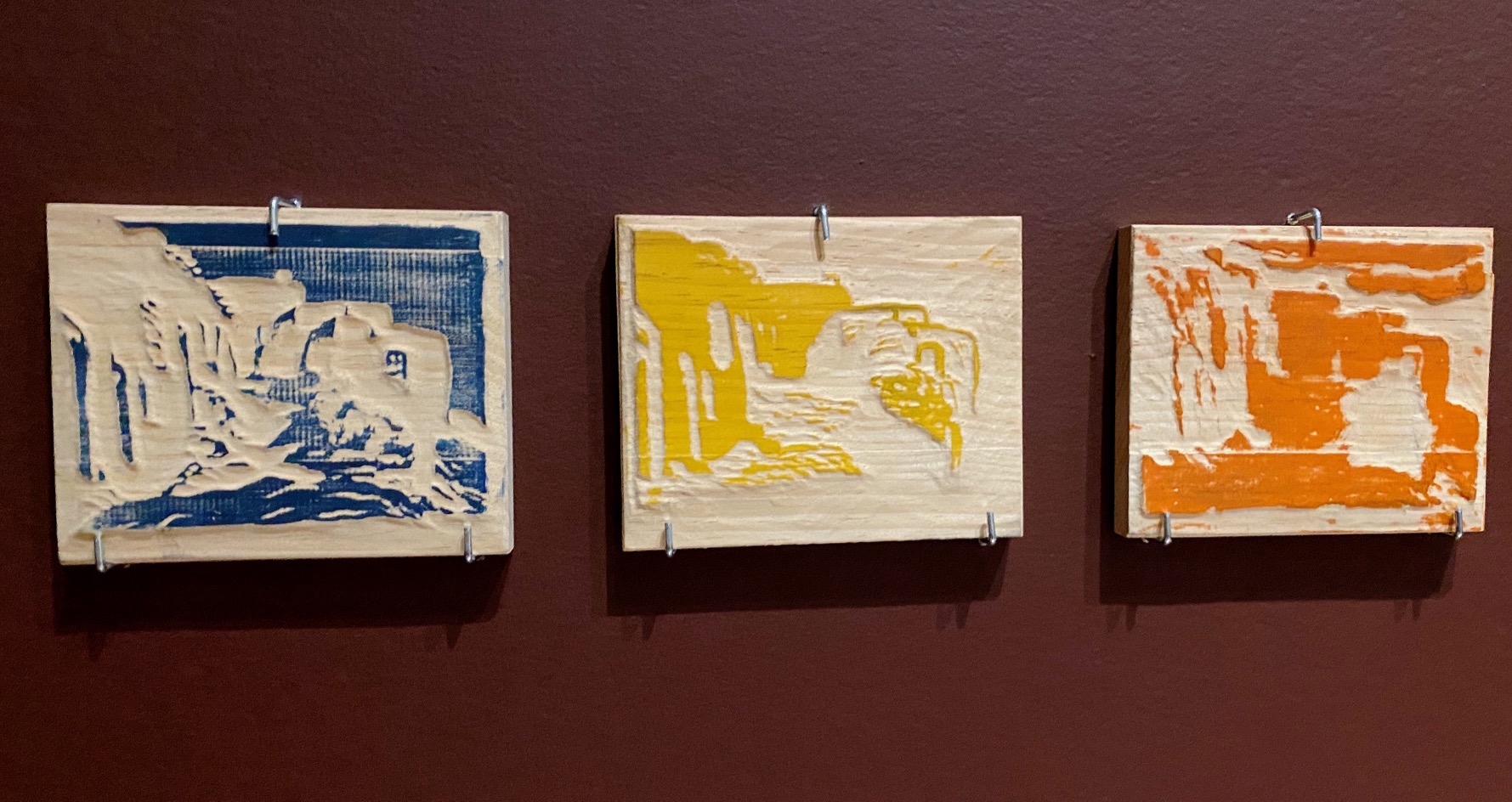
Reproductions of Baumann’s blue, yellow, and orange woodblocks for his 1925 print Old Santa Fe.

Nearly a half-dozen example of Gus’s watercolor paintings and finished prints are displayed side by side. Visitors are delighted to stand, look, compare, and wonder how he conceptualized steps to carve blocks for each color and achieve images of such depth and vibrancy.
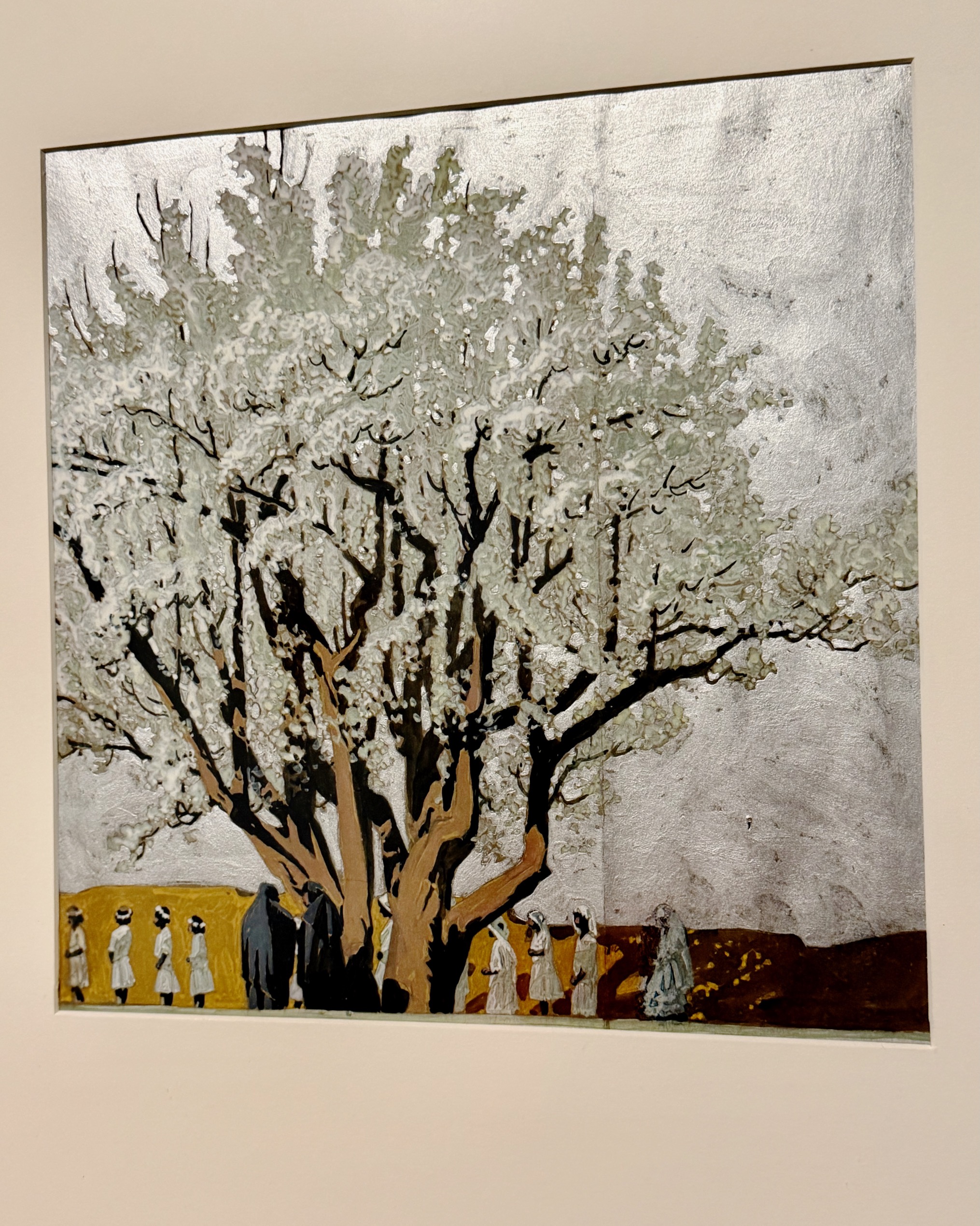
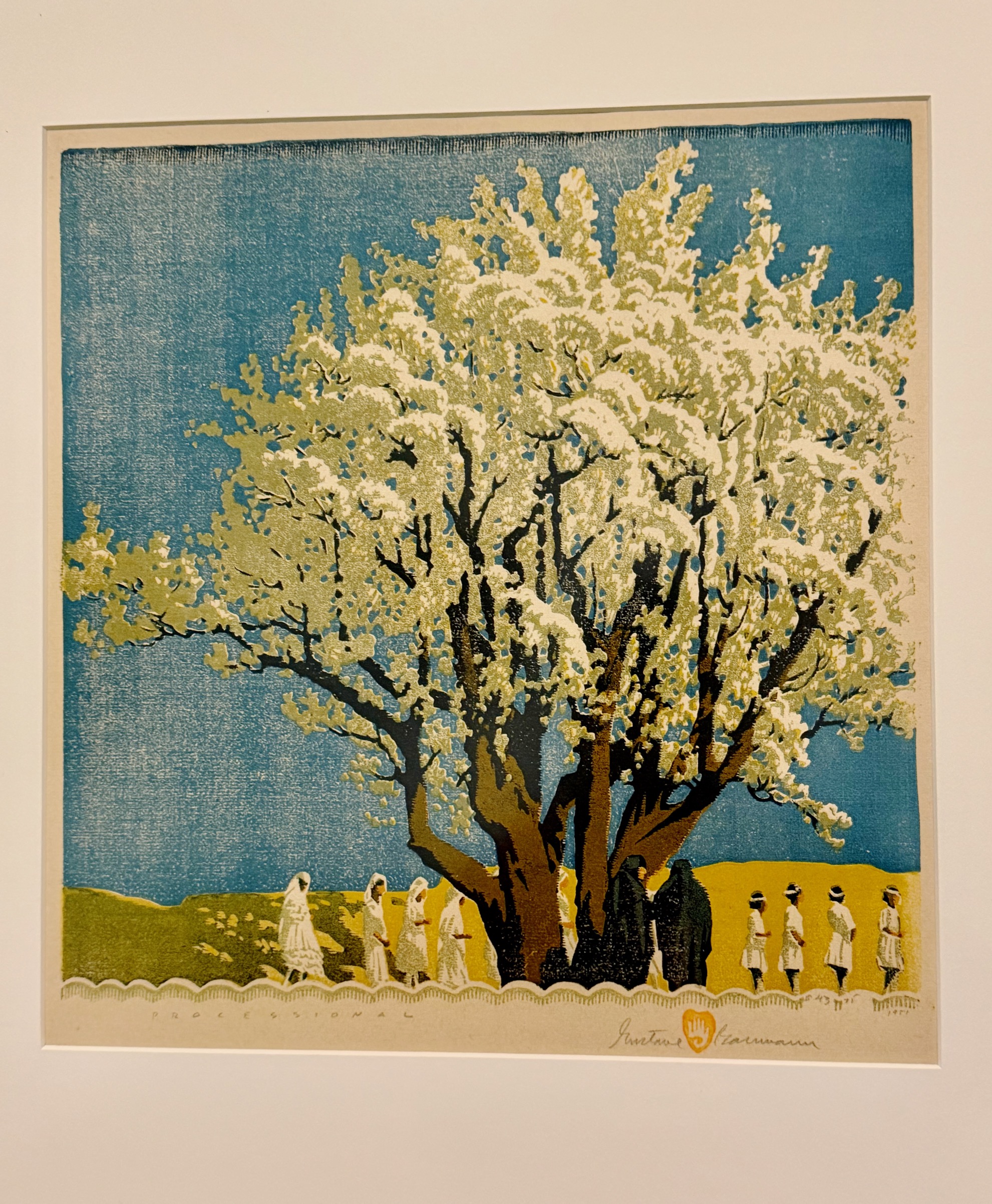
Gus Baumann’s 1930 watercolor Processional (Study), featuring girls walking to their First Holy Communion under a blooming tree and silver sky.
Gus Baumann’s 1930 color woodcut print Processional (printed 1951), based upon his watercolor.

The final gallery “An Artist by Accident” displays an array of intricate color woodcuts, experimental paintings, satirical works, paintings Spanish religious icons, whimisical wood carvings, and everyone’s favorites – Baumann’s marionettes.

It’s the first time Gus and Jane’s marionette casts have been displayed in decades, complete with hand-painted backdrops – scenes representing just a few of the couple’s scripted shows that they performed at home, in venues around Santa Fe, at world fairs, and on tour. 
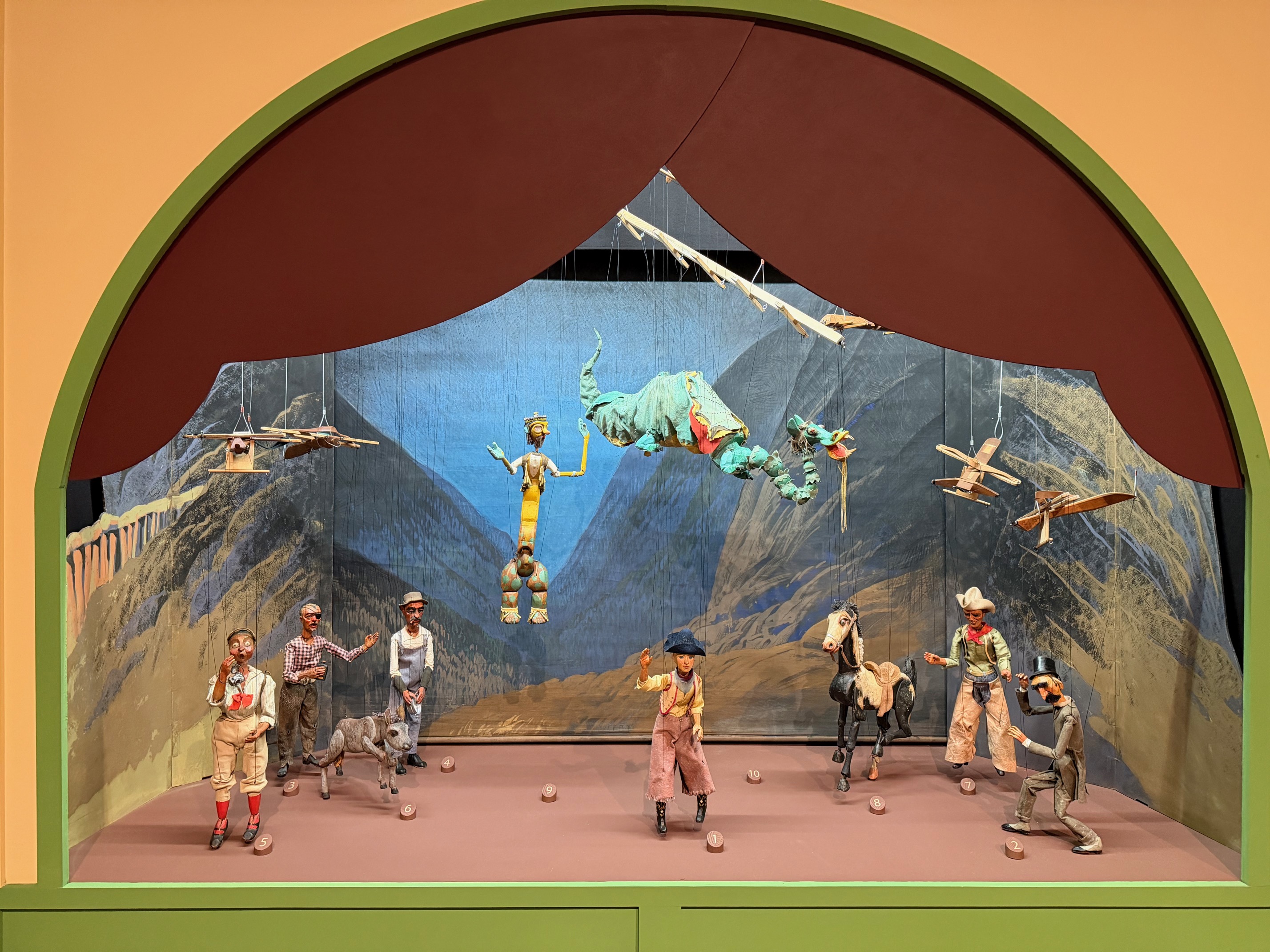
Gus and Jane Baumann’s stage set for the Santa Fe Puppett Wranglers’ 1932 marionette production of the comic melodrama The Golden Dragon Mine –starring The Tourist Lady, Temperence the Miner, Hardpan, Burro, Old Man of the Mountain, the Green Dragon, Nambé Nell, Coco the Horse, Pecos Bill, and Lord Leffinghoop.

Whimsey, delight, innovation, social commentary, and fun are all there, with surprises unfolding around every corner.  And this is all just a fraction of Gus’s creative output from his coming-of-age in the horse-and-buggy era to the Atomic Age.
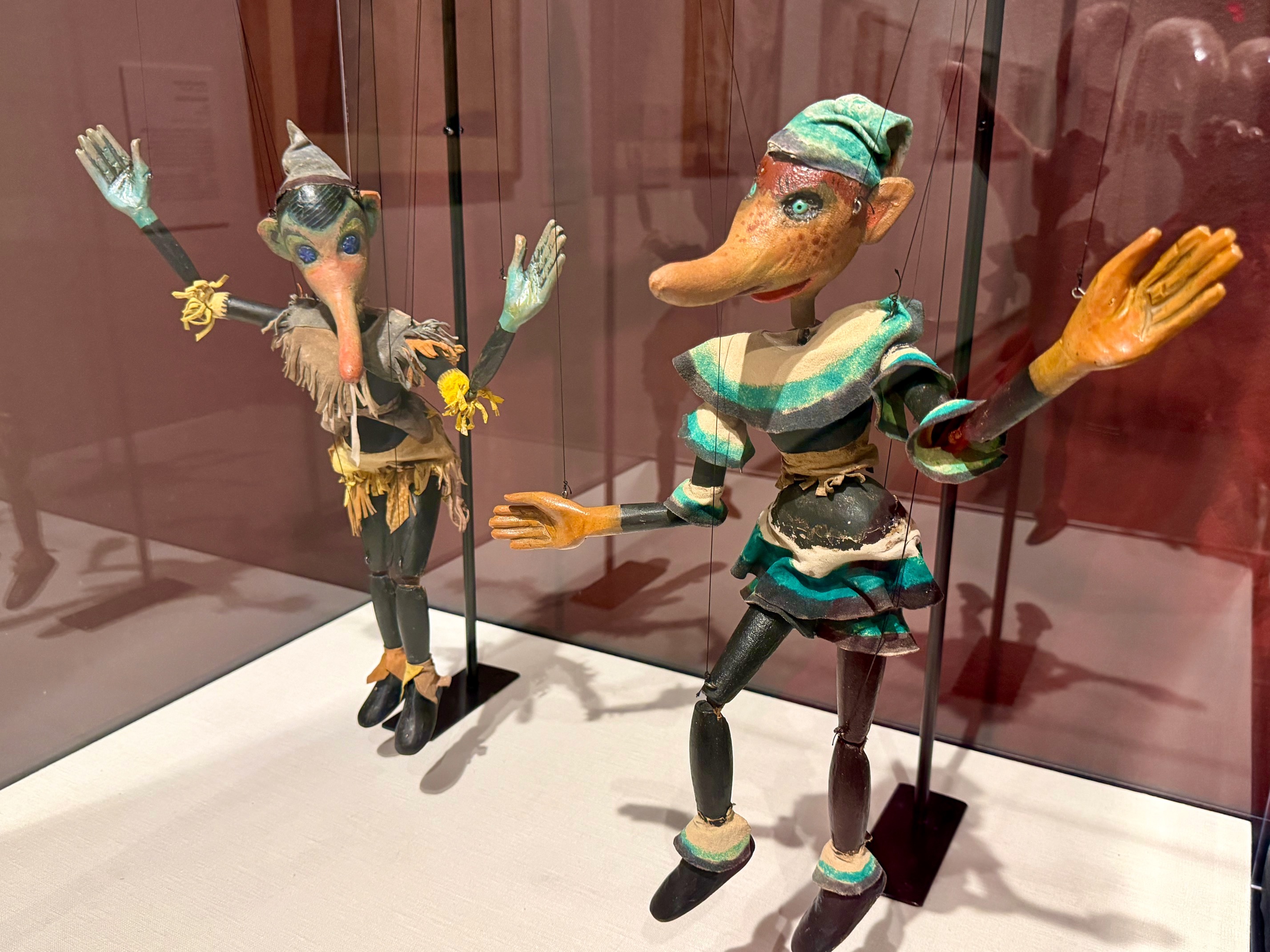
Gus Baumann’s 1940 marionette comedy stars of Teatro Duende – Long Nose (“Nosey”), the Duendi and Freckles the Duende – mischief-making Iberian elves.

No, he didn’t follow the traditional academic path, but he did leave his creative touch on America’s printmaking traditions, the foundation of many Santa Fe cultural and historical institutions, and the care and feeding of a state full of artists as head of New Mexico’s New Deal artist programs.
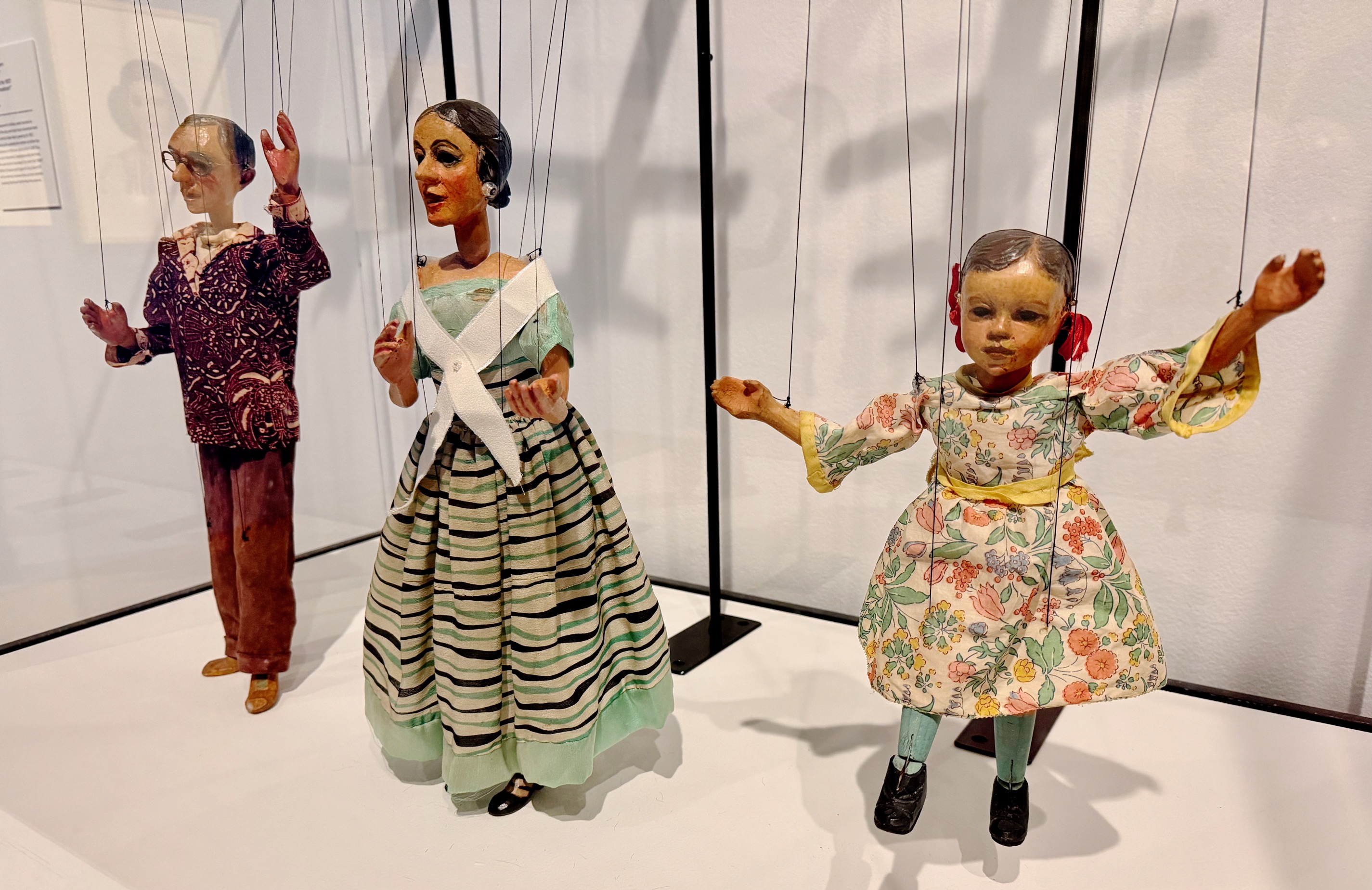
Gus Baumann’s 1932 carved family portrait – marionettes Gus, Jane, and Ann – with costumes by Jane.

Master Printmaker Gene Kloss Sees Taos

Do you wish you could travel back to Taos in the Thirties and Forties to experience the quiet, small, out-of-the-way place that inspired so many artists? Take a walk through this two-site exhibition, Legacy in Line: The Art of Gene Kloss, on view through June 8, 2025 at the Harwood Museum of Art and through May 31 at the Couse-Sharp Historic Site just off the Taos Plaza.

Kloss, whose artistic style was honed in the 1920s and 1930s, is arguably one of New Mexico’s favorite artists.  Kloss specialized in printmaking, creating an immediately recognizable style – a landscape, village, or pueblo scene with dramatic contrasts (often at night). Look at some of our favorites in our Flickr album

Kloss 1934 aquatint and drypoint Eve of the Green Corn Ceremony –Domingo Pueblo, which received a gold medal from the Pennsylvania Academy of Fine Arts. Courtesy: Couse Sharp Historic Site

Kloss fell in love with plrintmaking as an undergraduate art student at UC-Berkeley. She was captivated by the printmaking revival that swept Paris and Britain in the mid-19th century. Artists owned their own presses and produced affordable prints of landscapes and small towns that encouraged everyone to collect art.

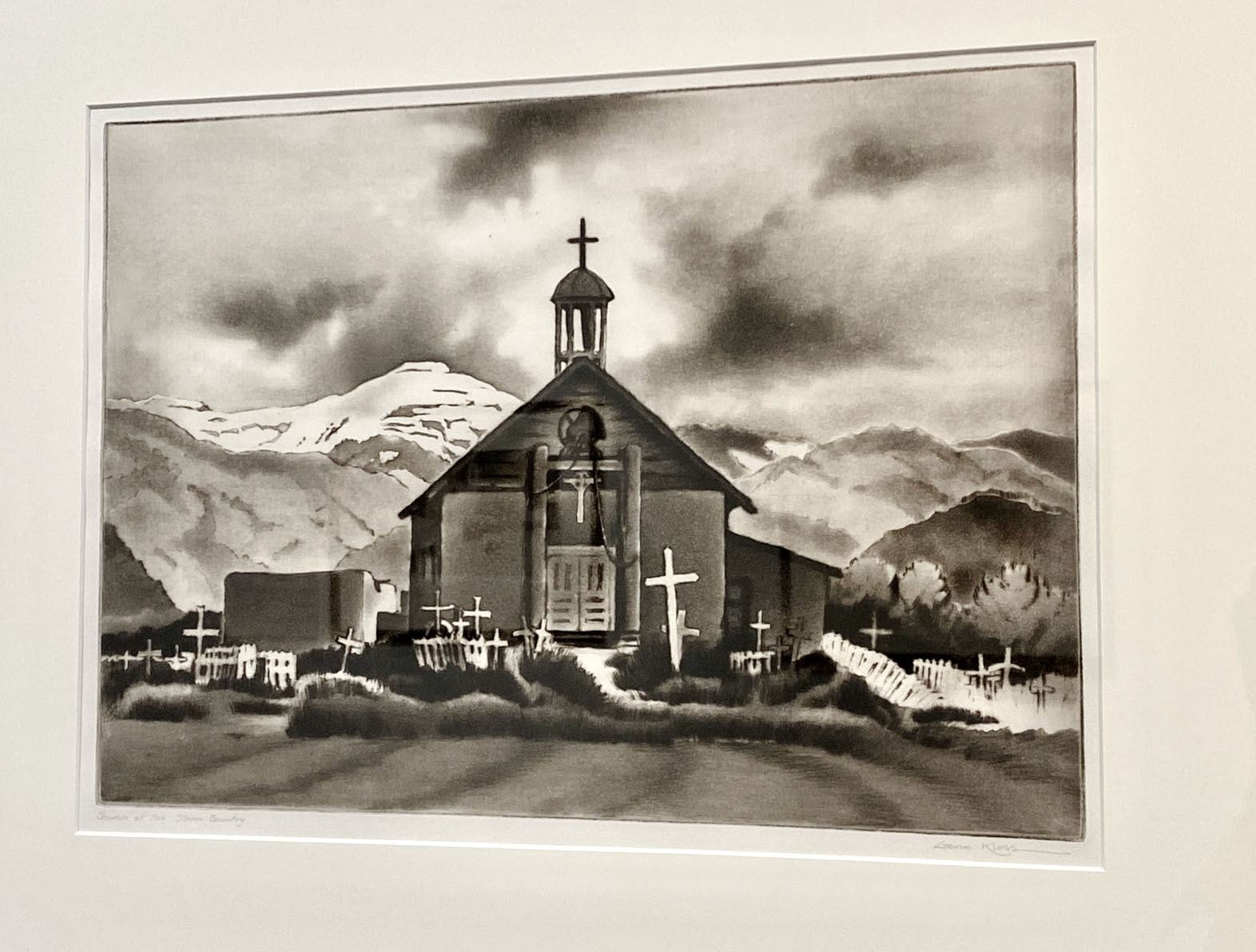
Kloss 1941 drypoint Church of the Storm Country. Courtesy: Taos Municipal Schools.

A lifelong resident of the Bay Area, she first came to Taos on a car-camping honeymoon in 1925 with her writer-composer husband. She fell in love with the landscape, the culture, and the pueblos of Northern New Mexico. Did I mention she brought along her 60-lb. portable printing press?

Kloss 1934 drypoint All Saints Day Mass – Taos. Courtesy: Taos Municipal Schools.

Kloss was prolific, and the next year showed over 100 of her paintings and prints – including Taos subjects – at a wildly successful solo show in Berkeley. She and her husband were hooked on the inspiration Taos provided, and soon rented a getaway home, where they would spend two to four months per year. 

Kloss 1934 drypoint Acoma. Courtesy: Taos Municipal Schools.

Kloss developed her images from quick sketches and from memory, bringing the drama as she precisely worked her impressions into the copper.

In the Thirties, Kloss did artwork under several New Deal programs and produced a nine-part series on New Mexico that was gifted to public schools in the state.

As a master of intaglio, drypoint, and aquatint, she developed an innovative technique in which she painted acid directly into the ground with a brush or pencil that allowed her to create super-deep tones, gradations, and atmospheres in her prints.

Few others could create scenes like hers – dramatic nighttime scenes at the pueblos, tiny pilgrims making their way at dusk among the mountains, or aerial views of old Spanish valleys.

Over her lifetime, Kloss would create over 18,000 signed prints, show in New York and Europe, and be honored with membership in the National Academy of Design. She always pulled her own prints in the studio, and kept on working through the Seventies, until the quality of commercial copper and ink that she had always used became unavailable.

Kloss 1950 drypoint and aquatint Desert Drama. Courtesy: Harwood Museum (Purcell gift)

The Couse-Sharp Historic Site (where the Taos Society of Artists was founded) and the Harwood Museum have mounted this fantastic show to honor a gift bestowed upon them by Joy and Frank Purcell, Taos residents and Kloss collectors that ultimately amassed over 130 of her works.

To see more of her work, watch this short New Mexico PBS documentary on Ms. Kloss with art historian David Witt, who talks about his friendship with her, her process, and unique interpretation of her Taos world: