Vintage Attire on NYC Mean Streets

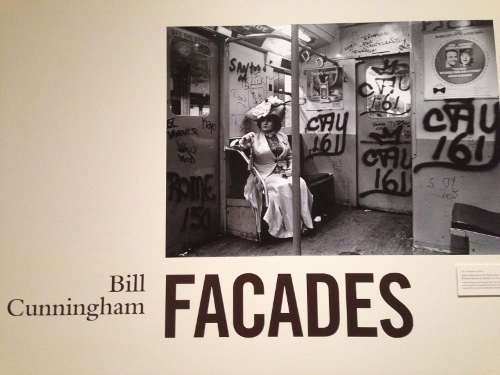
Editta Sherman in period dress on a graffiti-covered subway car to the Brooklyn Botanic Gardens

Cunningham’s photo of Editta Sherman in period dress on a 70s graffiti-covered subway car going to a shoot at the Brooklyn Botanic Gardens

Uber-fashion documentarian Bill Cunningham had a great idea in 1968, just as NYC was sliding toward financial crisis, crime, and (goes without saying) neglect of architectural sites, like Grand Central. Why not celebrate two centuries of NYC fashion and splendor on the street?

What were people wearing when some of the City’s most iconic homes, churches, and public buildings were built? Was it possible for a black-and-white photograph to reveal some new insight about the City from combining fashion, architecture, and a little fashion flair and attitude?

Editta poses for Bill  in embroidered frock coat and breeches  in front of St. Paul’s Chapel, the oldest church building (1766) in Manhattan

Editta poses for Bill in embroidered frock coat and breeches in front of St. Paul’s Chapel, the oldest church building (1766) in Manhattan

Results of Bill’s eight-year project are on display through July 15 in the Bill Cunningham: Facades photo exhibition on the second floor of the New-York Historical Society.

Without the aid of Wikipedia, he researched the years that some of his favorite historic places were built, and began scouring thrift stores for get-ups from the matching decade. He enlisted his muse, Editta Sherman, a fellow photographer and neighbor at the Carnegie Hall studios. For the next eight years, Editta and Bill went on weekend odysseys throughout the City, modeling and documenting over 500 historic outfits in front of interesting but sometimes forgotten facades.

In 1976, Bill gave 88 of his silver-gelatin prints to NYHS – the core of the current show, which is hung to emphasize the chronology of fashion and architectural style. The show was jammed with fashion lovers last weekend, soaking in the details from Bill and Eddita’s journey back in time.

Editta dresses for Bill in Gertrude Vanderbilt Whitney’s own Callot Soeurs at the 1904 Harry Payne Whitney House

Editta dresses for Bill in Gertrude Vanderbilt Whitney’s own Callot Soeurs at the 1904 Harry Payne Whitney House

It starts with Editta dressed in an 18th c. embroidered coat and breeches in front of the 1766 tower of St. Paul’s Chapel at Broadway and Fulton – the oldest church building in Manhattan that was considered “suburban” when President Washington lived here. Remarkably, they discovered this satorial gem in a Ninth Avenue second-hand store.

The visual treats just keep coming – a diaphanous Empire muslin on a model in front of City Hall (1803), Civil War-era frocks at Sniffen Court in Murray Hill, bustles and parasols at the 1884 Villard Houses (Helmsley Palace), and many spectacular gowns from the Gilded Age. Consider Eddita channeling “Diamond Lil” in front of 1891 Delmonico’s, the first modern American restaurant that innovated a la carte dining, private dining rooms, Lobster Newberg, and Baked Alaska.

In two photos, the team managed to borrow some historically relevant gowns – Gertrude Whitney’s Callot Soeurs frock for the shoot at the 1906 Payne Whitney home by Stanford White (Fifth & 79th) and Mrs. J.P. Morgan’s Worth gown at the gazelle gates of the Apthorp.

Bill Cunningham's take on modern fashions at the 1968 GM Building

Bill Cunningham’s take on modern fashions at the 1968 GM Building

The curators note that although women’s fashion in the early 20th century was fairly liberating, the public architecture of New York remained tightly classical. The show’s final shots soar with the optimism of the modern – the “New Look” in front of the Paris Theater (1948), full-skirted flair on Park Avenue by the Lever House (1952), Givenchy at the Guggenheim (1959), and mod looks at the GM Building (1968).

You will savor every minute of your journey with these creative geniuses. Check out a few photos on the NYHS web site, find a copy of the 1978 book Facades, or get to the show.

If you didn’t see the film about Bill, rent it from iTunes or Netflix or buy the DVD. You can glimpse  Eddita (a.k.a. The Dutchess) in the movie trailer below:

Subversive Chinese Brush-Up at the Met

Yang Jiechang’s Crying Landscape (2003) shares the Gallery for Art of Ancient China with a sandstone stele from the Northern Wei dynasty (489-495) and the 1319 Buddha of Medicine.

Yang Jiechang’s Crying Landscape (2003) shares the Gallery for Art of Ancient China with a sandstone stele from the Northern Wei dynasty (489-495) and the 1319 Buddha of Medicine.

Normally, the galleries for Asian Art at the Metropolitan Museum of Art are pretty tranquil. But through April 6, you’ll find them buzzing with contemporary art lovers reveling in the hunt to find the most famous, subversive, subtle works by Chinese painters, sculptors, and digital artists residing amidst centuries-old treasures in the widely popular exhibition, Ink Art: Past as Present in Contemporary China.

The Met gave the Chinese art curators free reign to pluck sly works from the in-house contemporary collections created by Chinese artists over the last 20 years, grab monumental works from private collectors, and mount a tribute to how post-Cultural Revolution innovators parse the traditions associated with centuries-old art making in their ancestral country.

How do the hottest artists on the planet turn calligraphy and inked woodblocks into biting social commentary? Take a stroll through the second floor Asian art wing.

Inspired by Cultural Revolution posters, the letters in Wu Shanzhuan’s Character Image of Black Character Font (1989) have no meaning.

Inspired by Cultural Revolution posters, the letters in Wu Shanzhuan’s Character Image of Black Character Font (1989) have no meaning. Courtesy: Private collector, the artist.

Just past the balcony-bar area, the monumental 1319 Buddha of Medicine mural from Shanxi Province, China, casts a benign presence over the Gallery for Art of Ancient China. But just stage right, two larger-than-life works on paper preview how Chinese artists twist the “then” into the “now”.

Yang Jiechang’s Crying Landscape panels are painted in the beautiful, colorful “old school” flat Asian style but depict decidedly unbeautiful industrial and political subjects. Similarly, Qiu Zhirie’s Nanjing Yangzi River Bridge ink triptych features masterful, large-scale ink-brush technique but uses art-world icons to relay a disturbing story. It’s an installation triumph that will haunt you every time you pass through that room again.

Large-scale calligraphy by many of the artists makes ink-pot-and-brush tradition echo with gestures as large as Rothko’s. In the galleries with meticulously crafted “landscape” drawings and images, you’ll ask how this modern crew managed to produce scrolls with such heft and detail. Take a walk-through of the show through our Flickr site.

In 1995, Ai Weiwei corporatized a Han Dynasty (206 B.C. – 9 A.D.) earthenware jar.

In 1995, Ai Weiwei corporatized a Han Dynasty (206 B.C. – 9 A.D.) earthenware jar. Courtesy: M + Sigg, the artist

Along the way to back of the wing, the curators play hide-and-seek, putting Ai Weiwei’s “enhanced” Han Dynasty jar right in the aisle with the “unmodernized” earthenware vessels, and mounting Hong Hoo’s subtly colored, hilarious historical “atlas” silkscreens in a case that practically dares unfocused visitors to pass them by as they drift toward the Astor Court.

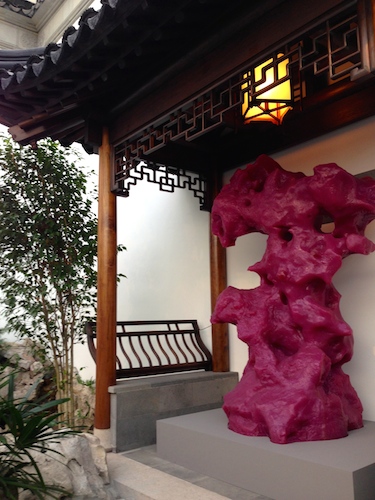
Hopefully by the time they get to the rock garden they will notice Zhang Jianjun’s crazy pink silicone rubber “scholar rock” right next to the real ones. Zhan Wang’s stainless steel scholar rock and Shou Fan’s side chairs are beautifully arranged in the Ming Dynasty room just off the Court, along with more of Ai Weiwei’s furniture hijinx.

After you’re done getting a feel for how the galleries have been transformed, go back into the Met’s exhibition web site to study the brushwork and details and get to know some of the artists.

Zhang Jianjun’s 2008 silicone rubber Scholar Rock (The Mirage Garden) sits in a 17th-century pagoda in the Met’s Astor Court

Zhang Jianjun’s 2008 silicone rubber Scholar Rock (The Mirage Garden) sits under a 17th-century pagoda in the Met’s Astor Court. Courtesy: Sigg Collection, the atist

Although the web site appears to be more plain-vanilla than jazzy, you’ll be surprised to see that the digital back-end of the Met archives lets you zoom into each of the paintings to see the handsome handwork of each of these wunderkinds from each thematic section of the show. You can even peruse the gigantic scrolls up close, section by section.

The video room, where art lovers can relax and watch a rotating collection of work, is a nice touch. The modern digital sign to the side tells you exactly where you are in the rotation.

Here’s a link to one of the featured videos: Get to know the constantly transforming cityscape of Beijing through Chen Shaoxiong’s 2005  Ink City, and see what happens when a contemporary artist paints daily life in Beijing with traditional tools and ports his day-to-night experience to video.

Armory Show Stars on the West Coast of Manhattan

The Artforum Lounge on the Contemporary Pier

The Artforum Lounge on the Contemporary Pier

For four action-packed days, the art crowd made its way to the West Coast of Manhattan Island past gritty lots, warehouses, the ball fields of Clinton, and high-rises-under-construction to enter a white, light-filled glittery expanse of painting, sculpture, and champagne bars at the 2014 edition of The Armory Show.

This year, 205 exhibitors showed off the best in modern masters and contemporary upstarts. Walk through it with us on our Flickr feed.

If you’ve never been there, just know that the art fills two full piers (yes, where the cruise ships come in). You may think the Whitney Biennial is big, but The Armory promenade is vast.

On the Modern Pier: Chicago’s Alan Koppel Gallery gave tribute to original Armory Show in 1913 with several Duchamps, but most of the work is post-1940 by Modern superstars. Right at the start of the pier, Galleria d’Arte Maggiori positioned a nice rough-and-ready Mattia Moreni in kind-of a face-off with a pretty primitive Basquiat nearby.

Dramatic paper collage and charcoal work by Elaine de Kooning with two Picasso ceramics at Vivian Horan

Dramatic paper collage and charcoal work by Elaine de Kooning with two little Picasso ceramics at Vivian Horan

Frankfurt’s Die Galerie gave NYC glamour-icon Louise Nevelson a mini-tribute, and several galleries featured Marca-Relli’s painting/collages.

Best on the Modern Pier: Vivian Horan’s booth, dominated by a large Elaine de Kooning charcoal drawing with collage, but populated by two small Picasso ceramics that most fair goers didn’t even see, although they were practically out in the aisle. You don’t see Picasso ceramics too much, and they really added a nice touch.

Second runner-up was the Armand Bartos booth with a sharp Kenneth Noland, Andy’s chicken soup can under glass, and a no-holds-barred Stella. In fact, there were multiple 1980s 3D Frank Stellas leaping out from walls, demanding attention. Besides posing with the soup can, lots of visitors were snapping photos of themselves in front of Mr. Stella’s work.

1949 Hans Hoffman oil at London’s Crane Kalman

1949 Hans Hoffman oil at London’s Crane Kalman

Welcomed surprises: Even though he taught most of the post-war painters in New York, you don’t often see Hans Hoffman paintings, so it was nice to encounter one of his color explosions at Crane Kalman. And we’ve never seen the two super-early skinny Lichtenstein sculptures at Barcelona’s Galeria Marc Domenech booth. Guess they were made in those lean before-the-dots years on his path to Pop.

Susan Harris curated a great micro-show of 20th century female artists, mostly works on paper (e.g. Georgia O’Keefe, Kiki Smith, Lee Bonticou), all contributed by gallery exhibitors.

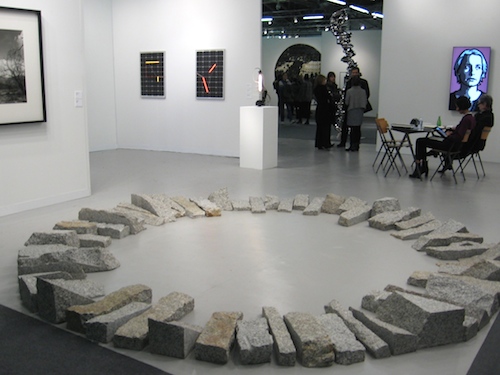
Richard Long’s 1994 Merrivale Circle at the Lisson Gallery

Richard Long’s 1994 Merrivale Circle at the Lisson Gallery

Although you could hike outdoors to get to the second pier along the West Side Highway, most were guided through a wormhole and down a flight of stairs to descend directly into the booths from 17 contemporary galleries across China – a great landing into a warren of booths featuring installations (watch out for the Roomba!), and user-friendly exercise equipment that the PRC makes available in public parks for citizen fitness.

From there, you enter the Contemporary Pier area.  Highlights: the whirling handbag piece (with real handbags) by Egill Saebjornsson at Reykjavik’s i8 Gallery, Richard Long’s stone circle at London’s Lisson Gallery booth, the completely constructed entry to Boesky Gallery, and Claudia Weiser’s cool wooden sculptures at Sies + Hoke (Dusseldorf).

Nick Cave Soundsuits at Jack Shainman

Nick Cave Soundsuits at Jack Shainman

A great place to end the journey was at the Jack Shainman booth, with its dramatic contemporary art exploring expressions from Africa, African-Americans, and global artists — the Nick Cave soundsuits and Richard Mosse’s spectacularly dissonant hot-pink infrared photograph of a waterfall in the continually disintegrating, war-torn Democratic Republic of Congo.

Take a look at the highlights here.

Fair goer relaxes on modernist egg chair under the watchful eye of Dali

Fair goer relaxes on modernist egg chair under the watchful eye of Dali

The Art of ElBulli’s Culinary Genius

Notebooks and menu drawings from ElBulli’s kitchen displayed in front of a mural of Ferran Adrià and staff in Roses, Spain in the most famous kitchen in the world. Courtesy: elBullifoundation, The Drawing Center

Notebooks and menu drawings from ElBulli’s kitchen displayed in front of a mural of Ferran Adrià and staff in Roses, Spain in the most famous kitchen in the world. Courtesy: elBullifoundation, The Drawing Center

If you weren’t able to visit the famed ElBulli restaurant on the coast of Spain before it closed two years ago, don’t worry. Pop down to Soho to meet the man, his team, and his legacy through The Drawing Center’s provocative show, Ferran Adrià: Notes on Creativity, running through February 28.

Even if you can’t taste the world-renowned creations, you’ll feel as though you’ve entered his kitchen during the six months per year that his team worked on R&D through up-close looks at experiments, plating, techniques, codes, inventions, and graphic treatises. Take a look at the installation on our Flickr feed.

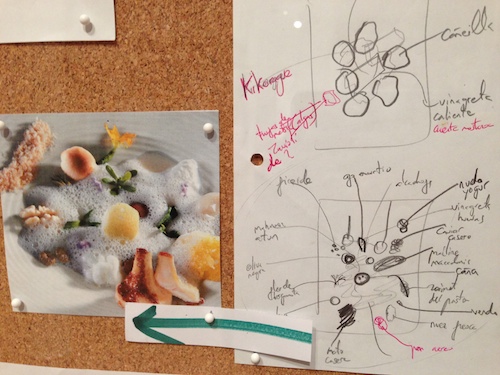
Close-up of large working board of photo and diagrams document the plating and components of each dish. Courtesy: elBullifoundation

Close-up of large working board of photo and diagrams document the plating and components of each dish. Courtesy: elBullifoundation

Last weekend, the Wooster Street space was jammed with visitors eager to see glimpse the genius behind the magic of the famed elBulli – notebooks filled with diagrams of exacting platings of food, a room inside the gallery evoking elBulli’s Barcelona archive, huge storyboards pinned with drawings and photographs of artist-inspired dishes, and glass-topped tables containing inventions that created some of the most amazing food–art in the world.

Examples: the apparatus that turns cheese into “spaghetti”, the glass bowls used to serve diners “edible air”, or the cocktail device that literally sprays a dry martini right into a diner’s mouth.

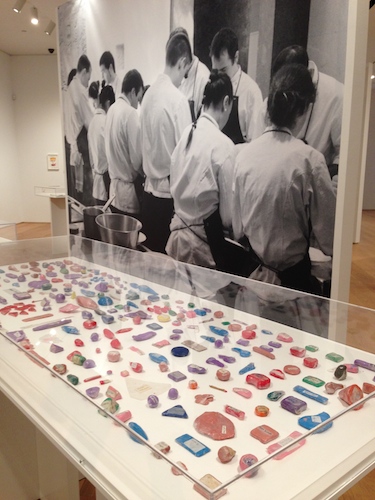
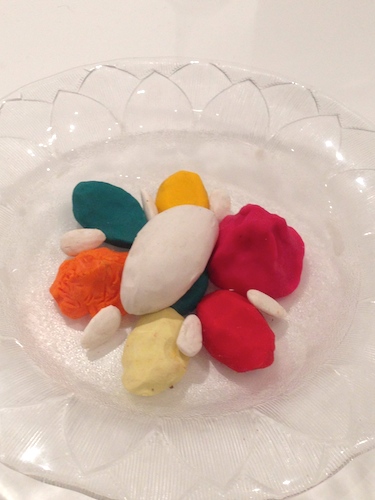
240 plasticine models used to standardize recreation of the sizes and shapes of various portions of food used as components in his highly inventive, artistic dishes. Courtesy: elBullifoundation, The Drawing Center

240 plasticine models used by staff to recreate precise shapes and portions of artistic dish components.

And how do you keep the beautiful dishes consistent? By making little plastic sculptures so that the kitchen crew knows how to duplicate forms for delicate platings precisely on everyone’s plate. When you’re delivering identical 40-course dinners to guests who have flown halfway around the world to join you for dinner, precision counts.

Improvisation may have happened during the six months of the year that elBulli shut down to devote itself to R&D, but not so much during dining-season crunch time. Just look at the large wall drawing that Adrià sketched for this show — Map of the Creative Process: Decoding the Genome of Creativity. Organization is key.

Last weekend, there were no empty seats in the downstairs video viewing gallery, as visitors sat mesmerized by 1846, the 90-minute film co-produced by The Drawing Center, showing every dish Adriá ever served at elBulli (1987 – 2011).

Plasticine model of the 1994 Le Menestra dish composed only of textures, including cauliflower mousse, basil jelly, almond sorbet, avocado, and numerous other components. Courtesy: elBullifoundation

Plasticine model of the 1994 Le Menestra dish composed only of textures, including cauliflower mousse, basil jelly, almond sorbet, avocado, and numerous other components.

Photos of gorgeous, glistening food on plates, rocks, and wood lilted by to an opera soundtrack punctuated by the sounds of water lapping on the shore near the restaurant.  Plates of vegetables, seafood slices, sprigs, and flowers wafted by. What are those spoons filled with? What appeared to be “hatching” out of that egg? What was the egg? What was perching on a stalk like an insect? The effect made you feel as if you were seeing life on Earth evolve…biomorphic shapes surrounded by foam.

You could tell that these art-and-food lovers had absorbed the exhibit upstairs when there was a collective gasp of recognition when the real-life version of La Menestra (accurately and lovingly represented in plascticene upstairs) floated onto the screen.

Since he shut the most desired and famous restaurant in the world, Adrià has been hard at work making sure that his thoughts, processes, philosophy, and research were well documented and translated to digital form. Although it’s still in beta, he’s incorporating it all into an online encyclopedia of gastronomic knowledge.

Kudos to Brett Littman and his team at The Drawing Center for mounting a show that pays tribute to food-as-art and shows us how creativity, inspiration, and documentation (in the hands of an genius, or team of geniuses) can turn experiments in a kitchen on a small Spanish seaside cove into a global digital export of wisdom and innovation for the next generation of chefs.

Take a look at Bullifoundation’s promo video to see what’s in store:

Happily, this show is going on the road in the United States before it leaves for The Netherlands in 2016:  See it at the ACE Museum in LA (May 4-July 31), Museum of Contemporary Art in Cleveland (September 26-January 18, 2015), or Minneapolis Institute of Art (September 17, 2015-January 3, 2016).

Here’s a link to Documenting Documenta, a 2011 film about Adrià’s life, inspiration, work, and participation in Documenta 12, an international cultural festival in Kassel, Germany that happens every five years.

Must-See Skytop Panorama of NYC Past & Present at The Whitney

The installation view of T. J. Wilcox: In the Air, 2013. Photo: Bill Orcutt

The installation view of T. J. Wilcox: In the Air, 2013. Photo: Bill Orcutt

If you want to enjoy a beautiful view of Manhattan from the roof, don’t worry about the snow, rain, or cold weather. Go over to the Whitney Museum before February 9 and take in the film installation T.J. Wilcox, In the Air, that features a beautiful panorama (from the roof of Wilcox’s Union Square studio) that dreamily introduces six stories about the past and present of life, art, energy, fame, events, and cosmic forces that ebb and flow continuously below.

The big, in-the-round screen circles around you (duck and just walk into it), so you can really take in the view, all the way from the Battery to beyond the Empire State Building.

Still from T.J. Wilcox’s panoramic 2013 silent film installation, In the Air. Image courtesy of the artist and Metro Pictures.

Still from T.J. Wilcox’s panoramic 2013 silent film installation, In the Air. Image courtesy of the artist and Metro Pictures.

The film cycles from dawn to dusk, but along the way, Mr. Wilcox takes you on little journeys as you enjoy his movie panorama. The experience is one where you begin to see New York through his eyes, past and present together.

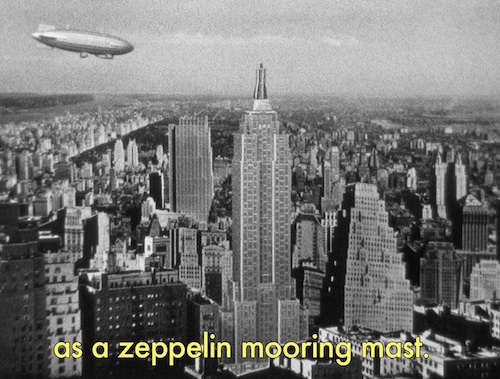
After a few minutes, one of his panorama screens fades you see a short, reflective, poetic, subtitled NYC story-movie. It’s a quiet experience — bringing you back to the Thirties when the Empire State Building was contemplated to be used as a zeppelin-docking station, to the present when 14th Street is one of the best vantage points to contemplate the out-of-this-world spectacle of Manhattanhenge, and the days of glitter, glamour, and grit of Warhol, Gloria Vanderbilt, and fashion-industry icon, Antonio Lopez.

Watching Wilcox’s Gloria Vanderbilt vignette from outside the installation. Photo: Bill Orcutt.

Watching Wilcox’s Gloria Vanderbilt vignette from outside the installation. Photo: Bill Orcutt.

He reminds you that Gertrude Whitney, the museum’s founder, long ago succeeded in a custody battle to care for little Gloria. The film takes you to her apartment and reflects on the fact that Gloria was “in the public eye from birth” and celebrates her vibrant artistic, business, and family accomplishments (re: plenty of shots of Anderson Cooper). Another mini-film focuses upon a nano-second in Warhol’s life, when his Factory crew unfurled Mylar balloons to welcome the arrival of the pope-mobile to New York City in 1965.

Weegee’s Variant of Untitled (Striking Beauty) is hung in an adjacent gallery. Courtesy: Whitney Museum

Weegee’s Variant of Untitled (Striking Beauty) is hung in an adjacent gallery. Courtesy: Whitney Museum

In his musing on the film about fashion-illustrator extraordinaire, Antonio, Wilcox reveals his surprise that Antonio’s studio was located right next to his own building, takes pleasure in asking us to gaze out over the community where so much magnificent art was made, careers enlivened, and life lived.

In a tiny back-room gallery, the Whitney has installed a few other reflections on skies over the City – Weegee’s lightening strike behind the Empire State Building and Yoko’s Sky TV, are two – but the big “wow” here is Mr. Wilcox’s ability to take us on a 35-minute journey in and among the streets and skyline that from his quiet, contemplative perch.

It’s quite a collage of memory, reflection, mythologies, politics, history, and beauty. Click here to see the Whitney’s slide show of the storyboards in Wilcox’s studio, and listen to him talk about it this beautiful work in this YouTube video:

Wool Smart Art Covers Guggenheim

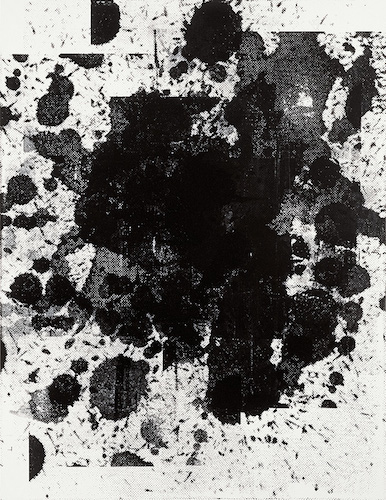
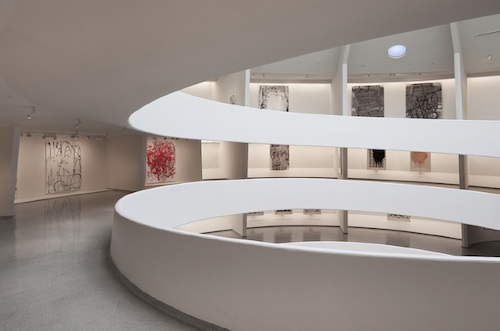
Wool’s untitled 2000 work, silkscreen on linen on the top-floor gallery. © Christopher Wool

Wool’s gigantic 2000 silkscreen installed on the top-floor gallery, a cool, hands-off approach to large-scale work. © Christopher Wool

The Saturday night art crowd packing the free Guggenheim night for the last weekend of the Christopher Wool retrospective was drinking in the cool, edgy dissonance of this savvy, art-world action artist. Check it out in person before January 22, or download the new free Guggenheim app and take the tour on your iPhone.

Gazing down from the third or fourth floor, the smooth rungs of Mr. Lloyd-Wright’s spirals punctuate tiers of Mr. Wool’s own spirals, splatters, wipe-outs, word art, and grids of gritty photos. The massive crowd of locals, tourists, and moms with tweens provided a lively audience for work originally germinated in the rough-and-ready Lower East Side during the days when NYC was not-so-nice.

Just up the ramp in the two-story mini-gallery, the curators hung pieces that sum up Wool’s lifetime achievements – large-scale enamels on aluminum using gigantic, ironic gestures and banal advertising-art flowers; channeling the down-and-out feel to 80s New York with cool word-and-letter art evoking graffiti; and appropriating phrases from revolutionary texts that seem to be about one thing but are actually heady philosophical and literary references that only super-smart people would “get.” The work is stunning.

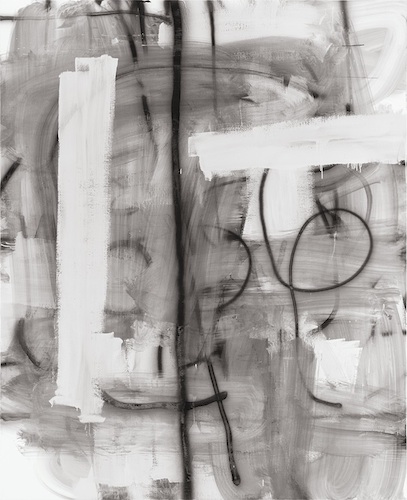
Wool’s 2010 untitled enamel on linen uses erasures, spray, and wipeouts. © Christopher Wool

Wool’s 2010 untitled enamel on linen uses erasures and spray. © Christopher Wool

Then a slightly more chronological journey begins through the rest of the museum. Wool began appropriating rollers used by painters to paint tenement walls and halls to apply decorative patterns methodically across his own giant canvases – taking a bit of the decision making out of the act of painting. At the time, it was an in-you-face comment directed toward more lyrical, or expressive gestural painters. Of course, he would screw up the pattern just a little to add a little extra dig at the current scene. Oh, yes, he mostly kept the color palette to black and white. Smack!

By 1987, he injected letters, words, and texts onto the white canvases and began collaborating with other artists in the “no wave” Downtown scene, which was rife with 8mm filmmakers, performance artists, and musicians reacting against the more commercial artists emanating from CBGB or other clubs. He collaborated making books, always an ephemeral, revolutionary choice.

Hydrant photo that resembles the above work, from East Broadway Breakdown, one of 160 inkjet prints, 1994–95/2002. © Christopher Wool

Hydrant photo with spilled water whose shape resembles the silkscreen above. Photo from East Broadway Breakdown, one of 160 inkjet prints, 1994–95/2002. © Christopher Wool

In the 1990s, the street was used as a start point for both his own photo books, which were shots of lonely urban areas that he photocopied over and over to obtain the I-don’t-care-about-glossy-quality look of the published work. When accessing the iPhone audio track in front of the 1990s photo piece, East Broadway Breakdown, Mr. Wool and the curators pretty much knock your socks off by blasting the superb Nation Time by Joe McPhee right through the earbuds. Thanks to them, you can hear the masterwork music that inspired Wool at the time, jolting you back the mean streets of Chinatown and East Broadway that sparked so much creative juice.

Installation view of Wool’s provocative all-word 1989 Black Book Drawings. Photo: David Heald.

Installation view of Wool’s provocative all-word 1989 Black Book Drawings. Photo: David Heald.

The top rungs of the show are gorgeous, even though that was probably not the original intent – cool, monumental works that are layered, blotted out, white-washed, and splattered over. If a line is blotted out, do you still see the line? If you do your painting on rice paper, is the end result different than when you do it on a canvas?

When you get to the final gallery way, way up top, Wool has digitized fragments of many of these earlier gestural images and silkscreened them onto the giant pieces of stretched linen. Very, very cool and covered in micro-dots from the silkscreen mesh. Check out the works on the Guggenheim website.

Stunning installation of Christopher Wool’s work in Mr. Wright’s building. Photo: David Heald.

Stunning installation of Christopher Wool’s work in Mr. Wright’s building. Photo: David Heald.

If you don’t know Wool’s work, using the iPhone guide provides a valuable context, showing you the works while you listen to the audio and watch other artists talk about Wool. Access some samples here.

But most of the people we saw on Saturday were standing in awe before the gigantic gestural canvases without the aid of an interpretive guide. Thousands of people were examining the curator notes, and moving forward and back within Mr. Wright’s bays to take it in from all angles…the kind of slow, deliberate, thoughtful face-to-face encounters that Mr. Wool likely treasures from cool admirers.

Artistic and Ethnic Identities Explored in La Bienal at El Museo

Ethno Portrait Cultural Test Shot by Sean Paul Gallegos alongside Reserved Ancestry made from Air Jordans, Arrow collars, and fur.

Indian Removal Act Skeuomorph by Sean Paul Gallegos wearing Reserved Ancestry (on right) sculpted from Air Jordans, Arrow collars, and fur.

Get to know some of NYC’s best new artists by strolling through El Museo del Barrio’s La Bienal 2013 on the Upper East Side before January 4.

Full of fun, reality, street life, high-art provocation, and what it’s like to be an artist in 2013, the show has it all – installations, videos, performance-art artifacts, photographs, sculptures and even a tintype. Take a look at some of our favorites on the Flickr feed, and go to the excellent website for El Museo La Bienal 2013: Here is Where We Jump, the seventh edition of this working contemporary artist showcase, which explores both formal-art and ethnic identity issues.

Small detail of Ignazio Gonzalez-Lang’s “Guess Who” – a grid of 100 inkjet prints of police sketches that appeared in NYC newspapers papers. In this 2012 work, he arranged very similar portraits side by side.

Small detail of Ignazio Gonzalez-Lang’s Guess Who – a grid of 100 inkjet prints of police sketches that appeared in NYC newspapers papers. In this 2012 work, he arranged very similar portraits side by side.

Look closely at the pieces by Sean Paul Gallegos, an artist who considers himself a product of colonial ancestry (his father is Tiwa and Spanish from New Mexico and his mother is Cree and French from Canada). Gallegos juxtaposes his “anthropological” self-portrait with his Native American-inspired headdress made entirely out of cut-up Air Jordan sneakers, Arrow shirt collars, and fur.

A grid of 100 inkjet prints of police sketches by Ignazio Gonzalez-Lang, an NYC Puerto Rican artist, also puts identity to the test. For Guess Who, he’s collected police sketches that have appeared in New York City newspapers, slapped them into a grid, and arranged them in pairs that look all-too-similar. Super thought-provoking.

The Cortez Killer Cutz Radio installation by Eric Ramos Guerrero, a Philippines-born artist, also gets into your head but out of your comfort zone. It’s a full-size, two-room simulation of a Southern California hip hop/R&B radio station streaming late-night song dedications by girlfriends to their incarcerated boyfriends.

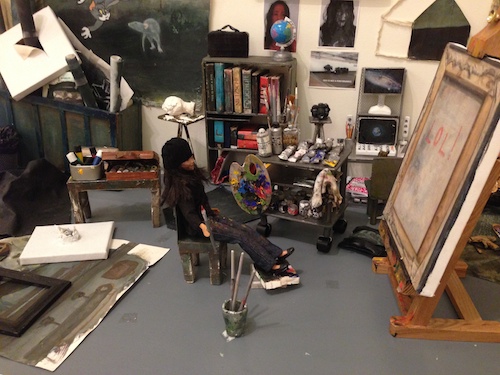
Close-up of the doll-artist contemplating her studio output in Julia San Martin’s Dollhouse

Close-up of the doll-artist contemplating her studio output in Julia San Martin’s Dollhouse

Julia San Martín’s Dollhouse, on the other hand, is a very tiny, detailed installation of a look into the mind and work of the artist. On a miniscule set of her studio, a doll-size painter works on her paintings and drawings, which the Chilean-born artist often rearranges and reshuffles to mimic the working life and consternation of deciding what to paint and what to show.

RISD-trained Gabriela Salazar also looks inward to her studio experience, but in a more formal way. As an artist that often creates large-scale constructed works in the community, she’s taken the remainders of some of her projects – wood shims, foam, cardboard, felt, rope, and wire – and turned them into tiny-scale minimal masterworks, all displayed in a type of “gallery show within a show.”

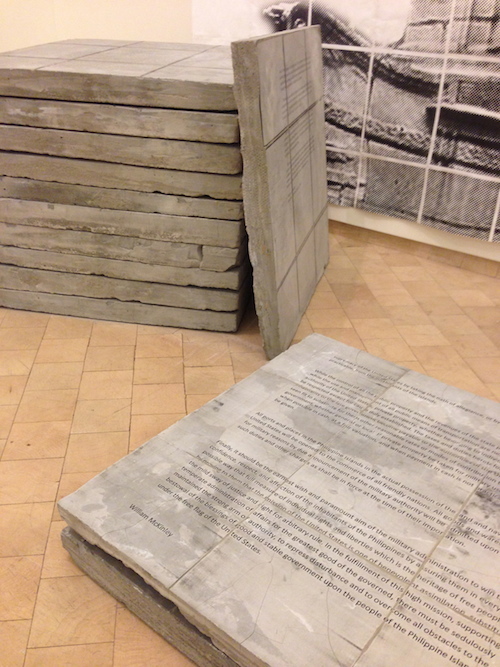
Ramón Miranda Beltrán’s historic documents cast in concrete, featuring President McKinley’s treaties that gave Guam and the Philippines to the US after the Spanish-American War

Ramón Miranda Beltrán’s historic documents cast in concrete, featuring President McKinley’s treaties that gave Guam and the Philippines to the US after the Spanish-American War

And be sure to look for Gabriela Scopazzi’s hilarious Amarilla video where she seranades a captivated group of llamas with an aria. (Sorry, it’s for in-person viewing only and not on the web.)

Work through the show’s website to see more of each artist’s work and learn more about what makes them tick.

Go Underground and Outside at Grand Central

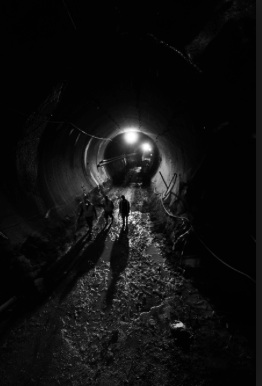
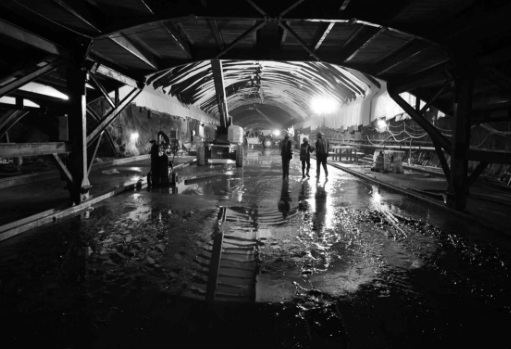
Hiroyuki Suzuki’s dramatic black-and-white view of the massive $8.2B project

Hiroyuki Suzuki’s dramatic black-and-white view of the massive $8.2B project

See New York above and below in two unique photography installations at everyone’s favorite train station right now.

At the New York Transit Museum Annex, you can glimpse your future path to the Hamptons in The Next Level: East Side Access Photographs by Hiroyuki Suzuki through October 27. Suzuki takes you over 14 stories below Grand Central to see the tunnels, sandhogs, tunnel boring machines, and chasms of the huge construction project that will allow 160,000 daily LIRR riders to arrive on Manhattan’s East Side when it’s done in 2019.

Suzuki had never before visited New York before starting his project, but he considers it a thank-you for the relief work done by the US Armed Services following the devastating earthquake and tsunami that hit his home country of Japan in 2011.

Underground view of East Side Access by Hiroyuki Suzuki

Underground view of East Side Access by Hiroyuki Suzuki

Contemplating the more than 50 black-and-white images, you can feel the monumental achievement happening underground, feel the damp, hear the light sloshing of men and machines moving through slightly damp tunnels, and see the miles of spaghetti-like cables illuminating the gigantic spaces where trains will soon thunder.

Suzuki made four trips down there during the project, and you may not even get to make one, so drop in and take a look at the engineering marvel happening right beneath a good patch of Midtown East. You’ll see supports labeled “48 Street” or “FDR” for orientation in the black wilderness.

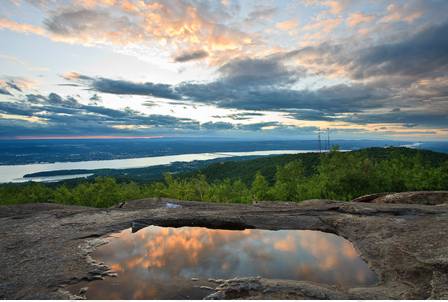
Beautiful Hudson River photograph by Robert Rodriguez, Jr. from the one-day exhibition in Vanderbilt Hall

Beautiful Hudson River photograph by Robert Rodriguez, Jr. from the one-day exhibition in Vanderbilt Hall

Speaking of wilderness, get over to Vanderbilt Hall sometime today to experience the opposite – gorgeous landscapes of the spectacular Hudson Valley. To celebrate the achievements of an historic environmental organization (and encourage you to buy a train ticket to see scenery that inspired generations of artists), there’s a one-day-only photo spectacular — 150 images by Annie Leibovitz and 12 other photographers whose subject is the beauty of the Hudson River.

On Time and Place: Celebrating Scenic Hudson’s 50 Years, sponsored by Metro-North and Scenic Hudson, has traveled to five cities to celebrate this historic environmental organization’s 50 years of success. The photos are in Vanderbilt Hall from 10am until 4pm.

Civil War Photos and High Line

The High Bridge and the former Civil War rail line, now turned into a pedestrian walking trail across the Appomattox River last year by the State of Virginia.

The High Bridge and the former Civil War rail line, now turned into a pedestrian walking trail across the Appomattox River last year by the State of Virginia.

What can you see from the perspective of 150 years after Gettysburg? If you go to Farmville, Virginia, you can experience a tranquil, soaring view of lush greenery 160 feet above the Appomattox River – a railroad trestle that was once burned, chopped, and torn apart in desperation just a few days before Lee’s surrender.

If you go to the Metropolitan Museum of Art today or tomorrow, you can see Photography and the American Civil War, a show on the First Floor that snaps you back to the birth of image-making, self-promotion, and day-to-day documentation in a way that makes today’s mania for image-sharing look a little lame in comparison.

Essentially, there were over 2,000 photographers roaming through the North and South during those four years of the Civil War. They produced over 1 million pictures of people, soldiers, current/former slaves, battlefield encampments, and more. Photographers trailed the troops everywhere they went, setting up tented studios on site.

Half of Timothy O’Sullivan’s stereo photo, Farmville, Va. April 1865, High Bridge of the South Side Railroad across the Appomattox. Source: Library of Congress

Half of Timothy O’Sullivan’s stereo photo, Farmville, Va. April 1865, High Bridge of the South Side Railroad across the Appomattox. Source: Library of Congress

As soon as you walk into the tented galleries, you’ll see a dizzying array of new technology and firsts – the first campaign button (Lincoln’s) using photos, the carte de visite mass marketed by Sojourner Truth to raise funds and promote her many social-change initiatives (check it out), stereo photos, albumen silver prints from glass negatives, Matthew Brady’s Union Square photo studio for the rich and famous, and before-and-after panoramas of what was going on at the front (not easy when the medium does not capture motion). But that’s just the first two rooms, so plan about an hour or more for the rest of the show.

Timothy O’Sullivan’s 1865 photograph, High Bridge, Appomattox, Va. from Gardner's Photographic Sketch Book of the War [c1866] Source: Library of Congress

Timothy O’Sullivan’s 1865 photograph, High Bridge, Appomattox, Va. from Gardner’s Photographic Sketch Book of the War [c1866] Source: Library of Congress

The photos from this week’s walk across the High Bridge in central Virginia is in stark contrast to the Library of Congress photos of the site in 1865, just after the war ended – a ground-up view of the famous rail bridge that was part of the historic photo-tome produced and marketed to the wealthy by Alexander Gardner and a stereo view of same, produced for the 3-D mass market. See and compare more views of Virginia’s Civil War “high line” with our Flickr photos.

There’s a lot more to the Met’s show than it’s possible to write about here (like the original $100K reward poster for Booth that was the first time photos were used in a perp search) and the fact that Brady never actually went to a battlefield (he sent others).

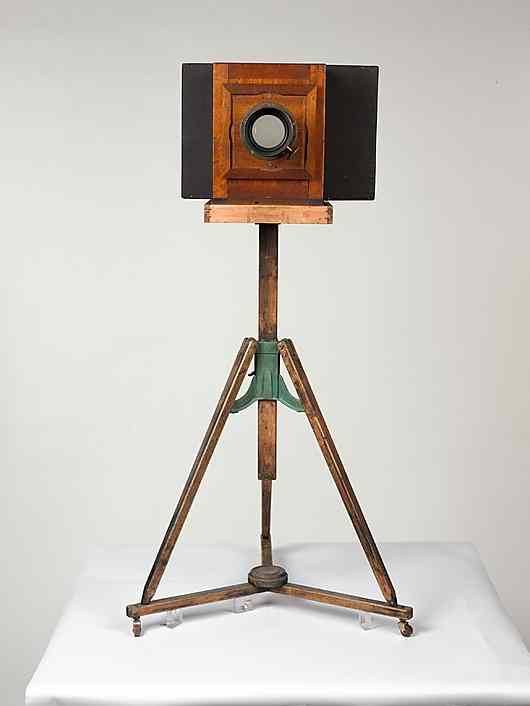
Matthew Brady’s 1860s studio camera is part of the Met’s show. Source: Lowenthell Family Photography Collection.

Matthew Brady’s 1860s studio camera is part of the Met’s show. Source: Lowenthell Family Photography Collection.

It’s simply one of the best shows that the Met has mounted, and congratulations to curator Jeff Rosenheim for this triumph. He’s written a great blog post and recorded a nice 30-minute video that sums up a lot of his thinking.

Check it out and if you’ve missed it, get your Amtrak ticket and head South: This mind-bending, must-see show is coming to the Gibbes Museum, Charleston, South Carolina (September 27, 2013–January 5, 2014), and the New Orleans Museum of Art (January 31–May 4, 2014).

Anxious, Turbulent Skies in Masterful Landscapes

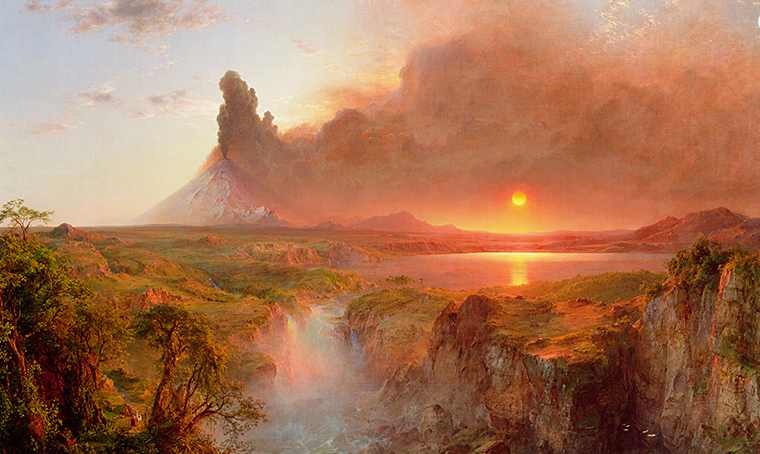
Frederic Edwin Church’s depiction of the volcanic eruption in Ecuador -- Cotopaxi, painted in 1862 and exhibited the following year. Source: Detroit Institute of Arts.

Frederic Edwin Church’s depiction of the volcanic eruption in Ecuador — Cotopaxi, painted in 1862 and shown the following year. Source: Detroit Institute of Arts.

Who expects that gigantic, bold 18th-century people-free landscapes by Bierstadt and Church to bear the heft of telling the anxious backstory of America before, during, and after the Civil War?

It’s true. Big landscapes are the booknds to the dramatic story told by the Smithsonian Museum of American Art’s exhibition to honor the 150th anniversary of Gettysburg, American Painting and the Civil War, installed through September 2 on the upper and lower levels of the Met’s Lehman Wing.

Seeing the stunning upper-gallery works within the context of America’s troubled times is a must. You’ll never look again at a Bierstadt or Church again without checking its date to see if it was painted in the 1859-1865 range.

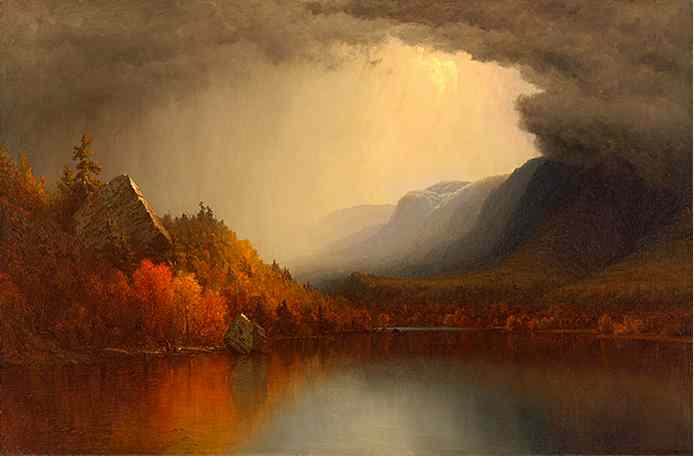
Sanford R. Giffins’s 1863 oil, A Coming Storm, says it all. Retouched by the artist in 1880. Source: Philadelphia Museum of Art.

Sanford R. Giffins’s 1863 oil, A Coming Storm, says it all. Retouched by the artist in 1880. Source: Philadelphia Museum of Art.

Hear Smithsonian curator Eleanor Jones Harvey’s three-minute introduction to how these magnificent landscapes became the “emotional barometer” of the country and what approach genre painters took in the midst of changing times. Then, check out the Smithsonian’s nice timeline and click on Church’s Meteor of 1860 and Our Banner in the Sky from 1861 to see what was in the news while these were being created in the studio.

You’ll find Sanford Gilfford’s A Coming Storm (1863) in the timeline in 1865. Ironically, this was owned by Shakespearean superstar Edwin Booth right after it was painted, but before his brother actor John Wilkes changed history and trashed the family name. When Melville saw the painting in a New York gallery a few weeks later in April 1865, he felt the tragic irony so profoundly that he had to write a poem to process it all.

Bierstadt’s Looking Down Yosemite Valley, California, exhibited in 1865, one year after Lincoln signed legislation declaring this a public reserve. Source: Birmingham Museum of Art.

Bierstadt’s Looking Down Yosemite Valley, California, exhibited in 1865, one year after Lincoln signed legislation declaring this a public reserve. Source: Birmingham Museum of Art.

Church, Homer, and Gifford also painted camp life during the War, and those up-close-and-personal works are also featured in the show, alongside very precise oils of Confederate encampments by Conrad Wise Chapman. Thanks to Richmond’s Museum of the Confederacy, which loaned the works by Chapman, you’ll get to see the famous experimental submarine, The Hunley as it was in 1863. The submersible was raised from the depths near Charleston in 2000 with the tar bucket you’ll see in Chapman’s oil painting

But back to the giant landscape that closes the show upstairs. Bierstadt paid someone to take his place in the Union Army, so maybe that’s why his mind was free concentrate on more placid, ethereal works, such as the show’s finale, Looking Down Yosemite Valley, California of 1865 – a immersive look into the California Eden that Lincoln’s signature in 1864 preserved as public land and away from scarred landscapes of the battlefield states.

What’s the connection between Arctic exploration and unusual nighttime phenomenon of 1864? Watch this video to see how Church used them to convey the mood of the country through his powerful, gigantic, beautiful Aurora Borealis.

See a slide show of 34 paintings in the show and access the full set of video podcasts on the Smithsonian’s web site.