Light, Space and Time in Albuquerque

Drift into another dimension in Light, Space, and the Shape of Time at the Albuquerque Museum through July 20, 2025. The show, with significant works from the museum’s own collection, harkens back to the founders of California’s 1960s Light and Space movement, but also presents work by contemporary artists – many from New Mexico – who continue to explore the same phenomenon.

The curators have arranged the exhibition to show how artists use light, space, and time as subjects through which visitors can slow down, contemplate, and experience.
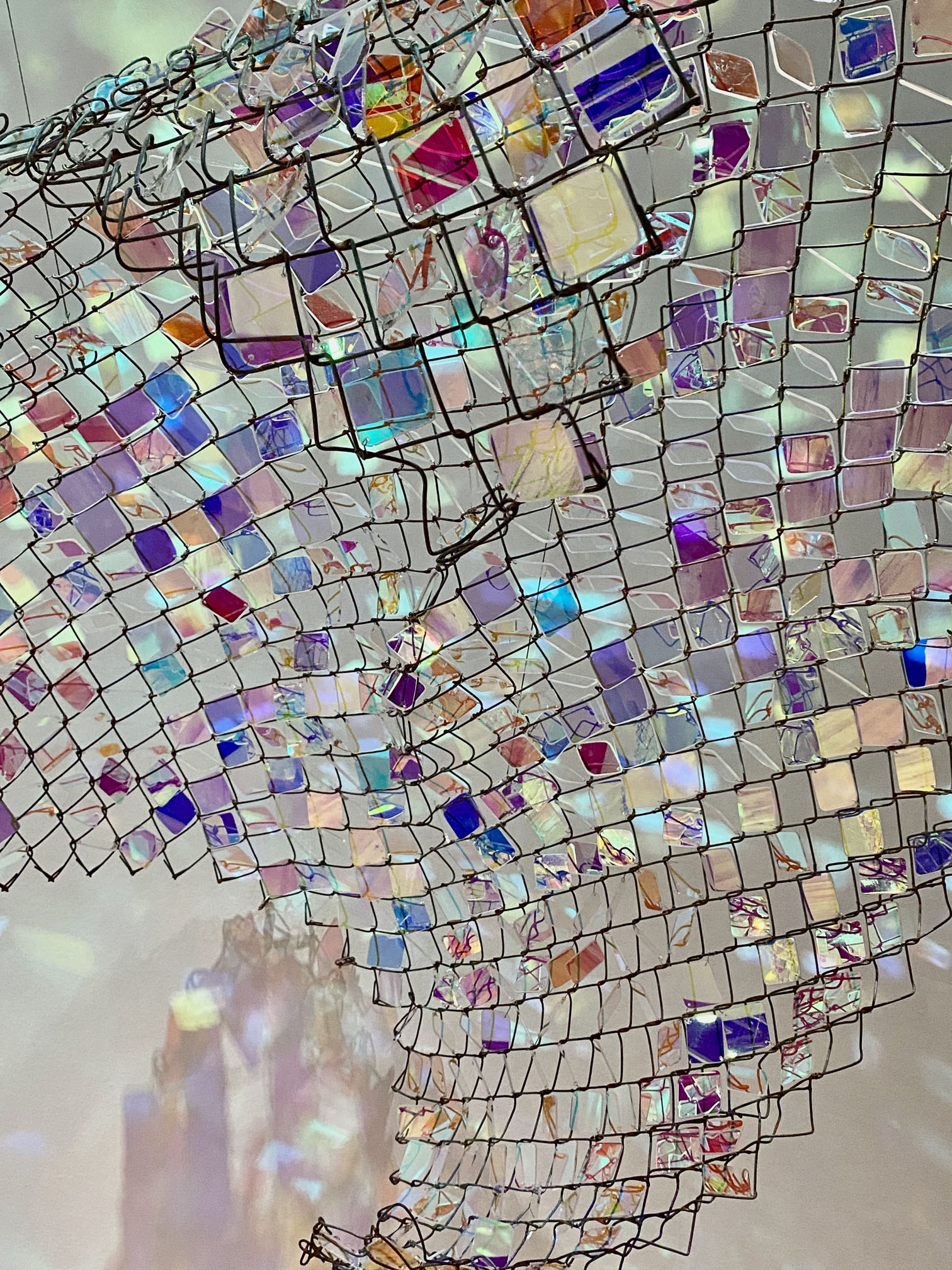
Detail of Soo Sunny Park’s 2013 Unwoven Light, an installation that seems to move as visitors walk through it. Courtesy: the artist

For more, see some of our favorites works in our Flickr album.

The first section showcases works where artists use light as the primary medium. Visitors can enjoy works by some of the most famous innovators from the Sixties and Seventies – Robert Irwin, who inspired a generation of West Coast art students to think differently; Dan Flavin, who merged minimalism with industrial light; and Helen Pashgian, who makes magic from luminous resins.

Irwin’s 2011 piece appears minimal, but his six fluorescent-light colors can be activated in four different variations, and he associated each with agricultural colors of Southern California. You can enjoy looking at Lucky You for its purity of form, or contemplate Irwin’s recollections of home.

Two fluorescent works by Space and Light superstars – Robert Irwin’s 2011 Lucky You and Dan Flavin’s 1987 untitled (in honor of Leo at the 30th anniversary of his gallery. Courtesy: Thoma Foundation

Behind the black curtain, you can enter a tranquility chamber. Helen Pashgian’s 2021 installation provides an unforgettable experience to visitors to slow down and wait. What are you seeing? The frosted, peach-colored epoxy sculpture at center stage appears dissolve in the light-filled space as lights slowly change. It’s like watching show changes to the sky during a dramatic sunset, but it’s light, white, ethereal, and pure.

Helen Pashgian’s 2021 untitled (peach lens) – the lens dissolve into space as the light changes to sunrise and sunset modes. Courtesy: Tia Collection

All-star word artist Jenny Holtzer’s Red Tilt takes an absolutely maximalist approach with multiple LED displays – a too-much, all-at-once, never-stopping tsunami of emotional words from her own story about survival and trauma.

Leo Villareal’s piece Scramble is the opposite. Albuquerque-bassed Villareal creates a mesmerizing, tranquil, never-repeating abstraction by programming LED lights. He’s done this on a larger scale in his epic commissions to light the San Francisco-Oakland Bay Bridge and all of London’s bridges over the Thames. Here, visitors get a more intimate experience – slowing down to watch Scramble’s gently changing colors and know what they’re seeing is unique to the moment.

Jenny Holtzer’s 2002 LED display, Red Tilt. Courtesy: Thoma Foundation
Leo Villareal’s 2011 Scramble, a programmed LED artwork that changes constantly. Courtesy: Thoma Foundation

Larry Bell’s 1984 installation is the centerpiece of exhibition’s exploration of how artists use light, illusion, and technology to explore (and play with) our perceptions of space. Direct from his retrospective in Phoenix, Bell’s barely-there The Cat is a delicate but monumental presence in the show.  Huge, planes of coated and non-coated glass require a circumnavigation. Moving around, you can see how works are reflected and how some opaque surfaces block views of others.
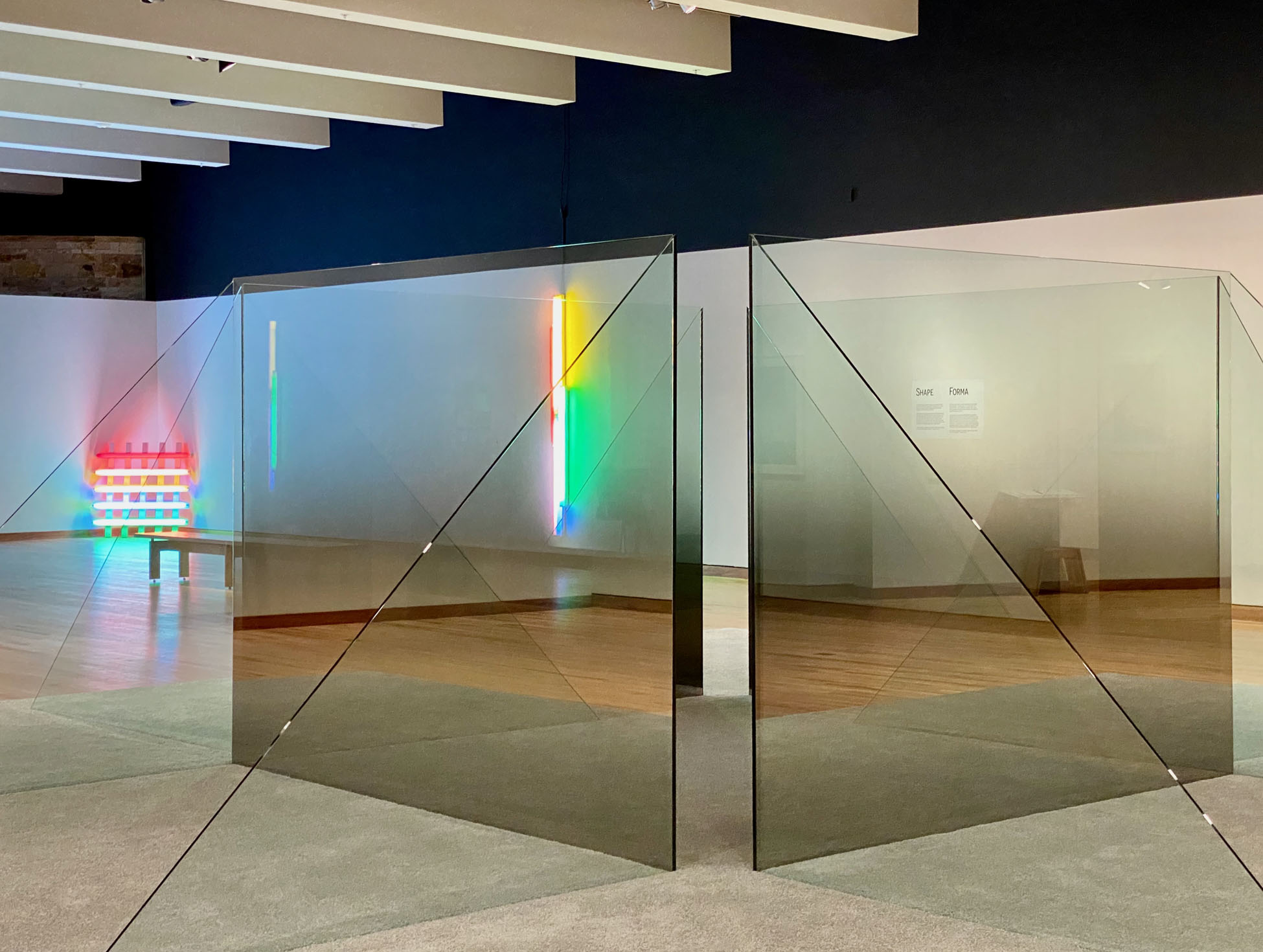
Larry Bell’s 1984 The Cat – rectangles of coated and uncoated float glass.

Two nearby works by Santa Fe-based August Muth offer visitors a more intimate experience. Muth uses a holographic etching technique in which he creates the illusion of a “floating” image.

August Muth’s 2024 holographic etching Shadow Within Light. Courtesy: Pie Projects Contemporary Art.
August Muth’s 2022 holographic etching Terra Solaris. Courtesy: Pie Projects Contemporary Art.

The exhibition concludes with a magnificent installation by Soo Sunny Park – an installation of lights and plexiglass pieces that appear to move as you move through. Take a peek in this video.

Detail of Soo Sunny Park’s 2013 Unwoven Light installation with tiles that appear to move as the visitor moves through it. Courtesy: the artist

Kite Dreams with AI at IAIA

How does a Lakȟóta artist link dreams and artificial intelligence to imagine futures for her people? Experience five years of innovative installations in Kite and Wíhaŋble S’a Center: Dreaming with AI, on view at the IAIA Museum of Contemporary Native Arts in Santa Fe through July 13, 2025.

The IAIA exhibition – Suzanne Kite’s third solo exhibition this year across the United States – presents several installations that highlight her collaborative work that merges cutting-edge technology with Indigenous knowledge systems. 

Download the exhibition catalogue here, and look at photos of the installation in our Flickr album.

2023 Wičhíŋčala Šakówiŋ (Seven Little Girls) and Wicháhpi Wóihanbleya (Dreamlike Star) use stones to translate Kite’s dreams into Lakhóta symbols.

In Iron Road and Dreamlike Star, stones and minerals (the building blocks of computers!) are arranged in Lakȟóta geometric language that suggest Lakȟóta quilt patterns. They’re placed atop a mirror to show resonance between the Earth and the cosmos (stars).

2023 Wicháhpi Wóihanbleya (Dreamlike Star) suggest that ancestor stars can point the way to Indigenous futures.

In this first section, inputs are taken from Kite’s dreams. Using AI, her dreams are translated into geometric Lakȟóta shapes created by designer Sadie Red Wing. Kite has figured out a way to bypass large-scale, commercial AI networks in favor of an AI model (run on her PC) that aligns more closely with Indigenous knowledge systems.    

A digital embroidery machine has yards of embroidered black velvet flowing out of it.  Oihanke Wanica (Infinity) is a collaboration with New York City’s Center for Art, Research and Alliances. As you examine the velvet, you’ll find geometric Lakȟóta shapes translated (using AI) from Kite’s dreams.

Nearby, there’s a comfortable lounge where you can watch Cosmologyscape, an interactive digital quilt – a public art project in which AI translates the public’s dreams into artist-created geometric symbols. It’s a collaboration with Alisha B. Wormsley, so the virtual community quilt manifests both African-American and Lakȟóta shapes.

2023 Oihanke Wanica (Infinity) – a digital embroidery machine stitches symbols representing dreams onto black velvet. Collaborator; Center for Art, Research and Alliances.
Lounge to watch Kite and Alisha B. Wormsley’s 2024 Cosmologyscape – Ai translates the public’s dreams into symbols for an ever-expanding digital quilt.

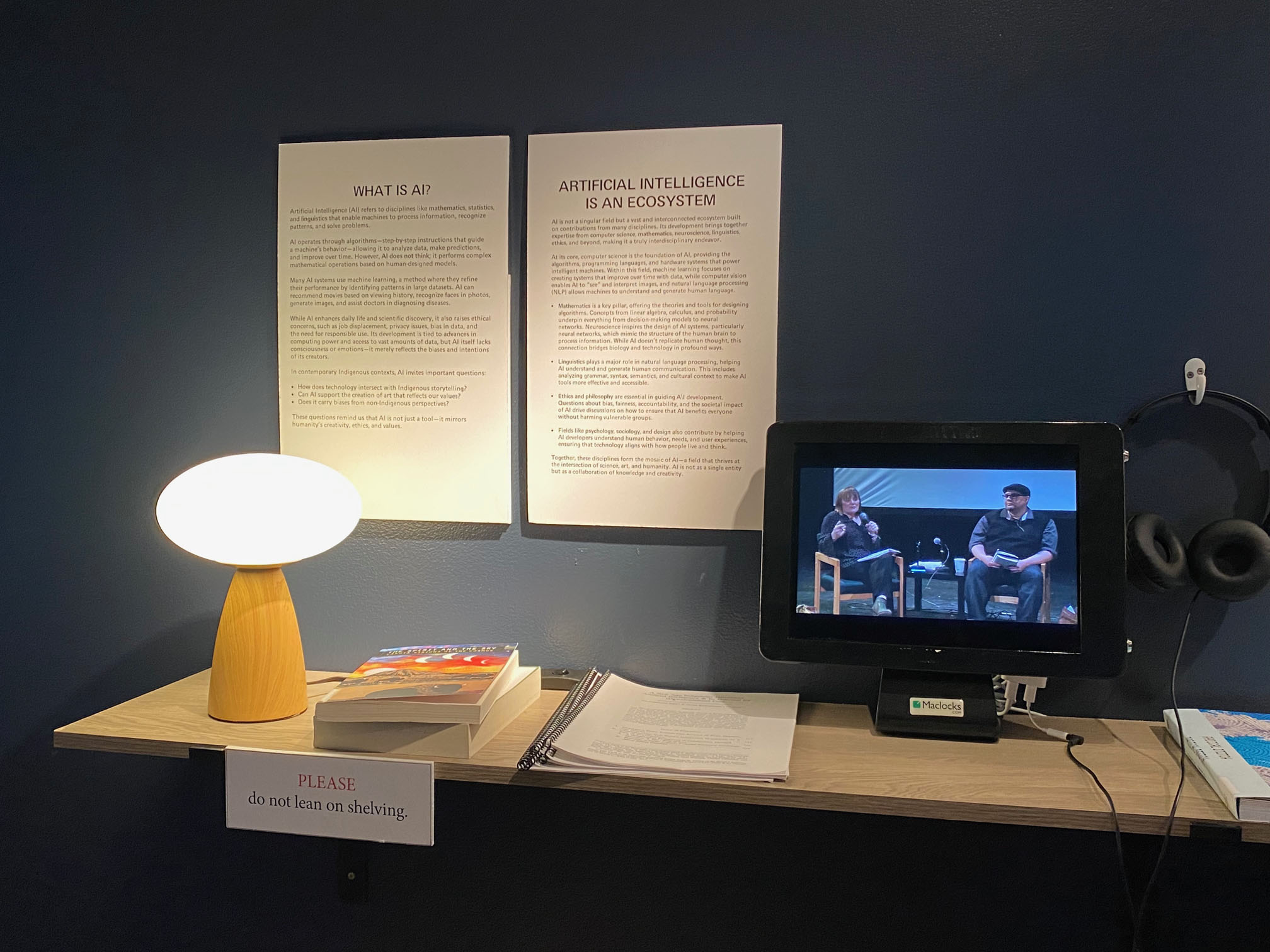
Installations in the other half of the exhibition shows collaborative projects that combine Indigenous knowledge systems and AI. Along one wall in the spectacular, tranquil gallery, you can explore a print and digital resource library on international research programs that integrate Indigenous knowledge systems into AI design.

Abundant Intelligences – a library and digital resource station for information on AI and futurism in contemporary Indigenous art.

Oneiris is a large interactive station through which visitors are invited to generate dream symbols that AI adds into a wall-sized display that looks like a portal to the cosmos. Inspired by the Lakȟóta concept of a Dream Language, she and her many technical collaborators genuinely bring dreams to life.

Oneiris – a collaborative project using advanced AI models to allow visitors to bring dreams to life.

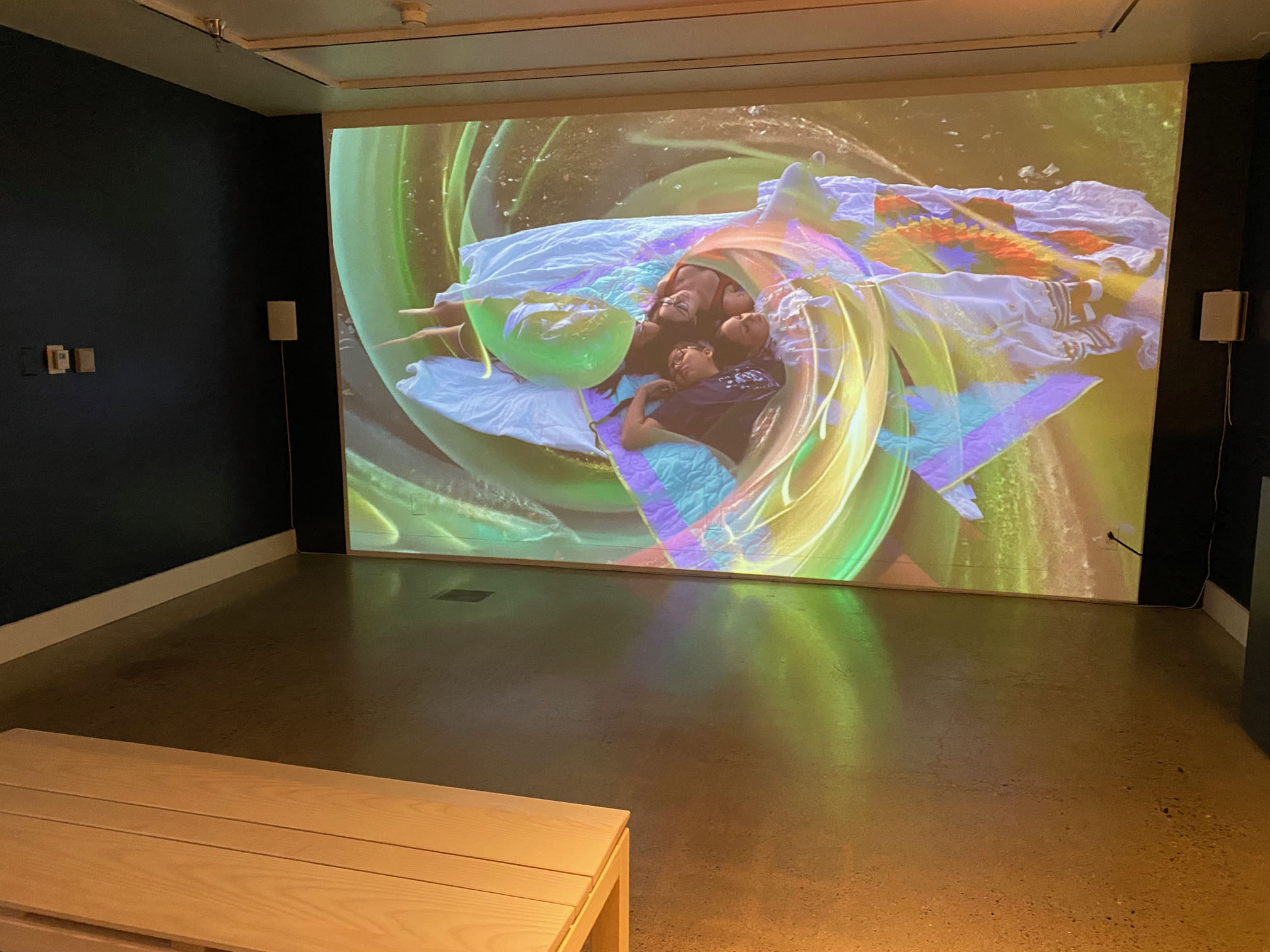
Spashed across the final wall of the space, The Land Paints Itself is a video collaboration with her Wíhaŋble S’a Center for Indigenous AI at Bard – a lab that explores Indigenous advances in this science and art. Watch as AI generates dazzling colors and patterns as four Lakȟóta dream about Indigenous futures. Kite suggests that the evolving technology of dreams is a legitimate way for her nation to envision ways forward.

2025 The Land Paints Itself video that uses AI to illustrate Lakhóta people’s dreams about Indigenous futures.

Provocative, visionary, and affirmative – meet Kite herself in an interview with Artforum editor Tina Rivers Ryan in March 2025, when Kite’s work was featured on the cover.

Walking Into the Broken Boxes Podcast

Did you ever want to walk into a podcast? The grand installation of Broken Boxes: A Decade of Art, Action, and Dialogue lets you experience large-scale work by some of the socially conscious artists that have been featured on Ginger Dunnill’s interview series. Enter, listen, and get inside the heads of 23 artists at the Albuquerque Museum through March 2, 2025.

The exhibition honors ten years of Broken Boxes conversations, which you can hear at various “listening spots” inside the exhibition. Ginger began her project as a way to encourage community among artists who were creating disruptive work that prompts viewers to imagine a different world.

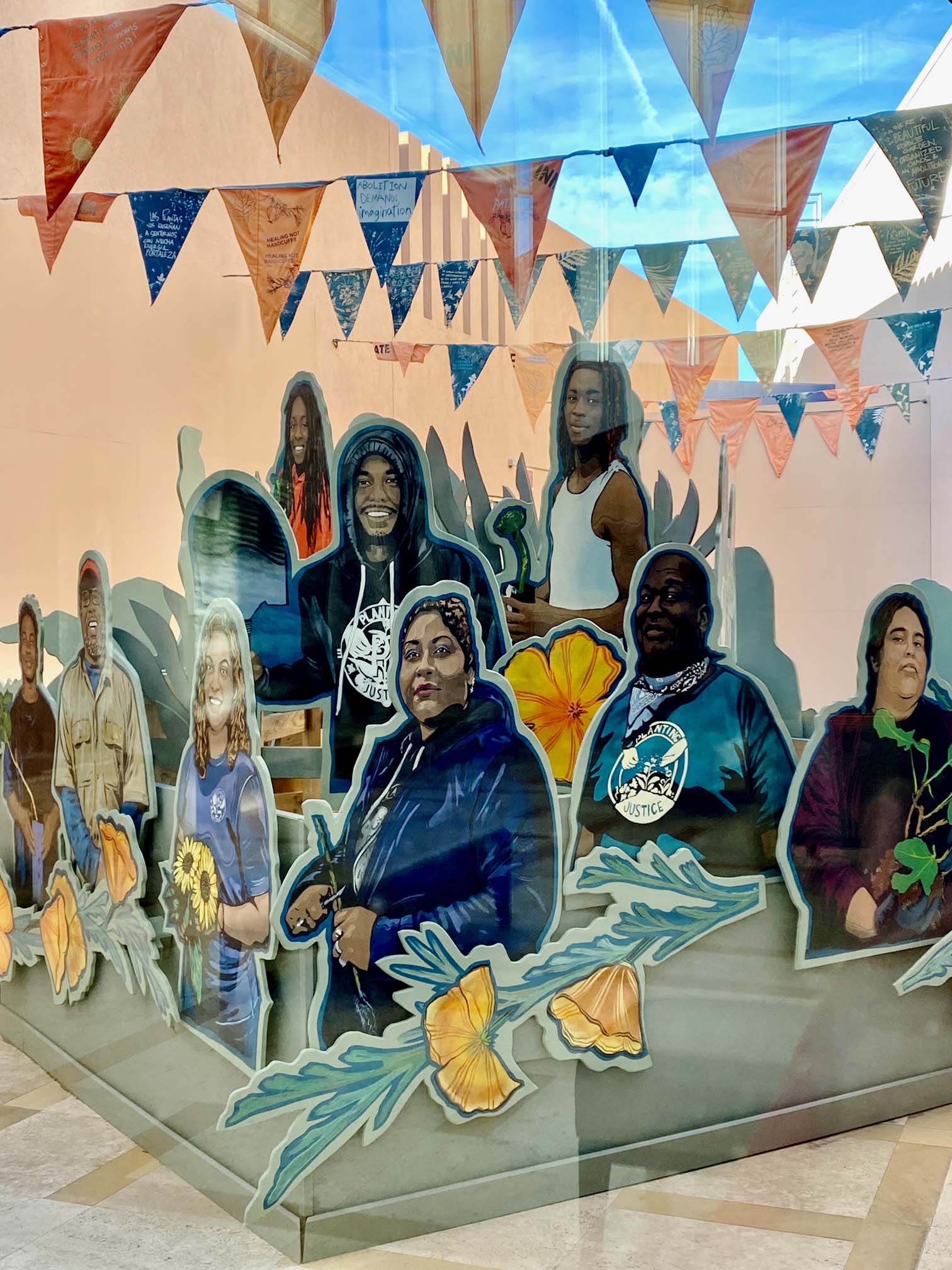
Kate DeCiccio’s Blooming Abolition depicts formerly incarcerated community members who develop gardens. Created by local artists, Planting Justice, Hiroyo Kaneko, and Malaya Tuyay.

The show spills way beyond this main gallery into a theater showing artist videos, another space featuring a soundscape by Raven Chacon, and a courtyard reflecting artist-educator Kate DeCiccio’s vision for sustainable community gardens that give purpose and fulfillment to formerly incarcerated neighbors. 

Inside the main space, visitors wind through and around different installations, such as Marie Watt’s hanging jingle sculptures and her spectacular collaboration with Cannupa Hanska Luger. The jingle “clouds” take a traditional element of powwow and turn it into fine art that invites participation in the soundscape.

2023 dangling jingle sculptures Sky Dances Light: Revolution VII, VIII, and IX created by Marie Watt (Seneca Nation of Indians). Courtesy: private collection

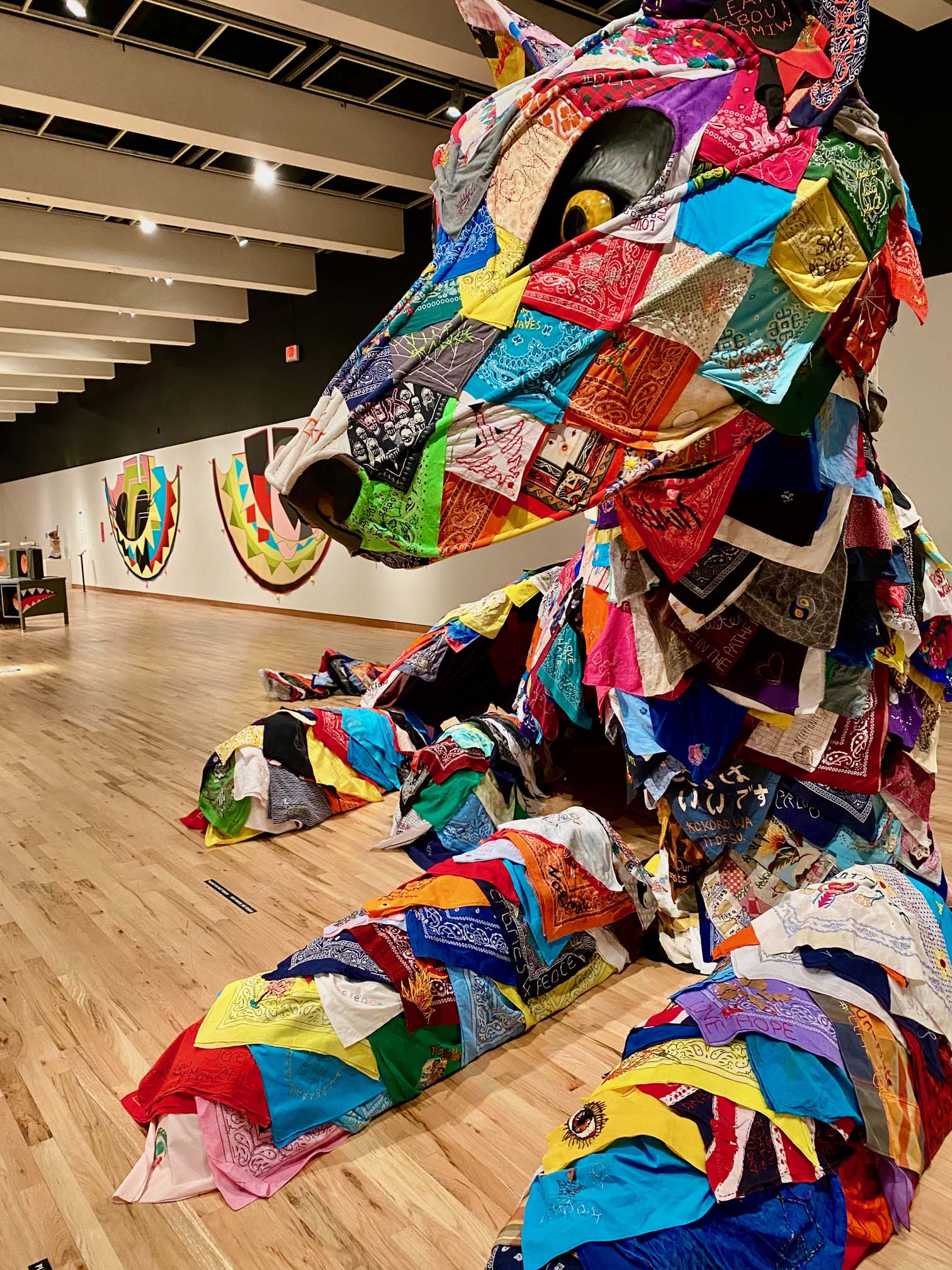
Across the way is an enormous canine created by Luger and Watt. As he’s done with other large-scale participatory projects, Luger sent out a call worldwide requesting people to embroider messages on bandanas and send them in. Visitors are fascinated by the Each Other collaboration, circling around the wolf to discover messages about rescue, shelter, and sustainability.

Guadalupe Maravilla’s installation draws inspiration from his own story and struggle. He assembled the piece from items picked up when he retraced his migration route from El Salvador to the United States when he was a child. But he made it to emit therapeutic vibrational sounds, similar to the sound therapy that brought him relief as an adult when he underwent therapies to cure his own cancer.

2020-2021 Each Other community bandana-sculpture created by Cannupa Hanska Luger (Mandan, Hidatsa, Ankara, Lakota) and Marie Watt (Seneca Nation of Indians). Courtesy: the artists
Guadalupe Maravilla’s 2021 Disease Thrower #17 – a therapeutic sound installation using materials found when he retraced his El Salvador-US migration route. Courtesy: the artist

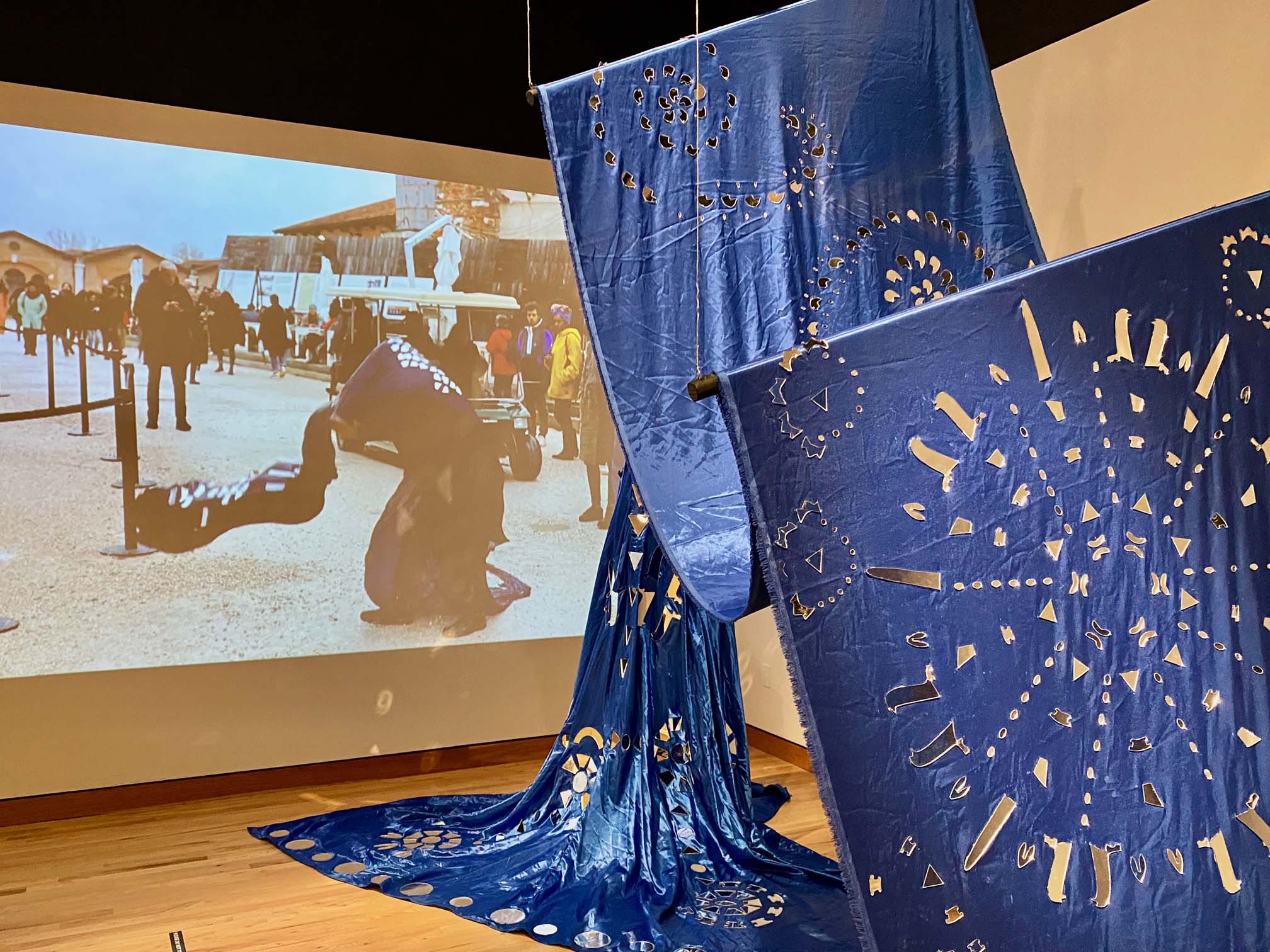
Work by Ethiopian refugee Tsedaye Makonnen includes a performance video and installation that focuses attention on African refugees who risk dangerous ocean crossings to escape violence in their home countries. The blue fabric represents the ocean, and each mirror a life lost.

Tsedaye Makonnen’s Astral Sea Views video with Astral Sea Series mirrored fabrics – commemorating women migrants who perished attempting dangerous European ocean crossings. Courtesy: the artist. 

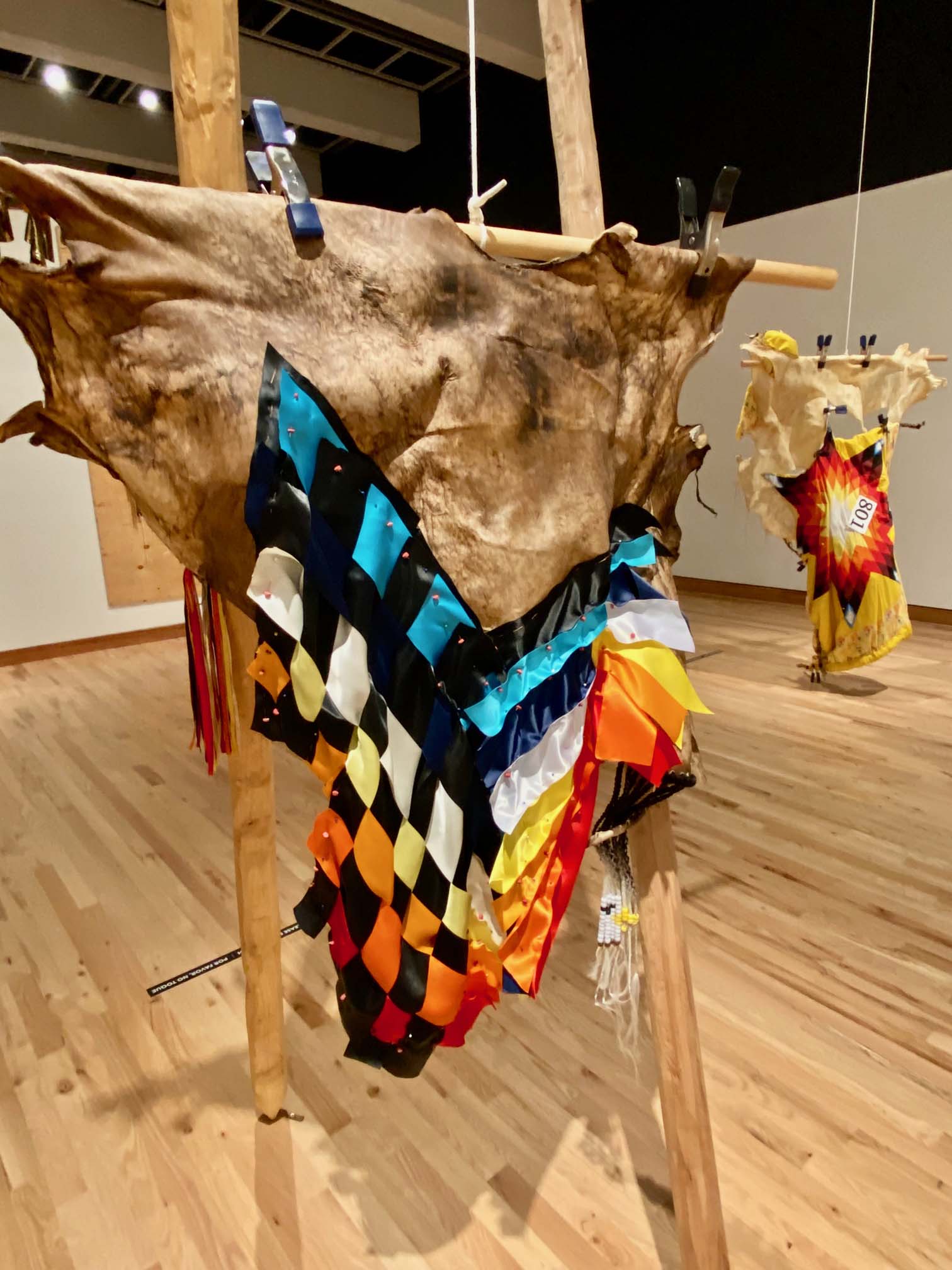
See some of our other favorite installations here in our Flickr album – a shrine by Mario Yvarra, Jr. dedicated to his Chicana-activist mother –Music My Mom Played While Cleaning House – and works by Natalie Ball (Klamath/Modoc) that are straight from her recent show at the Whitney.

2023 mixed-media sculptures by Natalie Ball – ribbon skirt: There’s Indian and than there’s Indian; (rear) Baby Board. Courtesy: the artist.
Music My Mom Played While Cleaning the House…, a parade float by California artist Mario Ybarra, Jr. that honors his mother, a Chicana civil rights activist.

Listen to the Broken Boxes podcast to hear Ginger and international artists talk about making art, building community, and meeting the challenge of the moment.

Flight Into Egypt at The Met

Take an epic tour through ancient Egyption iconography through the eyes of African-American artists and thinkers in Flight into Egypt: Black Artists and Ancient Egypt, 1876 – Now, on view at the Metropolitan Museum through February 17. It’s quite a ride with African-American artists and writers through decades of deep history.

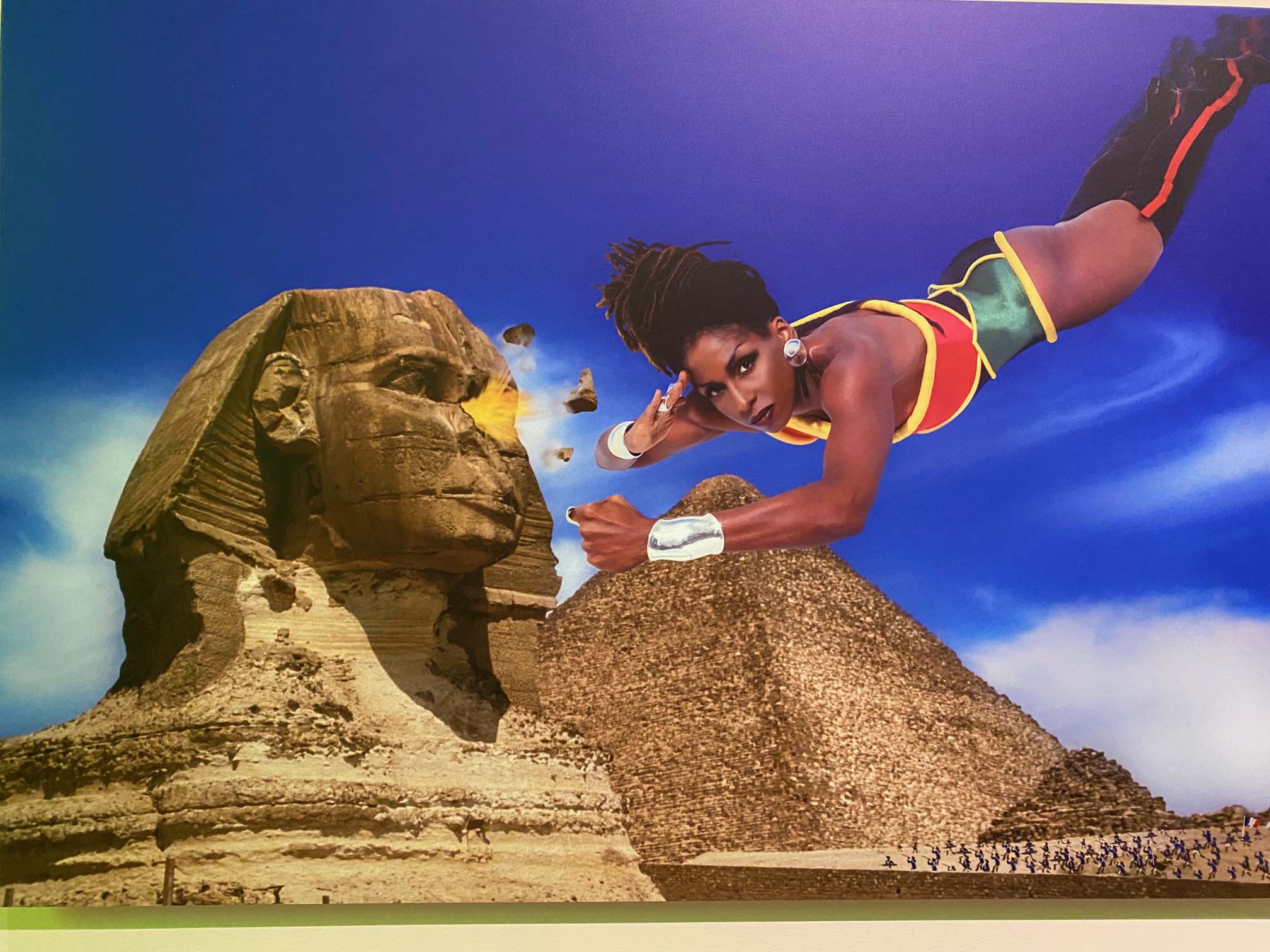
The wonders never cease, from Cleopatra’s “throne” welcoming you into the galleries to Simone Leigh’s giant queen Sharifa, Henry Taylor’s vision of Michelle Obama as (maybe?) Queen Hapshetsut, epistles of the Harlem Renaissance, Afro-futurist super-heroines, and a neon Nefertiti taking her bow.

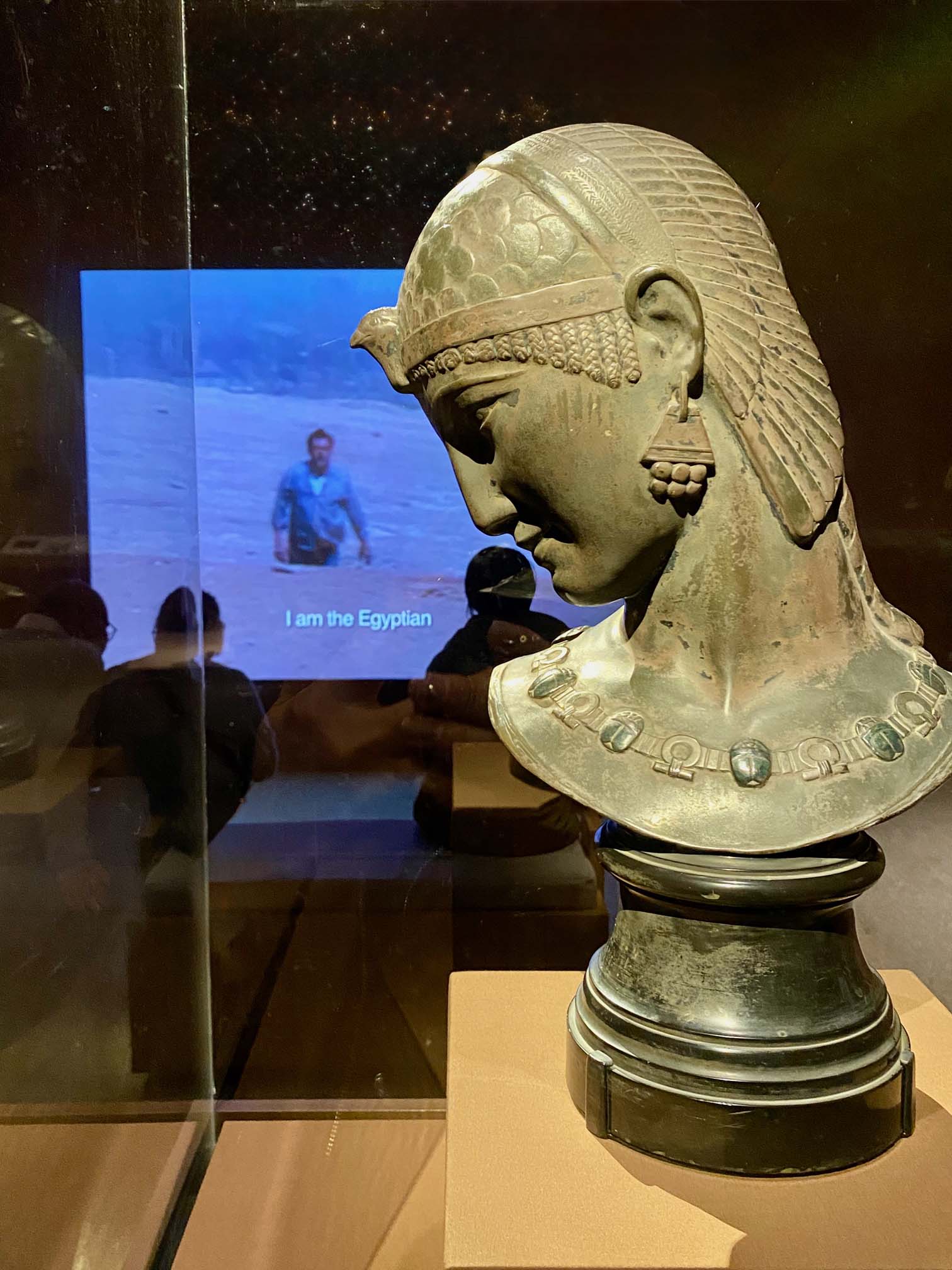
1930 bronze and silver Bride of the Nile (Arous El Nil), Bust by Egyptian sculptor Mahmoud Moktar. In the Heritage Studies gallery. Courtesy: HAR Collection.

The Met, home to the largest Egyptian art collection in the Western Hemisphere (followed by Brooklyn!), decided to create a contemporary counterpoint to its heralded wing and showcase all the ways African-American artists have looked to ancient histories of the Nile, contemplated their relationships to Egypt, and integrated Egyptian spirituality into the current narrative.

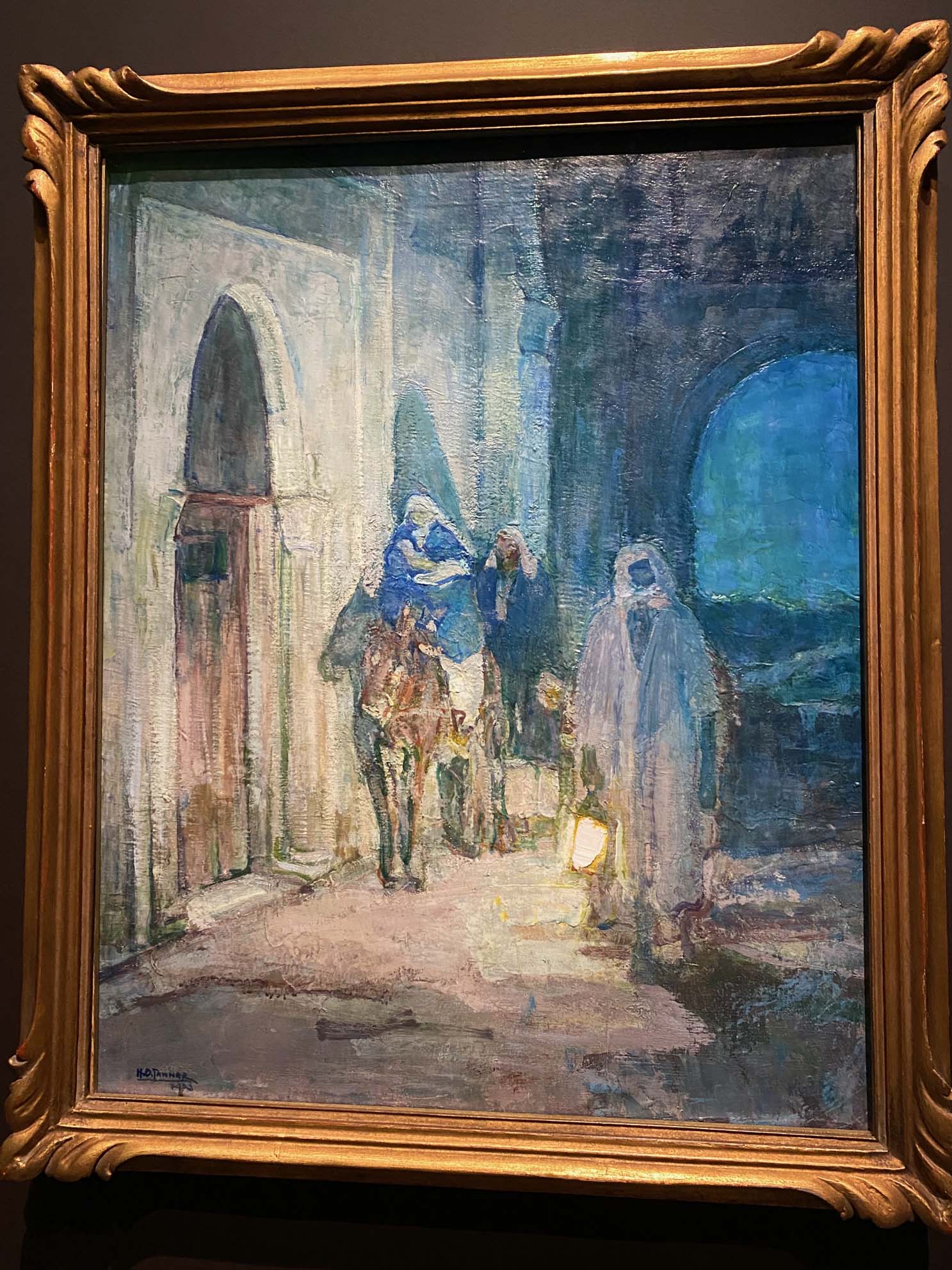
Henry O. Tanner’s 1923 painting Flight into Egypt, based on sketches made during his travels in Egypt.
Jean-Michel Basquiat’s 1982 painting Kings of Egypt II. In the Kings and Queens gallery. Courtesy: Rotterdam’s Museum Boijmans Van Beuningen.

Over 200 paintings, sculptures, videos, and installations are presented in this massive show, which also includes performances produced by Met Live Arts.  See some of our favorite works in our Flickr album.

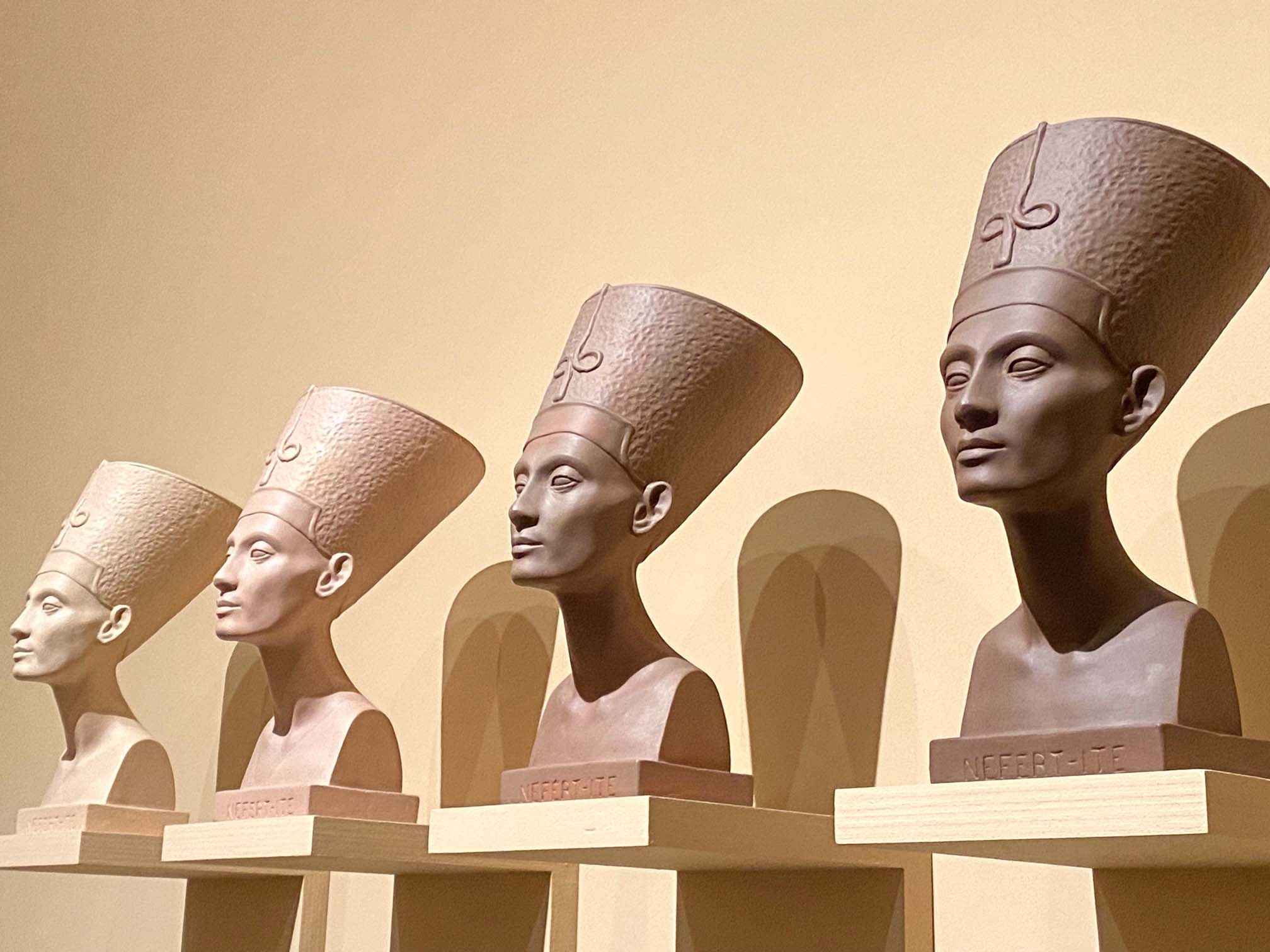
1993 Grey Area (Brown Version) by Fred Wilson – busts of Nefertiti painted in varied skin shades, reflecting the unresolved opinions on the racial makeup of the ancient Egyptians. From the Kings and Queens gallery. Courtesy: Brooklyn Museum

Watch this video walk-through with the curator, who’s accompanied by two artist in the show – Fred Wilson, whose “Grey Area (Brown Version)” sculpture inspired the curator’s theme, and acclaimed abstractionist Julie Mehretu, who herself was born in Ethiopia and experienced the monuments of Egypt at a very young age:

There’s also a gallery devoted to contemporary work by Egyptian artists –a body of work that’s often overlooked in Western art museums. Here’s a closer look at how an Egyptian artist – who’s also a security guard at the Met – was invited by the curator to participate in this exhibition:

For learn more, here’s a link to the Met’s exhibition guide, and a curated playlist for the show. Take an exciting journey through these visual and musical revelations!

Renee Cox’s 1998 digital print (printed 2024) Rajé to the Rescue, featuring an Afrofuturist super-heroine. In the Space is the Place gallery. Courtesy: the artist.

Virtual NYC Museum Events – Broadway, Brooklyn, Karma, Kusama, and McQueen

New York museums are offering a full calendar of virtual events this week, including trips to Broadway history, hipster restaurants of the world, Buddhist virtual reality, and tributes to artistic genius. Take a look at the list here! Here are just a few highlights:

2002 Broadway revival of Rogers & Hammerstein’s Flower Drum Song

Do you miss Broadway? Learn about some little-known secrets behind hit shows today, Monday (April 12) at 5:30pm. It’s a rare chance to meet the president of the Rogers & Hammerstein Organization, Ted Chapin, who will be giving a behind-the-scenes look at the Great White Way in his program, From Follies to Flower Drum Song and Beyond. It’s the premiere of a conversation recorded last Fall with Broadway World’s Richard Ridge, courtesy of the New York Public Library for the Performing Arts at Lincoln Center.

Did this global restaurant trend actually start in Brooklyn? Find out with MOFAD and the creators of Global Brooklyn: Designing Food Experiences in World Cities.

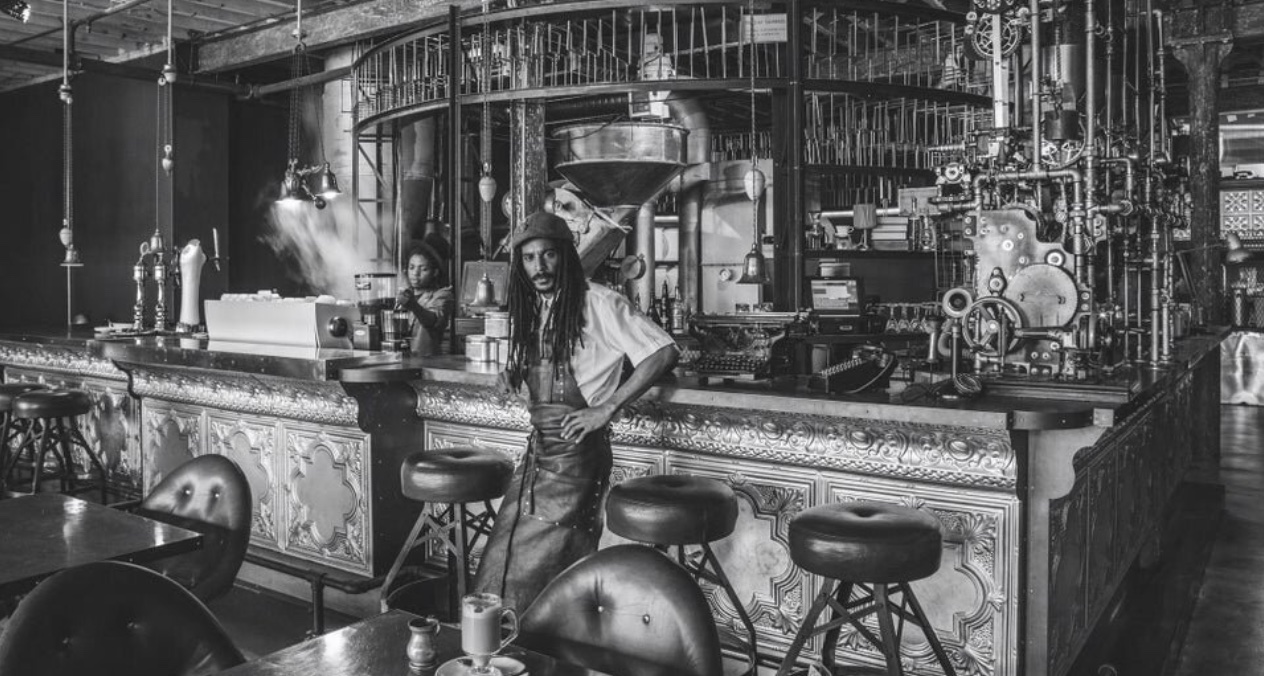
Love restaurants? Especially ones with slightly nostalgic post-industrial interiors decorated with that hand-crafted look? At 7pm, join the Museum of Food and Drink to meet the authors who explored how the Brooklyn aesthetic for How a Restaurant Aesthetic Became a Global Phenomenon. Learn how restaurants around the world adopted the style, and find out if this brand of hip actually started in Brooklyn.

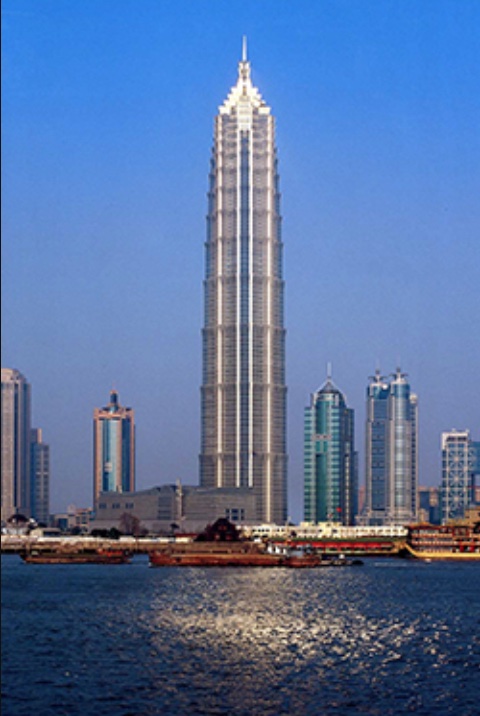
On Tuesday (April 14) at 6pm, join the architecture crowd at the Skyscraper Museum to hear Mark Sarkisian, the structural and seismic engineer who is a partner at SOM in San Francisco. Mark designed one of Shanghai’s first supertalls back in 1999. His talk Pivot to China: How Jin Mao Portended Future Supertalls will explain how this tower’s innovations influenced the generation of supertall skyscrapers that followed.

Shanghai’s Jin Mao tower, 1999
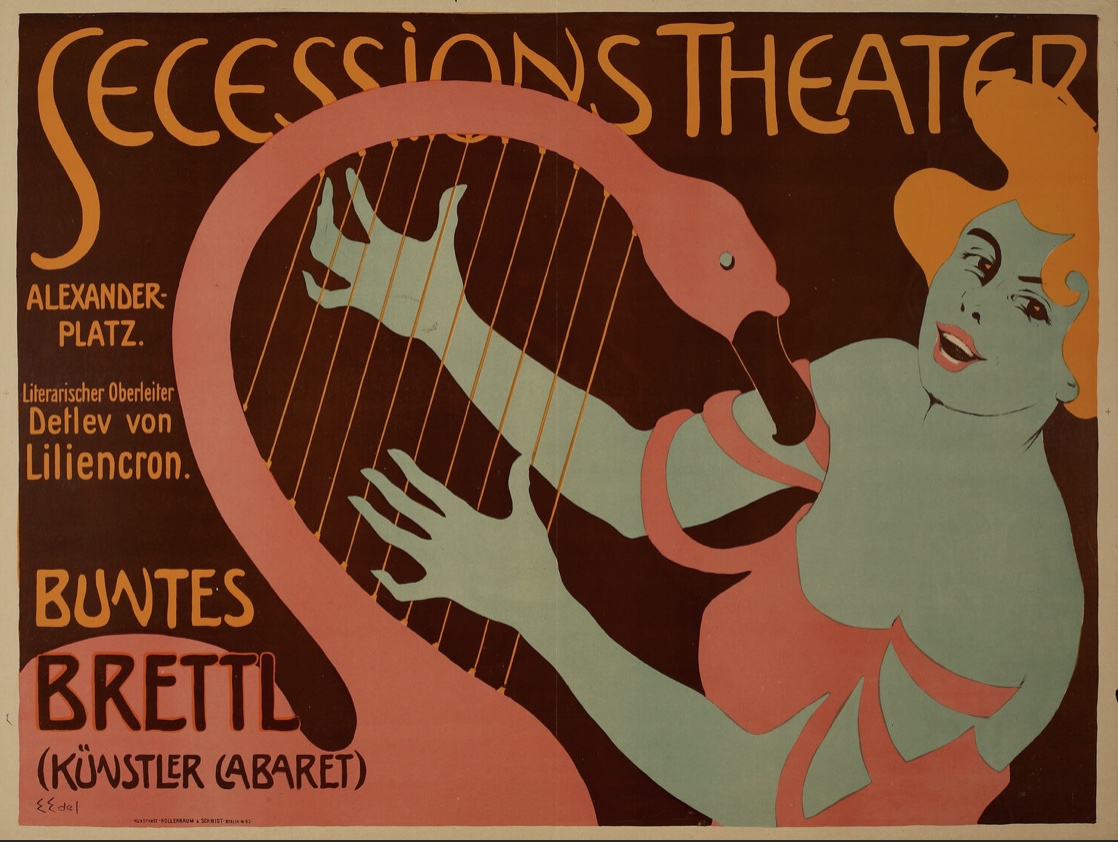
Berman Collection poster part of the Youth Style talk at Poster House.

On Wednesday (April 14) at 6:30pm, take a journey back to early modernist Europe at Poster House, who will be hosting A Tale of Three Cities: Youth Style in Berlin, Munich, & Vienna with the Kaller Research Institute. The evening will focus on how young designers made their mark on design from 1895 to 1910. You’ll see works from the Merrill C. Berman Collection (the collection featured at MoMA in Engineer Agitator Constructor), and works from the Poster House’s current Julius Klinger exhibition.

Also at 6:30pm – an opportunity to understand your karma. Join the Rubin Museum of Art for The Game of Life: An Interactive Virtual Experience. A contemplative psychotherapist will guide participants through a virtual Buddhist Wheel of Life to finding liberation from negative habits and patterns. The virtual game takes you throughout the different floors of the museum, and provides twists and turns. There are “Hell” and “God” Zoom rooms, but the payoff is higher awareness of one’s state of mind.

The Rubin’s reimagined Wheel of Life by eight graphic artists.
Kusama at New York Botanical Garden

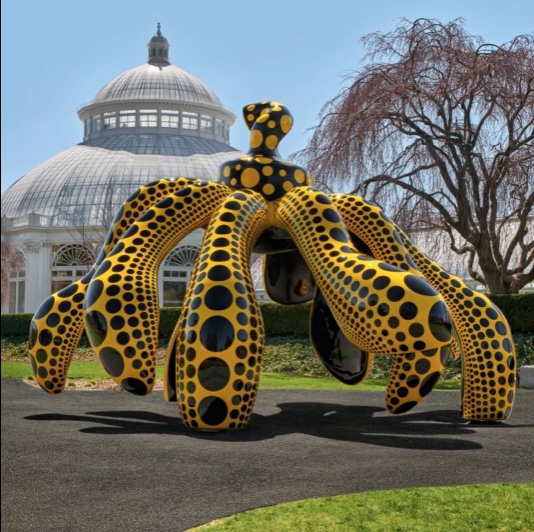
On Thursday (April 15) at 11am, it’s what all of New York has been waiting for! Mika Yoshitake, the curator of New York Botanical Garden’s KUSAMA: Cosmic Nature will provide a look at how Kusama’s blockbuster installation reflects nature, the earth, the microscopic, and the cosmos. Cosmic Nature: Embracing the Unknown will present Mike’s insights about Kusama’s artistic language and her unrelenting, lifelong journey into new territory.

McQueen models backstage, as photographed by Richard Fairer

Want to go backstage at a McQueen show? At 6pm you can. Join Vogue photographer Robert Fairer at Museum at FIT for a live Q&A about his new book, Alexander McQueen: Unseen. Experience memorable moments of fashion’s greatest, most outrageous showman and see what a genius at work backstage before the show.

There’s a lot more happening this week, so check the complete schedule. Most of the events are free, but it’s always nice to add a thank-you donation.