Walking Into the Broken Boxes Podcast

Did you ever want to walk into a podcast? The grand installation of Broken Boxes: A Decade of Art, Action, and Dialogue lets you experience large-scale work by some of the socially conscious artists that have been featured on Ginger Dunnill’s interview series. Enter, listen, and get inside the heads of 23 artists at the Albuquerque Museum through March 2, 2025.

The exhibition honors ten years of Broken Boxes conversations, which you can hear at various “listening spots” inside the exhibition. Ginger began her project as a way to encourage community among artists who were creating disruptive work that prompts viewers to imagine a different world.

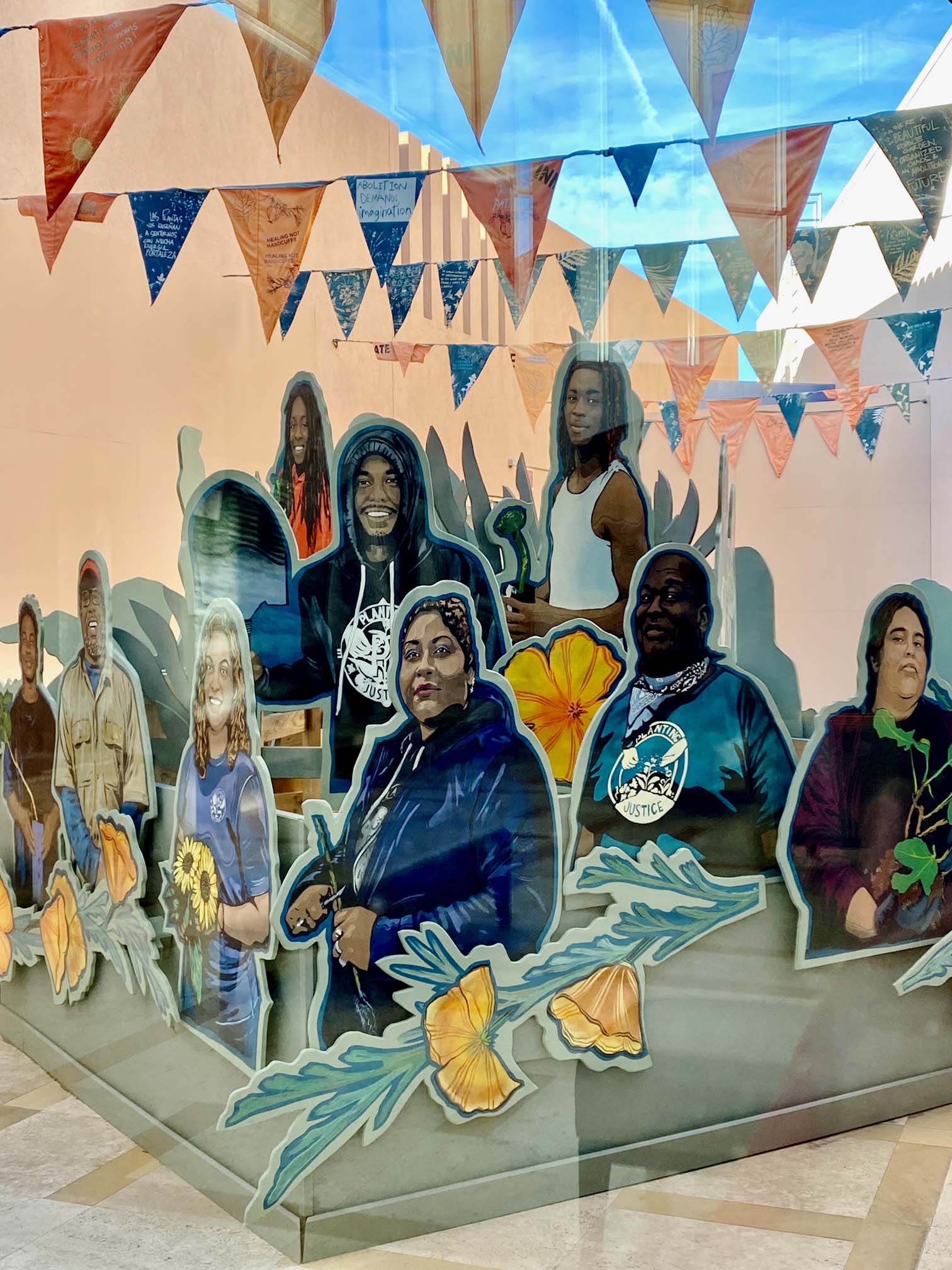
Kate DeCiccio’s Blooming Abolition depicts formerly incarcerated community members who develop gardens. Created by local artists, Planting Justice, Hiroyo Kaneko, and Malaya Tuyay.

The show spills way beyond this main gallery into a theater showing artist videos, another space featuring a soundscape by Raven Chacon, and a courtyard reflecting artist-educator Kate DeCiccio’s vision for sustainable community gardens that give purpose and fulfillment to formerly incarcerated neighbors. 

Inside the main space, visitors wind through and around different installations, such as Marie Watt’s hanging jingle sculptures and her spectacular collaboration with Cannupa Hanska Luger. The jingle “clouds” take a traditional element of powwow and turn it into fine art that invites participation in the soundscape.

2023 dangling jingle sculptures Sky Dances Light: Revolution VII, VIII, and IX created by Marie Watt (Seneca Nation of Indians). Courtesy: private collection

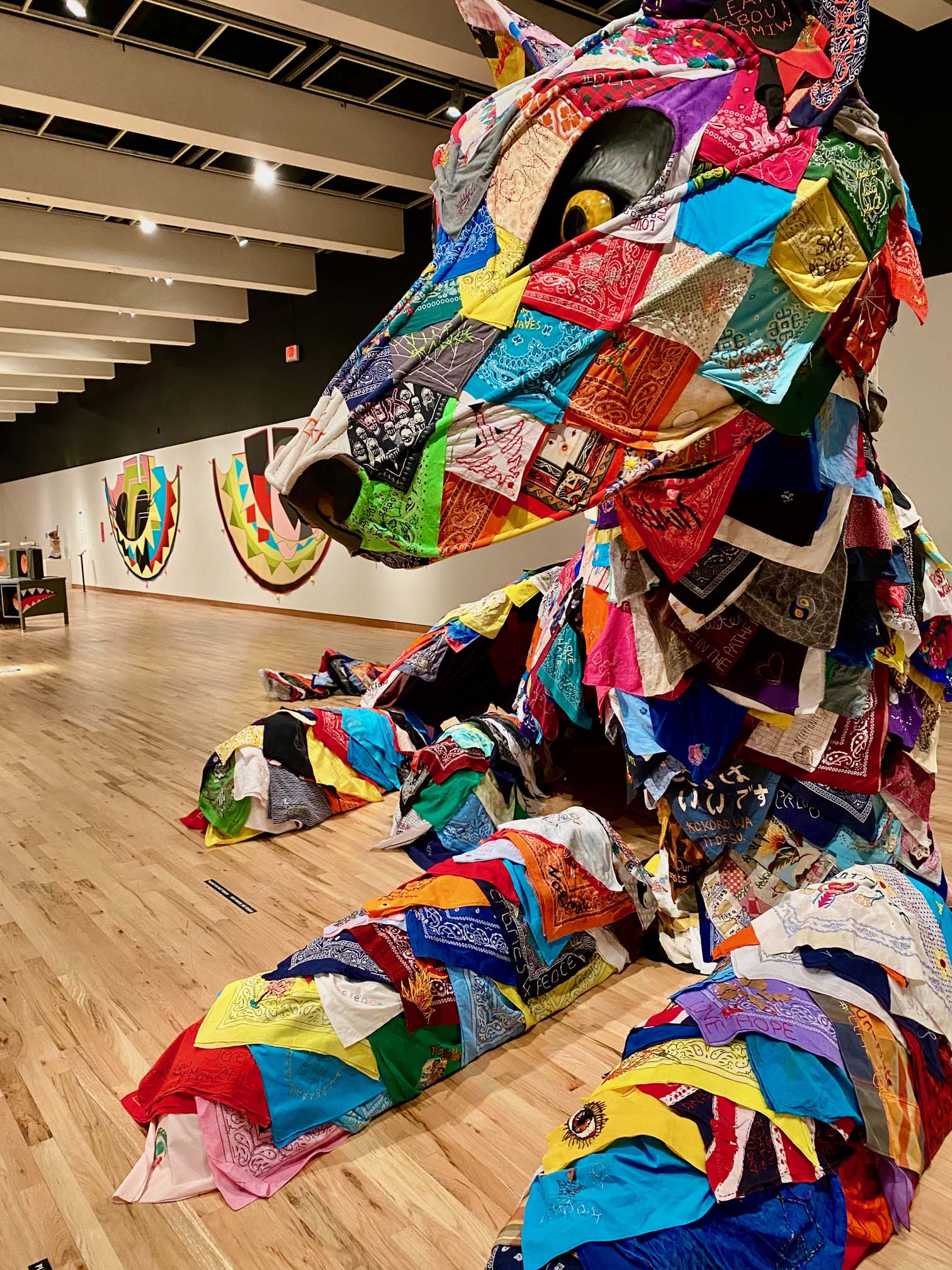
Across the way is an enormous canine created by Luger and Watt. As he’s done with other large-scale participatory projects, Luger sent out a call worldwide requesting people to embroider messages on bandanas and send them in. Visitors are fascinated by the Each Other collaboration, circling around the wolf to discover messages about rescue, shelter, and sustainability.

Guadalupe Maravilla’s installation draws inspiration from his own story and struggle. He assembled the piece from items picked up when he retraced his migration route from El Salvador to the United States when he was a child. But he made it to emit therapeutic vibrational sounds, similar to the sound therapy that brought him relief as an adult when he underwent therapies to cure his own cancer.

2020-2021 Each Other community bandana-sculpture created by Cannupa Hanska Luger (Mandan, Hidatsa, Ankara, Lakota) and Marie Watt (Seneca Nation of Indians). Courtesy: the artists
Guadalupe Maravilla’s 2021 Disease Thrower #17 – a therapeutic sound installation using materials found when he retraced his El Salvador-US migration route. Courtesy: the artist

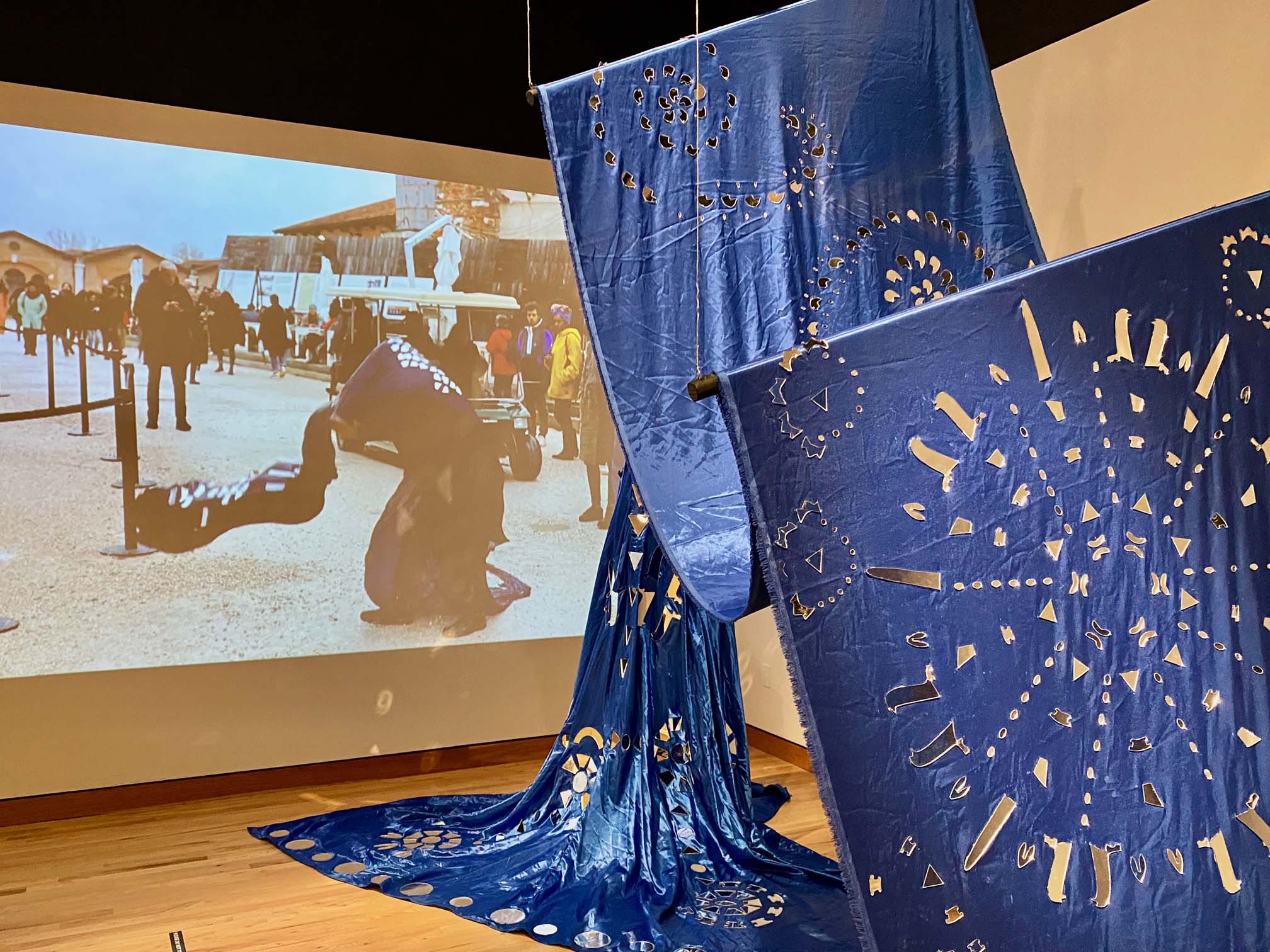
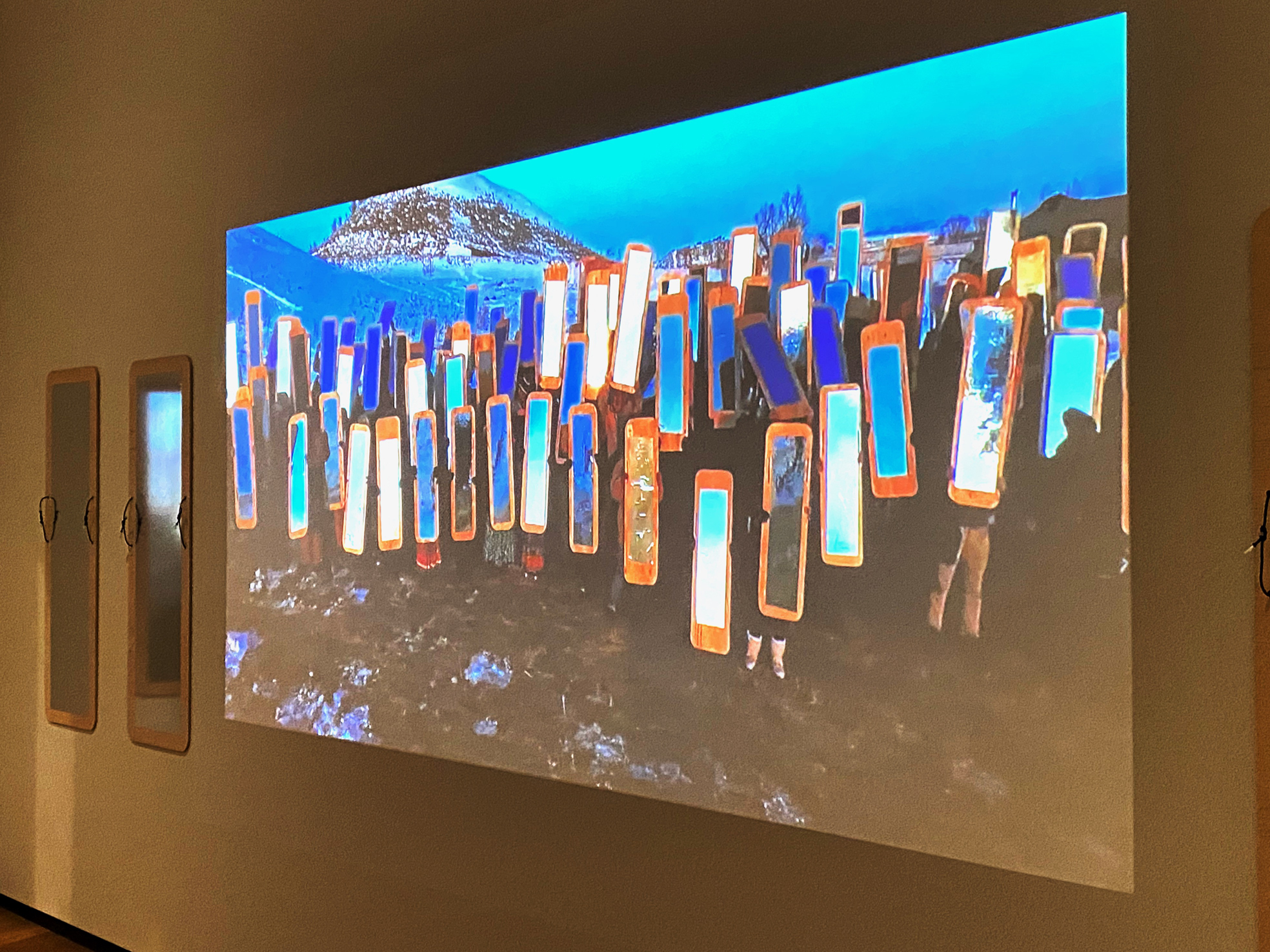
Work by Ethiopian refugee Tsedaye Makonnen includes a performance video and installation that focuses attention on African refugees who risk dangerous ocean crossings to escape violence in their home countries. The blue fabric represents the ocean, and each mirror a life lost.

Tsedaye Makonnen’s Astral Sea Views video with Astral Sea Series mirrored fabrics – commemorating women migrants who perished attempting dangerous European ocean crossings. Courtesy: the artist. 

See some of our other favorite installations here in our Flickr album – a shrine by Mario Yvarra, Jr. dedicated to his Chicana-activist mother –Music My Mom Played While Cleaning House – and works by Natalie Ball (Klamath/Modoc) that are straight from her recent show at the Whitney.

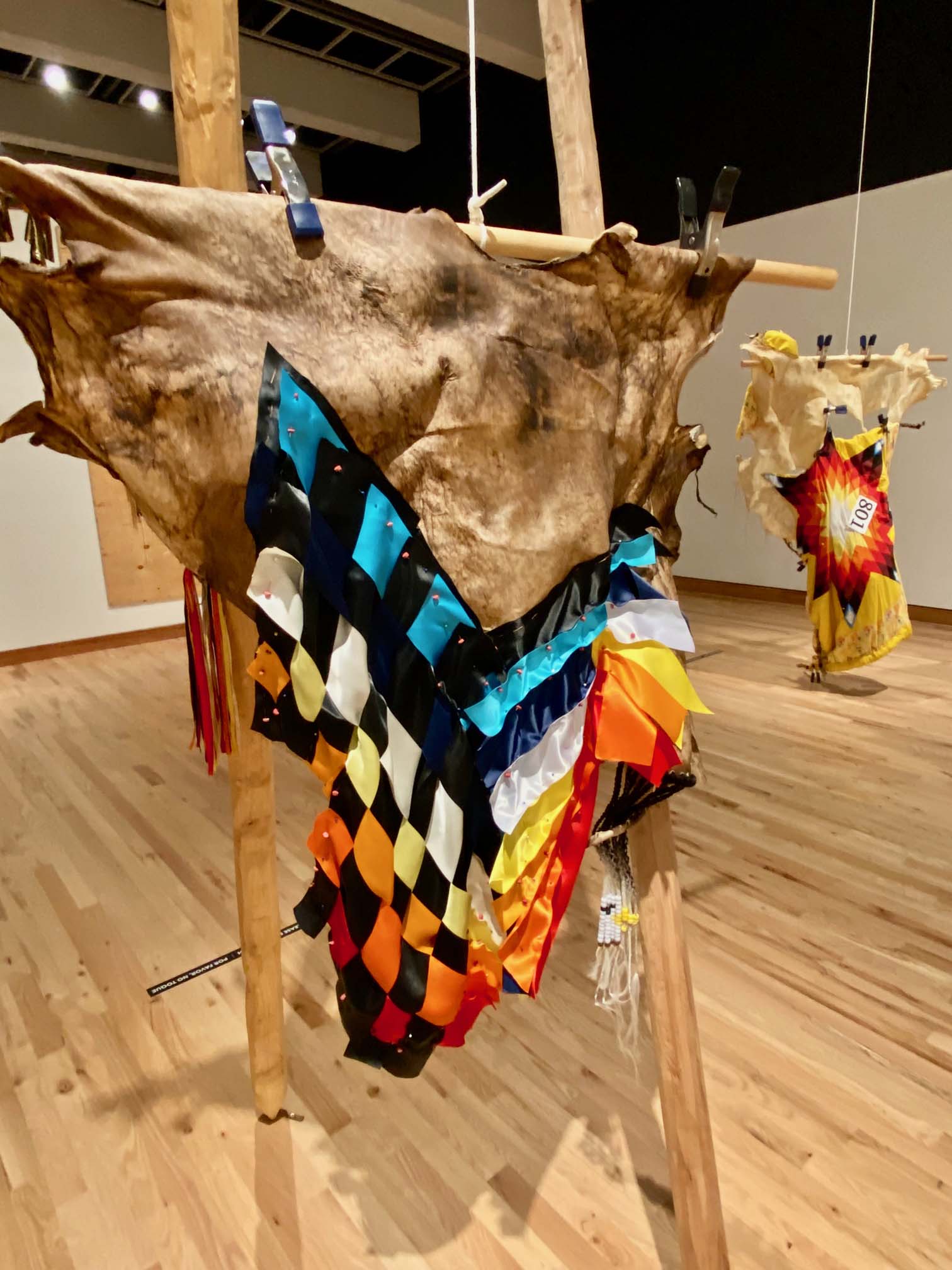
2023 mixed-media sculptures by Natalie Ball – ribbon skirt: There’s Indian and than there’s Indian; (rear) Baby Board. Courtesy: the artist.
Music My Mom Played While Cleaning the House…, a parade float by California artist Mario Ybarra, Jr. that honors his mother, a Chicana civil rights activist.

Listen to the Broken Boxes podcast to hear Ginger and international artists talk about making art, building community, and meeting the challenge of the moment.

Flight Into Egypt at The Met

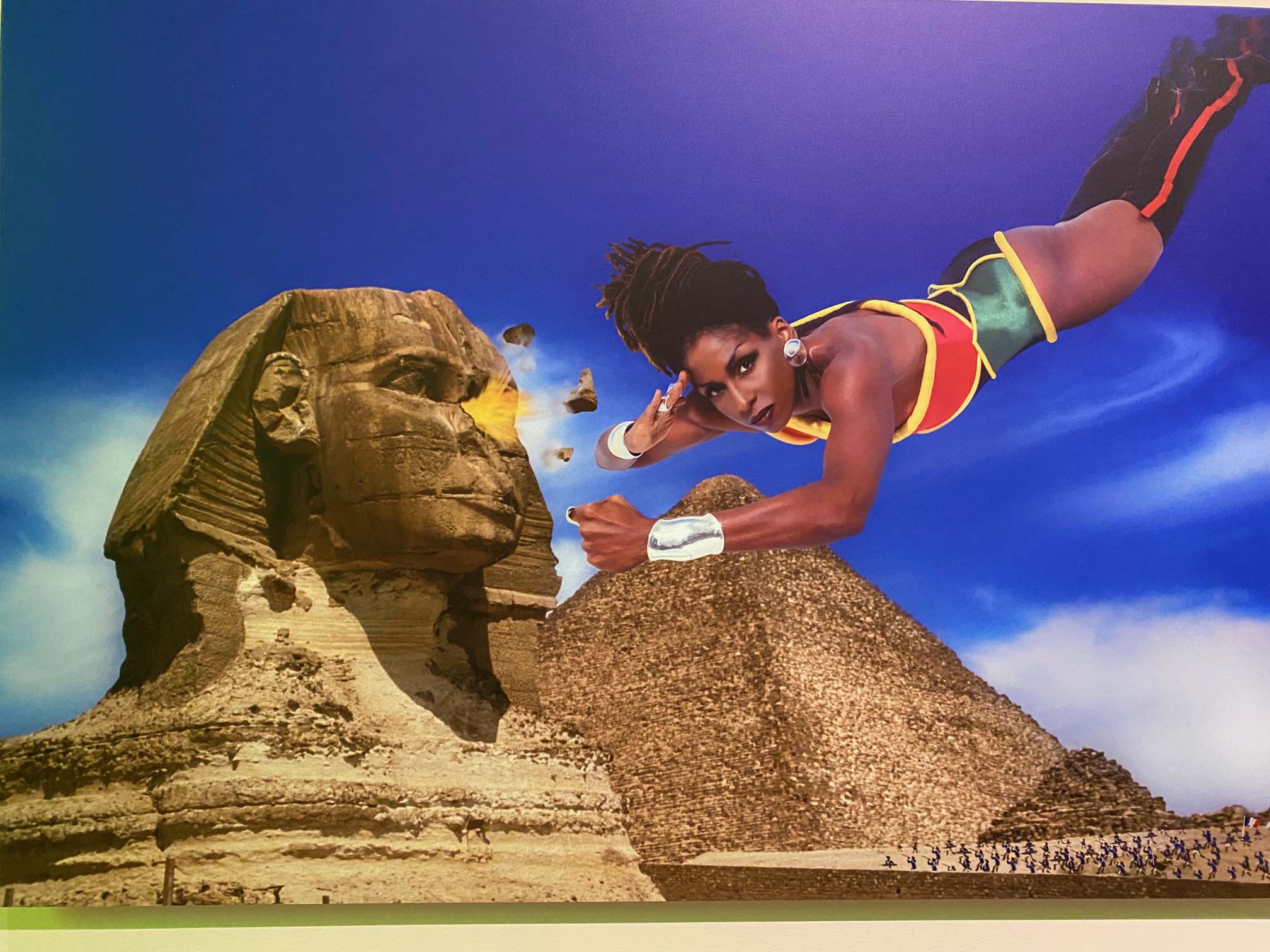
Take an epic tour through ancient Egyption iconography through the eyes of African-American artists and thinkers in Flight into Egypt: Black Artists and Ancient Egypt, 1876 – Now, on view at the Metropolitan Museum through February 17. It’s quite a ride with African-American artists and writers through decades of deep history.

The wonders never cease, from Cleopatra’s “throne” welcoming you into the galleries to Simone Leigh’s giant queen Sharifa, Henry Taylor’s vision of Michelle Obama as (maybe?) Queen Hapshetsut, epistles of the Harlem Renaissance, Afro-futurist super-heroines, and a neon Nefertiti taking her bow.

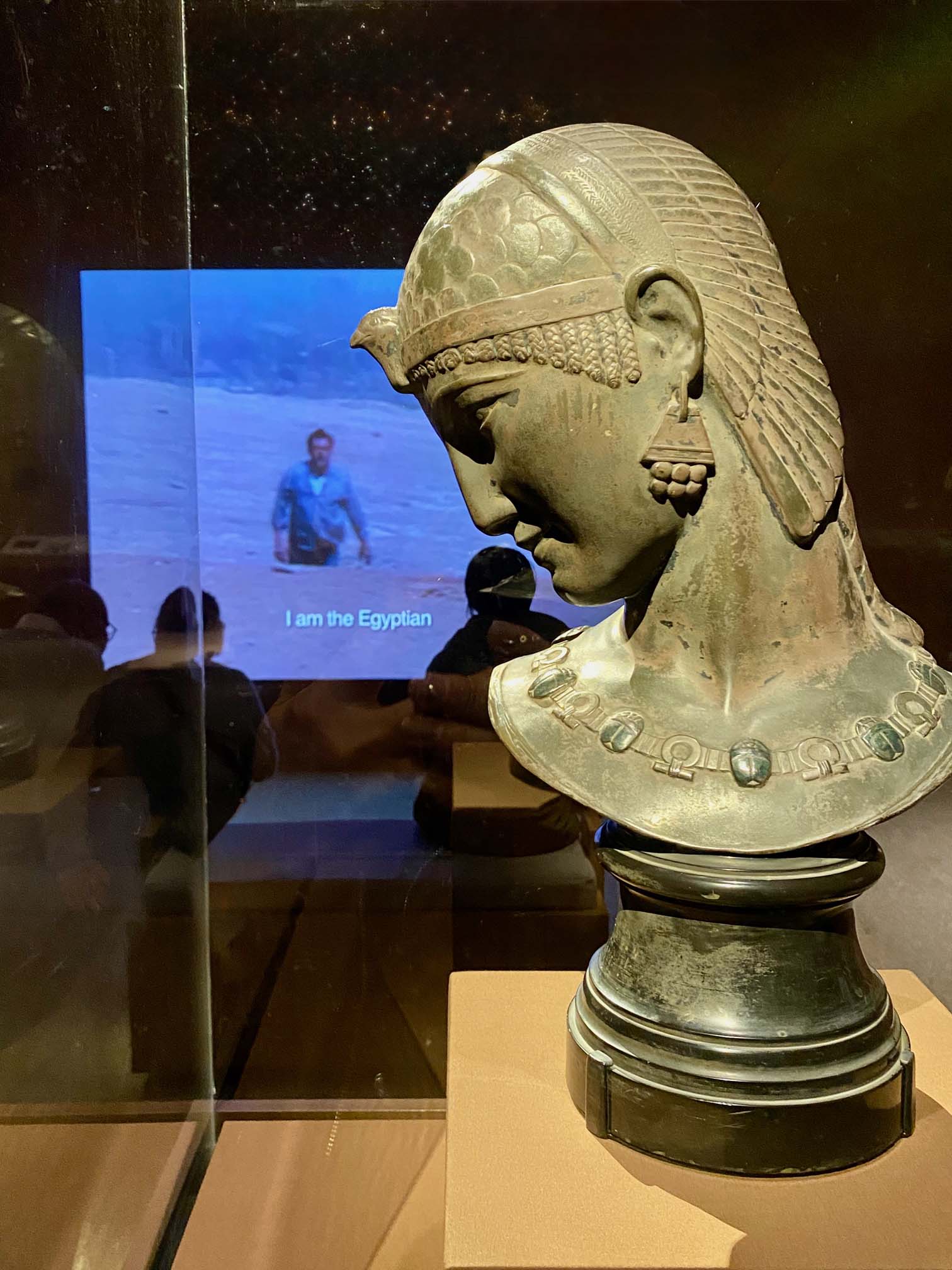
1930 bronze and silver Bride of the Nile (Arous El Nil), Bust by Egyptian sculptor Mahmoud Moktar. In the Heritage Studies gallery. Courtesy: HAR Collection.

The Met, home to the largest Egyptian art collection in the Western Hemisphere (followed by Brooklyn!), decided to create a contemporary counterpoint to its heralded wing and showcase all the ways African-American artists have looked to ancient histories of the Nile, contemplated their relationships to Egypt, and integrated Egyptian spirituality into the current narrative.

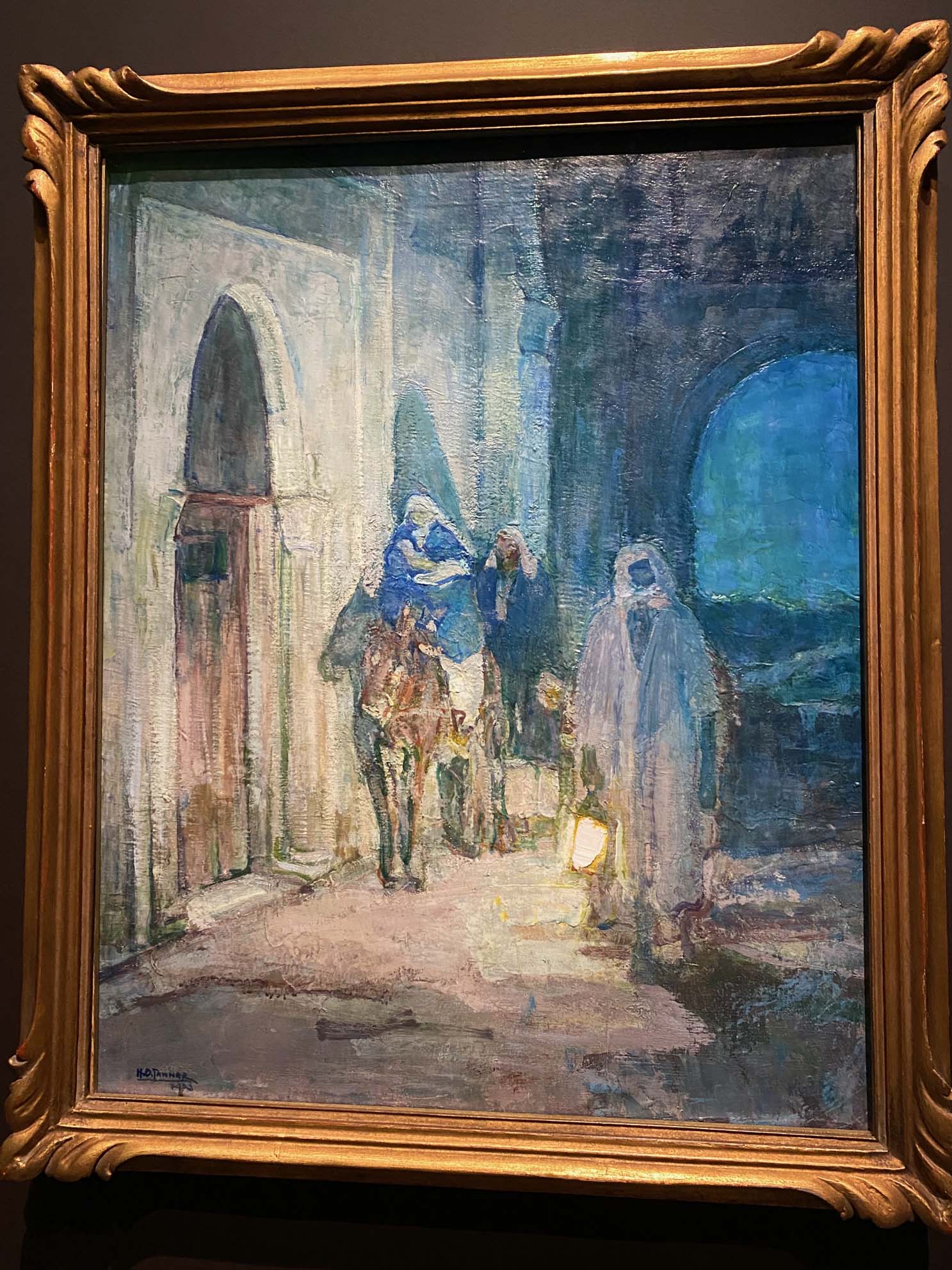
Henry O. Tanner’s 1923 painting Flight into Egypt, based on sketches made during his travels in Egypt.
Jean-Michel Basquiat’s 1982 painting Kings of Egypt II. In the Kings and Queens gallery. Courtesy: Rotterdam’s Museum Boijmans Van Beuningen.

Over 200 paintings, sculptures, videos, and installations are presented in this massive show, which also includes performances produced by Met Live Arts.  See some of our favorite works in our Flickr album.

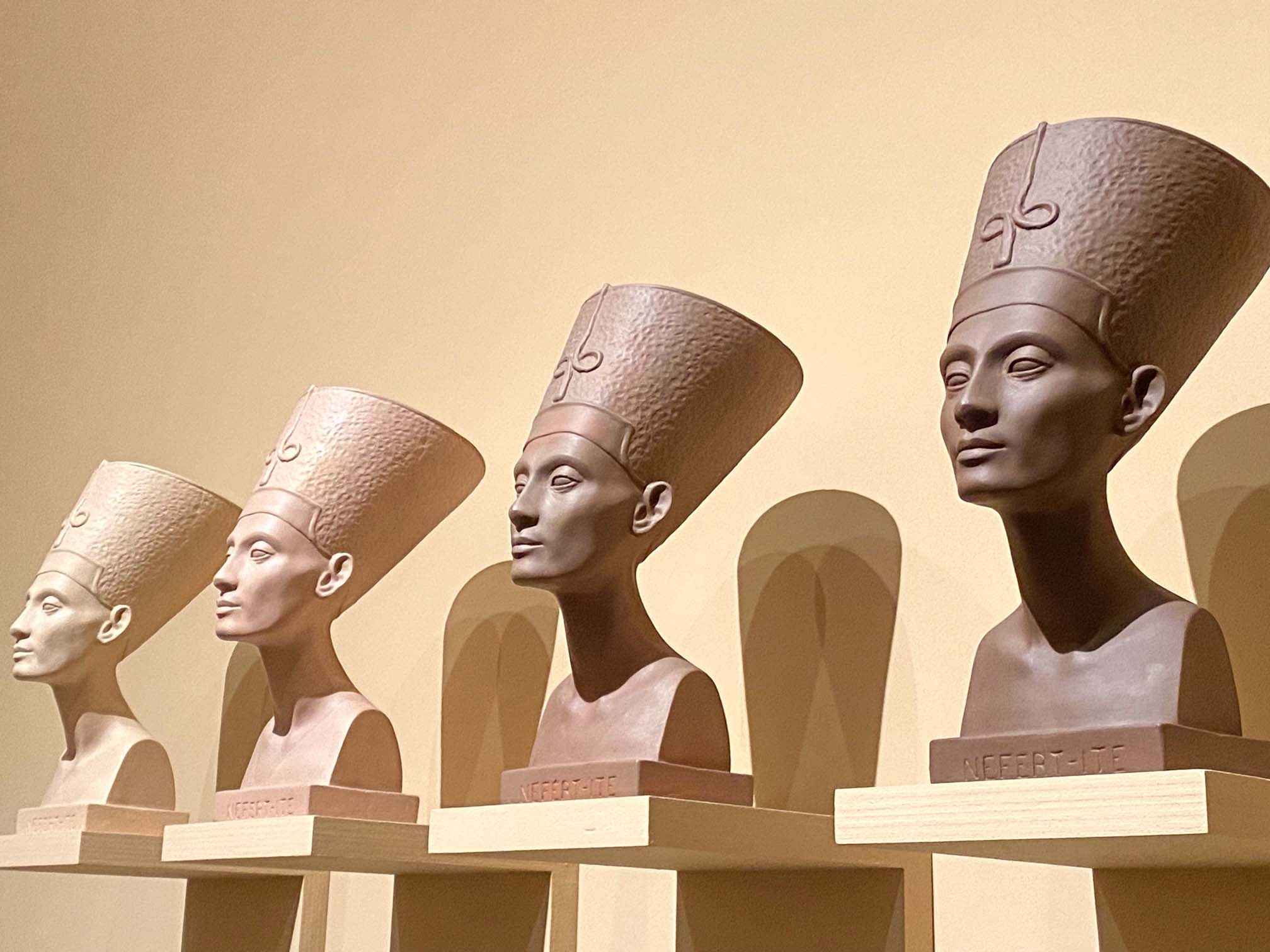
1993 Grey Area (Brown Version) by Fred Wilson – busts of Nefertiti painted in varied skin shades, reflecting the unresolved opinions on the racial makeup of the ancient Egyptians. From the Kings and Queens gallery. Courtesy: Brooklyn Museum

Watch this video walk-through with the curator, who’s accompanied by two artist in the show – Fred Wilson, whose “Grey Area (Brown Version)” sculpture inspired the curator’s theme, and acclaimed abstractionist Julie Mehretu, who herself was born in Ethiopia and experienced the monuments of Egypt at a very young age:

There’s also a gallery devoted to contemporary work by Egyptian artists –a body of work that’s often overlooked in Western art museums. Here’s a closer look at how an Egyptian artist – who’s also a security guard at the Met – was invited by the curator to participate in this exhibition:

For learn more, here’s a link to the Met’s exhibition guide, and a curated playlist for the show. Take an exciting journey through these visual and musical revelations!

Renee Cox’s 1998 digital print (printed 2024) Rajé to the Rescue, featuring an Afrofuturist super-heroine. In the Space is the Place gallery. Courtesy: the artist.

Painters Tell Stories of Nature’s Resilience

Feel like things are out of balance?  Seven narrative painters let animals take center stage get visitors thinking about the future for nature and the world in Vivarium, Exploring Intersections of Art, Storytelling, and the Resilience of the Living World at the Albuquerque Museum through February 9, 2025..

Big, bold paintings let nature tell the story and present juxtapositions that present questions about society, environmental dissonance, and what messages animals might want to send. See some of our favorites in our Flickr album.

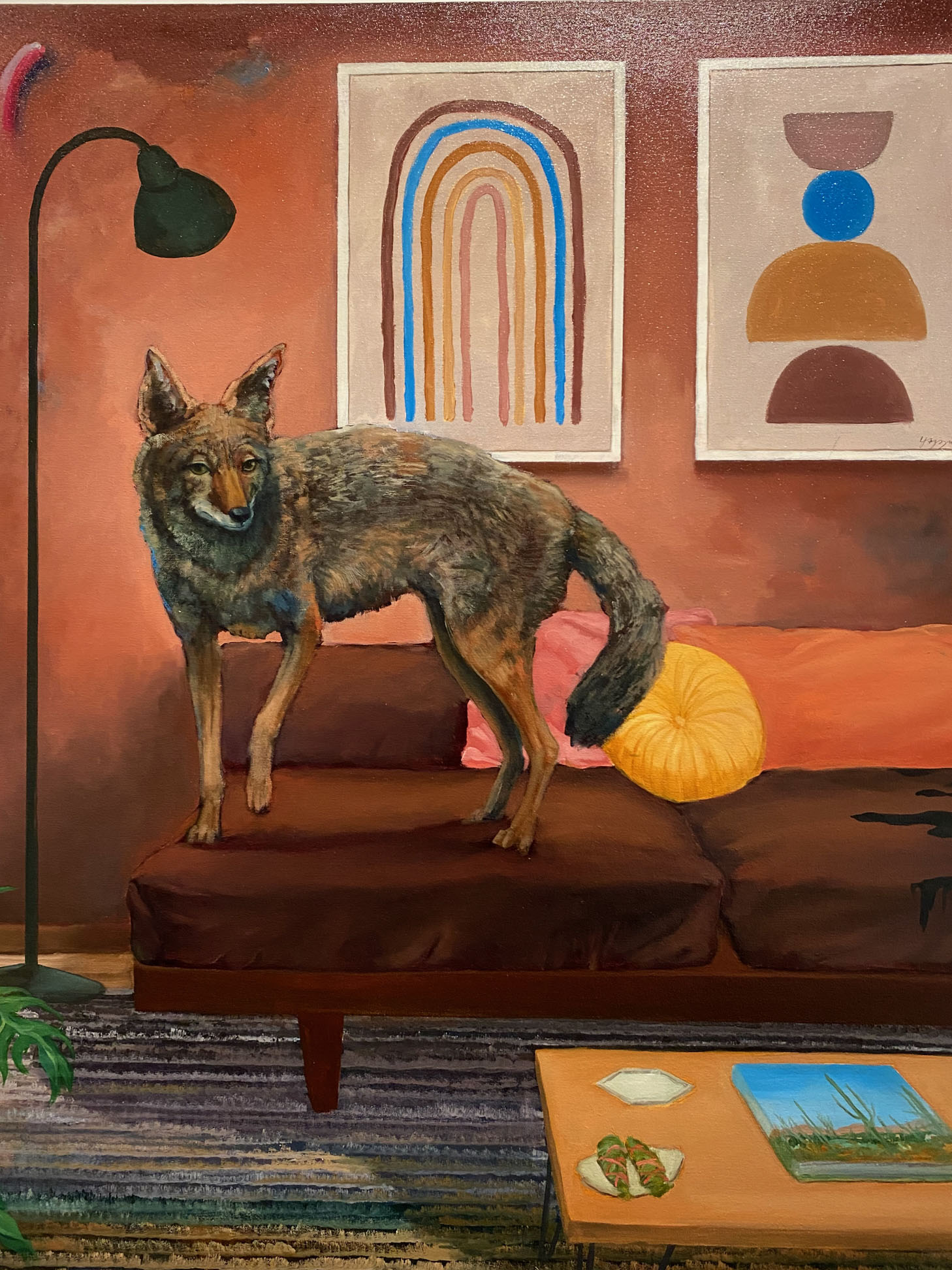
2023 oil Astrid by Stephen J. Yazzie (Laguna Pueblo/Diné). Courtesy: private collection

Although the exhibition begins with a small selection of works from Santa Fe’s Tia Collection – Dan Namingha (Hopi-Tewa), Nanibah Chacon (Dine/Chicana), and others – the majority of the space features a selection of works by the seven featured painters. Clusters of paintings immerse viewers in each artist’s unique world, style, and narrative – mini-vivariums, or artificial worlds.

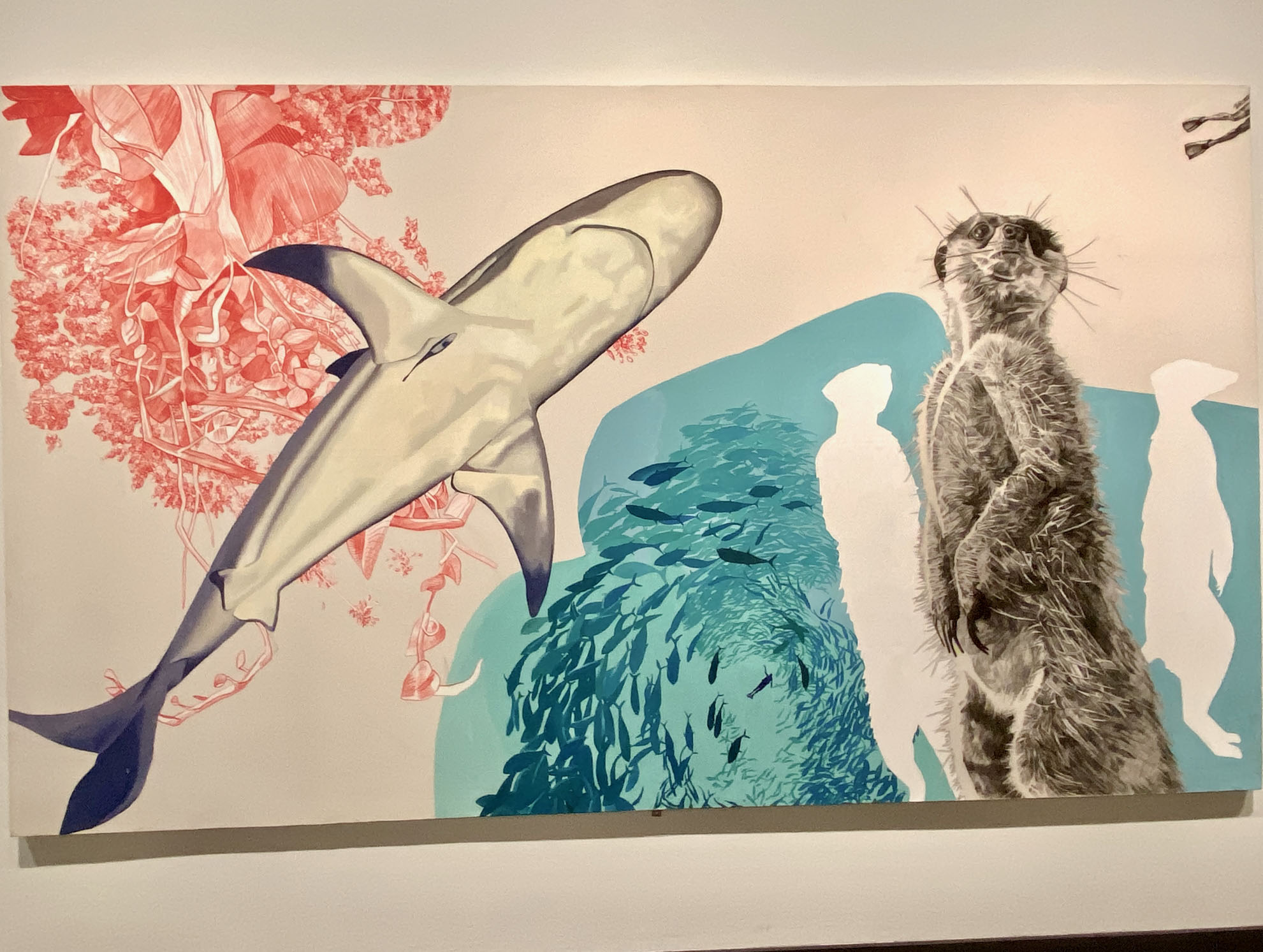
Nature explodes of Nathan Budoff’s giant canvases – tigers, meerkats, swimming octopii, schools of fish, prarie dogs – all floating and interacting in a pure, white space.  He creates realistic depictions in charcoal, oil, acrylic, and ink, but juxtaposes natural components that are startling. Visitors stand back, pause, take it all in at once, trying to make sense of how these magnificent creatures interact in unusual landscapes.  Mostly, the canvases do not include people, but Nathan enjoys letting the remarkable, minutely observed wildlife speak their own truths.

2017 charcoal, oil, acrylic, and ink Imminent Danger by Nathan Budoff – showing systems and social behaviors in the natural world. Courtesy: the artist.

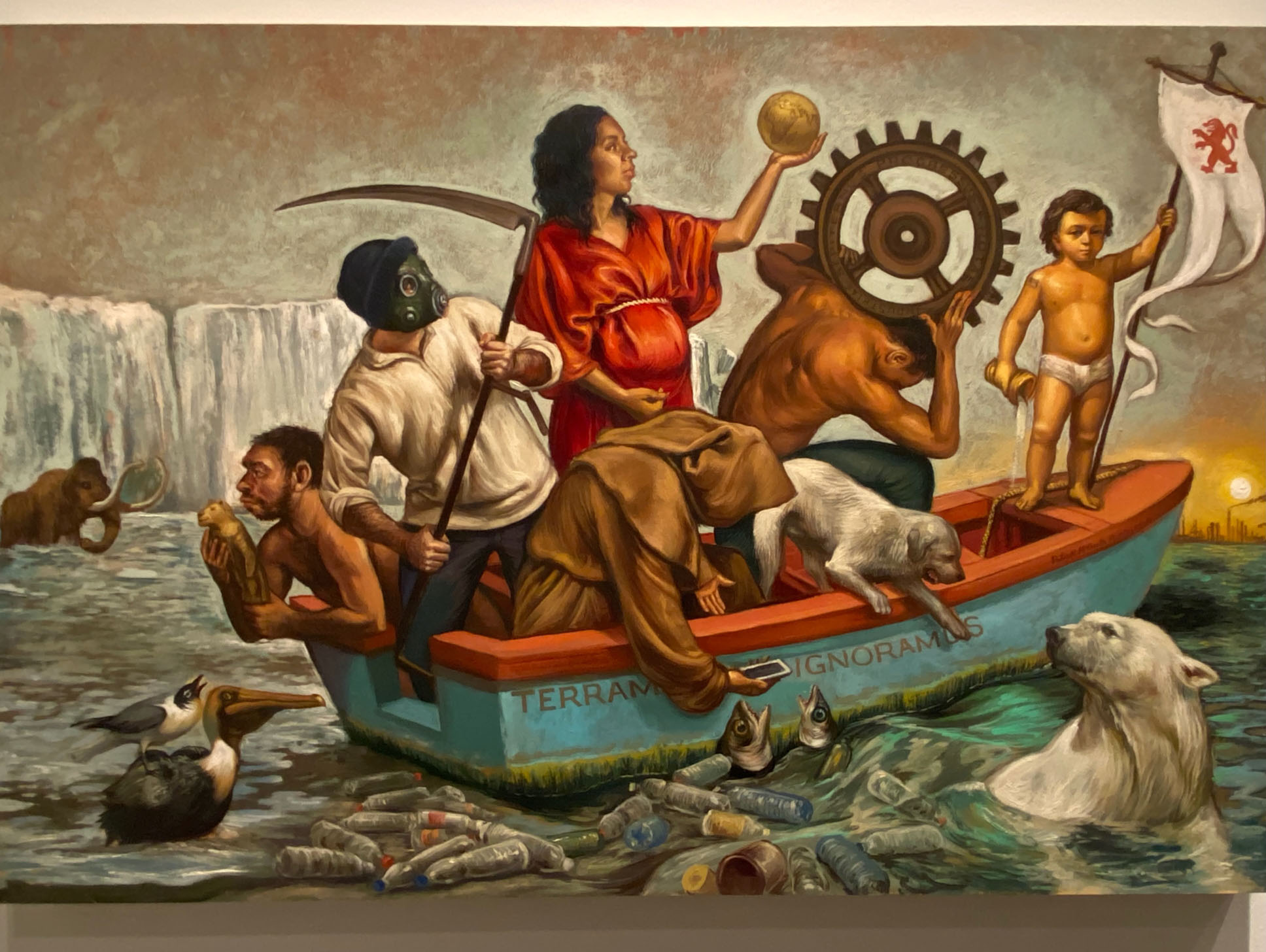
Paintings by Patrick McGrath Muñiz are intellectual puzzles, mixing modern issues, depictions of modern technology, and classical Renaissance and

Baroque painting techniques.  Signs, symbols, and details on the horizon demand slow scrutiny to unravel the allegories and associations packed into the paintings.

2018 oil painting Terram Ignoramus by Patrick McGrath Muñiz – a warning about the perils of climate change; depicting a perilous Arctic journey in a boat named “We know not the earth.” Courtesy: the artist

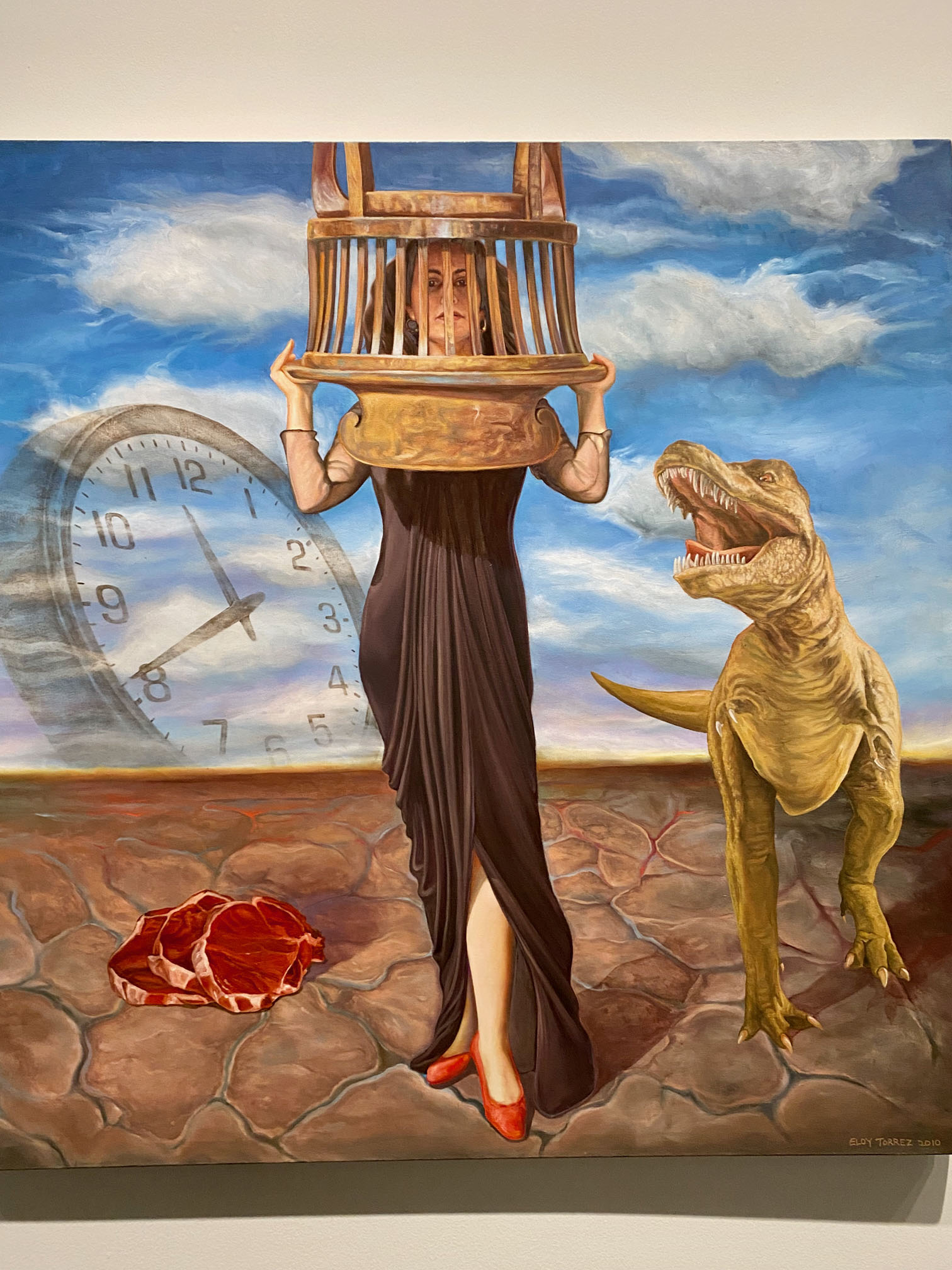
Eloy Torres, a Chicano activist and muralist, uses religious, mythological, and surrealist pictorial conventions to construct worlds that lets the viewer their intuition to connect the dots.

2006 oil portrait of Cheech Martin It’s a Brown World After All by Eloy Torrez; the crown connects him to his ancestral past. Courtesy: Riverside Art Museum.
2010 oil on panel Meat by Eloy Torrez, a surreal allegory on precarious relationships between humans and thenatural world. Courtesy: the artist.

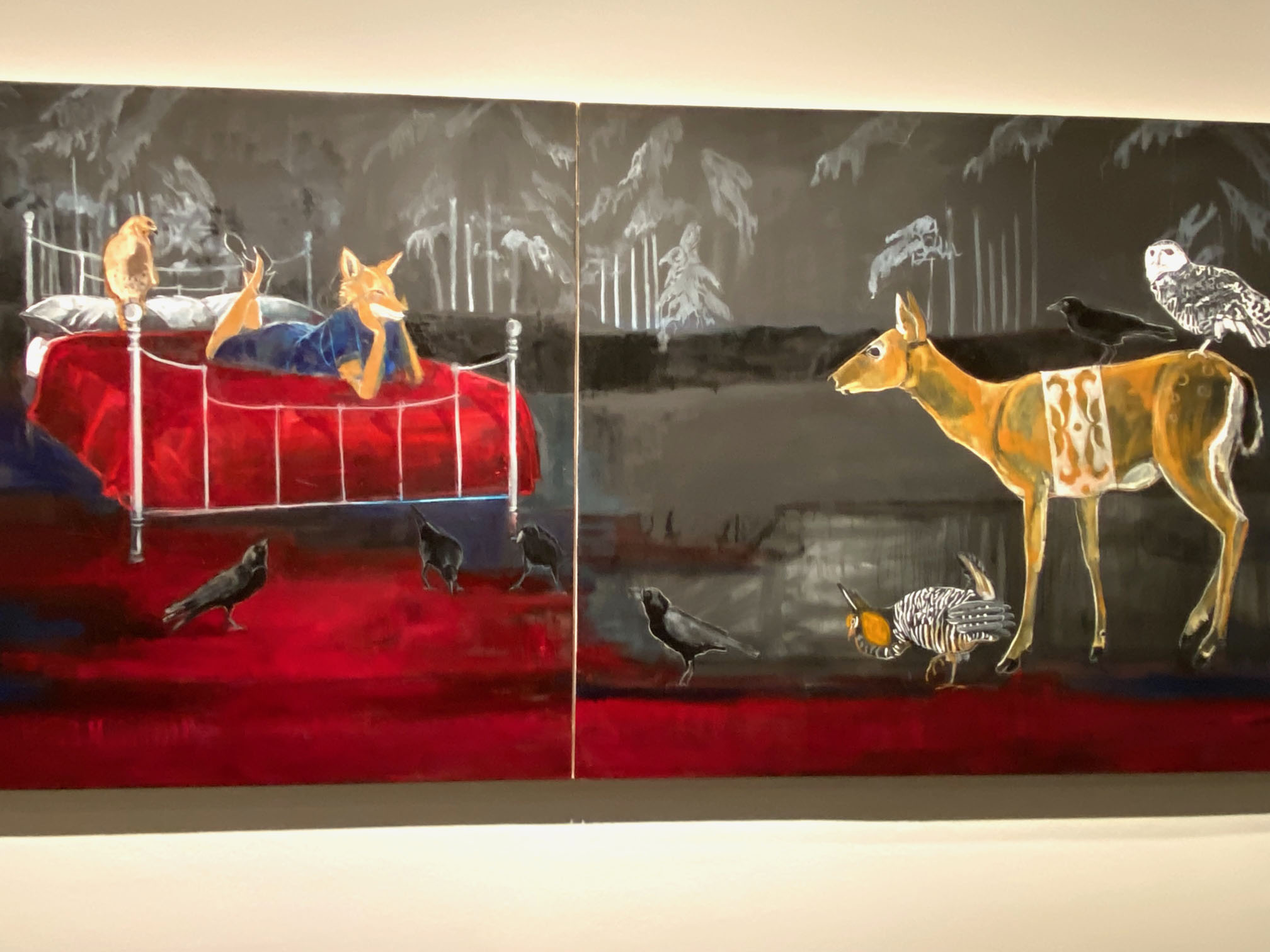
Stephen J. Yazzie (Laguna Pueblo/Diné) exhibits a series of works in which Coyote inhabits upscale suburban interiors, emphasizing the inside/outside, nature/culture dichotomies in contemporary life.

Julie Buffalohead (Ponca Tribe of Oklahoma), a member of her tribe’s Deer Clan, creates narratives featuring animals as protagonists, often metaphors for interactions between natural and spiritual realms. Large works allow players in her stories to prance, dance, and float across saturated color fields.

2018 oil and pastel Straight Legs by Julie Buffalohead (Ponca Tribe of Oklahoma) – a painting reflecting her membership in the Deer Clan. Courtesy: University of Wyoming Art Museum

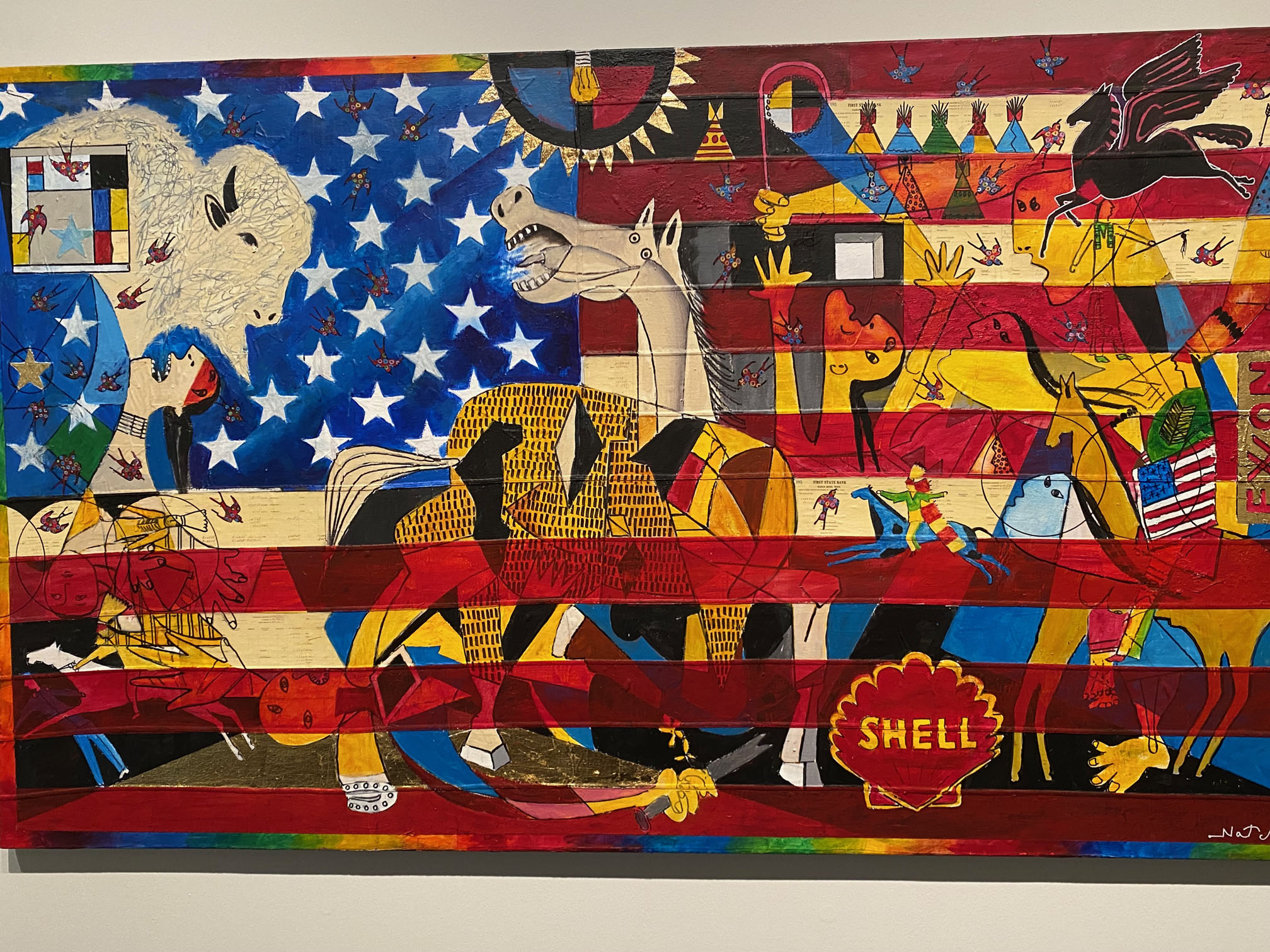
Artist/educator Stan Netchez (Shoshone/Tataviam) presents a throught-provoking masterpiece, using Picasso’s Guernica imagery, US brands, and indigenous spiritual icons to display the chaos and destruction inflicted on indigenous peoples.

2019 acrylic, oil, and metal leaf “Guernica Flag” by Stan Netchez (Shoshone/Tataviam) – a critique of colonialism’s impact. Courtesy: Tia Collection

Listen in on a panel with four of these storytellers conducted by the Albuquerque Museum.

Pathfinder Marcus Amerman at The Wheelwright

Shape-shifter, beadwork innovator, pop-culture provocateur, fashion designer, and performance artist – it’s hard to know where to start when summarizing four-decades of work by a Native-American contemporary art superstar. But his first retrospective, Pathfinder: 40 Years of Marcus Amerman, does showcases his wide range of work in spectacular fashion. See it at the Wheelwright Museum of the American Indian in Santa Fe through January 11.

Marcus Amerman (Choctaw Nation of Oklahoma) is best known for his intricate beaded “paintings,” which take center stage.

1994 Stormbringer beaded portrait of Lakota leader Chief Iron Hawk. Surrealist eyes by Man Ray watch from a brewing storm. Courtesy: Colorado Springs Fine Arts Center.

Once Amerman developed his bead technique, which provided a photo-realist spin to a traditional “native” craft, he really felt that he could take on any subject as a contemporary artist – movie stars, historic characters, and cartoon images. The impact is electric. 

2002 beaded painting Greetings from Indian Country, merging vintage tourism with pointed social commentary on exploitation. Private collection

Gazing across the main gallery, you see pop-culture images of “Indian” memes splashed across large canvases, cartoony self-portraits, fashion mannequins, glass sculptures, and photos by his wry collaborators. It’s a splendid mix of eye-dazzling color, technical mastery, and social commentary. Take a look at some of our favorites in our Flickr gallery.

Amerman garnered a lot of attention in the late 1980s and early 1990s for merging his beadwork into contemporary fashion. He cites his beaded leather motorcycle jacket with a beaded meme of bikini-clad Brooke Shields starting it all – a shock-worthy mix of leather toughness with one of the hottest young stars of the day.  He took on custom commissions and leapt at the opportunity to participate in fashion shows. He was overjoyed to see his buckskin fashions featured in Elle.

1982 Iron Horse Jacket with beaded Brooke Shields. Courtesy: Private collection
American eagles beaded on lapels of 1992 dinner jacket; commissioned by veteran Doug Hyde (Nez Perce, Assiniboine, Chippewa).

It’s obvious that Amerman rejects staying put into a single category. He loves collecting vintage “Indian” objects and collaging art-world and historic references in all of his work. Check out those hubcaps!

2023 acrylic painting Old Masters in the New World, showing 17th century Dutch colonizers next to a Santa Fe train. Courtesy: the artist
2023 Rattles found-object collage, mixing pop cultural and Native images. Courtesy: the artist

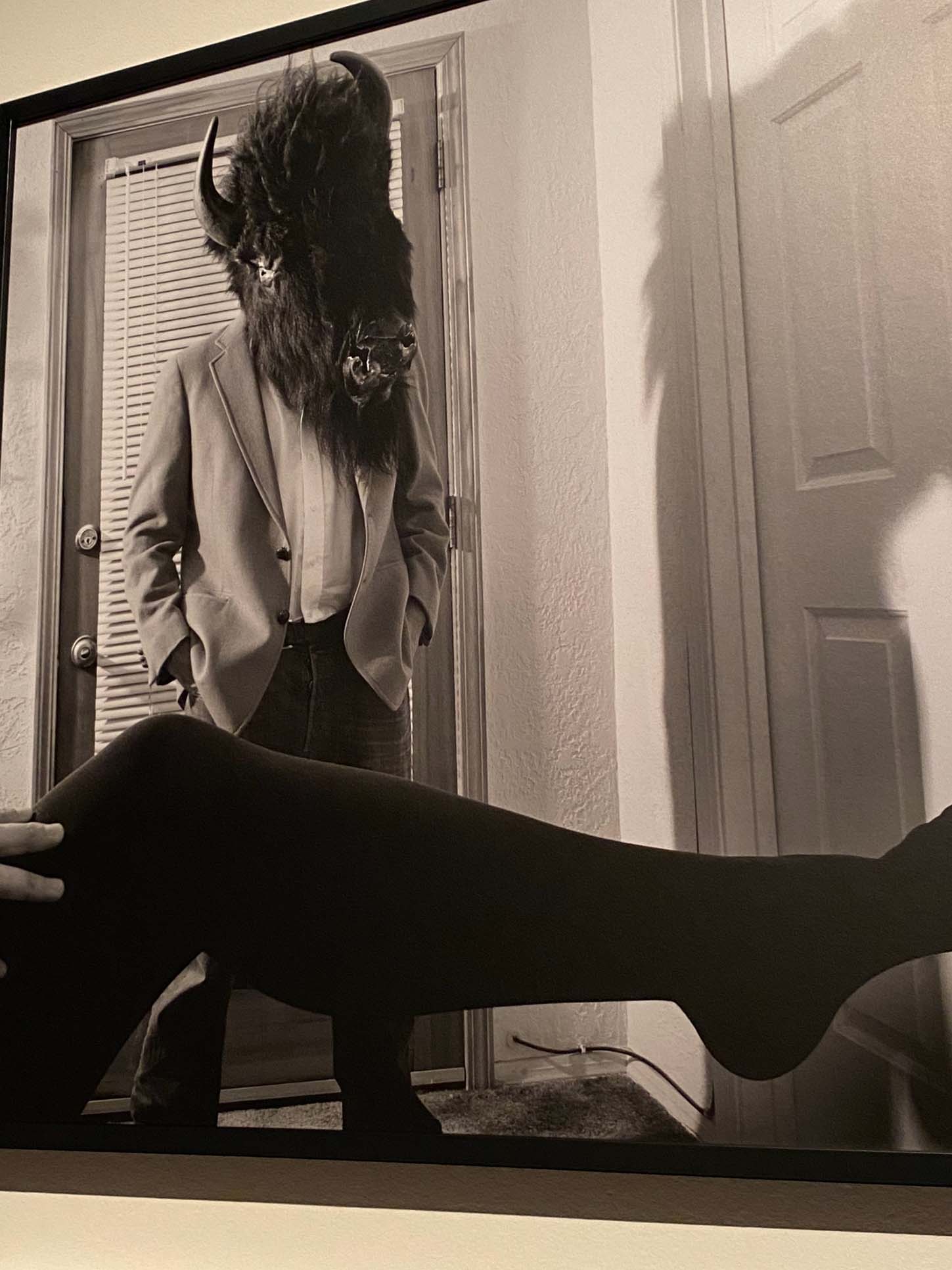
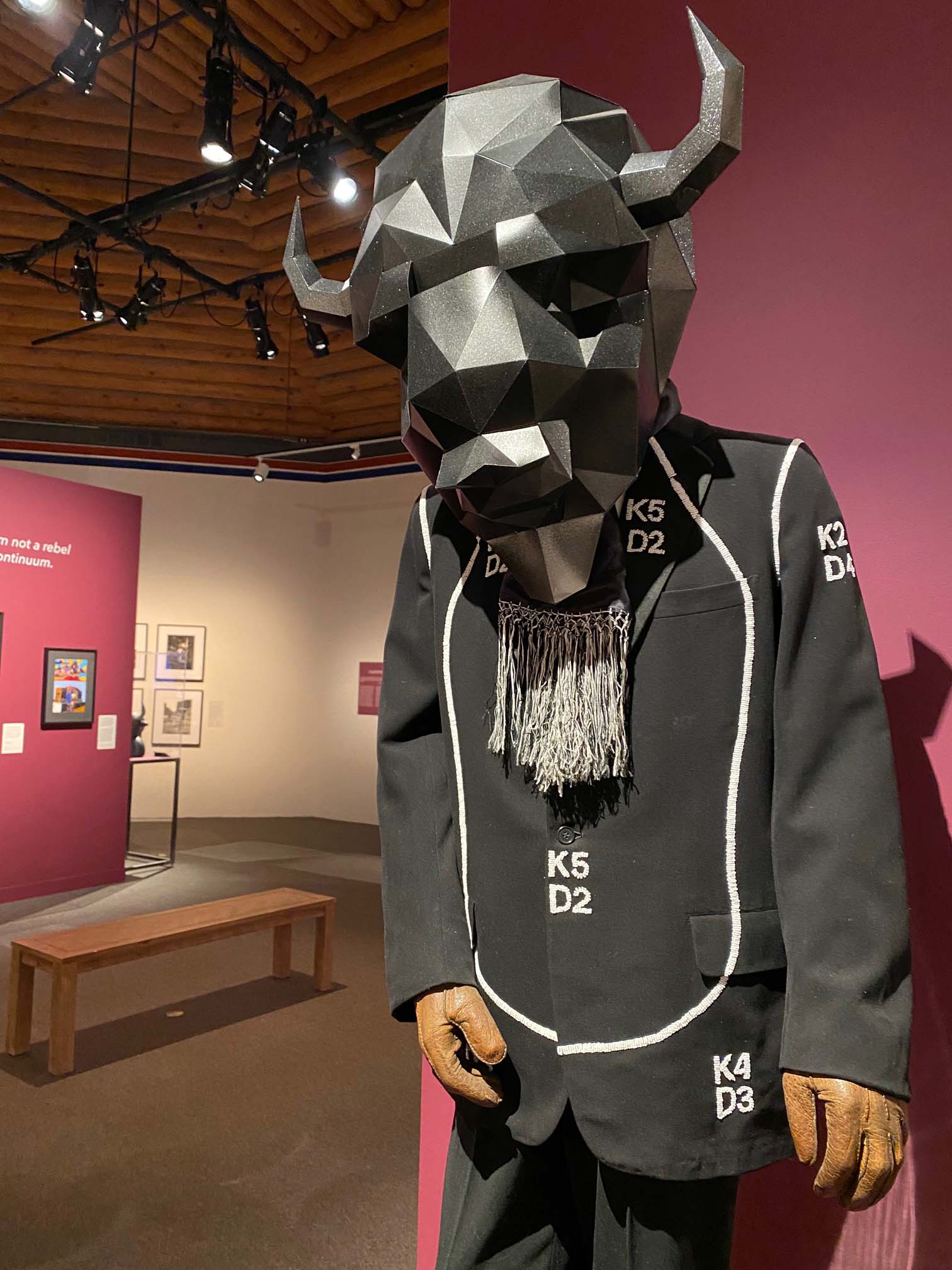
Amerman’s alter ego, Buffalo Man, features prominently in the show, particularly in his collaborations with acclaimed photographer Cara Romero, where icons of Native culture insert themselves into American pop culture.

Cara Romero’s 2013 photo El Graduaté – a collaboration with Amerman’s performance alter ego, Buffalo Man. Courtesy: Cara Romero
2002 Target Jacket with glass beads, worn by the artist in fashion shows as himself and as Buffalo Man. Courtesy: the artist

The gorgeous collaborations with glass artists from Amerman’s time at Pilchuk are a delight – some self-referential and others harkening back to his own culture’s ancestry.  He claims that everything he makes is genuinely as “self portrait.”

2010 blown and sand-carved Buffalo Man – a collaboration by Amerman and Preston Singletary (Tlingit). Courtesy: the artist
2006 Glass Shield, one of a series created during a residency at Pilchuk Glass School and inspired by historic Plains Indian shields. Courtesy: the artist

It’s a joyful tribute to an artist who gives back, inspires others, and keeps asking pertinent questions about the role of art and artists in our society.

Enjoy this close-up look at some of Amerman’s masterful beadwork and hear why Amerman continues to create:

Alma Thomas Splashes Denver with Color

For a pop of color in the winter season, see Composing Color: Paintings by Alma Thomas from the Smithsonian Museum of American Art at the Denver Museum of Art through January 12 and at the Memorial Art Gallery in Rochester, New York February 8 through May 25, 2025.

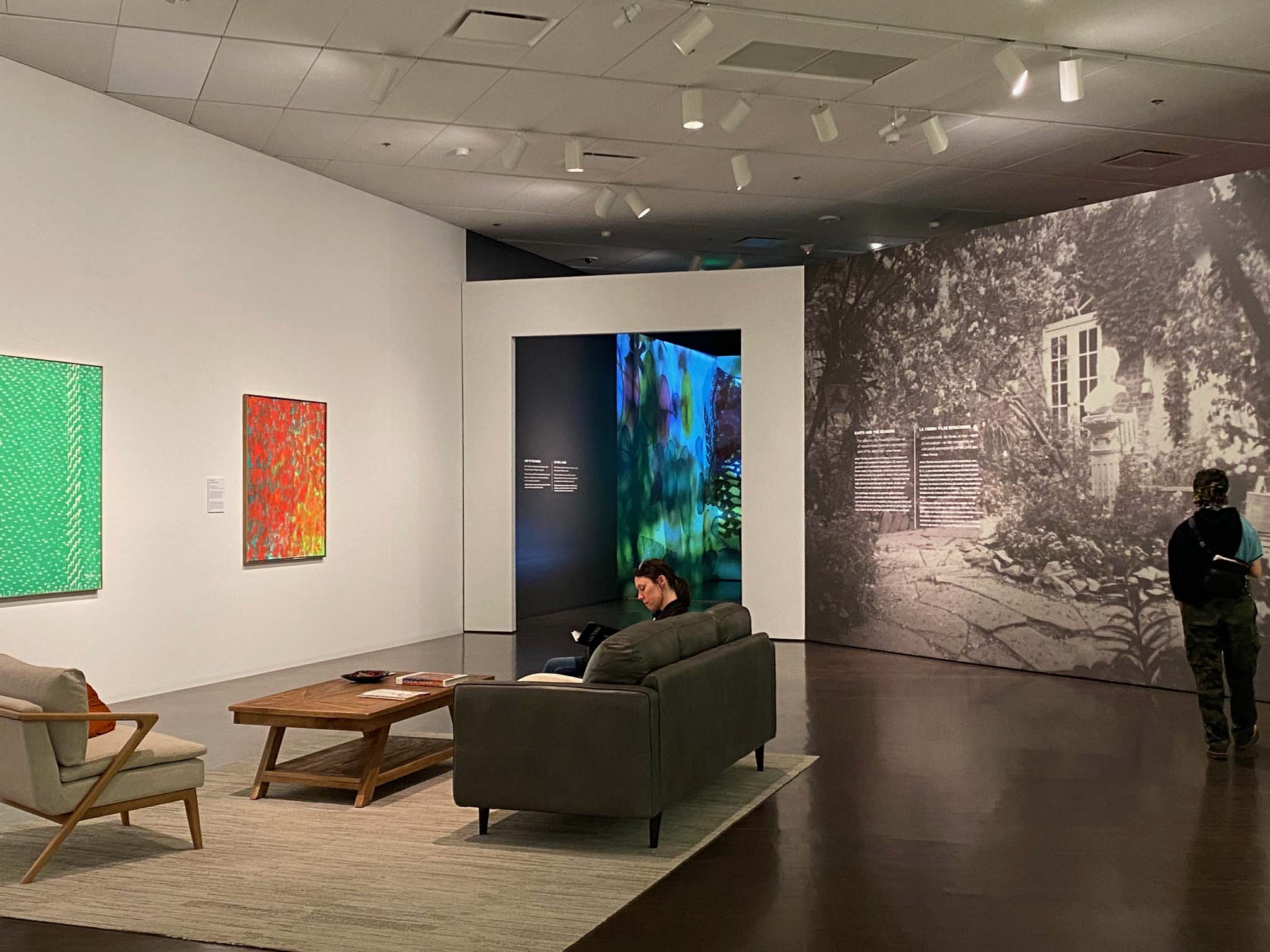
Denver has welcomed this mid-century modern painter with open arms, with visitors lounging in several living-room settings surrounded by abstractions from the Sixties and Seventies by a Washington, D.C. painter who born in the late 19th century but who lived to see a man land on the Moon.

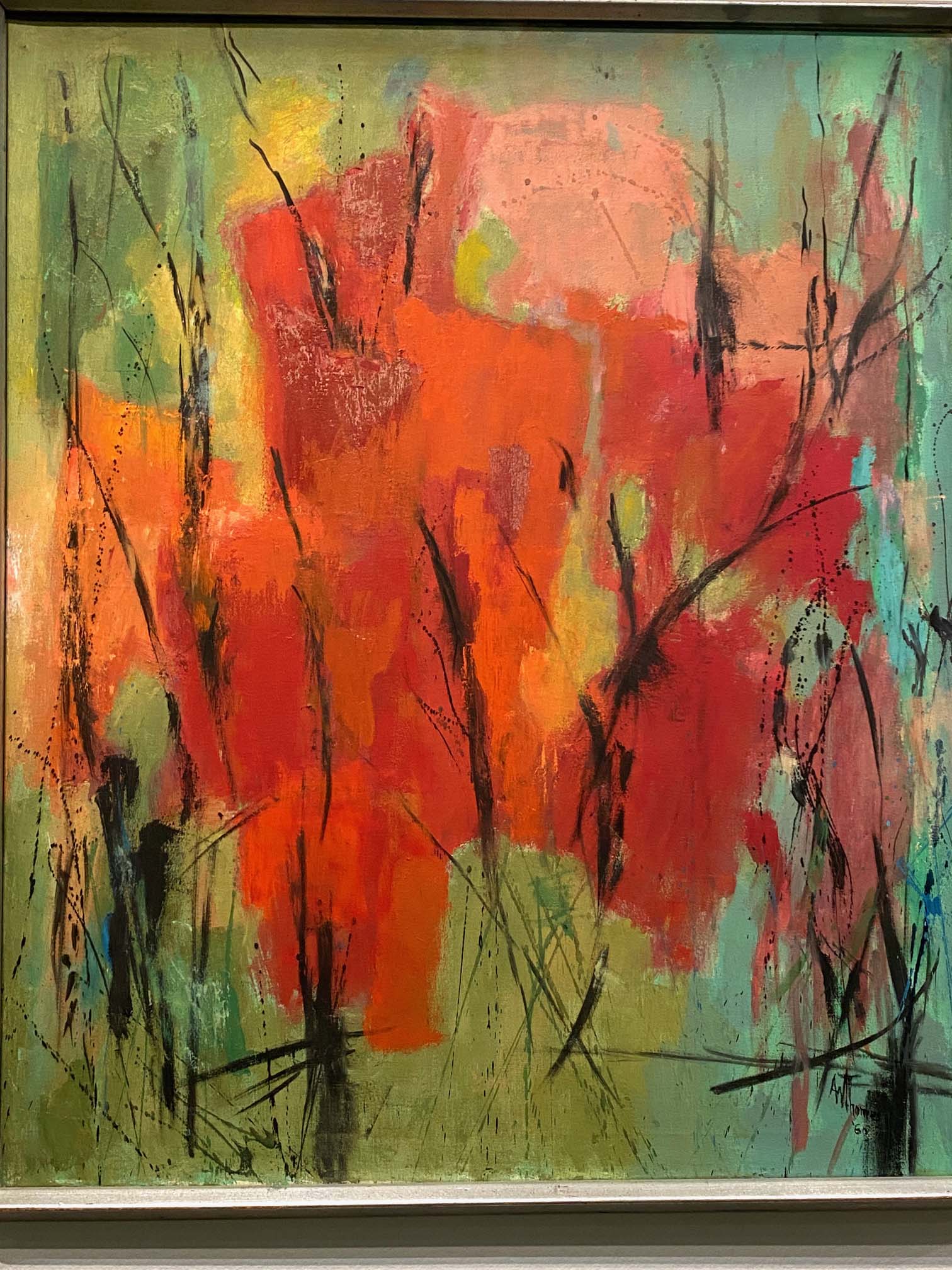
1960 Red Abstraction by Alma Thomas. Courtesy: Smithsonian American Art Museum.

Alma Thomas grew up in Georgia, and earned the first fine arts degree ever granted by Howard University in 1924.  After receiving a masters in education from Columbia, Alma spent the next 30 years teaching in Washington, D.C. public schools. 

Ida Jervis’s 1968 photo Alma Thomas working in her studio. Courtesy: Archives of American Art, Smithsonian Institution.

But she stayed close with her professors at Howard, who founded the Barnett Aden Gallery, one of first racially integrated and Black-owned art galleries in the United States.  Alma served as the gallery’s VP, which displayed a who’s who of contemporary African-American artists, like Elizabeth Catlett, Aaron Douglas, Jacob Lawrence, and Henry O. Tanner. 

By the early 1950s, Alma’s work was regularly shown in exhibitions at the gallery. When Alma finally retired from teaching in 1960 at age 69, she was finally able to paint full time. The Smithsonian’s exhibition features Alma’s work from this highly productive period.

Take a look at our favorites in our Flickr album.

The exhibition is centered around three subjects that inspired her – nature, the cosmos, and music. Her vivid color paintings welcome you to the exhibition but around the corner you see what really inspired her – a wall-sized photo of Alma’s beloved flower garden

Mid-century modern lounge in the Denver exhibition with paintings by Alma Thomas inspired by her garden

She loved the changing seasons, the patterns of gardens, and patterns observed by light flickering through the crepe myrtles in her garden or through the trees on her walks through DC’s endless greenways and parks.

1976 oil Fall Begins, suggesting rustling leaves. Courtesy: Smithsonian American Art Museum.
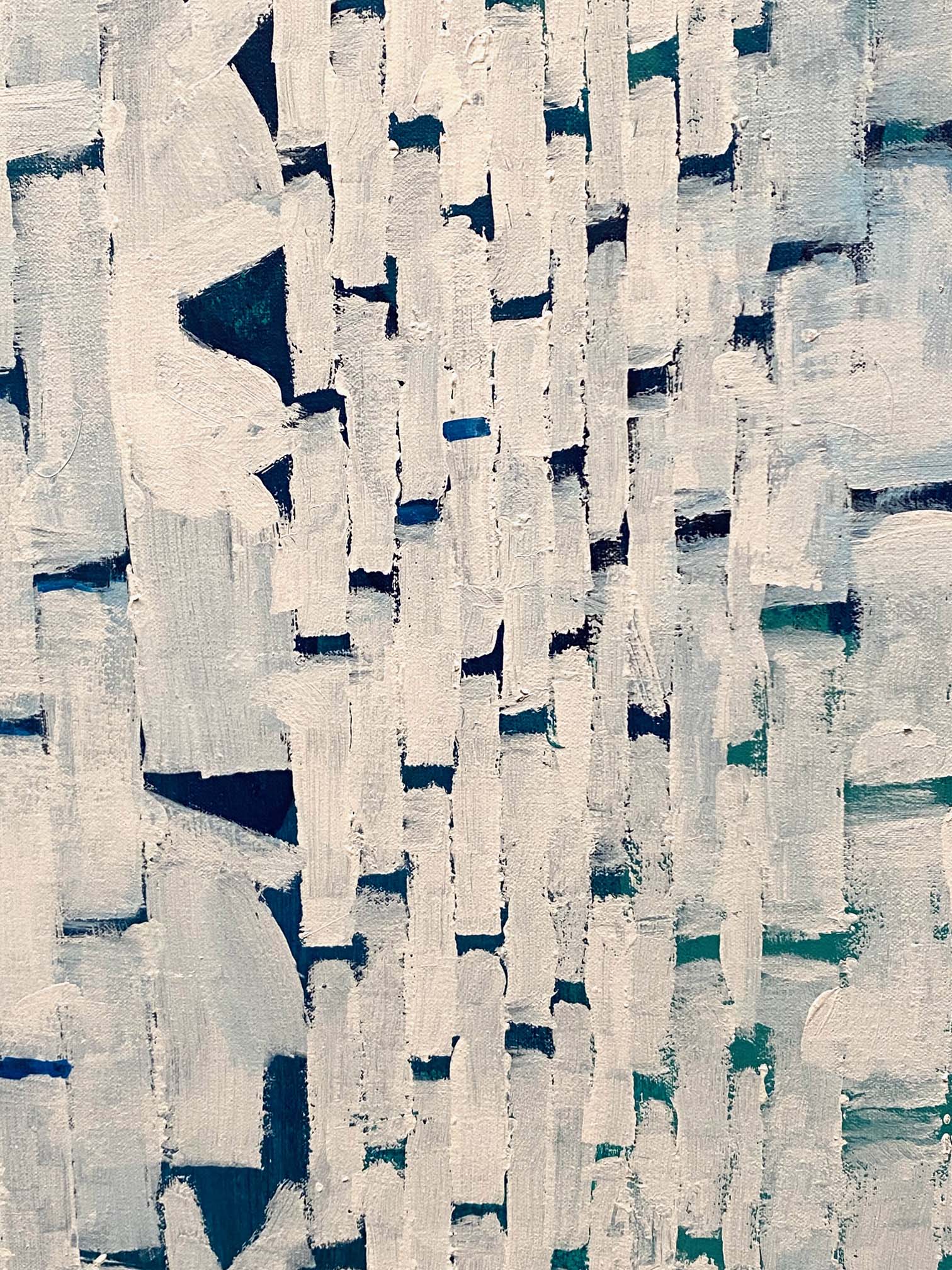
Detail of 1972 acrylic, Arboretum Presents White Dogwood. Courtesy: Smithsonian American Art Museum.

The exhibition also features an immersive environment where visitors can use colors and shapes from Alma’s paintings to splash supersized across the gallery walls.

Room in Denver where visitors use filters to create lightscapes on the gallery walls.
1976 acrylic, Grassy Melodic Chart. Courtesy: Smithsonian American Art Museum.

By the 1970s, Alma’s love of music and rhythm were reflected in her abstractions, although the titles of her canvases tell us that she saw expressive melodies in nature too.

Captivated by the promise of technology, Alma also reveled in the mysteries and rhythms of the planets, space, and those frontiers of exploration. She really felt that the Moon, planets, and stars represented the peace and harmony that were sometimes lacking on Earth.

Always searching for beauty in the world, continuing to paint, and contemplating a brighter future, Alma achieved unprecedented art-world recognition in 1972 at age 80 –a one-woman show at the Corcoran Gallery in Washington and in New York at the Whitney Museum of American Art.

Not bad for a gal who grew up in “horse and buggy days” in Georgia! Thank you to the Smithsonian for collecting Alma’s work and producing this joyful, colorful show.

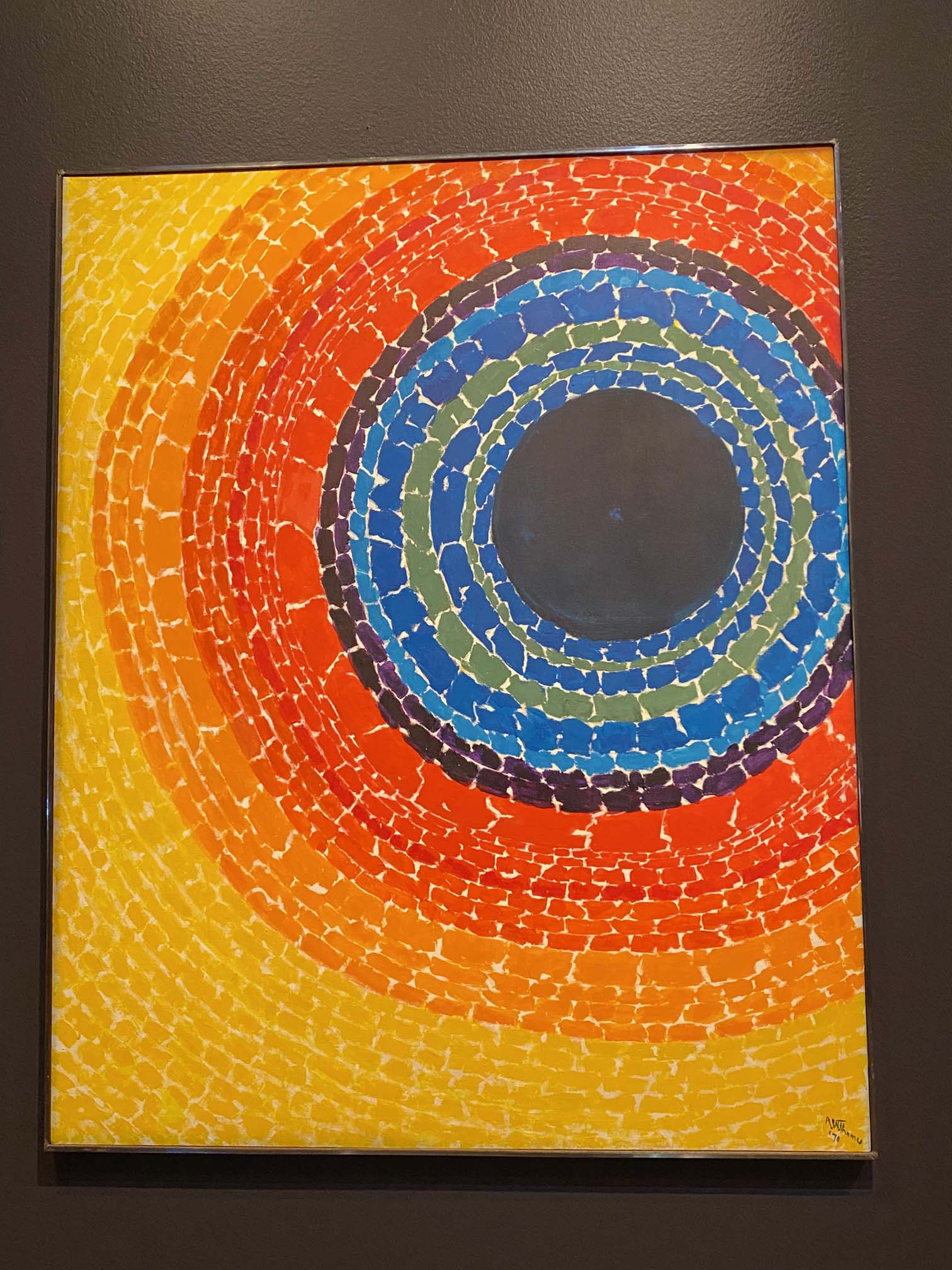
1970 acrylic The Eclipse, based on the March 7, 1970 total solar eclipse. Courtesy: Smithsonian American Art Museum.
1973 acrylic Celestial Fantasy. Courtesy: Smithsonian American Art Museum.

Click here to read more in Denver’s exhibition guide and watch this short glimpse of the galleries below:

Listen to curator Rory Padeken discuss Alma Thomas’s life and work with artist Jordan Casteel, choreographer and dancer Cleo Parker Robinson, and floral artist Breigh Jones-Coplin.

O’Keeffe Above and Beyond the Grid

Six years before she became transfixed with the drama of the colorful New Mexico desert, Georgia O’Keeffe began translating another magnificent, magical view from her skyscraper home in Manhattan. You can see all her transformational aerial cityscapes in Georgia O’Keeffe: “My New Yorks” on view at Atlanta’s High Museum of Art through February 16, 2025.

Created by the Art Institute of Chicago, the show assembles Georgia’s breakthrough city paintings and puts them squarely into the context of her better-known nature close-ups and other modernist takes – just the way she wanted it.

O’Keeffe’s 1927 Radiator Building – Night, New York. Courtesy: Crystal Bridges Museum of American Art

Listen to the Art Institute curators talk about Georgia’s approach to New York landscapes, her life in the city’s Roaring Twenties, and what inspired her walking Manhattan’s grid at a time of of such transformational urban change:

As a total modernist, Georgia couldn’t wait to move into the Shelton Hotel, a brand-new skyscraper, with her brand-new husband (Stieglitz) in 1924. As half of New York’s art-world “power couple” it’s most likely that Georgia was one of the first women to enjoy high-rise living in Manhattan.

O’Keeffe’s 1926 The Shelton with Sunspots, N.Y. Courtesy: Art Institute of Chicago

The Shelton (still there at Lexington and 49th Street) was an apartment-hotel built in Midtown around Grand Central. Although it was first envisioned as a men’s residence, the marketing team soon pivoted a more expanded market with newspaper ads that would attract women, couples, and artists!

Read more about the Shelton, Georgia’s life there, and see 1920s photographs on the Art Institute’s blog post.

Georgia and Alfred moved in, captivated by the views of the East River and rapidly changing Manhattan skyline, where new skyscrapers were popping up like daisies.  Alfred took photographs and Georgia recorded ths shifting light, atmosphere, and moods of the rapidly changing landscape.

O’Keeffe’s 1928 East River from the 30th Story of the Shelton Hotel.
Courtesy: New Britain Museum of American Art.

As the exhibition demonstrates, Georgia didn’t limit herself to urban landscapes at the time. She was still depicting the natural world, but was determined to channel the rising modern city.  At the time, Alfred and her fellow artists strongly discouraged her from displaying her urban work, arguing that painting cityscapes was “best left to the men.”  You can just imagine what our Georgia thought about that! Naturally, it was full steam ahead! 

Before Google Street view, Georgia walked the Midtown Grid, exploring (and remembering) her neighborhood streets as they transformed into skyscraper canyons. More high rises! The Empire State Building! Rockefeller Center!

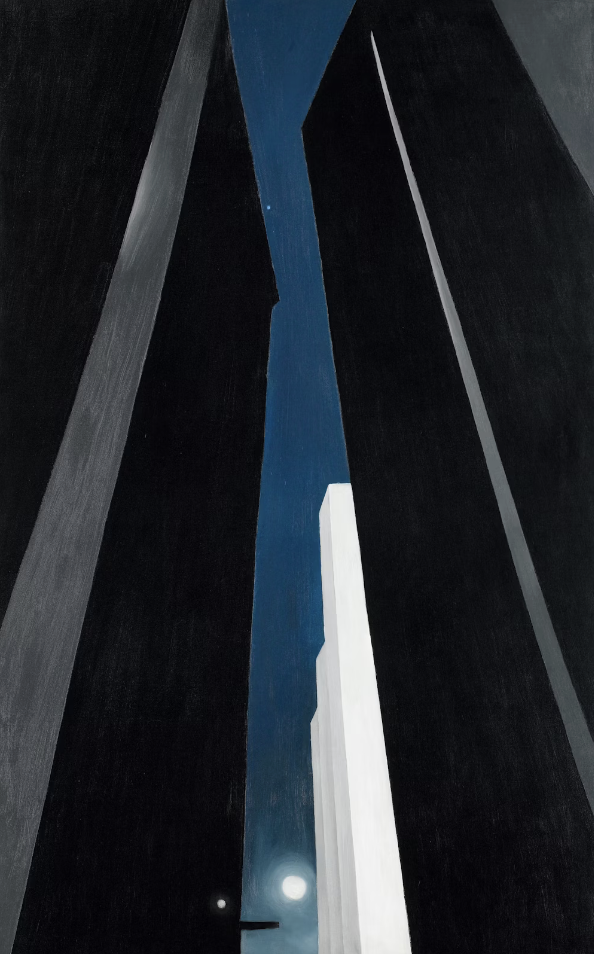
O’Keeffe’s 1926 City Night. Courtesy: Minneapolis Institute of Art
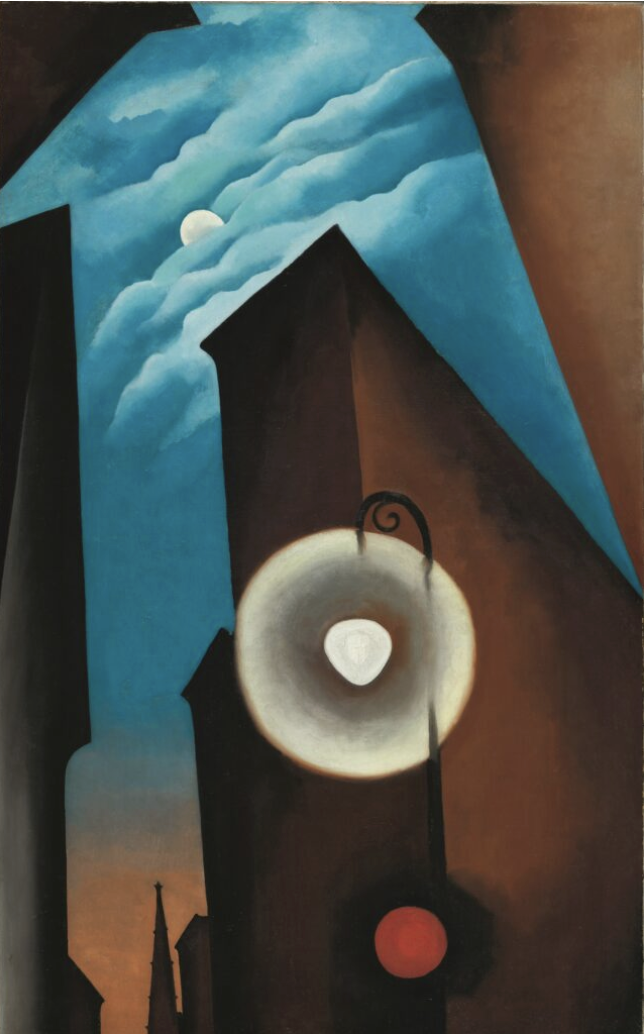
O’Keeffe’s 1925 New York with Moon. Courtesy: Carmen Thyssen Collection

Who knows if Georgia ever experienced Manhattanhenge, but she certainly enjoyed the verticality and sky views between the buildings.  A nature-lover, modernist, and virtuoso painter! 

Despite Stieglitz’s misgivings about her city paintings, when she finally had her annual one-woman show at his gallery, her city painting was the first work that sold!

The curators have hung some of Georgia’s paintings just as she displayed them – side-by-side flower close-ups, other nature-inspired works, and City views – to provide the full experience of a modern woman’s mastery.

O’Keeffe’s 1924 From the Lake, No. 1.
Courtesy: Des Moines Art Center
O’Keeffe’s 1929 Black Cross, New Mexico.
Courtesy: Art Institute of Chicago

For more, here’s a longer discussion about Georgia rip-roaring 1920s life and work by one of the Chicago Art Institute curators for Georgia O’Keeffe Museum members.

National Gallery Celebrates 50 Contemporary Native Artists

If you want to take a trip across American land with 50 living Native artists, there’s still time to catch the ground-breaking exhibition, The Land Carries Our Ancestors: Contemporary Art by Native Americans, at Connecticut’s New Britain Museum of American Art through September 15, 2024.

The National Gallery of Art in Washington, D.C. asked Jaune Quick-to-See Smith (Citizen of the Confederated Salish and Kootenai Nation) to survey the United States and create an exhibition reflecting the diversity of the living Native American artists.

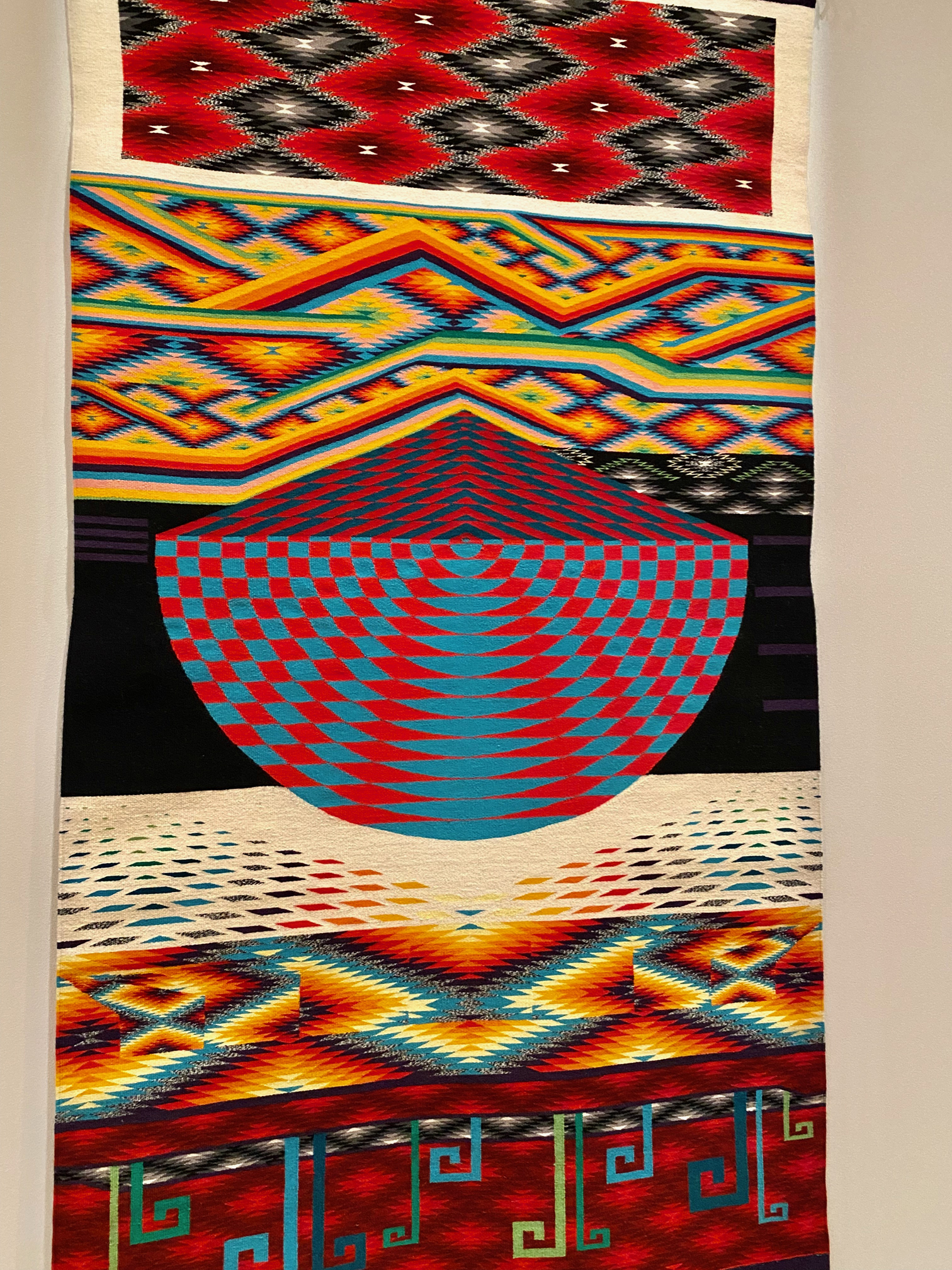
2014 wool weaving World Traveler by Melissa Cody (Navajo). Courtesy: Stark Museum of Art.

Smith, whose own artistic achievement was honored most recently in a three-museum retrospective in 2023-2024, became the first artist invited to curate a show at the National Gallery.

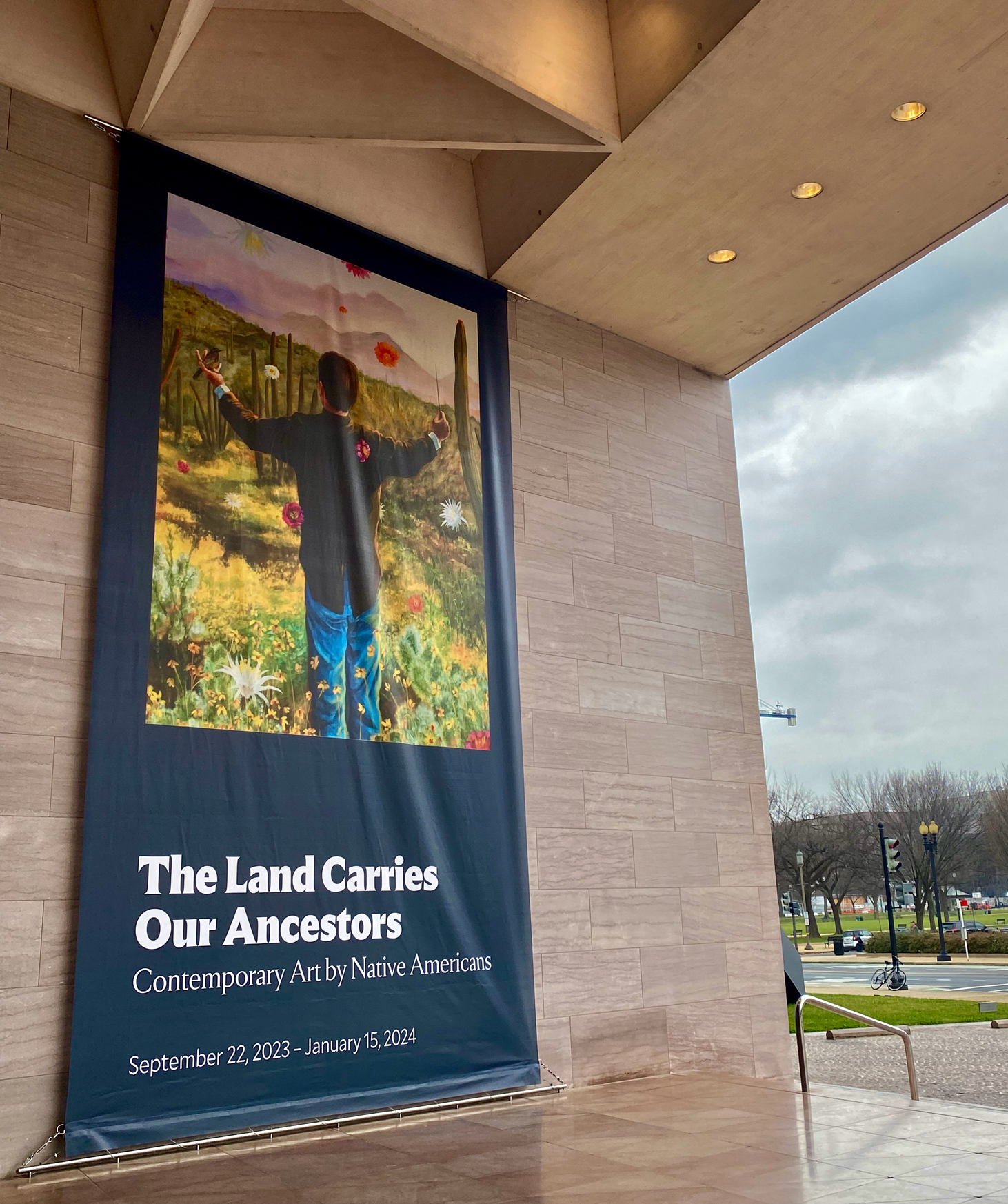
Entrance banner features Orchestrating a Blooming Desert by Steven Yazzie (Diné/Laguna Pueblo).

Smith has always done whatever possible to increase the visibilty of Native artists in the contemporary art world. For this exhibition, she chose 50 intergenerational artists from diverse regions, cultures, and artistic practices. Look at our Flickr album of the National Gallery installation to see some of our favorites.

All of the works reflect the artists’ deep connection to the land, especially Orchestrating a Blooming Desert by Steven Yazzie (Diné/Laguna Pueblo), a painting that reflects one man’s joyful encounter with a lush landscape.

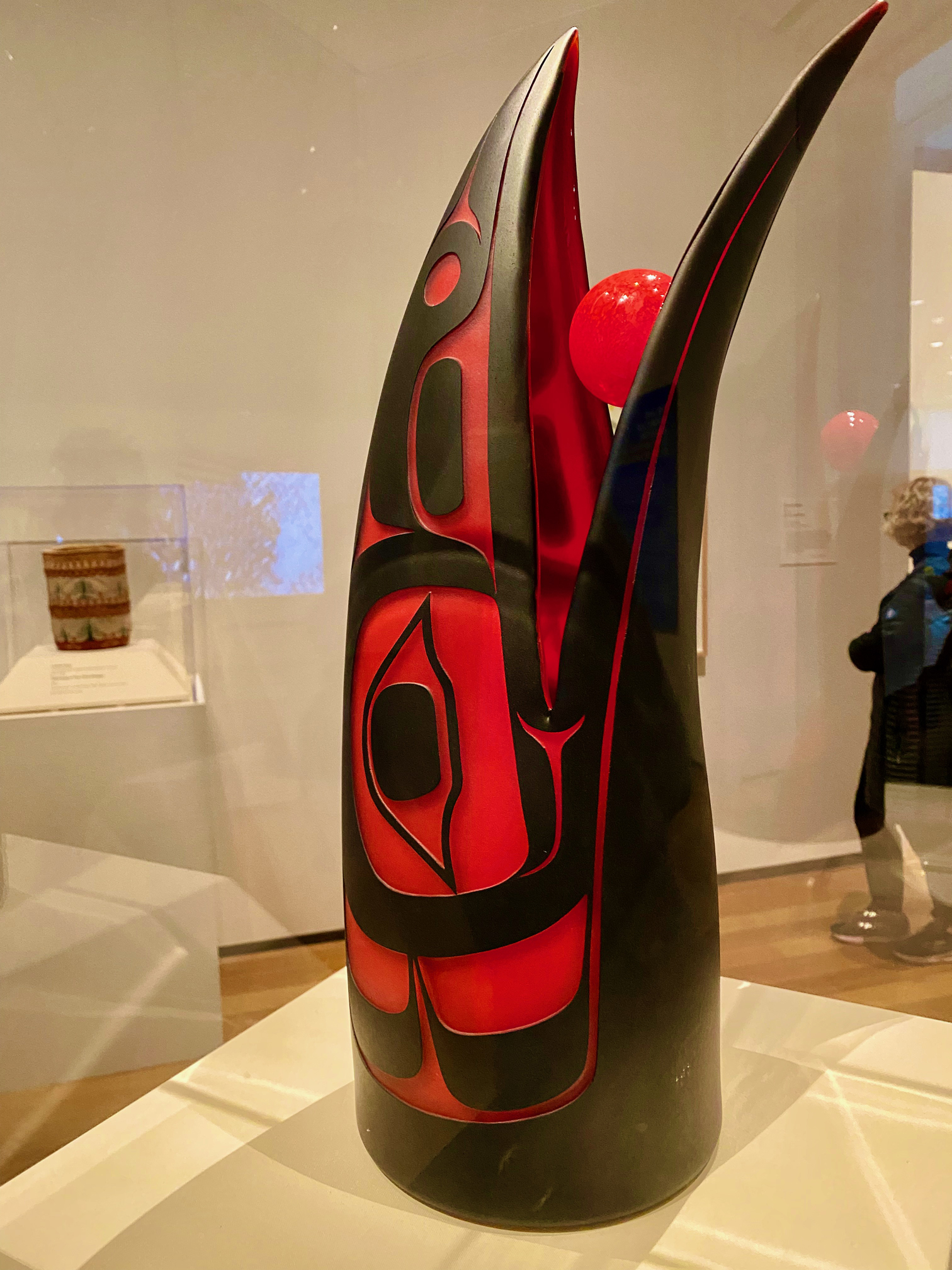
Some works depict a tribe’s link to the natural world through origin stories. Visitors are mesmerized by Preston Singletary’s exquisite sculpture of Tlingit creation-myth legend, Raven stealing the Sun. It’s glorious to admire this dramatic icon fully realized in a distinctly nontraditional medium – blown and sand-carved glass.

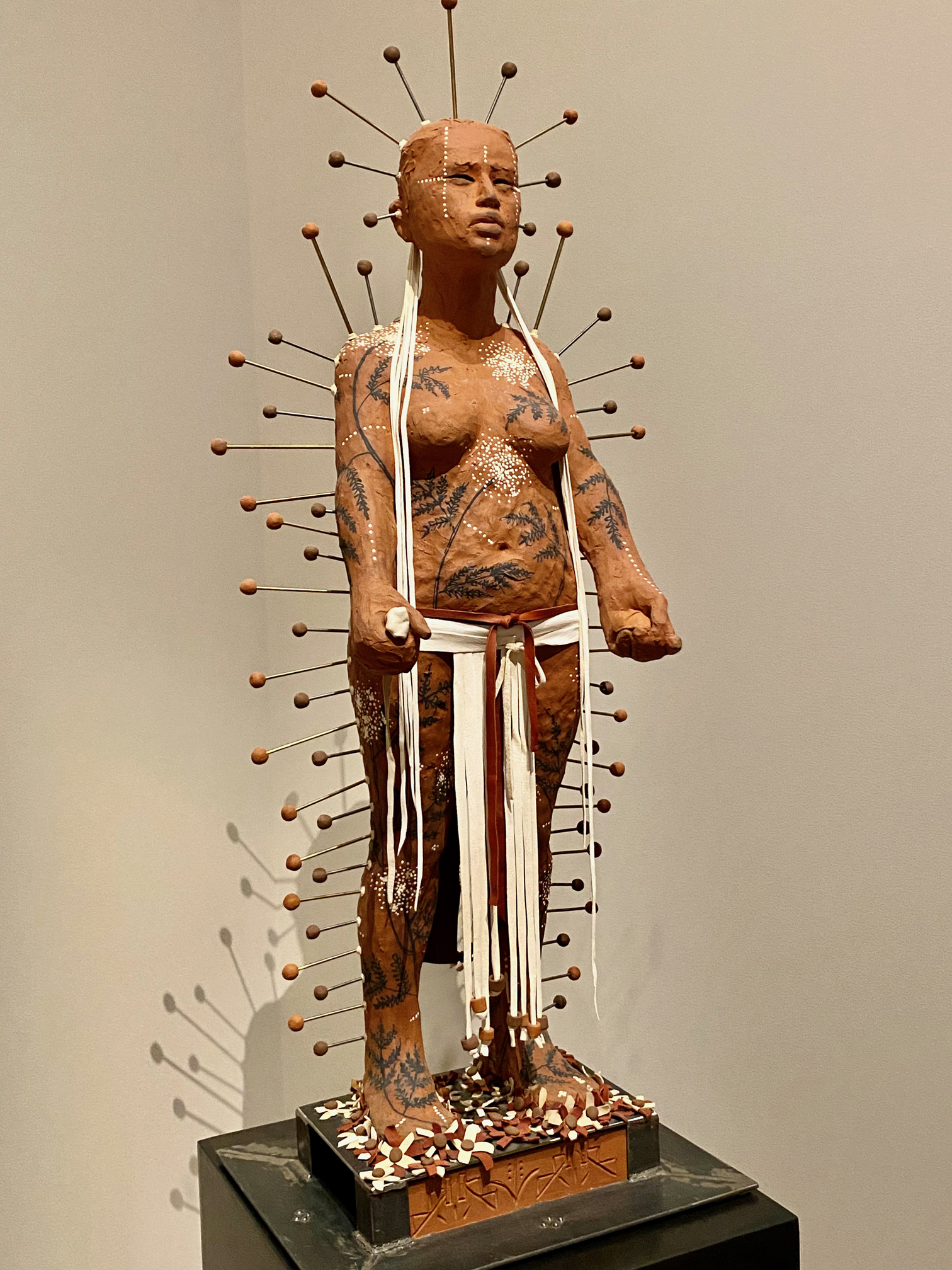
Experiencing the large, spiritual earth-colored ceramic figure by Rose B. Simpson (Santa Clara Pueblo) harkens back to eras when people had a more integral connection to the earth. Simpson calls her figure Tonantzin, an Aztec name for earth mothers, corn mothers, and even the Virgin of Guadalupe.

2017 blown and sand-carved glass Raven Steals the Sun by Preston Singletary (Tlingit). Courtesy: private collector.
2021 ceramic, steel, leather, and brass Tonantzin by Rose B. Simpson (Santa Clara Pueblo). Courtesy: Tia Collection.

Smith has chosen to hang many smaller two-dimensional works across a long wall in a checkerboard to suggest that visitors reflect on the impact of 1887 Dawes Act upon Native lands – a law that cut Native territory into “checkerboard” lots to facilitate private ownership.

At the National Gallery, Jeffrey Gibson’s punching bag (all made of found materials) was hung nearby, reminding us of the delicate balance that has to be struck by simultaneously caring for and taking gifts from the earth.

Next to checkerboard wall, the 2020 beaded punching bag To Feel Myself Loved On the Earth by Jeffrey Gibson (Mississippi Band of Choctaw Indians/Cherokee Nation). Courtesy: Hirschhorn Museum.

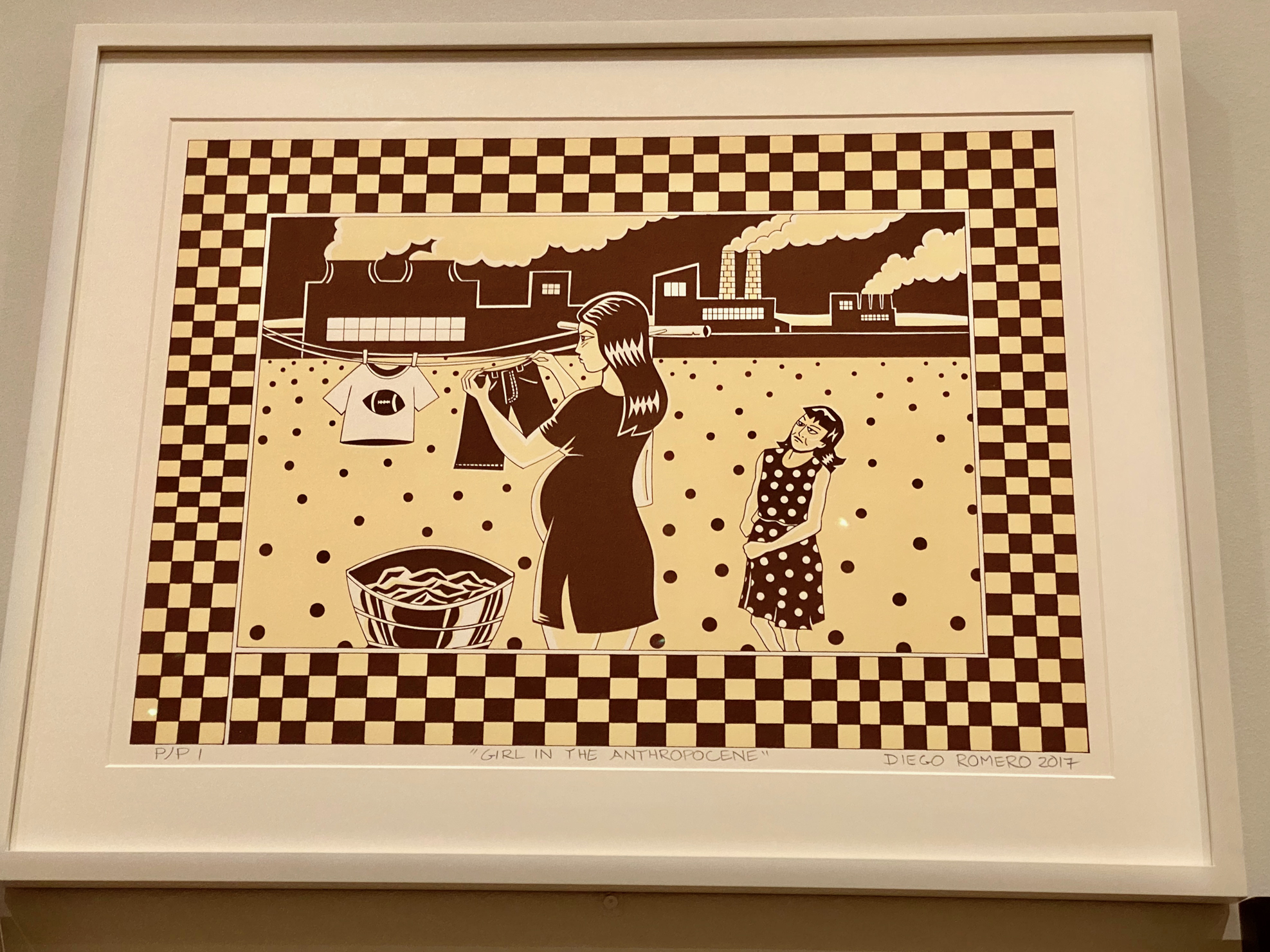
Some artists mix impressions of modern life with tribal lands, such as satiric works by Diego Romero (Cochiti Pueblo) and stylized symbols in a monoprint by Joe Fedderson (Colville Confederated Tribes).

2017 lithograph Girl in the Anthropocene by Diego Romero (Cochiti Pueblo). Private collection

In addition to sculptures, paintings, and photos, Smith has also included pieces made for fashion runways, live performances, and social protests.

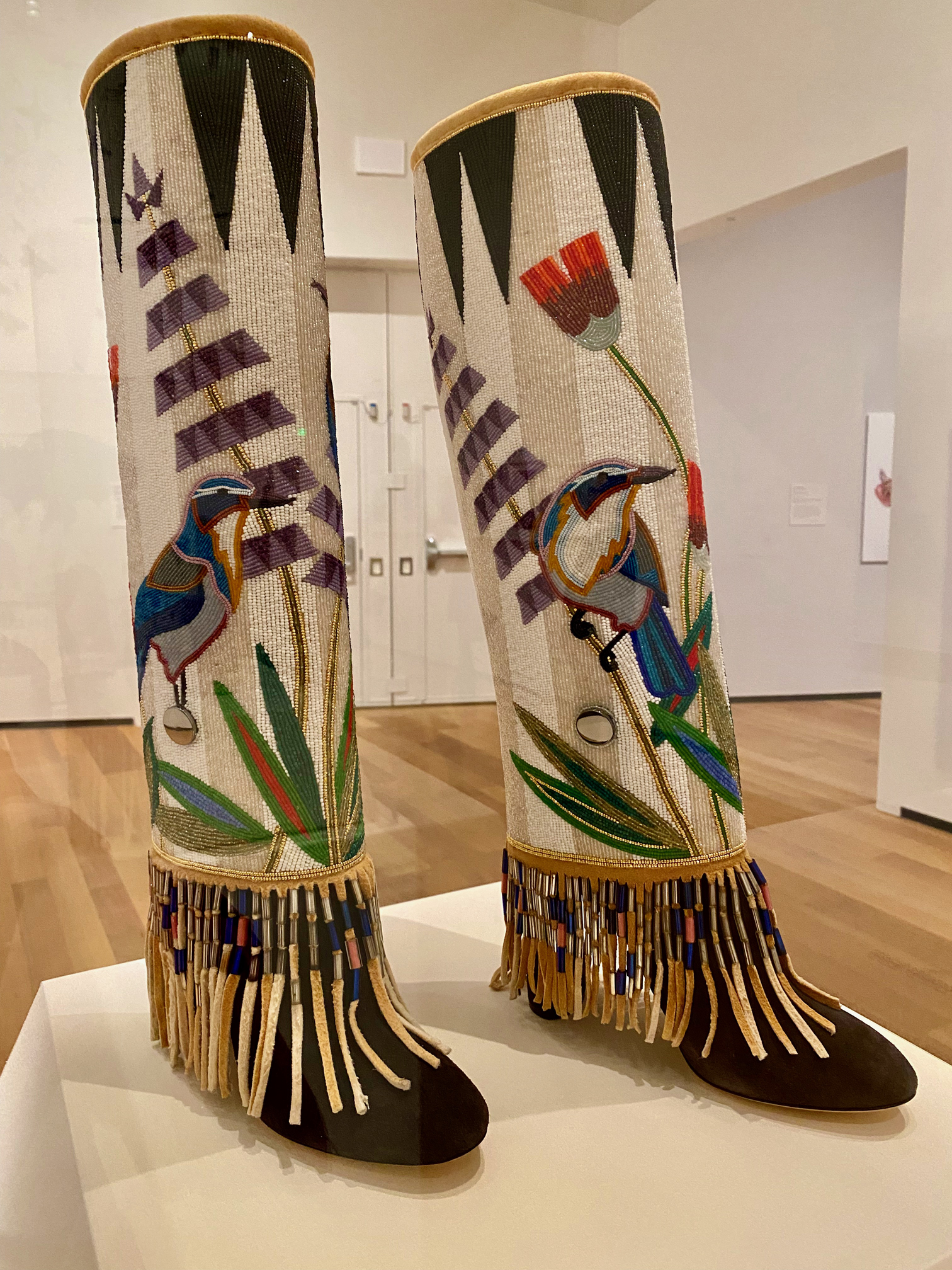
Fashion designer Jamie Okuma (La Jolla Band of Luiseno Indians) beaded her fringed fashion boots with a portrait of her family’s pet scrub jay.

Ten foot-long fiber seashell earrings designed for an interactive video and gallery performance by fiber and performance artist Eric-Paul Riege (Diné) are a reminder of the ancient trade networks that brought trade items from the ocean to the interior deserts.

2021 beaded and fringed Casedei boots by Jaime Okuma (La Jolla Band of Luiseno Indians). Courtesy: Dartmouth College’s Hood Museum
2020 mixed-fiber installation jaatloh4Ye’iitosoh [3-4] by Eric-Paul Riege (Diné). Courtesy: Tia Collection.

A wall of “mirror shields” were mounted by artist-activist Cannupa Hanska Luger (Mandan/Hidatsa/Arikara/Lakota), showing just a small sample of the 1,000 protective and reflective shields made by people to help water protectors during thre 2016 pipeline intervention at Standing Rock Sioux Tribe Reservation, Luger’s childhood home. Take a look at Luger’s instruction video here.

The shields served to protect the peaceful protesters from rubber bullets and water cannons, and reflected images of the security forces back to them. The crowd-sourced shields were also used in a social-action performance piece at Standing Rock.

2016 mirror shields and video for Mirror Shield Project – River (The Water Spirit) by Cannupa Hanska Luger (Mandan/Hidatsa/Arikara/Lakota). Courtesy: the artist, Garth Greenan Gallery.

Textiles and vinyl drawings also pack a punch in this show. Take a look at the dazzler woven by Melissa Cody (Diné), who draws inspiration from video gaming and the matriarchs of Navajo Nation. Watch her interview from her recent exhibition at MoMA PS1.

Here, John Hitchcock explains how his room-sized drawing, Impact vs. Influence, incorporates his influences – nature, family, Native beadwork, and the next-door military base:

Take a look the National Gallery’s trailer and meet the 50 contemporary artists whose work and relationship to the land is celebrated in the show:

Out West in New Mexico

The artist stories and works presented in Out West: Gay and Lesbian Artists in the Southwest 1900-1969, at the New Mexico Museum of Art through September 2, 2023, shed light on artists who lived a bit more “under the radar” in the early 20th century, compared to the post-1969 era when loud and proud artists unleashed their voices in response to the Stonewall Riots.

The exhibition focuses on how early modernists used “coded” symbols in their work, explores the legacies of two-gendered Native American artists, and introduces mid-century work by mid-century contemporary artists working.

Marsden Hartley’s 1919 still life El Santo, featuring Hispanic Catholic objects of northern New Mexico.
Russel Cheney’s 1929 New Mexico/Penitente showing a bulto, axe, and flowers associated with the Penitente brotherhood.

Take a look at our favorites in our Flickr album.

The show opens with works by Marsden Hartley and Russell Cheney – painted 10 years apart (1919 and 1929) that feature items associated with rituals by Northern New Mexico’s Penitentes – Catholic men’s associations that kept faith alive during the 19th century when clergy were scarce in their remote mountain towns.

Hartley and Cheney were captivated by the religious rituals of these mysterious, faithful “brotherhoods” that persevered for centuries, despite periodic bans by New Mexico’s Catholic Church – not unlike the early 20th century gay men’s associations whose underground culture gave rise to “coded” rituals and language.

Hence, these works feature images of the suffering Christ, yucca plants used for self-mortification rituals, adobe churches, and props associated with processional death carts – symbols of religious brotherhood that represent the importance of brotherhood among the early 20th century gay community.

The second portion of the show introduces us to the many painters, photographers, and sculptors who not only drew artistic inspiration from the Southwest, but found communities that welcomed gay and lesbian artists. Works by artists, such as Agnes C. Sims and Cady Wells, are paired with portraits by a Southwestern who’s who of modern portraiture and photography – Will Shuster, Laura Gilpin, Ansel Adams, and Anne Noggle.

Modernist Deer Dance cedar sculptures carved in 1945 by Agnes C. Sims, a tribute to native cultures
Laura Gilpin’s 1942 photographic portrait of artist Agnes C. Sims

There’s even a “portrait” stitched by maverick Cady Wells of his very best friend, modernist Rebecca James. Well known for his expressionist paintings and his large collection of Northern New Mexican religious art, Wells subversively went all in on petit-point – an art form traditionally associated with “women’s work” and beloved by Ms. James.

Detail of 1953 petit-point stitchery “portrait” of Rebecca S. James by her friend, Cady Wells – his work in a traditional “feminine” genre of craft.
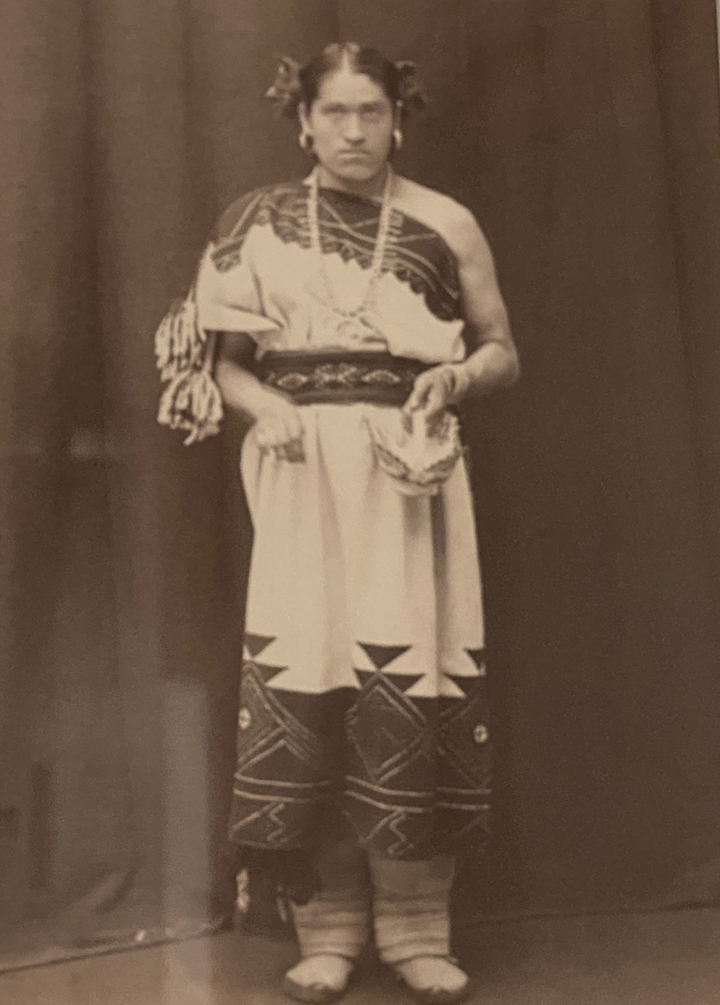
John K. Hillers’ 1879-1880 albumen portrait of Lahmana We’wha of Zuni Pueblo. Courtesy: Palace of the Governors Photo Archive.

This section also includes the stories of important two-spirit Native American artists – individuals who are born “male” but who take on spiritual and other tribal roles traditionally associated with women. The first is We’wha, a respected 19th-century expert in and advocate for Zuni arts and traditions– a favorite of Smithsonian anthropologists who demonstrated weaving in D.C. and even presented a special work directly to President Grover Cleveland as a wedding gift.

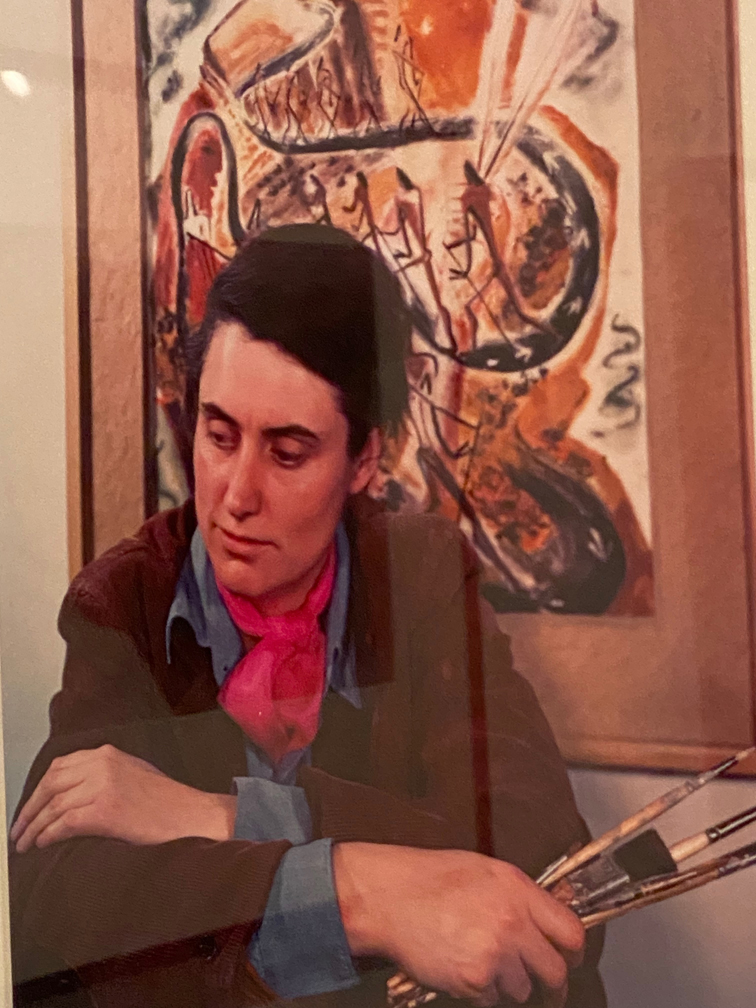
Another is R.C. Gorman’s portrait of Hosteen Klah, a Navajo two-spirit, one of the the Wheelwright Museum’s co-founders. Gorman, one of the best recognized and flamboyant 20th century contemporary Native artists, excelled in colorful mid-century works. Gorman made history in Taos by opening the first Native-owned gallery in the United States.

Navajo artist R.C. Gorman’s 1960 painting Night of the Yei – a celebration of Navajo spiritual traditions.

The final portion of the show includes two works by female rule-breakers. The first is a rare Agnes Martin 1954 abstract-expressionist work typical of her experimentation prior to her acclaimed grid series. It’s much more aligned to the biomorphic symbolism of early Pollack and Rothko – reflecting what was happening earlier in her New York career during the heyday of the Cedar Street Tavern crowd.

Agnes Martin’s untitled 1954 painting. Courtesy: University of New Mexico Art Museum.

Second ia a never-before-seen 1997 installation by feminist-art innovator Harmony Hammond, who was also represented in this year’s Whitney Biennial. Hammond, who curated one of Santa Fe’s first LGBTQ exhibitions back in 1999, used to travel backroads of the Southwest, finding abandoned towns and homesteads and collecting left behinds. In this show, she presents What Have You Done With Our Desire, a mixed-media piece using ancient kitchen linoleum – an allusion to circumstances leading to repression of gay women’s sexuality.

Harmony Hammond’s never-before-seen 1997 mixed-media installation What Have You Done with Our Desire. Courtesy: the artist.

For more about these and other artists, listen to curator Christian Waguespak’s talk about LGBTQ artists in the Southwest at the Harwood Museum in Taos.

How Philadelphia Made American Artists

How does it feel to have the eyes of 200 years of art history upon you, peering out from portraits, history paintings, and scenes of everyday people? What stories do they have to tell you? And who gets to tell the history and make the story?

Find out by contemplating works by over 100 artists nurtured and celebrated by PAFA in Making American Artists: Stories from the Pennsylvania Academy of Fine Arts, 1777-1976, currently on view at the Albuquerque Museum through August 11, 2024…but coming soon to a museum near you (see below)!

Charles Willson Peale’s 1779 George Washington at Princeton, painted during the War of Independence. Courtesy: PAFA

While renovations are happening at the Academy in Philadelphia, the curators have chosen some of PAFA’s most iconic works to be shipped cross-country and installed “in conversation” with works by PAFA artists who may not be household names but were nonetheless ahead of their time.

It’s all a tribute to legacies preserved in the oldest art museum + art school in the United States, founded in 1805 by the dynamic duo of William Rush and Charles Willson Peale, both Continental Army militia (and artists!) during the American Revolution.

1810 painted pine sculpture Eagle by PAFA co-founder and Revolutionary War veteran William Rush.

Mr. Rush carved the bow figures on most of the ships for America’s first Naval fleet. All of those ships are now long gone, so it’s nice to see that we can admire his majestic Eagle in this exhibit.

Mr. Peale, one of the Sons of Liberty who served under and painted General Washington, later founded America’s first natural history museum on the second floor of Independence Hall. He also passed his talent on to the next generation through his very large family of artistic prodigies.

These two artists of the Revolution walked the walk and talked the talk and passionately felt the young nation needed an art academy.

PAFA’s first hundred years had some ground-breaking firsts – the first exhibition that included both male and female artists (1811), admission for Black artists (1857), and first female instructor (1878).

Charles Willson Peale’s 1822 self portrait (painted at age 81), The Artist in His Museum proudly showing his collection, turkey, and mastodon. Courtesy: PAFA

The show kicks off with a masterful history painting by Benjamin West, a Pennsylvania painting genius who landed in England in 1763, helped to found the Royal Academy, and somehow remained best friends with both King George III and Benjamin Franklin at the same time. He revolutionized history painting by depicting contemporary subjects and taught (in London) a who’s who of Americans artists – Peale, Stuart, Sully, Morse (who invented the telegraph and code), and Fulton (who invented steamships).

Benjamin West’s 1771-1772 Penn’s Treaty with the Indians, an imaginary scene painted to rehabilitate Penn’s image at the time, although it does feature Lenape chief Tamanend;. Courtesy: PAFA

In addition to masterworks by West and Gilbert Stuart, the exhibition showcases many works by female and African-African artists associated with PAFA – Patience Wright (America’s first professional sculptor), Cecilia Beaux (first female teacher), Henry O. Tanner (first successful African-American painter), and superstar Mary Cassatt.

1784-1786 wax relief portrait of George Washington by Patience Wright, the oldest American sculpture in the PAFA collection
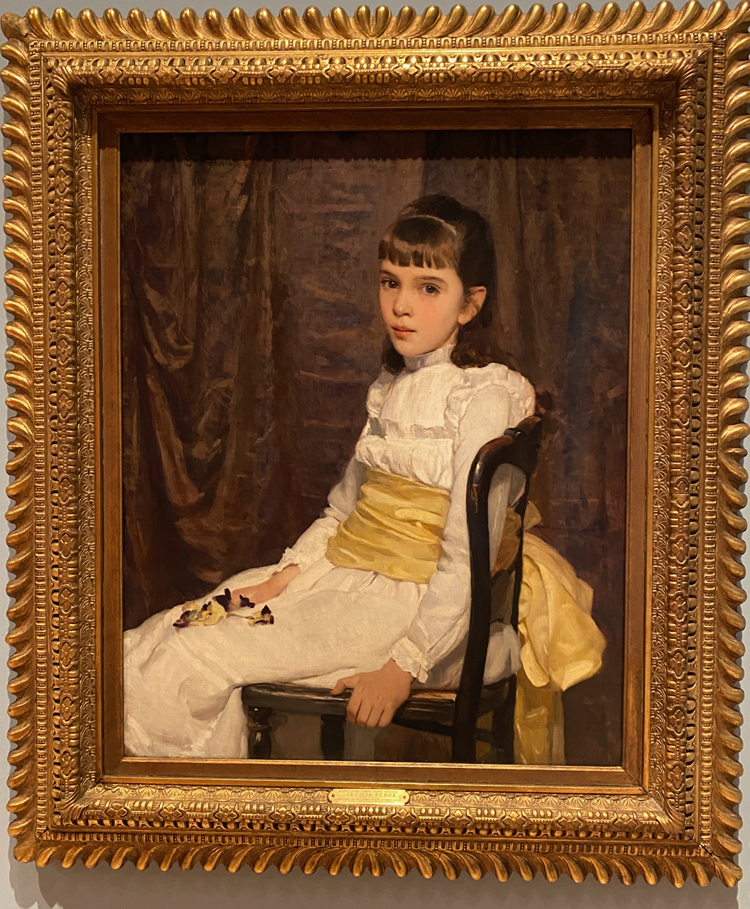
1887 A Little Girl by Cecilia Beaux, an acclaimed female portraitist known for her insightful psychological depictions of young women. Courtesy: PAFA

In the day, grand history paintings were primarily the work of men, but the exhibition emphasizes that many enterprising 19th century women still found ways to make it in the art world. They specialized in “lesser genres,” like portraits, still lifes, and scenes of everyday life. Check out our favorites in our Flickr album.

Making American Artists really comes alive by adding 20th century works on the walls. Alongside the Founding Fathers, the portrait section features liberated women, bohemian artists, and proud Black artists with attitude.

Margaret Foster Richardson’s 1912 A Motion Picture – an honest self-portrait reflecting society’s changing views of professional women. Courtesy: PAFA
Barkley L. Hendricks’ 1968 J.S.B III, a fashionable, life-sized, postmodern portrait of his PAFA classmate James Brantley. Courtesy: PAFA

The section of the exhibition on still life focuses on early female painters who made decent incomes from their work, as well as modernist superheroes O’Keeffe and Nevelson. The history painting section presents 20th century show-it-like-it-is artists, like Horace Pippin and Alice Neel.

Georgia O’Keeffe’s 1923 Red Cana, an early abstracted floral still life. Courtesy: PAFA
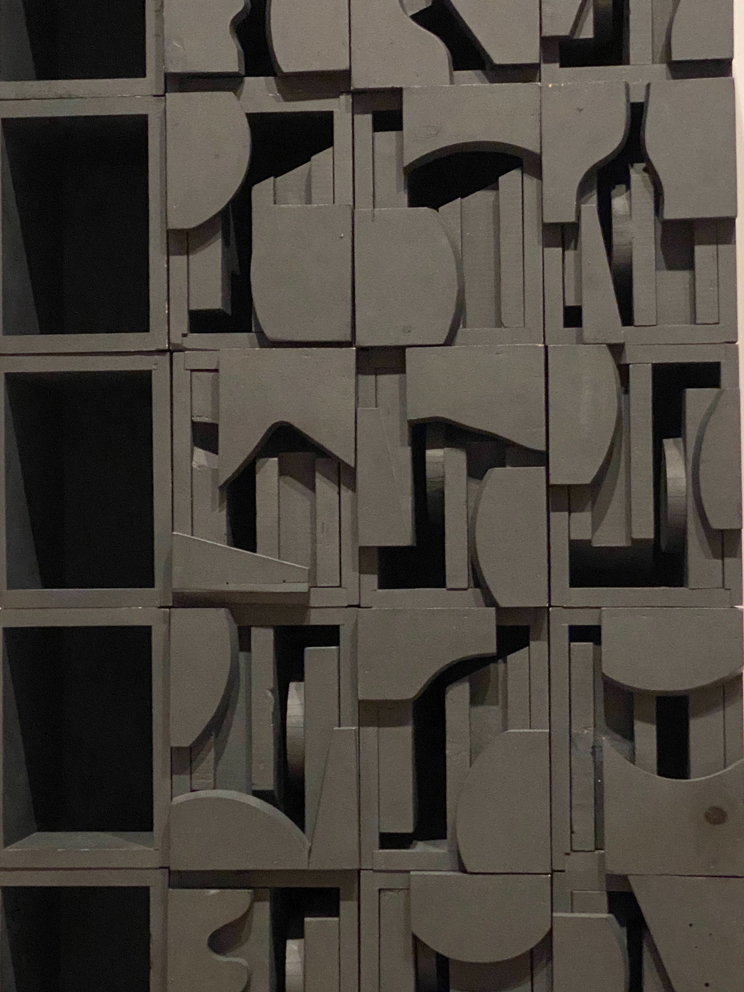
Detail of Louise Nevelson’s 1972 South Floral. Still life section. Courtesy: PAFA

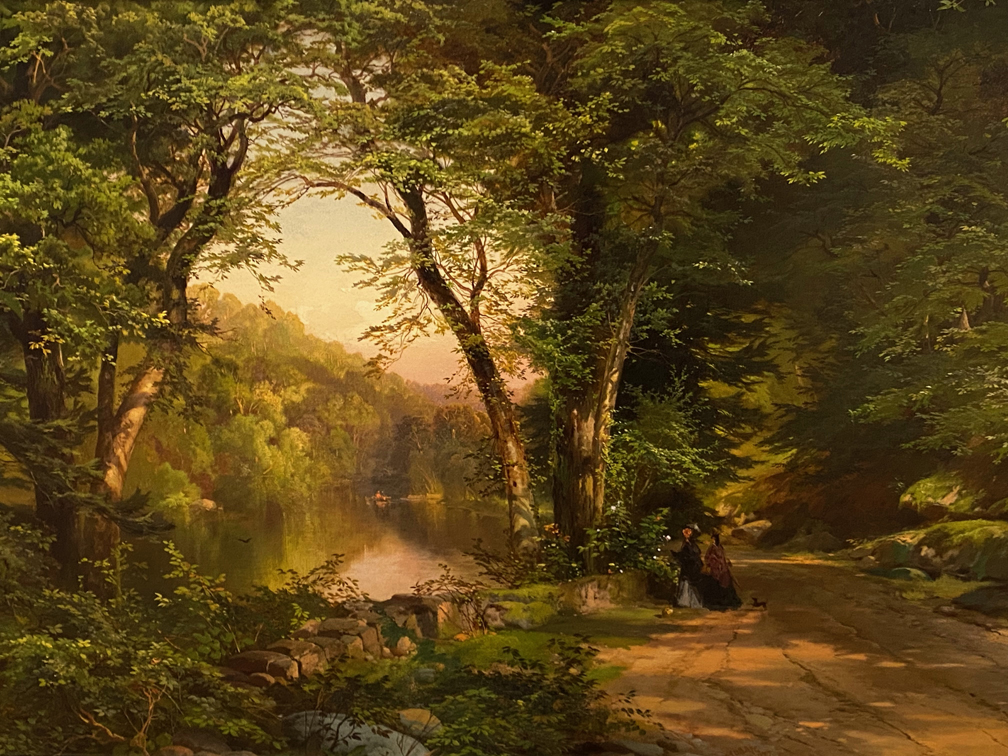
We’re reminded that many of the great masters of American landscape, like Thomas Moran, got their starts by painting bucolic views of Philadelphia’s Wissahickon and Schulkyll Rivers. Painting Philadelphia’s river landscapes may have even inspired the rise of the Hudson River School.

Thomas Moran’s 1870 Two Women in the Woods enjoying the green along the Wissahickon in Philadelphia. Courtesy: PAFA

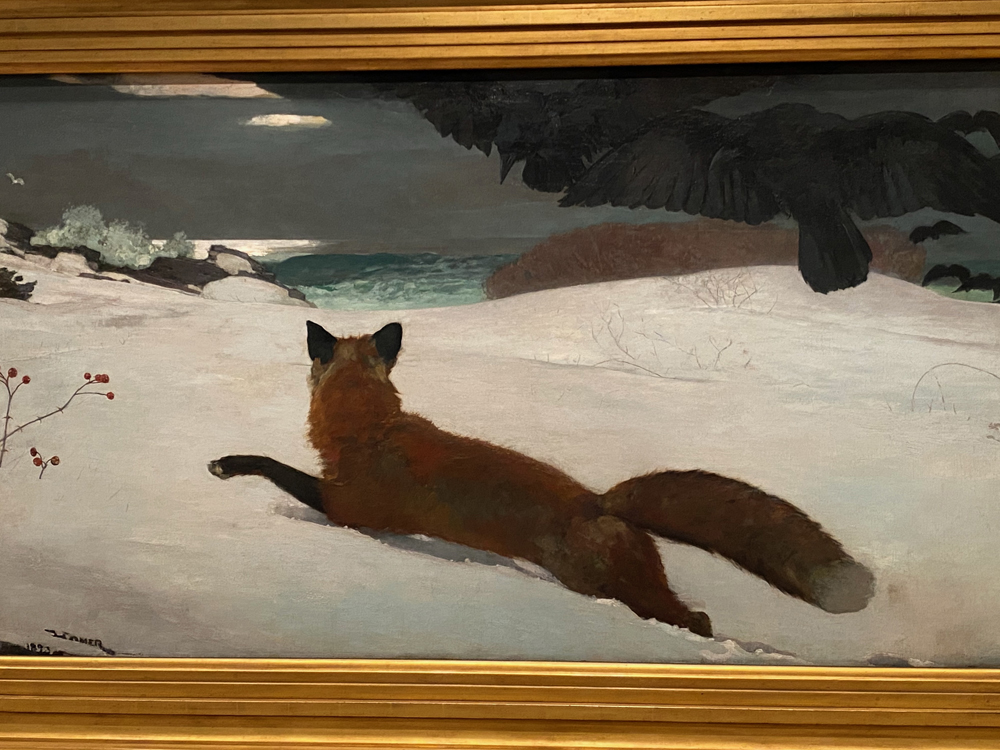
And it was PAFA that gave Winslow Homer his professional start.

Winslow Homer’s 1893 Fox Hunt, where predator becomes the prey; Homer’s first painting to enter a museum collection. Landscape section. Courtesy: PAFA

The entire exhibition is a fresh look at American masters who created an astonishing legacy at one of our oldest art institutions ­and upstarts who never quite got their due. There’s so much to appreciate from this fresh, 21st century perspective!

Earlier this year, Making American Artists was at the Wichita Art Museum. Its next stop is the Philbrook Museum of Art in Tulsa, Oklahoma (September 25, 2024), followed by a spectacular road show: Everson Museum of Art in Syracuse (February 2025), the Peabody-Essex in Springfield, Massachusetts (June 2025), and the Taubman Museum of Art in Roanoke, Virginia (October 2025).

Don’t miss it. While you’re waiting, listen in to curator Anna O. Marley’s May talk at the Albuquerque Museum:

How O’Keeffe Saw Trees

Whether she contemplated her surroundings among the greenery at Lake George or the multicolord rocks at Ghost Ranch, Georgia O’Keefe often started by sketching the trees around her.

in Rooted in Place, a special exhibit at the Georgia O’Keeffe Museum in Santa Fe through November 3, 2024, you are surrounded by Georgia’s watercolors, oils, and sketches interpreting (and abstracting) trees she encountered on her walks and international travels.

Take a look at our favorites in our Flickr album.

Georgia’s 1937 painting Gerald’s Tree I, a tree enjoyed by her friend, science historian Gerald Heard

The curators have selected works from the full span of Georgia’s life. The earliest are from her trips to Lake George, such as the glorious autumn maples surrounding the Stieglitz home.

The show’s curators leverage Georgia’s habit of collecting inspirational bits and pieces of nature from her Ghost Ranch walks, showing the twisted juniper she brought home alongside the dramatic oil painting in which it stars.

Piece of juniper that Georgia collected from the land surrounding her Ghost Ranch home.
Georgia’s 1940 painting Stump in Red Hills

The museum’s collaboration with the Santa Fe Botanical Garden adds scientific insights about the three cornerstone species of New Mexico wilderness that from which Ms. O’Keeffe drew inspiration – pinons and junipers next to the red rock, and wide, leafy cottonwoods along the river.

Georgia’s 1930 Cottonwoods Near Abiquiu showing the breeze catching the wide branches

A gorgeous photo by Ansel Adams shows Georgia nestled up against one of her favorites nearby in the desert. She loved the fruit trees she planted near her home garden, but she never painted them.

When Georgia was a young student at the Art Institute of Chicago in 1905-1906, she studied with John Vanderpoel, well known for being a master educator in figure drawing. Looking at her drawing of a banyon tree from her trip to the Bahamas over thirty years later, it’s clear she employed those early lessons – bringing trees to life as living beings in her work ­– throughout her life.

Ansel Adams’1938 portrait of George O’Keeffe resting against a dramatic tree stump in northern New Mexico
Georgia’s 1934 figure-like drawing Banyon Tree created on her trip to Bermuda

Listen to the museum’s panel about Georgia’s approach to painting her favorite trees and the role they play in the ecosystem of northern New Mexico: