AMNH Honors America’s Super-Early Explorers

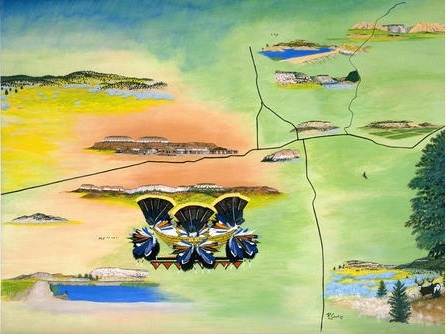
Ronnie Cachini’s 2006 acrylic, Ho’n A:wan Dehwa:we/(Our Land), Source: AMNH/ of A:Shiw A:Wan Museum and Heritage Center

Ronnie Cachini’s 2006 acrylic, Ho’n A:wan Dehwa:we/(Our Land), Source: AMNH/ of A:Shiw A:Wan Museum

Long before John Wesley Powell steered his boats down the rapids and mapped the Grand Canyon for the US Geological Survey, another set of intrepid explorers had walked, mapped, documented, and guided travelers through the entire Colorado River system. Climb up to the hidden Audubon Gallery on the Fourth Floor of the American Museum of Natural History before January 12 and get a fresh perspective on pueblo cartography in the special exhibition, A:shiwi A:wan Ulohnanne: Zuni World.

 The show features 31 paintings by seven contemporary painters from the Zuni Pueblo of New Mexico – one of the ancient tribes whose ancestors built the cliff dwellings and multistory wonders of the Four Corners.

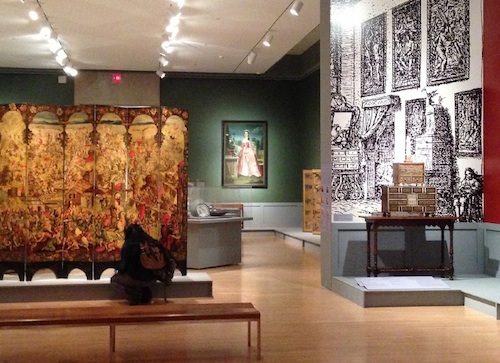
Installation view in the “quiet gallery” on the Fourth Floor of AMNH

Installation view in the “quiet gallery” on the Fourth Floor of AMNH

After 500 years of seeing their sacred places renamed by the conquistadors, Spanish land owners, government mapmakers, and the National Park Service, Zuni cultural leaders thought it was high time to start creating maps that reflected traditional Zuni place names, stories, and symbols. They asked some leading Zuni artists to choose the story, sacred sites, and landscapes that would “map” Zuni cultural history. According to some of the artists in the show, the exercise required them to look at what they knew in an entirely different way.

The Zuni people consider their place of origin to be the Grand Canyon. Back in deep time, the Zuni ancestors were instructed to find “the Middle Place”, so groups set out in journeys to the north, south, east, and west. The northern group, for example, settled in what is now called “Navajo National Monument” and eventually built multistoried dwellings inside the most spectacular red-rock shelter in the American Southwest.

Cliff dwellings in Betatakin alcove, a NPS site at Navajo National Monument where pueblo elders continue to hold sacred ceremonies. Photo: Dan Boone/Ryan Belnap, Bilby Research Center, Northern Arizona University

Cliff dwellings in Betatakin alcove at Navajo National Monument, where pueblo elders travel to hold sacred ceremonies. Photo: Dan Boone/Ryan Belnap, Bilby Research Center, Northern Arizona University

Each painter’s style is different, but when you take it all in, the exploration story is one of fairly mind-blowing proportions – the Zuni ancestors explored the entire Colorado River system, carved petroglyphs in canyons to point travelers to nearby communities, and even journeyed south to the “land of endless summer” –Central America’s coastal communities.

Although the paintings depict myths and symbols in the Southwestern landscapes, East Coast art-lovers should be aware that the Zuni expedition story isn’t fiction: Chaco Canyon’s great archeological sites contain the evidence — tropical shells, stones, Scarlet macaw skeletons, cacao, and the network of banked, engineered roads (circa 850 – 1100 A.D.) that actually lead to many of the places depicted by the Zuni painters.

Geddy Epaloose’s 2006 acrylic, The Middle Place. Source: AMNH/ of A:Shiw A:Wan Museum and Heritage Center

Geddy Epaloose’s 2006 acrylic, The Middle Place. Source: AMNH/ of A:Shiw A:Wan Museum and Heritage Center

Geddy Epaloose’s 2006 painting The Middle Place features an aerial view of Zuni’s Middle Village with sacred trails spiking out in all directions. Colorado River by Ronnie Cachini includes the edge of the distant ocean. Other paintings include the Zuni’s version of their Great Flood, the spiritual importance of their salt lake, and even unmarked lines representing some modern paved roads. Unless you’re Zuni, you’ll have to read the captions on each of the paintings.

Hunted deer is honored with a Zuni necklace

Hunted deer is honored with a Zuni necklace

AMNH has one of the largest collections of Zuni artifacts in the country, and has a good, close working relationship with that pueblo. Entering the Audubon Gallery on the Fourth Floor feels like a sacred space. You’ll be greeted by a hunted deer honored with a necklace of precious stones and ceremonial rods festooned with pieces of traditional Zuni clothing loaned by the painters and their children for us to see while their work is on display in New York.

Make a pilgrimage to this hidden gallery on AMNH’s Fourth Floor and learn about some remarkable people, places, origins, and cartography. (And stop into the First Floor rotunda to see some of the museum’s Chaco Canyon treasures.)

Enjoy this short YouTube video featuring Jim Enote, the director of A:Shiw A:Wan Museum and Heritage Center, who describes the exhibition when it debuted iat the Indian Pueblo Cultural Center.

“Love” Artist Given Same in Whitney Tribute

Aluminum panel of the career-stopping work. LOVE, 1968. Source: Whitney Museum of American Art. © 2013 Morgan Art Foundation, ARS, NY

Aluminum panel of the career-interrupting work. LOVE, 1968. Source: The Whitney. © 2013 Morgan Art Foundation, ARS, NY

The Whitney has mounted the first US retrospective for an artist who did one piece of work that became so popular that it sort-of ended his fine-art gallery career for a while. The show, Robert Indiana: Beyond Love, presents the full range of work done by this 1960s pop superstar, which was eclipsed in popular consciousness after he designed  a Christmas card for MoMA in 1965.

Indiana’s famous Love image went viral, appearing everywhere and on everything for years — US postage stamp, mugs, pins, and posters. Everyone loved LOVE. Even right now, New York visitors are standing in line to photograph themselves in front of Mr. Indiana’s monumental LOVE sculpture at Sixth Avenue and 56th Street. Did he actually make another work of art?

Scrounged wood assemblages hold court with Indiana’s numbers and cruciform arrangement of Demuth-inspired canvases. © 2013 Morgan Art Foundation, ARS, NY Photo: Sheldan C. Collins

Installation view of Indiana’s numbers and early wood assemblages. © 2013 Morgan Art Foundation, ARS, NY
Photo: Sheldan C. Collins

You bet he did, and the Whitney’s giving you until January 5 to see it.

After graduating from Chicago’s Art Institute and studying in Edinburgh, Indiana left for New York in 1959; moved into some busted Coenties Slip lofts near Pearl Street; met neighbors Rauchenberg, Johns, and Kelly; and changed his surname to “Indiana”, which reflected his Midwestern roots and showed that he was unafraid of embracing of Americana at a time when big-idea Abstract Expressionism was trending in galleries.

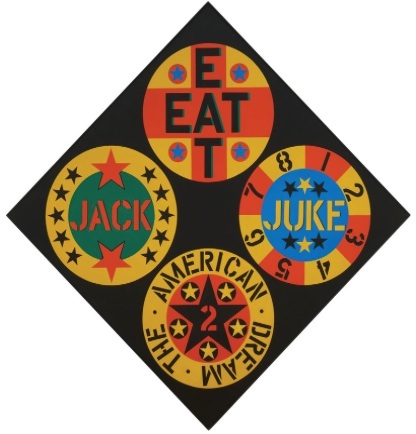
Four-panel 1962 work, The Black Diamond American Dream #2. Source: Museu

Four-panel 1962 work, The Black Diamond American Dream #2. Source: Museu Colecção Berardo, Lisbon. ©2013 Morgan Art Foundation, ARS, NY

Surrounded by broke pre-Pop experimenters and collage-makers, Indiana found a materials Nirvana. Wall Street construction was booming, so he could scrounge construction-site refuse bins to find his materials instead of spending money in art stores (where he worked). He cobbled together wood, bolts, pegs, and wheels into small, painted totems inspired by American folk art and in-your-face advertising graphics. The first gallery in the show is populated with them.

Indiana let his mind wander back to the 18th century, when his neighborhood was America’s most bustling seaport, inspiring Whitman and Melville to write classics. The iconic Brooklyn Bridge towering a few blocks north reminded him of the great painters and poets of the early 20th century, who immortalized it.

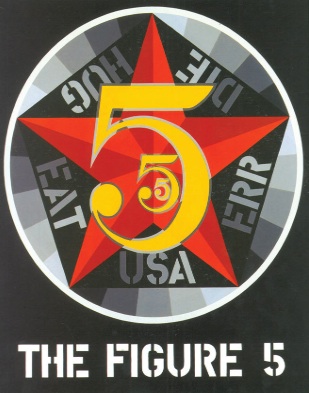
Indiana uses Mr. Demuth for inspiration in his 1963 oil, The Figure Five. Source: Smithsonian American Art Museum/Art Resource ©2013 Morgan Art Foundation, ARS, NY

Indiana uses Mr. Demuth for inspiration in his 1963 oil, The Figure Five. Source: Smithsonian American Art Museum/Art Resource ©2013 Morgan Art Foundation, ARS, NY

Room after room in the retrospective shows how Indiana took these inspirations, locations, and words and shot them through a hard-edged prism. There are dozens of diamond-shaped canvases hung alone and in pairs channeling short, bold words (e.g. “TILT”, “EAT”) with bold colors and forms and the occasional Charles Demuth, Joseph Stella, or Marsden Hartley reference. New York place names, art-history allusions, literary puns, social commentary, and no-gesture, hard-edge style on serial canvases are telltale signs that you are gazing at an “Indiana.”

The super-famous LOVE canvases are confined to a small room at the end of the show. The popularity of those images might have daunted Mr. Indiana mid-career (as in “Am I turning into Peter Max?”), but the Whitney’s showcase puts LOVE – 48 years later – into just the right context – a creative artist who delivered a lifetime of word-art experimentation, everyday-advertising satire, and “less is more” social commentary.

Listen as curator Barbara Haskell gives you the full story on one of the world’s best-known icons:

World Wide Web (and Weft) of Past Centuries at The Met

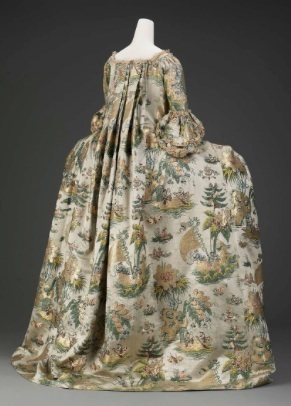
1730s Dutch brocaded satin, featuring exotic Asian islands and fauna, was refashioned into a more fashionable French frock in 1770. Source: Museum of Fine Arts, Boston. The Elizabeth Day McCormick Collection

1730s Dutch brocaded satin showing exotic Asian islands and fauna was refashioned in 1770 into a more fashionable French look. Source: Museum of Fine Arts, Boston.

A joyous collaboration among eight departments of the Metropolitan Museum of Art has written a new history of how a global network of fabric trade and manufacture once served the same purpose that YouTube, music videos, shelter magazines, Vogue, and The New York Times Style section do today – to present images of the latest trends and make anyone in the world that sees them understand the clothes or accessories needed to be “on trend” with other sophisticates.

Interwoven Globe: The Worldwide Textile Trade, 1500–1800, running through January 5, tells a monumental story about how trends went viral pre-Internet. It was a slower world dominated by sailing ships versus transoceanic cables, but the tale spanning centuries, continents, and cultures shows how gorgeous garments, incredible tapestries, bedazzled church vestments, quilted bedding, luxurious wall hangings, tour-de-force printed fabrics, and royal furniture telegraphed “trend” in a different way.

Embroidered muslin dress and fichu. The 18th c. craze for Neoclassical across Europe drove massive imports of lighter-than-air Bengali muslin. Source: The Met

Embroidered muslin dress. The 18th c. European Neoclassical craze drove massive imports of airy Bengali muslin. Source: The Met

The show can’t fully be appreciated in just one walk-through. Each textile and garment is incredible to behold, and the network of interrelationships among craftsmen, artisans, tradesmen, royal buyers, rich merchants, and brave sailors traversing strange shores is equally rich, complex, and layered.

This two-dimensional pageant, enhanced by exquisite gowns and garments whose fabrics were sourced from the four corners of the globe, is given the full-bore treatment in the top-floor galleries reserved for blockbusters.

How do you tell a story this big? The curators decided to put a large interactive map of the 16th- to 18th-century trade routes right inside the door, which brings you up to speed on the French, Portuguese, Spanish, Dutch, and British trade routes linking the Americas, India, the Orient, and islands.

Then come the galleries dedicated to the styles and fiber-tech associated with each – silks woven in China for Europe and Japan, Spanish embroideries that reference Islamic carpet borders, weavings made by Peruvian grand masters of the art, and Indian resist-dye masterpieces that turned into English chintz and fabrics for the King of Siam.

Japanese Jinbaori made from Dutch 17th century wool and Chinese silk, a luxury item worn over samurai armor. Source: John C. Weber Collection

17th c. Japanese Jinbaori made from Dutch wool and Chinese silk, a luxury item worn over samurai armor. Source: John C. Weber Collection

In the Spanish gallery, you’ll see how the crowned double-headed eagles of the Hapsburgs adopt kind of a Chinese-phoenix look when 16th-century Iberian traders commissioned silk artists in Macau to create silk they could sell back home. By the 17th century, everyone – East and West – had become accustomed to enjoying “exotic” images from halfway around the world – birds, animals, architecture, flowers, and landscapes. It had the same impact as Google Earth and World Wide Web access today.

One of the more startling facts is that before Commodore Perry “opened” Japan to the West (ref. Sondheim’s Pacific Overtures, the musical), Japan was more into luxury-goods consumption than production. Apparently, the trend was to import the ultra-luxury, Dutch wool, and make it into topcoats that Samurai warriors could drape over their armor.

If you don’t see this in person, visit the online exhibition site for an encounter that’s a real treat: You’ll get to zoom into each quilt, drape, embroidery, dress, shawl, and piece of fabric to see it all super-close.

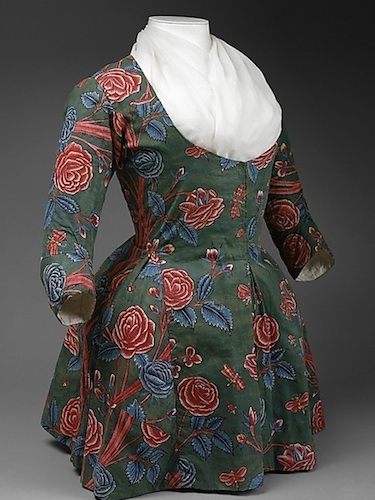
A late-18th century Indian-chintz Dutch jacket that knocked-off a French designer jacket in pink French fabric. Both have similar exotic floral prints. Source: The Met

A late-18th century Indian-chintz Dutch jacket that knocked-off a French designer jacket in pink French fabric. Both have similar exotic floral prints. Source: The Met

Click on the “full screen” button on each and toggle in to examine all of the glorious detail. The web site will tell you the story and show you the items in each gallery. You’ll be surprised to find the genesis of the fabrics-on-walls interior-decorating craze for country homes in the late 1700s and how men-only clubs adopted both plain and exotic dressing-gown dress from the Orient (a style also featured prominently in the current FIT show).

The King of Siam’s royal 18th century guard wore these resist-dye tunics. Fabrics were made in India and tailored in Siam. Source: Royal Ontario Museum, Toronto

The King of Siam’s royal 18th century guard wore these resist-dye tunics. Fabrics were made in India and tailored in Siam. Source: Royal Ontario Museum, Toronto

Magritte’s Surrealist Train Departing MoMA for Houston

Magritte’s 1938 oil, La durée poignardée (Time Transfixed) from The Art Institute of Chicago’s Winterbotham Collection. © Charly Herscovici ADAGP–ARS, 2013

Magritte’s 1938 oil, La durée poignardée (Time Transfixed) from The Art Institute of Chicago’s Winterbotham Collection. © Charly Herscovici ADAGP–ARS, 2013

One of the most recognizable trains in the history of modern art hasn’t left the station. It’s coming out of the wall at MoMA until January 12 as part of the tribute to Belgium’s only big-time Surrealist painter, Magritte: The Mystery of the Ordinary, 1926–1938. But don’t worry – this intriguing tribute chugs on, arriving at The Menil in Houston on Valentine’s Day (February 14) and at Chicago’s Art Institute on June 25. Catch it, because it’s loaded with new revelations, in person and on line.

In person: So many of paintings are icons of 20th century art, that it’s shocking to think that one anarchic visual artist had the chops to turn out so many great works in such a relatively short period of time. Walking through the first couple of galleries, you’ll recognize many famous images, but check out the dates on the labels: 40 were done in just his first three years in Paris between 1927 and 1929! He was so prolific, it makes you wonder when he made time to hang out at cafes, discuss dreams, and publish with Breton and the rest of the crew.

Jasper Johns owns the small version of Magritte’s 1935 oil La clef des songes (The Interpretation of Dreams), which uses English. © Charly Herscovici ADAGP–ARS, 2013. Photograph: Jerry Thompson

Jasper Johns owns the small English version of Magritte’s 1935 oil La clef des songes (The Interpretation of Dreams). © Charly Herscovici ADAGP–ARS, 2013. Photo: Jerry Thompson

Magritte liked making the familiar unfamiliar, playing with fact and fiction, probing dreams and reality, and appropriating pop culture into an art context.

Like Andy Warhol, Magritte began as an ad illustrator, and MoMA’s curators have included a few of his early fashion illustrations. It’s surprising to know that phrases that he injected onto his canvas (like “Ceci n’est pas une pipe”) were written in a script that was one of the most recognizable fonts used in European newspaper and magazine ads in the Twenties.

Was appreciation of Magritte’s ground-breaking cultural appropriation and subversion lost on our own American Pop pantheon? Not really, and the evidence is that one of the best examples of Magritte’s sly presentation of an everyday-object grid with ironic words was lent by the midcentury grandmaster, Jasper Johns.

So much contemporary pop culture and advertising art has reinterpreted, reimagined, and referenced Mr. Magritte’s images that it’s easy to forget that they rocked the world in the Twenties. His reverberation with our beloved 1960s Pop masters (and this show) reminds us that Mr. Magritte truly blazed an innovation pathway in taking the everyday and turning it into art.

MoMA discovered something lurking beneath the surface of its Magritte’s 1936 oil, Le portrait (The Portrait). Gift of Kay Sage Tanguy. © Charly Herscovici ADAGP–ARS, 2013

MoMA discovered something historic lurking under Magritte’s 1936 , Le portrait (The Portrait). Gift of Kay Sage Tanguy. © Charly Herscovici ADAGP–ARS, 2013

And speaking of pioneering, check out the amazing interactive site that lets us enter Magritte’s mind; learn how he turned nature, desire, dreams, language, and symbols into troubling, evocative, subversive works; and see the behind-the-scenes conservation and curatorial work. The beautiful, musical experience is designed by Hello Monday, and should probably win a Webby Award. See it now.

You’ll see how MoMA took off the old varnish, examined the canvases under ultra-violet light, and did detective work of which Magritte and his silent-movie-icon inspiration, Fantômas, would be proud.

Spend time letting each painting’s mini-site load into your browser window, click to hear the curators talk, and keep scrolling down to see what the conservators discovered. You can even toggle back and forth to see the surface of the painting and X-ray.

As a preview, here’s the YouTube video about the “lost” Magritte painting that conservator Cindy Albertson found lurking underneath The Portrait.

And while you’re at it, you might take a minute to see what technology was at work in possibly Magritte’s most famous image:

Meet American Legends at The Whitney

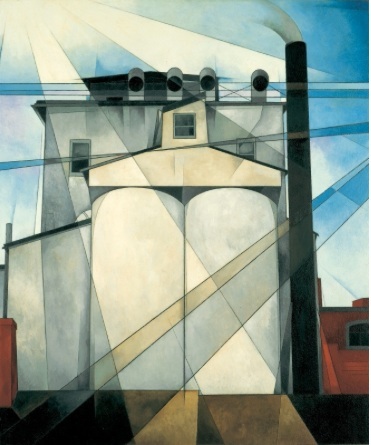
Charles Demuth’s precisionist take on the grain elevators in his hometown, My Egypt, 1927.

Charles Demuth’s precisionist take on the grain elevators in his hometown, My Egypt, 1927.

Five reasons to cozy up with the stars in the American Art Walk of Fame in the Whitney’s top-floor show, American Legends: From Calder to O’Keefe before December 15 when they come down to make room for the next batch of legends from the Whitney’s massive collection:

#1: Charles Demuth. See how he turned the industrial landscape of his Lancaster, Pennsylvania hometown and flowers from his garden into magic. Experience Demuth’s oil, My Egypt, a pristine oil that looks like it was painted yesterday. He captures the monumentality of the local grain elevators and uses his title to channel the greatest architectural feats of the ancient world. The beautiful floral watercolors were some of Ms. Whitney’s favorites.

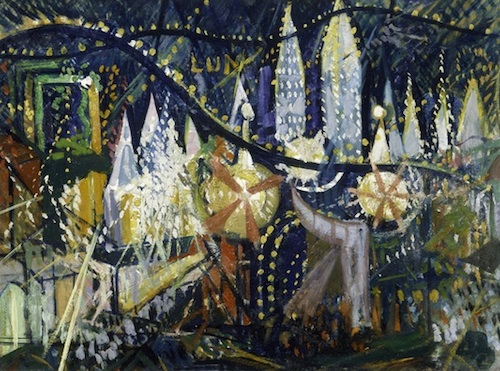
A Joseph Stella masterpieces: The Brooklyn Bridge: Variation on an Old Theme, 1939.

A Joseph Stella masterpieces: The Brooklyn Bridge: Variation on an Old Theme, 1939.

#2: Joseph Stella’s interpretation of 1930s New York, including one of his best-known works, The Brooklyn Bridge: Variation on an Old Theme, 1939. Here, the painting evokes a cathedral’s stained glass window but it’s actually a love letter to the iconic structure that he painted so many times in his career. If you’ve never walked across this bridge, listen to a civil engineer interpret Mr. Stella’s work on the Whitney’s audio guide.

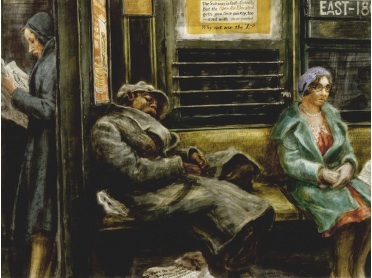
#3: Immersion into bygone New York. Check out Coney Island’s main attraction in 1913 via Mr. Stella’s Luna Park (here’s the audio). Also, the show has many Reginald Marsh works of life during the depression, including Why Not Take the “L”?, and the original “ten cents a dance” girls in his 1933 portrait of taxi dancers.

#4: The whimsy of sculptor Elie Nadelman, whose large, rounded, folk-art-inspired figurative sculptures could certainly work in Mr. Calder’s crazy circus (which is here, too), if they could only be shrunk down to fit into his tiny, tiny circus ring.

Reginald Marsh asks commuters a question in Why Not Use the “L”?, 1930

Reginald Marsh asks commuters a question in Why Not Use the “L”?, 1930

Mr. Nadelman looms large in the Whitney collection, and it’s nice to have a great, big room to dance around all his sculpted people.

#5: Georgia O’Keefe shares a gallery room with Marsden Hartley, a nice pairing of visual mystics captivated by symbols, nature, mysterious abstractions, and the evocative power of landscapes.

There’s a lot to enjoy about many of the other featured legends, so hurry over to drink in the colors of Stuart Davis, watercolors of John Marin, the sharp visions of Ralston Crawford, and eight other anchors of the Whitney collection.

Stella’s 1913 take on the magic of Coney Island’s main attraction, Luna Park

Stella’s 1913 take on the magic of Coney Island’s main attraction, Luna Park

Who will be featured next on the top floor? We’ll see who the curators pick on December 21, when they reveal their next group of Legends.

Artistic and Ethnic Identities Explored in La Bienal at El Museo

Ethno Portrait Cultural Test Shot by Sean Paul Gallegos alongside Reserved Ancestry made from Air Jordans, Arrow collars, and fur.

Indian Removal Act Skeuomorph by Sean Paul Gallegos wearing Reserved Ancestry (on right) sculpted from Air Jordans, Arrow collars, and fur.

Get to know some of NYC’s best new artists by strolling through El Museo del Barrio’s La Bienal 2013 on the Upper East Side before January 4.

Full of fun, reality, street life, high-art provocation, and what it’s like to be an artist in 2013, the show has it all – installations, videos, performance-art artifacts, photographs, sculptures and even a tintype. Take a look at some of our favorites on the Flickr feed, and go to the excellent website for El Museo La Bienal 2013: Here is Where We Jump, the seventh edition of this working contemporary artist showcase, which explores both formal-art and ethnic identity issues.

Small detail of Ignazio Gonzalez-Lang’s “Guess Who” – a grid of 100 inkjet prints of police sketches that appeared in NYC newspapers papers. In this 2012 work, he arranged very similar portraits side by side.

Small detail of Ignazio Gonzalez-Lang’s Guess Who – a grid of 100 inkjet prints of police sketches that appeared in NYC newspapers papers. In this 2012 work, he arranged very similar portraits side by side.

Look closely at the pieces by Sean Paul Gallegos, an artist who considers himself a product of colonial ancestry (his father is Tiwa and Spanish from New Mexico and his mother is Cree and French from Canada). Gallegos juxtaposes his “anthropological” self-portrait with his Native American-inspired headdress made entirely out of cut-up Air Jordan sneakers, Arrow shirt collars, and fur.

A grid of 100 inkjet prints of police sketches by Ignazio Gonzalez-Lang, an NYC Puerto Rican artist, also puts identity to the test. For Guess Who, he’s collected police sketches that have appeared in New York City newspapers, slapped them into a grid, and arranged them in pairs that look all-too-similar. Super thought-provoking.

The Cortez Killer Cutz Radio installation by Eric Ramos Guerrero, a Philippines-born artist, also gets into your head but out of your comfort zone. It’s a full-size, two-room simulation of a Southern California hip hop/R&B radio station streaming late-night song dedications by girlfriends to their incarcerated boyfriends.
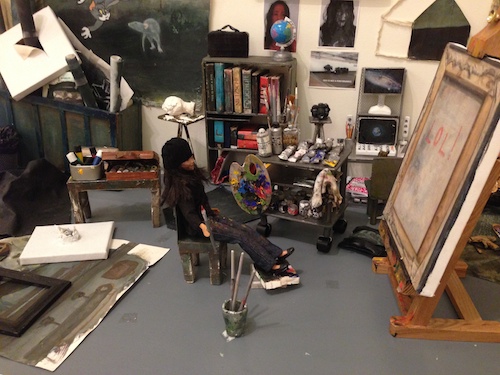
Close-up of the doll-artist contemplating her studio output in Julia San Martin’s Dollhouse

Close-up of the doll-artist contemplating her studio output in Julia San Martin’s Dollhouse

Julia San Martín’s Dollhouse, on the other hand, is a very tiny, detailed installation of a look into the mind and work of the artist. On a miniscule set of her studio, a doll-size painter works on her paintings and drawings, which the Chilean-born artist often rearranges and reshuffles to mimic the working life and consternation of deciding what to paint and what to show.

RISD-trained Gabriela Salazar also looks inward to her studio experience, but in a more formal way. As an artist that often creates large-scale constructed works in the community, she’s taken the remainders of some of her projects – wood shims, foam, cardboard, felt, rope, and wire – and turned them into tiny-scale minimal masterworks, all displayed in a type of “gallery show within a show.”

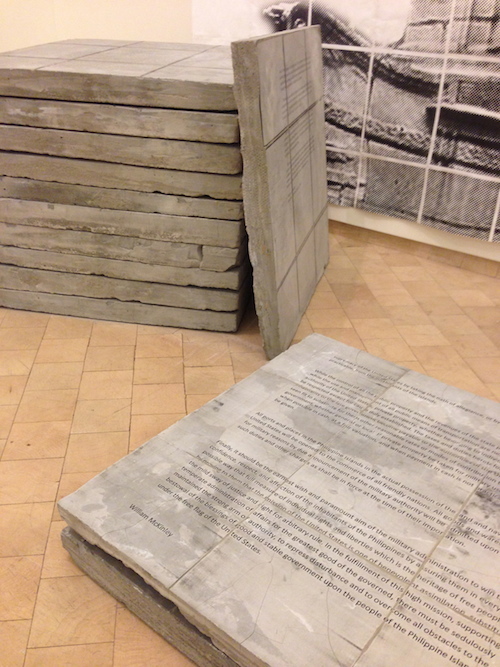
Ramón Miranda Beltrán’s historic documents cast in concrete, featuring President McKinley’s treaties that gave Guam and the Philippines to the US after the Spanish-American War

Ramón Miranda Beltrán’s historic documents cast in concrete, featuring President McKinley’s treaties that gave Guam and the Philippines to the US after the Spanish-American War

And be sure to look for Gabriela Scopazzi’s hilarious Amarilla video where she seranades a captivated group of llamas with an aria. (Sorry, it’s for in-person viewing only and not on the web.)

Work through the show’s website to see more of each artist’s work and learn more about what makes them tick.

Oldest Painted Theater Curtain in America on View in NC

The original 1858 William Russell Smith drop curtain, displayed in Thalian Hall’s Parquet Hall

The original 1858 William Russell Smith drop curtain, displayed in Thalian Hall’s Parquet Hall

Lincoln was prepping for his sixth debate with Douglas in Illinois when the curtain went up on October 12, 1858 at Thalian Hall in Wilmington, North Carolina – the same curtain, still on display, that is considered to be the oldest existing theater drop in America, painted by Philadelphia-trained landscape artist William Russell Smith.

Back in the 1850s, major theaters up and down the East Coast were in pursuit of the classically trained Smith to create romantic, ethereal landscape images on the gigantic canvas curtains that audiences saw when they entered opera houses. Typically framed by an ornate proscenium, the drop transported theatergoers to the work of make-believe, Moliere, and Macbeth – staples of the touring companies and troupes of the time.

Detail of original drop curtain, done in distemper on 30-foot canvas

Detail of 1858 curtain, distemper on a 30-foot canvas

Today, except for Wilmington’s Thalian Hall treasure, those grand masterpieces are gone, victims of time, decay, and impermanence like the superstars of yesteryear. It’s quite a miracle that Thalian’s original curtain has still survived, considering that it’s not painted in oil, but distemper – a less permanent, water-soluable medium, essentially colors ground into glue. When an artist applies the wet pigment, he sees the opposite color, which gradually turns into the “true” color when the paint dries. It’s a process that could only be executed by a skilled master, particularly on a 30-foot wide canvas. The surface of the curtain holds the granules (like a piece of paper holds pastel fragments).

Wilmington, NC’s Thalian Hall, built 1855-1858, one of the oldest continuously operating theaters in the South

Wilmington, NC’s Thalian Hall, built 1855-1858, one of the oldest continuously operating theaters in the South

No wonder Smith purpose-built a huge studio in his home with poles that could be raised and lowered as he worked on a gigantic scale first with a charcoal sketch, then with distemper (move over, Chuck Close!). When Smith finished painting his commission, he carefully folded the canvas, rolled it on a long pole, and had it delivered to the opera house.

Thalian Hall received its long-distance delivery this way, because Smith never set foot in North Carolina. The new opera house was designed by New York architect John Trimble, who built Barnum’s Museum and many New York theaters of the mid-1800s, including the New Bowery. Smith’s curtain was the finishing touch, depicting an Aegean sailing ship arriving at classical islands filled with temples dedicated to Apollo, evoking commencement of the ancient Olympiad.

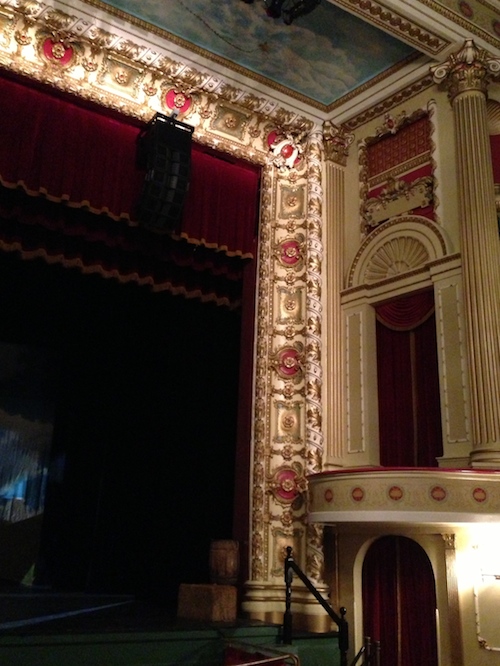
Detail of Thalian Hall's beautifully restored proscenium and box

Detail of Thalian Hall’s beautifully restored proscenium and box

The curtain was in service from 1858 until 1909, when a restoration was planned. Historians know it was hung again by 1938 (see the photo in our Flickr feed). It got hurt a little in the 1940 WPA renovations, and was known to be back in place in 1947, but disappeared after 1963. It was rediscovered in 1979, when Mrs. Juanita Menick, the president of the board, told the new Thalian director that she might still have an old curtain that she took years ago to her home for safekeeping. Thank goodness for those large, Southern homes.

Although only 15 feet of the original 30-foot drop remained, tribute was paid to the historic artwork. The fragile canvas was used as part of the set for Thanlian Hall’s 125th anniversary celebration, and now hangs, ready for its closeup, in the luxurious entry to the theater’s orchestra section.

Hear how executive director Tony Rivenbark rediscovered it, and watch historian David Rowland’s talk about the life of William Russell Smith (at 4:20), whose romantic landscapes of New England somewhat predated the Hudson River School; the imagery used in the magnificent theater curtains (at 30:22); and the astonishing discovery recently made in Smith’s grand studio (at 35:30) in this YouTube video.

Thalian Hall's balconies and orchestra

Thalian Hall’s balconies and orchestra

You can read more about the historic theater on its website (and check out the video on Thalian’s “thunder roll” device, another “only remaining in America” theatrical wonder). Glimpse more of this theater’s grandeur and photos of the illustrious performers who have trod its boards on our Flickr feed.

In Wilmington, you can view this remarkable piece of theater history any time during box office hours.

NYU Shows How Modern Art Popped in 1960s Iran

Zarrine-Asfar’s 1970s Black Plaster Hand in oil and pencil on canvas with plaster. Source: Grey

Zarrine-Asfar’s 1970s Black Plaster Hand in oil and pencil on canvas with plaster. Source: Grey

If you go downstairs at NYU’s Grey Art Gallery, a collection of seemingly quiet works will show you how a cadre of avant-Garde painters injected the spirit of 1960s downtown New York into Iran’s gallery scene just before the 1979 revolution transformed Persian society. Get down to Washington Square to contemplate Modern Iranian Art before December 7.

Gallery founder and woman-about-the-world, Abby Weed Grey, made it her priority to collect modern-influenced Iranian artists in the 1960s and 1970s just before the transition from the Shah to the Ayatollah, amassing (and ultimately bequeathing to NYU) the largest Iranian modern art collection outside the country.

Tanavoli’s Persian Telephone I, a 1963 bronze sculpture inspired by Johns and Warhol. Source: Grey

Tanavoli’s Persian Telephone I, a 1963 bronze sculpture inspired by Johns and Warhol. Source: Grey

This show and its scholarship is first rate, hitting a home run with Sixties connoisseurs. Good job, Grey team, with your first-ever e-book on the web site, which connects the dots in some unexpected places.

Consider Parviz Tanavoli, who experimented with some Jasper Johns techniques — incorporating dishes into ceramics and playing with bronzed objects. Hamid Zarrine-Asfar was also experimenting with whitewashed 3D grids in a refined, painterly, and Johns-like way. Not copies, but reinterpretations that resonated with cosmopolitan Persians. Abby bought 35 of his works.

Robert Indiana wasn’t the only one playing with letters-as-art during the Sixties.  Abby collected work by a lot of artists who used the calligraphy of their own culture in their work — a more lyrical, poetic approach than the brash American appropriations.

Two extremely understated painting in the show were influenced by one artist’s interest in Cage and Duchamp. Read the label copy, and you’ll learn that they were done by a young revolutionary artist, Mir-Hossein Mousavi, fresh out of school, who later served as Iran’s Prime Minister in the 1980s and challenged Ahmadinejad in a run for president in 2009. He lost, but the work makes you wonder about the number of political candidates (anywhere in the world), who are trained architects interested in channeling the I Ching, playing with alt notation, or using chess as a visual metaphor.

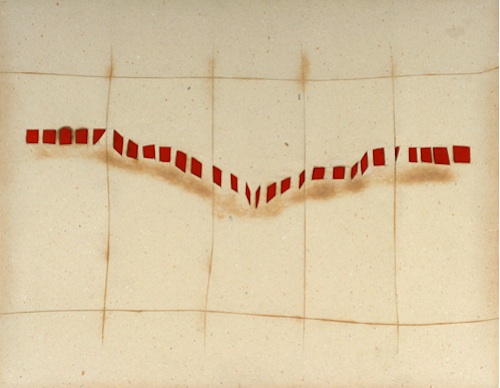
Mir-Hossein Mousavi (Khameneh), Musical Notations, a 1967 mixed media work inspired by Cage. Source: Grey

Mir-Hossein Mousavi (Khameneh), Musical Notations, a 1967 mixed media work inspired by Cage. Source: Grey

The startling image of Kamran Diba’s Diver at the foot of the stairs debuted as part of a multimedia piece, with two actors’ voices repeating the “conversation” that appears on the canvas – a reminder of performance mash-ups that young Yoko Ono might experimenting with around the same time.

The more you probe, the more you’ll see. No Ben Day dots or photo imagery — just glimmers of interdisciplinary thought normally associated with that boundary-pushing Black Mountain crowd.

Abby, you wanted your Middle East buying spree to inspire cross-cultural associations among generations of US scholars. Grey Gallery team, you did your founder proud. Well done in supplying this special lens.

Kamran Diba’s Diver, a 1967 oil that originally included an audio track with two actors’ voices. Source: Grey

Kamran Diba’s 1967 Diver,  whch originally included an audio track with two actors’ voices. Source: Grey

If you can’t get there, browse the e-book and photos of the work here. Abby’s collection of Iranian modern art has its own website, and you can browse through dozens of examples by each of her favorite artists.

If you’re up on Park Avenue, works that Abby collected are also at the Asia Society until January 5 in another exhibition shining the light on Iranian modernism.

History Twist in Brooklyn’s Period Rooms

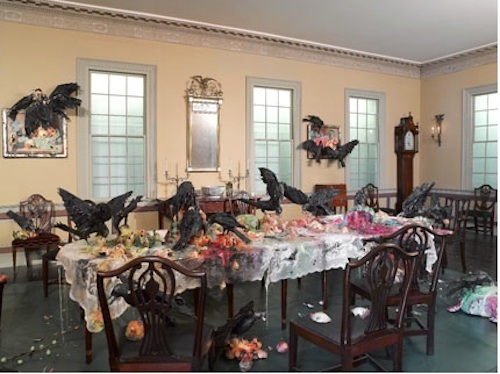
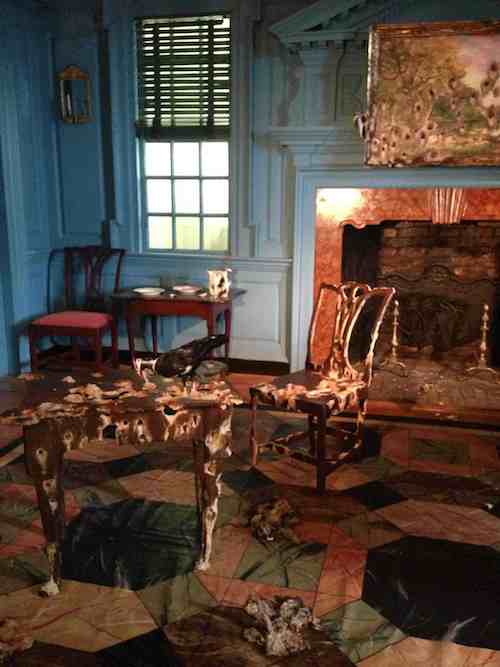
Hegarty’s “activation” of the Cane Acres Plantation dining room: Still Life with Peaches, Pear, Grapes and Crows; Still Life with Watermelon, Peaches and Crows; and Table Cloth with Fruit and Crows. Photo: Brooklyn Museum

Hegarty’s “activation” of the Cane Acres Plantation dining room including Still Life with Watermelon, Peaches and Crows. Photo: Brooklyn Museum

The Brooklyn Museum’s Period Rooms are again the focus of a rip-roaring, history-tearing, upside-down interpretation by an installation artist. Go before December 1 to see what’s happened to three rooms up on the museum’s Fourth Floor in Valerie Hegarty: Alternative Histories.

The dining room from the South Carolina’s Cane Acres Plantation is alive with dozen or so papier-mâché crows that are chowing down on the faux watermelons and peaches that you imagine to have been so beautifully arranged on the long, grand table.

Peering into either of the two plantation doorways, it’s disconcerting to see how the delicacies are being ripped apart and strewn about. The fruit literally pops out of the frames in this cross-referenced mash-up of Hitchcock terror, racial segregation issues, and classic still life painting.

Hegarty’s Pendleton carpet in the Cupola House parlor.

Hegarty’s Pendleton carpet is growing in the Cupola House parlor.

See how Hegarty created it all out of wire, glue, foil, foam, and everything else you can purchase at Michael’s on the Brooklyn Museum’s Flickr feed.

She was equally ambitious in two other rooms from the Cupola House, originally built in Edenton, North Carolina: The 1725 parlor room focuses on a visual “conversation” between General George Washington and Pawnee Chief Sharitarish, featuring a Native American-style Pendleton parlor rug that is “growing” grass, flowers, and roots to make you think about what happened to the native culture over the last few centuries.

She kicks the Manifest Destiny discussion right where it hurts in the Cupola House “hall” (where guests socialized) by letting two Pileated and Downy Woodpeckers have their way with everything valuable in the room, including (a reproduction of) Thomas Cole’s 1846 painting The Pic-Nic. Nature is getting out of hand.

The Downey Woodpeckers take over the Cupola House hall. Photo: Brooklyn Museum

The Downey Woodpeckers take over the Cupola House hall. Photo: Brooklyn Museum

Get over to Brooklyn and encounter a new twist on what you were taught in grade school history, but watch out for Hegarty’s flying bullets and birds.

Mondrian Goes Digital Electronic at MoMA

Mondrian’s Composition in Yellow, Blue, and White, I inside Haroon Mizra's installation Frame for a Painting

Mondrian’s Composition in Yellow, Blue, and White, I is framed in LEDs inside Haroon Mizra’s sound installation Frame for a Painting

Mondrian’s in the house (literally), starring in a fun interactive installation tucked away near the exit to Soundings: A Contemporary Score, MoMA’s first exhibition devoted entirely to the work of creative contemporary artists working in sound.

The show, which runs through November 3, has plenty of fascinating, thoughtful works in hallways, around bends, and in darkened galleries, such as Tristan Perich’s Microtonal Wall in the entrance hallway, which lets you experience the sound of 1,500 1-bit speakers up close and personal. Listen to it at the bottom of his MoMa artist page.

IMG_2939But the delightful surprise installation is a long, narrow almost hidden room, where Haroon Mizra has installed his ever-changing Frame for a Painting. On the occasion of being at MoMA, he’s chosen Mr. Mondrian’s Composition in Yellow, Blue, and White, I from MoMA’s collection and given this small, jazzy gridwork its own ultra-modern, swinging London, mid-century electro-pad. See it on our Flickr feed.

The narrow room has pointy yellow acoustic foam covering the tall walls. At the far end, you see Composition framed in a rectangle of electric blue LED lights that flash in sync to a pulsing electronic sound track. You have to maneuver around a low Danish modern side table from which a bright red bicycle light pulses and bleeps.

It’s a nice tribute to this favorite Modern master, and one of the few nooks in the show where visitors are taking photos and making little Vine videos like crazy. Composition harkens back to 1937, the table to the 1950s, and the sounds to the dawn of electronic music. It feels like a crazy time machine in an over-the-top conceptual 1960s living room.  Surely Mr. Mondrian would approve of the precision and interrupted rhythm. In any case, Composition certainly seems to enjoy being liberated from the white-wall treatment upstairs.

Close-up of the foam lining all the walls of Mondrian's slim room

Close-up of the foam lining all the walls of Mondrian’s slim room

Another work in the show that you might remember is a sound piece that used to be installed on the High Line in 2010 – Stephen Vitiello’s A Bell for Every Minute, which features New York City bells that he recorded and are heard every 60 seconds. You can get a taste of the experience listening to Bell Study, an audio track embedded at the bottom of his artist page used as an underlay in his longer audio piece.

Also check out the track from Jana Winderen’s Ultrafield, which slows down the ultrasound communications of bats, fish, and underwater insects so that we can hear the “hidden” sounds of our fellow species for the first time. Listen in to Jana’s work and check out the other artists on MoMA’s interactive show site.

And feel free to record and add your own everyday sounds to MoMA’s show site.