Last Call for the Whitney Biennial Uptown

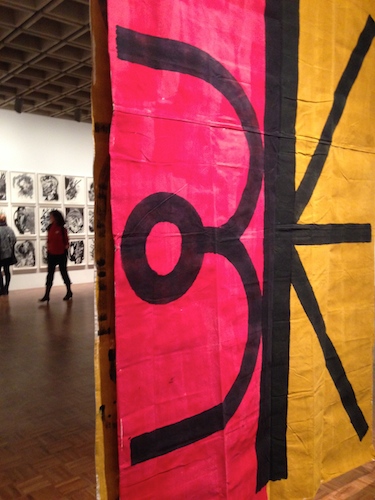
Detail of Elijah Burgher’s “The Pattern of All Patience 1” (2014), featuring magical symbols, installed on the second floor

Detail of Elijah Burgher’s The Pattern of All Patience 1 (2014), featuring magical symbols, installed on the second floor

It’s the last time the Whitney Biennial is holding its big, expansive, colorful, and provocative shindig on the Upper East Side, since it will decamp to its new riverside home at the foot of the High Line next year. Go before it ends on May 25.

It’s amazing to think that this is the 77th time that the Whitney has hosted either an annual or biennial show to showcase the best of American art, as controversial and impossible a task as that may be. This year, the Whitney threw in the towel in trying to showcase “the best” of what’s going on in contemporary art coast to coast. It just wasn’t possible given the expanse, diversity, and barrier-breaking works that American artists are cranking out right now.

Instead, the Whitney invited three innovative curators to choose what should be shown on each of three floors and around town. (Yes, there are offsite works, too.)

“Pillar of Inquiry/Supple Column” (2013-2014) by fiber artist superstar Sheila Hicks

Pillar of Inquiry/Supple Column (2013-2014) by fiber artist superstar Sheila Hicks

The divide-and-conquer approach works, resulting in a fun variety of media, installations, paintings, sculptures, textile art, performance, and collections-as-art. The team pulled it all together in only 18 months while still doing their day jobs at Chicago’s Art Institute, London’s Tate Modern, and Philadelphia’s ICA.

Visit our Flickr album and walk through the press preview with us, where several artists were on hand in the galleries with their work.

It’s a happier, lighter show compared to past Biennials, but that doesn’t mean that the artists ignore social commentary or darker sides of human nature. It just means that you won’t feel as though you need a graduate degree in Conceptual Art to enjoy and ponder the work you’ll encounter.

Highlights: Charlemagne Palestine has created a surprisingly spooky installation in the stairwell that features sonorous sounds emanating from speakers adorned with stuffed animals. LA painter Rebecca Morris has two bright, gigantic delightful paintings on the second floor, curated by Philadelphia’s Anthony Elms, which features several satisfying collections-as-art installations by Julie Ault, Richard Hawkins, and Catherine Opie.

Pterosaur and giant theropod are featured in Shio Kusaka’s third-floor ceramics display

Pterosaur and giant theropod are featured in Shio Kusaka’s fourth-floor ceramics display

Fans of NYC’s 1970s art scene (when Soho was still industrial) will be captivated by The Gregory Battcock Archive, peering at the ephemera collected by one of the decade’s most prominent art critics who died under mysterious circumstances in 1980. Amazingly, it was all found by artist Joseph Grigley wafting around garbage bins in an abandoned storage facility. Grigley’s created a disciplined, loving, and intimate installation of reclaimed Battcock mementos, memories, and letters with Cage, Warhol, Moorman, Paik, Ono, and other 70s superstars.

The top floor takes a down-home approach to some very enjoyable paintings, sculptures, installations, and ceramics. Midwest curator Michelle Grabner said that she wishes she could just camp out there for the run of the show. You’ll enjoy it, too — a dreamy installation by Joel Otterson, a monumental yarn pillar by uber-fiber-artist Sheila Hicks, a witty desk and bookcase by master woodsman-sculptor David Robbins, and shelf of delicate and whimsical ceramics by Shio Kusaka.

Knits with commentary by Lisa Anne Auerbach, including We Are All Pussy Riot

Knits with commentary by Lisa Anne Auerbach, including We Are All Pussy Riot

The third floor, curated by Stuart Comer (who’s recently moved to MoMA), features a lot of screens and digital media, essentially making you think about art in the age of the iPhone. As you step out of the elevator, you’ll encounter Ken Okiishi’s series of painted panels. Oh, wait! They’re actually abstract paintings on upended flat-screen TV displays – sort of like what would happen if Kandinsky’s Seasons were done at the Samsung plant.

The mixing of media keeps morphing in room after room of clever installations by Triple Canopy (antiques meet 3D printing) and Lisa Anne Auerbach (knitting meets social commentary, and zines meet the Giant in Jack and the Beanstalk). See Lisa’s work and listen to her explain her knitting:

There are dozens of other videos and audio guide stops posted on the Biennial web site (click on “watch and listen”), as well as bios of all the artists.

Alert: MAD’s own design biennial opens July 1.
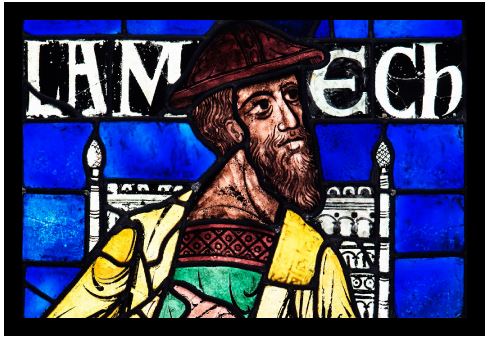
Windows into Famed 12th c. Cathedral at Cloisters

Lamech (detail), from the Ancestors of Christ Windows, Canterbury Cathedral, England, 1178–80. Images © Robert Greshoff Photography, courtesy Dean and Chapter of Canterbury

Lamech (detail), from the Ancestors of Christ Windows, Canterbury Cathedral, England, 1178–80. Images © Robert Greshoff Photography, courtesy Dean and Chapter of Canterbury

If you’ve never gotten to see Canterbury Cathedral, pop into Radiant Light before May 18 to see six magnificently restored Romanesque windows from this historic site, installed appropriately in the Romanesque Gallery near the entrance of The Cloisters.

It’s the first time any of stained glass windows from Canterbury have left home, so it’s a unique chance to gaze upon brilliant, beautiful works designed and made in 1178-1180 and think about the fact that these were seen by Chaucer and millions of pilgrims who trekked to this site over the centuries. Maybe during your trip to the wilds of Fort Tryon Park in northern Manhattan, you’ll act out your own CanterburyTales adventure.

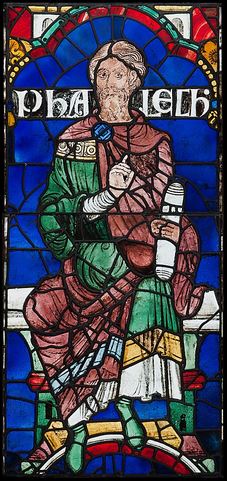
Phalech, one of Noah’s descendants, one of Canterbury’s original 86 stained-glass panels (1178-1780)

Phalech, one of Noah’s descendants, one of Canterbury’s original 86 stained-glass panels (1178-1780)

The Cloisters got the chance to display these medieval masterworks after a brief run at The Getty while the walls of the Canterbury Cathedral were being restored. Lucky us.

The backstory: After King Henry had Thomas Becket killed at Canterbury in 1170, word spread of miracles in 1171, the fastest canonization in history followed in 1173, and pilgrims began flocking to Becket’s former home. A fire in 1174 triggered Canterbury’s rebuilding and redesign, including the plan for an unprecedented series of 86 stained-glass windows to emphasize the connection of priests (versus kings) to Christ.

At the Cloisters, you will see six of the 46 surviving choir windows depicting the Biblical ancestors of Christ, as chronicled in the Book of Luke.

The patriarchs that you’ll meet uptown are Jared, a fifth-generation descendant of Adam; Lamech, the son of Methuselah and father of Noah, who lived during those sinful pre-Flood times; Noah, who appears to be talking to God; Phalec, who lived five or six generations after Noah; Thara, Abraham’s father who hailed from the ancient city of Ur; and Abraham himself.

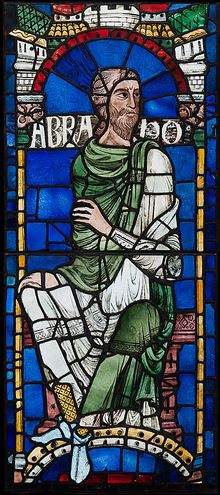
Abraham with his border back around him again after 200 years

Abraham with his border back around him again after 200 years

Several full-body portraits are reunited for the first time in 200 years with their original stained-glass borders, which mimic those of contemporaneous manuscript illuminations. Phalech’s portrait has a little less detail than the others, and the curators speculate that the artisans may have had to rush a bit to finish this monster-sized commission on time for the Archbishop back in 1180.

Spoiler alert: The faces of Thara and Abraham are 20th-century copies.

How were these painted? How were these  images made? The Cloisters points us the four-minute video below, created by London’s Victoria and Albert Museum to show how medieval artists created their magic.

Making a stained glass panel from Victoria and Albert Museum on Vimeo.

For other views of The Cloisters, see our Flickr album.

Subversive Chinese Brush-Up at the Met

Yang Jiechang’s Crying Landscape (2003) shares the Gallery for Art of Ancient China with a sandstone stele from the Northern Wei dynasty (489-495) and the 1319 Buddha of Medicine.

Yang Jiechang’s Crying Landscape (2003) shares the Gallery for Art of Ancient China with a sandstone stele from the Northern Wei dynasty (489-495) and the 1319 Buddha of Medicine.

Normally, the galleries for Asian Art at the Metropolitan Museum of Art are pretty tranquil. But through April 6, you’ll find them buzzing with contemporary art lovers reveling in the hunt to find the most famous, subversive, subtle works by Chinese painters, sculptors, and digital artists residing amidst centuries-old treasures in the widely popular exhibition, Ink Art: Past as Present in Contemporary China.

The Met gave the Chinese art curators free reign to pluck sly works from the in-house contemporary collections created by Chinese artists over the last 20 years, grab monumental works from private collectors, and mount a tribute to how post-Cultural Revolution innovators parse the traditions associated with centuries-old art making in their ancestral country.

How do the hottest artists on the planet turn calligraphy and inked woodblocks into biting social commentary? Take a stroll through the second floor Asian art wing.

Inspired by Cultural Revolution posters, the letters in Wu Shanzhuan’s Character Image of Black Character Font (1989) have no meaning.

Inspired by Cultural Revolution posters, the letters in Wu Shanzhuan’s Character Image of Black Character Font (1989) have no meaning. Courtesy: Private collector, the artist.

Just past the balcony-bar area, the monumental 1319 Buddha of Medicine mural from Shanxi Province, China, casts a benign presence over the Gallery for Art of Ancient China. But just stage right, two larger-than-life works on paper preview how Chinese artists twist the “then” into the “now”.

Yang Jiechang’s Crying Landscape panels are painted in the beautiful, colorful “old school” flat Asian style but depict decidedly unbeautiful industrial and political subjects. Similarly, Qiu Zhirie’s Nanjing Yangzi River Bridge ink triptych features masterful, large-scale ink-brush technique but uses art-world icons to relay a disturbing story. It’s an installation triumph that will haunt you every time you pass through that room again.

Large-scale calligraphy by many of the artists makes ink-pot-and-brush tradition echo with gestures as large as Rothko’s. In the galleries with meticulously crafted “landscape” drawings and images, you’ll ask how this modern crew managed to produce scrolls with such heft and detail. Take a walk-through of the show through our Flickr site.

In 1995, Ai Weiwei corporatized a Han Dynasty (206 B.C. – 9 A.D.) earthenware jar.

In 1995, Ai Weiwei corporatized a Han Dynasty (206 B.C. – 9 A.D.) earthenware jar. Courtesy: M + Sigg, the artist

Along the way to back of the wing, the curators play hide-and-seek, putting Ai Weiwei’s “enhanced” Han Dynasty jar right in the aisle with the “unmodernized” earthenware vessels, and mounting Hong Hoo’s subtly colored, hilarious historical “atlas” silkscreens in a case that practically dares unfocused visitors to pass them by as they drift toward the Astor Court.

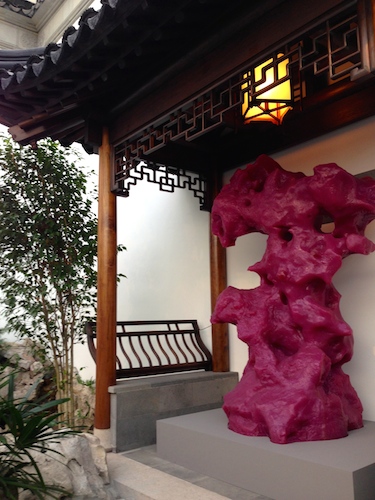
Hopefully by the time they get to the rock garden they will notice Zhang Jianjun’s crazy pink silicone rubber “scholar rock” right next to the real ones. Zhan Wang’s stainless steel scholar rock and Shou Fan’s side chairs are beautifully arranged in the Ming Dynasty room just off the Court, along with more of Ai Weiwei’s furniture hijinx.

After you’re done getting a feel for how the galleries have been transformed, go back into the Met’s exhibition web site to study the brushwork and details and get to know some of the artists.

Zhang Jianjun’s 2008 silicone rubber Scholar Rock (The Mirage Garden) sits in a 17th-century pagoda in the Met’s Astor Court

Zhang Jianjun’s 2008 silicone rubber Scholar Rock (The Mirage Garden) sits under a 17th-century pagoda in the Met’s Astor Court. Courtesy: Sigg Collection, the atist

Although the web site appears to be more plain-vanilla than jazzy, you’ll be surprised to see that the digital back-end of the Met archives lets you zoom into each of the paintings to see the handsome handwork of each of these wunderkinds from each thematic section of the show. You can even peruse the gigantic scrolls up close, section by section.

The video room, where art lovers can relax and watch a rotating collection of work, is a nice touch. The modern digital sign to the side tells you exactly where you are in the rotation.

Here’s a link to one of the featured videos: Get to know the constantly transforming cityscape of Beijing through Chen Shaoxiong’s 2005  Ink City, and see what happens when a contemporary artist paints daily life in Beijing with traditional tools and ports his day-to-night experience to video.

Armory Show Stars on the West Coast of Manhattan

The Artforum Lounge on the Contemporary Pier

The Artforum Lounge on the Contemporary Pier

For four action-packed days, the art crowd made its way to the West Coast of Manhattan Island past gritty lots, warehouses, the ball fields of Clinton, and high-rises-under-construction to enter a white, light-filled glittery expanse of painting, sculpture, and champagne bars at the 2014 edition of The Armory Show.

This year, 205 exhibitors showed off the best in modern masters and contemporary upstarts. Walk through it with us on our Flickr feed.

If you’ve never been there, just know that the art fills two full piers (yes, where the cruise ships come in). You may think the Whitney Biennial is big, but The Armory promenade is vast.

On the Modern Pier: Chicago’s Alan Koppel Gallery gave tribute to original Armory Show in 1913 with several Duchamps, but most of the work is post-1940 by Modern superstars. Right at the start of the pier, Galleria d’Arte Maggiori positioned a nice rough-and-ready Mattia Moreni in kind-of a face-off with a pretty primitive Basquiat nearby.

Dramatic paper collage and charcoal work by Elaine de Kooning with two Picasso ceramics at Vivian Horan

Dramatic paper collage and charcoal work by Elaine de Kooning with two little Picasso ceramics at Vivian Horan

Frankfurt’s Die Galerie gave NYC glamour-icon Louise Nevelson a mini-tribute, and several galleries featured Marca-Relli’s painting/collages.

Best on the Modern Pier: Vivian Horan’s booth, dominated by a large Elaine de Kooning charcoal drawing with collage, but populated by two small Picasso ceramics that most fair goers didn’t even see, although they were practically out in the aisle. You don’t see Picasso ceramics too much, and they really added a nice touch.

Second runner-up was the Armand Bartos booth with a sharp Kenneth Noland, Andy’s chicken soup can under glass, and a no-holds-barred Stella. In fact, there were multiple 1980s 3D Frank Stellas leaping out from walls, demanding attention. Besides posing with the soup can, lots of visitors were snapping photos of themselves in front of Mr. Stella’s work.

1949 Hans Hoffman oil at London’s Crane Kalman

1949 Hans Hoffman oil at London’s Crane Kalman

Welcomed surprises: Even though he taught most of the post-war painters in New York, you don’t often see Hans Hoffman paintings, so it was nice to encounter one of his color explosions at Crane Kalman. And we’ve never seen the two super-early skinny Lichtenstein sculptures at Barcelona’s Galeria Marc Domenech booth. Guess they were made in those lean before-the-dots years on his path to Pop.

Susan Harris curated a great micro-show of 20th century female artists, mostly works on paper (e.g. Georgia O’Keefe, Kiki Smith, Lee Bonticou), all contributed by gallery exhibitors.

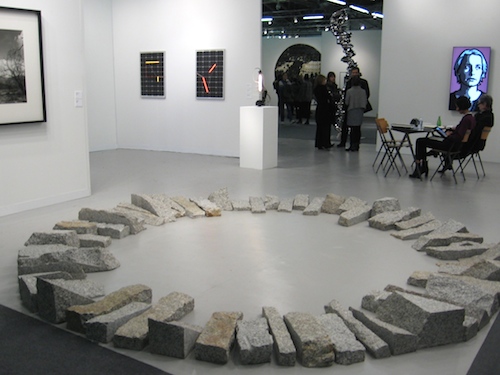
Richard Long’s 1994 Merrivale Circle at the Lisson Gallery

Richard Long’s 1994 Merrivale Circle at the Lisson Gallery

Although you could hike outdoors to get to the second pier along the West Side Highway, most were guided through a wormhole and down a flight of stairs to descend directly into the booths from 17 contemporary galleries across China – a great landing into a warren of booths featuring installations (watch out for the Roomba!), and user-friendly exercise equipment that the PRC makes available in public parks for citizen fitness.

From there, you enter the Contemporary Pier area.  Highlights: the whirling handbag piece (with real handbags) by Egill Saebjornsson at Reykjavik’s i8 Gallery, Richard Long’s stone circle at London’s Lisson Gallery booth, the completely constructed entry to Boesky Gallery, and Claudia Weiser’s cool wooden sculptures at Sies + Hoke (Dusseldorf).

Nick Cave Soundsuits at Jack Shainman

Nick Cave Soundsuits at Jack Shainman

A great place to end the journey was at the Jack Shainman booth, with its dramatic contemporary art exploring expressions from Africa, African-Americans, and global artists — the Nick Cave soundsuits and Richard Mosse’s spectacularly dissonant hot-pink infrared photograph of a waterfall in the continually disintegrating, war-torn Democratic Republic of Congo.

Take a look at the highlights here.

Fair goer relaxes on modernist egg chair under the watchful eye of Dali

Fair goer relaxes on modernist egg chair under the watchful eye of Dali

Mutu Takes Art-Lovers on a Fantastic Brooklyn Journey

Le Noble Savage, 2006. Ink and collage on Mylar (over 7 feet tall). Collection: Martin and Rebecca Eisenberg. Image: courtesy of the artist. © Wangechi Mutu

Le Noble Savage, 2006. Ink and collage on Mylar (over 7 feet tall). Collection: Martin and Rebecca Eisenberg. Image: courtesy of the artist. © Wangechi Mutu

The Saturday night crowd at the Brooklyn Museum was intent on exploring every inch, sketchbook, plastic-wrapped ball, and cut-out supplied by the born-in-Kenya Brooklyn vision-artist in her one-woman show, Wangechi Mutu: A Fantastic Journey. Explore her world (installed right next to The Dinner Party) before March 9.

Wangechi has been turning out thought-provoking work for the last 15 years, and the show, originally created by the Nasher Museum on the Duke University campus, presents the gigantic collage images that made her famous with collectors as well as a brand-new video and on-site installation.

Ladies’ fashion lips, stiletto-heeled shoes, African totems, African animals, high-fashion eyes, and magical shapes and patterns are interworked onto large-scale pieces portraying Amazons that are pushed, puzzled, and probed in fantasy landscapes, surrounded by plants and creatures from different worlds.

She’s a visual virtuoso who knows that how things look from a distance are nothing like what you’ll see when you get up to her images very, very close. For example, when you come into the gallery, you see a wall-sized work that Wangechi created that looks like a she-centaur being chased by who-knows-what-in-3D flying into the frame. Up close, you’ll see that her “hooves” are collages of African sculptures and engine parts. The furtive creature flees atop a huge root system of “earth” created out of masses of folded felt. Take a look at how she assembled it:

Walking up to each piece, shapes shift right in front of you, conjuring mixed messages and forms associated with female beauty, African “otherness”, the fallout from colonialism, and the disassociation with the natural world. Wangechi wants everyone and everything to exist harmoniously, but her techniques constantly remind you of the dissonance and difficulty in achieving this.

Funkalicious fruit field, 2007. Ink, paint, mixed media, plastic pearls, and collage on Mylar. Collection of Glenn Scott Wright. Courtesy: Victoria Miro Gallery, London. © Wangechi Mutu

Funkalicious fruit field, 2007. Ink, paint, mixed media, plastic pearls, and collage on Mylar. Collection of Glenn Scott Wright. Courtesy: Victoria Miro Gallery, London. © Wangechi Mutu

In a 2007 piece titled Funkalicious fruit field, the far-away feeling is organic, dense, watery, and surreal. But when you get right up close, you’ll discover three jackals, a sacred cow, and a white rhino floating around, and you’ll start scouring the weeds for more surprises. Her female portraits can sometimes feel scary as you recognize the genesis of some of the cut-up images creating the illusion – medical textbooks whose components aren’t pretty.

The crowd was captivated by her first animated film, The End of eating Everything. A female-headed magical creature belches volcano steam from her misshapen body, eating everything in sight. Thankfully, it has a bit of a surreal, happy ending as hopeful, intelligent heads eventually prevail, framed by a cloud-filled blue sky.

Listen to a discussion of her work at the Brooklyn Museum via YouTube, and enjoy this beautiful 9-minute documentary produced by Arise Entertainment 360. You’ll meet this fascinating artist, see close-ups of her collages, and experience what’s so great about this show:

The Armory Show: One Ends, One Begins

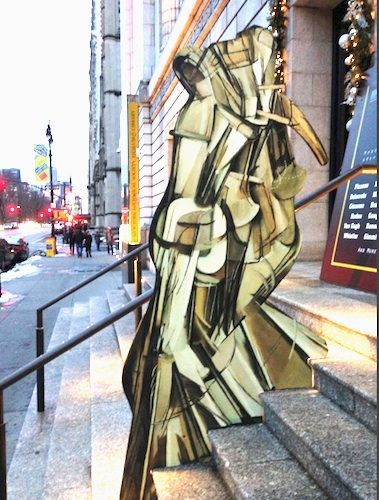
Mr. Duchamp’s 100 year-old icon exits NYHS on Central Park West after seeing the show.

Mr. Duchamp’s 100 year-old icon exits NYHS on Central Park West after seeing the show.

Challenging, ground-breaking art from all over the world under one roof, fashionable crowds, and buyers looking for the next big thing. On March 6, the 2014 edition of The Armory Show opens at the Hudson Piers 92 and 94; but for art-history lovers, there’s just a few days more to travel back in time to experience the 1913 edition that inspired it all at the New-York Historical Society’s show, The Armory Show at 100: Modern Art and Revolution, closing February 23. Check out the spectacular online exhibition site.

NYHS has gathered together 100 of the great art works that rocked Manhattan 100 years ago downtown at the 69th Regiment Armory on Lexington and 26th Street, where the Fighting Irish rented out their parade hall for a month to the newly formed Association of American Painters and Sculptors to show 1,400 works representing the latest trends in modernism.

One of the many postcards sold at the 1913 show’s merchandise table. Source: Smithsonian Archives of American Art

One of the many postcards sold at the 1913 show’s merchandise table. Source: Smithsonian Archives of American Art

Picasso, Cezanne, Matisse, Gauguin, and Munch were there in all their shocking glory – the first time many of these Europeans had been shown stateside. Take a look on the NYHS site and see what chaos ensued in the popular press. Even T. Roosevelt himself wrote an editorial about it.

NYHS not only shows us the work, but puts it all in the context of the times – the bohemian life in Greenwich Village, upstart galleries with an interest in the primitive and new, dissatisfaction with the confines of taste at the National Academy, and New York tastemakers yearning to make their mark on a world stage.

In the little low-light gallery next to the library, you’ll find all sorts of interesting ephemera – letters by the organizers of the show, registration cards with the insurance value of now-famous works, postcards for sale at the show, and a scrapbook of satirical telegrams read by the organizers at their celebratory dinner. This is where you can marvel at Gauguins selling for $8,100, Redon for $810, an oil by Braque for $200, a plaster Brancusi for $200, and Cezanne lithographs for $20 to $40. No wonder Stieglitz amassed such a great collection at these prices!

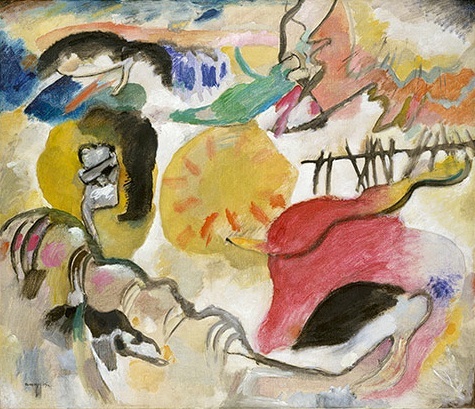
He had to have it. Stieglitz bought Kandinsky’s 1912 The Garden of Love (Improvisation Number 27) as soon as he saw it. Source: Metropolitan Museum/ © 2011 Artists Rights Society (ARS), NY / ADAGP, Paris

Stieglitz bought Kandinsky’s 1912 The Garden of Love (Improvisation Number 27) as soon as he saw it. Source: Metropolitan Museum/ © 2011 Artists Rights Society (ARS), NY / ADAGP, Paris

It’s interesting that the show would not have been such an affordable-art extravaganza without mega-dealer Vollard riding to the rescue, shipping crates of color lithographs and drawings to New York from Paris a scant three weeks before the show. Kuhn and his co-organizers devoted three galleries to works on paper. Works by Gaugin, Cezanne, Lautrec, and Munch flew off the walls, and when the show closed in New York, half of all the works sold had been supplied by Vollard.

Check out the price list and who-bought-what online. You can also probe the Smithsonian’s archive of Armory Show-related materials here.

The International Exhibition of Modern Art (a.k.a. Armory Show) installed in the 69th Regiment Armory at 25th & Lexington. Source: Smithsonian Archives of American Art, Kuhn family papers.

The International Exhibition of Modern Art (a.k.a. Armory Show) installed in the 69th Regiment Armory at 25th & Lexington. Source: Smithsonian Archives of American Art, Kuhn family papers.

The NYHS show is organized according to the original layout, including the grouping of Cubists with Mr. Duchamp’s iconic Nude Descending a Staircase, and the Fauve-Brancusi area – otherwise known in New York critic circles as the “Chamber of Horrors.” Looking at Matisse’s Blue Nude today, it’s hard to imagine that Art Institute of Chicago students found Matisse so shocking that they held a mock trial for him and burned it in effigy when the show arrived in the Windy City in April 1913.

And speaking of Chicago, the Armory Show was a huge success there – attracting over 180,000 art lovers, nearly double the attendance in New York. See the Art Institute’s gorgeous web site of exactly how everything looked in its grand galleries on Michigan Avenue. Everything really got the royal treatment. In turn, AIC can say it was the first museum in North America to show Picasso, Matisse, Duchamp, and Brancusi. No second-city status there.

Kuhn kept Picasso’s 1912 list of which artists should be shown. Source: Smithsonian Archives of American Art, Kuhn family papers.

Kuhn kept Picasso’s 1912 list of which artists should be shown. Source: Smithsonian Archives of American Art, Kuhn family papers.

Buy your ticket to this Armory Show before you buy one for the next one and feel what it’s like to walk through a turning point in American art history.

Top of the Pop 80s Style at NY Historical

Keith’s “Into 84” exhibition poster inspired by choeographer Bill T. Jones (1983). Photo: Tseng Kwong Chi. © Muna Tseng Dance Projects, Inc.; Keith Haring artwork © Keith Haring Foundation

Keith’s “Into 84” exhibition poster inspired by choeographer Bill T. Jones (1983). Photo: Tseng Kwong Chi. © Muna Tseng Dance Projects, Inc.; Keith Haring artwork © Keith Haring Foundation

When you stand in line to get your tickets for The Armory Show at 100 at the New-York Historical Society, look up and you’ll see a piece of history from the era of Madonna and Danceteria right above you – the entire beautiful, embellished ceiling of one of the must-see stops during the raging Eighties club culture in NYC, Keith Haring’s Pop Shop as part of the special installation Keith Haring All-Over.

Although the Pop Shop closed its doors on Lafayette Street in 2005, it achieved worldwide pop-culture recognition for being the most iconic sites where art, music, dance, graffiti, celebrity, and the street mixed. Haring, whose Radiant Baby and other works ubiquitously plastered subway station walls in the 80s, decided to put Warhol’s commerce-as-art philosophy into practice. He created an art-filled shop downtown where the international art collectors, celebrities, club kids, and graffiti artists would feel comfortable.

Installation view of the Pop Shop ceiling over the cash registers at NYHS, right behind a video wall of Oertel’s Pulling Down the Statue of King George III. Courtesy: NYHS/John Wallen

Installation view of the Pop Shop ceiling over the cash registers at NYHS, right behind a video wall of Oertel’s Pulling Down the Statue of King George III. Courtesy: NYHS/John Wallen

The walls were covered in Haring’s instantly recognizable doodle-cartoon figures and stuff to buy, so when the Haring Foundation gave the ceiling to NYHS, it did so with the stipulation that it be hung somewhere where money is exchanged.  So, right inside the door in the same beautiful entrance hosting the treasures of Revolutionary New York, is the ceiling from a place where music blared, fun was had, all-night parties raged, and Downtown 80s life was celebrated.

Take the elevator to the Luce Center to see the rest of the show, which is on loan to NYHS by the Haring Foundation, which Keith established just before he succumbed to AIDS in 1990. Go to Keith’s website to see him in action in the subway, galleries, and performance and click through images of his amazing body of work in digital form by decade. It’s all here.

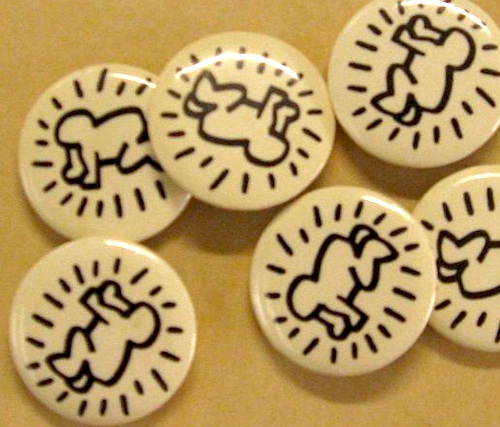
Keith’s “Radiant Baby” buttons in the NYHS collection, gifted by Roy Eddey.

Keith’s “Radiant Baby” buttons in the NYHS collection, gifted by Roy Eddey.

But back upstairs at NYHS, you’ll see Keith’s 1985 repeated-pattern design for a fabric run right above two NYC mile markers from the 1800s, a Haring-painted black-and-pink leather jacket (done with graffiti artist LAII), and Jeremy Scott’s Haring-inspired sneakers for Adidas. The NYHS is also screening some vintage video in the little 80s space, right next to the classical busts of New York’s 19th century high and mighty. Hang out to see Madonna’s 1984 performance of Dress You Up for the Keith’s Party of Life and the 1986 Grace Jones video I’m Not Perfect (But I’m Perfect For You), which Keith co-directed.

The show is tiny, but it’s a great little secret spot to time travel back to the Eighties. For more Keith, visit the Fales Library at NYU for Keith Haring: Languages through February 28 and NYPL’s Why We Fight: Remembering AIDS Activism through April 6. The NYHS installation is an open run.

Hey, and don’t forget to shop in the online Pop Shop, where revenue from (RED) items goes to combatting AIDS.

Must-See Skytop Panorama of NYC Past & Present at The Whitney

The installation view of T. J. Wilcox: In the Air, 2013. Photo: Bill Orcutt

The installation view of T. J. Wilcox: In the Air, 2013. Photo: Bill Orcutt

If you want to enjoy a beautiful view of Manhattan from the roof, don’t worry about the snow, rain, or cold weather. Go over to the Whitney Museum before February 9 and take in the film installation T.J. Wilcox, In the Air, that features a beautiful panorama (from the roof of Wilcox’s Union Square studio) that dreamily introduces six stories about the past and present of life, art, energy, fame, events, and cosmic forces that ebb and flow continuously below.

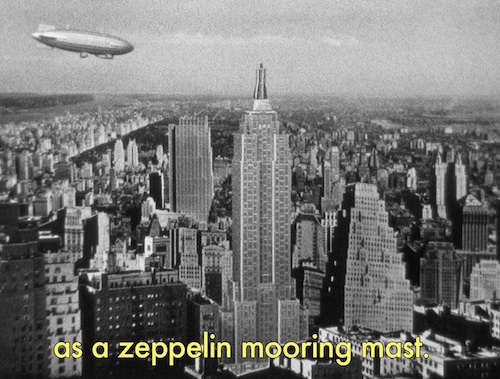
The big, in-the-round screen circles around you (duck and just walk into it), so you can really take in the view, all the way from the Battery to beyond the Empire State Building.

Still from T.J. Wilcox’s panoramic 2013 silent film installation, In the Air. Image courtesy of the artist and Metro Pictures.

Still from T.J. Wilcox’s panoramic 2013 silent film installation, In the Air. Image courtesy of the artist and Metro Pictures.

The film cycles from dawn to dusk, but along the way, Mr. Wilcox takes you on little journeys as you enjoy his movie panorama. The experience is one where you begin to see New York through his eyes, past and present together.

After a few minutes, one of his panorama screens fades you see a short, reflective, poetic, subtitled NYC story-movie. It’s a quiet experience — bringing you back to the Thirties when the Empire State Building was contemplated to be used as a zeppelin-docking station, to the present when 14th Street is one of the best vantage points to contemplate the out-of-this-world spectacle of Manhattanhenge, and the days of glitter, glamour, and grit of Warhol, Gloria Vanderbilt, and fashion-industry icon, Antonio Lopez.

Watching Wilcox’s Gloria Vanderbilt vignette from outside the installation. Photo: Bill Orcutt.

Watching Wilcox’s Gloria Vanderbilt vignette from outside the installation. Photo: Bill Orcutt.

He reminds you that Gertrude Whitney, the museum’s founder, long ago succeeded in a custody battle to care for little Gloria. The film takes you to her apartment and reflects on the fact that Gloria was “in the public eye from birth” and celebrates her vibrant artistic, business, and family accomplishments (re: plenty of shots of Anderson Cooper). Another mini-film focuses upon a nano-second in Warhol’s life, when his Factory crew unfurled Mylar balloons to welcome the arrival of the pope-mobile to New York City in 1965.

Weegee’s Variant of Untitled (Striking Beauty) is hung in an adjacent gallery. Courtesy: Whitney Museum

Weegee’s Variant of Untitled (Striking Beauty) is hung in an adjacent gallery. Courtesy: Whitney Museum

In his musing on the film about fashion-illustrator extraordinaire, Antonio, Wilcox reveals his surprise that Antonio’s studio was located right next to his own building, takes pleasure in asking us to gaze out over the community where so much magnificent art was made, careers enlivened, and life lived.

In a tiny back-room gallery, the Whitney has installed a few other reflections on skies over the City – Weegee’s lightening strike behind the Empire State Building and Yoko’s Sky TV, are two – but the big “wow” here is Mr. Wilcox’s ability to take us on a 35-minute journey in and among the streets and skyline that from his quiet, contemplative perch.

It’s quite a collage of memory, reflection, mythologies, politics, history, and beauty. Click here to see the Whitney’s slide show of the storyboards in Wilcox’s studio, and listen to him talk about it this beautiful work in this YouTube video:

Wool Smart Art Covers Guggenheim

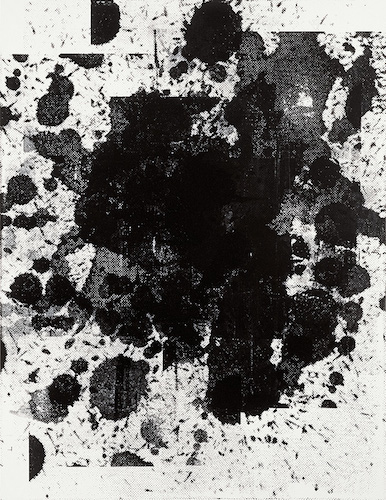
Wool’s untitled 2000 work, silkscreen on linen on the top-floor gallery. © Christopher Wool

Wool’s gigantic 2000 silkscreen installed on the top-floor gallery, a cool, hands-off approach to large-scale work. © Christopher Wool

The Saturday night art crowd packing the free Guggenheim night for the last weekend of the Christopher Wool retrospective was drinking in the cool, edgy dissonance of this savvy, art-world action artist. Check it out in person before January 22, or download the new free Guggenheim app and take the tour on your iPhone.

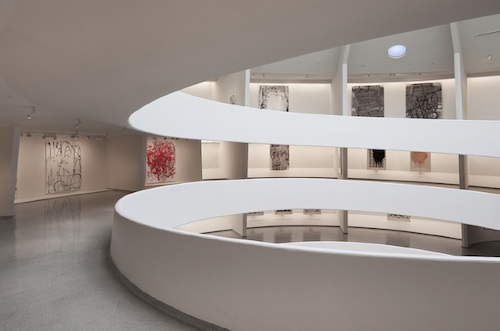
Gazing down from the third or fourth floor, the smooth rungs of Mr. Lloyd-Wright’s spirals punctuate tiers of Mr. Wool’s own spirals, splatters, wipe-outs, word art, and grids of gritty photos. The massive crowd of locals, tourists, and moms with tweens provided a lively audience for work originally germinated in the rough-and-ready Lower East Side during the days when NYC was not-so-nice.

Just up the ramp in the two-story mini-gallery, the curators hung pieces that sum up Wool’s lifetime achievements – large-scale enamels on aluminum using gigantic, ironic gestures and banal advertising-art flowers; channeling the down-and-out feel to 80s New York with cool word-and-letter art evoking graffiti; and appropriating phrases from revolutionary texts that seem to be about one thing but are actually heady philosophical and literary references that only super-smart people would “get.” The work is stunning.

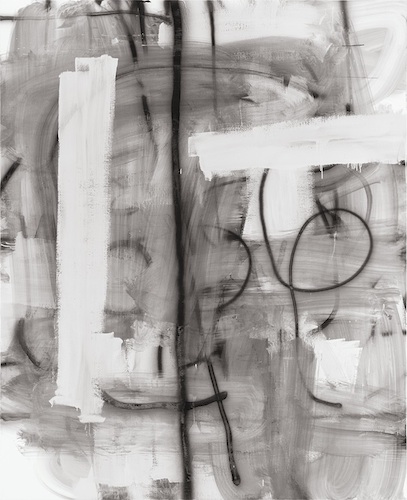
Wool’s 2010 untitled enamel on linen uses erasures, spray, and wipeouts. © Christopher Wool

Wool’s 2010 untitled enamel on linen uses erasures and spray. © Christopher Wool

Then a slightly more chronological journey begins through the rest of the museum. Wool began appropriating rollers used by painters to paint tenement walls and halls to apply decorative patterns methodically across his own giant canvases – taking a bit of the decision making out of the act of painting. At the time, it was an in-you-face comment directed toward more lyrical, or expressive gestural painters. Of course, he would screw up the pattern just a little to add a little extra dig at the current scene. Oh, yes, he mostly kept the color palette to black and white. Smack!

By 1987, he injected letters, words, and texts onto the white canvases and began collaborating with other artists in the “no wave” Downtown scene, which was rife with 8mm filmmakers, performance artists, and musicians reacting against the more commercial artists emanating from CBGB or other clubs. He collaborated making books, always an ephemeral, revolutionary choice.

Hydrant photo that resembles the above work, from East Broadway Breakdown, one of 160 inkjet prints, 1994–95/2002. © Christopher Wool

Hydrant photo with spilled water whose shape resembles the silkscreen above. Photo from East Broadway Breakdown, one of 160 inkjet prints, 1994–95/2002. © Christopher Wool

In the 1990s, the street was used as a start point for both his own photo books, which were shots of lonely urban areas that he photocopied over and over to obtain the I-don’t-care-about-glossy-quality look of the published work. When accessing the iPhone audio track in front of the 1990s photo piece, East Broadway Breakdown, Mr. Wool and the curators pretty much knock your socks off by blasting the superb Nation Time by Joe McPhee right through the earbuds. Thanks to them, you can hear the masterwork music that inspired Wool at the time, jolting you back the mean streets of Chinatown and East Broadway that sparked so much creative juice.

Installation view of Wool’s provocative all-word 1989 Black Book Drawings. Photo: David Heald.

Installation view of Wool’s provocative all-word 1989 Black Book Drawings. Photo: David Heald.

The top rungs of the show are gorgeous, even though that was probably not the original intent – cool, monumental works that are layered, blotted out, white-washed, and splattered over. If a line is blotted out, do you still see the line? If you do your painting on rice paper, is the end result different than when you do it on a canvas?

When you get to the final gallery way, way up top, Wool has digitized fragments of many of these earlier gestural images and silkscreened them onto the giant pieces of stretched linen. Very, very cool and covered in micro-dots from the silkscreen mesh. Check out the works on the Guggenheim website.

Stunning installation of Christopher Wool’s work in Mr. Wright’s building. Photo: David Heald.

Stunning installation of Christopher Wool’s work in Mr. Wright’s building. Photo: David Heald.

If you don’t know Wool’s work, using the iPhone guide provides a valuable context, showing you the works while you listen to the audio and watch other artists talk about Wool. Access some samples here.

But most of the people we saw on Saturday were standing in awe before the gigantic gestural canvases without the aid of an interpretive guide. Thousands of people were examining the curator notes, and moving forward and back within Mr. Wright’s bays to take it in from all angles…the kind of slow, deliberate, thoughtful face-to-face encounters that Mr. Wool likely treasures from cool admirers.

Brooklyn Museum Shows What Rich Americans Buy to Impress

Cabrera

Miguel Cabrera oil (1760) of Dona Maria de la Luz Padilla y Gomez de Cervantes sporting velvet beauty marks and bling

Conspicuous consumptions is nothing new, according to the Brooklyn Museum’s spectacular show, Behind Closed Doors: Art in the Spanish American Home 1492-1898, and they’ve gathered (mostly from their collection) four centuries of blindingly beautiful stuff to show how earlier generations of status-seekers showed off how special and rich they were. Catch it before January 12.

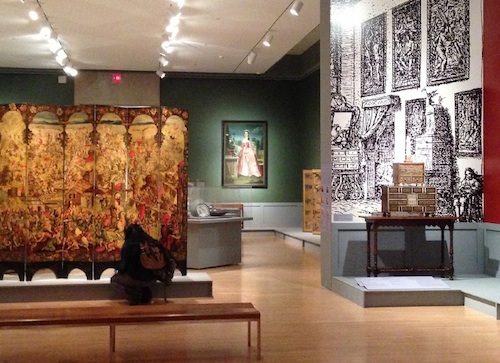
The Fourth-Floor show fills two huge galleries that have been partitioned by the curators into areas corresponding to rooms in a traditional Spanish-American home, where they’ve displayed the stuff that the colonial high and mighty would have put there.  Although two-thirds of the United States was once under Spanish rule, the paintings, furniture, textiles, and other treasures you’ll see are from homes south of the border, including the Caribbean and south of the Isthmus. Check out our Flickr feed.

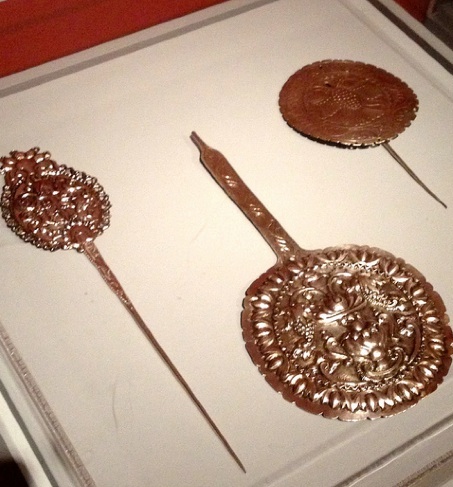
Silver Pins

Giant 18th century silver status pins for women, slightly Incan-style

First, you’d dress to impress and make sure that everyone knew that you were somehow aligned with the upper classes back in Spain. The show puts English and Spanish-American portraits side-by-side in the first gallery to illustrate that the latter weren’t shy about applying ostentatious tiaras and pearls to themselves, slapping on the velvet faux-beauty marks, and shoving royal proclamations into the frame to convey your wealth, status, and privilege. Wealthy English colonials and their portrait painters took a more austere, understated approach.

Second, if you were of mixed race but possibly had some Incan royalty in your blood, you’d hang gold-flecked portrait series of Incan chieftains where everybody could see them in your home. The lady of the house might wrap herself in a locally woven textile sporting mixes of South American deities with that oh-so-familiar-to-Europeans Hapsburg double eagle. Then she’d bling it up with a giant oversize pin made out of solid silver.

Visitor inspects painted screen in exhibit area with the objects from the grand reception room of an upscale home.

Visitor inspects painted screen in exhibit area with the objects from the grand reception room of an upscale home.

Third, you’d emphasize your casual elegance by actually draping the rugs and tapestries all over the floor, stairs, and risers in the ladies’ sitting room.  After gold, silver, and jewels, textiles were about the biggest luxury anyone could find, and Spanish Americans made and bought a lot. In British America, carpets were only used to cover tables, so the casual distribution of so much wealth below your feet was something only Spanish Americans could afford.

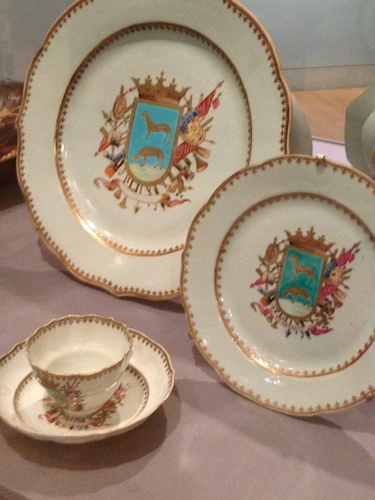
Because the Caribbean and coastal cities of South and Central America were right in the center of shipping and trade routes for centuries, wealthy people could buy pretty much anything they wanted and the curators show it to us – gorgeous Japanese screens, custom-printed Chinese porcelain, English-style sitting chairs, and Turkish rugs. No pennies were pinched in upwardly mobile, Spanish-speaking homes.

Peruvian bed of gilt wood (1700-1760) that would be shown off in a state bedroom.

Peruvian bed of gilt wood (1700-1760) that would be shown off in a state bedroom.

And let’s not forget what treasures were produced right inside the Spanish protectorates – silver shaving basins, polychromed statues of the saints, gigantic gold-framed “statue paintings”, gilded beds, embellished leather traveling trunks (to go to your country home), solid mahogany furniture, and custom-made books of your family’s geneaology. We won’t even get started on the private chapel décor.

This show throws open a window on the first wave of high-status interior design and decoration – a story that is normally confined to the castles in Europe or the palace at Versailles, and one that is perfectly suited to be told by Brooklyn’s extensive Latin American holdings with a couple of key pieces from the sumptuous collections uptown at the Hispanic Society of America.

Chinese import: 1770 porcelain featuring South American animals, purchased by Ignazio Lemez de Cervantes

Chinese import: 1770 porcelain featuring South American animals, purchased by Ignazio Lemez de Cervantes

If you want to do a deep dive into upscale living of past centuries, visit the exhibition archive on the Museum’s website and click on the Objects tab. Or, see it all in person when it goes on the road: it opens at the Albuquerque Museum on February 16, the New Orleans Museum of Art on June 20, and the Ringling Museum in Sarasota on October 17.

And congratulations to Brooklyn for making it onto the cover of the winter edition of Humanties, the NEH magazine.