Gus Baumann’s Legacy of Art and Fun in Santa Fe

Gus Baumann, America’s greatest master of color woodblock prints, never considered himself a fine artist. Nevertheless, his prints, sculptures, paintings, commercial art, furniture, and marionette stages fill four galleries in his grand retrospective at the New Mexico Museum of Art – Gustave Baumann: The Artist’s Environment, on view through February 22, 2026.

Demand for Gus’s intricate block-printed sun-dappled Western landscapes from the 1920s through the 1950s still runs high. So, it’s a treat to learn how Gus achieved such a high degree of technical proficiency early in his career, lived Arts and Crafts philosophy, relished immersion in art colonies, and found his family in Santa Fe.
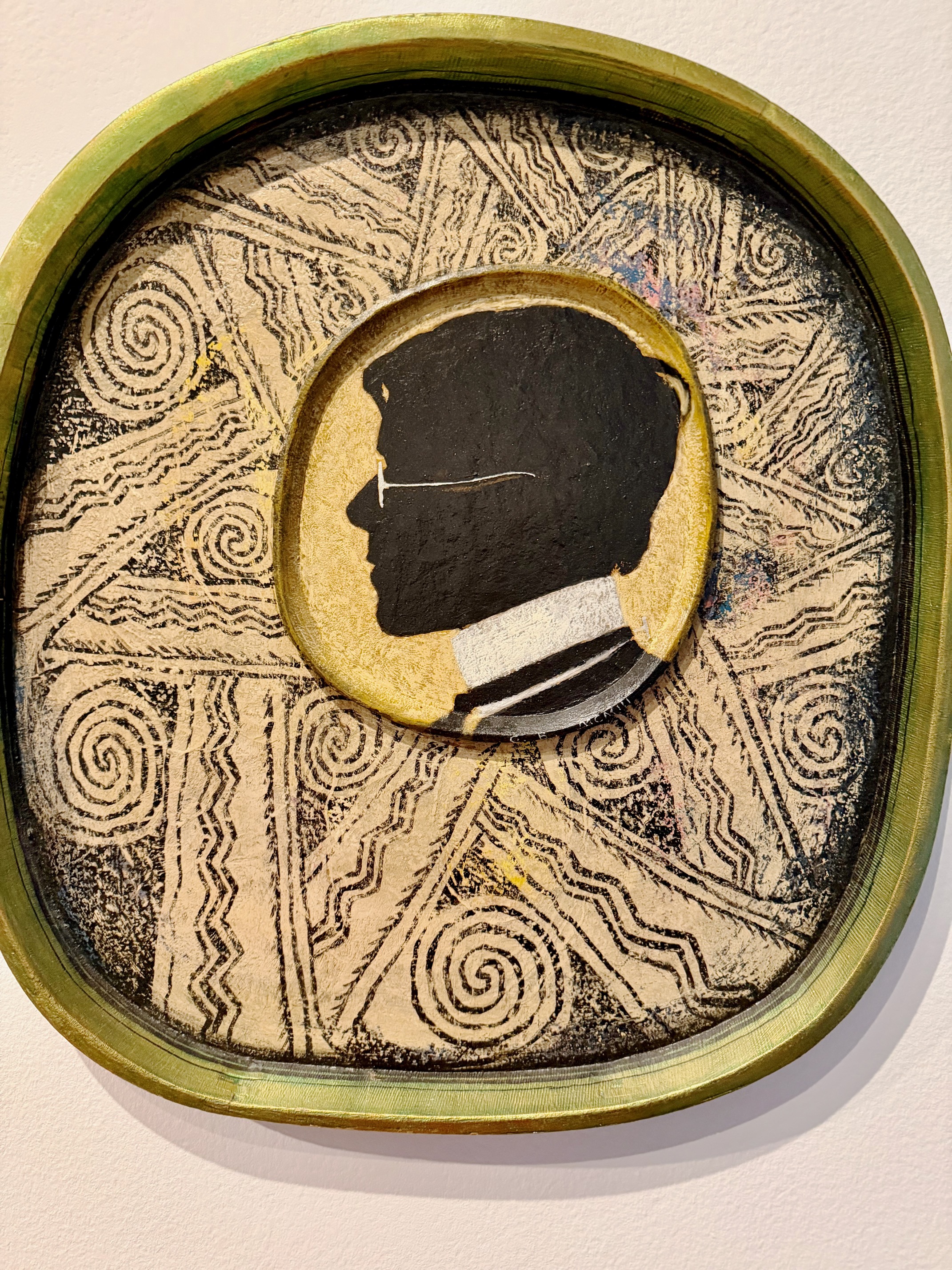
Gus Baumann’s 1903 oil Self-portrait (Silhouette) painted in his Chicago studio; reworked in Santa Fe after 1920 with a border inspired by Mimbres pottery.

See some of our favorites in our Flickr album.

Although Gus was born in Germany in 1881, his family emigrated to Chicago when he was around ten. His father was a craftsman and woodcarver, and it left an impression.  The first themed section of the exhibit – “Finding His Way”– gives a glimpse into his family background, early commercial art work, wood carving expertise, and furniture he designed later in the 1930s.
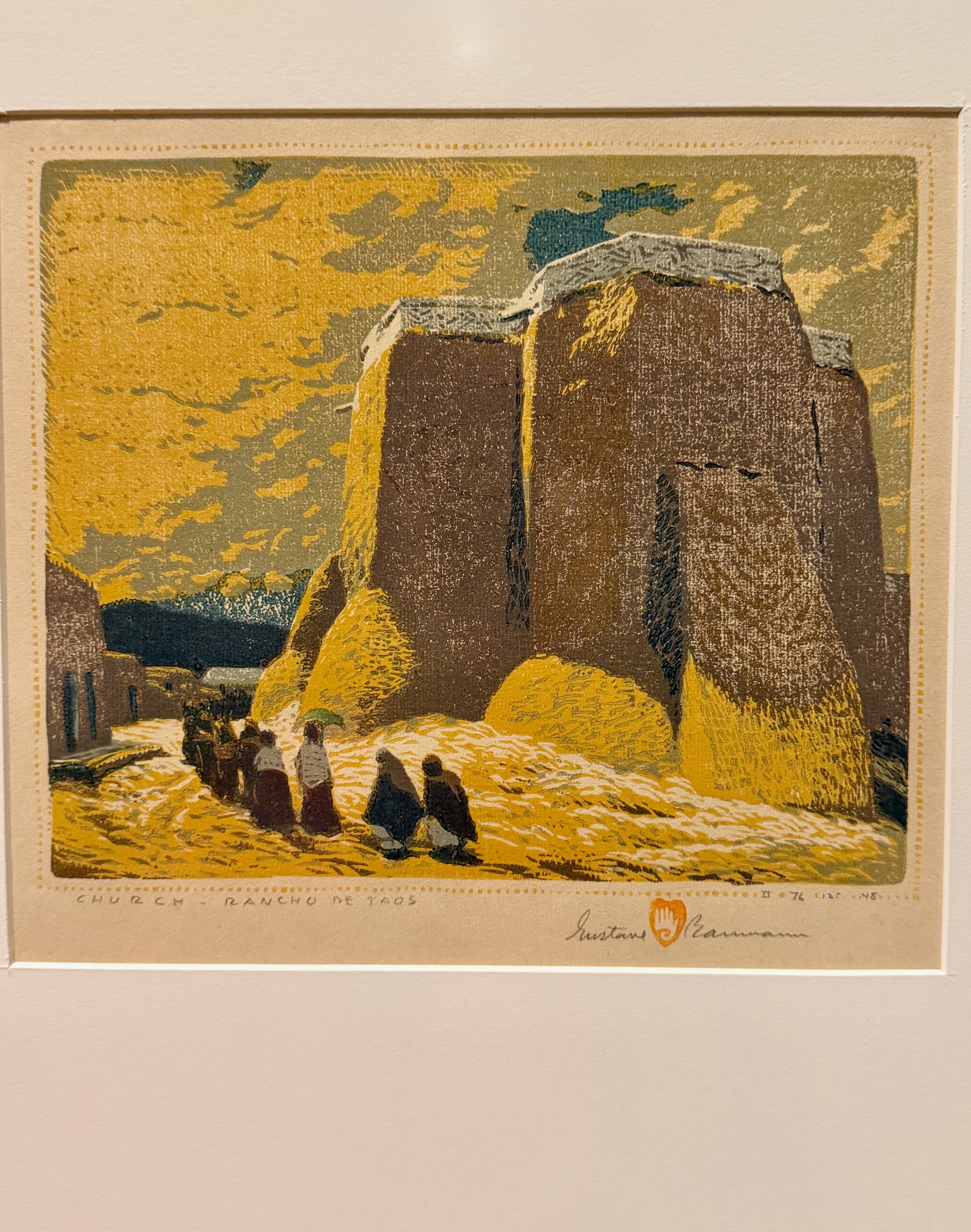
Gus Baumann’s 1919 color woodblock print Church Ranchos de Taos – one of the first modern artists to depict this iconic church; printed in 1948.
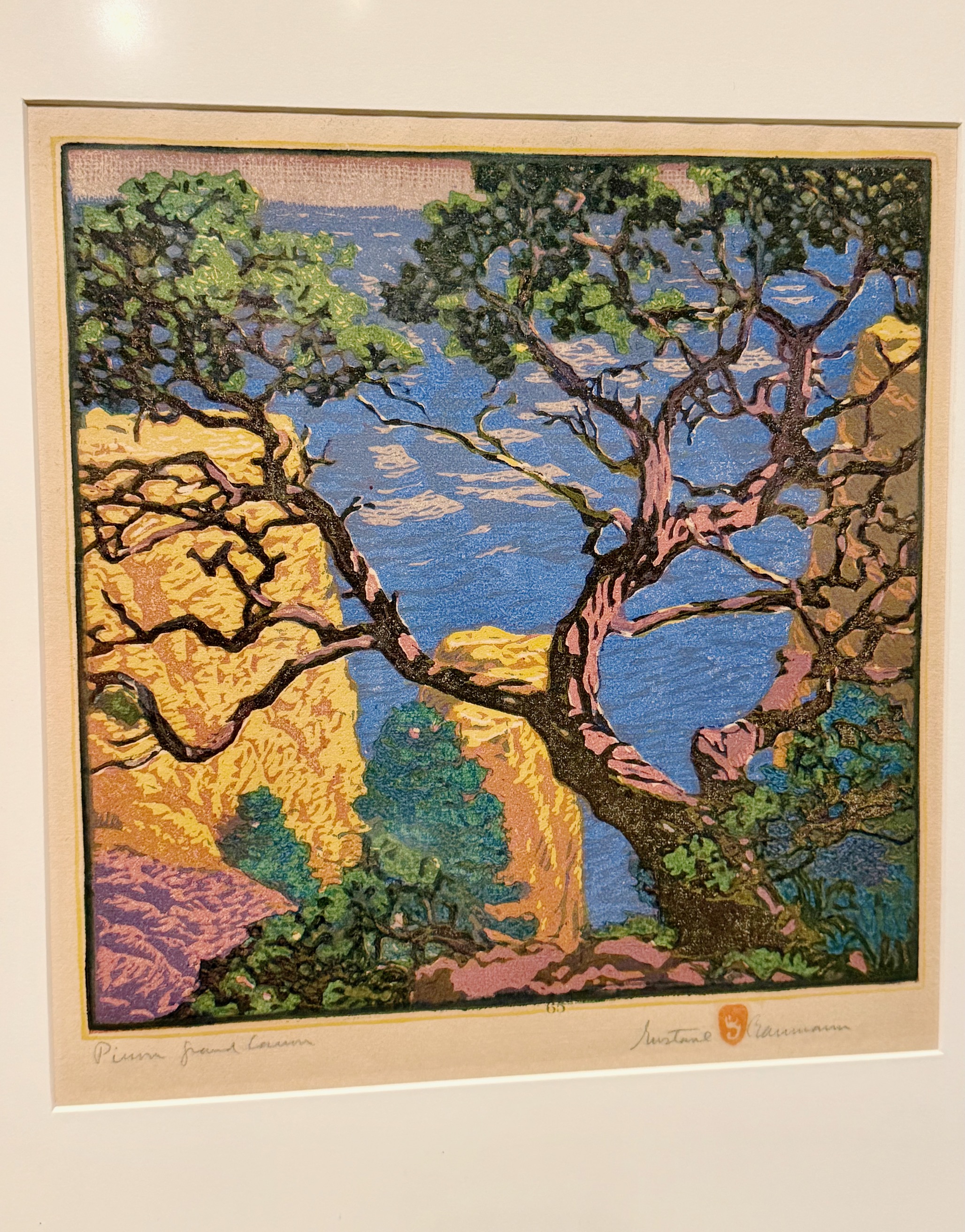
Gus Baumann’s 1921 color woodblock print Piñon Grand Canyon – one of four landscapes created after his first visit.

When he was 17 and his dad left the family, Gus had to find work to help his mom make ends meet.  He worked full time at a Chicago wood-engraving shop that cut illustrations for books, magazines, and newspapers. When he was 20, Gus opened his own wood-engraving studio.

To fine tune his skill, he attended Munich’s Royal Arts and Crafts School for a year to learn from the best German color wood-block print masters – a move that chose traditional skills over academy fine-arts training. When he returned to Chicago, he opened Baumann Graphic Art Service.
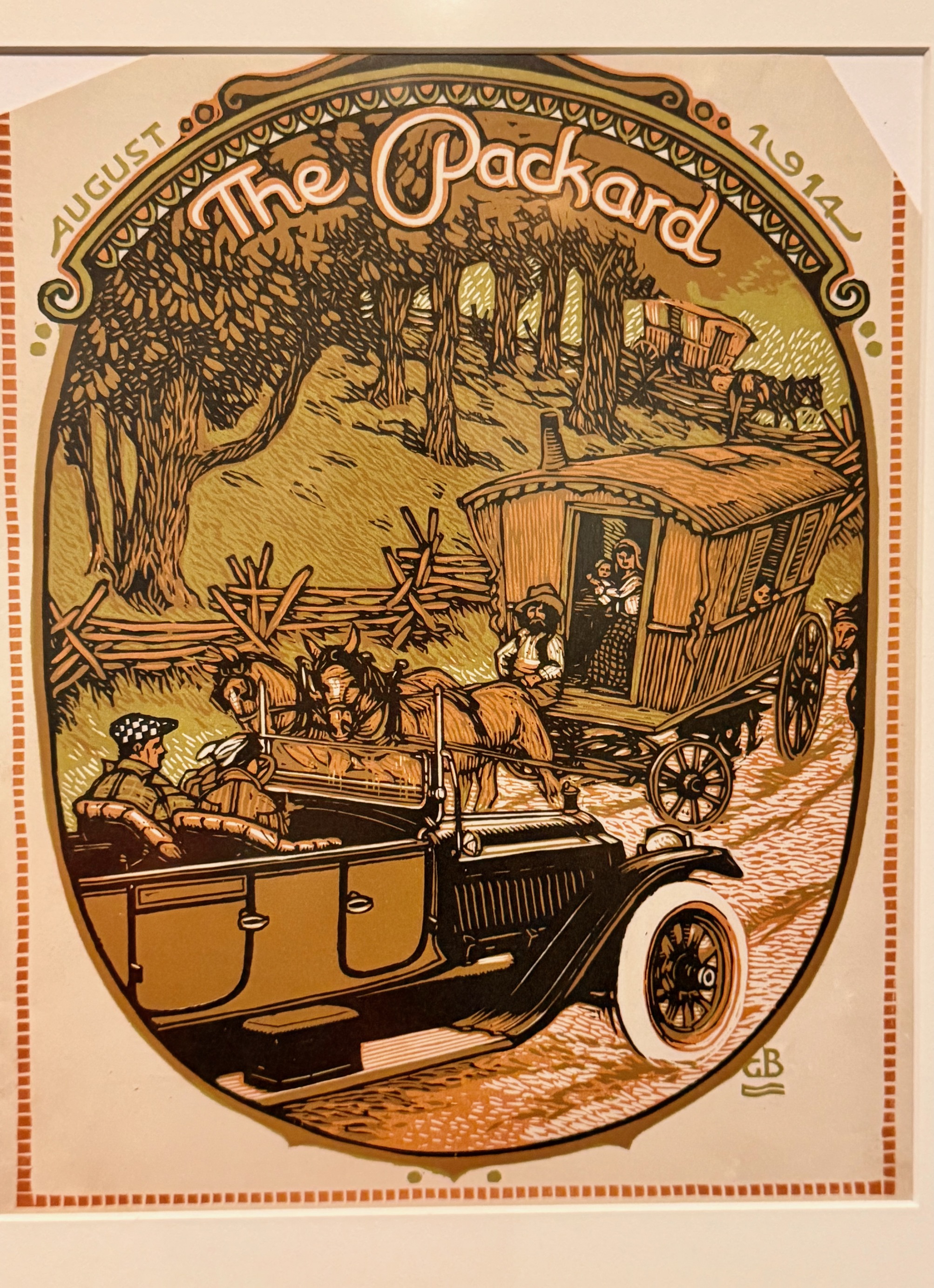
Gus Baumann’s 1913 Illustration for a Calendar: The Packard Car Motor Company, August 1914 – one of four he created for Packard.
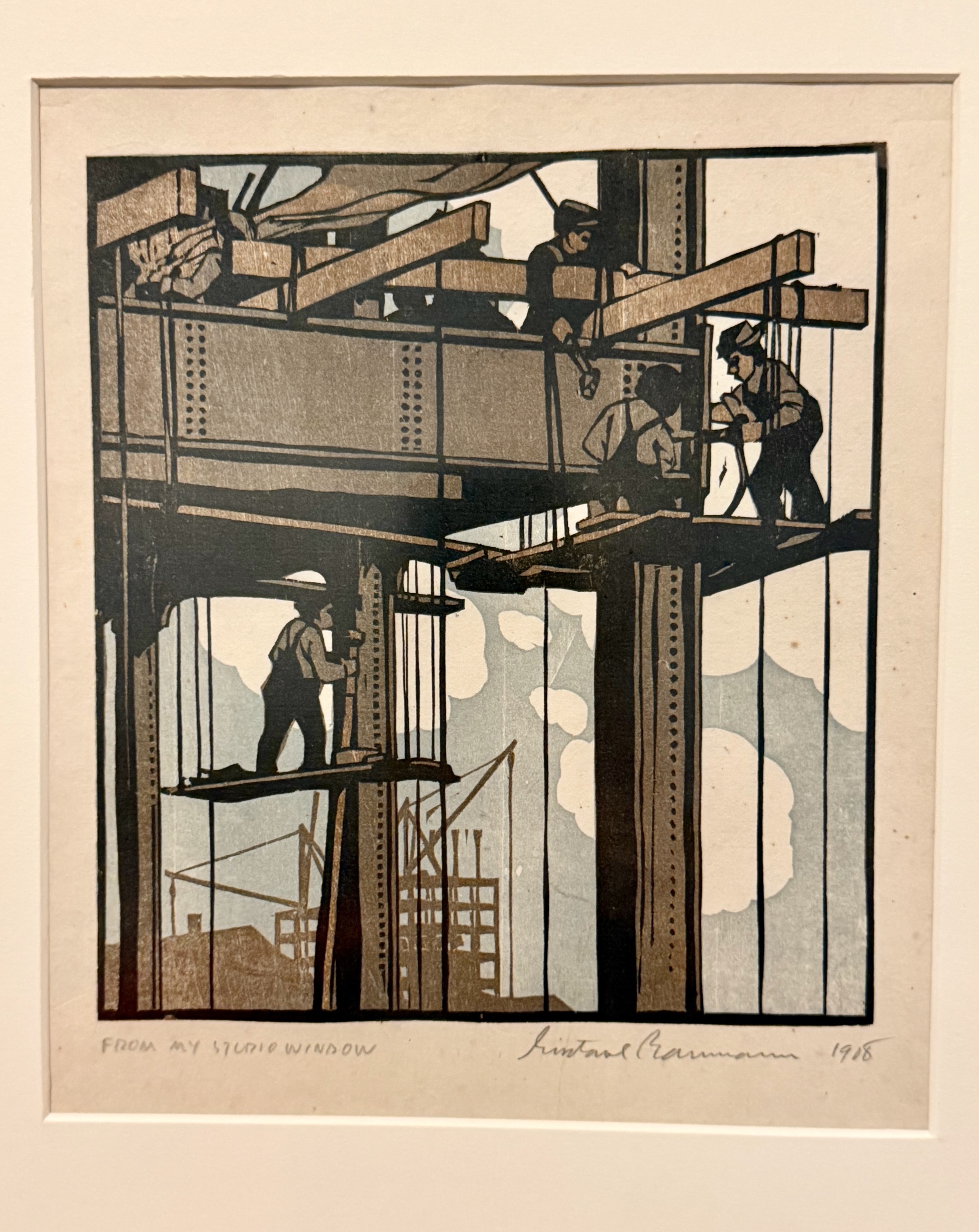
Gus Baumann’s 1908 color woodcut From My Studio Window in downtown Chicago –the high-rise McCormack Building going up on South Michigan Avenue.

Although Gus found success, his love of craft and traditional printmaking methods drew him to an art colony in Nashville, Indiana that revered traditional crafts and a slower pace of life.  The second section of the exhibition – “A Rolling Stone” – highlights work he did in Munich, his acclaimed print series featuring Indiana craftsmen, coastal life in Provincetown, and the electricity he felt in New York.
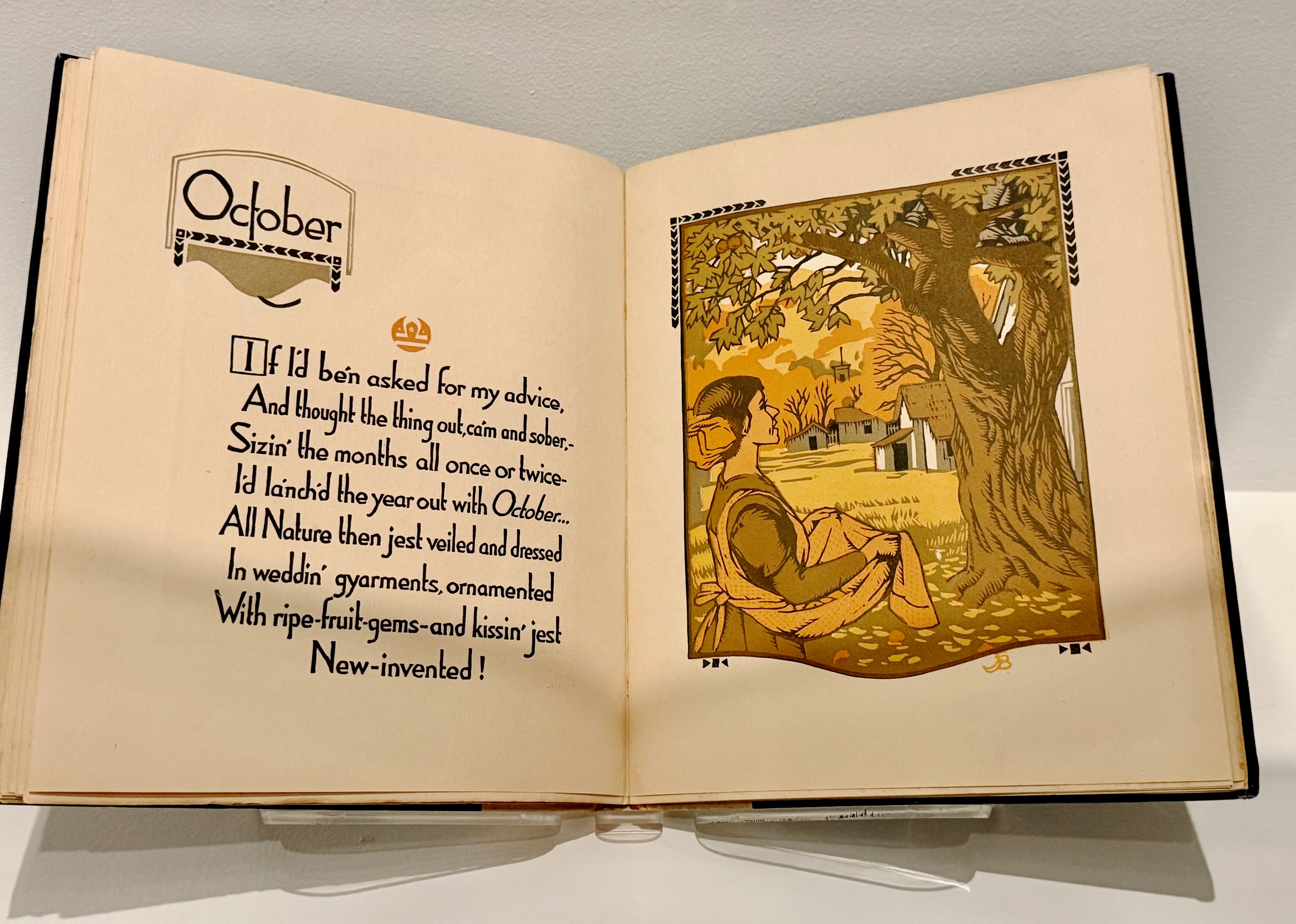
Gus Baumann’s 1912 book All the Year Round – woodcut illustrations and poetry James Whitcomb Riley, featuring scenes of daily rural life for each month of the year.

But his life would change forever when he traveled West and landed in New Mexico in 1918. Due to his reputation as an award-winning printmaker, Santa Fe welcomed him with open arms. Gus was struck by the unique Hispanic and Pueblo ways of life, the beauty of the Southwest, and the growing art colony in Santa Fe. 
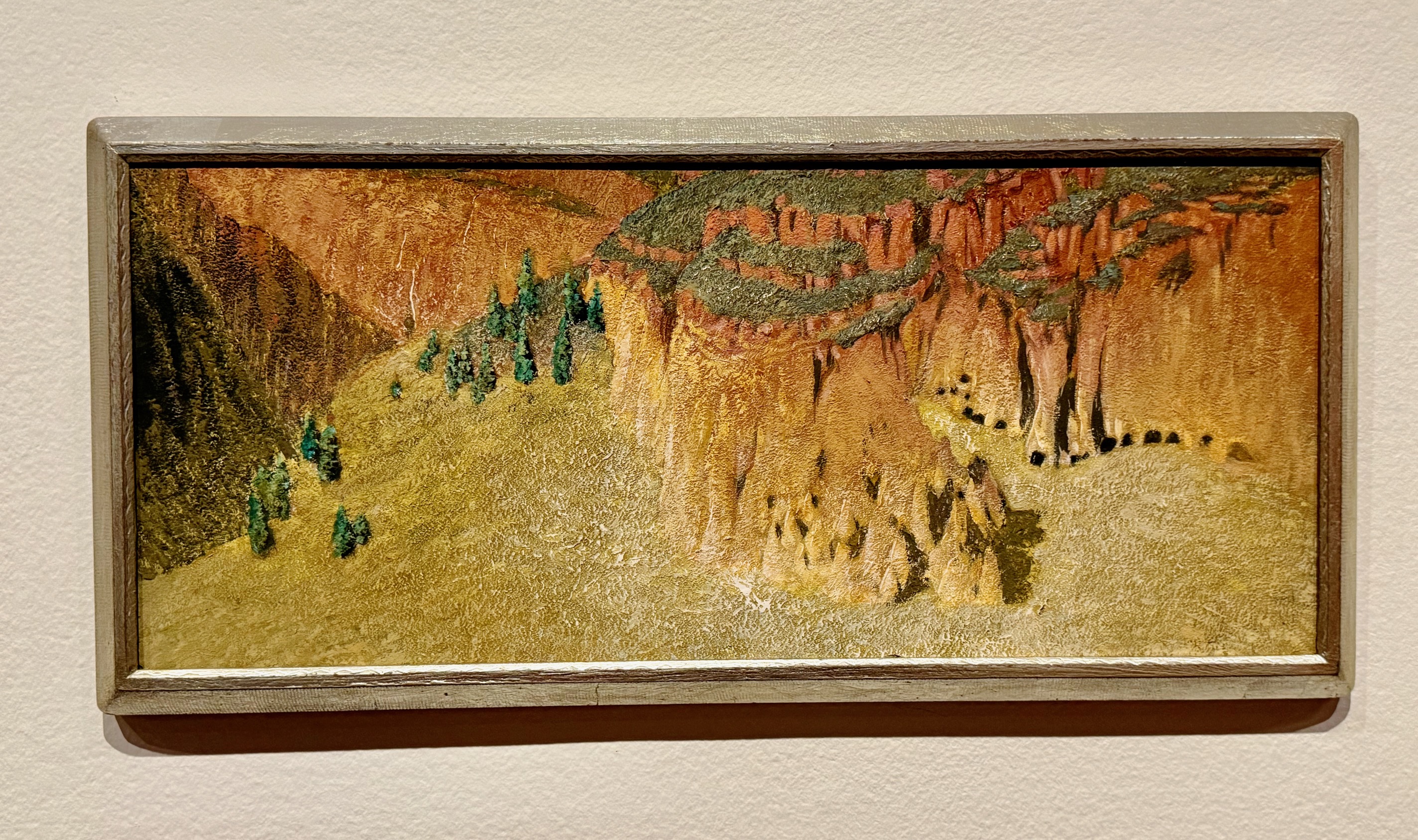
Gus Baumann’s 1925 oil painting Frijoles Canyon – a panorama of ancient tuff dwellings of Tuyoni Pueblo at Bandelier.

Before long, Gus was making and selling gorgeous prints, traveling to archeological sites, attending dances at the pueblos, soaking up the ambience of ancient Spanish churches, and putting brush to canvas, and partying with his new artist friends. And he met Jane, the love of his life, and started a family – creating a life full of fun, art, play, and community service.
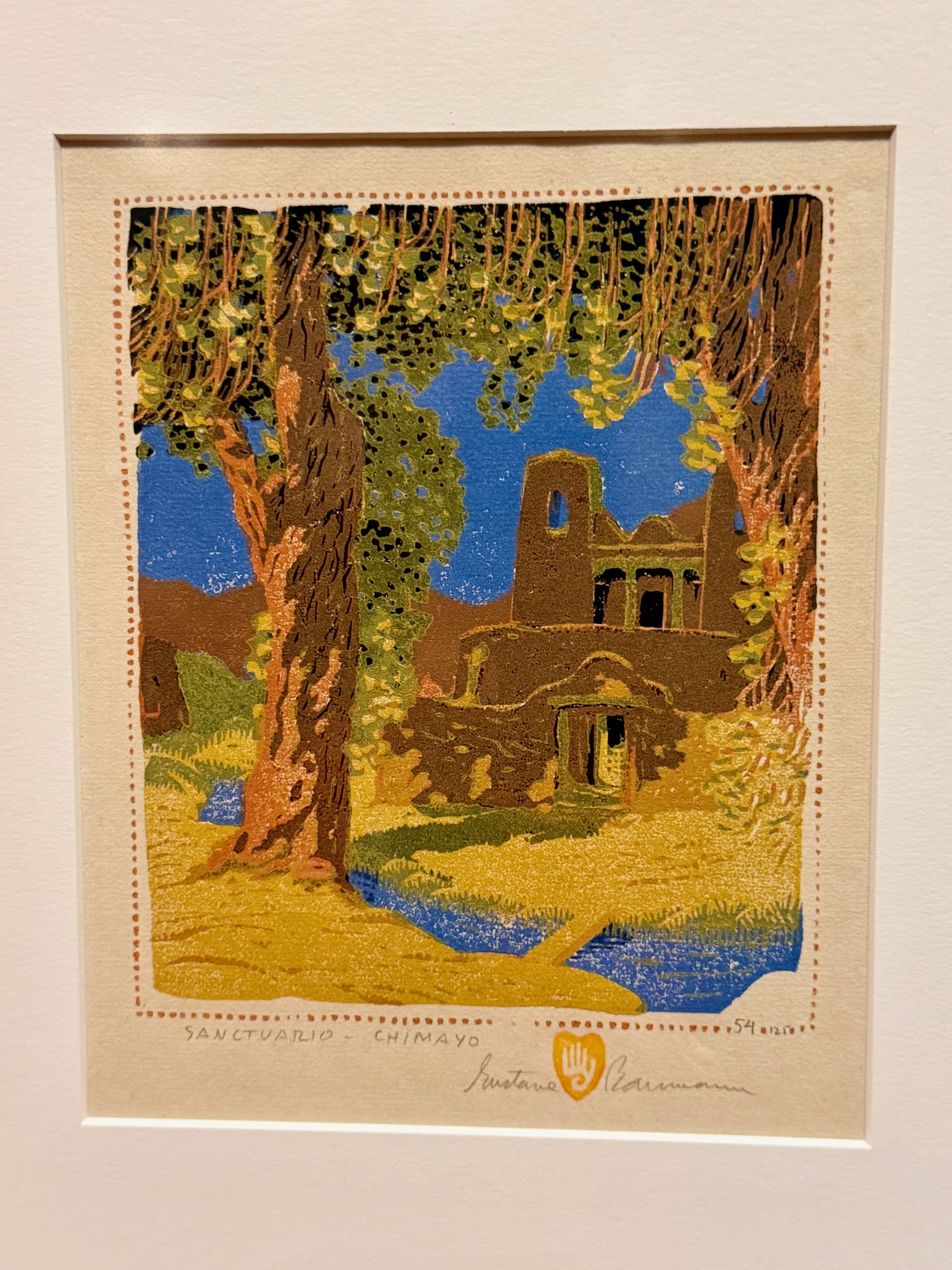
Gus Baumann’s 1924 color woodblock print Sanctuario Chimayo – learning of the historic church’s imminent sale on a sketching trip, he lobbied successfully for its preservation.
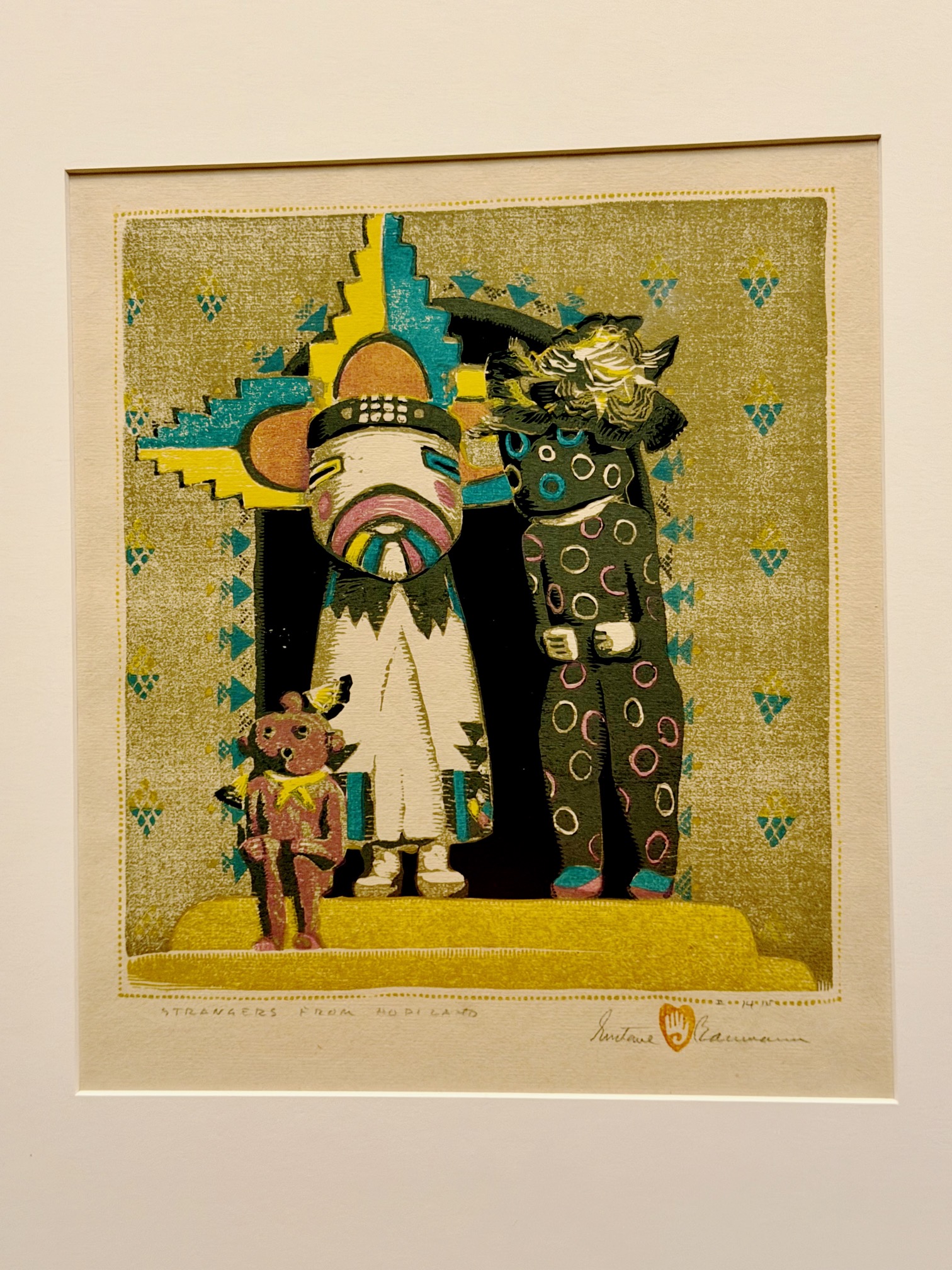
Gus Baumann’s 1921 color woodblock print Strangers from Hopiland, featuring kachinas from his collection; printed in the 1930s.

Since Jane and Ann Baumann donated so much of Gus’s work to the New Mexico Museum of Art, the curators were able to display finished prints alongside drawings and wood blocks that give visitors insight to his process.  One long wall dissects his multi-color printing process for his famed Old Santa Fe – the initial drawing, the separately carved color blocks, single-color proofs, multi-color runs, and the finished six-color print.
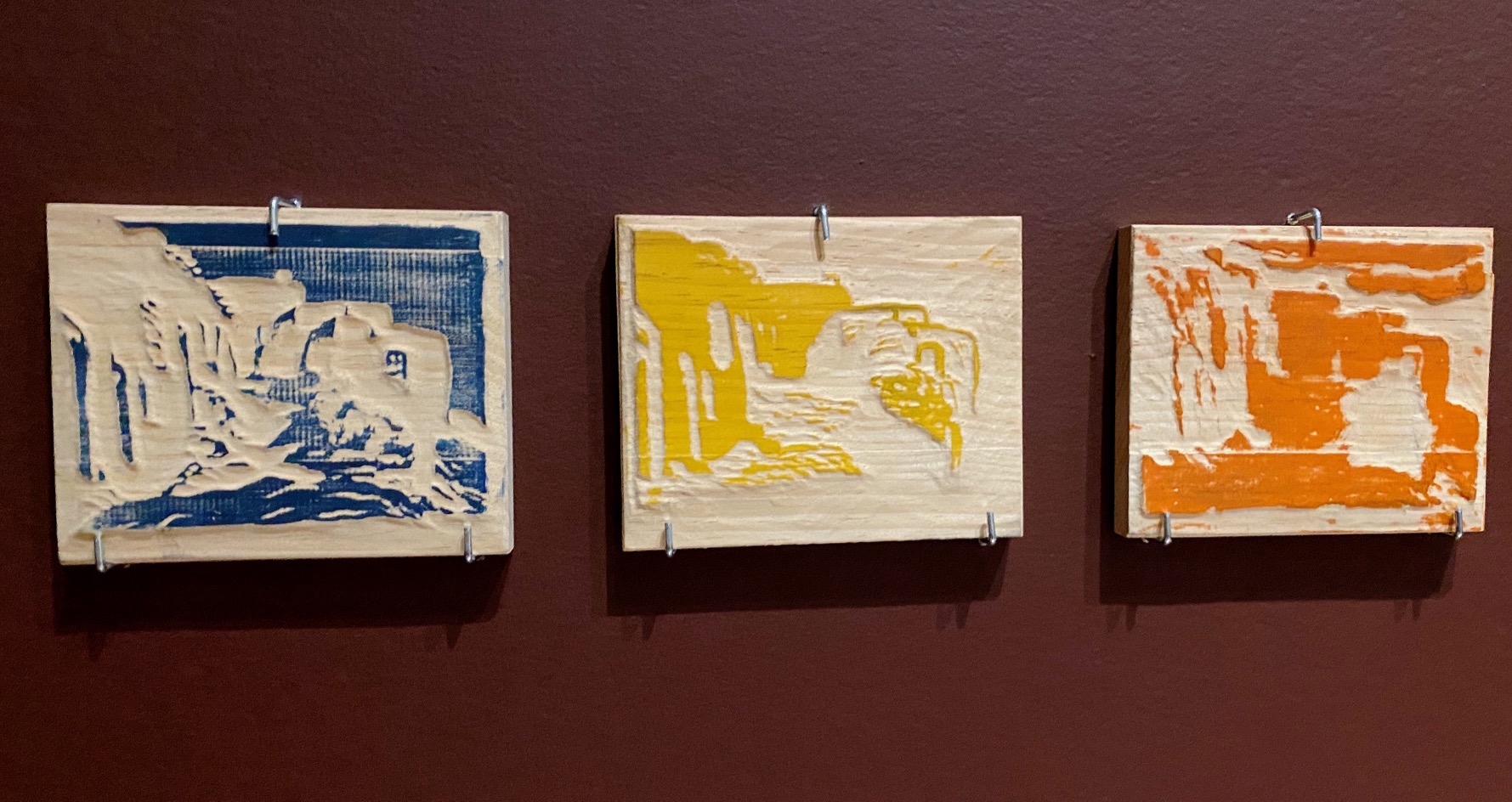
Reproductions of Baumann’s blue, yellow, and orange woodblocks for his 1925 print Old Santa Fe.

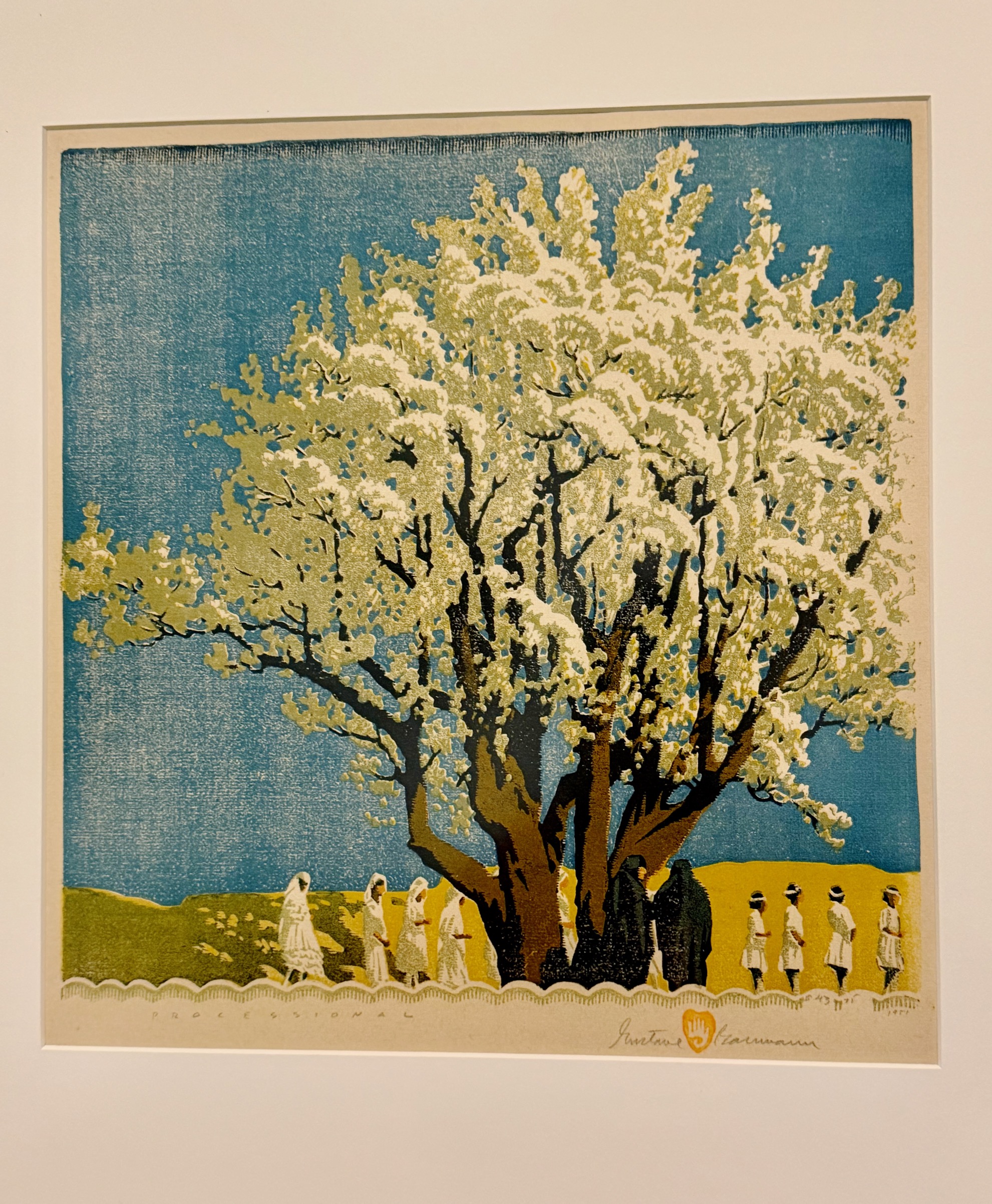
Nearly a half-dozen example of Gus’s watercolor paintings and finished prints are displayed side by side. Visitors are delighted to stand, look, compare, and wonder how he conceptualized steps to carve blocks for each color and achieve images of such depth and vibrancy.
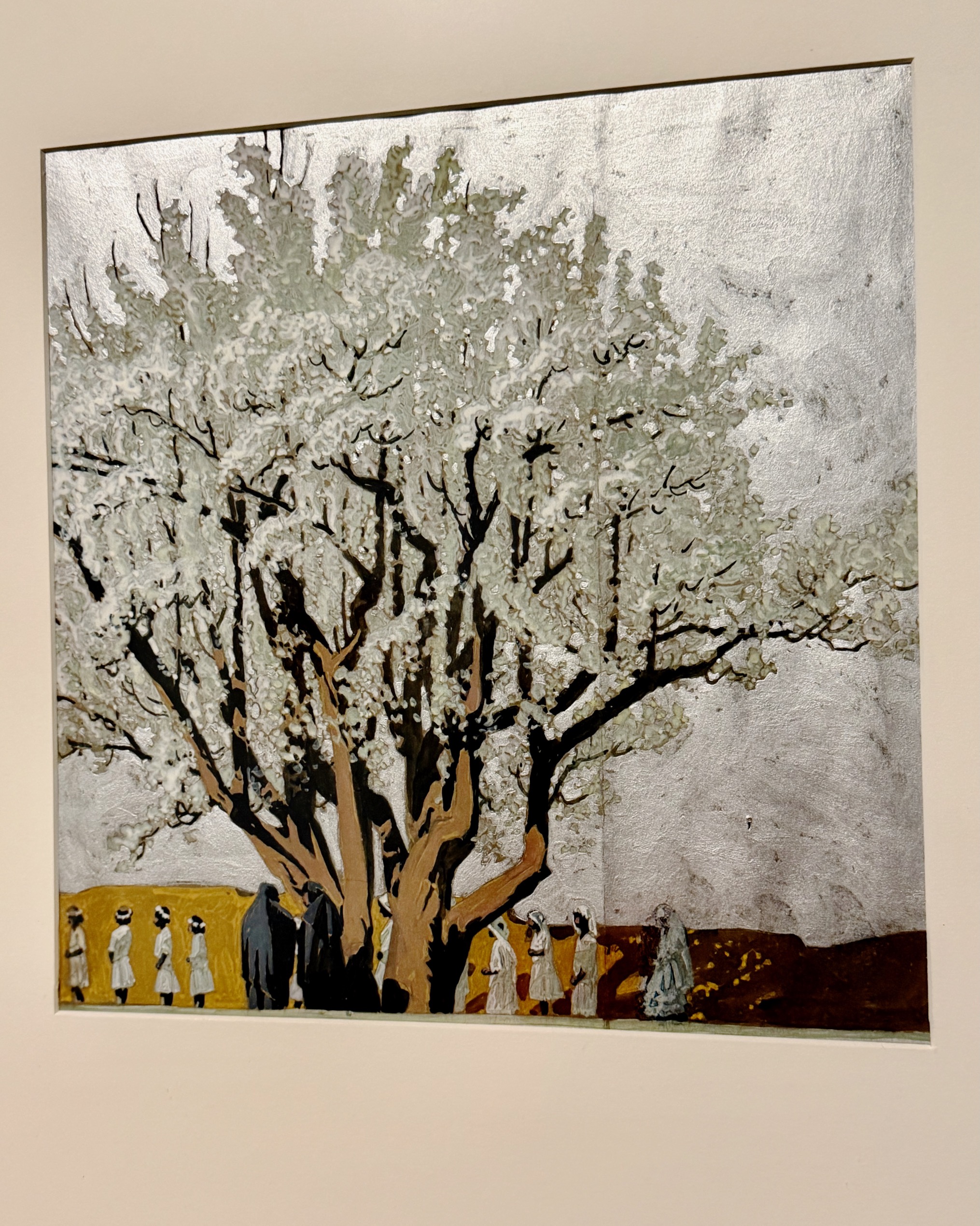
Gus Baumann’s 1930 watercolor Processional (Study), featuring girls walking to their First Holy Communion under a blooming tree and silver sky.
Gus Baumann’s 1930 color woodcut print Processional (printed 1951), based upon his watercolor.

The final gallery “An Artist by Accident” displays an array of intricate color woodcuts, experimental paintings, satirical works, paintings Spanish religious icons, whimisical wood carvings, and everyone’s favorites – Baumann’s marionettes.

It’s the first time Gus and Jane’s marionette casts have been displayed in decades, complete with hand-painted backdrops – scenes representing just a few of the couple’s scripted shows that they performed at home, in venues around Santa Fe, at world fairs, and on tour. 
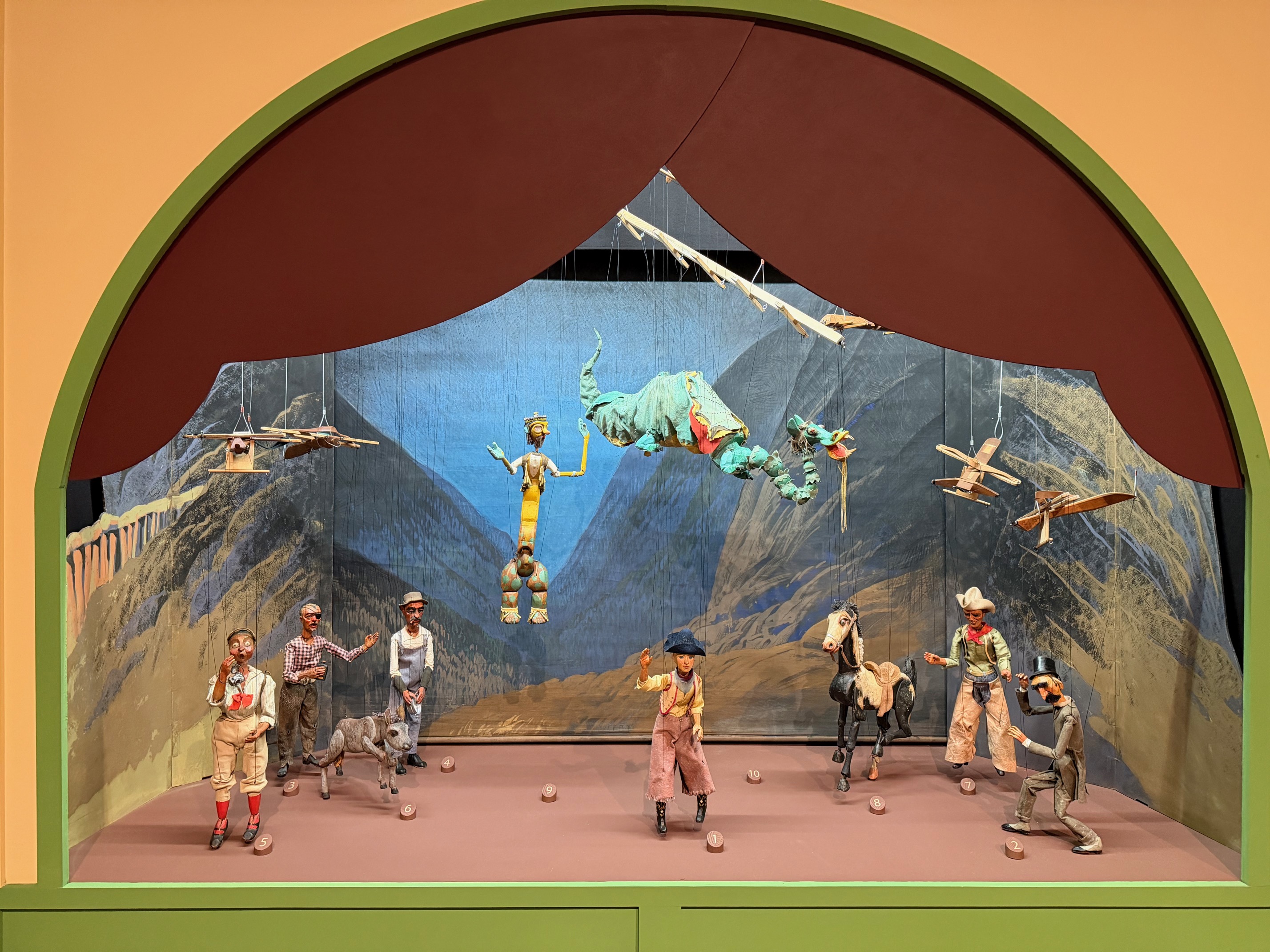
Gus and Jane Baumann’s stage set for the Santa Fe Puppett Wranglers’ 1932 marionette production of the comic melodrama The Golden Dragon Mine –starring The Tourist Lady, Temperence the Miner, Hardpan, Burro, Old Man of the Mountain, the Green Dragon, Nambé Nell, Coco the Horse, Pecos Bill, and Lord Leffinghoop.

Whimsey, delight, innovation, social commentary, and fun are all there, with surprises unfolding around every corner.  And this is all just a fraction of Gus’s creative output from his coming-of-age in the horse-and-buggy era to the Atomic Age.
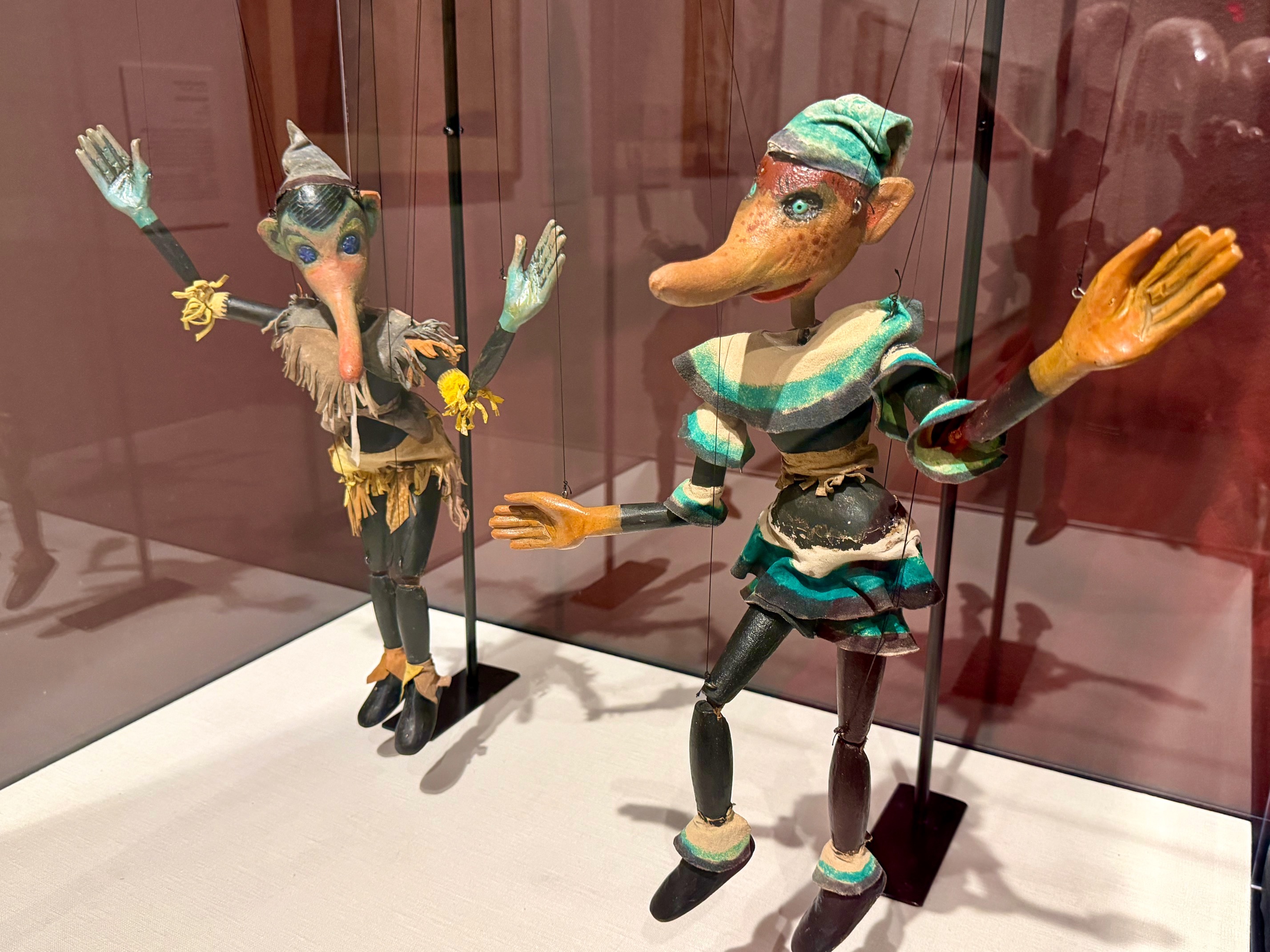
Gus Baumann’s 1940 marionette comedy stars of Teatro Duende – Long Nose (“Nosey”), the Duendi and Freckles the Duende – mischief-making Iberian elves.

No, he didn’t follow the traditional academic path, but he did leave his creative touch on America’s printmaking traditions, the foundation of many Santa Fe cultural and historical institutions, and the care and feeding of a state full of artists as head of New Mexico’s New Deal artist programs.
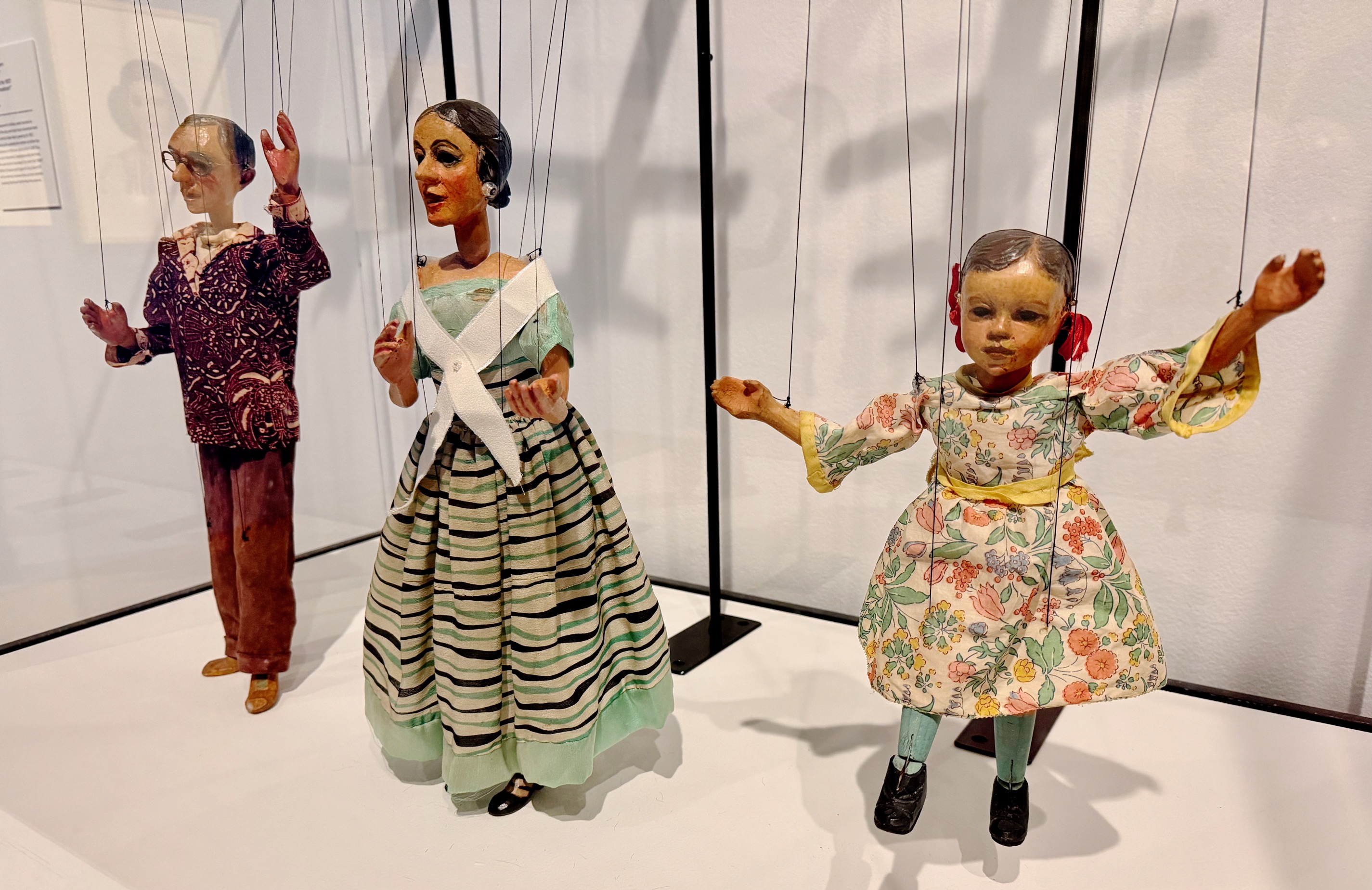
Gus Baumann’s 1932 carved family portrait – marionettes Gus, Jane, and Ann – with costumes by Jane.

Marsden Hartley: A Modernist on the Move

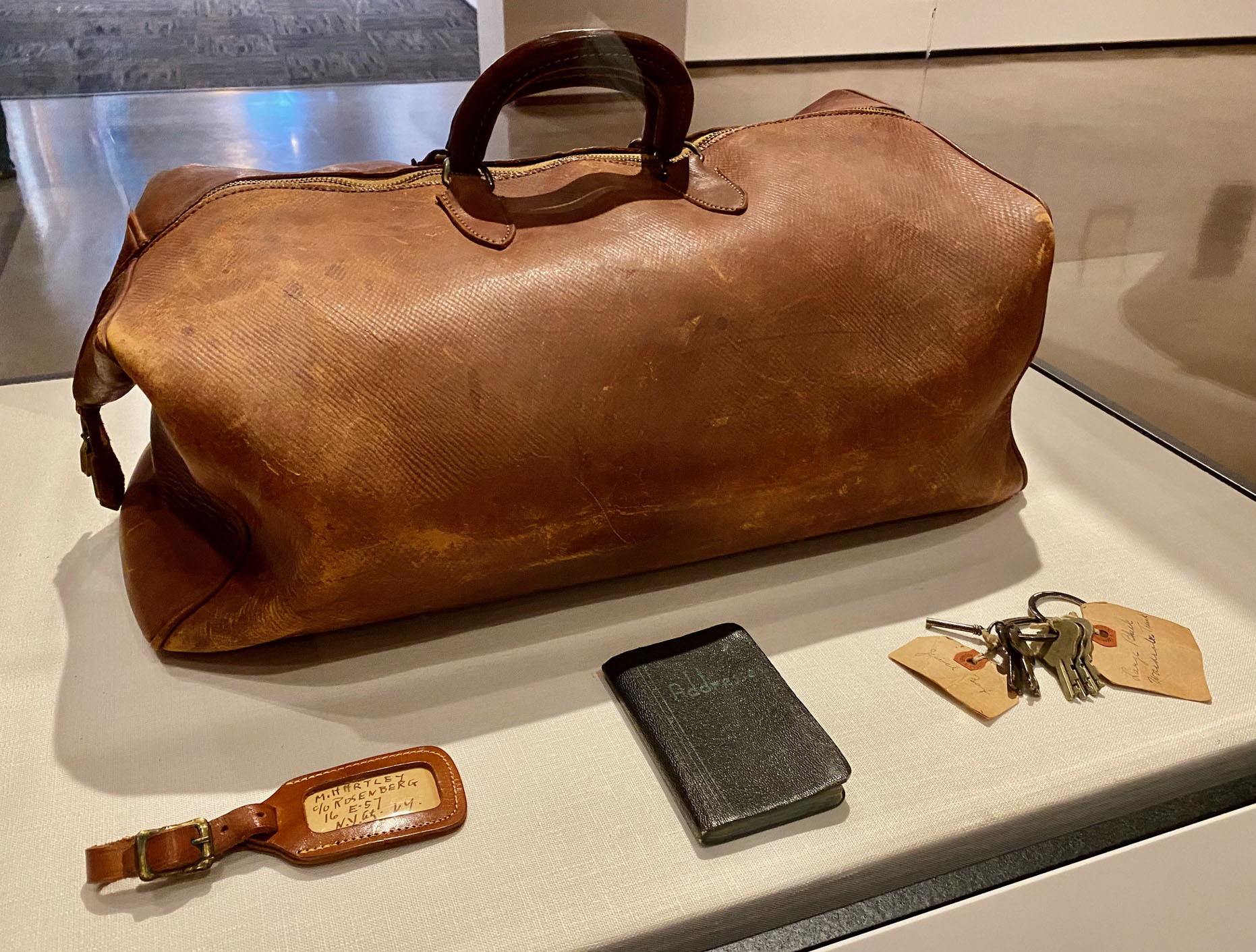
With his traveling valise sitting in the center of the introductory gallery and a map nearby, you understand instantly that superstar artist Marsden Hartley was a man on the go.

Marsden Hartley: Adventurer in the Arts, on view at the New Mexico Museum of Art in Santa Fe through July 20, 2025, uses his personal possessions, works painted on two continents, and non-stop itinerary to demonstrate how landscape, life, and modern-art legends led him to create an epic body of work.

Take a look at our favorites in our Flickr album.

Hartley’s 1914 Berlin Series, No. 2 – flat, abstracted natural symbols. Courtesy: Jan T. and Marica Vilcek Collection.
Ready to travel – Hartley’s leather valise, address book and luggage tags. Courtesy: the artist’s estate; Bates College Museum of Art.

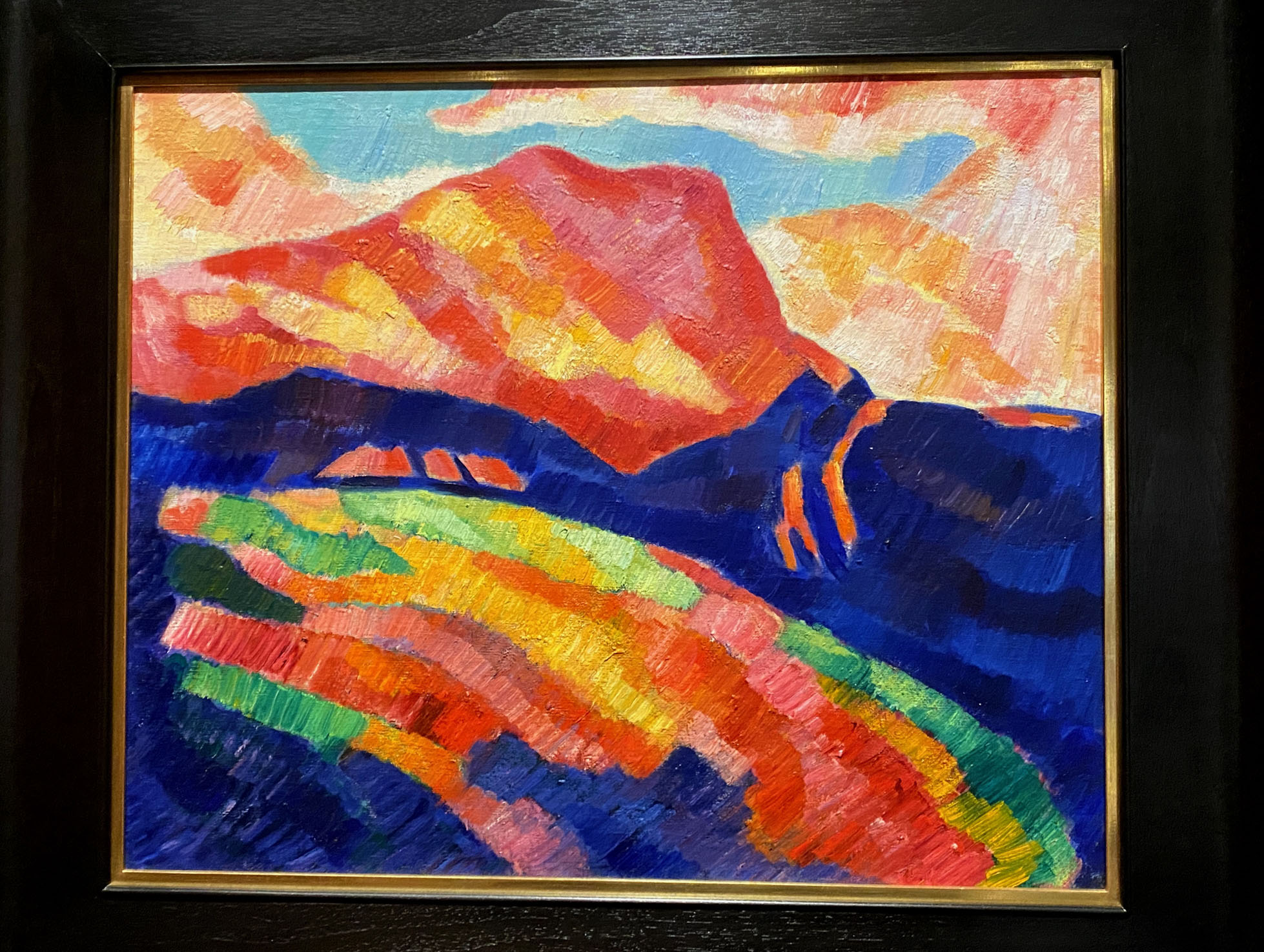
Looking around, there’s a wall of Maine mountainscapes he did in his thirties, a painting done just after Stieglitz sent him to Paris to soak up the vibes in Gertrude Stein’s salon, his accessories of rings and cigarette cases from Berlin in the 1920s, a Fauve-ist impression of Mount Saint-Victoire at Cezanne’s old stomping grounds in Aix, and photos of him and his dog at his Maine studio in the 1940s.

Hartley’s 1927 oil Mont Sainte-Victoire – painted in Aix, France where Cezanne once lived. Courtesy: Jan T. and Marica Vilcek Collection.

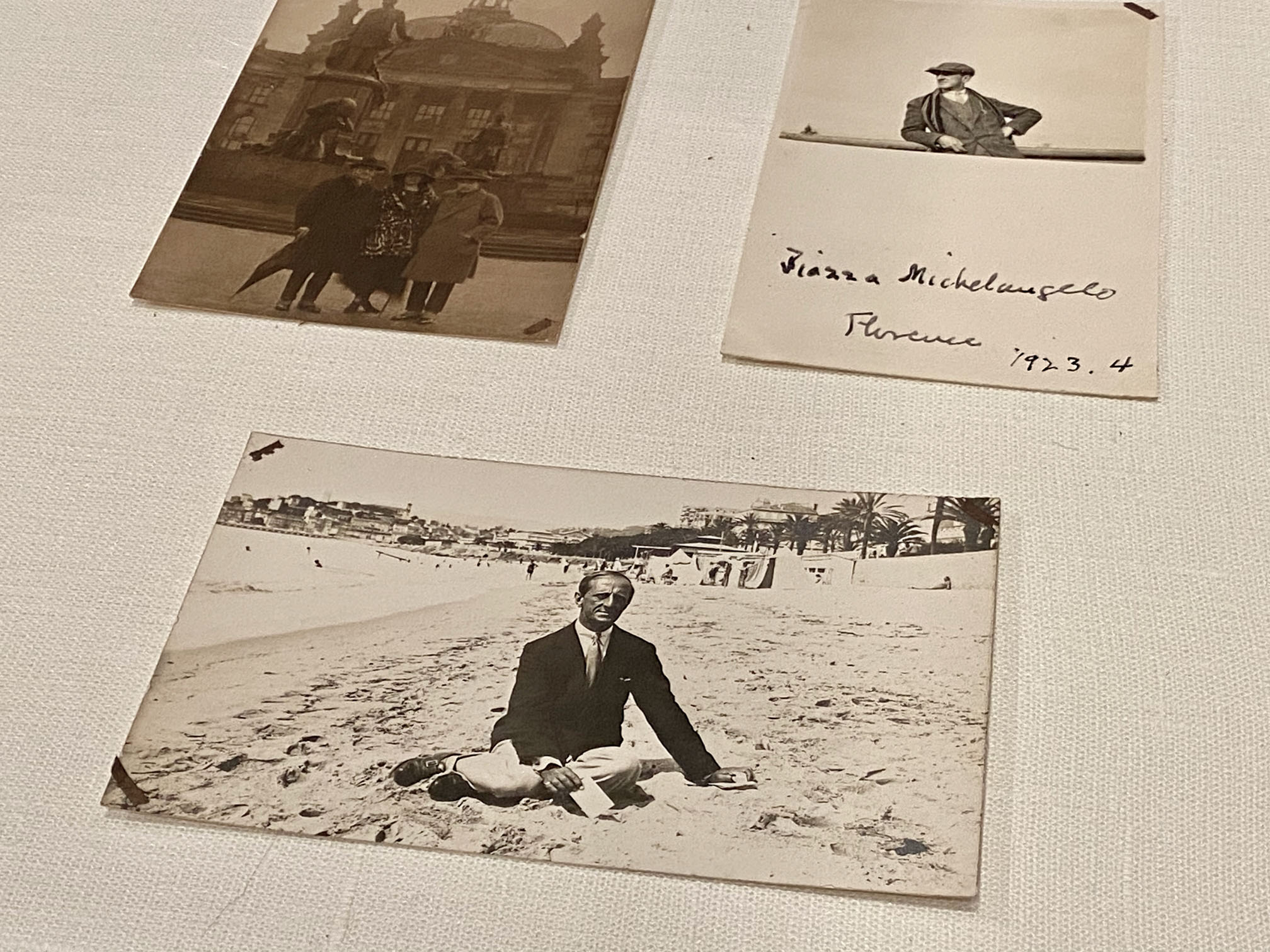
The exhibition merges Hartley’s paintings from the Jan T. and Marica Vilcek Collection with items donated by his favorite niece to Bates College in Maine – items he collected as he traveled; sketches and stuff sent to his neice; his camera, books, and snapshots; his studio paintbox, and other personal art. Together, the exhibition tells a story of innovation, personal journey, and relentless art making.

Hartley’s personal photos from his 1920s European adventures. Courtesy: Bates College Museum of Art

Hartley emerged from a hardscrabble childhood to see, feel, and experience art, nature, and transcendental spiritualism in New York, Boston, and Maine in 1890s.

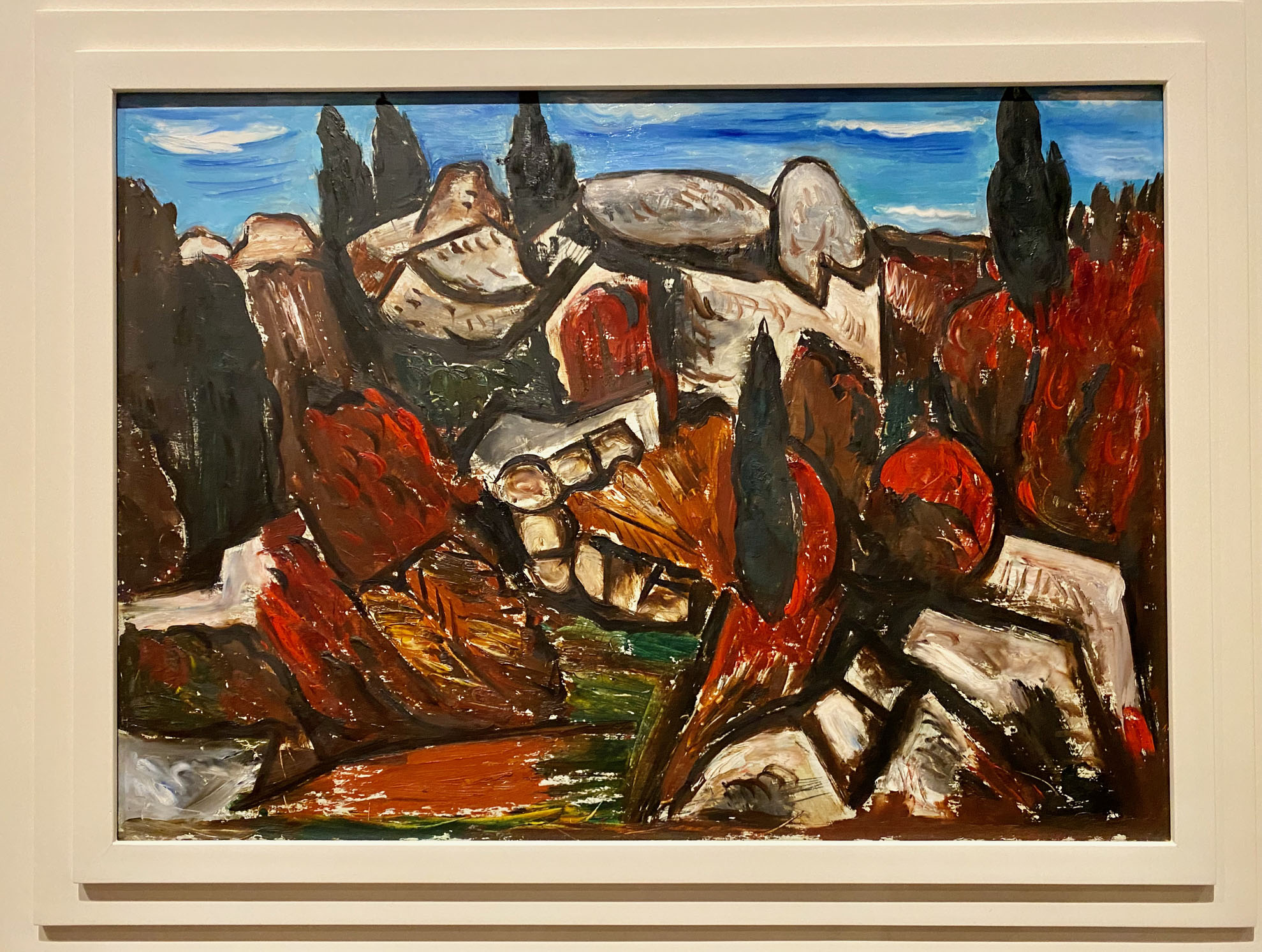
He loved painting mountains and depicted water, earth and sky as a color-filled flat plane filled with jabbing brushstrokes – an approach that stuck with him throughout his life as he journeyed through New Mexico, the Alps, Mexico, and back in Maine.

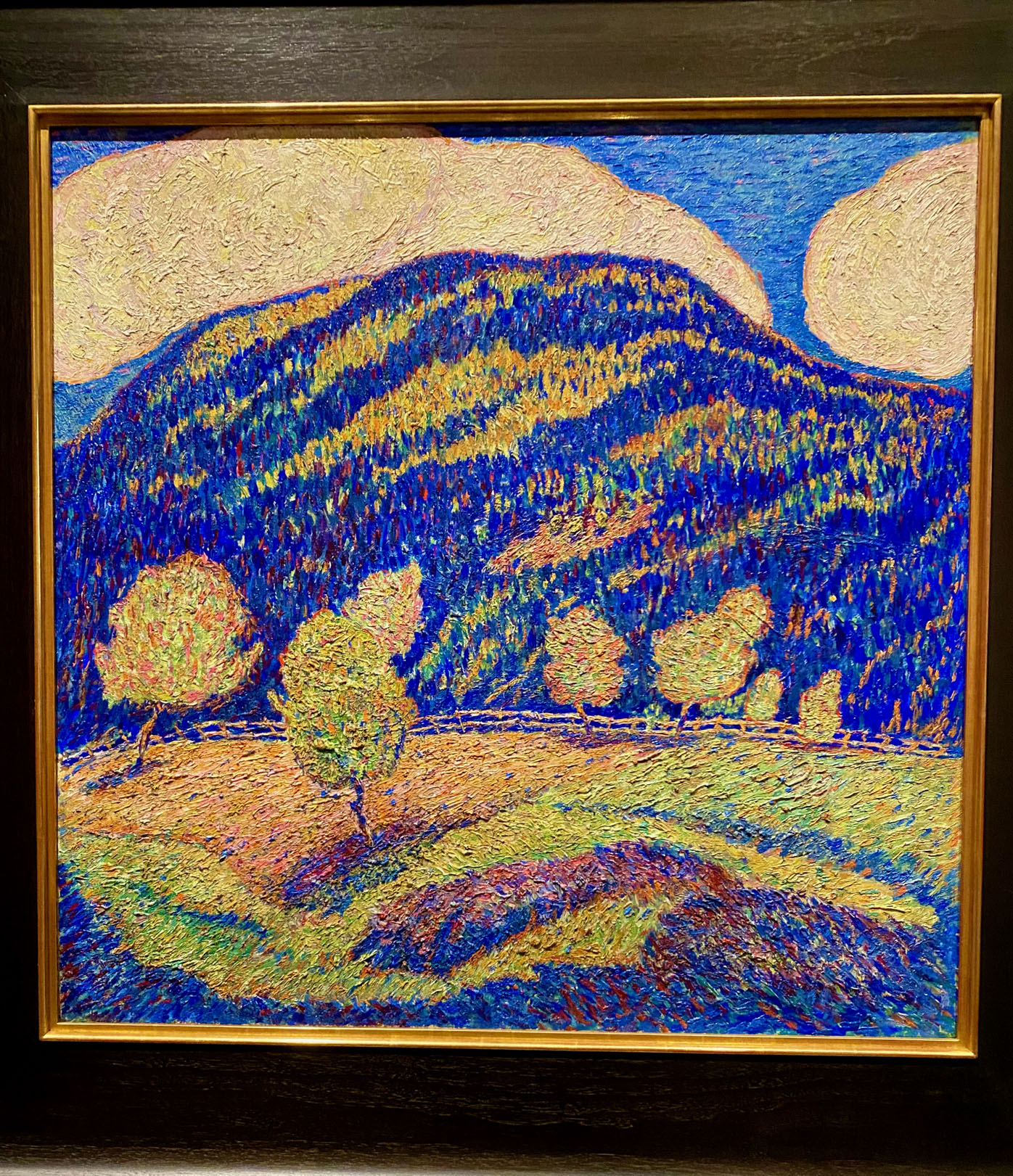
Hartley’s 1907-08 oil Silence of High Noon – Midsummer painted in Stoneham Valley, Maine. Courtesy: Jan T. and Marica Vilcek Collection.

By the time he was in his early thirties, he had shown his landscapes to The Eight, knocked on Stieglitz’s gallery door, and got a one-man show (and a dealer for the next 20 years) at 291, the hottest modern art gallery in America.

Hartley’s 1910 Untitled (Maine Landscape)– water cascading down a rock face. Courtesy: Jan T. and Marica Vilcek Collection.

Getting to Europe in 1912, the color, cubism, and symbolism of the Blue Rider, Matisse, and Picasso made his head spin. His German friends introduced him to Kandinsky’s book Concerning the Spiritual in Art. He went out of his way to meet the man himself, and his painterly wheels turned.

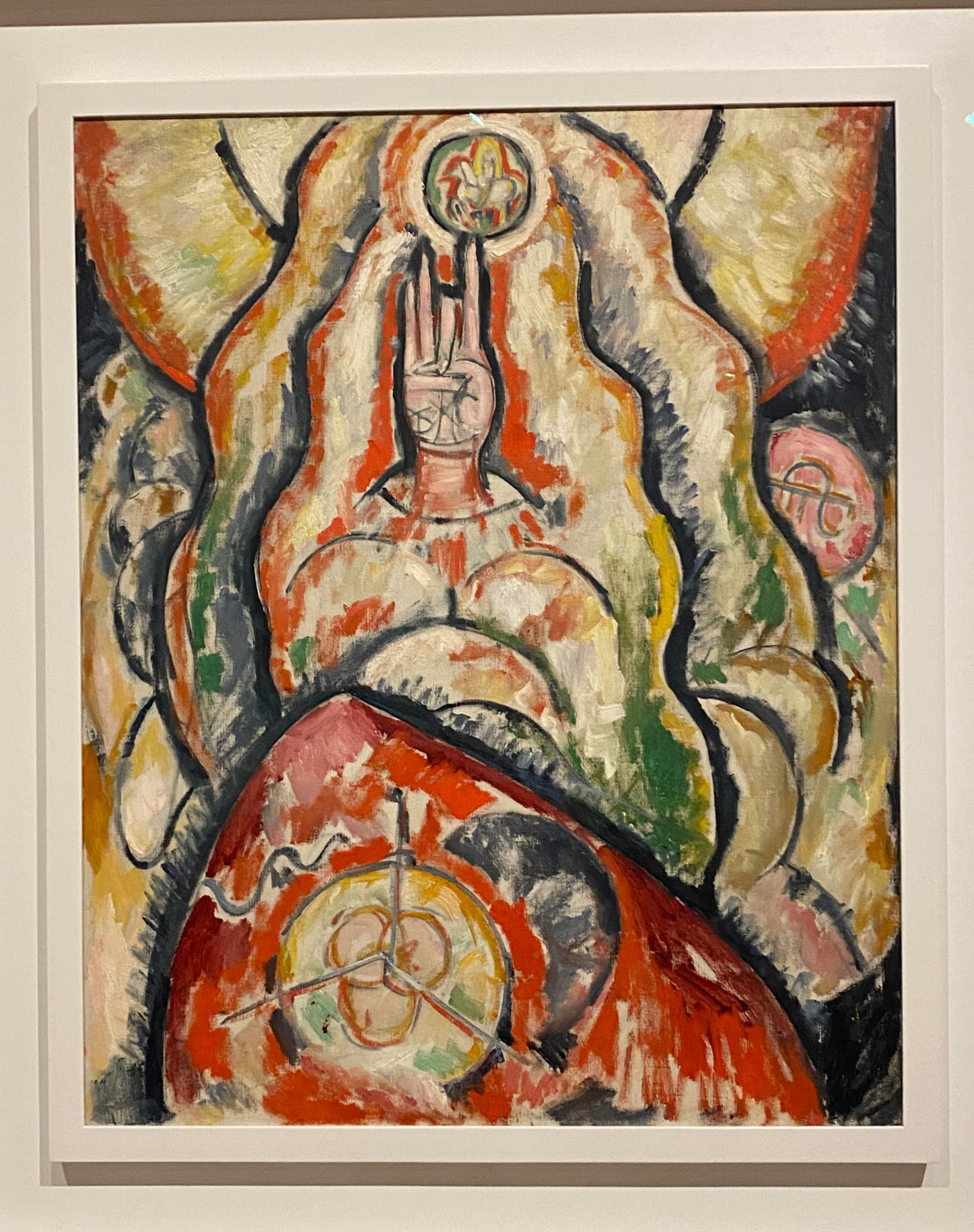
The second gallery presents a large work from his Cosmic Cubism series – an airy, dreamy arrangement of signs, spiritual symbols, colors, and planes – along with drawings from his Amerika series, based loosely on Native American symbols and other abstract shapes. On view for only the second time in the United States, Schiff is a dazzling creation drawing signs and symbols from Native American and Egyptian cultures that spill out onto the painted frame.

Hartley’s 1912-1913 Portrait Arrangement, No. 2, created in Paris. Courtesy: Courtesy: Jan T. and Marica Vilcek Collection.
Schiff – part of the Amerika series Hartley painted in Germany. Courtesy: Vilcek Collection.
April 5 – July 20, 2025

Up to this point, Hartley’s only encounter with indigenous American culture came from visits to ethnography museums in Paris and Berlin, but that would soon change. The advent of World War I tore apart the avant-garde, his social circles, and the direction of his work. Although these Berlin abstractions were long considered by late 20th century critics to be the high point of his career, Hartley abandoned this artistic path when forced to return to the United States, started over, kept wandering, and went back to landscapes and still lifes to discover his “American” expressionist vision.

Hartley’s 1934 Autumn Landscape, Dogtown – a colorful painting made near Gloucester, Maine. Courtesy: Jan T. and Marica Vilcek Collection.

The exhibition does not unfold chronologically. Instead, it shows how much friends, place, and spiritual encounters affected him.

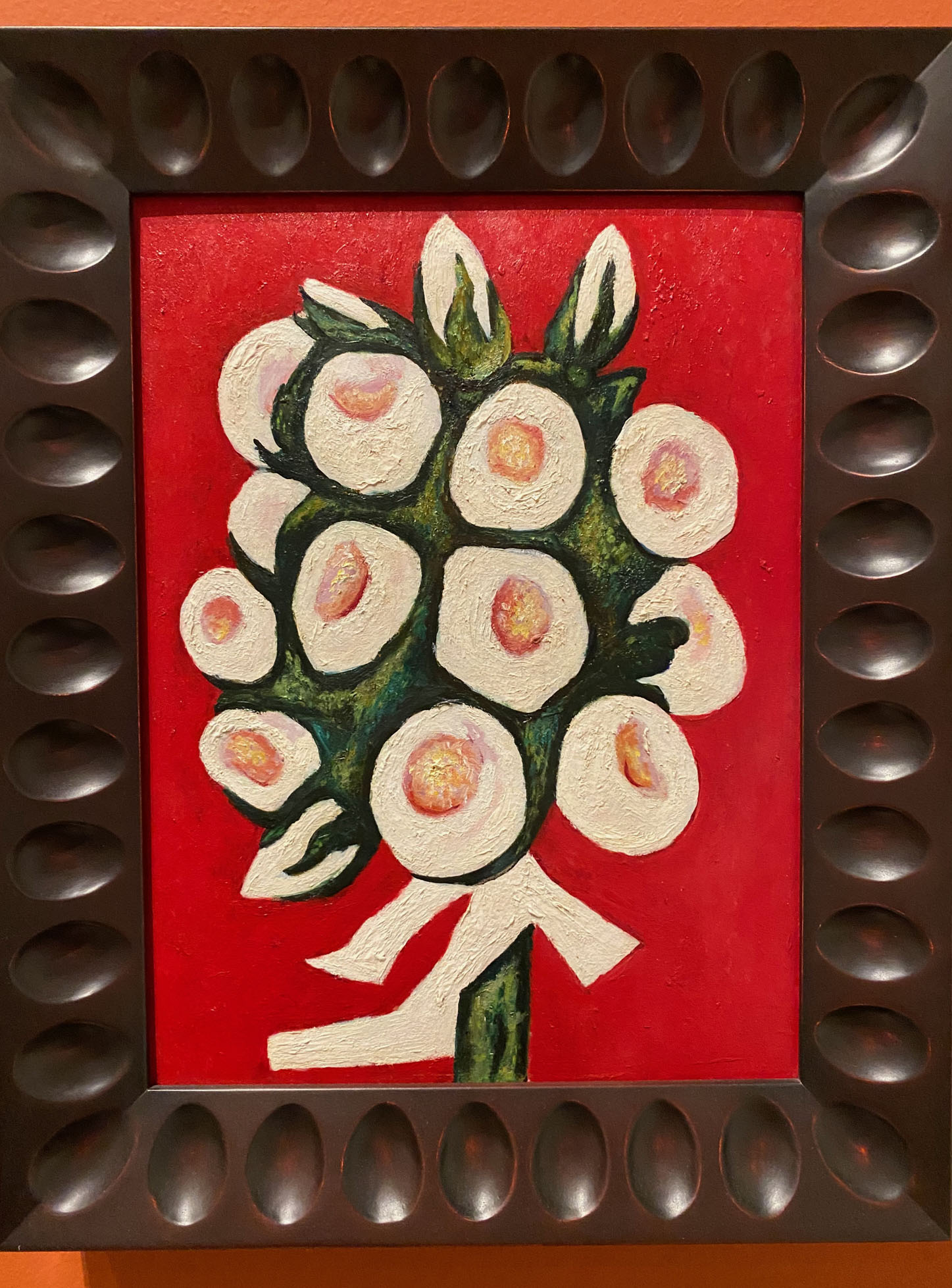
Near the Berlin abstractions are highly expressionist 1930s rockscapes from Maine and pointy Alpine peaks from his return to Bavaria. There’s an example of his stripped-down 1916 “synthetic cubist” work in Provincetown, a 1917 New England still life painted in Bermuda when he was budget-bunking with Demuth, and a red-saturated still life that is a therapeutic tribute to his Nova Scotia friends who died at sea in the late Thirties.

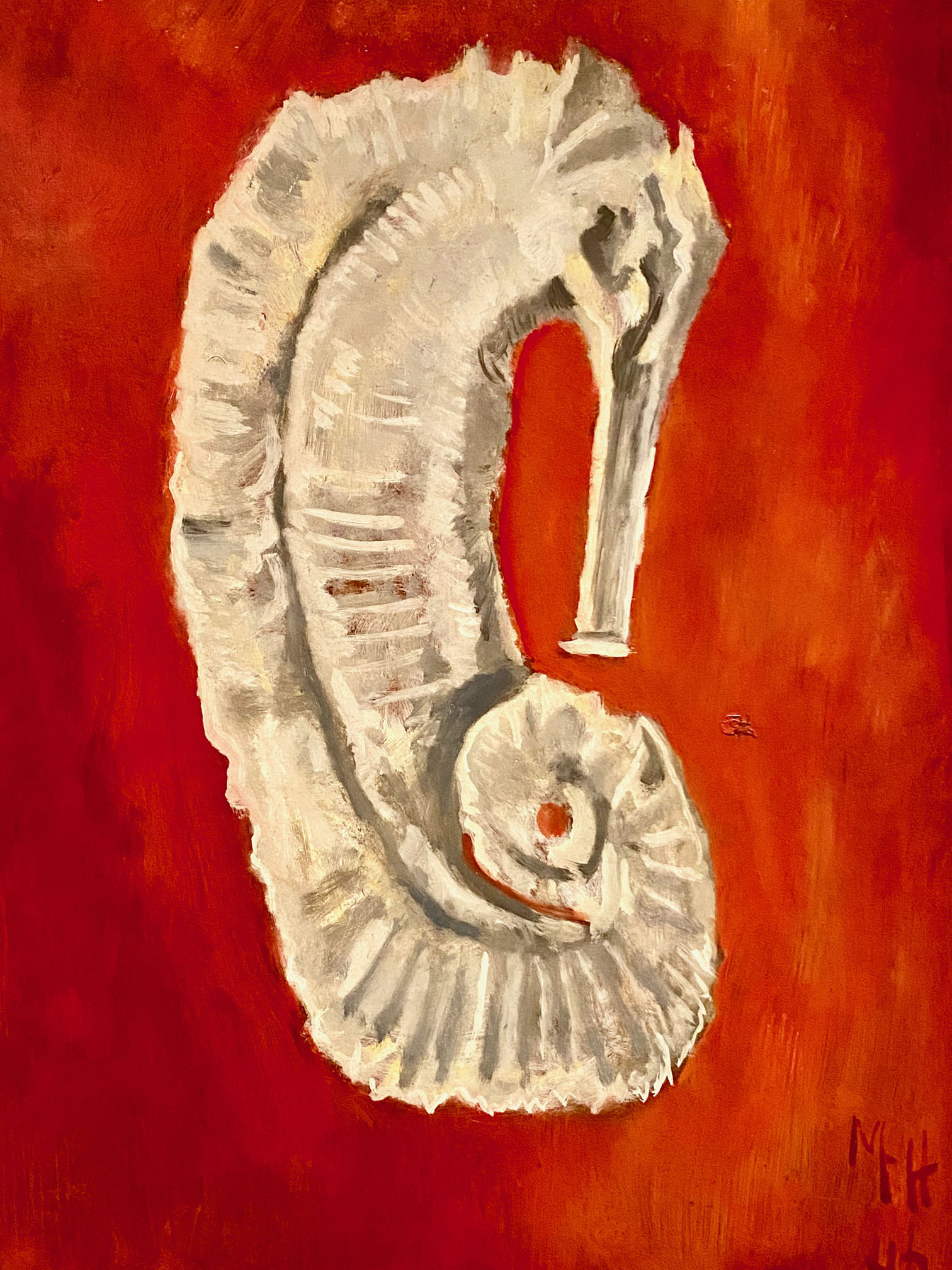
Hartley’s 1942 White Sea Horse – part of a series with vivid backgrounds done in Maine. Courtesy: Jan T. and Marica Vilcek Collection
Hartley’s 1935-39 Roses for Seagulls that Lost Their Way –made in Bermuda to honor his Nova Scotia friends lost at sea. Courtesy: Jan T. and Marica Vilcek Collection.

In the middle of this gallery are vitrines with highly personal, everyday stuff from a painter who never settled down, stayed on the move, and always kept creating.

Here’s his camera, a scrapbook of personal photos, his 1923 published book of poetry, a few books from his library, and a little toy and pressed flowers sent to his niece.    

Hartley’s photos from his 1917-1918 trip to Santa Fe. Courtesy: Bates College Museum of Art

Except for the Provincetown piece, all the surrounding paintings have direct, bold outlines, vivid colors, and vigorous, unglamorized visions – a fitting prelude to the last gallery of New Mexico landscapes.

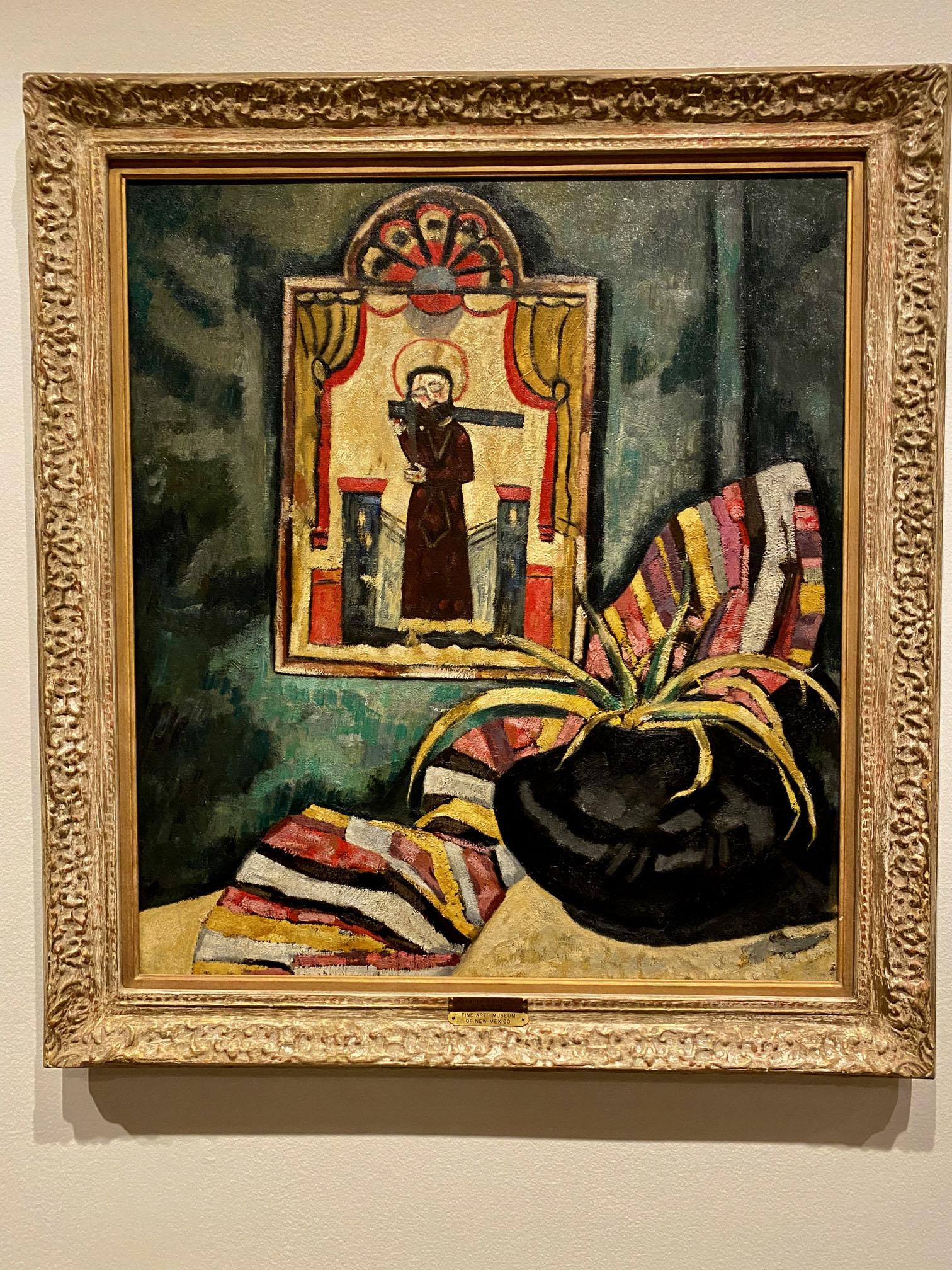
Hartley’s 1919 El Santo painted in New Mexico.

The final gallery provides a panorama of landscapes, plus a dramatic image of a ridge of Mexican volcanoes. Hartley only spent part of

1918 in Taos and Santa Fe, where he traversed the hills, attended Pueblo ceremonies, and wrote about the indigenous culture. He also completed his El Santo still life with a black-on-black ceramic vase, a striped textile, and a Northern New Mexican retablo of a suffering Jesus.  

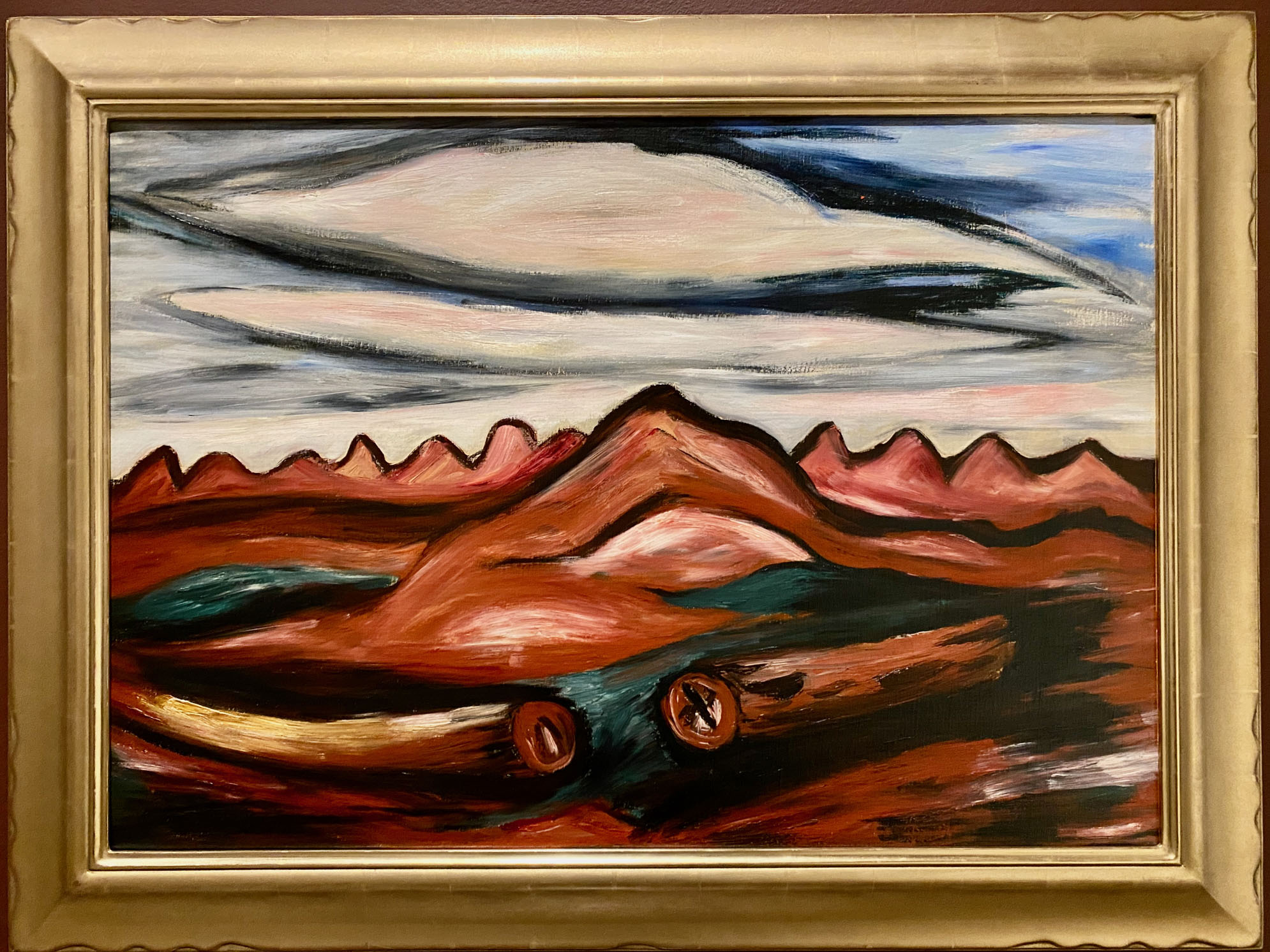
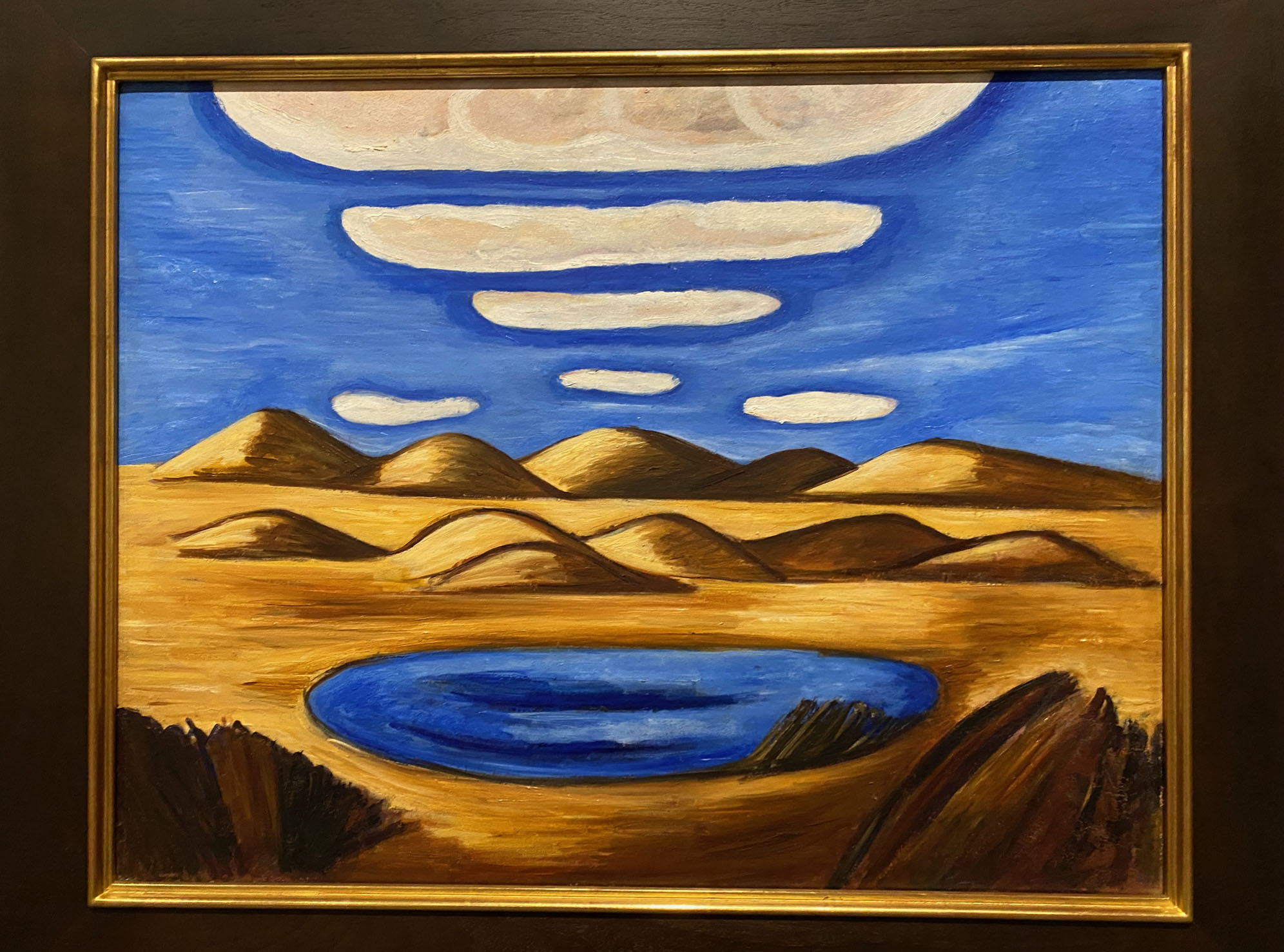
But it might be a surprise to learn that all of the Southwest landscapes were painted in Berlin in the 1920s – fittingly called his New Mexico “recollections” – or in Mexico in the 1930s.

Floating clouds, expressive lines, and abstracted mountains – all from his vivid mind and recollections of spiritual and physical experiences long past.  In the 21st century, increasing numbers of art historians and artists have looked to this phase of Hartley’s work for insight and inspiration – bold brushwork, expressive memory, and both a spiritual and emotional creative process.

Hartley’s 1923 oil New Mexico Recollection #14– painted in Berlin based upon memories of his year in the Southwest. Courtesy: Jan T. and Marica Vilcek Collection.
Hartley’s 1932 oil Lost Country – Petrified Sand Hills – a symbolic landscape inspired by mystical texts he discovered while painting in Mexico. Courtesy: Jan T. and Marica Vilcek Collection.

Toward the end of his life, the accolades, awards, honors, and retrospective exhibitions came his way, but Hartley remained the hardscrabble “painter of Maine,” barely interested in cashing the checks.

His niece, who preserved her uncle’s posessions and legacy after his death in 1943, took a train trip to New Mexico for the first time to see the landscapes that so inspired her uncle. Upon emerging from the train at the stop near Santa Fe, she looked up to take in the big, dramatic, cloud-filled sky. Thinking of all her uncle’s landscapes, she said, “Those clouds…I’d recognize them anywhere!”

If you see this show in Santa Fe, you will, too.

Louise Zelda Young’s 1943 photo Marsden Hartley’s Studio, Corea, Maine, where he worked in his final years. Courtesy: Bates College Museum of Art.