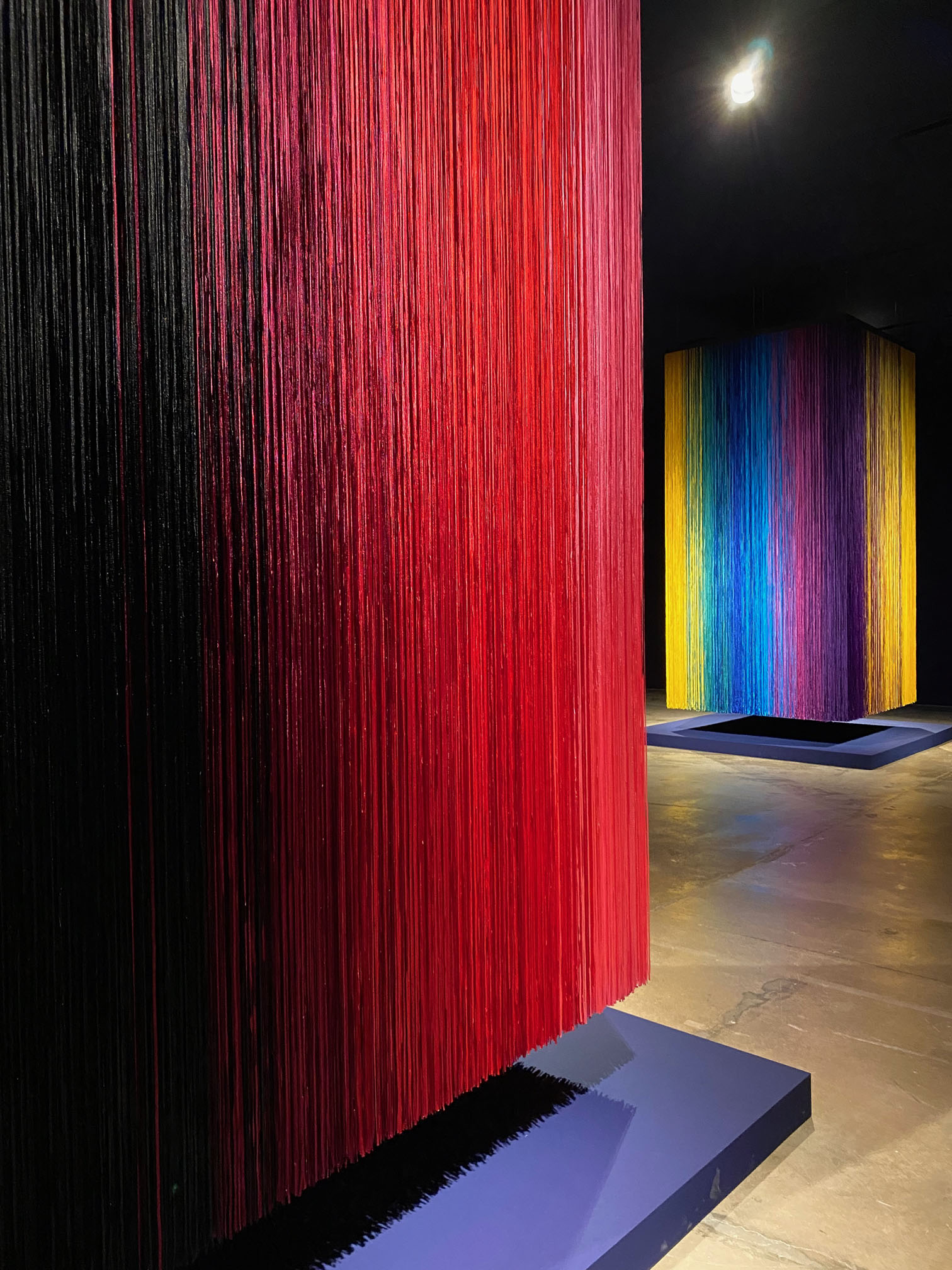
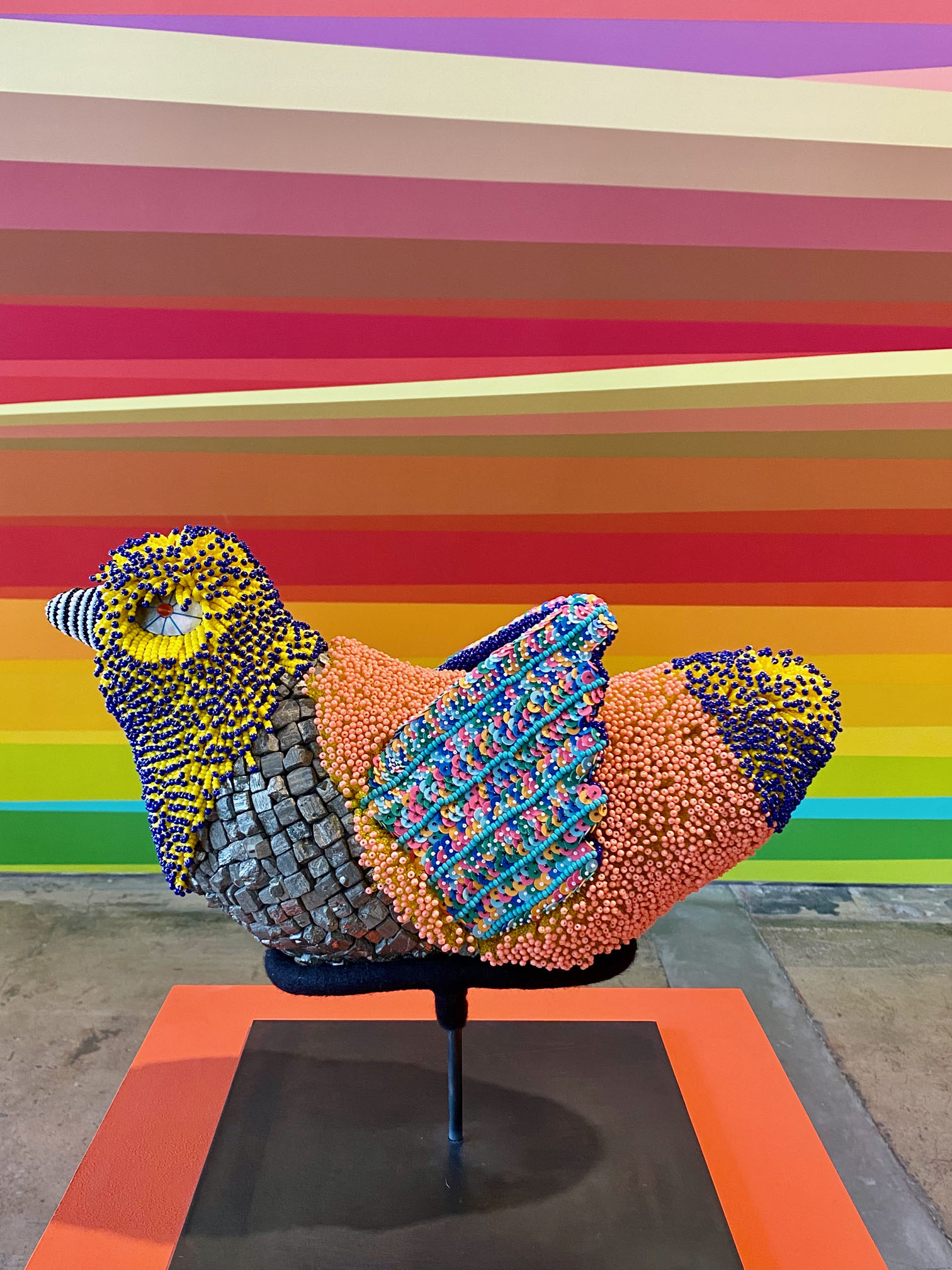
Contemporary Pueblo Architecture Honors Ancient Beliefs

Any visitor to Chaco Canyon National Historial Park (850-1250 CE) makes the journey to appreciate innovative masonry of the Great Houses, the precision of the ancient road system, and the astronomically aligned walls, windows, and kivas. But how do contemporary Pueblo architects incorporate these traditional beliefs in their 21st century projects?

A fascinating, in-depth exhibition, Restorying our Heartplaces: Contemporary Pueblo Architecture – on view at Albuquerque’s Indian Pueblo Cultural Center through December 7, 2025 – explores how modern Indigenous architects incorporate traditional world views into their work.
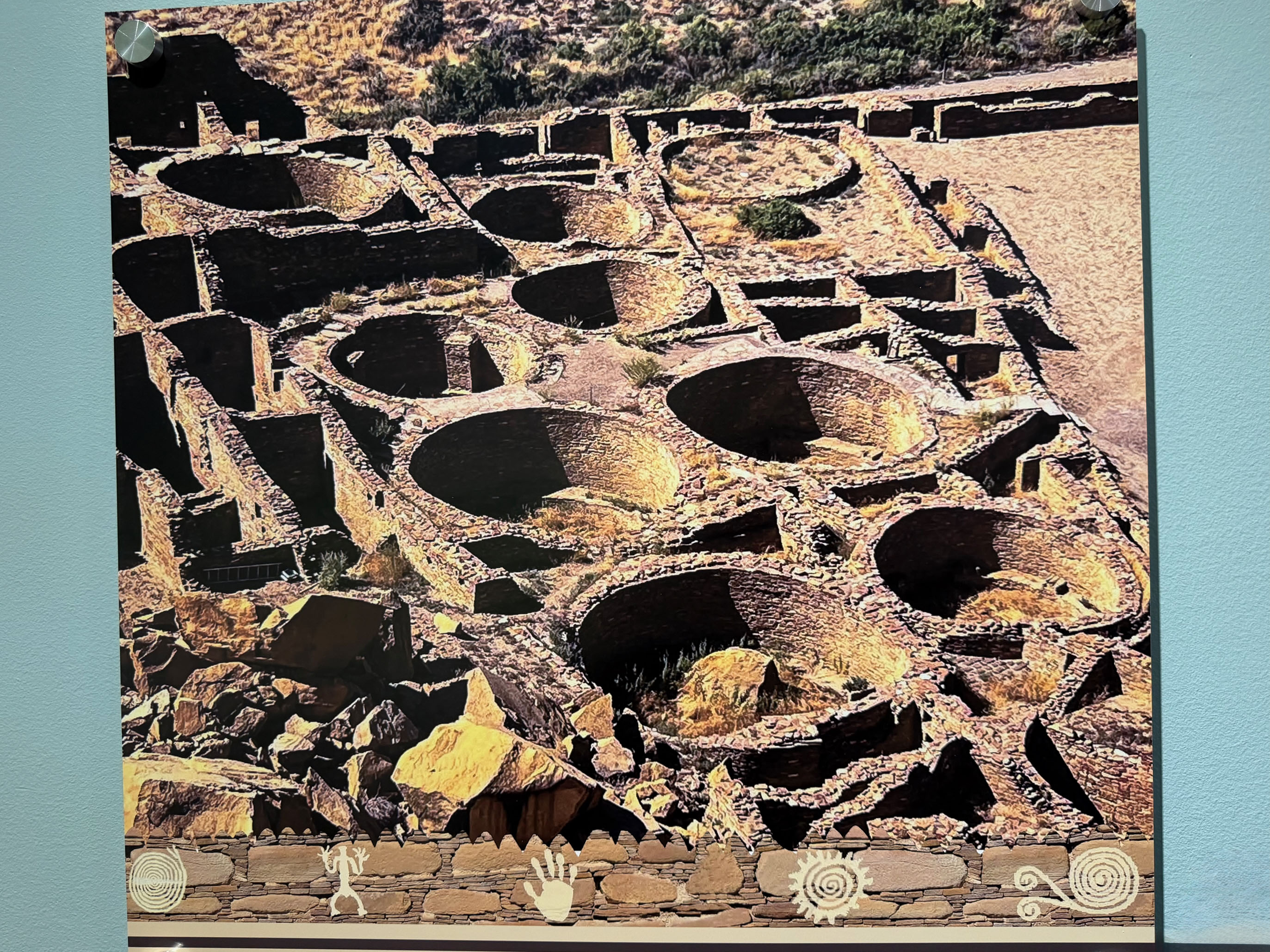
2023 photo Kivas at Pueblo Bonito,Chaco Canyon by curator Ted Jojola (Islela Pueblo) showing advanced masonry and architectural concepts.

For example, just look at the design of the National Museum of the American Indian’s Resource Center – an organic design, aligned to the four cardinal directions, with extensive use of cedar wood.
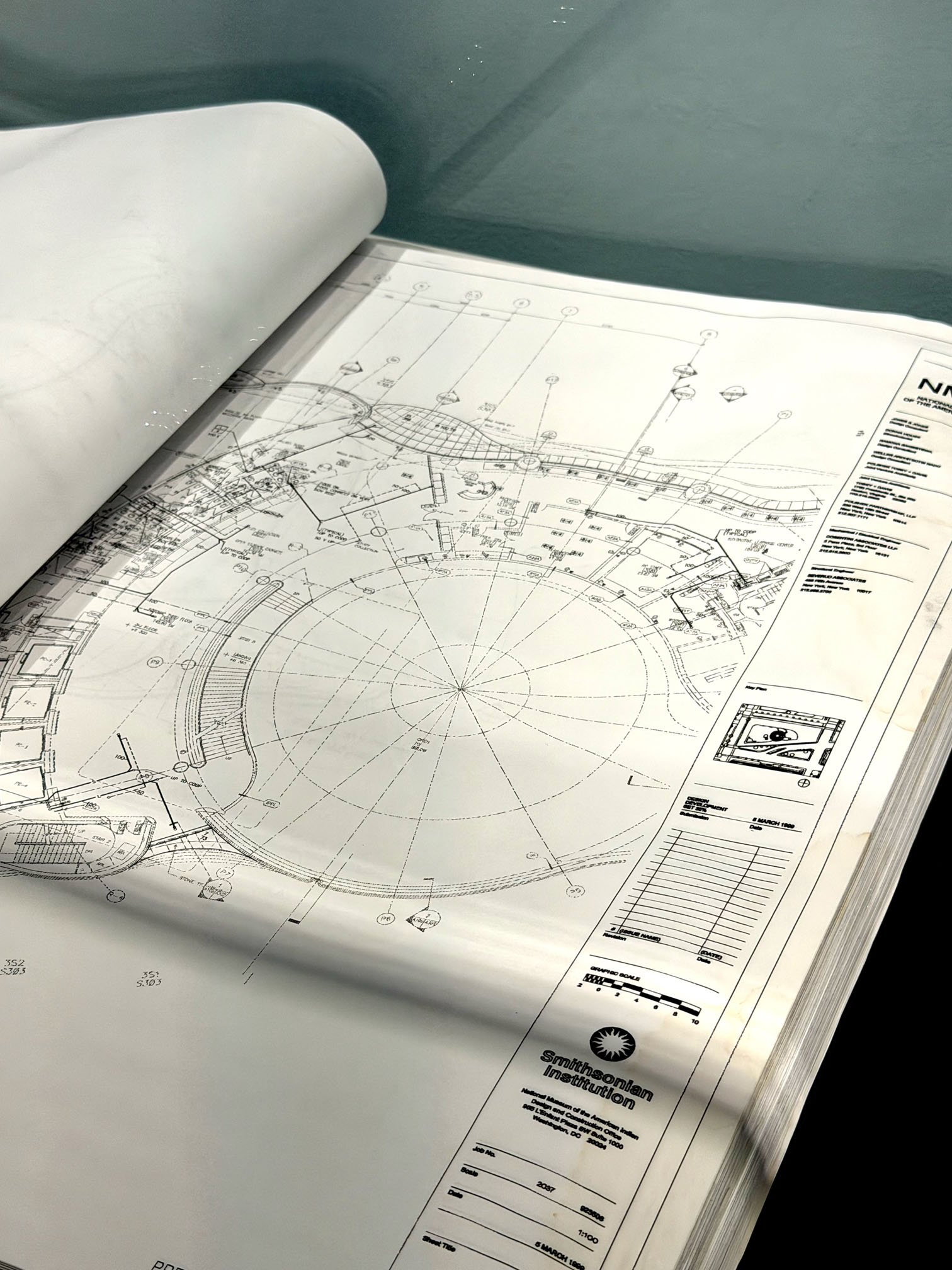
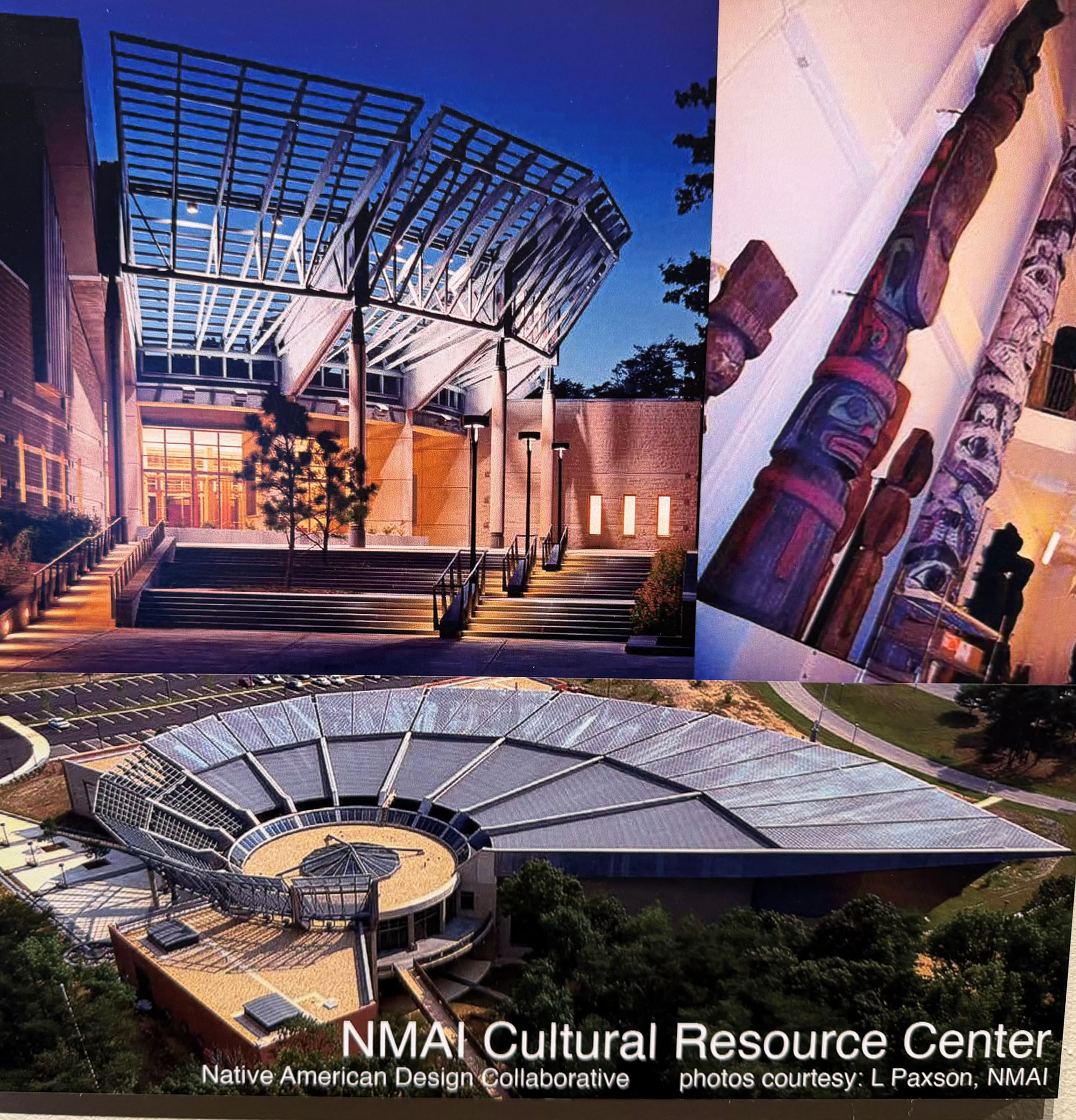
1999 plans for the National Museum of the American Indian Resource Center. Courtesy: Ted Jojola (Isleta Pueblo)
Views of the 1999 National Museum of the American Indian Cultural Resource Center in Suitland, Maryland. Courtesy: Lynn Paxson.

This exhibition coincides with the 50th anniversary of the 1975 Indian Self-Determination and Education Assistance Act – legislation that shifted Native American policy in the United States from assimilation to self-determination. Tribes were now able to initiate and run justice, government, health and education departments of their own – a change that triggered a construction boom for new schools and administrative buildings.

The show opens as an immersive experience in a large, circular gallery that introduces the core belief system and origin story of the Ancient Puebloans. Across a large screen in a vivid animation, the Pueblo people emerge into this world from a previous world. You watch them migrating outward in a spiral – symbols that are reflected across the art, murals, and photographs on the surrounding walls.
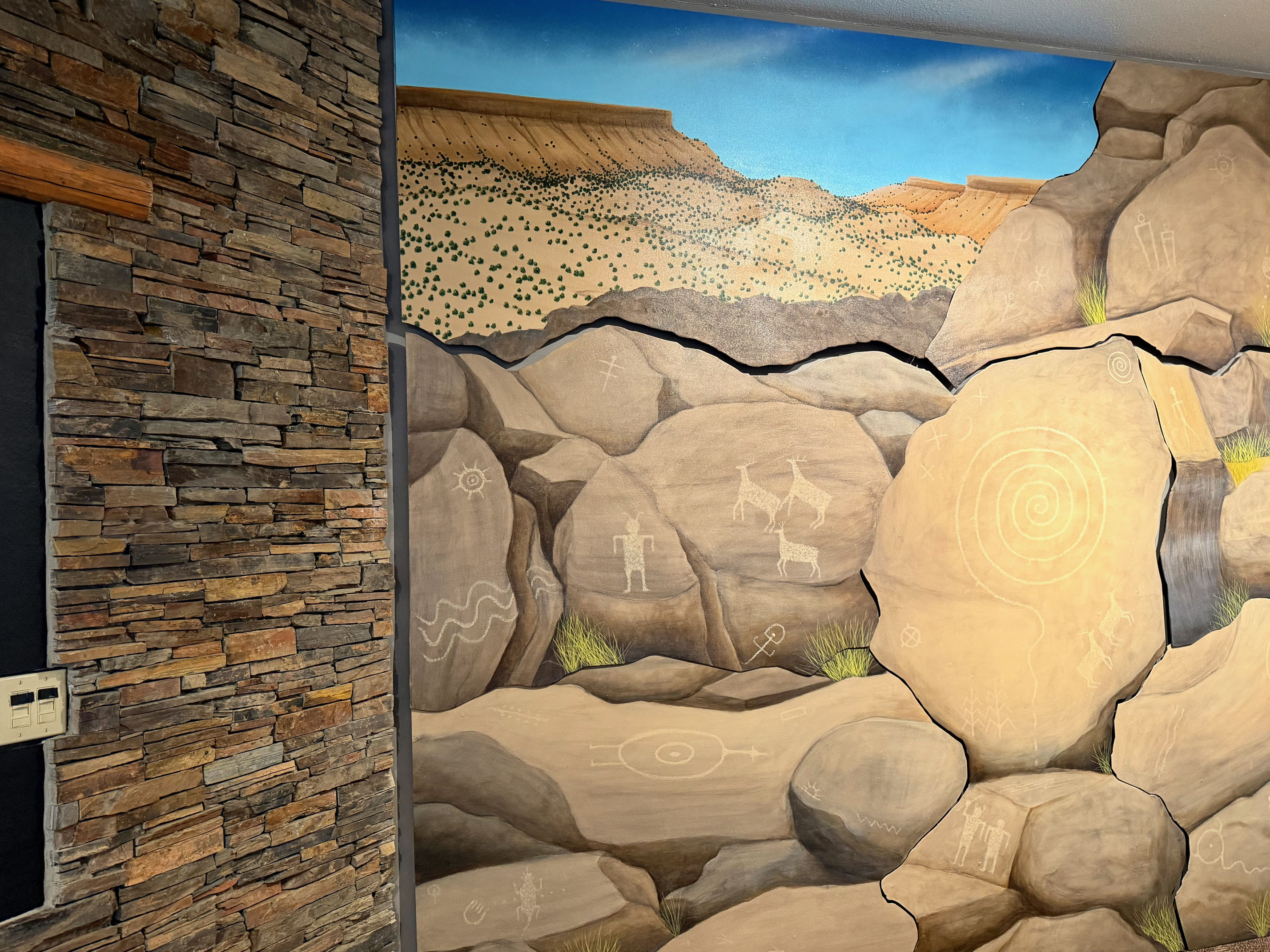
Mural by Dominic Aquero (Cochiti) with symbols of Pueblo creation; T-door represents the spiritual passage between two worlds (sky and Earth)

This experience sets the stage for the rest of the exhibition by showing how the stonework and beliefs reflected by the architecture of Ancient Puebloan centers points the way forward for Pueblo architects today.

2022 print by Gerald Dawavandewa (Hopi Cherokee) with T-shaped door for passage between worlds (sky and Earth]

The exhibition describes Ancient Puebloan architectural innovations – passive solar heating, precise window alignment, and masonry approaches. How did the Ancients achieve such precision in their dramatic Chaco and Mesa Verde buildings?

The curators present engineering and survey tools from archaeological excavations and modern survey backpacks side by side – plumb bobs, levels, and measuring devices.

Ancient stone and ceramic plumb bobs (from California and from Hewitt excavation at Rito de los Frijoles, Bandelier). Courtesy: Museum of Indian Arts & Culture/Lab of Anthropology.
Modern survey tools: level, tape measure, compass, brass plumb bob, wood, and string. Courtesy: curator Ted Jojola (Isleta Pueblo)

They also add comparisons of selenite used as window panels in Old Acoma’s Sky City (among the longest-inhabited communities in the US) and the contemporary architectural approach to windows in the recently built Acoma museum – a thoughtful reflection of the past

The exhibition directly addresses past HUD housing approaches on tribal lands – pushing suburban-style low-income housing, which moved families away from the traditional Pueblo plaza (the HeartPlace) and provided pitched-roof designs that blunted community cultural practices that utilized traditional Pueblo flat-roof construction.

The curators remind us of the continual upkeep required by adobe construction – a repeated communal task typically undertaken by a community’s women that happened on a regular, cyclical basis.  It’s also a reminder that Pueblo communities view buildings as living presences that evolve – not just concrete objects exist in a “finished” state.

Views of the 2000 campus for the Institute of American Indian Arts in Santa Fe. Courtesy: Paul Fragua (Jemez Pueblo)
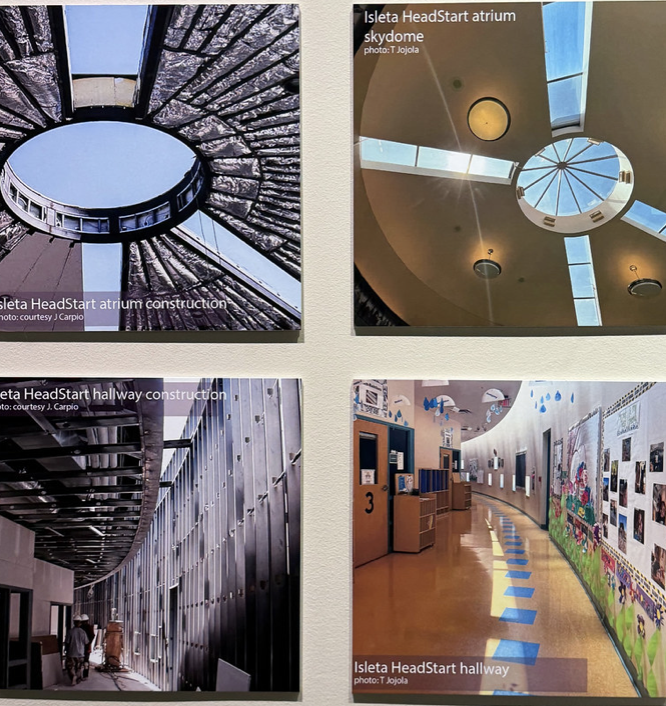
Views of 2004 building designed by Janet Carpio (Laguna/Isleta Pueblos) for Pueblo of Isleta’s Headstart/Child Care Center.

Wall panels, blueprint books, and architectural models are used to demonstrate the contemporary innovations of Pueblo architects – the Resource Center of the National Museum of the American Indian (1999), the campus of the Institute of Amercian Indian Arts in Santa Fe (2000), and the Headstart Child Care Center for Isleta Pueblo (2004). Both incorporate design elements echoing the spiral migration path, alignment to the cardinal directions, and colors and elements of the Earth.

A huge multimedia interactive theater punctuates the walk-through – an immersive visit to Acoma’s new Cultural Center and Haa’ku Museum with tribal members and designers explaining the architectural details and how the buildings reflect the landscape and traditional belief systems.

Immersive interactive experience of Acoma’s new Cultural Center and Haa’ku Museum. Courtesy: Anna Seed Productions, Electric Playouse, and UNM ASPIRE.

The exhibition features the work of the Indiginous Design and Planning Institute (iD+Pi) at UNM and presents dramatic architectural models of the past, present, and future of the community of Nambe Pueblo.

Look through the exhibition in our Flickr album here – a future-forward look at the continuing progression of innovative architectural designs and the next generation of designers and architects respecting and integrating the Pueblo world view with buildings considered to be living, breathing HeartPlaces for the community. 
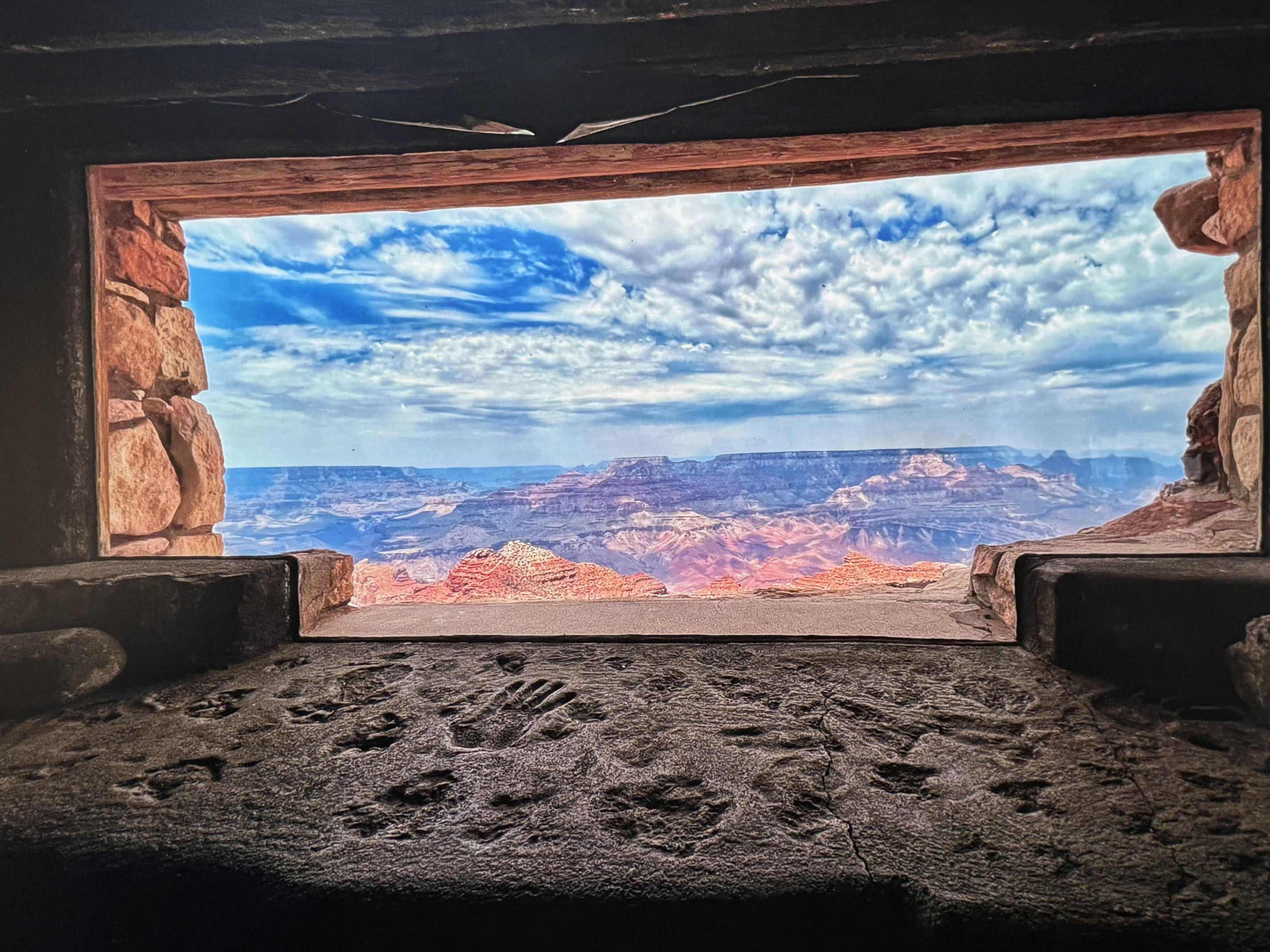
2023 photo by curatorTed Jojola (Islela Pueblo) North Window View from Desert View Watchtower, Grand Canyon showing the T-shaped doorway symbolizing passage between worlds

As the curators made clear in their opening-day remarks, a similarly extensive exhibition could explore architectural innovation and spiritualism across Navajo Nation. Let’s hope that happens!
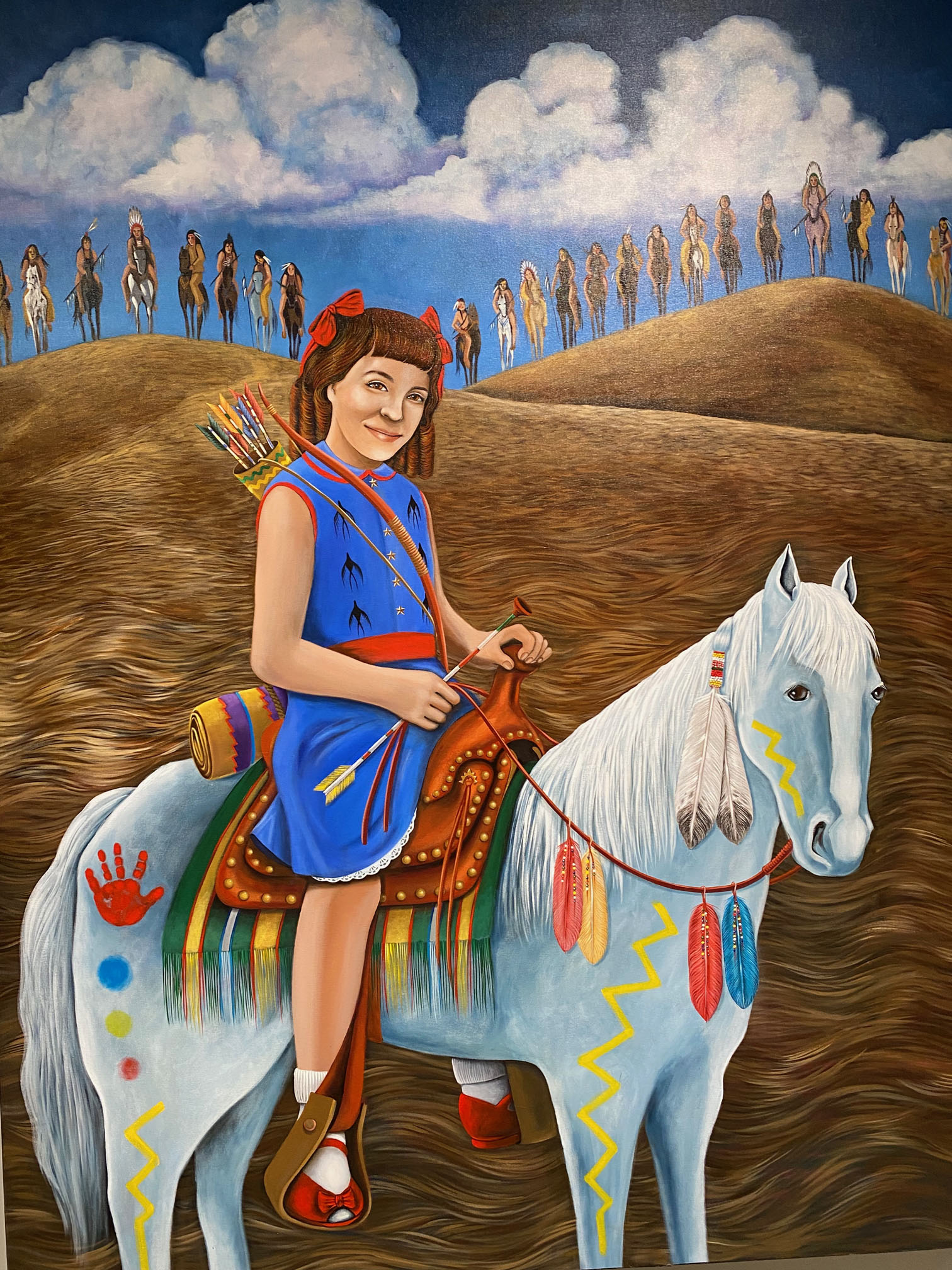
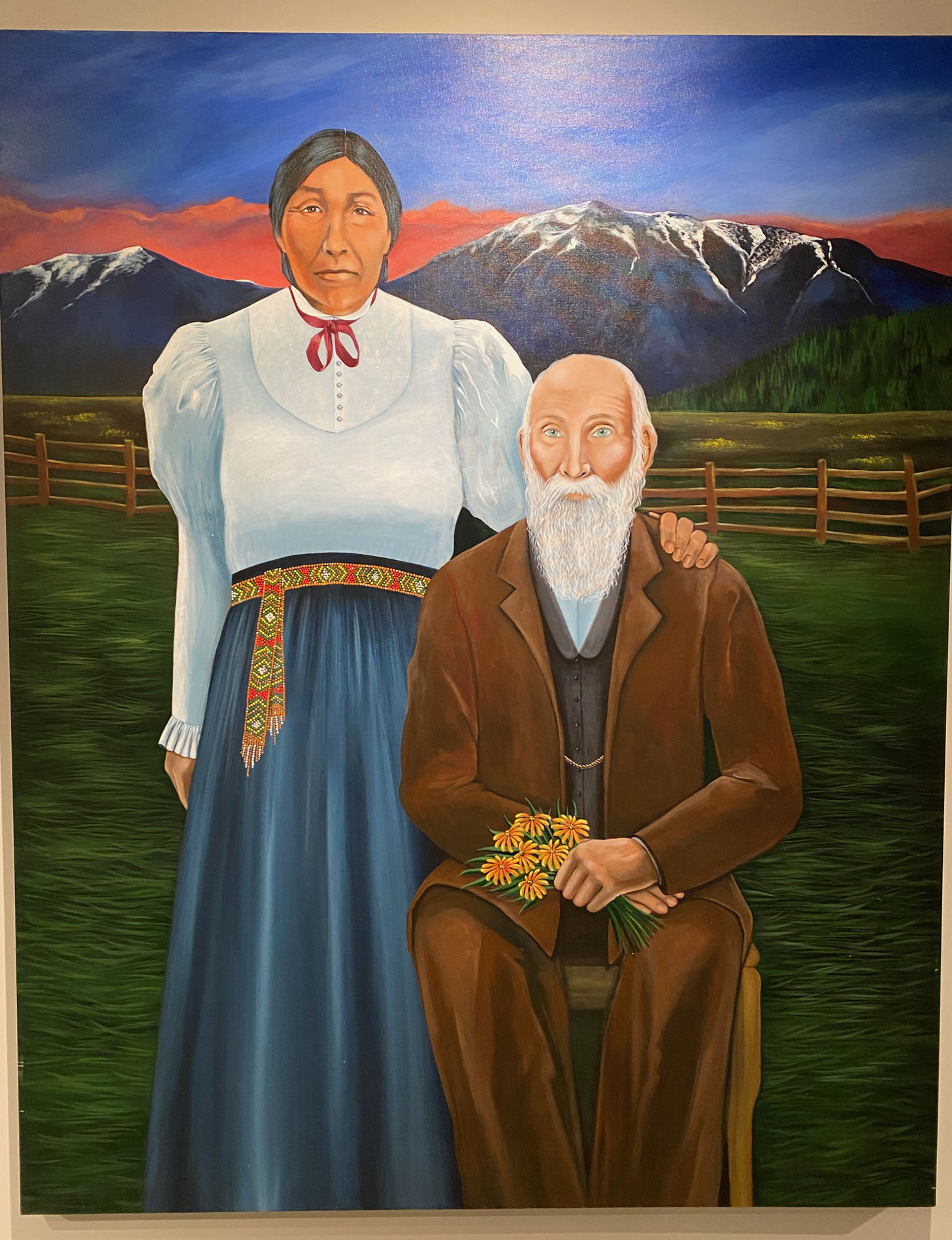
Judith Lowry Retrospective and Her Great Basin Legacy

She grew up on US military bases all over the world, and was thankful that her parents exposed her to the best museums, art, and culture in every country they resided. As an adult member of the Pit River Tribe, she moved back to her ancestors’ land in California and Nevada’s Great Basin, and began telling stories of her family’s history and modern Indigenous experience.

The Art of Judith Lowry showcases 40 years of this artist’s work in Reno, Nevada at the Nevada Museum of Art through November 16, 2025 – large-scale painting, triptychs, and installations.

Lowry’s 1997 Red Ribbons depicts herself as a light-skinned Native American teen equipped for battle. Courtesy: The Wheelwright Museum of the American Indian, Santa Fe.

The museum assembled Lowry’s most celebrated work from major collections across the United States, but is also using the occasion to celebrate Lowry’s own (and her husband’s) gift to the museum with a companion installation of The Lowrey and Croul Collection of Native American Art.

Take a look at some at our favorites from both shows in our Flickr album.

The entry of the exhibition shows how Lowry explores her complex family history at the turn of the last century in frontier ranch lands along the California-Nevada border – images of her biracial great-grandparents and a beautifully mystical depiction of her grandmother. Her regal portrait shows her ancestor’s face tatoos coupled with perfect Victorian dress and small references to the tragedies that befell her family – a symbolic approach Lowry adapted from her deep appreciation of Renaissance works by Bellini, da Vinci, and other masters.

Lowry’s 1997 The Good Marriage – her Native American great-grandmother and German-Irish great-grandfather at their Greenville, California ranch. Courtesy: private collection.
Lowry’s 1999/2012 Edna at Honey Lake depicts her biracial grandmother holding one of her many children who did not survive to adulthood.

A case in the center of the gallery presents Lowry’s paintings for her children’s book about her father and uncle’s Indian boarding-school experience, break out, and unauthorized journey back home.

She also presents family photos and representations of her own growing-up with rich stories and excerpts from her family photo albums. The experience of reading personal history, seeing her ancestors’ faces, and looking at the painted details on her epic canvases is a deep, warm experience that allows you to feel like you’re welcomed into Lowry’s complex and loving family.

Lowry’s 1995 triptych Family: Love’s Unbreakable Heaven showing the moment she understood her family’s unique biracial identity while living at an American military base in Germany. Courtesy: The Rockwell Museum, Corning, New York.

Many of the paintings are satiric takes on the pressures facing contemporary Native Americans navigating life in modern American society – startling theatrical juxtapositions in Indian casinos, retail emporiums, and Renaissance altarpieces.

Lowry’s 1996 Shopping – a sales associate shows the Virgin of Guadalupe’s cloak to a pre-Columbian mother and daughter who are shopping for prom. Courtesy: Peabody Essex Museum

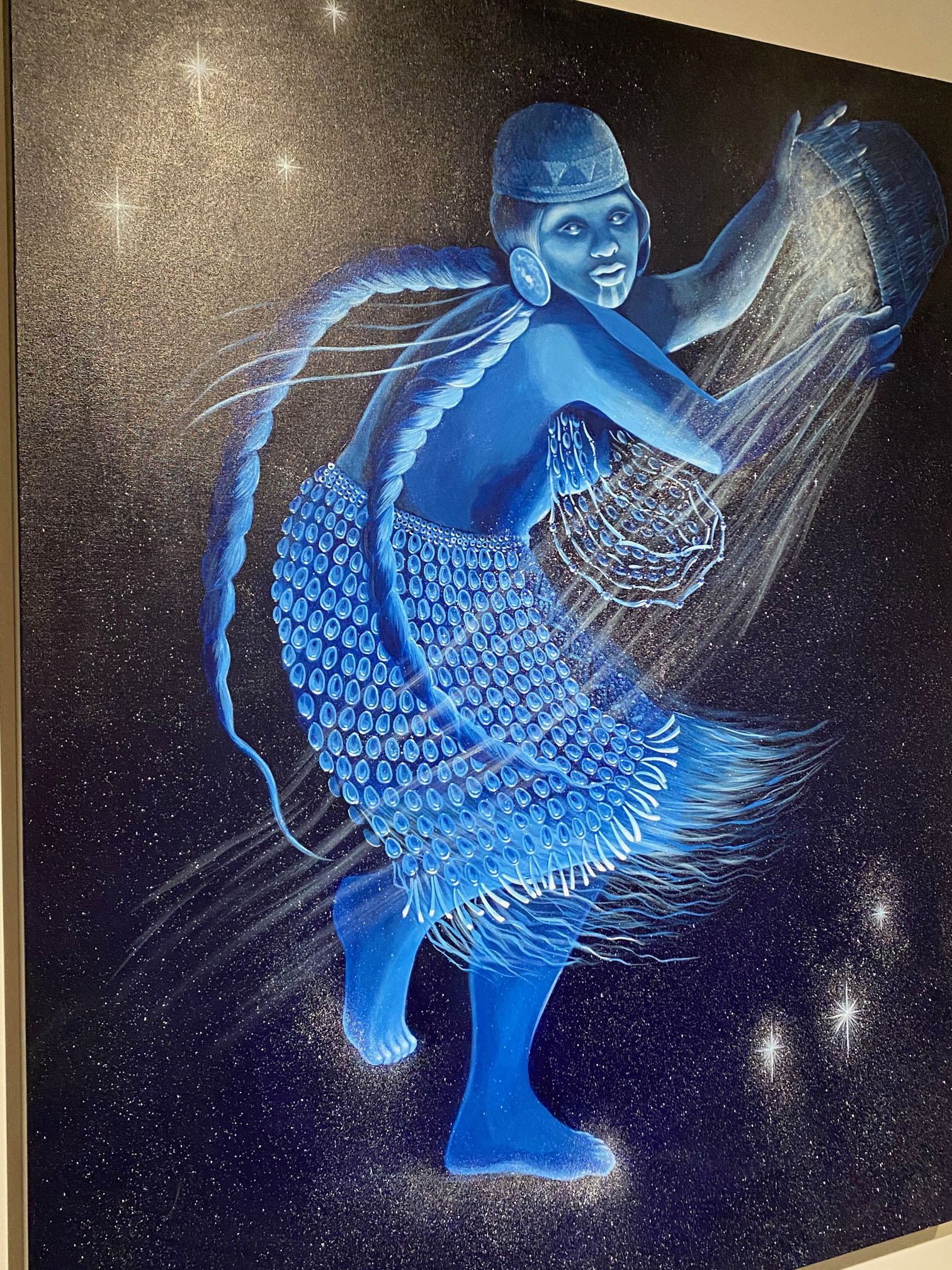
Some of the most arresting works allow us to enter a spiritual realm – magical depictions of legends, stories, and lessons that she heard from her dad growing up.  Lowry’s large-scale, dramatic canvases are immersive – letting us enter the world of the girl-power Star Maidens, who who dance across the sky holding baskets of stars and tossing comets.

Lowry’s 2003 Northern Coast panel from the series Weh-Pom and the Star Sisters celebrating female autonomy and strength. Courtesy: National Museum of the American Indian, Smithsonian
Lowry’s 2003 Southern Coast panel from the story of the the Star Sisters holding their own in the sky and rejecting the advances of trickster Coyote Weh-Pom. Courtesy: National Museum of the American Indian, Smithsonian.

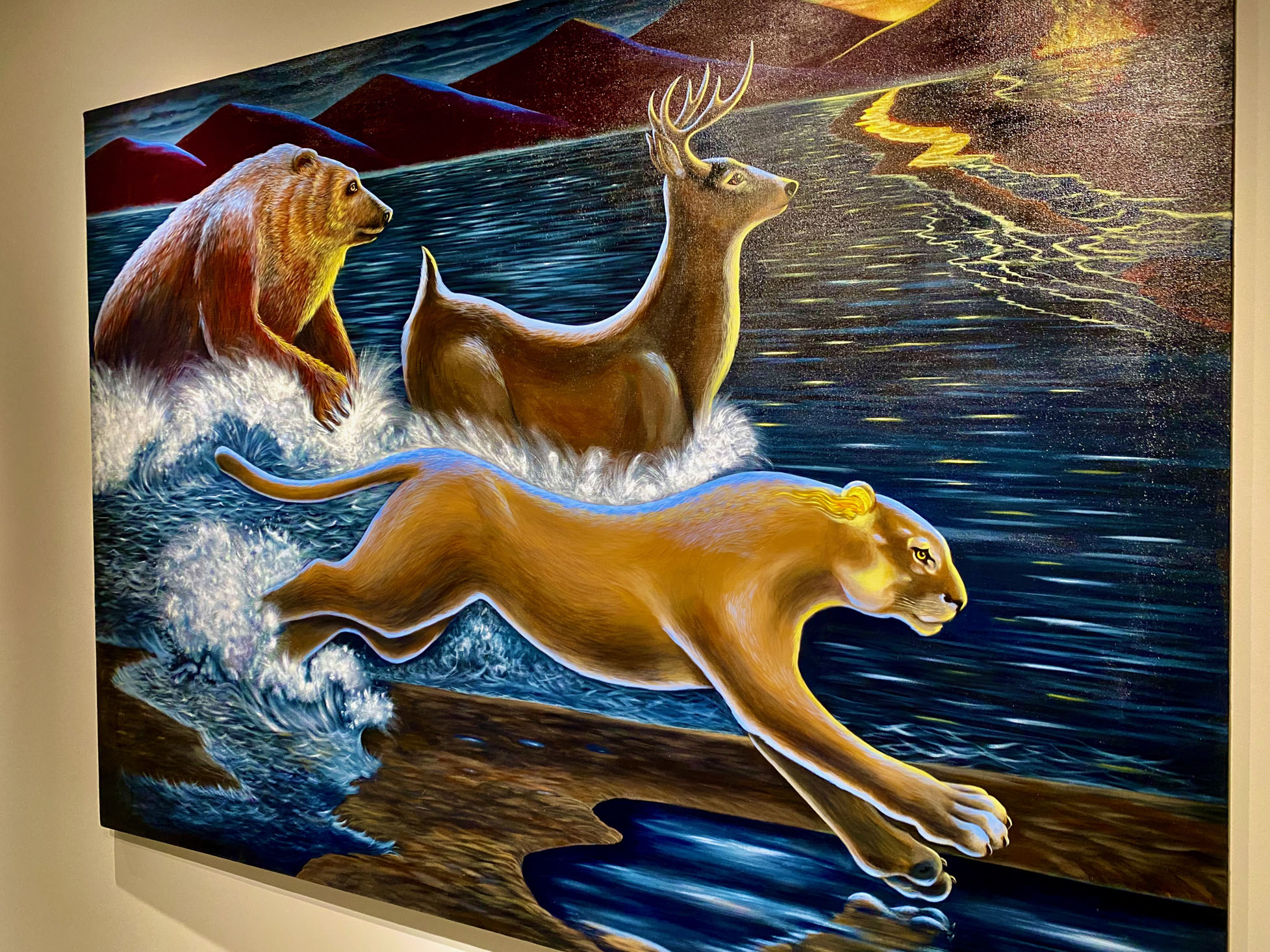
Or letting us enjoy the epic, triumphant forces of natural world that led to the environment Lowry now inhabits in the shadow of the Sierra Nevadas.

Lowry’s 2001 The Race for Fire showing animal spirits charging to retrieve fire from the mountains after a devastating flood. Courtesy: Maidu Museum and Historic Site, Roseville, California.

But at the end of her retrospective, Lowry presents the ultimate immersive experience – an imagined native Northern California roundhouse where visitors can enter, think, and see mystical images of Lowry’s inspiring female ancestors, tribal story-carriers, and cultural symbols.  Visitors enter quietly and linger respectfully, taking in all the details of the painted walls and dome.  See our short video to see Lowry’s comforting interior.

Lowry’s 2005/2025 mixed-media installation K’um degoi-dom (Home Place), an imagined Native California roundhouse covered in snow; built for quiet reflection. Courtesy: private collection

After immersion in this spiritual space, visitors enter a bright contemporary gallery displaying some of the 125 contemporary Indigenous works that Lowry and her husband Brad Croul donated to the Nevada Museum – honoring the accomplishments of the notable artists working in the region in the 1990s. The gallery is filled with art by famed Northern California indigenous artists (inspirations and friends like Harry Fonseca and Jean LeMarr. The gift significantly expands the museum’s indigenous contemporary collection.

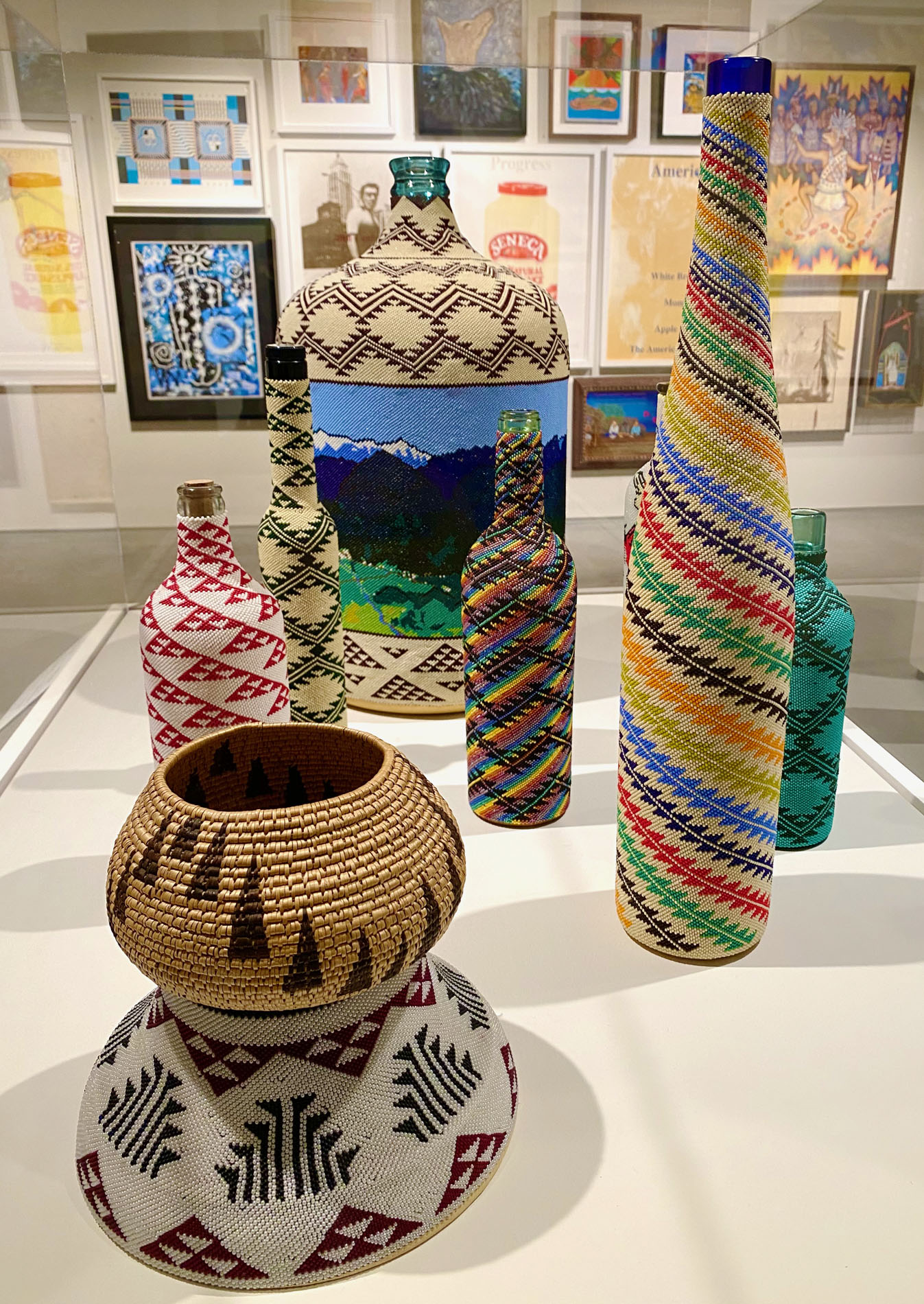
It’s also a nice punctuation that the spectacular case of beaded glasswork by Lorena Gorbet also features a treasured piece of Judith’s family history – a beautiful grasshopper-stitch basket made by Judith’s great-aunt Annie Gorbet when she was only fourteen years old. 

1914 red maple and willow Grasshopper Stitch Basket by 14-year-old Annie Gorbet [Yamani Maidu (Mountain Maidu)] (Judith’s great aunt) and undated beaded glass water jug and bottles by Annie’s granddaughter, Lorena Gorbet
Car Crash Necklace by Brian Tripp (Karuk); created from auto reflector fragments, river rock, duct tape, fabric, and string.

Lowry’s work and generous collection provide a loving immersion into family, friends, and spiritual traditions of the Great Basin. It’s a rich tribute to a prolific contemporary artist – one who cares about her culture and committed to ensuring its legacy for her region.

Celebrating Juan Pino, First Pueblo Printmaker

It’s been just over 100 years ago that Juan Pino of Tesuque Pueblo popped into the Santa Fe studio of Charles Kassler, and experienced his enthusiasm about linoleum printmaking – a new-ish way to make multiple images without using an expensive press or chemicals.

Charles offered Juan some materials to take home so he could try it, and Juan got to work. See the results in Printing the Pueblo World: Juan Pino of Tay Tsu’geh Oweenge, on display at Santa Fe’s Museum of Indian Arts and Culture through August 17, 2025.

Take a look at our favorites in our Flickr album.

Exhibition banner on Museum Hill

Unlike his friend Kassler, who trained formally at Princeton and the Art Institute of Chicago, Juan received his artistic training in the Pueblo world, learning observation, craftsmanship, and patience from the ceramic and textile artists around him. By 1924, booming tourism in Northern New Mexico had created a big market for modern and traditional pueblo ceramics (think Maria Martinez and Margaret Tafoya) and for pueblo painters, like Julian Martinez and Awa Tsireh (Alfonso Roybal).

Juan Pino’s 1925 linocut print of people by the church in the Tesuque Pueblo plaza

Juan was an expert in wood carving, ceramics, textiles, and crafting dance regalia, but like most artists of his day, he juggled his artistic output with other income-generating pursuits – farming, gathering and selling home-heating wood, and posing as a model for Anglo artists flocking to the vibrant Santa Fe art colony.

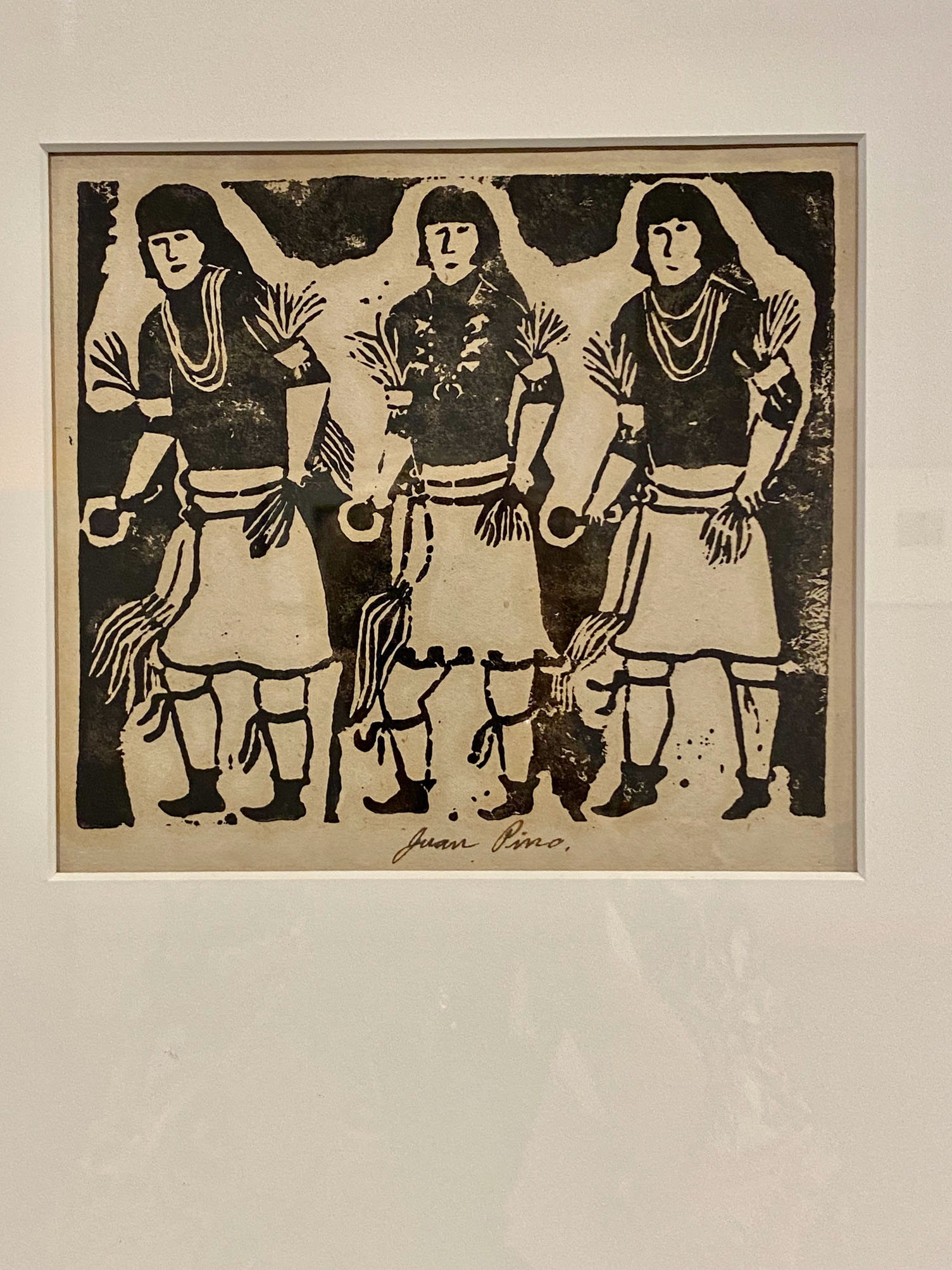
Juan Pino’s 1925 linocut print of three corn dancers – depicting himself, Vecillio Herrera, and Candido Herrera.

For linocut printmaking, you just cut your design into linoleum – a relatively accessible material since it was manufactured for use in kitchen floors or wall coverings for new homes. Once the block was carved and inked, you could either apply manual pressure to make the multiple images or ask a fellow artist to borrow their press.

Carving images into linoleum came naturally, and Juan started depicting the world around him in Tesuque – not just romanticized images of Indian life. Juan carved and printed the daily comings and goings of his fellow villagers in the pueblo plaza and images of traditional dances.

For all the car traffic and hubub on the streets of Santa Fe during the 1920s, Tesuque pueblo life still had elements of traditional Tewa ways.  Archaeologists have found remnants of village buildings dating back to 1200 CE, so Tesuque is one of the longest inhabited communities in the United States.

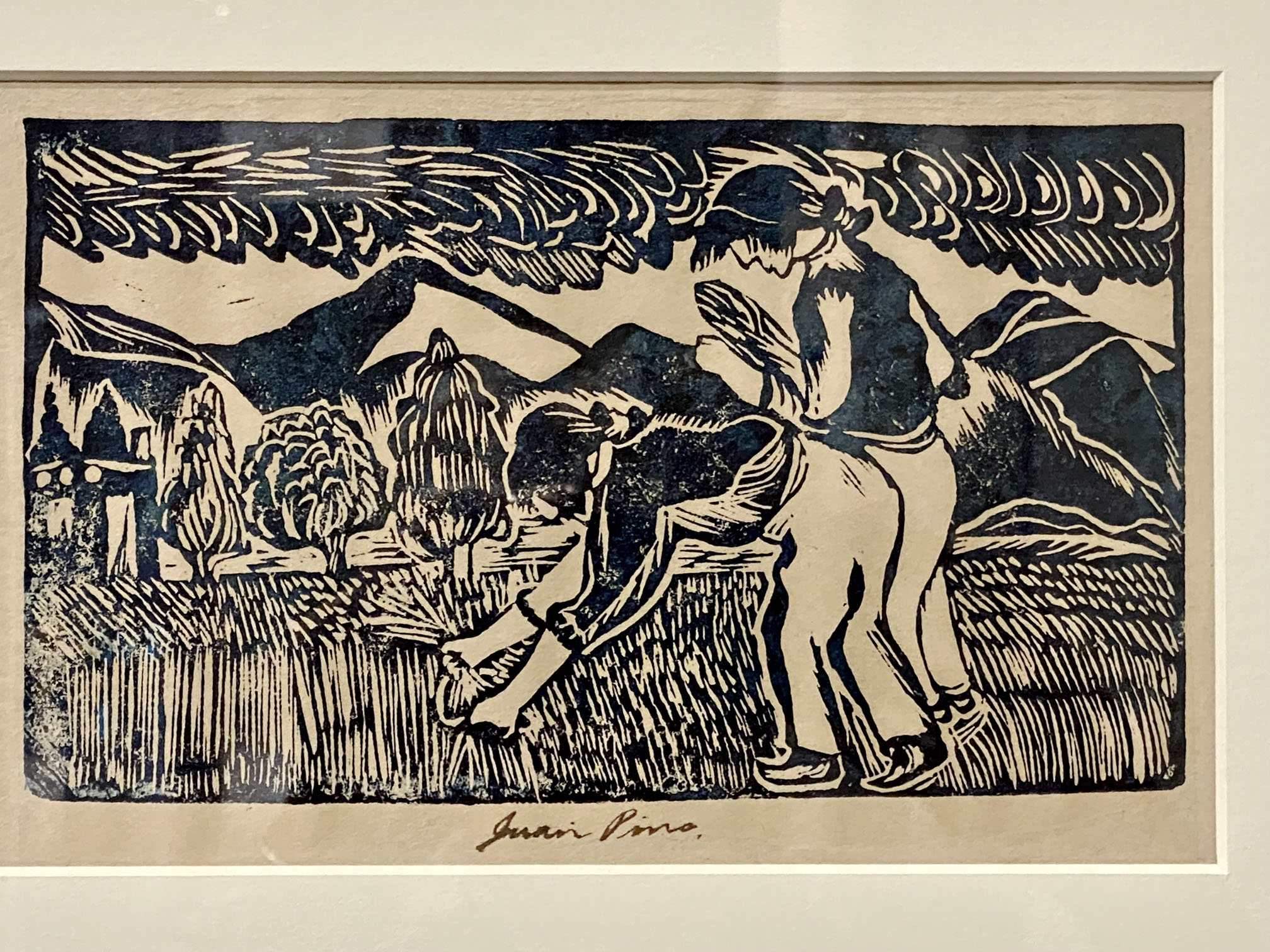
Juan Pino’s 1925 linocut print of two men harvesting wheat

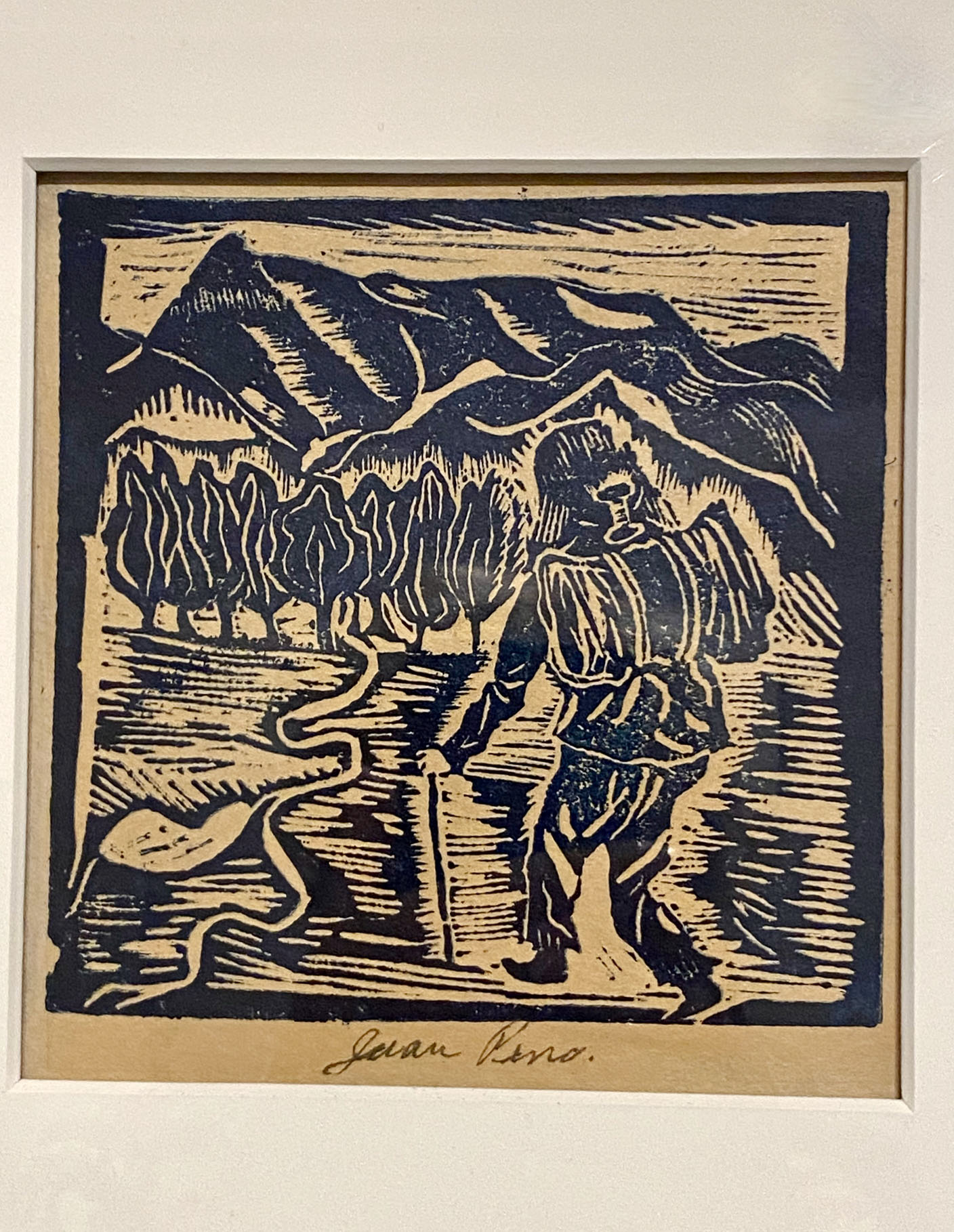
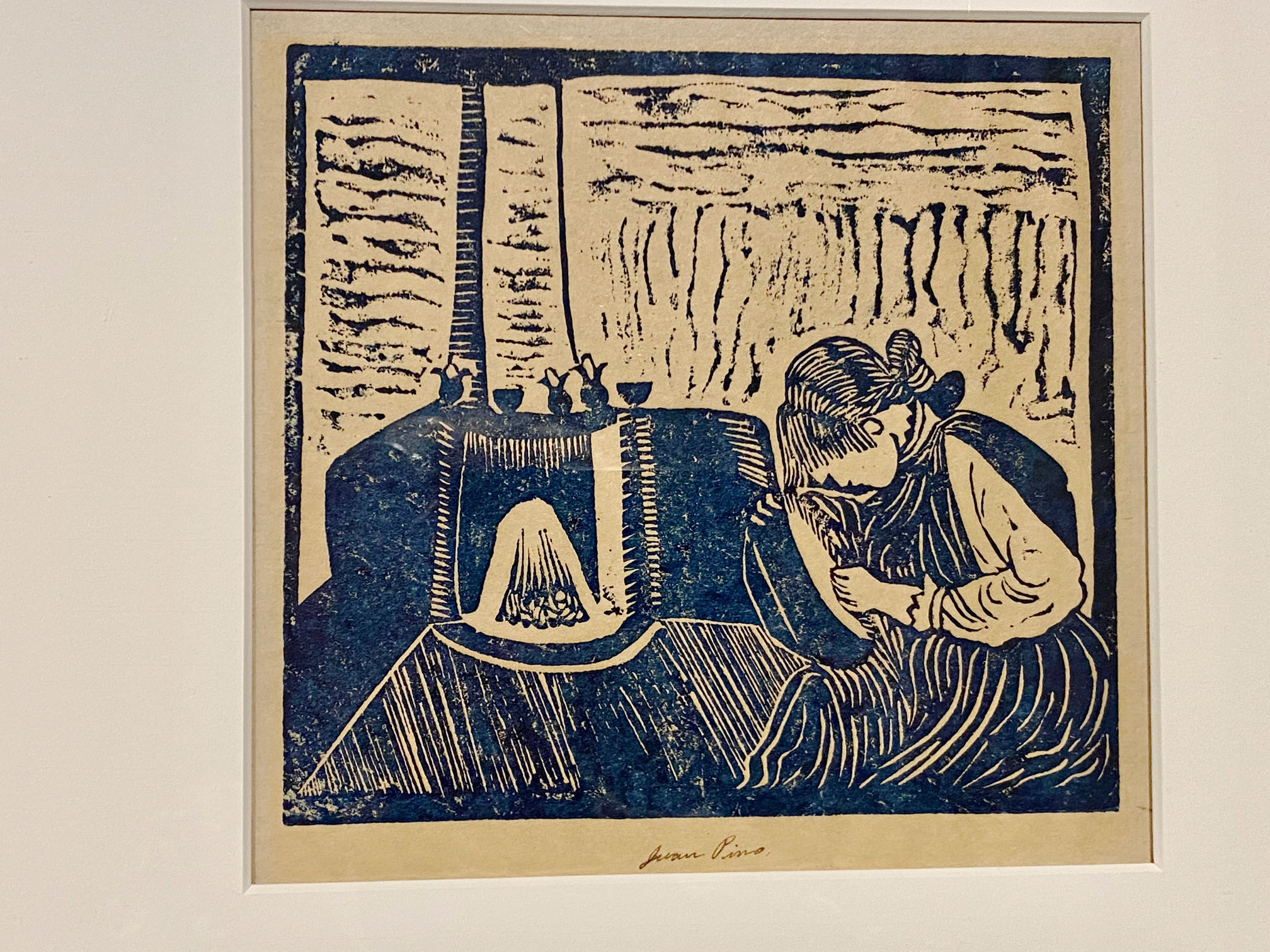
Taking in the twenty prints in the exhibition allows us to see day-to-day life as it was 100 years ago in the historic pueblo – making ceramics at home, harvesting, using oxen on the farm at a time just before horses replaced them as the work animal of choice.  We can even see detailed black-and-white depictions of the regalia men were wearing for the Corn Dance – including one print that likely includes a self-portrait!

After only a few months of making linoprints in 1925, Juan’s work was displayed at the New Mexico Museum of Art. Santa Fe and Pueblo artists celebrated his accomplishment as the first Pueblo artist to try his hand at printmaking. In Santa Fe’s commercial gallery market, however, tourists were more inclined to purchase prints and paintings that showed more romanticized visions of Indian life.

Juan kept creating, and seeing so much of his work 100 years later is truly a revelation – a set of quiet, enjoyable glimpses of everyday life at the foot of the Sangre de Christo Mountains.

Juan Pino’s 1925 linocut print of a voyaging man. Courtesy: Indian Arts Research Center, School for Advanced Research, Santa Fe.

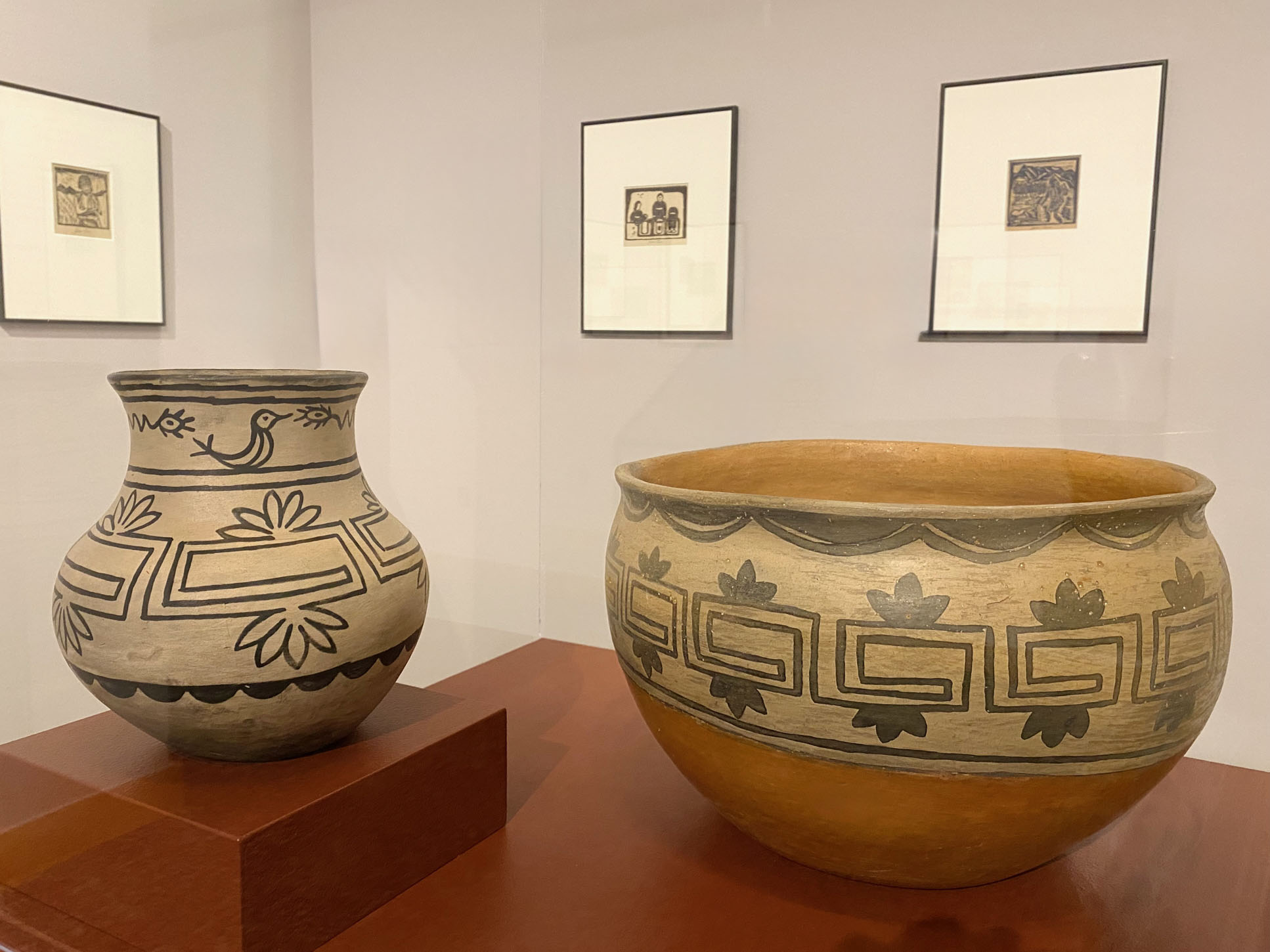
The show also has a beautiful touch that emphasizies Juan’s continuing artistic output: two large ceramic pieces from the Thirties and Forties created by his wife, Lorencita Pino. It’s likely Juan used his steady hand to apply strong, black lines – skills so evident in his masterful design for his slice-of-life print series.

Lorencita Pino ceramics likely painted by her husband, Juan Pino – a 1940 dough bowl with cloud and scroll designs and 1930 jar with bird and scroll design.
1925 linocut print of woman making pottery near fireplace…is it Lorencita?

Kite Dreams with AI at IAIA

How does a Lakȟóta artist link dreams and artificial intelligence to imagine futures for her people? Experience five years of innovative installations in Kite and Wíhaŋble S’a Center: Dreaming with AI, on view at the IAIA Museum of Contemporary Native Arts in Santa Fe through July 13, 2025.

The IAIA exhibition – Suzanne Kite’s third solo exhibition this year across the United States – presents several installations that highlight her collaborative work that merges cutting-edge technology with Indigenous knowledge systems. 

Download the exhibition catalogue here, and look at photos of the installation in our Flickr album.

2023 Wičhíŋčala Šakówiŋ (Seven Little Girls) and Wicháhpi Wóihanbleya (Dreamlike Star) use stones to translate Kite’s dreams into Lakhóta symbols.

In Iron Road and Dreamlike Star, stones and minerals (the building blocks of computers!) are arranged in Lakȟóta geometric language that suggest Lakȟóta quilt patterns. They’re placed atop a mirror to show resonance between the Earth and the cosmos (stars).

2023 Wicháhpi Wóihanbleya (Dreamlike Star) suggest that ancestor stars can point the way to Indigenous futures.

In this first section, inputs are taken from Kite’s dreams. Using AI, her dreams are translated into geometric Lakȟóta shapes created by designer Sadie Red Wing. Kite has figured out a way to bypass large-scale, commercial AI networks in favor of an AI model (run on her PC) that aligns more closely with Indigenous knowledge systems.    

A digital embroidery machine has yards of embroidered black velvet flowing out of it.  Oihanke Wanica (Infinity) is a collaboration with New York City’s Center for Art, Research and Alliances. As you examine the velvet, you’ll find geometric Lakȟóta shapes translated (using AI) from Kite’s dreams.

Nearby, there’s a comfortable lounge where you can watch Cosmologyscape, an interactive digital quilt – a public art project in which AI translates the public’s dreams into artist-created geometric symbols. It’s a collaboration with Alisha B. Wormsley, so the virtual community quilt manifests both African-American and Lakȟóta shapes.

2023 Oihanke Wanica (Infinity) – a digital embroidery machine stitches symbols representing dreams onto black velvet. Collaborator; Center for Art, Research and Alliances.
Lounge to watch Kite and Alisha B. Wormsley’s 2024 Cosmologyscape – Ai translates the public’s dreams into symbols for an ever-expanding digital quilt.

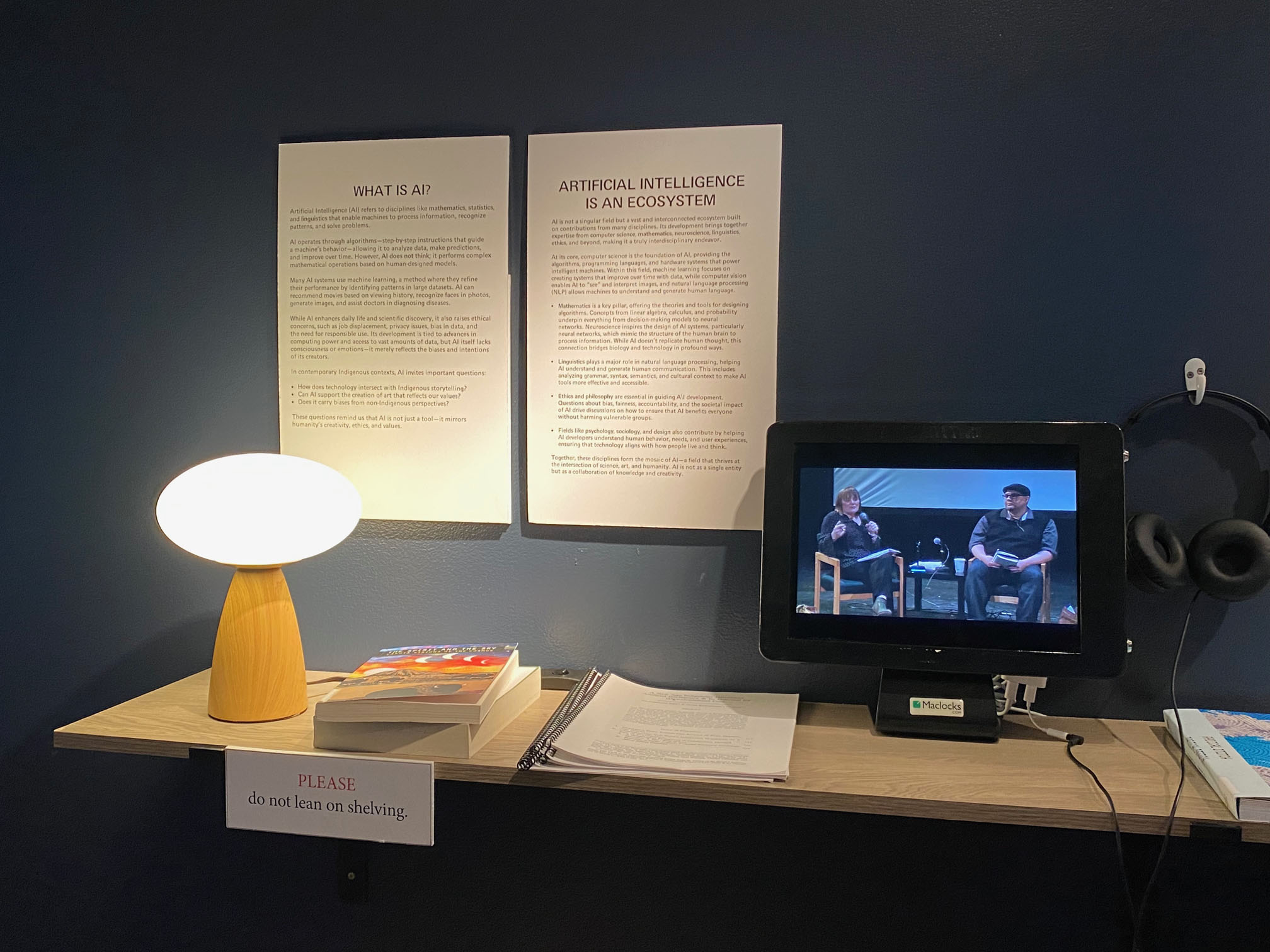
Installations in the other half of the exhibition shows collaborative projects that combine Indigenous knowledge systems and AI. Along one wall in the spectacular, tranquil gallery, you can explore a print and digital resource library on international research programs that integrate Indigenous knowledge systems into AI design.

Abundant Intelligences – a library and digital resource station for information on AI and futurism in contemporary Indigenous art.

Oneiris is a large interactive station through which visitors are invited to generate dream symbols that AI adds into a wall-sized display that looks like a portal to the cosmos. Inspired by the Lakȟóta concept of a Dream Language, she and her many technical collaborators genuinely bring dreams to life.

Oneiris – a collaborative project using advanced AI models to allow visitors to bring dreams to life.

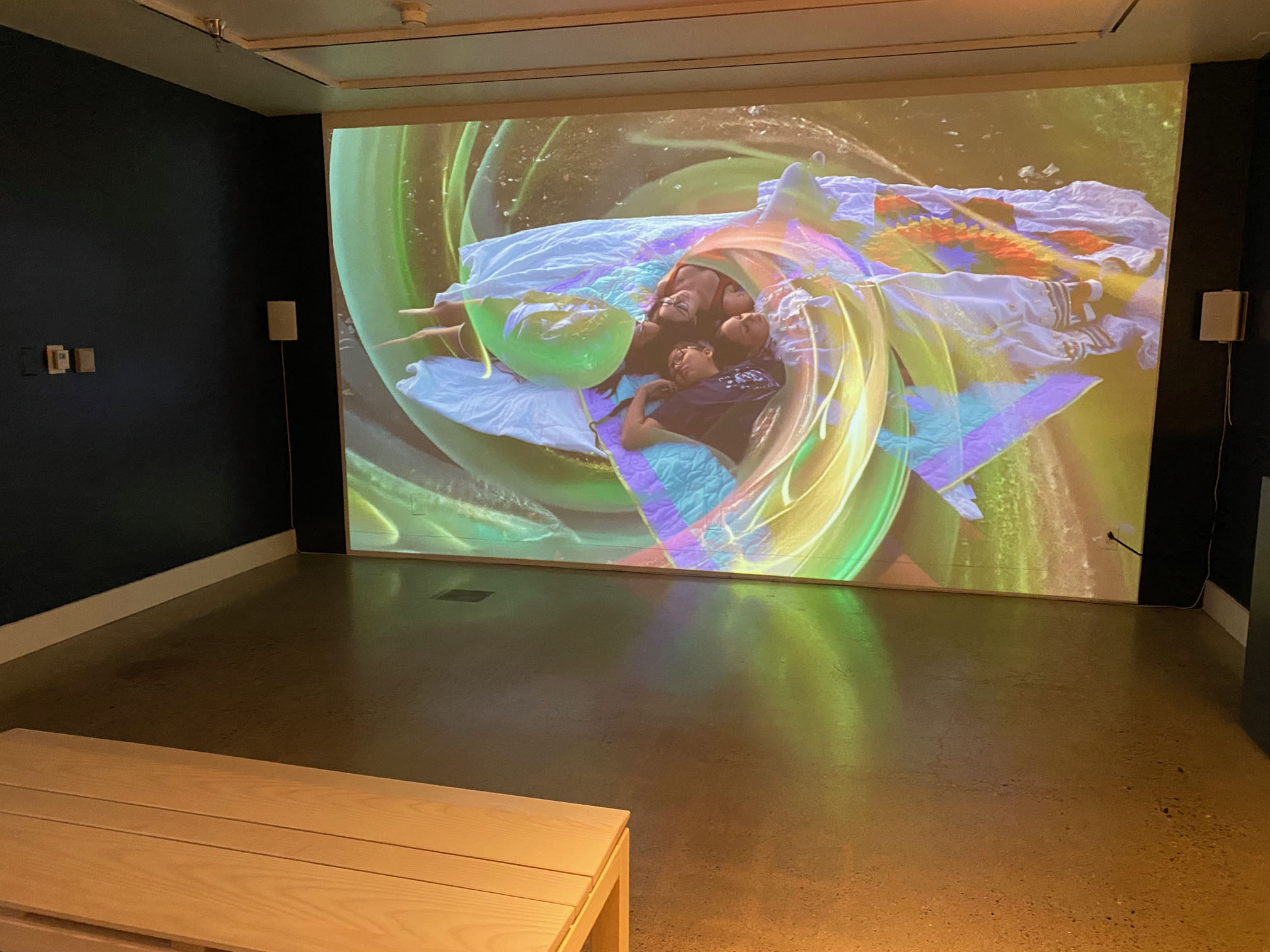
Spashed across the final wall of the space, The Land Paints Itself is a video collaboration with her Wíhaŋble S’a Center for Indigenous AI at Bard – a lab that explores Indigenous advances in this science and art. Watch as AI generates dazzling colors and patterns as four Lakȟóta dream about Indigenous futures. Kite suggests that the evolving technology of dreams is a legitimate way for her nation to envision ways forward.

2025 The Land Paints Itself video that uses AI to illustrate Lakhóta people’s dreams about Indigenous futures.

Provocative, visionary, and affirmative – meet Kite herself in an interview with Artforum editor Tina Rivers Ryan in March 2025, when Kite’s work was featured on the cover.

Contemporary “Echoes” at The Wheelwright

Since its founding in 1937 as an institution documenting Navajo ceremonial art, Santa Fe’s Wheelwright Museum of the American Indian has shifted toward collecting contemporary Native American art and serving as a platform to boost careers of emerging artists.

The latest exhibition pays tribute to its last 50 years in Echoes: Selections from the Wheelwright Museum’s Permanent Collection, on view through June 8, 2025

The exhibit showcases well-known artists – like Tony Abeyta, T.C. Cannon, Virgil Ortiz, Rose B. Simpson, Bob Hazous, and Emmi Whitehorse – but the curators deliberately chose early-career works that haven’t been seen for a while. 

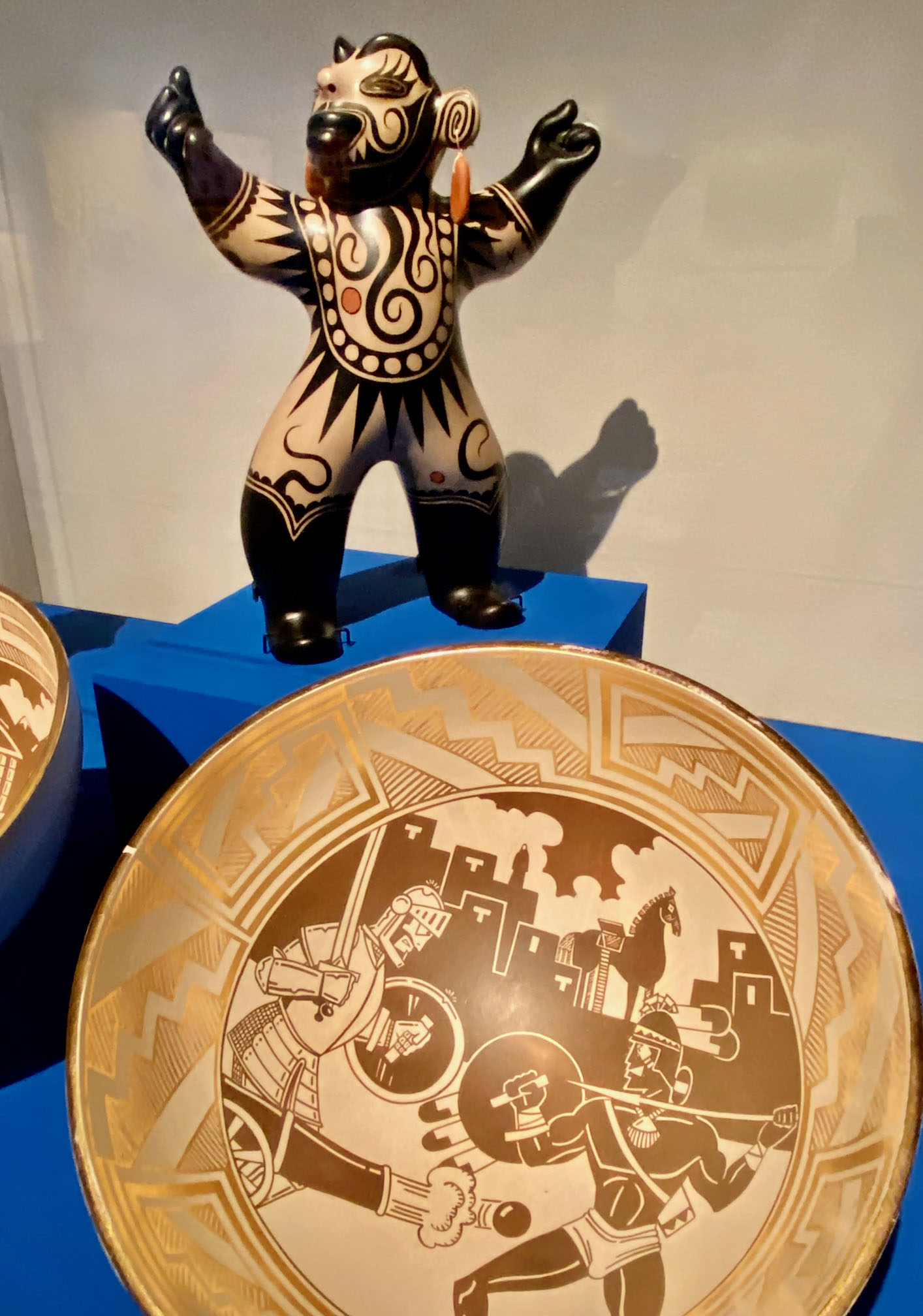
Virgil Ortiz’s (Cochiti) 2005 ceramic sculpture Monos Figure with Diego Romero’s (Chochiti) 2005 bowl Tenga Cuidado Con Griegos Salvo Obseqios.

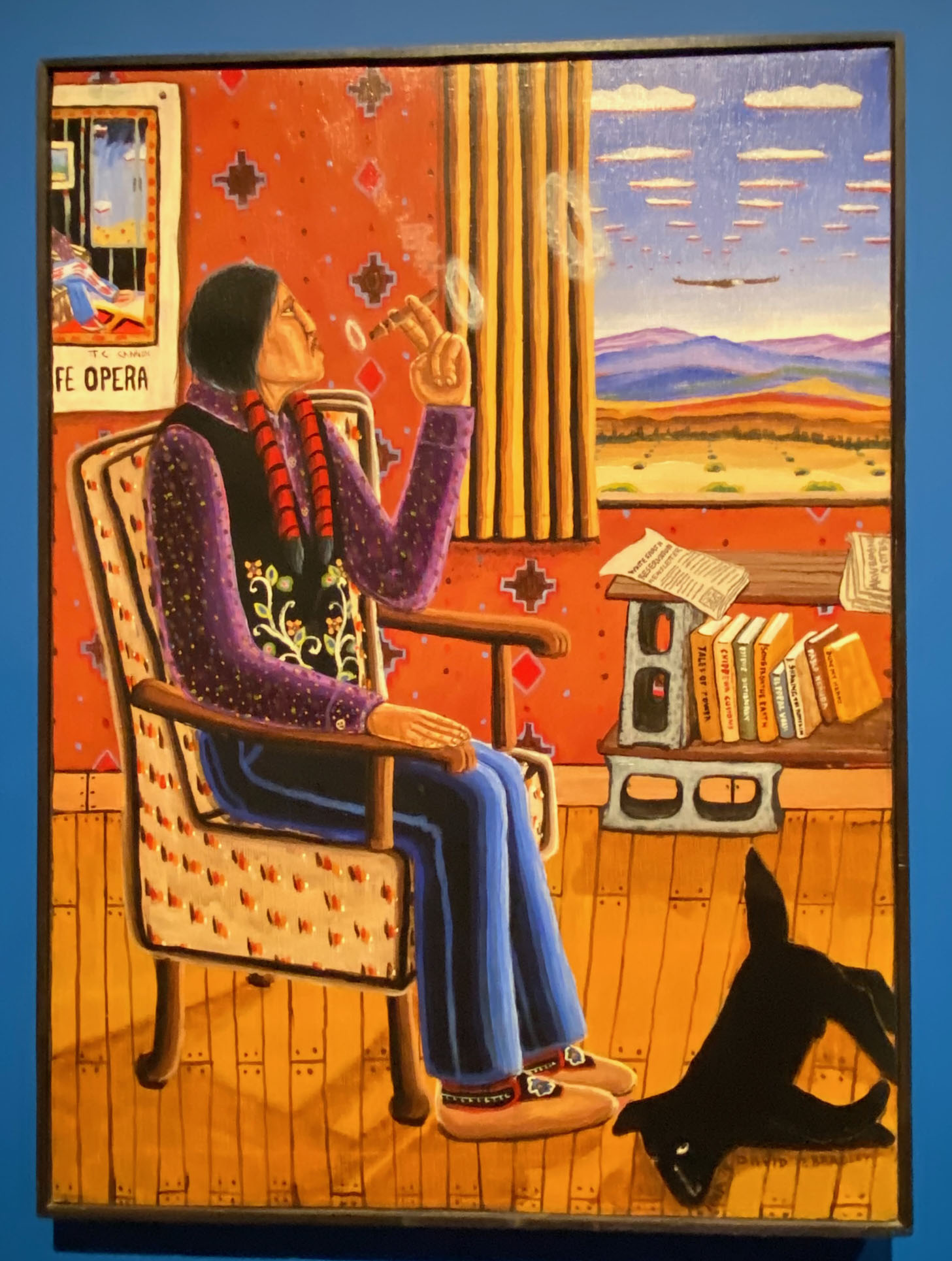
For example, on a wall honoring T.C. Cannon, the curators showcase a crazy, irreverent David Bradley work painted in T.C.’s bold, satirical style, but display a rather conservative (and rarely seen) woodcut by T.C. himself.

David Bradley’s (Minnesota Chippewa) 1979 acrylic Remembering T.C. Cannon in the style of his hero.
T.C. Cannon’s (Kiowa/Caddo) 1977 woodblock print Hopi with Manta.

Contemporary textile artist Ramona Sakiestewa’s comment that her work represents “visual echoes of what came before” inspired the title of the exhibition. Sakiestewa’s tapestry incorporates colors and motifs of traditional Hopi wicker plaques.  This theme is carried throughout the show.

Ramona Sakiestewa’s 1992 Basket Dance/9-B echoes a traditional woven Hopi ceremonial plaque.

A grouping of intricately painted Acoma ceramics pays tribute to the Wheelwright’s 1981 exhibition Sky City Salute that honored two matiarchs of that art form – Lucy Lewis, who lived at Acoma before and after tourists began beating a path to the ancient mesa-top city, and Marie Z. Chino. The curators match it with work by Marie’s grandson, Robert Patricio, who channels traditional themes into a modern ceramic context.

Acoma legacies: a 1965-85 seed pot and 1958 bowl by Lucy Lewis, and large 1980 storage jar by Marie Z. Chino.

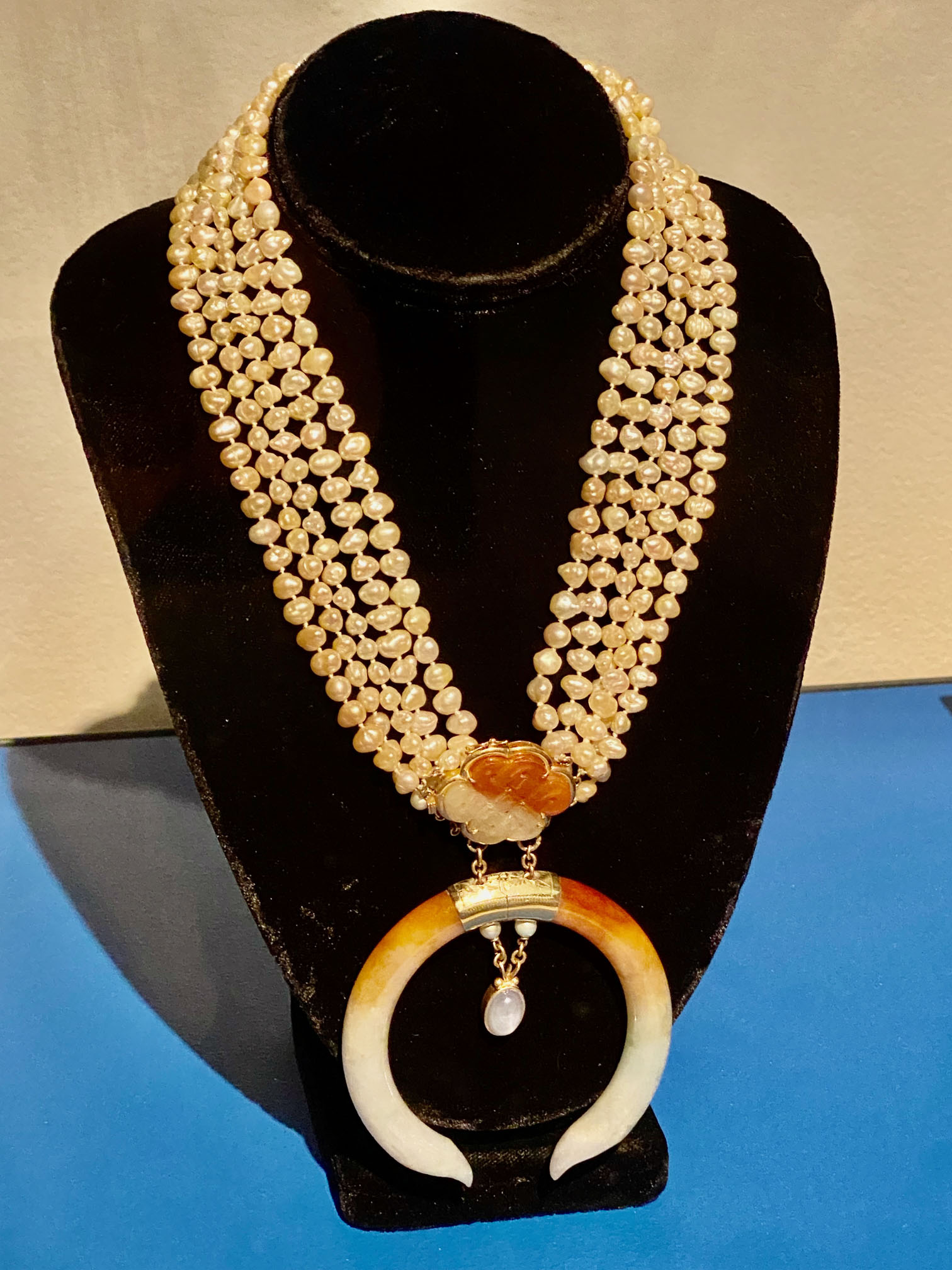
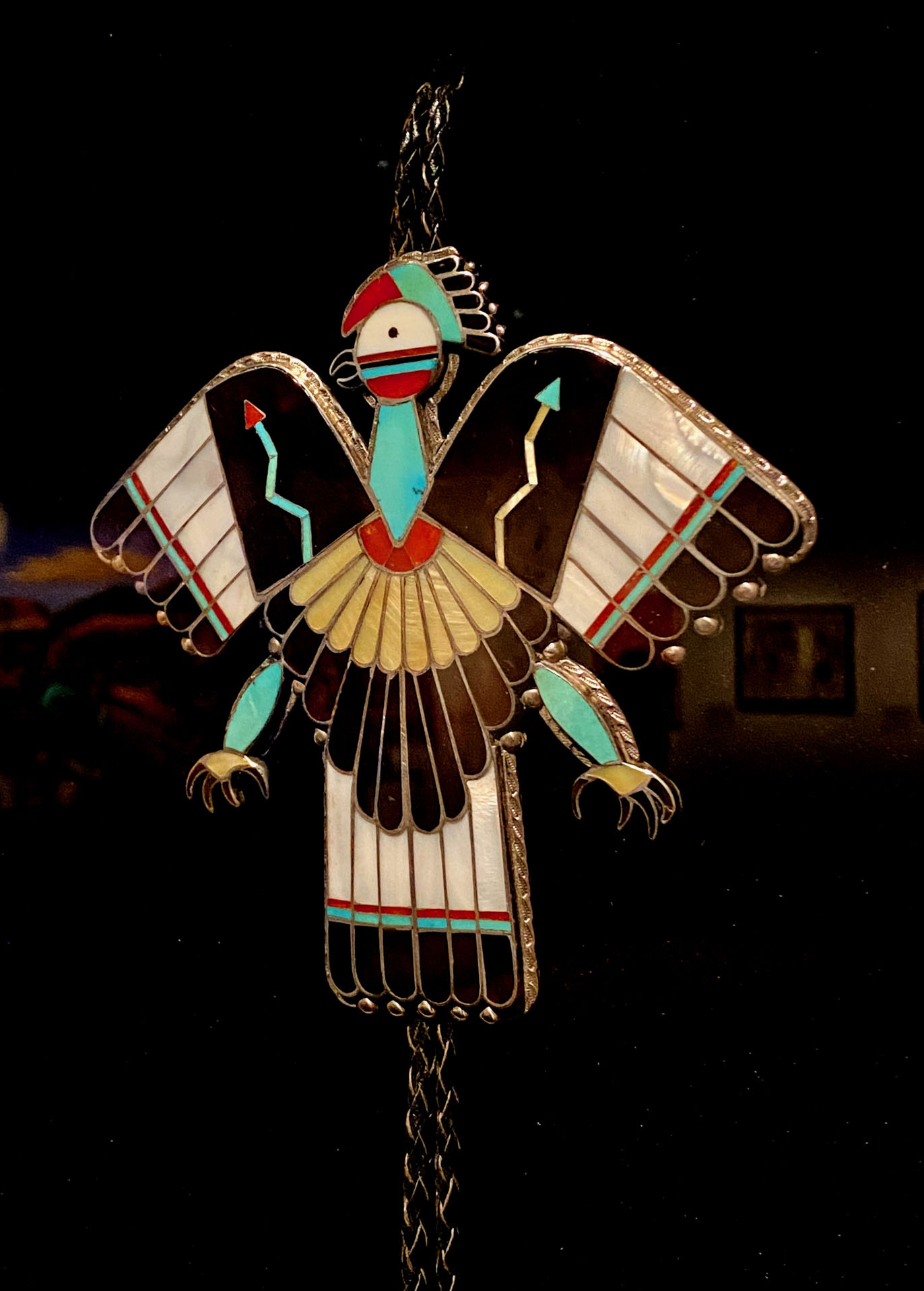
Another grouping references the Wheelwright’s 2011 show Radical Recycled Jewelry Makeover with a bold piece by Kenneth Johnson and the Wheelwright’s stellar collection of Zuni bolo-tie inlays.

Kenneth Johnson’s (Muscogee/Seminole) 2011 necklace from recycled pearls, jade, gold, and silver..
1970s-1980s thunderbird bolo by Owen Bobelu (Zuni); inlaid silver, jet, turquoise, and mother-of-pearl.

The “salon wall” is peppered with paintings that tell the interconnected histories and styles of nine Native artists – the trajectory from flat-style styles of the 1920s and 1930s to more open innovation of Ben Harjo and Linda Lomahaftewa, some of earliest graduates at the Institute of American Insitute Arts (IAIA).

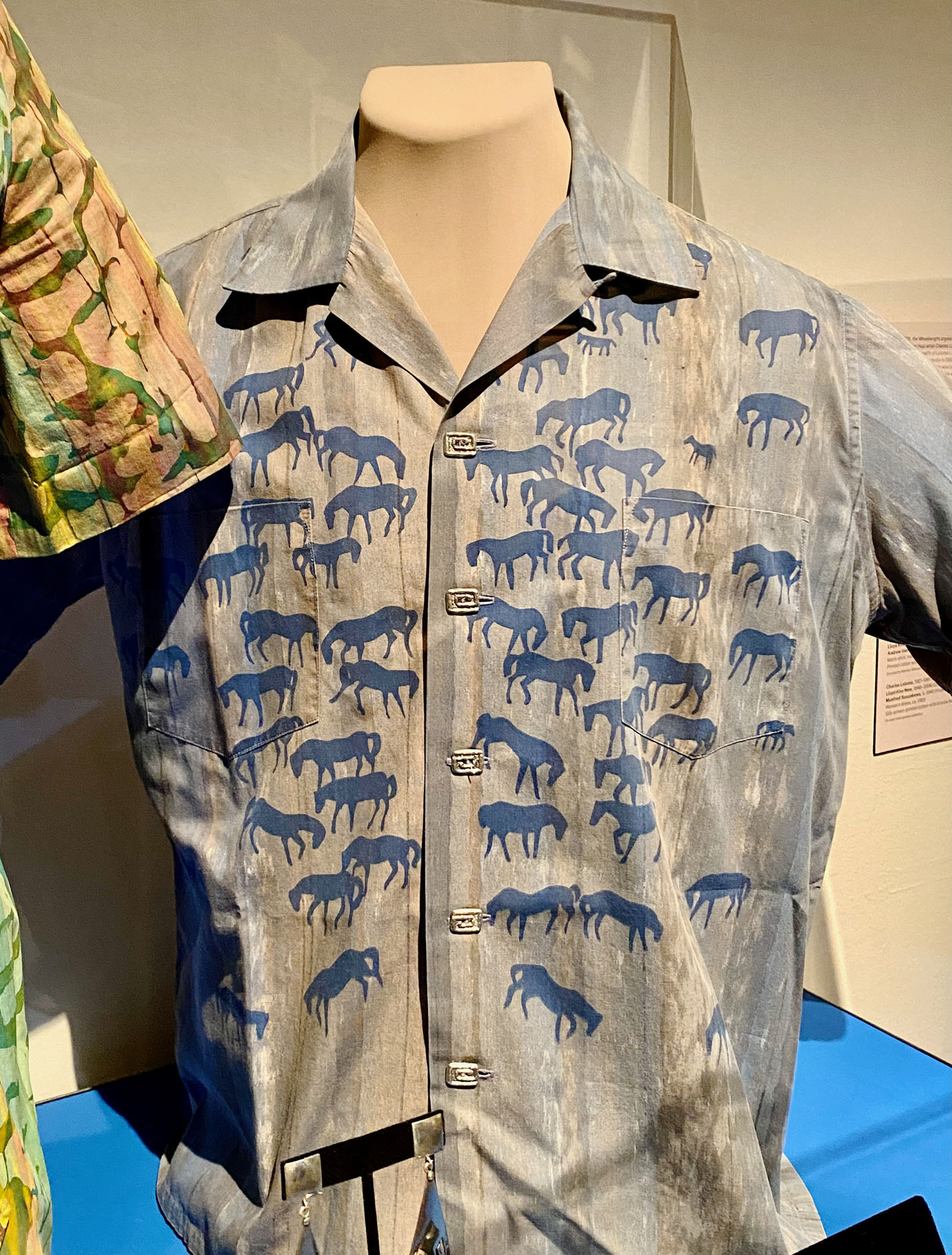
The exhibition also presents another group of work to acknowledge the artists who began working together in Scottsdale in the 1950s and who began IAIA in 1962 – clothing designed by co-founder/president Lloyd Kiva New and jewelry by instructor Charles Loloma..

Lloyd Kiva New’s (Cherokee) 1950s man’s shirt with Andrew van Tsinajinnie (Diné) printed fabric and Charles Laloma (Hopi) silver buttons.
Charles Laloma’s 1970 silver, coral, turquoise pin.

Beaded Converse sneakers by Marie Flying Horse, clever collage by Arthur Amiotte, a dinosaur pot by William Andrew Pacheco, art-world satire by Bob Hazous, and colorful Seurat references by Shonto Begay all add up to a vibrant walk through the last half-century of contemporary art innovations inside the hogan on Museum Hill.   

Take a look at our favorites on Flickr.

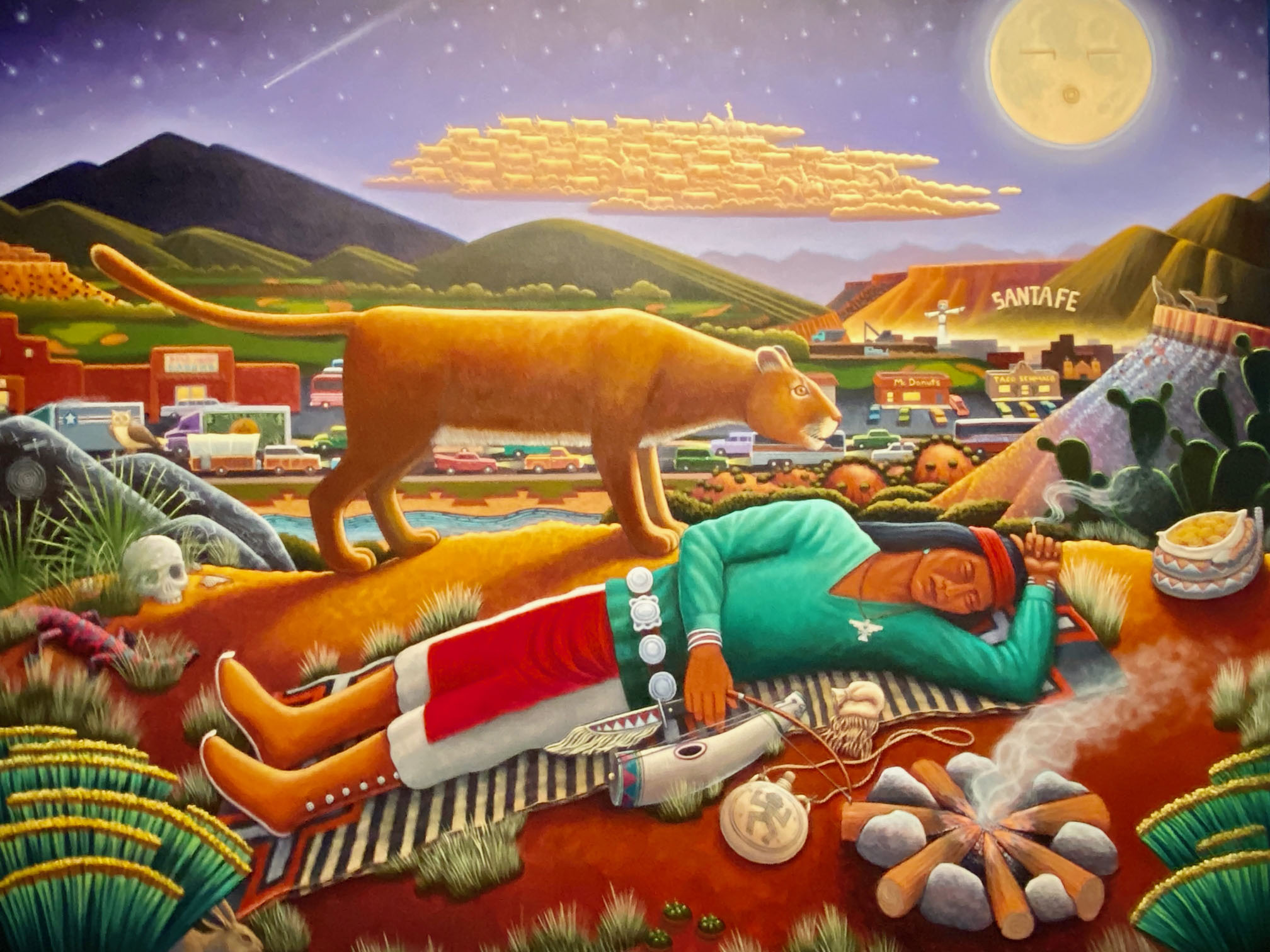
David Bradley’s (Minnesota Chippewa) 2004 acrylic To Sleep Perchance to Dream – a take on Rousseau

Pathfinder Marcus Amerman at The Wheelwright

Shape-shifter, beadwork innovator, pop-culture provocateur, fashion designer, and performance artist – it’s hard to know where to start when summarizing four-decades of work by a Native-American contemporary art superstar. But his first retrospective, Pathfinder: 40 Years of Marcus Amerman, does showcases his wide range of work in spectacular fashion. See it at the Wheelwright Museum of the American Indian in Santa Fe through January 11.

Marcus Amerman (Choctaw Nation of Oklahoma) is best known for his intricate beaded “paintings,” which take center stage.

1994 Stormbringer beaded portrait of Lakota leader Chief Iron Hawk. Surrealist eyes by Man Ray watch from a brewing storm. Courtesy: Colorado Springs Fine Arts Center.

Once Amerman developed his bead technique, which provided a photo-realist spin to a traditional “native” craft, he really felt that he could take on any subject as a contemporary artist – movie stars, historic characters, and cartoon images. The impact is electric. 

2002 beaded painting Greetings from Indian Country, merging vintage tourism with pointed social commentary on exploitation. Private collection

Gazing across the main gallery, you see pop-culture images of “Indian” memes splashed across large canvases, cartoony self-portraits, fashion mannequins, glass sculptures, and photos by his wry collaborators. It’s a splendid mix of eye-dazzling color, technical mastery, and social commentary. Take a look at some of our favorites in our Flickr gallery.

Amerman garnered a lot of attention in the late 1980s and early 1990s for merging his beadwork into contemporary fashion. He cites his beaded leather motorcycle jacket with a beaded meme of bikini-clad Brooke Shields starting it all – a shock-worthy mix of leather toughness with one of the hottest young stars of the day.  He took on custom commissions and leapt at the opportunity to participate in fashion shows. He was overjoyed to see his buckskin fashions featured in Elle.

1982 Iron Horse Jacket with beaded Brooke Shields. Courtesy: Private collection
American eagles beaded on lapels of 1992 dinner jacket; commissioned by veteran Doug Hyde (Nez Perce, Assiniboine, Chippewa).

It’s obvious that Amerman rejects staying put into a single category. He loves collecting vintage “Indian” objects and collaging art-world and historic references in all of his work. Check out those hubcaps!

2023 acrylic painting Old Masters in the New World, showing 17th century Dutch colonizers next to a Santa Fe train. Courtesy: the artist
2023 Rattles found-object collage, mixing pop cultural and Native images. Courtesy: the artist

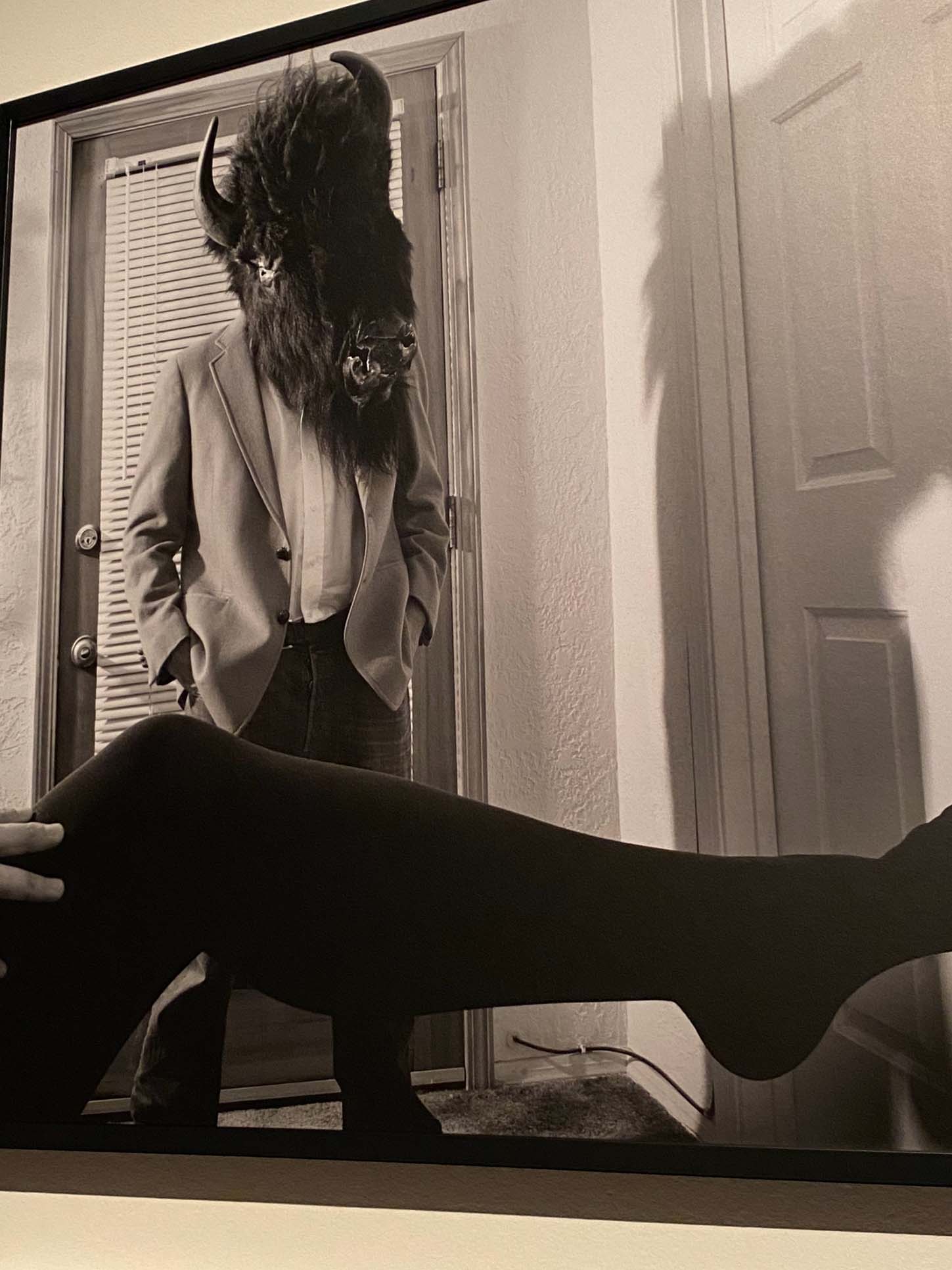
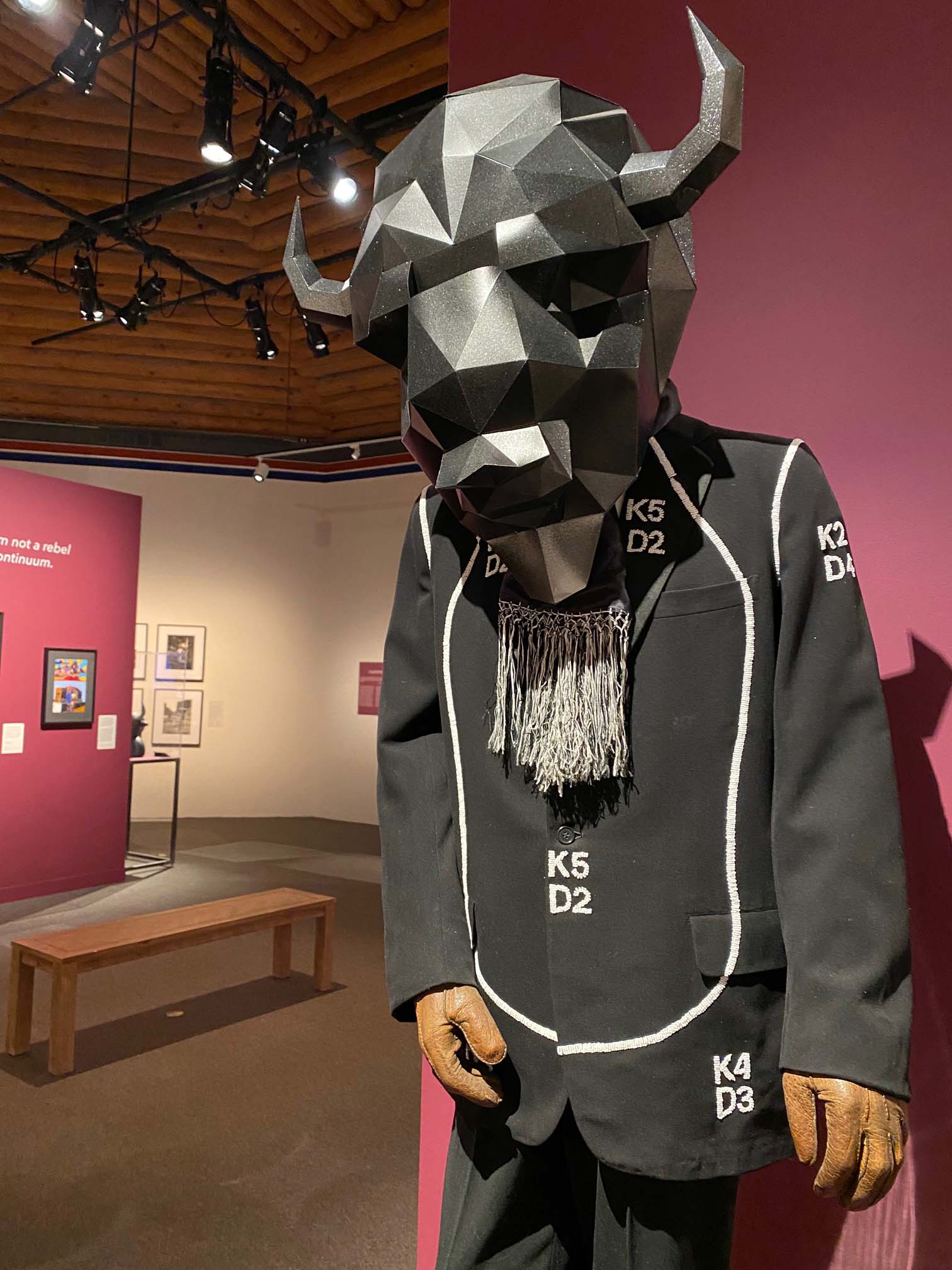
Amerman’s alter ego, Buffalo Man, features prominently in the show, particularly in his collaborations with acclaimed photographer Cara Romero, where icons of Native culture insert themselves into American pop culture.

Cara Romero’s 2013 photo El Graduaté – a collaboration with Amerman’s performance alter ego, Buffalo Man. Courtesy: Cara Romero
2002 Target Jacket with glass beads, worn by the artist in fashion shows as himself and as Buffalo Man. Courtesy: the artist

The gorgeous collaborations with glass artists from Amerman’s time at Pilchuk are a delight – some self-referential and others harkening back to his own culture’s ancestry.  He claims that everything he makes is genuinely as “self portrait.”

2010 blown and sand-carved Buffalo Man – a collaboration by Amerman and Preston Singletary (Tlingit). Courtesy: the artist
2006 Glass Shield, one of a series created during a residency at Pilchuk Glass School and inspired by historic Plains Indian shields. Courtesy: the artist

It’s a joyful tribute to an artist who gives back, inspires others, and keeps asking pertinent questions about the role of art and artists in our society.

Enjoy this close-up look at some of Amerman’s masterful beadwork and hear why Amerman continues to create:

National Gallery Celebrates 50 Contemporary Native Artists

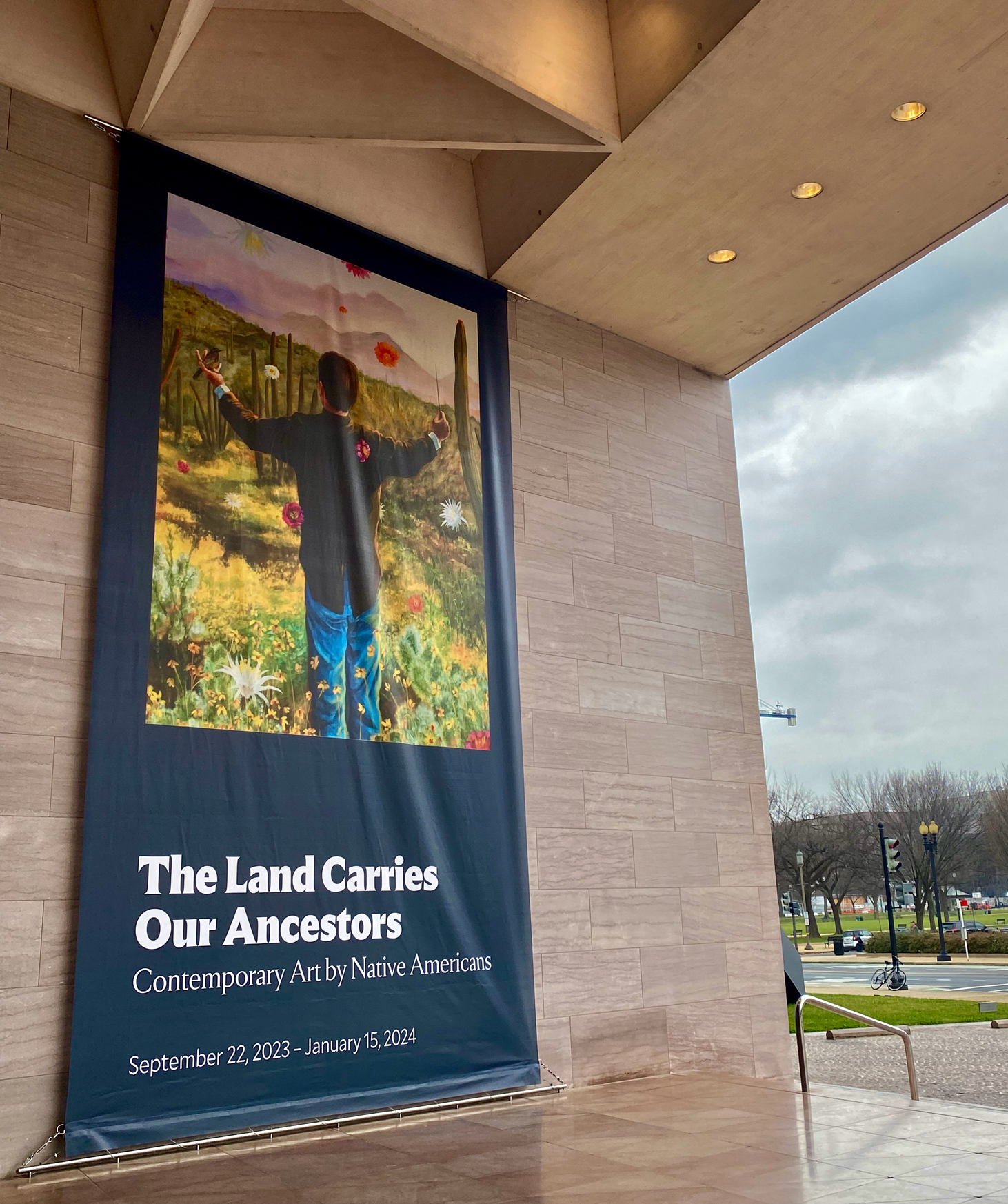
If you want to take a trip across American land with 50 living Native artists, there’s still time to catch the ground-breaking exhibition, The Land Carries Our Ancestors: Contemporary Art by Native Americans, at Connecticut’s New Britain Museum of American Art through September 15, 2024.

The National Gallery of Art in Washington, D.C. asked Jaune Quick-to-See Smith (Citizen of the Confederated Salish and Kootenai Nation) to survey the United States and create an exhibition reflecting the diversity of the living Native American artists.

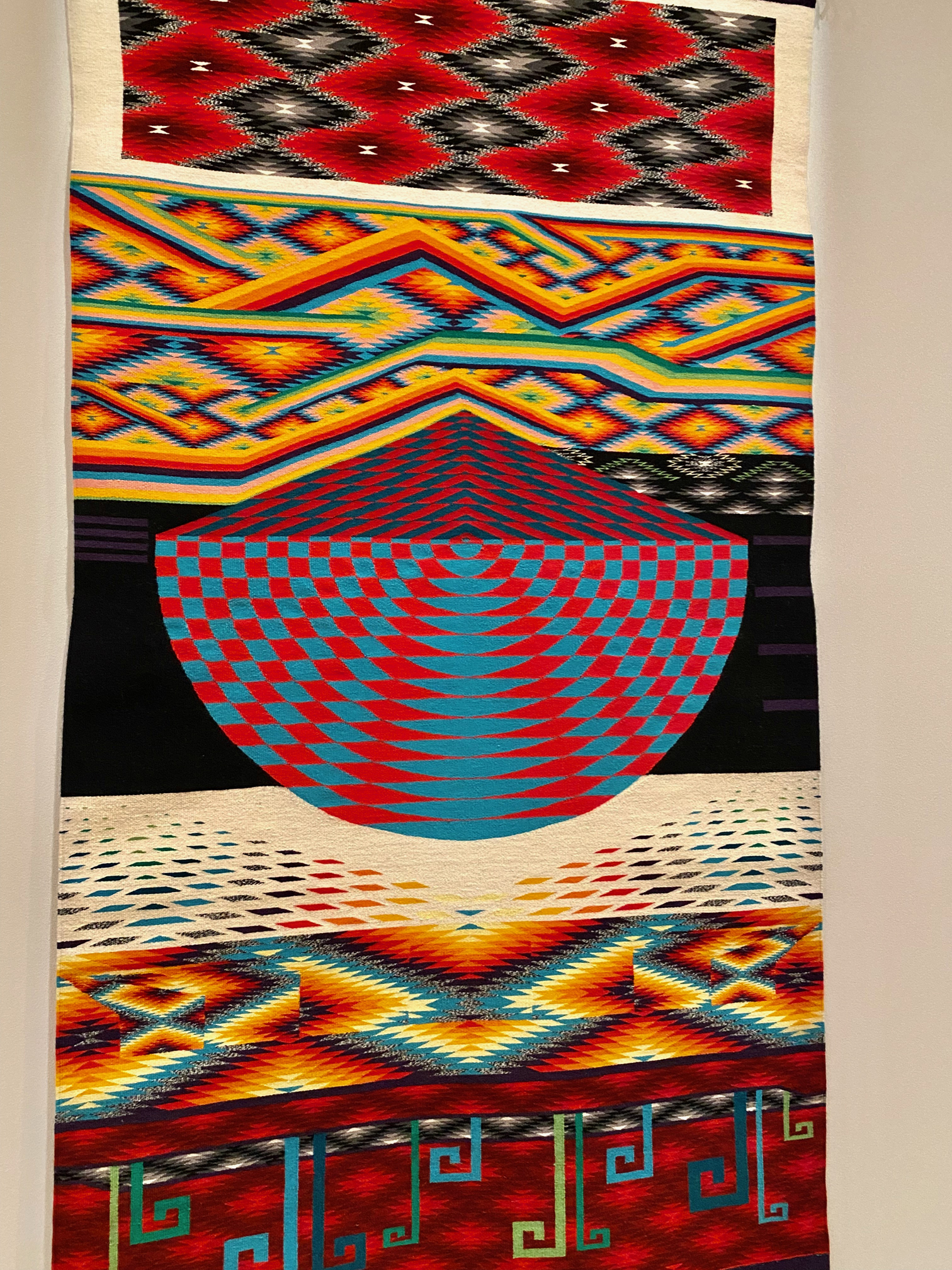
2014 wool weaving World Traveler by Melissa Cody (Navajo). Courtesy: Stark Museum of Art.

Smith, whose own artistic achievement was honored most recently in a three-museum retrospective in 2023-2024, became the first artist invited to curate a show at the National Gallery.

Entrance banner features Orchestrating a Blooming Desert by Steven Yazzie (Diné/Laguna Pueblo).

Smith has always done whatever possible to increase the visibilty of Native artists in the contemporary art world. For this exhibition, she chose 50 intergenerational artists from diverse regions, cultures, and artistic practices. Look at our Flickr album of the National Gallery installation to see some of our favorites.

All of the works reflect the artists’ deep connection to the land, especially Orchestrating a Blooming Desert by Steven Yazzie (Diné/Laguna Pueblo), a painting that reflects one man’s joyful encounter with a lush landscape.

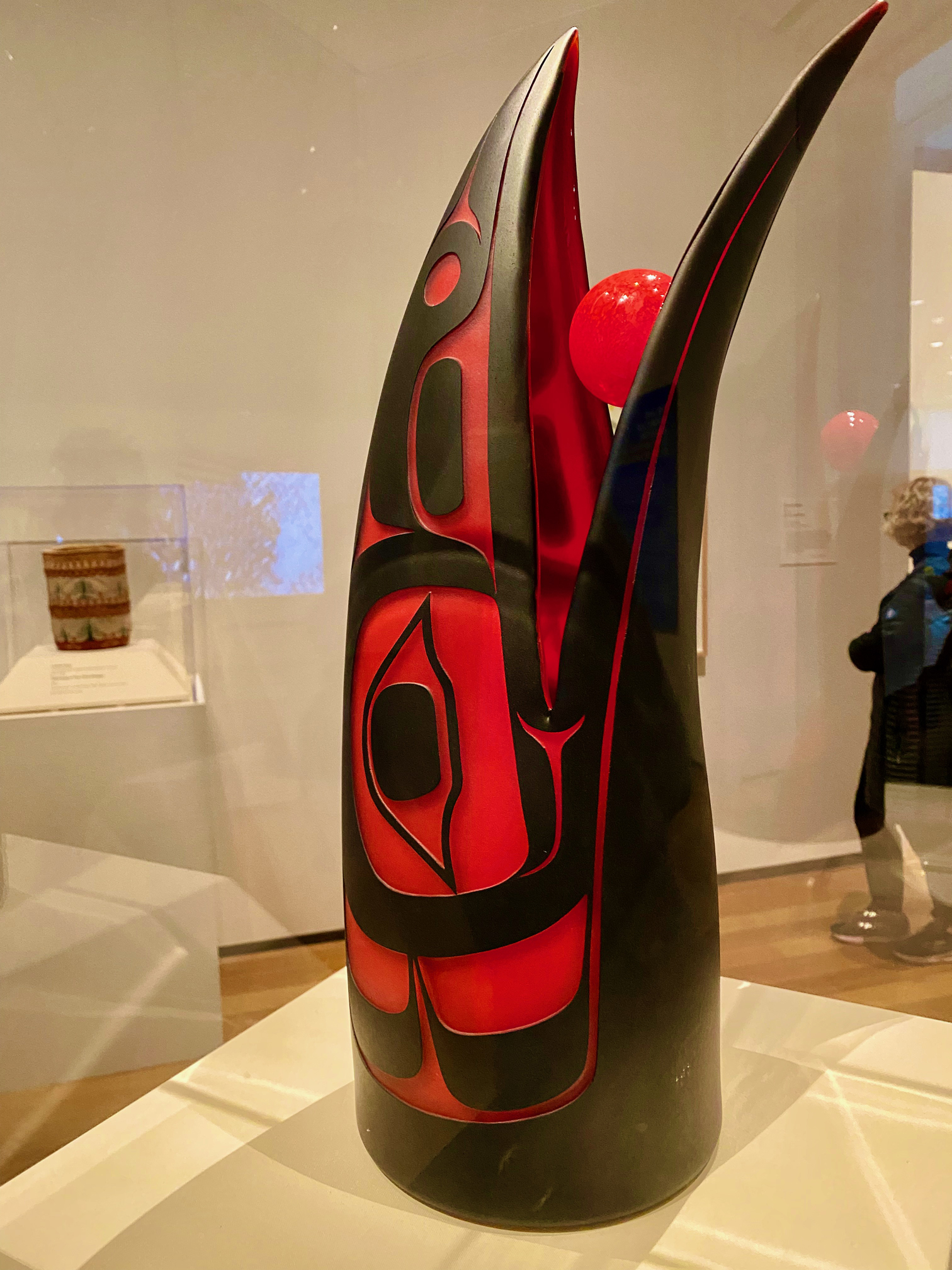
Some works depict a tribe’s link to the natural world through origin stories. Visitors are mesmerized by Preston Singletary’s exquisite sculpture of Tlingit creation-myth legend, Raven stealing the Sun. It’s glorious to admire this dramatic icon fully realized in a distinctly nontraditional medium – blown and sand-carved glass.

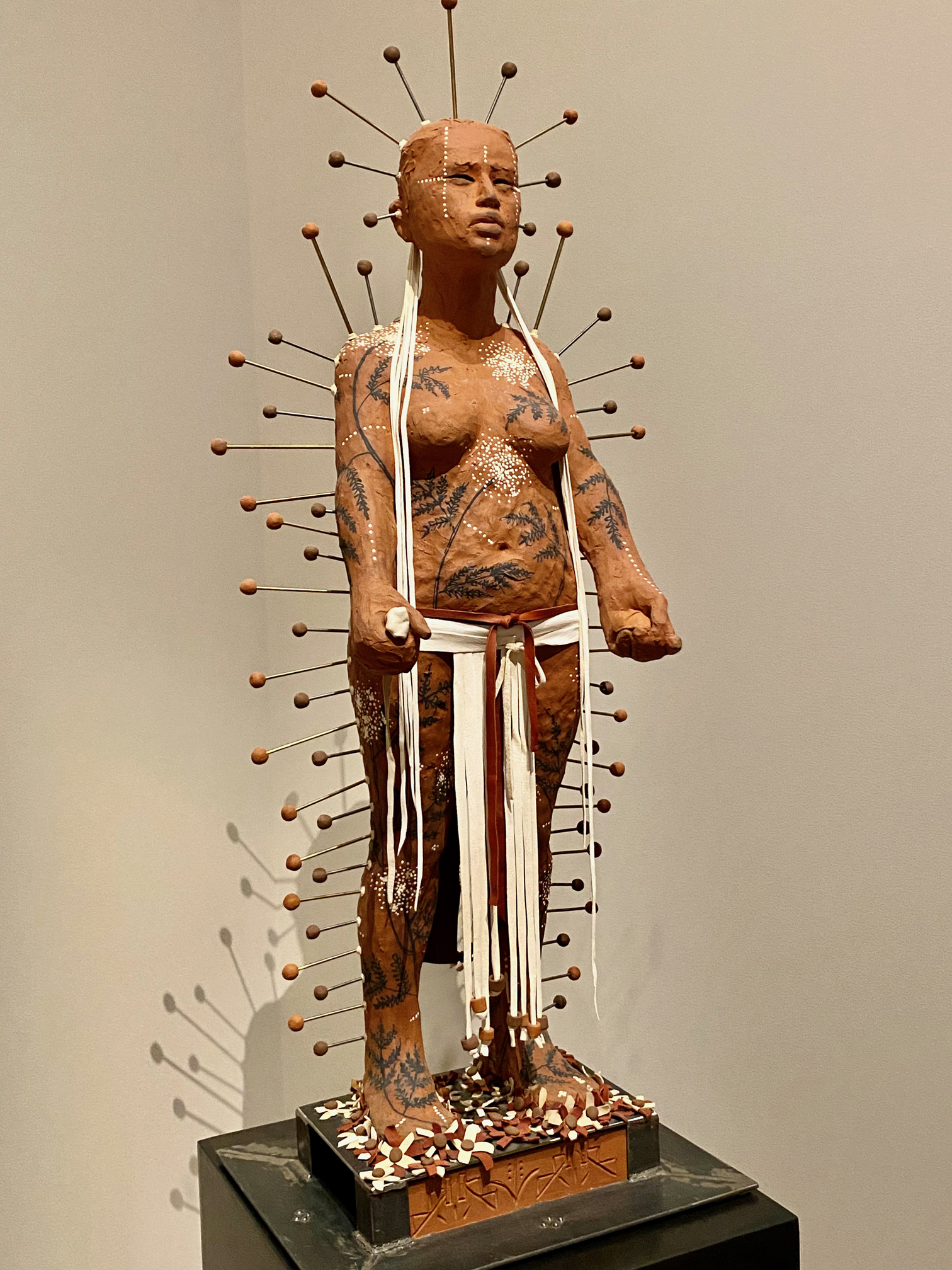
Experiencing the large, spiritual earth-colored ceramic figure by Rose B. Simpson (Santa Clara Pueblo) harkens back to eras when people had a more integral connection to the earth. Simpson calls her figure Tonantzin, an Aztec name for earth mothers, corn mothers, and even the Virgin of Guadalupe.

2017 blown and sand-carved glass Raven Steals the Sun by Preston Singletary (Tlingit). Courtesy: private collector.
2021 ceramic, steel, leather, and brass Tonantzin by Rose B. Simpson (Santa Clara Pueblo). Courtesy: Tia Collection.

Smith has chosen to hang many smaller two-dimensional works across a long wall in a checkerboard to suggest that visitors reflect on the impact of 1887 Dawes Act upon Native lands – a law that cut Native territory into “checkerboard” lots to facilitate private ownership.

At the National Gallery, Jeffrey Gibson’s punching bag (all made of found materials) was hung nearby, reminding us of the delicate balance that has to be struck by simultaneously caring for and taking gifts from the earth.

Next to checkerboard wall, the 2020 beaded punching bag To Feel Myself Loved On the Earth by Jeffrey Gibson (Mississippi Band of Choctaw Indians/Cherokee Nation). Courtesy: Hirschhorn Museum.

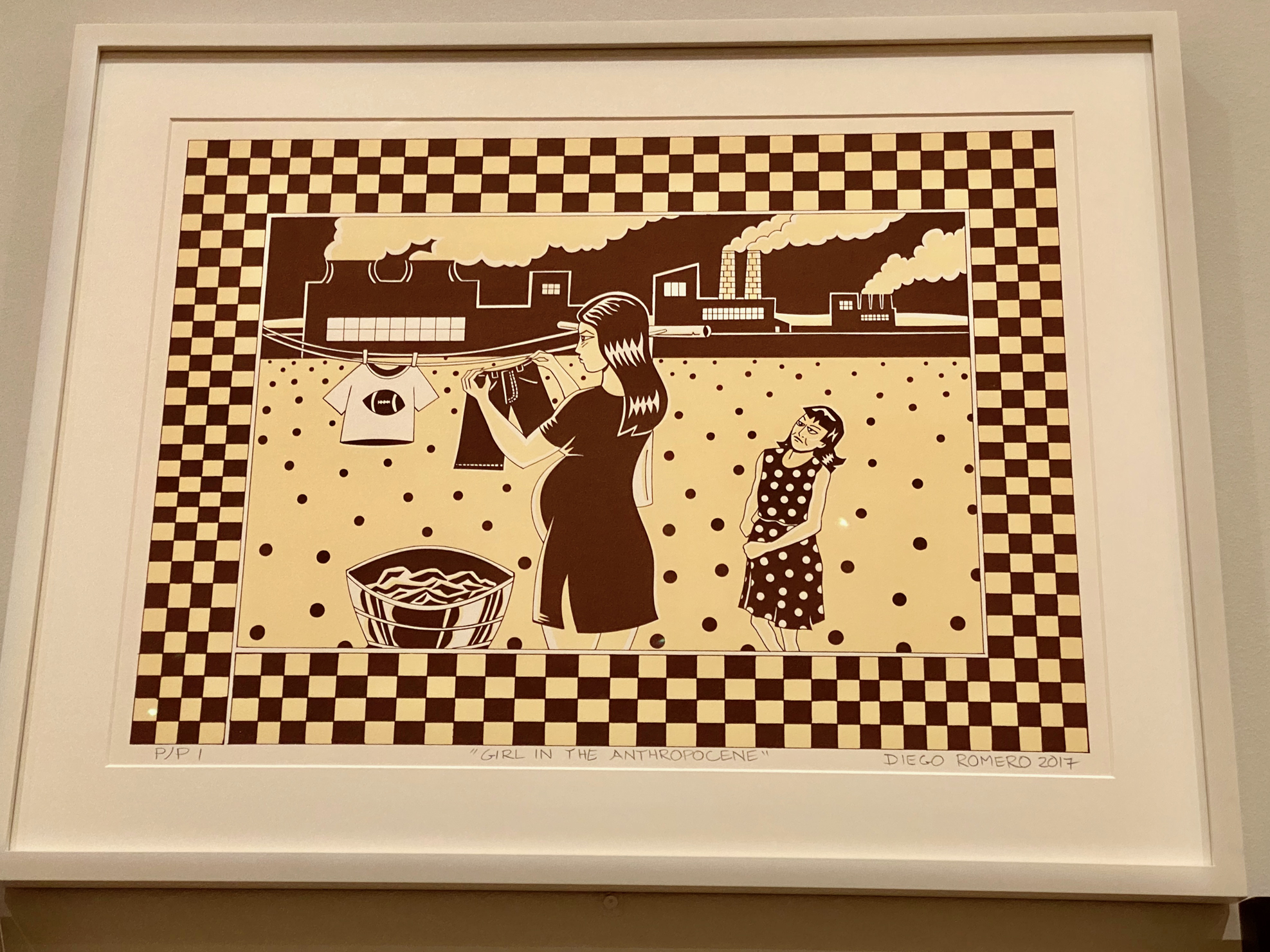
Some artists mix impressions of modern life with tribal lands, such as satiric works by Diego Romero (Cochiti Pueblo) and stylized symbols in a monoprint by Joe Fedderson (Colville Confederated Tribes).

2017 lithograph Girl in the Anthropocene by Diego Romero (Cochiti Pueblo). Private collection

In addition to sculptures, paintings, and photos, Smith has also included pieces made for fashion runways, live performances, and social protests.

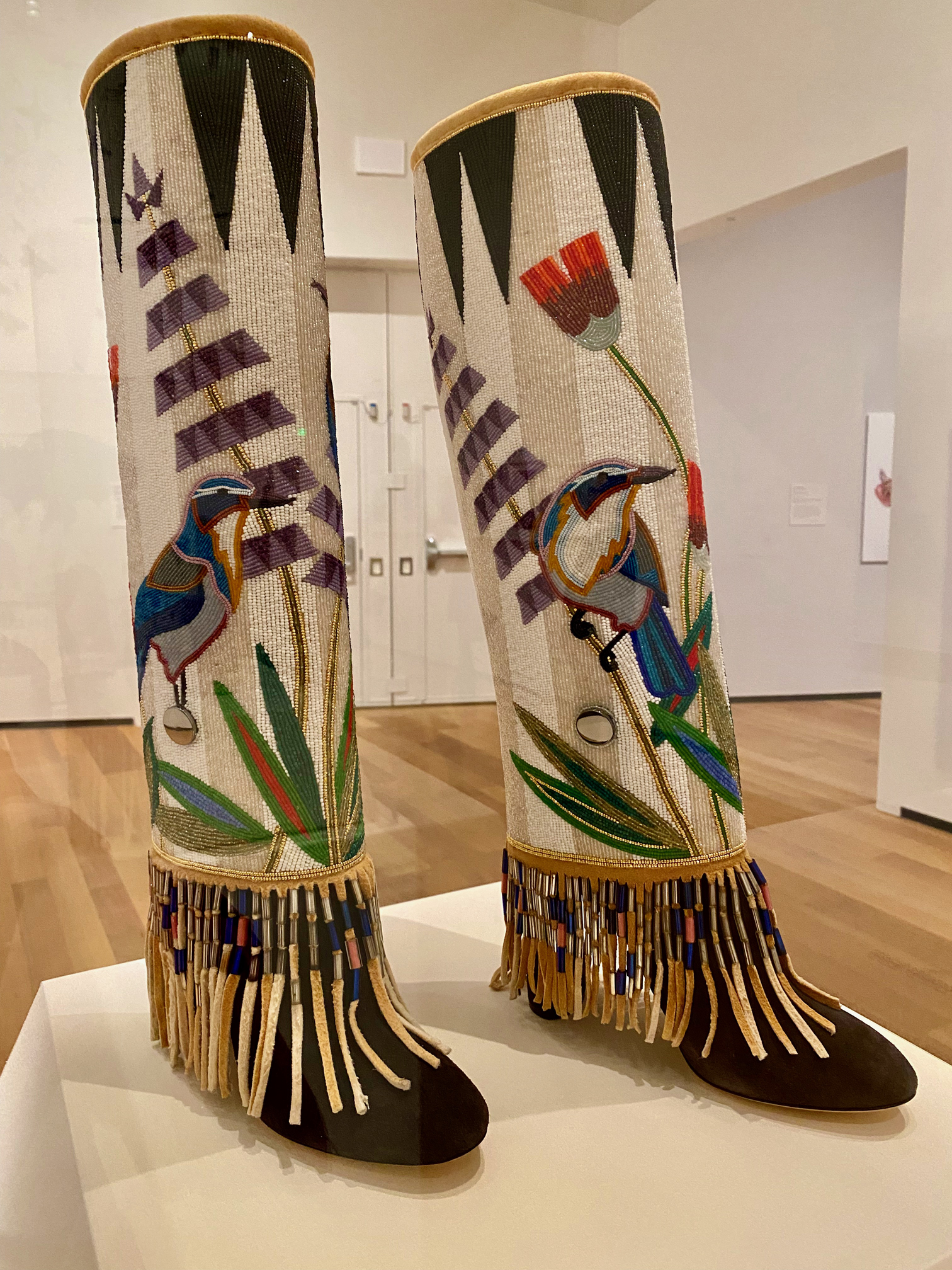
Fashion designer Jamie Okuma (La Jolla Band of Luiseno Indians) beaded her fringed fashion boots with a portrait of her family’s pet scrub jay.

Ten foot-long fiber seashell earrings designed for an interactive video and gallery performance by fiber and performance artist Eric-Paul Riege (Diné) are a reminder of the ancient trade networks that brought trade items from the ocean to the interior deserts.

2021 beaded and fringed Casedei boots by Jaime Okuma (La Jolla Band of Luiseno Indians). Courtesy: Dartmouth College’s Hood Museum
2020 mixed-fiber installation jaatloh4Ye’iitosoh [3-4] by Eric-Paul Riege (Diné). Courtesy: Tia Collection.

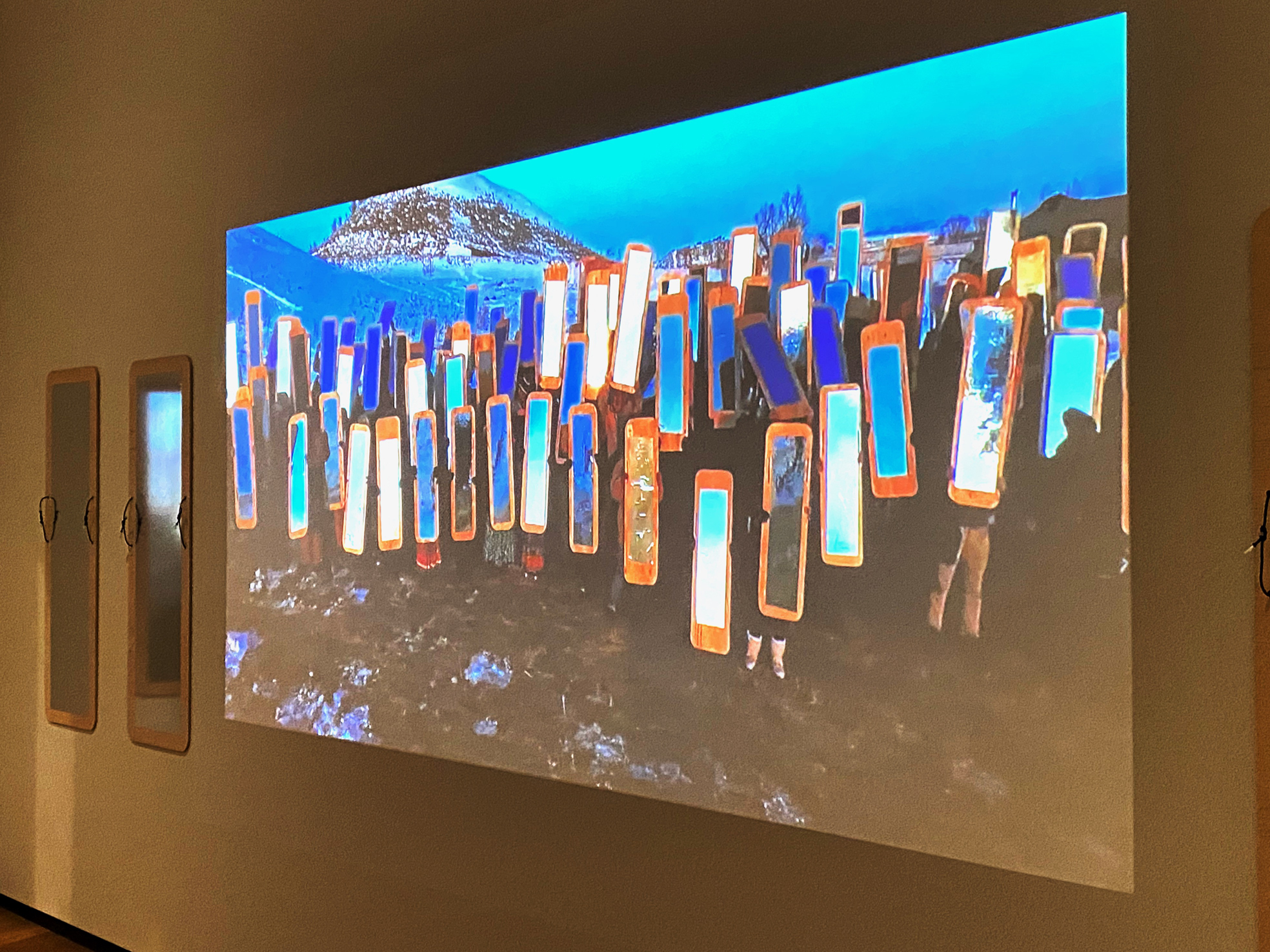
A wall of “mirror shields” were mounted by artist-activist Cannupa Hanska Luger (Mandan/Hidatsa/Arikara/Lakota), showing just a small sample of the 1,000 protective and reflective shields made by people to help water protectors during thre 2016 pipeline intervention at Standing Rock Sioux Tribe Reservation, Luger’s childhood home. Take a look at Luger’s instruction video here.

The shields served to protect the peaceful protesters from rubber bullets and water cannons, and reflected images of the security forces back to them. The crowd-sourced shields were also used in a social-action performance piece at Standing Rock.

2016 mirror shields and video for Mirror Shield Project – River (The Water Spirit) by Cannupa Hanska Luger (Mandan/Hidatsa/Arikara/Lakota). Courtesy: the artist, Garth Greenan Gallery.

Textiles and vinyl drawings also pack a punch in this show. Take a look at the dazzler woven by Melissa Cody (Diné), who draws inspiration from video gaming and the matriarchs of Navajo Nation. Watch her interview from her recent exhibition at MoMA PS1.

Here, John Hitchcock explains how his room-sized drawing, Impact vs. Influence, incorporates his influences – nature, family, Native beadwork, and the next-door military base:

Take a look the National Gallery’s trailer and meet the 50 contemporary artists whose work and relationship to the land is celebrated in the show:

Past and Future of Santa Fe’s Indian Market

There’s no better way to see the best of the best at the Santa Fe Indian Market than to visit the remarkable retrospective assembled at the New Mexico History Museum in their honorary centennial exhibition, Honoring Tradition and Innovation: 100 Years of Santa Fe’s Indian Market, 1922-2022, on view through August 31.

The curators have gathered loans from private collections, museums, individual artists, and big-name galleries to give visitors a decade-by-decade chronicle of the people, families, maker innovations, and contemporary-art trends that converged to showcase works from one the most exciting confluences of creativity in the United States.

Santa Clara artist Nancy Youngblood’s 2018 polished pottery jar (best of pottery category award), granddaughter of Margaret Tafoya. Courtesy: private collection.

The items in the show – traditional pots, dazzling Navajo weavings, whimsical figurines, elaborately embroidered accessories and clothing, social-commentary photos and paintings – are so compelling that it takes two or three visits to actually focus on the thoughtful, illuminating text that accompanies each portion of the show.

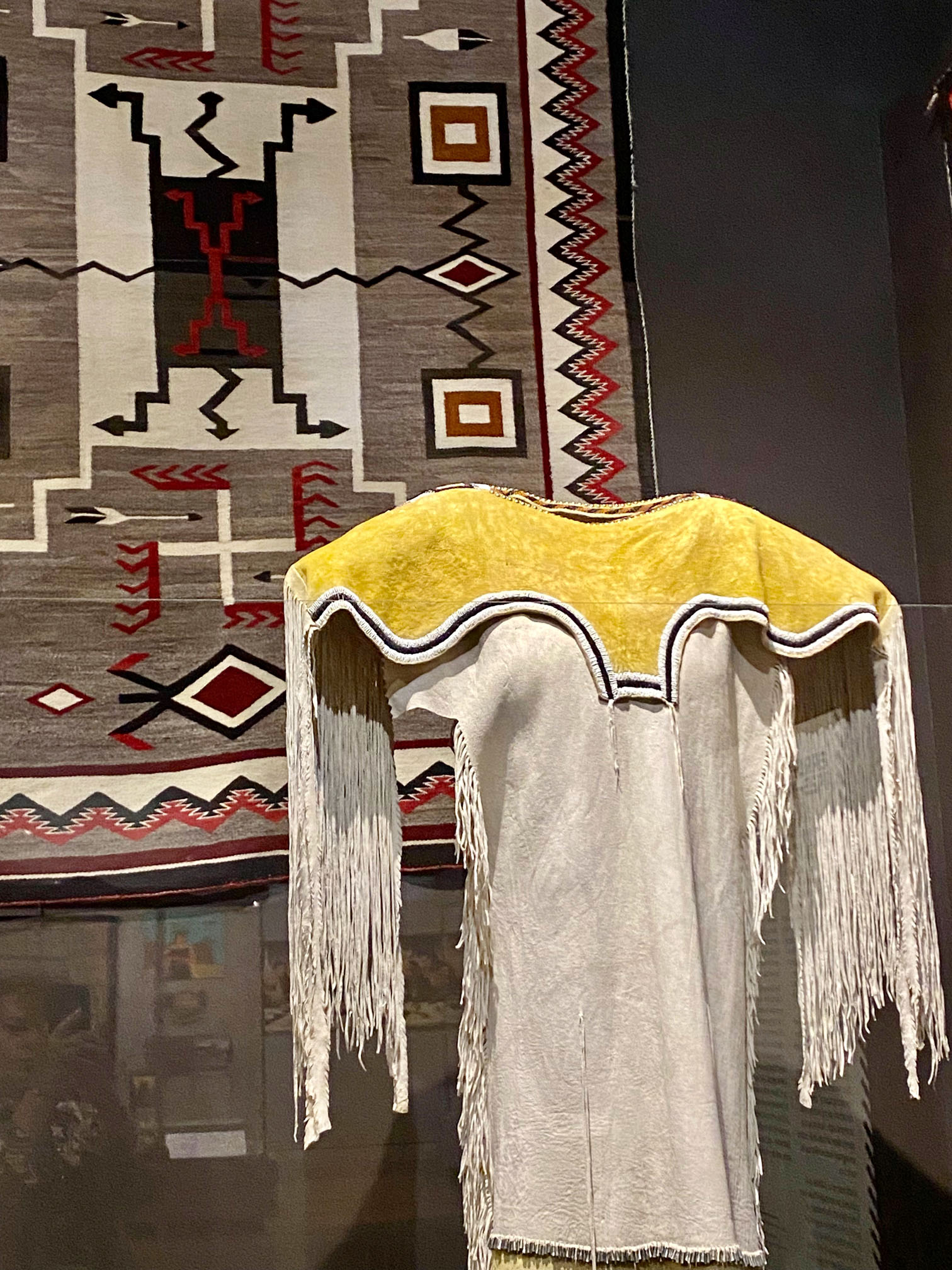
Embellished 1890 buckskin Apache/Ute dress; behind, a 1925-1930 Navajo rug. Courtesy: Cowboys and Indians Antiques, Historic Toadlena Trading Post Museum.

The organizers have provided a revealing chronology of the politics, economics, and social context of each decade of the arts festival, noting changes in the people, processes, power, and patronage over time.

The first gallery brings you back to the earliest days of the market – a time when there were no Indian curators or judges (unlike today!) and when Native makers were not even allowed to sell their own work or interface directly with non-Native buyers. 

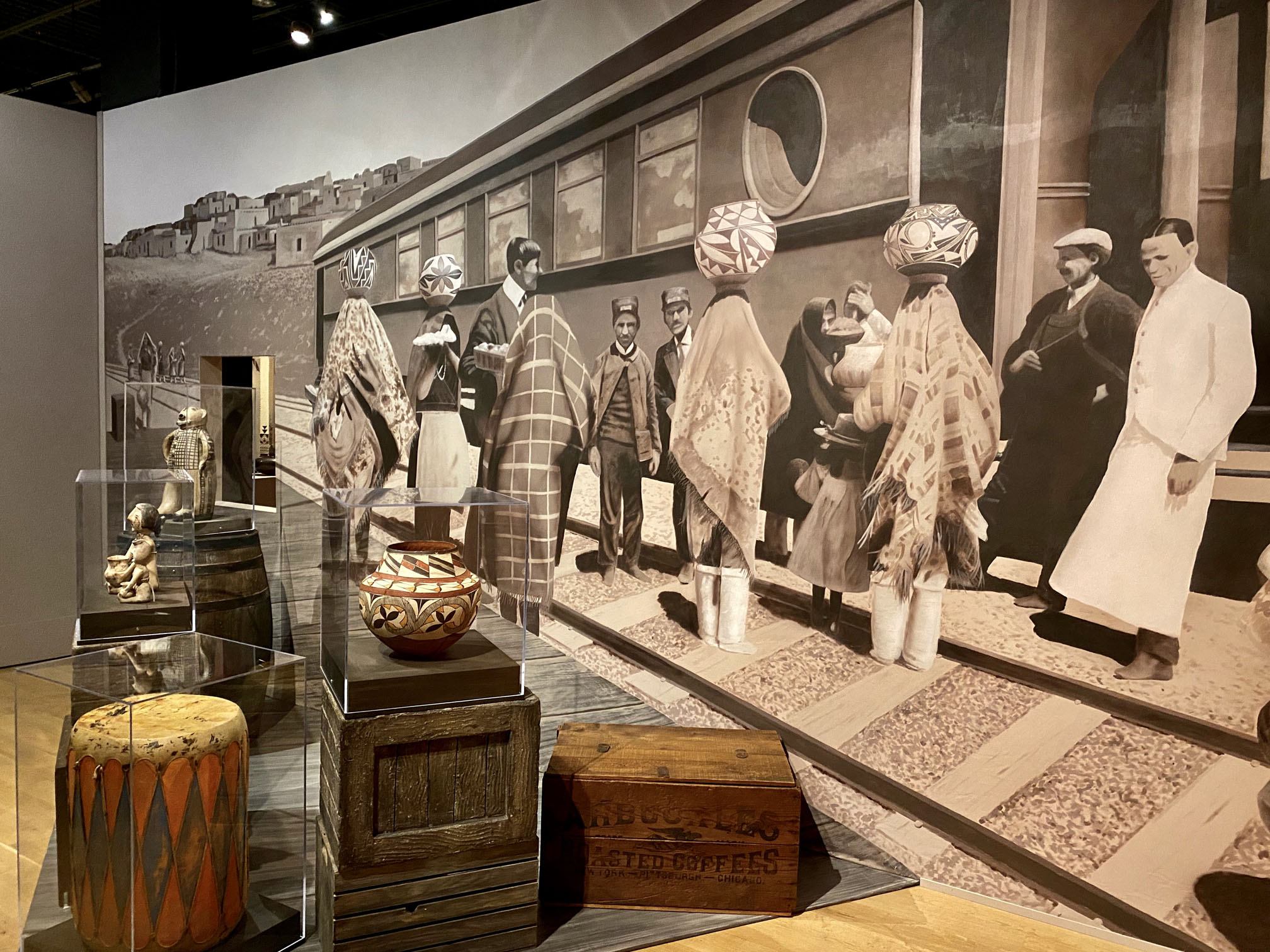
The wall mural harkens back to the days when Pueblo people sold their pots and creations to tourists along the railroad, which in the late 1890s and early 1900s brought curious travelers, East Coast dandies, and traveling showpeople out to the Western badlands.

David Rock’s mural with early Native-made collectibles – early 1900s pottery and 1920s drum.

Turn-of-the-century tom-toms, curios, and older pots are displayed near the rail-top mural; Navajo rugs and beaded moccasins from the period are arrayed across the way. It’s an arrangement that evokes what might be displayed in an old trading post, or at least in the early 1920s Santa Fe markets.

Many of these makers in New Mexico were still living on their ancestral lands, but across the United States, the majority of Indigenous populations had either been relocated to reservations or boarding schools.

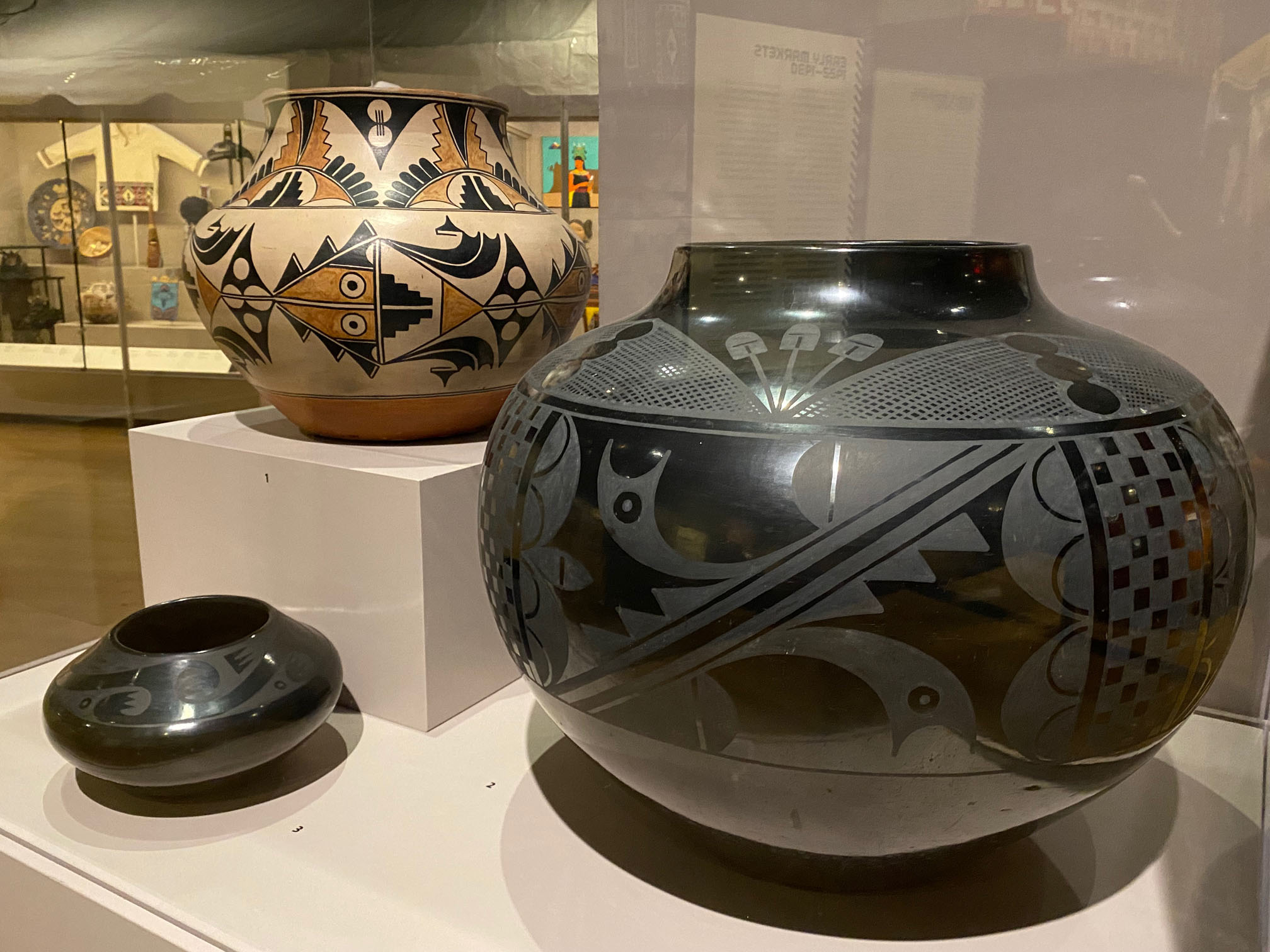
The inter-generational mastery of New Mexico’s Pueblo artists is featured in several vitrines holding examples of black-on-black (and other) masterworks by the Martinez family at San Ildefonso (go, Maria!) and the Tafoyas of Santa Clara, with Margaret’s famous bear-paw imprints.

Work by famed San Ildefonso artist Maria Martinez: 1922 polychrome, large 1942 black pot (award-winner painted by Julian Martinez); and 1928 jar. Courtesy: MICA, SAR

The surrounding gallery features dazzling painted pottery works by Zuni and Acoma from the 1920s – all drawn from the School for Advanced Research (SAR) collection, which began in 1922 to preserve classic works, SAR is the source of the acclaimed exhibition now at the Metropolitan Museum, Grounded in Clay: The Spirit of Pueblo Pottery. Sometimes the artists who made the pot is known; but often the maker is lost to history.

1928 Acoma jar. Courtesy: SAR

In the 1930s and 1940s across the United States, tribal mortality rates increased and their other economic lifelines decreased. But these conditions in the Southwest made the Market an even more important source of family revenue. Throughout the 1940s, the Santa Fe Market boomed.

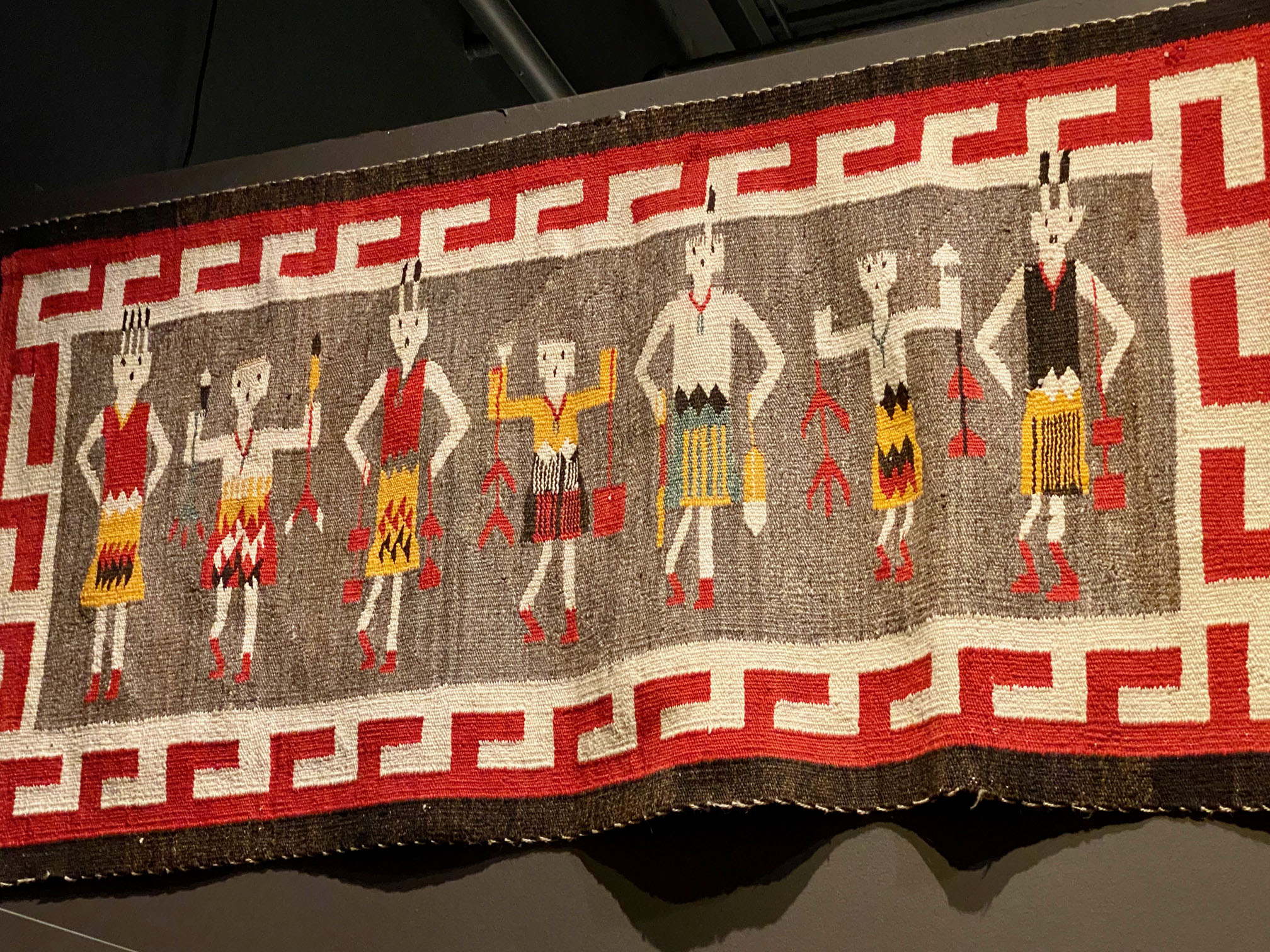
1920-1930 Navajo hand-spun wool rug with figures representing the fire dance. Courtesy: Historic Toadlena Trading Post Museum.

By the 1950s, Federal government instituted policies to encourage Indians to leave their land and move into cities. Unfortunately, Santa Fe Indian Market policies had the same depressing effect – the organizers reduced both the number of artists allowed to show and amount of prize money that could be won.

By 1959, the SF Indian Market was on life support, with a few private donors stepping in with funding just to let it survive.

But during the 1960s, changes were afoot. The Institute for American Indian Arts began in Santa Fe, where Lloyd Kiva New gave Native artists “permission” to throw off traditional conventions and make contemporary art. Across the United States, social-justice movements focused on indigenous people’s rights demanded policy changes to reverse the impact of oppression. By 1968, Congress had passed the Indian Civil Rights Act.

What did that mean for the Market? The majority of works on display in the museum gallery are from the post-1970s period, when the scope, range, voice, virtuosity, and experimentation reflected the times.

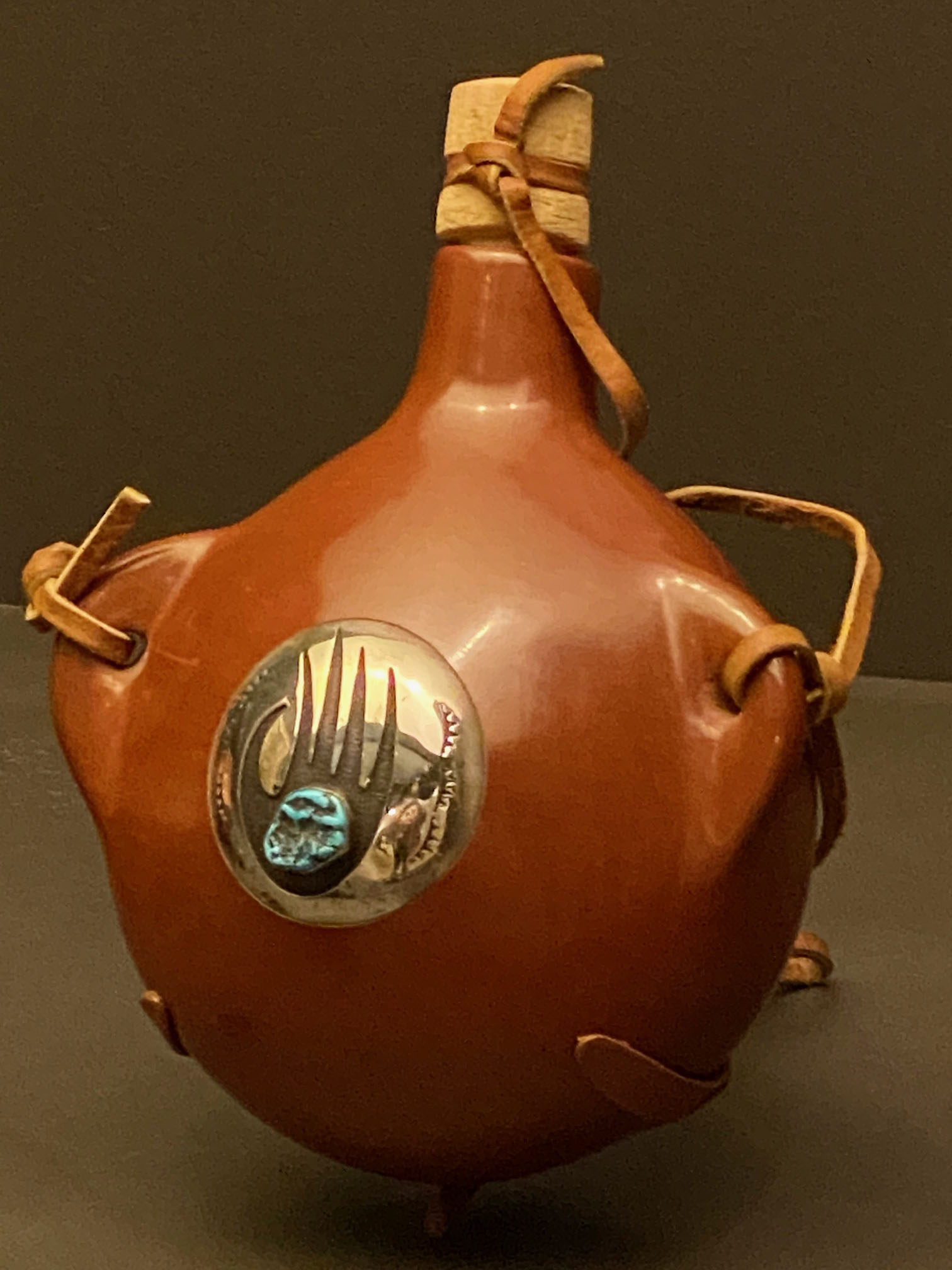
1974 pottery canteen with turquoise and silver by San Ildefonso artists Rose Gonzales and Tse Pe. Courtesy: private collection.

Here are some examples – the glorious, gleaming, turquoise-inlaied 1980s vessel by by Zia/Jemez/San Ildefonso artist Dora Tse Pe and the virtuoso painting on a jar by by Acoma artist Dorothy Toriio.

1980s pottery jar by Zia/Jemez/San Ildefonso artist Dora Tse Pe. Courtesy: private collection.
1990 pottery jar by Acoma artist Dorothy Toriio. Courtesy: King Galleries.

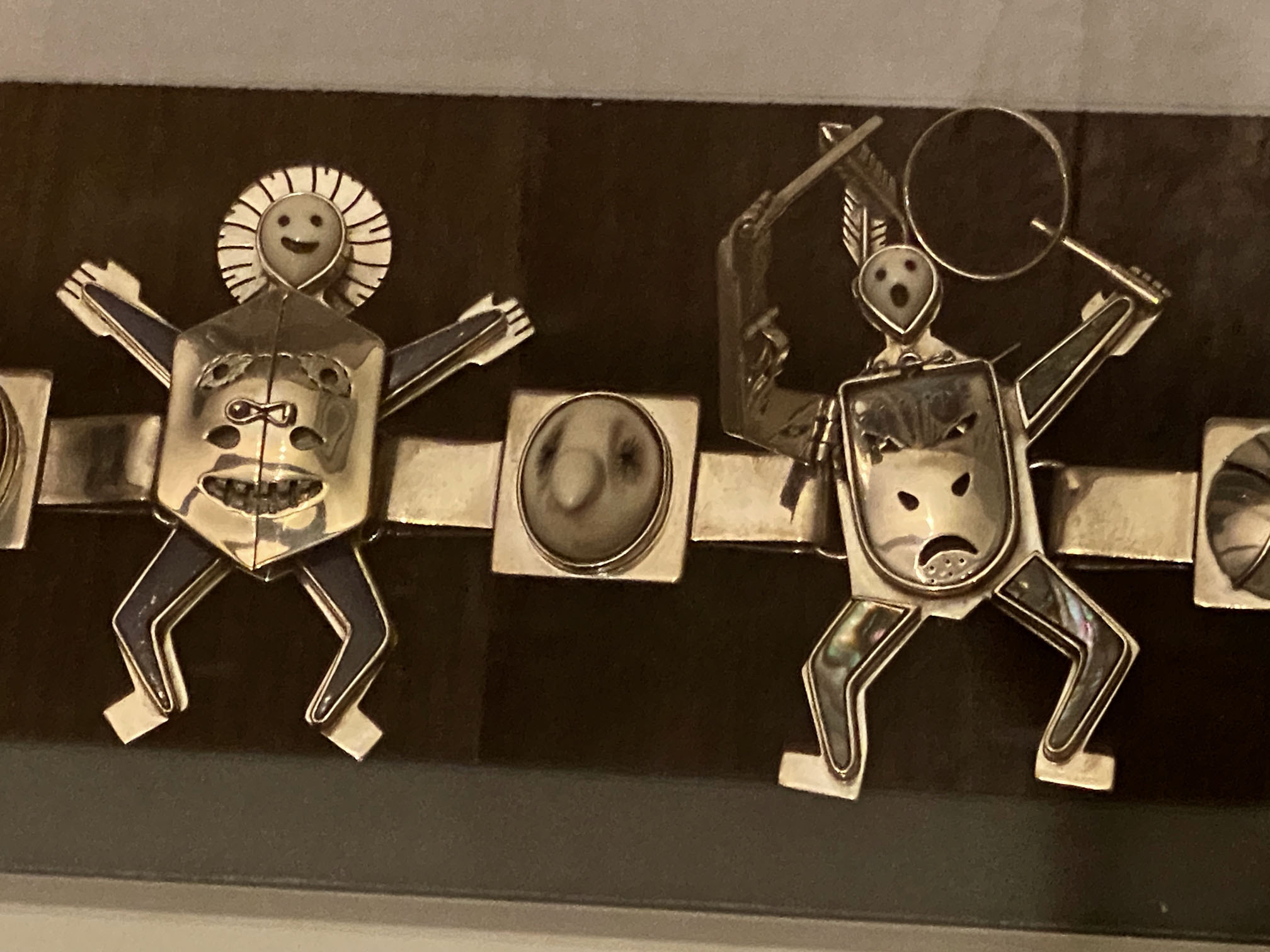
Or, consider the virtuoso silverwork and inlaid belt by Aleutian master Denise Wallace; edgy, theatrical 1990s Cochiti figurines by Virgil Ortiz; and a 1999 horsehair basket woven by Tohono O’odham artist Leona Antone. See more in our Flickr album.

Silver 1986 “Aleut Dancer Belt” by Aleut artist Denise Wallace with abalone, fossil ivory, and lapis; Best in Non-traditional Jewelry Award. Courtesy: private collection.

The show’s finale catapults the story of Indian Market into the future.  First, there’s a cluster of sculptural and video works by Virgil Ortiz, featuring his sci-fi, super-powered, time-traveling warriors from the future who travel back to 1680 to fortify the success of the Pueblo Revolt and save Pueblo culture.

“Kootz (Runner-twin brother of Tahu)” 2018 high-fire clay sculpture with “warning” LED lights by Cochiti artist Virgil Ortiz. – a character from his sci-fi 2180 ReVOltage Series. Courtesy: the artist
“Tahu (Blind Archer)” 2018 sculpture with LED lights by Cochiti artist Virgil Ortiz.. Courtesy: the artist

Second, there’s a photo wall of families and their young children, who create work to enter in to the children’s division. It leaves visitors with the strong feeling that not only will forward-looking artists keep innovating and creating, but that the kids will be all right.

Still of 2022 “Made in Native America” video by Cochiti artist Virgil Ortiz, featuring sci-fi costumes. Courtesy: the artist

Jeffrey Gibson at SITE Santa FE

What happens when a Native American MacArthur genius is asked by SITE Santa Fe to create an art exhibition during a time of a global pandemic and social justice marches? And invite him to a location where Native Americans make up a significant percentage of the population?

The result is Jeffrey Gibson: The Body Electric – a constantly surprising gallery journey where shape-shifting, cultural disassociation, beadwork, kitsch-image appropriation, gender-identity questions, and science-fiction inspiration reigns.

The show is filled with life-size beaded dolls and garments, films, pulsing papered walls, mysterious film experiences, and social statements either woven or stamped onto clothes (or are they banners?).

Gibson’s 2021 White Swan mixed-media painting in wall-papered gallery with a beaded, life-size, genderless “doll”
2020 Red Moon and Desert Sky minimalist sculptures created from strands of dance fringe.

Gibson, who is based in New York, is an intertribal artist who is a member of Mississippi Band of Choctaw and half Cherokee. However, his influences were forged from prestigious art schools, international travel, and living in non-Native societies.

The opportunity to come to Santa Fe, host a cinema series and several performances, and stay out West for a while was an open door to explore inter-cultural influences, host discussions with appreciative audiences, and show off his wide intellectual and artistic breadth.

In many of his works, Jeffrey mixes traditional “Indian” materials like beads or fringe with slogans, sayings, dime-store “Indian” images, and big-time art-world references.

See some our favorites from this exhibit in our Flickr album and hear Jeffrey explain his influences in SITE Santa Fe’s audio guide.

The little beaded birds that greet visitors in the first gallery and the big beaded life-sized “dolls” in the second were inspired by Jeffrey’s early work in the ethnographic collections of the Field Museum, where he encountered Haudenosaunee-made beaded tourist-trade whimsies and traditional “third gender” dolls for the first time. Why not make his own, but over-size them?

2021 My Joy My Joy My Joy, a mixed-media beaded bird inspired by Victorian-era Native American tourist whimsies

The nearby video gallery features a kaleidoscopic multichannel video of Sarah Ortegon, an award-winning Eastern Shoshone/Northern Arapaho jingle dress dancer, performing to the energetic Sisters track by A Tribe Called Red. This piece – She Never Dances Alone – refers to the dancers who came to the Standing Rock Reservation and lent their support to the 2016 pipeline protests though dance.

Here’s Sarah Ortegon in Gibson’s 2019 Times Square installation of She Never Dances Alone here…wait for it:

2021 They Play Endlessly mixed-media crazy quilt of paint, beads, words, and found objects.

And here’s another look at Gibson’s 2020 exhibition at the Brooklyn Museum, where he mixed works from his studio with artifacts and art from Brooklyn’s own collection.

And check out Gibson’s work our album documenting the Smithsonian’s National Museum of the American Indian exhibition of Native painting, Stretching the Canvas.

If you’re near Nashville, you’ll be able to see Gibson’s The Body Electric at the Frist Art Museum February 3 – April 23, 2023.