Painters Tell Stories of Nature’s Resilience

Feel like things are out of balance?  Seven narrative painters let animals take center stage get visitors thinking about the future for nature and the world in Vivarium, Exploring Intersections of Art, Storytelling, and the Resilience of the Living World at the Albuquerque Museum through February 9, 2025..

Big, bold paintings let nature tell the story and present juxtapositions that present questions about society, environmental dissonance, and what messages animals might want to send. See some of our favorites in our Flickr album.
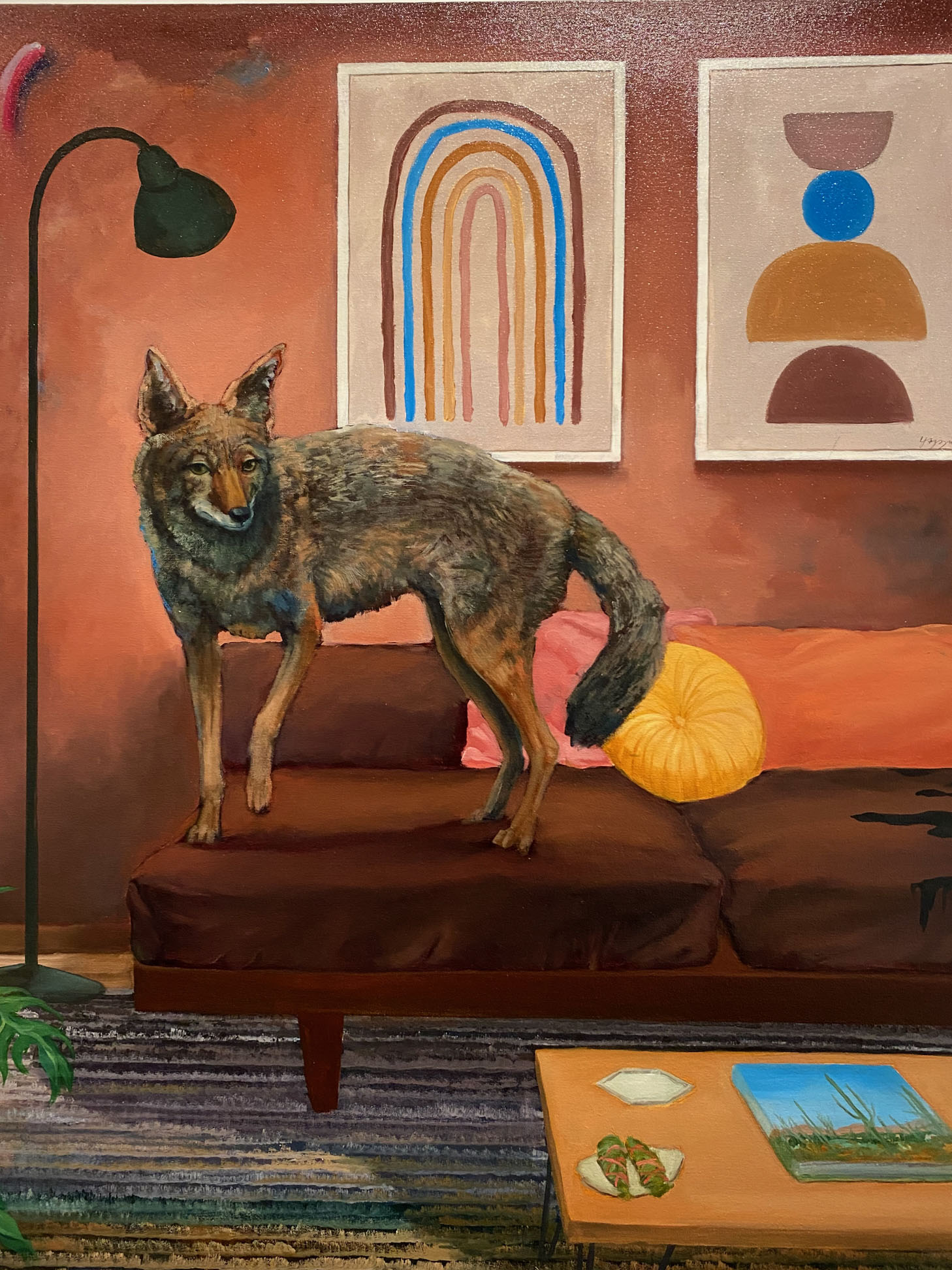
2023 oil Astrid by Stephen J. Yazzie (Laguna Pueblo/Diné). Courtesy: private collection

Although the exhibition begins with a small selection of works from Santa Fe’s Tia Collection – Dan Namingha (Hopi-Tewa), Nanibah Chacon (Dine/Chicana), and others – the majority of the space features a selection of works by the seven featured painters. Clusters of paintings immerse viewers in each artist’s unique world, style, and narrative – mini-vivariums, or artificial worlds.

Nature explodes of Nathan Budoff’s giant canvases – tigers, meerkats, swimming octopii, schools of fish, prarie dogs – all floating and interacting in a pure, white space.  He creates realistic depictions in charcoal, oil, acrylic, and ink, but juxtaposes natural components that are startling. Visitors stand back, pause, take it all in at once, trying to make sense of how these magnificent creatures interact in unusual landscapes.  Mostly, the canvases do not include people, but Nathan enjoys letting the remarkable, minutely observed wildlife speak their own truths.
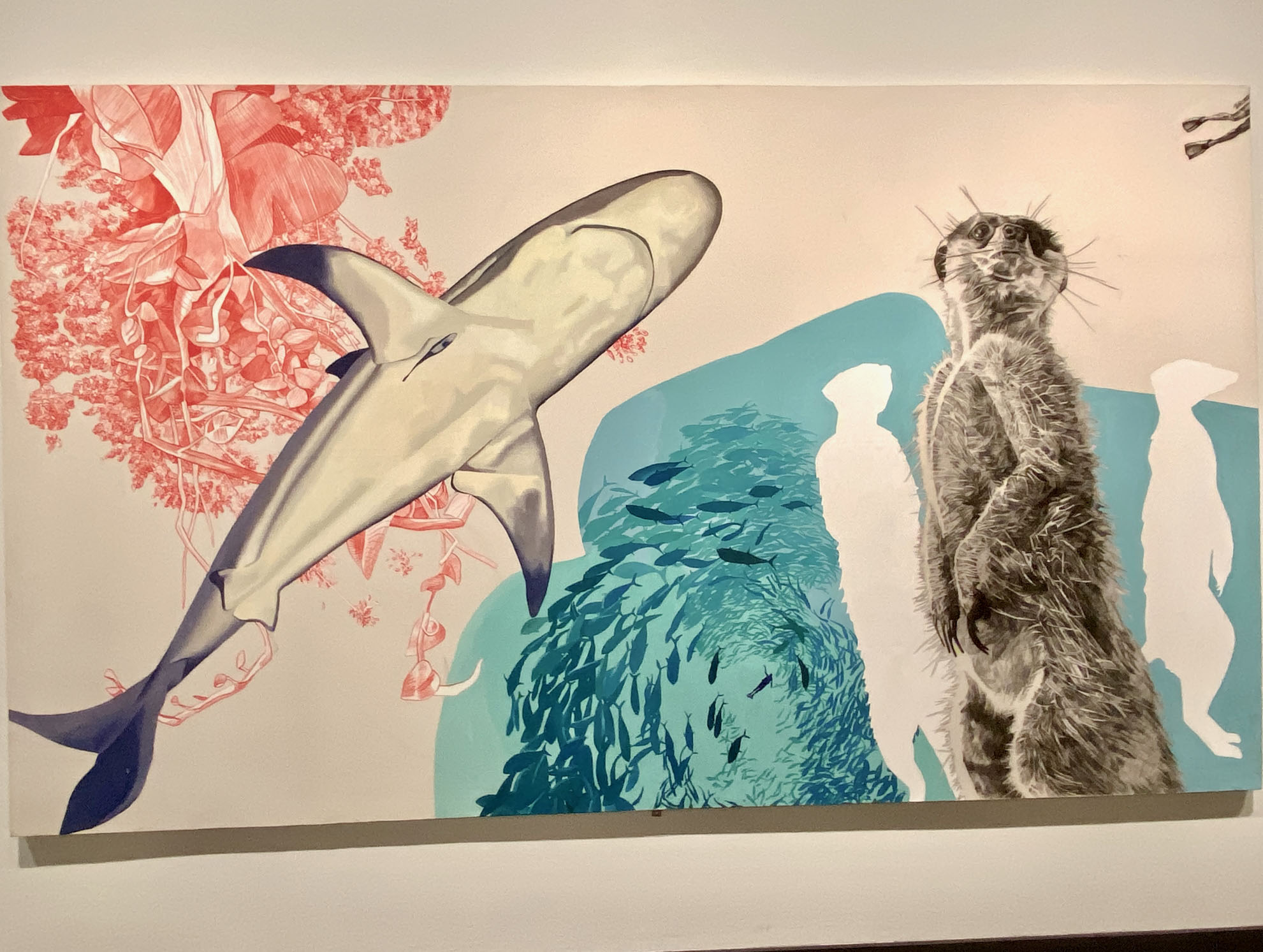
2017 charcoal, oil, acrylic, and ink Imminent Danger by Nathan Budoff – showing systems and social behaviors in the natural world. Courtesy: the artist.

Paintings by Patrick McGrath Muñiz are intellectual puzzles, mixing modern issues, depictions of modern technology, and classical Renaissance and

Baroque painting techniques.  Signs, symbols, and details on the horizon demand slow scrutiny to unravel the allegories and associations packed into the paintings.
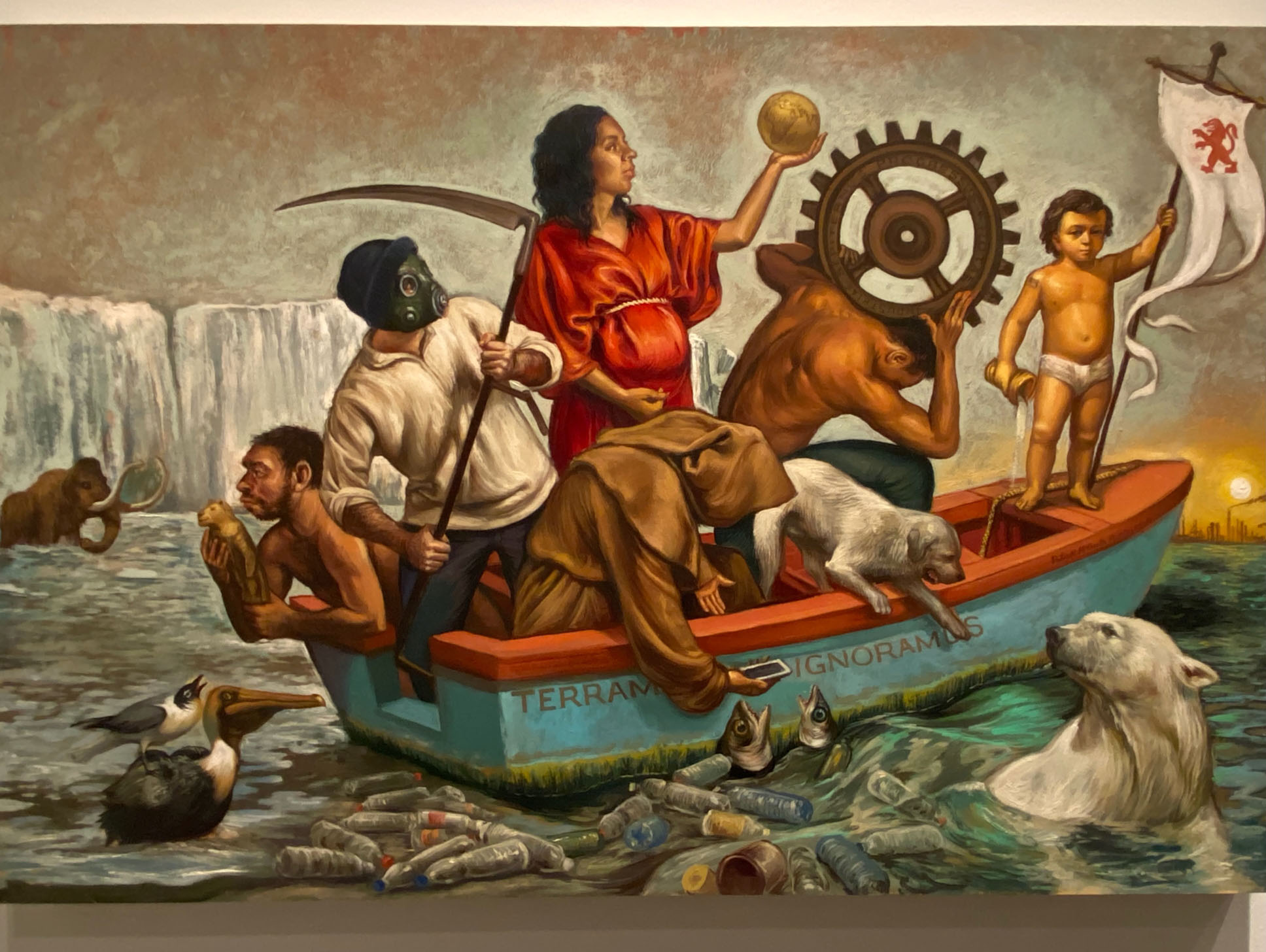
2018 oil painting Terram Ignoramus by Patrick McGrath Muñiz – a warning about the perils of climate change; depicting a perilous Arctic journey in a boat named “We know not the earth.” Courtesy: the artist

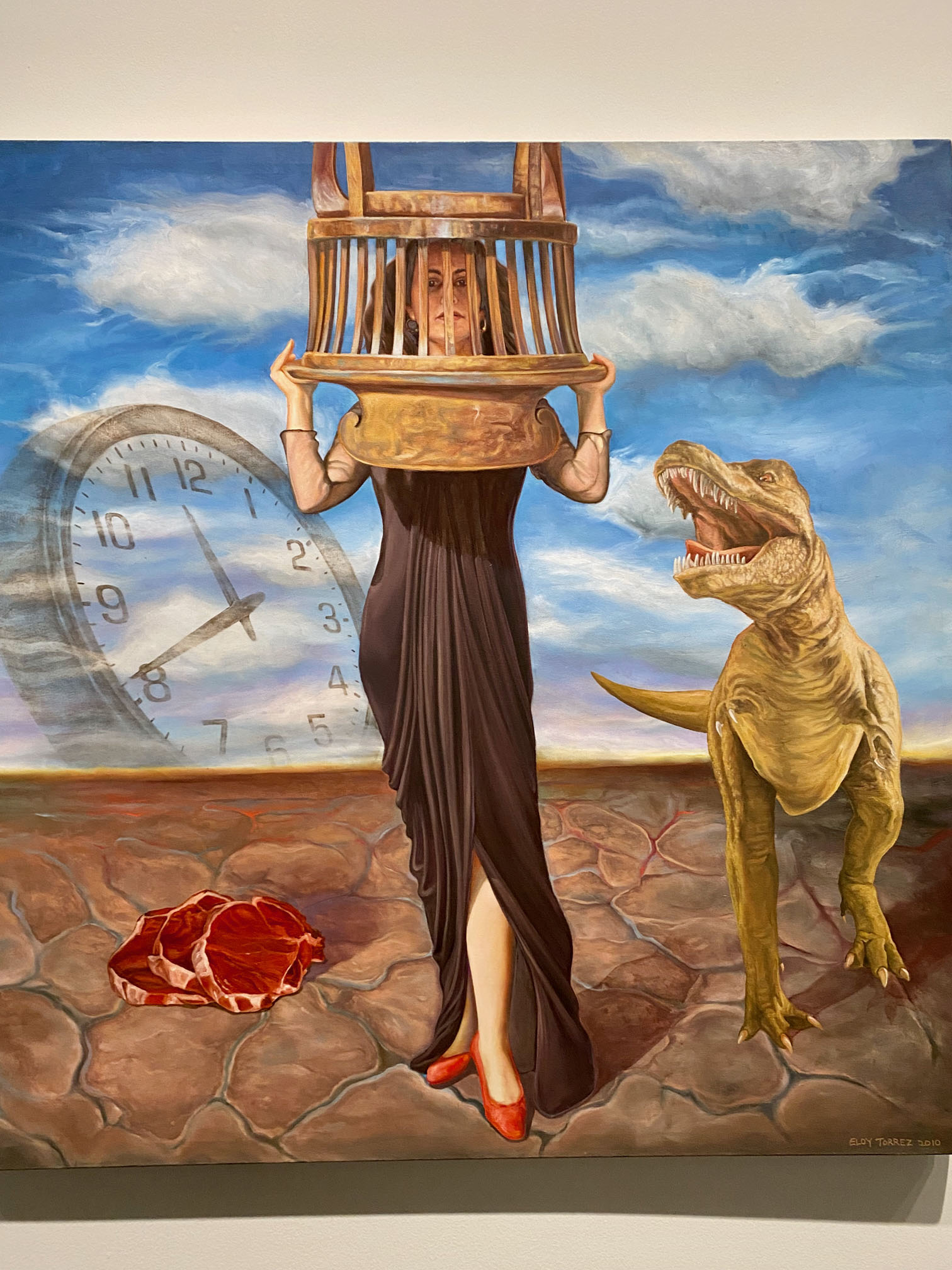
Eloy Torres, a Chicano activist and muralist, uses religious, mythological, and surrealist pictorial conventions to construct worlds that lets the viewer their intuition to connect the dots.

2006 oil portrait of Cheech Martin It’s a Brown World After All by Eloy Torrez; the crown connects him to his ancestral past. Courtesy: Riverside Art Museum.
2010 oil on panel Meat by Eloy Torrez, a surreal allegory on precarious relationships between humans and thenatural world. Courtesy: the artist.

Stephen J. Yazzie (Laguna Pueblo/Diné) exhibits a series of works in which Coyote inhabits upscale suburban interiors, emphasizing the inside/outside, nature/culture dichotomies in contemporary life.

Julie Buffalohead (Ponca Tribe of Oklahoma), a member of her tribe’s Deer Clan, creates narratives featuring animals as protagonists, often metaphors for interactions between natural and spiritual realms. Large works allow players in her stories to prance, dance, and float across saturated color fields.
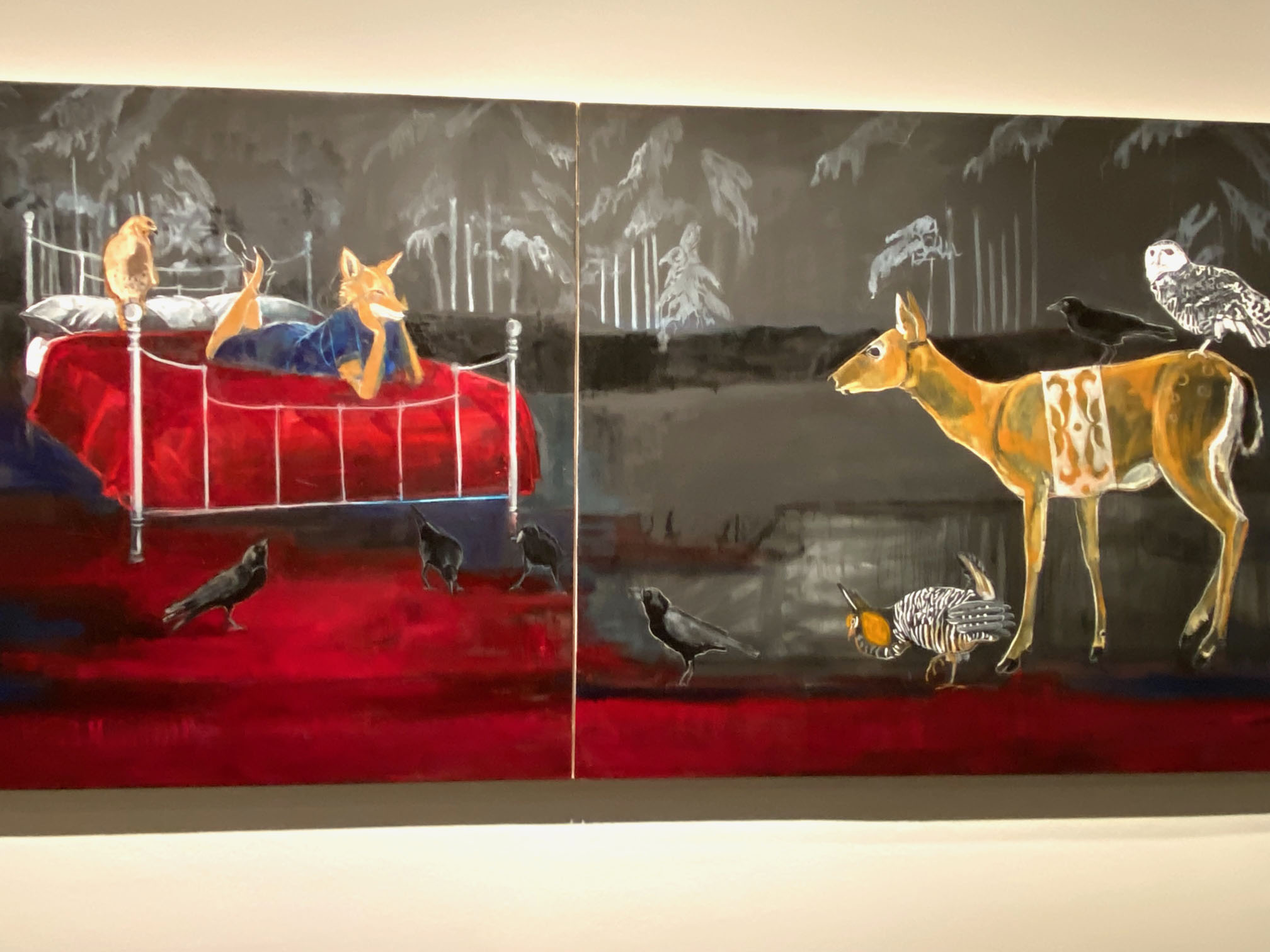
2018 oil and pastel Straight Legs by Julie Buffalohead (Ponca Tribe of Oklahoma) – a painting reflecting her membership in the Deer Clan. Courtesy: University of Wyoming Art Museum

Artist/educator Stan Netchez (Shoshone/Tataviam) presents a throught-provoking masterpiece, using Picasso’s Guernica imagery, US brands, and indigenous spiritual icons to display the chaos and destruction inflicted on indigenous peoples.
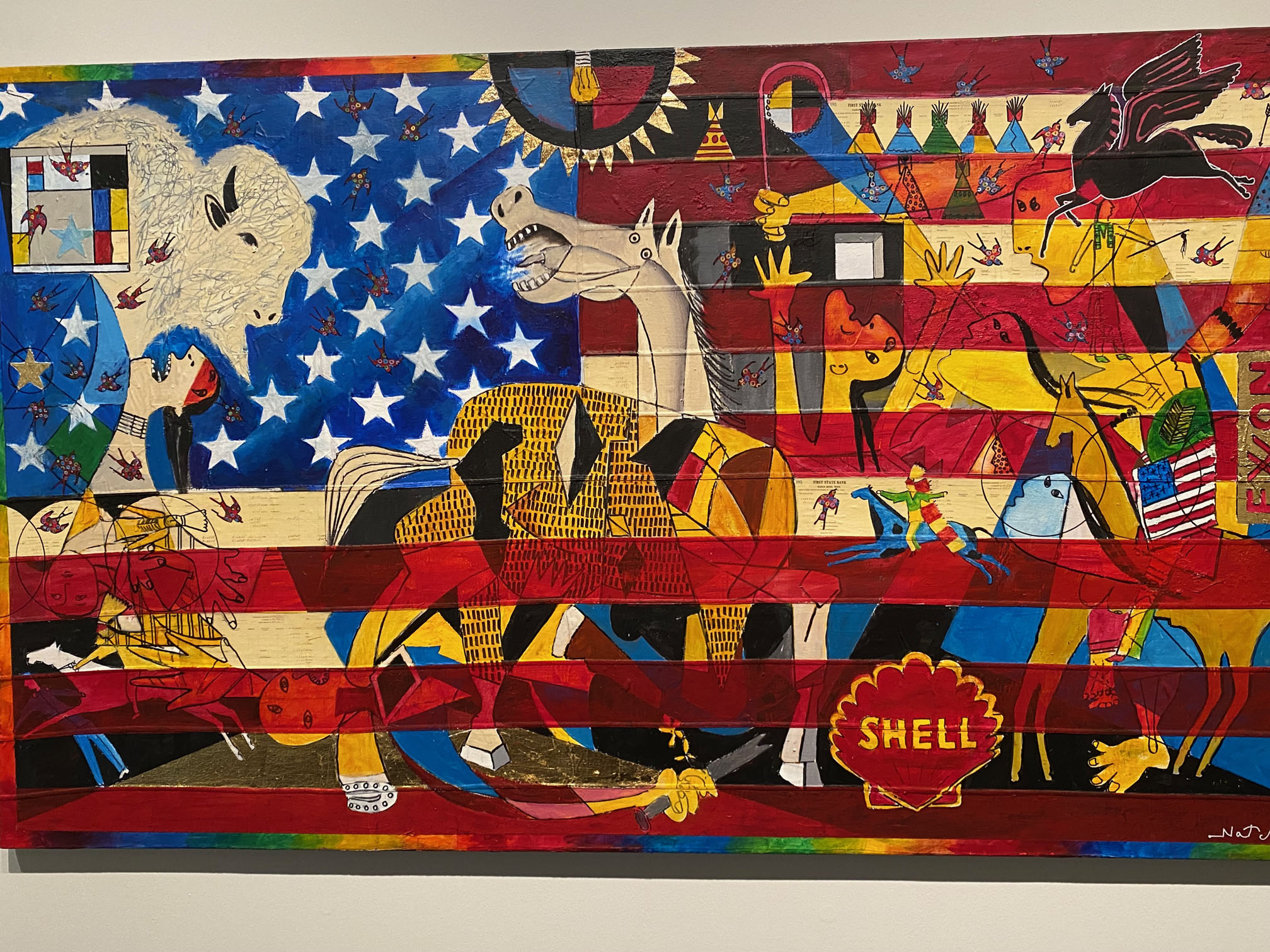
2019 acrylic, oil, and metal leaf “Guernica Flag” by Stan Netchez (Shoshone/Tataviam) – a critique of colonialism’s impact. Courtesy: Tia Collection

Listen in on a panel with four of these storytellers conducted by the Albuquerque Museum.
MIAC Connects Diné Textiles to Land and Community

Building on the groundwork laid in the artist-curated exhibition Grounded in Clay: The Spirit of Pueblo Pottery (opening in St. Louis on March 7), Santa Fe’s Museum of Indian Arts and Culture asked five Navajo textile artists, photographers, and scholars to delve into MIAC’s historic collections to tell the story of Diné weavng.

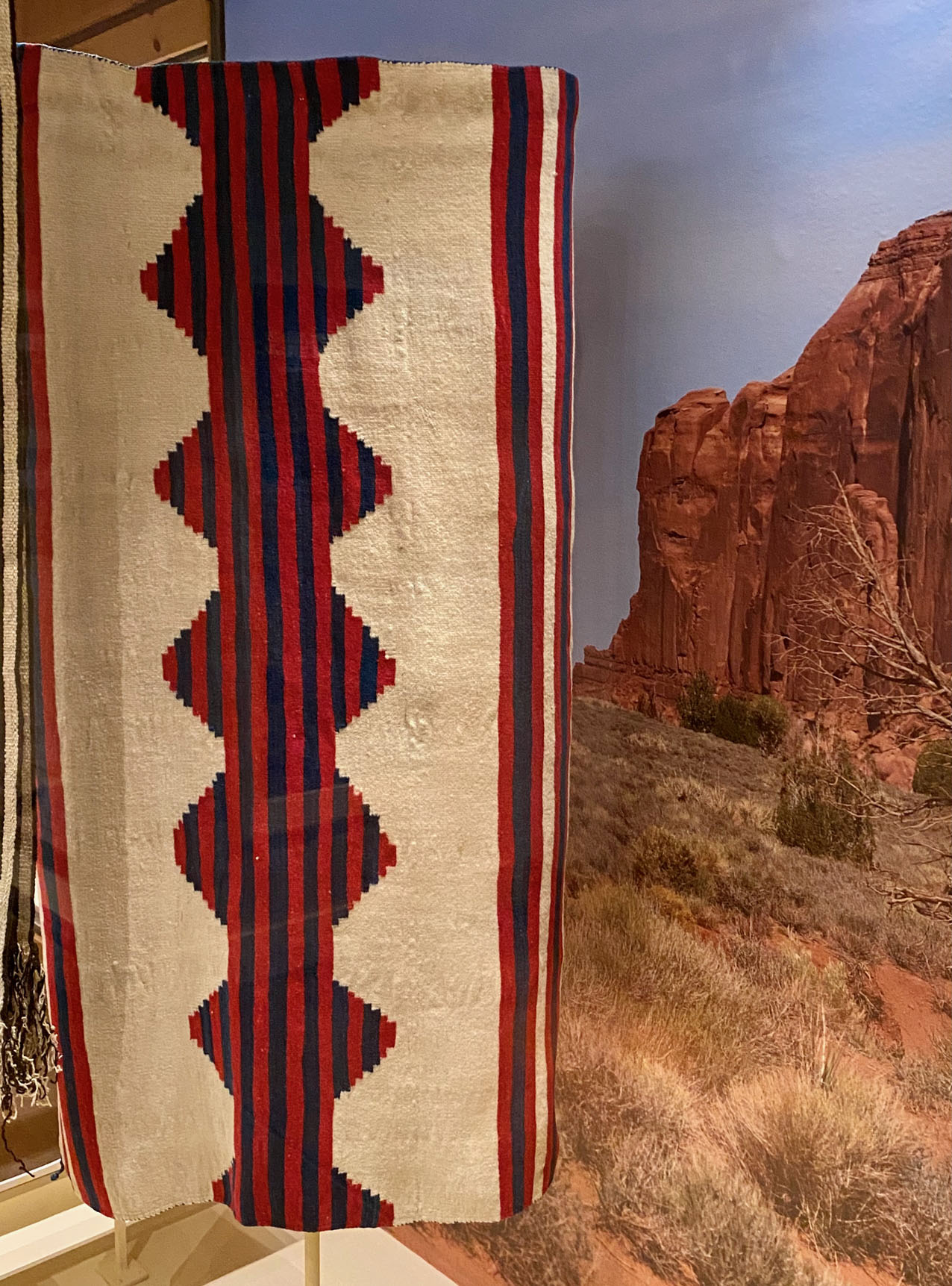
Horizons: Weaving Between the Lines with Diné Textiles, on view through February 2, 2025, presents historic and contemporary weavings alongside epic photographs of Navajo Nation landscapes to show the connections textile artist have to ancestors, their mentors, the community, the land, and their materials.

Historic Diné weaving with photomural by co-curator Rapheal Begay. Courtesy: the artist.

Appropriately, the story told by over 30 historic textiles is presented in MIAC’s Masterpieces gallery.

The entrance presents a dazzling display – a pictorial blanket woven in the 1890s set against a photomural of co-curator Rapheal Begay’s family sheep corral. It’s a visual testament to the importance of wool, life, and the 27,000 square miles of Navajo Nation. 

The blanket’s creator (unknown today) was an astute observer of the life on the land and translated it all into warp and weft – cow punchers, cattle, boots, birds, and new-fangled railroad cars, that only arrived in Navajo Country around the 1880s. Click here to see the detail.

1885 pictorial blanket created with Germantown wool yarn introduced in the Southwest by the railroads; photomural Navel (Hunter’s Point, AZ) by co-curator Rapheal Begay. Photo courtesy of artist.

Nothing was newer than the railroad, at the time this artist depicted it – a steam-fed invention from the East that would change western life forever, but that also brought a wide array of colorful yarn that could be mixed and matched with vegetal dyes to create new Native designs.

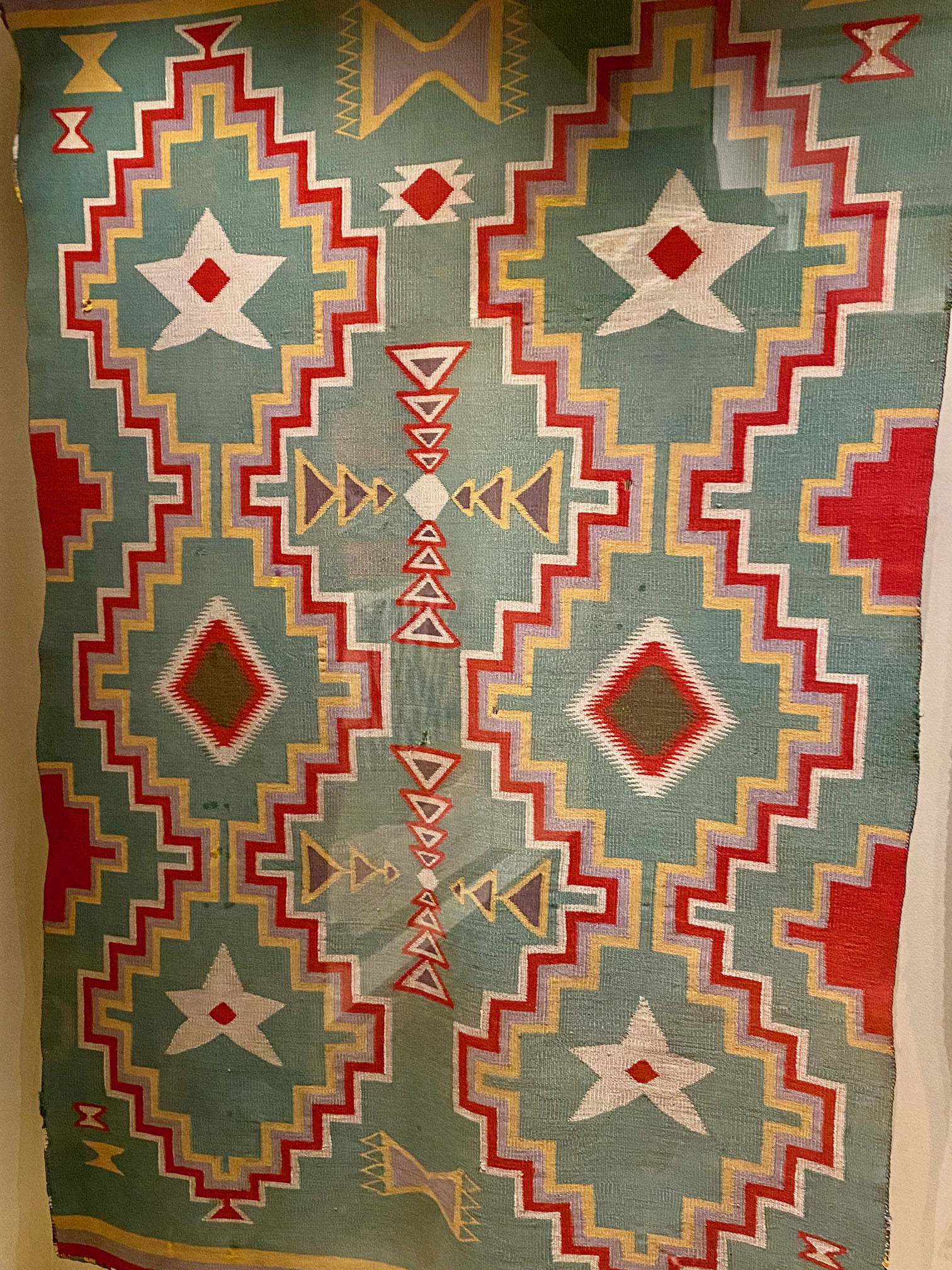
The intertwined history of Diné (“The People” in the Navajo language), textile art, and the land is told through quotes and recollections by the exhibition’s Native collaborators. While examining masterful geometric weaving techniques in 19th-century works, visitors are provided with an historic context – the types of art materials introduced to captives imprisoned at Bosque Redondo after the Long Walk, the images that could be interpreted as a longing for the homeland by the incarcerated, and coded spiritual affirmations.

1850-1860 hand-spun wool child’s (or saddle) blanket with Spider Woman crosses; created with natural cocineal, indigo, and chamisa dye
1880-1897 rug made with Germantown wool yarn, cotton string, and raveled yarn; materials used in weaving at Bosque Redondo era, post-Long Walk.

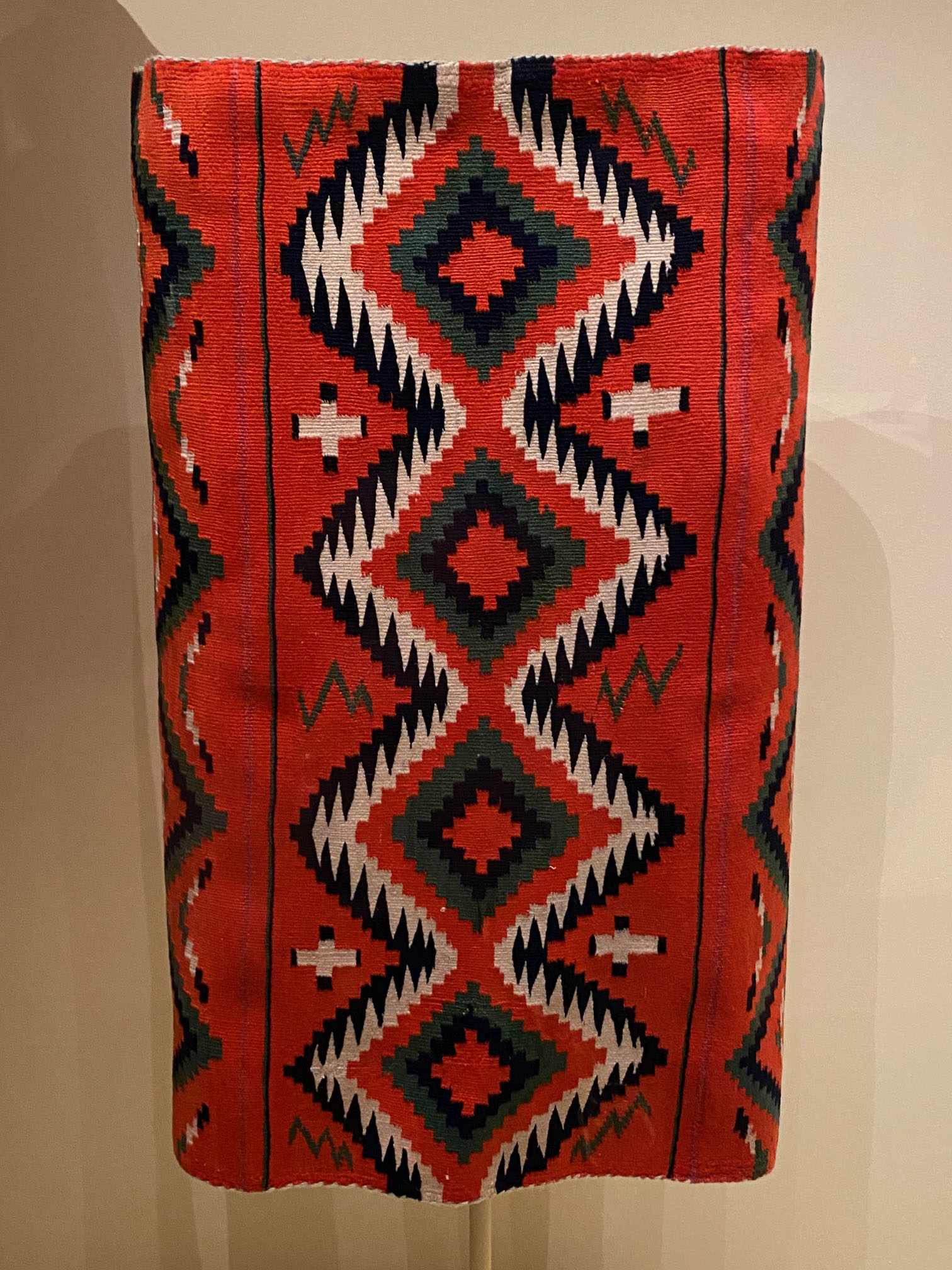
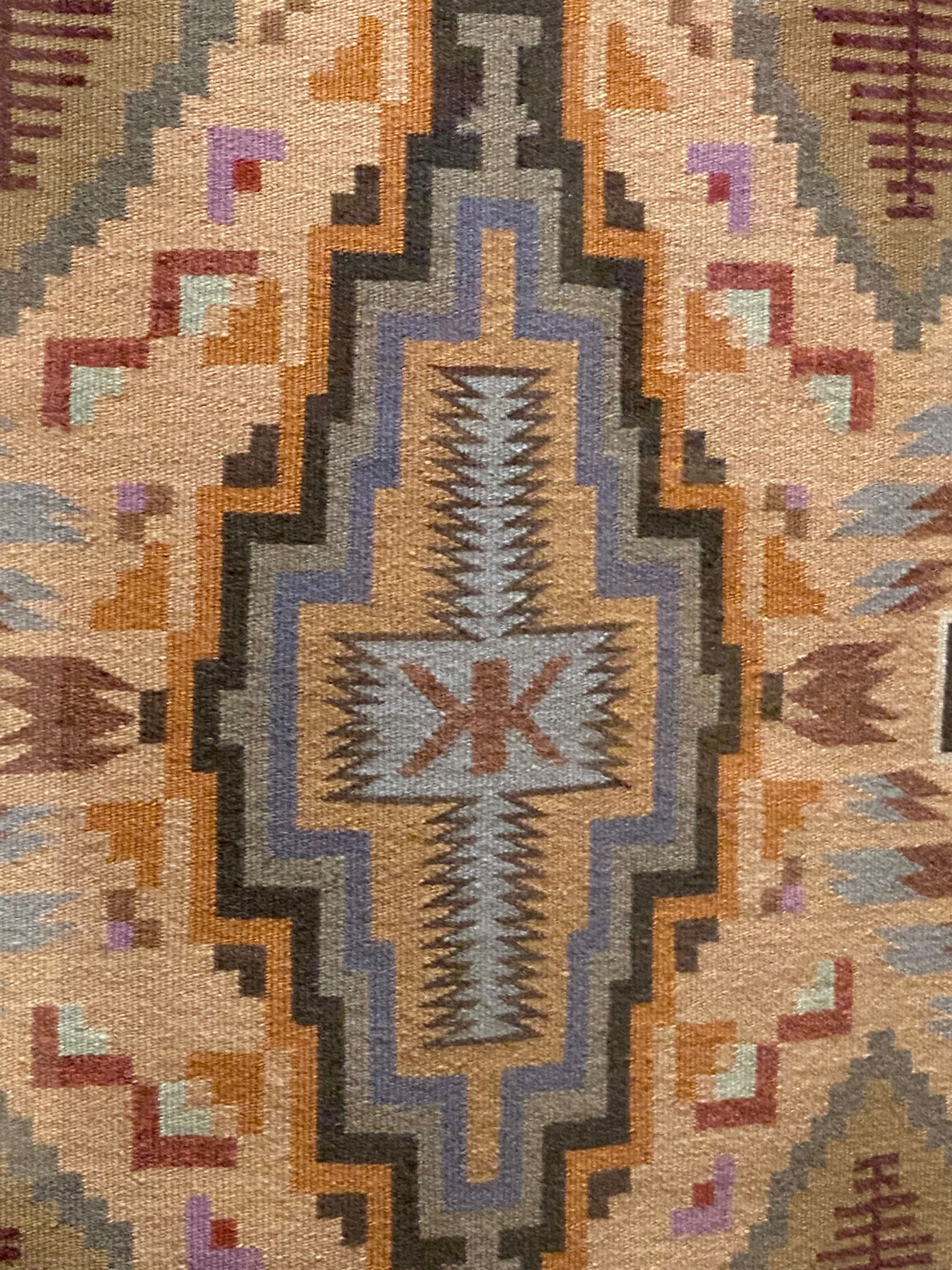
The participants in the exhibition make sure that viewers also experience how the landscape inspires the work of the past and contemporary Native textile artists. Diné fiber artist Tyrrell Tapaha includes her two-panel dress in which incorporates images of the Utah clouds and mountains that bring her spiritual peace. The masterful wall hanging by Lillie Joe uses the palette of the desert to create a mesmerizing geometric dazzler.

2020 two-panel dress by fiber artist Tyrrell Tapaha with images from Utah landscapes that inspired her; woven from churro, silk, mohair, and marino wool..
Close up of highly detailed 1980s Burntwater wall hanging by Lillie Joe, reflecting colors and patterns of the Navajo Nation landscape.

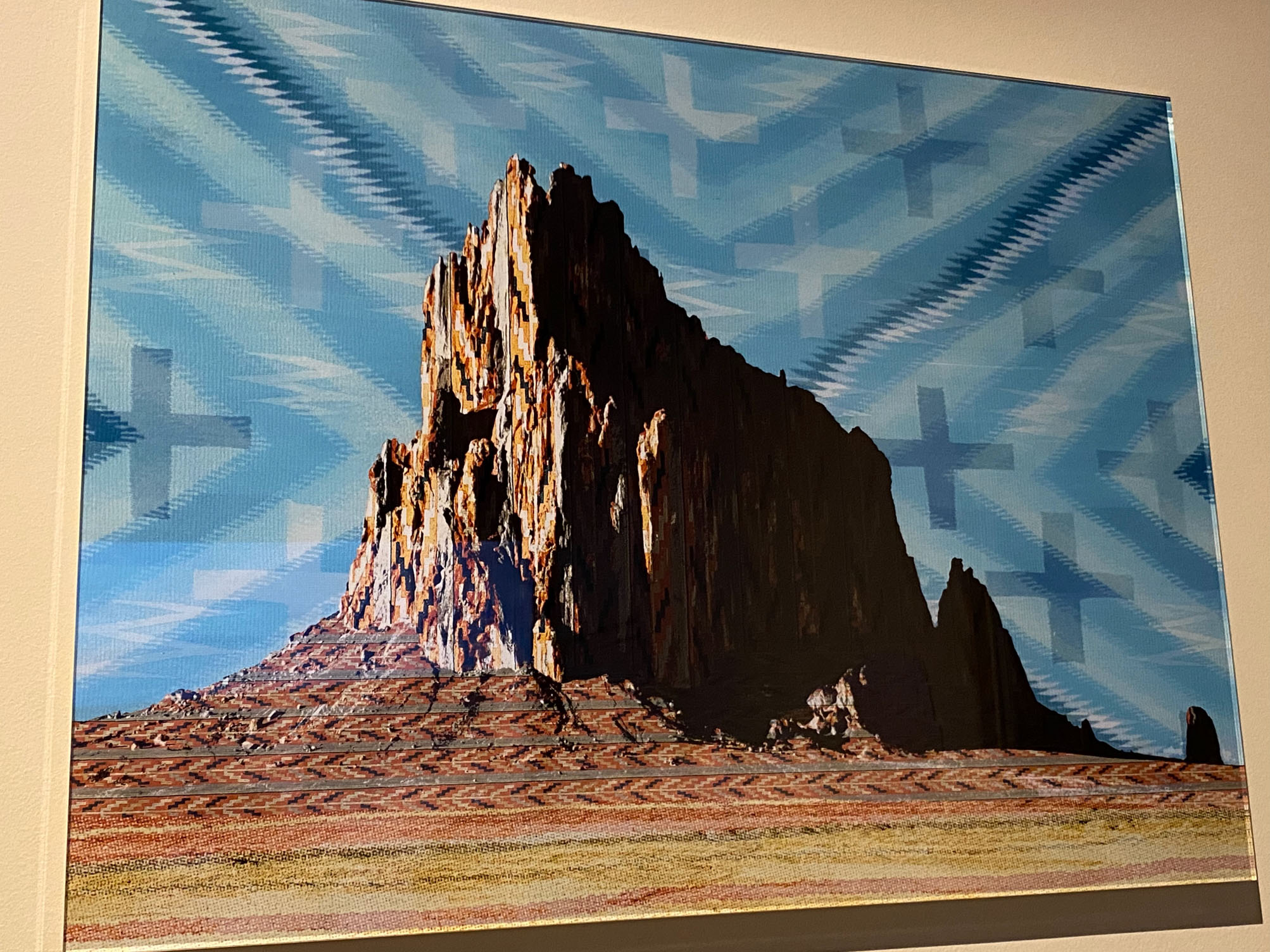
The curators feature both the photography of co-curator Rapheal Begay and Darby Raymond-Overstreet to allow gallery visitors to experience the awesome beauty of the homeland that inspires artists. Digital artist Raymond-Overstreet overlays geometric textile patterns across his luscious, beautiful landscapes.

2018 digital print Woven Landscape, Shiprock by Darby Raymond-Overstreet (Diné), overlaying digital landscapes with traditional weavings. Courtesy: the artist

Take a look at some of our favorite works in our Flickr album. And enjoy these historic and contemporary dazzlers.

Detail of 1895 wedge weave blanket made with commercial cotton string and Germantown wool – a dramatic 19th c. weaving innovation. Courtesy: International Museum of Folk Art.
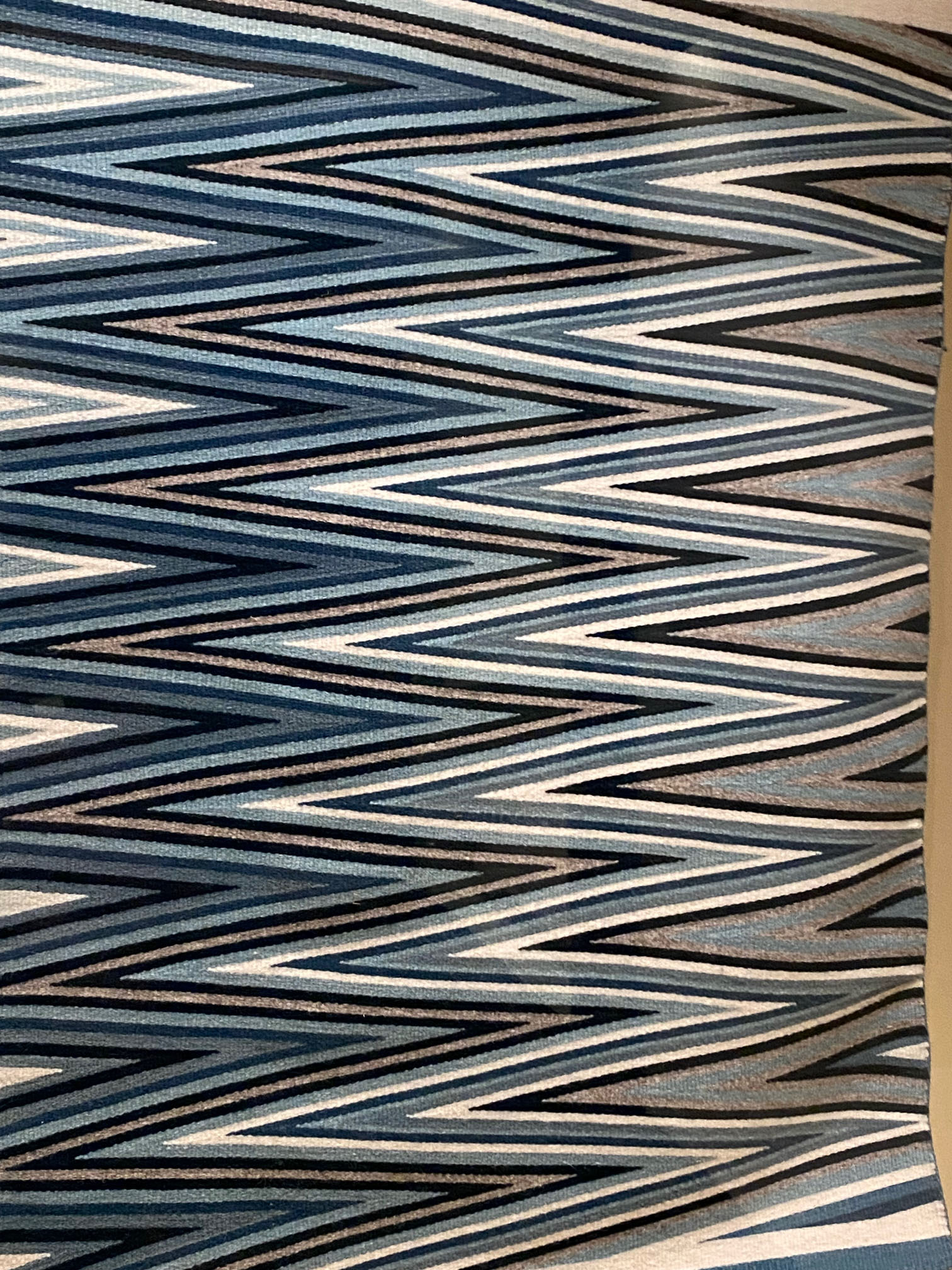
2022 wedge weave by Kevin Aspaas; white and grey wool yarn with indigo dye. Courtesy: private collection.
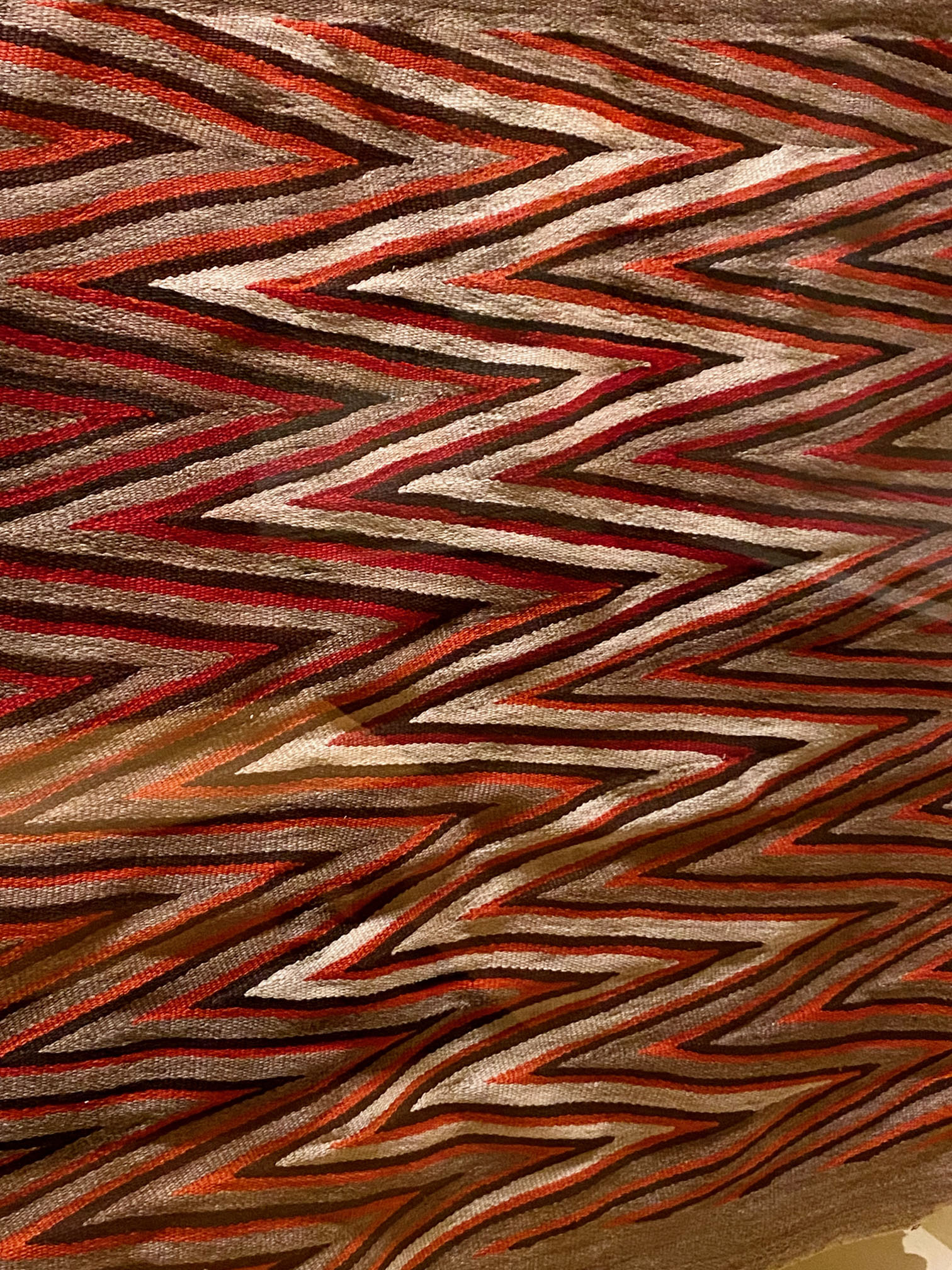
Detail of dynamic Diné 1960 wool tapestry weave. Courtesy: International Museum of Folk Art

Wit, Humor & Satire in Albuquerque

If you want to have a good laugh or contemplate a biting piece of social satire, head over to Wit, Humor & Satire at the Albuquerque Museum, on view through January 29.

Pulled from the museum’s permanent collection, themed sections of the show present artists’ side-glance takes on Western mythology, art jokes, image puns, and politics.

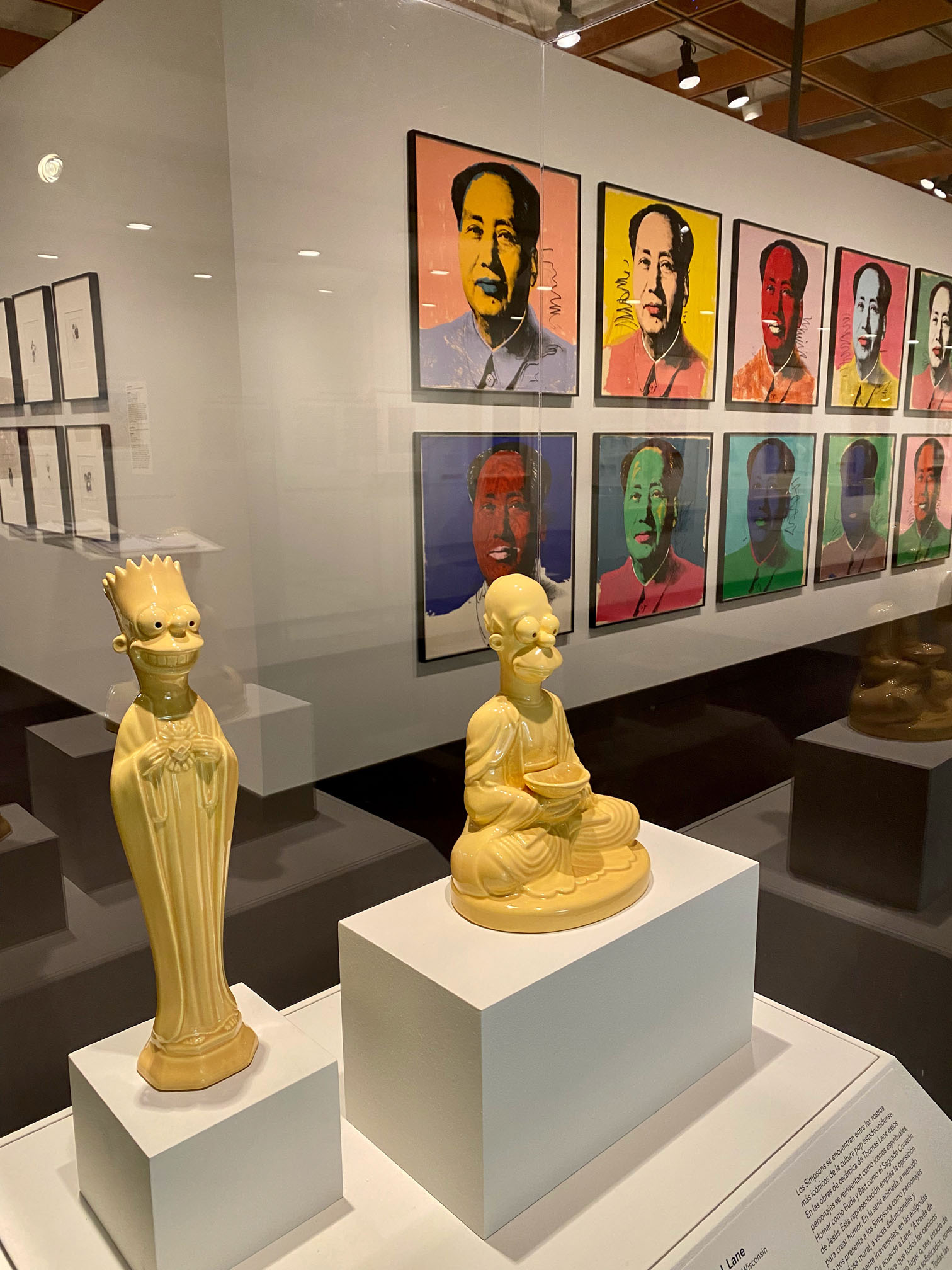
Right in the entry, you see the huge wall of Warhol Mao Tse-Tungs in blazing Pop Art colors, alongside Thomas J. Lane’s satirical ceramics – Bart Simpson impersonating Jesus and Homer as Buddha. Irreverant satire mixed with social commentary in impeccable execution.

Art history “jokes” and political portraits: Thomas J. Lane’s satirical Simpson ceramics with Warhol’s monumental 1972 Mao Tse Tung silkscreens.

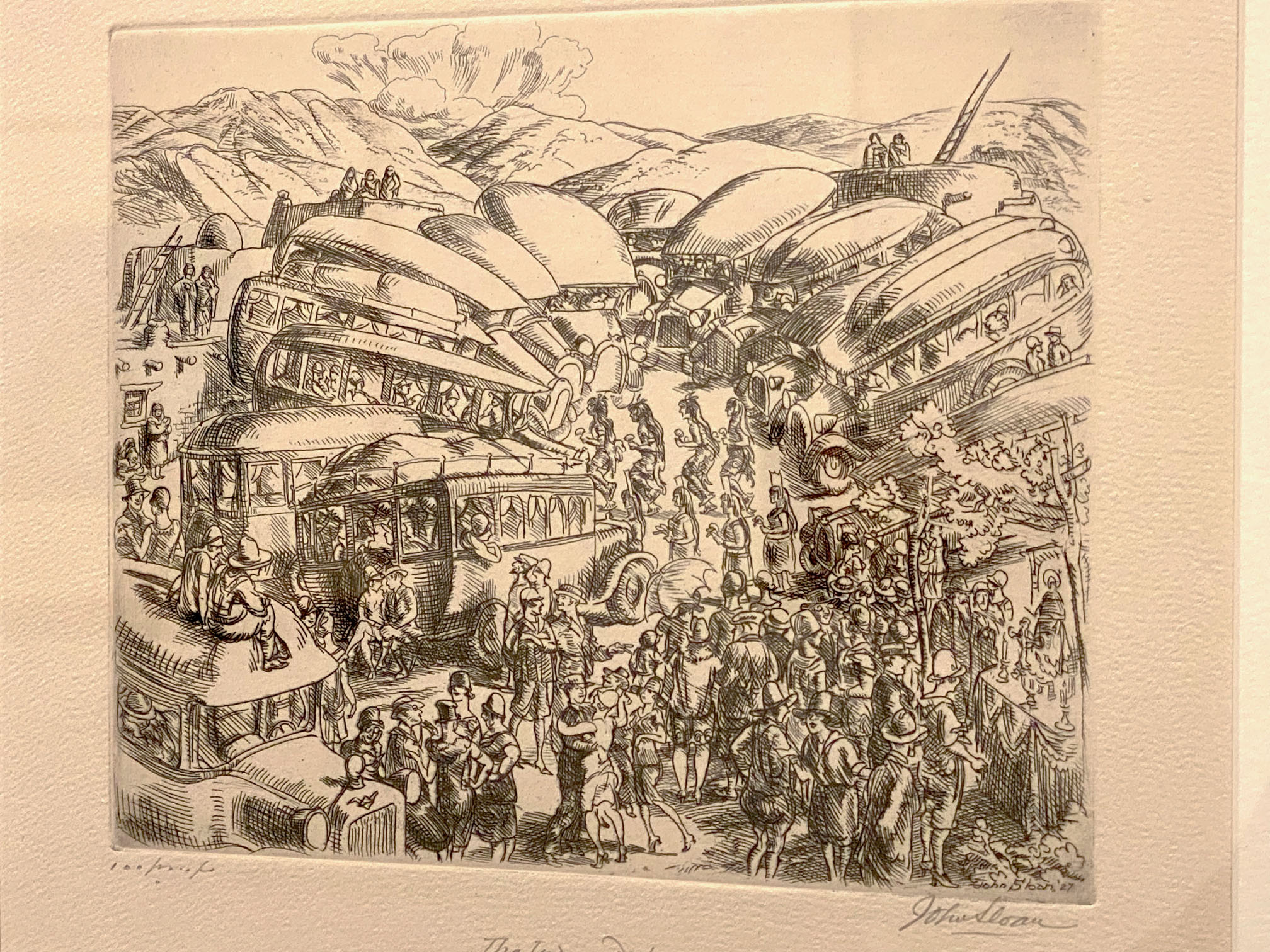
There’s a dark 18th-century Goya etching in the first gallery and a funny Sloan print skewering 1920s tourists, but most of the offerings are more recent vintage, particularly whimsical sculptures and social commentary of the Seventies, Eighties, and Nineties. 

Comments on Commodification: John Sloane’s 1927 Indian Detour etching, a satire showing hoards of souvenir-buying tourists descending upon Indian pueblos on their Fred Harvey packaged excursions.

It’s nice to encounter clever Sixties and Seventies Warhol, Rauchenberg, and Red Grooms prints in other humorous sections of the show, and to revisit Southwestern superstars like the T.C. Canon and Scholder, who like challenging stereotypes of what people think of Western people and cultures.

Political commentary: Red Grooms’ 1976 silkscreen Bicentennial Bandwagon,”which references America’s troubled past versus all-out patriotic celebration of American history.

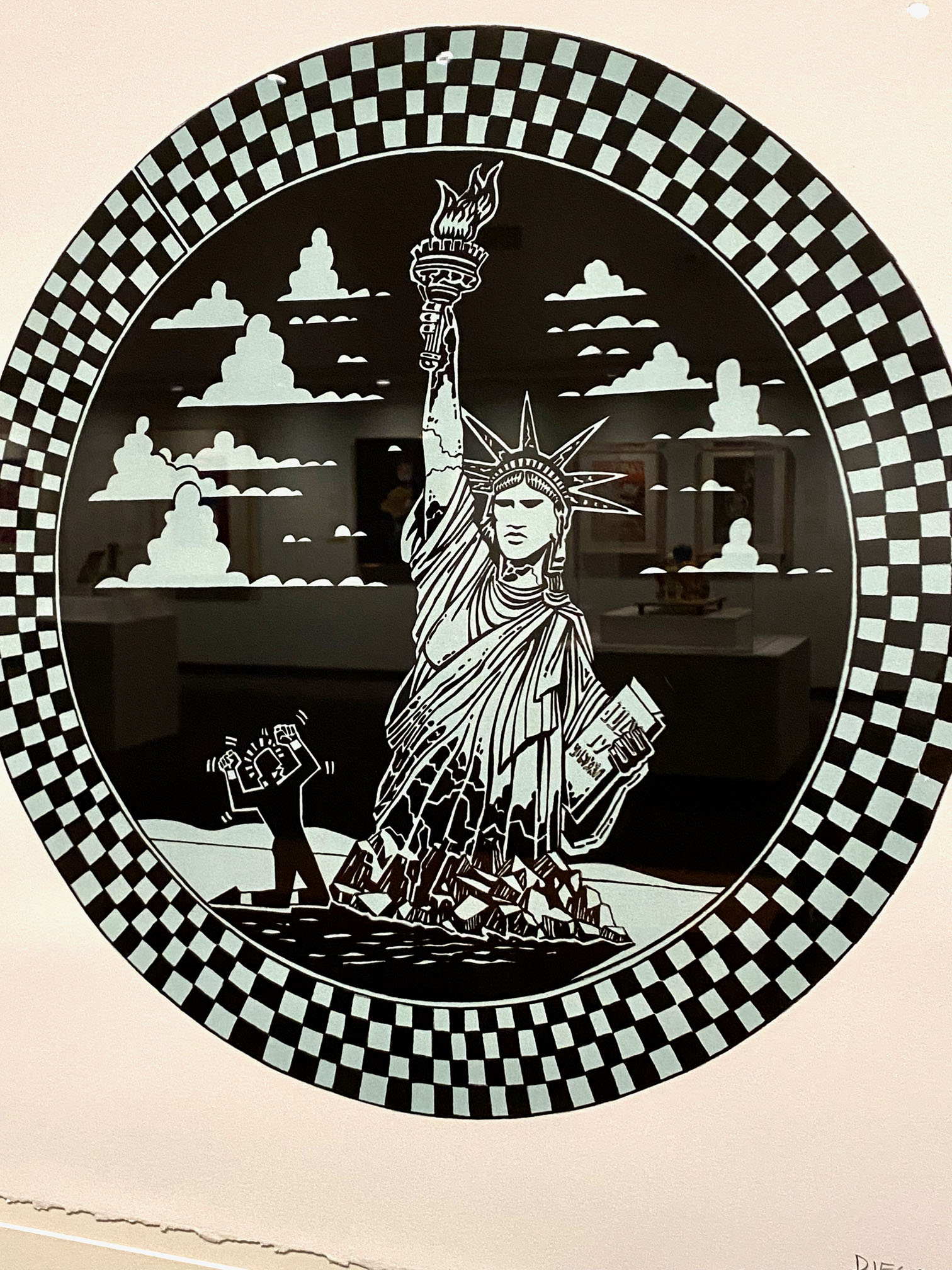
Most of the anti-War and social commentary are in the back half of the gallery, with strong pieces by Bob Haozous, John L. Doyle, and Sue Coe. Diego Romero lays it out with a lithograph that resembles his normal medium of politics-on-a-plate.

War: 1990 steel-plated sculpture El Piloto by Bob Haozous, depicting a skeleton pilot whose nose is a plane with a bomb trailing.
Political commentary: Diego Romero’s 2011 Apocalypto lithograph.

Another stand-out is the first poster ever designed by Keith Haring – a combination of images that came to define subterranean visual protest in the dark, scary times of 1980s New York. He debuted it for an anti-nuclear rally in Central Park, but his unforgettable images and icons soon became ubiquitous on City streets and subways, on T-shirts, and downtown art galleries.

Indigenous humor and commentary are well represented by Jason Garcia’s water-carrying pueblo gals in a contemporary landscape and Wendy Red Star’s Native seasons studio-portraiture spoof.

War commentary: Keith Haring’s first poster – his 1982 Anti-Nuclear Weapons Poster, featuring his iconic “radiant baby”.
Western mythologies: Subversive autumnal studio self-portrait from Wendy Red Star’s 2006 digital print series Four Seasons, which highlights artificial elements.

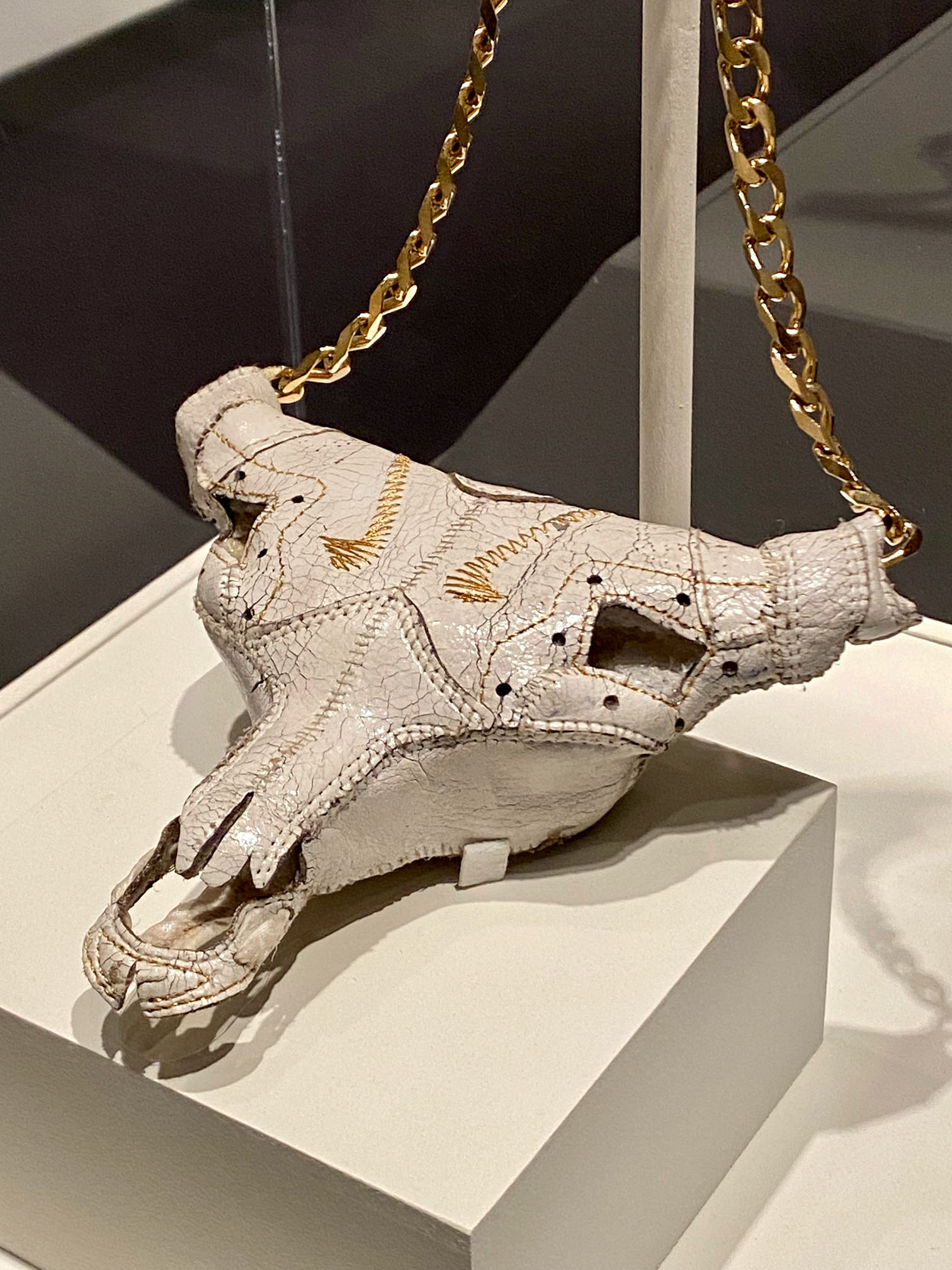
Too bad that no one knows who made the 1960s traditional Zuni pop-culture Disney necklace. But it’s fun to contemplate the Nike-sneaker sculpture/neckpiece by Sean Paul Gallegos.

Exploring wit: 1960s silver Zuni necklace by unknown artist featuring Disney characters inlaid with shell, coral, turquoise, and jet.
Commodification commentary: 2015 satiric “high fashion” neckpiece by Sean Paul Gallegos, created from recycled Nike sneakers and gold thread.

There’s a lot to think about and enjoy in this provocative show. Visit our Flickr album to enjoy more of our favorite works.

Art of Indigenous Fashion at IAIA

How do Native American designers transform traditional beading, ancient symbols, social commentary, and tribal embroidery into contemporary fashion? 

Answers are on display in the exhibition, Art of Indigenous Fashion at Santa Fe’s IAIA Museum of Contemporary Native Art (MoCNA) through January 8. It’s a fitting exhibition that opened in conjunction with the tenth anniversary of the Southwestern Association for Indian Arts (SWIA) Indigenous Fashion show.

Take a look at our favorite pieces in our Flickr gallery.

2015 Jamie Okuma wool dress with shells. Courtesy: National Museum of the American Indian
2022 Recon Watchmen costumes by Virgil Otiz (Cochiti Pueblo). Courtesy: the artist.

The show puts the work of 2022 Native American Treasure honoree Virgil Ortiz front and center, with three imposing Recon Watchmen costumes. No, it’s not runway fashion. But these futuristic sci-fi ensembles from the year 2180 are made for a film where protectors travel back in time to help the New Mexico pueblos successfully fight their opressors in the Revolt of 1680.

Ortiz (Cochiti Pueblo) combines film, fabric, headresses, and history to tell the story of a real-life Native revolution that Pueblo kids never learned in their New Mexican history classes. Look close at the awesome printed silk cloaks, lamé “armor”, and dramatic sculpted masks of these dramatic Native superheroes.

Next, you see how Native artists combined art and fashion from the mid-20th century until now.

Several historic pieces are by the godfather of Native American contemporary fashion (and early leader of IAIA), Lloyd Kiva New (Cherokee), who had a successful contemporary line in Scottsdale in the 1940s and1950s.

The clothes in this exhibition feature buttons and clasps made by Charles Loloma, a Hopi innovator in contemporary Native jewelry, who also had a shop in Scottsdale and joined New at IAIA in the Sixties. Lucky that collectors saved these gems for us.

1950s and 1960s ensembles by Lloyd Kiva New (Cherokee). Private collection.
2016 ribbon dress by Jamie Okuma ((Luiseño/Shoshone/Bannock)) and 2018 silk dress by Orlando Dugi (Dine’). Courtesy: the artist; IAIA

The rest of the work in the exhibition represents the 2000s, primarily three types – ensembles taking a luxurious haute-couture approach, wearable social commentary, and sly conceptual art-as-fashion installations.

The 2000 embroidered, appliqued wool “Chilkat” cape by Pamela Baker (Tlingit/Haida) is regal enough to wear at any black-tie affair.

The same for Orlando Dugi’s (Dine’) 2018 feathered and beaded evening dress with a subtle golden eagle and touches of sparkling corn pollen. Dugi is a self-taught couturier, who meticulously applies each bead and feather himself.

Two dramatic red-carpet dresses by Lesley Hampton (Anishinaabe) that have appeared at recent Emmy and Golden Globe Award events are reminders of the inroads being made by Native Americans artists in the entertainment sector.

Among the most dramatic social-commentary work, Canadian design team Decontie & Brown (Penobscott Nation) has two attention-grabbers – a “wedding dress” offering the wearer protective spikes from unwanted advances and radiating power-feathers, and the “I Am A Reflection…” mirrored man’s coat. Absorbed in the kaleidoscope of the coat’s reflected light, viewers contemplate Decontie & Brown’s message as they marvel at the visual magic.

Decontie & Brown’s 2017 Armored Beauty wedding dress and 2021 upcycled I Am a Reflection…Mirror Coat. Courtesy: the artists
2018 It’s in Our DNA, It’s Who We Are ensemble by Anita Fields reflecting tribe’s past and present. Courtesy: Minneapolis Museum of Art

The elegant embroidered cashmere shift by Sho Sho Esquiro (Kaska Dena/Cree) has delicate somber black wings fluttering across the back. But these are paired with a front shouting the savage message of 20th-century Indian boarding school government policy. Beautiful but chilling.

Anita Fields (Osage) is represented by a suspended fashion installation in the center of main gallery – a wildly oversized embroidered top hat and wedding coat titled “It’s In Our DNA, It’s Who We Are.” Intertwined strands are emblazoned on the front; images of the unfortunate treaty her tribe signed in 1808 line the inside.

Outside the main gallery, MoCNA has invited Mohawk multimedia artist Skawennati to create a digital mural and installation of her “Activist Avatars,” cyber-protesters modeling a virtual clothing line. Multiple screens of social-justice protesters in power-to-the-people cammo and calico march toward viewers in the MoCNA screening room to an energetic Native hip-hop track.

Skawennati’s (Mohawk) 2022 Calico and Camouflage: Assemble! multichannel video installation.

Many of the artists represented in this show – Patricia Michaels, Jason Baerg, Jamie Okuna, Sho Sho Esquiro, and others – were featured in this year’s Indigenous Fashion show. Watch the 2022 SWIA Fashion Designers runway videos here.

2019 silk and leather Sunset Dress by Jason Baerg (Cree Métis), symbolizing dynamic optimism and referencing trees, sky, and earth. Courtesy: the artist.