Before LeBron: Historic Tribute to Basketball Pioneers

Claude Johnson of the Black Fives Foundation in the New-York Historical Society's "Black Fives" gallery.

Claude Johnson of the Black Fives Foundation, surrounded by memorabilia, in The Black Fives show at New -York Historical Society.

With LeBron James’s big announcement in the news, it’s a good time to trek over to the New York Historical Society to learn about how it all started – basketball, African American domination of the sport, and pro trades — in the fascinating second-floor show, The Black Fives, running through July 20.

When basketball really took off in the 1910s and 1920s, the top starting players were known as “fives.” Pre-integration, when African-Americans had their own teams, the amateur club starters were known as “black fives.” NYHS produced this show in collaboration with Claude Johnson, director of the Black Fives Foundation, who has been leading the charge to collect, document, and interpret the unknown or forgotten history of African American participation in one of America’s favorite games.

Recap: Basketball began in 1891, using peach baskets, as a game to keep youngsters occupied during long winters in the Northeast. in 1904, Harvard-educated Edwin “EB” Bancroft Henderson introduced the game to African-Americans through the public-school phys ed classes he taught  in Washington, D.C. Physical activity was seen as a way to combat TB and pneumonia, which were rampant in cities. Here’s a short clip about Henderson:

It wasn’t long before basketball came to Harlem, Cleveland, Chicago, Pittsburgh, Atlantic City, and Pittsburgh, where there were large populations of young African American men and coach/role models ready to start something new in public schools, churches, and colleges.
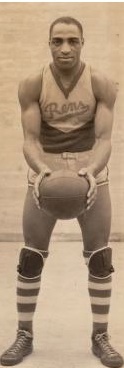
Charles “Tarzan” Cooper (1907-1980), the star center who won the World Pro Basketball Tournament championship with the Rens in 1939. Photo: courtesy Black Fives Foundation.

Charles “Tarzan” Cooper (1907-1980), the star center who won the 1939 World Pro Basketball Tournament championship with the Rens. Photo: Black Fives Foundation.

Johnson’s collection of original cotton jerseys, trunks, stop-clocks, balls, and shoes from the 1910-1920 era is amazing, and really brings you back to the days when basketball courts were surrounded by wire mesh to protect fans (“cage match”, anyone?). You’ll see original, handmade basketball shoes, crafted of canvas and kangaroo leather and a life-size photo of how these snazzy sportsmen dressed.

Since NYC gymnasiums were still racially segregated, African-American clubs had to find alternate spaces to play. Uptown, the rise of basketball just happened to coincide with the Harlem Renaissance. Solution: use a ballroom and combine dancing, jazz orchestras, and basketball.

Ballrooms and basketball boomed, with “black five” teams now having really nice home courts. In 1923, Bob Douglas created the first Black-owned pro team for Harlem’s 2,500-seat-capacity Renaissance Ballroom at 138th Street. Douglas christened them the New York Renaissance Big Five (fans called them the “New York Rens”), and promptly started offering big-time contracts to the best players in town. By luring top talent with lucrative pay, the Rens would dominate basketball for decades to come.

Since they couldn’t compete at first in white leagues, the Rens went barnstorming across the country to play white teams, averaging 130 games per season. Some venues were as large as 10,000 seats. Fans went wild during the Depression to see the amazing Rens. From 1923 on, the Rens won 1,673 out of 1,944 games, led by Charles “Tarzan” Cooper. By 1939, they captured the first World Championship of Pro Basketball in Chicago, defeating the top white team in the country, the Oshkosh All Stars. The Rens were hailed as the top team of the decade, black or white.

This 1971 Milton Bradley game , in the NYHS collection, celebrates the Harlem Globetrotters, who were a team  that started on Chicago's South Side

This 1971 Milton Bradley game , in the NYHS collection, celebrates the Harlem Globetrotters, who were a team that started on Chicago’s South Side

To learn more about this history, visit NYHS or go to the foundation’s web site and click through each section of the exhibition in the pull-down menu. In the Depression Era section, you’ll get the entire backstory on how the Harlem Globetrotters were actually from South Side Chicago and how even they got creamed by The Rens in ‘39. (The Globetrotters didn’t actually play a game in Harlem until 1968!)

Check out the exhibition video:

Here, you’ll see more about the Black Fives and Brooklyn, and how the Barclay Center is commemorating the “Black Five” era:
Sky High NYC Real Estate at Skyscraper Museum

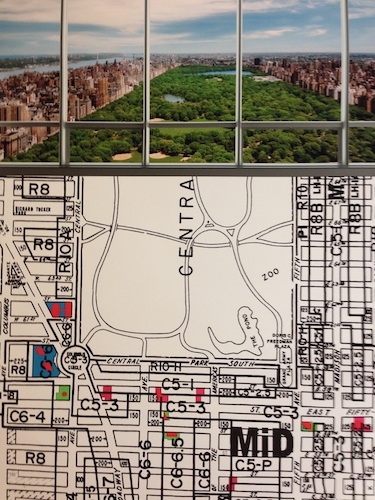
A photo of the future view from an apartment in One57, with the Midtown zoning map. Source: Skyscraper Museum

A photo of the future view from an apartment in One57, with the Midtown zoning map. Source: Skyscraper Museum

People get pretty emotional about their New York skyline. Recent news has swirled around Comcast wanting to put its name atop Rockefeller Center (goodbye, G.E.), the soon-to-be obstructed view of Manhattan from New Jersey’s Lincoln Tunnel entrance, and the super-slim ultra-tall residential skyscrapers sprouting up along the south edge of Central Park.

What’s going up at Hudson Yards? Will more sky-high slivers be overtaking the Empire State Building? The downtown skyline? Thankfully, the Skyscraper Museum is walking us all through the plans in its show, closing this weekend, Sky High & the Logic of Luxury. In a fantastic on-line and in-gallery show, the museum lays out the thinking behind six super-tall residential real estate developments, gives us the historic context of tall buildings here, and introduces us to the architects and developers behind the trend.

Take an installation walk-through.

Stars of the show, left to right: 432 Park Avenue, One57, 111 West 57th, Four Seasons at 30 Park Place, 56 Leonard, Hudson Yards Tower D.

Stars of the show, left to right: 432 Park Avenue, One57, 111 West 57th, Four Seasons at 30 Park Place, 56 Leonard, Hudson Yards Tower D.

The show – both in the museum and on the web – begins with a definition of  “slim” skyscraper and the long history of super-skinny in Manhattan. The history goes as far back to 1889 with the super-tall (at eleven stories) Tower Building at 50 Broadway – the beginning of the first phase of super-slim buildings. The MetLife Tower, finished in 1909, still towers to the east of Shake Shack at Madison Square. (Note, however, that the clock face is the only original part of the exterior left after a 1960s renovation.)

Illustrations of the world’s tallest skyscrapers in 1899 to 1918, all in Manhattan.

Illustrations of the world’s tallest skyscrapers in 1899 to 1918, all in Manhattan.

After New York’s zoning laws went into effect in 1916 (the first in the United States), hotels started growing taller and skinnier (e.g. the Sherry Netherland in 1927, the Pierre in 1930). Residences didn’t get that way until much more recently with the post-1961 legal change that allowed developers to buy air rights and build really high.

Enter Trump in the 1980s with multiple residential towers covered in dark glass, and the super-tall building (One Madison Park) that went bankrupt during the recession. But now, the entire movement is gaining steam again, with prices, views, and amenities reaching higher and higher.

The buildings featured in this show (in case you haven’t looked up) shoot up between 50 and 90 stories. Some are clustered at the foot of Central Park (check out 432 Park Avenue, One57, and 111 West 57th). Some are rising downtown – Four Seasons at 30 Park Place and 56 Leonard.

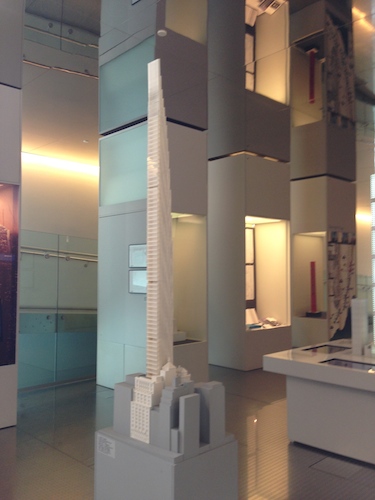
Architect model of 111 West 57th Street soars over surrounding buildings

Architect model of 111 West 57th Street soars over surrounding buildings

And, of course, some will be encircled by the High Line Phase III, such as Hudson Yards Tower D.

Take a look at the fantastic, detailed museum exhibition site and get to know your new neighbors.

Be sure to zoom in on the chart on the museum’s web site, showing the history of Manhattan sky-high apartment prices. Also, check out our Flickr photstream of the museum show.

Want to see the future? Take a look:

Gauguin’s Primitive Universe at MoMA

Be Mysterious (1890) Carved and painted lime wood from Musée d’Orsay, Paris. © RMN-Grand Palais /Art Resource NY.

Be Mysterious (1890) Carved and painted lime wood from Musée d’Orsay, Paris. © RMN-Grand Palais /Art Resource NY.

You can almost hear the rustling pandan leaves, waterfalls rushing into exotic coves, and the drums and chants of fiery Tahitian rituals around powerful idols long since banned by the Christian missionaries…but only if you take the time to get close to the smaller works in MoMA’s revealing sixth-floor show, Gauguin: Metamorphoses through June 8.

Yes, Gauguin’s bright, colorful paintings of island life are displayed, but the show is really about the darker, more primitive experience expressed in Mr. Gauguin’s ceramics, woodcuts, carvings, and monoprints – the works that we rarely get to see en masse.

Hina and Fatu (c. 1892) Carved tamanu wood. Courtesy: Art Gallery of Ontario, Toronto © 2013 AGO

Hina and Fatu (c. 1892) Carved tamanu wood. Courtesy: Art Gallery of Ontario, Toronto © 2013 AGO

After nearly two decades plugging away at his day job, weathering a stock-market crash, struggling to stay in the middle class, cranking out artworks in his spare time, and showing with the Impressionists, he just chucked it all, packed a bag, and went to Tahiti in 1891. From his young-adult years working in the merchant marine, he figured Tahiti was as far away as he could get from his family, responsibilities, and the frustrating Paris art scene where others were making it besides him.

Nothing’s perfect, and the Tahiti he arrived in was already changing from contact with the global trade networks of industrialized countries. No matter. Gauguin was captivated by the thought of connecting with the “true” primitive and savage that lived in the myths, lore, and natural beauty of Polynesia and shoving it all into the face of the avant-garde and art-buying public back home.

The curators have assembled all the images Gauguin created for three dramatic series of woodcuts. The rough edges really come out in Noa Noa (1893) and The Vollard Suite, with a few of the gouged-out woodblocks exhibited right next to several states of the same image.

Mahna no varua ino (The Devil Speaks), state IV / IV, from the suite Noa Noa (Fragrant Scent). (1893–94). Woodcut from private collection. Courtesy: Galleri K, Oslo. © Reto Rodolfo Pedrini, Zurich

Mahna no varua ino (The Devil Speaks), state IV / IV, from the suite Noa Noa (Fragrant Scent).
(1893–94). Woodcut from private collection. Courtesy: Galleri K, Oslo. © Reto Rodolfo Pedrini, Zurich

Black, dark, primitive, edgy – too edgy, in fact, for his dealer, Mr. Vollard, who felt that the prettier oil paintings were a lot more palatable to his clients. (Vollard kept the more expressive primitive prints in the drawer.)

Take a look on MoMA’s special website for the show, which has a detailed timeline for Gauguin’s travels. Clicking on images on the site allows you to zoom in closely on each work. A particularly nice touch is the full digitized version of Gauguin’s unpublished Noa Noa manuscript, which he assembled (but never published) to interpret all the exotic images and symbols of the series for the public and his hoped-for fans. Scroll down to the bottom of this page to see the manuscript, page by page.

Oviri (Savage). (1894) Partly enameled stoneware, from Musée d’Orsay, Paris. © RMN-Grasnd Palais /Art Resource NY

Oviri (Savage). (1894) Partly enameled stoneware, from Musée d’Orsay, Paris. © RMN-Grasnd Palais /Art Resource NY

So here’s your chance to examine what was boxed up for so long along alongside magnificently  disturbing sculptures, panels, and reliefs of goddesses, devils, spirits, waves, women, and mountains created out of tamanu and pua wood with the occasional daubs of colored paint. It’s clear that the design and detail of Gauguin’s beautiful symbolist color paintings got a further workout through all of these other works portraying the dark, mysterious side of life forces emanating from the mind of a struggling artist obsessed with the uber-primitive.

Some say that Picasso was inspired to transform his Demoiselles after seeing some of this raw work (exhibited after Gauguin’s death). Say hello to them seven days a week on MoMA’s 5th Floor.

Get Out of Town with JJ Audubon

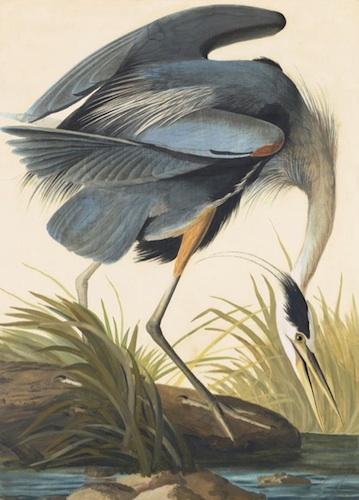
Audubon’s Great Blue Heron (Ardea herodias), Study for Havell pl. 281 (1832). Watercolor, graphite, and pastel on paper, laid on thin board. Courtesy NYHS and Mrs. Audubon

Audubon’s Great Blue Heron (Ardea herodias), Study for Havell pl. 281 (1832). Watercolor, graphite, and pastel on paper, laid on thin board. Courtesy NYHS and Mrs. Audubon

If you need to get out of town Memorial Day weekend, there’s no better traveling companion than J.J. Audubon, whose original watercolors will transport you to another time and place better than any plane, car, or train. Experience his spectacular show at the New-York Historical Society, Audubon’s Aviary: Parts Unknown: Part II of the Complete Flock today and tomorrow.

Can’t make it in person to New York? Not a problem, because you can tour Mr. Audubon’s show (and more) on a fantastic website that shows you his birds, provides the maps of your journey, and more. True, you won’t enjoy the life-size paintings – shocking when you see them in person – but you’ll learn the entire backstory of JJ’s trips through the Southeast US and Northeast Canada as he did the best-job-ever for his epic Birds of America four-volume series.

In the NYHS gallery in the last several weeks, visitors have been running up to the second floor and grabbing the magnifying glasses to study each brushstroke of these magnificent works. Although they’re mostly watercolor, each painting is enhanced with graphite, pastel, gouache, and ink. Because no one’s perfect, a few have birds pasted in from other pieces of paper, but you really can’t tell unless you study them closely.

A second Great Blue Heron (1834), thought to be another species at the time, with the skyline of Key West, Florida. Courtesy NYHS and Mrs. Audubon

A second Great Blue Heron (1834), thought to be another species at the time, with the skyline of Key West, Florida. Courtesy NYHS and Mrs. Audubon

It’s the first time that NYHS has exhibited JJ’s complete watercolor series, but it’s so big – 474 original watercolors – that they had to break it into three separate shows.

Mrs. Audubon presented JJ’s entire set of original work to NYHS in1862. Her husband had worked so hard on these works of art (he didn’t consider them “scientific”) that she commented that sometimes the birds felt like “her rivals.” Better that NYHS preserve them for posterity.

The museum decided to mount the watercolors in the order in which JJ painted them. On the website, you can revisit Part I, but let’s turn our attention to Part II.

As you’d expect from his trips to the Carolinas, Georgia, Florida, Labrador, and Newfoundland in 1831-33, the majority of the birds you’ll see live in and around the water. Two spectacular works are of the Great Blue Heron in two color ways. In JJ’s lifetime, the white- and bluish-colored herons were thought to be two separate species (which they’re not), so we’re treated two very large paintings of one fishing from shore and the other enjoying a meal in sight of the Key West skyline across the bay.

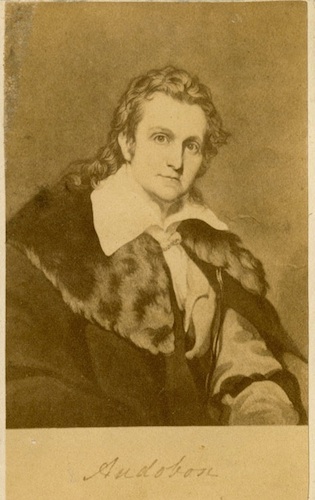
Carte–de–visite of John James Audubon. The legacy lives. Courtesy: NYHS

Carte–de–visite of John James Audubon. The legacy lives. Courtesy: NYHS

It’s amazing to consider that JJ started many of these while he was on his journeys, totally outdoing Banksy as a premiere peripetatic creating-art-wherever road warrior. Of course, he did it all without electricity and frequent-flyer miles hauling around gigantic pieces of perfect paper.

Through it’s collaboration with the Cornell Ornithology Lab, the NYHS provides (on the web and on the gallery audio guides) clips of each bird’s distinctive voice. Another nice in-gallery touch is an iPad app that allows visitors to compare each watercolor with the engraved print made in London by Robert Havell, Jr. for the printed books.

Enjoy JJ’s images here.

FIT Students Digitize and Unzip Biker Jacket History

The 1980 version of The Perfecto, which debuted in 1928 and is still sold by Schott Bros. Source: FIT

The 1980 version of The Perfecto, which debuted in 1928 and is still sold by Schott Bros. Source: FIT

The FIT fashion and textile grad students always pull out the stops on their shows in the Museum at FIT’s side gallery, turning mini-shows into main events, as in their current exhibition, Beyond Rebellion: Fashioning the Biker Jacket. The gallery installation highlights the jacket’s role in history, culture, couture, and street fashion, but the team makes its history come alive even further on their superb companion digital site featuring photos, videos, and the historical context. See the jackets in person and touch the leather swatches before April 5, and go play with the web site at any time.

The digital timeline begins with the birth of the motorcycle in the UK in 1902, but the fashion story starts in 1928 with the debut of the leather riding jacket, The Perfecto by the Schott Bros. It’s the template upon which all other cool looks – street, couture, punk, ready-to-wear – are based. It combines the swag of a WWI aviator jackets with the utility and protection needed by one of the original road warriors. Retail: $5.50.

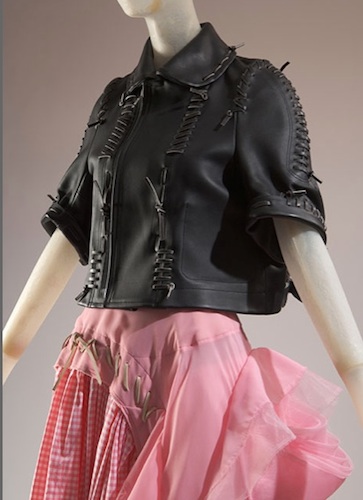
From Rei Kawakubo’s 2005 Biker + Ballerina collection (leather, gingham, and tulle) for Comme des Garcons. Source: FIT.

From Rei Kawakubo’s 2005 Biker + Ballerina collection (leather, gingham, and tulle) for Comme des Garcons. Source: FIT.

In the first gallery next to The Perfecto, fashionable visitors were hovering to take in all the information in Paula Sim’s excellent illustrated deconstruction of the jacket’s iconic design features as if it were the Rosetta Stone. How and why did the details we know so well all originate? The asymmetrical zip thwarts wind, epaulets secure riding gloves during breaks, the belt keeps wind from whistling up your back, and zips at the wrist do the same for the glove-sleeve juncture. The extensive use of hardware was a desirable touch inspired by chrome and metal features on the just-taking-off auto industry. Want or need?

It didn’t take long for motorcycle-loving vets to start applying patches and insignias to the aviator-inspired jackets, just as they had done with patches, insignias, and pins during the war. By the 1930s, as shown on the timeline, club patches gradually became associated with “outlaw” clubs. Nevertheless, the popularity of motorcycle riding grew, documented by the curators with a 1951 Sears catalog showing a premium $33.95 leather moto jacket featuring a snap-off lamb collar and “built-in kidney support”.

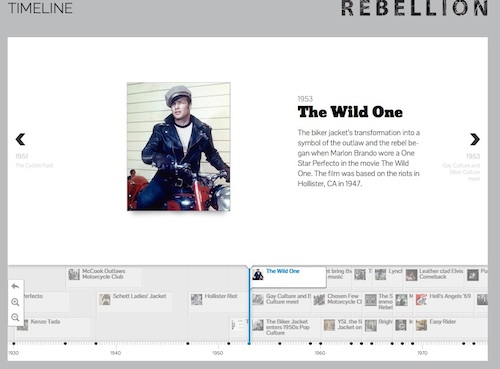
Screenshot from the FIT show timeline

Screenshot from the FIT show timeline

As the curators note, the watershed year for this utility bomber was 1953, when Brando sported cuffed-jeans-and-jacket attire in The Wild One. Banned initially in the UK, the film (and Brando) became a sensation, giving mass audiences a pop-culture version of what happened in the 1947 Hollister, California motorcycle club riots.

The style went viral, pushed further into street-style consciousness by emerging rock-and-rollers and The King himself, Elvis. Take a look at some iconic 50s performances that the digital curators included on the show’s website. Scroll up to 1956 in the timeline to see Gene Vincent tear it up onstage and to 1968 to see Elvis rocking his leather look doing Jailhouse Rock in his NBC comeback special.

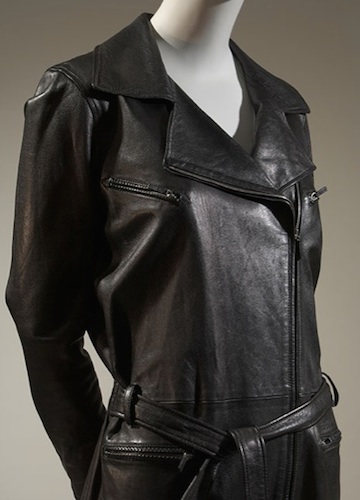
It's so Schott: Stefano Pilati’s Fall 2009 jumpsuit for YSL. Source: FIT, gift of YSL.

It’s so Schott: Stefano Pilati’s Fall 2009 jumpsuit for YSL. Source: FIT, gift of YSL.

In 1960, YSL became the first high-fashion designer to bring the biker look to the runway – a move that contributed to his exit from the House of Dior. Never mind, though. When he opened his own house two years later, he continued riffing on the bad-girl theme.  The rest was history, with plenty of rock musicians, high-end designers, and Vogue stylists following suit.

The curators feature New York’s own Ramones as the epitome of the 1970s motorcycle-jacket-wearing punk-music rebels, and present lots of album covers as evidence of the jacket’s enduring presence.

As for fashion from the FIT collections, the team has pulled together a dozen high-end interpretations, beginning with Mr. Versace’s 1993 gold-stitched biker jacket with pull-tab logo hardware and a more subdued version by Emporio Armani. Fashion lovers have plenty of other versions to savor from Ms. Herrera, Rick Owens, JPG, Rei Kawakubo, and others.

All the techniques rolled into one in Jean Paul Gaultier’s 1987 creation of leather, fake fur, suede, and wool. Note the trapunto, elbow studs, fringe, and pin stripes. Source: FIT, gift of Anne Zartaian.

All the techniques rolled into one: Jean Paul Gaultier’s 1987 leather, fake fur, suede, and wool jacket with trapunto, elbow studs, fringe, and pin stripes. Source: FIT, gift of Anne Zartaian.

In the far corner, the team offers a wall where you can touch and compare different types of hides and treatments used for jackets, marvel at the trapunto-on-leather techniques Mr. Versace and JPG used so extensively, and learn that patent leather was invented in 1811.

If you can’t get to FIT in person, browse through the fantastic exhibition site, listen to the nine-minute audio tour, and download the exhibition brochure. Better yet, do both.

As for the current popularity of the biker jacket on the Streets of New York, enjoy the slide show by the FIT student team, shot on the only warm weekend day so far this year in Williamsburg:

Armory Show Stars on the West Coast of Manhattan

The Artforum Lounge on the Contemporary Pier

The Artforum Lounge on the Contemporary Pier

For four action-packed days, the art crowd made its way to the West Coast of Manhattan Island past gritty lots, warehouses, the ball fields of Clinton, and high-rises-under-construction to enter a white, light-filled glittery expanse of painting, sculpture, and champagne bars at the 2014 edition of The Armory Show.

This year, 205 exhibitors showed off the best in modern masters and contemporary upstarts. Walk through it with us on our Flickr feed.

If you’ve never been there, just know that the art fills two full piers (yes, where the cruise ships come in). You may think the Whitney Biennial is big, but The Armory promenade is vast.

On the Modern Pier: Chicago’s Alan Koppel Gallery gave tribute to original Armory Show in 1913 with several Duchamps, but most of the work is post-1940 by Modern superstars. Right at the start of the pier, Galleria d’Arte Maggiori positioned a nice rough-and-ready Mattia Moreni in kind-of a face-off with a pretty primitive Basquiat nearby.

Dramatic paper collage and charcoal work by Elaine de Kooning with two Picasso ceramics at Vivian Horan

Dramatic paper collage and charcoal work by Elaine de Kooning with two little Picasso ceramics at Vivian Horan

Frankfurt’s Die Galerie gave NYC glamour-icon Louise Nevelson a mini-tribute, and several galleries featured Marca-Relli’s painting/collages.

Best on the Modern Pier: Vivian Horan’s booth, dominated by a large Elaine de Kooning charcoal drawing with collage, but populated by two small Picasso ceramics that most fair goers didn’t even see, although they were practically out in the aisle. You don’t see Picasso ceramics too much, and they really added a nice touch.

Second runner-up was the Armand Bartos booth with a sharp Kenneth Noland, Andy’s chicken soup can under glass, and a no-holds-barred Stella. In fact, there were multiple 1980s 3D Frank Stellas leaping out from walls, demanding attention. Besides posing with the soup can, lots of visitors were snapping photos of themselves in front of Mr. Stella’s work.

1949 Hans Hoffman oil at London’s Crane Kalman

1949 Hans Hoffman oil at London’s Crane Kalman

Welcomed surprises: Even though he taught most of the post-war painters in New York, you don’t often see Hans Hoffman paintings, so it was nice to encounter one of his color explosions at Crane Kalman. And we’ve never seen the two super-early skinny Lichtenstein sculptures at Barcelona’s Galeria Marc Domenech booth. Guess they were made in those lean before-the-dots years on his path to Pop.

Susan Harris curated a great micro-show of 20th century female artists, mostly works on paper (e.g. Georgia O’Keefe, Kiki Smith, Lee Bonticou), all contributed by gallery exhibitors.

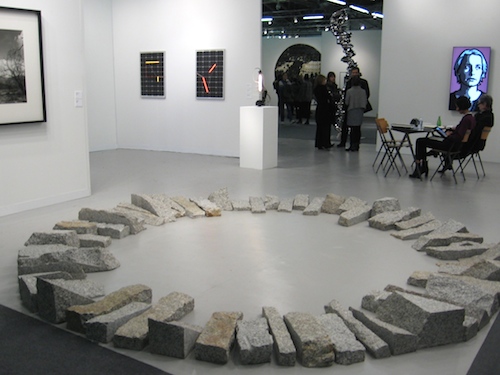
Richard Long’s 1994 Merrivale Circle at the Lisson Gallery

Richard Long’s 1994 Merrivale Circle at the Lisson Gallery

Although you could hike outdoors to get to the second pier along the West Side Highway, most were guided through a wormhole and down a flight of stairs to descend directly into the booths from 17 contemporary galleries across China – a great landing into a warren of booths featuring installations (watch out for the Roomba!), and user-friendly exercise equipment that the PRC makes available in public parks for citizen fitness.

From there, you enter the Contemporary Pier area.  Highlights: the whirling handbag piece (with real handbags) by Egill Saebjornsson at Reykjavik’s i8 Gallery, Richard Long’s stone circle at London’s Lisson Gallery booth, the completely constructed entry to Boesky Gallery, and Claudia Weiser’s cool wooden sculptures at Sies + Hoke (Dusseldorf).

Nick Cave Soundsuits at Jack Shainman

Nick Cave Soundsuits at Jack Shainman

A great place to end the journey was at the Jack Shainman booth, with its dramatic contemporary art exploring expressions from Africa, African-Americans, and global artists — the Nick Cave soundsuits and Richard Mosse’s spectacularly dissonant hot-pink infrared photograph of a waterfall in the continually disintegrating, war-torn Democratic Republic of Congo.

Take a look at the highlights here.

Fair goer relaxes on modernist egg chair under the watchful eye of Dali

Fair goer relaxes on modernist egg chair under the watchful eye of Dali

The Armory Show: One Ends, One Begins

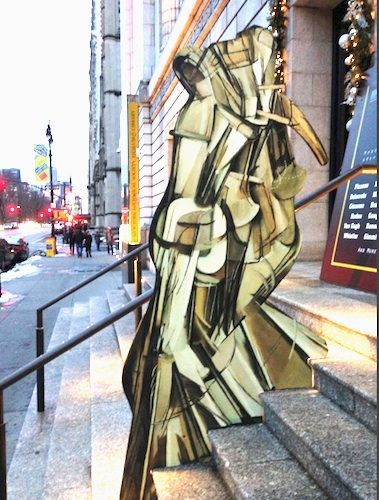
Mr. Duchamp’s 100 year-old icon exits NYHS on Central Park West after seeing the show.

Mr. Duchamp’s 100 year-old icon exits NYHS on Central Park West after seeing the show.

Challenging, ground-breaking art from all over the world under one roof, fashionable crowds, and buyers looking for the next big thing. On March 6, the 2014 edition of The Armory Show opens at the Hudson Piers 92 and 94; but for art-history lovers, there’s just a few days more to travel back in time to experience the 1913 edition that inspired it all at the New-York Historical Society’s show, The Armory Show at 100: Modern Art and Revolution, closing February 23. Check out the spectacular online exhibition site.

NYHS has gathered together 100 of the great art works that rocked Manhattan 100 years ago downtown at the 69th Regiment Armory on Lexington and 26th Street, where the Fighting Irish rented out their parade hall for a month to the newly formed Association of American Painters and Sculptors to show 1,400 works representing the latest trends in modernism.

One of the many postcards sold at the 1913 show’s merchandise table. Source: Smithsonian Archives of American Art

One of the many postcards sold at the 1913 show’s merchandise table. Source: Smithsonian Archives of American Art

Picasso, Cezanne, Matisse, Gauguin, and Munch were there in all their shocking glory – the first time many of these Europeans had been shown stateside. Take a look on the NYHS site and see what chaos ensued in the popular press. Even T. Roosevelt himself wrote an editorial about it.

NYHS not only shows us the work, but puts it all in the context of the times – the bohemian life in Greenwich Village, upstart galleries with an interest in the primitive and new, dissatisfaction with the confines of taste at the National Academy, and New York tastemakers yearning to make their mark on a world stage.

In the little low-light gallery next to the library, you’ll find all sorts of interesting ephemera – letters by the organizers of the show, registration cards with the insurance value of now-famous works, postcards for sale at the show, and a scrapbook of satirical telegrams read by the organizers at their celebratory dinner. This is where you can marvel at Gauguins selling for $8,100, Redon for $810, an oil by Braque for $200, a plaster Brancusi for $200, and Cezanne lithographs for $20 to $40. No wonder Stieglitz amassed such a great collection at these prices!

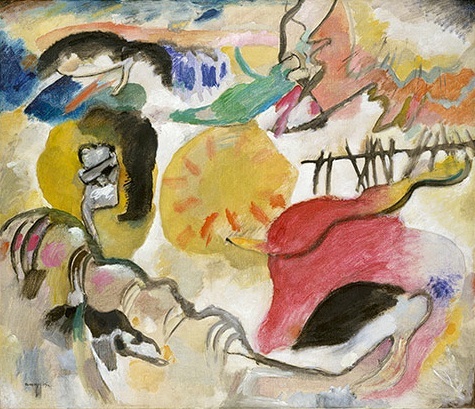
He had to have it. Stieglitz bought Kandinsky’s 1912 The Garden of Love (Improvisation Number 27) as soon as he saw it. Source: Metropolitan Museum/ © 2011 Artists Rights Society (ARS), NY / ADAGP, Paris

Stieglitz bought Kandinsky’s 1912 The Garden of Love (Improvisation Number 27) as soon as he saw it. Source: Metropolitan Museum/ © 2011 Artists Rights Society (ARS), NY / ADAGP, Paris

It’s interesting that the show would not have been such an affordable-art extravaganza without mega-dealer Vollard riding to the rescue, shipping crates of color lithographs and drawings to New York from Paris a scant three weeks before the show. Kuhn and his co-organizers devoted three galleries to works on paper. Works by Gaugin, Cezanne, Lautrec, and Munch flew off the walls, and when the show closed in New York, half of all the works sold had been supplied by Vollard.

Check out the price list and who-bought-what online. You can also probe the Smithsonian’s archive of Armory Show-related materials here.

The International Exhibition of Modern Art (a.k.a. Armory Show) installed in the 69th Regiment Armory at 25th & Lexington. Source: Smithsonian Archives of American Art, Kuhn family papers.

The International Exhibition of Modern Art (a.k.a. Armory Show) installed in the 69th Regiment Armory at 25th & Lexington. Source: Smithsonian Archives of American Art, Kuhn family papers.

The NYHS show is organized according to the original layout, including the grouping of Cubists with Mr. Duchamp’s iconic Nude Descending a Staircase, and the Fauve-Brancusi area – otherwise known in New York critic circles as the “Chamber of Horrors.” Looking at Matisse’s Blue Nude today, it’s hard to imagine that Art Institute of Chicago students found Matisse so shocking that they held a mock trial for him and burned it in effigy when the show arrived in the Windy City in April 1913.

And speaking of Chicago, the Armory Show was a huge success there – attracting over 180,000 art lovers, nearly double the attendance in New York. See the Art Institute’s gorgeous web site of exactly how everything looked in its grand galleries on Michigan Avenue. Everything really got the royal treatment. In turn, AIC can say it was the first museum in North America to show Picasso, Matisse, Duchamp, and Brancusi. No second-city status there.

Kuhn kept Picasso’s 1912 list of which artists should be shown. Source: Smithsonian Archives of American Art, Kuhn family papers.

Kuhn kept Picasso’s 1912 list of which artists should be shown. Source: Smithsonian Archives of American Art, Kuhn family papers.

Buy your ticket to this Armory Show before you buy one for the next one and feel what it’s like to walk through a turning point in American art history.

Top of the Pop 80s Style at NY Historical

Keith’s “Into 84” exhibition poster inspired by choeographer Bill T. Jones (1983). Photo: Tseng Kwong Chi. © Muna Tseng Dance Projects, Inc.; Keith Haring artwork © Keith Haring Foundation

Keith’s “Into 84” exhibition poster inspired by choeographer Bill T. Jones (1983). Photo: Tseng Kwong Chi. © Muna Tseng Dance Projects, Inc.; Keith Haring artwork © Keith Haring Foundation

When you stand in line to get your tickets for The Armory Show at 100 at the New-York Historical Society, look up and you’ll see a piece of history from the era of Madonna and Danceteria right above you – the entire beautiful, embellished ceiling of one of the must-see stops during the raging Eighties club culture in NYC, Keith Haring’s Pop Shop as part of the special installation Keith Haring All-Over.

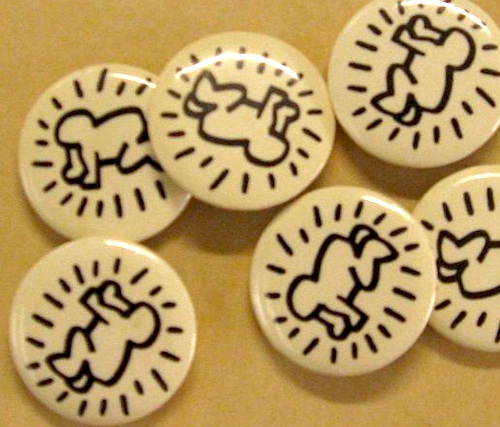
Although the Pop Shop closed its doors on Lafayette Street in 2005, it achieved worldwide pop-culture recognition for being the most iconic sites where art, music, dance, graffiti, celebrity, and the street mixed. Haring, whose Radiant Baby and other works ubiquitously plastered subway station walls in the 80s, decided to put Warhol’s commerce-as-art philosophy into practice. He created an art-filled shop downtown where the international art collectors, celebrities, club kids, and graffiti artists would feel comfortable.

Installation view of the Pop Shop ceiling over the cash registers at NYHS, right behind a video wall of Oertel’s Pulling Down the Statue of King George III. Courtesy: NYHS/John Wallen

Installation view of the Pop Shop ceiling over the cash registers at NYHS, right behind a video wall of Oertel’s Pulling Down the Statue of King George III. Courtesy: NYHS/John Wallen

The walls were covered in Haring’s instantly recognizable doodle-cartoon figures and stuff to buy, so when the Haring Foundation gave the ceiling to NYHS, it did so with the stipulation that it be hung somewhere where money is exchanged.  So, right inside the door in the same beautiful entrance hosting the treasures of Revolutionary New York, is the ceiling from a place where music blared, fun was had, all-night parties raged, and Downtown 80s life was celebrated.

Take the elevator to the Luce Center to see the rest of the show, which is on loan to NYHS by the Haring Foundation, which Keith established just before he succumbed to AIDS in 1990. Go to Keith’s website to see him in action in the subway, galleries, and performance and click through images of his amazing body of work in digital form by decade. It’s all here.

Keith’s “Radiant Baby” buttons in the NYHS collection, gifted by Roy Eddey.

Keith’s “Radiant Baby” buttons in the NYHS collection, gifted by Roy Eddey.

But back upstairs at NYHS, you’ll see Keith’s 1985 repeated-pattern design for a fabric run right above two NYC mile markers from the 1800s, a Haring-painted black-and-pink leather jacket (done with graffiti artist LAII), and Jeremy Scott’s Haring-inspired sneakers for Adidas. The NYHS is also screening some vintage video in the little 80s space, right next to the classical busts of New York’s 19th century high and mighty. Hang out to see Madonna’s 1984 performance of Dress You Up for the Keith’s Party of Life and the 1986 Grace Jones video I’m Not Perfect (But I’m Perfect For You), which Keith co-directed.

The show is tiny, but it’s a great little secret spot to time travel back to the Eighties. For more Keith, visit the Fales Library at NYU for Keith Haring: Languages through February 28 and NYPL’s Why We Fight: Remembering AIDS Activism through April 6. The NYHS installation is an open run.

Hey, and don’t forget to shop in the online Pop Shop, where revenue from (RED) items goes to combatting AIDS.

World Wide Web (and Weft) of Past Centuries at The Met

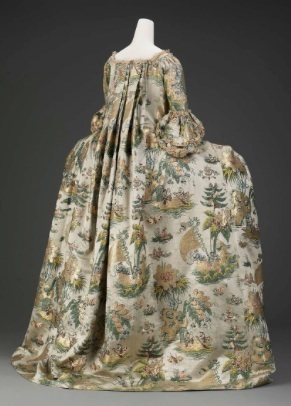
1730s Dutch brocaded satin, featuring exotic Asian islands and fauna, was refashioned into a more fashionable French frock in 1770. Source: Museum of Fine Arts, Boston. The Elizabeth Day McCormick Collection

1730s Dutch brocaded satin showing exotic Asian islands and fauna was refashioned in 1770 into a more fashionable French look. Source: Museum of Fine Arts, Boston.

A joyous collaboration among eight departments of the Metropolitan Museum of Art has written a new history of how a global network of fabric trade and manufacture once served the same purpose that YouTube, music videos, shelter magazines, Vogue, and The New York Times Style section do today – to present images of the latest trends and make anyone in the world that sees them understand the clothes or accessories needed to be “on trend” with other sophisticates.

Interwoven Globe: The Worldwide Textile Trade, 1500–1800, running through January 5, tells a monumental story about how trends went viral pre-Internet. It was a slower world dominated by sailing ships versus transoceanic cables, but the tale spanning centuries, continents, and cultures shows how gorgeous garments, incredible tapestries, bedazzled church vestments, quilted bedding, luxurious wall hangings, tour-de-force printed fabrics, and royal furniture telegraphed “trend” in a different way.

Embroidered muslin dress and fichu. The 18th c. craze for Neoclassical across Europe drove massive imports of lighter-than-air Bengali muslin. Source: The Met

Embroidered muslin dress. The 18th c. European Neoclassical craze drove massive imports of airy Bengali muslin. Source: The Met

The show can’t fully be appreciated in just one walk-through. Each textile and garment is incredible to behold, and the network of interrelationships among craftsmen, artisans, tradesmen, royal buyers, rich merchants, and brave sailors traversing strange shores is equally rich, complex, and layered.

This two-dimensional pageant, enhanced by exquisite gowns and garments whose fabrics were sourced from the four corners of the globe, is given the full-bore treatment in the top-floor galleries reserved for blockbusters.

How do you tell a story this big? The curators decided to put a large interactive map of the 16th- to 18th-century trade routes right inside the door, which brings you up to speed on the French, Portuguese, Spanish, Dutch, and British trade routes linking the Americas, India, the Orient, and islands.

Then come the galleries dedicated to the styles and fiber-tech associated with each – silks woven in China for Europe and Japan, Spanish embroideries that reference Islamic carpet borders, weavings made by Peruvian grand masters of the art, and Indian resist-dye masterpieces that turned into English chintz and fabrics for the King of Siam.

Japanese Jinbaori made from Dutch 17th century wool and Chinese silk, a luxury item worn over samurai armor. Source: John C. Weber Collection

17th c. Japanese Jinbaori made from Dutch wool and Chinese silk, a luxury item worn over samurai armor. Source: John C. Weber Collection

In the Spanish gallery, you’ll see how the crowned double-headed eagles of the Hapsburgs adopt kind of a Chinese-phoenix look when 16th-century Iberian traders commissioned silk artists in Macau to create silk they could sell back home. By the 17th century, everyone – East and West – had become accustomed to enjoying “exotic” images from halfway around the world – birds, animals, architecture, flowers, and landscapes. It had the same impact as Google Earth and World Wide Web access today.

One of the more startling facts is that before Commodore Perry “opened” Japan to the West (ref. Sondheim’s Pacific Overtures, the musical), Japan was more into luxury-goods consumption than production. Apparently, the trend was to import the ultra-luxury, Dutch wool, and make it into topcoats that Samurai warriors could drape over their armor.

If you don’t see this in person, visit the online exhibition site for an encounter that’s a real treat: You’ll get to zoom into each quilt, drape, embroidery, dress, shawl, and piece of fabric to see it all super-close.

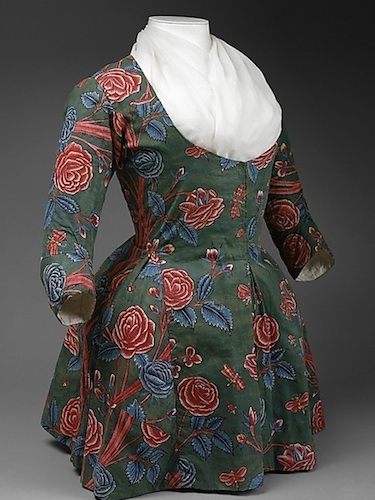
A late-18th century Indian-chintz Dutch jacket that knocked-off a French designer jacket in pink French fabric. Both have similar exotic floral prints. Source: The Met

A late-18th century Indian-chintz Dutch jacket that knocked-off a French designer jacket in pink French fabric. Both have similar exotic floral prints. Source: The Met

Click on the “full screen” button on each and toggle in to examine all of the glorious detail. The web site will tell you the story and show you the items in each gallery. You’ll be surprised to find the genesis of the fabrics-on-walls interior-decorating craze for country homes in the late 1700s and how men-only clubs adopted both plain and exotic dressing-gown dress from the Orient (a style also featured prominently in the current FIT show).

The King of Siam’s royal 18th century guard wore these resist-dye tunics. Fabrics were made in India and tailored in Siam. Source: Royal Ontario Museum, Toronto

The King of Siam’s royal 18th century guard wore these resist-dye tunics. Fabrics were made in India and tailored in Siam. Source: Royal Ontario Museum, Toronto

Last Call for Global Kitchen at AMNH

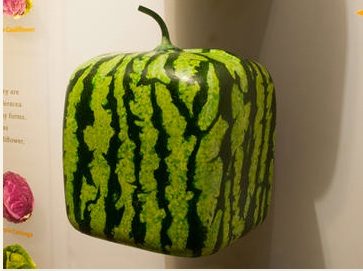
Japanese cube melon. Photo: AMNH/D. Finnin

Japanese cube melon. Photo: AMNH/D. Finnin

Ever wonder what story is told by the food on your plate? It’s all explained in the show at the American Museum of Natural History, Our Global Kitchen: Food, Nature, Culture, now in its final weekend.

It’s a fascinating walk-through of how food is produced, transported, and consumed by cultures all over the world. You’ll see examples of the zillions of varieties of potatoes archived by the Peruvians high up in the Andes and interesting twists like cube-shaped melons grown in Japan.

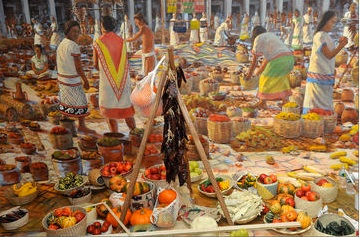
Diorama of the Aztec Tiatelolco market in 1519, just before the Conquistadors arrived. Photo: AMNH/R. Mickens

Diorama of the Aztec Tiatelolco market in 1519, just before the Conquistadors arrived. Photo: AMNH/R. Mickens

What’s everyone’s favorite part of the show? Most people can’t get enough of the interactive light table where you can watch the hands of master chefs making some incredible ethnic dishes and the Aztec market. The latter is a full-scale diorama of what shopping was like in 1519 down in Mexico City just before the conquistadors arrived. The market is vast, with an amazing array of items, all neatly arranged in sections, not unlike Eataly’s adventurous stalls near Madison Square.

You’ll get a glimpse of what was on the table of Gandhi, Roman royalty, the Great Khan, and other historic celebrities. The best is seeing what Otzi, the mummified Ice Man was packing as he crossed the Alps about 5,000 years ago.

Here’s the informative introductory video for this thought-provoking and mouth-watering show.