Warhol’s New Year’s Eve Finale at the Met

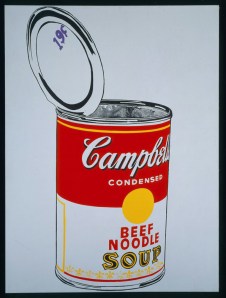
Andy Warhol. Big Campbell's Soup Can, 19¢ (Beef Noodle), 1962. Acrylic and graphite on canvas, The Menil Collection, Houston. © 2012 The Andy Warhol Foundation for the Visual Arts, Inc. / Artists Rights Society (ARS), New York

Andy Warhol. Big Campbell’s Soup Can, 19¢ (Beef Noodle), 1962. Acrylic & graphite on canvas, The Menil Collection, Houston. © 2012 The Andy Warhol Foundation for the Visual Arts, Inc. / ARS, New York

New Year’s Eve is the last day of a major tribute to the man who encouraged us to view brands, news, celebrities, identity-shifting, multiples, and commerce as art – Regarding Warhol: Sixty Artists, Fifty Years.

 The curators have organized the big, second-floor galleries along these themes, and paired Andy’s work with the work of fifty contemporary artists whose own work is indebted to Andy’s redefinition of modern life.

As the show begins, it’s almost as if Andy’s contemplating the implications of the upcoming fiscal cliff talks with the wall quote, “Buying is much more American than thinking.”

To prove his point, you’ll find Andy’s little-seen Dr. Scholl’s Corns (1961) (a gift from Halston to the Met), alongside better-known Brillo boxes and other brand icons from the Whitney, Menil, and Warhol Foundation collections. The curators have included Tom Sach’s Chanel Chainsaw (1996) and Hans Haake’s political pop masterwork, a giant cigarette box created in 1990 in response to Jesse Helms’s attack on Mapplethorpe and the NEA with the cigarettes wrapped in the Bill of Rights and branded “Phiip Morris Funds Jesse Helms”.
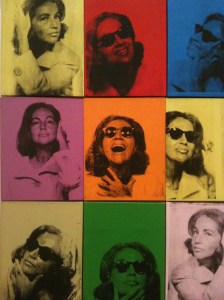
Fragment of Andy Warhol’s silkscreen on canvas, Ethel Scull 36 Times. Jointly owned by the Whitney Museum of American Art and The Metropolitan Museum of Art; Gift of Ethel Redner Scull, 2001

Fragment of Andy Warhol’s silkscreen on canvas, Ethel Scull 36 Times. Jointly owned by the Whitney Museum of American Art and The Metropolitan Museum of Art; Gift of Ethel Redner Scull, 2001

Alongside Andy’s Screen Test films are portraits by Tillman, Close, and Avedon, as well as a needlepoint of Liza in her heyday and a brilliant Sugimoto portrait of Fidel Castro (except that it’s a wax museum likeness).  Andy’s dollar-sign print multiples are hung near another quote: “Being good in business is the most fascinating kind of art.” An entire wall covered in Takashi Murakami and Koons multiples stand in evidence.

If you can’t celebrate in person at the Met, download Rebecca Lowery’s timeline of Warhol’s impact from the exhibition catalog. Or watch the 90-minute video featuring the curator Mark Rosenthal debating if Warhol actually is the most influential artist of the last fifty years. Or, view the films and listen to the music that the Met streamed live last October:  The Metropolitan Museum of Art – Dean and Britta—13 Most Beautiful: Songs for Andy Warhol’s Screen Tests.

1950s and 60s Vintage Rolling through Midtown This Week

GM Model 5106 (1958-mid-1970s)

GM Model 5106 (1958-mid-1970s)

Christmas shoppers in NYC’s Midtown are in for a special retro-treat this week. For $2.25, they can take a trip back in time, as New York City Transit shuttles 42nd Street travelers from Twelfth Avenue to the East River on its collection of vintage buses.

It’s a fun way to travel to two of the best holiday markets in the City – Bryant Park and Grand Central Terminal – by enjoying a “good old days” vibe, complete with vintage ads. mtabus1211

The antique buses are due to roll east along the M42 route at 8:30am, 11:30am, and 2:30pm. If you aren’t in the vicinity of 42nd Street, look for parked antique buses opposite Macy’s (at Sixth and 35th Street) and across from Union Square between 10am and 3:30pm all week.

Transit will be featuring six styles of vintage buses from its collection, including five models from General Motors and one from Mack Truck and Bus. The earliest model is GM’s Model 5101, which ran the streets from 1949 to 1966; the most recent vintage is GM Model 5305A, which debuted in 1968 and ran until 1984.

Even though MetroCards are “new” (they debuted in 1993), they’ll work on the retro-buses. Check out this 1949 Rapid Transit movie to feel the way it used to be, and be sure to catch one of the retro-subway trains every Sunday until December 30 on the M Line between 2 Ave and Queens Plaza.

Mayans Dispute 2012 Ending

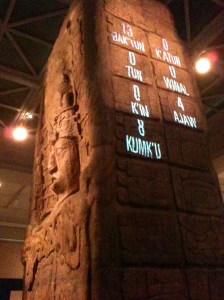
Illumination translates glyphs into numbers on stele, marking the end of the Long Count cycle on December 29, 775 CE

Illumination translates glyphs into numbers on stele, marking the end of the Long Count cycle on December 29, 775 CE

One of the best things about the Penn Museum’s “Maya 2012: Lord of Time” exhibition is the manner in which the curators meld the ancient, the mathematical, the historic, and the modern to answer the question “Will the world end at the end of the Mayan Long Count calendar in December 2012?”

The exhibition is built around the spectacular work that Penn’s archeological teams have done for decades in Copan, an ancient Mayan city located in today’s Honduras not far from the Guatemalan border – excavating tombs, uncovering clues to the succession of rulers, and figuring out exactly what all the once-cryptic hieroglyphics tell us. Check out the Flickr photos.

It turns out that the rulers kept a tight rein on the calendar, astronomic phenomenon, and various time-counting cycles to assert their right to rule. As some of the most spectacular stele show, the stone monuments actually enabled kings to embody dates, such as October 21, 731 (Copan Stele A).

Censor lid depicting founder of the Copan dynasty (695 CE)

Censor lid depicting founder of the Copan dynasty (695 CE)

The towering Quirigua Stele C from Guatemala associates the ruler with December 29, 775, the last time that the calendar flipped to the number 13.0.0.0 to signal the end of the Long Count.

There are many beautiful altars, sculptures, and pieces from the Penn’s collection, but the curators also went further, including the famous Dresden Codex, the Popol Vuh, and a phenomenal digital blow-up of a map showing how and where the Aztecs and Spaniards brought down the Maya. But one of the best contributions to the show are the video interviews with contemporary Maya commenting on their still-thriving culture and debunking the worries of their global neighbors about events later this month.

It’s obvious the view that Penn is taking, since the show is scheduled to run through January 13, 2013. Here’s Penn’s YouTube preview:

Holiday Rush for Christopher Columbus

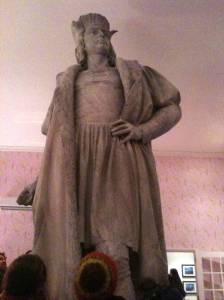
Greeting visitors in his apartment 75 feet in the air

Greeting visitors in his apartment 75 feet in the air

It’s the holiday season in New York, with art lovers rushing to see the spectacular apartment that Tatzu Nishi has created (courtesy of The Public Art Fund) for Christopher Columbus, the man at the center of things near the Time-Warner Building.

He’s been standing atop that column since 1892, so it’s about time that he had us over to see his taste in décor, books, and light TV viewing.  Here’s the Flickr feed, which takes you on a 360-degree view of his digs.

Who knew Captain Columbus was into pop culture? He even has a copy of one of Andy’s early cat lithos in his bookcase. Enjoy the holiday views that Columbus is enjoying, and get your free tickets now, because you won’t be seeing the City from this view again!

What Columbus is reading inside his apartment

What Columbus is reading inside his apartment

NYC High Line Wilderness Being Swept Away

It’s not going to be swept away by Hurricane Sandy…We’re just alerting you to the fact that the last section of the High Line looping the West Side Rail Yards is about to undergo its final construction transformation from 30th Street up to 34th Street, right across the street from the Javits Convention Center.

As soon as the hurricane subsides, crews will start transforming the railroad-bed wilderness into a beautiful promenade designed by James Corner Field Operations, Diller Scofidio + Renfro, and planting designer Piet Oudolf. The City acquired the property from CSX Transportation this summer – the final piece of rail property to complete the High Line vision.

Earlier this month, the High Line opened up this final frontier to foot traffic as part of Open House New York, and we’re providing a last virtual look on the Flickr site.  Enjoy the trees, the views, the historic photos, and graffiti of the old elevated railway before the skyscrapers start rising over the old Penn Central yards.

And be sure to find the theropod dinosaur lurking in the weeds above Eleventh Avenue!

Hirschhorn Goes Overboard at Gladstone

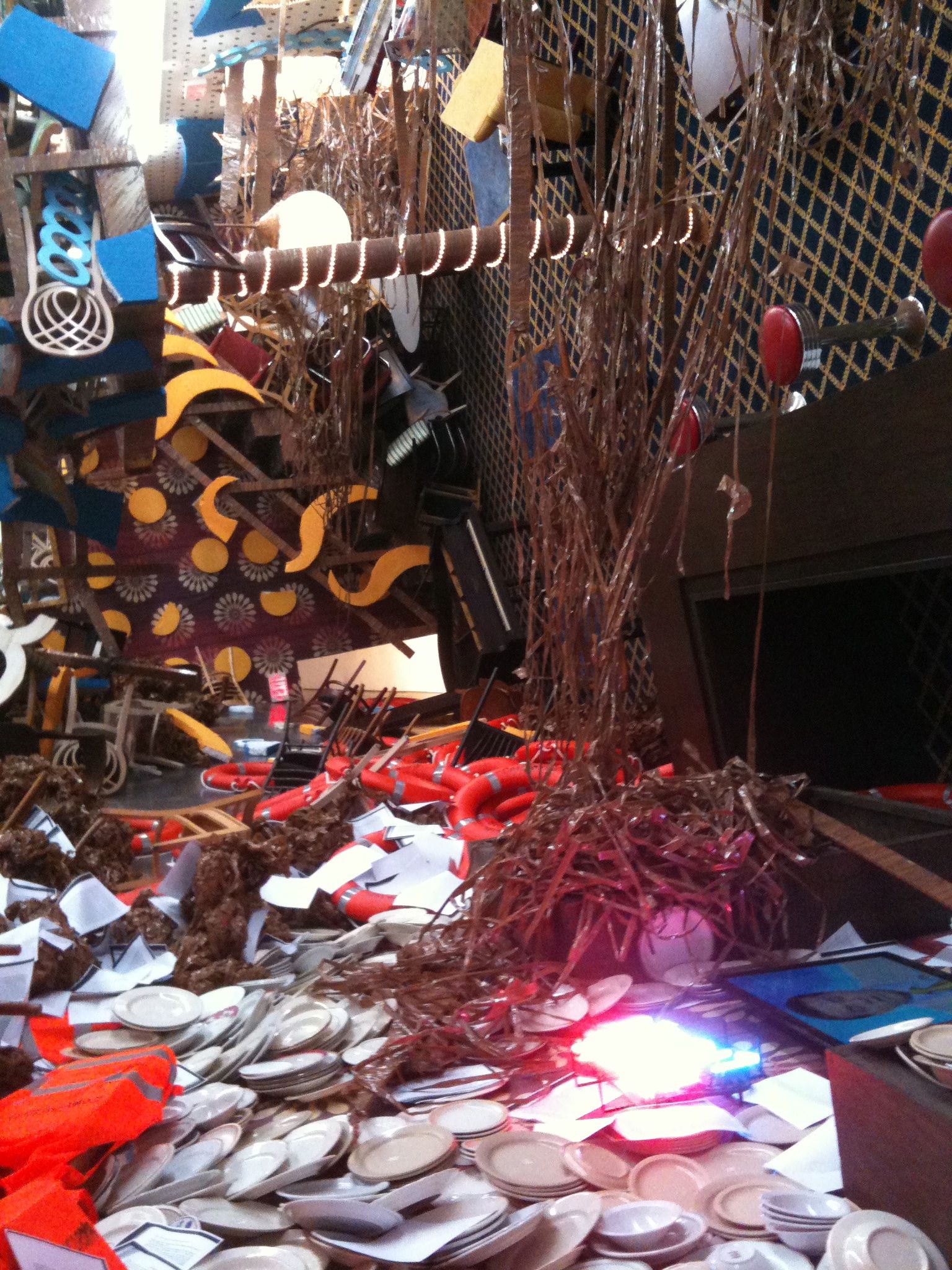
This may look like a Judy Pfaff installation, but it’s a close-up of the engaging, room-size environmental work by social commentator Thomas Hirschhorn on view until October 20 at Gladstone Gallery in Chelsea.

Concordia, Concordia is a riff on the tumultuous, larger-than-life grounding tumble of the Italian cruise ship, Costa Concordia in January 2012. Gladstone has other close-ups on its website, but its worth a walk over to 530 West 21st to get the full experience for yourself.

Hirschhorn was inspired by the furniture-akimbo nature of the interior photos of the luxury liner and the refusal of the ship’s captain to tend to the self-inflicted disaster.  There’s a lot to look at – including Hirschhorn’s cheeky inclusion of The Raft of the Medusa.  Look hard. You’ll find it. There’s no safe place.

What’s Up with Those Dots, Yayoi?

You’ve seen them everywhere over town…the enigmatic dotted signs with the face of Yayoi Kusama peering out. During Fashion’s Night Out, the Vuitton store was ablaze in polka dots, all a tribute to this reclusive Japanese pop-art sensation who burst upon the Manhattan art scene in the 1960s.

This is the last weekend to see her retrospective in person at The Whitney, but if you can’t make it, enjoy the Vuitton collection that she inspired (they’ve created a whole website).

Take a peek into the show.

And click on this link to see a documentary clip about this Kusama’s life. Be surprised and find out how to merge into infinity!

How di Suvero Makes Steel Move

Rust Angel sculpture (1995) by Mark di Suvero at the edge of the Parade Ground at Governors Island

Even if you haven’t caught the monumentally good outdoor installation of Mark di Suvero’s work on Governors Island (check out the photos), the folks at Storm King Art Center are making sure that you don’t miss it.

Thankfully they asked filmmaker Dirk Van Dall to capture how it was all transported down the Hudson from Storm King’s 500-acre campus an hour north of the City. The short film follows di Suvero around the Island to inspect the (literal) heavy lifting.

In 2010, di Suvero won National Medal of Arts, and in the film he talks about his lifelong fascination with steel, his early employment at the Fulton Fish Market, how neighborhood kids inspired him to begin creating large-scale fun works, and how he makes the seemingly immobile move. Listen in.

Drop in at the Governors Galleries this weekend to talk with the Storm King folks, and join their walking tour of the works at 2pm.

Girls Who Wear (Google) Glasses

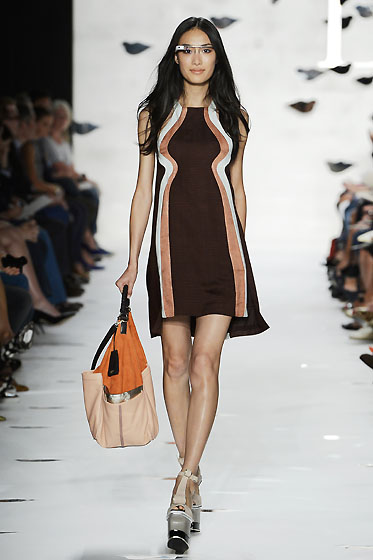
DVF’s Look #17 for Spring/Summer 2013

When Diane von Furstenberg and her models walked the runway at NYC’s recently concluded Fashion Week, they decided to give the world an inside peek at how it feels by recording the experience with Google Glass, the still-in-Beta avant-eyewear.

The innovative accessory shoots video, snaps pix, streams messages, and apparently looks good, so Diane decided to snap on the specs and take you with her (and her posse) on a fashion-tech flashbulb-popping stroll.

What’s cooler than Diane’s embrace of the new? Her Spring/Summer 2013 collection and her attitudes about life, potential, and empowerment. Take a look. Thanks, Diane!

What Happens (to Dresses) after Fashion’s Night Out

Everyone enjoyed the party atmosphere last Thursday during Fashion’s Night Out, with beautiful people, clothes, and accessories on display and tributes to retail and design history. (Check out the Flickr feed of the action on Madison and down Fifth.)

But what happens when the party ends? That question is what inspired two curators from Saratoga Springs to create a micro-show from fashion museum cast-offs — Tattered and Torn (On the Road to Deaccession).

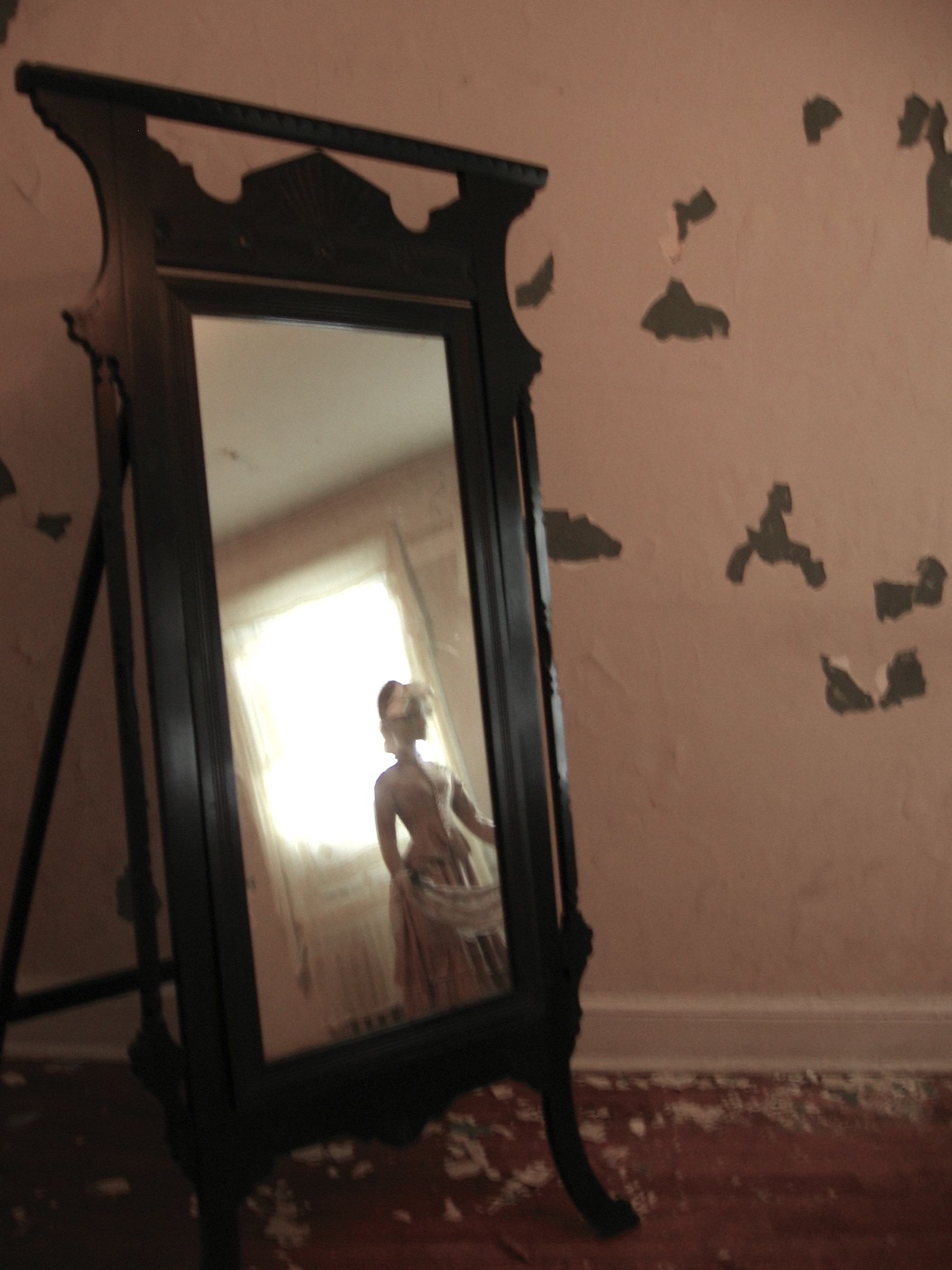
Empire Historic Arts Fund (founded by curators Rodney DeJong and Michael Levinson) gathered together less-than-perfect examples of 19th-century couture and used the abandoned rooms of the Governor’s Galleries on Governors Island to evoke the passage of time for fashion, finery, and fanfare. Rooms that once housed the U.S. Coast Guard as recently as the 1960s felt far older, perhaps due to the dreamlike state evoked by the presence of peeling paint, claustrophobic rooms, and props with which the curators surrounded their proud mannequins.

When you enter, the dresses look glamorous, but upon closer inspection, you can see that the silk has peeled away, seams have come apart, and the total elegance that must have accompanied these dresses’ debuts has passed into history. Take a look.

Considering the $250 budget for this installation, the curators have done a fine job of paying tribute to the history of fashion, creating a memorable experience on the Island, and letting us meditate on the still-beautiful details of fabric and design up close in a quiet place.

(The show is tucked away the far east side of the Island, beyond the Parade Ground, in Building 315 facing the Brooklyn waterfront. It’s the last building on your way toward Yankee Pier.)