More Time Tripping at Grand Central

Annex window view of Lothar Osterburg’s model of his dream of Grand Central as a zeppelin docking station back in the 1930s

Annex window view of Lothar Osterburg’s model of his dream of Grand Central as a zeppelin docking station back in the 1930s

Even if you didn’t manage to board the historic train cars at Grand Central in May, you can still go back in time, courtesy of 18 artists featured in the GCT exhibition in the New York Transit Museum Annex, On Time: Grand Central at 100.

Inspired by The Clock and the continual flow of people and trains through Grand Central, MTA Arts for Transit cooked up a delightful mix of contemporary 2D works, models, videos, and digital art that puts a smile on the face of every commuter, tourist, and art-seeker that we’ve seen inside the tiny Annex.

Look closely to find this minute secret portal: Ledge with Lunette, 2013 by Patrick Jacobs

Look closely to find this minute secret portal: Ledge with Lunette by Patrick Jacobs

Have you seen the mysterious Zeppelin posters by Lothar Osterburg on the subway? Right in the Annex window you’ll see the gigantic, fun-house model that he created to photograph as one step in the process of making the photogravure you see on the A train. Kids and parents can’t resist Lothar’s newspaper-covered multi-story GCT impression and the funny, fat yellow old-time taxis and zeppelin ends that poke out. Right next to it, you can examine his resulting print, Zeppelins Docking on Grand Central.

People are usually transfixed by the 2008 video documenting Frozen Grand Central, where Improv Everywhere staged a 250-person flash mob, where people “froze” for 5 minutes as commuters, tourists, and workers wondered what was going on.

Another hit is Grand Central Diary. London Squared Productions interviewed tourists and commuters about GCT, animated the furniture and items around the terminal, and…well, just watch The Clock and the Maintenance Cart speak for themselves:

Nearby, several small digital screens show Alexander Chen’s Conductor, a 15-minute video loop that animates the subway lines, suggesting trains moving through the system. He turns the subway lines into an animated stringed instrument. No wonder he’s working for Google Creative Labs. Spend a few moments, take a look, and experience it here.
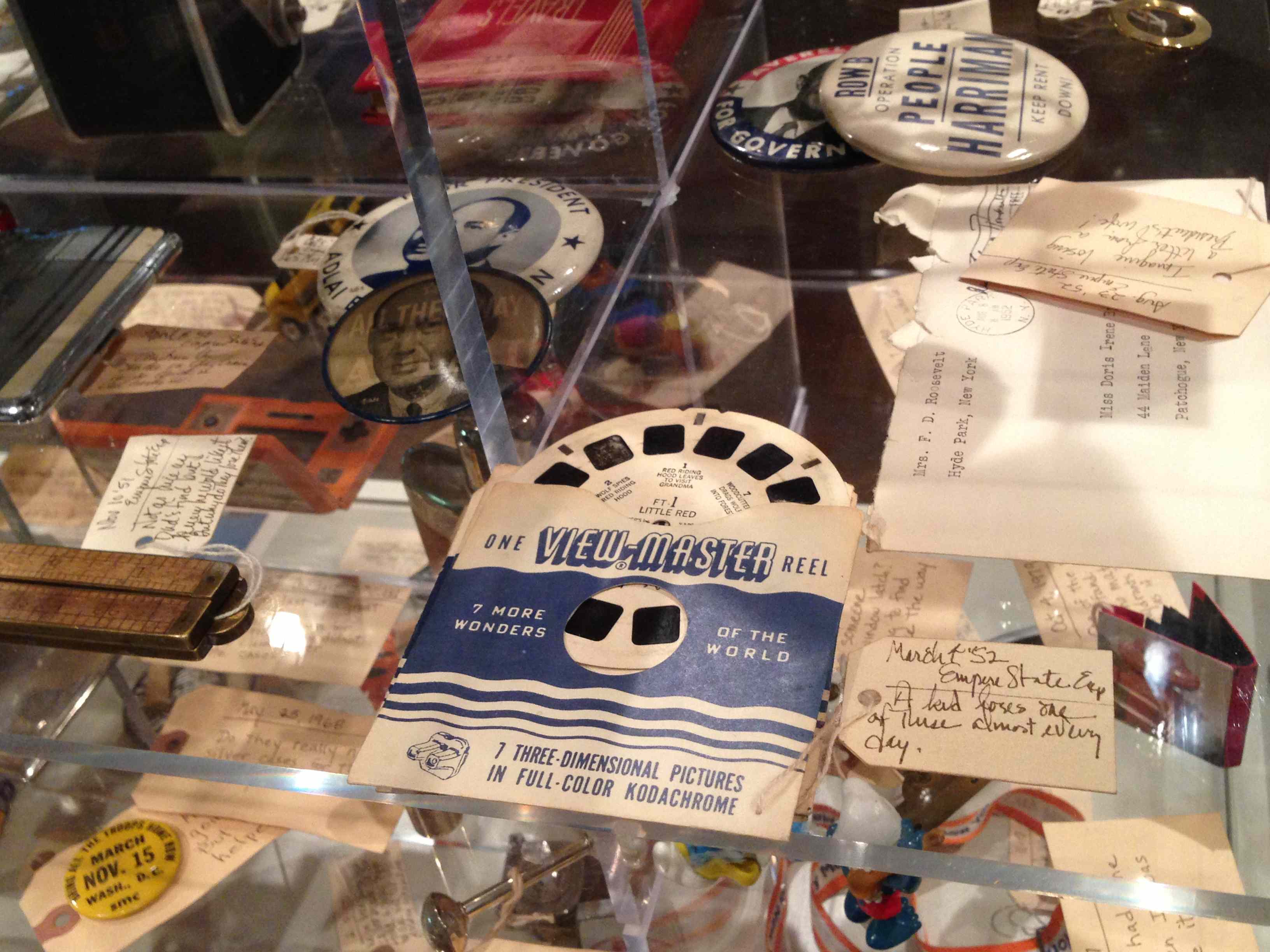
Close-up of Viewmasters and other leave-behinds inside Jane Greengold’s Lost and Found.

Close-up of Viewmasters and other leave-behinds inside Jane Greengold’s Lost and Found.

Another must-see piece (among many) is Jane Greengold’s Lost and Found. She’s created a sort-of fiction about the dozens of tagged items in the vitrine, evoking the memories and observations of generations of conductors who found items that train passengers left behind. Actually, the items you’re looking at are actual leave-behinds collected by real-life conductors, so Jane’s work isn’t entirely made up. The archeological discoveries include things from the old Lake Shore Limited on the NY Central, a 1948 boxed baby tooth, 1943 ration cards, 1952 Viewmasters, a Kennedy campaign button, and a Kindle.

Get to the Annex before July 7. In the meantime, check out curator Amy Hausmann and her artists telling about the fun they had contemplating time, architecture, fashion, and Jackie O.
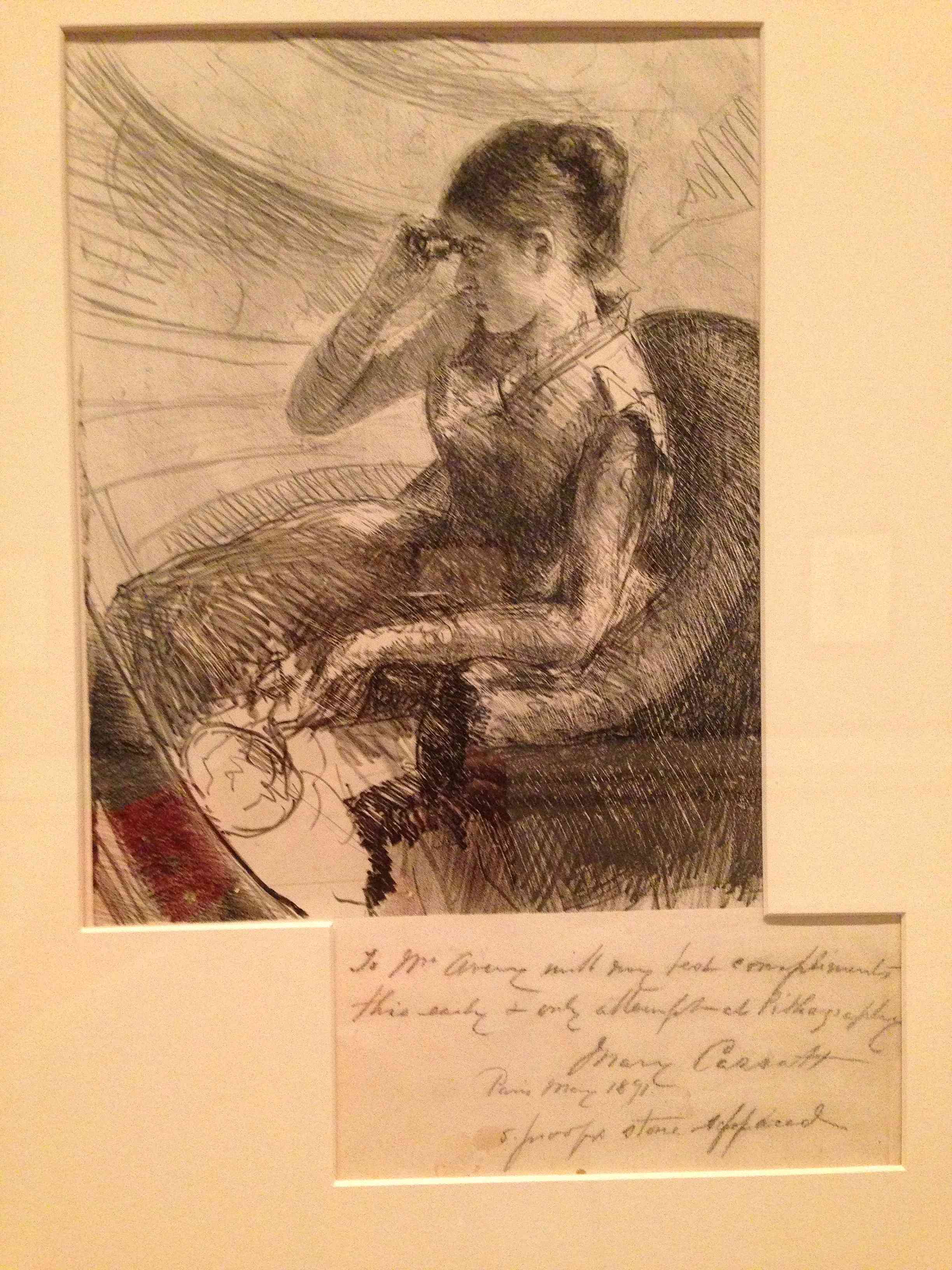
Mary Cassatt’s Tech Start-Up Chronicled by NYPL

Woman Seated in a Loge (1881). The only lithograph Cassatt ever did, personally inscribed to Mr. Avery.

Woman Seated in a Loge (1881). The only lithograph Cassatt ever did, personally inscribed to Mr. Avery.

Still using a flip phone? Don’t know how to code? There’s nothing wrong with sticking with what you know, but expanding horizons with new technology is always good. In 1876, it’s exactly why Mr. Degas invited 32-year-old Mary Cassatt into his studio, showed her some of his printmaking techniques, and encouraged her to jump in and try something new. She did, and her technological triumph is the story of NYPL’s illuminating third-floor show, Daring Methods: The Prints of Mary Cassatt, which ends Saturday.

The show gives you a new slant, documenting this American artist’s struggle to make new work, push her technical boundaries, and mash up styles to total critical acclaim at the turn of the last century. NYPL found itself in a unique position to mount this show, since art dealer/print collector Samuel Putnam Avery made an unprecedented donation back in 1900 — more than 17,000 19th-century prints, including dozens and dozens he purchased directly from Cassatt as evolved her printmaking between 1878 and 1898.

The Letter (1891) – color print with drypoint and aquatint. This is an earlier state (iii/iv) of Cassatt’s famous print minus the wallpaper pattern and letter on the desk

The Letter – 1891 color print with drypoint and aquatint. This is an earlier state (iii/iv) of Cassatt’s famous print minus the wallpaper pattern and letter on the desk

This show provides art-lovers with a unique, chronological walk-through of Cassatt’s technical trial-and-error, beginning with her early drypoints (1878 costume studies suggested by Degas), simple drypoints and etchings, and her only litho (see right). Cassatt continued to experiment throughout the 1880s, perfecting her softground, drypoint, aquatint, and etching techniques, often mashing them together – brave moves by a stylish, curious female artist of the modern era.

Gallery visitors walk slowly from print to print, taking in the subtle changes, redirects, and reworks of this modern, mid-career artist determined to find status and success in the male-dominated Parisian art scene of the late 19th century.

The NYPL curators decided to hang multiple versions of similar subjects side by side, so you can really examine the mind of the artist at work. It’s interesting that Cassatt let Avery have prints off cancelled plates that she pulled after the “good” print run was finished. You’ll see the scratched-up images in the show next to the best ones.

The Fitting – 1891 color print with drypoint and aquating, printed with three plates

The Fitting – 1891 color print with drypoint and aquatint, printed with three plates

In 1890, everything changed for Cassatt, when she saw an exhibition of Japanese woodblock prints took the Parisian cultural community by storm. It was the moment that her technical experiments paid off and her printmaking vision, style, and legacy became sharply focused. In the last portion of the show, you witness her brilliant response — making intaglio look like woodblock, applying multiple areas of bright color, injecting pattern into domestic surfaces, and zooming in for low-angle close-ups of private moments in women’s lives.

Enjoy NYPL’s selections from Mr. Avery’s collection and spend some time examining the multiple states of the most beloved prints in the Impressionist canon, mash-ups of aquatint and drypoint. It’s a master class in color, ink, and composition.

If you can’t get to the show this week, download the PDF and take a look at Ms. Cassatt’s technical journey. Then go out and try something new.

Impressionist Line Ends at Frick

Toulouse-Lautrec, The Jockey, 1899. Color-printed lithograph on cream wove paper

Toulouse-Lautrec, The Jockey, 1899. Color-printed lithograph on cream paper

If you’re already nostalgic for the grand Impressionist show that ended at The Met, you can still find your favorites filling the Frick’s two downstairs galleries and the room next to the gift shop. While the Clark Art Institute (Williamstown, Massachusetts) was undergoing renovation, the Frick borrowed some of their finest works on paper for the gem-of-a-show, The Impressionist Line from Degas to Toulouse-Lautrec: Drawings and Prints from the Clark.

If you loved seeing Al Hirschfeld apply his pen and ink to paper in our last post, you will delight in perusing how lines by Degas, Manet, Lautrec, and Gaugin created a profitable niche in the rapidly expanding art market at the 19th century’s end. (By the way, Hirschfeld fans, who knew that Monet drew crazy caricatures to support himself early in his career? Claude’s Man with a Snuff Box looks like it was drawn in the 1950s…not the 1850s!)

Toulouse-Lautrec, Miss Loïe Fuller (1893), Lithograph printed touched with gold and silver powder. Source: Clark Art Institute

Toulouse-Lautrec, Miss Loïe Fuller (1893), Lithograph printed touched with gold and silver powder. Source: Clark Art Institute

Although a few politically charged works are in the show (like Manet’s 1874 print of the Commune uprising The Barricade), the majority are masterworks of portraiture, everyday life, cafes, and modern entertainments like horseracing, circuses, and boulevard promenades. Some of our favorites are Degas’s sketches of horses in motion and Lautrec’s circus-themed sketches that he drew from memory while in rehab.

If you can’t get to the show, the Frick web site allows you to peruse all of these works in detail (with the curator’s descriptions) by decade, by artist, or by the order in which they’re hung in the exhibition.

For sheer theatricality and delight, Lautrec takes the cake in this show, as shown in the images here. The hand-painted 1896 Lumiere Brothers film below shows silk-clad modern dance pioneer Loïe Fuller making the moves that inspired Lautrec to create dozens of experimental lithographs (sprinkled in gold and silver powder, no less!) of her abstractionist performances.

Yes, it’s all about the line.

If you have time, watch the video of the co-curator’s lecture about Impressionist line and how sketches, watercolors, woodcuts, lithographs, pastels, and improvised etchings created a revolution in affordable art.

Toulouse-Lautrec, The Englishman at the Moulin Rouge, 1892. Color-printed lithograph

Toulouse-Lautrec, The Englishman at the Moulin Rouge, 1892. Color-printed lithograph

Tony Week Pilgrimage to NYPL

Al's studio at New York Public Library of the Performing Arts

Al watches over his studio at NYPL for the Performing Arts

Tony favorite Kinky Boots is playing at the Hirschfeld, but as you contemplate the number of awards it will pick up Sunday night, walk over to the entrance of NYPL at Lincoln Center to pay tribute to Al himself. Peek through the window of NYPL for the Performing Arts to see the nook where every Broadway star since the 1920s had their portrait done –the studio of Al Hirschfeld, the man who immortalized them all.

Look through the window and you’ll see his drawing table, lamp, and the cozy, cushioned barber chair where he perched day after day, recording entertainment history over the decades with his unmistakable whimsical flair and line. The Lincoln Center library is a fitting home for Al’s studio furniture, since he consulted the NYPL theater archives for a lot of his work.

Liza in Minnelli On Minnelli (1999), one of more than 20 portraits Al did of her. In color for The New York Times. Source: Library of Congress.

Liza in Minnelli On Minnelli (1999), one of more than 20 portraits Al did of her. Source: Library of Congress.

It’s hard to believe that Hirschfeld first began drawing celebrity caricatures in the 1920s, and continued his illustrious career for the next eighty years. Click on this link to his dealer’s site (Margo Feiden) to scroll through all the plays and musicals he’s covered, documenting the quirks, panache, and performances of everyone from Fanny Brice to Martin Short.

You can click through the “time table” of Al’s work at the gallery site, or in the Timeline of the Hirschfeld Foundation’s website. Every drawing after 1948 was done from a cushioned barber chair in which he could swivel to his heart’s content. Initially, he found it on the Bowery for $3.00, but the one you’ll see in the Performing Arts library entrance is the replacement (the original just wore out), which he bought in 1993 from a barber shop in the Chrysler Building.

So, pay tribute to Broadway’s most beloved artist. And before we post about the Impressionist Line show at the Frick, why not watch a 20th century master of line make his mark so you can imagine all the creativity that emanated from the table you see in the window. The clip from The Line King, uploaded to YouTube by Al’s grandson, documents the legend drawing a caricature of Paul Newman as he appeared in Our Town. 

Enter House of Memory at The Customs House

Detail of Dad’s House, (2012). Horse hair, feathers, cotton cloth, Photo by Clarissa Rose Pepper.

Detail of Dad’s House (2012). Installation with horse hair, feathers, cotton cloth, Photo by Clarissa Rose Pepper.

What do you remember about where you grew up? About your family when you were young? C. Maxx Stevens, an artist of the Seminole/Muscogee Nation of Oklahoma, answers these questions for herself (and us) in the evocative show, House of Memory, in its final weeks at the Customs House at the Smithsonian’s National Museum of the American Indian in New York.

Stevens, currently teaching art at University of Colorado-Boulder, scrounges around in junk stores and yard sales out west to find the ephemeral materials for her installations – slightly transparent gauze made into hoop-skirt structures and large multimedia recreations of 1950s homes with floating scrims. Can you see through the haze?

The experience of walking around the show takes you back to corners of Stevens’ memory growing up in a multitribal community of Plainview, Kansas, just outside Wichita. It may not be like your own experience, but the stuff she weaves, scatters, and constructs will cause you to tap into your own memories.

Three Graces (2004) installation. Source: Eitelijorg Museum of American Indians and Western Art, Indianapolis

Three Graces (2004) mixed-media installation. Source: Eitelijorg Museum of American Indians and Western Art, Indianapolis

The first gallery with The Three Graces is a tribute to her relationships with her sisters, and a must-see for lovers of fabrics, textiles, and interwoven mixed media.

The second gallery has several installation that resemble mini-stage sets that trigger memories through scattered photos, altered clothing, suspended objects, horse hair, garden stakes, and evocative combinations of other props – Dad’s House, Mum’s House, Sister’s House, Four Directions House, and House of Transitions.

Detail of Cultural Landscape installation of 1950s houses (2012). Photo: Clarissa Rose Pepper

Detail of Cultural Landscape installation of 1950s houses (2012). Photo: Clarissa Rose Pepper

Cultural Landscape is an immersive installation with tiny illuminated homes (found in thrift stores), scrims, and multimedia that “remembers” the 1950s streets of her suburban Kansas community.

The Smithsonian chose to publish black-and-white photos of the installations, which we’re using here. It’s kind of fitting…not quite of-the-moment and a little back-in-time feeling.

Want to reflect more about your own childhood home, your grandparents, and your neighborhood? Take a trip down to the Customs House before June 16, and let Stevens take you on that journey.

NMAI is making the leap into downloadable digital media with this show, so go to the iTunes U store, type in “NMAI-NY” and download the app, which contains an audio guide for this show. If you’d prefer to read about Stevens and her work, download the PDF.

Morgan Deconstructs Degas’s 19th c. Cirque-du-Soleil Experience

Edgar Degas, Miss La La at the Cirque Fernando, 1879. Oil on canvas. Source: National Gallery © National Gallery, London / Art Resource, NY

Edgar Degas, Miss La La at the Cirque Fernando, 1879. Oil on canvas. Source: National Gallery © National Gallery, London / Art Resource, NY

Long before Cirque du Soleil began selling $180 seats to eight shows in Las Vegas or Floating Kabarette came to Brooklyn, high society and avant-garde crowds were flocking to extravagant theaters on Montmartre in Paris to see the finest aerialists from Europe.

The Morgan Library’s exquisite micro-show, Degas, Miss La La, and the Cirque Fernandodocuments the meticulous work of Mr. Degas to portray the magic, daring, and wonder inside a 2,000-seat arena where he experienced the artistry of one of the must-see acts of 1879 – a mixed-race German aerialist who hung from a trapeze clenching an apparatus in her teeth from which she dangled a firing cannon.

As in the Met’s blockbuster show, Impressionism, Fashion, and Modernity (which also features a circus-themed painting in its last gallery), the Morgan makes the case that Degas selected this subject because was associated with the height of fashion (along with café concerts and racetracks). Although this particular work was the only circus image Degas would ever paint, just tackling the dazzle and glamour of Miss La La dangling 70 feet in the air (before the cannon stunt) showed that he was capturing what was “happening” among high society and artsy types in their “modern” life.

A vibrant pastel study of the artist by Mr. Degas. Source: Tate, London/Art Resource, NY

A vibrant pastel study of the artist by Mr. Degas. Source: Tate, London/Art Resource, NY

Although we can marvel at how well Degas captured this fleeting moment, the Morgan lays bare that this work was planned in meticulous detail. They’ve displayed preparatory works, sketchbooks, and even architectural drawings of the theatre’s interior that Degas created to work out the feeling, look, composition, and setting for this spectacular work. As Degas said, “No art was less spontaneous than mine.”

If you love Impressionism and theatricality, get over to the Morgan to enjoy the mechanics behind the creative process and flip through the digital version of our artist’s sketchbook (which was to fragile to be sent from France) right inside the colorful upstairs gallery.

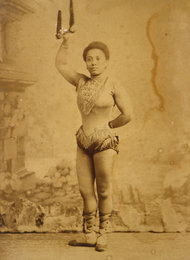
Visit Mr. Degas and Ms. La La before May 12, when they leave for the Continent. (Sorry, no video, but here’s a photo of the star herself.)

Photograph of the artist, Miss La La (c. 1880). Albumen silver print. Source: Zimmerli Art Museum, Rutgers University

Photograph of the artist, Miss La La (c. 1880). Albumen silver print. Source: Zimmerli Art Museum, Rutgers University

Surrealists Get Out Pencils and Scissors at The Morgan

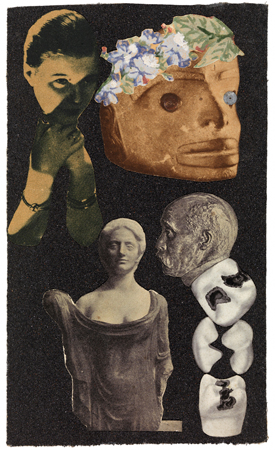
César Moro’s Adorée au grand air (1935). Source: The Getty Research Institute.

César Moro’s Adorée au grand air (1935). Source: The Getty Research Institute.

Automatic drawing, games, rubbings, collage, and dreams are all chronicled in the spectacular Drawing Surrealism show closing today at The Morgan. It’s an encyclopedia of what you can do with a scissors and pencil and demonstrates that these forms of play were critical to the most famous Surrealist works by superstars Ernst, Dali, Masson, and their European colleagues.

Some of the off-the-wall creations born out of the Surrealist’s drawing games eventually made their way into big-time oil paintings. The curators also contend that the monochrome grey-scale of some famous paintings is actually a tribute to the importance they attached to charcoal and pencil media.

The show, co-organized with the LA County Museum of Art, is the first time that Surrealist drawings have been the subject of an exhibition, and curators make quite the case for drawing technology transfer by showing us how these techniques (especially collage) spread to the rest of the world.

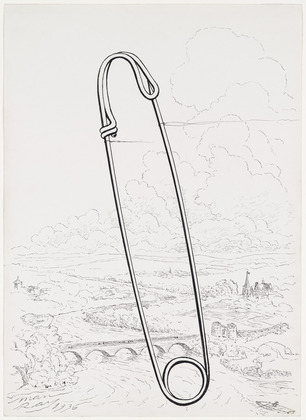
Man Ray’s Safety Pin (1936). Ink and pencil on paper. Source: MoMA. © 2013 Man Ray Trust / Artists Rights Society (ARS)

Man Ray’s Safety Pin (1936). Ink and pencil on paper. Source: MoMA. © 2013 Man Ray Trust / Artists Rights Society (ARS)

One of the genuine revelations is the work and importance of César Moro, a Parisian-trained Peruvian who brought Surrealism to Mexico and the rest of Latin America.

You can’t help but be struck by the forerunners of Pop: Man Ray’s Safety Pin sure looks like a precursor to Claes Oldenburg’s 1970s Clothespin, and there’s no question about the influence of Eduardo Paolozzi’s 1940s Surrealist-influenced collages: He and Richard Hamilton invented Pop Art in Britiain.

When the show was installed at LACMA, several contemporary artists were asked to create Surrealist-inspired works. Listen as Alexandra Grant, Mark Licari, and Stas Orlovski show and tell how European mind-and-hand games of the 1930s inspire work today: