Benton’s Freebie Masterpiece at The Met

Viewer contemplates “The Changing West” panel of Thomas Hart Benton’s America Today mural (1930-1931)

Met visitor contemplates “The Changing West” panel of Thomas Hart Benton’s America Today mural (1930-1931)

When times get tough, did you ever take on a job or make something for free just to build up your resume and showcase what you could do? That’s exactly what one New York up-and-comer did, and it really paid off. The Metropolitan Museum of Art’s show, Thomas Hart Benton’s ‘America Today’ Mural Rediscovered, tells the story.

Back in 1930, the New School was just completing its modern building in the Village on West 12th Street and was seeking something to jazz up the boardroom.
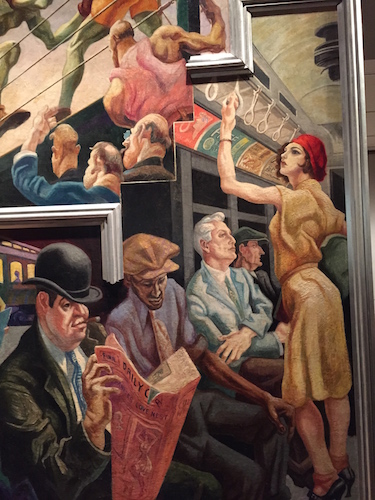
“City Activities with Subway” portion of America Today based on his portrait sketches

“City Activities with Subway” portion of America Today based on his portrait sketches. (It’s Pollack’s sister-in-law, Elizabeth)

Mr. Orozco, the famed Mexican muralist, had already been commissioned for the more visible dining room/lounge, and Mr. Benton, who was teaching at the Art Students League, saw an opportunity to showcase his painting chops.

Social realist chronicler Reginald Marsh had introduced Benton to the mysteries of mastering egg tempera, and Benton felt ready to go to town on a large-scale portrait of American life in all of its regional glory. Here’s the deal: no pay, just loft studio space about a block away.

Twenty years earlier, Benton had hung around Paris, soaking up the birth of the French Cubist and Italian Futurist movements in Europe. Ten years earlier, he roamed around the back roads of the United States, filling up sketchbooks with steel town landscapes, lumber camps, oil derricks popping up in Los Angeles, dives, diners, and small town stuff.

“Steel” portion of the mural, featuring model Jackson Pollack, Benton’s student

“Steel” portion of the mural, featuring model Jackson Pollack, Benton’s student

The mural began taking shape, crammed to the gills with swirling activities, people, industry, and pop culture that he saw. Need models? Why not ask Jackson Pollack, his art student, and his sister to pose?

It’s hard to imagine serious board meetings taking place in a room so alive with oversized ambition and action. Over the decades, the New School repurposed the room for classroom lectures, and over time, the scuffed mural was removed completely.

Lucky for us, Benton’s 1930s historic masterpiece found its way to the Met, which has lovingly restored and installed it in a rectangular room just beyond the Frank Lloyd Wright room.

The curators have filled the adjacent galleries with extra treats: the inspirational sketches from Benton’s earlier road trips and works by Mr. Pollack and Benton’s Village contemporaries.

See our Flickr album to glimpse the installation (and works by early Pollack, Abbott, Marsh from the Met’s collection), and watch the Met curators tell the story of how Mr. Benton’s freebie paid off and their joy in giving this ten-panel chronicle a new home.

Times Square Time Machine at the Skyscraper Museum

Poster from the Schubert archives of “The City at 42nd Street”, the never-built 1979 mall-superblock plan

Poster from the Schubert archives of “The City at 42nd Street”, the never-built 1979 mall-superblock plan

Two weeks ago, the eyes of the world were on Times Square, but how did it get that way? Take a walk through history at The Skyscraper Museum’s exhibition — Times Square, 1984: The Post Modernist Moment through February 15.

You’ll find out that the crazy, frenetic, chaotic landscape of this town square and its surrounding theaters was nearly lost when the City Fathers and the real-estate community thought Times Square should be “sanitized”. It took wrecking balls destroying several historic theaters to bring activists, celebrities, actors, historians, and preservationists into the streets and paddy wagons to reverse course.

The skyscrapers that were finally built at Times Square, including the Times Towers of 1997 and 2004

The skyscrapers that were finally built at Times Square, including the Times Towers of 1997 and 2004

The Skyscraper Museum has assembled the architectural models, videos, personal memorabilia collections, and planning sketches to resurrect this nearly forgotten war story. See the installation views on our Flickr site.

The show opens with a 1905 Mutoscope film showing the panorama from the top of the new Times Tower – the first skyscraper in that part of town. See it here on the exhibition web site. The Times started the ball drop in 1907, and it’s continued as one of the City’s most famous traditions.

The “Great White Way” name became popular in the 1920s and 1930s to indicate the glow from theater marquees lining Broadway, Seventh Avenue, and the side streets. The second skyscraper wasn’t built until 1927 (the Paramount Building/ Hard Rock Café), and remarkably, no other skyscrapers popped up until 1972.

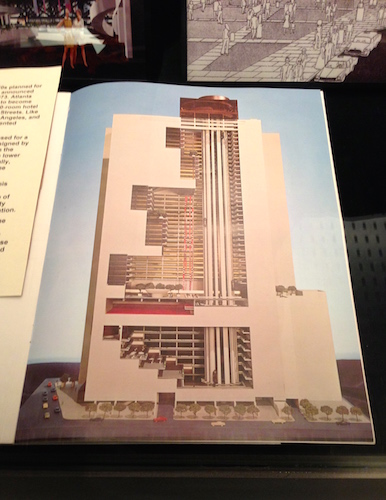
Cutaway drawing of the Portman/Marriott Marquis Hotel (1973-1985), which kept focus inward away from tawdry Times Square

Cutaway drawing of the Portman/Marriott Marquis Hotel (1973-1985), which kept focus inward away from tawdry Times Square

The Portman Hotel (now Marriott Marquis) project was sketched out in 1973, but it took until 1985 to open. The fortress-like complex was designed to look inward on purpose – away from the tawdry street life that characterized Times Square in the “bad old” days when drug pushers, crime, pickpockets, loudmouths, and fistfights were the norm. The atrium and rotating rooftop restaurant were marvels to tourists, who were happy to have an inside-escape route.

By 1979, it was so bad outside that the City proposed some drastic plans to make it all better: Why not tear down a few blocks and make an indoor entertainment mall, complete with a 15-story indoor Ferris wheel and the world’s biggest movie screen? Why not make Times Square look more like Sixth Avenue by building monolithic skyscrapers on each corner of Broadway at 42nd?

Real estate deals ruled the city at the time, and the bonanza created by tourism was still decades away.

Save the Theaters study with 1982 photos of Joe Papp and others protesting the destruction of the Helen Hays and Morosco to build the  Portman. Courtesy: Lee Harris Pomeroy

Save the Theaters study and 1982 photos of Joe Papp protesting the destruction of the Helen Hays and Morosco to build the Portman. Courtesy: Lee Harris Pomeroy

The actors, preservationists, and architects were aghast at plans to tear down so many historic theaters for the Portman/Marriott Marquis and began staging street protests and galvanizing public opinion to save Broadway. Through a lot of community organizing, a Save the Theaters study, and a night where all the theaters turned the lights out, the battle was won. Yes, new towers would be built, but the demolition of theaters would stop.

In 1993, Disney pledged to take over and restore the New Amsterdam, the study identified theater features of historic value (including backstage areas), and a 42nd Street redevelopment effort commenced. Julian Eltinge’s theater (now AMC Empire 25) was moved 130 feet down the street, rehearsal studios were built, and the New Victory brought children’s theater to a house that used to be Minsky’s (and the Belasco).

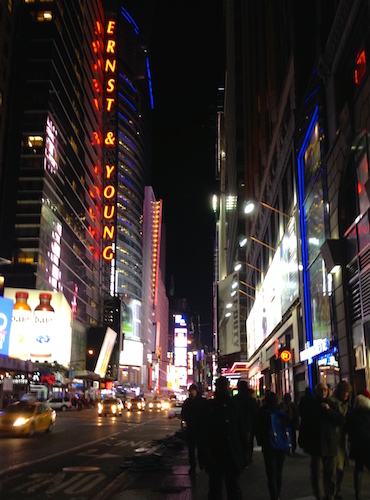
Today, the crossroads is dominated by tall, sparkling skyscrapers and bustling with high-spending visitors. The TKTS island serves as a concrete village green for the entire area.

Looking north today toward Times Square and 42nd Street

Looking north today toward Times Square and 42nd Street

Insiders at the Skyscraper Museum’s winter program at Columbia University let us in on the fact that the there are actually design requirements for flashing signs and billboards in Times Square to be at off-angles and tilts to maintain the slapped-together look of the area – design elements flouted by Vornado’s new block-long HD video billboard.

This short synopsis is only the tip of the iceberg on Times Square. For the full story and history, get to the show and take time to watch Carol Willis’ historic, all-star panel from last November, where you’ll meet the people who saved the Theater District, remade 42nd Street, and created the landscape of Times Square that the world knows today. You’ll never look at it the same way again:


For more, click here to read the exhibition story online and see more photos, videos, and artifacts.

The Sistine Chapel of Fashion Virtuosity

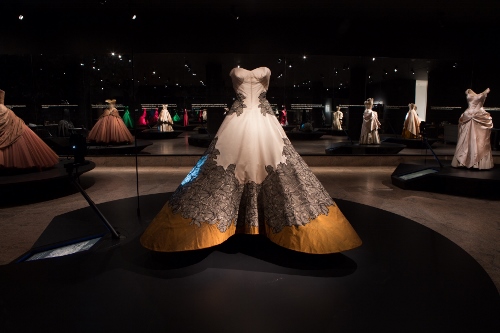
Clover Leaf Ball Gown – a 1953 silk faille, shantung, and black lace sculpture by Mr. James. Part of the Brooklyn Collection at The Met

Clover Leaf Ball Gown – a 1953 silk faille, shantung, and black lace sculpture by Mr. James. Part of the Brooklyn Collection at The Met

When the Brooklyn Museum handed its fashion archive over to the Met in January 2009, the first thought that crossed everyone’s mind was the mind-bending masterworks that would now be sheltered under the protective wing of the Costume Institute’s crack conservation team — “Oooh, maybe the Met will do a Charles James show!”

We’re glad to report that the Met has done this master proud and given his humble admirers a fitting place to worship in its triumphant two-gallery show, Charles James: Beyond Fashion, which ends this weekend, August 10.

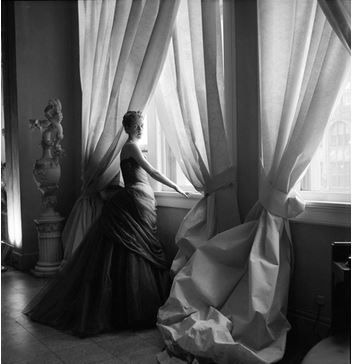
1952 portrait by Michael A. Vaccaro / LOOK Magazine. Courtesy: The Met;  Library of Congress

1952 portrait by Michael A. Vaccaro / LOOK Magazine. Courtesy: The Met; Library of Congress

Mr. James is credited with being among the first to perfect the strapless gown in the 1930s, an inspiration for Mr. Dior’s “New Look” in the 1940s, and the epitome of Vogue glamour dressing in the 1950s. He could do things with fabric that others simply couldn’t do or wouldn’t dare…well, maybe except for Madame Gres. He pushed silhouettes and fabrics further than most anyone could conceive and had the temperamental nature, drive for perfection, and uncompromising attention to detail that characterize any of history’s greatest, most passionate artists.

You always look at his creations and ask yourself, “How did he do it?” How did he get a spiral of fabric to stand out as it wraps sinuously around a sleek, strapless electric green silk mermaid dress? Is that sexy Thirties frock actually cut from one scarf?  How did he create virtual moving sculptures from the world’s most expensive fabric?

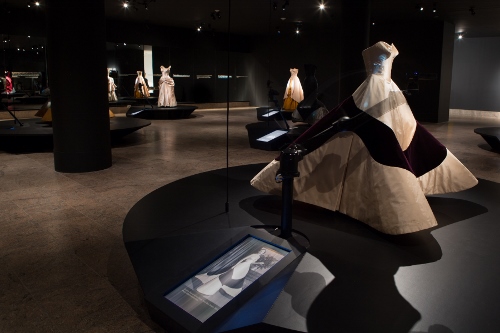
Innovative digital display tells the back story of Mrs. Hearst’s Clover Leaf Gown – too big for Ike’s inaugural, but just right for Queen Elizabeth II’s coronation

Innovative digital display tells the back story of Mrs. Hearst’s Clover Leaf Gown – too big for Ike’s inaugural, but just right for Queen Elizabeth II’s coronation

Long known for his innovative engineering, the Met came to a brilliant solution to explain the magic that Mr. James wrought over his decades of no-two-alike work – hire an architectural firm to show us.

Enter Diller Scofidio + Renfro, who have mounted these sculptures in silk inside an infinity-room gallery and paired each masterpiece with its own personal robot and humongous iPad-type display. Look at the dress and refer to the screen as the dress digitally deconstructs and is assembled again.

Cecil Beaton’s 1955  photo of Nancy James in the Swan Gown. Courtesy: The Met; Cecil Beaton Studio Archive at Sotheby's

Cecil Beaton’s 1955 photo of Nancy James in the Swan Gown. Courtesy: The Met; Cecil Beaton Studio Archive at Sotheby’s

The crowds waft from dress to dress in no particular order, clustering silently to watch digital magic, see where the robot is pointing, and view photos of Mrs. Randolph Heart, Jr., Gypsy Rose Lee, or Josephine Abercrombie in said gown. The robot with the 1954 Swan Ball Gown captivates viewers by moving underneath to televise close-up views of some of the 1,080 square feet of tulle that Mr. James used to create the oomph.

The mirrored walls of the upstairs gallery and the see-through dividers downstairs are emblazoned with the wisdom of the man himself. He seems to be talking right to you as you wonder how he made the fabric do what it’s doing (“It’s the air that’s sculpted, not the silk”) or how he thought about the world of fashion (“We who have been ahead in style have usually been ahead in our thinking”).

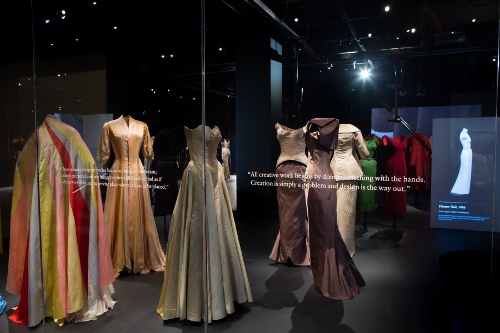
Downstairs gallery, newly named for Ms. Wintour, filled with James creations

Downstairs gallery, newly named for Ms. Wintour, filled with James creations

The second gallery (welcome back, ground floor Costume Institute!) displays his wool creations and sharply shaped cocktail wear. It’s interesting that James considered some of these genuinely more innovative than his often-photographed gowns. The curators have placed another of his “first” in a room at the back – the predecessor of today’s puffer coat. On loan from the V&A, it remarkably dates from the 1930s – his soft, sensual, silky answer to the boxy fur jackets that Ms. Schiaparelli was showing in Europe at the time.

We have to thank Mr. James for his vision and for making sure the Brooklyn design lab had so many examples of his masterpieces to teach and inspire future generations of Seventh Avenue designers. As he says, “In fashion, even what seems most fragile must be built on cement.”  Lesson learned.

The Met’s a great steward. Just listen to the love in the tour of the show by its curators:

If you have more time, hear what Zac Posen has to say to the co-curator about The Master:

Sky High NYC Real Estate at Skyscraper Museum

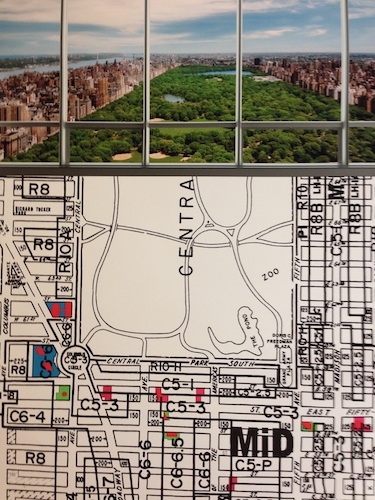
A photo of the future view from an apartment in One57, with the Midtown zoning map. Source: Skyscraper Museum

A photo of the future view from an apartment in One57, with the Midtown zoning map. Source: Skyscraper Museum

People get pretty emotional about their New York skyline. Recent news has swirled around Comcast wanting to put its name atop Rockefeller Center (goodbye, G.E.), the soon-to-be obstructed view of Manhattan from New Jersey’s Lincoln Tunnel entrance, and the super-slim ultra-tall residential skyscrapers sprouting up along the south edge of Central Park.

What’s going up at Hudson Yards? Will more sky-high slivers be overtaking the Empire State Building? The downtown skyline? Thankfully, the Skyscraper Museum is walking us all through the plans in its show, closing this weekend, Sky High & the Logic of Luxury. In a fantastic on-line and in-gallery show, the museum lays out the thinking behind six super-tall residential real estate developments, gives us the historic context of tall buildings here, and introduces us to the architects and developers behind the trend.

Take an installation walk-through.

Stars of the show, left to right: 432 Park Avenue, One57, 111 West 57th, Four Seasons at 30 Park Place, 56 Leonard, Hudson Yards Tower D.

Stars of the show, left to right: 432 Park Avenue, One57, 111 West 57th, Four Seasons at 30 Park Place, 56 Leonard, Hudson Yards Tower D.

The show – both in the museum and on the web – begins with a definition of  “slim” skyscraper and the long history of super-skinny in Manhattan. The history goes as far back to 1889 with the super-tall (at eleven stories) Tower Building at 50 Broadway – the beginning of the first phase of super-slim buildings. The MetLife Tower, finished in 1909, still towers to the east of Shake Shack at Madison Square. (Note, however, that the clock face is the only original part of the exterior left after a 1960s renovation.)

Illustrations of the world’s tallest skyscrapers in 1899 to 1918, all in Manhattan.

Illustrations of the world’s tallest skyscrapers in 1899 to 1918, all in Manhattan.

After New York’s zoning laws went into effect in 1916 (the first in the United States), hotels started growing taller and skinnier (e.g. the Sherry Netherland in 1927, the Pierre in 1930). Residences didn’t get that way until much more recently with the post-1961 legal change that allowed developers to buy air rights and build really high.

Enter Trump in the 1980s with multiple residential towers covered in dark glass, and the super-tall building (One Madison Park) that went bankrupt during the recession. But now, the entire movement is gaining steam again, with prices, views, and amenities reaching higher and higher.

The buildings featured in this show (in case you haven’t looked up) shoot up between 50 and 90 stories. Some are clustered at the foot of Central Park (check out 432 Park Avenue, One57, and 111 West 57th). Some are rising downtown – Four Seasons at 30 Park Place and 56 Leonard.

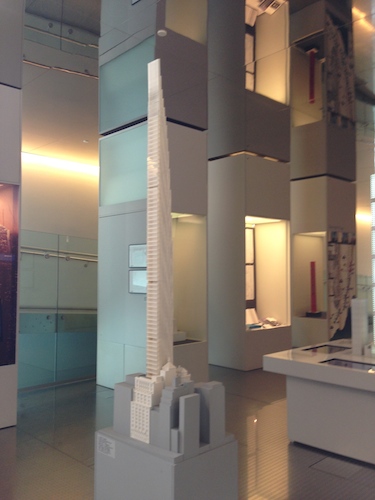
Architect model of 111 West 57th Street soars over surrounding buildings

Architect model of 111 West 57th Street soars over surrounding buildings

And, of course, some will be encircled by the High Line Phase III, such as Hudson Yards Tower D.

Take a look at the fantastic, detailed museum exhibition site and get to know your new neighbors.

Be sure to zoom in on the chart on the museum’s web site, showing the history of Manhattan sky-high apartment prices. Also, check out our Flickr photstream of the museum show.

Want to see the future? Take a look:

Gauguin’s Primitive Universe at MoMA

Be Mysterious (1890) Carved and painted lime wood from Musée d’Orsay, Paris. © RMN-Grand Palais /Art Resource NY.

Be Mysterious (1890) Carved and painted lime wood from Musée d’Orsay, Paris. © RMN-Grand Palais /Art Resource NY.

You can almost hear the rustling pandan leaves, waterfalls rushing into exotic coves, and the drums and chants of fiery Tahitian rituals around powerful idols long since banned by the Christian missionaries…but only if you take the time to get close to the smaller works in MoMA’s revealing sixth-floor show, Gauguin: Metamorphoses through June 8.

Yes, Gauguin’s bright, colorful paintings of island life are displayed, but the show is really about the darker, more primitive experience expressed in Mr. Gauguin’s ceramics, woodcuts, carvings, and monoprints – the works that we rarely get to see en masse.

Hina and Fatu (c. 1892) Carved tamanu wood. Courtesy: Art Gallery of Ontario, Toronto © 2013 AGO

Hina and Fatu (c. 1892) Carved tamanu wood. Courtesy: Art Gallery of Ontario, Toronto © 2013 AGO

After nearly two decades plugging away at his day job, weathering a stock-market crash, struggling to stay in the middle class, cranking out artworks in his spare time, and showing with the Impressionists, he just chucked it all, packed a bag, and went to Tahiti in 1891. From his young-adult years working in the merchant marine, he figured Tahiti was as far away as he could get from his family, responsibilities, and the frustrating Paris art scene where others were making it besides him.

Nothing’s perfect, and the Tahiti he arrived in was already changing from contact with the global trade networks of industrialized countries. No matter. Gauguin was captivated by the thought of connecting with the “true” primitive and savage that lived in the myths, lore, and natural beauty of Polynesia and shoving it all into the face of the avant-garde and art-buying public back home.

The curators have assembled all the images Gauguin created for three dramatic series of woodcuts. The rough edges really come out in Noa Noa (1893) and The Vollard Suite, with a few of the gouged-out woodblocks exhibited right next to several states of the same image.

Mahna no varua ino (The Devil Speaks), state IV / IV, from the suite Noa Noa (Fragrant Scent). (1893–94). Woodcut from private collection. Courtesy: Galleri K, Oslo. © Reto Rodolfo Pedrini, Zurich

Mahna no varua ino (The Devil Speaks), state IV / IV, from the suite Noa Noa (Fragrant Scent).
(1893–94). Woodcut from private collection. Courtesy: Galleri K, Oslo. © Reto Rodolfo Pedrini, Zurich

Black, dark, primitive, edgy – too edgy, in fact, for his dealer, Mr. Vollard, who felt that the prettier oil paintings were a lot more palatable to his clients. (Vollard kept the more expressive primitive prints in the drawer.)

Take a look on MoMA’s special website for the show, which has a detailed timeline for Gauguin’s travels. Clicking on images on the site allows you to zoom in closely on each work. A particularly nice touch is the full digitized version of Gauguin’s unpublished Noa Noa manuscript, which he assembled (but never published) to interpret all the exotic images and symbols of the series for the public and his hoped-for fans. Scroll down to the bottom of this page to see the manuscript, page by page.

Oviri (Savage). (1894) Partly enameled stoneware, from Musée d’Orsay, Paris. © RMN-Grasnd Palais /Art Resource NY

Oviri (Savage). (1894) Partly enameled stoneware, from Musée d’Orsay, Paris. © RMN-Grasnd Palais /Art Resource NY

So here’s your chance to examine what was boxed up for so long along alongside magnificently  disturbing sculptures, panels, and reliefs of goddesses, devils, spirits, waves, women, and mountains created out of tamanu and pua wood with the occasional daubs of colored paint. It’s clear that the design and detail of Gauguin’s beautiful symbolist color paintings got a further workout through all of these other works portraying the dark, mysterious side of life forces emanating from the mind of a struggling artist obsessed with the uber-primitive.

Some say that Picasso was inspired to transform his Demoiselles after seeing some of this raw work (exhibited after Gauguin’s death). Say hello to them seven days a week on MoMA’s 5th Floor.

Get Out of Town with JJ Audubon

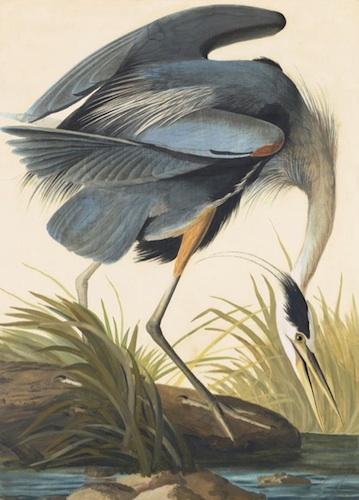
Audubon’s Great Blue Heron (Ardea herodias), Study for Havell pl. 281 (1832). Watercolor, graphite, and pastel on paper, laid on thin board. Courtesy NYHS and Mrs. Audubon

Audubon’s Great Blue Heron (Ardea herodias), Study for Havell pl. 281 (1832). Watercolor, graphite, and pastel on paper, laid on thin board. Courtesy NYHS and Mrs. Audubon

If you need to get out of town Memorial Day weekend, there’s no better traveling companion than J.J. Audubon, whose original watercolors will transport you to another time and place better than any plane, car, or train. Experience his spectacular show at the New-York Historical Society, Audubon’s Aviary: Parts Unknown: Part II of the Complete Flock today and tomorrow.

Can’t make it in person to New York? Not a problem, because you can tour Mr. Audubon’s show (and more) on a fantastic website that shows you his birds, provides the maps of your journey, and more. True, you won’t enjoy the life-size paintings – shocking when you see them in person – but you’ll learn the entire backstory of JJ’s trips through the Southeast US and Northeast Canada as he did the best-job-ever for his epic Birds of America four-volume series.

In the NYHS gallery in the last several weeks, visitors have been running up to the second floor and grabbing the magnifying glasses to study each brushstroke of these magnificent works. Although they’re mostly watercolor, each painting is enhanced with graphite, pastel, gouache, and ink. Because no one’s perfect, a few have birds pasted in from other pieces of paper, but you really can’t tell unless you study them closely.

A second Great Blue Heron (1834), thought to be another species at the time, with the skyline of Key West, Florida. Courtesy NYHS and Mrs. Audubon

A second Great Blue Heron (1834), thought to be another species at the time, with the skyline of Key West, Florida. Courtesy NYHS and Mrs. Audubon

It’s the first time that NYHS has exhibited JJ’s complete watercolor series, but it’s so big – 474 original watercolors – that they had to break it into three separate shows.

Mrs. Audubon presented JJ’s entire set of original work to NYHS in1862. Her husband had worked so hard on these works of art (he didn’t consider them “scientific”) that she commented that sometimes the birds felt like “her rivals.” Better that NYHS preserve them for posterity.

The museum decided to mount the watercolors in the order in which JJ painted them. On the website, you can revisit Part I, but let’s turn our attention to Part II.

As you’d expect from his trips to the Carolinas, Georgia, Florida, Labrador, and Newfoundland in 1831-33, the majority of the birds you’ll see live in and around the water. Two spectacular works are of the Great Blue Heron in two color ways. In JJ’s lifetime, the white- and bluish-colored herons were thought to be two separate species (which they’re not), so we’re treated two very large paintings of one fishing from shore and the other enjoying a meal in sight of the Key West skyline across the bay.

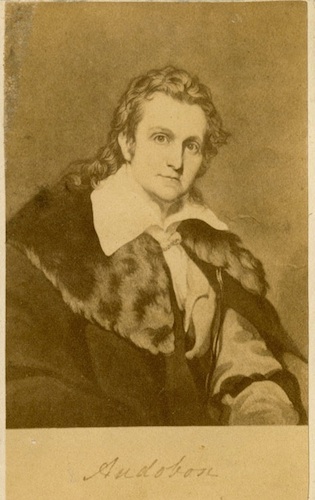
Carte–de–visite of John James Audubon. The legacy lives. Courtesy: NYHS

Carte–de–visite of John James Audubon. The legacy lives. Courtesy: NYHS

It’s amazing to consider that JJ started many of these while he was on his journeys, totally outdoing Banksy as a premiere peripetatic creating-art-wherever road warrior. Of course, he did it all without electricity and frequent-flyer miles hauling around gigantic pieces of perfect paper.

Through it’s collaboration with the Cornell Ornithology Lab, the NYHS provides (on the web and on the gallery audio guides) clips of each bird’s distinctive voice. Another nice in-gallery touch is an iPad app that allows visitors to compare each watercolor with the engraved print made in London by Robert Havell, Jr. for the printed books.

Enjoy JJ’s images here.

Last Call for the Whitney Biennial Uptown

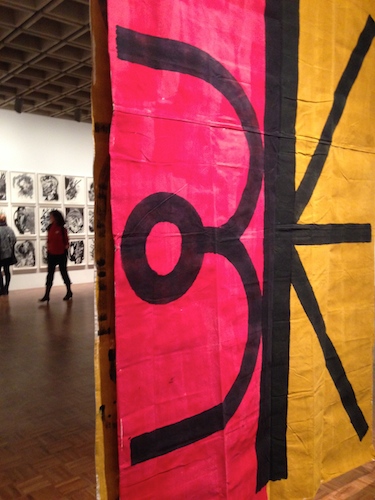
Detail of Elijah Burgher’s “The Pattern of All Patience 1” (2014), featuring magical symbols, installed on the second floor

Detail of Elijah Burgher’s The Pattern of All Patience 1 (2014), featuring magical symbols, installed on the second floor

It’s the last time the Whitney Biennial is holding its big, expansive, colorful, and provocative shindig on the Upper East Side, since it will decamp to its new riverside home at the foot of the High Line next year. Go before it ends on May 25.

It’s amazing to think that this is the 77th time that the Whitney has hosted either an annual or biennial show to showcase the best of American art, as controversial and impossible a task as that may be. This year, the Whitney threw in the towel in trying to showcase “the best” of what’s going on in contemporary art coast to coast. It just wasn’t possible given the expanse, diversity, and barrier-breaking works that American artists are cranking out right now.

Instead, the Whitney invited three innovative curators to choose what should be shown on each of three floors and around town. (Yes, there are offsite works, too.)

“Pillar of Inquiry/Supple Column” (2013-2014) by fiber artist superstar Sheila Hicks

Pillar of Inquiry/Supple Column (2013-2014) by fiber artist superstar Sheila Hicks

The divide-and-conquer approach works, resulting in a fun variety of media, installations, paintings, sculptures, textile art, performance, and collections-as-art. The team pulled it all together in only 18 months while still doing their day jobs at Chicago’s Art Institute, London’s Tate Modern, and Philadelphia’s ICA.

Visit our Flickr album and walk through the press preview with us, where several artists were on hand in the galleries with their work.

It’s a happier, lighter show compared to past Biennials, but that doesn’t mean that the artists ignore social commentary or darker sides of human nature. It just means that you won’t feel as though you need a graduate degree in Conceptual Art to enjoy and ponder the work you’ll encounter.

Highlights: Charlemagne Palestine has created a surprisingly spooky installation in the stairwell that features sonorous sounds emanating from speakers adorned with stuffed animals. LA painter Rebecca Morris has two bright, gigantic delightful paintings on the second floor, curated by Philadelphia’s Anthony Elms, which features several satisfying collections-as-art installations by Julie Ault, Richard Hawkins, and Catherine Opie.

Pterosaur and giant theropod are featured in Shio Kusaka’s third-floor ceramics display

Pterosaur and giant theropod are featured in Shio Kusaka’s fourth-floor ceramics display

Fans of NYC’s 1970s art scene (when Soho was still industrial) will be captivated by The Gregory Battcock Archive, peering at the ephemera collected by one of the decade’s most prominent art critics who died under mysterious circumstances in 1980. Amazingly, it was all found by artist Joseph Grigley wafting around garbage bins in an abandoned storage facility. Grigley’s created a disciplined, loving, and intimate installation of reclaimed Battcock mementos, memories, and letters with Cage, Warhol, Moorman, Paik, Ono, and other 70s superstars.

The top floor takes a down-home approach to some very enjoyable paintings, sculptures, installations, and ceramics. Midwest curator Michelle Grabner said that she wishes she could just camp out there for the run of the show. You’ll enjoy it, too — a dreamy installation by Joel Otterson, a monumental yarn pillar by uber-fiber-artist Sheila Hicks, a witty desk and bookcase by master woodsman-sculptor David Robbins, and shelf of delicate and whimsical ceramics by Shio Kusaka.

Knits with commentary by Lisa Anne Auerbach, including We Are All Pussy Riot

Knits with commentary by Lisa Anne Auerbach, including We Are All Pussy Riot

The third floor, curated by Stuart Comer (who’s recently moved to MoMA), features a lot of screens and digital media, essentially making you think about art in the age of the iPhone. As you step out of the elevator, you’ll encounter Ken Okiishi’s series of painted panels. Oh, wait! They’re actually abstract paintings on upended flat-screen TV displays – sort of like what would happen if Kandinsky’s Seasons were done at the Samsung plant.

The mixing of media keeps morphing in room after room of clever installations by Triple Canopy (antiques meet 3D printing) and Lisa Anne Auerbach (knitting meets social commentary, and zines meet the Giant in Jack and the Beanstalk). See Lisa’s work and listen to her explain her knitting:

There are dozens of other videos and audio guide stops posted on the Biennial web site (click on “watch and listen”), as well as bios of all the artists.

Alert: MAD’s own design biennial opens July 1.

Folk Art Couture

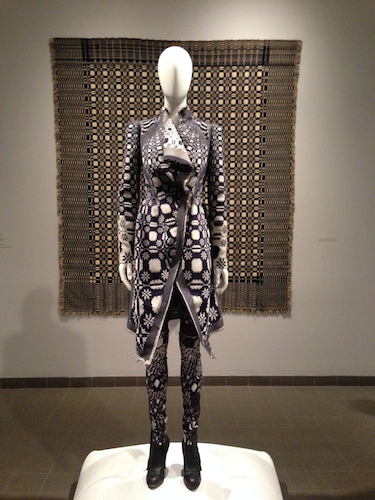
Gary Graham’s coat of wool/cotton jacquard in front of his inspiration — an 1810 Ann Carll Coverlet: “Blazing Star and Snowball.”

Gary Graham’s coat of wool/cotton jacquard in front of his inspiration — an 1810 Ann Carll Coverlet: “Blazing Star and Snowball.”

Delightful, whimsical carved animals from New Mexico don’t often appear on the runway with couture, but they certainly take center stage in the American Folk Art Museum’s fantastic show, Folk Couture: Fashion and Folk Art, which closes today.

No worries, though, the museum has created a detailed, media-rich exhibition site on Tumblr that gives you a close-up look at the fabrics, fashions, and folk art that inspired these fun, creative looks.

The museum pulled 100 of works from its collection and asked thirteen
designers to create clothes – wearable or not – that would reflect the scope, spontaneity, and sheer funkiness of folk art.

A steady stream of fashion-lovers worked their way through three galleries of beautiful clothes and creations inspired by collection pieces from across America — New Mexico folk-art porcupines inspired Jean Yu to make a straw-chiffon cocktail ensemble; an 1810 coverlet from Westbury, Long Island inspired Gary Graham to create a gorgeous jacquard-pattern coat and leggings; a religious sculpture made by German immigrants in North Dakota inspired Brazilian designer Fabio Costa to create an other-worldly white ensemble that would look at home in any avant-garde collection.

Closep-up of Michael Bastian’s sweater icon based upon an 1840s weathervane of the Archangel Gabriel. The look also features a hood with built-in earmuffs.

Closep-up of Michael Bastian’s sweater icon based upon an 1840s weathervane of the Archangel Gabriel. The look also features a hood with built-in earmuffs.

Apparently menswear designer Michael Bastian is a fan of this museum and loves its collection, so he fairly faithfully replicated an angel-weathervane icon on the front of his guy sweater and thought it would be fun (which it is!) to take the top hat and eyewear from a Michigan folk-art sculpture and put them right onto his mannequin’s head. The look is great — modern artist and old-fashioned at the same time.

Visit our Flickr album and the exhibition site to see all of the inspirations from the museum collection and learn more about each designer’s working process. We particularly liked the inspiration board in the gallery, which showed some of the process from art to reimagination to finished gown, coat, and dress.

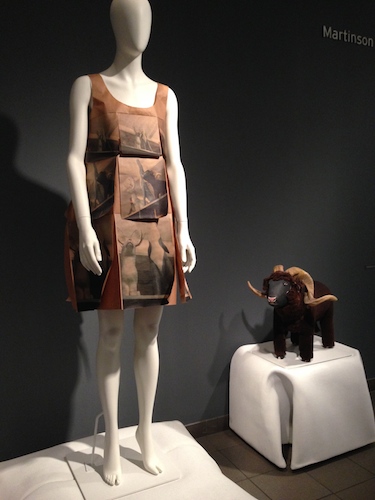
You can’t really beat Yeohlee’s paper dress, featuring images of New Mexico folk-art animals printed on Kraft paper and made into a modern and mod shaman ensemble. Chic and magical at the same time, just like her all of her collections and fans.

Yeohlee’s dress — Shamanistic Printed Prayer Flag Dress from Brown Kraft Paper. Among her whimsical inspirations — a ram carved in 1988 by New Mexico artist Johnson Antonio

Yeohlee’s dress — Shamanistic Printed Prayer Flag Dress from Brown Kraft Paper. Among her whimsical inspirations — a ram carved in 1988 by New Mexico artist Johnson Antonio

We’ve heard that this inspirational show will tour and we’ll keep you posted.

Subversive Chinese Brush-Up at the Met

Yang Jiechang’s Crying Landscape (2003) shares the Gallery for Art of Ancient China with a sandstone stele from the Northern Wei dynasty (489-495) and the 1319 Buddha of Medicine.

Yang Jiechang’s Crying Landscape (2003) shares the Gallery for Art of Ancient China with a sandstone stele from the Northern Wei dynasty (489-495) and the 1319 Buddha of Medicine.

Normally, the galleries for Asian Art at the Metropolitan Museum of Art are pretty tranquil. But through April 6, you’ll find them buzzing with contemporary art lovers reveling in the hunt to find the most famous, subversive, subtle works by Chinese painters, sculptors, and digital artists residing amidst centuries-old treasures in the widely popular exhibition, Ink Art: Past as Present in Contemporary China.

The Met gave the Chinese art curators free reign to pluck sly works from the in-house contemporary collections created by Chinese artists over the last 20 years, grab monumental works from private collectors, and mount a tribute to how post-Cultural Revolution innovators parse the traditions associated with centuries-old art making in their ancestral country.

How do the hottest artists on the planet turn calligraphy and inked woodblocks into biting social commentary? Take a stroll through the second floor Asian art wing.

Inspired by Cultural Revolution posters, the letters in Wu Shanzhuan’s Character Image of Black Character Font (1989) have no meaning.

Inspired by Cultural Revolution posters, the letters in Wu Shanzhuan’s Character Image of Black Character Font (1989) have no meaning. Courtesy: Private collector, the artist.

Just past the balcony-bar area, the monumental 1319 Buddha of Medicine mural from Shanxi Province, China, casts a benign presence over the Gallery for Art of Ancient China. But just stage right, two larger-than-life works on paper preview how Chinese artists twist the “then” into the “now”.

Yang Jiechang’s Crying Landscape panels are painted in the beautiful, colorful “old school” flat Asian style but depict decidedly unbeautiful industrial and political subjects. Similarly, Qiu Zhirie’s Nanjing Yangzi River Bridge ink triptych features masterful, large-scale ink-brush technique but uses art-world icons to relay a disturbing story. It’s an installation triumph that will haunt you every time you pass through that room again.

Large-scale calligraphy by many of the artists makes ink-pot-and-brush tradition echo with gestures as large as Rothko’s. In the galleries with meticulously crafted “landscape” drawings and images, you’ll ask how this modern crew managed to produce scrolls with such heft and detail. Take a walk-through of the show through our Flickr site.

In 1995, Ai Weiwei corporatized a Han Dynasty (206 B.C. – 9 A.D.) earthenware jar.

In 1995, Ai Weiwei corporatized a Han Dynasty (206 B.C. – 9 A.D.) earthenware jar. Courtesy: M + Sigg, the artist

Along the way to back of the wing, the curators play hide-and-seek, putting Ai Weiwei’s “enhanced” Han Dynasty jar right in the aisle with the “unmodernized” earthenware vessels, and mounting Hong Hoo’s subtly colored, hilarious historical “atlas” silkscreens in a case that practically dares unfocused visitors to pass them by as they drift toward the Astor Court.

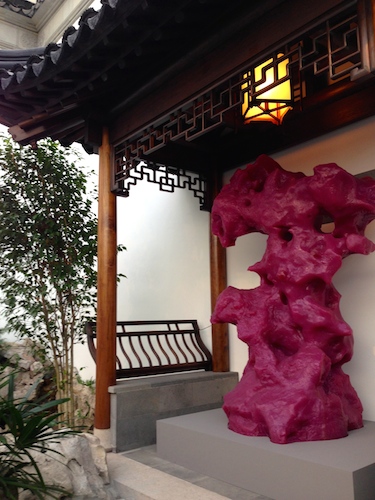
Hopefully by the time they get to the rock garden they will notice Zhang Jianjun’s crazy pink silicone rubber “scholar rock” right next to the real ones. Zhan Wang’s stainless steel scholar rock and Shou Fan’s side chairs are beautifully arranged in the Ming Dynasty room just off the Court, along with more of Ai Weiwei’s furniture hijinx.

After you’re done getting a feel for how the galleries have been transformed, go back into the Met’s exhibition web site to study the brushwork and details and get to know some of the artists.

Zhang Jianjun’s 2008 silicone rubber Scholar Rock (The Mirage Garden) sits in a 17th-century pagoda in the Met’s Astor Court

Zhang Jianjun’s 2008 silicone rubber Scholar Rock (The Mirage Garden) sits under a 17th-century pagoda in the Met’s Astor Court. Courtesy: Sigg Collection, the atist

Although the web site appears to be more plain-vanilla than jazzy, you’ll be surprised to see that the digital back-end of the Met archives lets you zoom into each of the paintings to see the handsome handwork of each of these wunderkinds from each thematic section of the show. You can even peruse the gigantic scrolls up close, section by section.

The video room, where art lovers can relax and watch a rotating collection of work, is a nice touch. The modern digital sign to the side tells you exactly where you are in the rotation.

Here’s a link to one of the featured videos: Get to know the constantly transforming cityscape of Beijing through Chen Shaoxiong’s 2005  Ink City, and see what happens when a contemporary artist paints daily life in Beijing with traditional tools and ports his day-to-night experience to video.

Armory Show Stars on the West Coast of Manhattan

The Artforum Lounge on the Contemporary Pier

The Artforum Lounge on the Contemporary Pier

For four action-packed days, the art crowd made its way to the West Coast of Manhattan Island past gritty lots, warehouses, the ball fields of Clinton, and high-rises-under-construction to enter a white, light-filled glittery expanse of painting, sculpture, and champagne bars at the 2014 edition of The Armory Show.

This year, 205 exhibitors showed off the best in modern masters and contemporary upstarts. Walk through it with us on our Flickr feed.

If you’ve never been there, just know that the art fills two full piers (yes, where the cruise ships come in). You may think the Whitney Biennial is big, but The Armory promenade is vast.

On the Modern Pier: Chicago’s Alan Koppel Gallery gave tribute to original Armory Show in 1913 with several Duchamps, but most of the work is post-1940 by Modern superstars. Right at the start of the pier, Galleria d’Arte Maggiori positioned a nice rough-and-ready Mattia Moreni in kind-of a face-off with a pretty primitive Basquiat nearby.

Dramatic paper collage and charcoal work by Elaine de Kooning with two Picasso ceramics at Vivian Horan

Dramatic paper collage and charcoal work by Elaine de Kooning with two little Picasso ceramics at Vivian Horan

Frankfurt’s Die Galerie gave NYC glamour-icon Louise Nevelson a mini-tribute, and several galleries featured Marca-Relli’s painting/collages.

Best on the Modern Pier: Vivian Horan’s booth, dominated by a large Elaine de Kooning charcoal drawing with collage, but populated by two small Picasso ceramics that most fair goers didn’t even see, although they were practically out in the aisle. You don’t see Picasso ceramics too much, and they really added a nice touch.

Second runner-up was the Armand Bartos booth with a sharp Kenneth Noland, Andy’s chicken soup can under glass, and a no-holds-barred Stella. In fact, there were multiple 1980s 3D Frank Stellas leaping out from walls, demanding attention. Besides posing with the soup can, lots of visitors were snapping photos of themselves in front of Mr. Stella’s work.

1949 Hans Hoffman oil at London’s Crane Kalman

1949 Hans Hoffman oil at London’s Crane Kalman

Welcomed surprises: Even though he taught most of the post-war painters in New York, you don’t often see Hans Hoffman paintings, so it was nice to encounter one of his color explosions at Crane Kalman. And we’ve never seen the two super-early skinny Lichtenstein sculptures at Barcelona’s Galeria Marc Domenech booth. Guess they were made in those lean before-the-dots years on his path to Pop.

Susan Harris curated a great micro-show of 20th century female artists, mostly works on paper (e.g. Georgia O’Keefe, Kiki Smith, Lee Bonticou), all contributed by gallery exhibitors.

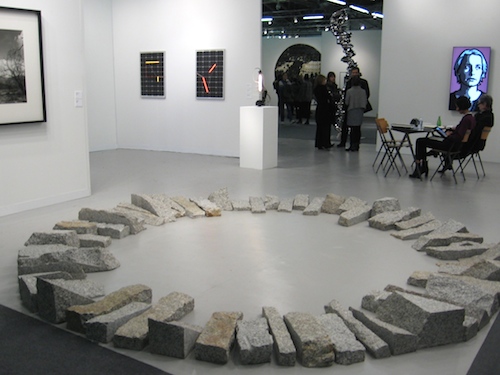
Richard Long’s 1994 Merrivale Circle at the Lisson Gallery

Richard Long’s 1994 Merrivale Circle at the Lisson Gallery

Although you could hike outdoors to get to the second pier along the West Side Highway, most were guided through a wormhole and down a flight of stairs to descend directly into the booths from 17 contemporary galleries across China – a great landing into a warren of booths featuring installations (watch out for the Roomba!), and user-friendly exercise equipment that the PRC makes available in public parks for citizen fitness.

From there, you enter the Contemporary Pier area.  Highlights: the whirling handbag piece (with real handbags) by Egill Saebjornsson at Reykjavik’s i8 Gallery, Richard Long’s stone circle at London’s Lisson Gallery booth, the completely constructed entry to Boesky Gallery, and Claudia Weiser’s cool wooden sculptures at Sies + Hoke (Dusseldorf).

Nick Cave Soundsuits at Jack Shainman

Nick Cave Soundsuits at Jack Shainman

A great place to end the journey was at the Jack Shainman booth, with its dramatic contemporary art exploring expressions from Africa, African-Americans, and global artists — the Nick Cave soundsuits and Richard Mosse’s spectacularly dissonant hot-pink infrared photograph of a waterfall in the continually disintegrating, war-torn Democratic Republic of Congo.

Take a look at the highlights here.

Fair goer relaxes on modernist egg chair under the watchful eye of Dali

Fair goer relaxes on modernist egg chair under the watchful eye of Dali